TITLE : BASICS OF LANDSCAPE ARCHITECTURE

         For All Students of …………..

            ARCHITECTURE
   INTERIOR DESIGN AND DECORATION
       LAND SCAPING ARHCITECTS
   SUSTAINABLE BUIDLING DESIGNERS
  GREEN ROOF DESIGNERS & ARCHITECTS


          Edited and Compiled by:
           SHAIKH JAVED ALAM
 TOTAL FACILITIES MANAGEMENT SERVICES


                                           PAGE : 01
Landscape
Landscape :


Landscape (Definition)

       • An expanse of scenery that can be seen in a single view.

       • A section or expanse of rural scenery, usually extensive,
         that can be seen from a single viewpoint.


                                                              PAGE : 02
Landscape
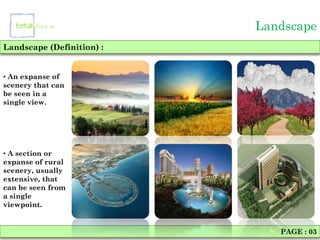
Landscape (Definition) :


• An expanse of
scenery that can
be seen in a
single view.


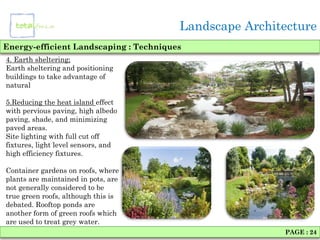
• A section or
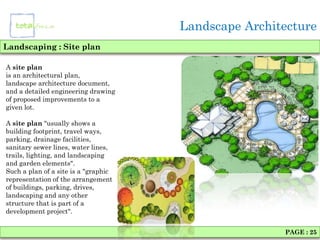
expanse of rural
scenery, usually
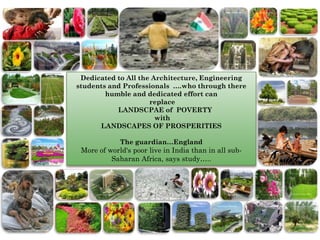
extensive, that
can be seen from
a single
viewpoint.


                              PAGE : 03
Landscaping
Landscaping (Definition) :

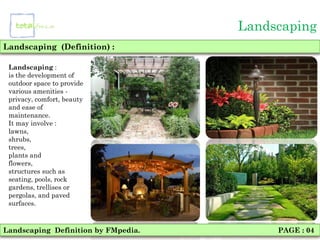
 Landscaping :
 is the development of
 outdoor space to provide
 various amenities -
 privacy, comfort, beauty
 and ease of
 maintenance.
 It may involve :
 lawns,
 shrubs,
 trees,
 plants and
 flowers,
 structures such as
 seating, pools, rock
 gardens, trellises or
 pergolas, and paved
 surfaces.


Landscaping Definition by FMpedia.        PAGE : 04
Landscaping
Landscaping (Definition) :
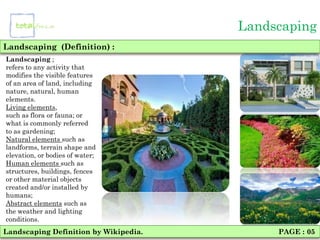
Landscaping ;
refers to any activity that
modifies the visible features
of an area of land, including
nature, natural, human
elements.
Living elements,
such as flora or fauna; or
what is commonly referred
to as gardening;
Natural elements such as
landforms, terrain shape and
elevation, or bodies of water;
Human elements such as
structures, buildings, fences
or other material objects
created and/or installed by
humans;
Abstract elements such as
the weather and lighting
conditions.
Landscaping Definition by Wikipedia.        PAGE : 05
Landscaping
Landscaping (Definition)


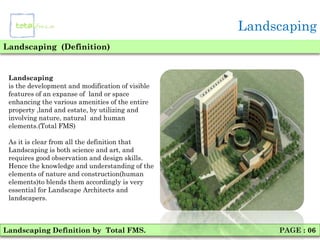
 Landscaping
 is the development and modification of visible
 features of an expanse of land or space
 enhancing the various amenities of the entire
 property ,land and estate, by utilizing and
 involving nature, natural and human
 elements.(Total FMS)

 As it is clear from all the definition that
 Landscaping is both science and art, and
 requires good observation and design skills.
 Hence the knowledge and understanding of the
 elements of nature and construction(human
 elements)to blends them accordingly is very
 essential for Landscape Architects and
 landscapers.


Landscaping Definition by Total FMS.                   PAGE : 06
Landscaping
Landscaping : Elements/Component (Soft and Hard components)
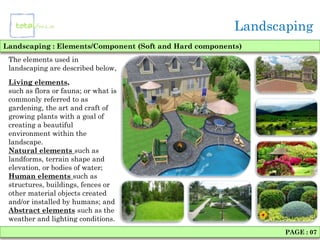
 The elements used in
 landscaping are described below,
 Living elements,
 such as flora or fauna; or what is
 commonly referred to as
 gardening, the art and craft of
 growing plants with a goal of
 creating a beautiful
 environment within the
 landscape.
 Natural elements such as
 landforms, terrain shape and
 elevation, or bodies of water;
 Human elements such as
 structures, buildings, fences or
 other material objects created
 and/or installed by humans; and
 Abstract elements such as the
 weather and lighting conditions.
                                                                PAGE : 07
Landscaping
Landscaping : Soft Landscaping
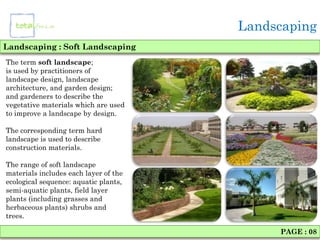
The term soft landscape;
is used by practitioners of
landscape design, landscape
architecture, and garden design;
and gardeners to describe the
vegetative materials which are used
to improve a landscape by design.

The corresponding term hard
landscape is used to describe
construction materials.

The range of soft landscape
materials includes each layer of the
ecological sequence: aquatic plants,
semi-aquatic plants, field layer
plants (including grasses and
herbaceous plants) shrubs and
trees.

                                            PAGE : 08
Landscaping
Landscaping : Hard & Soft Landscaping
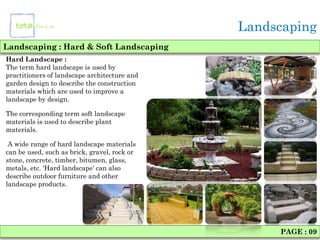
Hard Landscape :
The term hard landscape is used by
practitioners of landscape architecture and
garden design to describe the construction
materials which are used to improve a
landscape by design.

The corresponding term soft landscape
materials is used to describe plant
materials.

 A wide range of hard landscape materials
can be used, such as brick, gravel, rock or
stone, concrete, timber, bitumen, glass,
metals, etc. 'Hard landscape' can also
describe outdoor furniture and other
landscape products.


                                                   PAGE : 09
Landscape Architecture
Landscape Architecture (Definition:1)
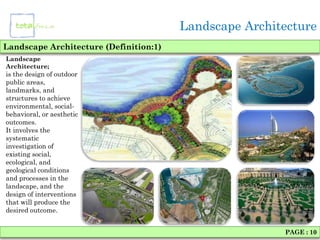
Landscape
Architecture;
is the design of outdoor
public areas,
landmarks, and
structures to achieve
environmental, social-
behavioral, or aesthetic
outcomes.
It involves the
systematic
investigation of
existing social,
ecological, and
geological conditions
and processes in the
landscape, and the
design of interventions
that will produce the
desired outcome.


                                                        PAGE : 10
Landscape Architecture
Landscape Architecture (Definition:2)
Landscape Architecture :

The art of arranging or
modifying the features of a
landscape, an urban area,
etc., for aesthetic or practical
reasons.

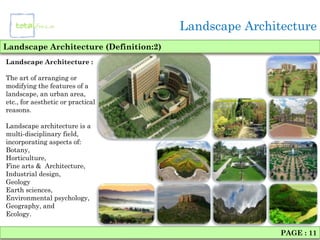
Landscape architecture is a
multi-disciplinary field,
incorporating aspects of:
Botany,
Horticulture,
Fine arts & Architecture,
Industrial design,
Geology
Earth sciences,
Environmental psychology,
Geography, and
Ecology.

                                                        PAGE : 11
Landscape Architecture
Landscape Architecture : Different involved Aspects
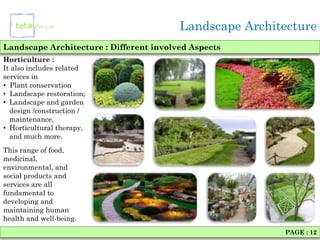
Horticulture :
It also includes related
services in
• Plant conservation
• Landscape restoration;
• Landscape and garden
  design /construction /
  maintenance,
• Horticultural therapy,
  and much more.
This range of food,
medicinal,
environmental, and
social products and
services are all
fundamental to
developing and
maintaining human
health and well-being.
                                                         PAGE : 12
Landscape Architecture
Landscape Architecture : Different involved Aspects
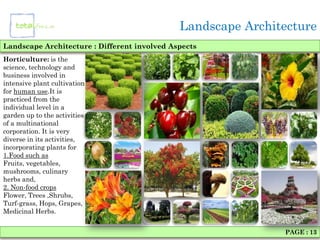
Horticulture: is the
science, technology and
business involved in
intensive plant cultivation
for human use.It is
practiced from the
individual level in a
garden up to the activities
of a multinational
corporation. It is very
diverse in its activities,
incorporating plants for
1.Food such as
Fruits, vegetables,
mushrooms, culinary
herbs and,
2. Non-food crops
Flower, Trees ,Shrubs,
Turf-grass, Hops, Grapes,
Medicinal Herbs.


                                                              PAGE : 13
Landscape Architecture
Landscaping : Horticulture : Botany

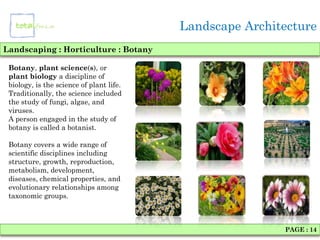
 Botany, plant science(s), or
 plant biology a discipline of
 biology, is the science of plant life.
 Traditionally, the science included
 the study of fungi, algae, and
 viruses.
 A person engaged in the study of
 botany is called a botanist.

 Botany covers a wide range of
 scientific disciplines including
 structure, growth, reproduction,
 metabolism, development,
 diseases, chemical properties, and
 evolutionary relationships among
 taxonomic groups.


                                                          PAGE : 14
Landscape Architecture
Landscape Architecture : Scope

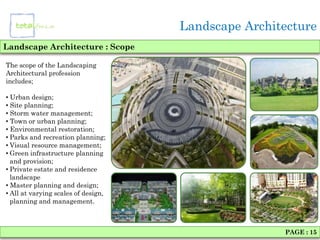
The scope of the Landscaping
Architectural profession
includes;

• Urban design;
• Site planning;
• Storm water management;
• Town or urban planning;
• Environmental restoration;
• Parks and recreation planning;
• Visual resource management;
• Green infrastructure planning
  and provision;
• Private estate and residence
  landscape
• Master planning and design;
• All at varying scales of design,
  planning and management.


                                                     PAGE : 15
Landscape Architecture
Landscape : Landscaping : Scopes : Urban Design
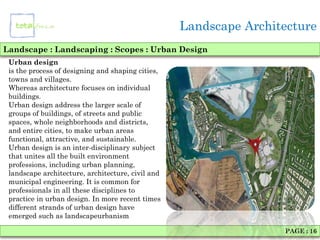
 Urban design
 is the process of designing and shaping cities,
 towns and villages.
 Whereas architecture focuses on individual
 buildings.
 Urban design address the larger scale of
 groups of buildings, of streets and public
 spaces, whole neighborhoods and districts,
 and entire cities, to make urban areas
 functional, attractive, and sustainable.
 Urban design is an inter-disciplinary subject
 that unites all the built environment
 professions, including urban planning,
 landscape architecture, architecture, civil and
 municipal engineering. It is common for
 professionals in all these disciplines to
 practice in urban design. In more recent times
 different strands of urban design have
 emerged such as landscapeurbanism

                                                                   PAGE : 16
Landscape Architecture
Landscaping : Scope : Storm water management
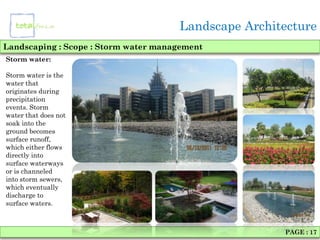
Storm water:

Storm water is the
water that
originates during
precipitation
events. Storm
water that does not
soak into the
ground becomes
surface runoff,
which either flows
directly into
surface waterways
or is channeled
into storm sewers,
which eventually
discharge to
surface waters.


                                                      PAGE : 17
Landscape Architecture
Landscaping : Scope : Storm water management


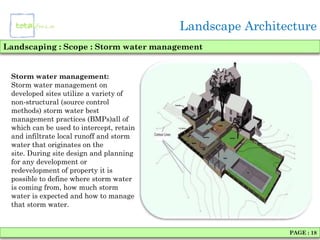
 Storm water management:
 Storm water management on
 developed sites utilize a variety of
 non-structural (source control
 methods) storm water best
 management practices (BMPs)all of
 which can be used to intercept, retain
 and infiltrate local runoff and storm
 water that originates on the
 site. During site design and planning
 for any development or
 redevelopment of property it is
 possible to define where storm water
 is coming from, how much storm
 water is expected and how to manage
 that storm water.


                                                           PAGE : 18
Landscape Architecture
Landscaping : Scope : Energy-efficient Landscaping
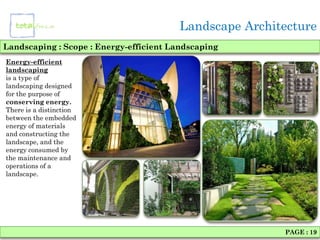
Energy-efficient
landscaping
is a type of
landscaping designed
for the purpose of
conserving energy.
There is a distinction
between the embedded
energy of materials
and constructing the
landscape, and the
energy consumed by
the maintenance and
operations of a
landscape.


                                                         PAGE : 19
Landscape Architecture
Energy-efficient Landscaping : Techniques
Energy-efficient
landscaping design
Techniques include:
1.Planting trees;
Planting trees for the
purpose of providing shade,
which reduces cooling costs.

2.Planting Windbreaks;
Planting or building
windbreaks to slow winds
near buildings, which
reduces heat loss.

3. Wall sheltering;
Wall sheltering, where
shrubbery or vines are used
to create a windbreak
directly against a wall.
landforms as windbreaks

                                                        PAGE : 20
Landscape Architecture
Energy-efficient Landscaping : Techniques
A green roof or living roof :
is a roof of a building that is
partially or completely covered
with vegetation and a growing
medium, planted over a
waterproofing membrane. It
may also include additional
layers such as a root barrier and
drainage and irrigation systems,
that cool buildings with extra
thermal mass and
evapotranspiration.

Green roofs serve several
purposes for a building, such as
absorbing rainwater, providing
insulation, creating a habitat for
wildlife, and helping to lower
urban air temperatures and
mitigate the heat island effect.
                                                        PAGE : 21
Landscape Architecture
Energy-efficient Landscaping : Techniques

There are two types of
green roofs based on
the depth of growing
medium :

An intensive roofs,
which are thicker and
has more than six
inches of growing
medium and tends to
have greater plant
variety and diversity,
as well as higher
weight(heavier), and
requires more
maintenance.


                                                        PAGE : 22
Landscape Architecture
Energy-efficient Landscaping : Techniques
An extensive roofs, which
are covered in a light
layer of vegetation and
are lighter than an
intensive green roof.
No single type of green
roof works for all
buildings, climates and
client needs. Green roofs
are categorized as
"intensive" or "extensive,"
based on the depth of
growing medium. An
extensive roof has 6
inches or less of growing
medium. It also has lower
weight, plant diversity,
costs and
Maintenance.

                                                        PAGE : 23
Landscape Architecture
Energy-efficient Landscaping : Techniques
4. Earth sheltering;
Earth sheltering and positioning
buildings to take advantage of
natural

5.Reducing the heat island effect
with pervious paving, high albedo
paving, shade, and minimizing
paved areas.
Site lighting with full cut off
fixtures, light level sensors, and
high efficiency fixtures.

Container gardens on roofs, where
plants are maintained in pots, are
not generally considered to be
true green roofs, although this is
debated. Rooftop ponds are
another form of green roofs which
are used to treat grey water.
                                                        PAGE : 24
Landscape Architecture
Landscaping : Site plan

A site plan
is an architectural plan,
landscape architecture document,
and a detailed engineering drawing
of proposed improvements to a
given lot.

A site plan "usually shows a
building footprint, travel ways,
parking, drainage facilities,
sanitary sewer lines, water lines,
trails, lighting, and landscaping
and garden elements".
Such a plan of a site is a "graphic
representation of the arrangement
of buildings, parking, drives,
landscaping and any other
structure that is part of a
development project".


                                                      PAGE : 25
Landscape Architect
Landscaping : Scope and Field of Actions…….
Landscape Architect :
A practitioner in the profession of landscape architecture is called a landscape architect.

The activities of a landscape architect can range from the creation of public parks and parkways to
site planning for campuses and corporate office parks, from the design of residential estates to the
design of civil infrastructure and the management of large wilderness areas or reclamation of
degraded landscapes such as mines or landfills.

Landscape architects work on all types of structures and external space - large or small, urban,
suburban and rural, and with "hard" (built) and "soft" (planted) materials, while integrating
ecological sustainability. The most valuable contribution can be made at the first stage of a project to
generate ideas with technical understanding and creative flair for the design, organization, and use
of spaces.

The landscape architect can conceive the overall concept and prepare the master plan, from which
detailed design drawings and technical specifications are prepared. They can also review proposals to
authorize and supervise contracts for the construction work. Other skills include preparing design
impact assessments, conducting environmental assessments and audits, and serving as an expert
witness at inquiries on land use issues. They can also support and prepare applications for capital
and revenue funding grants.


                                                                                              PAGE : 26
Dedicated to All the Architecture, Engineering
students and Professionals ….who through there
        humble and dedicated effort can
                     replace
           LANDSCPAE of POVERTY
                       with
      LANDSCAPES OF PROSPERITIES

             The guardian…England
 More of world's poor live in India than in all sub-
          Saharan Africa, says study…..

Landscaping Architecture

  • 1.
    TITLE : BASICSOF LANDSCAPE ARCHITECTURE For All Students of ………….. ARCHITECTURE INTERIOR DESIGN AND DECORATION LAND SCAPING ARHCITECTS SUSTAINABLE BUIDLING DESIGNERS GREEN ROOF DESIGNERS & ARCHITECTS Edited and Compiled by: SHAIKH JAVED ALAM TOTAL FACILITIES MANAGEMENT SERVICES PAGE : 01
  • 2.
    Landscape Landscape : Landscape (Definition) • An expanse of scenery that can be seen in a single view. • A section or expanse of rural scenery, usually extensive, that can be seen from a single viewpoint. PAGE : 02
  • 3.
    Landscape Landscape (Definition) : •An expanse of scenery that can be seen in a single view. • A section or expanse of rural scenery, usually extensive, that can be seen from a single viewpoint. PAGE : 03
  • 4.
    Landscaping Landscaping (Definition) : Landscaping : is the development of outdoor space to provide various amenities - privacy, comfort, beauty and ease of maintenance. It may involve : lawns, shrubs, trees, plants and flowers, structures such as seating, pools, rock gardens, trellises or pergolas, and paved surfaces. Landscaping Definition by FMpedia. PAGE : 04
  • 5.
    Landscaping Landscaping (Definition) : Landscaping; refers to any activity that modifies the visible features of an area of land, including nature, natural, human elements. Living elements, such as flora or fauna; or what is commonly referred to as gardening; Natural elements such as landforms, terrain shape and elevation, or bodies of water; Human elements such as structures, buildings, fences or other material objects created and/or installed by humans; Abstract elements such as the weather and lighting conditions. Landscaping Definition by Wikipedia. PAGE : 05
  • 6.
    Landscaping Landscaping (Definition) Landscaping is the development and modification of visible features of an expanse of land or space enhancing the various amenities of the entire property ,land and estate, by utilizing and involving nature, natural and human elements.(Total FMS) As it is clear from all the definition that Landscaping is both science and art, and requires good observation and design skills. Hence the knowledge and understanding of the elements of nature and construction(human elements)to blends them accordingly is very essential for Landscape Architects and landscapers. Landscaping Definition by Total FMS. PAGE : 06
  • 7.
    Landscaping Landscaping : Elements/Component(Soft and Hard components) The elements used in landscaping are described below, Living elements, such as flora or fauna; or what is commonly referred to as gardening, the art and craft of growing plants with a goal of creating a beautiful environment within the landscape. Natural elements such as landforms, terrain shape and elevation, or bodies of water; Human elements such as structures, buildings, fences or other material objects created and/or installed by humans; and Abstract elements such as the weather and lighting conditions. PAGE : 07
  • 8.
    Landscaping Landscaping : SoftLandscaping The term soft landscape; is used by practitioners of landscape design, landscape architecture, and garden design; and gardeners to describe the vegetative materials which are used to improve a landscape by design. The corresponding term hard landscape is used to describe construction materials. The range of soft landscape materials includes each layer of the ecological sequence: aquatic plants, semi-aquatic plants, field layer plants (including grasses and herbaceous plants) shrubs and trees. PAGE : 08
  • 9.
    Landscaping Landscaping : Hard& Soft Landscaping Hard Landscape : The term hard landscape is used by practitioners of landscape architecture and garden design to describe the construction materials which are used to improve a landscape by design. The corresponding term soft landscape materials is used to describe plant materials. A wide range of hard landscape materials can be used, such as brick, gravel, rock or stone, concrete, timber, bitumen, glass, metals, etc. 'Hard landscape' can also describe outdoor furniture and other landscape products. PAGE : 09
  • 10.
    Landscape Architecture Landscape Architecture(Definition:1) Landscape Architecture; is the design of outdoor public areas, landmarks, and structures to achieve environmental, social- behavioral, or aesthetic outcomes. It involves the systematic investigation of existing social, ecological, and geological conditions and processes in the landscape, and the design of interventions that will produce the desired outcome. PAGE : 10
  • 11.
    Landscape Architecture Landscape Architecture(Definition:2) Landscape Architecture : The art of arranging or modifying the features of a landscape, an urban area, etc., for aesthetic or practical reasons. Landscape architecture is a multi-disciplinary field, incorporating aspects of: Botany, Horticulture, Fine arts & Architecture, Industrial design, Geology Earth sciences, Environmental psychology, Geography, and Ecology. PAGE : 11
  • 12.
    Landscape Architecture Landscape Architecture: Different involved Aspects Horticulture : It also includes related services in • Plant conservation • Landscape restoration; • Landscape and garden design /construction / maintenance, • Horticultural therapy, and much more. This range of food, medicinal, environmental, and social products and services are all fundamental to developing and maintaining human health and well-being. PAGE : 12
  • 13.
    Landscape Architecture Landscape Architecture: Different involved Aspects Horticulture: is the science, technology and business involved in intensive plant cultivation for human use.It is practiced from the individual level in a garden up to the activities of a multinational corporation. It is very diverse in its activities, incorporating plants for 1.Food such as Fruits, vegetables, mushrooms, culinary herbs and, 2. Non-food crops Flower, Trees ,Shrubs, Turf-grass, Hops, Grapes, Medicinal Herbs. PAGE : 13
  • 14.
    Landscape Architecture Landscaping :Horticulture : Botany Botany, plant science(s), or plant biology a discipline of biology, is the science of plant life. Traditionally, the science included the study of fungi, algae, and viruses. A person engaged in the study of botany is called a botanist. Botany covers a wide range of scientific disciplines including structure, growth, reproduction, metabolism, development, diseases, chemical properties, and evolutionary relationships among taxonomic groups. PAGE : 14
  • 15.
    Landscape Architecture Landscape Architecture: Scope The scope of the Landscaping Architectural profession includes; • Urban design; • Site planning; • Storm water management; • Town or urban planning; • Environmental restoration; • Parks and recreation planning; • Visual resource management; • Green infrastructure planning and provision; • Private estate and residence landscape • Master planning and design; • All at varying scales of design, planning and management. PAGE : 15
  • 16.
    Landscape Architecture Landscape :Landscaping : Scopes : Urban Design Urban design is the process of designing and shaping cities, towns and villages. Whereas architecture focuses on individual buildings. Urban design address the larger scale of groups of buildings, of streets and public spaces, whole neighborhoods and districts, and entire cities, to make urban areas functional, attractive, and sustainable. Urban design is an inter-disciplinary subject that unites all the built environment professions, including urban planning, landscape architecture, architecture, civil and municipal engineering. It is common for professionals in all these disciplines to practice in urban design. In more recent times different strands of urban design have emerged such as landscapeurbanism PAGE : 16
  • 17.
    Landscape Architecture Landscaping :Scope : Storm water management Storm water: Storm water is the water that originates during precipitation events. Storm water that does not soak into the ground becomes surface runoff, which either flows directly into surface waterways or is channeled into storm sewers, which eventually discharge to surface waters. PAGE : 17
  • 18.
    Landscape Architecture Landscaping :Scope : Storm water management Storm water management: Storm water management on developed sites utilize a variety of non-structural (source control methods) storm water best management practices (BMPs)all of which can be used to intercept, retain and infiltrate local runoff and storm water that originates on the site. During site design and planning for any development or redevelopment of property it is possible to define where storm water is coming from, how much storm water is expected and how to manage that storm water. PAGE : 18
  • 19.
    Landscape Architecture Landscaping :Scope : Energy-efficient Landscaping Energy-efficient landscaping is a type of landscaping designed for the purpose of conserving energy. There is a distinction between the embedded energy of materials and constructing the landscape, and the energy consumed by the maintenance and operations of a landscape. PAGE : 19
  • 20.
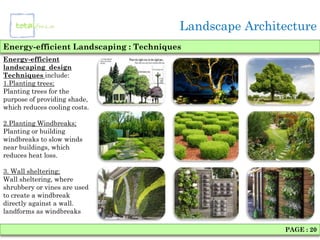
    Landscape Architecture Energy-efficient Landscaping: Techniques Energy-efficient landscaping design Techniques include: 1.Planting trees; Planting trees for the purpose of providing shade, which reduces cooling costs. 2.Planting Windbreaks; Planting or building windbreaks to slow winds near buildings, which reduces heat loss. 3. Wall sheltering; Wall sheltering, where shrubbery or vines are used to create a windbreak directly against a wall. landforms as windbreaks PAGE : 20
  • 21.
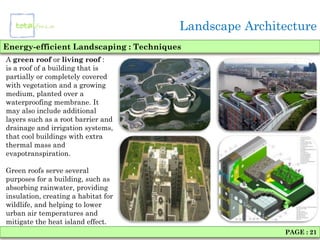
    Landscape Architecture Energy-efficient Landscaping: Techniques A green roof or living roof : is a roof of a building that is partially or completely covered with vegetation and a growing medium, planted over a waterproofing membrane. It may also include additional layers such as a root barrier and drainage and irrigation systems, that cool buildings with extra thermal mass and evapotranspiration. Green roofs serve several purposes for a building, such as absorbing rainwater, providing insulation, creating a habitat for wildlife, and helping to lower urban air temperatures and mitigate the heat island effect. PAGE : 21
  • 22.
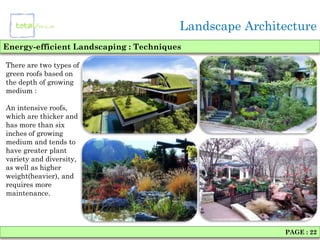
    Landscape Architecture Energy-efficient Landscaping: Techniques There are two types of green roofs based on the depth of growing medium : An intensive roofs, which are thicker and has more than six inches of growing medium and tends to have greater plant variety and diversity, as well as higher weight(heavier), and requires more maintenance. PAGE : 22
  • 23.
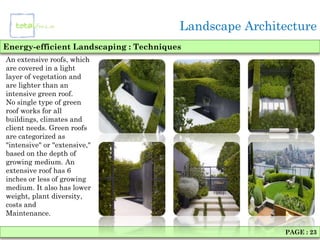
    Landscape Architecture Energy-efficient Landscaping: Techniques An extensive roofs, which are covered in a light layer of vegetation and are lighter than an intensive green roof. No single type of green roof works for all buildings, climates and client needs. Green roofs are categorized as "intensive" or "extensive," based on the depth of growing medium. An extensive roof has 6 inches or less of growing medium. It also has lower weight, plant diversity, costs and Maintenance. PAGE : 23
  • 24.
    Landscape Architecture Energy-efficient Landscaping: Techniques 4. Earth sheltering; Earth sheltering and positioning buildings to take advantage of natural 5.Reducing the heat island effect with pervious paving, high albedo paving, shade, and minimizing paved areas. Site lighting with full cut off fixtures, light level sensors, and high efficiency fixtures. Container gardens on roofs, where plants are maintained in pots, are not generally considered to be true green roofs, although this is debated. Rooftop ponds are another form of green roofs which are used to treat grey water. PAGE : 24
  • 25.
    Landscape Architecture Landscaping :Site plan A site plan is an architectural plan, landscape architecture document, and a detailed engineering drawing of proposed improvements to a given lot. A site plan "usually shows a building footprint, travel ways, parking, drainage facilities, sanitary sewer lines, water lines, trails, lighting, and landscaping and garden elements". Such a plan of a site is a "graphic representation of the arrangement of buildings, parking, drives, landscaping and any other structure that is part of a development project". PAGE : 25
  • 26.
    Landscape Architect Landscaping :Scope and Field of Actions……. Landscape Architect : A practitioner in the profession of landscape architecture is called a landscape architect. The activities of a landscape architect can range from the creation of public parks and parkways to site planning for campuses and corporate office parks, from the design of residential estates to the design of civil infrastructure and the management of large wilderness areas or reclamation of degraded landscapes such as mines or landfills. Landscape architects work on all types of structures and external space - large or small, urban, suburban and rural, and with "hard" (built) and "soft" (planted) materials, while integrating ecological sustainability. The most valuable contribution can be made at the first stage of a project to generate ideas with technical understanding and creative flair for the design, organization, and use of spaces. The landscape architect can conceive the overall concept and prepare the master plan, from which detailed design drawings and technical specifications are prepared. They can also review proposals to authorize and supervise contracts for the construction work. Other skills include preparing design impact assessments, conducting environmental assessments and audits, and serving as an expert witness at inquiries on land use issues. They can also support and prepare applications for capital and revenue funding grants. PAGE : 26
  • 27.
    Dedicated to Allthe Architecture, Engineering students and Professionals ….who through there humble and dedicated effort can replace LANDSCPAE of POVERTY with LANDSCAPES OF PROSPERITIES The guardian…England More of world's poor live in India than in all sub- Saharan Africa, says study…..