Level 6
David Mullich
Game Design 1
The Los Angeles Film School
Let’s deconstruct a game most of us have played.
Analyze:
 Player Experience: Aesthetics
 Foundational Elements: Mechanics
 Structural Elements: Procedures, Rules,
Objectives, Resources, Conflict, Outcomes
 Dramatic Elements: Challenge, Premise,
Character, Story
 Dynamic Elements: Objects, Properties,
Behaviors, Relationships
Review of Past Concepts
Playcentric Design Process
Involving the player in your design process
from conception to completion.
 Setting Player Experience Goals
 Prototyping and Playtesting
 Iteration
Tracy Fullerton
Prototyping and Playtesting
1. Brainstorming
2. Physical Prototype
3. Presentation
4. Software Prototype
5. Design Document
6. Production
7. Quality Assurance
Step 1: Brainstorming
 Set player experience goals
 Come up with game concepts or
mechanics
 Narrow down the list to the top three
 Write up short, one page description of
each
 Test your written concepts with potential
players
Step 2: Physical Prototype
 Create a playable prototype using pen and
paper and other craft materials
 Playtest the physical prototype
 Modify physical prototype until it meets
player experience goals
 Write 3-6 page gameplay treatment
Step 3: Presentation
 Presentation is often made to secure funds
to hire the prototyping team
 Your presentation should include demo
artwork and a solid gameplay treatment
 If you do not get funding, get feedback
from your funding sources about what to
modify or start over again
Step 4: Software Prototypes
 Create rough computer models of
gameplay
 Playtest the prototype
 Modify prototype until it achieves your user
experience goals
Step 5: Design Documentation
 Use the notes you’ve been taking during
prototyping (you have been taking notes,
haven’t you?!) to create a first draft design
document
 Work with team members to make sure the
design is achievable and correctly described in
the design document
 Some designers now prefer creating a wiki to
a static design document
Step 6: Production
 Staff up and create real artwork and
programming
 Don’t lose sight of the playcentric process
during production! Continue playtesting!
 If the designer waits until production to
really start designing the game, it can lead
to all sorts of problems!
Step 7: Quality Assurance
 Quality Assurance, or QA, is the testing of
your game by professional testers
 Make sure your gameplay is solid before
your game goes into QA!
Your Class Project
1. Write A Concept Proposal
2. Prototype The Core Mechanic
3. Add Structural Elements
4. Add Dramatic Elements
5. Balance the Dynamic Elements
Ideas
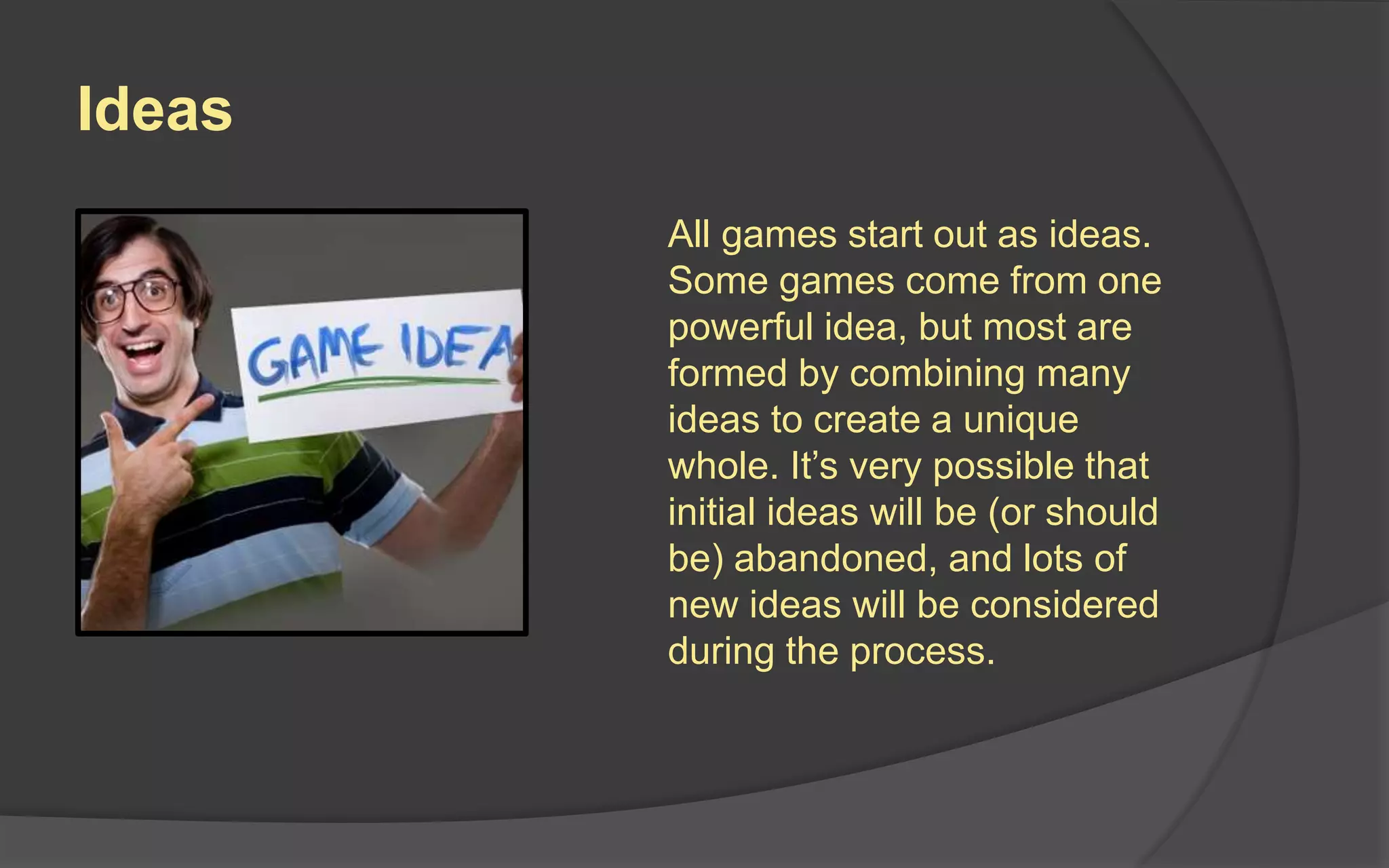
All games start out as ideas.
Some games come from one
powerful idea, but most are
formed by combining many
ideas to create a unique
whole. It’s very possible that
initial ideas will be (or should
be) abandoned, and lots of
new ideas will be considered
during the process.
Inspiration
Ideas don’t come out of thin air. Game designers are
influenced by personal interests and hobbies.
Spend a significant part of every day doing something
other than playing games:
 Read a book
 Go see a play
 Listen to music
 Exercise, draw or sketch
 Study a new language
 Volunteer at a neighborhood organization
The Lens of Infinite Inspiration
Stop looking at your game idea, and stop looking at
games like it. Instead, look everywhere else.
 What is the experience I have had in my life that I
would like to share with others?
 In what small way can I capture that experience
and put it in my game?
Jesse Schell, Lens #11
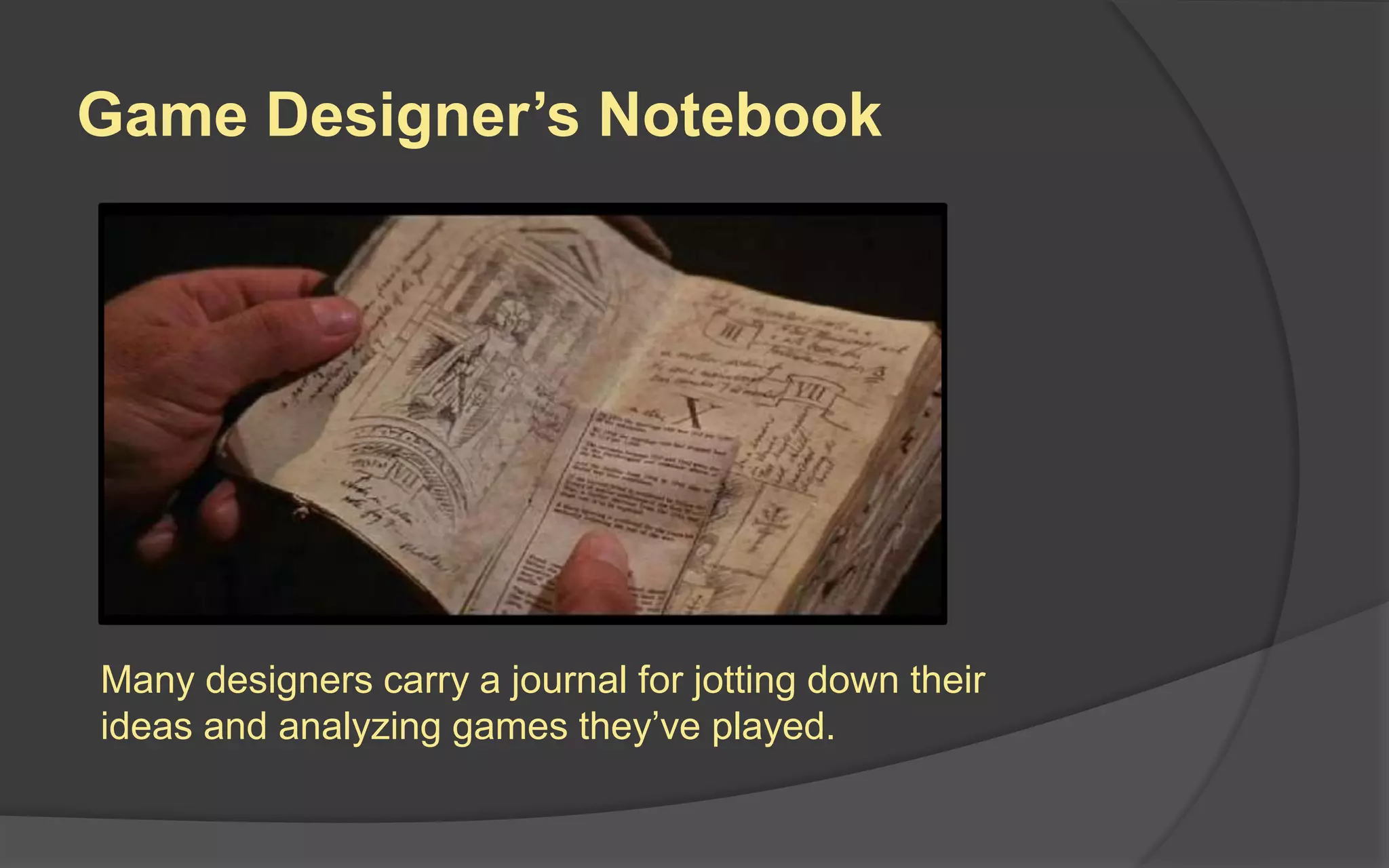
Game Designer’s Notebook
Many designers carry a journal for jotting down their
ideas and analyzing games they’ve played.
Stages of Creativity
Psychologist Mihaly Csikszentmihalyi describes
the classic stages of creativity:
 Preparation: Becoming interested in a topic
 Incubation: Period where ideas “churn around”
in your subconscious
 Insight: The “aha!” moment, where an idea
comes together
 Evaluation: Deciding whether the insight is
worth pursuing
 Elaboration: Fleshing out the idea
Elaboration on Elaboration
Having an idea for a game does not simply mean saying,
“I want to make a game about studying Chinese!”
Games are formal systems, and an idea for a game
usually includes some aspect of that system.
As you work through your idea, elaborating on its unique
elements, it might turn out no one would recognize your
language interests in the final experience.
Designing For Innovation
 Design games with unique play mechanics – think
beyond the existing genres of play
 Appeal to new players – people who have different
tastes and skills than hardcore players
 Try to solve difficult design problems like:
 Integration of story and gameplay
 Deeper empathy for characters in games
 Creating emotionally rich gameplay
 Discovering the relationships between games and learning
 Ask difficult questions about what games are, what
they can be, and what their impact is on us individually
and culturally
Designer Perspective: Yuji Naka
G4 Icons Episode #37: Yuji Naka
Brainstorming
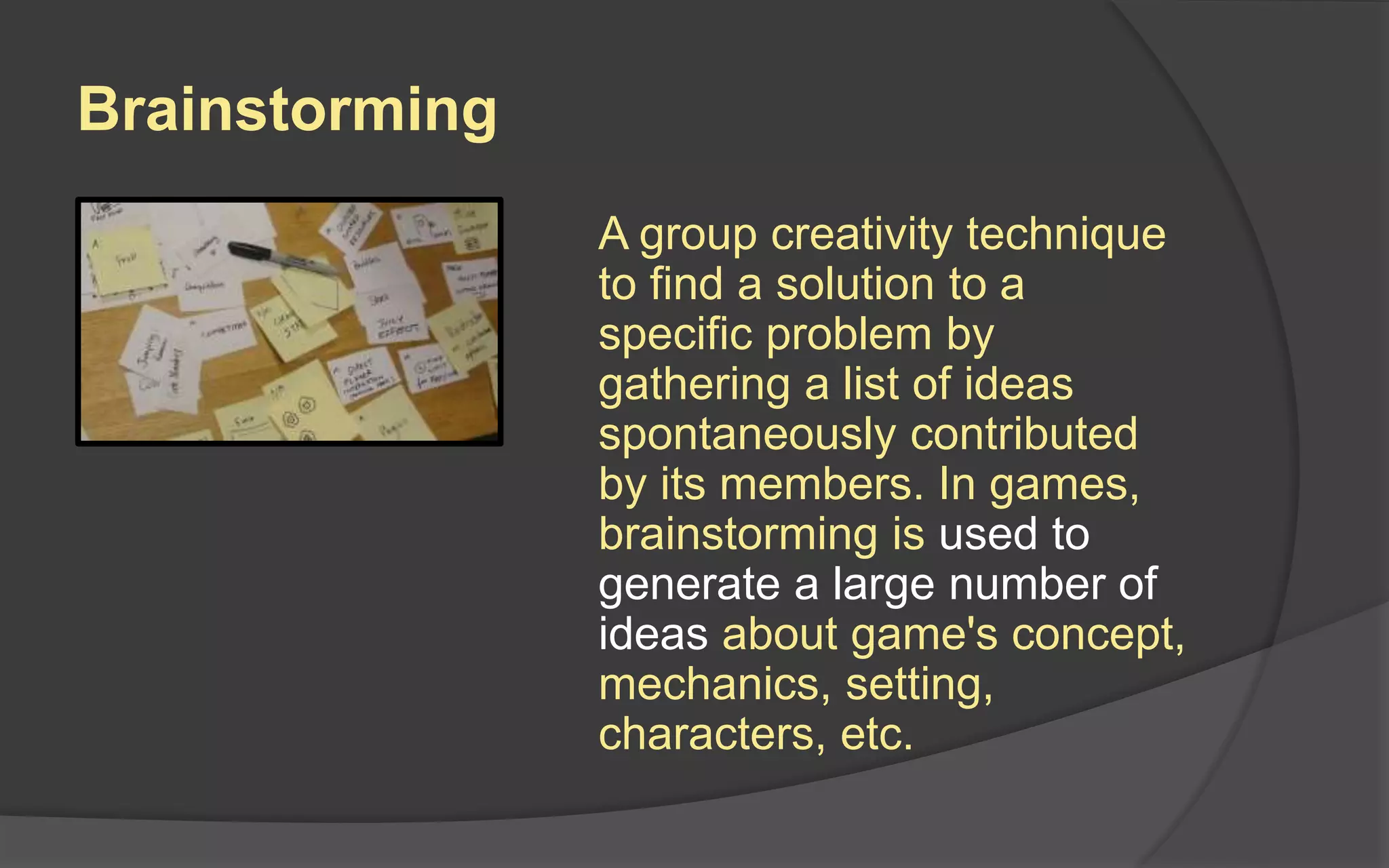
A group creativity technique
to find a solution to a
specific problem by
gathering a list of ideas
spontaneously contributed
by its members. In games,
brainstorming is used to
generate a large number of
ideas about game's concept,
mechanics, setting,
characters, etc.
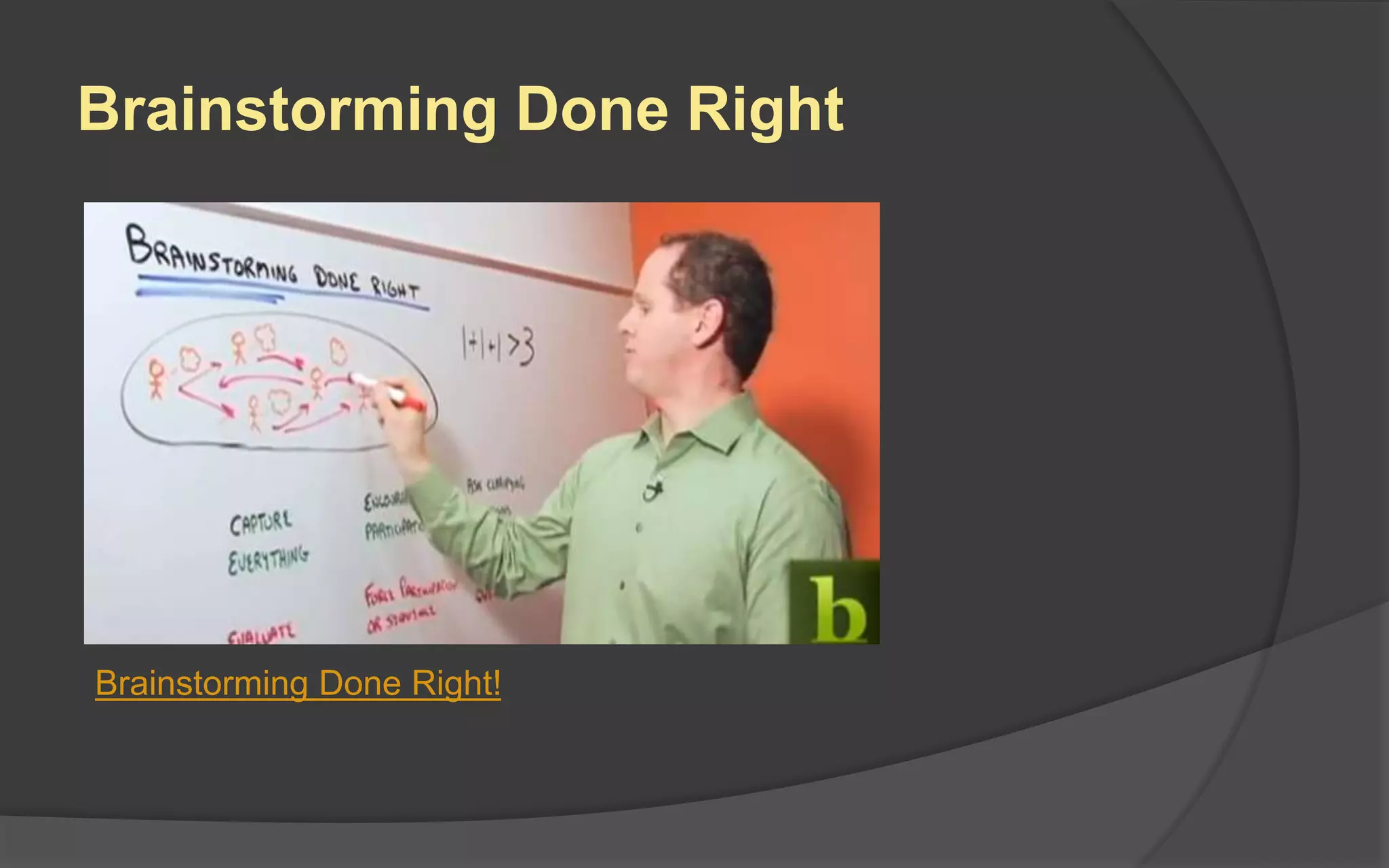
Brainstorming Done Right
Brainstorming Done Right!
Brainstorming
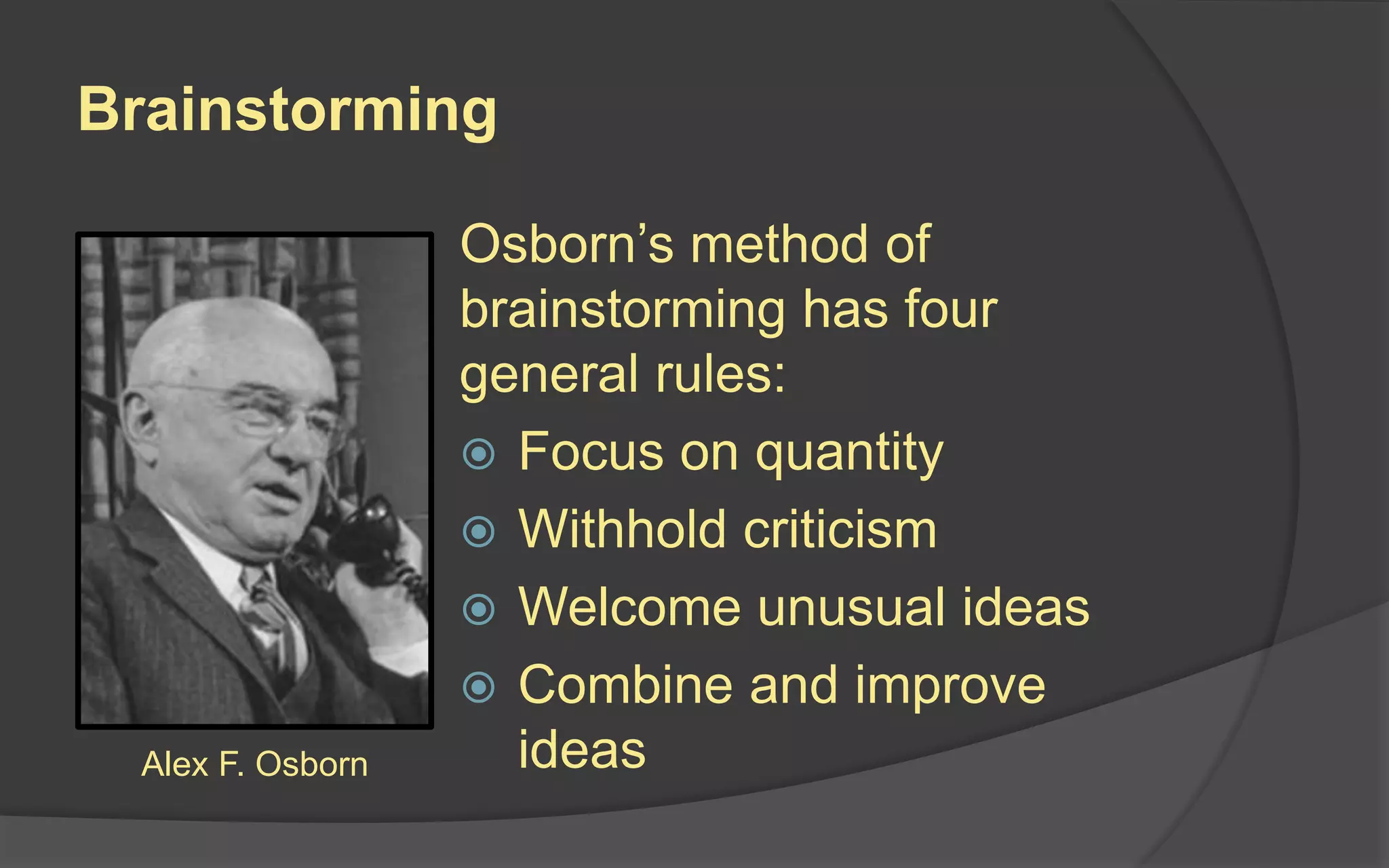
Osborn’s method of
brainstorming has four
general rules:
 Focus on quantity
 Withhold criticism
 Welcome unusual ideas
 Combine and improve
ideasAlex F. Osborn
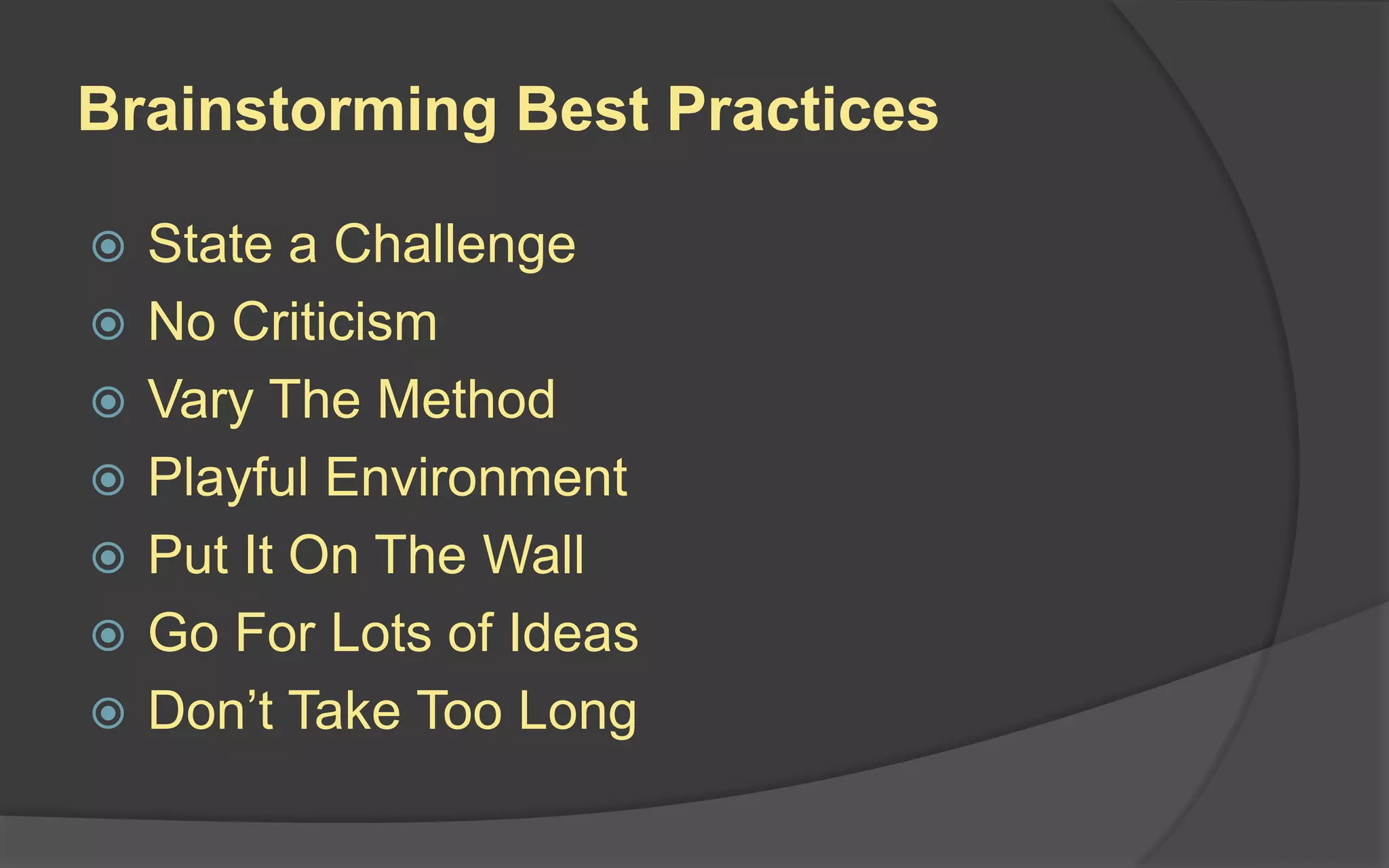
Brainstorming Best Practices
 State a Challenge
 No Criticism
 Vary The Method
 Playful Environment
 Put It On The Wall
 Go For Lots of Ideas
 Don’t Take Too Long
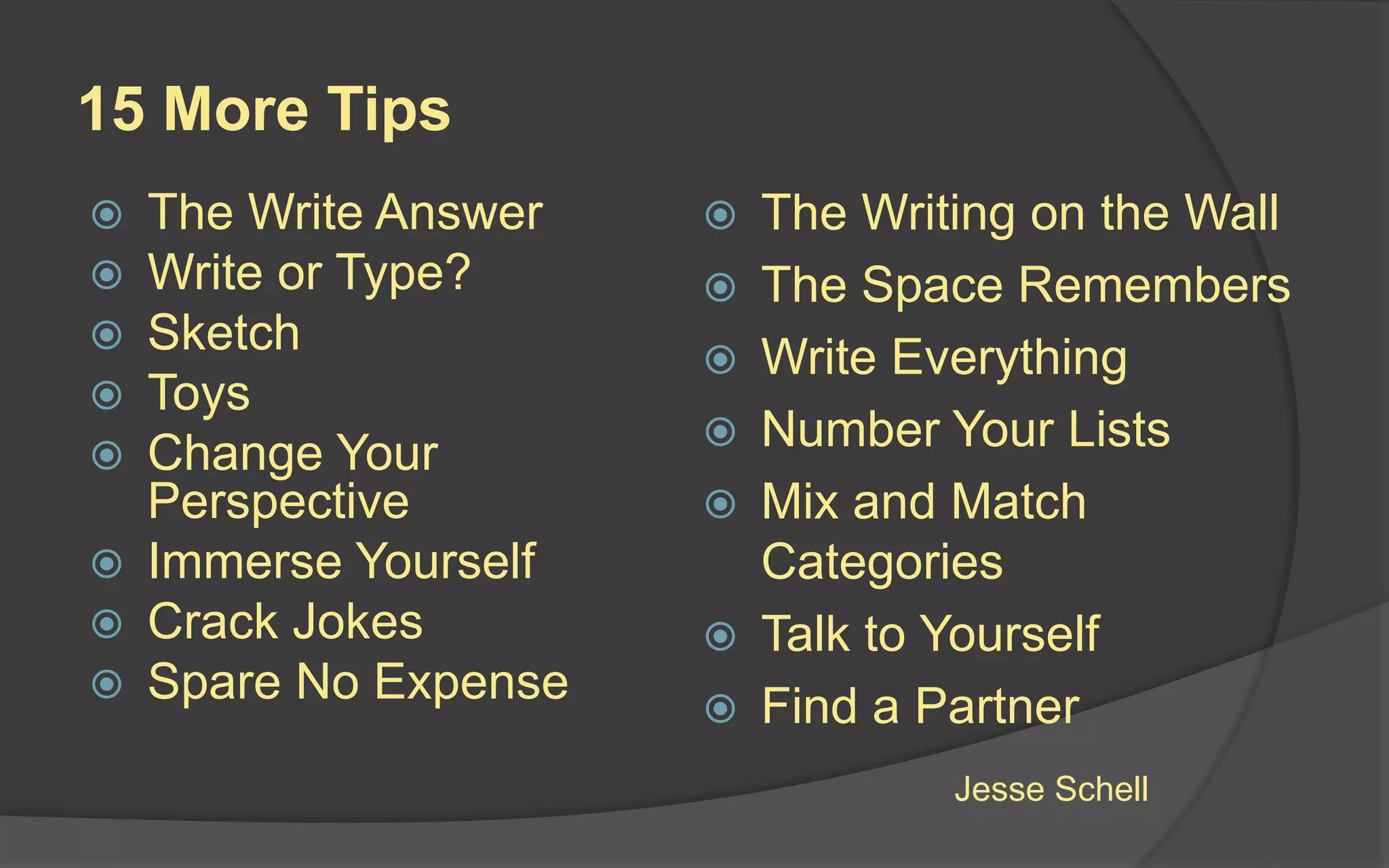
Six Creative Ways To Brainstorm
Six Creative Ways To Brainstorm Ideas
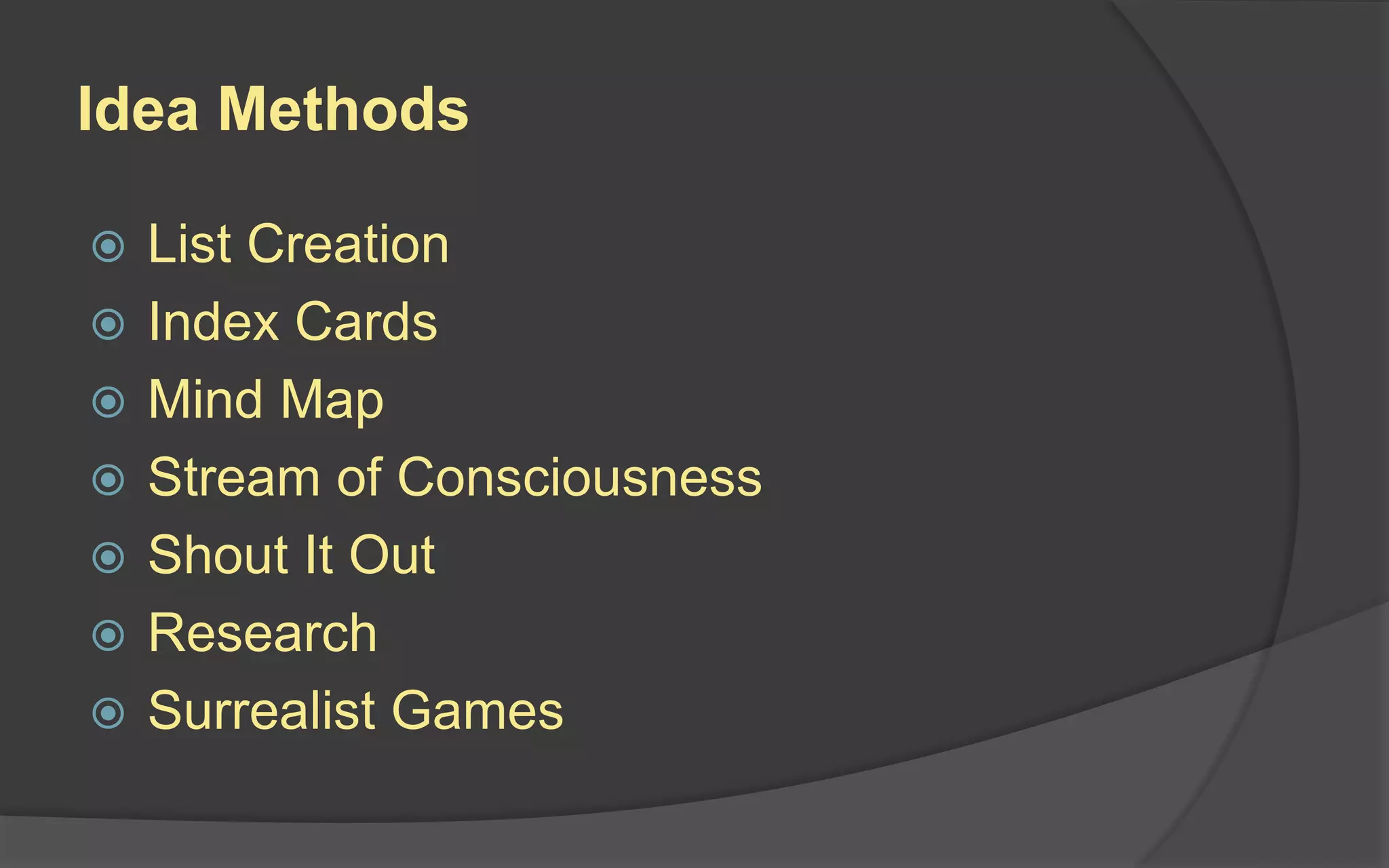
Idea Methods
 Create Numbered Lists
 Index Cards
 Mind Map
 Stream of Consciousness
 Change Your Perspective
 Change Your Environment
 Mix and Match Categories
 Research
 Surrealist Games
Exquisite Corpse
 Write an article and an adjective on a piece of
paper
 Fold the paper to conceal it and pass it to their
neighbor
 Write a noun on the the paper you were
handed, fold it, and pass it to your neighbor
 Repeat with a verb; article and adjective;
finally repeat with a noun
 Everyone unfolds their paper and reads the
poems they are holding
Now brainstorm your own idea!
Break into two groups of 3-6 and brainstorm
some game ideas.
The challenge is to come up with ideas for
games you can make with GameMaker and can
be done by the end of the term.
Try to generate 100 ideas in 60 minutes.
Reasons To Reject A Game Idea
 Technical Feasibility
 Market Opportunity
 Artistic Considerations
 Design Experience
 Innovation Needs
 Marketing Goals
 Business and Cost Restrictions
Editing Session
Hold an Editing Session on a different day than
your Brainstorming Session.
Edit your list down to the top 5 to 10 ideas and
discuss each thoroughly. Be positive and
discuss the strengths of each idea.
Narrow your list down to 3 ideas and schedule
brainstorming sessions to focus on features and
define the creative center of your game.
Take your list of 100 game ideas you came
up with earlier today and narrow it down to
your group’s 10 favorites.
Game-Defining Concepts
A “game-defining” concept is as a component,
mechanic, or other design element that is so
closely connected to the identity of the game that
it is inevitably talked about when the game is
brought up.
 “King” mechanic in Checkers
 Letter-tile combinations in Scrabble
 Polyhedral dice in Dungeons & Dragons
 Running and gunning in Doom
Game-Defining Concepts
What makes a concept “game defining”?
 Presenting clever, elegant, or unusual
resolutions to in-game issues.
 Showing information in a concise, centralized,
or attractive manner.
 Creating tension, or acting as a game’s
primary demand for strategy.
 Taking common elements and implementing
them in an original manner.
Creative Center
Your game’s creative center consists of two
elements:
 The Razor: Determines which features
belong and don’t belong
 The Slogan: A catchy phrase that gets
potential players (and the marketing
department) interested in your game
Come up with a Razor and Slogan for:
 Grand Theft Auto
 Call of Duty
 World of Warcraft
 Candy Crush
Take your list of 10 game ideas you came up with earlier
today and narrow it down to your 3-6 favorites (one for
each member of your group).
For each one, come up with:
 Game Title
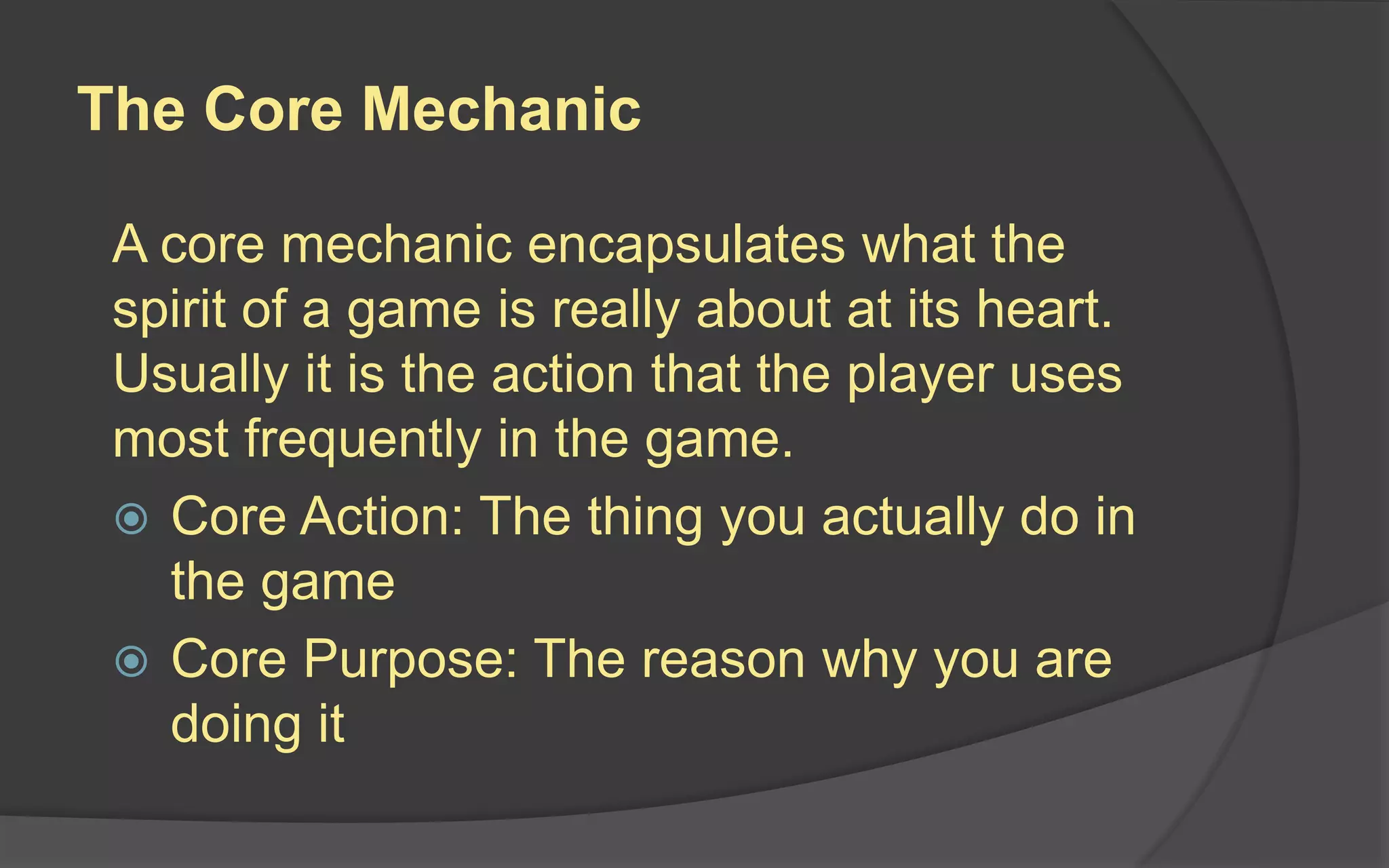
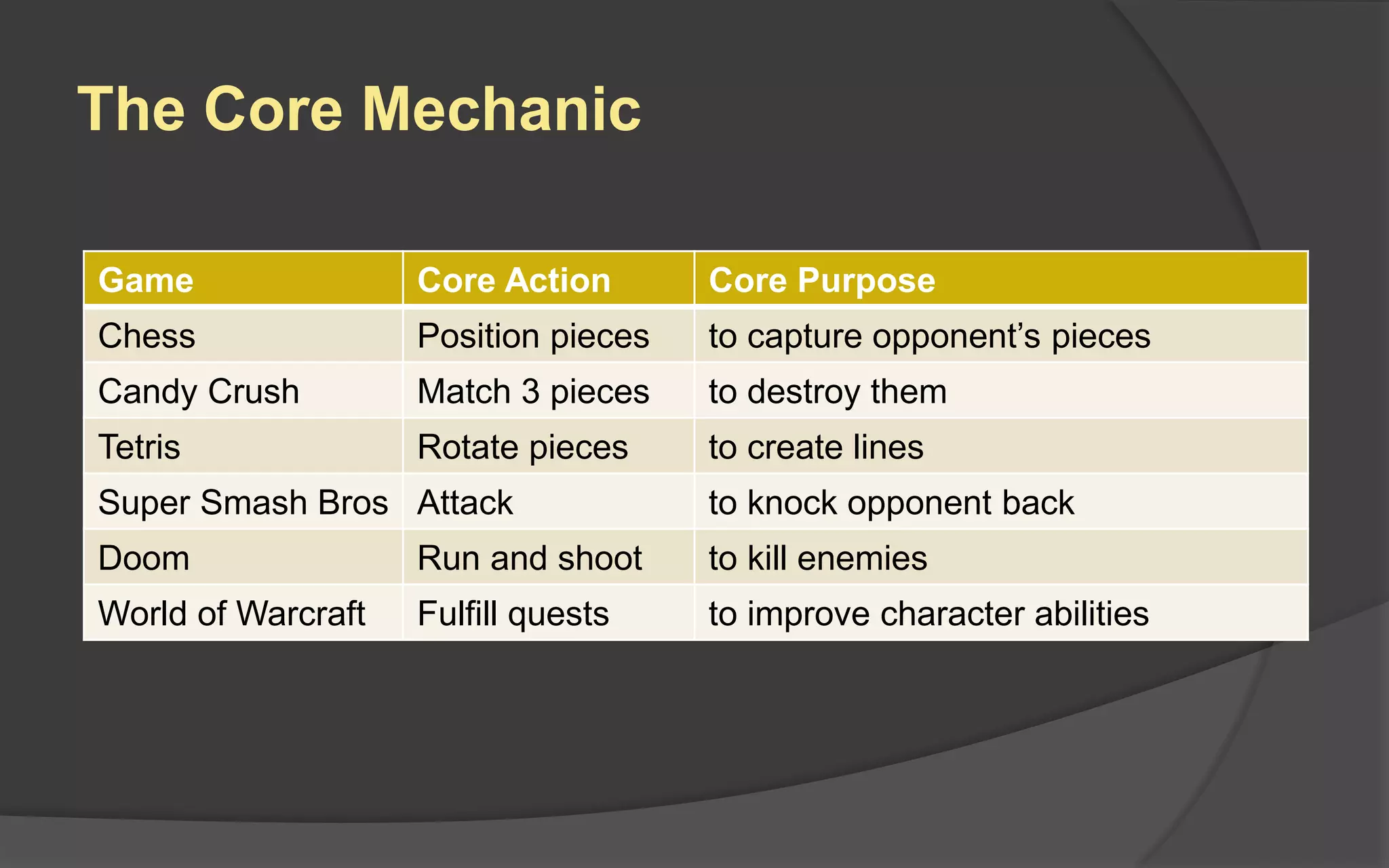
 Core mechanic (action/purpose)
 Razor (statement defining appropriate game features)
 Slogan (statement describing the game’s play value)
Present your ideas to class, and the class will choose their
favorite from each group.
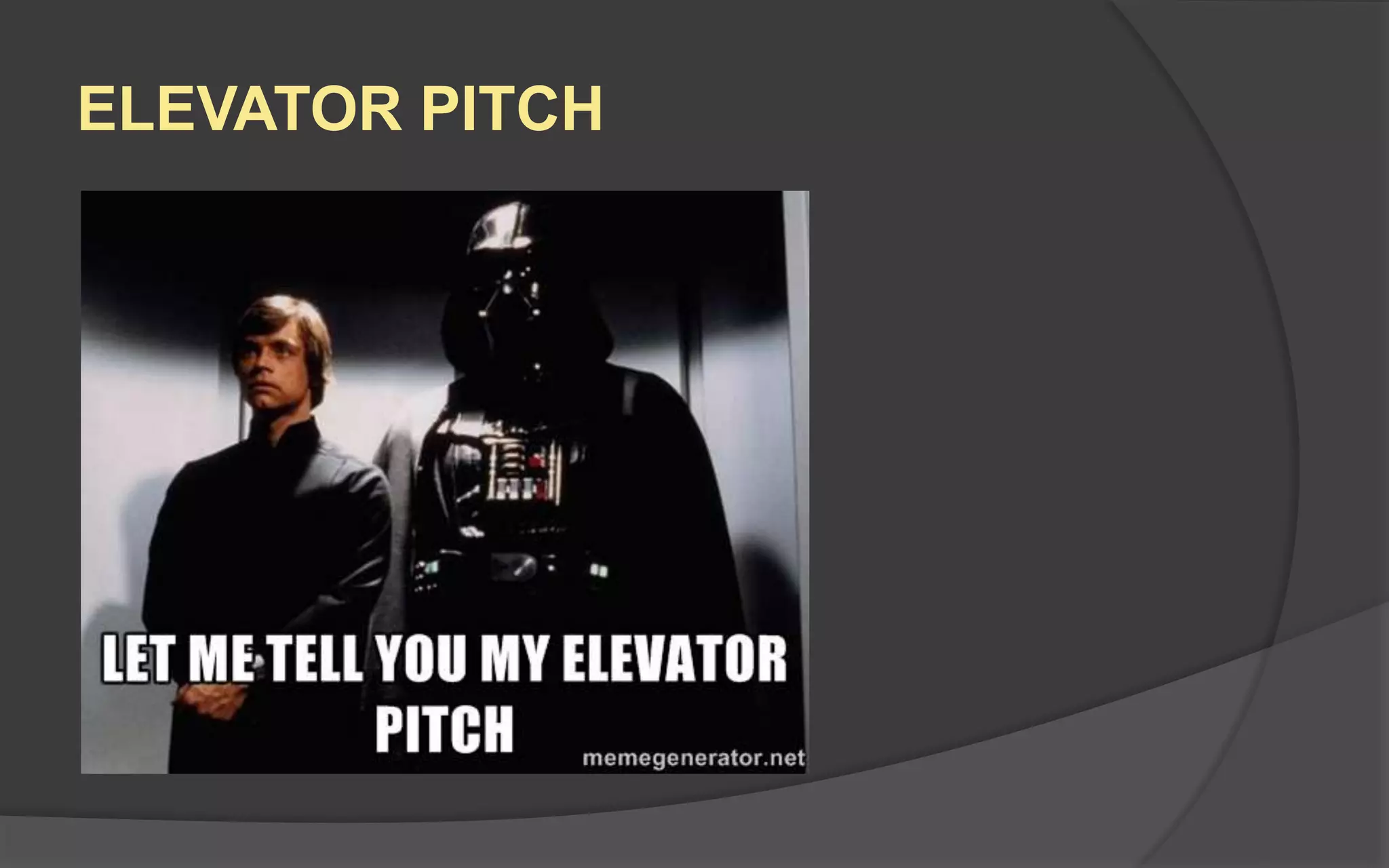
Elevator Pitch
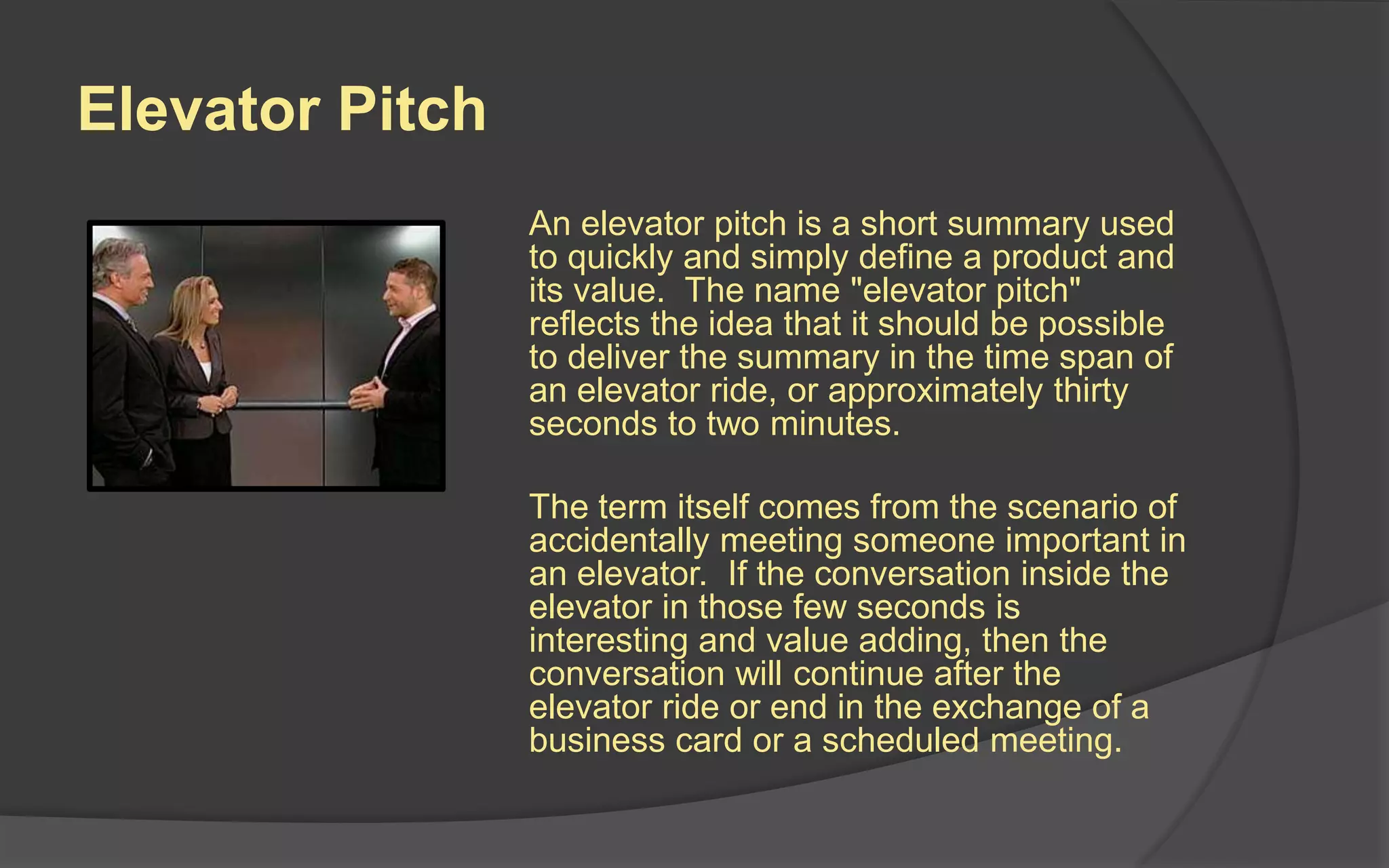
An elevator pitch is a short summary used
to quickly and simply define a product and
its value. The name "elevator pitch"
reflects the idea that it should be possible
to deliver the summary in the time span of
an elevator ride, or approximately thirty
seconds to two minutes.
The term itself comes from the scenario of
accidentally meeting someone important in
an elevator. If the conversation inside the
elevator in those few seconds is
interesting and value adding, then the
conversation will continue after the
elevator ride or end in the exchange of
business cards or a scheduled meeting.
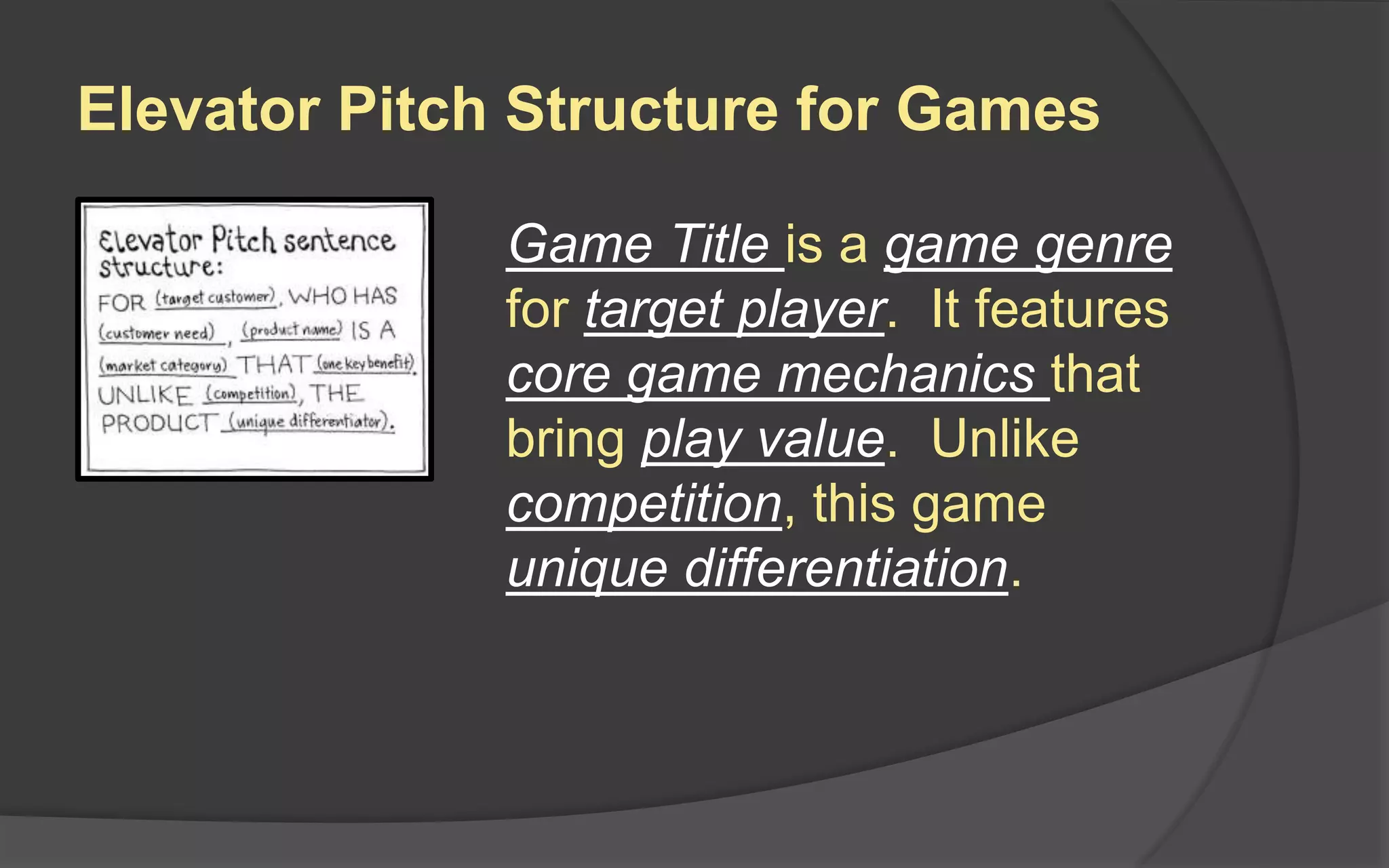
Elevator Pitch Structure for Games
Game Title is a game genre
set in premise for target
player. It features core
game mechanics that bring
play value. Unlike
competition, this game
unique differentiation.
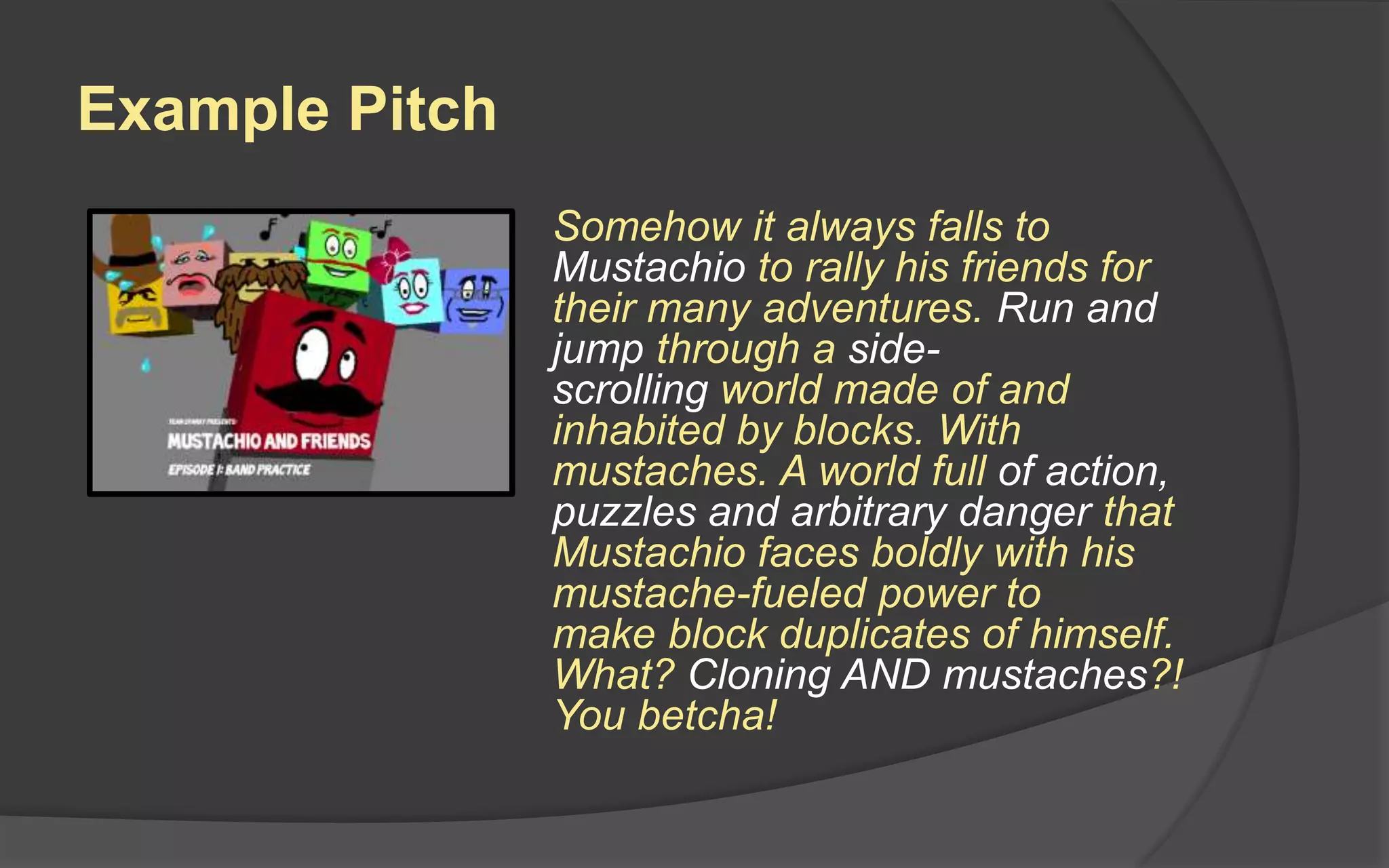
Example Pitch
Somehow it always falls to
Mustachio to rally his friends for
their many adventures. Run and
jump through a side-
scrolling world made of and
inhabited by blocks. With
mustaches. A world full of action,
puzzles and arbitrary danger that
Mustachio faces boldly with his
mustache-fueled power to
make block duplicates of himself.
What? Cloning AND mustaches?!
You betcha!
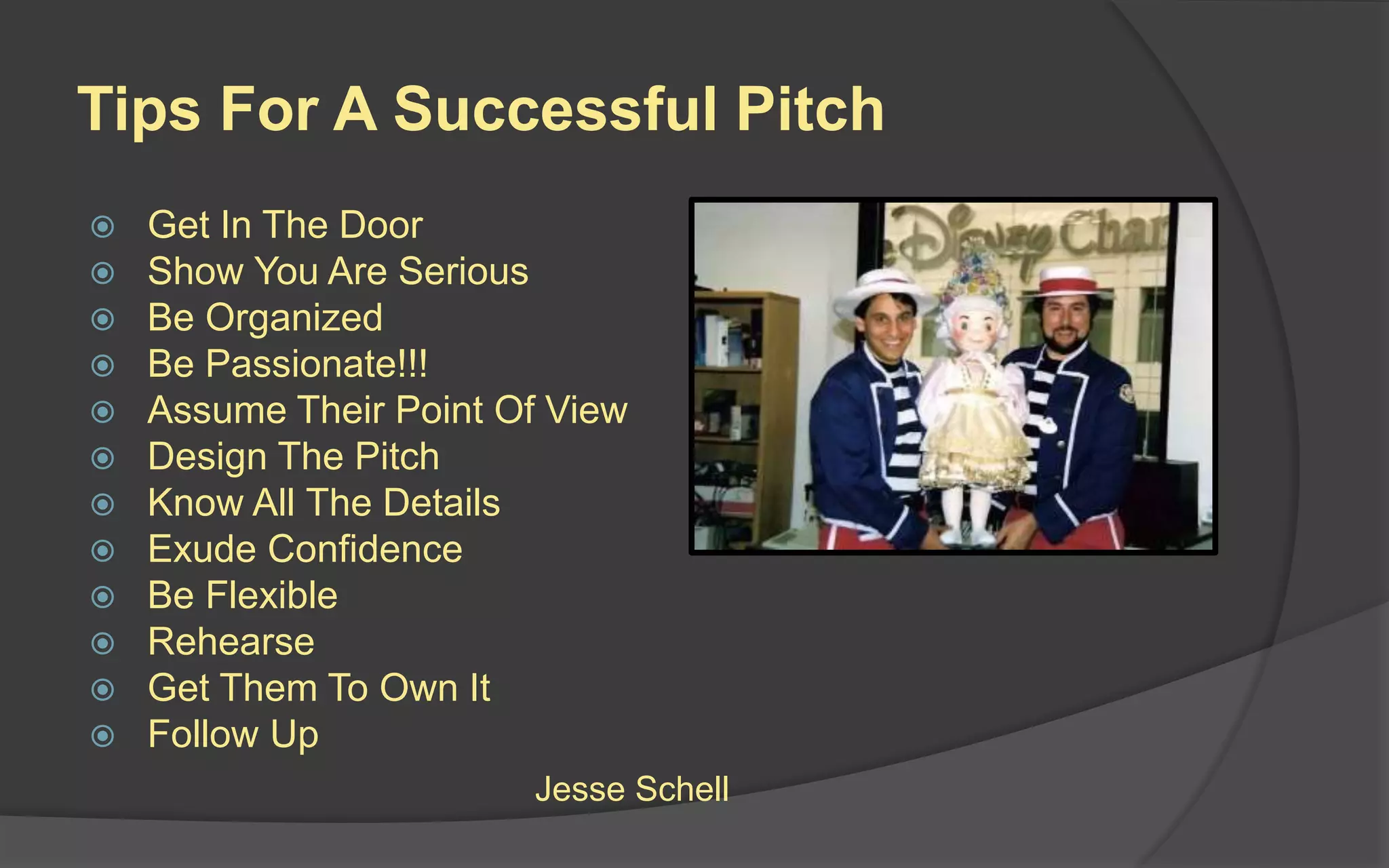
Tips For A Successful Pitch
 Get In The Door
 Show You Are Serious
 Be Organized
 Be Passionate!!!
 Assume Their Point Of View
 Design The Pitch
 Know All The Details
 Exude Confidence
 Be Flexible
 Rehearse
 Get Them To Own It
 Follow Up
Jesse Schell
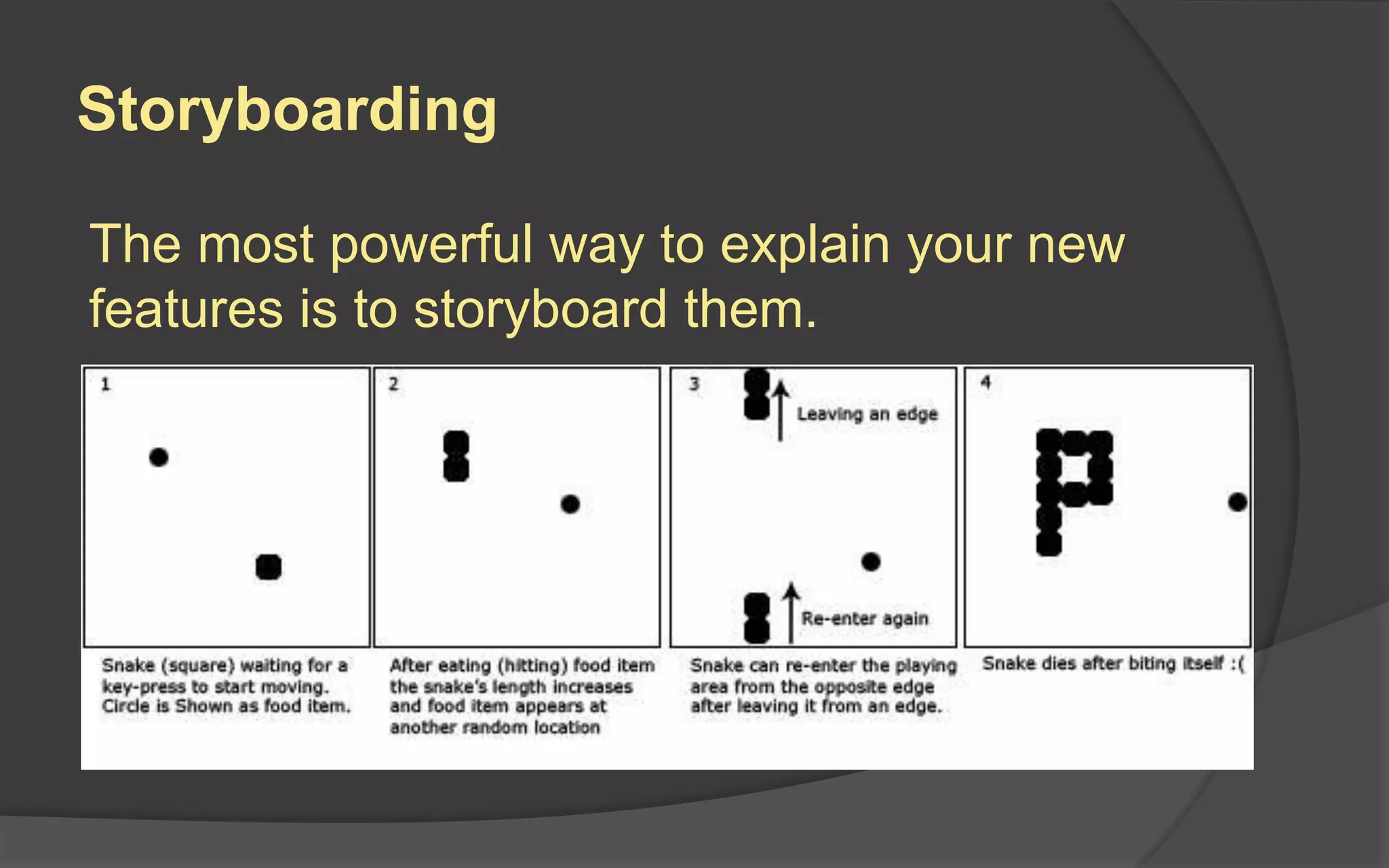
Storyboarding
The most powerful way to explain your new
features is to storyboard them.
LAFS Game Design 6 - Conceptualization

LAFS Game Design 6 - Conceptualization

  • 1.
    Level 6 David Mullich GameDesign 1 The Los Angeles Film School
  • 2.
    Let’s deconstruct agame most of us have played. Analyze:  Player Experience: Aesthetics  Foundational Elements: Mechanics  Structural Elements: Procedures, Rules, Objectives, Resources, Conflict, Outcomes  Dramatic Elements: Challenge, Premise, Character, Story  Dynamic Elements: Objects, Properties, Behaviors, Relationships Review of Past Concepts
  • 4.
    Playcentric Design Process Involvingthe player in your design process from conception to completion.  Setting Player Experience Goals  Prototyping and Playtesting  Iteration Tracy Fullerton
  • 5.
    Prototyping and Playtesting 1.Brainstorming 2. Physical Prototype 3. Presentation 4. Software Prototype 5. Design Document 6. Production 7. Quality Assurance
  • 6.
    Step 1: Brainstorming Set player experience goals  Come up with game concepts or mechanics  Narrow down the list to the top three  Write up short, one page description of each  Test your written concepts with potential players
  • 7.
    Step 2: PhysicalPrototype  Create a playable prototype using pen and paper and other craft materials  Playtest the physical prototype  Modify physical prototype until it meets player experience goals  Write 3-6 page gameplay treatment
  • 8.
    Step 3: Presentation Presentation is often made to secure funds to hire the prototyping team  Your presentation should include demo artwork and a solid gameplay treatment  If you do not get funding, get feedback from your funding sources about what to modify or start over again
  • 9.
    Step 4: SoftwarePrototypes  Create rough computer models of gameplay  Playtest the prototype  Modify prototype until it achieves your user experience goals
  • 10.
    Step 5: DesignDocumentation  Use the notes you’ve been taking during prototyping (you have been taking notes, haven’t you?!) to create a first draft design document  Work with team members to make sure the design is achievable and correctly described in the design document  Some designers now prefer creating a wiki to a static design document
  • 11.
    Step 6: Production Staff up and create real artwork and programming  Don’t lose sight of the playcentric process during production! Continue playtesting!  If the designer waits until production to really start designing the game, it can lead to all sorts of problems!
  • 12.
    Step 7: QualityAssurance  Quality Assurance, or QA, is the testing of your game by professional testers  Make sure your gameplay is solid before your game goes into QA!
  • 13.
    Your Class Project 1.Write A Concept Proposal 2. Prototype The Core Mechanic 3. Add Structural Elements 4. Add Dramatic Elements 5. Balance the Dynamic Elements
  • 15.
    Ideas All games startout as ideas. Some games come from one powerful idea, but most are formed by combining many ideas to create a unique whole. It’s very possible that initial ideas will be (or should be) abandoned, and lots of new ideas will be considered during the process.
  • 16.
    Inspiration Ideas don’t comeout of thin air. Game designers are influenced by personal interests and hobbies. Spend a significant part of every day doing something other than playing games:  Read a book  Go see a play  Listen to music  Exercise, draw or sketch  Study a new language  Volunteer at a neighborhood organization
  • 17.
    The Lens ofInfinite Inspiration Stop looking at your game idea, and stop looking at games like it. Instead, look everywhere else.  What is the experience I have had in my life that I would like to share with others?  In what small way can I capture that experience and put it in my game? Jesse Schell, Lens #11
  • 18.
    Game Designer’s Notebook Manydesigners carry a journal for jotting down their ideas and analyzing games they’ve played.
  • 19.
    Stages of Creativity PsychologistMihaly Csikszentmihalyi describes the classic stages of creativity:  Preparation: Becoming interested in a topic  Incubation: Period where ideas “churn around” in your subconscious  Insight: The “aha!” moment, where an idea comes together  Evaluation: Deciding whether the insight is worth pursuing  Elaboration: Fleshing out the idea
  • 20.
    Elaboration on Elaboration Havingan idea for a game does not simply mean saying, “I want to make a game about studying Chinese!” Games are formal systems, and an idea for a game usually includes some aspect of that system. As you work through your idea, elaborating on its unique elements, it might turn out no one would recognize your language interests in the final experience.
  • 21.
    Designing For Innovation Design games with unique play mechanics – think beyond the existing genres of play  Appeal to new players – people who have different tastes and skills than hardcore players  Try to solve difficult design problems like:  Integration of story and gameplay  Deeper empathy for characters in games  Creating emotionally rich gameplay  Discovering the relationships between games and learning  Ask difficult questions about what games are, what they can be, and what their impact is on us individually and culturally
  • 22.
    Designer Perspective: YujiNaka G4 Icons Episode #37: Yuji Naka
  • 24.
    Brainstorming A group creativitytechnique to find a solution to a specific problem by gathering a list of ideas spontaneously contributed by its members. In games, brainstorming is used to generate a large number of ideas about game's concept, mechanics, setting, characters, etc.
  • 25.
  • 26.
    Brainstorming Osborn’s method of brainstorminghas four general rules:  Focus on quantity  Withhold criticism  Welcome unusual ideas  Combine and improve ideasAlex F. Osborn
  • 27.
    Brainstorming Best Practices State a Challenge  No Criticism  Vary The Method  Playful Environment  Put It On The Wall  Go For Lots of Ideas  Don’t Take Too Long
  • 28.
    Six Creative WaysTo Brainstorm Six Creative Ways To Brainstorm Ideas
  • 29.
    Idea Methods  CreateNumbered Lists  Index Cards  Mind Map  Stream of Consciousness  Change Your Perspective  Change Your Environment  Mix and Match Categories  Research  Surrealist Games
  • 30.
    Exquisite Corpse  Writean article and an adjective on a piece of paper  Fold the paper to conceal it and pass it to their neighbor  Write a noun on the the paper you were handed, fold it, and pass it to your neighbor  Repeat with a verb; article and adjective; finally repeat with a noun  Everyone unfolds their paper and reads the poems they are holding
  • 31.
    Now brainstorm yourown idea! Break into two groups of 3-6 and brainstorm some game ideas. The challenge is to come up with ideas for games you can make with GameMaker and can be done by the end of the term. Try to generate 100 ideas in 60 minutes.
  • 33.
    Reasons To RejectA Game Idea  Technical Feasibility  Market Opportunity  Artistic Considerations  Design Experience  Innovation Needs  Marketing Goals  Business and Cost Restrictions
  • 34.
    Editing Session Hold anEditing Session on a different day than your Brainstorming Session. Edit your list down to the top 5 to 10 ideas and discuss each thoroughly. Be positive and discuss the strengths of each idea. Narrow your list down to 3 ideas and schedule brainstorming sessions to focus on features and define the creative center of your game.
  • 35.
    Take your listof 100 game ideas you came up with earlier today and narrow it down to your group’s 10 favorites.
  • 37.
    Game-Defining Concepts A “game-defining”concept is as a component, mechanic, or other design element that is so closely connected to the identity of the game that it is inevitably talked about when the game is brought up.  “King” mechanic in Checkers  Letter-tile combinations in Scrabble  Polyhedral dice in Dungeons & Dragons  Running and gunning in Doom
  • 38.
    Game-Defining Concepts What makesa concept “game defining”?  Presenting clever, elegant, or unusual resolutions to in-game issues.  Showing information in a concise, centralized, or attractive manner.  Creating tension, or acting as a game’s primary demand for strategy.  Taking common elements and implementing them in an original manner.
  • 39.
    Creative Center Your game’screative center consists of two elements:  The Razor: Determines which features belong and don’t belong  The Slogan: A catchy phrase that gets potential players (and the marketing department) interested in your game
  • 40.
    Come up witha Razor and Slogan for:  Grand Theft Auto  Call of Duty  World of Warcraft  Candy Crush
  • 41.
    Take your listof 10 game ideas you came up with earlier today and narrow it down to your 3-6 favorites (one for each member of your group). For each one, come up with:  Game Title  Core mechanic (action/purpose)  Razor (statement defining appropriate game features)  Slogan (statement describing the game’s play value) Present your ideas to class, and the class will choose their favorite from each group.
  • 43.
    Elevator Pitch An elevatorpitch is a short summary used to quickly and simply define a product and its value. The name "elevator pitch" reflects the idea that it should be possible to deliver the summary in the time span of an elevator ride, or approximately thirty seconds to two minutes. The term itself comes from the scenario of accidentally meeting someone important in an elevator. If the conversation inside the elevator in those few seconds is interesting and value adding, then the conversation will continue after the elevator ride or end in the exchange of business cards or a scheduled meeting.
  • 44.
    Elevator Pitch Structurefor Games Game Title is a game genre set in premise for target player. It features core game mechanics that bring play value. Unlike competition, this game unique differentiation.
  • 45.
    Example Pitch Somehow italways falls to Mustachio to rally his friends for their many adventures. Run and jump through a side- scrolling world made of and inhabited by blocks. With mustaches. A world full of action, puzzles and arbitrary danger that Mustachio faces boldly with his mustache-fueled power to make block duplicates of himself. What? Cloning AND mustaches?! You betcha!
  • 46.
    Tips For ASuccessful Pitch  Get In The Door  Show You Are Serious  Be Organized  Be Passionate!!!  Assume Their Point Of View  Design The Pitch  Know All The Details  Exude Confidence  Be Flexible  Rehearse  Get Them To Own It  Follow Up Jesse Schell
  • 47.
    Storyboarding The most powerfulway to explain your new features is to storyboard them.

Editor's Notes

  • #23 Influenced by cars, games, theme parks. First game, programmer of Girl's Garden for SG1000. Sonic came about in reaction to Mario, and competition between Sega and Nintendo. Worked with character designer Oshima. Wanted it to be playful, and built characters to match this. Also wanted a smooth surface that the character can run fast on -- in contrast to Mario and jumping. Character that conveys sense of speed and has attitude. Mari was just an old man. Big success- and a good mascot for Sega. Consciously decided to go for the teenage market. Nights became a critical hit but commercial disappointment. Art as well as entertainment. Burning Rescue - because a lot of kids want to be firefighter. ChuChu Rocket - Morocca shaking character Phantasy Star Online - First MMORPG for consoles. Lowered bar for broader audience. Although hardware sales stopped, continues making software.