A SUMMARY OFLABOUR CODES
&
IMPACT THEREOF
21/11/25
l
4 labour Codes
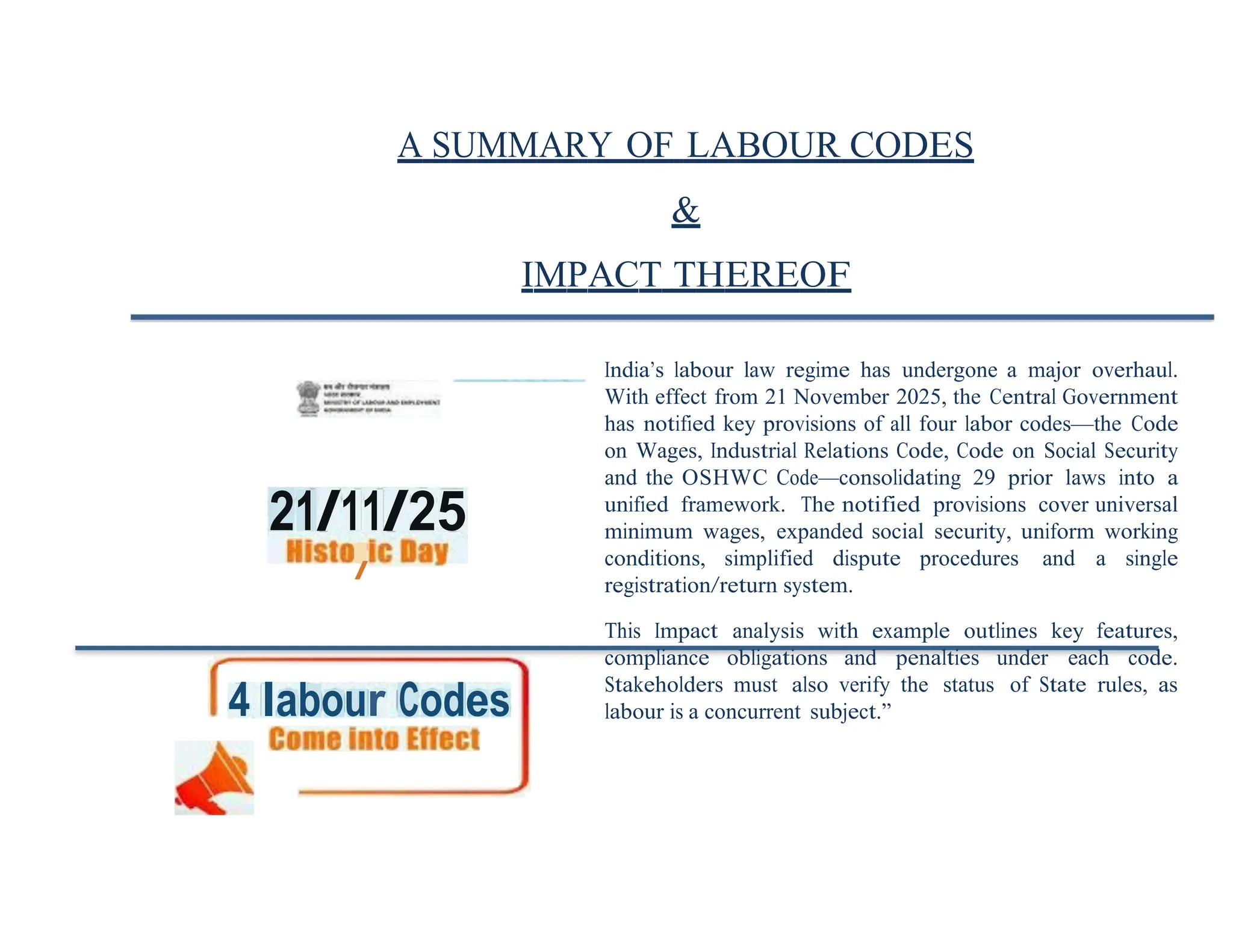
India’s labour law regime has undergone a major overhaul.
With effect from 21 November 2025, the Central Government
has notified key provisions of all four labor codes—the Code
on Wages, Industrial Relations Code, Code on Social Security
and the OSHWC Code—consolidating 29 prior laws into a
unified framework. The notified provisions cover universal
minimum wages, expanded social security, uniform working
conditions, simplified dispute procedures and a single
registration/return system.
This Impact analysis with example outlines key features,
compliance obligations and penalties under each code.
Stakeholders must also verify the status of State rules, as
labour is a concurrent subject.”
2.
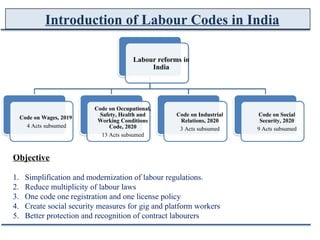
Introduction of LabourCodes in India
Labour reforms in
India
Code on Occupational,
Safety, Health and
Working Conditions
Code, 2020
Code on Industrial
Relations, 2020
Code on Social
Security, 2020
Code on Wages, 2019
4 Acts subsumed
3 Acts subsumed 9 Acts subsumed
13 Acts subsumed
Objective
1. Simplification and modernization of labour regulations.
2. Reduce multiplicity of labour laws
3. One code one registration and one license policy
4. Create social security measures for gig and platform workers
5. Better protection and recognition of contract labourers
3.
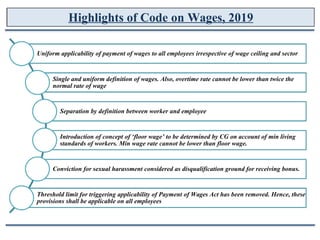
Highlights of Codeon Wages, 2019
Uniform applicability of payment of wages to all employees irrespective of wage ceiling and sector
Single and uniform definition of wages. Also, overtime rate cannot be lower than twice the
normal rate of wage
Separation by definition between worker and employee
Introduction of concept of ‘floor wage’ to be determined by CG on account of min living
standards of workers. Min wage rate cannot be lower than floor wage.
Conviction for sexual harassment considered as disqualification ground for receiving bonus.
Threshold limit for triggering applicability of Payment of Wages Act has been removed. Hence, these
provisions shall be applicable on all employees
4.
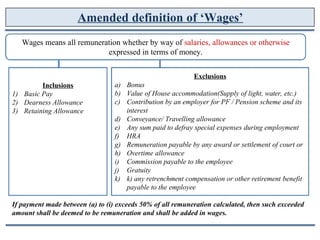
Amended definition of‘Wages’
Wages means all remuneration whether by way of salaries, allowances or otherwise
expressed in terms of money.
Exclusions
Inclusions
1) Basic Pay
2) Dearness Allowance
3) Retaining Allowance
a) Bonus
b) Value of House accommodation(Supply of light, water, etc.)
c) Contribution by an employer for PF / Pension scheme and its
interest
d) Conveyance/ Travelling allowance
e) Any sum paid to defray special expenses during employment
f) HRA
g) Remuneration payable by any award or settlement of court or
h) Overtime allowance
i) Commission payable to the employee
j) Gratuity
k) k) any retrenchment compensation or other retirement benefit
payable to the employee
If payment made between (a) to (i) exceeds 50% of all remuneration calculated, then such exceeded
amount shall be deemed to be remuneration and shall be added in wages.
5.
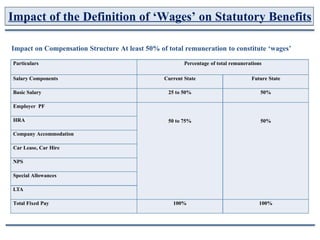
Impact of theDefinition of ‘Wages’ on Statutory Benefits
Impact on Compensation Structure At least 50% of total remuneration to constitute ‘wages’
Particulars Percentage of total remunerations
Salary Components
Basic Salary
Current State Future State
50%
25 to 50%
Employer PF
HRA 50 to 75% 50%
Company Accommodation
Car Lease, Car Hire
NPS
Special Allowances
LTA
Total Fixed Pay 100% 100%
6.
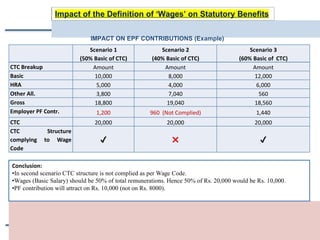
Impact of theDefinition of ‘Wages’ on Statutory Benefits
IMPACT ON EPF CONTRIBUTIONS (Example)
Scenario 1
(50% Basic of CTC)
Amount
Scenario 2
(40% Basic of CTC)
Amount
Scenario 3
(60% Basic of CTC)
Amount
CTC Breakup
Basic 10,000 8,000 12,000
HRA 5,000 4,000 6,000
Other All.
Gross
3,800
18,800
7,040
19,040
560
18,560
Employer PF Contr. 1,200 960 (Not Complied)
20,000
1,440
CTC 20,000 20,000
CTC Structure
complying to Wage
Code
Conclusion:
•In second scenario CTC structure is not complied as per Wage Code.
•Wages (Basic Salary) should be 50% of total remunerations. Hence 50% of Rs. 20,000 would be Rs. 10,000.
•PF contribution will attract on Rs. 10,000 (not on Rs. 8000).
7.
Impact of theDefinition of ‘Wages’ on Statutory Benefits
IMPACT ON MINIMUM WAGES- Contract Labour Centric
Example for minimum wages calculation: For worker (Uttarakhand) getting minimum wages Rs.
12,539 Per Months
Calculation as per
Calculation as per
Code
Sr. No
(a) Basic Salary
Earning Heads Pre-existing
enactments
Impact
9720
2819
12539
0
HRA – No more part of minimum wages.
(b) HRA (50 % of Basic Salary)
(c ) Monthly Gross Salary [ (a) + (b)]
(e) Deductions….
12539
(f) EE-PF Contr. (12 % of Basic Salary)
(g) EE-ESIC Contr. (0.75 % of Gross Salary)
(h) Total Deduction [ (f) + (g)]
1166
95
1505
95
PF contribution increased by Rs. 454
1261
11278
1600
10939
(i) Net Salary [ (c) - (h)] Net Salary decreased by Rs. 339
(j) Employer Contributions
(k) ER-PF Contr. (12 % of Basic Salary)
(l) ER-ESIC Contr. (3.25 % of Gross Salary)
(m) Total Employer Contributions [ (k) + (l)]
1166
408
1505
408
Employer PF contribution increased by Rs. 339
1574
14113
1913
14452
Employer Cost increased by Rs. 454
(n) Monthly CTC [ (c) + (m)] Total Contractor cost increased by Rs. 339
Conclusion:
•Above Analysis is for the Contractor labour, We can see the impact, Since HRA is no more part of minimum wages, Hence PF will be deducted on
minimum wages, resulting worker’s net salary will be reduced.
• Worker’s social security increased.
•Contractor’s cost will be increased.
8.
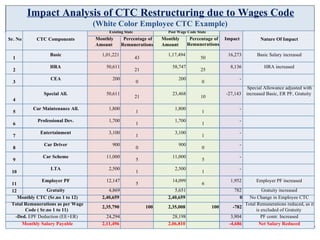
Impact Analysis ofCTC Restructuring due to Wages Code
(White Color Employee CTC Example)
Existing State Post Wage Code State
Sr. No CTC Components Monthly
Amount
Percentage of
Remunerations
Monthly
Amount
Percentage of Impact
Remunerations
Nature Of Impact
Basic
HRA
CEA
1,01,221 1,17,494 16,273 Basic Salary increased
HRA increased
1
2
3
43
21
0
50
25
0
50,611
200
58,747
200
8,136
-
Special Allowance adjusted with
Special All. 50,611 23,468 -27,143 increased Basic, ER PF, Gratuity
21 10
4
5
Car Maintenance All.
Professional Dev.
Entertainment
Car Driver
1,800
1,700
3,100
900
1,800
1,700
3,100
900
-
-
-
-
-
-
1
1
1
0
5
1
5
1
1
1
0
5
1
6
6
7
8
Car Scheme 11,000
2,500
12,147
11,000
2,500
14,099
9
LTA
10
Employer PF
Gratuity
1,952
782
Employer PF increased
11
12 4,869 5,651 Gratuity increased
Monthly CTC (Sr.no 1 to 12) 2,40,659 2,40,659 0 No Change in Employee CTC
Total Remunerations as per Wage
Code ( Sr.no 1 to 11)
Total Remunerations reduced, as it
is excluded of Gratuity
2,35,790 100 2,35,008 100 -782
-Ded. EPF Deduction (EE+ER) 24,294 28,198 3,904 PF contr. Increased
Net Salary Reduced
Monthly Salary Payable 2,11,496 2,06,810 -4,686
9.
Impact on Gratuity& Leave Encashment
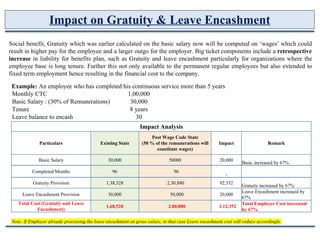
Social benefit, Gratuity which was earlier calculated on the basic salary now will be computed on ‘wages’ which could
result in higher pay for the employee and a larger outgo for the employer. Big ticket components include a retrospective
increase in liability for benefits plan, such as Gratuity and leave encashment particularly for organizations where the
employee base is long tenure. Further this not only available to the permanent regular employees but also extended to
fixed term employment hence resulting in the financial cost to the company.
Example: An employee who has completed his continuous service more than 5 years
Monthly CTC
Basic Salary : (30% of Remunerations)
Tenure
1,00,000
30,000
8 years
30
Leave balance to encash
Impact Analysis
Post Wage Code State
Particulars Existing State (50 % of the remunerations will
constitute wages)
Impact Remark
Basic Salary
Completed Months
30,000
96
50000
96
20,000
Basic increased by 67%
-
Gratuity Provision 1,38,528
30,000
1,68,528
2,30,880
50,000
2,80,880
92,352
Gratuity increased by 67%
Leave Encashment increased by
67%
Total Employer Cost increased
by 67%
Leave Encashment Provision 20,000
Total Cost (Gratuity and Leave
Encashment)
1,12,352
Note: If Employer already processing the leave encashment on gross salary, in that case Leave encashment cost will reduce accordingly.
10.
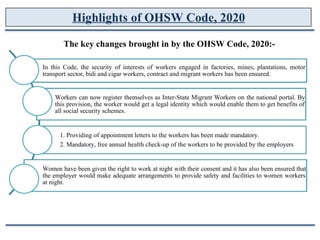
Highlights of OHSWCode, 2020
The key changes brought in by the OHSW Code, 2020:-
In this Code, the security of interests of workers engaged in factories, mines, plantations, motor
transport sector, bidi and cigar workers, contract and migrant workers has been ensured.
Workers can now register themselves as Inter-State Migrant Workers on the national portal. By
this provision, the worker would get a legal identity which would enable them to get benefits of
all social security schemes.
1. Providing of appointment letters to the workers has been made mandatory.
2. Mandatory, free annual health check-up of the workers to be provided by the employers
Women have been given the right to work at night with their consent and it has also been ensured that
the employer would make adequate arrangements to provide safety and facilities to women workers
at night.
11.
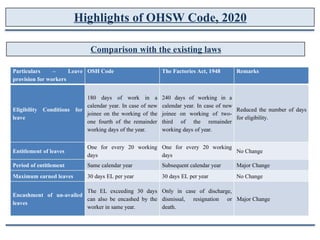
Highlights of OHSWCode, 2020
Comparison with the existing laws
Particulars – Leave OSH Code The Factories Act, 1948 Remarks
provision for workers
180 days of work in a 240 days of working in a
calendar year. In case of new calendar year. In case of new
joinee on the working of the joinee on working of two-
one fourth of the remainder third of the remainder
Eligibility Conditions for
leave
Reduced the number of days
for eligibility.
working days of the year. working days of year.
One for every 20 working One for every 20 working
Entitlement of leaves No Change
days days
Period of entitlement Same calendar year Subsequent calendar year Major Change
No Change
Maximum earned leaves 30 days EL per year 30 days EL per year
The EL exceeding 30 days Only in case of discharge,
Encashment of un-availed
leaves
can also be encashed by the dismissal, resignation or Major Change
worker in same year. death.
12.
Comparison with theexisting laws
Whether
Shops/Offices etc. to
provide such
facilities or not
[Y/N].
Sr. Revised worker Worker strength as per existing
Welfare facilities
No. strength in OSH Code provisions of factories Act, 1948
1 Canteen 100 or more 250 or more workers [Sec. 46]
30 or more women workers [Sec.
48]
Ye s [Sec. 24(1)(V)]
2. Creche facility 50 or more workers Ye s [Sec. 24(3)]
Washing Facilities, Bathing Facilities for
male female separately
Ye s [Sec. 24(1)(i) &
(ii)]
3. All All
4.
5.
Clock room/Locker etc. All
All
All
All
Ye s [Sec. 24(1)(iii)]
Ye s [Sec. 24(1)(iv)]
Sitting arrangement
6.
7.
First aid boxes All All Ye s [Sec. 24(1)(vii)]
No
Ambulance room 500 or more workers 500 or more workers (Sec. 45(4)]
8.
9.
Rest room / Lunch rooms 50 or more workers
250 or more workers
150 or more workers [Sec. 47]
500 or more workers [ Sec 49]
No
No
Welfare Officers in Factories
10. Safety Officer 500 or more workers 1000 or more workers [Sec. 40-B] No
No
11. Medical Officer
500 or more workers /
or carrying on 250 or more workers / or carrying
12. Safety Committee No
hazardous process
wherein 250 or more
on hazardous process
13.
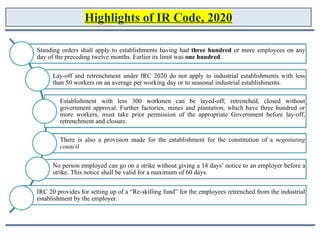
Highlights of IRCode, 2020
Standing orders shall apply to establishments having had three hundred or more employees on any
day of the preceding twelve months. Earlier its limit was one hundred.
Lay-off and retrenchment under IRC 2020 do not apply to industrial establishments with less
than 50 workers on an average per working day or to seasonal industrial establishments.
Establishment with less 300 workmen can be layed-off, retrenched, closed without
government approval. Further factories, mines and plantation, which have three hundred or
more workers, must take prior permission of the appropriate Government before lay-off,
retrenchment and closure.
There is also a provision made for the establishment for the constitution of a negotiating
council
No person employed can go on a strike without giving a 14 days’ notice to an employer before a
strike. This notice shall be valid for a maximum of 60 days.
IRC 20 provides for setting up of a “Re-skilling fund” for the employees retrenched from the industrial
establishment by the employer.
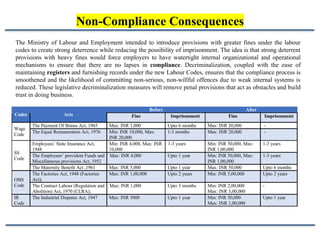
Non-Compliance Consequences
The Ministryof Labour and Employment intended to introduce provisions with greater fines under the labour
codes to create strong deterrence while reducing the possibility of imprisonment. The idea is that strong deterrent
provisions with heavy fines would force employers to have watertight internal organizational and operational
mechanisms to ensure that there are no lapses in compliance. Decriminalization, coupled with the ease of
maintaining registers and furnishing records under the new Labour Codes, ensures that the compliance process is
smoothened and the likelihood of committing non-serious, non-willful offences due to weak internal systems is
reduced. These legislative decriminalization measures will remove penal provisions that act as obstacles and build
trust in doing business.
Before After
Codes Acts Fine Imprisonment Fine Imprisonment
The Payment Of Bonus Act, 1965
The Equal Remuneration Act, 1976
Max: INR 1,000
Min: INR 10,000, Max:
INR 20,000
Upto 6 months
1-3 months
Max: INR 20,000
Max: INR 20,000
-
-
Wage
Code
Employees’ State Insurance Act,
1948
The Employees’ provident Funds and Max: INR 4,000
Miscellaneous provisions Act, 1952
Min: INR 4,000, Max: INR 1-3 years
10,000
Min: INR 50,000, Max:
INR 1,00,000
Min: INR 50,000, Max:
INR 1,00,000
1-3 years
1-3 years
SS
Code
Upto 1 year
The Maternity Benefit Act ,1961
The Factories Act, 1948 (Factories
Act);
The Contract Labour (Regulation and Max: INR 1,000
Abolition) Act, 1970 (CLRA);
Max: INR 5,000
Max: INR 1,00,000
Upto 1 year
Upto 2 years
Max: INR 50,000
Min: INR 5,00,000
Upto 6 months
Upto 2 years
OSH
Code Upto 3 months
Upto 1 year
Min: INR 2,00,000
Max: INR 3,00,000
Min: INR 50,000
Max: INR 1,00,000
-
IR
Code
The Industrial Disputes Act, 1947 Max: INR 5000 Upto 1 year

![Impact of the Definition of ‘Wages’ on Statutory Benefits
IMPACT ON MINIMUM WAGES- Contract Labour Centric
Example for minimum wages calculation: For worker (Uttarakhand) getting minimum wages Rs.
12,539 Per Months
Calculation as per
Calculation as per
Code
Sr. No
(a) Basic Salary
Earning Heads Pre-existing
enactments
Impact
9720
2819
12539
0
HRA – No more part of minimum wages.
(b) HRA (50 % of Basic Salary)
(c ) Monthly Gross Salary [ (a) + (b)]
(e) Deductions….
12539
(f) EE-PF Contr. (12 % of Basic Salary)
(g) EE-ESIC Contr. (0.75 % of Gross Salary)
(h) Total Deduction [ (f) + (g)]
1166
95
1505
95
PF contribution increased by Rs. 454
1261
11278
1600
10939
(i) Net Salary [ (c) - (h)] Net Salary decreased by Rs. 339
(j) Employer Contributions
(k) ER-PF Contr. (12 % of Basic Salary)
(l) ER-ESIC Contr. (3.25 % of Gross Salary)
(m) Total Employer Contributions [ (k) + (l)]
1166
408
1505
408
Employer PF contribution increased by Rs. 339
1574
14113
1913
14452
Employer Cost increased by Rs. 454
(n) Monthly CTC [ (c) + (m)] Total Contractor cost increased by Rs. 339
Conclusion:
•Above Analysis is for the Contractor labour, We can see the impact, Since HRA is no more part of minimum wages, Hence PF will be deducted on
minimum wages, resulting worker’s net salary will be reduced.
• Worker’s social security increased.
•Contractor’s cost will be increased.](https://image.slidesharecdn.com/labourcodes2025-251227111527-543e36bd/85/Labour-Codes-2025-what-are-changes-docx-7-320.jpg)
![Comparison with the existing laws
Whether
Shops/Offices etc. to
provide such
facilities or not
[Y/N].
Sr. Revised worker Worker strength as per existing
Welfare facilities
No. strength in OSH Code provisions of factories Act, 1948
1 Canteen 100 or more 250 or more workers [Sec. 46]
30 or more women workers [Sec.
48]
Ye s [Sec. 24(1)(V)]
2. Creche facility 50 or more workers Ye s [Sec. 24(3)]
Washing Facilities, Bathing Facilities for
male female separately
Ye s [Sec. 24(1)(i) &
(ii)]
3. All All
4.
5.
Clock room/Locker etc. All
All
All
All
Ye s [Sec. 24(1)(iii)]
Ye s [Sec. 24(1)(iv)]
Sitting arrangement
6.
7.
First aid boxes All All Ye s [Sec. 24(1)(vii)]
No
Ambulance room 500 or more workers 500 or more workers (Sec. 45(4)]
8.
9.
Rest room / Lunch rooms 50 or more workers
250 or more workers
150 or more workers [Sec. 47]
500 or more workers [ Sec 49]
No
No
Welfare Officers in Factories
10. Safety Officer 500 or more workers 1000 or more workers [Sec. 40-B] No
No
11. Medical Officer
500 or more workers /
or carrying on 250 or more workers / or carrying
12. Safety Committee No
hazardous process
wherein 250 or more
on hazardous process](https://image.slidesharecdn.com/labourcodes2025-251227111527-543e36bd/85/Labour-Codes-2025-what-are-changes-docx-12-320.jpg)



![Salient features on all labour codes ppt [compatibility mode]](https://cdn.slidesharecdn.com/ss_thumbnails/salientfeaturesonalllabourcodes-pptcompatibilitymode-200108112830-thumbnail.jpg?width=640&height=640&fit=bounds)


