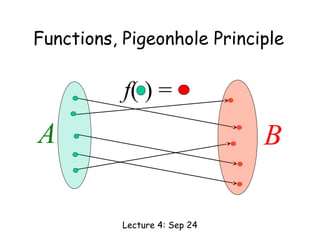
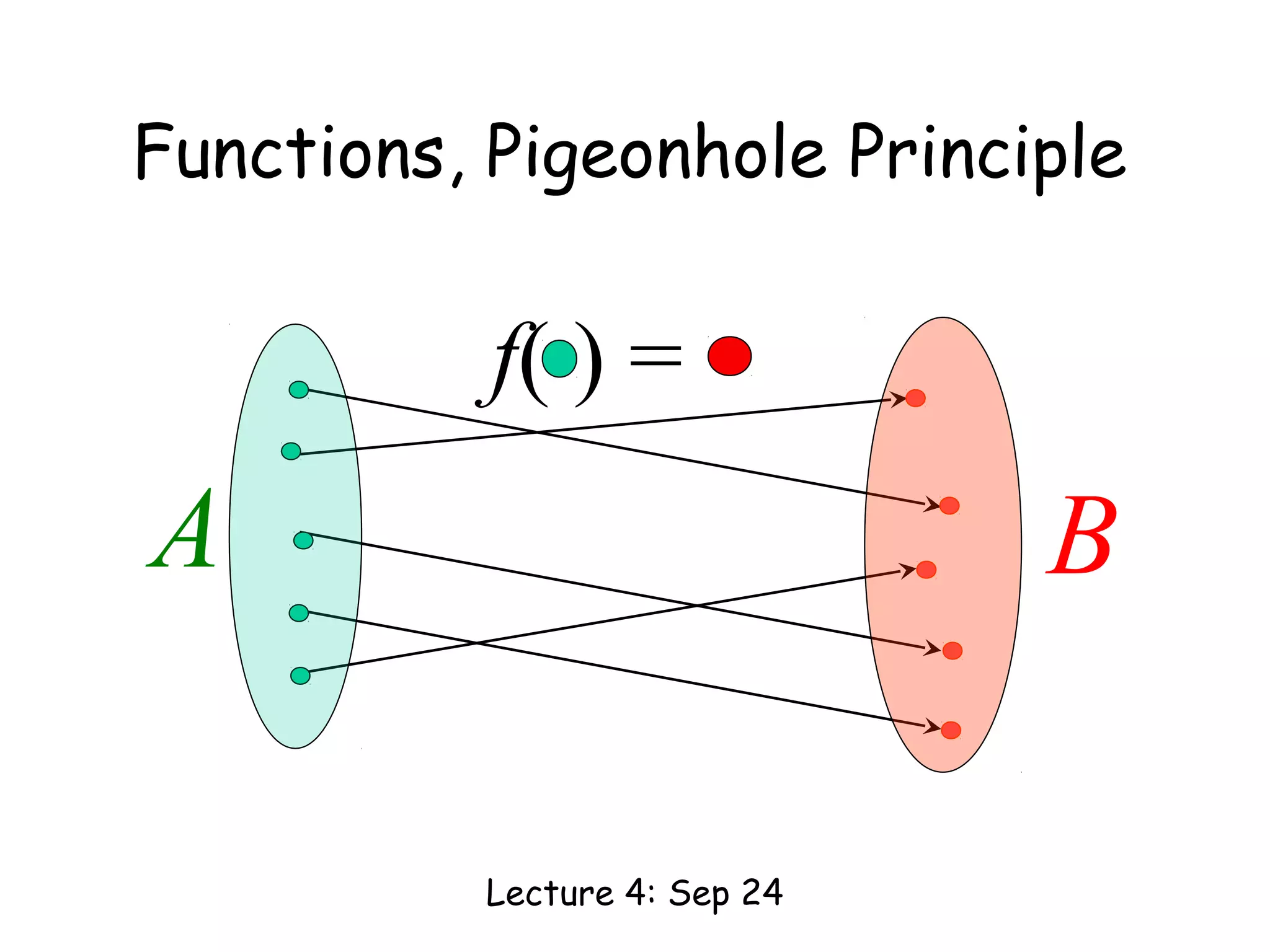

Functions, Pigeonhole Principle

           f( ) =
A                              B

           Lecture 4: Sep 24
This Lecture


We will define what is a function “formally”, and then
in the next lecture we will use this concept in counting.

We will also study the pigeonhole principle and its applications.


 • Examples and definitions (injection, surjection, bijection)

 • Pigeonhole principle and applications
Functions

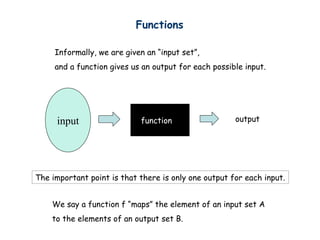
     Informally, we are given an “input set”,
     and a function gives us an output for each possible input.


     input                  function                  output


The important point is that there is only one output for each input.


    We say a function f “maps” the element of an input set A
    to the elements of an output set B.
Functions

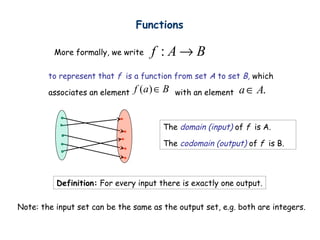
         More formally, we write    f :A→B
        to represent that f is a function from set A to set B, which

        associates an element   f (a) ∈ B   with an element   a ∈ A.


                                       The domain (input) of f is A.

                                       The codomain (output) of f is B.


          Definition: For every input there is exactly one output.

Note: the input set can be the same as the output set, e.g. both are integers.
Examples of Functions


                    domain = R
                    codomain = R>0


                    domain = R>0
                    codomain = R


                    domain = R
                    codomain = [-1,1]


                    domain = R>=0
                    codomain = R>=0
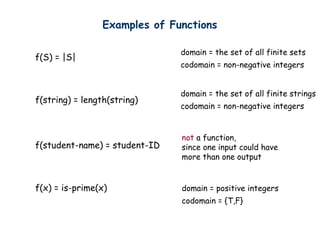
Examples of Functions

                               domain = the set of all finite sets
f(S) = |S|
                               codomain = non-negative integers


                               domain = the set of all finite strings
f(string) = length(string)
                               codomain = non-negative integers


                               not a function,
f(student-name) = student-ID   since one input could have
                               more than one output


f(x) = is-prime(x)             domain = positive integers
                               codomain = {T,F}
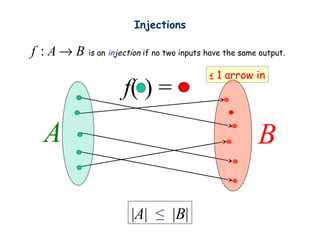
Injections

f : A → B is an injection if no two inputs have the same output.
                                            ≤ 1 arrow in
                       f( ) =
   A                                                     B

                         |A| ≤ |B|
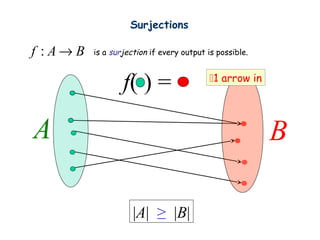
Surjections

f :A→B   is a surjection if every output is possible.


                 f( ) =                   1 arrow in


A                                                       B

                    |A| ≥ |B|
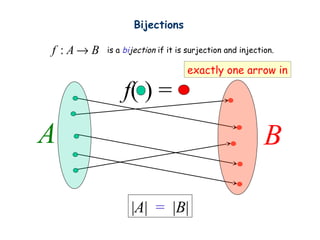
Bijections

f :A→ B   is a bijection if it is surjection and injection.

                                 exactly one arrow in

              f( ) =
A                                                       B

                 |A| = |B|
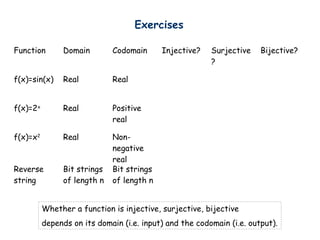
Exercises

Function        Domain        Codomain      Injective?   Surjective    Bijective?
                                                         ?

f(x)=sin(x)     Real          Real


f(x)=2x         Real          Positive
                              real

f(x)=x2         Real          Non-
                              negative
                              real
Reverse         Bit strings   Bit strings
string          of length n   of length n


          Whether a function is injective, surjective, bijective
          depends on its domain (i.e. input) and the codomain (i.e. output).
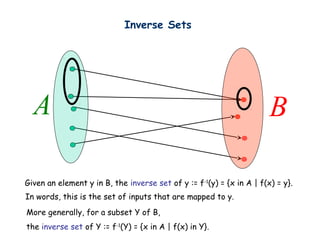
Inverse Sets


  A                                                                    B

Given an element y in B, the inverse set of y := f-1(y) = {x in A | f(x) = y}.
In words, this is the set of inputs that are mapped to y.
More generally, for a subset Y of B,
the inverse set of Y := f-1(Y) = {x in A | f(x) in Y}.
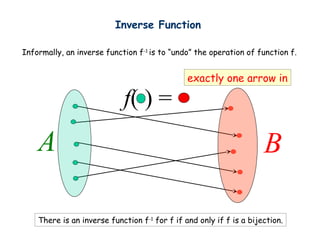
Inverse Function

Informally, an inverse function f-1 is to “undo” the operation of function f.


                                               exactly one arrow in

                            f( ) =
    A                                                                B

    There is an inverse function f-1 for f if and only if f is a bijection.
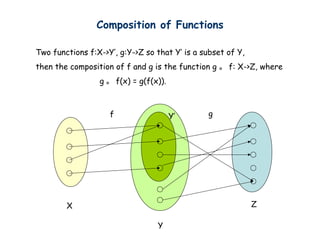
Composition of Functions

Two functions f:X->Y’, g:Y->Z so that Y’ is a subset of Y,
then the composition of f and g is the function g 。 f: X->Z, where
                 g 。 f(x) = g(f(x)).


                    f                  Y’      g


        X                                                    Z

                                 Y
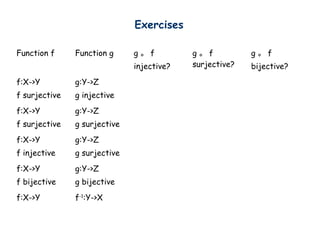
Exercises

Function f     Function g     g。f          g。f           g。f
                              injective?   surjective?   bijective?
f:X->Y         g:Y->Z
f surjective   g injective
f:X->Y         g:Y->Z
f surjective   g surjective
f:X->Y         g:Y->Z
f injective    g surjective
f:X->Y         g:Y->Z
f bijective    g bijective
f:X->Y         f-1:Y->X
This Lecture


• Examples and definitions (injection, surjection, bijection)

• Pigeonhole principle and applications
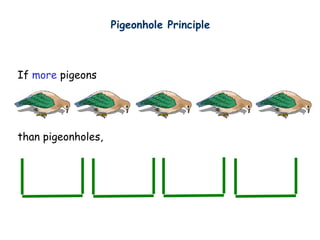
Pigeonhole Principle


If more pigeons


than pigeonholes,
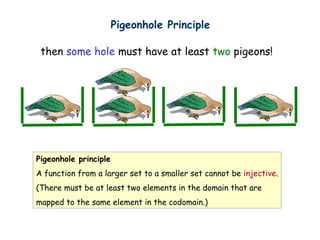
Pigeonhole Principle

 then some hole must have at least two pigeons!


Pigeonhole principle
A function from a larger set to a smaller set cannot be injective.
(There must be at least two elements in the domain that are
mapped to the same element in the codomain.)
Example 1

Question: Let A = {1,2,3,4,5,6,7,8}

If five distinct integers are selected from A,
must a pair of integers have a sum of 9?


  Consider the pairs {1,8}, {2,7}, {3,6}, {4,5}.
  The sum of each pair is equal to 9.
  If we choose 5 numbers from the set A,
  then by the pigeonhole principle,
  both elements of some pair will be chosen,
  and their sum is equal to 9.
Example 2

   Question: In a party of n people, is it always true that there are
               two people shaking hands with the same number of people?

Everyone can shake hand with 0 to n-1 people, and there are n people,
and so it does not seem that it must be the case, but think about it carefully:

      Case 1: if there is a person who does not shake hand with others,
               then any person can shake hands with at most n-2 people,
               and so everyone shakes hand with 0 to n-2 people, and so
               the answer is “yes” by the pigeonhole principle.


      Case 2: if everyone shakes hand with at least one person, then
               any person shakes hand with 1 to n-1 people, and so
               the answer is “yes” by the pigeonhole principle.
Birthday Paradox

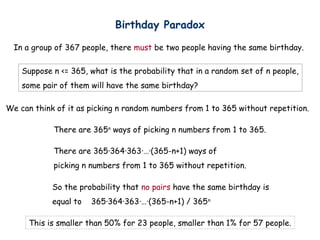
  In a group of 367 people, there must be two people having the same birthday.

    Suppose n <= 365, what is the probability that in a random set of n people,
    some pair of them will have the same birthday?

We can think of it as picking n random numbers from 1 to 365 without repetition.

            There are 365n ways of picking n numbers from 1 to 365.

            There are 365·364·363·…·(365-n+1) ways of
            picking n numbers from 1 to 365 without repetition.

            So the probability that no pairs have the same birthday is
            equal to   365·364·363·…·(365-n+1) / 365 n

      This is smaller than 50% for 23 people, smaller than 1% for 57 people.
Generalized Pigeonhole Principle


Generalized Pigeonhole Principle

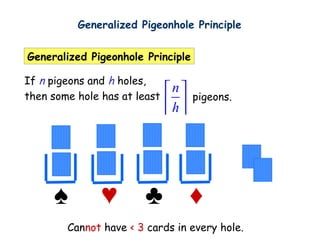
If n pigeons and h holes,
then some hole has at least
                              n
                                    pigeons.
                              h
                               


     ♠         ♥        ♣           ♦
        Cannot have < 3 cards in every hole.
Subset Sum


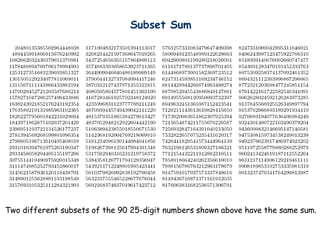
Two different subsets of the 90 25-digit numbers shown above have the same sum.
Subset Sum

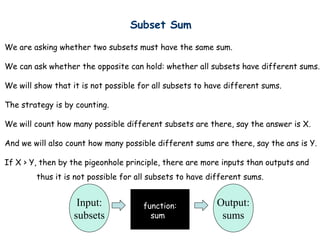
We are asking whether two subsets must have the same sum.

We can ask whether the opposite can hold: whether all subsets have different sums.

We will show that it is not possible for all subsets to have different sums.

The strategy is by counting.

We will count how many possible different subsets are there, say the answer is X.

And we will also count how many possible different sums are there, say the ans is Y.

If X > Y, then by the pigeonhole principle, there are more inputs than outputs and
        thus it is not possible for all subsets to have different sums.


                    Input:            function:           Output:
                   subsets              sum                sums
Subset Sum


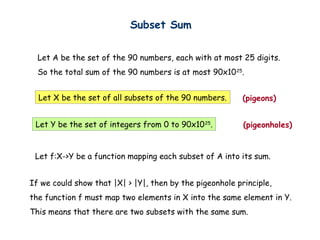
  Let A be the set of the 90 numbers, each with at most 25 digits.
  So the total sum of the 90 numbers is at most 90x10 25.


  Let X be the set of all subsets of the 90 numbers.      (pigeons)


 Let Y be the set of integers from 0 to 90x10 25.         (pigeonholes)


 Let f:X->Y be a function mapping each subset of A into its sum.


If we could show that |X| > |Y|, then by the pigeonhole principle,
the function f must map two elements in X into the same element in Y.
This means that there are two subsets with the same sum.
Subset Sum


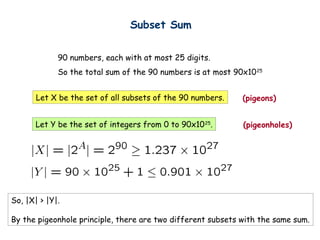
             90 numbers, each with at most 25 digits.
             So the total sum of the 90 numbers is at most 90x10 25


       Let X be the set of all subsets of the 90 numbers.    (pigeons)


       Let Y be the set of integers from 0 to 90x10 25.      (pigeonholes)


So, |X| > |Y|.

By the pigeonhole principle, there are two different subsets with the same sum.
Club vs Strangers

Let’s agree that given any two people, either they have met or not.

If every people in a group has met, then we’ll call the group a club.

If every people in a group has not met, then we’ll call a group of strangers.


 Theorem: Every collection of 6 people includes a club of 3 people,
             or a group of 3 strangers.


 Let x be one of the six people.

 By the (generalized) pigeonhole principle, we have the following claim.

 Claim: Among the remaining 5 people, either 3 of them have met x,
        or 3 of them have not met x.
Club vs Strangers

Theorem: Every collection of 6 people includes a club of 3 people,
           or a group of 3 strangers.

Claim: Among the remaining 5 people, either 3 of them have met x,
      or 3 of them have not met x.


Case 1: “3 people have met x”


  Case 1.1: No pair among those people met each other.                 OK!
           Then there is a group of 3 strangers.

  Case 1.2: Some pair among those people have met each other.          OK!
           Then that pair, together with x, form a club of 3 people.
Club vs Strangers

Theorem: Every collection of 6 people includes a club of 3 people,
           or a group of 3 strangers.

Claim: Among the remaining 5 people, either 3 of them have met x,
      or 3 of them have not met x.


Case 2: “3 people have not met x”


  Case 2.1: Every pair among those people met each other.            OK!
           Then there is a club of 3 people.

  Case 2.2: Some pair among those people have not met each other. OK!
           Then that pair, together with x, form a group of 3 strangers.
Club vs Strangers


Theorem: Every collection of 6 people includes a club of 3 people,
          or a group of 3 strangers.


     Theorem: For every k, if there are enough people,
                then either there exists a club of k people,
                or a group of k strangers.


      A large enough structure cannot be totally disorder.

      This is a basic result of Ramsey theory.
Quick Summary


Make sure you understand basic definitions of functions.

These will be used in the next lecture for counting.

The pigeonhole principle is very simple,

but there are many clever uses of it to prove non-trivial results.
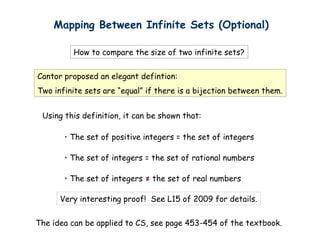
Mapping Between Infinite Sets (Optional)

         How to compare the size of two infinite sets?


Cantor proposed an elegant defintion:
Two infinite sets are “equal” if there is a bijection between them.


 Using this definition, it can be shown that:

       • The set of positive integers = the set of integers

       • The set of integers = the set of rational numbers

       • The set of integers ≠ the set of real numbers

      Very interesting proof! See L15 of 2009 for details.


The idea can be applied to CS, see page 453-454 of the textbook.

L04 (1)

  • 1.
    Functions, Pigeonhole Principle f( ) = A B Lecture 4: Sep 24
  • 2.
    This Lecture We willdefine what is a function “formally”, and then in the next lecture we will use this concept in counting. We will also study the pigeonhole principle and its applications. • Examples and definitions (injection, surjection, bijection) • Pigeonhole principle and applications
  • 3.
    Functions Informally, we are given an “input set”, and a function gives us an output for each possible input. input function output The important point is that there is only one output for each input. We say a function f “maps” the element of an input set A to the elements of an output set B.
  • 4.
    Functions More formally, we write f :A→B to represent that f is a function from set A to set B, which associates an element f (a) ∈ B with an element a ∈ A. The domain (input) of f is A. The codomain (output) of f is B. Definition: For every input there is exactly one output. Note: the input set can be the same as the output set, e.g. both are integers.
  • 5.
    Examples of Functions domain = R codomain = R>0 domain = R>0 codomain = R domain = R codomain = [-1,1] domain = R>=0 codomain = R>=0
  • 6.
    Examples of Functions domain = the set of all finite sets f(S) = |S| codomain = non-negative integers domain = the set of all finite strings f(string) = length(string) codomain = non-negative integers not a function, f(student-name) = student-ID since one input could have more than one output f(x) = is-prime(x) domain = positive integers codomain = {T,F}
  • 7.
    Injections f : A→ B is an injection if no two inputs have the same output. ≤ 1 arrow in f( ) = A B |A| ≤ |B|
  • 8.
    Surjections f :A→B is a surjection if every output is possible. f( ) = 1 arrow in A B |A| ≥ |B|
  • 9.
    Bijections f :A→ B is a bijection if it is surjection and injection. exactly one arrow in f( ) = A B |A| = |B|
  • 10.
    Exercises Function Domain Codomain Injective? Surjective Bijective? ? f(x)=sin(x) Real Real f(x)=2x Real Positive real f(x)=x2 Real Non- negative real Reverse Bit strings Bit strings string of length n of length n Whether a function is injective, surjective, bijective depends on its domain (i.e. input) and the codomain (i.e. output).
  • 11.
    Inverse Sets A B Given an element y in B, the inverse set of y := f-1(y) = {x in A | f(x) = y}. In words, this is the set of inputs that are mapped to y. More generally, for a subset Y of B, the inverse set of Y := f-1(Y) = {x in A | f(x) in Y}.
  • 12.
    Inverse Function Informally, aninverse function f-1 is to “undo” the operation of function f. exactly one arrow in f( ) = A B There is an inverse function f-1 for f if and only if f is a bijection.
  • 13.
    Composition of Functions Twofunctions f:X->Y’, g:Y->Z so that Y’ is a subset of Y, then the composition of f and g is the function g 。 f: X->Z, where g 。 f(x) = g(f(x)). f Y’ g X Z Y
  • 14.
    Exercises Function f Function g g。f g。f g。f injective? surjective? bijective? f:X->Y g:Y->Z f surjective g injective f:X->Y g:Y->Z f surjective g surjective f:X->Y g:Y->Z f injective g surjective f:X->Y g:Y->Z f bijective g bijective f:X->Y f-1:Y->X
  • 15.
    This Lecture • Examplesand definitions (injection, surjection, bijection) • Pigeonhole principle and applications
  • 16.
    Pigeonhole Principle If morepigeons than pigeonholes,
  • 17.
    Pigeonhole Principle thensome hole must have at least two pigeons! Pigeonhole principle A function from a larger set to a smaller set cannot be injective. (There must be at least two elements in the domain that are mapped to the same element in the codomain.)
  • 18.
    Example 1 Question: LetA = {1,2,3,4,5,6,7,8} If five distinct integers are selected from A, must a pair of integers have a sum of 9? Consider the pairs {1,8}, {2,7}, {3,6}, {4,5}. The sum of each pair is equal to 9. If we choose 5 numbers from the set A, then by the pigeonhole principle, both elements of some pair will be chosen, and their sum is equal to 9.
  • 19.
    Example 2 Question: In a party of n people, is it always true that there are two people shaking hands with the same number of people? Everyone can shake hand with 0 to n-1 people, and there are n people, and so it does not seem that it must be the case, but think about it carefully: Case 1: if there is a person who does not shake hand with others, then any person can shake hands with at most n-2 people, and so everyone shakes hand with 0 to n-2 people, and so the answer is “yes” by the pigeonhole principle. Case 2: if everyone shakes hand with at least one person, then any person shakes hand with 1 to n-1 people, and so the answer is “yes” by the pigeonhole principle.
  • 20.
    Birthday Paradox In a group of 367 people, there must be two people having the same birthday. Suppose n <= 365, what is the probability that in a random set of n people, some pair of them will have the same birthday? We can think of it as picking n random numbers from 1 to 365 without repetition. There are 365n ways of picking n numbers from 1 to 365. There are 365·364·363·…·(365-n+1) ways of picking n numbers from 1 to 365 without repetition. So the probability that no pairs have the same birthday is equal to 365·364·363·…·(365-n+1) / 365 n This is smaller than 50% for 23 people, smaller than 1% for 57 people.
  • 21.
    Generalized Pigeonhole Principle GeneralizedPigeonhole Principle If n pigeons and h holes, then some hole has at least n pigeons. h   ♠ ♥ ♣ ♦ Cannot have < 3 cards in every hole.
  • 22.
    Subset Sum Two differentsubsets of the 90 25-digit numbers shown above have the same sum.
  • 23.
    Subset Sum We areasking whether two subsets must have the same sum. We can ask whether the opposite can hold: whether all subsets have different sums. We will show that it is not possible for all subsets to have different sums. The strategy is by counting. We will count how many possible different subsets are there, say the answer is X. And we will also count how many possible different sums are there, say the ans is Y. If X > Y, then by the pigeonhole principle, there are more inputs than outputs and thus it is not possible for all subsets to have different sums. Input: function: Output: subsets sum sums
  • 24.
    Subset Sum Let A be the set of the 90 numbers, each with at most 25 digits. So the total sum of the 90 numbers is at most 90x10 25. Let X be the set of all subsets of the 90 numbers. (pigeons) Let Y be the set of integers from 0 to 90x10 25. (pigeonholes) Let f:X->Y be a function mapping each subset of A into its sum. If we could show that |X| > |Y|, then by the pigeonhole principle, the function f must map two elements in X into the same element in Y. This means that there are two subsets with the same sum.
  • 25.
    Subset Sum 90 numbers, each with at most 25 digits. So the total sum of the 90 numbers is at most 90x10 25 Let X be the set of all subsets of the 90 numbers. (pigeons) Let Y be the set of integers from 0 to 90x10 25. (pigeonholes) So, |X| > |Y|. By the pigeonhole principle, there are two different subsets with the same sum.
  • 26.
    Club vs Strangers Let’sagree that given any two people, either they have met or not. If every people in a group has met, then we’ll call the group a club. If every people in a group has not met, then we’ll call a group of strangers. Theorem: Every collection of 6 people includes a club of 3 people, or a group of 3 strangers. Let x be one of the six people. By the (generalized) pigeonhole principle, we have the following claim. Claim: Among the remaining 5 people, either 3 of them have met x, or 3 of them have not met x.
  • 27.
    Club vs Strangers Theorem:Every collection of 6 people includes a club of 3 people, or a group of 3 strangers. Claim: Among the remaining 5 people, either 3 of them have met x, or 3 of them have not met x. Case 1: “3 people have met x” Case 1.1: No pair among those people met each other. OK! Then there is a group of 3 strangers. Case 1.2: Some pair among those people have met each other. OK! Then that pair, together with x, form a club of 3 people.
  • 28.
    Club vs Strangers Theorem:Every collection of 6 people includes a club of 3 people, or a group of 3 strangers. Claim: Among the remaining 5 people, either 3 of them have met x, or 3 of them have not met x. Case 2: “3 people have not met x” Case 2.1: Every pair among those people met each other. OK! Then there is a club of 3 people. Case 2.2: Some pair among those people have not met each other. OK! Then that pair, together with x, form a group of 3 strangers.
  • 29.
    Club vs Strangers Theorem:Every collection of 6 people includes a club of 3 people, or a group of 3 strangers. Theorem: For every k, if there are enough people, then either there exists a club of k people, or a group of k strangers. A large enough structure cannot be totally disorder. This is a basic result of Ramsey theory.
  • 30.
    Quick Summary Make sureyou understand basic definitions of functions. These will be used in the next lecture for counting. The pigeonhole principle is very simple, but there are many clever uses of it to prove non-trivial results.
  • 31.
    Mapping Between InfiniteSets (Optional) How to compare the size of two infinite sets? Cantor proposed an elegant defintion: Two infinite sets are “equal” if there is a bijection between them. Using this definition, it can be shown that: • The set of positive integers = the set of integers • The set of integers = the set of rational numbers • The set of integers ≠ the set of real numbers Very interesting proof! See L15 of 2009 for details. The idea can be applied to CS, see page 453-454 of the textbook.