L-10 SEDIMENTATION PART-I 
Environmental Engineering-I
CONTETS 
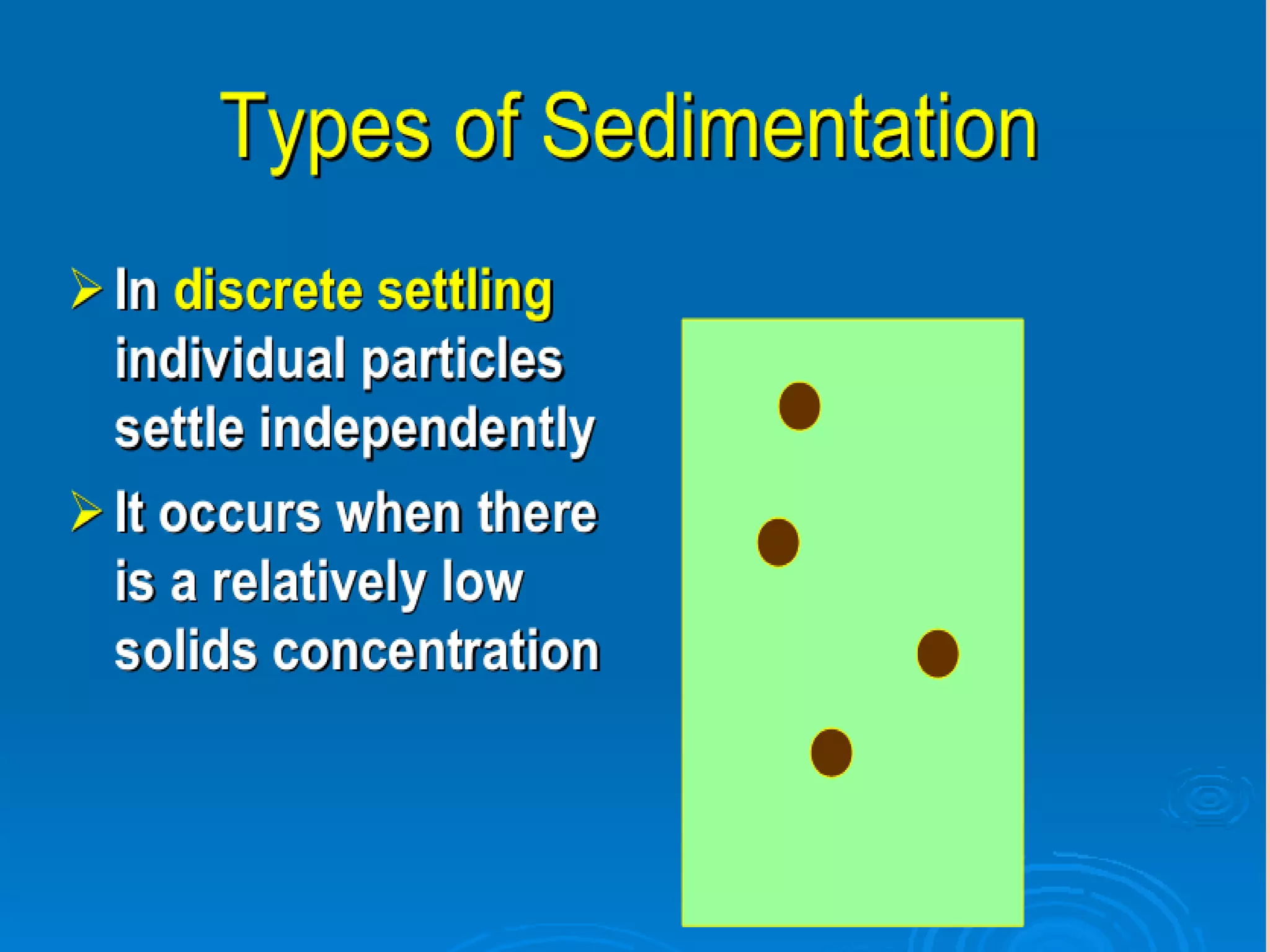
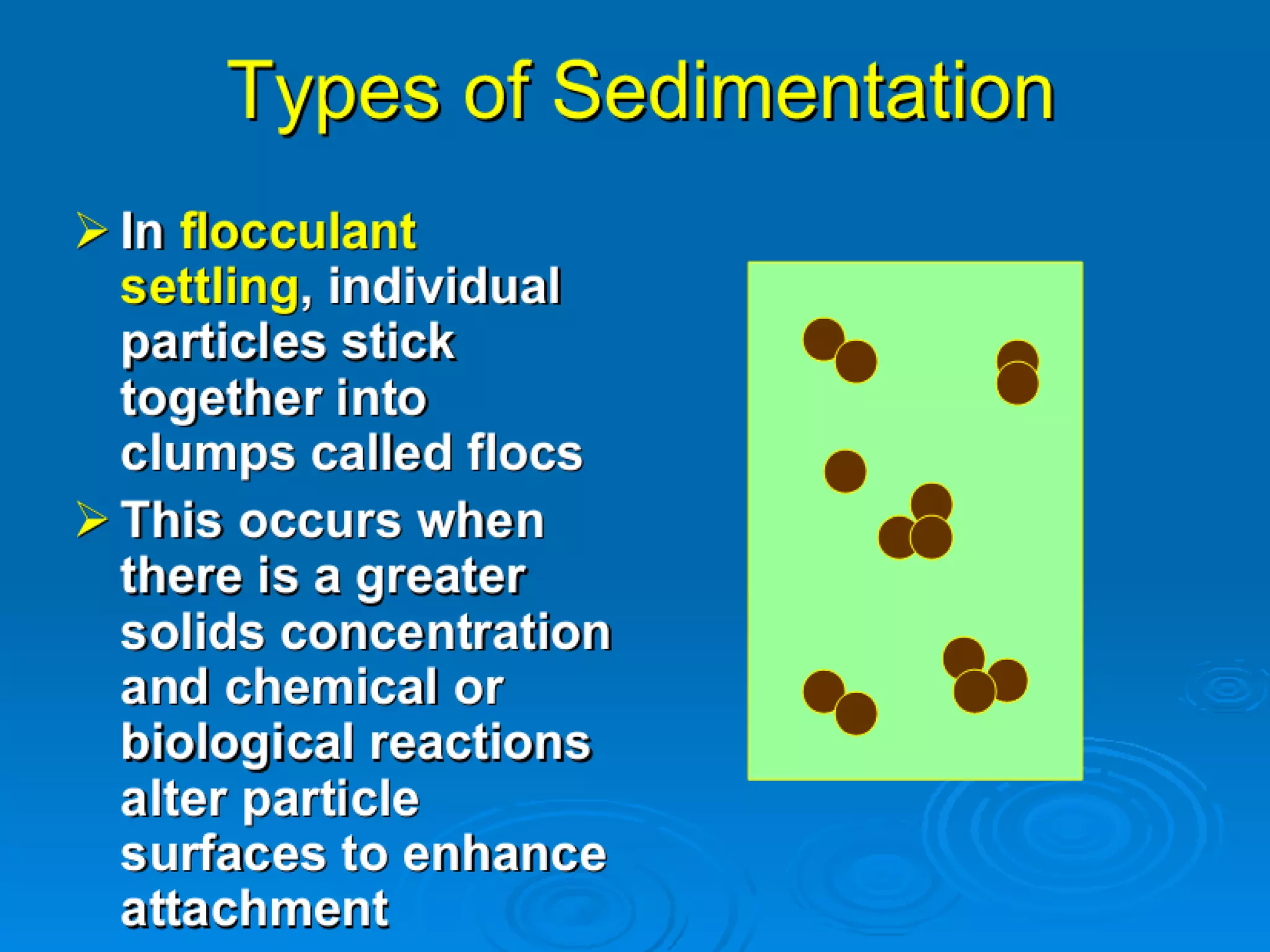
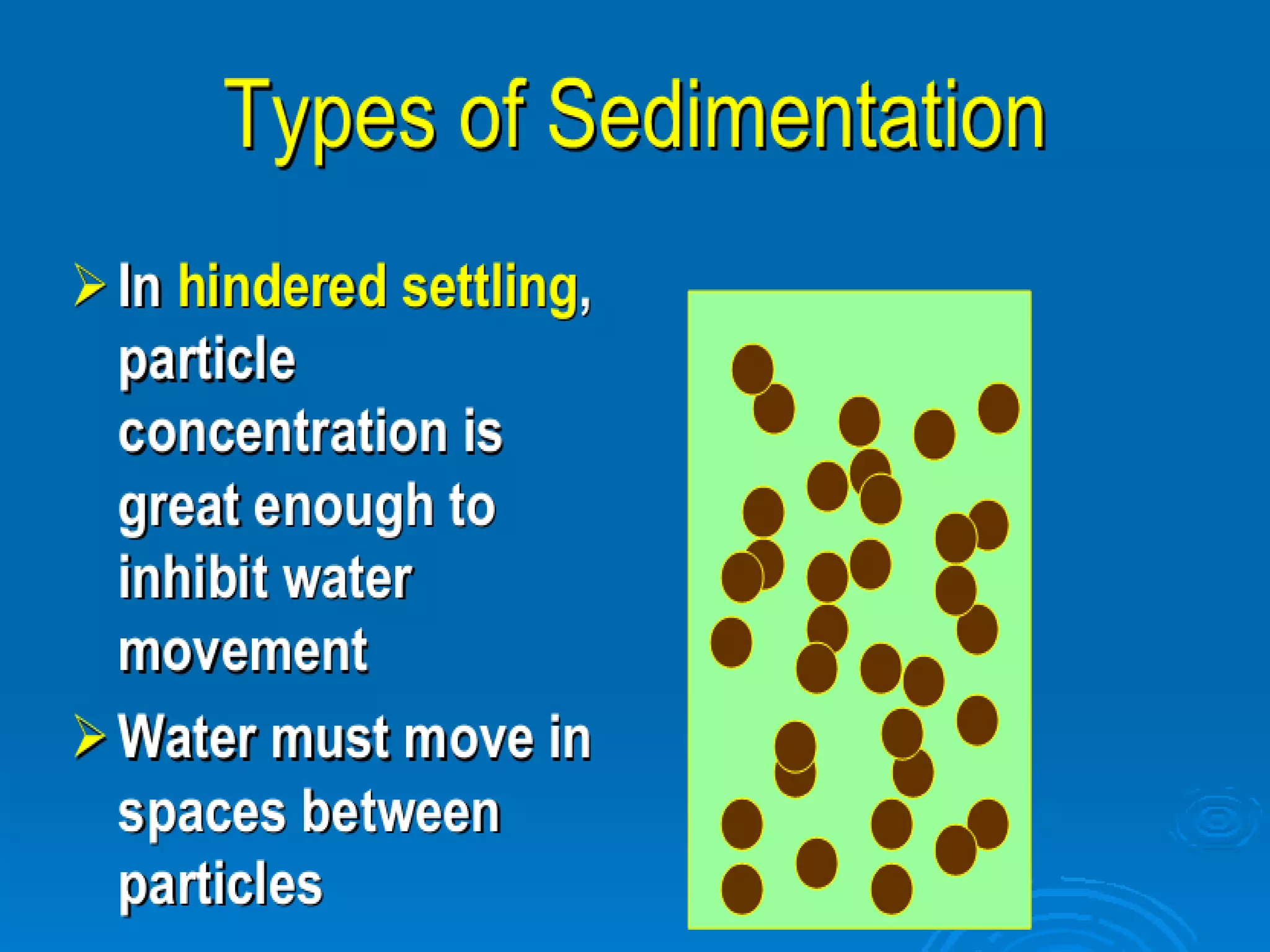
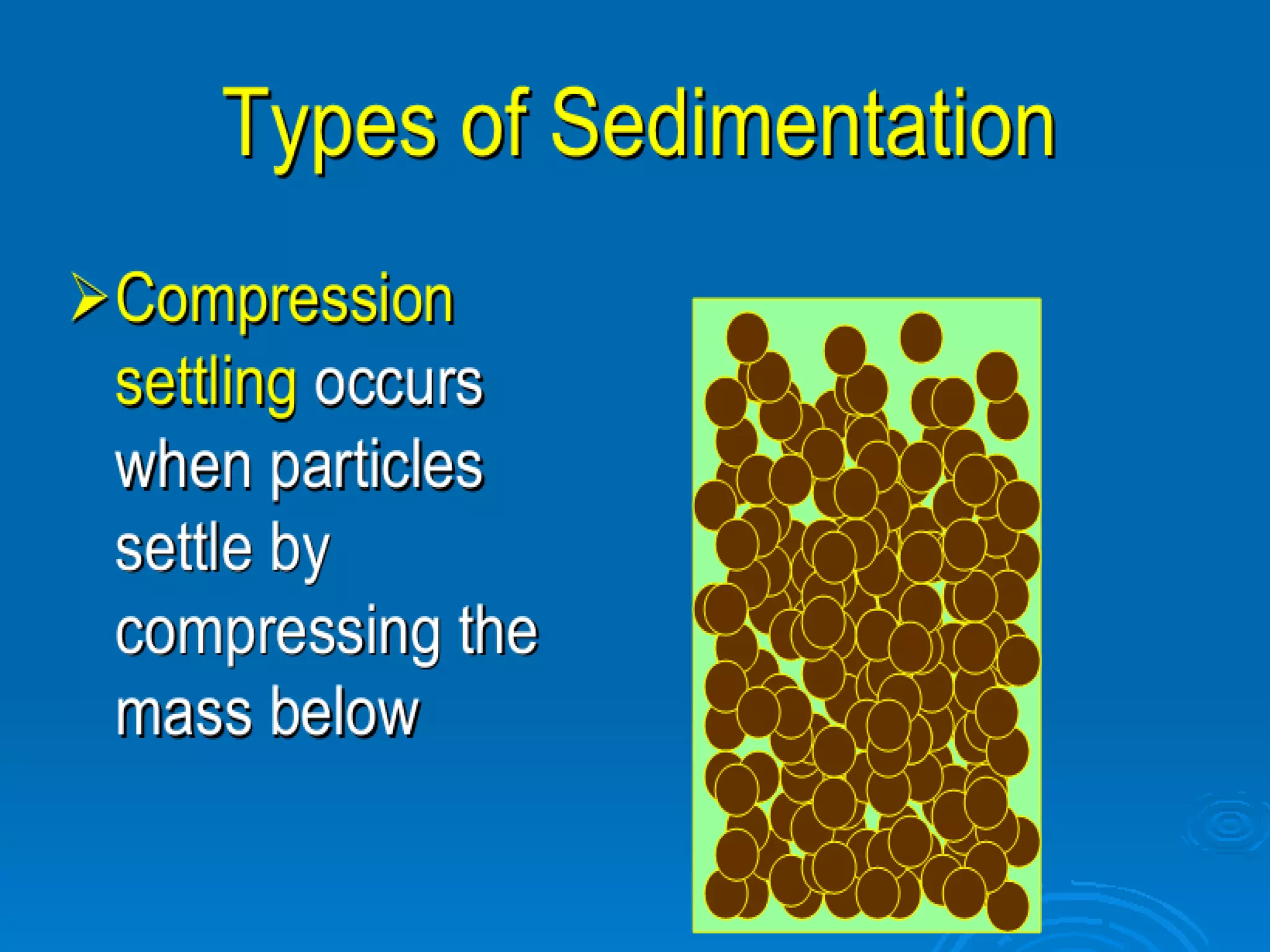
Types of settling, Theory of settling
L-12 PART -II
CONTENTS 
Theory of settling (Continued…)
ZONES IN SETTLING TANK 
As = B x L 
Vol = B x L x H 
B 
As 
Ac/s = B x H 
Ac/s
IDEAL SETTLING 
vf 
vs 
v’s 
vf
vf = flow velocity 
vs= terminal settling velocity of a particle that is just removed when it enters at the water surface (H). 
Note: 
1) All particles with terminal settling velocity ≥ vs are removed. 
2) Only part of particles with settling velocity < vs are removed.
SETTLING BASINS 
Design to minimize turbulence: 
chamfered weir to enhance laminar flow (85% of water depth) 
full-width 
weir 
inlet 
outlet 
effective settling zone 
length:width = 4:1 to 8:1 
sludge zone
SETTLING BASINS 
 Overflow rates are used for design: Vo 
( ) 
( / ) 
2 
3 
settling surface area m 
FlowRate m s 
OverflowRate  
settling surface area = length x width 
width 
length 
flow flow
L-15 PART-III INLET AND OUTLET ARRANGEMENTS TYPES OF SETTLING TANKS
INLET ARRANGEMENTS
OUTLET ARRANGEMENTS
TYPES OF SETTLING TANKS
TYPES OF SETTLING TANKS 
1.Fill and draw 
2.Continuous flow type
RECTANGULAR BASINS 
Rectangular basins are commonly found in large- scale water treatment plants. 
Rectangular tanks are popular as they tend to have: 
• High tolerance to shock overload 
• Predictable performance 
• Cost effectiveness due to lower construction cost 
• Lower maintenance 
• Minimal short circuiting
CIRCULAR BASINS 
Circular basins are often referred to as clarifiers. 
These basins share some of the performance advantages of the rectangular basins, but are generally more prone to short circuiting and particle removal problems.
CENTRAL INLET PERIPHERAL OUTLET
PERIPHERAL INLET CENTRAL OUTLET
SECTION OF RECTANGULAR TANK
Circular tank with central feed radial flow
CIRCULAR TANK 
Inlet well 
Water inlet
Rectangular Tank
Circular Tank
OBJECTIVE QUESTIONS 
1. If settling tank is rectangular in shape having length L, width W and depth D, then for discharge Q, the settling velocity would be ______. (Q/WD, Q/LW, Q/DL, Q/LWD). 
2. ______________ sedimentation is concerned with the settling of non flocculating discrete particles. (Type I/Type II/Type III/Type IV). 
3. Settling tank efficiency is reduced by __________. (eddy currents/ surface currents/ vertical convection/all of above). 
4. Type III settling is known as _______ or _________ settling. 
5. Efficiency of settling is independent of ______ and _______.
6. Unit of SOR is _____________. 
7. Unit of weir loading is __________________. 
8. Surface currents in settling tanks are due to ____________. 
9. Circular basins are often referred to as __________________.
THEORY QUESTIONS 
Q1. The removal efficiency of settling tank reduces. Explain with factors affecting removal efficiency. (May 2012, 5 marks) 
Q2. Write short notes on 
i.Stokes law of settling (May 2012, 5 marks) 
ii.Types of settling tanks (May 2012, 4 marks) 
Q3.Explain the terms ( Dec 2011, 4 marks) 
i.Overflow rate 
ii.Flow through velocity 
iii.Detention time 
iv.Settling velocity
Q4. Draw neat sketches for inlet and outlet arrangements for sedimentation tank. (May 2011, 8 marks). 
Q5. In case of sedimentation tank, ‘the efficiency is independent of the basin depth and detention period’. Prove this statement. (Dec 2010, 9 marks). 
Q6. Write explanatory note on ‘Types of settling’. (Dec 2009, 5 marks) 
Q7. Explain design criteria for sedimentation tanks. 
Q8. Discuss factors affecting efficiency of settling

L 10 sedimentation

  • 1.
    L-10 SEDIMENTATION PART-I Environmental Engineering-I
  • 2.
    CONTETS Types ofsettling, Theory of settling
  • 20.
  • 21.
    CONTENTS Theory ofsettling (Continued…)
  • 22.
    ZONES IN SETTLINGTANK As = B x L Vol = B x L x H B As Ac/s = B x H Ac/s
  • 25.
    IDEAL SETTLING vf vs v’s vf
  • 26.
    vf = flowvelocity vs= terminal settling velocity of a particle that is just removed when it enters at the water surface (H). Note: 1) All particles with terminal settling velocity ≥ vs are removed. 2) Only part of particles with settling velocity < vs are removed.
  • 27.
    SETTLING BASINS Designto minimize turbulence: chamfered weir to enhance laminar flow (85% of water depth) full-width weir inlet outlet effective settling zone length:width = 4:1 to 8:1 sludge zone
  • 28.
    SETTLING BASINS Overflow rates are used for design: Vo ( ) ( / ) 2 3 settling surface area m FlowRate m s OverflowRate  settling surface area = length x width width length flow flow
  • 29.
    L-15 PART-III INLETAND OUTLET ARRANGEMENTS TYPES OF SETTLING TANKS
  • 30.
  • 33.
  • 35.
  • 36.
    TYPES OF SETTLINGTANKS 1.Fill and draw 2.Continuous flow type
  • 37.
    RECTANGULAR BASINS Rectangularbasins are commonly found in large- scale water treatment plants. Rectangular tanks are popular as they tend to have: • High tolerance to shock overload • Predictable performance • Cost effectiveness due to lower construction cost • Lower maintenance • Minimal short circuiting
  • 38.
    CIRCULAR BASINS Circularbasins are often referred to as clarifiers. These basins share some of the performance advantages of the rectangular basins, but are generally more prone to short circuiting and particle removal problems.
  • 39.
  • 40.
  • 41.
  • 43.
    Circular tank withcentral feed radial flow
  • 46.
    CIRCULAR TANK Inletwell Water inlet
  • 47.
  • 48.
  • 50.
    OBJECTIVE QUESTIONS 1.If settling tank is rectangular in shape having length L, width W and depth D, then for discharge Q, the settling velocity would be ______. (Q/WD, Q/LW, Q/DL, Q/LWD). 2. ______________ sedimentation is concerned with the settling of non flocculating discrete particles. (Type I/Type II/Type III/Type IV). 3. Settling tank efficiency is reduced by __________. (eddy currents/ surface currents/ vertical convection/all of above). 4. Type III settling is known as _______ or _________ settling. 5. Efficiency of settling is independent of ______ and _______.
  • 51.
    6. Unit ofSOR is _____________. 7. Unit of weir loading is __________________. 8. Surface currents in settling tanks are due to ____________. 9. Circular basins are often referred to as __________________.
  • 52.
    THEORY QUESTIONS Q1.The removal efficiency of settling tank reduces. Explain with factors affecting removal efficiency. (May 2012, 5 marks) Q2. Write short notes on i.Stokes law of settling (May 2012, 5 marks) ii.Types of settling tanks (May 2012, 4 marks) Q3.Explain the terms ( Dec 2011, 4 marks) i.Overflow rate ii.Flow through velocity iii.Detention time iv.Settling velocity
  • 53.
    Q4. Draw neatsketches for inlet and outlet arrangements for sedimentation tank. (May 2011, 8 marks). Q5. In case of sedimentation tank, ‘the efficiency is independent of the basin depth and detention period’. Prove this statement. (Dec 2010, 9 marks). Q6. Write explanatory note on ‘Types of settling’. (Dec 2009, 5 marks) Q7. Explain design criteria for sedimentation tanks. Q8. Discuss factors affecting efficiency of settling