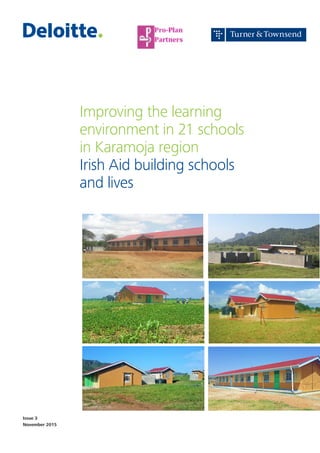
Improving the learning
environment in 21 schools
in Karamoja region
Irish Aid building schools
and lives
Issue 3
November 2015
2
Dear Readers,
The Project Management Partner (PMP) is very pleased to introduce the third issue of the Karamoja Primary Education
Programme (KPEP) newsletter. It has been a busy few months for the team and this update covers some of the key
milestones reached as well as updates on key project areas.
We also feature insights on pupil enrolment and interviews with various stakeholders concerning their views on the
KPEP.
We would like to thank Irish Aid, the Steering Committee, Ministry of Education, Science, Technology and Sports
(MoESTS) all partners and colleagues for the work we have done together. We are confident that our collective
efforts will have a great impact in advancing the KPEP Project.
Join us in celebrating the accomplishments thus far and we hope you enjoy this newsletter finding it not only
educational but stimulating and motivating.
Introduction
Building schools and lives Irish Aid 3
Contents
Project Scope 	 4
Word from the Project management Partners 	 5
Project Progress 	 6
Stakeholders’ corner 	 8
Head Teachers’ corner – Lot 1 	 9
Head Teachers’ corner – Lot 2 	 10
Communities’ corner 	 11
Pupils’ corner 	 12
Facts and figures 	 13
KPEP in the News 	 16
Immediate impact observed 	 17
Improvement in infrastructure 	 18
4
Upcoming activities
•	Finalise implementation of provision of
furniture.
•	Preparation of Final Accounts.
•	Participate in official handover activities
organised by the Steering Committee.
•	Finalise procurement for proposed solar
installations.
•	Continue procurement activities for
the provision of selected instructional
materials.
•	Prepare final project report.
Project scope
Furniture: 1,824 double decker beds,
710 three seater pupils’ desks, 60 staff room
chairs, 12 reading/staff room tables, 12 book
shelves, 8 teachers tables, 8 teachers chairs,
4 office desks and 4 high back office chairs.
Grant Amount €11,339,645
2 Kitchen Blocks
38 Double Winged Dormitories
21 Primary Schools
21 Twin Staff Houses
2 Classroom Blocks with Offices
21 VIP Latrines (2 Stance for teaching staff)
38 VIP Latrines (5 or 6 Stance for Dormitories)
38 Shower Blocks for Dormitories
18.12 Km Chain Link Fencing
Rainwater harvesting up to
630,000 litres water
630 trees to be planted
Building schools and lives Irish Aid 5
Word from the Project
Management Partners
I have the pleasure of having this opportunity to share more information with
you in this 3rd issue of the KPEP Newsletter. It has been a very wonderful
journey since we communicated in the last Newsletter. We have been able to
achieve much progress on the project. Construction of the structures has been
completed in time, within budget and with high level of quality standards. As
a PMP, we appreciate all the support from the various stakeholders including,
Irish Aid, Ministry of Education (MoESTS), Steering Committee members,
District leaders, beneficiary schools’ management and Community leaders. To
all of you we say THANK YOU. We look forward to continued partnership in
ensuring that the remaining components of the program will be successfully
implemented.
It has been a great experience implementing this project whilst ensuring that
all activities undertaken were as per the agreed scope, timely and within the
approved budget. Working with a diverse team where few people are willing to
venture made it all the more interesting. There was the sharing of experiences
and appreciation of different cultures and I believe this is one of the things that
kept the team together throughout the implementation period. It has been
great working with all partners, the Steering Committee and Irish Aid.
For over 2 years of implementation of KPEP, it has been a rewarding experience
to deliver this project on schedule, within budget and regarded to be of high
quality by all stakeholders. Hearing our own Client and Steering Committee
(Irish Aid and Ministry of Education) applaud the work done has made
worthwhile the sleepless nights, day-long bumpy road trips and challenging
stakeholder engagements, among others. To-date, the project stands ‘dispute-
free’ with contractors, which cannot be taken for granted. Our entire network
of professionals and field staff is immensely appreciated for working together to
deliver what can rightly be known as Value-for-Money for our Client.
Geoffrey Musisi
KPEP Program Director
Richard Mugisa
Project Manager
Elizabeth Natukunda
Cost Manager
6
The KPEP project is intended to support the objective
of equitable access to basic education for Karimojong
children through the improvement of infrastructure in
21 primary schools in Karamoja. This support does not
stop at infrastructure development but also includes the
provision of furniture for the constructed dormitories,
classrooms and administration blocks.
Progress of Works
The works contracts commenced in July 2014. The civil
works regarded to be of high quality were completed on
schedule in August 2015 as contracted and were within
the agreed contract sums.
The PMP perceives this achievement to be of significant
Value-for-Money.
By 31 October 2015, the following had been achieved:
•	Main facilities (38 double winged dormitories and 21
Staff Houses) and auxiliary facilities (38 V.I.P Latrines,
38 Shower blocks and 2 Kitchens) were completed;
•	7.72 Kilometres (Km) and 9.755 Kilometres (Km)
fencing and gates were completed for Lot 1 and Lot 2
respectively;
•	30 trees per school were planted and are subject to
regular maintenance till established;
•	External works (mainly earthworks), rain water
harvesting and foul drainage works, fixtures and final
painting works were completed;
•	Water tanks with 30,000 litre capacity were provided
to 17 schools while those with 20,000 litre capacity
were provided to the remaining 4 school.
•	Site technical handovers of all the 21 primary schools
were performed between the 28th of September and
1st of October 2015 and were well attended by high
level representation and participation of Irish Aid, the
Ministry of Education, Science, Technology and Sports
(MoESTS), members of the Steering Committee,School
Management, respective district leadership, the
contractors (Seyani Brothers & co. (U) Ltd and Excel
Construction Ltd) and facilitated by the PMP (Deloitte
(U) Ltd, Pro-Plan Partners and Turner & Townsend).
Project progress
Building schools and lives Irish Aid 7
Progress of Furniture supply
The provision of furniture at their respective destinations started on schedule in September 2015, and has been
completed in all schools both For Lot 1 and Lot 2.
Furniture delivered is shown below:
Site meetings, inspections and visits
As at 30 October 2015, the PMP had carried out 8 site visits as indicated below. These activities involved stakeholders
from the 21 schools, district leadership, members of the Steering Committee, representing the MoESTS and Irish Aid.
The project has now entered the defects liability period within which the PMP will have minimal field supervision
activities.
Double
decker
beds
3 Seater
pupils
desks
Teachers
tables
Chairs office
desks
High back
managerial
office chairs
Reading
/ Staff
room
Staff
room
chairs
Book
shelves
Lot 1 816 270 0 0 0 0 0 0 0
Lot 2 1,008 440 8 8 4 4 12 60 12
Technical site handovers
Snagging inspections
Impromptu visits
Site inspections
Site meetings
Lot 2 (excel) Lot 1 (seyani)
8
The PMP had a word with Ms. Rohan Stritch who
conveyed appreciation from Irish Aid for the progress of
the project.
I am glad that I had the opportunity to be involved
in some of the team site meetings that took place
in June 2015. For Irish Aid, education plays a central
role in helping the communities lift themselves out of
poverty, secure employment and contribute fully to their
own growth and development as well as that of their
community, especially the girl child. I am also pleased
that during the lifetime of this project, health and safety
matters have been taken into consideration by the
pertinent parties including the school staff members,
the contractors and the PMP. Irish Aid partnered
with Straight Talk Foundation to stay on top of health
matters, specifically concerns around HIV/AIDS. Straight
Talk has visited each of the 21 schools at least twice and
has certainly made the effort to discuss health related
concerns with site workers, the communities, school
management committees, school administrations, pupils
and teaching staff at both lots. This is commendable.
I am also glad that there has been continuous
commitment from the contractor teams and the PMP to
stick to the schedule and have the school construction
process completed and delivered on time.
I am delighted that the contractors have consistently
performed a good job and have been on schedule
throughout the construction of the schools. I am also
glad that the site meetings and inspections carried out
by the Implementing Partners and the stakeholders were
consistent and participatory in nature which is important
in terms of sustainability and ownership.
The KPEP Project is an important support to the
Education Sector, particularly in Karamoja. And its
success can be attributed to invaluable support by the
Irish government, the commitment of the implementers
of the project and the participation of the stakeholders
at all levels.
I also wish to once again appreciate the stakeholders,
particularly the school management for embracing the
project throughout the period of implementation.
Stakeholders’ corner
Rohan Stritch - Development Officer at Irish Aid
Department of Foreign Affairs and Trade.
(June 2015.)
Engineer Tinkasiimire Emmanuel – MoESTS/
CMU and member of the Steering Committee. (16
September 2015)
“My concern and area of interest is Government spending a lot of money on
education. The kind of work I have seen so far is perfect. It is well done and it
leaves me questioning myself whether the good work is as a result of the work
of the consultants or the stakeholders. There’s a lot to learn from you people
in Karamoja. I am going to tell people out there to come to Karamoja and learn
about the very good Government work going on. I am really impressed. Thank
you.” – Hon. Minister John Chrysestom Muyingo (MoESTS)
For Irish Aid, it is very
important to have children in
school and more importantly
to have girls in school and
secure.
Building schools and lives Irish Aid 9
Head Teachers’ corner
Lot 1
Irish Aid, the Ministry of Education,
Science, Technology and Sports (MoESTS)
and the Implementing Partners are greatly
appreciated for their contributions in
ensuring that the girl child benefits from
this project by rehabilitating this single
sexed school. As a result of the new
structures;
•	There was an increase in the enrolment
of girls (10) for Primary 7 between
January and June 2015.
•	We also have 5 visually impaired boys
who have always wanted to study and
could not be denied the education. They
will now have better space within which
to rest and study.
•	Instances of children sleeping on
the floor or sharing beddings will be
alleviated as each of the pupils will
have access to personal beds which
encourages good hygiene.
The KPEP project has seen children get
enrolled in school from as far as South
Sudan and Karamoja surrounding regions.
We are happy that the pupils can be
housed in the dormitories but are worried
about the limited classroom facilities we
have to teach them. The option for the
time being would be to teach them in
shifts but this is something that can be
discussed with the school management.
The community has also been quite
supportive of the project and they
concur that it has played a huge role in
encouraging more girls to go to school. It
provides the girl child an avenue to avoid
situations like child labour at home or early
marriages. In the past 2 years, we have had
an increase in the number of girls passing
exams in the 1st grade division and these
were girls who were specifically in the
boarding section.
With regards, to sustainability, the
community around the school is an
informed one and they know what it
means to educate children. They are
actively involved in the Girl Education
Movement campaign which is geared
towards having the girl child in school and
this poses an advantage for the girls.
We are thrilled to have these structures in
place within the school. As an outcome of
these structures,
•	Many children have been attracted to
the school both as day scholars and as
boarders and this plays a big role in pupil
retention.
•	The discipline of the children will be
improved and maintained as they will be
within a fenced environment.
•	The girls will be able to have ample time
to study as opposed to carrying out
various chores at home where they will
rarely get time to study.
•	Children who used to walk from as far
as Abuuk district headquarters which is
15km away from the school no longer
have to do that since they will be catered
for within the school premises.
•	The project has reduced the burden of
parents building temporary huts for the
teachers and these huts were infested
with termites. The twin staff house will
greatly help reduce that burden.
Sister Jacinta – Head Teacher
Komukuny Girls Primary School.
Okello Alfred Obonyo – Deputy Head
Teacher Karenga Primary School.
Koryang Jimmex Abang – Head Teacher
Kiru Primary School.
10
The buildings are going to be of great
help to the school and solve some of the
challenges that we have been having.
Examples of these include;
•	Pupils, both girls and boys have been
studying in the classes during the day
and sleeping in the same classes during
the night.
•	The new dormitories and provision of
furniture will help solve this problem as
the pupils will be able to sleep in areas
separate from their classes.
•	Most of the pupils walk long distances
to study and in the process lose a lot
of time which should have been spent
studying. Having the dormitories will
ensure that the pupils can stay within
secure school premises and concentrate
on their studies. The dormitories will
attract children to the school which will
inevitably boost enrolment in the school
which is a good thing.
•	The twin staff houses are a good step
towards retaining our teachers and we
hope for more housing in the future.
•	The security fence will ensure security
for all people on school ground, while
the harvested water will alleviate the
problem of having no water within the
school.
KPEP has been a good project and
I would like to thank Irish Aid for
including Naitakwae Primary School in
the consideration to provide us with the
buildings that we have. There is ample
space for the children to stay within the
school premises and this gives the teachers
a chance to spend more time with the
pupils both in class and when carrying
out remedial classes which plays a role in
increasing the pass rate of the pupils.
Community members diligently supported
the construction of the school buildings
by attending site meetings and inspections
and contributing thoughts on the progress
of the project.
It is exciting to see the community have
a sense of ownership of the school. This
was noted from the time construction
begun. The community members were
always eager to attend site meetings and
contribute to the discussions therein.
Most parents did not understand the
importance of girls going to school. The
two girls’ dormitories built have played a
role in encouraging parents to let their girl
children go to school.
Head Teachers’ corner
Lot 2
Napeyok Betty Volla – Head Teacher
(Loodoi Primary School)
Sister Madgalene – Head teacher
Kalas Girls P/S. (30 September 2015.)
James Etelu – Head Teacher
(Naitakwae Primary School)
Ilukol Moses – Head Teacher
Lotome Girls Primary School (June 2015)
“I have appreciated the form of partnership
and mode of consultative work carried
out by the PMP. I wish that all contractors
worked in the same manner as the PMP
did. This way all projects would be of
quality standards. I commend the team/
consultants’ efforts of involving the bene-
fitting stakeholders which resulted in good
quality work.’
Building schools and lives Irish Aid 11
Communities’ corner
As a child, I studied in Nalakas Primary
School. At the time, I recall studying in
mud houses and when I got to Primary
4, I was transferred to another school
in Moroto district. On occasion, I would
return to Nalakas Primary School to
encourage as many children as possible to
keep studying.
To see some of these new buildings in
place in my former primary school is
beyond words. Since the KPEP project
started, I have ensured that I attend as
many site meetings as possible or as often
as time would allow me to. There has
already been an impact on the school with
the advent of the new structures in place
such as an increase in the number of pupils
enrolled and the willingness of parents to
pay a small fee to ensure that their children
are in school.
In as much as we thank Irish Aid for
considering this school as one of the
beneficiaries of this project, I would like
to highlight the dilapidated classroom
challenges that we have and request that if
there are funds that have been saved upon
completion of the project, consideration
can be given to the provision of classrooms
for the school.
From my interaction with the PMP and
other stakeholders during site meetings, I
am particularly grateful that the structures
have been built for both our pupils and
staff members. I would like to also thank
the PMP for always keeping time each
time a site meeting was scheduled and for
ensuring that work was carried out as had
been agreed with the contractors and the
stakeholders.
I would like to thank the PMP for involving
the community in the site meetings and
inspections and as a result of this, it
has been able to own the project and
have been involved in sensitising other
community members on how to ensure
that the buildings are well maintained.
Finally, we thank God for Irish Aid for
funding the structures that we have,
for the PMP who have seen the project
through and the contractors who were
willing to take on this project.
I am happy that the Local Council,
Chairperson and community members are
involved in the project. Seeing them take
ownership of the project is a good sign of
things to come. The workmanship of the
works being performed is good including
the quality of materials. I would also like
to appreciate the constant supervision
that is carried out at the school sites by
the Project Management team. They
are consistent and ensure that work is
being performed as was agreed with the
contractor.
I appreciate the fact that the buildings
cater for the pupils with disabilities.
Somebody shed a tear for Karamoja and that is the
Ambassador of the Embassy of Ireland. I remember
he said, “I really cry for Karamoja, I cry for the
development of Karamoja.” That was in 2008. I still
remember that day and today those tears that the
Ambassador shed have been realised through these
buildings. Now we know where we will put our
toilets, our roads etc. We are not going to build and
put structures anywhere. We are very lucky that we
have people who can plan for us in this site plan.
Oryem Paul – Community member and
Alumnus of Nalakas Primary School.
Bishop: The Rt. Revd James Nasak –
North Karamoja Diocese.
Chuna Moses – Deputy CAO
(Napak District).
Hilary Topos Ramson, Senior Assistant
Town Clerk Nakapiripirit, (1 Oct 2015.)
12
Pupils’ corner
“We are happy that we have the new structures in place.
As girls, we won’t have to go through the problems of
rebels disturbing us while we walk to school and waking
up extremely early to walk to school to read. The new
structures with the addition of electricity will help us to read
our books in the night and be able to favourably compete
with other schools nearby.”
Pupils of Primary 6 class in Kotido Mixed Primary
School
“I cannot wait to enter the girls’ dormitory as this will ensure that I get to class
on time and it will also give me the opportunity to read at night instead of
carrying out home chores.”
Apio Rachel: P.6 Kiru Primary School.
“The new dormitories and latrines give us a chance for improved health as they
are clean and will force us to be hygienic.”
Ojom Lameck: P.7 Kiru Primary School.
“Thank you Irish Aid for the support you have
rendered us. The girls’ dormitory is very good but we
still want you to provide our teachers with enough
accommodation because most of them are residing in
our classrooms.”
Kasimeri Primary School students. (29 September
2015)
Building schools and lives Irish Aid 13
Text for footer goes here 13
Facts and figures
Overall,
populati
employeNote: The 5 boys that are studying in Komukuny Girls Primary School are partially blind but have always wanted to study so the school took
them in.
Note: From the start of the project, there has been a notable increase in pupil enrolment with the highest incre
127% from 780 pupils in 2013 to 987 as of July 2015. With regard to the pupils in boarding, there was an incre
boarding section with the highest recorded at 594% from 161 boarders in Orwamuge P/S in 2013 to 956 board
Lot 1
26
50
213
491
Lot 2
Overall, female workers made up 10%
of the total work population at both
school lots. 780 locals were employed
to work on all 21 school sites.
Male vs female workers on both Lots
Female workers Male workers
Facts and figures
14
Note: From the start of the project, there has been a notable increase in pupil enrolment with the highest increase recorded in Kasimeri P/S at
127% from 780 pupils in 2013 to 987 as of July 2015. With regard to the pupils in boarding, there was an increase in the number of pupils in the
boarding section with the highest recorded at 594% from 161 boarders in Orwamuge P/S in 2013 to 956 boarders in 2015.
Text for footer goes here 13
Overall,
populati
employeNote: The 5 boys that are studying in Komukuny Girls Primary School are partially blind but have always wanted to study so the school took
them in.
Note: From the start of the project, there has been a notable increase in pupil enrolment with the highest incre
127% from 780 pupils in 2013 to 987 as of July 2015. With regard to the pupils in boarding, there was an incr
boarding section with the highest recorded at 594% from 161 boarders in Orwamuge P/S in 2013 to 956 board
r footer goes here 13
Overall, female workers made up 10% of the total work
population at both school lots. 780 locals were
employed to work on all 21 school sites.have always wanted to study so the school took
een a notable increase in pupil enrolment with the highest increase recorded in Kasimeri P/S at
2015. With regard to the pupils in boarding, there was an increase in the number of pupils in the
94% from 161 boarders in Orwamuge P/S in 2013 to 956 boarders in 2015.
Building schools and lives Irish Aid 15
816 double decker beds and 270 three seater pupils’ desks
have been delivered to Lot 1. 1,008 double decker beds and
440 three seater desks have been delivered to Lot 2.
Some of the furniture provided under KPEP
Lokitelaebu P/S – September 2015: School children
using the new furniture supplied under KPEP.
More staff are expected to be
resident on campus with the
construction of additional staff
houses.
97181
Male
teachers in
21 Schools
Female
teachers in
21 Schools
16
First Lady and Minister for Karamoja Affairs Janet
Museveni and Irish Ambassador Donal Cronin after
touring the boys’ dormitory building constructed under
the Irish funded Karamoja Primary Education Programme
at Loodoi Primary School in Napak district.
(5 June 2015).
The state minister for Primary Education John
Chrysostom Muyingo, during the visit of four newly
constructed dormitories in Napak district. (30
September 2015)
KPEP in the News
Building schools and lives Irish Aid 17
•	Improved security for learners as a result of the chain
link fencing around learner campuses.
•	Increasing retention of pupils especially the girl child.
•	Increasing demand for enrolment by neighbouring
districts who have been motivated by the new
facilities constructed.
•	Employment creation for the local population
as a result of contractors procuring some local
building materials which met the required technical
specifications. Some artisans and casual labour force
was comprised of Karimojong population.
•	Food crop growing embarked on by various school
communities within the newly fenced boundaries of
the institutions which is perceived to contribute to the
welfare of livelihood of the population at the schools.
•	Skills development. The district and community
leaders commended the contractors for employing
local labour who met the skills required for the
execution of works. This has in turn helped in
improving the technical capacity in the region.
•	Involvement of women in activities such as masonry
works, catering services, stores records management,
landscaping and casual labour.
•	Involvement of Public/Private Partnerships throughout
the project cycle of design, execution and supervision/
monitoring yielded much appreciated quality results in
a timely manner and robust cost management.
Immediate impact observed
Food crop growing next to Kiru P/S Girls’
dormitory – August 2015.
Food crop growing next to Napumpum P/S
Twin Staff House – August 2015.
Employment of locals as casual labourers – (December 2014.)
18
Improvement in infrastructure
Lokitelaebu P/S boys’ dormitory Karenga P/S Teachers’ staff house. Katikit P/S Classroom
Naitakwae P/S Boys’ Dormitory Karenga P/S Boys’ Shower block and
5 stance VIP latrines
Kasimeri P/S 2 stance VIP latrine
After
Before
Deloitte refers to one or more of Deloitte Touche Tohmatsu Limited, a UK private company limited by guarantee (“DTTL”), its network of member firms, and their related entities. DTTL and each of its member
firms are legally separate and independent entities. DTTL (also referred to as “Deloitte Global”) does not provide services to clients. Please see www.deloitte.com/about for a more detailed description of DTTL
and its member firms.
Deloitte provides audit, tax, consulting, and financial advisory services to public and private clients spanning multiple industries. With a globally connected network of member firms in more than
150 countries, Deloitte brings world-class capabilities and high-quality service to clients, delivering the insights they need to address their most complex business challenges. Deloitte has in the region
of 200,000 professionals, all committed to becoming the standard of excellence.
© 2015 Deloitte Uganda Limited

KPEP_Newsletter_Issue 3

  • 1.
    Improving the learning environmentin 21 schools in Karamoja region Irish Aid building schools and lives Issue 3 November 2015
  • 2.
    2 Dear Readers, The ProjectManagement Partner (PMP) is very pleased to introduce the third issue of the Karamoja Primary Education Programme (KPEP) newsletter. It has been a busy few months for the team and this update covers some of the key milestones reached as well as updates on key project areas. We also feature insights on pupil enrolment and interviews with various stakeholders concerning their views on the KPEP. We would like to thank Irish Aid, the Steering Committee, Ministry of Education, Science, Technology and Sports (MoESTS) all partners and colleagues for the work we have done together. We are confident that our collective efforts will have a great impact in advancing the KPEP Project. Join us in celebrating the accomplishments thus far and we hope you enjoy this newsletter finding it not only educational but stimulating and motivating. Introduction
  • 3.
    Building schools andlives Irish Aid 3 Contents Project Scope 4 Word from the Project management Partners 5 Project Progress 6 Stakeholders’ corner 8 Head Teachers’ corner – Lot 1 9 Head Teachers’ corner – Lot 2 10 Communities’ corner 11 Pupils’ corner 12 Facts and figures 13 KPEP in the News 16 Immediate impact observed 17 Improvement in infrastructure 18
  • 4.
    4 Upcoming activities • Finalise implementationof provision of furniture. • Preparation of Final Accounts. • Participate in official handover activities organised by the Steering Committee. • Finalise procurement for proposed solar installations. • Continue procurement activities for the provision of selected instructional materials. • Prepare final project report. Project scope Furniture: 1,824 double decker beds, 710 three seater pupils’ desks, 60 staff room chairs, 12 reading/staff room tables, 12 book shelves, 8 teachers tables, 8 teachers chairs, 4 office desks and 4 high back office chairs. Grant Amount €11,339,645 2 Kitchen Blocks 38 Double Winged Dormitories 21 Primary Schools 21 Twin Staff Houses 2 Classroom Blocks with Offices 21 VIP Latrines (2 Stance for teaching staff) 38 VIP Latrines (5 or 6 Stance for Dormitories) 38 Shower Blocks for Dormitories 18.12 Km Chain Link Fencing Rainwater harvesting up to 630,000 litres water 630 trees to be planted
  • 5.
    Building schools andlives Irish Aid 5 Word from the Project Management Partners I have the pleasure of having this opportunity to share more information with you in this 3rd issue of the KPEP Newsletter. It has been a very wonderful journey since we communicated in the last Newsletter. We have been able to achieve much progress on the project. Construction of the structures has been completed in time, within budget and with high level of quality standards. As a PMP, we appreciate all the support from the various stakeholders including, Irish Aid, Ministry of Education (MoESTS), Steering Committee members, District leaders, beneficiary schools’ management and Community leaders. To all of you we say THANK YOU. We look forward to continued partnership in ensuring that the remaining components of the program will be successfully implemented. It has been a great experience implementing this project whilst ensuring that all activities undertaken were as per the agreed scope, timely and within the approved budget. Working with a diverse team where few people are willing to venture made it all the more interesting. There was the sharing of experiences and appreciation of different cultures and I believe this is one of the things that kept the team together throughout the implementation period. It has been great working with all partners, the Steering Committee and Irish Aid. For over 2 years of implementation of KPEP, it has been a rewarding experience to deliver this project on schedule, within budget and regarded to be of high quality by all stakeholders. Hearing our own Client and Steering Committee (Irish Aid and Ministry of Education) applaud the work done has made worthwhile the sleepless nights, day-long bumpy road trips and challenging stakeholder engagements, among others. To-date, the project stands ‘dispute- free’ with contractors, which cannot be taken for granted. Our entire network of professionals and field staff is immensely appreciated for working together to deliver what can rightly be known as Value-for-Money for our Client. Geoffrey Musisi KPEP Program Director Richard Mugisa Project Manager Elizabeth Natukunda Cost Manager
  • 6.
    6 The KPEP projectis intended to support the objective of equitable access to basic education for Karimojong children through the improvement of infrastructure in 21 primary schools in Karamoja. This support does not stop at infrastructure development but also includes the provision of furniture for the constructed dormitories, classrooms and administration blocks. Progress of Works The works contracts commenced in July 2014. The civil works regarded to be of high quality were completed on schedule in August 2015 as contracted and were within the agreed contract sums. The PMP perceives this achievement to be of significant Value-for-Money. By 31 October 2015, the following had been achieved: • Main facilities (38 double winged dormitories and 21 Staff Houses) and auxiliary facilities (38 V.I.P Latrines, 38 Shower blocks and 2 Kitchens) were completed; • 7.72 Kilometres (Km) and 9.755 Kilometres (Km) fencing and gates were completed for Lot 1 and Lot 2 respectively; • 30 trees per school were planted and are subject to regular maintenance till established; • External works (mainly earthworks), rain water harvesting and foul drainage works, fixtures and final painting works were completed; • Water tanks with 30,000 litre capacity were provided to 17 schools while those with 20,000 litre capacity were provided to the remaining 4 school. • Site technical handovers of all the 21 primary schools were performed between the 28th of September and 1st of October 2015 and were well attended by high level representation and participation of Irish Aid, the Ministry of Education, Science, Technology and Sports (MoESTS), members of the Steering Committee,School Management, respective district leadership, the contractors (Seyani Brothers & co. (U) Ltd and Excel Construction Ltd) and facilitated by the PMP (Deloitte (U) Ltd, Pro-Plan Partners and Turner & Townsend). Project progress
  • 7.
    Building schools andlives Irish Aid 7 Progress of Furniture supply The provision of furniture at their respective destinations started on schedule in September 2015, and has been completed in all schools both For Lot 1 and Lot 2. Furniture delivered is shown below: Site meetings, inspections and visits As at 30 October 2015, the PMP had carried out 8 site visits as indicated below. These activities involved stakeholders from the 21 schools, district leadership, members of the Steering Committee, representing the MoESTS and Irish Aid. The project has now entered the defects liability period within which the PMP will have minimal field supervision activities. Double decker beds 3 Seater pupils desks Teachers tables Chairs office desks High back managerial office chairs Reading / Staff room Staff room chairs Book shelves Lot 1 816 270 0 0 0 0 0 0 0 Lot 2 1,008 440 8 8 4 4 12 60 12 Technical site handovers Snagging inspections Impromptu visits Site inspections Site meetings Lot 2 (excel) Lot 1 (seyani)
  • 8.
    8 The PMP hada word with Ms. Rohan Stritch who conveyed appreciation from Irish Aid for the progress of the project. I am glad that I had the opportunity to be involved in some of the team site meetings that took place in June 2015. For Irish Aid, education plays a central role in helping the communities lift themselves out of poverty, secure employment and contribute fully to their own growth and development as well as that of their community, especially the girl child. I am also pleased that during the lifetime of this project, health and safety matters have been taken into consideration by the pertinent parties including the school staff members, the contractors and the PMP. Irish Aid partnered with Straight Talk Foundation to stay on top of health matters, specifically concerns around HIV/AIDS. Straight Talk has visited each of the 21 schools at least twice and has certainly made the effort to discuss health related concerns with site workers, the communities, school management committees, school administrations, pupils and teaching staff at both lots. This is commendable. I am also glad that there has been continuous commitment from the contractor teams and the PMP to stick to the schedule and have the school construction process completed and delivered on time. I am delighted that the contractors have consistently performed a good job and have been on schedule throughout the construction of the schools. I am also glad that the site meetings and inspections carried out by the Implementing Partners and the stakeholders were consistent and participatory in nature which is important in terms of sustainability and ownership. The KPEP Project is an important support to the Education Sector, particularly in Karamoja. And its success can be attributed to invaluable support by the Irish government, the commitment of the implementers of the project and the participation of the stakeholders at all levels. I also wish to once again appreciate the stakeholders, particularly the school management for embracing the project throughout the period of implementation. Stakeholders’ corner Rohan Stritch - Development Officer at Irish Aid Department of Foreign Affairs and Trade. (June 2015.) Engineer Tinkasiimire Emmanuel – MoESTS/ CMU and member of the Steering Committee. (16 September 2015) “My concern and area of interest is Government spending a lot of money on education. The kind of work I have seen so far is perfect. It is well done and it leaves me questioning myself whether the good work is as a result of the work of the consultants or the stakeholders. There’s a lot to learn from you people in Karamoja. I am going to tell people out there to come to Karamoja and learn about the very good Government work going on. I am really impressed. Thank you.” – Hon. Minister John Chrysestom Muyingo (MoESTS) For Irish Aid, it is very important to have children in school and more importantly to have girls in school and secure.
  • 9.
    Building schools andlives Irish Aid 9 Head Teachers’ corner Lot 1 Irish Aid, the Ministry of Education, Science, Technology and Sports (MoESTS) and the Implementing Partners are greatly appreciated for their contributions in ensuring that the girl child benefits from this project by rehabilitating this single sexed school. As a result of the new structures; • There was an increase in the enrolment of girls (10) for Primary 7 between January and June 2015. • We also have 5 visually impaired boys who have always wanted to study and could not be denied the education. They will now have better space within which to rest and study. • Instances of children sleeping on the floor or sharing beddings will be alleviated as each of the pupils will have access to personal beds which encourages good hygiene. The KPEP project has seen children get enrolled in school from as far as South Sudan and Karamoja surrounding regions. We are happy that the pupils can be housed in the dormitories but are worried about the limited classroom facilities we have to teach them. The option for the time being would be to teach them in shifts but this is something that can be discussed with the school management. The community has also been quite supportive of the project and they concur that it has played a huge role in encouraging more girls to go to school. It provides the girl child an avenue to avoid situations like child labour at home or early marriages. In the past 2 years, we have had an increase in the number of girls passing exams in the 1st grade division and these were girls who were specifically in the boarding section. With regards, to sustainability, the community around the school is an informed one and they know what it means to educate children. They are actively involved in the Girl Education Movement campaign which is geared towards having the girl child in school and this poses an advantage for the girls. We are thrilled to have these structures in place within the school. As an outcome of these structures, • Many children have been attracted to the school both as day scholars and as boarders and this plays a big role in pupil retention. • The discipline of the children will be improved and maintained as they will be within a fenced environment. • The girls will be able to have ample time to study as opposed to carrying out various chores at home where they will rarely get time to study. • Children who used to walk from as far as Abuuk district headquarters which is 15km away from the school no longer have to do that since they will be catered for within the school premises. • The project has reduced the burden of parents building temporary huts for the teachers and these huts were infested with termites. The twin staff house will greatly help reduce that burden. Sister Jacinta – Head Teacher Komukuny Girls Primary School. Okello Alfred Obonyo – Deputy Head Teacher Karenga Primary School. Koryang Jimmex Abang – Head Teacher Kiru Primary School.
  • 10.
    10 The buildings aregoing to be of great help to the school and solve some of the challenges that we have been having. Examples of these include; • Pupils, both girls and boys have been studying in the classes during the day and sleeping in the same classes during the night. • The new dormitories and provision of furniture will help solve this problem as the pupils will be able to sleep in areas separate from their classes. • Most of the pupils walk long distances to study and in the process lose a lot of time which should have been spent studying. Having the dormitories will ensure that the pupils can stay within secure school premises and concentrate on their studies. The dormitories will attract children to the school which will inevitably boost enrolment in the school which is a good thing. • The twin staff houses are a good step towards retaining our teachers and we hope for more housing in the future. • The security fence will ensure security for all people on school ground, while the harvested water will alleviate the problem of having no water within the school. KPEP has been a good project and I would like to thank Irish Aid for including Naitakwae Primary School in the consideration to provide us with the buildings that we have. There is ample space for the children to stay within the school premises and this gives the teachers a chance to spend more time with the pupils both in class and when carrying out remedial classes which plays a role in increasing the pass rate of the pupils. Community members diligently supported the construction of the school buildings by attending site meetings and inspections and contributing thoughts on the progress of the project. It is exciting to see the community have a sense of ownership of the school. This was noted from the time construction begun. The community members were always eager to attend site meetings and contribute to the discussions therein. Most parents did not understand the importance of girls going to school. The two girls’ dormitories built have played a role in encouraging parents to let their girl children go to school. Head Teachers’ corner Lot 2 Napeyok Betty Volla – Head Teacher (Loodoi Primary School) Sister Madgalene – Head teacher Kalas Girls P/S. (30 September 2015.) James Etelu – Head Teacher (Naitakwae Primary School) Ilukol Moses – Head Teacher Lotome Girls Primary School (June 2015) “I have appreciated the form of partnership and mode of consultative work carried out by the PMP. I wish that all contractors worked in the same manner as the PMP did. This way all projects would be of quality standards. I commend the team/ consultants’ efforts of involving the bene- fitting stakeholders which resulted in good quality work.’
  • 11.
    Building schools andlives Irish Aid 11 Communities’ corner As a child, I studied in Nalakas Primary School. At the time, I recall studying in mud houses and when I got to Primary 4, I was transferred to another school in Moroto district. On occasion, I would return to Nalakas Primary School to encourage as many children as possible to keep studying. To see some of these new buildings in place in my former primary school is beyond words. Since the KPEP project started, I have ensured that I attend as many site meetings as possible or as often as time would allow me to. There has already been an impact on the school with the advent of the new structures in place such as an increase in the number of pupils enrolled and the willingness of parents to pay a small fee to ensure that their children are in school. In as much as we thank Irish Aid for considering this school as one of the beneficiaries of this project, I would like to highlight the dilapidated classroom challenges that we have and request that if there are funds that have been saved upon completion of the project, consideration can be given to the provision of classrooms for the school. From my interaction with the PMP and other stakeholders during site meetings, I am particularly grateful that the structures have been built for both our pupils and staff members. I would like to also thank the PMP for always keeping time each time a site meeting was scheduled and for ensuring that work was carried out as had been agreed with the contractors and the stakeholders. I would like to thank the PMP for involving the community in the site meetings and inspections and as a result of this, it has been able to own the project and have been involved in sensitising other community members on how to ensure that the buildings are well maintained. Finally, we thank God for Irish Aid for funding the structures that we have, for the PMP who have seen the project through and the contractors who were willing to take on this project. I am happy that the Local Council, Chairperson and community members are involved in the project. Seeing them take ownership of the project is a good sign of things to come. The workmanship of the works being performed is good including the quality of materials. I would also like to appreciate the constant supervision that is carried out at the school sites by the Project Management team. They are consistent and ensure that work is being performed as was agreed with the contractor. I appreciate the fact that the buildings cater for the pupils with disabilities. Somebody shed a tear for Karamoja and that is the Ambassador of the Embassy of Ireland. I remember he said, “I really cry for Karamoja, I cry for the development of Karamoja.” That was in 2008. I still remember that day and today those tears that the Ambassador shed have been realised through these buildings. Now we know where we will put our toilets, our roads etc. We are not going to build and put structures anywhere. We are very lucky that we have people who can plan for us in this site plan. Oryem Paul – Community member and Alumnus of Nalakas Primary School. Bishop: The Rt. Revd James Nasak – North Karamoja Diocese. Chuna Moses – Deputy CAO (Napak District). Hilary Topos Ramson, Senior Assistant Town Clerk Nakapiripirit, (1 Oct 2015.)
  • 12.
    12 Pupils’ corner “We arehappy that we have the new structures in place. As girls, we won’t have to go through the problems of rebels disturbing us while we walk to school and waking up extremely early to walk to school to read. The new structures with the addition of electricity will help us to read our books in the night and be able to favourably compete with other schools nearby.” Pupils of Primary 6 class in Kotido Mixed Primary School “I cannot wait to enter the girls’ dormitory as this will ensure that I get to class on time and it will also give me the opportunity to read at night instead of carrying out home chores.” Apio Rachel: P.6 Kiru Primary School. “The new dormitories and latrines give us a chance for improved health as they are clean and will force us to be hygienic.” Ojom Lameck: P.7 Kiru Primary School. “Thank you Irish Aid for the support you have rendered us. The girls’ dormitory is very good but we still want you to provide our teachers with enough accommodation because most of them are residing in our classrooms.” Kasimeri Primary School students. (29 September 2015)
  • 13.
    Building schools andlives Irish Aid 13 Text for footer goes here 13 Facts and figures Overall, populati employeNote: The 5 boys that are studying in Komukuny Girls Primary School are partially blind but have always wanted to study so the school took them in. Note: From the start of the project, there has been a notable increase in pupil enrolment with the highest incre 127% from 780 pupils in 2013 to 987 as of July 2015. With regard to the pupils in boarding, there was an incre boarding section with the highest recorded at 594% from 161 boarders in Orwamuge P/S in 2013 to 956 board Lot 1 26 50 213 491 Lot 2 Overall, female workers made up 10% of the total work population at both school lots. 780 locals were employed to work on all 21 school sites. Male vs female workers on both Lots Female workers Male workers Facts and figures
  • 14.
    14 Note: From thestart of the project, there has been a notable increase in pupil enrolment with the highest increase recorded in Kasimeri P/S at 127% from 780 pupils in 2013 to 987 as of July 2015. With regard to the pupils in boarding, there was an increase in the number of pupils in the boarding section with the highest recorded at 594% from 161 boarders in Orwamuge P/S in 2013 to 956 boarders in 2015. Text for footer goes here 13 Overall, populati employeNote: The 5 boys that are studying in Komukuny Girls Primary School are partially blind but have always wanted to study so the school took them in. Note: From the start of the project, there has been a notable increase in pupil enrolment with the highest incre 127% from 780 pupils in 2013 to 987 as of July 2015. With regard to the pupils in boarding, there was an incr boarding section with the highest recorded at 594% from 161 boarders in Orwamuge P/S in 2013 to 956 board r footer goes here 13 Overall, female workers made up 10% of the total work population at both school lots. 780 locals were employed to work on all 21 school sites.have always wanted to study so the school took een a notable increase in pupil enrolment with the highest increase recorded in Kasimeri P/S at 2015. With regard to the pupils in boarding, there was an increase in the number of pupils in the 94% from 161 boarders in Orwamuge P/S in 2013 to 956 boarders in 2015.
  • 15.
    Building schools andlives Irish Aid 15 816 double decker beds and 270 three seater pupils’ desks have been delivered to Lot 1. 1,008 double decker beds and 440 three seater desks have been delivered to Lot 2. Some of the furniture provided under KPEP Lokitelaebu P/S – September 2015: School children using the new furniture supplied under KPEP. More staff are expected to be resident on campus with the construction of additional staff houses. 97181 Male teachers in 21 Schools Female teachers in 21 Schools
  • 16.
    16 First Lady andMinister for Karamoja Affairs Janet Museveni and Irish Ambassador Donal Cronin after touring the boys’ dormitory building constructed under the Irish funded Karamoja Primary Education Programme at Loodoi Primary School in Napak district. (5 June 2015). The state minister for Primary Education John Chrysostom Muyingo, during the visit of four newly constructed dormitories in Napak district. (30 September 2015) KPEP in the News
  • 17.
    Building schools andlives Irish Aid 17 • Improved security for learners as a result of the chain link fencing around learner campuses. • Increasing retention of pupils especially the girl child. • Increasing demand for enrolment by neighbouring districts who have been motivated by the new facilities constructed. • Employment creation for the local population as a result of contractors procuring some local building materials which met the required technical specifications. Some artisans and casual labour force was comprised of Karimojong population. • Food crop growing embarked on by various school communities within the newly fenced boundaries of the institutions which is perceived to contribute to the welfare of livelihood of the population at the schools. • Skills development. The district and community leaders commended the contractors for employing local labour who met the skills required for the execution of works. This has in turn helped in improving the technical capacity in the region. • Involvement of women in activities such as masonry works, catering services, stores records management, landscaping and casual labour. • Involvement of Public/Private Partnerships throughout the project cycle of design, execution and supervision/ monitoring yielded much appreciated quality results in a timely manner and robust cost management. Immediate impact observed Food crop growing next to Kiru P/S Girls’ dormitory – August 2015. Food crop growing next to Napumpum P/S Twin Staff House – August 2015. Employment of locals as casual labourers – (December 2014.)
  • 18.
    18 Improvement in infrastructure LokitelaebuP/S boys’ dormitory Karenga P/S Teachers’ staff house. Katikit P/S Classroom Naitakwae P/S Boys’ Dormitory Karenga P/S Boys’ Shower block and 5 stance VIP latrines Kasimeri P/S 2 stance VIP latrine After Before
  • 19.
    Deloitte refers toone or more of Deloitte Touche Tohmatsu Limited, a UK private company limited by guarantee (“DTTL”), its network of member firms, and their related entities. DTTL and each of its member firms are legally separate and independent entities. DTTL (also referred to as “Deloitte Global”) does not provide services to clients. Please see www.deloitte.com/about for a more detailed description of DTTL and its member firms. Deloitte provides audit, tax, consulting, and financial advisory services to public and private clients spanning multiple industries. With a globally connected network of member firms in more than 150 countries, Deloitte brings world-class capabilities and high-quality service to clients, delivering the insights they need to address their most complex business challenges. Deloitte has in the region of 200,000 professionals, all committed to becoming the standard of excellence. © 2015 Deloitte Uganda Limited