The Kotlin  Programming Language Dmitry Jemerov JetBrains GmbH
What is JetBrains?
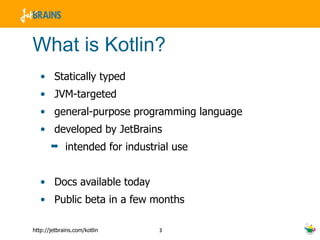
What is Kotlin? Statically typed JVM-targeted general-purpose programming language developed by JetBrains intended for industrial use Docs available today Public beta in a few months
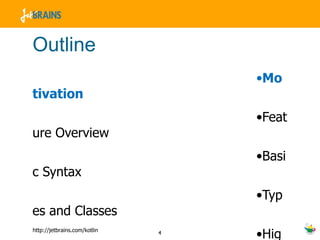
Outline Motivation Feature Overview Basic Syntax Types and Classes Higher-order Functions Type-safe Groovy-style Builders
Motivation Started in mid 2010 Huge Java codebase (>50k classes, 10 years old) Building tools for many nice languages Want a modern, expressive language … that’s easy to introduce in the existing environment Need efficient tooling None of the existing languages was a good fit
Design Goals Full  Java interoperability Compiles  as   fast as  Java More  concise  than  Java Prevents more kinds of errors  than  Java Way  simpler  than  Scala
Tooling IntelliJ IDEA plugin developed in parallel with compiler Both compiler and plugin will be released under Apache 2 license Basic Eclipse plugin will be provided
Innovation Not a research project, don’t plan to publish papers No ground-breaking language features Focus on common sense and best practices established in other languages Groovy, Scala, C#, Gosu… Feature selection tradeoff: expressive yet easy to learn
Outline Motivation Feature Overview Basic Syntax Types and Classes Higher-order Functions Type-safe Groovy-style Builders
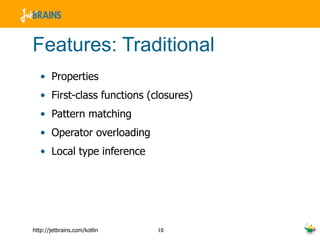
Features: Traditional Properties First-class functions (closures) Pattern matching Operator overloading Local type inference
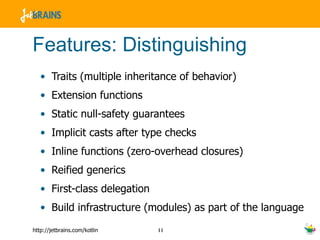
Features: Distinguishing Traits (multiple inheritance of behavior) Extension functions Static null-safety guarantees Implicit casts after type checks Inline functions (zero-overhead closures) Reified generics First-class delegation Build infrastructure (modules) as part of the language
Outline Motivation Feature Overview Basic Syntax Types and Classes Higher-order Functions Type-safe Groovy-style Builders
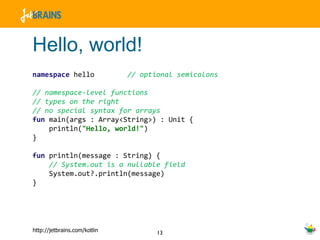
Hello, world! namespace  hello  // optional semicolons // namespace-level functions // types on the right // no special syntax for arrays fun  main(args : Array<String>) : Unit { println( &quot;Hello, world!&quot; ) } fun  println(message : String) { // System.out is a nullable field System.out?.println(message) }
Hello, <names>! fun  main(args : Array<String>) { // type inference for local variables var  names =  &quot;&quot; for  (i  in  args.indices) { names += args[i] if  (i +  1  < args.size) names +=  &quot;, &quot; } println( &quot;Hello,  $ names !&quot; )  // string templates } val  Array<*>.indices : Iterable<Int> get () = IntRange<Int>(0, size - 1)
Hello, <names>!  (Faster version) fun  main(args : Array<String>) { // ‘val’ means final val  names =  StringBuilder()  // no ‘new’ for  (i  in  args.indices) { names += args[i] if  (i +  1  < args.size) names +=  &quot;, &quot; } println( &quot;Hello,  $ names !&quot; ) } // operator overload as an extension function fun  StringBuilder.plusAssign(s : String) { this .append(s) }
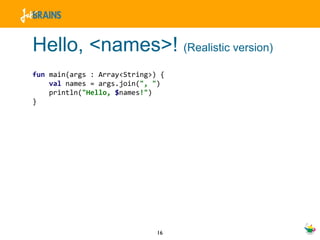
Hello, <names>!  (Realistic version) fun  main(args : Array<String>) { val  names = args.join( &quot;, &quot; ) println( &quot;Hello,  $ names !&quot; ) }
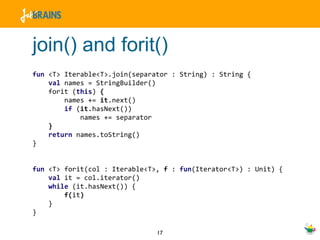
join() and forit() fun  <T> Iterable<T>.join(separator : String) : String { val  names = StringBuilder() forit ( this )  { names +=  it .next() if  ( it .hasNext()) names += separator } return  names.toString() } fun  <T> forit(col : Iterable<T>,  f  :  fun (Iterator<T>) : Unit) { val  it = col.iterator() while  (it.hasNext()) { f( it ) } }
Outline Motivation Feature Overview Basic Syntax Types and Classes Higher-order Functions Type-safe Groovy-style Builders
Mapping to Java types Kotlin Java Kotlin Any Object Any? Unit void Unit Int int Int Int? Integer Int? String String String? Foo Foo Foo? Array<Foo> Foo[] Array<Foo?>? IntArray int [] IntArray? GEN LOAD
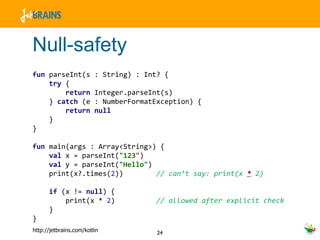
Null-safety fun  parseInt(s : String) : Int? { try  { return  Integer.parseInt(s) }  catch  (e : NumberFormatException) { return   null } } fun  main(args : Array<String>) { val  x = parseInt( &quot;123&quot; ) val  y = parseInt( &quot;Hello&quot; ) print(x?.times( 2 ))  // can’t say: print(x   *   2) if  (x !=  null ) { print(x *  2 )  // allowed after explicit check } }
Implicit casts and When fun  foo(obj : Any?) { if  (obj  is  String) { obj .substring(2) } when  (obj) { is  String =>  obj [ 0 ] is  Int =>  obj  +  1 !is  Boolean =>  null else  => ... } }
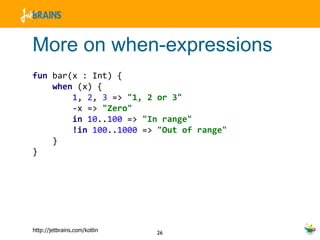
More on when-expressions fun  bar(x : Int) { when  (x) { 1 ,  2 ,  3  =>  &quot;1, 2 or 3&quot; -x =>  &quot;Zero&quot; in   10 .. 100  =>  &quot;In range&quot; !in   100 .. 1000  =>  &quot;Out of range&quot; } }
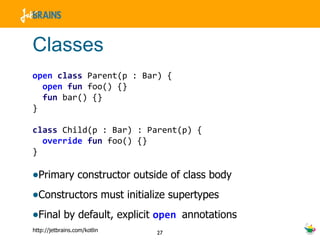
Classes open   class  Parent(p : Bar) { open   fun  foo() {} fun  bar() {} } class  Child(p : Bar) : Parent(p) { override   fun  foo() {}  } Primary constructor outside of class body Constructors must initialize supertypes Final by default, explicit  open  annotations
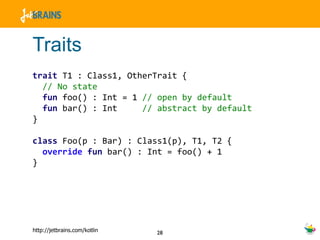
Traits trait  T1 : Class1, OtherTrait {  // No state fun  foo() : Int = 1  // open by default fun  bar() : Int  // abstract by default } class  Foo(p : Bar) : Class1(p), T1, T2 {    override   fun  bar() : Int = foo() + 1  }
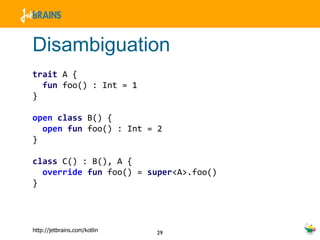
Disambiguation trait  A { fun  foo() : Int = 1 } open   class  B() { open   fun  foo() : Int = 2 } class  C() : B(), A { override   fun  foo() =  super <A>.foo() }
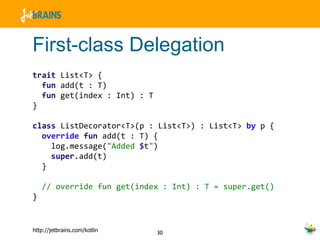
First-class Delegation trait  List<T> {  fun  add(t : T) fun  get(index : Int) : T } class  ListDecorator<T>(p : List<T>) : List<T>  by  p { override   fun  add(t : T) { log.message( &quot;Added  $ t &quot; ) super .add(t) } // override fun get(index : Int) : T = super.get() }
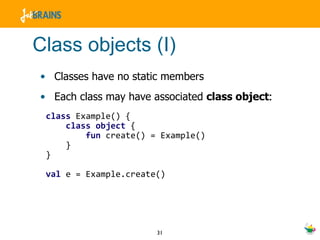
Class objects (I) Classes have no static members Each class may have associated  class object : class  Example() { class   object  { fun  create() = Example() } } val  e = Example.create()
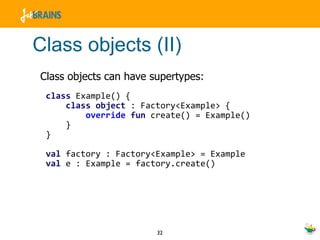
Class objects (II) Class objects can have supertypes: class  Example() { class  object   : Factory<Example> { override   fun  create() = Example() } } val  factory : Factory<Example> = Example val  e : Example = factory.create()
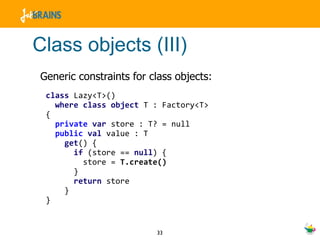
Class objects (III) Generic constraints for class objects: class  Lazy<T>()  where   class   object  T : Factory<T>  { private   var  store : T? = null public   val  value : T get () { if  (store ==  null ) { store =  T.create() } return  store } }
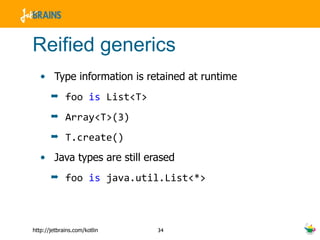
Reified generics Type information is retained at runtime foo  is  List<T> Array<T>(3) T.create() Java types are still erased foo  is  java.util.List<*>
Outline Motivation Feature Overview Basic Syntax Types and Classes Higher-order Functions Type-safe Groovy-style Builders
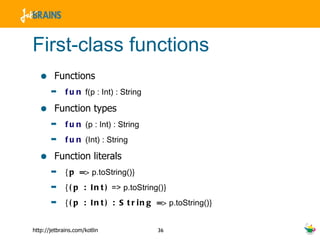
First-class functions Functions fun  f(p : Int) : String Function types fun  (p : Int) : String fun  (Int) : String Function literals {p =>  p.toString() } {(p : Int)  => p.toString() } {(p : Int) : String =>  p.toString() }
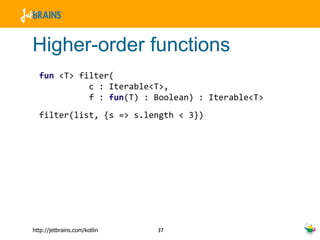
Higher-order functions fun   <T>   filter(   c : Iterable<T>,    f :  fun (T) : Boolean) : Iterable<T> filter(list, {s => s.length < 3})
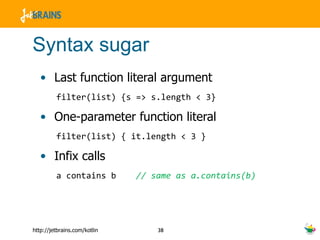
Syntax sugar Last function literal argument filter(list)  {s =>  s.length < 3 } One-parameter function literal filter(list)  { it .length < 3  } Infix calls a contains b  // same as a.contains(b)
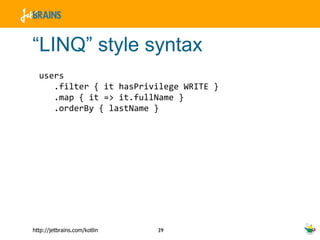
“ LINQ” style syntax users .filter { it hasPrivilege WRITE } .map { it => it.fullName } .orderBy { lastName }
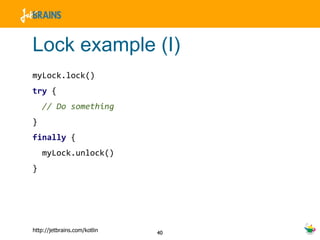
Lock example (I) myLock.lock() try  { // Do something } finally  { myLock.unlock() }
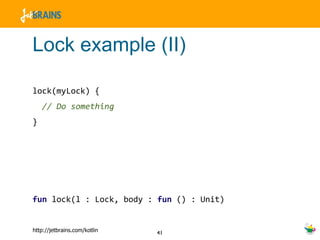
Lock example (II) lock(myLock) { // Do something } fun  lock(l : Lock, body :  fun  () : Unit)
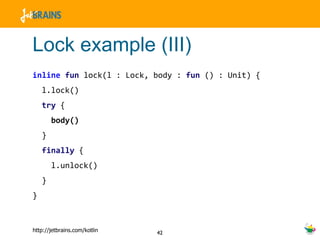
Lock example (III) inline   fun  lock(l : Lock, body :  fun  () : Unit) { l.lock() try  { body() } finally  { l.unlock() } }
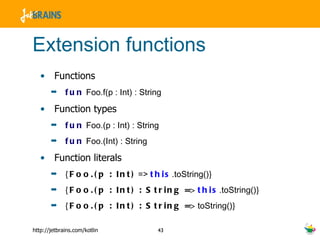
Extension functions Functions fun  Foo.f(p : Int) : String Function types fun  Foo.(p : Int) : String fun  Foo.(Int) : String Function literals {Foo.(p : Int)  =>  this .toString() } {Foo.(p : Int) : String =>   this .toString() } {Foo.(p : Int) : String =>  toString() }
Outline Motivation Feature Overview Basic Syntax Types and Classes Higher-order Functions Type-safe Groovy-style Builders
Builders in Groovy html {  head {  title  &quot;XML encoding with Groovy&quot;   }  body {  h1  &quot;XML encoding with Groovy&quot;  p  &quot;this format can be used as an alternative to XML&quot;   /* an element with attributes and text content */ ahref: 'http://groovy.codehaus.org'  [ &quot;Groovy&quot; ] } }
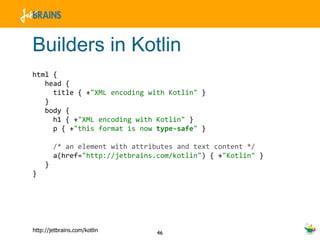
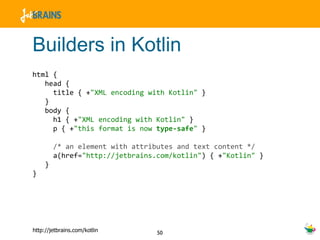
Builders in Kotlin html {  head {  title { + &quot;XML encoding with Kotlin&quot;  } }  body {  h1 { + &quot;XML encoding with Kotlin&quot;  } p { + &quot;this format is now  type-safe &quot;  } /* an element with attributes and text content */ a(href= &quot;http://jetbrains.com/kotlin&quot; )  { + &quot;Kotlin&quot;  } } }
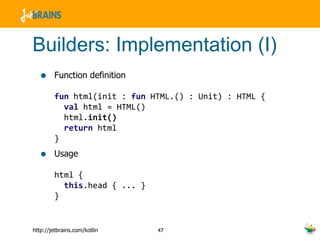
Builders: Implementation (I) Function definition fun  html(init :  fun  HTML.() : Unit) : HTML {    val  html = HTML()   html. init()   return  html } Usage html {   this .head { ... } }
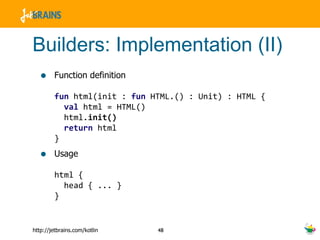
Builders: Implementation (II) Function definition fun  html(init :  fun  HTML.() : Unit) : HTML {    val  html = HTML()   html. init()   return  html } Usage html {   head { ... } }
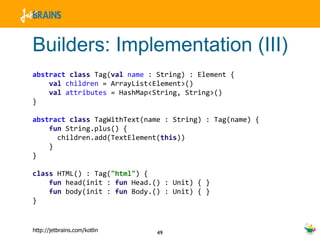
Builders: Implementation (III) abstract   class  Tag( val   name  : String) : Element { val   children  = ArrayList<Element>()  val   attributes  = HashMap<String, String>()  } abstract   class  TagWithText(name : String) : Tag(name) {  fun  String.plus() { children.add(TextElement( this )) } } class  HTML() : Tag( &quot;html&quot; ) { fun  head(init :  fun  Head.() : Unit) { }  fun  body(init :  fun  Body.() : Unit) { } }
Builders in Kotlin html {  head {  title { + &quot;XML encoding with Kotlin&quot;  } }  body {  h1 { + &quot;XML encoding with Kotlin&quot;  } p { + &quot;this format is now  type-safe &quot;  } /* an element with attributes and text content */ a(href= &quot;http://jetbrains.com/kotlin&quot; ) { + &quot;Kotlin&quot;  } } }
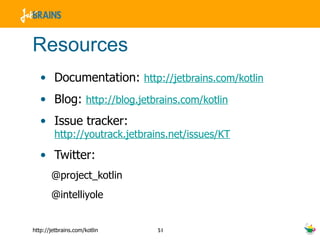
Resources Documentation:  http://jetbrains.com/kotlin Blog:  http://blog.jetbrains.com/kotlin Issue tracker:  http://youtrack.jetbrains.net/issues/KT Twitter: @project_kotlin @intelliyole
Q&A Dmitry Jemerov [email_address]

The Kotlin Programming Language

  • 1.
    The Kotlin Programming Language Dmitry Jemerov JetBrains GmbH
  • 2.
  • 3.
    What is Kotlin?Statically typed JVM-targeted general-purpose programming language developed by JetBrains intended for industrial use Docs available today Public beta in a few months
  • 4.
    Outline Motivation FeatureOverview Basic Syntax Types and Classes Higher-order Functions Type-safe Groovy-style Builders
  • 5.
    Motivation Started inmid 2010 Huge Java codebase (>50k classes, 10 years old) Building tools for many nice languages Want a modern, expressive language … that’s easy to introduce in the existing environment Need efficient tooling None of the existing languages was a good fit
  • 6.
    Design Goals Full Java interoperability Compiles as fast as Java More  concise  than  Java Prevents more kinds of errors than  Java Way  simpler  than  Scala
  • 7.
    Tooling IntelliJ IDEAplugin developed in parallel with compiler Both compiler and plugin will be released under Apache 2 license Basic Eclipse plugin will be provided
  • 8.
    Innovation Not aresearch project, don’t plan to publish papers No ground-breaking language features Focus on common sense and best practices established in other languages Groovy, Scala, C#, Gosu… Feature selection tradeoff: expressive yet easy to learn
  • 9.
    Outline Motivation FeatureOverview Basic Syntax Types and Classes Higher-order Functions Type-safe Groovy-style Builders
  • 10.
    Features: Traditional PropertiesFirst-class functions (closures) Pattern matching Operator overloading Local type inference
  • 11.
    Features: Distinguishing Traits(multiple inheritance of behavior) Extension functions Static null-safety guarantees Implicit casts after type checks Inline functions (zero-overhead closures) Reified generics First-class delegation Build infrastructure (modules) as part of the language
  • 12.
    Outline Motivation FeatureOverview Basic Syntax Types and Classes Higher-order Functions Type-safe Groovy-style Builders
  • 13.
    Hello, world! namespace hello // optional semicolons // namespace-level functions // types on the right // no special syntax for arrays fun main(args : Array<String>) : Unit { println( &quot;Hello, world!&quot; ) } fun println(message : String) { // System.out is a nullable field System.out?.println(message) }
  • 14.
    Hello, <names>! fun main(args : Array<String>) { // type inference for local variables var names = &quot;&quot; for (i in args.indices) { names += args[i] if (i + 1 < args.size) names += &quot;, &quot; } println( &quot;Hello, $ names !&quot; ) // string templates } val Array<*>.indices : Iterable<Int> get () = IntRange<Int>(0, size - 1)
  • 15.
    Hello, <names>! (Faster version) fun main(args : Array<String>) { // ‘val’ means final val names = StringBuilder() // no ‘new’ for (i in args.indices) { names += args[i] if (i + 1 < args.size) names += &quot;, &quot; } println( &quot;Hello, $ names !&quot; ) } // operator overload as an extension function fun StringBuilder.plusAssign(s : String) { this .append(s) }
  • 16.
    Hello, <names>! (Realistic version) fun main(args : Array<String>) { val names = args.join( &quot;, &quot; ) println( &quot;Hello, $ names !&quot; ) }
  • 17.
    join() and forit()fun <T> Iterable<T>.join(separator : String) : String { val names = StringBuilder() forit ( this ) { names += it .next() if ( it .hasNext()) names += separator } return names.toString() } fun <T> forit(col : Iterable<T>, f : fun (Iterator<T>) : Unit) { val it = col.iterator() while (it.hasNext()) { f( it ) } }
  • 18.
    Outline Motivation FeatureOverview Basic Syntax Types and Classes Higher-order Functions Type-safe Groovy-style Builders
  • 19.
    Mapping to Javatypes Kotlin Java Kotlin Any Object Any? Unit void Unit Int int Int Int? Integer Int? String String String? Foo Foo Foo? Array<Foo> Foo[] Array<Foo?>? IntArray int [] IntArray? GEN LOAD
  • 20.
    Mapping to Javatypes Kotlin Java Kotlin Any Object Any? Unit void Unit Int int Int Int? Integer Int? String String String? Foo Foo Foo? Array<Foo> Foo[] Array<Foo?>? IntArray int [] IntArray? GEN LOAD
  • 21.
    Mapping to Javatypes Kotlin Java Kotlin Any Object Any? Unit void Unit Int int Int Int? Integer Int? String String String? Foo Foo Foo? Array<Foo> Foo[] Array<Foo?>? IntArray int [] IntArray? GEN LOAD
  • 22.
    Mapping to Javatypes Kotlin Java Kotlin Any Object Any? Unit void Unit Int int Int Int? Integer Int? String String String? Foo Foo Foo? Array<Foo> Foo[] Array<Foo?>? IntArray int [] IntArray? GEN LOAD
  • 23.
    Mapping to Javatypes Kotlin Java Kotlin Any Object Any? Unit void Unit Int int Int Int? Integer Int? String String String? Foo Foo Foo? Array<Foo> Foo[] Array<Foo?>? IntArray int [] IntArray? GEN LOAD
  • 24.
    Null-safety fun parseInt(s : String) : Int? { try { return Integer.parseInt(s) } catch (e : NumberFormatException) { return null } } fun main(args : Array<String>) { val x = parseInt( &quot;123&quot; ) val y = parseInt( &quot;Hello&quot; ) print(x?.times( 2 )) // can’t say: print(x * 2) if (x != null ) { print(x * 2 ) // allowed after explicit check } }
  • 25.
    Implicit casts andWhen fun foo(obj : Any?) { if (obj is String) { obj .substring(2) } when (obj) { is String => obj [ 0 ] is Int => obj + 1 !is Boolean => null else => ... } }
  • 26.
    More on when-expressionsfun bar(x : Int) { when (x) { 1 , 2 , 3 => &quot;1, 2 or 3&quot; -x => &quot;Zero&quot; in 10 .. 100 => &quot;In range&quot; !in 100 .. 1000 => &quot;Out of range&quot; } }
  • 27.
    Classes open class Parent(p : Bar) { open fun foo() {} fun bar() {} } class Child(p : Bar) : Parent(p) { override fun foo() {} } Primary constructor outside of class body Constructors must initialize supertypes Final by default, explicit open annotations
  • 28.
    Traits trait T1 : Class1, OtherTrait { // No state fun foo() : Int = 1 // open by default fun bar() : Int // abstract by default } class Foo(p : Bar) : Class1(p), T1, T2 { override fun bar() : Int = foo() + 1 }
  • 29.
    Disambiguation trait A { fun foo() : Int = 1 } open class B() { open fun foo() : Int = 2 } class C() : B(), A { override fun foo() = super <A>.foo() }
  • 30.
    First-class Delegation trait List<T> { fun add(t : T) fun get(index : Int) : T } class ListDecorator<T>(p : List<T>) : List<T> by p { override fun add(t : T) { log.message( &quot;Added $ t &quot; ) super .add(t) } // override fun get(index : Int) : T = super.get() }
  • 31.
    Class objects (I)Classes have no static members Each class may have associated class object : class Example() { class object { fun create() = Example() } } val e = Example.create()
  • 32.
    Class objects (II)Class objects can have supertypes: class Example() { class object : Factory<Example> { override fun create() = Example() } } val factory : Factory<Example> = Example val e : Example = factory.create()
  • 33.
    Class objects (III)Generic constraints for class objects: class Lazy<T>() where class object T : Factory<T> { private var store : T? = null public val value : T get () { if (store == null ) { store = T.create() } return store } }
  • 34.
    Reified generics Typeinformation is retained at runtime foo is List<T> Array<T>(3) T.create() Java types are still erased foo is java.util.List<*>
  • 35.
    Outline Motivation FeatureOverview Basic Syntax Types and Classes Higher-order Functions Type-safe Groovy-style Builders
  • 36.
    First-class functions Functionsfun f(p : Int) : String Function types fun (p : Int) : String fun (Int) : String Function literals {p => p.toString() } {(p : Int) => p.toString() } {(p : Int) : String => p.toString() }
  • 37.
    Higher-order functions fun <T> filter( c : Iterable<T>, f : fun (T) : Boolean) : Iterable<T> filter(list, {s => s.length < 3})
  • 38.
    Syntax sugar Lastfunction literal argument filter(list) {s => s.length < 3 } One-parameter function literal filter(list) { it .length < 3 } Infix calls a contains b // same as a.contains(b)
  • 39.
    “ LINQ” stylesyntax users .filter { it hasPrivilege WRITE } .map { it => it.fullName } .orderBy { lastName }
  • 40.
    Lock example (I)myLock.lock() try { // Do something } finally { myLock.unlock() }
  • 41.
    Lock example (II)lock(myLock) { // Do something } fun lock(l : Lock, body : fun () : Unit)
  • 42.
    Lock example (III)inline fun lock(l : Lock, body : fun () : Unit) { l.lock() try { body() } finally { l.unlock() } }
  • 43.
    Extension functions Functionsfun Foo.f(p : Int) : String Function types fun Foo.(p : Int) : String fun Foo.(Int) : String Function literals {Foo.(p : Int) => this .toString() } {Foo.(p : Int) : String => this .toString() } {Foo.(p : Int) : String => toString() }
  • 44.
    Outline Motivation FeatureOverview Basic Syntax Types and Classes Higher-order Functions Type-safe Groovy-style Builders
  • 45.
    Builders in Groovyhtml { head { title &quot;XML encoding with Groovy&quot; } body { h1 &quot;XML encoding with Groovy&quot; p &quot;this format can be used as an alternative to XML&quot; /* an element with attributes and text content */ ahref: 'http://groovy.codehaus.org' [ &quot;Groovy&quot; ] } }
  • 46.
    Builders in Kotlinhtml { head { title { + &quot;XML encoding with Kotlin&quot; } } body { h1 { + &quot;XML encoding with Kotlin&quot; } p { + &quot;this format is now type-safe &quot; } /* an element with attributes and text content */ a(href= &quot;http://jetbrains.com/kotlin&quot; ) { + &quot;Kotlin&quot; } } }
  • 47.
    Builders: Implementation (I)Function definition fun html(init : fun HTML.() : Unit) : HTML { val html = HTML() html. init() return html } Usage html { this .head { ... } }
  • 48.
    Builders: Implementation (II)Function definition fun html(init : fun HTML.() : Unit) : HTML { val html = HTML() html. init() return html } Usage html { head { ... } }
  • 49.
    Builders: Implementation (III)abstract class Tag( val name : String) : Element { val children = ArrayList<Element>() val attributes = HashMap<String, String>() } abstract class TagWithText(name : String) : Tag(name) { fun String.plus() { children.add(TextElement( this )) } } class HTML() : Tag( &quot;html&quot; ) { fun head(init : fun Head.() : Unit) { } fun body(init : fun Body.() : Unit) { } }
  • 50.
    Builders in Kotlinhtml { head { title { + &quot;XML encoding with Kotlin&quot; } } body { h1 { + &quot;XML encoding with Kotlin&quot; } p { + &quot;this format is now type-safe &quot; } /* an element with attributes and text content */ a(href= &quot;http://jetbrains.com/kotlin&quot; ) { + &quot;Kotlin&quot; } } }
  • 51.
    Resources Documentation: http://jetbrains.com/kotlin Blog: http://blog.jetbrains.com/kotlin Issue tracker: http://youtrack.jetbrains.net/issues/KT Twitter: @project_kotlin @intelliyole
  • 52.
    Q&A Dmitry Jemerov[email_address]