THE PRIMARY SCHOOL LIBRARY
         guidelines
THE PRIMARY SCHOOL LIBRARY GUIDELINES

Working Group
Sue Adler (Education Library Service, Islington), Trish Botten (The Library Association), Chris Brown (former primary
Headteacher), Pam Dix (Education Library Service, Islington), Gill Harris (Schools Library Service, Tower Hamlets),
Susan Heyes (Schools Library Service, West Sussex), Sue Jones (Schools Library Service, Hertfordshire),
Ray Swan (Education Library Consultant), Glenys Willars (Library Services for Education, Leicestershire and Leicester City).

Focus Group
The Association of Senior Children’s and Education Librarians (ASCEL), The Library Association Youth Libraries Committee,
The Library Association Youth Libraries Group (YLG), The Library Association School Libraries Group (SLG), the School
Library Association (SLA), the Scottish Library Association, the Welsh Library Association and the Northern Ireland Branch
of The Library Association.

Consultative Group
Peter Beauchamp, Chief Library Adviser,
Department for Culture, Media and Sport
Ceris Bergen, Head of National Grid for Learning Policy Support Unit,
British Educational Communications and Technology Agency (BECTa)
Tony Kirwan and Diane Wilson,
The Study Support National Evaluation and Development Programme at the National Youth Agency
Pauline Linton, Curriculum Division,
The Department for Education and Employment.


Published by The Professional Practice Department of The Library Association, 7 Ridgmount Street, London WC1E 7AE.
Telephone: 020 7255 0500 Fax: 020 7255 0501 Textphone: 020 7255 0505
For questions relating to this booklet, e-mail: schools@la-hq.org.uk
© 2000    ISBN 0 9537404 04
THE PRIMARY SCHOOL LIBRARY GUIDELINES

The Guidelines are intended to be a practical support to everyone concerned with establishing, maintaining and developing
dynamic primary school libraries across the UK: Headteachers, teachers, governing bodies, primary school librarians/library co-
ordinators and Schools Library Services.
The Guidelines address the library needs of pupils between 4 and 11 years as independent learners and imaginative readers;
embedding the school library in the teaching and learning culture of the whole school. The Guidelines also recognise that the
use of information and communication technologies is integral to every aspect of primary school library provision.
The Library Association worked with key librarians throughout the UK to produce this document. The principles and practises
recommended, read together with The Library Association Guidelines for Secondary School Libraries, cover the library needs
of pupils throughout their school career – from primary to secondary school - and form an essential support to the lifelong
learning process.
The terminology used in the Guidelines is generic and the Guidelines have been distributed throughout the UK. However,
primary schools in Scotland should use the Guidelines as useful background information and should refer primarily to
Standards for School Library Resource Services in Scotland: a Framework for Developing Services, Convention of Scottish
Local Authorities (COSLA) 1999 and Taking a Closer Look at the School Library Resource Centre: Self Evaluation using
Performance Indicators, Scottish Consultative Council for the Curriculum [et al].

The Library Association
The Library Association is the leading professional body for librarians and information managers with over 25,000 members. It is
committed to enabling its members to achieve and maintain the highest professional standards, and encouraging and
supporting them in the delivery and promotion of high quality library and information services responsive to the needs of users.
The Primary School Library Guidelines can be found on The Library Association web site: www.la-hq.org.uk

Schools Library Services/Central Library Support Services
The Library Association believes that a Schools Library Service plays a key role in developing school effectiveness. This is
achieved through support and advice in the development and improvement of school libraries, use of learning resources, the
development of effective information handling skills, and access to wider reading choices for all pupils.
Schools Library Services are available to schools in the UK through a range of options for purchase of all, or parts of, their
service, or via central education funding. The Library Association or the local public library can direct schools to the nearest
Schools Library Service.

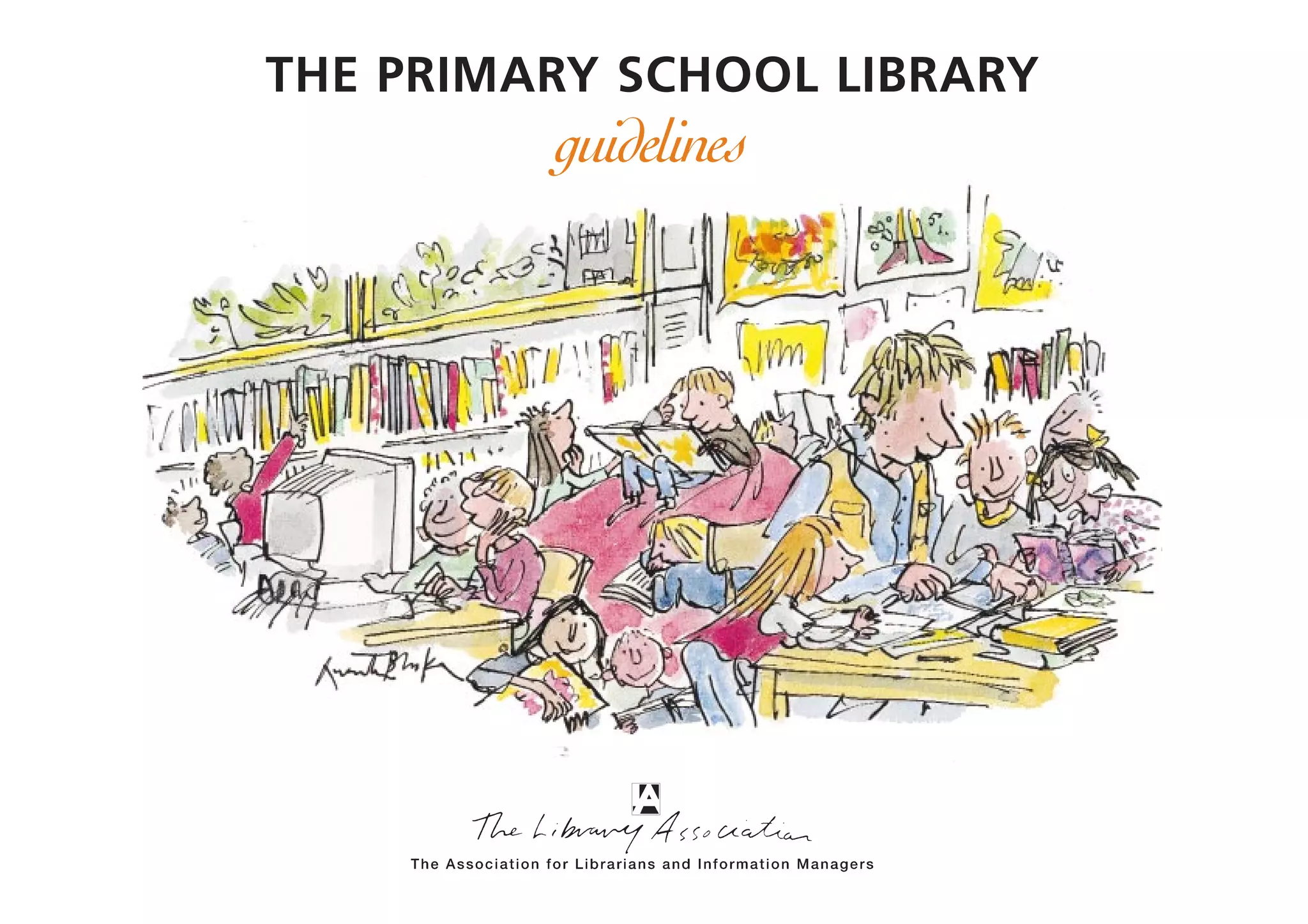
Cover illustration
The cover illustration is by Quentin Blake, the Children’s Laureate, and was specially created for The Primary
School Library Guidelines.

                                                                                                                                   This report may be reproduced in whole or in part provided that the source
                                                                                                                                   and date thereof are stated, except for commercial purposes or in connection
                                                                                                                                   with a prospectus or advertisement.
i
CONTENTS

     DEVELOPING A LIBRARY APPROPRIATE TO THE NEEDS OF THE SCHOOL
                                                                                                                  Real learners need real libraries.
           A key learning environment; Good school libraries; A whole school approach              1
     POLICY                                                                                                Better libraries, Department of Education and Science,
                                                                                                                            1989, ISBN 085522 2107
           Context; Purpose and content                                                            2
     CREATING THE ENVIRONMENT
           The ideal location; Accommodation and shelving                                          3
           Furniture and equipment; Guiding and signs; Lighting                                    4   A lively, welcoming and well resourced school library
     STAFF                                                                                                 is essential. It gives pupils broad and positive
           Why appropriate staffing is essential; Recommendations; Schools Library Services        5    experiences of books, computers, and other media.
     BUDGETS AND FUNDING
                                                                                                        The library is not just a space but a living organism,
           General guidelines; Assessing funding needs; Formulating the budgets for resources      6
                                                                                                       continually evolving to respond to the learning and
     SELECTING RESOURCES                                                                                teaching needs of the whole school – an expression
           Why is selection so important?; Acquisition: who selects?; Sources of supply            7   of the ethos and values of the school community. It is
           Assessment criteria; Short cuts to assessment; Stock review programme                   8     also an effective and economical shared resource.
           CD-ROMs/Web sites; Non-fiction; Fiction and picture books                               9
                                                                                                         The school library should be a centre for learning
     LIBRARY ORGANIZATION
                                                                                                         and literacy development; a place where pupils,
           Classifying and organization; Issuing resources                                        10
                                                                                                       surrounded by books, can enjoy and respond to the
     COMPUTERISED LIBRARY MANAGEMENT SYSTEMS                                                               stimulating environment. ICT, through access
           Costs involved; System considerations                                                  11     to CD-ROMs, the Internet and the National Grid
     THE LIBRARY AS A FOCUS FOR LITERACY                                                                   for Learning, is an integral component of this
           Something for everyone; Reader development; Some examples of reading activities        12                    learning environment.
     INFORMATION LITERACY
                                                                                                            Effective library provision is concerned with
           Introducing learning skills; The learning sequence; Extending interactions with text   13         equality and social inclusion. Through the
     JUDGING SUCCESS                                                                                      school library, all pupils have access to learning
           Key questions; Performance measures                                                    14       resources. The school library’s role is to help
                                                                                                           create confident, enthusiastic readers, and to
     EXEMPLAR 1 POLICY INTO PRACTICE: IMPROVING THE SCHOOL LIBRARY                                16            engage children in lifelong learning.
     EXEMPLAR 2 ICT AND INFORMATION HANDLING SKILLS IN THE SCHOOL LIBRARY                         17


     APPENDICES
     1 RESPONSIBILITIES OF THE PRIMARY SCHOOL LIBRARIAN/LIBRARY CO-ORDINATOR                      18
     2 CONTACT LIST                                                                               19
     3 UNESCO SCHOOL LIBRARY MANIFESTO                                                            22
     4 FURTHER READING                                                                            24


ii
DEVELOPING A LIBRARY APPROPRIATE TO THE NEEDS OF THE SCHOOL

 A key learning environment                                     Good school libraries                                          A whole school approach

Pupils need to develop appropriate learning strategies and     • enrich pupils’ reading experiences and develop pupils’       Library planning must:
become independent and lifelong learners. The school           skills as independent learners
library is the cornerstone to this process.
                                                                                                                              • be part of the school’s policies for teaching and learning
                                                               • provide resources and information that teachers and
                                                                                                                              • be included in curriculum planning that promotes the
Libraries empower pupils, not only by supporting the           pupils need                                                    development of literacy and reading for information
teaching and learning in the school, but by giving them the
freedom to make their own choices about reading and
                                                               • support the teaching and learning process, and extend        • reflect the school’s profile of teachers and pupils and the
                                                               the school’s curriculum                                        nature of the local community
learning experiences.
Library skills need to be introduced to pupils from an early
                                                               •   have skilled, enthusiastic staff with time allocated for
                                                                                                                              • complement styles of teaching and learning in the school
                                                               library duties
age and practised throughout their school career.                                                                             • recognise the need for staffing, support, accommodation
Libraries in schools give children the opportunity to:
                                                               • have up-to-date, attractive and suitable resources in a      and funding
                                                               range of media
• extend their reading experiences                                                                                            • set targets which are realistic and achievable within an
                                                               • are adequately funded to ensure continuing maintenance       agreed period of time
• discover and use information                                 and development
                                                                                                                              • establish an agreed policy and development plan for
• learn research skills.                                       • are planned and designed to be pleasant and                  the library
School libraries are important to the learning                 stimulating environments
                                                                                                                              • ensure the support and formal endorsement of the
outcomes of the whole school and the impact                    • are monitored regularly to assess their use                  governing body and staff
goes beyond its walls to the family and the
wider community.
                                                               • are guided by a whole school policy for the library          • contribute to school improvement
As a base for family learning activities, the school
                                                               • make good use of the expertise and stock of a Schools        • keep abreast of ICT developments.
                                                               Library Service, and develop ongoing links with the local
library may be the only contact some parents have              public library.
with the world of books and learning resources.


                                                                                                                                                                                              1
POLICY

                                                                      Purpose and Content                                           The Policy should include:
      The library policy document should define the visions,
              aspirations and role of the school library.            The purpose of the policy is to make clear, for the whole      1 All aspects of library provision, including:
                 West Sussex Schools Library Service 1998            school community, the role, aims and objectives of the         • accommodation
                                                                     library, including:
                                                                                                                                    • staffing
     Context                                                         • the library’s status as a learning environment in the        • funding
                                                                     school and its role in raising achievement
    The school library policy does not exist in isolation.
                                                                     • the relationship with other areas e.g. other school          • learning resources
    It should relate to:
                                                                     policies, the curriculum, study support, classroom             • organization
    • national educational initiatives                               collections                                                    • ICT
    • Local Education Authority plans and initiatives                • the relationship with the school’s overall aims as defined   • support for teaching and learning.
    • the policies, ethos and aims of the school, e.g. School        in the School Development Plan (SDP) and the role of the
                                                                                                                                    2 Use and access, including:
       Development Plan (SDP)                                        library in achievement of school improvement priorities.

    • local support services, e.g.                                                                                                  • patterns of class and individual use
       –   Schools Library Service/Central Library Support Service                                                                  • supervision arrangement
       –   Public Library Service                                                                                                   • opening times
       –   other LEA departments
       –   Education Action Zones                                                                                                   • library’s role in information skills programmes
    • the social and cultural environment of the school, the                                                                        • reading development and book promotion
    local community and other local initiatives, e.g.                                                                               • use of ICT
       – Out of Hours learning initiatives
       – Equal Opportunities
                                                                                                                                    • after hours activities.
                                                                                                                                    3 Monitoring and evaluation
       – Social inclusion
       – partnerships with other organizations                                                                                      4 Planning and future development
       – pre-school activities
       – liaison with secondary schools
                                                                                                                                    Policy should inform practice, and therefore practice
       – cultural diversity
                                                                                                                                    should inform policy. It should be revised regularly
       – literacy policies.
                                                                                                                                    alongside other school plans and form part of the school
                                                                                                                                    cycle of reviews. Policy should be reported to the governing
                                                                                                                                    body and form part of the SDP and INSET programmes.
                                                                                                                                    The Library Association recommends that the school
                                                                                                                                    has a library policy that is effectively implemented
                                                                                                                                    through good practice.


2
CREATING THE ENVIRONMENT

    The ideal location
                                                                                   The school library should be exciting and welcoming, and identifiably different from classrooms.
Ideally the library should be:                                                A multi-media, interactive learning environment motivates pupils to explore resources for both curriculum
                                                                                                    related work and for their own personal exploration of the resources.
• a whole school resource
• centrally located within the school                                     Accommodation and shelving
• easily accessible to all classes and all children, whatever         Accommodation                                                             Shelving must provide:
their particular needs 1
                                                                      Size is important. There are a number of factors to consider
• a single-use area.                                                  when calculating the ideal size of the library.
                                                                                                                                                • safe, back-edge book supports
The library should embrace:                                                                                                                     • shelf guiding
                                                                      • DfEE building regulations      2


•     the central fiction collection                                                                                                            • adjustable shelves
                                                                      • the number of shelves and wall/floor space required to
• the central non-fiction collection                                  house recommended number of books and accommodate                         • options for face-on book display.
• access to ICT, e.g. Internet, Intranet, CD-ROM                      study, group or class activities.                                         Other forms of shelving include:

• study space                                                         Shelving                                                                  • kinder boxes for picture books
                                                                      Shelving may be either wall mounted or freestanding.
• enough seating for a whole class                                                                                                              • big book storage
                                                                      Ideally shelving should be:
• informal reading areas.                                                                                                                       • paperback carousels.
Classroom book corners benefit from a centralised library             • a maximum height of 1200mm (and never higher than                       Shelving should be purchased from a specialist
                                                                      1500mm). This will provide three shelves per bay                          library supplier. A Schools Library Service or The
from which staff and pupils select fresh collections termly.
Schools with no suitable central area must find alternative           • 250mm deep                                                              Library Association can provide contact details of
                                                                                                                                                suppliers and advise on library layout.
locations for a central collection which include as many of           • 900 - 1000mm in length
the ‘ideals’ as possible.                                             with
Other spaces for the school library can be created
imaginatively but it is important that the library functions
                                                                      • a minimum one front-facing display shelf per bay
fully according to the recommended guidelines, and fulfils            • a minimum of 1000mm circulation space in front of and
Health and Safety criteria.                                           between shelving units. This is a Health and Safety
                                                                      requirement.
                                                                                                                                                                                       1200mm
                                                                      DIY shelving is not recommended for safety reasons.                       250mm


                                                                                                                                                                  900/1000mm
                                                                                                                                                Diagram showing one bay with three shelves
DfEE Access for Disabled People to School Buildings Bulletin No.91,
1                                                                     2
                                                                       DfEE Area Guidelines for School Buildings Bulletin No. 82, HMSO, 1996,
HMSO, 1999, ISBN 011271062X                                           ISBN 0112709214

                                                                                                                                                                                                     3
CREATING THE ENVIRONMENT                                                       (continued)


     Furniture and equipment                                         Guiding and signs                                         Health and Safety

    Furniture and equipment should include:                         Clear guiding and signs will ensure that the library is   All plans for the development or reorganisation of the
                                                                    easily accessible and effectively used.                   library (including furnishing, staffing, use and movement of
    • tables and chairs of a size appropriate for most of                                                                     pupils) must be in line with the school’s, and other
    the children                                                    This should include:
                                                                                                                              recognised authorities’ Health and Safety documents.
    • workstations for CD-ROM, Internet use, access to              • general signs on bays e.g.                              Early and regular consultation with the Health & Safety
    computerised library catalogue
                                                                                                                              representative and/or any other appropriate officer is
    • sufficient power points and network connections for                     Fiction A – C                                   advised for all new library plans, schemes and alterations.
    ICT desk and other audiovisual equipment
                                                                                                                              Safety tips
    • a table for issuing and return of books with room for                                                                   •  shelves should be strong enough to take the weight
    a computer                                                      • and shelves e.g.                                        of books
    • easy chairs, bean bags or cushions for ‘comfy reading’              Athletics 796.4                                     • shelves should not have sharp edges
    • carpets, curtains and other soft furnishings – all create a                                                             • bean bags and other soft furnishings must be flame
    welcoming and comfortable environment
                                                                                                                              resistant and have removable covers
                                                                    • a wall subject index, e.g.
    •  listening stations with headphones
                                                                                                                              • mobile shelves must have lockable castors.
    • storage for audiovisual resources, other media formats,            Bangladesh                 954.9
    posters/charts                                                       Bible                      220
    • display facilities.                                                Biology                    574
    Lighting                                                             Birds                      598
    Wherever possible, make the most of natural light. Strip             Boats                      386
    lighting is preferable and needs to be placed appropriately
    for even distribution of light.
                                                                    • subjects listed on the end of a bay panel, e.g.

                                                                                     600s
                                                                         612      Human Body
                                                                         624      Bridges
                                                                         640      Food


4
STAFF

    All staff, pupils, parents and the governing body      Staffing options                                              Help from a Schools Library Service
        need to be involved in the school library,        Primary school libraries can be managed in one of the         A Schools Library Service can:
     sharing in plans, and helping to ensure that use     following ways:
                is successful and effective.                                                                            • help and advise in the organization and management of
                                                          •  a full time professional librarian – The Library           library resources
                                                          Association’s recommendation
 Why appropriate staffing is essential                                                                                  • promote the enjoyment of reading and literacy
                                                          • a professional librarian shared by a group of schools       development across the curriculum, and the development
Running a school library is more than day to day                                                                        of information handling skills
operational routines.
                                                          • a teacher as a library co-ordinator, line managed by the
                                                          Headteacher. Enthusiasm and experience are essential and      • lend resources to support the school library and
Time and support is required for management and           the post should be open to all teachers.                      classroom work
strategic development. This needs to done by the
library co-ordinator or librarian and includes:
                                                          See Appendix 1 for the responsibilities of a primary school   • train and support the professional development of
                                                          librarian/library co-ordinator.                               library staff.
•  policy and development

• overview of resource selection                                                                                         Other sources of help
• organization of library
• overview of use                                                                                                       • all teaching staff should contribute to the selection of
                                                                                                                        resources, the planning and monitoring of library use and
• creating imaginative and confident readers                                                                            implementation of the whole-school information skills
                                                                                                                        programme
• development of skills programme for pupils.
It is also necessary to run the library on a day-to-day                                                                 • classroom assistants can be trained to help with the
basis. The library co-ordinator/librarian can share the                                                                 routine tasks and library supervision at lunchtime, or before
following tasks with additional helpers:                                                                                and after school

• preparing stock for use                                                                                               • pupil helpers can help promote the library to other
                                                                                                                        children and carry out routine tasks
• shelving books
• keeping the library tidy                                                                                              • volunteers, e.g. parents and governors, can
                                                                                                                        provide valuable help with routine tasks as well as
• supervising access                                                                                                    with library events

• supporting pupil use                                                                                                  • one-off task groups can achieve a particular aim.
• organizing displays, promotions and special events.


                                                                                                                                                                                        5
BUDGETS AND FUNDING

                                                                       Assessing funding needs for learning resources               Formulating the budgets for learning resources
              The library should have a fair share of
         the total capitation because it is a whole school            Budget preparation                                            Resource requirements
                resource serving all staff and pupils.                In order to assess adequate funding for learning
        Better Libraries, Department of Education and Science, 1989   resources, consider:
                                                                                                                                      School Roll
                                                                      • the cost of replacing outdated or worn out resources and                                              resources
     General guidelines                                                                                                                                    -to-date library
                                                                      filling stock gaps. Regular stock maintenance and annual         a) Number of up
                                                                                                                                                                              k=
                                                                      monitoring and evaluation will identify the items and areas                          n-fiction) in stoc
    • The school’s total budget must include an adequate                                                                               (fiction* and no
                                                                      that need replacing and developing                                                                             dation
    amount for the library every year. This figure must be a                                                                                                    ciation recommen
                                                                                                                                       b)   The Library Asso
                                                                      • the proportion of funding required for developing new                                                   ctive, up-
    discrete item in the school book policy                                                                                                                 ovision (13 attra
                                                                      curricular areas                                                  for total stock pr                      roll =
    • Learning resources need to be regularly replaced in order                                                                                             r pupil) x school
                                                                                                                                        to-date items pe
    to be relevant to the needs of the curriculum, and the            • the need for funding books and non-book material                                     rary provision (b
                                                                                                                                                                                 -a) =
    reading and information needs of pupils and teachers              eg. CD-ROMs and tapes.                                             c) Shortfall in lib                       budget
                                                                                                                                                              figure, a 3–5 year
                                                                                                                                         (if this is a large                        e library
    • Resources such as books, CD-ROMs, Web sites,                    How many items?
                                                                                                                                          programme shou
                                                                                                                                                               ld be built into th
    magazines and story tapes remain useful only while up-to-         The Library Association recommends:
                                                                                                                                                             an)
    date or in good physical condition                                                                                                    development pl
                                                                      • 13 items per pupil (based on National Curriculum                                                           existing
                                                                                                                                                              tion that 10% of
    • There also needs to be a budget for the physical                coverage and fiction reading books per pupil)                       d) Recommenda                            )=
                                                                                                                                                                annually (a/10%
    environment and appropriate furniture and equipment
                                                                      • that 10% of existing stock is replaced annually                    stock is replaced
                                                                                                                                                                                    et:
    • It is important to plan ahead and cost for ICT                                                                                                             Resource Budg
                                                                      • 2,400 as the minimum number of resources for a                     e) Total Annual
                                                                                                                                                                                ice) =
    developments including:                                           school, regardless of pupil numbers.                                                      e resource pr
                                                                                                                                            (c + d x averag
      – Internet access and the National Grid for Learning
                                                                      This ensures a full range of resources to cover the
      – CD-ROM
                                                                      information needs of the curriculum and provide sufficient
                                                                                                                                    Average resource price = £9.50 (year 2000)
    • One computer with CD-ROM and Internet access is a               reading materials for all ages and abilities.
                                                                                                                                    (this figure takes into account hardback, paperback,
    basic requirement
                                                                                                                                    educational and mainstream children’s publishing)
    • A computerised library management system greatly                                                                              *This excludes reading schemes and text books.
    improves pupils’ access to resources, as well as improving
    stock management.


6
SELECTING RESOURCES

                                                                                                                                  Sources of Supply
      Selecting the right resources for the library is the key to success. It will enable the primary school library to
            inspire a child’s imagination, provide for a child’s information needs and create life-long learners.                 Schools Library Service (SLS)
                                                                                                                                  A Schools Library Service offers a cost-effective way of
                                                                                                                                  exchanging and acquiring up-to-date stock regularly. Some
Why is selection so important?                                     Acquisition: who selects?
                                                                                                                                  SLSs offer a book shop or ordering service, and competitive
The school library will stand or fall on its stock. Pupils (and   The librarian/library co-ordinator has overall                  terms, as well as ready-serviced stock (saving teachers’
teachers) who find what they want will return to use the          responsibility for selection                                    time), and give impartial and informed advice on suitable
library and will trust the library to meet their needs.                                                                           material for purchase. Some SLSs provide access to Library
The stock reflects a balance between supporting the               Issues to consider:                                             Suppliers’ CD-ROM and Internet ordering services.
curriculum and providing resources to meet individual             •  do all staff have opportunities to recommend titles?
                                                                                                                                  Library suppliers
needs and interests.
                                                                  • are specialist curriculum and interest areas recognised?      Library suppliers offer a wide range of materials which can
As well as providing all users with resources that they know                                                                      be viewed in showrooms, catalogues, on CD-ROM or on the
they want and need, the library can take them beyond the
                                                                  • can parents, carers and other adults also                     Internet. They process stock, i.e. classify/jacket/label ready
                                                                     recommend titles?
known into new worlds. Selection is not just responsive to                                                                        for immediate use. Discounts can be negotiated. A Schools
need; its role is also to inspire and challenge. Where better     • how can pupils contribute to the process?                     Library Service or The Library Association can provide
to discover new resources, new authors, genres and                • is the special expertise of both adults and pupils            contact details of library suppliers.
interests, than in the school library?                            recognised, e.g. in the area of languages other than English?
                                                                                                                                  Bookshops
Selecting and withdrawing resources needs to be systematic        • does the collection reflect the cultural diversity of the     Discounts of 10% can usually be negotiated. The local
to ensure currency and relevance. A regular routine needs         community?                                                      bookshop is a valuable place to see resources.
to be established.
                                                                  General principles
Selection policy                                                  The range and balance of stock in the library should follow
This should be part of the library policy. It should              an agreed plan that is a part of the school’s library policy.
complement the whole school policy on resource provision,
                                                                  Issues to consider:
i.e. in the context of core book provision in classrooms,
home reading schemes, resources for the Literacy Hour, and        •  the ratio of fiction to non-fiction

ICT. The selection policy is therefore part of a wider policy;    • the proportion of curriculum resources to leisure reading
creating a context for stock management in terms of               • the proportion of stock for early years, KS1, KS2
acquisition, promotion and use.
                                                                  • the relationship of classroom collections and literacy
                                                                  resources to the central library

                                                                  • equal opportunities, including multicultural provision
                                                                  and special needs provision.


                                                                                                                                                                                                   7
SELECTING RESOURCES                                               (continued)


     Assessment criteria                                                Short cuts to assessment

    Assess the item in the school context, e.g. relate current         Assessment of resources can be time consuming. Relying on         A useful strategy
    stock to the School Development Plan and the curriculum.           the work of others can speed up the process.                      •  buy several books and other resources per curriculum
    Is it relevant to the age and abilities of the pupils? How will    Sources of help and advice                                        subject at different ability levels
    the item make a difference? For all resources check:
                                                                       •  services offered by a Schools Library Service include          • buy a range of ‘enrichment’ material and popular fiction
    • purpose                                                          exhibitions of recommended books, booklists, reviews, etc.
                                                                                                                                         • borrow more copies of:
       – relevance to pupils or staff                                  Borrowing recommended resources from a Schools Library                – popular fiction
       – does it achieve what it sets out to do?                       Service is a cost-effective way of supplementing library and          – expensive, special or unusual books
       – does it appeal to the target age group?                       classroom resources                                                   – topic books.
    • suitability                                                      • review journals and newspapers, e.g.
       – reading age                 – clarity of illustration              Books for Keeps
       – print size                  – ease of use                          Carousel                                                      Stock review programme
       – readability                 – use of language                      Child Education and Junior Education                         It is important to undertake regular audits and edits of
                                                                            The School Librarian
    • medium - book/tape/CD-ROM/magazine, how appropriate?                  Times Educational Supplement
                                                                                                                                         library stock, to ensure that resources remain relevant
                                                                                                                                         and attractive.
    • production
       – quality (e.g. paper)        – attractiveness to pupils        • the Internet, e.g. National Grid for Learning literacy web      • establish criteria for the removal of resources,
       – durability (e.g. binding)   – accessibility                   sites (always check the credentials of the organization           considering:
       – ease of use and safety                                        providing the web site)                                             – equal opportunities issues

    • value for money                                                  • specialist literacy organizations, e.g. Book Trust                – physical condition
                                                                       and REACH.                                                          – currency of information
       – quality
                                                                                                                                           – attractiveness to pupils
       – standard of production                                        Consider carefully
                                                                                                                                           – relevance to curriculum or other pupil needs
       – minority appeal – take into account that a more limited       • Internet recommendations – many sites are commercial
         print run usually means it will be more expensive             and may not be impartial                                          • decide on methods of disposal, remembering that
       – library need                                                                                                                    stock no longer suitable for the library is unlikely to be
       – hard-back v. paperback. Paperbacks should always be
                                                                       • sales representatives represent one publisher only. A           useful elsewhere
                                                                       library supplier or Schools Library Service will display a wide
         plastic-jacketed. Decide which format is most
         appropriate for the age group and intended use
                                                                       range of resources for comparison                                 • resources which are out-dated, offensive or in poor
                                                                                                                                         condition, should be pulped/binned.
       – borrow or buy?                                                • donations may be out of date or unsuitable. Only put in
                                                                       stock if the quality, currency and content are relevant to        The stock review should include an assessment of stock
    • equal opportunities                                              pupil needs                                                       gaps. Information from this contributes to the production
       – how cultures, religions, ethnic diversity, gender and                                                                           of a development plan and to the informed acquisition of
         disabilities are presented in text and images                 • very cheap books - are they just shelf fillers, or do they      new stock.
       – the provision of dual-language and mother-tongue              address stock gaps?
                                                                                                                                         A Schools Library Service can advise on all aspects of the
         e.g. Welsh                                                    • public library book sales. If the books for sale are no         selection policy including evaluation and maintenance.
       – author credentials.                                           longer suitable for the public library, are they suitable for
                                                                       the school library?
8
SELECTING RESOURCES                                                (continued)


 CD-ROMs/Web sites                                                   Non-fiction                                                   Fiction and picture books

General selection criteria, eg. content and                         Content                                                       Assessment criteria
coverage/currency and accuracy, apply to all formats.               • wide-ranging or specific?                                   While quality is important, so too is balance of stock and
                                                                                                                                  having the right book for the right child. A rich reading
Other considerations include:                                       • stimulus material or full information for topic research?   experience includes access to ‘fast food’ reads as well as the
Compatibility                                                       • at an appropriate level for the intended audience?          more challenging; the TV tie-ins, series, short stories and
• will it run on existing equipment?                                • introducing new concepts or assuming prior knowledge?       novelty books. The content should be appropriate to the
Ease of use                                                         Style and language                                            maturity of the reader.
• clarity of screen and instructions                                •  clear and grammatically correct
                                                                                                                                  Plot
• available search strategies, eg. keyword, topic, illustration,    • conveys an enthusiasm for the subject                       •  originality
and/or [Boolean] searching
                                                                    • matched to reading abilities and interests of the           • creation of a sense of time and place
• help prompts                                                      intended audience
                                                                                                                                  • sensitive handling of controversial themes
• time required to train staff and pupils                           • are differentiated texts available?                         • imaginative handling of familiar themes
Functions and facilities available as a part                        Information accuracy
of the software, eg.                                                                                                              • suited to the intended readers.
                                                                    •  correct and current
                                                                                                                                  Characterisation
•  dictionary
                                                                    • avoids errors and bias
• print                                                                                                                           •   how do the characters interact with other characters
                                                                    • any instructions for activities or experiments should be    in the story?
• download to disk                                                  workable and safe
                                                                                                                                  • how appropriate are they within the genre?
• notepad                                                           • author credentials.                                         Style and language
• search record                                                     Illustrations
                                                                                                                                  •  stimulating use of language
• cross-references.                                                 •   should interact well with the text
                                                                                                                                  • language level for the intended readership
Networking capability                                               • should positively convey accurate information in an         • authentic dialogue, particularly the use of patois and dialect
                                                                    appropriate form, eg. photographs, diagrams, maps, charts
Use of medium
eg. sound, music, video, photographs.
                                                                    and drawings                                                  • avoid stereotyped language use. Use of slang should not
                                                                                                                                  be gratuitous but appropriate to the plot and readership.
Are updates available?                                              • have appropriate captions which are written at the same     Illustrations
                                                                    level as the text.
If so, how often and at what cost?
                                                                    Format                                                        •   artistic merit
Reviews of CD-ROMs can be found on the BECTa or
TEEM Web sites.                                                     • suitable for the subject matter and intended users.         • illustrations which complement the text
The Educational Software Data base gives information about          Information-finding aids                                      • cover and pictures appeal to the intended readers
the technical requirements for running software.                    •  contents pages should use sensible terms and assist in     • illustrations reflect the nature of the story.
                                                                    using the resource                                            Big Books
See page 24 for these Web site addresses.
                                                                    • indexes should contain relevant terms and                   •  will it last? Look at paper quality and binding.
                                                                    useful references                                             • is the print size large enough to use with a whole class?
                                                                    • glossaries should explain difficult terms.
                                                                                                                                                                                                     9
LIBRARY ORGANIZATION

                                                                       Loaning resources
          Simple and easy procedures are essential for the
            effective organization and use of the library.            An issue system can be useful in order to:                       Other options for issuing resources
         Books, and other resources, need to be organized in                                                                           If a computerised library management system is too
          a logical sequence and labelled clearly. A Schools
                                                                      • keep track of books as they are borrowed                       expensive, other options for recording loans include:
            Library Service will be able to provide advice.           • record and assess children’s reading habits                    • An exercise (or similar) book in which the pupils write
                                                                      • facilitate the issuing of bulk loans of reading materials to   the titles of the books they have borrowed. Most schools
                                                                      classroom book corners                                           allocate a page of the book to each child. When books
      Classifying and organizing resources

     General rules
                                                                      • encourage children to be responsible                           are returned, the child ticks off the record of the loan.
                                                                                                                                       Some schools like to note both the date of the loan and
     • Divide the library into fiction and non-fiction resources      • familiarise children with library routines which               of the return.
                                                                      will give them a generic understanding of all libraries,
     and label bays, shelves and sections clearly
                                                                      e.g. public libraries                                            • A book-card for each child, which is used to record items
     Arranging the non-fiction books                                                                                                   borrowed. The cards are kept in book-pockets in the
     •  Classify books according to the Dewey Decimal
                                                                      • reduce stock loss.                                             classroom, arranged by the children’s names. The book title
     Classification System. Dewey organises knowledge into 10         However, issue systems:                                          is written on the card, sometimes with the date. Again,
     numbered categories, e.g. 900: Geography and History. A          • can be time consuming                                          when books are returned, the child ticks off the record.
     Schools Library Service can provide training and advice on
     how to classify, or can do this for you.                         • need dependable people to operate them                         Details of suppliers of book-cards and book-pockets can be
                                                                                                                                       found in the catalogues of library suppliers.
     • As well as the Dewey system, coloured labels to indicate       • require pupils to be trained to use them.
                                                                      The Library Association recommends that a school                 Security
     broad categories can be used. A Schools Library Service can
     advise on local policy.                                          library uses a computerised library management                   • Security systems are expensive and not normally
                                                                      system which includes cataloguing* and loan                      necessary in primary schools.
     • Shelve non-fiction resources in a single sequence, from        functions. See Computerised Library Management                   • Ideally teachers, parents, classroom assistants or primary
     left to right within bays and in numerical order
                                                                      Systems p.11                                                     helpers should be in the library at all times when the library
     •  Provide an alphabetical subject index in a range of                                                                            is in use.
     formats, e.g. wall chart; computer search screen; booklet;
     drawer of cards.

     Arranging fiction books
     •  Shelve alphabetically by author’s last name, left to right,
     within bays.

     Arranging the picture books
     • Generally these are shelved separately from the fiction
     books, or displayed in bright kinder boxes.


                                                                                                                                       *Manual cataloguing systems are not recommended.


10
COMPUTERISED LIBRARY MANAGEMENT SYSTEMS

 Costs involved
                                                                An efficient computerised library management system will enhance the effectiveness of the library. The system
Hardware                                                            makes the recording of loans simple and provides useful information about library use. Keywords make
•   number of computers – at least one dedicated computer      finding information easy. When assessing different systems cost, installation, operation and maintenance all need
is needed
                                                                                     to be considered e.g. printing subject specific lists and producing statistics.
•   networking costs, if more than one computer

• printer                                                    System considerations
• barcode reader.
Software
                                                            • is the screen layout clear and user-friendly?                    Company Information

Assess the software packages on offer and decide which      • does the catalogue offer all the fields you need - author,      •  does the company have a good reputation?

modules are needed.                                         title, Dewey classification number, edition, publisher,           • does the company employ librarians who will understand
                                                            publication date, price, resource type, keywords, notes?           the needs of a school library?
Other costs
• barcodes                                                  • is searching by keyword simple?                                 • is there a user group?
• initial input of records: many systems allow data to be   • is there a limit to the number of keywords which can be         • can demonstrations be organized?
                                                            applied to a resource?
imported requiring only the addition of a class number                                                                        • is the manual easy to use and comprehensive?
e.g. catalogue records – this saves time and money          • can lists be printed?                                           • what technical support is offered?
• ongoing maintenance and upgrades                          • what reports and statistical information can be produced,        For further advice
                                                            e.g. top 10 use, books borrowed by boys?
• helpline/support                                                                                                             A Schools Library Service can advise on evaluating the range

• staff training                                            • is issuing and returning straightforward?                        of computerised library management systems available for a
                                                                                                                               primary school library.
• staff time.                                               • can the system be networked across the whole school?
                                                                                                                               The Library Association recommends that schools use
                                                            • is the system easy to manage?                                    one of the specialist computerised library
                                                            • does it offer an interactive element, e.g. pupils adding         management systems available.
                                                            their own reviews?

                                                            • is the system easy to backup?
                                                            • what systems are other local schools using?
                                                            • can you visit another school to see the system in use?


                                                                                                                                                                                              11
THE LIBRARY AS A FOCUS FOR LITERACY

                                                                         Reader development                                            Some examples of reading activities
              “Enjoyment of reading at the youngest
          possible age sets us up for life as full members              Confident readers                                             Outside the requirements of the curriculum there are many
                          of a literate society”                        Confident readers still need support. The main fiction        enjoyable ways to involve pupils creatively in the reading
                                                                        sequence should include quick reads as well as more in-       process. Pupils of all abilities need to be reassured that their
                              Liz Attenborough
               Project Director – The National Year of Reading          depth stories. Extending pupils’ reading experiences          reading experiences are valid, and to have opportunities and
                                                                        includes becoming familiar with genres, a wide range of       activities to measure and test validity.
                                                                        authors, series and different publishers. Pupils relish the   Reading Groups
     Something for everyone                                             freedom to dabble, explore, read up and down, take risks,     A Reading Group starts with the interests of the pupils and
     Children of all ages and abilities, including reluctant and less   make choices and read for escapism.                           allows them to develop the identity of the group and the
     able readers, need a variety of reading choices to feed their      The school library should encourage reading                   nature of the reading activities, which can include:
     moods and interests.                                               exploration.
                                                                                                                                      • exploring book-related Web sites
     The youngest readers                                               Some reader development activities
     Even before children start school they can visit the school
                                                                                                                                      • producing book reviews and recommendations for the
     library as part of their introduction to the school day.
                                                                        • story times for children of all ages                        whole school

     Picture books, novelty books, board books and nursery              • private reading time                                        • involving pupils in book selection for the library
     rhymes should be part of the core stock to encourage               • author/illustrator visits                                   • taking part in the planning of book weeks
     children and parents to read together.
                                                                        • book weeks                                                  • helping with story sacks.
     Developing readers
     There are many attractive first reading series which offer
                                                                        • shadowing national book awards, e.g. the Carnegie and       Story Sacks
                                                                        Greenaway Medals                                              Combine a book (fiction or non-fiction) with activities and a
     both familiarity and challenges but which are not devised as
                                                                                                                                      collection of objects, and package them in a decorated
     reading schemes. Pupils should feel they are reading ‘real         • celebrating national reading initiatives,                   fabric sack. The sacks can be put together by parents and
                                                                        e.g Poetry Day; World Book Day
     books’ (keep reading schemes in the classroom). Poetry,
                                                                                                                                      other volunteers and loaned for use at home as well as in
     short stories, non-fiction, picture books for older readers and    • promoting public library activities,                        the classroom. Story sacks work well with pupils of all ages
     story-tapes also appeal to new readers. Many will still enjoy      e.g the Summer Reading Challenge
                                                                                                                                      including children with special needs. They involve parents
     the younger picture books. The short paragraphs of text in
     non-fiction books can also be interesting for new readers.
                                                                        • family literacy                                             in supporting their children’s literacy and stimulate book
                                                                                                                                      sharing in families*.
     Reluctant readers
                                                                        • linking with whole school events, e.g. celebration of key
                                                                        festivals and events.
     Make sure that there is plenty to interest reluctant readers,
     e.g. picture books for older readers, suitable graphic novels,
     short stories, jokes, simple non-fiction, comics and ICT.


                                                                                                                                      *Story Sack is a Basic Skills Agency project.
                                                                                                                                      For contact details see Appendix 2.

12
INFORMATION LITERACY

                                                                                                                                      Extending interactions with text4
     In a world of global information, the ability to handle information effectively has never been more vital. The
   school library is much more than a gateway to information sources. It is where pupils learn to make sense of what                                       The Exit Model
    they see and acquire the essential building blocks of information skills - the key to the lifelong learning process.
                                                                                                                                          Process Stages               Teaching Strategies
          The school must adopt a whole approach to teaching information skills, so that skills are not taught
              out of context but are reinforced in the classroom and the library as the curriculum requires.                          1   Activation of prior          Brainstorming, concept
                                                                                                                                          knowledge                    mapping, KWL grids
 Introducing learning skills                                       Reinforcing the learning sequence                                  2   Establishing purposes        Question-setting, KWL*
                                                                                                                                                                       And QUADS** grids
• Reading for information is a skill that needs to be taught      • Pupils need time and opportunity to learn how to make
and learned, using print forms and on a computer screen           full use of the library and to handle information efficiently       3   Locating information         Situating the learning
                                                                  and effectively                                                                                      in meaningful contexts,
• Start with a basic introduction to the layout of the library,                                                                                                        teacher modelling
the range of resources and how to find them                       • Information literacy must be taught and reinforced
                                                                  throughout pupils’ school careers across the curriculum             4   Adopting an                  Metacognitive
• Move onto the models and structures of information                                                                                      appropriate strategy         discussion, teacher
handling skills that help pupils make sense of the                • Pupils need systematic guidance and experience in the                                              modelling
information available – these can be used in the classroom        selection and use of information books and other sources
and the library                                                                                                                       5. Interacting with              Text marking and
                                                                  • The seeking of information, and the resulting                        the text                      restructuring, genre
• With a strategy for searching and evaluating information,       organization and presentation needs to be within the
                                                                                                                                                                       exchange, cloze
pupils will be equipped with lifelong learning skills.            everyday demands of each curriculum subject
                                                                                                                                                                       activities, sequencing
                                                                  • The creation and use of computer databases are highly             6   Monitoring                   Teacher modelling,
                                                                  valuable learning experiences
                                                                                                                                          understanding                strategy charts
                                                                  • As with all newly acquired skills, pupils’ progress needs         7   Making a record              Writing frames, grids,
                                                                  to be recorded to maintain and ensure continuity and
                                                                                                                                                                       teacher modelling
                                                                  development
                                                                                                                                      8   Evaluating                   Discussion of biased
                                                                  • Carefully planned homework activities provide                         information                  texts
                                                                  opportunities for pupils to reinforce and extend reading
                                                                  for information, in interesting ways, outside of the                9   Assisting memory             Review, revisit,
                                                                  curriculum.                                                                                          restructuring

                                                                                                                                      10 Communicating                 Different types of
                                                                                                                                         information                   writing frames, drama,
                                                                                                                                                                       alternative outcomes

                                                                                                                                  *KWL = Know, Want, Learned
                                                                                                                                  **QUADS = Questions, Answers, Details, Source
                                                                                                                                  4
                                                                                                                                   National Literacy Strategy Module 6, Reading and Writing for
                                                                                                                                  Information: Teachers Notes, DFEE, 1998, ISBN 019 3121913

                                                                                                                                                                                                  13
JUDGING SUCCESS

         Effective libraries must be responsive to educational           Performance measures
              and technological change, and contribute                  Strengths, weaknesses and areas for development will be      Service Input - Qualitative Measures
             to school improvement and pupils’ learning.                identified by judging the service against the following
         This requires a continual process of self review and           quantitative and qualitative performance measures. Targets
                                                                                                                                     • quality of stock
       evaluation which is both qualitative and quantitative.           for raising standards should then be set.                    • range of stock
           Evaluations are only successful if their outcomes
                                                                        Service Input - Quantitative Measures                        • appropriateness of stock
           are efficiently disseminated and used effectively
                        to inform future action.                        • size of bookfund                                           • range and quality of displays and book
                                                                                                                                     promotion activities
                                                                        • spending per pupil
      Key questions                                                     • number of books in library                                 • training for teachers and pupils
                                                                        • number of multimedia items/CD-ROMs in library              • effectiveness of the information skills programme
     • Are there sufficient resources in the library to meet the                                                                     • inclusion of library in curriculum plans
     needs of the various curriculum subjects and cater for             • book ratio per pupil (minimum 13 books per pupil)
     pupils’ personal and leisure interests?
                                                                        • school community involvement:                              • input into the school’s Annual Report.
     • Do resources meet the individual learning needs of                  –   teachers                                              Service Output - Quantitative Measures
     pupils of all ages and abilities?                                     –   parents/volunteers                                    These can be easily retrieved from an computerised library
                                                                           –   pupils                                                management system.
     • Are the library and its resources easily accessible to pupils?      –   primary helpers/classroom assistants
     • Are these resources relevant and of good quality?                   –   governors
                                                                                                                                     • number of books issued
     • What use do pupils and staff make of the library and                –   other adults                                          • number of classes using library regularly
     its resources?
                                                                        • number of hours the library is open/accessible             • percentage of books on loan at any one time
     •  How does the library ethos contribute to educational
                                                                        • number of computers in the library                         • number of pupils using library
     standards within the school?
                                                                        • internet access                                            • breakdown of users by pupils (age and gender) teachers,
     • How does the library affect school improvement,                                                                               class/year groups.
     including pupil achievement?                                       • accommodation:
                                                                           – space for shelves
     • Do the school library and the local public library                  – reading space
     complement and support each other? Are pupils confident               – shelving: accessibility, flexibility, height,
     users of both?                                                          guiding facilities
                                                                           – display space
                                                                           – chairs/tables
                                                                           – lighting
                                                                           – power sockets
                                                                           – floor covering.

                                                                                                                                     ref: Goodman, J. The School Library, Making the most of inspection.
                                                                                                                                     SLA (Guideline) 1996 0900641 80 0.

14
Service Output - Qualitative Measures                           Documentation to support performance measures

• how easy is the library to use by classes and individuals?    • library policy, including book selection and stock
                                                                review guidelines
• who is not using the library, and why?
• quality and effectiveness of book promotion activities        • library development plan
• contribution of library to achievements and                   • material demonstrating how information literacy is taught
school standards                                                across the curriculum, including the school’s curriculum
                                                                planning documents
• impact on pupils
                                                                • facts and figures about the library, e.g. from a
• profile of individual pupil’s reading development             computer database
• pupils’ confidence in using information and learning skills   • details and photographs of any special library
• ways in which the library is used to support teaching and     based events
learning in the school.
                                                                • comments on the library’s contribution to whole
Key questions which could be asked by an Inspector              school policies
• “who uses the library – and who doesn’t?”
                                                                • examples of pupils’ work produced using the library,
• are learning resources accessible for the school’s            e.g. project work.
curriculum and range of pupils?                                 The Library Association recommends that the school
   – is the library adequately resourced?                       library is evaluated on a regular basis and that
   – what is the quality and diversity of the resources?        reports are shared with the Headteacher, other
   – do the resources match the differentiated learning         staff, governing body and parents.
      needs of the pupils?
   – how suitable is the layout of the library:
      its organization, use and accessibility?

• what is the library’s contribution to:
   – raising standards and individual progress?
   – supporting behaviour and personal development?
   – supporting teaching and the curriculum?
   – assessment?
   – supporting spiritual, moral, social and cultural
     development and pupil welfare?
   – supporting partnerships with parents,
     the community and leadership?
   – supporting the management and efficiency of
     the school?

                                                                                                                              15
EXEMPLAR 1 – POLICY INTO PRACTICE: IMPROVING THE SCHOOL LIBRARY

         “Our library is in a bit of a mess – can you help?”           The solution                                                     The way forward
       asked the Head of an inner city primary school of her
          local Schools Library Service. The school had 380
                                                                      • Amalgamate the two libraries in the space of the existing       Now that the library was attractive and organized, the pupils
                                                                      junior library.                                                   were keen to use the spaces and books. Two short meetings
           pupils on the school roll, Infants taught on the                                                                             with the SLS and school staff resulted in a timetable for use
        ground floor, Juniors on the first and second levels,         • Purchase new free-standing double-sided bays of shelving        and a longer-term development plan. Plans for the future
                                                                      to complement the existing wall shelving.
           and all the restrictions of a Victorian building.                                                                            include a computer with CD-ROM and Internet access, and a
                                                                      • Weed the stock. This task was undertaken by the Schools         computerised library system to facilitate loans, records and
                                                                      Library Service librarian and a teacher with responsibility for   teaching library skills. Funds were pledged to up-date and
      The background
                                                                      the library. It took over two days and resulted in more than      expand the stock, and the issue of the (still) shabby
     At the request of the Headteacher, a member of Schools           50% of the books being discarded. Initially staff were            furniture and shelving was put on to the medium-term
     Library Service staff visited the school. She prepared a         horrified by the amount of stock that needed to be                budget. Similarly, the condition of the room was discussed
     written report outlining strategies for improvement and          removed, but soon became convinced that ‘less is more’.           and, in the context of whole-school building works, will
     development, with a suggested action plan. The school            Pupils’ needs could not be met by out-of-date books.              eventually be completed. It was agreed that pupils were to
     decided to buy in six days of specialist Schools Library         Arrangements were made to have the remaining stock                share in the responsibility for keeping the library tidy.
     Service librarian time to get the process underway.              cleaned by parent volunteers.

                                                                      • Colour-code and re-classify the stock to help the pupils        Conclusion
                                                                      find what they wanted more easily. The Schools Library
      The problem
                                                                      Service librarian worked quickly through the books                With a modest budget, the school now has a functioning
     The school had two libraries, both in a state of disarray.       allocating numbers from a simplified Dewey Decimal                learning space. The pupils are delighted with the changes,
                                                                      Classification System (available from the Schools Library
     • The Junior library had been moved recently and books           Service). The books were then re-labelled. Five children
                                                                                                                                        and library skills make more sense in the new organization
     were in boxes in a dirty and dingy room. Existing wall                                                                             of the resources. The library is now used every day for
     shelving was insufficient. While some new books had been         were co-opted to sort the books into first colour, and then       project work and parent volunteers encourage pupils to
     bought in the past few years, much of the stock was old and      number order.                                                     borrow books to take home. The Schools Library Service
     in poor condition. On the positive side, the room was quite      The library was quickly transformed by the rationalised           visits regularly to advise and support.
     large and located adjacent to the teaching rooms.                shelving, cleaned and properly classified books, and new,
                                                                      bright and relevant wall subject index, posters, guiding, and
     • The Infant library was in a corner of a hall, which was also   labelling. As there was no funding for new furniture, tables
     used as a gym and as a dining area. It was blocked off with
     discarded classroom furniture, and the books were in no          and chairs were cleaned, providing (just) adequate seating
     obvious order.                                                   for a whole class of children.
                                                                      The Infants were delighted with their area of the library
                                                                      which was created with a barrier of large plants. The displays
                                                                      of paper cut out parrots, leopards, monkeys and butterflies
                                                                      prompted one five year old to say “Is this our wild library ?”


16
EXEMPLAR 2 – ICT AND INFORMATION HANDLING SKILLS IN THE
             SCHOOL LIBRARY
  The school library has a key role to play in making the most of opportunities offered by ICT and The National Grid                  Selecting and appraising
      for Learning: in providing access to information and resources; in supporting teachers in their use of ICT to                  The teacher has identified the most potentially useful
     ensure effective teaching; and in supporting the development of skills needed by pupils. Used effectively and                   Internet site (using search engines such as Ask Jeeves for
                      appropriately, ICT can in turn develop the role of the library within the school.                              Kids or Alta Vista).
                                                                BECTa
                                                                                                                                     • The pupils looks at a site called Volcano World
                                                                                                                                     (http://volcano.und.edu/vw.html) provided by experts at the
 Background                                                             In the library, locating and gathering                       University of Hawaii. The advantages of the site are its
Year Five's focus for their physical geography lesson this          Groups 1 and 2, using the books and the CD-ROMs, work            currency and interactive nature. The site offers pupils the
week is Volcanoes. The teacher has already consulted with           together initially to agree a strategy. Using the guide to the   opportunity to ask an expert for information.
the library co-ordinator about the availability of resources,       Dewey system, they discover the number for volcanoes.            • E-mail replies are guaranteed within a few days. There is
and planned the session accordingly.                                They also discuss using the reference section of the library,    an E-mail forum on the site which allows users around the
                                                                    particularly the encyclopedias and possibly the atlases.         world to communicate with each other. Pupils can also post
 In the classroom, planning a strategy                              The CD-ROM group finds two useful CD-ROMs at the                 work on the site to be shared with others.

The teacher builds on last week's work on mountains and             identified Dewey number - Violent Earth (Wayland) and            As the project develops during the week, the class discusses
establishes why some mountains are volcanoes. The class             Interfact: Volcanoes (Two-Can) which has the bonus of a          the advantages and disadvantages of each information
decides that it needs to find out the following.                    clearly illustrated, accompanying booklet. Using these two       source, checking with each other the currency and accuracy
                                                                    disks highlights the fact that, unlike books, CD-ROMs are        of the information gathered. Although the E-mail replies
• physical properties of volcanoes                                  not all organised in the same way.                               from the Internet site generate the most excitement, and
• where they are?                                                   • The Wayland CD-ROM, Violent Earth, brings up a                 the interactivity of the CD-ROM is much discussed, the
                                                                                                                                     books proved very instructive when planning the layout
• which ones are still live?                                        contents page which leads directly to the section on
                                                                                                                                     and presentation of the finished project.
                                                                    volcanoes. Each section has its own menu, accessed from
• when was the last eruption?                                       the contents menu. The group sees from this that they will
• when is there likely to be another eruption & where?              be able to answer their questions by clicking on the                    ICT is more than just a tool. Its potential for
The teacher asks them to suggest where they think they will         appropriate icons. The timeline alerts them to other places           increasing the range, relevance and accessibility
find the information they require. The school library is            to look for information and they are quick to share their               of information and communication used in
quickly identified as the most likely source of resources to        expertise with the other groups.                                        schools is significant. Equally, its potential is
supplement the project collection on loan from the Schools
Library Service in the classroom.
                                                                    • The Interfact: Volcanoes CD-ROM is less structured and              considerable for supporting school librarians in
                                                                    has more generic titles on the Help screen, but the group is             their everyday role and in their continuing
Books are obviously a valuable resource but this school is          able to apply the terminology they have already learned and                training and professional development
lucky to have two computers in the library on which they            find appropriate places to look. The interactive nature of              Using ICT – training needs for schools: identification
can use CD-ROMs and access the Internet. The teacher                the CD-ROM allows the pupils to watch volcanoes erupt and                 of training need. Part A: Expected outcomes for
                                                                                                                                                 school librarians, Teacher Training Agency.
reminds the class that the use of the Internet involves             see inside the crater.
on-line costs.                                                      The book group soon finds some interesting information
The class works in three groups and allocates responsibility        about Pompeii in the History section of the library.
for research using these three different information sources.
After a brain-storm, suitable questions have been formulated.
                                                                                                                                                                                                     17
APPENDIX 1 – RESPONSIBILITIES OF THE PRIMARY SCHOOL
                  LIBRARIAN/LIBRARY CO-ORDINATOR
                                                             Key tasks to be undertaken by the primary school librarian/library co-ordinator, to:
     Responsible to: The Headteacher
     Primary purpose: To plan and implement the school’s    • manage the school library and library resources throughout the school
     library policy in consultation with the Headteacher,   • develop and promote the role of the library in the support of the curriculum
     governors and staff, and in conjunction with the
     overall School Development Plan.                       • work closely with the teaching staff in planning and delivering the curriculum
                                                            • develop and support the information skills curriculum in consultation with the teaching staff
                                                            • prepare financial estimates for the school library and manage the budget
                                                            • supervise and train all library staff, volunteers and pupil helpers
                                                            • select, acquire, maintain and withdraw library stock, ensuring a balance between subject and ability levels
                                                            • organize, catalogue and classify library resources, electronic and print-based
                                                            • make full use of ICT in the library
                                                            • make the library attractive and accessible to all children and staff, including displays, guiding and publicity materials
                                                            • promote the effective and efficient use of the library and library resources
                                                            • encourage reading and enjoyment of literature
                                                            • create and organize reader development activities, e.g. Book Week
                                                            • work with the wider community, especially parents
                                                            • make full use of the Schools Library Service and other sources of information and support
                                                            • develop links with secondary schools to facilitate transition and a coherent approach to library skills
                                                            • keep the Headteacher, school governors and parents informed about the needs and development of the library and
                                                            information service in school.


18
APPENDIX 2 – CONTACTS

Libraries

For advice, information and publications about school           For advice particular to individual UK countries, contact:   For advice on international aspects of school libraries, contact:
libraries and librarians, and contact details of suppliers of   Scottish Library Association                                 International Federation of Library
books, library furniture, equipment, and computerised           Executive Director                                           Associations (IFLA): Section of School Libraries
library management systems, contact:                            Scottish Centre for Information and Library Services         and Resource Centres
The Library Association                                         1 John Street                                                Glenys Willars
7 Ridgmount Street                                              Hamilton ML3 7EU                                             County Education Librarian
London WC1E 7AE                                                 Scotland                                                     Library Services for Education
Tel: 020 7255 0500 Textphone: 020 7255 0505                     Tel: 01698 458888 Fax: 01698 458899                          Rothley Crossroads
Fax: 020 7255 0501                                              Web site: www.slainte.org.uk                                 929/931 Loughborough Road
E-mail: schools@la-hq.org.uk                                    Welsh Library Association                                    Rothley
Web site: www.la-hq.org.uk                                      Executive Officer                                            Leicester LE7 7NH
Schools Library Service                                         Department of Information and Library Studies                Tel: 0116 2678008
The local public library or The Library Association hold        University of Wales                                          Fax: 0116 2678039
contact details.                                                Aberystwyth
                                                                Llanbadarn Fawr
School Library Association
                                                                Aberystwyth, Dyfed
Liden Library
                                                                Wales SY23 3AS
Barrington Close
                                                                Tel: 01970 622174
Liden
                                                                Fax: 01970 622190
Swindon
                                                                Web site: www.llgc.org.uk/wla/
Wiltshire SN3 6HF
Tel: 01793 617838                                               Northern Ireland Branch of The Library Association
Fax: 01793 537374                                               Executive Officer
Web site: www.rmplc.co.uk/eduweb/sites/mleech/                  Western Education and Library Board
                                                                Central Library
                                                                35 Foyle Street
                                                                Londonderry
                                                                Northern Ireland B248 6AL
                                                                Tel: 01504 272307
                                                                Fax: 01504 261374


                                                                                                                                                                                                 19
APPENDIX 2 – CONTACTS                                         (continued)


     Literacy and Learning

     Basic Skills Agency                                          Campaign for Learning                                         NIACE
     1 - 19 New Oxford Street                                     19 Buckingham Street                                          21 De Montfort Street
     London WC1A 1NU                                              London WC2N 6EF                                               Leicester LE1 7GE
     Tel: 020 7405 4017                                           Tel: 020 7633 0840                                            Tel: 0116 204 4200
     Fax: 020 7440 6626                                           Fax: 020 7930 1551                                            Fax: 0116 285 4514
     Web site: www.basic-skills.co.uk                             Web site: www.campaign-for-learning.org.uk                    Web site: www.niace.org.uk
     National development organization for literacy and           For all information concerning family learning.               National organisation for adult/ lifelong learning
     numeracy (England and Wales) for children and adults.                                                                      opportunities including Adult Learners’ Week
                                                                  Centre for Language in Primary Education
     Developed the idea of Story Sacks.
                                                                  Webber Street                                                 The Poetry Society
     BECTa (British Educational Communications                    London SE1 8QW                                                22 Betterton Street
     and Technology Agency)                                       Tel: 020 7633 0840                                            London, WC2H 9BU,.
     Milburn Hill Road                                            Fax: 020 7928 4624                                            Tel: 020 7420 9880
     Science Park                                                 E-mail: info@clpe.co.uk                                       Fax: 020 7240 4818
     Coventry CV4 7JJ                                                                                                           Web site: www.poetrysoc.com
                                                                  Education Extra
     Tel: 01203 416994
                                                                  St Margaret’s House                                           The Publishers Association
     Fax: 01203 411418
                                                                  17 Old Ford Road, Bethnal Green                               and Educational Publishers Council
     Web site: www.becta.org.uk
                                                                  London E2 9PL                                                 No 1 Kingsway, London WC2B 6XF
     Supports the development of the National Grid for Learning   Tel: 020 8709 9900                                            Tel: 020 7565 7474
     and other ICT initiatives in education.                      Fax: 020 8709 9933                                            Fax: 020 7836 4543
     Book Trust (and Young Book Trust)                            Web site: www.educationextra.org.uk                           Web site: www.publishers.org.uk
     45 East Hill                                                 Supports out of hours learning initiatives including family   Ensures that publishing reflects the need of the curriculum
     Wandsworth                                                   literacy, reading clubs, funding & training.                  and education sector.
     London SW18 2QZ
                                                                  National Literacy Trust                                       REACH: National Advice Centre for Children
     Tel: 020 8516 2977
                                                                  and Reading is Fun(damental), UK                              with Reading Difficulties
     Fax: 020 8516 2978
                                                                  and The National Reading Campaign                             California County Park
     Web site: www.booktrust.org.uk
                                                                  Swire House                                                   Nine Mile Ride
     National charity for books and reading. Provides a book      Buckingham Gate                                               Finchampested
     information service; administers book prizes e.g. Nestle     London SW1E 6AJ                                               Berkshire RG40 4HT
     Smarties Book Prize; manages projects e.g. Bookstart,        Tel: 020 7828 2435                                            Tel: 01189 737575
     Children’s Book Week; produces Bookfax and information       Fax: 020 7931 9986                                            Fax: 01189 973 7105
     about school book spending.                                  Web site: www.literacytrust.org.uk                            Web site: www.reach-reading.demon.co.uk
                                                                  Provides an on-line data base and information on literacy;    Provides advice and assistance relating to reading disability
                                                                  journals; conferences and training.                           in children and offers a comprehensive resource collection
                                                                                                                                of books and materials.
20
APPENDIX 2 – CONTACTS                                         (continued)


Literacy and learning (continued)                                                                                        Key book events

Reading and Language Information Centre                      Teacher Training Agency (TTA)                               • Adults Learners’ Week
University of Reading                                        Portland House                                                Date: 20-26 May 2000 (and every May)
Bulmershe Court, Earley                                      Stag Place                                                    Contact: NIACE
Reading RG6 1HY                                              London SW1E 5TT
Tel: 0118 9318820                                            Tel: 020 7925 3700
                                                                                                                         • Family Learning Weekend
                                                                                                                           Date: October every year
Fax: 0118 9316801                                            Web site: www.teach-tta.gov.uk                                Contact: Campaign for Learning
Provides advice and information on children’s language and   For information about the expected outcomes for school
literacy needs through courses; publications and an          librarians (NOF ICT Training).
                                                                                                                         • National Children’s Book Week
                                                                                                                           Date: first week of every October
exhibition collection.                                                                                                     Contact: The Book Trust
                                                             For information about the New Opportunities Fund ICT
Scottish Book Trust                                          Training initiative call the NOF enquiry line on 0845 000
137 Dundee Street                                            0120 or visit NOF’s Web site (www.nof.org.uk).
                                                                                                                         • National Poetry Day
                                                                                                                           Date: first Thursday of every October
Edinburgh EH11 1BG                                                                                                         Contact: The Poetry Society, 22 Betterton Street
                                                             Welsh Books Council
Scotland                                                                                                                   London, WC2H 9BU.
                                                             Castell Brychan
Tel: 0131 2293663                                                                                                          Tel: 020 7420 9880 Fax: 020 7240 4818
                                                             Aberystwyth
Fax: 0131 2284293                                                                                                          Web site: www.poetrysoc.com
                                                             Ceredigion SY33 2JB
Web site: www.scottishbooktrust.com
                                                             Wales
The Study Support National Evaluation and                    Tel: 01970 624151
                                                                                                                         • Read On: National Reading Campaign
                                                                                                                           Contact: The National Literacy Trust
Development Programme (at The National Youth Agency)         Fax: 01970 625358                                             Web site: www.year of reading.org.uk
Bellerive House                                              Web site: www.cllc.org.uk
3 Muirfield Crescent
                                                             Provides an advisory and sales for schools in Wales about
                                                                                                                         • Shadowing The Carnegie and Greenaway Medals
London E14 9SZ                                                                                                             Date: May/July every year
                                                             Welsh Language books and Welsh interest books in English.     Contact: The Library Association
Tel: 020 7522 6300
Fax: 020 7522 6301                                                                                                         Web site: www.la-hq.org.uk/shadowing

Advice and publication on out of hours learning and                                                                      • World Book Day
homework clubs.                                                                                                            Date: 23rd April
                                                                                                                           Web site: www.worldbookday.com


                                                                                                                                                                              21
APPENDIX 3 – THE SCHOOL LIBRARY IN TEACHING AND LEARNING FOR ALL:
                  INTERNATIONAL FEDERATION OF LIBRARY ASSOCIATIONS AND
     The mission of the school library                                     The school library provides information and ideas               Goals of the school library

     The school library offers learning services, books and               that are fundamental to functioning successfully in             The school library is integral to the educational process.
     resources that enable all members of the school community            today’s information and knowledge-based society.
                                                                                                                                          The following are essential to the development of literacy,
     to become critical thinkers and effective users of                     The school library equips students with lifelong
                                                                                                                                          information literacy, teaching, learning and culture and are
     information in all formats and media.                                    learning skills and develops the imagination,
                                                                                                                                          core school library services.
                                                                              enabling them to live as responsible citizens.
     School libraries link to the wider library and information
     network in accord with the principles in the UNESCO Public
                                                                                                                                          • Supporting and enhancing educational goals as outlined
                                                                       Funding legislation and networks                                   in the school’s mission and curriculum.
     Library Manifesto.
     The library staff support the use of books and other              The school library is essential to every long-term strategy for    • Developing and sustaining in children the habit and
                                                                                                                                          enjoyment of reading and learning, and the use of libraries
     information sources, ranging from the fictional to the            literacy, education, information provision and economic,
                                                                                                                                          throughout their lives.
     documentary, from print to electronic, both on-site and           social and cultural development. As the responsibility of local,
     remote. The materials complement and enrich textbooks,            regional and national authorities, it must be supported by         • Offering opportunities for experiences in creating and
     teaching materials and methodologies.                             specific legislation and policies. School libraries must have      using information for knowledge, understanding,
                                                                       adequate and sustained funding for trained staff, materials,       imagination and enjoyment.
     It has been demonstrated that, when librarians and teachers
                                                                       technologies and facilities. They must be free of charge.
     work together, students achieve higher levels of literacy,                                                                           • Supporting all students in learning and practising skills
     reading, learning, problem-solving and information and            The school library is an essential partner in the local, and       for evaluation and using information, regardless of format,
     communication technology skills.                                  regional library and information network.                          or medium, including sensitivity to the modes of
                                                                                                                                          communication within the community.
     School Library Services must be provided equally to all           Where the school library shares facilities and/or resources
     members of the school community, regardless of age, race,         with another type of library, such as a public library, the        • Providing access to local, regional, national, and global
     gender, religion, nationality, language, professional or social   unique aims of the school library must be acknowledged             resources and opportunities that expose learners to diverse
     status. Specific services and materials must be provided for      and maintained.                                                    ideas, experiences and opinions.
     those who are unable to use mainstream library services                                                                              • Organizing activities that encourage cultural and social
     and materials.                                                                                                                       awareness and sensitivity.
     Access to services and collections should be based on the                                                                            • Working with students, teachers, administrators and
     United Nations Universal Declaration of Human Rights and                                                                             parents to achieve the mission of the school.
     Freedoms, and should not be subject to any form of
     ideological, political or religious censorship, or to
                                                                                                                                          • Proclaiming the concept that intellectual freedom and
                                                                                                                                          access to information are essential to effective and
     commercial pressures.
                                                                                                                                          responsible citizenship and participation in democracy.

                                                                                                                                          • Promoting reading, the resources and services of the
                                                                                                                                          school library to the whole school.
                                                                                                                                          The school library fulfils these functions by developing
                                                                                                                                          policies and services, selecting and acquiring resources,
                                                                                                                                          providing physical and intellectual access to appropriate
                                                                                                                                          sources of information, providing instructional facilities, and
                                                                                                                                          employing trained staff.
22
INSTITUTIONS, & THE UNESCO SCHOOL LIBRARY MANIFESTO
    Staff                                                             Operation and management

   The school librarian is the professionally qualified staff        To ensure effective and accountable operations:
   member responsible for planning and managing the school
   library, supported by as adequate staffing as possible,
                                                                     • the policy on school library services must be formulated
                                                                     to define goals, priorities and services in relation to the
   working together with all members of the school                   school’s curriculum
   community, and liaising with the public library and others.
   The role of school librarians will vary according to the
                                                                     • the school library must be organized and maintained
                                                                     according to professional standards
   budget and the curriculum and teaching methodology of
   the schools, within the national legal and financial              • services must be accessible to all members of the school
   framework. Within specific contexts, there are general areas      community and operate within the context of the local
   of knowledge that are vital if school librarians are to develop   community
   and operate effective school library services: resources,         • co-operation with teachers, senior management,
   library and information management, and teaching.                 administrators, parents, other librarians and information
   In an increasingly networked environment, school librarians       professionals, and community groups must be encouraged.
   must be competent in planning and teaching different
   information handling skills to both teachers and students.         Implementing the Manifesto
   Therefore they must continue their professional training
                                                                     Governments, through their ministries responsible for
   and development.
                                                                     education, are urged to develop strategies, policies and
                                                                     plans which implement the principles of this Manifesto.
                                                                     Plans should include the dissemination of the Manifesto to
                                                                     initial and continuing training programmes for librarians
                                                                     and teachers.


                                                                                                                                   23
APPENDIX 4 – FURTHER READING

     BECTa, Connecting Schools, Networking People 2000: 1999,       Dunne, John, Establishing a Primary School Library policy:    ICT Web Sites
     Free. ISBN 1 85379 435X                                        School Library Association, 1994.                             National Grid for Learning
     ICT planning, purchase and good practice for the National      ISBN 0 900641 71 1                                            http://www.ngfl.gov.uk/
     Grid for Learning.                                             Gawith, Gwen, Library Alive! Promoting Reading and            Virtual Teacher Centre
     BECTa, From Chalkboard to Internet: 1999,                      Research in the School Library: A&C Black, 1987.              http://www.vtc.ngfl.gov.uk/
     ISBN 1 85379 432 5                                             ISBN 0 713629002
                                                                                                                                  Scottish VTC
     How to use e-mail; what you can find on the Web; what you      Irvin, Norah and Cooper, Lesley                               http://www.svtc.org.uk/
     need to get connected; ways of using the Web; how to           Who next…? A guide to children’s authors: LISU, 1999.
     choose a service provider; how to use search engines.                                                                        VTC Cymru
                                                                    ISBN 1 901786 17X
                                                                                                                                  http://www.vtccymru.ngfl.wales.gov.uk/
     BECTa, Implementing IT: 1997, ISBN 1 85379 394 9               Lemaire, Kathy, Issues Systems for the Primary School
     A toolkit for managing the development and delivery of                                                                       N. Ireland Network for Education
                                                                    Library: School Library Association, 1998.
     a whole-school IT policy. Pack contains planning tools                                                                       http://www.nine.org.uk/
                                                                    ISBN 0 900641 894
     and templates.                                                                                                               BECTa
                                                                    McGonagle, Janet, Promoting Literacy through the Primary
     BECTa/DfEE, Superhighway Safety: 1999. Free. Children’s                                                                      http://www.becta.org.uk
                                                                    School Library: School Library Association, 1998.
     safe use of the Internet                                       ISBN 0 900641 908                                             New Opportunities Fund
     Charlton, Leonore, Designing and Planning a Primary                                                                          http://www.nof.org.uk
                                                                    Powling, Chris, Storytelling in Schools … and some stories
     School Library: School Library Association, 1994.              about it: Reading and Language Information Centre, 1997.      Information sheets
     ISBN 0 900641 69X                                              ISBN 0 704910 68 3                                            http://www.becta.org.uk/info-sheets/index.html
     Convention of Scottish Local Authorities (COSLA),              Scottish Consultative Council for the Curriculum [et al],     CD-ROM reviews
     Standards for School Library Resources Services in             Taking a closer look at the School Library Resource Centre:   http://www.becta.org.uk/information/cd- roms/index.html
     Scotland: a framework for developing services: 1999            self evaluation using performance indicators: 1999,           Educational Software Database
     DfEE, Study Support. A Code of Practice for the Primary        ISBN 1 85 955 8488                                            http://www.vtc.ngfl.gov.uk/resource/esr/
     Sector: 1999.                                                  Tilke, Anthony, On-the-Job Source Book for School             ICT in Education News
     Dubber, Elizabeth, and Yendall, David, Display and Publicity   Librarians: LA Publishing, 1998.                              http://www.becta.org.uk/information/ictnews.html
     for the School Library: School Library Association, 1996.      ISBN 1 85604 270 7
                                                                                                                                  Learning Resources Index
     ISBN 0 900641 789                                              Tilke, Anthony (ed.), The Library Association Secondary       http://www.ngfl.gov.uk/ngfl/index.html
     Dubber, Geoff, Developing Information Literacy                 School Library Guidelines: LA Publishing, 1998.
                                                                                                                                  TEEM (Teachers Evaluating Educational Multimedia)
     Skills through the Primary School Library: School              ISBN 1 85604 278 2
                                                                                                                                  http://www.teem.org.uk/
     Library Association, 1999.                                     Wray, David and Lewis, Maureen, Extending Literacy:
     ISBN 0 900641 92 4                                             developing approaches to non-fiction: Routledge, 1997.
                                                                    ISBN 0 415 128 307


24
The primary school library is a vital component in addressing the Government’s
agenda of raising educational achievement. The library provides a stimulating
environment with a wide range of multi-media resources that encourage even the
youngest pupils to develop reading skills and discover that learning can be fun. In
doing this, the library not only supports the formal curriculum but, by promoting
learning for pleasure, lays the foundation for a lifetime of learning.
Peter Beauchamp, Chief Library Adviser, Department for Culture, Media and Sport


Professional Practice Department
7 Ridgmount St
London WC1E 7AE
Tel: 020 7255 0500
Textphone: 020 7255 0505
Fax: 020 7255 0501
e-mail: schools@la-hq.org.uk
Registered Charity No. 313014


© 2000 ISBN 0 9537404 04

Knd primary

  • 1.
    THE PRIMARY SCHOOLLIBRARY guidelines
  • 2.
    THE PRIMARY SCHOOLLIBRARY GUIDELINES Working Group Sue Adler (Education Library Service, Islington), Trish Botten (The Library Association), Chris Brown (former primary Headteacher), Pam Dix (Education Library Service, Islington), Gill Harris (Schools Library Service, Tower Hamlets), Susan Heyes (Schools Library Service, West Sussex), Sue Jones (Schools Library Service, Hertfordshire), Ray Swan (Education Library Consultant), Glenys Willars (Library Services for Education, Leicestershire and Leicester City). Focus Group The Association of Senior Children’s and Education Librarians (ASCEL), The Library Association Youth Libraries Committee, The Library Association Youth Libraries Group (YLG), The Library Association School Libraries Group (SLG), the School Library Association (SLA), the Scottish Library Association, the Welsh Library Association and the Northern Ireland Branch of The Library Association. Consultative Group Peter Beauchamp, Chief Library Adviser, Department for Culture, Media and Sport Ceris Bergen, Head of National Grid for Learning Policy Support Unit, British Educational Communications and Technology Agency (BECTa) Tony Kirwan and Diane Wilson, The Study Support National Evaluation and Development Programme at the National Youth Agency Pauline Linton, Curriculum Division, The Department for Education and Employment. Published by The Professional Practice Department of The Library Association, 7 Ridgmount Street, London WC1E 7AE. Telephone: 020 7255 0500 Fax: 020 7255 0501 Textphone: 020 7255 0505 For questions relating to this booklet, e-mail: schools@la-hq.org.uk © 2000 ISBN 0 9537404 04
  • 3.
    THE PRIMARY SCHOOLLIBRARY GUIDELINES The Guidelines are intended to be a practical support to everyone concerned with establishing, maintaining and developing dynamic primary school libraries across the UK: Headteachers, teachers, governing bodies, primary school librarians/library co- ordinators and Schools Library Services. The Guidelines address the library needs of pupils between 4 and 11 years as independent learners and imaginative readers; embedding the school library in the teaching and learning culture of the whole school. The Guidelines also recognise that the use of information and communication technologies is integral to every aspect of primary school library provision. The Library Association worked with key librarians throughout the UK to produce this document. The principles and practises recommended, read together with The Library Association Guidelines for Secondary School Libraries, cover the library needs of pupils throughout their school career – from primary to secondary school - and form an essential support to the lifelong learning process. The terminology used in the Guidelines is generic and the Guidelines have been distributed throughout the UK. However, primary schools in Scotland should use the Guidelines as useful background information and should refer primarily to Standards for School Library Resource Services in Scotland: a Framework for Developing Services, Convention of Scottish Local Authorities (COSLA) 1999 and Taking a Closer Look at the School Library Resource Centre: Self Evaluation using Performance Indicators, Scottish Consultative Council for the Curriculum [et al]. The Library Association The Library Association is the leading professional body for librarians and information managers with over 25,000 members. It is committed to enabling its members to achieve and maintain the highest professional standards, and encouraging and supporting them in the delivery and promotion of high quality library and information services responsive to the needs of users. The Primary School Library Guidelines can be found on The Library Association web site: www.la-hq.org.uk Schools Library Services/Central Library Support Services The Library Association believes that a Schools Library Service plays a key role in developing school effectiveness. This is achieved through support and advice in the development and improvement of school libraries, use of learning resources, the development of effective information handling skills, and access to wider reading choices for all pupils. Schools Library Services are available to schools in the UK through a range of options for purchase of all, or parts of, their service, or via central education funding. The Library Association or the local public library can direct schools to the nearest Schools Library Service. Cover illustration The cover illustration is by Quentin Blake, the Children’s Laureate, and was specially created for The Primary School Library Guidelines. This report may be reproduced in whole or in part provided that the source and date thereof are stated, except for commercial purposes or in connection with a prospectus or advertisement.
  • 4.
  • 5.
    CONTENTS DEVELOPING A LIBRARY APPROPRIATE TO THE NEEDS OF THE SCHOOL Real learners need real libraries. A key learning environment; Good school libraries; A whole school approach 1 POLICY Better libraries, Department of Education and Science, 1989, ISBN 085522 2107 Context; Purpose and content 2 CREATING THE ENVIRONMENT The ideal location; Accommodation and shelving 3 Furniture and equipment; Guiding and signs; Lighting 4 A lively, welcoming and well resourced school library STAFF is essential. It gives pupils broad and positive Why appropriate staffing is essential; Recommendations; Schools Library Services 5 experiences of books, computers, and other media. BUDGETS AND FUNDING The library is not just a space but a living organism, General guidelines; Assessing funding needs; Formulating the budgets for resources 6 continually evolving to respond to the learning and SELECTING RESOURCES teaching needs of the whole school – an expression Why is selection so important?; Acquisition: who selects?; Sources of supply 7 of the ethos and values of the school community. It is Assessment criteria; Short cuts to assessment; Stock review programme 8 also an effective and economical shared resource. CD-ROMs/Web sites; Non-fiction; Fiction and picture books 9 The school library should be a centre for learning LIBRARY ORGANIZATION and literacy development; a place where pupils, Classifying and organization; Issuing resources 10 surrounded by books, can enjoy and respond to the COMPUTERISED LIBRARY MANAGEMENT SYSTEMS stimulating environment. ICT, through access Costs involved; System considerations 11 to CD-ROMs, the Internet and the National Grid THE LIBRARY AS A FOCUS FOR LITERACY for Learning, is an integral component of this Something for everyone; Reader development; Some examples of reading activities 12 learning environment. INFORMATION LITERACY Effective library provision is concerned with Introducing learning skills; The learning sequence; Extending interactions with text 13 equality and social inclusion. Through the JUDGING SUCCESS school library, all pupils have access to learning Key questions; Performance measures 14 resources. The school library’s role is to help create confident, enthusiastic readers, and to EXEMPLAR 1 POLICY INTO PRACTICE: IMPROVING THE SCHOOL LIBRARY 16 engage children in lifelong learning. EXEMPLAR 2 ICT AND INFORMATION HANDLING SKILLS IN THE SCHOOL LIBRARY 17 APPENDICES 1 RESPONSIBILITIES OF THE PRIMARY SCHOOL LIBRARIAN/LIBRARY CO-ORDINATOR 18 2 CONTACT LIST 19 3 UNESCO SCHOOL LIBRARY MANIFESTO 22 4 FURTHER READING 24 ii
  • 6.
    DEVELOPING A LIBRARYAPPROPRIATE TO THE NEEDS OF THE SCHOOL A key learning environment Good school libraries A whole school approach Pupils need to develop appropriate learning strategies and • enrich pupils’ reading experiences and develop pupils’ Library planning must: become independent and lifelong learners. The school skills as independent learners library is the cornerstone to this process. • be part of the school’s policies for teaching and learning • provide resources and information that teachers and • be included in curriculum planning that promotes the Libraries empower pupils, not only by supporting the pupils need development of literacy and reading for information teaching and learning in the school, but by giving them the freedom to make their own choices about reading and • support the teaching and learning process, and extend • reflect the school’s profile of teachers and pupils and the the school’s curriculum nature of the local community learning experiences. Library skills need to be introduced to pupils from an early • have skilled, enthusiastic staff with time allocated for • complement styles of teaching and learning in the school library duties age and practised throughout their school career. • recognise the need for staffing, support, accommodation Libraries in schools give children the opportunity to: • have up-to-date, attractive and suitable resources in a and funding range of media • extend their reading experiences • set targets which are realistic and achievable within an • are adequately funded to ensure continuing maintenance agreed period of time • discover and use information and development • establish an agreed policy and development plan for • learn research skills. • are planned and designed to be pleasant and the library School libraries are important to the learning stimulating environments • ensure the support and formal endorsement of the outcomes of the whole school and the impact • are monitored regularly to assess their use governing body and staff goes beyond its walls to the family and the wider community. • are guided by a whole school policy for the library • contribute to school improvement As a base for family learning activities, the school • make good use of the expertise and stock of a Schools • keep abreast of ICT developments. Library Service, and develop ongoing links with the local library may be the only contact some parents have public library. with the world of books and learning resources. 1
  • 7.
    POLICY Purpose and Content The Policy should include: The library policy document should define the visions, aspirations and role of the school library. The purpose of the policy is to make clear, for the whole 1 All aspects of library provision, including: West Sussex Schools Library Service 1998 school community, the role, aims and objectives of the • accommodation library, including: • staffing Context • the library’s status as a learning environment in the • funding school and its role in raising achievement The school library policy does not exist in isolation. • the relationship with other areas e.g. other school • learning resources It should relate to: policies, the curriculum, study support, classroom • organization • national educational initiatives collections • ICT • Local Education Authority plans and initiatives • the relationship with the school’s overall aims as defined • support for teaching and learning. • the policies, ethos and aims of the school, e.g. School in the School Development Plan (SDP) and the role of the 2 Use and access, including: Development Plan (SDP) library in achievement of school improvement priorities. • local support services, e.g. • patterns of class and individual use – Schools Library Service/Central Library Support Service • supervision arrangement – Public Library Service • opening times – other LEA departments – Education Action Zones • library’s role in information skills programmes • the social and cultural environment of the school, the • reading development and book promotion local community and other local initiatives, e.g. • use of ICT – Out of Hours learning initiatives – Equal Opportunities • after hours activities. 3 Monitoring and evaluation – Social inclusion – partnerships with other organizations 4 Planning and future development – pre-school activities – liaison with secondary schools Policy should inform practice, and therefore practice – cultural diversity should inform policy. It should be revised regularly – literacy policies. alongside other school plans and form part of the school cycle of reviews. Policy should be reported to the governing body and form part of the SDP and INSET programmes. The Library Association recommends that the school has a library policy that is effectively implemented through good practice. 2
  • 8.
    CREATING THE ENVIRONMENT The ideal location The school library should be exciting and welcoming, and identifiably different from classrooms. Ideally the library should be: A multi-media, interactive learning environment motivates pupils to explore resources for both curriculum related work and for their own personal exploration of the resources. • a whole school resource • centrally located within the school Accommodation and shelving • easily accessible to all classes and all children, whatever Accommodation Shelving must provide: their particular needs 1 Size is important. There are a number of factors to consider • a single-use area. when calculating the ideal size of the library. • safe, back-edge book supports The library should embrace: • shelf guiding • DfEE building regulations 2 • the central fiction collection • adjustable shelves • the number of shelves and wall/floor space required to • the central non-fiction collection house recommended number of books and accommodate • options for face-on book display. • access to ICT, e.g. Internet, Intranet, CD-ROM study, group or class activities. Other forms of shelving include: • study space Shelving • kinder boxes for picture books Shelving may be either wall mounted or freestanding. • enough seating for a whole class • big book storage Ideally shelving should be: • informal reading areas. • paperback carousels. Classroom book corners benefit from a centralised library • a maximum height of 1200mm (and never higher than Shelving should be purchased from a specialist 1500mm). This will provide three shelves per bay library supplier. A Schools Library Service or The from which staff and pupils select fresh collections termly. Schools with no suitable central area must find alternative • 250mm deep Library Association can provide contact details of suppliers and advise on library layout. locations for a central collection which include as many of • 900 - 1000mm in length the ‘ideals’ as possible. with Other spaces for the school library can be created imaginatively but it is important that the library functions • a minimum one front-facing display shelf per bay fully according to the recommended guidelines, and fulfils • a minimum of 1000mm circulation space in front of and Health and Safety criteria. between shelving units. This is a Health and Safety requirement. 1200mm DIY shelving is not recommended for safety reasons. 250mm 900/1000mm Diagram showing one bay with three shelves DfEE Access for Disabled People to School Buildings Bulletin No.91, 1 2 DfEE Area Guidelines for School Buildings Bulletin No. 82, HMSO, 1996, HMSO, 1999, ISBN 011271062X ISBN 0112709214 3
  • 9.
    CREATING THE ENVIRONMENT (continued) Furniture and equipment Guiding and signs Health and Safety Furniture and equipment should include: Clear guiding and signs will ensure that the library is All plans for the development or reorganisation of the easily accessible and effectively used. library (including furnishing, staffing, use and movement of • tables and chairs of a size appropriate for most of pupils) must be in line with the school’s, and other the children This should include: recognised authorities’ Health and Safety documents. • workstations for CD-ROM, Internet use, access to • general signs on bays e.g. Early and regular consultation with the Health & Safety computerised library catalogue representative and/or any other appropriate officer is • sufficient power points and network connections for Fiction A – C advised for all new library plans, schemes and alterations. ICT desk and other audiovisual equipment Safety tips • a table for issuing and return of books with room for • shelves should be strong enough to take the weight a computer • and shelves e.g. of books • easy chairs, bean bags or cushions for ‘comfy reading’ Athletics 796.4 • shelves should not have sharp edges • carpets, curtains and other soft furnishings – all create a • bean bags and other soft furnishings must be flame welcoming and comfortable environment resistant and have removable covers • a wall subject index, e.g. • listening stations with headphones • mobile shelves must have lockable castors. • storage for audiovisual resources, other media formats, Bangladesh 954.9 posters/charts Bible 220 • display facilities. Biology 574 Lighting Birds 598 Wherever possible, make the most of natural light. Strip Boats 386 lighting is preferable and needs to be placed appropriately for even distribution of light. • subjects listed on the end of a bay panel, e.g. 600s 612 Human Body 624 Bridges 640 Food 4
  • 10.
    STAFF All staff, pupils, parents and the governing body Staffing options Help from a Schools Library Service need to be involved in the school library, Primary school libraries can be managed in one of the A Schools Library Service can: sharing in plans, and helping to ensure that use following ways: is successful and effective. • help and advise in the organization and management of • a full time professional librarian – The Library library resources Association’s recommendation Why appropriate staffing is essential • promote the enjoyment of reading and literacy • a professional librarian shared by a group of schools development across the curriculum, and the development Running a school library is more than day to day of information handling skills operational routines. • a teacher as a library co-ordinator, line managed by the Headteacher. Enthusiasm and experience are essential and • lend resources to support the school library and Time and support is required for management and the post should be open to all teachers. classroom work strategic development. This needs to done by the library co-ordinator or librarian and includes: See Appendix 1 for the responsibilities of a primary school • train and support the professional development of librarian/library co-ordinator. library staff. • policy and development • overview of resource selection Other sources of help • organization of library • overview of use • all teaching staff should contribute to the selection of resources, the planning and monitoring of library use and • creating imaginative and confident readers implementation of the whole-school information skills programme • development of skills programme for pupils. It is also necessary to run the library on a day-to-day • classroom assistants can be trained to help with the basis. The library co-ordinator/librarian can share the routine tasks and library supervision at lunchtime, or before following tasks with additional helpers: and after school • preparing stock for use • pupil helpers can help promote the library to other children and carry out routine tasks • shelving books • keeping the library tidy • volunteers, e.g. parents and governors, can provide valuable help with routine tasks as well as • supervising access with library events • supporting pupil use • one-off task groups can achieve a particular aim. • organizing displays, promotions and special events. 5
  • 11.
    BUDGETS AND FUNDING Assessing funding needs for learning resources Formulating the budgets for learning resources The library should have a fair share of the total capitation because it is a whole school Budget preparation Resource requirements resource serving all staff and pupils. In order to assess adequate funding for learning Better Libraries, Department of Education and Science, 1989 resources, consider: School Roll • the cost of replacing outdated or worn out resources and resources General guidelines -to-date library filling stock gaps. Regular stock maintenance and annual a) Number of up k= monitoring and evaluation will identify the items and areas n-fiction) in stoc • The school’s total budget must include an adequate (fiction* and no that need replacing and developing dation amount for the library every year. This figure must be a ciation recommen b) The Library Asso • the proportion of funding required for developing new ctive, up- discrete item in the school book policy ovision (13 attra curricular areas for total stock pr roll = • Learning resources need to be regularly replaced in order r pupil) x school to-date items pe to be relevant to the needs of the curriculum, and the • the need for funding books and non-book material rary provision (b -a) = reading and information needs of pupils and teachers eg. CD-ROMs and tapes. c) Shortfall in lib budget figure, a 3–5 year (if this is a large e library • Resources such as books, CD-ROMs, Web sites, How many items? programme shou ld be built into th magazines and story tapes remain useful only while up-to- The Library Association recommends: an) date or in good physical condition development pl • 13 items per pupil (based on National Curriculum existing tion that 10% of • There also needs to be a budget for the physical coverage and fiction reading books per pupil) d) Recommenda )= annually (a/10% environment and appropriate furniture and equipment • that 10% of existing stock is replaced annually stock is replaced et: • It is important to plan ahead and cost for ICT Resource Budg • 2,400 as the minimum number of resources for a e) Total Annual ice) = developments including: school, regardless of pupil numbers. e resource pr (c + d x averag – Internet access and the National Grid for Learning This ensures a full range of resources to cover the – CD-ROM information needs of the curriculum and provide sufficient Average resource price = £9.50 (year 2000) • One computer with CD-ROM and Internet access is a reading materials for all ages and abilities. (this figure takes into account hardback, paperback, basic requirement educational and mainstream children’s publishing) • A computerised library management system greatly *This excludes reading schemes and text books. improves pupils’ access to resources, as well as improving stock management. 6
  • 12.
    SELECTING RESOURCES Sources of Supply Selecting the right resources for the library is the key to success. It will enable the primary school library to inspire a child’s imagination, provide for a child’s information needs and create life-long learners. Schools Library Service (SLS) A Schools Library Service offers a cost-effective way of exchanging and acquiring up-to-date stock regularly. Some Why is selection so important? Acquisition: who selects? SLSs offer a book shop or ordering service, and competitive The school library will stand or fall on its stock. Pupils (and The librarian/library co-ordinator has overall terms, as well as ready-serviced stock (saving teachers’ teachers) who find what they want will return to use the responsibility for selection time), and give impartial and informed advice on suitable library and will trust the library to meet their needs. material for purchase. Some SLSs provide access to Library The stock reflects a balance between supporting the Issues to consider: Suppliers’ CD-ROM and Internet ordering services. curriculum and providing resources to meet individual • do all staff have opportunities to recommend titles? Library suppliers needs and interests. • are specialist curriculum and interest areas recognised? Library suppliers offer a wide range of materials which can As well as providing all users with resources that they know be viewed in showrooms, catalogues, on CD-ROM or on the they want and need, the library can take them beyond the • can parents, carers and other adults also Internet. They process stock, i.e. classify/jacket/label ready recommend titles? known into new worlds. Selection is not just responsive to for immediate use. Discounts can be negotiated. A Schools need; its role is also to inspire and challenge. Where better • how can pupils contribute to the process? Library Service or The Library Association can provide to discover new resources, new authors, genres and • is the special expertise of both adults and pupils contact details of library suppliers. interests, than in the school library? recognised, e.g. in the area of languages other than English? Bookshops Selecting and withdrawing resources needs to be systematic • does the collection reflect the cultural diversity of the Discounts of 10% can usually be negotiated. The local to ensure currency and relevance. A regular routine needs community? bookshop is a valuable place to see resources. to be established. General principles Selection policy The range and balance of stock in the library should follow This should be part of the library policy. It should an agreed plan that is a part of the school’s library policy. complement the whole school policy on resource provision, Issues to consider: i.e. in the context of core book provision in classrooms, home reading schemes, resources for the Literacy Hour, and • the ratio of fiction to non-fiction ICT. The selection policy is therefore part of a wider policy; • the proportion of curriculum resources to leisure reading creating a context for stock management in terms of • the proportion of stock for early years, KS1, KS2 acquisition, promotion and use. • the relationship of classroom collections and literacy resources to the central library • equal opportunities, including multicultural provision and special needs provision. 7
  • 13.
    SELECTING RESOURCES (continued) Assessment criteria Short cuts to assessment Assess the item in the school context, e.g. relate current Assessment of resources can be time consuming. Relying on A useful strategy stock to the School Development Plan and the curriculum. the work of others can speed up the process. • buy several books and other resources per curriculum Is it relevant to the age and abilities of the pupils? How will Sources of help and advice subject at different ability levels the item make a difference? For all resources check: • services offered by a Schools Library Service include • buy a range of ‘enrichment’ material and popular fiction • purpose exhibitions of recommended books, booklists, reviews, etc. • borrow more copies of: – relevance to pupils or staff Borrowing recommended resources from a Schools Library – popular fiction – does it achieve what it sets out to do? Service is a cost-effective way of supplementing library and – expensive, special or unusual books – does it appeal to the target age group? classroom resources – topic books. • suitability • review journals and newspapers, e.g. – reading age – clarity of illustration Books for Keeps – print size – ease of use Carousel Stock review programme – readability – use of language Child Education and Junior Education It is important to undertake regular audits and edits of The School Librarian • medium - book/tape/CD-ROM/magazine, how appropriate? Times Educational Supplement library stock, to ensure that resources remain relevant and attractive. • production – quality (e.g. paper) – attractiveness to pupils • the Internet, e.g. National Grid for Learning literacy web • establish criteria for the removal of resources, – durability (e.g. binding) – accessibility sites (always check the credentials of the organization considering: – ease of use and safety providing the web site) – equal opportunities issues • value for money • specialist literacy organizations, e.g. Book Trust – physical condition and REACH. – currency of information – quality – attractiveness to pupils – standard of production Consider carefully – relevance to curriculum or other pupil needs – minority appeal – take into account that a more limited • Internet recommendations – many sites are commercial print run usually means it will be more expensive and may not be impartial • decide on methods of disposal, remembering that – library need stock no longer suitable for the library is unlikely to be – hard-back v. paperback. Paperbacks should always be • sales representatives represent one publisher only. A useful elsewhere library supplier or Schools Library Service will display a wide plastic-jacketed. Decide which format is most appropriate for the age group and intended use range of resources for comparison • resources which are out-dated, offensive or in poor condition, should be pulped/binned. – borrow or buy? • donations may be out of date or unsuitable. Only put in stock if the quality, currency and content are relevant to The stock review should include an assessment of stock • equal opportunities pupil needs gaps. Information from this contributes to the production – how cultures, religions, ethnic diversity, gender and of a development plan and to the informed acquisition of disabilities are presented in text and images • very cheap books - are they just shelf fillers, or do they new stock. – the provision of dual-language and mother-tongue address stock gaps? A Schools Library Service can advise on all aspects of the e.g. Welsh • public library book sales. If the books for sale are no selection policy including evaluation and maintenance. – author credentials. longer suitable for the public library, are they suitable for the school library? 8
  • 14.
    SELECTING RESOURCES (continued) CD-ROMs/Web sites Non-fiction Fiction and picture books General selection criteria, eg. content and Content Assessment criteria coverage/currency and accuracy, apply to all formats. • wide-ranging or specific? While quality is important, so too is balance of stock and having the right book for the right child. A rich reading Other considerations include: • stimulus material or full information for topic research? experience includes access to ‘fast food’ reads as well as the Compatibility • at an appropriate level for the intended audience? more challenging; the TV tie-ins, series, short stories and • will it run on existing equipment? • introducing new concepts or assuming prior knowledge? novelty books. The content should be appropriate to the Ease of use Style and language maturity of the reader. • clarity of screen and instructions • clear and grammatically correct Plot • available search strategies, eg. keyword, topic, illustration, • conveys an enthusiasm for the subject • originality and/or [Boolean] searching • matched to reading abilities and interests of the • creation of a sense of time and place • help prompts intended audience • sensitive handling of controversial themes • time required to train staff and pupils • are differentiated texts available? • imaginative handling of familiar themes Functions and facilities available as a part Information accuracy of the software, eg. • suited to the intended readers. • correct and current Characterisation • dictionary • avoids errors and bias • print • how do the characters interact with other characters • any instructions for activities or experiments should be in the story? • download to disk workable and safe • how appropriate are they within the genre? • notepad • author credentials. Style and language • search record Illustrations • stimulating use of language • cross-references. • should interact well with the text • language level for the intended readership Networking capability • should positively convey accurate information in an • authentic dialogue, particularly the use of patois and dialect appropriate form, eg. photographs, diagrams, maps, charts Use of medium eg. sound, music, video, photographs. and drawings • avoid stereotyped language use. Use of slang should not be gratuitous but appropriate to the plot and readership. Are updates available? • have appropriate captions which are written at the same Illustrations level as the text. If so, how often and at what cost? Format • artistic merit Reviews of CD-ROMs can be found on the BECTa or TEEM Web sites. • suitable for the subject matter and intended users. • illustrations which complement the text The Educational Software Data base gives information about Information-finding aids • cover and pictures appeal to the intended readers the technical requirements for running software. • contents pages should use sensible terms and assist in • illustrations reflect the nature of the story. using the resource Big Books See page 24 for these Web site addresses. • indexes should contain relevant terms and • will it last? Look at paper quality and binding. useful references • is the print size large enough to use with a whole class? • glossaries should explain difficult terms. 9
  • 15.
    LIBRARY ORGANIZATION Loaning resources Simple and easy procedures are essential for the effective organization and use of the library. An issue system can be useful in order to: Other options for issuing resources Books, and other resources, need to be organized in If a computerised library management system is too a logical sequence and labelled clearly. A Schools • keep track of books as they are borrowed expensive, other options for recording loans include: Library Service will be able to provide advice. • record and assess children’s reading habits • An exercise (or similar) book in which the pupils write • facilitate the issuing of bulk loans of reading materials to the titles of the books they have borrowed. Most schools classroom book corners allocate a page of the book to each child. When books Classifying and organizing resources General rules • encourage children to be responsible are returned, the child ticks off the record of the loan. Some schools like to note both the date of the loan and • Divide the library into fiction and non-fiction resources • familiarise children with library routines which of the return. will give them a generic understanding of all libraries, and label bays, shelves and sections clearly e.g. public libraries • A book-card for each child, which is used to record items Arranging the non-fiction books borrowed. The cards are kept in book-pockets in the • Classify books according to the Dewey Decimal • reduce stock loss. classroom, arranged by the children’s names. The book title Classification System. Dewey organises knowledge into 10 However, issue systems: is written on the card, sometimes with the date. Again, numbered categories, e.g. 900: Geography and History. A • can be time consuming when books are returned, the child ticks off the record. Schools Library Service can provide training and advice on how to classify, or can do this for you. • need dependable people to operate them Details of suppliers of book-cards and book-pockets can be found in the catalogues of library suppliers. • As well as the Dewey system, coloured labels to indicate • require pupils to be trained to use them. The Library Association recommends that a school Security broad categories can be used. A Schools Library Service can advise on local policy. library uses a computerised library management • Security systems are expensive and not normally system which includes cataloguing* and loan necessary in primary schools. • Shelve non-fiction resources in a single sequence, from functions. See Computerised Library Management • Ideally teachers, parents, classroom assistants or primary left to right within bays and in numerical order Systems p.11 helpers should be in the library at all times when the library • Provide an alphabetical subject index in a range of is in use. formats, e.g. wall chart; computer search screen; booklet; drawer of cards. Arranging fiction books • Shelve alphabetically by author’s last name, left to right, within bays. Arranging the picture books • Generally these are shelved separately from the fiction books, or displayed in bright kinder boxes. *Manual cataloguing systems are not recommended. 10
  • 16.
    COMPUTERISED LIBRARY MANAGEMENTSYSTEMS Costs involved An efficient computerised library management system will enhance the effectiveness of the library. The system Hardware makes the recording of loans simple and provides useful information about library use. Keywords make • number of computers – at least one dedicated computer finding information easy. When assessing different systems cost, installation, operation and maintenance all need is needed to be considered e.g. printing subject specific lists and producing statistics. • networking costs, if more than one computer • printer System considerations • barcode reader. Software • is the screen layout clear and user-friendly? Company Information Assess the software packages on offer and decide which • does the catalogue offer all the fields you need - author, • does the company have a good reputation? modules are needed. title, Dewey classification number, edition, publisher, • does the company employ librarians who will understand publication date, price, resource type, keywords, notes? the needs of a school library? Other costs • barcodes • is searching by keyword simple? • is there a user group? • initial input of records: many systems allow data to be • is there a limit to the number of keywords which can be • can demonstrations be organized? applied to a resource? imported requiring only the addition of a class number • is the manual easy to use and comprehensive? e.g. catalogue records – this saves time and money • can lists be printed? • what technical support is offered? • ongoing maintenance and upgrades • what reports and statistical information can be produced, For further advice e.g. top 10 use, books borrowed by boys? • helpline/support A Schools Library Service can advise on evaluating the range • staff training • is issuing and returning straightforward? of computerised library management systems available for a primary school library. • staff time. • can the system be networked across the whole school? The Library Association recommends that schools use • is the system easy to manage? one of the specialist computerised library • does it offer an interactive element, e.g. pupils adding management systems available. their own reviews? • is the system easy to backup? • what systems are other local schools using? • can you visit another school to see the system in use? 11
  • 17.
    THE LIBRARY ASA FOCUS FOR LITERACY Reader development Some examples of reading activities “Enjoyment of reading at the youngest possible age sets us up for life as full members Confident readers Outside the requirements of the curriculum there are many of a literate society” Confident readers still need support. The main fiction enjoyable ways to involve pupils creatively in the reading sequence should include quick reads as well as more in- process. Pupils of all abilities need to be reassured that their Liz Attenborough Project Director – The National Year of Reading depth stories. Extending pupils’ reading experiences reading experiences are valid, and to have opportunities and includes becoming familiar with genres, a wide range of activities to measure and test validity. authors, series and different publishers. Pupils relish the Reading Groups Something for everyone freedom to dabble, explore, read up and down, take risks, A Reading Group starts with the interests of the pupils and Children of all ages and abilities, including reluctant and less make choices and read for escapism. allows them to develop the identity of the group and the able readers, need a variety of reading choices to feed their The school library should encourage reading nature of the reading activities, which can include: moods and interests. exploration. • exploring book-related Web sites The youngest readers Some reader development activities Even before children start school they can visit the school • producing book reviews and recommendations for the library as part of their introduction to the school day. • story times for children of all ages whole school Picture books, novelty books, board books and nursery • private reading time • involving pupils in book selection for the library rhymes should be part of the core stock to encourage • author/illustrator visits • taking part in the planning of book weeks children and parents to read together. • book weeks • helping with story sacks. Developing readers There are many attractive first reading series which offer • shadowing national book awards, e.g. the Carnegie and Story Sacks Greenaway Medals Combine a book (fiction or non-fiction) with activities and a both familiarity and challenges but which are not devised as collection of objects, and package them in a decorated reading schemes. Pupils should feel they are reading ‘real • celebrating national reading initiatives, fabric sack. The sacks can be put together by parents and e.g Poetry Day; World Book Day books’ (keep reading schemes in the classroom). Poetry, other volunteers and loaned for use at home as well as in short stories, non-fiction, picture books for older readers and • promoting public library activities, the classroom. Story sacks work well with pupils of all ages story-tapes also appeal to new readers. Many will still enjoy e.g the Summer Reading Challenge including children with special needs. They involve parents the younger picture books. The short paragraphs of text in non-fiction books can also be interesting for new readers. • family literacy in supporting their children’s literacy and stimulate book sharing in families*. Reluctant readers • linking with whole school events, e.g. celebration of key festivals and events. Make sure that there is plenty to interest reluctant readers, e.g. picture books for older readers, suitable graphic novels, short stories, jokes, simple non-fiction, comics and ICT. *Story Sack is a Basic Skills Agency project. For contact details see Appendix 2. 12
  • 18.
    INFORMATION LITERACY Extending interactions with text4 In a world of global information, the ability to handle information effectively has never been more vital. The school library is much more than a gateway to information sources. It is where pupils learn to make sense of what The Exit Model they see and acquire the essential building blocks of information skills - the key to the lifelong learning process. Process Stages Teaching Strategies The school must adopt a whole approach to teaching information skills, so that skills are not taught out of context but are reinforced in the classroom and the library as the curriculum requires. 1 Activation of prior Brainstorming, concept knowledge mapping, KWL grids Introducing learning skills Reinforcing the learning sequence 2 Establishing purposes Question-setting, KWL* And QUADS** grids • Reading for information is a skill that needs to be taught • Pupils need time and opportunity to learn how to make and learned, using print forms and on a computer screen full use of the library and to handle information efficiently 3 Locating information Situating the learning and effectively in meaningful contexts, • Start with a basic introduction to the layout of the library, teacher modelling the range of resources and how to find them • Information literacy must be taught and reinforced throughout pupils’ school careers across the curriculum 4 Adopting an Metacognitive • Move onto the models and structures of information appropriate strategy discussion, teacher handling skills that help pupils make sense of the • Pupils need systematic guidance and experience in the modelling information available – these can be used in the classroom selection and use of information books and other sources and the library 5. Interacting with Text marking and • The seeking of information, and the resulting the text restructuring, genre • With a strategy for searching and evaluating information, organization and presentation needs to be within the exchange, cloze pupils will be equipped with lifelong learning skills. everyday demands of each curriculum subject activities, sequencing • The creation and use of computer databases are highly 6 Monitoring Teacher modelling, valuable learning experiences understanding strategy charts • As with all newly acquired skills, pupils’ progress needs 7 Making a record Writing frames, grids, to be recorded to maintain and ensure continuity and teacher modelling development 8 Evaluating Discussion of biased • Carefully planned homework activities provide information texts opportunities for pupils to reinforce and extend reading for information, in interesting ways, outside of the 9 Assisting memory Review, revisit, curriculum. restructuring 10 Communicating Different types of information writing frames, drama, alternative outcomes *KWL = Know, Want, Learned **QUADS = Questions, Answers, Details, Source 4 National Literacy Strategy Module 6, Reading and Writing for Information: Teachers Notes, DFEE, 1998, ISBN 019 3121913 13
  • 19.
    JUDGING SUCCESS Effective libraries must be responsive to educational Performance measures and technological change, and contribute Strengths, weaknesses and areas for development will be Service Input - Qualitative Measures to school improvement and pupils’ learning. identified by judging the service against the following This requires a continual process of self review and quantitative and qualitative performance measures. Targets • quality of stock evaluation which is both qualitative and quantitative. for raising standards should then be set. • range of stock Evaluations are only successful if their outcomes Service Input - Quantitative Measures • appropriateness of stock are efficiently disseminated and used effectively to inform future action. • size of bookfund • range and quality of displays and book promotion activities • spending per pupil Key questions • number of books in library • training for teachers and pupils • number of multimedia items/CD-ROMs in library • effectiveness of the information skills programme • Are there sufficient resources in the library to meet the • inclusion of library in curriculum plans needs of the various curriculum subjects and cater for • book ratio per pupil (minimum 13 books per pupil) pupils’ personal and leisure interests? • school community involvement: • input into the school’s Annual Report. • Do resources meet the individual learning needs of – teachers Service Output - Quantitative Measures pupils of all ages and abilities? – parents/volunteers These can be easily retrieved from an computerised library – pupils management system. • Are the library and its resources easily accessible to pupils? – primary helpers/classroom assistants • Are these resources relevant and of good quality? – governors • number of books issued • What use do pupils and staff make of the library and – other adults • number of classes using library regularly its resources? • number of hours the library is open/accessible • percentage of books on loan at any one time • How does the library ethos contribute to educational • number of computers in the library • number of pupils using library standards within the school? • internet access • breakdown of users by pupils (age and gender) teachers, • How does the library affect school improvement, class/year groups. including pupil achievement? • accommodation: – space for shelves • Do the school library and the local public library – reading space complement and support each other? Are pupils confident – shelving: accessibility, flexibility, height, users of both? guiding facilities – display space – chairs/tables – lighting – power sockets – floor covering. ref: Goodman, J. The School Library, Making the most of inspection. SLA (Guideline) 1996 0900641 80 0. 14
  • 20.
    Service Output -Qualitative Measures Documentation to support performance measures • how easy is the library to use by classes and individuals? • library policy, including book selection and stock review guidelines • who is not using the library, and why? • quality and effectiveness of book promotion activities • library development plan • contribution of library to achievements and • material demonstrating how information literacy is taught school standards across the curriculum, including the school’s curriculum planning documents • impact on pupils • facts and figures about the library, e.g. from a • profile of individual pupil’s reading development computer database • pupils’ confidence in using information and learning skills • details and photographs of any special library • ways in which the library is used to support teaching and based events learning in the school. • comments on the library’s contribution to whole Key questions which could be asked by an Inspector school policies • “who uses the library – and who doesn’t?” • examples of pupils’ work produced using the library, • are learning resources accessible for the school’s e.g. project work. curriculum and range of pupils? The Library Association recommends that the school – is the library adequately resourced? library is evaluated on a regular basis and that – what is the quality and diversity of the resources? reports are shared with the Headteacher, other – do the resources match the differentiated learning staff, governing body and parents. needs of the pupils? – how suitable is the layout of the library: its organization, use and accessibility? • what is the library’s contribution to: – raising standards and individual progress? – supporting behaviour and personal development? – supporting teaching and the curriculum? – assessment? – supporting spiritual, moral, social and cultural development and pupil welfare? – supporting partnerships with parents, the community and leadership? – supporting the management and efficiency of the school? 15
  • 21.
    EXEMPLAR 1 –POLICY INTO PRACTICE: IMPROVING THE SCHOOL LIBRARY “Our library is in a bit of a mess – can you help?” The solution The way forward asked the Head of an inner city primary school of her local Schools Library Service. The school had 380 • Amalgamate the two libraries in the space of the existing Now that the library was attractive and organized, the pupils junior library. were keen to use the spaces and books. Two short meetings pupils on the school roll, Infants taught on the with the SLS and school staff resulted in a timetable for use ground floor, Juniors on the first and second levels, • Purchase new free-standing double-sided bays of shelving and a longer-term development plan. Plans for the future to complement the existing wall shelving. and all the restrictions of a Victorian building. include a computer with CD-ROM and Internet access, and a • Weed the stock. This task was undertaken by the Schools computerised library system to facilitate loans, records and Library Service librarian and a teacher with responsibility for teaching library skills. Funds were pledged to up-date and The background the library. It took over two days and resulted in more than expand the stock, and the issue of the (still) shabby At the request of the Headteacher, a member of Schools 50% of the books being discarded. Initially staff were furniture and shelving was put on to the medium-term Library Service staff visited the school. She prepared a horrified by the amount of stock that needed to be budget. Similarly, the condition of the room was discussed written report outlining strategies for improvement and removed, but soon became convinced that ‘less is more’. and, in the context of whole-school building works, will development, with a suggested action plan. The school Pupils’ needs could not be met by out-of-date books. eventually be completed. It was agreed that pupils were to decided to buy in six days of specialist Schools Library Arrangements were made to have the remaining stock share in the responsibility for keeping the library tidy. Service librarian time to get the process underway. cleaned by parent volunteers. • Colour-code and re-classify the stock to help the pupils Conclusion find what they wanted more easily. The Schools Library The problem Service librarian worked quickly through the books With a modest budget, the school now has a functioning The school had two libraries, both in a state of disarray. allocating numbers from a simplified Dewey Decimal learning space. The pupils are delighted with the changes, Classification System (available from the Schools Library • The Junior library had been moved recently and books Service). The books were then re-labelled. Five children and library skills make more sense in the new organization were in boxes in a dirty and dingy room. Existing wall of the resources. The library is now used every day for shelving was insufficient. While some new books had been were co-opted to sort the books into first colour, and then project work and parent volunteers encourage pupils to bought in the past few years, much of the stock was old and number order. borrow books to take home. The Schools Library Service in poor condition. On the positive side, the room was quite The library was quickly transformed by the rationalised visits regularly to advise and support. large and located adjacent to the teaching rooms. shelving, cleaned and properly classified books, and new, bright and relevant wall subject index, posters, guiding, and • The Infant library was in a corner of a hall, which was also labelling. As there was no funding for new furniture, tables used as a gym and as a dining area. It was blocked off with discarded classroom furniture, and the books were in no and chairs were cleaned, providing (just) adequate seating obvious order. for a whole class of children. The Infants were delighted with their area of the library which was created with a barrier of large plants. The displays of paper cut out parrots, leopards, monkeys and butterflies prompted one five year old to say “Is this our wild library ?” 16
  • 22.
    EXEMPLAR 2 –ICT AND INFORMATION HANDLING SKILLS IN THE SCHOOL LIBRARY The school library has a key role to play in making the most of opportunities offered by ICT and The National Grid Selecting and appraising for Learning: in providing access to information and resources; in supporting teachers in their use of ICT to The teacher has identified the most potentially useful ensure effective teaching; and in supporting the development of skills needed by pupils. Used effectively and Internet site (using search engines such as Ask Jeeves for appropriately, ICT can in turn develop the role of the library within the school. Kids or Alta Vista). BECTa • The pupils looks at a site called Volcano World (http://volcano.und.edu/vw.html) provided by experts at the Background In the library, locating and gathering University of Hawaii. The advantages of the site are its Year Five's focus for their physical geography lesson this Groups 1 and 2, using the books and the CD-ROMs, work currency and interactive nature. The site offers pupils the week is Volcanoes. The teacher has already consulted with together initially to agree a strategy. Using the guide to the opportunity to ask an expert for information. the library co-ordinator about the availability of resources, Dewey system, they discover the number for volcanoes. • E-mail replies are guaranteed within a few days. There is and planned the session accordingly. They also discuss using the reference section of the library, an E-mail forum on the site which allows users around the particularly the encyclopedias and possibly the atlases. world to communicate with each other. Pupils can also post In the classroom, planning a strategy The CD-ROM group finds two useful CD-ROMs at the work on the site to be shared with others. The teacher builds on last week's work on mountains and identified Dewey number - Violent Earth (Wayland) and As the project develops during the week, the class discusses establishes why some mountains are volcanoes. The class Interfact: Volcanoes (Two-Can) which has the bonus of a the advantages and disadvantages of each information decides that it needs to find out the following. clearly illustrated, accompanying booklet. Using these two source, checking with each other the currency and accuracy disks highlights the fact that, unlike books, CD-ROMs are of the information gathered. Although the E-mail replies • physical properties of volcanoes not all organised in the same way. from the Internet site generate the most excitement, and • where they are? • The Wayland CD-ROM, Violent Earth, brings up a the interactivity of the CD-ROM is much discussed, the books proved very instructive when planning the layout • which ones are still live? contents page which leads directly to the section on and presentation of the finished project. volcanoes. Each section has its own menu, accessed from • when was the last eruption? the contents menu. The group sees from this that they will • when is there likely to be another eruption & where? be able to answer their questions by clicking on the ICT is more than just a tool. Its potential for The teacher asks them to suggest where they think they will appropriate icons. The timeline alerts them to other places increasing the range, relevance and accessibility find the information they require. The school library is to look for information and they are quick to share their of information and communication used in quickly identified as the most likely source of resources to expertise with the other groups. schools is significant. Equally, its potential is supplement the project collection on loan from the Schools Library Service in the classroom. • The Interfact: Volcanoes CD-ROM is less structured and considerable for supporting school librarians in has more generic titles on the Help screen, but the group is their everyday role and in their continuing Books are obviously a valuable resource but this school is able to apply the terminology they have already learned and training and professional development lucky to have two computers in the library on which they find appropriate places to look. The interactive nature of Using ICT – training needs for schools: identification can use CD-ROMs and access the Internet. The teacher the CD-ROM allows the pupils to watch volcanoes erupt and of training need. Part A: Expected outcomes for school librarians, Teacher Training Agency. reminds the class that the use of the Internet involves see inside the crater. on-line costs. The book group soon finds some interesting information The class works in three groups and allocates responsibility about Pompeii in the History section of the library. for research using these three different information sources. After a brain-storm, suitable questions have been formulated. 17
  • 23.
    APPENDIX 1 –RESPONSIBILITIES OF THE PRIMARY SCHOOL LIBRARIAN/LIBRARY CO-ORDINATOR Key tasks to be undertaken by the primary school librarian/library co-ordinator, to: Responsible to: The Headteacher Primary purpose: To plan and implement the school’s • manage the school library and library resources throughout the school library policy in consultation with the Headteacher, • develop and promote the role of the library in the support of the curriculum governors and staff, and in conjunction with the overall School Development Plan. • work closely with the teaching staff in planning and delivering the curriculum • develop and support the information skills curriculum in consultation with the teaching staff • prepare financial estimates for the school library and manage the budget • supervise and train all library staff, volunteers and pupil helpers • select, acquire, maintain and withdraw library stock, ensuring a balance between subject and ability levels • organize, catalogue and classify library resources, electronic and print-based • make full use of ICT in the library • make the library attractive and accessible to all children and staff, including displays, guiding and publicity materials • promote the effective and efficient use of the library and library resources • encourage reading and enjoyment of literature • create and organize reader development activities, e.g. Book Week • work with the wider community, especially parents • make full use of the Schools Library Service and other sources of information and support • develop links with secondary schools to facilitate transition and a coherent approach to library skills • keep the Headteacher, school governors and parents informed about the needs and development of the library and information service in school. 18
  • 24.
    APPENDIX 2 –CONTACTS Libraries For advice, information and publications about school For advice particular to individual UK countries, contact: For advice on international aspects of school libraries, contact: libraries and librarians, and contact details of suppliers of Scottish Library Association International Federation of Library books, library furniture, equipment, and computerised Executive Director Associations (IFLA): Section of School Libraries library management systems, contact: Scottish Centre for Information and Library Services and Resource Centres The Library Association 1 John Street Glenys Willars 7 Ridgmount Street Hamilton ML3 7EU County Education Librarian London WC1E 7AE Scotland Library Services for Education Tel: 020 7255 0500 Textphone: 020 7255 0505 Tel: 01698 458888 Fax: 01698 458899 Rothley Crossroads Fax: 020 7255 0501 Web site: www.slainte.org.uk 929/931 Loughborough Road E-mail: schools@la-hq.org.uk Welsh Library Association Rothley Web site: www.la-hq.org.uk Executive Officer Leicester LE7 7NH Schools Library Service Department of Information and Library Studies Tel: 0116 2678008 The local public library or The Library Association hold University of Wales Fax: 0116 2678039 contact details. Aberystwyth Llanbadarn Fawr School Library Association Aberystwyth, Dyfed Liden Library Wales SY23 3AS Barrington Close Tel: 01970 622174 Liden Fax: 01970 622190 Swindon Web site: www.llgc.org.uk/wla/ Wiltshire SN3 6HF Tel: 01793 617838 Northern Ireland Branch of The Library Association Fax: 01793 537374 Executive Officer Web site: www.rmplc.co.uk/eduweb/sites/mleech/ Western Education and Library Board Central Library 35 Foyle Street Londonderry Northern Ireland B248 6AL Tel: 01504 272307 Fax: 01504 261374 19
  • 25.
    APPENDIX 2 –CONTACTS (continued) Literacy and Learning Basic Skills Agency Campaign for Learning NIACE 1 - 19 New Oxford Street 19 Buckingham Street 21 De Montfort Street London WC1A 1NU London WC2N 6EF Leicester LE1 7GE Tel: 020 7405 4017 Tel: 020 7633 0840 Tel: 0116 204 4200 Fax: 020 7440 6626 Fax: 020 7930 1551 Fax: 0116 285 4514 Web site: www.basic-skills.co.uk Web site: www.campaign-for-learning.org.uk Web site: www.niace.org.uk National development organization for literacy and For all information concerning family learning. National organisation for adult/ lifelong learning numeracy (England and Wales) for children and adults. opportunities including Adult Learners’ Week Centre for Language in Primary Education Developed the idea of Story Sacks. Webber Street The Poetry Society BECTa (British Educational Communications London SE1 8QW 22 Betterton Street and Technology Agency) Tel: 020 7633 0840 London, WC2H 9BU,. Milburn Hill Road Fax: 020 7928 4624 Tel: 020 7420 9880 Science Park E-mail: info@clpe.co.uk Fax: 020 7240 4818 Coventry CV4 7JJ Web site: www.poetrysoc.com Education Extra Tel: 01203 416994 St Margaret’s House The Publishers Association Fax: 01203 411418 17 Old Ford Road, Bethnal Green and Educational Publishers Council Web site: www.becta.org.uk London E2 9PL No 1 Kingsway, London WC2B 6XF Supports the development of the National Grid for Learning Tel: 020 8709 9900 Tel: 020 7565 7474 and other ICT initiatives in education. Fax: 020 8709 9933 Fax: 020 7836 4543 Book Trust (and Young Book Trust) Web site: www.educationextra.org.uk Web site: www.publishers.org.uk 45 East Hill Supports out of hours learning initiatives including family Ensures that publishing reflects the need of the curriculum Wandsworth literacy, reading clubs, funding & training. and education sector. London SW18 2QZ National Literacy Trust REACH: National Advice Centre for Children Tel: 020 8516 2977 and Reading is Fun(damental), UK with Reading Difficulties Fax: 020 8516 2978 and The National Reading Campaign California County Park Web site: www.booktrust.org.uk Swire House Nine Mile Ride National charity for books and reading. Provides a book Buckingham Gate Finchampested information service; administers book prizes e.g. Nestle London SW1E 6AJ Berkshire RG40 4HT Smarties Book Prize; manages projects e.g. Bookstart, Tel: 020 7828 2435 Tel: 01189 737575 Children’s Book Week; produces Bookfax and information Fax: 020 7931 9986 Fax: 01189 973 7105 about school book spending. Web site: www.literacytrust.org.uk Web site: www.reach-reading.demon.co.uk Provides an on-line data base and information on literacy; Provides advice and assistance relating to reading disability journals; conferences and training. in children and offers a comprehensive resource collection of books and materials. 20
  • 26.
    APPENDIX 2 –CONTACTS (continued) Literacy and learning (continued) Key book events Reading and Language Information Centre Teacher Training Agency (TTA) • Adults Learners’ Week University of Reading Portland House Date: 20-26 May 2000 (and every May) Bulmershe Court, Earley Stag Place Contact: NIACE Reading RG6 1HY London SW1E 5TT Tel: 0118 9318820 Tel: 020 7925 3700 • Family Learning Weekend Date: October every year Fax: 0118 9316801 Web site: www.teach-tta.gov.uk Contact: Campaign for Learning Provides advice and information on children’s language and For information about the expected outcomes for school literacy needs through courses; publications and an librarians (NOF ICT Training). • National Children’s Book Week Date: first week of every October exhibition collection. Contact: The Book Trust For information about the New Opportunities Fund ICT Scottish Book Trust Training initiative call the NOF enquiry line on 0845 000 137 Dundee Street 0120 or visit NOF’s Web site (www.nof.org.uk). • National Poetry Day Date: first Thursday of every October Edinburgh EH11 1BG Contact: The Poetry Society, 22 Betterton Street Welsh Books Council Scotland London, WC2H 9BU. Castell Brychan Tel: 0131 2293663 Tel: 020 7420 9880 Fax: 020 7240 4818 Aberystwyth Fax: 0131 2284293 Web site: www.poetrysoc.com Ceredigion SY33 2JB Web site: www.scottishbooktrust.com Wales The Study Support National Evaluation and Tel: 01970 624151 • Read On: National Reading Campaign Contact: The National Literacy Trust Development Programme (at The National Youth Agency) Fax: 01970 625358 Web site: www.year of reading.org.uk Bellerive House Web site: www.cllc.org.uk 3 Muirfield Crescent Provides an advisory and sales for schools in Wales about • Shadowing The Carnegie and Greenaway Medals London E14 9SZ Date: May/July every year Welsh Language books and Welsh interest books in English. Contact: The Library Association Tel: 020 7522 6300 Fax: 020 7522 6301 Web site: www.la-hq.org.uk/shadowing Advice and publication on out of hours learning and • World Book Day homework clubs. Date: 23rd April Web site: www.worldbookday.com 21
  • 27.
    APPENDIX 3 –THE SCHOOL LIBRARY IN TEACHING AND LEARNING FOR ALL: INTERNATIONAL FEDERATION OF LIBRARY ASSOCIATIONS AND The mission of the school library The school library provides information and ideas Goals of the school library The school library offers learning services, books and that are fundamental to functioning successfully in The school library is integral to the educational process. resources that enable all members of the school community today’s information and knowledge-based society. The following are essential to the development of literacy, to become critical thinkers and effective users of The school library equips students with lifelong information literacy, teaching, learning and culture and are information in all formats and media. learning skills and develops the imagination, core school library services. enabling them to live as responsible citizens. School libraries link to the wider library and information network in accord with the principles in the UNESCO Public • Supporting and enhancing educational goals as outlined Funding legislation and networks in the school’s mission and curriculum. Library Manifesto. The library staff support the use of books and other The school library is essential to every long-term strategy for • Developing and sustaining in children the habit and enjoyment of reading and learning, and the use of libraries information sources, ranging from the fictional to the literacy, education, information provision and economic, throughout their lives. documentary, from print to electronic, both on-site and social and cultural development. As the responsibility of local, remote. The materials complement and enrich textbooks, regional and national authorities, it must be supported by • Offering opportunities for experiences in creating and teaching materials and methodologies. specific legislation and policies. School libraries must have using information for knowledge, understanding, adequate and sustained funding for trained staff, materials, imagination and enjoyment. It has been demonstrated that, when librarians and teachers technologies and facilities. They must be free of charge. work together, students achieve higher levels of literacy, • Supporting all students in learning and practising skills reading, learning, problem-solving and information and The school library is an essential partner in the local, and for evaluation and using information, regardless of format, communication technology skills. regional library and information network. or medium, including sensitivity to the modes of communication within the community. School Library Services must be provided equally to all Where the school library shares facilities and/or resources members of the school community, regardless of age, race, with another type of library, such as a public library, the • Providing access to local, regional, national, and global gender, religion, nationality, language, professional or social unique aims of the school library must be acknowledged resources and opportunities that expose learners to diverse status. Specific services and materials must be provided for and maintained. ideas, experiences and opinions. those who are unable to use mainstream library services • Organizing activities that encourage cultural and social and materials. awareness and sensitivity. Access to services and collections should be based on the • Working with students, teachers, administrators and United Nations Universal Declaration of Human Rights and parents to achieve the mission of the school. Freedoms, and should not be subject to any form of ideological, political or religious censorship, or to • Proclaiming the concept that intellectual freedom and access to information are essential to effective and commercial pressures. responsible citizenship and participation in democracy. • Promoting reading, the resources and services of the school library to the whole school. The school library fulfils these functions by developing policies and services, selecting and acquiring resources, providing physical and intellectual access to appropriate sources of information, providing instructional facilities, and employing trained staff. 22
  • 28.
    INSTITUTIONS, & THEUNESCO SCHOOL LIBRARY MANIFESTO Staff Operation and management The school librarian is the professionally qualified staff To ensure effective and accountable operations: member responsible for planning and managing the school library, supported by as adequate staffing as possible, • the policy on school library services must be formulated to define goals, priorities and services in relation to the working together with all members of the school school’s curriculum community, and liaising with the public library and others. The role of school librarians will vary according to the • the school library must be organized and maintained according to professional standards budget and the curriculum and teaching methodology of the schools, within the national legal and financial • services must be accessible to all members of the school framework. Within specific contexts, there are general areas community and operate within the context of the local of knowledge that are vital if school librarians are to develop community and operate effective school library services: resources, • co-operation with teachers, senior management, library and information management, and teaching. administrators, parents, other librarians and information In an increasingly networked environment, school librarians professionals, and community groups must be encouraged. must be competent in planning and teaching different information handling skills to both teachers and students. Implementing the Manifesto Therefore they must continue their professional training Governments, through their ministries responsible for and development. education, are urged to develop strategies, policies and plans which implement the principles of this Manifesto. Plans should include the dissemination of the Manifesto to initial and continuing training programmes for librarians and teachers. 23
  • 29.
    APPENDIX 4 –FURTHER READING BECTa, Connecting Schools, Networking People 2000: 1999, Dunne, John, Establishing a Primary School Library policy: ICT Web Sites Free. ISBN 1 85379 435X School Library Association, 1994. National Grid for Learning ICT planning, purchase and good practice for the National ISBN 0 900641 71 1 http://www.ngfl.gov.uk/ Grid for Learning. Gawith, Gwen, Library Alive! Promoting Reading and Virtual Teacher Centre BECTa, From Chalkboard to Internet: 1999, Research in the School Library: A&C Black, 1987. http://www.vtc.ngfl.gov.uk/ ISBN 1 85379 432 5 ISBN 0 713629002 Scottish VTC How to use e-mail; what you can find on the Web; what you Irvin, Norah and Cooper, Lesley http://www.svtc.org.uk/ need to get connected; ways of using the Web; how to Who next…? A guide to children’s authors: LISU, 1999. choose a service provider; how to use search engines. VTC Cymru ISBN 1 901786 17X http://www.vtccymru.ngfl.wales.gov.uk/ BECTa, Implementing IT: 1997, ISBN 1 85379 394 9 Lemaire, Kathy, Issues Systems for the Primary School A toolkit for managing the development and delivery of N. Ireland Network for Education Library: School Library Association, 1998. a whole-school IT policy. Pack contains planning tools http://www.nine.org.uk/ ISBN 0 900641 894 and templates. BECTa McGonagle, Janet, Promoting Literacy through the Primary BECTa/DfEE, Superhighway Safety: 1999. Free. Children’s http://www.becta.org.uk School Library: School Library Association, 1998. safe use of the Internet ISBN 0 900641 908 New Opportunities Fund Charlton, Leonore, Designing and Planning a Primary http://www.nof.org.uk Powling, Chris, Storytelling in Schools … and some stories School Library: School Library Association, 1994. about it: Reading and Language Information Centre, 1997. Information sheets ISBN 0 900641 69X ISBN 0 704910 68 3 http://www.becta.org.uk/info-sheets/index.html Convention of Scottish Local Authorities (COSLA), Scottish Consultative Council for the Curriculum [et al], CD-ROM reviews Standards for School Library Resources Services in Taking a closer look at the School Library Resource Centre: http://www.becta.org.uk/information/cd- roms/index.html Scotland: a framework for developing services: 1999 self evaluation using performance indicators: 1999, Educational Software Database DfEE, Study Support. A Code of Practice for the Primary ISBN 1 85 955 8488 http://www.vtc.ngfl.gov.uk/resource/esr/ Sector: 1999. Tilke, Anthony, On-the-Job Source Book for School ICT in Education News Dubber, Elizabeth, and Yendall, David, Display and Publicity Librarians: LA Publishing, 1998. http://www.becta.org.uk/information/ictnews.html for the School Library: School Library Association, 1996. ISBN 1 85604 270 7 Learning Resources Index ISBN 0 900641 789 Tilke, Anthony (ed.), The Library Association Secondary http://www.ngfl.gov.uk/ngfl/index.html Dubber, Geoff, Developing Information Literacy School Library Guidelines: LA Publishing, 1998. TEEM (Teachers Evaluating Educational Multimedia) Skills through the Primary School Library: School ISBN 1 85604 278 2 http://www.teem.org.uk/ Library Association, 1999. Wray, David and Lewis, Maureen, Extending Literacy: ISBN 0 900641 92 4 developing approaches to non-fiction: Routledge, 1997. ISBN 0 415 128 307 24
  • 30.
    The primary schoollibrary is a vital component in addressing the Government’s agenda of raising educational achievement. The library provides a stimulating environment with a wide range of multi-media resources that encourage even the youngest pupils to develop reading skills and discover that learning can be fun. In doing this, the library not only supports the formal curriculum but, by promoting learning for pleasure, lays the foundation for a lifetime of learning. Peter Beauchamp, Chief Library Adviser, Department for Culture, Media and Sport Professional Practice Department 7 Ridgmount St London WC1E 7AE Tel: 020 7255 0500 Textphone: 020 7255 0505 Fax: 020 7255 0501 e-mail: schools@la-hq.org.uk Registered Charity No. 313014 © 2000 ISBN 0 9537404 04