Key Technologies Mobile App
Development Companies are
Using in 2025
By Dave Patel Date
The mobile app development industry is continuously evolving. Technology
advancements, consumer demands, and a wide range of other factors have a direct
impact on mobile app trends.
Staying up to date with the latest trends is arguably the most crucial aspect of success
in this space. As a member of the Forbes Technology Council, I’m constantly
researching patterns and communicating with other tech leaders about gaining an
edge.
Mobile app resellers need to keep up with new trends to better serve their clients. The
same goes for content creators and producers ready to take their brands to the next
level with mobile development.
Are you prepared for the mobile app development changes in the coming year?
The list below is more than just a hunch or my personal opinion. I’ve used fact-based
research to come up with the top app development trends that will dominate 2025.
1. Internet of Things (IoT) App
Integration
The IoT is far from a new concept. However, the rise in mobile penetration across a
broad range of sectors and categories has created seemingly endless opportunities for
the Internet of Things.
People have grown accustomed to using technology to improve their everyday lives.
The IoT describes the growing network of devices connected to the Internet, providing
convenience and automated control to consumers. Smart home technology is a
perfect example of the rise in IoT and mobile app development.
Mobile apps can be used to adjust the thermostat in a house from a remote location,
lock or unlock a front door, and connect to home security systems. Refrigerators and
other household appliances can also be connected to mobile apps.
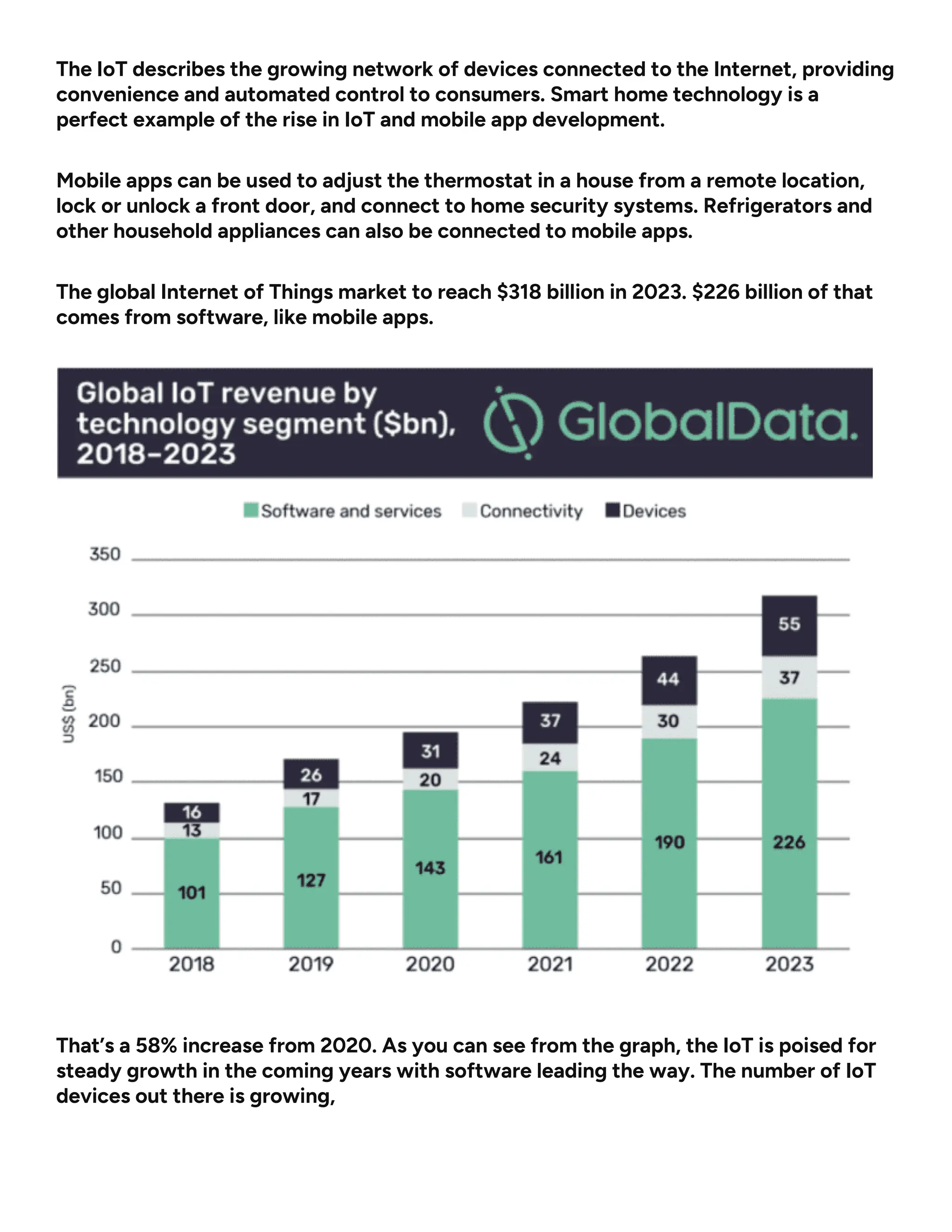
The global Internet of Things market to reach $318 billion in 2023. $226 billion of that
comes from software, like mobile apps.
That’s a 58% increase from 2020. As you can see from the graph, the IoT is poised for
steady growth in the coming years with software leading the way. The number of IoT
devices out there is growing,
According to Statista, the revenue from technology associated with the Internet of
Things will eclipse 1.6 trillion by 2025.
In 2025, I expect to see more mobile app development with the IoT in mind. Household
devices, automobiles, display devices, smart devices, and healthcare are all markets to
keep an eye on.
2. Apps For Foldable Devices
It feels like a lifetime ago, but one of my first mobile phones was a flip phone. Mobile
phones have changed over the last decade. Touch screens with one or no buttons have
taken over the market.
But over the last couple of years, foldable devices have begun making a comeback.
2019 saw the release of foldable devices like the Samsung Galaxy Fold, the Huawei
Mate X, and the new Motorola Razr.
These smartphones fold to compress or expand the screen size based on user
preferences. For example, a user might make a call with the device closed, but watch a
video on a larger screen by unfolding the device.
From an app development perspective, resellers and content creators need to account
for these devices when building or updating an app.
The idea is that an app should seamlessly adjust its display as the screen folds or
unfolds.
Right now, foldable devices are just a sliver of the overall smartphone market share.
But this will change in the coming years. According to a 2019 study by USA Today, 17%
of iPhone users and 19% of Android users are excited about buying a phone with a
foldable design.
According to Statista, roughly 3.2 million foldable phones were shipped in 2019. This
forecast is expected to reach 50 million units by 2023. This will be a big year for
foldables, which means app developers must plan accordingly.
3. 5G Technology
The rollout of 5G will have a major impact on 2025 app trends. For developers,
resellers, and creators, this technology is poised to change the way mobile applications
are used and created.
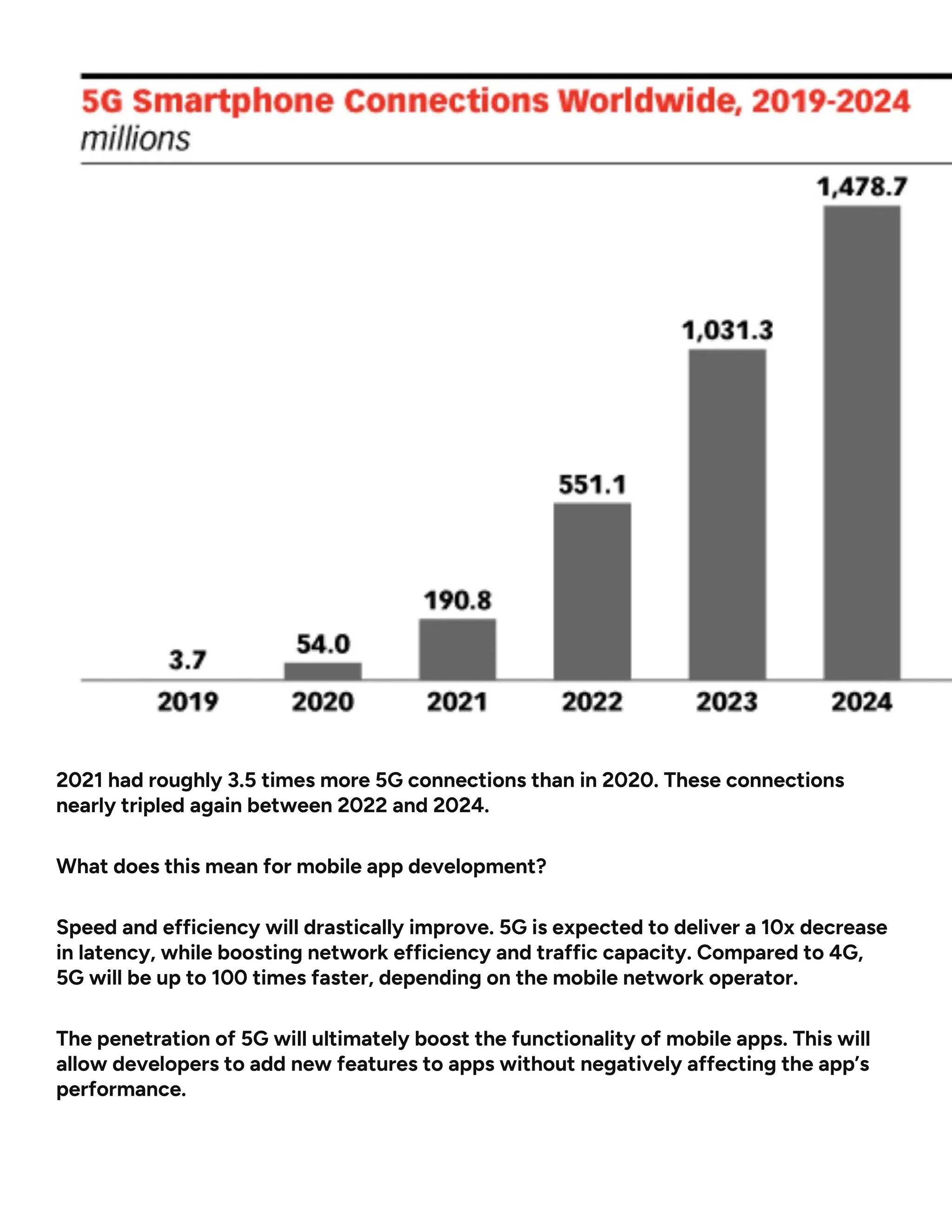
Take a look at the expected growth of 5G smartphone connections over the next four
years.
2021 had roughly 3.5 times more 5G connections than in 2020. These connections
nearly tripled again between 2022 and 2024.
What does this mean for mobile app development?
Speed and efficiency will drastically improve. 5G is expected to deliver a 10x decrease
in latency, while boosting network efficiency and traffic capacity. Compared to 4G,
5G will be up to 100 times faster, depending on the mobile network operator.
The penetration of 5G will ultimately boost the functionality of mobile apps. This will
allow developers to add new features to apps without negatively affecting the app’s
performance.
Developers and mobile app resellers should also use 5G network speed during the
testing and development stages of building an app.
4. Development For Wearable
Devices
Wearable technology has been trending upward for years now as well. This isn’t
necessarily a breakthrough in the market. We’ve seen smartwatches, trackers, and
fitness bands for a while now.
However wearable devices have yet to reach their full potential.
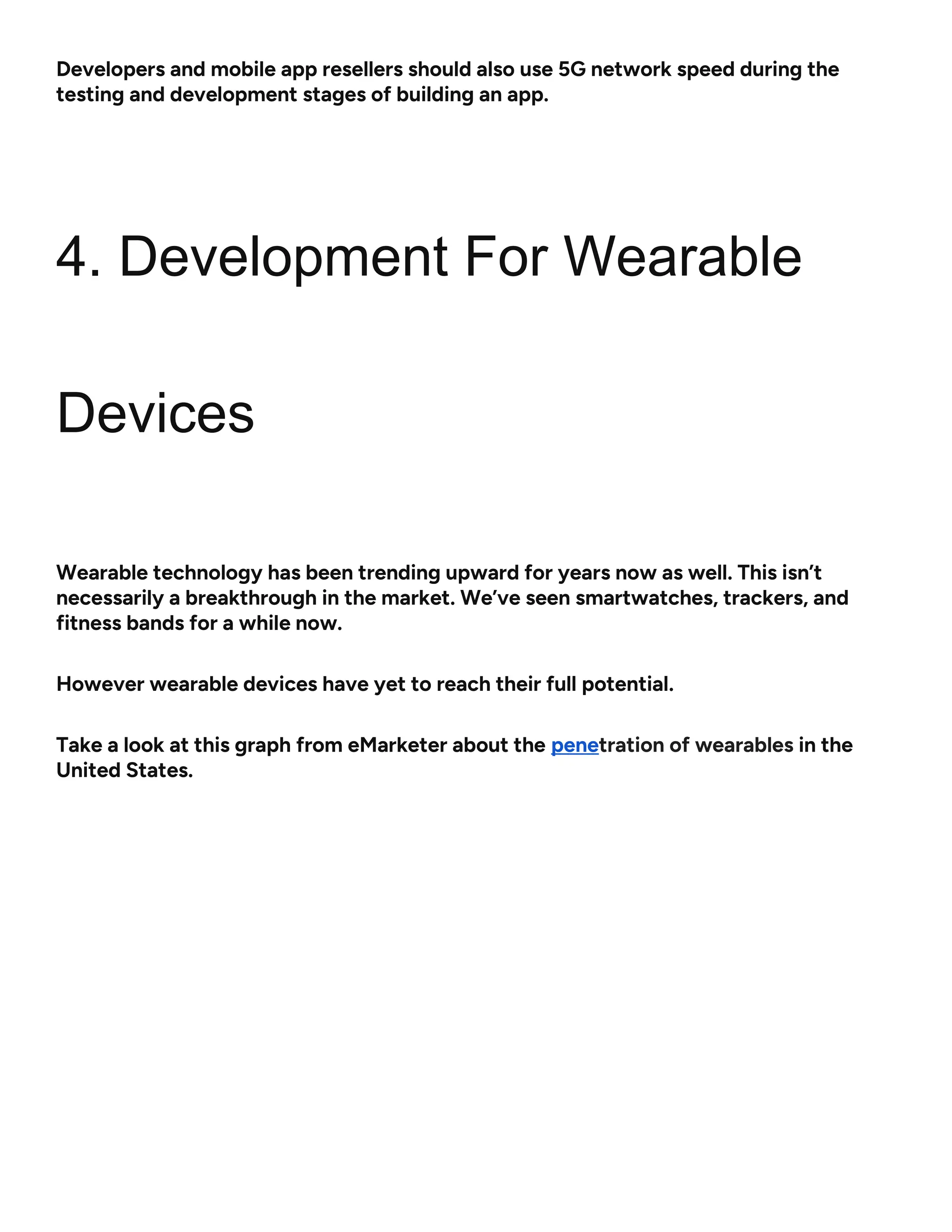
Take a look at this graph from eMarketer about the penetration of wearables in the
United States.
While we’re not seeing a staggering jump year-year-over-year, the growth is still
steady. The wearables trend has changed and will continue to change the way that
mobile apps are developed.
For instance, Apple made a big announcement about wearables and app integration at
WWDC 2019. The new watchOS 6 has brought the Apple App Store to Apple Watch.
Independent apps are being built specifically for these devices. This has created an
enormous opportunity for app resellers and content creators.
In 2025, more mobile apps will be made with wearables in mind. Users will be able to
download tens of thousands of apps directly from their wrist.
We’re just beginning to scratch the surface with wearables and mobile app integration.
The coming years will be exceptionally progressive in this category.
5. Beacon Technology
Beacon technology has been embraced by a wide range of industries. From retail to
healthcare and hospitality, beacons can add advanced functionality to nearly any
mobile app.
The first mobile app beacons were developed back in 2013. However, over the last few
years, significant advancements have been made to this technology.
Here’s an example of how beacons work with mobile apps. Let’s say you’re a mobile
app reseller that builds apps for retailers. Your clients can install beacons in their stores
that connect with a user’s smartphone via Bluetooth if the app is on their device. When
a user passes by a beacon, they can be instantly notified about a sale or special on
products in that store.
Beacons can also help track buyer behavior in stores. They can detect if a user is
spending a significant amount of time in a particular aisle. The app can automatically
trigger a push notification to entice a sale at a later date related to those products.
The main benefit of beacon technology is proximity marketing. It ultimately improves
the customer experience within a mobile app.
According to Statista, the beacon technology market is increasing at a compound
annual growth rate of 59.8%. The estimated market value will reach $56.6 billion by
2026. That’s more than ten times higher than the $519.6 million worth from 2016.
6. Mobile Commerce
I can’t make a list of 2025 app trends without mentioning mobile commerce. This trend
has been dominating for years, and will continue trending upward for the foreseeable
future.
It seems like everyone is leveraging mobile apps to increase revenue. From large
retailers to individual content creators and personal brands, there is plenty of money
to be made in this space.
Mobile e-commerce functionality is a top feature for mobile app resellers to showcase
during client pitches. It seems like every day another business is launching an app to
drive sales.
We’re not quite at this point yet, but we’re almost reaching the age where you need a
mobile commerce app to stay competitive. Every single person and business selling
online is competing with giants like Amazon. To keep pace, you need to replicate what
makes those brands so successful; an app is at the top of that list.
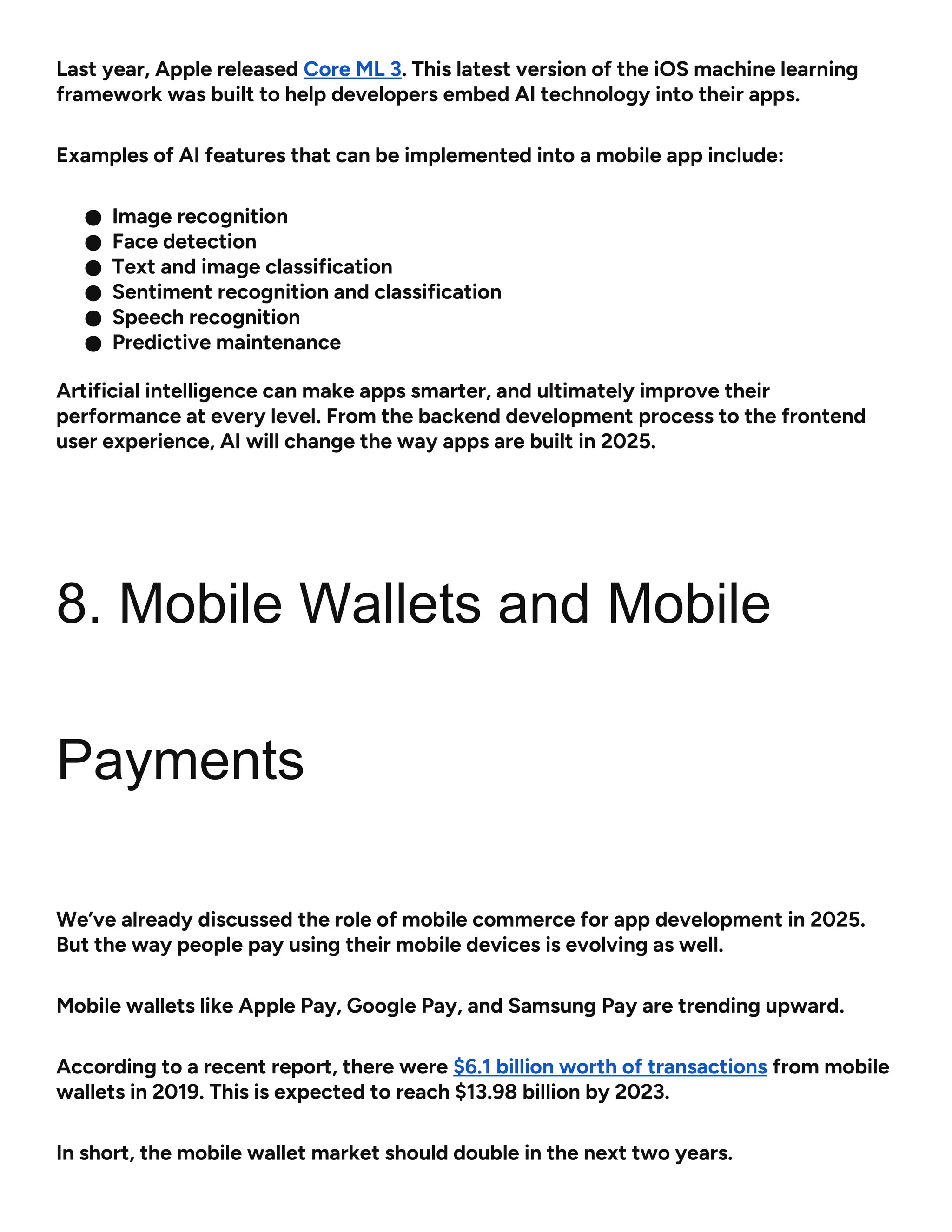
In 2021, more than 72.9% of total ecommerce sales came from mobile devices. Apps
play a significant role in the current and future success of mobile commerce.
I could go on for days listing dozens of trends in mobile commerce. But to keep things
brief here, you can check out our complete guide to mobile e-commerce statistics.
2025 will continue to be a big year for e-commerce app development. Plan
accordingly.
7. Artificial Intelligence (AI)
Artificial intelligence and machine learning both penetrated mobile app development
years ago. But we’ve only just begun to scratch the surface of how these advanced
technologies can be used.
When we first think about AI, virtual assistants like Siri or Alexa come to mind.
However, the use cases go far beyond this for app development.
Last year, Apple released Core ML 3. This latest version of the iOS machine learning
framework was built to help developers embed AI technology into their apps.
Examples of AI features that can be implemented into a mobile app include:
● Image recognition
● Face detection
● Text and image classification
● Sentiment recognition and classification
● Speech recognition
● Predictive maintenance
Artificial intelligence can make apps smarter, and ultimately improve their
performance at every level. From the backend development process to the frontend
user experience, AI will change the way apps are built in 2025.
8. Mobile Wallets and Mobile
Payments
We’ve already discussed the role of mobile commerce for app development in 2025.
But the way people pay using their mobile devices is evolving as well.
Mobile wallets like Apple Pay, Google Pay, and Samsung Pay are trending upward.
According to a recent report, there were $6.1 billion worth of transactions from mobile
wallets in 2019. This is expected to reach $13.98 billion by 2023.
In short, the mobile wallet market should double in the next two years.
Smartphone users are slowly but surely adopting mobile payments. They’re even
leveraging app functionalities for payments on connected wearable devices. In the
coming years, all the mobile apps out there need to account for mobile pay.
Mobile wallets must be taken into consideration for app development in 2025. Wallet
integration should become a standard feature for every app that processes
transactions. Currently, that’s not the case. However, the mobile wallet penetration
rate in apps will grow significantly in the coming years.
9. Augmented Reality (AR) and
Virtual Reality
Augmented reality will continue trending upward in 2025. Mobile apps can use AR
features for a wide range of use cases.
Pokemon Go paved the way for AR in mobile app gaming. But today, the applications
for AR have become more practical for other apps as well.
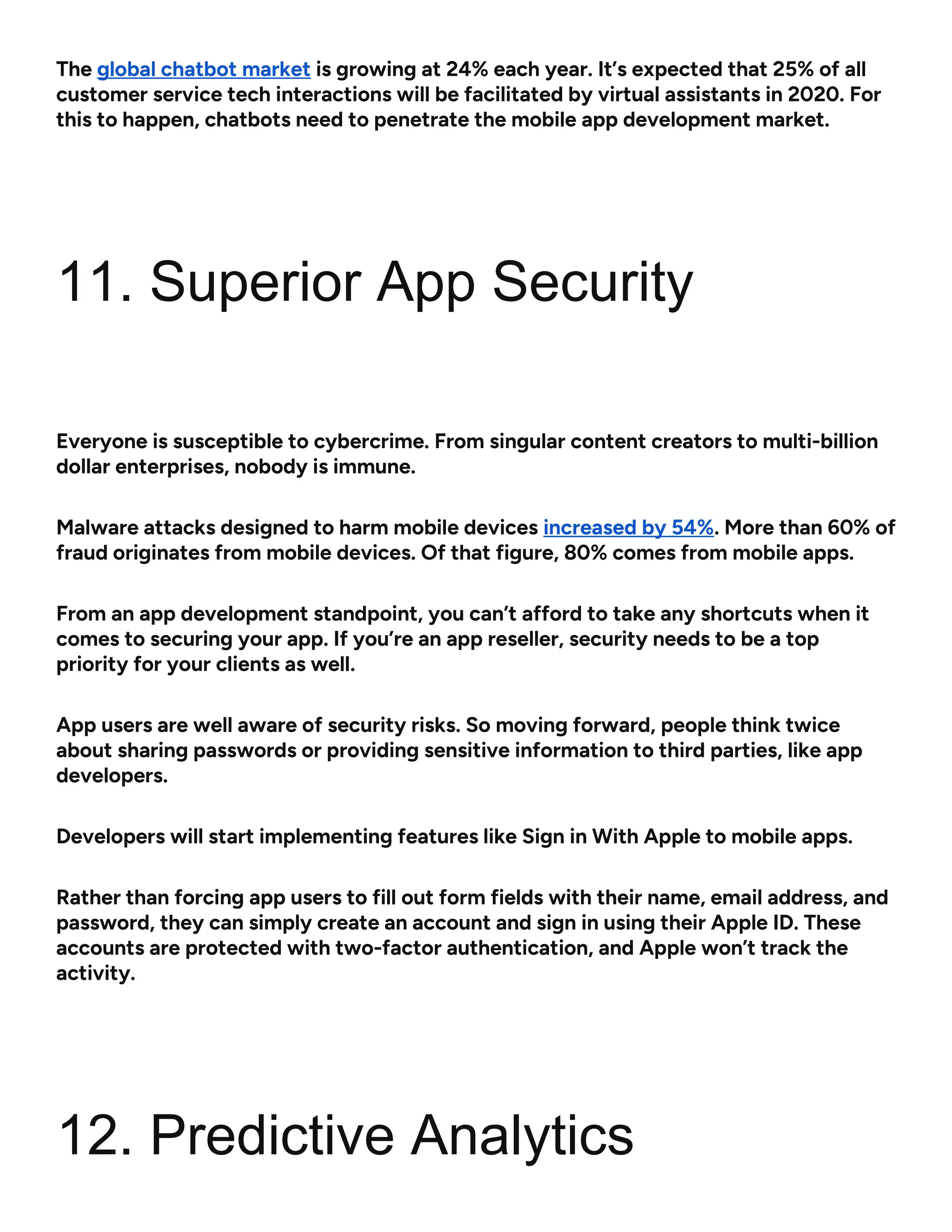
L’Oreal Paris uses AR for their Style My Hair app.
The app uses AR technology to showcase different hairstyles and colors directly to the
user. L’Oreal has also created a virtual makeup app using AR to see what makeup looks
like on the user’s face.
Even Google Maps rolled out a feature called “Live View” where users can see turn-by-
turn directions in real-time on real-world imagery. By pointing the device’s camera at
buildings and street signs, the app can figure out exactly where a user is.
While these examples may not necessarily be useful for the majority of apps
developed in 2025, there are plenty of other ways to use AR in mobile apps.
For example, workforce apps can use AR-based training programs for employee
learning.
AR adaption is a top app development trend for content creators. You can use this
technology to get creative as Instagram and Snapchat do with face filters.
Virtual reality is also shaking things up in the world of mobile application development.
This is especially true for gaming apps. VR technology can connect with phones, apps,
and wearables to enhance the gaming experience of fully functional mobile apps. In
terms of virtual reality and AR, these mobile application development trends cannot be
ignored if you’re in the industries mentioned above.
10. Chatbots
Chatbots have been around for more than a decade. I remember my first interactions
with these bots in the late 1990s on AOL Instant Messenger.
Over the years, chatbots have evolved and become much more advanced. Chatbots on
websites have increased in popularity due to consumer demand. It’s becoming the new
standard of customer service.
But of the millions of apps available on the Apple App Store and Google Play Store, just
a small fraction use chatbots. This will change in 2025.
Since chatbots are driven by AI technology, their responses are becoming more
human-like. We already discussed how AI will continue to trend upward, and this is one
of the reasons why.
The global chatbot market is growing at 24% each year. It’s expected that 25% of all
customer service tech interactions will be facilitated by virtual assistants in 2020. For
this to happen, chatbots need to penetrate the mobile app development market.
11. Superior App Security
Everyone is susceptible to cybercrime. From singular content creators to multi-billion
dollar enterprises, nobody is immune.
Malware attacks designed to harm mobile devices increased by 54%. More than 60% of
fraud originates from mobile devices. Of that figure, 80% comes from mobile apps.
From an app development standpoint, you can’t afford to take any shortcuts when it
comes to securing your app. If you’re an app reseller, security needs to be a top
priority for your clients as well.
App users are well aware of security risks. So moving forward, people think twice
about sharing passwords or providing sensitive information to third parties, like app
developers.
Developers will start implementing features like Sign in With Apple to mobile apps.
Rather than forcing app users to fill out form fields with their name, email address, and
password, they can simply create an account and sign in using their Apple ID. These
accounts are protected with two-factor authentication, and Apple won’t track the
activity.
12. Predictive Analytics
Here’s another mobile app development trend that will shake things up in the mobile
app industry. By leveraging technology for machine learning, AI, data mining, and
modeling, predictive analytics can forecast events using data.
Tech giants have been leveraging predictive analytics for years now. A simple example
is Netflix. The platform offers TV shows and movie recommendations based on what
users have previously watched.
In 2025, predictive analytics will be implemented on a more mainstream level, for a
wide range of mobile apps. The primary purpose will be to enhance the UI/UX with an
app.
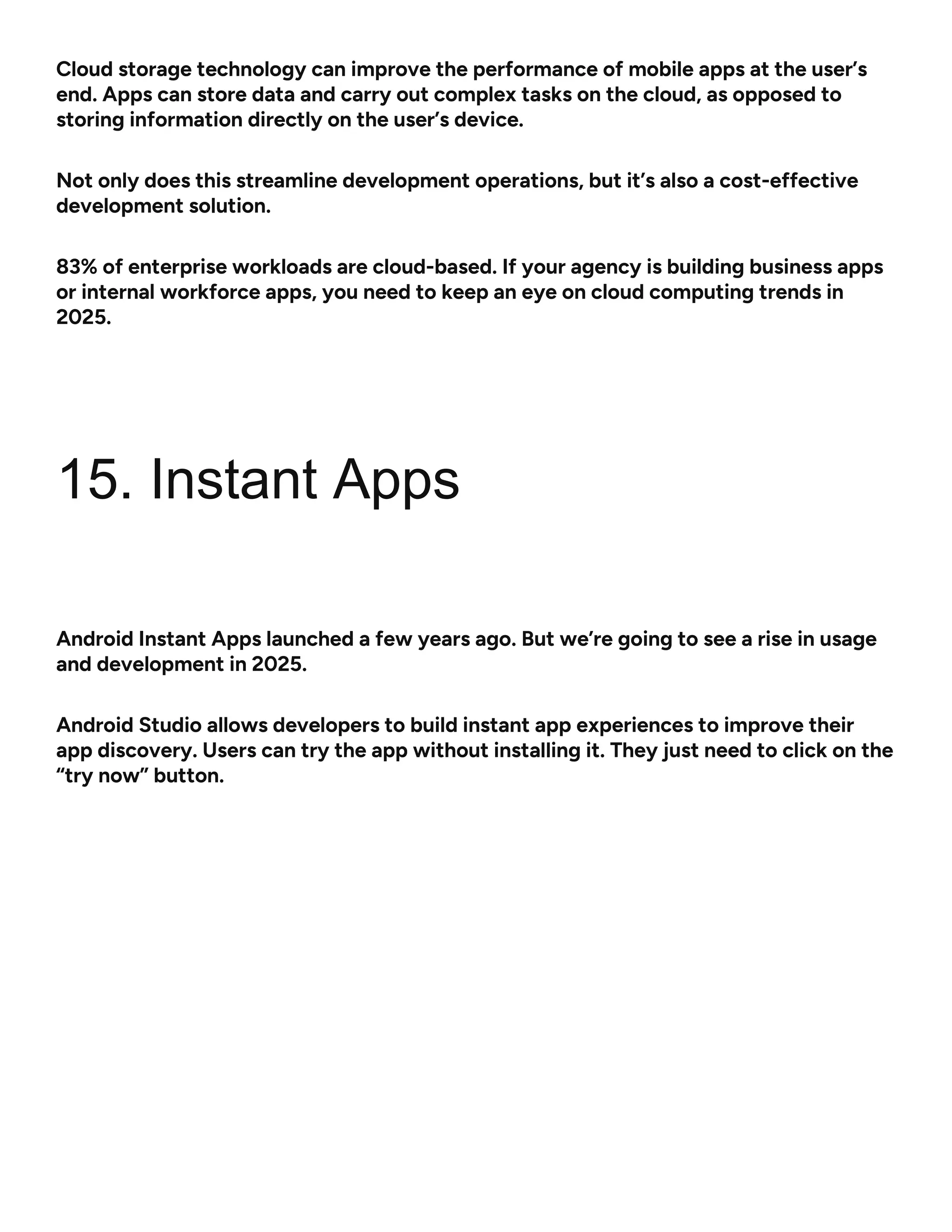
Take a look at how businesses across the globe are using AI technology.
19% of companies use AI for predictive analytics, which ranks first in the marketing
category and fifth overall.
The idea here is that no two users will have the same experience with an app. Product
suggestions and preferences will be presented differently based on each user’s actions
and behavior history.
13. On Demand Apps
On-demand mobile app development is trending upward in 2025. Apps like Airbnb and
Uber have shown how successful apps in this space can be.
Users spend $57.6 billion per year using on-demand services. These are some examples
of how apps can transform the on-demand industry:
● Laundry service
● Doctors on-demand
● Virtual tutors and coaches
● Food delivery
● House cleaning
● Maintenance services
● Fitness on-demand
● Pet care
● Barber and beauty salon
The opportunities for on demand apps are seemingly endless. As a mobile app reseller,
this is a huge opportunity for you to widen your customer base. By leveraging on-
demand capabilities, your clients can add advanced functionality to their apps, which
will increase profits for everyone.
14. Cloud Computing Integration
While cloud technology is not new, it hasn’t quite penetrated the mobile app industry
to its full potential just yet. But this is a mobile app development trend that you need
to keep an eye on. Cloud computing has a wide range of possibilities for mobile
development, which will be exploited in 2025.
Cloud storage technology can improve the performance of mobile apps at the user’s
end. Apps can store data and carry out complex tasks on the cloud, as opposed to
storing information directly on the user’s device.
Not only does this streamline development operations, but it’s also a cost-effective
development solution.
83% of enterprise workloads are cloud-based. If your agency is building business apps
or internal workforce apps, you need to keep an eye on cloud computing trends in
2025.
15. Instant Apps
Android Instant Apps launched a few years ago. But we’re going to see a rise in usage
and development in 2025.
Android Studio allows developers to build instant app experiences to improve their
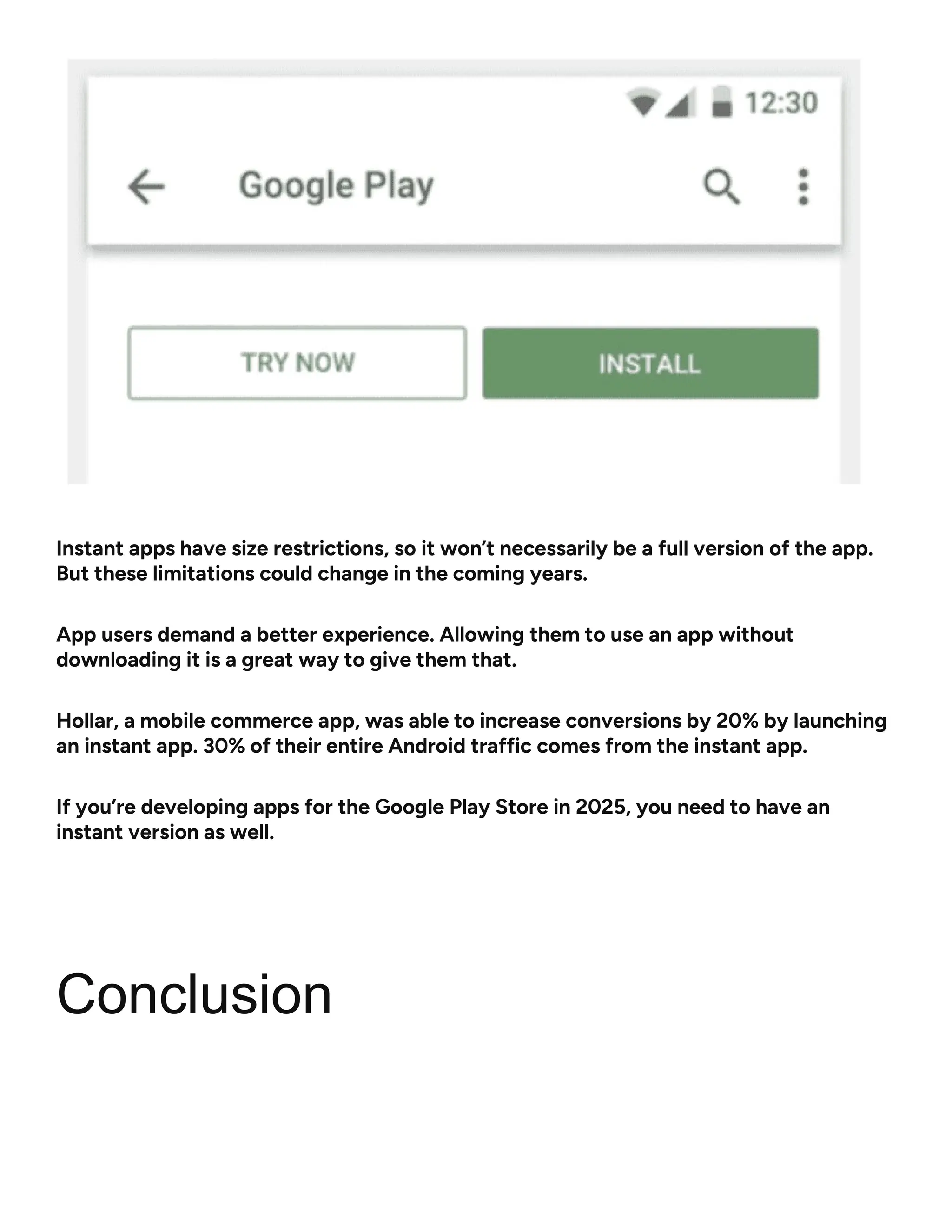
app discovery. Users can try the app without installing it. They just need to click on the
“try now” button.
Instant apps have size restrictions, so it won’t necessarily be a full version of the app.
But these limitations could change in the coming years.
App users demand a better experience. Allowing them to use an app without
downloading it is a great way to give them that.
Hollar, a mobile commerce app, was able to increase conversions by 20% by launching
an instant app. 30% of their entire Android traffic comes from the instant app.
If you’re developing apps for the Google Play Store in 2025, you need to have an
instant version as well.
Conclusion
Mobile app development is constantly changing. If you’re building apps today using
information from two or three years ago, you won’t be able to stay competitive. Mobile
app industry trends can make or break the success of your project.
As a reseller or mobile app development company, you can treat the 2025 mobile app
trends like your bible. This is how you can gain an edge in your space. All of the mobile
app developers on your team need to understand mobile app development trends and
incorporate them into the app development process.
You don’t necessarily need to implement every single trend into every app you build.
But you need to have a general understanding of how the market is shifting so you can
adapt accordingly.
Based on my extensive research, the 15 app development trends that I outlined above
will dominate in 2025.
Share & follow
For any inquiries, please contact:
Dave Patel
dave.patell95@gmail.com

Key Technologies Mobile App Development Companies are Using in 2025.docx

  • 1.
    Key Technologies MobileApp Development Companies are Using in 2025 By Dave Patel Date
  • 3.
    The mobile appdevelopment industry is continuously evolving. Technology advancements, consumer demands, and a wide range of other factors have a direct impact on mobile app trends. Staying up to date with the latest trends is arguably the most crucial aspect of success in this space. As a member of the Forbes Technology Council, I’m constantly researching patterns and communicating with other tech leaders about gaining an edge. Mobile app resellers need to keep up with new trends to better serve their clients. The same goes for content creators and producers ready to take their brands to the next level with mobile development. Are you prepared for the mobile app development changes in the coming year? The list below is more than just a hunch or my personal opinion. I’ve used fact-based research to come up with the top app development trends that will dominate 2025. 1. Internet of Things (IoT) App Integration The IoT is far from a new concept. However, the rise in mobile penetration across a broad range of sectors and categories has created seemingly endless opportunities for the Internet of Things. People have grown accustomed to using technology to improve their everyday lives.
  • 4.
    The IoT describesthe growing network of devices connected to the Internet, providing convenience and automated control to consumers. Smart home technology is a perfect example of the rise in IoT and mobile app development. Mobile apps can be used to adjust the thermostat in a house from a remote location, lock or unlock a front door, and connect to home security systems. Refrigerators and other household appliances can also be connected to mobile apps. The global Internet of Things market to reach $318 billion in 2023. $226 billion of that comes from software, like mobile apps. That’s a 58% increase from 2020. As you can see from the graph, the IoT is poised for steady growth in the coming years with software leading the way. The number of IoT devices out there is growing,
  • 5.
    According to Statista,the revenue from technology associated with the Internet of Things will eclipse 1.6 trillion by 2025. In 2025, I expect to see more mobile app development with the IoT in mind. Household devices, automobiles, display devices, smart devices, and healthcare are all markets to keep an eye on. 2. Apps For Foldable Devices It feels like a lifetime ago, but one of my first mobile phones was a flip phone. Mobile phones have changed over the last decade. Touch screens with one or no buttons have taken over the market. But over the last couple of years, foldable devices have begun making a comeback. 2019 saw the release of foldable devices like the Samsung Galaxy Fold, the Huawei Mate X, and the new Motorola Razr. These smartphones fold to compress or expand the screen size based on user preferences. For example, a user might make a call with the device closed, but watch a video on a larger screen by unfolding the device. From an app development perspective, resellers and content creators need to account for these devices when building or updating an app. The idea is that an app should seamlessly adjust its display as the screen folds or unfolds. Right now, foldable devices are just a sliver of the overall smartphone market share. But this will change in the coming years. According to a 2019 study by USA Today, 17% of iPhone users and 19% of Android users are excited about buying a phone with a foldable design.
  • 6.
    According to Statista,roughly 3.2 million foldable phones were shipped in 2019. This forecast is expected to reach 50 million units by 2023. This will be a big year for foldables, which means app developers must plan accordingly. 3. 5G Technology The rollout of 5G will have a major impact on 2025 app trends. For developers, resellers, and creators, this technology is poised to change the way mobile applications are used and created. Take a look at the expected growth of 5G smartphone connections over the next four years.
  • 7.
    2021 had roughly3.5 times more 5G connections than in 2020. These connections nearly tripled again between 2022 and 2024. What does this mean for mobile app development? Speed and efficiency will drastically improve. 5G is expected to deliver a 10x decrease in latency, while boosting network efficiency and traffic capacity. Compared to 4G, 5G will be up to 100 times faster, depending on the mobile network operator. The penetration of 5G will ultimately boost the functionality of mobile apps. This will allow developers to add new features to apps without negatively affecting the app’s performance.
  • 8.
    Developers and mobileapp resellers should also use 5G network speed during the testing and development stages of building an app. 4. Development For Wearable Devices Wearable technology has been trending upward for years now as well. This isn’t necessarily a breakthrough in the market. We’ve seen smartwatches, trackers, and fitness bands for a while now. However wearable devices have yet to reach their full potential. Take a look at this graph from eMarketer about the penetration of wearables in the United States.
  • 9.
    While we’re notseeing a staggering jump year-year-over-year, the growth is still steady. The wearables trend has changed and will continue to change the way that mobile apps are developed. For instance, Apple made a big announcement about wearables and app integration at WWDC 2019. The new watchOS 6 has brought the Apple App Store to Apple Watch. Independent apps are being built specifically for these devices. This has created an enormous opportunity for app resellers and content creators. In 2025, more mobile apps will be made with wearables in mind. Users will be able to download tens of thousands of apps directly from their wrist.
  • 10.
    We’re just beginningto scratch the surface with wearables and mobile app integration. The coming years will be exceptionally progressive in this category. 5. Beacon Technology Beacon technology has been embraced by a wide range of industries. From retail to healthcare and hospitality, beacons can add advanced functionality to nearly any mobile app. The first mobile app beacons were developed back in 2013. However, over the last few years, significant advancements have been made to this technology. Here’s an example of how beacons work with mobile apps. Let’s say you’re a mobile app reseller that builds apps for retailers. Your clients can install beacons in their stores that connect with a user’s smartphone via Bluetooth if the app is on their device. When a user passes by a beacon, they can be instantly notified about a sale or special on products in that store. Beacons can also help track buyer behavior in stores. They can detect if a user is spending a significant amount of time in a particular aisle. The app can automatically trigger a push notification to entice a sale at a later date related to those products. The main benefit of beacon technology is proximity marketing. It ultimately improves the customer experience within a mobile app. According to Statista, the beacon technology market is increasing at a compound annual growth rate of 59.8%. The estimated market value will reach $56.6 billion by 2026. That’s more than ten times higher than the $519.6 million worth from 2016.
  • 11.
    6. Mobile Commerce Ican’t make a list of 2025 app trends without mentioning mobile commerce. This trend has been dominating for years, and will continue trending upward for the foreseeable future. It seems like everyone is leveraging mobile apps to increase revenue. From large retailers to individual content creators and personal brands, there is plenty of money to be made in this space. Mobile e-commerce functionality is a top feature for mobile app resellers to showcase during client pitches. It seems like every day another business is launching an app to drive sales. We’re not quite at this point yet, but we’re almost reaching the age where you need a mobile commerce app to stay competitive. Every single person and business selling online is competing with giants like Amazon. To keep pace, you need to replicate what makes those brands so successful; an app is at the top of that list. In 2021, more than 72.9% of total ecommerce sales came from mobile devices. Apps play a significant role in the current and future success of mobile commerce.
  • 12.
    I could goon for days listing dozens of trends in mobile commerce. But to keep things brief here, you can check out our complete guide to mobile e-commerce statistics. 2025 will continue to be a big year for e-commerce app development. Plan accordingly. 7. Artificial Intelligence (AI) Artificial intelligence and machine learning both penetrated mobile app development years ago. But we’ve only just begun to scratch the surface of how these advanced technologies can be used. When we first think about AI, virtual assistants like Siri or Alexa come to mind. However, the use cases go far beyond this for app development.
  • 13.
    Last year, Applereleased Core ML 3. This latest version of the iOS machine learning framework was built to help developers embed AI technology into their apps. Examples of AI features that can be implemented into a mobile app include: ● Image recognition ● Face detection ● Text and image classification ● Sentiment recognition and classification ● Speech recognition ● Predictive maintenance Artificial intelligence can make apps smarter, and ultimately improve their performance at every level. From the backend development process to the frontend user experience, AI will change the way apps are built in 2025. 8. Mobile Wallets and Mobile Payments We’ve already discussed the role of mobile commerce for app development in 2025. But the way people pay using their mobile devices is evolving as well. Mobile wallets like Apple Pay, Google Pay, and Samsung Pay are trending upward. According to a recent report, there were $6.1 billion worth of transactions from mobile wallets in 2019. This is expected to reach $13.98 billion by 2023. In short, the mobile wallet market should double in the next two years.
  • 14.
    Smartphone users areslowly but surely adopting mobile payments. They’re even leveraging app functionalities for payments on connected wearable devices. In the coming years, all the mobile apps out there need to account for mobile pay. Mobile wallets must be taken into consideration for app development in 2025. Wallet integration should become a standard feature for every app that processes transactions. Currently, that’s not the case. However, the mobile wallet penetration rate in apps will grow significantly in the coming years. 9. Augmented Reality (AR) and Virtual Reality Augmented reality will continue trending upward in 2025. Mobile apps can use AR features for a wide range of use cases. Pokemon Go paved the way for AR in mobile app gaming. But today, the applications for AR have become more practical for other apps as well. L’Oreal Paris uses AR for their Style My Hair app.
  • 15.
    The app usesAR technology to showcase different hairstyles and colors directly to the user. L’Oreal has also created a virtual makeup app using AR to see what makeup looks like on the user’s face. Even Google Maps rolled out a feature called “Live View” where users can see turn-by- turn directions in real-time on real-world imagery. By pointing the device’s camera at buildings and street signs, the app can figure out exactly where a user is.
  • 16.
    While these examplesmay not necessarily be useful for the majority of apps developed in 2025, there are plenty of other ways to use AR in mobile apps. For example, workforce apps can use AR-based training programs for employee learning. AR adaption is a top app development trend for content creators. You can use this technology to get creative as Instagram and Snapchat do with face filters. Virtual reality is also shaking things up in the world of mobile application development. This is especially true for gaming apps. VR technology can connect with phones, apps, and wearables to enhance the gaming experience of fully functional mobile apps. In terms of virtual reality and AR, these mobile application development trends cannot be ignored if you’re in the industries mentioned above. 10. Chatbots Chatbots have been around for more than a decade. I remember my first interactions with these bots in the late 1990s on AOL Instant Messenger. Over the years, chatbots have evolved and become much more advanced. Chatbots on websites have increased in popularity due to consumer demand. It’s becoming the new standard of customer service. But of the millions of apps available on the Apple App Store and Google Play Store, just a small fraction use chatbots. This will change in 2025. Since chatbots are driven by AI technology, their responses are becoming more human-like. We already discussed how AI will continue to trend upward, and this is one of the reasons why.
  • 17.
    The global chatbotmarket is growing at 24% each year. It’s expected that 25% of all customer service tech interactions will be facilitated by virtual assistants in 2020. For this to happen, chatbots need to penetrate the mobile app development market. 11. Superior App Security Everyone is susceptible to cybercrime. From singular content creators to multi-billion dollar enterprises, nobody is immune. Malware attacks designed to harm mobile devices increased by 54%. More than 60% of fraud originates from mobile devices. Of that figure, 80% comes from mobile apps. From an app development standpoint, you can’t afford to take any shortcuts when it comes to securing your app. If you’re an app reseller, security needs to be a top priority for your clients as well. App users are well aware of security risks. So moving forward, people think twice about sharing passwords or providing sensitive information to third parties, like app developers. Developers will start implementing features like Sign in With Apple to mobile apps. Rather than forcing app users to fill out form fields with their name, email address, and password, they can simply create an account and sign in using their Apple ID. These accounts are protected with two-factor authentication, and Apple won’t track the activity. 12. Predictive Analytics
  • 18.
    Here’s another mobileapp development trend that will shake things up in the mobile app industry. By leveraging technology for machine learning, AI, data mining, and modeling, predictive analytics can forecast events using data. Tech giants have been leveraging predictive analytics for years now. A simple example is Netflix. The platform offers TV shows and movie recommendations based on what users have previously watched. In 2025, predictive analytics will be implemented on a more mainstream level, for a wide range of mobile apps. The primary purpose will be to enhance the UI/UX with an app. Take a look at how businesses across the globe are using AI technology.
  • 19.
    19% of companiesuse AI for predictive analytics, which ranks first in the marketing category and fifth overall. The idea here is that no two users will have the same experience with an app. Product suggestions and preferences will be presented differently based on each user’s actions and behavior history.
  • 20.
    13. On DemandApps On-demand mobile app development is trending upward in 2025. Apps like Airbnb and Uber have shown how successful apps in this space can be. Users spend $57.6 billion per year using on-demand services. These are some examples of how apps can transform the on-demand industry: ● Laundry service ● Doctors on-demand ● Virtual tutors and coaches ● Food delivery ● House cleaning ● Maintenance services ● Fitness on-demand ● Pet care ● Barber and beauty salon The opportunities for on demand apps are seemingly endless. As a mobile app reseller, this is a huge opportunity for you to widen your customer base. By leveraging on- demand capabilities, your clients can add advanced functionality to their apps, which will increase profits for everyone. 14. Cloud Computing Integration While cloud technology is not new, it hasn’t quite penetrated the mobile app industry to its full potential just yet. But this is a mobile app development trend that you need to keep an eye on. Cloud computing has a wide range of possibilities for mobile development, which will be exploited in 2025.
  • 21.
    Cloud storage technologycan improve the performance of mobile apps at the user’s end. Apps can store data and carry out complex tasks on the cloud, as opposed to storing information directly on the user’s device. Not only does this streamline development operations, but it’s also a cost-effective development solution. 83% of enterprise workloads are cloud-based. If your agency is building business apps or internal workforce apps, you need to keep an eye on cloud computing trends in 2025. 15. Instant Apps Android Instant Apps launched a few years ago. But we’re going to see a rise in usage and development in 2025. Android Studio allows developers to build instant app experiences to improve their app discovery. Users can try the app without installing it. They just need to click on the “try now” button.
  • 22.
    Instant apps havesize restrictions, so it won’t necessarily be a full version of the app. But these limitations could change in the coming years. App users demand a better experience. Allowing them to use an app without downloading it is a great way to give them that. Hollar, a mobile commerce app, was able to increase conversions by 20% by launching an instant app. 30% of their entire Android traffic comes from the instant app. If you’re developing apps for the Google Play Store in 2025, you need to have an instant version as well. Conclusion
  • 23.
    Mobile app developmentis constantly changing. If you’re building apps today using information from two or three years ago, you won’t be able to stay competitive. Mobile app industry trends can make or break the success of your project. As a reseller or mobile app development company, you can treat the 2025 mobile app trends like your bible. This is how you can gain an edge in your space. All of the mobile app developers on your team need to understand mobile app development trends and incorporate them into the app development process. You don’t necessarily need to implement every single trend into every app you build. But you need to have a general understanding of how the market is shifting so you can adapt accordingly. Based on my extensive research, the 15 app development trends that I outlined above will dominate in 2025. Share & follow For any inquiries, please contact: Dave Patel dave.patell95@gmail.com