Updates on the BioSense Program Redesign

2011 Public Health Preparedness Summit
Session WS-16—Location International 10
Tuesday, February 22, 2011 1:30 PM- 5:30 PM
Atlanta, GA, USA – February 22-25, 2011


Taha A. Kass-Hout, MD, MS
Deputy Director for Information Science (Acting) and BioSense Program Manager
Division of Notifiable Diseases and Healthcare Information (DNDHI, Proposed)
Public Health Surveillance Program Office (PHSPO)
Office of Surveillance, Epidemiology, and Laboratory Services (OSELS)
Centers for Disease Control & Prevention (CDC)

Any views or opinions expressed here do not necessarily represent the views of the CDC, HHS, or any other entity of the United States
government. Furthermore, the use of any product names, trade names, images, or commercial sources is for identification purposes only,
and does not imply endorsement or government sanction by the U.S. Department of Health and Human Services.


                           Public Health Surveillance Program Office
                           Office of Surveillance, Epidemiology, and Laboratory Services
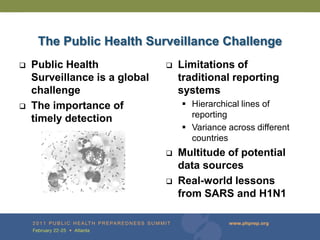
The Public Health Surveillance Challenge
   Public Health                 Limitations of
    Surveillance is a global       traditional reporting
    challenge                      systems
   The importance of               Hierarchical lines of
    timely detection                 reporting
                                    Variance across different
                                     countries
                                  Multitude of potential
                                   data sources
                                  Real-world lessons
                                   from SARS and H1N1
Limitations of Current Approaches
   Can’t mine
      all possible sources
      all data types
   Delay required for searching,
    curating and processing
   Massive bandwidth and
    processing requirements
   Resource limited process
    (machine and human)
   Policies that hinder data
    sharing
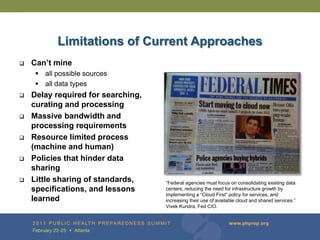
   Little sharing of standards,    “Federal agencies must focus on consolidating existing data
    specifications, and lessons     centers, reducing the need for infrastructure growth by
                                    implementing a “Cloud First” policy for services, and
    learned                         increasing their use of available cloud and shared services.”
                                    Vivek Kundra, Fed CIO.
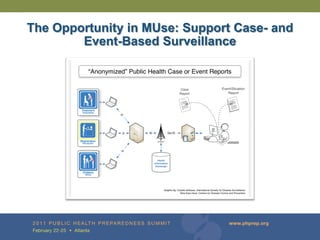
The Opportunity in MUse: Support Case- and
        Event-Based Surveillance
EHRs and Health Information Exchanges can
       Improve Public Health Surveillance
   Enhanced Situation Awareness
        Syndromic surveillance exploits more elements from the EHR for earlier characterization
           •   can limit spread of outbreak or monitor severity of pandemics, and reduce morbidity and mortality
        Automated collection and reporting encourages more care provider organizations to participate
   Timely and More Complete Notifiable Disease Reporting
        Studies have shown that electronically based reporting for STDs averages 7.9 days earlier than
         spontaneous reporting, allowing:
           •   52% increase in treating patients in 2 weeks
           •   28% increase in reaching at risk subject by phone
        Automation of this task is popular with healthcare provides since it relieves a perceived burden
   Better Prevention and Surveillance or Chronic Conditions
        Addresses major factors in rising healthcare costs
        Data can be used for outcome-based incentives for best practices
        Simple ABCDs (Aspirin Therapy, Blood Pressure Screening, Cholesterol Screening, Smoking Cessation, and
         Diabetes) Interventions can reduce the number of avoidable deaths
           •   CDC’s Demonstrating the Preventive Care Value of HIEs (DPCVCHIE) project is using national standards and
               capabilities to evaluate the effectiveness of ABCDs interventions


               Consistency of Reporting | Reduced Latency | More Completeness of Reporting
BioSense Program

             Civilian Hospitals
             • ~640 facilities [~12% ED coverage in US, patchy geo
               coverage] [Chief complaints: median 24-hour
               latency, Diagnoses: median 6 days latency]
                 • 8 health department sending data from 482
                    hospitals
                 • 165 facilities reporting ED data directly to CDC
                    or a health department

             Veterans Affairs and Department of Defense
             • ~1400 facilities in 50 states, District of Columbia, and
               Puerto Rico [final diagnosis ~2->5 days latency]

             National Labs [LabCorp and Quest]
             • 47 states, the District of Columbia, and Puerto Rico
               [24-hour latency]

             Hospital Labs
             • 49 hospital labs in 17 states/jurisdictions [24-hours
               latency]

             Pharmacies
             • 50,000 (27,000 Active) in 50 states [24-hour latency]
BioSense Program Redesign
Updated Vision: Beyond early detection Beyond syndromic

   The goal of the redesign effort is to be able to provide
       Nationwide and regional Situation Awareness for all hazards health-related
        events (beyond bioterrorism) and to support national, state, and local responses
        to those events
       Multiple uses to support your public health Situation Awareness; routine public
        health practice; and improved health outcomes and public health


   Our strategy is to increase BioSense Program participation and
    utility and to support local and state jurisdictions’ health
    monitoring infrastructure and workforce capacity
       Requires collaboration with other CDC Programs and federal agencies

–   7 years of experience dealing with timely healthcare data (Outpatient, ED, Inpatient, Census,
    Laboratory, Radiology, Pharmacy, etc.)
–   Infrastructure reconfigured for high performance, scalability and Meaningful Use (MUse)
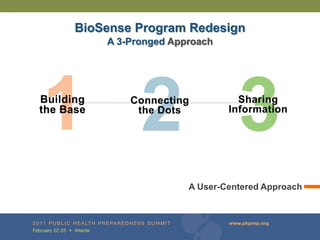
BioSense Program Redesign
           A 3-Pronged Approach


Building       Connecting           Sharing
the Base        the Dots          Information


                          A User-Centered Approach
Technical Expert Panel (TEP)—Current Status
    David Buckeridge                      Judy Murphy
      McGill University                     Aurora Health System
    Julia Gunn                            Marc Paladini
      National Association of County        NYC Department of Health
       and City Health Officials              and Mental Hygiene
       (NACCHO)                            Tom Safranek, Lisa Ferland,
    Jim Kirkwood                           Richard Hopkins
      Association of State and              Council of State and Territorial
       Territorial Health Officers            Epidemiologists (CSTE)
       (ASTHO)
                                           Walter G. Suarez
    Denise Love                             Kaiser Permanente
      National Association of Health
       Data Organizations (NAHDO)
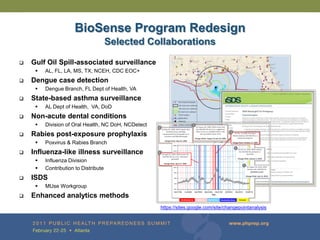
BioSense Program Redesign
                                      Selected Collaborations

   Gulf Oil Spill-associated surveillance
        AL, FL, LA, MS, TX, NCEH, CDC EOC+
   Dengue case detection
        Dengue Branch, FL Dept of Health, VA
   State-based asthma surveillance
        AL Dept of Health, VA, DoD
   Non-acute dental conditions
        Division of Oral Health, NC DoH, NCDetect
   Rabies post-exposure prophylaxis
        Poxvirus & Rabies Branch
   Influenza-like illness surveillance
        Influenza Division
        Contribution to Distribute
   ISDS
        MUse Workgroup
   Enhanced analytics methods
                                                     https://sites.google.com/site/changepointanalysis
BioSense Program Redesign
    Selected Stakeholders
BioSense Program Redesign
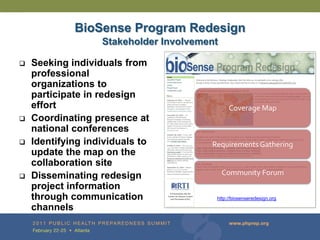
                   Stakeholder Involvement

   Seeking individuals from
    professional
    organizations to
    participate in redesign
    effort                                    Coverage Map
   Coordinating presence at
    national conferences
   Identifying individuals to          Requirements Gathering
    update the map on the
    collaboration site
   Disseminating redesign                   Community Forum
    project information
    through communication                http://biosenseredesign.org

    channels
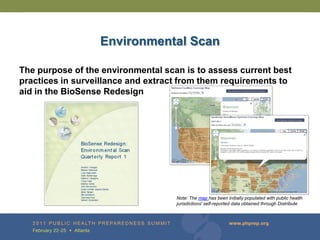
Environmental Scan

The purpose of the environmental scan is to assess current best
practices in surveillance and extract from them requirements to
aid in the BioSense Redesign


                                    Note: The map has been initially populated with public health
                                    jurisdictions' self-reported data obtained through Distribute
Key Sources of Information
   Published literature
   BioSense evaluations and roundtables
   Surveys from our partner organizations
   User requirement gathering sessions
   Site profiles from the Distribute Project
   Database of frequently used syndromic surveillance
    systems
   Collaboration Web Site Coverage Map
BioSense Redesign Coverage Map
      Data fields selected from Distribute Site Profiles include:
   Type of jurisdiction (i.e., state, county, city)
   Surveillance system(s) used by site
   Total number of emergency care and urgent care facilities in
    the jurisdiction, including pediatric facilities
   Number of reporting emergency care and urgent care facilities,
    including pediatric facilities
   Estimated population coverage
   Approximate number of emergency department (ED) visits
    captured
BioSense Redesign Coverage Map
             Contributing BioSense facilities
   925 VA hospitals
   362 U.S. Dept. of Defense healthcare facilities
   661 Private hospitals and hospital systems
   2,780 National laboratories
   49,365 Pharmacies
Populating the Coverage Map: Methods
                  Identifying Editors

   Historic partnership with BioSense or CDC
   Newsletter, website announcements (CSTE, ASTHO,
    NACCHO, ISDS)
   Volunteers from Collaboration Site
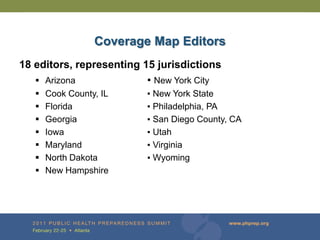
Coverage Map Editors
18 editors, representing 15 jurisdictions
    Arizona              ▪ New York City
      Cook County, IL    ▪ New York State
      Florida            ▪ Philadelphia, PA
      Georgia            ▪ San Diego County, CA
      Iowa               ▪ Utah
      Maryland           ▪ Virginia
      North Dakota       ▪ Wyoming
      New Hampshire
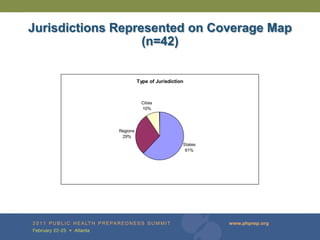
Jurisdictions Represented on Coverage Map
                   (n=42)


                        Type of Jurisdiction


                         Cities
                         10%


              Regions
               29%
                                           States
                                            61%
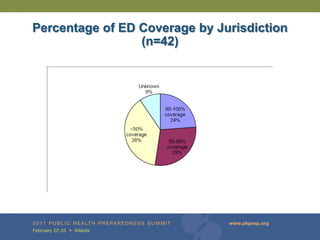
Percentage of ED Coverage by Jurisdiction
                 (n=42)


    Average ED coverage is 58%
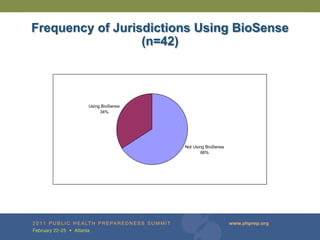
Frequency of Jurisdictions Using BioSense
                  (n=42)


         Using BioSense
              34%


                          Not Using BioSense
                                 66%
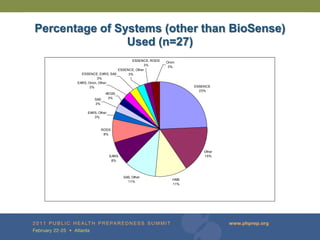
Percentage of Systems (other than BioSense)
                Used (n=27)
                                   ESSENCE, RODS
                                                   Orion
                                          3%        3%
                            ESSENCE, Other
         ESSENCE, EARS, SAS      3%
                   3%
       EARS, Orion, Other
              3%                                            ESSENCE
                                                              23%
                      AEGIS
                SAS    3%
                3%

            EARS, Other
               3%


                   RODS
                    8%


                                                                Other
                          EARS                                  15%
                           8%


                                 SAS, Other
                                                      HMS
                                   11%
                                                      11%
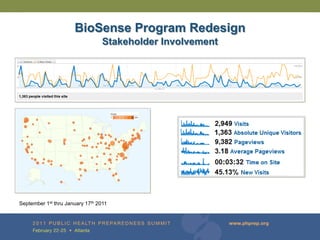
BioSense Program Redesign
                                  Stakeholder Involvement


September 1st thru January 17th 2011
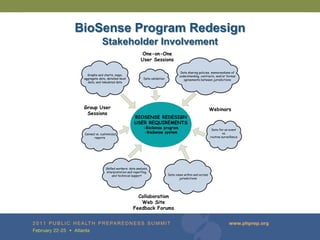
BioSense Program Redesign
             Stakeholder Involvement
                                         One-on-One
                                         User Sessions

                                                                     Data sharing policies, memorandums of
   Graphs and charts, maps,                                         understanding, contracts, and/or formal
 aggregate data, detailed-level            Data validation             agreements between jurisdictions
   data, and tabulated data


 Group User                                                                                 Webinars
  Sessions
                                     BIOSENSE REDESIGN
                                     USER REQUIREMENTS
                                           -BioSense program                                 Data for an event
 Canned vs. customized
                                           -BioSense system                                          vs.
       reports                                                                              routine surveillance


                Skilled workers: data analysis,
                interpretation and reporting,
                     and technical support                   Data views within and across
                                                                     jurisdictions


                                      Collaboration
                                       Web Site
                                    Feedback Forums
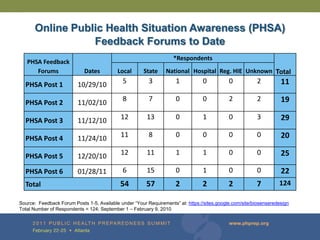
Online Public Health Situation Awareness (PHSA)
                 Feedback Forums to Date
                                                                    *Respondents
   PHSA Feedback
      Forums                Dates          Local       State     National Hospital Reg. HIE Unknown Total

  PHSA Post 1             10/29/10            5          3           1           0           0           2          11

                                              8          7           0           0           2           2          19
  PHSA Post 2             11/02/10

  PHSA Post 3             11/12/10           12         13           0           1           0           3          29

  PHSA Post 4             11/24/10           11          8           0           0           0           0          20

  PHSA Post 5             12/20/10           12         11           1           1           0           0          25

  PHSA Post 6             01/28/11            6         15           0           1           0           0          22
  Total                                      54         57           2           2           2           7         124

Source: Feedback Forum Posts 1-5, Available under “Your Requirements” at: https://sites.google.com/site/biosenseredesign
Total Number of Respondents = 124; September 1 – February 9, 2010
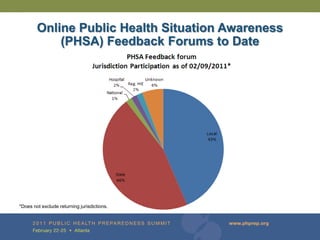
Online Public Health Situation Awareness
            (PHSA) Feedback Forums to Date


*Does not exclude returning jurisdictions.
Online Public Health Situation Awareness
         (PHSA) Feedback Forums to Date
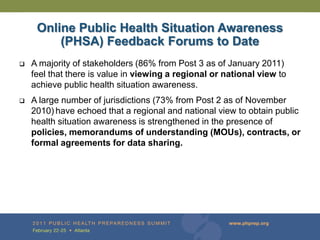
   A majority of stakeholders (86% from Post 3 as of January 2011)
    feel that there is value in viewing a regional or national view to
    achieve public health situation awareness.
   A large number of jurisdictions (73% from Post 2 as of November
    2010) have echoed that a regional and national view to obtain public
    health situation awareness is strengthened in the presence of
    policies, memorandums of understanding (MOUs), contracts, or
    formal agreements for data sharing.
Online Public Health Situation Awareness
         (PHSA) Feedback Forums to Date
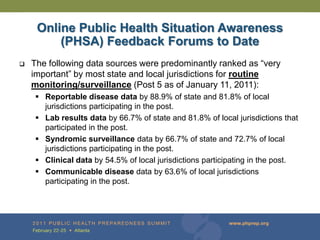
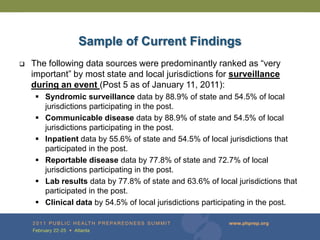
   The following data sources were predominantly ranked as “very
    important” by most state and local jurisdictions for routine
    monitoring/surveillance (Post 5 as of January 11, 2011):
     Reportable disease data by 88.9% of state and 81.8% of local
      jurisdictions participating in the post.
     Lab results data by 66.7% of state and 81.8% of local jurisdictions that
      participated in the post.
     Syndromic surveillance data by 66.7% of state and 72.7% of local
      jurisdictions participating in the post.
     Clinical data by 54.5% of local jurisdictions participating in the post.
     Communicable disease data by 63.6% of local jurisdictions
      participating in the post.
Sample of Current Findings
   The following data sources were predominantly ranked as “very
    important” by most state and local jurisdictions for surveillance
    during an event (Post 5 as of January 11, 2011):
      Syndromic surveillance data by 88.9% of state and 54.5% of local
       jurisdictions participating in the post.
      Communicable disease data by 88.9% of state and 54.5% of local
       jurisdictions participating in the post.
      Inpatient data by 55.6% of state and 54.5% of local jurisdictions that
       participated in the post.
      Reportable disease data by 77.8% of state and 72.7% of local
       jurisdictions participating in the post.
      Lab results data by 77.8% of state and 63.6% of local jurisdictions that
       participated in the post.
      Clinical data by 54.5% of local jurisdictions participating in the post.
Online Public Health Situation Awareness
            (PHSA) Feedback Forums to Date


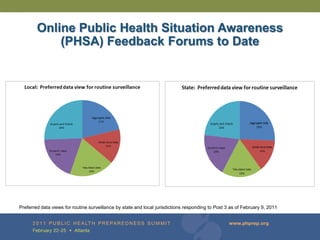
Preferred data views for routine surveillance by state and local jurisdictions responding to Post 3 as of February 9, 2011
Online Public Health Situation Awareness
            (PHSA) Feedback Forums to Date


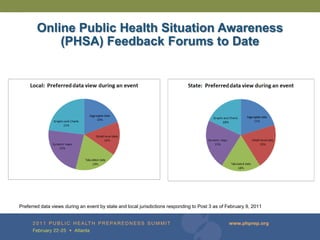
Preferred data views during an event by state and local jurisdictions responding to Post 3 as of February 9, 2011
Online Public Health Situation Awareness
            (PHSA) Feedback Forums to Date


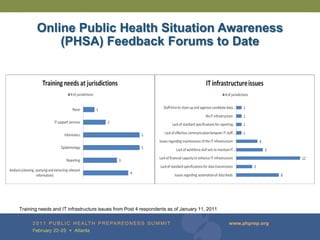
Training needs and IT infrastructure issues from Post 4 respondents as of January 11, 2011
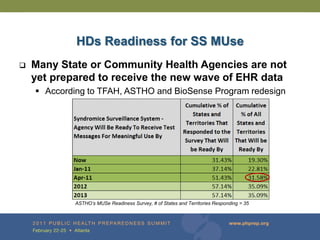
HDs Readiness for SS MUse
   Many State or Community Health Agencies are not
    yet prepared to receive the new wave of EHR data
     According to TFAH, ASTHO and BioSense Program redesign


            ASTHO’s MUSe Readiness Survey, # of States and Territories Responding = 35
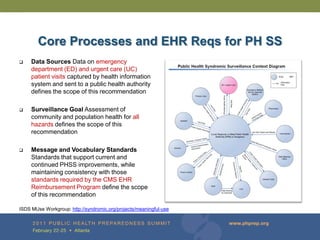
Core Processes and EHR Reqs for PH SS
    Data Sources Data on emergency
     department (ED) and urgent care (UC)
     patient visits captured by health information
     system and sent to a public health authority
     defines the scope of this recommendation

    Surveillance Goal Assessment of
     community and population health for all
     hazards defines the scope of this
     recommendation

    Message and Vocabulary Standards
     Standards that support current and
     continued PHSS improvements, while
     maintaining consistency with those
     standards required by the CMS EHR
     Reimbursement Program define the scope
     of this recommendation

ISDS MUse Workgroup: http://syndromic.org/projects/meaningful-use
Core Processes and EHR Reqs for PH SS:
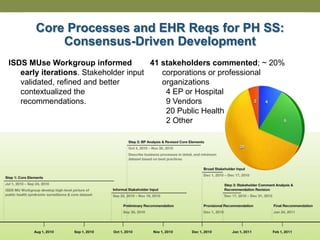
           Consensus-Driven Development
ISDS MUse Workgroup informed           41 stakeholders commented; ~ 20%
   early iterations. Stakeholder input    corporations or professional
   validated, refined and better          organizations
   contextualized the                      4 EP or Hospital
   recommendations.                        9 Vendors
                                           20 Public Health
                                           2 Other
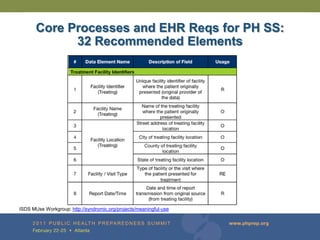
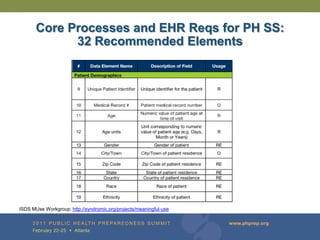
Core Processes and EHR Reqs for PH SS:
             32 Recommended Elements


ISDS MUse Workgroup: http://syndromic.org/projects/meaningful-use
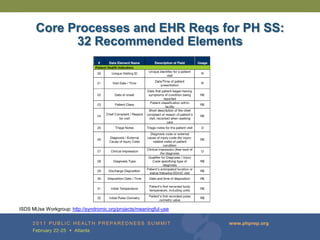
Core Processes and EHR Reqs for PH SS:
             32 Recommended Elements


ISDS MUse Workgroup: http://syndromic.org/projects/meaningful-use
Core Processes and EHR Reqs for PH SS:
             32 Recommended Elements


ISDS MUse Workgroup: http://syndromic.org/projects/meaningful-use
Acknowledgements
   US CDC                                    TEP Members
      James Buehler*, Samuel
       Groseclose*, Laura Conn*, Seth           David Buckeridge*, Julia Gunn,
       Foldy*, Nedra Garrett*                    Jim Kirkwood, Denise Love, Judy
                                                 Murphy, Marc Paladini, Tom
                                                 Safranek, Lisa Ferland, Richard
   RTI International
                                                 Hopkins, Walter Suarez
      Barbara Massoudi*, Lucia Rojas-
       Smith, S. Cornelia Kaydos-
       Daniels, Annette Casoglos, Rita
       Sembajwe, Dean Jackman, Ross           ISDS
       Loomis, Alan O'Connor, Taya              Charlie Ishikawa*, Anne Gifford,
       McMillan, Amanda Flynn, Tonya
       Farris, Alison Banger, Robert             Rachel Viola, Emily Cain
       Furberg

   Epidemico
      John Brownstein*, Clark Freifeld,
       Deanna Aho, Nabarun Dasgupta,
       Susan Aman, Katelynn O'Brien                                        * Co-authors
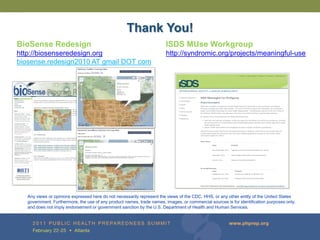
Thank You!
BioSense Redesign                                                       ISDS MUse Workgroup
http://biosenseredesign.org                                             http://syndromic.org/projects/meaningful-use
biosense.redesign2010 AT gmail DOT com


   Any views or opinions expressed here do not necessarily represent the views of the CDC, HHS, or any other entity of the United States
   government. Furthermore, the use of any product names, trade names, images, or commercial sources is for identification purposes only,
   and does not imply endorsement or government sanction by the U.S. Department of Health and Human Services.

Updates on the BioSense Program Redesign: 2011 Public Health Preparedness Summit

  • 1.
    Updates on theBioSense Program Redesign 2011 Public Health Preparedness Summit Session WS-16—Location International 10 Tuesday, February 22, 2011 1:30 PM- 5:30 PM Atlanta, GA, USA – February 22-25, 2011 Taha A. Kass-Hout, MD, MS Deputy Director for Information Science (Acting) and BioSense Program Manager Division of Notifiable Diseases and Healthcare Information (DNDHI, Proposed) Public Health Surveillance Program Office (PHSPO) Office of Surveillance, Epidemiology, and Laboratory Services (OSELS) Centers for Disease Control & Prevention (CDC) Any views or opinions expressed here do not necessarily represent the views of the CDC, HHS, or any other entity of the United States government. Furthermore, the use of any product names, trade names, images, or commercial sources is for identification purposes only, and does not imply endorsement or government sanction by the U.S. Department of Health and Human Services. Public Health Surveillance Program Office Office of Surveillance, Epidemiology, and Laboratory Services
  • 2.
    The Public HealthSurveillance Challenge  Public Health  Limitations of Surveillance is a global traditional reporting challenge systems  The importance of  Hierarchical lines of timely detection reporting  Variance across different countries  Multitude of potential data sources  Real-world lessons from SARS and H1N1
  • 3.
    Limitations of CurrentApproaches  Can’t mine  all possible sources  all data types  Delay required for searching, curating and processing  Massive bandwidth and processing requirements  Resource limited process (machine and human)  Policies that hinder data sharing  Little sharing of standards, “Federal agencies must focus on consolidating existing data specifications, and lessons centers, reducing the need for infrastructure growth by implementing a “Cloud First” policy for services, and learned increasing their use of available cloud and shared services.” Vivek Kundra, Fed CIO.
  • 4.
    The Opportunity inMUse: Support Case- and Event-Based Surveillance
  • 5.
    EHRs and HealthInformation Exchanges can Improve Public Health Surveillance  Enhanced Situation Awareness  Syndromic surveillance exploits more elements from the EHR for earlier characterization • can limit spread of outbreak or monitor severity of pandemics, and reduce morbidity and mortality  Automated collection and reporting encourages more care provider organizations to participate  Timely and More Complete Notifiable Disease Reporting  Studies have shown that electronically based reporting for STDs averages 7.9 days earlier than spontaneous reporting, allowing: • 52% increase in treating patients in 2 weeks • 28% increase in reaching at risk subject by phone  Automation of this task is popular with healthcare provides since it relieves a perceived burden  Better Prevention and Surveillance or Chronic Conditions  Addresses major factors in rising healthcare costs  Data can be used for outcome-based incentives for best practices  Simple ABCDs (Aspirin Therapy, Blood Pressure Screening, Cholesterol Screening, Smoking Cessation, and Diabetes) Interventions can reduce the number of avoidable deaths • CDC’s Demonstrating the Preventive Care Value of HIEs (DPCVCHIE) project is using national standards and capabilities to evaluate the effectiveness of ABCDs interventions Consistency of Reporting | Reduced Latency | More Completeness of Reporting
  • 6.
    BioSense Program Civilian Hospitals • ~640 facilities [~12% ED coverage in US, patchy geo coverage] [Chief complaints: median 24-hour latency, Diagnoses: median 6 days latency] • 8 health department sending data from 482 hospitals • 165 facilities reporting ED data directly to CDC or a health department Veterans Affairs and Department of Defense • ~1400 facilities in 50 states, District of Columbia, and Puerto Rico [final diagnosis ~2->5 days latency] National Labs [LabCorp and Quest] • 47 states, the District of Columbia, and Puerto Rico [24-hour latency] Hospital Labs • 49 hospital labs in 17 states/jurisdictions [24-hours latency] Pharmacies • 50,000 (27,000 Active) in 50 states [24-hour latency]
  • 7.
    BioSense Program Redesign UpdatedVision: Beyond early detection Beyond syndromic  The goal of the redesign effort is to be able to provide  Nationwide and regional Situation Awareness for all hazards health-related events (beyond bioterrorism) and to support national, state, and local responses to those events  Multiple uses to support your public health Situation Awareness; routine public health practice; and improved health outcomes and public health  Our strategy is to increase BioSense Program participation and utility and to support local and state jurisdictions’ health monitoring infrastructure and workforce capacity  Requires collaboration with other CDC Programs and federal agencies – 7 years of experience dealing with timely healthcare data (Outpatient, ED, Inpatient, Census, Laboratory, Radiology, Pharmacy, etc.) – Infrastructure reconfigured for high performance, scalability and Meaningful Use (MUse)
  • 8.
    BioSense Program Redesign A 3-Pronged Approach Building Connecting Sharing the Base the Dots Information A User-Centered Approach
  • 9.
    Technical Expert Panel(TEP)—Current Status  David Buckeridge  Judy Murphy  McGill University  Aurora Health System  Julia Gunn  Marc Paladini  National Association of County  NYC Department of Health and City Health Officials and Mental Hygiene (NACCHO)  Tom Safranek, Lisa Ferland,  Jim Kirkwood Richard Hopkins  Association of State and  Council of State and Territorial Territorial Health Officers Epidemiologists (CSTE) (ASTHO)  Walter G. Suarez  Denise Love  Kaiser Permanente  National Association of Health Data Organizations (NAHDO)
  • 10.
    BioSense Program Redesign Selected Collaborations  Gulf Oil Spill-associated surveillance  AL, FL, LA, MS, TX, NCEH, CDC EOC+  Dengue case detection  Dengue Branch, FL Dept of Health, VA  State-based asthma surveillance  AL Dept of Health, VA, DoD  Non-acute dental conditions  Division of Oral Health, NC DoH, NCDetect  Rabies post-exposure prophylaxis  Poxvirus & Rabies Branch  Influenza-like illness surveillance  Influenza Division  Contribution to Distribute  ISDS  MUse Workgroup  Enhanced analytics methods https://sites.google.com/site/changepointanalysis
  • 11.
    BioSense Program Redesign Selected Stakeholders
  • 12.
    BioSense Program Redesign Stakeholder Involvement  Seeking individuals from professional organizations to participate in redesign effort Coverage Map  Coordinating presence at national conferences  Identifying individuals to Requirements Gathering update the map on the collaboration site  Disseminating redesign Community Forum project information through communication http://biosenseredesign.org channels
  • 13.
    Environmental Scan The purposeof the environmental scan is to assess current best practices in surveillance and extract from them requirements to aid in the BioSense Redesign Note: The map has been initially populated with public health jurisdictions' self-reported data obtained through Distribute
  • 14.
    Key Sources ofInformation  Published literature  BioSense evaluations and roundtables  Surveys from our partner organizations  User requirement gathering sessions  Site profiles from the Distribute Project  Database of frequently used syndromic surveillance systems  Collaboration Web Site Coverage Map
  • 15.
    BioSense Redesign CoverageMap Data fields selected from Distribute Site Profiles include:  Type of jurisdiction (i.e., state, county, city)  Surveillance system(s) used by site  Total number of emergency care and urgent care facilities in the jurisdiction, including pediatric facilities  Number of reporting emergency care and urgent care facilities, including pediatric facilities  Estimated population coverage  Approximate number of emergency department (ED) visits captured
  • 16.
    BioSense Redesign CoverageMap Contributing BioSense facilities  925 VA hospitals  362 U.S. Dept. of Defense healthcare facilities  661 Private hospitals and hospital systems  2,780 National laboratories  49,365 Pharmacies
  • 17.
    Populating the CoverageMap: Methods Identifying Editors  Historic partnership with BioSense or CDC  Newsletter, website announcements (CSTE, ASTHO, NACCHO, ISDS)  Volunteers from Collaboration Site
  • 18.
    Coverage Map Editors 18editors, representing 15 jurisdictions  Arizona ▪ New York City  Cook County, IL ▪ New York State  Florida ▪ Philadelphia, PA  Georgia ▪ San Diego County, CA  Iowa ▪ Utah  Maryland ▪ Virginia  North Dakota ▪ Wyoming  New Hampshire
  • 19.
    Jurisdictions Represented onCoverage Map (n=42) Type of Jurisdiction Cities 10% Regions 29% States 61%
  • 20.
    Percentage of EDCoverage by Jurisdiction (n=42) Average ED coverage is 58%
  • 21.
    Frequency of JurisdictionsUsing BioSense (n=42) Using BioSense 34% Not Using BioSense 66%
  • 22.
    Percentage of Systems(other than BioSense) Used (n=27) ESSENCE, RODS Orion 3% 3% ESSENCE, Other ESSENCE, EARS, SAS 3% 3% EARS, Orion, Other 3% ESSENCE 23% AEGIS SAS 3% 3% EARS, Other 3% RODS 8% Other EARS 15% 8% SAS, Other HMS 11% 11%
  • 23.
    BioSense Program Redesign Stakeholder Involvement September 1st thru January 17th 2011
  • 24.
    BioSense Program Redesign Stakeholder Involvement One-on-One User Sessions Data sharing policies, memorandums of Graphs and charts, maps, understanding, contracts, and/or formal aggregate data, detailed-level Data validation agreements between jurisdictions data, and tabulated data Group User Webinars Sessions BIOSENSE REDESIGN USER REQUIREMENTS -BioSense program Data for an event Canned vs. customized -BioSense system vs. reports routine surveillance Skilled workers: data analysis, interpretation and reporting, and technical support Data views within and across jurisdictions Collaboration Web Site Feedback Forums
  • 25.
    Online Public HealthSituation Awareness (PHSA) Feedback Forums to Date *Respondents PHSA Feedback Forums Dates Local State National Hospital Reg. HIE Unknown Total PHSA Post 1 10/29/10 5 3 1 0 0 2 11 8 7 0 0 2 2 19 PHSA Post 2 11/02/10 PHSA Post 3 11/12/10 12 13 0 1 0 3 29 PHSA Post 4 11/24/10 11 8 0 0 0 0 20 PHSA Post 5 12/20/10 12 11 1 1 0 0 25 PHSA Post 6 01/28/11 6 15 0 1 0 0 22 Total 54 57 2 2 2 7 124 Source: Feedback Forum Posts 1-5, Available under “Your Requirements” at: https://sites.google.com/site/biosenseredesign Total Number of Respondents = 124; September 1 – February 9, 2010
  • 26.
    Online Public HealthSituation Awareness (PHSA) Feedback Forums to Date *Does not exclude returning jurisdictions.
  • 27.
    Online Public HealthSituation Awareness (PHSA) Feedback Forums to Date  A majority of stakeholders (86% from Post 3 as of January 2011) feel that there is value in viewing a regional or national view to achieve public health situation awareness.  A large number of jurisdictions (73% from Post 2 as of November 2010) have echoed that a regional and national view to obtain public health situation awareness is strengthened in the presence of policies, memorandums of understanding (MOUs), contracts, or formal agreements for data sharing.
  • 28.
    Online Public HealthSituation Awareness (PHSA) Feedback Forums to Date  The following data sources were predominantly ranked as “very important” by most state and local jurisdictions for routine monitoring/surveillance (Post 5 as of January 11, 2011):  Reportable disease data by 88.9% of state and 81.8% of local jurisdictions participating in the post.  Lab results data by 66.7% of state and 81.8% of local jurisdictions that participated in the post.  Syndromic surveillance data by 66.7% of state and 72.7% of local jurisdictions participating in the post.  Clinical data by 54.5% of local jurisdictions participating in the post.  Communicable disease data by 63.6% of local jurisdictions participating in the post.
  • 29.
    Sample of CurrentFindings  The following data sources were predominantly ranked as “very important” by most state and local jurisdictions for surveillance during an event (Post 5 as of January 11, 2011):  Syndromic surveillance data by 88.9% of state and 54.5% of local jurisdictions participating in the post.  Communicable disease data by 88.9% of state and 54.5% of local jurisdictions participating in the post.  Inpatient data by 55.6% of state and 54.5% of local jurisdictions that participated in the post.  Reportable disease data by 77.8% of state and 72.7% of local jurisdictions participating in the post.  Lab results data by 77.8% of state and 63.6% of local jurisdictions that participated in the post.  Clinical data by 54.5% of local jurisdictions participating in the post.
  • 30.
    Online Public HealthSituation Awareness (PHSA) Feedback Forums to Date Preferred data views for routine surveillance by state and local jurisdictions responding to Post 3 as of February 9, 2011
  • 31.
    Online Public HealthSituation Awareness (PHSA) Feedback Forums to Date Preferred data views during an event by state and local jurisdictions responding to Post 3 as of February 9, 2011
  • 32.
    Online Public HealthSituation Awareness (PHSA) Feedback Forums to Date Training needs and IT infrastructure issues from Post 4 respondents as of January 11, 2011
  • 33.
    HDs Readiness forSS MUse  Many State or Community Health Agencies are not yet prepared to receive the new wave of EHR data  According to TFAH, ASTHO and BioSense Program redesign ASTHO’s MUSe Readiness Survey, # of States and Territories Responding = 35
  • 34.
    Core Processes andEHR Reqs for PH SS  Data Sources Data on emergency department (ED) and urgent care (UC) patient visits captured by health information system and sent to a public health authority defines the scope of this recommendation  Surveillance Goal Assessment of community and population health for all hazards defines the scope of this recommendation  Message and Vocabulary Standards Standards that support current and continued PHSS improvements, while maintaining consistency with those standards required by the CMS EHR Reimbursement Program define the scope of this recommendation ISDS MUse Workgroup: http://syndromic.org/projects/meaningful-use
  • 35.
    Core Processes andEHR Reqs for PH SS: Consensus-Driven Development ISDS MUse Workgroup informed 41 stakeholders commented; ~ 20% early iterations. Stakeholder input corporations or professional validated, refined and better organizations contextualized the 4 EP or Hospital recommendations. 9 Vendors 20 Public Health 2 Other
  • 36.
    Core Processes andEHR Reqs for PH SS: 32 Recommended Elements ISDS MUse Workgroup: http://syndromic.org/projects/meaningful-use
  • 37.
    Core Processes andEHR Reqs for PH SS: 32 Recommended Elements ISDS MUse Workgroup: http://syndromic.org/projects/meaningful-use
  • 38.
    Core Processes andEHR Reqs for PH SS: 32 Recommended Elements ISDS MUse Workgroup: http://syndromic.org/projects/meaningful-use
  • 39.
    Acknowledgements  US CDC  TEP Members  James Buehler*, Samuel Groseclose*, Laura Conn*, Seth  David Buckeridge*, Julia Gunn, Foldy*, Nedra Garrett* Jim Kirkwood, Denise Love, Judy Murphy, Marc Paladini, Tom Safranek, Lisa Ferland, Richard  RTI International Hopkins, Walter Suarez  Barbara Massoudi*, Lucia Rojas- Smith, S. Cornelia Kaydos- Daniels, Annette Casoglos, Rita Sembajwe, Dean Jackman, Ross  ISDS Loomis, Alan O'Connor, Taya  Charlie Ishikawa*, Anne Gifford, McMillan, Amanda Flynn, Tonya Farris, Alison Banger, Robert Rachel Viola, Emily Cain Furberg  Epidemico  John Brownstein*, Clark Freifeld, Deanna Aho, Nabarun Dasgupta, Susan Aman, Katelynn O'Brien * Co-authors
  • 40.
    Thank You! BioSense Redesign ISDS MUse Workgroup http://biosenseredesign.org http://syndromic.org/projects/meaningful-use biosense.redesign2010 AT gmail DOT com Any views or opinions expressed here do not necessarily represent the views of the CDC, HHS, or any other entity of the United States government. Furthermore, the use of any product names, trade names, images, or commercial sources is for identification purposes only, and does not imply endorsement or government sanction by the U.S. Department of Health and Human Services.