“ Helping Students Use Textual Sources Persuasively” Margaret Kantz
Are you an Alice or a Shirley? Describe an experience you’ve had writing a research paper. Were you an Alice or a Shirley?
Analyzing Kantz Audience? How is she entering the “conversation”? Purpose (exigence)?
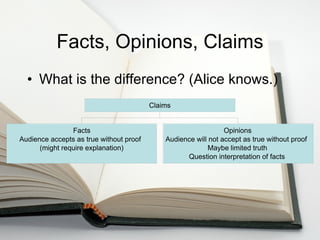
Facts, Opinions, Claims What is the difference? (Alice knows.)
Facts as claims: an example http://www.thedailyshow.com/watch/wed-march-17-2010/don-t-mess-with-textbooks  (@1:12)
Conflicting ideas What do you do if sources disagree? What did Shirley do? 10,000-45,000 What would Alice do? Rhetorical analysis
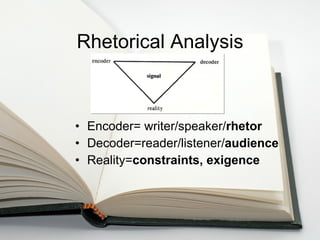
Rhetorical Analysis Encoder= writer/speaker/ rhetor Decoder=reader/listener/ audience Reality= constraints, exigence
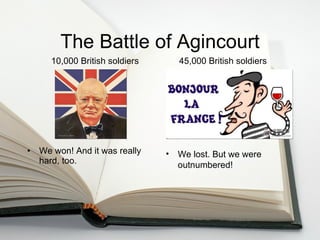
The Battle of Agincourt We won! And it was really hard, too. We lost. But we were outnumbered! 10,000 British soldiers 45,000 British soldiers
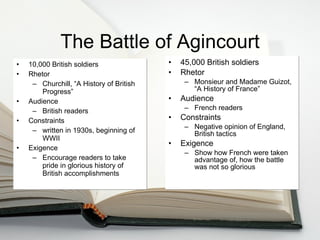
The Battle of Agincourt 10,000 British soldiers Rhetor Churchill, “A History of British Progress” Audience British readers Constraints written in 1930s, beginning of WWII Exigence Encourage readers to take pride in glorious history of British accomplishments  45,000 British soldiers Rhetor Monsieur and Madame Guizot, “A History of France” Audience French readers Constraints Negative opinion of England, British tactics Exigence Show how French were taken advantage of, how the battle was not so glorious
What would Alice/Shirley do? 5 teams First to buzz in and answer correctly gets a point Group with the most points gets a bonus point
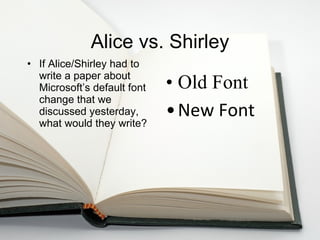
Alice vs. Shirley If Alice/Shirley had to write a paper about Microsoft’s default font change that we discussed yesterday, what would they write? Old Font New Font
Alice vs. Shirley Definition of a fact Shirley: thinks sources transmit facts Alice: facts are claims
Alice vs. Shirley How do they read sources? Shirley: narrative/story Alice: a  “ message sent by someone to somebody for a reason ”
Alice vs. Shirley Why do they write? Shirley: to find the truth Alice: to make an argument
Alice vs. Shirley View of themselves as writers; what is their goal? Shirley: to be credible Alice: to persuade, say something new
Alice vs. Shirley View of their task (task representation) Shirley: summary Alice: original argument
Alice vs. Shirley How do they organize their writing? Shirley: in the order she found it, order the source writer puts it in Alice:  in the order that fits her purpose to convince her audience
Alice vs. Shirley Who is more likely to plagiarize? Why? Shirley
Alice vs. Shirley Who writes more drafts? Why? Alice; summary, rhetorical analysis, argument
Alice vs. Shirley View of research Shirley:  Research is not creative, but a static task designed to examine students on their understanding of facts Alice:  Research is creative, and students are scholars “w h o work to find answers to problem questions” and who  “se t reading and writing goals for themselves that will allow them to think constructively.”
Alice vs. Shirley What “tool” does Alice have in her toolbox that Shirley does not? Rhetorical situation
More questions It seems like everything worth saying has already been said—how do you create an original argument? How can research be creative? Do you think that this would make research more enjoyable? How is it possible for sources to disagree in ways other than pro/con? Why does Kantz think that plagiarism can be understandable, or even inevitable? Why does Kantz suggest that multiple drafts are useful?
What did the instructor do wrong, and how could she fix it? Minimal notes on draft, and those notes had to do with formalist issues Didn’t sequence the assignment, pacing it with enough time to allow students’ thoughts to develop  Didn’t teach rhetorical reading and writing strategies  Gave  “ weak assignment and an ineffective critique of the draft”  Didn’t tell Shirley she was expected to say something original, that she should look for discrepant facts/conflicts in her sources, or that she should use her notes to comment on the sources and use the notes to plan her paper Didn’t teach Shirley to look for arguments instead of facts
Practice using textual sources persuasively: Charlie Sheen, wasted, or misunderstood? “ What does this say about Haim Levine [Chuck Lorre] after he tried to use his words to judge and attempt to degrade me. I gracefully ignored this folly for 177 shows ... I fire back once and this contaminated little maggot can't handle my power and can't handle the truth. I wish him nothing but pain in his silly travels especially if they wind up in my octagon. Clearly I have defeated this earthworm with my words -- imagine what I would have done with my fire breathing fists. I urge all my beautiful and loyal fans who embraced this show for almost a decade to walk with me side-by-side as we march up the steps of justice to right this unconscionable wrong.” Write for each of the following citation strategies. Quoting directly Short phrase lead-in using a comma (,) Complete sentence lead-in using a colon (:) Inserting select words into your own sentence using no additional punctuation Paraphrasing Stance 1 : You think Charlie is on drugs (and this proves it). Stance 2 : You think Charlie is being unfairly treated by Lorre.
An experiment: how do you read? Read an excerpt from an article out of context At frequent intervals, answer the question: how do you interpret the text now?
Like the modern world, modern scientific psychology is extremely technical and complex. The application of any particular set of psychological principles to any particular real problem requires a double specialist: a specialist in the scientific area, and a specialist in the real area.
Not many such double specialists exist. The relationship of a child’s current behavior to his early home life, for example, is not a simple problem--Sunday Supplement psychology notwithstanding.
Many variables must be understood and integrated: special (“critical”) periods of brain sensitivity, nutrition, genetic factors, the development of attention and perception, language, time factors (for example, the amount of time that elapses between a baby’s action and a mother’s smile), and so one. Mastery of these principles is a full time professional occupation.
The professional application of these principles--in, say, a day-care center--is also a full-time occupation, and one that is foreign to many laboratory psychologists. Indeed, a laboratory psychologist may not even recognize his pet principles when they are realized in a day care setting.
What is needed is a coming together of real-world and laboratory specialists that will require both better communication and more complete experience. The laboratory specialists must spend some time in a real setting; the real-world specialists must spend some time in a theoretical laboratory.

Kantz

  • 1.
    “ Helping StudentsUse Textual Sources Persuasively” Margaret Kantz
  • 2.
    Are you anAlice or a Shirley? Describe an experience you’ve had writing a research paper. Were you an Alice or a Shirley?
  • 3.
    Analyzing Kantz Audience?How is she entering the “conversation”? Purpose (exigence)?
  • 4.
    Facts, Opinions, ClaimsWhat is the difference? (Alice knows.)
  • 5.
    Facts as claims:an example http://www.thedailyshow.com/watch/wed-march-17-2010/don-t-mess-with-textbooks (@1:12)
  • 6.
    Conflicting ideas Whatdo you do if sources disagree? What did Shirley do? 10,000-45,000 What would Alice do? Rhetorical analysis
  • 7.
    Rhetorical Analysis Encoder=writer/speaker/ rhetor Decoder=reader/listener/ audience Reality= constraints, exigence
  • 8.
    The Battle ofAgincourt We won! And it was really hard, too. We lost. But we were outnumbered! 10,000 British soldiers 45,000 British soldiers
  • 9.
    The Battle ofAgincourt 10,000 British soldiers Rhetor Churchill, “A History of British Progress” Audience British readers Constraints written in 1930s, beginning of WWII Exigence Encourage readers to take pride in glorious history of British accomplishments 45,000 British soldiers Rhetor Monsieur and Madame Guizot, “A History of France” Audience French readers Constraints Negative opinion of England, British tactics Exigence Show how French were taken advantage of, how the battle was not so glorious
  • 10.
    What would Alice/Shirleydo? 5 teams First to buzz in and answer correctly gets a point Group with the most points gets a bonus point
  • 11.
    Alice vs. ShirleyIf Alice/Shirley had to write a paper about Microsoft’s default font change that we discussed yesterday, what would they write? Old Font New Font
  • 12.
    Alice vs. ShirleyDefinition of a fact Shirley: thinks sources transmit facts Alice: facts are claims
  • 13.
    Alice vs. ShirleyHow do they read sources? Shirley: narrative/story Alice: a “ message sent by someone to somebody for a reason ”
  • 14.
    Alice vs. ShirleyWhy do they write? Shirley: to find the truth Alice: to make an argument
  • 15.
    Alice vs. ShirleyView of themselves as writers; what is their goal? Shirley: to be credible Alice: to persuade, say something new
  • 16.
    Alice vs. ShirleyView of their task (task representation) Shirley: summary Alice: original argument
  • 17.
    Alice vs. ShirleyHow do they organize their writing? Shirley: in the order she found it, order the source writer puts it in Alice: in the order that fits her purpose to convince her audience
  • 18.
    Alice vs. ShirleyWho is more likely to plagiarize? Why? Shirley
  • 19.
    Alice vs. ShirleyWho writes more drafts? Why? Alice; summary, rhetorical analysis, argument
  • 20.
    Alice vs. ShirleyView of research Shirley: Research is not creative, but a static task designed to examine students on their understanding of facts Alice: Research is creative, and students are scholars “w h o work to find answers to problem questions” and who “se t reading and writing goals for themselves that will allow them to think constructively.”
  • 21.
    Alice vs. ShirleyWhat “tool” does Alice have in her toolbox that Shirley does not? Rhetorical situation
  • 22.
    More questions Itseems like everything worth saying has already been said—how do you create an original argument? How can research be creative? Do you think that this would make research more enjoyable? How is it possible for sources to disagree in ways other than pro/con? Why does Kantz think that plagiarism can be understandable, or even inevitable? Why does Kantz suggest that multiple drafts are useful?
  • 23.
    What did theinstructor do wrong, and how could she fix it? Minimal notes on draft, and those notes had to do with formalist issues Didn’t sequence the assignment, pacing it with enough time to allow students’ thoughts to develop Didn’t teach rhetorical reading and writing strategies Gave “ weak assignment and an ineffective critique of the draft” Didn’t tell Shirley she was expected to say something original, that she should look for discrepant facts/conflicts in her sources, or that she should use her notes to comment on the sources and use the notes to plan her paper Didn’t teach Shirley to look for arguments instead of facts
  • 24.
    Practice using textualsources persuasively: Charlie Sheen, wasted, or misunderstood? “ What does this say about Haim Levine [Chuck Lorre] after he tried to use his words to judge and attempt to degrade me. I gracefully ignored this folly for 177 shows ... I fire back once and this contaminated little maggot can't handle my power and can't handle the truth. I wish him nothing but pain in his silly travels especially if they wind up in my octagon. Clearly I have defeated this earthworm with my words -- imagine what I would have done with my fire breathing fists. I urge all my beautiful and loyal fans who embraced this show for almost a decade to walk with me side-by-side as we march up the steps of justice to right this unconscionable wrong.” Write for each of the following citation strategies. Quoting directly Short phrase lead-in using a comma (,) Complete sentence lead-in using a colon (:) Inserting select words into your own sentence using no additional punctuation Paraphrasing Stance 1 : You think Charlie is on drugs (and this proves it). Stance 2 : You think Charlie is being unfairly treated by Lorre.
  • 25.
    An experiment: howdo you read? Read an excerpt from an article out of context At frequent intervals, answer the question: how do you interpret the text now?
  • 26.
    Like the modernworld, modern scientific psychology is extremely technical and complex. The application of any particular set of psychological principles to any particular real problem requires a double specialist: a specialist in the scientific area, and a specialist in the real area.
  • 27.
    Not many suchdouble specialists exist. The relationship of a child’s current behavior to his early home life, for example, is not a simple problem--Sunday Supplement psychology notwithstanding.
  • 28.
    Many variables mustbe understood and integrated: special (“critical”) periods of brain sensitivity, nutrition, genetic factors, the development of attention and perception, language, time factors (for example, the amount of time that elapses between a baby’s action and a mother’s smile), and so one. Mastery of these principles is a full time professional occupation.
  • 29.
    The professional applicationof these principles--in, say, a day-care center--is also a full-time occupation, and one that is foreign to many laboratory psychologists. Indeed, a laboratory psychologist may not even recognize his pet principles when they are realized in a day care setting.
  • 30.
    What is neededis a coming together of real-world and laboratory specialists that will require both better communication and more complete experience. The laboratory specialists must spend some time in a real setting; the real-world specialists must spend some time in a theoretical laboratory.