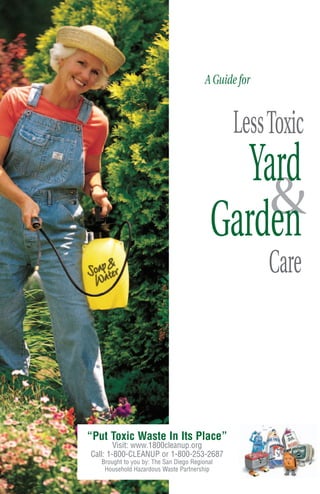
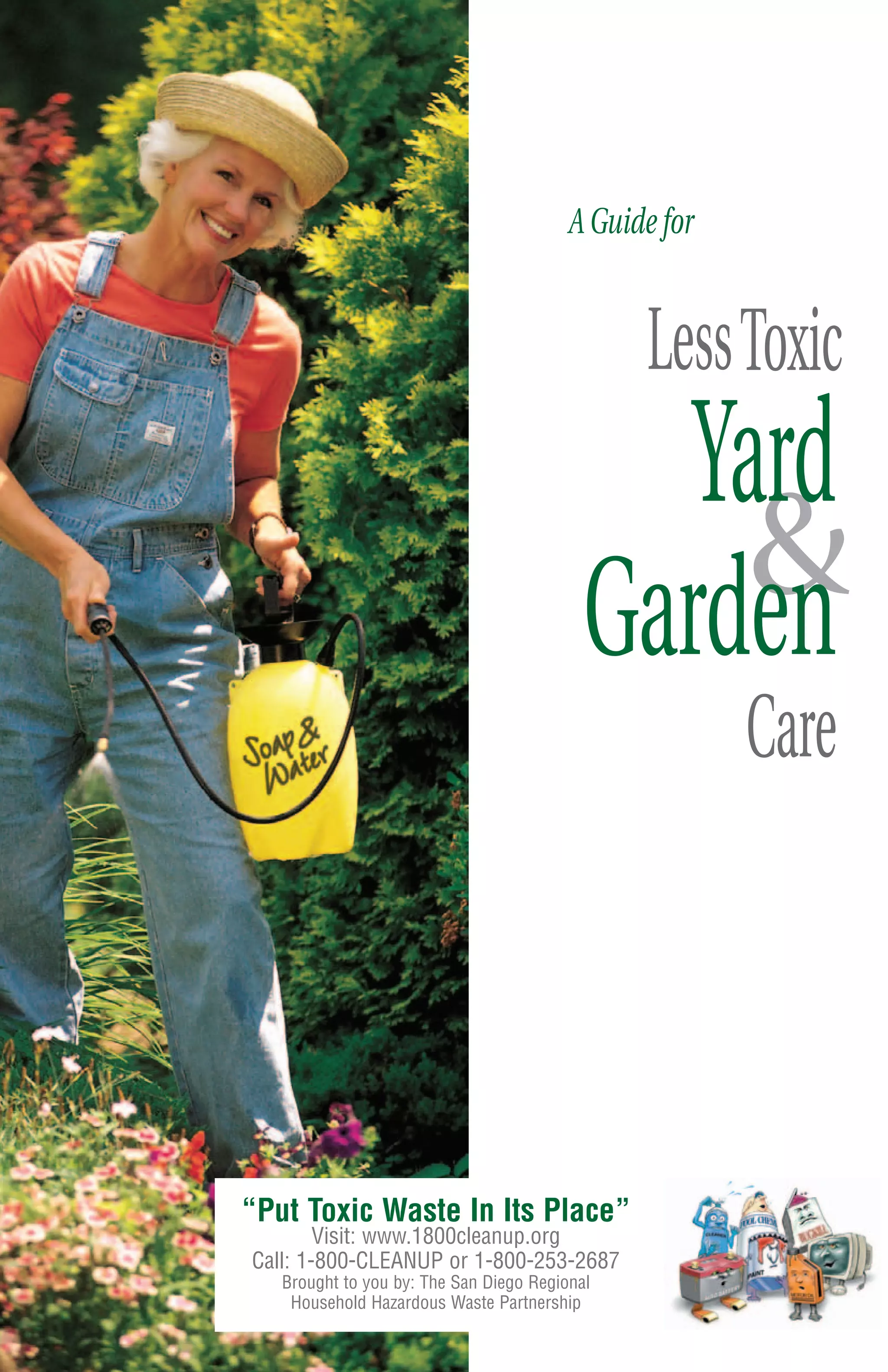
A Guide for


“Put Toxic Waste In Its Place”
        Visit: www.1800cleanup.org
Call: 1-800-CLEANUP or 1-800-253-2687
   Brought to you by: The San Diego Regional
    Household Hazardous Waste Partnership
Did You Know…


     “     On average, homeowners use
                 10 times more pesticides
                           than farmers do;
              spend (nationwide) nearly
              25 billion dollars annually
             on lawn care products; and
         use roughly 67 million pounds
                     of synthetic pesticides
                           on U.S. lawns.
                                             ”
                   That is a lot nationwide. But
                   there are alternatives to
                   chemicals that can help reduce
                   the amount of pesticides we
                   use. Many times, these
                   products are not used correctly.
                   These products can harm trash
                   collection personnel,
contribute to fire hazards, enter storm drains
and pollute creeks, rivers, lakes and beaches
that include some of our most cherished
recreational locations. These water sources are
also critical to local water supplies and wildlife
habitat.

To help protect and preserve our natural
resources, 17 cities and the County of San Diego
have come together to form the San Diego
Regional Household Hazardous Waste
Partnership. We have developed this guide,
which contains a wide variety of information
including building healthy soil, gardening with
companion plants, grass cycling, identifying
beneficial bugs, plus many more tips. Most
importantly, this booklet provides residents
with information about how to properly
dispose of household hazardous waste.

Residents can bring their household hazardous
waste, free of charge or for a small co-payment
to a nearby collection facility. There are a
variety of programs offered throughout the
region. Visit www.1800CLEANUP      .org or
call 1-800-CLEANUP (1-800- 253-2687)
for information about your community’s
household hazardous waste collection program.

The San Diego Regional Household Hazardous
Waste Partnership is striving to create a cleaner
and safer environment. So … read our Guide
for Less Toxic Yard and Garden Care and
remember to always …


                Put Toxic Waste
                    In Its Place!
How to Create a
   Fabulous Landscape
       that’s Safe for You,
              Your Family
and the Neighborhood!
San Diego County’s climate and geology pose
considerable challenges to lawn and garden
care. Homeowners and landscape professionals
alike confront the same set of hurdles… rainfall
in coastal areas averaging less than ten inches
per year and soil conditions ranging from sand
to clay to rock. Lacking the sponge-like ability
of good soil to hold nutrients and amendments,
clay performs much like pavement, allowing
applied pesticides and fertilizers to run-off
easily. Sand, on the other hand, lets these
additives flow through. The result is our lakes,
streams and ocean end up with chemicals
intended for our gardens and lawns.
Without healthy soil, plants may gain little or
no benefit from fertilizers. And commercial
pesticides often kill more beneficial organisms
than pests, compromising the health of our
neighborhoods in the process. Here’s what
happens… you apply pesticides and fertilizers
to your landscape because the plants you’re
growing are doing poorly. Unaccustomed to this
climate and poor soil, they are weak and
susceptible to a variety of diseases. You water
the plants and the chemicals you apply wash
away with it into storm drains. The pesticide
and fertilizer laden water weaves its way
through channels and may end up in rivers,
lakes and the sea, wreaking havoc on both
aquatic and terrestrial life.

Some people believe all those nasty things that
go down the storm drain are filtered out by
some treatment plant. Unfortunately, in most
communities they’re not. The same chemicals
you apply to your lawn may very well end up in
the water you or your children swim in, miles
from your home.

A few of the simple methods described below can
not only help eliminate unnecessary toxins from
our local environment and yield a more beautiful
landscape, healthier plants, reduced water bills,
and even some protection from wildfires as well.
A less toxic approach to yard and garden care is
well worth the effort. This brochure contains
many possibilities for you to try.


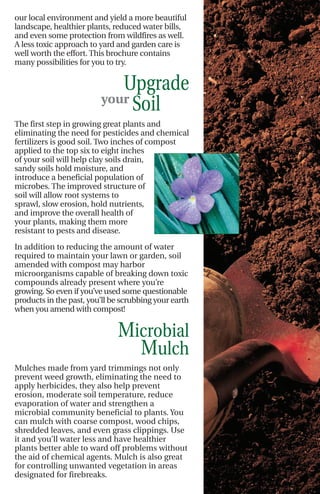
                            Upgrade
                         your
                              Soil
The first step in growing great plants and
eliminating the need for pesticides and chemical
fertilizers is good soil. Two inches of compost
applied to the top six to eight inches
of your soil will help clay soils drain,
sandy soils hold moisture, and
introduce a beneficial population of
microbes. The improved structure of
soil will allow root systems to
sprawl, slow erosion, hold nutrients,
and improve the overall health of
your plants, making them more
resistant to pests and disease.

In addition to reducing the amount of water
required to maintain your lawn or garden, soil
amended with compost may harbor
microorganisms capable of breaking down toxic
compounds already present where you’re
growing. So even if you’ve used some questionable
products in the past, you’ll be scrubbing your earth
when you amend with compost!


                              Microbial
                                Mulch
Mulches made from yard trimmings not only
prevent weed growth, eliminating the need to
apply herbicides, they also help prevent
erosion, moderate soil temperature, reduce
evaporation of water and strengthen a
microbial community beneficial to plants. You
can mulch with coarse compost, wood chips,
shredded leaves, and even grass clippings. Use
it and you’ll water less and have healthier
plants better able to ward off problems without
the aid of chemical agents. Mulch is also great
for controlling unwanted vegetation in areas
designated for firebreaks.
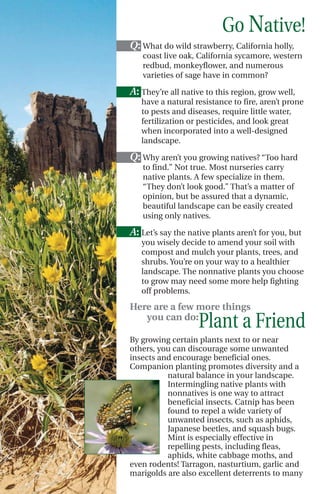
Go Native!
Q: What do wild strawberry, California holly,
   coast live oak, California sycamore, western
   redbud, monkeyflower, and numerous
   varieties of sage have in common?

A: They’re all native to this region, grow well,
   have a natural resistance to fire, aren’t prone
   to pests and diseases, require little water,
   fertilization or pesticides, and look great
   when incorporated into a well-designed
   landscape.

Q: Why aren’t you growing natives? “Too hard
   to find.” Not true. Most nurseries carry
   native plants. A few specialize in them.
   “They don’t look good.” That’s a matter of
   opinion, but be assured that a dynamic,
   beautiful landscape can be easily created
   using only natives.

A: Let’s say the native plants aren’t for you, but
   you wisely decide to amend your soil with
   compost and mulch your plants, trees, and
   shrubs. You’re on your way to a healthier
   landscape. The nonnative plants you choose
   to grow may need some more help fighting
   off problems.

Here are a few more things
   you can do:
                    Plant a Friend
By growing certain plants next to or near
others, you can discourage some unwanted
insects and encourage beneficial ones.
Companion planting promotes diversity and a
          natural balance in your landscape.
          Intermingling native plants with
          nonnatives is one way to attract
          beneficial insects. Catnip has been
          found to repel a wide variety of
          unwanted insects, such as aphids,
          Japanese beetles, and squash bugs.
          Mint is especially effective in
          repelling pests, including fleas,
          aphids, white cabbage moths, and
even rodents! Tarragon, nasturtium, garlic and
marigolds are also excellent deterrents to many
problem insects. Beneficial insects can
be attracted by planting a variety of
items, such as: California poppy
Native sages, Yarrow California
coffeeberry Clover and many others.

Some plants both attract and are
toxic to the same pests. For example,
white geraniums attract Japanese
beetles, which die after feeding on
them. We encourage you to do a little
research before you plant, and
experiment a bit as you go, as choosing the
right companions may not only help keep
unwanted pests away, but also enhance the
growth of the crops you establish.


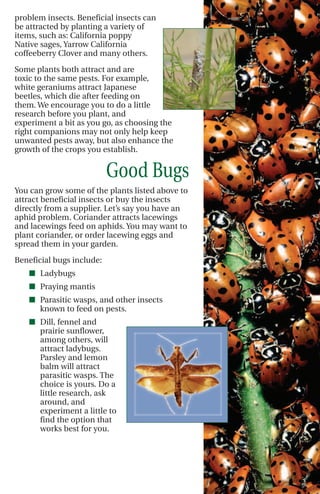
                           Good Bugs
You can grow some of the plants listed above to
attract beneficial insects or buy the insects
directly from a supplier. Let’s say you have an
aphid problem. Coriander attracts lacewings
and lacewings feed on aphids. You may want to
plant coriander, or order lacewing eggs and
spread them in your garden.

Beneficial bugs include:
    I Ladybugs
    I Praying mantis
    I Parasitic wasps, and other insects
      known to feed on pests.
    I Dill, fennel and
      prairie sunflower,
      among others, will
      attract ladybugs.
      Parsley and lemon
      balm will attract
      parasitic wasps. The
      choice is yours. Do a
      little research, ask
      around, and
      experiment a little to
      find the option that
      works best for you.
The Grass is Greener…
                    When you do
                    grasscycling!
Every time you mow your lawn and discard the
clippings, you’re removing a substantial volume
of organic matter, nitrogen and other nutrients
your grass could be benefiting from.

How does it work? Cut the grass and leave the
clippings on the lawn. The key is to chop the
clippings as finely as possible, something that
can be easily achieved using a very sharp blade,
mowing over the clippings twice, or using a
mulching mower. A good rule of thumb for
grasscycling is to cut your grass no more
than1/3 of its length. This allows clippings to
fall between the blades of grass and back into
the soil, reducing watering requirements,
pesticide use, and saving you money too! And
by the way, grass clippings make excellent
mulch for flowers and vegetables!
Create a
                          Solution!
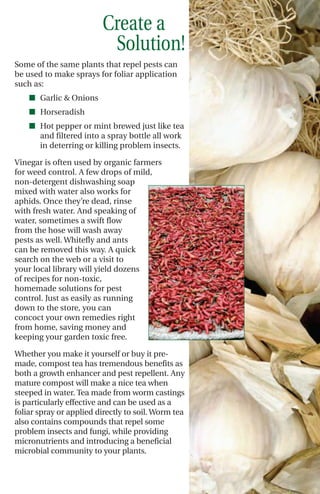
Some of the same plants that repel pests can
be used to make sprays for foliar application
such as:
    I Garlic & Onions
    I Horseradish
    I Hot pepper or mint brewed just like tea
      and filtered into a spray bottle all work
      in deterring or killing problem insects.

Vinegar is often used by organic farmers
for weed control. A few drops of mild,
non-detergent dishwashing soap
mixed with water also works for
aphids. Once they’re dead, rinse
with fresh water. And speaking of
water, sometimes a swift flow
from the hose will wash away
pests as well. Whitefly and ants
can be removed this way. A quick
search on the web or a visit to
your local library will yield dozens
of recipes for non-toxic,
homemade solutions for pest
control. Just as easily as running
down to the store, you can
concoct your own remedies right
from home, saving money and
keeping your garden toxic free.

Whether you make it yourself or buy it pre-
made, compost tea has tremendous benefits as
both a growth enhancer and pest repellent. Any
mature compost will make a nice tea when
steeped in water. Tea made from worm castings
is particularly effective and can be used as a
foliar spray or applied directly to soil. Worm tea
also contains compounds that repel some
problem insects and fungi, while providing
micronutrients and introducing a beneficial
microbial community to your plants.
Safe
                                  on the
                                        Shelf
Although it can sometimes take a little research
to find them, there are some safer, more
environmentally friendly products you can buy.
Look for pesticides made from essential oils,
mint, citrus, or some of the same plants you
now know repel pests. Insecticidal soaps are
also available and much easier on the
environment than some of the toxic
alternatives.


                       Get Friendly
When plants we call weeds and insects we call
pests invade our landscapes, we often panic
and scour the shed, garage or local store for
products designed to eliminate them. A slight
adjustment in perception can go a long way. We
spend hours gardening, carefully pruning,
watering, and maintaining our plants. We
decide what fits, what doesn’t belong, and how
to adjust things so they’re just right. But
diversity is a fundamental component of
nature, and our plants and animals have a
unique way of blending together nicely without
our help. A plant becomes a weed only when
we choose to call it a weed.

Change the way you look at your landscape. Let
it flourish, diversify, and grow a bit wild. If you
want to remove unwanted plants, handpick
them. Avoid the chemical sprays. Accept the
random design of nature, and you’ll find it
beautifying your landscape better than
imagined. Try some of the methods we’ve
suggested here to create a magnificent
landscape that you can enjoy knowing it’s safe
for your family, pets and environment.

Create a toxic-free home landscape, and delight
in the rewards that blossom.
For Local Disposal
                                       Options:
      Call 1800CLEANUP or visit
       www.1800CLEANUP.org


                    Additional
                                 Resources:
Solana Center for Environmental Innovation’s
MasterComposter
Program at . . . . . . . . . . . . . . . . . . . (760) 436-7986
                                    www.solanacenter.org

I Love A Clean San Diego
               (877) R-1-EARTH (877-713-2784)
                             www.ILACSD.org

Central Contra Costa Sanitary District
Our Water Our World
                  www.ourwaterourworld.org

County of Los Angeles
Smart Gardening Program
                    www.smartgardening.com

Master Gardeners of California
                    www.mastergardeners.org

National Pesticide Information Center (NPIC)
                               1-800-858-7378
                            www.npic.orst.edu
The San Diego Regional
Household Hazard Waste
Partnership thanks you.

Participating
 Municipalities
   Carlsbad                          Chula Vista

   Coronado                 County of San Diego

    Del Mar                           El Cajon

   Encinitas                         Escondido

 Imperial Beach                       La Mesa

 Lemon Grove                     National City

   Oceanside                           Poway

  San Marcos                           Santee

 Solana Beach                           Vista
                                                   Printed on 100% post-consumer recycled paper.


         Funded by a grant from:
         The California Integrated
         Waste Management Board.

A Guide for Less Toxic Yard and Garden - City of Chula Vista

  • 1.
    A Guide for “PutToxic Waste In Its Place” Visit: www.1800cleanup.org Call: 1-800-CLEANUP or 1-800-253-2687 Brought to you by: The San Diego Regional Household Hazardous Waste Partnership
  • 2.
    Did You Know… “ On average, homeowners use 10 times more pesticides than farmers do; spend (nationwide) nearly 25 billion dollars annually on lawn care products; and use roughly 67 million pounds of synthetic pesticides on U.S. lawns. ” That is a lot nationwide. But there are alternatives to chemicals that can help reduce the amount of pesticides we use. Many times, these products are not used correctly. These products can harm trash collection personnel, contribute to fire hazards, enter storm drains and pollute creeks, rivers, lakes and beaches that include some of our most cherished recreational locations. These water sources are also critical to local water supplies and wildlife habitat. To help protect and preserve our natural resources, 17 cities and the County of San Diego have come together to form the San Diego Regional Household Hazardous Waste Partnership. We have developed this guide,
  • 3.
    which contains awide variety of information including building healthy soil, gardening with companion plants, grass cycling, identifying beneficial bugs, plus many more tips. Most importantly, this booklet provides residents with information about how to properly dispose of household hazardous waste. Residents can bring their household hazardous waste, free of charge or for a small co-payment to a nearby collection facility. There are a variety of programs offered throughout the region. Visit www.1800CLEANUP .org or call 1-800-CLEANUP (1-800- 253-2687) for information about your community’s household hazardous waste collection program. The San Diego Regional Household Hazardous Waste Partnership is striving to create a cleaner and safer environment. So … read our Guide for Less Toxic Yard and Garden Care and remember to always … Put Toxic Waste In Its Place!
  • 4.
    How to Createa Fabulous Landscape that’s Safe for You, Your Family and the Neighborhood! San Diego County’s climate and geology pose considerable challenges to lawn and garden care. Homeowners and landscape professionals alike confront the same set of hurdles… rainfall in coastal areas averaging less than ten inches per year and soil conditions ranging from sand to clay to rock. Lacking the sponge-like ability of good soil to hold nutrients and amendments, clay performs much like pavement, allowing applied pesticides and fertilizers to run-off easily. Sand, on the other hand, lets these additives flow through. The result is our lakes, streams and ocean end up with chemicals intended for our gardens and lawns. Without healthy soil, plants may gain little or no benefit from fertilizers. And commercial pesticides often kill more beneficial organisms than pests, compromising the health of our neighborhoods in the process. Here’s what happens… you apply pesticides and fertilizers to your landscape because the plants you’re growing are doing poorly. Unaccustomed to this climate and poor soil, they are weak and susceptible to a variety of diseases. You water the plants and the chemicals you apply wash away with it into storm drains. The pesticide and fertilizer laden water weaves its way through channels and may end up in rivers, lakes and the sea, wreaking havoc on both aquatic and terrestrial life. Some people believe all those nasty things that go down the storm drain are filtered out by some treatment plant. Unfortunately, in most communities they’re not. The same chemicals you apply to your lawn may very well end up in the water you or your children swim in, miles from your home. A few of the simple methods described below can not only help eliminate unnecessary toxins from
  • 5.
    our local environmentand yield a more beautiful landscape, healthier plants, reduced water bills, and even some protection from wildfires as well. A less toxic approach to yard and garden care is well worth the effort. This brochure contains many possibilities for you to try. Upgrade your Soil The first step in growing great plants and eliminating the need for pesticides and chemical fertilizers is good soil. Two inches of compost applied to the top six to eight inches of your soil will help clay soils drain, sandy soils hold moisture, and introduce a beneficial population of microbes. The improved structure of soil will allow root systems to sprawl, slow erosion, hold nutrients, and improve the overall health of your plants, making them more resistant to pests and disease. In addition to reducing the amount of water required to maintain your lawn or garden, soil amended with compost may harbor microorganisms capable of breaking down toxic compounds already present where you’re growing. So even if you’ve used some questionable products in the past, you’ll be scrubbing your earth when you amend with compost! Microbial Mulch Mulches made from yard trimmings not only prevent weed growth, eliminating the need to apply herbicides, they also help prevent erosion, moderate soil temperature, reduce evaporation of water and strengthen a microbial community beneficial to plants. You can mulch with coarse compost, wood chips, shredded leaves, and even grass clippings. Use it and you’ll water less and have healthier plants better able to ward off problems without the aid of chemical agents. Mulch is also great for controlling unwanted vegetation in areas designated for firebreaks.
  • 6.
    Go Native! Q: Whatdo wild strawberry, California holly, coast live oak, California sycamore, western redbud, monkeyflower, and numerous varieties of sage have in common? A: They’re all native to this region, grow well, have a natural resistance to fire, aren’t prone to pests and diseases, require little water, fertilization or pesticides, and look great when incorporated into a well-designed landscape. Q: Why aren’t you growing natives? “Too hard to find.” Not true. Most nurseries carry native plants. A few specialize in them. “They don’t look good.” That’s a matter of opinion, but be assured that a dynamic, beautiful landscape can be easily created using only natives. A: Let’s say the native plants aren’t for you, but you wisely decide to amend your soil with compost and mulch your plants, trees, and shrubs. You’re on your way to a healthier landscape. The nonnative plants you choose to grow may need some more help fighting off problems. Here are a few more things you can do: Plant a Friend By growing certain plants next to or near others, you can discourage some unwanted insects and encourage beneficial ones. Companion planting promotes diversity and a natural balance in your landscape. Intermingling native plants with nonnatives is one way to attract beneficial insects. Catnip has been found to repel a wide variety of unwanted insects, such as aphids, Japanese beetles, and squash bugs. Mint is especially effective in repelling pests, including fleas, aphids, white cabbage moths, and even rodents! Tarragon, nasturtium, garlic and marigolds are also excellent deterrents to many
  • 7.
    problem insects. Beneficialinsects can be attracted by planting a variety of items, such as: California poppy Native sages, Yarrow California coffeeberry Clover and many others. Some plants both attract and are toxic to the same pests. For example, white geraniums attract Japanese beetles, which die after feeding on them. We encourage you to do a little research before you plant, and experiment a bit as you go, as choosing the right companions may not only help keep unwanted pests away, but also enhance the growth of the crops you establish. Good Bugs You can grow some of the plants listed above to attract beneficial insects or buy the insects directly from a supplier. Let’s say you have an aphid problem. Coriander attracts lacewings and lacewings feed on aphids. You may want to plant coriander, or order lacewing eggs and spread them in your garden. Beneficial bugs include: I Ladybugs I Praying mantis I Parasitic wasps, and other insects known to feed on pests. I Dill, fennel and prairie sunflower, among others, will attract ladybugs. Parsley and lemon balm will attract parasitic wasps. The choice is yours. Do a little research, ask around, and experiment a little to find the option that works best for you.
  • 8.
    The Grass isGreener… When you do grasscycling! Every time you mow your lawn and discard the clippings, you’re removing a substantial volume of organic matter, nitrogen and other nutrients your grass could be benefiting from. How does it work? Cut the grass and leave the clippings on the lawn. The key is to chop the clippings as finely as possible, something that can be easily achieved using a very sharp blade, mowing over the clippings twice, or using a mulching mower. A good rule of thumb for grasscycling is to cut your grass no more than1/3 of its length. This allows clippings to fall between the blades of grass and back into the soil, reducing watering requirements, pesticide use, and saving you money too! And by the way, grass clippings make excellent mulch for flowers and vegetables!
  • 9.
    Create a Solution! Some of the same plants that repel pests can be used to make sprays for foliar application such as: I Garlic & Onions I Horseradish I Hot pepper or mint brewed just like tea and filtered into a spray bottle all work in deterring or killing problem insects. Vinegar is often used by organic farmers for weed control. A few drops of mild, non-detergent dishwashing soap mixed with water also works for aphids. Once they’re dead, rinse with fresh water. And speaking of water, sometimes a swift flow from the hose will wash away pests as well. Whitefly and ants can be removed this way. A quick search on the web or a visit to your local library will yield dozens of recipes for non-toxic, homemade solutions for pest control. Just as easily as running down to the store, you can concoct your own remedies right from home, saving money and keeping your garden toxic free. Whether you make it yourself or buy it pre- made, compost tea has tremendous benefits as both a growth enhancer and pest repellent. Any mature compost will make a nice tea when steeped in water. Tea made from worm castings is particularly effective and can be used as a foliar spray or applied directly to soil. Worm tea also contains compounds that repel some problem insects and fungi, while providing micronutrients and introducing a beneficial microbial community to your plants.
  • 10.
    Safe on the Shelf Although it can sometimes take a little research to find them, there are some safer, more environmentally friendly products you can buy. Look for pesticides made from essential oils, mint, citrus, or some of the same plants you now know repel pests. Insecticidal soaps are also available and much easier on the environment than some of the toxic alternatives. Get Friendly When plants we call weeds and insects we call pests invade our landscapes, we often panic and scour the shed, garage or local store for products designed to eliminate them. A slight adjustment in perception can go a long way. We spend hours gardening, carefully pruning, watering, and maintaining our plants. We decide what fits, what doesn’t belong, and how to adjust things so they’re just right. But diversity is a fundamental component of nature, and our plants and animals have a unique way of blending together nicely without our help. A plant becomes a weed only when we choose to call it a weed. Change the way you look at your landscape. Let it flourish, diversify, and grow a bit wild. If you want to remove unwanted plants, handpick them. Avoid the chemical sprays. Accept the random design of nature, and you’ll find it beautifying your landscape better than imagined. Try some of the methods we’ve suggested here to create a magnificent landscape that you can enjoy knowing it’s safe for your family, pets and environment. Create a toxic-free home landscape, and delight in the rewards that blossom.
  • 11.
    For Local Disposal Options: Call 1800CLEANUP or visit www.1800CLEANUP.org Additional Resources: Solana Center for Environmental Innovation’s MasterComposter Program at . . . . . . . . . . . . . . . . . . . (760) 436-7986 www.solanacenter.org I Love A Clean San Diego (877) R-1-EARTH (877-713-2784) www.ILACSD.org Central Contra Costa Sanitary District Our Water Our World www.ourwaterourworld.org County of Los Angeles Smart Gardening Program www.smartgardening.com Master Gardeners of California www.mastergardeners.org National Pesticide Information Center (NPIC) 1-800-858-7378 www.npic.orst.edu
  • 12.
    The San DiegoRegional Household Hazard Waste Partnership thanks you. Participating Municipalities Carlsbad Chula Vista Coronado County of San Diego Del Mar El Cajon Encinitas Escondido Imperial Beach La Mesa Lemon Grove National City Oceanside Poway San Marcos Santee Solana Beach Vista Printed on 100% post-consumer recycled paper. Funded by a grant from: The California Integrated Waste Management Board.