Eco design in principle and practice (part 2 of 4)


                Introduction to
          Rainharvesting
          Greywater reuse
      Water-efficient gardening
           Dr Maggie Lawton, Fred
           Braxton and Eion Scott

            Sustainable Living Centre
               13 November 2010
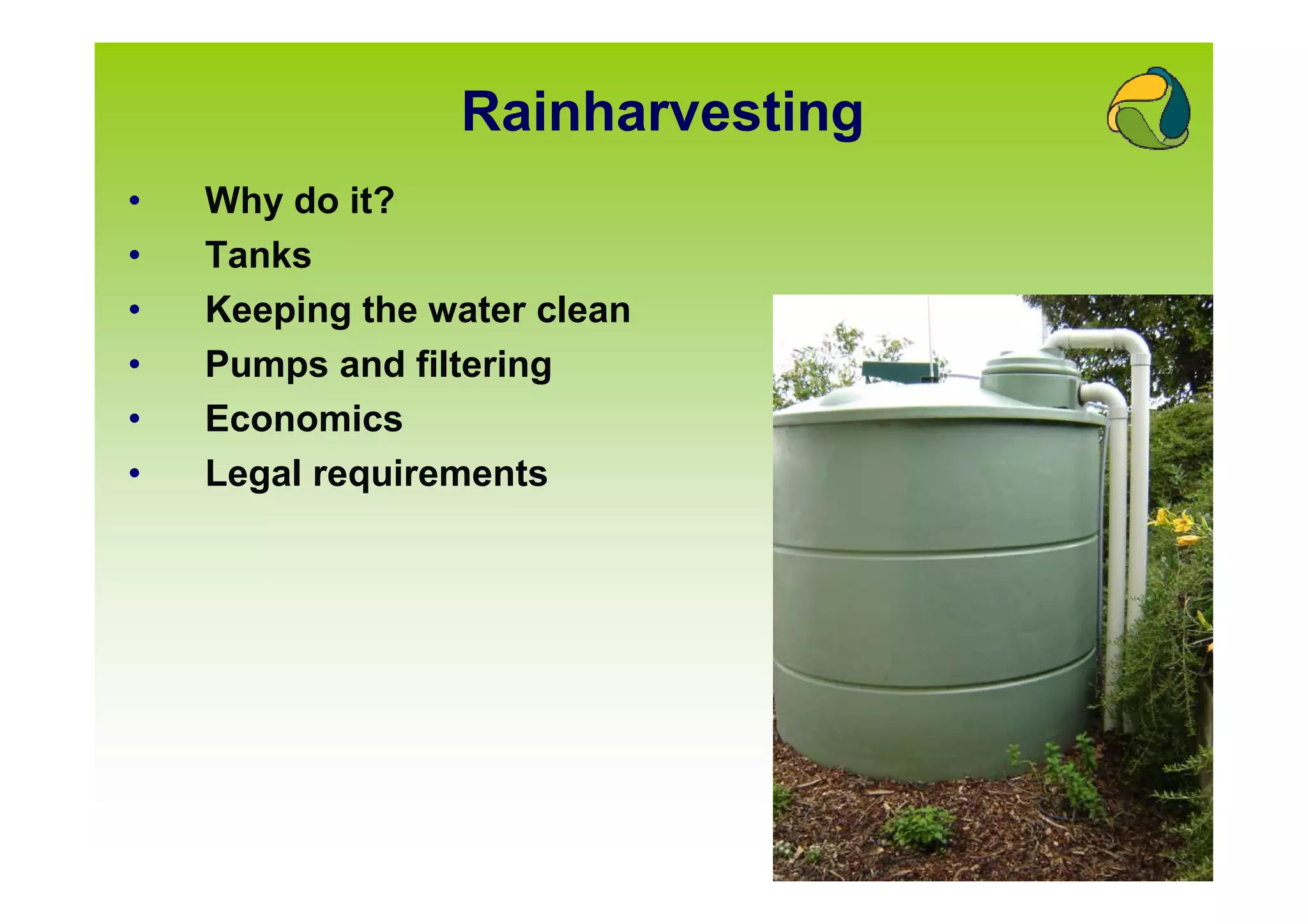
Rainharvesting
•   Why do it?
•   Tanks
•   Keeping the water clean
•   Pumps and filtering
•   Economics
•   Legal requirements
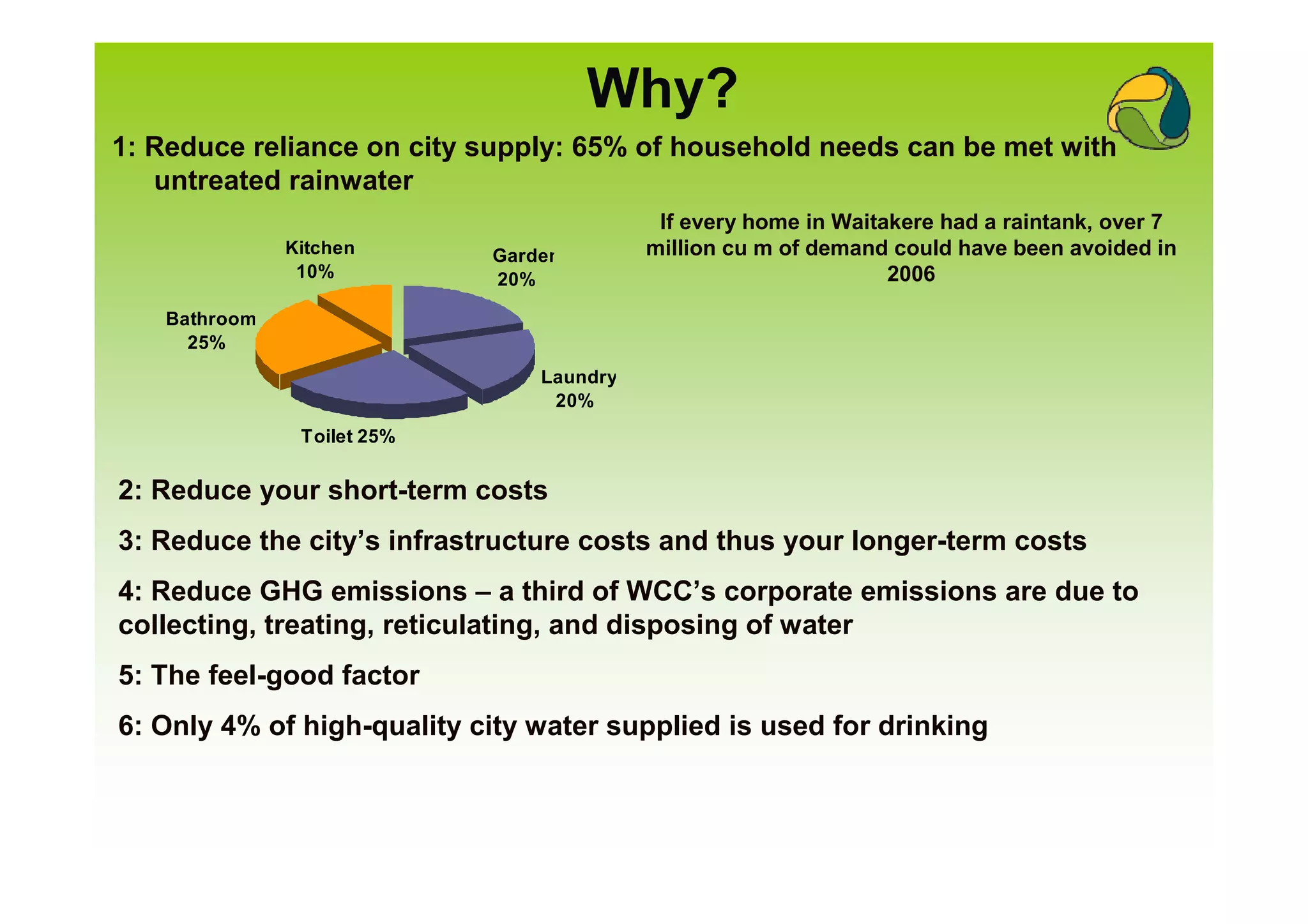
Why?
1: Reduce reliance on city supply: 65% of household needs can be met with
   untreated rainwater
                                           If every home in Waitakere had a raintank, over 7
              Kitchen       Garden        million cu m of demand could have been avoided in
               10%          20%                                  2006

   Bathroom
     25%
                                Laundry
                                 20%
               Toilet 25%


2: Reduce your short-term costs
3: Reduce the city’s infrastructure costs and thus your longer-term costs
4: Reduce GHG emissions – a third of WCC’s corporate emissions are due to
collecting, treating, reticulating, and disposing of water
5: The feel-good factor
6: Only 4% of high-quality city water supplied is used for drinking
What will the end-use be?

•   Different requirements for drinking-water and other
    uses
•   End-use will determine system design
•   For garden irrigation, a small tank will run out quickly
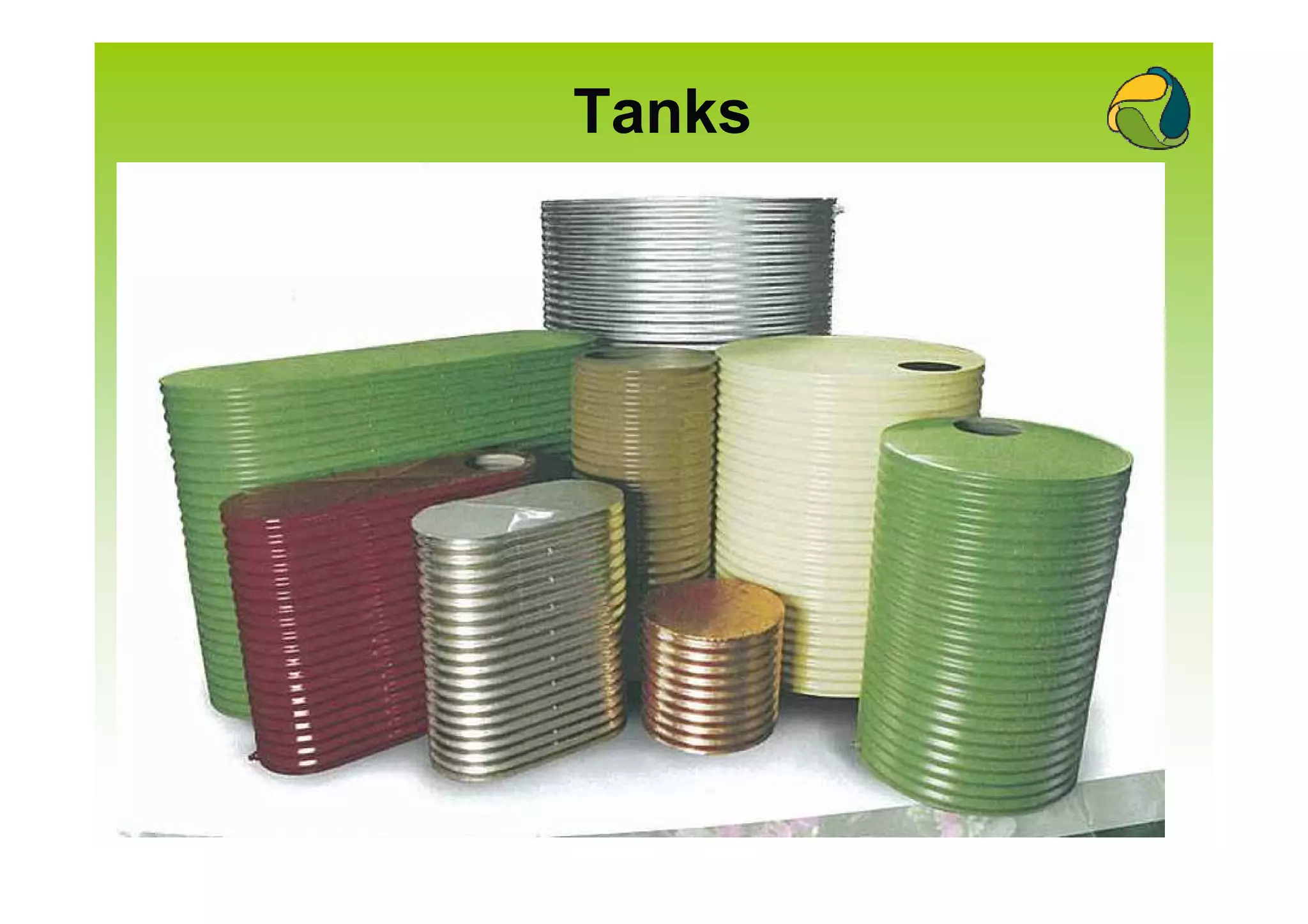
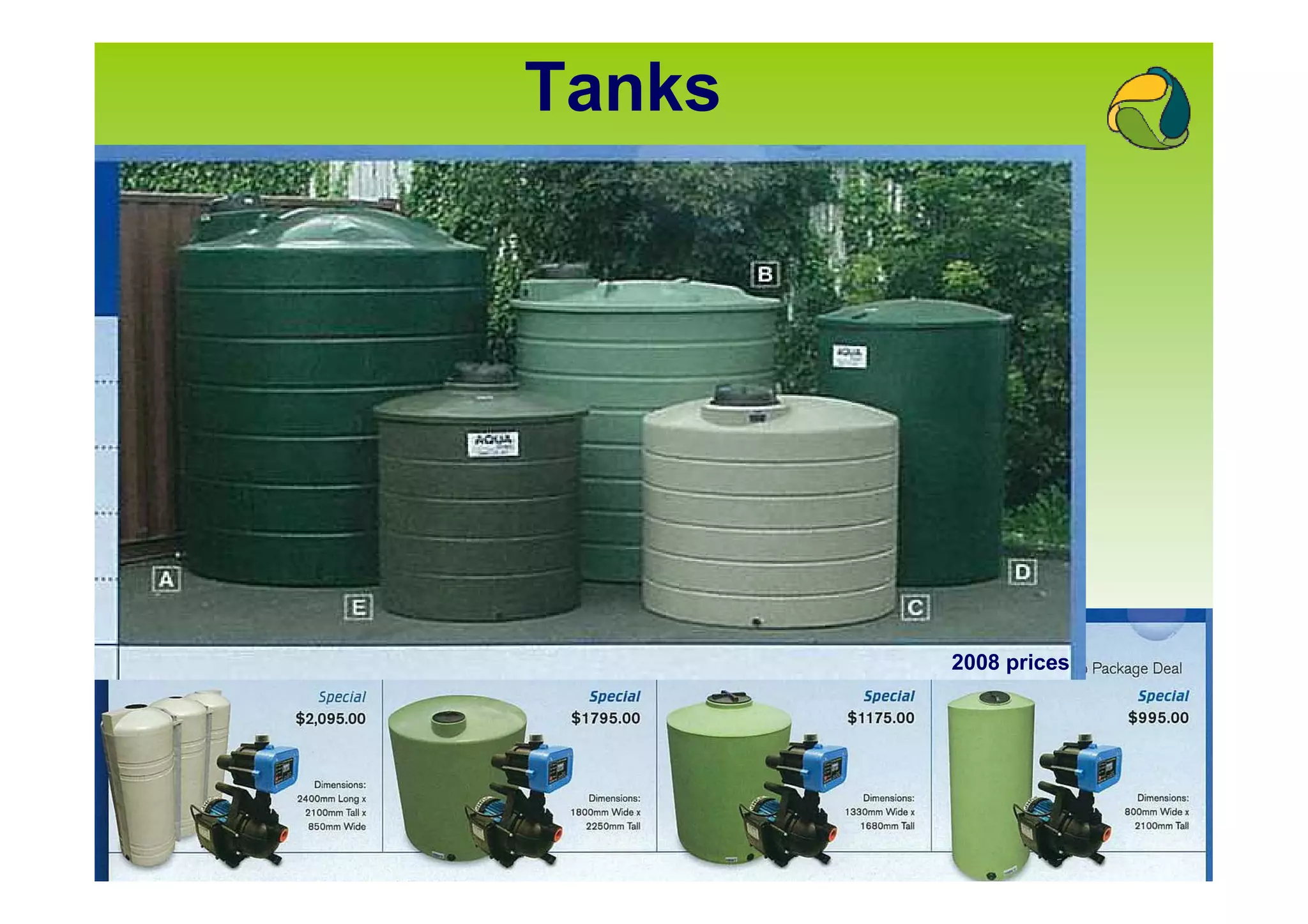
Tanks
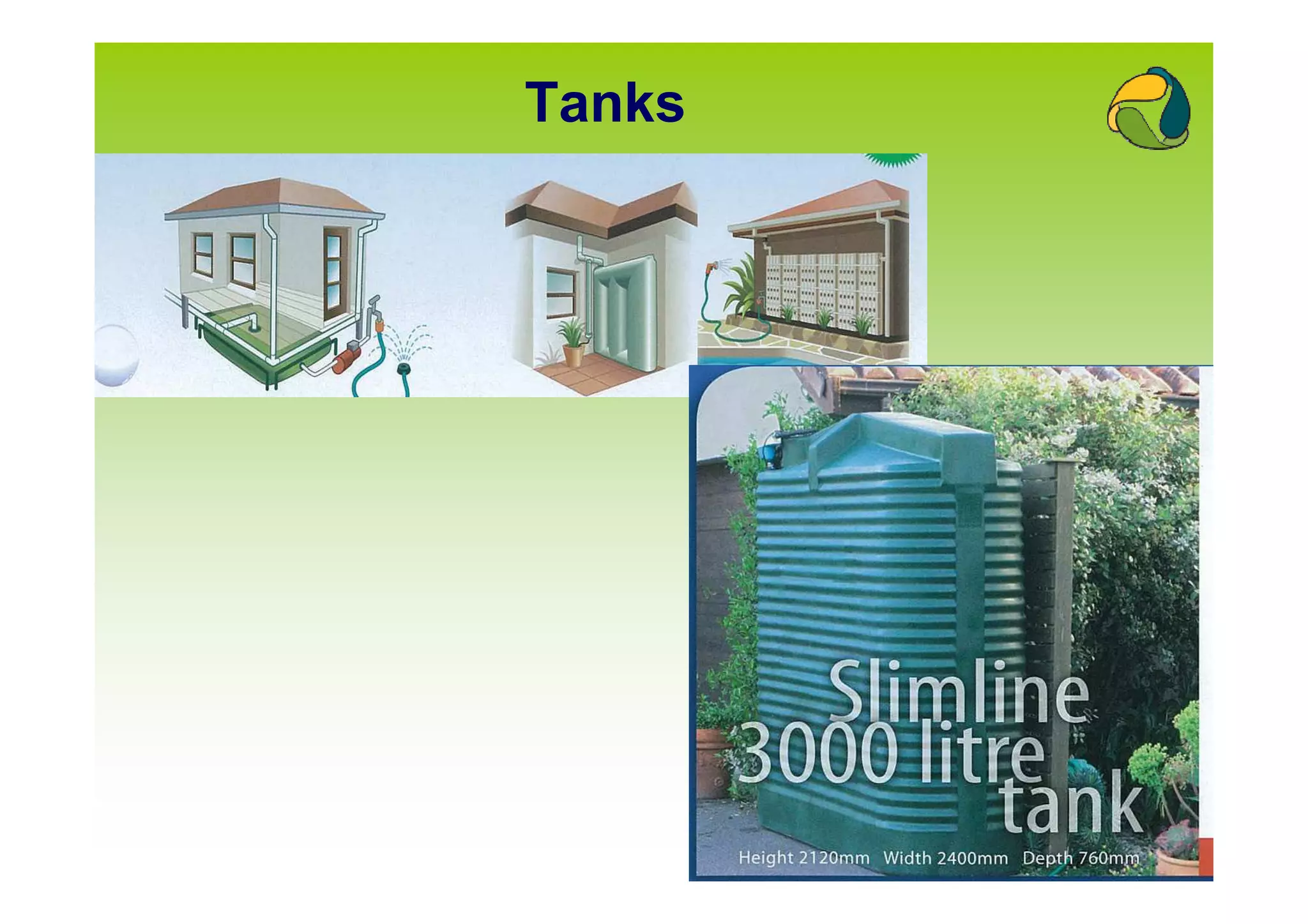
Tanks


        2008 prices
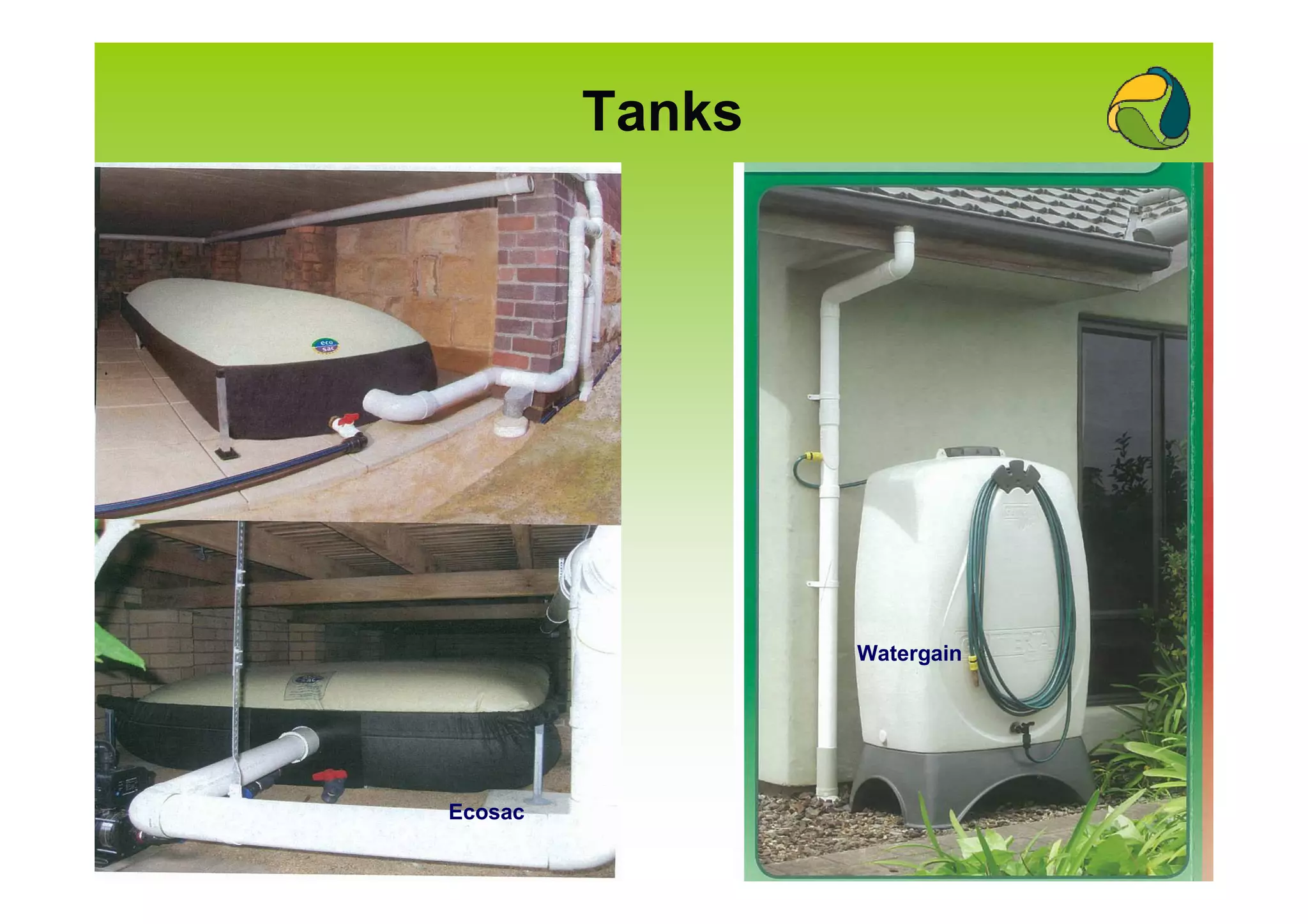
Tanks
Tanks


                 Watergain


Ecosac
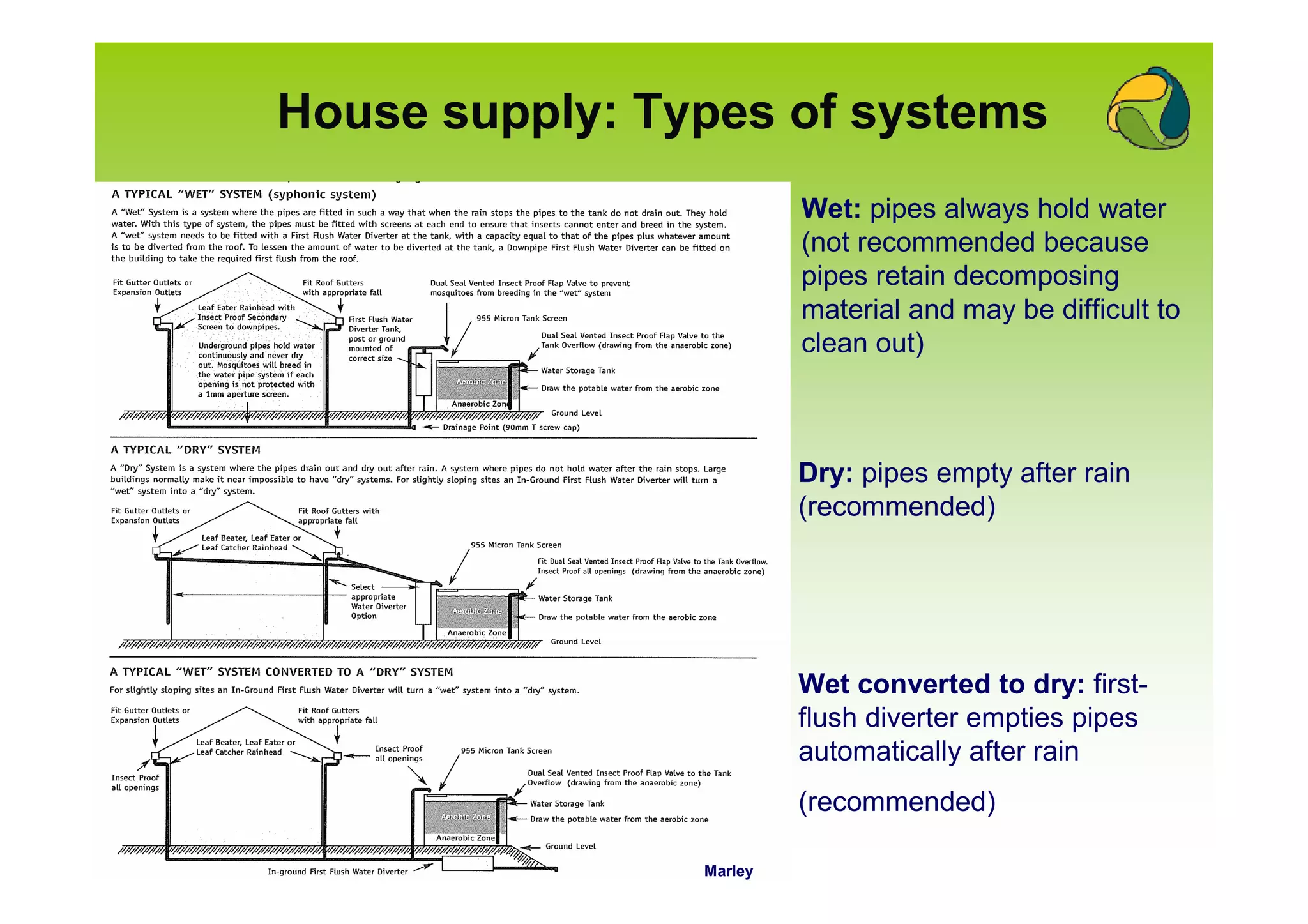
House supply: Types of systems
                         Wet: pipes always hold water
                         (not recommended because
                         pipes retain decomposing
                         material and may be difficult to
                         clean out)


                         Dry: pipes empty after rain
                         (recommended)


                         Wet converted to dry: first-
                         flush diverter empties pipes
                         automatically after rain
                         (recommended)

                Marley
House supply: Wet or dry?

•   Large houses often require wet systems
•   Decomposing material causes smell and taste
    problems with wet systems
•   The Wilson house, which you will visit, has a wet
    system
•   If possible, wet systems should be converted to dry
    systems
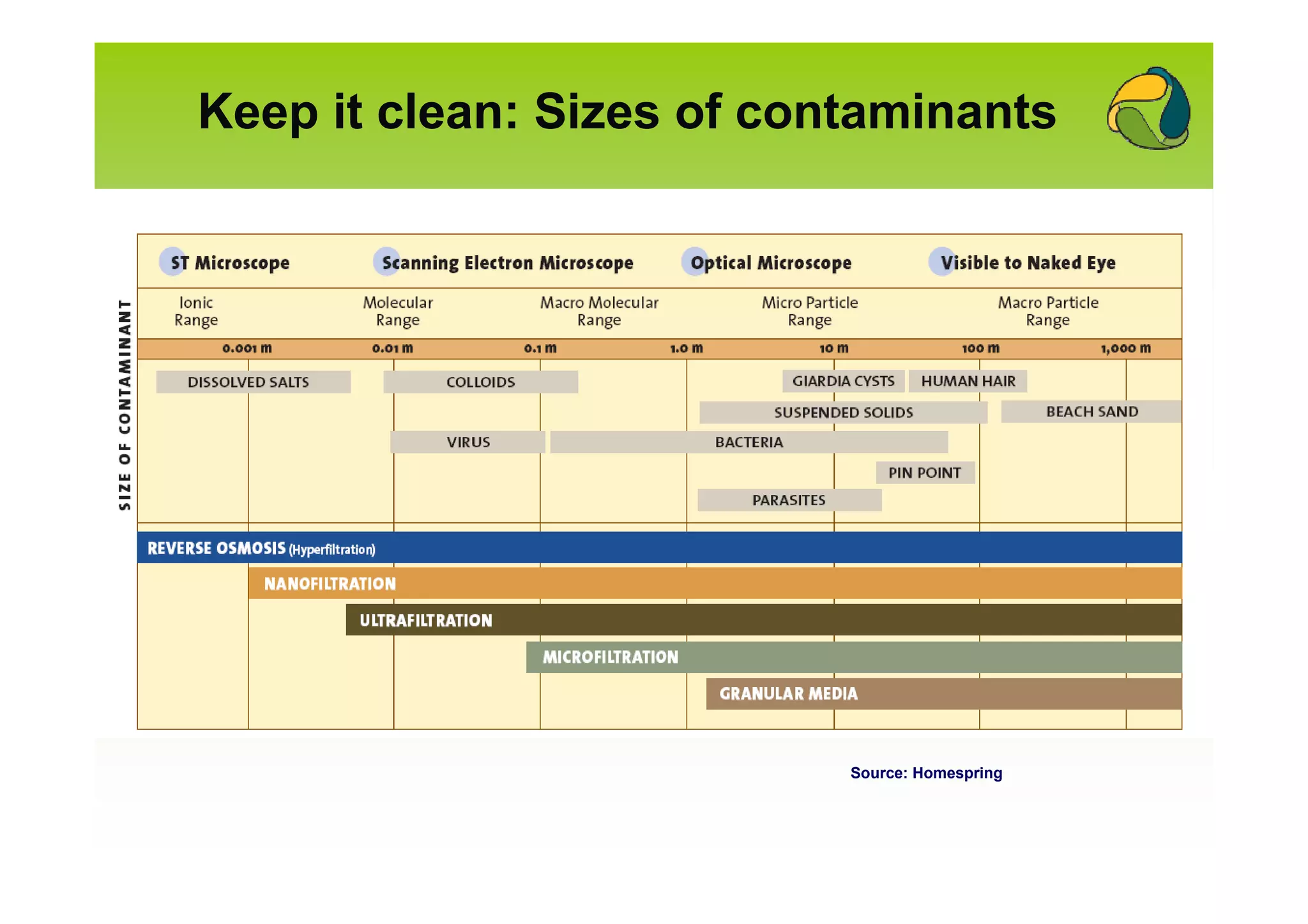
Keep it clean: Sizes of contaminants


                           Source: Homespring
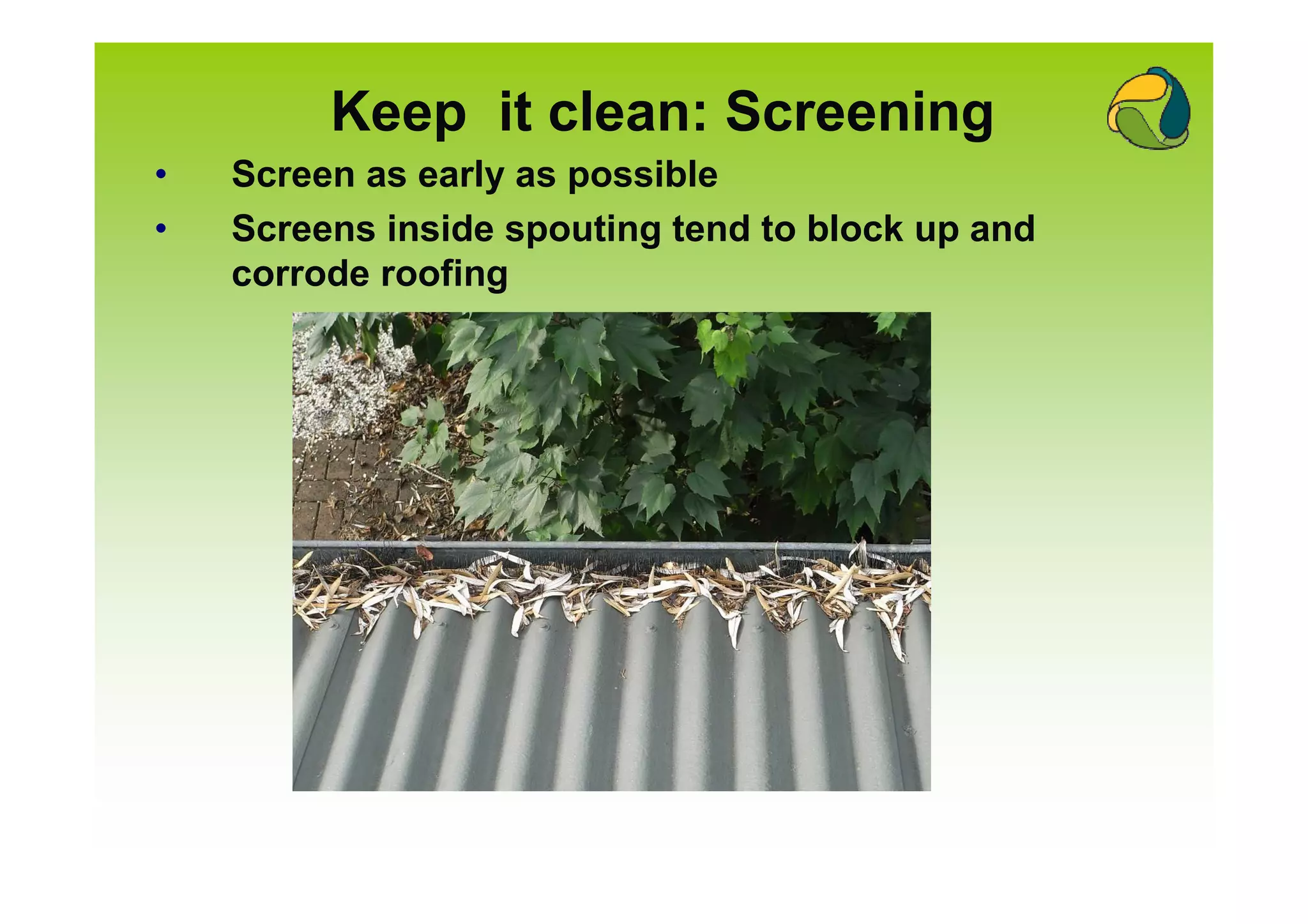
Keep it clean: Screening
•   Screen as early as possible
•   Screens inside spouting tend to block up and
    corrode roofing
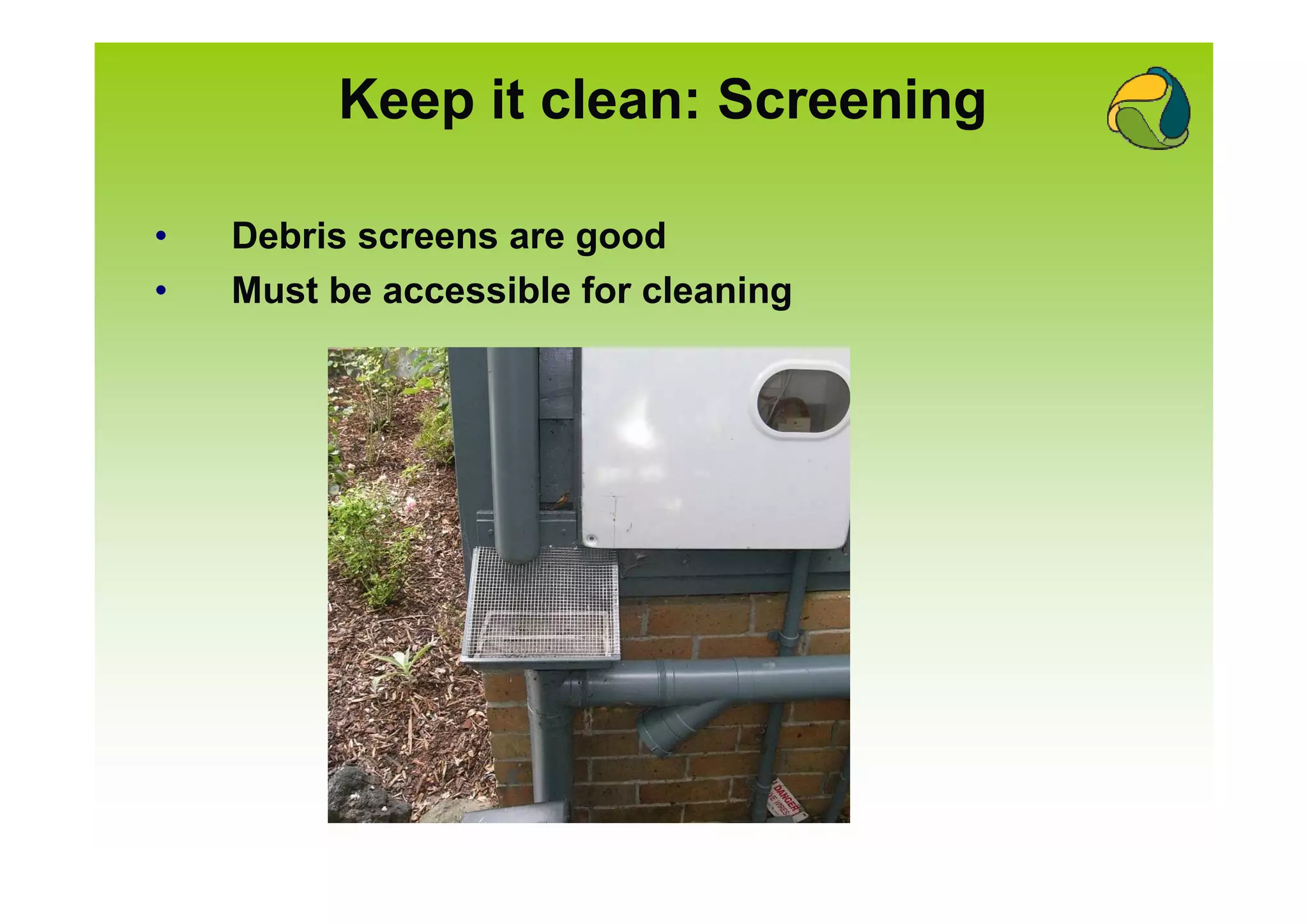
Keep it clean: Screening

•   Debris screens are good
•   Must be accessible for cleaning
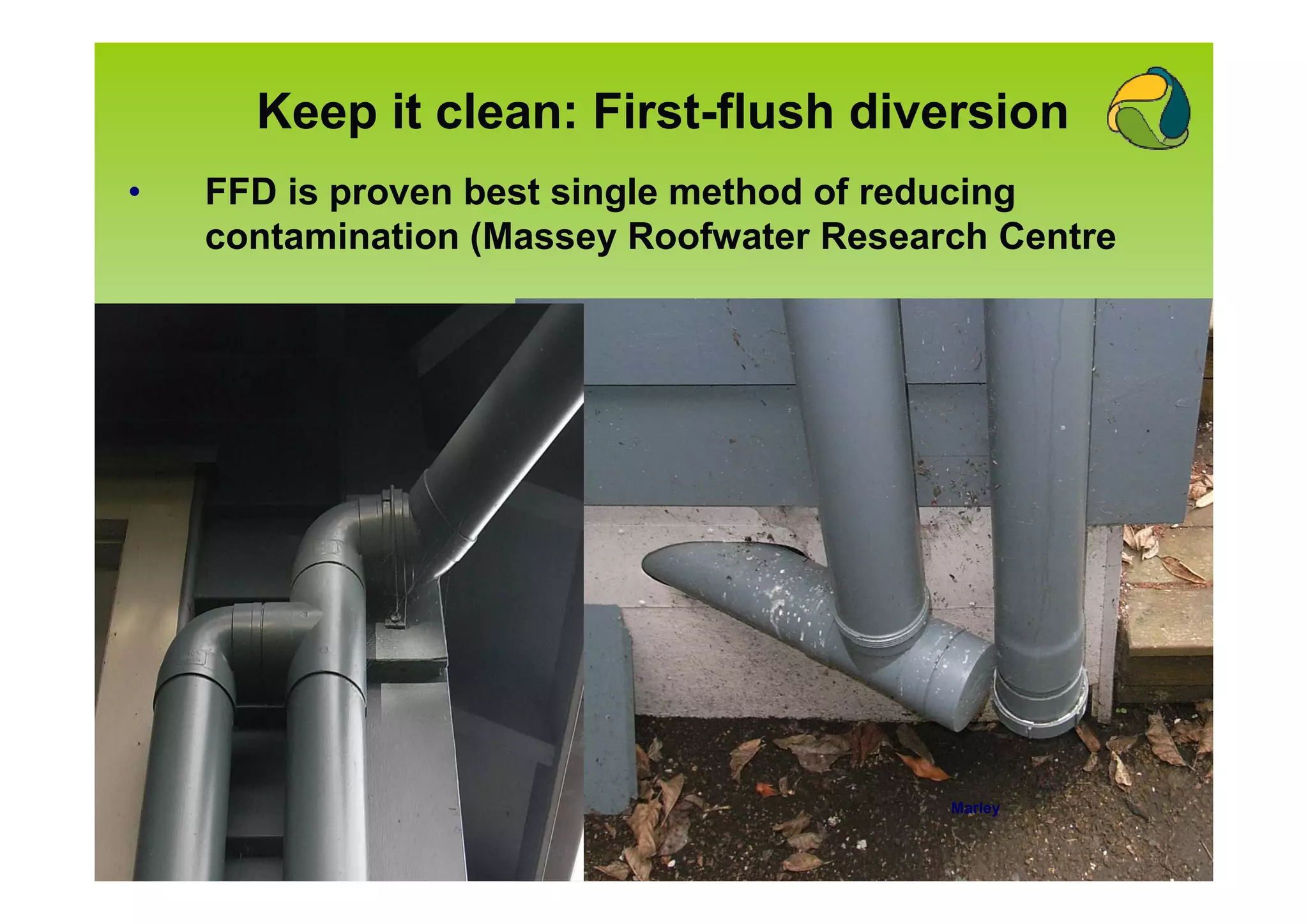
Keep it clean: First-flush diversion
•   FFD is proven best single method of reducing
    contamination (Massey Roofwater Research Centre


                                          Marley
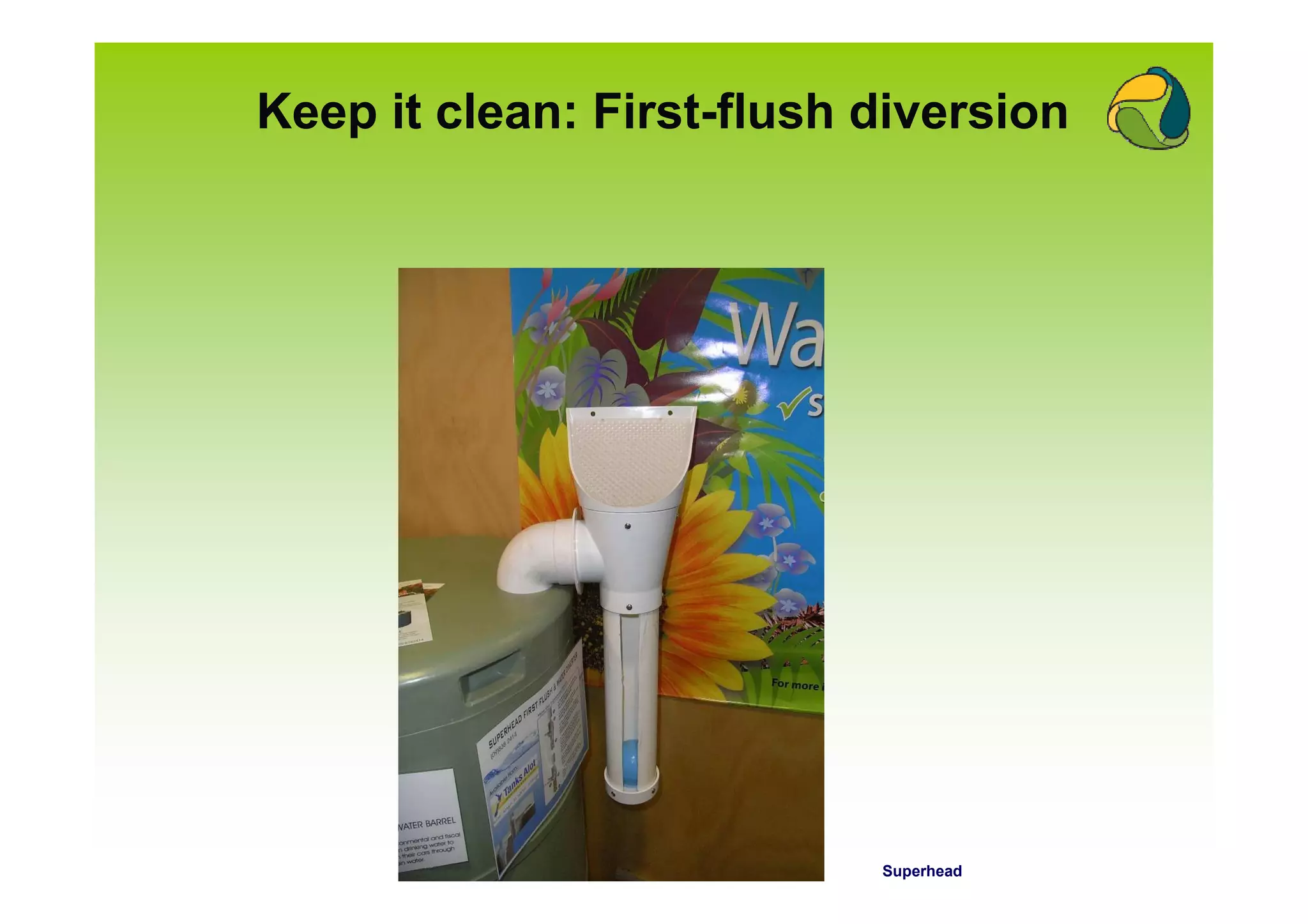
Keep it clean: First-flush diversion


                           Superhead
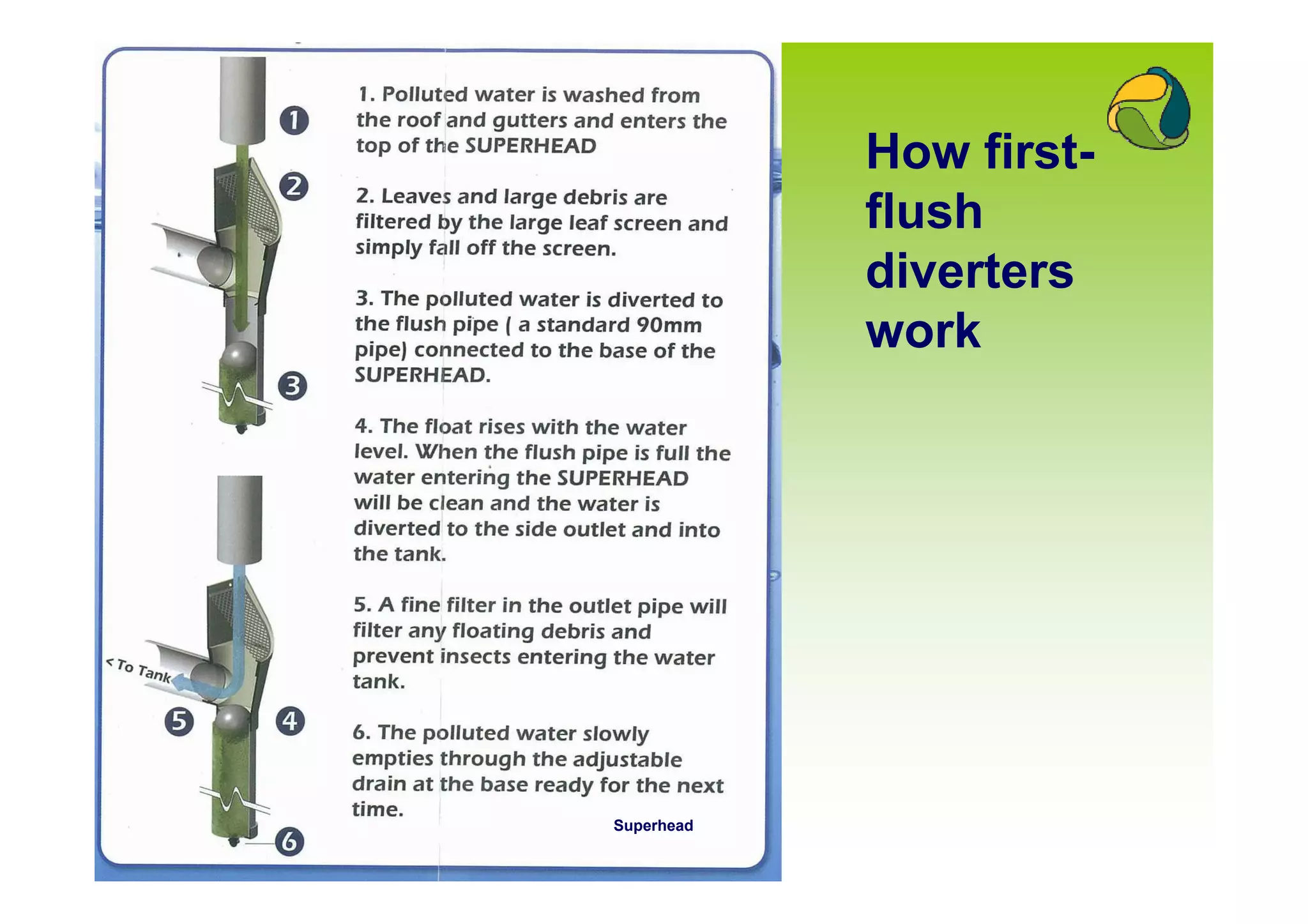
How first-
            flush
            diverters
            work


Superhead
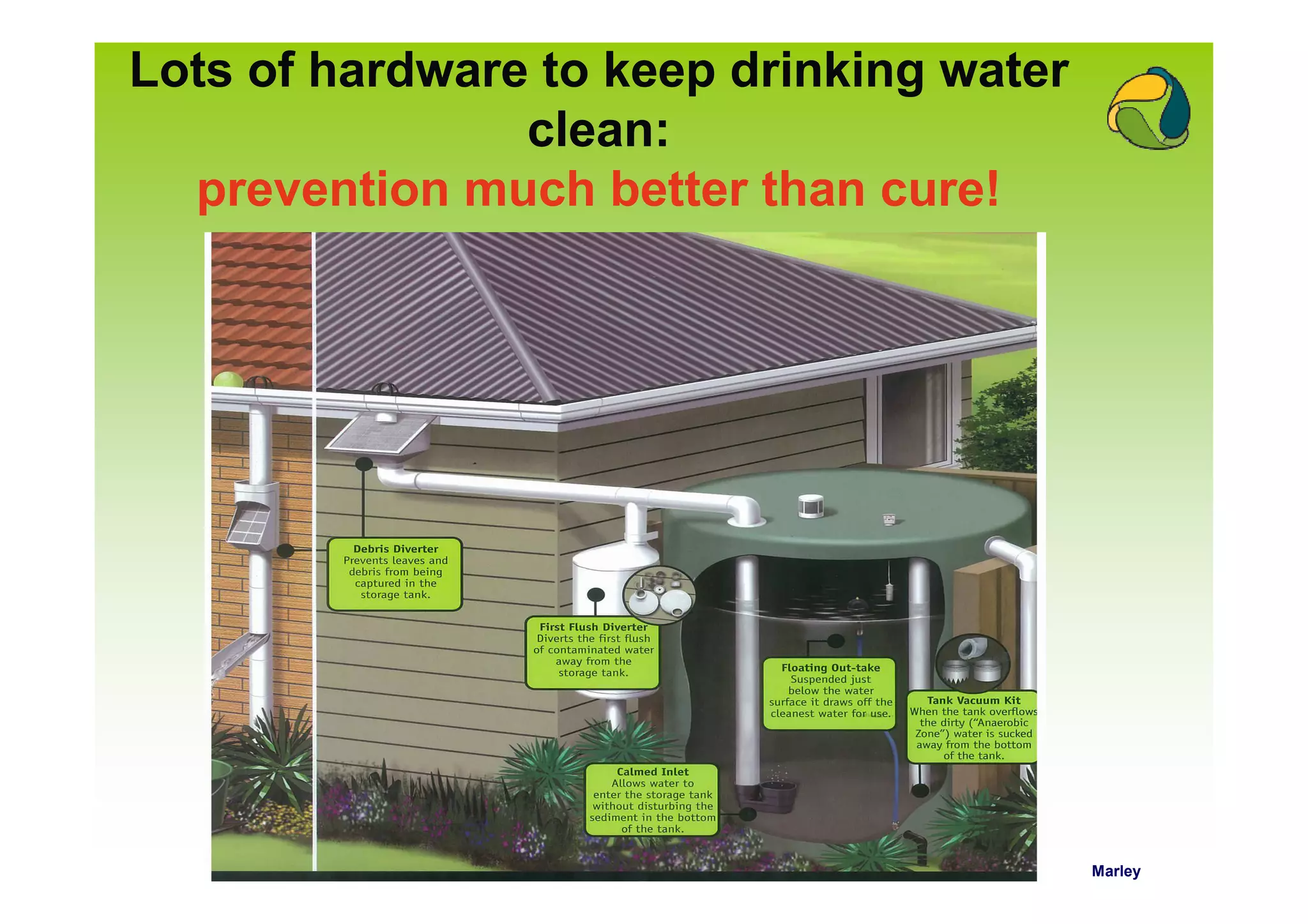
Lots of hardware to keep drinking water
                clean:
  prevention much better than cure!


                                          Marley
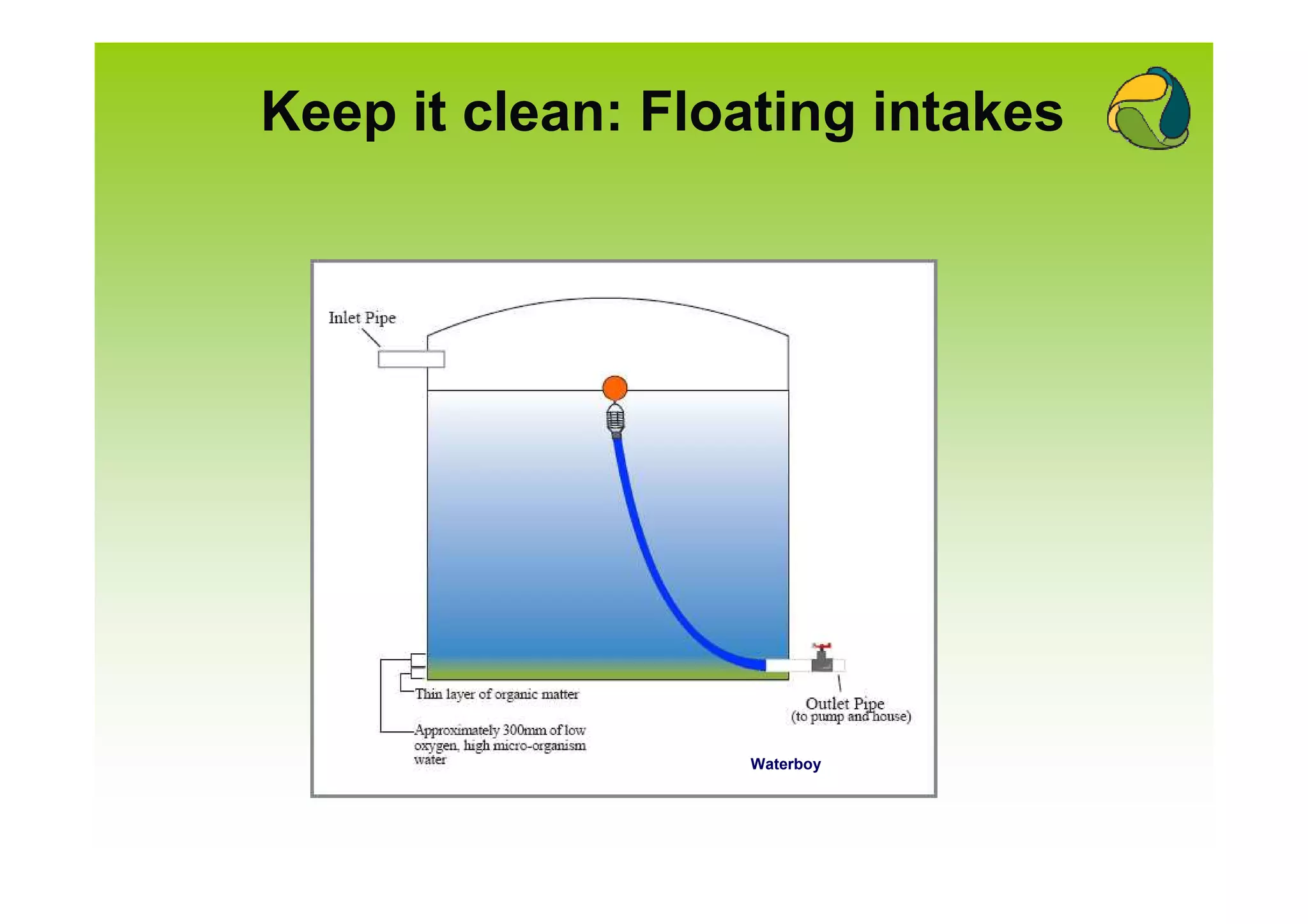
Keep it clean: Floating intakes


                  Waterboy
Pipework for drinking-water supply

•   Must be drinking-water rated
•   DWV or Stormwater pipe doesn’t comply
•   PVC – sustainability still controversial but full LCA
    suggests OK for this (USGBC)
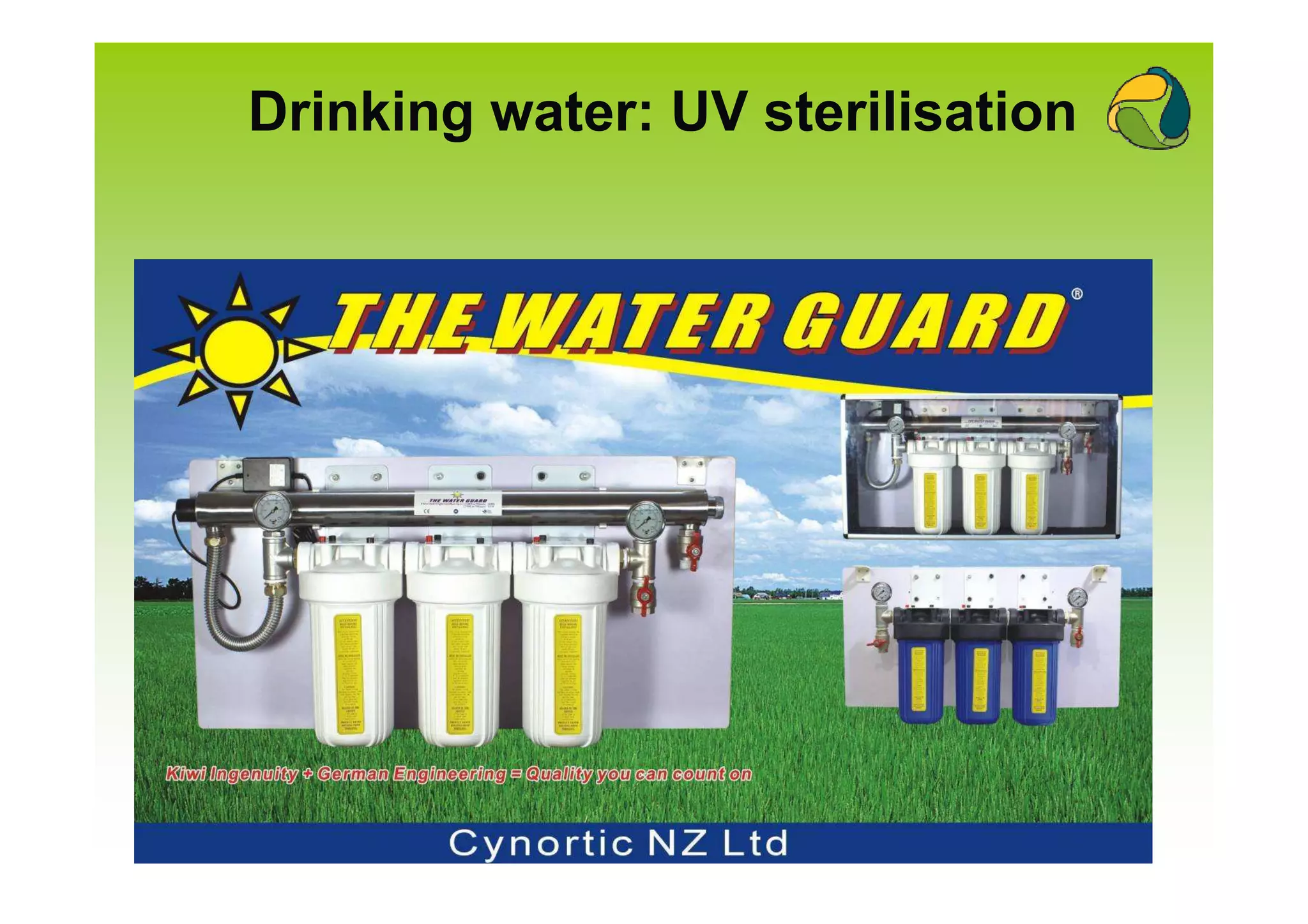
Drinking water: UV sterilisation
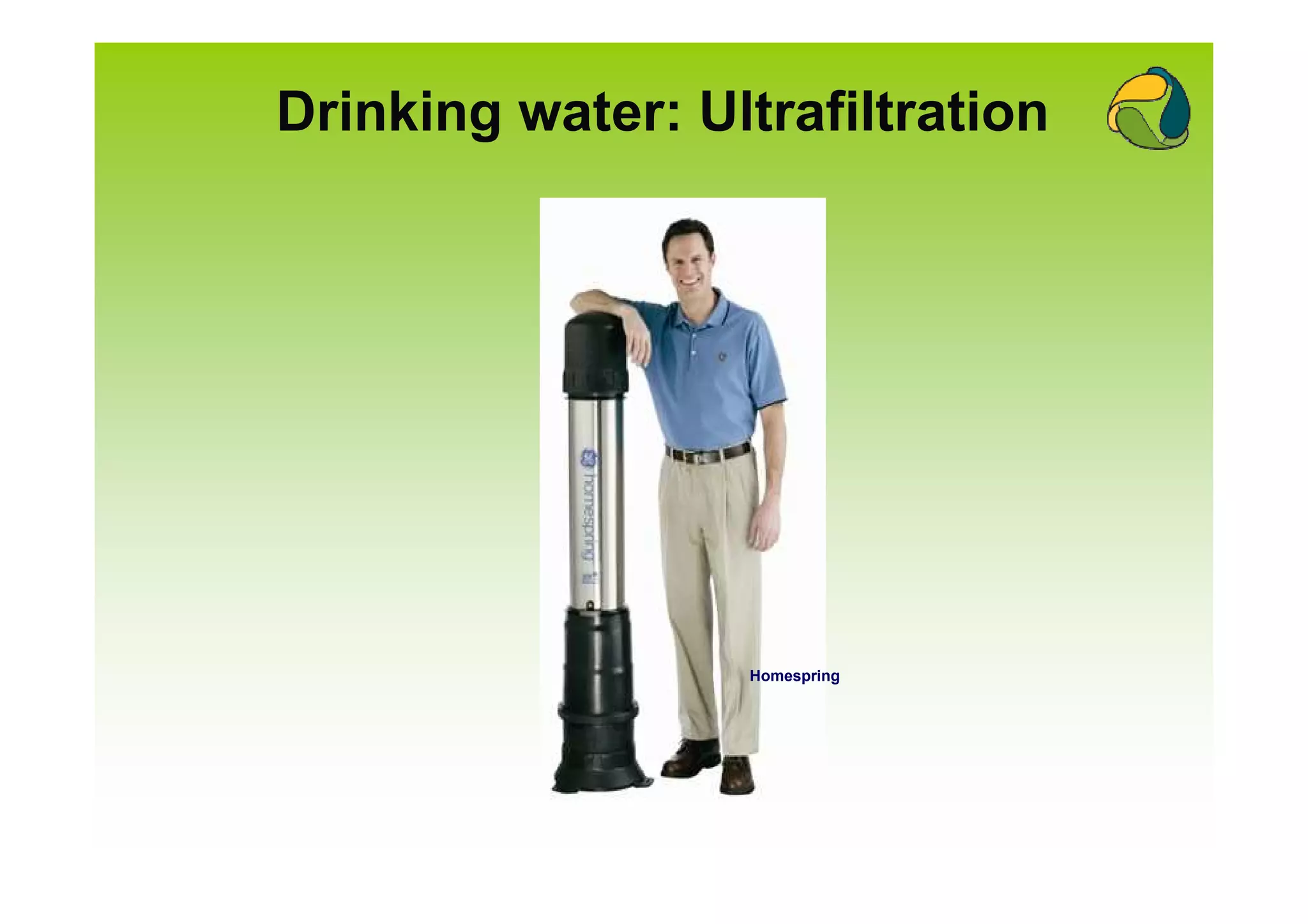
Drinking water: Ultrafiltration


                  Homespring
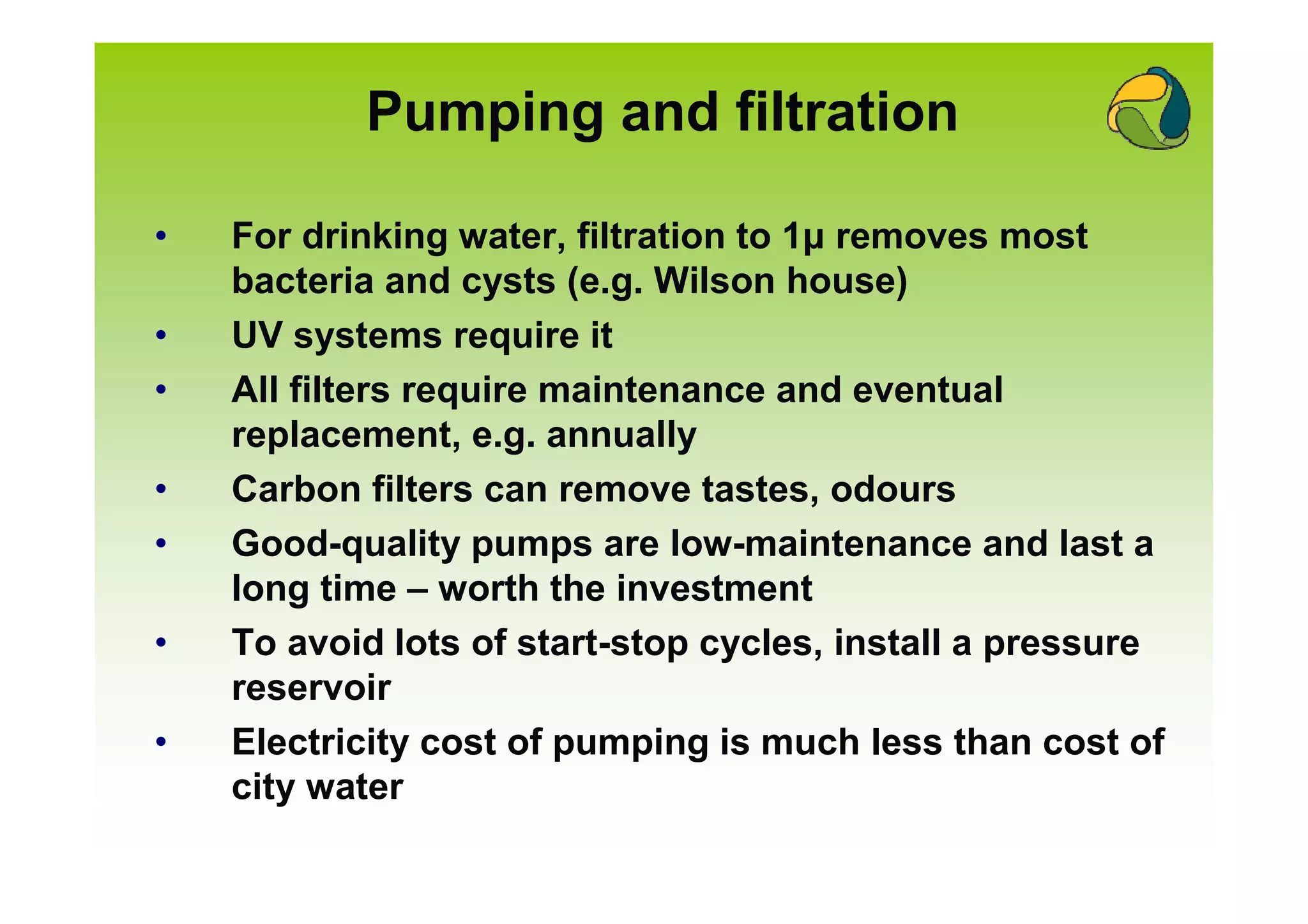
Pumping and filtration

•   For drinking water, filtration to 1µ removes most
    bacteria and cysts (e.g. Wilson house)
•   UV systems require it
•   All filters require maintenance and eventual
    replacement, e.g. annually
•   Carbon filters can remove tastes, odours
•   Good-quality pumps are low-maintenance and last a
    long time – worth the investment
•   To avoid lots of start-stop cycles, install a pressure
    reservoir
•   Electricity cost of pumping is much less than cost of
    city water
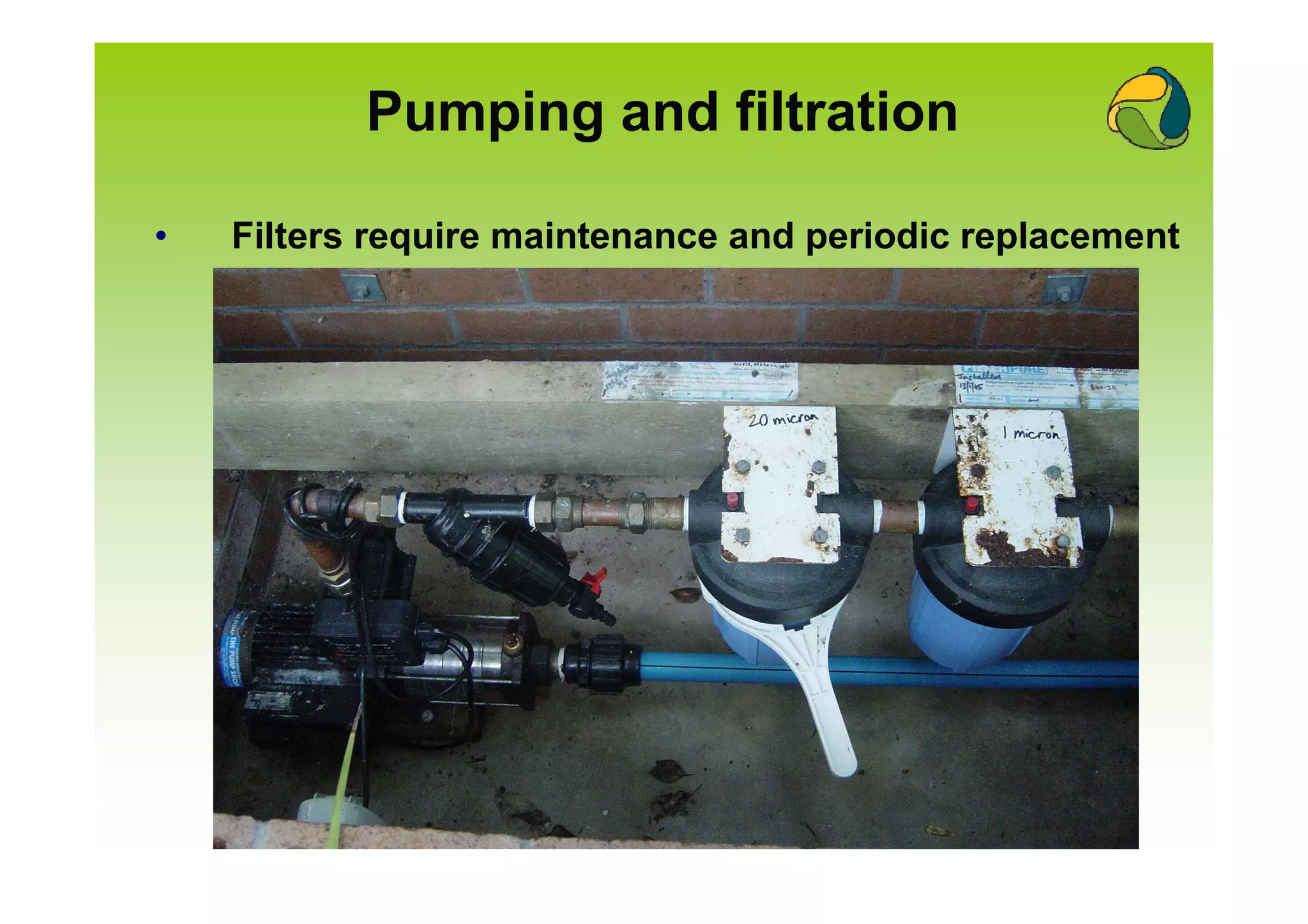
Pumping and filtration

•   Filters require maintenance and periodic replacement
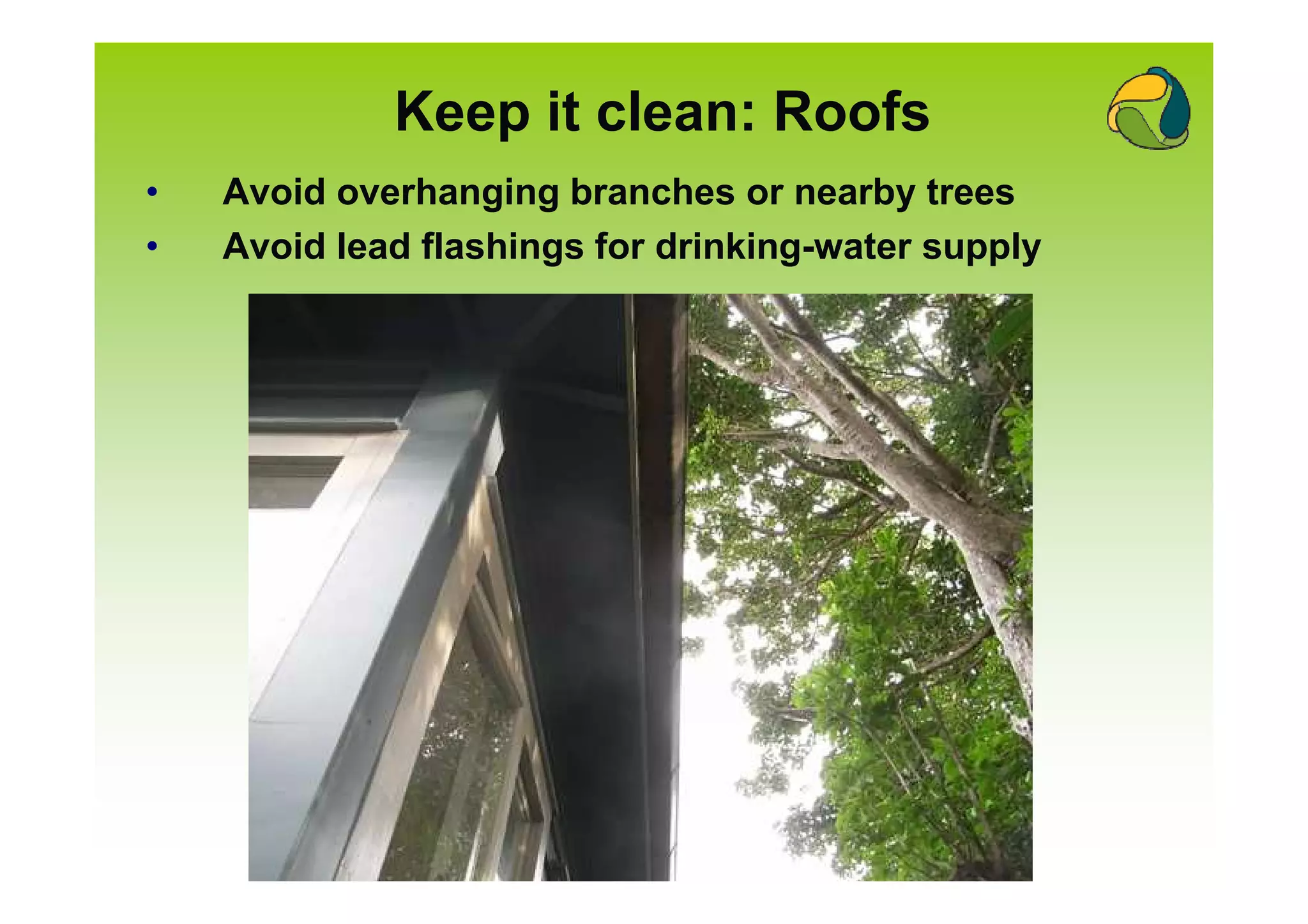
Keep it clean: Roofs
•   Avoid overhanging branches or nearby trees
•   Avoid lead flashings for drinking-water supply
Keep it clean: Gutters

•   Avoid copper for drinking-water supplies – it leaches
    into the water
•   Ensure adequate fall to assist cleaning
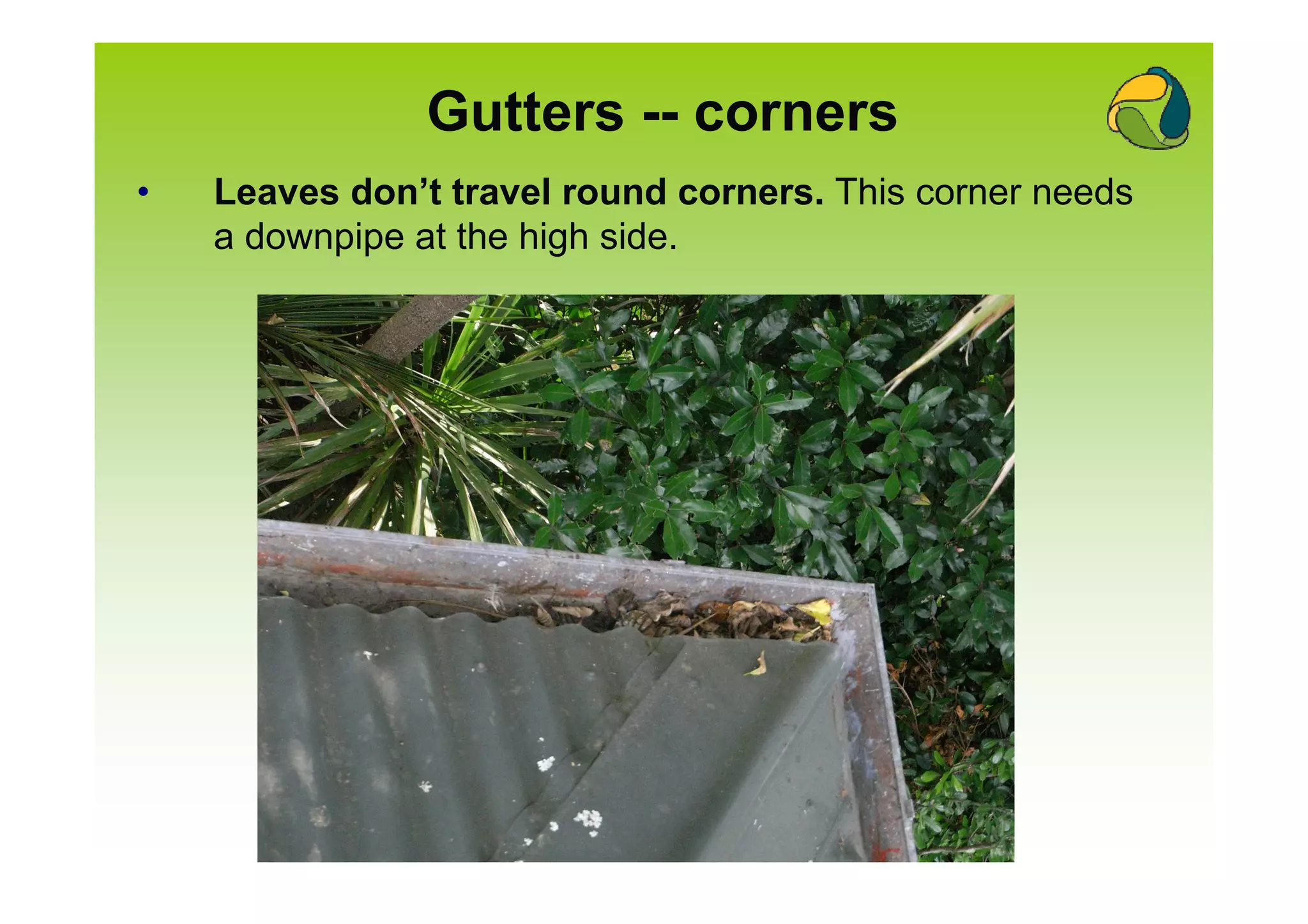
Gutters -- corners
•   Leaves don’t travel round corners. This corner needs
    a downpipe at the high side.
MAINTENANCE
•   Crucial to success
•   Systems are not set-and-forget
•   Each part of the system needs it
•   Drinking-water systems need more maintenance than
    non-drinking
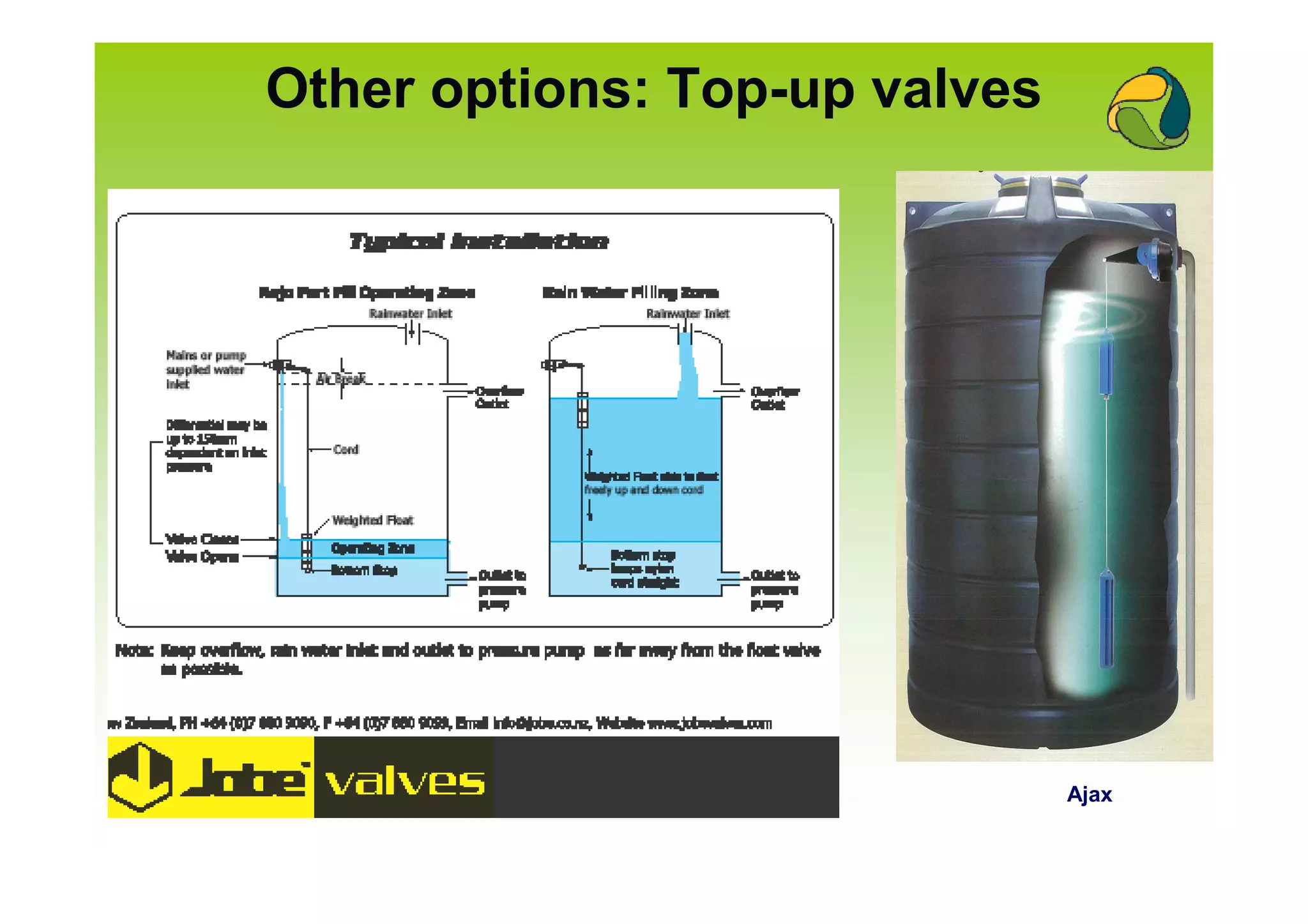
Other options: Top-up valves


                               Ajax
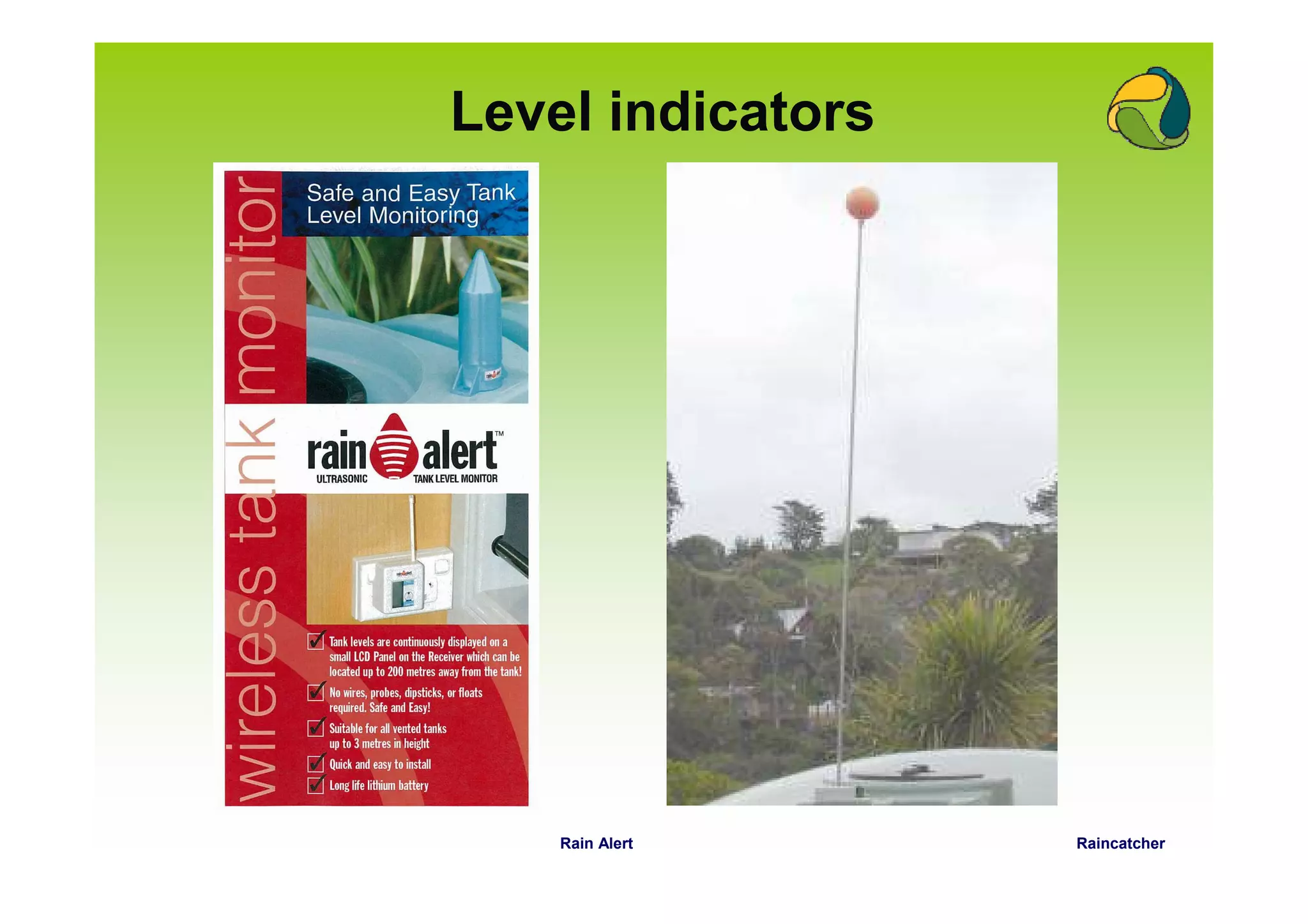
Level indicators


    Rain Alert     Raincatcher
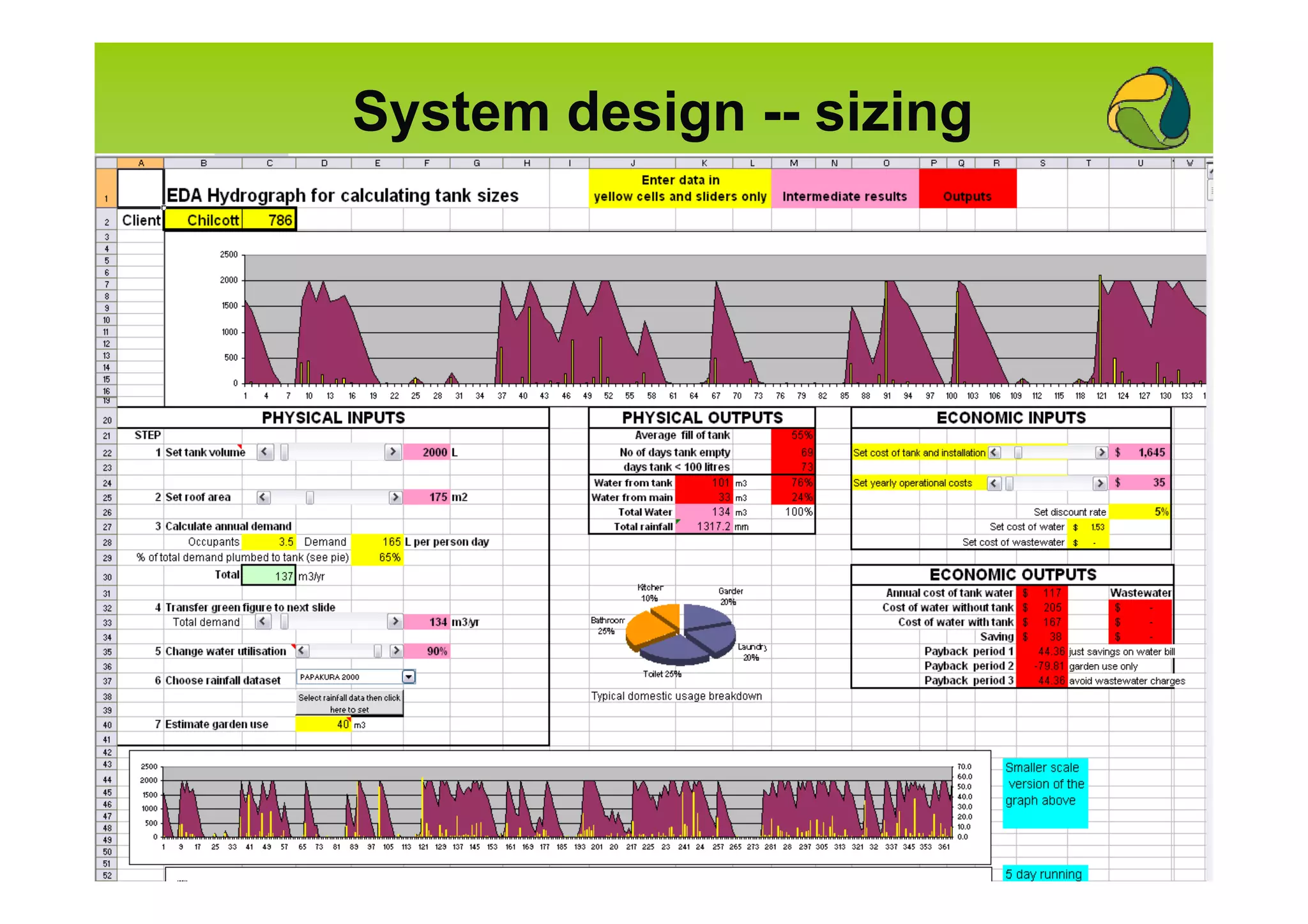
System design -- sizing
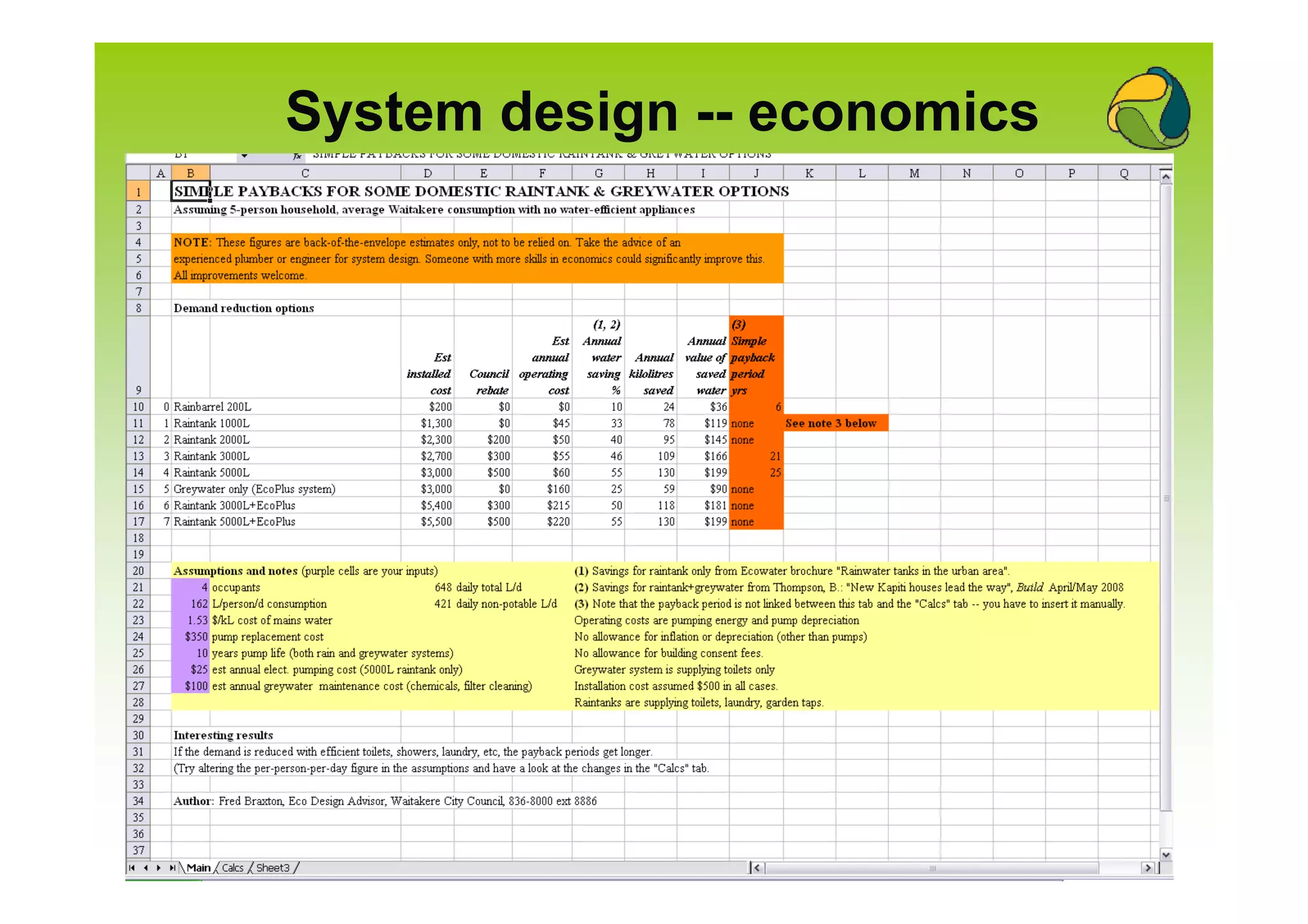
System design -- economics
Legal requirements
     (check with Council Call Centre 301-0101)

•   Building Consent is needed for:
     • connection to house plumbing
     • tank >25,000L on ground
     • tank >2000L supported >2M above ground
     • tank >500L supported >4M above ground
•   Resource Consent may be needed for tank >6000L
•   Back-flow preventer needed if system connects to mains supply
•   Registered plumber must do the work if connected to house or mains
•   No consent needed for pipework for garden only
•   Building Code requires that overflow goes to approved disposal
Further information

•   See Waitakere Sustainable Home Guidelines chapters
    on “Saving water” and “Using rainwater” at
    www.waitakere.govt.nz
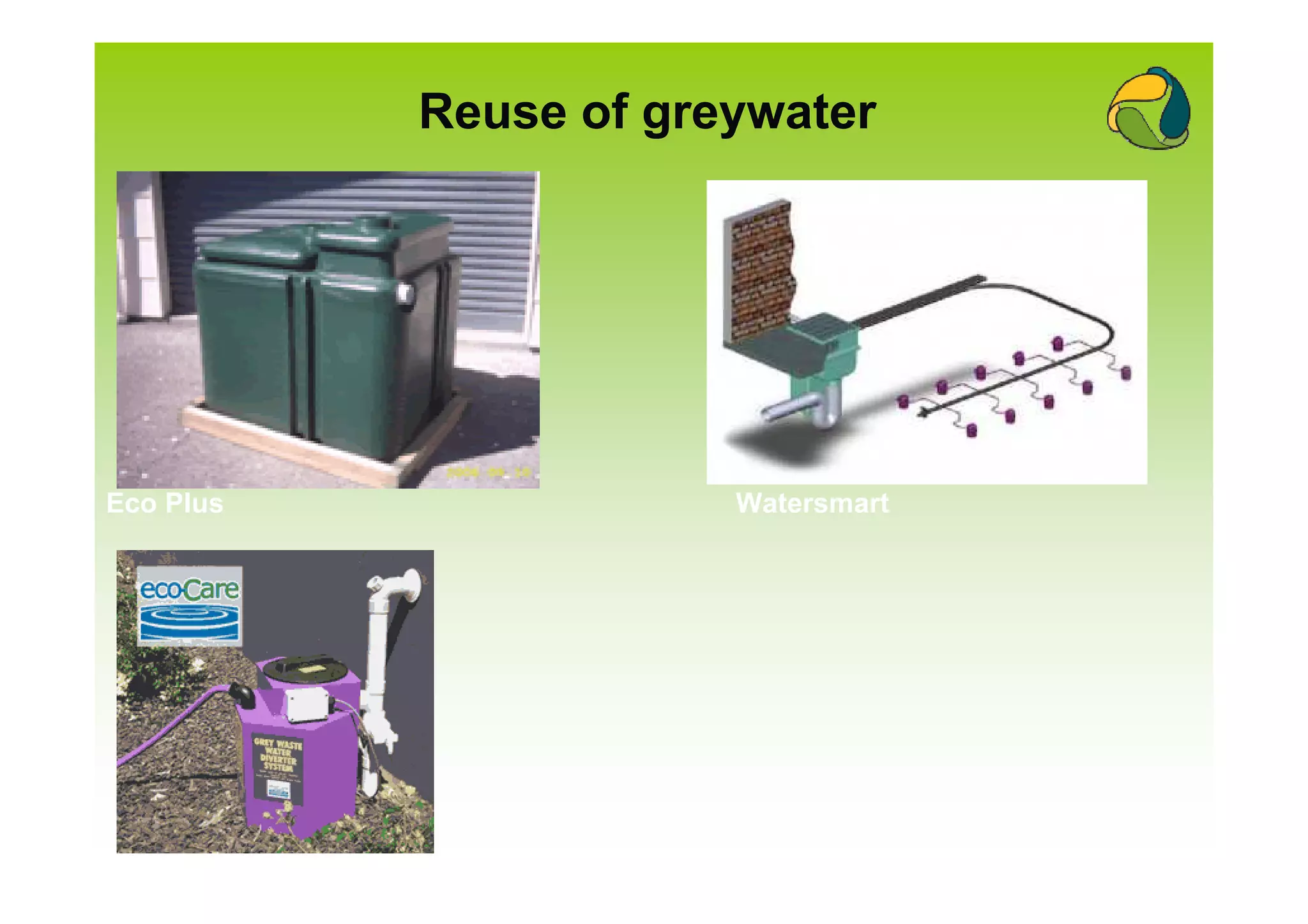
Reuse of greywater


Eco Plus               Watersmart
What is greywater?

•   Greywater is water from showers, baths, washing
    machines and handbasins – but not from kitchens or
    toilets
•   The benefits are reduced water demand
What can greywater be used for?

•   Toilet flushing
•   Subsurface irrigation
How is it done?

•   If stored for more than 24 hours it needs to be treated,
    otherwise it goes septic (health risk)
•   For toilet flushing it needs to be filtered and treated, and
    usually needs to be pumped (as in Wilson house using
    the Eco-Plus system)
•   For irrigation it needs to be delivered below the surface,
    not sprayed or ponded
•   See Waitakere Sustainable Home Guidelines chapter
    on “Wastewater”
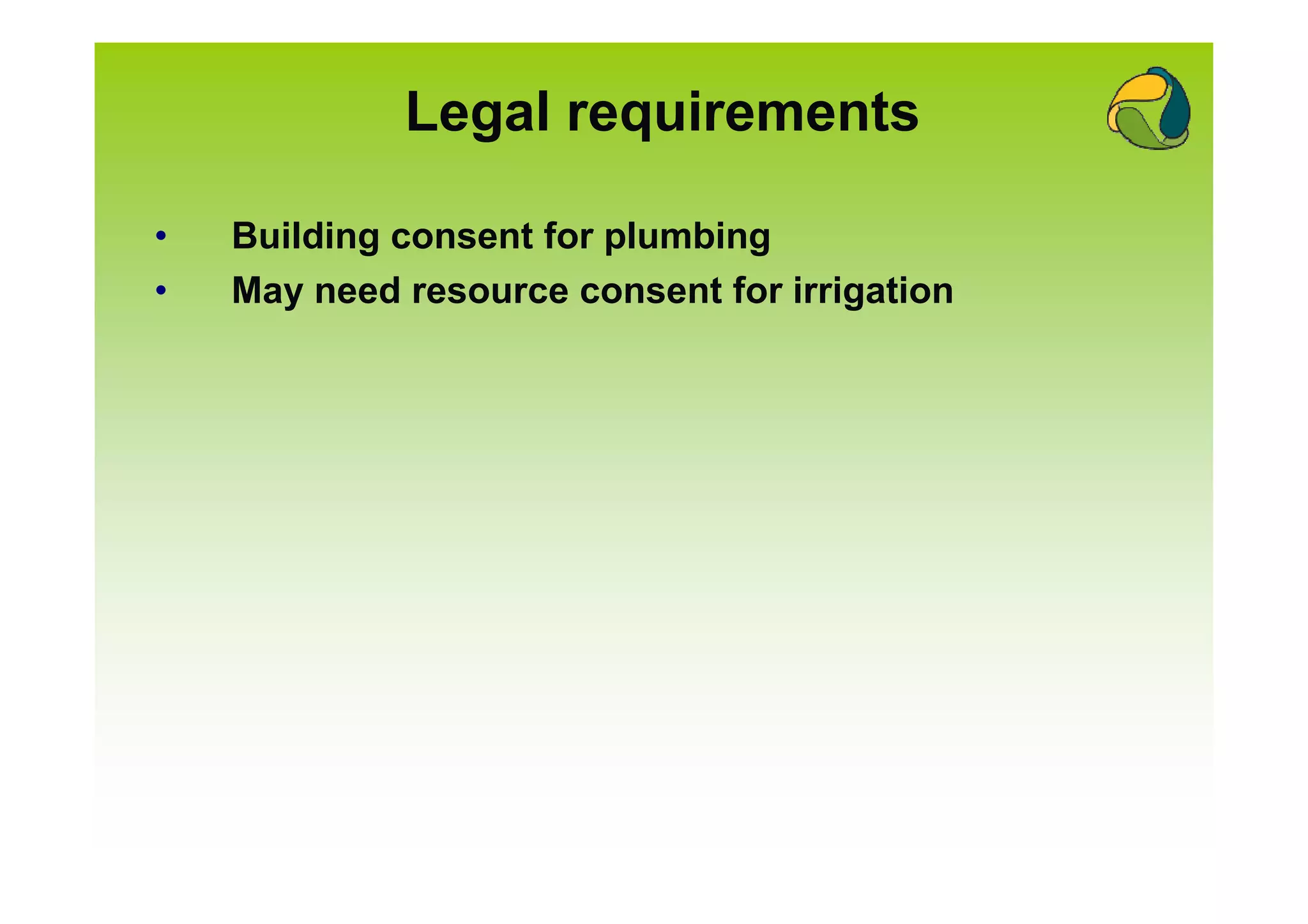
Legal requirements

•   Building consent for plumbing
•   May need resource consent for irrigation
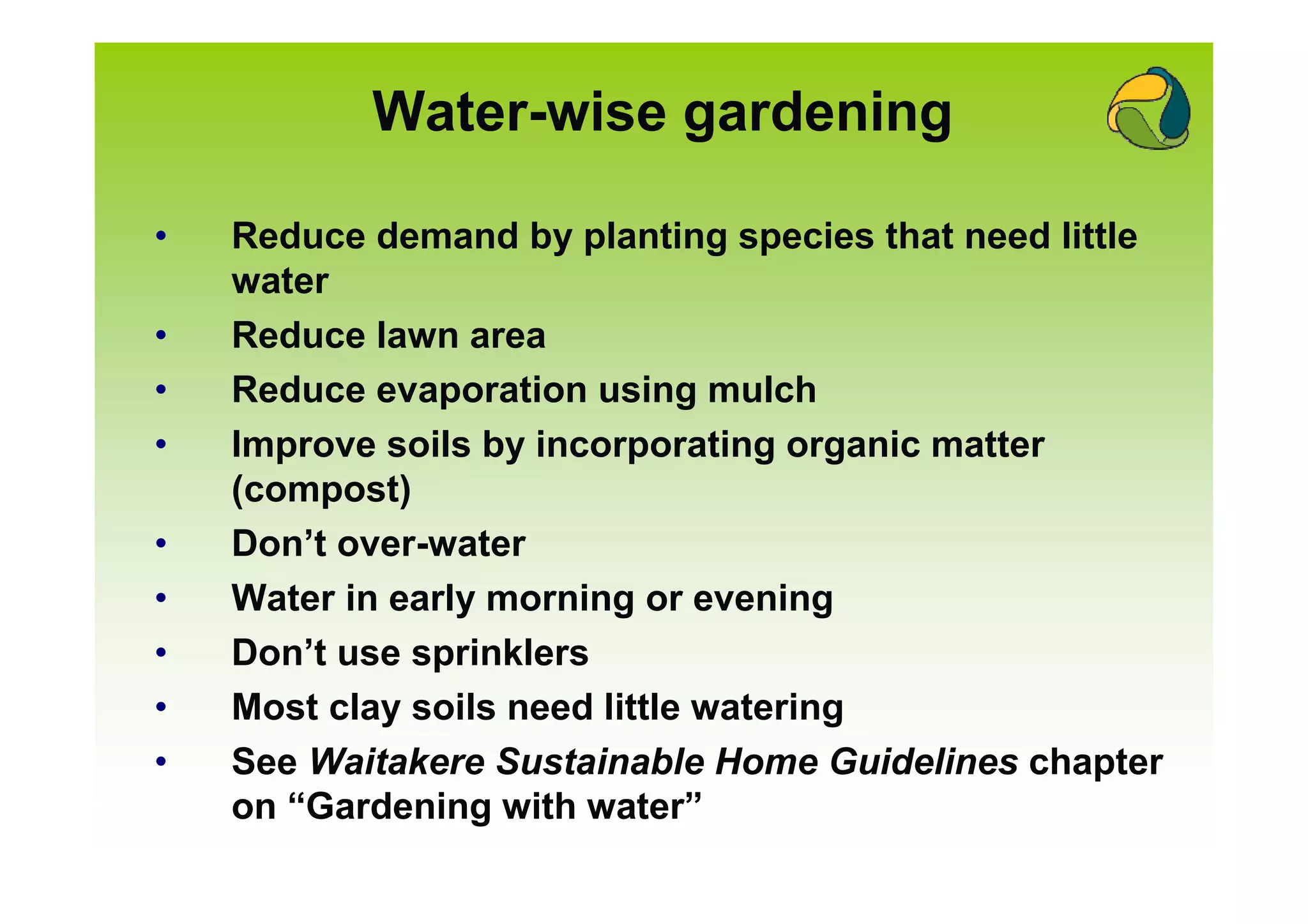
Water-wise gardening

•   Reduce demand by planting species that need little
    water
•   Reduce lawn area
•   Reduce evaporation using mulch
•   Improve soils by incorporating organic matter
    (compost)
•   Don’t over-water
•   Water in early morning or evening
•   Don’t use sprinklers
•   Most clay soils need little watering
•   See Waitakere Sustainable Home Guidelines chapter
    on “Gardening with water”
Other resources

•   Waitakere Sustainable Home Guidelines at
    www.waitakere.govt.nz
•   Eco Design Advisors provide a free, independent
    service, www.ecodesignadvisor.org.nz
•   Rural plumbers are experienced with rainharvesting
•   There are several urban plumbers with experience
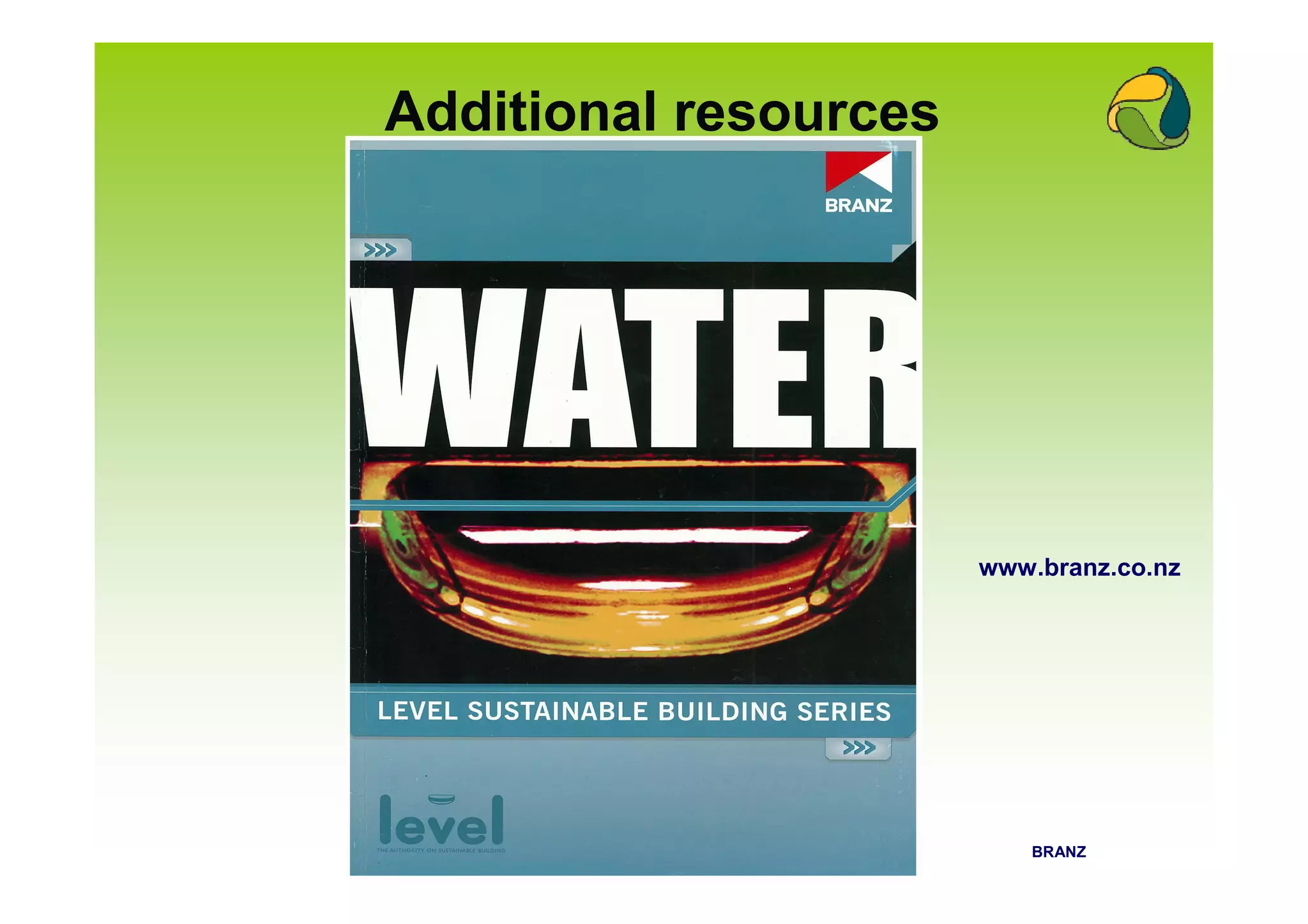
Additional resources


                       www.branz.co.nz


                          BRANZ
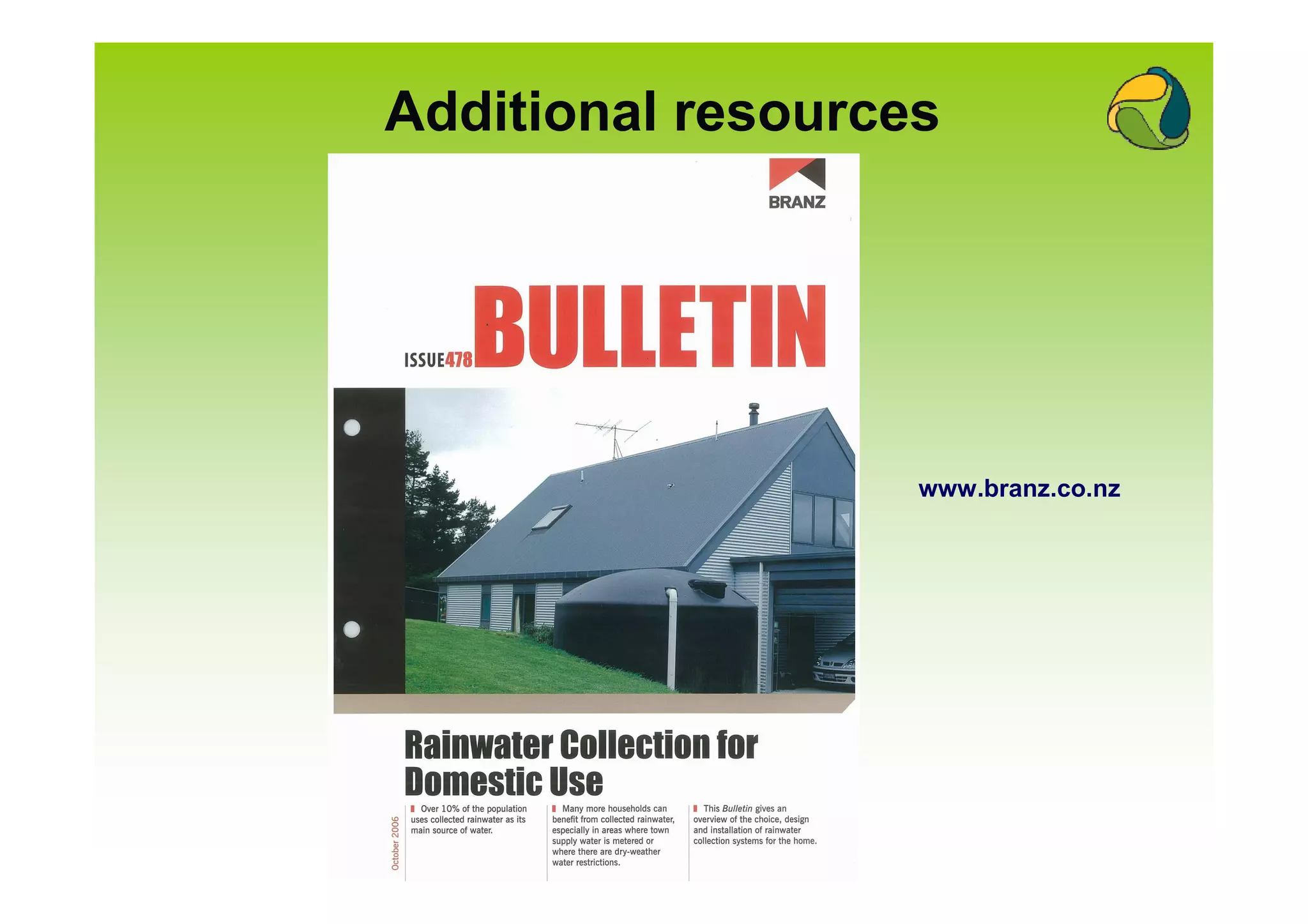
Additional resources


                   www.branz.co.nz
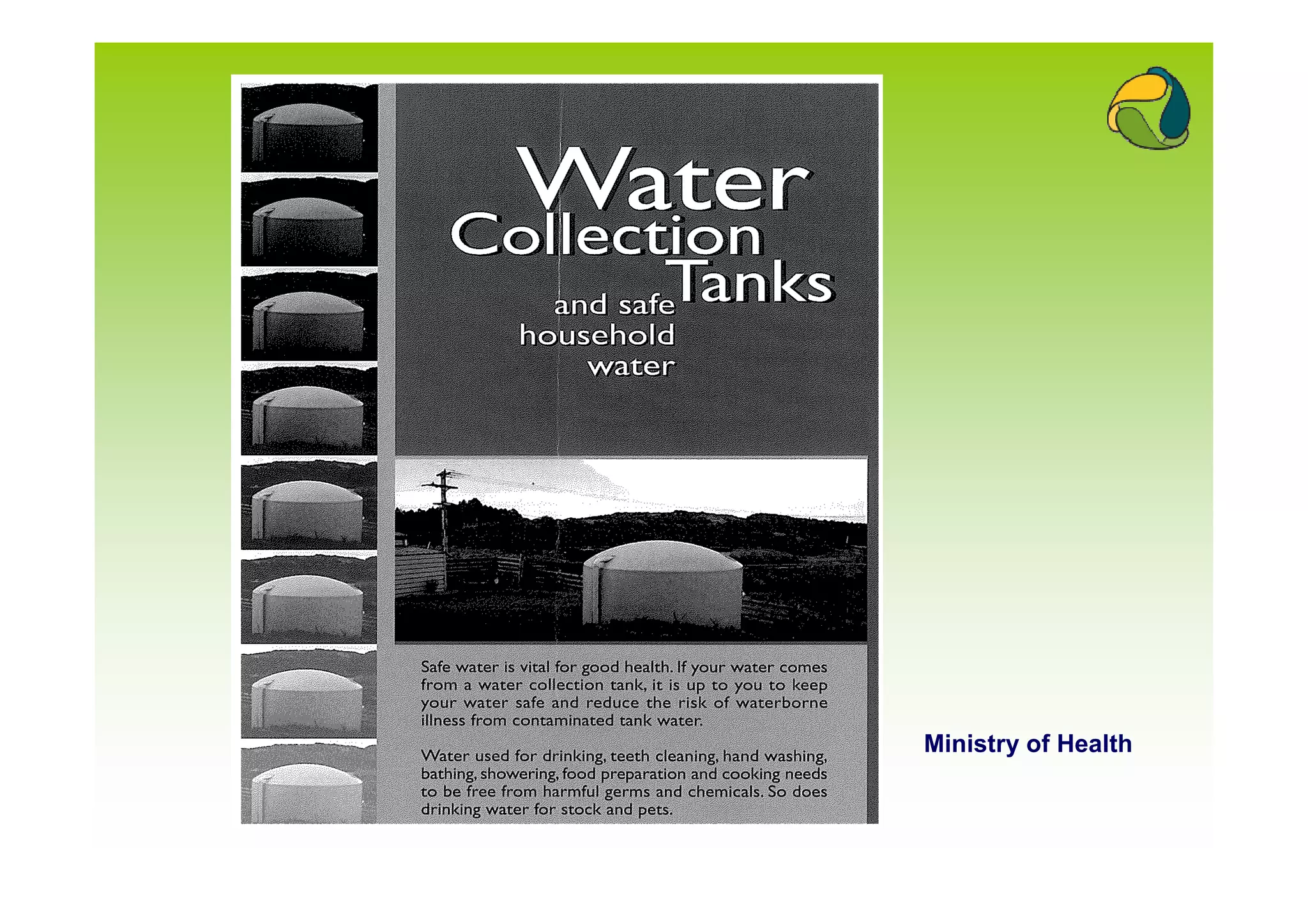
Ministry of Health

Introduction to Rainharvesting Greywater Reuse Water-Efficient Gardening - New Zealand

  • 1.
    Eco design inprinciple and practice (part 2 of 4) Introduction to Rainharvesting Greywater reuse Water-efficient gardening Dr Maggie Lawton, Fred Braxton and Eion Scott Sustainable Living Centre 13 November 2010
  • 2.
    Rainharvesting • Why do it? • Tanks • Keeping the water clean • Pumps and filtering • Economics • Legal requirements
  • 3.
    Why? 1: Reduce relianceon city supply: 65% of household needs can be met with untreated rainwater If every home in Waitakere had a raintank, over 7 Kitchen Garden million cu m of demand could have been avoided in 10% 20% 2006 Bathroom 25% Laundry 20% Toilet 25% 2: Reduce your short-term costs 3: Reduce the city’s infrastructure costs and thus your longer-term costs 4: Reduce GHG emissions – a third of WCC’s corporate emissions are due to collecting, treating, reticulating, and disposing of water 5: The feel-good factor 6: Only 4% of high-quality city water supplied is used for drinking
  • 4.
    What will theend-use be? • Different requirements for drinking-water and other uses • End-use will determine system design • For garden irrigation, a small tank will run out quickly
  • 5.
  • 6.
    Tanks 2008 prices
  • 7.
  • 8.
    Tanks Watergain Ecosac
  • 9.
    House supply: Typesof systems Wet: pipes always hold water (not recommended because pipes retain decomposing material and may be difficult to clean out) Dry: pipes empty after rain (recommended) Wet converted to dry: first- flush diverter empties pipes automatically after rain (recommended) Marley
  • 10.
    House supply: Wetor dry? • Large houses often require wet systems • Decomposing material causes smell and taste problems with wet systems • The Wilson house, which you will visit, has a wet system • If possible, wet systems should be converted to dry systems
  • 11.
    Keep it clean:Sizes of contaminants Source: Homespring
  • 12.
    Keep it clean:Screening • Screen as early as possible • Screens inside spouting tend to block up and corrode roofing
  • 13.
    Keep it clean:Screening • Debris screens are good • Must be accessible for cleaning
  • 14.
    Keep it clean:First-flush diversion • FFD is proven best single method of reducing contamination (Massey Roofwater Research Centre Marley
  • 15.
    Keep it clean:First-flush diversion Superhead
  • 16.
    How first- flush diverters work Superhead
  • 17.
    Lots of hardwareto keep drinking water clean: prevention much better than cure! Marley
  • 18.
    Keep it clean:Floating intakes Waterboy
  • 19.
    Pipework for drinking-watersupply • Must be drinking-water rated • DWV or Stormwater pipe doesn’t comply • PVC – sustainability still controversial but full LCA suggests OK for this (USGBC)
  • 20.
    Drinking water: UVsterilisation
  • 21.
  • 22.
    Pumping and filtration • For drinking water, filtration to 1µ removes most bacteria and cysts (e.g. Wilson house) • UV systems require it • All filters require maintenance and eventual replacement, e.g. annually • Carbon filters can remove tastes, odours • Good-quality pumps are low-maintenance and last a long time – worth the investment • To avoid lots of start-stop cycles, install a pressure reservoir • Electricity cost of pumping is much less than cost of city water
  • 23.
    Pumping and filtration • Filters require maintenance and periodic replacement
  • 24.
    Keep it clean:Roofs • Avoid overhanging branches or nearby trees • Avoid lead flashings for drinking-water supply
  • 25.
    Keep it clean:Gutters • Avoid copper for drinking-water supplies – it leaches into the water • Ensure adequate fall to assist cleaning
  • 26.
    Gutters -- corners • Leaves don’t travel round corners. This corner needs a downpipe at the high side.
  • 27.
    MAINTENANCE • Crucial to success • Systems are not set-and-forget • Each part of the system needs it • Drinking-water systems need more maintenance than non-drinking
  • 28.
  • 29.
    Level indicators Rain Alert Raincatcher
  • 30.
  • 31.
  • 32.
    Legal requirements (check with Council Call Centre 301-0101) • Building Consent is needed for: • connection to house plumbing • tank >25,000L on ground • tank >2000L supported >2M above ground • tank >500L supported >4M above ground • Resource Consent may be needed for tank >6000L • Back-flow preventer needed if system connects to mains supply • Registered plumber must do the work if connected to house or mains • No consent needed for pipework for garden only • Building Code requires that overflow goes to approved disposal
  • 33.
    Further information • See Waitakere Sustainable Home Guidelines chapters on “Saving water” and “Using rainwater” at www.waitakere.govt.nz
  • 34.
    Reuse of greywater EcoPlus Watersmart
  • 35.
    What is greywater? • Greywater is water from showers, baths, washing machines and handbasins – but not from kitchens or toilets • The benefits are reduced water demand
  • 36.
    What can greywaterbe used for? • Toilet flushing • Subsurface irrigation
  • 37.
    How is itdone? • If stored for more than 24 hours it needs to be treated, otherwise it goes septic (health risk) • For toilet flushing it needs to be filtered and treated, and usually needs to be pumped (as in Wilson house using the Eco-Plus system) • For irrigation it needs to be delivered below the surface, not sprayed or ponded • See Waitakere Sustainable Home Guidelines chapter on “Wastewater”
  • 38.
    Legal requirements • Building consent for plumbing • May need resource consent for irrigation
  • 39.
    Water-wise gardening • Reduce demand by planting species that need little water • Reduce lawn area • Reduce evaporation using mulch • Improve soils by incorporating organic matter (compost) • Don’t over-water • Water in early morning or evening • Don’t use sprinklers • Most clay soils need little watering • See Waitakere Sustainable Home Guidelines chapter on “Gardening with water”
  • 40.
    Other resources • Waitakere Sustainable Home Guidelines at www.waitakere.govt.nz • Eco Design Advisors provide a free, independent service, www.ecodesignadvisor.org.nz • Rural plumbers are experienced with rainharvesting • There are several urban plumbers with experience
  • 41.
    Additional resources www.branz.co.nz BRANZ
  • 42.
    Additional resources www.branz.co.nz
  • 43.