Douglas Q. Hawkins
@dougqh
VM Engineer
Understanding
the JIT’s Tricks
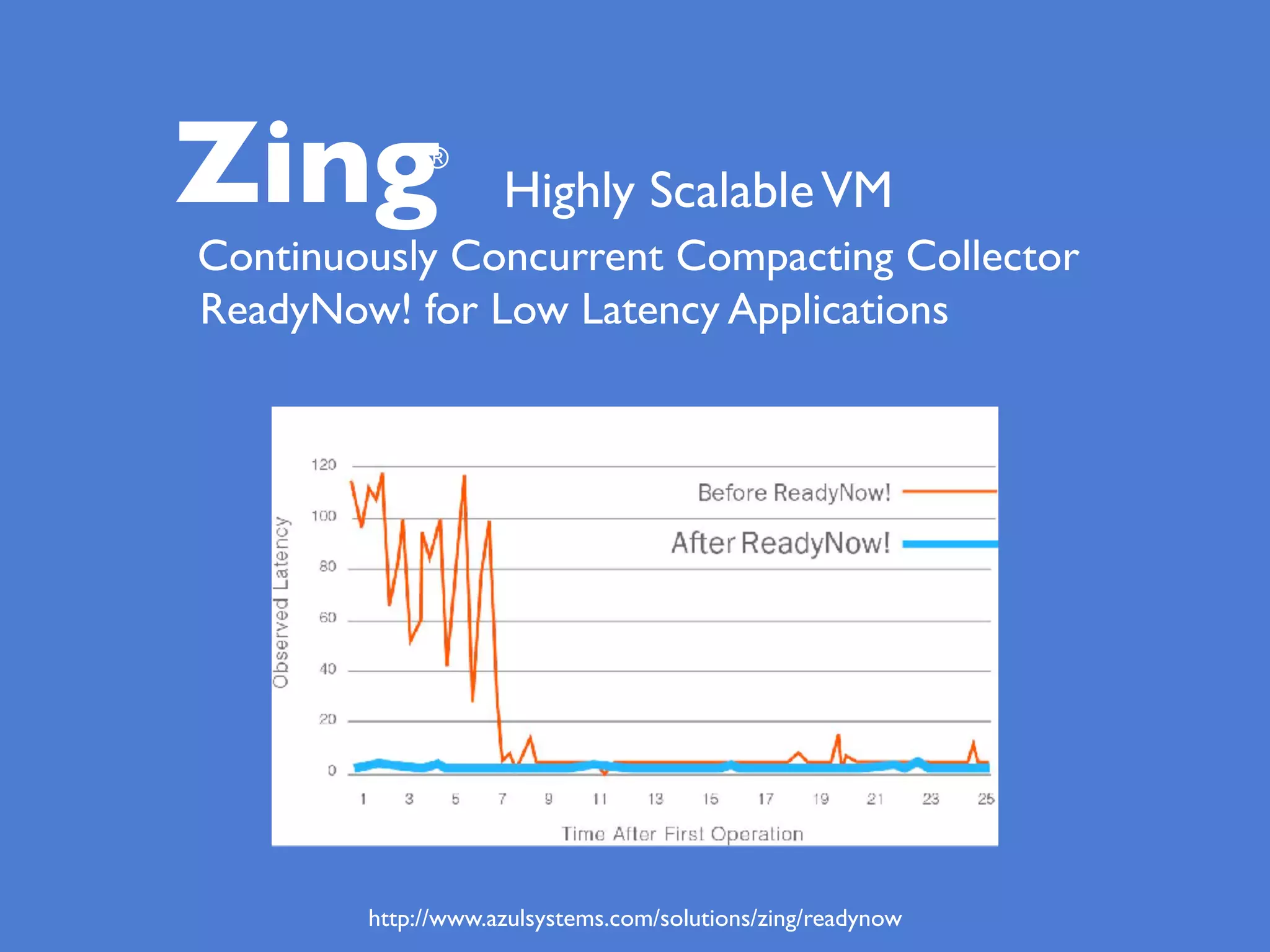
Zing®
Highly ScalableVM
Continuously Concurrent Compacting Collector
ReadyNow! for Low Latency Applications
http://www.azulsystems.com/solutions/zing/readynow
Zulu®
Multi-Platform OpenJDK
Cloud Support including Docker and Azure
Embedded Support
http://zulu.org/
GOAL: Understand
ArrayList<E>.forEach(Consumer<? super E> action) {
for ( int i = 0; i < this.size; i++ ) {
action.accept(this.elementData[i]);
}
}
…
?5 Lines?
Actual Implementation
ArrayList<E>.forEach(Consumer<? super E> action) {
Objects.requireNonNull(action);
final int expectedModCount = modCount;
final E[] elementData = (E[]) this.elementData;
final int size = this.size;
for (int i=0; modCount == expectedModCount && i < size; i++) {
action.accept(elementData[i]);
}
if (modCount != expectedModCount) throw new CME();
}
The Just-in-Time Compiler
is a Compiler, but It’s a…
Profile Guided
Speculatively Optimizing
Compiler
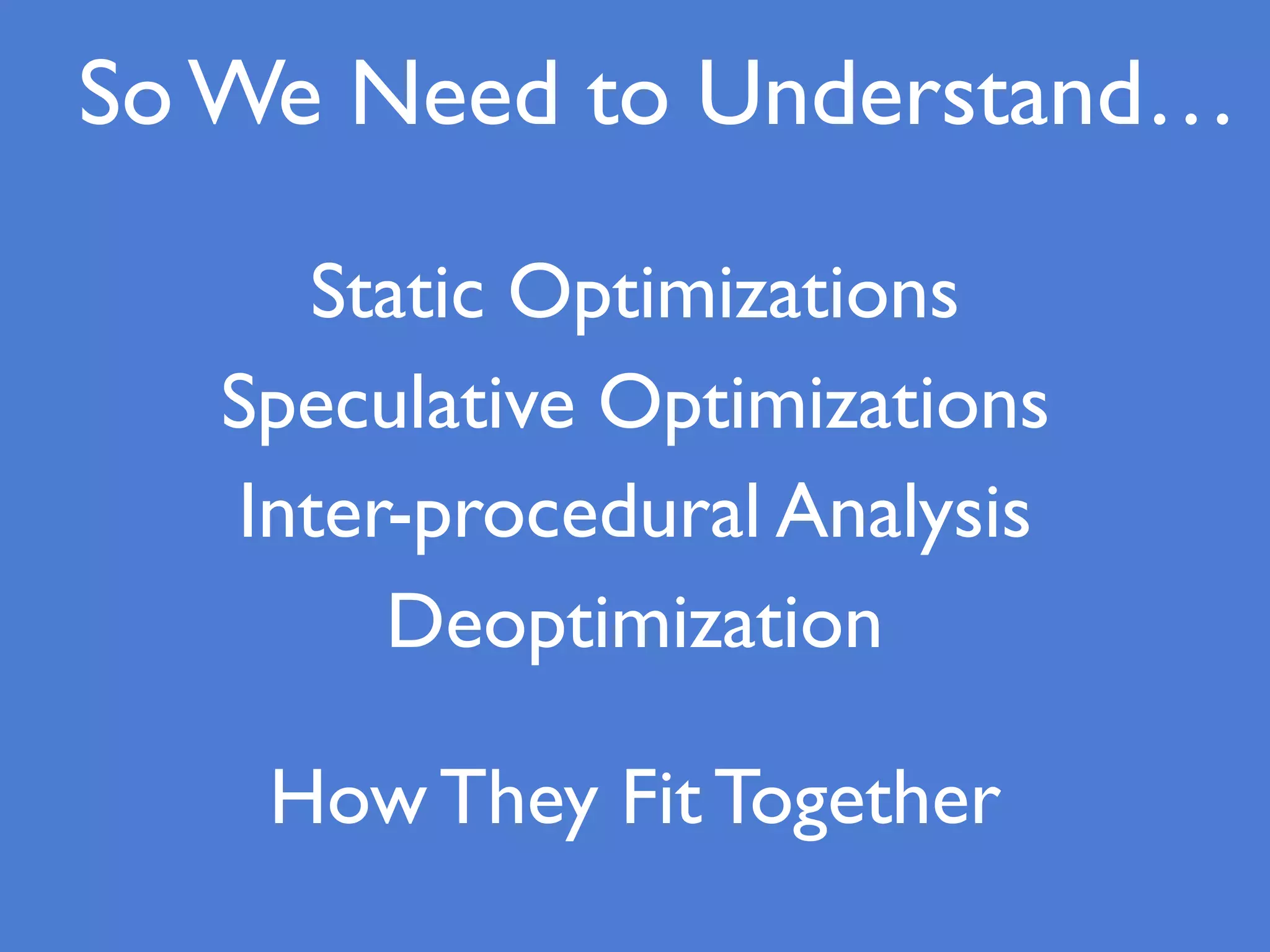
So We Need to Understand…
Static Optimizations
Speculative Optimizations
Inter-procedural Analysis
Deoptimization
How They Fit Together
Understand What
You Can Rely on
OpenJDK’s JIT to do
!
REAL GOAL:
http://openjdk.java.net/groups/hotspot/docs/RuntimeOverview.html
?But First…
When Do We JIT?
public class Allocation {
static final int CHUNK_SIZE = 1_000;
public static void main(String[] args) {
for ( int i = 0; i < 500; ++i ) {
long startTime = System.nanoTime();
for ( int j = 0; j < CHUNK_SIZE; ++j ) {
new Object();
}
long endTime = System.nanoTime();
System.out.printf("%dt%d%n", i, endTime - startTime);
}
}
}
S:01A
1
100
10000
0 50 100 150 200 250 300 350 400 450
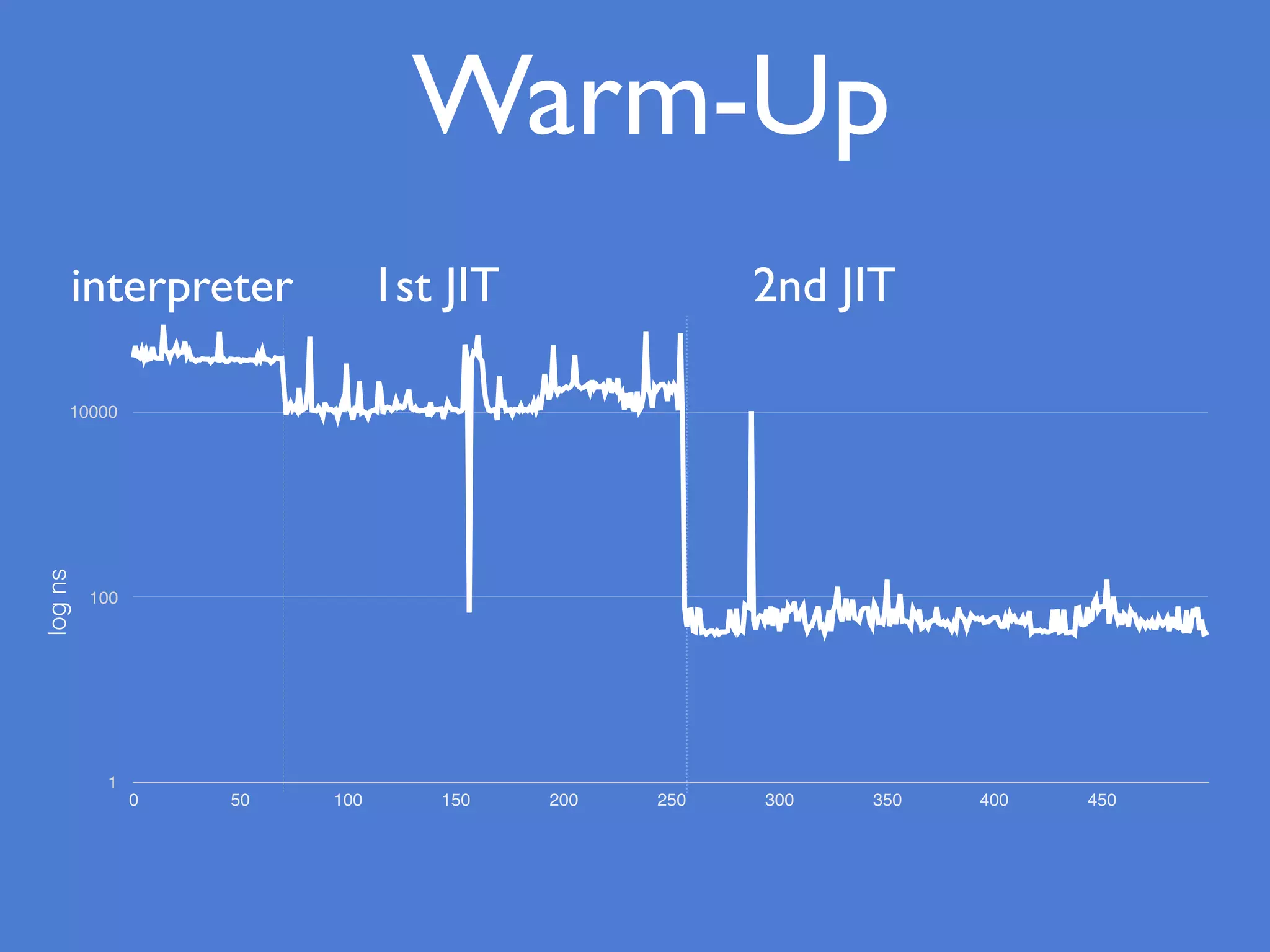
Warm-Up
interpreter 1st JIT 2nd JIT
logns
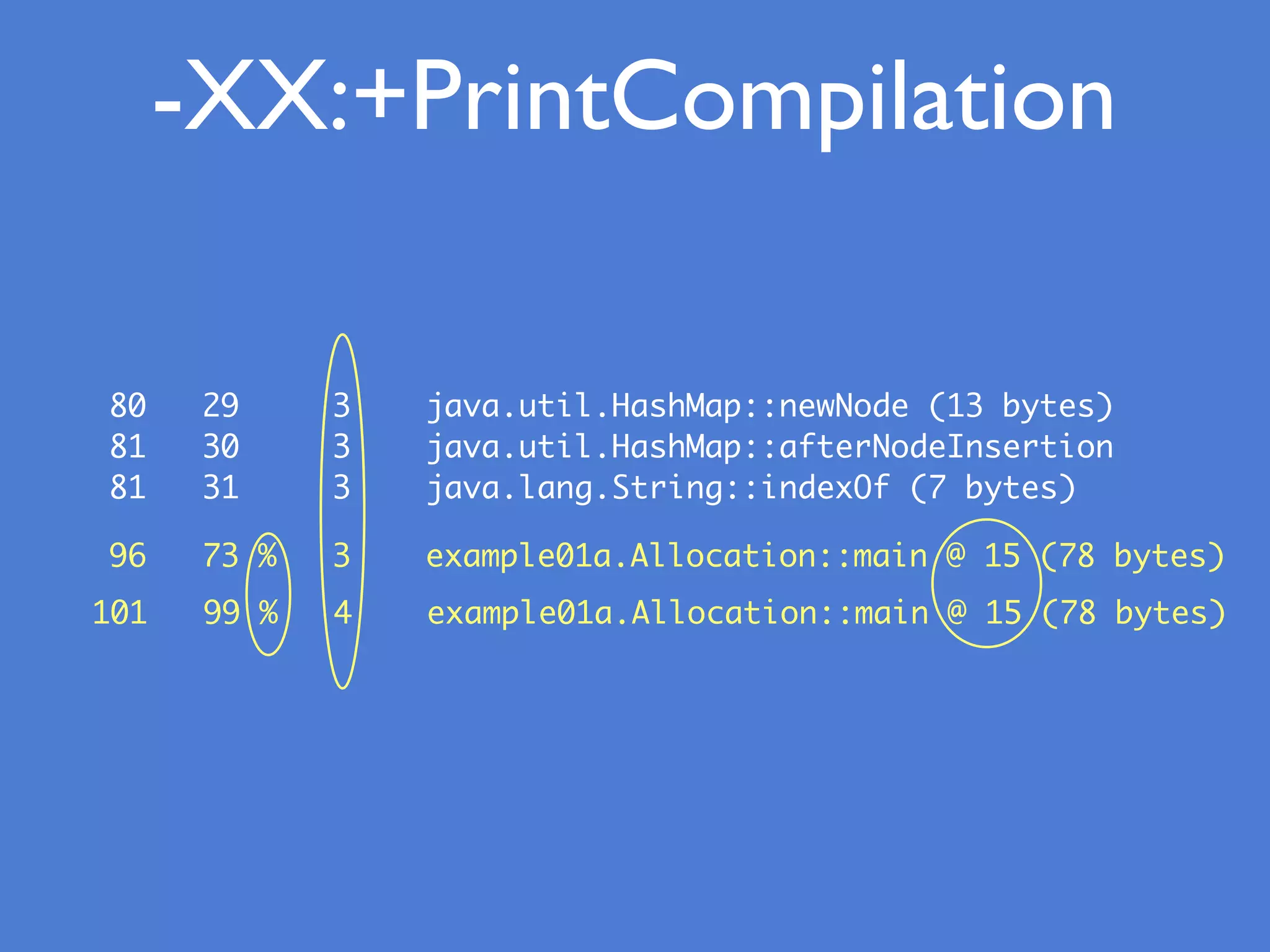
-XX:+PrintCompilation
80 29 3 java.util.HashMap::newNode (13 bytes)
81 30 3 java.util.HashMap::afterNodeInsertion
81 31 3 java.lang.String::indexOf (7 bytes)
96 73 % 3 example01a.Allocation::main @ 15 (78 bytes)
101 99 % 4 example01a.Allocation::main @ 15 (78 bytes)
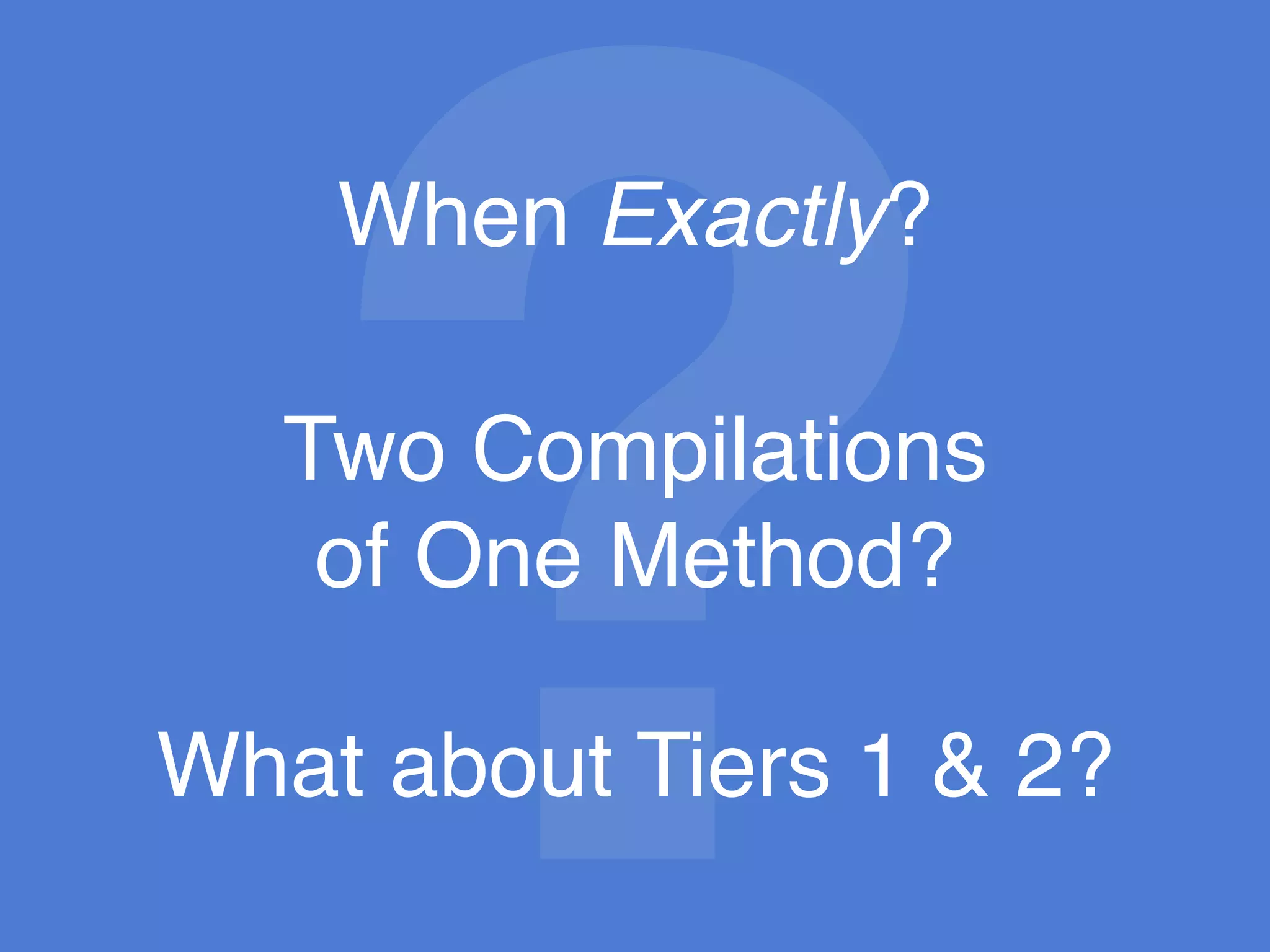
?Two Compilations
of One Method?
What about Tiers 1 & 2?
When Exactly?
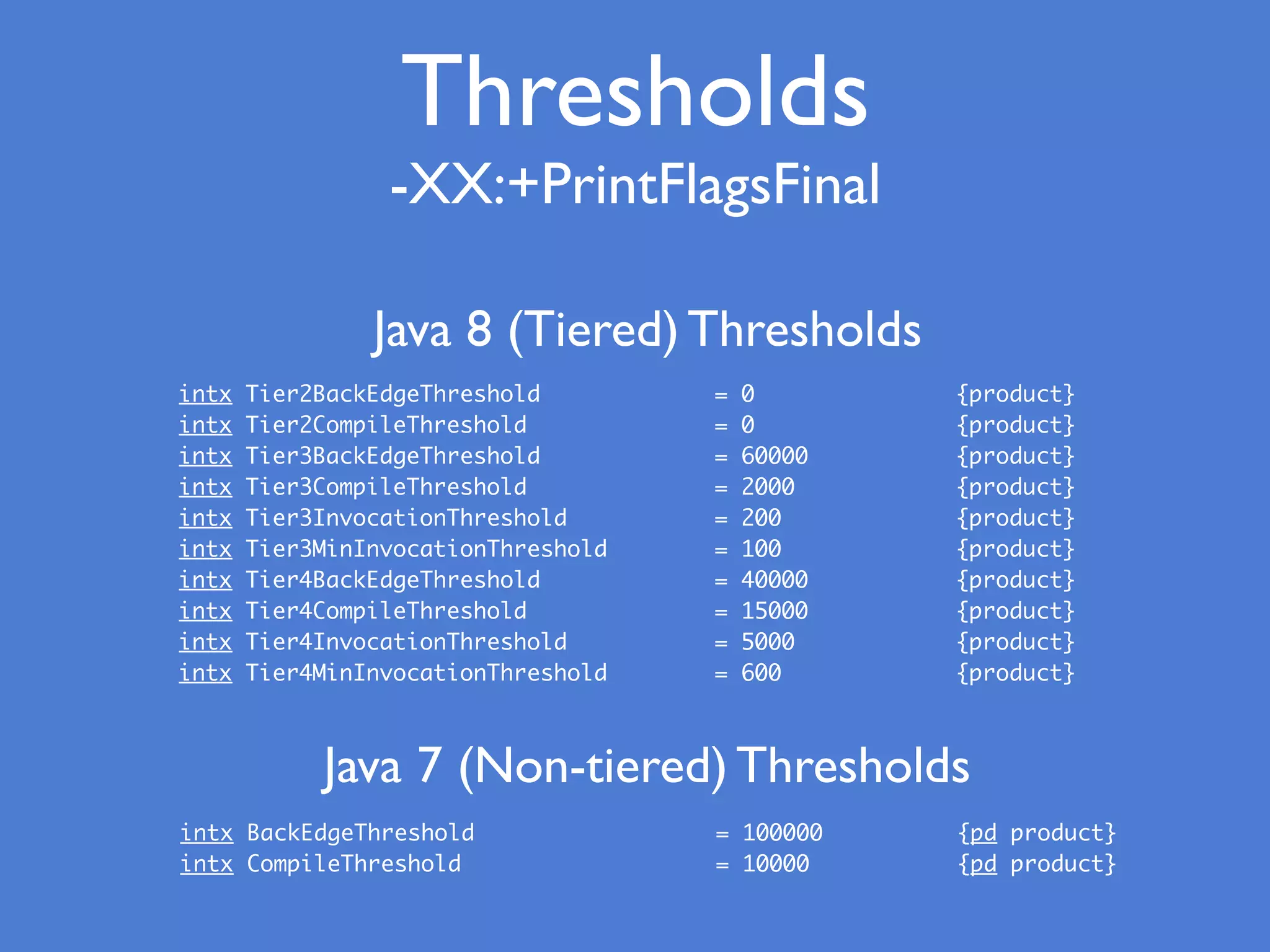
Thresholds
intx Tier2BackEdgeThreshold = 0 {product}
intx Tier2CompileThreshold = 0 {product}
intx Tier3BackEdgeThreshold = 60000 {product}
intx Tier3CompileThreshold = 2000 {product}
intx Tier3InvocationThreshold = 200 {product}
intx Tier3MinInvocationThreshold = 100 {product}
intx Tier4BackEdgeThreshold = 40000 {product}
intx Tier4CompileThreshold = 15000 {product}
intx Tier4InvocationThreshold = 5000 {product}
intx Tier4MinInvocationThreshold = 600 {product}
intx BackEdgeThreshold = 100000 {pd product}
intx CompileThreshold = 10000 {pd product}
Java 7 (Non-tiered) Thresholds
Java 8 (Tiered) Thresholds
-XX:+PrintFlagsFinal
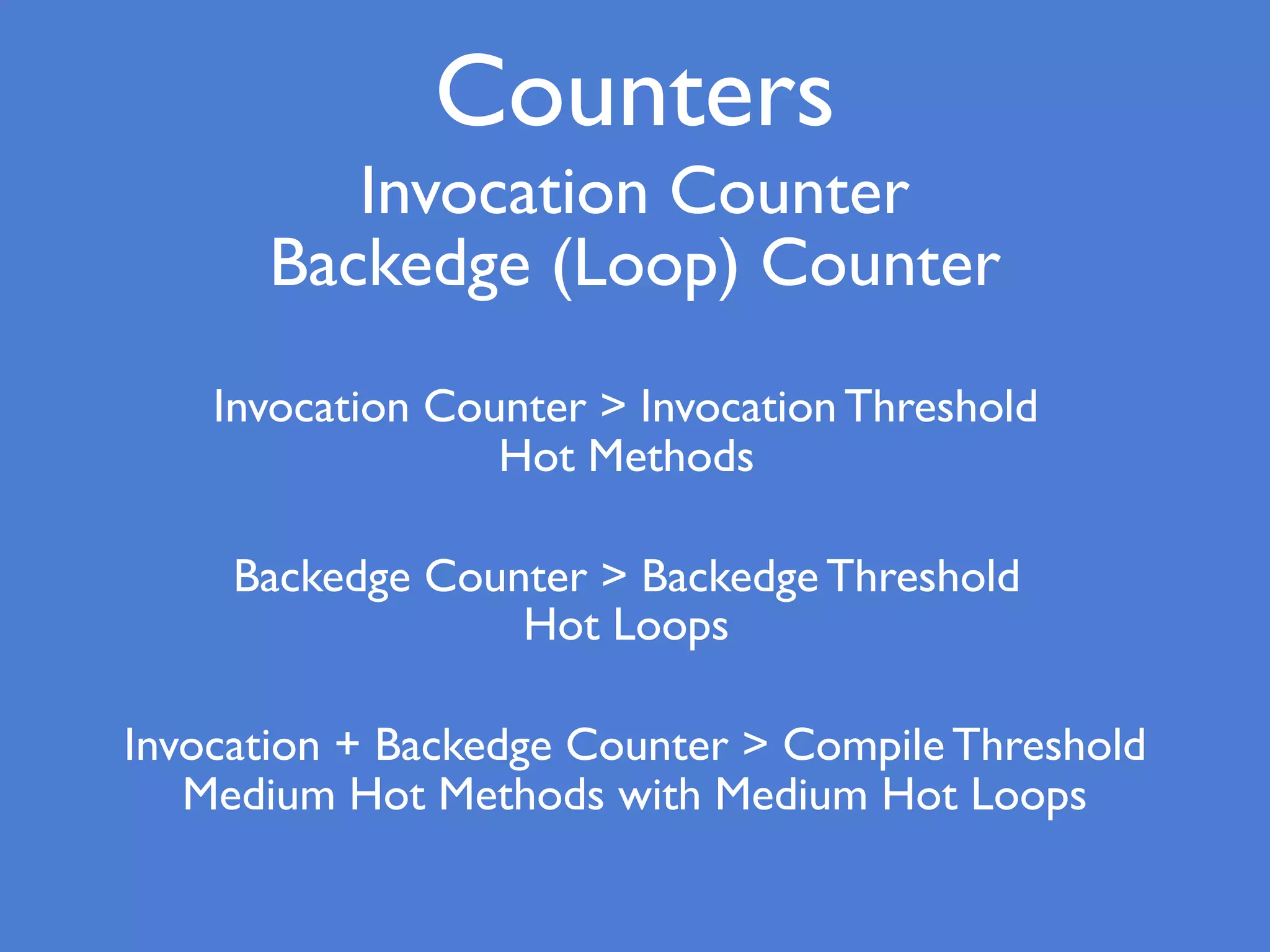
Counters
Invocation Counter
Backedge (Loop) Counter
Backedge Counter > Backedge Threshold
Hot Loops
Invocation Counter > Invocation Threshold
Hot Methods
Invocation + Backedge Counter > Compile Threshold
Medium Hot Methods with Medium Hot Loops
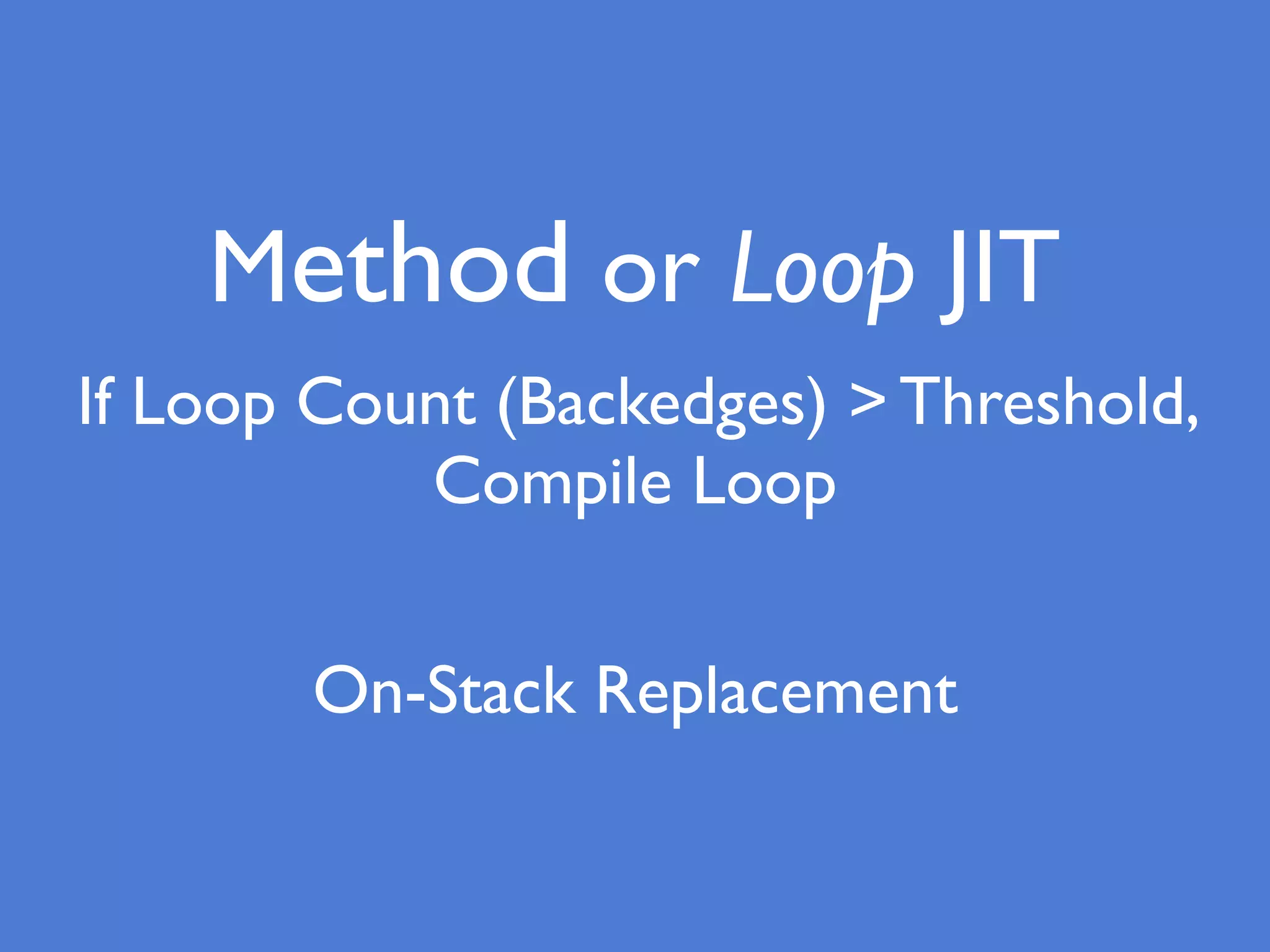
Method or Loop JIT
If Loop Count (Backedges) > Threshold,
Compile Loop
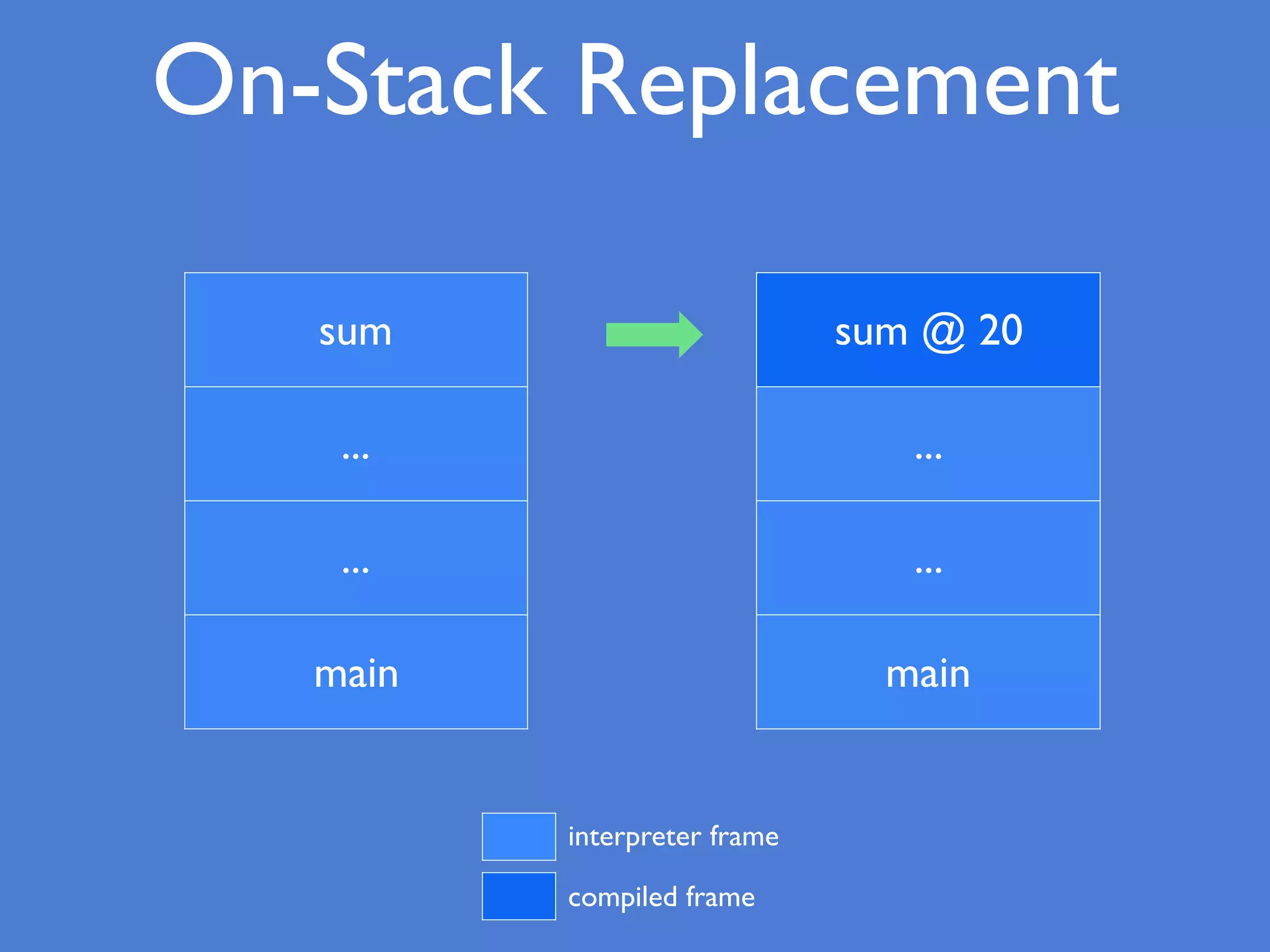
On-Stack Replacement
sum
...
...
main
sum @ 20
...
...
main
interpreter frame
compiled frame
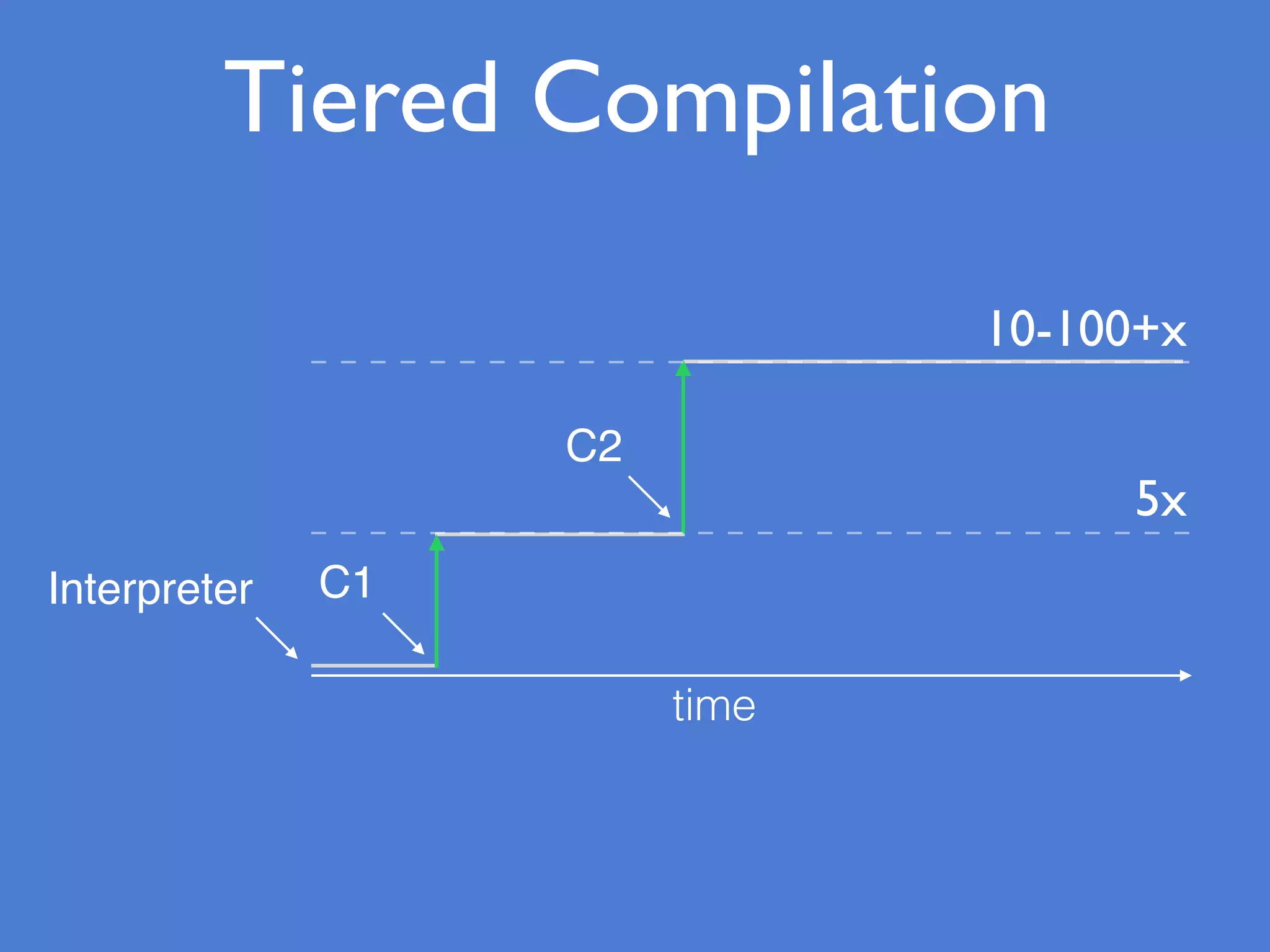
C2
C1Interpreter
time
Tiered Compilation
5x
10-100+x
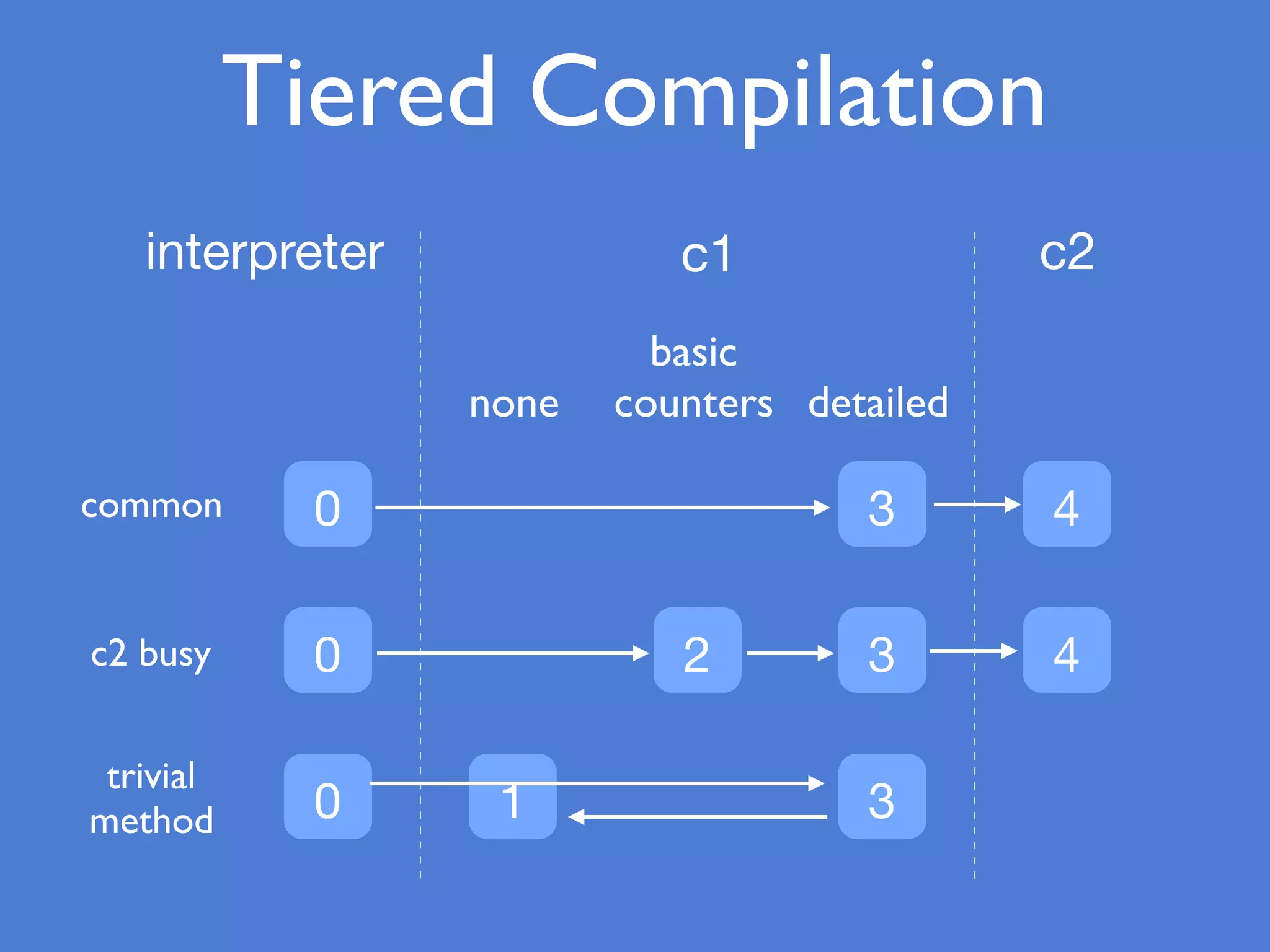
0
0
0
interpreter
3 4
2 3 4
1 3
c1 c2
none
basic
counters detailed
common
c2 busy
trivial
method
Tiered Compilation
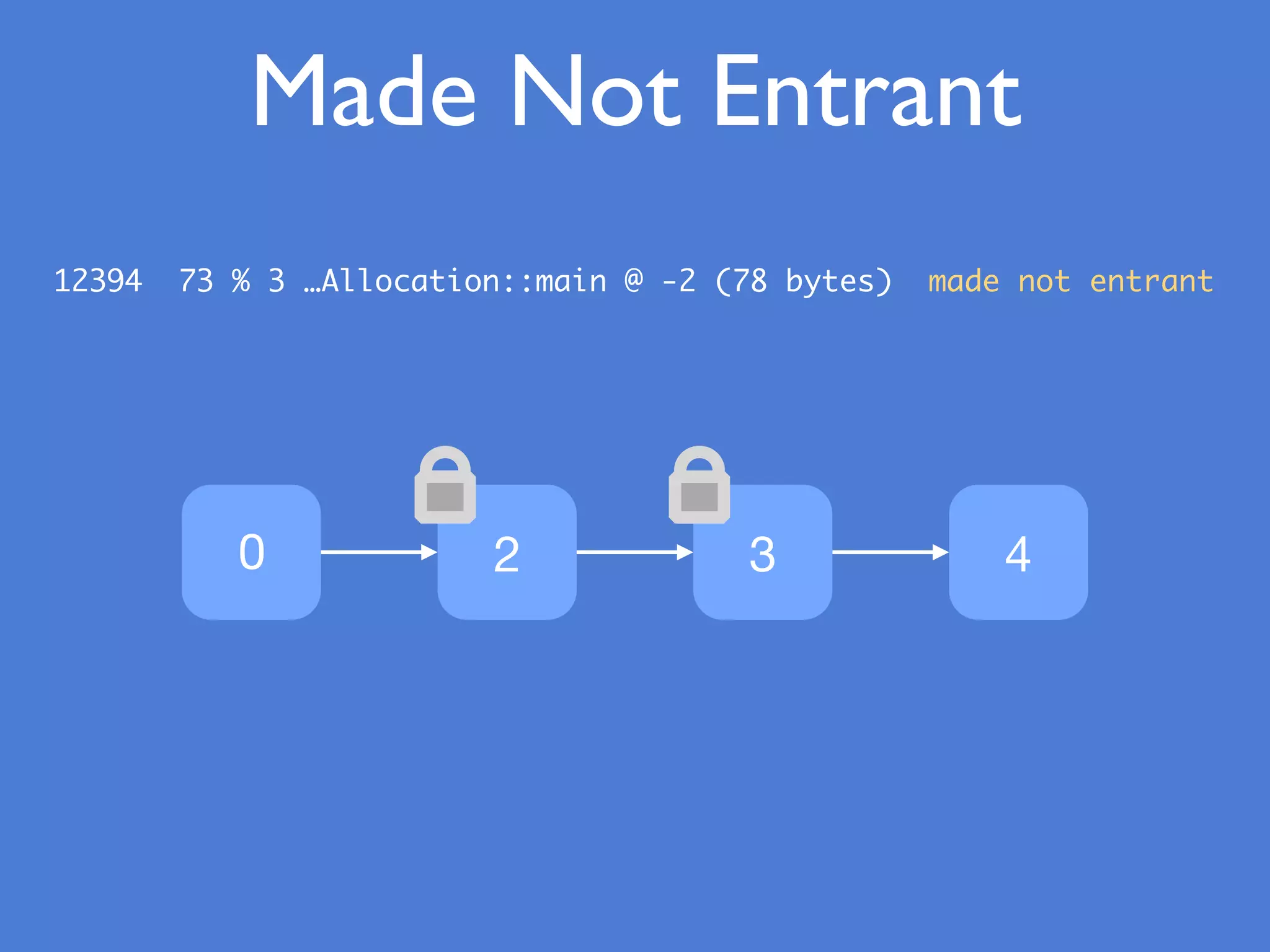
0 2 3 4
Made Not Entrant
12394 73 % 3 …Allocation::main @ -2 (78 bytes) made not entrant
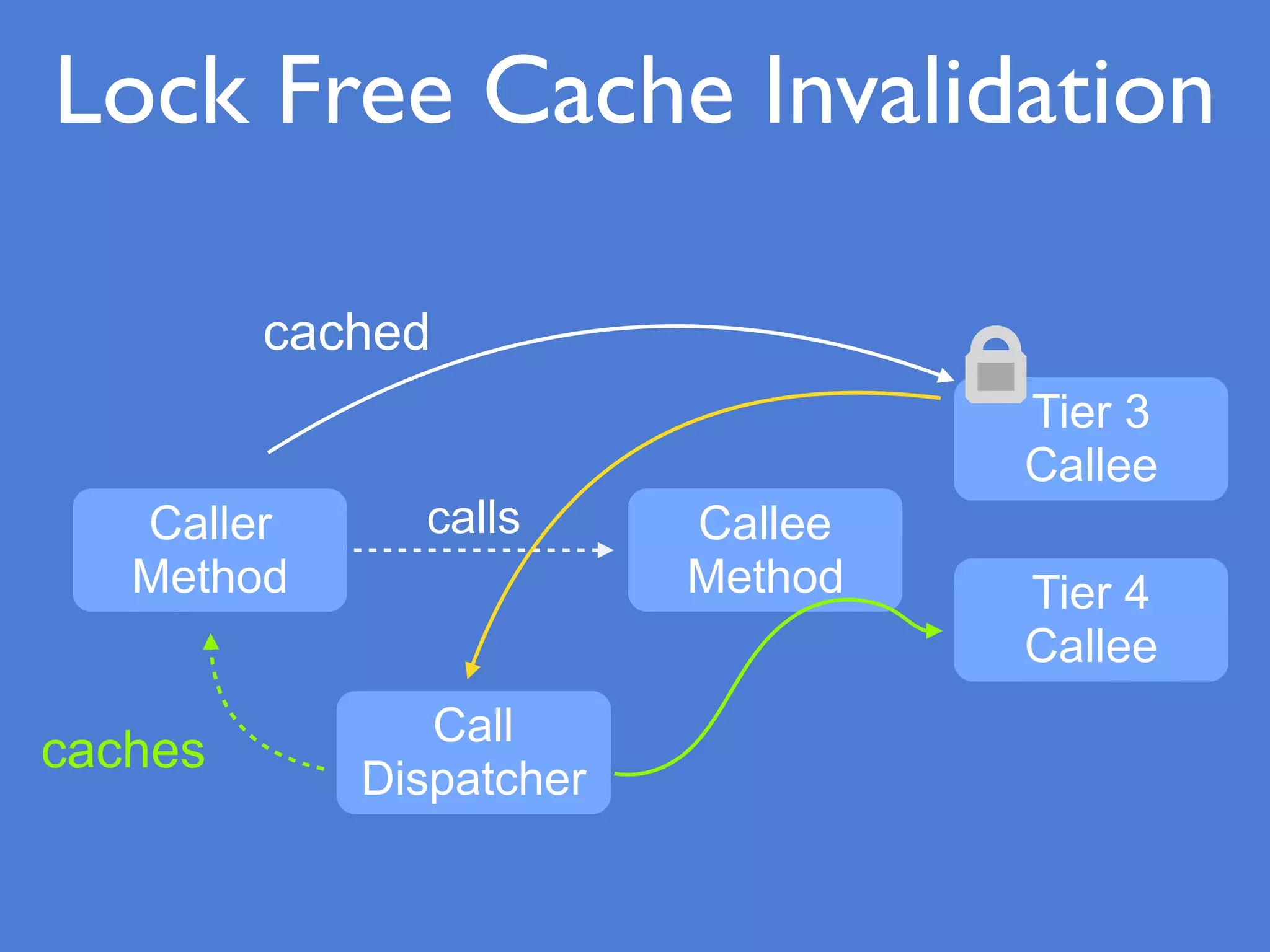
Caller
Method
Callee
Method
Tier 3
Callee
Call
Dispatcher
calls
cached
Tier 4
Callee
caches
Lock Free Cache Invalidation
HotSpot’s Job is to
Find Hot Spots
Rules for Triggering the
JIT Keep Changing
HotSpot JITs…
Hot Methods
Hot Loops
Warm Methods with Warm Loops
?What Does
the JIT C2 Do?
Focus on Final Tier
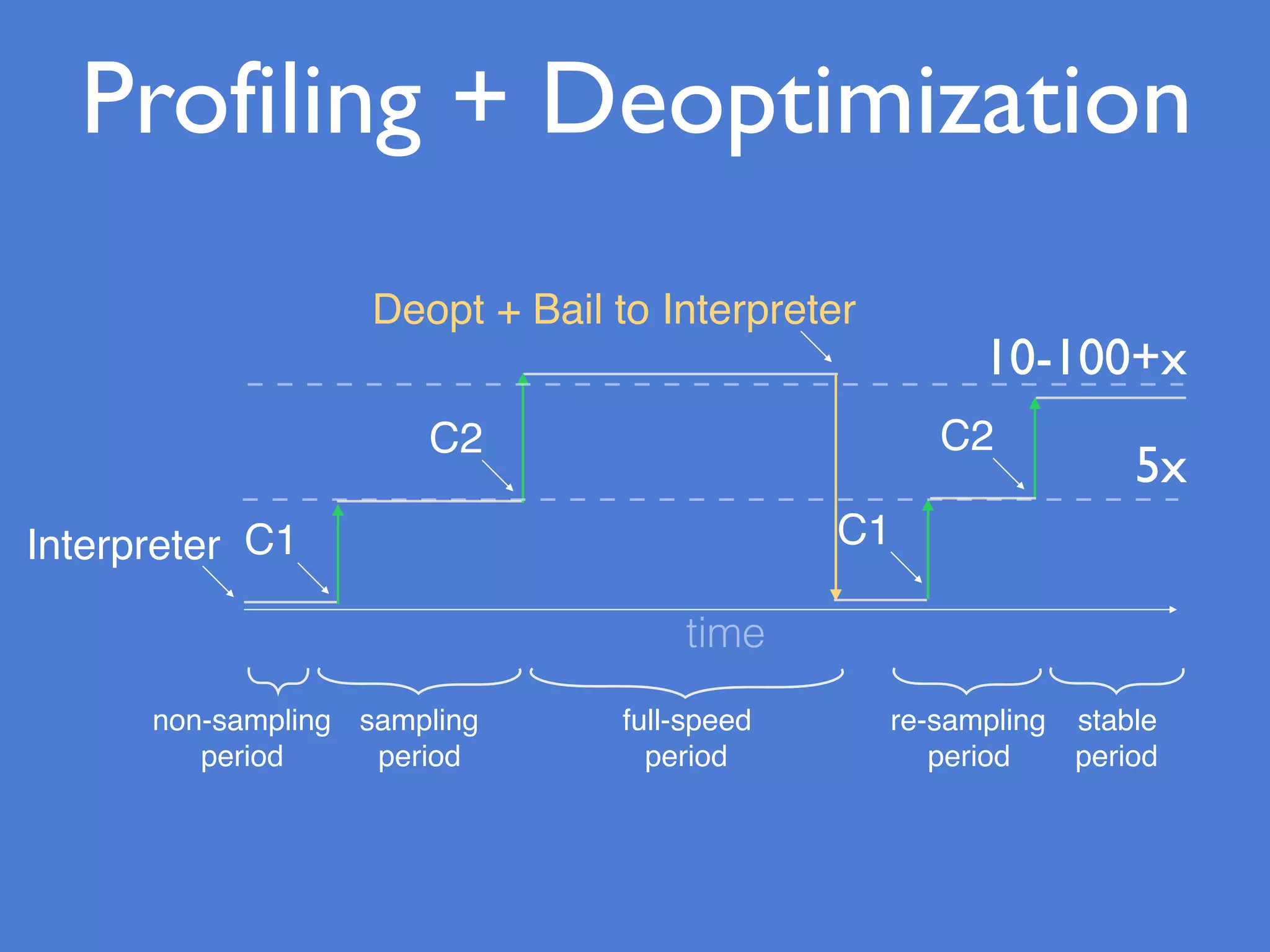
non-sampling
period
sampling
period
full-speed
period
C2
C1Interpreter
time
C1
C2
re-sampling
period
stable
period
Deopt + Bail to Interpreter
Profiling + Deoptimization
5x
10-100+x
public class AllocationTrap {
static final int CHUNK_SIZE = 1_000;
public static void main(String[] args) {
Object trap = null;
for ( int i = 0; i < 500; ++i ) {
long startTime = System.nanoTime();
for ( int j = 0; j < CHUNK_SIZE; ++j ) {
new Object();
if ( trap != null ) {
System.out.println(“trap!");
trap = null;
}
}
if ( i == 400 ) trap = new Object();
long endTime = System.nanoTime();
System.out.printf("%dt%d%n", i, endTime - startTime);
}
}
}
S:01B
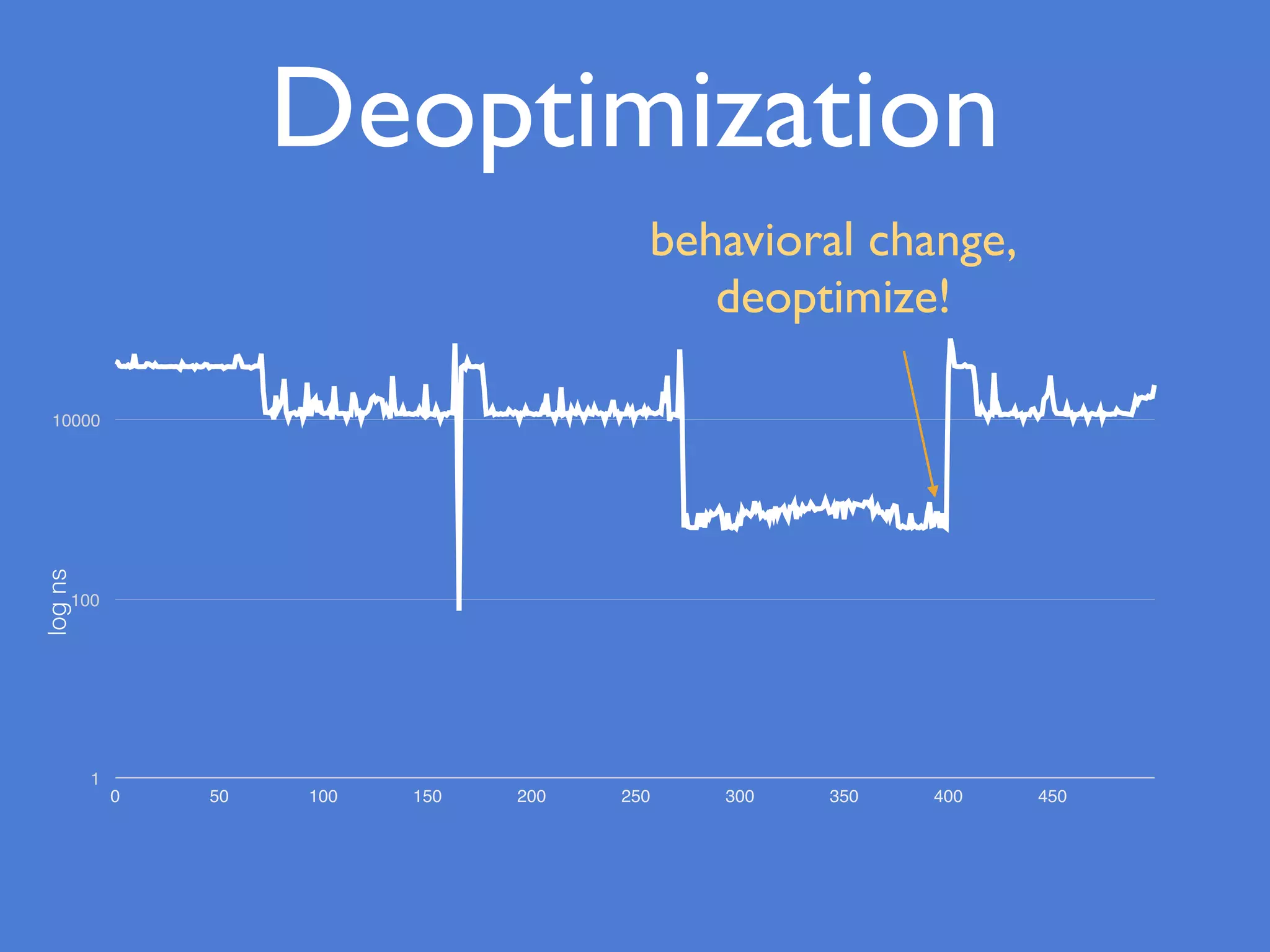
1
100
10000
0 50 100 150 200 250 300 350 400 450
Deoptimization
behavioral change,
deoptimize!
logns
Returning to forEach
ArrayList<E>.forEach(Consumer<? super E> action) {
for ( int i = 0; i < this.size; i++ ) {
action.accept(this.elementData[i]);
}
}
Something “Simpler”
ArrayStream<E>.forEach(Consumer<? super E> action) {
for ( int i = 0; i < this.elementData.length; i++ ) {
action.accept(this.elementData[i]);
}
}
“Simpler” Bound
Implied Safety Code
ArrayStream<E>.forEach(Consumer<? super E> action) {
if ( this == null ) throw new NPE();
if ( this.elementData == null ) throw new NPE();
for ( int i = 0; i < this.elementData.length; i++ ) {
if ( this == null ) throw new NPE();
if ( this.elementData == null ) throw new NPE();
if ( i < 0 ) throw new AIOBE();
if ( i >= this.elementData.length ) throw new AIOBE();
if ( action == null ) throw new NPE();
action.accept(this.elementData[i]);
}
}
Null Check Elimination
ArrayStream<E>.forEach(Consumer<? super E> action) {
if ( this == null ) throw new NPE();
if ( this.elementData == null ) throw new NPE();
for ( int i = 0; i < this.elementData.length; i++ ) {
if ( this == null ) throw new NPE();
if ( this.elementData == null ) throw new NPE();
if ( i < 0 ) throw new AIOBE();
if ( i >= this.elementData.length ) throw new AIOBE();
if ( action == null ) throw new NPE();
action.accept(this.elementData[i]);
}
}
this != null
Lower Bound Check Elimination
ArrayStream<E>.forEach(Consumer<? super E> action) {
if ( this.elementData == null ) throw new NPE();
for ( int i = 0; i < this.elementData.length; i++ ) {
if ( this.elementData == null ) throw new NPE();
if ( i < 0 ) throw new AIOBE();
if ( i >= this.elementData.length ) throw new AIOBE();
if ( action == null ) throw new NPE();
action.accept(this.elementData[i]);
}
}
i >= 0
i <= INT_MAX
ArrayStream<E>.forEach(Consumer<? super E> action) {
if ( this.elementData == null ) throw new NPE();
for ( int i = 0; i < this.elementData.length; i++ ) {
if ( this.elementData == null ) throw new NPE();
if ( i >= this.elementData.length ) throw new AIOBE();
if ( !(i < this.elementData.length) ) throw new AIOBE();
if ( action == null ) throw new NPE();
action.accept(this.elementData[i]);
}
}
Canonicalize Upper Bound
Canonicalize
ArrayStream<E>.forEach(Consumer<? super E> action) {
if ( this.elementData == null ) throw new NPE();
for ( int i = 0; i < this.elementData.length; i++ ) {
if ( this.elementData == null ) throw new NPE();
if ( !(i < this.elementData.length) ) throw new AIOBE();
if ( action == null ) throw new NPE();
action.accept(this.elementData[i]);
}
}
Upper Bound Check Elimination
Common
Sub-
Expression
* Really GlobalValue Numbering
*
Cached Length isn’t Better!
public class ArrayStream<E> interface Stream<E> {
private final E[] elementData;
private final int size;
public ArrayStream(E… elements) {
this.elementData = elements;
this.size = elements.length;
}
forEach(Consumer<? super E> action) {
if ( this.elementData == null ) throw new NPE();
for ( int i = 0; i < this.size; i++ ) {
if ( this.elementData == null ) throw new NPE();
if ( i >= this.elementData.length ) throw new AIOBE();
if ( action == null ) throw new NPE();
action.accept(this.elementData[i]);
}
}
}
mismatch!
Confuses the JIT
ArrayStream<E>.forEach(Consumer<? super E> action) {
if ( this.elementData == null ) throw new NPE();
for ( int i = 0; i < this.elementData.length; i++ ) {
if ( this.elementData == null ) throw new NPE();
if ( action == null ) throw new NPE();
action.accept(this.elementData[i]);
}
}
What Else?
What Else
Can Be
Done?
ArrayStream<E>.forEach(Consumer<? super E> action) {
if ( this.elementData == null ) throw new NPE();
for ( int i = 0; i < this.elementData.length; i++ ) {
if ( this.elementData == null ) throw new NPE();
if ( action == null ) throw new NPE();
action.accept(this.elementData[i]);
}
}
Null Pointer Checks
Required -
cannot
optimize
further?
Assume
non-null
from
above?
Required -
cannot
optimize
further?
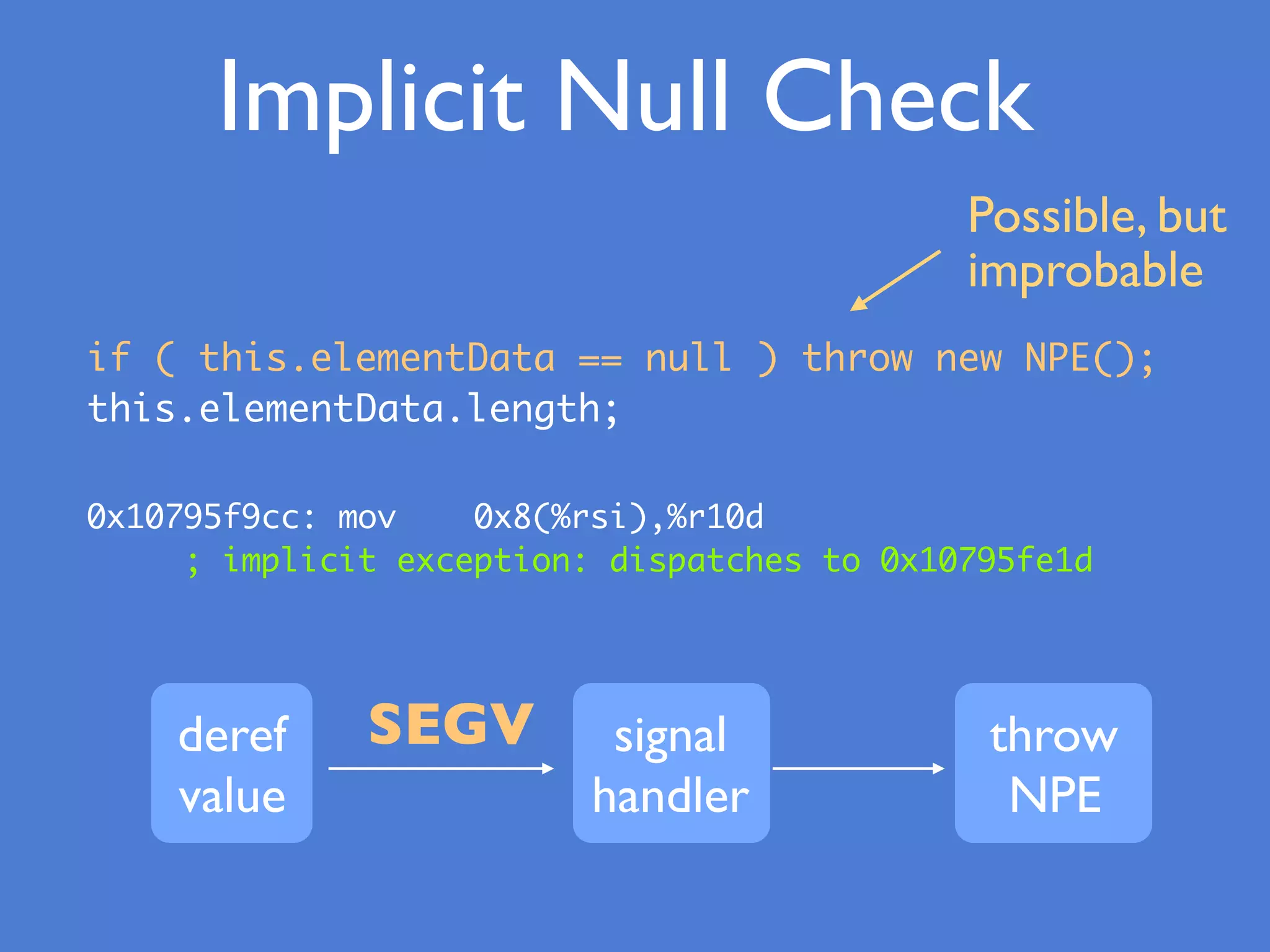
Implicit Null Check
if ( this.elementData == null ) throw new NPE();
this.elementData.length;
Possible, but
improbable
SEGVderef
value
signal
handler
throw
NPE
0x10795f9cc: mov 0x8(%rsi),%r10d
; implicit exception: dispatches to 0x10795fe1d
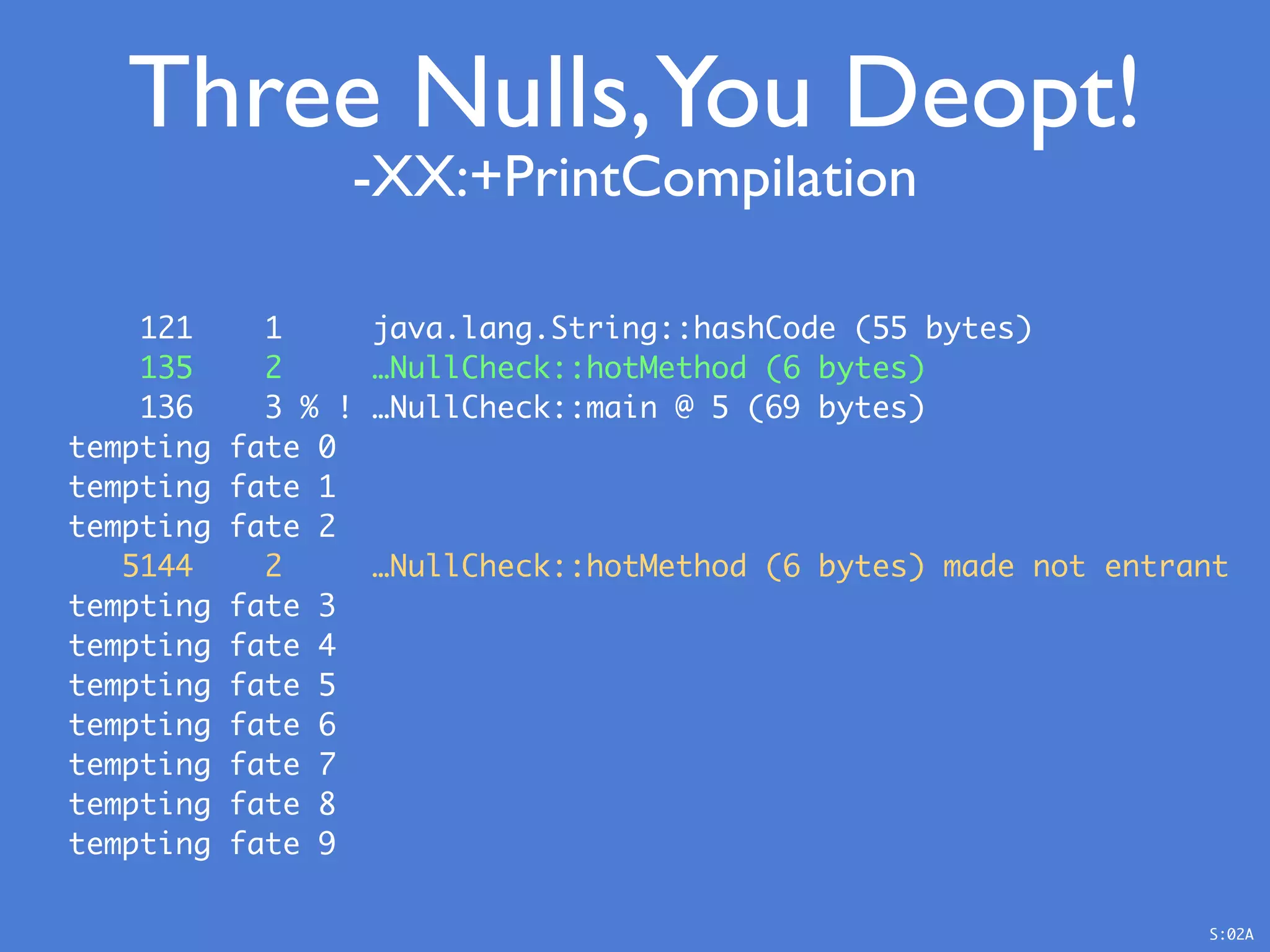
Three Nulls,You Deopt!
-XX:+PrintCompilation
121 1 java.lang.String::hashCode (55 bytes)
135 2 …NullCheck::hotMethod (6 bytes)
136 3 % ! …NullCheck::main @ 5 (69 bytes)
tempting fate 0
tempting fate 1
tempting fate 2
5144 2 …NullCheck::hotMethod (6 bytes) made not entrant
tempting fate 3
tempting fate 4
tempting fate 5
tempting fate 6
tempting fate 7
tempting fate 8
tempting fate 9
S:02A
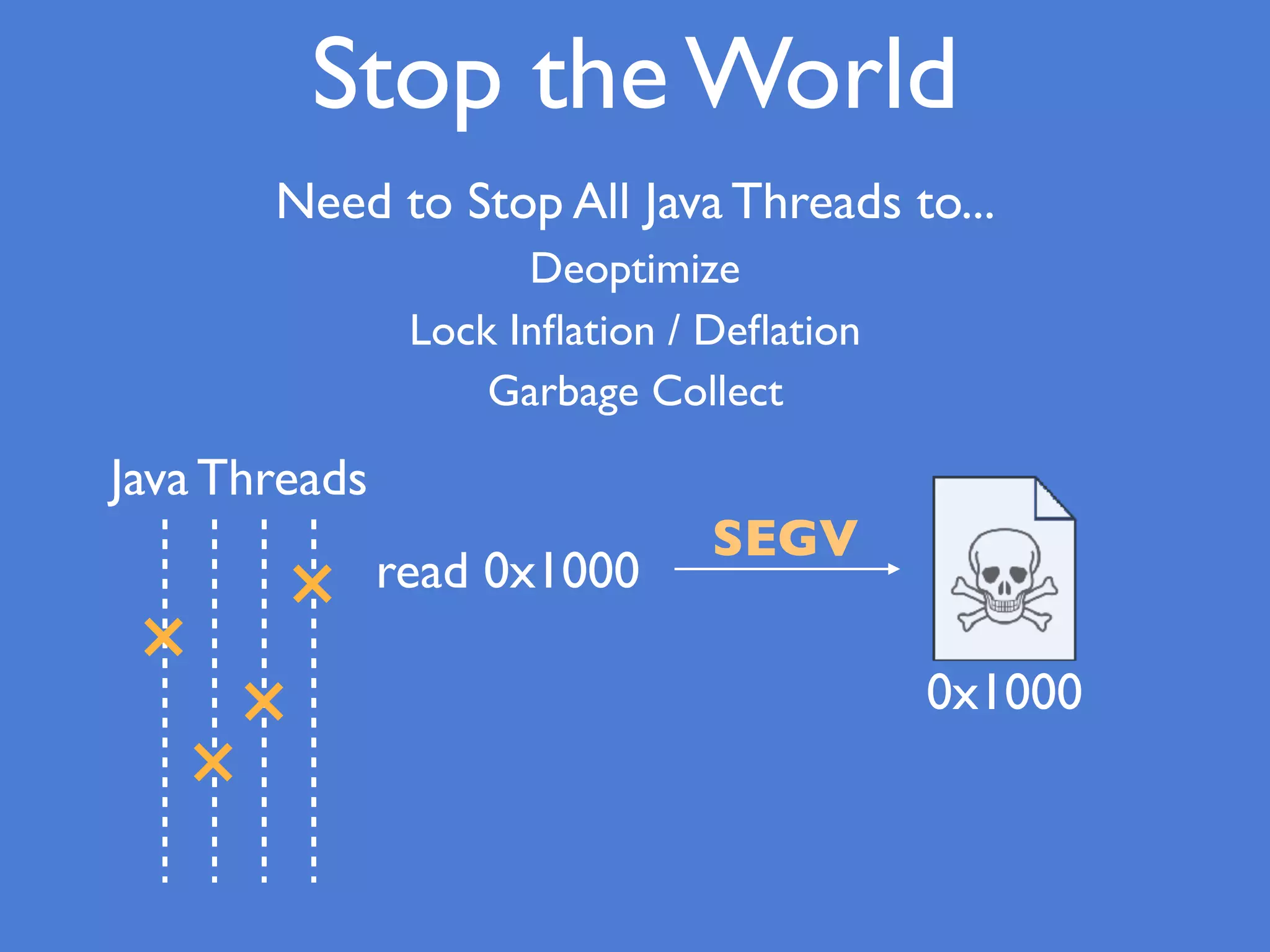
Stop the World
Need to Stop All Java Threads to...
Deoptimize
Lock Inflation / Deflation
Garbage Collect
Java Threads
read 0x1000
0x1000
SEGV
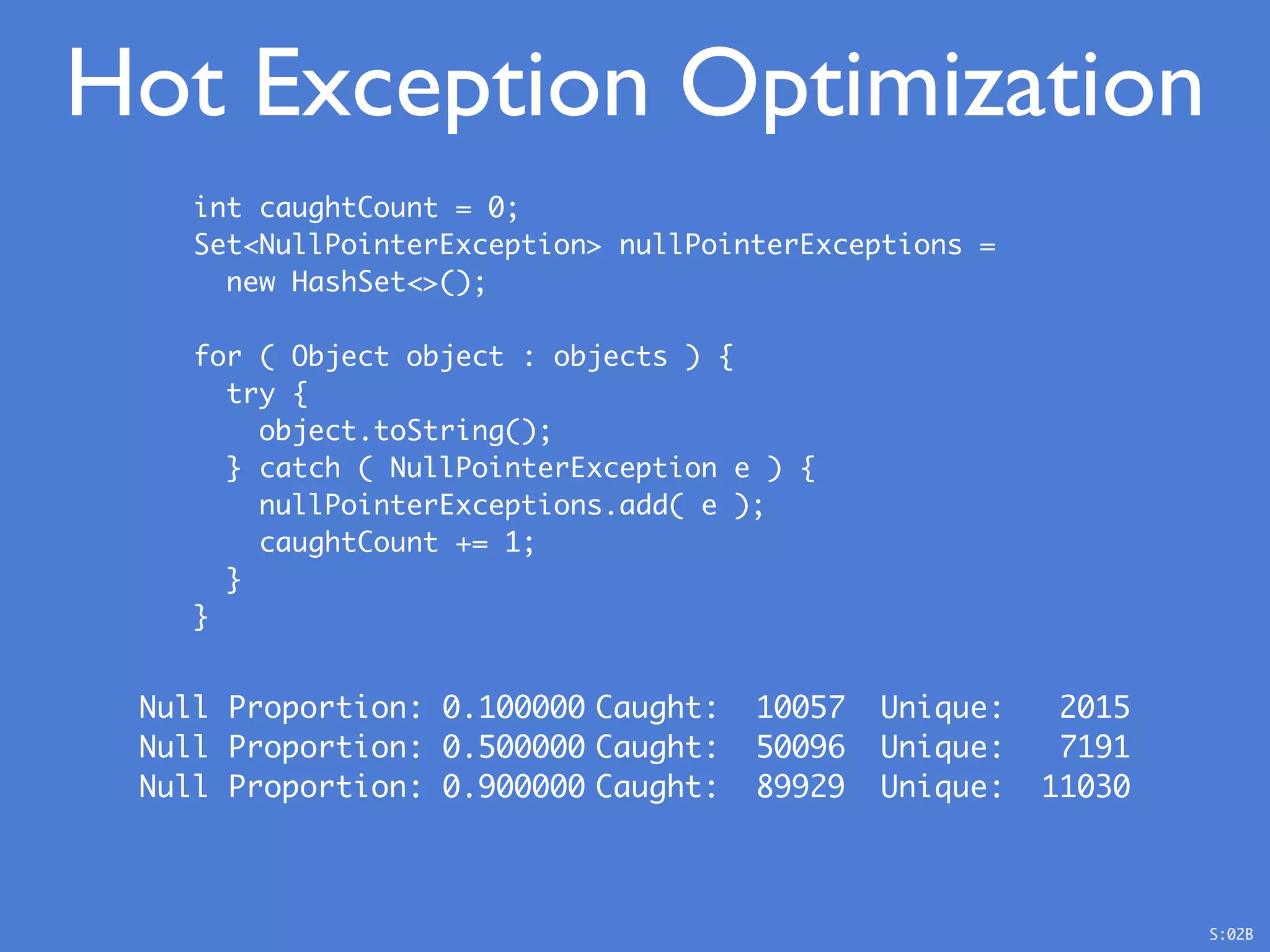
Null Proportion: 0.100000 Caught: 10057 Unique: 2015
Null Proportion: 0.500000 Caught: 50096 Unique: 7191
Null Proportion: 0.900000 Caught: 89929 Unique: 11030
int caughtCount = 0;
Set<NullPointerException> nullPointerExceptions =
new HashSet<>();
for ( Object object : objects ) {
try {
object.toString();
} catch ( NullPointerException e ) {
nullPointerExceptions.add( e );
caughtCount += 1;
}
}
Hot Exception Optimization
S:02B
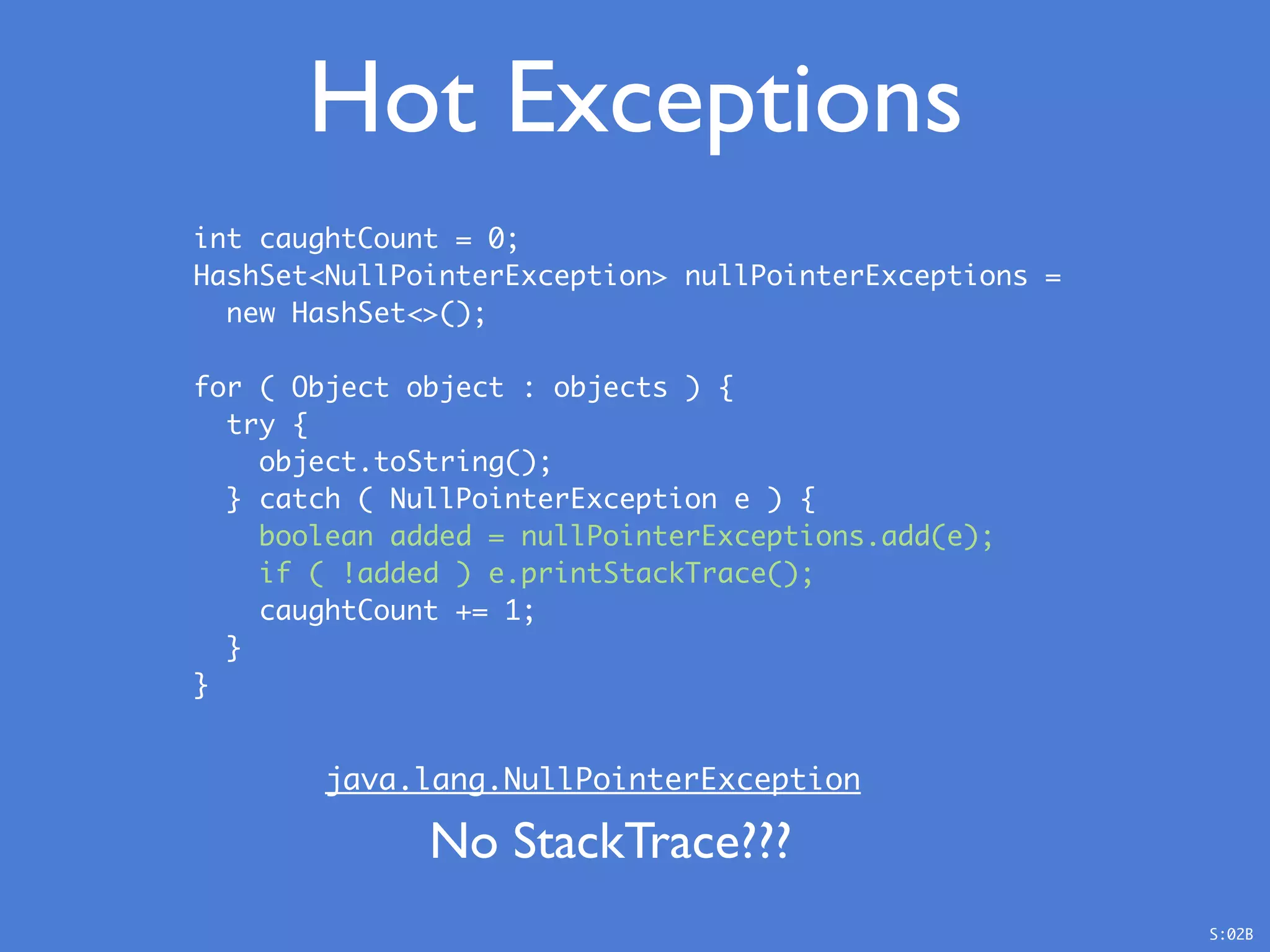
Hot Exceptions
int caughtCount = 0;
HashSet<NullPointerException> nullPointerExceptions =
new HashSet<>();
for ( Object object : objects ) {
try {
object.toString();
} catch ( NullPointerException e ) {
boolean added = nullPointerExceptions.add(e);
if ( !added ) e.printStackTrace();
caughtCount += 1;
}
}
java.lang.NullPointerException
No StackTrace???
S:02B
ArrayStream<E>.forEach(Consumer<? super E> action) {
if ( this.elementData == null ) throw new NPE();
for ( int i = 0; i < this.elementData.length; i++ ) {
if ( this.elementData == null ) throw new NPE();
if ( action == null ) throw new NPE();
action.accept(this.elementData[i]);
}
}
Total Elimination is Better!
Assume
non-null
from
above?
Common Sub-Expression
if ( this.elementData == null ) throw new NPE();
Requires knowing that…
null doesn’t change
this doesn’t change
this.elementData doesn’t change
easy
hard
for ( … ) {
if ( this.elementData == null ) throw new NPE();
}
The Other “Easy” One
LocalVariable: action
ArrayStream<E>.forEach(Consumer<? super E> action) {
if ( this.elementData == null ) throw new NPE();
for ( int i = 0; i < this.elementData.length; i++ ) {
if ( this.elementData == null ) throw new NPE();
if ( action == null ) throw new NPE();
action.accept(this.elementData[i]);
}
}
CANNOT be changed by
another thread or method.
Loop Peeling
ArrayStream<E>.forEach(Consumer<? super E> action) {
if ( this.elementData == null ) throw new NPE();
// i=0 iteration
if ( 0 < this.elementData.length ) {
if ( this.elementData == null ) throw NPE();
if ( action == null ) throw new NPE();
action.accept(this.elementData[0]);
}
// rest of the iterations
for ( int i = 1; i < this.elementData.length; i++ ) {
if ( this.elementData == null ) throw new NPE();
if ( action == null ) throw new NPE();
action.accept(this.elementData[i]);
}
}
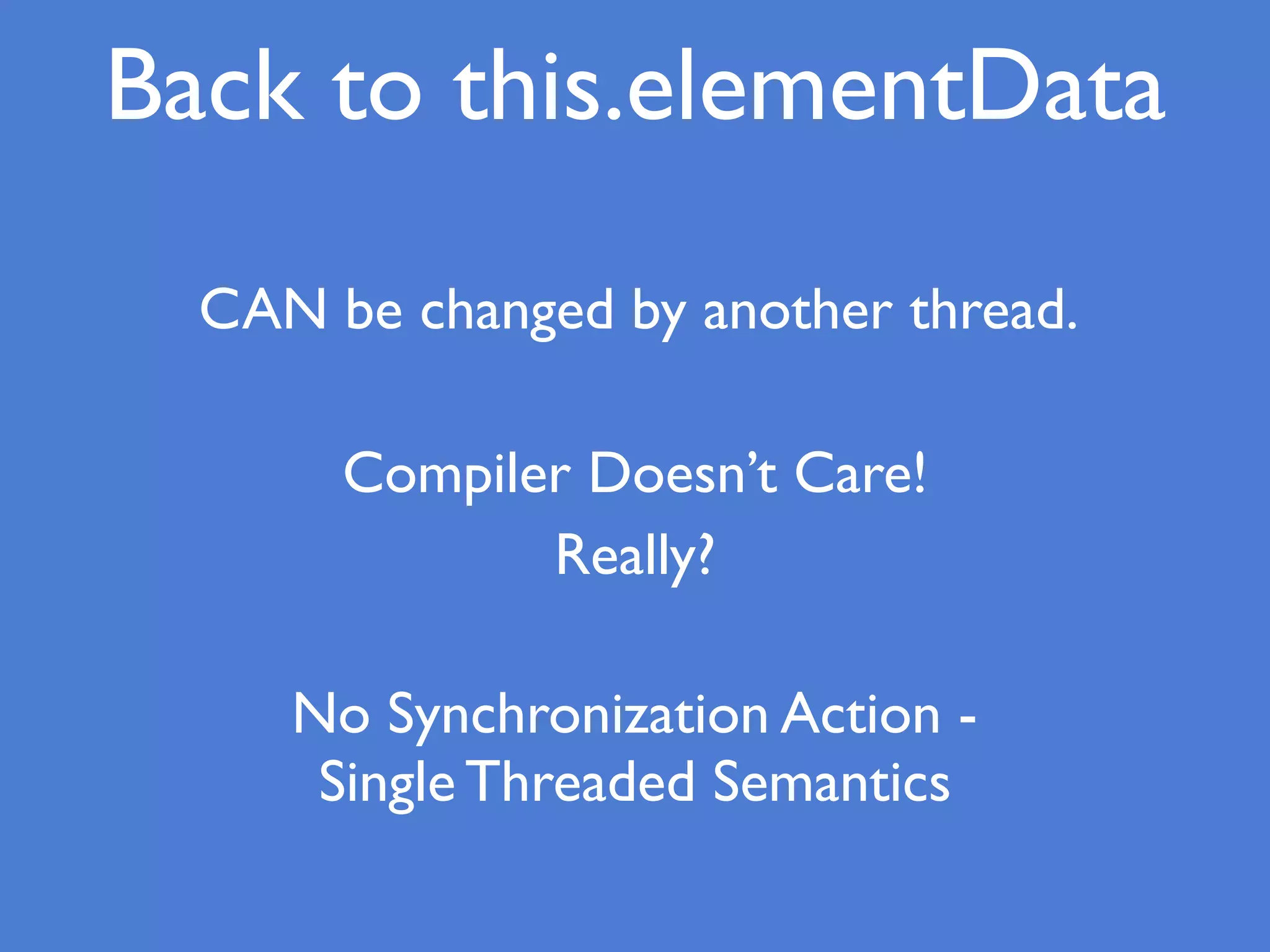
Back to this.elementData
CAN be changed by another thread.
Compiler Doesn’t Care!
Really?
No Synchronization Action -
Single Threaded Semantics
Loop Invariant Hoisting?
ArrayStream<E>.forEach(Consumer<? super E> action) {
E[] elementData = this.elementData;
int len = elementData.length;
if ( elementData == null ) throw new NPE();
// i=0 iteration
if ( 0 < len ) {
if ( elementData == null ) throw NPE();
if ( action == null ) throw new NPE();
action.accept(this.elementData[0]);
}
// rest of the iterations
for ( int i = 1; i < elementData.length; i++ ) {
if ( elementData == null ) throw new NPE();
action.accept(elementData[i]);
}
}
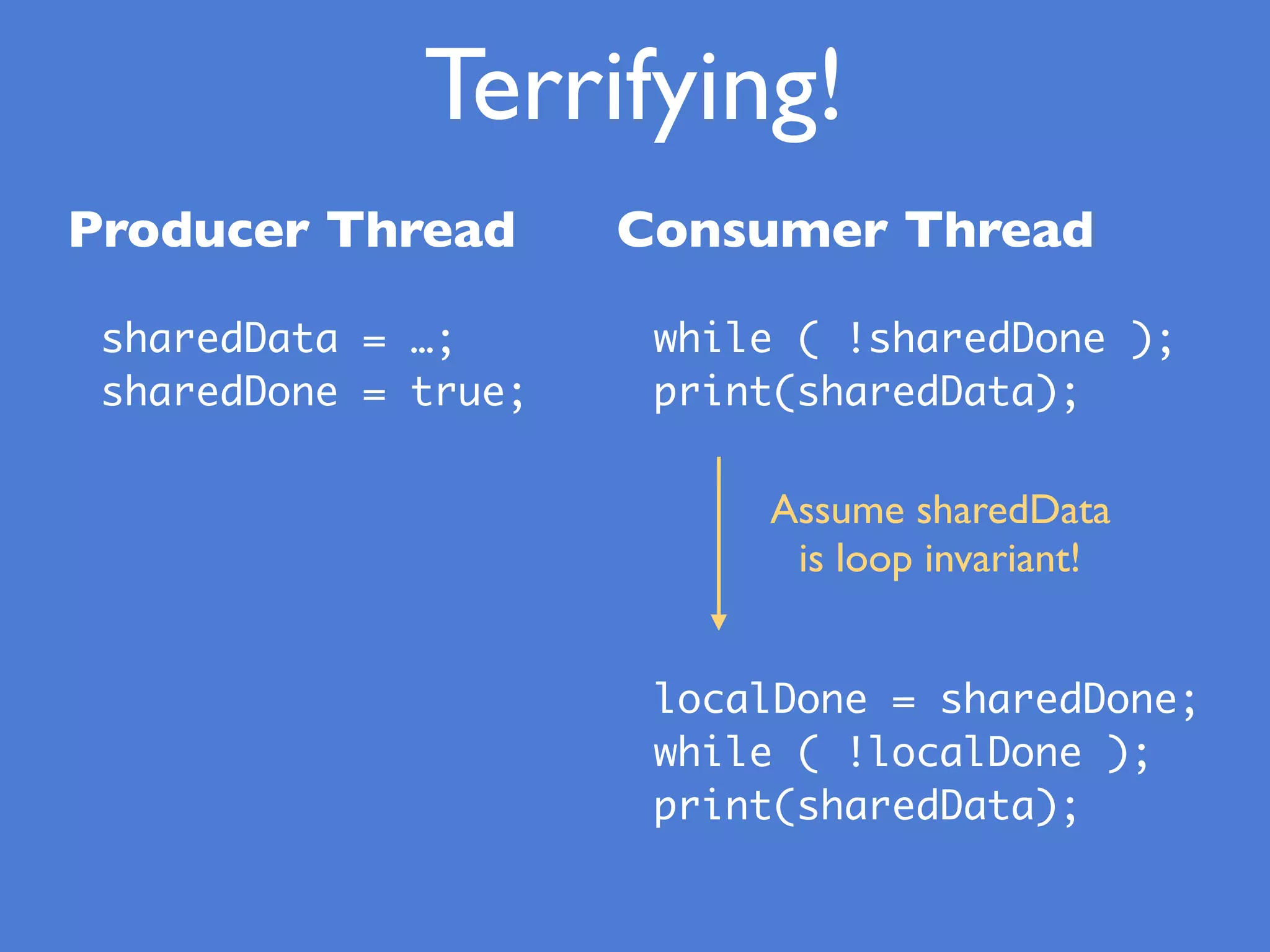
Terrifying!
while ( !sharedDone );
print(sharedData);
sharedData = …;
sharedDone = true;
Consumer ThreadProducer Thread
Assume sharedData
is loop invariant!
localDone = sharedDone;
while ( !localDone );
print(sharedData);
Not So Fast
Single Threaded Side Effects
ArrayStream<E>.forEach(Consumer<? super E> action) {
if ( this.elementData == null ) throw new NPE();
// i=0 iteration
if ( 0 < this.elementData.length ) {
if ( this.elementData == null ) throw NPE();
if ( action == null ) throw new NPE();
action.accept(this.elementData[0]);
}
// rest of the iterations
for ( int i = 1; i < this.elementData.length; i++ ) {
if ( this.elementData == null ) throw new NPE();
action.accept(this.elementData[i]);
}
}
Can
this.elementData
change? YES
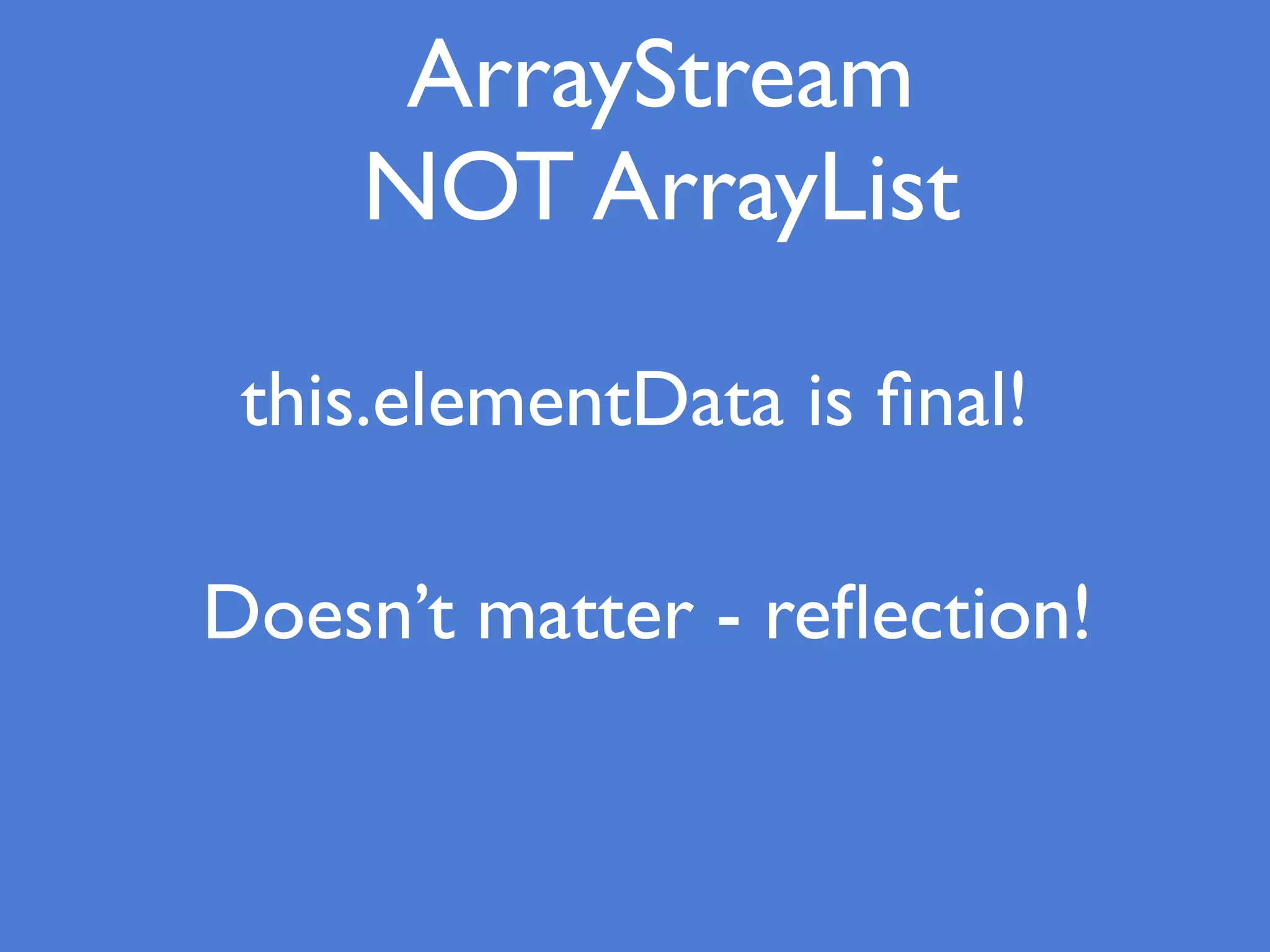
ArrayStream
NOT ArrayList
this.elementData is final!
Doesn’t matter - reflection!
A Call is a
“Black Box”
which may
contain
“Evils”!
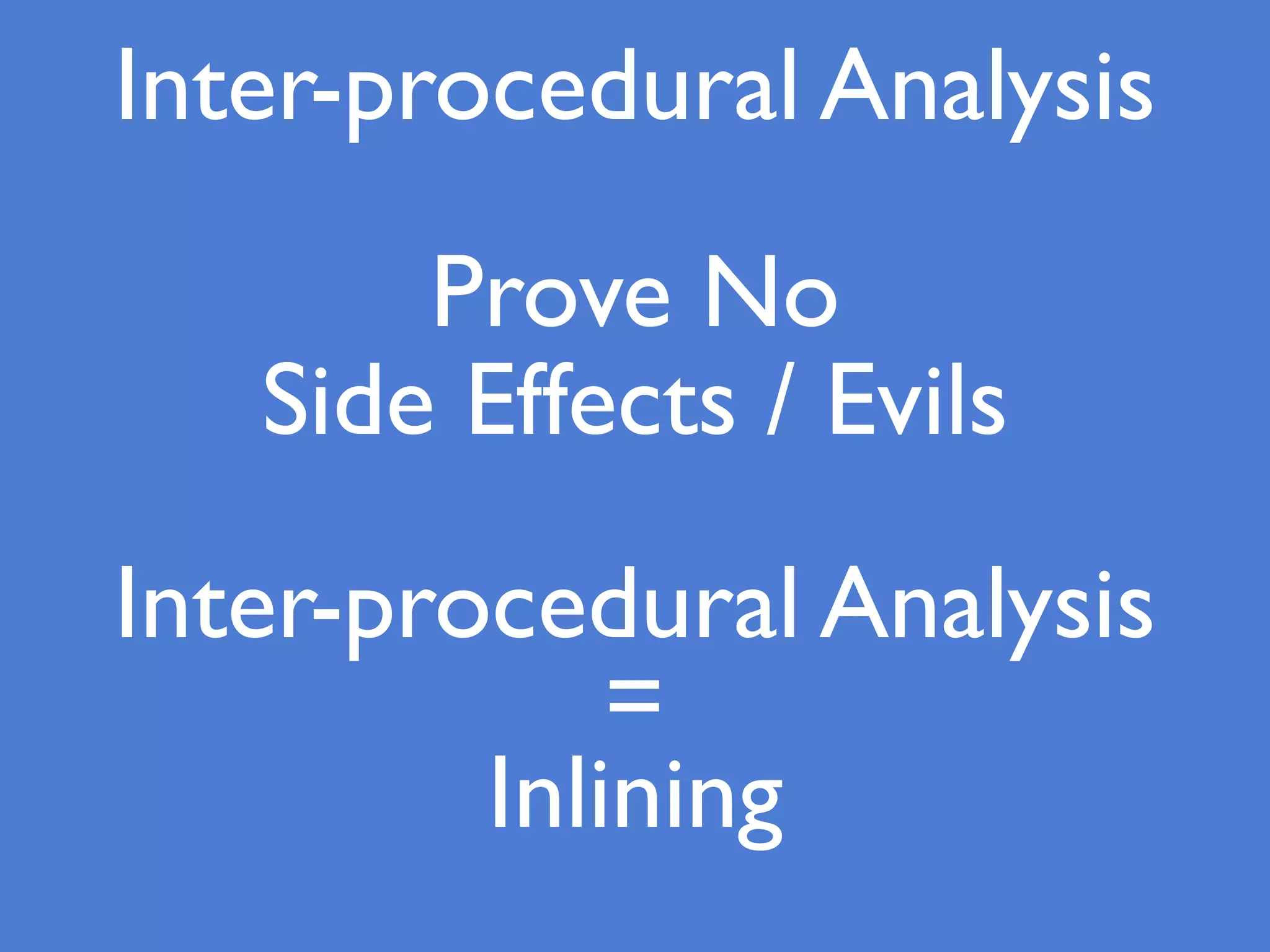
Inter-procedural Analysis
Prove No
Side Effects / Evils
Inter-procedural Analysis
=
Inlining
Inlining
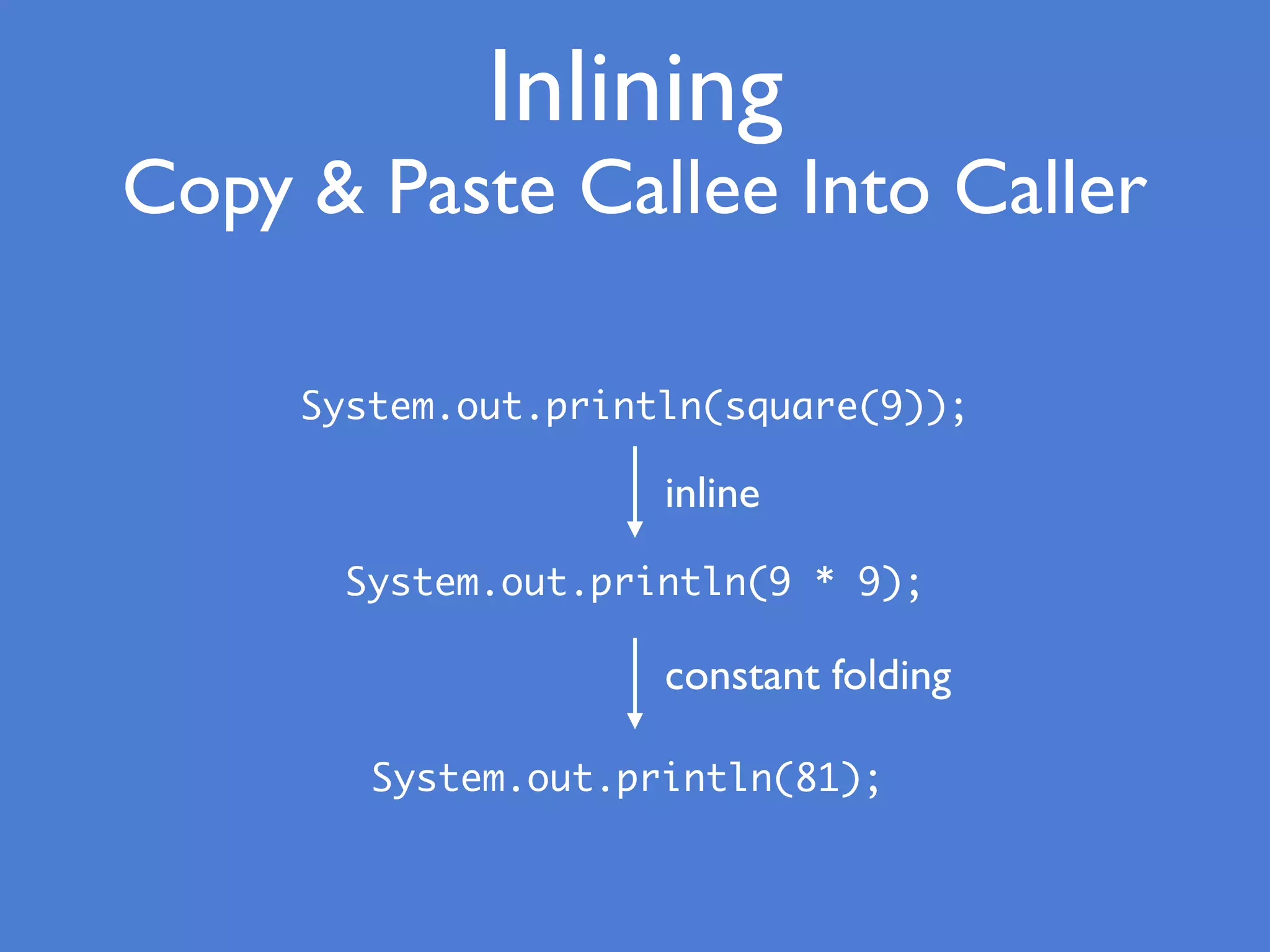
Copy & Paste Callee Into Caller
System.out.println(square(9));
inline
System.out.println(9 * 9);
constant folding
System.out.println(81);
Start with a Static Call
JMH: Java Measurement Harness
@Benchmark
public void cstyle() {
for ( int i = 0; i < this.elementData.length; ++i ) {
consume(this.elementData[i]);
}
}
static int sum = 0;
@CompilerControl(CompilerControl.Mode.INLINE | DONT_INLINE)
static consume(int x) {
sum += x;
}
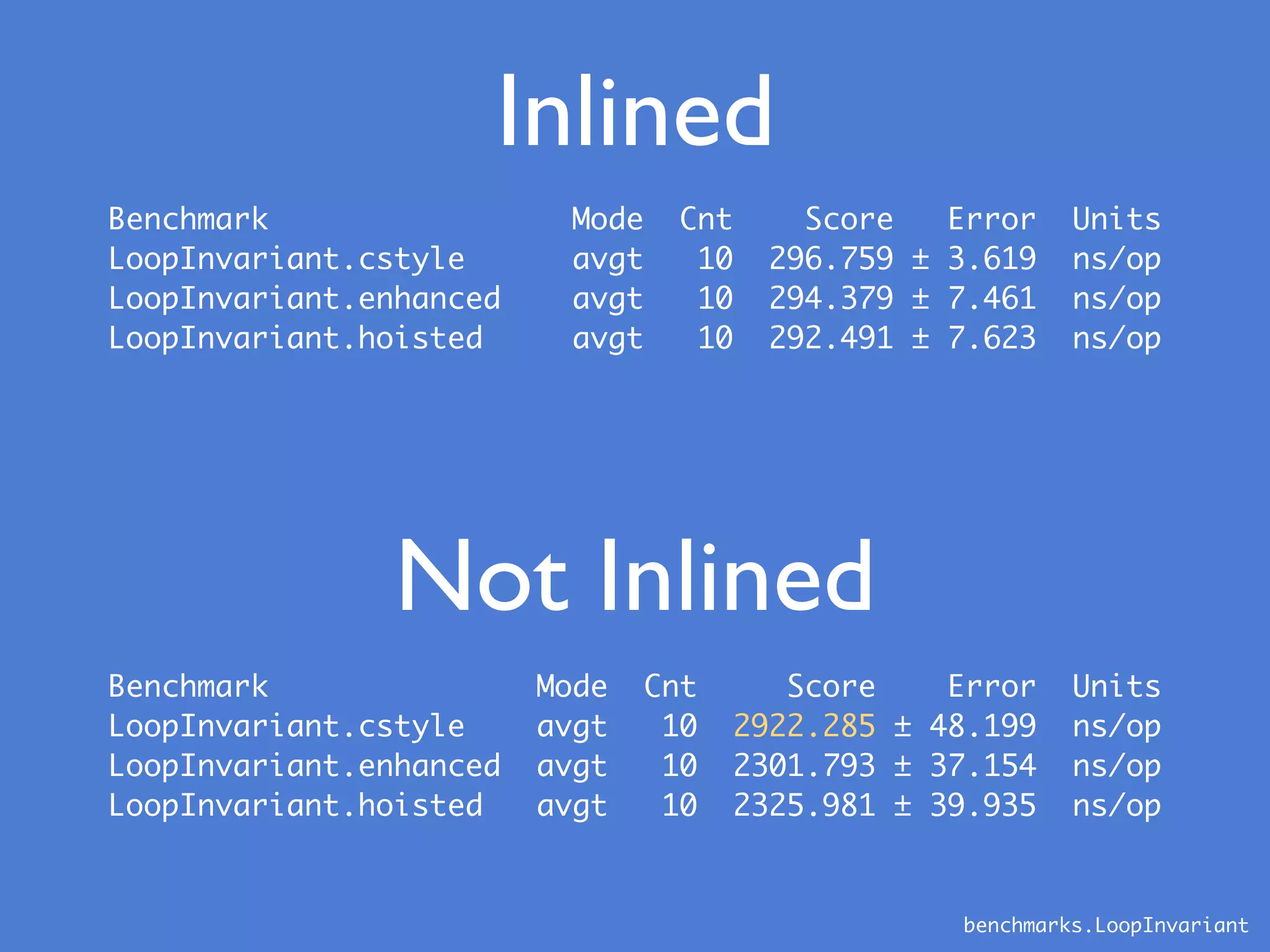
Benchmark Mode Cnt Score Error Units
LoopInvariant.cstyle avgt 10 296.759 ± 3.619 ns/op
LoopInvariant.enhanced avgt 10 294.379 ± 7.461 ns/op
LoopInvariant.hoisted avgt 10 292.491 ± 7.623 ns/op
Inlined
Not Inlined
Benchmark Mode Cnt Score Error Units
LoopInvariant.cstyle avgt 10 2922.285 ± 48.199 ns/op
LoopInvariant.enhanced avgt 10 2301.793 ± 37.154 ns/op
LoopInvariant.hoisted avgt 10 2325.981 ± 39.935 ns/op
benchmarks.LoopInvariant
Not Just “Sugar”
for ( int x: this.elementData ) {
consume(x);
}
E[] elementData = this.elementData;
for ( int i = 0; i < elementData.length; ++i ) {
int x = elementData[i];
consume(x);
}
javac
More Terrifying!
while ( !sharedDone ) {
fn();
}
print(sharedData);
Consumer Thread
Assume sharedData
is loop invariant!
localDone = sharedDone;
while ( !localDone ) {
// inlined fn() …
}
print(sharedData);
Producer Thread
sharedData = …;
sharedDone = true;
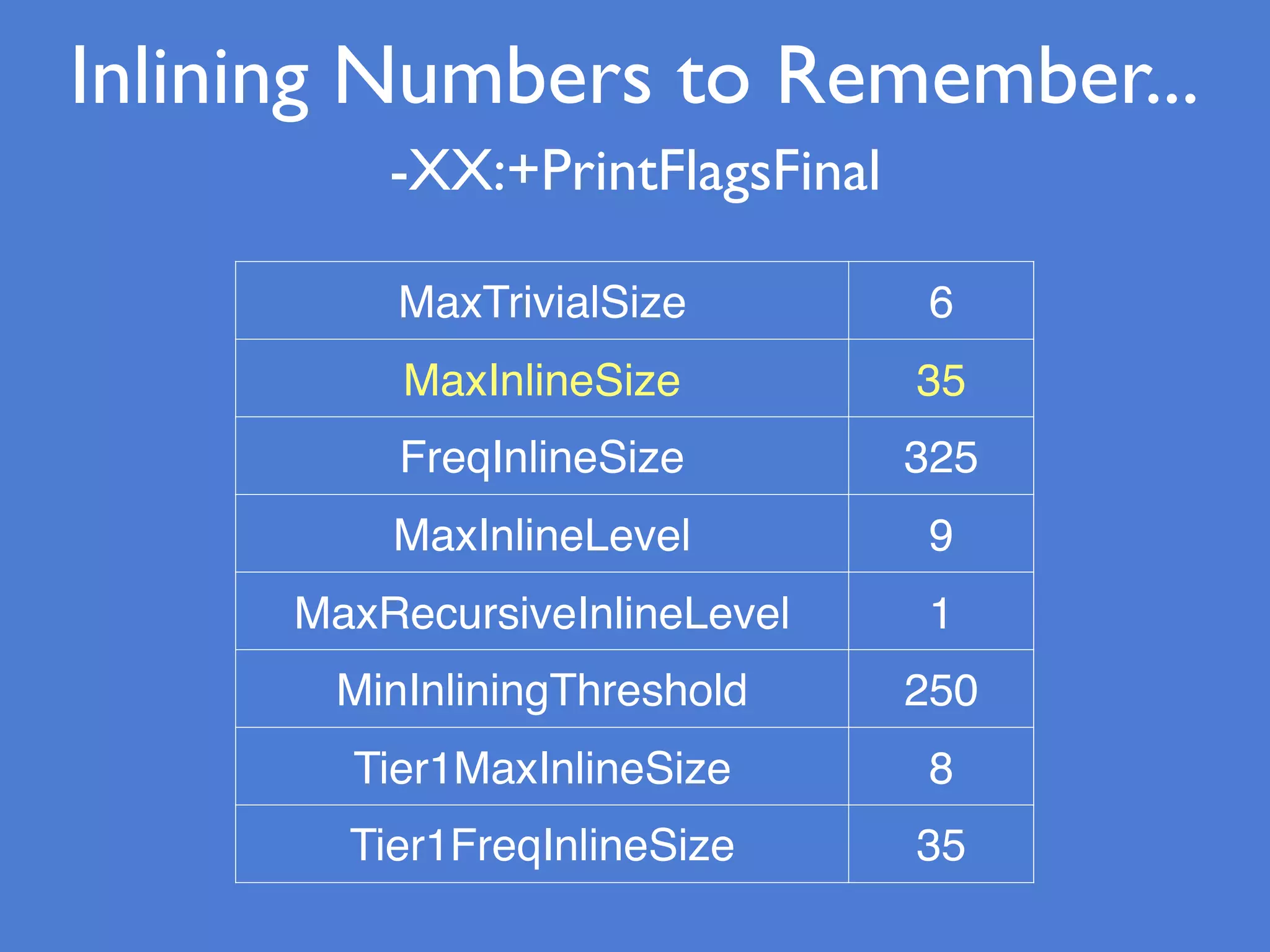
Inlining Numbers to Remember...
-XX:+PrintFlagsFinal
MaxTrivialSize 6
MaxInlineSize 35
FreqInlineSize 325
MaxInlineLevel 9
MaxRecursiveInlineLevel 1
MinInliningThreshold 250
Tier1MaxInlineSize 8
Tier1FreqInlineSize 35
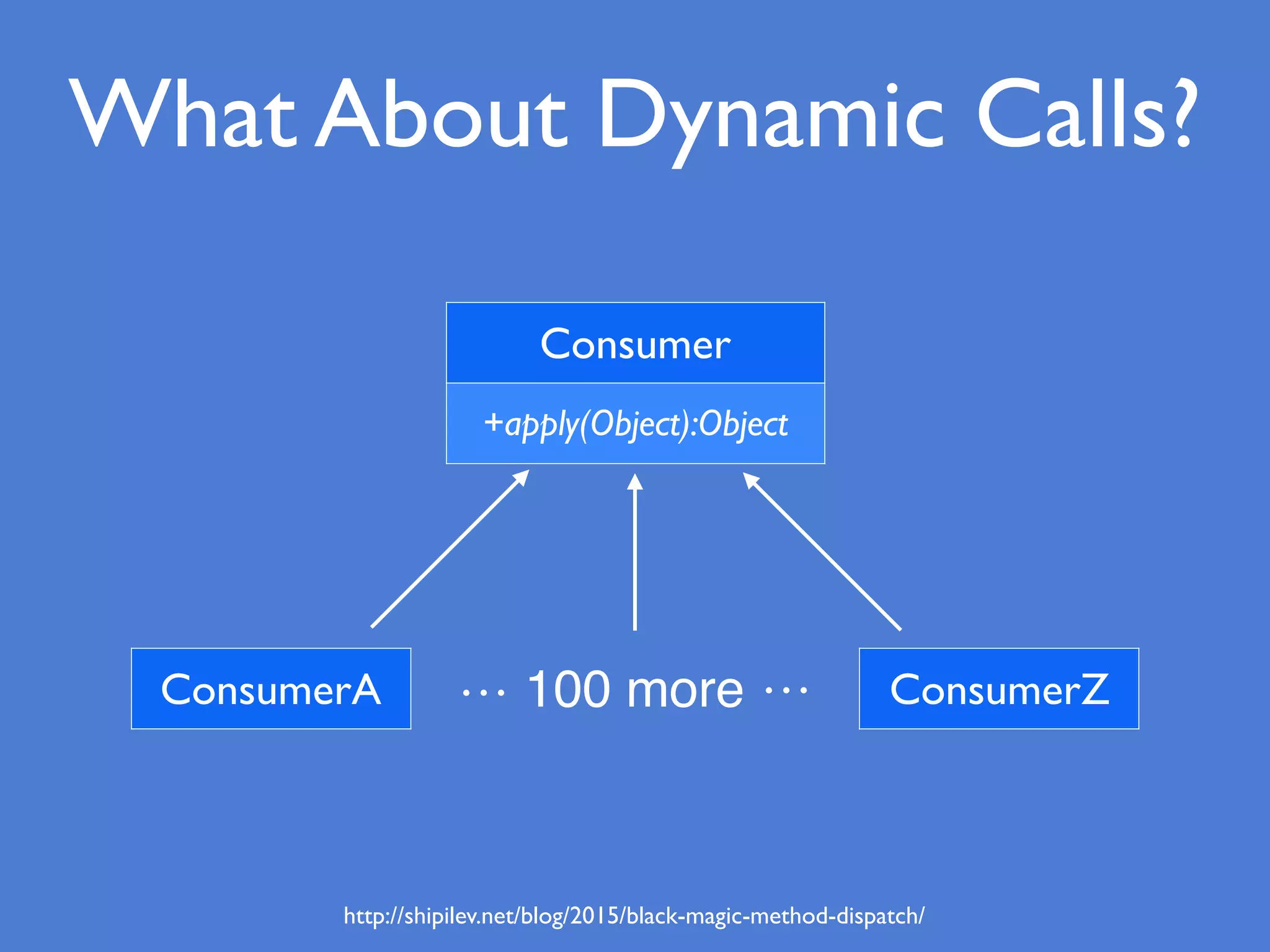
What About Dynamic Calls?
Consumer
+apply(Object):Object
ConsumerA ConsumerZ100 more
http://shipilev.net/blog/2015/black-magic-method-dispatch/
… …
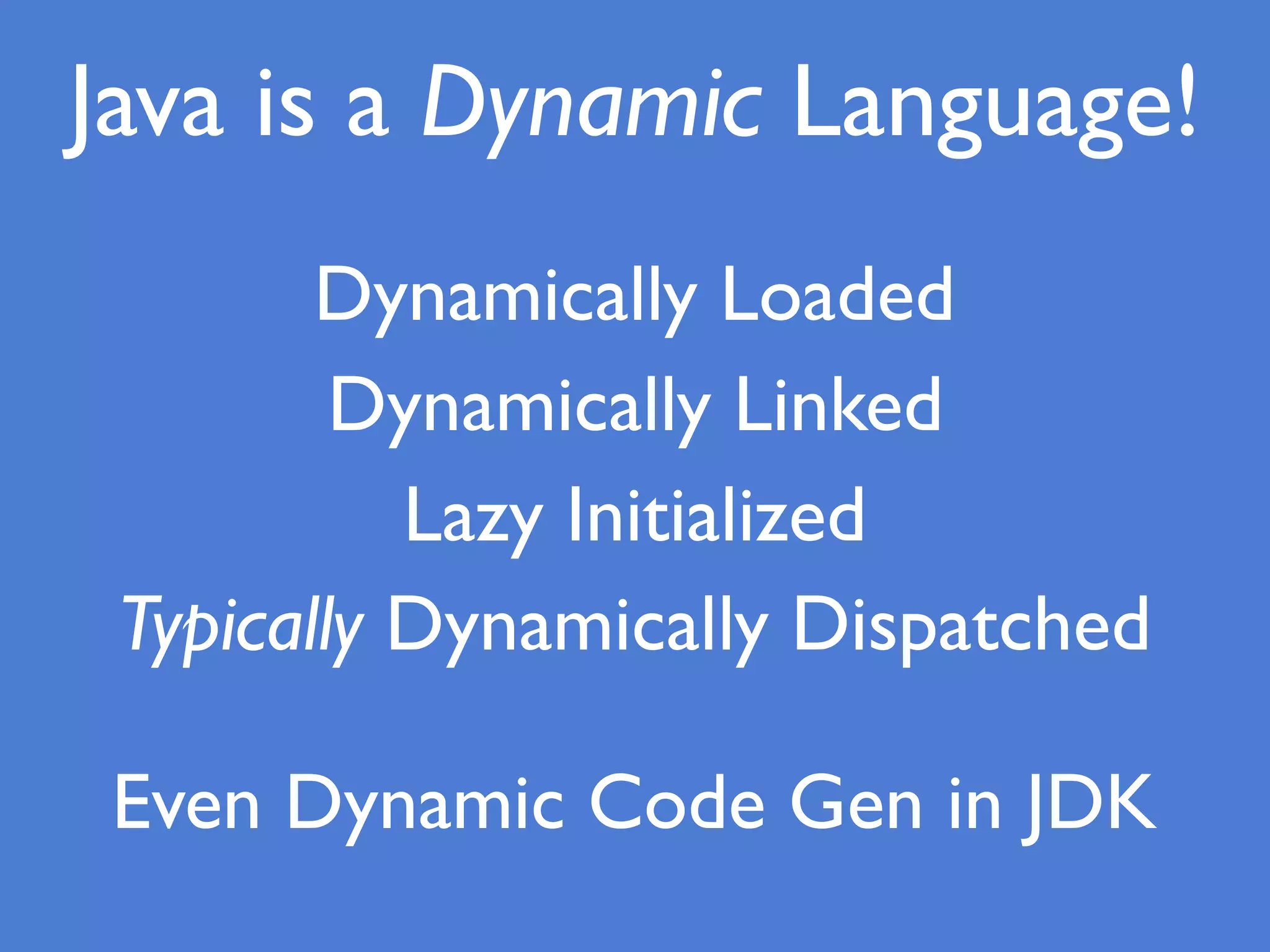
Java is a Dynamic Language!
Dynamically Loaded
Dynamically Linked
Lazy Initialized
Typically Dynamically Dispatched
Even Dynamic Code Gen in JDK
Unloaded Class?!?
Fields in Class
Methods in Class
Parent Class
Interfaces
Anything?
…Don’t Know
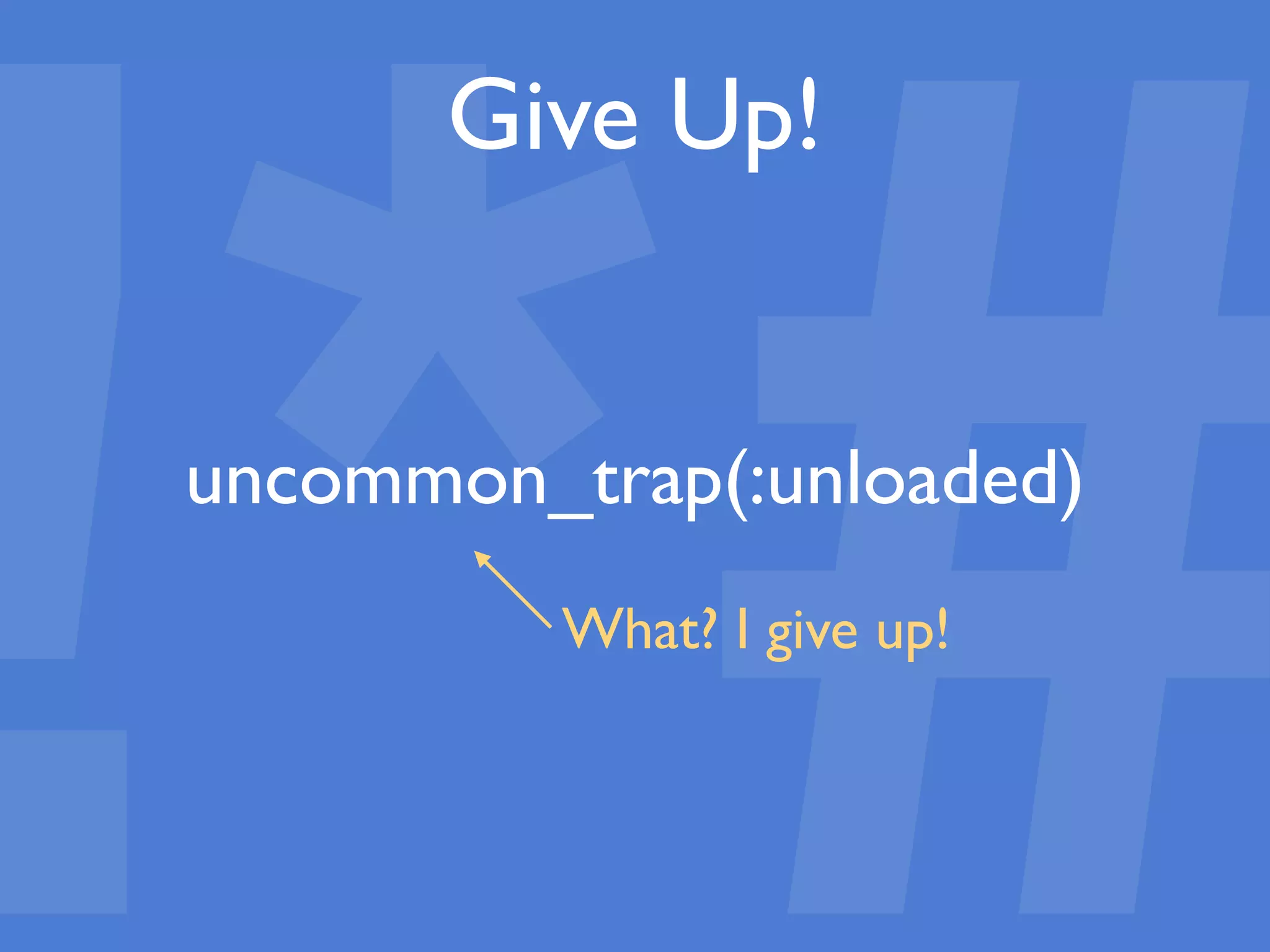
!*#
Give Up!
uncommon_trap(:unloaded)
What? I give up!
Compile + Deopt Storm
public class UnloadedForever {
public static void main(String[] args) {
for ( int i = 0; i < 100_000; ++i ) {
try {
factory();
} catch ( Throwable t ) {
// ignore
}
}
}
static DoesNotExist factory() {
return new DoesNotExist();
}
}
Compile + Deopt Storm
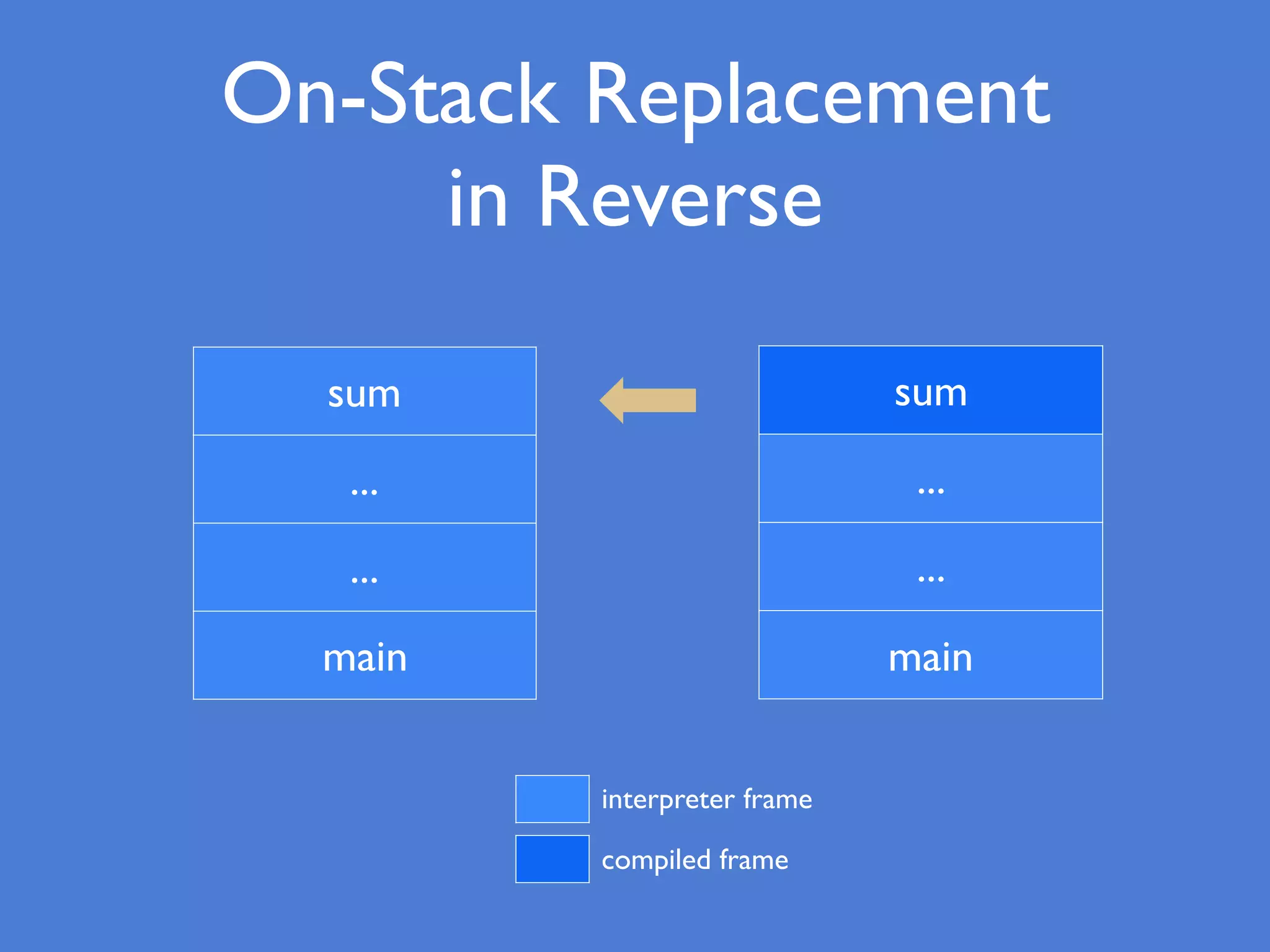
On-Stack Replacement
in Reverse
sum
...
...
main
sum
...
...
main
interpreter frame
compiled frame
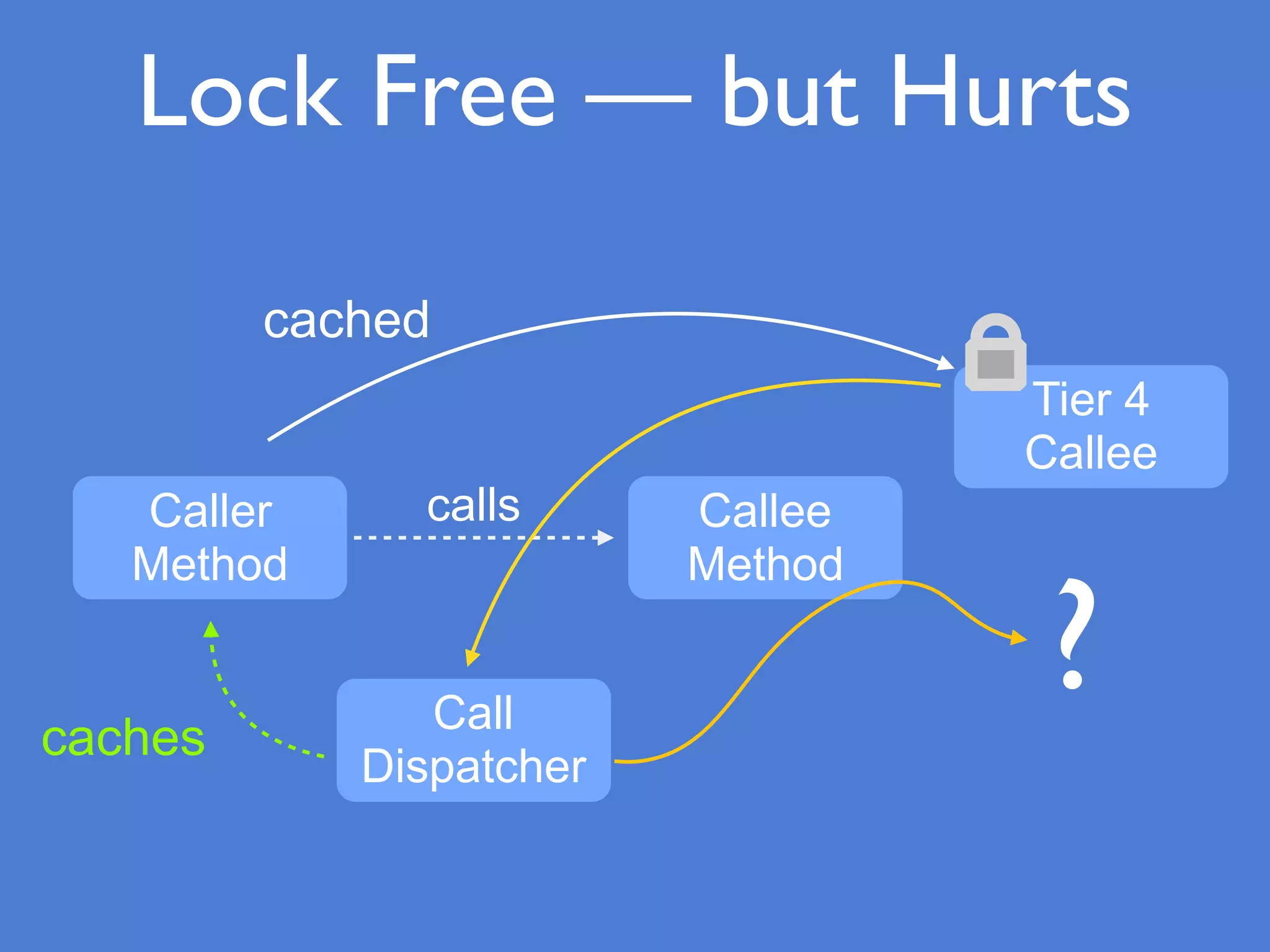
Caller
Method
Callee
Method
Tier 4
Callee
Call
Dispatcher
calls
cached
caches
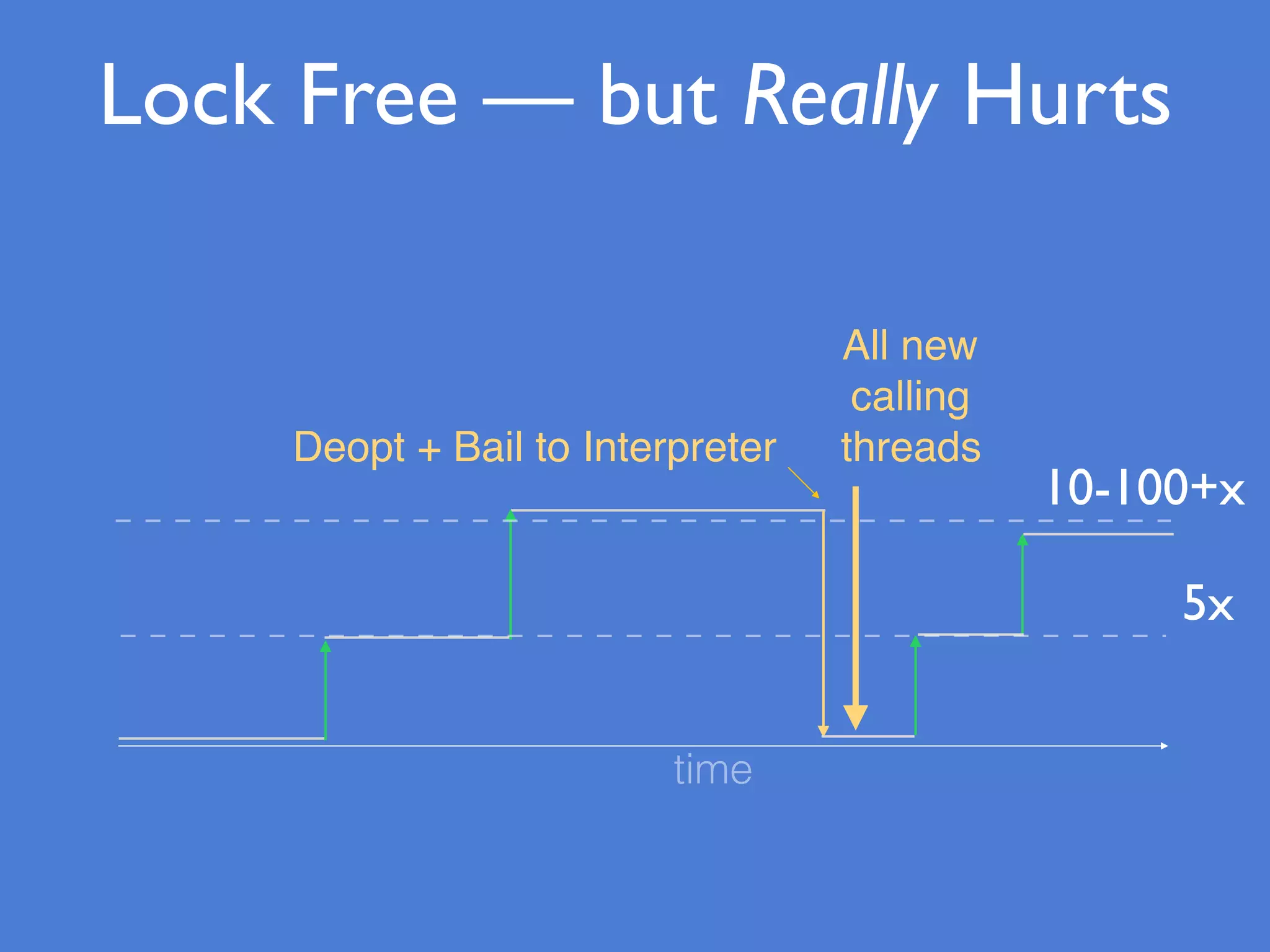
Lock Free — but Hurts
?
Lock Free — but Really Hurts
time
Deopt + Bail to Interpreter
5x
10-100+x
All new
calling
threads
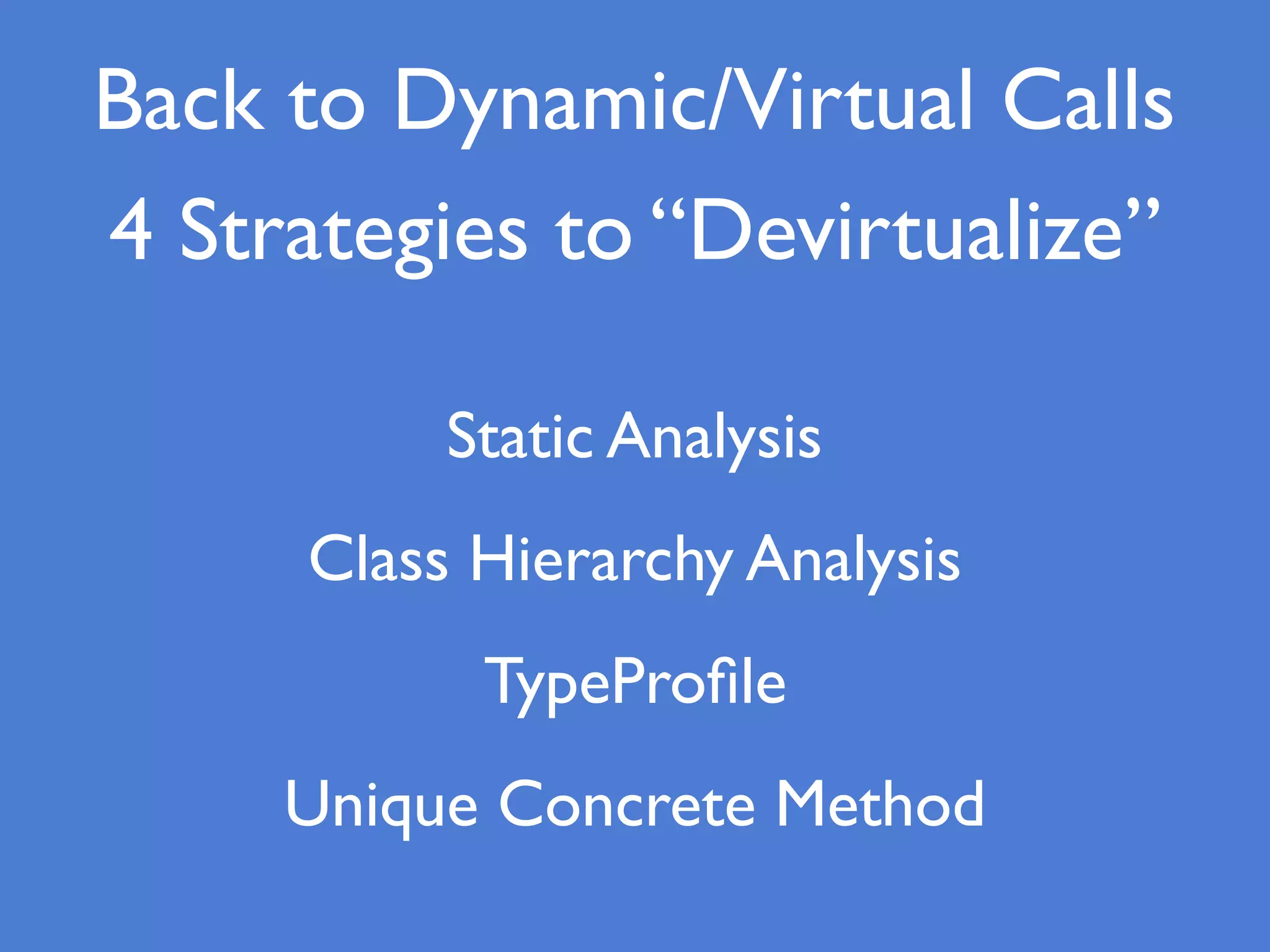
Static Analysis
Class Hierarchy Analysis
TypeProfile
Unique Concrete Method
Back to Dynamic/Virtual Calls
4 Strategies to “Devirtualize”
public class Monomorphic {
public static void main(String[] args)
throws InterruptedException
{
Func func = new Square();
for ( int i = 0; i < 20_000; ++i ) {
apply(func, i);
}
Thread.sleep(5_000);
}
static double apply(Func func, int x) {
return func.apply(x);
}
}
Monomorphic
S:04A
public class Monomorphic {
public static void main(String[] args)
throws InterruptedException
{
Func func = new Square();
for ( int i = 0; i < 20_000; ++i ) {
apply(func, i);
}
Thread.sleep(5_000);
}
static double apply(Func func, int x) {
return func.apply(x);
}
}
Static Analysis
S:04A
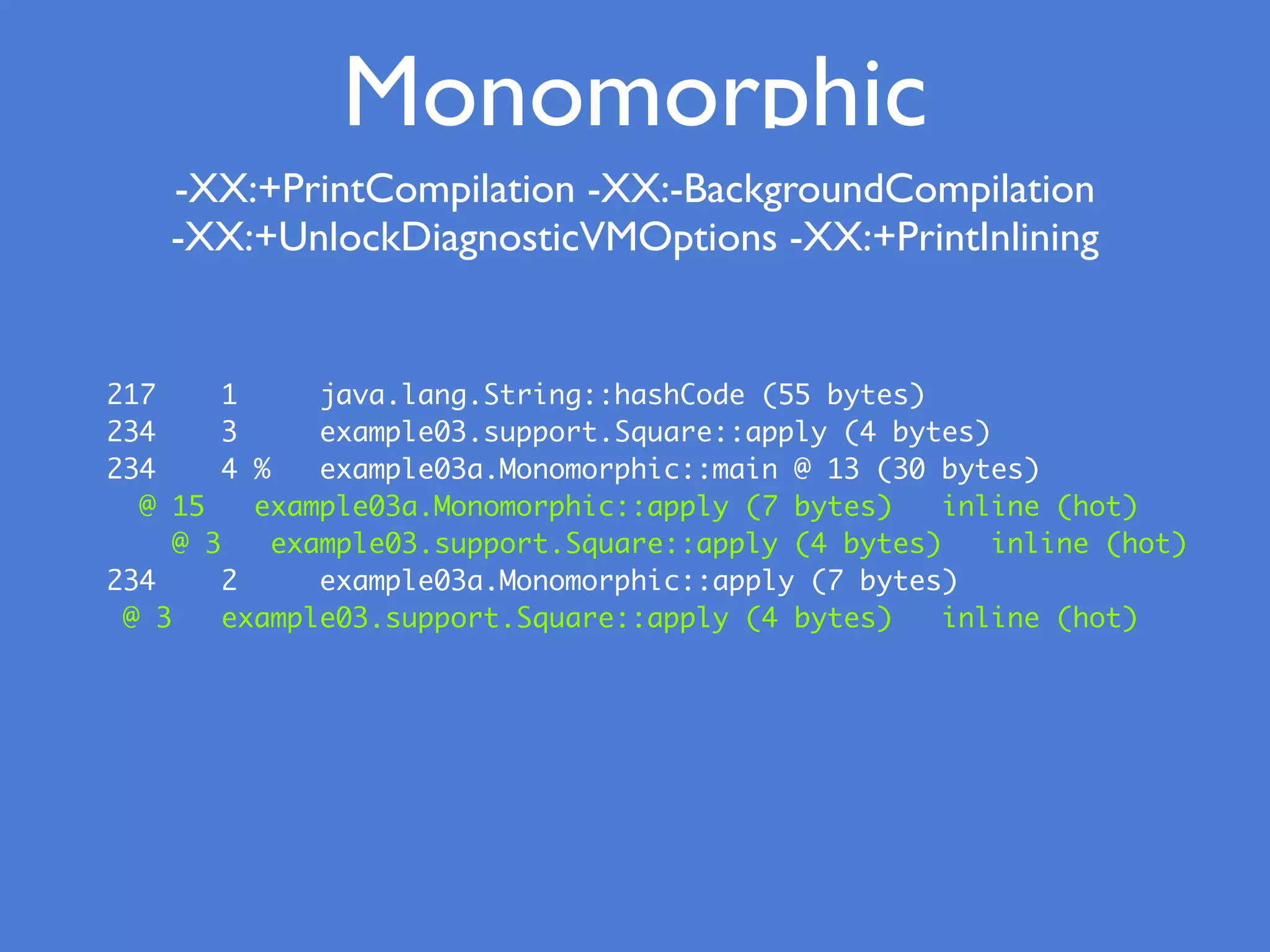
217 1 java.lang.String::hashCode (55 bytes)
234 3 example03.support.Square::apply (4 bytes)
234 4 % example03a.Monomorphic::main @ 13 (30 bytes)
@ 15 example03a.Monomorphic::apply (7 bytes) inline (hot)
@ 3 example03.support.Square::apply (4 bytes) inline (hot)
234 2 example03a.Monomorphic::apply (7 bytes)
@ 3 example03.support.Square::apply (4 bytes) inline (hot)
Monomorphic
-XX:+PrintCompilation -XX:-BackgroundCompilation
-XX:+UnlockDiagnosticVMOptions -XX:+PrintInlining
public class ChaStorm {
public static void main(String[] args) throws… {
Func func = new Square();
for ( int i = 0; i < 10_000; ++i ) {
apply1(func, i);
…
apply8(func, i);
}
System.out.println("Waiting for compiler...");
Thread.sleep(5_000);
System.out.println("Deoptimize...");
System.out.println(Sqrt.class);
Thread.sleep(5_000);
}
}
Potential for Deopt Storm
S:04B
Potential for Deopt Storm
152 1 java.lang.String::hashCode (55 bytes)
166 2 example04.support.Square::apply (4 bytes)
173 3 example04b.ChaStorm::apply1 (7 bytes)
173 4 example04b.ChaStorm::apply2 (7 bytes)
Waiting for compiler...
174 5 example04b.ChaStorm::apply3 (7 bytes) …
174 9 example04b.ChaStorm::apply7 (7 bytes)
174 10 example04b.ChaStorm::apply8 (7 bytes)
Deoptimize...
5176 9 example04b.ChaStorm::apply7 (7 bytes) made not entrant
5176 8 example04b.ChaStorm::apply6 (7 bytes) made not entrant
…
5176 4 example04b.ChaStorm::apply2 (7 bytes) made not entrant
5176 3 example04b.ChaStorm::apply1 (7 bytes) made not entrant
5176 10 example04b.ChaStorm::apply8 (7 bytes) made not entrant
class example04.support.Sqrt
vmop [threads: total initially_running wait_to_block] …
5.096: Deoptimize
http://blog.ragozin.info/2012/10/safepoints-in-hotspot-jvm.html
[ 7 0 0 ] …
-XX:+PrintCompilation
-XX+PrintSafepointStatistics
-XX:PrintSafepointStatisticsCount=1
NOT Lock Free — and
Really, Really Hurts
new calls
bail!
returning
calls bail!
Interpreter C2
!*#No IHA
TypeProfile
Interpreter & C1 Gather Data
Track Types used at Each Call Site
-XX:+UnlockDiagnosticVMOptions -XX:+LogCompilation
<klass id='780' name='Square' flags='1'/>
<klass id='781' name='Sqrt' flags='1'/>
<call method='783' count=‘23161'
prof_factor='1' virtual='1' inline='1'
receiver='780' receiver_count=‘19901'
receiver2='781' receiver2_count='3260'/>
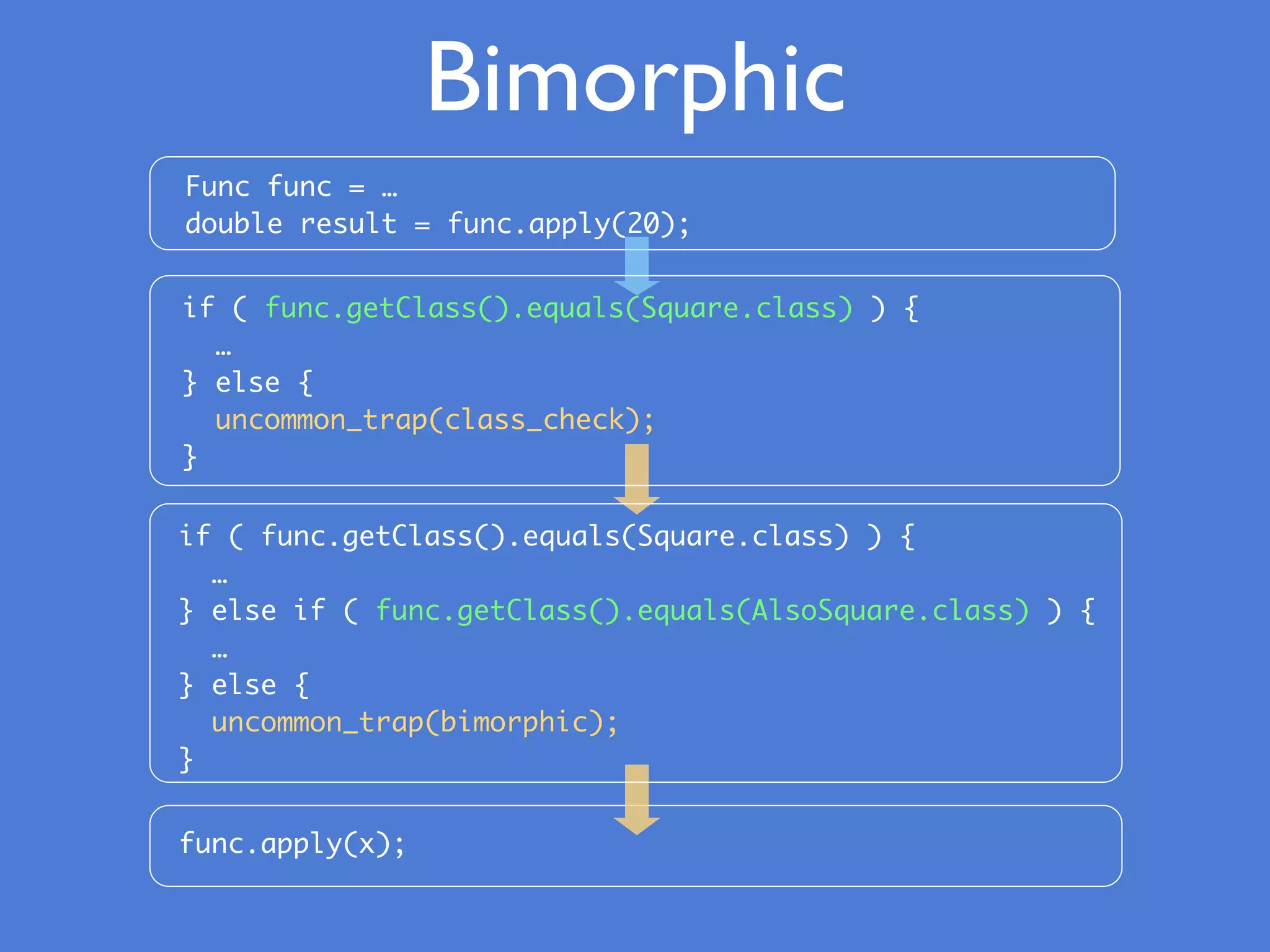
Bimorphic
Func func = …
double result = func.apply(20);
func.apply(x);
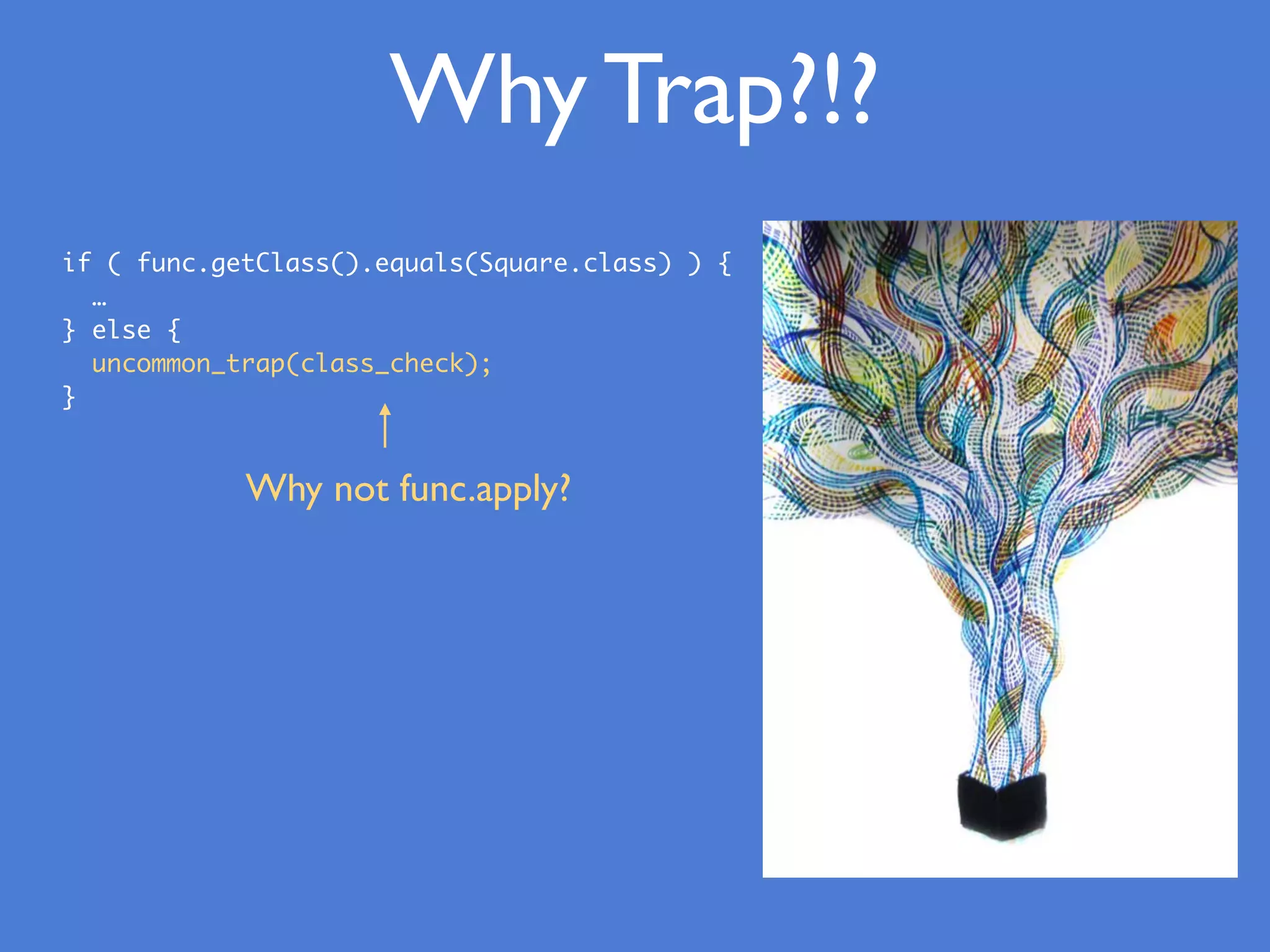
if ( func.getClass().equals(Square.class) ) {
…
} else {
uncommon_trap(class_check);
}
if ( func.getClass().equals(Square.class) ) {
…
} else if ( func.getClass().equals(AlsoSquare.class) ) {
…
} else {
uncommon_trap(bimorphic);
}
Very Effective
Call-site specific
Works for 90-95% of call sites
Very few call sites are “megamorphic”
Slightly more overhead than
no check (3-5ns)
Why Trap?!?
if ( func.getClass().equals(Square.class) ) {
…
} else {
uncommon_trap(class_check);
}
Why not func.apply?
Solved? NO
ArrayList<E>.forEach(Consumer<? super E> action) {
for ( int i = 0; i < this.size; i++ ) {
action.accept(this.elementData[i]);
}
}
megamorphic,
no (incomplete)
inlining.
elementData
could change!
size could change!
Unless, Done Manually…
ArrayList<E>.forEach(Consumer<? super E> action) {
Objects.requireNonNull(action);
final int expectedModCount = modCount;
final E[] elementData = (E[]) this.elementData;
final int size = this.size;
for (int i=0;
modCount == expectedModCount && i < size;
i++)
{
action.accept(elementData[i]);
}
if (modCount != expectedModCount) throw new CME();
}
Goal Accomplished? NO
Handling this.size with an
uncommon trap
More loop optimizations…
Loop Unrolling
Loop Unswitching

Vectorization
Interactions with Garbage Collector
JIT (and All Compilers) Are Just
Complex Pattern Matchers.
Don’t Like
“Weird” Code
Big Methods
Mutability
Native Methods
Like
“Normal” Code
Small Methods
Immutability
LocalVariables
* except for intrinsics: arraycopy, tan, …
*
VM Developer Blogs
Aleksey Shipilëv
http://shipilev.net/
http://psy-lob-saw.blogspot.com/
Nitsan Wakart
https://twitter.com/maddocig
IgorVeresov
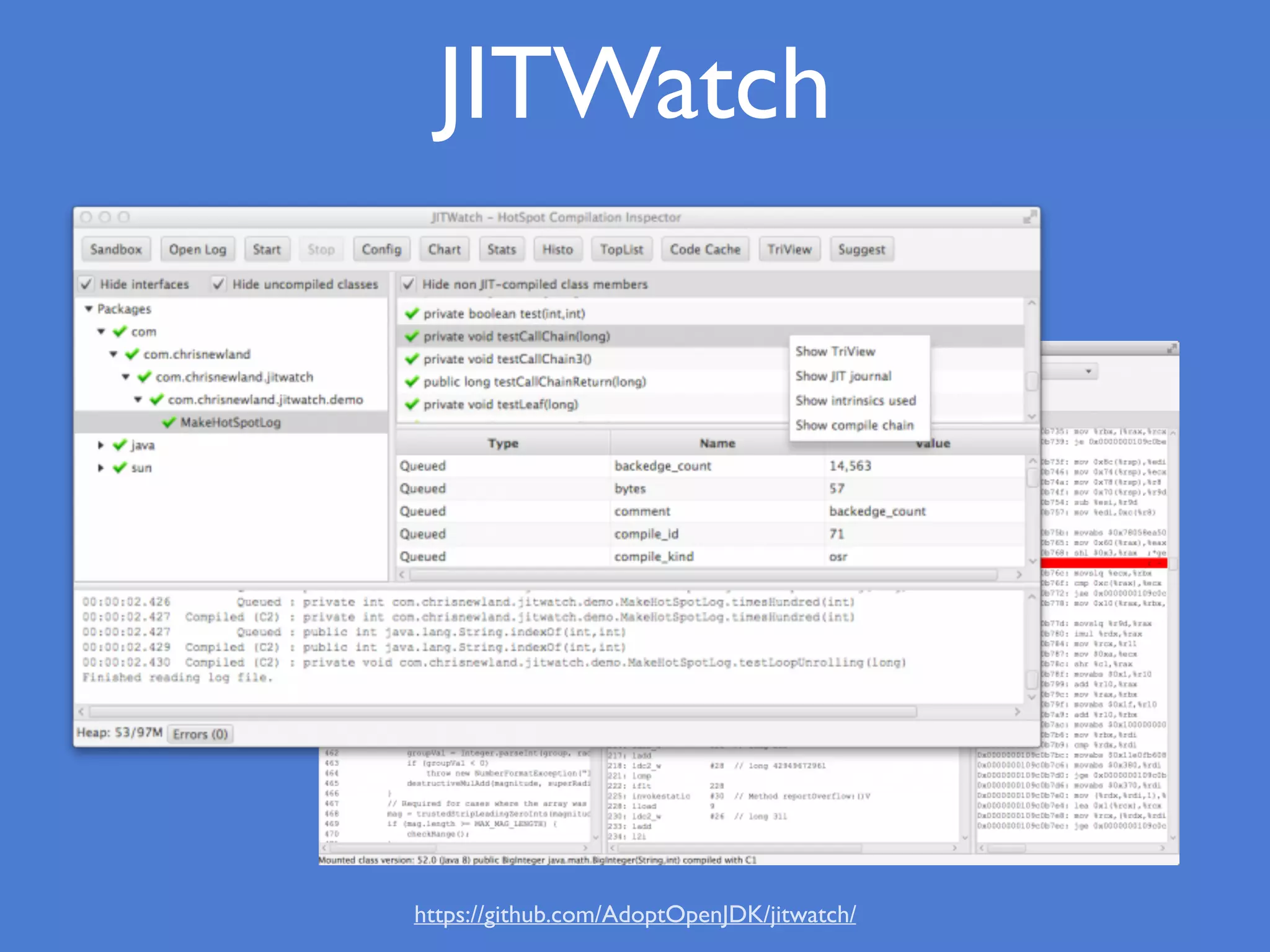
JITWatch
https://github.com/AdoptOpenJDK/jitwatch/
Shameless Self-Promotion
http://shop.oreilly.com/product/0636920043560.do
Optimizing Java
Douglas Q. Hawkins
?
Questions?
Douglas Q. Hawkins
@dougqh
VM Engineer

JVM Mechanics: Understanding the JIT's Tricks

  • 1.
    Douglas Q. Hawkins @dougqh VMEngineer Understanding the JIT’s Tricks
  • 2.
    Zing® Highly ScalableVM Continuously ConcurrentCompacting Collector ReadyNow! for Low Latency Applications http://www.azulsystems.com/solutions/zing/readynow
  • 3.
    Zulu® Multi-Platform OpenJDK Cloud Supportincluding Docker and Azure Embedded Support http://zulu.org/
  • 4.
    GOAL: Understand ArrayList<E>.forEach(Consumer<? superE> action) { for ( int i = 0; i < this.size; i++ ) { action.accept(this.elementData[i]); } } …
  • 5.
  • 6.
    Actual Implementation ArrayList<E>.forEach(Consumer<? superE> action) { Objects.requireNonNull(action); final int expectedModCount = modCount; final E[] elementData = (E[]) this.elementData; final int size = this.size; for (int i=0; modCount == expectedModCount && i < size; i++) { action.accept(elementData[i]); } if (modCount != expectedModCount) throw new CME(); }
  • 7.
    The Just-in-Time Compiler isa Compiler, but It’s a… Profile Guided Speculatively Optimizing Compiler
  • 8.
    So We Needto Understand… Static Optimizations Speculative Optimizations Inter-procedural Analysis Deoptimization How They Fit Together
  • 9.
    Understand What You CanRely on OpenJDK’s JIT to do ! REAL GOAL:
  • 10.
  • 11.
    public class Allocation{ static final int CHUNK_SIZE = 1_000; public static void main(String[] args) { for ( int i = 0; i < 500; ++i ) { long startTime = System.nanoTime(); for ( int j = 0; j < CHUNK_SIZE; ++j ) { new Object(); } long endTime = System.nanoTime(); System.out.printf("%dt%d%n", i, endTime - startTime); } } } S:01A
  • 12.
    1 100 10000 0 50 100150 200 250 300 350 400 450 Warm-Up interpreter 1st JIT 2nd JIT logns
  • 13.
    -XX:+PrintCompilation 80 29 3java.util.HashMap::newNode (13 bytes) 81 30 3 java.util.HashMap::afterNodeInsertion 81 31 3 java.lang.String::indexOf (7 bytes) 96 73 % 3 example01a.Allocation::main @ 15 (78 bytes) 101 99 % 4 example01a.Allocation::main @ 15 (78 bytes)
  • 14.
    ?Two Compilations of OneMethod? What about Tiers 1 & 2? When Exactly?
  • 15.
    Thresholds intx Tier2BackEdgeThreshold =0 {product} intx Tier2CompileThreshold = 0 {product} intx Tier3BackEdgeThreshold = 60000 {product} intx Tier3CompileThreshold = 2000 {product} intx Tier3InvocationThreshold = 200 {product} intx Tier3MinInvocationThreshold = 100 {product} intx Tier4BackEdgeThreshold = 40000 {product} intx Tier4CompileThreshold = 15000 {product} intx Tier4InvocationThreshold = 5000 {product} intx Tier4MinInvocationThreshold = 600 {product} intx BackEdgeThreshold = 100000 {pd product} intx CompileThreshold = 10000 {pd product} Java 7 (Non-tiered) Thresholds Java 8 (Tiered) Thresholds -XX:+PrintFlagsFinal
  • 16.
    Counters Invocation Counter Backedge (Loop)Counter Backedge Counter > Backedge Threshold Hot Loops Invocation Counter > Invocation Threshold Hot Methods Invocation + Backedge Counter > Compile Threshold Medium Hot Methods with Medium Hot Loops
  • 17.
    Method or LoopJIT If Loop Count (Backedges) > Threshold, Compile Loop On-Stack Replacement
  • 18.
    On-Stack Replacement sum ... ... main sum @20 ... ... main interpreter frame compiled frame
  • 19.
  • 20.
    0 0 0 interpreter 3 4 2 34 1 3 c1 c2 none basic counters detailed common c2 busy trivial method Tiered Compilation
  • 21.
    0 2 34 Made Not Entrant 12394 73 % 3 …Allocation::main @ -2 (78 bytes) made not entrant
  • 22.
  • 23.
    HotSpot’s Job isto Find Hot Spots Rules for Triggering the JIT Keep Changing HotSpot JITs… Hot Methods Hot Loops Warm Methods with Warm Loops
  • 24.
    ?What Does the JITC2 Do? Focus on Final Tier
  • 25.
  • 26.
    public class AllocationTrap{ static final int CHUNK_SIZE = 1_000; public static void main(String[] args) { Object trap = null; for ( int i = 0; i < 500; ++i ) { long startTime = System.nanoTime(); for ( int j = 0; j < CHUNK_SIZE; ++j ) { new Object(); if ( trap != null ) { System.out.println(“trap!"); trap = null; } } if ( i == 400 ) trap = new Object(); long endTime = System.nanoTime(); System.out.printf("%dt%d%n", i, endTime - startTime); } } } S:01B
  • 27.
    1 100 10000 0 50 100150 200 250 300 350 400 450 Deoptimization behavioral change, deoptimize! logns
  • 28.
    Returning to forEach ArrayList<E>.forEach(Consumer<?super E> action) { for ( int i = 0; i < this.size; i++ ) { action.accept(this.elementData[i]); } }
  • 29.
    Something “Simpler” ArrayStream<E>.forEach(Consumer<? superE> action) { for ( int i = 0; i < this.elementData.length; i++ ) { action.accept(this.elementData[i]); } } “Simpler” Bound
  • 30.
    Implied Safety Code ArrayStream<E>.forEach(Consumer<?super E> action) { if ( this == null ) throw new NPE(); if ( this.elementData == null ) throw new NPE(); for ( int i = 0; i < this.elementData.length; i++ ) { if ( this == null ) throw new NPE(); if ( this.elementData == null ) throw new NPE(); if ( i < 0 ) throw new AIOBE(); if ( i >= this.elementData.length ) throw new AIOBE(); if ( action == null ) throw new NPE(); action.accept(this.elementData[i]); } }
  • 31.
    Null Check Elimination ArrayStream<E>.forEach(Consumer<?super E> action) { if ( this == null ) throw new NPE(); if ( this.elementData == null ) throw new NPE(); for ( int i = 0; i < this.elementData.length; i++ ) { if ( this == null ) throw new NPE(); if ( this.elementData == null ) throw new NPE(); if ( i < 0 ) throw new AIOBE(); if ( i >= this.elementData.length ) throw new AIOBE(); if ( action == null ) throw new NPE(); action.accept(this.elementData[i]); } } this != null
  • 32.
    Lower Bound CheckElimination ArrayStream<E>.forEach(Consumer<? super E> action) { if ( this.elementData == null ) throw new NPE(); for ( int i = 0; i < this.elementData.length; i++ ) { if ( this.elementData == null ) throw new NPE(); if ( i < 0 ) throw new AIOBE(); if ( i >= this.elementData.length ) throw new AIOBE(); if ( action == null ) throw new NPE(); action.accept(this.elementData[i]); } } i >= 0 i <= INT_MAX
  • 33.
    ArrayStream<E>.forEach(Consumer<? super E>action) { if ( this.elementData == null ) throw new NPE(); for ( int i = 0; i < this.elementData.length; i++ ) { if ( this.elementData == null ) throw new NPE(); if ( i >= this.elementData.length ) throw new AIOBE(); if ( !(i < this.elementData.length) ) throw new AIOBE(); if ( action == null ) throw new NPE(); action.accept(this.elementData[i]); } } Canonicalize Upper Bound Canonicalize
  • 34.
    ArrayStream<E>.forEach(Consumer<? super E>action) { if ( this.elementData == null ) throw new NPE(); for ( int i = 0; i < this.elementData.length; i++ ) { if ( this.elementData == null ) throw new NPE(); if ( !(i < this.elementData.length) ) throw new AIOBE(); if ( action == null ) throw new NPE(); action.accept(this.elementData[i]); } } Upper Bound Check Elimination Common Sub- Expression * Really GlobalValue Numbering *
  • 35.
    Cached Length isn’tBetter! public class ArrayStream<E> interface Stream<E> { private final E[] elementData; private final int size; public ArrayStream(E… elements) { this.elementData = elements; this.size = elements.length; } forEach(Consumer<? super E> action) { if ( this.elementData == null ) throw new NPE(); for ( int i = 0; i < this.size; i++ ) { if ( this.elementData == null ) throw new NPE(); if ( i >= this.elementData.length ) throw new AIOBE(); if ( action == null ) throw new NPE(); action.accept(this.elementData[i]); } } } mismatch! Confuses the JIT
  • 36.
    ArrayStream<E>.forEach(Consumer<? super E>action) { if ( this.elementData == null ) throw new NPE(); for ( int i = 0; i < this.elementData.length; i++ ) { if ( this.elementData == null ) throw new NPE(); if ( action == null ) throw new NPE(); action.accept(this.elementData[i]); } } What Else? What Else Can Be Done?
  • 37.
    ArrayStream<E>.forEach(Consumer<? super E>action) { if ( this.elementData == null ) throw new NPE(); for ( int i = 0; i < this.elementData.length; i++ ) { if ( this.elementData == null ) throw new NPE(); if ( action == null ) throw new NPE(); action.accept(this.elementData[i]); } } Null Pointer Checks Required - cannot optimize further? Assume non-null from above? Required - cannot optimize further?
  • 38.
    Implicit Null Check if( this.elementData == null ) throw new NPE(); this.elementData.length; Possible, but improbable SEGVderef value signal handler throw NPE 0x10795f9cc: mov 0x8(%rsi),%r10d ; implicit exception: dispatches to 0x10795fe1d
  • 39.
    Three Nulls,You Deopt! -XX:+PrintCompilation 1211 java.lang.String::hashCode (55 bytes) 135 2 …NullCheck::hotMethod (6 bytes) 136 3 % ! …NullCheck::main @ 5 (69 bytes) tempting fate 0 tempting fate 1 tempting fate 2 5144 2 …NullCheck::hotMethod (6 bytes) made not entrant tempting fate 3 tempting fate 4 tempting fate 5 tempting fate 6 tempting fate 7 tempting fate 8 tempting fate 9 S:02A
  • 40.
    Stop the World Needto Stop All Java Threads to... Deoptimize Lock Inflation / Deflation Garbage Collect Java Threads read 0x1000 0x1000 SEGV
  • 41.
    Null Proportion: 0.100000Caught: 10057 Unique: 2015 Null Proportion: 0.500000 Caught: 50096 Unique: 7191 Null Proportion: 0.900000 Caught: 89929 Unique: 11030 int caughtCount = 0; Set<NullPointerException> nullPointerExceptions = new HashSet<>(); for ( Object object : objects ) { try { object.toString(); } catch ( NullPointerException e ) { nullPointerExceptions.add( e ); caughtCount += 1; } } Hot Exception Optimization S:02B
  • 42.
    Hot Exceptions int caughtCount= 0; HashSet<NullPointerException> nullPointerExceptions = new HashSet<>(); for ( Object object : objects ) { try { object.toString(); } catch ( NullPointerException e ) { boolean added = nullPointerExceptions.add(e); if ( !added ) e.printStackTrace(); caughtCount += 1; } } java.lang.NullPointerException No StackTrace??? S:02B
  • 43.
    ArrayStream<E>.forEach(Consumer<? super E>action) { if ( this.elementData == null ) throw new NPE(); for ( int i = 0; i < this.elementData.length; i++ ) { if ( this.elementData == null ) throw new NPE(); if ( action == null ) throw new NPE(); action.accept(this.elementData[i]); } } Total Elimination is Better! Assume non-null from above?
  • 44.
    Common Sub-Expression if (this.elementData == null ) throw new NPE(); Requires knowing that… null doesn’t change this doesn’t change this.elementData doesn’t change easy hard for ( … ) { if ( this.elementData == null ) throw new NPE(); }
  • 45.
    The Other “Easy”One LocalVariable: action ArrayStream<E>.forEach(Consumer<? super E> action) { if ( this.elementData == null ) throw new NPE(); for ( int i = 0; i < this.elementData.length; i++ ) { if ( this.elementData == null ) throw new NPE(); if ( action == null ) throw new NPE(); action.accept(this.elementData[i]); } } CANNOT be changed by another thread or method.
  • 46.
    Loop Peeling ArrayStream<E>.forEach(Consumer<? superE> action) { if ( this.elementData == null ) throw new NPE(); // i=0 iteration if ( 0 < this.elementData.length ) { if ( this.elementData == null ) throw NPE(); if ( action == null ) throw new NPE(); action.accept(this.elementData[0]); } // rest of the iterations for ( int i = 1; i < this.elementData.length; i++ ) { if ( this.elementData == null ) throw new NPE(); if ( action == null ) throw new NPE(); action.accept(this.elementData[i]); } }
  • 47.
    Back to this.elementData CANbe changed by another thread. Compiler Doesn’t Care! Really? No Synchronization Action - Single Threaded Semantics
  • 48.
    Loop Invariant Hoisting? ArrayStream<E>.forEach(Consumer<?super E> action) { E[] elementData = this.elementData; int len = elementData.length; if ( elementData == null ) throw new NPE(); // i=0 iteration if ( 0 < len ) { if ( elementData == null ) throw NPE(); if ( action == null ) throw new NPE(); action.accept(this.elementData[0]); } // rest of the iterations for ( int i = 1; i < elementData.length; i++ ) { if ( elementData == null ) throw new NPE(); action.accept(elementData[i]); } }
  • 49.
    Terrifying! while ( !sharedDone); print(sharedData); sharedData = …; sharedDone = true; Consumer ThreadProducer Thread Assume sharedData is loop invariant! localDone = sharedDone; while ( !localDone ); print(sharedData);
  • 50.
    Not So Fast SingleThreaded Side Effects ArrayStream<E>.forEach(Consumer<? super E> action) { if ( this.elementData == null ) throw new NPE(); // i=0 iteration if ( 0 < this.elementData.length ) { if ( this.elementData == null ) throw NPE(); if ( action == null ) throw new NPE(); action.accept(this.elementData[0]); } // rest of the iterations for ( int i = 1; i < this.elementData.length; i++ ) { if ( this.elementData == null ) throw new NPE(); action.accept(this.elementData[i]); } } Can this.elementData change? YES
  • 51.
    ArrayStream NOT ArrayList this.elementData isfinal! Doesn’t matter - reflection!
  • 52.
    A Call isa “Black Box” which may contain “Evils”!
  • 53.
    Inter-procedural Analysis Prove No SideEffects / Evils Inter-procedural Analysis = Inlining
  • 54.
    Inlining Copy & PasteCallee Into Caller System.out.println(square(9)); inline System.out.println(9 * 9); constant folding System.out.println(81);
  • 55.
    Start with aStatic Call JMH: Java Measurement Harness @Benchmark public void cstyle() { for ( int i = 0; i < this.elementData.length; ++i ) { consume(this.elementData[i]); } } static int sum = 0; @CompilerControl(CompilerControl.Mode.INLINE | DONT_INLINE) static consume(int x) { sum += x; }
  • 56.
    Benchmark Mode CntScore Error Units LoopInvariant.cstyle avgt 10 296.759 ± 3.619 ns/op LoopInvariant.enhanced avgt 10 294.379 ± 7.461 ns/op LoopInvariant.hoisted avgt 10 292.491 ± 7.623 ns/op Inlined Not Inlined Benchmark Mode Cnt Score Error Units LoopInvariant.cstyle avgt 10 2922.285 ± 48.199 ns/op LoopInvariant.enhanced avgt 10 2301.793 ± 37.154 ns/op LoopInvariant.hoisted avgt 10 2325.981 ± 39.935 ns/op benchmarks.LoopInvariant
  • 57.
    Not Just “Sugar” for( int x: this.elementData ) { consume(x); } E[] elementData = this.elementData; for ( int i = 0; i < elementData.length; ++i ) { int x = elementData[i]; consume(x); } javac
  • 58.
    More Terrifying! while (!sharedDone ) { fn(); } print(sharedData); Consumer Thread Assume sharedData is loop invariant! localDone = sharedDone; while ( !localDone ) { // inlined fn() … } print(sharedData); Producer Thread sharedData = …; sharedDone = true;
  • 59.
    Inlining Numbers toRemember... -XX:+PrintFlagsFinal MaxTrivialSize 6 MaxInlineSize 35 FreqInlineSize 325 MaxInlineLevel 9 MaxRecursiveInlineLevel 1 MinInliningThreshold 250 Tier1MaxInlineSize 8 Tier1FreqInlineSize 35
  • 60.
    What About DynamicCalls? Consumer +apply(Object):Object ConsumerA ConsumerZ100 more http://shipilev.net/blog/2015/black-magic-method-dispatch/ … …
  • 61.
    Java is aDynamic Language! Dynamically Loaded Dynamically Linked Lazy Initialized Typically Dynamically Dispatched Even Dynamic Code Gen in JDK
  • 62.
    Unloaded Class?!? Fields inClass Methods in Class Parent Class Interfaces Anything? …Don’t Know
  • 63.
  • 64.
    Compile + DeoptStorm public class UnloadedForever { public static void main(String[] args) { for ( int i = 0; i < 100_000; ++i ) { try { factory(); } catch ( Throwable t ) { // ignore } } } static DoesNotExist factory() { return new DoesNotExist(); } }
  • 65.
  • 66.
  • 67.
  • 68.
    Lock Free —but Really Hurts time Deopt + Bail to Interpreter 5x 10-100+x All new calling threads
  • 69.
    Static Analysis Class HierarchyAnalysis TypeProfile Unique Concrete Method Back to Dynamic/Virtual Calls 4 Strategies to “Devirtualize”
  • 70.
    public class Monomorphic{ public static void main(String[] args) throws InterruptedException { Func func = new Square(); for ( int i = 0; i < 20_000; ++i ) { apply(func, i); } Thread.sleep(5_000); } static double apply(Func func, int x) { return func.apply(x); } } Monomorphic S:04A
  • 71.
    public class Monomorphic{ public static void main(String[] args) throws InterruptedException { Func func = new Square(); for ( int i = 0; i < 20_000; ++i ) { apply(func, i); } Thread.sleep(5_000); } static double apply(Func func, int x) { return func.apply(x); } } Static Analysis S:04A
  • 72.
    217 1 java.lang.String::hashCode(55 bytes) 234 3 example03.support.Square::apply (4 bytes) 234 4 % example03a.Monomorphic::main @ 13 (30 bytes) @ 15 example03a.Monomorphic::apply (7 bytes) inline (hot) @ 3 example03.support.Square::apply (4 bytes) inline (hot) 234 2 example03a.Monomorphic::apply (7 bytes) @ 3 example03.support.Square::apply (4 bytes) inline (hot) Monomorphic -XX:+PrintCompilation -XX:-BackgroundCompilation -XX:+UnlockDiagnosticVMOptions -XX:+PrintInlining
  • 73.
    public class ChaStorm{ public static void main(String[] args) throws… { Func func = new Square(); for ( int i = 0; i < 10_000; ++i ) { apply1(func, i); … apply8(func, i); } System.out.println("Waiting for compiler..."); Thread.sleep(5_000); System.out.println("Deoptimize..."); System.out.println(Sqrt.class); Thread.sleep(5_000); } } Potential for Deopt Storm S:04B
  • 74.
    Potential for DeoptStorm 152 1 java.lang.String::hashCode (55 bytes) 166 2 example04.support.Square::apply (4 bytes) 173 3 example04b.ChaStorm::apply1 (7 bytes) 173 4 example04b.ChaStorm::apply2 (7 bytes) Waiting for compiler... 174 5 example04b.ChaStorm::apply3 (7 bytes) … 174 9 example04b.ChaStorm::apply7 (7 bytes) 174 10 example04b.ChaStorm::apply8 (7 bytes) Deoptimize... 5176 9 example04b.ChaStorm::apply7 (7 bytes) made not entrant 5176 8 example04b.ChaStorm::apply6 (7 bytes) made not entrant … 5176 4 example04b.ChaStorm::apply2 (7 bytes) made not entrant 5176 3 example04b.ChaStorm::apply1 (7 bytes) made not entrant 5176 10 example04b.ChaStorm::apply8 (7 bytes) made not entrant class example04.support.Sqrt vmop [threads: total initially_running wait_to_block] … 5.096: Deoptimize http://blog.ragozin.info/2012/10/safepoints-in-hotspot-jvm.html [ 7 0 0 ] … -XX:+PrintCompilation -XX+PrintSafepointStatistics -XX:PrintSafepointStatisticsCount=1
  • 75.
    NOT Lock Free— and Really, Really Hurts new calls bail! returning calls bail! Interpreter C2
  • 76.
  • 77.
    TypeProfile Interpreter & C1Gather Data Track Types used at Each Call Site -XX:+UnlockDiagnosticVMOptions -XX:+LogCompilation <klass id='780' name='Square' flags='1'/> <klass id='781' name='Sqrt' flags='1'/> <call method='783' count=‘23161' prof_factor='1' virtual='1' inline='1' receiver='780' receiver_count=‘19901' receiver2='781' receiver2_count='3260'/>
  • 78.
    Bimorphic Func func =… double result = func.apply(20); func.apply(x); if ( func.getClass().equals(Square.class) ) { … } else { uncommon_trap(class_check); } if ( func.getClass().equals(Square.class) ) { … } else if ( func.getClass().equals(AlsoSquare.class) ) { … } else { uncommon_trap(bimorphic); }
  • 79.
    Very Effective Call-site specific Worksfor 90-95% of call sites Very few call sites are “megamorphic” Slightly more overhead than no check (3-5ns)
  • 80.
    Why Trap?!? if (func.getClass().equals(Square.class) ) { … } else { uncommon_trap(class_check); } Why not func.apply?
  • 81.
    Solved? NO ArrayList<E>.forEach(Consumer<? superE> action) { for ( int i = 0; i < this.size; i++ ) { action.accept(this.elementData[i]); } } megamorphic, no (incomplete) inlining. elementData could change! size could change!
  • 82.
    Unless, Done Manually… ArrayList<E>.forEach(Consumer<?super E> action) { Objects.requireNonNull(action); final int expectedModCount = modCount; final E[] elementData = (E[]) this.elementData; final int size = this.size; for (int i=0; modCount == expectedModCount && i < size; i++) { action.accept(elementData[i]); } if (modCount != expectedModCount) throw new CME(); }
  • 83.
    Goal Accomplished? NO Handlingthis.size with an uncommon trap More loop optimizations… Loop Unrolling Loop Unswitching
 Vectorization Interactions with Garbage Collector
  • 84.
    JIT (and AllCompilers) Are Just Complex Pattern Matchers. Don’t Like “Weird” Code Big Methods Mutability Native Methods Like “Normal” Code Small Methods Immutability LocalVariables * except for intrinsics: arraycopy, tan, … *
  • 85.
    VM Developer Blogs AlekseyShipilëv http://shipilev.net/ http://psy-lob-saw.blogspot.com/ Nitsan Wakart https://twitter.com/maddocig IgorVeresov
  • 86.
  • 87.
  • 88.