Junior CycleJunior Cycle
PhysicsPhysics
RadiationRadiation
Edited and Reproduced by
Theresa Lowry-Lehnen
RGN, BSc (Hon’s) Specialist Clinical Practitioner (Nursing), Dip Counselling, Dip Adv Psychotherapy, BSc
(Hon’s) Clinical Science, PGCE (QTS) , H. Dip. Ed, MEd, Emotional Intelligence (Level 9) MHS Accredited
28/05/13
Structure of the atomStructure of the atom
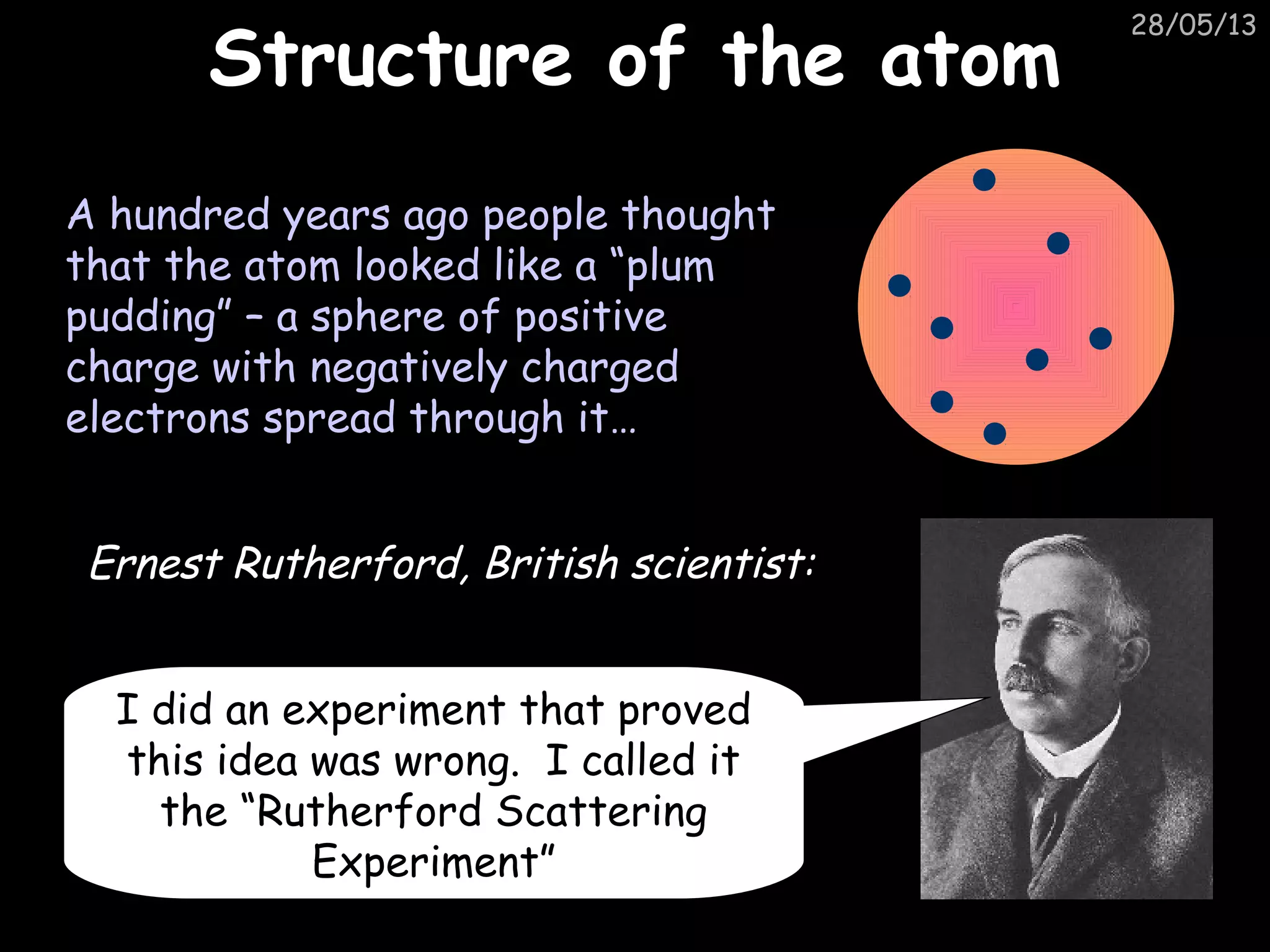
A hundred years ago people thought
that the atom looked like a “plum
pudding” – a sphere of positive
charge with negatively charged
electrons spread through it…
I did an experiment that proved
this idea was wrong. I called it
the “Rutherford Scattering
Experiment”
Ernest Rutherford, British scientist:
28/05/13
The Rutherford Scattering ExperimentThe Rutherford Scattering Experiment
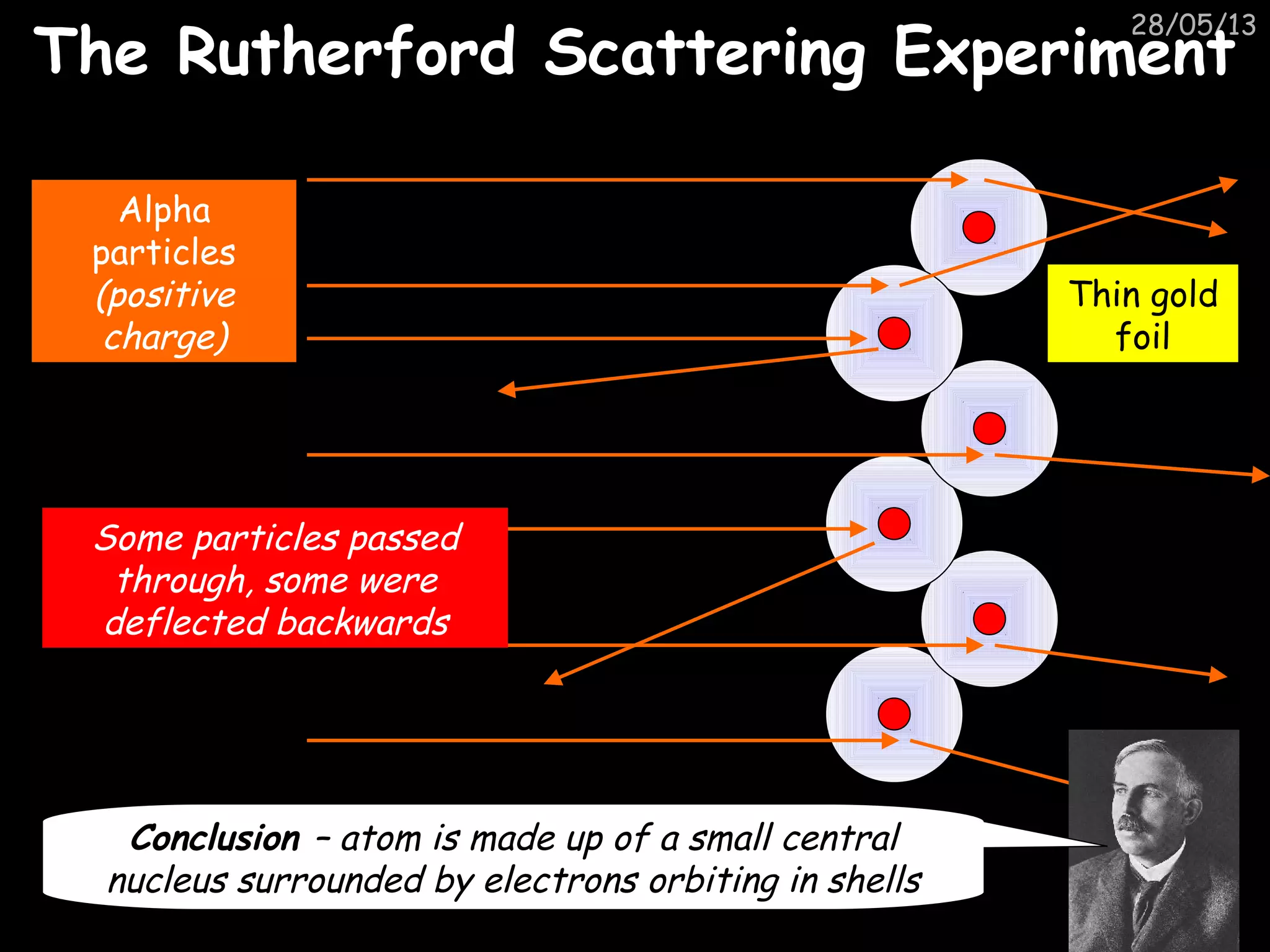
Alpha
particles
(positive
charge)
Thin gold
foil
Some particles passed
through, some were
deflected backwards
Conclusion – atom is made up of a small central
nucleus surrounded by electrons orbiting in shells
28/05/13
The structure of the atomThe structure of the atom
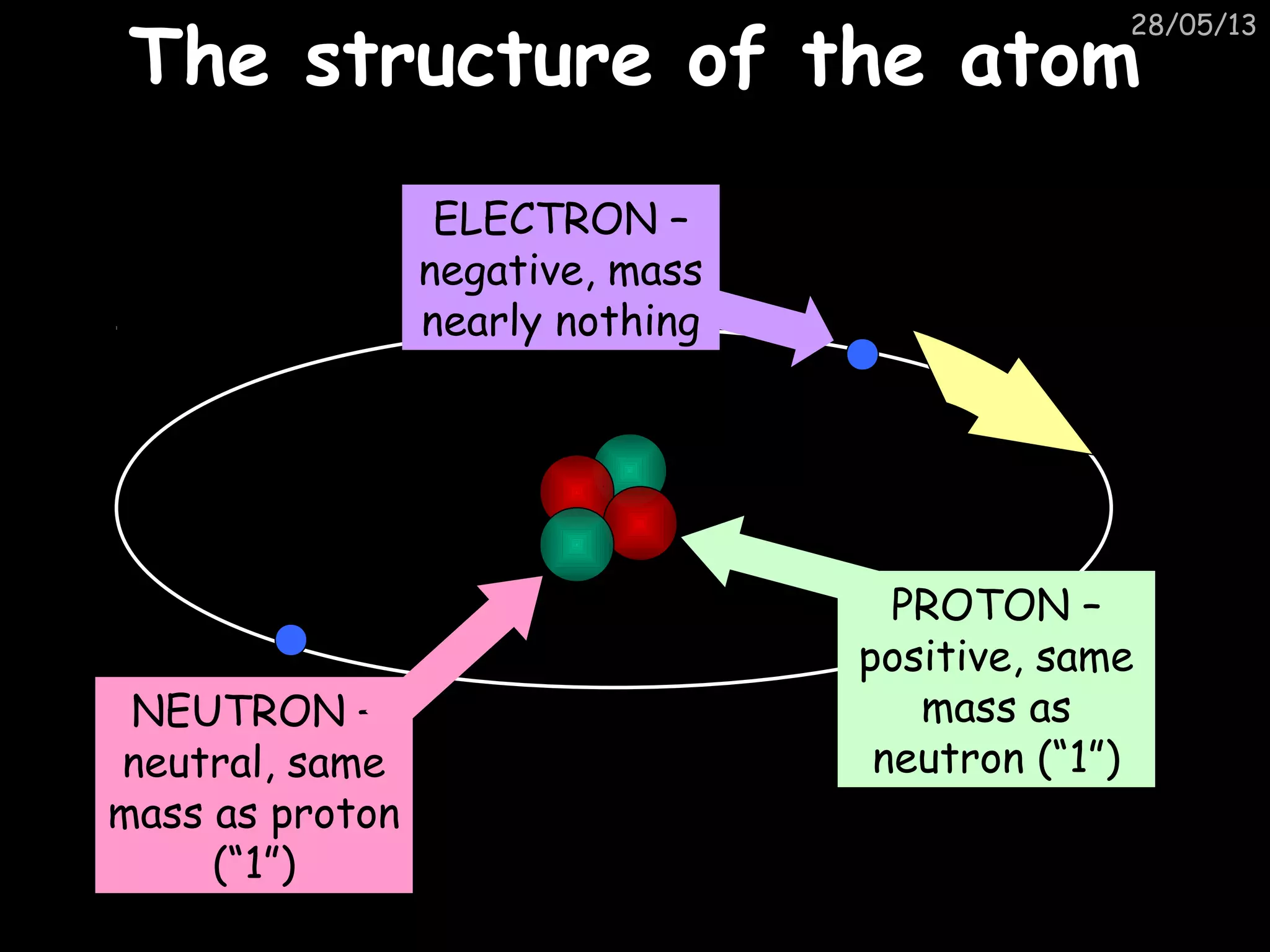
ELECTRON –
negative, mass
nearly nothing
PROTON –
positive, same
mass as
neutron (“1”)
NEUTRON –
neutral, same
mass as proton
(“1”)
28/05/13
The structure of the atomThe structure of the atom
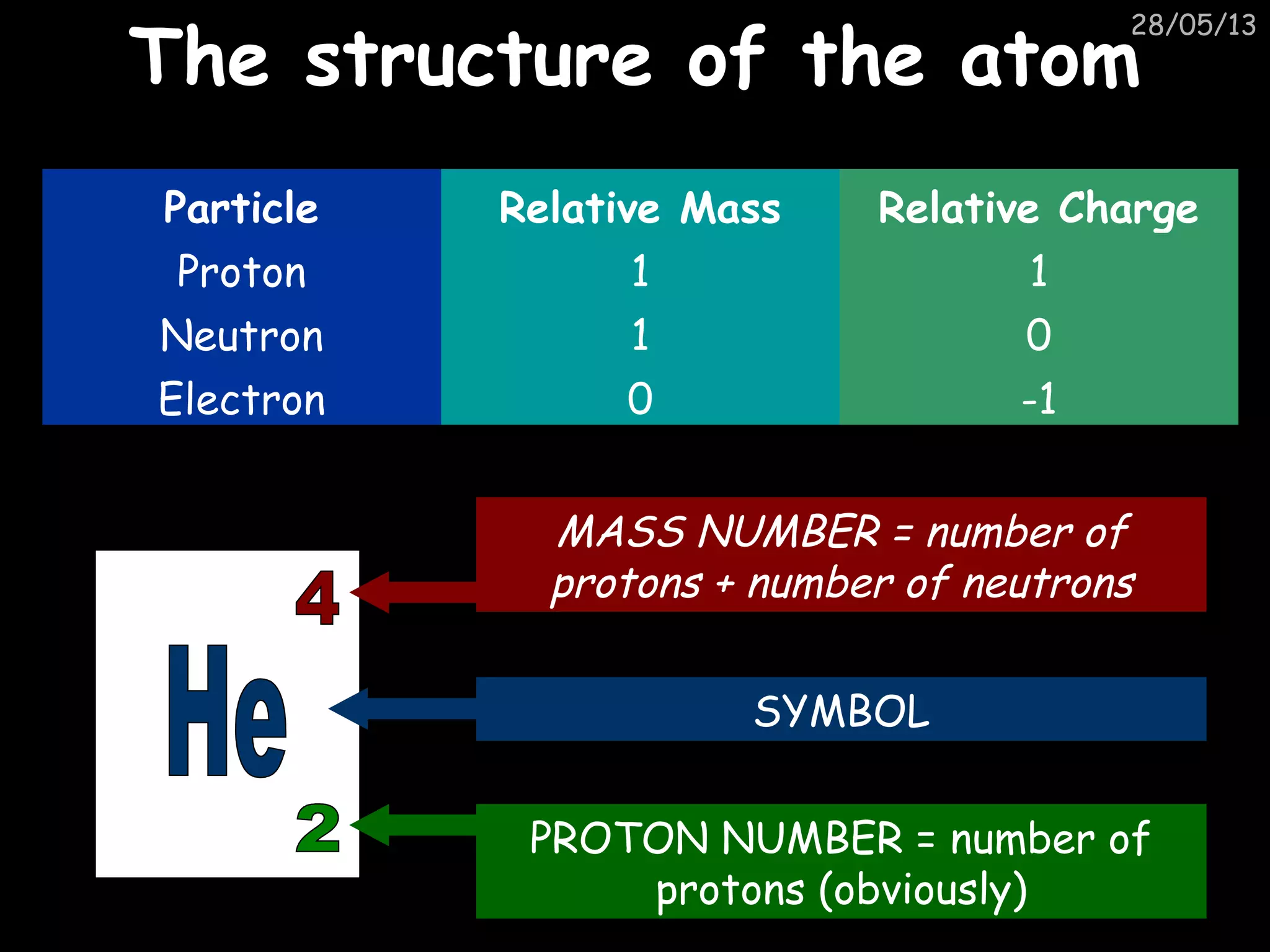
Particle Relative Mass Relative Charge
Proton 1 1
Neutron 1 0
Electron 0 -1
MASS NUMBER = number of
protons + number of neutrons
SYMBOL
PROTON NUMBER = number of
protons (obviously)
28/05/13
Background RadiationBackground Radiation
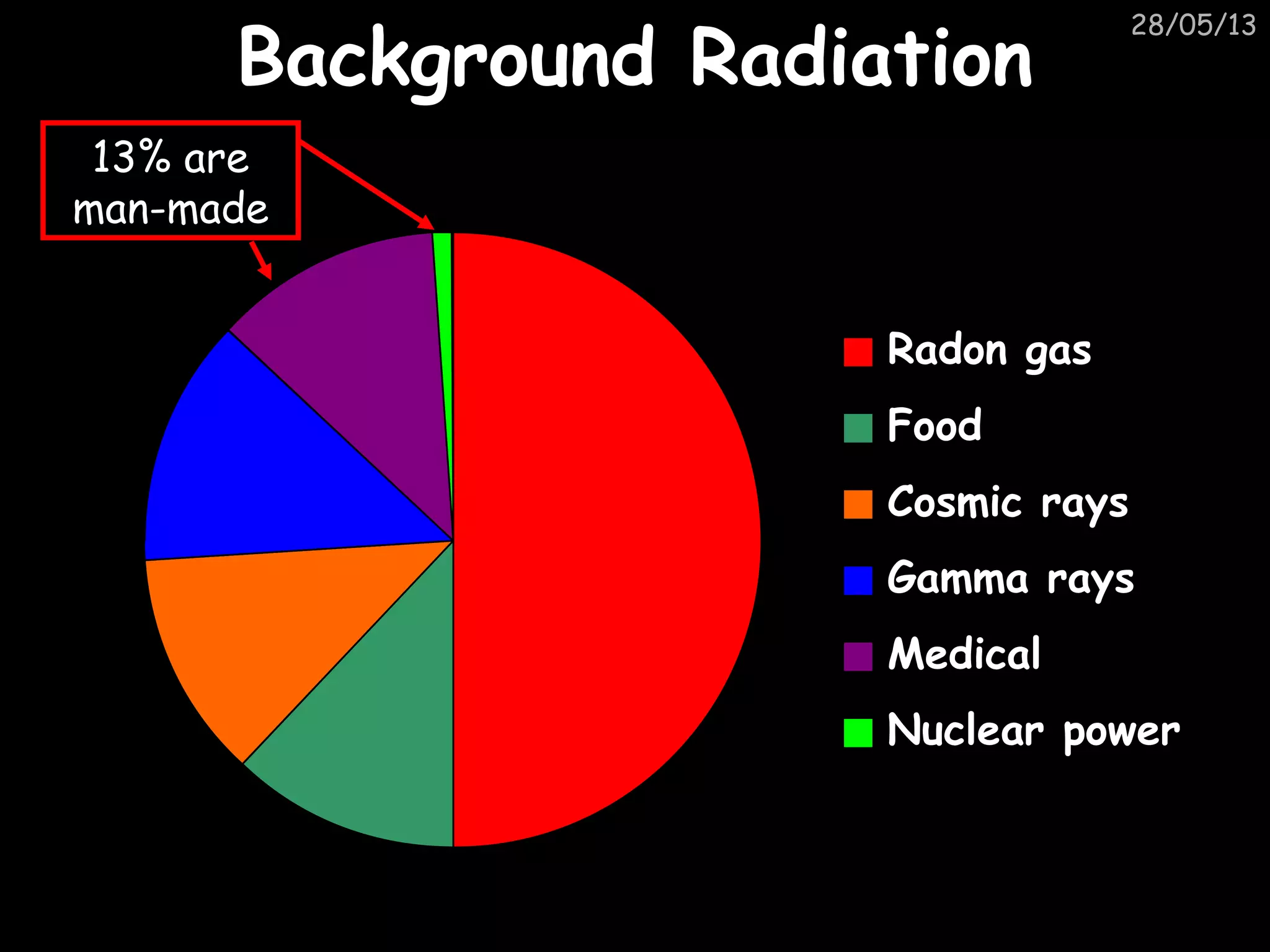
Radon gas
Food
Cosmic rays
Gamma rays
Medical
Nuclear power
13% are
man-made
28/05/13
RadioactivityRadioactivity
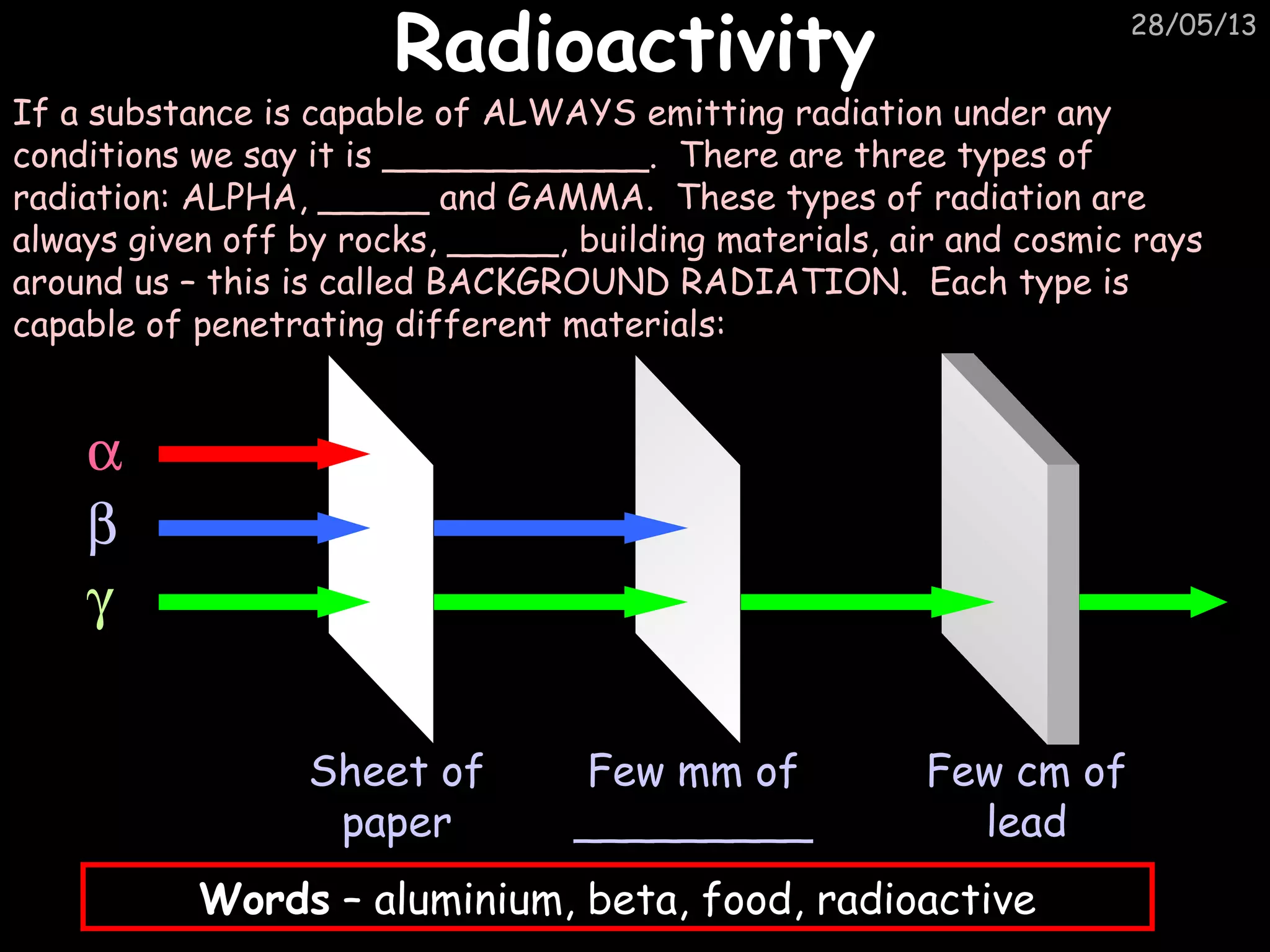
If a substance is capable of ALWAYS emitting radiation under any
conditions we say it is ____________. There are three types of
radiation: ALPHA, _____ and GAMMA. These types of radiation are
always given off by rocks, _____, building materials, air and cosmic rays
around us – this is called BACKGROUND RADIATION. Each type is
capable of penetrating different materials:
α
β
γ
Sheet of
paper
Few mm of
_________
Few cm of
lead
Words – aluminium, beta, food, radioactive
28/05/13
IsotopesIsotopes
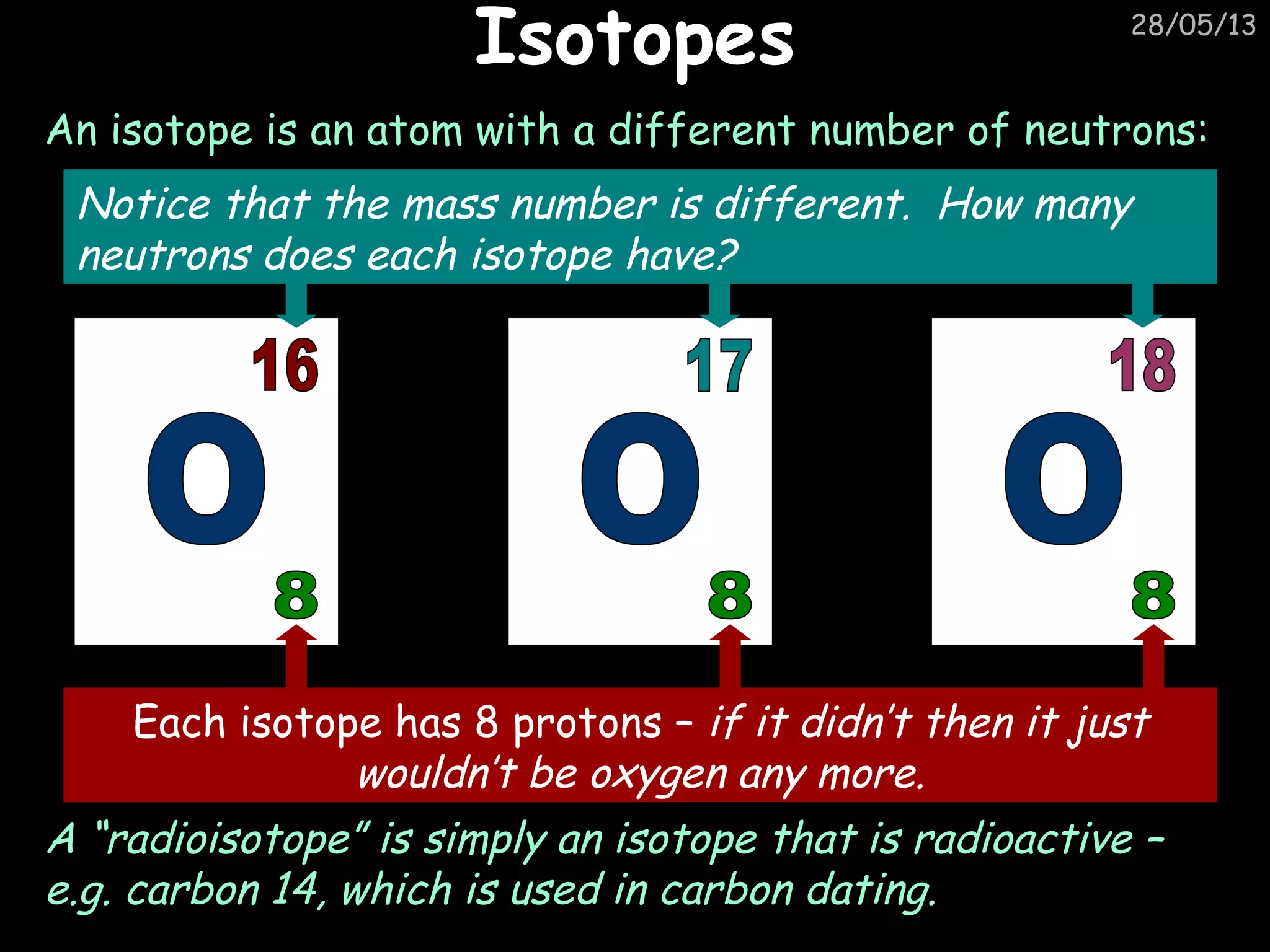
An isotope is an atom with a different number of neutrons:
Each isotope has 8 protons – if it didn’t then it just
wouldn’t be oxygen any more.
Notice that the mass number is different. How many
neutrons does each isotope have?
A “radioisotope” is simply an isotope that is radioactive –
e.g. carbon 14, which is used in carbon dating.
28/05/13
Types of radiationTypes of radiation
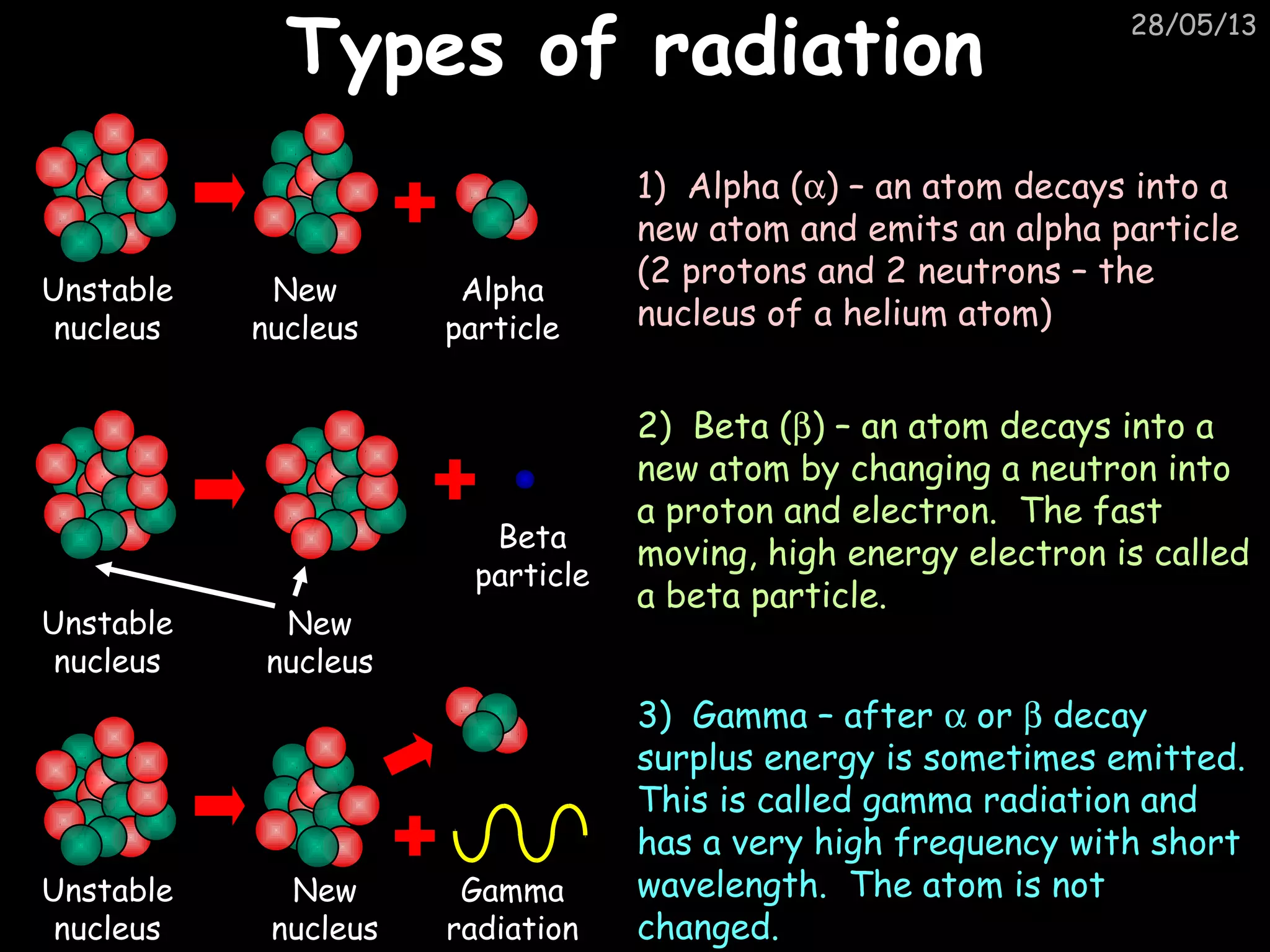
1) Alpha (α) – an atom decays into a
new atom and emits an alpha particle
(2 protons and 2 neutrons – the
nucleus of a helium atom)
2) Beta (β) – an atom decays into a
new atom by changing a neutron into
a proton and electron. The fast
moving, high energy electron is called
a beta particle.
3) Gamma – after α or β decay
surplus energy is sometimes emitted.
This is called gamma radiation and
has a very high frequency with short
wavelength. The atom is not
changed.
Unstable
nucleus
Unstable
nucleus
Unstable
nucleus
New
nucleus
New
nucleus
New
nucleus
Alpha
particle
Beta
particle
Gamma
radiation
28/05/13
IonisationIonisation
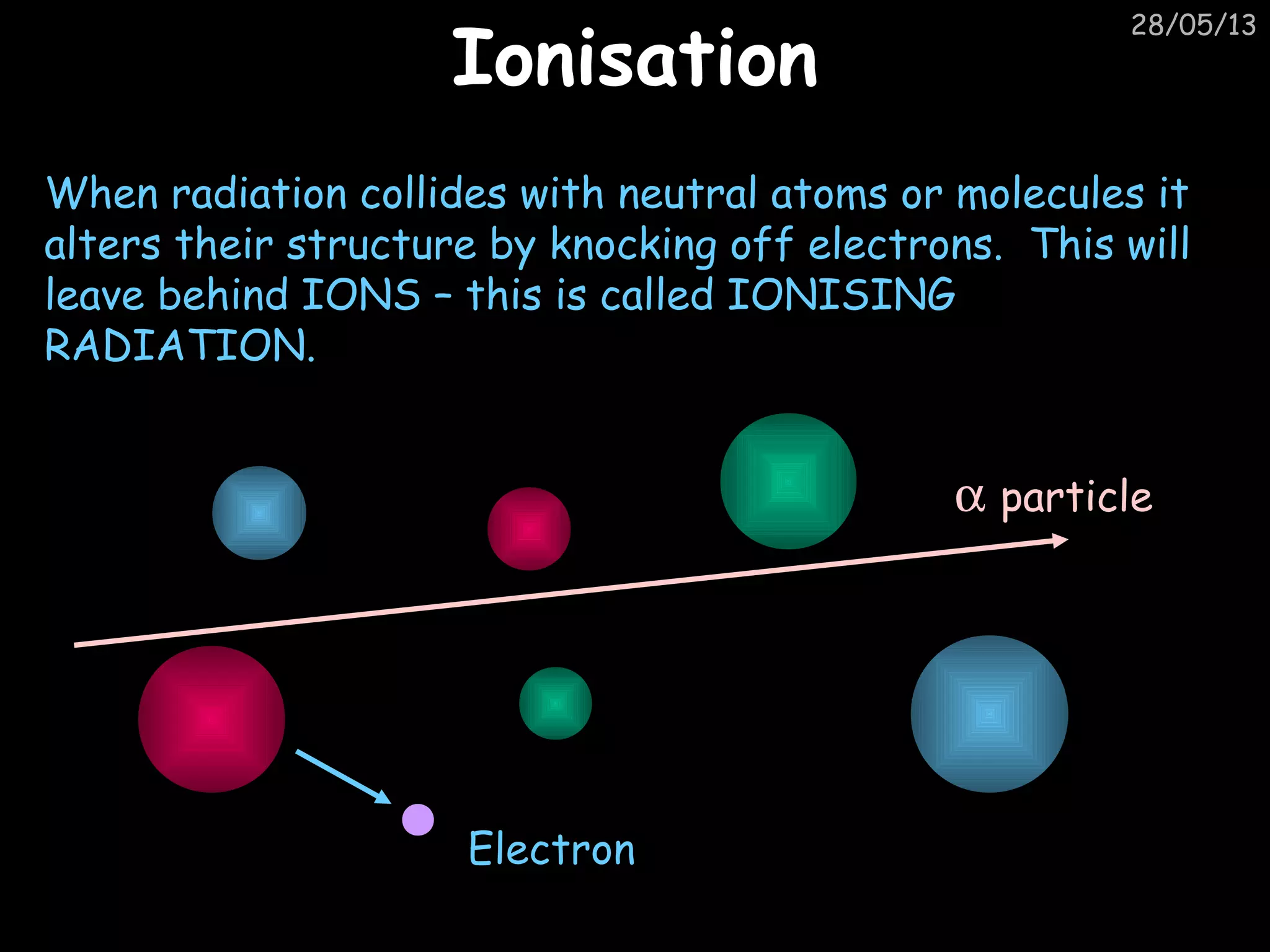
When radiation collides with neutral atoms or molecules it
alters their structure by knocking off electrons. This will
leave behind IONS – this is called IONISING
RADIATION.
α particle
Electron
28/05/13
Uses of radioactivityUses of radioactivity
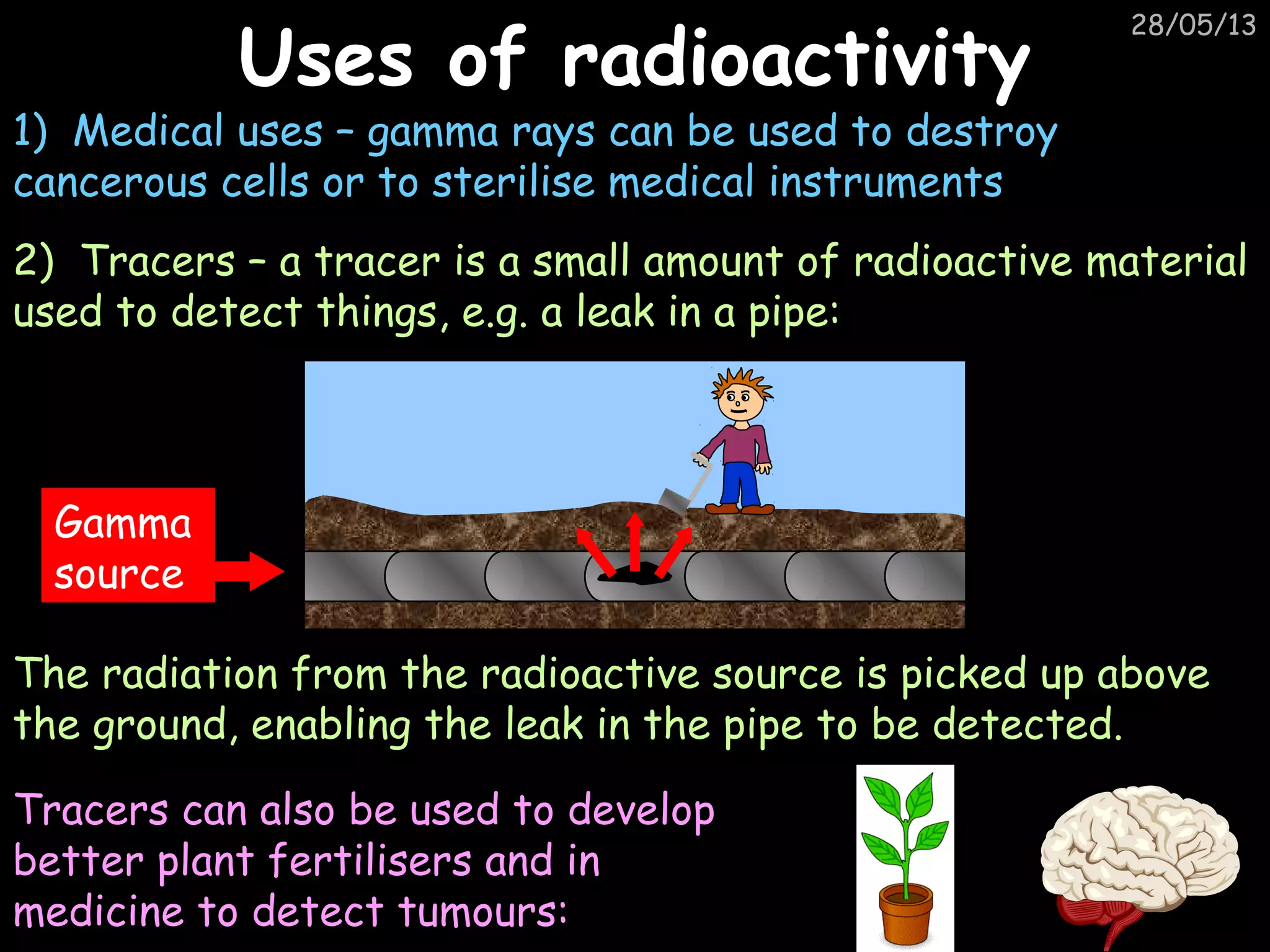
1) Medical uses – gamma rays can be used to destroy
cancerous cells or to sterilise medical instruments
2) Tracers – a tracer is a small amount of radioactive material
used to detect things, e.g. a leak in a pipe:
Gamma
source
Tracers can also be used to develop
better plant fertilisers and in
medicine to detect tumours:
The radiation from the radioactive source is picked up above
the ground, enabling the leak in the pipe to be detected.
28/05/13
Uses of radioactivity 2Uses of radioactivity 2
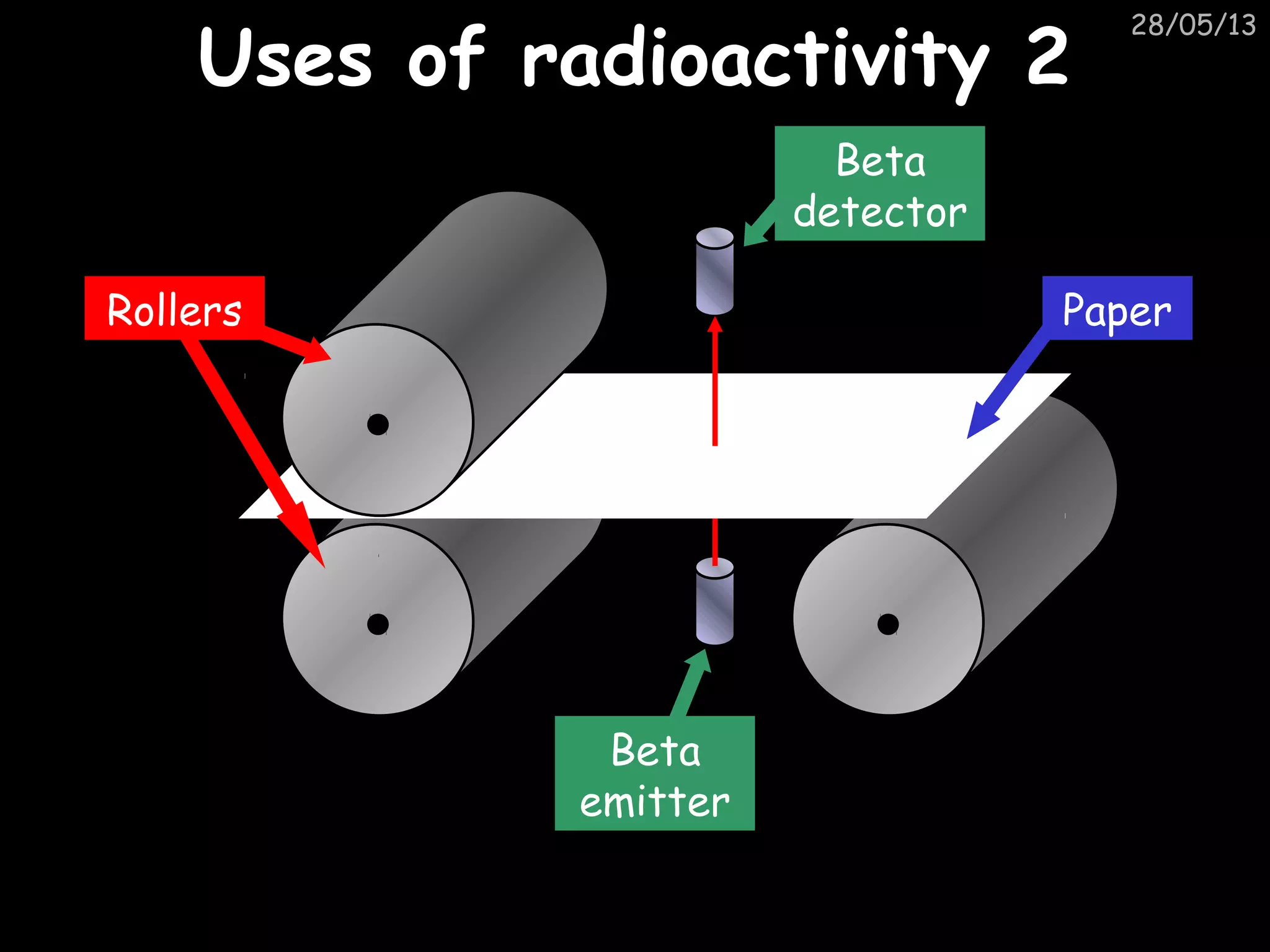
Rollers
Beta
emitter
Beta
detector
Paper
28/05/13
Dangers of radioactivityDangers of radioactivity
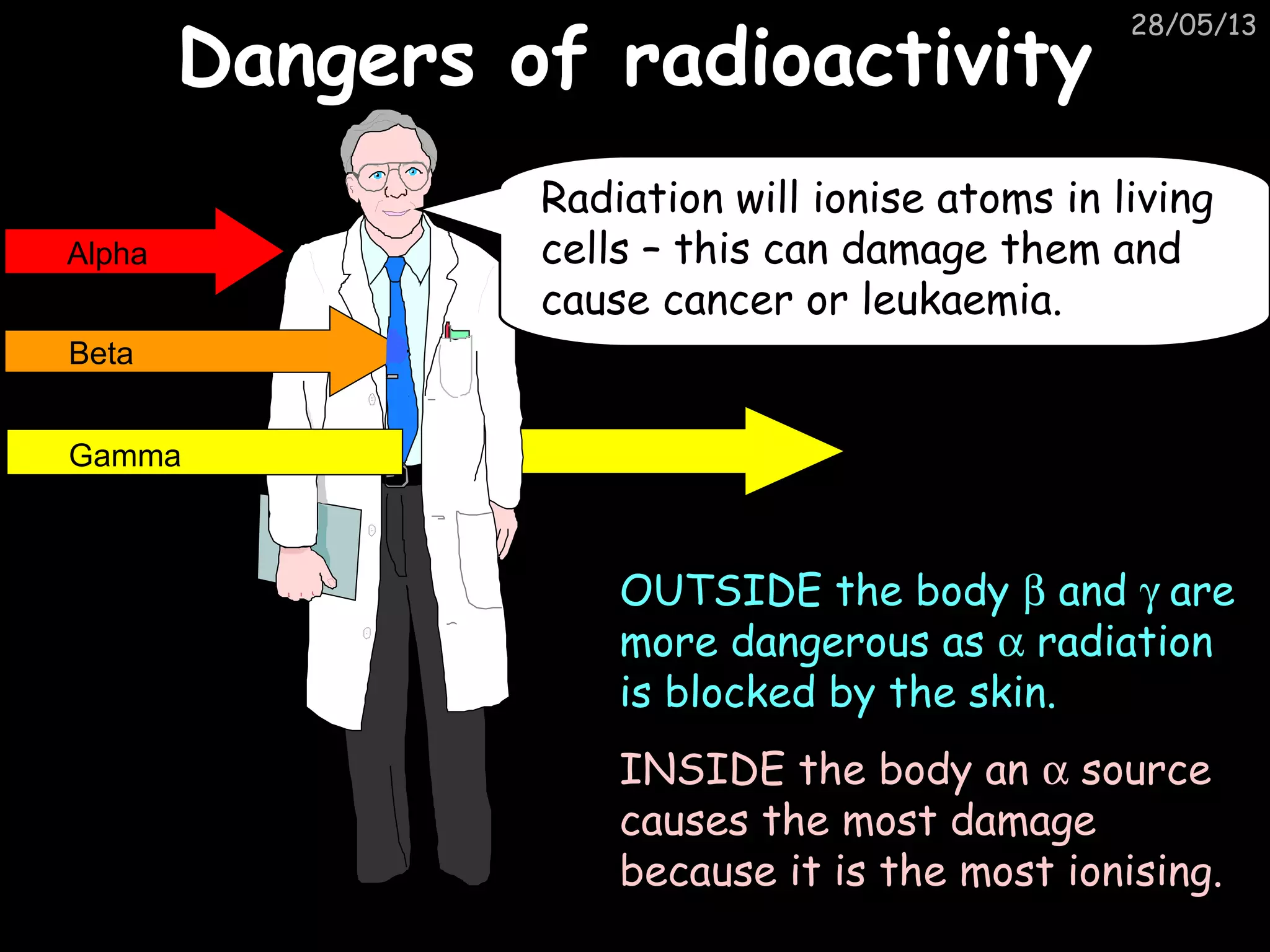
OUTSIDE the body β and γ are
more dangerous as α radiation
is blocked by the skin.
INSIDE the body an α source
causes the most damage
because it is the most ionising.
Alpha
Beta
Gamma
Radiation will ionise atoms in living
cells – this can damage them and
cause cancer or leukaemia.
28/05/13
Half lifeHalf life
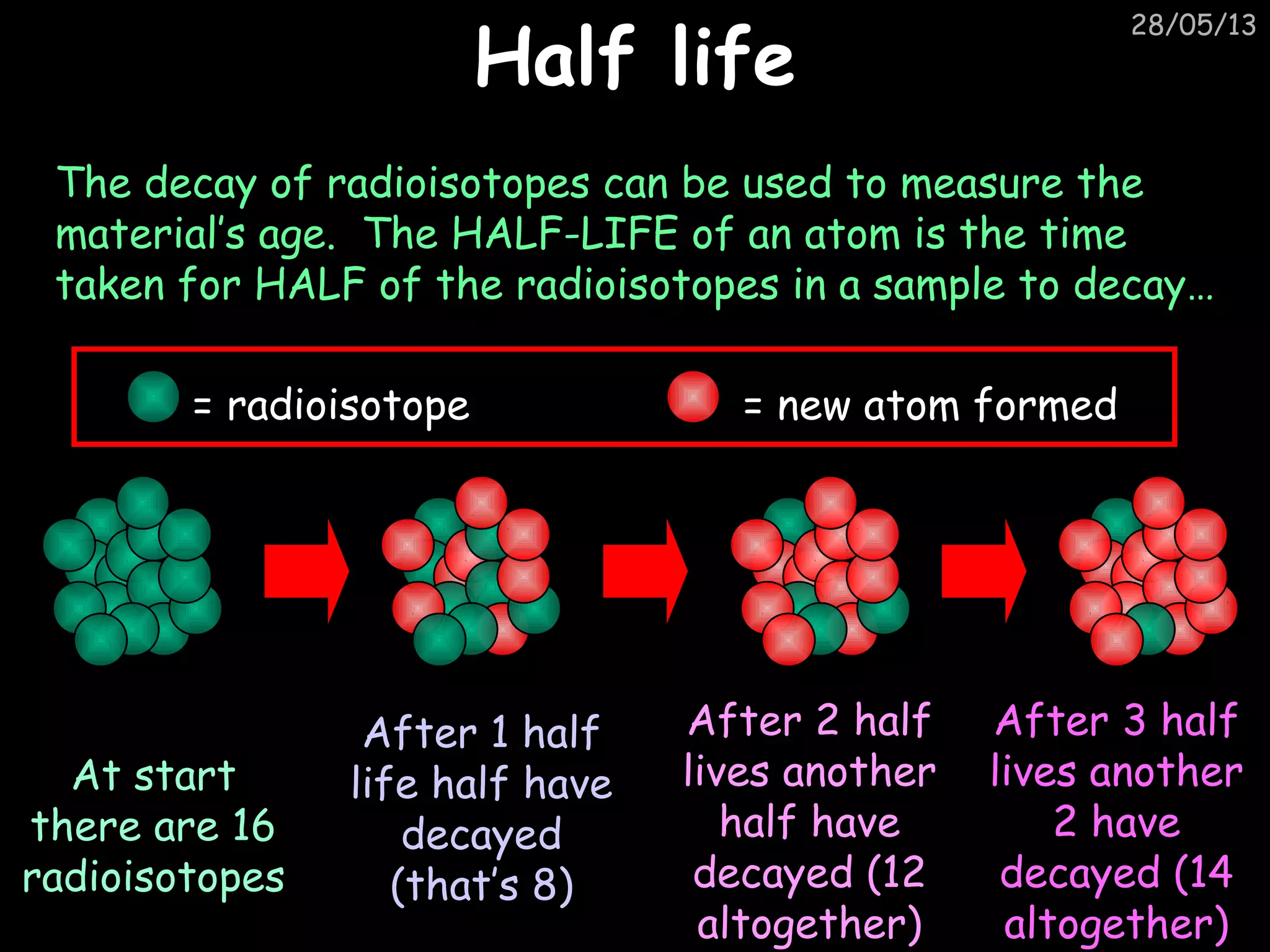
The decay of radioisotopes can be used to measure the
material’s age. The HALF-LIFE of an atom is the time
taken for HALF of the radioisotopes in a sample to decay…
At start
there are 16
radioisotopes
After 1 half
life half have
decayed
(that’s 8)
After 3 half
lives another
2 have
decayed (14
altogether)
After 2 half
lives another
half have
decayed (12
altogether)
= radioisotope = new atom formed
28/05/13
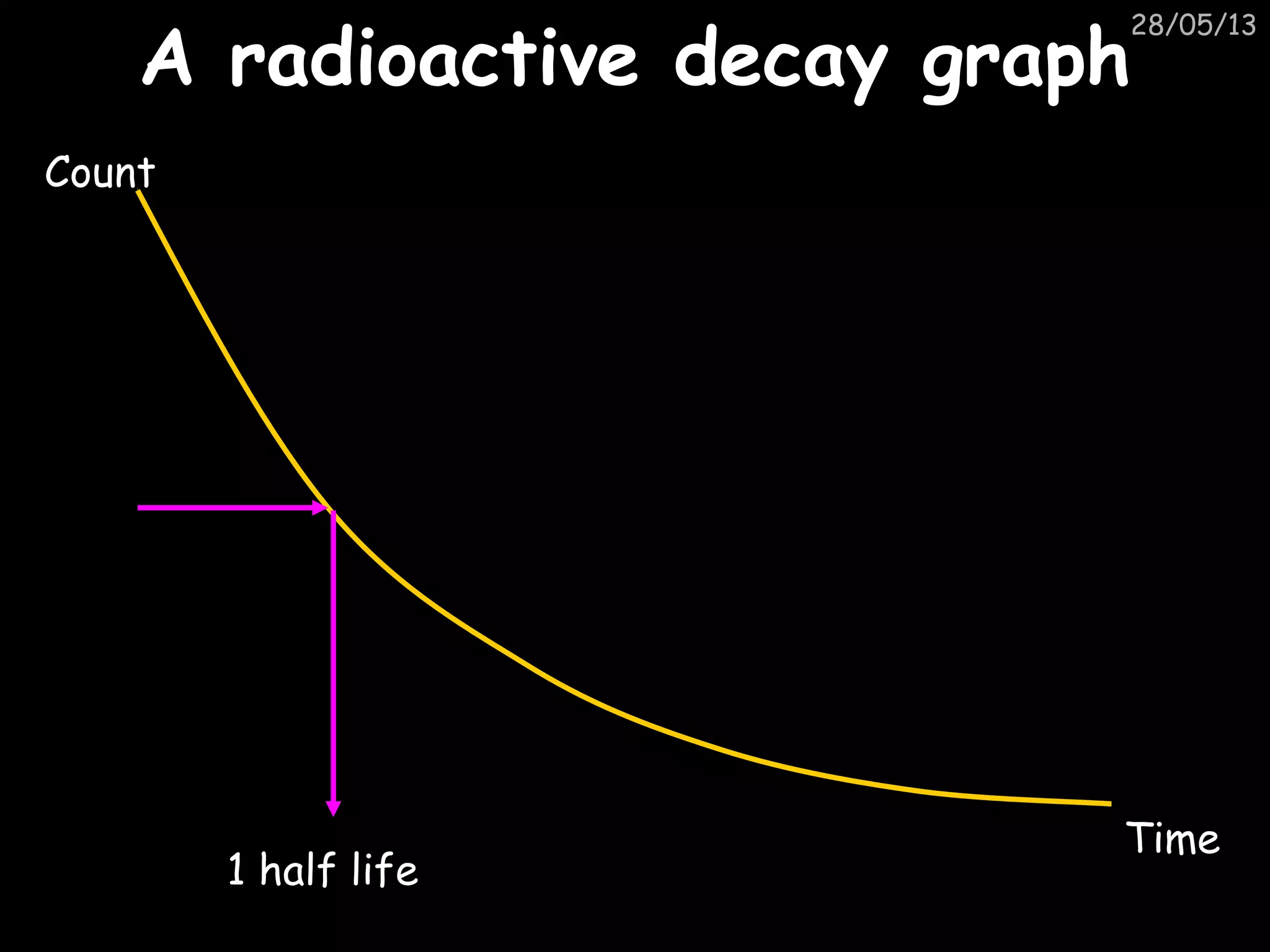
A radioactive decay graphA radioactive decay graph
Time
Count
1 half life
28/05/13
Dating materials using half-livesDating materials using half-lives
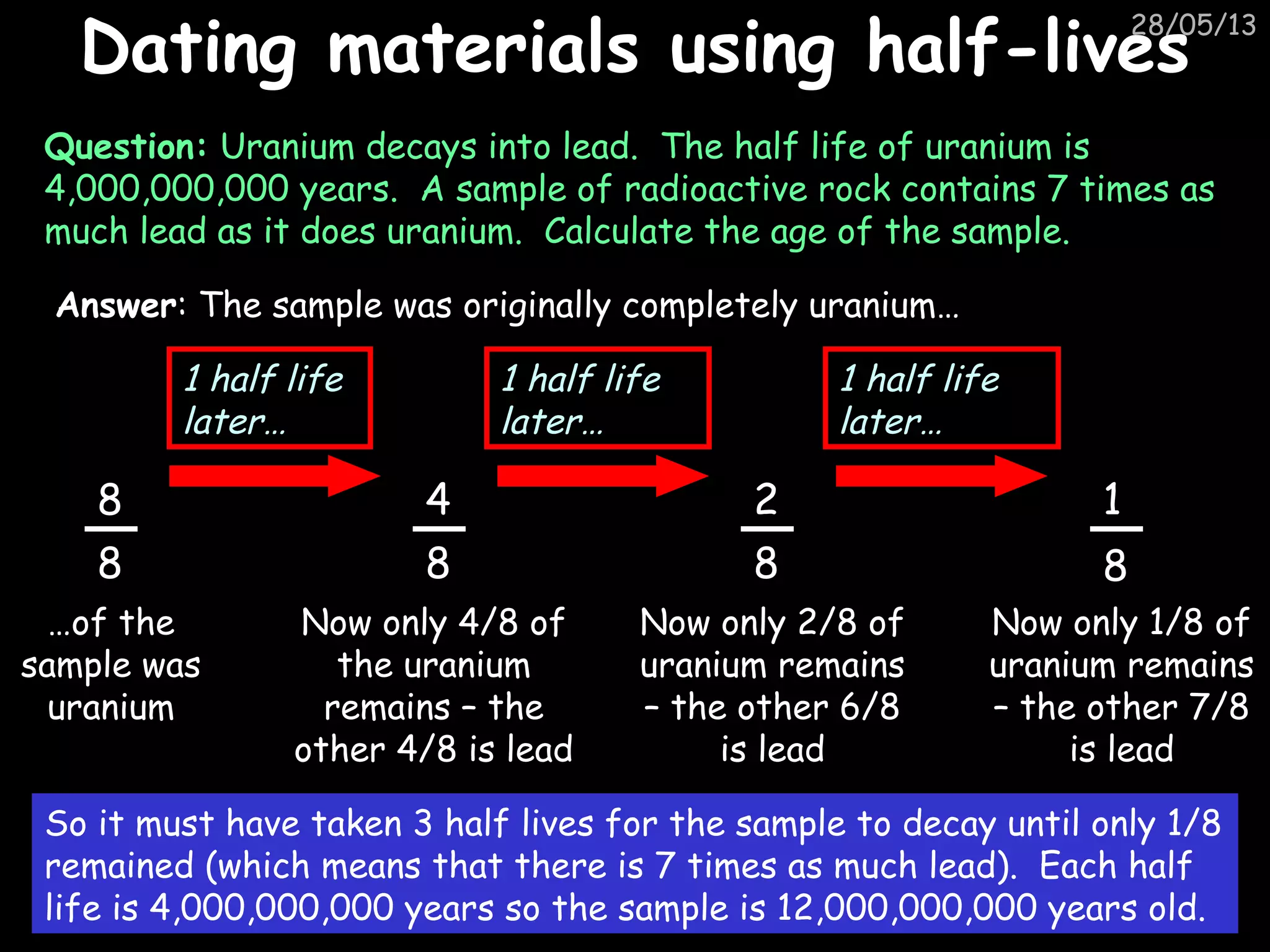
Question: Uranium decays into lead. The half life of uranium is
4,000,000,000 years. A sample of radioactive rock contains 7 times as
much lead as it does uranium. Calculate the age of the sample.
8
8
Answer: The sample was originally completely uranium…
…of the
sample was
uranium
4
8
2
8
1
8
Now only 4/8 of
the uranium
remains – the
other 4/8 is lead
Now only 2/8 of
uranium remains
– the other 6/8
is lead
Now only 1/8 of
uranium remains
– the other 7/8
is lead
So it must have taken 3 half lives for the sample to decay until only 1/8
remained (which means that there is 7 times as much lead). Each half
life is 4,000,000,000 years so the sample is 12,000,000,000 years old.
1 half life
later…
1 half life
later…
1 half life
later…
28/05/13
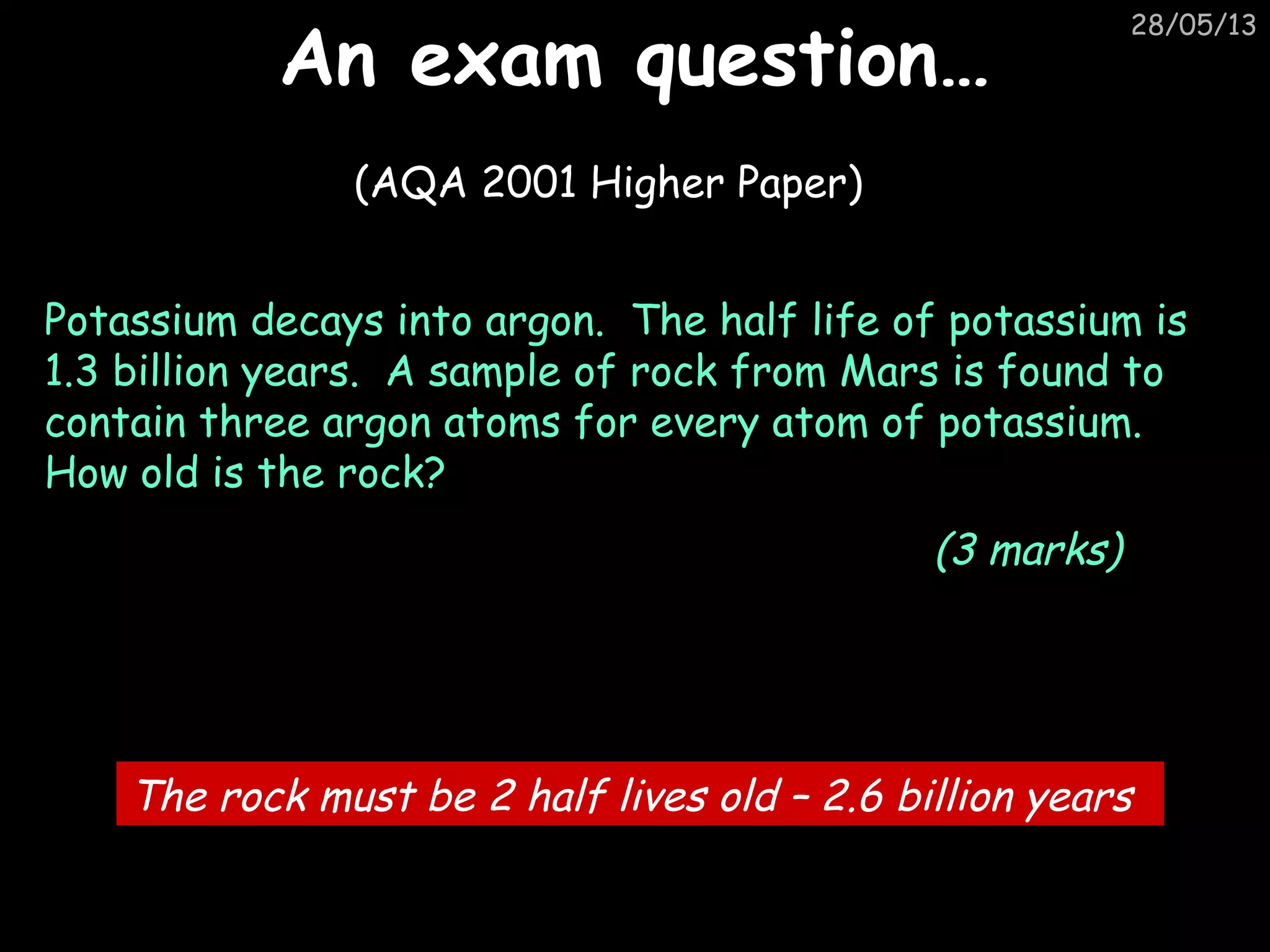
An exam question…An exam question…
(AQA 2001 Higher Paper)
Potassium decays into argon. The half life of potassium is
1.3 billion years. A sample of rock from Mars is found to
contain three argon atoms for every atom of potassium.
How old is the rock?
(3 marks)
The rock must be 2 half lives old – 2.6 billion years
28/05/13
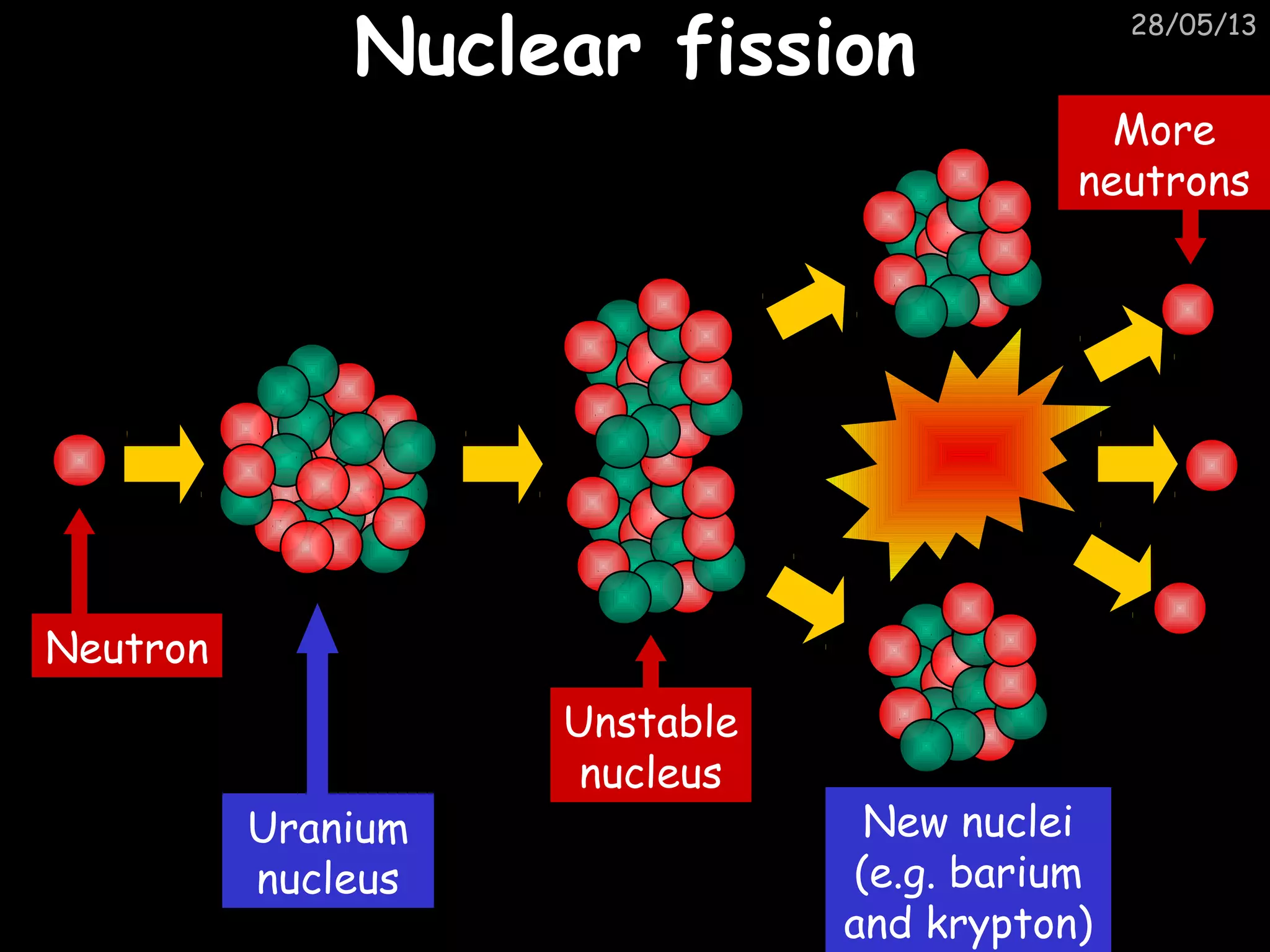
Nuclear fissionNuclear fission
Uranium
nucleus
Unstable
nucleus
New nuclei
(e.g. barium
and krypton)
More
neutrons
Neutron
28/05/13
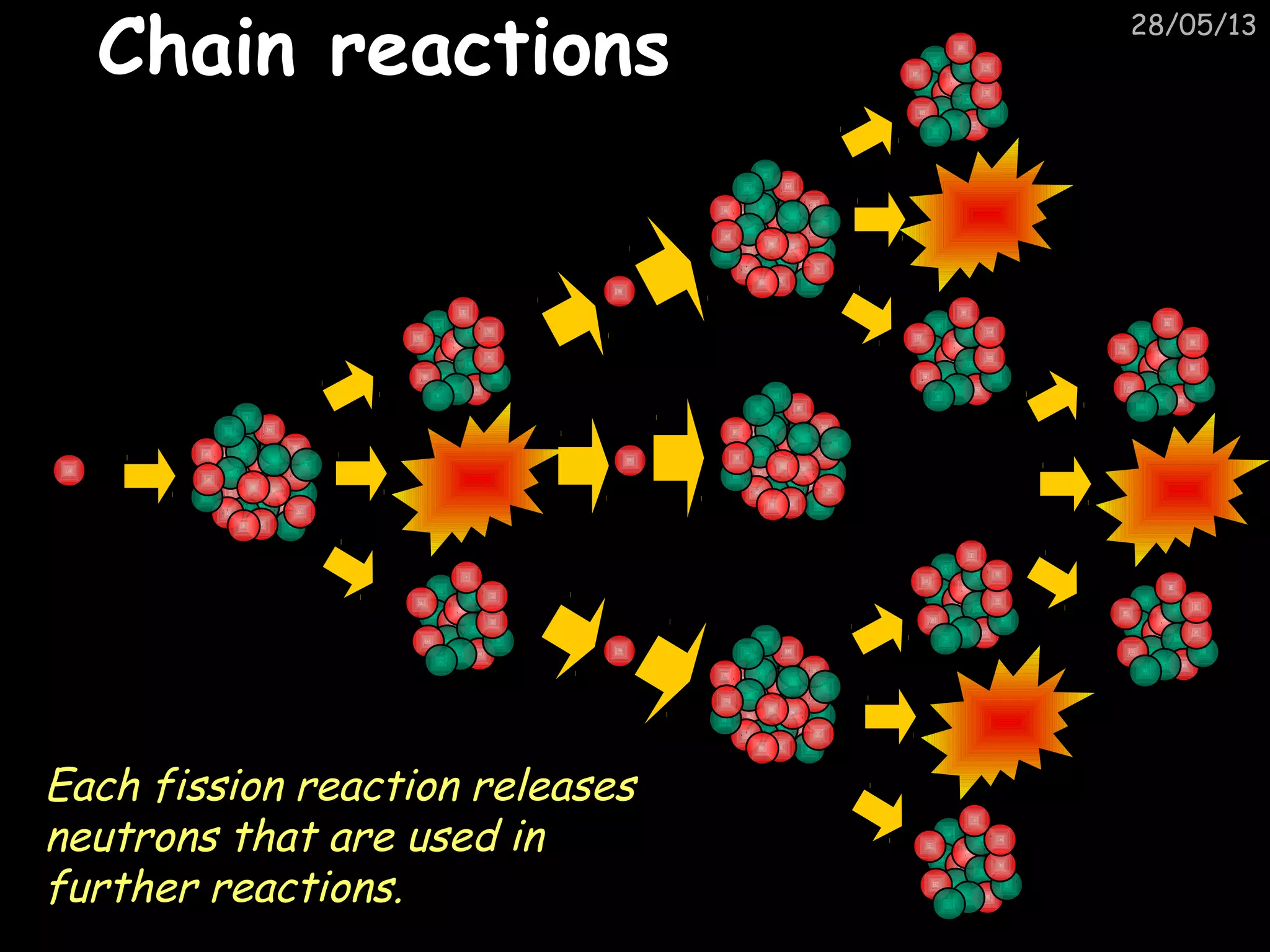
Chain reactionsChain reactions
Each fission reaction releases
neutrons that are used in
further reactions.
28/05/13
Fission reactions summaryFission reactions summary
Each fission reaction releases energy in the form of
_______. In a nuclear power plant this heat is used to boil
_______, which is used to drive turbines etc. The energy
from each reaction is very ______, but there are
________ of reactions every second. The waste products
from these reactions are __________, which is why
nuclear power plants are ___________.
Words – radioactive, water, billions,
controversial, heat, small

Junior cycle science physics radiation. By Theresa Lowry-Lehnen. Science Teacher.

  • 1.
    Junior CycleJunior Cycle PhysicsPhysics RadiationRadiation Editedand Reproduced by Theresa Lowry-Lehnen RGN, BSc (Hon’s) Specialist Clinical Practitioner (Nursing), Dip Counselling, Dip Adv Psychotherapy, BSc (Hon’s) Clinical Science, PGCE (QTS) , H. Dip. Ed, MEd, Emotional Intelligence (Level 9) MHS Accredited
  • 2.
    28/05/13 Structure of theatomStructure of the atom A hundred years ago people thought that the atom looked like a “plum pudding” – a sphere of positive charge with negatively charged electrons spread through it… I did an experiment that proved this idea was wrong. I called it the “Rutherford Scattering Experiment” Ernest Rutherford, British scientist:
  • 3.
    28/05/13 The Rutherford ScatteringExperimentThe Rutherford Scattering Experiment Alpha particles (positive charge) Thin gold foil Some particles passed through, some were deflected backwards Conclusion – atom is made up of a small central nucleus surrounded by electrons orbiting in shells
  • 4.
    28/05/13 The structure ofthe atomThe structure of the atom ELECTRON – negative, mass nearly nothing PROTON – positive, same mass as neutron (“1”) NEUTRON – neutral, same mass as proton (“1”)
  • 5.
    28/05/13 The structure ofthe atomThe structure of the atom Particle Relative Mass Relative Charge Proton 1 1 Neutron 1 0 Electron 0 -1 MASS NUMBER = number of protons + number of neutrons SYMBOL PROTON NUMBER = number of protons (obviously)
  • 6.
    28/05/13 Background RadiationBackground Radiation Radongas Food Cosmic rays Gamma rays Medical Nuclear power 13% are man-made
  • 7.
    28/05/13 RadioactivityRadioactivity If a substanceis capable of ALWAYS emitting radiation under any conditions we say it is ____________. There are three types of radiation: ALPHA, _____ and GAMMA. These types of radiation are always given off by rocks, _____, building materials, air and cosmic rays around us – this is called BACKGROUND RADIATION. Each type is capable of penetrating different materials: α β γ Sheet of paper Few mm of _________ Few cm of lead Words – aluminium, beta, food, radioactive
  • 8.
    28/05/13 IsotopesIsotopes An isotope isan atom with a different number of neutrons: Each isotope has 8 protons – if it didn’t then it just wouldn’t be oxygen any more. Notice that the mass number is different. How many neutrons does each isotope have? A “radioisotope” is simply an isotope that is radioactive – e.g. carbon 14, which is used in carbon dating.
  • 9.
    28/05/13 Types of radiationTypesof radiation 1) Alpha (α) – an atom decays into a new atom and emits an alpha particle (2 protons and 2 neutrons – the nucleus of a helium atom) 2) Beta (β) – an atom decays into a new atom by changing a neutron into a proton and electron. The fast moving, high energy electron is called a beta particle. 3) Gamma – after α or β decay surplus energy is sometimes emitted. This is called gamma radiation and has a very high frequency with short wavelength. The atom is not changed. Unstable nucleus Unstable nucleus Unstable nucleus New nucleus New nucleus New nucleus Alpha particle Beta particle Gamma radiation
  • 10.
    28/05/13 IonisationIonisation When radiation collideswith neutral atoms or molecules it alters their structure by knocking off electrons. This will leave behind IONS – this is called IONISING RADIATION. α particle Electron
  • 11.
    28/05/13 Uses of radioactivityUsesof radioactivity 1) Medical uses – gamma rays can be used to destroy cancerous cells or to sterilise medical instruments 2) Tracers – a tracer is a small amount of radioactive material used to detect things, e.g. a leak in a pipe: Gamma source Tracers can also be used to develop better plant fertilisers and in medicine to detect tumours: The radiation from the radioactive source is picked up above the ground, enabling the leak in the pipe to be detected.
  • 12.
    28/05/13 Uses of radioactivity2Uses of radioactivity 2 Rollers Beta emitter Beta detector Paper
  • 13.
    28/05/13 Dangers of radioactivityDangersof radioactivity OUTSIDE the body β and γ are more dangerous as α radiation is blocked by the skin. INSIDE the body an α source causes the most damage because it is the most ionising. Alpha Beta Gamma Radiation will ionise atoms in living cells – this can damage them and cause cancer or leukaemia.
  • 14.
    28/05/13 Half lifeHalf life Thedecay of radioisotopes can be used to measure the material’s age. The HALF-LIFE of an atom is the time taken for HALF of the radioisotopes in a sample to decay… At start there are 16 radioisotopes After 1 half life half have decayed (that’s 8) After 3 half lives another 2 have decayed (14 altogether) After 2 half lives another half have decayed (12 altogether) = radioisotope = new atom formed
  • 15.
    28/05/13 A radioactive decaygraphA radioactive decay graph Time Count 1 half life
  • 16.
    28/05/13 Dating materials usinghalf-livesDating materials using half-lives Question: Uranium decays into lead. The half life of uranium is 4,000,000,000 years. A sample of radioactive rock contains 7 times as much lead as it does uranium. Calculate the age of the sample. 8 8 Answer: The sample was originally completely uranium… …of the sample was uranium 4 8 2 8 1 8 Now only 4/8 of the uranium remains – the other 4/8 is lead Now only 2/8 of uranium remains – the other 6/8 is lead Now only 1/8 of uranium remains – the other 7/8 is lead So it must have taken 3 half lives for the sample to decay until only 1/8 remained (which means that there is 7 times as much lead). Each half life is 4,000,000,000 years so the sample is 12,000,000,000 years old. 1 half life later… 1 half life later… 1 half life later…
  • 17.
    28/05/13 An exam question…Anexam question… (AQA 2001 Higher Paper) Potassium decays into argon. The half life of potassium is 1.3 billion years. A sample of rock from Mars is found to contain three argon atoms for every atom of potassium. How old is the rock? (3 marks) The rock must be 2 half lives old – 2.6 billion years
  • 18.
    28/05/13 Nuclear fissionNuclear fission Uranium nucleus Unstable nucleus Newnuclei (e.g. barium and krypton) More neutrons Neutron
  • 19.
    28/05/13 Chain reactionsChain reactions Eachfission reaction releases neutrons that are used in further reactions.
  • 20.
    28/05/13 Fission reactions summaryFissionreactions summary Each fission reaction releases energy in the form of _______. In a nuclear power plant this heat is used to boil _______, which is used to drive turbines etc. The energy from each reaction is very ______, but there are ________ of reactions every second. The waste products from these reactions are __________, which is why nuclear power plants are ___________. Words – radioactive, water, billions, controversial, heat, small