june 2015
Field Day is fast
approaching! Planning efforts for this
year’s Palomar Amateur Radio Club
Field Day Effort are underway. Field
Day this year will fall on June 26th,
27th, and 2th 2015. See website for
location.
The Field Day net occurs Wednesdays
at 8PM. We are currently looking at
a 4A setup this year. This will free up
10M for GOTA so they have a place
to operate and will also free up some
of the congestion at the site on the
airways (hopefully).
Our Field Day Chef this year will
be Gina along with her impressive
Psycho Kitchen. Cuisine still to be
determined.
We have sourced many of the
needed supplies. We still need help
with setup and tear down. Setup
will begin on Friday at 11am on
site. Field Day is a group effort and
cannot be accomplished with out all
the generous help from PARC club
members and other volunteers. Many
hands make light work!
Field Day is not a contest, but will
sure be fun. When you have fun
doing something you love, you
generally end up doing well. That is
this year’s goal. To have FUN and do
well. Come out and visit with your
fellow club members and hams alike,
get on the air and operate, eat good
food, enjoy eyeball QSO, demonstrate
amateur radio to the public, and most
of all have fun. Thank you for all you
do and I look forward to hearing you
on the Net and more importantly,
seeing you at Field Day.
73,
Greg Gibbs KI6RXX
Cell: 760-583-9668
SCOPE page 2
Club Meeting
Save the Date
Board Meeting Club Events
Field Day Program! Plus,
Trade Tech High shows
off their robotics project.
Palomar Amateur Radio
Club board meeting at
7:00pm at W6GNI QTH.
Field Day! New site!
June 7th work party!
3 June 2015 10 June 2015 27-28 June 2015
Advertisements are free for members
Have items that need to find a new home? Advertise here! Send your ads to scope@palomararc.org
Spectrum Analyzer, HP141T working mainframe with HP8553 (working 110 MHz) RF plug in with
HP 8552 I.F. module. Several HP8555s (10 MHz - 22 GHz) parts units and extra HP8552A & B I.F.
modules. Make offers. WB6IQS@att.net. John, Vista.
Wanted: E. F. Johnson electronic T-R switch, working or not. Matt, 619-865-8497, ae6hf@arrl.net.
Matt AE6HF
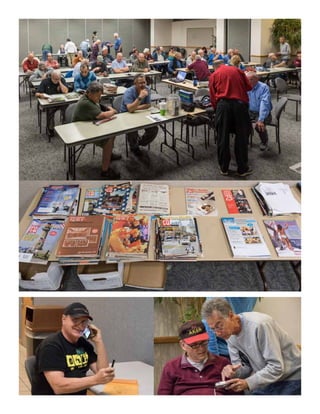
May 2015 Club Meeting Filmstrip
Goodie Table Update!
For next few month’s meeting I would like the Scope to stress that the Goodie Table will be
exceptionally well stocked. I will have all manner of variable capacitors, resistors, power resistors,
power and RF cables, coaxial fittings, relays, digital and analog ICs. I am hoping to get fair value
for the club for these items but JoAnne McBride is more interested in them being used for future
projects rather than just being dumped as electronic trash going to the recycle. Also, a large
assortment of test meters and component parts will be on the “Goodie” table at the June & July
meetings. Bird type RF Wattmeter w/ VHF/UHF slugs, variable capacitors, cables, power resistors /
fixed capacitors, etc. Bring bags / boxes to take home the treasures. Contact WB6IQS@att.net for
any specific requests. John Kuivinen, WB6IQS
SCOPE page 3
Please
support our
advertisers.
Their support
of the club is
vital.
microwaveupdate.org
SCOPE page 4
Integrating Yaesu System Fusion
Photos into the World
Paul KB5MU and Michelle W5NYV
Some of the Yaesu C4FM “System Fusion”
transceivers (FTM-400D mobile, FT-1DR and FT-
2DR handhelds, but not the C4FM-enabled FT-
991 HF/VHF rig or the brand-new (Dayton 2015)
FTM-100DR) support a camera microphone
accessory (MH-85A11U) that can take relatively
poor-quality, low-resolution photographs. These
photographs are stored locally on a microSD
card, as are photos received over the air. Later,
any photograph stored on the microSD card can
be transmitted to ALL or to a specified Group
ID. The FTM-400D has a color graphic display
which can display the photos. The FT-2DR can
display the photos in monochrome. The FT-1DR
can’t display the photos at all, so if you transmit
a picture taken with the camera mic or forward
a received photo you’re doing it without seeing
the photo first. The FTM-100DR can’t display the
photos either, but it can still receive and forward
them, even though it doesn’t support the camera
mic.
Photos are integrated to some extent with
Yaesu’s WIRES-X internet linking system. Photos
can be stored on the server, and can be part of
so-called News items. These capabilities have
not been evaluated. WIRES-X server software for
C4FM repeaters has yet to be released. WIRES-X
support for user stations requires the HRI-200
interface box (about $125) and a Windows
computer. We recently bought an HRI-200 for
evaluation. The HRI-200 software limits photos
to 40 kilobytes, according to the user manual.
Pictures taken by the MH-85A11U seem to be a
maximum of about 20 kilobytes.
The goal of this investigation is to bring this
photo capability into the wide world of the
internet and open systems, somehow, to
whatever extent seems feasible. Here are some
possible use cases to consider.
* Photo Channel Logger. A receiver would be
dedicated to monitoring a particular channel
frequented by C4FM users and store every
picture it hears. These pictures might be made
available in real time on the web, or on other
amateur radio data systems. The pictures could
be enhanced with EXIF metadata generated
by the logger, which could easily include, for
example, the date and time of reception. With a
little more work, the pictures could be associated
with signal strength information, or even signal
bearing from the receiver site. A logger could
be placed at an EOC and set to automatically
display all photos sent to a list of Group IDs, so
that information gathered in the field would be
immediately available to served agencies.
* Automatic Photo Sender. A system that has
automated access to some kind of image data
would be able to automatically transmit the
image on a particular channel. For example, it
would be easy to hook into weather forecasting
systems and transmit a radar image periodically,
or only when weather alerts are active, or
according to any other set of rules. A system
placed temporarily at a key location in an event
could be set up to take a photograph of the area
and transmit it periodically, or when some other
sensor is tripped, or even when computer image
analysis says that the photo contains something
interesting.
* Interactive Photo Sender. A system controlled
by text messaging (whether over C4FM, or AX.25
packet, or cellular SMS, or any other system) or
via the web (whether over amateur radio or not)
could be set up to allow a remote user to trigger
the transmission of a specific image. The image
might be one that already exists, or it might be
captured by a camera on demand, or it might
be computer generated on demand. The “News”
feature of the WIRES-X software is a simple 		
				continued page 6
SCOPE page 5
Why A Packet Repeater?
by Paul KB5MU
Why do we have a full duplex repeater on
146.700 MHz dedicated to packet radio?
Like a regular FM voice repeater, the packet
repeater gives every little station in range the
coverage that comes with a good antenna and a
spectacular mountaintop location. A handheld on
one end of the county can communicate with a
mobile in a crummy location on the other side of
the county. That’s good magic.
Packet radio, though, can get the same range
with just a digipeater on the mountaintop. A
digipeater is much simpler than a full duplex
repeater. It’s just an ordinary transceiver
connected to a little controller called a TNC
(“Terminal Node Controller”). The TNC listens for
packets that want to go through the digipeater.
Once it has fully received such a packet, it
listens for the radio channel to go idle and then
retransmits it. This mode of operation is called
“store and forward”, because the TNC stores
the message briefly before forwarding it on
to the next station. The TNC in a digipeater is
only listening (to store incoming packets) or
transmitting (to forward them on) at any given
time. It never needs to transmit and receive at
the same time.
There is one obvious disadvantage to the store-
and-forward mode. Every packet has to be sent
twice, once by the original station and then
again by the digipeater. This not only adds a little
bit of delay to every communication, it also takes
up twice the capacity on the channel. That is,
there’s only room for half as much data. That’s
a big deal, because standard 1200-baud packet
radio is already pretty slow. It can be pretty
speedy compared to users typing back and forth
on keyboards, but for most practical applications
giving up half the throughput is painful.
Unfortunately, it’s actually much worse than that.
It all comes down to how packet stations share
the channel. Packet stations listen before they
transmit, except for some APRS trackers that get
by without a receiver. If there’s a signal present
already, the station waits until the signal is gone.
If it didn’t do that, there would be two station
transmitting at once -- a “collision”. Very likely,
they would interfere with each other and neither
packet would be received. Remember, the packet
has to be received perfectly with no errors in
order to be used at all. After the channel sounds
clear, the station waits an additional random
interval, called a backoff. Provided the channel
is still clear, the station then finally transmits its
packet.
This all works pretty well, provided that every
station can hear every other station. But in a
typical metropolitan area network, that is not the
case. Each station has its own area of coverage,
depending on its antenna, the local terrain, the
local noise and interference levels, and so on.
The coverage might be different on receive and
transmit. A low power station will have a smaller
coverage area on transmit than on receive,
while the opposite would be true for a high
power station. You can think of these coverage
areas as circles of various sizes, but a real-world
coverage map looks more like the shape of a
bug splattered on a windshield. The network
consists of a crazy patchwork quilt of all these
unique coverage areas. Each station can hear
some subset of the other stations. If Alice can
hear Bob and Carol, there’s no guarantee that
Bob and Carol can hear each other.
Consider the case of a mountaintop digipeater.
It has an excellent location, high up on a
mountain, and a good antenna. Its coverage
area might blanket the county. For simplicity,
let’s just assume that the digipeater can hear
everyone else just fine, and everyone can hear
the digipeater. That’ll never be exactly true, but
close enough. No problem, right? When the
				continued page 18
SCOPE page 6
	 System Fusion continued from page 4
version of this sort of application.
* Photo User Terminal. A system could be set up
to send and receive photos locally, providing a
superset of the capabilities built into the Yaesu
transceivers. A variant would use the camera
and screen of a connected smartphone.
There are two obvious main approaches to this
sort of integration: use the C4FM capabilities
of Yaesu transceivers, or go directly to the on-
the-air signals with whatever radio hardware
is convenient. Unfortunately, the Yaesu radios
treat the photo capability as part of their
closed system. The available interfaces are the
proprietary jack that the camera microphone
plugs into, the 10-pin mini-DIN radio interface
connector used by the HRI-200 (on the FTM-
400D), and the microSD card slot with its file
formats and conventions. The pin assignments
for the 10-pin mini-DIN are documented,
but the other two interfaces are completely
undocumented by Yaesu.
There is a serial RS-232 interface on the 10-
pin mini-DIN. The radio menu lets you choose
the baud rate (4800 to 57600) and one of four
modes: Off(camera), GPS Out, Packet, and
Waypoint. Setting the mode to Off disables the
port (and is documented as disabling the camera
mic as well, but this is clearly a misprint.) In GPS
Out mode, the port transmits NMEA sentences
GGA and RMC, containing position fixes from the
radio’s GPS receiver. In Packet mode, the manual
says that the port “Outputs the AX.25 packet
communication data received using the in-built
modem function.” In Waypoint mode, it “Outputs
the position information of other station beacons
obtained from the APRS packets received as
WAYPOINT data.” None of these documented
functions lets you send and receive data using
C4FM, which is a shame. Yaesu could and should
expose data communications features on this
interface, but so far has not.
The HRI-200 and WIRES-X software also connect
to that 10-pin mini-DIN port, and are able to
do things that are not otherwise possible. The
software controls the radio’s frequency, for
example, and transmits and receives C4FM
digital data to implement the WIRES-X protocol
operations. To enable all this, the radio has to be
put into a special mode by pressing two buttons
while turning it on. In this mode, none of the
regular user features of the radio work. The
radio becomes a dedicated slave to the software.
This mode might be useful for other applications,
but it is completely undocumented. Some
reverse engineering work on a working HRI-200
system would help here.
We have already spent some time trying to
reverse engineer the camera microphone
jack. It is encouragingly labeled “Data” on the
transceiver, but even the pin assignments on
this connector seem to be unpublished. We’ve
written up our results in some detail and are
waiting to hear from ARRL about whether they
want to publish it. We found what appears to
be a USB interface, or something very much like
a USB interface, on several of the pins. That’s
consistent with the Yaesu menu text, where the
camera microphone is called “USB Camera”. If
this interface is indeed standard USB, or close
enough, it should be possible to interface it with
other hardware. It may be possible to partially
confirm this with a logic analyzer. Gathering
more details on how this interface works will
depend on getting access to a non-invasive USB
analyzer. The least expensive such instrument
I was able to find costs $1200. Even if we
knew everything about this interface, the most
we could hope to do is emulate the camera
microphone to store pictures to the radio’s SD
card.
We have also spent considerable time reverse
engineering the microSD card interface. If Yaesu
had chosen to comply with DCF, the standard
SCOPE page 7
that all digital cameras follow when they put the
pictures into a directory named DCIM, and if
Yaesu had paid more attention to compatibility
with different kinds of SD cards, it would
have been possible to use an Eye-Fi wireless-
enabled SD card to at least get images out of
the radio. However, they chose to invent their
own directory structure, and managed to be
incompatible with both of the Eye-Fi cards I was
able to test. With some specialized hardware,
it would be possible to emulate an SD card or
eavesdrop on the radio’s communication with an
actual SD card, and thus to extract all the photos
taken by the camera mic or received over the
air. That would enable the Photo Channel Logger
application described above, but none of the
others.
Yaesu may be planning a firmware update to
enable data communication and other features
that seem possible with the existing hardware,
but as far as I can tell they have made no such
promises. We can only wait and hope.
In the mean time, it might be possible to bypass
the Yaesu radios completely and make our
own C4FM stations, at least for data. Doing
C4FM voice would require the proprietary AMBE
voice codec. Yaesu publishes a document titled
“Amateur Radio Digital Standards” (Revision 1.01
April 18, 2013). This dense 38-page document
appears to specify the technical details of
the transmitted signal, perhaps in sufficient
detail that a third-party implementation would
be possible, with access to Yaesu radios for
reference. GNUradio already has code to receive
C4FM modulation as used by the P25 system,
as part of the DSD (Digital Speech Decoder)
package. This may not be directly compatible,
but should give a starting point for demodulating
the symbols. The rest of the processing would
have to be created from scratch using the Yaesu
document as a guide, but the more complex
parts of it should be buildable from available
building blocks. Nonetheless, it would be a non-
trivial amount of highly technical work.
The question, then, is whether the work to
create an independent implementation of
Yaesu’s version of C4FM is justified by the
photo capability. Yaesu has two products, a
mobile and a handheld, that could be useful as
photo terminals. Many amateurs may be buying
these products to use with the System Fusion
repeaters that are being deployed by many
clubs, including ours. Is it worth the trouble of a
big development project to make these radios a
little more useful?
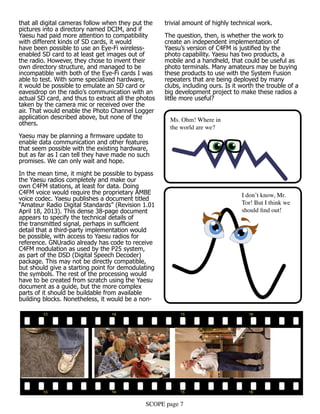
Ms. Ohm! Where in
the world are we?
I don’t know, Mr.
Tor! But I think we
should find out!
SCOPE page 8
“Hello,
I just wanted to let you know
how much I enjoyed the class
yesterday at the scout fair. Thank
you very much for for your time
teaching about radio. I would like
to complete the merit badge when
you do the follow up at Camp
Balboa next month. Hopefully it
will not conflict with the week-
end of the 16th and 17th of May.
That Saturday I have a mandatory
high school orientation, and on
Sunday an annual Karate tourna-
ment. Can you please email me
when the date of the follow up is
confirmed.
Much appreciated, Ben G.”
(a letter from one of the Scouts at
the Scout Fair)
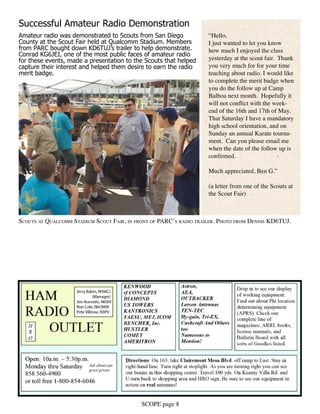
Successful Amateur Radio Demonstration
Amateur radio was demonstrated to Scouts from San Diego
County at the Scout Fair held at Qualcomm Stadium. Members
from PARC bought down KD6TUJ’s trailer to help demonstrate.
Conrad KG6JEI, one of the most public faces of amateur radio
for these events, made a presentation to the Scouts that helped
capture their interest and helped them desire to earn the radio
merit badge.
Scouts at Qualcomm Stadium Scout Fair, in front of PARC’s radio trailer. Photo from Dennis KD6TUJ.
SCOPE page 9
Club HF Remote Station? Let’s Install One!
There are at least three reasons for the club to get involved in the HF remote movement.
The first one is technical. The challenge of making a quality remote installation is fun and
rewarding. The project involves backhaul establishment, HF equipment selection, remote access
protocol development, command channel identification and establishment, testing and tuning,
documentation, and training, among other things.
Secondly, autopatch and casual repeater usage has declined due to the increase of cellular
coverage. Exploring new services that can be offered from club equipment on the Palomar Mountain
property is an important responsibility. A new broadband repeater has been installed, and fresh
hardware for the voice repeaters is under active investigation. Adding an HF remote station would
expand the services provided by the club. This is an exciting time to get involved with renovating
equipment on the site.
Third, many members are negatively affected by CC&Rs and other limitations on putting up HF
antennas on their San Diego properties. We live in an urbanized area where antennas may or may
not be allowed. Plenty of us live in valleys or in places that are not good for radio. Having a remote
station that members can reserve and use would go a long way towards making the hobby possible
for people that live in places where radio is limited.
If you would be interested in helping explore a club remote HF station on Palomar Mountain, then
please join up by writing me at scope@palomararc.org and I’ll add you to the mailing list!
Mailing list archive located at http://palomararc.org/pipermail/hfremote/
This special interest group for HF remote will write a proposal for the Palomar Amateur Radio Club
board of directors to vote on. If the vote is successful, then fundraising will begin immediately.
Current state: We think PARC needs to be 501c3 in order to get the required equipment, and we
might need to use a base station in addition to Valley Center Wireless (ISP) to get audio up to the
mountain.
IMPULSE Electronics .com
(866) 747-5277
Wouxun Radios and Accessories
Powerpole Connectors
Power Cables
Coax Cable
Coax Connectors
Custom Cable Assemblies
AGM Batteries and Accessories
CTek & UPG Batteries Chargers
Fuses and Holders
Terminals and Splices
Tools
RF Industries Coax Adapters
SCOPE page 10
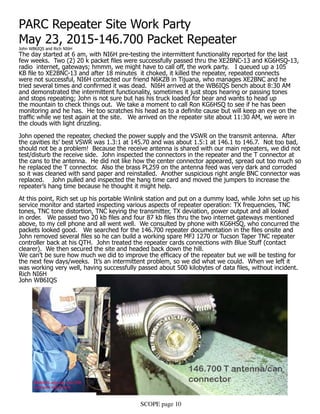
PARC Repeater Site Work Party
May 23, 2015-146.700 Packet Repeater
John WB6IQS and Rich NI6H
The day started at 6 am, with NI6H pre-testing the intermittent functionality reported for the last
few weeks. Two (2) 20 k packet files were successfully passed thru the XE2BNC-13 and KG6HSQ-13,
radio internet, gateways; hmmm, we might have to call off, the work party. I queued up a 105
KB file to XE2BNC-13 and after 18 minutes it choked, it killed the repeater, repeated connects
were not successful, NI6H contacted our friend N6KZB in Tijuana, who manages XE2BNC and he
tried several times and confirmed it was dead. NI6H arrived at the WB6IQS bench about 8:30 AM
and demonstrated the intermittent functionality, sometimes it just stops hearing or passing tones
and stops repeating; John is not sure but has his truck loaded for bear and wants to head up
the mountain to check things out. We take a moment to call Ron KG6HSQ to see if he has been
monitoring and he has. He too scratches his head as to a definite cause but will keep an eye on the
traffic while we test again at the site. We arrived on the repeater site about 11:30 AM, we were in
the clouds with light drizzling.
John opened the repeater, checked the power supply and the VSWR on the transmit antenna. After
the cavities its’ best VSWR was 1.3:1 at 145.70 and was about 1.5:1 at 146.1 to 146.7. Not too bad,
should not be a problem! Because the receive antenna is shared with our main repeaters, we did not
test/disturb the receive side. John inspected the connectors in the repeater and the T connector at
the cans to the antenna. He did not like how the center connector appeared, spread out too much so
he replaced the T connector. Also the brass PL259 on the antenna feed was very dark and corroded
so it was cleaned with sand paper and reinstalled. Another suspicious right angle BNC connector was
replaced. John pulled and inspected the hang time card and moved the jumpers to increase the
repeater’s hang time because he thought it might help.
At this point, Rich set up his portable Winlink station and put on a dummy load, while John set up his
service monitor and started inspecting various aspects of repeater operation: TX frequencies, TNC
tones, TNC tone distortion, TNC keying the transmitter, TX deviation, power output and all looked
in order. We passed two 20 kb files and four 87 kb files thru the two internet gateways mentioned
above, to my cell phone and all went well. We consulted by phone with KG6HSQ, who concurred the
packets looked good. We searched for the 146.700 repeater documentation in the files onsite and
John removed several files so he can build a working spare MFJ 1270 or Tucson Taper TNC repeater
controller back at his QTH. John treated the repeater cards connections with Blue Stuff (contact
clearer). We then secured the site and headed back down the hill.
We can’t be sure how much we did to improve the efficacy of the repeater but we will be testing for
the next few days/weeks. It’s an intermittent problem, so we did what we could. When we left it
was working very well, having successfully passed about 500 kilobytes of data files, without incident.
Rich NI6H
John WB6IQS
SCOPE page 11
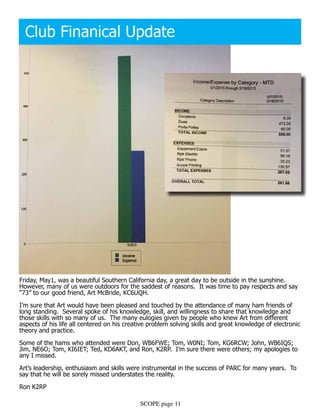
Club Finanical Update
Friday, May1, was a beautiful Southern California day, a great day to be outside in the sunshine.
However, many of us were outdoors for the saddest of reasons. It was time to pay respects and say
“73” to our good friend, Art McBride, KC6UQH.
I’m sure that Art would have been pleased and touched by the attendance of many ham friends of
long standing. Several spoke of his knowledge, skill, and willingness to share that knowledge and
those skills with so many of us. The many eulogies given by people who knew Art from different
aspects of his life all centered on his creative problem solving skills and great knowledge of electronic
theory and practice.
Some of the hams who attended were Don, WB6FWE; Tom, W0NI; Tom, KG6RCW; John, WB6IQS;
Jim, NE6O; Tom, KI6IET; Ted, KD6AKT, and Ron, K2RP. I’m sure there were others; my apologies to
any I missed.
Art’s leadership, enthusiasm and skills were instrumental in the success of PARC for many years. To
say that he will be sorely missed understates the reality.
Ron K2RP
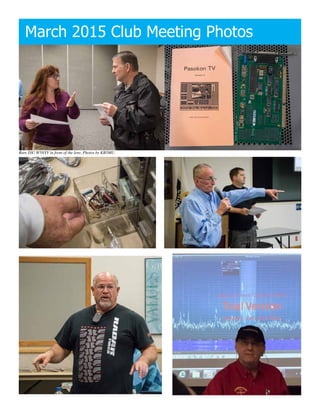
March 2015 Club Meeting Photos
Rare DX! W5NYV in front of the lens. Photos by KB5MU.
June Presidential Address
Greetings all. This is the long awaited
Field Day month! Your club will carry
out FD operations from a new location.
As you may be aware, we lost our
longstanding FD location because the
site finally is being developed with very
large construction. See the FD note on
the cover of this Scope for full details
about FD.
I am happy to be back in town after
a fantastic Dayton Hamvention. Was
pleased to see several PARC members at
the Hamvention, and was delighted to
even see KD6AKT having a grand time
browsing through all the goodies. Lots of
interesting things to see this year.
As always, there were a myriad
of vendors. The “usual suspects”
(ICOKENYAE, Flex, and K3) were there,
along with a host of new and interesting
players. Yes, some surprises, at least for
me. ICOM highlighted the ICOM 7851
HF/VHF/UHF transceiver. Mighty fine
looking radio. Probably works pretty well
too. Nice built-in output for a full PAN
display with point and click capability. I am not
schooled in ICOM, so maybe this is common. At
a price of $15.5 K it must be astounding!
Yaesu was in full C4FM/Fusion marketing, with
a very fine display and presentation at one of
the forums. The real surprises to me were
the various newcomers to the SDR world.
For example, ELDA, an Italian company, was
highlighting and selling their QRP Full SDR
Transceiver. An HF transceiver that even has
“knobs”, since the unit DOES NOT need a
computer to operate It is standalone capable
of CW/SSB in the “old way” if you happen to
be communicating when the big one hits. But
operated with a laptop, you achieve full SDR
performance similar to FLEX. You only get 5
Watts output, but the radio is powered through
the USB port that communicates all usual digital
commands to the laptop, and has built into the
radio itself all the software: Digital processing,
logging, display, etc. All it uses on the laptop
is the laptop’s sound card for digital signal
generation, and the laptop is the source for
commanding the radio when not commanded
with knobs. And for a price of $1200.00, it even
gives you 4 slice receivers compared to the 2
slices you get with a FLEX 6300. Most intriguing!
So, there is a lot to look forward to in order to
have fun in ham radio.
See you at FD.
73 de NN3V
Club Members ONLY!
PARC has a tube bank that includes many 6 & 12 volt receiving tubes (and some
transmitting types) for use by club members to repair their own personal equipment.
Not for commercial use or resale. If we have your requests, we will pre-check the
tubes and deliver them to you at the next club meeting.
Contact John WB6IQS WB6IQS@att.net
SCOPE page 16
Hamvention Report
by Howard KY6LA
Weather was the usual muggy and rainy Dayton
crap weather. glad I no longer live near the
center of the continent
Dayton. usual FILTHY disgusting arena with
overflowing toilets. As an American I am shamed
that Foreign visitors have to see Ham Radio’s
Mecca as such a worse than 3rd world place.
FLEA MARKET
Flea market was clearly down about 25% less
vendors this year and virtually everything for
sale was garbage that you would not normally
pull out from your own trash. Even the usual
hat embroidery places were down to one vendor.
I suspect old age plus a lousy weather forecast
was a contributing factor.
FORUMS
I attended 2 Forums = Ham Law. which was
terrible this year without Fred Hopengarten. and
SDR - which was excellent with a number of new
ideas and concepts being shown.
JAPANESE
The Japanese had their usual Legacy HF radios
which clearly are no longer selling very well.
Kenwood and Yaesu HF Both areas were totally
dead. Icom - who are better showmen. had
some interest in the Overpriced IC-7851 - but
it still lacked a modern display capability. they
were misrepresenting the 7851 as an SDR. which
it obviously is not as it is legacy Superhetrodyne
technology with a DSP. Circa 1980 design. albeit
they have tried to address the phase noise
issues they had with the 7800.
It was pretty obvious that the Japanese have
almost given up on selling HF equipment in
the face of superior US Offerings from Elecraft
and Flex Radio. The Japanese seem to
moved heavily into the VHF/UHF and various
incompatible digital modes. Talking to HRO.
they admitted that they hardly ever sell a
Japanese HF radio anymore but the VHF/UHF
Radios sell well.
CHINA
However the star of the VHF/UHF were the
Baofeng Chinese Radios selling for $24.95. Hard
to justify $400 for a Japanese radio that does
the same thing. Needless to say the Baofeng
were selling like hot cakes.
STEPPIR
SteppIR introduced a portable Antenna
analyzer for $389 which is visibly superior to
the MFJ269@$399. Several of us bought the
SteppIR analyzers. Rob WA3IHV and Ben
N6MUF bought the CrankIR portable vertical
Antennas for DXpeditions.
ELECRAFT
Elecraft introduced the K3S which is the old K3
with a new synthesizer board to fix the poor
RMDR issues that had the K3 down on the
Sherwood List. Like the Japanese, Elecraft tried
to misrepresent the K3S as an SDR but clearly
it is a Legacy Superhetrodyne Radio with a DSP
audio stage. Circa 1980 design. With the new
synthesizer board the K3S still ranks second to
the Flex 6700/6500 on the Sherwood list. The
sales table at Elecraft had 3 sales stations and
were lined up 3-5 deep waiting to place orders.
Clearly Elecraft still make winning products.
FLEX RADIO
Flex Radio introduced their $999 Maestro
Portable Front Panel - Contest Optimized Knobs
and Display for their 6000 series. Clearly it was
the star of Dayton 2015. Flex is making a major
push into the contest world. more on that later.
Maestro’s were selling spectacularly. both over
the sales counter and online. in fact the order
flow online was so heavy that the on line sales
site clearly slowed down under the load. Flex
had several stations set up that each include a
Maestro Front Panel - One demonstrated close
integration with N1MM+ Contest Software, One
Demonstrated the Application Programming
Interface where users are now connecting all
sorts of interesting and cool things to the Flex
6000 series. WITHOUT WIRES. Since all the
Flex 6000 series have 95 dB antenna isolation,
Flex introduced a SO2R box to enable full duplex
in all the 6000 radios. The major benefit is
that now a Single Radio can now be used to
SO2R contest at about 1/2 the cost and much
less complexity of the comparable two K3S that
would be needed to accomplish the same result.
Rob WA3IHV and I put in orders for the Maestro.
ITALY
Italy was very strongly represented. Begali
Morse Code Keys are definitely still the #1 CW
Key. Expert Amps had their 1.3K-FA Amp on
display. only 16lbs and 1500 Watts. Only $4,695
Show Special.Backordered by shows end to at
least January 2016.
I was particularly impressed with the $1099 Elad
SDR-DUO. (I saw it also at Friedrichshafen 2014)
with is a complete Second Generation SDR 5 W
Transceiver in a very portable box with Knobs.
it runs stand alone or with a computer. More
impressive was when hooked up to a Expert
1.3K-FA it drove 1000W with only 5 W drive.
SCOPE page 17
Charlie NN3V bought one.
FLEX BANQUET
We normally avoid events in Downtown Dayton.
too yucky and dangerous
. But this year the draw was Ranko 4O3A
and Craig K9CT - two renowned world class
contesters who were the guest speakers.
Top Contesters are like Formula One Drivers.
They push the technological envelop to achieve
better and better results. We all benefit from the
technological improvements that trickle down
from their competitive experience.
Gerald Youngblood, President of Flex, told us
of his design process for the Maestro in which
he visited with and listened to top contesters
to try to understand what they needed to be
able to perform better. With the help of Craig
K9CT they design the Maestro box . with only
the absolutely needed knobs and controls and
put it in a small enough package that it could
fit at the most ergonomically optimum angle
for contesting for minimum operator fatigue He
then went onto explain the rapid development
process where they literally backed the molds in
an oven to produce working models for the show
in 4 weeks.
Ranko 4O3A’s company is well known for making
devices such as the Station Genius to integrate
any and every possible peripheral device into
a contest station. Most important all the
new devices are 21st Century Ethernet Speed
Connected rather than 20th century slow serial
ports. He went over the joint development
of the Flex SO2R box to give it the features of
the Station Genius as well as enable the Flex
6000 operate as a Full Duplex SO2R station.
Ranko’s contest station set the new European
Record for the 2014 CQWWDX CW contest. His
plan is to use the Flex 6000 with the SO2R in
the 2015 CQWWDX contest and hopes that
the improvements will enable him to shatter
the world record. He then surprised us all by
revealing that Flex was working with him on the
design a Full Legal Amplifier (using 2 - 1400W
transistors) - This will be the first totally Ethernet
Connected Amplifier. Flex gave NO PRICES or
DETAIL or Delivery Dates. but likely the main
stumbling block will be the usual bureaucratic
regulatory approval delays associated with Amps
.rather than engineering or production.
Craig, K9CT, started his talk by stating that
“Elecraft should be worried that he was over at
the Flex Dinner” He explained the concepts
and designs behind K9CT contest station and
how the new Flex Contest Suite would not only
cut his costs of a SO2R station in 1/2 but more
important greatly simplify station configuration,
design and contest work flow. K9CT is
committed to using the Flex Contest Station
Suite in the Fall Contests.
FINALLY
Ken NN9P and I got a totally unexpected
award at the Flex Radio Banquet at the Dayton
Hamvention as the 2014 Top Flex Radio Elmer.
In case you are wondering, I am not paid by
Flex nor do I own any of their stock. All my life I
have worked at the Bleeding Edge of Technology
and I really enjoy working with others who also
invent new things. Flex has put fun back into
Ham Radio for me by pushing me to consider
new things all the time.
I appear to be able to
poke through the side
of these boxes!
Oh no!
I think I am trapped!
SCOPE page 18
	 Why Packet Repeater? continued from page 5
digipeater is transmitting, everybody hears it and
waits. When the digipeater stops transmitting
(and starts listening), any user station can
transmit to it and be heard. But what happens if
two users have a packet to send?
That’s what the random backoff is for. Without
the backoff, both stations would jump on the
channel at the exact same instant, and interfere
with each other every single time. With the
backoff, the station that randomly chooses a
shorter backoff starts to transmit first. The other
station is supposed to hear that transmission and
wait its turn. But if those two stations are low-
level stations that need to use the digipeater to
cover the county, chances are pretty good that
they can’t hear each other. The second station
won’t know that the first station has taken over
the channel, and will happily start transmitting
on top of it. The digipeater will hear both
stations, which means it can’t copy either one,
unless one is very much stronger than the other
(thanks to the FM capture effect). This is called
“the hidden terminal problem”, since the two
low-level stations are hidden from each other.
I won’t try to reproduce the math here, but this
situation has been analyzed rather thoroughly. It
turns out that the hidden terminal problem can
really hurt the channel capacity. If nobody listens
at all, and just transmits randomly whenever
they have data, the best throughput you can
expect is about 18% of the ideal channel data
rate. Listening before you transmit is supposed
to help. A network with listening but suffering
from hidden terminal effects can be even worse
than not listening at all!
There are various ways to address this problem.
If the transmissions were much shorter than the
backoff times, for instance, chances of a collision
would be pretty small. We can’t really use that
technique, though, because our data rate is so
slow. It can take several seconds to send a long
packet, so backoffs would have to be many tens
of seconds to have much effect on the collision
rate. We don’t want to wait that long, so just
increasing the backoff times isn’t a practical
solution. It’s also possible to add complexity
to the packet protocol in ways that reduce the
problem. For instance, stations might be required
to transmit a short burst to request the channel,
and then wait for a go-ahead from the receiving
station before sending the payload. That
technique is used by WiFi wireless networking
with good results. However, we’re pretty much
stuck with the existing AX.25 protocol for short-
term compatibility, so that’s out too.
The best solution is to make sure everybody can
hear everybody else, and the way to do that
on a metropolitan area scale is to install a full
duplex repeater in place of the digipeater on the
mountaintop. A full duplex repeater transmits
exactly what it hears, with essentially no delay.
Because everybody can hear the mountaintop
repeater, and it can hear everybody, effectively
everybody can hear everybody else through
the repeater. There are no hidden terminals.
Stations who can’t hear the repeater will know
right away, and choose another network, so
our assumption that everybody can hear the
repeater is self-fulfilling.
Notice that the full duplex repeater doesn’t
participate in the network as a station. Packets
are not received and stored by the repeater.
The repeater retransmits the tones in real
time, without worrying about what they mean.
There’s no extra delay or extra complexity. Each
station can hear every other station (through
the repeater) and the standard channel sharing
mechanism works well. The user stations
don’t have to do much special. They do have
to program their radios for split frequency
operation, just as on a voice repeater, but since
this is automatic on most modern radios, that’s
easy and familiar.
There is one TNC timing parameter that
might need to be adjusted for the full duplex
repeater. It’s called TXDELAY and it controls
the delay between enabling the transmitter’s
push-to-talk and beginning to send the packet’s
actual data. This delay has to be long enough
to let the transmitter turn fully on, plus long
enough for the other receiver’s squelch to
open and demodulator to synchronize with the
transmission. When operating through a full
duplex repeater, this also has to allow for any
delay in bringing up the repeater. Typically,
default TXDELAY values are so generous that it
works fine on the repeater without adjustment.
There are costs at the mountaintop, of course.
Because it’s a full duplex repeater, it needs cavity
filters to isolate the transmitter from the receiver.
Because it’s transmitting whenever anybody
wants to transmit, it has to be build robustly to
take 100% duty cycle transmitting indefinitely.
To guarantee availability in times of emergency,
it needs substantial battery backup and maybe
a fallback generator too. It needs a coordinated
frequency pair. Just like a voice repeater.
And just like a voice repeater, it needs
maintenance. Ours had to be repaired just
recently (see page 10). Much more next month.
SCOPE page 19
PALOMAR AMATEUR RADIO CLUB
FIELD DAY 2015
JUNE 26th
– 28th
Location: S/E Corner Palomar Airport Rd.
and El Camino Real in Carlsbad.
33.126127, -117.264353
DO NOT HAVE TO
• BE A PARC CLUB MEMBER
(Club Membership is encouraged)
• BE LICENSED or KNOW CODE
Pictures of Past
Field Day Fun on
CLUB WEBSITE
WWW.PALOMARARC.ORG
OPERATING 5 STATIONS
~20/80 M CW ~20/80 M SSB
~15/40/10 M CW ~15/40 M SSB
~GOTA and VHF 6 M
W6NWG
WHISKEY SIX NOTHING WORKS GOOD
FD SCHEDULE
(Tentative)
June 26th
-11AM Setup at site
June 27th
-7AM Breakfast
-8AM Crank up towers
-9AM Final Setup Test
-11AM CQ Field Day...
-1230PM Lunch
-6PM Dinner
-8PM NTS Message NET
June 28th
-7AM Final Breakfast
-10:59:59 Final Contact
-11:30 Tear-down
FD PICNIC
DINNER
PSYCHO
Kitchen
Saturday 6pm
ALL ARE WELCOME INCLUDING GENERAL PUBLIC!
COME OPERATE, LEARN MORE ABOUT HAM RADIO!
VISIT SAN DIEGO COUNTYS GREATEST AMATEUR RADIO CLUB!
COME JOIN THE FUN!
Category:
4A
Amateur Radio Emergency
Data Network Demonstration:
Work Party at Repeater Site 7 June 2015
The next scheduled work party is for June 7, the Sunday after the meeting.
Needed are helpers to help clean off the flaking paint on the freezer building. After it is cleaned up,
we will prime the freezer building. Plans are to follow up on the next trip with a moderate green paint
keep blending in better for our neighbors.
There are also two trees that have been felled, one by choice, one by a superiors act. These will
need to be cut and removed at some point in the near future. Should a club member wish then for
personal use, I believe they are welcome to them. If not we will cut them and ask a small price for
the service/goods to be given to the club.
The group will gather at Mother’s Kitchen at 10:00 AM and proceed to the site from there. Those that
wish may come earlier and enjoy the delight of the Kitchen before the party. Mother’s is at the top of
south grade and to the left.
This is a great time to provide the club with support and join together. Also a chance for new
members to learn some about Palomar’s equipment.
More hands make for easier work.
Dennis
KD6TUJ
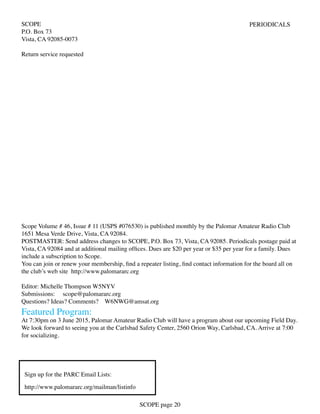
see palomararc.org for location
SCOPE
P.O. Box 73
Vista, CA 92085-0073
Return service requested
PERIODICALS
Scope Volume # 46, Issue # 11 (USPS #076530) is published monthly by the Palomar Amateur Radio Club
1651 Mesa Verde Drive, Vista, CA 92084.
POSTMASTER: Send address changes to SCOPE, P.O. Box 73, Vista, CA 92085. Periodicals postage paid at
Vista, CA 92084 and at additional mailing offices. Dues are $20 per year or $35 per year for a family. Dues
include a subscription to Scope.
You can join or renew your membership, find a repeater listing, find contact information for the board all on
the club’s web site http://www.palomararc.org
Editor: Michelle Thompson W5NYV
Submissions: scope@palomararc.org
Questions? Ideas? Comments? W6NWG@amsat.org
Featured Program:
At 7:30pm on 3 June 2015, Palomar Amateur Radio Club will have a program about our upcoming Field Day.
We look forward to seeing you at the Carlsbad Safety Center, 2560 Orion Way, Carlsbad, CA. Arrive at 7:00
for socializing.
SCOPE page 20
Sign up for the PARC Email Lists:
http://www.palomararc.org/mailman/listinfo

June2015ScopeWeb

  • 1.
    june 2015 Field Dayis fast approaching! Planning efforts for this year’s Palomar Amateur Radio Club Field Day Effort are underway. Field Day this year will fall on June 26th, 27th, and 2th 2015. See website for location. The Field Day net occurs Wednesdays at 8PM. We are currently looking at a 4A setup this year. This will free up 10M for GOTA so they have a place to operate and will also free up some of the congestion at the site on the airways (hopefully). Our Field Day Chef this year will be Gina along with her impressive Psycho Kitchen. Cuisine still to be determined. We have sourced many of the needed supplies. We still need help with setup and tear down. Setup will begin on Friday at 11am on site. Field Day is a group effort and cannot be accomplished with out all the generous help from PARC club members and other volunteers. Many hands make light work! Field Day is not a contest, but will sure be fun. When you have fun doing something you love, you generally end up doing well. That is this year’s goal. To have FUN and do well. Come out and visit with your fellow club members and hams alike, get on the air and operate, eat good food, enjoy eyeball QSO, demonstrate amateur radio to the public, and most of all have fun. Thank you for all you do and I look forward to hearing you on the Net and more importantly, seeing you at Field Day. 73, Greg Gibbs KI6RXX Cell: 760-583-9668
  • 2.
    SCOPE page 2 ClubMeeting Save the Date Board Meeting Club Events Field Day Program! Plus, Trade Tech High shows off their robotics project. Palomar Amateur Radio Club board meeting at 7:00pm at W6GNI QTH. Field Day! New site! June 7th work party! 3 June 2015 10 June 2015 27-28 June 2015 Advertisements are free for members Have items that need to find a new home? Advertise here! Send your ads to scope@palomararc.org Spectrum Analyzer, HP141T working mainframe with HP8553 (working 110 MHz) RF plug in with HP 8552 I.F. module. Several HP8555s (10 MHz - 22 GHz) parts units and extra HP8552A & B I.F. modules. Make offers. WB6IQS@att.net. John, Vista. Wanted: E. F. Johnson electronic T-R switch, working or not. Matt, 619-865-8497, ae6hf@arrl.net. Matt AE6HF May 2015 Club Meeting Filmstrip Goodie Table Update! For next few month’s meeting I would like the Scope to stress that the Goodie Table will be exceptionally well stocked. I will have all manner of variable capacitors, resistors, power resistors, power and RF cables, coaxial fittings, relays, digital and analog ICs. I am hoping to get fair value for the club for these items but JoAnne McBride is more interested in them being used for future projects rather than just being dumped as electronic trash going to the recycle. Also, a large assortment of test meters and component parts will be on the “Goodie” table at the June & July meetings. Bird type RF Wattmeter w/ VHF/UHF slugs, variable capacitors, cables, power resistors / fixed capacitors, etc. Bring bags / boxes to take home the treasures. Contact WB6IQS@att.net for any specific requests. John Kuivinen, WB6IQS
  • 3.
    SCOPE page 3 Please supportour advertisers. Their support of the club is vital. microwaveupdate.org
  • 4.
    SCOPE page 4 IntegratingYaesu System Fusion Photos into the World Paul KB5MU and Michelle W5NYV Some of the Yaesu C4FM “System Fusion” transceivers (FTM-400D mobile, FT-1DR and FT- 2DR handhelds, but not the C4FM-enabled FT- 991 HF/VHF rig or the brand-new (Dayton 2015) FTM-100DR) support a camera microphone accessory (MH-85A11U) that can take relatively poor-quality, low-resolution photographs. These photographs are stored locally on a microSD card, as are photos received over the air. Later, any photograph stored on the microSD card can be transmitted to ALL or to a specified Group ID. The FTM-400D has a color graphic display which can display the photos. The FT-2DR can display the photos in monochrome. The FT-1DR can’t display the photos at all, so if you transmit a picture taken with the camera mic or forward a received photo you’re doing it without seeing the photo first. The FTM-100DR can’t display the photos either, but it can still receive and forward them, even though it doesn’t support the camera mic. Photos are integrated to some extent with Yaesu’s WIRES-X internet linking system. Photos can be stored on the server, and can be part of so-called News items. These capabilities have not been evaluated. WIRES-X server software for C4FM repeaters has yet to be released. WIRES-X support for user stations requires the HRI-200 interface box (about $125) and a Windows computer. We recently bought an HRI-200 for evaluation. The HRI-200 software limits photos to 40 kilobytes, according to the user manual. Pictures taken by the MH-85A11U seem to be a maximum of about 20 kilobytes. The goal of this investigation is to bring this photo capability into the wide world of the internet and open systems, somehow, to whatever extent seems feasible. Here are some possible use cases to consider. * Photo Channel Logger. A receiver would be dedicated to monitoring a particular channel frequented by C4FM users and store every picture it hears. These pictures might be made available in real time on the web, or on other amateur radio data systems. The pictures could be enhanced with EXIF metadata generated by the logger, which could easily include, for example, the date and time of reception. With a little more work, the pictures could be associated with signal strength information, or even signal bearing from the receiver site. A logger could be placed at an EOC and set to automatically display all photos sent to a list of Group IDs, so that information gathered in the field would be immediately available to served agencies. * Automatic Photo Sender. A system that has automated access to some kind of image data would be able to automatically transmit the image on a particular channel. For example, it would be easy to hook into weather forecasting systems and transmit a radar image periodically, or only when weather alerts are active, or according to any other set of rules. A system placed temporarily at a key location in an event could be set up to take a photograph of the area and transmit it periodically, or when some other sensor is tripped, or even when computer image analysis says that the photo contains something interesting. * Interactive Photo Sender. A system controlled by text messaging (whether over C4FM, or AX.25 packet, or cellular SMS, or any other system) or via the web (whether over amateur radio or not) could be set up to allow a remote user to trigger the transmission of a specific image. The image might be one that already exists, or it might be captured by a camera on demand, or it might be computer generated on demand. The “News” feature of the WIRES-X software is a simple continued page 6
  • 5.
    SCOPE page 5 WhyA Packet Repeater? by Paul KB5MU Why do we have a full duplex repeater on 146.700 MHz dedicated to packet radio? Like a regular FM voice repeater, the packet repeater gives every little station in range the coverage that comes with a good antenna and a spectacular mountaintop location. A handheld on one end of the county can communicate with a mobile in a crummy location on the other side of the county. That’s good magic. Packet radio, though, can get the same range with just a digipeater on the mountaintop. A digipeater is much simpler than a full duplex repeater. It’s just an ordinary transceiver connected to a little controller called a TNC (“Terminal Node Controller”). The TNC listens for packets that want to go through the digipeater. Once it has fully received such a packet, it listens for the radio channel to go idle and then retransmits it. This mode of operation is called “store and forward”, because the TNC stores the message briefly before forwarding it on to the next station. The TNC in a digipeater is only listening (to store incoming packets) or transmitting (to forward them on) at any given time. It never needs to transmit and receive at the same time. There is one obvious disadvantage to the store- and-forward mode. Every packet has to be sent twice, once by the original station and then again by the digipeater. This not only adds a little bit of delay to every communication, it also takes up twice the capacity on the channel. That is, there’s only room for half as much data. That’s a big deal, because standard 1200-baud packet radio is already pretty slow. It can be pretty speedy compared to users typing back and forth on keyboards, but for most practical applications giving up half the throughput is painful. Unfortunately, it’s actually much worse than that. It all comes down to how packet stations share the channel. Packet stations listen before they transmit, except for some APRS trackers that get by without a receiver. If there’s a signal present already, the station waits until the signal is gone. If it didn’t do that, there would be two station transmitting at once -- a “collision”. Very likely, they would interfere with each other and neither packet would be received. Remember, the packet has to be received perfectly with no errors in order to be used at all. After the channel sounds clear, the station waits an additional random interval, called a backoff. Provided the channel is still clear, the station then finally transmits its packet. This all works pretty well, provided that every station can hear every other station. But in a typical metropolitan area network, that is not the case. Each station has its own area of coverage, depending on its antenna, the local terrain, the local noise and interference levels, and so on. The coverage might be different on receive and transmit. A low power station will have a smaller coverage area on transmit than on receive, while the opposite would be true for a high power station. You can think of these coverage areas as circles of various sizes, but a real-world coverage map looks more like the shape of a bug splattered on a windshield. The network consists of a crazy patchwork quilt of all these unique coverage areas. Each station can hear some subset of the other stations. If Alice can hear Bob and Carol, there’s no guarantee that Bob and Carol can hear each other. Consider the case of a mountaintop digipeater. It has an excellent location, high up on a mountain, and a good antenna. Its coverage area might blanket the county. For simplicity, let’s just assume that the digipeater can hear everyone else just fine, and everyone can hear the digipeater. That’ll never be exactly true, but close enough. No problem, right? When the continued page 18
  • 6.
    SCOPE page 6 System Fusion continued from page 4 version of this sort of application. * Photo User Terminal. A system could be set up to send and receive photos locally, providing a superset of the capabilities built into the Yaesu transceivers. A variant would use the camera and screen of a connected smartphone. There are two obvious main approaches to this sort of integration: use the C4FM capabilities of Yaesu transceivers, or go directly to the on- the-air signals with whatever radio hardware is convenient. Unfortunately, the Yaesu radios treat the photo capability as part of their closed system. The available interfaces are the proprietary jack that the camera microphone plugs into, the 10-pin mini-DIN radio interface connector used by the HRI-200 (on the FTM- 400D), and the microSD card slot with its file formats and conventions. The pin assignments for the 10-pin mini-DIN are documented, but the other two interfaces are completely undocumented by Yaesu. There is a serial RS-232 interface on the 10- pin mini-DIN. The radio menu lets you choose the baud rate (4800 to 57600) and one of four modes: Off(camera), GPS Out, Packet, and Waypoint. Setting the mode to Off disables the port (and is documented as disabling the camera mic as well, but this is clearly a misprint.) In GPS Out mode, the port transmits NMEA sentences GGA and RMC, containing position fixes from the radio’s GPS receiver. In Packet mode, the manual says that the port “Outputs the AX.25 packet communication data received using the in-built modem function.” In Waypoint mode, it “Outputs the position information of other station beacons obtained from the APRS packets received as WAYPOINT data.” None of these documented functions lets you send and receive data using C4FM, which is a shame. Yaesu could and should expose data communications features on this interface, but so far has not. The HRI-200 and WIRES-X software also connect to that 10-pin mini-DIN port, and are able to do things that are not otherwise possible. The software controls the radio’s frequency, for example, and transmits and receives C4FM digital data to implement the WIRES-X protocol operations. To enable all this, the radio has to be put into a special mode by pressing two buttons while turning it on. In this mode, none of the regular user features of the radio work. The radio becomes a dedicated slave to the software. This mode might be useful for other applications, but it is completely undocumented. Some reverse engineering work on a working HRI-200 system would help here. We have already spent some time trying to reverse engineer the camera microphone jack. It is encouragingly labeled “Data” on the transceiver, but even the pin assignments on this connector seem to be unpublished. We’ve written up our results in some detail and are waiting to hear from ARRL about whether they want to publish it. We found what appears to be a USB interface, or something very much like a USB interface, on several of the pins. That’s consistent with the Yaesu menu text, where the camera microphone is called “USB Camera”. If this interface is indeed standard USB, or close enough, it should be possible to interface it with other hardware. It may be possible to partially confirm this with a logic analyzer. Gathering more details on how this interface works will depend on getting access to a non-invasive USB analyzer. The least expensive such instrument I was able to find costs $1200. Even if we knew everything about this interface, the most we could hope to do is emulate the camera microphone to store pictures to the radio’s SD card. We have also spent considerable time reverse engineering the microSD card interface. If Yaesu had chosen to comply with DCF, the standard
  • 7.
    SCOPE page 7 thatall digital cameras follow when they put the pictures into a directory named DCIM, and if Yaesu had paid more attention to compatibility with different kinds of SD cards, it would have been possible to use an Eye-Fi wireless- enabled SD card to at least get images out of the radio. However, they chose to invent their own directory structure, and managed to be incompatible with both of the Eye-Fi cards I was able to test. With some specialized hardware, it would be possible to emulate an SD card or eavesdrop on the radio’s communication with an actual SD card, and thus to extract all the photos taken by the camera mic or received over the air. That would enable the Photo Channel Logger application described above, but none of the others. Yaesu may be planning a firmware update to enable data communication and other features that seem possible with the existing hardware, but as far as I can tell they have made no such promises. We can only wait and hope. In the mean time, it might be possible to bypass the Yaesu radios completely and make our own C4FM stations, at least for data. Doing C4FM voice would require the proprietary AMBE voice codec. Yaesu publishes a document titled “Amateur Radio Digital Standards” (Revision 1.01 April 18, 2013). This dense 38-page document appears to specify the technical details of the transmitted signal, perhaps in sufficient detail that a third-party implementation would be possible, with access to Yaesu radios for reference. GNUradio already has code to receive C4FM modulation as used by the P25 system, as part of the DSD (Digital Speech Decoder) package. This may not be directly compatible, but should give a starting point for demodulating the symbols. The rest of the processing would have to be created from scratch using the Yaesu document as a guide, but the more complex parts of it should be buildable from available building blocks. Nonetheless, it would be a non- trivial amount of highly technical work. The question, then, is whether the work to create an independent implementation of Yaesu’s version of C4FM is justified by the photo capability. Yaesu has two products, a mobile and a handheld, that could be useful as photo terminals. Many amateurs may be buying these products to use with the System Fusion repeaters that are being deployed by many clubs, including ours. Is it worth the trouble of a big development project to make these radios a little more useful? Ms. Ohm! Where in the world are we? I don’t know, Mr. Tor! But I think we should find out!
  • 8.
    SCOPE page 8 “Hello, Ijust wanted to let you know how much I enjoyed the class yesterday at the scout fair. Thank you very much for for your time teaching about radio. I would like to complete the merit badge when you do the follow up at Camp Balboa next month. Hopefully it will not conflict with the week- end of the 16th and 17th of May. That Saturday I have a mandatory high school orientation, and on Sunday an annual Karate tourna- ment. Can you please email me when the date of the follow up is confirmed. Much appreciated, Ben G.” (a letter from one of the Scouts at the Scout Fair) Successful Amateur Radio Demonstration Amateur radio was demonstrated to Scouts from San Diego County at the Scout Fair held at Qualcomm Stadium. Members from PARC bought down KD6TUJ’s trailer to help demonstrate. Conrad KG6JEI, one of the most public faces of amateur radio for these events, made a presentation to the Scouts that helped capture their interest and helped them desire to earn the radio merit badge. Scouts at Qualcomm Stadium Scout Fair, in front of PARC’s radio trailer. Photo from Dennis KD6TUJ.
  • 9.
    SCOPE page 9 ClubHF Remote Station? Let’s Install One! There are at least three reasons for the club to get involved in the HF remote movement. The first one is technical. The challenge of making a quality remote installation is fun and rewarding. The project involves backhaul establishment, HF equipment selection, remote access protocol development, command channel identification and establishment, testing and tuning, documentation, and training, among other things. Secondly, autopatch and casual repeater usage has declined due to the increase of cellular coverage. Exploring new services that can be offered from club equipment on the Palomar Mountain property is an important responsibility. A new broadband repeater has been installed, and fresh hardware for the voice repeaters is under active investigation. Adding an HF remote station would expand the services provided by the club. This is an exciting time to get involved with renovating equipment on the site. Third, many members are negatively affected by CC&Rs and other limitations on putting up HF antennas on their San Diego properties. We live in an urbanized area where antennas may or may not be allowed. Plenty of us live in valleys or in places that are not good for radio. Having a remote station that members can reserve and use would go a long way towards making the hobby possible for people that live in places where radio is limited. If you would be interested in helping explore a club remote HF station on Palomar Mountain, then please join up by writing me at scope@palomararc.org and I’ll add you to the mailing list! Mailing list archive located at http://palomararc.org/pipermail/hfremote/ This special interest group for HF remote will write a proposal for the Palomar Amateur Radio Club board of directors to vote on. If the vote is successful, then fundraising will begin immediately. Current state: We think PARC needs to be 501c3 in order to get the required equipment, and we might need to use a base station in addition to Valley Center Wireless (ISP) to get audio up to the mountain. IMPULSE Electronics .com (866) 747-5277 Wouxun Radios and Accessories Powerpole Connectors Power Cables Coax Cable Coax Connectors Custom Cable Assemblies AGM Batteries and Accessories CTek & UPG Batteries Chargers Fuses and Holders Terminals and Splices Tools RF Industries Coax Adapters
  • 10.
    SCOPE page 10 PARCRepeater Site Work Party May 23, 2015-146.700 Packet Repeater John WB6IQS and Rich NI6H The day started at 6 am, with NI6H pre-testing the intermittent functionality reported for the last few weeks. Two (2) 20 k packet files were successfully passed thru the XE2BNC-13 and KG6HSQ-13, radio internet, gateways; hmmm, we might have to call off, the work party. I queued up a 105 KB file to XE2BNC-13 and after 18 minutes it choked, it killed the repeater, repeated connects were not successful, NI6H contacted our friend N6KZB in Tijuana, who manages XE2BNC and he tried several times and confirmed it was dead. NI6H arrived at the WB6IQS bench about 8:30 AM and demonstrated the intermittent functionality, sometimes it just stops hearing or passing tones and stops repeating; John is not sure but has his truck loaded for bear and wants to head up the mountain to check things out. We take a moment to call Ron KG6HSQ to see if he has been monitoring and he has. He too scratches his head as to a definite cause but will keep an eye on the traffic while we test again at the site. We arrived on the repeater site about 11:30 AM, we were in the clouds with light drizzling. John opened the repeater, checked the power supply and the VSWR on the transmit antenna. After the cavities its’ best VSWR was 1.3:1 at 145.70 and was about 1.5:1 at 146.1 to 146.7. Not too bad, should not be a problem! Because the receive antenna is shared with our main repeaters, we did not test/disturb the receive side. John inspected the connectors in the repeater and the T connector at the cans to the antenna. He did not like how the center connector appeared, spread out too much so he replaced the T connector. Also the brass PL259 on the antenna feed was very dark and corroded so it was cleaned with sand paper and reinstalled. Another suspicious right angle BNC connector was replaced. John pulled and inspected the hang time card and moved the jumpers to increase the repeater’s hang time because he thought it might help. At this point, Rich set up his portable Winlink station and put on a dummy load, while John set up his service monitor and started inspecting various aspects of repeater operation: TX frequencies, TNC tones, TNC tone distortion, TNC keying the transmitter, TX deviation, power output and all looked in order. We passed two 20 kb files and four 87 kb files thru the two internet gateways mentioned above, to my cell phone and all went well. We consulted by phone with KG6HSQ, who concurred the packets looked good. We searched for the 146.700 repeater documentation in the files onsite and John removed several files so he can build a working spare MFJ 1270 or Tucson Taper TNC repeater controller back at his QTH. John treated the repeater cards connections with Blue Stuff (contact clearer). We then secured the site and headed back down the hill. We can’t be sure how much we did to improve the efficacy of the repeater but we will be testing for the next few days/weeks. It’s an intermittent problem, so we did what we could. When we left it was working very well, having successfully passed about 500 kilobytes of data files, without incident. Rich NI6H John WB6IQS
  • 11.
    SCOPE page 11 ClubFinanical Update Friday, May1, was a beautiful Southern California day, a great day to be outside in the sunshine. However, many of us were outdoors for the saddest of reasons. It was time to pay respects and say “73” to our good friend, Art McBride, KC6UQH. I’m sure that Art would have been pleased and touched by the attendance of many ham friends of long standing. Several spoke of his knowledge, skill, and willingness to share that knowledge and those skills with so many of us. The many eulogies given by people who knew Art from different aspects of his life all centered on his creative problem solving skills and great knowledge of electronic theory and practice. Some of the hams who attended were Don, WB6FWE; Tom, W0NI; Tom, KG6RCW; John, WB6IQS; Jim, NE6O; Tom, KI6IET; Ted, KD6AKT, and Ron, K2RP. I’m sure there were others; my apologies to any I missed. Art’s leadership, enthusiasm and skills were instrumental in the success of PARC for many years. To say that he will be sorely missed understates the reality. Ron K2RP
  • 12.
    March 2015 ClubMeeting Photos Rare DX! W5NYV in front of the lens. Photos by KB5MU.
  • 15.
    June Presidential Address Greetingsall. This is the long awaited Field Day month! Your club will carry out FD operations from a new location. As you may be aware, we lost our longstanding FD location because the site finally is being developed with very large construction. See the FD note on the cover of this Scope for full details about FD. I am happy to be back in town after a fantastic Dayton Hamvention. Was pleased to see several PARC members at the Hamvention, and was delighted to even see KD6AKT having a grand time browsing through all the goodies. Lots of interesting things to see this year. As always, there were a myriad of vendors. The “usual suspects” (ICOKENYAE, Flex, and K3) were there, along with a host of new and interesting players. Yes, some surprises, at least for me. ICOM highlighted the ICOM 7851 HF/VHF/UHF transceiver. Mighty fine looking radio. Probably works pretty well too. Nice built-in output for a full PAN display with point and click capability. I am not schooled in ICOM, so maybe this is common. At a price of $15.5 K it must be astounding! Yaesu was in full C4FM/Fusion marketing, with a very fine display and presentation at one of the forums. The real surprises to me were the various newcomers to the SDR world. For example, ELDA, an Italian company, was highlighting and selling their QRP Full SDR Transceiver. An HF transceiver that even has “knobs”, since the unit DOES NOT need a computer to operate It is standalone capable of CW/SSB in the “old way” if you happen to be communicating when the big one hits. But operated with a laptop, you achieve full SDR performance similar to FLEX. You only get 5 Watts output, but the radio is powered through the USB port that communicates all usual digital commands to the laptop, and has built into the radio itself all the software: Digital processing, logging, display, etc. All it uses on the laptop is the laptop’s sound card for digital signal generation, and the laptop is the source for commanding the radio when not commanded with knobs. And for a price of $1200.00, it even gives you 4 slice receivers compared to the 2 slices you get with a FLEX 6300. Most intriguing! So, there is a lot to look forward to in order to have fun in ham radio. See you at FD. 73 de NN3V Club Members ONLY! PARC has a tube bank that includes many 6 & 12 volt receiving tubes (and some transmitting types) for use by club members to repair their own personal equipment. Not for commercial use or resale. If we have your requests, we will pre-check the tubes and deliver them to you at the next club meeting. Contact John WB6IQS WB6IQS@att.net
  • 16.
    SCOPE page 16 HamventionReport by Howard KY6LA Weather was the usual muggy and rainy Dayton crap weather. glad I no longer live near the center of the continent Dayton. usual FILTHY disgusting arena with overflowing toilets. As an American I am shamed that Foreign visitors have to see Ham Radio’s Mecca as such a worse than 3rd world place. FLEA MARKET Flea market was clearly down about 25% less vendors this year and virtually everything for sale was garbage that you would not normally pull out from your own trash. Even the usual hat embroidery places were down to one vendor. I suspect old age plus a lousy weather forecast was a contributing factor. FORUMS I attended 2 Forums = Ham Law. which was terrible this year without Fred Hopengarten. and SDR - which was excellent with a number of new ideas and concepts being shown. JAPANESE The Japanese had their usual Legacy HF radios which clearly are no longer selling very well. Kenwood and Yaesu HF Both areas were totally dead. Icom - who are better showmen. had some interest in the Overpriced IC-7851 - but it still lacked a modern display capability. they were misrepresenting the 7851 as an SDR. which it obviously is not as it is legacy Superhetrodyne technology with a DSP. Circa 1980 design. albeit they have tried to address the phase noise issues they had with the 7800. It was pretty obvious that the Japanese have almost given up on selling HF equipment in the face of superior US Offerings from Elecraft and Flex Radio. The Japanese seem to moved heavily into the VHF/UHF and various incompatible digital modes. Talking to HRO. they admitted that they hardly ever sell a Japanese HF radio anymore but the VHF/UHF Radios sell well. CHINA However the star of the VHF/UHF were the Baofeng Chinese Radios selling for $24.95. Hard to justify $400 for a Japanese radio that does the same thing. Needless to say the Baofeng were selling like hot cakes. STEPPIR SteppIR introduced a portable Antenna analyzer for $389 which is visibly superior to the MFJ269@$399. Several of us bought the SteppIR analyzers. Rob WA3IHV and Ben N6MUF bought the CrankIR portable vertical Antennas for DXpeditions. ELECRAFT Elecraft introduced the K3S which is the old K3 with a new synthesizer board to fix the poor RMDR issues that had the K3 down on the Sherwood List. Like the Japanese, Elecraft tried to misrepresent the K3S as an SDR but clearly it is a Legacy Superhetrodyne Radio with a DSP audio stage. Circa 1980 design. With the new synthesizer board the K3S still ranks second to the Flex 6700/6500 on the Sherwood list. The sales table at Elecraft had 3 sales stations and were lined up 3-5 deep waiting to place orders. Clearly Elecraft still make winning products. FLEX RADIO Flex Radio introduced their $999 Maestro Portable Front Panel - Contest Optimized Knobs and Display for their 6000 series. Clearly it was the star of Dayton 2015. Flex is making a major push into the contest world. more on that later. Maestro’s were selling spectacularly. both over the sales counter and online. in fact the order flow online was so heavy that the on line sales site clearly slowed down under the load. Flex had several stations set up that each include a Maestro Front Panel - One demonstrated close integration with N1MM+ Contest Software, One Demonstrated the Application Programming Interface where users are now connecting all sorts of interesting and cool things to the Flex 6000 series. WITHOUT WIRES. Since all the Flex 6000 series have 95 dB antenna isolation, Flex introduced a SO2R box to enable full duplex in all the 6000 radios. The major benefit is that now a Single Radio can now be used to SO2R contest at about 1/2 the cost and much less complexity of the comparable two K3S that would be needed to accomplish the same result. Rob WA3IHV and I put in orders for the Maestro. ITALY Italy was very strongly represented. Begali Morse Code Keys are definitely still the #1 CW Key. Expert Amps had their 1.3K-FA Amp on display. only 16lbs and 1500 Watts. Only $4,695 Show Special.Backordered by shows end to at least January 2016. I was particularly impressed with the $1099 Elad SDR-DUO. (I saw it also at Friedrichshafen 2014) with is a complete Second Generation SDR 5 W Transceiver in a very portable box with Knobs. it runs stand alone or with a computer. More impressive was when hooked up to a Expert 1.3K-FA it drove 1000W with only 5 W drive.
  • 17.
    SCOPE page 17 CharlieNN3V bought one. FLEX BANQUET We normally avoid events in Downtown Dayton. too yucky and dangerous . But this year the draw was Ranko 4O3A and Craig K9CT - two renowned world class contesters who were the guest speakers. Top Contesters are like Formula One Drivers. They push the technological envelop to achieve better and better results. We all benefit from the technological improvements that trickle down from their competitive experience. Gerald Youngblood, President of Flex, told us of his design process for the Maestro in which he visited with and listened to top contesters to try to understand what they needed to be able to perform better. With the help of Craig K9CT they design the Maestro box . with only the absolutely needed knobs and controls and put it in a small enough package that it could fit at the most ergonomically optimum angle for contesting for minimum operator fatigue He then went onto explain the rapid development process where they literally backed the molds in an oven to produce working models for the show in 4 weeks. Ranko 4O3A’s company is well known for making devices such as the Station Genius to integrate any and every possible peripheral device into a contest station. Most important all the new devices are 21st Century Ethernet Speed Connected rather than 20th century slow serial ports. He went over the joint development of the Flex SO2R box to give it the features of the Station Genius as well as enable the Flex 6000 operate as a Full Duplex SO2R station. Ranko’s contest station set the new European Record for the 2014 CQWWDX CW contest. His plan is to use the Flex 6000 with the SO2R in the 2015 CQWWDX contest and hopes that the improvements will enable him to shatter the world record. He then surprised us all by revealing that Flex was working with him on the design a Full Legal Amplifier (using 2 - 1400W transistors) - This will be the first totally Ethernet Connected Amplifier. Flex gave NO PRICES or DETAIL or Delivery Dates. but likely the main stumbling block will be the usual bureaucratic regulatory approval delays associated with Amps .rather than engineering or production. Craig, K9CT, started his talk by stating that “Elecraft should be worried that he was over at the Flex Dinner” He explained the concepts and designs behind K9CT contest station and how the new Flex Contest Suite would not only cut his costs of a SO2R station in 1/2 but more important greatly simplify station configuration, design and contest work flow. K9CT is committed to using the Flex Contest Station Suite in the Fall Contests. FINALLY Ken NN9P and I got a totally unexpected award at the Flex Radio Banquet at the Dayton Hamvention as the 2014 Top Flex Radio Elmer. In case you are wondering, I am not paid by Flex nor do I own any of their stock. All my life I have worked at the Bleeding Edge of Technology and I really enjoy working with others who also invent new things. Flex has put fun back into Ham Radio for me by pushing me to consider new things all the time. I appear to be able to poke through the side of these boxes! Oh no! I think I am trapped!
  • 18.
    SCOPE page 18 Why Packet Repeater? continued from page 5 digipeater is transmitting, everybody hears it and waits. When the digipeater stops transmitting (and starts listening), any user station can transmit to it and be heard. But what happens if two users have a packet to send? That’s what the random backoff is for. Without the backoff, both stations would jump on the channel at the exact same instant, and interfere with each other every single time. With the backoff, the station that randomly chooses a shorter backoff starts to transmit first. The other station is supposed to hear that transmission and wait its turn. But if those two stations are low- level stations that need to use the digipeater to cover the county, chances are pretty good that they can’t hear each other. The second station won’t know that the first station has taken over the channel, and will happily start transmitting on top of it. The digipeater will hear both stations, which means it can’t copy either one, unless one is very much stronger than the other (thanks to the FM capture effect). This is called “the hidden terminal problem”, since the two low-level stations are hidden from each other. I won’t try to reproduce the math here, but this situation has been analyzed rather thoroughly. It turns out that the hidden terminal problem can really hurt the channel capacity. If nobody listens at all, and just transmits randomly whenever they have data, the best throughput you can expect is about 18% of the ideal channel data rate. Listening before you transmit is supposed to help. A network with listening but suffering from hidden terminal effects can be even worse than not listening at all! There are various ways to address this problem. If the transmissions were much shorter than the backoff times, for instance, chances of a collision would be pretty small. We can’t really use that technique, though, because our data rate is so slow. It can take several seconds to send a long packet, so backoffs would have to be many tens of seconds to have much effect on the collision rate. We don’t want to wait that long, so just increasing the backoff times isn’t a practical solution. It’s also possible to add complexity to the packet protocol in ways that reduce the problem. For instance, stations might be required to transmit a short burst to request the channel, and then wait for a go-ahead from the receiving station before sending the payload. That technique is used by WiFi wireless networking with good results. However, we’re pretty much stuck with the existing AX.25 protocol for short- term compatibility, so that’s out too. The best solution is to make sure everybody can hear everybody else, and the way to do that on a metropolitan area scale is to install a full duplex repeater in place of the digipeater on the mountaintop. A full duplex repeater transmits exactly what it hears, with essentially no delay. Because everybody can hear the mountaintop repeater, and it can hear everybody, effectively everybody can hear everybody else through the repeater. There are no hidden terminals. Stations who can’t hear the repeater will know right away, and choose another network, so our assumption that everybody can hear the repeater is self-fulfilling. Notice that the full duplex repeater doesn’t participate in the network as a station. Packets are not received and stored by the repeater. The repeater retransmits the tones in real time, without worrying about what they mean. There’s no extra delay or extra complexity. Each station can hear every other station (through the repeater) and the standard channel sharing mechanism works well. The user stations don’t have to do much special. They do have to program their radios for split frequency operation, just as on a voice repeater, but since this is automatic on most modern radios, that’s easy and familiar. There is one TNC timing parameter that might need to be adjusted for the full duplex repeater. It’s called TXDELAY and it controls the delay between enabling the transmitter’s push-to-talk and beginning to send the packet’s actual data. This delay has to be long enough to let the transmitter turn fully on, plus long enough for the other receiver’s squelch to open and demodulator to synchronize with the transmission. When operating through a full duplex repeater, this also has to allow for any delay in bringing up the repeater. Typically, default TXDELAY values are so generous that it works fine on the repeater without adjustment. There are costs at the mountaintop, of course. Because it’s a full duplex repeater, it needs cavity filters to isolate the transmitter from the receiver. Because it’s transmitting whenever anybody wants to transmit, it has to be build robustly to take 100% duty cycle transmitting indefinitely. To guarantee availability in times of emergency, it needs substantial battery backup and maybe a fallback generator too. It needs a coordinated frequency pair. Just like a voice repeater. And just like a voice repeater, it needs maintenance. Ours had to be repaired just recently (see page 10). Much more next month.
  • 19.
    SCOPE page 19 PALOMARAMATEUR RADIO CLUB FIELD DAY 2015 JUNE 26th – 28th Location: S/E Corner Palomar Airport Rd. and El Camino Real in Carlsbad. 33.126127, -117.264353 DO NOT HAVE TO • BE A PARC CLUB MEMBER (Club Membership is encouraged) • BE LICENSED or KNOW CODE Pictures of Past Field Day Fun on CLUB WEBSITE WWW.PALOMARARC.ORG OPERATING 5 STATIONS ~20/80 M CW ~20/80 M SSB ~15/40/10 M CW ~15/40 M SSB ~GOTA and VHF 6 M W6NWG WHISKEY SIX NOTHING WORKS GOOD FD SCHEDULE (Tentative) June 26th -11AM Setup at site June 27th -7AM Breakfast -8AM Crank up towers -9AM Final Setup Test -11AM CQ Field Day... -1230PM Lunch -6PM Dinner -8PM NTS Message NET June 28th -7AM Final Breakfast -10:59:59 Final Contact -11:30 Tear-down FD PICNIC DINNER PSYCHO Kitchen Saturday 6pm ALL ARE WELCOME INCLUDING GENERAL PUBLIC! COME OPERATE, LEARN MORE ABOUT HAM RADIO! VISIT SAN DIEGO COUNTYS GREATEST AMATEUR RADIO CLUB! COME JOIN THE FUN! Category: 4A Amateur Radio Emergency Data Network Demonstration: Work Party at Repeater Site 7 June 2015 The next scheduled work party is for June 7, the Sunday after the meeting. Needed are helpers to help clean off the flaking paint on the freezer building. After it is cleaned up, we will prime the freezer building. Plans are to follow up on the next trip with a moderate green paint keep blending in better for our neighbors. There are also two trees that have been felled, one by choice, one by a superiors act. These will need to be cut and removed at some point in the near future. Should a club member wish then for personal use, I believe they are welcome to them. If not we will cut them and ask a small price for the service/goods to be given to the club. The group will gather at Mother’s Kitchen at 10:00 AM and proceed to the site from there. Those that wish may come earlier and enjoy the delight of the Kitchen before the party. Mother’s is at the top of south grade and to the left. This is a great time to provide the club with support and join together. Also a chance for new members to learn some about Palomar’s equipment. More hands make for easier work. Dennis KD6TUJ see palomararc.org for location
  • 20.
    SCOPE P.O. Box 73 Vista,CA 92085-0073 Return service requested PERIODICALS Scope Volume # 46, Issue # 11 (USPS #076530) is published monthly by the Palomar Amateur Radio Club 1651 Mesa Verde Drive, Vista, CA 92084. POSTMASTER: Send address changes to SCOPE, P.O. Box 73, Vista, CA 92085. Periodicals postage paid at Vista, CA 92084 and at additional mailing offices. Dues are $20 per year or $35 per year for a family. Dues include a subscription to Scope. You can join or renew your membership, find a repeater listing, find contact information for the board all on the club’s web site http://www.palomararc.org Editor: Michelle Thompson W5NYV Submissions: scope@palomararc.org Questions? Ideas? Comments? W6NWG@amsat.org Featured Program: At 7:30pm on 3 June 2015, Palomar Amateur Radio Club will have a program about our upcoming Field Day. We look forward to seeing you at the Carlsbad Safety Center, 2560 Orion Way, Carlsbad, CA. Arrive at 7:00 for socializing. SCOPE page 20 Sign up for the PARC Email Lists: http://www.palomararc.org/mailman/listinfo