Thermal Energy Conversion Control Lab. Chonbuk Nat’I Univ.
Phase Changing Material (PCM)
Thermal Energy Storage
Sudheer Nandi
M.Tech,MBA(Ph.D.)
Sustainable Energy ,S.korea.
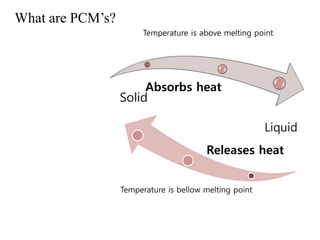
What are PCM’s?
Absorbs heat
Liquid
Releases heat
Solid
Temperature is above melting point
Temperature is bellow melting point
3
Thermal Energy Conversion Control Lab. Chonbuk Nat’I Univ.
Our Idea
• Storing PCM’s in the walls of the house/ building HVAC system.
• The goal is to sustain a specific temperature range for human comfort
• Decreasing the usage of energy by replacing air conditioners
• Used for heating the house in winter and cooling in summer
Thermal Energy Conversion Control Lab. Chonbuk Nat’I Univ.
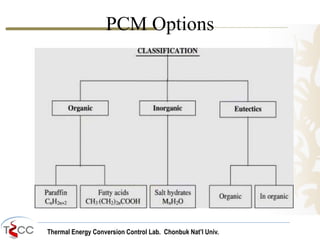
PCM Options
Thermal Energy Conversion Control Lab. Chonbuk Nat’I Univ.
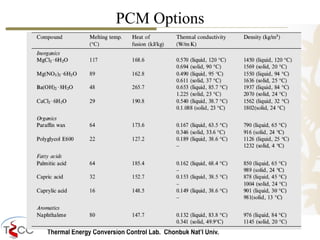
PCM Options
Thermal Energy Conversion Control Lab. Chonbuk Nat’I Univ. 7
Fig. 1. (a) Latent heat of melting of paraffin compounds [4]. (b) Latent heat of melting of non-paraffin organic compoun
ds [4]. (c) Latent heat of melting/mass of inorganic compounds [4]. (d) Latent heat of melting/volume of inorganic comp
ounds [4]. (e) Latent heat of melting of eutectic compounds
Thermal Energy Conversion Control Lab. Chonbuk Nat’I Univ.
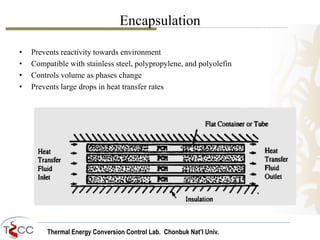
Encapsulation
• Prevents reactivity towards environment
• Compatible with stainless steel, polypropylene, and polyolefin
• Controls volume as phases change
• Prevents large drops in heat transfer rates
Thermal Energy Conversion Control Lab. Chonbuk Nat’I Univ.
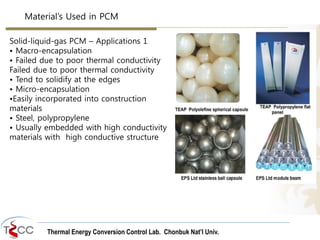
Solid-liquid-gas PCM – Applications 1
• Macro-encapsulation
• Failed due to poor thermal conductivity
Failed due to poor thermal conductivity
• Tend to solidify at the edges
• Micro-encapsulation
•Easily incorporated into construction
materials
• Steel, polypropylene
• Usually embedded with high conductivity
materials with high conductive structure
Material’s Used in PCM
Thermal Energy Conversion Control Lab. Chonbuk Nat’I Univ.
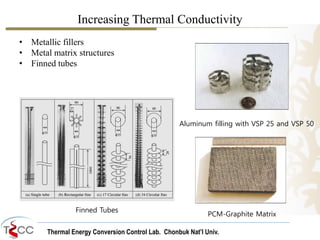
Increasing Thermal Conductivity
• Metallic fillers
• Metal matrix structures
• Finned tubes
Aluminum filling with VSP 25 and VSP 50
PCM-Graphite Matrix
Finned Tubes
Thermal Energy Conversion Control Lab. Chonbuk Nat’I Univ.
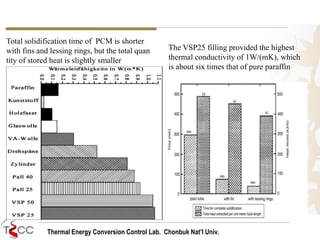
The VSP25 filling provided the highest
thermal conductivity of 1W/(mK), which
is about six times that of pure paraffin
Total solidification time of PCM is shorter
with fins and lessing rings, but the total quan
tity of stored heat is slightly smaller
Thermal Energy Conversion Control Lab. Chonbuk Nat’I Univ.
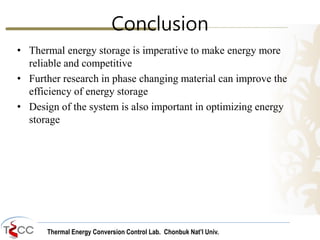
Conclusion
• Thermal energy storage is imperative to make energy more
reliable and competitive
• Further research in phase changing material can improve the
efficiency of energy storage
• Design of the system is also important in optimizing energy
storage
Thermal Energy Conversion Control Lab. Chonbuk Nat’I Univ.
References
• Aghbalou, F., F. Badia, and J. Illa. “Exergetic Optimization of Solar Collector and Thermal Energy Storage System.” I
nternational Journal of Heat and Mass Transfer 49.7-8 (Apr. 2006): 1255-1263. ScienceDirect. Elsevier. 16 Nov. 200
7 <http://www.sciencedirect.com/>.
• Badescu, Viorel. “Model of a Thermal Energy Storage Device Integrated into a Solar Assisted Heat Pump System f
or Space Heating.” Energy Conversion and Management 44.10 (June 2003): 1589-1604. ScienceDirect. Elsevier. 16
Nov. 2007 <http://www.sciencedirect.com/>.
• Denholm, Paul, and Robert M. Margolis. “Evaluating the Limits of Solar Photovoltaics (PVs) in Electric Power Syste
ms Utilizing Energy Storage and Other Enabling Technologies.” Energy Policy 35.9 (Sept. 2007): 4424-4433. Science
Direct. Elsevier. 16 Nov. 2007 <http://www.sciencedirect.com/>.
• Farid, Mohammed M., et al. “A Review on Phase Change Energy Storage: Materials and Applications.” Energy Con
version and Management 45.9-19 (June 2004): 1597-1615. ScienceDirect. Elsevier. 17 Nov. 2007 <http://www.scien
cedirect.com.ezproxy.lib.utexas.edu/>.
• Fath, Hassan E. S. “Technical Assessment of Solar Thermal Energy Storage Technologies.” Renewable Energy 13.1-4
(Summer 1998): 35-40. ScienceDirect. Elsevier. 17 Nov. 2007 <http://www.sciencedirect.com.ezproxy.lib.utexas.edu/
>.
• Kenisarin, Murat, and Khamid Mahkamov. “Solar Energy Storage Using Phase Change Materials.” Renewable and S
ustainable Energy Reviews 11.9 (Dec. 2007): 1913-1965. ScienceDirect. Elsevier. 17 Nov. 2007 <http://www.scienced
irect.com.ezproxy.lib.utexas.edu/>.
• Koca, Ahmet, et al. “Energy and Exergy Analysis of a Latent Heat Storage System with Phase Change Material for
a Solar Collector.” Renewable Energy (May 2007): 1-8. ScienceDirect. Elsevier. 16 Nov. 2007 <http://www.sciencedir
ect.com/>.
• Kousksou, T., et al. “Second Law Analysis of Latent Thermal Storage for Solar System.” Solar Energy Materials and
Solar Cells 91.14 (Sept. 2007): 1275-1281. ScienceDirect. Elsevier. 19 Nov. 2007 <http://www.sciencedirect.com.ezpr
oxy.lib.utexas.edu/>.
• Pasupathy, A., R. Velraj, and R. V. Seeniraj. “Phase Change Material-based Building Architecture for Thermal Manag
ement in Residential and Commercial Establisments.” Renewable & Sustainable Energy Reviews 12.1 (Jan. 2008): 3
9-64. ScienceDirect. Elsevier. 18 Nov. 2007 <http://www.sciencedirect.com/>.
• Regin, A. Felix, S. C. Solanki, and J. S. Saini. “Heat Transfer Characteristics of Thermal Energy Storage System Using
PCM Capsules: A Review.” Renewable and Sustainable Energy Reviews (Aug. 2007): 1-14. ScienceDirect. Elsevier. 2
0 Nov. 2007 <http://www.sciencedirect.com.ezproxy.lib.utexas.edu/>.
Thermal Energy Conversion Control Lab. Chonbuk Nat’I Univ.
Thank you for listening
14

Material Study pcm

  • 1.
    Thermal Energy ConversionControl Lab. Chonbuk Nat’I Univ. Phase Changing Material (PCM) Thermal Energy Storage Sudheer Nandi M.Tech,MBA(Ph.D.) Sustainable Energy ,S.korea.
  • 2.
    What are PCM’s? Absorbsheat Liquid Releases heat Solid Temperature is above melting point Temperature is bellow melting point
  • 3.
  • 4.
    Thermal Energy ConversionControl Lab. Chonbuk Nat’I Univ. Our Idea • Storing PCM’s in the walls of the house/ building HVAC system. • The goal is to sustain a specific temperature range for human comfort • Decreasing the usage of energy by replacing air conditioners • Used for heating the house in winter and cooling in summer
  • 5.
    Thermal Energy ConversionControl Lab. Chonbuk Nat’I Univ. PCM Options
  • 6.
    Thermal Energy ConversionControl Lab. Chonbuk Nat’I Univ. PCM Options
  • 7.
    Thermal Energy ConversionControl Lab. Chonbuk Nat’I Univ. 7 Fig. 1. (a) Latent heat of melting of paraffin compounds [4]. (b) Latent heat of melting of non-paraffin organic compoun ds [4]. (c) Latent heat of melting/mass of inorganic compounds [4]. (d) Latent heat of melting/volume of inorganic comp ounds [4]. (e) Latent heat of melting of eutectic compounds
  • 8.
    Thermal Energy ConversionControl Lab. Chonbuk Nat’I Univ. Encapsulation • Prevents reactivity towards environment • Compatible with stainless steel, polypropylene, and polyolefin • Controls volume as phases change • Prevents large drops in heat transfer rates
  • 9.
    Thermal Energy ConversionControl Lab. Chonbuk Nat’I Univ. Solid-liquid-gas PCM – Applications 1 • Macro-encapsulation • Failed due to poor thermal conductivity Failed due to poor thermal conductivity • Tend to solidify at the edges • Micro-encapsulation •Easily incorporated into construction materials • Steel, polypropylene • Usually embedded with high conductivity materials with high conductive structure Material’s Used in PCM
  • 10.
    Thermal Energy ConversionControl Lab. Chonbuk Nat’I Univ. Increasing Thermal Conductivity • Metallic fillers • Metal matrix structures • Finned tubes Aluminum filling with VSP 25 and VSP 50 PCM-Graphite Matrix Finned Tubes
  • 11.
    Thermal Energy ConversionControl Lab. Chonbuk Nat’I Univ. The VSP25 filling provided the highest thermal conductivity of 1W/(mK), which is about six times that of pure paraffin Total solidification time of PCM is shorter with fins and lessing rings, but the total quan tity of stored heat is slightly smaller
  • 12.
    Thermal Energy ConversionControl Lab. Chonbuk Nat’I Univ. Conclusion • Thermal energy storage is imperative to make energy more reliable and competitive • Further research in phase changing material can improve the efficiency of energy storage • Design of the system is also important in optimizing energy storage
  • 13.
    Thermal Energy ConversionControl Lab. Chonbuk Nat’I Univ. References • Aghbalou, F., F. Badia, and J. Illa. “Exergetic Optimization of Solar Collector and Thermal Energy Storage System.” I nternational Journal of Heat and Mass Transfer 49.7-8 (Apr. 2006): 1255-1263. ScienceDirect. Elsevier. 16 Nov. 200 7 <http://www.sciencedirect.com/>. • Badescu, Viorel. “Model of a Thermal Energy Storage Device Integrated into a Solar Assisted Heat Pump System f or Space Heating.” Energy Conversion and Management 44.10 (June 2003): 1589-1604. ScienceDirect. Elsevier. 16 Nov. 2007 <http://www.sciencedirect.com/>. • Denholm, Paul, and Robert M. Margolis. “Evaluating the Limits of Solar Photovoltaics (PVs) in Electric Power Syste ms Utilizing Energy Storage and Other Enabling Technologies.” Energy Policy 35.9 (Sept. 2007): 4424-4433. Science Direct. Elsevier. 16 Nov. 2007 <http://www.sciencedirect.com/>. • Farid, Mohammed M., et al. “A Review on Phase Change Energy Storage: Materials and Applications.” Energy Con version and Management 45.9-19 (June 2004): 1597-1615. ScienceDirect. Elsevier. 17 Nov. 2007 <http://www.scien cedirect.com.ezproxy.lib.utexas.edu/>. • Fath, Hassan E. S. “Technical Assessment of Solar Thermal Energy Storage Technologies.” Renewable Energy 13.1-4 (Summer 1998): 35-40. ScienceDirect. Elsevier. 17 Nov. 2007 <http://www.sciencedirect.com.ezproxy.lib.utexas.edu/ >. • Kenisarin, Murat, and Khamid Mahkamov. “Solar Energy Storage Using Phase Change Materials.” Renewable and S ustainable Energy Reviews 11.9 (Dec. 2007): 1913-1965. ScienceDirect. Elsevier. 17 Nov. 2007 <http://www.scienced irect.com.ezproxy.lib.utexas.edu/>. • Koca, Ahmet, et al. “Energy and Exergy Analysis of a Latent Heat Storage System with Phase Change Material for a Solar Collector.” Renewable Energy (May 2007): 1-8. ScienceDirect. Elsevier. 16 Nov. 2007 <http://www.sciencedir ect.com/>. • Kousksou, T., et al. “Second Law Analysis of Latent Thermal Storage for Solar System.” Solar Energy Materials and Solar Cells 91.14 (Sept. 2007): 1275-1281. ScienceDirect. Elsevier. 19 Nov. 2007 <http://www.sciencedirect.com.ezpr oxy.lib.utexas.edu/>. • Pasupathy, A., R. Velraj, and R. V. Seeniraj. “Phase Change Material-based Building Architecture for Thermal Manag ement in Residential and Commercial Establisments.” Renewable & Sustainable Energy Reviews 12.1 (Jan. 2008): 3 9-64. ScienceDirect. Elsevier. 18 Nov. 2007 <http://www.sciencedirect.com/>. • Regin, A. Felix, S. C. Solanki, and J. S. Saini. “Heat Transfer Characteristics of Thermal Energy Storage System Using PCM Capsules: A Review.” Renewable and Sustainable Energy Reviews (Aug. 2007): 1-14. ScienceDirect. Elsevier. 2 0 Nov. 2007 <http://www.sciencedirect.com.ezproxy.lib.utexas.edu/>.
  • 14.
    Thermal Energy ConversionControl Lab. Chonbuk Nat’I Univ. Thank you for listening 14