Jump-Start Your Application Security
    p            pp                y
Knowledge: For the Network Security
Guy Who Knows Nothing about
Applications
A li ti
     Jeremiah Grossman
     John B. Dickson, CISSP
Speaker’s Backgrounds

•   Jeremiah Grossman
    – Founder & CTO of WhiteHat Security
    – World-renowned expert in Web security and founder of the Web Application
      Security Consortium (WASC)
    – Former information security officer at Yahoo!
•   John Dickson
    – Denim Group Principal and career security professional
    – Assists CISO’s build application security programs
               CISO s
    – Prior to Denim Group, was a information security consultant at SecureLogix,
      KPMG, Trident Data Systems, and US Air Force


                                                                                    1
Company Backgrounds

•   WhiteHat Security Background
    – WhiteHat Security is the leading provider of website risk management solutions
    – WhiteHat serves hundreds of customers in e-commerce, financial services,
      information technology and healthcare including many of the Fortune 1000
      WhiteHat Sentinel the company’s flagship product family launched in 2003
                Sentinel,    company s                    family,
•   Denim Group Background
    – Denim Group is a professional services company that
       • develops secure software
       • helps organizations assess and mitigate risk with existing software
       • provides training on best practices in software security
    – WhiteHat Security’s Premier Integration Partner
        • Built Snort-Sentinel Integration for real-time application level blocking


                                                                                       2
“Houston we have a Problem”

•   Throughout industry security officers are responsible for the security
    of applications
     – If a breach occurs involving applications, who gets called first?
     – CIO’s largely can’t distinguish between web applications and the infrastructure in
       which applications reside
     – Rarely, if ever, do security manager have control of development efforts to
       remediate
•   It begs the question
     – Why are development colleagues not on the “hot seat” as well?
•   Security professionals are rushing into the application security world
     – New entrants into the field have less background knowledge in applications
                                                 g              g      pp
     – Demand to increase for application-smart security professionals


                                                                                            3
The Key Problem


Security officers worry about application vulnerabilities, but
       have little power to f them…
                            fix

Development managers have power to fix
      application vulnerabilities, but don’t worry about them


                                                                 4
Business Impact of this Problem

•   Many Security professionals are ill-equipped to secure applications
     – Difficulty analyzing application-level scan reports
     – Sometimes powerless to overcome development team objections
     – Network vulnerabilities get fixed relatively quickly – not the case for applications


•   WhiteHat Website Security Statistics Report
     – 82% of websites have had a HIGH, CRITICAL, or URGENT issue
     – V l
       Vulnerability time-to-fix metrics are not changing substantively, t i ll requiring
               bilit ti   t fi     ti          t h    i     b t ti l typically      ii
       weeks to months to achieve resolution
     – Security managers need to do a better job of managing or influencing the solution


                                                                                              5
Results of Denim Group Survey
•   75% of security respondents did not know the likely outcome of the
    exploitation of a Cross-Site Scripting (XSS) vulnerability
•   Nearly 70% did not know that modern development languages like
    Java and .NET could provide protection against buffer overflow
    vulnerabilities
•   Nearly 50% thought developers could perform source code reviews in
    the requirements
•   Nearly 70% of respondents could not identify that logical vulnerabilities
    involving authorization and authentication are typically more difficult to
    remediate than coding flaws such as Cross-Site Scripting (XSS) or
    buffer overflow vulnerabilities


                                                                                 6
A Journey of 1,000 Miles Starts with one Step…

•   Raise the bar on your knowledge of key aspects of software
    development, including:
    – Key coding terms
    – software architecture terms
    – Different software development methodologies
•   Build up a dictionary of terms tailored to your environment
•   Find a trusted development colleague to ask questions you wouldn’t
    ask in a public meeting
•   Understand what SDLC’s their organization uses
    – Different software development methodologies will drive how you want to introduce
      security practices to internal development teams


                                                                                          7
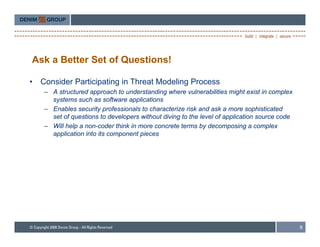
Ask a Better Set of Questions!

•   Consider Participating in Threat Modeling Process
    – A structured approach to understanding where vulnerabilities might exist in complex
      systems such as software applications
    – Enables security professionals to characterize risk and ask a more sophisticated
      set of questions to developers without diving to the level of application source code
    – Will help a non-coder think in more concrete terms by decomposing a complex
      application into its component pieces


                                                                                              8
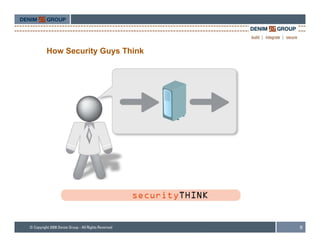
How Security Guys Think


                          9
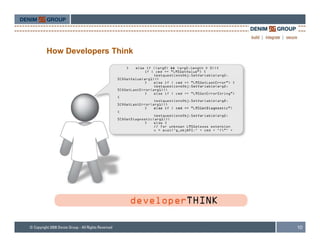
How Developers Think


                       10
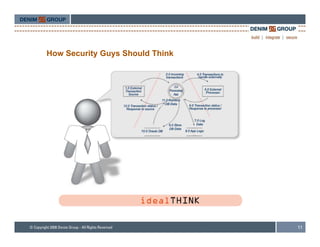
How Security Guys Should Think


                                 11
WhiteHat Sentinel – Snort Integration
•    Denim Group developed technology based on the WhiteHat’s open
     XML application programming interface (API), allowing for a
     seamless integration with Snort® to block website attacks
              – Highly accurate vulnerability information combined with an open XML API
                allows WhiteHat Sentinel data to be shared and employed within an
                organization s
                organization’s existing communications and reporting infrastructure
              – Integration supports both open source and commercial versions of IPS/IDS
              – Any IDS/IPS that imports these rules will work


•    Sentinel
     S ti l customers can now use vulnerability d t t quickly create
                  t                 l    bilit data to i kl       t
     ultra-targeted Snort rules
              – Expands capability of IPS to detect and block application layer attacks in real-
                time
              – Fine-tunes Snort alerts and correlate findings to reduce noise
              – Leverages existing, deployed infrastructure
                   » 80% Fortune 100 use Snort
                   » No need to retrain employees or reconfigure networks
How the integration works:

•   Implemented as a script, which when executed will securely
                      script             executed,
    connect to the Sentinel open API to extract website’s vulnerability
    details
             – Script translates downloaded data into Snort alert rules
             – Users apply rules to Snort IPS to alert on or block attacks

•   Simple deployment
             – All Sentinel customers have access to Open XML API free of charge

•   WhiteHat Open XML API also enables data exchange with:
             – W b Application Fi
               Web A li ti Firewalls  ll
             – Bug tracking systems
             – Security Information and Event Management systems
Contact Information

•   Jeremiah Grossman
    – jeremiah@whitehatsec.com
    – Twitter @jeremiahg

    www.whitehatsec.com


•   John B. Dickson, CISSP
    – john@denimgroup.com
    – Twitter @johnbdickson

    www.denimgroup.com


                                 14

Jump Start Your Application Security Knowledge

  • 1.
    Jump-Start Your ApplicationSecurity p pp y Knowledge: For the Network Security Guy Who Knows Nothing about Applications A li ti Jeremiah Grossman John B. Dickson, CISSP
  • 2.
    Speaker’s Backgrounds • Jeremiah Grossman – Founder & CTO of WhiteHat Security – World-renowned expert in Web security and founder of the Web Application Security Consortium (WASC) – Former information security officer at Yahoo! • John Dickson – Denim Group Principal and career security professional – Assists CISO’s build application security programs CISO s – Prior to Denim Group, was a information security consultant at SecureLogix, KPMG, Trident Data Systems, and US Air Force 1
  • 3.
    Company Backgrounds • WhiteHat Security Background – WhiteHat Security is the leading provider of website risk management solutions – WhiteHat serves hundreds of customers in e-commerce, financial services, information technology and healthcare including many of the Fortune 1000 WhiteHat Sentinel the company’s flagship product family launched in 2003 Sentinel, company s family, • Denim Group Background – Denim Group is a professional services company that • develops secure software • helps organizations assess and mitigate risk with existing software • provides training on best practices in software security – WhiteHat Security’s Premier Integration Partner • Built Snort-Sentinel Integration for real-time application level blocking 2
  • 4.
    “Houston we havea Problem” • Throughout industry security officers are responsible for the security of applications – If a breach occurs involving applications, who gets called first? – CIO’s largely can’t distinguish between web applications and the infrastructure in which applications reside – Rarely, if ever, do security manager have control of development efforts to remediate • It begs the question – Why are development colleagues not on the “hot seat” as well? • Security professionals are rushing into the application security world – New entrants into the field have less background knowledge in applications g g pp – Demand to increase for application-smart security professionals 3
  • 5.
    The Key Problem Securityofficers worry about application vulnerabilities, but have little power to f them… fix Development managers have power to fix application vulnerabilities, but don’t worry about them 4
  • 6.
    Business Impact ofthis Problem • Many Security professionals are ill-equipped to secure applications – Difficulty analyzing application-level scan reports – Sometimes powerless to overcome development team objections – Network vulnerabilities get fixed relatively quickly – not the case for applications • WhiteHat Website Security Statistics Report – 82% of websites have had a HIGH, CRITICAL, or URGENT issue – V l Vulnerability time-to-fix metrics are not changing substantively, t i ll requiring bilit ti t fi ti t h i b t ti l typically ii weeks to months to achieve resolution – Security managers need to do a better job of managing or influencing the solution 5
  • 7.
    Results of DenimGroup Survey • 75% of security respondents did not know the likely outcome of the exploitation of a Cross-Site Scripting (XSS) vulnerability • Nearly 70% did not know that modern development languages like Java and .NET could provide protection against buffer overflow vulnerabilities • Nearly 50% thought developers could perform source code reviews in the requirements • Nearly 70% of respondents could not identify that logical vulnerabilities involving authorization and authentication are typically more difficult to remediate than coding flaws such as Cross-Site Scripting (XSS) or buffer overflow vulnerabilities 6
  • 8.
    A Journey of1,000 Miles Starts with one Step… • Raise the bar on your knowledge of key aspects of software development, including: – Key coding terms – software architecture terms – Different software development methodologies • Build up a dictionary of terms tailored to your environment • Find a trusted development colleague to ask questions you wouldn’t ask in a public meeting • Understand what SDLC’s their organization uses – Different software development methodologies will drive how you want to introduce security practices to internal development teams 7
  • 9.
    Ask a BetterSet of Questions! • Consider Participating in Threat Modeling Process – A structured approach to understanding where vulnerabilities might exist in complex systems such as software applications – Enables security professionals to characterize risk and ask a more sophisticated set of questions to developers without diving to the level of application source code – Will help a non-coder think in more concrete terms by decomposing a complex application into its component pieces 8
  • 10.
  • 11.
  • 12.
    How Security GuysShould Think 11
  • 13.
    WhiteHat Sentinel –Snort Integration • Denim Group developed technology based on the WhiteHat’s open XML application programming interface (API), allowing for a seamless integration with Snort® to block website attacks – Highly accurate vulnerability information combined with an open XML API allows WhiteHat Sentinel data to be shared and employed within an organization s organization’s existing communications and reporting infrastructure – Integration supports both open source and commercial versions of IPS/IDS – Any IDS/IPS that imports these rules will work • Sentinel S ti l customers can now use vulnerability d t t quickly create t l bilit data to i kl t ultra-targeted Snort rules – Expands capability of IPS to detect and block application layer attacks in real- time – Fine-tunes Snort alerts and correlate findings to reduce noise – Leverages existing, deployed infrastructure » 80% Fortune 100 use Snort » No need to retrain employees or reconfigure networks
  • 14.
    How the integrationworks: • Implemented as a script, which when executed will securely script executed, connect to the Sentinel open API to extract website’s vulnerability details – Script translates downloaded data into Snort alert rules – Users apply rules to Snort IPS to alert on or block attacks • Simple deployment – All Sentinel customers have access to Open XML API free of charge • WhiteHat Open XML API also enables data exchange with: – W b Application Fi Web A li ti Firewalls ll – Bug tracking systems – Security Information and Event Management systems
  • 15.
    Contact Information • Jeremiah Grossman – jeremiah@whitehatsec.com – Twitter @jeremiahg www.whitehatsec.com • John B. Dickson, CISSP – john@denimgroup.com – Twitter @johnbdickson www.denimgroup.com 14