JS - Basics
                             part 1


Thursday, June 9, 2011
JS - overview
                    •    JavaScript =/= DOM        •   Prototypal inheritance
                                                       (objects not classes)
                    •    Dynamic language
                                                   •   Closures (lambda)
                    •    Loosely & dynamically
                         typed                     •   Event loop

                    •    Functional language       •   ECMA5

                    •    Almost everything is an   •   SSJS
                         object


Thursday, June 9, 2011
Variables


Thursday, June 9, 2011
Globals & Locals

                    • only function scope
                    • no block scope (ok, this is not exactly
                         true...)
                    • never, ever without var


Thursday, June 9, 2011
Globals & Locals
                var a = 5;

                (function() {
                    var a = 7;
                })();

                console.log(a) // 5


Thursday, June 9, 2011
Globals & Locals
                var a = 5;

                (function() {
                    a = 7;
                })();

                console.log(a) // 7


Thursday, June 9, 2011
Globals & Locals

                • watch out for loops
                         for(var i = 0; i < 3; i++) {

                             // be sure you're not making i global!

                         }


Thursday, June 9, 2011
var & let

                    •    let - variable with block scope

                    • implemented in JS 1.7 (part of ECMA6)
                    • sweet but not yet there


Thursday, June 9, 2011
var & let
                <script type="application/
                javascript;version=1.7">

                var a = 6;
                if(true) {
                    var b = 7;
                }
                console.log(a); // 6
                console.log(b); // 7

                </script>


Thursday, June 9, 2011
var & let
                 <script type="application/
                 javascript;version=1.7">

                 var a = 6;
                 if(true) {
                     let b = 7;
                 }
                 console.log(a); // 6
                 console.log(b); // Error: b is not defined

                 </script>


Thursday, June 9, 2011
module pattern
                    • extremely useful in apps that have more
                         than one JS file
                    • easy way to encapsulate and limit the
                         amount of global variables
                    • use please :)
                    • JavaScript Module Pattern: In-Depth - by
                         Ben Cherry http://bit.ly/j4vhTi


Thursday, June 9, 2011
module pattern
                (function(){
                     // om nom nom, do stuff, nothing gets out of here
                })()


                var MyApp = function() {
                    // do stuff and return some object for future use
                    return {
                        om : 'nom'
                    }
                } ();

                MyApp.om // nom


Thursday, June 9, 2011
module pattern
                var MyApp = function() {
                    var privateVariable;

                         function privateFunction(someVar) {
                             // mess around with privateVariable and someVar
                         }

                         var thisWillBePublic = function(someVar) {
                             return privateFunction(someVar)
                         }

                    return {
                        myAppMethod: thisWillBePublic
                    }
                } ();

                MyApp.myAppMethod();
Thursday, June 9, 2011
variable types
                    •    undefined - variable that has no value assigned

                    •    null - object with no value

                    •    boolean - true or false

                    •    string - 'this' "and that"

                    •    number - double precision 64bit number & NaN

                    •    object - everything else (yes, arrays and
                         functions too)


Thursday, June 9, 2011
Dynamic Typing
                •        Data types can change
                               var foo = 42;
                               foo = "Blah";

                •        „+” can convert to number
                               +"42" // 42

                •        „+” can convert to string
                               33 + " oops" // "33 oops"
                               "37" - 7 // 30
                               "37" + 7 // "377"
                •        Don’t kill the compiler - avoid changing types!


Thursday, June 9, 2011
Falsy Values
                •        undefined
                •        null
                •        false
                •        NaN, 0 (both are numbers)
                •        "" '' (empty strings)


                !null; !undefined; !0; !''; !false; !NaN // true


Thursday, June 9, 2011
Falsy Values

                0 == ''; 0 == false; '' == false // true


                0 == undefined; 0 == null // false

                undefined == null // true

                NaN == NaN // false


Thursday, June 9, 2011
Literals vs Built-in
                              Objects
                var a = 1;
                typeof a; // "number"
                a instanceof Number; // false
                a instanceof Object; // false

                var b = new Number(1);
                typeof b; // "object"
                b instanceof Number; // true
                b instanceof Object; // true

                a == b // true
                a === b // false


                Same happens with strings & booleans

Thursday, June 9, 2011
Literals vs Built-in
                              Objects
                var a = [];
                typeof a; // "object"
                a instanceof Array; // true
                a instanceof Object; // true

                var b = new Array(1);
                typeof b; // "object"
                b instanceof Array; // true
                b instanceof Object // true

                a == b // false - comparing references, not values!
                a === b // false - same case


           With arrays, objects and functions it works both ways
Thursday, June 9, 2011
Built-in Objects
                    •    Object            •   RegExp

                    •    Function          •   Error

                    •    Array             •   ...

                    •    String

                    •    Boolean

                    •    Date


Thursday, June 9, 2011
Operators


Thursday, June 9, 2011
Operators || and &&
                function a(b){       function a(b){
                    return b || 7;       return b && 7;
                }                    }

                a(); // 7            a(); // undefined
                a(9); // 9           a(9); // 7
                a([]); // []         a([]); // 7
                a(0); // 7           a(0); // 0


Thursday, June 9, 2011
Operator !!
                • makes a boolean out of anything:
                         !!0    !!''   !!null   !!undefined   !!NaN // false


                         !!5    !!'om nom nom' // true

                         !![]    !!{} // true

                         !!function(){} // true


Thursday, June 9, 2011
Operators ~~ and |

                • get integer from any number (fastest way)
                         ~~3.75

                         0 | 3.75

                         parseInt(3.75)


Thursday, June 9, 2011
== && ===

                    • == checks only the value
                    • === checks also the type
                    • always use ===
                         [] == ![]    // true

                         [] === ![]   // false


Thursday, June 9, 2011
Objects


Thursday, June 9, 2011
Objects
                    •    almost everything is an object:
                         •   functions, arrays, object literals, constructor instances..
                         •   everything that is not a string, number, boolean
                             (literals!), null or undefined
                    •    objects are always passed by reference (no clone method)
                    •    comparing objects compares references (no equal
                         method)
                    •    objects are dynamic - can be modified after creating
                    •    they can inherit from each other


Thursday, June 9, 2011
Objects
                var a = { b : 'om' }, a1 = {   b : 'om' }
                var c = a;

                a === a1 // false
                c === a // true

                a.b // 'om'
                c.b // 'om'

                c.b = 'nom'
                a.b // 'nom'

                (function(obj) {
                    obj.d = 'ninja!'
                })(a)

                c.d // ninja!


Thursday, June 9, 2011
Objects

                var obj = {key1 : 5}

                obj.key1 // 5
                obj['key1']; // 5
                var a = 'key1';
                obj[a] // 5

                obj.someKey // undefined
                obj.someKey.value // error


Thursday, June 9, 2011
Objects - creating
           var obj = {
               key1 : ”value”,       var obj = {};
               key2 : 7,             obj.key1 = 'str';
               key3 : true,          obj.key2 = 7;
               key4 : {},            obj.key3 = {};
               key5 : [],            obj.key3.boo = function() {}
               key6: function(){},
               key7: myFun
           }
           function myFun() {}


Thursday, June 9, 2011
Arrays
                    •    Indexes are converted to strings and used as
                         names for retrieving values.
                    •    Very efficient for sparse arrays.
                    •    length is not actual size of array but highest
                         index + 1
                    •    typeof [] returns ”object”
                    •    Arrays can be augmented (as any other object)


Thursday, June 9, 2011
Arrays - length
                                  property

                         var arr = [];

                         arr[3] = 1;

                         arr.length // 4

                         arr // [undefined, undefined, undefined, 1]


Thursday, June 9, 2011
Arrays - deleting
                            elements

                var arr = [1, 2, 3] // [1, 2, 3]
                delete arr[1] // [1, undefined, 3]

                var arr = [1, 2, 3] // [1, 2, 3]
                arr.splice(1, 1) // [1, 3]


Thursday, June 9, 2011
Arrays - iterating
                    •    Use for or while loop

                    •    ECMA5 has more methods for iteration like
                         forEach

                    •    for...in is dangerous and (usually) ineffective as
                         it uses not only array elements but also object
                         properties

                    •    for..in can be effective in case of sparse arrays
                         but has to be used with hasOwnProperty method


Thursday, June 9, 2011
Arrays - iterating
                Array.prototype.myArrMethod = function() { return 'thisIsMyArrMethod' }
                var arr = [];
                arr[3] = 3;
                arr[1000] = 1000;

                for(var i = 0, len = arr.length; i < len; i++){
                    console.log(arr[i])
                }
                // 3 x undefined, 3, 996 x undefined, 1000

                for(var i in arr) {
                    console.log(arr[i])
                }
                // 3, 1000, function () { return 'thisIsMyArrMethod' }

                for(var i in arr) {
                    if(arr.hasOwnProperty(i)) {
                        console.log(arr[i])
                    }
                }
                // 3, 1000

Thursday, June 9, 2011
Functions


Thursday, June 9, 2011
Functions
                    •    Functions are first class objects – can be passed,
                         returned or stored

                    •    typeof function(){} returns ”function”

                    •    In JS function is what in other languages is called
                         lambda
                    •    Functions can be defined inside each other
                    •    Functions return undefined if not set differently
                         (unless new operator is used)


Thursday, June 9, 2011
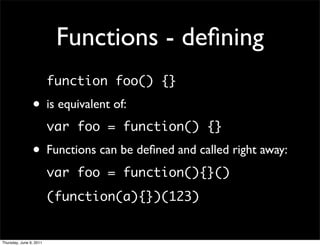
Functions - defining
                         function foo() {}

                • is equivalent of:
                         var foo = function() {}

                • Functions can be defined and called right away:
                         var foo = function(){}()
                         (function(a){})(123)


Thursday, June 9, 2011
Functions - closures
                Function keeps a reference to its private variables
                even after it has returned
                function setPuppyBasket(initialPuppy) {
                    var basket = [initialPuppy]
                    return function(puppy) {
                        if(puppy) {
                            basket.push(puppy)
                        }
                        return basket.toString();
                    }
                }

                var puppyBasket = setPuppyBasket('black');
                puppyBasket(); // 'black'
                puppyBasket('white') // 'black,white'
                puppyBasket('white') // 'black,white,white'

Thursday, June 9, 2011
Function - closures

                    • Allow to use private variables and methods
                    • Can cause problems when not used with
                         caution
                    • Excessive use of closures can affect script
                         performance - all objects are kept in
                         memory


Thursday, June 9, 2011
<p id="help">Helpful notes will appear here</p>
                <p>E-mail: <input type="text" id="email" name="email"></p>
                <p>Name: <input type="text" id="name" name="name"></p>
                <p>Age: <input type="text" id="age" name="age"></p>

                function showHelp(help) {
                  document.getElementById('help').innerHTML = help;
                }

                function setupHelp() {
                  var helpText = [
                       {'id': 'email', 'help': 'Your e-mail address'},
                       {'id': 'name', 'help': 'Your full name'},
                       {'id': 'age', 'help': 'Your age (you must be over 16)'}
                    ];

                     for (var i = 0; i < helpText.length; i++) {
                       var item = helpText[i];
                       document.getElementById(item.id).onfocus = function() {
                         showHelp(item.help);
                       }
                     }
                }

Thursday, June 9, 2011
for (var i = 0; i < helpText.length; i++) {
                    var item = helpText[i];
                    var elem = document.getElementById(item.id);
                    elem.onfocus = function() {
                        showHelp(item.help);
                    }
                }


                for (var i = 0; i < helpText.length; i++) {
                    var item = helpText[i];
                    var elem = document.getElementById(item.id);
                    elem.onfocus = function(helpItem) {
                        return function() {
                            showHelp(helpItem);
                        }
                    }(item.help)
                  }
                }


Thursday, June 9, 2011
Functions - arguments

                    • special ‘array like’ object accessible inside
                         every function
                    • contains all arguments with which function
                         was invoked
                    • has length property but no other array
                         methods like splice or sort


Thursday, June 9, 2011
Functions - arguments
                function joiner(separator) {
                    // make real array from arguments
                    var args = [].splice.call(arguments, 1)

                         return args.join(separator)
                }

                function joiner(separator) {
                    var len = arguments.length;
                    var joined = '';
                    for(var i = 1; i < len; i++) {
                        joined += arguments[i]
                        if(arguments[i+1]) {
                            joined += separator;
                        }
                    }
                    return joined;
                }

                joiner(':', 1, 2, 3); // 1:2:3


Thursday, June 9, 2011
Functions - length
                •        fnName.length - number of parameters function
                         expects
                •        arguments.length - number of parameters
                         actually passed to the function
                         function joiner(separator) {

                             console.log('joiner.length: ' + joiner.length)

                             console.log('arguments.length: ' + arguments.length)

                         }

                         joiner(':', 1, 2, 3);

                         // joiner.length: 1

                         // arguments.length: 4

Thursday, June 9, 2011
Function - invocation
                •        Function form
                         functionObject(arguments)

                •        Method form
                         thisObject.methodName(arguments)
                         thisObject["methodName"](arguments)

                •        Constructor form
                         new functionObject(arguments)

                •        Apply/call form
                         functionObject.apply(thisObj,[arguments])


Thursday, June 9, 2011
Functions - this
                    •    this is an extra parameter. Its value depends on the
                         calling form.
                    •    It’s the context in which function is called
                    •    this gives methods access to their objects

                    •    this is bound at invocation time

                    •    Treat it like something that will be changing

                    •    More information on this and context
                         http://j.mp/jFFgUB


Thursday, June 9, 2011
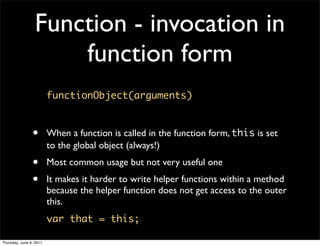
Function - invocation in
                     function form
                         functionObject(arguments)


                •        When a function is called in the function form, this is set
                         to the global object (always!)
                •        Most common usage but not very useful one
                •        It makes it harder to write helper functions within a method
                         because the helper function does not get access to the outer
                         this.
                         var that = this;

Thursday, June 9, 2011
Example

                function oohLaLa() {
                    alert(this == window)
                }
                oohLaLa(); // true


Thursday, June 9, 2011
Function - method
                                   form
                         myObject.methodName(args)
                         myObject["methodName"](args)


                • When a function is called in the method form, this is
                         set to myObject - the object containing the function.
                • This allows methods to have a reference to the parent
                         object


Thursday, June 9, 2011
Example
                var ooh = {
                    laLa: function() {
                        alert(this === ooh)
                    }
                }
                ooh.laLa(); // true

                var domNode = document.getElementById('elem');
                domNode.onclick = ooh.laLa; // false - context is domNode!

                var domNode = document.getElementById('elem');
                domNode.onclick = function() {
                    ooh.laLa(); // true - context is ooh object
                }


Thursday, June 9, 2011
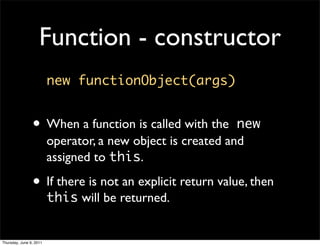
Function - constructor
                         new functionObject(args)


                • When a function is called with the         new
                         operator, a new object is created and
                         assigned to this.

                • If there is not an explicit return value, then
                         this will be returned.


Thursday, June 9, 2011
Example

                var Ooh = function() {}
                Ooh.prototype.laLa = function(obj) {
                    alert(this === obj)
                }

                var myOoh = new Ooh(); // myOoh is created,
                                       // set to this and returned
                myOoh.laLa(myOoh); // true


Thursday, June 9, 2011
Function apply/call

                fnObject.apply(thisObj,[arg1, arg2])

                fnObject.call(thisObj, arg1, arg2)


                •        this is set explicitely


Thursday, June 9, 2011
Function - bind
                         fnObject.bind(thisObj, arg1, arg2)


                • Available in ECMA5
                • Binding this object & presetting the
                         arguments

                • Calling bind returns new - curried -
Thursday, June 9, 2011
Example
                function sum() {
                    var sum = 0;
                    for(var i = 0; i < arguments.length; i++) {
                        sum += arguments[i]
                    }
                    return sum
                }

                var addToOne = sum.bind(null, 1);
                addToOne(2) // this === null, returns 3

                var addToThree = sum.bind(null, 1, 2);
                addToThree(3) // this === null, returns 6


Thursday, June 9, 2011
To be (hopefully)
                           continued with
                             event loop,
                             inheritance
                                  &
                         other JS sweetness
Thursday, June 9, 2011

Javascript Basics - part 1

  • 1.
    JS - Basics part 1 Thursday, June 9, 2011
  • 2.
    JS - overview • JavaScript =/= DOM • Prototypal inheritance (objects not classes) • Dynamic language • Closures (lambda) • Loosely & dynamically typed • Event loop • Functional language • ECMA5 • Almost everything is an • SSJS object Thursday, June 9, 2011
  • 3.
  • 4.
    Globals & Locals • only function scope • no block scope (ok, this is not exactly true...) • never, ever without var Thursday, June 9, 2011
  • 5.
    Globals & Locals var a = 5; (function() { var a = 7; })(); console.log(a) // 5 Thursday, June 9, 2011
  • 6.
    Globals & Locals var a = 5; (function() { a = 7; })(); console.log(a) // 7 Thursday, June 9, 2011
  • 7.
    Globals & Locals • watch out for loops for(var i = 0; i < 3; i++) { // be sure you're not making i global! } Thursday, June 9, 2011
  • 8.
    var & let • let - variable with block scope • implemented in JS 1.7 (part of ECMA6) • sweet but not yet there Thursday, June 9, 2011
  • 9.
    var & let <script type="application/ javascript;version=1.7"> var a = 6; if(true) { var b = 7; } console.log(a); // 6 console.log(b); // 7 </script> Thursday, June 9, 2011
  • 10.
    var & let <script type="application/ javascript;version=1.7"> var a = 6; if(true) { let b = 7; } console.log(a); // 6 console.log(b); // Error: b is not defined </script> Thursday, June 9, 2011
  • 11.
    module pattern • extremely useful in apps that have more than one JS file • easy way to encapsulate and limit the amount of global variables • use please :) • JavaScript Module Pattern: In-Depth - by Ben Cherry http://bit.ly/j4vhTi Thursday, June 9, 2011
  • 12.
    module pattern (function(){ // om nom nom, do stuff, nothing gets out of here })() var MyApp = function() { // do stuff and return some object for future use return { om : 'nom' } } (); MyApp.om // nom Thursday, June 9, 2011
  • 13.
    module pattern var MyApp = function() { var privateVariable; function privateFunction(someVar) { // mess around with privateVariable and someVar } var thisWillBePublic = function(someVar) { return privateFunction(someVar) } return { myAppMethod: thisWillBePublic } } (); MyApp.myAppMethod(); Thursday, June 9, 2011
  • 14.
    variable types • undefined - variable that has no value assigned • null - object with no value • boolean - true or false • string - 'this' "and that" • number - double precision 64bit number & NaN • object - everything else (yes, arrays and functions too) Thursday, June 9, 2011
  • 15.
    Dynamic Typing • Data types can change var foo = 42; foo = "Blah"; • „+” can convert to number +"42" // 42 • „+” can convert to string 33 + " oops" // "33 oops" "37" - 7 // 30 "37" + 7 // "377" • Don’t kill the compiler - avoid changing types! Thursday, June 9, 2011
  • 16.
    Falsy Values • undefined • null • false • NaN, 0 (both are numbers) • "" '' (empty strings) !null; !undefined; !0; !''; !false; !NaN // true Thursday, June 9, 2011
  • 17.
    Falsy Values 0 == ''; 0 == false; '' == false // true 0 == undefined; 0 == null // false undefined == null // true NaN == NaN // false Thursday, June 9, 2011
  • 18.
    Literals vs Built-in Objects var a = 1; typeof a; // "number" a instanceof Number; // false a instanceof Object; // false var b = new Number(1); typeof b; // "object" b instanceof Number; // true b instanceof Object; // true a == b // true a === b // false Same happens with strings & booleans Thursday, June 9, 2011
  • 19.
    Literals vs Built-in Objects var a = []; typeof a; // "object" a instanceof Array; // true a instanceof Object; // true var b = new Array(1); typeof b; // "object" b instanceof Array; // true b instanceof Object // true a == b // false - comparing references, not values! a === b // false - same case With arrays, objects and functions it works both ways Thursday, June 9, 2011
  • 20.
    Built-in Objects • Object • RegExp • Function • Error • Array • ... • String • Boolean • Date Thursday, June 9, 2011
  • 21.
  • 22.
    Operators || and&& function a(b){ function a(b){ return b || 7; return b && 7; } } a(); // 7 a(); // undefined a(9); // 9 a(9); // 7 a([]); // [] a([]); // 7 a(0); // 7 a(0); // 0 Thursday, June 9, 2011
  • 23.
    Operator !! • makes a boolean out of anything: !!0 !!'' !!null !!undefined !!NaN // false !!5 !!'om nom nom' // true !![] !!{} // true !!function(){} // true Thursday, June 9, 2011
  • 24.
    Operators ~~ and| • get integer from any number (fastest way) ~~3.75 0 | 3.75 parseInt(3.75) Thursday, June 9, 2011
  • 25.
    == && === • == checks only the value • === checks also the type • always use === [] == ![] // true [] === ![] // false Thursday, June 9, 2011
  • 26.
  • 27.
    Objects • almost everything is an object: • functions, arrays, object literals, constructor instances.. • everything that is not a string, number, boolean (literals!), null or undefined • objects are always passed by reference (no clone method) • comparing objects compares references (no equal method) • objects are dynamic - can be modified after creating • they can inherit from each other Thursday, June 9, 2011
  • 28.
    Objects var a = { b : 'om' }, a1 = { b : 'om' } var c = a; a === a1 // false c === a // true a.b // 'om' c.b // 'om' c.b = 'nom' a.b // 'nom' (function(obj) { obj.d = 'ninja!' })(a) c.d // ninja! Thursday, June 9, 2011
  • 29.
    Objects var obj = {key1 : 5} obj.key1 // 5 obj['key1']; // 5 var a = 'key1'; obj[a] // 5 obj.someKey // undefined obj.someKey.value // error Thursday, June 9, 2011
  • 30.
    Objects - creating var obj = { key1 : ”value”, var obj = {}; key2 : 7, obj.key1 = 'str'; key3 : true, obj.key2 = 7; key4 : {}, obj.key3 = {}; key5 : [], obj.key3.boo = function() {} key6: function(){}, key7: myFun } function myFun() {} Thursday, June 9, 2011
  • 31.
    Arrays • Indexes are converted to strings and used as names for retrieving values. • Very efficient for sparse arrays. • length is not actual size of array but highest index + 1 • typeof [] returns ”object” • Arrays can be augmented (as any other object) Thursday, June 9, 2011
  • 32.
    Arrays - length property var arr = []; arr[3] = 1; arr.length // 4 arr // [undefined, undefined, undefined, 1] Thursday, June 9, 2011
  • 33.
    Arrays - deleting elements var arr = [1, 2, 3] // [1, 2, 3] delete arr[1] // [1, undefined, 3] var arr = [1, 2, 3] // [1, 2, 3] arr.splice(1, 1) // [1, 3] Thursday, June 9, 2011
  • 34.
    Arrays - iterating • Use for or while loop • ECMA5 has more methods for iteration like forEach • for...in is dangerous and (usually) ineffective as it uses not only array elements but also object properties • for..in can be effective in case of sparse arrays but has to be used with hasOwnProperty method Thursday, June 9, 2011
  • 35.
    Arrays - iterating Array.prototype.myArrMethod = function() { return 'thisIsMyArrMethod' } var arr = []; arr[3] = 3; arr[1000] = 1000; for(var i = 0, len = arr.length; i < len; i++){ console.log(arr[i]) } // 3 x undefined, 3, 996 x undefined, 1000 for(var i in arr) { console.log(arr[i]) } // 3, 1000, function () { return 'thisIsMyArrMethod' } for(var i in arr) { if(arr.hasOwnProperty(i)) { console.log(arr[i]) } } // 3, 1000 Thursday, June 9, 2011
  • 36.
  • 37.
    Functions • Functions are first class objects – can be passed, returned or stored • typeof function(){} returns ”function” • In JS function is what in other languages is called lambda • Functions can be defined inside each other • Functions return undefined if not set differently (unless new operator is used) Thursday, June 9, 2011
  • 38.
    Functions - defining function foo() {} • is equivalent of: var foo = function() {} • Functions can be defined and called right away: var foo = function(){}() (function(a){})(123) Thursday, June 9, 2011
  • 39.
    Functions - closures Function keeps a reference to its private variables even after it has returned function setPuppyBasket(initialPuppy) { var basket = [initialPuppy] return function(puppy) { if(puppy) { basket.push(puppy) } return basket.toString(); } } var puppyBasket = setPuppyBasket('black'); puppyBasket(); // 'black' puppyBasket('white') // 'black,white' puppyBasket('white') // 'black,white,white' Thursday, June 9, 2011
  • 40.
    Function - closures • Allow to use private variables and methods • Can cause problems when not used with caution • Excessive use of closures can affect script performance - all objects are kept in memory Thursday, June 9, 2011
  • 41.
    <p id="help">Helpful noteswill appear here</p> <p>E-mail: <input type="text" id="email" name="email"></p> <p>Name: <input type="text" id="name" name="name"></p> <p>Age: <input type="text" id="age" name="age"></p> function showHelp(help) { document.getElementById('help').innerHTML = help; } function setupHelp() { var helpText = [ {'id': 'email', 'help': 'Your e-mail address'}, {'id': 'name', 'help': 'Your full name'}, {'id': 'age', 'help': 'Your age (you must be over 16)'} ]; for (var i = 0; i < helpText.length; i++) { var item = helpText[i]; document.getElementById(item.id).onfocus = function() { showHelp(item.help); } } } Thursday, June 9, 2011
  • 42.
    for (var i= 0; i < helpText.length; i++) { var item = helpText[i]; var elem = document.getElementById(item.id); elem.onfocus = function() { showHelp(item.help); } } for (var i = 0; i < helpText.length; i++) { var item = helpText[i]; var elem = document.getElementById(item.id); elem.onfocus = function(helpItem) { return function() { showHelp(helpItem); } }(item.help) } } Thursday, June 9, 2011
  • 43.
    Functions - arguments • special ‘array like’ object accessible inside every function • contains all arguments with which function was invoked • has length property but no other array methods like splice or sort Thursday, June 9, 2011
  • 44.
    Functions - arguments function joiner(separator) { // make real array from arguments var args = [].splice.call(arguments, 1) return args.join(separator) } function joiner(separator) { var len = arguments.length; var joined = ''; for(var i = 1; i < len; i++) { joined += arguments[i] if(arguments[i+1]) { joined += separator; } } return joined; } joiner(':', 1, 2, 3); // 1:2:3 Thursday, June 9, 2011
  • 45.
    Functions - length • fnName.length - number of parameters function expects • arguments.length - number of parameters actually passed to the function function joiner(separator) { console.log('joiner.length: ' + joiner.length) console.log('arguments.length: ' + arguments.length) } joiner(':', 1, 2, 3); // joiner.length: 1 // arguments.length: 4 Thursday, June 9, 2011
  • 46.
    Function - invocation • Function form functionObject(arguments) • Method form thisObject.methodName(arguments) thisObject["methodName"](arguments) • Constructor form new functionObject(arguments) • Apply/call form functionObject.apply(thisObj,[arguments]) Thursday, June 9, 2011
  • 47.
    Functions - this • this is an extra parameter. Its value depends on the calling form. • It’s the context in which function is called • this gives methods access to their objects • this is bound at invocation time • Treat it like something that will be changing • More information on this and context http://j.mp/jFFgUB Thursday, June 9, 2011
  • 48.
    Function - invocationin function form functionObject(arguments) • When a function is called in the function form, this is set to the global object (always!) • Most common usage but not very useful one • It makes it harder to write helper functions within a method because the helper function does not get access to the outer this. var that = this; Thursday, June 9, 2011
  • 49.
    Example function oohLaLa() { alert(this == window) } oohLaLa(); // true Thursday, June 9, 2011
  • 50.
    Function - method form myObject.methodName(args) myObject["methodName"](args) • When a function is called in the method form, this is set to myObject - the object containing the function. • This allows methods to have a reference to the parent object Thursday, June 9, 2011
  • 51.
    Example var ooh = { laLa: function() { alert(this === ooh) } } ooh.laLa(); // true var domNode = document.getElementById('elem'); domNode.onclick = ooh.laLa; // false - context is domNode! var domNode = document.getElementById('elem'); domNode.onclick = function() { ooh.laLa(); // true - context is ooh object } Thursday, June 9, 2011
  • 52.
    Function - constructor new functionObject(args) • When a function is called with the new operator, a new object is created and assigned to this. • If there is not an explicit return value, then this will be returned. Thursday, June 9, 2011
  • 53.
    Example var Ooh = function() {} Ooh.prototype.laLa = function(obj) { alert(this === obj) } var myOoh = new Ooh(); // myOoh is created, // set to this and returned myOoh.laLa(myOoh); // true Thursday, June 9, 2011
  • 54.
    Function apply/call fnObject.apply(thisObj,[arg1, arg2]) fnObject.call(thisObj, arg1, arg2) • this is set explicitely Thursday, June 9, 2011
  • 55.
    Function - bind fnObject.bind(thisObj, arg1, arg2) • Available in ECMA5 • Binding this object & presetting the arguments • Calling bind returns new - curried - Thursday, June 9, 2011
  • 56.
    Example function sum() { var sum = 0; for(var i = 0; i < arguments.length; i++) { sum += arguments[i] } return sum } var addToOne = sum.bind(null, 1); addToOne(2) // this === null, returns 3 var addToThree = sum.bind(null, 1, 2); addToThree(3) // this === null, returns 6 Thursday, June 9, 2011
  • 57.
    To be (hopefully) continued with event loop, inheritance & other JS sweetness Thursday, June 9, 2011