Structure and architecture, API, security, asynchronity, routing,
middlewares, data access, memory, cpu, state management, etc.
Timur Shemsedinov
8-9 NOV ‘19 KIEV, UKRAINE
Node.js
Antipatterns
JS FEST PROFESSIONAL JS CONFERENCE
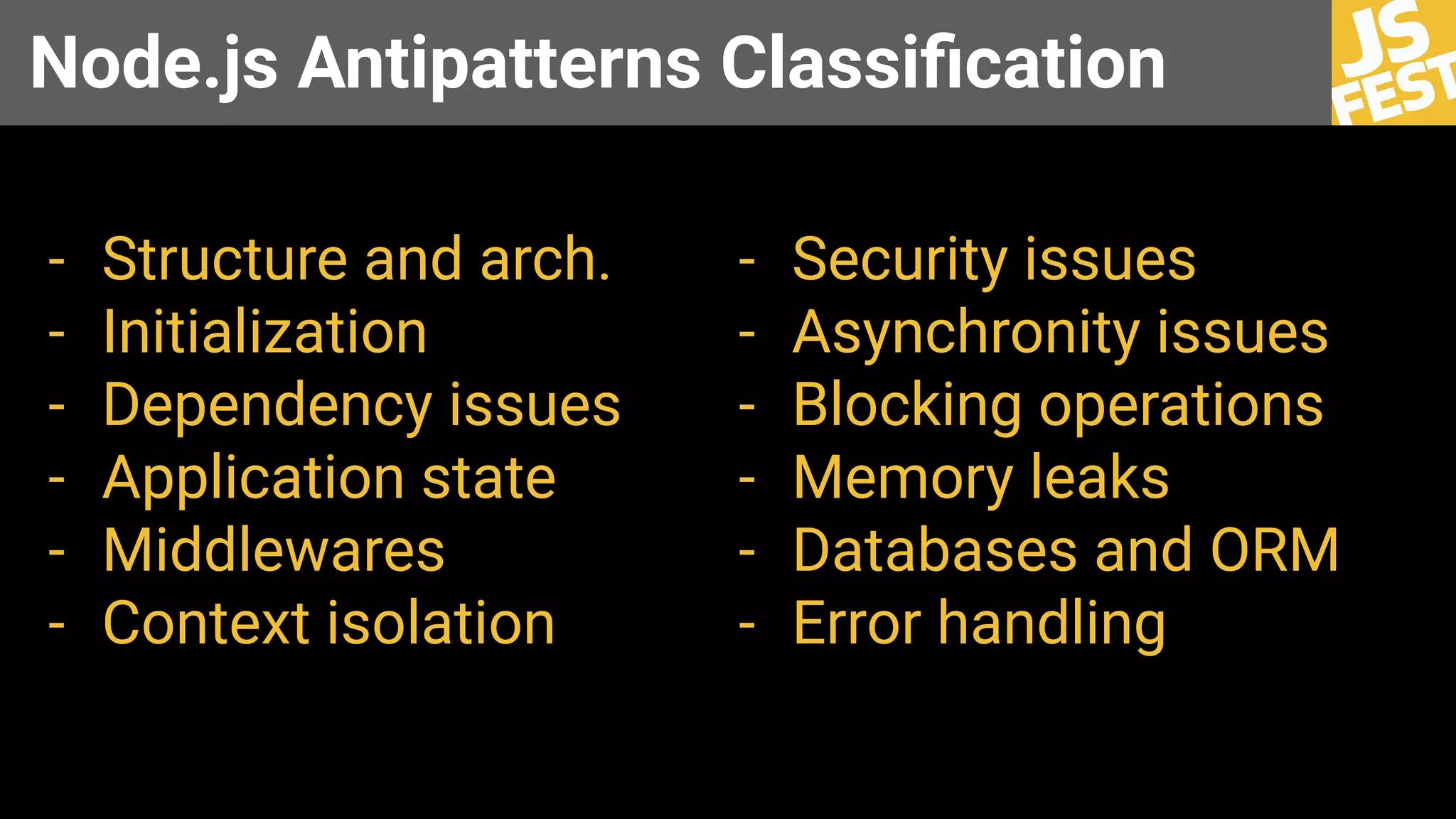
Node.js Antipatterns Classification
- Structure and arch.
- Initialization
- Dependency issues
- Application state
- Middlewares
- Context isolation
- Security issues
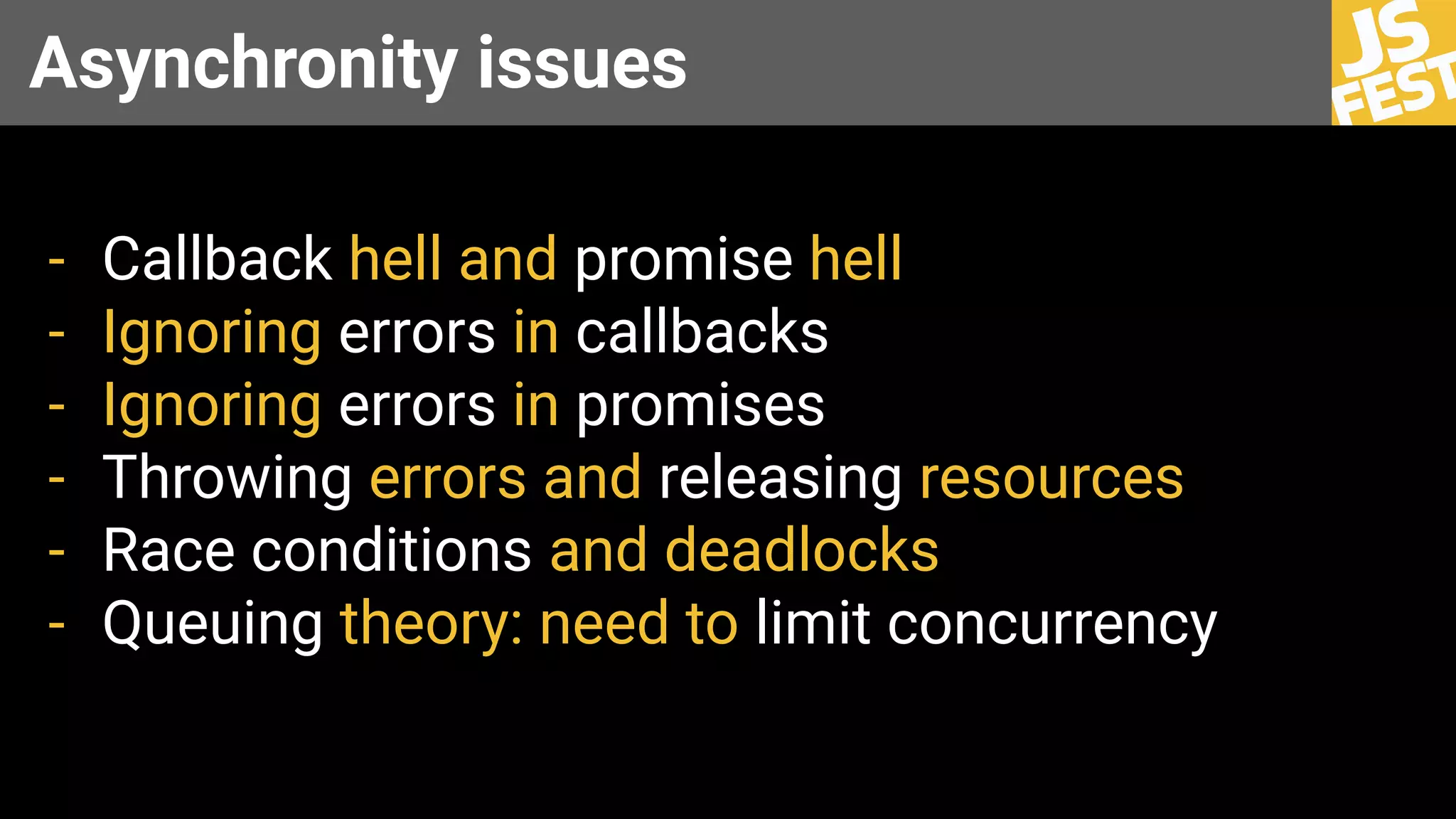
- Asynchronity issues
- Blocking operations
- Memory leaks
- Databases and ORM
- Error handling
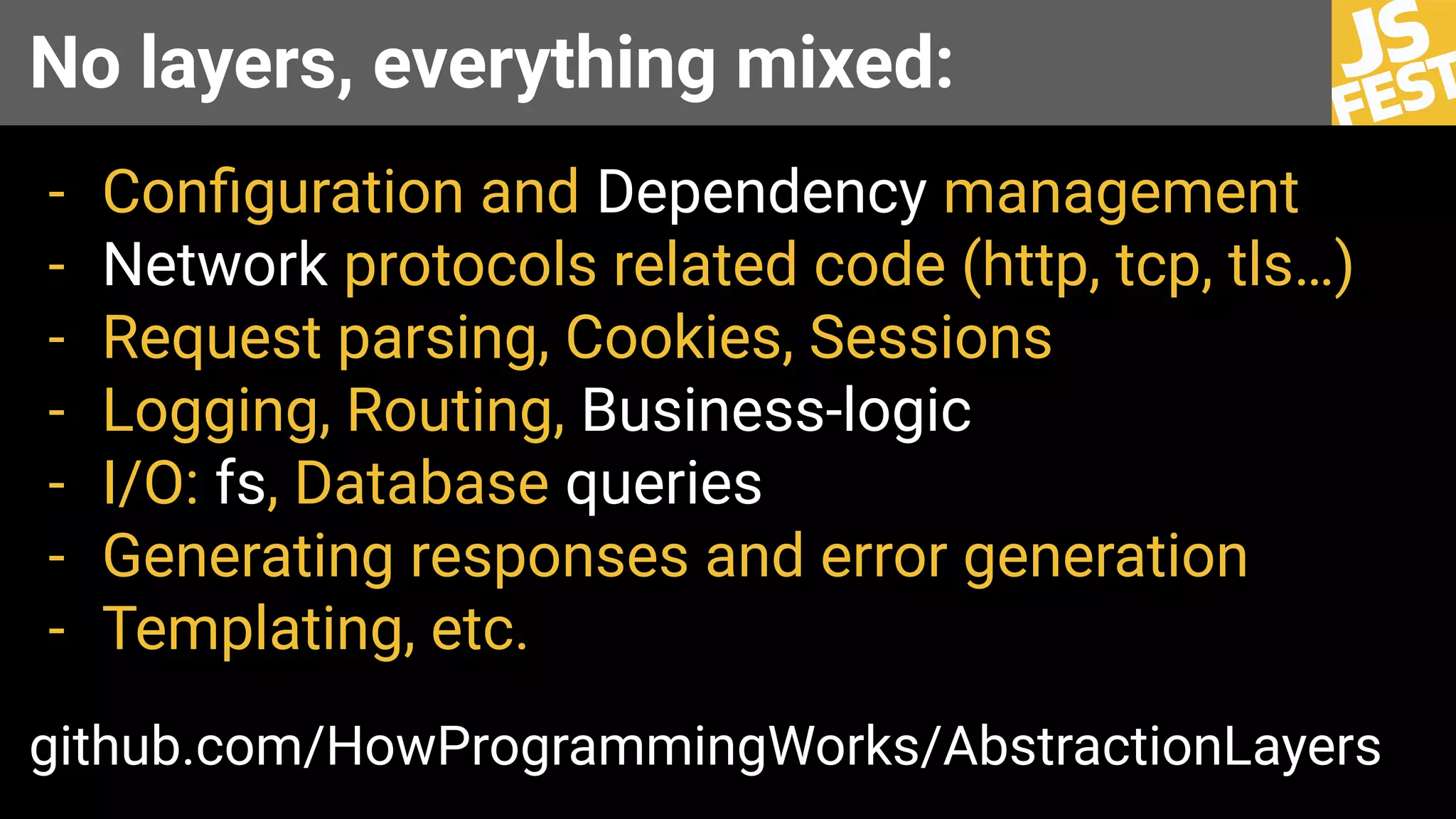
No layers, everything mixed:
- Configuration and Dependency management
- Network protocols related code (http, tcp, tls…)
- Request parsing, Cookies, Sessions
- Logging, Routing, Business-logic
- I/O: fs, Database queries
- Generating responses and error generation
- Templating, etc.
github.com/HowProgrammingWorks/AbstractionLayers
Mixed Layers
router.get('/user/:id', (req, res, next) => {
const id = parseInt(req.params.id);
const query = 'SELECT * FROM users WHERE id = $1';
pool.query(query, [id], (err, data) => {
if (err) throw err;
res.status(200).json(data.rows);
next();
});
});
What do we want?
async (arg1, arg2, arg3) => {
const data1 = await getData(arg1);
if (!data1) throw new Error('Message');
const [data2, data3] = await Promise.all(
[getData(arg2), getData(arg3)]
);
return await processData(data1, data2, data3);
}
github.com/HowProgrammingWorks/API
Transport agnostic, Framework agnostic
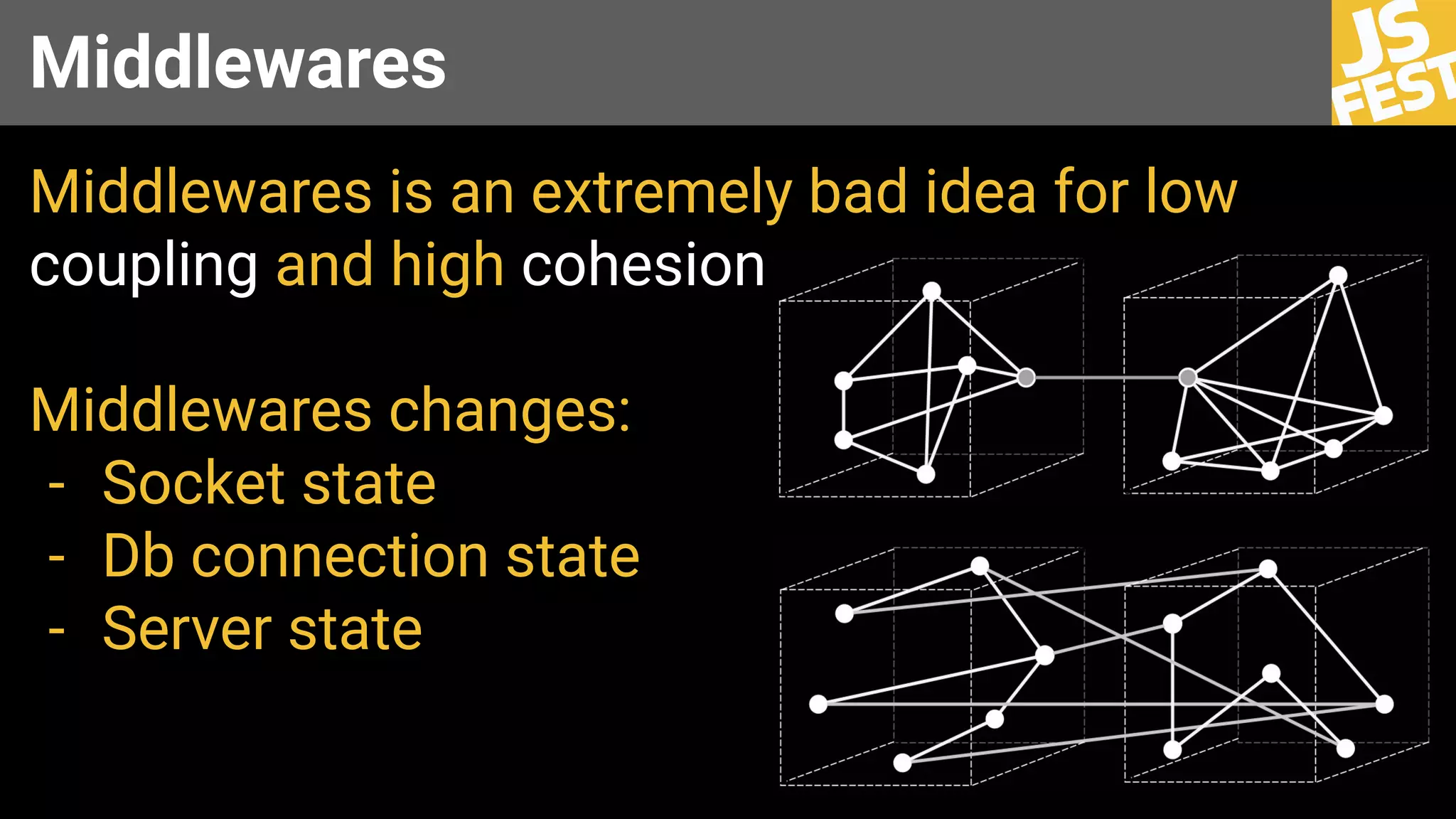
Middlewares
Middlewares is an extremely bad idea for low
coupling and high cohesion
Middlewares changes:
- Socket state
- Db connection state
- Server state
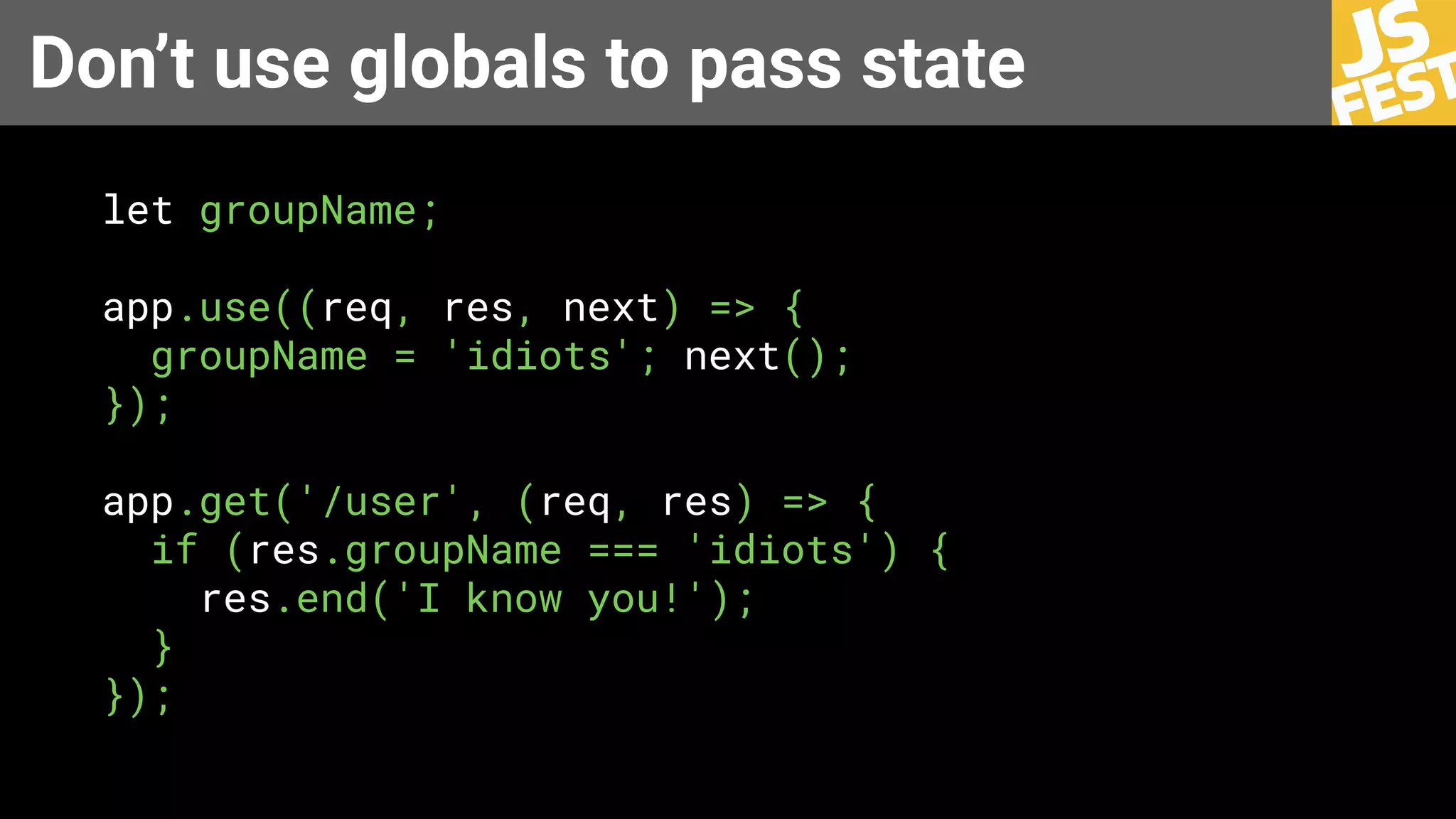
Don’t use globals to pass state
let groupName;
app.use((req, res, next) => {
groupName = 'idiots'; next();
});
app.get('/user', (req, res) => {
if (res.groupName === 'idiots') {
res.end('I know you!');
}
});
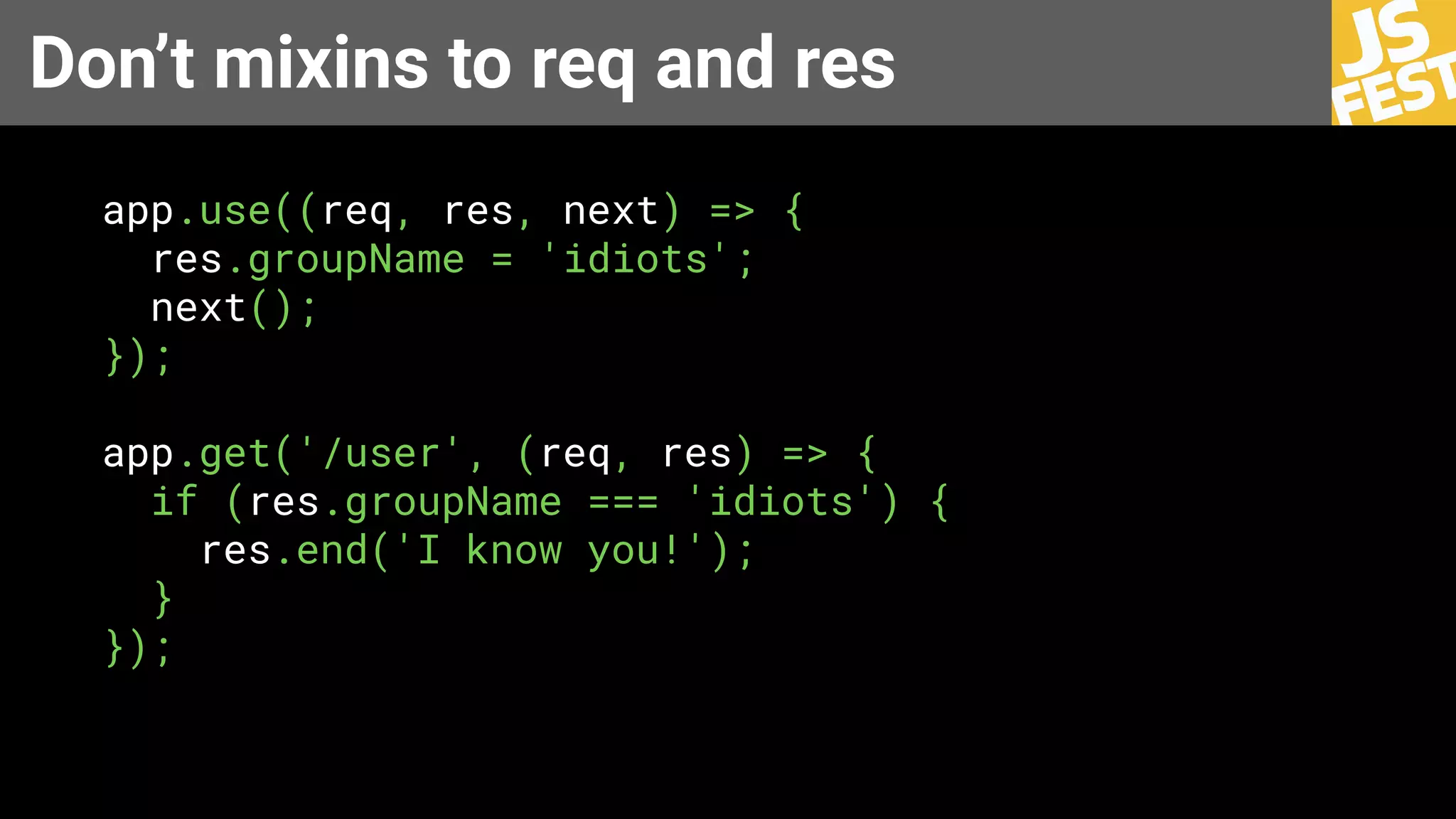
Don’t mixins to req and res
app.use((req, res, next) => {
res.groupName = 'idiots';
next();
});
app.get('/user', (req, res) => {
if (res.groupName === 'idiots') {
res.end('I know you!');
}
});
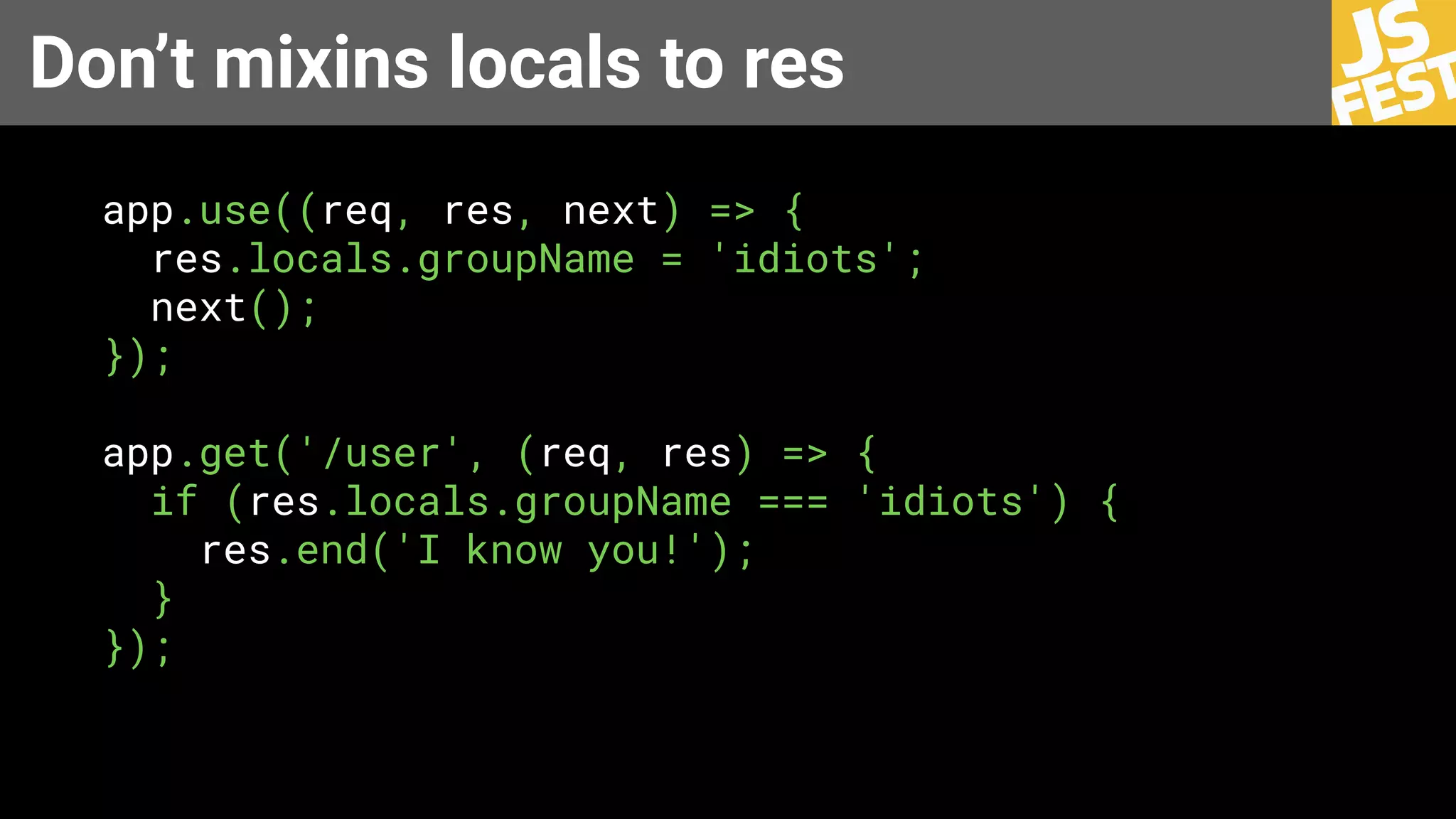
Don’t mixins locals to res
app.use((req, res, next) => {
res.locals.groupName = 'idiots';
next();
});
app.get('/user', (req, res) => {
if (res.locals.groupName === 'idiots') {
res.end('I know you!');
}
});
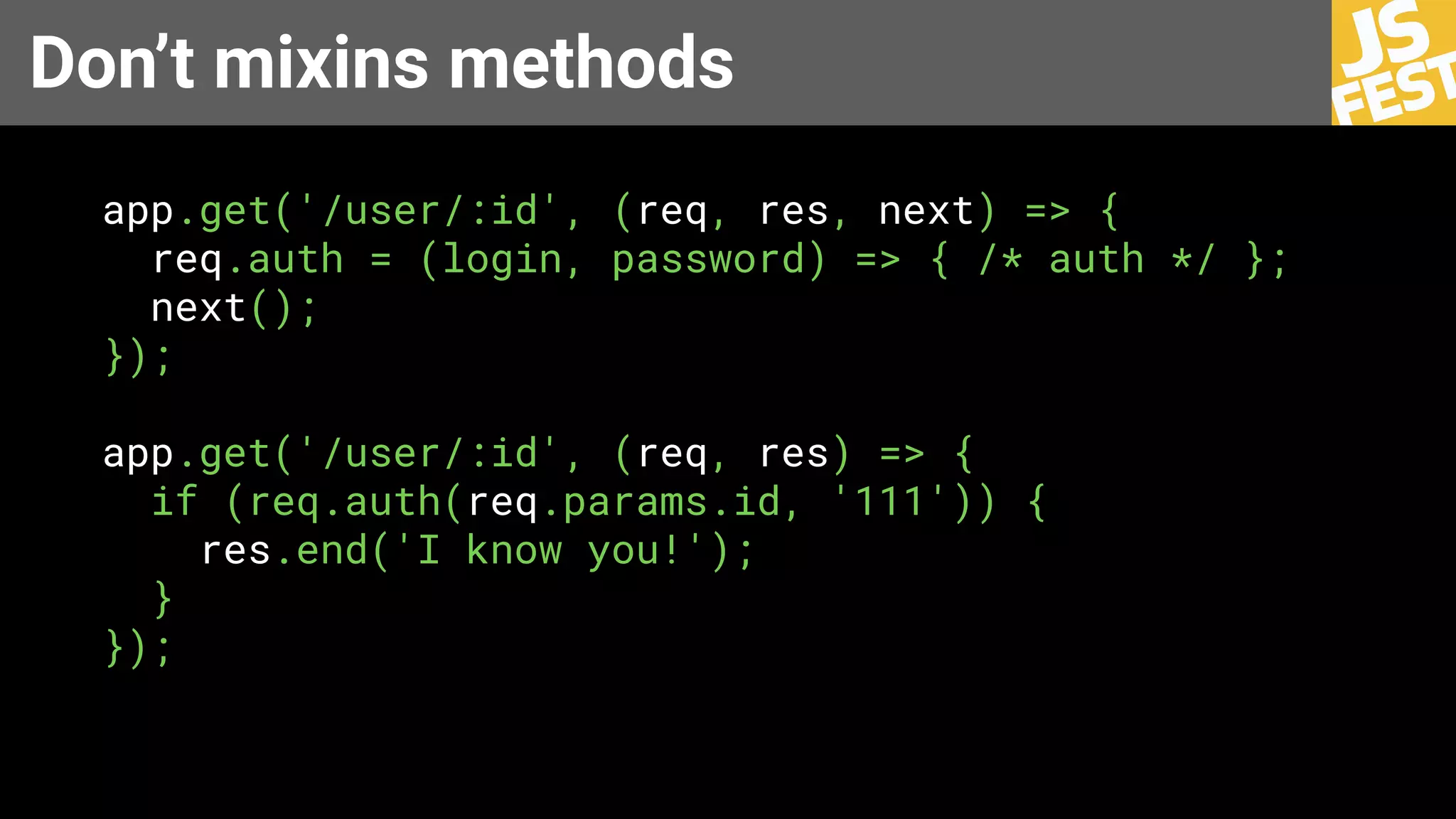
Don’t mixins methods
app.get('/user/:id', (req, res, next) => {
req.auth = (login, password) => { /* auth */ };
next();
});
app.get('/user/:id', (req, res) => {
if (req.auth(req.params.id, '111')) {
res.end('I know you!');
}
});
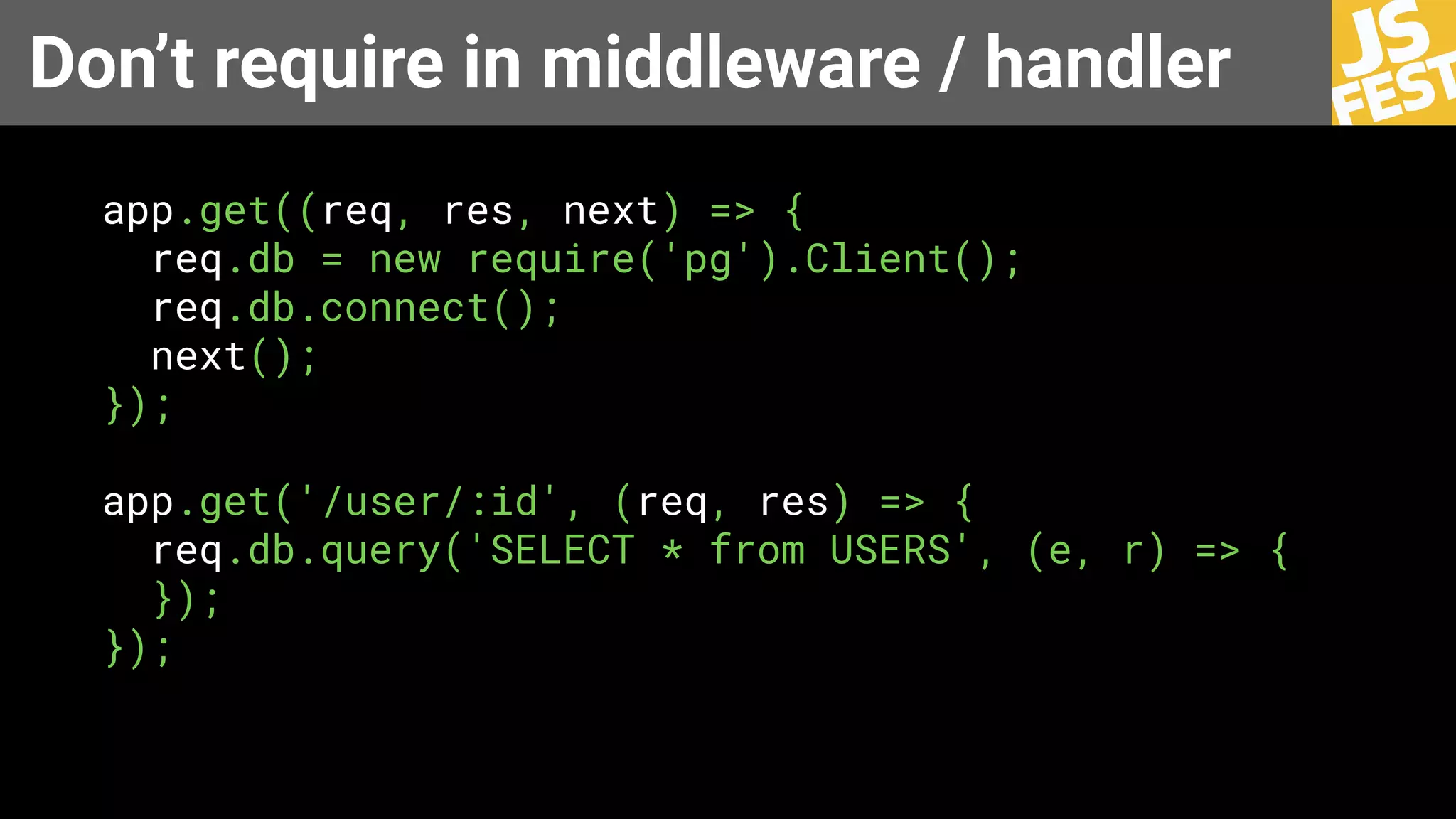
Don’t require in middleware / handler
app.get((req, res, next) => {
req.db = new require('pg').Client();
req.db.connect();
next();
});
app.get('/user/:id', (req, res) => {
req.db.query('SELECT * from USERS', (e, r) => {
});
});
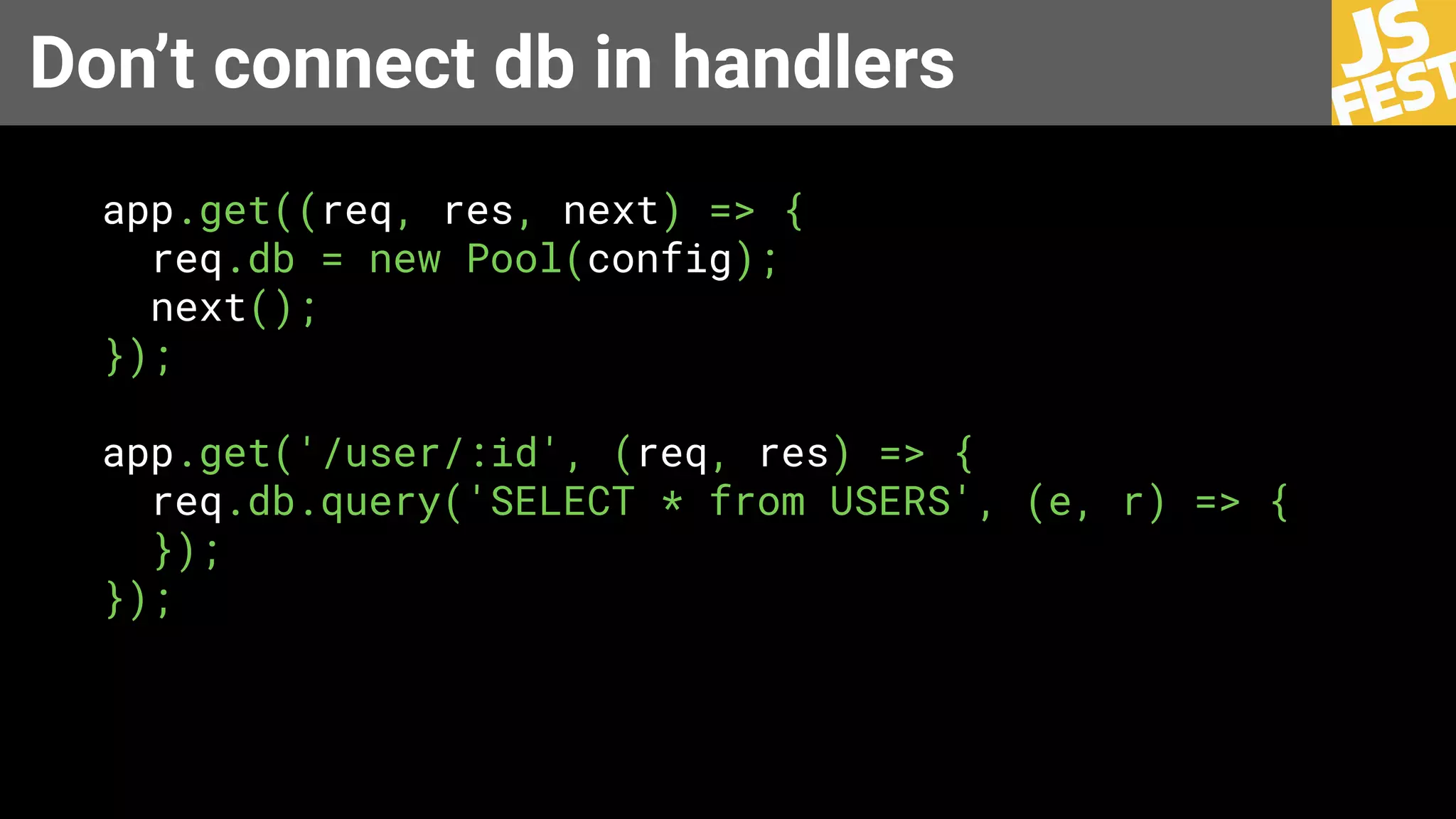
Don’t connect db in handlers
app.get((req, res, next) => {
req.db = new Pool(config);
next();
});
app.get('/user/:id', (req, res) => {
req.db.query('SELECT * from USERS', (e, r) => {
});
});
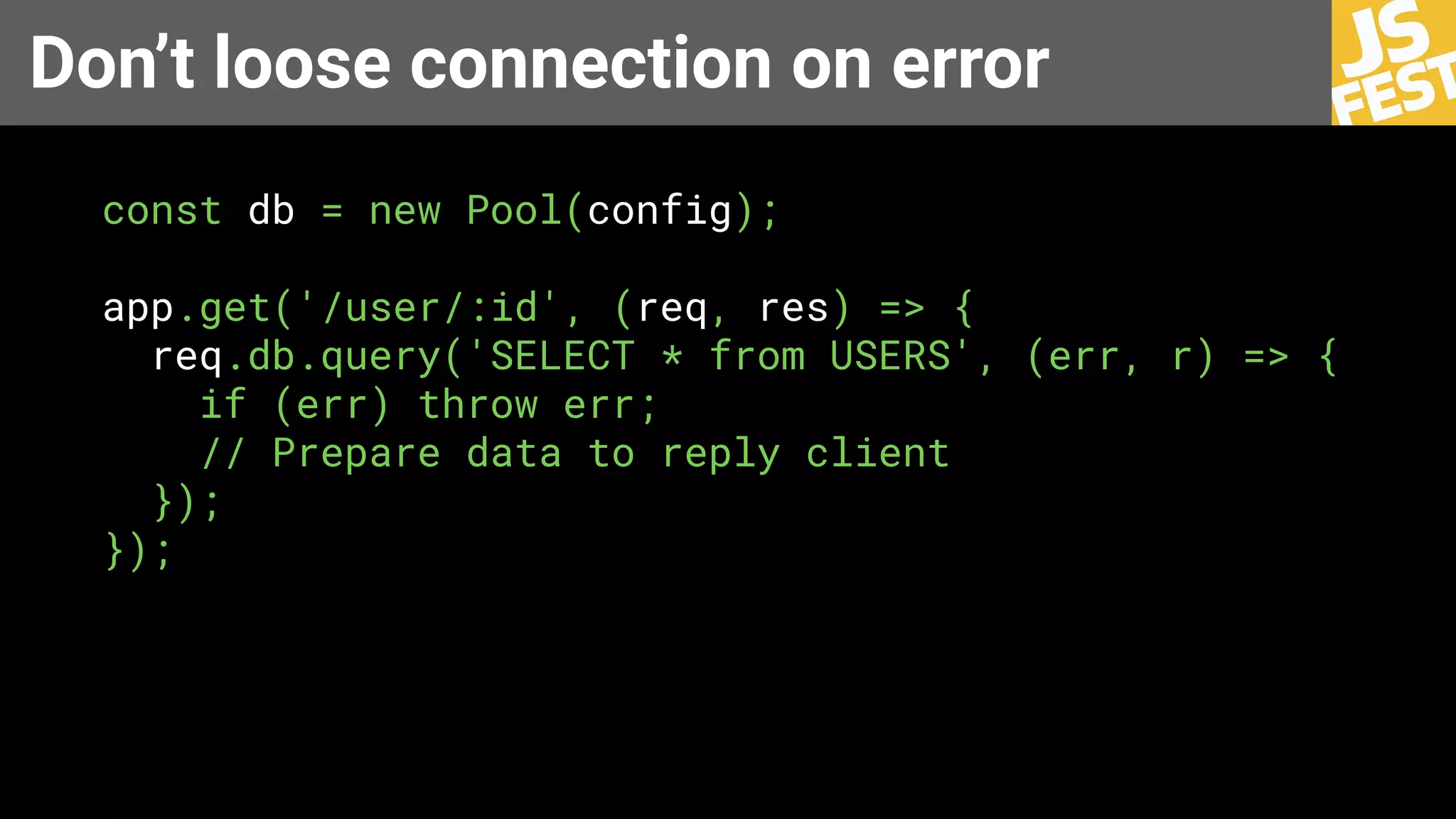
Don’t loose connection on error
const db = new Pool(config);
app.get('/user/:id', (req, res) => {
req.db.query('SELECT * from USERS', (err, r) => {
if (err) throw err;
// Prepare data to reply client
});
});
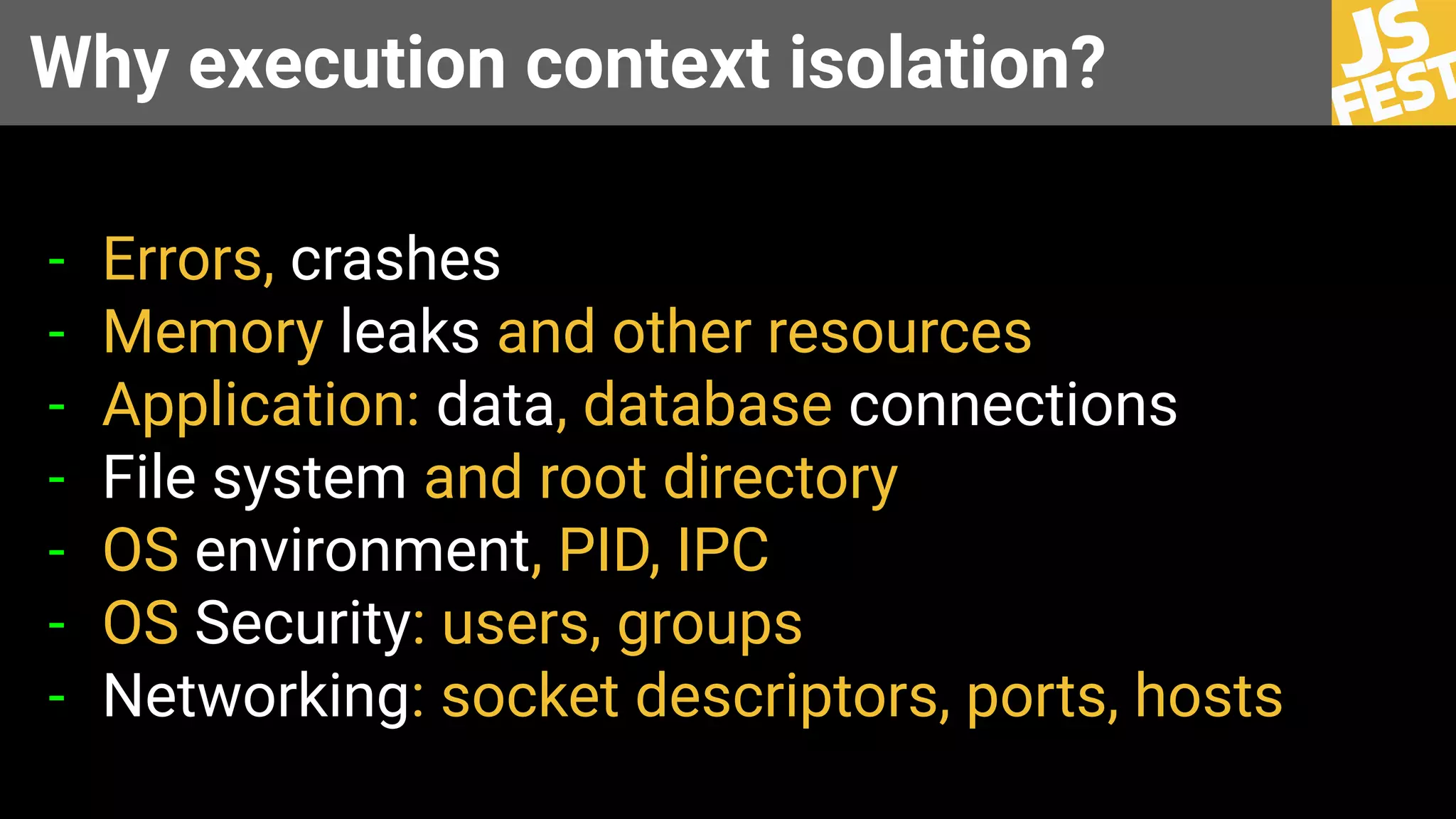
Why execution context isolation?
- Errors, crashes
- Memory leaks and other resources
- Application: data, database connections
- File system and root directory
- OS environment, PID, IPC
- OS Security: users, groups
- Networking: socket descriptors, ports, hosts
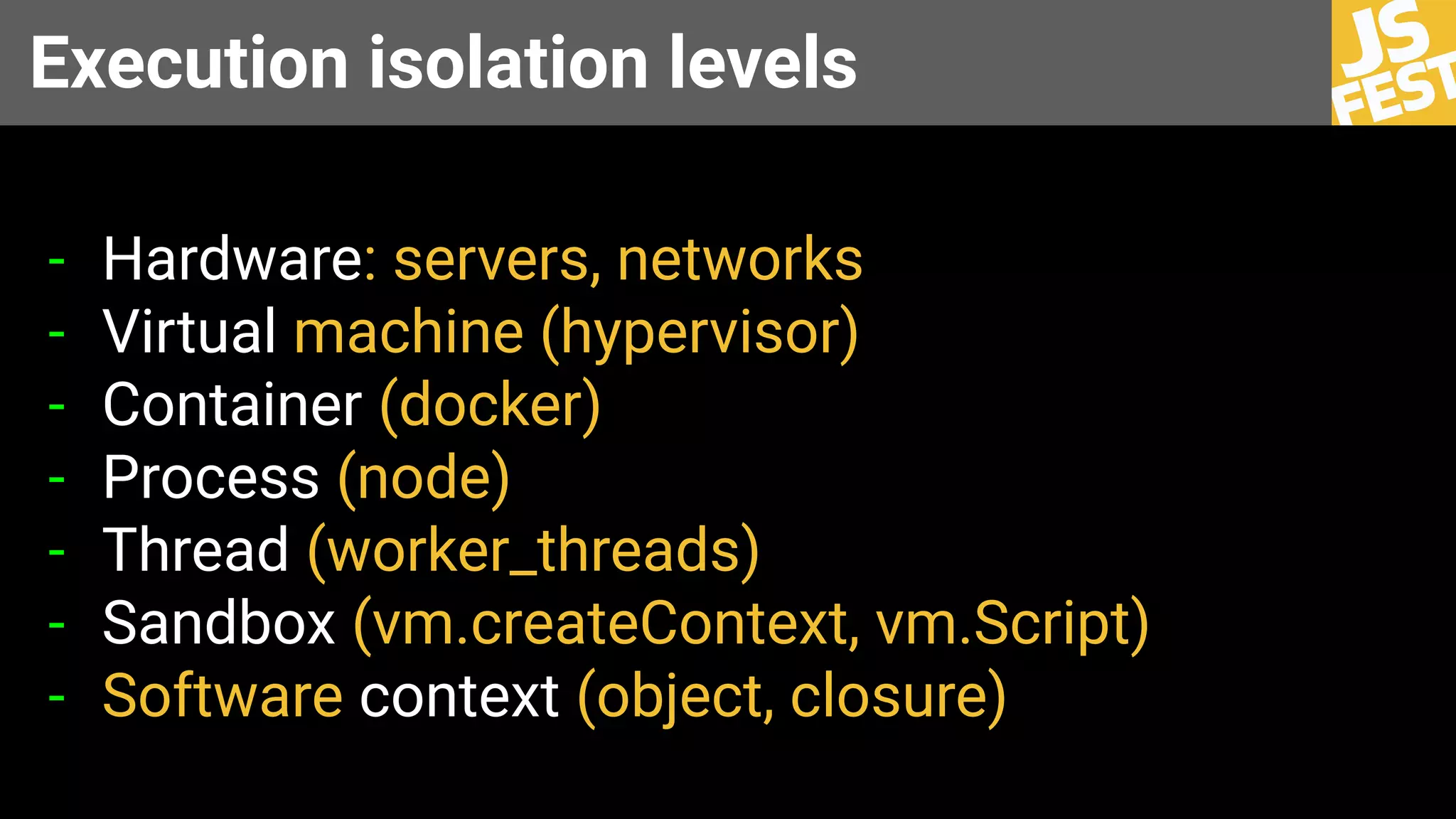
Execution isolation levels
- Hardware: servers, networks
- Virtual machine (hypervisor)
- Container (docker)
- Process (node)
- Thread (worker_threads)
- Sandbox (vm.createContext, vm.Script)
- Software context (object, closure)
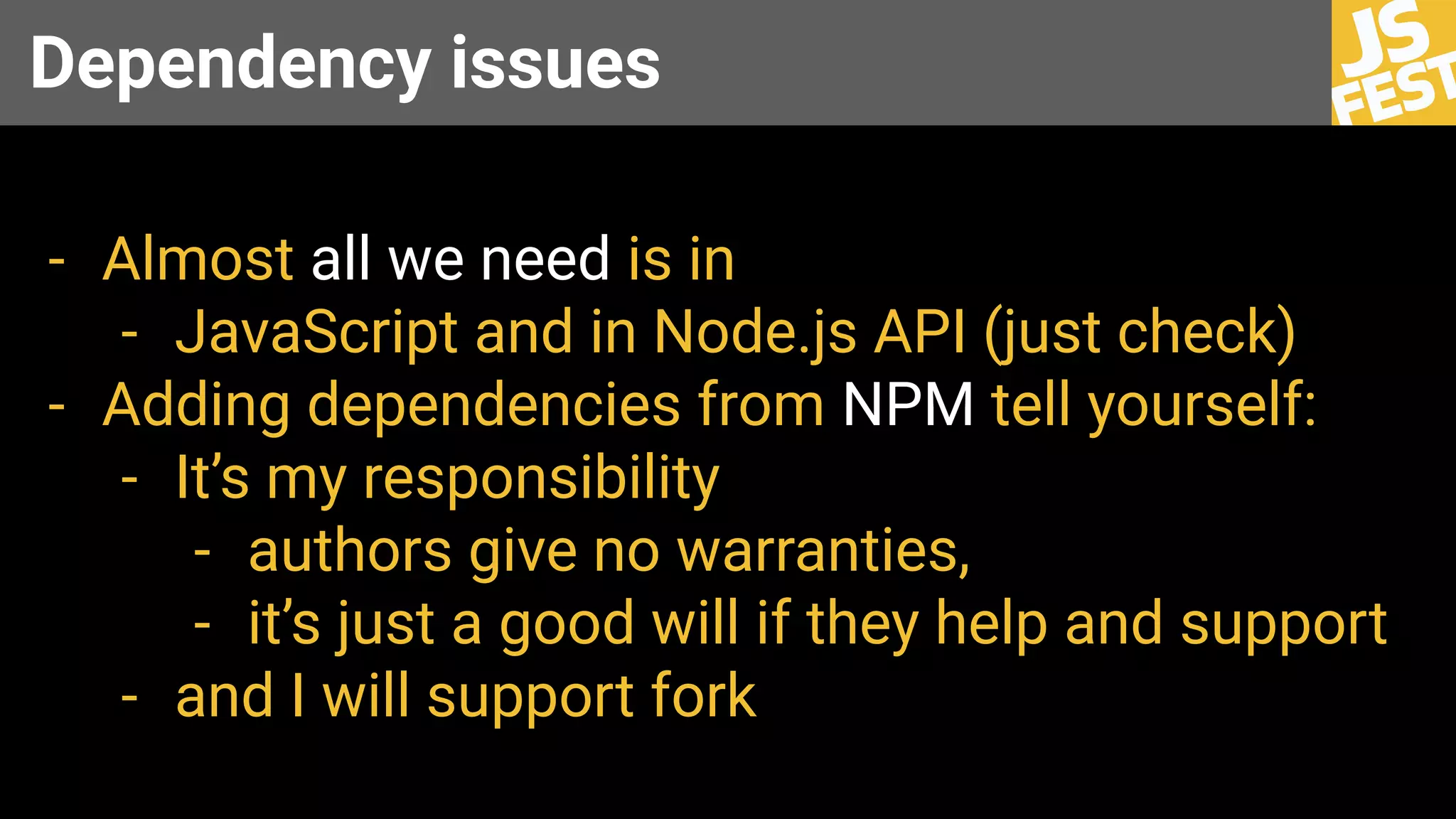
Dependency issues
- Almost all we need is in
- JavaScript and in Node.js API (just check)
- Adding dependencies from NPM tell yourself:
- It’s my responsibility
- authors give no warranties,
- it’s just a good will if they help and support
- and I will support fork
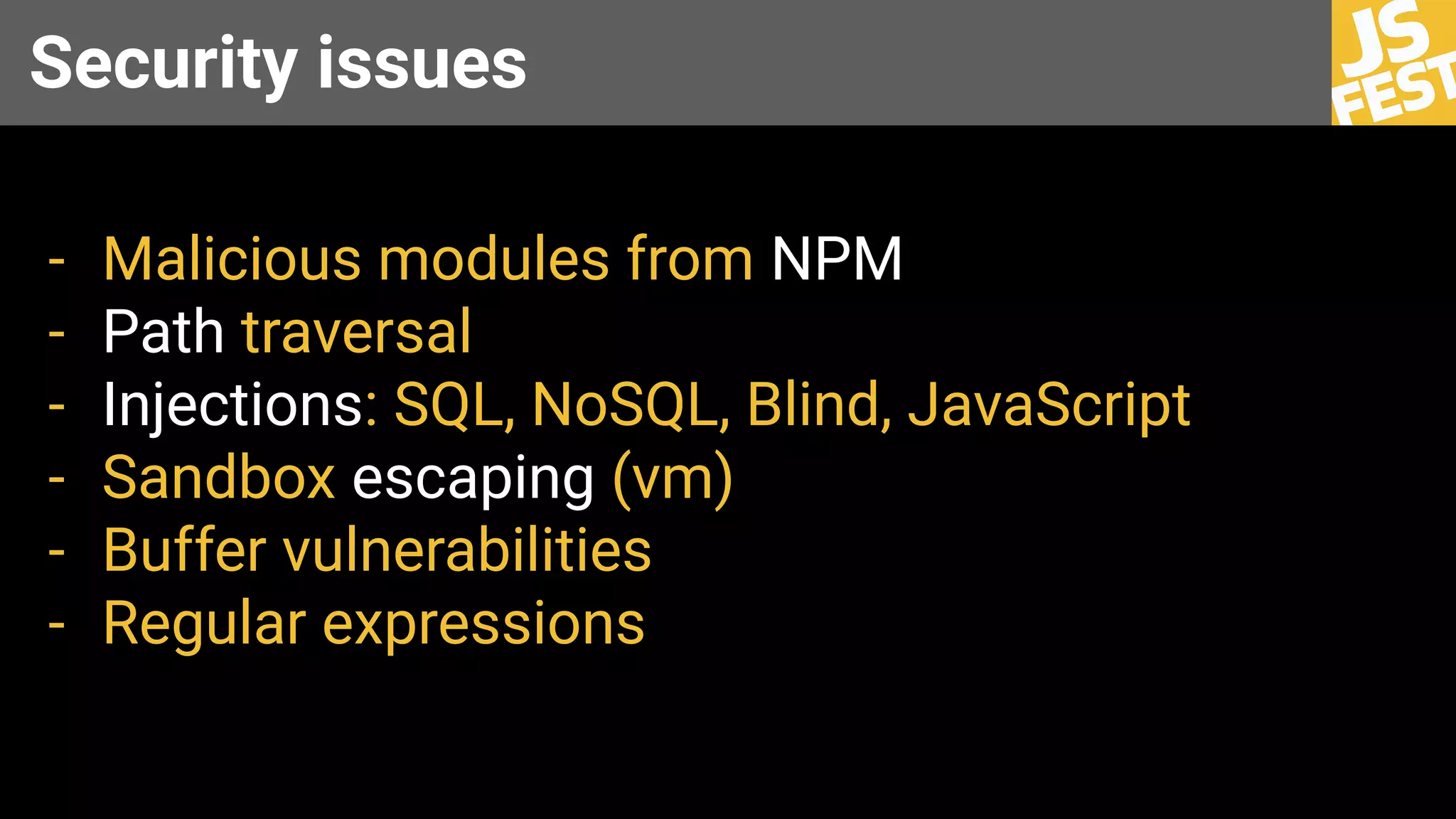
Security issues
- Malicious modules from NPM
- Path traversal
- Injections: SQL, NoSQL, Blind, JavaScript
- Sandbox escaping (vm)
- Buffer vulnerabilities
- Regular expressions
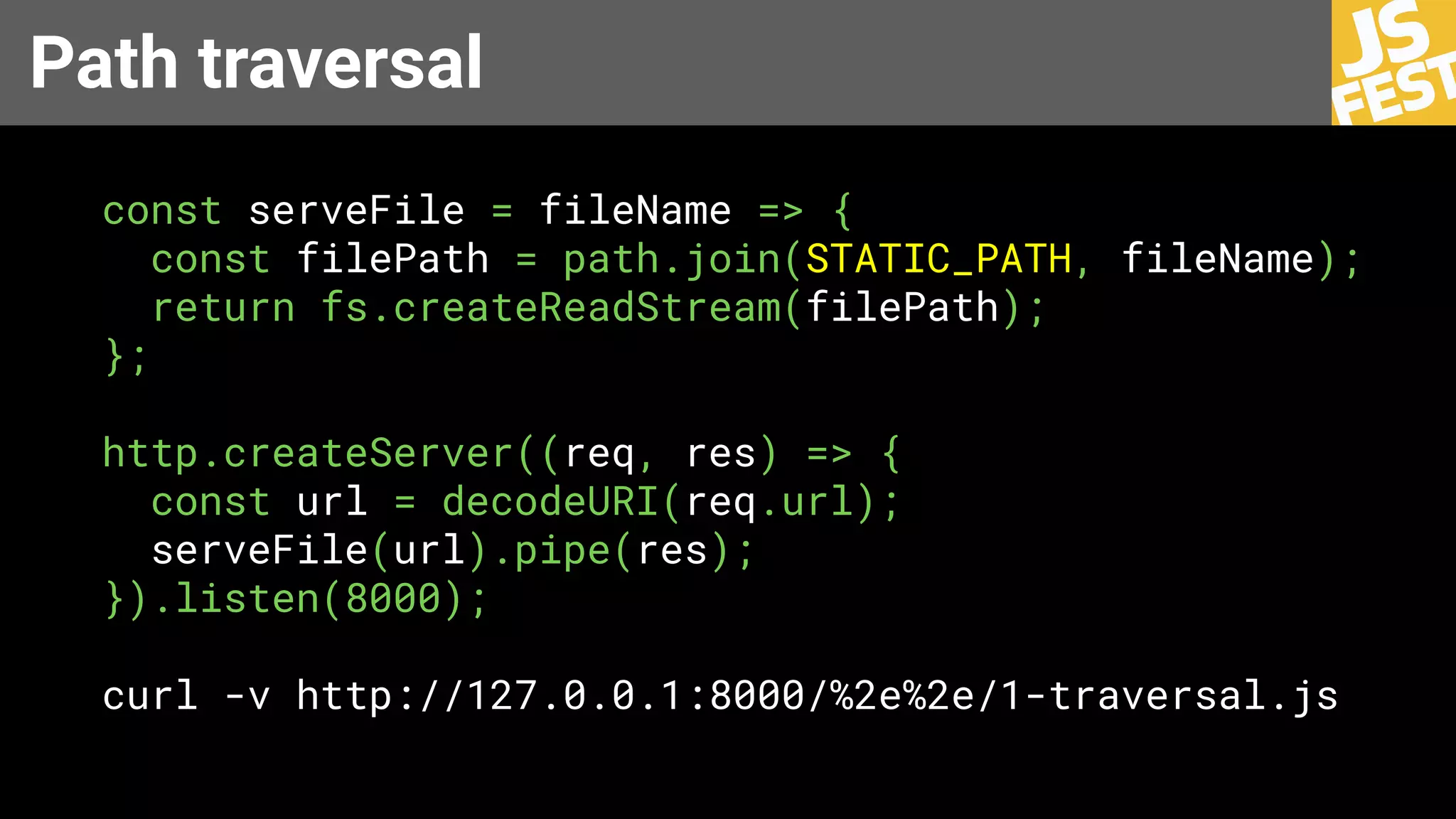
Path traversal
const serveFile = fileName => {
const filePath = path.join(STATIC_PATH, fileName);
return fs.createReadStream(filePath);
};
http.createServer((req, res) => {
const url = decodeURI(req.url);
serveFile(url).pipe(res);
}).listen(8000);
curl -v http://127.0.0.1:8000/%2e%2e/1-traversal.js
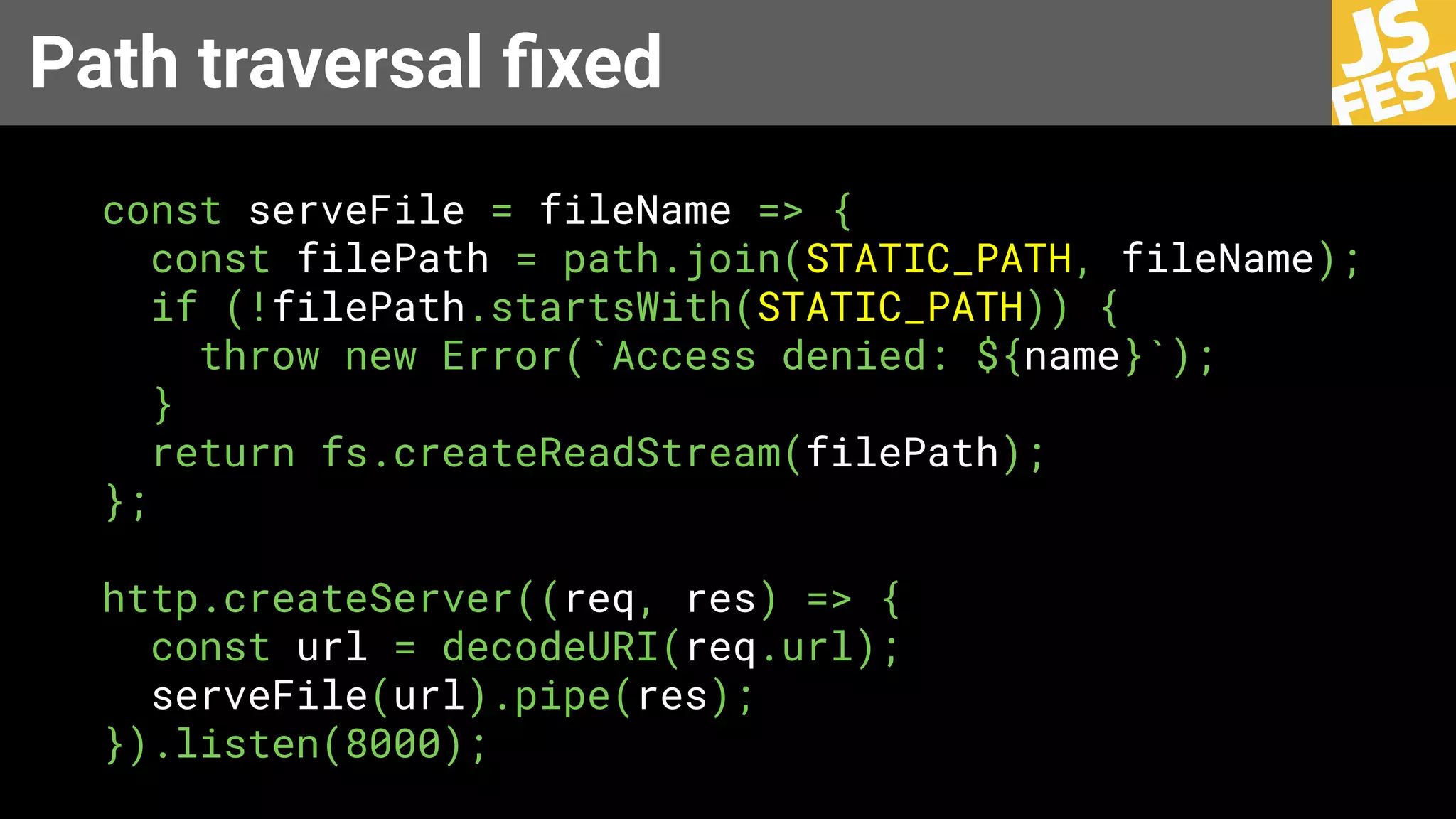
Path traversal fixed
const serveFile = fileName => {
const filePath = path.join(STATIC_PATH, fileName);
if (!filePath.startsWith(STATIC_PATH)) {
throw new Error(`Access denied: ${name}`);
}
return fs.createReadStream(filePath);
};
http.createServer((req, res) => {
const url = decodeURI(req.url);
serveFile(url).pipe(res);
}).listen(8000);
Asynchronity issues
- Callback hell and promise hell
- Ignoring errors in callbacks
- Ignoring errors in promises
- Throwing errors and releasing resources
- Race conditions and deadlocks
- Queuing theory: need to limit concurrency
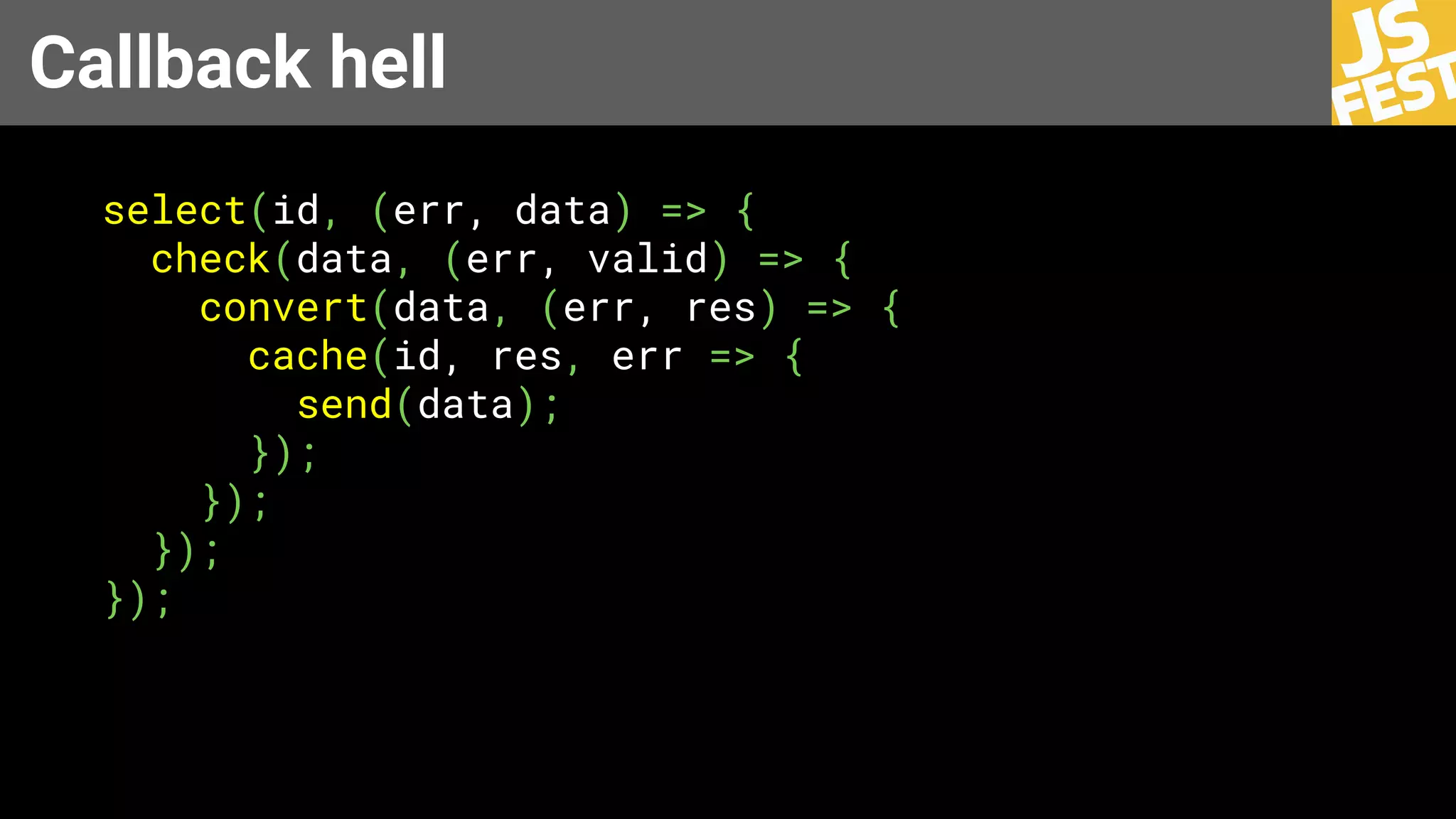
Callback hell
select(id, (err, data) => {
check(data, (err, valid) => {
convert(data, (err, res) => {
сache(id, res, err => {
send(data);
});
});
});
});
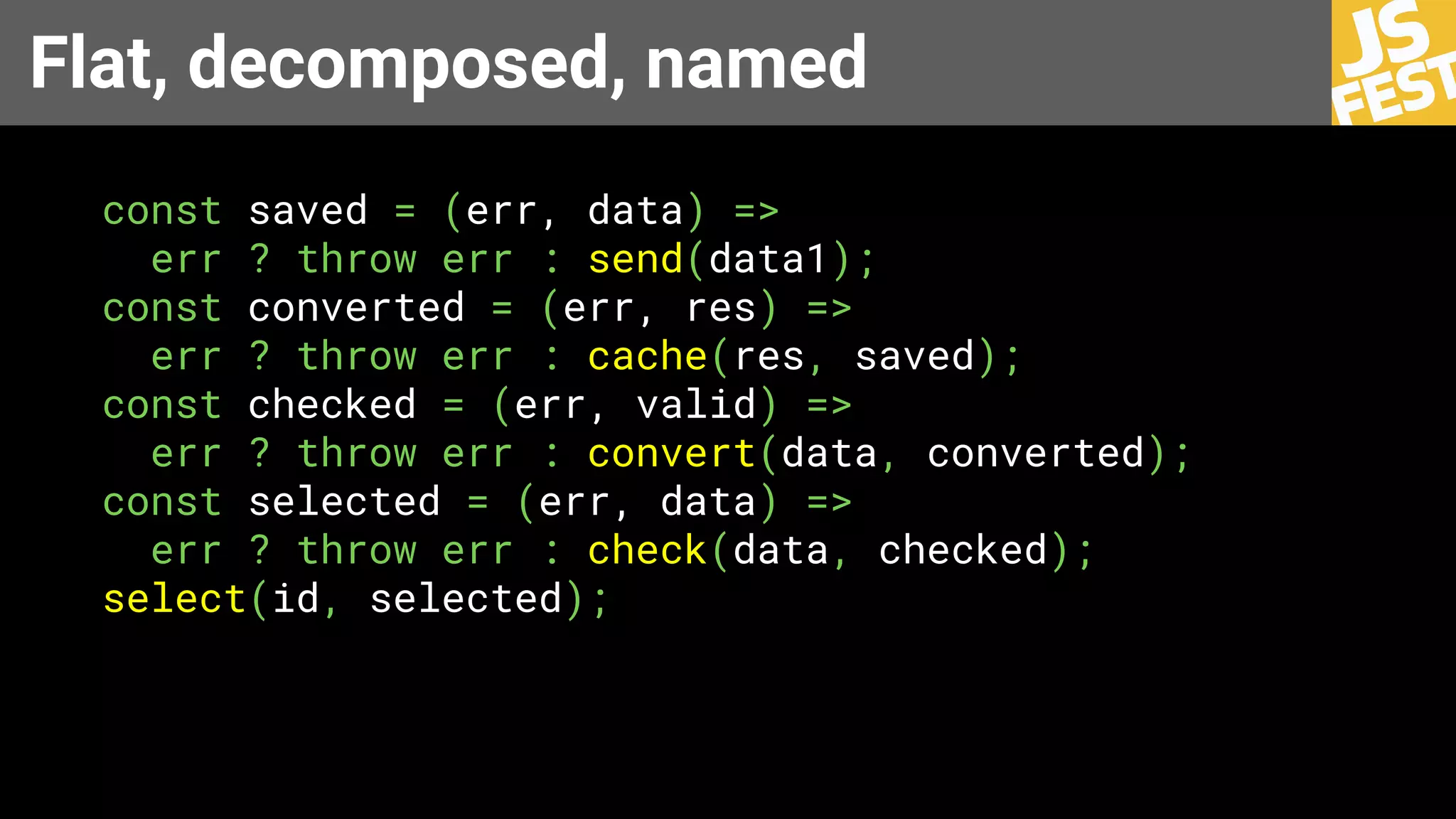
Flat, decomposed, named
const saved = (err, data) =>
err ? throw err : send(data1);
const converted = (err, res) =>
err ? throw err : сache(res, saved);
const checked = (err, valid) =>
err ? throw err : convert(data, converted);
const selected = (err, data) =>
err ? throw err : check(data, checked);
select(id, selected);
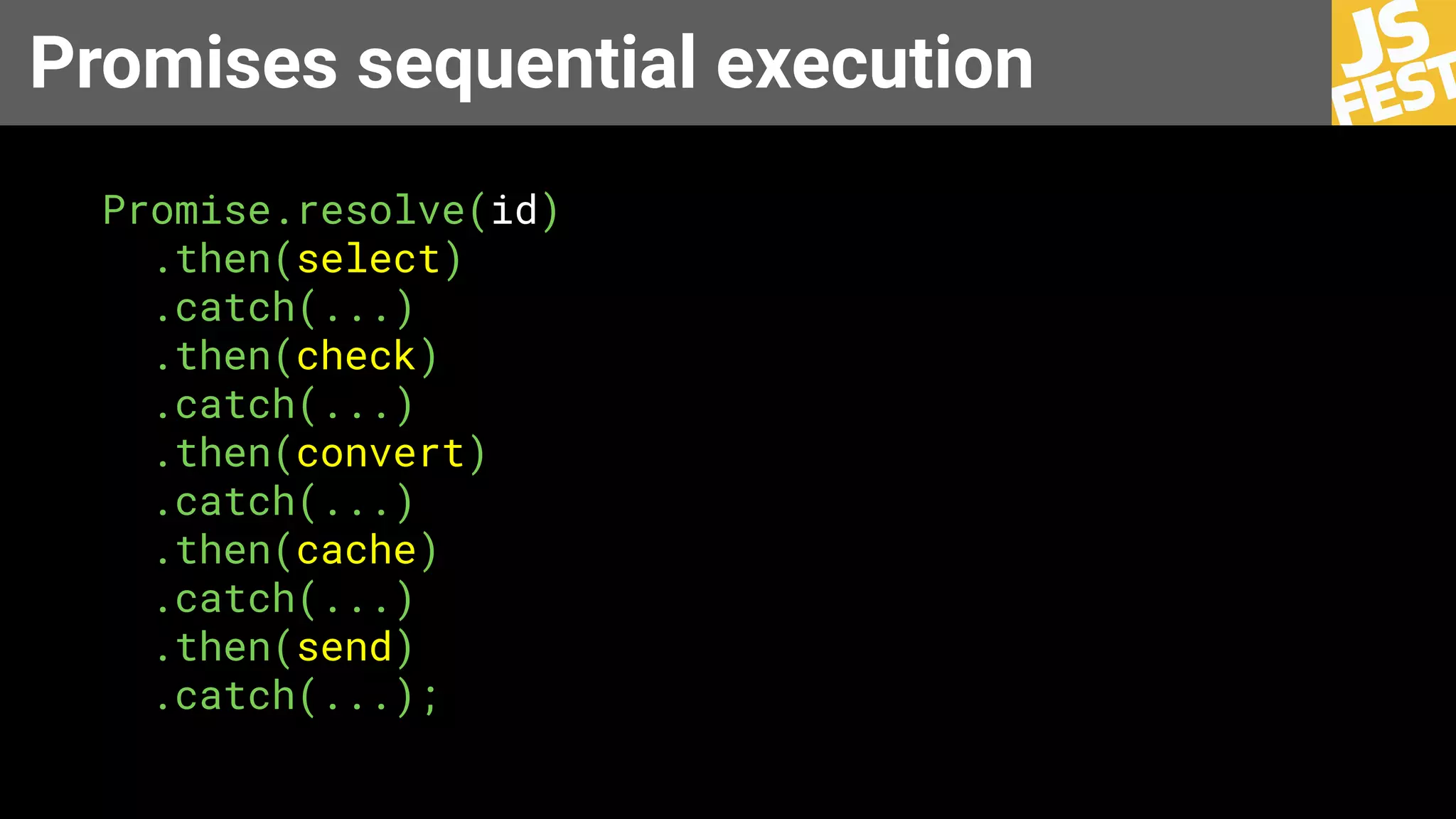
Promises sequential execution
Promise.resolve(id)
.then(select)
.catch(...)
.then(check)
.catch(...)
.then(convert)
.catch(...)
.then(cache)
.catch(...)
.then(send)
.catch(...);
Promise hell
select(id).then(data => {
check(data).then(valid => {
if (valid) {
Promise.all([
convert(data),
cache(data)
]).then(send);
}
});
});
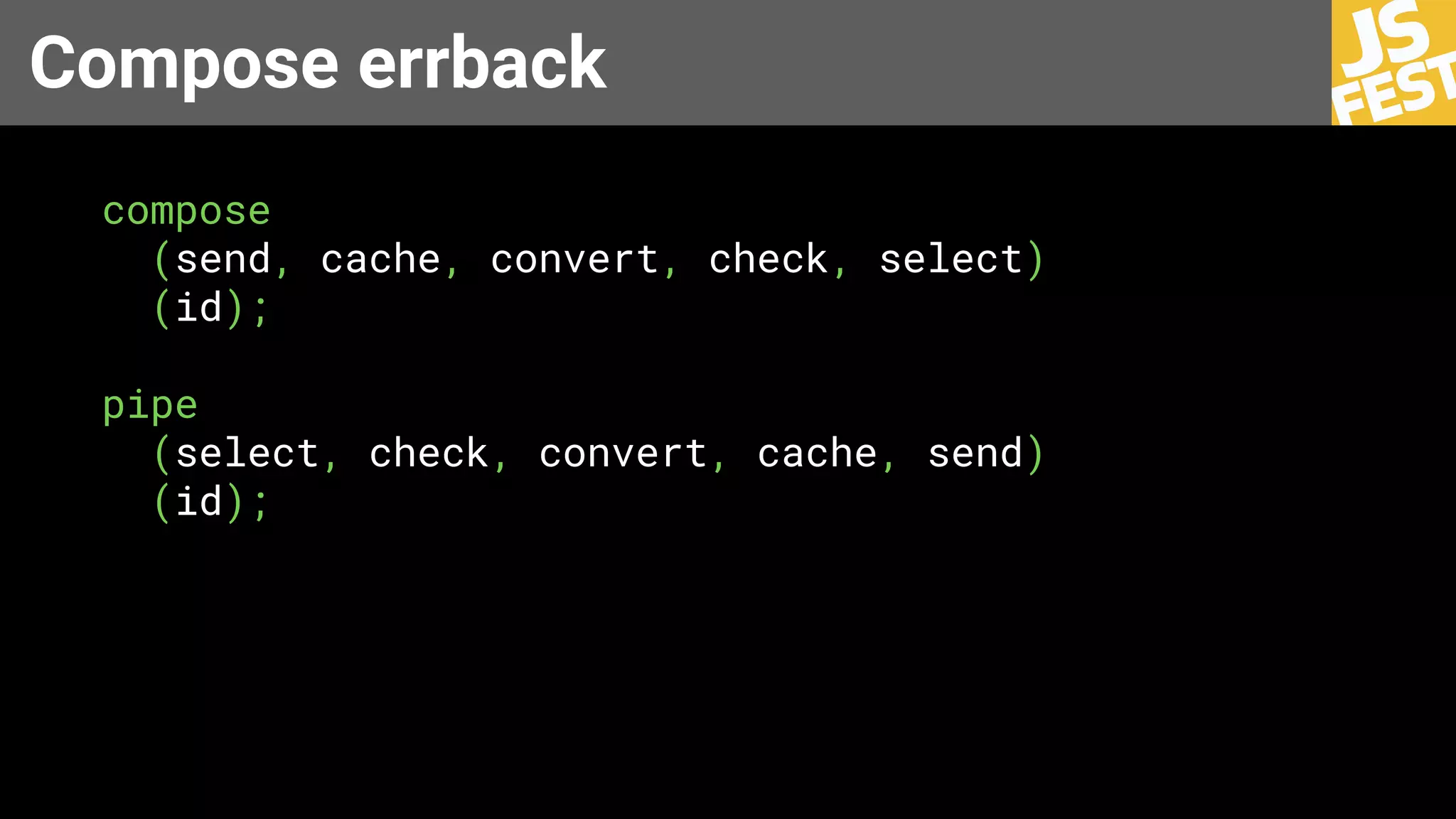
Compose errback
compose
(send, cache, convert, check, select)
(id);
pipe
(select, check, convert, cache, send)
(id);
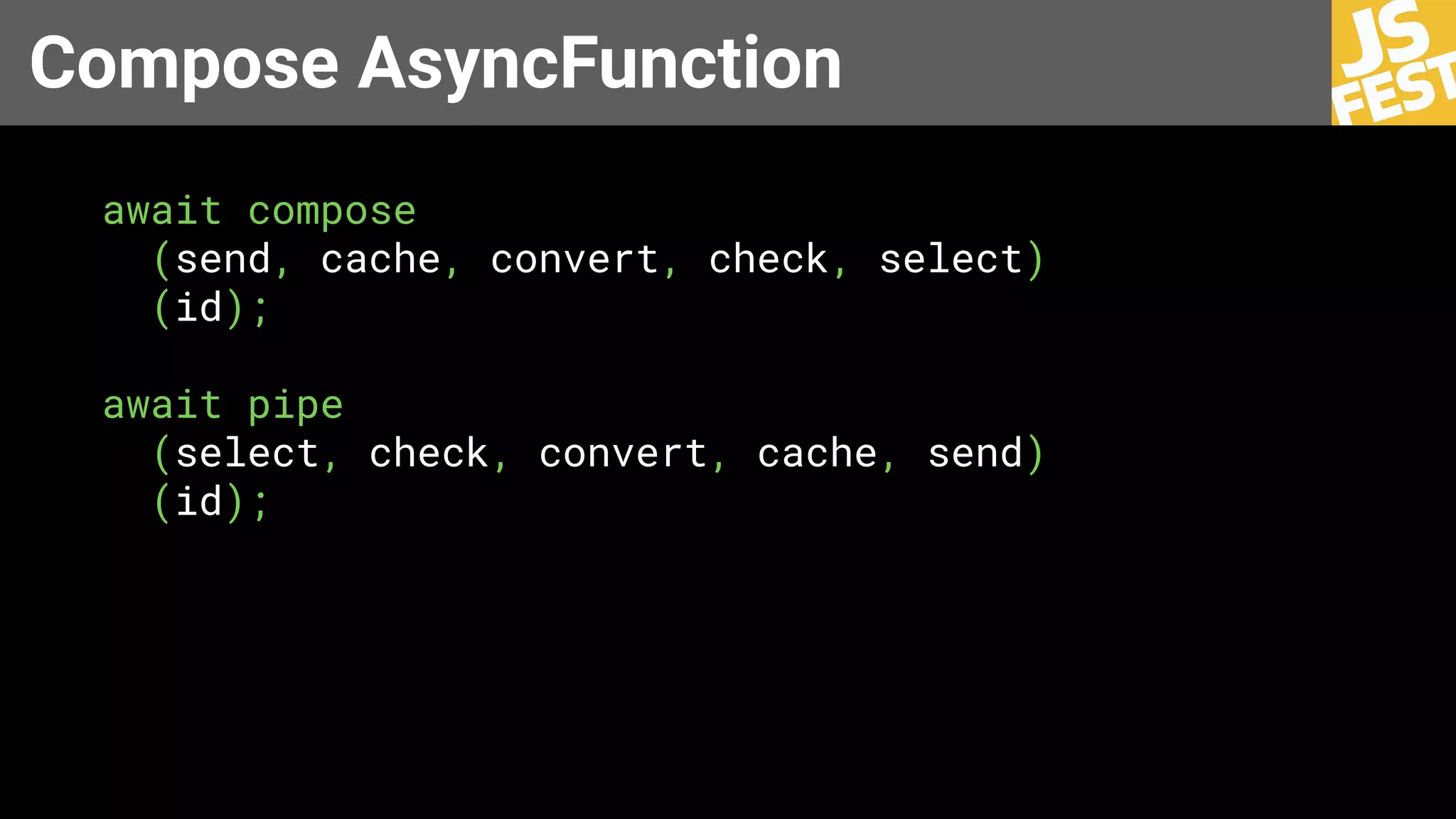
Compose AsyncFunction
await compose
(send, cache, convert, check, select)
(id);
await pipe
(select, check, convert, cache, send)
(id);
Universal composition: metasync
metasync
([select, check, [[convert, cache]], send])
(id);
// In arguments: Function | Errback | AsyncFunction
// Process: Parallel | Sequential
// Functionality: Cancelable | Timeout | Throttle
// Result: Thenable | Promise | Errback | EventEmitter
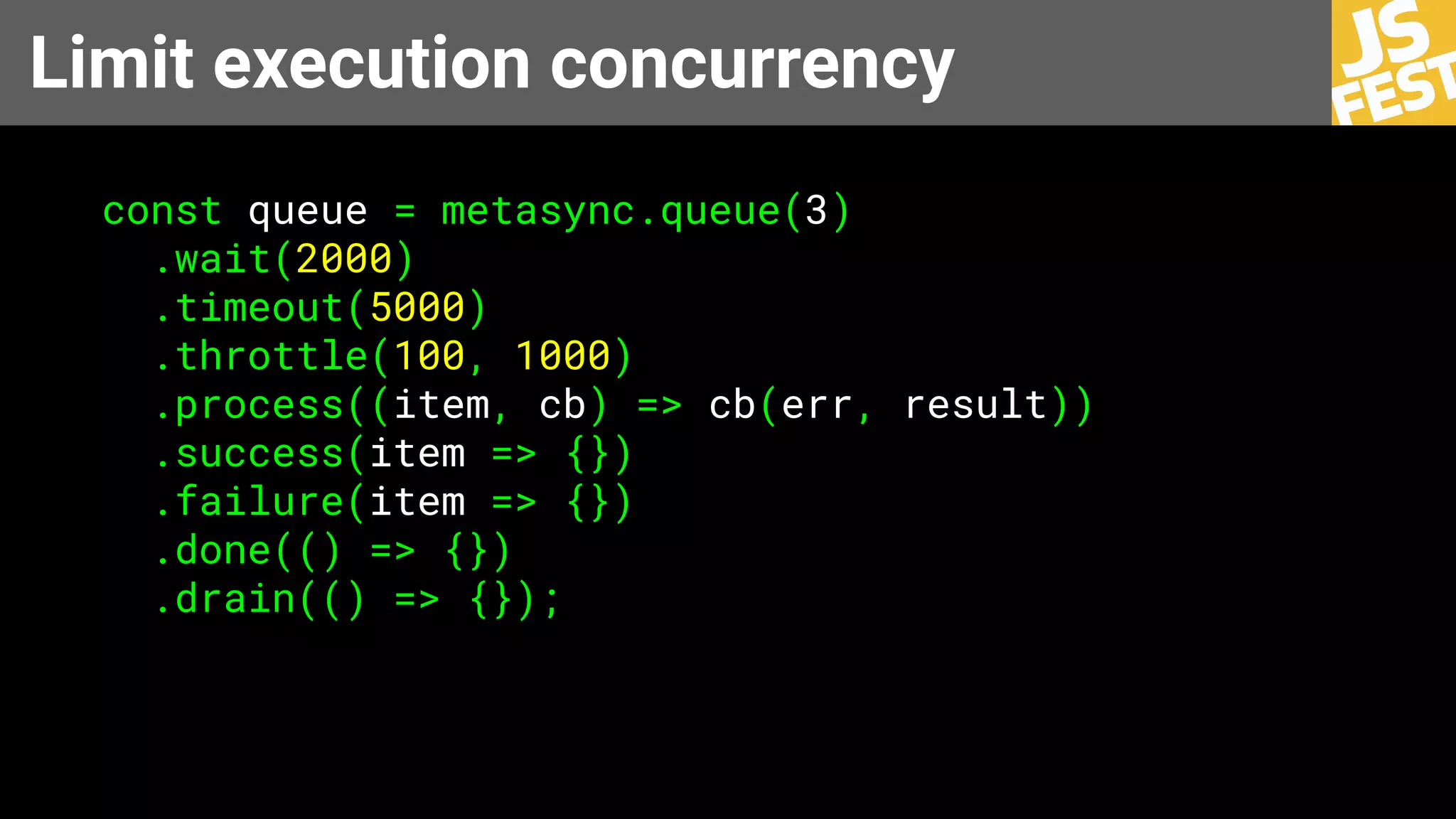
Limit execution concurrency
const queue = metasync.queue(3)
.wait(2000)
.timeout(5000)
.throttle(100, 1000)
.process((item, cb) => cb(err, result))
.success(item => {})
.failure(item => {})
.done(() => {})
.drain(() => {});
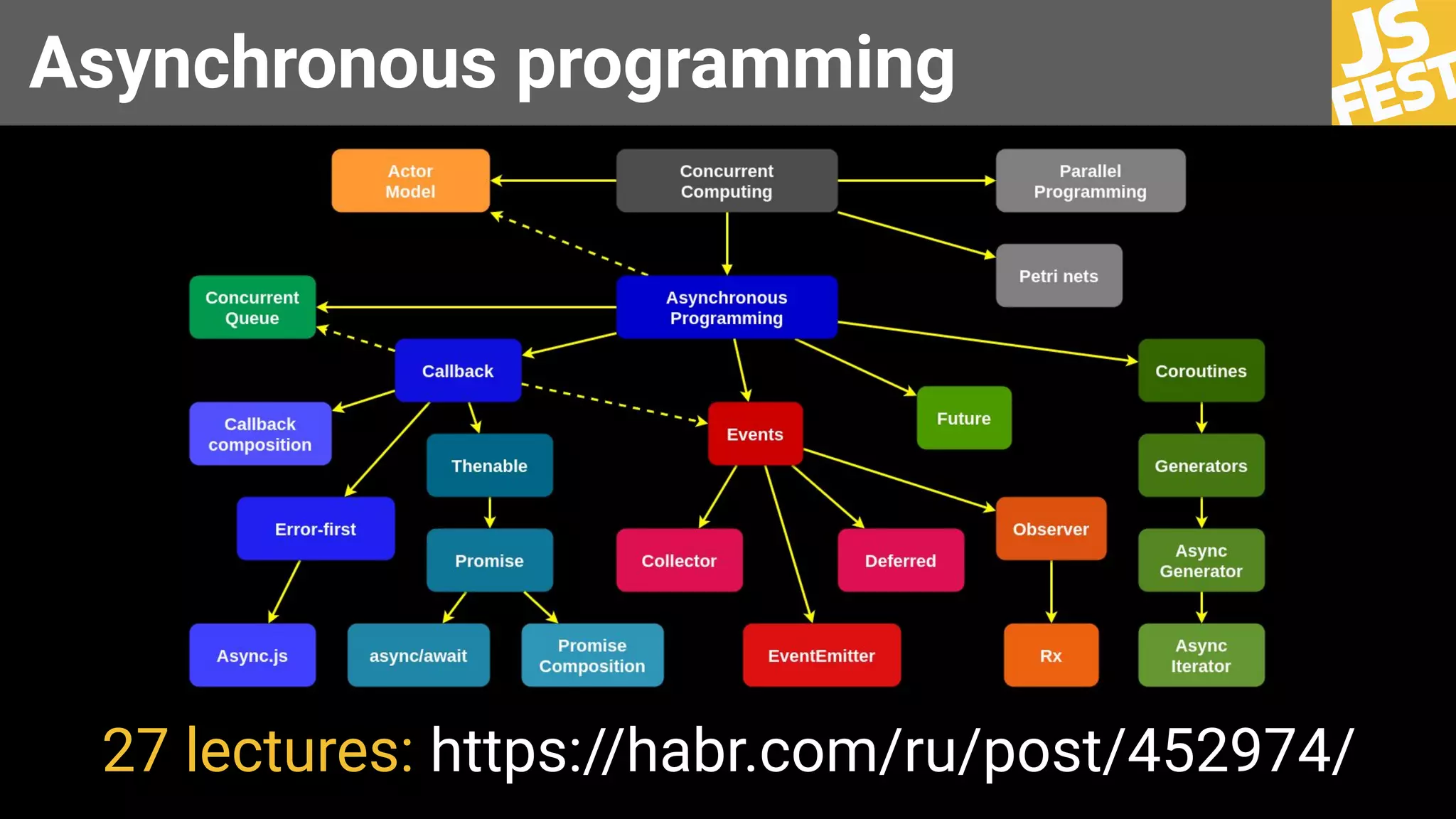
Asynchronous programming
27 lectures: https://habr.com/ru/post/452974/
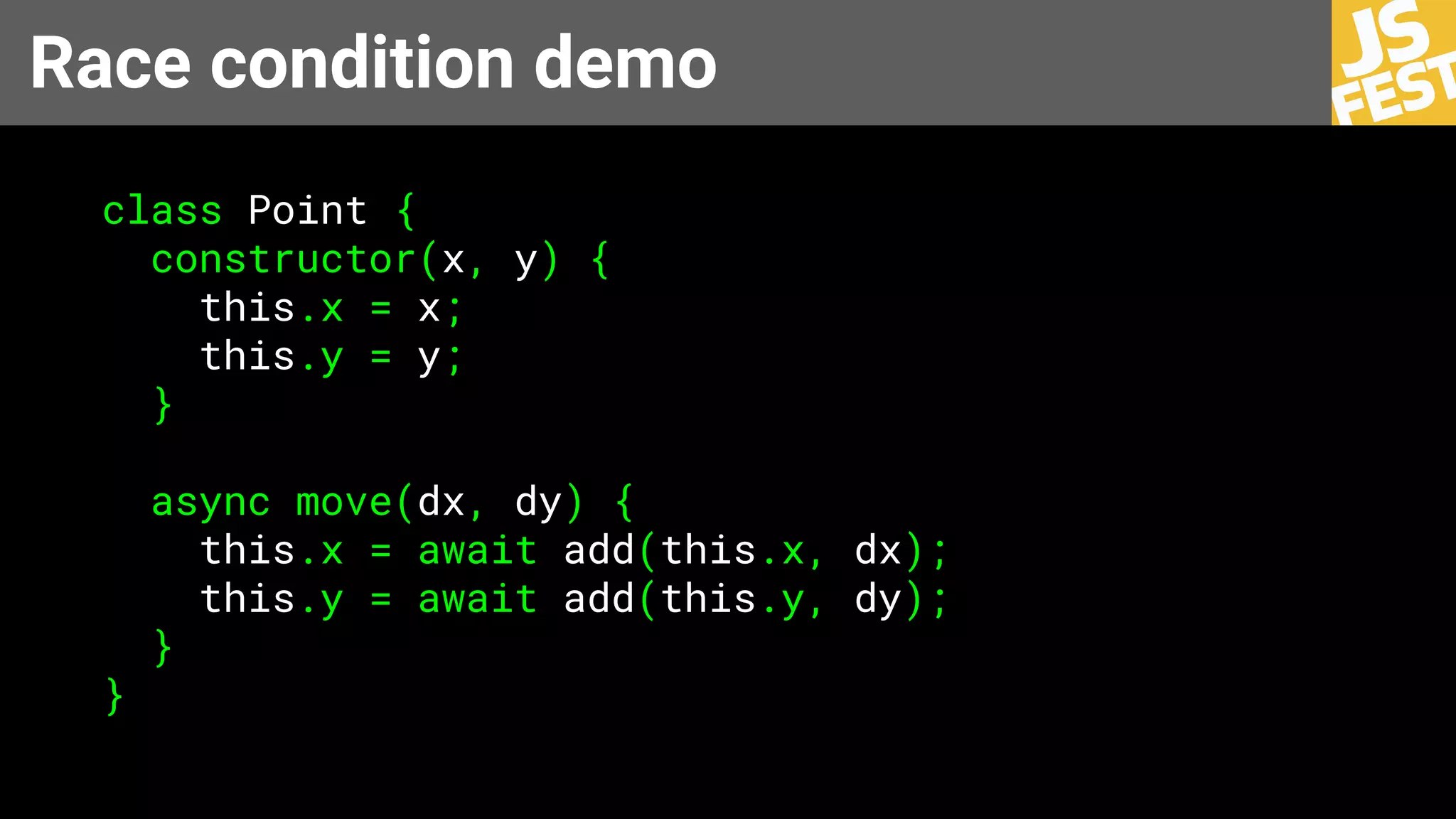
Race condition demo
class Point {
constructor(x, y) {
this.x = x;
this.y = y;
}
async move(dx, dy) {
this.x = await add(this.x, dx);
this.y = await add(this.y, dy);
}
}
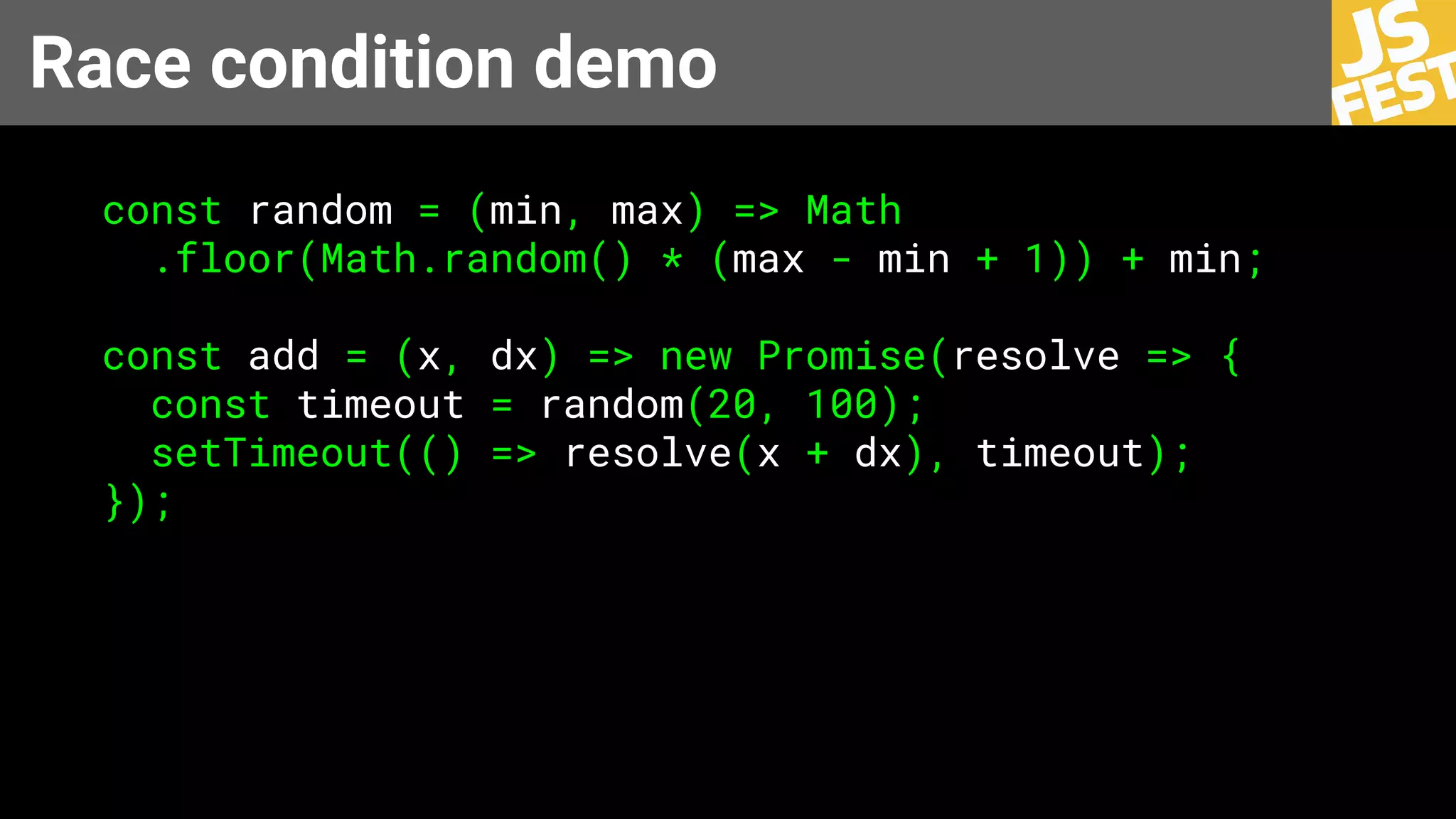
Race condition demo
const random = (min, max) => Math
.floor(Math.random() * (max - min + 1)) + min;
const add = (x, dx) => new Promise(resolve => {
const timeout = random(20, 100);
setTimeout(() => resolve(x + dx), timeout);
});
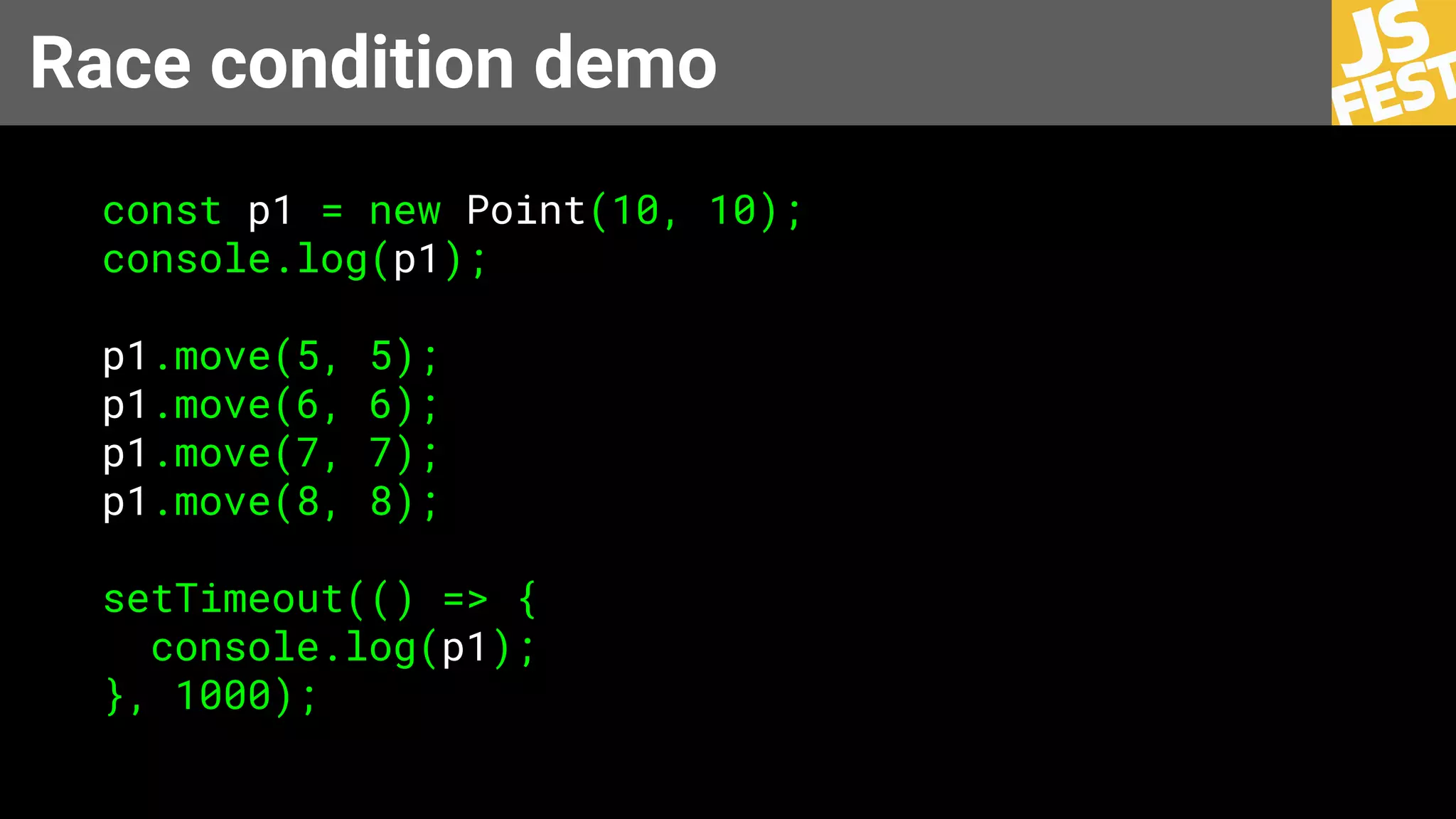
Race condition demo
const p1 = new Point(10, 10);
console.log(p1);
p1.move(5, 5);
p1.move(6, 6);
p1.move(7, 7);
p1.move(8, 8);
setTimeout(() => {
console.log(p1);
}, 1000);
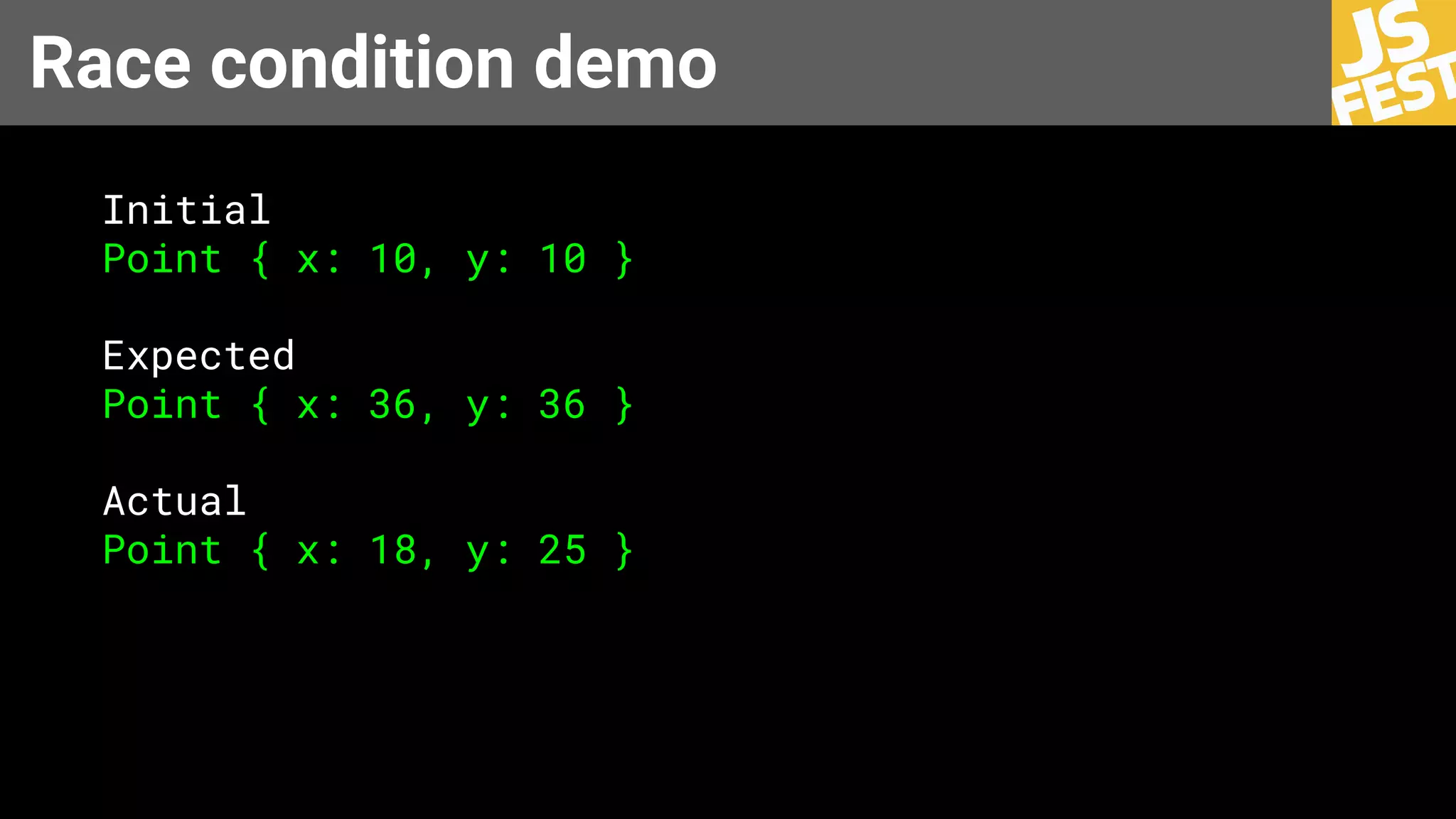
Race condition demo
Initial
Point { x: 10, y: 10 }
Expected
Point { x: 36, y: 36 }
Actual
Point { x: 18, y: 25 }
Do we need parallel primitives?
- Semaphore: Binary and Counting semaphore
- Condition variable
- Spinlock
- Mutex, Timed mutex, Shared mutex
- Recursive mutex
- Monitor
- Barrier
Do we need parallel primitives?
https://github.com
/HowProgrammingWorks
/Semaphore
/Mutex
/RaceCondition
/Deadlock
https://youtu.be/JNLrITevhRI
Simple Resource Locking
class Lock {
constructor() {
this.active = false;
this.queue = [];
}
leave() {
if (!this.active) return;
this.active = false;
const next = this
.queue.pop();
if (next) next();
}
}
enter() {
return new Promise(resolve => {
const start = () => {
this.active = true;
resolve();
};
if (!this.active) {
start();
return;
}
this.queue.push(start);
});
}
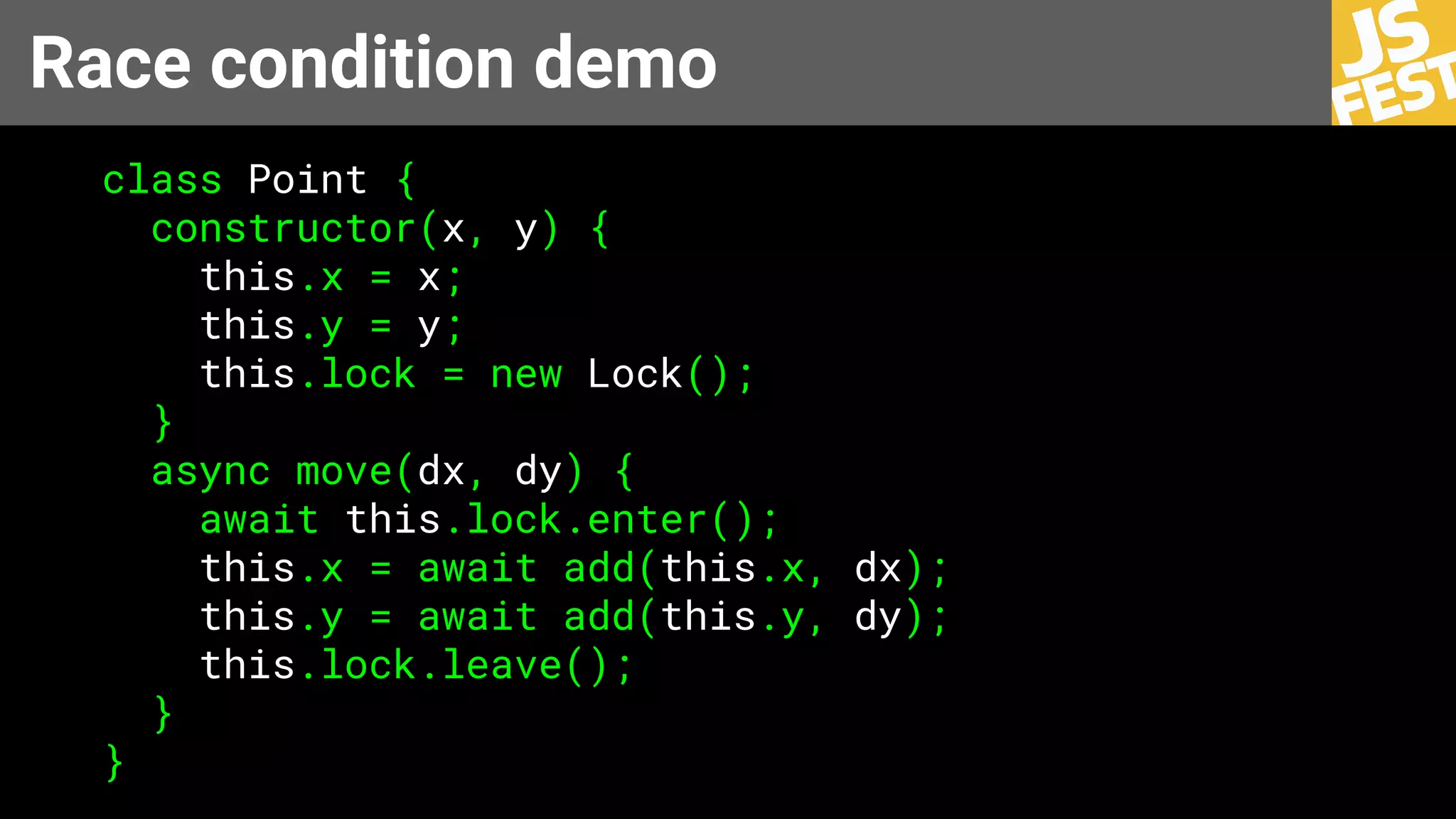
Race condition demo
class Point {
constructor(x, y) {
this.x = x;
this.y = y;
this.lock = new Lock();
}
async move(dx, dy) {
await this.lock.enter();
this.x = await add(this.x, dx);
this.y = await add(this.y, dy);
this.lock.leave();
}
}
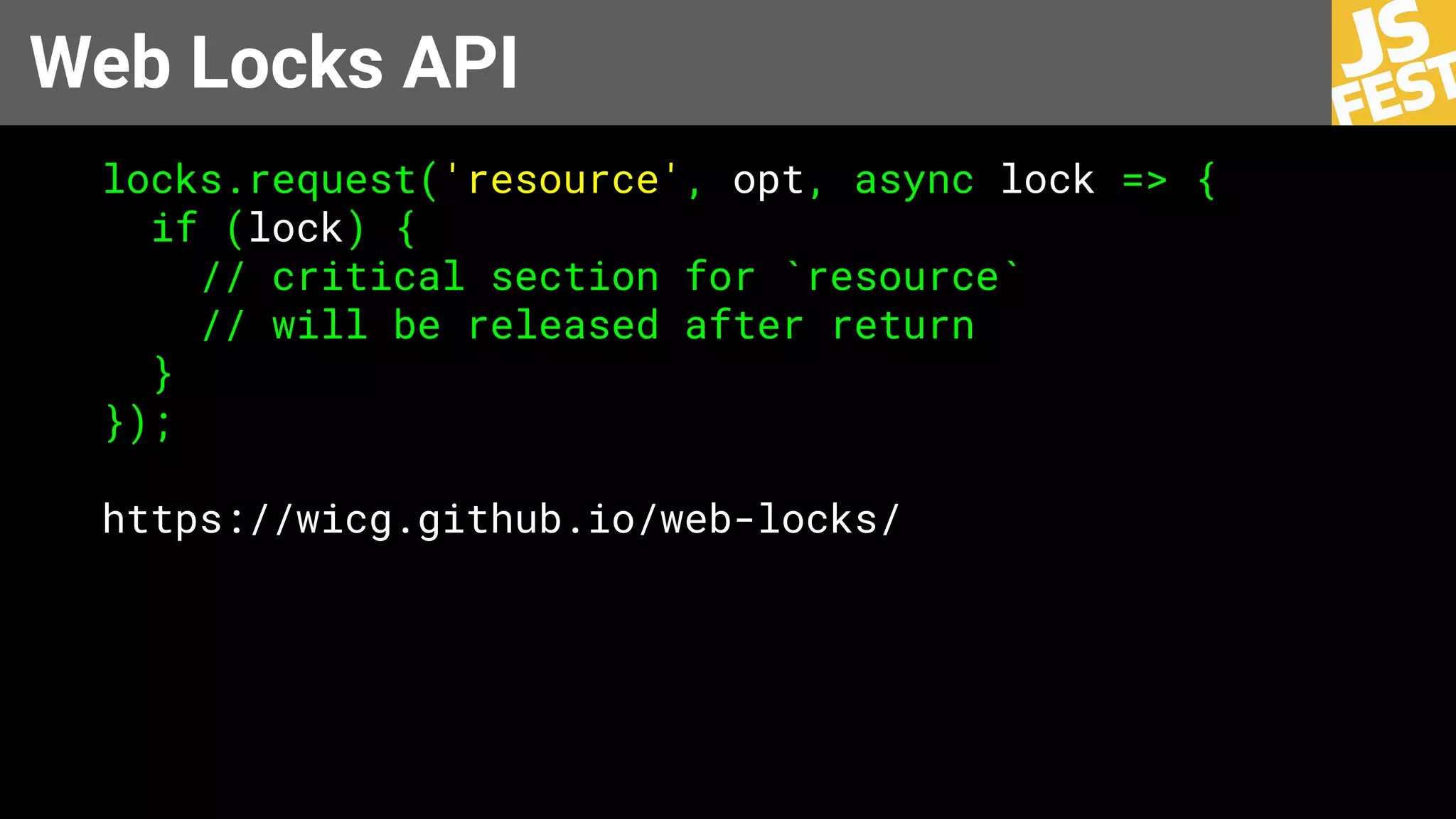
Web Locks API
locks.request('resource', opt, async lock => {
if (lock) {
// critical section for `resource`
// will be released after return
}
});
https://wicg.github.io/web-locks/
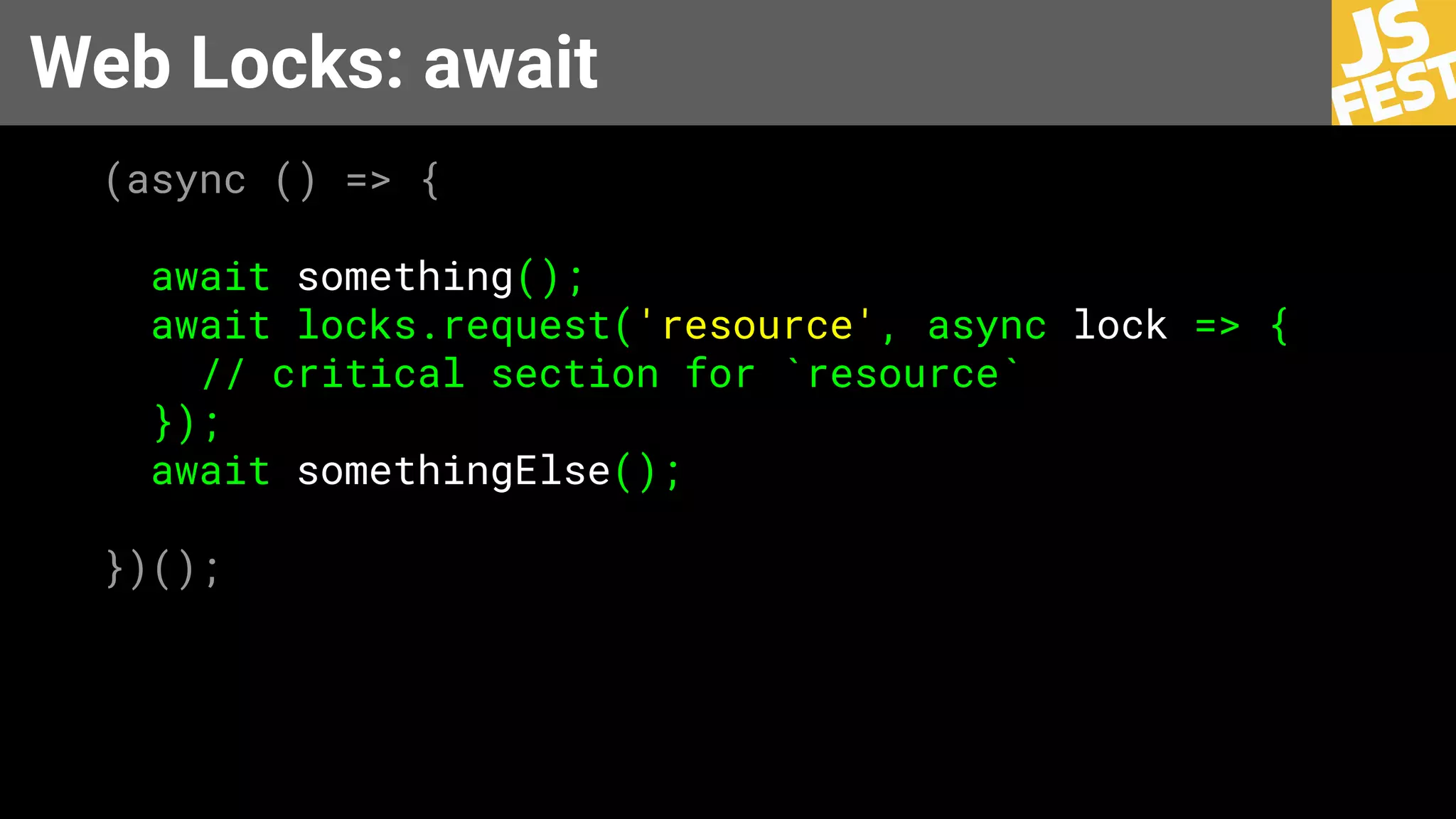
Web Locks: await
(async () => {
await something();
await locks.request('resource', async lock => {
// critical section for `resource`
});
await somethingElse();
})();
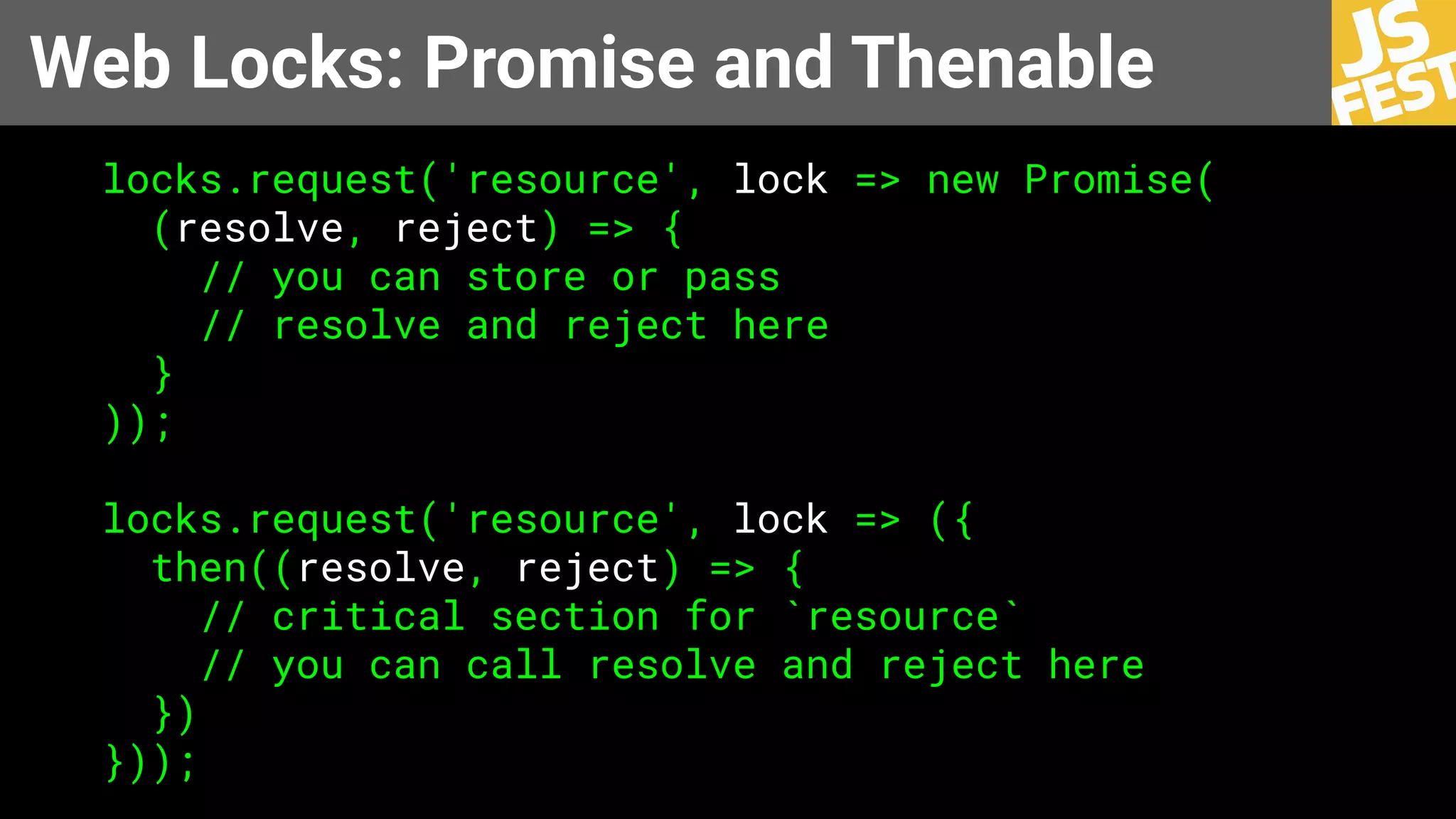
Web Locks: Promise and Thenable
locks.request('resource', lock => new Promise(
(resolve, reject) => {
// you can store or pass
// resolve and reject here
}
));
locks.request('resource', lock => ({
then((resolve, reject) => {
// critical section for `resource`
// you can call resolve and reject here
})
}));
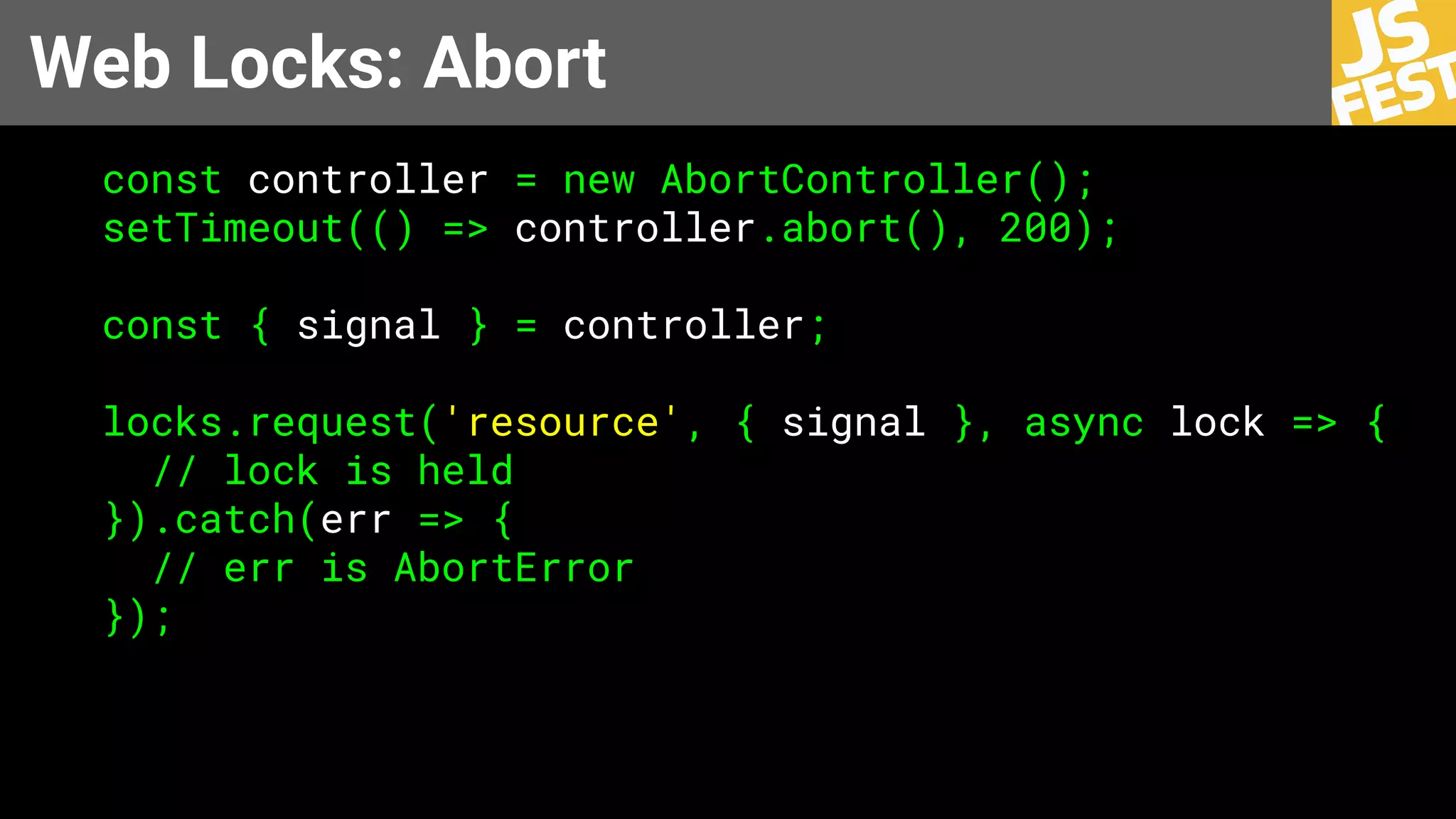
Web Locks: Abort
const controller = new AbortController();
setTimeout(() => controller.abort(), 200);
const { signal } = controller;
locks.request('resource', { signal }, async lock => {
// lock is held
}).catch(err => {
// err is AbortError
});
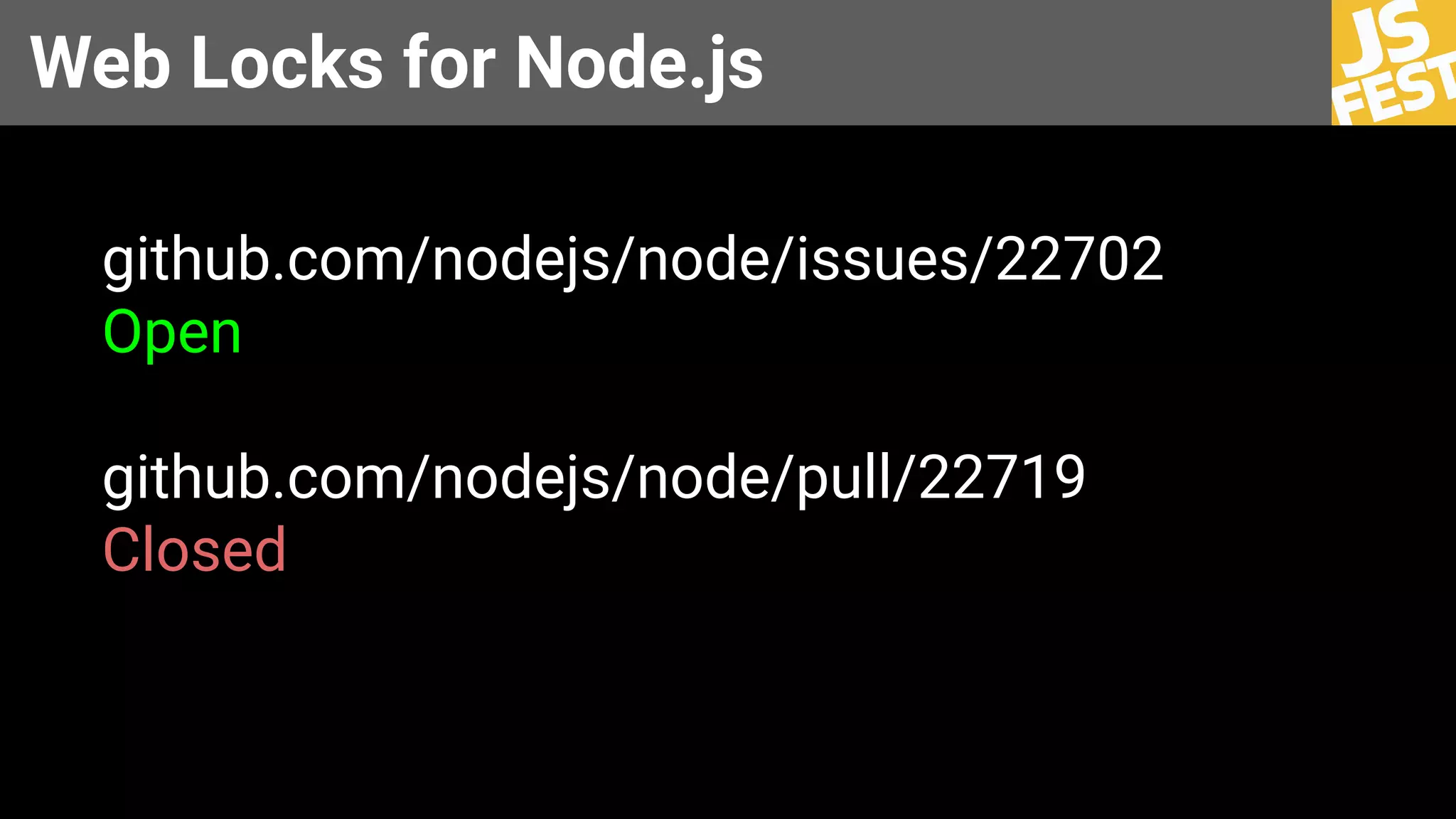
Web Locks for Node.js
github.com/nodejs/node/issues/22702
Open
github.com/nodejs/node/pull/22719
Closed
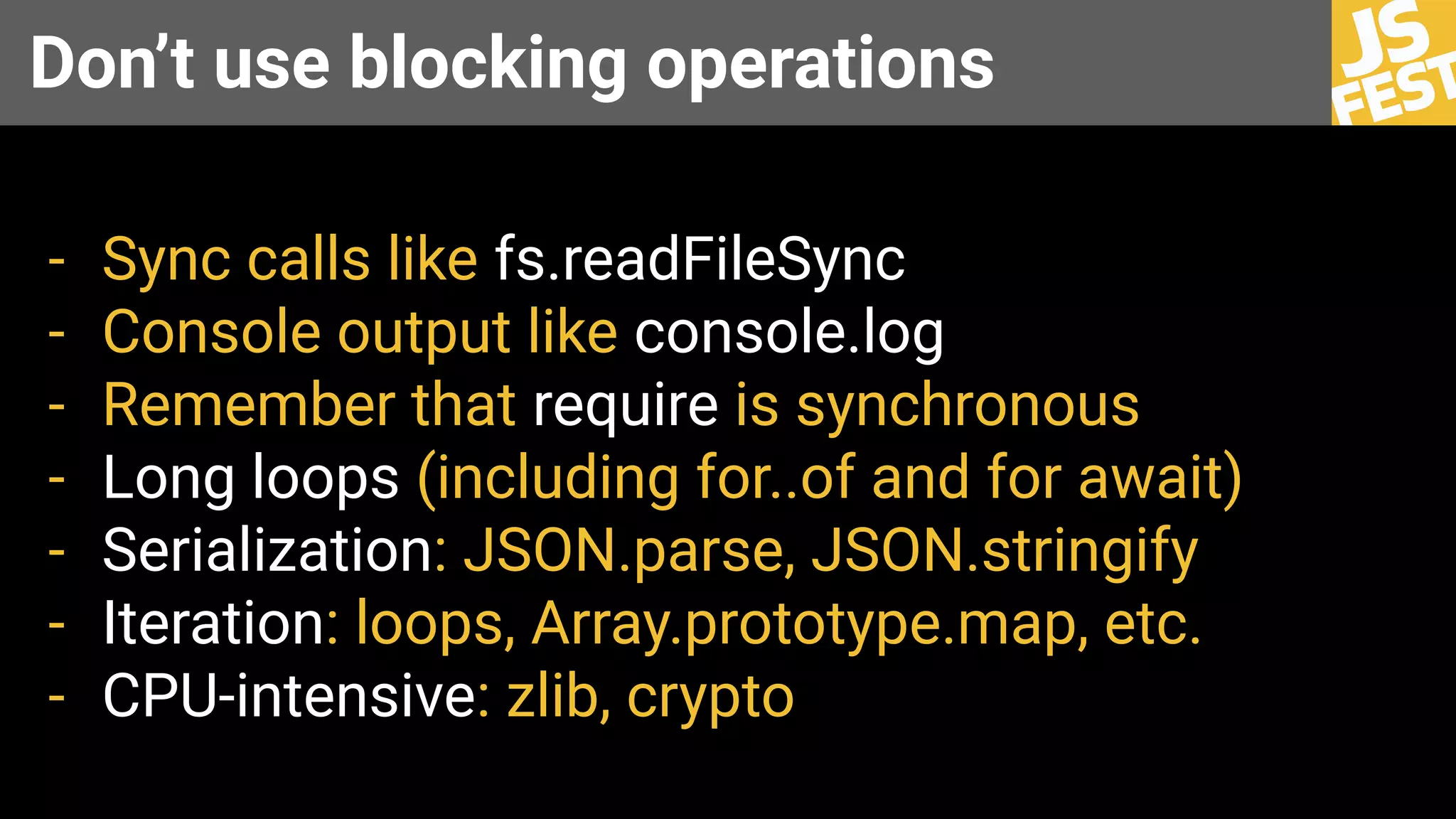
Don’t use blocking operations
- Sync calls like fs.readFileSync
- Console output like console.log
- Remember that require is synchronous
- Long loops (including for..of and for await)
- Serialization: JSON.parse, JSON.stringify
- Iteration: loops, Array.prototype.map, etc.
- CPU-intensive: zlib, crypto
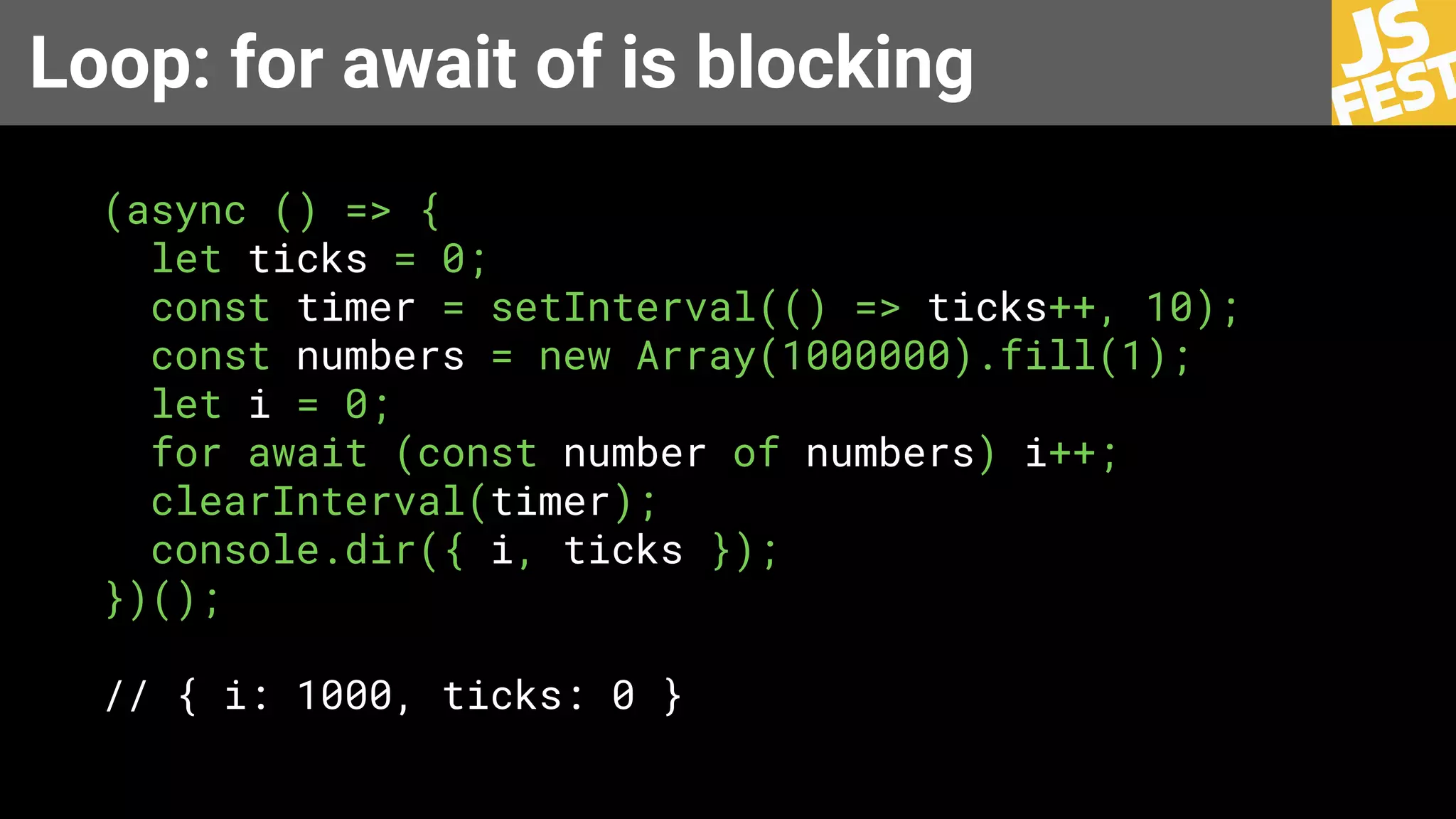
Loop: for await of is blocking
(async () => {
let ticks = 0;
const timer = setInterval(() => ticks++, 10);
const numbers = new Array(1000000).fill(1);
let i = 0;
for await (const number of numbers) i++;
clearInterval(timer);
console.dir({ i, ticks });
})();
// { i: 1000, ticks: 0 }
AsyncArray (short version)
class AsyncArray extends Array {
[Symbol.asyncIterator]() {
let i = 0;
return {
next: () => new Promise(resolve => {
setTimeout(() => resolve({
value: this[i], done: i++ === this.length
}), 0);
})
};
}
} // github.com/HowProgrammingWorks/NonBlocking
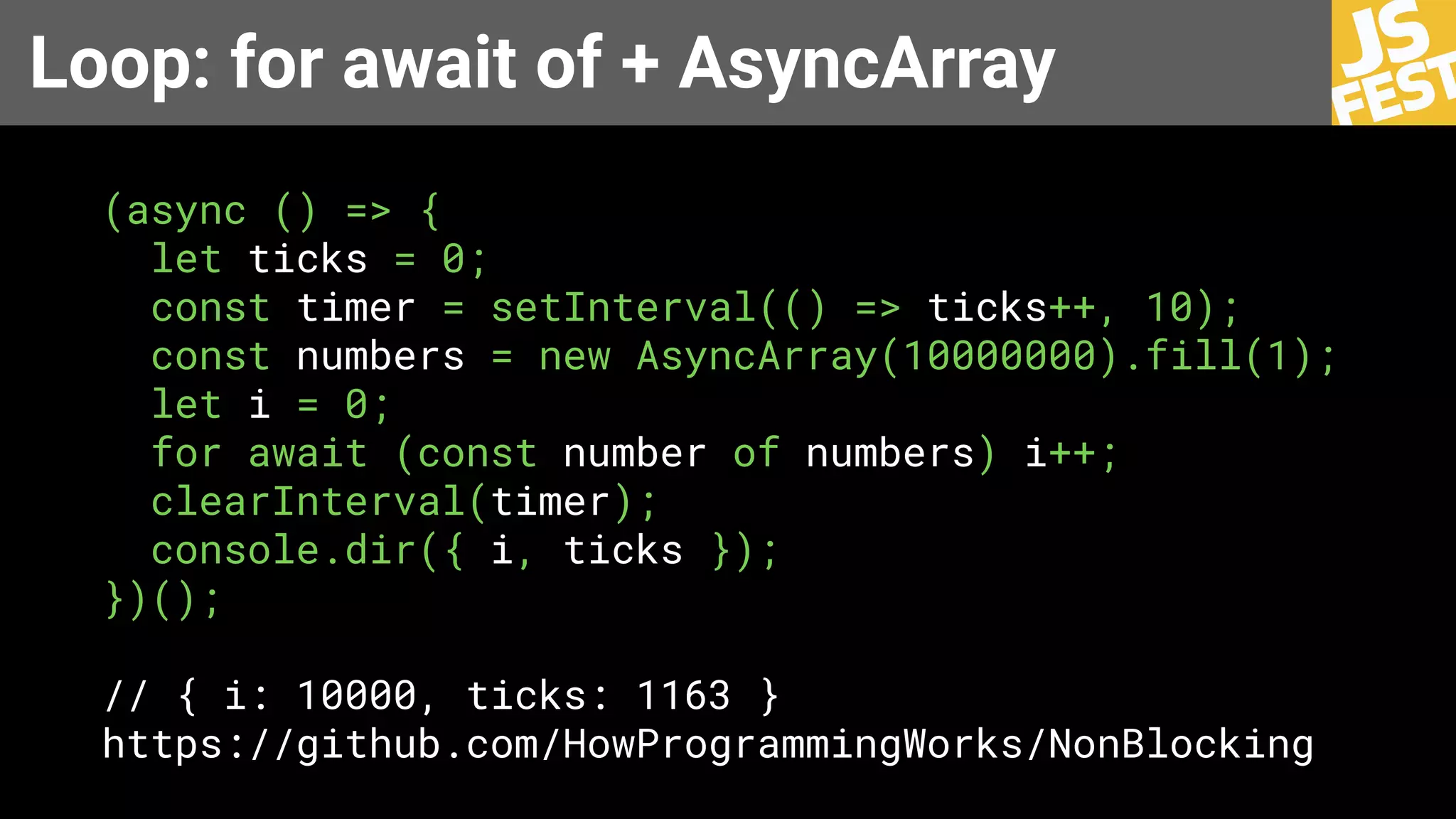
Loop: for await of + AsyncArray
(async () => {
let ticks = 0;
const timer = setInterval(() => ticks++, 10);
const numbers = new AsyncArray(10000000).fill(1);
let i = 0;
for await (const number of numbers) i++;
clearInterval(timer);
console.dir({ i, ticks });
})();
// { i: 10000, ticks: 1163 }
https://github.com/HowProgrammingWorks/NonBlocking
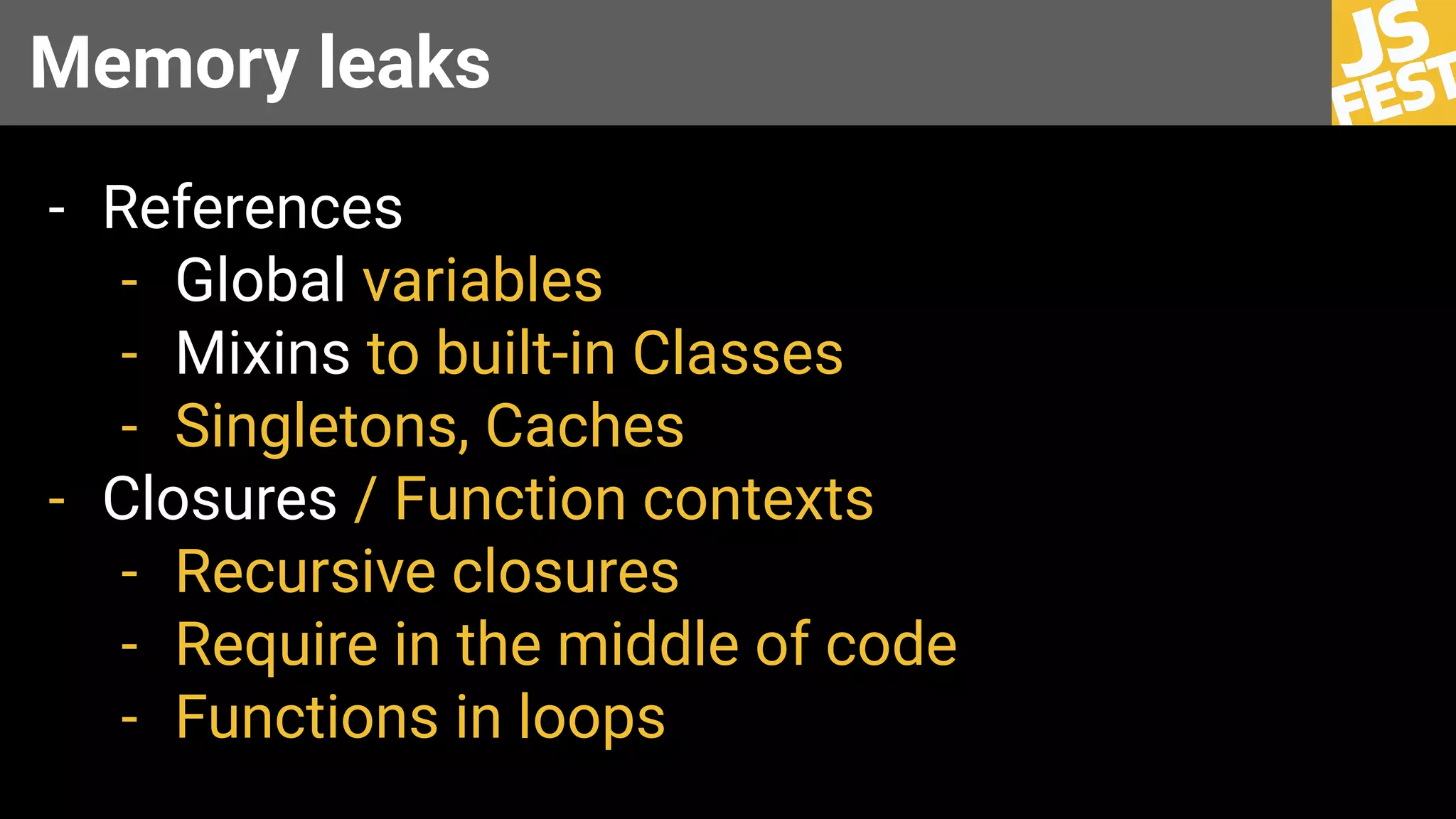
Memory leaks
- References
- Global variables
- Mixins to built-in Classes
- Singletons, Caches
- Closures / Function contexts
- Recursive closures
- Require in the middle of code
- Functions in loops
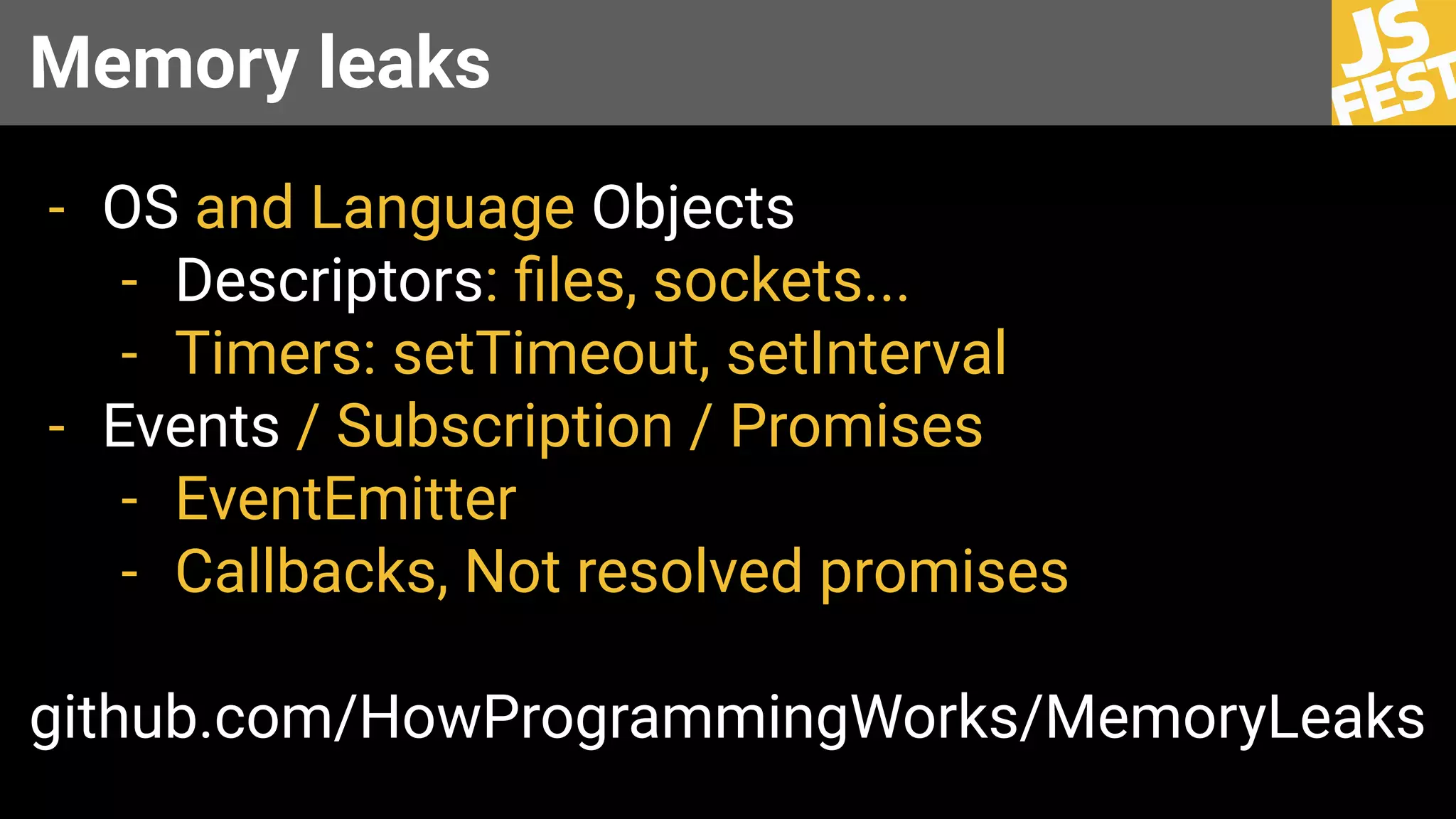
Memory leaks
- OS and Language Objects
- Descriptors: files, sockets...
- Timers: setTimeout, setInterval
- Events / Subscription / Promises
- EventEmitter
- Callbacks, Not resolved promises
github.com/HowProgrammingWorks/MemoryLeaks
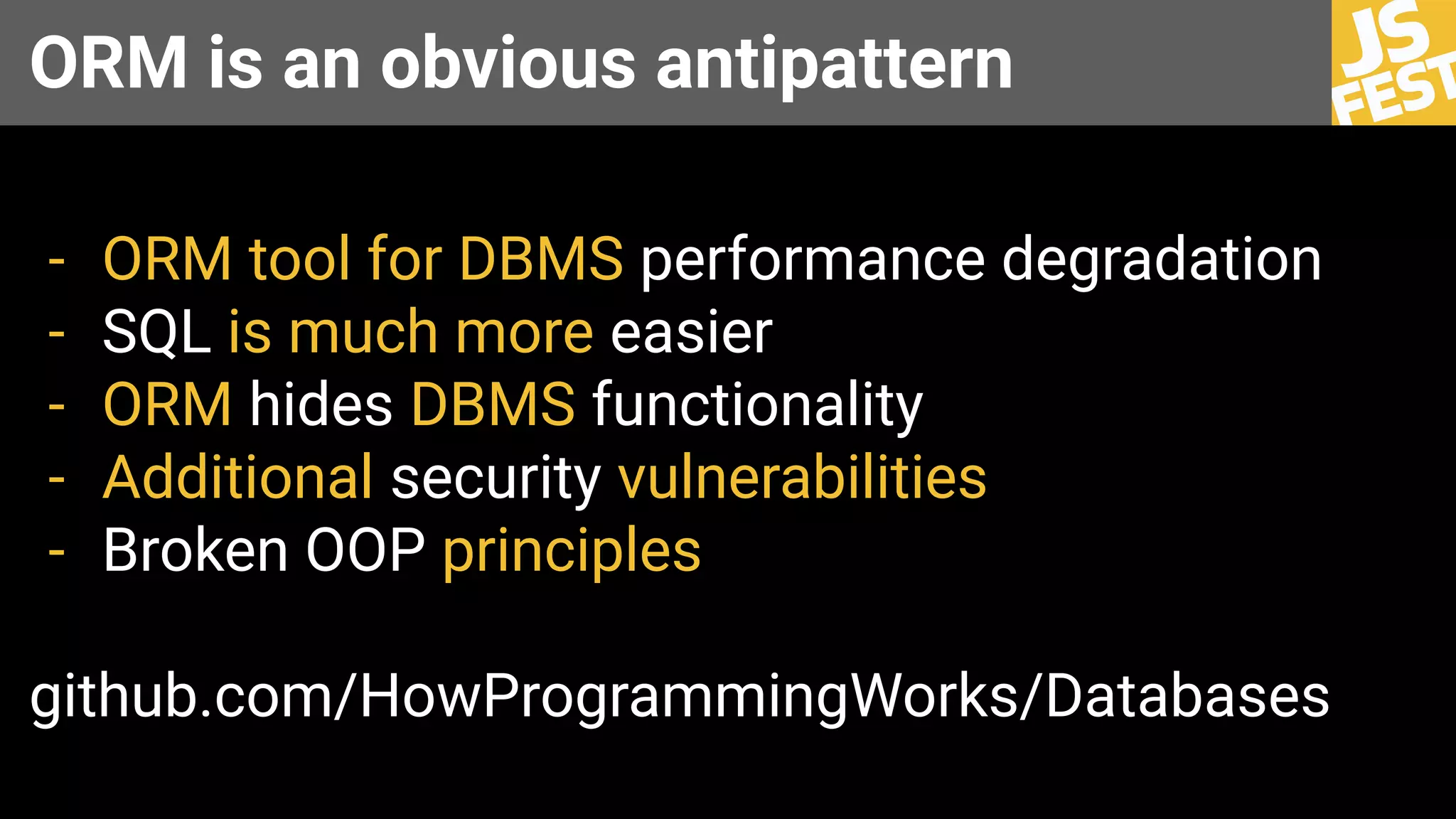
ORM is an obvious antipattern
- ORM tool for DBMS performance degradation
- SQL is much more easier
- ORM hides DBMS functionality
- Additional security vulnerabilities
- Broken OOP principles
github.com/HowProgrammingWorks/Databases
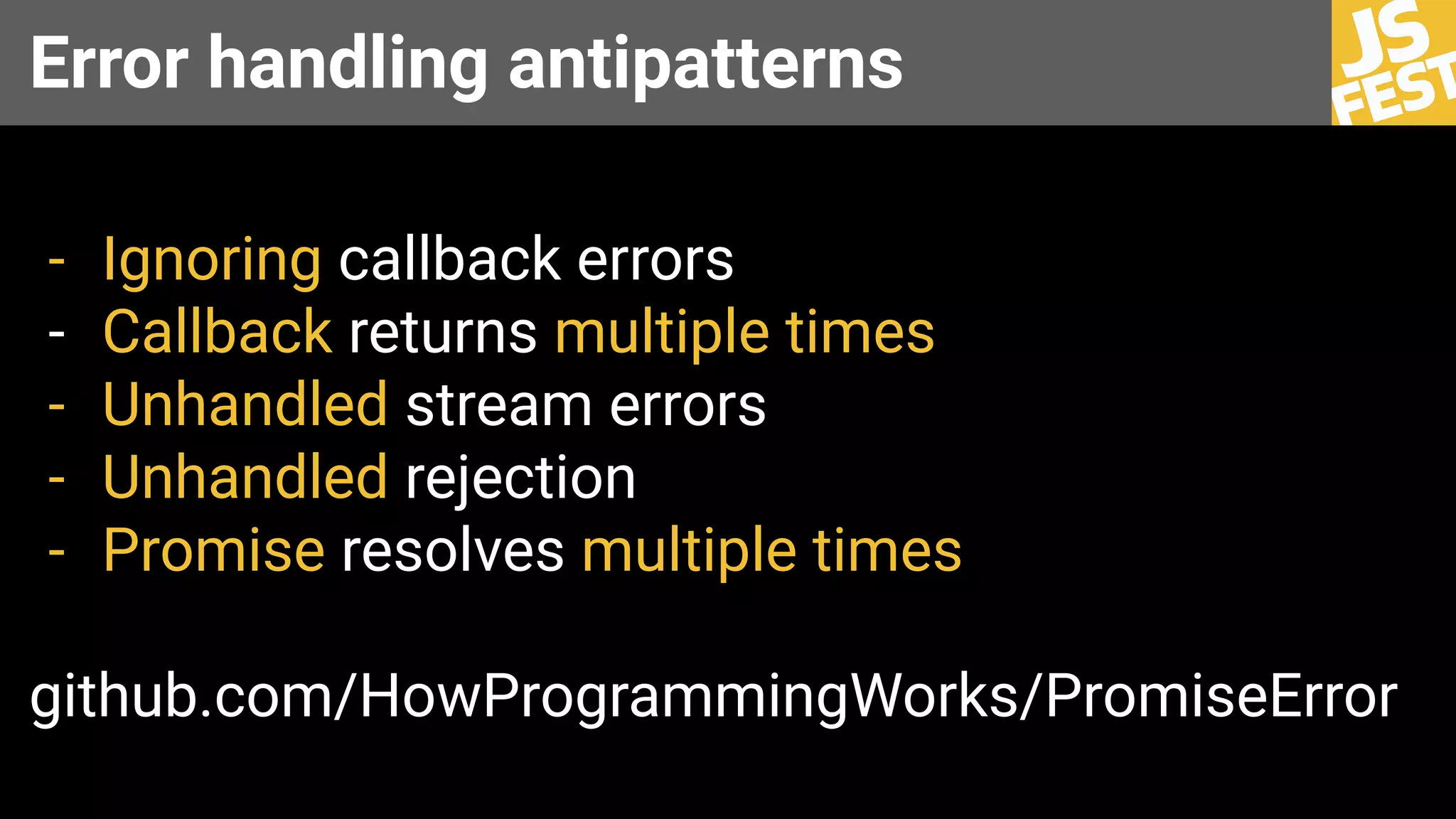
Error handling antipatterns
- Ignoring callback errors
- Callback returns multiple times
- Unhandled stream errors
- Unhandled rejection
- Promise resolves multiple times
github.com/HowProgrammingWorks/PromiseError
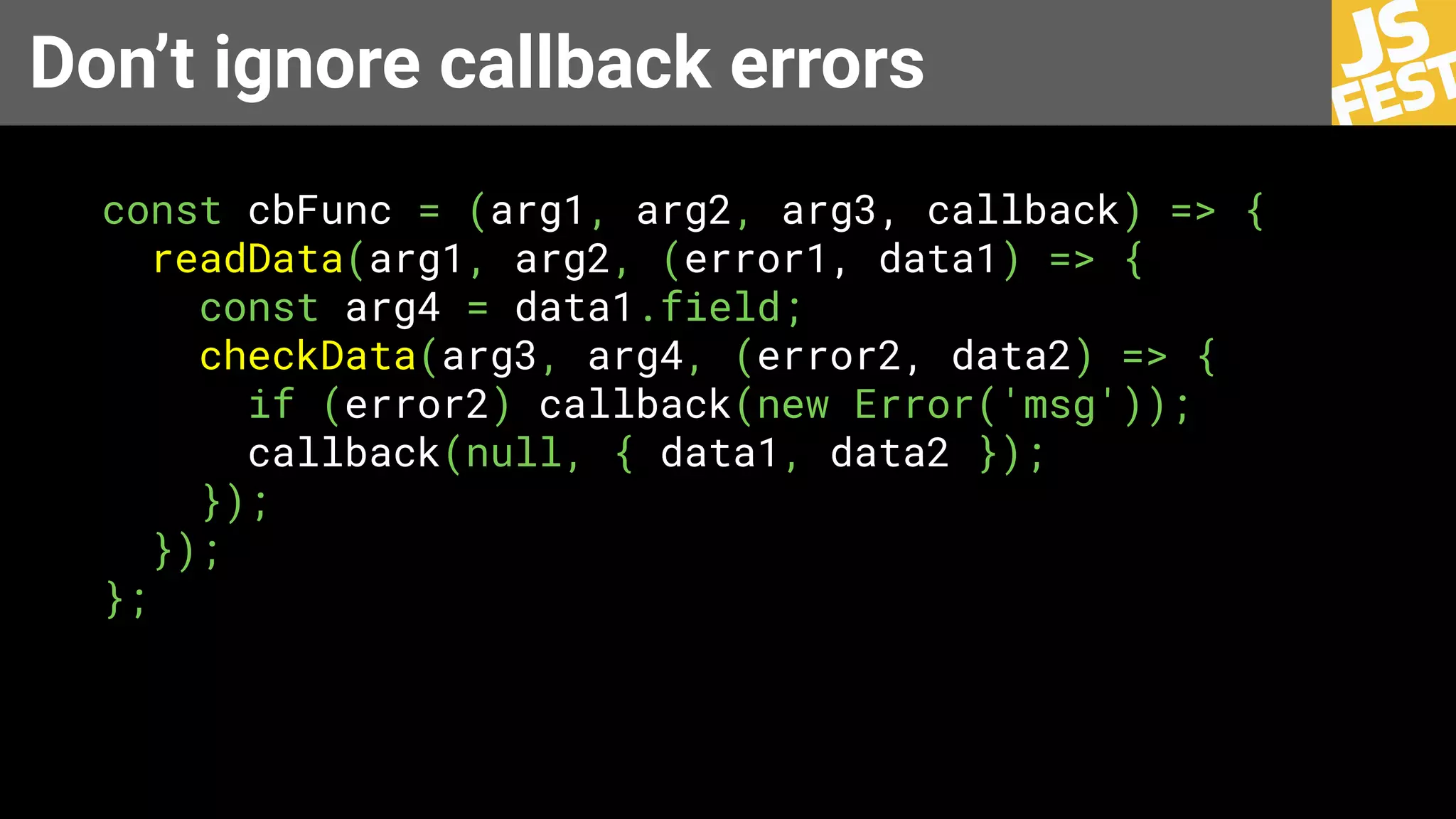
Don’t ignore callback errors
const cbFunc = (arg1, arg2, arg3, callback) => {
readData(arg1, arg2, (error1, data1) => {
const arg4 = data1.field;
checkData(arg3, arg4, (error2, data2) => {
if (error2) callback(new Error('msg'));
callback(null, { data1, data2 });
});
});
};
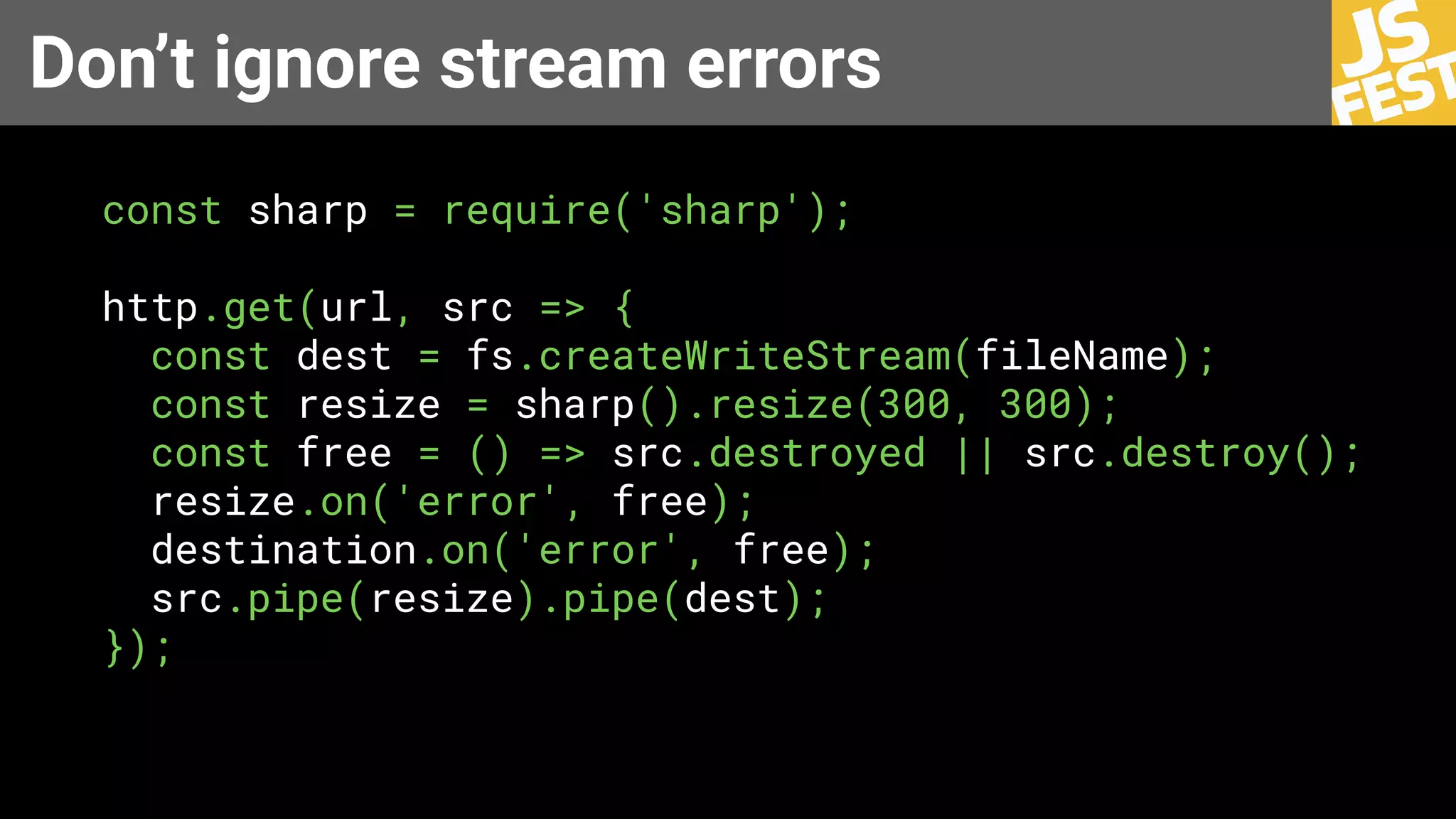
Don’t ignore stream errors
const sharp = require('sharp');
http.get(url, src => {
const dest = fs.createWriteStream(fileName);
const resize = sharp().resize(300, 300);
const free = () => src.destroyed || src.destroy();
resize.on('error', free);
destination.on('error', free);
src.pipe(resize).pipe(dest);
});
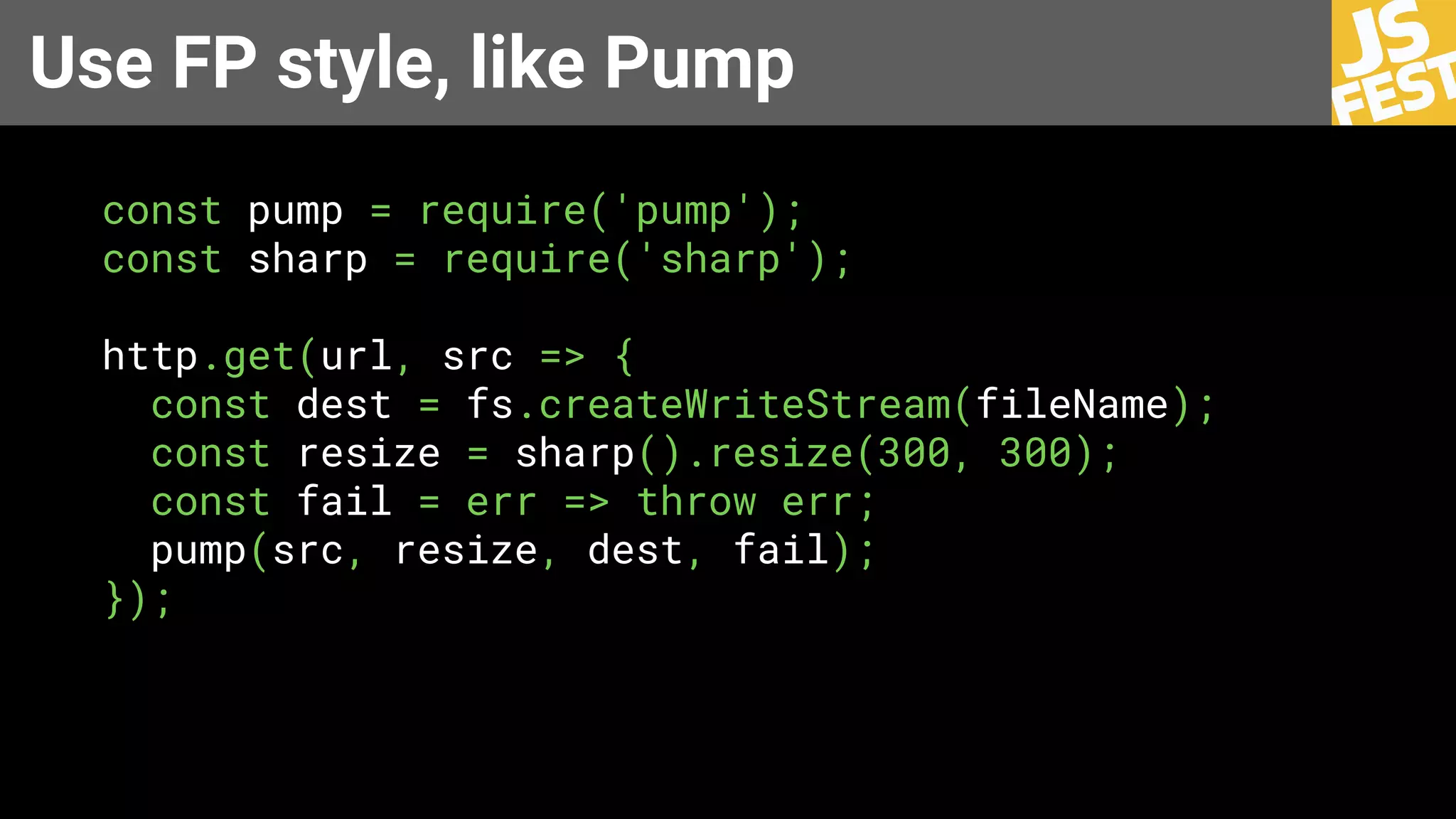
Use FP style, like Pump
const pump = require('pump');
const sharp = require('sharp');
http.get(url, src => {
const dest = fs.createWriteStream(fileName);
const resize = sharp().resize(300, 300);
const fail = err => throw err;
pump(src, resize, dest, fail);
});
https://github.com/tshemsedinov
https://www.youtube.com/TimurShemsedinov
timur.shemsedinov@gmail.com
Thanks! Questions?

JS Fest 2019 Node.js Antipatterns

  • 1.
    Structure and architecture,API, security, asynchronity, routing, middlewares, data access, memory, cpu, state management, etc. Timur Shemsedinov 8-9 NOV ‘19 KIEV, UKRAINE Node.js Antipatterns JS FEST PROFESSIONAL JS CONFERENCE
  • 2.
    Node.js Antipatterns Classification -Structure and arch. - Initialization - Dependency issues - Application state - Middlewares - Context isolation - Security issues - Asynchronity issues - Blocking operations - Memory leaks - Databases and ORM - Error handling
  • 3.
    No layers, everythingmixed: - Configuration and Dependency management - Network protocols related code (http, tcp, tls…) - Request parsing, Cookies, Sessions - Logging, Routing, Business-logic - I/O: fs, Database queries - Generating responses and error generation - Templating, etc. github.com/HowProgrammingWorks/AbstractionLayers
  • 4.
    Mixed Layers router.get('/user/:id', (req,res, next) => { const id = parseInt(req.params.id); const query = 'SELECT * FROM users WHERE id = $1'; pool.query(query, [id], (err, data) => { if (err) throw err; res.status(200).json(data.rows); next(); }); });
  • 5.
    What do wewant? async (arg1, arg2, arg3) => { const data1 = await getData(arg1); if (!data1) throw new Error('Message'); const [data2, data3] = await Promise.all( [getData(arg2), getData(arg3)] ); return await processData(data1, data2, data3); } github.com/HowProgrammingWorks/API Transport agnostic, Framework agnostic
  • 6.
    Middlewares Middlewares is anextremely bad idea for low coupling and high cohesion Middlewares changes: - Socket state - Db connection state - Server state
  • 7.
    Don’t use globalsto pass state let groupName; app.use((req, res, next) => { groupName = 'idiots'; next(); }); app.get('/user', (req, res) => { if (res.groupName === 'idiots') { res.end('I know you!'); } });
  • 8.
    Don’t mixins toreq and res app.use((req, res, next) => { res.groupName = 'idiots'; next(); }); app.get('/user', (req, res) => { if (res.groupName === 'idiots') { res.end('I know you!'); } });
  • 9.
    Don’t mixins localsto res app.use((req, res, next) => { res.locals.groupName = 'idiots'; next(); }); app.get('/user', (req, res) => { if (res.locals.groupName === 'idiots') { res.end('I know you!'); } });
  • 10.
    Don’t mixins methods app.get('/user/:id',(req, res, next) => { req.auth = (login, password) => { /* auth */ }; next(); }); app.get('/user/:id', (req, res) => { if (req.auth(req.params.id, '111')) { res.end('I know you!'); } });
  • 11.
    Don’t require inmiddleware / handler app.get((req, res, next) => { req.db = new require('pg').Client(); req.db.connect(); next(); }); app.get('/user/:id', (req, res) => { req.db.query('SELECT * from USERS', (e, r) => { }); });
  • 12.
    Don’t connect dbin handlers app.get((req, res, next) => { req.db = new Pool(config); next(); }); app.get('/user/:id', (req, res) => { req.db.query('SELECT * from USERS', (e, r) => { }); });
  • 13.
    Don’t loose connectionon error const db = new Pool(config); app.get('/user/:id', (req, res) => { req.db.query('SELECT * from USERS', (err, r) => { if (err) throw err; // Prepare data to reply client }); });
  • 14.
    Why execution contextisolation? - Errors, crashes - Memory leaks and other resources - Application: data, database connections - File system and root directory - OS environment, PID, IPC - OS Security: users, groups - Networking: socket descriptors, ports, hosts
  • 15.
    Execution isolation levels -Hardware: servers, networks - Virtual machine (hypervisor) - Container (docker) - Process (node) - Thread (worker_threads) - Sandbox (vm.createContext, vm.Script) - Software context (object, closure)
  • 16.
    Dependency issues - Almostall we need is in - JavaScript and in Node.js API (just check) - Adding dependencies from NPM tell yourself: - It’s my responsibility - authors give no warranties, - it’s just a good will if they help and support - and I will support fork
  • 17.
    Security issues - Maliciousmodules from NPM - Path traversal - Injections: SQL, NoSQL, Blind, JavaScript - Sandbox escaping (vm) - Buffer vulnerabilities - Regular expressions
  • 18.
    Path traversal const serveFile= fileName => { const filePath = path.join(STATIC_PATH, fileName); return fs.createReadStream(filePath); }; http.createServer((req, res) => { const url = decodeURI(req.url); serveFile(url).pipe(res); }).listen(8000); curl -v http://127.0.0.1:8000/%2e%2e/1-traversal.js
  • 19.
    Path traversal fixed constserveFile = fileName => { const filePath = path.join(STATIC_PATH, fileName); if (!filePath.startsWith(STATIC_PATH)) { throw new Error(`Access denied: ${name}`); } return fs.createReadStream(filePath); }; http.createServer((req, res) => { const url = decodeURI(req.url); serveFile(url).pipe(res); }).listen(8000);
  • 20.
    Asynchronity issues - Callbackhell and promise hell - Ignoring errors in callbacks - Ignoring errors in promises - Throwing errors and releasing resources - Race conditions and deadlocks - Queuing theory: need to limit concurrency
  • 21.
    Callback hell select(id, (err,data) => { check(data, (err, valid) => { convert(data, (err, res) => { сache(id, res, err => { send(data); }); }); }); });
  • 22.
    Flat, decomposed, named constsaved = (err, data) => err ? throw err : send(data1); const converted = (err, res) => err ? throw err : сache(res, saved); const checked = (err, valid) => err ? throw err : convert(data, converted); const selected = (err, data) => err ? throw err : check(data, checked); select(id, selected);
  • 23.
  • 24.
    Promise hell select(id).then(data =>{ check(data).then(valid => { if (valid) { Promise.all([ convert(data), cache(data) ]).then(send); } }); });
  • 25.
    Compose errback compose (send, cache,convert, check, select) (id); pipe (select, check, convert, cache, send) (id);
  • 26.
    Compose AsyncFunction await compose (send,cache, convert, check, select) (id); await pipe (select, check, convert, cache, send) (id);
  • 27.
    Universal composition: metasync metasync ([select,check, [[convert, cache]], send]) (id); // In arguments: Function | Errback | AsyncFunction // Process: Parallel | Sequential // Functionality: Cancelable | Timeout | Throttle // Result: Thenable | Promise | Errback | EventEmitter
  • 28.
    Limit execution concurrency constqueue = metasync.queue(3) .wait(2000) .timeout(5000) .throttle(100, 1000) .process((item, cb) => cb(err, result)) .success(item => {}) .failure(item => {}) .done(() => {}) .drain(() => {});
  • 29.
    Asynchronous programming 27 lectures:https://habr.com/ru/post/452974/
  • 30.
    Race condition demo classPoint { constructor(x, y) { this.x = x; this.y = y; } async move(dx, dy) { this.x = await add(this.x, dx); this.y = await add(this.y, dy); } }
  • 31.
    Race condition demo constrandom = (min, max) => Math .floor(Math.random() * (max - min + 1)) + min; const add = (x, dx) => new Promise(resolve => { const timeout = random(20, 100); setTimeout(() => resolve(x + dx), timeout); });
  • 32.
    Race condition demo constp1 = new Point(10, 10); console.log(p1); p1.move(5, 5); p1.move(6, 6); p1.move(7, 7); p1.move(8, 8); setTimeout(() => { console.log(p1); }, 1000);
  • 33.
    Race condition demo Initial Point{ x: 10, y: 10 } Expected Point { x: 36, y: 36 } Actual Point { x: 18, y: 25 }
  • 34.
    Do we needparallel primitives? - Semaphore: Binary and Counting semaphore - Condition variable - Spinlock - Mutex, Timed mutex, Shared mutex - Recursive mutex - Monitor - Barrier
  • 35.
    Do we needparallel primitives? https://github.com /HowProgrammingWorks /Semaphore /Mutex /RaceCondition /Deadlock https://youtu.be/JNLrITevhRI
  • 36.
    Simple Resource Locking classLock { constructor() { this.active = false; this.queue = []; } leave() { if (!this.active) return; this.active = false; const next = this .queue.pop(); if (next) next(); } } enter() { return new Promise(resolve => { const start = () => { this.active = true; resolve(); }; if (!this.active) { start(); return; } this.queue.push(start); }); }
  • 37.
    Race condition demo classPoint { constructor(x, y) { this.x = x; this.y = y; this.lock = new Lock(); } async move(dx, dy) { await this.lock.enter(); this.x = await add(this.x, dx); this.y = await add(this.y, dy); this.lock.leave(); } }
  • 38.
    Web Locks API locks.request('resource',opt, async lock => { if (lock) { // critical section for `resource` // will be released after return } }); https://wicg.github.io/web-locks/
  • 39.
    Web Locks: await (async() => { await something(); await locks.request('resource', async lock => { // critical section for `resource` }); await somethingElse(); })();
  • 40.
    Web Locks: Promiseand Thenable locks.request('resource', lock => new Promise( (resolve, reject) => { // you can store or pass // resolve and reject here } )); locks.request('resource', lock => ({ then((resolve, reject) => { // critical section for `resource` // you can call resolve and reject here }) }));
  • 41.
    Web Locks: Abort constcontroller = new AbortController(); setTimeout(() => controller.abort(), 200); const { signal } = controller; locks.request('resource', { signal }, async lock => { // lock is held }).catch(err => { // err is AbortError });
  • 42.
    Web Locks forNode.js github.com/nodejs/node/issues/22702 Open github.com/nodejs/node/pull/22719 Closed
  • 43.
    Don’t use blockingoperations - Sync calls like fs.readFileSync - Console output like console.log - Remember that require is synchronous - Long loops (including for..of and for await) - Serialization: JSON.parse, JSON.stringify - Iteration: loops, Array.prototype.map, etc. - CPU-intensive: zlib, crypto
  • 44.
    Loop: for awaitof is blocking (async () => { let ticks = 0; const timer = setInterval(() => ticks++, 10); const numbers = new Array(1000000).fill(1); let i = 0; for await (const number of numbers) i++; clearInterval(timer); console.dir({ i, ticks }); })(); // { i: 1000, ticks: 0 }
  • 45.
    AsyncArray (short version) classAsyncArray extends Array { [Symbol.asyncIterator]() { let i = 0; return { next: () => new Promise(resolve => { setTimeout(() => resolve({ value: this[i], done: i++ === this.length }), 0); }) }; } } // github.com/HowProgrammingWorks/NonBlocking
  • 46.
    Loop: for awaitof + AsyncArray (async () => { let ticks = 0; const timer = setInterval(() => ticks++, 10); const numbers = new AsyncArray(10000000).fill(1); let i = 0; for await (const number of numbers) i++; clearInterval(timer); console.dir({ i, ticks }); })(); // { i: 10000, ticks: 1163 } https://github.com/HowProgrammingWorks/NonBlocking
  • 47.
    Memory leaks - References -Global variables - Mixins to built-in Classes - Singletons, Caches - Closures / Function contexts - Recursive closures - Require in the middle of code - Functions in loops
  • 48.
    Memory leaks - OSand Language Objects - Descriptors: files, sockets... - Timers: setTimeout, setInterval - Events / Subscription / Promises - EventEmitter - Callbacks, Not resolved promises github.com/HowProgrammingWorks/MemoryLeaks
  • 49.
    ORM is anobvious antipattern - ORM tool for DBMS performance degradation - SQL is much more easier - ORM hides DBMS functionality - Additional security vulnerabilities - Broken OOP principles github.com/HowProgrammingWorks/Databases
  • 50.
    Error handling antipatterns -Ignoring callback errors - Callback returns multiple times - Unhandled stream errors - Unhandled rejection - Promise resolves multiple times github.com/HowProgrammingWorks/PromiseError
  • 51.
    Don’t ignore callbackerrors const cbFunc = (arg1, arg2, arg3, callback) => { readData(arg1, arg2, (error1, data1) => { const arg4 = data1.field; checkData(arg3, arg4, (error2, data2) => { if (error2) callback(new Error('msg')); callback(null, { data1, data2 }); }); }); };
  • 52.
    Don’t ignore streamerrors const sharp = require('sharp'); http.get(url, src => { const dest = fs.createWriteStream(fileName); const resize = sharp().resize(300, 300); const free = () => src.destroyed || src.destroy(); resize.on('error', free); destination.on('error', free); src.pipe(resize).pipe(dest); });
  • 53.
    Use FP style,like Pump const pump = require('pump'); const sharp = require('sharp'); http.get(url, src => { const dest = fs.createWriteStream(fileName); const resize = sharp().resize(300, 300); const fail = err => throw err; pump(src, resize, dest, fail); });
  • 54.