Journal club
Presenter-Dr Rajesh Nandi
Moderator-Dr Mamta
Facilitator-Dr Abhishek
Title of the article
Seeds of prevention: The impact on health behaviors
of young adolescent girls in Uttar Pradesh, India, a
cluster randomized control trial
Authors- Nandita Kapadia-Kundu & Geetali Trivedi
1
, Douglas Storey & Basil Safi2
, Rama Tupe3
, G.
Narayana 4
1-Johns Hopkins Bloomberg School of Public Health, Center for
Communication Programs, Nehru Place, New Delhi, India
2- Johns Hopkins Bloomberg School of Public Health, Center for
Communication, Baltimore, USA
3- Genesis Research, Delhi, India
4- Futures International , Haryana, India
About the journal
Name – Social science and medicine
Impact factor- 5.4
Published – September 2014
Volume-120
Pages -169-179
Plan of presentation
 Introduction and Rationale
 Objective
 Methodology
 Results
 Discussion
Introduction and rationale
Early adolescent girls are vulnerable to health challenges
Effective health interventions were scarce
Intergenerational low birth weight , anemia and under
nutrition
Leads to “Cycle of failure”
Early adolescent is a gateway to build nutritional and health
reserves
Aim
To provide a foundation of healthy behavior that
will benefit two generations: young adults and
girls in their adulthood and their children
Methodology
Study design- Cluster randomised control trial
Study setting- Hardoi, district of Uttar Pradesh
Study participants- Adolescent girls (11-14
years)
Study period-January 2010 to October 2011
Sample size – For cluster RCT (ESS=mk/DE)
ESS =effective sample size
Number of schools/clusters (k) = 30
Number of girls per school (m) = 60
Total number =1800
Design effect = 1+ rho(m-1)
= 1+0.017(29)
=1.4
ESS=1800/1.4=1205 adolescents girls
Data collection- Face to face interviews were
conducted
Statistical analysis-Qualitative data was analysed in
proportion using chi square while quantitative data
was analysed using t test between intervention and
control groups
Hardoi district (19 blocks)
Stratification of blocks into 3 categories by distance
41-60 kms
from Hardoi
<20 kms
from Hardoi
21- 40 kms
from Hardoi
Randomly 2 blocks
selected from
which 5 schools
were randomly
selected
40 girls from each
school were
randomly selected
from class 7-8
Randomly 2 blocks
selected from
which 5 schools
were randomly
selected
40 girls from each
school were
randomly selected
from class 7-8
Randomly 2 blocks
selected from which 5
schools were
randomly selected
40 girls from each
school were randomly
selected from class 7-
8
Baseline survey of girls
Baseline survey
Random assignment
of blocks <20km
from Hardoi city
Random assignment
of blocks 20-40 kms
from Hardoi city
Random assignment
of blocks 41-60 kms
from Hardoi city
Intervention
block
Control
block
5 schools
40
girls/school
SSKY + Pilot
5 schools
40
girls/school
5 schools
40
girls/school
5 schools
40
girls/school
5 schools
40
girls/school
5 schools
40
girls/school
Intervention
block
Control
block
Control
block
Intervention
block
SSKY + Pilot SSKY + Pilot
SSKY SSKY SSKY
Saloni swasthya kishori yojana
 For school going adolescent girls (10-19 years)
 Address the problem of anemia
 Administration of weekly IFA tablets, bi annual
deworming and annual health check ups
Saloni pilot intervention
Addition to SSKY implemented in government schools
Promoted 19 health behaviors
5 health seeking ,6 nutrition,3 reproductive health and 5 hygiene
A structured teachers manual
A saloni diary for the girls
Saloni diary – provided to girls with aim to promote healthy
behaviors in a more interactive way (colourful pictorial
representations)
Contents
 Personal information
 Family details
 Daily activities
Daily food intake
 Health behaviors (reproductive health, nutrition and hygiene)
 Intergenerational communication – sharing learning with parents
Delivery of interventions
Saloni diary
Education on inter generational communication(with mothers,
fathers and other family members)
Role plays and posters promoting intergenerational communication
and enforcing healthy behaviors
Community support ( school teachers)
Ten monthly education sessions one hour each ( by the teachers)
Consent for participation was taken from their guardians or parents
and from the girls themselves
Face to face interviews were conducted at the end of the
intervention
Only 11.4 – 9.5% girls live in brick houses- indicative of high level of poverty
Increase in number of nuclear families in the endline is not explained
Results
Significant increase in consumption of iron folic acid tablets after the intervention
The above table shows significant increase in having 3 meals + snack in both the groups but more in intervention
group
There was an improvement in menstrual hygiene in both the groups but due to some social
constraints the improvement was limited
Discussion
 Seeds of prevention need to be sown in early ages
 Saloni intervention focused on early adolescence as gateway moment
 Early adolescence girls are potentially receptive
 Integrated intervention on reproductive and sexual health ,nutrition and
hygiene
 Evidence of concurrent changes in more than one behavior across
different health issues
 Findings can be applied to the target population
Limitations
 Short duration of study
 Sustainability of behavioral changes unknown
CONSORT checklist
28
Content Recommendation Report
Title Identification as a randomized trial in the title Yes
Abstract
Structured summary of trial design, methods,
results, and conclusions
Mentioned but not in a structured format
Introduction Scientific background and explanation of rationale
Background and problem statement
explained
Objectives Specific objectives or hypotheses
Not clearly stated under a separate
heading
Trial design
Description of trial design
Important changes to methods after trial
commenced
No changes were made to protocol after
commencing the study
CONSORT checklist (cont.)
Content Recommendation Report
Participants
Eligibility criteria
Settings and locations where the data were collected Mentioned
Interventions
Interventions for each group with sufficient details to allow
replication
Mentioned but in detailed
delivery of interventions not
given
Outcomes
Completely defined pre-specified outcome measures, including
how and when they were assessed
Any changes to outcomes after the trial commenced
Primary outcome and
secondary outcome not
mentioned under separate
heading , analysis of results
not mentioned clearly
Sample size How sample size was determined Explained.
CONSORT checklist (cont.)
Content Recommendation Report
Random sequence
generation
Method, type of randomization, details of any restriction Not mentioned
Allocation
concealment
Mechanism used, describing any steps taken to conceal
the sequence until interventions Not mentioned
Implementation
Who generated the random allocation sequence, who
enrolled and assigned interventions Not mentioned
Blinding
If done, who was blinded after assignment to interventions
and how
Not mentioned clearly
Statistical methods Methods used to compare groups for outcomes
Methods for additional analyses Mentioned.
CONSORT checklist (cont.)
Content Recommendation Report
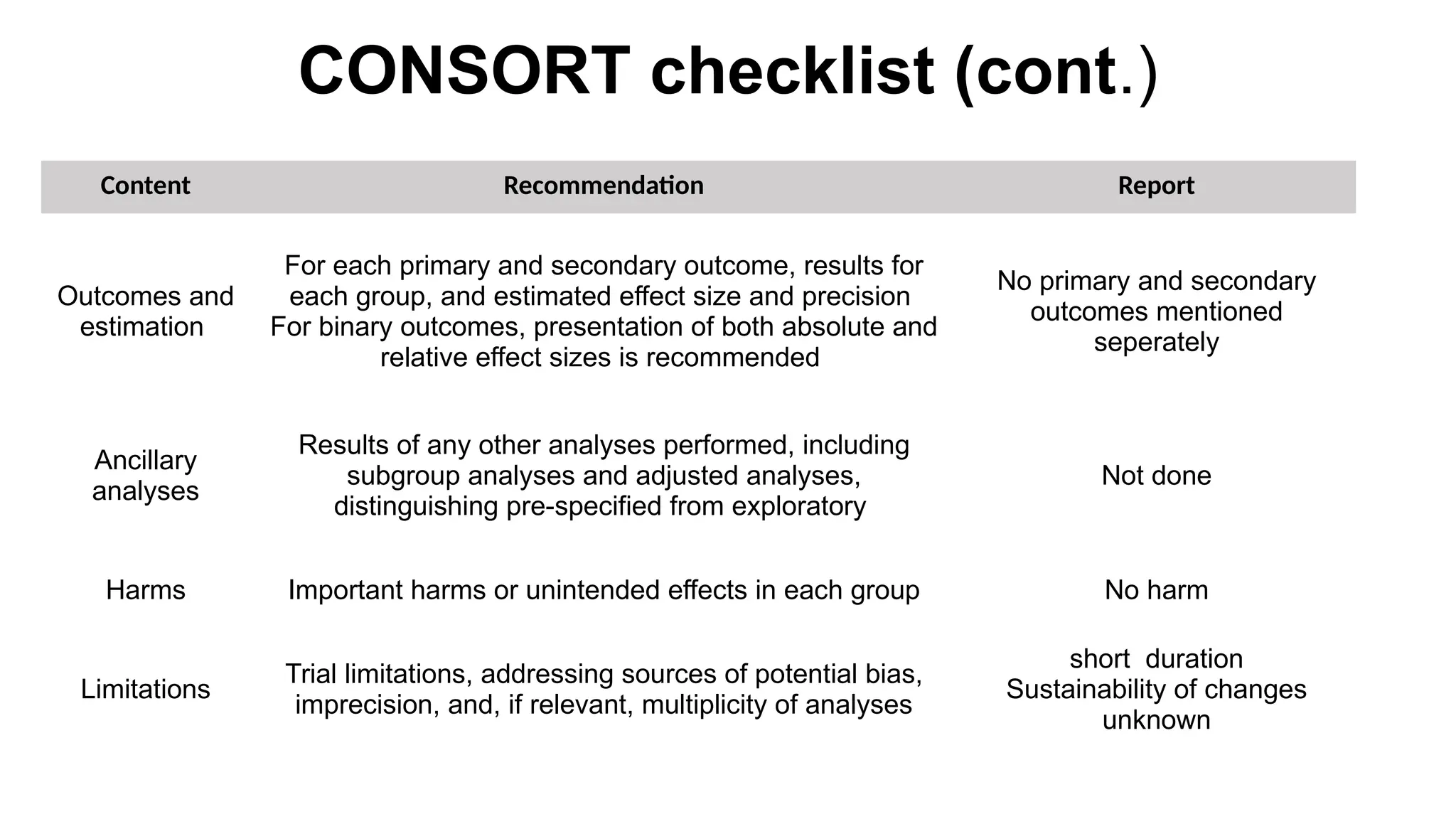
Outcomes and
estimation
For each primary and secondary outcome, results for
each group, and estimated effect size and precision
For binary outcomes, presentation of both absolute and
relative effect sizes is recommended
No primary and secondary
outcomes mentioned
seperately
Ancillary
analyses
Results of any other analyses performed, including
subgroup analyses and adjusted analyses,
distinguishing pre-specified from exploratory
Not done
Harms Important harms or unintended effects in each group No harm
Limitations
Trial limitations, addressing sources of potential bias,
imprecision, and, if relevant, multiplicity of analyses
short duration
Sustainability of changes
unknown
CONSORT checklist (cont.)
Content Recommendation Report
Generalizability External validity & applicability of the trial findings
Generalizable only to target
population
Registration Registration number and name of trial registry Not mentioned
Protocol Where the full trial protocol can be accessed Could not be accessed
Funding
Sources of funding and other support, role of
funders
Not mentioned
Journal club on Randomised control trial.pptx

Journal club on Randomised control trial.pptx

  • 1.
    Journal club Presenter-Dr RajeshNandi Moderator-Dr Mamta Facilitator-Dr Abhishek
  • 2.
    Title of thearticle Seeds of prevention: The impact on health behaviors of young adolescent girls in Uttar Pradesh, India, a cluster randomized control trial Authors- Nandita Kapadia-Kundu & Geetali Trivedi 1 , Douglas Storey & Basil Safi2 , Rama Tupe3 , G. Narayana 4
  • 3.
    1-Johns Hopkins BloombergSchool of Public Health, Center for Communication Programs, Nehru Place, New Delhi, India 2- Johns Hopkins Bloomberg School of Public Health, Center for Communication, Baltimore, USA 3- Genesis Research, Delhi, India 4- Futures International , Haryana, India
  • 4.
    About the journal Name– Social science and medicine Impact factor- 5.4 Published – September 2014 Volume-120 Pages -169-179
  • 5.
    Plan of presentation Introduction and Rationale  Objective  Methodology  Results  Discussion
  • 6.
    Introduction and rationale Earlyadolescent girls are vulnerable to health challenges Effective health interventions were scarce Intergenerational low birth weight , anemia and under nutrition Leads to “Cycle of failure” Early adolescent is a gateway to build nutritional and health reserves
  • 7.
    Aim To provide afoundation of healthy behavior that will benefit two generations: young adults and girls in their adulthood and their children
  • 8.
    Methodology Study design- Clusterrandomised control trial Study setting- Hardoi, district of Uttar Pradesh Study participants- Adolescent girls (11-14 years) Study period-January 2010 to October 2011
  • 9.
    Sample size –For cluster RCT (ESS=mk/DE) ESS =effective sample size Number of schools/clusters (k) = 30 Number of girls per school (m) = 60 Total number =1800 Design effect = 1+ rho(m-1) = 1+0.017(29) =1.4 ESS=1800/1.4=1205 adolescents girls
  • 10.
    Data collection- Faceto face interviews were conducted Statistical analysis-Qualitative data was analysed in proportion using chi square while quantitative data was analysed using t test between intervention and control groups
  • 11.
    Hardoi district (19blocks) Stratification of blocks into 3 categories by distance 41-60 kms from Hardoi <20 kms from Hardoi 21- 40 kms from Hardoi Randomly 2 blocks selected from which 5 schools were randomly selected 40 girls from each school were randomly selected from class 7-8 Randomly 2 blocks selected from which 5 schools were randomly selected 40 girls from each school were randomly selected from class 7-8 Randomly 2 blocks selected from which 5 schools were randomly selected 40 girls from each school were randomly selected from class 7- 8 Baseline survey of girls
  • 12.
    Baseline survey Random assignment ofblocks <20km from Hardoi city Random assignment of blocks 20-40 kms from Hardoi city Random assignment of blocks 41-60 kms from Hardoi city Intervention block Control block 5 schools 40 girls/school SSKY + Pilot 5 schools 40 girls/school 5 schools 40 girls/school 5 schools 40 girls/school 5 schools 40 girls/school 5 schools 40 girls/school Intervention block Control block Control block Intervention block SSKY + Pilot SSKY + Pilot SSKY SSKY SSKY
  • 13.
    Saloni swasthya kishoriyojana  For school going adolescent girls (10-19 years)  Address the problem of anemia  Administration of weekly IFA tablets, bi annual deworming and annual health check ups
  • 14.
    Saloni pilot intervention Additionto SSKY implemented in government schools Promoted 19 health behaviors 5 health seeking ,6 nutrition,3 reproductive health and 5 hygiene A structured teachers manual A saloni diary for the girls
  • 16.
    Saloni diary –provided to girls with aim to promote healthy behaviors in a more interactive way (colourful pictorial representations) Contents  Personal information  Family details  Daily activities Daily food intake  Health behaviors (reproductive health, nutrition and hygiene)  Intergenerational communication – sharing learning with parents
  • 17.
    Delivery of interventions Salonidiary Education on inter generational communication(with mothers, fathers and other family members) Role plays and posters promoting intergenerational communication and enforcing healthy behaviors Community support ( school teachers) Ten monthly education sessions one hour each ( by the teachers)
  • 18.
    Consent for participationwas taken from their guardians or parents and from the girls themselves Face to face interviews were conducted at the end of the intervention
  • 20.
    Only 11.4 –9.5% girls live in brick houses- indicative of high level of poverty Increase in number of nuclear families in the endline is not explained
  • 21.
    Results Significant increase inconsumption of iron folic acid tablets after the intervention
  • 22.
    The above tableshows significant increase in having 3 meals + snack in both the groups but more in intervention group
  • 23.
    There was animprovement in menstrual hygiene in both the groups but due to some social constraints the improvement was limited
  • 26.
    Discussion  Seeds ofprevention need to be sown in early ages  Saloni intervention focused on early adolescence as gateway moment  Early adolescence girls are potentially receptive  Integrated intervention on reproductive and sexual health ,nutrition and hygiene  Evidence of concurrent changes in more than one behavior across different health issues  Findings can be applied to the target population
  • 27.
    Limitations  Short durationof study  Sustainability of behavioral changes unknown
  • 28.
    CONSORT checklist 28 Content RecommendationReport Title Identification as a randomized trial in the title Yes Abstract Structured summary of trial design, methods, results, and conclusions Mentioned but not in a structured format Introduction Scientific background and explanation of rationale Background and problem statement explained Objectives Specific objectives or hypotheses Not clearly stated under a separate heading Trial design Description of trial design Important changes to methods after trial commenced No changes were made to protocol after commencing the study
  • 29.
    CONSORT checklist (cont.) ContentRecommendation Report Participants Eligibility criteria Settings and locations where the data were collected Mentioned Interventions Interventions for each group with sufficient details to allow replication Mentioned but in detailed delivery of interventions not given Outcomes Completely defined pre-specified outcome measures, including how and when they were assessed Any changes to outcomes after the trial commenced Primary outcome and secondary outcome not mentioned under separate heading , analysis of results not mentioned clearly Sample size How sample size was determined Explained.
  • 30.
    CONSORT checklist (cont.) ContentRecommendation Report Random sequence generation Method, type of randomization, details of any restriction Not mentioned Allocation concealment Mechanism used, describing any steps taken to conceal the sequence until interventions Not mentioned Implementation Who generated the random allocation sequence, who enrolled and assigned interventions Not mentioned Blinding If done, who was blinded after assignment to interventions and how Not mentioned clearly Statistical methods Methods used to compare groups for outcomes Methods for additional analyses Mentioned.
  • 31.
    CONSORT checklist (cont.) ContentRecommendation Report Outcomes and estimation For each primary and secondary outcome, results for each group, and estimated effect size and precision For binary outcomes, presentation of both absolute and relative effect sizes is recommended No primary and secondary outcomes mentioned seperately Ancillary analyses Results of any other analyses performed, including subgroup analyses and adjusted analyses, distinguishing pre-specified from exploratory Not done Harms Important harms or unintended effects in each group No harm Limitations Trial limitations, addressing sources of potential bias, imprecision, and, if relevant, multiplicity of analyses short duration Sustainability of changes unknown
  • 32.
    CONSORT checklist (cont.) ContentRecommendation Report Generalizability External validity & applicability of the trial findings Generalizable only to target population Registration Registration number and name of trial registry Not mentioned Protocol Where the full trial protocol can be accessed Could not be accessed Funding Sources of funding and other support, role of funders Not mentioned

Editor's Notes

  • #21 Weekly IFA consumption was low at baseline for both groups it increased substantially to 77% in the intervention group weekly if a consumption decreased in the control group at the end line due to stoppage of government supplies however girls in the intervention school demanded their weekly dosage and their teachers brought the supplies from non government sources. There was also a significant increase in the consumption of deworming tablet among girls in the intervention group while there was a decline among girls in the control group as a result of disruption in supplies.
  • #22 At baseline only 25% of the girls reported having three meals and a snack daily which increased to 70% at the end line in the intervention group and 55% in the control group the adjusted Chi Square indicates a significant increase in the number of meals for the girls at end line in the intervention group
  • #23 Practices of daily genital hygiene improved in both intervention and control groups but more strongly in the intervention group girls should change their clothes advised to change their clothes at least three times a day during menstruation but constraints such as no toilets such schools and lack of privacy at home often prevented them from doing so at baseline 21% girls in their intervention group wanted three children another 22% wanted four or more children however at the end line 80% of the intervention group wanted two children compared to 61% in the control group.
  • #24 Hand washing with soap after defecation increased from 75% to 90% in the intervention group it also increased in the control group from 65% to 23% there was a significant increase in the proportion of girls in the intervention group reporting daily hand washing with soap before a meal and washing hands with soap before cooking.
  • #25 Find nutrition behaviors were tested for cluster level analysis at the end average number of food items consumed in a day was 12.6 in the intervention group and 10.7 in the control group demonstrating a significant increase in the intervention group. Similarly a cluster level increase in iron reach foods and vitamin C reach foods and if a tab tablets consumption compared to girls in control schools number of meals a day where almost similar in both the groups indicating no difference between the two clusters at the end line on an average girls in the intervention group practice genital hygiene 4.8 times a week at end line which is significantly higher than twice a week genital hygiene practiced by the girls in control schools also in the intervention group girls wanted significantly fewer children at end line compared to girls in control group. Both the groups after using toilet however in the intervention group at cluster level showed a significantly higher average of hand washing with soap before meal and before cooking compared to control group
  • #26 Integrated intervention based on compassion self efficacy emotional well being pure and parental support packaged in the form of short easy to use instructional modules diary to engage adolescent girls articulate new social and behavioral norms and reinforce the daily practice of protective nutrition and hygiene behaviors Sustainable lateral adoption of multiple health behaviors in early adolescent will show the seeds of prevention resulting in many generations of healthy adults and girls women and children in UP
  • #27 Short duration of study did not permit measurement of long term impact of short term changes in Delhi health practices