Joern Fischer, David J. Abson, Van Butsic, M. Jahi Chappell, Johan Ekroos, Jan Hanspach, Tobias
Kuemmerle, Henrik G. Smith, Henrik von Wehrden
Email: jfischer@leuphana.de Blog: http://ideas4sustainability.wordpress.com/ Twitter: @ideas4sust
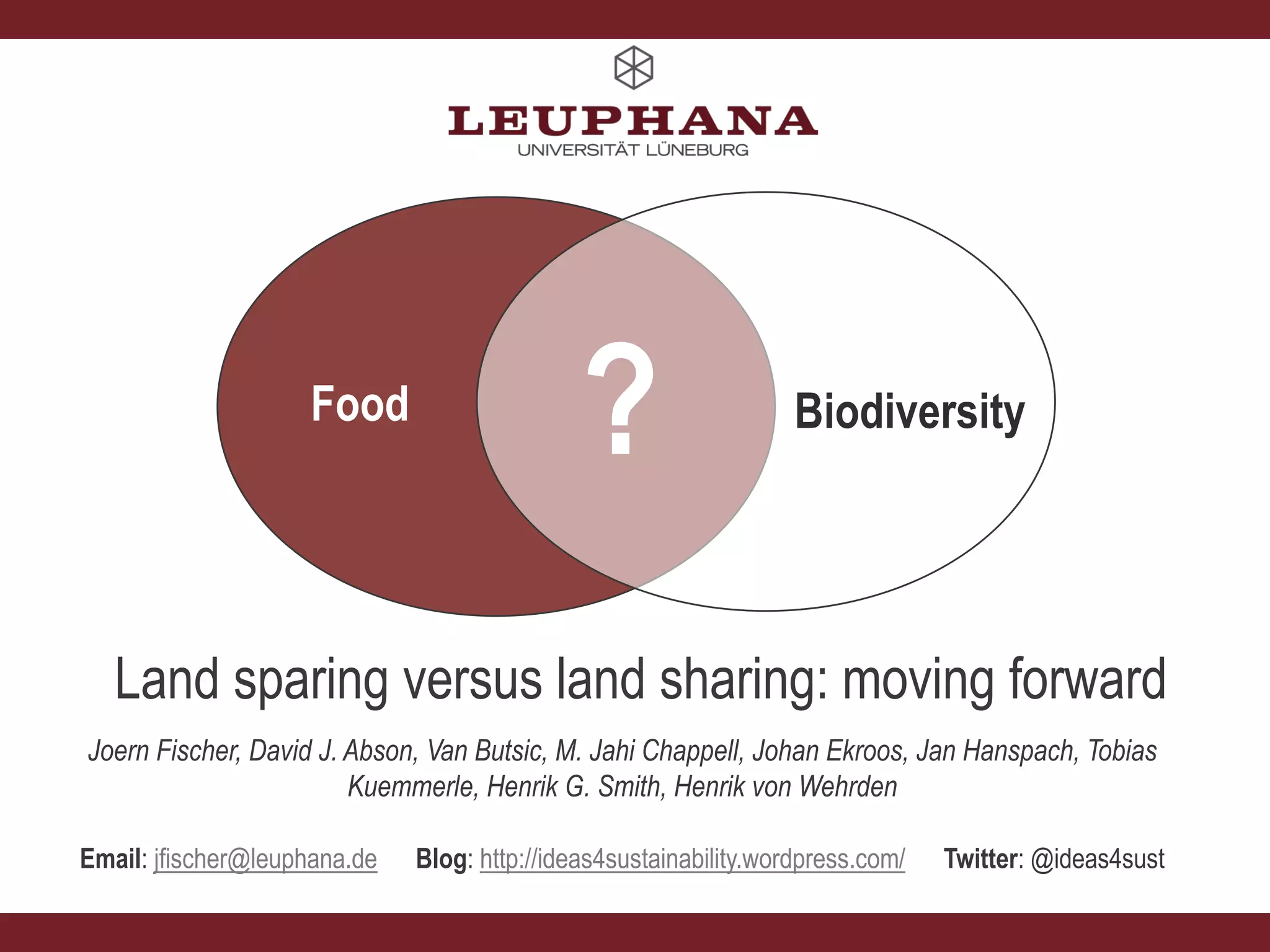
Land sparing versus land sharing: moving forward
Food Biodiversity
?
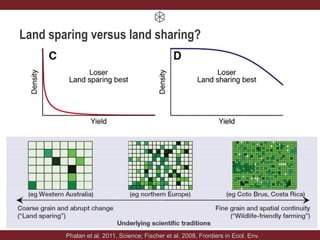
Land sparing versus land sharing?
Phalan et al. 2011, Science; Fischer et al. 2008, Frontiers in Ecol. Env.
A lively debate
How to address the nexus of
food and biodiversity?
How to foster agricultural
sustainability?
Land sparing versus sharing:
Many opinions, responses and
discussions
(Responses include: Chappell et al. 2009, Fischer et al.
2011; Hayashi 2011; Phalan et al. 2012; Wright et al. 2012;
Scariot 2013)
Debate is part of science
But not all debate is productive
(SLOSS, corridors)
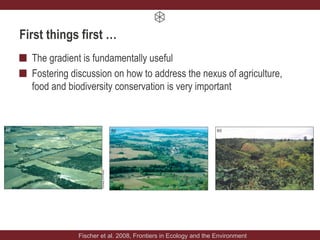
First things first …
The gradient is fundamentally useful
Fostering discussion on how to address the nexus of agriculture,
food and biodiversity conservation is very important
Fischer et al. 2008, Frontiers in Ecology and the Environment
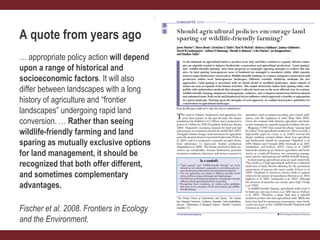
A quote from years ago
… appropriate policy action will depend
upon a range of historical and
socioeconomic factors. It will also
differ between landscapes with a long
history of agriculture and “frontier
landscapes” undergoing rapid land
conversion. … Rather than seeing
wildlife-friendly farming and land
sparing as mutually exclusive options
for land management, it should be
recognized that both offer different,
and sometimes complementary
advantages.
Fischer et al. 2008. Frontiers in Ecology
and the Environment.
Five points of friction
1. The focus on food
2. The benefits and limitations of trade-off analysis
3. The measurement of biodiversity
4. Scale issues
5. Framing problems
My hypothesis:
Through understanding these points of friction,
unproductive debate can be avoided – and we can
instead focus on moving forward
Image source: http://www.mikecurtis.org.uk/images/friction.jpg
The focus on food
Many of the most influential papers have focused on “food”
This focus is of interest to at least three bodies of scholarship,
namely on:
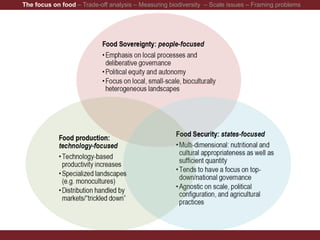
Food production
Food security
Food sovereignty
Image source: http://www.interpares.ca/photos/globeapple.gif
The focus on food – Trade-off analysis – Measuring biodiversity – Scale issues – Framing problems
Food production
Dominant discourse: “Too many people, too little food”
Traditionally, though not by necessity, focusing on:
Technology-based productivity increases
Specialized landscapes (e.g. monocultures)
Distribution handled by markets/“trickled down”
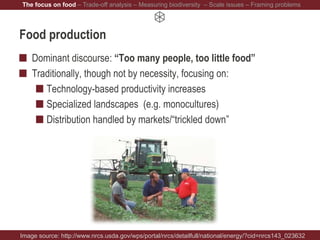
Image source: http://www.nrcs.usda.gov/wps/portal/nrcs/detailfull/national/energy/?cid=nrcs143_023632
The focus on food – Trade-off analysis – Measuring biodiversity – Scale issues – Framing problems
Food security
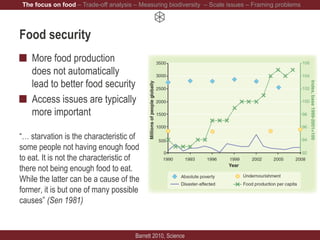
More food production
does not automatically
lead to better food security
Access issues are typically
more important
“… starvation is the characteristic of
some people not having enough food
to eat. It is not the characteristic of
there not being enough food to eat.
While the latter can be a cause of the
former, it is but one of many possible
causes” (Sen 1981)
Barrett 2010, Science
The focus on food – Trade-off analysis – Measuring biodiversity – Scale issues – Framing problems
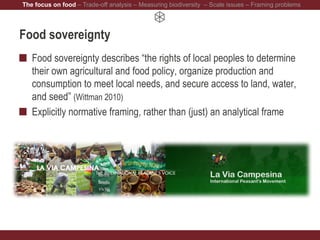
Food sovereignty
Food sovereignty describes “the rights of local peoples to determine
their own agricultural and food policy, organize production and
consumption to meet local needs, and secure access to land, water,
and seed” (Wittman 2010)
Explicitly normative framing, rather than (just) an analytical frame
The focus on food – Trade-off analysis – Measuring biodiversity – Scale issues – Framing problems
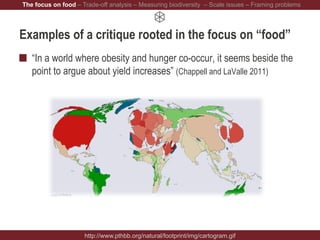
Examples of a critique rooted in the focus on “food”
“In a world where obesity and hunger co-occur, it seems beside the
point to argue about yield increases” (Chappell and LaValle 2011)
http://www.pthbb.org/natural/footprint/img/cartogram.gif
The focus on food – Trade-off analysis – Measuring biodiversity – Scale issues – Framing problems
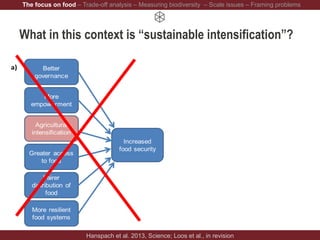
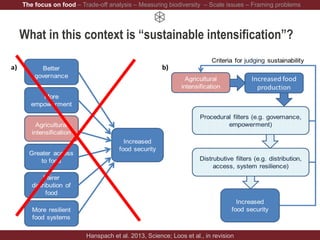
What in this context is “sustainable intensification”?
Hanspach et al. 2013, Science; Loos et al., in revision
The focus on food – Trade-off analysis – Measuring biodiversity – Scale issues – Framing problems
What in this context is “sustainable intensification”?
Hanspach et al. 2013, Science; Loos et al., in revision
The focus on food – Trade-off analysis – Measuring biodiversity – Scale issues – Framing problems
The focus on food: solutions
Food indicates an interest in “feeding” someone
Looking at food without actively engaging with food security (or
sovereignty) is open to criticism
Solution:
Frame sparing/ sharing work around the notion of “land scarcity”
Some of the land use science community is already doing this; but
many scientists single out “food” to promote their work
The focus on food – Trade-off analysis – Measuring biodiversity – Scale issues – Framing problems
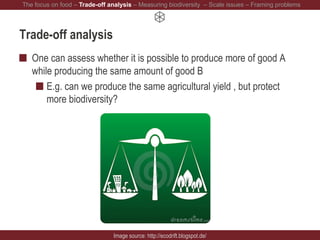
Trade-off analysis
One can assess whether it is possible to produce more of good A
while producing the same amount of good B
E.g. can we produce the same agricultural yield , but protect
more biodiversity?
Image source: http://ecodrift.blogspot.de/
The focus on food – Trade-off analysis – Measuring biodiversity – Scale issues – Framing problems
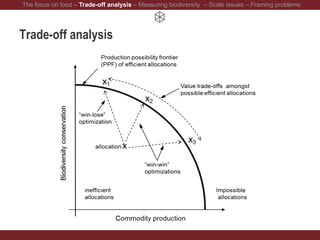
Trade-off analysis
The focus on food – Trade-off analysis – Measuring biodiversity – Scale issues – Framing problems
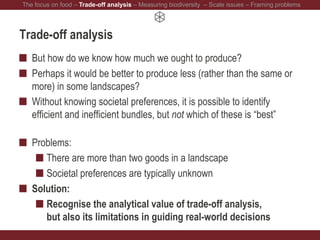
Trade-off analysis
But how do we know how much we ought to produce?
Perhaps it would be better to produce less (rather than the same or
more) in some landscapes?
Without knowing societal preferences, it is possible to identify
efficient and inefficient bundles, but not which of these is “best”
Problems:
There are more than two goods in a landscape
Societal preferences are typically unknown
Solution:
Recognise the analytical value of trade-off analysis,
but also its limitations in guiding real-world decisions
The focus on food – Trade-off analysis – Measuring biodiversity – Scale issues – Framing problems
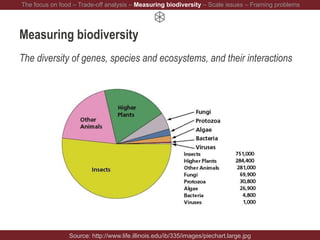
Measuring biodiversity
Source: http://www.life.illinois.edu/ib/335/images/piechart.large.jpg
The focus on food – Trade-off analysis – Measuring biodiversity – Scale issues – Framing problems
The diversity of genes, species and ecosystems, and their interactions
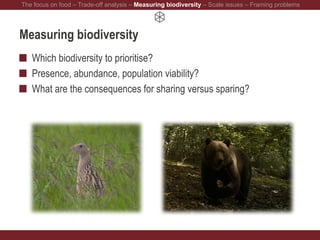
Measuring biodiversity
Which biodiversity to prioritise?
Presence, abundance, population viability?
What are the consequences for sharing versus sparing?
The focus on food – Trade-off analysis – Measuring biodiversity – Scale issues – Framing problems
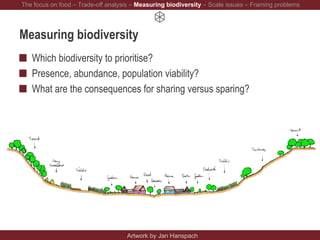
Measuring biodiversity
Which biodiversity to prioritise?
Presence, abundance, population viability?
What are the consequences for sharing versus sparing?
Artwork by Jan Hanspach
The focus on food – Trade-off analysis – Measuring biodiversity – Scale issues – Framing problems
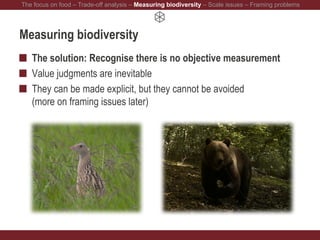
Measuring biodiversity
The solution: Recognise there is no objective measurement
Value judgments are inevitable
They can be made explicit, but they cannot be avoided
(more on framing issues later)
The focus on food – Trade-off analysis – Measuring biodiversity – Scale issues – Framing problems
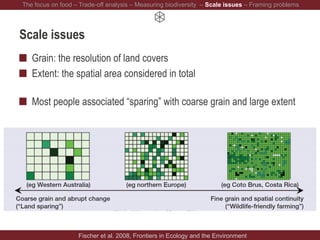
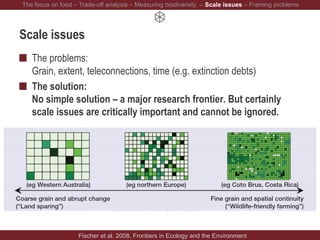
Scale issues
Grain: the resolution of land covers
Extent: the spatial area considered in total
Most people associated “sparing” with coarse grain and large extent
Fischer et al. 2008, Frontiers in Ecology and the Environment
The focus on food – Trade-off analysis – Measuring biodiversity – Scale issues – Framing problems
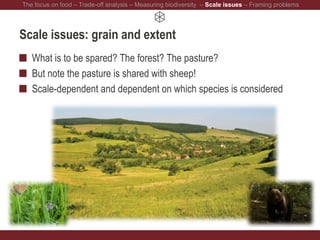
Scale issues: grain and extent
What is to be spared? The forest? The pasture?
But note the pasture is shared with sheep!
Scale-dependent and dependent on which species is considered
The focus on food – Trade-off analysis – Measuring biodiversity – Scale issues – Framing problems
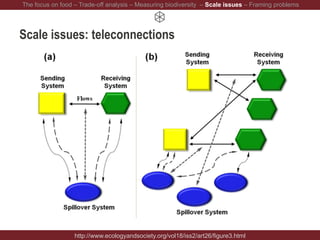
Scale issues: teleconnections
http://www.ecologyandsociety.org/vol18/iss2/art26/figure3.html
The focus on food – Trade-off analysis – Measuring biodiversity – Scale issues – Framing problems
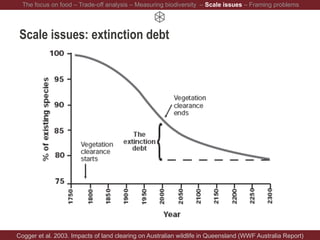
Scale issues: extinction debt
Cogger et al. 2003. Impacts of land clearing on Australian wildlife in Queensland (WWF Australia Report)
The focus on food – Trade-off analysis – Measuring biodiversity – Scale issues – Framing problems
Scale issues
The problems:
Grain, extent, teleconnections, time (e.g. extinction debts)
The solution:
No simple solution – a major research frontier. But certainly
scale issues are critically important and cannot be ignored.
Fischer et al. 2008, Frontiers in Ecology and the Environment
The focus on food – Trade-off analysis – Measuring biodiversity – Scale issues – Framing problems
Framing problems
In an effort to be “objective”, many natural scientists fall into the trap
of logical positivism
Definition: A philosophy asserting the primacy of observation in assessing the truth of
statements of fact and holding that metaphysical and subjective arguments not based on
observable data are meaningless. (www.thefreedictionary.com)
How we frame problems changes how we solve them
The trade-off between wild nature versus food
The synergies of farmland biodiversity with ecosystem services
Fostering production with minimal harm to biodiversity
Fostering food security by harnessing biodiversity
…
The focus on food – Trade-off analysis – Measuring biodiversity – Scale issues – Framing problems
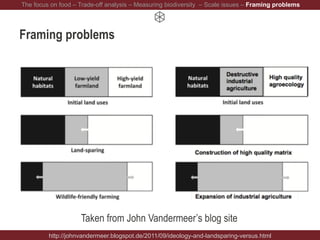
Framing problems
http://johnvandermeer.blogspot.de/2011/09/ideology-and-landsparing-versus.html
The focus on food – Trade-off analysis – Measuring biodiversity – Scale issues – Framing problems
Taken from John Vandermeer’s blog site
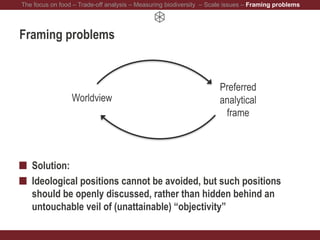
Framing problems
Solution:
Ideological positions cannot be avoided, but such positions
should be openly discussed, rather than hidden behind an
untouchable veil of (unattainable) “objectivity”
The focus on food – Trade-off analysis – Measuring biodiversity – Scale issues – Framing problems
Worldview
Preferred
analytical
frame
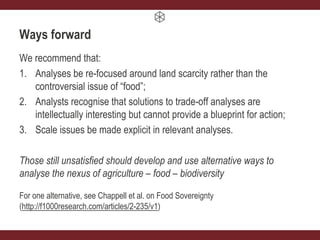
Ways forward
We recommend that:
1. Analyses be re-focused around land scarcity rather than the
controversial issue of “food”;
2. Analysts recognise that solutions to trade-off analyses are
intellectually interesting but cannot provide a blueprint for action;
3. Scale issues be made explicit in relevant analyses.
Those still unsatisfied should develop and use alternative ways to
analyse the nexus of agriculture – food – biodiversity
For one alternative, see Chappell et al. on Food Sovereignty
(http://f1000research.com/articles/2-235/v1)
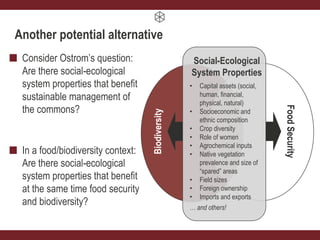
Another potential alternative
Consider Ostrom’s question:
Are there social-ecological
system properties that benefit
sustainable management of
the commons?
In a food/biodiversity context:
Are there social-ecological
system properties that benefit
at the same time food security
and biodiversity?
Social-Ecological
System Properties
Biodiversity
FoodSecurity
• Capital assets (social,
human, financial,
physical, natural)
• Socioeconomic and
ethnic composition
• Crop diversity
• Role of women
• Agrochemical inputs
• Native vegetation
prevalence and size of
“spared” areas
• Field sizes
• Foreign ownership
• Imports and exports
… and others!
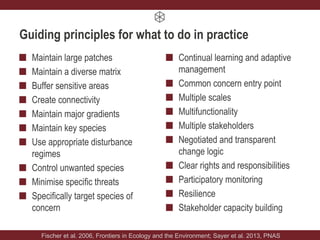
Guiding principles for what to do in practice
Maintain large patches
Maintain a diverse matrix
Buffer sensitive areas
Create connectivity
Maintain major gradients
Maintain key species
Use appropriate disturbance
regimes
Control unwanted species
Minimise specific threats
Specifically target species of
concern
Continual learning and adaptive
management
Common concern entry point
Multiple scales
Multifunctionality
Multiple stakeholders
Negotiated and transparent
change logic
Clear rights and responsibilities
Participatory monitoring
Resilience
Stakeholder capacity building
Fischer et al. 2006, Frontiers in Ecology and the Environment; Sayer et al. 2013, PNAS
Conclusion
The sparing/sharing framework has coincided with a suite of other
shifts:
From a value-driven environmental movement to focusing almost
exclusively on quantitative evidence
From local data and intuition to simple, general models
From questioning excessive demand to “needing to meet”
demand
By and large, we no longer dare to challenge the paradigms
underpinning un-sustainability
Will this new approach really achieve more?
Acknowledgements
The full paper on this talk is in press with Conservation Letters.
Thanks for funding to the Alexander von Humboldt Foundation,
and as of 2014 the European Research Council.
Thanks to all colleagues who have engaged in debate on this issue.
“… starvation is the characteristic
of some people not having enough
food to eat. It is not the
characteristic of there not being
enough food to eat. While the
latter can be a cause of the
former, it is but one of many
possible causes” (Sen 1981)
Image source: http://claudioesilvia.files.wordpress.com/2012/01/sen1.jpg

Joern escalate2

  • 1.
    Joern Fischer, DavidJ. Abson, Van Butsic, M. Jahi Chappell, Johan Ekroos, Jan Hanspach, Tobias Kuemmerle, Henrik G. Smith, Henrik von Wehrden Email: jfischer@leuphana.de Blog: http://ideas4sustainability.wordpress.com/ Twitter: @ideas4sust Land sparing versus land sharing: moving forward Food Biodiversity ?
  • 2.
    Land sparing versusland sharing? Phalan et al. 2011, Science; Fischer et al. 2008, Frontiers in Ecol. Env.
  • 3.
    A lively debate Howto address the nexus of food and biodiversity? How to foster agricultural sustainability? Land sparing versus sharing: Many opinions, responses and discussions (Responses include: Chappell et al. 2009, Fischer et al. 2011; Hayashi 2011; Phalan et al. 2012; Wright et al. 2012; Scariot 2013) Debate is part of science But not all debate is productive (SLOSS, corridors)
  • 4.
    First things first… The gradient is fundamentally useful Fostering discussion on how to address the nexus of agriculture, food and biodiversity conservation is very important Fischer et al. 2008, Frontiers in Ecology and the Environment
  • 5.
    A quote fromyears ago … appropriate policy action will depend upon a range of historical and socioeconomic factors. It will also differ between landscapes with a long history of agriculture and “frontier landscapes” undergoing rapid land conversion. … Rather than seeing wildlife-friendly farming and land sparing as mutually exclusive options for land management, it should be recognized that both offer different, and sometimes complementary advantages. Fischer et al. 2008. Frontiers in Ecology and the Environment.
  • 6.
    Five points offriction 1. The focus on food 2. The benefits and limitations of trade-off analysis 3. The measurement of biodiversity 4. Scale issues 5. Framing problems My hypothesis: Through understanding these points of friction, unproductive debate can be avoided – and we can instead focus on moving forward Image source: http://www.mikecurtis.org.uk/images/friction.jpg
  • 7.
    The focus onfood Many of the most influential papers have focused on “food” This focus is of interest to at least three bodies of scholarship, namely on: Food production Food security Food sovereignty Image source: http://www.interpares.ca/photos/globeapple.gif The focus on food – Trade-off analysis – Measuring biodiversity – Scale issues – Framing problems
  • 8.
    Food production Dominant discourse:“Too many people, too little food” Traditionally, though not by necessity, focusing on: Technology-based productivity increases Specialized landscapes (e.g. monocultures) Distribution handled by markets/“trickled down” Image source: http://www.nrcs.usda.gov/wps/portal/nrcs/detailfull/national/energy/?cid=nrcs143_023632 The focus on food – Trade-off analysis – Measuring biodiversity – Scale issues – Framing problems
  • 9.
    Food security More foodproduction does not automatically lead to better food security Access issues are typically more important “… starvation is the characteristic of some people not having enough food to eat. It is not the characteristic of there not being enough food to eat. While the latter can be a cause of the former, it is but one of many possible causes” (Sen 1981) Barrett 2010, Science The focus on food – Trade-off analysis – Measuring biodiversity – Scale issues – Framing problems
  • 10.
    Food sovereignty Food sovereigntydescribes “the rights of local peoples to determine their own agricultural and food policy, organize production and consumption to meet local needs, and secure access to land, water, and seed” (Wittman 2010) Explicitly normative framing, rather than (just) an analytical frame The focus on food – Trade-off analysis – Measuring biodiversity – Scale issues – Framing problems
  • 11.
    The focus onfood – Trade-off analysis – Measuring biodiversity – Scale issues – Framing problems
  • 12.
    Examples of acritique rooted in the focus on “food” “In a world where obesity and hunger co-occur, it seems beside the point to argue about yield increases” (Chappell and LaValle 2011) http://www.pthbb.org/natural/footprint/img/cartogram.gif The focus on food – Trade-off analysis – Measuring biodiversity – Scale issues – Framing problems
  • 13.
    What in thiscontext is “sustainable intensification”? Hanspach et al. 2013, Science; Loos et al., in revision The focus on food – Trade-off analysis – Measuring biodiversity – Scale issues – Framing problems
  • 14.
    What in thiscontext is “sustainable intensification”? Hanspach et al. 2013, Science; Loos et al., in revision The focus on food – Trade-off analysis – Measuring biodiversity – Scale issues – Framing problems
  • 15.
    The focus onfood: solutions Food indicates an interest in “feeding” someone Looking at food without actively engaging with food security (or sovereignty) is open to criticism Solution: Frame sparing/ sharing work around the notion of “land scarcity” Some of the land use science community is already doing this; but many scientists single out “food” to promote their work The focus on food – Trade-off analysis – Measuring biodiversity – Scale issues – Framing problems
  • 16.
    Trade-off analysis One canassess whether it is possible to produce more of good A while producing the same amount of good B E.g. can we produce the same agricultural yield , but protect more biodiversity? Image source: http://ecodrift.blogspot.de/ The focus on food – Trade-off analysis – Measuring biodiversity – Scale issues – Framing problems
  • 17.
    Trade-off analysis The focuson food – Trade-off analysis – Measuring biodiversity – Scale issues – Framing problems
  • 18.
    Trade-off analysis But howdo we know how much we ought to produce? Perhaps it would be better to produce less (rather than the same or more) in some landscapes? Without knowing societal preferences, it is possible to identify efficient and inefficient bundles, but not which of these is “best” Problems: There are more than two goods in a landscape Societal preferences are typically unknown Solution: Recognise the analytical value of trade-off analysis, but also its limitations in guiding real-world decisions The focus on food – Trade-off analysis – Measuring biodiversity – Scale issues – Framing problems
  • 19.
    Measuring biodiversity Source: http://www.life.illinois.edu/ib/335/images/piechart.large.jpg Thefocus on food – Trade-off analysis – Measuring biodiversity – Scale issues – Framing problems The diversity of genes, species and ecosystems, and their interactions
  • 20.
    Measuring biodiversity Which biodiversityto prioritise? Presence, abundance, population viability? What are the consequences for sharing versus sparing? The focus on food – Trade-off analysis – Measuring biodiversity – Scale issues – Framing problems
  • 21.
    Measuring biodiversity Which biodiversityto prioritise? Presence, abundance, population viability? What are the consequences for sharing versus sparing? Artwork by Jan Hanspach The focus on food – Trade-off analysis – Measuring biodiversity – Scale issues – Framing problems
  • 22.
    Measuring biodiversity The solution:Recognise there is no objective measurement Value judgments are inevitable They can be made explicit, but they cannot be avoided (more on framing issues later) The focus on food – Trade-off analysis – Measuring biodiversity – Scale issues – Framing problems
  • 23.
    Scale issues Grain: theresolution of land covers Extent: the spatial area considered in total Most people associated “sparing” with coarse grain and large extent Fischer et al. 2008, Frontiers in Ecology and the Environment The focus on food – Trade-off analysis – Measuring biodiversity – Scale issues – Framing problems
  • 24.
    Scale issues: grainand extent What is to be spared? The forest? The pasture? But note the pasture is shared with sheep! Scale-dependent and dependent on which species is considered The focus on food – Trade-off analysis – Measuring biodiversity – Scale issues – Framing problems
  • 25.
    Scale issues: teleconnections http://www.ecologyandsociety.org/vol18/iss2/art26/figure3.html Thefocus on food – Trade-off analysis – Measuring biodiversity – Scale issues – Framing problems
  • 26.
    Scale issues: extinctiondebt Cogger et al. 2003. Impacts of land clearing on Australian wildlife in Queensland (WWF Australia Report) The focus on food – Trade-off analysis – Measuring biodiversity – Scale issues – Framing problems
  • 27.
    Scale issues The problems: Grain,extent, teleconnections, time (e.g. extinction debts) The solution: No simple solution – a major research frontier. But certainly scale issues are critically important and cannot be ignored. Fischer et al. 2008, Frontiers in Ecology and the Environment The focus on food – Trade-off analysis – Measuring biodiversity – Scale issues – Framing problems
  • 28.
    Framing problems In aneffort to be “objective”, many natural scientists fall into the trap of logical positivism Definition: A philosophy asserting the primacy of observation in assessing the truth of statements of fact and holding that metaphysical and subjective arguments not based on observable data are meaningless. (www.thefreedictionary.com) How we frame problems changes how we solve them The trade-off between wild nature versus food The synergies of farmland biodiversity with ecosystem services Fostering production with minimal harm to biodiversity Fostering food security by harnessing biodiversity … The focus on food – Trade-off analysis – Measuring biodiversity – Scale issues – Framing problems
  • 29.
    Framing problems http://johnvandermeer.blogspot.de/2011/09/ideology-and-landsparing-versus.html The focuson food – Trade-off analysis – Measuring biodiversity – Scale issues – Framing problems Taken from John Vandermeer’s blog site
  • 30.
    Framing problems Solution: Ideological positionscannot be avoided, but such positions should be openly discussed, rather than hidden behind an untouchable veil of (unattainable) “objectivity” The focus on food – Trade-off analysis – Measuring biodiversity – Scale issues – Framing problems Worldview Preferred analytical frame
  • 31.
    Ways forward We recommendthat: 1. Analyses be re-focused around land scarcity rather than the controversial issue of “food”; 2. Analysts recognise that solutions to trade-off analyses are intellectually interesting but cannot provide a blueprint for action; 3. Scale issues be made explicit in relevant analyses. Those still unsatisfied should develop and use alternative ways to analyse the nexus of agriculture – food – biodiversity For one alternative, see Chappell et al. on Food Sovereignty (http://f1000research.com/articles/2-235/v1)
  • 32.
    Another potential alternative ConsiderOstrom’s question: Are there social-ecological system properties that benefit sustainable management of the commons? In a food/biodiversity context: Are there social-ecological system properties that benefit at the same time food security and biodiversity? Social-Ecological System Properties Biodiversity FoodSecurity • Capital assets (social, human, financial, physical, natural) • Socioeconomic and ethnic composition • Crop diversity • Role of women • Agrochemical inputs • Native vegetation prevalence and size of “spared” areas • Field sizes • Foreign ownership • Imports and exports … and others!
  • 33.
    Guiding principles forwhat to do in practice Maintain large patches Maintain a diverse matrix Buffer sensitive areas Create connectivity Maintain major gradients Maintain key species Use appropriate disturbance regimes Control unwanted species Minimise specific threats Specifically target species of concern Continual learning and adaptive management Common concern entry point Multiple scales Multifunctionality Multiple stakeholders Negotiated and transparent change logic Clear rights and responsibilities Participatory monitoring Resilience Stakeholder capacity building Fischer et al. 2006, Frontiers in Ecology and the Environment; Sayer et al. 2013, PNAS
  • 34.
    Conclusion The sparing/sharing frameworkhas coincided with a suite of other shifts: From a value-driven environmental movement to focusing almost exclusively on quantitative evidence From local data and intuition to simple, general models From questioning excessive demand to “needing to meet” demand By and large, we no longer dare to challenge the paradigms underpinning un-sustainability Will this new approach really achieve more?
  • 35.
    Acknowledgements The full paperon this talk is in press with Conservation Letters. Thanks for funding to the Alexander von Humboldt Foundation, and as of 2014 the European Research Council. Thanks to all colleagues who have engaged in debate on this issue. “… starvation is the characteristic of some people not having enough food to eat. It is not the characteristic of there not being enough food to eat. While the latter can be a cause of the former, it is but one of many possible causes” (Sen 1981) Image source: http://claudioesilvia.files.wordpress.com/2012/01/sen1.jpg