
J O B C O S T I N G
• A form of specific order costing which applies where the work is
undertaken as an identifiable unit on the basis specific requisition
or order of the customer
• A method of cost accounting whereby cost is compiled for a specific
quantity of product, equipment, repair or other service that move
through the production process as an identifiable unit in terms of
different cost elements as material, labor and overheads
• Costs are collected and accumulated for each job, work order or
project separately; each job is separately identifiable is terms of
different cost elements
• Applicable to printers, machine tool manufacturers, general
engineering workshops, interior decorators etc, who undertake and
execute work according to the order of the customers
• It refers to costing of jobs that are executed against specific orders
Features of Job Order Costing
1. Production is against customer’s order and not for stock
2. Each job has its own characteristics and needs special
treatment
3. No uniformity in the flow of production form department to
department. The nature of job determine the flow
4. Production is intermittent (irregular) and not continuous
5. Each job is treated as a cost unit
6. Each job is specifically identifiable by a production order
throughout the production process or till completion
7. Cost of production of each job is ascertained after
completion
8. Work in progress differ from period to period according to
the number of orders or jobs in hand
Objectives of Job Order Costing
1. To find out cost of production of each job or order
and to know profit or loss made on its execution,
which helps the management to judge profitability of
each job and to plan for future
2. To help the management to make more accurate
estimates for cost of similar jobs to be executed in
future. Management can more easily and accurately
determine and quote prices of jobs of similar jobs
3. To help management to control operational
inefficiency by comparing actual costs with estimates
or standards
4. To help in the valuation of work-in-progress
Advantages of Job Order Costing
1. Provides for a detailed analysis of different elements of cost. This
helps the management to determine the operational efficiency of
different factor of production, production centers and functional
units
2. Records costs more accurately and facilitates cost control by
comparing actual with estimates or standards
3. Helps the management to determine profitability of different jobs
or orders
4. Provides a basis for estimating costs of similar jobs or order to be
taken in future and helps in production planning
5. Helps to identify wastages, spoilages and defectives with specific
jobs or orders and departments, which in turn helps to control
losses and to reduce costs
6. Detailed cost records of the past yeas help to determine the trend
in cost of production and their relative efficiencies
7. It helps in quoting cost plus contract
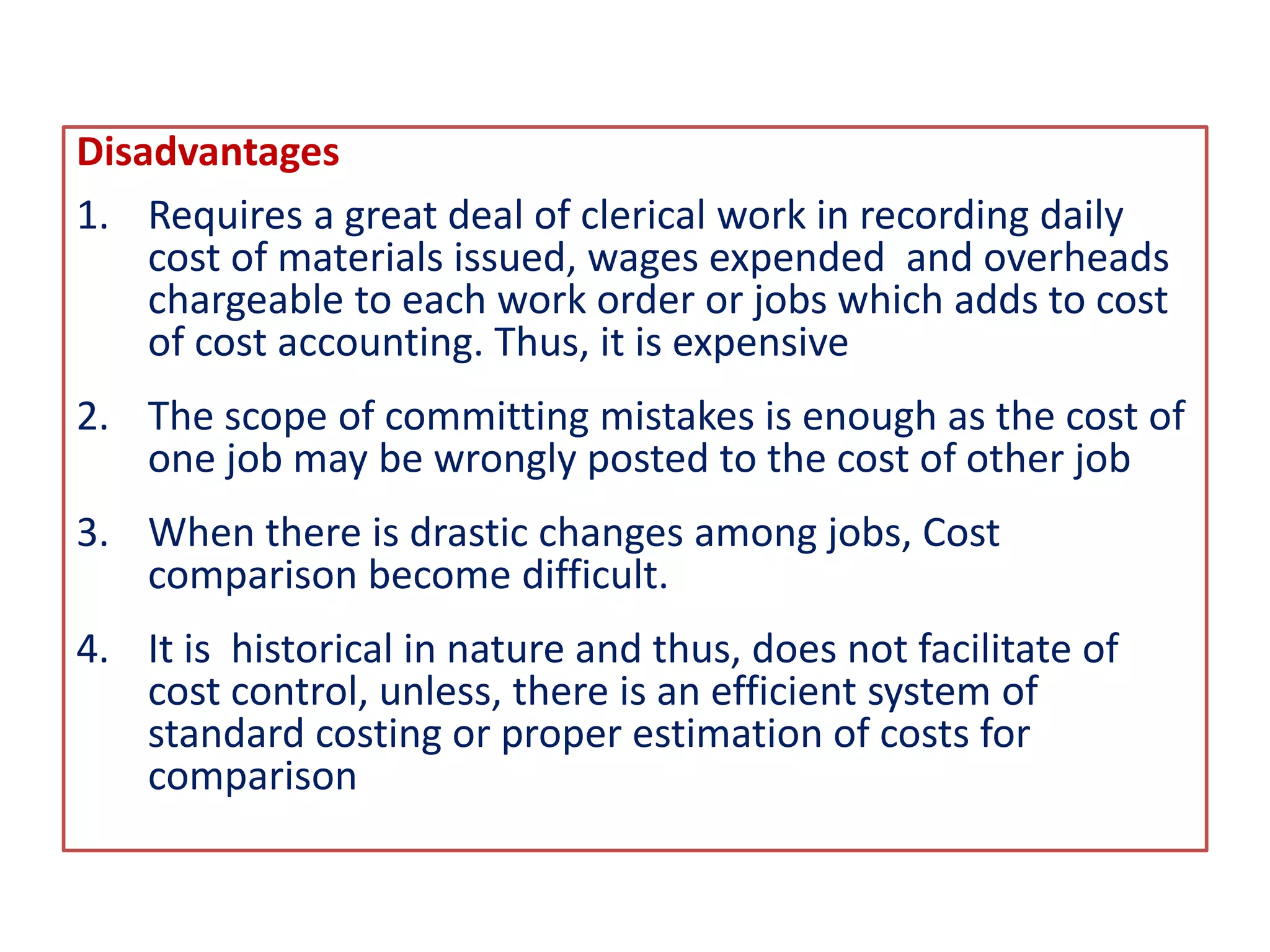
Disadvantages
1. Requires a great deal of clerical work in recording daily
cost of materials issued, wages expended and overheads
chargeable to each work order or jobs which adds to cost
of cost accounting. Thus, it is expensive
2. The scope of committing mistakes is enough as the cost of
one job may be wrongly posted to the cost of other job
3. When there is drastic changes among jobs, Cost
comparison become difficult.
4. It is historical in nature and thus, does not facilitate of
cost control, unless, there is an efficient system of
standard costing or proper estimation of costs for
comparison
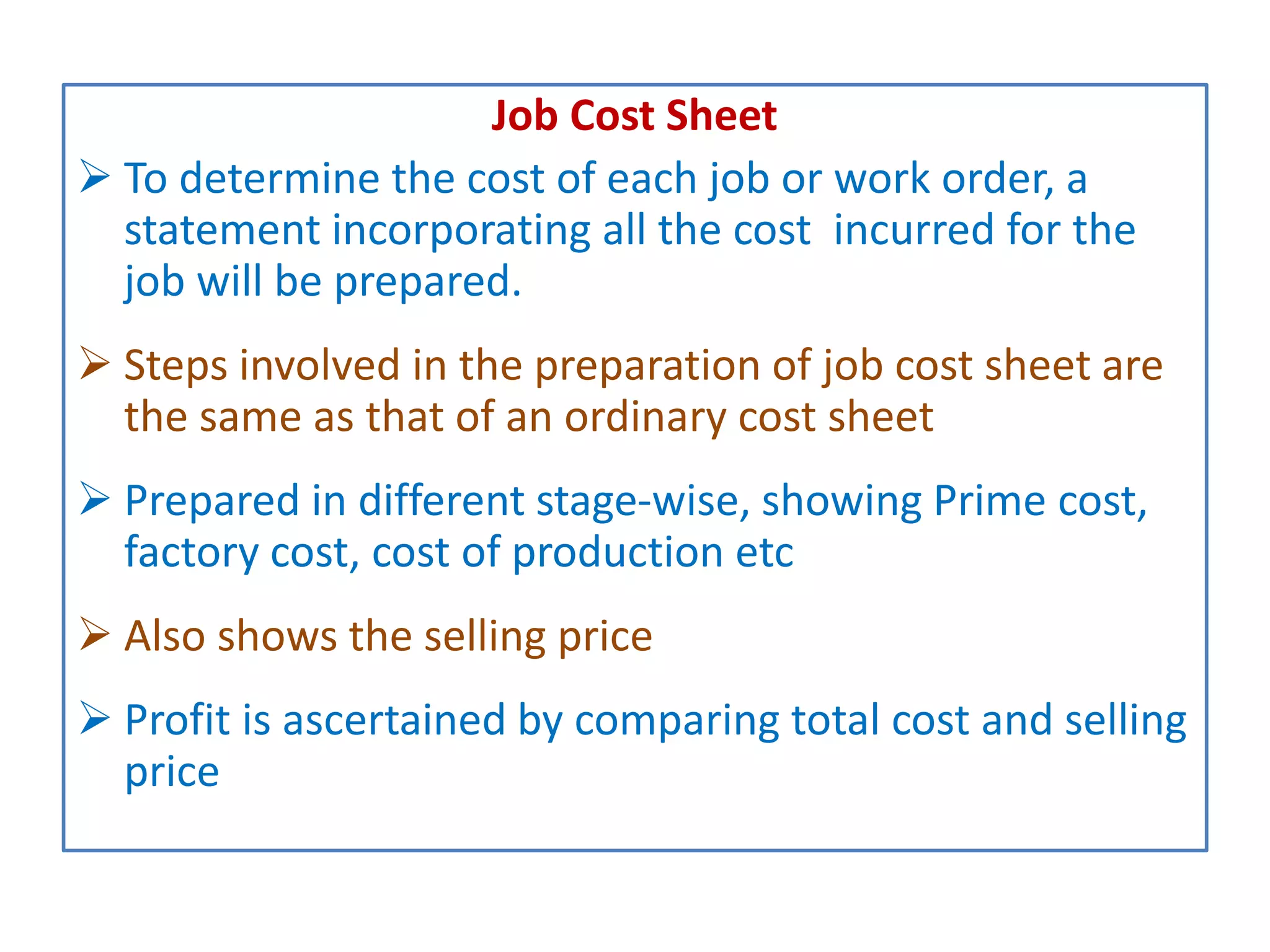
Job Cost Sheet
 To determine the cost of each job or work order, a
statement incorporating all the cost incurred for the
job will be prepared.
 Steps involved in the preparation of job cost sheet are
the same as that of an ordinary cost sheet
 Prepared in different stage-wise, showing Prime cost,
factory cost, cost of production etc
 Also shows the selling price
 Profit is ascertained by comparing total cost and selling
price
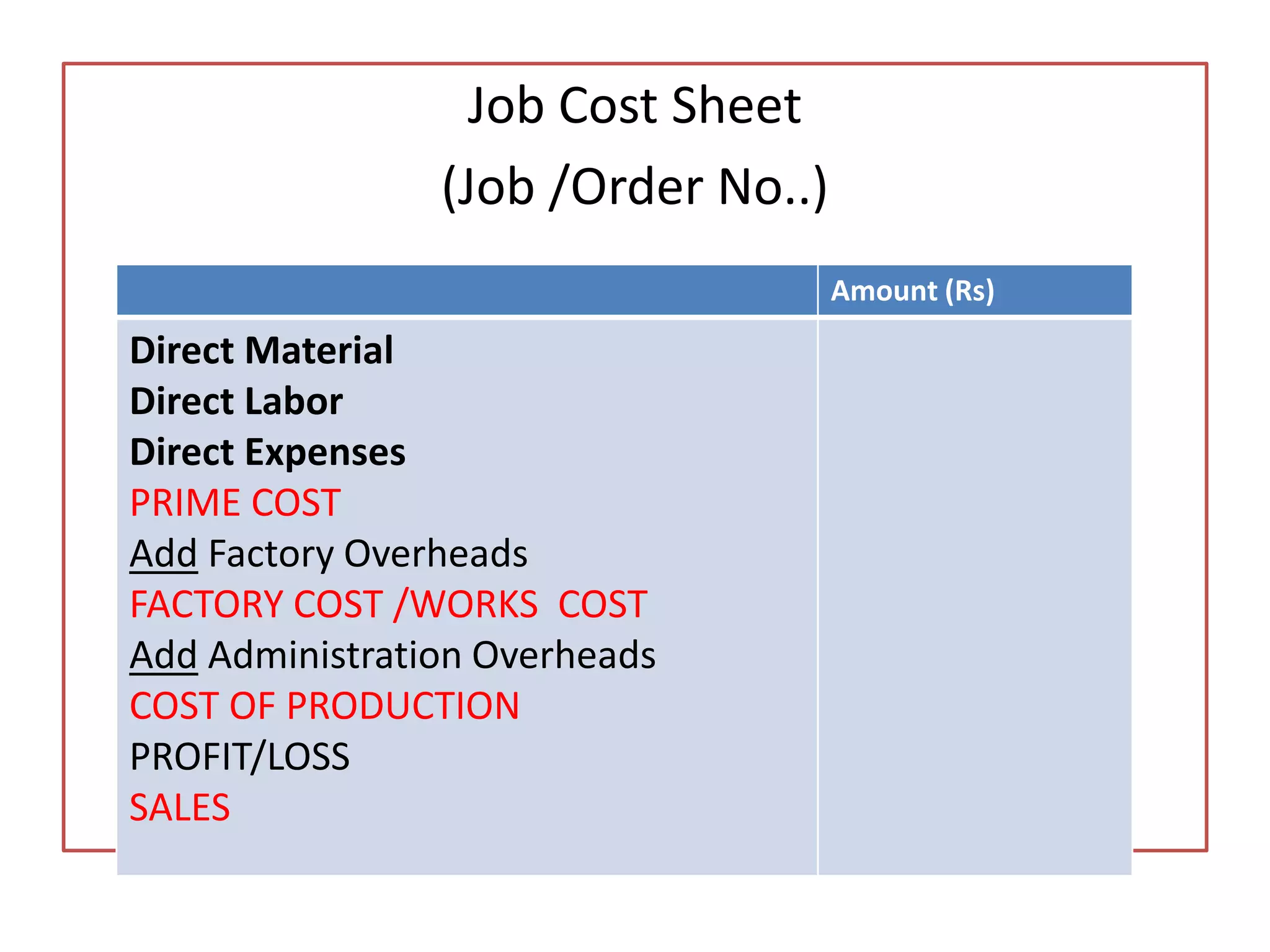
Job Cost Sheet
(Job /Order No..)
Amount (Rs)
Direct Material
Direct Labor
Direct Expenses
PRIME COST
Add Factory Overheads
FACTORY COST /WORKS COST
Add Administration Overheads
COST OF PRODUCTION
PROFIT/LOSS
SALES
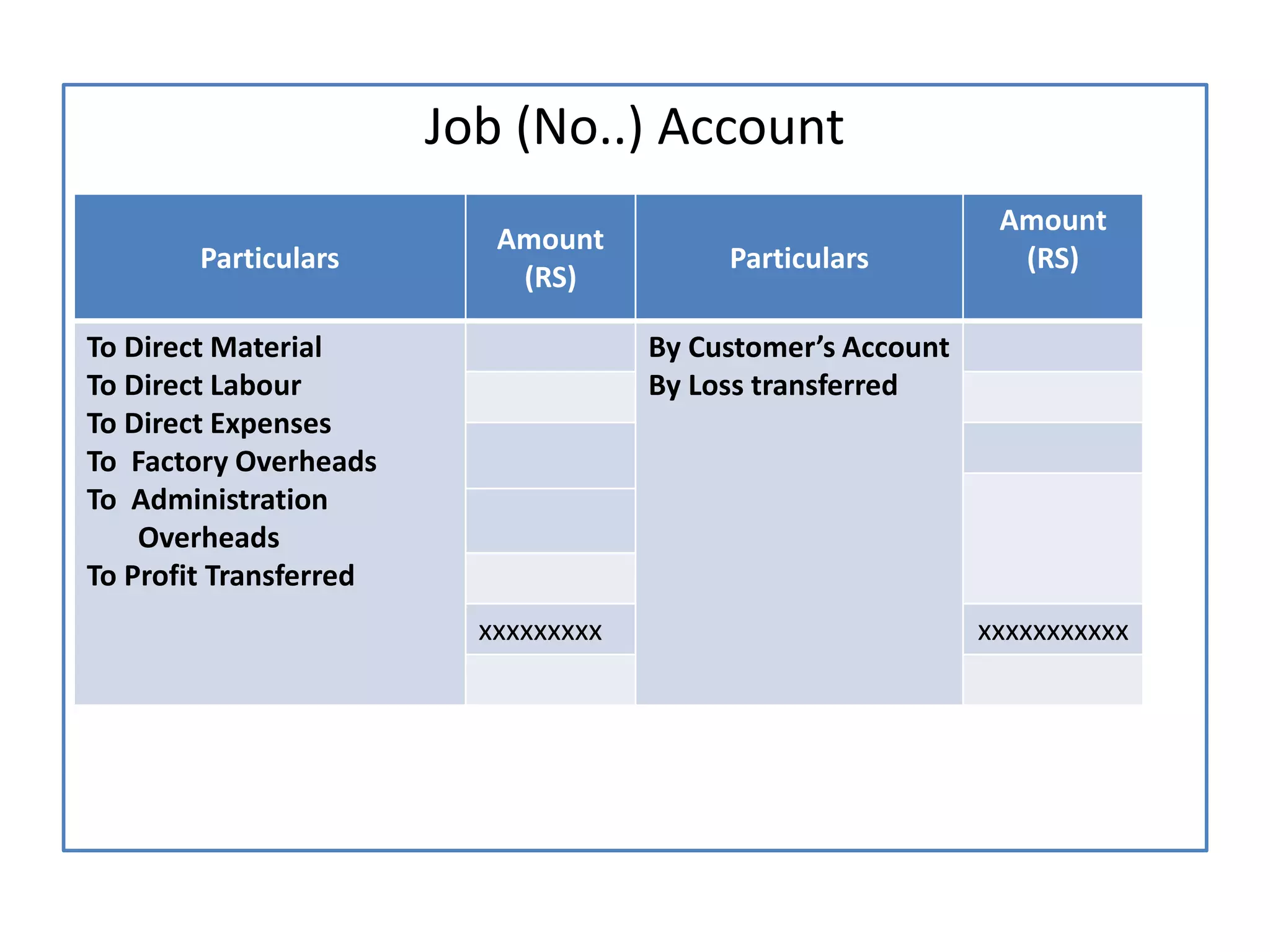
Job (No..) Account
Particulars
Amount
(RS)
Particulars
Amount
(RS)
To Direct Material
To Direct Labour
To Direct Expenses
To Factory Overheads
To Administration
Overheads
To Profit Transferred
By Customer’s Account
By Loss transferred
xxxxxxxxx xxxxxxxxxxx
BATCH COSTING
• Specific order costing
• This method is followed when the firm produces
different items of goods in batches
• Batch costing is adopted to determine the cost of each
batch and unit cost, when goods as produced in
different batches for stock
• Each batch consisting of a predetermined number of
products
• Firms engaged in producing chemicals and component
parts etc. may also adopt batch production
• Cost per unit is ascertained by dividing the total cost of
a batch by the number of items produced in that batch
BATCH COST SHEET
A cost statement prepared to ascertain the cost of each batch.
Preparation and stages involved in the preparation of batch cost sheet are
the same as that of ordinary cost sheet
Economic Batch Quantity Or Economic Lot Size
Optimum quantity for a batch for which, the setting up and carrying costs
are minimum
For a batch production, machinery, tools and facilities are to be set up
Maximum number of production reduces the per unit setting up cost
At the same time higher production result in large inventory, which increase
the carrying cost
Economic batch size off set the high carrying cost by the reduced set up cost
(i). Set up cost (ii). Manufacturing cost (iii). Interest on capital (iv) storage cost
and (v) rate of consumption are the factors affecting economic lot size
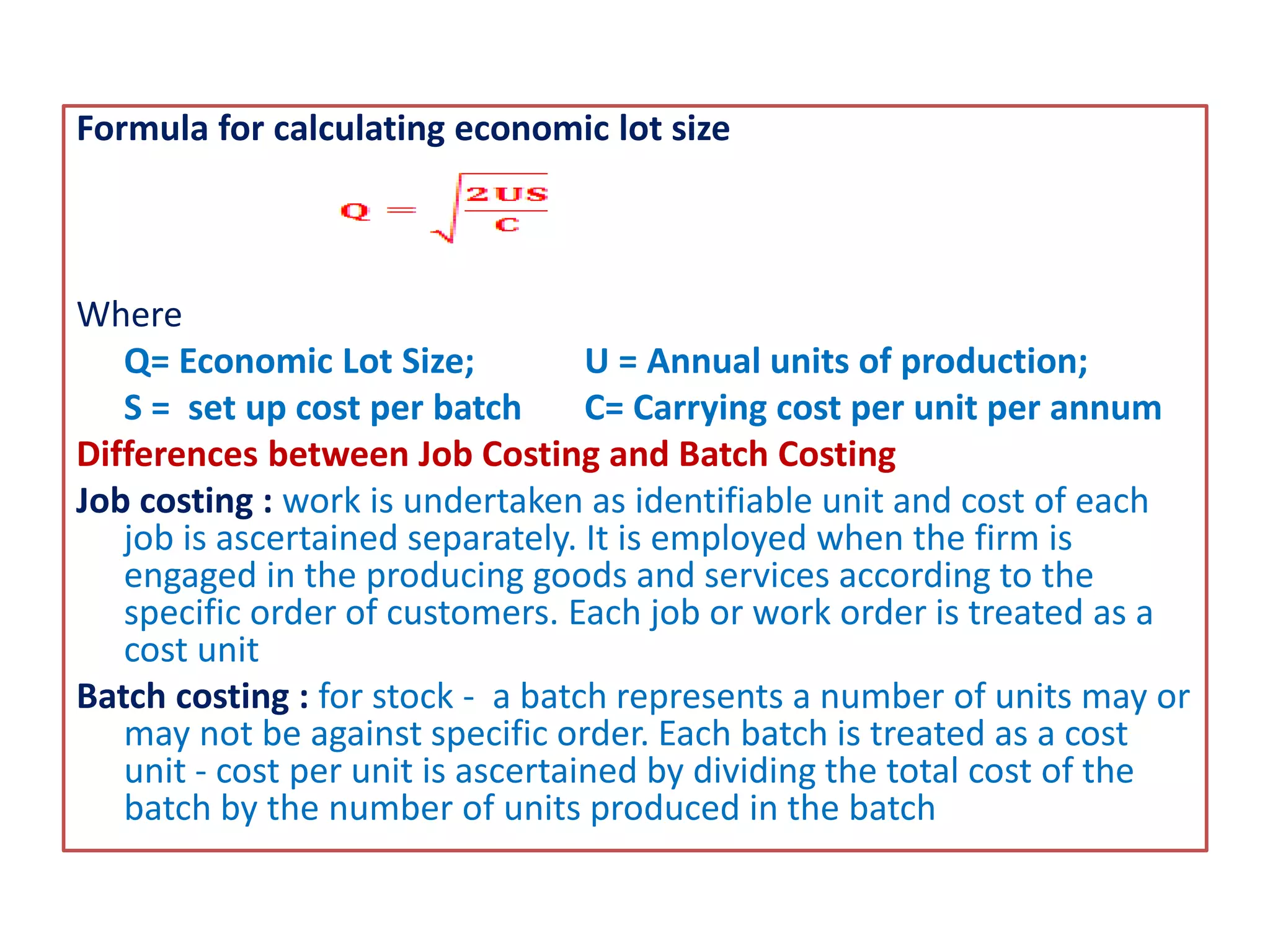
Formula for calculating economic lot size
Where
Q= Economic Lot Size; U = Annual units of production;
S = set up cost per batch C= Carrying cost per unit per annum
Differences between Job Costing and Batch Costing
Job costing : work is undertaken as identifiable unit and cost of each
job is ascertained separately. It is employed when the firm is
engaged in the producing goods and services according to the
specific order of customers. Each job or work order is treated as a
cost unit
Batch costing : for stock - a batch represents a number of units may or
may not be against specific order. Each batch is treated as a cost
unit - cost per unit is ascertained by dividing the total cost of the
batch by the number of units produced in the batch

Job costing and batch costing

  • 2.
    J O BC O S T I N G • A form of specific order costing which applies where the work is undertaken as an identifiable unit on the basis specific requisition or order of the customer • A method of cost accounting whereby cost is compiled for a specific quantity of product, equipment, repair or other service that move through the production process as an identifiable unit in terms of different cost elements as material, labor and overheads • Costs are collected and accumulated for each job, work order or project separately; each job is separately identifiable is terms of different cost elements • Applicable to printers, machine tool manufacturers, general engineering workshops, interior decorators etc, who undertake and execute work according to the order of the customers • It refers to costing of jobs that are executed against specific orders
  • 3.
    Features of JobOrder Costing 1. Production is against customer’s order and not for stock 2. Each job has its own characteristics and needs special treatment 3. No uniformity in the flow of production form department to department. The nature of job determine the flow 4. Production is intermittent (irregular) and not continuous 5. Each job is treated as a cost unit 6. Each job is specifically identifiable by a production order throughout the production process or till completion 7. Cost of production of each job is ascertained after completion 8. Work in progress differ from period to period according to the number of orders or jobs in hand
  • 4.
    Objectives of JobOrder Costing 1. To find out cost of production of each job or order and to know profit or loss made on its execution, which helps the management to judge profitability of each job and to plan for future 2. To help the management to make more accurate estimates for cost of similar jobs to be executed in future. Management can more easily and accurately determine and quote prices of jobs of similar jobs 3. To help management to control operational inefficiency by comparing actual costs with estimates or standards 4. To help in the valuation of work-in-progress
  • 5.
    Advantages of JobOrder Costing 1. Provides for a detailed analysis of different elements of cost. This helps the management to determine the operational efficiency of different factor of production, production centers and functional units 2. Records costs more accurately and facilitates cost control by comparing actual with estimates or standards 3. Helps the management to determine profitability of different jobs or orders 4. Provides a basis for estimating costs of similar jobs or order to be taken in future and helps in production planning 5. Helps to identify wastages, spoilages and defectives with specific jobs or orders and departments, which in turn helps to control losses and to reduce costs 6. Detailed cost records of the past yeas help to determine the trend in cost of production and their relative efficiencies 7. It helps in quoting cost plus contract
  • 6.
    Disadvantages 1. Requires agreat deal of clerical work in recording daily cost of materials issued, wages expended and overheads chargeable to each work order or jobs which adds to cost of cost accounting. Thus, it is expensive 2. The scope of committing mistakes is enough as the cost of one job may be wrongly posted to the cost of other job 3. When there is drastic changes among jobs, Cost comparison become difficult. 4. It is historical in nature and thus, does not facilitate of cost control, unless, there is an efficient system of standard costing or proper estimation of costs for comparison
  • 7.
    Job Cost Sheet To determine the cost of each job or work order, a statement incorporating all the cost incurred for the job will be prepared.  Steps involved in the preparation of job cost sheet are the same as that of an ordinary cost sheet  Prepared in different stage-wise, showing Prime cost, factory cost, cost of production etc  Also shows the selling price  Profit is ascertained by comparing total cost and selling price
  • 8.
    Job Cost Sheet (Job/Order No..) Amount (Rs) Direct Material Direct Labor Direct Expenses PRIME COST Add Factory Overheads FACTORY COST /WORKS COST Add Administration Overheads COST OF PRODUCTION PROFIT/LOSS SALES
  • 9.
    Job (No..) Account Particulars Amount (RS) Particulars Amount (RS) ToDirect Material To Direct Labour To Direct Expenses To Factory Overheads To Administration Overheads To Profit Transferred By Customer’s Account By Loss transferred xxxxxxxxx xxxxxxxxxxx
  • 10.
    BATCH COSTING • Specificorder costing • This method is followed when the firm produces different items of goods in batches • Batch costing is adopted to determine the cost of each batch and unit cost, when goods as produced in different batches for stock • Each batch consisting of a predetermined number of products • Firms engaged in producing chemicals and component parts etc. may also adopt batch production • Cost per unit is ascertained by dividing the total cost of a batch by the number of items produced in that batch
  • 11.
    BATCH COST SHEET Acost statement prepared to ascertain the cost of each batch. Preparation and stages involved in the preparation of batch cost sheet are the same as that of ordinary cost sheet Economic Batch Quantity Or Economic Lot Size Optimum quantity for a batch for which, the setting up and carrying costs are minimum For a batch production, machinery, tools and facilities are to be set up Maximum number of production reduces the per unit setting up cost At the same time higher production result in large inventory, which increase the carrying cost Economic batch size off set the high carrying cost by the reduced set up cost (i). Set up cost (ii). Manufacturing cost (iii). Interest on capital (iv) storage cost and (v) rate of consumption are the factors affecting economic lot size
  • 12.
    Formula for calculatingeconomic lot size Where Q= Economic Lot Size; U = Annual units of production; S = set up cost per batch C= Carrying cost per unit per annum Differences between Job Costing and Batch Costing Job costing : work is undertaken as identifiable unit and cost of each job is ascertained separately. It is employed when the firm is engaged in the producing goods and services according to the specific order of customers. Each job or work order is treated as a cost unit Batch costing : for stock - a batch represents a number of units may or may not be against specific order. Each batch is treated as a cost unit - cost per unit is ascertained by dividing the total cost of the batch by the number of units produced in the batch