S C H O O L O F E N V I R O N M E N T
Living in a warmer world 4 December 2014
Living in a warmer world:
Climate change impacts on Auckland
Dr Jim Salinger,
School of Environment
University of Auckland
j.salinger@auckland.ac.nz
Living in a warmer world: 4 December 2014
Outline
•  Our changing climate
•  Future projections: Auckland
•  Impacts: Extremes
•  Agriculture and Health
•  Oceans and fisheries
•  Pacific Communities – our front yard
Living in a warmer world: 4 December 2014
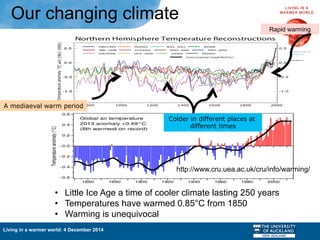
Our changing climate
•  Little Ice Age a time of cooler climate lasting 250 years
•  Temperatures have warmed 0.85°C from 1850
•  Warming is unequivocal
A mediaeval warm period
Rapid warming
Colder in different places at
different times
http://www.cru.uea.ac.uk/cru/info/warming/
Living in a warmer world: 4 December 2014
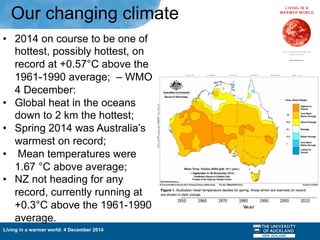
•  2014 on course to be one of
hottest, possibly hottest, on
record at +0.57°C above the
1961-1990 average; – WMO
4 December:
•  Global heat in the oceans
down to 2 km the hottest;
•  Spring 2014 was Australia’s
warmest on record;
•  Mean temperatures were
1.67 °C above average;
•  NZ not heading for any
record, currently running at
+0.3°C above the 1961-1990
average.
Our changing climate
Living in a warmer world: 4 December 2014
Our changing climate
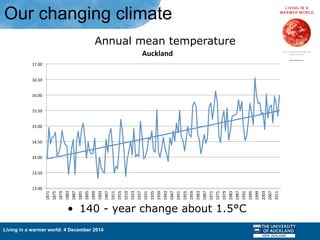
Annual mean temperature
•  140 - year change about 1.5°C
13.00	
  
13.50	
  
14.00	
  
14.50	
  
15.00	
  
15.50	
  
16.00	
  
16.50	
  
17.00	
  
1871	
  
1875	
  
1879	
  
1883	
  
1887	
  
1891	
  
1895	
  
1899	
  
1903	
  
1907	
  
1911	
  
1915	
  
1919	
  
1923	
  
1927	
  
1931	
  
1935	
  
1939	
  
1943	
  
1947	
  
1951	
  
1955	
  
1959	
  
1963	
  
1967	
  
1971	
  
1975	
  
1979	
  
1983	
  
1987	
  
1991	
  
1995	
  
1999	
  
2003	
  
2007	
  
2011	
  
Auckland	
  
Living in a warmer world: 4 December 2014
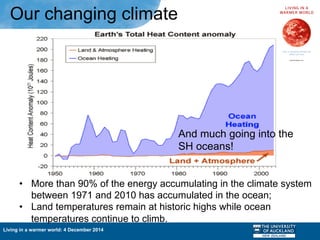
•  More than 90% of the energy accumulating in the climate system
between 1971 and 2010 has accumulated in the ocean;
•  Land temperatures remain at historic highs while ocean
temperatures continue to climb.
And much going into the
SH oceans!
Our changing climate
Living in a warmer world: 4 December 2014
Our changing climate
Living in a warmer world: 4 December 2014
Our changing climate
-­‐1.5	
  
-­‐1	
  
-­‐0.5	
  
0	
  
0.5	
  
1	
  
1.5	
  
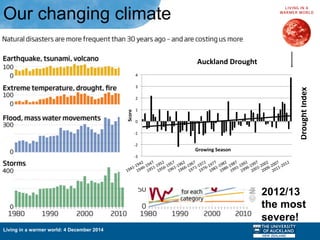
Drought	
  Index	
  
Growing	
  Season	
  
New	
  Zealand	
  Drought	
  Index	
  
1941	
  -­‐	
  2013	
  
-­‐3	
  
-­‐2	
  
-­‐1	
  
0	
  
1	
  
2	
  
3	
  
4	
  
Score	
  
Growing	
  Season	
  
Auckland	
  Drought	
  	
  
2012/13
the most
severe!
Living in a warmer world: 4 December 2014
Our changing climate
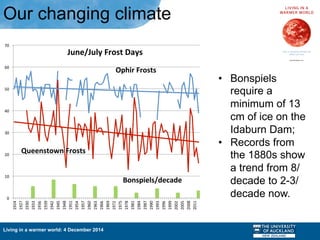
•  Bonspiels
require a
minimum of 13
cm of ice on the
Idaburn Dam;
•  Records from
the 1880s show
a trend from 8/
decade to 2-3/
decade now.0	
  
10	
  
20	
  
30	
  
40	
  
50	
  
60	
  
70	
  
1924	
  
1927	
  
1930	
  
1933	
  
1936	
  
1939	
  
1942	
  
1945	
  
1948	
  
1951	
  
1954	
  
1957	
  
1960	
  
1963	
  
1966	
  
1969	
  
1972	
  
1975	
  
1978	
  
1981	
  
1984	
  
1987	
  
1990	
  
1993	
  
1996	
  
1999	
  
2002	
  
2005	
  
2008	
  
2011	
  
Ophir	
  Frosts	
  
Queenstown	
  Frosts	
  
Bonspiels/decade	
  
June/July	
  Frost	
  Days	
  
Living in a warmer world: 4 December 2014
Our changing climate
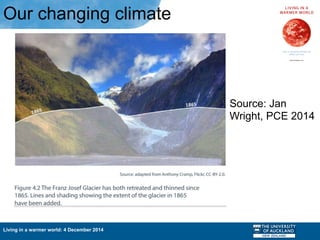
Source: Jan
Wright, PCE 2014
Living in a warmer world: 4 December 2014
Our changing climate
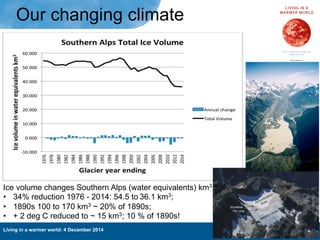
Tasman
Ice volume changes Southern Alps (water equivalents) km3;;
•  34% reduction 1976 - 2014: 54.5 to 36.1 km3;
•  1890s 100 to 170 km3 ~ 20% of 1890s;
•  + 2 deg C reduced to ~ 15 km3; 10 % of 1890s!
Living in a warmer world: 4 December 2014
Our changing climate
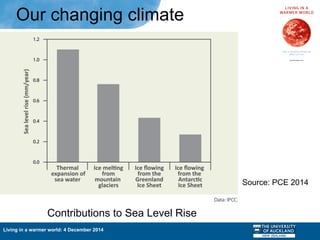
Source: PCE 2014
Contributions to Sea Level Rise
Living in a warmer world: 4 December 2014
Our changing climate
Living in a warmer world: 4 December 2014
Our changing climate
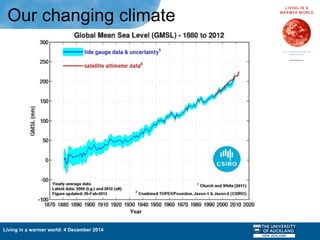
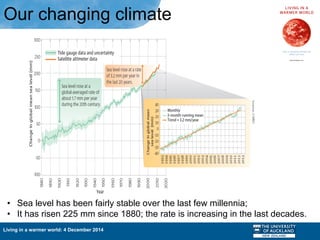
•  Sea level has been fairly stable over the last few millennia;
•  It has risen 225 mm since 1880; the rate is increasing in the last decades.
Living in a warmer world: 4 December 2014
Our changing climate
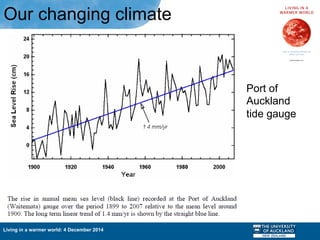
Port of
Auckland
tide gauge
Living in a warmer world: 4 December 2014
Our changing climate
Living in a warmer world: 4 December 2014
Our changing climate
Living in a warmer world: 4 December 2014
Our changing climate
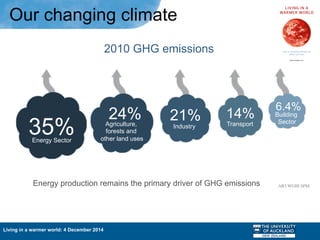
Energy production remains the primary driver of GHG emissions
35%
24% 21% 14%
6.4%
2010 GHG emissions
Energy Sector
Agriculture,
forests and
other land uses
Industry Transport
Building
Sector
AR5 WGIII SPM
Living in a warmer world: 4 December 2014
Our changing climate
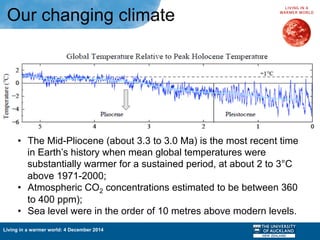
•  The Mid-Pliocene (about 3.3 to 3.0 Ma) is the most recent time
in Earth’s history when mean global temperatures were
substantially warmer for a sustained period, at about 2 to 3°C
above 1971-2000;
•  Atmospheric CO2 concentrations estimated to be between 360
to 400 ppm);
•  Sea level were in the order of 10 metres above modern levels.
Living in a warmer world: 4 December 2014
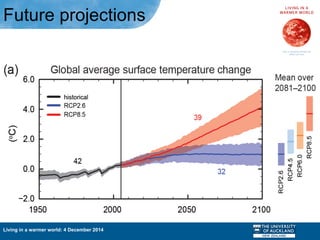
Future projections
Living in a warmer world: 4 December 2014
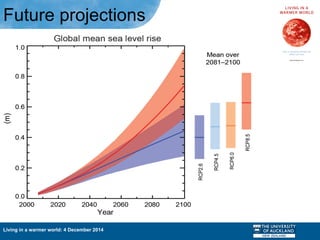
Future projections
Living in a warmer world: 4 December 2014
Future projections
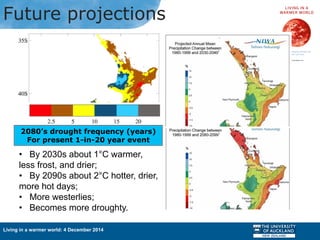
•  By 2030s about 1°C warmer,
less frost, and drier;
•  By 2090s about 2°C hotter, drier,
more hot days;
•  More westerlies;
•  Becomes more droughty.
2080’s drought frequency (years)
For present 1-in-20 year event
Living in a warmer world: 4 December 2014
Impacts:coasts
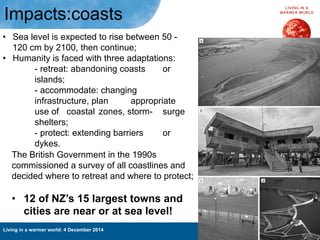
•  Sea level is expected to rise between 50 -
120 cm by 2100, then continue;
•  Humanity is faced with three adaptations:
- retreat: abandoning coasts or
islands;
- accommodate: changing
infrastructure, plan appropriate
use of coastal zones, storm- surge
shelters;
- protect: extending barriers or
dykes.
The British Government in the 1990s
commissioned a survey of all coastlines and
decided where to retreat and where to protect;
•  12 of NZ’s 15 largest towns and
cities are near or at sea level!
Living in a warmer world: 4 December 2014
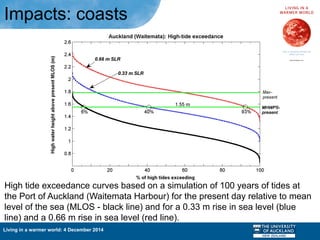
High tide exceedance curves based on a simulation of 100 years of tides at
the Port of Auckland (Waitemata Harbour) for the present day relative to mean
level of the sea (MLOS - black line) and for a 0.33 m rise in sea level (blue
line) and a 0.66 m rise in sea level (red line).
Impacts: coasts
Living in a warmer world: 4 December 2014
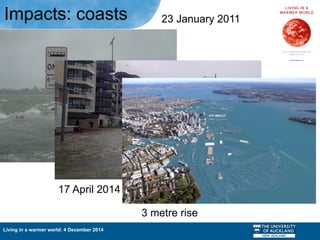
Impacts: coasts 23 January 2011
17 April 2014
3 metre rise
Living in a warmer world: 4 December 2014
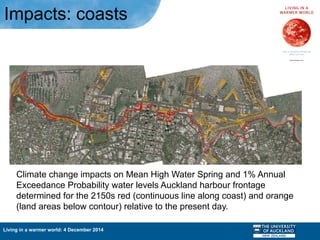
Climate change impacts on Mean High Water Spring and 1% Annual
Exceedance Probability water levels Auckland harbour frontage
determined for the 2150s red (continuous line along coast) and orange
(land areas below contour) relative to the present day.
Impacts: coasts
Living in a warmer world: 4 December 2014
Impacts: infrastructure
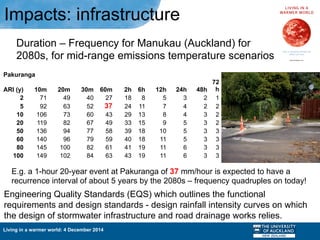
Engineering Quality Standards (EQS) which outlines the functional
requirements and design standards - design rainfall intensity curves on which
the design of stormwater infrastructure and road drainage works relies.
Duration – Frequency for Manukau (Auckland) for
2080s, for mid-range emissions temperature scenarios
E.g. a 1-hour 20-year event at Pakuranga of 37 mm/hour is expected to have a
recurrence interval of about 5 years by the 2080s – frequency quadruples on today!	

Pakuranga
ARI (y) 10m 20m 30m 60m 2h 6h 12h 24h 48h
72
h
2 71 49 40 27 18 8 5 3 2 1
5 92 63 52 37 24 11 7 4 2 2
10 106 73 60 43 29 13 8 4 3 2
20 119 82 67 49 33 15 9 5 3 2
50 136 94 77 58 39 18 10 5 3 3
60 140 96 79 59 40 18 11 5 3 3
80 145 100 82 61 41 19 11 6 3 3
100 149 102 84 63 43 19 11 6 3 3
Living in a warmer world: 4 December 2014
Impacts: infrastructure
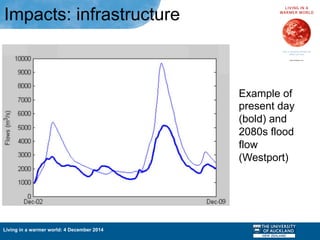
Example of
present day
(bold) and
2080s flood
flow
(Westport)
Living in a warmer world: 4 December 2014
Agriculture: Wine
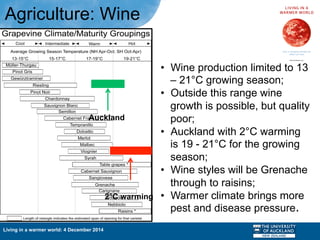
•  Wine production limited to 13
– 21°C growing season;
•  Outside this range wine
growth is possible, but quality
poor;
•  Auckland with 2°C warming
is 19 - 21°C for the growing
season;
•  Wine styles will be Grenache
through to raisins;
•  Warmer climate brings more
pest and disease pressure.
Auckland	

2°C warming
Living in a warmer world: 4 December 2014
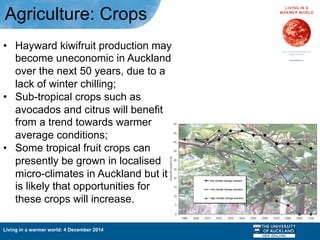
•  Hayward kiwifruit production may
become uneconomic in Auckland
over the next 50 years, due to a
lack of winter chilling;
•  Sub-tropical crops such as
avocados and citrus will benefit
from a trend towards warmer
average conditions;
•  Some tropical fruit crops can
presently be grown in localised
micro-climates in Auckland but it
is likely that opportunities for
these crops will increase.
Agriculture: Crops
Living in a warmer world: 4 December 2014
Agriculture
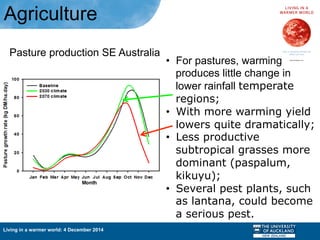
Pasture production SE Australia
•  For pastures, warming
produces little change in
lower rainfall temperate
regions;
•  With more warming yield
lowers quite dramatically;
•  Less productive
subtropical grasses more
dominant (paspalum,
kikuyu);
•  Several pest plants, such
as lantana, could become
a serious pest.
Living in a warmer world: 4 December 2014
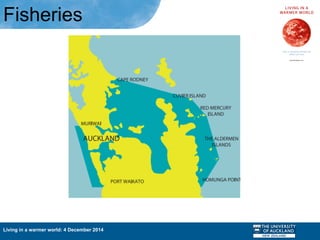
Fisheries
Living in a warmer world: 4 December 2014
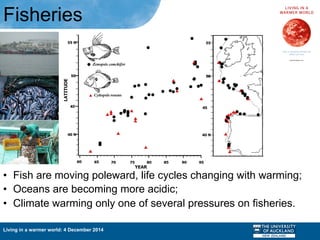
Fisheries
•  Fish are moving poleward, life cycles changing with warming;
•  Oceans are becoming more acidic;
•  Climate warming only one of several pressures on fisheries.
Living in a warmer world: 4 December 2014
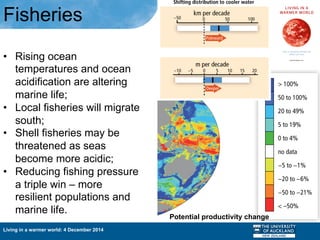
•  Rising ocean
temperatures and ocean
acidification are altering
marine life;
•  Local fisheries will migrate
south;
•  Shell fisheries may be
threatened as seas
become more acidic;
•  Reducing fishing pressure
a triple win – more
resilient populations and
marine life.
Fisheries
Potential productivity change
Living in a warmer world: 4 December 2014
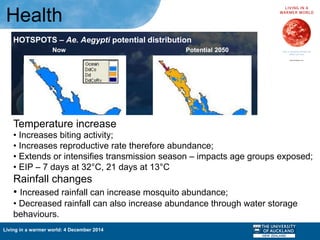
Health


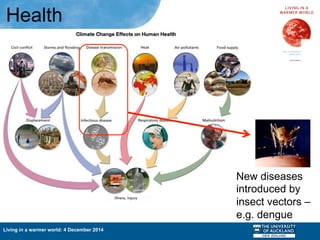
New diseases
introduced by
insect vectors –
e.g. dengue
Living in a warmer world: 4 December 2014
Health
Temperature increase
• Increases biting activity;
• Increases reproductive rate therefore abundance;
• Extends or intensifies transmission season – impacts age groups exposed;
• EIP – 7 days at 32°C, 21 days at 13°C
Rainfall changes
• Increased rainfall can increase mosquito abundance;
• Decreased rainfall can also increase abundance through water storage
behaviours.
Living in a warmer world: 4 December 2014
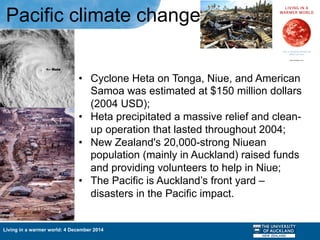
Pacific climate change
•  Cyclone Heta on Tonga, Niue, and American
Samoa was estimated at $150 million dollars
(2004 USD);
•  Heta precipitated a massive relief and clean-
up operation that lasted throughout 2004;
•  New Zealand's 20,000-strong Niuean
population (mainly in Auckland) raised funds
and providing volunteers to help in Niue;
•  The Pacific is Auckland’s front yard –
disasters in the Pacific impact.
Living in a warmer world: 4 December 2014
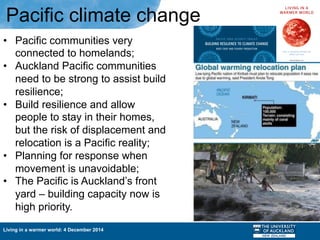
•  Pacific communities very
connected to homelands;
•  Auckland Pacific communities
need to be strong to assist build
resilience;
•  Build resilience and allow
people to stay in their homes,
but the risk of displacement and
relocation is a Pacific reality;
•  Planning for response when
movement is unavoidable;
•  The Pacific is Auckland’s front
yard – building capacity now is
high priority.
Pacific climate change
Living in a warmer world: 4 December 2014
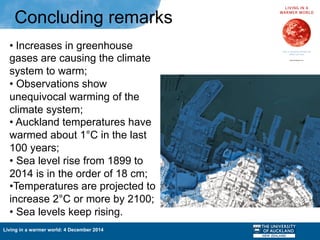
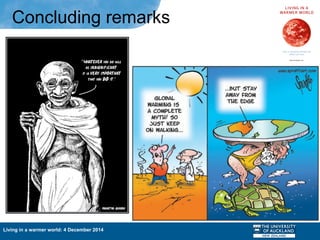
Concluding remarks
• Increases in greenhouse
gases are causing the climate
system to warm;
• Observations show
unequivocal warming of the
climate system;
• Auckland temperatures have
warmed about 1°C in the last
100 years;
• Sea level rise from 1899 to
2014 is in the order of 18 cm;
• Temperatures are projected to
increase 2°C or more by 2100;
• Sea levels keep rising.
Living in a warmer world: 4 December 2014
Concluding remarks
Living in a warmer world: 4 December 2014
“In my personal value frame, it is
already a few decades too late for
having implemented some policy
measures against such risks…..
beyond a few degrees Celsius of
warming —it is likely that many
‘dangerous’ thresholds will be
exceeded.….
uncertainty is no longer a
responsible justification for delay. ”
Stephen H Schneider
Concluding remarks

Jim salinger presentation

  • 1.
    S C HO O L O F E N V I R O N M E N T Living in a warmer world 4 December 2014 Living in a warmer world: Climate change impacts on Auckland Dr Jim Salinger, School of Environment University of Auckland j.salinger@auckland.ac.nz
  • 2.
    Living in awarmer world: 4 December 2014 Outline •  Our changing climate •  Future projections: Auckland •  Impacts: Extremes •  Agriculture and Health •  Oceans and fisheries •  Pacific Communities – our front yard
  • 3.
    Living in awarmer world: 4 December 2014
  • 4.
    Living in awarmer world: 4 December 2014 Our changing climate •  Little Ice Age a time of cooler climate lasting 250 years •  Temperatures have warmed 0.85°C from 1850 •  Warming is unequivocal A mediaeval warm period Rapid warming Colder in different places at different times http://www.cru.uea.ac.uk/cru/info/warming/
  • 5.
    Living in awarmer world: 4 December 2014 •  2014 on course to be one of hottest, possibly hottest, on record at +0.57°C above the 1961-1990 average; – WMO 4 December: •  Global heat in the oceans down to 2 km the hottest; •  Spring 2014 was Australia’s warmest on record; •  Mean temperatures were 1.67 °C above average; •  NZ not heading for any record, currently running at +0.3°C above the 1961-1990 average. Our changing climate
  • 6.
    Living in awarmer world: 4 December 2014 Our changing climate Annual mean temperature •  140 - year change about 1.5°C 13.00   13.50   14.00   14.50   15.00   15.50   16.00   16.50   17.00   1871   1875   1879   1883   1887   1891   1895   1899   1903   1907   1911   1915   1919   1923   1927   1931   1935   1939   1943   1947   1951   1955   1959   1963   1967   1971   1975   1979   1983   1987   1991   1995   1999   2003   2007   2011   Auckland  
  • 7.
    Living in awarmer world: 4 December 2014 •  More than 90% of the energy accumulating in the climate system between 1971 and 2010 has accumulated in the ocean; •  Land temperatures remain at historic highs while ocean temperatures continue to climb. And much going into the SH oceans! Our changing climate
  • 8.
    Living in awarmer world: 4 December 2014 Our changing climate
  • 9.
    Living in awarmer world: 4 December 2014 Our changing climate -­‐1.5   -­‐1   -­‐0.5   0   0.5   1   1.5   Drought  Index   Growing  Season   New  Zealand  Drought  Index   1941  -­‐  2013   -­‐3   -­‐2   -­‐1   0   1   2   3   4   Score   Growing  Season   Auckland  Drought     2012/13 the most severe!
  • 10.
    Living in awarmer world: 4 December 2014 Our changing climate •  Bonspiels require a minimum of 13 cm of ice on the Idaburn Dam; •  Records from the 1880s show a trend from 8/ decade to 2-3/ decade now.0   10   20   30   40   50   60   70   1924   1927   1930   1933   1936   1939   1942   1945   1948   1951   1954   1957   1960   1963   1966   1969   1972   1975   1978   1981   1984   1987   1990   1993   1996   1999   2002   2005   2008   2011   Ophir  Frosts   Queenstown  Frosts   Bonspiels/decade   June/July  Frost  Days  
  • 11.
    Living in awarmer world: 4 December 2014 Our changing climate Source: Jan Wright, PCE 2014
  • 12.
    Living in awarmer world: 4 December 2014 Our changing climate Tasman Ice volume changes Southern Alps (water equivalents) km3;; •  34% reduction 1976 - 2014: 54.5 to 36.1 km3; •  1890s 100 to 170 km3 ~ 20% of 1890s; •  + 2 deg C reduced to ~ 15 km3; 10 % of 1890s!
  • 13.
    Living in awarmer world: 4 December 2014 Our changing climate Source: PCE 2014 Contributions to Sea Level Rise
  • 14.
    Living in awarmer world: 4 December 2014 Our changing climate
  • 15.
    Living in awarmer world: 4 December 2014 Our changing climate •  Sea level has been fairly stable over the last few millennia; •  It has risen 225 mm since 1880; the rate is increasing in the last decades.
  • 16.
    Living in awarmer world: 4 December 2014 Our changing climate Port of Auckland tide gauge
  • 17.
    Living in awarmer world: 4 December 2014 Our changing climate
  • 18.
    Living in awarmer world: 4 December 2014 Our changing climate
  • 19.
    Living in awarmer world: 4 December 2014 Our changing climate Energy production remains the primary driver of GHG emissions 35% 24% 21% 14% 6.4% 2010 GHG emissions Energy Sector Agriculture, forests and other land uses Industry Transport Building Sector AR5 WGIII SPM
  • 20.
    Living in awarmer world: 4 December 2014 Our changing climate •  The Mid-Pliocene (about 3.3 to 3.0 Ma) is the most recent time in Earth’s history when mean global temperatures were substantially warmer for a sustained period, at about 2 to 3°C above 1971-2000; •  Atmospheric CO2 concentrations estimated to be between 360 to 400 ppm); •  Sea level were in the order of 10 metres above modern levels.
  • 21.
    Living in awarmer world: 4 December 2014 Future projections
  • 22.
    Living in awarmer world: 4 December 2014 Future projections
  • 23.
    Living in awarmer world: 4 December 2014 Future projections •  By 2030s about 1°C warmer, less frost, and drier; •  By 2090s about 2°C hotter, drier, more hot days; •  More westerlies; •  Becomes more droughty. 2080’s drought frequency (years) For present 1-in-20 year event
  • 24.
    Living in awarmer world: 4 December 2014 Impacts:coasts •  Sea level is expected to rise between 50 - 120 cm by 2100, then continue; •  Humanity is faced with three adaptations: - retreat: abandoning coasts or islands; - accommodate: changing infrastructure, plan appropriate use of coastal zones, storm- surge shelters; - protect: extending barriers or dykes. The British Government in the 1990s commissioned a survey of all coastlines and decided where to retreat and where to protect; •  12 of NZ’s 15 largest towns and cities are near or at sea level!
  • 25.
    Living in awarmer world: 4 December 2014 High tide exceedance curves based on a simulation of 100 years of tides at the Port of Auckland (Waitemata Harbour) for the present day relative to mean level of the sea (MLOS - black line) and for a 0.33 m rise in sea level (blue line) and a 0.66 m rise in sea level (red line). Impacts: coasts
  • 26.
    Living in awarmer world: 4 December 2014 Impacts: coasts 23 January 2011 17 April 2014 3 metre rise
  • 27.
    Living in awarmer world: 4 December 2014 Climate change impacts on Mean High Water Spring and 1% Annual Exceedance Probability water levels Auckland harbour frontage determined for the 2150s red (continuous line along coast) and orange (land areas below contour) relative to the present day. Impacts: coasts
  • 28.
    Living in awarmer world: 4 December 2014 Impacts: infrastructure Engineering Quality Standards (EQS) which outlines the functional requirements and design standards - design rainfall intensity curves on which the design of stormwater infrastructure and road drainage works relies. Duration – Frequency for Manukau (Auckland) for 2080s, for mid-range emissions temperature scenarios E.g. a 1-hour 20-year event at Pakuranga of 37 mm/hour is expected to have a recurrence interval of about 5 years by the 2080s – frequency quadruples on today! Pakuranga ARI (y) 10m 20m 30m 60m 2h 6h 12h 24h 48h 72 h 2 71 49 40 27 18 8 5 3 2 1 5 92 63 52 37 24 11 7 4 2 2 10 106 73 60 43 29 13 8 4 3 2 20 119 82 67 49 33 15 9 5 3 2 50 136 94 77 58 39 18 10 5 3 3 60 140 96 79 59 40 18 11 5 3 3 80 145 100 82 61 41 19 11 6 3 3 100 149 102 84 63 43 19 11 6 3 3
  • 29.
    Living in awarmer world: 4 December 2014 Impacts: infrastructure Example of present day (bold) and 2080s flood flow (Westport)
  • 30.
    Living in awarmer world: 4 December 2014 Agriculture: Wine •  Wine production limited to 13 – 21°C growing season; •  Outside this range wine growth is possible, but quality poor; •  Auckland with 2°C warming is 19 - 21°C for the growing season; •  Wine styles will be Grenache through to raisins; •  Warmer climate brings more pest and disease pressure. Auckland 2°C warming
  • 31.
    Living in awarmer world: 4 December 2014 •  Hayward kiwifruit production may become uneconomic in Auckland over the next 50 years, due to a lack of winter chilling; •  Sub-tropical crops such as avocados and citrus will benefit from a trend towards warmer average conditions; •  Some tropical fruit crops can presently be grown in localised micro-climates in Auckland but it is likely that opportunities for these crops will increase. Agriculture: Crops
  • 32.
    Living in awarmer world: 4 December 2014 Agriculture Pasture production SE Australia •  For pastures, warming produces little change in lower rainfall temperate regions; •  With more warming yield lowers quite dramatically; •  Less productive subtropical grasses more dominant (paspalum, kikuyu); •  Several pest plants, such as lantana, could become a serious pest.
  • 33.
    Living in awarmer world: 4 December 2014 Fisheries
  • 34.
    Living in awarmer world: 4 December 2014 Fisheries •  Fish are moving poleward, life cycles changing with warming; •  Oceans are becoming more acidic; •  Climate warming only one of several pressures on fisheries.
  • 35.
    Living in awarmer world: 4 December 2014 •  Rising ocean temperatures and ocean acidification are altering marine life; •  Local fisheries will migrate south; •  Shell fisheries may be threatened as seas become more acidic; •  Reducing fishing pressure a triple win – more resilient populations and marine life. Fisheries Potential productivity change
  • 36.
    Living in awarmer world: 4 December 2014 Health New diseases introduced by insect vectors – e.g. dengue
  • 37.
    Living in awarmer world: 4 December 2014 Health Temperature increase • Increases biting activity; • Increases reproductive rate therefore abundance; • Extends or intensifies transmission season – impacts age groups exposed; • EIP – 7 days at 32°C, 21 days at 13°C Rainfall changes • Increased rainfall can increase mosquito abundance; • Decreased rainfall can also increase abundance through water storage behaviours.
  • 38.
    Living in awarmer world: 4 December 2014 Pacific climate change •  Cyclone Heta on Tonga, Niue, and American Samoa was estimated at $150 million dollars (2004 USD); •  Heta precipitated a massive relief and clean- up operation that lasted throughout 2004; •  New Zealand's 20,000-strong Niuean population (mainly in Auckland) raised funds and providing volunteers to help in Niue; •  The Pacific is Auckland’s front yard – disasters in the Pacific impact.
  • 39.
    Living in awarmer world: 4 December 2014 •  Pacific communities very connected to homelands; •  Auckland Pacific communities need to be strong to assist build resilience; •  Build resilience and allow people to stay in their homes, but the risk of displacement and relocation is a Pacific reality; •  Planning for response when movement is unavoidable; •  The Pacific is Auckland’s front yard – building capacity now is high priority. Pacific climate change
  • 40.
    Living in awarmer world: 4 December 2014 Concluding remarks • Increases in greenhouse gases are causing the climate system to warm; • Observations show unequivocal warming of the climate system; • Auckland temperatures have warmed about 1°C in the last 100 years; • Sea level rise from 1899 to 2014 is in the order of 18 cm; • Temperatures are projected to increase 2°C or more by 2100; • Sea levels keep rising.
  • 41.
    Living in awarmer world: 4 December 2014 Concluding remarks
  • 42.
    Living in awarmer world: 4 December 2014 “In my personal value frame, it is already a few decades too late for having implemented some policy measures against such risks….. beyond a few degrees Celsius of warming —it is likely that many ‘dangerous’ thresholds will be exceeded.…. uncertainty is no longer a responsible justification for delay. ” Stephen H Schneider Concluding remarks