JESUS WAS LOVED VOL. 2
EDITED BY GLENN PEASE
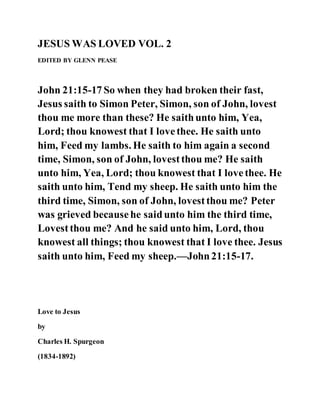
John 21:15-17 So when they had broken their fast,
Jesus saith to Simon Peter, Simon, son of John, lovest
thou me more than these? He saithunto him, Yea,
Lord; thou knowest that I lovethee. He saith unto
him, Feed my lambs. He saith to him again a second
time, Simon, son of John, lovestthou me? He saith
unto him, Yea, Lord; thou knowest that I lovethee. He
saith unto him, Tend my sheep. He saith unto him the
third time, Simon, son of John, lovestthou me? Peter
was grieved becausehe saidunto him the third time,
Lovestthou me? And he said unto him, Lord, thou
knowest all things; thou knowest that I love thee. Jesus
saith unto him, Feed my sheep.—John21:15-17.
Love to Jesus
by
Charles H. Spurgeon
(1834-1892)
This updated and revised manuscript is copyrighted ã 1999 by Tony
Capoccia. All rights reserved.
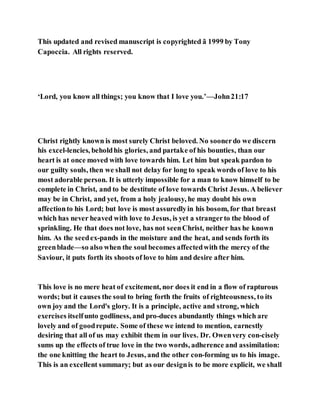
‘Lord, you know all things; you know that I love you.’—John21:17
Christ rightly known is most surely Christ beloved. No soonerdo we discern
his excel-lencies, beholdhis glories, and partake of his bounties, than our
heart is at once moved with love towards him. Let him but speak pardon to
our guilty souls, then we shall not delay for long to speak words of love to his
most adorable person. It is utterly impossible for a man to know himself to be
complete in Christ, and to be destitute of love towards Christ Jesus. A believer
may be in Christ, and yet, from a holy jealousy, he may doubt his own
affectionto his Lord; but love is most assuredlyin his bosom, for that breast
which has never heaved with love to Jesus, is yet a strangerto the blood of
sprinkling. He that does not love, has not seenChrist, neither has he known
him. As the seedex-pands in the moisture and the heat, and sends forth its
greenblade—so also when the soul becomes affectedwith the mercy of the
Saviour, it puts forth its shoots of love to him and desire after him.
This love is no mere heat of excitement, nor does it end in a flow of rapturous
words; but it causes the soul to bring forth the fruits of righteousness, to its
own joy and the Lord's glory. It is a principle, active and strong, which
exercises itselfunto godliness, and pro-duces abundantly things which are
lovely and of goodrepute. Some of these we intend to mention, earnestly
desiring that all of us may exhibit them in our lives. Dr. Owenvery con-cisely
sums up the effects of true love in the two words, adherence and assimilation:
the one knitting the heart to Jesus, and the other con-forming us to his image.
This is an excellent summary; but as our designis to be more explicit, we shall
in detail review the more usual and pleasing of the displays of the power of
grace, affordedby the soul which is under the influence of love to Christ.
1. One of the earliestand most important signs of love to Jesus is the deed of
solemn dedicationof ourselves, with all we have and are, most unreservedly to
the Lord's service.
Dr. Doddridge has recommendeda solemn covenantbetweenthe soul and
God, to be signed and sealedwith due deliberation and most fervent prayer.
Many of the most emi-nent of the saints have adopted this excellentmethod of
devoting themselves in very deed unto the Lord, and have reaped great
benefits from the review of that solemn document when they have freshly
renewedthe actof dedication. The writer of the present volume conceives that
burial with Christ in Baptism is a far more scriptural and expressive sign of
dedication; but he is not inclined to deny his brethren the liberty of
confirming that actby the other, if it seemgoodto them. The remarks of John
Newtonupon this subject are therefore cautious and terse [See ‘Life of
Grimshaw,’ p.13], that we cannot refrain from quoting them at length:—
‘Many judicious persons have differed in their sentiments with respectto the
propriety or utility of such written en-gagements. Theyare usually entered
into, if at all, in an early stage ofprofession, when, though the heart is warm,
there has been little actualexperience of its deceitfulness. In the day when the
Lord turns our mourning into joy, and speaks peace,by the blood of his cross,
to the conscienceburdened by guilt and fear, resolutions are formed which,
though honestand sincere, prove, like Peter's promise to our lord, too weak to
withstand the force of subsequent unforeseentemptation. Such vows, made in
too much dependence upon our own strength, not only occasiona farther
discoveryof our weakness, but frequently give the enemy advan-tage to
terrify and distress the mind. There-fore, some persons, ofmore mature
experience, discount the practice as legaland im-proper. But, as a scaffold,
though no part of an edifice, and designedto be taken down when the building
is finished, is yet useful for a time in carrying on the work—somany young
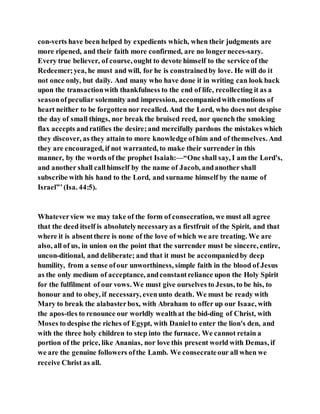
con-verts have been helped by expedients which, when their judgments are
more ripened, and their faith more confirmed, are no longerneces-sary.
Every true believer, of course, ought to devote himself to the service of the
Redeemer;yea, he must and will, for he is constrainedby love. He will do it
not once only, but daily. And many who have done it in writing can look back
upon the transactionwith thankfulness to the end of life, recollecting it as a
seasonofpeculiar solemnity and impression, accompaniedwith emotions of
heart neither to be forgotten nor recalled. And the Lord, who does not despise
the day of small things, nor break the bruised reed, nor quench the smoking
flax accepts andratifies the desire;and mercifully pardons the mistakes which
they discover, as they attain to more knowledge ofhim and of themselves. And
they are encouraged, if not warranted, to make their surrender in this
manner, by the words of the prophet Isaiah:—“One shall say, I am the Lord's,
and another shall callhimself by the name of Jacob, andanother shall
subscribe with his hand to the Lord, and surname himself by the name of
Israel”’(Isa. 44:5).
Whateverview we may take of the form of consecration, we must all agree
that the deed itself is absolutelynecessaryas a firstfruit of the Spirit, and that
where it is absentthere is none of the love of which we are treating. We are
also, all of us, in union on the point that the surrender must be sincere, entire,
uncon-ditional, and deliberate; and that it must be accompaniedby deep
humility, from a sense ofour unworthiness, simple faith in the blood of Jesus
as the only medium of acceptance, andconstantreliance upon the Holy Spirit
for the fulfilment of our vows. We must give ourselves to Jesus, to be his, to
honour and to obey, if necessary, evenunto death. We must be ready with
Mary to break the alabasterbox, with Abraham to offer up our Isaac, with
the apos-tles to renounce our worldly wealthat the bid-ding of Christ, with
Moses to despise the riches of Egypt, with Danielto enter the lion's den, and
with the three holy children to step into the furnace. We cannot retain a
portion of the price, like Ananias, nor love this present world with Demas, if
we are the genuine followers ofthe Lamb. We consecrateour all when we
receive Christ as all.
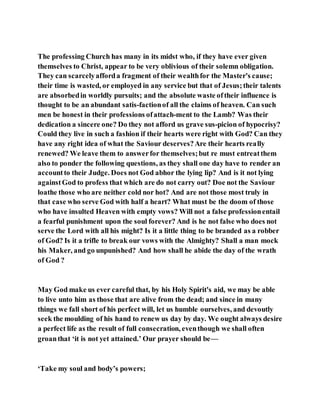
The professing Church has many in its midst who, if they have ever given
themselves to Christ, appear to be very oblivious of their solemn obligation.
They can scarcelyafforda fragment of their wealthfor the Master's cause;
their time is wasted, or employed in any service but that of Jesus;their talents
are absorbedin worldly pursuits; and the absolute waste oftheir influence is
thought to be an abundant satis-factionof all the claims of heaven. Can such
men be honest in their professions ofattach-ment to the Lamb? Was their
dedication a sincere one? Do they not afford us grave sus-picion of hypocrisy?
Could they live in such a fashion if their hearts were right with God? Can they
have any right idea of what the Saviour deserves?Are their hearts really
renewed? We leave them to answerfor themselves;but re must entreatthem
also to ponder the following questions, as they shall one day have to render an
accountto their Judge. Does not God abhor the lying lip? And is it not lying
againstGod to profess that which are do not carry out? Doe not the Saviour
loathe those who are neither cold nor hot? And are not those most truly in
that case who serve God with half a heart? What must be the doom of those
who have insulted Heaven with empty vows? Will not a false professionentail
a fearful punishment upon the soul forever? And is he not false who does not
serve the Lord with all his might? Is it a little thing to be branded as a robber
of God? Is it a trifle to break our vows with the Almighty? Shall a man mock
his Maker, and go unpunished? And how shall he abide the day of the wrath
of God ?
May God make us ever careful that, by his Holy Spirit's aid, we may be able
to live unto him as those that are alive from the dead; and since in many
things we fall short of his perfect will, let us humble ourselves, and devoutly
seek the moulding of his hand to renew us day by day. We ought always desire
a perfect life as the result of full consecration, eventhough we shall often
groanthat ‘it is not yet attained.’ Our prayer should be—
‘Take my soul and body’s powers;
Take my memory, mind, and will;
All my goods, and all my hours;
All I know, and all I feel;
All I think, or speak, ordo;
Take my heart—but make it new.’
[C. Wesley]
2. Love to Christ will make us ‘timid and tender to offend.’—We shall be most
careful lestthe Saviour should be grieved by our ill manners. When some
much loved friend is visiting our house, we are everfearful lest he should be ill
at ease;we therefore watchevery movement in the family, that nothing may
disturb the quiet we desire him to enjoy. How frequently do we apologisefor
the homeliness of our provisions, our own apparent inattention, the
forgetfulness of our servants, or the rudeness of our children. If we suppose
him to be uncomfortable, how readily will we disarrange our household to
give him pleasure, and how disturbed are we at the leastsymptom that he is
not satisfiedwith our hospitality. We are grieved if our words appear cold
towards him, or our acts unkind. We would soonerthat he should grieve us
than that we should displease him. Surely we should not treat our heavenly
Friend worse than our earthly acquaintance;but we should constantly
endeavour to please Him in all things who did not please himself. Such is the
influence of realdevotion to our precious Redeemer, that the more the mind is
saturatedwith affection to him, the more watchful shall we be to give no
offense in anything, and the more sorrow shall we suffer because ournature is
yet so imperfect that in many things we come short of his glory. A believer, in
a healthy state of mind, will be extremely sensitive; he will avoid the
appearance ofevil, and guard againstthe beginnings of sin. He will often be
afraid to put one foot before another, lesthe should tread upon forbidden
ground; he will tremble to speak, lesthis words should not be ordered aright;
he will be timid in the world, lest he should be surprised into transgression;
and even in his holy deeds he will be watchful over his heart, lesthe should
mock his Lord. This feeling of fear lest we should ‘slip with our feet,’ is a
precious feature of true spiritual life. It is to be greatly regrettedthat it is so
lightly prized by many, in comparisonwith the more martial virtues; for,
despite its apparent insignificance, it is one of the choicestfruits of the Spirit,
and its absence is one of the most de-plorable evidences ofspiritual decay. A
heedless spirit is a curse to the soul; a rash, presumptuous conversationwill
eat like a cancerdoes. ‘Too bold’ was never Too-wisenor Too‑ loving.
Careful walking is one of the best securities of safe and happy standing. It is
solemn cause fordoubting when we are indifferent in our be-haviour to our
best Friend. When the new creature is active, it will be indignant at the very
name of sin; it will condemn it as the murderer of the Redeemer, and wage as
fierce a war againstit as the Lord did with Amalek. Christ's foes are our foes
when we are Christ's friends. Love of Christ and love of sin are elements too
hostile to reign in the same heart. We shall hate iniquity simply because Jesus
hates it. A gooddivine [John Brine] writes:—‘If any pretend unto an
assurance offorgiveness through the merits of Jesus, without any experience
of shame, sorrow, and hatred of sin, on accountof its vile nature, I dare boldly
pronounce such a pretensionto be no other than a vain presumption, that is
likely to be followedby an eternalloss of their immortal souls.’
He that is not afraid of sinning has goodreasonto be afraid of damning.
Truth hates error, holiness abhors guilt, and grace cannotbut detest sin. If we
do not desire to be cau-tious to avoid offending our Lord, we may rest
confident that we have no part in him, for true love to Christ will rather die
than wound him. Hence love to Christ is ‘the best antidote to idolatry;’ [James
Hamilton] for it prevent any objectfrom occu-pying the rightful throne of the
Saviour. The believer dares not admit a rival into his heart, knowing that this
would grievously offend the King. The simplest way of preventing an
ex-cessive love ofthe creature is to set all our affectionupon the Creator. Give
your whole heart to your Lord, and you cannot idolize the things of earth, for
thou will have nothing left with which to worship them.
B. If we love the Lord Jesus we shall be obe-dient to his commands.—False,
vain, and boasting pretenders to friendship with Christ think it enough to talk
fluently of him; but humble, sincere, and faithful lovers of the Lord are not
content with words—theymust be doing the will of their Master. As the
affectionate wife obeys because she loves her husband, so does the redeemed
soul delight in keeping the com-mands of Jesus, although compelledby no
force but that of love. This divine principle will render every duty pleasant;
yes, when the labour is in itself irksome, this heavenly grace will quicken us in
its performance by reminding us that it is honourable to suffer for our Lord.
It will induce an universal obedience to all known commands, and overcome
that criticalspirit of rebellion which takes exceptionto many precepts, and
obeys only as far as it chooses to do so. It infuses not the mere act, but the very
spirit of obedience, inclining the inmost heart to feel that its new born nature
cannot but obey. True, old corruption is still there; but this only proves the
hearty wil-lingness of the soul to be faithful to the laws of its King, seeing that
it is the cause ofa per-petual and violent contest—the flesh lusting againstthe
spirit, and the spirit striving againstthe flesh. We are willing to serve God
when we love his Son: there may be obstacles, but no unwillingness. We would
be holy even as Godis holy, and perfect even as our Fatherwhich is in heaven
is perfect. And to proceedyet further, love not only removes all unwillingness,
but inspires the soul with a delight in the service of God, by making the lowest
act of service to appearhonourable. A heathen [Seneca]once exclaimed, Deo
servire estregnare—‘to serve Godis to reign:’ so does the renewedheart
joyfully acknowledge the high honour which it receives by obedience to its
Lord. He counts it not only his reasonable, but his de-lightful service, to be a
humble and submissive disciple of his gracious Friend. He would be unhappy
if he had no opportunity of obedience—his love requires channels for its
fullness: he would pray for work if there were none, for he includes his duties
among his privileges. In the young dawn of true religion this is very
observable—wouldthat it were equally so ever after! Oh! how jealous we
were lest one divine ordinance should be neglected, or one rule violated.
Nothing pained us more than our own too frequent wanderings, and nothing
gra-tified us more than to be allowedto cut woodor draw waterat his
bidding. Why is it not so now with all of us? Why are those wings, once
outstretchedfor speedy flight, now folded in sloth? Is our Redeemerless
deserving? Or could it be that we are less loving? Let us seek by greater
meditation on the work and love of our Saviour, by the help of the Holy Spirit,
to renew our love to him: otherwise our lamentation will soonbe—‘How the
gold has become dim! How the glory has departed!’ (Lam. 4:1).
4. Love to Christ will impel us to defend him againsthis foes.—
‘If any touch my friend, or his goodname,
It is my honour and my love to free his blasted fame
From the leastspot or thought of blame.’ [Herbert].
Goodmen are more tender over the reputation of Christ than over their own
goodname; for they are willing to lose the world's favourable opinion rather
than that Christ should be dis-honoured. This is no more than Jesus has a
right to expect. Would he not be a sorry brother who should hear me insulted
and slan-dered, and yet be silent? Would he not be destitute of affectionwho
would allow the characterof his nearestrelative to be trampled in the dust,
without a struggle on his behalf? And is he not a poor style of Christian who
would calmly submit to hear his Lord abused? We could bearto be trampled
in the very mire that He might be exalted; but to see our glorious Head
dishonoured, is a sight we cannottamely behold. We would not, like Peter,
strike his enemies with the sword of man; but we would use the swordof the
Spirit as wellas we are enabled. Oh! how has our blood boiled when the name
of Jesus has been the theme of scornful jest! How we have been ready to
invoke the fire of Elijah on the guilty blasphemers!Or when our more carnal
heat has subsided, how have we wept, evento the sobbing of a child, at the
reproachcastupon his most hallowedname! Many a time we have been ready
to burst with anguish when we have been speechlessbefore the scoffer,
because the Lord had shut us up, that we could not come forth; but at other
seasons, withcourage more than we had consideredto be within the range of
our capability, we have boldly reproved the wicked, and sent them back
abashed.
It is a lovely spectacleto behold the timid and feeble defending the citadelof
truth: not with hard blows of logic, or bombardments of rhetoric—but with
that tearful earnestness,and implicit confidence, againstwhichthe attacks of
revilers are utterly powerless.Over-thrown in argument, they overcome by
faith; coveredwith contempt, they think it all joy if they can only avert a
solitary stain from the escutcheon[shield-shapedemblem bearing a coatof
arms] of their Lord. ‘Call me what you will,’ says the believer, ‘but do not
speak ill of my Beloved. Here, plough these shoulders with your lashes, but
spare yourselves the sin of cursing him! Yes, let me die: I am all too happy to
be slain, if my Lord's most glorious cause shall live!’
Ask every regenerate child of God whether he does not count it his privilege to
maintain the honour of his Master's name; and though his answermay be
worded with holy caution, you will not fail to discoverin it enough of that
determined resolution which, by the blessing of the Holy Spirit, will enable
him to stand fast in the evil day. He may be carefulto reply to such a question,
lest he should be presumptuous; but should he stand like the three holy
children before an enragedtyrant, in the very mouth of a burning fiery
furnace, his answer, like theirs, would be, ‘We have no need to answeryou in
this matter. If that is the case, ourGod whom we serve is able to deliver us
from the burning fiery furnace, and he will deliver us from your hand, O king.
But if not, let it be known to you, O king, that we do not serve your gods, nor
will we worship the gold image which you have set up’ (Dan. 3:16-18).
In some circles it is believed that in the event of another reign of persecution,
there are very few in our churches who would endure the fiery trial: nothing,
we think, is more unfounded. It is our firm opinion that the feeblestsaint in
our midst would receive grace for the struggle, and come off more than a
conqueror. God's children are the same now as ever. Realpiety will as well
endure the fire in one century as another. There is the same love to impel the
martyrdom, the same grace to sustainthe sufferer, the same promises to cheer
his heart, and the same crownto adorn his head. We believe that those
followers of Jesus who may perhaps one day be called to the stake, will die as
readily as any who have gone before. Love is still as strong as death, and grace
is still made perfect in weakness.
‘Sweetis the cross, above all sweets,
To souls enamoured with His smiles;
The keenestwoe life ever meets,
Love strips of all its terrors, and beguiles.’
[Madame Guion]
This is as true today, as it was a thousand years ago. We may be weak in
grace, but grace is not weak:it is still omnipotent, and able to endure the
trying day.
There is one form of this jealousyfor the honour of the cross, whichwill
always distinguish the devout Christian:—he win tremble lest he himself, by
word or deed, by omis-sionof duty or commission of sin, should dishonour the
holy religion which he has professed. He will hold perpetual controversywith
‘sinful self’on this account, and will loathe himself when he has inadvertently
given occasionto the enemy to blaspheme. The King's favourite will be sad if,
by mistake or carelessness, he has been the accomplice oftraitors: he desires
to be beyond reproach, that his Monarchmay suffer no disgrace from his
courtier. Nothing has injured the cause ofChrist more than the
inconsistenciesofhis avowedfriends. Jealousyfor the honour of Christ is an
admirable mark of grace.
5. A firm attachment to the person of Christ will create a constantanxiety to
promote his cause.
With some it has produced that burning zeal which enabled them to endure
banishment, to brave dangers, and to forsake comforts, in order to evangelise
an ungrateful people, among whom they were not unwilling to suffer
perse-cution, or even death, so that they might but enlarge the borders of
Immanuel's land. This has inspired the evangelistwith inex-haustible strength
to proclaim the word of his Lord from place to place, amid the slander of foes
and the coldness of friends; this has moved the generous heart to devise liberal
things, that the cause might not fade for lack of temporal supplies; and this, in
a thousand ways, has stirred up the host of God, with various weapons and in
severalfields, to fight the battles of their Lord. There is little or no love to
Jesus in that man who is indifferent concerning the progress of the truth. The
man whose soulis saturated with grateful affectionto his crucified Lord will
weepwhen the enemy seems to get an advantage;he will waterhis couchwith
tears when he sees a declining church; he will lift up his voice like a trumpet
to arouse the slumbering, and with his own hand will labour day and night to
build up the breaches of Zion; and should his efforts be successful, with what
joyous gratitude will he lift up his heart unto the King of Israel, extolling him
as much—yes, more—formercies given to the Church than for bounties
conferredupon himself. How diligently and tirelesslywill he labour for his
Lord, humbly conceiving that he cannotdo too much, or even enough, for one
who gave his heart's blood as the price of our peace.
We lament that too many among us are like Issachar, who was describedas ‘a
strong donkey, lying down betweentwo burdens,’—too lazy to perform the
works of piety so urgently demanded at our hands: but the reasonofthis sad
condition is not that fervent love is unable to produce activity, but that such
are deplorably destitute of that intense affectionwhich grace begets in the
soul.
Love to Christ smoothes the path of duty, and dispatches the feetto travel it:
it is the bow which impels the arrow of obedience;it is the mainspring moving
the wheels ofduty; it is the strong arm tugging the oar of diligence. Love is the
marrow of the bones of fidelity, the blood in the veins of piety, the sinew of
spiritual strength—yes, the life of sincere devotion. He that has love can no
more be mo-tionless than the aspentree in the gale, the withered leaf in the
hurricane, or the spray in the tempest. Likewise, as hearts must beat, so also
love must labour. Love is instinct with activity, it cannotbe idle; it is full of
energy, it cannot content itself with little things: it is the well spring of
heroism, and great deeds are the gushings of its fountain; it is a giant—it
heaps mountains upon moun-tains, and thinks it a little pile; it is a mighty
mystery, for it changes bitter into sweet;it calls death life, and life death, and
it makes pain less painful than enjoyment. Love has a cleareye, but it can see
only one thing— it is blind to every interest but that of its Lord; it sees things
in the light of his glory, and weighs actions in the scales ofhis honour; it
counts royalty but drudgery if it cannot reign for Christ, but it delights in
servitude as much as in honour, if it can thereby advance the Master's
kingdom; its end sweetens allits means; its objectlightens its toil, and
removes its weariness. Love, with refreshing influence, girds up the loins of
the pilgrim, so that he forgets fatigue; it casts a shadow for the traveling man,
so that he does not feel the burning heat; and it puts the bottle to the lip of
thirst. Have we not found it so? And, under the influence of love, are we not
prepared by the Spirit's sacredaid to do or suffer all that thought cansuggest,
as being likely to promote his honour?
He who does not desire the goodof the kingdom is no friend to the king; so he
who forgets the interests of Zion can scarcelybe a favourite with her Prince.
We wish prosperity in estate and householdto all those in whom we delight;
and if we take pleasure in Jesus, we shallpray for the peace of Jerusalem, and
labour for her increase.
May ‘the Fatherof lights’ give unto his Church more love to her Head, then
she will be zealous, valiant, and persevering, and then shall her Lord be
glorified.
6. It is a notable fact that fervent love to Jesus will enable us to endure
anything he is pleasedto lay upon us.
Love is the mother of resignation:we gladly receive buffeting and blows from
Jesus whenour heart is fully occupied with his love. Even as a dearly
cherishedfriend does but delight us when he uses freedoms with us, or when
he takes a gooddealof liberty in our house—so Jesus, whenwe love him
heartily, will never offend us by anything that he may do. Should he take our
gold, we would think his hand to be a noble treasury for our wealth;should he
remove our joys, we reckonit a greaterbliss to lose than gain, when his will
runs in such a channel. Yes, should he smite us very deeply, we shall turn to
his hand and kiss the rod. To believe that Christ has done it, is to extract the
sting of an affliction. We remember hearing a preacherat a funeral most
beautifully setting forth this truth in parable. He said:—‘A certain nobleman
had a spacious garden, which he left to the care of a faithful servant, whose
delight it was to train the climbing plants along the trellis, to waterthe seeds
in the time of drought, to support the stalks of the tender plants, and to do
every work which could render the garden a Paradise offlowers. One
morning he rose with joy, expecting to tend his beloved flowers, and hoping to
find his favourites increasedin beauty. To his surprise, he found one of his
choicestbeauties torn from its stem, and, looking around him, he missedfrom
every bed the pride of his garden, the most precious of his blooming flowers.
Full of grief and anger, he hurried to his fellow servants, and demanded who
had thus robbed him of his treasures. Theyhad not done it and he did not
charge them with it; but he found no solacefor his grief till one of them
remarked:—“My lord was walking in the gardenthis morning, and I saw
him pluck the flowers and carry them away.” Thentruly he found he had no
cause for his trouble. He felt it was wellthat his masterhad been pleasedto
take his own, and he went away, smiling at his loss, becausehis lord had taken
them. So,’said the preacher, turning to the mourners, ‘you have lost one
whom you regardedwith much tender affection. The bonds of endearment
have not availedfor her retention upon earth. I know your wounded feelings
when, instead of the lovely form which was the embo-diment of all that is
excellentand amiable, you behold nothing but ashes andcorruption. But
remember, my beloved, THE LORD has done it; He has removed the tender
mother, the affectionate wife, the inestimable friend. I say again, remember
your own Lord has done it; therefore do not murmur, or yield yourselves to
an excess ofgrief’ There was as much force as well as beauty in the simple
allegory:it would be goodif all the Lord’s family had grace to prac­tice its
heavenly lesson, in all times of bereave-ment and affliction.
Our favourite master of quaint conceits [Herbert] has singularly said in his
poem entitled ‘Unkind­ness’—
‘My friend may spit upon my curious floor.’
True, most true, our Belovedmay do as he pleases in our house, evenif he
would break its ornaments and stain its glories. Come in, you heavenly guest,
even though eachfootstepon our floor should crush a thousand of our earthly
joys. You are yourself more than sufficient recompense for all that you can
take away. Come in, you brother of our souls, eventhough your rod comes
with you. We would rather have you, and trials with you, than lament your
absence eventhough surrounded with all the wealththe universe can bestow.
The Lord’s prisoner in the dungeon of Aberdeen thus penned his belief in the
love of his ‘sweetLord Jesus,’and his acquiescencein his Master’s will:—
‘Oh, what owe I to the file, to the hammer, to the furnace, of my Lord Jesus!
who hath now let me see how goodthe wheatof Christ is, which goeththrough
his mill, to be made bread for his own table. Grace tried is better than grace,
and more than grace—itis glory in its infancy. When Christ blesses his own
crosseswith a tongue, they breathe out Christ's love, wisdom, kindness, and
care of us. Why should I start at the plough of my Lord, that makethdeep
furrows upon my soul? 1 know that He is no idle husbandman; He purposeth
a crop. Oh, that this white, withered lea‑ ground[pasture] were made fertile
to bear a crop for him, by whom it is so painfully dressed, and that this
fallow‑ groundwere broken up! Why was I (a fool!) grievedthat He put his
gar-land and his rose upon my head—the glory and honour of his faithful
witnesses?I desire now to make no more pleas with Christ. Verily, He hath
not put me to a loss by what I suffered; he owethme nothing; for in my bonds
how sweetand comfortable have the thoughts of Him been to me, wherein I
find a sufficient recompense ofreward!’
7. To avoid tiring the reader with a longerlist of ‘the precious fruits put forth
by the Sun’ of love, we will sum up everything in the lastre­mark—that the
gracious soulwill labour after an entire annihilation of selfishness, and a
com-plete absorption into Christ of its aims, joys, desires, and hope. The
highest conceivable state ofspirituality is produced by a concentrationof all
the powers and passions ofthe soul upon the personof Christ. We have asked
a greatthing when we have beggedto be wholly surrendered to be crucified. It
is the higheststage of manhood to have no wish, no thought, no desire, but
Christ—to feelthat to die would be bliss, if it were for Christ—that to live in
poverty, and woe, and scorn, and contempt, and misery, would be sweet, if it
were for Christ—to feel that it matters nothing what becomes ofone's self, as
long as our Masteris exalted—to feelthat though we are like a withered leaf,
we are blown in the blast, we are quite carelesswhere we are going, so long as
we feel that the Master’s hand is guiding us according to his will; or, rather, to
feel that though like the diamond, we must be cut with sharp tools, yet we do
not care how sharply we may be cut, as long as we are made fit jewels to
adorn his crown. If any of us have attained to this sweetfeeling of self-
anni-hilation, then we shall look up to Christ as if He were the sun, and we
shall say within ourselves, ‘O Lord, I see your beams; I feelmyself to be—not
a beam from you—but darkness, swallowedup in your light. The most I ask
is, that you would live in me—that the life I live in the flesh may not be my
life, but your life in me; that I may say with emphasis, as Paul did, ‘For me to
live is Christ.’
A man who has attained this high position has indeed ‘entered into rest.’ To
him the praise or the censure of men are both contemptible, for he has learned
to look upon the one as unworthy of his pursuit, and the other as beneath his
regard. He is no longer vulnerable, since he has in himself no separate
sensitiveness,but has united his whole being with the cause and person of the
Redeemer. As long as there is a particle of selfishness remaining in us, it will
mar our sweetenjoymentof Christ; and until we geta complete riddance of it,
our joy will never be unmixed with grief. We must dig at the roots of our
selfishness to find the worm which eats awayat our happiness. The soul of the
believer will always pant for this serene conditionof passive surrender, and
will not be con-tent until it has thoroughly plunged itself into the sea of divine
love. Its normal con-dition is that of complete dedication, and it regards every
deviation from such a state as a
mark of the plague and a breaking forth of disease. Here, in the lowestvalley
of self-renunciation, the believer walks upon a very pinnacle of exaltation;
bowing himself, he knows that he rising immeasurably high when he is sinking
into nothing, and, falling flat upon his face, he feels that he is thus mounting to
the highestelevation of mental grandeur.
It is the ambition of most men to absorbothers into their own life, that they
may shine all the more brightly by the stolenrays of other lights; but it is the
Christian's highest aspira-tionto be absorbedinto another, and lose himself in
the glories ofhis sovereignand Saviour. Proud men hope that the names of
others shall only be remembered as single words in their own long titles of
honour; but loving children of God long for nothing more than to see their
own names used as letters in the bright records of the accomplishments of the
Wonderful, and the Councillor.
Heaven is a state of entire acquiescencein the will of God, and perfect
sympathy with his purposes;it is, therefore, easyto discern that the desires we
have just been describing are true promises of the inheritance? and sure signs
of preparation for it.
And now, how is it with the reader? Is he a lover of Jesus in verity and truth?
or does he confess thatthese signs are not seenin him? If he is indeed without
love to Jesus, then he has goodreasonto humble himself and turn unto the
Lord, for his soul is in as evil a condition as it canbe this side of hell; and,
alas!will soonbe, unless grace prevents it, in a plight so pitiable, that eternity
will scarcelybe long enough for its regrets.
It is more than probable that some of our readers are troubled with doubts
concerning the truth of their affectionfor Jesus, althoughthey are indeed his
faithful friends. Permit us to address such with a word of consolation.
You have some of the marks of true piety about you—at least, you can join in
some of the feelings to which we have been ex-pressing—butstill you fear that
you are not right in your heart towards Christ. What then is your reasonfor
such a suspicion? You reply that your excess ofattachment towards your
friends and relatives is proof that you are not sincere, for if you truly loved
Jesus, you would love him more than these. Your complaint is:—‘I fear I love
the creature more than Christ, and if so my love is hypocritical. I frequently
feel more vehement and more devoted longings of my heart to my beloved
relatives than I do towards heavenly objects, and I therefore believe that I am
still carnal, and the love of God does not inhabit my heart.’
Far be it from us to plead the cause ofsin, or extenuate the certain fault which
you thus commit; but at the same time it would be even further from our
design to blot out at once all the names of the living family of God. For if our
love is to be measuredby its temporary violence, then we fear there is not one
among the saints who has not at some time or other had an excessive love to
the creature, and; who has not, therefore, upon such reasoning, proved
himself to be a hypocrite. Let it be remembered, therefore, that the strength of
affectionis rather to be measured by the hold it has upon the heart, than by
the heatit displays at carelesstimes and seasons.Flavelvery wisely observes,
‘As rootedmalice argues a strongerhatred than a sudden though more violent
passion, so we must measure our love, not by a violent motion of it, now and
then, but by the depth of the root and the constancyofits actings. Be-cause
David was so passionatelymoved for Absalom, Joabconcludes that if he had
lived, and all the people died, it would have pleasedhim well; but that was
argued more like a soldierthan a logician.’
If your love is constantin its steadfastness,faithful in its actions, and honest in
its character, then you do not need to distrust it on accountof certain more
burning passions, whichtemporarily and wickedlyinflame the mind. Avoid
these as sinful, but do not therefore doubt the truthful-ness of your
attachment to your Master. True grace may be in the soul without being
apparent, for, as Baxter truly observes, ‘grace is never apparent and sensible
to the soul but while it is in action.’Fire may be in the flint, and yet be unseen
exceptwhen circumstances shallbring it out. As Dr. Sibbs observes in his
Soul's Conflict, ‘There is sometimes grieffor sin in us, when we think there is
none;’ so may it be with love which may be there, but not discoverable till
some circumstance shall leadto its discovery. The eminent Puritan pertinently
remarks:—
‘You may go seeking for the hare or partridge many hours, and never find
them while they lie close andstir not; but when once the hare betakes himself
to his legs, and the bird to her wings, then you see them presently. So long as a
Christian hath his graces in lively action, so long, for the most part, he is
assuredof them. How can you doubt whether you love God in the act of
loving? Or whether you believe in the very act of believing. If, there, you
would be assuredwhether this sacredfire be kindled in your hearts, blow it
up, get it into a flame, and then you will know;believe till you feel that you do
believe; and love till you feelthat you love.’
Seek to keepyour graces in actionby living near to the author of them. Live
very near to Jesus, and think much of his love to you: thus will your love to
him become more deep and fervent.
We pause here, and pray to the most gracious Fatherof all good, that he
would acceptour love, as he has already acceptedus, in the Beloved;and we
humbly crave the kind influence of his Holy Spirit, that we may be made
perfect in love, and may glorify him to whom we now present ourselves as
living sacrifices, holy, acceptable unto God, which is our reasonable service.
‘Jesu, thy boundless love to me
No thought can reach, no tongue declare;
O knit my thankful heart to thee,
And reign without a rival there:
Thine wholly, thine alone, I am;
Be thou alone my constantflame!
O grant that nothing in my soul
May dwell, but thy pure love alone:
O may thy love possess me whole,
My joy, my treasure, and my crown;
Strange flames far from my heart remove;
My every act, word, thought be love!’
TO THE UNCONVERTEDREADER
Again we turn to you; and are you still where we left you? Still without hope,
still unforgiven? Surely, then, you have been con-demning yourself while
reading these signs of grace in others. Such experience is too high for you, you
can no more attain unto it than a stone to sensibility; but, remember, it is not
too high for the Lord. He can renew you, and make you know the highest
enjoyment of the saints. He alone can do it, therefore de-spair of your own
strength; but He can accom-plishit, therefore hope in omnipotent grace. You
are in a wrong state, and you know it: how fearful it will be if you should
remain the same until death! Yet most assuredlyyou will unless Divine love
shall change you. See, then, how absolutely you are in the hands of God.
Labour to feel this. Seek to know the power of this dreaded but certain fact—
that you lie entirely at his pleasure; and there is no-thing more likely to
humble and subdue you than the thoughts which it will begetwithin you.
Know and tremble, hear and be afraid. Bow yourself before the MostHigh,
and confess his justice should He destroyyou, and admire his grace which
proclaims pardon to you. Do not think that the works ofbelievers are their
salvation;but seek first the root of their graces, whichlies in Christ, not in
themselves. This you canget nowhere but at the footstoolofmercy from the
hand of Jesus. You are shut up to one [standing at the?] door of life, and that
door is Christ crucified. Receive him as God's free gift and your undeserved
blessing. Renounce everyother refuge, and embrace the Lord Jesus as your
only hope. Put your soul in his hands. Sink or swim, let Him be your only
support, and he will never fail you.
BELIEVE 0N THE LORD JESUS CHRIST, AND YOU WILL BE SAVED.
Added to Bible Bulletin Board's "SpurgeonCollection" by:
Tony Capoccia
Bible Bulletin Board
LOVEST THOU ME? NO. 117
A SERMON DELIVERED ON SABBATHMORNING, SEPTEMBER7,
1856, BYTHE REV. C. H. SPURGEON,AT NEW PARK STREET
CHAPEL, SOUTHWARK.
“Jesus saidto Simon Peter, Simon, son of Jonas, lovestthou me more than
these? He said unto him, Yea, Lord; you know that I love you. He saidunto
him, Feed my lambs. He saidto him againthe secondtime, Simon, sonof
Jonas, lovestthou me? He said unto him, Yea, Lord; you know that I love you.
He said unto him, Feedmy sheep. He said unto him the third time, Simon, son
of Jonas, lovestthou me? Peter was grievedbecause he said unto him the third
time, lovestthou me? And he said unto him, Lord, you know all things; you
know that I love you. Jesus saidunto him, Feedmy sheep.” John 21:15-17.
HOW very much like to Christ before His crucifixion was Christ after His
resurrection!Although He had lain in the grave, and descendedinto the
regions of the dead, and had retracedhis steps to the land of the living, yet
how marvelously similar He was in His manners and how unchanged in His
disposition. His passion, His death, and His resurrection, could not alter His
characteras a man any more than they could affectHis attributes as God. He
is Jesus foreverthe same. And when He appearedagain to His disciples, He
had castaside none of His kind manners, He had not lost a particle of interest
in their welfare, He addressedthem just as tenderly as before, and called them
His children and His friends. Concerning their temporal condition He was
mindful, for He said, “Children, have you any meat?” And He was certainly
quite as watchful over their spiritual state, for after He had supplied their
bodies by a rich draught from the sea, with fish (which possibly He had
createdfor the occasion), He inquires after their souls’ health and prosperity,
beginning with the one who might be supposed to have been in the most sickly
condition, the one who had denied his Masterthrice, and wept bitterly—even
Simon Peter. “Simon, son of Jonas,”saidJesus, “lovestthou me?” Without
preface, for we shall have but little time this morning—may God help us to
make gooduse of it!—we shall mention three things. First, a solemn
question—“Lovestthou me?” Secondly, a discreetanswer, “Yes, Lord, you
know that I love you,” and thirdly, a required demonstration of the fact, “He
said unto him, Feedmy lambs,” or again, “Feedmy sheep.” I. First, then, here
was a SOLEMN QUESTION, whichour Savior put to Peter, not for His own
information, for, as Petersaid, “You know that I love you,” but for Peter’s
examination. It is well, especiallyafter a foul sin, that the Christian should
well probe the wound. It is right that he should examine himself, for sin gives
grave cause for suspicion, and it would be wrong for a Christian to live an
hour with a suspicionconcerning his spiritual estate, unless he occupythat
hour in examination of himself. Self-examination should more especially
follow sin, though it ought to be the daily habit of every Christian, and should
be practiced by him perpetually. Our Savior, I say, askedthis question of
Peter, that he might ask it of himself, so we may suppose it askedof us this
morning that we may put it to our own hearts. Let eachone ask himself then,
in his Savior’s name, for his own profit, “Lovestthou the Lord? Love you the
Savior? Love you the everblessedRedeemer?” Note whatthis question was. It
was a question concerning Peter’s love. He did not say, “Simon, son of Jonas,
fear you Me.” He did not say, “Do you admire Me? Do you adore Me?” Nor
was it even a question concerning his faith. He did not say, “Simon, sonof
Jonas, believe you in Me?” But He askedhim another question, “Lovestthou
me?” I take it that is because love is the very best evidence of piety.
LovestThou Me? Sermon #117
Volume 3
2
2
Love is the brightest of all the graces, andhence it becomes the best evidence.
I do not believe love to be superior to faith, I believe faith to be the
groundwork of our salvation, I think faith to be the mother grace, and love
springs from it, faith I believe to be the root grace, and love grows from it. But
then, faith is not an evidence for brightness equal to love. Faith, if we have it,
is a sure and certainsign that we are God’s children, and so is every other
grace a sure and certain one, but many of them cannot be seenby others.
Love is a more sparkling one than any other. If I have a true fear of God in
my heart, then am I God’s child, but since fear is a grace that is more dim and
has not that halo of glory over it that love has, love becomes one of the very
best evidences and one of the easiestsigns ofdiscerning whether we are alive
to the Savior. He that lacks love must lack also every other grace in the
proportion in which he lacks love. If love be little, I believe it is a sign that
faith is little, for he that believes much loves much. If love be little, fearwill be
little, and courage for God will be little, and whatsoevergracesthere be,
though faith lies at the root of them all, yet do they so sweetlyhang on love,
that if love is weak, allthe restof the graces mostassuredlywill be so. Our
Lord askedPeter, then, that question, “Lovestthou me?” And note, again,
that He did not ask Peteranything about his doings. He did not say, “Simon
Peter, how much have you wept? How often have you done penance on
accountof your greatsin? How often have you on your knees soughtmercy at
My hand for the slight you have done to Me, and for that terrible cursing and
swearing wherewithyou did disown your Lord, whom you had declaredyou
would follow even to prison and to death?” No, it was not in reference to his
works, but in reference to the state of his heart that Jesus said, “Lovestthou
me?” To teachus this, that though works do follow after a sincere love, yet
love excels the works, and works without love are not evidences worth having.
We may have some tears, but they are not the tears that God shall accept, if
there be no love to Him. We may have some works, but they are not
acceptable works, if they are not done out of love to His person. We may
perform very many of the outward, ritual observances ofreligion, but unless
love lies at the bottom, all these things are vain and useless.The question,
then, “Lovestthou me?” is a very vital question, far more so than one that
merely concerns the outward conduct. It is a question that goes into the very
heart, and in such a way that it brings the whole heart to one question, for if
love be wrong, everything else is wrong. “Simon, sonof Jonas, lovestthou
me?” Ah! dear beloved, we have very much cause for asking ourselves this
question. If our Saviorwere no more than a man like ourselves, He might
often doubt whether we love Him at all. Let me just remind you of sundry
things which give us very greatcause to ask this question: “Lovestthou me?”
I will deal only with the last week. Come, my Christian brother, look at your
own conduct. Do not your sins make you doubt whether you do love your
Master? Come, look overthe sins of this week, whenyou were speaking with
an angry word and with a sullen look, might not your Lord have touched you,
and said, Lovest thou me?” When you were doing such-and-sucha thing,
which you right well knew in your conscience wasnot according to His
precept, might He not have said, “Lovestthou me?” Canyou not remember
the murmuring words because something had gone wrong with you in
business this week, andyou were speaking ill of the God of providence for it?
Oh, might not the loving Savior, with pity in His languid eye, have said to you,
“What speak you? Lovest you Me?” I need not stop to mention the various
sins of which you have been guilty. You have sinned, I am sure, enough to give
goodground for self-suspicion, if you did not still hang on this, that His love to
you, not your love to Him, is the sealof your discipleship. Oh, do you not
think within yourselves, “If I had loved Him more, should I have sinned so
much? And oh, canI love Him when I have broken so many of His
commandments? Have I reflectedHis glorious image to the world as I should
have done? Have I not wastedmany hours within this week that I might have
spent in winning souls to Him? Have I not thrown awaymany precious
moments in light and frivolous conversationwhichI might have spent in
earnestprayer? Oh! how many words have I uttered, which if they have not
been filthy (as I trust they have not), yet have not been such as have
ministered grace to the hearers? Oh, how many follies have I
Sermon #117 LovestThou Me?
Volume 3
3
3
indulged in? How many sins have I winked at? How many crimes have I
coveredover? How have I made my Savior’s heart bleed? How have I done
dishonor to His cause? How have I in some degree disgracedmy heart’s
professionof love to Him?” Oh, ask these questions of yourself, beloved, and
say, “Is this your kindness to your Friend?” But I hope this week has been
one wherein you have sinned little openly as to the world, or even in your own
estimation, as to open acts of crime. But now let me put another question to
you, Does not your worldliness make you doubt? How have you been occupied
with the world, from Monday morning to the lasthour of Saturday night?
You have scarcelyhad time to think of Him. What corners have you pushed
your Jesus into to make room for your bales of goods? How have you stowed
Him awayinto one short five minutes, to make room for your ledger or your
day-book? How little time have you given to Him! You have been occupied
with the shop, with the exchange, and the farmyard, and you have had little
time to commune with Him! Come, just think! remember any one day this
week, canyou say that your soul always flew upward with passionate desires
to Him? Did you pant like a hart for your Savior during the week? Nay,
perhaps there was a whole day went by, and you scarcelythought of Him till
the winding up of it, and then you could only upbraid yourself, “How have I
forgottenChrist today? I have not beheld His person, I have not walkedwith
Him, I have not done as Enochdid! I knew He would come into the shop with
me, I knew He is such a blessedChrist that He would stand behind the
counter with me, I knew He was sucha joyous Lord Jesus that He would walk
through the marketwith me! but I left Him at home and forgot Him all the
day long.” Surely, surely, beloved, when you remember your worldliness, you
must say of yourself, “O Lord, you might well ask, ‘Lovestthou me?’”
Consideragain, I beseechyou, how cold you have been this week atthe mercy
seat. You have been there, for you can not live without it, you have lifted up
your heart in prayer, for you are a Christian, and prayer is as necessaryto
you as your breath. But oh! with what a poor asthmatic breath have you lived
this week!How little have you breathed? Do not you remember how hurried
was your prayer on Monday morning, how driven you were on Tuesday
night? Canyou not recollecthow languid was your heart, when on another
occasionyou were on your knees? You have had little wrestling, perhaps, this
week, little agonizing, you have had little of the prayer which prevails, you
have scarcelylaid hold of the horns of the altar, you have stoodin the distance
and seenthe smoke at the altar, but you have not laid hold of the horns of it.
Come, ask yourself, do not your prayers make you doubt? I say, honestly
before you all, my own prayers often make me doubt, and I know nothing that
gives me more grave cause ofdisquietude. When I labor to pray—oh! that
rascallydevil!—fifty thousand thoughts he tries to inject to take me off from
prayer, and when I will and must pray, oh, what an absence there is of that
burning fervent desire, and when I would come right close to God, when I
would weep my very eyes out in penitence, and would believe and take the
blessing, oh, what little faith and what little penitence there is! Verily, I have
thought that prayer has made me more unbelieving than anything else. I could
believe over the tops of my sins, but sometimes I can scarcelybelieve over the
tops of my prayers—foroh! how coldis prayer when it is cold! Of all things
that are bad when cold, I think prayer is the worst, for it becomes like a very
mockery, and insteadof warming the heart, it makes it colderthan it was
before, and seems evento dampen its life and spirit, and fills it full of doubts
whether it is really an heir of heaven and acceptedof Christ. Oh! look at your
cold prayers, Christian, and say is not your Saviorright to ask this question
very solemnly, “Simon, son of Jonas, lovestthou me?” But stop again, just one
more word for you to reflectupon. Perhaps you have had much prayer, and
this has been a time of refreshing from the presence ofthe Lord. But yet,
perhaps, you know, you have not gone so far this week as you might have done
in another exercise ofgodliness that is even better than prayer—I mean
communion and fellowship. Oh! beloved, you have this week had but little
sitting under the apple tree, and finding its shadow greatdelight to you. You
have not gone much this week to the banquet house, and had its banner of
love over you. Come, think yourself, how little have you seenyour Lord this
week!Perhaps He has been absentthe greaterpart of the time, and have you
not groaned?
LovestThou Me? Sermon #117
Volume 3
4
4
Have you not wept? Have you not sighed after Him? Sure, then, you can not
have loved Him as you should, else you could not have borne His absence, you
could not have endured it calmly, if you had the affection for Him a sanctified
spirit has for its Lord. You did have one sweetvisit from Him in the week,
and why did you let Him go? Why did you not constrainHim to abide with
you? Why did you not lay hold of the skirts of His garment and say, “Why
should You be like a wayfaring man, and as one that turns aside, and tarries
for a night? Oh! my Lord, You shall dwell with me, I will keepYou, I will
detain You in my company, I cannot let You go, I love You, and I will
constrainYou to dwell with me this night and the next day, as long as I can
keepYou, I will keepYou.” But no, you were foolish, you did let Him go. Oh!
Soul, why did you not lay hold of His arm and say, “I will not let You go.” But
you did lay hold on Him so feebly, you did suffer Him to depart so quickly, He
might have turned round and said to you, as He said to Simon, “Simon, son of
Jonas, lovestthou me?” Now, I have askedyou all these questions because I
have been asking them of myself. I feel that I must answerto nearly every one
of them, “Lord, there is great cause forme to ask myself that question,” and I
think that most of you, if you are honest to yourselves, will say the same. I do
not approve of the man that says, “I know I love Christ, and I never have a
doubt about it,” because we oftenhave reasonto doubt ourselves, a believer’s
strong faith is not a strong faith in his ownlove to Christ—it is a strong faith
in Christ’s love to him. There is no faith which always believes that it loves
Christ. Strong faith has its conflicts, and a true believer will often wrestle in
the very teeth of his own feelings. Lord, if I never did love You, nevertheless, if
I am not a saint, I am a sinner. Lord, I still believe, help You my unbelief. The
disciple can believe, when he feels no love, for he can believe that Christ loves
the soul, and when he has no evidence he can go to Christ without evidence
and lay hold of Him, just as he is, with naked faith, and still hold fast by Him.
Though he sees not His signs, though he walk in darkness and there be no
light, still may he trust in the Lord, and stay upon His God—but to be certain
at all times that we love the Lord is quite another matter, about this we have
need continually to question ourselves, and most scrupulously to examine both
the nature and the extent of our evidences. II. And now I come to the second
thing, which is A DISCREETANSWER.“Simon, sonof Jonas, lovestthou
me?” Simon gave a very goodanswer. Jesus askedhim, in the first place,
whether he loved Him better than others. Simon would not saythat, he had
once been a little proud—more than a little—and thought he was better than
the other disciples. But this time he evaded that question, he would not say
that he loved better than others. And I am sure there is no loving heart that
will think it loves even better than the leastof God’s children. I believe the
higher a man is in grace, the lower he will be in his own esteem, and he will be
the lastperson to claim any supremacy over others in the divine grace oflove
to Jesus. But mark how Simon Peter did answer, he did not answeras to the
quantity but as to the quality of his love. He would aver that he loved Christ,
but not that he loved Christ better than others. “Lord, I cannotsay how much
I love You, but You know all things, You know that I do love You. So far as I
can aver, as to the quantity of my love, I cannotsay much about it.” But just
notice, again, the discreetmanner in which Peteranswered. Some of us, if we
had been askedthat question, would have answeredfoolishly. We should have
said, “Lord, I have preachedfor You so many times this week, Lord, I have
distributed of my substance to the poor this week. Blessedbe Your name, You
have given me grace to walk humbly, faithfully, and honestly, and therefore,
Lord, I think I can say, ‘I love You.’” We should have brought forward our
goodworks before our Master, as being the evidences of our love, we should
have said, “Lord, You have seenme during this week, as Nehemiahdid of old,
‘Forgetnot my goodworks. O Lord, I thank you, I know they are Your gifts,
but I think they are proofs of my love.’” Thatwould have been a very good
answerif we had been questioned by our fellow man, and he had said, “You
do not always love your Savior,” but it would be foolishfor us to tell the
Masterthat. Peter’s answerwas wise, “Lord, You know that I love You.” You
know the Mastermight have said to Peter,
Sermon #117 LovestThou Me?
Volume 3
5
5
had he appealedto his works, “Yes, you may preach, and yet not love Me, you
may pray, after a fashion, and yet not love Me, you may do all these works
and yet have no love to Me. I did not ask you what are the evidences ofyour
love, I askedyou the fact of it.” Very likely all my dear friends here would not
have answeredin the fashion I have supposed, but they would have said,
“Love You Lord? Why, my heart is all on fire towards You, I feel as if I could
go to prison and to death for You! Sometimes, when I think of You, my heart
is ravished with bliss, and when You are absent, O Lord, I moan and cry like
a dove that has lostits mate. Yes, I feelI love You, O my Christ.” But that
would have been very foolish, because althoughwe may often rejoice in our
own feelings— they are joyful things—it would not do to plead them with our
Lord, for He might answer, “Ah! you feel joyful at the mention of My name.
So, no doubt, has many a deluded one, because he had a fictitious faith, and a
fancied hope in Christ, therefore the name of Christ seemedto gladden him.
You say, ‘I have felt dull when You have been absent.’That might have been
accountedfor from natural circumstances, youhad a headache, perhaps, or
some other ailment.” “But,” you say, “I felt so happy when He was present
that I thought I could die.” Ah! in such manner Peter had spokenmany a time
before, but a sorry mess he made of it when he trusted his feelings, for he
would have sunk into the sea but for Christ, and eternally damned his soul, if
it had not been for His grace, when, with cursing and swearing he thrice
denied his Lord. But no, Peterwas wise, he did not bring forward his frames
and feelings, nor did he bring his evidences, thoughthey are goodin
themselves, he did not bring them before Christ. But, as though he shall say,
“Lord, I appeal to Your omnipotence. I am not going to tell You that the
volume of my heart must contain such-and-such matter, because there is such-
and-such a mark on its cover, for, Lord, you can read inside of it, and,
therefore, I need not tell You what the title is, nor read over to You the index
of the contents. Lord, You know that I love You.” Now, could we, this
morning, dear friends, give such an answeras that to the question? If Christ
should come here, if He were now to walk down these aisles andalong the
pews, could we appeal to His own divine Omniscience, His infallible
knowledge ofour hearts, that we all love Him? There is a testpoint betweena
hypocrite and a real Christian. If you are a hypocrite, you might say, “Lord,
my minister knows that I love You, Lord, the deacons know that I love You,
they think I do, for they have given me a ticket, the members think I love You,
for they see me sitting at Your table, my friends think I love You, for they
often hear me talk about You.” But you could not say, “Lord, You know that
I love You,” Your own heart is witness that your secretworks belie your
confession, foryou are without prayer in secret, and you can preach a twenty
minute prayer in public. You are niggardly and parsimonious in giving to the
cause ofChrist, but you can sport your name to be seen. You are an angry,
petulant creature, but when you come to the house of God, you have a pious
whine, and talk like a canting hypocrite, as if you were a very gentlemanly
man, and never seemedangry. You can take your Maker’s name in vain, but
if you hear another do it you would be mighty severe upon him. You affect to
be very pious, and yet if men knew of that widow’s house that is sticking in
your throat, and of that orphan’s patrimony which you have takenfrom him,
you would leave off trumpeting your gooddeeds. Your own heart tells you
that you are a liar before God. But you, O sincere Christian, you can welcome
your Lord’s question, and answerit with holy fear and gracious confidence.
Yes, you may welcome the question. Such a question was never put to Judas.
The Lord loved Peterso much that He was jealous over him, or He never
would have thus challengedhis attachment. And in this kind does He often
appeal to the affections of those whom He dearly loves. The response likewise
is recordedfor you, “Lord, You know all things.” Can you not look up,
though scornedby men, though even rejectedby your minister, though kept
back by the deacons, andlookedupon with disesteemby some—canyou not
look up and say, “Lord, You know all things, You know that I love You”? Do
it not in brag and bravado, but if you can do it sincerely, be happy, bless God
that He has given you a sincere love to the Savior, and ask Him to increase it
from a spark to a flame, and from a grain to a mountain. “Simon, sonof
Jonas, lovestthou me? Yea, Lord, You know all things; You know that I love
You.”
LovestThou Me? Sermon #117
Volume 3
6
6
III. And now here is A DEMONSTRATIONREQUIRED—“Feedmy lambs:
feed my sheep.” Thatwas Peter’s demonstration. It is not necessarythat it
should be our wayof showing our love. There are different ways for different
disciples. There are some who are not qualified to feed lambs, for they are
only little lambs themselves. There are some that could not feedsheep, for
they cannot at present see afaroff, they are weak in the faith and not qualified
to teachat all. They have other means, however, of showing their love to the
Savior. Let us offer a few words upon this matter. “Lovestthou me?” Then
one of the best evidences you can give is to feed My lambs. Have I two or three
little children that love and fear My name? If you want to do a deed, which
shall show that you are a true lover, and not a proud pretender, go and feed
them. Are there a few little ones whom I have purchasedwith My blood in an
infant class? Do you want to do something which shall give evidence that you
are indeed Mine? Then sit not down with the elders, dispute not in the temple,
I did that Myself, but go you, and sit down with the young orphans, and teach
them the way to the kingdom. “Feedmy lambs.” Dearlybeloved, I have been
of late perplexing myself with one thought, that our church government is not
Scriptural. It is Scriptural as far as it goes, but it is not according to the whole
of Scripture, neither do we practice many excellentthings that ought to be
practicedin our churches. We have receivedinto our midst a large number of
young persons, in the ancient churches that was what was calledthe catechism
class—Ibelieve there ought to be such a class now. The Sabbath school, I
believe, is in the Scripture, and I think there ought to be on the Sabbath
afternoon, a class ofthe young people of this church, who are members
already, to be taught by some of the elder members. Nowadays,whenwe get
the lambs, we just turn them adrift in the meadow, and there we leave them.
There are more than a hundred young people in this church who positively,
though they are members, ought not to be left alone, but some of our elders, if
we have elders, and some who ought to be ordained elders, should make it
their business to teach them further, to instruct them in the faith, and so keep
them hard and fast by the truth of Jesus Christ. If we had elders, as they had
in all the apostolic churches, this might in some degree be attended to. But
now the hands of our deacons are full, they do much of the work of the
eldership, but they cannotdo any more than they are doing, for they are
toiling hard already. I would that some here whom God has gifted, and who
have time, would spend their afternoons in taking a class ofthose who live
around them, of their younger brethren, asking them to their houses for
prayer and pious instruction, that so the lambs of the flock may be fed. By
God’s help I will take care of the sheep, I will endeavorunder God to feed
them, as well as I can, and preach the Gospelto them. You that are older in
the faith and strongerin it, need not that careful cautious feeding which is
required by the lambs. But there are many in our midst, goodpious souls who
love the Savior as much as the sheep do, but one of their complaints which I
have often heard is, “Oh! sir, I joined your church, I thought they would be all
brothers and sisters to me, and that I could speak to them, and they would
teachme and be kind to me. Oh! sir, I came and nobody spoke to me.” I say,
“Why did you not speak to them first?” “Oh!” they reply, “I did not like.”
Well, they should have liked, I am wellaware, but if we had some means of
feeding the lambs, it would be a goodway of proving to our Savior and to the
world, that we really do endeavorto follow Him. I hope some of my friends
will take that hint, and if, in concertwith me, my brethren in office will
endeavorto do something in that way, I think it will be no mean proof of their
love to Christ. “Feedmy lambs,” is a greatduty, let us try to practice it as we
are able. But, beloved, we cannotall do that, the lambs cannot feed the lambs,
the sheepcannotfeed the sheepexactly. There must be some appointed to
these offices. And therefore, in the Savior’s name, allow me to sayto some of
you, that there are different kinds of proof you must give. “Simon son of
Jonas, lovestthou me? He said unto him, Yea, Lord; you know that I love
you.” Then preserve that prayer meeting, attend to it, see that it is kept going
on, and that it does not fall to the ground. “Simon, sonof Jonas, lovestthou
me?” See to your servants, see that they go to the house of God, and instruct
them in the faith. There is a sister: Lovestthou Christ? “Yea, Lord.” Perhaps
it is as much as you cando—perhaps it
Sermon #117 LovestThou Me?
Volume 3
7
7
is as much as you ought to do—to train up your children in the fear of the
Lord. It is of no use to trouble yourselves about duties that Godnever meant
you to do, and leave your own vineyard at home to itself. Just take care of
your own children; perhaps that is as good a proof as Christ wants of you that
you are feeding His lambs. You have your own office, to which Christ has
appointed you, seek not to run away from it, but endeavorto do what you can
to serve your Mastertherein. But, I beseechyou, do something to prove your
love, do not be sitting down doing nothing. Do not be folding your hands and
arms, for such people perplex a minister most, and bring the most ruin on a
church—such as do nothing. You are always the most ready to find fault. I
have marked it here, that the very people who are quarrelling with everything
are the people that are doing nothing, or are goodfor nothing. They are sure
to quarrel with everything else, becausethey are doing nothing themselves,
and therefore they have time to find fault with other people. Do not O
Christian, say that you love Christ, and yet do nothing for Him. Doing is a
goodsign of living, and he can scarcelybe alive unto God that does nothing
for God. We must let our works evidence the sincerity of our love to our
Master. “Oh!” sayyou, “but we are doing a little.” Can you do any more? If
you can, then do it. If you cannot do more, then God requires no more of you,
doing to the utmost of your ability is your bestproof, but if you can do more,
inasmuch as you keepback any part of what you can do, in that degree you
give cause to yourselves to distrust your love to Christ. Do all you can to your
very utmost, serve Him abundantly, ay, and superabundantly, seek to magnify
His name, and if ever you do too much for Christ, come and tell me of it, if
you ever do too much for Christ, tell the angels ofit—but you will never do
that. He gave Himself for you, give yourselves to Him. You see, my friends,
how I have been directing you to searchyour ownhearts, and I am almost
afraid that some of you will mistake my intention. Have I a poor soulhere
who really deplores the languor of her affections? Perhaps youhave
determined to ask yourself as many questions as you canwith a view of
reviving the languid sparks of love. Let me tell you then that the pure flame of
love must be always nourished where it was first kindled. When I admonished
you to look to yourself, it was only to detectthe evil, would you find the
remedy, you must direct your eyes, not to your own heart, but to the blessed
heart of Jesus—to the BelovedOne—to my gracious Lord and Master. And
would you be everconscious ofthe sweetswellingsup of your heart towards
Him, you can only prove this by a constantsense of His tender love to you. I
rejoice to know that the Holy Ghostis the Spirit of love, and the ministry of
the Spirit is endearedto me in nothing so much as this, that He takes ofthe
things of Jesus, andshows them to me, spreading abroad the Savior’s love in
my heart, until it constrains all my passions, awakensthe tenderestof all
tender emotions, reveals my union to Him, and occasionsmy strong desire to
serve Him. Let not love appear to you as a stern duty, or an arduous effort,
rather look to Jesus, yield yourself up to His gracious charms till you are
ravished with His beauty and preciousness.But ah! if you are slack in the
proofs you give, I shall know you are not walking with Him in holy
communion. And allow me to suggestone profitable wayof improving the
ordinance of the Lord’s Supper. That is, while you are partaking of it, my
friends, renew your dedicationto Christ. Seek this morning to give yourselves
over afreshto your Master. Saywith your hearts, what I shall now saywith
my lips, “Oh! my precious Lord Jesus, I do love You, You know I have in
some degree given myself to You up to this time, thanks to Your grace!
Blessedbe Your name, that You have acceptedthe deeds of so unworthy a
servant. O Lord, I am conscious thatI have not devoted myself to You as I
ought, I know that in many things I have come short. I will make no resolution
to live better to Your honor, but I will offer the prayer that You would help
me so to do. Oh! Lord, I give to You my health, my life, my talents, my power,
and all I have! You have bought me, and bought me wholly, then, Lord, take
me this morning, baptize me in the Spirit, let me now feel an entire affection
to Your blessedperson. May I have that love which conquers sin and purifies
the soul—thatlove which can dare danger and encounterdifficulties for Your
sake. MayI henceforthand forever be a consecratedvesselofmercy, having
been chosenof You
LovestThou Me? Sermon #117
Volume 3
8
8
from before the foundation of the world! Help me to hold fast that solemn
choice of Your service which I desire this morning, by Your grace to renew.”
And when you drink the blood of Christ, and eat His flesh spiritually—in the
type and in the emblem, then I beseechyou, let the solemn recollectionof His
agonyand suffering for you inspire you with a greaterlove, that you may be
more devoted to His service than ever. If that be done, I shall have the best of
churches, if that be done by us, the Holy Spirit helping us to carry it out, we
shall all be goodmen and true, holding fast by Him, and we shall not need to
be ashamed in the awful day. As for you who have never given yourselves to
Christ, I dare not tell you to renew a vow which you have never made, nor
dare I ask you to make a vow which you would never keep. I can only pray for
you, that God the Saviorwould be pleasedto reveal Himself unto your heart,
that “a sense of bloodbought pardon” may “dissolve your hearts of stone,”
that you may be brought to give yourselves to Him, knowing that if you have
done that, you have the best proof that He has given Himself for you. May
God Almighty bless you, those of you who depart, may He dismiss with His
blessing, and those who remain, may you receive His favor, for Christ’s sake!
Amen.
Takenfrom The C. H. Spurgeon Collection, Version1.0, Ages Software. Only
necessarychanges have beenmade, such as correcting spelling errors, some
punctuation usage, capitalizationof deity pronouns, and minimal updating of
a few archaic words. The content is unabridged. Additional Bible-based
resources are available at www.spurgeongems.org.
JOHN MACARTHUR
For this morning, we come we come to the 21stchapter of John, and this
morning we’re going to finish our study of this incredibly important gospel.
Somebody askedme if I’m always kind of glad when you come to the end of a
book and have the satisfaction that it’s completed, and the truth is I have the
very opposite reaction. I hate to let it go, because it’s likely that I’ll never be
back againto do this; and this is such an incredibly powerful life-
transforming experience, especiallyfor me, because of the intensity that I
apply to it in order to bring a messageto you on the Lord’s Day. So it’s with a
measure of sadness that we come to the end of the gospelof John, but it’s
going to be, I trust, a wonderfully helpful consummation as we look at the
final section. Thatfinal sectionof chapter 21 looks like a lot of verses, and
maybe it could be stretched out a little bit. But it is really faithful to the intent
of John not to get boggeddown here and wander off into all the world and
preach the gospeleverywhere, but to stick with the emphasis here. This
sectionis really driven right at Peter. Peter, of course, has already been high-
profile in the first half of chapter 21. Again, Peterhad acteddisobediently;
and because he was a leader, he led the other apostles who were with him into
disobedience.
You remember I told you, they were supposedto be in a mountain waiting for
the Lord, but Peterdecided that he was going to abandon his call to ministry,
if you will, and go back to fishing. There were reasons for that. He had denied
the Lord on three separate occasions. Ithink he felt inadequate. I think he felt
guilty. I think he felt weak. He also was a man who didn’t have a lot of
patience. He had not yet, along with the apostles, receivedthe Holy Spirit.
They were doubtful of their ownpower, their own ability, to sustain a
ministry he knew that he had failed so many times.
The Lord had rebuked him so many times; the others were unsure about the
future even though they had seenthe risen Christ for the third time in chapter
21 when He met them for breakfaston the shore of the lake in Galilee. So we
understand that Peterwas really vacillating in his commitment to ministry. If
the gospelendedthere we wouldn’t really know whether Peterhad an official
recommissioning, so we’re grateful for verses 15 and following, because this is
the restoration, the recalling of Peter, the reassignmentof the ministry that
God had given him through Christ at the very beginning of the ministry of
our Lord.
Back in Matthew 4:19 Jesus metthese fishermen, including Peter; told them
to drop their nets, leave it all behind and He would make them fishers of men.
You remember they all dropped everything, followedHim. This is three years-
plus later, and Peter has led his fishermen friends back to fishing in the first
part of the chapter. That’s not the Lord’s plan for them. Peteris the leader;
he needs to be restored, and behind him will come the others. God has very
significant plans for this denying, impatient, impulsive leader by the name of
Peter. And as we look at this final sectionwe’re going to see whatis essentially
a call to faithfulness for any believer, any disciple of Christ, anyone who is
going to serve the Lord. This is what a committed Christian looks like. This is
a characteristic ofcommitted Christians. To see what our Lord elicits out of
Peteris what He wants out of all of us. This is a wonderful model.
Let me begin in verse 15:“So when they had finished breakfast, Jesus saidto
Simon Peter, ‘Simon, sonof John, do you love Me more than these?’He said
to Him, ‘Yes, Lord; You know that I love You.’ And He said to him, ‘Tend
My lambs’ – or – ‘feed My lambs.’ He said to him againa secondtime,
‘Simon, son of John, do you love Me?’He said to Him, ‘Yes, Lord; You know
that I love You.’ He said to him, ‘Shepherd My sheep.’He said to him the
third time, ‘Simon, son of John, do you love Me?’Peterwas grieved because
he said him the third time, ‘Do you love Me?’And he said to Him, “Lord, You
know all things; You know that I love You.’ Jesus saidto him, ‘Tend’ – or
feed – ‘My sheep. Truly, truly, I say to you, when you were younger, you used
to gird yourself and walk whereveryou wished; but when you grow old, you
will stretchout your hands and someone else will gird you, and bring you
where you do not wish to go.’ Now this He said, signifying by what kind of
death he would glorify God. And when He had spokenthis, He said to him,
‘Follow Me!’
“Peter, turning around, saw the disciple whom Jesus loved following them;
the one who also had leanedback on His bosom” – or chest – “atthe supper
and said, ‘Lord, who is the one who betrays You?’ So Peterseeing him said to
Jesus, ‘Lord, and what about this man?’ Jesus saidto him, ‘If I want him to
remain until I come, what is that to you? You follow Me!’ Therefore this
saying wentout among the brethren that the disciple would not die; yet Jesus
didn’t say to him that he would not die, but only, ‘If I want him to remain
until I come, what is that to you?’ This is the disciple who is testifying to these
things and wrote these things, and we know that his testimony is true. And
there are also many other things which Jesus did, which if they were written
in detail, I suppose that even the world itself would not contain the books that
would be written.” Justa fascinating portion of Scripture directed at Peter.
Peteris beloved by all of us because he is like us. He has all the failures that
we are so familiar with in our own lives. He overestimates himselfand
underestimates temptation. He think he’s more committed than he is. He
thinks he loves the Lord more than he does. He thinks he can face any trial
triumphantly; finds out he can’t. By the time we get to this point, even though
he has seenthe risen Christ, he is really a brokenman.
The disciples have not yet receivedthe Holy Spirit, so they have not yet been
infused with power, and they are very familiar with their own impotence. It’s
very easyfor them, as we come to the epilogue in the gospelofJohn, to just
kind of drift back to life the wayit used to be, to go back to fishing, which this
particular group had been engagedin, with the exception of Thomas. But the
Lord is going to callhim back, and with him the rest of them, back into
significant ministry. They will subsequently be empoweredby the Holy Spirit,
and they will turn the world upside-down. But it requires a certain
commitment for them to be that useful, so here you have a call to follow
Christ. It has three components. It is a call to love Christ; it is a call to
sacrifice for Christ; it is a call to follow Christ no matter what. That is
universally the case.
For every believer, for every followerof Jesus Christ, there is the necessityof
a call to love, a call to sacrifice, and a callto obey. That is the stuff of
discipleship. So this is a very straightforward, somewhatsimple – not
simplistic, but simple in the sense that it’s very clear, “Look atwhat it means
to be a disciple.” What comes out of those three things that are very easily
articulated – love, sacrifice, and obedience – is still the factthat following
Christ is not easy. To love that way is not easy, to sacrifice that way is not
easy, and to obey that way is not easy. Salvationis not cheap, it is not easy, it
costs everything, everything. We are told by our Lord Himself in His gospel
calls that sinners are to submit completely to the Lord Jesus Christ, to find
their lives by losing them, to fulfill their lives by emptying them, to live their
lives by dying to self.
Salvationis not cheap, it is not easy. Our Lord repeatedlysaid, “It might
require you to hate your father, your mother, your sister, your brother, and
your own life. It might require you to turn from everything you possess, all
your desires, all your ambitions.” “If you want to follow Me,” – Jesus said–
“you must deny yourself, take up your cross,” – which means it may mean
death – “and follow Me.” You need to count the cost, and the costcould be
your life. The costwill be your life, and maybe your death. This is a very, very
extreme call to follow a man.
Why would people do this? Jesus was actuallycalling for people to become
His slave, to abandon their own ambition, desire, control; become slaves ofthe
Lord Jesus Christ. That is extreme. What would motivate that? Why would
someone do that? What is the compelling desire that is going to cause me or
you or anybody else to sacrifice my life for Christ, to spend my life obeying
Him? What’s the motive? Well, that’s where we begin.
The motive is love. That is the only powerthat can motivate this kind of
devotion. I think we understand that even on a human level that people who
love greatly, sacrifice greatly. People who love greatlygive up things. Love is a
powerful, powerful emotion, powerful motivation.
Even earthly love is so powerful it can draw the best out of people, and it can
also draw the worst. It is love that makes people sacrifice everything to live
with one personthe rest of their life. It is love that is so powerful it can
destroy a family. It can destroy a marriage;it does all the time. It can destroy
a life. It can lead to alcoholism, drugs, suicide, murder.
Love is a powerful emotion on a human level. It is so powerful that people
sacrifice their own lives for it on the positive side, giving up their life for the
one they love, giving up their life, if need be, for the children. Some have such
greatlove for causes that are even beyond personalcauses, thatthey will give
their lives for their nation, for their neighbors.
In John 15:13, Jesus said, “Greaterlove has no one than this, that one lay
down his life for his philn, the ones He loves.” People die for love. It is a
powerful, powerful motivation. And as far as Christians are concerned,
according to 2 Corinthians 5:14, it is the love that we have for the Lord that
controls us, that’s what Paul said. It is that love that controls us. Some of the
translations of 2 Corinthians 5:14 say: constrains us, motivates us, drives us.
Reallyyou follow your love, you follow your love, the things you love; you
follow those things in life, whateverthey be, even objects that you love,
experiences that you love, as well as people that you love.
Love is a powerful, powerful motivator, more powerful than any other. And
when you move it into the spiritual dimension and the divine world, love is
what causes us to serve the Lord in an extreme actof dedication. In fact, we
go to the Old Testament, whatdo we hear our responsibility is? It is this,
reiteratedin Matthew 22:37 by our Lord Himself: “You are to love the Lord
your God with all your heart, soul, mind, and strength.” That in itself sums up
the law. You canhave the law of God.
All His laws in the Old Testamentdirectedtoward how we respond to Him.
You can condense them into the first half of the Decalogue,whichrelates to
how we treat God, or you can condense them once more into one statement:
“You love the Lord your God with all your heart, soul, mind, and strength.”
That is how you are to live, you are to live a life of love. The Bible never calls
for a life of legalism, a life of law, a life of dread, a life of fear; it always calls
for us to love God.
And then the secondpart of that greatcommand like it is, “Love your
neighbor as yourself.” That fulfills the secondhalf of the Decalogue andall the
other laws that God gave that deal with human relationships. Love is the
driving powerin life. It is the driving power in the kingdom as well.
Back in Deuteronomy, when our Lord was reiterating His requirements for
His people as they were on the brink of going into the PromisedLand, chapter
6, verse 4, He says, “Hear, O Israel!The Lord is our God, the Lord is one!
You shall love the Lord your God with all your heart and with all your soul
and with all your might. These words, which I am commanding you today,
shall be on your heart. You shall teachthem diligently to your sons, talk of
them when you sit in your house, when you walk by the way, when you lie
down, when you rise up. Bind them as a sign on your hand and on the front of
your forehead. Write them on the doorposts of your house and on your gates.”
What are you writing? “The Lord is one and you shall love the Lord your God
with all your heart, with all your soul, with all your might.” That’s what you
teachyour children. That is the summation of all that should be said about
our relationship to God.
Listen to the 10th chapter of Deuteronomy, verse 12:“Now, Israel, whatdoes
the Lord your God require from you, but to fear the Lord your God, to walk
in all His ways and love Him, and to serve the Lord your God with all your
heart, with all your soul.” Do you see the totality of that commitment? Every
faculty, every aspectofyour being is to be loving God. And then as a result,
“If you love God with all your heart and all your soul, you will keepthe
Lord’s commandments and statutes which I am commanding you today for
good.”
Again, in chapter 11, “You shall” – verse 1 – “therefore love the Lord your
God, and always keepHis charge, His statutes, His ordinances, and His
commandments.” That’s Old Testament. It’s about loving God. That’s what
God calledthe world to do, to love Him, to love Him.
Our Lord makes it clearin the 14th chapter of John. As you remember, on the
night before His crucifixion in the upper room, verse 15, John 14, He says to
the disciples and to all of us, “If you love Me, you’ll keepMy
commandments.” Verse 21, “He who has My commandments and keeps them
is the one who loves Me; and he who loves Me will be loved by My Father, and
I will love him and disclose Myselfto him.” Verse 23, “If anyone loves Me,
he’ll keepMy word. My Father will love him; We will come to him and Our
abode with him.” Verse 28, “If you loved Me, you would have rejoice because
I go to the Father.”
It’s all about love. From the beginning, from the Mosaic revelationto the very
New Testamentand all through the New Testament, and the summation of all
that the apostles write, we are called to love God with all our faculties. It’s
about loving Him.
John makes obviously a major point of this when he writes his epistles. His
epistles are about loving God in the same way, and John extends them from
not only loving God, but loving brothers. He does that in chapter 2, chapter3,
chapter 4, chapter5 of 1 John. So when we talk about what characterizes
believers, dedicatedbelievers, it begins by saying they are driven by
compelling love for Christ, compelling love for Christ.
Love is the powerof obedience. Love is the power of duty. Love is the power
of service. Love is the power of sacrifice. Love is the power of worship. Love is
the powerof fellowship. Love is everything. So you see that in the opening
verses, verses 15 to 17, and our Lord’s dialogue with the apostle Peter. Here is
a man who needs a total restoration.
Now somebody might say, “You know, he’s going to have to have six weeks of
therapy to get him back to where he needs to be. There’s gotto be a process
here. There’s gotto be some kind of path. There’s gotto be some kind of
course he needs to run. There have to be things he needs to learn.
Sanctificationis a very complicatedthing to get him back on track. We’ve got
to have him deal with a lot of his past, and plow through and figure things out,
and assessthings, and find a way forward.”
No. The Lord asks him one question three times: “Do you love Me? Do you
love Me?” becauseyou will follow what you love. You will serve what you
love. You will sacrifice for what you love, who you love. That’s the question.
So for us to understand dedication commitment in the way that our Lord
explains it here in the illustration with Peter, we start by understanding that a
committed Christian lives a life compelledby love for Christ. This is very
practical. It’s a wonderful way to end this glorious gospelofJohn. It almost
seems, I suppose, like we’ve come down off this incredible high of the
resurrection, post resurrectionappearances,and now we’re down with the
stumbling and bumbling people in the final chapter. But you have to
understand that the glory of Christ is going to be placed in the hands of these
stumbling, bumbling people; that this treasure, as Paul says, is in earthen
vessels. And so we need to learn at the very end of this the kind of people that
God is depending on to proclaim the glory of this gospel.
Now look, Peteroverestimatedhimself a lot. But even in the upper room on
Thursday night before the crucifixion, Jesus was talking about the fact that
He was going to be leaving, verse 33:“Little children,” – John 13 – “I’m with
you a little while longer. You’ll seek Me. As I said to the Jews, Ialso say to
you, ‘Where I’m going, you can’t come.’A new commandment I give you, that
you love one another, even as I have loved you, that you love one another. By
this all men will know that you’re My disciples, if you have love for one
another.” That is not only the essenceofour relationship with God, it’s the
essenceofour relationship with eachother.
“Simon Petersaid to Him, ‘Lord, where are You going?’Jesus answered,
‘Where I go, you cannot follow Me now; but you will follow later.’ Petersaid
to Him, ‘Lord, why canI not follow You right now? I will lay down my life for
You.’ Jesus answered, ‘Will you lay down your life for Me? Truly, truly, I say
to you, a roosterwill not crow until you deny Me three times.’” And he did.
Three separate occasions, andin eachof the three occasions, there were
multiple denials. All of them happened that one night at the trial of Jesus in
the house of the high priest. Peterhad alreadyseenChrist twice, and a third
time on the shore of Galilee, so he knew He was alive. But he still had serious
doubts about himself, and our Lord had to go to the core of the issue. He had
been told to go to Galilee and wait for the Lord. Instead, he went up there for
a little while and then went back to his old career, and took all his friends with
him.
“Let’s go back to fishing.” That’s what they did before it all began. “We know
how to do that; let’s go back and do that.” That wasn’tGod’s plan for them.
That wasn’t the Lord’s will. So Peterneededto be restored, and we need to
know what happens to Peterat the end of the story.
This is a public restoration, by the way, because he’s not alone here. Back in
verse 2 you have a list of all of the other disciples who were with him: Thomas,
Nathanael, James and John, Philip and Andrew most likely – the crew, for the
most part, that were the fishermen, with the addition of Thomas. And our
Lord has prepared breakfastfor them after the wonderful, miraculous catch
of fish, and it’s now time to setthe standard for discipleship and He’s going to
start with Peter. They’ve all been disobedient; Peter’s going to be the
example.
Verse 15: “When they had finished breakfast, Jesus saidto Simon Peter,” – by
the way, John always refers to him as Simon Peter, which kind of gives us the
whole picture before and after. I think there may be one exception to that in
John’s gospel. Buthe choosesto call him Simon Peter. “But Jesus says to him,
‘Simon, son of John.’”
Now that must have gottenhis attention. That was his name before he met the
Lord, and the Lord had given him another name. “You used to be Simon, now
you’re Peter.” Peterwas the Lord’s name for him. But Peterhad fallen so far
that the Lord is using his old name, because he’s acting like his old self. This is
like when you did something wrong and your mother calledyou by your
entire name.
This must have been a shock. Peterdidn’t necessarilywant to be pointed out,
he would like to have blended into the group. But he is pointed out, the Lord
calls him out, and three times askedhim if he loves Him, one for eachoccasion
of denial. For eachtime that he denied Him, he gets an opportunity to be
restored. And here is the restoration, it’s as simple as this: “Simon, son of
John,” – or Jonas – “do you love Me?” That’s the question. That’s always the
question to ask a disobedient believer, because whatis being manifest in any
act of disobedience is love. And when you actdisobediently, you’re declaring
love for something other than Christ, and Peterhad done that.
So He says, “Do you love Me more than these?” Thesewhat, these men? No,
because they had all done the same thing. They were all guilty of a loveless
disobedience. He means nets, boats, fish. “Do you love Me more than these
things that go with your former life? Are you prepared to give this up, to
abandon all your successes, your chosen career?Are you willing to give it all
up? Do you love Me enough to do that?”
And the word He uses is agapaó. That’s that high love – the noblest, purest,
best; the love of the will. We talk about agape love; that’s a noun form of it. It
is love in its fullest sense, love in its deepestsense, love in its greatestsense,
love, I guess you could say, in its purest form – divine love.
“Do you really love Me, Peter, at the highestlevel?” That is the critical
question. And that is the key to commitment. It was John Calvin who said,
“No man will steadilypersevere in the discharge ofhis ministry unless the love
of Christ shall reign in his heart.”
“Do you love Me enough to live for Me? Do you love Me enough to walk away
from this? Are you constrainedby loving Me? Do you have a love for Me” – in
the words of Paul in Ephesians 6:24 – “that is incorruptible love? Do you
really love Me in the fullest sense?”
So Peter replies, “He saidto Him, ‘Yes, Lord; You know that I love You.’”
But he changedthe word. Jesus usedthe word agapaó,Peterusedthe word
phileó, he dropped down a notch. Phileó is a kind of brotherly love, kind of
warm affection, a friendship love.
Look, Petercouldn’t say, “Yes, You know that I love You at the highestlevel
of love.” That just wouldn’t fly. I mean he had denied Him, and now He had
disobeyed Him, and He had enough sense not to be an absolute hypocrite and
say, “Of course, I love You at the highestlevel.” So he says, “Lord, I have
greataffectionfor You.” He dared not claim agapaó, but he did claim phileó.
But even with that, he has to lean on omniscience:“Yes, Lord; You know that
I love You.”
Now some people think omniscience is frightening; I think it’s a blessing. You
say, “Well, that means the Lord knows everything you’re thinking, the Lord
knows all about you.” Absolutely. What a blessing that is, because evenwhen
we don’t demonstrate it, He knows we love Him.
I’m happy to allow Him to know the things that I wish He wouldn’t know if
He can also know the things that I desperatelywant Him to know, that I love
Him. And he had to appealto the omniscience of the Lord. In a broken and a
contrite spirit he refuses to acknowledgethe love at the level our Lord put it.
But he says, “I have a greataffectionfor You. It’s not what it should be, but
it’s real.”
This is amazing. He said to him, “Tend” – or – “feed” – boskó is the verb –
“pasture My lambs, pasture My lambs.” Amazing. With a less than perfect
love, with a less than ideal love, with a less than noble love, with a less than
elevatedlove, the Lord accepts him and says, “Pasture My lambs. FeedMy
lambs.”
And I just want to call to your attention that personalpronoun is very
important, because whoeverwe shepherd doesn’t belong to us. This is a
calling that Peter reminds all of us about in 1 Peter5 when he writes and he
says, “We are all under-shepherds and Christ is the Chief Shepherd.”
If you’re in ministry, if you’re caring for any other believers in any way, you
are shepherding His sheep, not yours. No congregationbelongs to a pastor or
an elder. No Sunday Schoolclass belongsto a teacher. No believers in a family
belong, in a spiritual sense, to parents. They’re His. It’s a stewardshipthat in
some ways is really frightening. That’s why in Matthew the Lord tells us to be
careful how we treat eachother, because notonly do they belong to Christ,
but Christ is in them. So many people don’t understand pastoralministry as
caring for His sheep.
“Peter, pasture My lambs. The most vulnerable, the most weak, the most
prone to wander, the most delicate – I turn them over to you. Care for them.”
That’s what pastoralministry is. It’s not about the world, it’s not about how
you handle a culture, it’s how you handle His sheep. “If you love Me, then give
your life to shepherding My lambs – the most vulnerable, the most dangerous,
the weakest.”
You say, “Well that’s wonderful that the Lord would settle for that.” It is, but
He’s not done. Verse 16:“He said to him againa secondtime, ‘Simon, sonof
John, do you love Me?’” Same word agapaó.“He said to Him, ‘Yes, Lord;
You know that I love You.’ ‘Okay,’He said to Him, ‘Shepherd My sheep, not
just the little ones, but all the rest.’In other words, ‘No more fishing;
shepherd My sheep. This is your calling.’”
And then in verse 17, “He said to him a third time, ‘Simon, son of John,’ –
again, painfully repeatedthree times – ‘do you love Me?’ – and with that
word, He dropped down to Peter’s word – ‘Do you really phileó Me?’ – in
other words, He’s questioning even that – ‘Do you really have strong affection
for Me? Do you really?’” Peter’s deeds didn’t even support that.
Jesus probes deep into Peter. This is corrective surgery. It cuts deep, it’s
painful, but it can be healed. “He says,” – says John – “Peterwas grieved
because He said to him the third time.” He’s not grieved because He said it
three times; there were three denials. He’s grieved, because the third time He
says, “Do you phileó Me?” and even questions that love. “And, again, he says,
‘Lord, You know all things; You know that I love You.’ Jesus saidto him,
‘FeedMy sheep, tend My sheep, pasture My sheep. No more fishing. No more
fishing. Your job is My little lambs, My sheep.’”
Back in chapter 10 He talked about how He loved the sheep, how He gave His
life for the sheep, how the sheepknew Him and He knew them. And now He’s
handing them over to Peter. “I’m entrusting you with them, and I need to
know that you love Me more than you love this, so that you’re going to be
faithful to give your life for them.” So three times Peterhad the opportunity
to tell the Lord he loved Him. You might have thought that the Lord would
have discarded Peterat this point since Peterreally couldn’t even defend, by
his behavior, that lowerlevel of love. But the Lord acceptedhim and said,
“Pasture My sheep.”
We are truly clay pots. The Lord has to use those of us who have an inferior
love. First Thessalonians 4 talks about how we’re taught of God to love in
verse 9. And then verse 10 it says, “But you need to exceleven more.” We’re
told that our love should abound.
But this is where all Christian commitment starts: “Do you love Christ more
than” – fill in the blank, whateverit is. “Do you love Him more? Then serve
Him.” I can tell what you love by what you serve, what you do, what the
priorities of your life are. A committed Christian is compelled, driven by love
for Christ, and that shows up in his or her life, a life given to His flock.
Secondly– and this is equally important and builds on the first – a committed
lives a life compelledby love for Christ, and secondly, characterizedby
sacrifice for Christ. This is costlylove. I alreadyquoted Luke 9:23, “If any
man will come after Me, let him deny himself, take up his cross” – it could
mean you’re going to die.
And that’s exactly what Peterhears in verse 18:“Truly, truly, I say to you,” –
that’s been repeatedmany times in the gospelofJohn: truly, truly, a formula
for something that is absolutely true – “I sayto you, when you were younger,
you used to gird yourself and walk whereveryou wished. You put on your
own belt, you lived your life the way you wanted to. You had freedom, you
calledthe shots, you did whateveryou wanted to do. But when you grow old,
you will stretch out your hands and someone else willgird you, and bring you
where you do not wish to go.”
He’s saying to Peter, “In the future, Peter, you’re going to be takenprisoner.
You’re going to be bound and hauled off to a place you don’t want to go.
Then” – He says – “you’re going to stretch out your hands” – that is a
euphemism for crucifixion. That’s how people were crucified. He’s telling
Peter, “When you get old, Peter, you’re going to be crucified. You’re going to
be taken prisoner and you’re going to be crucified.”
How do I know that? Verse 19 says it: “Now this He said, signifying by what
kind of death he would glorify God.” Peterfinds out here he’s going to be a
martyr. He’s going to be a crucified martyr. And you remember the story that
tradition gives us, that when it came time for him to be crucified, he didn’t
feel he was worthy to be crucified as the Lord was, so he askedto be crucified
upside-down. “So, Peter, welcome back to the ministry. Go feedMy sheep, go
feed My lambs, and know this, that sometime in the future when you’re old,
you’re going to be arrested, you’re going to be crucified.”
You might stop and say, “Well that is really bad news. Why would You tell
him that? Why would you tell Him that? Betternot to know, right, let it be a
surprise.” No, it’s important to tell him that. He needed to know what? He
needed to know that the next time he gotin a life and death situation he would
not deny his Lord. He needed to know that. He neededto know that when they
took him and captured him, and tied him up, and stretched out his hands, and
nailed him to a cross, he would glorify God.
I think he lived the rest of his life with a newfound confidence that overcame
his self-doubt, because he had been such a failure at the trial of Christ. I think
this put power into his life. I think this put hope into his heart. I think this
added confidence to him and boldness. I think he may have otherwise feared
that, “If I ever getinto that situation again, what am I going to do?” and that
would have suckedall of his confidence out. This is a great gift to this man:
“You’re going to be arrested, crucified. You’re going to die, but in it, you’re
going to glorify God.” Goodnews.
This is the ultimate sacrifice, andthat’s how believers live. This is the extreme
requirement for a committed life. Peterhad said, Luke 22, “I’m ready to go
with you to prison and death.” Didn’t work out that way first time; it would
work out that waythe last time. In the end, he will die for his Lord. This is a
beautiful life-changing promise. Peter has to be ecstatic, thrilled. His heart has
to be soaring. His hopes are flying. His boldness is being elevatedas he heads
toward a triumphant encounterwith those who will kill him for his
faithfulness to Christ. That’s what dedication is.
The third thing: a life that is truly dedicatedto the Lord is compelled by love
for Christ, characterizedby sacrifice forChrist, and content with following
Christ. The end of verse 19: “WhenJesus had spokenthe words about Peter’s
death, He said this to him, ‘Follow Me!Follow Me!’” So important: “Follow
Me!” Simple enough.
In a wonderful gesture, I think the Lord turned and startedwalking away,
and Peter’s going to follow Him, at leastfor two steps, because in verse 20 it
says, “Peterturning around.” What? This guy is incorrigible. “Whatare you
turning around for?”
Well, he saw the disciple whom Jesus lovedfollowing them, you know, the one
who leanedon Jesus atthe supper, that’s John. He sees John, you know, John,
the one who askedthe question, “Lord, who’s the one at the table who’s going
to betray You?” And verse 21, “Peterseeing Johnsaid to Jesus, ‘Lord, Lord,
what about him? So I’m going to be crucified. What about him?’” Peteris a
project. “What about him?”
I love the answer. “Jesus saysto him” – in verse 22, it’s really hyperbole and
sarcasm– ‘If I want him to remain until I come, what is that to you? You
follow Me! Look, if I decide he’s going to live till the secondcoming, it’s none
of your business. Follow Me!’”
I mean this is the kind of focus that our Lord wants:“Follow Me!Don’t
compare yourself with somebody else. Don’task what God has for somebody
else, you just follow Me whereverthat leads” – and for him, it’s going to lead
to death. “What about John; it’s irrelevant. If I want him to live till the second
coming, what is that to you?”
That would be interesting, wouldn’t it, if he were still here. Well, that’s what
some people thought, verse 23: “Therefore this saying went out among the
brethren that that disciple would not die.” That’s gossipfor you; they never
get it right. It’s ridiculous, “John’s going to live till the secondcoming.”
The Lord has to straightenthat out. Jesus didn’t say to him that he wouldn’t
die, He just said, “If I want him to remain to come, what is that to you?” He
had to correcta rumor, because if people actually believed Jesus saidhe
wasn’t going to die and he died, then Jesus didn’t know, and they gotit
wrong. We’ve gotto protect His integrity. “Peter, please,just follow Me.
Don’t worry about John. Don’t worry about anybody else.” Like Paul, we’re
not comparing ourselves with others, “Justfollow Me.” First Timothy 4:16,
“Take heedto yourself.” You’ve got plenty to work on right there.
Peterwould be faithful, he would be focused. And, oh, by the way, John didn’t
live till the secondcoming, he died on the Isle of Patmos at the end of the first
century in exile. But he also was Peter’s companion, right? From the Day of
Pentecoston to the first part of the book of Acts, it was Peterand John
together.
So the Lord wasn’t saying, “You’re not going to have anything to do with
John.” The Lord was saying to him, “You follow My plan for you, not My
plan for him.” Peterwas crucified upside-down; John lived much longer than
Peter. God had a different plan; Christ had a different plan for John.
Peteris restored. And, oh, by the way, John, who is being referred to here,
adds his ownlittle final note in verse 24:“This is the disciple who is testifying
to these things and wrote these things, and we know that his testimony is
true.” There is John saying, “The one that he was talking about, that’s me,
and I’m the one who wrote all of this and it’s the truth.” The apostle
authenticates his own gospel. The apostle authenticates his owngospel:“It’s
the truth.” What a touching personalend.
And, again, why does it end this way? You know, we’ve been to the heights.
We’ve been through the cross, through the resurrection. The glory of Christ
has been demonstrated, verse 31, that culminating statement: “These things
have been written that you may believe Jesus is the Christ, the Sonof God,
and believing might have life in His name,” – this greatgospelreality.
And in the final chapter, we just come back down to earth and we meet these
two guys. That is such a fitting ending, because the glory of the gospel
eventually ends up with us, right, ends up with us and whether or not we’re
going to love Christ, sacrifice for Him, and be content to follow Him.
And then a final word. There’s just one other question to ask:“Why didn’t
John say more about Jesus?”Well, he says, “There are also many other things
which Jesus did, which if they were written in detail, I suppose that even the
world itself wouldn’t containthe books that would be written.”
Now that may seemlike hyperbole to you, but we live in a fascinating
technologicalworld. Justyour life alone and all the words you’ve ever said,
ever written, have ever been sent to you, written about you; all the interaction
you’ve everhad in this world; I read by the time you’re done with your life
could fill 320 libraries; and that just you, and who cares, right?
And you understand that there are so many bits of data in the world that
they’re literally uncountable. It’s amazing how one personwith one mouth
and one pen can generate the volume of experiences thatcould be written
about, conversations thatcould be recorded, letters that could be repeated,
copied. Oh, by the way, it’s all copied, it’s in the cloud; not God’s cloud, it’s in
Google’s cloud. But it’s also in God’s cloud. And you would be amazed to
know that even though you probably have a maximum of, oh, maybe 20,000
words in your vocabulary, that stretches into an almost infinite number of bits
just to representyour one life.
John didn’t know all about that, but he did know that if everything Jesus ever
did was written out in full, and everything He ever said was recorded, the
world wouldn’t be able to contain it; it would have to be up in the cloud.
Somedaywe’ll have accessto that. When we get into God’s cloud and go to
heaven, I think we’ll know the full story.
Father, we thank You againthis morning for a wonderful opportunity to have
our lives examined by Your Word, because that’s what it does, it shines a light
on us. It disclosesus. It is the revealerof the thoughts and intents of the heart.
We thank You for the searchlightof Your precious Word. We thank You for
the joy that it brings, the comfort, the encouragement, the counsel, the
wisdom, the knowledge, the conviction, the correction. And we would all want
to be like You wished Peterto be, motivated by love for You over love for
anything and everything else, not loving the world or the things that are in the
world, because then the Love of the Father’s not in us. But loving You, we
want to be willing to sacrifice forYou in life, and even in death if need be. And
just in that simple way, we want to follow You, not asking about somebody
else or what you have for them, but what You have for us.
Lord, we want to be used by You with all of our frailty. We feel like Peter. We
want to say we love You. We can’t climb a mountain of that highest love and
say we’ve reachedthe peak. It’s a lesserlove that we claim, and that might
even be questionable. But You know our hearts, You know we love You, and
we want to serve You. We want to shepherd Your sheepand tend Your lambs.
So, Lord, would You count us faithful, know our hearts, and know that we do
love You. We are willing to sacrifice for You. We do desire to follow; and in so
doing, may You find us useful to Your glory. This is our prayer.
Thank You for all that this wonderful gospelhas meant to us and will
continue to mean. And as the messages go outaround the world in years to
come, may they always accomplishYour purpose. And may it be that the
testimony that John has written, as he said, will be seenas true, as true. And
may the truth enlighten many, many souls to salvation, for Your glory. Amen.
“DO I LOVE THE LORD OR NO?”
NO. 3524
PUBLISHED ON THURSDAY, AUGUST 10TH, 1916
DELIVERED BY C. H. SPURGEON,
AT THE METROPOLITAN TABERNACLE,NEWINGTON,
— John 21:17.
THIS is a pointed question, which demands a personalanswerand should,
therefore, stir up full and frequent self-examination. “Lovestthou me?” It is a
probing question that is likely to excite much grief when pressedhome to the
sensitive, tender-hearted disciple, even as Peter was grievedbecause the Lord
said unto him the third time, “Lovestthou me?” Yet it is a pleasing and
profitable question to so many of us as can give a like solemn and satisfactory
response to that of Simon Peter, “Lord, thou knowestallthings; thou knowest
that I love thee.”
—————
I. It Is Very NecessaryThat All Disciples, EvenThe MostPrivileged, The
MostTalented, And The MostFamous, Should Often Be AskedThe Question,
Hear It In Their Souls, And FeelIts Thrilling Intensity, “Simon, SonOf
Jonas, LovestThou Me?”
It must have been momentous indeed, or the Savior would not have repeated
it to Peterthree times at one interview. He tarried on earth but forty days
after his resurrection. These opportunities for conference, therefore, withhis
disciples would be few. On what subjects, then, should he speak to them but
those which appearedto him of the weightiestimport? Of the times or the
seasonsthat must presently transpire, he refrains to divulge a secret. With the
fulfillment of ancient predictions that prompted the curiosity of the Jew, or
the solution of metaphysicalproblems that harassedthe minds of Gentile
philosophers, he did not meddle. I neither find him interpreting obscure
prophecy, nor expounding mystic doctrine; but instead thereof I do find him
inculcating personalpiety. The question he propounds is of such vital
importance that all other questions may be setaside till this one question is
positively settled, “Lovestthou me?”
Hence, beloved, I infer that it is of infinitely more consequence forme to know
that I love Christ than it is to know the meaning of the little horn, or the ten
toes, or the four greatbeasts. All Scripture is profitable to those who have
grace to profit by it; but wouldest thou both save thyself and them that hear
thee, thou must know him and love him to whom patriarchs, prophets, and
apostles allbear witness that there is salvationin none other, and no other
name given under heaven whereby we must be saved. You may whet your
appetite for logic, but you cannotwith your heart believe unto righteousness
while you occupy your thoughts, your tongues, oryour pens wrangling about
Calvinism and Arminianism, sublapsarianismand supra-lapsarianism, or any
of the endless controversiesofthe schoolmenand sectarians!“Lovestthou
me?” that is the moot point. Canstthou give an affirmative answer? Will thy
conscience, thy life, thy God, attest the verity of thy love to him? then, though
thou be no doctorof divinity, though thou canstnot decipher the niceties of
systematic theology, though thou art unable to rebut one in a thousand of the
subtleties of the adversary, yet thou hast an unction from the Holy One; thy
love approves thee; thy faith has saved thee; and he whom thy soul loveth will
keepthee; for time and for eternity thou art blessed. To my mind, I say, the
gravity of the question is palpable from the time at which it was put. During
the few days of our risen Lord’s sojourn, he would not have given it such
distinct prominence had it not been in Peter’s casethe evidence of his
repentance, his restoration, and the full recognitionhe received.
But, brethren, what question canmore closelyappealto ourselves, to eachone
of us? Love is one of the most vital of the Christian graces.If faith be the eye
of the soul, without which we cannot see our Lord savingly, surely love is the
very heart of the soul, and there is no spiritual life if love be absent. I will not
say that love is the first grace, forfaith first discovers that Christ loves us, and
shall we love him because he first loved us. Love may be secondin order, but
it is not secondin importance. I may say of faith and love, that these are like
two roes that are twins; or rather of faith, and hope, and love, that these are
three divine sisters, who mutually support one another; the health of one
betokening the vigor of all, or the decline in one the weakness ofall. “Lovest
thou me?” Why, the question means, Are you a Christian? Are you a disciple?
Are you saved? For if any man love wife, or child, or house more than Christ,
he is not worthy of him. Christ must have from every one of his disciples the
heart’s warmestaffection, and where that is not freely accorded, dependupon
it, there is no true faith, and consequentlyno salvation, no spiritual life. On
thine answerto that question hangs thy present state. Dostthou love Jesus? If
the verdict be “No,” thenthou art still in the gall of bitterness and the bonds
of iniquity. But if the truthful answerof thy soul be, “Thouknowestall things;
thou knowestthat I love thee,” then, weak as thou art, thou art a saved soul,
and with all thy mourning and trembling, thy doubts and misgivings, the
Spirit of Godbears witness with thy spirit that thou art born from above. The
sincerity of your love to Christ shows more plainly than aught beside the
verity of your relationto him.
Oh! what searching of heart this question demands! Do not flatter yourselves
with any false confidence. Manypersons have been deceivedupon this matter.
Alas! they are partial judges, who sit in judgment of themselves;for every
defectthey have an excuse;they find mitigating circumstances to palliate their
basestcrimes. No marvel to me, but infinite pity for them that they choose
their own delusions and become the dupes of their own infatuation. Their
feelings, enhancedby the music of a hymn, or impassionedby the fervor of a
sermon, they mistake for an inspiration of faith and love; and when the
emotions pass off, as they quickly do, they grow loud in their professions. At
first their own hearts were deceived; at length they practice deception on
others. O ye church members! I beseechyou, do not conclude that you are
members of the invisible Church because you are members of the visible
Church. Though your names may be inscribed on the roll of the faithful here,
do not be too sure that they are written in the Lamb’s Book ofLife. Never
take your position before God for granted. Do not shrink from a rigid
scrutiny as those who never dare ask the question; do not disparage self-
examination like those who affectto think it is the devil sets them to the task
when he would besetthem with legalterrors. Believe me, Satan is too fond of
lulling you into presumption to aid or abetin awakening youto make sure of
your condition. There is a gross infatuation which is the counterfeit of faith in
God. Its credulous victims believe a lie, and fondly they cling to it like limpets
to a rock. But sound believers are not afraid of vigilant self-examination; they
are prepared to endure a severertest;they say,
“Searchme, God, and try me.”
It is your hollow dissemblers who resentall questionings, and take umbrage at
any suspicions. The man who knows that he has pure gold to sell is not afraid
of the aquafortis with which the goldsmith tests it, nor even of the crucible
into which he may cast. Not so the impostor who hawks a basermetal; he
entreats you to be satisfiedwith his warranty, though it is as worthless as his
wares;searchyourselves;examine yourselves, whetherye be in the faith;
prove your own selves;know ye not that Jesus Christis in you, except ye be
reprobates?” Byyonder wreck, castawayupon the rocks of presumption; by
the cries of souls who, concerning faith, have made shipwreck, while they
dreamed they were sailing gloriouslyinto harbour — I beseechyou make sure
work for eternity, and take care that your answerto the question, “Lovest
thou me,” is wellweighed, truthful, and sincere, lestyou should split on the
mane reefs and be lost, for ever lost!
And, dear friends, I am sure the more closelywe examine ourselves, the more
need for self-examinationwe shall discover. Can you not recollectmuch in the
tone of your thoughts and the temper of your actions that might welllead you
to suspectthat you do not love Christ? If this be not so with all of you, I know
it is so with me. Mournfully must I confess thatwhen I look book upon my
past service for my Master, I could wish to blot it out with tears of penitent
compunction, so far as my share in it has been concerned. Whereinhe bath
used me let him have all the glory, for to him it belongs. His be the praise. For
me there remaineth shame and confusionof face, because ofthe coldness of
my heart, the feebleness ofmy faith, the presumption with which I have
trusted to my ownunderstanding, and the resistance I have offeredto the
motions of the Holy Spirit. Alas for the carnality of our minds, the worldliness
of our projects, and our forgetfulness of God in times of ease. It is strange to
me if we have not all cause to mourn over delinquencies like these. And if it be
so with those of us who still canhonestly say that we know we love our Lord,
what scruples, what perilous scruples might some of you entertain whose
conduct, character, andthe tenor of your lives may well raise a graver
question! You imagine that you love Christ. Have you fed his lambs? Have
you fed his sheep? Have you given that proof which our Saviorimperatively
requires of you? What are you doing for him now? It is poor love that spends
itself in professions and never comes to any practicalresult. Let this enquiry,
then, pass round: —
“What have I done for him who died
To save my precious soul?”
Alas! then, if instead of having, like the believed Persis, laboredmuch in the
Lord (Ro 16:12), might we not, some of us, suspectourselves of having so
actedas rather to dishonor his name? Are you not tenderly consciousthat
Christian people full often lend their sanction, by a loose conversationand lax
habits, to the sins which the world has allowedand applauded? Jerusalem
becomes a Comforter to Sodom when those who call themselves people of God
conform to the usages ofsociety, and of such societyas is corrupt at the core.
They say, “Ah! you see, there is no harms in it; for the saints themselves
indulge in it. They are of the same mind as we tare; they make a great
presence, but to no greatpurpose, for they do as we do.” God forgive us if we
have opened the mouths of the lord’s enemies after this fashion. Surely such
failures and such offenses make it necessaryfor us to ask whether we love the
Lord or not. And though we may hesitate to answerthe question, it is well to
raise it, lest, closing our eyes in carnalsecurity, we should go on to
destruction. Let us put the question to ourselves again, and again, and again,
for the question will not mar our faith, nor even mar our comfort, so;long as
we are able to fall book upon Peter’s reply, “Lord, thou knowestallthings;
thou knowestthat I love thee.” And now, presuming that we are, all of us,
convinced that the question is expedient and becoming, let me remark that: —
—————
II. It Is A Question Which, When Raised, Often Causes Grief.
Peterwas “grieved,” but the Lord Jesus Christ never grieved one of his
disciples heedlessly. This goes againto prove the need of the question. He was
rather for comforting, cheering, and blessing them. He inflicted no needless
pain. He shielded them from bootless anxiety. Yet Peter was grieved. Now why
should you and I be grieved when the enquiry turns upon our sincerity? You
know that if we do not canvass the matter ourselves, ourfoes will be prompt
enough to suspectus, especiallyif we are in a public potion. The cleareryour
characterthe keenerthe assault. Satan — and he is the accuserofthe
brethren — said, “Doth Jobserve God for nought? Hast thou not seta hedge
about him?” The devil’s taunting question has become a proverb with the
profane. What worse canthey sayof the Christian minister than this, “Is he
zealous for nought? Has he not a motive? Is there not selfishness in the
background?” Baseinsinuations will, I suppose, be freely uttered about you
whatevermay be your position in the world. Of the tradesman who fears the
Lord, they will say, “Ofcourse, he makes it pay.” As for the merchant who
consecrateshis wealth for the love of Christ, they ask, “Do not you see that he
is seeking notoriety? Is it not a cheap way of getting up a name?” We are sure
to have the question raised. Sometimes it sorelygrieves us, because ofour
pride.
We do not like to have our feelings chafed in such a manner. I cannot help
thinking there was some sin in Peter’s grief. He was grievedas one who felt
himself aggrieved— ”Is it not too bad to ask me three times! Why should the
Lord thus distress me? Surely the blessedMastermight have put more
confidence in me than to press a question which stings like a reproach.” Yet
what a poor simpleton he was to think so. How much harm comes from
answering in a hurry. When our professionis canvassed, we ought not to be
angry. Did we knew our own hearts, we should keenly feelthe accusationsit
would be reasonable to lay againstus, and the poor defense that conscience
could make. When my enemies are finding fault with me, and forging lies to
injure me, I sometimes think to myself that though I canexonerate myself
from their charges, there are other faults of which they are not cognizantthat
humble me before God beyond their utmost surmise. Their conspiracies
cannot explore the secretof my confessionswhenI lay the imaginations of my
heart before him againstwhom only I have sinned. How dare we whisper into
the ears of our fellowmen the wish, the whim the like, or the hate that haunts
one’s breast, or aught of the multitude of vanities that float along the rapid
current of one’s mind? What would they think of us who do not know how
rightly to think of themselves? Surely pride is put out of countenance, forthe
worstopinions our enemies can form of us are probably as goodas we dare to
entertain of ourselves, taking the evil of our hearts into consideration. The
heart is a very sick of evil; if we have not perceived it, we have it yet to
discover. The voice Ezekielheard speaks to us: “Sonof man, I show thee
greaterabominations than these.” Little charm ye canfind, because little
cheerye canget out of these sermons, which wither your vain conceit. But
they are not the less profitable. You prefer the small still voice of a kindly
promise, or the rich tones of a glorious prophecy, and then you congratulate
yourselves upon the happy Sabbath you have spent. I am not quite so sure
that your emotions are the truest testof your interests. Is that always the most
wholesome foodyour children getwhich has most sugar in it? Do they never
get surfeited with luxury till they need medicine? Is comfort always the
choicestblessing we cancrave? Alas! we form so high an estimate of our
estate, that to question whether we love the Lord Jesus Christ or not, lowers
our dignity, annoys, vexes, and sadly grieves us.
Not that price is the only incentive. Shame crouches full often in the same
obscure cornerwhere pride nestles. Bothalike are disturbed by a gleamof
daylight. Petermust have felt, when he heard the question for the third time,
“Lovestthou me?” as if he could hear the cock grow again. He recollectedthe
scene and circumstance of the dark betrayal hour. Doth not the Lord
remember my fear and my cowardice, the falsehoodI told, the cursing and
swearing I gave way to, and the paltry excuse that edgedme on when the
taunt of a poor silly maid was too much for an apostle? Ah! she annoyed me,
she irritated me, I was conquered. I became a traitor, a blasphemer, almostan
apostate. The tears, the bitter tears he wept on the morning of the crucifixion
when Jesus lookedupon him, welledup againfrom his heart into his eyes as
the risen Lord lookedinto his face, and made him conscious how richly he
deservedto be askedthe question, “Lovestthou me?” Yes, and like bitter
memories may cover some of us with shame. Bitter as gall must the
recollections be to some of you who have so backsliddenas to publicly
dishonor Christ. I do not want to sayan unkind thing to you, but it is good
sometimes to keepa wound open. The Bible tells of some sins God has freely
forgiven and yet fully recorded. It is no marvel if we cannot forgive ourselves
for having in any way brought dishonor and reproachupon the cross of
Christ. The grief is healthy. We sing: —
“What anguish does that question stir, ’if ye will also go?”
But what deeperanguish may that other question stir, “Lovestthou me?” Our
cheeks maywell mantle with a crimson blush when we remember what grave
cause for suspicionwe have given to our Lord.
Not that wounded pride and conscious shame are the only sensations.
Peradventure feardistressedhim. Peter may have thought to himself, Why
does my Lord ask me three times? It may be I am deluded, and that I do not
love him. Before his fall he would have said, “Lord, thou knowestthat I love
thee; how canstthou ask me? Have I not proved it? Did I not step down into
the sea atthy beck and call? I will go through fire and water for thee.” But
Simon, son of Jonas, had learned to be more sober and less loud in his
protestations He had been tried; he had attempted to stand alone, and he had
proved his palpable weakness. He looks dubious, he seems hesitant, he feels
scrupulous. He is alive to the fact that the Lord knows him better than he
knows himself. Hence the diffidence with which he, asserts his confidence —
”Thou knowestallthings; thou knowestthat I do love thee.” A burned child is
afraid of fire, and a scaldedchild shudders at hot water. So a precocious Peter
feels the peril of presumption. His timidity troubles him. He hesitates to give
his word of honor. Distrust of self distresses him. He dreams his former
downfall o’er and o’er again. The hypocrisy of his ownheart horrifies him.
What can he say? He answers the accuser, orrather he appeals to the
appellant, “Thou knowestallthings; thou knowestthat I love thee.” His
previous guilt causes his present grief. Should like horrors haunt you, friends,
give no, place to grievous misgivings. Do not encourage them. Hie awayto the
cross;behold the thorny crown. Fly at once, poor guilty sinner, to the great
atonement which was made by the Lord upon the tree, and let that fear be
ended once for all.
Not that it was all pride, or all shame, or all fear; I think there was also love in
it. Peterdid love his Master, and, therefore, he did not like to have, a doubt or
a dark suspicioncaston his sincerity. Love is a very jealous emotion, and
keenly sensitive when questioned by those on whom it intensely coats. “Why,”
Peterseems to say, “my Lord and Master, whatwould I not Lo for thee?
Though I was so false, and so faithless in that hour of trial, yet I know that I
am true in the very bottom of my heart. My fall has not been a total one, nor a
final one. There is in my soul, my Lord, a true, deep, and honestlove to thee; I
know there is.” He could not bear to have that love questioned. What would
the wife say if her husband should ask, “Lovestthou me?” and after she had
given a fond assurance ofaffection, he should repeatthe question solemnly,
and with an earnestand a penetrating look, especiallyif she had done much to
grieve him, and to make him suspecther? Oh! I can understand how her love
at last would make her heart feel as if it must burst. With what earnestness
she would exclaim, “Oh! my husband. If you could see my heart, you would
see your name written there.” It is hard, even in the conjugal relationship, to
have a suspicioncastupon your affection. Because ofthe tenacity of his love,
Peterwas grieved. Had he not loved Christ so ardently he would not have felt
the grief so acutely. Had he been a hypocrite he might have fired with anger,
but he would not have grieved after this fashion. I tell some of our dear young
people who get into trouble, and say they are afraid that they are hypocrites,
that I never yet knew a hypocrite who said he was afraid he was one, and
those who say that they are afraid they do not love Jesus, and are timid and
trembling — though I do not commend them for their trembling, yet I have a
much better hope of some of them than I have of others who are loud in their
protests and vehement in asserting, “Thoughall men forsake thee, yet will not
I.” One is comforted to hear the confidence with which some of our young
brethren can speak. Theirwarm expressions oflove refreshus. Yet we cannot
help feeling that they have got to be tried. Perhaps they will not be less
confident in Christ when trial comes. Theywill be less confident in
themselves;and it is just possible that, though their voices may be quite as
sweet, they will yet not be quite so loud. Years of trial and temptation, and
especiallyany experience of backsliding, will pluck some of the feathers out of
us, and make us feel humble before the Lord. This grief of Peter, what a
complex passionit was!
—————
III. But If It Has Grieved Us To Hear This Question, It Will Be Very SweetIf
We Can Truly Give The Answer, “Thou KnowestAll Things; Thou Knowest
That I Love Thee.”
Surely the preacherneed not say any more if the hearers would just say what
is in their own hearts. Let the question go round. With all your imperfections
and infirmities, your wanderings and backslidings, canyou nevertheless
declare that you do love the Lord? Canyou join in that verse: —
“Thou know’stI love thee, dearestLord;
But, oh! I long to soar
Far from the sphere of earthly joy,
and learn to love thee more?”
If you can saythat you love Christ from your very heart, how happy you
ought to be! That love of yours is only a drop from the fountain of his own
everlasting love. It is a proof that he loved you are everthe earth was. It is also
a pledge that he always will love you when the heavens and the earth shall
pass away. “I am persuadedthat neither death, nor life, nor angels, nor
principalities, nor powers nor things present, nor things to come, nor height,
nor depth, nor any other creature, shall be able to separate us from the love of
God which is in Christ Jesus our Lord.” Jesus’hand is on thee, or ease thy
heart would not be on him, and that hand will never relax its grip. He himself
has said it, “I give unto my sheepeternal life, and they shall never perish,
neither shall any pluck them out of my hand.” Now let your heart say, “What
shall I dot What shall I render to him whom I love?” And the Savior’s answer
to you will be,” If ye love me, keep my commandments.” You know his
“commandments,” as to the holiness of your life, the nonconformity of your
spirit to the world, your private communion with him. You know his
commandment concerning your professionof your faith by baptism. You
know his commandment, “This do ye in remembrance of me,” as often as ye
break bread and take the cup of fellowship. You know his’ commandment,
“Feedmy lambs; feedmy sheep.” Rememberthis, “If ye love me, keepmy
commandments.”
As for you who do not love my Lord and Master, whatcan I do but pray for
you, that his greatlove may now overcome your ignorance and aversion —
until, having first been loved of him, you love him in return. Jesus Christ
would have you trust him. Faith is the first grace you need. Oh! come and
depend upon him who did hang upon the cross. Whenyou rest in him your
soul is saved, and, being saved, it shall become your constantjoy to love him
who loved you, and gave himself for you. Amen.
(Copyright AGES Software. Usedby permission. All rights reserved. See
AGES Software fortheir full selectionofhighly recommended resources)
Question:"What does it mean to love Jesus?"
Answer: To understand what it means to love Jesus, we must first define what
is meant by the word love. Since we are discussing Jesus, we will limit our
definitions to the two primary Greek words used for “love” in the New
Testament. The first is philia. This refers to a brotherly love or to a close
associationwith another person. To demonstrate this type of love would not
require any substantialsacrifice on the part of the lover. This love is shown
through a cordial attitude and an allotment of time. Anyone from a mild
acquaintance to a close colleaguecanbe loved with philia. This type of love
will easilyfade, however, if the loved one moves awayor is not often
encountered. Thus, this is not the type of love that would be adequate for the
kind of love Jesus wants from His followers.
The other Greek word for “love” is agape. This is love that is considered
unconditional. This is the love that Paul describes in 1 Corinthians 13 and is
most appropriate for understanding what it means to love Jesus. Paul explains
this type of love by what it does and what it does not do. According to 1
Corinthians 13:4–8, agape is patient, kind, rejoicing with truth, bearing all
things, believing all things, hoping in all things, and enduring through all
things. In contrast, agape does not envy, boast, or rejoice in wrongdoing;it is
not arrogant, rude, selfish, irritable, or resentful. Mostimportantly, agape
does not end. It will not fade away like philia. Agape is not basedon
circumstances and will never end.
To love the Lord is to follow Him whereverHe leads, to obey Him whatever
He asks, and to trust Him whateverthe trial. To love Jesus is to reflect the
love that God has for us, for “this is love: not that we loved God, but that he
loved us and sent his Son” (1 John 4:10). To love the Lord is to care for the
ones He loves (1 John 4:19; see also John21:16).
Agape is not based on emotion but on the will. Eachcharacteristic ofagape is
a deliberate choice to act in a certain manner. Thus, when Jesus said, “If you
love me, you will keepmy commandments” (John 14:15), He was teaching
that loving Him would be a demonstrable action, not an emotionalfeeling. If
Jesus is to be loved as He commanded, then a consciouschoice must be made
to act according to the pattern describedin 1 Corinthians 13. Jesus was clear
that loving Him is a service (John 14:15, 21, 23, 28) and that disobedience is
evidence of a lack of love (John 14:24). Therefore, to love Jesus is to willfully
act in such a way that our devotion to Him is proved through our actions
toward Him and our obedience of Him.
https://www.gotquestions.org/love-Jesus.html
I Love Jesus Christ
An Unforgettable Moment in Seminary
Article by John Piper
Founder & Teacher, desiringGod.org
One of the most memorable moments of my seminary days was during the
schoolyear1968–69 atFuller Seminary on the third level of the classroom
building just after a class onsystematic theology. A group of us were huddled
around Jaymes Morgan, the young theologyteacherwho was saying
something about the engagementof Christians in socialjustice. I don’t
remember what I said, but he lookedme right in the eye and said, “John, I
love Jesus Christ.”
It was like a thunderclap in my heart. A strong, intelligent, mature, socially
engagedman had just saidout loud in front of a half dozen men, “I love Jesus
Christ.” He was not preaching. He was not pronouncing on any issue. He was
not singing in church. He was not trying to get a job. He was not being
recorded. He was telling me that he loved Jesus.
The echo of that thunderclap is still sounding in my heart. That was 40 years
ago!There are a thousand things I don’t remember about those days in
seminary. But that afternoonremains unforgettable. And all he said was,
“John, I love Jesus Christ.”
Jaymes Morgandied a year later of stomachcancer, leaving a wife and four
small children. His chief legacyin my life was one statementon an afternoon
in Pasadena. “Ilove Jesus Christ.”
Loving Jesus is natural and necessaryfor the children of God. It’s natural
because it’s part of our nature as children of God. “If Godwere your Father,
you would love me, for I came from God” (John 8:42). The children of God
have the natural disposition to love his Son.
Loving Jesus is also necessarybecause Paulsays that if you don’t love Jesus,
you will be cursed: “If anyone has no love for the Lord, let him be accursed”
(1 Corinthians 16:22). Loving Jesus is an essential(not optional) mark of
being a beneficiary of God’s grace. “Grace be with all who love our Lord
Jesus Christ with love incorruptible” (Ephesians 6:24). If you hold fast to the
love of anything above Jesus, youare not his disciple: “Whoeverloves father
or mother more than me is not worthy of me, and whoeverloves sonor
daughter more than me is not worthy of me” (Matthew 10:37).
Loving Jesus is not the same as obeying all of Jesus’commands. Jesus said, “If
you love me, you will keepmy commandments” (John 14:15). That means that
obedience to the commandments is the result of loving Jesus, not the same as
loving Jesus. Love is something invisible and inside. It is the root that
produces the visible fruit of loving others.
So here at the beginning of 2009, I join Jaymes Morganin saying, “I love
Jesus Christ.”
And as I say it, I want to make clearwhat I mean:
I admire Jesus Christmore than any other human or angelic being.
I enjoy his ways and his words more than I enjoy the ways and words of
anyone else.
I want his approval more than I want the approval of anyone else.
I want to be with him more than I want to be with anyone else.
I feel more grateful to him for what he has done for me than I do to anyone
else.
I trust his words more fully than I trust what anyone else says.
I am more glad in his exaltation than in the exaltationof anyone else,
including me.
Would you pray with me that in 2009 we would love Jesus Christmore than
we ever have? And may our Lord Jesus grant that from time to time we would
deliver quietly and naturally a thunderclap into the hearts of others with the
simple words, “I love Jesus Christ.”
“Thoughyou have not seenhim, you love him. Though you do not now see
him, you believe in him and rejoice with joy that is inexpressible and filled
with glory” (1 Peter1:8).
Loving him with you,
PastorJohn
I Love You Jesus Christ! - Poemby Shaila Touchton
Lord Jesus, I adore you, my Lord for being my light and Salvation
My soullongs for you, for your touch, your love, your presence and to see you.
You are my Lord of Glory, Lord of Lords, mighty God, my redeemer, my
most beloved Friend.
Through you I am eternally blessed, with the mercy of God.
Lord Jesus, I want to talk to you, walk with you, love you with all my heart
and soul
I surrender myself completely and unreservedly in every area of my life to you
I surrender my heart and soul to you and my family and friends to you
I thank you Lord for keeping my family and my friends family safe from all
harm and danger.
I thank you for blessing me every day and for the all miracles you've brought
to my life particularly saving my Sons life.
Jesus you're always in my mind and I seek you with my spirit everyday and
my spirit exalts you.
I surrender my emotions, my fears, my insecurities, my everything to you
Lord Jesus you are my stronghold and my very present help in time of need.
Lord you are near to me when I am broken heartedand crushed in my spirit.
All of my trials and struggles are known to you even before I was born.
Your truth and inspiration gives light into the darkestcorners of my life.
I just wantedto let you know how much I love you and need you
Lord Jesus, you are my eternal Love, my Joy, my Hope and my strength
Lord searchmy heart and soul, and show me the areas of my life that do not
please you Cleanse me with your precious blood to make me more like you
and worthy of your love
I am your servant, a slave of your divine Love, a humble and unworthy child
Take controlof my life direct my life and May your will and purpose be done
in my life.
When I close my eyes, I sense your presence around me.
I feel that you are carrying me close to your heart
I feel your loving arms around me and peace and comfort
I find my joy in you and in your steadfastand everlasting love
I want to lead a Spirit filled life and want to grow in your relationship with
the Lord.
I want to please you in all my ways, obeyyour laws and commandments and
want to walk humbly with your loving mercy.
I can't live without you and I long to worship you
I praise and give glory to your wonderful name forever and ever.
Shaila Touchton
I Love Jesus
I love Jesus becauseHe first loved me
He rides the waves with me through the stormy sea
When I'm sailing smoothly across the bay
And a raging storm comes my way
He is the master of the sea
He says "peace be still" and it will be
I want to love Him even more
for He brought my boat safe to the other shore
I love Jesus becauseHe loves me
He loved me first and made my eyes see
My saviorloves me even when I fail
And His loving kindness does always prevail
I'm so glad his love is so true
and I always have Him to look to
He is always there and a true friend
His love is too wonderful to even comprehend
I love Jesus becauseHe loves me so
He loves me and keeps me and will never let me go
He sees me when my steps are going astray
And gently leads me back to Him and shows the way
He is always waiting with his arms open wide
And with His love and mercy I am never denied
His love grows sweeterandsweetereachday
for He is my constanthope and stay
I love Jesus becauseHe is always there
I know He loves me and will always care
Others may fail me, but Jesus never
I am His forever and ever
I John 4:19 We love him, because he first loved us.
I Love Jesus (Part2)
I love Jesus and I'll never take it back
even if I'm put on the torture rack
He's a friend that stickethcloserthan a brother
I love Him so much more than any other
He knows all my trials and every heartache
and works to remold me and to remake
Even though my faith is tried with fire
He is there to pick me up out of the mire
I love Jesus becauseHe never forgets
how I followed Him in the wilderness through many pits
He is my all in all and so greata salvation
Through his redemption He made me a new creation
Jesus is there when thrown in the fiery furnace
He goes with me and causes me to resurface
The fire does not harm me, but only refine
to bear more fruit for His glory, not mine
I love Jesus becauseHe forgives
and within my heart He forever lives
@Copyright 2011, by Cindy Wyatt. All rights reserved.
JESUS WAS LOVED AND HE LOVED IN RETURN
John 13:31-35 31Whenhe was gone, Jesus said, "Now the Son of Man is
glorified and God is glorified in him. 32If Godis glorified in him, God will
glorify the Son in himself, and will glorify him at once. 33"Mychildren, I will
be with you only a little longer. You will look for me, and just as I told the
Jews, so I tell you now: Where I am going, you cannot come. 34"Anew
command I give you: Love one another. As I have loved you, so you must love
one another. 35Bythis everyone will know that you are my disciples, if you
love one another."
John made it clearthat he was one loved by Jesus, forhe states it three times-
John 13:23 23One of them, the disciple whom Jesus loved, was reclining next
to him.
John 19:26 26WhenJesus saw his mother there, and the disciple whom he
loved standing nearby, he said to her, "Woman, here is your son,"
John 20:1-4 1Earlyon the first day of the week, while it was still dark, Mary
Magdalene wentto the tomb and saw that the stone had been removed from
the entrance. 2So she came running to Simon Peterand the other disciple, the
one Jesus loved, and said, "They have takenthe LORD out of the tomb, and
we don't know where they have put him!" 3So Peterand the other disciple
started for the tomb. 4Bothwere running, but the other disciple outran Peter
and reachedthe tomb first.
MetropolitanTabernacle Pulpit 1
Volume 26 1
“THE DISCIPLE WHOM JESUS LOVED” NO. 1539
A SERMON DELIVERED ON LORD’S-DAYMORNING, MAY 23, 1880,
BY C. H. SPURGEON, AT THE METROPOLITAN TABERNACLE,
NEWINGTON.
“The disciple whom Jesus loved following;which also leanedon his breastat
supper.” John 21:20.
OUR Lord loved all His disciples—“Having loved His own which were in the
world, He loved them unto the end.” He saidto all the apostles, “Icallyou not
servants;for the servant knows not what his Lord does:but I have calledyou
friends; for all things that I have heard of my Father I have made known unto
you.” And yet within that circle of love there was an innermost place in which
the belovedJohn was favoredto dwell, upon the mountain of the Savior’s love
there was a knoll, a little higher than the rest of the mount, and there John
was made to stand, nearestto his Lord. Let us not, because Johnwas specially
loved, think less, evenin the slightest degree, of the love which Jesus Christ
gave forth to the rest of His chosen. I take it, brethren, that those who
display an extraordinary love to one are all the more capable of great
affectionto many, and therefore, because Jesus lovedJohn most, I have an
enhancedestimate of His love to the other disciples. It is not for a moment to
be supposed that any one suffered from His supreme friendship for John.
John was raised, and they were not lowered, but raisedwith him. All believers
are the dear objects of the Savior’s choice, the purchase of His blood, His
portion and inheritance, the jewels ofHis crown. If in John’s case one is
greaterin love than another, yet all are eminently great, and therefore if it
should so happen that you dare not hope to reachthe height of John, and
cannot look to be distinguished above others as “the disciple whom Jesus
loved,” yet be very thankful to be among the brotherhood who can eachsay,
“He loved me, and gave Himself for me.” If you have not attained unto the
first three, be happy to belong to the host of those who follow the Son of
David. It is a matchless privilege, and an unspeakable honor, to enjoy the love
of Jesus, evenif you march among the rank and file of the armies of love. Our
Lord’s love to eachof us has in it heights immeasurable and depths
unfathomable, it passes knowledge. Yet would I not utter this word of good
cheerto make you remain at ease in a low state of grace, far rather would I
excite you to rise to the highestpoint of love, for if already the Lord has loved
you with an everlasting love, if already He has chosenyou and calledyou, and
kept you and instructed you, and forgiven you, and manifested Himself to you,
why should you not hope that another stepor two may yet be taken, and that
so you may climb to the very highest eminence? Why should you not ere long
be styled like Daniel, a “man greatly beloved”? orlike John, “that disciple
whom Jesus loved”? To be loved as John was, with a speciallove, is an
innermost form of that same grace with which all believers have been favored.
You must not imagine when I try to exhibit some of the lovable traits of
John’s character, that I would have you infer that the love of Christ went
forth towards John in any other way than according to the law of grace, for
whateverthere was that was lovable in John it was wrought in him by the
grace ofGod. Under the law of works John would have been as surely
condemned as any of us, and there was nothing legallydeserving in John.
Grace made him to differ, just as truly as grace separatesthe vilest sinner
from among the ungodly. Though it be granted that there were certain
natural characteristicswhichmade him amiable, yet God is the creatorof all
that is estimable in man, and it was not till the
2 “The Disciple Whom Jesus Loved” Sermon #1539
2 Volume 26
natural had been by grace transformedand transfigured into the spiritual
that these things became the subject of the complacencyof Christ Jesus.
Brethren, we do not speak of John today as if he were loved because ofhis
works or stoodhigher in the heart of Christ on the ground of personalmerit,
whereofhe might glory. He, like all the rest of his brethren, was loved of Jesus
because Jesusis all love, and chose to set His heart upon him. Our Lord
exerciseda sovereigntyof love, and chose Johnfor His own name’s sake, and
yet at the same time there was createdin John much that was a fit objectfor
the love of Christ. The love of Jesus was shedabroadin John’s heart, and thus
John himself was made fragrant with delightful odors. It was all of grace, the
supposition of anything else is out of place. I look upon this specialform of
our Lord’s love as one of those “best gifts” which we are bidden earnestlyto
covet—but a gift most emphatically, and not a wage ora purchasable
commodity. Love is not bought. It never talks of price or claim. Its
atmosphere is free favor. “If a man would give all the substance of his house
for love, it would be utterly contemned.” The supremest love is to be sought
for, then, after the analogyof grace, as gracious men seek greatergrace, and
not as legalists chafferand bargain for reward and desert. If everwe reach
the upper chambers of love’s palace love herself must lead us up the stairs,
yea, and be to our willing feet the staircase itself. O for the help of the Holy
Spirit while we speak upon such a theme. I. And now, to come nearer to the
text, first, dear friends, LET US CONSIDERTHE NAME ITSELF—“The
disciple whom Jesus loved.” Our first observationupon it is—it is a name
which John gives to himself. I think he repeats it five times. No other writer
calls John “the disciple whom Jesus loved,” John has thus surnamed himself,
and all the early writers recognize him under that title. Do not suspecthim,
however, of egotism. It is one of the instances in which egotismis quite out of
the question. Naturally, you and I would be rather slow to take such a title,
even if we felt it belongedto us, because we should be jealous for our repute
and be afraid of being thought presumptuous, but with a sweetnaiveté which
makes him quite forget himself, John took the name which he knew most
accuratelydescribedhim, whether others caviled at it or no. So far from
there being any pride in it, it just shows the simplicity of his spirit, the
openness, the transparencyof his character, and his complete self-
forgetfulness. Knowing it to be the truth he does not hesitate to sayit, he was
sure that Jesus lovedhim better than others, and though he wondered at it
more than anyone else did, yet he so rejoicedin the fact that he could not help
publishing it whateverthe consequences to himself might be. Often there is a
deal more pride in not witnessing to what God has done for us than in
speaking ofit. Everything depends upon the spirit which moves us. I have
heard a brother with the deepesthumility speak with full assuranceofthe
divine love, and while some have thought that he was presumptuous, I have
felt within myself that his positive testimony was perfectly consistent with the
deepesthumility, and that it was his simple modesty which made the man so
utterly forgethimself as to run the risk of being thought forward and
egotistical. He was thinking of how he should glorify God, and the appearance
of glorifying himself did not alarm him, for he had forgotten himself in his
Master. I wish we could bear to be laughed at as proud for our Lord’s sake.
We shall never have John’s name till like John we dare wearit without a
blush. It is a name in which John hides himself. He is very chary of
mentioning John. He speaks of“anotherdisciple,” and “that other disciple,”
and then of “that disciple whom Jesus loved.” These are the names by which
he would travel through his own Gospel“incognito.”We find him out,
however, for the disguise is too thin, but still he intends to concealhimself
behind his Savior, he wears his Master’s love as a veil, though it turns out to
be a veil of light. He might have calledhimself if he had chosen, “that disciple
who beheld visions of God,” but he prefers to speak of love rather than of
prophecy. In the early church we find writings concerning him, in which he is
named, “that disciple who leaned on Jesus’bosom,” and this he mentions in
our text. He might have been called“that disciple who wrote one of the
gospels,”or“that disciple who knew more of
Sermon #1539 “The Disciple WhomJesus Loved” 3
Volume 26 3
the very heart of Christ than any other,” but he gives the preference to love.
He is not that disciple who did anything, but who receivedlove from Jesus,
and he is not that disciple who loved Jesus, but “whom Jesus loved.” John is
the man in the silver mask, but we know the man and his communications,
and we hear him say, “We have known and believed the love that God has to
us. God is love, and he that dwells in love dwells in God and God in Him.”
The name before us is a name in which John felt himself most at home. No
other title would so well describe him. His own name, “John,” means the “gift
of God,” and he was a precious gift from God the Father to His suffering Son,
and a greatcomfort to the Saviorduring the years of His abode among men.
Jesus doubtless counted him to be His Jonathan, His John, His God gift, and
He treasured him as such, but John does not so much think of his being of any
service to his Lord, as of that which His Lord had been to him. He calls
himself “that disciple whom Jesus loved,” because he recognizedthe delightful
obligation which springs out of greatlove, and wished ever to be under its
royal influence. He lookedon Jesus’love as the source and root of everything
about himself which was gracious andcommendable. If he had any courage,
if he had any faithfulness, if he had any depth of knowledge, it was because
Jesus had loved these things into him. All the sweetflowers which bloomed in
the gardenof his heart were planted there by the hand of Christ’s love, so
when he calledhimself “that disciple whom Jesus loved,” he felt that he had
gone to the root and bottom of the matter, and explained the main reasonof
his being what he was. This endearing name was very precious to him
because it evokedthe sunniest memories of all his life. Those short years in
which he had been with Jesus must have been lookedupon by him in his old
age with greattransport, as the crownand glory of his earthly existence. I do
not wonderthat he saw Christ againin Patmos, after having seenHim once in
Palestine as he did see Him, for such sights are very apt to repeatthemselves.
Such sights, I say, for John’s view of his Lord was no ordinary one. There is
at times an echo to sights as wellas to sounds, and he who saw the Lord with
John’s eagle eye, with his deep-seatedinner eye, was the likeliestman in all
the world to see Him over againin vision as he did see Him amid the rocks of
the AegeanSea. All the memories of the best part of his life were awakenedby
the name which he wore, and by its powerhe often renewedthat intimate
communion with the living Christ which had lived on during the horrors of
the crucifixion, and lastedto the end of his days. That charming name setall
the bells of his soul a-ringing, does it not sound right musically—“The disciple
whom Jesus loved.” That name was a powerful spring of action to him as
long as he lived. How could he be false to Him who had loved him so? How
could he refuse to bear witness to the Gospelof the Savior who had loved him
so? What leagues ofjourneying could be too long for the feet of that disciple
whom Jesus loved? What mobs of cruel men could cow the heart of the
disciple whom Jesus loved? What form of banishment or death could dismay
him whom Jesus loved? No, henceforth in the powerof that name John
becomes bold and faithful, and he serves his loving Friend with all his heart.
I say, then, that this title must have been very dear to John, because he felt
himself most at home in it, the secretsprings of his nature were touched by it,
he felt his whole self, heart, soul, mind, memory, all comprehended within the
compass ofthe words, “The disciple whom Jesus loved.” It was a name which
was never disputed. You do not find anyone complaining of John for thus
describing himself. Generalconsentawardedhim the title. His brethren did
quarrel with him a little when his fond mother, Salome, wantedthrones for
her two sons on the right and the left hand of the Messiah, but the love of
Jesus to John never causedany ill will among the brethren, nor did John take
any undue advantage of it. I believe that the apostles tacitlyacknowledged
that their Lord was perfectly right in His choice. There was something about
John which made his brethren love him, and therefore they did not marvel
that their Lord should make him His most intimate friend. The truly loved
one of God generallyreceives the love of his brethren. ay, and even the love of
the ungodly after a sort, for when a man’s ways please the Lord, He makes
even his enemies to be at peace
4 “The Disciple Whom Jesus Loved” Sermon #1539
4 Volume 26
with him. While David walkedwith God all Israel loved him, and even Saul
was forcedto cry, “You are more righteous than I.” John was so loving that
he gained love everywhere. We may well be eagerafterthis choice blessing,
since it alone of all known treasures excites no envy among the brethren, but
the rather makes all the godly rejoice. Inasmuch as saints wish to be greatly
loved themselves, they are glad when they meet with those who have obtained
that blessing. If we would ourselves smellof myrrh and aloes andcassia, we
are glad to meet with those whose garments are already fragrant. You never
find John lecturing his brethren, or acting as a lord over God’s heritage, but
in all gentleness andlowliness he justified the affectionwhich our Lord
manifested toward him. II. Thus much, then, with regard to the name.
Secondly, LET US LOOK AT THE CHARACTER WHICH LAY BELOW
IT. I can only give a miniature of John, it is quite impossible in the few
moments of a sermonto draw a full-length portrait, and indeed, I am not
artist enough to accomplishit if I should attempt the task. In the characterof
John we see much that is admirable. First, let us look at his personality as an
individual. His was a large and warm heart. Perhaps his main force lies in the
intensity of his nature. He is not vehement, but deep and strong. Whatever he
did he did right heartily. He was simple-minded, a man in whom there was no
guile, there was no division in his nature, he was one and indivisible in all that
he felt or did. He did not entertain questions, he was not captious, he was not
apt to spy out faults in others, and as to difficulties, mental or otherwise, he
seems to have been happily without them. Having pondered and come to a
conclusion, his whole nature moved in solid phalanx with forceful march,
whichever wayhe went, he went altogether, and right resolutely. Some men go
two ways, or they tack about, or they go towards their object in an indirect
manner, but John steams straight forward, with the fires blazing and the
engine working at full speed. His whole soul was engagedin his Lord’s cause,
for he was a deep thinker, a silent student, and then a forcefulactor. He was
not impetuous with the haste of Peter, but yet he was determined and
thorough-going, and all on fire with zeal. He was exceedinglyvivid in his
beliefs, and believed to the utmost what he had learnedof his Lord. Readhis
Epistle through, and see how many times he says “we know,” “we know,” “we
know.” There are no “ifs” about him, he is a deep and strong believer. His
heart gives an unfeigned assentand consent. Withal there was an intense
warmth about John. He loved his Lord, he loved his brethren, he loved with a
large heart, for he had a grand nature. He loved constantly, and he loved in
such a way as to be practicallycourageous forhis Master, for he was a bold
man, a true son of thunder. He was ready to go to the front if he was bound to
do so, but it is in quite a quiet way and not with a rush and a noise, his is not
the dash of a cataract, but the still flow of a deep river. Putting all together
that we know about his personality, we look upon him as a man who was the
reverse of your cold, calculating, slow-moving sonof diffidence. You know the
sort of persons I mean, very goodpeople in their way, but by no means
fascinating or much to be imitated. He was quite the reverse of those dried,
juiceless brethren who have no human nature in them—men who are
somewhere aboutperfect, for they have not life enough to sin. They do no
wrong, for they do nothing at all. I know a few of those delightful people,
sharp critics of others and faultless themselves, with this one exception, that
they are heartless. John was a hearty man, a man of brain, but of soul, too—
a soul which went out to the tips of his fingers, a man who was permeated with
intense but quiet life, a man to be loved. His life was not that of an ice-plant,
but of the red rose. He carried summer in his countenance, energyin his
manner, steadyforce in all his movements. He was like that other John of
whom he was once a disciple, “a burning and a shining light.” There was
warmth as well as light in him. He was intense, sincere, and unselfish by
nature, and a fullness of grace came upon him and sanctified these virtues.
Let us now view him in his relation to his Lord. The name he takes to himself
is “the disciple whom Jesus loved.” Jesus lovedhim as a disciple. What sort of
disciples do masters love? You that have ever
Sermon #1539 “The Disciple WhomJesus Loved” 5
Volume 26 5
been teachers ofyouth know that if teachers had their choice certainpersons
would be selectedbefore others. If we teachwe love teachable people, such
was John. He was a man quick to learn. He was not like Thomas, slow,
argumentative, cautious, but having once assuredhimself that he had a true
teacher, he gave himself right up to him, and was willing to receive what he
had to reveal. He was a disciple of a very keeneye, seeing into the soul of his
instructor’s teaching. His emblem in the early church was the eagle—the eagle
which soars, but also the eagle which sees from afar. John saw the spiritual
meaning of types and emblems, he did not stop at the outward symbols, as
some of the disciples did, but his penetrating soulread into the depths of
truth. You cansee this both in his Gospeland in his epistles. He is a
spiritually-minded man, he stays not in the letter, but he dives beneaththe
surface. He pierces through the shell, and reaches the inner teaching. His first
master was John the Baptist, and he was so gooda disciple that he was the
first to leave his teacher. You hint that this did not show that he was a good
disciple. Indeed it did, for it was the Baptist’s aim to send his followers to
Jesus. The Baptistsaid, “Beholdthe Lamb of God, which takes awaythe sin of
the world,” and John was so gooda followerof the forerunner that he
immediately followedthe Lord Himself, to whom the forerunner introduced
him. This he did without a violent jerk, his progress was natural and even.
Paul came to Jesus with a greatstart and twist, when he was put upon the
lines on the road to Damascus, but John glided gently to the Baptist and then
from the Baptistto Jesus. He was not obstinate, neither was he weak, but he
was teachable, and so he made steady progress in his learning. Such a disciple
is one that a teacheris sure to love, and John was therefore “the disciple
whom Jesus loved.” He was full of faith to acceptwhathe was taught. He
believed it, and he believed it really and thoroughly. He did not believe as
some people do, with the finger-ends of their understanding, but he gripped
the truth with both hands, laid it up in his heart, and allowedit to flow from
that center, and saturate his whole being. He was a believer in his inmost soul,
both when he saw the blood and waterat the cross and the folded grave
clothes at the sepulcher, he saw and believed. His faith wrought in him a
strong and enduring love, for faith works by love. He believed in his Masterin
a sweetlyfamiliar way, “for there is no fear in love; but perfect love casts out
fear.” Such a trustful, confiding disciple is sure to be loved of his teacher.
John had greatreceptiveness.He drank in what he was taught. He was like
Gideon’s fleece, readyto be saturatedwith the dew of heaven. His whole
nature absorbedthe truth as it is in Jesus. He was not a greattalker, I should
think he was almosta silent disciple. So little did he say that we have only one
saying of his recordedin the Gospels. “Why,” says one, “I remember two or
three.” Do you remind me that he askedthat he might sit on the right hand of
Christ? I have not forgotten that request, but I answerthat his mother,
Salome, spoke onthat occasion. Again, you tell me that at the supper he
asked, “Lord, who is it?” Yes, but it was Peterwho put that question into his
mouth. The only utterance that I remember in the Gospelwhich was
altogetherJohn’s is that at the sea of Tiberius, when he said to Peter, “It is the
Lord.” This was a very significantlittle speech—a recognitionofhis Lord
such as the quick eye of love is sure to make. He who lived nearestto Jesus
could best discern Him as He stoodupon the shore. “It is the Lord,” is the
gladsome cry of love, overjoyedat the sight of its Beloved. It might have
served John as his motto—“It is the Lord.” O that we were able amid
darkness and tossing to discern the Savior, and rejoice in His presence.
“Blessedare the pure in heart, for they shall see God,” and such was the
beloved disciple. One greattrait in John’s characteras a disciple was his
intense love for his Teacher, he not only receivedthe truth, but he receivedthe
MasterHimself. I take it that the leaning of a man’s faults often betrays his
heart more than his virtues. It may seema strange observationto make, but it
is true. A true heart may as well be seenin its weaknessas in its excellence.
What were the weak points about John, as some would say? On one occasion
he was intolerant. Certain persons were casting out devils, and he forbade
them because they followednot with the disciples. Now, that intolerance,
mistakenas it was,
6 “The Disciple Whom Jesus Loved” Sermon #1539
6 Volume 26
grew out of love to his Lord, he was afraid that these interlopers might setup
as rivals to his Lord, and he wanted them to come under the rule of his
beloved Jesus. At another time the Samaritans would not receive them, and
he askedhis Masterif he might calldown fire from heaven on them. One does
not commend him, but still it was love to Jesus whichmade him indignant at
their ungenerous conduct to their best friend. He felt so indignant that men
should not entertain the Savior who had come into the world to bless them
that he would even callfire from heaven, it showedhis burning love for Jesus.
Even when his mother askedthat he and the brother might sit upon thrones at
the right hand and the left hand of Christ, it was a deep and thoughtful faith
in Jesus which suggestedit. His idea of honor and glory was bound up with
Jesus. If he gives way to ambition it is an ambition to reign with the despised
Galilean. He does not want a throne unless it be at his Leader’s side.
Moreover, whatfaith there was in that request! I am not going to justify it,
but I am going to saysomething to moderate your condemnation. Our Lord
was going up to Jerusalemto be spat upon, and to be put to death, and yet
John so thoroughly threw himself into his Lord’s careerthat he would gladly
share in the fortune of his greatCaesar, assuredthat it must end in His
enthronement. He is content, he says, to be baptized with His baptism, and to
drink of His cup, he only asks to share with Jesus in all things. As a good
writer says, it reminds one of the courage ofthe Roman who when Rome was
in the hands of the enemy purchaseda house within the walls, John heroically
asks fora throne at the side of one who was about to die on the cross, for he
feels sure that He will triumph. When the cause and kingdom of Christ
seemedready to expire, yet so whole-heartedwas John in his faith in God and
his love to his beloved Lord that his highest ambition was still to be with Jesus
and take shares with Him in all that He would do and be. So, you see, all
through he loved his Lord with all his heart, and therefore Jesus Christ loved
him, or let me turn it the other way—the Lord loved John, and therefore he
loved the Lord Jesus. It is his ownexplanation of it—“We love Him because
He first loved us.” I must ask you to look at John once more, as an instructed
person. He was a beloveddisciple, and remained a disciple, but he grew to
know more and more, and in that capacityI would say of him that doubtless
our Lord Jesus lovedhim because ofthe tenderness which was produced by
grace out of his natural warmth. How tender he was to Peter, after that
apostle’s grievous fall, for early in the morning John goes with him to the
sepulcher. He is the man who restoredthe backslider. He was so tender that
our Lord did not say to John, “Feedmy lambs,” for He knew he would be
sure to do it, and He did not even sayto him, “Feedmy sheep,” as He did to
Peter—He knew that John would do so from the instincts of his loving nature.
He was a man who under the tutorship of Christ grew, moreover, to be very
spiritual and very deep. The words he uses in his epistles are mostly
monosyllables, but what mighty meanings they contain. If we may compare
one inspired writer with another, I should say that no other evangelistis at all
comparable to him in depth. The other evangelists give us Christ’s miracles,
and certainof His sermons, but His profound discourses,and His matchless
prayer, are reservedfor that disciple whom Jesus loved. Where the deep
things of God are concernedthere is John, with sublime simplicity of
utterance, declaring unto us the things which he has tasted and handled. Of
all the disciples John was most Christlike. Like will to like. Jesus lovedJohn
for what He saw of Himself in him, createdby His grace. Thus I think you will
see that, without supposing John to have possessedany merit, there were
points in his personalcharacter, in his characteras a disciple, and in his
characteras an educated, spiritual man, which justified our Saviorin making
him the object of His most intimate affection. III. Very briefly, in the third
place, LET US REVIEW THE LIFE WHICH GREW OUT OF THIS
EXTRAORDINARYLOVE OF CHRIST.
Sermon #1539 “The Disciple WhomJesus Loved” 7
Volume 26 7
What was the life of John? First, it was a life of intimate communion. John
was whereverChrist was. Otherdisciples are away, but Peterand James and
John are present. When all the disciples sit at the table, even Peteris not
nearestto the Lord Jesus, but John leans his head upon His bosom. Their
intercourse was very near and dear. Jesus and John were David and Jonathan
over again. If you are a man greatly beloved you will live in Jesus, your
fellowship will be with Him from day to day. John’s was a life of special
instruction. He was taught things which no others knew, for they could not
bear them. At the latter end of his life he was favored with visions such as
even Paul himself, though not a whit behind the chief of the apostles, had
never seen. Becauseofthe greatnessofhis Lord’s love to him He showedhim
future things, and lifted up the veil so that he might see the kingdom and the
glory. They shall see most who love most; they shall be taught most who most
completely give up their hearts to the doctrine. John henceforth became a
man in whose life there was amazing depth. If he did not say much as a rule
while his Lord was with him, he was taking it all in for future use. He lived an
inner life. He was a sonof thunder, and could boldly thunder out the truth,
because, as a thundercloud is chargedwith electricity, so had he gatheredup
the mysterious force of his Lord’s life, love, and truth. When he did break out
there was a voice like the voice of God in him, a deep, mysterious,
overwhelming powerof God was about him. What a flash of lightning is the
Apocalypse!What awful thunders sleepwithin the vials and the trumpets! His
was a life of divine powerbecause of the greatfire which burned within, his
was not the flash of crackling thorns beneath a pot, but the glow of coals in a
furnace when the whole mass is molten into a white heat. John is the ruby
among the twelve, he shines with a warm brilliance reflecting the love which
Jesus lavishedon him. Hence his life was one of specialusefulness. He was
entrusted with choice commissions involving high honor. The Lord gave him
to do a work of the most tender and delicate kind, which I am afraid He could
not commit to some of us. As the Redeemerhung upon the tree dying, He saw
His mother standing in the throng, and He did not commit her to Peter, but to
John. Peterwould have been glad of the commission, I am sure, and so would
Thomas, and so would James, but the Lord said to John, “Beholdyour
mother!” and to His mother, “Woman, behold your son!” And from that hour
that disciple took her to his own home. So modest, so retiring, I was going to
say, so gentlemanly, was John that he was the man to take charge of a broken-
hearted mother. Said I wrong that he was a true gentleman? Divide the word,
and surely he was the gentlestof men. John has a delicate air and considerate
manner, needful to the care of an honored woman. Peteris good, but he is
rough, Thomas is kind, but cold, John is tender and affectionate. Whenyou
love Jesus much, He will trust His mother to you, I mean His church and the
poorestpeople in it, such as widows and orphans, and poor ministers. He will
trust them to you because He loves you much. He will not put everybody into
that office. Some of His people are very hard and stony of heart, and fitter to
be tax-collectors than distributors of alms. They would make capitalofficers
in an army, but not nurses in a hospital. If you love Jesus much you shall have
many delicate offices to perform which shall be to you proofs of your Lord’s
trust in you, and renewed tokens ofHis love. John’s life was, moreover, one
of extraordinary heavenliness. Theycall him John the Divine, and he was so.
His eagle wings bore him aloft into the heavenly places, and there he beheld
the glory of the Lord. Whether in Jerusalemor in Antioch, in Ephesus or in
Patmos, his conversationwas in heaven. The Lord’s-day found him in the
spirit, waiting for Him that comes with clouds—so waiting that He who is the
Alpha and Omega hastenedto reveal Himself to him. It was the love of his
Lord which had thus prepared him for visions of the glory. Had not that love
so enkindled his own love as to hold him faithfully at the cross all through the
agony, he might never have been able to gaze upon the throne. He had
lovingly followedHim who had been pointed out to him as the “Lamb of
God,” and therefore he was made fit to see Him as the Lamb in the midst of
the throne, adored of angels and redeemedsaints, whose harps and viols are
engrossedwith
8 “The Disciple Whom Jesus Loved” Sermon #1539
8 Volume 26
His praise. O that we too, could be freed from the grossness ofearth, and
borne aloft into the purer atmosphere of spiritual and heavenly things. IV.
We close by saying, very briefly, LET US LEARN LESSONS FOR
OURSELVES from that disciple whom Jesus loved. May the Holy Spirit
speak them to our inmost hearts. First, I speak to those of you who are still
young. If you wish to be “the disciple whom Jesus loved” begin soon. I
suppose that John was betweentwenty and twenty-five when he was
converted, at any rate, he was quite a young man. All the representations of
him which have been handed down to us, though I attach no greatvalue to
them, yet unite in the fact of his youth. Youthful piety has the most profitable
opportunity of becoming eminent piety. If you begin soonto walk with Christ
you will improve your pace and the habit will grow upon you. He who is only
made a Christian in the last few years of his life will scarcelyreachto the first
and highest degree, forlack of time, and from the hampering influence of old
habits, but you who begin soonare planted in goodsoil, with a sunny aspect,
and should come to maturity. Soldiers who enlist early under the banner of
our David have hope of becoming veterans, and attaining to the first three.
Next, if we would be like John in being loved by Christ, let us give our heart’s
best thoughts to spiritual things. Brethren and sisters, do not stop in the
outward ordinance, but plunge into its inner sense. Neverallow your soul, on
the Lord’s-day for instance, to be thankful and happy merely because you
have been to the place of worship. Ask yourself, “Did I worship? Did my soul
commune with God?” In the use of the two ordinances of baptism and the
supper, content not yourself with the shell, but seek to getat the kernel of
their inner meaning. Restnot unless the Spirit of God Himself dwell within
you. Recollectthatthe letter kills, it is the spirit that gives life. The Lord Jesus
Christ takes no delight in those who are fond of broad phylacteries, and
multiplied sacraments, andholy performances, and superstitious observances.
The Fatherseeks those to worship Him who worship Him in spirit and in
truth. Be spiritual, and you are among those who are likely to be men greatly
beloved. Next to that, cherisha holy warmth. Do not repress your emotions
and freeze your souls. You know the class ofbrethren who are gifted with
refrigerating power. When you shake hands with them, you would think that
you had hold of a fish, a chill goes to your very soul. Listen to them sing. No,
you cannothear them! Sit in the next pew, and you will never hear the gentle
hiss or mutter which they call singing. Out in their shops they could be heard
a quarter of a mile off, but if they pray in the meeting, you must strain your
ears. They do all Christian service as if they were working by the day for a
bad masterand at scanty wages,whenthey get into the world they work by
the piece as if for dear life. Such brethren cannot be affectionate. Theynever
encourage a young man, for they are afraid that their weighty commendation
might exalt him above measure. A little encouragementwould help the
struggling youth mightily, but they have none to offer. They calculate and
reckonand move prudently, but anything like a brave trust in God they set
down as rashness andfolly. God grant us plenty of rashness, I say, for what
men think imprudence is about the grandestthing under heaven. Enthusiasm
is a feeling which these refrigerators do not indulge. Their chant is, “As it was
in the beginning, is now, and ever shall be, world without end. Amen,” but
anything like a dash for Christ and a rush for souls they do not understand.
Mark this, if you trace such brethren home, you will find that they have little
joy themselves and make very little joy for others. They are never quite
certain that they are saved, and if they are not sure of it we may readily guess
that other people are not. They spend in anxious thought the strength which
ought to have gone in hearty love. They were born at the North Pole, and live
amid perpetual frost, all the furs of Hudson’s Bay could not warm them.
About them you see none of the rich tropicalflowers which bedeck the heart
upon which the Sun of Righteousnessshines with perpendicular beams.
These chilly mortals have never traversedthe sunny regions of heavenly love
where the spices of holy delight load all the air, and apples of gold are
everywhere within the reachof glowing hearts. The Lord bring us there! Jesus
Christ loves warm people, He never shines on an iceberg exceptto melt it.
Sermon #1539 “The Disciple WhomJesus Loved” 9
Volume 26 9
His own life is so full of love that its holy fire kindles the like flame in others.
and thus He has fellowshipwith those whose hearts burn within them. The
fitness for love is love. To enjoy the love of Jesus we must overflow with love.
Pray for earnest, eager, intense affection. Lay your hearts among the coals of
juniper till they melt and glow. Dearbrother, if you want to be the man that
Jesus loves, cultivate strong affectionand let your nature be tender and kind.
The man who is habitually cross, and frequently angry, cannotwalk with
God. A man of a quick, hot temper who never tries to check it, or in whom
there is a malicious remembrance of injuries, like a fire smoldering amidst the
embers, cannot be the companion and friend of Jesus, whose spirit is of an
opposite character. A pitiful, compassionate,unselfish, generous heartis that
which our Lord approves. Forgive your fellow as if you never had anything
to forgive. When brethren injure you, hope that they have made a mistake, or
else feelthat if they knew you better they would treat you worse. Be ofsuch a
mind towards them that you will neither give nor take offense. Be willing to
lay down, not only your comfort, but even your life for the brethren. Live in
the joy of others, even as saints do in heaven. Love others so as to forget your
own sorrows. So shallyou become a man greatly beloved. Last of all, may the
Spirit of Godhelp you to rise to heavenliness. Do not be miserable
moneygrubbers or sordid earthworms, do not be pleasure hunters and novelty
seekers, do not set your affectionupon these children’s toys, which will be so
soonbroken. Be you no more children, but men of God. Oh to find your joy
in Christ, your wealth in Christ, your honor in Christ, your everything in
Christ—this is peace. To be in the world but not to be of it, to linger here as if
you were an angelsent from heaven to dwell for a while among the sons of
men, to tell them of heaven, and point them the way—this is to abide in
Christ’s love. To be always ready to fly, to stand on tiptoe, waiting for the
heavenwardcall, to expectto hear the trumpet ring out its clarion note, the
trumpet of the coming of your Lord—this is to have fellowship with Christ.
Sit loose, I pray you, by this world, geta tighter grip of the world to come—so
shall Jesus’love be shed abroadwithin you. Throw your anchor upward, into
the placid sea of divine love, and not like the seamen, downward, into a
troubled ocean. Anchor yourselves to the eternal throne, and never be divided
even in thought from the love of God, which is in Christ Jesus our Lord. May
it be my privilege and yours, brothers and sisters, to lean these heads of ours
on Jesus’bosom, till the day break and the shadows flee away. Amen and
Amen.
PORTION OF SCRIPTUREREAD BEFORESERMON—1JOHN 2
HYMNS FROM “OUR OWN HYMN BOOK”—810,784, 798
Takenfrom The C. H. Spurgeon Collection, Version1.0, Ages Software. Only
necessarychanges have beenmade, such as correcting spelling errors, some
punctuation usage, capitalizationof deity pronouns, and minimal updating of
a few archaic words. The content is unabridged. Additional Bible-based
resources are available at www.spurgeongems.org.
Christianity
Lazarus, not John, was the disciple whom Jesus loved
Traditionally, John the Gospelwriter was the disciple whom Jesus loved.
However, upon closerstudy, there is another followerof Jesus that is a
strongercandidate that you have likely not considered:Lazarus.
The identity of the “beloved disciple” or the one John calls “disciple whom
Jesus loved” is unnamed and has remained a mystery. Irenaeus and Eusebius
both identified the beloved disciple as John as early as the secondand fourth
century respectively. Scholars, suchas Raymond Brown, have written heavily
upon John as the one whom Jesus loved. Despite the fact John does not self-
identify nor names himself as the writer of the Gospelof John or the beloved
disciple, we have relied on tradition and church history.
If we are to rely on the tradition of the identification of the beloved disciple,
what about the internal evidence of scripture? Surprisingly, scripture does
offer dramatic clues to the mystery of the beloved disciple.
Basedon John’s gospel, the only gospelthat mentions this “beloved” disciple
we read of five instances:
John 13:23 One of his disciples—the one whom Jesus loved—wasreclining
next to him; (Lazarus also reclined with Jesus in John 12)
John 19:26 When Jesus saw his mother and the disciple whom he loved
standing beside her, he said to his mother, “Woman, here is your son.”
John 20:2 So she ran and went to Simon Peterand the other disciple, the one
whom Jesus loved, and said to them, “They have takenthe Lord out of the
tomb, and we do not know where they have laid him.”
John 21:7 That disciple whom Jesus loved said to Peter, “It is the Lord!”
When Simon Peterheard that it was the Lord, he put on some clothes, for he
was naked, and jumped into the sea.
John 21:20 Peter turned and saw the disciple whom Jesus lovedfollowing
them; he was the one who had reclined next to Jesus at the supper and had
said, “Lord, who is it that is going to betray you?”
However, there is the sixth instance that this expressionof the one who Jesus
loved. John 11
1 Now a certain man was ill, Lazarus of Bethany, the village of Mary and her
sisterMartha. 2 Mary was the one who anointed the Lord with perfume and
wiped his feet with her hair; her brother Lazarus was ill. 3 So the sisters sent
a messageto Jesus, “Lord, he whom you love is ill. 5 Now Jesus lovedMartha
and her sister and Lazarus. 6 So when he heard that Lazarus was sick, he
stayed where he was two more days, 7 and then he saidto his disciples, “Let
us go back to Judea.”8 “ButRabbi,” they said, “a short while ago the Jews
there tried to stone you, and yet you are going back?”
Now, before you call me a heretic, I want to remind you that John is never
explicitly named as the beloved disciple, but only tradition names him. I want
you to considerfor a moment Lazarus was the disciple whom Jesus loved. You
may say, Lazarus was not one of the twelve disciples. Let’s consider and
reflectwho and what a disciple is.
The word disciple comes from the Greek wordμαθητής (mathētēs)which
means a student of a teacheror master. As we know, Jesus was a Jewishrabbi
(teacher)who had many students: the three “inner disciples” (Peter, James,
and John) and the rest of the nine other core disciples. The twelve were the
first disciples. There were The Disciples ofJesus and there were the disciples
Jesus. In Luke 10, we are reminded of the 70 other disciples who went out into
the towns and villages. Other disciples or students included women: Mary,
Martha, Joanna, and many others. These womenwere also part of the inner
core of Jesus ministry and supported the movement financially (Luke 8).
Mary and Martha are key to understanding the mystery of the beloved
disciple: they are Lazarus’ sisters. Mostforgetthat “other women” (Luke
24:10)are mentioned as the first evangelists ofthe resurrectionof Jesus. Early
Church leaderHippolytus of Rome identifies both Marth and Mary as being
present at the resurrection(In Cant 25 6). Mary and Martha are likely a part
of the group as Mary anointed Jesus and was in proximity to Jesus before he
entered Jerusalem(Mark 14). Bethany was less than two miles from
Jerusalem. We know that Jesus’movement involved families: James and John
were brothers, Mary and Martha were sisters, and severalearlychurch
leaders were relatedby birth or marriage. Women followedJesus into
Jerusalem(Luke 23:49) If Mary was was nearJesus before his death then it is
plausible to believe Lazarus was there as the beloved disciple. If Lazarus was
to be killed with Jesus according to John 12:10, then it was smart for the
writer of John to name Lazarus as the disciple whom Jesus loved. Since the
oral tradition was circulatedamong early believers it would have been
advantageous notto name Lazarus as part of the inner group of disciples.
Lazarus holds a greaterrole in the life of Jesus than you might think. In the
Gospels, Jesus only cries three times. Actually, he weeps – a more sorrowful
crying. In Luke 19:41, Jesus weptover Jerusalem. At the cross, scripture
states that Jesus criedout in a loud voice, “My God, My God, why have you
forsakenme” in Matthew 27:46. Lastly, in John 11:35 Jesus weeps overthe
death of his “friend” – the one who Jesus loved, Lazarus. Out of all the people
in the Gospel, Lazarus holds the distinction of:
Being the only named person in scripture as “he whom you love” (Jesus loved
everyone, but this phrase is unique)
Being the only personnamed by a group of people exclaiming, “See how he
[Jesus]loved him [Lazarus].” (John 11:36)
Being the only personwho Jesus personallycried and grieved for.
Being the only personJesus was willing to be stonedfor.
Being the only disciple or person who was to be killed with Jesus. (John12:10)
Being the only one friend/disciple of Jesus who was a recipient of a healing
miracle. (Jesus healedPeter’s mother-in-law)
The mentioning of the disciple “whom Jesus loved” is mentioned only after
the raising of Lazarus in the Book of John.
The love that is mentioned in John’s Gospelregarding Lazarus and the
BelovedDisciple is phileo – a deep affection, a love of a dear friend, or a
brotherly love. John continues to use phileo throughout his Gospelwhen
referring to the disciple whom Jesus loved, including at the resurrection. John
used phileo when recording the love betweenthe Father and Son in John 3:35.
In this light, Lazarus’ unique relationship with Jesus is most likely one of the
most overlookedand under-studied topics in the Gospels.
If Lazarus is the disciple whom Jesus loved, then the identity of the mystery
disciple with Peterat the tomb of Jesus makes sense:It’s Lazarus. If a rabbi
brought you back to life, you would want to follow that person around – even
become their student. You would be eternally grateful for that person. You
would even feel compelled to take care of this person’s mother because this
healerdid so much for you. If there was a rumor that Jesus was alive you
would want to be first at the tomb since Jesus was there at your tomb. If Jesus
could bring you back from the dead surely he could bring himself back from
death. Lazarus certainly has ample reasons to hang around and continue to
have a friendship with Jesus.
The friendship of Jesus and Lazarus is overlookedbecausewe do not know
why Jesus lovedLazarus so much. It is plausible to think that Lazarus was a
disciple of Jesus because ofJesus’relationshipwith his sister Mary, who is
named throughout the Gospels atkey moments. Or, it is the other way
around: Jesus is close with Mary and Martha because ofhis friendship with
Lazarus! Regardless, the Gospels offersubtle clues to the mystery of the
beloved disciple’s identity. Lazarus’ story, family relationships, and Jesus’
love of him makes Lazarus a fitting choice as the beloved disciple.
http://www.alanrudnick.org/2017/04/13/john-was-not-the-disciple-whom-
jesus-loved/
Question:"Who was the disciple whom Jesus loved?"
Answer: The Gospelof John is the only Gospelwhich mentions “the disciple
whom Jesus loved.” John 13:23 tells us, "One of them, the disciple whom
Jesus loved, was reclining next to Him." John 19:26 declares, "WhenJesus
saw His mother there, and the disciple whom He loved standing nearby, He
said to His mother, 'Dearwoman, here is your son.'" John 21:7 says, “Then
the disciple whom Jesus lovedsaid to Peter, ‘It is the Lord!’” This disciple is
never specificallyidentified, but the identity of the disciple whom Jesus loved
is clear. The disciple whom Jesus lovedis John, the son of Zebedee and
brother of James.
First, only the Gospelof John mentions the "disciple whom Jesus loved."
Second, John 21:2 lets us know who was fishing with Peter:"Simon Peter,
Thomas (called Didymus), Nathanaelfrom Cana in Galilee, the sons of
Zebedee, and two other disciples were together..."The apostle John was a son
of Zebedee (Matthew 4:21). Third, there were three disciples who were
especiallyclose to Jesus:Peter, James, and John (Matthew 17:1; Mark 5:37;
14:33;Luke 8:51). The “disciple whom Jesus loved” could not be Peter, as
Peterasks Jesus a questionin regards to this disciple (John 21:20-21). That
leaves us with James orJohn. Jesus made a statementabout the possible
"longevity" of the life of the disciple whom He loved in John 21:22. James was
the first of the apostles to die (Acts 12:2). While Jesus did not promise the
disciple whom He loved long life, it would be highly unusual for Jesus to say,
"If I want him to remain alive until I return, what is that to you?" if the
disciple whom He loved was going to be the first disciple to die.
Church history tells us that the apostle John lived into the A.D. 90s and was
the lastsurviving apostle. Earlychurch tradition was unanimous in
identifying John as the disciple whom Jesus loved. It seems that John had a
closerrelationshipwith Jesus than any of the other disciples. Jesus and John
were essentially“bestfriends.” Jesus entrustedJohn with the care of His
mother, gave John the vision of the transfiguration, allowedJohn to witness
His most amazing miracles, and later gave John the Book ofRevelation.
https://www.gotquestions.org/disciple-whom-Jesus-loved.html

Jesus was loved vol. 2

  • 1.
    JESUS WAS LOVEDVOL. 2 EDITED BY GLENN PEASE John 21:15-17 So when they had broken their fast, Jesus saith to Simon Peter, Simon, son of John, lovest thou me more than these? He saithunto him, Yea, Lord; thou knowest that I lovethee. He saith unto him, Feed my lambs. He saith to him again a second time, Simon, son of John, lovestthou me? He saith unto him, Yea, Lord; thou knowest that I lovethee. He saith unto him, Tend my sheep. He saith unto him the third time, Simon, son of John, lovestthou me? Peter was grieved becausehe saidunto him the third time, Lovestthou me? And he said unto him, Lord, thou knowest all things; thou knowest that I love thee. Jesus saith unto him, Feed my sheep.—John21:15-17. Love to Jesus by Charles H. Spurgeon (1834-1892)
  • 2.
    This updated andrevised manuscript is copyrighted ã 1999 by Tony Capoccia. All rights reserved. ‘Lord, you know all things; you know that I love you.’—John21:17 Christ rightly known is most surely Christ beloved. No soonerdo we discern his excel-lencies, beholdhis glories, and partake of his bounties, than our heart is at once moved with love towards him. Let him but speak pardon to our guilty souls, then we shall not delay for long to speak words of love to his most adorable person. It is utterly impossible for a man to know himself to be complete in Christ, and to be destitute of love towards Christ Jesus. A believer may be in Christ, and yet, from a holy jealousy, he may doubt his own affectionto his Lord; but love is most assuredlyin his bosom, for that breast which has never heaved with love to Jesus, is yet a strangerto the blood of sprinkling. He that does not love, has not seenChrist, neither has he known him. As the seedex-pands in the moisture and the heat, and sends forth its greenblade—so also when the soul becomes affectedwith the mercy of the Saviour, it puts forth its shoots of love to him and desire after him. This love is no mere heat of excitement, nor does it end in a flow of rapturous words; but it causes the soul to bring forth the fruits of righteousness, to its own joy and the Lord's glory. It is a principle, active and strong, which exercises itselfunto godliness, and pro-duces abundantly things which are lovely and of goodrepute. Some of these we intend to mention, earnestly desiring that all of us may exhibit them in our lives. Dr. Owenvery con-cisely sums up the effects of true love in the two words, adherence and assimilation: the one knitting the heart to Jesus, and the other con-forming us to his image. This is an excellent summary; but as our designis to be more explicit, we shall
  • 3.
    in detail reviewthe more usual and pleasing of the displays of the power of grace, affordedby the soul which is under the influence of love to Christ. 1. One of the earliestand most important signs of love to Jesus is the deed of solemn dedicationof ourselves, with all we have and are, most unreservedly to the Lord's service. Dr. Doddridge has recommendeda solemn covenantbetweenthe soul and God, to be signed and sealedwith due deliberation and most fervent prayer. Many of the most emi-nent of the saints have adopted this excellentmethod of devoting themselves in very deed unto the Lord, and have reaped great benefits from the review of that solemn document when they have freshly renewedthe actof dedication. The writer of the present volume conceives that burial with Christ in Baptism is a far more scriptural and expressive sign of dedication; but he is not inclined to deny his brethren the liberty of confirming that actby the other, if it seemgoodto them. The remarks of John Newtonupon this subject are therefore cautious and terse [See ‘Life of Grimshaw,’ p.13], that we cannot refrain from quoting them at length:— ‘Many judicious persons have differed in their sentiments with respectto the propriety or utility of such written en-gagements. Theyare usually entered into, if at all, in an early stage ofprofession, when, though the heart is warm, there has been little actualexperience of its deceitfulness. In the day when the Lord turns our mourning into joy, and speaks peace,by the blood of his cross, to the conscienceburdened by guilt and fear, resolutions are formed which, though honestand sincere, prove, like Peter's promise to our lord, too weak to withstand the force of subsequent unforeseentemptation. Such vows, made in too much dependence upon our own strength, not only occasiona farther discoveryof our weakness, but frequently give the enemy advan-tage to terrify and distress the mind. There-fore, some persons, ofmore mature experience, discount the practice as legaland im-proper. But, as a scaffold, though no part of an edifice, and designedto be taken down when the building is finished, is yet useful for a time in carrying on the work—somany young
  • 4.
    con-verts have beenhelped by expedients which, when their judgments are more ripened, and their faith more confirmed, are no longerneces-sary. Every true believer, of course, ought to devote himself to the service of the Redeemer;yea, he must and will, for he is constrainedby love. He will do it not once only, but daily. And many who have done it in writing can look back upon the transactionwith thankfulness to the end of life, recollecting it as a seasonofpeculiar solemnity and impression, accompaniedwith emotions of heart neither to be forgotten nor recalled. And the Lord, who does not despise the day of small things, nor break the bruised reed, nor quench the smoking flax accepts andratifies the desire;and mercifully pardons the mistakes which they discover, as they attain to more knowledge ofhim and of themselves. And they are encouraged, if not warranted, to make their surrender in this manner, by the words of the prophet Isaiah:—“One shall say, I am the Lord's, and another shall callhimself by the name of Jacob, andanother shall subscribe with his hand to the Lord, and surname himself by the name of Israel”’(Isa. 44:5). Whateverview we may take of the form of consecration, we must all agree that the deed itself is absolutelynecessaryas a firstfruit of the Spirit, and that where it is absentthere is none of the love of which we are treating. We are also, all of us, in union on the point that the surrender must be sincere, entire, uncon-ditional, and deliberate; and that it must be accompaniedby deep humility, from a sense ofour unworthiness, simple faith in the blood of Jesus as the only medium of acceptance, andconstantreliance upon the Holy Spirit for the fulfilment of our vows. We must give ourselves to Jesus, to be his, to honour and to obey, if necessary, evenunto death. We must be ready with Mary to break the alabasterbox, with Abraham to offer up our Isaac, with the apos-tles to renounce our worldly wealthat the bid-ding of Christ, with Moses to despise the riches of Egypt, with Danielto enter the lion's den, and with the three holy children to step into the furnace. We cannot retain a portion of the price, like Ananias, nor love this present world with Demas, if we are the genuine followers ofthe Lamb. We consecrateour all when we receive Christ as all.
  • 5.
    The professing Churchhas many in its midst who, if they have ever given themselves to Christ, appear to be very oblivious of their solemn obligation. They can scarcelyafforda fragment of their wealthfor the Master's cause; their time is wasted, or employed in any service but that of Jesus;their talents are absorbedin worldly pursuits; and the absolute waste oftheir influence is thought to be an abundant satis-factionof all the claims of heaven. Can such men be honest in their professions ofattach-ment to the Lamb? Was their dedication a sincere one? Do they not afford us grave sus-picion of hypocrisy? Could they live in such a fashion if their hearts were right with God? Can they have any right idea of what the Saviour deserves?Are their hearts really renewed? We leave them to answerfor themselves;but re must entreatthem also to ponder the following questions, as they shall one day have to render an accountto their Judge. Does not God abhor the lying lip? And is it not lying againstGod to profess that which are do not carry out? Doe not the Saviour loathe those who are neither cold nor hot? And are not those most truly in that case who serve God with half a heart? What must be the doom of those who have insulted Heaven with empty vows? Will not a false professionentail a fearful punishment upon the soul forever? And is he not false who does not serve the Lord with all his might? Is it a little thing to be branded as a robber of God? Is it a trifle to break our vows with the Almighty? Shall a man mock his Maker, and go unpunished? And how shall he abide the day of the wrath of God ? May God make us ever careful that, by his Holy Spirit's aid, we may be able to live unto him as those that are alive from the dead; and since in many things we fall short of his perfect will, let us humble ourselves, and devoutly seek the moulding of his hand to renew us day by day. We ought always desire a perfect life as the result of full consecration, eventhough we shall often groanthat ‘it is not yet attained.’ Our prayer should be— ‘Take my soul and body’s powers;
  • 6.
    Take my memory,mind, and will; All my goods, and all my hours; All I know, and all I feel; All I think, or speak, ordo; Take my heart—but make it new.’ [C. Wesley] 2. Love to Christ will make us ‘timid and tender to offend.’—We shall be most careful lestthe Saviour should be grieved by our ill manners. When some much loved friend is visiting our house, we are everfearful lest he should be ill at ease;we therefore watchevery movement in the family, that nothing may disturb the quiet we desire him to enjoy. How frequently do we apologisefor the homeliness of our provisions, our own apparent inattention, the forgetfulness of our servants, or the rudeness of our children. If we suppose him to be uncomfortable, how readily will we disarrange our household to give him pleasure, and how disturbed are we at the leastsymptom that he is not satisfiedwith our hospitality. We are grieved if our words appear cold towards him, or our acts unkind. We would soonerthat he should grieve us than that we should displease him. Surely we should not treat our heavenly Friend worse than our earthly acquaintance;but we should constantly endeavour to please Him in all things who did not please himself. Such is the influence of realdevotion to our precious Redeemer, that the more the mind is saturatedwith affection to him, the more watchful shall we be to give no offense in anything, and the more sorrow shall we suffer because ournature is yet so imperfect that in many things we come short of his glory. A believer, in a healthy state of mind, will be extremely sensitive; he will avoid the appearance ofevil, and guard againstthe beginnings of sin. He will often be afraid to put one foot before another, lesthe should tread upon forbidden ground; he will tremble to speak, lesthis words should not be ordered aright; he will be timid in the world, lest he should be surprised into transgression; and even in his holy deeds he will be watchful over his heart, lesthe should
  • 7.
    mock his Lord.This feeling of fear lest we should ‘slip with our feet,’ is a precious feature of true spiritual life. It is to be greatly regrettedthat it is so lightly prized by many, in comparisonwith the more martial virtues; for, despite its apparent insignificance, it is one of the choicestfruits of the Spirit, and its absence is one of the most de-plorable evidences ofspiritual decay. A heedless spirit is a curse to the soul; a rash, presumptuous conversationwill eat like a cancerdoes. ‘Too bold’ was never Too-wisenor Too‑ loving. Careful walking is one of the best securities of safe and happy standing. It is solemn cause fordoubting when we are indifferent in our be-haviour to our best Friend. When the new creature is active, it will be indignant at the very name of sin; it will condemn it as the murderer of the Redeemer, and wage as fierce a war againstit as the Lord did with Amalek. Christ's foes are our foes when we are Christ's friends. Love of Christ and love of sin are elements too hostile to reign in the same heart. We shall hate iniquity simply because Jesus hates it. A gooddivine [John Brine] writes:—‘If any pretend unto an assurance offorgiveness through the merits of Jesus, without any experience of shame, sorrow, and hatred of sin, on accountof its vile nature, I dare boldly pronounce such a pretensionto be no other than a vain presumption, that is likely to be followedby an eternalloss of their immortal souls.’ He that is not afraid of sinning has goodreasonto be afraid of damning. Truth hates error, holiness abhors guilt, and grace cannotbut detest sin. If we do not desire to be cau-tious to avoid offending our Lord, we may rest confident that we have no part in him, for true love to Christ will rather die than wound him. Hence love to Christ is ‘the best antidote to idolatry;’ [James Hamilton] for it prevent any objectfrom occu-pying the rightful throne of the Saviour. The believer dares not admit a rival into his heart, knowing that this would grievously offend the King. The simplest way of preventing an ex-cessive love ofthe creature is to set all our affectionupon the Creator. Give your whole heart to your Lord, and you cannot idolize the things of earth, for thou will have nothing left with which to worship them.
  • 8.
    B. If welove the Lord Jesus we shall be obe-dient to his commands.—False, vain, and boasting pretenders to friendship with Christ think it enough to talk fluently of him; but humble, sincere, and faithful lovers of the Lord are not content with words—theymust be doing the will of their Master. As the affectionate wife obeys because she loves her husband, so does the redeemed soul delight in keeping the com-mands of Jesus, although compelledby no force but that of love. This divine principle will render every duty pleasant; yes, when the labour is in itself irksome, this heavenly grace will quicken us in its performance by reminding us that it is honourable to suffer for our Lord. It will induce an universal obedience to all known commands, and overcome that criticalspirit of rebellion which takes exceptionto many precepts, and obeys only as far as it chooses to do so. It infuses not the mere act, but the very spirit of obedience, inclining the inmost heart to feel that its new born nature cannot but obey. True, old corruption is still there; but this only proves the hearty wil-lingness of the soul to be faithful to the laws of its King, seeing that it is the cause ofa per-petual and violent contest—the flesh lusting againstthe spirit, and the spirit striving againstthe flesh. We are willing to serve God when we love his Son: there may be obstacles, but no unwillingness. We would be holy even as Godis holy, and perfect even as our Fatherwhich is in heaven is perfect. And to proceedyet further, love not only removes all unwillingness, but inspires the soul with a delight in the service of God, by making the lowest act of service to appearhonourable. A heathen [Seneca]once exclaimed, Deo servire estregnare—‘to serve Godis to reign:’ so does the renewedheart joyfully acknowledge the high honour which it receives by obedience to its Lord. He counts it not only his reasonable, but his de-lightful service, to be a humble and submissive disciple of his gracious Friend. He would be unhappy if he had no opportunity of obedience—his love requires channels for its fullness: he would pray for work if there were none, for he includes his duties among his privileges. In the young dawn of true religion this is very observable—wouldthat it were equally so ever after! Oh! how jealous we were lest one divine ordinance should be neglected, or one rule violated. Nothing pained us more than our own too frequent wanderings, and nothing gra-tified us more than to be allowedto cut woodor draw waterat his bidding. Why is it not so now with all of us? Why are those wings, once outstretchedfor speedy flight, now folded in sloth? Is our Redeemerless
  • 9.
    deserving? Or couldit be that we are less loving? Let us seek by greater meditation on the work and love of our Saviour, by the help of the Holy Spirit, to renew our love to him: otherwise our lamentation will soonbe—‘How the gold has become dim! How the glory has departed!’ (Lam. 4:1). 4. Love to Christ will impel us to defend him againsthis foes.— ‘If any touch my friend, or his goodname, It is my honour and my love to free his blasted fame From the leastspot or thought of blame.’ [Herbert]. Goodmen are more tender over the reputation of Christ than over their own goodname; for they are willing to lose the world's favourable opinion rather than that Christ should be dis-honoured. This is no more than Jesus has a right to expect. Would he not be a sorry brother who should hear me insulted and slan-dered, and yet be silent? Would he not be destitute of affectionwho would allow the characterof his nearestrelative to be trampled in the dust, without a struggle on his behalf? And is he not a poor style of Christian who would calmly submit to hear his Lord abused? We could bearto be trampled in the very mire that He might be exalted; but to see our glorious Head dishonoured, is a sight we cannottamely behold. We would not, like Peter, strike his enemies with the sword of man; but we would use the swordof the Spirit as wellas we are enabled. Oh! how has our blood boiled when the name of Jesus has been the theme of scornful jest! How we have been ready to invoke the fire of Elijah on the guilty blasphemers!Or when our more carnal heat has subsided, how have we wept, evento the sobbing of a child, at the reproachcastupon his most hallowedname! Many a time we have been ready to burst with anguish when we have been speechlessbefore the scoffer, because the Lord had shut us up, that we could not come forth; but at other seasons, withcourage more than we had consideredto be within the range of
  • 10.
    our capability, wehave boldly reproved the wicked, and sent them back abashed. It is a lovely spectacleto behold the timid and feeble defending the citadelof truth: not with hard blows of logic, or bombardments of rhetoric—but with that tearful earnestness,and implicit confidence, againstwhichthe attacks of revilers are utterly powerless.Over-thrown in argument, they overcome by faith; coveredwith contempt, they think it all joy if they can only avert a solitary stain from the escutcheon[shield-shapedemblem bearing a coatof arms] of their Lord. ‘Call me what you will,’ says the believer, ‘but do not speak ill of my Beloved. Here, plough these shoulders with your lashes, but spare yourselves the sin of cursing him! Yes, let me die: I am all too happy to be slain, if my Lord's most glorious cause shall live!’ Ask every regenerate child of God whether he does not count it his privilege to maintain the honour of his Master's name; and though his answermay be worded with holy caution, you will not fail to discoverin it enough of that determined resolution which, by the blessing of the Holy Spirit, will enable him to stand fast in the evil day. He may be carefulto reply to such a question, lest he should be presumptuous; but should he stand like the three holy children before an enragedtyrant, in the very mouth of a burning fiery furnace, his answer, like theirs, would be, ‘We have no need to answeryou in this matter. If that is the case, ourGod whom we serve is able to deliver us from the burning fiery furnace, and he will deliver us from your hand, O king. But if not, let it be known to you, O king, that we do not serve your gods, nor will we worship the gold image which you have set up’ (Dan. 3:16-18). In some circles it is believed that in the event of another reign of persecution, there are very few in our churches who would endure the fiery trial: nothing, we think, is more unfounded. It is our firm opinion that the feeblestsaint in our midst would receive grace for the struggle, and come off more than a
  • 11.
    conqueror. God's childrenare the same now as ever. Realpiety will as well endure the fire in one century as another. There is the same love to impel the martyrdom, the same grace to sustainthe sufferer, the same promises to cheer his heart, and the same crownto adorn his head. We believe that those followers of Jesus who may perhaps one day be called to the stake, will die as readily as any who have gone before. Love is still as strong as death, and grace is still made perfect in weakness. ‘Sweetis the cross, above all sweets, To souls enamoured with His smiles; The keenestwoe life ever meets, Love strips of all its terrors, and beguiles.’ [Madame Guion] This is as true today, as it was a thousand years ago. We may be weak in grace, but grace is not weak:it is still omnipotent, and able to endure the trying day. There is one form of this jealousyfor the honour of the cross, whichwill always distinguish the devout Christian:—he win tremble lest he himself, by word or deed, by omis-sionof duty or commission of sin, should dishonour the holy religion which he has professed. He will hold perpetual controversywith ‘sinful self’on this account, and will loathe himself when he has inadvertently given occasionto the enemy to blaspheme. The King's favourite will be sad if, by mistake or carelessness, he has been the accomplice oftraitors: he desires to be beyond reproach, that his Monarchmay suffer no disgrace from his courtier. Nothing has injured the cause ofChrist more than the inconsistenciesofhis avowedfriends. Jealousyfor the honour of Christ is an admirable mark of grace.
  • 12.
    5. A firmattachment to the person of Christ will create a constantanxiety to promote his cause. With some it has produced that burning zeal which enabled them to endure banishment, to brave dangers, and to forsake comforts, in order to evangelise an ungrateful people, among whom they were not unwilling to suffer perse-cution, or even death, so that they might but enlarge the borders of Immanuel's land. This has inspired the evangelistwith inex-haustible strength to proclaim the word of his Lord from place to place, amid the slander of foes and the coldness of friends; this has moved the generous heart to devise liberal things, that the cause might not fade for lack of temporal supplies; and this, in a thousand ways, has stirred up the host of God, with various weapons and in severalfields, to fight the battles of their Lord. There is little or no love to Jesus in that man who is indifferent concerning the progress of the truth. The man whose soulis saturated with grateful affectionto his crucified Lord will weepwhen the enemy seems to get an advantage;he will waterhis couchwith tears when he sees a declining church; he will lift up his voice like a trumpet to arouse the slumbering, and with his own hand will labour day and night to build up the breaches of Zion; and should his efforts be successful, with what joyous gratitude will he lift up his heart unto the King of Israel, extolling him as much—yes, more—formercies given to the Church than for bounties conferredupon himself. How diligently and tirelesslywill he labour for his Lord, humbly conceiving that he cannotdo too much, or even enough, for one who gave his heart's blood as the price of our peace. We lament that too many among us are like Issachar, who was describedas ‘a strong donkey, lying down betweentwo burdens,’—too lazy to perform the works of piety so urgently demanded at our hands: but the reasonofthis sad condition is not that fervent love is unable to produce activity, but that such are deplorably destitute of that intense affectionwhich grace begets in the soul.
  • 13.
    Love to Christsmoothes the path of duty, and dispatches the feetto travel it: it is the bow which impels the arrow of obedience;it is the mainspring moving the wheels ofduty; it is the strong arm tugging the oar of diligence. Love is the marrow of the bones of fidelity, the blood in the veins of piety, the sinew of spiritual strength—yes, the life of sincere devotion. He that has love can no more be mo-tionless than the aspentree in the gale, the withered leaf in the hurricane, or the spray in the tempest. Likewise, as hearts must beat, so also love must labour. Love is instinct with activity, it cannotbe idle; it is full of energy, it cannot content itself with little things: it is the well spring of heroism, and great deeds are the gushings of its fountain; it is a giant—it heaps mountains upon moun-tains, and thinks it a little pile; it is a mighty mystery, for it changes bitter into sweet;it calls death life, and life death, and it makes pain less painful than enjoyment. Love has a cleareye, but it can see only one thing— it is blind to every interest but that of its Lord; it sees things in the light of his glory, and weighs actions in the scales ofhis honour; it counts royalty but drudgery if it cannot reign for Christ, but it delights in servitude as much as in honour, if it can thereby advance the Master's kingdom; its end sweetens allits means; its objectlightens its toil, and removes its weariness. Love, with refreshing influence, girds up the loins of the pilgrim, so that he forgets fatigue; it casts a shadow for the traveling man, so that he does not feel the burning heat; and it puts the bottle to the lip of thirst. Have we not found it so? And, under the influence of love, are we not prepared by the Spirit's sacredaid to do or suffer all that thought cansuggest, as being likely to promote his honour? He who does not desire the goodof the kingdom is no friend to the king; so he who forgets the interests of Zion can scarcelybe a favourite with her Prince. We wish prosperity in estate and householdto all those in whom we delight; and if we take pleasure in Jesus, we shallpray for the peace of Jerusalem, and labour for her increase.
  • 14.
    May ‘the Fatheroflights’ give unto his Church more love to her Head, then she will be zealous, valiant, and persevering, and then shall her Lord be glorified. 6. It is a notable fact that fervent love to Jesus will enable us to endure anything he is pleasedto lay upon us. Love is the mother of resignation:we gladly receive buffeting and blows from Jesus whenour heart is fully occupied with his love. Even as a dearly cherishedfriend does but delight us when he uses freedoms with us, or when he takes a gooddealof liberty in our house—so Jesus, whenwe love him heartily, will never offend us by anything that he may do. Should he take our gold, we would think his hand to be a noble treasury for our wealth;should he remove our joys, we reckonit a greaterbliss to lose than gain, when his will runs in such a channel. Yes, should he smite us very deeply, we shall turn to his hand and kiss the rod. To believe that Christ has done it, is to extract the sting of an affliction. We remember hearing a preacherat a funeral most beautifully setting forth this truth in parable. He said:—‘A certain nobleman had a spacious garden, which he left to the care of a faithful servant, whose delight it was to train the climbing plants along the trellis, to waterthe seeds in the time of drought, to support the stalks of the tender plants, and to do every work which could render the garden a Paradise offlowers. One morning he rose with joy, expecting to tend his beloved flowers, and hoping to find his favourites increasedin beauty. To his surprise, he found one of his choicestbeauties torn from its stem, and, looking around him, he missedfrom every bed the pride of his garden, the most precious of his blooming flowers. Full of grief and anger, he hurried to his fellow servants, and demanded who had thus robbed him of his treasures. Theyhad not done it and he did not charge them with it; but he found no solacefor his grief till one of them remarked:—“My lord was walking in the gardenthis morning, and I saw him pluck the flowers and carry them away.” Thentruly he found he had no cause for his trouble. He felt it was wellthat his masterhad been pleasedto
  • 15.
    take his own,and he went away, smiling at his loss, becausehis lord had taken them. So,’said the preacher, turning to the mourners, ‘you have lost one whom you regardedwith much tender affection. The bonds of endearment have not availedfor her retention upon earth. I know your wounded feelings when, instead of the lovely form which was the embo-diment of all that is excellentand amiable, you behold nothing but ashes andcorruption. But remember, my beloved, THE LORD has done it; He has removed the tender mother, the affectionate wife, the inestimable friend. I say again, remember your own Lord has done it; therefore do not murmur, or yield yourselves to an excess ofgrief’ There was as much force as well as beauty in the simple allegory:it would be goodif all the Lord’s family had grace to prac­tice its heavenly lesson, in all times of bereave-ment and affliction. Our favourite master of quaint conceits [Herbert] has singularly said in his poem entitled ‘Unkind­ness’— ‘My friend may spit upon my curious floor.’ True, most true, our Belovedmay do as he pleases in our house, evenif he would break its ornaments and stain its glories. Come in, you heavenly guest, even though eachfootstepon our floor should crush a thousand of our earthly joys. You are yourself more than sufficient recompense for all that you can take away. Come in, you brother of our souls, eventhough your rod comes with you. We would rather have you, and trials with you, than lament your absence eventhough surrounded with all the wealththe universe can bestow. The Lord’s prisoner in the dungeon of Aberdeen thus penned his belief in the love of his ‘sweetLord Jesus,’and his acquiescencein his Master’s will:—
  • 16.
    ‘Oh, what oweI to the file, to the hammer, to the furnace, of my Lord Jesus! who hath now let me see how goodthe wheatof Christ is, which goeththrough his mill, to be made bread for his own table. Grace tried is better than grace, and more than grace—itis glory in its infancy. When Christ blesses his own crosseswith a tongue, they breathe out Christ's love, wisdom, kindness, and care of us. Why should I start at the plough of my Lord, that makethdeep furrows upon my soul? 1 know that He is no idle husbandman; He purposeth a crop. Oh, that this white, withered lea‑ ground[pasture] were made fertile to bear a crop for him, by whom it is so painfully dressed, and that this fallow‑ groundwere broken up! Why was I (a fool!) grievedthat He put his gar-land and his rose upon my head—the glory and honour of his faithful witnesses?I desire now to make no more pleas with Christ. Verily, He hath not put me to a loss by what I suffered; he owethme nothing; for in my bonds how sweetand comfortable have the thoughts of Him been to me, wherein I find a sufficient recompense ofreward!’ 7. To avoid tiring the reader with a longerlist of ‘the precious fruits put forth by the Sun’ of love, we will sum up everything in the lastre­mark—that the gracious soulwill labour after an entire annihilation of selfishness, and a com-plete absorption into Christ of its aims, joys, desires, and hope. The highest conceivable state ofspirituality is produced by a concentrationof all the powers and passions ofthe soul upon the personof Christ. We have asked a greatthing when we have beggedto be wholly surrendered to be crucified. It is the higheststage of manhood to have no wish, no thought, no desire, but Christ—to feelthat to die would be bliss, if it were for Christ—that to live in poverty, and woe, and scorn, and contempt, and misery, would be sweet, if it were for Christ—to feel that it matters nothing what becomes ofone's self, as long as our Masteris exalted—to feelthat though we are like a withered leaf, we are blown in the blast, we are quite carelesswhere we are going, so long as we feel that the Master’s hand is guiding us according to his will; or, rather, to feel that though like the diamond, we must be cut with sharp tools, yet we do not care how sharply we may be cut, as long as we are made fit jewels to adorn his crown. If any of us have attained to this sweetfeeling of self- anni-hilation, then we shall look up to Christ as if He were the sun, and we
  • 17.
    shall say withinourselves, ‘O Lord, I see your beams; I feelmyself to be—not a beam from you—but darkness, swallowedup in your light. The most I ask is, that you would live in me—that the life I live in the flesh may not be my life, but your life in me; that I may say with emphasis, as Paul did, ‘For me to live is Christ.’ A man who has attained this high position has indeed ‘entered into rest.’ To him the praise or the censure of men are both contemptible, for he has learned to look upon the one as unworthy of his pursuit, and the other as beneath his regard. He is no longer vulnerable, since he has in himself no separate sensitiveness,but has united his whole being with the cause and person of the Redeemer. As long as there is a particle of selfishness remaining in us, it will mar our sweetenjoymentof Christ; and until we geta complete riddance of it, our joy will never be unmixed with grief. We must dig at the roots of our selfishness to find the worm which eats awayat our happiness. The soul of the believer will always pant for this serene conditionof passive surrender, and will not be con-tent until it has thoroughly plunged itself into the sea of divine love. Its normal con-dition is that of complete dedication, and it regards every deviation from such a state as a mark of the plague and a breaking forth of disease. Here, in the lowestvalley of self-renunciation, the believer walks upon a very pinnacle of exaltation; bowing himself, he knows that he rising immeasurably high when he is sinking into nothing, and, falling flat upon his face, he feels that he is thus mounting to the highestelevation of mental grandeur. It is the ambition of most men to absorbothers into their own life, that they may shine all the more brightly by the stolenrays of other lights; but it is the Christian's highest aspira-tionto be absorbedinto another, and lose himself in the glories ofhis sovereignand Saviour. Proud men hope that the names of others shall only be remembered as single words in their own long titles of honour; but loving children of God long for nothing more than to see their
  • 18.
    own names usedas letters in the bright records of the accomplishments of the Wonderful, and the Councillor. Heaven is a state of entire acquiescencein the will of God, and perfect sympathy with his purposes;it is, therefore, easyto discern that the desires we have just been describing are true promises of the inheritance? and sure signs of preparation for it. And now, how is it with the reader? Is he a lover of Jesus in verity and truth? or does he confess thatthese signs are not seenin him? If he is indeed without love to Jesus, then he has goodreasonto humble himself and turn unto the Lord, for his soul is in as evil a condition as it canbe this side of hell; and, alas!will soonbe, unless grace prevents it, in a plight so pitiable, that eternity will scarcelybe long enough for its regrets. It is more than probable that some of our readers are troubled with doubts concerning the truth of their affectionfor Jesus, althoughthey are indeed his faithful friends. Permit us to address such with a word of consolation. You have some of the marks of true piety about you—at least, you can join in some of the feelings to which we have been ex-pressing—butstill you fear that you are not right in your heart towards Christ. What then is your reasonfor such a suspicion? You reply that your excess ofattachment towards your friends and relatives is proof that you are not sincere, for if you truly loved Jesus, you would love him more than these. Your complaint is:—‘I fear I love the creature more than Christ, and if so my love is hypocritical. I frequently feel more vehement and more devoted longings of my heart to my beloved relatives than I do towards heavenly objects, and I therefore believe that I am still carnal, and the love of God does not inhabit my heart.’
  • 19.
    Far be itfrom us to plead the cause ofsin, or extenuate the certain fault which you thus commit; but at the same time it would be even further from our design to blot out at once all the names of the living family of God. For if our love is to be measuredby its temporary violence, then we fear there is not one among the saints who has not at some time or other had an excessive love to the creature, and; who has not, therefore, upon such reasoning, proved himself to be a hypocrite. Let it be remembered, therefore, that the strength of affectionis rather to be measured by the hold it has upon the heart, than by the heatit displays at carelesstimes and seasons.Flavelvery wisely observes, ‘As rootedmalice argues a strongerhatred than a sudden though more violent passion, so we must measure our love, not by a violent motion of it, now and then, but by the depth of the root and the constancyofits actings. Be-cause David was so passionatelymoved for Absalom, Joabconcludes that if he had lived, and all the people died, it would have pleasedhim well; but that was argued more like a soldierthan a logician.’ If your love is constantin its steadfastness,faithful in its actions, and honest in its character, then you do not need to distrust it on accountof certain more burning passions, whichtemporarily and wickedlyinflame the mind. Avoid these as sinful, but do not therefore doubt the truthful-ness of your attachment to your Master. True grace may be in the soul without being apparent, for, as Baxter truly observes, ‘grace is never apparent and sensible to the soul but while it is in action.’Fire may be in the flint, and yet be unseen exceptwhen circumstances shallbring it out. As Dr. Sibbs observes in his Soul's Conflict, ‘There is sometimes grieffor sin in us, when we think there is none;’ so may it be with love which may be there, but not discoverable till some circumstance shall leadto its discovery. The eminent Puritan pertinently remarks:— ‘You may go seeking for the hare or partridge many hours, and never find them while they lie close andstir not; but when once the hare betakes himself to his legs, and the bird to her wings, then you see them presently. So long as a
  • 20.
    Christian hath hisgraces in lively action, so long, for the most part, he is assuredof them. How can you doubt whether you love God in the act of loving? Or whether you believe in the very act of believing. If, there, you would be assuredwhether this sacredfire be kindled in your hearts, blow it up, get it into a flame, and then you will know;believe till you feel that you do believe; and love till you feelthat you love.’ Seek to keepyour graces in actionby living near to the author of them. Live very near to Jesus, and think much of his love to you: thus will your love to him become more deep and fervent. We pause here, and pray to the most gracious Fatherof all good, that he would acceptour love, as he has already acceptedus, in the Beloved;and we humbly crave the kind influence of his Holy Spirit, that we may be made perfect in love, and may glorify him to whom we now present ourselves as living sacrifices, holy, acceptable unto God, which is our reasonable service. ‘Jesu, thy boundless love to me No thought can reach, no tongue declare; O knit my thankful heart to thee, And reign without a rival there: Thine wholly, thine alone, I am; Be thou alone my constantflame! O grant that nothing in my soul May dwell, but thy pure love alone: O may thy love possess me whole,
  • 21.
    My joy, mytreasure, and my crown; Strange flames far from my heart remove; My every act, word, thought be love!’ TO THE UNCONVERTEDREADER Again we turn to you; and are you still where we left you? Still without hope, still unforgiven? Surely, then, you have been con-demning yourself while reading these signs of grace in others. Such experience is too high for you, you can no more attain unto it than a stone to sensibility; but, remember, it is not too high for the Lord. He can renew you, and make you know the highest enjoyment of the saints. He alone can do it, therefore de-spair of your own strength; but He can accom-plishit, therefore hope in omnipotent grace. You are in a wrong state, and you know it: how fearful it will be if you should remain the same until death! Yet most assuredlyyou will unless Divine love shall change you. See, then, how absolutely you are in the hands of God. Labour to feel this. Seek to know the power of this dreaded but certain fact— that you lie entirely at his pleasure; and there is no-thing more likely to humble and subdue you than the thoughts which it will begetwithin you. Know and tremble, hear and be afraid. Bow yourself before the MostHigh, and confess his justice should He destroyyou, and admire his grace which proclaims pardon to you. Do not think that the works ofbelievers are their salvation;but seek first the root of their graces, whichlies in Christ, not in themselves. This you canget nowhere but at the footstoolofmercy from the hand of Jesus. You are shut up to one [standing at the?] door of life, and that door is Christ crucified. Receive him as God's free gift and your undeserved
  • 22.
    blessing. Renounce everyotherrefuge, and embrace the Lord Jesus as your only hope. Put your soul in his hands. Sink or swim, let Him be your only support, and he will never fail you. BELIEVE 0N THE LORD JESUS CHRIST, AND YOU WILL BE SAVED. Added to Bible Bulletin Board's "SpurgeonCollection" by: Tony Capoccia Bible Bulletin Board LOVEST THOU ME? NO. 117 A SERMON DELIVERED ON SABBATHMORNING, SEPTEMBER7, 1856, BYTHE REV. C. H. SPURGEON,AT NEW PARK STREET CHAPEL, SOUTHWARK. “Jesus saidto Simon Peter, Simon, son of Jonas, lovestthou me more than these? He said unto him, Yea, Lord; you know that I love you. He saidunto him, Feed my lambs. He saidto him againthe secondtime, Simon, sonof Jonas, lovestthou me? He said unto him, Yea, Lord; you know that I love you. He said unto him, Feedmy sheep. He said unto him the third time, Simon, son of Jonas, lovestthou me? Peter was grievedbecause he said unto him the third time, lovestthou me? And he said unto him, Lord, you know all things; you know that I love you. Jesus saidunto him, Feedmy sheep.” John 21:15-17.
  • 23.
    HOW very muchlike to Christ before His crucifixion was Christ after His resurrection!Although He had lain in the grave, and descendedinto the regions of the dead, and had retracedhis steps to the land of the living, yet how marvelously similar He was in His manners and how unchanged in His disposition. His passion, His death, and His resurrection, could not alter His characteras a man any more than they could affectHis attributes as God. He is Jesus foreverthe same. And when He appearedagain to His disciples, He had castaside none of His kind manners, He had not lost a particle of interest in their welfare, He addressedthem just as tenderly as before, and called them His children and His friends. Concerning their temporal condition He was mindful, for He said, “Children, have you any meat?” And He was certainly quite as watchful over their spiritual state, for after He had supplied their bodies by a rich draught from the sea, with fish (which possibly He had createdfor the occasion), He inquires after their souls’ health and prosperity, beginning with the one who might be supposed to have been in the most sickly condition, the one who had denied his Masterthrice, and wept bitterly—even Simon Peter. “Simon, son of Jonas,”saidJesus, “lovestthou me?” Without preface, for we shall have but little time this morning—may God help us to make gooduse of it!—we shall mention three things. First, a solemn question—“Lovestthou me?” Secondly, a discreetanswer, “Yes, Lord, you know that I love you,” and thirdly, a required demonstration of the fact, “He said unto him, Feedmy lambs,” or again, “Feedmy sheep.” I. First, then, here was a SOLEMN QUESTION, whichour Savior put to Peter, not for His own information, for, as Petersaid, “You know that I love you,” but for Peter’s examination. It is well, especiallyafter a foul sin, that the Christian should well probe the wound. It is right that he should examine himself, for sin gives grave cause for suspicion, and it would be wrong for a Christian to live an hour with a suspicionconcerning his spiritual estate, unless he occupythat hour in examination of himself. Self-examination should more especially follow sin, though it ought to be the daily habit of every Christian, and should be practiced by him perpetually. Our Savior, I say, askedthis question of Peter, that he might ask it of himself, so we may suppose it askedof us this morning that we may put it to our own hearts. Let eachone ask himself then, in his Savior’s name, for his own profit, “Lovestthou the Lord? Love you the Savior? Love you the everblessedRedeemer?” Note whatthis question was. It
  • 24.
    was a questionconcerning Peter’s love. He did not say, “Simon, son of Jonas, fear you Me.” He did not say, “Do you admire Me? Do you adore Me?” Nor was it even a question concerning his faith. He did not say, “Simon, sonof Jonas, believe you in Me?” But He askedhim another question, “Lovestthou me?” I take it that is because love is the very best evidence of piety. LovestThou Me? Sermon #117 Volume 3 2 2 Love is the brightest of all the graces, andhence it becomes the best evidence. I do not believe love to be superior to faith, I believe faith to be the groundwork of our salvation, I think faith to be the mother grace, and love springs from it, faith I believe to be the root grace, and love grows from it. But then, faith is not an evidence for brightness equal to love. Faith, if we have it, is a sure and certainsign that we are God’s children, and so is every other grace a sure and certain one, but many of them cannot be seenby others. Love is a more sparkling one than any other. If I have a true fear of God in my heart, then am I God’s child, but since fear is a grace that is more dim and has not that halo of glory over it that love has, love becomes one of the very best evidences and one of the easiestsigns ofdiscerning whether we are alive to the Savior. He that lacks love must lack also every other grace in the proportion in which he lacks love. If love be little, I believe it is a sign that faith is little, for he that believes much loves much. If love be little, fearwill be little, and courage for God will be little, and whatsoevergracesthere be, though faith lies at the root of them all, yet do they so sweetlyhang on love, that if love is weak, allthe restof the graces mostassuredlywill be so. Our Lord askedPeter, then, that question, “Lovestthou me?” And note, again, that He did not ask Peteranything about his doings. He did not say, “Simon Peter, how much have you wept? How often have you done penance on accountof your greatsin? How often have you on your knees soughtmercy at My hand for the slight you have done to Me, and for that terrible cursing and swearing wherewithyou did disown your Lord, whom you had declaredyou
  • 25.
    would follow evento prison and to death?” No, it was not in reference to his works, but in reference to the state of his heart that Jesus said, “Lovestthou me?” To teachus this, that though works do follow after a sincere love, yet love excels the works, and works without love are not evidences worth having. We may have some tears, but they are not the tears that God shall accept, if there be no love to Him. We may have some works, but they are not acceptable works, if they are not done out of love to His person. We may perform very many of the outward, ritual observances ofreligion, but unless love lies at the bottom, all these things are vain and useless.The question, then, “Lovestthou me?” is a very vital question, far more so than one that merely concerns the outward conduct. It is a question that goes into the very heart, and in such a way that it brings the whole heart to one question, for if love be wrong, everything else is wrong. “Simon, sonof Jonas, lovestthou me?” Ah! dear beloved, we have very much cause for asking ourselves this question. If our Saviorwere no more than a man like ourselves, He might often doubt whether we love Him at all. Let me just remind you of sundry things which give us very greatcause to ask this question: “Lovestthou me?” I will deal only with the last week. Come, my Christian brother, look at your own conduct. Do not your sins make you doubt whether you do love your Master? Come, look overthe sins of this week, whenyou were speaking with an angry word and with a sullen look, might not your Lord have touched you, and said, Lovest thou me?” When you were doing such-and-sucha thing, which you right well knew in your conscience wasnot according to His precept, might He not have said, “Lovestthou me?” Canyou not remember the murmuring words because something had gone wrong with you in business this week, andyou were speaking ill of the God of providence for it? Oh, might not the loving Savior, with pity in His languid eye, have said to you, “What speak you? Lovest you Me?” I need not stop to mention the various sins of which you have been guilty. You have sinned, I am sure, enough to give goodground for self-suspicion, if you did not still hang on this, that His love to you, not your love to Him, is the sealof your discipleship. Oh, do you not think within yourselves, “If I had loved Him more, should I have sinned so much? And oh, canI love Him when I have broken so many of His commandments? Have I reflectedHis glorious image to the world as I should have done? Have I not wastedmany hours within this week that I might have
  • 26.
    spent in winningsouls to Him? Have I not thrown awaymany precious moments in light and frivolous conversationwhichI might have spent in earnestprayer? Oh! how many words have I uttered, which if they have not been filthy (as I trust they have not), yet have not been such as have ministered grace to the hearers? Oh, how many follies have I Sermon #117 LovestThou Me? Volume 3 3 3 indulged in? How many sins have I winked at? How many crimes have I coveredover? How have I made my Savior’s heart bleed? How have I done dishonor to His cause? How have I in some degree disgracedmy heart’s professionof love to Him?” Oh, ask these questions of yourself, beloved, and say, “Is this your kindness to your Friend?” But I hope this week has been one wherein you have sinned little openly as to the world, or even in your own estimation, as to open acts of crime. But now let me put another question to you, Does not your worldliness make you doubt? How have you been occupied with the world, from Monday morning to the lasthour of Saturday night? You have scarcelyhad time to think of Him. What corners have you pushed your Jesus into to make room for your bales of goods? How have you stowed Him awayinto one short five minutes, to make room for your ledger or your day-book? How little time have you given to Him! You have been occupied with the shop, with the exchange, and the farmyard, and you have had little time to commune with Him! Come, just think! remember any one day this week, canyou say that your soul always flew upward with passionate desires to Him? Did you pant like a hart for your Savior during the week? Nay, perhaps there was a whole day went by, and you scarcelythought of Him till the winding up of it, and then you could only upbraid yourself, “How have I forgottenChrist today? I have not beheld His person, I have not walkedwith Him, I have not done as Enochdid! I knew He would come into the shop with me, I knew He is such a blessedChrist that He would stand behind the counter with me, I knew He was sucha joyous Lord Jesus that He would walk
  • 27.
    through the marketwithme! but I left Him at home and forgot Him all the day long.” Surely, surely, beloved, when you remember your worldliness, you must say of yourself, “O Lord, you might well ask, ‘Lovestthou me?’” Consideragain, I beseechyou, how cold you have been this week atthe mercy seat. You have been there, for you can not live without it, you have lifted up your heart in prayer, for you are a Christian, and prayer is as necessaryto you as your breath. But oh! with what a poor asthmatic breath have you lived this week!How little have you breathed? Do not you remember how hurried was your prayer on Monday morning, how driven you were on Tuesday night? Canyou not recollecthow languid was your heart, when on another occasionyou were on your knees? You have had little wrestling, perhaps, this week, little agonizing, you have had little of the prayer which prevails, you have scarcelylaid hold of the horns of the altar, you have stoodin the distance and seenthe smoke at the altar, but you have not laid hold of the horns of it. Come, ask yourself, do not your prayers make you doubt? I say, honestly before you all, my own prayers often make me doubt, and I know nothing that gives me more grave cause ofdisquietude. When I labor to pray—oh! that rascallydevil!—fifty thousand thoughts he tries to inject to take me off from prayer, and when I will and must pray, oh, what an absence there is of that burning fervent desire, and when I would come right close to God, when I would weep my very eyes out in penitence, and would believe and take the blessing, oh, what little faith and what little penitence there is! Verily, I have thought that prayer has made me more unbelieving than anything else. I could believe over the tops of my sins, but sometimes I can scarcelybelieve over the tops of my prayers—foroh! how coldis prayer when it is cold! Of all things that are bad when cold, I think prayer is the worst, for it becomes like a very mockery, and insteadof warming the heart, it makes it colderthan it was before, and seems evento dampen its life and spirit, and fills it full of doubts whether it is really an heir of heaven and acceptedof Christ. Oh! look at your cold prayers, Christian, and say is not your Saviorright to ask this question very solemnly, “Simon, son of Jonas, lovestthou me?” But stop again, just one more word for you to reflectupon. Perhaps you have had much prayer, and this has been a time of refreshing from the presence ofthe Lord. But yet, perhaps, you know, you have not gone so far this week as you might have done in another exercise ofgodliness that is even better than prayer—I mean
  • 28.
    communion and fellowship.Oh! beloved, you have this week had but little sitting under the apple tree, and finding its shadow greatdelight to you. You have not gone much this week to the banquet house, and had its banner of love over you. Come, think yourself, how little have you seenyour Lord this week!Perhaps He has been absentthe greaterpart of the time, and have you not groaned? LovestThou Me? Sermon #117 Volume 3 4 4 Have you not wept? Have you not sighed after Him? Sure, then, you can not have loved Him as you should, else you could not have borne His absence, you could not have endured it calmly, if you had the affection for Him a sanctified spirit has for its Lord. You did have one sweetvisit from Him in the week, and why did you let Him go? Why did you not constrainHim to abide with you? Why did you not lay hold of the skirts of His garment and say, “Why should You be like a wayfaring man, and as one that turns aside, and tarries for a night? Oh! my Lord, You shall dwell with me, I will keepYou, I will detain You in my company, I cannot let You go, I love You, and I will constrainYou to dwell with me this night and the next day, as long as I can keepYou, I will keepYou.” But no, you were foolish, you did let Him go. Oh! Soul, why did you not lay hold of His arm and say, “I will not let You go.” But you did lay hold on Him so feebly, you did suffer Him to depart so quickly, He might have turned round and said to you, as He said to Simon, “Simon, son of Jonas, lovestthou me?” Now, I have askedyou all these questions because I have been asking them of myself. I feel that I must answerto nearly every one of them, “Lord, there is great cause forme to ask myself that question,” and I think that most of you, if you are honest to yourselves, will say the same. I do not approve of the man that says, “I know I love Christ, and I never have a doubt about it,” because we oftenhave reasonto doubt ourselves, a believer’s strong faith is not a strong faith in his ownlove to Christ—it is a strong faith in Christ’s love to him. There is no faith which always believes that it loves
  • 29.
    Christ. Strong faithhas its conflicts, and a true believer will often wrestle in the very teeth of his own feelings. Lord, if I never did love You, nevertheless, if I am not a saint, I am a sinner. Lord, I still believe, help You my unbelief. The disciple can believe, when he feels no love, for he can believe that Christ loves the soul, and when he has no evidence he can go to Christ without evidence and lay hold of Him, just as he is, with naked faith, and still hold fast by Him. Though he sees not His signs, though he walk in darkness and there be no light, still may he trust in the Lord, and stay upon His God—but to be certain at all times that we love the Lord is quite another matter, about this we have need continually to question ourselves, and most scrupulously to examine both the nature and the extent of our evidences. II. And now I come to the second thing, which is A DISCREETANSWER.“Simon, sonof Jonas, lovestthou me?” Simon gave a very goodanswer. Jesus askedhim, in the first place, whether he loved Him better than others. Simon would not saythat, he had once been a little proud—more than a little—and thought he was better than the other disciples. But this time he evaded that question, he would not say that he loved better than others. And I am sure there is no loving heart that will think it loves even better than the leastof God’s children. I believe the higher a man is in grace, the lower he will be in his own esteem, and he will be the lastperson to claim any supremacy over others in the divine grace oflove to Jesus. But mark how Simon Peter did answer, he did not answeras to the quantity but as to the quality of his love. He would aver that he loved Christ, but not that he loved Christ better than others. “Lord, I cannotsay how much I love You, but You know all things, You know that I do love You. So far as I can aver, as to the quantity of my love, I cannotsay much about it.” But just notice, again, the discreetmanner in which Peteranswered. Some of us, if we had been askedthat question, would have answeredfoolishly. We should have said, “Lord, I have preachedfor You so many times this week, Lord, I have distributed of my substance to the poor this week. Blessedbe Your name, You have given me grace to walk humbly, faithfully, and honestly, and therefore, Lord, I think I can say, ‘I love You.’” We should have brought forward our goodworks before our Master, as being the evidences of our love, we should have said, “Lord, You have seenme during this week, as Nehemiahdid of old, ‘Forgetnot my goodworks. O Lord, I thank you, I know they are Your gifts, but I think they are proofs of my love.’” Thatwould have been a very good
  • 30.
    answerif we hadbeen questioned by our fellow man, and he had said, “You do not always love your Savior,” but it would be foolishfor us to tell the Masterthat. Peter’s answerwas wise, “Lord, You know that I love You.” You know the Mastermight have said to Peter, Sermon #117 LovestThou Me? Volume 3 5 5 had he appealedto his works, “Yes, you may preach, and yet not love Me, you may pray, after a fashion, and yet not love Me, you may do all these works and yet have no love to Me. I did not ask you what are the evidences ofyour love, I askedyou the fact of it.” Very likely all my dear friends here would not have answeredin the fashion I have supposed, but they would have said, “Love You Lord? Why, my heart is all on fire towards You, I feel as if I could go to prison and to death for You! Sometimes, when I think of You, my heart is ravished with bliss, and when You are absent, O Lord, I moan and cry like a dove that has lostits mate. Yes, I feelI love You, O my Christ.” But that would have been very foolish, because althoughwe may often rejoice in our own feelings— they are joyful things—it would not do to plead them with our Lord, for He might answer, “Ah! you feel joyful at the mention of My name. So, no doubt, has many a deluded one, because he had a fictitious faith, and a fancied hope in Christ, therefore the name of Christ seemedto gladden him. You say, ‘I have felt dull when You have been absent.’That might have been accountedfor from natural circumstances, youhad a headache, perhaps, or some other ailment.” “But,” you say, “I felt so happy when He was present that I thought I could die.” Ah! in such manner Peter had spokenmany a time before, but a sorry mess he made of it when he trusted his feelings, for he would have sunk into the sea but for Christ, and eternally damned his soul, if it had not been for His grace, when, with cursing and swearing he thrice denied his Lord. But no, Peterwas wise, he did not bring forward his frames and feelings, nor did he bring his evidences, thoughthey are goodin themselves, he did not bring them before Christ. But, as though he shall say,
  • 31.
    “Lord, I appealto Your omnipotence. I am not going to tell You that the volume of my heart must contain such-and-such matter, because there is such- and-such a mark on its cover, for, Lord, you can read inside of it, and, therefore, I need not tell You what the title is, nor read over to You the index of the contents. Lord, You know that I love You.” Now, could we, this morning, dear friends, give such an answeras that to the question? If Christ should come here, if He were now to walk down these aisles andalong the pews, could we appeal to His own divine Omniscience, His infallible knowledge ofour hearts, that we all love Him? There is a testpoint betweena hypocrite and a real Christian. If you are a hypocrite, you might say, “Lord, my minister knows that I love You, Lord, the deacons know that I love You, they think I do, for they have given me a ticket, the members think I love You, for they see me sitting at Your table, my friends think I love You, for they often hear me talk about You.” But you could not say, “Lord, You know that I love You,” Your own heart is witness that your secretworks belie your confession, foryou are without prayer in secret, and you can preach a twenty minute prayer in public. You are niggardly and parsimonious in giving to the cause ofChrist, but you can sport your name to be seen. You are an angry, petulant creature, but when you come to the house of God, you have a pious whine, and talk like a canting hypocrite, as if you were a very gentlemanly man, and never seemedangry. You can take your Maker’s name in vain, but if you hear another do it you would be mighty severe upon him. You affect to be very pious, and yet if men knew of that widow’s house that is sticking in your throat, and of that orphan’s patrimony which you have takenfrom him, you would leave off trumpeting your gooddeeds. Your own heart tells you that you are a liar before God. But you, O sincere Christian, you can welcome your Lord’s question, and answerit with holy fear and gracious confidence. Yes, you may welcome the question. Such a question was never put to Judas. The Lord loved Peterso much that He was jealous over him, or He never would have thus challengedhis attachment. And in this kind does He often appeal to the affections of those whom He dearly loves. The response likewise is recordedfor you, “Lord, You know all things.” Can you not look up, though scornedby men, though even rejectedby your minister, though kept back by the deacons, andlookedupon with disesteemby some—canyou not look up and say, “Lord, You know all things, You know that I love You”? Do
  • 32.
    it not inbrag and bravado, but if you can do it sincerely, be happy, bless God that He has given you a sincere love to the Savior, and ask Him to increase it from a spark to a flame, and from a grain to a mountain. “Simon, sonof Jonas, lovestthou me? Yea, Lord, You know all things; You know that I love You.” LovestThou Me? Sermon #117 Volume 3 6 6 III. And now here is A DEMONSTRATIONREQUIRED—“Feedmy lambs: feed my sheep.” Thatwas Peter’s demonstration. It is not necessarythat it should be our wayof showing our love. There are different ways for different disciples. There are some who are not qualified to feed lambs, for they are only little lambs themselves. There are some that could not feedsheep, for they cannot at present see afaroff, they are weak in the faith and not qualified to teachat all. They have other means, however, of showing their love to the Savior. Let us offer a few words upon this matter. “Lovestthou me?” Then one of the best evidences you can give is to feed My lambs. Have I two or three little children that love and fear My name? If you want to do a deed, which shall show that you are a true lover, and not a proud pretender, go and feed them. Are there a few little ones whom I have purchasedwith My blood in an infant class? Do you want to do something which shall give evidence that you are indeed Mine? Then sit not down with the elders, dispute not in the temple, I did that Myself, but go you, and sit down with the young orphans, and teach them the way to the kingdom. “Feedmy lambs.” Dearlybeloved, I have been of late perplexing myself with one thought, that our church government is not Scriptural. It is Scriptural as far as it goes, but it is not according to the whole of Scripture, neither do we practice many excellentthings that ought to be practicedin our churches. We have receivedinto our midst a large number of young persons, in the ancient churches that was what was calledthe catechism class—Ibelieve there ought to be such a class now. The Sabbath school, I believe, is in the Scripture, and I think there ought to be on the Sabbath
  • 33.
    afternoon, a classofthe young people of this church, who are members already, to be taught by some of the elder members. Nowadays,whenwe get the lambs, we just turn them adrift in the meadow, and there we leave them. There are more than a hundred young people in this church who positively, though they are members, ought not to be left alone, but some of our elders, if we have elders, and some who ought to be ordained elders, should make it their business to teach them further, to instruct them in the faith, and so keep them hard and fast by the truth of Jesus Christ. If we had elders, as they had in all the apostolic churches, this might in some degree be attended to. But now the hands of our deacons are full, they do much of the work of the eldership, but they cannotdo any more than they are doing, for they are toiling hard already. I would that some here whom God has gifted, and who have time, would spend their afternoons in taking a class ofthose who live around them, of their younger brethren, asking them to their houses for prayer and pious instruction, that so the lambs of the flock may be fed. By God’s help I will take care of the sheep, I will endeavorunder God to feed them, as well as I can, and preach the Gospelto them. You that are older in the faith and strongerin it, need not that careful cautious feeding which is required by the lambs. But there are many in our midst, goodpious souls who love the Savior as much as the sheep do, but one of their complaints which I have often heard is, “Oh! sir, I joined your church, I thought they would be all brothers and sisters to me, and that I could speak to them, and they would teachme and be kind to me. Oh! sir, I came and nobody spoke to me.” I say, “Why did you not speak to them first?” “Oh!” they reply, “I did not like.” Well, they should have liked, I am wellaware, but if we had some means of feeding the lambs, it would be a goodway of proving to our Savior and to the world, that we really do endeavorto follow Him. I hope some of my friends will take that hint, and if, in concertwith me, my brethren in office will endeavorto do something in that way, I think it will be no mean proof of their love to Christ. “Feedmy lambs,” is a greatduty, let us try to practice it as we are able. But, beloved, we cannotall do that, the lambs cannot feed the lambs, the sheepcannotfeed the sheepexactly. There must be some appointed to these offices. And therefore, in the Savior’s name, allow me to sayto some of you, that there are different kinds of proof you must give. “Simon son of Jonas, lovestthou me? He said unto him, Yea, Lord; you know that I love
  • 34.
    you.” Then preservethat prayer meeting, attend to it, see that it is kept going on, and that it does not fall to the ground. “Simon, sonof Jonas, lovestthou me?” See to your servants, see that they go to the house of God, and instruct them in the faith. There is a sister: Lovestthou Christ? “Yea, Lord.” Perhaps it is as much as you cando—perhaps it Sermon #117 LovestThou Me? Volume 3 7 7 is as much as you ought to do—to train up your children in the fear of the Lord. It is of no use to trouble yourselves about duties that Godnever meant you to do, and leave your own vineyard at home to itself. Just take care of your own children; perhaps that is as good a proof as Christ wants of you that you are feeding His lambs. You have your own office, to which Christ has appointed you, seek not to run away from it, but endeavorto do what you can to serve your Mastertherein. But, I beseechyou, do something to prove your love, do not be sitting down doing nothing. Do not be folding your hands and arms, for such people perplex a minister most, and bring the most ruin on a church—such as do nothing. You are always the most ready to find fault. I have marked it here, that the very people who are quarrelling with everything are the people that are doing nothing, or are goodfor nothing. They are sure to quarrel with everything else, becausethey are doing nothing themselves, and therefore they have time to find fault with other people. Do not O Christian, say that you love Christ, and yet do nothing for Him. Doing is a goodsign of living, and he can scarcelybe alive unto God that does nothing for God. We must let our works evidence the sincerity of our love to our Master. “Oh!” sayyou, “but we are doing a little.” Can you do any more? If you can, then do it. If you cannot do more, then God requires no more of you, doing to the utmost of your ability is your bestproof, but if you can do more, inasmuch as you keepback any part of what you can do, in that degree you give cause to yourselves to distrust your love to Christ. Do all you can to your very utmost, serve Him abundantly, ay, and superabundantly, seek to magnify
  • 35.
    His name, andif ever you do too much for Christ, come and tell me of it, if you ever do too much for Christ, tell the angels ofit—but you will never do that. He gave Himself for you, give yourselves to Him. You see, my friends, how I have been directing you to searchyour ownhearts, and I am almost afraid that some of you will mistake my intention. Have I a poor soulhere who really deplores the languor of her affections? Perhaps youhave determined to ask yourself as many questions as you canwith a view of reviving the languid sparks of love. Let me tell you then that the pure flame of love must be always nourished where it was first kindled. When I admonished you to look to yourself, it was only to detectthe evil, would you find the remedy, you must direct your eyes, not to your own heart, but to the blessed heart of Jesus—to the BelovedOne—to my gracious Lord and Master. And would you be everconscious ofthe sweetswellingsup of your heart towards Him, you can only prove this by a constantsense of His tender love to you. I rejoice to know that the Holy Ghostis the Spirit of love, and the ministry of the Spirit is endearedto me in nothing so much as this, that He takes ofthe things of Jesus, andshows them to me, spreading abroad the Savior’s love in my heart, until it constrains all my passions, awakensthe tenderestof all tender emotions, reveals my union to Him, and occasionsmy strong desire to serve Him. Let not love appear to you as a stern duty, or an arduous effort, rather look to Jesus, yield yourself up to His gracious charms till you are ravished with His beauty and preciousness.But ah! if you are slack in the proofs you give, I shall know you are not walking with Him in holy communion. And allow me to suggestone profitable wayof improving the ordinance of the Lord’s Supper. That is, while you are partaking of it, my friends, renew your dedicationto Christ. Seek this morning to give yourselves over afreshto your Master. Saywith your hearts, what I shall now saywith my lips, “Oh! my precious Lord Jesus, I do love You, You know I have in some degree given myself to You up to this time, thanks to Your grace! Blessedbe Your name, that You have acceptedthe deeds of so unworthy a servant. O Lord, I am conscious thatI have not devoted myself to You as I ought, I know that in many things I have come short. I will make no resolution to live better to Your honor, but I will offer the prayer that You would help me so to do. Oh! Lord, I give to You my health, my life, my talents, my power, and all I have! You have bought me, and bought me wholly, then, Lord, take
  • 36.
    me this morning,baptize me in the Spirit, let me now feel an entire affection to Your blessedperson. May I have that love which conquers sin and purifies the soul—thatlove which can dare danger and encounterdifficulties for Your sake. MayI henceforthand forever be a consecratedvesselofmercy, having been chosenof You LovestThou Me? Sermon #117 Volume 3 8 8 from before the foundation of the world! Help me to hold fast that solemn choice of Your service which I desire this morning, by Your grace to renew.” And when you drink the blood of Christ, and eat His flesh spiritually—in the type and in the emblem, then I beseechyou, let the solemn recollectionof His agonyand suffering for you inspire you with a greaterlove, that you may be more devoted to His service than ever. If that be done, I shall have the best of churches, if that be done by us, the Holy Spirit helping us to carry it out, we shall all be goodmen and true, holding fast by Him, and we shall not need to be ashamed in the awful day. As for you who have never given yourselves to Christ, I dare not tell you to renew a vow which you have never made, nor dare I ask you to make a vow which you would never keep. I can only pray for you, that God the Saviorwould be pleasedto reveal Himself unto your heart, that “a sense of bloodbought pardon” may “dissolve your hearts of stone,” that you may be brought to give yourselves to Him, knowing that if you have done that, you have the best proof that He has given Himself for you. May God Almighty bless you, those of you who depart, may He dismiss with His blessing, and those who remain, may you receive His favor, for Christ’s sake! Amen.
  • 37.
    Takenfrom The C.H. Spurgeon Collection, Version1.0, Ages Software. Only necessarychanges have beenmade, such as correcting spelling errors, some punctuation usage, capitalizationof deity pronouns, and minimal updating of a few archaic words. The content is unabridged. Additional Bible-based resources are available at www.spurgeongems.org. JOHN MACARTHUR For this morning, we come we come to the 21stchapter of John, and this morning we’re going to finish our study of this incredibly important gospel. Somebody askedme if I’m always kind of glad when you come to the end of a book and have the satisfaction that it’s completed, and the truth is I have the very opposite reaction. I hate to let it go, because it’s likely that I’ll never be back againto do this; and this is such an incredibly powerful life- transforming experience, especiallyfor me, because of the intensity that I apply to it in order to bring a messageto you on the Lord’s Day. So it’s with a measure of sadness that we come to the end of the gospelof John, but it’s going to be, I trust, a wonderfully helpful consummation as we look at the final section. Thatfinal sectionof chapter 21 looks like a lot of verses, and maybe it could be stretched out a little bit. But it is really faithful to the intent of John not to get boggeddown here and wander off into all the world and preach the gospeleverywhere, but to stick with the emphasis here. This sectionis really driven right at Peter. Peter, of course, has already been high- profile in the first half of chapter 21. Again, Peterhad acteddisobediently; and because he was a leader, he led the other apostles who were with him into disobedience. You remember I told you, they were supposedto be in a mountain waiting for the Lord, but Peterdecided that he was going to abandon his call to ministry, if you will, and go back to fishing. There were reasons for that. He had denied the Lord on three separate occasions. Ithink he felt inadequate. I think he felt guilty. I think he felt weak. He also was a man who didn’t have a lot of patience. He had not yet, along with the apostles, receivedthe Holy Spirit.
  • 38.
    They were doubtfulof their ownpower, their own ability, to sustain a ministry he knew that he had failed so many times. The Lord had rebuked him so many times; the others were unsure about the future even though they had seenthe risen Christ for the third time in chapter 21 when He met them for breakfaston the shore of the lake in Galilee. So we understand that Peterwas really vacillating in his commitment to ministry. If the gospelendedthere we wouldn’t really know whether Peterhad an official recommissioning, so we’re grateful for verses 15 and following, because this is the restoration, the recalling of Peter, the reassignmentof the ministry that God had given him through Christ at the very beginning of the ministry of our Lord. Back in Matthew 4:19 Jesus metthese fishermen, including Peter; told them to drop their nets, leave it all behind and He would make them fishers of men. You remember they all dropped everything, followedHim. This is three years- plus later, and Peter has led his fishermen friends back to fishing in the first part of the chapter. That’s not the Lord’s plan for them. Peteris the leader; he needs to be restored, and behind him will come the others. God has very significant plans for this denying, impatient, impulsive leader by the name of Peter. And as we look at this final sectionwe’re going to see whatis essentially a call to faithfulness for any believer, any disciple of Christ, anyone who is going to serve the Lord. This is what a committed Christian looks like. This is a characteristic ofcommitted Christians. To see what our Lord elicits out of Peteris what He wants out of all of us. This is a wonderful model. Let me begin in verse 15:“So when they had finished breakfast, Jesus saidto Simon Peter, ‘Simon, sonof John, do you love Me more than these?’He said to Him, ‘Yes, Lord; You know that I love You.’ And He said to him, ‘Tend My lambs’ – or – ‘feed My lambs.’ He said to him againa secondtime, ‘Simon, son of John, do you love Me?’He said to Him, ‘Yes, Lord; You know that I love You.’ He said to him, ‘Shepherd My sheep.’He said to him the third time, ‘Simon, son of John, do you love Me?’Peterwas grieved because he said him the third time, ‘Do you love Me?’And he said to Him, “Lord, You know all things; You know that I love You.’ Jesus saidto him, ‘Tend’ – or feed – ‘My sheep. Truly, truly, I say to you, when you were younger, you used
  • 39.
    to gird yourselfand walk whereveryou wished; but when you grow old, you will stretchout your hands and someone else will gird you, and bring you where you do not wish to go.’ Now this He said, signifying by what kind of death he would glorify God. And when He had spokenthis, He said to him, ‘Follow Me!’ “Peter, turning around, saw the disciple whom Jesus loved following them; the one who also had leanedback on His bosom” – or chest – “atthe supper and said, ‘Lord, who is the one who betrays You?’ So Peterseeing him said to Jesus, ‘Lord, and what about this man?’ Jesus saidto him, ‘If I want him to remain until I come, what is that to you? You follow Me!’ Therefore this saying wentout among the brethren that the disciple would not die; yet Jesus didn’t say to him that he would not die, but only, ‘If I want him to remain until I come, what is that to you?’ This is the disciple who is testifying to these things and wrote these things, and we know that his testimony is true. And there are also many other things which Jesus did, which if they were written in detail, I suppose that even the world itself would not contain the books that would be written.” Justa fascinating portion of Scripture directed at Peter. Peteris beloved by all of us because he is like us. He has all the failures that we are so familiar with in our own lives. He overestimates himselfand underestimates temptation. He think he’s more committed than he is. He thinks he loves the Lord more than he does. He thinks he can face any trial triumphantly; finds out he can’t. By the time we get to this point, even though he has seenthe risen Christ, he is really a brokenman. The disciples have not yet receivedthe Holy Spirit, so they have not yet been infused with power, and they are very familiar with their own impotence. It’s very easyfor them, as we come to the epilogue in the gospelofJohn, to just kind of drift back to life the wayit used to be, to go back to fishing, which this particular group had been engagedin, with the exception of Thomas. But the Lord is going to callhim back, and with him the rest of them, back into significant ministry. They will subsequently be empoweredby the Holy Spirit, and they will turn the world upside-down. But it requires a certain commitment for them to be that useful, so here you have a call to follow Christ. It has three components. It is a call to love Christ; it is a call to
  • 40.
    sacrifice for Christ;it is a call to follow Christ no matter what. That is universally the case. For every believer, for every followerof Jesus Christ, there is the necessityof a call to love, a call to sacrifice, and a callto obey. That is the stuff of discipleship. So this is a very straightforward, somewhatsimple – not simplistic, but simple in the sense that it’s very clear, “Look atwhat it means to be a disciple.” What comes out of those three things that are very easily articulated – love, sacrifice, and obedience – is still the factthat following Christ is not easy. To love that way is not easy, to sacrifice that way is not easy, and to obey that way is not easy. Salvationis not cheap, it is not easy, it costs everything, everything. We are told by our Lord Himself in His gospel calls that sinners are to submit completely to the Lord Jesus Christ, to find their lives by losing them, to fulfill their lives by emptying them, to live their lives by dying to self. Salvationis not cheap, it is not easy. Our Lord repeatedlysaid, “It might require you to hate your father, your mother, your sister, your brother, and your own life. It might require you to turn from everything you possess, all your desires, all your ambitions.” “If you want to follow Me,” – Jesus said– “you must deny yourself, take up your cross,” – which means it may mean death – “and follow Me.” You need to count the cost, and the costcould be your life. The costwill be your life, and maybe your death. This is a very, very extreme call to follow a man. Why would people do this? Jesus was actuallycalling for people to become His slave, to abandon their own ambition, desire, control; become slaves ofthe Lord Jesus Christ. That is extreme. What would motivate that? Why would someone do that? What is the compelling desire that is going to cause me or you or anybody else to sacrifice my life for Christ, to spend my life obeying Him? What’s the motive? Well, that’s where we begin. The motive is love. That is the only powerthat can motivate this kind of devotion. I think we understand that even on a human level that people who love greatly, sacrifice greatly. People who love greatlygive up things. Love is a powerful, powerful emotion, powerful motivation.
  • 41.
    Even earthly loveis so powerful it can draw the best out of people, and it can also draw the worst. It is love that makes people sacrifice everything to live with one personthe rest of their life. It is love that is so powerful it can destroy a family. It can destroy a marriage;it does all the time. It can destroy a life. It can lead to alcoholism, drugs, suicide, murder. Love is a powerful emotion on a human level. It is so powerful that people sacrifice their own lives for it on the positive side, giving up their life for the one they love, giving up their life, if need be, for the children. Some have such greatlove for causes that are even beyond personalcauses, thatthey will give their lives for their nation, for their neighbors. In John 15:13, Jesus said, “Greaterlove has no one than this, that one lay down his life for his philn, the ones He loves.” People die for love. It is a powerful, powerful motivation. And as far as Christians are concerned, according to 2 Corinthians 5:14, it is the love that we have for the Lord that controls us, that’s what Paul said. It is that love that controls us. Some of the translations of 2 Corinthians 5:14 say: constrains us, motivates us, drives us. Reallyyou follow your love, you follow your love, the things you love; you follow those things in life, whateverthey be, even objects that you love, experiences that you love, as well as people that you love. Love is a powerful, powerful motivator, more powerful than any other. And when you move it into the spiritual dimension and the divine world, love is what causes us to serve the Lord in an extreme actof dedication. In fact, we go to the Old Testament, whatdo we hear our responsibility is? It is this, reiteratedin Matthew 22:37 by our Lord Himself: “You are to love the Lord your God with all your heart, soul, mind, and strength.” That in itself sums up the law. You canhave the law of God. All His laws in the Old Testamentdirectedtoward how we respond to Him. You can condense them into the first half of the Decalogue,whichrelates to how we treat God, or you can condense them once more into one statement: “You love the Lord your God with all your heart, soul, mind, and strength.” That is how you are to live, you are to live a life of love. The Bible never calls
  • 42.
    for a lifeof legalism, a life of law, a life of dread, a life of fear; it always calls for us to love God. And then the secondpart of that greatcommand like it is, “Love your neighbor as yourself.” That fulfills the secondhalf of the Decalogue andall the other laws that God gave that deal with human relationships. Love is the driving powerin life. It is the driving power in the kingdom as well. Back in Deuteronomy, when our Lord was reiterating His requirements for His people as they were on the brink of going into the PromisedLand, chapter 6, verse 4, He says, “Hear, O Israel!The Lord is our God, the Lord is one! You shall love the Lord your God with all your heart and with all your soul and with all your might. These words, which I am commanding you today, shall be on your heart. You shall teachthem diligently to your sons, talk of them when you sit in your house, when you walk by the way, when you lie down, when you rise up. Bind them as a sign on your hand and on the front of your forehead. Write them on the doorposts of your house and on your gates.” What are you writing? “The Lord is one and you shall love the Lord your God with all your heart, with all your soul, with all your might.” That’s what you teachyour children. That is the summation of all that should be said about our relationship to God. Listen to the 10th chapter of Deuteronomy, verse 12:“Now, Israel, whatdoes the Lord your God require from you, but to fear the Lord your God, to walk in all His ways and love Him, and to serve the Lord your God with all your heart, with all your soul.” Do you see the totality of that commitment? Every faculty, every aspectofyour being is to be loving God. And then as a result, “If you love God with all your heart and all your soul, you will keepthe Lord’s commandments and statutes which I am commanding you today for good.” Again, in chapter 11, “You shall” – verse 1 – “therefore love the Lord your God, and always keepHis charge, His statutes, His ordinances, and His commandments.” That’s Old Testament. It’s about loving God. That’s what God calledthe world to do, to love Him, to love Him.
  • 43.
    Our Lord makesit clearin the 14th chapter of John. As you remember, on the night before His crucifixion in the upper room, verse 15, John 14, He says to the disciples and to all of us, “If you love Me, you’ll keepMy commandments.” Verse 21, “He who has My commandments and keeps them is the one who loves Me; and he who loves Me will be loved by My Father, and I will love him and disclose Myselfto him.” Verse 23, “If anyone loves Me, he’ll keepMy word. My Father will love him; We will come to him and Our abode with him.” Verse 28, “If you loved Me, you would have rejoice because I go to the Father.” It’s all about love. From the beginning, from the Mosaic revelationto the very New Testamentand all through the New Testament, and the summation of all that the apostles write, we are called to love God with all our faculties. It’s about loving Him. John makes obviously a major point of this when he writes his epistles. His epistles are about loving God in the same way, and John extends them from not only loving God, but loving brothers. He does that in chapter 2, chapter3, chapter 4, chapter5 of 1 John. So when we talk about what characterizes believers, dedicatedbelievers, it begins by saying they are driven by compelling love for Christ, compelling love for Christ. Love is the powerof obedience. Love is the power of duty. Love is the power of service. Love is the power of sacrifice. Love is the power of worship. Love is the powerof fellowship. Love is everything. So you see that in the opening verses, verses 15 to 17, and our Lord’s dialogue with the apostle Peter. Here is a man who needs a total restoration. Now somebody might say, “You know, he’s going to have to have six weeks of therapy to get him back to where he needs to be. There’s gotto be a process here. There’s gotto be some kind of path. There’s gotto be some kind of course he needs to run. There have to be things he needs to learn. Sanctificationis a very complicatedthing to get him back on track. We’ve got to have him deal with a lot of his past, and plow through and figure things out, and assessthings, and find a way forward.”
  • 44.
    No. The Lordasks him one question three times: “Do you love Me? Do you love Me?” becauseyou will follow what you love. You will serve what you love. You will sacrifice for what you love, who you love. That’s the question. So for us to understand dedication commitment in the way that our Lord explains it here in the illustration with Peter, we start by understanding that a committed Christian lives a life compelledby love for Christ. This is very practical. It’s a wonderful way to end this glorious gospelofJohn. It almost seems, I suppose, like we’ve come down off this incredible high of the resurrection, post resurrectionappearances,and now we’re down with the stumbling and bumbling people in the final chapter. But you have to understand that the glory of Christ is going to be placed in the hands of these stumbling, bumbling people; that this treasure, as Paul says, is in earthen vessels. And so we need to learn at the very end of this the kind of people that God is depending on to proclaim the glory of this gospel. Now look, Peteroverestimatedhimself a lot. But even in the upper room on Thursday night before the crucifixion, Jesus was talking about the fact that He was going to be leaving, verse 33:“Little children,” – John 13 – “I’m with you a little while longer. You’ll seek Me. As I said to the Jews, Ialso say to you, ‘Where I’m going, you can’t come.’A new commandment I give you, that you love one another, even as I have loved you, that you love one another. By this all men will know that you’re My disciples, if you have love for one another.” That is not only the essenceofour relationship with God, it’s the essenceofour relationship with eachother. “Simon Petersaid to Him, ‘Lord, where are You going?’Jesus answered, ‘Where I go, you cannot follow Me now; but you will follow later.’ Petersaid to Him, ‘Lord, why canI not follow You right now? I will lay down my life for You.’ Jesus answered, ‘Will you lay down your life for Me? Truly, truly, I say to you, a roosterwill not crow until you deny Me three times.’” And he did. Three separate occasions, andin eachof the three occasions, there were multiple denials. All of them happened that one night at the trial of Jesus in the house of the high priest. Peterhad alreadyseenChrist twice, and a third time on the shore of Galilee, so he knew He was alive. But he still had serious
  • 45.
    doubts about himself,and our Lord had to go to the core of the issue. He had been told to go to Galilee and wait for the Lord. Instead, he went up there for a little while and then went back to his old career, and took all his friends with him. “Let’s go back to fishing.” That’s what they did before it all began. “We know how to do that; let’s go back and do that.” That wasn’tGod’s plan for them. That wasn’t the Lord’s will. So Peterneededto be restored, and we need to know what happens to Peterat the end of the story. This is a public restoration, by the way, because he’s not alone here. Back in verse 2 you have a list of all of the other disciples who were with him: Thomas, Nathanael, James and John, Philip and Andrew most likely – the crew, for the most part, that were the fishermen, with the addition of Thomas. And our Lord has prepared breakfastfor them after the wonderful, miraculous catch of fish, and it’s now time to setthe standard for discipleship and He’s going to start with Peter. They’ve all been disobedient; Peter’s going to be the example. Verse 15: “When they had finished breakfast, Jesus saidto Simon Peter,” – by the way, John always refers to him as Simon Peter, which kind of gives us the whole picture before and after. I think there may be one exception to that in John’s gospel. Buthe choosesto call him Simon Peter. “But Jesus says to him, ‘Simon, son of John.’” Now that must have gottenhis attention. That was his name before he met the Lord, and the Lord had given him another name. “You used to be Simon, now you’re Peter.” Peterwas the Lord’s name for him. But Peterhad fallen so far that the Lord is using his old name, because he’s acting like his old self. This is like when you did something wrong and your mother calledyou by your entire name. This must have been a shock. Peterdidn’t necessarilywant to be pointed out, he would like to have blended into the group. But he is pointed out, the Lord calls him out, and three times askedhim if he loves Him, one for eachoccasion of denial. For eachtime that he denied Him, he gets an opportunity to be restored. And here is the restoration, it’s as simple as this: “Simon, son of
  • 46.
    John,” – orJonas – “do you love Me?” That’s the question. That’s always the question to ask a disobedient believer, because whatis being manifest in any act of disobedience is love. And when you actdisobediently, you’re declaring love for something other than Christ, and Peterhad done that. So He says, “Do you love Me more than these?” Thesewhat, these men? No, because they had all done the same thing. They were all guilty of a loveless disobedience. He means nets, boats, fish. “Do you love Me more than these things that go with your former life? Are you prepared to give this up, to abandon all your successes, your chosen career?Are you willing to give it all up? Do you love Me enough to do that?” And the word He uses is agapaó. That’s that high love – the noblest, purest, best; the love of the will. We talk about agape love; that’s a noun form of it. It is love in its fullest sense, love in its deepestsense, love in its greatestsense, love, I guess you could say, in its purest form – divine love. “Do you really love Me, Peter, at the highestlevel?” That is the critical question. And that is the key to commitment. It was John Calvin who said, “No man will steadilypersevere in the discharge ofhis ministry unless the love of Christ shall reign in his heart.” “Do you love Me enough to live for Me? Do you love Me enough to walk away from this? Are you constrainedby loving Me? Do you have a love for Me” – in the words of Paul in Ephesians 6:24 – “that is incorruptible love? Do you really love Me in the fullest sense?” So Peter replies, “He saidto Him, ‘Yes, Lord; You know that I love You.’” But he changedthe word. Jesus usedthe word agapaó,Peterusedthe word phileó, he dropped down a notch. Phileó is a kind of brotherly love, kind of warm affection, a friendship love. Look, Petercouldn’t say, “Yes, You know that I love You at the highestlevel of love.” That just wouldn’t fly. I mean he had denied Him, and now He had disobeyed Him, and He had enough sense not to be an absolute hypocrite and say, “Of course, I love You at the highestlevel.” So he says, “Lord, I have greataffectionfor You.” He dared not claim agapaó, but he did claim phileó.
  • 47.
    But even withthat, he has to lean on omniscience:“Yes, Lord; You know that I love You.” Now some people think omniscience is frightening; I think it’s a blessing. You say, “Well, that means the Lord knows everything you’re thinking, the Lord knows all about you.” Absolutely. What a blessing that is, because evenwhen we don’t demonstrate it, He knows we love Him. I’m happy to allow Him to know the things that I wish He wouldn’t know if He can also know the things that I desperatelywant Him to know, that I love Him. And he had to appealto the omniscience of the Lord. In a broken and a contrite spirit he refuses to acknowledgethe love at the level our Lord put it. But he says, “I have a greataffectionfor You. It’s not what it should be, but it’s real.” This is amazing. He said to him, “Tend” – or – “feed” – boskó is the verb – “pasture My lambs, pasture My lambs.” Amazing. With a less than perfect love, with a less than ideal love, with a less than noble love, with a less than elevatedlove, the Lord accepts him and says, “Pasture My lambs. FeedMy lambs.” And I just want to call to your attention that personalpronoun is very important, because whoeverwe shepherd doesn’t belong to us. This is a calling that Peter reminds all of us about in 1 Peter5 when he writes and he says, “We are all under-shepherds and Christ is the Chief Shepherd.” If you’re in ministry, if you’re caring for any other believers in any way, you are shepherding His sheep, not yours. No congregationbelongs to a pastor or an elder. No Sunday Schoolclass belongsto a teacher. No believers in a family belong, in a spiritual sense, to parents. They’re His. It’s a stewardshipthat in some ways is really frightening. That’s why in Matthew the Lord tells us to be careful how we treat eachother, because notonly do they belong to Christ, but Christ is in them. So many people don’t understand pastoralministry as caring for His sheep. “Peter, pasture My lambs. The most vulnerable, the most weak, the most prone to wander, the most delicate – I turn them over to you. Care for them.”
  • 48.
    That’s what pastoralministryis. It’s not about the world, it’s not about how you handle a culture, it’s how you handle His sheep. “If you love Me, then give your life to shepherding My lambs – the most vulnerable, the most dangerous, the weakest.” You say, “Well that’s wonderful that the Lord would settle for that.” It is, but He’s not done. Verse 16:“He said to him againa secondtime, ‘Simon, sonof John, do you love Me?’” Same word agapaó.“He said to Him, ‘Yes, Lord; You know that I love You.’ ‘Okay,’He said to Him, ‘Shepherd My sheep, not just the little ones, but all the rest.’In other words, ‘No more fishing; shepherd My sheep. This is your calling.’” And then in verse 17, “He said to him a third time, ‘Simon, son of John,’ – again, painfully repeatedthree times – ‘do you love Me?’ – and with that word, He dropped down to Peter’s word – ‘Do you really phileó Me?’ – in other words, He’s questioning even that – ‘Do you really have strong affection for Me? Do you really?’” Peter’s deeds didn’t even support that. Jesus probes deep into Peter. This is corrective surgery. It cuts deep, it’s painful, but it can be healed. “He says,” – says John – “Peterwas grieved because He said to him the third time.” He’s not grieved because He said it three times; there were three denials. He’s grieved, because the third time He says, “Do you phileó Me?” and even questions that love. “And, again, he says, ‘Lord, You know all things; You know that I love You.’ Jesus saidto him, ‘FeedMy sheep, tend My sheep, pasture My sheep. No more fishing. No more fishing. Your job is My little lambs, My sheep.’” Back in chapter 10 He talked about how He loved the sheep, how He gave His life for the sheep, how the sheepknew Him and He knew them. And now He’s handing them over to Peter. “I’m entrusting you with them, and I need to know that you love Me more than you love this, so that you’re going to be faithful to give your life for them.” So three times Peterhad the opportunity to tell the Lord he loved Him. You might have thought that the Lord would have discarded Peterat this point since Peterreally couldn’t even defend, by his behavior, that lowerlevel of love. But the Lord acceptedhim and said, “Pasture My sheep.”
  • 49.
    We are trulyclay pots. The Lord has to use those of us who have an inferior love. First Thessalonians 4 talks about how we’re taught of God to love in verse 9. And then verse 10 it says, “But you need to exceleven more.” We’re told that our love should abound. But this is where all Christian commitment starts: “Do you love Christ more than” – fill in the blank, whateverit is. “Do you love Him more? Then serve Him.” I can tell what you love by what you serve, what you do, what the priorities of your life are. A committed Christian is compelled, driven by love for Christ, and that shows up in his or her life, a life given to His flock. Secondly– and this is equally important and builds on the first – a committed lives a life compelledby love for Christ, and secondly, characterizedby sacrifice for Christ. This is costlylove. I alreadyquoted Luke 9:23, “If any man will come after Me, let him deny himself, take up his cross” – it could mean you’re going to die. And that’s exactly what Peterhears in verse 18:“Truly, truly, I say to you,” – that’s been repeatedmany times in the gospelofJohn: truly, truly, a formula for something that is absolutely true – “I sayto you, when you were younger, you used to gird yourself and walk whereveryou wished. You put on your own belt, you lived your life the way you wanted to. You had freedom, you calledthe shots, you did whateveryou wanted to do. But when you grow old, you will stretch out your hands and someone else willgird you, and bring you where you do not wish to go.” He’s saying to Peter, “In the future, Peter, you’re going to be takenprisoner. You’re going to be bound and hauled off to a place you don’t want to go. Then” – He says – “you’re going to stretch out your hands” – that is a euphemism for crucifixion. That’s how people were crucified. He’s telling Peter, “When you get old, Peter, you’re going to be crucified. You’re going to be taken prisoner and you’re going to be crucified.” How do I know that? Verse 19 says it: “Now this He said, signifying by what kind of death he would glorify God.” Peterfinds out here he’s going to be a martyr. He’s going to be a crucified martyr. And you remember the story that tradition gives us, that when it came time for him to be crucified, he didn’t
  • 50.
    feel he wasworthy to be crucified as the Lord was, so he askedto be crucified upside-down. “So, Peter, welcome back to the ministry. Go feedMy sheep, go feed My lambs, and know this, that sometime in the future when you’re old, you’re going to be arrested, you’re going to be crucified.” You might stop and say, “Well that is really bad news. Why would You tell him that? Why would you tell Him that? Betternot to know, right, let it be a surprise.” No, it’s important to tell him that. He needed to know what? He needed to know that the next time he gotin a life and death situation he would not deny his Lord. He needed to know that. He neededto know that when they took him and captured him, and tied him up, and stretched out his hands, and nailed him to a cross, he would glorify God. I think he lived the rest of his life with a newfound confidence that overcame his self-doubt, because he had been such a failure at the trial of Christ. I think this put power into his life. I think this put hope into his heart. I think this added confidence to him and boldness. I think he may have otherwise feared that, “If I ever getinto that situation again, what am I going to do?” and that would have suckedall of his confidence out. This is a great gift to this man: “You’re going to be arrested, crucified. You’re going to die, but in it, you’re going to glorify God.” Goodnews. This is the ultimate sacrifice, andthat’s how believers live. This is the extreme requirement for a committed life. Peterhad said, Luke 22, “I’m ready to go with you to prison and death.” Didn’t work out that way first time; it would work out that waythe last time. In the end, he will die for his Lord. This is a beautiful life-changing promise. Peter has to be ecstatic, thrilled. His heart has to be soaring. His hopes are flying. His boldness is being elevatedas he heads toward a triumphant encounterwith those who will kill him for his faithfulness to Christ. That’s what dedication is. The third thing: a life that is truly dedicatedto the Lord is compelled by love for Christ, characterizedby sacrifice forChrist, and content with following Christ. The end of verse 19: “WhenJesus had spokenthe words about Peter’s death, He said this to him, ‘Follow Me!Follow Me!’” So important: “Follow Me!” Simple enough.
  • 51.
    In a wonderfulgesture, I think the Lord turned and startedwalking away, and Peter’s going to follow Him, at leastfor two steps, because in verse 20 it says, “Peterturning around.” What? This guy is incorrigible. “Whatare you turning around for?” Well, he saw the disciple whom Jesus lovedfollowing them, you know, the one who leanedon Jesus atthe supper, that’s John. He sees John, you know, John, the one who askedthe question, “Lord, who’s the one at the table who’s going to betray You?” And verse 21, “Peterseeing Johnsaid to Jesus, ‘Lord, Lord, what about him? So I’m going to be crucified. What about him?’” Peteris a project. “What about him?” I love the answer. “Jesus saysto him” – in verse 22, it’s really hyperbole and sarcasm– ‘If I want him to remain until I come, what is that to you? You follow Me! Look, if I decide he’s going to live till the secondcoming, it’s none of your business. Follow Me!’” I mean this is the kind of focus that our Lord wants:“Follow Me!Don’t compare yourself with somebody else. Don’task what God has for somebody else, you just follow Me whereverthat leads” – and for him, it’s going to lead to death. “What about John; it’s irrelevant. If I want him to live till the second coming, what is that to you?” That would be interesting, wouldn’t it, if he were still here. Well, that’s what some people thought, verse 23: “Therefore this saying went out among the brethren that that disciple would not die.” That’s gossipfor you; they never get it right. It’s ridiculous, “John’s going to live till the secondcoming.” The Lord has to straightenthat out. Jesus didn’t say to him that he wouldn’t die, He just said, “If I want him to remain to come, what is that to you?” He had to correcta rumor, because if people actually believed Jesus saidhe wasn’t going to die and he died, then Jesus didn’t know, and they gotit wrong. We’ve gotto protect His integrity. “Peter, please,just follow Me. Don’t worry about John. Don’t worry about anybody else.” Like Paul, we’re not comparing ourselves with others, “Justfollow Me.” First Timothy 4:16, “Take heedto yourself.” You’ve got plenty to work on right there.
  • 52.
    Peterwould be faithful,he would be focused. And, oh, by the way, John didn’t live till the secondcoming, he died on the Isle of Patmos at the end of the first century in exile. But he also was Peter’s companion, right? From the Day of Pentecoston to the first part of the book of Acts, it was Peterand John together. So the Lord wasn’t saying, “You’re not going to have anything to do with John.” The Lord was saying to him, “You follow My plan for you, not My plan for him.” Peterwas crucified upside-down; John lived much longer than Peter. God had a different plan; Christ had a different plan for John. Peteris restored. And, oh, by the way, John, who is being referred to here, adds his ownlittle final note in verse 24:“This is the disciple who is testifying to these things and wrote these things, and we know that his testimony is true.” There is John saying, “The one that he was talking about, that’s me, and I’m the one who wrote all of this and it’s the truth.” The apostle authenticates his own gospel. The apostle authenticates his owngospel:“It’s the truth.” What a touching personalend. And, again, why does it end this way? You know, we’ve been to the heights. We’ve been through the cross, through the resurrection. The glory of Christ has been demonstrated, verse 31, that culminating statement: “These things have been written that you may believe Jesus is the Christ, the Sonof God, and believing might have life in His name,” – this greatgospelreality. And in the final chapter, we just come back down to earth and we meet these two guys. That is such a fitting ending, because the glory of the gospel eventually ends up with us, right, ends up with us and whether or not we’re going to love Christ, sacrifice for Him, and be content to follow Him. And then a final word. There’s just one other question to ask:“Why didn’t John say more about Jesus?”Well, he says, “There are also many other things which Jesus did, which if they were written in detail, I suppose that even the world itself wouldn’t containthe books that would be written.” Now that may seemlike hyperbole to you, but we live in a fascinating technologicalworld. Justyour life alone and all the words you’ve ever said,
  • 53.
    ever written, haveever been sent to you, written about you; all the interaction you’ve everhad in this world; I read by the time you’re done with your life could fill 320 libraries; and that just you, and who cares, right? And you understand that there are so many bits of data in the world that they’re literally uncountable. It’s amazing how one personwith one mouth and one pen can generate the volume of experiences thatcould be written about, conversations thatcould be recorded, letters that could be repeated, copied. Oh, by the way, it’s all copied, it’s in the cloud; not God’s cloud, it’s in Google’s cloud. But it’s also in God’s cloud. And you would be amazed to know that even though you probably have a maximum of, oh, maybe 20,000 words in your vocabulary, that stretches into an almost infinite number of bits just to representyour one life. John didn’t know all about that, but he did know that if everything Jesus ever did was written out in full, and everything He ever said was recorded, the world wouldn’t be able to contain it; it would have to be up in the cloud. Somedaywe’ll have accessto that. When we get into God’s cloud and go to heaven, I think we’ll know the full story. Father, we thank You againthis morning for a wonderful opportunity to have our lives examined by Your Word, because that’s what it does, it shines a light on us. It disclosesus. It is the revealerof the thoughts and intents of the heart. We thank You for the searchlightof Your precious Word. We thank You for the joy that it brings, the comfort, the encouragement, the counsel, the wisdom, the knowledge, the conviction, the correction. And we would all want to be like You wished Peterto be, motivated by love for You over love for anything and everything else, not loving the world or the things that are in the world, because then the Love of the Father’s not in us. But loving You, we want to be willing to sacrifice forYou in life, and even in death if need be. And just in that simple way, we want to follow You, not asking about somebody else or what you have for them, but what You have for us. Lord, we want to be used by You with all of our frailty. We feel like Peter. We want to say we love You. We can’t climb a mountain of that highest love and say we’ve reachedthe peak. It’s a lesserlove that we claim, and that might
  • 54.
    even be questionable.But You know our hearts, You know we love You, and we want to serve You. We want to shepherd Your sheepand tend Your lambs. So, Lord, would You count us faithful, know our hearts, and know that we do love You. We are willing to sacrifice for You. We do desire to follow; and in so doing, may You find us useful to Your glory. This is our prayer. Thank You for all that this wonderful gospelhas meant to us and will continue to mean. And as the messages go outaround the world in years to come, may they always accomplishYour purpose. And may it be that the testimony that John has written, as he said, will be seenas true, as true. And may the truth enlighten many, many souls to salvation, for Your glory. Amen. “DO I LOVE THE LORD OR NO?” NO. 3524 PUBLISHED ON THURSDAY, AUGUST 10TH, 1916 DELIVERED BY C. H. SPURGEON, AT THE METROPOLITAN TABERNACLE,NEWINGTON, — John 21:17. THIS is a pointed question, which demands a personalanswerand should, therefore, stir up full and frequent self-examination. “Lovestthou me?” It is a probing question that is likely to excite much grief when pressedhome to the sensitive, tender-hearted disciple, even as Peter was grievedbecause the Lord said unto him the third time, “Lovestthou me?” Yet it is a pleasing and profitable question to so many of us as can give a like solemn and satisfactory response to that of Simon Peter, “Lord, thou knowestallthings; thou knowest that I love thee.” —————
  • 55.
    I. It IsVery NecessaryThat All Disciples, EvenThe MostPrivileged, The MostTalented, And The MostFamous, Should Often Be AskedThe Question, Hear It In Their Souls, And FeelIts Thrilling Intensity, “Simon, SonOf Jonas, LovestThou Me?” It must have been momentous indeed, or the Savior would not have repeated it to Peterthree times at one interview. He tarried on earth but forty days after his resurrection. These opportunities for conference, therefore, withhis disciples would be few. On what subjects, then, should he speak to them but those which appearedto him of the weightiestimport? Of the times or the seasonsthat must presently transpire, he refrains to divulge a secret. With the fulfillment of ancient predictions that prompted the curiosity of the Jew, or the solution of metaphysicalproblems that harassedthe minds of Gentile philosophers, he did not meddle. I neither find him interpreting obscure prophecy, nor expounding mystic doctrine; but instead thereof I do find him inculcating personalpiety. The question he propounds is of such vital importance that all other questions may be setaside till this one question is positively settled, “Lovestthou me?” Hence, beloved, I infer that it is of infinitely more consequence forme to know that I love Christ than it is to know the meaning of the little horn, or the ten toes, or the four greatbeasts. All Scripture is profitable to those who have grace to profit by it; but wouldest thou both save thyself and them that hear thee, thou must know him and love him to whom patriarchs, prophets, and apostles allbear witness that there is salvationin none other, and no other name given under heaven whereby we must be saved. You may whet your appetite for logic, but you cannotwith your heart believe unto righteousness while you occupy your thoughts, your tongues, oryour pens wrangling about Calvinism and Arminianism, sublapsarianismand supra-lapsarianism, or any of the endless controversiesofthe schoolmenand sectarians!“Lovestthou me?” that is the moot point. Canstthou give an affirmative answer? Will thy conscience, thy life, thy God, attest the verity of thy love to him? then, though thou be no doctorof divinity, though thou canstnot decipher the niceties of systematic theology, though thou art unable to rebut one in a thousand of the subtleties of the adversary, yet thou hast an unction from the Holy One; thy love approves thee; thy faith has saved thee; and he whom thy soul loveth will
  • 56.
    keepthee; for timeand for eternity thou art blessed. To my mind, I say, the gravity of the question is palpable from the time at which it was put. During the few days of our risen Lord’s sojourn, he would not have given it such distinct prominence had it not been in Peter’s casethe evidence of his repentance, his restoration, and the full recognitionhe received. But, brethren, what question canmore closelyappealto ourselves, to eachone of us? Love is one of the most vital of the Christian graces.If faith be the eye of the soul, without which we cannot see our Lord savingly, surely love is the very heart of the soul, and there is no spiritual life if love be absent. I will not say that love is the first grace, forfaith first discovers that Christ loves us, and shall we love him because he first loved us. Love may be secondin order, but it is not secondin importance. I may say of faith and love, that these are like two roes that are twins; or rather of faith, and hope, and love, that these are three divine sisters, who mutually support one another; the health of one betokening the vigor of all, or the decline in one the weakness ofall. “Lovest thou me?” Why, the question means, Are you a Christian? Are you a disciple? Are you saved? For if any man love wife, or child, or house more than Christ, he is not worthy of him. Christ must have from every one of his disciples the heart’s warmestaffection, and where that is not freely accorded, dependupon it, there is no true faith, and consequentlyno salvation, no spiritual life. On thine answerto that question hangs thy present state. Dostthou love Jesus? If the verdict be “No,” thenthou art still in the gall of bitterness and the bonds of iniquity. But if the truthful answerof thy soul be, “Thouknowestall things; thou knowestthat I love thee,” then, weak as thou art, thou art a saved soul, and with all thy mourning and trembling, thy doubts and misgivings, the Spirit of Godbears witness with thy spirit that thou art born from above. The sincerity of your love to Christ shows more plainly than aught beside the verity of your relationto him. Oh! what searching of heart this question demands! Do not flatter yourselves with any false confidence. Manypersons have been deceivedupon this matter. Alas! they are partial judges, who sit in judgment of themselves;for every defectthey have an excuse;they find mitigating circumstances to palliate their basestcrimes. No marvel to me, but infinite pity for them that they choose their own delusions and become the dupes of their own infatuation. Their
  • 57.
    feelings, enhancedby themusic of a hymn, or impassionedby the fervor of a sermon, they mistake for an inspiration of faith and love; and when the emotions pass off, as they quickly do, they grow loud in their professions. At first their own hearts were deceived; at length they practice deception on others. O ye church members! I beseechyou, do not conclude that you are members of the invisible Church because you are members of the visible Church. Though your names may be inscribed on the roll of the faithful here, do not be too sure that they are written in the Lamb’s Book ofLife. Never take your position before God for granted. Do not shrink from a rigid scrutiny as those who never dare ask the question; do not disparage self- examination like those who affectto think it is the devil sets them to the task when he would besetthem with legalterrors. Believe me, Satan is too fond of lulling you into presumption to aid or abetin awakening youto make sure of your condition. There is a gross infatuation which is the counterfeit of faith in God. Its credulous victims believe a lie, and fondly they cling to it like limpets to a rock. But sound believers are not afraid of vigilant self-examination; they are prepared to endure a severertest;they say, “Searchme, God, and try me.” It is your hollow dissemblers who resentall questionings, and take umbrage at any suspicions. The man who knows that he has pure gold to sell is not afraid of the aquafortis with which the goldsmith tests it, nor even of the crucible into which he may cast. Not so the impostor who hawks a basermetal; he entreats you to be satisfiedwith his warranty, though it is as worthless as his wares;searchyourselves;examine yourselves, whetherye be in the faith; prove your own selves;know ye not that Jesus Christis in you, except ye be reprobates?” Byyonder wreck, castawayupon the rocks of presumption; by the cries of souls who, concerning faith, have made shipwreck, while they dreamed they were sailing gloriouslyinto harbour — I beseechyou make sure work for eternity, and take care that your answerto the question, “Lovest thou me,” is wellweighed, truthful, and sincere, lestyou should split on the mane reefs and be lost, for ever lost! And, dear friends, I am sure the more closelywe examine ourselves, the more need for self-examinationwe shall discover. Can you not recollectmuch in the
  • 58.
    tone of yourthoughts and the temper of your actions that might welllead you to suspectthat you do not love Christ? If this be not so with all of you, I know it is so with me. Mournfully must I confess thatwhen I look book upon my past service for my Master, I could wish to blot it out with tears of penitent compunction, so far as my share in it has been concerned. Whereinhe bath used me let him have all the glory, for to him it belongs. His be the praise. For me there remaineth shame and confusionof face, because ofthe coldness of my heart, the feebleness ofmy faith, the presumption with which I have trusted to my ownunderstanding, and the resistance I have offeredto the motions of the Holy Spirit. Alas for the carnality of our minds, the worldliness of our projects, and our forgetfulness of God in times of ease. It is strange to me if we have not all cause to mourn over delinquencies like these. And if it be so with those of us who still canhonestly say that we know we love our Lord, what scruples, what perilous scruples might some of you entertain whose conduct, character, andthe tenor of your lives may well raise a graver question! You imagine that you love Christ. Have you fed his lambs? Have you fed his sheep? Have you given that proof which our Saviorimperatively requires of you? What are you doing for him now? It is poor love that spends itself in professions and never comes to any practicalresult. Let this enquiry, then, pass round: — “What have I done for him who died To save my precious soul?” Alas! then, if instead of having, like the believed Persis, laboredmuch in the Lord (Ro 16:12), might we not, some of us, suspectourselves of having so actedas rather to dishonor his name? Are you not tenderly consciousthat Christian people full often lend their sanction, by a loose conversationand lax habits, to the sins which the world has allowedand applauded? Jerusalem becomes a Comforter to Sodom when those who call themselves people of God conform to the usages ofsociety, and of such societyas is corrupt at the core. They say, “Ah! you see, there is no harms in it; for the saints themselves indulge in it. They are of the same mind as we tare; they make a great presence, but to no greatpurpose, for they do as we do.” God forgive us if we have opened the mouths of the lord’s enemies after this fashion. Surely such
  • 59.
    failures and suchoffenses make it necessaryfor us to ask whether we love the Lord or not. And though we may hesitate to answerthe question, it is well to raise it, lest, closing our eyes in carnalsecurity, we should go on to destruction. Let us put the question to ourselves again, and again, and again, for the question will not mar our faith, nor even mar our comfort, so;long as we are able to fall book upon Peter’s reply, “Lord, thou knowestallthings; thou knowestthat I love thee.” And now, presuming that we are, all of us, convinced that the question is expedient and becoming, let me remark that: — ————— II. It Is A Question Which, When Raised, Often Causes Grief. Peterwas “grieved,” but the Lord Jesus Christ never grieved one of his disciples heedlessly. This goes againto prove the need of the question. He was rather for comforting, cheering, and blessing them. He inflicted no needless pain. He shielded them from bootless anxiety. Yet Peter was grieved. Now why should you and I be grieved when the enquiry turns upon our sincerity? You know that if we do not canvass the matter ourselves, ourfoes will be prompt enough to suspectus, especiallyif we are in a public potion. The cleareryour characterthe keenerthe assault. Satan — and he is the accuserofthe brethren — said, “Doth Jobserve God for nought? Hast thou not seta hedge about him?” The devil’s taunting question has become a proverb with the profane. What worse canthey sayof the Christian minister than this, “Is he zealous for nought? Has he not a motive? Is there not selfishness in the background?” Baseinsinuations will, I suppose, be freely uttered about you whatevermay be your position in the world. Of the tradesman who fears the Lord, they will say, “Ofcourse, he makes it pay.” As for the merchant who consecrateshis wealth for the love of Christ, they ask, “Do not you see that he is seeking notoriety? Is it not a cheap way of getting up a name?” We are sure to have the question raised. Sometimes it sorelygrieves us, because ofour pride. We do not like to have our feelings chafed in such a manner. I cannot help thinking there was some sin in Peter’s grief. He was grievedas one who felt himself aggrieved— ”Is it not too bad to ask me three times! Why should the
  • 60.
    Lord thus distressme? Surely the blessedMastermight have put more confidence in me than to press a question which stings like a reproach.” Yet what a poor simpleton he was to think so. How much harm comes from answering in a hurry. When our professionis canvassed, we ought not to be angry. Did we knew our own hearts, we should keenly feelthe accusationsit would be reasonable to lay againstus, and the poor defense that conscience could make. When my enemies are finding fault with me, and forging lies to injure me, I sometimes think to myself that though I canexonerate myself from their charges, there are other faults of which they are not cognizantthat humble me before God beyond their utmost surmise. Their conspiracies cannot explore the secretof my confessionswhenI lay the imaginations of my heart before him againstwhom only I have sinned. How dare we whisper into the ears of our fellowmen the wish, the whim the like, or the hate that haunts one’s breast, or aught of the multitude of vanities that float along the rapid current of one’s mind? What would they think of us who do not know how rightly to think of themselves? Surely pride is put out of countenance, forthe worstopinions our enemies can form of us are probably as goodas we dare to entertain of ourselves, taking the evil of our hearts into consideration. The heart is a very sick of evil; if we have not perceived it, we have it yet to discover. The voice Ezekielheard speaks to us: “Sonof man, I show thee greaterabominations than these.” Little charm ye canfind, because little cheerye canget out of these sermons, which wither your vain conceit. But they are not the less profitable. You prefer the small still voice of a kindly promise, or the rich tones of a glorious prophecy, and then you congratulate yourselves upon the happy Sabbath you have spent. I am not quite so sure that your emotions are the truest testof your interests. Is that always the most wholesome foodyour children getwhich has most sugar in it? Do they never get surfeited with luxury till they need medicine? Is comfort always the choicestblessing we cancrave? Alas! we form so high an estimate of our estate, that to question whether we love the Lord Jesus Christ or not, lowers our dignity, annoys, vexes, and sadly grieves us. Not that price is the only incentive. Shame crouches full often in the same obscure cornerwhere pride nestles. Bothalike are disturbed by a gleamof daylight. Petermust have felt, when he heard the question for the third time,
  • 61.
    “Lovestthou me?” asif he could hear the cock grow again. He recollectedthe scene and circumstance of the dark betrayal hour. Doth not the Lord remember my fear and my cowardice, the falsehoodI told, the cursing and swearing I gave way to, and the paltry excuse that edgedme on when the taunt of a poor silly maid was too much for an apostle? Ah! she annoyed me, she irritated me, I was conquered. I became a traitor, a blasphemer, almostan apostate. The tears, the bitter tears he wept on the morning of the crucifixion when Jesus lookedupon him, welledup againfrom his heart into his eyes as the risen Lord lookedinto his face, and made him conscious how richly he deservedto be askedthe question, “Lovestthou me?” Yes, and like bitter memories may cover some of us with shame. Bitter as gall must the recollections be to some of you who have so backsliddenas to publicly dishonor Christ. I do not want to sayan unkind thing to you, but it is good sometimes to keepa wound open. The Bible tells of some sins God has freely forgiven and yet fully recorded. It is no marvel if we cannot forgive ourselves for having in any way brought dishonor and reproachupon the cross of Christ. The grief is healthy. We sing: — “What anguish does that question stir, ’if ye will also go?” But what deeperanguish may that other question stir, “Lovestthou me?” Our cheeks maywell mantle with a crimson blush when we remember what grave cause for suspicionwe have given to our Lord. Not that wounded pride and conscious shame are the only sensations. Peradventure feardistressedhim. Peter may have thought to himself, Why does my Lord ask me three times? It may be I am deluded, and that I do not love him. Before his fall he would have said, “Lord, thou knowestthat I love thee; how canstthou ask me? Have I not proved it? Did I not step down into the sea atthy beck and call? I will go through fire and water for thee.” But Simon, son of Jonas, had learned to be more sober and less loud in his protestations He had been tried; he had attempted to stand alone, and he had proved his palpable weakness. He looks dubious, he seems hesitant, he feels scrupulous. He is alive to the fact that the Lord knows him better than he knows himself. Hence the diffidence with which he, asserts his confidence — ”Thou knowestallthings; thou knowestthat I do love thee.” A burned child is
  • 62.
    afraid of fire,and a scaldedchild shudders at hot water. So a precocious Peter feels the peril of presumption. His timidity troubles him. He hesitates to give his word of honor. Distrust of self distresses him. He dreams his former downfall o’er and o’er again. The hypocrisy of his ownheart horrifies him. What can he say? He answers the accuser, orrather he appeals to the appellant, “Thou knowestallthings; thou knowestthat I love thee.” His previous guilt causes his present grief. Should like horrors haunt you, friends, give no, place to grievous misgivings. Do not encourage them. Hie awayto the cross;behold the thorny crown. Fly at once, poor guilty sinner, to the great atonement which was made by the Lord upon the tree, and let that fear be ended once for all. Not that it was all pride, or all shame, or all fear; I think there was also love in it. Peterdid love his Master, and, therefore, he did not like to have, a doubt or a dark suspicioncaston his sincerity. Love is a very jealous emotion, and keenly sensitive when questioned by those on whom it intensely coats. “Why,” Peterseems to say, “my Lord and Master, whatwould I not Lo for thee? Though I was so false, and so faithless in that hour of trial, yet I know that I am true in the very bottom of my heart. My fall has not been a total one, nor a final one. There is in my soul, my Lord, a true, deep, and honestlove to thee; I know there is.” He could not bear to have that love questioned. What would the wife say if her husband should ask, “Lovestthou me?” and after she had given a fond assurance ofaffection, he should repeatthe question solemnly, and with an earnestand a penetrating look, especiallyif she had done much to grieve him, and to make him suspecther? Oh! I can understand how her love at last would make her heart feel as if it must burst. With what earnestness she would exclaim, “Oh! my husband. If you could see my heart, you would see your name written there.” It is hard, even in the conjugal relationship, to have a suspicioncastupon your affection. Because ofthe tenacity of his love, Peterwas grieved. Had he not loved Christ so ardently he would not have felt the grief so acutely. Had he been a hypocrite he might have fired with anger, but he would not have grieved after this fashion. I tell some of our dear young people who get into trouble, and say they are afraid that they are hypocrites, that I never yet knew a hypocrite who said he was afraid he was one, and those who say that they are afraid they do not love Jesus, and are timid and
  • 63.
    trembling — thoughI do not commend them for their trembling, yet I have a much better hope of some of them than I have of others who are loud in their protests and vehement in asserting, “Thoughall men forsake thee, yet will not I.” One is comforted to hear the confidence with which some of our young brethren can speak. Theirwarm expressions oflove refreshus. Yet we cannot help feeling that they have got to be tried. Perhaps they will not be less confident in Christ when trial comes. Theywill be less confident in themselves;and it is just possible that, though their voices may be quite as sweet, they will yet not be quite so loud. Years of trial and temptation, and especiallyany experience of backsliding, will pluck some of the feathers out of us, and make us feel humble before the Lord. This grief of Peter, what a complex passionit was! ————— III. But If It Has Grieved Us To Hear This Question, It Will Be Very SweetIf We Can Truly Give The Answer, “Thou KnowestAll Things; Thou Knowest That I Love Thee.” Surely the preacherneed not say any more if the hearers would just say what is in their own hearts. Let the question go round. With all your imperfections and infirmities, your wanderings and backslidings, canyou nevertheless declare that you do love the Lord? Canyou join in that verse: — “Thou know’stI love thee, dearestLord; But, oh! I long to soar Far from the sphere of earthly joy, and learn to love thee more?” If you can saythat you love Christ from your very heart, how happy you ought to be! That love of yours is only a drop from the fountain of his own everlasting love. It is a proof that he loved you are everthe earth was. It is also a pledge that he always will love you when the heavens and the earth shall pass away. “I am persuadedthat neither death, nor life, nor angels, nor principalities, nor powers nor things present, nor things to come, nor height,
  • 64.
    nor depth, norany other creature, shall be able to separate us from the love of God which is in Christ Jesus our Lord.” Jesus’hand is on thee, or ease thy heart would not be on him, and that hand will never relax its grip. He himself has said it, “I give unto my sheepeternal life, and they shall never perish, neither shall any pluck them out of my hand.” Now let your heart say, “What shall I dot What shall I render to him whom I love?” And the Savior’s answer to you will be,” If ye love me, keep my commandments.” You know his “commandments,” as to the holiness of your life, the nonconformity of your spirit to the world, your private communion with him. You know his commandment concerning your professionof your faith by baptism. You know his commandment, “This do ye in remembrance of me,” as often as ye break bread and take the cup of fellowship. You know his’ commandment, “Feedmy lambs; feedmy sheep.” Rememberthis, “If ye love me, keepmy commandments.” As for you who do not love my Lord and Master, whatcan I do but pray for you, that his greatlove may now overcome your ignorance and aversion — until, having first been loved of him, you love him in return. Jesus Christ would have you trust him. Faith is the first grace you need. Oh! come and depend upon him who did hang upon the cross. Whenyou rest in him your soul is saved, and, being saved, it shall become your constantjoy to love him who loved you, and gave himself for you. Amen. (Copyright AGES Software. Usedby permission. All rights reserved. See AGES Software fortheir full selectionofhighly recommended resources) Question:"What does it mean to love Jesus?" Answer: To understand what it means to love Jesus, we must first define what is meant by the word love. Since we are discussing Jesus, we will limit our definitions to the two primary Greek words used for “love” in the New Testament. The first is philia. This refers to a brotherly love or to a close
  • 65.
    associationwith another person.To demonstrate this type of love would not require any substantialsacrifice on the part of the lover. This love is shown through a cordial attitude and an allotment of time. Anyone from a mild acquaintance to a close colleaguecanbe loved with philia. This type of love will easilyfade, however, if the loved one moves awayor is not often encountered. Thus, this is not the type of love that would be adequate for the kind of love Jesus wants from His followers. The other Greek word for “love” is agape. This is love that is considered unconditional. This is the love that Paul describes in 1 Corinthians 13 and is most appropriate for understanding what it means to love Jesus. Paul explains this type of love by what it does and what it does not do. According to 1 Corinthians 13:4–8, agape is patient, kind, rejoicing with truth, bearing all things, believing all things, hoping in all things, and enduring through all things. In contrast, agape does not envy, boast, or rejoice in wrongdoing;it is not arrogant, rude, selfish, irritable, or resentful. Mostimportantly, agape does not end. It will not fade away like philia. Agape is not basedon circumstances and will never end. To love the Lord is to follow Him whereverHe leads, to obey Him whatever He asks, and to trust Him whateverthe trial. To love Jesus is to reflect the love that God has for us, for “this is love: not that we loved God, but that he loved us and sent his Son” (1 John 4:10). To love the Lord is to care for the ones He loves (1 John 4:19; see also John21:16). Agape is not based on emotion but on the will. Eachcharacteristic ofagape is a deliberate choice to act in a certain manner. Thus, when Jesus said, “If you love me, you will keepmy commandments” (John 14:15), He was teaching that loving Him would be a demonstrable action, not an emotionalfeeling. If Jesus is to be loved as He commanded, then a consciouschoice must be made to act according to the pattern describedin 1 Corinthians 13. Jesus was clear
  • 66.
    that loving Himis a service (John 14:15, 21, 23, 28) and that disobedience is evidence of a lack of love (John 14:24). Therefore, to love Jesus is to willfully act in such a way that our devotion to Him is proved through our actions toward Him and our obedience of Him. https://www.gotquestions.org/love-Jesus.html I Love Jesus Christ An Unforgettable Moment in Seminary Article by John Piper Founder & Teacher, desiringGod.org One of the most memorable moments of my seminary days was during the schoolyear1968–69 atFuller Seminary on the third level of the classroom building just after a class onsystematic theology. A group of us were huddled around Jaymes Morgan, the young theologyteacherwho was saying something about the engagementof Christians in socialjustice. I don’t remember what I said, but he lookedme right in the eye and said, “John, I love Jesus Christ.” It was like a thunderclap in my heart. A strong, intelligent, mature, socially engagedman had just saidout loud in front of a half dozen men, “I love Jesus Christ.” He was not preaching. He was not pronouncing on any issue. He was not singing in church. He was not trying to get a job. He was not being recorded. He was telling me that he loved Jesus. The echo of that thunderclap is still sounding in my heart. That was 40 years ago!There are a thousand things I don’t remember about those days in
  • 67.
    seminary. But thatafternoonremains unforgettable. And all he said was, “John, I love Jesus Christ.” Jaymes Morgandied a year later of stomachcancer, leaving a wife and four small children. His chief legacyin my life was one statementon an afternoon in Pasadena. “Ilove Jesus Christ.” Loving Jesus is natural and necessaryfor the children of God. It’s natural because it’s part of our nature as children of God. “If Godwere your Father, you would love me, for I came from God” (John 8:42). The children of God have the natural disposition to love his Son. Loving Jesus is also necessarybecause Paulsays that if you don’t love Jesus, you will be cursed: “If anyone has no love for the Lord, let him be accursed” (1 Corinthians 16:22). Loving Jesus is an essential(not optional) mark of being a beneficiary of God’s grace. “Grace be with all who love our Lord Jesus Christ with love incorruptible” (Ephesians 6:24). If you hold fast to the love of anything above Jesus, youare not his disciple: “Whoeverloves father or mother more than me is not worthy of me, and whoeverloves sonor daughter more than me is not worthy of me” (Matthew 10:37). Loving Jesus is not the same as obeying all of Jesus’commands. Jesus said, “If you love me, you will keepmy commandments” (John 14:15). That means that obedience to the commandments is the result of loving Jesus, not the same as loving Jesus. Love is something invisible and inside. It is the root that produces the visible fruit of loving others. So here at the beginning of 2009, I join Jaymes Morganin saying, “I love Jesus Christ.” And as I say it, I want to make clearwhat I mean: I admire Jesus Christmore than any other human or angelic being. I enjoy his ways and his words more than I enjoy the ways and words of anyone else. I want his approval more than I want the approval of anyone else.
  • 68.
    I want tobe with him more than I want to be with anyone else. I feel more grateful to him for what he has done for me than I do to anyone else. I trust his words more fully than I trust what anyone else says. I am more glad in his exaltation than in the exaltationof anyone else, including me. Would you pray with me that in 2009 we would love Jesus Christmore than we ever have? And may our Lord Jesus grant that from time to time we would deliver quietly and naturally a thunderclap into the hearts of others with the simple words, “I love Jesus Christ.” “Thoughyou have not seenhim, you love him. Though you do not now see him, you believe in him and rejoice with joy that is inexpressible and filled with glory” (1 Peter1:8). Loving him with you, PastorJohn I Love You Jesus Christ! - Poemby Shaila Touchton Lord Jesus, I adore you, my Lord for being my light and Salvation My soullongs for you, for your touch, your love, your presence and to see you. You are my Lord of Glory, Lord of Lords, mighty God, my redeemer, my most beloved Friend. Through you I am eternally blessed, with the mercy of God. Lord Jesus, I want to talk to you, walk with you, love you with all my heart and soul
  • 69.
    I surrender myselfcompletely and unreservedly in every area of my life to you I surrender my heart and soul to you and my family and friends to you I thank you Lord for keeping my family and my friends family safe from all harm and danger. I thank you for blessing me every day and for the all miracles you've brought to my life particularly saving my Sons life. Jesus you're always in my mind and I seek you with my spirit everyday and my spirit exalts you. I surrender my emotions, my fears, my insecurities, my everything to you Lord Jesus you are my stronghold and my very present help in time of need. Lord you are near to me when I am broken heartedand crushed in my spirit. All of my trials and struggles are known to you even before I was born. Your truth and inspiration gives light into the darkestcorners of my life. I just wantedto let you know how much I love you and need you Lord Jesus, you are my eternal Love, my Joy, my Hope and my strength Lord searchmy heart and soul, and show me the areas of my life that do not please you Cleanse me with your precious blood to make me more like you and worthy of your love I am your servant, a slave of your divine Love, a humble and unworthy child Take controlof my life direct my life and May your will and purpose be done in my life. When I close my eyes, I sense your presence around me.
  • 70.
    I feel thatyou are carrying me close to your heart I feel your loving arms around me and peace and comfort I find my joy in you and in your steadfastand everlasting love I want to lead a Spirit filled life and want to grow in your relationship with the Lord. I want to please you in all my ways, obeyyour laws and commandments and want to walk humbly with your loving mercy. I can't live without you and I long to worship you I praise and give glory to your wonderful name forever and ever. Shaila Touchton I Love Jesus I love Jesus becauseHe first loved me He rides the waves with me through the stormy sea When I'm sailing smoothly across the bay And a raging storm comes my way He is the master of the sea He says "peace be still" and it will be I want to love Him even more for He brought my boat safe to the other shore
  • 71.
    I love JesusbecauseHe loves me He loved me first and made my eyes see My saviorloves me even when I fail And His loving kindness does always prevail I'm so glad his love is so true and I always have Him to look to He is always there and a true friend His love is too wonderful to even comprehend I love Jesus becauseHe loves me so He loves me and keeps me and will never let me go He sees me when my steps are going astray And gently leads me back to Him and shows the way He is always waiting with his arms open wide And with His love and mercy I am never denied His love grows sweeterandsweetereachday for He is my constanthope and stay I love Jesus becauseHe is always there I know He loves me and will always care Others may fail me, but Jesus never I am His forever and ever
  • 72.
    I John 4:19We love him, because he first loved us. I Love Jesus (Part2) I love Jesus and I'll never take it back even if I'm put on the torture rack He's a friend that stickethcloserthan a brother I love Him so much more than any other He knows all my trials and every heartache and works to remold me and to remake Even though my faith is tried with fire He is there to pick me up out of the mire I love Jesus becauseHe never forgets how I followed Him in the wilderness through many pits He is my all in all and so greata salvation Through his redemption He made me a new creation Jesus is there when thrown in the fiery furnace He goes with me and causes me to resurface
  • 73.
    The fire doesnot harm me, but only refine to bear more fruit for His glory, not mine I love Jesus becauseHe forgives and within my heart He forever lives @Copyright 2011, by Cindy Wyatt. All rights reserved. JESUS WAS LOVED AND HE LOVED IN RETURN John 13:31-35 31Whenhe was gone, Jesus said, "Now the Son of Man is glorified and God is glorified in him. 32If Godis glorified in him, God will glorify the Son in himself, and will glorify him at once. 33"Mychildren, I will be with you only a little longer. You will look for me, and just as I told the Jews, so I tell you now: Where I am going, you cannot come. 34"Anew command I give you: Love one another. As I have loved you, so you must love one another. 35Bythis everyone will know that you are my disciples, if you love one another." John made it clearthat he was one loved by Jesus, forhe states it three times-
  • 74.
    John 13:23 23Oneof them, the disciple whom Jesus loved, was reclining next to him. John 19:26 26WhenJesus saw his mother there, and the disciple whom he loved standing nearby, he said to her, "Woman, here is your son," John 20:1-4 1Earlyon the first day of the week, while it was still dark, Mary Magdalene wentto the tomb and saw that the stone had been removed from the entrance. 2So she came running to Simon Peterand the other disciple, the one Jesus loved, and said, "They have takenthe LORD out of the tomb, and we don't know where they have put him!" 3So Peterand the other disciple started for the tomb. 4Bothwere running, but the other disciple outran Peter and reachedthe tomb first. MetropolitanTabernacle Pulpit 1 Volume 26 1 “THE DISCIPLE WHOM JESUS LOVED” NO. 1539 A SERMON DELIVERED ON LORD’S-DAYMORNING, MAY 23, 1880, BY C. H. SPURGEON, AT THE METROPOLITAN TABERNACLE, NEWINGTON. “The disciple whom Jesus loved following;which also leanedon his breastat supper.” John 21:20. OUR Lord loved all His disciples—“Having loved His own which were in the world, He loved them unto the end.” He saidto all the apostles, “Icallyou not servants;for the servant knows not what his Lord does:but I have calledyou friends; for all things that I have heard of my Father I have made known unto you.” And yet within that circle of love there was an innermost place in which
  • 75.
    the belovedJohn wasfavoredto dwell, upon the mountain of the Savior’s love there was a knoll, a little higher than the rest of the mount, and there John was made to stand, nearestto his Lord. Let us not, because Johnwas specially loved, think less, evenin the slightest degree, of the love which Jesus Christ gave forth to the rest of His chosen. I take it, brethren, that those who display an extraordinary love to one are all the more capable of great affectionto many, and therefore, because Jesus lovedJohn most, I have an enhancedestimate of His love to the other disciples. It is not for a moment to be supposed that any one suffered from His supreme friendship for John. John was raised, and they were not lowered, but raisedwith him. All believers are the dear objects of the Savior’s choice, the purchase of His blood, His portion and inheritance, the jewels ofHis crown. If in John’s case one is greaterin love than another, yet all are eminently great, and therefore if it should so happen that you dare not hope to reachthe height of John, and cannot look to be distinguished above others as “the disciple whom Jesus loved,” yet be very thankful to be among the brotherhood who can eachsay, “He loved me, and gave Himself for me.” If you have not attained unto the first three, be happy to belong to the host of those who follow the Son of David. It is a matchless privilege, and an unspeakable honor, to enjoy the love of Jesus, evenif you march among the rank and file of the armies of love. Our Lord’s love to eachof us has in it heights immeasurable and depths unfathomable, it passes knowledge. Yet would I not utter this word of good cheerto make you remain at ease in a low state of grace, far rather would I excite you to rise to the highestpoint of love, for if already the Lord has loved you with an everlasting love, if already He has chosenyou and calledyou, and kept you and instructed you, and forgiven you, and manifested Himself to you, why should you not hope that another stepor two may yet be taken, and that so you may climb to the very highest eminence? Why should you not ere long be styled like Daniel, a “man greatly beloved”? orlike John, “that disciple whom Jesus loved”? To be loved as John was, with a speciallove, is an innermost form of that same grace with which all believers have been favored. You must not imagine when I try to exhibit some of the lovable traits of John’s character, that I would have you infer that the love of Christ went forth towards John in any other way than according to the law of grace, for whateverthere was that was lovable in John it was wrought in him by the
  • 76.
    grace ofGod. Underthe law of works John would have been as surely condemned as any of us, and there was nothing legallydeserving in John. Grace made him to differ, just as truly as grace separatesthe vilest sinner from among the ungodly. Though it be granted that there were certain natural characteristicswhichmade him amiable, yet God is the creatorof all that is estimable in man, and it was not till the 2 “The Disciple Whom Jesus Loved” Sermon #1539 2 Volume 26 natural had been by grace transformedand transfigured into the spiritual that these things became the subject of the complacencyof Christ Jesus. Brethren, we do not speak of John today as if he were loved because ofhis works or stoodhigher in the heart of Christ on the ground of personalmerit, whereofhe might glory. He, like all the rest of his brethren, was loved of Jesus because Jesusis all love, and chose to set His heart upon him. Our Lord exerciseda sovereigntyof love, and chose Johnfor His own name’s sake, and yet at the same time there was createdin John much that was a fit objectfor the love of Christ. The love of Jesus was shedabroadin John’s heart, and thus John himself was made fragrant with delightful odors. It was all of grace, the supposition of anything else is out of place. I look upon this specialform of our Lord’s love as one of those “best gifts” which we are bidden earnestlyto covet—but a gift most emphatically, and not a wage ora purchasable commodity. Love is not bought. It never talks of price or claim. Its atmosphere is free favor. “If a man would give all the substance of his house for love, it would be utterly contemned.” The supremest love is to be sought for, then, after the analogyof grace, as gracious men seek greatergrace, and not as legalists chafferand bargain for reward and desert. If everwe reach the upper chambers of love’s palace love herself must lead us up the stairs, yea, and be to our willing feet the staircase itself. O for the help of the Holy Spirit while we speak upon such a theme. I. And now, to come nearer to the text, first, dear friends, LET US CONSIDERTHE NAME ITSELF—“The disciple whom Jesus loved.” Our first observationupon it is—it is a name which John gives to himself. I think he repeats it five times. No other writer calls John “the disciple whom Jesus loved,” John has thus surnamed himself,
  • 77.
    and all theearly writers recognize him under that title. Do not suspecthim, however, of egotism. It is one of the instances in which egotismis quite out of the question. Naturally, you and I would be rather slow to take such a title, even if we felt it belongedto us, because we should be jealous for our repute and be afraid of being thought presumptuous, but with a sweetnaiveté which makes him quite forget himself, John took the name which he knew most accuratelydescribedhim, whether others caviled at it or no. So far from there being any pride in it, it just shows the simplicity of his spirit, the openness, the transparencyof his character, and his complete self- forgetfulness. Knowing it to be the truth he does not hesitate to sayit, he was sure that Jesus lovedhim better than others, and though he wondered at it more than anyone else did, yet he so rejoicedin the fact that he could not help publishing it whateverthe consequences to himself might be. Often there is a deal more pride in not witnessing to what God has done for us than in speaking ofit. Everything depends upon the spirit which moves us. I have heard a brother with the deepesthumility speak with full assuranceofthe divine love, and while some have thought that he was presumptuous, I have felt within myself that his positive testimony was perfectly consistent with the deepesthumility, and that it was his simple modesty which made the man so utterly forgethimself as to run the risk of being thought forward and egotistical. He was thinking of how he should glorify God, and the appearance of glorifying himself did not alarm him, for he had forgotten himself in his Master. I wish we could bear to be laughed at as proud for our Lord’s sake. We shall never have John’s name till like John we dare wearit without a blush. It is a name in which John hides himself. He is very chary of mentioning John. He speaks of“anotherdisciple,” and “that other disciple,” and then of “that disciple whom Jesus loved.” These are the names by which he would travel through his own Gospel“incognito.”We find him out, however, for the disguise is too thin, but still he intends to concealhimself behind his Savior, he wears his Master’s love as a veil, though it turns out to be a veil of light. He might have calledhimself if he had chosen, “that disciple who beheld visions of God,” but he prefers to speak of love rather than of prophecy. In the early church we find writings concerning him, in which he is named, “that disciple who leaned on Jesus’bosom,” and this he mentions in
  • 78.
    our text. Hemight have been called“that disciple who wrote one of the gospels,”or“that disciple who knew more of Sermon #1539 “The Disciple WhomJesus Loved” 3 Volume 26 3 the very heart of Christ than any other,” but he gives the preference to love. He is not that disciple who did anything, but who receivedlove from Jesus, and he is not that disciple who loved Jesus, but “whom Jesus loved.” John is the man in the silver mask, but we know the man and his communications, and we hear him say, “We have known and believed the love that God has to us. God is love, and he that dwells in love dwells in God and God in Him.” The name before us is a name in which John felt himself most at home. No other title would so well describe him. His own name, “John,” means the “gift of God,” and he was a precious gift from God the Father to His suffering Son, and a greatcomfort to the Saviorduring the years of His abode among men. Jesus doubtless counted him to be His Jonathan, His John, His God gift, and He treasured him as such, but John does not so much think of his being of any service to his Lord, as of that which His Lord had been to him. He calls himself “that disciple whom Jesus loved,” because he recognizedthe delightful obligation which springs out of greatlove, and wished ever to be under its royal influence. He lookedon Jesus’love as the source and root of everything about himself which was gracious andcommendable. If he had any courage, if he had any faithfulness, if he had any depth of knowledge, it was because Jesus had loved these things into him. All the sweetflowers which bloomed in the gardenof his heart were planted there by the hand of Christ’s love, so when he calledhimself “that disciple whom Jesus loved,” he felt that he had gone to the root and bottom of the matter, and explained the main reasonof his being what he was. This endearing name was very precious to him because it evokedthe sunniest memories of all his life. Those short years in which he had been with Jesus must have been lookedupon by him in his old age with greattransport, as the crownand glory of his earthly existence. I do not wonderthat he saw Christ againin Patmos, after having seenHim once in Palestine as he did see Him, for such sights are very apt to repeatthemselves. Such sights, I say, for John’s view of his Lord was no ordinary one. There is
  • 79.
    at times anecho to sights as wellas to sounds, and he who saw the Lord with John’s eagle eye, with his deep-seatedinner eye, was the likeliestman in all the world to see Him over againin vision as he did see Him amid the rocks of the AegeanSea. All the memories of the best part of his life were awakenedby the name which he wore, and by its powerhe often renewedthat intimate communion with the living Christ which had lived on during the horrors of the crucifixion, and lastedto the end of his days. That charming name setall the bells of his soul a-ringing, does it not sound right musically—“The disciple whom Jesus loved.” That name was a powerful spring of action to him as long as he lived. How could he be false to Him who had loved him so? How could he refuse to bear witness to the Gospelof the Savior who had loved him so? What leagues ofjourneying could be too long for the feet of that disciple whom Jesus loved? What mobs of cruel men could cow the heart of the disciple whom Jesus loved? What form of banishment or death could dismay him whom Jesus loved? No, henceforth in the powerof that name John becomes bold and faithful, and he serves his loving Friend with all his heart. I say, then, that this title must have been very dear to John, because he felt himself most at home in it, the secretsprings of his nature were touched by it, he felt his whole self, heart, soul, mind, memory, all comprehended within the compass ofthe words, “The disciple whom Jesus loved.” It was a name which was never disputed. You do not find anyone complaining of John for thus describing himself. Generalconsentawardedhim the title. His brethren did quarrel with him a little when his fond mother, Salome, wantedthrones for her two sons on the right and the left hand of the Messiah, but the love of Jesus to John never causedany ill will among the brethren, nor did John take any undue advantage of it. I believe that the apostles tacitlyacknowledged that their Lord was perfectly right in His choice. There was something about John which made his brethren love him, and therefore they did not marvel that their Lord should make him His most intimate friend. The truly loved one of God generallyreceives the love of his brethren. ay, and even the love of the ungodly after a sort, for when a man’s ways please the Lord, He makes even his enemies to be at peace 4 “The Disciple Whom Jesus Loved” Sermon #1539 4 Volume 26
  • 80.
    with him. WhileDavid walkedwith God all Israel loved him, and even Saul was forcedto cry, “You are more righteous than I.” John was so loving that he gained love everywhere. We may well be eagerafterthis choice blessing, since it alone of all known treasures excites no envy among the brethren, but the rather makes all the godly rejoice. Inasmuch as saints wish to be greatly loved themselves, they are glad when they meet with those who have obtained that blessing. If we would ourselves smellof myrrh and aloes andcassia, we are glad to meet with those whose garments are already fragrant. You never find John lecturing his brethren, or acting as a lord over God’s heritage, but in all gentleness andlowliness he justified the affectionwhich our Lord manifested toward him. II. Thus much, then, with regard to the name. Secondly, LET US LOOK AT THE CHARACTER WHICH LAY BELOW IT. I can only give a miniature of John, it is quite impossible in the few moments of a sermonto draw a full-length portrait, and indeed, I am not artist enough to accomplishit if I should attempt the task. In the characterof John we see much that is admirable. First, let us look at his personality as an individual. His was a large and warm heart. Perhaps his main force lies in the intensity of his nature. He is not vehement, but deep and strong. Whatever he did he did right heartily. He was simple-minded, a man in whom there was no guile, there was no division in his nature, he was one and indivisible in all that he felt or did. He did not entertain questions, he was not captious, he was not apt to spy out faults in others, and as to difficulties, mental or otherwise, he seems to have been happily without them. Having pondered and come to a conclusion, his whole nature moved in solid phalanx with forceful march, whichever wayhe went, he went altogether, and right resolutely. Some men go two ways, or they tack about, or they go towards their object in an indirect manner, but John steams straight forward, with the fires blazing and the engine working at full speed. His whole soul was engagedin his Lord’s cause, for he was a deep thinker, a silent student, and then a forcefulactor. He was not impetuous with the haste of Peter, but yet he was determined and thorough-going, and all on fire with zeal. He was exceedinglyvivid in his beliefs, and believed to the utmost what he had learnedof his Lord. Readhis Epistle through, and see how many times he says “we know,” “we know,” “we know.” There are no “ifs” about him, he is a deep and strong believer. His heart gives an unfeigned assentand consent. Withal there was an intense
  • 81.
    warmth about John.He loved his Lord, he loved his brethren, he loved with a large heart, for he had a grand nature. He loved constantly, and he loved in such a way as to be practicallycourageous forhis Master, for he was a bold man, a true son of thunder. He was ready to go to the front if he was bound to do so, but it is in quite a quiet way and not with a rush and a noise, his is not the dash of a cataract, but the still flow of a deep river. Putting all together that we know about his personality, we look upon him as a man who was the reverse of your cold, calculating, slow-moving sonof diffidence. You know the sort of persons I mean, very goodpeople in their way, but by no means fascinating or much to be imitated. He was quite the reverse of those dried, juiceless brethren who have no human nature in them—men who are somewhere aboutperfect, for they have not life enough to sin. They do no wrong, for they do nothing at all. I know a few of those delightful people, sharp critics of others and faultless themselves, with this one exception, that they are heartless. John was a hearty man, a man of brain, but of soul, too— a soul which went out to the tips of his fingers, a man who was permeated with intense but quiet life, a man to be loved. His life was not that of an ice-plant, but of the red rose. He carried summer in his countenance, energyin his manner, steadyforce in all his movements. He was like that other John of whom he was once a disciple, “a burning and a shining light.” There was warmth as well as light in him. He was intense, sincere, and unselfish by nature, and a fullness of grace came upon him and sanctified these virtues. Let us now view him in his relation to his Lord. The name he takes to himself is “the disciple whom Jesus loved.” Jesus lovedhim as a disciple. What sort of disciples do masters love? You that have ever Sermon #1539 “The Disciple WhomJesus Loved” 5 Volume 26 5 been teachers ofyouth know that if teachers had their choice certainpersons would be selectedbefore others. If we teachwe love teachable people, such was John. He was a man quick to learn. He was not like Thomas, slow, argumentative, cautious, but having once assuredhimself that he had a true teacher, he gave himself right up to him, and was willing to receive what he had to reveal. He was a disciple of a very keeneye, seeing into the soul of his
  • 82.
    instructor’s teaching. Hisemblem in the early church was the eagle—the eagle which soars, but also the eagle which sees from afar. John saw the spiritual meaning of types and emblems, he did not stop at the outward symbols, as some of the disciples did, but his penetrating soulread into the depths of truth. You cansee this both in his Gospeland in his epistles. He is a spiritually-minded man, he stays not in the letter, but he dives beneaththe surface. He pierces through the shell, and reaches the inner teaching. His first master was John the Baptist, and he was so gooda disciple that he was the first to leave his teacher. You hint that this did not show that he was a good disciple. Indeed it did, for it was the Baptist’s aim to send his followers to Jesus. The Baptistsaid, “Beholdthe Lamb of God, which takes awaythe sin of the world,” and John was so gooda followerof the forerunner that he immediately followedthe Lord Himself, to whom the forerunner introduced him. This he did without a violent jerk, his progress was natural and even. Paul came to Jesus with a greatstart and twist, when he was put upon the lines on the road to Damascus, but John glided gently to the Baptist and then from the Baptistto Jesus. He was not obstinate, neither was he weak, but he was teachable, and so he made steady progress in his learning. Such a disciple is one that a teacheris sure to love, and John was therefore “the disciple whom Jesus loved.” He was full of faith to acceptwhathe was taught. He believed it, and he believed it really and thoroughly. He did not believe as some people do, with the finger-ends of their understanding, but he gripped the truth with both hands, laid it up in his heart, and allowedit to flow from that center, and saturate his whole being. He was a believer in his inmost soul, both when he saw the blood and waterat the cross and the folded grave clothes at the sepulcher, he saw and believed. His faith wrought in him a strong and enduring love, for faith works by love. He believed in his Masterin a sweetlyfamiliar way, “for there is no fear in love; but perfect love casts out fear.” Such a trustful, confiding disciple is sure to be loved of his teacher. John had greatreceptiveness.He drank in what he was taught. He was like Gideon’s fleece, readyto be saturatedwith the dew of heaven. His whole nature absorbedthe truth as it is in Jesus. He was not a greattalker, I should think he was almosta silent disciple. So little did he say that we have only one saying of his recordedin the Gospels. “Why,” says one, “I remember two or three.” Do you remind me that he askedthat he might sit on the right hand of
  • 83.
    Christ? I havenot forgotten that request, but I answerthat his mother, Salome, spoke onthat occasion. Again, you tell me that at the supper he asked, “Lord, who is it?” Yes, but it was Peterwho put that question into his mouth. The only utterance that I remember in the Gospelwhich was altogetherJohn’s is that at the sea of Tiberius, when he said to Peter, “It is the Lord.” This was a very significantlittle speech—a recognitionofhis Lord such as the quick eye of love is sure to make. He who lived nearestto Jesus could best discern Him as He stoodupon the shore. “It is the Lord,” is the gladsome cry of love, overjoyedat the sight of its Beloved. It might have served John as his motto—“It is the Lord.” O that we were able amid darkness and tossing to discern the Savior, and rejoice in His presence. “Blessedare the pure in heart, for they shall see God,” and such was the beloved disciple. One greattrait in John’s characteras a disciple was his intense love for his Teacher, he not only receivedthe truth, but he receivedthe MasterHimself. I take it that the leaning of a man’s faults often betrays his heart more than his virtues. It may seema strange observationto make, but it is true. A true heart may as well be seenin its weaknessas in its excellence. What were the weak points about John, as some would say? On one occasion he was intolerant. Certain persons were casting out devils, and he forbade them because they followednot with the disciples. Now, that intolerance, mistakenas it was, 6 “The Disciple Whom Jesus Loved” Sermon #1539 6 Volume 26 grew out of love to his Lord, he was afraid that these interlopers might setup as rivals to his Lord, and he wanted them to come under the rule of his beloved Jesus. At another time the Samaritans would not receive them, and he askedhis Masterif he might calldown fire from heaven on them. One does not commend him, but still it was love to Jesus whichmade him indignant at their ungenerous conduct to their best friend. He felt so indignant that men should not entertain the Savior who had come into the world to bless them that he would even callfire from heaven, it showedhis burning love for Jesus. Even when his mother askedthat he and the brother might sit upon thrones at the right hand and the left hand of Christ, it was a deep and thoughtful faith
  • 84.
    in Jesus whichsuggestedit. His idea of honor and glory was bound up with Jesus. If he gives way to ambition it is an ambition to reign with the despised Galilean. He does not want a throne unless it be at his Leader’s side. Moreover, whatfaith there was in that request! I am not going to justify it, but I am going to saysomething to moderate your condemnation. Our Lord was going up to Jerusalemto be spat upon, and to be put to death, and yet John so thoroughly threw himself into his Lord’s careerthat he would gladly share in the fortune of his greatCaesar, assuredthat it must end in His enthronement. He is content, he says, to be baptized with His baptism, and to drink of His cup, he only asks to share with Jesus in all things. As a good writer says, it reminds one of the courage ofthe Roman who when Rome was in the hands of the enemy purchaseda house within the walls, John heroically asks fora throne at the side of one who was about to die on the cross, for he feels sure that He will triumph. When the cause and kingdom of Christ seemedready to expire, yet so whole-heartedwas John in his faith in God and his love to his beloved Lord that his highest ambition was still to be with Jesus and take shares with Him in all that He would do and be. So, you see, all through he loved his Lord with all his heart, and therefore Jesus Christ loved him, or let me turn it the other way—the Lord loved John, and therefore he loved the Lord Jesus. It is his ownexplanation of it—“We love Him because He first loved us.” I must ask you to look at John once more, as an instructed person. He was a beloveddisciple, and remained a disciple, but he grew to know more and more, and in that capacityI would say of him that doubtless our Lord Jesus lovedhim because ofthe tenderness which was produced by grace out of his natural warmth. How tender he was to Peter, after that apostle’s grievous fall, for early in the morning John goes with him to the sepulcher. He is the man who restoredthe backslider. He was so tender that our Lord did not say to John, “Feedmy lambs,” for He knew he would be sure to do it, and He did not even sayto him, “Feedmy sheep,” as He did to Peter—He knew that John would do so from the instincts of his loving nature. He was a man who under the tutorship of Christ grew, moreover, to be very spiritual and very deep. The words he uses in his epistles are mostly monosyllables, but what mighty meanings they contain. If we may compare one inspired writer with another, I should say that no other evangelistis at all comparable to him in depth. The other evangelists give us Christ’s miracles,
  • 85.
    and certainof Hissermons, but His profound discourses,and His matchless prayer, are reservedfor that disciple whom Jesus loved. Where the deep things of God are concernedthere is John, with sublime simplicity of utterance, declaring unto us the things which he has tasted and handled. Of all the disciples John was most Christlike. Like will to like. Jesus lovedJohn for what He saw of Himself in him, createdby His grace. Thus I think you will see that, without supposing John to have possessedany merit, there were points in his personalcharacter, in his characteras a disciple, and in his characteras an educated, spiritual man, which justified our Saviorin making him the object of His most intimate affection. III. Very briefly, in the third place, LET US REVIEW THE LIFE WHICH GREW OUT OF THIS EXTRAORDINARYLOVE OF CHRIST. Sermon #1539 “The Disciple WhomJesus Loved” 7 Volume 26 7 What was the life of John? First, it was a life of intimate communion. John was whereverChrist was. Otherdisciples are away, but Peterand James and John are present. When all the disciples sit at the table, even Peteris not nearestto the Lord Jesus, but John leans his head upon His bosom. Their intercourse was very near and dear. Jesus and John were David and Jonathan over again. If you are a man greatly beloved you will live in Jesus, your fellowship will be with Him from day to day. John’s was a life of special instruction. He was taught things which no others knew, for they could not bear them. At the latter end of his life he was favored with visions such as even Paul himself, though not a whit behind the chief of the apostles, had never seen. Becauseofthe greatnessofhis Lord’s love to him He showedhim future things, and lifted up the veil so that he might see the kingdom and the glory. They shall see most who love most; they shall be taught most who most completely give up their hearts to the doctrine. John henceforth became a man in whose life there was amazing depth. If he did not say much as a rule while his Lord was with him, he was taking it all in for future use. He lived an inner life. He was a sonof thunder, and could boldly thunder out the truth, because, as a thundercloud is chargedwith electricity, so had he gatheredup the mysterious force of his Lord’s life, love, and truth. When he did break out
  • 86.
    there was avoice like the voice of God in him, a deep, mysterious, overwhelming powerof God was about him. What a flash of lightning is the Apocalypse!What awful thunders sleepwithin the vials and the trumpets! His was a life of divine powerbecause of the greatfire which burned within, his was not the flash of crackling thorns beneath a pot, but the glow of coals in a furnace when the whole mass is molten into a white heat. John is the ruby among the twelve, he shines with a warm brilliance reflecting the love which Jesus lavishedon him. Hence his life was one of specialusefulness. He was entrusted with choice commissions involving high honor. The Lord gave him to do a work of the most tender and delicate kind, which I am afraid He could not commit to some of us. As the Redeemerhung upon the tree dying, He saw His mother standing in the throng, and He did not commit her to Peter, but to John. Peterwould have been glad of the commission, I am sure, and so would Thomas, and so would James, but the Lord said to John, “Beholdyour mother!” and to His mother, “Woman, behold your son!” And from that hour that disciple took her to his own home. So modest, so retiring, I was going to say, so gentlemanly, was John that he was the man to take charge of a broken- hearted mother. Said I wrong that he was a true gentleman? Divide the word, and surely he was the gentlestof men. John has a delicate air and considerate manner, needful to the care of an honored woman. Peteris good, but he is rough, Thomas is kind, but cold, John is tender and affectionate. Whenyou love Jesus much, He will trust His mother to you, I mean His church and the poorestpeople in it, such as widows and orphans, and poor ministers. He will trust them to you because He loves you much. He will not put everybody into that office. Some of His people are very hard and stony of heart, and fitter to be tax-collectors than distributors of alms. They would make capitalofficers in an army, but not nurses in a hospital. If you love Jesus much you shall have many delicate offices to perform which shall be to you proofs of your Lord’s trust in you, and renewed tokens ofHis love. John’s life was, moreover, one of extraordinary heavenliness. Theycall him John the Divine, and he was so. His eagle wings bore him aloft into the heavenly places, and there he beheld the glory of the Lord. Whether in Jerusalemor in Antioch, in Ephesus or in Patmos, his conversationwas in heaven. The Lord’s-day found him in the spirit, waiting for Him that comes with clouds—so waiting that He who is the Alpha and Omega hastenedto reveal Himself to him. It was the love of his
  • 87.
    Lord which hadthus prepared him for visions of the glory. Had not that love so enkindled his own love as to hold him faithfully at the cross all through the agony, he might never have been able to gaze upon the throne. He had lovingly followedHim who had been pointed out to him as the “Lamb of God,” and therefore he was made fit to see Him as the Lamb in the midst of the throne, adored of angels and redeemedsaints, whose harps and viols are engrossedwith 8 “The Disciple Whom Jesus Loved” Sermon #1539 8 Volume 26 His praise. O that we too, could be freed from the grossness ofearth, and borne aloft into the purer atmosphere of spiritual and heavenly things. IV. We close by saying, very briefly, LET US LEARN LESSONS FOR OURSELVES from that disciple whom Jesus loved. May the Holy Spirit speak them to our inmost hearts. First, I speak to those of you who are still young. If you wish to be “the disciple whom Jesus loved” begin soon. I suppose that John was betweentwenty and twenty-five when he was converted, at any rate, he was quite a young man. All the representations of him which have been handed down to us, though I attach no greatvalue to them, yet unite in the fact of his youth. Youthful piety has the most profitable opportunity of becoming eminent piety. If you begin soonto walk with Christ you will improve your pace and the habit will grow upon you. He who is only made a Christian in the last few years of his life will scarcelyreachto the first and highest degree, forlack of time, and from the hampering influence of old habits, but you who begin soonare planted in goodsoil, with a sunny aspect, and should come to maturity. Soldiers who enlist early under the banner of our David have hope of becoming veterans, and attaining to the first three. Next, if we would be like John in being loved by Christ, let us give our heart’s best thoughts to spiritual things. Brethren and sisters, do not stop in the outward ordinance, but plunge into its inner sense. Neverallow your soul, on the Lord’s-day for instance, to be thankful and happy merely because you have been to the place of worship. Ask yourself, “Did I worship? Did my soul commune with God?” In the use of the two ordinances of baptism and the supper, content not yourself with the shell, but seek to getat the kernel of
  • 88.
    their inner meaning.Restnot unless the Spirit of God Himself dwell within you. Recollectthatthe letter kills, it is the spirit that gives life. The Lord Jesus Christ takes no delight in those who are fond of broad phylacteries, and multiplied sacraments, andholy performances, and superstitious observances. The Fatherseeks those to worship Him who worship Him in spirit and in truth. Be spiritual, and you are among those who are likely to be men greatly beloved. Next to that, cherisha holy warmth. Do not repress your emotions and freeze your souls. You know the class ofbrethren who are gifted with refrigerating power. When you shake hands with them, you would think that you had hold of a fish, a chill goes to your very soul. Listen to them sing. No, you cannothear them! Sit in the next pew, and you will never hear the gentle hiss or mutter which they call singing. Out in their shops they could be heard a quarter of a mile off, but if they pray in the meeting, you must strain your ears. They do all Christian service as if they were working by the day for a bad masterand at scanty wages,whenthey get into the world they work by the piece as if for dear life. Such brethren cannot be affectionate. Theynever encourage a young man, for they are afraid that their weighty commendation might exalt him above measure. A little encouragementwould help the struggling youth mightily, but they have none to offer. They calculate and reckonand move prudently, but anything like a brave trust in God they set down as rashness andfolly. God grant us plenty of rashness, I say, for what men think imprudence is about the grandestthing under heaven. Enthusiasm is a feeling which these refrigerators do not indulge. Their chant is, “As it was in the beginning, is now, and ever shall be, world without end. Amen,” but anything like a dash for Christ and a rush for souls they do not understand. Mark this, if you trace such brethren home, you will find that they have little joy themselves and make very little joy for others. They are never quite certain that they are saved, and if they are not sure of it we may readily guess that other people are not. They spend in anxious thought the strength which ought to have gone in hearty love. They were born at the North Pole, and live amid perpetual frost, all the furs of Hudson’s Bay could not warm them. About them you see none of the rich tropicalflowers which bedeck the heart upon which the Sun of Righteousnessshines with perpendicular beams. These chilly mortals have never traversedthe sunny regions of heavenly love where the spices of holy delight load all the air, and apples of gold are
  • 89.
    everywhere within thereachof glowing hearts. The Lord bring us there! Jesus Christ loves warm people, He never shines on an iceberg exceptto melt it. Sermon #1539 “The Disciple WhomJesus Loved” 9 Volume 26 9 His own life is so full of love that its holy fire kindles the like flame in others. and thus He has fellowshipwith those whose hearts burn within them. The fitness for love is love. To enjoy the love of Jesus we must overflow with love. Pray for earnest, eager, intense affection. Lay your hearts among the coals of juniper till they melt and glow. Dearbrother, if you want to be the man that Jesus loves, cultivate strong affectionand let your nature be tender and kind. The man who is habitually cross, and frequently angry, cannotwalk with God. A man of a quick, hot temper who never tries to check it, or in whom there is a malicious remembrance of injuries, like a fire smoldering amidst the embers, cannot be the companion and friend of Jesus, whose spirit is of an opposite character. A pitiful, compassionate,unselfish, generous heartis that which our Lord approves. Forgive your fellow as if you never had anything to forgive. When brethren injure you, hope that they have made a mistake, or else feelthat if they knew you better they would treat you worse. Be ofsuch a mind towards them that you will neither give nor take offense. Be willing to lay down, not only your comfort, but even your life for the brethren. Live in the joy of others, even as saints do in heaven. Love others so as to forget your own sorrows. So shallyou become a man greatly beloved. Last of all, may the Spirit of Godhelp you to rise to heavenliness. Do not be miserable moneygrubbers or sordid earthworms, do not be pleasure hunters and novelty seekers, do not set your affectionupon these children’s toys, which will be so soonbroken. Be you no more children, but men of God. Oh to find your joy in Christ, your wealth in Christ, your honor in Christ, your everything in Christ—this is peace. To be in the world but not to be of it, to linger here as if you were an angelsent from heaven to dwell for a while among the sons of men, to tell them of heaven, and point them the way—this is to abide in Christ’s love. To be always ready to fly, to stand on tiptoe, waiting for the heavenwardcall, to expectto hear the trumpet ring out its clarion note, the trumpet of the coming of your Lord—this is to have fellowship with Christ.
  • 90.
    Sit loose, Ipray you, by this world, geta tighter grip of the world to come—so shall Jesus’love be shed abroadwithin you. Throw your anchor upward, into the placid sea of divine love, and not like the seamen, downward, into a troubled ocean. Anchor yourselves to the eternal throne, and never be divided even in thought from the love of God, which is in Christ Jesus our Lord. May it be my privilege and yours, brothers and sisters, to lean these heads of ours on Jesus’bosom, till the day break and the shadows flee away. Amen and Amen. PORTION OF SCRIPTUREREAD BEFORESERMON—1JOHN 2 HYMNS FROM “OUR OWN HYMN BOOK”—810,784, 798 Takenfrom The C. H. Spurgeon Collection, Version1.0, Ages Software. Only necessarychanges have beenmade, such as correcting spelling errors, some punctuation usage, capitalizationof deity pronouns, and minimal updating of a few archaic words. The content is unabridged. Additional Bible-based resources are available at www.spurgeongems.org. Christianity Lazarus, not John, was the disciple whom Jesus loved
  • 91.
    Traditionally, John theGospelwriter was the disciple whom Jesus loved. However, upon closerstudy, there is another followerof Jesus that is a strongercandidate that you have likely not considered:Lazarus. The identity of the “beloved disciple” or the one John calls “disciple whom Jesus loved” is unnamed and has remained a mystery. Irenaeus and Eusebius both identified the beloved disciple as John as early as the secondand fourth century respectively. Scholars, suchas Raymond Brown, have written heavily upon John as the one whom Jesus loved. Despite the fact John does not self- identify nor names himself as the writer of the Gospelof John or the beloved disciple, we have relied on tradition and church history. If we are to rely on the tradition of the identification of the beloved disciple, what about the internal evidence of scripture? Surprisingly, scripture does offer dramatic clues to the mystery of the beloved disciple. Basedon John’s gospel, the only gospelthat mentions this “beloved” disciple we read of five instances: John 13:23 One of his disciples—the one whom Jesus loved—wasreclining next to him; (Lazarus also reclined with Jesus in John 12) John 19:26 When Jesus saw his mother and the disciple whom he loved standing beside her, he said to his mother, “Woman, here is your son.” John 20:2 So she ran and went to Simon Peterand the other disciple, the one whom Jesus loved, and said to them, “They have takenthe Lord out of the tomb, and we do not know where they have laid him.” John 21:7 That disciple whom Jesus loved said to Peter, “It is the Lord!” When Simon Peterheard that it was the Lord, he put on some clothes, for he was naked, and jumped into the sea. John 21:20 Peter turned and saw the disciple whom Jesus lovedfollowing them; he was the one who had reclined next to Jesus at the supper and had said, “Lord, who is it that is going to betray you?”
  • 92.
    However, there isthe sixth instance that this expressionof the one who Jesus loved. John 11 1 Now a certain man was ill, Lazarus of Bethany, the village of Mary and her sisterMartha. 2 Mary was the one who anointed the Lord with perfume and wiped his feet with her hair; her brother Lazarus was ill. 3 So the sisters sent a messageto Jesus, “Lord, he whom you love is ill. 5 Now Jesus lovedMartha and her sister and Lazarus. 6 So when he heard that Lazarus was sick, he stayed where he was two more days, 7 and then he saidto his disciples, “Let us go back to Judea.”8 “ButRabbi,” they said, “a short while ago the Jews there tried to stone you, and yet you are going back?” Now, before you call me a heretic, I want to remind you that John is never explicitly named as the beloved disciple, but only tradition names him. I want you to considerfor a moment Lazarus was the disciple whom Jesus loved. You may say, Lazarus was not one of the twelve disciples. Let’s consider and reflectwho and what a disciple is. The word disciple comes from the Greek wordμαθητής (mathētēs)which means a student of a teacheror master. As we know, Jesus was a Jewishrabbi (teacher)who had many students: the three “inner disciples” (Peter, James, and John) and the rest of the nine other core disciples. The twelve were the first disciples. There were The Disciples ofJesus and there were the disciples Jesus. In Luke 10, we are reminded of the 70 other disciples who went out into the towns and villages. Other disciples or students included women: Mary, Martha, Joanna, and many others. These womenwere also part of the inner core of Jesus ministry and supported the movement financially (Luke 8). Mary and Martha are key to understanding the mystery of the beloved disciple: they are Lazarus’ sisters. Mostforgetthat “other women” (Luke 24:10)are mentioned as the first evangelists ofthe resurrectionof Jesus. Early Church leaderHippolytus of Rome identifies both Marth and Mary as being present at the resurrection(In Cant 25 6). Mary and Martha are likely a part of the group as Mary anointed Jesus and was in proximity to Jesus before he entered Jerusalem(Mark 14). Bethany was less than two miles from Jerusalem. We know that Jesus’movement involved families: James and John
  • 93.
    were brothers, Maryand Martha were sisters, and severalearlychurch leaders were relatedby birth or marriage. Women followedJesus into Jerusalem(Luke 23:49) If Mary was was nearJesus before his death then it is plausible to believe Lazarus was there as the beloved disciple. If Lazarus was to be killed with Jesus according to John 12:10, then it was smart for the writer of John to name Lazarus as the disciple whom Jesus loved. Since the oral tradition was circulatedamong early believers it would have been advantageous notto name Lazarus as part of the inner group of disciples. Lazarus holds a greaterrole in the life of Jesus than you might think. In the Gospels, Jesus only cries three times. Actually, he weeps – a more sorrowful crying. In Luke 19:41, Jesus weptover Jerusalem. At the cross, scripture states that Jesus criedout in a loud voice, “My God, My God, why have you forsakenme” in Matthew 27:46. Lastly, in John 11:35 Jesus weeps overthe death of his “friend” – the one who Jesus loved, Lazarus. Out of all the people in the Gospel, Lazarus holds the distinction of: Being the only named person in scripture as “he whom you love” (Jesus loved everyone, but this phrase is unique) Being the only personnamed by a group of people exclaiming, “See how he [Jesus]loved him [Lazarus].” (John 11:36) Being the only personwho Jesus personallycried and grieved for. Being the only personJesus was willing to be stonedfor. Being the only disciple or person who was to be killed with Jesus. (John12:10) Being the only one friend/disciple of Jesus who was a recipient of a healing miracle. (Jesus healedPeter’s mother-in-law) The mentioning of the disciple “whom Jesus loved” is mentioned only after the raising of Lazarus in the Book of John. The love that is mentioned in John’s Gospelregarding Lazarus and the BelovedDisciple is phileo – a deep affection, a love of a dear friend, or a brotherly love. John continues to use phileo throughout his Gospelwhen referring to the disciple whom Jesus loved, including at the resurrection. John
  • 94.
    used phileo whenrecording the love betweenthe Father and Son in John 3:35. In this light, Lazarus’ unique relationship with Jesus is most likely one of the most overlookedand under-studied topics in the Gospels. If Lazarus is the disciple whom Jesus loved, then the identity of the mystery disciple with Peterat the tomb of Jesus makes sense:It’s Lazarus. If a rabbi brought you back to life, you would want to follow that person around – even become their student. You would be eternally grateful for that person. You would even feel compelled to take care of this person’s mother because this healerdid so much for you. If there was a rumor that Jesus was alive you would want to be first at the tomb since Jesus was there at your tomb. If Jesus could bring you back from the dead surely he could bring himself back from death. Lazarus certainly has ample reasons to hang around and continue to have a friendship with Jesus. The friendship of Jesus and Lazarus is overlookedbecausewe do not know why Jesus lovedLazarus so much. It is plausible to think that Lazarus was a disciple of Jesus because ofJesus’relationshipwith his sister Mary, who is named throughout the Gospels atkey moments. Or, it is the other way around: Jesus is close with Mary and Martha because ofhis friendship with Lazarus! Regardless, the Gospels offersubtle clues to the mystery of the beloved disciple’s identity. Lazarus’ story, family relationships, and Jesus’ love of him makes Lazarus a fitting choice as the beloved disciple. http://www.alanrudnick.org/2017/04/13/john-was-not-the-disciple-whom- jesus-loved/ Question:"Who was the disciple whom Jesus loved?" Answer: The Gospelof John is the only Gospelwhich mentions “the disciple whom Jesus loved.” John 13:23 tells us, "One of them, the disciple whom Jesus loved, was reclining next to Him." John 19:26 declares, "WhenJesus
  • 95.
    saw His motherthere, and the disciple whom He loved standing nearby, He said to His mother, 'Dearwoman, here is your son.'" John 21:7 says, “Then the disciple whom Jesus lovedsaid to Peter, ‘It is the Lord!’” This disciple is never specificallyidentified, but the identity of the disciple whom Jesus loved is clear. The disciple whom Jesus lovedis John, the son of Zebedee and brother of James. First, only the Gospelof John mentions the "disciple whom Jesus loved." Second, John 21:2 lets us know who was fishing with Peter:"Simon Peter, Thomas (called Didymus), Nathanaelfrom Cana in Galilee, the sons of Zebedee, and two other disciples were together..."The apostle John was a son of Zebedee (Matthew 4:21). Third, there were three disciples who were especiallyclose to Jesus:Peter, James, and John (Matthew 17:1; Mark 5:37; 14:33;Luke 8:51). The “disciple whom Jesus loved” could not be Peter, as Peterasks Jesus a questionin regards to this disciple (John 21:20-21). That leaves us with James orJohn. Jesus made a statementabout the possible "longevity" of the life of the disciple whom He loved in John 21:22. James was the first of the apostles to die (Acts 12:2). While Jesus did not promise the disciple whom He loved long life, it would be highly unusual for Jesus to say, "If I want him to remain alive until I return, what is that to you?" if the disciple whom He loved was going to be the first disciple to die. Church history tells us that the apostle John lived into the A.D. 90s and was the lastsurviving apostle. Earlychurch tradition was unanimous in identifying John as the disciple whom Jesus loved. It seems that John had a closerrelationshipwith Jesus than any of the other disciples. Jesus and John were essentially“bestfriends.” Jesus entrustedJohn with the care of His mother, gave John the vision of the transfiguration, allowedJohn to witness His most amazing miracles, and later gave John the Book ofRevelation. https://www.gotquestions.org/disciple-whom-Jesus-loved.html