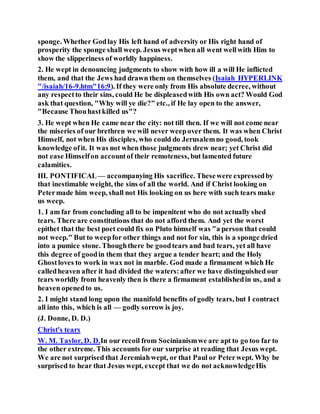
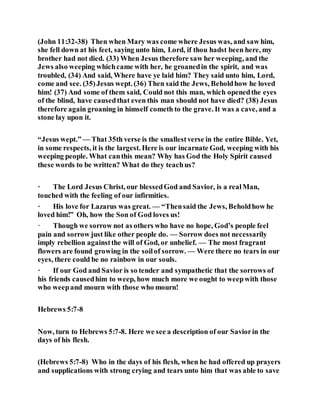
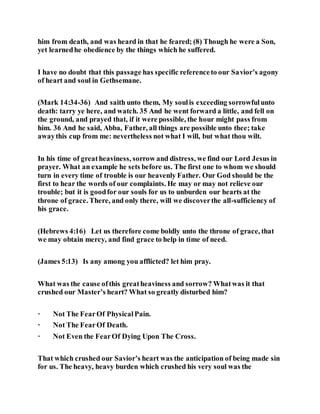
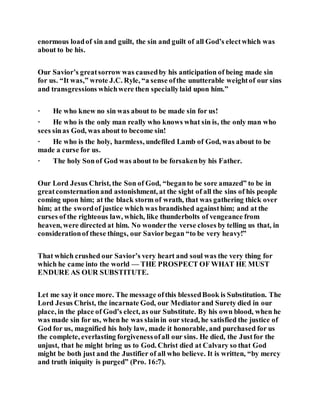
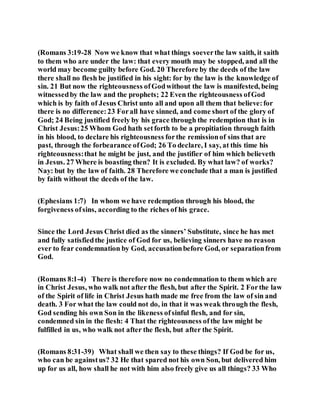
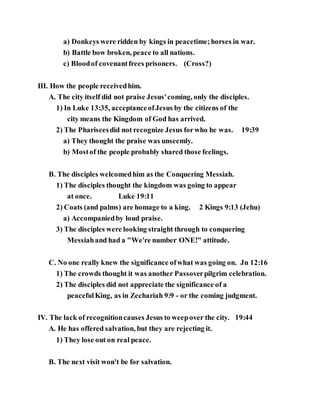
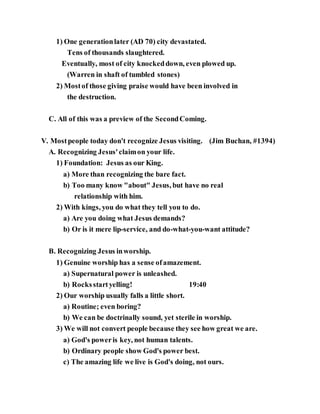
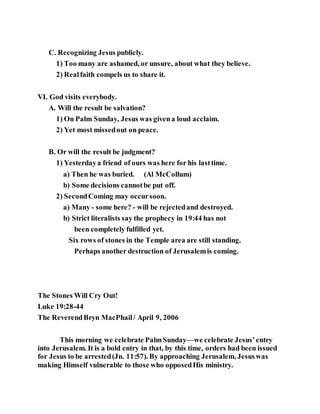
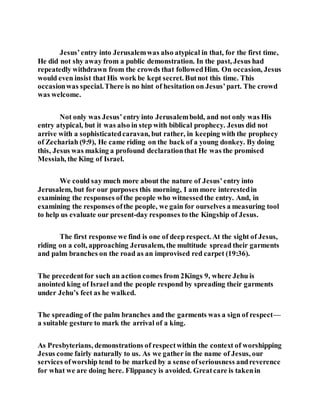
JESUS WAS A MAN WHOCOULD CRY
EDITED BY GLENN PEASE
Luke HYPERLINK"http://www.biblica.com/en-
us/bible/online-bible/niv/luke/19/"19:4141
As he
approachedJerusalemand saw the city, he wept over
it
BIBLEHUB RESOURCES
Pulpit Commentary Homiletics
The Tears Of Christ
Luke HYPERLINK "/luke/19-41.htm"19:41
W. ClarksonWe are touched by the tears of a little child; for they are the sign
of a genuine, if a simple, sorrow. Much more are we affectedby the tears of a
strong and brave man. When a man of vigorous intelligence, accustomedto
command himself, gives way to tears, then we feel that we are in the presence
of a very deep and sad emotion. Such were the tears of Christ. Twice, at least,
he wept; and on this occasionwe understand that he gave free vent to an
overpowering distress. The tears of Christ speak oftwo things more
especially.
I. HIS TENDER SYMPATHYWITH HUMAN SORROW, The grief which
now overwhelmedthe Saviour was (as we shall see)very largely due to his
sense ofits past and its approaching guilt. But it was also due, in part, to his
foreknowledgeofthe sufferings its inhabitants must endure. An intense
sympathy with human woe was and is a very large element in the character
and life of Jesus Christ.
1. It was his compassionfor our race that brought him from above - that we
by his poverty might become rich.
2. It was this which, more than anything else, accounts for the miracles he
wrought. He could not see the blind, and the lame, and the fever-stricken, and
the leprous without tendering them the restoring grace it was in his power to
bestow. He could not see mourning parents and weeping sisters without
healing the heart-wounds he was able to cure.
3. It was this which drew to himself the confidence and affectionof loving
hearts. It was no wonder that pitiful womenand tender-hearted children, and
men whose hearts were unhardened by the world, were drawn in trust and
love to the responsive Sonof man, whose stepwas always stopped by a human
cry, to whose compassionno strickenman or womanever appealedin vain.
4. It is this feature of his characterwhich makes him so dearto us now as our
Divine Friend. For in this world, where sorrow treads so fast on the heels of
joy, and where human comforters so often fail us, of what priceless value is it
to have in that Everlasting One, who is the Ever-present One, a Friend who is
"touched" with our griefs, and who still carries our sorrows by the powerof
his sympathy!
(1) Let us thank God that we have such a Friend in him; and
(2) let us resolve before God that such a friend will we seek andstrive to be.
II. HIS PROFOUND REGRETFOR THOSE WHO ARE IN THE WRONG.
With what eyes do we look upon human sin when we see it at its worst? How
are we affectedby the sight of a drunkard, of a thief, of a foul-mouthed and
fallen woman? Are we filled with contempt? Many bad things are indeed
contemptible; but there is a view to be takenwhich is worthier and more
Christ-like than that; a view which is more humane and more Divine - a
feeling of profound pitifulness and sorrowfulregret. It was this which filled
the heart of Christ when he lookedupon Jerusalem, and that calledforth his
tearful lamentation. Much was there about that city that might well move his
righteous anger, that did calldown his strong, unsparing indignation
(Matthew HYPERLINK "/matthew/23.htm"23.)- its spiritual arrogance, its
religious egotism, its fearful pretentiousness, its deep-seatedhypocrisy, its
heartless cruelty, its whitewashof ceremonywithout with all its corruptness
and selfishness within. But Jesus forebore to denounce; he stopped to weep.
He was most powerfully affectedby the thought that Jerusalemmight have
been so much to God and man, and was - what she was. Jesus Christwas not
so much angeredas he was saddenedby the presence and the sight of sin. He
might have withered it up in his wrath, but he rather wept over it in his pity.
This is the Christian spirit to be cherishedand to be manifestedby ourselves.
We must contemn the contemptible; but we rise to higher ground when we
pity the erring because they are in error, when we mourn over the fallen
because they are down so low, when we grieve for those who are afaroff
because they are astray from God and blessedness. Butwe must not only weep
for those who are in the wrong because they are in the wrong. We must do our
utmost to setthem right. "How often" did Christ seek to gather those sons
and daughters of Jerusalemunder the wings of his love! How often and how
earnestlyshould we seek to reclaim and to restore! - C.
Biblical Illustrator
Jesus wept. - The word is different from that used to express weeping in ver.
33; but this latter is used of our Lord in
Luke HYPERLINK "/luke/19-41.htm"19:41
Christ's tears
J. Donne, D. D.(Text, and Luke HYPERLINK "/luke/19-41.htm"19:41;
Hebrews HYPERLINK "/hebrews/5-7.htm"5:7):— It is a commonplace to
speak of tears;would that it were a common practice to shed them. Whoever
divided the New Testamentinto verses seems to have stopped in amazement at
the text, making an entire verse of two words. There is not a shorter verse in
the Bible nor a larger text. Christ wept thrice. The tears of the text are as a
spring belonging to one house. hold; the tears over Jerusalemare as a river,
belonging to a whole country; the tears on the cross (Hebrews HYPERLINK
"/hebrews/5-7.htm"5:7)are as a sea belonging to all the world; and though,
literally, these fall no more into our text than the spring, yet because the
spring flows into the river and the river into the sea, and that wheresoeverwe
find that Jesus weptwe find our text, we shall look upon those heavenly eyes
through this glass ofHis own tears in all these three lines. Christ's tears were
—
I. HUMANE, as here. This being His greatestmiracle, and declaring His
Divinity, He would declare that He was man too.
1. They were not distrustful inordinate tears. Christ might go further than
any other man, both because He had no original sin within to drive Him, and
no inordinate love without to draw Him when His affections were moved.
Christ goes as faras a passionate deprecationin the passion, but all these
passions were sanctifiedin the root by full submission to God's pleasure. And
here Christ's affections were vehemently stirred (ver. 33); but as in a clean
glass if waterbe troubled it may conceive a little light froth, yet it contracts no
foulness, the affections of Christ were moved but so as to contractno
inordinateness. But then every Christian is not a Christ, and He who would
fast forty days as Christ did might starve.
2. But Christ came nearer to excess thanto senselessness. Inordinateness may
make men like beasts, but absence ofaffectionmakes them like stones. St.
Petertells us that men will become lovers of themselves, which is bad enough,
but he casts anothersin lower — to be without natural affections. The Jews
argued that saw Christ weep, "Beholdhow He loved him." Without outward
declarations who can conclude inward love? Who then needs to be ashamedof
weeping? As they proceededfrom natural affection, Christ's were tears of
imitation. And when God shall come to that last actin the glorifying of man
— wiping all tears from his eyes — what shall He have to do with that eye that
never wept?
3. Christ wept out of a natural tenderness in general;now out of a particular
occasion— Lazarus was dead. A goodman is not the worse for dying, because
he is establishedin a better world: but yet when he is gone out of this he is
none of us, is no longera man. It is not the soul, but the union of the soul that
makes the man. A man has a natural loathness to lose his friend though God
take him. Lazarus's sisters believedhis soul to be in a goodestate, andthat his
body would be raised, yet they wept. Here in this world we lack those who are
gone:we know they shall never come to us, and we shall not know them again
till we join them.
4. Christ wept though He knew Lazarus was to be restored. He would do a
greatmiracle for him as He was a mighty God; but He would weepfor him as
He was a good-natured man. It is no very charitable disposition if I give all at
my death to others, and keepall my life to myself. I may mean to feasta man
at Christmas, and that man may starve before in Lent. Jesus would not give
this family whom He loved occasionof suspicionthat He neglectedthem; and
therefore though He came not presently to His great work, He left them not
comfortless by the way.
II. PROPHETICAL— over Jerusalem. His former tears had the spirit of
prophecy in them, for He foresaw how little the Jews wouldmake of the
miracle. His prophetical tears were humane too, they rise from goodaffections
to that people.
1. He wept in the midst of the acclamations ofthe people. In the best times
there is ever just occasionoffear of worse, and so of tears. Every man is but a
sponge. Whether Godlay His left hand of adversity or His right hand of
prosperity the sponge shall weep. Jesus weptwhen all went wellwith Him to
show the slipperiness of worldly happiness.
2. He wept in denouncing judgments to show with how ill a will He inflicted
them, and that the Jews had drawn them on themselves (Isaiah HYPERLINK
"/isaiah/16-9.htm"16:9). If they were only from His absolute decree, without
any respectto their sins, could He be displeasedwith His own act? Would God
ask that question, "Why will ye die?" etc., if He lay open to the answer,
"Because Thouhastkilled us"?
3. He wept when He came near the city: not till then. If we will not come near
the miseries of our brethren we will never weepover them. It was when Christ
Himself, not when His disciples, who could do Jerusalemno good, took
knowledge ofit. It was not when those judgments drew near; yet Christ did
not ease Himselfon accountof their remoteness, but lamented future
calamities.
III. PONTIFICAL— accompanying His sacrifice. Thesewere expressedby
that inestimable weight, the sins of all the world. And if Christ looking on
Petermade him weep, shall not His looking on us here with such tears make
us weep.
1. I am far from concluding all to be impenitent who do not actually shed
tears. There are constitutions that do not afford them. And yet the worst
epithet that the best poet could fix on Pluto himself was "a person that could
not weep." But to weepfor other things and not for sin, this is a sponge dried
into a pumice stone. Thoughthere be goodtears and bad tears, yet all have
this degree of goodin them that they argue a tender heart; and the Holy
Ghostloves to work in wax not in marble. God made a firmament which He
calledheaven after it had divided the waters:after we have distinguished our
tears worldly from heavenly then is there a firmament establishedin us, and a
heaven openedto us.
2. I might stand long upon the manifold benefits of godly tears, but I contract
all into this, which is all — godly sorrow is joy.
(J. Donne, D. D.)
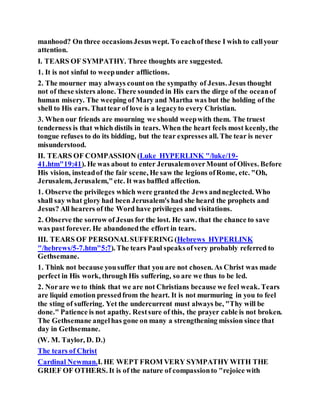
Christ's tears
W. M. Taylor, D. D.In our recoil from Socinianismwe are apt to go too far to
the other extreme. This accounts for our surprise at reading that Jesus wept.
We are not surprised that Jeremiahwept, or that Paul or Peterwept. Why be
surprised to hear that Jesus wept, except that we do not acknowledgeHis
manhood? On three occasionsJesuswept. To eachof these I wish to callyour
attention.
I. TEARS OF SYMPATHY. Three thoughts are suggested.
1. It is not sinful to weepunder afflictions.
2. The mourner may always counton the sympathy of Jesus. Jesus thought
not of these sisters alone. There sounded in His ears the dirge of the oceanof
human misery. The weeping of Mary and Martha was but the holding of the
shell to His ears. Thattear of love is a legacyto every Christian.
3. When our friends are mourning we should weepwith them. The truest
tenderness is that which distils in tears. When the heart feels most keenly, the
tongue refuses to do its bidding, but the tear expresses all. The tear is never
misunderstood.
II. TEARS OF COMPASSION (Luke HYPERLINK "/luke/19-
41.htm"19:41). He was about to enter JerusalemoverMount of Olives. Before
His vision, insteadof the fair scene, He saw the legions ofRome, etc. "Oh,
Jerusalem, Jerusalem,"etc. It was baffled affection.
1. Observe the privileges which were granted the Jews andneglected. Who
shall say what glory had been Jerusalem's had she heard the prophets and
Jesus? All hearers of the Word have privileges and visitations.
2. Observe the sorrow of Jesus for the lost. He saw. that the chance to save
was past forever. He abandonedthe effort in tears.
III. TEARS OF PERSONALSUFFERING (Hebrews HYPERLINK
"/hebrews/5-7.htm"5:7). The tears Paul speaksofvery probably referred to
Gethsemane.
1. Think not because yousuffer that you are not chosen. As Christ was made
perfect in His work, through His suffering, so are we thus to be led.
2. Norare we to think that we are not Christians because we feel weak. Tears
are liquid emotion pressedfrom the heart. It is not murmuring in you to feel
the sting of suffering. Yet the undercurrent must always be, "Thy will be
done." Patience is not apathy. Restsure of this, the prayer cable is not broken.
The Gethsemane angelhas gone on many a strengthening mission since that
day in Gethsemane.
(W. M. Taylor, D. D.)
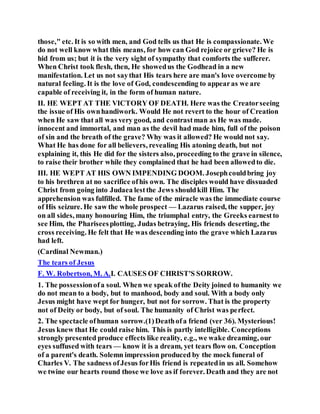
The tears of Christ
Cardinal Newman.I. HE WEPT FROM VERY SYMPATHY WITH THE
GRIEF OF OTHERS. It is of the nature of compassionto "rejoice with
those," etc. It is so with men, and God tells us that He is compassionate. We
do not well know what this means, for how can God rejoice or grieve? He is
hid from us; but it is the very sight of sympathy that comforts the sufferer.
When Christ took flesh, then, He showedus the Godhead in a new
manifestation. Let us not saythat His tears here are man's love overcome by
natural feeling. It is the love of God, condescending to appearas we are
capable of receiving it, in the form of human nature.
II. HE WEPT AT THE VICTORY OF DEATH. Here was the Creatorseeing
the issue of His ownhandiwork. Would He not revert to the hour of Creation
when He saw that all was very good, and contrastman as He was made.
innocent and immortal, and man as the devil had made him, full of the poison
of sin and the breath of the grave? Why was it allowed? He would not say.
What He has done for all believers, revealing His atoning death, but not
explaining it, this He did for the sisters also, proceeding to the grave in silence,
to raise their brother while they complained that he had been allowedto die.
III. HE WEPT AT HIS OWN IMPENDING DOOM. Josephcouldbring joy
to his brethren at no sacrifice ofhis own. The disciples would have dissuaded
Christ from going into Judaea lestthe Jews shouldkill Him. The
apprehension was fulfilled. The fame of the miracle was the immediate course
of His seizure. He saw the whole prospect — Lazarus raised, the supper, joy
on all sides, many honouring Him, the triumphal entry, the Greeks earnestto
see Him, the Phariseesplotting, Judas betraying, His friends deserting, the
cross receiving. He felt that He was descending into the grave which Lazarus
had left.
(Cardinal Newman.)
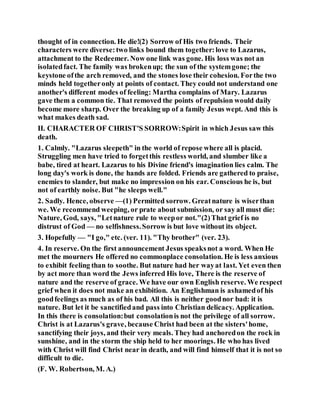
The tears of Jesus
F. W. Robertson, M. A.I. CAUSES OF CHRIST'S SORROW.
1. The possessionofa soul. When we speak ofthe Deity joined to humanity we
do not mean to a body, but to manhood, body and soul. With a body only
Jesus might have wept for hunger, but not for sorrow. That is the property
not of Deity or body, but of soul. The humanity of Christ was perfect.
2. The spectacle ofhuman sorrow.(1)Deathofa friend (ver 36). Mysterious!
Jesus knew that He could raise him. This is partly intelligible. Conceptions
strongly presented produce effects like reality, e.g., we wake dreaming, our
eyes suffused with tears — know it is a dream, yet tears flow on. Conception
of a parent's death. Solemn impression produced by the mock funeral of
Charles V. The sadness ofJesus forHis friend is repeatedin us all. Somehow
we twine our hearts round those we love as if forever. Death and they are not
thought of in connection. He die!(2) Sorrow of His two friends. Their
characters were diverse:two links bound them together:love to Lazarus,
attachment to the Redeemer. Now one link was gone. His loss was not an
isolatedfact. The family was brokenup; the sun of the systemgone; the
keystone ofthe arch removed, and the stones lose their cohesion. Forthe two
minds held togetheronly at points of contact. They could not understand one
another's different modes of feeling: Martha complains of Mary. Lazarus
gave them a common tie. That removed the points of repulsion would daily
become more sharp. Over the breaking up of a family Jesus wept. And this is
what makes death sad.
II. CHARACTER OF CHRIST'S SORROW:Spirit in which Jesus saw this
death.
1. Calmly. "Lazarus sleepeth" in the world of repose where all is placid.
Struggling men have tried to forgetthis restless world, and slumber like a
babe, tired at heart. Lazarus to his Divine friend's imagination lies calm. The
long day's work is done, the hands are folded. Friends are gathered to praise,
enemies to slander, but make no impression on his ear. Conscious he is, but
not of earthly noise. But "he sleeps well."
2. Sadly. Hence, observe —(1) Permitted sorrow. Greatnature is wiserthan
we. We recommend weeping, or prate about submission, or say all must die:
Nature, God, says, "Letnature rule to weepor not."(2)That grief is no
distrust of God — no selfishness.Sorrow is but love without its object.
3. Hopefully — "I go," etc. (ver. 11). "Thy brother" (ver. 23).
4. In reserve. On the first announcement Jesus speaksnot a word. When He
met the mourners He offered no commonplace consolation. He is less anxious
to exhibit feeling than to soothe. But nature had her wayat last. Yet even then
by act more than word the Jews inferred His love, There is the reserve of
nature and the reserve of grace. We have our own English reserve. We respect
grief when it does not make an exhibition. An Englishman is ashamedof his
goodfeelings as much as of his bad. All this is neither goodnor bad: it is
nature. But let it be sanctifiedand pass into Christian delicacy. Application.
In this there is consolation:but consolationis not the privilege of all sorrow.
Christ is at Lazarus's grave, because Christ had been at the sisters'home,
sanctifying their joys, and their very meals. They had anchoredon the rock in
sunshine, and in the storm the ship held to her moorings. He who has lived
with Christ will find Christ near in death, and will find himself that it is not so
difficult to die.
(F. W. Robertson, M. A.)
The import of Jesus'tears
T. E. Hughes.The weeping was precededby groans. After the groans come
tears — a gentle rain after the violent storm. Jesus in this, as in all things,
stands alone.
1. Different from Himself at other times.
2. Very unlike the Jews who came to comfort the two sisters, and —
3. unlike the sisters themselves. Jesus'tears imply —
I. THE RELATION BETWEENTHE BODY AND THE MIND
(Lamentations HYPERLINK "/lamentations/3-51.htm"3:51). Tears are
natural. The relation existing between matter and mind is inexplicable. Yet it
exists. From this fact we can reasonto the relation existing betweenGod and
the material universe.
II. THE RELATION BETWEEN THE HUMAN AND THE DIVINE. Here
we have a proof of His humanity. What more human than weeping? Following
this manifestationof humanity is the manifestationof divinity. We should
guard againstthe old errors concerning the constitution of Christ's person;
for they appear from age to age under new forms:
1. Arianism — denying His proper Divinity.
2. Appolinarianism — denying His proper humanity.
3. Nestorianism— dual personality.
4. Eutychianism — confounding the two natures in His person.
III. THE RELATION BETWEENCHRIST AS MEDIATOR AND
HUMANITY, IN GENERAL, IN ITS MISERY, AND HIS PEOPLE, IN
PARTICULAR, IN THEIR AFFLICTIONS.
1. The question, why He wept? is here answered.(1)He was sorrowful because
of the misery causedby sin. As Jerusalemwas before His eyes when He wept
over it, so here humanity in its sin and all its misery passedin review before
His face.(2)His weeping was a manifestation of His sympathy. No comparison
betweenHis consoling, comforting tears and those of the Jews.
2. The intercessorywork of Christ as our High Priestin heaven is here
implied. He is the same there as when here upon earth (Hebrews
HYPERLINK "/hebrews/13-8.htm"13:8). Has the same heart beating with
ours. He is our sympathizing Friend and Brother there. APPLICATION:
1. Have you wept on accountof your sins? They have caused, and are still
causing, Jesus to weep.
2. Do you realise Christ's friendship for you?
3. Let us learn from His example to sympathise with the sorrows ofour fellow
men.
(T. E. Hughes.)
A unique verse
C. H. Spurgeon.Ihave often felt vexed with the man whoeverhe was, who
chopped up the New Testamentinto verses. He seems to have let the hatchet
drop indiscriminately here and there; but I forgive him a greatdeal of
blundering for his wisdom in letting these two words make a verse by
themselves, "Jesuswept." This is a diamond of the first water, and it cannot
have another gem setwith it, for it is unique. Shortestof verses in words, but
where is there a longerone in sense? Letit stand in solitary, sublimity and
simplicity.
(C. H. Spurgeon.)
Embodied sympathy powerful
George Eliot."Ideas are oftenpoor ghosts;our sun-filled eyes cannotdiscern
them. They pass athwart us in this vapour and cannotmake themselves felt.
But sometimes they are made flesh, they breathe upon us with warm breath,
they touch us with soft, responsive hands, they look at us with sad, sincere
eyes, and speak to us in appealing tones. They are clothedin a living human
soul, with all its conflicts, its faith, and its love. Then their presence is a power,
and we are drawn after them with a gentle compulsion, as flame is drawn to
flame."
(George Eliot.)
Jesus sympathizes with all who suffer
H. W. Beecher.Ifa man be found weltering by the roadside, wounded, and a
strangercomes along, he will pity him, for the heart of man speaks one
language the world over. But if it were a near neighbour or strong personal
friend how much more tender the pity. That of the man's ownfather far
transcends those. But the noblest heart on earth is but a trickling stream from
a shallow fountain compared with the pity of God, which is wide as the scope
of heaven and abundant as all the air.
(H. W. Beecher.)
Christ satisfying the instinct of sympathy
DeanVaughan.There is a word in our language — the iron Roman had to
arrange many circuitous approaches to it — we borrow it straight from the
plastic, responsive Greek — the word sympathy
I. THE INSTINCT. The wordhas gone through one process since it left its
root "to suffer," which root does not mean suffering in our common sense, but
"being affected." So sympathy does not mean fellow suffering, but community
of affection. It may be —(1) A community of congruity. There is sympathy
betweentwo persons where there is such a likeness ofdisposition that they are
mutually drawn to eachother.(2) A community of contagion. You sympathize
with a person when in some particular sorrow or joy you share the feeling
arising out of circumstances notyour own.
1. As a community of disposition, sympathy is —(1) The spring of all love. We
see in the soul which looks through those eyes, its windows, the very
counterpart and complement of our own. Even beauty acts through sympathy.
It is not the flesh, grace, colour, etc., but the idea or promise of beautiful
qualities which wins the heart. Another may be more comely, but we are not
attractedbecause we read not the disposition which ours craves. We blame
ourselves for not loving. Why do we not love? For the lack of that sympathy of
congruity representedby the word "liking."(2)The inspiration of eloquence.
What is there in that insignificant figure, uncomely countenance, unmusical
voice which nevertheless swaysmultitudes as the oratorlists. An empire has
hung in suspense while one man has talked to 10,000. Why? Becauseofthe
charm of sympathy.(3) The secretofpowerin poetry and fiction. What is it
which draws tears from eyes which know they are Witnessing imaginary
sorrows? Itis the skill with which genius draws upon the resources ofhuman
feeling. The moment the tragicalpassesinto the artificial, the teardries of
itself.(4)The explanation of all magnificent successes.A want of sympathy
accounts for the failure of men possessedof every gift but one. You see it in
oratory: there is learning, industry, etc., but the audience is unimpressed
because there was no heart. You see it in action:there is education, character,
opportunity, etc., but coldness of temperament chilled the touch of
friendship.(5) This sympathy has its excesses. Itis so charming and
remunerative that some men are guilty of practising on good impulses, and
become insincere, and destroyothers by means of the soul's best and tenderest
affections.
2. Sympathy of contagion, too, is an instinct. To feel is human; we calla man
unnatural, unhuman who cannotpity. But some men feel without acting, and
consequentlyfeeling is deadened. Others keepawayfrom them what will
make them feel, and waste the instinct. To this kind of sympathy belong all
those efforts by which we throw ourselves into another's life for benevolent
influence. This alone renders possible an education which is worthy of the
name, the teachersharing personally the difficulties, games, weaknesses, etc.,
of the taught.
II. CHRIST SATISFYING THIS INSTINCT.
1. He presented Himself to us in one thrust, as possessing allthat beauty
which has a natural affinity to everything that is noble and true.(1) He appeals
to the instinct in its form of likeness. We must be cautious here, a not confuse
the ruined will, the original temple. Still there is no one who has no response
in him to that which is lovely and of goodreport. The instinct finds not its rest
here below. Some profess to be satisfied: they have what they want. They are
happy — might it but last; were there no storms and eventual death. But for
the restcare, toil, ill-health, bereavementhave forbidden it, or they have not
yet found the haven of sympathy. The first movement of such in hearing of
Christ satisfying the wants of the soulis one of impatience: they want
something substantial. What they really want is community of affection.
There is offeredto them a perfectlove.(2)Christ guides and demands
sympathy. He makes it religion, which is sympathy with God; "liking" the
drawing of spirit to spirit by the magnet of a felt loveliness. "Idrew them with
cords," etc. Without this religion is a burden and bondage.
2. Christ satisfies the sympathy of contact. We might have thought that the
Creatorwould shrink from the ugly thing into which sin has corrupted His
handiwork. But He never heard the lepers cry without making it a reasonfor
drawing nigh. Again and againHe went to the bereaved, and it was to wake
the dead; and this not officially, as though to say, "This proves Me the
Christ." Jesus wept. There was no real peril or want with which He did not
express sympathy. He loved the rich young man; He wept over Jerusalemwith
its unbelief and hypocrisy; He was in all points tempted, and so is able to
sympathize with our infirmities. What He sympathized with was poor sin-
spoilt humanity, and for that He died. Conclusion:What Christ did He bids us
do not in the way of condescension, but as men touching to Him, not loving the
sin, yet loving the sinner. Lonely people cease to be alone. "Rejoicewith them
that rejoice," etc.
(DeanVaughan.)
The tears of the Lord Jesus
WatsonSmith.I. JESUS WEPT;FOR THERE WAS CAUSE WORTHY OF
HIS TEARS. The finest, noblest race of God's creatures dismantled, sunk in
death before Him, all across earthand time from the world's beginning.
Tears, we know, show strongestin the strongest. Whenyou see the strong man
broken down beside his sick babe you cannotbut feel there is a cause.
Whateverelse there may be in the man, you see that he has a heart, and that
his heart is the deepest, is the Divine part of him. As the father's tears over his
child testify the father's heart, so the tears of Jesus testify that He has a heart
which beats with infinite love and tenderness towardus men. For we are His,
and in a far more profound and intimate sense belong to Him, than children
can to an earthly parent. And the relation into which the Lord Jesus has come
with our humanity is closerand tenderer than that of earthly parent. We
speak of Him as our Brother, our Elder Brother; but the truth is, Christ's
relation to us is Father, Mother, Brother, Sister, Husband, Friend, all in One.
But He knew — further — that a sadderthing than death and its miseries lay
behind, even sin. This touched and affectedHim most, that we were a fallen
and dishonoured race, and therefore death had come upon us and
overshadowedus. Why else should we die? The stars do not wax old and die,
the heavens and the earth remain unto this day, though there is no soul or
spirit in them. Why should the brightness of an immeasurably nobler and
more exalted creature like man waxdim? Stars falling from heaven are
nothing to souls falling from God. The one are but lights going out in God's
house, the other the very children of the house perishing. Jesus weptthen for
the innermost death of all death, the fountain misery of all miseries But while
in His Divine thought and sorrow He penetrated to the root and source ofthat
evil and of all evil, the mighty attendant suffering awoke in Him the truest and
deepestcompassionand sympathy. He wept, then, with eachone of us; for
who has not been called to part with some beloved relative, parent, partner,
companion, guide, or friend? With all sorrowing, desolate hearts and homes
of the children of men He then took part. Again, the Lord Jesus felt how much
the darkness and sorrows ofdeath were intensified and aggravatedby the
state of ignorance and unbelief in which the world lay. How mournful to His
spirit at that hour the realization of the way in which the vast bulk and
majority of the human race enter the world, go through it, leave it 1 for He
knew, better than any other that has been on earth, man's capability of higher
things and of an endless life and blessedness. "Like sheepthey are laid in the
grave," says the writer of the 49th Psalm, What a picture! Like that abject,
unthinking, and helpless animal, driven in flocks by awful forms, cruel
powers, they can neither escape norresist, to a narrow point and bound,
where all is impenetrable darkness.
II. Let us consider"THE TEARS OF JESUS" AS REVEALING THE
DIVINE HEART. Are we to believe that He out of whose heart have come the
hearts of all true fathers and mothers, all the simple, pure affections of our
common nature and kinship, of the family and the home; are we to believe, I
say, that God has no heart? Some one may say, There is no doubt God can
love and does love — infinitely; but can He sorrow? Now, my friend, I pray
you, think what is sorrow but love wanting or losing its objects, its desire and
satisfactionin its objects, and going forth earnestlyin its grief to seek and
regainthem? Sorrow, suffering, is one of the grandest, noblest, most self-
denying, and disinterested forms and capabilities of love, apart from which
love could not exist, whether in nature or in name.
III. THE TEARS OF JESUS ARE THOSE OF A MIGHTY ONE
HASTENING TO AVENGE AND DELIVER. They are not the tears of one
whose pity and sympathy canonly be thus expressed, but who has no power
— whatever may be his willingness and desire — to help. The tears of Jesus
are those of a hero over his native country and kingdom laid waste by an
enemy whom he hastens to meet and avenge himself upon. There is hope,
there is help for our world; Jesus Christ weeps overit, and He "will restore all
things" of which we have been robbed and spoiled.
IV. HENCE WE LEARN OUR TRUE SOURCE OF COMFORT, HELP,
AND RESTORATION. He who wept and bled and died for man has proved
Himself to be our greatDeliverer. Do we ever feel we can go anywhere else
but to Him when sicknessand death threaten and invade us and ours?
(WatsonSmith.)
PRECEPTAUSTIN RESOURCES
The Lamentations Of Jesus BY SPURGEON
“When He had come near, He beheld the city and wept over it.”
Luke 19:41
ON three occasions we are told that Jesus wept. You know them well, but it
may be worth while to refresh your memories. The first was when our Lord
was about to raise Lazarus from the dead. He saw the sorrow ofthe sisters
and He meditated upon the fruit of sin in the death and corruption of the body
and He groanedin spirit and it is written that “Jesus wept.” Those who
divided the chapters did well to make a separate verse of that simple sentence.
It stands alone, the smallestand yet, in some respects, the greatestverse in the
whole Bible! It shines as a diamond of the first water. It contains a world of
healing balm condensedinto a drop. Here we have much in little–a wealthof
meaning in two words.
The secondoccasionwe have before us and we will make it the theme of our
discourse. At the sight of the beloved but rebellious city, Jesus wept. The third
occasionis mentioned by the Apostle Paul in the fifth chapter of his Epistle to
the Hebrews where he tells us what else we might not have known, that the
Savior, “in the days of His flesh, offered up prayers and supplications with
strong crying and tears unto Him that was able to save Him from death and
was heard in that He feared.” Thatpassagerelates to the Gethsemane agony
in which a showerof bitter tears was mingled with the bloody sweat. The
strength of His love strove with the anguish of His souland, in the process,
forcedforth the sacredwaters ofHis eyes. Thus our Saviorwept in sympathy
with domestic sorrow and sanctifiedthe tears of the bereaved.
We, too, may weep when brethren and friends lie dead, for Jesus wept. There
need not be rebellion in our mourning, for Jesus fully consentedto the Divine
will and yet He wept. We may weepat the graves ofthose we love and yet be
guiltless of unbelief as to their resurrection, for Jesus knew that Lazarus
would rise againand yet He wept. Our Lord, in weeping over Jerusalem,
showedHis sympathy with national troubles and His distress at the evils
which awaitedHis countrymen. Men should not ceaseto be patriots when they
become Believers–saints should bemoan the ills which come upon the guilty
people among whom they are numbered and do so all the more because they
are saints.
Our Lord’s third weeping was induced by the great burden of human guilt
which pressedupon Him. This shows us how we, too, should look upon the
guilt of men and mourn overit before God. But in this specialweeping Jesus
is alone–there was a something in the tears of Gethsemane to which we cannot
reach, for He who shed them was then beginning to suffer as our Substitute
and in that case He must necessarilytread the winepress alone and of the
people there must be none with Him. Beholdbeneath the olive trees a solitary
Weeperenduring a grief which, blessedbe His name, is now impossible to us,
seeing He has takenawaythe transgressions whichcalledfor it!
We will now turn to this secondinstance of our Savior’s weeping and here we
find, when we look at the original words, that it is not exactlyexpressedby the
words used in our admirable English version. We there read, “He beheld the
city and wept overit,” but the Greek means a greatdeal more than tears and
includes sobs and cries. Perhaps it may be best to read it, “He lamented over
it.” He suffered a deep inward anguish and He expressedit by signs of woe
and by words which showedhow bitter was His grief. Our subject will not be
the lamentations of Jeremiah, but the lamentations of Jesus–the lamentations
of Him who could more truly saythan the weeping Prophet, “I am the Man
that has seenaffliction by the rod of His wrath. My eyes run down with rivers
of water for the destruction of the daughter of My people. Beholdand see if
there is any sorrow like unto My sorrow which is done unto Me.”
Jesus is here a King by generalacclamation, but King of grief by personal
lamentation. He is the Sovereignof sorrow, weeping while riding in triumph
in the midst of His followers. Did He ever look more kingly than when He
showedthe tenderness of His heart towards His rebellious subjects? The city
which had been the metropolis of the house of David never saw so truly a
royal man before, for He is most fit to rule who is most ready to sympathize!
We shall, this morning, as God shall help us, first, considerour Lord’s inward
grief. And then, secondly, His verbal lamentation. Oh for the powerof the
Spirit to bless the meditation to the melting of all our hearts! O Lord, speak to
the rock and bid the waters flow, or, if it pleases Youbetter, strike it with
Your rod and make it gush with rivers–only in some way make us answerto
the mourning of our Savior–
“Did Christ oversinners weep
And shall our cheeks be dry?
Let floods of penitential grief
Burst forth from every eye.”
1. First, we are to contemplate OUR LORD’S INWARD GRIEF. We note
concerning it that it was so intense that it could not be restrainedby the
occasion. The occasionwas one entirely by itself–a brief gleam of
sunlight in a cloudy day, a glimpse of summer amid a cruel winter. His
disciples had brought the colt and had placedHim on it and He was
riding to the city which was altogethermoved at His coming. The
multitudes were eagerto do Him homage with waving branches and
loud hosannas, while His disciples in the inner circle were exulting in
songs ofpraise which almost emulated the angelic chorales ofHis birth
night. “Glory to God in the highest, peace on earth, goodwill toward
men,” found its echo when the disciples said, “Blessedbe the King that
comes in the name of the Lord: peace in Heaven and glory in the
highest.”
Yet amidst the hosannas ofthe multitude, while the palm branches were yet in
many hands, the Savior stoppedto weep!On the very spot where David had
gone centuries before weeping, the Son of David stayed awhile to look upon
the city and to pour out His lamentation! That must have been deep grief
which ran counter to all the demands of the seasonand violated, as it were, all
the decorum of the occasion. Itturned a festival into a mourning, a triumph
into a lament. Ah, He knew the hollowness ofall the praises which were
ringing in His ears!He knew that they who shouted hosanna today would,
before many suns had risen, cry, “Crucify Him! Crucify Him!” He knew that
His joyous entrance into Jerusalemwould be followedby a mournful
processionoutof it when they would take Him to the Cross that He might die.
He saw amid all the effervescenceofthe moment the small residue of sincerity
that there was in it and He acceptedit–but He lamented the abundance of
mere outward excitement which would disappearlike the froth of the sea–and
so He stoodand wept. It was a great sorrow, surely, which turned such a day
of hopefulness into a seasonofanguish. It strikes me that all that day the
Savior fastedand, if so, it is singular that He should have purposely kept for
Himself a fast while others on His accountheld a festival! The reasonwhy He
did so, I think, is this–Mark says, “And now the eventide was come, He went
out unto Bethany with the twelve. And on the morrow, when they were come
from Bethany, He was hungry: and seeing a fig tree afar off having leaves, He
came, if haply He might find anything thereon.”
Such hunger had not come upon Him if it had not been precededby a fastthe
day before. See, then, your Lord surrounded, as it were, with billows of praise
in the midst of a tumultuous sea of exultation, Himself standing as a lone rock,
unmoved by all the excitementaround Him. Deepwas the grief which could
not be concealedor controlledon such a day when the sincere congratulations
of His disciples, the happy songs ofchildren and the loud hosannas ofthe
multitude everywhere welcomedHim.
The greatnessofHis grief may be seen, again, by the factthat it overshadowed
other very natural feelings which might have been and, perhaps, were, excited
by the occasion. Our Lord stoodon the brow of the hill where He could see
Jerusalembefore Him in all its beauty. What thoughts it awakenedin Him!
His memory was strongerand quicker than ours, for His mental powers were
unimpaired by sin and He could remember all the greatand glorious things
which had been spokenof Zion, the city of God. Yet, as He remembered them
all, no joy came into His soulbecause of the victories of David or the pomp of
Solomon–Temple andtower had lostall charm for Him–“the joy of the earth”
brought no joy to Him. And at the sight of the venerable city and its holy and
beautiful house He wept.
Modern travelers who have any soul in them are always moved by the
sublimity of the spectacle fromthe Mount of Olives. DeanStanley wrote,
“Nothing at Rome, Memphis, Thebes, Constantinople, orAthens can
approachit in beauty or interest.” And yet this is the poor, mean Jerusalemof
modern times–by no means to be comparedwith the Jerusalemof our
Savior’s day! Yet the Lord Jesus says nothing about this city, “Beautifulfor
situation,” except to lament overit. If He counts the towers there and marks
well her bulwarks, it is only to bemoan their total overthrow. All the
memories of the past did but swell the torrent of His anguish in the foresight
of her doom!
Something of admiration may have entered the Savior’s holy breast, for
before Him stood His Father’s house, of which He still thought so much that
even though He knew it would be left desolate, yetHe took pains to purge it
once againof the buyers and sellers who polluted it. That Temple was built of
white marble and much of it, the roofespecially, coveredwith slabs of gold. It
must have been one of the fairestobjects that everhuman eye restedupon as
it glittered in the sun before Him. But what were those greatand costly
stones? Whatwere those curious carvings to Him? His heart was saying
within itself, “There shall not be one stone left upon anotherthat shall not be
thrown down.”
His sadness atthe foresight of the city’s desolationmasteredHis natural
feeling of admiration for its presentglory. His sorrow found no alleviation
either in the past or the present of the city’s history–the dreadful future threw
a pall over all. It mastered, too, the sympathy which He usually felt for those
who were about Him. He would not stop His disciples from rejoicing, though
the PhariseesaskedHim, but He, Himself, took no share in the joy. Usually
He was the most sensitive of men to all who were around Him, sorrowing with
their sorrow and joying in their joy. But on this occasionthey may wave their
palms and cut down branches of trees and strew them in the wayand the
children may shout, Hosanna, but He who was the center of it all did not enter
into the feeling of the hour–they celebrate–He weeps.
More striking, still, is the fact that His grief for others prevented all
apprehension for Himself. As He beheld that city, knowing that within a week
He would die outside its gates, He might naturally have begun to feel the
shadow of His sufferings, but no trace of such emotion is discoverable. You
and I, in such a case,with the certainty of a speedy and ignominious death
before us, would have been heavy about it, but Jesus was not. In all that flood
of tears there was not one for His own death! The tears were all for
Jerusalem’s doom, even as He said afterwards, “DaughtersofJerusalem,
weepnot for Me, but for yourselves and for your children.”
It is not “Woe is Me, the holy city will become an Aceldama, a field of blood
by My slaughter,” but, “Oh, if you had known, even you, in this, your day.”
He grieves for others, not for Himself! Yet it must have been a very intense
emotion which thus swept away, as with a torrent, everything else so that He
had neither joy for joy, nor sorrow for sorrow, but His whole strength of
feeling was poured forth from one sluice and ran in one channel towards the
devoted city which had rejectedHim and was about to put Him to death! This
greatsorrow of His reveals to us the Nature of our Lord. How complex is the
Personof Christ! He foresaw that the city would be destroyedand though He
was Divine, He wept! He knew every single event and detail of the dreadful
tragedy and used words about it of specialhistoricalaccuracywhichbring out
His prophetic Characterand yet the eyes so clearin seeing the future were
almost blinded with tears!
He speaks ofHimself as willing and able to have averted this doom by
gathering the guilty ones under His wings and thus He intimates His Godhead.
While His Nature on the one side of it sees the certainty of the doom, the same
Nature, from another side, laments the dread necessity!I will not say that His
Godheadforesaw and His Manhoodlamented, for so mysteriously is the
Manhoodjoined to the Godheadthat it makes but one Personand it were
better to assertthat the entire Nature of Christ lamented over Jerusalem. I
have never been able to believe in an impassive God, though many theologians
lay it down as an axiom that God cannotsuffer. It seems to me that He can do
or endure anything He wills to do or endure and I, for one, cannotsee that
there is any specialglorifying of God in the notion that He is incapable in any
direction whatever. We can only speak of Him after the manner of men and
after that manner He speaks ofHimself and, therefore, there is no wrong in so
doing.
It brings the greatFather nearer when we see Him lamenting the wanderings
of His children and joying in their penitent return. What but sorrow canbe
meant by such expressions as these? “How shallI give you up, Ephraim? How
shall I deliver you, Israel? How shall I make you as Admah? How shall I set
you as Zeboim? My heart is turned within Me; My repentings are kindled
together.” “Hear, O heavens and give ear, O earth: for the Lord has spoken, I
have nourished and brought up children and they have rebelled againstMe.
The ox knows his owner and the ass his master’s crib: but Israeldoes not
know, My people do not consider.” Are these the utterances of an unfeeling
God? I believe it is the Christ, the entire Christ that both foretells the doom of
Jerusalemand laments it.
Some have even been staggeredatthe statement that Jesus wept. Certain of
the early Christians, I am sorry to say, even went the length of striking the
passageout of the Gospelbecause they thought that weeping would dishonor
their Lord. They ought to have had more reverence for the Inspired Word
and a truer knowledge oftheir Masterand never to have wished to obliterate
a record which reflects the highest honor upon man’s Redeemer. Our Lord’s
lament gives us an insight into the great tenderness of His Character–He is so
tender that He not only weeps while weeping would be of no use–but He
laments when lamentation must be fruitless! He reminds me of a judge who,
having before been a friend by warning, persuading, pleading with the
prisoner, at last has the unutterable pain of condemning him–he puts on the
black cap and, with many a sighand tear, pronounces sentence–feeling the
dreadful nature of the occasionfar more than the criminal at the bar.
He is overcome with emotion while he declares that the condemned must be
takento the place from where he came and there die a felon’s death. Oh the
tender heart of Christ, that when it comes to pronouncing the inevitable
sentence, “Yourhouse is left unto you desolate,”yet He cannot utter the
righteous words without lamentation! In this our Lord reveals the very heart
of God! Did He not say, “He that has seenMe has seenthe Father”? Here,
then, you see the Father, Himself, even He who saidof old, “As I live, says the
Lord God, I have no pleasure in the death of the wicked;but that the wicked
turn from his wayand live.” The doom must be pronounced, for infinite
Justice demands it, but Mercy laments what she was not permitted to prevent.
Tears fall amid the thunders and though the doom is sealedby obstinate
impenitence, yet judgment is evidently strange work to the patient Judge. This
anguish showedhow dreadful was the sentence, forwhat could stir the Savior
so if the doom of sinners is a small affair? If the doom of guilt is such a trifle
as some dream, I understand not why these tears!The whole Nature of Christ
is convulsed as He thinks, first of Jerusalemplowedas a field and her children
slaughteredtill their blood runs in rivers of gore and, next, as He beholds the
doom of the ungodly who must be driven from His Presenceand from the
Glory of His power to be the awful witnesses ofDivine Justice and of God’s
hatred of evil. Thus standing on the brow of Olivet, the weeping Sonof Man
reveals to us the heart of God–slow to anger, of greatmercy, waiting to be
gracious and tardy in executing His wrath.
For a practicallesson, we may remark that this weeping of the Saviorshould
much encourage men to trust Him. Those who desire His salvationmay
approachHim without hesitation, for His tears prove His hearty desires for
our good. When a man who is not given to sentimental tears, as some
effeminate beings are, is seento weep, we are convincedof his sincerity. When
a strong man is passionatelyconvulsedfrom head to footand pours out
lamentations, you feelthat he is in downright earnestand if that earnestnessis
manifested on your behalf you can commit yourself to him. Oh, weeping
Sinner, fear not to come to a weeping Savior! If you will not come to Jesus, it
grieves Him! That you have not come long ago has wrung His heart! That you
are still awayfrom Him is His daily sorrow–come, then, to Him without delay!
Let His tears banish your fears, yes, He gives you better encouragementthan
tears, for He has shed for sinners not drops from His eyes, alone, but from His
heart! He died that sinners who believe in Him might live! His whole body was
coveredwith bloody sweatwhen He agonized for you–how can you doubt His
readiness to receive you? The five scars that still remain upon His blessed
Person, up there at the Father’s right hand, all invite you to approach Him!
These dumb mouths most eloquently entreat you to draw near and trust in
Him whom God has setforth as the Propitiation for sin! How shall He that
wept and bled and died for sinners repulse a sinner who comes to Him at His
bidding? Oh, come, come, come, I pray you, even now, to the weeping sinner’s
Friend.
This, too, I think is an admonishment to Christian workers. Some ofus, long
ago, came to Jesus and we now occupy ourselves with endeavoring to bring
others to Him. In this blessedwork our Lord instructs us by His example.
Brothers and Sisters, if we would have others come to Jesus we must be like
Jesus in tenderness. We must be meek, lowly, gentle and sympathetic and we
must be moved to deep emotion at the thought that any should perish. Never
let us speak harshly of the doom of the wicked. Neverlet us speak flippantly,
or without holy grief–the loss of Heaven and the endurance of Hell must
always be themes for tears!That men should live without Christ is grief
enough–but that they should DIE without Christ is an overwhelming horror
which should grind our hearts to powder before God and make us fall on our
faces and cry, “O God, have mercy upon them and save them, for Your Grace
and for Your love’s sake.”
The deepesttenderness, it may be, some of us have yet to learn. Perhaps we
are passing through a schoolin which we shall be taught it and if we do but
learn it we need not care how severe the instructive discipline may be. We
ought not to look upon this city of London without tears, nor even upon a
single sinner without sorrow. We must preachtenderly and teachtenderly if
we would win souls. We are not to weep continually, for even Jesus did not do
that, yet are we always to feel a tender love towards men so that we would be
ready to die for them if we might but save them from the wrath to come and
bring them into the haven of the Savior’s rest!
Let me add that I think the lament of Jesus should instruct all those who
would now come to Him as to the manner of their approach. While I appealed
to you, just now, were there any who said, “I would gladly come to Jesus, but
how shall I come?” The answeris–comewith sorrow and with prayer, even as
it is written, “they shall come with weeping and with supplications will I lead
them.” As Jesus meets you, so meet Him. He shows you in what fashion to
return, in what array to draw near to your Redeemer, for He comes to you
clothed in no robes but those of mourning, adorned with no jewels but the
pearls of His tears. Come to Him in the garments of humiliation, mourning for
your sin. “Blessedare they that mourn, for they shall be comforted.”
Penitential sorrow works life into men. Only come to Jesus and tell Him you
have sinned and are ashamedand gladly would ceaseto do evil and learn to
do well. Come in all your misery and degradation, in all your consciousness of
your Hell-deservedness. Come in sorrow to the Man of Sorrows who is even
now on the road to meet you! He has said, “Him that comes to Me I will in no
wise castout,” and He will not forfeit His Word. God bless these feeble words
concerning the inner emotions of my Lord and may the Holy Spirit again rest
upon us while we further pursue the subject into another field.
II. We are now to considerOUR LORD’S VERBAL LAMENTATIONS.
These are recordedin the following words–“Ohthat you had known, even
you, at least in this, your day, the things which belong unto your peace!But
now they are hid from your eyes.” First, notice He laments over the fault by
which they perished–“Ohthat you had known.” Ignorance, willful ignorance,
was their ruin. “Oh that you had known.” Theydid not know what they might
have known–whatthey ought to have known–theydid not know their God.
“The ox knows his ownerand the ass his master’s crib, but Israeldoes not
know, My people do not consider.”
They knew not God! They knew not God’s only Son! They knew not Him who
came in mercy to them with nothing but love upon His lips! Oh, but this is the
pity, that the Light of God is come into the world and men will not have it, but
love darkness rather than Light. Alas, I fear that some of my hearers live in
the Light and will not see. There are none so deaf as those that will not hear
and none so blind as those that will not see–andyet there are such in all
Christian congregations–who do not know and will not know. God says, “Oh
that you had hearkenedto My Commandments, then had your peace beenas
a river and your righteousness as the waves of the sea.” Our Lord lamented
over the inhabitants of Jerusalembecause theyhated knowledge and did not
choose the fear of the Lord–they would have none of His counsel–they
despisedHis reproof.
Willful ignorance led to obstinate unbelief. They chose to die in the dark
rather than acceptthe Light of the Sonof God! The Lord laments the bliss
which they had lost, the peace which could not be theirs, “Oh that you had
known the things that belong unto your peace.” The name of that city was, as
we know, Jerusalem, which, being interpreted, signifies a vision of peace.
They that lookedupon it saw before them a vision of peace. But, alas,
Jerusalemhad lost its “salem,” orpeace, and become only a vision because she
did not know and would not know her God! Oh men and womenthat know
not God, you have lost peace!Even now you are like the troubled sea that
cannot rest, whose waters castup mire and dirt!
“There is no peace, says my God, unto the wicked.” Ohwhat joys you might
have had! The delights of pardoned sin, the bliss of conscious safety, the joy of
communion with God–the rapture of fellowship with Christ Jesus, the
heavenly expectationof infinite Glory–all might have been yours! But you
have put them awayfrom you. The Lord says of you, as of Israel of old, “O
that My people had hearkenedunto Me and Israelhad walkedin My ways!I
would soonhave subdued their enemies and turned My hand upon their
adversaries.”Godwould have revealedto you, by His Spirit, brighter things
than eyes have seenand sweeterjoys than ears have heard–for if you had been
willing and obedient you would have eatenthe fat of the land of His promises!
You are losers!You are awful losers by not being reconciledto God and you
will be worse losers yet, for that false peace which now stands in the place of
true peace and beguiles and fascinatesyou will depart like the mirage of the
desertand leave you on the arid sands of despair to seek restand find it not!
Soonshall a terrible sound be in your ears of the approaching vengeance of
God and there shall be for you no placeofrefuge. When the Lord thought of
what they had lost, He cried, “Oh that you had known!” I feelashamed to
repeatHis Words because I cannotrepeat them in the tone He used. Oh, to
hear Jesus saythese words! I think it might melt a heart of stone!But no, I am
mistaken, even that would not do it, for those who did hear Him were not
melted nor reclaimed, but went on their wayto their doom as they had done
before! How hardened are the men who can trample on a Redeemer’s tears!
What wonder that they find a Hell where not a drop of watercan ever cool
their parched tongues tormented in the flames! If men are resolvedto be
damned, it is evident that the tears of the best, the most perfect of men cannot
stop them! Woe is me! This is deeper cause for tears than all else besides, that
men should be so desperatelyset on mischief that nothing but Omnipotence
will stop them from eternalsuicide!
But our Lord also lamented over they who had lost peace. Observe that He
says–“Ohthat you had known, even you. You are Jerusalem, the favored city.
It is little that Egypt did not know, that Tyre and Sidon did not know, but that
you should not know!” Ah, Friends, if Jesus were here this morning, He might
weepover some of you and say–“Ohthat you had known, even you.” You
were a lovely child! Even in your earliestdays you were fond of everything
goodand gracious!You were takento the place of worship and sat on your
mother’s knee, pleasedto be there. Do you remember the minister’s name
that you used to lisp with delight, the texts you repeatedand the hymns you
sang? You grew up to be a lad right full of promise and all felt sure that you
would be a Christian.
What exhortations your father, who is now in Heaven, gave you! And she that
bore you and loved you till she passedaway!How she prayed and pleaded for
you! Some of you have been sitting here, or in some other place where Christ
is preached, for a very long time and you have often been very near to the
Kingdom and yet you are not in it. You have come right up to the edge of the
border, but you have not crossedthe line. You are not far from the Kingdom
of God, but you lack one thing–the one essentialpoint of decisionfor Christ–
“Oh that you had known, even you!” You are always ready to help the cause
of God with your purse, for you take an interestin every goodwork–you
cannot bear blasphemy or infidelity–and yet you are not saved!
There are a thousand things that are hopeful about you, but there is one thing
which dampens our hope, for you always procrastinate and know not how to
use your presentopportunity. Jesus bids you use “this your day,” but you
linger and delay. Today is God’s acceptedtime! Postpone no longer the hour
of decision!Alas that you should perish! Shall the child of such a mother be
lost? Shall the sonof such a father be driven down to Hell? I cannotbear it!
God have mercy on you, sons and daughters of Christian parents! You that
have been enriched with Christian privileges, why will you die? Young man,
so promising but yet so undecided, it makes the Savior, Himself, weepthat
you, even you, should still refuse to know the things that make for your peace!
Our Lord wept because ofthe opportunity which they had neglected. He said,
“At leastin this, your day.” It was such a favored day–they had been warned
by holy men, but now they had the Sonof God, Himself, to preach to them! It
was a day of miracles of mercy, a day of the unveiling of GospelGrace!And
yet they would not have Christ though He had come so near to them and it
was a day of merciful visitation such as other nations had not known. Perhaps
today, also, may be a day of visitation for some of you. Shall we have to
lament, “Oh that you had known, even you, at leastin this, your day”–onthis
Lord’s-Day, this day of power, this day of the Spirit? Oh, by His Grace, you
now weepand I perceive you feel some tender touches of the Spirit’s power!
Do not resistHim and cause this day, also, to pass awayunimproved!
“The harvest is passed, the summer is ended and you are not saved.” And has
the autumn closedand shall the winter come and go and shall these days in
which the Spirit visits men all depart till God shall declare that it does not
become the dignity of His Spirit to always strive with flesh and, therefore, He
shall cease His operations and leave men to their owndevices? Oh, souls, I
pray you think of Christ weeping because revivaldays and Sundays are being
wastedby you! Do not, in these best of days, commit the worst of sins by still
refusing to receive the Gospelof God! The Lord Jesus mourned, again,
because He saw the blindness which had stolen over them. They had shut their
eyes so fast that now they could not see–theirears which they had stopped had
become dull and heavy–their hearts which they had hardened had waxen
gross so that they could not see with their eyes, nor hear with their ears, nor
feel in their hearts, nor be converted that He should healthem.
Why, the Truth of God was as plain as the sun in the heavens and yet they
could not see it! And so is the Gospelatthis hour to many of you and yet you
perceive it not. There is nothing plainer than the plan of salvation by looking
unto Jesus and yet many men have gone on so long resisting the sweetness and
Light of the Spirit of God that they cannot, now, see the Lord Jesus who is as
the sun in the heavens!The kindest friends have put the Gospelbefore them
in a way that has enlightened others, but it has not affectedthem. They still
say, “I cannotsee it!” O you blind ones, take heed lest this has come upon you,
“Behold, you despisers and wonderand perish.” Christ groans because the
timings which belongedto the peace of Jerusalemwere hid from their eyes as
a punishment for refusing to see.
Lastly, we know that the greatfloodgates ofChrist’s grief were pulled up
because ofthe ruin which He foresaw.It is worth any man’s while to read the
story of the destruction of Jerusalemas it is told by Josephus–itis the most
harrowing of all records written by human pen! It remains the tragedy of
tragedies!There never was and there never will be anything comparable to it.
The people died of famine and of pestilence and fell by thousands beneath the
swords of their own countrymen. Women devoured the flesh of their own
children and men ragedagainsteachother with the fury of beasts. All ills
seemedto meet in that doomed city! It was filled within with horrors and
surrounded without by terrors. There was no escape, neitherwould the
frenzied people acceptmercy.
The city itself was the banqueting hall of death. Josephus says, “All hope of
escaping was now cut off from the Jews, togetherwith their liberty of going
out of the city. Then did the famine widen its progress anddevour the people
by whole houses and families. The upper rooms were full of women and
infants that were dying by famine and the lanes of the city were full of the
dead bodies of the aged. The children, also, and the young men wandered
about the market places like shadows, allswelledwith the famine and fell
down dead wherever their misery seized them. For a time the dead were
buried, but afterwards, when they could not do that, they had them castdown
from the wall into the valleys beneath. When Titus, on going his rounds along
these valleys, saw them full of dead bodies and the thick putrefaction running
about them, he gave a groan and, spreading out his hands to Heaven, called
God to witness this was not his doing.”
There is nothing in history to exceedthis horror! But even this is nothing
compared with the destruction of a soul. A man might look with complacency
upon a dying body if he knew that within it was a soul that would live
eternally in bliss and cause the body to rise againto equal joy. But for a soul
to die is a catastrophe so terrible that the heavens might be clothed with
sackclothfor its funeral! There is a death which never ends! The separationof
the soulfrom God–whichis the most complete of all deaths! The separationof
the soulfrom the body is but, as it were, a prelude and type of the far more
dreadful death–the separationof the soul from God. Banishedfrom hope,
existing but not living and that forever! What a condition this must be!
I shall draw no picture. Words fail but, oh, my Hearers, shall it be that anyone
among you shall always know the meaning of the Savior’s words–“Theseshall
go away into everlasting punishment”? Will it ever be your lot to hear Him
say–youwho hear me this day, I mean–“Depart, you cursed, into everlasting
fire in Hell, prepared for the devil and his angels”? Ifwe could mark any here
to whom this doom will happen, we might make a ring around them and bring
them home tearing our garments and tearing our hair, for it would be a far
greatergrief than if we knew that they would die by the sword or by famine in
a foreign land! All ills are trifles comparedwith the seconddeath!
Bearwith me just a moment while, in conclusion, I setforth our Savior’s grief
as it expresseditself in other words, for those other words may help us to
fresh light. You remember the passagein the 23 rd of Matthew which I read
in yourhearing, where the Lord said, “O Jerusalem, Jerusalem, you that kill
the Prophets and stone them which are sent unto you, how often would I have
gatheredyour children together, even as a hen gathers her chicks under her
wings and you would not!”? Do you see His Grace and grief? These people
killed the Prophets and yet the Lord of Prophets would have gatheredthem!
His love had gone so far that even Prophet-killers He would have gathered!Is
not this amazing that there should be Grace enough in Christ to gather
adulterers, thieves, liars and to forgive and change them and yet they will not
be gathered? That Jesus should be willing, even, to gather such base ones into
a place of salvation and yet should be refused?
The pith of it lies in this–“How often would I have gatheredyour children
together, even as a hen gathers her chicks under her wings and you would
not.” See, here, the case stands thus–I would, but you would not. This is a
grief to love. If it had been a factthat Christ would not, then I could not
understand His tears, but when He says “I would, but you would not,” then I
see the deep reasonof His anguish! The failure of will is in you that perish, not
in Christ who cries, “I would, but you would not.” Yes and He adds, “How
often would I.” Notonce was He in a merciful mood and pitiful to sinners for
that time, alone, but He cries, “How often would I have gathered.”
Every Prophet that had come to them had indicated an opportunity for their
being gatheredand every time that Jesus preachedthere was a door setopen
for their salvation, but they would not be gathered and so He foretells their
fate in these words–“Yourhouse shall be left unto you desolate.”Here is a
painful sentence. Setthe two words in contrast–“Gathered,” thatis what you
might have been! “Desolate,”that is what you shall be–and Jesus weeps
because ofit! “Gathered”–itis such a beautiful picture! You see the little
chicks fleeing from danger when they hear the cluck of the mother hen. They
gather togetherand they come under her wings.
Did you ever hear that little, pretty cry they make when they are all together
with their heads buried in the feathers? How warm and comfortable they are!
This is where you might have been, gathered under the warm breastof the
eternal God, feeling His love with the rest of the people–joying and rejoicing
in a communion of complete security! But inasmuch as you would not be
gathered, see whatyou will be–“desolate,” withouta friend, without a helper.
Then you will callto the saints, but they will not be able to help you. Say to
them, “Give us of your oil, for our lamps are gone out”–but they must refuse
you. Unto which of the holy ones will you turn? What angelwill have pity
upon you? Eachcherub waves his fiery swordto keepyou from the gate of
Paradise. There is no help for you in God when once you die without Him! No
help for you anywhere.
Desolate!Desolate!Desolate!Becauseyou would not be gathered!Well does
the tender Savior weepover men since they will perversely choose sucha
doom! I do not feel as if I should close in gloom. I must flash before you a
brighter light, though it is but for the last minute. The day hastens on when
Christ will come a secondtime and then He shall behold a new Jerusalem, a
spiritual Jerusalem, built by Divine hands. The foundations thereof are of
jewels and the gates thereofare of pearl. How He will rejoice over it! He shall
rest in His love and He shall rejoice overit with singing! He will shed no tears,
then, but He will see in the Jerusalemfrom above the travail of His soul and
He shall be satisfied. When Zion shall be built up, the Lord shall appear in His
Glory and the marriage of the Lamb will have come.
Meanwhile, if any one of you who are not yet savedwill come to Jesus, He will
rejoice overyou, for He takes pleasure in the stones of Zion and favors the
dust, there, and if you are as little as Zion’s dust and as mean as her rubbish,
He will rejoice over you! It is written that, “There is joy in the presence of the
angels of God over one sinner that repents.” Now, angels standin the Presence
of the Lord Jesus and there is joy in His heart over a single penitent! If only
one sinner shall repent because ofthis sermon, my Lord will rejoice over Him!
I, His servant, am, in my measure, intensely glad when a soul repents, but He
shall have the chief joy, for His is the chief love!
Who will now come to Jesus? Wouldto God it might be the beloved sonof a
godly mother! Would to God it might be you, my long hesitating Hearer, for
years a hearer but not a doer of the Word. May the Holy Spirit decide you at
this very moment! Amen.
BRUCE HURT MD
Luke 19:41 When He approachedJerusalem, He saw the city and wept over
it,
wept over it Ps 119:53,136,158;Jeremiah9:1; 13:17;17:16; Hosea 11:8;John
11:35;Romans 9:2,3
Parallelaccounts ofTriumphal Entry - Mt 21:1-11;Mk 11:1-11;Lk 19:29-44,
John 12:12-19
Luke 19 Resources - Multiple Sermons and Commentaries
Luke 19:28-44 Why You Should Follow Jesus - StevenCole
Luke 19:28-40 Jesus'Humble Coronation, Part1 - John MacArthur
Luke 19:28-44 Jesus'Humble Coronation, Part2 - John MacArthur
WEEPING OVER REJECTION WHICH
WOULD BRING RETRIBUTION!
Luke 19:41-44 is only found in the GospelofLuke, neither Matthew or
Mark's versions prophesying in this sectionof the coming destruction of
Jerusalem.
Spurgeon- What a contrast!The King’s courtiers shouting for joy, and the
King himself weeping over the guilty city where the greatesttragedyin the
history of the whole universe was about to take place. The King saw, in the
near and more remote future, what no one else could see, so, “whenhe was
come near, and beheld the city, he wept over it.”
When He approachedJerusalem- As he ascendedfrom the other side of the
Mount of Olives from Bethphage and Bethany the city would come into view
as He reachedthe top of the mountain and could see the Temple on Temple
Mount (His Own House!).
Now take a moment and image this incredible scene. The crowdis rejoicing
and shouting the words from the MessianicPsalm118:26, evenproclaiming
Him as the "King of Israel" and yet Jesus, as He sees the city, begins sobbing,
a visible show of emotion which would have been obvious to all who could see
Him. One wonders what went through their minds at this "strange moment?"
This has to be one of the most tragic, ironic contrasts in all of human history.
On one hand, the Jews are expressing unbridled jubilance, while on the other
hand, Jesus was expressing profound sorrow (an emotion of great sadness
associatedwith loss or bereavementcoming from deep within His Holy
Being)! Let me apply this picture of Jesus seeing His sinful, rebellious city, for
it makes me wonder whether Jesus weeps deeplynow in Heaven when He sees
us, His very ownpossession, (and He does see us) willfully turning awayfrom
His holy law and commiting heinous sin? Oh my! May our prayer frequently
be that of God's choice servantDavid who sinned woefully againstGod and
yet who God later declaredto be "a man after My heart who will do all My
will." (Acts 13:22). Let us pray "Keep back Your servant from presumptuous
sins. Let them not rule over (Lxx = katakurieuo = bring into subjection , gain
dominion over, become masterover, overpower)me. Then I will be
blameless,andI shall be acquitted of greattransgression."(Ps 19:13-note).
Amen!
A C Gaebelein- Before He utters the greatprophecy announcing the doom of
the city, He weeps. What a glimpse it gives of the loving heart of the Saviour-
King, the friend of sinners!
He saw the city and wept over it - In John 11:35 when Lazarus died "Jesus
wept," but wept there is the a different Greek verb dakruo (root word of
English "tears")whichmeans "He shed a tear," speaking ofa quiet
expressionof grief. Now in His final approach to the Holy City He is in deep
agonyweeping and sobbing over the "death" (and coming destruction) of the
city and the entire nation of Israel, for in His omniscience, He knows they will
soonrejectHim as their Messiah and King, even though for a brief moment
they put on an external show of acceptance. The Englishword that comes to
mind is "fickle" which is defined as "markedby erratic changeableness in
affections or attachments."
Jerusalemwas the same city of which the psalmist had penned such an
eloquent description
Greatis the LORD, and greatly to be praised, In the city of our God, His holy
mountain. Beautiful in elevation, the joy of the whole earth, Is Mount Zion in
the far north, The city of the greatKing. God, in her palaces, Has made
Himself known as a stronghold. (Ps 48:1-3)
The writer of Hebrews records that "In the days of His flesh, He (JESUS)
offered up both prayers and supplications with loud crying and tears to the
One able to save Him from death, and He was heard because ofHis piety."
(Heb 5:7-note, cf Lk 22:44-45-note)
Brian Bell tells this story - Finding his newly-appointed pastorstanding at his
study window in the church weeping as he lookedover the inner city's tragic
conditions, a layman sought to console him: "Don'tworry. After you've been
here a while, you'll get used to it." Respondedthe minister, "Yes, I know.
That's why I am crying." The question for us is "Have we gotten used to it?"
Jesus criedout a similar plaintive lament "O Jerusalem, Jerusalem" twice in
the Gospels (althoughwe are not told He actually wept)....
“O Jerusalem, Jerusalem, the city that kills the prophets and stones those sent
to her! How often I wanted to gather your children together, just as a hen
gathers her brood under her wings, and you would not have it! 35 “Behold,
your house is left to you desolate (PROPHECYFULFILLED WHEN
TEMPLE WAS DESTROYED IN 70 A.D.); and I sayto you, you will not see
Me UNTIL the time comes when you say, ‘BLESSED IS HE WHO COMES
IN THE NAME OF THE LORD!’” (Lk 13:34-35-note)
"O Jerusalem, Jerusalem, who kills the prophets and stones those who are
sent to her! How often I wanted to gather your children together, the way a
hen gathers her chicks under her wings, and you were unwilling. 38 “Behold,
your house (INTERESTING- HE DOES NOT CALL IT "GOD'S HOUSE!")
is being left to you desolate!39 “For I say to you, from now on you will not see
Me UNTIL you say, ‘BLESSED IS HE WHO COMES IN THE NAME OF
THE LORD!’” (Mt 23:37-39)
Comment: Jesus uttered this lament with a peculiar poignancy and pathos for
the Holy City so near and dear to God's heart. But notice that while He uses
the name Jerusalem, the city of God, it was a symbol of the entire Jewish
nation, the majority of which refusedto receive Him (Jn 1:11-note). Jesus'
double declarationof the name Jerusalemis indicative of His deep sorrow.
And so Yeshua with broken heart, sorrowfully laments over His beloved city.
As you ponder these words from the lips of our King Who was soonto be
rejectedby the very city in which He would one day reign as King of kings,
take a moment of respite from your study to play this beautiful but sad song
Yerushalayim.
Is is not fascinating that Jesus quotes the very same Psalm(Psalm 118:26)
which the Jews criedout as He made His "Triumphal Entry" into Jerusalem
at which time He acceptedtheir praises to Him as their King. Of course before
the week was outthey would say He was not their King and would demand
His crucifixion. And so in both Luke and Matthew Jesus gives a prophecy to
Israel(the prophecy in Matthew 23:39 was the LAST public prophecy given
to the nation (the Olivet Discoursewas spokento His disciples). In this final
prophecy Jesus warnedthat Israel would not see Him againuntil the
pressures of the Great Tribulation (the Time of Jacob's Distress)causedthem
(see especiallyZechariah12:10-14-note)to welcome Him as the BlessedOne
Who comes in the Name of the Lord.
And don't miss the time sensitive word UNTIL, as it is filled with Messiah's
love and mercy, for it speaks ofsomething happening (Israel's Temple
desolate)up to a future point in time, in this case Messiah's SecondComing
which is more accuratelycalled the real TRIUMPHAL ENTRYand the
believing Jewishremnant cries out "Blessedis He Who comes in the Name of
the Lord!"
Spurgeon- “As he approached and saw the city, he wept for it.” On three
occasions we are told that Jesus wept. The first was when our Lord was about
to raise Lazarus from the dead. He saw the sorrow of the sisters and
meditated on the fruit of sin in the death and corruption of the body, and he
groanedin spirit, and it is written that “Jesus wept” (Jn11:35). The third
occasionwas in the Gethsemane agonywhen a showerofbitter tears was
mingled with the bloody sweat(Heb 5:7). The secondoccasionwas here at the
sight of the beloved but rebellious city. Our Lord, in weeping over Jerusalem,
showedhis sympathy with national troubles and his distress at the evils which
awaitedhis countrymen. He suffered a deep inward anguishand expressedit
by signs of woe and by words that showedhow bitter was his grief. He is the
Sovereignof sorrow, weeping while riding in triumph in the midst of his
followers. Did he ever look more kingly than when he showedthe tenderness
of his heart toward his rebellious subjects? The city that had been the
metropolis of the house of David never saw so truly a royal man before, for he
is most fit to rule who is most ready to sympathize. Jesus knew the hollowness
of all the praises ringing in his ears. He knew that those who shoutedhosanna
today would, before many suns had risen, cry, “Crucify him! Crucify him!”
He knew his joyous entrance into Jerusalemwould be followedby a mournful
processionoutof it when they would take him to the cross to die. Yet in all
that flood of tears, there was not one for his own death. The tears were all for
Jerusalem’s doom, even as he saidafterwards, “Daughters ofJerusalem, do
not weepfor me, but weepfor yourselves and your children” (Lk 23:28).
Wept (2799)(klaio)refers to a loud expressionof grief which can even include
wailing out loud. So klaio candescribe not only the shedding of tears, but also
all manner of external expressionofgrief. This describes Peter's experience
after denying His Lord three times and going out where he "weptbitterly."
(Mt 26:75;Mk 14:72). Klaio is used especiallyto describe the wailing and
lamenting for the dead and indeed Jerusalemwas in a sense "dead" andwill
remain "dead" until the King returns. Why? BecauseJesus haddone miracles
and clearlyshown the Jews of JerusalemWho He was and yet they steadfastly
refused to hear, to see and to believe He was their Messiah. Jesuswas also
sobbing because He knew their rejectionof Him as Messiahwould bring
about intense suffering and tragedy. In 70 AD after a siege of143 days the
Romans would kill (by some reports) up to a million Jews and take thousands
more captive.
Luke's uses of klaio - Lk. 6:21; Lk. 6:25; Lk. 7:13; Lk. 7:32; Lk. 7:38; Lk.
8:52; Lk. 19:41; Lk. 22:62;Lk. 23:28;Acts 9:39; Acts 21:13;
Brian Bill - Jonahlookedon Nineveh and hoped it would be destroyed, while
Jesus lookedatJerusalemand wept because it had destroyed itself. The
parade suddenly stops. People see His shoulders shaking. Maybe He’s
laughing. Everyone else is throwing up cheers while Jesus is shedding tears.
These were chest-heaving sobs. This same word is used in Mark 5:38 to
describe how family members were crying over the death of a young daughter
when it says they were “crying and wailing loudly.” Jesus was not weeping
because He was going to suffer and die. No, He was lamenting the lostand
their hard hearts. He breaks out into loud wailing when people will to go their
own way. I like how the Bible ExpositionCommentary puts it: “No matter
where Jesus looked, He found cause for weeping. If He lookedback, He saw
how the nation had wastedopportunities. If He lookedwithin, He saw
spiritual ignorance and blindness…as He lookedaround, Jesus saw religious
activity that accomplishedvery little…as Jesus lookedahead, He wept as He
saw the terrible judgment that was coming to the nation, the city, and the
temple.” I wonderhow much He weeps for the things that are happening in
our country? Do you feel what Jesus feels – even when others don’t? Are you
willing to let your heart be broken for those who are hurting and wandering?
Ask God to help you feelwhat Jesus feels about their lostness and then
determine this week to invite him or her to our GoodFriday and Easter
services. Surveys indicate that the majority of people who don’t attend church
give the same reasonwhenthey’re askedwhy they don’t: “No one ever
asked.” Your missionthis week is to make the Easter ask!...His tears reveal
His heart of compassiontowardyou. Romans 2:4 says that God’s kindness
can lead you to repentance. As you focus on his tears, allow His kind heart to
melt awayyour hardness and turn to Him. In Matthew 21:10-11, we readthat
the whole city was “stirredand asked, ‘Who is this?’” The word stirred is
where we getour word seismic. I cantell you this. When you totally submit
and surrender to the Savior, allowing Him to make a triumphal entry into
your own heart, seismic changes willtake place. Friend, don’t put off the
decisionany longer. Welcome the King into your life today and worship Him.
When you die, you may be askedjust one question. The question will go
something like this: Why should I let you into heaven? Any answerother than
because you have put your faith in Jesus and allowedHim to triumph over
your sins, is the wrong answer. (Sermon)
Spurgeon- There will be no true glory for Jerusalemuntil the Jews are
converted; there will be no return of Christ to that royal city until they shall
welcome him with louder hosannas than they gave when he rode in triumph
through the streets, and enteredinto the temple. The Lord grant that we may
never reject Christ! Let us run, even now, like little chicks, and hide beneath
the wings of the Eternal.
Steven Cole - On Palm Sunday, Jesus fulfilled severalOld Testament
prophecies, which I canonly touch on here.
(1) Psalm 118:22-27.This psalm, sung by pilgrims going up to Jerusalemfor
the feasts, refers to Jesus, the cornerstone rejectedby the Jewishleaders, and
to the day of MessiahwhichGod has made. In Hebrew, “do save” (Ps 118:25)
is “Hosanna,” whichthe crowds calledout to Jesus (Matt. 21:9). Luke omits
that word, but he reports that they quote Psalm 118:26 as Jesus passes by
(Luke 19:38).
(2) Zechariah 9:9 (see Matt. 21:5; John 12:14-15). Zechariahproclaims,
“Rejoicegreatly, O daughter of Jerusalem!Behold, your king is coming to
you; He is just and endowedwith salvation, humble, and mounted on a
donkey, even on a colt, the foal of a donkey.” This prophecy refers especially
to Messiahin His humiliation. The word “humble” (Zech. 9:9) points to one
who is not only humble, but also oppressedorafflicted by evil men. After the
time of Solomon, a donkey was considereda lowly animal ridden only by
persons of no rank or position. Kings, warriors, and people of importance
after Solomon’s time rode on horses. The donkey was considereda burden-
bearer, an animal of peace, notan animal of war. By riding a donkey, Jesus
was showing Himself to be Messiah, in fulfillment of Zechariah 9:9, but not
the exaltedpolitical Messiahof warthat the people expected. In His first
coming, Jesus was the suffering Messiahoffering peace and salvation.
(3) Daniel 9:24-27. I do not have time to demonstrate the calculations, but the
19th century British scholar, Sir Robert Anderson, showedthat Jesus’
triumphal entry fulfilled to the very day Daniel’s prophecy of 70 weeks
concerning the appearance of Messiahthe prince (see Alva McClain, Daniel’s
Prophecyof the Seventy Weeks [Zondervanl p. 20). Note Jesus’words in Luke
19:42, “If you had known in this day ....” What day? The precise day that God
had fixed in Daniel’s prophecy. Before this time, Jesus would not allow His
followers to proclaim Him as Messiah. Butnow (Luke 19:40)He accepts their
acclaimbecause the day had come for Messiahthe prince (cf "until Messiah
the Prince" - Da 9:25) to be proclaimed.
RelatedResources:
Jesus wept - why did Jesus weep?
The Temple--Its Ministry and Services:Chapter 1 By Alfred Edersheim - A
First View of Jerusalem, and of the Temple - And when He was come near,
He beheld the city, and wept over it.' Luke 19:41
JERUSALEM - The name Jerusalemmeans "city of peace" or"foundation of
peace";and the people were hoping that Jesus would bring them the peace
that they needed. However, He wept because He saw what lay ahead of the
nation-war, suffering, destruction, and a scatteredpeople. At His birth, the
angels announced"peace onearth" (Luke 2:13-14-note);but in His ministry
Jesus announced"waron earth" (division) (Luke 12:51ff-note). It is
significant that the crowds shouted "peace in heaven" (Luke 19:38), because
that is the only place where there is peace today! The nation had wastedits
opportunities; their leaders did not know the time of God's visitation. They
were ignorant of their own Scriptures. The next time Israel sees the King, the
scene will be radically different! (Rev. 19:11ff-note)
The MoodyBible Commentary has very interesting comment regarding Jesus'
weeping over Jerusalemin light of their coming judgment for rejecting their
Messiah- The judgment of Jerusalemclarifies two issues regarding the
history of anti-Semitism: First, the judgment was caused by the Jewish
leadership’s rejectionof Jesus as Messiah, notfor being uniquely and
perpetually guilty of crucifying Jesus. This contradicts the historic “Christ-
killer” accusationagainstthe Jewishpeople. Second, the judgment was
fulfilled by the devastating events of the destruction of Jerusalemin AD 70,
not through the oppressionof the Jewishpeople in their perpetual wanderings
and persecutions. Beginning with Justin Martyr (who wrote of the Jewish
people “tribulations were justly imposed on you, for you have murdered the
Just One,” Dialogue with Trypho, 16), the church has frequently leveled both
these false charges againstthe Jewishpeople, misunderstanding the clear
teaching of Lk 19:41–44.
Heartaches
Read:Luke 19:28-41
As He drew near, He saw the city and wept over it. —Luke 19:41
Heartaches—the worldis full of them! A boy is mockedat schoolbecause he
has an underdeveloped arm. A widow painfully remembers the day her
husband committed suicide. Parents grieve overa rebellious son. A man
tenderly cares for his wife, who has Alzheimer’s disease and doesn’t even
know him. A minister resigns because ofvicious lies told about him. A wife
anguishes overher husband’s unfaithfulness.
Such heartaches have causedsome people to drop out of life. Other hurting
folks have gone to the opposite extreme, trying to lose themselves in a flurry of
activity.
We canlearn how to handle our heartaches by looking at the life of Jesus. His
heart was breaking as He contemplated what would happen to Jerusalem. He
let Himself cry (Luke 19:41). Then He continued the work He came to do—
confronting sin, teaching the people, and instructing His disciples.
If your heart is aching, admit your hurt to yourself, to others, and to God.
This will open the door to receiving the help you need from the Lord and from
people who care. Then choose to getinvolved in life by worshiping, loving,
caring, and working. As you do, your deep hurt will lessenand your joy will
increase.
God wants to bind the broken heart
And wipe eachteardrop dry;
He'll calm and soothe the troubled soul
Who looks to God on high. —Brandt
Serving others helps to heal your grief.
By Herbert Vander Lugt (Our Daily Bread, Copyright RBC Ministries,
Grand Rapids, MI. — Reprinted by permission. All rights reserved)
Through The Eyes Of Jesus
Read:Matthew 9:35-38
As [Jesus]drew near, He saw the city and wept over it. —Luke 19:41
Actor Bruce Marchiano wantedto see the world through the eyes of the
characterhe was playing. So as he prepared for the role of Jesus in a
presentationof Matthew’s Gospel, he prayed, “Lord, show me what it all
looks like through Your eyes.”
That prayer was answeredone day while Marchiano was filming the Lord’s
heartbrokendenunciation of the unrepentant cities of Chorazin and Bethsaida
(Mt. 11:20-22). The actorbegan to weepuncontrollably as he lookedatthe
people around him. He said that he “saw people living their lives in ways that
God didn’t plan.” He likened his reactionto what parents might feelif they
saw their toddler walking into the streetas a truck was coming. Marchiano
realized that compassionis not just feeling sorry for people;it’s a heartache so
intense that it moves us to action.
As Jesus walkedamong people, He saw them as shepherdless sheep—
spiritually ignorant, without hope, eternally lost. Movedwith compassion, He
taught them and used His supernatural powerto meet their needs (Mt. 9:35).
Do we see people through the eyes of Jesus? Are we moved with compassion,
not with just a passing twinge of pity but a profound reactionthat motivates
action?
Beautiful lives have they who bear
The burdens of those heavy laden with care;
Earnestare they who daily show
Compassionateservice whereverthey go.
—Anon.
Compassionis love in action.
By Vernon Grounds (Our Daily Bread, Copyright RBC Ministries, Grand
Rapids, MI. — Reprinted by permission. All rights reserved)
The NeedFor Tears
Read:Luke 19:37-44
As He drew near, He saw the city and wept over it. —Luke 19:41
Following the 2010 earthquake in Haiti, we were all overwhelmedby the
images of devastationand hardship endured by the people of that tiny nation.
Of the many heartbreaking pictures, one captured my attention. It showeda
woman staring at the massive destruction—and weeping. Her mind could not
process the suffering of her people, and as her heart was crushed, tears
poured from her eyes. Her reactionwas understandable. Sometimes crying is
the only appropriate response to the suffering we encounter.
As I examined that picture, I thought of the compassionofour Lord. Jesus
understood the need for tears, and He too wept. But He wept over a different
kind of devastation—the destruction brought on by sin. As He approached
Jerusalem, markedby corruption and injustice and the pain they create, His
response was tears. “Nowas He drew near, He saw the city and wept over it”
(Luke 19:41). Jesus weptout of compassionandgrief.
As we encounterthe inhumanity, suffering, and sin that wreak havoc in our
world, how do we respond? If the heart of Christ breaks overthe broken
condition of our world, shouldn’t ours? And shouldn’t we then do everything
we can to make a difference for those in need, both spiritually and physically?
Lord, when I learn that someone is hurting,
Help me know what to do and to say;
Speak to my heart and give me compassion,
Let Your greatlove flow through me today.
—K. De Haan
Compassionoffers whateveris necessaryto healthe hurts of others.
By Bill Crowder(Our Daily Bread, Copyright RBC Ministries, Grand Rapids,
MI. — Reprinted by permission. All rights reserved)
Luke 19:42 saying, "If you had known in this day, even you, the things which
make for peace!But now they have been hidden from your eyes.
But now they have been hidden from your eyesDeuteronomy5:29;32:29; Ps
81:13;Isaiah 48:18;Ezekiel18:31,32;33:11
in this day Lk 19:44; Ps 32:6; 95:7,8;Isaiah 55:6; John 12:35,36;2
Corinthians 6:1,2
But now they have been hidden from your eyes Lk 1:77-79;2:10-14;10:5,6;
Acts 10:36;13:46; Hebrews 3:7,13,15;10:26-29;Hebrews 12:24-26
But now they have been hidden from your eyesIsaiah6:9,10;29:10-14;44:18;
Matthew 13:14,15;John 12:38-41;Acts 28:25-27;Romans 11:7-10;2
Corinthians 3:14-16;4:3,4; 2 Thessalonians 2:9-12
Luke 19 Resources - Multiple Sermons and Commentaries
Luke 19:28-44 Why You Should Follow Jesus - StevenCole
Luke 19:28-40 Jesus'Humble Coronation, Part1 - John MacArthur
Luke 19:28-44 Jesus'Humble Coronation, Part2 - John MacArthur
"THIS DAY" MARKED A
TURNING POINT FOR THE JEWS
Saying, "If you had known -- The "IF" here is the "if" of a secondclass
conditional statementwhich is determined as unfulfilled. The Jews could have
known, but they did not know. Had they studied and believed their prophet
Daniel 9:24-25-note they could have known that this was the very day about
which he had prophesiedalmost 500 years earlier.
In this day (cf to the parallel phrase "the time" below) - When is this day?
The Greek text is even more striking because it has the definitive article
before day (te hemera), which identifies this as not just any day but as a very
specific, unique day, a day the Jews couldhave and should have known!This
is the very day about Danielhad prophesied, the day on which the Messiah
would come into Jerusalemand proclaim (by His actions that fulfilled OT
prophecies like Zechariah9:9 by His willing reception of the Messianic
adulation of the crowd) that He was indeed Israel's long awaitedand longed
for Messiah!
Henry Morris on "this thy day" (Lk 19:42KJV) - "This thy day" was the day
when the Scriptures had said that Messiahwouldpresent Himself to Judah
and Jerusalemas their promised King. The time of His coming had been
foretold in Daniel 9:25, and the manner of His coming in Zechariah 9:9. A
believing remnant had recognizedHim, but the leaders and most of the people
did not. On the very day when they should have crowned Him King, they set
about to destroyHim (Lk 19:47-note). (Defender's Study Bible)
David Guzik adds "Jesus mourned over the fact they did not know the time of
the Messiah’scoming, the day prophesied by Daniel: this your day. This your
day was so important because it was likely the day prophesied by Danielthat
Messiahthe Prince would come unto Jerusalem. Danielsaidthat it would be
483 years on the Jewishcalendarfrom the day of the decree to restore and
rebuild Jerusalemto the day the Messiahwould come to Jerusalem. By the
reckoning of Sir Robert Anderson, this was fulfilled 483 years laterto the day
(by the Jewishreckoning of 360 day years, as in Daniel 9:25). This is the day
mentioned in Psalm118:24:This is the day the Lord has made; we will rejoice
and be glad in it. (Henry Morris adds this comment on Ps 118:24 - This
particular "day" was acknowledgedas suchby Christ when He wept over
Jerusalemafter its leaders had rejectedHim. "If thou hadst known," He
lamented, "at leastin this thy day, the things which belong unto thy peace!"
(Luke 19:42).") (Enduring Word Bible Commentary – Luke 19)
Stein on this day - This refers to “the time of God’s coming to you” (Luke
19:44), which refers broadly to the coming of God’s kingdom but more
narrowly to the coming of Israel’s King in 19:28–40.
As Adrian Rogers saidcommenting on Lk 19:42 "Jesus came ontime; He died
on time; He was buried on time; He rose on time; and He is coming on time.
You can just bank on it."
So where is this day prophesied in the book of Daniel? This greatprophecy is
given to godly Danielas an answerto his great prayer in Daniel 9:3-18, 19.
While there is debate over the interpretation of this great prophecy, this
debate stems largelyfrom the fact that many interpreters refuse to accept
Daniel's words literally, but insteadchoose to spiritualize, allegorize orin
some other way obscure the plain, normative sense one gleans from a literal
reading of the text. That said, here is the greatprophecy, in my estimation one
of the greatestin the entire Old Testament...
Seventy weeks (70 seven's = 490)have been decreedfor your people and your
holy city, to finish the transgression, to make an end of sin, to make atonement
for iniquity, to bring in everlasting righteousness,to sealup vision and
prophecy and to anoint the most holy place. 25 “So you are to know and
discern that from the issuing of a decree to restore and rebuild Jerusalem
until Messiah(Lxx = Christos) the Prince there will be sevenweeks andsixty-
two weeks(483);it will be built again, with plaza and moat, even in times of
distress. 26 “Thenafter the sixty-two weeks (62 weeks + 7 weeks= 483)the
Messiahwill be cut off (karath = violent death) and have nothing, and the
people of the prince who is to come will destroy the city and the sanctuary.
And its end will come with a flood; even to the end there will be war;
desolations are determined. 27 “And he will make a firm covenantwith the
many for one week (7), but in the middle of the week he will put a stopto
sacrifice and grain offering; and on the wing of abominations will come one
who makes desolate,evenuntil a complete destruction, one that is decreed, is
poured out on the one who makes desolate.” (ED:IT IS TO THIS
PROPHECYTO WHICH JESUS REFERS IN Mt 24:15-see commentary
WHICH SETS IN MOTION THE LAST 3.5 YEARS HE CALLED THE
GREAT TRIBULATION, JEREMIAH CALLED "THE TIME OF JACOB'S
DISTRESS" in Jer30:7-note AND DANIEL CALLED "A TIME OF
DISTRESS" in Da 12:1-note) (Daniel9:24-27-note)
Notice that Daniel 9:25-note says virtually the same thing twice - (1) You are
to know and (2) discernwhich is somewhatsynonymous with "know" but
expresses the idea of knowing the reasonfor something by looking at it or
giving attention to it. In the Greek Septuagintthe Hebrew word for discern is
translated with the Greek verb suniemi which entails the assembling of
individual facts into an organizedwhole, as collecting the pieces ofa puzzle
and putting them together. To be sure Daniel's prophecy is somewhatlike a
puzzle, but puzzles are meant to be put together. Putting togetherthe pieces of
this prophecy does require one to do some work, but God is in the business of
revelation not in hiding His ways from His people. And so His people, the
Jews couldhave known down to the very day when their Messiahwas coming.
Even if they could not discern the exactday they could have determined the
generaltime and that knowledge combined with the fulfillment of Zechariah
9:9 should have "nailed" this one down. They could have and should have
recognizedthe very day of Messiah's visitation.
So let's briefly summarize Daniel's prophecy (see chart below and also the in
depth commentary on Daniel 9:25 for more detail) - First note that weeks is a
term meaning "sevens" so SeventyWeeks equals 490 andalmost every
commentary agrees the unit is years. So the prophecy is about events that
occurin 490 years. The starting point is the issuing of a decree to restore and
rebuild Jerusalemwhich conservative scholarsagree wasArtaxerxes'decree
in Nehemiah 2:1-8. Then after 62 sevens plus 7 sevens or483 years Messiah
the Prince would enter Jerusalemand allow the Jews forthe first time to
proclaim Him as their King, the so-called"Triumphal Entry." Then after the
483 years Messiahwouldbe cut off which refers to His crucifixion. Sir Robert
Anderson, former head of the ScotlandYard, wrote a book calledThe
Coming Prince in which he gave detailed calculations that place the endpoint
of the 483 years preciselyon the "this day" which Jesus saidthe Jews could
have and should have known!
As testimony to the factthat the Jews shouldhave knownTHIS DAY it is
notable that over the centuries that have passedsince Daniel's prophecy of the
70 Weeks, the Holy Spirit has used the truth of this incredible prophecy to say
other Jews suchas Leopold Cohn when went to found a localmission to
Jewishpeople which eventually gave rise to the .ChosenPeople Ministries.
Over 50 years later a man named Moishe Rosenleft that ministry to form
what eventually became Jews for Jesus. This one passage, Daniel9:24-27,
radically changedan Orthodox Jewishrabbi and led to the birthing of
ministries that have touched literally thousands of Jewishand Gentile lives
around the world! Here is a quote from the ChosenPeople ministry
It was during these years of rabbinic study that certain portions of Scripture
leapt off the page to Rabbi Leopold, especiallythe passagesin the book of
Daniel that describe the timeline of Messiah’s coming. According to Daniel’s
timeline, the Messiahshould have already come two thousand years ago!
Cohn askedhimself, “Is it possible that the time which God had fixed for the
appearance ofour Messiahhad passedawaywithout the promise of our true
and Living God being fulfilled?” Cohn was perplexed…if Danielwas correct,
then the rabbis of the Talmud were wrong. Rabbi Cohn decided to dig deeper,
but after much searching, he could find no satisfactoryanswersforhis
troubled soul. One rabbi in a distant town advised him to go to America
where people knew more about the Messiah, so Cohnimmediately made his
preparations to leave for the United States. (ED: And as the saying goes, the
rest of the story is history or better yet "His-story" for every new creationin
Christ is God's Story of redemption. Won't heavenbe a joy as we will likely
hear of all the manifold ways God's Story played out in the lives of millions of
souls bringing them to a saving knowledge ofthe Messiah!Glory!)
Thomas Ice - The fulfillment of the sevenand sixty-two weeks is recordedin
Luke 19:41-42, 44....Afurther value of the literal approachof Dr. Hoehner is
that this prophecy provides an exact time in which Israel's Messiahwas
predicted to show up in history. "And when He approached, He saw the city
and wept over it, saying, 'If you had knownin this day, even you, the things
which make for peace!But now they have been hidden from your eyes. . . .
because you did not recognize the time of your visitation'" (Luke 19:41-42,
44). How was Israelto have knownthe time of their visitation? From a literal
understanding of Daniel's prophecy. In fact, this prophecy, along with
Christ's fulfillment of every other first coming Messianic prophecyproves
beyond a shadow of a doubt that Jesus was Israel's Messiah.[90]ManyJews
have come to faith, over the years, as a result of being challengedby this
prediction about the time of Messiah's coming. It is clearthat a literal
interpretation of this passageis demanded by the text itself.
ReginaldShowers of the Friends of Israel GospelMinistry writes that Daniel
9:24-27 is "one of the most significantprophecies in all the Old Testament
Scriptures" and is also "one of the strongestbiblical evidences to the effect
that Jesus ofNazareth is the Messiah....Whatsignificantthing happened to
Jesus, the Messiah, on April 6, 32 AD? When referring to the end of the first
483 years, Gabrielsaid: “until Messiahthe Prince.” Whateverhappened to
Jesus on April 6, 32 AD, it must have been related significantly to His being
the Prince, the King of Israel. Sir Robert Anderson concluded that April 6, 32
AD, was the day on which Jesus officially presentedHimself as Messiahto
Israelthrough His triumphal entry into Jerusalemon the foal of a donkey.
Zechariah 9:9 had declaredthat Israelcould identify its King in the following
manner: He would come to Jerusalemmounted on the foal of a donkey. Some
of the crowdon that Palm Sunday recognizedthe significance ofJesus’
actions on that day, for they calledHim King (Lk. 19:37-38). As Jesus
approachedJerusalemon that day, He wept over the city and said: “If you
had knownin this day, even you, the things which make for peace!But now
they have been hidden from your eyes.” He warned Jerusalemthat it would
suffer greatdisaster“because youdid not recognize the time of your
visitation” (Lk. 19:41-44). Jesus’languageindicatedthat that particular day
had been marked out by God as the time of Jerusalem’s visitationby her
MessiahPrince-the day which could have brought lasting peace to that city if
its people had acceptedJesusfor who He was. It also indicated that the Jews
should have recognizedthat that particular day (April 6, 32 AD) was the day
on which Messiahwouldvisit Jerusalemas Prince. Why should they have
recognizedthis? Becauseseveralcenturies earlierin Daniel9:25, God had
revealedthe exacttime" (The MostHigh God: Commentary on the book of
Daniel)
Even you - It is fascinating that all the pronouns in this passageare not plural
(as one might expect)but singular, as if He is addressing the personified city
of Jerusalemas representative of the entire Jewishnation.
The things which make for peace - What irony -- Jerusalem"City of Peace"
had no clue as what made for true peace, mostimportantly peace with God!
The Hebrew conceptof Shalom emphasized peace orright relationship
betweencreature and Creation!Without this man can experience no true
peace. Here is my simple formula for genuine peace = Know God. Know
peace!No God. No peace!So Jesus is not referring to political peace!
Ultimately it is not what things but Who makes for peace. Messiahwas the
prophesied Prince of Peace(Isaiah9:6-note) Who would have indeed brought
in the Messianic Kingdom of peace for the Jews and the holy city of Jerusalem
just as had been prophesied (cf Isaiah 32:18, 60:18, Micah4:3NASB-note,
Micah4:4NLT-note; Zechariah 14:11-note).
But - This term of contrastintroduces the tragic contrastof what could have
been (peace)with the consequencesofrejecting truth. Oh, may we all be
careful to never rejectany word of God's Word of Truth!
Now - This is but a single word, but it is an expressionof time which functions
in this context like a "curtain" dropping to announce the final scene in a play!
It announces the beginning of a time of judicial spiritual blindness for the
nation of Israeland Jews in general(2 Cor 3:14, cf 2 Cor4:3,4, cf Isaiah6:10-
note). But praise God, He always preserveda remnant of believing Jews and
there is evidence that globally their numbers are increasing in our day
(March, 2018). One day every Jewisheye (as well as every Gentile eye) will
behold the Messiah(Revelation1:7-note), but even then only one-third of the
Jews will recognize Him, repent of their sins and receive the Messiahas their
long awaitedRedeemer(see Zechariah12:10-14-note,Zechariah13:1-note,
Zechariah 13:8-9-note, cfRomans 11:26-29-note).
They have been hidden from your eyes - This has to be one of most tragic
passagesin all Scripture. Here we see that since they did not recognize
Messiah, Godblinds their eyes that they cannotrecognize Messiah. This is
divine judicial blindness.
They would now be concealedfrom the Jews. Whatthings? The things which
make for peace...the Prince of PeaceHimself...thus we must constantly
intercede for the peace of Jerusalem(Ps 122:6)knowing some day a Deliverer
will come out of Zion and then all Israelwill be saved (Romans 11:26-29-
note). So pray, pray, pray.
Hidden from your eyes is the antithesis of Paul's prayer in Ephesians 1:18-19
"I pray that the eyes of your heart may be enlightened, so that you will know
what is the hope of His calling, what are the riches of the glory of His
inheritance in the saints, and what is the surpassing greatness ofHis power
toward us who believe." Note the key phrase "us who believe." Keep the
context in mind. When is Jesus making this pronouncement? The irony is that
He is making this judicial declarationat the very time the nation of Israelis
seemingly receiving Him as their Messiahand their King! Of course as the
story goes, we know the cries for coronationsoonturned to cries for
crucifixion. The fact is they not truly receive Jesus as Messiahand King, for
He did not fulfill their expectations ofa King who would conquer Rome. And
so instead of the eyes of their heart being enlightened, the eyes (of their
heart/mind) were judicially blinded as God dropped a veil over their spiritual
vision, which will only be fully removed when Messiahmakes His "second
(and absolute)triumphal entry" at His SecondComing (described in
Zechariah 9:10), for then God promises (also through the prophet Zechariah
wherein ironically we saw the prophetic promise of His First Triumphal entry
in Zechariah 9:9) "I will pour out on the house of David and on the
inhabitants of Jerusalem, the Spirit of grace and of supplication, so that they
will look on Me (THEIR EYES NOW SPIRITUALLY ENLIGHTENED)
Whom they have pierced; and they will mourn for Him, as one mourns for an
only son, and they will weepbitterly overHim like the bitter weeping over a
firstborn (NOTE THE IRONY - JESUS WEEPS AT HIS FIRST
TRIUMPHAL ENTRY. ISRAEL WEEPS AT HIS SECOND TRIUMPHAL
ENTRY!)." (Zechariah12:10-note). Until that time as Paul explains "just as it
is written, "GOD GAVE THEM A SPIRIT OF STUPOR, EYES TO SEE
NOT AND EARS TO HEAR NOT, DOWN TO THIS VERY DAY." And
David says, "LET THEIR TABLE BECOME A SNARE AND A TRAP, AND
A STUMBLING BLOCK AND A RETRIBUTION TO THEM.10 "LET
THEIR EYES BE DARKENED TO SEE NOT, AND BEND THEIR BACKS
FOREVER."(Romans 11:8-11-note).
Have been hidden (2928)(krupto - English = crypt, cryptic) is a verb meaning
to cover, to hide, to conceal, to keepsecret(either protectively or for selfish
reasons). To keepsomething from being seen. In some contexts krupto means
to hide so as to keepsecretas in this passage (Lk 19:42) and in Lk 18:34-note
(But the disciples understood none of these things, and the meaning of this
statementwas hidden from them, and they did not comprehend the things
that were said.)
C H Spurgeon writes that "The Lord God appointed a settime for the coming
of His Son into the world; nothing was left to chance. Infinite wisdom dictated
the hour at which the Messiahshouldbe born, and the moment at which He
should be cut off. His advent and His work are the highestpoint of the
purpose of God, the hinge of history, the centerof providence, the crowning of
the edifice of grace, and therefore peculiar care watchedover every detail.
Once in the end of the world hath the Son of God appeared to put awaysin by
the sacrifice ofHimself, and this is the event before which all other events
must bow. The studious mind will be delighted to searchout the reasons why
the Messiahcame notbefore, and why He did not tarry till yet later ages.
Prophecies declaredthe date; but long before infallible wisdom had settledit
for profoundest reasons. Itwas well that the Redeemercame:it was well that
He came in what Scripture calls the fullness of time, even in these last days."
RelatedResourcesonInterpretation of "THIS DAY" in light of the Prophecy
in Daniel 9:25
What is the significance ofthe triumphal/triumphant entry?
Daniel 9:20-27 The Arrival of the King - Dr John MacArthur
The Seventy Weeks ofDaniel - Dr Thomas Ice (alternative)
The Coming Prince - Sir RobertAnderson
Interpretation of 70 Weeks - Randall Price-3 interpretations - literal, Jewish,
non-literal
ChronologicalAspects ofDaniel’s 70 Weeks $ - Dr Harold Hoehner
Daniel 9:24b, 25 - Dr Charles Ray
Daniel 9:25b, 26, 27a - Dr Charles Ray
Daniel 9:20-24 Israel's Future, Part 1 - Dr John MacArthur
Daniel 9:24-25 Israel's Future, Part 2 - Dr John MacArthur
If Thou Hadst Known!- OswaldChambers 'If thou hadst known... in this thy
day, the things which belong unto thy peace!but now they are hid from thine
eyes.'Luke 19:42
Jesus had entered into Jerusalemin triumph, the city was stirred to its
foundations; but a strange god was there, the pride of Pharisaism;it was
religious and upright, but a "whited sepulchre." (Mt 23:37KJV) What is it
that blinds me in this "my day"? (Lk 19:42)Have I a strange god - not a
disgusting monster, but a disposition that rules me? More than once God has
brought me face to face with the strange godand I thought I should have to
yield, but I did not do it. I gotthrough the crisis by the skin of my teeth (ED:
And I would add Ro 8:13b-note) and I find myself in the possessionofthe
strange god still (cf Ro 7:21-note); I am blind to the things which belong to my
peace. It is an appalling thing that we can be in the place where the Spirit of
God should be getting at us unhinderedly, and yet increase ourcondemnation
in God's sight. "If thou hadst known" - God goes directto the heart, with the
tears of Jesus behind. These words imply culpable responsibility; God holds
us responsible for what we do not see. "Now they are hid from thine eyes" -
because the disposition has never been yielded. The unfathomable sadness of
the "might have been!" God never opens doors that have been closed. He
opens other doors, but He reminds us that there are doors which we have
shut, doors which need never have been shut, imaginations which need never
have been sullied. Never be afraid when God brings back the past. Let
memory have its way. It is a minister of God (cf Ro 13:4) with its rebuke and
chastisementand sorrow. Godwill turn the "might have been" into a
wonderful culture for the future. (Amen!)
JosephAugustus Seiss (1823-1904- Lutheran minister who interpreted the
Scriptures literally not allegorically)offers an incisive analysis of the timing of
Daniel's prophecy in Daniel 9:25 in which he discussesthe appearance of
Messiahthe Prince, first asking...
To what point in the life of Christ, then, does the angelrefer (angel's answer
to Daniel in Daniel 9:25)?
Some say to His birth; but Jesus was notthen presented to the Jewishnation
as their Prince or King, though called"king of the Jews" by the Magi (Mt
2:2).
Some say the reference is to His baptism or His anointing by the Holy Ghost
immediately after His baptism (Mt 3:13,14, 15, 16, 17, 21:11), orboth; but not
a word was then said to the people about His being King, but only of His being
the Son(Mt 3:17) and Prophet of God (Mt 10:41, 13:57, 14:5), to Whom they
should give audience.
And for more than three years of His ministry, in all His authoritative
teaching and miraculous healing, He did not once make the slightest
pretensions to being a king. On the contrary, when the people would willingly
have crownedHim, and insistedon making Him their king, He peremptorily
refused to take any such place, honor or title. But the time came when He did
make professionand claim to be the rightful King of the Jews, and so
presentedHimself to the Jewishnation at one of the greatestoftheir national
festivals at Jerusalem(Passover). It occurred but a few days prior to His
Passion, andwas one of the principal and most direct causes ofHis
condemnation and crucifixion.
For the first time in His careerwe behold Him mounted as a king (Jn 12:12-
19, Mt 21:1-9, Lk 19:33-40-note)with multitudes doing honor to Him and
hailing Him with Hosannas ("Save us now")as the Prince of the house of
David (Mt 21:15, 16). In the midst of the loud-sounding proclamations of Him
as the King, He triumphantly rode into Jerusalem, entered the Temple, cast
out all them that sold and bought in the Temple, overthrew the tables of the
money changers and the seats ofthem that sold doves, and took to Himself all
the authority and majesty of the rightful King and Lord of the chosenpeople,
their Temple and their state (Mt 21:12, 13, Mk 11:15-18, Lk 19:45, 46-note).
And when the officials came to Him, insinuating treasonablenessin these
pretensions, particularly in the outcries which hailed Him as the blessedKing,
the Davidic Prince, He promptly answered, If these should hold their peace,
the stones wouldimmediately cry out. (Lk 19:40-note)
He had to be presentedto the nation as its rightful and anointed King; and
this is when and how it was done. We make mistake on this point. Ancient
prophecy foretold that the MessiahKing should come to Jerusalemsitting
upon an ass, evena coltthe foal of an ass;and inspiration under the New
Testamentnarrates this very scene, and says,
"This was done that it might be fulfilled which was spokenby the prophet,
saying, Tell ye the daughter of Zion, Behold, Thy King cometh unto thee."
(Mt 21:4)
It was here specially, emphatically and for the first time that Jesus presented
Himself to the Jewishpeople as their MessiahPrince;and only to this point in
His earthly history can the words of the angelliterally and fully apply, for not
till then did He come as the Ruler, the King.
We thus find the exactterminating-point of the angel's four hundred and
eighty-three years. (Voices from Babylon or, The Records ofDaniel - Online)
Luke 19:43 "Forthe days will come upon you when your enemies will throw
up a barricade againstyou, and surround you and hem you in on every side,
For the days will come upon you Lk 21:20-24;Deuteronomy28:49-58;Ps
37:12,13;Daniel9:26,27;Matthew 22:7; 23:37-39;Mark 13:14-20;1
Thessalonians 2:15,16
Luke 19 Resources - Multiple Sermons and Commentaries
Luke 19:28-44 Why You Should Follow Jesus - StevenCole
Luke 19:28-40 Jesus'Humble Coronation, Part1 - John MacArthur
Luke 19:28-44 Jesus'Humble Coronation, Part2 - John MacArthur
JerusalemDestroyed70 AD
Click to enlarge
For the days will come upon you - Jesus gives a prophecy in light of their
spiritual blindness and failure to recognizedtheir Messiahand King.
You - Ten times in 2 verses (Lk 19:43-44)Jerusalemis personified as mother.
This judgment is very personal!
When your enemies will throw up a barricade againstyou - Your enemies
would prove to be the Roman army. To throw up or raise up BESIDE
STAKES (plural here) so collectivelydesignating a PALISADES or WALL
OF STAKES erectedby the Romansoldiers during the siege.
Throw up (3925)(paremballo from para = from beside, by the side of + ballo =
throw) is used only here as a military technicalterm expressing preparations
to besiege a city by throwing up a rampart of earthworks and/or surrounding
the city with barricades. This was a standard Romanmilitary tactic.
Gilbrant - The word paremballō is related to parembolē (lit., "a casting in
among from para = among + ballo = throw) which refers to an army or camp
(in the Macedoniandialect, cf Heb 11:34). Its range of meaning includes
“insert” or “interpose,” and in the intransitive sense “to fall in line” (cf.
Liddell-Scott). It is also often used in military contexts with various meanings,
such as to surround an enemy camp, to insert soldiers in the battle line, to
assignsoldiers to a particular area, to assemble in formation, or to encamp
(Exodus 15:27). It occurs in some manuscripts at Luke 19:43, “Thine enemies
shall casta trench about thee.” The Textus Receptus has the term periballō at
Luke 19:43. The word translated “trench” is charax which refers to a fence
stake orpalisade. Hence, paremballō refers here to the erecting of some sort
of physical barrier rather than merely encircling with troops. (The Complete
Biblical Library Greek-EnglishDictionary)
Barricade (5482)(charaxrelatedto verb charassō = sharpen to a point) is used
only here in the NT and literally means a stake (as providing support for a
vine) but by synecdoche, it came to mean timber used to fortify a camp. In
short, charaxreferred to what is made by sharpenedstakes, as in the stakes
composing a barricade or palisade. It describes a fortified fence constructedof
woodenpoles with earth, stones, pieces ofwoodpackedbetween, the purpose
being to prevent escape from the besiegedcity. Charax occurs only here in the
NT but 13 times in the Septuagint - Deut. 20:19;1 Ki. 12:24;1 Ki. 20:12; Eccl.
9:14; Isa. 29:3; Isa. 31:9; Isa. 37:33;Jer. 33:4; Ezek. 4:2; Ezek. 21:22; Ezek.
26:8.
Enemies (2190)(echthros froméchthos = hatred, enmity) is an adjective which
pertains to manifesting hostility toward another. In this case the Romans
would turn from an occupying force into overtly hostile enemies in response to
the Jews revoltin 66 AD. See details of this First Jewish-RomanWar(66-73
AD).
And surround (encircle) you and hem you in on every side - In AD 70, Titus,
the Romangeneral, surrounded Jerusalemwith an embankment of wooden
barricades often combined with earthworks (rocks, sticks, etc). The Jews in
one of their sorties (a military actionin which besiegedtroops burst forth
from their position) destroyed this barricade, after which GeneralTitus
surrounded the city with a wall of masonry. This would normally take months
to build but was built in 3 days by the determined Roman Army. This strategy
cut off all hope of escape andled to the unparalleled horror that followed. The
description is reminiscent of OT predictions (Isa 29:3; Isa 37:33; Ezek 4:1-3).
Luke 19:44 and they will levelyou to the ground and your children within
you, and they will not leave in you one stone upon another, because you did
not recognize the time of your visitation."
they will level you to the ground 1 Kings 9:7,8; Micah 3:12
your children within you Lk 13:34,35;Matthew 23:37,38
they will not leave in you one stone upon anotherLk 21:6; Matthew 24:2;
Mark 13:2
because you did not recognize the time of your visitation Lk 19:42;1:68,78;
Lamentations 1:8; Daniel 9:24; John 3:18-21;1 Peter2:12
Luke 19 Resources - Multiple Sermons and Commentaries
Luke 19:28-44 Why You Should Follow Jesus - StevenCole
Luke 19:28-40 Jesus'Humble Coronation, Part1 - John MacArthur
Luke 19:28-44 Jesus'Humble Coronation, Part2 - John MacArthur
THE "ROCKS CRY OUT"
NO STONE LEFT UNTURNED!
The picture above is of the huge stones from the retaining wall surrounding
Herod's Temple Mount, castdown in the destruction of Jerusalemin A.D. 70
And they will level you to the ground and your children within you - to shatter
againstthe ground. Jesus'prophecy was fulfilled in AD 70 when the Roman
army under Titus destroyedthe temple completely. The destruction of the city
and dispersionof its people was completedin AD 135.
What the Bible Teaches - The Jews had rejectedthe testimony of their own
Scriptures to the Lord Jesus. Theyhad refused the powerful testimony of His
own miracles, the moral perfectionof His life, and the powerand authority of
His words which all felt. Willfully they had shut their eyes until, as Paul
wrote, "the wrath is come upon them to the uttermost" (1 Th 2:16-note). The
destruction of Jerusalemwas a direct result of their rejection of Messiah.
What a solemn warning to Christ rejecters!(What the Bible teaches – Luke)
Level (1474)(edaphizo from edaphos = ground upon which things rest) dash
to the ground, to level to the ground, to overthrow and when used of a city
means to level to the ground. BDAG - "to destroy or tear down by causing
something to be brought to ground level." Thayer - "to throw to the ground”
—both of cities, buildings, “ to raze, level with the earth,” and of men." Jesus
uses this verb only here and in so doing predicts that the walls, towers and
houses of Jerusalemwere to be beaten as level as a threshing floor, and this
was literally fulfilled.
Gilbrant on edaphizo - Occurring from around the Fourth Century B.C.
onward, this verb denotes “to beat level and firm” like the floor. It canrefer
also to the actionof “providing a floor,” or in a harsh sense “to dash to the
ground.” (cf Ps 137:9, Nah3:10).
Edaphizo - 6x in 6v in the Septuagint - Ps. 137:9 = "dashes your little ones
againstthe rock.";Isa. 3:26; Ezek. 31:12;Hos. 10:14;Hos. 13:16; Nah. 3:10 =
"her small children were dashed to pieces At the head of every street."
And they will not leave in you one stone upon another - The picture above is
of stones from the WesternWall of the Temple Mount (Jerusalem)thrown
onto the streetby Roman soldiers on the Ninth of Av, 70 AD.
Becauseyou did not recognize the time of your visitation (Watch video) - The
clearimplication is that they could have recognizedthe time (compare to the
preceding synonym - "this day") of their visitation. Some see this as a more
generalreference to Jesus'entire ministry, which gave many "clues" that He
was indeed the Messiahand they could have recognizedHim simply by
examining the Messianic ProphecieswhichHe fulfilled perfectly. As discussed
above, more specificallythe Jews couldhave rightly interpreted Daniel's great
prophecy in Daniel9:24-27, which gave a timetable to allow one to predict
when the Messiahwouldpresent Himself to Jerusalemas the Messiah, the
Anointed One, the King of the Jews (cf the phrase "until Messiahthe Prince"
= Da 9:25-note). And they could have compared Daniel's prophecy with that
of Zechariah 9:9, and they would have recognizedthe time of their visitation
by God in the flesh! This principle canapply to our lives today as believers,
for Jesus is ever present and active in our lives, giving us warnings,
opportunities, blessings, etc. The question is are we too busy with our SELF to
recognize our SAVIOR? I fearthis occurs far more in my life than I would
even like to know!God grant us spiritual vision to see Jesus andHis Spirit's
active role in our day to day lives so that we do not miss the time of our
visitation. Amen
The time (the opportunity, proper time) (2540)(kairos)means a point or
period of time with the implication of being especiallyfit for something.
Kairos describes a period as especiallyappropriate. It is something that lasts
for a seasonand thus endures only for a specific period of time. In this context
kairos refers to the opportunity given to the nation of Israel when they could
recognize and receive Jesus as their Messiahand King. Once the opportunity
(kairos)passed, it was too late and they would suffer the consequences.
Your visitation (possessive pronoun) - Jerusalem's (Israel's)ownpersonal
prophesied promised visit!
Believer's Study Bible - “The time of your visitation” means the time in which
God comes to bring salvationand blessing. Jerusalemdoes not recognize the
hour of grace.
What the Bible Teaches - "The time of thy visitation" is a frequent OT
phrase. In all its occurrences in the Prophets it is a day of calamity or a day of
judgment (Isa 10:3; Jer 8:12; 10:15;11:23; 23:12;46:21; 48:44;50:27; 51:18;
Hos 9:7; Micah7:4). He who came in grace usedit of a visitation of the grace
of God." (What the Bible teaches – Luke)
Visitation (1984)(episkope from epí = upon, perfective use, intensifying
already existing idea in verb + skopeo = regard, give attention to) describes
the actof watching over with specialreference to being present and thus
speaks ofa visitation, in this context a favorable divine visitation. Friberg says
it is " the presence ofdivine powerto benefit or save." Episkope is that actby
which God looks into and searches outthe ways, deeds character, of men, in
order to adjudge them their lot accordingly, whether joyous or sad.
MacArthur adds that visitation was "a common phrase in the OT (Isa 10:3;
Jer 27:22)warning of God's "visitation," His drawing near to people or
nations in either judgment or blessing. In the NT, "visitation" speaks of
redemption ("Blessedbe the Lord God of Israel, ForHe has visited
[episkeptomai]us and accomplishedredemption for His people." = Lk 1:68-
note Lk 7:16-note). (MacArthur Study Bible)
Brian Bill - There is a very clearprinciple here in these words that are
dripping with the tears of Jesus. If you and I do not recognize God’s coming
in the form of the Lord Jesus and put our faith in Him, we will be exposedto
judgment. If you rejectChrist, you will pay the consequences. It’s possible to
miss the time of God’s visitation today as well. This word translated“coming”
means “to relieve.” It’s the same word used in Matthew 25:36 where Jesus
said, “I was in prison and you came to visit me.” The coming of Christ is
meant to bring us comfort. (Sermon)
Josephus in the 'JewishWar': "In the morning Titus commanded that the
fires should be put out and that a road should be built to the gates to allow
entry for his troops. His generals then came togetherto discuss what should
be done with the temple. Some wanted to destroy it, because it would give the
Jews a reasonfor uprising. Others arguedthat if the Jews wouldclearout of
the temple it should be allowedto stand, but if they were to use it as a fortress,
it should be destroyed. Titus then gave the command that no matter what
happened, the temple should be spared, because it would always be a great
tribute to the empire. Three of his chief generals agreed, andthe meeting was
disbanded......Titus then went into Antonia, intending the next morning to
attack and overwhelm the temple with his entire force. But on that day, the
tenth of Lous [August 30, 70 AD], the same day on which Solomon’s temple
had been destroyedby the king of Babylon, the structure was doomed. The
rebels again attackedthe Romans after Titus retreated, and a battle took
place betweenthe temple guards and the Roman troops who were trying to
put out the flames in the inner court. The Romans scatteredthe Jews and
pursued them into the sanctuary. At the same time, a soldier recklessly
grabbed a torch . . . He hurled the firestick through the doors made of gold on
the north side which allowed entry to chambers around the sanctuary. On
seeing the flames, a cry went up from the Jews, andcaring nothing for their
lives, they rushed forward to put out the fire. A messengerrushed to the tent
of Titus to inform him of the fire. Immediately, Titus ran to the temple to put
out the flames. But because ofthe battle that ragedon, the soldiers either
could not or would not hear his commands. The wrath of his troops could not
be stopped, and at the doorwaymany soldiers were trampled by their own
forces. There among the burning ruins they fell, sharing the same fate as their
enemies. Pretending not to hear the commands of their general, and filled
with hatred, the soldiers rushed on, hurling their torches into the temple. The
helpless rebels made no attempt at defense. Fleeing for their lives, with
bloodshed all around, many civilians were caughtin the battle. Even the steps
of the altar were stained with the blood of the dead. When Caesarcouldnot
hold back his troops, he and his generals enteredthe temple and viewed for
the lasttime the MostHoly Place. Since the fire had not yet reachedthe inside,
but was still feeding the outside chambers, Titus made one last effort to save
the structure. Ordering a centurion to club anyone if they disobeyed his
commands, he rushed forward and pleaded with his soldiers to put out the
flames. But because oftheir hatred of the Jews and their desire for riches, the
soldiers disregardedthe orders of their general. Seeing that all the
surroundings were made of gold, they assumedthat inside there would be
greattreasures. Titus then ran out to hold back his troops, but one of those
who had enteredwith him thrust a torch into the hinges of the temple gate,
and mighty fire shot up inside. Caesarand his generals fled for safety, and
thus, againsthis wishes, the sanctuarywas burned."....... The city and the
temple was then leveled to the ground by the command of Caesar. Only the
highest towers and part of the westernwall remained to show all mankind
how the Romans overpoweredsuch a strong fortress."
How Long?
Read:Luke 19:41-44
As [Jesus]drew near, He saw the city and wept over it. —Luke 19:41
It took years before she finally said yes. A Welshman had fallen in love with
one of his neighbors and wanted to marry her. But they had quarreled, and
she refusedto forgive. Shy and reluctant to face the offended woman, the
persistentsuitor slipped a love letter under her door every week.
At last, after 42 years, he summoned up courage, knockedon her door, and
askedher to become his wife. To his delight, she consented. So they were
married at the age of 74!
God is also a persistentlover. Century after century He sentprophets, seeking
the stubborn people of Israel. Then God sent His Son. In Luke 19, we read
that Jesus lookedoutover the city of Jerusalemand wept because oftheir
hardness of heart (vv.41-44).
Yet Jesus persistedin His loving pursuit. He opened the way for reconciliation
by His redeeming sacrifice atCalvary. TodayHe is still asking sinners to come
to Him, personally acceptHim as Savior, and enjoy close fellowshipwith Him
(Matthew 11:28).
If you have come to Him, rejoice that you are His. If you have not, however,
you must realize that time may run out. Don’t remain forever alienatedfrom
the Lover of your soul. Trust Him today.
Why trade the hope of heaven's light
For things that please the prince of night?
Eternal glories waitfor all
Who turn and trust God's loving call. —Branon
God always knocks loudenough for the seeking soulto hear.
By Vernon Grounds (Our Daily Bread, Copyright RBC Ministries, Grand
Rapids, MI. — Reprinted by permission. All rights reserved)
Luke 19:28-48: “Jesus’Triumphal Entry Into Jerusalem/ Weeps Over
Jerusalem& Pronounces Judgment/ Drives MoneyChangers From Temple”
By
Jim Bomkamp
Back Bible Studies Home Page
1. INTRO:
1.1. In our last study, we lookedat verses 1-27 ofchapter 19.
1.1.1. A chief tax gatherernamed Zaccheus determined that he wanted to try
and see Jesus howeverbecausehe was small he was afraid that he would not
be able to see Jesus, so he climbed up in a Sycamore Tree and waited up the
road for Jesus to come to him. We saw that Jesus walkedright up to the tree
and calledZaccheus by name and told him to come down for he must stay at
Zaccheus’s house that day. We saw how that Jesus was in the business of
initiating relationships with people for the purpose of leading them to
salvation.
1.1.2. Jesus taughtthe Parable Of The Minas which is very similar to the
parable found in Matthew’s gospelcalled, “The Parable OfThe Talents.” We
talkedabout the stewardship that the Lord wants and expects us to have.
1.2. In this study we will look at verses 28-48 ofchapter19.
1.2.1. Jesus willmake His triumphal entry into Jerusalemseatedupon a
donkey as the crowdwelcomes Him and declares, “Hosanna,blessedis He
who comes in the Name of the Lord!”
1.2.2. Jesus willweepover Jerusalemand pronounce judgment over her for
not knowing the hour of her visitation from the Lord.
1.2.3. Jesus willdrive the money changers from the temple.
2. VS 19:28-34 - “28 After He had said these things, He was going on ahead,
going up to Jerusalem. 29 When He approached Bethphage and Bethany, near
the mount that is calledOlivet, He sent two of the disciples, 30 saying, “Go
into the village aheadof you; there, as you enter, you will find a colt tied on
which no one yet has ever sat;untie it and bring it here. 31 “If anyone asks
you, ‘Why are you untying it?’ you shall say, ‘The Lord has need of it.’ ” 32
So those who were sent went away and found it just as He had told them. 33
As they were untying the colt, its owners saidto them, “Why are you untying
the colt?” 34 Theysaid, “The Lord has need of it.”” - Jesus sends two of His
disciples to go and to procure and bring to Him a donkey
2.1. We have now enteredthe last week ofJesus’life. Jesus willbe
crucified during the Passoveratthe end of this week.
2.2. Jesus’enters into Jerusalemon this week before the Passover
knowing full well that He has come here to fulfill that which scripture foretold
concerning the Messiahand that which He has prophesiedabout Himself at
leastsix times: He will be rejectedby the religious leaders, suffer at their
hands, be crucified and die, and then be raisedup from the dead three days
later.
2.2.1. Whatgreatlove for mankind Jesus displays by His brave actions this
last week ofHis life.
2.2.2. Whatdetermination Jesus shows as He keeps to His purpose of being
the sacrifice thatwill make the full payment for the sins of all mankind.
2.3. Evidently without cluing in His disciples, Jesus is setting up
conditions in preparation for His own triumphal entry into Jerusalem. The
events in these immediate verses revealto us that Jesus is “omniscient,” or
“all knowing,” and that He is in control of every situation in life, even when
sometimes it seems that this is not true.
2.3.1. Jesus tells two disciples that they are to go up to the village aheadand
that they would find there ‘a colt tied on which no one yet has ever sat.’ Then,
if anyone asks them why they are untying the donkey they are simply to tell
them that ‘The Lord has need of it.’ Every detail and event then came about
just as Jesus saidthat it would, they find a colt who had never been mounted,
untied it and told its owners that the Lord had need of it, and the owners let
them have the colt.
2.4. What a comfort it is for us who are Christians to reflectupon
the factthat nothing takes our Lord by surprise. He is prepared for every
situation in our life before it even occurs. He knows how He will provide for
us, from where our protection will come, what resource we will need at every
moment in order to survive, what knowledge we will need to gain in
preparation for every task, etc., etc. We just need to trust the Lord in every
situation and look to Him so that we will be able to see whatHe has planned to
supply us and how He wants to work with and in us.
2.5. J.C. Ryle has written the following, “The thought of Christ’s
perfect knowledge shouldalarm sinners and awakenthem to repentance. The
greatHead of the Church knows them and all their doings. The Judge of all
sees them continually, and marks down all their ways. There is “no darkness
where the workers ofiniquity can hide themselves.” (Jobxxxiv. 22.) If they
go into the secretchamberthe eyes of Christ are there. If they privately
scheme villany and plot wickedness, Christknows it and observes it. If they
speak secretlyagainstthe righteous, Christ hears. They may deceive men all
their life long, but they cannotdeceive Christ. A day comes whenGod “will
judge the secrets ofmen by Jesus Christ according to the Gospel.” (Rom. Ii.
16.)”
2.6. Another thing that was happening on this day as these
disciples were procuring this donkey for Jesus to ride into Jerusalemupon is
that scripture was being fulfilled, for the following was long before prophesied
to occurin Zechariah9:9, “9 Rejoice greatly, O daughter of Zion! Shout in
triumph, O daughter of Jerusalem!Behold, your king is coming to you; He is
just and endowedwith salvation, Humble, and mounted on a donkey, Even on
a colt, the foal of a donkey.”
2.7. Many people also see Daniel9:25 fulfilled by Jesus. That
prophesy gave a precise date for when the Messiahwas to first appear, and
some have takenwhat we know as the date of Cyrus’ decree to rebuild
Jerusalemand by using Daniel’s formula of seven years equals a prophetic
week, determined that Jesus appearedexactlyto the day 483 years (
(62+7)weeks x 7 = 483)after Cyrus decree, right on schedule for the
fulfillment of the prophesy.
2.7.1. Daniel9:24-29 gives us the prophetic timetable for the events of Biblical
prophesy related to the end times, “24 “Seventyweeks have been decreedfor
your people and your holy city, to finish the transgression, to make an end of
sin, to make atonementfor iniquity, to bring in everlasting righteousness, to
sealup vision and prophecy and to anoint the most holy place. 25 “So you are
to know and discern that from the issuing of a decree to restore and rebuild
Jerusalemuntil Messiahthe Prince there will be sevenweeks andsixty-two
weeks;it will be built again, with plaza and moat, even in times of distress. 26
“Then after the sixty-two weeks the Messiahwill be cut off and have nothing,
and the people of the prince who is to come will destroy the city and the
sanctuary. And its end will come with a flood; even to the end there will be
war; desolations are determined. 27 “And he will make a firm covenantwith
the many for one week, but in the middle of the week he will put a stop to
sacrifice and grain offering; and on the wing of abominations will come one
who makes desolate,evenuntil a complete destruction, one that is decreed, is
poured out on the one who makes desolate.”
3. VS 19:35-40 - “35 Theybrought it to Jesus, andthey threw their coats on
the coltand put Jesus onit. 36 As He was going, they were spreading their
coats on the road. 37 As soonas He was approaching, near the descentof the
Mount of Olives, the whole crowdof the disciples began to praise God joyfully
with a loud voice for all the miracles which they had seen, 38 shouting:
“Blessedis the King who comes in the name of the Lord; Peace in heaven and
glory in the highest!” 39 Some of the Phariseesin the crowdsaid to Him,
“Teacher, rebuke Your disciples.” 40 But Jesus answered, “Itell you, if these
become silent, the stones will cry out!”” - Jesus’makes His Triumphal Entry
into Jerusalem
3.1. In Jesus’day, kings would enter a land to make peace riding
upon a donkey. This is the means by which the Messiahwas prophesiedto
make His entrance to Jerusalem.
3.2. We see here that it was Jesus’disciples who placed their coats
on the colt as a saddle and then placed Jesus upon the colt. Then, other
disciples and a multitude who was there with Jesus on this day placed their
coats on the road for Jesus to ride over into Jerusalem, and in this waygave
Him the “redcarpet” treatment, so to speak. Theywere welcoming Jesus to
Jerusalemto be their king!
3.3. The place where the people were spreading their coats on the
road is ‘near the descentof the Mount of Olives.’ The Mount of Olives is a
very important place in God’s purposes as we will see that it is here that Jesus
gives us His prophetic Olivett Discourse aboutwhat signs will proceedHis
“porousia” or“appearing” (Luke 21), it is here that Christ ascendedto
heaven forty days after His resurrection (see Acts 1), and it is here that the
scripture has prophetically foretold that when Christ returns to the earth that
He will first touch down:
3.3.1. Acts 1:9-12, “9 And after He had said these things, He was lifted up
while they were looking on, and a cloud receivedHim out of their sight. 10
And as they were gazing intently into the sky while He was going, behold, two
men in white clothing stood beside them. 11 They also said, “Menof Galilee,
why do you stand looking into the sky? This Jesus, who has been takenup
from you into heaven, will come in just the same wayas you have watched
Him go into heaven.” 12 Then they returned to Jerusalemfrom the mount
calledOlivet, which is near Jerusalem, a Sabbath day’s journey away.”
3.3.2. Zechariah14:4, “4 In that day His feet will stand on the Mount of
Olives, which is in front of Jerusalemon the east;and the Mount of Olives will
be split in its middle from eastto westby a very large valley, so that half of the
mountain will move toward the north and the other half toward the south.”
3.4. In Matthew’s and Mark’s accountof this event, Matt. 21:8
and Mark 11:8, we read that the people were placing “palm branches” along
with their garments on the road on this day for Jesus to ride on. Forwhatever
reason, Luke does not include the palm branches.
3.5. In 2 Kings 9:11-13, we read that when the people made Jehu
to be their king that they placed their coats under him also at that time.
Perhaps the disciples were remembering that incident in the Old Testamentas
they were preparing for Jerusalemto receive King Jesus onthis day of Jesus’
Triumphal Entry.
3.6. This phrase that the disciples and multitude were chanting on
this day is a Messianicpassagefrom Psalm 118:22-26and was part of prayers
that were prayed in anticipation of the Messiaheachyearduring the “Feast
Of Tabernacles,” : 22 The stone which the builders rejectedHas become the
chief corner stone. 23 This is the Lord’s doing; It is marvelous in our eyes. 24
This is the day which the Lord has made; Let us rejoice and be glad in it. 25 O
Lord, do save, we beseechYou; O Lord, we beseechYou, do send prosperity!
26 Blessedis the one who comes in the name of the Lord; We have blessedyou
from the house of the Lord.
3.7. The “Infoplease” websitehas the following encyclopedia entry
for “FeastofTabernacles,” andnote the tie in to the people on this day
placing palm branches on the road for Jesus as He was entering Jerusalem,
the City Of God :
Tabernacles,Feastof, one of the oldest and most joyous of Jewishholidays,
calledin the Bible the FeastofIngathering and today often calledby its
Hebrew name, Sukkoth[Heb.,=booth]. The holiday begins on the 15th day of
Tishri, the seventh month in the Jewishcalendar, and lasts for eight days
(sevendays in Israel). The FeastofTabernacles,whichmarked the closing of
the harvestseasonforthe Jews ofancient Palestine, is today celebratedby the
taking of all meals in a lightly constructedbooth roofedwith thatch (a
sukkah)to recall the shelters of the Jews whenthey wanderedin the
wilderness. The palm branch (lulav or lulab) and citron (etrog or ethrog) used
in conjunction with prayers of the FeastofTabernacles possiblygo back to
the harvestfestival associatedwith the holiday. The day after Sukkothis
Simhath Torah [Heb.,=rejoicing ofthe law], which celebrates the annual
completion of the reading of the Torah. Ex. 23.16;Lev. 23.33–44;Num. 29.12–
40; Ezek. 45.25.
3.8. Matthew in his gospel, Matt. 21:9, has the multitude on this
day crying out to Jesus, saying “Hosanna” : 9 The crowds going ahead of
Him, and those who followed, were shouting, “Hosanna to the Son of David;
Blessedis He who comes in the name of the Lord; Hosanna in the highest!”
3.8.1. The Greek wordtranslated‘Hosanna’ in Matthew’s passageis a word
that means, “Save us!” Using this word implies that the people understood
the significance ofJesus’triumphant entry into Jerusalem. Theyunderstood
that He was entering God’s city as the Messiah, the Savior. Theywere crying
out to king Jesus to save them.
3.8.2. A secularsource, the Columbia Encyclopedia, has the following entry
for this word ‘Hosanna’ used by the people here:
(hzn´) (KEY) [Heb.,=save now;Psalm118], an intensified imperative, a cry,
addressedto God, particularly used in the Feastof Tabernacles, whenprayers
for rain were offered. In the New Testamentthe crowdshouted it when Jesus
entered Jerusalemon Palm Sunday. It is used as an acclamationin Christian
worship, e.g., in the Sanctus.
3.9. Luke doesn’t use this word “Hosanna” whichthe people were
crying out, howeverhe does use a phrase that reflects the role of the Messiah
in the latter days, ‘Peace inheaven and glory in the highest.’
3.10. The Pharisees who were presentwith Jesus on this day are
offended that the people would give praise to Jesus the acclaimthat was
deserving of the Messiah. ThesePharisees refusedto see the truth that Jesus
was indeed fulfilling all of the Old Testamentscripture which prophesied the
events that would occurduring Messiah’s ministry, and thus they were also
blinded to what God was doing in Jesus’life. Jesus refuses to rebuke His
disciples and tells these Pharisees that if His disciples didn’t give Him praise
that inanimate objects such as ‘rocks’would cry out in testimony of praise to
Jesus.
3.10.1. I’ll bet they didn’t like being made by Jesus to feel dumber
than a rock!
4. VS 19:41-44 - “41 When He approachedJerusalem, He saw the city and
wept over it, 42 saying, “If you had known in this day, even you, the things
which make for peace!But now they have been hidden from your eyes. 43
“Forthe days will come upon you when your enemies will throw up a
barricade againstyou, and surround you and hem you in on every side, 44
and they will level you to the ground and your children within you, and they
will not leave in you one stone upon another, because you did not recognize
the time of your visitation.”” - Jesus weeps overJerusalemand then declares
God’s coming judgment over her
4.1. We see in these verses Jesus weeping overthe people of the
city of Jerusalembecause theyhad been blind to the things that God was
doing in her midst in bringing to them the Messiah, andnow judgment was
determined for them.
4.2. Jesus’weeping for the people of the city of Jerusalemis even
more intriguing when we considerthe fact that He had known all along that
these same people would in just a few days unjustly condemn, torture and
punish Him in the most horrible and painful of ways, by crucifixion unto
death. This just reveals to us the fact that God doesn’thate His enemies, those
who rejectHis rule over their lives, but rather He still loves and reaches out to
them in hopes of their coming to salvationthrough Christ. We read about
how the Lord feels about those who are lost and rebellious in severplaces in
scripture, including:
4.2.1. In Ezek. 33:11 we read that the Lord takes no pleasure in the death of
the wicked, “11 “Sayto them, ‘As I live!’ declares the Lord God, ‘I take no
pleasure in the death of the wicked, but rather that the wickedturn from his
way and live. Turn back, turn back from your evil ways!Why then will you
die, O house of Israel?’”
4.2.2. In 2 Peter3:9, the scriptures tell us that the Lord does not desire for
any to perish, “9 The Lord is not slow about His promise, as some count
slowness, but is patient toward you, not wishing for any to perish but for all to
come to repentance.”
4.3. We Christians ought to have such love for the lost as Jesus.
We ought to ask the Lord to give us a greatlove for the souls of men that we
would desire more than anything that men should be saved. We should also
desire to be like the apostle Paul who loved the Jews, his countrymen, to such
an extent he wrote that he would gladly be condemned to hell if his
countrymen would be saved.
4.4. From these verses, we see that the Lord does not exempt from
judgment those who are blind from the truth if they have had the chance to
hear it and yet have instead willfully refused to hear, especiallythose who call
themselves the Lord’s people. Willful ignorance of the truth always leads to
judgment from God.
4.5. These verses also revealthat after a person refuses to hear the
truth that eventually the Lord in judgment hides the truth from them so that
they can’t see it, for He says to the people concerning the truth, ‘now they
have been hidden from your eyes.’
4.6. Notice how thorough the coming judgment is that is promised
againstthe people of Jerusalemand Israel, it is complete devastationthat will
occur:
4.6.1. ‘Your enemies will throw up a barricade againstyou.’
4.6.2. Your enemies will ‘surround you and hem you in on every side.’
4.6.3. Your enemes will ‘level you to the ground and your children within
you.’
4.6.4. Your enemies will ‘not leave in you one stone upon another.’
4.6.4.1. All of the buildings will be leveledin Jerusalem.
4.7. These judgments againstIsraelwere fulfilled in history past
when Jerusalemwas completelydestroyed by the Romans under General
Titus in 70A.D. DarrellG. Young in his web page “Focus OnJerusalem”
emphasizing Biblical prophecy has written the following concerning the
destruction of Jerusalemthat occurredin 70AD and which was prophesied
here by Luke and in Matt. 24:1-2 ("And Jesus went out, and departed from
the Temple: and His disciples came to Him for to shew Him the buildings of
the Temple. And Jesus saidunto them, "See ye not all these things? Verily I
say unto you, there shall not be left here one stone upon another, that shall not
be thrown down.") :
About 40 years later, (32AD-70AD)and exactlyas prophesied by Jesus
Christ, the magnificent "Herod's Temple" was completely destroyed, leaving
not one stone upon another. It was an event that markedthe beginning of the
long and arduous JewishDiaspora. Yet, it was definitely an event foreseenin
Bible prophecy. Jesus not only prophesied about the destruction of Jerusalem
and its Holy Temple, but added the following statement:(Luke 21:24;and
Jerusalemshall be trodden down of the Gentiles, until the times of the
Gentiles be fulfilled.)
The Jewishzealots, reacting in opposition to Caligula’s campaignbegana
revolt againstRome, a revolt which led to Romanlegion soldiers from Syria
destroying the food stocks ofthe Zealots and the localJewishpopulation. The
inhabitants of the city of Jerusalemdied in great numbers via starvation.
(Luke 21:20-23)Roman GeneralTitus encircledthe city, (later became
Caesar)and beganthe siege ofJerusalemin April, A.D. 70. He posted his 10th
legionon the Mount of Olives, directly eastof and overlooking the Temple
Mount. The 12th and 15th legions were stationedon Mount Scopus, further to
the eastand commanding all ways to Jerusalemfrom eastto north. On the
10th of August, in A.D. 70 – (the 9th of Av) -- in Jewishcalendarreckoning,
the very day when the King of Babylon burned the Temple in 586 B.C., the
Temple was burned again. Titus took the city and put it to the torch, burning
the Temple, leaving not one stone upon another.
Thus, Jerusalemwas totally destroyedas Jesus had predicted, and not one
stone was left upon another. When the Temple was seton fire the Roman
soldiers tore apart the stone to getthe melted gold. The Menorahand vessels
were carried to Rome and the treasury was robbed. But perhaps the most
astonishing prophecy about the destruction of Jerusalemby Rome is that it
happened just as Danielhad predicted, in that the Temple was destroyed only
after the Messiahhadcome, and not before he had presented himself to
Israel! (Daniel9:26) (Luke 19:41-45)
…By 70 A.D., Jerusalemand Judea were left desolate, mostofthe people
either killed or being held in captivity, or had become refugees fleeing to
remote lands. All that remained in Israelwas the defiant little garrisonatop
the mount at Masada, a fortress complex south of the DeadSea, which was
built by Herod the Great. Thus when the Temple was destroyed in A.D. 70 the
period of the secondexile began. (Diaspora)The Jewishpeople were soonto
be scatteredthroughout the earth. For the next 1900 years the Jews would
have no authority in the land Godgave to Abraham, Isaac, andJacob.
4.8. Jesus tells His disciples that these judgments would come
againstthe people of the city of Jerusalembecause‘you did not recognize the
time of your visitation.’ The ‘visitation’ that Jesus refers to in this case is not
a ‘visitation’ of judgment but rather a ‘visitation’ of mercy and grace. God
sent His Son to procure salvation for and redeem His people, making
completion of that perfect sacrifice thatevery other Jewishsacrifice pointedto
and depended on.
4.8.1. The Lord sometimes comes and “visits” His people and He expects that
they will hear His voice and respond to what He is doing when He visits them.
Every people of God sometimes has God visit them. God visits every family.
He visits every church. When He comes to us we must be found having ears to
hear and respond to what He is wanting to teachus, and do with us and in our
midst.
5. VS 19:45-48 - “45 Jesus enteredthe temple and began to drive out those
who were selling, 46 saying to them, “It is written, ‘And My house shall be a
house of prayer,’ but you have made it a robbers’ den.” 47 And He was
teaching daily in the temple; but the chief priests and the scribes and the
leading men among the people were trying to destroy Him, 48 and they could
not find anything that they might do, for all the people were hanging on to
every word He said.” - Jesus drives the money changers from the temple
5.1. The Jews in Jesus’day had takenthe Court of the Gentiles in
the temple where Gentiles were to come and worship, and had allowedpeople
to sell animals for sacrifice there as well as other merchandise. I surmise that
it probably wasn’t the factthat people sold animals there for sacrifice that
bothered Jesus, but rather it was the way that they did it. The people selling
the animals told the worshippers that only the animals that were sold in the
temple were certified as being without spot or blemish and therefore they
were the only animals that anyone could sacrifice. Then, they chargeda huge
price for these animals. People who came to the temple just to pray, worship,
and learn about the Lord ended up instead being defrauded and robbed.
Plus, where were the Gentiles to worship? This was a travesty.
5.2. In the gospels we see thatthis is really the secondtime that
Jesus scourgedthe temple and drove the money changers out of it. He did this
when He first beganHis ministry (John 2:13-17), and He did it at the end of
His ministry (as recordedhere).
5.3. Jesus had such greatzeal and love for the Lord that He was
deeply troubled and offended when the Lord’s Name was profaned. It
bothered Him also that Gentiles who would come to the temple in order to get
to know the God of Israel were hindered from coming to the Lord because of
the sinful actions of God’s people.
5.3.1. We in the church need more people today who really care whether or
not the Lord is worshipped and honored or not. A stinging rebuke that comes
from godly zeal is appropriate at times and the Lord can use it to purify His
people.
5.4. Notice that Jesus says to those whom He is driving out of the
temple that they are robbers and that instead of the temple being a place
where God is worshipped and people brought to salvationin the Lord, instead
it had become a ‘robber’s den.’
5.5. It was a tremendous miracle of God also that one man could
drive all of those who were money changers and selling various merchandise
out of the temple with ease? Someonehas said that this may well have been
Jesus’greatestmiracle.
5.6. Notice here that it says that during this last week ofHis life
after entering into Jerusalemthat He was in the temple daily teaching people
and that though the Pharisees wantedto find a time to be able to catchHim
and have Him put to death that there were always so many people around
Him that the Pharisees were notable or willing to approach Him. Jesus will
be crucified but it will only occurat the proper time and when the Lord has
willingly “laid His life down.”
5.7. Notice that Jesus had such popularity with the people that it
says here that they were ‘hanging on to every word He said.’ It will only be
when the religious leaders have sufficiently poisonedthe minds of the people
that they will in just a few days be crying out to have Jesus be crucified. The
people revealjust how fickle they really are for one day they are laying their
coats and palm branches down in the road for Jesus to ride over upon His
donkey as He is making His triumphal entry into Jerusalem, and just a week
later they are asking for a robber named Barabas to be releasedto them so
that Jesus couldbe crucified.
6. CONCLUSIONS:
6.1. As we considerthe events of Jesus’life coveredin this study,
we need to think about the things that the Lord wants us to apply to our own
life. As we considerJesus’omniscience being in total control of the events on
this day as seenby sending His disciples into the city to get a donkeyfor Him,
we need to restin our God and His abilities and provisions for our life. The
Lord knows all about our goings out and coming in, including all of our very
needs, and He already knows how He will provide for eachand every need.
Look to Him and His resources.
CHRIST IN OUR TEXAS CITIES
Dr. W.A. Criswell
Luke 19:37-44
9-13-70 7:30 p.m.
And sweetchoir, thank you, oh, how much! On the radio you are sharing the
services ofthe First BaptistChurch in Dallas, and this is the pastorbringing
the messageentitledChrist in Our Texas Cities. It is a message thatI have
been askedto deliver by our Woman’s MissionaryUnion as we enter our
week ofprayer for state missions. The emphasis this year, and especiallyhere
in our church, will be upon our city. As I read in the papers, as also do you, I
learn that our nation is becoming increasinglyurban, and that is significantly
and particularly true with our state of Texas. In the census figures that have
been released, Texashas come to be number four in the populations of the
different fifty states of our union. California is first, and New York is second,
and Pennsylvania is third, and Texas is number four. And if I canhave any
guideline by the increase of population in Pennsylvania compared with the
increase in Texas, the next decennialcensus will bring Texas to place number
three. After California and after New York, Texas will be third.
Now, where has that increase in population come from in our state of Texas?
As you drive through the countryside, does it seemapparent to you that our
towns out there are growing, that more of our people are living on the farms?
As I drive through the state my impressionis like yours. The little towns are
getting littler and the farmers are getting fewer. The increase in the
population in the state of Texas has come through the growthof these
tremendous cities. And in the release ofour United States Census Bureau,
Houston is now number six with the population of more than one million two
hundred thousand. And our queenly city of Dallas is number eight. Eighth
largestcity in America is our own city of Dallas with something like eight
hundred thirty-six thousand people in our city, not counting our metropolitan
area.
In our state there is one other city that is in the largesttwenty-five, and that is
San Antonio which is number fifteen. The growth of our state has been
almost without exception in the growthof the greatcities of Houston, and
Dallas, and San Antonio, and Fort Worth, and El Paso, and some of the other
largertowns, smaller metropolises in our state. When, therefore, our
Woman’s MissionaryUnion guides us in this week ofprayer in behalf of our
state, they rightly askedthe pastor to emphasize the ministry of Christ in our
cities. Now that’s the background for the messagetonight.
Now will we turn now, all of us, to the Third Gospel, to the GospelofLuke,
and if you are listening on the radio and can, getyour Bible and turn with us
to the Gospelof Luke, chapter19, chapter 19, Luke chapter 19, we shall begin
at verse 37 and conclude at verse 44. Luke chapter 19 beginning at verse 37
and concluding at verse 44. Now Luke 19:37-44, reading it out loud together:
And when He was come nigh, even now at the descentof the Mount of Olives,
the whole multitude of the disciples began to rejoice and praise God with a
loud voice for all the mighty works that they had seen;
Saying, Blessedbe the King that cometh in the name of the Lord: peace in
heaven, and glory in the highest.
And some of the Pharisees fromamong the multitude said unto Him, Master,
rebuke Thy disciples.
And He answeredand saidunto them, I tell you that, if these should hold their
peace, the stones would immediately cry out.
And when He was come near, He beheld the city, and wept over it,
Saying, If thou hadst known, even thou, at leastin this thy day, the things
which belong unto thy peace!but now they are hid from thine eyes.
For the days shall come upon thee, that thine enemies shall casta trench about
thee, and compass thee round, and keepthee in on every side,
And shall lay thee even with the ground, and thy children within thee; and
they shall not leave in thee one stone upon another; because thou knewestnot
the time of thy visitation.
[Luke 19:37-44]
And the text would immediately present itself as you read the passage, "And
when He was come nigh, He beheld the city, and wept over it" [Luke 19:41].
This, as you saw in the passage, took place in the triumphal entry of our Lord
into Jerusalem. This is Palm Sunday. This is the Sunday of His royal
presentation. As I preachedin the sermon this morning, this is the great
covenantday of Israel when the King, the promised covenantKing presented
Himself to the nation.
Now, in America and anyone who’s lived in a city, we are familiar with
tremendous parades. When a hero comes back from the war, or when a man
has been singly honored by the world, they will have a tickertape parade for
him down Broadwayin our greatest, largestAmericancity. And he sits in an
open convertible and smiles and waves to the people. As our astronauts, as
GeneralMcArthur, as Charles Lindberg, this we are accustomedto. And
when we see pictures of it or when we stand on the sidewalk and watchthe
parade go by, all of us feel an exaltation and a thanksgiving that one of us in
our land should have attained such signal and significant achievements.
Well, this was a parade like that. It had glory in it, honor in it, praise in it,
and Jesus the King was in that marvelous journey into the holy city there to
offer Himself as the covenantSon of David to God’s chosenpeople. But what
an unusual parade; for the hero, instead of smiling, and waving, and rejoicing,
when He came over the brow of Olivet and beheld the city, He burst into
tears. "And when He was come near, He beheld the city, and wept over it"
[Luke 19:41]. As the eyes of our Lord lookedupon it, what He saw brought
sorrow to His heart.
What do we see when we look upon the city? Ah, those buildings are so
towering. They are architectural triumphs. When the sun rises in the
morning, the shadow of a fifty story building falls upon our church. And the
teeming, bustling hundreds of thousands, our schools, ouruniversities, ah, the
throbbing life of a city! But most of us never really look at it, and most of us
never really draw nigh to it. We have a little beaten path from where we live
to where we work. And we shut out the strange faces, andthe strange voices,
and the strange streets and the houses with which we’re not acquainted. Nor
do we propose to be acquainted, and we isolate and insulate and shut up
ourselves from the life of the city. And there, maybe in a comfortable home,
when the wild wind blows we touch a thermostat and the answering flame
warms us. Or when it is furiously hot we touch a button and the cooling
winds blow over us. But we don’t see the city. We shut our eyes to it, and we
live in isolationfrom it. For, if we were to look at it, these are some of the
things we’d see.
We’d see a poor widow counting out the money for the rent, and seemingly,
the counting never stops as she struggles againstsome ofthe oppressive
fortunes and providences of life. What would you see if you lookedat the
city? You would see the solitary sufferer who turns home every evening with
a broken heart. Widows whose husbands are not dead, orphan children
whose [fathers] are still living, and there is a traumatic hurt and bleeding in
the soulthat never ceases, like a wound that never heals. And when they go to
bed at night they go to sleepcrying. And when they wake up in the morning,
they wake up with heaviness of soul and spirit, the solitary sufferer.
If you were to draw nigh to the city and look at it, what would you see? You
would see those who are sealedwith the black sealof death. They face every
day, every night, and every hour of the day and the night pain, and suffering,
and agony; they are in a terminal illness. If you were to draw nigh and really
look at the city, what would you see? You would see the houses where the
agedare kept irrational, crying, lonely, forgottenand their loneliness
deepenedby neglect. Nobodyremembers, and nobody cares, andnobody
comes. If you were to draw nigh to the city and really see it, what would you
see? the frustrations and the hopelessnessofso many who are poor, and sub
marginal, and lost.
When the statisticiancomes and looks atthe city, this is what he sees,
numbers. And when the politician comes and looks atthe city, this is what he
sees, votes. And when the financier comes and looks atthe city, this is what he
sees, monetaryopportunities. And when the socialite comes and looks at the
city, this is what he sees,opportunities for advancement.
I can’t help but pause here to say that to me of all of the contemptible people
in this earth, to me the most contemptible and unforgivable are those who give
themselves to socialrounds of pleasure and advancement and forget the
thousands in the city who are left behind when they press the powerful
acceleratorand go out to what’s pretty and greenand beautiful, and leave
behind the thousands in the heart of the city who curse societybecause they
have nobody else to curse. Come downtown, live in a plush office, and join a
swankyclub, and never see the thousands and the thousands who need help,
and encouragement, andGod.
This is one of the reasons,as you’ve heard me speak on an anniversary
sermon or at the New Year, when I saythis is where God has placed us, down
in the heart of this teeming metropolis.
Let me have my church on a downtown street
Where the race of men go by –
The men who are good, the men who are bad,
As goodand as bad as I.
I would not sit in the scorner’s seat
Or hurl the cynic’s ban.
Let me have my church on Ervay Street
And be a friend to man.
[Adapted from The House by the Side of the Road, Sam Walter Foss]
"He came nigh, and beheld the city, and wept over it" [Luke 19:41]. The
tears of Jesus;three times in the Holy Scriptures does it saythat Jesus cried.
Once at the tomb of Lazarus [John 11:35], once in the gardenof Gethsemane
[Hebrews 5:7], and once as He lookedupon the holy city. Two out of the three
were tears of human sympathy, and I speak ofthe amazing and sympathetic
Jesus standing on the Mount of Olives looking overthe greatcity and bursting
into tears as He beholds it. In art, could you think of a subject more
appealing? In sentiment, could you think of a scene more moving? And in
religion, could you think of a revelation of God more precious, dearer,
sweeter, more heavenly, the Son of God standing, weeping over the city?
Sometimes the theologianwill use words to describe the greatmanifestationof
God in Christ Jesus. Immutable, or invincible, or eternal, or omniscient, or
omnipotent; in all of those marvelous theologicalterms describe our Lord,
yes; but every one of them lends itself to dissertations, and questions, and
debates, metaphysicaldissertations, theologicalqueries, philosophical
discussions. Butwhen you present the Lord Jesus as a Saviorwhose heart is
moved by the lostin the city, somehow you step out of disquisitions and
dissertations and theologicaldiscussions, andHe becomes a centeraround
which people unconsciouslyfind themselves drawn; the poor, the crippled, the
blind, the outcast, the sinners, the lost. There is a metaphysicalJesus, a
philosophical Jesus, a theologicalJesus,and they talk about Him in the books,
and write of Him in the articles. I know. But there is also a sympathizing,
weeping Jesus, and He is the One to whom we would join our souls in faith, in
life, and in death.
Not only His amazing sympathy, but also that God should cry. Ah, "And
when He beheld the city, He wept over it" [Luke 19:41]. Where is His
omnipotence that God should weep? Has omnipotence been exhausted? Can
God do nothing? As He beholds the city, He weeps over it. My brother,
omnipotence has to do with physical phenomena. Omnipotence cancreate the
stars and fling the planets out into space, but omnipotence has nothing to do
with moral suasion. This sovereigntyGod has divided with a man. Any man
anywhere can lift up his face and his voice in defiance and curse God. All God
can do is to plead, and to weep.
When I was a boy in high schoolthere was in our class a young fellow. I don’t
know why the turn of life, I’ve never understood it. But seemingly some
young men are born incorrigible. They are criminally inclined. And I
remember standing by the side of that boy and his father one day. And that
father with a pathos as only a father could command, and with an appeal that
only a father could bring, I heard him plead and beg with his boy to do right!
That boy was imperious and unbending. He left into crime, into a federal
penitentiary, and there was murdered by his fellow prisoners. All that father
could do was to beg and to plead. Oh, I can hear his words today! How many
years, "Oh, my, son," he’d say, "my son. Oh, my son!" That’s what the
Lord, all God can do with a man is to plead with him, beg, invite. Even
omnipotence itself is helpless before an obdurate and incorrigible will.
"When He was come near, He beheld the city, and wept over it" [Luke 19:41].
And these are the words that He said as you would follow the story in a
harmony. "O Jerusalem, Jerusalem, thou that killestthe prophets, and
stonestthem that are sent unto thee, how often would I have gatheredthy
children together, as a hen gatherethher brood under her wings, and ye
would not! Behold, behold, your house is left unto you desolate" [Matthew
23:37-38]. There is a judgment in the rejection of God that is inevitable. As
certain as the stars swing in their courses, as certainas the sun shines at the
dawn, as certain as God lives, as certain as you breathe, just so certain,
inevitable, inexorable is the judgment of God when we turn aside from the
Lord. And the Lord wept, "O Jerusalem, how oft would I have gathered thy
children together, as a hen gathers her brood under her wing, and you would
not." This was the answerof the city, "We will not have this Man to reign
over us. We will not" [Luke 19:14].
And the lamentation of our Lord was poignant and deep. Did you know
within a certainperiod of time, looking at it in a circumscription, a pericope,
there was never a ministry so fraught with failure as that of the Lord Jesus,
and He wept over it. Then that awesome judgment, "Behold, your house is
left unto you desolate" [Matthew 23:38]. It was not a cry of triumph. It was
not a cry of rejoicing over a disaster. Rather, it was a wail, a Jeremiaic
lamentation. It was a Jeremiad. No wind ever moaned in greaterdesolation.
No desert ever withered with greaterdestitution than the Lord wept over the
rejectionby the city of Jerusalem. "Your house is left unto you desolate." It’s
not a home anymore. There’s no restthere, and there’s no comfort there, and
there’s no salvationthere.
Do you ever think of these things when you read the daily newspapers? Do
you ever see how these things that the Lord says are before your eyes?
Unhappy Jerusalem? Unhappy Israel? Unhappy Palestine? Unhappy
Middle East? And there’s no statesmanin the earth but who will say barring
the intervention of God, we see no solution, only darkness and darkerstill.
"Your house left unto you desolate." Butthese greatspiritual revelations that
we read in God’s Word are not only for Jerusalem. They’re for Paris.
They’re for Tokyo. They’re for Tehran and Bangkok. They’re forHong
Kong. They’re for Houston. They’re for Los Angeles, and they’re for Dallas.
For the greatGod who presides above the circle of the earth [Isaiah 40:22]is
the Lord of all the peoples, that He is our Lord. And it is not a theory; it’s a
tragic fact that if I turn aside from His saving grace and mercy, I face an
inevitable judgment. The child withers on the parental branch. The young
life at the very threshold is cut down. He becomes a derelict. She becomes a
flotsam and a jetsam. There is no rest and there’s no happiness outside of
God. That’s why the earnestappeal of the Holy Scriptures. We then, as
fellow workers with Jesus, beseechyou that you receive not the grace of God
in vain. ForHe saith, I have heard thee in a time accepted, andin the day of
salvationhave I succoredthee: behold, now is the acceptedtime; behold, now
is the day of salvation" [2 Corinthians 6:1-2].
Howeverblind I may be, there is light in the Lord. Howevercrippled I may
be, there is healing in His gracious hands. Howeverlost I may be, there is
salvationin His atoning grace. I need God. The greatestneedof the city is
not for money, or better housing, or better socialprograms, or a thousand
other better things. What the city needs is God. And what I need is not a
biggersalary, or a biggercar, or a finer home, or socialadvancement. I need
ultimately nothing but God. If I have Him in my heart and in my life, I am
rich. I am strong. I am fit and prepared for every exigencyof every day and
tomorrow when I have God. O, Lord Jesus, come into my house. Lord, come
into my heart. Lord, come into my life. BlessedJesus, come, andwelcome!
THE AGE OF REDEMPTION
Dr. W. A. Criswell
Luke 19:41
12-2-56 10:50 a.m.
You’re listening to the services ofthe First Baptist Church in Dallas, Texas.
This is the pastorbringing the morning messageentitled The Age in Which
We Live. I have been preaching through the Bible for more than elevenyears.
It is a rare, rare thing that I ever turn aside from the passageimmediately in
front of me after closing with the passageonthe previous Sunday evening, but
the messagetodayis in keeping with our worldwide intercessionin behalf of
foreign missions.
This is the beginning of our Lottie Moonweek ofprayer. Every yearat this
time of the year, our people – all of us – it is sponsoredby the women in the
Woman’s MissionaryUnion but the appeal is to all of us when we give gifts to
one another not to forget Him in whose name the festival seasonis celebrated
– to keepChrist in Christmas. There could be no better way to honor our
Lord on His birthday than by dedicating a gift to the worldwide preaching of
the saving grace of the Son of God. It is in behalf of that week of prayer that
the messageis delivered this morning. It comes from the nineteenth chapter
of the Book of[Luke], the forty-first verse, and a prelude to the text is in the
story.
In the royal entry of our Lord into the city of Jerusalem, whichbegan His
passionweek, He is mounted [Luke 19:35]. They are placing garments in
front of Him [Luke 19:36]. Now, the thirty-seventh verse:
And when He was come nigh, even now at the descentof the mount of Olives,
the whole multitude of the disciples began to rejoice and praise God with a
loud voice for all the mighty works that they had seen;
Saying, "Blessedbe the King that cometh in the name of the Lord: peace in
heaven, and glory in the highest." –
Now, the contrast –
But when Jesus was come near, He beheld the city, and wept overit.
[Luke 19:37-38, 41]
What a strange procession. Withthe disciples and the multitudes on every
hand crying blessings, rejoicing in God, singing and praising, and the leader
of the procession, in whose honor it is held, coming to the brow of the Mount
of Olives before which is spreadthe whole panorama of the Holy City and
pausing, looking, and bursting into tears: "When He came near and beheld
the city, He wept over it" [Luke 19:41]. He said, "It is a sad, sad sight."
For who would ever have thought that the beautiful Queen of the Danube,
Budapest[Hungary], would ever look like this? Who would ever have
thought that Port Said [Egypt] would ever look like this? Or of so few years
ago, who would ever have dreamed that Hamburg, or Hannover, or Berlin, or
Munich [cities in Germany], or Yokohama, or Tokyo, orHiroshima, or
Nagasaki[cities in Japan] would look like this? "And when He came near, He
beheld the city and wept over it" [Luke 19:41]. It is a sad, sad sight.
This is the age, the age in which we live. This is the age of the refugees. At the
turn of our century, a great statesman, one time in a magnificent address,
said, "The twentieth century shall be known as the age of the common man:
every man a king, every woman a queen, every household a royal household.
We have arrived. This is to be the age of the common man." He would have
had far more intuitive wisdom, far more prophetic vision had he said, "This
twentieth century shall be knownas the age of the homeless man, the age of
the refugee" forthe displacedperson has come to be as much a symbol of our
age as the broken Adam.
These pictures that we see in every magazine and in every newspaperof the
stream of Hungarians who are fleeing the RedPeril [Communism] and
finding refuge in the Westernworld and these headlines that we read of the
opening of immigration laws into America, this has been the daily report of
newspaperand magazine for years and years and years – so long that our
children can remember no other report and no other pictures. The refugee
coming across the border into Austria is just today’s picture of the refugee of
yesterdaycoming into westernGermany and living in camps all up and down
Germanic land.
Or the picture of the refugee in Jordanand in Israel, or the picture of the
refugee in Karachi [Karachi, Pakistan]or Calcutta [Calcutta, India], or the
picture of the refugee in Hong Kong – all of them alike. One may be yellow,
the other may be swarthy. One may be white, but they all live alike. And in
their faces, their expressions are all alike:filled with despair, hopeless,
helpless, the flotsam and the jetsam of humanity: the age of the refugee. This
is the age of the anti-Christ and the kingdom of darkness.
I have never met Nasser[GamalAbdel Nasser, 1918-1970, Presidentof Egypt]
face to face. I have David Ben-Gurion [1886-1973, Prime Minister of Israel]
and talkedwith him. I’ve never met Nasser. Butin a televisedprogram a few
months ago, he was interviewed, and I suppose most of America listened and
saw that interview. I could not believe my ears or my eyes as I lookedupon
this little dictator of Egypt as he said, "We have no fear of Russia. Russia is
our friend. Our enemies," he said, "are Britain and France. Theyare the
colonialempires, and our experience with GreatBritain is one of devastating
harshness and memory. But our experience with Russia," he said, "has
always been one of highestfriendship and cooperation."
That is the siren song of the Arab-Asian block. And I marvel – I canhardly
believe it – what has become of Lithuania. Why, the very name has dropped
out of geography. Whathas become of little Latvia or Estonia? Inever hear
them mentioned anymore. They are destroyed. They are swallowedup by the
"friendly" Russian. He has a greatcapacityfor such friendship. And I
wonder that men like Nasserand Nehru [JawaharlalNehru, 1889-1964, Prime
Minister of India] and the leaders or Syria, whom I do not know, I wonder
that they never take a lessonor never read or never see a picture of Hungary,
or of Poland, or of EastGermany.
To me, it is an amazing thing. And I do not think it could happen. I don’t
believe men could be so blinded, and I don’t believe nations could be so
deceivedwere it not that back of the siren song is the master hand of the
prince of the power of this world [Ephesians 2:2, 6:12]. There is a kingdom of
light; there is a kingdom of darkness [Colossians 1:13]. There is a Prince of
Glory [1 Corinthians 2:8]. There is a prince of hell and warand devastation
[John 8:44], and his song, so beautifully played, entices and entrances and
hypnotizes [Genesis 3:1-6;2 Corinthians 11:4].
I talkedwith one of the most illustrious judges, federaljudges, of India. I
spent the night with his brother-in-law and he also was a guestin the home,
and much of the conversationturned about India and Russia. And I said to
him, "I cannotunderstand India’s open-hearted friendship with Russia. They
menace your northern border. They are the constantsource of turmoil and
perturbation in your political life. And yet, if I were to pick out a champion
for Communism in the United States, I would pick out the delegate from
India." I said, "I do not understand it. I cannot see it."
He said, "But what you people in America are never aware ofis this: that it
greatly impresses us that a nation, a few years ago a peasantnation – a slave
nation, a backwardnation, an ignorant nation – that through the power of
Communism, they have come to the place where they can challenge the might
of America itself!" He says, "We are greatly impressed."
Do you ever think how Russia is able to challenge the might of the United
States and of Britain? Let’s take you for instance. There is needed in
America, say, capital to build a greatsteelplant or a greatfactory out here in
Grand Prairie [Grand Prairie, Texas]. Where does America getthe capital to
build the plant? They get it from the sale of stock to the people. They will
offer it: "Here. For ten dollars a share or fifty dollars a share, you may buy
this stock,"and we subscribe it gladly. And we build a greatsteelplant, or a
greatBell telephone system, or some other greatenterprise. And from our
investment, using the brains and brawn and genius of men in factory and in
business, we get a return. I might getfive percent, sevenpercent, ten percent;
and as the economygrows, the stock may be split, and I have two for one.
That’s America. That’s the free capitalistic enterprise.
Did you ever considerhow Russia gets their capitalfor their greatexpansion?
This is the waythey get it. They get it from the grinding, and the grinding,
and the grinding of the greatmasses ofthe poor people who are chained to
job, who are chained to factory, as they take the increment of their hands and
their labors and give them nothing in return! But in the name of an all-
powerful state, they’ll build a greatfactoryor a greatsteelplant. And who
owns it? The people they have robbed, that they have oppressed? No! Who
owns it? The state, all-powerful!
That is totalitarianism, and there’s no limit to what they can do. Keep
robbing the people, keepoppressing the people, keeptaking the fruit of their
hands, turn it over to the government. And they build factoryafter factory
and institution after institution, but they do it at the price of the souland the
life of the greatmasses ofthe people.
But India never considers that nor the worstthing about it: it is done not in
liberty – not by choice, notin freedom. I don’t have to buy any stock. There’s
another simple reasonof why I can’t, but I don’t have to buy any stock nor
does anybody else in America have to buy any stock. If there is the building of
a greatindustrial plant in America, it is done by the free choice of free men.
But in Russia, you have a police state. They take what you have. If you are a
farmer, they take the produce of your land. They conscript it. If you are a
factory worker, they take the fruit of your hands, and they do it in the name
of a worker’s rebellion and a proletariat revolution. Oh, such deceit: the
kingdom of darkness. I say, this is the age of the anti-Christ. It is the age of
religious and spiritual impotence.
"Why, Pastor, I thought more people were joining the church than ever in
America’s history."
That’s correct. Statistically, that’s on the books.
"And I thought this was an age of greatrevival in America."
That’s quite true. Our services here, all of our sisterchurches – there is a
great, tremendous, deep-seatedsincere interestin religion in America.
I can remember as a boy – I can remember this – when Sinclair Lewis [1885-
1951]stoodin a pulpit in Kansas City and said, "If there is a God, I defy Him
to strike me dead as I say this sentence!" I can remember that, and the whole
world applauded. He was not bound by theologicalbaggage. He wasn’t
carrying out a lot of religious superstition. Sinclair Lewis had arrived! He
was a free man: he had broken the bonds and the chrysalis of all of that
religious superstition!
I can remember that – that it was the popular thing to do. If a man were to go
down the streetand make fun of the church, and make fun of the preacher,
and make fun of God, and make fun of the Bible, why, he was a hero! And the
kids would all gatherround, and the professorwould sit in the university
chair and belittle God, and belittle religion, and belittle Christ, and belittle the
Bible, and belittle the church; and he was an intellectual!
If a man were to walk down Main Streetin Dallas making fun of God and
making fun of the church and making fun of God’s preacher, I don’t think
they would swarm around him now and say, "Oh, what a brilliant, free, and
intellectual personality!" I don’t believe they would do it now. We have
changed.
But the tragedy is the change reaches suchan infinitesimal minority in this
vast world, and there has developed in these last few generations, there has
developed a canker, a dry rot – parasiticalvampires that have destroyedthe
greatevangelizing power of the Christian message. WhenI look upon it, time
and again– here, and then there, and then yonder again – there came to my
heart the cry of the King of [Judah] when He said to the prophet: "The
children are come to the birth and there is not strength to bear" [2 Kings
19:3; Isaiah 37:3].
In the face of these vast and illimitable crises that have revolutionized nations,
that have changedthe whole course of time and history – in the face of these
crises, the Christian church and the Christian religion and the Christian faith,
instead of being true to its GreatCommission[Matthew 28:18-20]and to the
faith once for all delivered to the saints [Jude 1:3], they have turned aside to
philosophy and to sociologyand to psychiatry and to self-examinationand to
subjective preaching and have forgotthe greatcommand of our Lord to make
disciples, Christians, of all of the kingdoms and nations and peoples of the
world [Matthew 28:18-20].
In Siam [now calledThailand], I listened to two old women – English women,
two Baptistwomen – all that remained of a once greatBaptist mission. Two
old women, all that remained, pleading with us to take overtheir work – give
it to us, what property they had, all of two or three generations – all of their
life’s work. "Please willyou not take it? We’re the last, and we’re not able
longerto carry on."
What’s the matter? At one time, at one time, there was in Siam a great
flourishing Christian work, and it was winning that nation to Christ. Then
they turned aside from preaching the gospeland calling men to faith and to
repentance, and they turned aside to sociology. "Well, let’s learn how better
to make this plow, and let’s learn how better to make Buddhism, Buddhism –
let’s learn better how to make Buddhism productive for this people. Let’s
don’t change the religion. These people here – they may be animists there,
and Buddhists there, and Confucianists yonder, and Moslems there – and our
purpose is to make them better Moslims, and better Buddhists, and better
animists, better Hindus, better Shintoists." But Jesus saidour commissionis
to make Christians out of them! [Matthew 28:18-20] So they turned aside.
They did the same thing in Japan. There was a day when Japanhad a
tremendous revival and a greatevangelistic outpouring. And in the middle of
it, liberalism and modernism innovated the gospelmessageandappeal, and
the churches turned aside to these other things.
What we’re giving our lives to now is race relations;what we’re giving our
lives to now is economics;what we’re giving our lives to now are these things
of sociologyandpsychiatry – how to get rid of all of the complexes I have.
And the more I study my complexes, I geta complex about the complex!
That’s modern Christianity, and it’s gotsome greatdisciples that everybody
loves to listen to and read after.
I don’t mind that stuff. I don’t mind it at all. I just mind it being called the
Christian faith! That’s all. That’s the only thing I mind about it. If a fellow
will stand up and say, "This is psychiatry," I don’t mind his doing anything,
saying anything, teaching anything: "This is psychiatry," or "this is
sociology," or"this is psychology," or"this is better agronomy." But that’s
not the Christian faith!
The Christian faith is this: that men are lostand dying and to be judged
[Romans 3:23; Revelation20:11-15], and Christ died for their sins [1
Corinthians 15:3-4], and God calls all men everywhere to repent [Acts 17:30]
and to acceptHis Son as a personalSavior and to give his life to God [John
3:16, 6:29; Acts 16:31]. That’s Christianity. And that will get rid of more
complexes than all of the subjective thinking in all of this world! You
objectify yourself and see if you don’t forget everything about you. Live
outside of yourself. But I must hasten. I have gotten away.
This is the age, I say, of religious impotence. You’ve heard me say that I saw,
I stoodby the side of a Baptist preacherby the name of Haider Ali [1895-
1956]who was in Agra [Agra, India]. And I was with him and he had been
sent to Agra to close down the Baptist church and the Baptist mission and the
Baptist schoolin Agra. And when you stand there and look at that church –
that’s in the city where the TajMahal is built, the most beautiful building in
the world; there’s none like it in creation. As you stand and look at our
Baptist church there in the metope, underneath the gable there in that
triangular – in that metope there – there is a foundation stone, an entablature,
a dedication stone, and the date on it is 1845 – 1845. And after the century of
work, now we commissionmen not to build it up, but we commission men now
to tear it down, close it up. Close it up: "Going out of the business." And all
up and down the Ganges River, the mission stations that William Carey
[1761-1834]establishedare now being closeddown.
And in Africa this last Thursday morning, Dale Moore, once our young
people’s leader– we sent her to Africa: gave her a check for $2,500from us to
buy a Jeepto help her in the jungles in Africa and bought her an outboard
motor. The only place by which she can getto her work is in a canoe – bought
her an outboard motor for the little boat when she drives the Jeepto the edge
of the river then getin the boat and go to her missions station. We bought her
the Jeep, and we bought her the outboard motor and sent her away to Africa.
And just before, we sent out Dr. and Mrs. Wayne Loganfrom our church to
Ibadan [Ibadan, Nigeria], the largestblack native city in the world, but when
you go over there and look at that work, bring tears to your eyes. Forevery
one Christian that we win, for every one Christian that we make, the Moslem
is there making ten for our one – ten! There are sections in Johannesburg,
Africa that once were solidly Christian that are now solidly Moslem. And the
day is sooncoming, not a long way off – soon, immediate – the day is soon
coming when Africa will be almosta solid Moslemcontinent. And there is no
fiercer antagonistofthe Christian faith than the sons of Ishmael as he wars
with Isaac and the children of God [Genesis 16:8-12;17:18-21].
But I must haste. This is also an age ofgrace. Thank God the Holy Spirit is
not yet withdrawn. He still is here. This is the age of the open door. This is
the age ofour greatestchallenge andopportunity, and this is the age of our
greatestresponse. Wherever, wherevera man will stand up and faithfully,
courageouslypreachthe unsearchable riches of God in Christ Jesus, there
God’s Spirit is outpoured and converts are made [Isaiah 55:11;Matthew 9:35-
38; John 16:7-11;Romans 10:8-15].
You listen. I receivedthis letter this week from Hong Kong. Our beloved Dr.
Feezor[Dr. ForrestFeezor, 1892-1986], who is the executive leader of our
people in the state of Texas, andhis wife are members here in this church.
They’re over there, and they’re in a crusade preaching Jesus in Hong Kong.
And here are a few sentences from his letter:
DearPastor:
The crusade here is accomplishing far more than I ever dreamed or thought.
In speaking to the high schoolupon giving the invitation, more than a
hundred responded. It was not simply a mass movement, but there was deep
concern. And I heard testimonies from some of the young people later
revealing their burden for sin and their joy in forgiveness. There have been
approximately 1,300 who have responded and the personal workers have dealt
with them with open Bible and counseling.
It’s still the day of God’s grace. It’s still the day of the open door. It is still
the day of our vastestopportunity.
When I was in Nazareth the first time, we went to see Dr. Bathgate [William
D. Bathgate]. He is under the Edinburgh MedicalMissionSocietyover there
in Nazareth – used to be all Arab; now it is a part of Israel. And Dr. Bathgate
is a greatfriend of our Baptistpeople. World War II cut them off from any
support and they were in destitute circumstances. And our Southern Baptist
people, through their mission offerings, supported him and the big, wonderful
medical compound there in Nazareth. And he was doubly glad to see
somebody from our Southern BaptistConvention. And it was a joy and a
gladness to be with him: a little Scotsman, and full of life and humor, and his
eyes twinkle – one of God’s servants.
Well, this week, he came by to see me. He came over there to my study – sent
me word, and he said, "I want to visit with you a little while." So he came by
to see me this last Thursday or Friday. And we had the finest visit together
talking about those things over there in Israeland in Nazareth.
And he said to me, he said, "You know your schoolin Nazareth, your Baptist
schoolthere, oh," he said, "it is growing!" He said, "At the last
commencement, guess who saton the front row?" He said, "The Greek
Archbishop sat right there on the front row." And Dr. Bathgate said, "And
during the services, I watchedhim and he just smiled and was so happy and
glad." He said, "The Greek Archbishop at your school, atthe commencement
services." He said, "Thatwas something."
I don’t know what something it is, but it sounded like something to me.
"Oh, they just doing fine," he said.
"Why," he said to me, "Pastor,"he said, "Did you know just a little while
ago, a few days ago," he said, "I had an operation on a little Arab boy. I
didn’t know who he was, had no idea where he came from, but we were to
operate on the little boy. So," he said, "I got all prepared and our nurses, you
know, and we went into the operating room to operate on the little boy, and
the little boy was brought in to be operatedon."
And the little boy said to him, "Doctor, before you operate on me, could I get
off the table and kneeldown here and have a prayer?"
And Dr. Bathgate, Christianman: "Oh, son, yes!"
So the little boy gotdown on his knees by the side of Dr. Bathgate’s operating
table, and he didn’t pray out loud. He just moved his lips and the doctor
watching him. And when he gotdone, he climbed back on the table, and, oh,
just absolutelyunafraid and fearless the doctorsaid. And so Dr. Bathgate
said, "Son, whatdid you saydown there on your knees?" And the little boy
replied. He said, "Sir, I repeatedthe twenty-third Psalm:‘Yea, though I walk
through the valley of the shadow of death, I will fear no evil: for Thou art with
me’" [Psalm 23:4]. The doctor said, "Son, where did you learn that?" And
the little boy says, "I go to the Baptist schoolhere in Nazareth."
I don’t suppose we have a whole lot in building the school, but we have a little
bit, a little bit. A part of what we bring here and dedicate to God, a
proportionate part goes overthere for the schoolin Nazareth, and I’m glad.
I’m grateful for the opportunity. And that is the spirit of this church.
Any pastorwould be proud to say"God hath made me undershepherd of this
flock." Whentime comes to make up a budget and how sorelywe may need it
here or there and how much pressedupon us to pay a debt, always, little more
than half of that budget is setaside for the greatmissionary program of Jesus
in our Jerusalem, in our Samaria and to our uttermost parts of the world
[Acts 1:8].
And when time comes to lay upon the hearts of our people a Lottie Moon
Christmas week ofprayer appeal, there is always deepestand profound
interest. Never yet have I had any member of our church say to me, "Now,
pastor, you just go light on missions. You just – don’t you emphasize that too
much."
Seems to me it’s the other wayaround. "Preacher, if anything, let’s be more
missionary. Let’s be more in prayer. Let’s give more of ourselves to the
great, worldwide callof Jesus." And this is our age of opportunity. It’s dark
and lowering, but above it, God reigns and He lives forever, our Lord and our
King [Psalm 2:1-12;Acts 17:22-27].
Now, if you’ve listened on radio or on television, where you are, if you’ve
never given your heart to Christ, would you today? Would you just bow your
head or get down on your knees and say, "Lord, today, I give my life in faith
and in trust to Thee. I’ll have no lord but Thee, no king but Thee, no savior
but Thee." Wouldyou? Castyourself upon Jesus.
And in the greathost of people here this morning, somebody you, give his
heart to Christ or come into the fellowshipof the church. While we sing this
appeal, would you come – a family of you or one somebody of you? Into the
aisle, down these stairwells, wherever, as Godshould saythe word and make
the appealto your heart, would you come while we stand and while we sing?
STEVEN COLE
Why You Should Follow Jesus (Luke 19:28-44)
RelatedMedia
00:00
00:00
You are witnessing to a college student who asks, “Whyshould I follow
Jesus?”You tell him, “BecauseJesus said, ‘I have come that you might have
life, and have it more abundantly.’ Jesus will give you an abundant life. Not
only that, He will give you peace with God. He will give you new purpose and
meaning. He will help you overcome the temptations that would destroy your
life. Being a Christian is the greatestlife in this world!”
You encourage him to come with you to a Christian concert. He enjoys the
music, even if he can’t catchall the words. He sees others who look similar to
him and figures, “Maybe not all Christians look weird.” When the invitation
is given, he sees others going forward and he feels goodabout the whole
evening. When the speakergives anotheremotional appeal to come forward
and know Jesus, the young man decides to try it. He goes downfront and a
counselorgoes overthe basics ofthe gospeland leads him in the sinner’s
prayer. He assures him that he is now one of God’s children and encourages
him to read the Bible and go to church.
In subsequent weeks, he’s out late on Saturday nights, so he struggles with
getting out of bed early enough to get to church on Sunday mornings. But he
hears about the college groupand starts attending it. He likes the feeling of
the worship time and meets a lot of nice people, including some cute girls. Life
seems to be going well for him. He likes being a Christian.
Then, bad news hits. He hears that his mom is dying of cancer. He asks
everyone to pray, but she doesn’t get better. He watches as she slowly,
painfully sinks lower and lower until she dies. He doesn’t understand why
God didn’t answerhis prayers. About this time, he runs into an old friend
who offers him a joint. He smokes it and feels mellow all over. Soon after, he
meets a beautiful girl and she willingly gives herselfto him. Being with her is a
lot of fun and she makes him forgetthe pain of his mother’s death. His
Christian experience fades into the backgroundas she moves into the center
of his life. When you talk to him about his faith, he says, “I tried Jesus and it
helped me for a while. If it works for you, that’s great. But right now, it’s just
not where I’m at.”
Why did that young man fall awayfrom the faith? What was behind his
spiritual defection? At leasttwo faulty assumptions: First, he saw spiritual
truth as personal and subjective, not as absolute and objective. If it makes you
feel better, if it works for you, then it must be true. But if something else
works better, then try it. The test for spiritual truth is how it makes you feel
and whether it works. If your thing is “trusting in Jesus,” that’s cool. That
seems to work for many people. But if it doesn’twork for me, and if smoking
dope and having sex with my girlfriend makes me feel good, then I’ll try that.
Spiritual truth is defined in personaland subjective terms.
The secondfaulty assumption is that personalhappiness is the most important
thing in life. God, if He is there, exists to make me happy. If Jesus canmake
me feelgood, I’ll give Him a try. If following Jesus doesn’tmake me feelgood
or if it seems too hard, then I’ll try something else. Manand his happiness, not
God and His glory, are what matter the most.
Maybe you’re wondering, “Whatdoes this have to do with Jesus’triumphal
entry into Jerusalemon Palm Sunday?” A lot! When Jesus rode into
Jerusalemon a foal of a donkey that day, it meant different things to different
people. For Jesus, it signified His officialpresentation to the nation as King
and Messiah, althoughHe knew that He would be rejectedand crucified. The
twelve and other followers of Jesus saw Him as Messiahand King, but they
mistakenly thought that He would setup His rule on the throne of David
immediately.
Others in the crowd saw the event in strictly political terms. They were
enamored by Jesus’miracles, especiallythe recent raising of Lazarus from the
dead (John 12:17-18). They hoped that Jesus would leadthe revolt against
Rome and restore independence to Israel. The Jewishleaders were frustrated
by the acclaimJesus was receiving, becauseHe threatened their powerbase
(John 11:48).
But less than a week later, one of the disciples had betrayed Jesus, another
had denied knowing Him, and His followers were scatteredand confused. The
fickle crowd had changed from shouts of “Hosanna!” to “Crucify Him!”
Why? What happened? Why the defection? Why the failure? Why the
change?
In part, I believe, it was because these various people had a wrong conception
of who Jesus is and they were following Him for what they thought He would
do for them. Becausethey had a faulty notion of spiritual truth regarding the
person of Jesus Christ and a man-centered theology, they fell awayin a time
of difficulty when things didn’t go as they had hoped. If we want a faith that
endures hardship and trials, we need to understand that …
We should follow Jesus becauseHe is Lord, not just because ofwhat He can
do for us.
I am not denying that Jesus canand will do much for us when we follow Him.
But I am affirming that the main reasonwe must follow Jesus is because of
who He is, not because ofwhat He can do for us. We may gettortured and
killed for our faith, but we still must follow Jesus if He is the SovereignLord
of all. Luke’s narrative of the “Triumphal Entry” of Jesus into Jerusalem
shows us five aspects ofthe Lordship of Jesus Christwhich give us solid
reasons to follow Him, even unto death.
1. BecauseJesusis the Lord of authority, we must follow Him.
This story that inaugurates the week leading to Jesus’arrest, trial, and
crucifixion, conveys the picture that He was in absolute control of the
circumstances. He was not deluded by the cheering crowd. He was not
intimidated by the threats of the Pharisees. He lived under the precise
timetable of the Heavenly Father, and now Jesus knew that His hour was
approaching.
On Palm Sunday Jesus stageda public demonstration to show the people and
the rulers that He is the Messiah, but not the kind of Messiahthey were
expecting. The chief priests and the Sanhedrin were looking for Jesus and had
given the command that if anyone knew where He was, they should inform
them so that He could be arrested(John 11:57). Jesus’bold action infuriated
them and led to His arrest and crucifixion at the very moment that the
Passoverlambs were being slaughteredin Jerusalem, as a fulfillment of His
offering Himself as the Lamb of God for sinners. Even the day of the
triumphal entry was in fulfillment of God’s prophetic timetable. Jesus was in
control of every event. Whether He had pre-arranged the details about
securing the coltor whether they reflectHis supernatural knowledge, we do
not know. But the clearpoint is, Jesus was in command of the whole situation.
He is the Lord who had need of the colt.
To have a faith that perseveres, youneed to understand that Jesus Christ is
the SovereignLord of authority. He is sovereignevenover all of the evil things
happening in the world. He will work all these things togetherfor His glory
and for the ultimate goodof His saints. Jesus was nota well-meaning
reformer who was tragicallymurdered because He made a mistake in picking
a disloyal disciple who betrayed Him. He laid down His life for His sheep on
His own initiative (John 10:17-18).
While the crucifixion of Jesus, the Son of God, was the most horrible crime
imaginable, and those who did it are responsible for their terrible sin, that sin
did not thwart the sovereignplan of God, but rather, fulfilled it. As the
apostles prayed (Acts 4:27-28), “Fortruly in this city there were gathered
togetheragainstYour holy servant Jesus, whomYou anointed, both Herod
and Pontius Pilate, along with the Gentiles and the peoples of Israel, to do
whateverYour hand and Your purpose predestined to occur.” Nothing can
thwart God’s purpose (Psalms 103:19;115:3). Either you can submit to Him
willingly now and be blessed, or on the day of judgment you will be forced to
submit to Him and be condemned. BecauseHe is the Lord of authority, we
must follow Him.
2. BecauseJesusis the Lord of creation, we must follow Him.
That Jesus is Lord overcreationis evident in the fact that He rode on an
unbroken colt. I’m no horseman, but I know that you don’t climb on an
unbroken coltand expecta nice, gentle ride! Jesus’riding on this colt shows
His miraculous powerover the creation that He spoke into existence by His
word of power. There also was a spiritual significance in the fact that the colt
was unbroken. In the Old Testament, whenan animal was put to sacreduse, it
had to be one which had not already been used for common purposes (Num.
19:2; Deut. 21:3). Since this animal was now to be used for the Messiahto ride
into the city of David, it had to be an animal which had never been ridden by
man. Only the Lord of creationcould do what Jesus did.
If Jesus is the Almighty Creator, then certainly we should follow Him. The
colt receivedJesus onits back without bucking, but He came unto His own
people, and they did not receive Him, but castHim off. As with Balaam’s
donkey, this donkey was smarter than people. If you want a faith that
perseveres, bow before Jesus as the Lord of creation. Of Jesus, Johnwrote,
“All things came into being through Him; and apart from Him nothing came
into being that has come into being” (John 1:3). We are not here as the result
of random chance plus billions of years of evolution. The personalGod
createdus and has a purpose for our lives, both in time and in eternity. We
realize that purpose when we follow Him. Jesus is the Lord of authority and
the Lord of creation. Also,
3. BecauseJesusis the Lord of prophecy, we must follow Him.
On Palm Sunday, Jesus fulfilled severalOld Testamentprophecies, whichI
can only touch on here.
(1) Psalm 118:22-27.This psalm, sung by pilgrims going up to Jerusalemfor
the feasts, refers to Jesus, the cornerstone rejectedby the Jewishleaders, and
to the day of MessiahwhichGod has made. In Hebrew, “do save” (118:25)is
“Hosanna,” whichthe crowds calledout to Jesus (Matt. 21:9). Luke omits that
word, but he reports that they quote Psalm118:26 as Jesus passesby (Luke
19:38).
(2) Zechariah 9:9 (see Matt. 21:5; John 12:14-15). Zechariahproclaims,
“Rejoicegreatly, O daughter of Jerusalem!Behold, your king is coming to
you; He is just and endowedwith salvation, humble, and mounted on a
donkey, even on a colt, the foal of a donkey.” This prophecy refers especially
to Messiahin His humiliation. The word “humble” (Zech. 9:9) points to one
who is not only humble, but also oppressedorafflicted by evil men. After the
time of Solomon, a donkey was considereda lowly animal ridden only by
persons of no rank or position. Kings, warriors, and people of importance
after Solomon’s time rode on horses. The donkey was considereda burden-
bearer, an animal of peace, notan animal of war. By riding a donkey, Jesus
was showing Himself to be Messiah, in fulfillment of Zechariah 9:9, but not
the exaltedpolitical Messiahof warthat the people expected. In His first
coming, Jesus was the suffering Messiahoffering peace and salvation.
(3) Daniel 9:24-27. I do not have time to demonstrate the calculations, but the
19th century British scholar, Sir Robert Anderson, showedthat Jesus’
triumphal entry fulfilled to the very day Daniel’s prophecy of 70 weeks
concerning the appearance of Messiahthe prince (see Alva McClain, Daniel’s
Prophecyof the Seventy Weeks [Zondervan], p. 20). Note Jesus’words in
Luke 19:42, “If you had known in this day ....” What day? The precise day
that God had fixed in Daniel’s prophecy. Before this time, Jesus wouldnot
allow His followers to proclaim Him as Messiah. Butnow (Luke 19:40)He
accepts their acclaimbecause the day had come for Messiahthe prince to be
proclaimed.
Realizing that Jesus is the Lord of prophecy will enable us to persevere when
we may wonder if history is running amok. The nations may rage and the
kings of the earth may take counseltogetheragainstthe Lord and His
anointed, but He who sits in the heavens laughs at their puny attempts to cast
off His rule (Psalm 2). Our God is sovereignover history, bringing it along
right on schedule according to His prophetic timetable. We can submit to Him
and trust Him even when circumstances seemoverwhelming.
4. BecauseJesusis the Lord of judgment, we must follow Him.
In Luke 19:41-44, Jesus predicts the terrible judgment that would come on
Jerusalem. Note His attitude: He wept. The word is a strongerone than the
word in John 11:35, where Jesus quietly wept at the tomb of Lazarus. The
word here means loud sobbing or a cry of agony. God does not delight in
judgment, but in mercy. He is not willing that any should perish, but that all
would come to repentance. He is slow to angerand abounding in love toward
every sinner (Exod. 34:6-7). Yet He is also the righteous judge. There is a
mystery here, which Wordsworthexpressednicely when he said, “Christ here
proves His twofold nature by shedding tears as man, for what He foretold as
God” (cited by J. C. Ryle, Expository Thoughts on the Gospels [Baker], note
on Luke 19:41, p. 318).
God is not only a God of love and grace. He also is a righteous God who is
settled in His wrath againstall sin. His day of grace is not forever. Jerusalem’s
day of grace was rapidly ending and a time of terrible judgment was
approaching, because they did not recognize the time of their visitation
(19:44). In A.D. 70, the armies of the Romangeneral, Titus, fulfilled the
frightening prediction of Luke 19:43-44. Somedaysoon, the same Messiah
who came the first time riding on a humble donkey, proclaiming peace, will
come againin powerand glory, riding on a white chargerof war, to tread the
winepress of the fierce wrath of God (Rev. 19:15). Then the day of grace will
be over.
What was true of the nation Israel in Jesus’day can be true of individuals in
our day: You canmiss the time of God’s gracious visitation. Right now He is
calling you to Himself with the promise of grace. But if you refuse to come and
bow before His rightful Lordship, you will face the awful day of His judgment
on your sins. J. C. Ryle observed that Christ’s perfect knowledge ofall these
things should “alarm sinners and awakenthem to repentance” (ibid., p. 308).
The Lord Jesus knows everything about you! Why try to avoid Him when He
offers a full pardon if you will trust in Him? Godet, warns, “Jesus does not
knock indefinitely at the door of a heart or of a people” (A Commentary on
the GospelofSt. Luke [I.K. Funk & Co.], p. 427). The day of judgment is
coming! We should follow Jesus becauseHe is the Lord of authority, the Lord
of creation, the Lord of prophecy, and the Lord of judgment.
5. BecauseJesusis the Lord of salvation, we must follow Him.
Jesus came the first time offering peace, andthe offer stands until He comes
againfor judgment. He offered Himself as the PassoverLamb. If His blood is
applied to your sins, Godwill pass over you in the day of judgment, and you
will be safe. His offer to you is peace with God through the forgiveness ofyour
sins. On the cross Jesussatisfiedthe wrath of God for every sinner who will
trust in Him. The cross ofChrist is offensive to our proud, sinful hearts,
because we must lay aside any notion that we cansave ourselves or that we’re
goodenough to get into heaven. We must admit that we are sinners who
desperatelyneed a Savior.
There are two wrong notions that will keepmany people out of heaven, and
they usually go together. First, people wrongly believe that God is too loving
to send decent, moral people to hell. Mostpeople canacceptthe fact that God
will judge people like Hitler—really evil people. But they view God as being
tolerant of the normal sins that good, law-abiding folks like us commit. But
the Bible makes it clearthat God is absolutely holy, and no sin will be
toleratedin the day of judgment. A single sin in thought, word, or deed is
enough to condemn a person to hell!
The secondwrong notion is that most of us are goodenoughto qualify for
heaven. Sure, we’re only human, we have our faults, but we’re not really bad,
like murderers, terrorists, and child molesters. So we figure that the scales
will tip our way when we stand before God because we were sincere and we
meant well, even though we’re not perfect. But pretty goodpeople do not
qualify for God’s perfectheaven. It requires perfect righteousnessto get into
heaven.
That’s where Christ and the cross come in. On the cross, the perfect Son of
God offered Himself as the substitute for sinners. He came “to give His life a
ransom for many” (Mark 10:45). Some day you will stand before God either
clothed in your own goodness,whichwill be inadequate, or clothed in the
perfect righteousness ofthe Lamb of God, Jesus Christ. That righteousness is
credited to your accountthe instant you renounce all trust in your own
righteousness andput your trust in Jesus as your sin-bearer.
Conclusion
I’d like you to ask yourself, “Why do I follow Jesus?”Some ofyou may have
to say, honestly, “I follow Jesus becauseI am hoping that He canheal my
broken marriage and give me a happy home life.” I assure you that He can do
that, but that is not a goodenough reasonto follow Jesus. Others may say, “I
follow Jesus because Istruggle with many emotionalproblems, and I’m
hoping that He can give me inner peace and joy.” He certainly cangive you
inner peace and joy, but that is not an adequate reasonto follow Jesus.
Following Jesus canalso give you increasedtrials and persecutions!
The main reasonto follow Jesus is because He is the Lord! He is the Sovereign
Lord of authority, who works all things after the counselof His will. He is the
Lord of creation, who spoke the universe into existence, who createdyou for
His purpose. He is the Lord of prophecy, who has revealed in His Word in
advance the course ofhistory. He is the fearful Lord of judgment, before
whom every knee shall bow. He is the gracious Lord of salvation, who gave
His life so that all who believe in Him shall not perish, but have eternal life.
When the apostle Paul facedhardship and suffering, he wrote to Timothy,
“Forthis reasonI also suffer these things, but I am not ashamed; for I know
whom I have believed and I am convincedthat He is able to guard what I have
entrusted to Him until that day” (2 Tim. 1:12). His faith was basedon the true
knowledge ofthe Lord Jesus Christ. If you want a faith that perseveres in the
trials of this life, trust in Jesus becauseofwho He is, not just because ofwhat
He can do for you.
DiscussionQuestions
How would you answera person who says, “Godis unfair to condemn
basicallydecent people to hell”?
Is it wrong to appeal to people to come to Christ so that He can solve their
personalproblems? Cite biblical support.
Why is it essential to view spiritual truth as objective, not subjective?
How do you harmonize Jesus’joy over God’s sovereigntyin salvation (Luke
10:21-22)and His sorrow overIsrael’s unbelief (19:41-44)?
Copyright, Steven J. Cole, 2000,All Rights Reserved.
GreatTexts of the Bible
The Impenitent City
And when he drew nigh, he saw the city and wept over it, saying, If thou hadst
known in this day, even thou, the things which belong unto peace!but now
they are hid from thine eyes.—Luke 19:41-42.
1. The Saviour’s tears were a startling contrastto the scene ofrejoicing to
which this incident is appended. It was in the midst of the Triumphal Entry
that this occurred, when all were exulting and shouts of hallelujah thrilled the
air. The simple pious hearts of the disciples were glad at this evident
acceptanceoftheir Master, and they anticipated a speedy capture of
Jerusalemitself for Christ, when His cause would lay hold of the whole nation
and greatand glorious events would ensue. They hardly knew what they
expected;but, in any case, itwas to be a mighty triumph for Christ, and
salvationfor Israel. But as the joyful processionsweptround the shoulder of
the hill, and the fair city gleamedinto sight, a hush came over the exulting
throng; for the Lord was weeping. He had no bright and futile illusions. A
wave of excitement like that which had transported the disciples could not
blind Him to the actualfacts of the case. He knew that He had lived, and
would die, in vain, so far as that hard and proud capitalwas concerned. He
knew that He was rejectedofrulers and people;and that ears and hearts were
deaf to His message. As He lookedat the beautiful city, it was not with pride
but with anguish. He knew that city and nation were doomed. They had had
their day of visitation, and were still having it—but the sands were fast
running out. In compassionate griefHe yearned over them still, weeping for
their blindness and hardness of heart. What a pathetic scene is here recalled
to our imagination! The gay and careless citysmiling in the sunlight, with
eagercrowds ofbusy men full of their interests and pleasures, full of their
greatreligious celebrationabout to be kept—and the Saviour looking down on
it all, weeping. They were throwing awaytheir lastchance, following false
lights, and dreaming false hopes, seeking false sourcesofpeace, stopping their
ears againstthe voice of wisdom and of love. “If thou hadst knownin this day,
even thou, the things which belong unto peace!but now they are hid from
thine eyes.”
2. Those who heard Him did not understand. Nevertheless He was right. He
saw things as they were, not as they seemed. His was that prophet-power
which is not so truly the vision of things future as of things present, a power
which is less intellectualthan moral, which in the sphere of the spiritual is the
equivalent of the scientific faculty in the physical order—the powerof
discerning in human history the reign of law, that necessityby which effect
follows upon cause, by which evil conduct must bring to pass evil fortune. He
saw, and only He, how things really were with Jerusalemand its people, and
therefore He saw what must happen to Jerusalem. So to Him the glowing
landscape and the city shining on it like a gemwere the illusion, and His
doom-picture was the reality; the beauty and peace and glory were the mask;
the features behind it were pain, horror, desolation. Jesus was right, and all
He wept overcame to pass in fullest and most bitter measure.
They climbed the Easternslope
Which leads from Jordan up to Olivet;
And they who earlierdreams could not forget
Were flushed with eagerhope.
They gained the crest, and lo!
The marble temple in the sunsetgleamed,
And golden light upon its turrets streamed,
As on the stainless snow.
They shout for joy of heart,
But He, the King, looks on as one in grief;
To heart o’erburdened weeping brings relief,
The unbidden tear-drops start:
“Ah, had’st thou known, e’en thou
In this thy day the things that make for peace;”
Alas! no strivings now canwork release.
The night is closing now.
“On all thy high estate,
Thy temple-courts and palaces ofpride,
Thy pleasantpictures and thy markets wide,
Is written now ‘Too late.’
Time was there might have been
The waking up to life of higher mood,
The knowledge ofthe only Wise and Good,
Within thy portals seen;
But now the past is past,
The lastfaint light by blackening clouds is hid;
Thy heaped-up sins eachhope of grace forbid,
The skyis all o’ercast;
And soonfrom out the cloud
Will burst the storm that lays thee low in dust,
Till shrine and palace, homes of hate and lust
Are wrapt in fiery shroud.”1 [Note: E. H. Plumptre.]
Let us consider:—
I. Jerusalem’s Dayof Privilege.
II. Her Rejectionofthe Light.
III. The Tears of the Redeemer.
I
The Day of Privilege
1. There are seasons ofspecialprivilege. Jesus here speaks of“a time of
visitation.” Properly speaking, thatmeans an overseeing. Thatis the strict
meaning of the original word. It is thus used to describe the office of an
Apostle, in the Acts of the Apostles, and the office of a bishop, in St. Paul’s
First Epistle to Timothy; and, from this employment of the word in Scripture,
it has come to be applied to the court—for such it is—whichfrom time to
time, a bishop is bound by the old law of the Church to hold, in order to
review the state of his diocese. Butthis word is more commonly applied in the
Bible to God’s activity than to man’s; and a visitation of God is sometimes
penal or judicial, and sometimes it is a seasonofgrace and mercy. The day of
visitation of which St. Peterspeaks, in which the heathen shall glorify God for
the goodworks ofChristians, is, we cannot doubt, the day of judgment. And
Job uses the Hebrew equivalent to describe the heavy trials which had been
sent to test his patience. On the other hand, in the language ofScripture, God
visits man in grace and mercy—as He did the Israelites in Egypt after
Joseph’s death; as He visited Sarahin one generation, and Hannah in
another; as He visited His flock, to use Zechariah’s expression, in Babylon. It
was such a visitation as this that our Lord had in view. He Himself had held it;
and when He spoke it was not yet concluded.
(1) This visitation was unobtrusive.—In the Advent of the Redeemerthere
was nothing outwardly remarkable to the men of that day. It was almost
nothing. Of all the historians of that period few indeed are found to mention
it. This is a thing which we at this day canscarcelyunderstand; for to us the
blessedAdvent of our Lord is the brightest page in the world’s history; but to
them it was far otherwise. Rememberfor one moment what the Advent of our
Lord was to all outward appearance. He seemed, let it be said reverently, to
the rulers of those days, a fanaticalfreethinker. They heard of His miracles,
but they appearednothing remarkable to them; there was nothing there on
which to fastentheir attention. They heard that some of the populace had
been led away, and now and then, it may be, some of His words reachedtheir
ears, but to them they were hard to be understood, full of mystery; or else
they roused every evil passionin their hearts, so stern and uncompromising
was the morality they taught. They put aside these words in that brief period,
and the day of grace passed.
There was nothing of the outward pageant of royalty to greetthe sonof David.
There were no guards, no palace, no throne, no royal livery, no currency
bearing the king’s image and superscription. All these things had passedinto
the hands of the foreign conqueror, or, in parts of the country, into the hands
of princes who had the semblance of independence without its reality. There
was not even the amount of circumstance and state which attends the
receptionof a visitor to some modern institution—a visitor who only
represents the majesty of some old prerogative or of some earthly throne. As
He, Israel’s true King, visits Jerusalem, He almost reminds us of the
descendantof an ancientand fallen family returning in secretto the old home
of his race. Everything is for him instinct with precious memories. Every stone
is dear to him, while he himself is forgotten. He wanders about unnoticed,
unobserved, or with only such notice as courtesymay accordto a presumed
stranger. He is living amid thoughts which are altogetherunshared by men
whom he meets, as he moves silently and sadly among the records of the past,
and he passes awayfrom sight as he came, with his real stationand character
generallyunrecognized, if indeed he is not dismissed as an upstart with
contempt and insult. So it was with Jerusalemand its Divine Visitor. “He
came unto his own, and his own receivedhim not.”1 [Note: H. P. Liddon.]
(2) The day of visitation is limited.—Jerusalem’s day was narrowedup into
the short space ofthree years and a half. After that, God still pleaded with
individuals; but the national cause, as a cause, was gone.Jerusalem’s doom
was sealedwhenChrist pronounced those words.
Here was His last word to the chosenpeople, the lastprobation, the last
opportunity. We may reverently say that there was no more after that to be
done. Eachprophet contributed something which others could not; eachhad
filled a place in the long series of visitations which no other could fill. Already,
long ago, Jerusalemhad been once destroyed, after a greatneglectof
opportunity. The Book ofJeremiahis one long and pathetic commentary on
the blindness and obstinacyof kings, priests, prophets, and people which
precededthe Chaldæan invasion, and which rendered it inevitable. And still
that ruin, vast and, for the time, utter as it was, had been followedby a
reconstruction—thatlong and bitter exile by a return. But history will not go
on for ever repeating events which contradict the possibility of change and
renewal. One greatervisitation awaitedJerusalem;one more utter ruin—and
eachwas to be the last.
After the PassionandCrucifixion of Jesus no cause of justice, no ministry of
truth, no service of one’s fellow-men, need despair. Though the People,
Religionand the State togethertriumph over them, beyond the brief day of
such a triumph the days—to use a prophetic promise which had often rung
through Jerusalem—the days are coming. The centuries, patient ministers of
God, are waiting as surely for them as they waitedfor Christ beyond His
Cross. Thus, then, did the City and the Man confront eachother: that great
Fortress, with her rival and separatelyentrenched forces, forthe moment
confederate againstHim; that Single Figure, sure of His sufficiency for all
their needs, and, though His flesh might shrink from it, consciousthat the
death which they conspiredfor Him was His Father’s will in the redemption
of mankind. As for the embattled City herself, lifted above her ravines and
apparently impregnable, she sat prepared only for the awful siege and
destruction which He foresaw;while all her spiritual promises, thronging
from centuries of hope and prophecy, ran out from her shining into the West;
a sunsetto herself, but the dawn of a new day to the world beyond.1 [Note: G.
A. Smith, Jerusalem, ii. 578.]
II
The Rejectionofthe Light
1. The Jews were blind to their opportunity. They knew not the day of their
visitation. There is the ignorance we cannot help, which is part of our
circumstances in this life, which is imposed on us by Providence. And such
ignorance as this, so far as it extends, effaces responsibility. God will never
hold a man accountable for knowledge whichHe knows to be out of his reach.
But there is also ignorance, and a greatdeal of it in many lives, for which we
are ourselves responsible, and which would not have embarrassedus now, if
we had made the best of our opportunities in pasttimes. And just as a man
who, being drunk, is held to be responsible for the outrage which he commits
without knowing what he was doing, because he is undoubtedly responsible
for getting into this condition of brutal insensibility at all, so God holds us all
to be accountable foran ignorance which He knows not to be due to our
nature. Now, this was the case with the men of Jerusalemat that day. Had
they studied their prophets earnestlyand sincerely, had they refusedto
surrender themselves to political dreams which flattered their self-love, and
which coloured all their thoughts and hopes, they would have seenin Jesus of
Nazareththe Divine Visitor whose coming Israel had for long ages been
expecting.
There is a wayof blindness by hardening the heart. Let us not concealthis
truth from ourselves. Godblinds the eye, but it is in the appointed course of
His providential dealings. If a man will not see, the law is he shall not see;if he
will not do what is right when he knows the right, then right shall become to
him wrong, and wrong shall seemto be right. We read that God hardened
Pharaoh’s heart, that He blinded Israel. It is impossible to look at these cases
of blindness without perceiving in them something of Divine action. Even at
the moment when the Romans were at their gates, Jerusalemstill dreamed of
security; and when the battering-ram was at the towerof Antonia, the priests
were celebrating, in fancied safety, their daily sacrifices. Fromthe moment
when our Masterspake, there was deep stillness overher until her
destruction; like the strange and unnatural stillness before the thunder-storm,
when every breath seems hushed, and every leafmay be almostheard moving
in the motionless air; and all this calm and stillness is but the prelude to the
moment when the eastand westare lighted up with the red flashes, and the
whole creationseems to reel. Such was the blindness of that nation which
would not know the day of her visitation.1 [Note:F. W. Robertson.]
2. The blindness of the Jews was the blindness of moral indifference. For years
they had been sinking into cold spiritual indifference, while they were clinging
all the more strongly to the outward formalities of religion. And then came
their rejectionof Christ, which consummated their ruin. They knew what
tithes the poor man must pay into the treasury, but they could not understand
a Christ who came to heal the broken-hearted. They knew that Jerusalemwas
the place where men ought to worship, and that the Samaritans were heretics;
they could not understand One who came to give men life and rest in God. It
was their cold-heartedindifference that thus blinded their eyes to the mission
of Jesus, and it was this that causedthem to destroy Him. They had found a
Man who said religion was a reality—who spoke in kindling words of a
spiritual world, and pointed the weary to an all-present Father; and when
they found they could not put to shame a truth that clashedwith their cold-
heartedness, they hurried Him to the judgment-hall and the cross.
If we go back to the time of the Greeks,and ask whatto the Greek mind was
the greatestsin, we find that it was insolence. To them insolence meant the
failure of a man to realize what was his true attitude to life, to understand that
he was bound, if he would be a true man, to face life boldly and fearlesslywith
all its issues, to think through its problems, to recognize the limits under
which his life had to be lived. Still the same thing is needed. We still ask you to
look at your life straight, to see whatit means, to see whatare the things that
will destroy it. And we are forced to conclude with the old Greeks that it is
insolence which destroys a man’s life. What the Greeks calledinsolence, we
call irreverence;and irreverence is at the bottom of it indifference. It means
the want of self-sacrifice, ofself-restraint, the want of manliness, the want of a
desire to think things out, to face life and its issues broadly and courageously.1
[Note:Life and Letters of Mandell Creighton, ii. 26.]
3. Such a process ofhardening may be very gradual. Little by little we lose our
keendelight in God, our warm loyalty to our Saviour, our exquisite pleasure
in noble things, our cordial sympathy with spiritual people and their aims;
little by little we decline into godlessness andworldliness. There is a growing
deadness of nerve, a creeping paralysis which leaves us more and more
untouched and unmoved by the high and glorious things of our faith, which
renders us more and more carelessaboutthe tragic possibilities of life.
Life must be a movement—a progress ofsome kind. We cannotstand still—
rise or fall we must. Unless, therefore, we have a restraining power within us
conquering those hidden evil tendencies, our life must be gradually sinking.
But indifference—the mere absence of positive Christian earnestness—hasno
restraining influence. Not what we are not, but what we are, forms character.
We resemble that which we supremely love. That rectitude of life and conduct
which is not the result of choice or effort, and which may exist in the absence
of temptation, is purely negative, and, unless supported by some earnest
positive principle, is in peril when the slumbering evil tendencies are wakened
into powerby temptation. We may go a step farther, and affirm that spiritual
indifference actually prepares the way for open sin. “He that is not with me is
againstme,” said Christ, and then followedHis parable of the unclean spirit
returning in sevenfoldmight to the empty house. The mere expulsion of evil
which leaves the heart vacantand indifferent is a false reformation. Take
awaycorrupt love, and leave the soul’s chamber empty, and it will come again
in gigantic force. Thus indifference is the commencementof a blindfold
descentinto spiritual ruin.
You have seenthe snow-flakes falling—atfirst they lay like beautiful winter
flowers, but gradually they formed an icy crust that hardened and thickened
with every snow shower. So, a man may receive the truth of Christ in the
freezing atmosphere of cold indifference, until he is girded round with a mass
of dead belief which no spiritual influence canpenetrate.1 [Note:E. L. Hull.]
4. These Jewsknew not the day of their visitation and yet they were always
expecting it. Their prophets had foretold it; in their prayers they cried out for
it. Even at this very time they were looking for their Messiah. Butthey had
made up their minds as to the way in which the visitation would be made.
When at lastit came in God’s way—so simply, so quietly—they could not
receive it.
How many there are who are still living in carelessness, neverreally ranging
themselves on the side of Christ, never really giving to Him their hearts and
souls;and all the time they have a sort of vague idea that some day the Lord
will come and visit their hearts!They do not mean to die in their irreligion.
They half imagine that suddenly and unexpectedly God will call them and
convert them; then the King will enthrone Himself in their hearts, and all will
be well; then they must needs give up sin, and delight in religion. So now they
are contentto wait; till that day it does not matter much, they think, what
lives they lead. All the time Jesus is with them; but they know Him not; they
know not the time of their visitation; they are expecting a visitation of some
strange, sensational, orterrible kind. If some storm or tempest of passion
shook their being, they might yield to that; if God were to afflict them by
laying them permanently on a bed of sickness,orby taking from them all that
makes life dear, they would count that as a visitation of God, and would
expectto be converted. Our ordinary language seems to countenance this
notion. It is “a visitation of God,” we say, when a city is smitten with cholera
or plague, or when death cannot be accountedfor. It would be well for us all if
we could realize more fully that, although God’s voice may be heard in the
whirlwind and the storm, it is more often heard in the quiet whisper, speaking
lovingly to the conscience.
Where are thy moments? Dostthou let them run
Unheeded through time’s glass? Is thy work done?
Hast thou no duties unfulfilled? Not one
That needs completion?
Thou would’st not castthy money to the ground;
Or, if thou did’st, perchance it might be found
By one who, schooledin poverty’s harsh round,
Knew not repletion.
But thy time lost, is lostto all and thee;
Swiftly ’tis added to eternity,
And for it answerable thoumust be;
So have a care.
Gather thy moments, lest they swellto hours;
Stir up thy youthful and still dormant powers;
Now only canstthou plant Heaven’s fadeless flowers,
Therefore, beware.
III
The Tears ofJesus
“He saw the city and wept over it.” He wept—weptaloud (there had been only
silent tears at Bethany, for the two Greek words imply this distinction)—He
wept aloud as the city of Jerusalemburst on His sight. The spothas been
identified by modern travellers, where a turn in the path brings into view the
whole city. “There stoodbefore Him the City of ten thousand memories, with
the morning sunlight blazing on the marble pinnacles and gilded roofs of the
Temple buildings”; and as He gazed, all the pity within Him over-mastered
His human spirit, and He broke into a passionof lamentation, at the sight of
the city, which it was too late for Him—the Deliverer—to save;at the thought
of the ruin of the nation, which He—the King—had come to rule. “If thou
hadst known—Oh! that thou hadst known—the things that belong unto thy
peace!” As if He had said, “Thou art called Jerusalem, whichmeans ‘They
shall see peace.’Ohthat thou wert Jerusalemin truth and hadst known the
things that make for thy peace!but now they are hid from thine eyes.”
The Son of God in tears
The Angels wondering see:
Hast thou no wonder, O my soul?
He shed those tears for thee!
He wept that we might weep,
Might weep our sin and shame,
He wept to shew His love for us,
And bid us love the same.
Then tender be our hearts,
Our eyes in sorrow dim,
Till every tear from every eye
Is wiped awayby Him!1 [Note:H. F. Lyte, Poems, 82.]
There is no more moving sight than a strong man in tears. Only the strong can
truly weep. Tears are then the overflow of the heart. They come when words
are powerless;they go where deeds cannot follow. They are the speechof souls
past speaking.2[Note:R. W. Barbour, Thoughts, 52.]
1. It was not for Himself that He wept. The Saviour quite forgotHimself.
Conscious as He was, perfectly conscious,ofthe terrible suffering and shame
which awaitedHim, He thought not of it; His whole soulwas takenup with
the city which lay before Him, glittering in the brilliant light of early morning.
The tide of sorrow and regret which that sight seta-flowing submerged all
other feelings for the moment. It is proper to man that only one very strong
emotion can find room within his breastat the same moment; and our Lord
was man, true man, made like unto us in all points, sin alone excepted. So He
forgotfor the moment all about Himself; His heart went out to the city which
lay before Him, and He wept over it.
He measured the worth, or rather He estimatedthe worthlessness,ofthose
greetings which greetedHim now. He knew that all this joy, this jubilant
burst, as it seemed, of a people’s gladness, was but as fire among straw, which
blazes up for an instant, and then as quickly expires, leaving nothing but a
handful of black ashes behind it. He knew that of this giddy thoughtless
multitude, many who now cried, “Hosanna;blessedis he that cometh in the
name of the Lord,” would, before one short week was ended, join their voices
with the voices ofthem who exclaimed, “Crucify him, crucify him; we have no
king but Cæsar”;and He wept, not for Himself, but for them, for the doom
which they were preparing for their city, for their children, for themselves.
The contrastwas, indeed, terrible betweenthe Jerusalemthat rose before
Christ in all its beauty, glory, and security, and the Jerusalemwhich He saw
in vision dimly rising on the sky, with the camp of the enemy round about it
on every side, hugging it closerand closerin deadly embrace, and the very
“stockade”whichthe Roman Legions raisedaround it; then, another scene in
the shifting panorama, and the city laid with the ground, and the gory bodies
of her children among her ruins; and yet another scene:the silence and
desolateness ofdeath by the Hand of God—not one stone left upon another!
We know only too well how literally this vision has become reality; and yet,
though uttered as prophecy by Christ, and its reasonso clearlystated, Israel
to this day knows not the things which belong unto its peace, and the upturned
scatteredstones ofits dispersion are crying out in testimony againstit. But to
this day, also, do the tears of Christ plead with the Church on Israel’s behalf,
and His words bear within them precious seedof promise.1 [Note:Edersheim,
Life and Times of Jesus the Messiah, ii. 369.]
2. He wept over the doom of the impenitent city that He loved. He foresaw the
hour when the Roman army would level its walls, destroyits Temple, and
scatterits people through all lands; when the spot that had been so long
known as the glory of Judæa should be recognizedonly by its ruins. And to
Christ there must have been something profoundly sad in that prospect. For
ages Jerusalemhad been the home of truth and the temple of the Eternal. For
ages its people had been the solitary worshippers and witnesses to the true
Lord of men. And the thought that a nation calledand chosenof old, a nation
whose forefathers had been true to God through perils and captivities, should
fall from its high standing through falseness to its Lord, and, shorn of its
ancient glory, should wander through the world, crownedwith mockery,
misery, and scorn, might well fill the heart of the compassionateChrist with
sorrow. But yet we cannot suppose that the downfall of Jerusalemand the
scattering of its people were the chief objects of His pity. It was the men
themselves—the men of Jerusalem, who, by the rejectionof God’s messengers,
and of Himself, the greatestofall, were bringing down those calamities—that
awakenedHis compassion. He saw other temples than Solomon’s falling into
ruin—the temples of the souls that had spurned His voice;and the ruin of
those spirits moved Him to tears.
3. He knew that this dreadful doom might have been averted. There were
things which belongedto Jerusalem’s peace, andwhich would have securedit,
if only she would have known them. They were things which He had brought
with Him. The guilty city, the murderess of the prophets, she that had been a
provocationalmost from her first day until now, might have washedher and
made her cleanfrom all that blood and from all that filthiness; she might have
become, not in name only, but in deed, “the city of peace,”if only she would
have consentedfirst to be “the city of righteousness,” to receive aright Him
who had come, “meek and having salvation,” and bringing near to her the
things of her everlasting peace. There was no dignity, there was no glory, that
might not have been hers. She might have been a name and a praise in all the
earth. From that mountain of the Lord’s house the streams of healing, the
waters of the river of life, might have gone forth for the healing of all the
bitter waters of the world. But no; she chose ratherto be herselfthe bitterest
fountain of all. As she had refused in the times past to hear God’s servants, so
now she refused to hearHis Son, stopped her ears like the deaf adder, made
her heart hard as adamant that she might not hear Him.
4. But He knew that His bitter tears were unavailing now. The desolationof
the belovedcity was a catastrophe that even the prevailing work of His
redemption was powerless to avert. “Now they are hid from thine eyes.” This
is a deliverance which lies beyond the limit even of the salvationwhich Christ
is to accomplish. “Thouknewestnot the time of thy visitation.” All the
opportunities afforded by the Divine forbearance to those who slew the
prophets, who stonedthe messengers, andwho were about to kill the heir, and
culminating in this day of Messiah’s unmistakable claimupon the allegiance
of God’s people, had passedunheeded and unused. Now, once and for all, the
things that belong to peace are hidden. JerusalemChrist cannot save. Its
destruction He cannot turn away. Therefore, He breaks forth into a
passionate lament, like Rachelweeping for her children—“And when he drew
nigh, he beheld the city, and wept over it.”
Jerusalemis the head and heart of the nation, the seatof the religious power
in which Israelis personified. Why then must this powerbe blind and
obstinate, angry and offended? Why should these high priests, elders, masters
of the Law and guardians of the traditions, these leaders of the chosenpeople,
fail to understand what the simple, the poor, the humble, the despisedhave
comprehended? Why do their minds blaspheme while the minds of the people
welcome with acclamations the ChosenOne of God? Such thoughts
overwhelmed and distracted the soul of Jesus. There is still time for them to
acknowledge Him; they can still proclaim Him Messiah, and save Israel, to
bestow upon it the peace of God. The unutterable anguish of Jesus is not for
His own fate, to that He is resigned;it is the fate of His people and of the city
which is on the point of demanding His execution; and this blindness will let
loose upon Israel nameless calamities.The hierarchy, which despises the true
Messiah, willbe carried awayby its false patriotism into every excess and
every frenzy. It will endeavour in vain to control the people in their feverish
impatience for deliverance. The Zealots will provoke implacable warfare, and,
in grasping after empty glory and empty liberty, their fanaticismwill be the
unconscious instrument of the vengeance ofGod. Jesus knew it; the future
was before His eyes;He saw Jerusalembesieged, invested, laid waste with fire
and sword, her children slaughtered, and her houses, her monuments, her
palaces, herTemple itself levelled with the ground.1 [Note: FatherDidon,
Jesus Christ, ii. 175.]
5. And yet, in spite of all, He persistedin His endeavours to reclaim the lost.
He threw Himself into the work of rousing and alarming Jerusalem, as though
its future might instantly be transformed. From the Mount of Olives He
descendedstraightwayto the Temple, and the last week ofHis life was spent
in daily intercourse with its chief priests. How vain, as it then appeared, were
all His words! How little availedHis sternesttones to stir the slumberous
pulses of His time! How unmoved (save by a bitter and personal animosity)
were the leaders and teachers to whom He spoke!And when that scornful
indifference on their part was exchangedat last for a distinctive enmity, with
what needless prodigality, as doubtless it seemedeven to some of His own
disciples, He flung away His life! Flung it away? Yes, but only how soonand
how triumphantly to take it again!The defeatof Golgotha meantthe victory
of the Resurrection. The failure of the cross was the triumph of the Crucified;
and, though by living and preaching He could not conquer the indifference or
awakenthe apathy of Israel, by dying and rising againHe did. It was the chief
priests who amid the anguish of Calvary were the most scornful spectators
and the most relentless foes. It was “a great company of the chief priests,”
who, on the day of Pentecost, scarcefifty days after that dark and bitter
Friday, “were obedient unto the faith.” And thus the tide was turned, and
though Jerusalemwas not rescuedfrom the vandal hordes of Titus, Jerusalem
and Judæa alike became the home and the cradle of the infant Church.
The Impenitent City
A. MACLAREN
A NEW KIND OF KING
‘And when He was come nigh, even now at the descentof the mount of Olives,
the whole multitude of the disciples began to rejoice and praise God with a
loud voice for all the mighty works that they had seen;38. Saying, Blessedbe
the King that comethin the name of the Lord: peace in heaven, and glory in
the highest. 38. And some of the Pharisees fromamong the multitude said
unto Him, Master, rebuke Thy disciples. 40. And He answeredand said unto
them, I tell you that, if these should hold their peace, the stones would
immediately cry out. 41. And when He was come near, He beheld the city, and
wept over it, 42. Saying, If thou hadst known, even thou, at leastin this thy
day, the things which belong unto thy peace!but now they are hid from thine
eyes. 43. Forthe days shall come upon thee, that thine enemies shall casta
trench about thee, and compass thee round, and keepthee in on every side, 44.
And shall lay thee even with the ground, and thy children within thee; and
they shall not leave in thee one stone upon another; because thou knewestnot
the time of thy visitation. 45. And he went into the temple, and beganto cast
out them that soldtherein, and them that bought; 46. Saying unto them, It is
written, My house is the house of prayer: but ye have made it a den of thieves.
47. And He taught daily in the temple. But the chief priests and the scribes
and the chief of the people soughtto destroyHim, 48. And could not find what
they might do: for all the people were very attentive to hear Him.’—LUKE
xix. 37-48.
‘He went on before.’ What concentrateddetermination, and almost eagerness,
impelled His firm and swift steps up the steep, weary road! Mark tells that the
disciples followed, ‘amazed’—as they well might be—atthe unusual haste,
and strange preoccupationon the face, setas a flint.
Luke takes no notice of the stay at Bethany and the sweetseclusionwhich
soothedJesus there. He dwells only on the assertionofroyalty, which stamped
an altogetherunique characteronthe remaining hours of Christ’s life.
I. The narrative brings into prominence Christ’s part in originating the
triumphal entry (vs. 30-34). He sentfor the colt with the obvious intention of
stimulating the people to just such a demonstration as followed.
As to the particulars, we need only note that the most obvious explanation of
His knowledge ofthe circumstances that the messengers wouldencounter, is
that it was supernatural. Only one other explanation is possible;namely, that
the owners of the animal were secretdisciples, with whom our Lord had
arrangedto send for it, and had settled a sign and countersign, by which they
would know His messengers.But that is a less natural explanation.
Note the remarkable blending of dignity and poverty in ‘The Lord hath need
of him.’ It asserts sovereignauthority and absolute rights, and it confesses
need and penury. He is a King, but He has to borrow even a colt to make His
triumphal entry on. Though He was rich, for our sakesHe became poor.
Jesus then deliberately brought about His public entry. He thereby acts in a
way perfectly unlike His whole previous course. And He stirs up popular
feelings at a time when they were speciallyexcitable by reasonof the
approaching Passoverandits crowds. FormerlyHe had avoided the danger
which He now seems to court, and had gone up to the feast‘as it were in
secret.’But it was fitting that once, for the lasttime, He should assertbefore
the gatheredIsraelthat He was their King, and should make a lastappeal.
Formerly He had soughtto avoid attracting the attention of the rulers; now
He knows that the end is near, and deliberately makes Himself conspicuous,
though—or we might saybecause—He knew that thereby He precipitated His
death.
The nature of His dominion is as plainly taught by the humble pomp as is its
reality. A pauper King, who makes His public entrance into His city mounted
on a borrowed ass, with His followers’clothes fora saddle, attended by a
shouting crowd of poor peasants, forweapons or banners had but the
branches plucked from other people’s trees, was a new kind of king.
We do not need Matthew’s quotation of the prophet’s vision of the meek King
coming to Zion on an ass, to understand the contrastof this kingdom with
such a dominion as that of Rome, or of such princes as the Herods. Gentleness
and peace, a swaythat rests not on force nor wealth, are shadowedin that
rustic processionand the pathetic poverty of its leader, throned on a
borrowedcolt, and attended, not by warriors or dignitaries, but by poor men
unarmed, and saluted, not with the blare of trumpets, but with the shouts of
joyful, though, alas!fickle hearts.
II. We have the humble processionwith the shouting disciples and the
backgroundof hostile spies. The disciples eagerlycaughtat the meaning of
bringing the colt, and threw themselves with alacrity into what seemedto
them preparation for the public assertionofroyalty, for which they had long
been impatient. Luke tells us that they lifted Jesus on to the seatwhich they
hurriedly prepared, while some spreadtheir garments in the way—the usual
homage to a king:
‘Ride on triumphantly; behold, we lay
Our lusts and proud wills in Thy way.’
How different the vision of the future in their minds and His! They dreamed
of a throne; He knew it was a Cross. Roundthe southern shoulder of Olivet
they came, and, as the long line of the Temple walls, glittering in the sunshine
across the valley, burst on the view, and their approachcould be seenfrom
the city, they broke into loud acclamations,summoning, as it were, Jerusalem
to welcome its King.
Luke’s versionof their chant omits the Jewishcolouring which it has in the
other Gospels, as was natural, in view of his Gentile readers. Christ’s royalty
and divine commissionare proclaimed from a thousand throats, and then up
swells the shout of praise, which echoes the angels’song at Bethlehem, and
ascribes to His coming, power to make peace in heavenwith an else alienated
world, and thus to make the divine glory blaze with new splendour even in the
highest heavens.
Their song was wiserthan they knew, and touched the deepest, sweetest
mysteries of the unity of the Son with the Father, of reconciliationby the
blood of His Cross, and of the new lustre accruing to God’s name thereby,
even in the sight of principalities and powers in heavenly places. Theymeant
none of these things, but they were unconscious prophets. Their shouts died
away, and their faith was almostas short-lived. With many of them, it
withered before the branches which they waved.
High-wrought emotion is a poor substitute for steadyconviction. But cool,
unemotional recognitionof Christ as King is as unnatural. If our hearts do not
glow with loyal love, nor leap up to welcome Him; if the contemplationof His
work and its issues on earth and in heaven does not make our dumb tongues
sing—we have need to ask ourselves if we believe at all that He is the King and
Saviour of all and of us. There were coolobservers there, and they make the
foil to the glad enthusiasm. Note that these Pharisees,mingling in the crowd,
have no title for Jesus but ‘Teacher.’He is no king to them. To those who
regard Jesus but as a human teacher, the acclamations ofthose to whom He is
King and Lord always sound exaggerated.
People with no depth of religious life hate religious emotion, and are always
seeking to repress it. A very tepid worship is warm enough for them.
Formalists detestgenuine feeling. Propriety is their ideal. No doubt, too, these
croakersfearedthat this tumult might come to formidable size, and bring
down Pilate’s heavy hand on them.
Christ’s answeris probably a quoted proverb. It implies His entire acceptance
of the characterwhich the crowd ascribedto Him, His pleasure in their
praises, and, in a wider aspect, His vindication of outbursts of devout feeling,
which shock ecclesiasticalmartinets and formalists.
III. We see the sorrowing King plunged in bitter grief in the very hour of His
triumph. Who can venture to speak ofthat infinitely pathetic scene? The fair
city, smiling across the glen, brings before His vision the awful contrastof its
lying compassedby armies and in ruins. He hears not the acclamationofthe
crowd. ‘He wept,’ or, rather, ‘wailed,’—forthe word does not imply tears so
much as cries. Thatsorrow is a sign of His real manhood, but it is also a part
of His revelationof the very heart of God. The form is human, the substance
divine. The man weeps because Godpities. Christ’s sorrow does not hinder
His judgments. The woes whichwring His heart will nevertheless be inflicted
by Him. Judgment is His ‘strange work,’alien from His desires;but it is His
work. The eyes which are as a flame of fire are filled with tears, but their
glance burns up the evil.
Note the yearning in the unfinished sentence, ‘If thou hadst known.’Note the
decisive closing of the time of repentance. Note the minute prophetic details of
the siege, which, if ever they were spoken, are a distinct proof of His all-seeing
eye. And from all let us fix in our hearts the convictionof the pity of the judge,
and of the judgment by the pitying Christ.
IV. We have Christ’s exercise ofsovereignauthority in His Father’s house.
Luke gives but a summary in verses 45-48,dwelling mainly on two points.
First he tells of casting out the traders. Two things are brought out in the
compressednarrative—the fact, and the Lord’s vindication of it. As to the
former, it was fitting that at the end of His career, as atthe beginning, He
should cleanse the Temple. The two events are significant as His first and last
acts. The secondone, as we gatherfrom the other Evangelists, had a greater
severity about it than the first.
The need for a secondpurifying indicated how sadly transient had been the
effectof the first, and was thus evidence of the depth of corruption and
formalism to which the religion of priests and people had sunk. Christ had
come to cleanse the Temple of the world’s religion, to banish from it
mercenaries and self-interestedattendants at the altar, and, in a higher
application of the incident, to clearawayall the degradations and
uncleannesseswhichare associatedwith worship everywhere but in His
Church, and which are ever seeking, like poisonous air, to find their way in
thither also, through any unguarded chink.
The vindication of the actis in right royal style. The first cleansing was
defended by Him by pointing to the sanctity of ‘My Father’s house’; the
second, by claiming it as ‘My house.’The rebuke of the hucksters is sterner
the secondtime. The profanation, once driven out and returning, is deeper;
for whereas, inthe first instance, it had made the Temple ‘a house of
merchandise,’in the secondit turned it into a ‘den of robbers.’ Thus evil
assumes a darker tint, like old oak, by lapse of time, and swiftly becomes
worse, if rebuked and chastisedin vain.
The secondpart of this summary puts in sharp contrastthree things—
Christ’s calm courage in continuous teaching in the Temple, the growing
bitter hatred of the authorities, who drew in their train the men of influence
holding no office, and the eagerhanging of the people on His words, which
baffled the murderous designs of the rulers. The same intentional publicity as
in the entrance is obvious. Jesus knew that His hour was come, and willingly
presents Himself a sacrifice. Meeklyand boldly He goes on the appointed way.
He sees all the hate working round Him, and lets it work. The day’s task of
winning some from impending ruin shall still be done. So should His servants
live, in patient discharge of daily duty, in the face of death, if need be.
The enemies, who heard His words and found in them only food for deeper
hatred, may warn us of the possibilities of antagonismto Him that lie in the
heart, and of the terrible judgment which they drag down on their own heads,
who hear, unmoved, His daily teaching, and see, unrepentant, His dying love.
The crowdthat listened, and, in less than a week yelled‘Crucify Him,’ may
teachus to take heed how we hear, and to beware of evanescentregardfor His
teaching, which, if it do not consolidate into resolvedand thoroughgoing
acceptanceofHis work and submission to His rule, will certainly coolinto
disregard, and may harden into hate.
DON FORTNER
“He BeheldThe City and Wept”
Text: Luke 19:41-44
Subject: The Savior’s Tears
Date: Sunday Evening — December26, 2004
Tape # Y-54b
Readings: Ron Wood and Merle Hart
Introduction:
Among the ancient pagans, there were numerous weeping gods. The
dismembered moon goddess ofthe ancientMexicans is portrayed as having
tears of gold flowing from her eyes. In JosephSmith’s Book of Mormon, he
relates his fabrication of a time when Enoch saw Godweeping, tears that fell
as rain upon the mountains. (Mr. Smith must have smokedone too many
peace pipes with the WesternIndians!)
Of course, we have no regard for paganidols and the religious myths built
around them. But, tonight, I want us to look at three texts of Scripture that
portray God our Savior weeping tears more precious than gold. In these three
texts of Scripture we see the incarnate God, our Savior, the Lord Jesus Christ
in tears. Surely, there are things to be observedin the tender heart of our
Savior, both to instruct and comfort us, as we see him weeping.
John 11:35
First, I want us to turn to John 11. Here we see a wondrous thing. You know
the context. Lazarus, a man the Savior loved, has died. The Lord Jesus has
come to raise him from the dead. Lazarus’ sisters, Martha and Mary, were
broken-heartedand weeping. In the company of his bereavedfriends at the
tomb of Lazarus, we see the Sonof God, weeping and groaning in himself (vv.
32-38).
(John 11:32-38) Then when Mary was come where Jesus was, and saw him,
she fell down at his feet, saying unto him, Lord, if thou hadst been here, my
brother had not died. (33) When Jesus therefore saw her weeping, and the
Jews also weeping whichcame with her, he groanedin the spirit, and was
troubled, (34) And said, Where have ye laid him? They said unto him, Lord,
come and see. (35)Jesus wept. (36) Then said the Jews, Beholdhow he loved
him! (37) And some of them said, Could not this man, which openedthe eyes
of the blind, have causedthat even this man should not have died? (38) Jesus
therefore again groaning in himself cometh to the grave. It was a cave, and a
stone lay upon it.
“Jesus wept.” — That 35th verse is the smallestverse in the entire Bible. Yet,
in some respects, it is the largest. Here is our incarnate God, weeping with his
weeping people. What canthis mean? Why has God the Holy Spirit caused
these words to be written? What do they teachus?
· The Lord Jesus Christ, our blessedGod and Savior, is a realMan,
touched with the feeling of our infirmities.
· His love for Lazarus was great. — “Thensaid the Jews, Beholdhow he
loved him!” Oh, how the Son of God loves us!
· Though we sorrow not as others who have no hope, God’s people feel
pain and sorrow just like other people do. — Sorrow does not necessarily
imply rebellion againstthe will of God, or unbelief. — The most fragrant
flowers are found growing in the soilof sorrow. — Were there no tears in our
eyes, there could be no rainbow in our souls.
· If our God and Savior is so tender and sympathetic that the sorrows of
his friends causedhim to weep, how much more we ought to weepwith those
who weepand mourn with those who mourn!
Hebrews 5:7-8
Now, turn to Hebrews 5:7-8. Here we see a description of our Saviorin the
days of his flesh.
(Hebrews 5:7-8) Who in the days of his flesh, when he had offered up prayers
and supplications with strong crying and tears unto him that was able to save
him from death, and was heard in that he feared; (8) Though he were a Son,
yet learnedhe obedience by the things which he suffered.
I have no doubt that this passage has specific referenceto our Savior’s agony
of heart and soul in Gethsemane.
(Mark 14:34-36) And saith unto them, My soulis exceeding sorrowfulunto
death: tarry ye here, and watch. 35 And he went forward a little, and fell on
the ground, and prayed that, if it were possible, the hour might pass from
him. 36 And he said, Abba, Father, all things are possible unto thee; take
awaythis cup from me: nevertheless not what I will, but what thou wilt.
In his time of greatheaviness, sorrow and distress, we find our Lord Jesus in
prayer. What an example he sets before us. The first one to whom we should
turn in every time of trouble is our heavenly Father. Our God should be the
first to hear the words of our complaints. He may or may not relieve our
trouble; but it is goodfor our souls for us to unburden our hearts at the
throne of grace. There, and only there, will we discoverthe all-sufficiency of
his grace.
(Hebrews 4:16) Let us therefore come boldly unto the throne of grace, that
we may obtain mercy, and find grace to help in time of need.
(James 5:13) Is any among you afflicted? let him pray.
What was the cause ofthis greatheaviness and sorrow? Whatwas it that
crushed our Master’s heart? What so greatly disturbed him?
· Not The FearOf PhysicalPain.
· Not The FearOf Death.
· Not Even the FearOf Dying Upon The Cross.
That which crushed our Savior’s heart was the anticipation of being made sin
for us. The heavy, heavy burden which crushed his very soul was the
enormous loadof sin and guilt, the sin and guilt of all God’s electwhich was
about to be his.
Our Savior’s greatsorrow was causedby his anticipation of being made sin
for us. “It was,” wrote J.C. Ryle, “a sense ofthe unutterable weightof our sins
and transgressions whichwere then speciallylaid upon him.”
· He who knew no sin was about to be made sin for us!
· He who is the only man really who knows what sin is, the only man who
sees sinas God, was about to become sin!
· He who is the holy, harmless, undefiled Lamb of God, was about to be
made a curse for us.
· The holy Sonof God was about to be forsakenby his Father.
Our Lord Jesus Christ, the Son of God, “beganto be sore amazed” to be in
greatconsternationand astonishment, at the sight of all the sins of his people
coming upon him; at the black storm of wrath, that was gathering thick over
him; at the swordof justice which was brandished againsthim; and at the
curses of the righteous law, which, like thunderbolts of vengeance from
heaven, were directed at him. No wonderthe verse closes by telling us that, in
considerationof these things, our Saviorbegan “to be very heavy!”
That which crushed our Savior’s very heart and soul was the very thing for
which he came into the world — THE PROSPECT OF WHAT HE MUST
ENDURE AS OUR SUBSTITUTE.
Let me say it once more. The message ofthis blessedBook is Substitution. The
Lord Jesus Christ, the incarnate God, our Mediatorand Surety died in our
place, in the place of God’s elect, as our Substitute. By his own blood, when he
was made sin for us, when he was slainin our stead, he satisfied the justice of
God for us, magnified his holy law, made it honorable, and purchased for us
the complete, everlasting forgivenessofall our sins. He died, the Justfor the
unjust, that he might bring us to God. Christ died at Calvary so that God
might be both just and the Justifier of all who believe. It is written, “by mercy
and truth iniquity is purged” (Pro. 16:7).
(Romans 3:19-28 Now we know that what things soeverthe law saith, it saith
to them who are under the law: that every mouth may be stopped, and all the
world may become guilty before God. 20 Therefore by the deeds of the law
there shall no flesh be justified in his sight: for by the law is the knowledge of
sin. 21 But now the righteousness ofGodwithout the law is manifested, being
witnessedby the law and the prophets; 22 Even the righteousness ofGod
which is by faith of Jesus Christ unto all and upon all them that believe:for
there is no difference:23 Forall have sinned, and come short of the glory of
God; 24 Being justified freely by his grace through the redemption that is in
Christ Jesus:25 Whom God hath setforth to be a propitiation through faith
in his blood, to declare his righteousness forthe remissionof sins that are
past, through the forbearance ofGod; 26 To declare, I say, at this time his
righteousness:that he might be just, and the justifier of him which believeth
in Jesus. 27 Where is boasting then? It is excluded. By what law? of works?
Nay: but by the law of faith. 28 Therefore we conclude that a man is justified
by faith without the deeds of the law.
(Ephesians 1:7) In whom we have redemption through his blood, the
forgiveness ofsins, according to the riches of his grace.
Since the Lord Jesus Christ died as the sinners’ Substitute, since he has met
and fully satisfiedthe justice of God for us, believing sinners have no reason
ever to fear condemnation by God, accusationbefore God, or separationfrom
God.
(Romans 8:1-4) There is therefore now no condemnation to them which are
in Christ Jesus, who walk not after the flesh, but after the Spirit. 2 Forthe law
of the Spirit of life in Christ Jesus hath made me free from the law of sin and
death. 3 For what the law could not do, in that it was weak through the flesh,
God sending his own Son in the likeness ofsinful flesh, and for sin,
condemned sin in the flesh: 4 That the righteousness ofthe law might be
fulfilled in us, who walk not after the flesh, but after the Spirit.
(Romans 8:31-39) What shall we then say to these things? If God be for us,
who can be againstus? 32 He that spared not his own Son, but delivered him
up for us all, how shall he not with him also freely give us all things? 33 Who
shall lay any thing to the charge of God’s elect? It is God that justifieth. 34
Who is he that condemneth? It is Christ that died, yea rather, that is risen
again, who is even at the right hand of God, who also makethintercessionfor
us. 35 Who shall separate us from the love of Christ? shall tribulation, or
distress, or persecution, or famine, or nakedness, orperil, or sword? 36 As it
is written, Forthy sake we are killed all the day long; we are accountedas
sheepfor the slaughter. 37 Nay, in all these things we are more than
conquerors through him that loved us. 38 For I am persuaded, that neither
death, nor life, nor angels, norprincipalities, nor powers, nor things present,
nor things to come, 39 Norheight, nor depth, nor any other creature, shall be
able to separate us from the love of God, which is in Christ Jesus our Lord.
Do you see this, my brother, my sister? Since Christ died for me I cannot die.
If you are in Christ, for you there is no possibility…
· Of Condemnation!
· Of Accusation!
· Of Separation!
It was the enormous load of my sin and my guilt which crushed my Savior’s
heart in Gethsemane!
(Isaiah 53:4-6) Surely he hath borne our griefs, and carried our sorrows:yet
we did esteemhim stricken, smitten of God, and afflicted. 5 But he was
wounded for our transgressions,he was bruised for our iniquities: the
chastisementof our peace was upon him; and with his stripes we are healed. 6
All we like sheephave gone astray; we have turned every one to his own way;
and the LORD hath laid on him the iniquity of us all.
Luke 19:41-44
Now, turn with me to Luke 19:41-44. Here we see the Lord Jesus weeping
over the city of Jerusalem.
(Luke 19:41-44) And when he was come near, he beheld the city, and wept
over it, (42)Saying, If thou hadst known, eventhou, at leastin this thy day,
the things which belong unto thy peace!but now they are hid from thine eyes.
(43) Forthe days shall come upon thee, that thine enemies shall casta trench
about thee, and compass thee round, and keepthee in on every side, (44)And
shall lay thee even with the ground, and thy children within thee; and they
shall not leave in thee one stone upon another; because thou knewestnot the
time of thy visitation.
· Behold the Man Christ Jesus. — Tender! — Merciful! — Gracious!—
Compassionate!
· Behold your God, full of compassion!— “He is gracious, full of
compassion” (Ps. 112:4).
(Psalms 78:38-39) But he, being full of compassion, forgave theiriniquity, and
destroyedthem not: yea, many a time turned he his anger away, and did not
stir up all his wrath. (39) For he remembered that they were but flesh; a wind
that passethaway, and cometh not again.
(Psalms 86:15) But thou, O Lord, art a God full of compassion, andgracious,
longsuffering, and plenteous in mercy and truth.
(Psalms 111:4) He hath made his wonderful works to be remembered: the
LORD is gracious and full of compassion.
(Psalms 145:8-9) The LORD is gracious, and full of compassion;slow to
anger, and of greatmercy. (9) The LORD is goodto all: and his tender
mercies are over all his works.
Here we see the greattenderness and compassionof our Lord Jesus Christ
toward sinners. When he came near Jerusalemfor the lasttime, “He beheld
the city and wept over it.” He knew the characterof the people who lived in
Jerusalem. Their cruelty, their self-righteousness, theirstubbornness, their
obstinate prejudice againstthe gospel, their pride of heart were all things
open to him. He knew that they were plotting to murder him, and that in just
a few days their hands would drip with his blood. Yet, He beheld the city and
wept.
Why did he weepover the lostand ruined city? His own words in these four
verses give us three distinct reasons forhis great pity.
· The Lord Jesus weptfor his countrymen because they were ignorant of
the gospel(v. 42).
(Luke 19:42) Saying, If thou hadst known, even thou, at leastin this thy day,
the things which belong unto thy peace!but now they are hid from thine eyes.
· He wept for them because he knew the judgment that was coming upon
them (v. 43).
(Luke 19:43-44) Forthe days shall come upon thee, that thine enemies shall
casta trench about thee, and compass thee round, and keepthee in on every
side, (44) And shall lay thee even with the ground, and thy children within
thee; and they shall not leave in thee one stone upon another; because thou
knewestnot the time of thy visitation.
· And he wept over the city because he knew that the judgment they
suffered was the result of them despising the time of their visitation (v. 44).
(Proverbs 1:23-33) Turn you at my reproof: behold, I will pour out my spirit
unto you, I will make known my words unto you. (24) BecauseI have called,
and ye refused; I have stretchedout my hand, and no man regarded; (25) But
ye have set at nought all my counsel, and would none of my reproof: (26) I
also will laugh at your calamity; I will mock when your fearcometh; (27)
When your fear cometh as desolation, and your destruction cometh as a
whirlwind; when distress and anguish comethupon you. (28) Then shall they
call upon me, but I will not answer;they shall seek me early, but they shall not
find me: (29)For that they hated knowledge, anddid not choosethe fearof
the LORD:(30) They would none of my counsel:they despisedall my reproof.
(31) Therefore shallthey eat of the fruit of their own way, and be filled with
their own devices. (32)For the turning awayof the simple shall slay them, and
the prosperity of fools shall destroythem. (33) But whoso hearkenethunto me
shall dwell safely, and shall be quiet from fearof evil.
(Proverbs 29:1) He, that being often reproved hardeneth his neck, shall
suddenly be destroyed, and that without remedy.
(Romans 9:1-3) I say the truth in Christ, I lie not, my consciencealso bearing
me witness in the Holy Ghost, (2) That I have greatheaviness and continual
sorrow in my heart. (3) ForI could wish that myself were accursedfrom
Christ for my brethren, my kinsmen according to the flesh:
(Romans 9:31-33) But Israel, which followedafter the law of righteousness,
hath not attained to the law of righteousness. (32)Wherefore? Because they
sought it not by faith, but as it were by the works of the law. For they
stumbled at that stumblingstone; (33)As it is written, Behold, I lay in Sion a
stumblingstone and rock of offence:and whosoeverbelieveth on him shall not
be ashamed.
(Romans 10:1-4) Brethren, my heart's desire and prayer to God for Israelis,
that they might be saved. (2) For I bear them recordthat they have a zeal of
God, but not according to knowledge.(3) For they being ignorant of God's
righteousness, andgoing about to establishtheir own righteousness, have not
submitted themselves unto the righteousness ofGod. (4) ForChrist is the end
of the law for righteousness to every one that believeth.
Rev. David Holwick N PALM SUNDAY
First Baptist Church
Ledgewood, New Jersey
April 12, 1992
Luke 19:28-44
RECOGNIZING GOD'S VISIT
I. Oh no! They're coming!
A. In the next three weeks:
Celeste's brotherand maybe her sisterwill be visiting.
Then some people from Ohio.
My in-laws come next, then my parents will swing through,
and finally more people from Ohio,
1) How do you feel about visitors?
2) Celeste claims I hide from them in my office.
B. Some visits cause dread.
1) What if, instead of your expectedrebate check, the IRS sends
you a letter requesting you to visit them?
2) Perhaps your in-laws are not the blessing mine are.
C. What if God himself were to visit you?
1) How would you feel about seeing Him?
2) How would HE feel about seeing you?
II. Palm Sunday is about the visit of Jesus.
A. Huge Passovercrowds are converging on the city.
1) Population swelledfrom 20,000to over 100,000.
2) People are excited and thinking of God's deliverance.
a) From Pharaoh.
b) From the Romans?
B. Jesus comes in a specialway.
1) Messiahondonkey prophesied in OT. Zech 9:9-11
2) Emphasis is on his humility and gentleness.
a) Donkeys were ridden by kings in peacetime;horses in war.
b) Battle bow broken, peace to all nations.
c) Bloodof covenantfrees prisoners. (Cross?)
III. How the people receivedhim.
A. The city itself did not praise Jesus'coming, only the disciples.
1) In Luke 13:35, acceptanceofJesus by the citizens of the
city means the Kingdom of God has arrived.
2) The Phariseesdid not recognize Jesus forwho he was. 19:39
a) They thought the praise was unseemly.
b) Mostof the people probably shared those feelings.
B. The disciples welcomedhim as the Conquering Messiah.
1) The disciples thought the kingdom was going to appear
at once. Luke 19:11
2) Coats (and palms) are homage to a king. 2 Kings 9:13 (Jehu)
a) Accompaniedby loud praise.
3) The disciples were looking straight through to conquering
Messiahand had a "We're number ONE!" attitude.
C. No one really knew the significance ofwhat was going on. Jn 12:16
1) The crowds thought it was another Passoverpilgrim celebration.
2) The disciples did not appreciate the significance of a
peacefulKing, as in Zechariah 9:9 - or the coming judgment.
IV. The lack of recognitioncauses Jesus to weepover the city. 19:44
A. He has offered salvation, but they are rejecting it.
1) They lose out on real peace.
B. The next visit won't be for salvation.
1) One generationlater (AD 70) city devastated.
Tens of thousands slaughtered.
Eventually, most of city knockeddown, even plowed up.
(Warren in shaft of tumbled stones)
2) Mostof those giving praise would have been involved in
the destruction.
C. All of this was a preview of the SecondComing.
V. Mostpeople today don't recognize Jesus visiting. (Jim Buchan, #1394)
A. Recognizing Jesus'claimon your life.
1) Foundation: Jesus as our King.
a) More than recognizing the bare fact.
b) Too many know "about" Jesus, but have no real
relationship with him.
2) With kings, you do what they tell you to do.
a) Are you doing what Jesus demands?
b) Or is it mere lip-service, and do-what-you-want attitude?
B. Recognizing Jesus inworship.
1) Genuine worship has a sense ofamazement.
a) Supernatural power is unleashed.
b) Rocksstartyelling! 19:40
2) Our worship usually falls a little short.
a) Routine; even boring?
b) We can be doctrinally sound, yet sterile in worship.
3) We will not convert people because they see how great we are.
a) God's poweris key, not human talents.
b) Ordinary people show God's power best.
c) The amazing life we live is God's doing, not ours.
C. Recognizing Jesus publicly.
1) Too many are ashamed, or unsure, about what they believe.
2) Realfaith compels us to share it.
VI. God visits everybody.
A. Will the result be salvation?
1) On Palm Sunday, Jesus was givena loud acclaim.
2) Yet most missedout on peace.
B. Or will the result be judgment?
1) Yesterdaya friend of ours was here for his lasttime.
a) Then he was buried. (Al McCollum)
b) Some decisions cannotbe put off.
2) SecondComing may occursoon.
a) Many - some here? - will be rejectedand destroyed.
b) Strict literalists say the prophecy in 19:44 has not
been completely fulfilled yet.
Six rows of stones in the Temple area are still standing.
Perhaps another destruction of Jerusalemis coming.
The Stones Will Cry Out!
Luke 19:28-44
The ReverendBryn MacPhail/ April 9, 2006
This morning we celebrate PalmSunday—we celebrate Jesus’entry
into Jerusalem. It is a bold entry in that, by this time, orders had been issued
for Jesus to be arrested(Jn. 11:57). By approaching Jerusalem, Jesuswas
making Himself vulnerable to those who opposedHis ministry.
Jesus’entry into Jerusalemwas also atypical in that, for the first time,
He did not shy away from a public demonstration. In the past, Jesus had
repeatedly withdrawn from the crowds that followedHim. On occasion, Jesus
would even insist that His work be kept secret. Butnot this time. This
occasionwas special.There is no hint of hesitation on Jesus’part. The crowd
was welcome.
Not only was Jesus’entry into Jerusalembold, and not only was His
entry atypical, but it was also in step with biblical prophecy. Jesus did not
arrive with a sophisticatedcaravan, but rather, in keeping with the prophecy
of Zechariah (9:9), He came riding on the back of a young donkey. By doing
this, Jesus was making a profound declarationthat He was the promised
Messiah, the King of Israel.
We could say much more about the nature of Jesus’entry into
Jerusalem, but for our purposes this morning, I am more interestedin
examining the responses ofthe people who witnessedthe entry. And, in
examining the responses ofthe people, we gain for ourselves a measuring tool
to help us evaluate our present-day responses to the Kingship of Jesus.
The first response we find is one of deep respect. At the sight of Jesus,
riding on a colt, approaching Jerusalem, the multitude spread their garments
and palm branches on the road as an improvised red carpet (19:36).
The precedentfor such an action comes from 2Kings 9, where Jehu is
anointed king of Israel and the people respond by spreading their garments
under Jehu’s feet as he walked.
The spreading of the palm branches and the garments was a sign of respect—
a suitable gesture to mark the arrival of a king.
As Presbyterians, demonstrations of respectwithin the context of worshipping
Jesus come fairly naturally to us. As we gather in the name of Jesus, our
services ofworship tend to be marked by a sense ofseriousness andreverence
for what we are doing here. Flippancy is avoided. Greatcare is takenin
planning and executing our service. Our mantra is to do things ‘decently and
in goodorder’.
We do this, I hope, out of a deep respectfor who Jesus is and what Jesus has
done for us.
The secondresponse we find from the multitude is one of joyful praise. We
read in verse 37, “As (Jesus)was approaching . . . the whole multitude of the
disciples began to praise God joyfully with a loud voice for all the miracles
which they had seen.”
We see here that approaching Christ with deep respectdoes not preclude us
from praising Him with a joyful disposition. Within the Presbyterian Church,
I fear that there are times when our commitment to reverent worship comes
at the expense of joyful praise.
Try to imagine the scene as it is described by Luke and the other Gospel
writers. I’m picturing excitement; I’m picturing exuberance! I imagine bright
eyes and smiling faces. The King is coming and the multitude cannotcontain
their enthusiasm.
Is that your experience of Jesus Christ? As you considerthe miracle that
Christ has wrought within your heart, as you considerthe benefits of Christ’s
death and Resurrection, to what extent are you stirred to engage in joyful
praise?
And, if we do find that our manner of praise is markedly different than what
we find in the biblical account, could it be said that our manner is praise is
lacking something?
I realize that our upbringing and our personality play a role here. I was raised
to think that less emotion was better than more emotion. As a child, being
excitable was a sure way to invite a reprimand. My tendency is not to be
overly demonstrative.
And yet, this scene, as Luke describes it, grabs a hold of me. The people are
praising God “joyfully” and “with a loud voice” (19:37). Thatsounds a lot like
cheering, doesn’t it?
If I can cheerloudly for the Toronto Maple Leafs—a group of men who have
let me down more times than I can number—can I not be sufficiently inspired
to bring cheerful praise for the One who has never failed me, and has
purchased my pardon at Calvary?
It seems to me that the joyful praise of the multitude was fitting, and it seems
to me that we need not restrain ourselves from engaging in the same kind
joyful praise as we gatherhere week to week.
In addition to demonstrating deep respectfor Jesus, andin addition to
bringing forth joyful praise, we see, thirdly, that the multitude brought forth
appropriate proclamation. I’m not speaking here so much about the manner,
as I am about the contentof their celebration. The praise of the multitude can
be said to be appropriate in nature because the proclamation was biblical in
nature.
Paraphrasing Psalm118 (v.26), the people were shouting, “Blessedbe the
King who comes in the name of the Lord.” The reasonI sayparaphrasing is
because the actual verse being referencedreads, “Blessedbe the one who
comes in the name of the Lord.” The multitude had inferred that Jesus was
the promised King of Israel, and so they amended their cheerto reflectthat.
Becausethe people were thinking biblically, they were saying the right things
about Jesus. And because their praise was born out of a deep respectand a
joyful disposition, it can be said that the multitude were saying the right
things rightly.
Even still, not everything was right about the gathering around Jesus that
day. Though we witness deep respect, joyful praise, and biblical proclamation,
we also see prevailing jealousy.
We are told that the Pharisees were among the multitude. The Pharisees
detectedthe sincerity of the crowdthat was following Jesus and they were not
happy about it. John records in his gospeltheir disdainful exclamation, “look
the whole world has gone after Him” (Jn. 12:19). And, more explicitly, in
Luke’s gospel, we are told that certain Pharisees actuallyapproachJesus,
saying to Him, “Teacher, rebuke your disciples” (19:39).
Yes, there was a prevailing jealousyat work that day, which was intent on
disrupting the celebrationaround Jesus’demonstration.
I wish I could tell you that there is no parallel to be found within the Christian
Church. I wish I could tell you that jealousyis nowhere to be found within the
Christian community. I am afraid that it is present. But, thankfully, we see
that jealousyis not able to sufficiently interrupt the progress of God’s people
as they celebrate the Kingship of Christ.
We see, in Luke 19, that there is something greaterat work than the
prevailing jealousyof man—we see that behind everything is God’s
unyielding sovereignty.
To speak of God’s unyielding sovereigntyis to simply confess that, at all times,
God has everything under control. This is to say that everything is going
according to God’s plan.
The entry into Jerusalem, the colt, the cheering crowd—this had been God’s
ancient plan for the Messiah, andno human initiative could derail what God
had determined would take place.
If we require an expressionof God’s unyielding sovereigntywe need not look
further than Jesus’reply to the Pharisees’rebuke. The Pharisees implore
Jesus, ‘Tellyour disciples to be quiet.’ Jesus answersthem and says, “I tell
you, if these become silent, the stones will cry out!” (19:40).
I don’t think Jesus was kidding when He gave that reply. I hear Jesus telling
the Phariseesthat their will cannottrump God’s will. Even if the Pharisees
were to get their way, even if the multitude were to ceasetheir cheers, God’s
unyielding sovereigntywould ensure that the messagewas nonetheless
proclaimed—the stones would be enabled to declare that the King has
arrived.
Jesus’reply to the Pharisees reminds us who is in control here, but there is
something else that Jesus’reply does. Jesus’reply to the Pharisees affirms the
suitability of the people’s response to Him.
Jesus couldhave played the role of the diplomat. He could have responded to
the Phariseesand said, ‘Yes, you are right, this is an excitable group. I agree,
these palm branches and ‘blessedbe the King’ cheers are a bit much. And I
do realize it must be a bit awkwardto hear them connectme with the
Messianic prophecies.Let me see if I cancalm them down a bit.’
But, of course, Jesusdoes nothing of the sort. Jesus’response affirms the
crowd’s gestures ofdeep respect. His response affirms the joyful praise and
biblical proclamationbrought forth by the multitude.
For this reason, there should be no question about our mandate. Our mandate
is to ‘start spreading the news’. In a way that demonstrates respectforJesus,
in a way that demonstrates the immense joy we feel about Him, and in a way
that matches the biblical testimony, we ought to be telling others about the
King of Kings, Jesus Christ.
Bearin mind the two groups of people identified in this passage—the cheering
multitude and despondent Pharisees. Jesus affirms the one group and He
rebukes the other group. That makes it obvious to me which group I would
like to identify with.
If I want to be affirmed by Jesus, and not rebuked, my attitude and my
actions need to be congruent with the attitude and actions of the crowd
following Jesus that day.
In other words, my walk with Jesus, and your walk with Jesus, oughtto be
marked by deep respect, joyful praise, and biblical proclamation.
Let us take our cue then from the ancient multitude, and may we be ever
prepared–in any context—to celebrate the presence ofour King, Jesus Christ.
Amen.
Palm Sunday - Is Jesus Still weeping?
By O.S. Hawkins
Bible Book:Luke 19 : 41
Subject: Jesus;Palm Sunday; Sin
Introduction
There are a lot of beautiful and awe-inspiring mountains in the world. From
the Himalayas to the Alps to the Rockies, mountains have their own unique
ways of pointing us to God. However, there is no more important mountain
related to both past and future events in human history than is the Mount of
Olives in Jerusalem. It was there on the easternslope that our Lord made His
triumphant entry into Jerusalemover palm branches a few days before His
own crucifixion. It was on this mountain that Scripture records for all
posterity the weeping Christ. On the easternslope of the mountain in the
village of Bethany He wept over our sorrows (John11:35). On the western
slope of the Mount of Olives overlooking the city of Jerusalem, He wept over
our sins (Luke 19:41).
Many believe Palm Sunday is about the pomp and circumstance and the
celebrationof the hour. After all, people were shouting their hosannas and
waving their palm branches. But it is not. Palm Sunday is about tears. It is
about weeping. It is about crying. We have raised a couple of generations in
the Westernworld who seemto have lost their tears. Our culture has taught
us that it is inappropriate to cry. In the Broadwaymusical "Evita" we hear
the former first lady of Argentina singing, "Don't cry for me Argentina."
When I was a teenager, a popular singing group calledFrankie Valli and The
Four Seasonshad a number one hit entitled, "Big Girls Don't Cry." We tell
our young sons "be a man and don't cry." One of the major problems facing
our culture today is that we've lost our tears.
A brilliant ophthalmologist in one of my former pastorates sharedwith me the
medical truth that crying is part of an important release valve in many people.
Crying may even be a chemicalrelease foremotional stress. Myphysician
friend said that tears actually release a chemicalthat helps relieve stress. This
is why we often feelbetter after we cry. Tears have a medicinal effect. Sweat
pours out of the body on a hot day to keepthe body cool. Tears flow to release
the stress ofthe soullike the sweatof a body.
As the Lord Jesus stoodat Lazarus's tomb He was saying, "It is okayto cry."
In fact, God gives us tears. When we think about it there are no other animal
species who cry with emotional tearogs don't cry. Turtles don't cry. Cats don't
cry. But we do. Tears are the gift of God. Jesus is telling us on this Palm
Sunday that it is okayto cry. He did Himself. This is why King David said
that, "Weeping may endure for a night but joy comes in the morning" (Ps.
30:5).
On Palm Sunday I hope to etch into your memory the picture of a weeping
Christ. Jesus wept! Think about that. Some are too proud to cry. Others
haven't cried in year. Still others have lost their tears.
But not our Lord. Jesus wept. There are two times in Scripture that record
His weeping. Bothof them are found on the Mount of Olives. Once, on the
easternslope when he wept overour sorrow, He is touched by our broken
hearts. The other, on the westernslope when he wept over our sin. He is
troubled by our blinded eyes. It is a Palm Sunday. Is Jesus still weeping? His
tears speak volumes to us today. Let's listen to them on Palm Sunday.
I. It is Palm Sunday and Jesus is Weeping over Our Sorrow
Jesus is touched by our broken hearts. "Therefore, whenJesus saw her
weeping, and the Jews who came with her weeping, He groanedin the spirit
and was troubled, And He said, 'Where have you laid him?' They said to
Him,'Lord, come and see.'Jesus wept."(John11:33-35)
The event was the funeral in Bethany of his dear friend Lazarus. Note when
the Lord Jesus wept. He wept when he saw Mary crying. Tears touchedthe
heart of God. Mary's heart was broken. Her brother was dead and Jesus was
too late. She held to no hope. She was hurting. When our Lord arrived on the
scene He saw her "weeping." Johnuses an interesting word in the language of
the New Testament(Koine Greek)to describe Mary's weeping. The word is
klaio meaning "deep sobs, wails." Marywas pouring out her soul. Our Lord
had come from a place where there was no sin, no sorrow, no tears, no tombs,
no hurts, no heartaches.Now he walks upon the scene and sees her crying
with deep and loud sobs.
When our Lord saw Mary crying in such a fashion two things happened. The
Bible says He "groaned" in His spirit and was "troubled." As our Lord stood
at the tomb of His friend, He was indignant at what sin had done resulting in
death and sorrow and in His restraint He groans and was troubled. The text
tells us that what really got to Him was Mary's tears and the cause behind her
heartbreak, that is, sin and death brought such greatpain and to this day still
brings such pain.
Now, with poignant brevity John simply writes, "Jesus wept" (John 11:35).
This is the shortestverse in all of the Bible and perhaps one of the deepest.
Mary was upset. Our Lord knew that better than anyone. What would He do?
Give her a lecture? Rebuke her? Try to encourage her? No. She wept and He
wept.
It's Palm Sunday and Jesus is still weeping overour sorrows becauseHe is
touched by our broken hearts. The tense of the verb tell us that He could not
hold it in. This was a spontaneous expressionoflove. Yes, He is the "man of
sorrows acquaintedwith our grief." The Lord Jesus is not a spectatorto our
heartaches. He has borne our griefs and carriedour sorrows.
Some men may think that it is not goodto be seencrying. However, greatmen
are not afraid to shed tears. The Apostle Paul himself reminded those at
Ephesus that he had been "serving the Lord with all humility, with many
tears" (Acts 20:19). And to the Corinthians he said, "For out of much
affliction and anguish of heart I wrote to you, with many tears" (II Cor. 2:4).
In the early days of the SalvationArmy when it was a greatmissionary force
in England, a young man assignedto a particular city wrote back to
headquarters with a telegram which simply said, "Have tried everything,
ready to quit." GeneralWilliam Booth wired him back with two words, "Try
tears." Tears movedthe heart of God.
It's Palm Sunday and Jesus is still weeping overour sorrows. He is touched by
our brokenhearts. Solomonreminds us in Ecclesiastes 3:4 that there is "a
time for tears." If you need God's attention, try tears. The Psalmistsaid that
God "keeps ourtears in a bottle" (Ps. 56:8). Not one of your tears falls
unnoticed nor forgotten.
Tears speak louderthan words. Tears have a language alltheir own and need
no interpreter. Any of us who have raised children know this to be true. Any
of us who held our husbands or wives in a time of tears know this to be true.
Nothing moves the heart of God like tears. In the Old TestamentKing
Hezekiahwas about to die and was told to gethis house in order. He prayed
and wept and God replied, "I have heard your prayers, I have seenyour
tears" (II Kings 20:5). Yes, tears touched the heart of God. Try tears.
Yes, it's Palm Sunday and Jesus is still weeping over our sorrows. He is
touched by our broken hearts. To the government you may only be a number,
a SocialSecuritynumber, but you're somebody to God. The same Lord Jesus
who saw Mary's tears and wept with her stands by your side today. He is
saying to us across the centuries that it is okayto cry. He is touched by our
broken hearts.
II. It is Palm Sunday and Jesus is Weeping overOur Sins
Jesus is troubled by our blinded eyes. "Now as He draws near, He saw the city
and wept over it."(Luke 19:41).
Do you get the picture? A few days after the experience in Bethany on the
easternslope of the Mount of Olives, Jesus finds himself on the back of a
donkey making a triumphant entry into the city of Jerusalem. The scene is
filled with all the excitement of the cheering crowdwho are waving their palm
branches. MostPalm Sunday messages in most churches are about the
parade, the pep rally. But all of that was a sham. And our Lord knew it.
Within five days they would all be gone and their cheers would turn to jeers.
Can you picture Him on this Palm Sunday morning? He is the center of
attention. One would say He must have had a smile on His face. He was riding
on the back of a donkey like riding in a convertible in a parade. Everyone was
partying. Everyone was waving.
Everyone was shouting their hosannas. But the Lord Jesus? Look atHim,
"now as He drew near, He saw the city and wept over it" (Luke 19:41). Do
you see Him? He is the objectof their adoration. But He is weeping. Hear Him
through His tears as He says, "If you had known, even you, especiallyin this
your day, the things that make for your peace!But now they are hidden from
your eyes. Fordays will come upon you when your enemies will build an
embankment around you, surround you and close youin on every side, and
level you, and your children within you, to the ground; and they will not leave
in you one stone upon another, because youdid not know the time of your
visitation" (Luke 19:42-44).
Those Jerusalemcrowds wanteda Stormin' Norman Schwarzkopf. They
wanted a George Washingtonwho would ride into town and put down the
Roman opposition. Thus, when they did not get what they wanted, their
cheers turned into jeers. Less than a week laterthey crownedHim a king all
right, but with thorns. They stripped Him naked. They beat Him until His
back was a bloody pulp. And then they asked, "Are you the King of the
Jews?"Whata joke, they thought! And they laughed and they laughed and
they laughed.
He was a King all right but His kingdom was not of this world. His was a
kingdom of our hearts and so our Lord Jesus saton the Mount of Olives and
"wept." Now, these were different tears than the ones we read about in
Bethany a few days earlier. In Bethany the Greek word to describe Jesus
weeping was dakruo. This is the only time we find this verb used in the New
Testament. It means to shed tears in such a fashionthat we weepsilently. It is
closelyakin to getting a lump in our throat and having a tear or two spill out
of our eyes. This is what happened when Jesus saw the grave of Lazarus.
However, on Palm Sunday when we are told that He wept, the Greek word we
find here is klaio. These are the same deep sobs that we find Mary using in
John 11:33. This is also the word used to describe Simon Peter when he wept
bitterly after the roostercrowedand reminded him of his denials.
Look at the Palm Sunday road. Look at our Lord. The people are cheering.
They're waving their palm branches. But He broke down and cried with deep
sobs that could be heard a block away. Yes, it is Palm Sunday and Jesus is still
weeping over our sin. He is troubled by our blinded eyes. He is still saying,
"How often I wanted to gather your children together, as a hen gathers her
brood under her wings, but you were not willing!" (Luke 13:34).
The church in the Westernworld today does not seemto be weeping over the
sins of the people. We do not seemto be troubled by blinded eyes. We are
watching the decayof a civilization before us.
A few years ago when I was a child we used to read about shoot-outs in Dodge
City and today we read about them in the schoolbuildings of our land. A few
years ago when I was in schoolproblem students were those involved in
talking out of turn, chewing gum in class, running in the halls, cutting in the
cafeteria line, littering on the schoolgrounds. Todaythe problems are drugs
and teenage pregnanciesandsuicides and guns as wellas extortions and
robberies. This is America of the 21stcentury and Jesus is still weeping. But
we are not! If we viewed our cities as our Lord sees them we would see them
through our tears. The problem with the church today is that she has lost her
tears. We may still cry in emotionalmovies or when our dog dies but the de-
Christianizing of the culture does not seemto affectus!
As we wave our own palm branches on this day does this story tell us anything
about ourselves? Is there anything in our lives that might cause our Lord to
weep? Is He saying to any of us, "How often I wanted to gather you, as a hen
gathers her brood under her wings, but you were not willing?" Are we like
some of them? Shouting and supporting and waving our palm branches as
long as we getwhat we want? Even in the midst of our own Palm Sunday, our
Lord may still be weeping over our sin. He may still be troubled by our
blinded eyes.
III. It is Palm Sunday and our Lord is Still Weeping over Our Sorrows
He is touched by our brokenhearts. Justas He wept with Mary, He's touched
by our own tears. It is Palm Sunday and Jesus is still weeping over our sins.
He is troubled by our blinded eyes. Justas He said to those on Palm Sunday
road, He says to us today, "If you had known, even you, especiallyin this your
day, the things that make for your peace!" (Luke 19:42). Does our Lord weep
with you today or over you? There is a big difference. He weeps with us in our
sorrows and over us in our sin.
Conclusion
The lasttime tears were mentioned in the Bible was in Revelation21:4. What
a scene in heaven. God "will wipe awayevery tear from their eyes." Thatis
the hope of Palm Sunday! Yes, in days of dusk and darkness remember that
God preserves all your tears in a bottle. Why? That He may one day at dawn
wipe them all away. Perhaps David said it best when he said, "ForHis anger
is but for a moment, His favor is for life; weeping may endure for a night, but
joy comes in the morning" (Psalm 30:5).
luk 142 19v41-44He Beheld the City and Wept
Sermon #142 Luke Sermons
Title: “He Beheld The City and Wept”
Text: Luke 19:41-44
Subject: The Savior’s Tears
Date: Sunday Evening — December26, 2004
Tape # Y-54b
Readings: Ron Wood and Merle Hart
Introduction:
Among the ancient pagans, there were numerous weeping gods. The
dismembered moon goddess ofthe ancientMexicans is portrayed as having
tears of gold flowing from her eyes. In JosephSmith’s Book of Mormon, he
relates his fabrication of a time when Enoch saw Godweeping, tears that fell
as rain upon the mountains. (Mr. Smith must have smokedone too many
peace pipes with the WesternIndians!)
Of course, we have no regard for paganidols and the religious myths built
around them. But, tonight, I want us to look at three texts of Scripture that
portray God our Savior weeping tears more precious than gold. In these three
texts of Scripture we see the incarnate God, our Savior, the Lord Jesus Christ
in tears. Surely, there are things to be observedin the tender heart of our
Savior, both to instruct and comfort us, as we see him weeping.
John 11:35
First, I want us to turn to John 11. Here we see a wondrous thing. You know
the context. Lazarus, a man the Savior loved, has died. The Lord Jesus has
come to raise him from the dead. Lazarus’ sisters, Martha and Mary, were
broken-heartedand weeping. In the company of his bereavedfriends at the
tomb of Lazarus, we see the Sonof God, weeping and groaning in himself (vv.
32-38).
(John 11:32-38) Then when Mary was come where Jesus was, and saw him,
she fell down at his feet, saying unto him, Lord, if thou hadst been here, my
brother had not died. (33) When Jesus therefore saw her weeping, and the
Jews also weeping whichcame with her, he groanedin the spirit, and was
troubled, (34) And said, Where have ye laid him? They said unto him, Lord,
come and see. (35)Jesus wept. (36) Then said the Jews, Beholdhow he loved
him! (37) And some of them said, Could not this man, which openedthe eyes
of the blind, have causedthat even this man should not have died? (38) Jesus
therefore again groaning in himself cometh to the grave. It was a cave, and a
stone lay upon it.
“Jesus wept.” — That 35th verse is the smallestverse in the entire Bible. Yet,
in some respects, it is the largest. Here is our incarnate God, weeping with his
weeping people. What canthis mean? Why has God the Holy Spirit caused
these words to be written? What do they teachus?
· The Lord Jesus Christ, our blessedGod and Savior, is a realMan,
touched with the feeling of our infirmities.
· His love for Lazarus was great. — “Thensaid the Jews, Beholdhow he
loved him!” Oh, how the Son of God loves us!
· Though we sorrow not as others who have no hope, God’s people feel
pain and sorrow just like other people do. — Sorrow does not necessarily
imply rebellion againstthe will of God, or unbelief. — The most fragrant
flowers are found growing in the soilof sorrow. — Were there no tears in our
eyes, there could be no rainbow in our souls.
· If our God and Savior is so tender and sympathetic that the sorrows of
his friends causedhim to weep, how much more we ought to weepwith those
who weepand mourn with those who mourn!
Hebrews 5:7-8
Now, turn to Hebrews 5:7-8. Here we see a description of our Saviorin the
days of his flesh.
(Hebrews 5:7-8) Who in the days of his flesh, when he had offered up prayers
and supplications with strong crying and tears unto him that was able to save
him from death, and was heard in that he feared; (8) Though he were a Son,
yet learnedhe obedience by the things which he suffered.
I have no doubt that this passage has specific referenceto our Savior’s agony
of heart and soul in Gethsemane.
(Mark 14:34-36) And saith unto them, My soulis exceeding sorrowfulunto
death: tarry ye here, and watch. 35 And he went forward a little, and fell on
the ground, and prayed that, if it were possible, the hour might pass from
him. 36 And he said, Abba, Father, all things are possible unto thee; take
awaythis cup from me: nevertheless not what I will, but what thou wilt.
In his time of greatheaviness, sorrow and distress, we find our Lord Jesus in
prayer. What an example he sets before us. The first one to whom we should
turn in every time of trouble is our heavenly Father. Our God should be the
first to hear the words of our complaints. He may or may not relieve our
trouble; but it is goodfor our souls for us to unburden our hearts at the
throne of grace. There, and only there, will we discoverthe all-sufficiency of
his grace.
(Hebrews 4:16) Let us therefore come boldly unto the throne of grace, that
we may obtain mercy, and find grace to help in time of need.
(James 5:13) Is any among you afflicted? let him pray.
What was the cause ofthis greatheaviness and sorrow? Whatwas it that
crushed our Master’s heart? What so greatly disturbed him?
· Not The FearOf PhysicalPain.
· Not The FearOf Death.
· Not Even the FearOf Dying Upon The Cross.
That which crushed our Savior’s heart was the anticipation of being made sin
for us. The heavy, heavy burden which crushed his very soul was the
enormous loadof sin and guilt, the sin and guilt of all God’s electwhich was
about to be his.
Our Savior’s greatsorrow was causedby his anticipation of being made sin
for us. “It was,” wrote J.C. Ryle, “a sense ofthe unutterable weightof our sins
and transgressions whichwere then speciallylaid upon him.”
· He who knew no sin was about to be made sin for us!
· He who is the only man really who knows what sin is, the only man who
sees sinas God, was about to become sin!
· He who is the holy, harmless, undefiled Lamb of God, was about to be
made a curse for us.
· The holy Sonof God was about to be forsakenby his Father.
Our Lord Jesus Christ, the Son of God, “beganto be sore amazed” to be in
greatconsternationand astonishment, at the sight of all the sins of his people
coming upon him; at the black storm of wrath, that was gathering thick over
him; at the swordof justice which was brandished againsthim; and at the
curses of the righteous law, which, like thunderbolts of vengeance from
heaven, were directed at him. No wonderthe verse closes by telling us that, in
considerationof these things, our Saviorbegan “to be very heavy!”
That which crushed our Savior’s very heart and soul was the very thing for
which he came into the world — THE PROSPECT OF WHAT HE MUST
ENDURE AS OUR SUBSTITUTE.
Let me say it once more. The message ofthis blessedBook is Substitution. The
Lord Jesus Christ, the incarnate God, our Mediatorand Surety died in our
place, in the place of God’s elect, as our Substitute. By his own blood, when he
was made sin for us, when he was slainin our stead, he satisfied the justice of
God for us, magnified his holy law, made it honorable, and purchased for us
the complete, everlasting forgivenessofall our sins. He died, the Justfor the
unjust, that he might bring us to God. Christ died at Calvary so that God
might be both just and the Justifier of all who believe. It is written, “by mercy
and truth iniquity is purged” (Pro. 16:7).
(Romans 3:19-28 Now we know that what things soeverthe law saith, it saith
to them who are under the law: that every mouth may be stopped, and all the
world may become guilty before God. 20 Therefore by the deeds of the law
there shall no flesh be justified in his sight: for by the law is the knowledge of
sin. 21 But now the righteousness ofGodwithout the law is manifested, being
witnessedby the law and the prophets; 22 Even the righteousness ofGod
which is by faith of Jesus Christ unto all and upon all them that believe:for
there is no difference:23 Forall have sinned, and come short of the glory of
God; 24 Being justified freely by his grace through the redemption that is in
Christ Jesus:25 Whom God hath setforth to be a propitiation through faith
in his blood, to declare his righteousness forthe remissionof sins that are
past, through the forbearance ofGod; 26 To declare, I say, at this time his
righteousness:that he might be just, and the justifier of him which believeth
in Jesus. 27 Where is boasting then? It is excluded. By what law? of works?
Nay: but by the law of faith. 28 Therefore we conclude that a man is justified
by faith without the deeds of the law.
(Ephesians 1:7) In whom we have redemption through his blood, the
forgiveness ofsins, according to the riches of his grace.
Since the Lord Jesus Christ died as the sinners’ Substitute, since he has met
and fully satisfiedthe justice of God for us, believing sinners have no reason
ever to fear condemnation by God, accusationbefore God, or separationfrom
God.
(Romans 8:1-4) There is therefore now no condemnation to them which are
in Christ Jesus, who walk not after the flesh, but after the Spirit. 2 Forthe law
of the Spirit of life in Christ Jesus hath made me free from the law of sin and
death. 3 For what the law could not do, in that it was weak through the flesh,
God sending his own Son in the likeness ofsinful flesh, and for sin,
condemned sin in the flesh: 4 That the righteousness ofthe law might be
fulfilled in us, who walk not after the flesh, but after the Spirit.
(Romans 8:31-39) What shall we then say to these things? If God be for us,
who can be againstus? 32 He that spared not his own Son, but delivered him
up for us all, how shall he not with him also freely give us all things? 33 Who
shall lay any thing to the charge of God’s elect? It is God that justifieth. 34
Who is he that condemneth? It is Christ that died, yea rather, that is risen
again, who is even at the right hand of God, who also makethintercessionfor
us. 35 Who shall separate us from the love of Christ? shall tribulation, or
distress, or persecution, or famine, or nakedness, orperil, or sword? 36 As it
is written, Forthy sake we are killed all the day long; we are accountedas
sheepfor the slaughter. 37 Nay, in all these things we are more than
conquerors through him that loved us. 38 For I am persuaded, that neither
death, nor life, nor angels, norprincipalities, nor powers, nor things present,
nor things to come, 39 Norheight, nor depth, nor any other creature, shall be
able to separate us from the love of God, which is in Christ Jesus our Lord.
Do you see this, my brother, my sister? Since Christ died for me I cannot die.
If you are in Christ, for you there is no possibility…
· Of Condemnation!
· Of Accusation!
· Of Separation!
It was the enormous load of my sin and my guilt which crushed my Savior’s
heart in Gethsemane!
(Isaiah 53:4-6) Surely he hath borne our griefs, and carried our sorrows:yet
we did esteemhim stricken, smitten of God, and afflicted. 5 But he was
wounded for our transgressions,he was bruised for our iniquities: the
chastisementof our peace was upon him; and with his stripes we are healed. 6
All we like sheephave gone astray; we have turned every one to his own way;
and the LORD hath laid on him the iniquity of us all.
Luke 19:41-44
Now, turn with me to Luke 19:41-44. Here we see the Lord Jesus weeping
over the city of Jerusalem.
(Luke 19:41-44) And when he was come near, he beheld the city, and wept
over it, (42)Saying, If thou hadst known, eventhou, at leastin this thy day,
the things which belong unto thy peace!but now they are hid from thine eyes.
(43) Forthe days shall come upon thee, that thine enemies shall casta trench
about thee, and compass thee round, and keepthee in on every side, (44)And
shall lay thee even with the ground, and thy children within thee; and they
shall not leave in thee one stone upon another; because thou knewestnot the
time of thy visitation.
· Behold the Man Christ Jesus. — Tender! — Merciful! — Gracious!—
Compassionate!
· Behold your God, full of compassion!— “He is gracious, full of
compassion” (Ps. 112:4).
(Psalms 78:38-39) But he, being full of compassion, forgave theiriniquity, and
destroyedthem not: yea, many a time turned he his anger away, and did not
stir up all his wrath. (39) For he remembered that they were but flesh; a wind
that passethaway, and cometh not again.
(Psalms 86:15) But thou, O Lord, art a God full of compassion, andgracious,
longsuffering, and plenteous in mercy and truth.
(Psalms 111:4) He hath made his wonderful works to be remembered: the
LORD is gracious and full of compassion.
(Psalms 145:8-9) The LORD is gracious, and full of compassion;slow to
anger, and of greatmercy. (9) The LORD is goodto all: and his tender
mercies are over all his works.
Here we see the greattenderness and compassionof our Lord Jesus Christ
toward sinners. When he came near Jerusalemfor the lasttime, “He beheld
the city and wept over it.” He knew the characterof the people who lived in
Jerusalem. Their cruelty, their self-righteousness, theirstubbornness, their
obstinate prejudice againstthe gospel, their pride of heart were all things
open to him. He knew that they were plotting to murder him, and that in just
a few days their hands would drip with his blood. Yet, He beheld the city and
wept.
Why did he weepover the lostand ruined city? His own words in these four
verses give us three distinct reasons forhis great pity.
· The Lord Jesus weptfor his countrymen because they were ignorant of
the gospel(v. 42).
(Luke 19:42) Saying, If thou hadst known, even thou, at leastin this thy day,
the things which belong unto thy peace!but now they are hid from thine eyes.
· He wept for them because he knew the judgment that was coming upon
them (v. 43).
(Luke 19:43-44) Forthe days shall come upon thee, that thine enemies shall
casta trench about thee, and compass thee round, and keepthee in on every
side, (44) And shall lay thee even with the ground, and thy children within
thee; and they shall not leave in thee one stone upon another; because thou
knewestnot the time of thy visitation.
· And he wept over the city because he knew that the judgment they
suffered was the result of them despising the time of their visitation (v. 44).
(Proverbs 1:23-33) Turn you at my reproof: behold, I will pour out my spirit
unto you, I will make known my words unto you. (24) BecauseI have called,
and ye refused; I have stretchedout my hand, and no man regarded; (25) But
ye have set at nought all my counsel, and would none of my reproof: (26) I
also will laugh at your calamity; I will mock when your fearcometh; (27)
When your fear cometh as desolation, and your destruction cometh as a
whirlwind; when distress and anguish comethupon you. (28) Then shall they
call upon me, but I will not answer;they shall seek me early, but they shall not
find me: (29)For that they hated knowledge, anddid not choosethe fearof
the LORD:(30) They would none of my counsel:they despisedall my reproof.
(31) Therefore shallthey eat of the fruit of their own way, and be filled with
their own devices. (32)For the turning awayof the simple shall slay them, and
the prosperity of fools shall destroythem. (33) But whoso hearkenethunto me
shall dwell safely, and shall be quiet from fearof evil.
(Proverbs 29:1) He, that being often reproved hardeneth his neck, shall
suddenly be destroyed, and that without remedy.
(Romans 9:1-3) I say the truth in Christ, I lie not, my consciencealso bearing
me witness in the Holy Ghost, (2) That I have greatheaviness and continual
sorrow in my heart. (3) ForI could wish that myself were accursedfrom
Christ for my brethren, my kinsmen according to the flesh:
(Romans 9:31-33) But Israel, which followedafter the law of righteousness,
hath not attained to the law of righteousness. (32)Wherefore? Because they
sought it not by faith, but as it were by the works of the law. For they
stumbled at that stumblingstone; (33)As it is written, Behold, I lay in Sion a
stumblingstone and rock of offence:and whosoeverbelieveth on him shall not
be ashamed.
(Romans 10:1-4) Brethren, my heart's desire and prayer to God for Israelis,
that they might be saved. (2) For I bear them recordthat they have a zeal of
God, but not according to knowledge.(3)For they being ignorant of God's
righteousness, andgoing about to establishtheir own righteousness, have not
submitted themselves unto the righteousness ofGod. (4) ForChrist is the end
of the law for righteousness to every one that believeth.
If Thou Hadst Known!
By OswaldChambers
If thou hadst known…in this thy day, the things which belong unto thy peace!
but now they are hid from thine eyes. — Luke 19:42
Jesus had entered into Jerusalemin triumph, the city was stirred to its
foundations; but a strange god was there, the pride of Pharisaism;it was
religious and upright, but a “whited sepulchre.”
What is it that blinds me in this my day? Have I a strange god — not a
disgusting monster, but a disposition that rules me? More than once God has
brought me face to face with the strange godand I thought I should have to
yield, but I did not do it. I gotthrough the crisis by the skin of my teeth and I
find myself in the possessionofthe strange godstill; I am blind to the things
which belong to my peace. It is an appalling thing that we can be in the place
where the Spirit of Godshould be getting at us unhinderedly, and yet increase
our condemnationin God’s sight.
“If thou hadst known” — God goes directto the heart, with the tears of Jesus
behind. These words imply culpable responsibility; God holds us responsible
for what we do not see. “Now theyare hid from thine eyes” — because the
disposition has never been yielded. The unfathomable sadness ofthe “might
have been”! God never opens doors that have been closed. He opens other
doors, but He reminds us that there are doors which we have shut, doors
which need never have been shut, imaginations which need never have been
sullied. Never be afraid when God brings back the past. Let memory have its
way. It is a minister of God with its rebuke and chastisementand sorrow. God
will turn the “might have been” into a wonderful culture for the future.
Palm Sunday Tears of SovereignMercy
Palm Sunday
Resource by John Piper
Scripture: Luke 19:28–44 Topic: The Life of Christ
And when he had said these things, he went on ahead, going up to Jerusalem.
29 When he drew near to Bethphage and Bethany, at the mount that is called
Olivet, he sent two of the disciples, 30 saying, "Go into the village in front of
you, where on entering you will find a colttied, on which no one has ever yet
sat. Untie it and bring it here. 31 If anyone asks you, ‘Why are you untying
it?’ you shall say this: ‘The Lord has need of it.’" 32 So those who were sent
went awayand found it just as he had told them. 33 And as they were untying
the colt, its owners said to them, "Why are you untying the colt?" 34 And they
said, "The Lord has need of it." 35 And they brought it to Jesus, and throwing
their cloaks onthe colt, they setJesus on it. 36 And as he rode along, they
spread their cloakson the road. 37 As he was drawing near – already on the
way down the Mount of Olives – the whole multitude of his disciples began to
rejoice and praise God with a loud voice for all the mighty works that they
had seen, 38 saying, "Blessedis the King who comes in the name of the Lord!
Peace in heavenand glory in the highest!" 39 And some of the Pharisees in the
crowdsaid to him, "Teacher, rebuke your disciples." 40 He answered, "Itell
you, if these were silent, the very stones would cry out." 41 And when he drew
near and saw the city, he wept over it, 42 saying, "Would that you, even you,
had knownon this day the things that make for peace!But now they are
hidden from your eyes. 43 Forthe days will come upon you, when your
enemies will setup a barricade around you and surround you and hem you in
on every side 44 and tearyou down to the ground, you and your children
within you. And they will not leave one stone upon another in you, because
you did not know the time of your visitation."
Before we get back to Romans 9 the Sunday after Easter, I wanted to preach a
messagethat is partly an overflow of one of the books I workedon during the
writing leave. (It will probably be called Don’t Waste Your Life.) Actually,
this messageis the overflow of more than the book.
It’s the overflow of conversations withJohn Ericksonabout his vision for
ministry in the city.
It’s the overflow of conversations withmy sonBenjamin about what it means
to be a merciful personon the street.
It’s the overflow of reading Timothy Keller’s book, Ministries of Mercy: The
Call of the Jericho Road.
It’s the overflow of the seminar I did on Prayer, Meditation, and Fasting a few
weeks ago, as I pondered what it really means to enjoy fellowshipwith Jesus
and anticipate meeting him face to face very shortly and giving an accountof
the wayI have thought, for example, about giving to people who ask for
money. I remember, specifically, in one of those hours asking the class:
Suppose you die and you’re standing before Jesus Christ, who surrendered
his body to spitting and shame and torture and death so that undeserving
sinners (like you and me) might be drawn into eternal joy, and he inquires
how you handled the people who askedyou for money – you know,
panhandlers, beggars, streetpeople, drunks, drifters. What would you say?
I suggestedto them, and I suggestto you now, you’re not going to feel very
goodabout saying, "I never got takenadvantage of. I saw through their
schemes. I developedreally shrewd counter-questions that would expose them.
So I hardly ever had to give anything." Do you know what I think the Lord
Jesus is going to sayto that – the Lord Jesus, the consummately, willingly,
savingly abused and exploited Jesus? Ithink he is going to say, "Thatwas an
exquisite imitation of the world. Even sinners give to those who deserve to be
given to. Even sinners pride themselves on not being taken advantage of."
Well this messageis a spillover of some of those thoughts.
And it’s a spillover of a conversationthat Noëland I had at Annie’s Parlora
little over a week ago as we assessedour lives how we wanted the next ten
years to look – if God gives us ten – in regardto practical deeds mercy. What
do we want Talitha to see in the city? What kind of Jesus do we want her to
see living through us in Philips neighborhood on 11th Avenue? Do we want
her to remember someday when we are gone:my folks were shrewd? Or do
we want her to remember: My folks were merciful?
Palm Sunday: An Event of Insight and Misunderstanding
Well, that’s what led me to choose this text for Palm Sunday. It’s a Palm
Sunday text. Palm Sunday is the day in the church year when traditionally we
mark the entrance of Jesus into Jerusalemfor the last week ofhis life. It’s an
event of great insight and greatmisunderstanding. The greatinsight was that
this Jesus reallyis "the King who comes in the name of the Lord" (Luke
19:38). He was the Messiah, the Son of David, the long-awaitedRuler of
Israel, the fulfillment of all God’s promises. But the great misunderstanding
was that he would enter Jerusalemand by his mighty works, take his throne
and make Israelfree from Rome.
It wasn’t going to be that way: he would take his throne but it would be
through voluntary suffering and death and resurrection. The first sermon
Peterpreachedafter the resurrectioncomes to an end with the words, "This
Jesus Godraised up" so that he was "exaltedat the right hand of God" (Acts
2:32-33). And the apostle Paul says that he is now King: "He must reign until
he has put all his enemies under his feet" (1 Corinthians 15:25;see Ephesians
1:20; Colossians3:1).
So Palm Sunday was a day of insight and a day of misunderstanding. The
insight gave joy, and the misunderstanding brought about destruction – the
murder of Jesus a few days later, and the destruction of Jerusalem40 years
later. And Jesus saw it all coming.
And what I want to focus on this morning is Jesus’response to this blindness
and hostility that he was about to meet in Jerusalem. Indeed, he met it already
in this very text. The crowds were crying out in verse 38, "Blessedis the King
who comes in the name of the Lord!" But in the very next verse it says, "Some
of the Pharisees inthe crowdsaid to him, ‘Teacher, rebuke your disciples’"
(Luke 19:39).
So Jesus knew what was about to happen. The Phariseeswere going to get the
upper hand. The people would be fickle and follow their leaders. And Jesus
would be rejectedand crucified. And within a generationthe city would be
obliterated. Look how Jesus says it in verses 43-44:
For the days will come upon you, when your enemies will setup a barricade
around you and surround you and hem you in on every side and tear you
down to the ground, you and your children within you. And they will not leave
one stone upon another in you, because youdid not know the time of your
visitation.
God had visited them in his Son, Jesus Christ – "he came to his own, and his
own receivedhim not" (John 1:11). They did not know the time of their
visitation. So they stumbled over the stumbling stone. The builders rejected
the stone and threw it away. Jesus saw this sin and this rebellion and this
blindness coming. How did he respond? Verse 41-42:"And when he drew
near and saw the city, he wept over it, saying, ‘Would that you, even you, had
known on this day the things that make for peace!But now they are hidden
from your eyes.’" Jesus weptoverthe blindness and the impending misery of
Jerusalem.
How would you describe these tears? You cansee from the title of this
messagethat I callthem, "Palm Sunday Tears ofSovereignMercy." The
effectthat I pray this will have on us is, first, to make us admire Christ, and
treasure him above all others and worship him as our merciful Sovereign;
and, second, that seeing the beauty of his mercy, we become merciful with him
and like him and because ofhim and for his glory.
Admiring Christ’s Merciful Sovereigntyand SovereignMercy
First, then let’s admire Christ together. What makes Christ so admirable, and
so different than all other persons – what sets him apart as unique and
inimitable – matchless, peerless – is that he unites in himself so many qualities
that in other people are contrary to eachother. That’s why I put togetherthe
words "sovereign" and"merciful." We can imagine supreme sovereignty, and
we can imagine tenderhearted mercy. But who do we look to combine in
perfect proportion merciful sovereigntyand sovereignmercy? We look to
Jesus. No other religious or political contender even comes close.
Look at three pointers in this text to his sovereignty. First, verse 37:"As he
was drawing near – already on the waydown the Mount of Olives – the whole
multitude of his disciples began to rejoice and praise God with a loud voice for
all the mighty works that they had seen." Jesus had made a name for himself
as the workerof miracles, and they remembered them. He had healedleprosy
with a touch; he had made the blind see and the deaf hear and the lame walk;
he had commanded the unclean spirits and they obeyed him; he had stilled
storms and walkedon waterand turned five loaves and two fish into a meal
for thousands. So as he entered Jerusalem, they knew nothing could stop him.
He could just speak and Pilate would perish; the Romans would be scattered.
He was sovereign.
Then look, secondly, at verse 38. The crowds cried out: "Blessedis the King
who comes in the name of the Lord! Peace in heaven and glory in the
highest!" Jesus was a King, and not just any king, but the one sent and
appointed by the Lord God. They knew how Isaiahhad describedhim:
Of the increase ofhis government and of peace there will be no end, on the
throne of David and over his kingdom, to establishit and to uphold it with
justice and with righteousness from this time forth and forevermore. The zeal
of the Lord of hosts will do this." (Isaiah 9:7)
A universal, never-ending kingdom backedby the zealof almighty God. Here
was the King of the universe, who today rules over the nations and the
galaxies, andfor whom America and Iraq are a grain of sand and a vapor.
Third, verse 40. When the Pharisees tellhim to make the people stop blessing
him as a king, he answers, "Itell you, if these were silent, the very stones
would cry out (Luke 19:40). Why? Because he will be praised! The whole
design of the universe is that Christ be praised. And therefore, if people won’t
do it, he will see to it that rocks do it. In other words, he is sovereign. He will
get what he means to get. If we refuse to praise, the rocks will getthe joy.
It is remarkable, therefore, that the tears of Jesus in verse 41 are so often used
to deny his sovereignty. Someone willsay, "Look, he weeps over Jerusalem
because his design for them, his will for them, is not coming to pass. He would
delight in their salvation. But they are resistant. They are going to rejecthim.
They are going to hand him over to be crucified." And so his purpose for
them has failed. But there is something not quite right about this objection to
Jesus’sovereignty.
He can make praise come from rocks. And so he could do the same from rock-
hard hearts in Jerusalem. What’s more, all this rejectionand persecutionand
killing of Jesus is not the failure of Jesus’plan, but the fulfillment of it. Listen
to what he said in Luke 18:31-33 a short time before:
And taking the twelve, he saidto them, "See, we are going up to Jerusalem,
and everything that is written [planned!] about the Son of Man by the
prophets will be accomplished. 32 For he will be delivered over to the Gentiles
and will be mockedand shamefully treated and spit upon. 33 And after
flogging him, they will kill him, and on the third day he will rise."
The betrayal, the mockery, the shame, the spit, the flogging, the murder – and
so much more – was planned. In other words, the resistance, the rejection, the
unbelief and hostility were not a surprise to Jesus. Theywere, in fact, part of
the plan. He says so. This is probably why it says at the end of verse 42, "But
now they are hidden from your eyes." Remember what Jesus saidabout his
parables back in Luke 8:10: "To you [disciples] it has been given to know the
secrets ofthe kingdom of God, but for others they are in parables, so that
‘seeing they may not see, and hearing they may not understand.’" God was
handing them over to hardness. It was judgment.
We have seenall this in Romans 9. The mercy of God is a sovereignmercy. "I
will have mercy on whom I have mercy, and I will have compassionon whom
I have compassion" (Romans 9:15). But here is the point I want you to see
today: This sovereignChrist weeps over heard-hearted, perishing Jerusalem
as they fulfilled his plan. It is unbiblical and wrong to make the tears of mercy
a contradiction to the serenity of sovereignty. Jesus was serene in sorrow, and
sorrowfulin sovereignty. Jesus’tears are the tears of sovereignmercy.
And therefore his sovereignpoweris the more admirable and the more
beautiful. It’s the harmony of things that seemin tension that makes him
glorious:"Merciful and Mighty," as we sing. We admire powermore when it
is merciful power. And we admire mercy more when it is mighty mercy. And,
as I said, my prayer is that as you see his mercy and admire his mercy, you
will become like him in his mercy.
There are at leastthree ways that Jesus is merciful, which we can draw out of
this context. And I pray that I will become like him in all of these. I pray that
you will too.
Jesus’MercyIs Tenderly Moved
First, Jesus’mercy is tenderly moved. He feels the sorrow of the situation.
This doesn’t mean his sovereignplan has wreckedonthe rocks ofhuman
autonomy. It means that Jesus is more emotionally complex than we think he
is. He really feels the sorrow of a situation. No doubt there is a deep inner
peace that God is in control and that God’s wise purposes will come to pass.
But that doesn’tmean you can’t cry.
In fact, on the contrary, I appeal to you here: pray that God would give you
tears. There is so much pain in the world. So much suffering far from you and
near you. Pray that God would help you be tenderly moved. When you die
and stand before the Judge, Jesus Christ, and he asks you, "How did you feel
about the suffering around you?" what will you say? I promise you, you will
not feelgoodabout saying, "I saw through to how a lot of people brought
their suffering upon themselves by sin or foolishness." You know what I think
the Lord will say to that? I think he will say, "I didn’t ask you what you saw
through. I askedyou what you felt?" Jesus felt enoughcompassionfor
Jerusalemto weep. If you haven’t shed any tears for somebody’s lossesbut
your own, it probably means you’re pretty wrapped up in yourself. So let’s
repent of our hardness and ask God to give us a heart that is tenderly moved.
Jesus’MercyWas Self-Denying
Second, Jesus’mercywas self-denying – not ultimately; there was great
reward in the long run, but very painfully in the short run. This text is part of
the story of Jesus’moving intentionally toward suffering and death. Jesus is
entering Jerusalemto die. He saidso, "We are going up to Jerusalem. . . and
the Sonof Man will be delivered up . . . and they will kill him" (Luke 18:31-
33). This is the meaning of self-denial. This is the way we follow Jesus. We see
a need – for Jesus is was seeing the sin of the world, and broken bodies, and
the misery of hell – and we move with Jesus, whateverit costs, towardneed.
We deny ourselves the comforts and the securities and the ease ofavoiding
other peoples’pain. We embrace it. Jesus’tears were not just the tender
moving of his emotions. They were the tears of a man on his way toward need.
Jesus’MercyIntends to Help
That leads us to the third and last way Jesus is merciful. First, he is tenderly
moved, secondhe is self-denying and moves towardneed. Now third, he
intends to help. Mercyif helpful. It doesn’t just feel – though it does feel– and
it doesn’t just deny itself – though it does deny itself – it actually does things
that help people. Jesus was dying in our place that we might be forgiven and
have eternal life with him. That’s how he helped.
What will it be for you? How are you doing in ministries of mercy? How are
you and your roommate, or your housemates, doing together? How is your
family doing? (That’s what Noëland I askedatAnnie’s Parlor.) What is
tenderly moving you these days? Is there movement toward pain or suffering
or misery or loss or sadness, that means denying yourself – in the short run –
and multiplying your joy in the long run? And what help are you actually
giving to those in need?
Two prayers: Oh, that we would see and savor the beauty of Christ – the Palm
Sunday Tears ofsovereignjoy. And oh, that as we admire and worship him,
we would be changedby what we see and become a more tenderly-moved,
self-denying, need-meeting people.
CHRIST WEEPING OVER JERUSALEM. Luke 19:28-48.
"The Son of God was seenMostglorious:in Him all His Father shone
Substantially expressed, andin His face Divine compassionvisibly
appeared."—Milton.
In every single ray of white light we are told there are all the colors of the
rainbow. In this portion we have a sevenfoldrevelation of the characterofthe
Lord Jesus Christ.
I. His Wisdom. If the eyes of our Lord had not more light in them than that of
ordinary mortals, how could He assure the disciples that they would find a
young colt tied at a certain place named (v. 30)? Through faith He spoke as
one endued with Omniscience. Distance is as nothing in the eyes of God.
II. His Power. All the apologythey were to offer on taking awaythe man's
donkey was, "The Lord has need of him " (vv. 31-34). With this simple
declarationthere went forth such an influence from the presence ofthe absent
Christ that no resistance couldbe offered. He will have a willing people in the
day of His power. All who go forth, like these disciples, in His Name, to do His
will, cannot fail to have the authority of their Masterwith them (Matthew
28:18, 19).
III. His Humility. "Theyset Jesus thereon." The King of Glory sitting upon a
borroweddonkey, and with "their garments upon the colt" (vv. 35, 36). There
was nothing too humiliating for the Son of God, if only the Scriptures might
be fulfilled (Zechariah 9:9). He who so humbles himself will surely be exalted
(Philippians 2:8, 9). The pride of man is foreveropposedto the revealedwill
of God.
IV. His RoyalDignity. "Blessedbe the King that comes in the Name of
Jehovah" (Hebrews 5:38). Jesus was a King, although His face was more
marred than any man's! He was bedless and penniless;yet His every word
and actwas stamped with the sovereignmajestyof Heaven (v. 37). The glory
of His kingly charactermanifested itself on the holy mount when it burst with
overwhelming powerthrough the concealing veilof His flesh, revealing "peace
in Heaven, and glory in the highest."
V. His Compassion. "WhenHe beheld the city He wept over it" (v. 41). If we
had the eyes and the compassionofJesus Christ we would be constrained
many a time to weep overwhat others are rejoicing in. Christ as the Son of
God and the Redeemerof men can only look upon places and persons in their
relationship to Himself. The temple stones may be large and beautiful, but
what of that if there be no welcome for Him in His "Father's house" (v. 45).
To Him the heart of the city was the heart of the citizen; if this was false and
cruel, all else was desolation. "He wept over it." "Greaterlove has no man
than this." What about that city within our own hearts? What does the
sympathetic Savior see there?
VI. His Faithfulness. It must have been with a very heavy heart that our Lord
uttered these solemn words recordedin verses 42-46, forHe wills not the
death of any, but rather that they would come to Him and live. But even His
tearful compassiondoes nothinder Him from speaking out these awful words
of warning and of doom It is a fearful thing to fall, as an unbeliever, into the
hands of the living God. Neither the city, the nation, nor the individual can
finally prosperwho reject the claims and resist the pleadings of the Lord
Jesus Christ. "While you have the light, believe in the light," for this same
Jesus who wept and died shall yet judge the quick and the dead.
VII. His Influence. The chief priests... soughtto destroy Him, for all the people
were attentive to hear Him" (vv. 47, 48). To some He was a savorof death, to
others of life. The sun which melts the waxwill harden the clay. Everything
depends on the attitude of our heart to Christ as to whether His influence will
melt us unto salvation or harden us for judgment. The preaching of the Cross
is either foolishness to us or it is the wisdom of God (1 Corinthians 1:23, 24).
Handfuls on Purpose
by James Smith, 1943
19:41-44 Jesus Weeping OverJerusalem’s DefiantIgnorance
Previous Next
Luke 19:41-44 “As he approached Jerusalemand saw the city, he wept over it
and said, ‘If you, even you, had only known on this day what would bring you
peace – but now it is hidden from your eyes. The days will come upon you
when your enemies will build an embankment againstyou and encircle you
and hem you in on every side. They will dash you to the ground, you and the
children within your walls. They will not leave one stone on another, because
you did not recognise the time of God’s coming to you.”
The one referred to in our text as approaching Jerusalemis JehovahJesus.
Here is God in the flesh, and our Lord shows men and women what God is
like. To see him is to see the one true and living God. We are also meeting in
Jesus ofNazareth the proper man, God’s greatdefinition of a man, and so his
life shows us the life of the archetypal man, the last Adam, and how he
behaves. He is God, and he is man; he is two perfect and distinct natures –
manhood and Godhood – in one person. The Godwho createdthe universe is
a personalGod. We don’t refer to him as ‘it’ but as ‘he’. He has personality –
wise, loving, patient, kind, holy, truthful in all he is and all he does. He makes
man in his image and likeness. Godspeaksto man and then through men he
speaks to others. In other words God separates to himself men who become
his mouthpieces – we call them God’s prophets – and he communicates to
them privately exactly what he wants them to say to us about himself and
about us. Noah was one such prophet, as were Abraham, and Moses,and
David and the others. He tells them much about why the world is in the state
it’s in, how man defied God and fell into sin, and also they tell us God’s own
response to all this, that God is grieved at the wickednessofman. He is
determined it will not go on being like this for ever and ever. The prophets tell
us about the compassionand sorrow of God. One of them was calledHosea,
and the way his wife behaved broke his heart. The heart of Hosea displayed
God’s love.
But it was not enough for God to speak to us about himself through these men
(who were his mouthpieces). He certainly wouldn’t shout down from heaven
and shatterthe peace of all the world. That’s science fictionand extra
terrestrial stuff! God’s way was to become a man, to add to his deity
manhood. He told the prophets that this would happen. A virgin would
conceive and bear a son, and he would be a man of sorrows and acquainted
with grief. He would not be shelteredfrom the grief of the world – griefs like
those which some of you have known. Crushing griefs. He would be a true
man in our humble condition. So the eternalSon of God was formed in the
womb of the virgin Mary. He grew up through childhood and adolescenceto
manhood. He had a human brain, and the human means of acquiring and
retaining knowledge and learning from it – observation, listening,
experiencing and retaining. He had human emotions and human tear ducts.
When he cried he had to dry his eyes, and his nose also ran and he neededto
blow it and wipe it. He had a lump in his throat and a heaviness in his
stomachat such times. He was not a stoic. He was touched by the feeling of his
friends’ infirmities. He is our sympathetic fellow sufferer. He was a people
person, looking forward to having a meal with his bestfriends. He needed
them to be with him when he was castdown. He askedthem to pray with him
for an hour. He needed assurance fromthem when they’d let him down badly
that they still loved him. “Do you love me?” he askedone of them several
times. He needed to know of Peter’s many expressions oflove just like a wife
needs that when she’s been betrayed by her husband.
So JehovahJesus had an inner emotional life just as we do. We don’t know
much about the emotional life of angels but we know much about Jesus’
emotional life because he was not afraid to expose that to us. He spoke frankly
and openly about his feelings. He didn’t considerit to be a sign of weaknessto
share such things with the whole world. You know there are many men who
are utterly stoicaland impassive. The Buddha is also like that, but our Lord
wasn’t like that. He told his friends, “My soul is troubled” (Jn. 12:27). Before
the crucifixion he acknowledged, “Mysoul is very sorrowful, even unto death”
(Matt. 26:38). In other words he felt his soul was going to burst or break with
sorrow and that would kill him. I am saying that JehovahJesus expressedthe
full range of human emotions, that he was amazed at the faith of the
centurion, and he wept in grief at the death of Lazarus and the sorrow of his
two sisters. Whenhe prayed he didn’t just repeata prayer by rote. We are
told that he “offeredup prayers and supplications with loud cries and tears to
him who was able to save him from death” (Hebs. 5:7).
When Christ saw a multitude of people he saw a multitude of pain. He told his
friends that he had compassiononthem, or better that he pitied them. There
was an occasionwhenhis vast open air congregationwas starving at the end
of long sessionsofteaching. He saidto his disciples, “I can’t send them away
in the state they’re in. They are ravenous, and where can they getfood from
here? They will collapse with hunger as they walk back.” He was concerned
about human hunger, but more than their physical needs he saw them as
having no one to protect them. They were like sheep without a shepherd with
a pack of hungry wolves approaching. They were in a desperate plight and he
was especiallymoved with concernbecause theycouldn’t see it! They were
blind to their danger and he pitied them greatly.
So we’re being told through the life of Jesus that this is how God is. Godis as
compassionateand involved in our lives as Jesus. Letme illustrate this by
reminding you of a parable that Jesus once told, maybe his greatestparable,
of the prodigal son. The boy has taken all his inheritance from his father at
the earliestpossible opportunity, and he had hurried off to Las Vegas, or the
equivalent of that day, and he had splurged the lot in night-clubs, parties,
drinking, gambling, expensive restaurants and women, on and on and on until
every penny was gone. He was broke and he was soonfriendless;all his fair-
weatherfriends didn’t want anything to do with him any longer, and he took a
job feeding pigs. All he had were the pigs and the memories of what he’d
done. Then and there, desperatelyhungry and broke, he came to himself, and
humiliatingly he left that place and walkedback home with a rehearsed
speech. Every day his father had lookeddown the country lane to see if his
boy were coming home. Day after day, no boy could be seenwalking home,
until one never to be forgottenday when his father saw a thin, bedraggled
figure slowly, shyly walking to the farm, and the old man was quickly out of
his chair, and through the front door and acrossthe farmyard, and through
the gate, and he was running and running and running, his tear-filled eyes
fixed on his boy. What if the lad changedhis mind? What if stopped and
turned back in suicidal despair? He mustn’t! He will not! He ran to him and
took him in his arms and wept over him and kissedhim and hugged him.
“This, my son, was lostand is found, was dead and is alive again.” And he
commanded the most joyful celebrationfor his son’s return.
That weeping old man clinging to his wastrelson is God! Jesus paints this
picture of what God is like. He underlines it by another parable of a lost and
wandering sheepthat’s in deadly peril, but ignorant of that reality. It’s
surrounded as darkness falls by foxes and wild beasts. It’s on the edge of a
precipice and a storm is blowing, but it can’t see the danger. It is nibbling
fresh tender grass in the sunset. It’s the gayestof the gay. It’s living just for
this moment. It’s the shepherd who is tortured by the anxiety of the moment,
of what may happen to this sheep. The animal is unconcernedabout the
wolves lurking all around and the wind blowing up a storm and the clouds
hiding any light from the mountain. Only the shepherd thinks about all of this
– the helplessnessofthe animal, and its loneliness, and its inevitable
destruction. The shepherd is carried along on a wave of pity and concern, and
off he goes from the warmth of the house and the companionship of his family,
into the darkness and the storm searching for the sheep, crying out in his
heart, “Oh lead me to this sheep!” stumbling and falling but keeping on and
keeping on until he has found and rescuedthe animal carrying it home on his
shoulders rejoicing. The sheepwouldn’t come to him and so he must go and
searchfor it. That is God! He bears our burdens when we refuse to admit we
have any; he sets up the plan of sending his Sonto seek andto save that which
was lost.
Look at the dangers into which God the Soncame. He came where men do the
vilest iniquities. They will go into a schoolyard, as one man did last Monday,
and shootdead three children and a father he had never seenbefore, because
they were of a different race from himself. Then they will take the loveliest
and best of men and they will nail him through his hands and feet to a cross
and lift up that cross andmock him as his soul screams in pain. Such men,
acting like that, seembeyond repentance and beyond forgiveness. Theyseem
to have no idea what wickednessis, and yet JehovahJesus pleads for them,
“Fatherforgive them for they know not what they do.” That is God!
The heart of the Christian gospelis the picture of a God who loves, and that
love wants us. He’s got to have us! It is not merely that all goodgifts around
us are sent from heaven above, but there is a dynamic and saving love with
God that moved him to seek for his people, billions of us, and find us and hold
us and never let us go, a love that will never be satisfieduntil we are in his
arms, and he won’t ever let us leave him again. That is the love of God. He
pities us, yes, but more than that, he will relieve us of our misery. He has
made up his mind and will do it. In Christ that work is done and finished.
That is why he has come to Jerusalem.
So here in our passageis God, and here also is the archetypal man, both
persons, Creatorand creature, present in this one person Jesus of Nazareth,
and we are told by Luke that when his long journey to Jerusalemwas over
and he stoodon a hill top to see lying before him this magnificent little city, as
he saw it he wept over it. And I am pleading with you not to think that this is
the man Jesus ofNazarethweeping, that this is not only Christ’s humanity
that Luke is recording. This is the grief of God incarnate. This is how God is,
and it is simply impossible for us to put a label on eachaction of the God-man
and say, “Here it is the true God who is doing this, but there it is the true man
who is doing that.” I am saying that in our text we see both God and man
filled with sadness atthe sight of the people of Jerusalem, and what is more,
here is how all of us should be seeing our town in its history, and in its
contemporary confusionand need, and in its pervasive contempt of the true
Messiah, andwe too should grieve and God makes every Christian men of
sorrow and acquainted with grief. But here is also how the one living and true
God lookedat Jerusalem, its past, present and future, and how God views
every greatcity today. And so now we must ask the question why it was that
Jesus weptover the inhabitants of this city, and Luke gives us three reasons
for his grief.
THEY WERE IGNORANT OF WHAT WOULD BRING THEM PEACE.
The Lord Jesus knew Jerusalemwell. He had lived for thirty years in
Nazareth70 miles north of Jerusalem, a few days journey for pilgrims. Three
times a year throughout his entire life he and his family spent a week in
Jerusalemat the feasts. So in a hundred visits to JerusalemChrist had got to
know the city and its people like the back of his hand. Then he had preached
there a number of times during his public ministry, and the people of
Jerusalemhad also gone out to hear him when, for example, the occasion
came when five thousand men had heard him and on another seven thousand.
I am saying that there would have been many from Jerusalemin the crowd.
They had seenhis miraculous healing. Some had spokento Lazarus whom he
had raisedfrom the dead, and to members of Lazarus’ family. They had
heard his greatclaims, “before Abraham was I am . . . I and my Father are
one . . . I am the way, and the truth and the life; no man comes to the Father
but by me.” He claimed to be the Judge of all mankind and its only Saviour.
They had heard his greatgospelpromises, “ForGodso loved the world that
he gave his one and only Son, that whoever believes in him shall not perish but
have eternal life” (Jn. 3:16). They had heard him say, “Come to me, all you
who are weary and burdened, and I will give you rest. Take my yoke upon you
and learn from me, for I am gentle and humble in heart, and you will find rest
for your souls. Formy yoke is easyand my burden is light” (Matt. 11:28-30).
Those were the words they talked about at Jerusalem’s gates, andthe women
as they waited to collecttheir daily pots of waterand as they washedclothes at
the riverside. “Did you know what he did yesterday . . . did you hear what he
said? He said we could have peace if we came to him. Is that right? I don’t
know if it is, but it’s hard to argue with someone who’s given sight to that
beggarwho was born blind. I don’t know. I think the jury is still out.” That is
what was being talked about. There was no big groundswellof opinion flowing
in his direction, no populist movement had spread. There was a burst of
enthusiasm as he enteredthe city on a donkey at the Passover. Maybe he
would stop being so gentle and meek and lead them into battle with Rome and
display his power in smiting the Roman armies all dead. Until then they were
not committing themselves to him.
Jesus knew all this, and was confronted with a city he loved but whose people
didn’t want him as their Lord. They had heard so much; they had seenthe
most extraordinary things people living on this planet have ever seenand
heard, but they were not satisfied. They couldn’t say, “Now if someone came
back from the dead I would believe,” because he had raisedthree people we
know of from the dead, and they still did not believe, and Jesus weptat their
defiance. This is what he said, “If you, even you, had only knownon this day
what would bring you peace – but now it is hidden from your eyes” (v.42).
When we saythat God knows everything we mean that God knows what
might have happened to us if we had not chosenthat option, or refused to do
that deed, or not gone that way. If only we had known what would result, and
God does know.
Sometimes we say about people, “if only they knew what they were missing . . .
if only they knew the consequences ofsteadydrinking and constantsmoking
and sexualpermissiveness . . . if only they knew what would happen if they
were unfaithful to their wives . . . if only they knew what refusing to work at
schooland passing their exams would result in . . . if only they knew what
constantviewing of pornography on the webwould do for them . . . if only
they knew what gambling and drug taking would do for them . . . if only they
knew what constantwatching televisiondoes for hours day after day, the
flickering screen, the attempts at humour and excitement, year after year
after year and your life is over! Eat, drink and watchtelly! If only they knew
there was a better way of living your life . . . then they would change. They
would turn their lives around. What peace they would find! What happiness!
If only . . . if only . . .
What does Jesus sayhere? “If they’d only known on this day what would
bring them peace.” It’s all a quest for peace isn’t it? The drugs, the
relationships, the drink, the pornography, the television – “this will bring me
peace because Idon’t have it now.” But there is no peace forthe wicked. No
peace whatsoever. A Christian once said, “Godhas made us for himself, and
our hearts are restless until they find their rest in him.” God has sent his Son
into the world as the one Mediator with him. He came into the world to show
us the living God, and to live the life that we should live as the real and true
man. He became the Lamb of God, and he made atonement for our guilt by
his death on the cross. He died in our place, as our substitute. God dealt with
him as we ourselves deserve to be dealt with – and as we shall be dealt with if
we reject him as our Mediator and Substitute. But through the life and death
of the Lord Jesus Christ there is forgiveness forour sins. We receive mercy
from God because Jesushad receivedjustice from God, not for his own sins,
for he had none, but for our guilt which he freely bore in his own body on the
cross. Judgmentfor him; pardon for us.
That is God’s wayof peace. We sinners keepfalling short of God’s glory by
our own doing, but Christ has come doing the works of the law and doing the
payment the law demands, and we are declaredrighteous because ofthat –
because ofhis righteousness.The way of peace is costlybut the bill is paid by
God, and the work is done by Christ. It costs us nothing, but it costthe Father
the death of his Son. It costthe Sonthe agonyand bloody sweatof
Gethsemane and Golgotha to give us peace with God. But to us? No cost!It is
free of charge!We did not buy this peace, Christ did. It was not earned by our
doings but by the doings of Christ.
How is that gift received? How do we getthat peace? Byentrusting ourselves
entirely and wholly in this life to Christ, and when we stand and give account
to God we plead Christ, and for ever and ever in heaven we plead our only
entitlement of being there to be the Lord Jesus Christ. It is not by our loving
that we get peace becauseour loving is always imperfect. It is not by our good
works because theyare all mixed with sin. It is because ofJesus’loving, and
Jesus’goodworks that God gives his peace to us. Those are the only terms by
which we can come to God. God has made that spectacularlyclear. There is
no other way. It is not by baptism. It is not by confirmation. It is not by a
bishop’s hands on our heads. It is not by holy communion. It is not by church
membership. It is only and ever through what the Lord Jesus Christhas done,
by his righteous life and his atoning death he became our Saviour.
Here is the greatstatementof Paul in the opening verse of Romans chapter 5.
He has been writing in the first four chapters about the problem of sin and its
guilt and then how God sentforth his Son to propitiate his wrath againstsin
for everyone who believes, and then he says, “Therefore since we have been
justified by faith we have peace with God through our Lord Jesus Christ”
(Roms. 5:1). That is God’s way of peace. Perfectpeace comesto us through
our trusting in the Lord Jesus Christ. God is not angry with us. We have no
fear of death and hell for Jesus has plucked the sting out of death and
exhausted all the judgment of hell. God has promised that he will never leave
us – peace with God. He will supply all our needs – peace with God. When we
walk through the valley of the shadow of death he will walk it with us – peace
with God. An angry God has become our Father – peace with God! And it is
all through Jesus Christ being receivedinto your life, and followedand
served. That is why Jesus Christ said, “Come to me, all you who are weary
and burdened, and I will give you rest.” But if you rejecthim then there is no
peace for the unbeliever. There is the ceaselesstramping from one pub to
another, night after night. There are endless ‘relationships.’There is constant
watching of TV. There are all the things with which you will try to fill your
empty heart, searching for peace and finding none.
We break our hearts over you. If only you knew with conviction, deep in your
heart that it is Jesus Christ and no one else who can give you peace. If only
you knew this what lostyears you would save. What an aching void of a life
you would miss. What needless pain you’d dodge, and what satisfying peace
you would gain, but you are deliberately blind to it all. You refuse to see it. It
is hidden from you. Our own hearts as Christians – my heart is too stony to
weepover your rejectionof our Saviour, but Jesus’heart was big and loving,
and when he saw the way that Jerusalemsinners had rejectedhis way of
peace he wept. “If you, even you, had only known on this day what would
bring you peace – but now it is hidden from your eyes”
THEY WERE IGNORANT OF THE DESTRUCTIONBEFORE THEM.
Jesus saidto them, “The days will come upon you when your enemies will
build an embankment againstyou and encircle you and hem you in on every
side. They will dash you to the ground, you and the children within your walls.
They will not leave one stone on another” (vv. 43&44). At every annual
Passoverthe people of Jerusalemgotexcited. Maybe this year the Messiah
would appear and he would use the same supernatural power that their
ancestors,the children of Israelin Egypt, had witnessed, as a successionof
plagues came upon their enemies, with increasing ferocityending with the
death of their firstborn children. Then their enemies surrendered and let
them go with all the plunder they could carry with them, and when they
pursued them then Pharaohand all his army were drowned in the Red Sea.
This was their God. He had not changed. “Do it againLord, at this Passover!
Do it soon!” That was their hope, a military political solution to the problem
of Rome and their lack of liberty.
That is what the world has cried out for during the last century, for military
and political solutions to socialand personaland family problems. “A glorious
time is going to come,” saidthe communists. “It is going to come,” saidthe
nationalists. “It is going to come,” saidthe fascists. “Itis going to come,” said
the Maoists.“It is going to come,” saidthe socialists. “Itis going to come,”
said the Muslims. What a wonderful future it will be, they dream, when their
political agenda is actedupon. So what happened following all the revolutions
and wars of the 20th century? The year 1900 was the beginning of the 20th
century and what excitementand hopes there were all round the world for the
century before them. Then there came a ceaselesschainof disasters. The
sinking of the unsinkable ship the Titanic a hundred years ago in 1912, then
the slaughterof the first world war beginning two years later, the second
world war only twenty years after the first world warhad ended. In that war
which I lived through 23 million Soviets were killed, over 6 million Poles and 6
million Germans. Then it didn’t end in 1945. In EasternEurope in continued
for months, and in Greece foryears, in Yugoslavia it broke out a generation
later. One night in the secondworld warthe British bombed Hamburg and we
killed 60,000 Germans in one night. We did it! Then Russia, who ended on the
winning side, gotsaddled by victory with communism and the most inefficient
government the world has knownfor the next sixty years.
Back in 1900 there were such hopes for the 20th century, and what politics
would certainly achieve, and if you had told them these facts as I have given
them to you and told them, “This is what lies before you in the 20th century,”
they would have mockedyou. What folly! What a simpleton to believe in that.
So it was in Jerusalem. Jesus oftenspoke of what lay before that generation
who rejectedhim and the kingdom of God, the people who rather lookedfor a
political kingdom. That generation, in forty years’time, would see invasion,
siege, the wanton cruel slaughter even of children, with the city and the
Temple of God totally destroyed; “The days will come upon you when your
enemies will build an embankment againstyou and encircle you and hem you
in on every side. They will dash you to the ground, you and the children
within your walls. Theywill not leave one stone on another.” And in the year
70 this was fulfilled to the letter. No bright tomorrow. No driving out of the
Roman armies and the Messiahreigning over the Middle East, nothing like it,
but simply the most horrific scenes anda new slavery for the people;
Jerusalemno more. PaganRome triumphant
Jesus weptas he spoke to them. Now I have no knowledge ofwhat lies before
us, but I do know of the capacityof destruction in contemporary armaments,
that one bomb can destroyan entire city or even a small country. I know that
there are men who would long to wipe out the whole westernworld and have
no conscienceaboutdoing so. May the powers that be have the skill to resist
them! May we pray for them constantly! What fools we would be to put our
trust in politicians of any political party. May we put to death any utopian
hopes we have of establishing peace through politics. Let us weepbefore God
for mercy on our groaning world. If he should put us in his crucible and
destroy us isn’t that exactly what our sensual, cruel world deserves? Mercyis
all we can pray for. We know that what nations sow that is also what they
reap. Whateverlies before us we cannot avoid our owndestruction and the
judgment of God and the possibility of everlasting separationfrom the
presence ofGod. Let us cry to God for mercy. Again why did Jesus weep?
THEY WERE IGNORANT OF THE TIME GOD HAD COME TO THEM.
Jesus wept, he told them, because, “youdid not recognisethe time of God’s
coming to you” (v.44). Godhad told them that one day he would come. He
spoke straightawayin Eden when Adam and Eve had obeyed the serpent and
defied him by taking the fruit of the tree he had told them not to take. He did
not tantalize them but he told them immediately of his mercy, that a
descendantof Eve would come and would bruise the serpent’s head. He told
them that a descendantof Abraham would come and all the nations of the
earth would be blessedthrough him. He told them that he would be one of
Moses’brethren and a descendantof David, that he would be born in
Bethlehem, that he would be a man of sorrows andacquainted with grief, but
he would be the wonderful counsellor, the mighty God, the everlasting father
and the prince of peace. He told them that a virgin would conceive and bear a
son and that he would be Immanuel, God with us. And JehovahJesus came,
just as God had said, and no one was born like him, and no one lived like him,
and not one taught like him, and no one loved like him, and no one died like
him and no one conqueredthe grave like him, and no one comes to us and
helps and saves us like Jesus does today
He tells us that he is with his disciples for ever, never leaving them. He comes
into our hearts and he abides there for ever. We have, as I often tell you,
unlimited accessto an indwelling Saviour. And when we meet togetherin his
name he is there in our midst as he has been in our midst today, walking these
aisles and sitting next to us, and opening our understanding, enlightening and
explaining things to us, saving us and rebuking us for our unbelief and
correcting our ideas and training us in righteous ways. God is with us each
Sunday in this place. Yet some of you come and when you leave you are as
cooland untouched as when you came. You failed to recognize the time when
God came here and dealt with you. When I particularly touched you in the
sermon then the thought came to you, “It’s his eloquence. He could make me
believe that black was white,” and so you could dismiss the word that God was
actually speaking to you and you could rather hang on to your unbelief and to
your darling sins. You did not recognize the time of God’s coming to you, and
I feel so sorry for you. Every Christian here feels a sorrow for you. We are not
angry with you because many of us took years to submit to the Lord Jesus.
What fools we were and slow of heart, we feel today.
Jesus triumphed with us. The Jesus who wept over our coldness of heart
finally made us willing in a day of his power to end this alienationand submit
to his lordship, but how we regret that we grieved his Spirit. He was so patient
with us. His longsuffering to you is to bring you to repentance. The Son of
God came, as he said he would, two thousand years ago, and since that time he
has senthis servants into the world to gather togetherhis people in
congregations large and small and wheneverthey have met in his name,
without exception, he has been there. “I will build my church, and the gates of
hell will not prevail againstit,” he has promised. This tender, loving Saviour
who has often lookedatyou and spokento you, has brought you here again
today. Make him rejoice, not grieve, as he finds you and welcomes you, a
prodigal, at last come home.
25th March 2012 GEOFF THOMAS
Jesus wept - why did Jesus weep?
Question:"Jesus wept - why did Jesus weep?"
Answer: Two passages inthe Gospels and one in the Epistles (Hebrews 5:7)
teachthat Jesus wept. In the Gospels ourLord wept as He lookedon man’s
misery, and both instances demonstrate our Lord’s (loving) human nature,
His compassionforpeople, and the life He offers to those who believe. When
Jesus wept, He showedall these things.
John 11:1–45 concerns the death and resurrectionof Lazarus, the brother of
Mary and Martha and a friend of our Lord. Jesus wept(John 11:35) when He
gatheredwith the sisters and others mourning Lazarus’s death. Jesus did not
weepover the death itself since He knew Lazarus would soonbe raisedand
ultimately spend eternity with Him in heaven. Yet He could not help but weep
when confronted with the wailing and sobbing of Mary, Martha, and the
other mourners (John 11:33). The original language indicates that our Lord
wept “silent tears” ortears of compassionforHis friends (Romans 12:15).
If Jesus had been present when Lazarus was dying, His compassionwould
have causedHim to heal His friend (John 11:14–15). Butpreventing a death
might be consideredby some to be a chance circumstance orjust a “minor”
miracle, and this was not a time for any doubt. So Lazarus spent four days in
death’s grave before Jesus publicly calledhim back to life. The Father wanted
these witnesses to know that Jesus was the Son of God, that Jesus was sentby
God, and that Jesus and the Fatherhad the same will in everything (John
11:4, 40–42). Only the one true God could have performed such an awesome
and breathtaking miracle, and through this miracle the Fatherand the Son
were glorified, and many believed (John 11:4, 45).
In Luke 19:41–44the Lord is taking His lasttrip to Jerusalemshortly before
He was crucified at the insistence of His ownpeople, the people He came to
save. Earlier, the Lord had said, “O Jerusalem, Jerusalem, the city that kills
the prophets and stones those sentto her! How often I wanted to gather your
children together, just as a hen gathers her brood under her wings, and you
would not have it” (Luke 13:34). As our Lord approachedJerusalemand
thought of all those lostsouls, “He saw the city and wept over it” (Luke 19:41).
Here, wept is the same word used to describe the weeping of Mary and the
others in John 11:33, so we know that Jesus criedaloud in anguish over the
future of the city. That future was less than 40 years distant; in AD 70 more
than 1,000,000 residents ofJerusalemdied in one of the most gruesome sieges
in recordedhistory.
Our Lord wept differently in these two instances becausethe eternaloutcomes
were entirely different. Martha, Mary, and Lazarus had eternallife because
they believed in the Lord Jesus Christ, but most in Jerusalemdid not believe
and therefore did not have life. The same is true today: “Jesus saidto her, ‘I
am the resurrectionand the life; he who believes in Me will live even if he
dies’” (John 11:25).
https://www.gotquestions.org/Jesus-wept.html
Why Did Jesus WeepoverJerusalem?
Electionin the Bible
By Dr. Rick Flanders | January 23, 2012
“And when he was come near, he beheld the city, and wept over it…”
Luke19:41
The scene is a sad one. Jesus, the MessiahofIsrael, comes nearthe city of
Jerusalem, and weeps overit. Jerusalem, the holy city, was built on
Abraham’s Mount Moriahand David’s Mount Zion. Its foundations rested
upon the Salemof Melchizedek and the Jebus of the Jebusites. It was made
the capitalof God’s nation during the reign of King David, and servedas such
until it was destroyedby the Babylonians. Jerusalemwas rebuilt by a remnant
of the Jews under Zerubbabel, Ezra, and Nehemiah. It had heard the voice
and seenthe face of the Son of God. One day, the prophets tell us, it will be the
capital city of the world and the centerof God’s Kingdom on earth! But as the
awful day it crucified our Saviour approached, Jesus weptover the city.
Jesus criedfor Jerusalemat leastthree times. Luke 13 tells us about a day
when He wept over the city before arriving there. As “He went through the
cities and villages, teaching, and journeying towardJerusalem,” He cried, “O
Jerusalem, Jerusalem, which killestthe prophets, and stonestthem that are
sent unto thee; how often would I have gathered thy children together, as a
hen doth gatherher brood under her wings, and ye would not! Behold, your
house is left unto you desolate:and verily I say unto you, Ye shall not see me,
until the time come when ye shall say, Blessedis he that comethin the name of
the Lord” (Luke 13:34–35).
Luke 19 tells us about Jesus weeping overthe city as He entered into it. He
wept over it, saying:“If thou hadst known, even thou, at leastin this thy day,
the things which belong unto thy peace!but now they are hid from thine eyes.
For the days shall come upon thee, that thine enemies shall casta trench about
thee, and compass thee round, and keepthee in on every side, And shall lay
thee even with the ground, and thy children within thee; and they shall not
leave in thee one stone upon another; because thou knewestnot the time of thy
visitation” (Luke 19:42–44).
Matthew 23 records a sermon Jesus preachedin Jerusalemjust a few days
before He was crucified, and at the conclusion(vv. 37–39)we readwords
almost identical to those of His lament in Luke 13.
He was weeping over the tragedy of a lost opportunity. The Israelites that
assembledin Jerusalemfor the Passovermissed the opportunity to be saved
from both earthly and eternaldestruction. They were visited by their Saviour,
but they did not know it. Instead of receiving Him, they killed Him.
Some people must wonder why the Son of God would be seenweeping that
day. A slant on the doctrine of electionthat is gaining more acceptance in our
day says that the salvationand damnation of individuals is basedultimately
upon an arbitrary choice made by the Lord. Some are chosenfor reprobation
and damnation, while others are electedfor repentance and salvation. Some
declare, the perfect will of Godis always accomplishedand that people receive
and rejectChrist because Godforeordainedthat they would. But if that were
so, why was Jesus weeping?
He was weeping because He is not willing that any should perish. That’s what
the Scriptures clearly say.
“This is good and acceptable in the sight of God our Saviour; Who will have
all men to be saved, and to come unto the knowledge ofthe truth. For there is
one God, and one mediator betweenGod and men, the man Christ Jesus;
Who gave himself a ransom for all, to be testified in due time.” 1 Timothy 2:3–
6
“The Lord is not slack concerning his promise, as some men count slackness;
but is longsuffering to us-ward, not willing that any should perish, but that all
should come to repentance.” 2 Peter3:9
Yes, the savedare the electof God, but electionis basedupon God’s
foreknowledge. Whatand whom God knows determines whom He chooses!
The Bible says that we are “. . . electaccording to the foreknowledge ofGod
the Father, through sanctificationof the Spirit, unto obedience and sprinkling
of the blood of Jesus Christ . . .” (1 Peter1:2).
Electionis defined in Romans 8 as God’s sovereigntyacting in accordance
with His omniscience and omnipotence. Study verses 29 through 34:
For whom he did foreknow, he also did predestinate to be conformed to the
image of his Son, that he might be the firstborn among many brethren.
Moreoverwhom he did predestinate, them he also called: and whom he called,
them he also justified: and whom he justified, them he also glorified. What
shall we then say to these things? If God be for us, who can be againstus? He
that sparednot his ownSon, but delivered him up for us all, how shall he not
with him also freely give us all things? Who shall lay any thing to the charge
of God’s elect? It is God that justifieth. Who is he that condemneth? It is
Christ that died, yea rather, that is risen again, who is even at the right hand
of God, who also makethintercessionfor us.
The Lord predestined those He foreknew to be like His Son someday. This
process is calledelection. It is a mystery to us because we cannotunderstand
what it is to be the all-knowing, all-powerful Ruler of the Universe. But we do
know that the electionof His own does not negate the part human choice plays
in determining a soul’s destiny.
If Jesus was aboutto do exactly what He wanted to do, why would He weep?
If He had chosento destroy Jerusalem, why would He weepover it? What
tragedy would there be in a sinner’s rejectionof God’s mercy if he could do
nothing else?
The choices ofman do play a role in his redemption or destruction. Of
Jerusalem, Jesus said, “…how oftenwould I have gathered thy children
together, as a hen doth gatherher brood under her wings, and ye would not!”
(Luke 13:34)
Jesus “would,” but they “wouldnot.” The tragedy over which Jesus is
weeping is the tragedy of lostopportunity. The people of the holy city missed
the opportunity to be saved because offoolishand wickeddecisions they
made! Their Saviour came to their city, but they would not have Him!
A willing heart makes the difference between“peace”(Luke 19:42)and
destruction (Luke 19:43–44). It was true for Jerusalem, and it is true for the
individual soul. If you will decide to turn from sin and self-righteousnessin
order to trust in Jesus Christ for your salvation, the Bible says that you will be
saved! Of the first-century Israelites, Paulsaid that,“…theybeing ignorant of
God’s righteousness, andgoing about to establishtheir ownrighteousness,
have not submitted themselves unto the righteousnessofGod. For Christ is
the end of the law for righteousness to every one that believeth… Forthe
scripture saith, Whosoeverbelievethon him shall not be ashamed. For there is
no difference betweenthe Jew and the Greek:for the same Lord over all is
rich unto all that call upon him. For whosoevershallcallupon the name of the
Lord shall be saved” (Romans 10:3–4, 10–13).
A decisionof the heart will secure one’s ownsalvation, and also a decisionin
the Christian heart will lead to the salvationof others! If Christians surrender
to do their Father’s will, a harvest of lost souls can be won to Christ who
would not otherwise have been saved. Hear what Jesus saidto His disciples
after personally leading a sinner to salvation.
“My meat is to do the will of him that sent me, and to finish his work. Saynot
ye, There are yet four months, and then comethharvest? behold, I sayunto
you, Lift up your eyes, and look on the fields; for they are white already to
harvest” (John 4:34–35).
The willingness of Christians to evangelize and of sinners to repent does make
the difference in the matter of who will spend eternity with Godand who will
suffer forever without Him. The unwillingness of men creates the tragedy of
lost opportunity over which Jesus is weeping in the book of Luke.
Treasuryof Sermons
Luke 19:41-44 - Why Did Christ WeepOver the City?
By Rev Charles Seet
Preachedat / Published Life BPC Worship Service, 2005-03-20
Text: Luke 19:41-44
Today is Palm Sunday, the day when many churches remember the triumphal
entry of our Lord into Jerusalem, prior to the events that led to His betrayal,
His death and His resurrection. In His triumphal entry, we are told that Jesus
came into Jerusalemriding on an ass. This was the fulfilment of Zechariah's
prophecy given 500 years earlierthat the Messianic king of Israelwould enter
into the city not on a horse, as a mighty conqueror, but on a lowly ass, as a
gentle bringer of salvation. (Zechariah 9:9)
The route that Jesus took into Jerusalembeganat the Mount of Olives, which
is on the eastof Jerusalem. As He rode the ass down the road on the western
slope of the Mount of Olives, crowds of people began to throng that road and
praise Him loudly, hailing Him as the King of Israel. All their excitement
came about as a result of hearing about the greatmiracles that Jesus had
performed.
Now, the crowds also wavedpalm branches in their hands (from this we have
the name 'Palm Sunday.'). These branches were readily available from the
palm trees that were found in abundance on the slopes of the Mount of Olives
at that time, and they were associatedwith rejoicing, victory and triumph. In
fact, during the Maccabeanera about200 years before Christ, when Simon
Maccabeushad captured a certain part of Jerusalemfrom the enemies of the
Jews, his entrance there was greetedwith triumphal shouts and palm
branches.
Thus we canimagine the scene onthat Palm Sunday as Jesus approachedthe
city of Jerusalemon His ass. Whata rousing, mighty royal welcome He was
given by a whole multitude of people, with loud praising and vigorous waving
of palm branches! Now, such public acclaim, honour and recognitionis rarely
given so spontaneouslywithout any planning. It would easily have been the
desire of any human king or leader. In today's terms it would indicate that
public opinion was fully in his favour, and that he has the top ratings in all
popularity polls. And any man receiving such treatment might feel lifted up
with a greatsense ofexhilaration, joy and pride. But not the Lord Jesus.
Instead of revelling in the overpowering rejoicing all around Him, Jesus did
something quite unexpected. As He gazed at the happy faces ofall the people
standing in the foreground, and at the whole city of Jerusalemwith its many
stately structures in the background, He wept. He was so overcome with deep
sorrow and grief in His heart, that tears began to flow from His eyes, and He
openly and verbally expressedHis emotionallamentation over the city.
Why did Jesus give such a different response during His triumphal entry?
Was it because He knew in His omniscience ofall the terrible things that He
was going to suffer there within a few days' time? Not at all. Jesus was not
weeping for Himself. What then was Jesus weeping for? Let us try to find out
by examining the words that Jesus spoke in His lamentation over the city, as
given in vv.42-44. And as we look at them, we will discover at leastthree
reasons forHis weeping. Firstly He wept:
I. BecauseofHis Unending Desire for the PeaceofJerusalem
We see this in v.42 - 'If thou hadst known, even thou, at leastin this thy day,
the things which belong unto thy peace!but now they are hid from thine eyes.'
The centralidea in this lamentation is peace. Jesus was expressing His sorrow
for Jerusalembecauseit had rejectedHim and therefore missedits
opportunity for peace.
You will notice that the words used here are 'thy peace,'as if peace was
something that rightfully belongs to Jerusalem. And historically, that was
supposedto be the case.Jerusalemwas meant to be a city of peace. When
King David made this city the capitalof Israelabout 1000 years before Christ,
he chose it because ofits excellentlocation. It was locatedright on the border
betweenthe tribal territories of Benjamin and Judah. Since his predecessor,
King Saul had been from the tribe of Benjamin, while David himself was from
the tribe of Judah, there would be a feeling that Judah had takenover the
royal rights of Benjamin. Jerusalem's locationonthe border betweenthem
would therefore help to bring peace and reconciliationbetweenthe two rival
tribes.
Furthermore, the city of Jerusalemwas locatedhigh up on top of a mountain
ridge and it was blessedwith its own sources ofwaterfrom severalgood
springs. From a military point of view, this would make it like a natural
fortress, and all who dwell in it should feelquite safe and secure from all
enemies, and be able to enjoy peace. Thatis perhaps why it was named,
'Jerusalem'which means, 'The City of Peace.'And in Psalm122:6 God's
people are exhorted to 'Pray for the peace ofJerusalem'
But history has shown that Jerusalemhas not been a city of peace even until
recenttimes. In its turbulent history spanning 3,500 years, Jerusalemhas seen
so little peace. At least118 major conflicts have takenplace over it, and rivers
of blood have been shed to possessit. It has been besiegedno less than 32
times, attackedand plundered by the Assyrians, Babylonians, Greeks,
Romans, Seljuk Turks, Crusaders, and finally the Ottoman Turks. And even
when Israel re-acquired Jerusalemin recent times, it has become a terrible
bone of contention betweenthe Palestiansand the Jews. Bloodis still shed in
terrorist attacks and suicide bombings. It is no wonder that some have called
it 'the most contestedpiece of realestate on Earth.'
Instead of being a city of peace, Jerusalemhas therefore become a city of
weeping - it has perhaps causedmore weeping than any other city in the
world. e.g. the book of Lamentations by Jeremiahwas written just after the
fall of Jerusalemin 586 BC, Jeremiah9:1 'Oh that my head were waters, and
mine eyes a fountain of tears, that I might weepday and night for the slain of
the daughter of my people!'
This helps us now to understand why Jesus wept over the city during His
triumphal entry. He wept with Jeremiahand with all the prophets who loved
the city of Jerusalem. He wept in full sympathy with those who have been
longing for peace in Jerusalem, a peace that should have been possessedby
Jerusalem, which is supposedto be the city of Peace!He felt the the anguish
and sorrow of the city and of the nation it represents - the nation of Israel.
And since Christ was himself a Jew, He naturally felt burdened that the His
own people should be blessedwith peace in this world and the next.
And now as our Lord and Saviour today, the Lord Jesus Christ desires for us
to be blessedwith the peace that passes allunderstanding, the peace that is
ours through being His people. He said, 'Peace I leave with you, My peace I
give unto you: not as the world giveth, give I unto you. Let not your heart be
troubled, neither let it be afraid.' (John 14:27). And because He desires this
peace for us so much, we canbe assuredthat He weeps with us when we are
troubled and bereft of peace. Dearlybeloved, the tears that Jesus shedon
earth reminds us that we have a Saviour who understands our feelings.
His tears must also remind those who are still unsaved not to forsake the
opportunity for peace with God that Jesus came to bestow on us. As the
Prince of PeaceHe alone canbring sinners into a permanent state of peace
with God (Romans 5:1) and grant them the perfectpeace of God which passes
all understanding (Philippians 4:7) - Jesus has given opportunity after
opportunity to many of the unsaved to possessthis peace. And yet strangely,
many choose to forsake that opportunity or to despise it altogether!
That is exactly what Jerusalemdid. The Jews couldhave had such blessed
peace�but they did not have it because they missedtheir opportunity! As
John 1:11 says, 'He came unto His own, and His own receivedHim not.' And
now, because theyreceivedHim not, the things that belong to their peace are
hid from their eyes as v.42 says. This speaks ofthe blindness of Israelto the
Gospelmessage, andit explains why the vast majority of Jews have responded
to the Gospelwith unbelief or hardened hearts until this day.
Now, as we proceedto look further into our text we learn another reasonwhy
Jesus weptover the city of Jerusalem:It was
II. BecauseofHis Unlimited Knowledge of the Punishment of Jerusalem
This knowledge is revealedin v.43 'Forthe days shall come upon thee, that
thine enemies shall casta trench about thee, and compass thee round, and
keepthee in on every side' As Christ fixed His gaze on the city from the ass on
which He rode, He could see not only its presentstate, but also its state 40
years later. Being the Omniscient God who knows allthings, Jesus could
foresee the destruction of Jerusalemin AD 70 by the Romans. Two days after
the Triumphal entry, when Jesus and His disciples beheld the city of
Jerusalemagainfrom the Mount of Olives, he provided more details about its
coming destruction in His Olivet discourse:
Luke 21:20-24 'And when ye shall see Jerusalemcompassedwith armies, then
know that the desolationthereofis nigh. 21 Then let them which are in Judaea
flee to the mountains; and let them which are in the midst of it depart out;
and let not them that are in the countries enter thereinto. 22 For these be the
days of vengeance, thatall things which are written may be fulfilled. 23 But
woe unto them that are with child, and to them that give suck, in those days!
for there shall be greatdistress in the land, and wrath upon this people. 24
And they shall fall by the edge of the sword, and shall be led awaycaptive into
all nations: and Jerusalemshall be trodden down of the Gentiles, until the
times of the Gentiles be fulfilled.'
It is understandable why Jesus would weepover the city. It was to be a
terrible destruction, with greatloss of life. In the yearAD 70, as a result of a
Jewishrebellion, Titus the Roman Generaland sonof Vespasianthe
Emperor, captured the city of Jerusalemand razed it to the ground. The
destruction by the Roman armies was so complete that all that remained of
the glorious Temple was just a wall.
And today it is known as the Wailing Wall because many Jews go there to
weepand wail over the destruction of their beloved city. That destruction in
AD 70 eliminated the Jewishnation for almost2000 years, and scatteredthe
Jews throughout the whole world.
Perhaps we should ask, 'Why was the punishment of Jerusalemso severe?'It
was because oftheir sins againstGod. Although the Lord had given them the
Law and sent prophets to them, they did not obey Him and seek afterHim as
a nation. On the day after the Triumphal Entry, Jesus curseda fig tree that
bore no fruits, and it withered (Matt 21:18-19). This fig tree was perhaps
meant to be a picture of Israel - that it had proven itself to be a barren nation
- lacking in the fruits of righteousness thatthe Lord expectedfrom it.
In John's Gospelwe see that the chief rulers of Israelloved the praise of men
more than the praise of God (John 12:43). And the fact that Jesus just after
His triumphal entry, had to cleanse the Holy Temple because it had become
like a den of thieves, shows the deep level of corruption that infected the
religious leadership of that time (Luke 19:45).
But all these sins of Jerusalemwere not as greatas the sin of rejecting the
Messiah. Letus look at v.44 'And shall lay thee even with the ground, and thy
children within thee; and they shall not leave in thee one stone upon another;
because thou knewestnot the time of thy visitation.' The last part of this verse
highlights for us the ultimate cause ofJerusalem's destruction: It was because
it failed to recognize the time of its visitation. Whose visitation is this? It is
God's visitation. When God the Son came to His own people, the Jews, they
refused to receive Him. It was not that they were ignorant of His visitation,
but they deliberately refusedto recognize Him as their God.
Now, a personmay ask, 'Wasn'tthe royal welcome givento Jesus atthe
triumphal entry such a recognition? Did the Jews not hail Him as their King
as He entered Jerusalem?'The true picture is revealedonly a few days later,
when instead of offering Him cheers of 'Hosanna!Hosanna!' they hurled at
Him jeers of 'Crucify Him! Crucify Him!'
Why did the multitudes change their tune? It was probably due to their
having an utterly selfishand mistakenconceptof the Messiah. Theyhad
heard that Christ had just raised a man named Lazarus from the dead at
Bethany, and so they probably hoped to feasttheir eyes on more great
miracles to be performed by Him in Jerusalem. What made this miracle so
remarkable was the fact that Lazarus had already been dead for 4 days when
Christ brought him back to life.
And so they eagerlyexpectedthis Messiahto resurrectthe glorious Davidic
Kingdom of Israelback to life, a kingdom which had been dead by then, for
more than four centuries! Thus, their cries of 'Hosanna!Hosanna!' expressed
their hopes that Jesus would now lead them to overthrow the Romans, and to
restore all the lostglorious fortunes of the Kingdom of Israel.
But when it became very clearto them that this was not His intention at all,
and Jesus did not perform the greatmiracles they had expected(although He
did heal the lame and the blind who were brought to Him at the Temple), all
their excitement gradually died down. In the days that followed, this selfish
conceptof the people became evident, as they went back to their own
businesses, andpaid hardly any attention to what the Lord Jesus saidor did.
All the high honour that they had given to Him during His Triumphal Entry
in Jerusalemwas soonforgotten, as they gave attention to other pursuits.
This gives us a better understanding now of why Jesus weptover the city of
Jerusalem. Amid all the loud praising and waving of palm leaves, He alone
could see their true motives, and the sinful, selfishand unbelieving hearts of
the vastmajority of the people there. Outwardly, they seemedto recognise
Him, but inwardly, they refused to recognise andacceptHim as their God
who had made them, and who had now come to visit them. And they rejected
Him even to the point of demanding His crucifixion a few days later, despite
all the ample signs and evidences they had receivedfrom Him.
Dearly beloved, perhaps there may also be some in our midst this morning
who would outwardly praise Jesus as their King here in this sanctuary, but
inwardly they do not recognise the claims that He makes upon their lives.
Perhaps the time of God�s visitation has come upon you, but you have
ignored it and even despisedit. If this is true of you, please be informed that
this is a far greatersin than any other sin. The sin of wilful unbelief in Christ
is unlike any other sin. As it brought about the utter destruction of Jerusalem
in AD 70, it will surely bring about your eternaldestruction in the fires of
Hell. And this destruction is so fearful that it should cause us to weep overour
sin of unbelief.
Here in our text, we see Jesus weeping overthe impending destruction of
Jerusalembecause ofthe unbelief of the Jews. Do you know that He also
weeps overthe impending destruction of your soul that results from your
unbelief? Jesus, being the Lord God, takes no delight in the death of sinners.
Listen to what the Lord Himself says in Ezekiel33:11 'As I live, saith the Lord
GOD, I have no pleasure in the death of the wicked;but that the wickedturn
from his wayand live: turn ye, turn ye from your evil ways;for why will ye
die, O house of Israel?'
Can you see how much He longs and weeps for your salvation? He knows
your heart and he knows what your end will be like if you do not repent of
your unbelief. He is much grievedat your continued rejectionof Him, and at
your indifference toward Him. Why? Because ofHis greatlove for you.
III. BecauseofHis Unbounded Love for the People of Jerusalem
This love that Christ has for you is just like the love that He had for the people
of Jerusalem. If you look at v.44 you will notice how He referred to them. He
calledthem 'children.' Doesn'tthis reveal the fatherly care and compassion
that He had for them? Psalm103:13 says, 'Like as a father pitieth his
children, so the LORD pitieth them that fear him.'
Now we can see that the tears that Jesus shedon His way to Jerusalemwere
not just tears of grief over their lack of peace, andover their sins of unbelief.
They were also tears of unbounded love for His people. Just two days after the
Triumphal Entry when Jesus uttered another lamentation over Jerusalem, He
expressedHis love for her people much more extensively. This is found in
Matthew 23:37-39 'O Jerusalem, Jerusalem, thou that killest the prophets,
and stonestthem which are sentunto thee, how often would I have gathered
thy children together, evenas a hen gathereth her chickens under her wings,
and ye would not! 38 Behold, your house is left unto you desolate. 39 ForI say
unto you, Ye shall not see Me henceforth, till ye shall say, Blessedis he that
cometh in the name of the Lord.'
Can you see here how tenderly Jesus lovedHis people? He longed to gather
them like a mother hen under His wings - so that they will find rest in Him
(Matthew 11:28) and life in Him (John 10:10). And not only did He want to
gather them togetherunder His wings, He says that He had wanted to do it
often - He had sought not just once, but againand againto bring them under
His wings, but eachtime He did this, they would not respond.
The tears that Jesus shedfor Jerusalemtruly reveal His greatunbounded love
for His own, a love that never ceasesto seek earnestlyaftertheir welfare and
salvation. Dearly beloved, this same Jesus who wept tears of love at that time,
weeps also out of love for you now. Have you been like Jerusalem, in a
backsliddencondition, unwilling to listen to His many calls to you, His calls to
obey Him and to renew your first love for Him? Have you growncold toward
Him, refusing to respond to the many tender appeals and warnings He has
been giving to you again and again through His Word? If you have been like
this, you must respond to His love. Let it draw you back to the Lord. Let His
love bind you with a new commitment and resolve to walk with Him eachday,
and to live for Him eachday.
And when you have seenhow greatlythe Lord Jesus loves you, please do not
forgethow much He loves others too. Let us do all that we canto make His
love knownand to bring the lost to Him, so that by the time when Christ will
come riding triumphantly from heaven to earth to receive His own and to
gather them under His wings, many would have already receivedHim.
Jesus weptthree times during his short three year ministry; how many times
did he weepbetweenthe ages oftwelve and thirty? Was Jesus too emotional?
ad by DuckDuckGo
What does Google know about me?
You may know that Google is tracking you, but most people don't realize the
extent of it. Luckily, there are simple steps you can take to dramatically
reduce Google'stracking.B...(Continue Reading)
12 Answers
Richard Quenneville, former Self-employed Building Designer(1980-2007)
Updated Dec 31, 2018 · Author has 3.3k answers and461.7k answerviews
Jesus weptthree times during his short three year ministry; how many times
did he weepbetweenthe ages oftwelve and thirty? Was Jesus too emotional?
I. He wept three times that we know of during His three year public life:
1] “ Now a certain man was ill, Lazarus of Bethany, the village of Mary and
her sisterMartha. 2 It was Mary who anointed the Lord with ointment and
wiped his feet with her hair, whose brother Lazarus was ill. 3 So the sisters
sent to him, saying, “Lord, he whom you love is ill.” 4 But when Jesus heardit
he said, “This illness does not lead to death. It is for the glory...
Continue Reading
Patrick Gibney, Married 40 years, gratefulfor real life
Updated Apr 12, 2019 · Author has 527 answers and 172.4kanswerviews
Without wanting to be disrespectful, this question is from a very misinformed
perspective, Jesus weptoften, read this from Hebrews 5:7 onwards;
“In the days of his flesh, Jesus offeredup prayers and supplications, with loud
cries and tears, to him who was able to save him from death, and he was
heard for his godly fear. Although he was a Son, he learned obedience through
what he suffered;”
This scripture states plainly how Jesus was emotionalabout what he had to
do, indeed I question any person who calls themselves a believer who
DOESN’T feelemotionalabout their conversionor when they r...
Continue Reading
sponsoredby TruthFinder
Have you ever googledyourself? Do a “deep search” instead.
Type in your name, wait 8 seconds, it’s crazy what this site reveals about
people.
Learn More
RelatedQuestions
More Answers Below
How many times does Jesus cry in his life? Why and when?
Where did Jesus stayduring his 3.5 year ministry?
How many times did Jesus cry in the Bible?
Why did it take three days for Jesus to resurrect?
How many times did Jesus fall while carrying the cross?
Dana Fraley Rankin, former Biblical Counselorand Teacherfor 14 Years
(2003-2017)
Answered Mar3, 2018 · Author has 1.3k answersand 183.3kanswer views
Sir, you look like an intelligent man, so I’m sure you realize that the gospels
don’t contain every instance of when Jesus wept, slept, prayed or healed a
person. They only tell some of the things Christ did…ENOUGH [according to
John] to compelpeople to BELIEVE in Him. Considering the fact that Jesus
is God I would imagine he wept a LOT more than what is documented for us.
I mean, think about it…He walkedamong His creation…the Creatorof the
Universe…preparing to take on the sins of all mankind because He loved
them, and there was NO OTHER way for them to be redeemed other than for
Him to...
Continue Reading
Tyrone Harbert
Answered Mar3, 2018 · Author has 176 answers and128.8kanswerviews
I was requestedto answerthis question…
Jesus weptthree times during his short three year ministry; how many times
did he weepbetweenthe ages oftwelve and thirty?
The bible does not give to us details of these years of our Lords life , however,
many bible scholars will point out that since many of the Psalms are prophetic
about the Life of the messiah, I will saythat IF psalm 69 is to be takenas a
glimpse into those years we have no recordof, then itd be clearhe wept from
his heart many times.
Was Jesus too emotional?
I suppose no more than most men, but being God in the Fleshand God ...
Continue Reading
RelatedQuestions
More Answers Below
MostChristians know the phrase "Jesus wept" that's in the Bible, why did he
weep?
According to the Bible, how long did Jesus'ministry last?
Why did Jesus instruct the healed lepers to show themselves to the priests in
Luke 17?
Where was Jesus from the age of 10 to 30 before He begin His ministry?
Why did Jesus Christget 39 lashes, insteadof 40, before he was crucified?
Kyle Hooper, former 91W1P Airborne Combat Medic at U.S. Army (2003-
2007)
Answered Dec 31, 2018 ·Author has 328 answers and1m answerviews
Jesus weptthree times during his short three year ministry;
yes
how many times did he weepbetweenthe ages oftwelve and thirty?
No one knows and there is no focus on this hypothetical observation, for a
reason. I cannot count how many times I have seenpeople focus on the wrong
thing. Please do not become carried awaywith fables. But, stay focusedon the
things that are important. Jesus Christ, Godwho came in the flesh.
Also, stayaway from anything that lays claim to a contribution to His story. It
is false doctrine and hereticalat best and I can prove it beyond a shadow of a
doubt.
Link ...
Continue Reading
sponsoredby Gundry MD
How to entirely empty your bowels everymorning (revealed).
World renownedcardiologistexplains how with at home trick.
Learn More
Kai Williams, former ProfessionalBusinessWoman
Answered Mar2, 2018 · Author has 17k answers and1.9m answerviews
Three times in three years? That is what you call‘too emotional’? If that was
the only times he showedstrong human emotion he’d be inhuman. But he was
human and he had nirmal human emotions and showedthem, like any
human, in highly emotional circumstances.Whena loved one died, when he
facedbrutal pain and humiliatiin and betrayal, when those whom he cated
about faced suffering, etc. i expect as a child he cried as often as any child. He
felt pain. He felt disappointment. He felt all tge same emotions and sensory
input any human felt. I think Jesus emotionallife was very healthily nor...
Continue Reading
Sam Adams, DedicatedPurveyor of Sarcasmat Miskatonic University (1960-
present)
Answered Mar2, 2018 · Author has 7.8k answersand 2.1manswerviews
How do you know that? After all, the gospels were written decades afterthe
supposeddate of the crucifixion by unknown authors who had never met him.
Factis, there is only one passagein the bible (2 Peter1:16-18)where someone
actually claims to have met him and most scholars considerthat to be a
forgery.
Having said that:
My favorite parts of the Bible are when Jesus is alone talking to God (himself)
and someone who wasn'tthere is writing about it.
1.4k views · View 2 Upvoters
Charbel Abdel Massih, studied at Holy Spirit University of Kaslik - USEK
(2015)
Answered Feb28, 2020
I have read some answers and comments about this issue but i'm really
shockedseeing thatpretty much all the time it was like seeking to justify why
Jesus wept!Is it a sin for someone to shed tears!Is crying, in some painful and
emotional situations, a crime that one has to be delivered of? In fact I would
say if a man doesn'tcry when he has to do so, he may be weak or unnatural!
Finally how is it to be honest and tender in love if we don't weepfor the ones
we love? And i want to ask:what will you do if your sonthat you love so much
and seek to deliver him from evil is refusing you a...
Continue Reading
James M. Dakis, Dir. of Living Sacrifice Ministries
Answered Aug 21, 2018 · Author has 1.5k answers and478.1kanswerviews
Keep in mind that the number of times that Jesus is knownto have wept is
recordedin the Bible. Exactly how many times He actually did is not known
any more than we know how often he ate except for the few times of
significance that are recorded.
As for your question “Was Jesus too emotional?”,the answeris quite clear.
No, He was not. He was and is, the perfect and flawless SonofGod. Any
emotion He ever showedwas in line with whateverHe was experiencing.
2k views · View 3 Upvoters
JonathanLloyd, Attended one too many Bible studies
Answered Mar2, 2018 · Author has 1.7k answersand 821.4kanswerviews
No one knows how many times Jesus wept, during his ministry or any other
period of time.
If the NT mentions three instances ofJesus weeping that doesn’t mean he
wept three times. It just means that three instances were written down. Oh,
and it doesn’t really mean that, since the Gospelaccounts were not eye-
witness accounts.
So what can we gleanfrom Jesus weeping? Thathe was human, that he had
compassion, that he felt the suffering of others? Thatis the narrative; and
that is goodenough for me.
2.2k views · View 2 Upvoters
Sheila Davis
Answered Aug 6, 2018 · Author has 2.8k answers and 234.8kanswerviews
We are “his” creation…. We were createdin His image, which means if we
have emotions he has emotion. Mankind's lack of faith, lack of true
understanding, lack of love, your lack of knowledge ofwho he is and all he is -
Grieves him. When it's all said and done he judges, and it is not his will that
any lost. Justice has to be rendered. For who would want their kingdom full of
unrighteousness, unruliness, evil in all sorts of manner. He Grieves. Justas a
human parent grieves for their children. Too emotional - no, thank him for
that emotion it's that motion that's giving us a chance at Re...
Continue Reading
Stefanie Dromi
Answered Apr 3, 2019
His tears were spiritual tears, not emotional tears. Rivers of living water, tears
of deep intercession, self-sacrificing love tears, springing up from bowels of
mercy and compassion, Godtears. Notself-serving, emotionaltears. Imagine
if the Body of Christ decidedto love and to weepthis way.
https://www.quora.com/Jesus-wept-three-times-during-his-short-three-year-
ministry-how-many-times-did-he-weep-between-the-ages-of-twelve-and-
thirty-Was-Jesus-too-emotional

Jesus was a man who could cry

  • 1.
    JESUS WAS AMAN WHOCOULD CRY EDITED BY GLENN PEASE Luke HYPERLINK"http://www.biblica.com/en- us/bible/online-bible/niv/luke/19/"19:4141 As he approachedJerusalemand saw the city, he wept over it BIBLEHUB RESOURCES Pulpit Commentary Homiletics The Tears Of Christ Luke HYPERLINK "/luke/19-41.htm"19:41 W. ClarksonWe are touched by the tears of a little child; for they are the sign of a genuine, if a simple, sorrow. Much more are we affectedby the tears of a strong and brave man. When a man of vigorous intelligence, accustomedto command himself, gives way to tears, then we feel that we are in the presence of a very deep and sad emotion. Such were the tears of Christ. Twice, at least, he wept; and on this occasionwe understand that he gave free vent to an overpowering distress. The tears of Christ speak oftwo things more especially. I. HIS TENDER SYMPATHYWITH HUMAN SORROW, The grief which now overwhelmedthe Saviour was (as we shall see)very largely due to his sense ofits past and its approaching guilt. But it was also due, in part, to his foreknowledgeofthe sufferings its inhabitants must endure. An intense sympathy with human woe was and is a very large element in the character and life of Jesus Christ. 1. It was his compassionfor our race that brought him from above - that we by his poverty might become rich.
  • 2.
    2. It wasthis which, more than anything else, accounts for the miracles he wrought. He could not see the blind, and the lame, and the fever-stricken, and the leprous without tendering them the restoring grace it was in his power to bestow. He could not see mourning parents and weeping sisters without healing the heart-wounds he was able to cure. 3. It was this which drew to himself the confidence and affectionof loving hearts. It was no wonder that pitiful womenand tender-hearted children, and men whose hearts were unhardened by the world, were drawn in trust and love to the responsive Sonof man, whose stepwas always stopped by a human cry, to whose compassionno strickenman or womanever appealedin vain. 4. It is this feature of his characterwhich makes him so dearto us now as our Divine Friend. For in this world, where sorrow treads so fast on the heels of joy, and where human comforters so often fail us, of what priceless value is it to have in that Everlasting One, who is the Ever-present One, a Friend who is "touched" with our griefs, and who still carries our sorrows by the powerof his sympathy! (1) Let us thank God that we have such a Friend in him; and (2) let us resolve before God that such a friend will we seek andstrive to be. II. HIS PROFOUND REGRETFOR THOSE WHO ARE IN THE WRONG. With what eyes do we look upon human sin when we see it at its worst? How are we affectedby the sight of a drunkard, of a thief, of a foul-mouthed and fallen woman? Are we filled with contempt? Many bad things are indeed contemptible; but there is a view to be takenwhich is worthier and more Christ-like than that; a view which is more humane and more Divine - a feeling of profound pitifulness and sorrowfulregret. It was this which filled the heart of Christ when he lookedupon Jerusalem, and that calledforth his tearful lamentation. Much was there about that city that might well move his righteous anger, that did calldown his strong, unsparing indignation (Matthew HYPERLINK "/matthew/23.htm"23.)- its spiritual arrogance, its religious egotism, its fearful pretentiousness, its deep-seatedhypocrisy, its heartless cruelty, its whitewashof ceremonywithout with all its corruptness and selfishness within. But Jesus forebore to denounce; he stopped to weep. He was most powerfully affectedby the thought that Jerusalemmight have been so much to God and man, and was - what she was. Jesus Christwas not so much angeredas he was saddenedby the presence and the sight of sin. He might have withered it up in his wrath, but he rather wept over it in his pity. This is the Christian spirit to be cherishedand to be manifestedby ourselves. We must contemn the contemptible; but we rise to higher ground when we
  • 3.
    pity the erringbecause they are in error, when we mourn over the fallen because they are down so low, when we grieve for those who are afaroff because they are astray from God and blessedness. Butwe must not only weep for those who are in the wrong because they are in the wrong. We must do our utmost to setthem right. "How often" did Christ seek to gather those sons and daughters of Jerusalemunder the wings of his love! How often and how earnestlyshould we seek to reclaim and to restore! - C. Biblical Illustrator Jesus wept. - The word is different from that used to express weeping in ver. 33; but this latter is used of our Lord in Luke HYPERLINK "/luke/19-41.htm"19:41 Christ's tears J. Donne, D. D.(Text, and Luke HYPERLINK "/luke/19-41.htm"19:41; Hebrews HYPERLINK "/hebrews/5-7.htm"5:7):— It is a commonplace to speak of tears;would that it were a common practice to shed them. Whoever divided the New Testamentinto verses seems to have stopped in amazement at the text, making an entire verse of two words. There is not a shorter verse in the Bible nor a larger text. Christ wept thrice. The tears of the text are as a spring belonging to one house. hold; the tears over Jerusalemare as a river, belonging to a whole country; the tears on the cross (Hebrews HYPERLINK "/hebrews/5-7.htm"5:7)are as a sea belonging to all the world; and though, literally, these fall no more into our text than the spring, yet because the spring flows into the river and the river into the sea, and that wheresoeverwe find that Jesus weptwe find our text, we shall look upon those heavenly eyes through this glass ofHis own tears in all these three lines. Christ's tears were — I. HUMANE, as here. This being His greatestmiracle, and declaring His Divinity, He would declare that He was man too. 1. They were not distrustful inordinate tears. Christ might go further than any other man, both because He had no original sin within to drive Him, and no inordinate love without to draw Him when His affections were moved. Christ goes as faras a passionate deprecationin the passion, but all these passions were sanctifiedin the root by full submission to God's pleasure. And
  • 4.
    here Christ's affectionswere vehemently stirred (ver. 33); but as in a clean glass if waterbe troubled it may conceive a little light froth, yet it contracts no foulness, the affections of Christ were moved but so as to contractno inordinateness. But then every Christian is not a Christ, and He who would fast forty days as Christ did might starve. 2. But Christ came nearer to excess thanto senselessness. Inordinateness may make men like beasts, but absence ofaffectionmakes them like stones. St. Petertells us that men will become lovers of themselves, which is bad enough, but he casts anothersin lower — to be without natural affections. The Jews argued that saw Christ weep, "Beholdhow He loved him." Without outward declarations who can conclude inward love? Who then needs to be ashamedof weeping? As they proceededfrom natural affection, Christ's were tears of imitation. And when God shall come to that last actin the glorifying of man — wiping all tears from his eyes — what shall He have to do with that eye that never wept? 3. Christ wept out of a natural tenderness in general;now out of a particular occasion— Lazarus was dead. A goodman is not the worse for dying, because he is establishedin a better world: but yet when he is gone out of this he is none of us, is no longera man. It is not the soul, but the union of the soul that makes the man. A man has a natural loathness to lose his friend though God take him. Lazarus's sisters believedhis soul to be in a goodestate, andthat his body would be raised, yet they wept. Here in this world we lack those who are gone:we know they shall never come to us, and we shall not know them again till we join them. 4. Christ wept though He knew Lazarus was to be restored. He would do a greatmiracle for him as He was a mighty God; but He would weepfor him as He was a good-natured man. It is no very charitable disposition if I give all at my death to others, and keepall my life to myself. I may mean to feasta man at Christmas, and that man may starve before in Lent. Jesus would not give this family whom He loved occasionof suspicionthat He neglectedthem; and therefore though He came not presently to His great work, He left them not comfortless by the way. II. PROPHETICAL— over Jerusalem. His former tears had the spirit of prophecy in them, for He foresaw how little the Jews wouldmake of the miracle. His prophetical tears were humane too, they rise from goodaffections to that people. 1. He wept in the midst of the acclamations ofthe people. In the best times there is ever just occasionoffear of worse, and so of tears. Every man is but a
  • 5.
    sponge. Whether GodlayHis left hand of adversity or His right hand of prosperity the sponge shall weep. Jesus weptwhen all went wellwith Him to show the slipperiness of worldly happiness. 2. He wept in denouncing judgments to show with how ill a will He inflicted them, and that the Jews had drawn them on themselves (Isaiah HYPERLINK "/isaiah/16-9.htm"16:9). If they were only from His absolute decree, without any respectto their sins, could He be displeasedwith His own act? Would God ask that question, "Why will ye die?" etc., if He lay open to the answer, "Because Thouhastkilled us"? 3. He wept when He came near the city: not till then. If we will not come near the miseries of our brethren we will never weepover them. It was when Christ Himself, not when His disciples, who could do Jerusalemno good, took knowledge ofit. It was not when those judgments drew near; yet Christ did not ease Himselfon accountof their remoteness, but lamented future calamities. III. PONTIFICAL— accompanying His sacrifice. Thesewere expressedby that inestimable weight, the sins of all the world. And if Christ looking on Petermade him weep, shall not His looking on us here with such tears make us weep. 1. I am far from concluding all to be impenitent who do not actually shed tears. There are constitutions that do not afford them. And yet the worst epithet that the best poet could fix on Pluto himself was "a person that could not weep." But to weepfor other things and not for sin, this is a sponge dried into a pumice stone. Thoughthere be goodtears and bad tears, yet all have this degree of goodin them that they argue a tender heart; and the Holy Ghostloves to work in wax not in marble. God made a firmament which He calledheaven after it had divided the waters:after we have distinguished our tears worldly from heavenly then is there a firmament establishedin us, and a heaven openedto us. 2. I might stand long upon the manifold benefits of godly tears, but I contract all into this, which is all — godly sorrow is joy. (J. Donne, D. D.) Christ's tears W. M. Taylor, D. D.In our recoil from Socinianismwe are apt to go too far to the other extreme. This accounts for our surprise at reading that Jesus wept. We are not surprised that Jeremiahwept, or that Paul or Peterwept. Why be surprised to hear that Jesus wept, except that we do not acknowledgeHis
  • 6.
    manhood? On threeoccasionsJesuswept. To eachof these I wish to callyour attention. I. TEARS OF SYMPATHY. Three thoughts are suggested. 1. It is not sinful to weepunder afflictions. 2. The mourner may always counton the sympathy of Jesus. Jesus thought not of these sisters alone. There sounded in His ears the dirge of the oceanof human misery. The weeping of Mary and Martha was but the holding of the shell to His ears. Thattear of love is a legacyto every Christian. 3. When our friends are mourning we should weepwith them. The truest tenderness is that which distils in tears. When the heart feels most keenly, the tongue refuses to do its bidding, but the tear expresses all. The tear is never misunderstood. II. TEARS OF COMPASSION (Luke HYPERLINK "/luke/19- 41.htm"19:41). He was about to enter JerusalemoverMount of Olives. Before His vision, insteadof the fair scene, He saw the legions ofRome, etc. "Oh, Jerusalem, Jerusalem,"etc. It was baffled affection. 1. Observe the privileges which were granted the Jews andneglected. Who shall say what glory had been Jerusalem's had she heard the prophets and Jesus? All hearers of the Word have privileges and visitations. 2. Observe the sorrow of Jesus for the lost. He saw. that the chance to save was past forever. He abandonedthe effort in tears. III. TEARS OF PERSONALSUFFERING (Hebrews HYPERLINK "/hebrews/5-7.htm"5:7). The tears Paul speaksofvery probably referred to Gethsemane. 1. Think not because yousuffer that you are not chosen. As Christ was made perfect in His work, through His suffering, so are we thus to be led. 2. Norare we to think that we are not Christians because we feel weak. Tears are liquid emotion pressedfrom the heart. It is not murmuring in you to feel the sting of suffering. Yet the undercurrent must always be, "Thy will be done." Patience is not apathy. Restsure of this, the prayer cable is not broken. The Gethsemane angelhas gone on many a strengthening mission since that day in Gethsemane. (W. M. Taylor, D. D.) The tears of Christ Cardinal Newman.I. HE WEPT FROM VERY SYMPATHY WITH THE GRIEF OF OTHERS. It is of the nature of compassionto "rejoice with
  • 7.
    those," etc. Itis so with men, and God tells us that He is compassionate. We do not well know what this means, for how can God rejoice or grieve? He is hid from us; but it is the very sight of sympathy that comforts the sufferer. When Christ took flesh, then, He showedus the Godhead in a new manifestation. Let us not saythat His tears here are man's love overcome by natural feeling. It is the love of God, condescending to appearas we are capable of receiving it, in the form of human nature. II. HE WEPT AT THE VICTORY OF DEATH. Here was the Creatorseeing the issue of His ownhandiwork. Would He not revert to the hour of Creation when He saw that all was very good, and contrastman as He was made. innocent and immortal, and man as the devil had made him, full of the poison of sin and the breath of the grave? Why was it allowed? He would not say. What He has done for all believers, revealing His atoning death, but not explaining it, this He did for the sisters also, proceeding to the grave in silence, to raise their brother while they complained that he had been allowedto die. III. HE WEPT AT HIS OWN IMPENDING DOOM. Josephcouldbring joy to his brethren at no sacrifice ofhis own. The disciples would have dissuaded Christ from going into Judaea lestthe Jews shouldkill Him. The apprehension was fulfilled. The fame of the miracle was the immediate course of His seizure. He saw the whole prospect — Lazarus raised, the supper, joy on all sides, many honouring Him, the triumphal entry, the Greeks earnestto see Him, the Phariseesplotting, Judas betraying, His friends deserting, the cross receiving. He felt that He was descending into the grave which Lazarus had left. (Cardinal Newman.) The tears of Jesus F. W. Robertson, M. A.I. CAUSES OF CHRIST'S SORROW. 1. The possessionofa soul. When we speak ofthe Deity joined to humanity we do not mean to a body, but to manhood, body and soul. With a body only Jesus might have wept for hunger, but not for sorrow. That is the property not of Deity or body, but of soul. The humanity of Christ was perfect. 2. The spectacle ofhuman sorrow.(1)Deathofa friend (ver 36). Mysterious! Jesus knew that He could raise him. This is partly intelligible. Conceptions strongly presented produce effects like reality, e.g., we wake dreaming, our eyes suffused with tears — know it is a dream, yet tears flow on. Conception of a parent's death. Solemn impression produced by the mock funeral of Charles V. The sadness ofJesus forHis friend is repeatedin us all. Somehow we twine our hearts round those we love as if forever. Death and they are not
  • 8.
    thought of inconnection. He die!(2) Sorrow of His two friends. Their characters were diverse:two links bound them together:love to Lazarus, attachment to the Redeemer. Now one link was gone. His loss was not an isolatedfact. The family was brokenup; the sun of the systemgone; the keystone ofthe arch removed, and the stones lose their cohesion. Forthe two minds held togetheronly at points of contact. They could not understand one another's different modes of feeling: Martha complains of Mary. Lazarus gave them a common tie. That removed the points of repulsion would daily become more sharp. Over the breaking up of a family Jesus wept. And this is what makes death sad. II. CHARACTER OF CHRIST'S SORROW:Spirit in which Jesus saw this death. 1. Calmly. "Lazarus sleepeth" in the world of repose where all is placid. Struggling men have tried to forgetthis restless world, and slumber like a babe, tired at heart. Lazarus to his Divine friend's imagination lies calm. The long day's work is done, the hands are folded. Friends are gathered to praise, enemies to slander, but make no impression on his ear. Conscious he is, but not of earthly noise. But "he sleeps well." 2. Sadly. Hence, observe —(1) Permitted sorrow. Greatnature is wiserthan we. We recommend weeping, or prate about submission, or say all must die: Nature, God, says, "Letnature rule to weepor not."(2)That grief is no distrust of God — no selfishness.Sorrow is but love without its object. 3. Hopefully — "I go," etc. (ver. 11). "Thy brother" (ver. 23). 4. In reserve. On the first announcement Jesus speaksnot a word. When He met the mourners He offered no commonplace consolation. He is less anxious to exhibit feeling than to soothe. But nature had her wayat last. Yet even then by act more than word the Jews inferred His love, There is the reserve of nature and the reserve of grace. We have our own English reserve. We respect grief when it does not make an exhibition. An Englishman is ashamedof his goodfeelings as much as of his bad. All this is neither goodnor bad: it is nature. But let it be sanctifiedand pass into Christian delicacy. Application. In this there is consolation:but consolationis not the privilege of all sorrow. Christ is at Lazarus's grave, because Christ had been at the sisters'home, sanctifying their joys, and their very meals. They had anchoredon the rock in sunshine, and in the storm the ship held to her moorings. He who has lived with Christ will find Christ near in death, and will find himself that it is not so difficult to die. (F. W. Robertson, M. A.)
  • 9.
    The import ofJesus'tears T. E. Hughes.The weeping was precededby groans. After the groans come tears — a gentle rain after the violent storm. Jesus in this, as in all things, stands alone. 1. Different from Himself at other times. 2. Very unlike the Jews who came to comfort the two sisters, and — 3. unlike the sisters themselves. Jesus'tears imply — I. THE RELATION BETWEENTHE BODY AND THE MIND (Lamentations HYPERLINK "/lamentations/3-51.htm"3:51). Tears are natural. The relation existing between matter and mind is inexplicable. Yet it exists. From this fact we can reasonto the relation existing betweenGod and the material universe. II. THE RELATION BETWEEN THE HUMAN AND THE DIVINE. Here we have a proof of His humanity. What more human than weeping? Following this manifestationof humanity is the manifestationof divinity. We should guard againstthe old errors concerning the constitution of Christ's person; for they appear from age to age under new forms: 1. Arianism — denying His proper Divinity. 2. Appolinarianism — denying His proper humanity. 3. Nestorianism— dual personality. 4. Eutychianism — confounding the two natures in His person. III. THE RELATION BETWEENCHRIST AS MEDIATOR AND HUMANITY, IN GENERAL, IN ITS MISERY, AND HIS PEOPLE, IN PARTICULAR, IN THEIR AFFLICTIONS. 1. The question, why He wept? is here answered.(1)He was sorrowful because of the misery causedby sin. As Jerusalemwas before His eyes when He wept over it, so here humanity in its sin and all its misery passedin review before His face.(2)His weeping was a manifestation of His sympathy. No comparison betweenHis consoling, comforting tears and those of the Jews. 2. The intercessorywork of Christ as our High Priestin heaven is here implied. He is the same there as when here upon earth (Hebrews HYPERLINK "/hebrews/13-8.htm"13:8). Has the same heart beating with ours. He is our sympathizing Friend and Brother there. APPLICATION: 1. Have you wept on accountof your sins? They have caused, and are still causing, Jesus to weep.
  • 10.
    2. Do yourealise Christ's friendship for you? 3. Let us learn from His example to sympathise with the sorrows ofour fellow men. (T. E. Hughes.) A unique verse C. H. Spurgeon.Ihave often felt vexed with the man whoeverhe was, who chopped up the New Testamentinto verses. He seems to have let the hatchet drop indiscriminately here and there; but I forgive him a greatdeal of blundering for his wisdom in letting these two words make a verse by themselves, "Jesuswept." This is a diamond of the first water, and it cannot have another gem setwith it, for it is unique. Shortestof verses in words, but where is there a longerone in sense? Letit stand in solitary, sublimity and simplicity. (C. H. Spurgeon.) Embodied sympathy powerful George Eliot."Ideas are oftenpoor ghosts;our sun-filled eyes cannotdiscern them. They pass athwart us in this vapour and cannotmake themselves felt. But sometimes they are made flesh, they breathe upon us with warm breath, they touch us with soft, responsive hands, they look at us with sad, sincere eyes, and speak to us in appealing tones. They are clothedin a living human soul, with all its conflicts, its faith, and its love. Then their presence is a power, and we are drawn after them with a gentle compulsion, as flame is drawn to flame." (George Eliot.) Jesus sympathizes with all who suffer H. W. Beecher.Ifa man be found weltering by the roadside, wounded, and a strangercomes along, he will pity him, for the heart of man speaks one language the world over. But if it were a near neighbour or strong personal friend how much more tender the pity. That of the man's ownfather far transcends those. But the noblest heart on earth is but a trickling stream from a shallow fountain compared with the pity of God, which is wide as the scope of heaven and abundant as all the air. (H. W. Beecher.) Christ satisfying the instinct of sympathy
  • 11.
    DeanVaughan.There is aword in our language — the iron Roman had to arrange many circuitous approaches to it — we borrow it straight from the plastic, responsive Greek — the word sympathy I. THE INSTINCT. The wordhas gone through one process since it left its root "to suffer," which root does not mean suffering in our common sense, but "being affected." So sympathy does not mean fellow suffering, but community of affection. It may be —(1) A community of congruity. There is sympathy betweentwo persons where there is such a likeness ofdisposition that they are mutually drawn to eachother.(2) A community of contagion. You sympathize with a person when in some particular sorrow or joy you share the feeling arising out of circumstances notyour own. 1. As a community of disposition, sympathy is —(1) The spring of all love. We see in the soul which looks through those eyes, its windows, the very counterpart and complement of our own. Even beauty acts through sympathy. It is not the flesh, grace, colour, etc., but the idea or promise of beautiful qualities which wins the heart. Another may be more comely, but we are not attractedbecause we read not the disposition which ours craves. We blame ourselves for not loving. Why do we not love? For the lack of that sympathy of congruity representedby the word "liking."(2)The inspiration of eloquence. What is there in that insignificant figure, uncomely countenance, unmusical voice which nevertheless swaysmultitudes as the oratorlists. An empire has hung in suspense while one man has talked to 10,000. Why? Becauseofthe charm of sympathy.(3) The secretofpowerin poetry and fiction. What is it which draws tears from eyes which know they are Witnessing imaginary sorrows? Itis the skill with which genius draws upon the resources ofhuman feeling. The moment the tragicalpassesinto the artificial, the teardries of itself.(4)The explanation of all magnificent successes.A want of sympathy accounts for the failure of men possessedof every gift but one. You see it in oratory: there is learning, industry, etc., but the audience is unimpressed because there was no heart. You see it in action:there is education, character, opportunity, etc., but coldness of temperament chilled the touch of friendship.(5) This sympathy has its excesses. Itis so charming and remunerative that some men are guilty of practising on good impulses, and become insincere, and destroyothers by means of the soul's best and tenderest affections. 2. Sympathy of contagion, too, is an instinct. To feel is human; we calla man unnatural, unhuman who cannotpity. But some men feel without acting, and consequentlyfeeling is deadened. Others keepawayfrom them what will make them feel, and waste the instinct. To this kind of sympathy belong all
  • 12.
    those efforts bywhich we throw ourselves into another's life for benevolent influence. This alone renders possible an education which is worthy of the name, the teachersharing personally the difficulties, games, weaknesses, etc., of the taught. II. CHRIST SATISFYING THIS INSTINCT. 1. He presented Himself to us in one thrust, as possessing allthat beauty which has a natural affinity to everything that is noble and true.(1) He appeals to the instinct in its form of likeness. We must be cautious here, a not confuse the ruined will, the original temple. Still there is no one who has no response in him to that which is lovely and of goodreport. The instinct finds not its rest here below. Some profess to be satisfied: they have what they want. They are happy — might it but last; were there no storms and eventual death. But for the restcare, toil, ill-health, bereavementhave forbidden it, or they have not yet found the haven of sympathy. The first movement of such in hearing of Christ satisfying the wants of the soulis one of impatience: they want something substantial. What they really want is community of affection. There is offeredto them a perfectlove.(2)Christ guides and demands sympathy. He makes it religion, which is sympathy with God; "liking" the drawing of spirit to spirit by the magnet of a felt loveliness. "Idrew them with cords," etc. Without this religion is a burden and bondage. 2. Christ satisfies the sympathy of contact. We might have thought that the Creatorwould shrink from the ugly thing into which sin has corrupted His handiwork. But He never heard the lepers cry without making it a reasonfor drawing nigh. Again and againHe went to the bereaved, and it was to wake the dead; and this not officially, as though to say, "This proves Me the Christ." Jesus wept. There was no real peril or want with which He did not express sympathy. He loved the rich young man; He wept over Jerusalemwith its unbelief and hypocrisy; He was in all points tempted, and so is able to sympathize with our infirmities. What He sympathized with was poor sin- spoilt humanity, and for that He died. Conclusion:What Christ did He bids us do not in the way of condescension, but as men touching to Him, not loving the sin, yet loving the sinner. Lonely people cease to be alone. "Rejoicewith them that rejoice," etc. (DeanVaughan.) The tears of the Lord Jesus WatsonSmith.I. JESUS WEPT;FOR THERE WAS CAUSE WORTHY OF HIS TEARS. The finest, noblest race of God's creatures dismantled, sunk in death before Him, all across earthand time from the world's beginning.
  • 13.
    Tears, we know,show strongestin the strongest. Whenyou see the strong man broken down beside his sick babe you cannotbut feel there is a cause. Whateverelse there may be in the man, you see that he has a heart, and that his heart is the deepest, is the Divine part of him. As the father's tears over his child testify the father's heart, so the tears of Jesus testify that He has a heart which beats with infinite love and tenderness towardus men. For we are His, and in a far more profound and intimate sense belong to Him, than children can to an earthly parent. And the relation into which the Lord Jesus has come with our humanity is closerand tenderer than that of earthly parent. We speak of Him as our Brother, our Elder Brother; but the truth is, Christ's relation to us is Father, Mother, Brother, Sister, Husband, Friend, all in One. But He knew — further — that a sadderthing than death and its miseries lay behind, even sin. This touched and affectedHim most, that we were a fallen and dishonoured race, and therefore death had come upon us and overshadowedus. Why else should we die? The stars do not wax old and die, the heavens and the earth remain unto this day, though there is no soul or spirit in them. Why should the brightness of an immeasurably nobler and more exalted creature like man waxdim? Stars falling from heaven are nothing to souls falling from God. The one are but lights going out in God's house, the other the very children of the house perishing. Jesus weptthen for the innermost death of all death, the fountain misery of all miseries But while in His Divine thought and sorrow He penetrated to the root and source ofthat evil and of all evil, the mighty attendant suffering awoke in Him the truest and deepestcompassionand sympathy. He wept, then, with eachone of us; for who has not been called to part with some beloved relative, parent, partner, companion, guide, or friend? With all sorrowing, desolate hearts and homes of the children of men He then took part. Again, the Lord Jesus felt how much the darkness and sorrows ofdeath were intensified and aggravatedby the state of ignorance and unbelief in which the world lay. How mournful to His spirit at that hour the realization of the way in which the vast bulk and majority of the human race enter the world, go through it, leave it 1 for He knew, better than any other that has been on earth, man's capability of higher things and of an endless life and blessedness. "Like sheepthey are laid in the grave," says the writer of the 49th Psalm, What a picture! Like that abject, unthinking, and helpless animal, driven in flocks by awful forms, cruel powers, they can neither escape norresist, to a narrow point and bound, where all is impenetrable darkness. II. Let us consider"THE TEARS OF JESUS" AS REVEALING THE DIVINE HEART. Are we to believe that He out of whose heart have come the
  • 14.
    hearts of alltrue fathers and mothers, all the simple, pure affections of our common nature and kinship, of the family and the home; are we to believe, I say, that God has no heart? Some one may say, There is no doubt God can love and does love — infinitely; but can He sorrow? Now, my friend, I pray you, think what is sorrow but love wanting or losing its objects, its desire and satisfactionin its objects, and going forth earnestlyin its grief to seek and regainthem? Sorrow, suffering, is one of the grandest, noblest, most self- denying, and disinterested forms and capabilities of love, apart from which love could not exist, whether in nature or in name. III. THE TEARS OF JESUS ARE THOSE OF A MIGHTY ONE HASTENING TO AVENGE AND DELIVER. They are not the tears of one whose pity and sympathy canonly be thus expressed, but who has no power — whatever may be his willingness and desire — to help. The tears of Jesus are those of a hero over his native country and kingdom laid waste by an enemy whom he hastens to meet and avenge himself upon. There is hope, there is help for our world; Jesus Christ weeps overit, and He "will restore all things" of which we have been robbed and spoiled. IV. HENCE WE LEARN OUR TRUE SOURCE OF COMFORT, HELP, AND RESTORATION. He who wept and bled and died for man has proved Himself to be our greatDeliverer. Do we ever feel we can go anywhere else but to Him when sicknessand death threaten and invade us and ours? (WatsonSmith.) PRECEPTAUSTIN RESOURCES The Lamentations Of Jesus BY SPURGEON “When He had come near, He beheld the city and wept over it.” Luke 19:41
  • 15.
    ON three occasionswe are told that Jesus wept. You know them well, but it may be worth while to refresh your memories. The first was when our Lord was about to raise Lazarus from the dead. He saw the sorrow ofthe sisters and He meditated upon the fruit of sin in the death and corruption of the body and He groanedin spirit and it is written that “Jesus wept.” Those who divided the chapters did well to make a separate verse of that simple sentence. It stands alone, the smallestand yet, in some respects, the greatestverse in the whole Bible! It shines as a diamond of the first water. It contains a world of healing balm condensedinto a drop. Here we have much in little–a wealthof meaning in two words. The secondoccasionwe have before us and we will make it the theme of our discourse. At the sight of the beloved but rebellious city, Jesus wept. The third occasionis mentioned by the Apostle Paul in the fifth chapter of his Epistle to the Hebrews where he tells us what else we might not have known, that the Savior, “in the days of His flesh, offered up prayers and supplications with strong crying and tears unto Him that was able to save Him from death and was heard in that He feared.” Thatpassagerelates to the Gethsemane agony in which a showerof bitter tears was mingled with the bloody sweat. The strength of His love strove with the anguish of His souland, in the process, forcedforth the sacredwaters ofHis eyes. Thus our Saviorwept in sympathy with domestic sorrow and sanctifiedthe tears of the bereaved. We, too, may weep when brethren and friends lie dead, for Jesus wept. There need not be rebellion in our mourning, for Jesus fully consentedto the Divine will and yet He wept. We may weepat the graves ofthose we love and yet be guiltless of unbelief as to their resurrection, for Jesus knew that Lazarus would rise againand yet He wept. Our Lord, in weeping over Jerusalem, showedHis sympathy with national troubles and His distress at the evils which awaitedHis countrymen. Men should not ceaseto be patriots when they become Believers–saints should bemoan the ills which come upon the guilty people among whom they are numbered and do so all the more because they are saints. Our Lord’s third weeping was induced by the great burden of human guilt which pressedupon Him. This shows us how we, too, should look upon the guilt of men and mourn overit before God. But in this specialweeping Jesus is alone–there was a something in the tears of Gethsemane to which we cannot reach, for He who shed them was then beginning to suffer as our Substitute and in that case He must necessarilytread the winepress alone and of the people there must be none with Him. Beholdbeneath the olive trees a solitary
  • 16.
    Weeperenduring a griefwhich, blessedbe His name, is now impossible to us, seeing He has takenawaythe transgressions whichcalledfor it! We will now turn to this secondinstance of our Savior’s weeping and here we find, when we look at the original words, that it is not exactlyexpressedby the words used in our admirable English version. We there read, “He beheld the city and wept overit,” but the Greek means a greatdeal more than tears and includes sobs and cries. Perhaps it may be best to read it, “He lamented over it.” He suffered a deep inward anguish and He expressedit by signs of woe and by words which showedhow bitter was His grief. Our subject will not be the lamentations of Jeremiah, but the lamentations of Jesus–the lamentations of Him who could more truly saythan the weeping Prophet, “I am the Man that has seenaffliction by the rod of His wrath. My eyes run down with rivers of water for the destruction of the daughter of My people. Beholdand see if there is any sorrow like unto My sorrow which is done unto Me.” Jesus is here a King by generalacclamation, but King of grief by personal lamentation. He is the Sovereignof sorrow, weeping while riding in triumph in the midst of His followers. Did He ever look more kingly than when He showedthe tenderness of His heart towards His rebellious subjects? The city which had been the metropolis of the house of David never saw so truly a royal man before, for He is most fit to rule who is most ready to sympathize! We shall, this morning, as God shall help us, first, considerour Lord’s inward grief. And then, secondly, His verbal lamentation. Oh for the powerof the Spirit to bless the meditation to the melting of all our hearts! O Lord, speak to the rock and bid the waters flow, or, if it pleases Youbetter, strike it with Your rod and make it gush with rivers–only in some way make us answerto the mourning of our Savior– “Did Christ oversinners weep And shall our cheeks be dry? Let floods of penitential grief Burst forth from every eye.” 1. First, we are to contemplate OUR LORD’S INWARD GRIEF. We note concerning it that it was so intense that it could not be restrainedby the occasion. The occasionwas one entirely by itself–a brief gleam of sunlight in a cloudy day, a glimpse of summer amid a cruel winter. His disciples had brought the colt and had placedHim on it and He was riding to the city which was altogethermoved at His coming. The multitudes were eagerto do Him homage with waving branches and loud hosannas, while His disciples in the inner circle were exulting in songs ofpraise which almost emulated the angelic chorales ofHis birth
  • 17.
    night. “Glory toGod in the highest, peace on earth, goodwill toward men,” found its echo when the disciples said, “Blessedbe the King that comes in the name of the Lord: peace in Heaven and glory in the highest.” Yet amidst the hosannas ofthe multitude, while the palm branches were yet in many hands, the Savior stoppedto weep!On the very spot where David had gone centuries before weeping, the Son of David stayed awhile to look upon the city and to pour out His lamentation! That must have been deep grief which ran counter to all the demands of the seasonand violated, as it were, all the decorum of the occasion. Itturned a festival into a mourning, a triumph into a lament. Ah, He knew the hollowness ofall the praises which were ringing in His ears!He knew that they who shouted hosanna today would, before many suns had risen, cry, “Crucify Him! Crucify Him!” He knew that His joyous entrance into Jerusalemwould be followedby a mournful processionoutof it when they would take Him to the Cross that He might die. He saw amid all the effervescenceofthe moment the small residue of sincerity that there was in it and He acceptedit–but He lamented the abundance of mere outward excitement which would disappearlike the froth of the sea–and so He stoodand wept. It was a great sorrow, surely, which turned such a day of hopefulness into a seasonofanguish. It strikes me that all that day the Savior fastedand, if so, it is singular that He should have purposely kept for Himself a fast while others on His accountheld a festival! The reasonwhy He did so, I think, is this–Mark says, “And now the eventide was come, He went out unto Bethany with the twelve. And on the morrow, when they were come from Bethany, He was hungry: and seeing a fig tree afar off having leaves, He came, if haply He might find anything thereon.” Such hunger had not come upon Him if it had not been precededby a fastthe day before. See, then, your Lord surrounded, as it were, with billows of praise in the midst of a tumultuous sea of exultation, Himself standing as a lone rock, unmoved by all the excitementaround Him. Deepwas the grief which could not be concealedor controlledon such a day when the sincere congratulations of His disciples, the happy songs ofchildren and the loud hosannas ofthe multitude everywhere welcomedHim. The greatnessofHis grief may be seen, again, by the factthat it overshadowed other very natural feelings which might have been and, perhaps, were, excited by the occasion. Our Lord stoodon the brow of the hill where He could see Jerusalembefore Him in all its beauty. What thoughts it awakenedin Him! His memory was strongerand quicker than ours, for His mental powers were unimpaired by sin and He could remember all the greatand glorious things
  • 18.
    which had beenspokenof Zion, the city of God. Yet, as He remembered them all, no joy came into His soulbecause of the victories of David or the pomp of Solomon–Temple andtower had lostall charm for Him–“the joy of the earth” brought no joy to Him. And at the sight of the venerable city and its holy and beautiful house He wept. Modern travelers who have any soul in them are always moved by the sublimity of the spectacle fromthe Mount of Olives. DeanStanley wrote, “Nothing at Rome, Memphis, Thebes, Constantinople, orAthens can approachit in beauty or interest.” And yet this is the poor, mean Jerusalemof modern times–by no means to be comparedwith the Jerusalemof our Savior’s day! Yet the Lord Jesus says nothing about this city, “Beautifulfor situation,” except to lament overit. If He counts the towers there and marks well her bulwarks, it is only to bemoan their total overthrow. All the memories of the past did but swell the torrent of His anguish in the foresight of her doom! Something of admiration may have entered the Savior’s holy breast, for before Him stood His Father’s house, of which He still thought so much that even though He knew it would be left desolate, yetHe took pains to purge it once againof the buyers and sellers who polluted it. That Temple was built of white marble and much of it, the roofespecially, coveredwith slabs of gold. It must have been one of the fairestobjects that everhuman eye restedupon as it glittered in the sun before Him. But what were those greatand costly stones? Whatwere those curious carvings to Him? His heart was saying within itself, “There shall not be one stone left upon anotherthat shall not be thrown down.” His sadness atthe foresight of the city’s desolationmasteredHis natural feeling of admiration for its presentglory. His sorrow found no alleviation either in the past or the present of the city’s history–the dreadful future threw a pall over all. It mastered, too, the sympathy which He usually felt for those who were about Him. He would not stop His disciples from rejoicing, though the PhariseesaskedHim, but He, Himself, took no share in the joy. Usually He was the most sensitive of men to all who were around Him, sorrowing with their sorrow and joying in their joy. But on this occasionthey may wave their palms and cut down branches of trees and strew them in the wayand the children may shout, Hosanna, but He who was the center of it all did not enter into the feeling of the hour–they celebrate–He weeps. More striking, still, is the fact that His grief for others prevented all apprehension for Himself. As He beheld that city, knowing that within a week He would die outside its gates, He might naturally have begun to feel the
  • 19.
    shadow of Hissufferings, but no trace of such emotion is discoverable. You and I, in such a case,with the certainty of a speedy and ignominious death before us, would have been heavy about it, but Jesus was not. In all that flood of tears there was not one for His own death! The tears were all for Jerusalem’s doom, even as He said afterwards, “DaughtersofJerusalem, weepnot for Me, but for yourselves and for your children.” It is not “Woe is Me, the holy city will become an Aceldama, a field of blood by My slaughter,” but, “Oh, if you had known, even you, in this, your day.” He grieves for others, not for Himself! Yet it must have been a very intense emotion which thus swept away, as with a torrent, everything else so that He had neither joy for joy, nor sorrow for sorrow, but His whole strength of feeling was poured forth from one sluice and ran in one channel towards the devoted city which had rejectedHim and was about to put Him to death! This greatsorrow of His reveals to us the Nature of our Lord. How complex is the Personof Christ! He foresaw that the city would be destroyedand though He was Divine, He wept! He knew every single event and detail of the dreadful tragedy and used words about it of specialhistoricalaccuracywhichbring out His prophetic Characterand yet the eyes so clearin seeing the future were almost blinded with tears! He speaks ofHimself as willing and able to have averted this doom by gathering the guilty ones under His wings and thus He intimates His Godhead. While His Nature on the one side of it sees the certainty of the doom, the same Nature, from another side, laments the dread necessity!I will not say that His Godheadforesaw and His Manhoodlamented, for so mysteriously is the Manhoodjoined to the Godheadthat it makes but one Personand it were better to assertthat the entire Nature of Christ lamented over Jerusalem. I have never been able to believe in an impassive God, though many theologians lay it down as an axiom that God cannotsuffer. It seems to me that He can do or endure anything He wills to do or endure and I, for one, cannotsee that there is any specialglorifying of God in the notion that He is incapable in any direction whatever. We can only speak of Him after the manner of men and after that manner He speaks ofHimself and, therefore, there is no wrong in so doing. It brings the greatFather nearer when we see Him lamenting the wanderings of His children and joying in their penitent return. What but sorrow canbe meant by such expressions as these? “How shallI give you up, Ephraim? How shall I deliver you, Israel? How shall I make you as Admah? How shall I set you as Zeboim? My heart is turned within Me; My repentings are kindled together.” “Hear, O heavens and give ear, O earth: for the Lord has spoken, I
  • 20.
    have nourished andbrought up children and they have rebelled againstMe. The ox knows his owner and the ass his master’s crib: but Israeldoes not know, My people do not consider.” Are these the utterances of an unfeeling God? I believe it is the Christ, the entire Christ that both foretells the doom of Jerusalemand laments it. Some have even been staggeredatthe statement that Jesus wept. Certain of the early Christians, I am sorry to say, even went the length of striking the passageout of the Gospelbecause they thought that weeping would dishonor their Lord. They ought to have had more reverence for the Inspired Word and a truer knowledge oftheir Masterand never to have wished to obliterate a record which reflects the highest honor upon man’s Redeemer. Our Lord’s lament gives us an insight into the great tenderness of His Character–He is so tender that He not only weeps while weeping would be of no use–but He laments when lamentation must be fruitless! He reminds me of a judge who, having before been a friend by warning, persuading, pleading with the prisoner, at last has the unutterable pain of condemning him–he puts on the black cap and, with many a sighand tear, pronounces sentence–feeling the dreadful nature of the occasionfar more than the criminal at the bar. He is overcome with emotion while he declares that the condemned must be takento the place from where he came and there die a felon’s death. Oh the tender heart of Christ, that when it comes to pronouncing the inevitable sentence, “Yourhouse is left unto you desolate,”yet He cannot utter the righteous words without lamentation! In this our Lord reveals the very heart of God! Did He not say, “He that has seenMe has seenthe Father”? Here, then, you see the Father, Himself, even He who saidof old, “As I live, says the Lord God, I have no pleasure in the death of the wicked;but that the wicked turn from his wayand live.” The doom must be pronounced, for infinite Justice demands it, but Mercy laments what she was not permitted to prevent. Tears fall amid the thunders and though the doom is sealedby obstinate impenitence, yet judgment is evidently strange work to the patient Judge. This anguish showedhow dreadful was the sentence, forwhat could stir the Savior so if the doom of sinners is a small affair? If the doom of guilt is such a trifle as some dream, I understand not why these tears!The whole Nature of Christ is convulsed as He thinks, first of Jerusalemplowedas a field and her children slaughteredtill their blood runs in rivers of gore and, next, as He beholds the doom of the ungodly who must be driven from His Presenceand from the Glory of His power to be the awful witnesses ofDivine Justice and of God’s hatred of evil. Thus standing on the brow of Olivet, the weeping Sonof Man
  • 21.
    reveals to usthe heart of God–slow to anger, of greatmercy, waiting to be gracious and tardy in executing His wrath. For a practicallesson, we may remark that this weeping of the Saviorshould much encourage men to trust Him. Those who desire His salvationmay approachHim without hesitation, for His tears prove His hearty desires for our good. When a man who is not given to sentimental tears, as some effeminate beings are, is seento weep, we are convincedof his sincerity. When a strong man is passionatelyconvulsedfrom head to footand pours out lamentations, you feelthat he is in downright earnestand if that earnestnessis manifested on your behalf you can commit yourself to him. Oh, weeping Sinner, fear not to come to a weeping Savior! If you will not come to Jesus, it grieves Him! That you have not come long ago has wrung His heart! That you are still awayfrom Him is His daily sorrow–come, then, to Him without delay! Let His tears banish your fears, yes, He gives you better encouragementthan tears, for He has shed for sinners not drops from His eyes, alone, but from His heart! He died that sinners who believe in Him might live! His whole body was coveredwith bloody sweatwhen He agonized for you–how can you doubt His readiness to receive you? The five scars that still remain upon His blessed Person, up there at the Father’s right hand, all invite you to approach Him! These dumb mouths most eloquently entreat you to draw near and trust in Him whom God has setforth as the Propitiation for sin! How shall He that wept and bled and died for sinners repulse a sinner who comes to Him at His bidding? Oh, come, come, come, I pray you, even now, to the weeping sinner’s Friend. This, too, I think is an admonishment to Christian workers. Some ofus, long ago, came to Jesus and we now occupy ourselves with endeavoring to bring others to Him. In this blessedwork our Lord instructs us by His example. Brothers and Sisters, if we would have others come to Jesus we must be like Jesus in tenderness. We must be meek, lowly, gentle and sympathetic and we must be moved to deep emotion at the thought that any should perish. Never let us speak harshly of the doom of the wicked. Neverlet us speak flippantly, or without holy grief–the loss of Heaven and the endurance of Hell must always be themes for tears!That men should live without Christ is grief enough–but that they should DIE without Christ is an overwhelming horror which should grind our hearts to powder before God and make us fall on our faces and cry, “O God, have mercy upon them and save them, for Your Grace and for Your love’s sake.” The deepesttenderness, it may be, some of us have yet to learn. Perhaps we are passing through a schoolin which we shall be taught it and if we do but
  • 22.
    learn it weneed not care how severe the instructive discipline may be. We ought not to look upon this city of London without tears, nor even upon a single sinner without sorrow. We must preachtenderly and teachtenderly if we would win souls. We are not to weep continually, for even Jesus did not do that, yet are we always to feel a tender love towards men so that we would be ready to die for them if we might but save them from the wrath to come and bring them into the haven of the Savior’s rest! Let me add that I think the lament of Jesus should instruct all those who would now come to Him as to the manner of their approach. While I appealed to you, just now, were there any who said, “I would gladly come to Jesus, but how shall I come?” The answeris–comewith sorrow and with prayer, even as it is written, “they shall come with weeping and with supplications will I lead them.” As Jesus meets you, so meet Him. He shows you in what fashion to return, in what array to draw near to your Redeemer, for He comes to you clothed in no robes but those of mourning, adorned with no jewels but the pearls of His tears. Come to Him in the garments of humiliation, mourning for your sin. “Blessedare they that mourn, for they shall be comforted.” Penitential sorrow works life into men. Only come to Jesus and tell Him you have sinned and are ashamedand gladly would ceaseto do evil and learn to do well. Come in all your misery and degradation, in all your consciousness of your Hell-deservedness. Come in sorrow to the Man of Sorrows who is even now on the road to meet you! He has said, “Him that comes to Me I will in no wise castout,” and He will not forfeit His Word. God bless these feeble words concerning the inner emotions of my Lord and may the Holy Spirit again rest upon us while we further pursue the subject into another field. II. We are now to considerOUR LORD’S VERBAL LAMENTATIONS. These are recordedin the following words–“Ohthat you had known, even you, at least in this, your day, the things which belong unto your peace!But now they are hid from your eyes.” First, notice He laments over the fault by which they perished–“Ohthat you had known.” Ignorance, willful ignorance, was their ruin. “Oh that you had known.” Theydid not know what they might have known–whatthey ought to have known–theydid not know their God. “The ox knows his ownerand the ass his master’s crib, but Israeldoes not know, My people do not consider.” They knew not God! They knew not God’s only Son! They knew not Him who came in mercy to them with nothing but love upon His lips! Oh, but this is the pity, that the Light of God is come into the world and men will not have it, but love darkness rather than Light. Alas, I fear that some of my hearers live in the Light and will not see. There are none so deaf as those that will not hear
  • 23.
    and none soblind as those that will not see–andyet there are such in all Christian congregations–who do not know and will not know. God says, “Oh that you had hearkenedto My Commandments, then had your peace beenas a river and your righteousness as the waves of the sea.” Our Lord lamented over the inhabitants of Jerusalembecause theyhated knowledge and did not choose the fear of the Lord–they would have none of His counsel–they despisedHis reproof. Willful ignorance led to obstinate unbelief. They chose to die in the dark rather than acceptthe Light of the Sonof God! The Lord laments the bliss which they had lost, the peace which could not be theirs, “Oh that you had known the things that belong unto your peace.” The name of that city was, as we know, Jerusalem, which, being interpreted, signifies a vision of peace. They that lookedupon it saw before them a vision of peace. But, alas, Jerusalemhad lost its “salem,” orpeace, and become only a vision because she did not know and would not know her God! Oh men and womenthat know not God, you have lost peace!Even now you are like the troubled sea that cannot rest, whose waters castup mire and dirt! “There is no peace, says my God, unto the wicked.” Ohwhat joys you might have had! The delights of pardoned sin, the bliss of conscious safety, the joy of communion with God–the rapture of fellowship with Christ Jesus, the heavenly expectationof infinite Glory–all might have been yours! But you have put them awayfrom you. The Lord says of you, as of Israel of old, “O that My people had hearkenedunto Me and Israelhad walkedin My ways!I would soonhave subdued their enemies and turned My hand upon their adversaries.”Godwould have revealedto you, by His Spirit, brighter things than eyes have seenand sweeterjoys than ears have heard–for if you had been willing and obedient you would have eatenthe fat of the land of His promises! You are losers!You are awful losers by not being reconciledto God and you will be worse losers yet, for that false peace which now stands in the place of true peace and beguiles and fascinatesyou will depart like the mirage of the desertand leave you on the arid sands of despair to seek restand find it not! Soonshall a terrible sound be in your ears of the approaching vengeance of God and there shall be for you no placeofrefuge. When the Lord thought of what they had lost, He cried, “Oh that you had known!” I feelashamed to repeatHis Words because I cannotrepeat them in the tone He used. Oh, to hear Jesus saythese words! I think it might melt a heart of stone!But no, I am mistaken, even that would not do it, for those who did hear Him were not melted nor reclaimed, but went on their wayto their doom as they had done before! How hardened are the men who can trample on a Redeemer’s tears!
  • 24.
    What wonder thatthey find a Hell where not a drop of watercan ever cool their parched tongues tormented in the flames! If men are resolvedto be damned, it is evident that the tears of the best, the most perfect of men cannot stop them! Woe is me! This is deeper cause for tears than all else besides, that men should be so desperatelyset on mischief that nothing but Omnipotence will stop them from eternalsuicide! But our Lord also lamented over they who had lost peace. Observe that He says–“Ohthat you had known, even you. You are Jerusalem, the favored city. It is little that Egypt did not know, that Tyre and Sidon did not know, but that you should not know!” Ah, Friends, if Jesus were here this morning, He might weepover some of you and say–“Ohthat you had known, even you.” You were a lovely child! Even in your earliestdays you were fond of everything goodand gracious!You were takento the place of worship and sat on your mother’s knee, pleasedto be there. Do you remember the minister’s name that you used to lisp with delight, the texts you repeatedand the hymns you sang? You grew up to be a lad right full of promise and all felt sure that you would be a Christian. What exhortations your father, who is now in Heaven, gave you! And she that bore you and loved you till she passedaway!How she prayed and pleaded for you! Some of you have been sitting here, or in some other place where Christ is preached, for a very long time and you have often been very near to the Kingdom and yet you are not in it. You have come right up to the edge of the border, but you have not crossedthe line. You are not far from the Kingdom of God, but you lack one thing–the one essentialpoint of decisionfor Christ– “Oh that you had known, even you!” You are always ready to help the cause of God with your purse, for you take an interestin every goodwork–you cannot bear blasphemy or infidelity–and yet you are not saved! There are a thousand things that are hopeful about you, but there is one thing which dampens our hope, for you always procrastinate and know not how to use your presentopportunity. Jesus bids you use “this your day,” but you linger and delay. Today is God’s acceptedtime! Postpone no longer the hour of decision!Alas that you should perish! Shall the child of such a mother be lost? Shall the sonof such a father be driven down to Hell? I cannotbear it! God have mercy on you, sons and daughters of Christian parents! You that have been enriched with Christian privileges, why will you die? Young man, so promising but yet so undecided, it makes the Savior, Himself, weepthat you, even you, should still refuse to know the things that make for your peace! Our Lord wept because ofthe opportunity which they had neglected. He said, “At leastin this, your day.” It was such a favored day–they had been warned
  • 25.
    by holy men,but now they had the Sonof God, Himself, to preach to them! It was a day of miracles of mercy, a day of the unveiling of GospelGrace!And yet they would not have Christ though He had come so near to them and it was a day of merciful visitation such as other nations had not known. Perhaps today, also, may be a day of visitation for some of you. Shall we have to lament, “Oh that you had known, even you, at leastin this, your day”–onthis Lord’s-Day, this day of power, this day of the Spirit? Oh, by His Grace, you now weepand I perceive you feel some tender touches of the Spirit’s power! Do not resistHim and cause this day, also, to pass awayunimproved! “The harvest is passed, the summer is ended and you are not saved.” And has the autumn closedand shall the winter come and go and shall these days in which the Spirit visits men all depart till God shall declare that it does not become the dignity of His Spirit to always strive with flesh and, therefore, He shall cease His operations and leave men to their owndevices? Oh, souls, I pray you think of Christ weeping because revivaldays and Sundays are being wastedby you! Do not, in these best of days, commit the worst of sins by still refusing to receive the Gospelof God! The Lord Jesus mourned, again, because He saw the blindness which had stolen over them. They had shut their eyes so fast that now they could not see–theirears which they had stopped had become dull and heavy–their hearts which they had hardened had waxen gross so that they could not see with their eyes, nor hear with their ears, nor feel in their hearts, nor be converted that He should healthem. Why, the Truth of God was as plain as the sun in the heavens and yet they could not see it! And so is the Gospelatthis hour to many of you and yet you perceive it not. There is nothing plainer than the plan of salvation by looking unto Jesus and yet many men have gone on so long resisting the sweetness and Light of the Spirit of God that they cannot, now, see the Lord Jesus who is as the sun in the heavens!The kindest friends have put the Gospelbefore them in a way that has enlightened others, but it has not affectedthem. They still say, “I cannotsee it!” O you blind ones, take heed lest this has come upon you, “Behold, you despisers and wonderand perish.” Christ groans because the timings which belongedto the peace of Jerusalemwere hid from their eyes as a punishment for refusing to see. Lastly, we know that the greatfloodgates ofChrist’s grief were pulled up because ofthe ruin which He foresaw.It is worth any man’s while to read the story of the destruction of Jerusalemas it is told by Josephus–itis the most harrowing of all records written by human pen! It remains the tragedy of tragedies!There never was and there never will be anything comparable to it. The people died of famine and of pestilence and fell by thousands beneath the
  • 26.
    swords of theirown countrymen. Women devoured the flesh of their own children and men ragedagainsteachother with the fury of beasts. All ills seemedto meet in that doomed city! It was filled within with horrors and surrounded without by terrors. There was no escape, neitherwould the frenzied people acceptmercy. The city itself was the banqueting hall of death. Josephus says, “All hope of escaping was now cut off from the Jews, togetherwith their liberty of going out of the city. Then did the famine widen its progress anddevour the people by whole houses and families. The upper rooms were full of women and infants that were dying by famine and the lanes of the city were full of the dead bodies of the aged. The children, also, and the young men wandered about the market places like shadows, allswelledwith the famine and fell down dead wherever their misery seized them. For a time the dead were buried, but afterwards, when they could not do that, they had them castdown from the wall into the valleys beneath. When Titus, on going his rounds along these valleys, saw them full of dead bodies and the thick putrefaction running about them, he gave a groan and, spreading out his hands to Heaven, called God to witness this was not his doing.” There is nothing in history to exceedthis horror! But even this is nothing compared with the destruction of a soul. A man might look with complacency upon a dying body if he knew that within it was a soul that would live eternally in bliss and cause the body to rise againto equal joy. But for a soul to die is a catastrophe so terrible that the heavens might be clothed with sackclothfor its funeral! There is a death which never ends! The separationof the soulfrom God–whichis the most complete of all deaths! The separationof the soulfrom the body is but, as it were, a prelude and type of the far more dreadful death–the separationof the soul from God. Banishedfrom hope, existing but not living and that forever! What a condition this must be! I shall draw no picture. Words fail but, oh, my Hearers, shall it be that anyone among you shall always know the meaning of the Savior’s words–“Theseshall go away into everlasting punishment”? Will it ever be your lot to hear Him say–youwho hear me this day, I mean–“Depart, you cursed, into everlasting fire in Hell, prepared for the devil and his angels”? Ifwe could mark any here to whom this doom will happen, we might make a ring around them and bring them home tearing our garments and tearing our hair, for it would be a far greatergrief than if we knew that they would die by the sword or by famine in a foreign land! All ills are trifles comparedwith the seconddeath! Bearwith me just a moment while, in conclusion, I setforth our Savior’s grief as it expresseditself in other words, for those other words may help us to
  • 27.
    fresh light. Youremember the passagein the 23 rd of Matthew which I read in yourhearing, where the Lord said, “O Jerusalem, Jerusalem, you that kill the Prophets and stone them which are sent unto you, how often would I have gatheredyour children together, even as a hen gathers her chicks under her wings and you would not!”? Do you see His Grace and grief? These people killed the Prophets and yet the Lord of Prophets would have gatheredthem! His love had gone so far that even Prophet-killers He would have gathered!Is not this amazing that there should be Grace enough in Christ to gather adulterers, thieves, liars and to forgive and change them and yet they will not be gathered? That Jesus should be willing, even, to gather such base ones into a place of salvation and yet should be refused? The pith of it lies in this–“How often would I have gatheredyour children together, even as a hen gathers her chicks under her wings and you would not.” See, here, the case stands thus–I would, but you would not. This is a grief to love. If it had been a factthat Christ would not, then I could not understand His tears, but when He says “I would, but you would not,” then I see the deep reasonof His anguish! The failure of will is in you that perish, not in Christ who cries, “I would, but you would not.” Yes and He adds, “How often would I.” Notonce was He in a merciful mood and pitiful to sinners for that time, alone, but He cries, “How often would I have gathered.” Every Prophet that had come to them had indicated an opportunity for their being gatheredand every time that Jesus preachedthere was a door setopen for their salvation, but they would not be gathered and so He foretells their fate in these words–“Yourhouse shall be left unto you desolate.”Here is a painful sentence. Setthe two words in contrast–“Gathered,” thatis what you might have been! “Desolate,”that is what you shall be–and Jesus weeps because ofit! “Gathered”–itis such a beautiful picture! You see the little chicks fleeing from danger when they hear the cluck of the mother hen. They gather togetherand they come under her wings. Did you ever hear that little, pretty cry they make when they are all together with their heads buried in the feathers? How warm and comfortable they are! This is where you might have been, gathered under the warm breastof the eternal God, feeling His love with the rest of the people–joying and rejoicing in a communion of complete security! But inasmuch as you would not be gathered, see whatyou will be–“desolate,” withouta friend, without a helper. Then you will callto the saints, but they will not be able to help you. Say to them, “Give us of your oil, for our lamps are gone out”–but they must refuse you. Unto which of the holy ones will you turn? What angelwill have pity upon you? Eachcherub waves his fiery swordto keepyou from the gate of
  • 28.
    Paradise. There isno help for you in God when once you die without Him! No help for you anywhere. Desolate!Desolate!Desolate!Becauseyou would not be gathered!Well does the tender Savior weepover men since they will perversely choose sucha doom! I do not feel as if I should close in gloom. I must flash before you a brighter light, though it is but for the last minute. The day hastens on when Christ will come a secondtime and then He shall behold a new Jerusalem, a spiritual Jerusalem, built by Divine hands. The foundations thereof are of jewels and the gates thereofare of pearl. How He will rejoice over it! He shall rest in His love and He shall rejoice overit with singing! He will shed no tears, then, but He will see in the Jerusalemfrom above the travail of His soul and He shall be satisfied. When Zion shall be built up, the Lord shall appear in His Glory and the marriage of the Lamb will have come. Meanwhile, if any one of you who are not yet savedwill come to Jesus, He will rejoice overyou, for He takes pleasure in the stones of Zion and favors the dust, there, and if you are as little as Zion’s dust and as mean as her rubbish, He will rejoice over you! It is written that, “There is joy in the presence of the angels of God over one sinner that repents.” Now, angels standin the Presence of the Lord Jesus and there is joy in His heart over a single penitent! If only one sinner shall repent because ofthis sermon, my Lord will rejoice over Him! I, His servant, am, in my measure, intensely glad when a soul repents, but He shall have the chief joy, for His is the chief love! Who will now come to Jesus? Wouldto God it might be the beloved sonof a godly mother! Would to God it might be you, my long hesitating Hearer, for years a hearer but not a doer of the Word. May the Holy Spirit decide you at this very moment! Amen. BRUCE HURT MD Luke 19:41 When He approachedJerusalem, He saw the city and wept over it, wept over it Ps 119:53,136,158;Jeremiah9:1; 13:17;17:16; Hosea 11:8;John 11:35;Romans 9:2,3
  • 29.
    Parallelaccounts ofTriumphal Entry- Mt 21:1-11;Mk 11:1-11;Lk 19:29-44, John 12:12-19 Luke 19 Resources - Multiple Sermons and Commentaries Luke 19:28-44 Why You Should Follow Jesus - StevenCole Luke 19:28-40 Jesus'Humble Coronation, Part1 - John MacArthur Luke 19:28-44 Jesus'Humble Coronation, Part2 - John MacArthur WEEPING OVER REJECTION WHICH WOULD BRING RETRIBUTION! Luke 19:41-44 is only found in the GospelofLuke, neither Matthew or Mark's versions prophesying in this sectionof the coming destruction of Jerusalem. Spurgeon- What a contrast!The King’s courtiers shouting for joy, and the King himself weeping over the guilty city where the greatesttragedyin the history of the whole universe was about to take place. The King saw, in the near and more remote future, what no one else could see, so, “whenhe was come near, and beheld the city, he wept over it.” When He approachedJerusalem- As he ascendedfrom the other side of the Mount of Olives from Bethphage and Bethany the city would come into view as He reachedthe top of the mountain and could see the Temple on Temple Mount (His Own House!). Now take a moment and image this incredible scene. The crowdis rejoicing and shouting the words from the MessianicPsalm118:26, evenproclaiming Him as the "King of Israel" and yet Jesus, as He sees the city, begins sobbing, a visible show of emotion which would have been obvious to all who could see Him. One wonders what went through their minds at this "strange moment?" This has to be one of the most tragic, ironic contrasts in all of human history. On one hand, the Jews are expressing unbridled jubilance, while on the other hand, Jesus was expressing profound sorrow (an emotion of great sadness associatedwith loss or bereavementcoming from deep within His Holy Being)! Let me apply this picture of Jesus seeing His sinful, rebellious city, for it makes me wonder whether Jesus weeps deeplynow in Heaven when He sees us, His very ownpossession, (and He does see us) willfully turning awayfrom His holy law and commiting heinous sin? Oh my! May our prayer frequently be that of God's choice servantDavid who sinned woefully againstGod and yet who God later declaredto be "a man after My heart who will do all My
  • 30.
    will." (Acts 13:22).Let us pray "Keep back Your servant from presumptuous sins. Let them not rule over (Lxx = katakurieuo = bring into subjection , gain dominion over, become masterover, overpower)me. Then I will be blameless,andI shall be acquitted of greattransgression."(Ps 19:13-note). Amen! A C Gaebelein- Before He utters the greatprophecy announcing the doom of the city, He weeps. What a glimpse it gives of the loving heart of the Saviour- King, the friend of sinners! He saw the city and wept over it - In John 11:35 when Lazarus died "Jesus wept," but wept there is the a different Greek verb dakruo (root word of English "tears")whichmeans "He shed a tear," speaking ofa quiet expressionof grief. Now in His final approach to the Holy City He is in deep agonyweeping and sobbing over the "death" (and coming destruction) of the city and the entire nation of Israel, for in His omniscience, He knows they will soonrejectHim as their Messiah and King, even though for a brief moment they put on an external show of acceptance. The Englishword that comes to mind is "fickle" which is defined as "markedby erratic changeableness in affections or attachments." Jerusalemwas the same city of which the psalmist had penned such an eloquent description Greatis the LORD, and greatly to be praised, In the city of our God, His holy mountain. Beautiful in elevation, the joy of the whole earth, Is Mount Zion in the far north, The city of the greatKing. God, in her palaces, Has made Himself known as a stronghold. (Ps 48:1-3) The writer of Hebrews records that "In the days of His flesh, He (JESUS) offered up both prayers and supplications with loud crying and tears to the One able to save Him from death, and He was heard because ofHis piety." (Heb 5:7-note, cf Lk 22:44-45-note) Brian Bell tells this story - Finding his newly-appointed pastorstanding at his study window in the church weeping as he lookedover the inner city's tragic conditions, a layman sought to console him: "Don'tworry. After you've been here a while, you'll get used to it." Respondedthe minister, "Yes, I know. That's why I am crying." The question for us is "Have we gotten used to it?" Jesus criedout a similar plaintive lament "O Jerusalem, Jerusalem" twice in the Gospels (althoughwe are not told He actually wept).... “O Jerusalem, Jerusalem, the city that kills the prophets and stones those sent to her! How often I wanted to gather your children together, just as a hen
  • 31.
    gathers her broodunder her wings, and you would not have it! 35 “Behold, your house is left to you desolate (PROPHECYFULFILLED WHEN TEMPLE WAS DESTROYED IN 70 A.D.); and I sayto you, you will not see Me UNTIL the time comes when you say, ‘BLESSED IS HE WHO COMES IN THE NAME OF THE LORD!’” (Lk 13:34-35-note) "O Jerusalem, Jerusalem, who kills the prophets and stones those who are sent to her! How often I wanted to gather your children together, the way a hen gathers her chicks under her wings, and you were unwilling. 38 “Behold, your house (INTERESTING- HE DOES NOT CALL IT "GOD'S HOUSE!") is being left to you desolate!39 “For I say to you, from now on you will not see Me UNTIL you say, ‘BLESSED IS HE WHO COMES IN THE NAME OF THE LORD!’” (Mt 23:37-39) Comment: Jesus uttered this lament with a peculiar poignancy and pathos for the Holy City so near and dear to God's heart. But notice that while He uses the name Jerusalem, the city of God, it was a symbol of the entire Jewish nation, the majority of which refusedto receive Him (Jn 1:11-note). Jesus' double declarationof the name Jerusalemis indicative of His deep sorrow. And so Yeshua with broken heart, sorrowfully laments over His beloved city. As you ponder these words from the lips of our King Who was soonto be rejectedby the very city in which He would one day reign as King of kings, take a moment of respite from your study to play this beautiful but sad song Yerushalayim. Is is not fascinating that Jesus quotes the very same Psalm(Psalm 118:26) which the Jews criedout as He made His "Triumphal Entry" into Jerusalem at which time He acceptedtheir praises to Him as their King. Of course before the week was outthey would say He was not their King and would demand His crucifixion. And so in both Luke and Matthew Jesus gives a prophecy to Israel(the prophecy in Matthew 23:39 was the LAST public prophecy given to the nation (the Olivet Discoursewas spokento His disciples). In this final prophecy Jesus warnedthat Israel would not see Him againuntil the pressures of the Great Tribulation (the Time of Jacob's Distress)causedthem (see especiallyZechariah12:10-14-note)to welcome Him as the BlessedOne Who comes in the Name of the Lord. And don't miss the time sensitive word UNTIL, as it is filled with Messiah's love and mercy, for it speaks ofsomething happening (Israel's Temple desolate)up to a future point in time, in this case Messiah's SecondComing which is more accuratelycalled the real TRIUMPHAL ENTRYand the believing Jewishremnant cries out "Blessedis He Who comes in the Name of the Lord!"
  • 32.
    Spurgeon- “As heapproached and saw the city, he wept for it.” On three occasions we are told that Jesus wept. The first was when our Lord was about to raise Lazarus from the dead. He saw the sorrow of the sisters and meditated on the fruit of sin in the death and corruption of the body, and he groanedin spirit, and it is written that “Jesus wept” (Jn11:35). The third occasionwas in the Gethsemane agonywhen a showerofbitter tears was mingled with the bloody sweat(Heb 5:7). The secondoccasionwas here at the sight of the beloved but rebellious city. Our Lord, in weeping over Jerusalem, showedhis sympathy with national troubles and his distress at the evils which awaitedhis countrymen. He suffered a deep inward anguishand expressedit by signs of woe and by words that showedhow bitter was his grief. He is the Sovereignof sorrow, weeping while riding in triumph in the midst of his followers. Did he ever look more kingly than when he showedthe tenderness of his heart toward his rebellious subjects? The city that had been the metropolis of the house of David never saw so truly a royal man before, for he is most fit to rule who is most ready to sympathize. Jesus knew the hollowness of all the praises ringing in his ears. He knew that those who shoutedhosanna today would, before many suns had risen, cry, “Crucify him! Crucify him!” He knew his joyous entrance into Jerusalemwould be followedby a mournful processionoutof it when they would take him to the cross to die. Yet in all that flood of tears, there was not one for his own death. The tears were all for Jerusalem’s doom, even as he saidafterwards, “Daughters ofJerusalem, do not weepfor me, but weepfor yourselves and your children” (Lk 23:28). Wept (2799)(klaio)refers to a loud expressionof grief which can even include wailing out loud. So klaio candescribe not only the shedding of tears, but also all manner of external expressionofgrief. This describes Peter's experience after denying His Lord three times and going out where he "weptbitterly." (Mt 26:75;Mk 14:72). Klaio is used especiallyto describe the wailing and lamenting for the dead and indeed Jerusalemwas in a sense "dead" andwill remain "dead" until the King returns. Why? BecauseJesus haddone miracles and clearlyshown the Jews of JerusalemWho He was and yet they steadfastly refused to hear, to see and to believe He was their Messiah. Jesuswas also sobbing because He knew their rejectionof Him as Messiahwould bring about intense suffering and tragedy. In 70 AD after a siege of143 days the Romans would kill (by some reports) up to a million Jews and take thousands more captive. Luke's uses of klaio - Lk. 6:21; Lk. 6:25; Lk. 7:13; Lk. 7:32; Lk. 7:38; Lk. 8:52; Lk. 19:41; Lk. 22:62;Lk. 23:28;Acts 9:39; Acts 21:13;
  • 33.
    Brian Bill -Jonahlookedon Nineveh and hoped it would be destroyed, while Jesus lookedatJerusalemand wept because it had destroyed itself. The parade suddenly stops. People see His shoulders shaking. Maybe He’s laughing. Everyone else is throwing up cheers while Jesus is shedding tears. These were chest-heaving sobs. This same word is used in Mark 5:38 to describe how family members were crying over the death of a young daughter when it says they were “crying and wailing loudly.” Jesus was not weeping because He was going to suffer and die. No, He was lamenting the lostand their hard hearts. He breaks out into loud wailing when people will to go their own way. I like how the Bible ExpositionCommentary puts it: “No matter where Jesus looked, He found cause for weeping. If He lookedback, He saw how the nation had wastedopportunities. If He lookedwithin, He saw spiritual ignorance and blindness…as He lookedaround, Jesus saw religious activity that accomplishedvery little…as Jesus lookedahead, He wept as He saw the terrible judgment that was coming to the nation, the city, and the temple.” I wonderhow much He weeps for the things that are happening in our country? Do you feel what Jesus feels – even when others don’t? Are you willing to let your heart be broken for those who are hurting and wandering? Ask God to help you feelwhat Jesus feels about their lostness and then determine this week to invite him or her to our GoodFriday and Easter services. Surveys indicate that the majority of people who don’t attend church give the same reasonwhenthey’re askedwhy they don’t: “No one ever asked.” Your missionthis week is to make the Easter ask!...His tears reveal His heart of compassiontowardyou. Romans 2:4 says that God’s kindness can lead you to repentance. As you focus on his tears, allow His kind heart to melt awayyour hardness and turn to Him. In Matthew 21:10-11, we readthat the whole city was “stirredand asked, ‘Who is this?’” The word stirred is where we getour word seismic. I cantell you this. When you totally submit and surrender to the Savior, allowing Him to make a triumphal entry into your own heart, seismic changes willtake place. Friend, don’t put off the decisionany longer. Welcome the King into your life today and worship Him. When you die, you may be askedjust one question. The question will go something like this: Why should I let you into heaven? Any answerother than because you have put your faith in Jesus and allowedHim to triumph over your sins, is the wrong answer. (Sermon) Spurgeon- There will be no true glory for Jerusalemuntil the Jews are converted; there will be no return of Christ to that royal city until they shall welcome him with louder hosannas than they gave when he rode in triumph through the streets, and enteredinto the temple. The Lord grant that we may
  • 34.
    never reject Christ!Let us run, even now, like little chicks, and hide beneath the wings of the Eternal. Steven Cole - On Palm Sunday, Jesus fulfilled severalOld Testament prophecies, which I canonly touch on here. (1) Psalm 118:22-27.This psalm, sung by pilgrims going up to Jerusalemfor the feasts, refers to Jesus, the cornerstone rejectedby the Jewishleaders, and to the day of MessiahwhichGod has made. In Hebrew, “do save” (Ps 118:25) is “Hosanna,” whichthe crowds calledout to Jesus (Matt. 21:9). Luke omits that word, but he reports that they quote Psalm 118:26 as Jesus passes by (Luke 19:38). (2) Zechariah 9:9 (see Matt. 21:5; John 12:14-15). Zechariahproclaims, “Rejoicegreatly, O daughter of Jerusalem!Behold, your king is coming to you; He is just and endowedwith salvation, humble, and mounted on a donkey, even on a colt, the foal of a donkey.” This prophecy refers especially to Messiahin His humiliation. The word “humble” (Zech. 9:9) points to one who is not only humble, but also oppressedorafflicted by evil men. After the time of Solomon, a donkey was considereda lowly animal ridden only by persons of no rank or position. Kings, warriors, and people of importance after Solomon’s time rode on horses. The donkey was considereda burden- bearer, an animal of peace, notan animal of war. By riding a donkey, Jesus was showing Himself to be Messiah, in fulfillment of Zechariah 9:9, but not the exaltedpolitical Messiahof warthat the people expected. In His first coming, Jesus was the suffering Messiahoffering peace and salvation. (3) Daniel 9:24-27. I do not have time to demonstrate the calculations, but the 19th century British scholar, Sir Robert Anderson, showedthat Jesus’ triumphal entry fulfilled to the very day Daniel’s prophecy of 70 weeks concerning the appearance of Messiahthe prince (see Alva McClain, Daniel’s Prophecyof the Seventy Weeks [Zondervanl p. 20). Note Jesus’words in Luke 19:42, “If you had known in this day ....” What day? The precise day that God had fixed in Daniel’s prophecy. Before this time, Jesus would not allow His followers to proclaim Him as Messiah. Butnow (Luke 19:40)He accepts their acclaimbecause the day had come for Messiahthe prince (cf "until Messiah the Prince" - Da 9:25) to be proclaimed. RelatedResources: Jesus wept - why did Jesus weep? The Temple--Its Ministry and Services:Chapter 1 By Alfred Edersheim - A First View of Jerusalem, and of the Temple - And when He was come near, He beheld the city, and wept over it.' Luke 19:41
  • 35.
    JERUSALEM - Thename Jerusalemmeans "city of peace" or"foundation of peace";and the people were hoping that Jesus would bring them the peace that they needed. However, He wept because He saw what lay ahead of the nation-war, suffering, destruction, and a scatteredpeople. At His birth, the angels announced"peace onearth" (Luke 2:13-14-note);but in His ministry Jesus announced"waron earth" (division) (Luke 12:51ff-note). It is significant that the crowds shouted "peace in heaven" (Luke 19:38), because that is the only place where there is peace today! The nation had wastedits opportunities; their leaders did not know the time of God's visitation. They were ignorant of their own Scriptures. The next time Israel sees the King, the scene will be radically different! (Rev. 19:11ff-note) The MoodyBible Commentary has very interesting comment regarding Jesus' weeping over Jerusalemin light of their coming judgment for rejecting their Messiah- The judgment of Jerusalemclarifies two issues regarding the history of anti-Semitism: First, the judgment was caused by the Jewish leadership’s rejectionof Jesus as Messiah, notfor being uniquely and perpetually guilty of crucifying Jesus. This contradicts the historic “Christ- killer” accusationagainstthe Jewishpeople. Second, the judgment was fulfilled by the devastating events of the destruction of Jerusalemin AD 70, not through the oppressionof the Jewishpeople in their perpetual wanderings and persecutions. Beginning with Justin Martyr (who wrote of the Jewish people “tribulations were justly imposed on you, for you have murdered the Just One,” Dialogue with Trypho, 16), the church has frequently leveled both these false charges againstthe Jewishpeople, misunderstanding the clear teaching of Lk 19:41–44. Heartaches Read:Luke 19:28-41 As He drew near, He saw the city and wept over it. —Luke 19:41 Heartaches—the worldis full of them! A boy is mockedat schoolbecause he has an underdeveloped arm. A widow painfully remembers the day her husband committed suicide. Parents grieve overa rebellious son. A man tenderly cares for his wife, who has Alzheimer’s disease and doesn’t even know him. A minister resigns because ofvicious lies told about him. A wife anguishes overher husband’s unfaithfulness.
  • 36.
    Such heartaches havecausedsome people to drop out of life. Other hurting folks have gone to the opposite extreme, trying to lose themselves in a flurry of activity. We canlearn how to handle our heartaches by looking at the life of Jesus. His heart was breaking as He contemplated what would happen to Jerusalem. He let Himself cry (Luke 19:41). Then He continued the work He came to do— confronting sin, teaching the people, and instructing His disciples. If your heart is aching, admit your hurt to yourself, to others, and to God. This will open the door to receiving the help you need from the Lord and from people who care. Then choose to getinvolved in life by worshiping, loving, caring, and working. As you do, your deep hurt will lessenand your joy will increase. God wants to bind the broken heart And wipe eachteardrop dry; He'll calm and soothe the troubled soul Who looks to God on high. —Brandt Serving others helps to heal your grief. By Herbert Vander Lugt (Our Daily Bread, Copyright RBC Ministries, Grand Rapids, MI. — Reprinted by permission. All rights reserved) Through The Eyes Of Jesus Read:Matthew 9:35-38 As [Jesus]drew near, He saw the city and wept over it. —Luke 19:41 Actor Bruce Marchiano wantedto see the world through the eyes of the characterhe was playing. So as he prepared for the role of Jesus in a presentationof Matthew’s Gospel, he prayed, “Lord, show me what it all looks like through Your eyes.” That prayer was answeredone day while Marchiano was filming the Lord’s heartbrokendenunciation of the unrepentant cities of Chorazin and Bethsaida (Mt. 11:20-22). The actorbegan to weepuncontrollably as he lookedatthe people around him. He said that he “saw people living their lives in ways that God didn’t plan.” He likened his reactionto what parents might feelif they saw their toddler walking into the streetas a truck was coming. Marchiano realized that compassionis not just feeling sorry for people;it’s a heartache so intense that it moves us to action.
  • 37.
    As Jesus walkedamongpeople, He saw them as shepherdless sheep— spiritually ignorant, without hope, eternally lost. Movedwith compassion, He taught them and used His supernatural powerto meet their needs (Mt. 9:35). Do we see people through the eyes of Jesus? Are we moved with compassion, not with just a passing twinge of pity but a profound reactionthat motivates action? Beautiful lives have they who bear The burdens of those heavy laden with care; Earnestare they who daily show Compassionateservice whereverthey go. —Anon. Compassionis love in action. By Vernon Grounds (Our Daily Bread, Copyright RBC Ministries, Grand Rapids, MI. — Reprinted by permission. All rights reserved) The NeedFor Tears Read:Luke 19:37-44 As He drew near, He saw the city and wept over it. —Luke 19:41 Following the 2010 earthquake in Haiti, we were all overwhelmedby the images of devastationand hardship endured by the people of that tiny nation. Of the many heartbreaking pictures, one captured my attention. It showeda woman staring at the massive destruction—and weeping. Her mind could not process the suffering of her people, and as her heart was crushed, tears poured from her eyes. Her reactionwas understandable. Sometimes crying is the only appropriate response to the suffering we encounter. As I examined that picture, I thought of the compassionofour Lord. Jesus understood the need for tears, and He too wept. But He wept over a different kind of devastation—the destruction brought on by sin. As He approached Jerusalem, markedby corruption and injustice and the pain they create, His response was tears. “Nowas He drew near, He saw the city and wept over it” (Luke 19:41). Jesus weptout of compassionandgrief. As we encounterthe inhumanity, suffering, and sin that wreak havoc in our world, how do we respond? If the heart of Christ breaks overthe broken condition of our world, shouldn’t ours? And shouldn’t we then do everything we can to make a difference for those in need, both spiritually and physically?
  • 38.
    Lord, when Ilearn that someone is hurting, Help me know what to do and to say; Speak to my heart and give me compassion, Let Your greatlove flow through me today. —K. De Haan Compassionoffers whateveris necessaryto healthe hurts of others. By Bill Crowder(Our Daily Bread, Copyright RBC Ministries, Grand Rapids, MI. — Reprinted by permission. All rights reserved) Luke 19:42 saying, "If you had known in this day, even you, the things which make for peace!But now they have been hidden from your eyes. But now they have been hidden from your eyesDeuteronomy5:29;32:29; Ps 81:13;Isaiah 48:18;Ezekiel18:31,32;33:11 in this day Lk 19:44; Ps 32:6; 95:7,8;Isaiah 55:6; John 12:35,36;2 Corinthians 6:1,2 But now they have been hidden from your eyes Lk 1:77-79;2:10-14;10:5,6; Acts 10:36;13:46; Hebrews 3:7,13,15;10:26-29;Hebrews 12:24-26 But now they have been hidden from your eyesIsaiah6:9,10;29:10-14;44:18; Matthew 13:14,15;John 12:38-41;Acts 28:25-27;Romans 11:7-10;2 Corinthians 3:14-16;4:3,4; 2 Thessalonians 2:9-12 Luke 19 Resources - Multiple Sermons and Commentaries Luke 19:28-44 Why You Should Follow Jesus - StevenCole Luke 19:28-40 Jesus'Humble Coronation, Part1 - John MacArthur Luke 19:28-44 Jesus'Humble Coronation, Part2 - John MacArthur "THIS DAY" MARKED A TURNING POINT FOR THE JEWS Saying, "If you had known -- The "IF" here is the "if" of a secondclass conditional statementwhich is determined as unfulfilled. The Jews could have known, but they did not know. Had they studied and believed their prophet Daniel 9:24-25-note they could have known that this was the very day about which he had prophesiedalmost 500 years earlier. In this day (cf to the parallel phrase "the time" below) - When is this day? The Greek text is even more striking because it has the definitive article before day (te hemera), which identifies this as not just any day but as a very
  • 39.
    specific, unique day,a day the Jews couldhave and should have known!This is the very day about Danielhad prophesied, the day on which the Messiah would come into Jerusalemand proclaim (by His actions that fulfilled OT prophecies like Zechariah9:9 by His willing reception of the Messianic adulation of the crowd) that He was indeed Israel's long awaitedand longed for Messiah! Henry Morris on "this thy day" (Lk 19:42KJV) - "This thy day" was the day when the Scriptures had said that Messiahwouldpresent Himself to Judah and Jerusalemas their promised King. The time of His coming had been foretold in Daniel 9:25, and the manner of His coming in Zechariah 9:9. A believing remnant had recognizedHim, but the leaders and most of the people did not. On the very day when they should have crowned Him King, they set about to destroyHim (Lk 19:47-note). (Defender's Study Bible) David Guzik adds "Jesus mourned over the fact they did not know the time of the Messiah’scoming, the day prophesied by Daniel: this your day. This your day was so important because it was likely the day prophesied by Danielthat Messiahthe Prince would come unto Jerusalem. Danielsaidthat it would be 483 years on the Jewishcalendarfrom the day of the decree to restore and rebuild Jerusalemto the day the Messiahwould come to Jerusalem. By the reckoning of Sir Robert Anderson, this was fulfilled 483 years laterto the day (by the Jewishreckoning of 360 day years, as in Daniel 9:25). This is the day mentioned in Psalm118:24:This is the day the Lord has made; we will rejoice and be glad in it. (Henry Morris adds this comment on Ps 118:24 - This particular "day" was acknowledgedas suchby Christ when He wept over Jerusalemafter its leaders had rejectedHim. "If thou hadst known," He lamented, "at leastin this thy day, the things which belong unto thy peace!" (Luke 19:42).") (Enduring Word Bible Commentary – Luke 19) Stein on this day - This refers to “the time of God’s coming to you” (Luke 19:44), which refers broadly to the coming of God’s kingdom but more narrowly to the coming of Israel’s King in 19:28–40. As Adrian Rogers saidcommenting on Lk 19:42 "Jesus came ontime; He died on time; He was buried on time; He rose on time; and He is coming on time. You can just bank on it." So where is this day prophesied in the book of Daniel? This greatprophecy is given to godly Danielas an answerto his great prayer in Daniel 9:3-18, 19. While there is debate over the interpretation of this great prophecy, this debate stems largelyfrom the fact that many interpreters refuse to accept Daniel's words literally, but insteadchoose to spiritualize, allegorize orin
  • 40.
    some other wayobscure the plain, normative sense one gleans from a literal reading of the text. That said, here is the greatprophecy, in my estimation one of the greatestin the entire Old Testament... Seventy weeks (70 seven's = 490)have been decreedfor your people and your holy city, to finish the transgression, to make an end of sin, to make atonement for iniquity, to bring in everlasting righteousness,to sealup vision and prophecy and to anoint the most holy place. 25 “So you are to know and discern that from the issuing of a decree to restore and rebuild Jerusalem until Messiah(Lxx = Christos) the Prince there will be sevenweeks andsixty- two weeks(483);it will be built again, with plaza and moat, even in times of distress. 26 “Thenafter the sixty-two weeks (62 weeks + 7 weeks= 483)the Messiahwill be cut off (karath = violent death) and have nothing, and the people of the prince who is to come will destroy the city and the sanctuary. And its end will come with a flood; even to the end there will be war; desolations are determined. 27 “And he will make a firm covenantwith the many for one week (7), but in the middle of the week he will put a stopto sacrifice and grain offering; and on the wing of abominations will come one who makes desolate,evenuntil a complete destruction, one that is decreed, is poured out on the one who makes desolate.” (ED:IT IS TO THIS PROPHECYTO WHICH JESUS REFERS IN Mt 24:15-see commentary WHICH SETS IN MOTION THE LAST 3.5 YEARS HE CALLED THE GREAT TRIBULATION, JEREMIAH CALLED "THE TIME OF JACOB'S DISTRESS" in Jer30:7-note AND DANIEL CALLED "A TIME OF DISTRESS" in Da 12:1-note) (Daniel9:24-27-note) Notice that Daniel 9:25-note says virtually the same thing twice - (1) You are to know and (2) discernwhich is somewhatsynonymous with "know" but expresses the idea of knowing the reasonfor something by looking at it or giving attention to it. In the Greek Septuagintthe Hebrew word for discern is translated with the Greek verb suniemi which entails the assembling of individual facts into an organizedwhole, as collecting the pieces ofa puzzle and putting them together. To be sure Daniel's prophecy is somewhatlike a puzzle, but puzzles are meant to be put together. Putting togetherthe pieces of this prophecy does require one to do some work, but God is in the business of revelation not in hiding His ways from His people. And so His people, the Jews couldhave known down to the very day when their Messiahwas coming. Even if they could not discern the exactday they could have determined the generaltime and that knowledge combined with the fulfillment of Zechariah 9:9 should have "nailed" this one down. They could have and should have recognizedthe very day of Messiah's visitation.
  • 41.
    So let's brieflysummarize Daniel's prophecy (see chart below and also the in depth commentary on Daniel 9:25 for more detail) - First note that weeks is a term meaning "sevens" so SeventyWeeks equals 490 andalmost every commentary agrees the unit is years. So the prophecy is about events that occurin 490 years. The starting point is the issuing of a decree to restore and rebuild Jerusalemwhich conservative scholarsagree wasArtaxerxes'decree in Nehemiah 2:1-8. Then after 62 sevens plus 7 sevens or483 years Messiah the Prince would enter Jerusalemand allow the Jews forthe first time to proclaim Him as their King, the so-called"Triumphal Entry." Then after the 483 years Messiahwouldbe cut off which refers to His crucifixion. Sir Robert Anderson, former head of the ScotlandYard, wrote a book calledThe Coming Prince in which he gave detailed calculations that place the endpoint of the 483 years preciselyon the "this day" which Jesus saidthe Jews could have and should have known! As testimony to the factthat the Jews shouldhave knownTHIS DAY it is notable that over the centuries that have passedsince Daniel's prophecy of the 70 Weeks, the Holy Spirit has used the truth of this incredible prophecy to say other Jews suchas Leopold Cohn when went to found a localmission to Jewishpeople which eventually gave rise to the .ChosenPeople Ministries. Over 50 years later a man named Moishe Rosenleft that ministry to form what eventually became Jews for Jesus. This one passage, Daniel9:24-27, radically changedan Orthodox Jewishrabbi and led to the birthing of ministries that have touched literally thousands of Jewishand Gentile lives around the world! Here is a quote from the ChosenPeople ministry It was during these years of rabbinic study that certain portions of Scripture leapt off the page to Rabbi Leopold, especiallythe passagesin the book of Daniel that describe the timeline of Messiah’s coming. According to Daniel’s timeline, the Messiahshould have already come two thousand years ago! Cohn askedhimself, “Is it possible that the time which God had fixed for the appearance ofour Messiahhad passedawaywithout the promise of our true and Living God being fulfilled?” Cohn was perplexed…if Danielwas correct, then the rabbis of the Talmud were wrong. Rabbi Cohn decided to dig deeper, but after much searching, he could find no satisfactoryanswersforhis troubled soul. One rabbi in a distant town advised him to go to America where people knew more about the Messiah, so Cohnimmediately made his preparations to leave for the United States. (ED: And as the saying goes, the rest of the story is history or better yet "His-story" for every new creationin Christ is God's Story of redemption. Won't heavenbe a joy as we will likely
  • 42.
    hear of allthe manifold ways God's Story played out in the lives of millions of souls bringing them to a saving knowledge ofthe Messiah!Glory!) Thomas Ice - The fulfillment of the sevenand sixty-two weeks is recordedin Luke 19:41-42, 44....Afurther value of the literal approachof Dr. Hoehner is that this prophecy provides an exact time in which Israel's Messiahwas predicted to show up in history. "And when He approached, He saw the city and wept over it, saying, 'If you had knownin this day, even you, the things which make for peace!But now they have been hidden from your eyes. . . . because you did not recognize the time of your visitation'" (Luke 19:41-42, 44). How was Israelto have knownthe time of their visitation? From a literal understanding of Daniel's prophecy. In fact, this prophecy, along with Christ's fulfillment of every other first coming Messianic prophecyproves beyond a shadow of a doubt that Jesus was Israel's Messiah.[90]ManyJews have come to faith, over the years, as a result of being challengedby this prediction about the time of Messiah's coming. It is clearthat a literal interpretation of this passageis demanded by the text itself. ReginaldShowers of the Friends of Israel GospelMinistry writes that Daniel 9:24-27 is "one of the most significantprophecies in all the Old Testament Scriptures" and is also "one of the strongestbiblical evidences to the effect that Jesus ofNazareth is the Messiah....Whatsignificantthing happened to Jesus, the Messiah, on April 6, 32 AD? When referring to the end of the first 483 years, Gabrielsaid: “until Messiahthe Prince.” Whateverhappened to Jesus on April 6, 32 AD, it must have been related significantly to His being the Prince, the King of Israel. Sir Robert Anderson concluded that April 6, 32 AD, was the day on which Jesus officially presentedHimself as Messiahto Israelthrough His triumphal entry into Jerusalemon the foal of a donkey. Zechariah 9:9 had declaredthat Israelcould identify its King in the following manner: He would come to Jerusalemmounted on the foal of a donkey. Some of the crowdon that Palm Sunday recognizedthe significance ofJesus’ actions on that day, for they calledHim King (Lk. 19:37-38). As Jesus approachedJerusalemon that day, He wept over the city and said: “If you had knownin this day, even you, the things which make for peace!But now they have been hidden from your eyes.” He warned Jerusalemthat it would suffer greatdisaster“because youdid not recognize the time of your visitation” (Lk. 19:41-44). Jesus’languageindicatedthat that particular day had been marked out by God as the time of Jerusalem’s visitationby her MessiahPrince-the day which could have brought lasting peace to that city if its people had acceptedJesusfor who He was. It also indicated that the Jews should have recognizedthat that particular day (April 6, 32 AD) was the day
  • 43.
    on which MessiahwouldvisitJerusalemas Prince. Why should they have recognizedthis? Becauseseveralcenturies earlierin Daniel9:25, God had revealedthe exacttime" (The MostHigh God: Commentary on the book of Daniel) Even you - It is fascinating that all the pronouns in this passageare not plural (as one might expect)but singular, as if He is addressing the personified city of Jerusalemas representative of the entire Jewishnation. The things which make for peace - What irony -- Jerusalem"City of Peace" had no clue as what made for true peace, mostimportantly peace with God! The Hebrew conceptof Shalom emphasized peace orright relationship betweencreature and Creation!Without this man can experience no true peace. Here is my simple formula for genuine peace = Know God. Know peace!No God. No peace!So Jesus is not referring to political peace! Ultimately it is not what things but Who makes for peace. Messiahwas the prophesied Prince of Peace(Isaiah9:6-note) Who would have indeed brought in the Messianic Kingdom of peace for the Jews and the holy city of Jerusalem just as had been prophesied (cf Isaiah 32:18, 60:18, Micah4:3NASB-note, Micah4:4NLT-note; Zechariah 14:11-note). But - This term of contrastintroduces the tragic contrastof what could have been (peace)with the consequencesofrejecting truth. Oh, may we all be careful to never rejectany word of God's Word of Truth! Now - This is but a single word, but it is an expressionof time which functions in this context like a "curtain" dropping to announce the final scene in a play! It announces the beginning of a time of judicial spiritual blindness for the nation of Israeland Jews in general(2 Cor 3:14, cf 2 Cor4:3,4, cf Isaiah6:10- note). But praise God, He always preserveda remnant of believing Jews and there is evidence that globally their numbers are increasing in our day (March, 2018). One day every Jewisheye (as well as every Gentile eye) will behold the Messiah(Revelation1:7-note), but even then only one-third of the Jews will recognize Him, repent of their sins and receive the Messiahas their long awaitedRedeemer(see Zechariah12:10-14-note,Zechariah13:1-note, Zechariah 13:8-9-note, cfRomans 11:26-29-note). They have been hidden from your eyes - This has to be one of most tragic passagesin all Scripture. Here we see that since they did not recognize Messiah, Godblinds their eyes that they cannotrecognize Messiah. This is divine judicial blindness. They would now be concealedfrom the Jews. Whatthings? The things which make for peace...the Prince of PeaceHimself...thus we must constantly
  • 44.
    intercede for thepeace of Jerusalem(Ps 122:6)knowing some day a Deliverer will come out of Zion and then all Israelwill be saved (Romans 11:26-29- note). So pray, pray, pray. Hidden from your eyes is the antithesis of Paul's prayer in Ephesians 1:18-19 "I pray that the eyes of your heart may be enlightened, so that you will know what is the hope of His calling, what are the riches of the glory of His inheritance in the saints, and what is the surpassing greatness ofHis power toward us who believe." Note the key phrase "us who believe." Keep the context in mind. When is Jesus making this pronouncement? The irony is that He is making this judicial declarationat the very time the nation of Israelis seemingly receiving Him as their Messiahand their King! Of course as the story goes, we know the cries for coronationsoonturned to cries for crucifixion. The fact is they not truly receive Jesus as Messiahand King, for He did not fulfill their expectations ofa King who would conquer Rome. And so instead of the eyes of their heart being enlightened, the eyes (of their heart/mind) were judicially blinded as God dropped a veil over their spiritual vision, which will only be fully removed when Messiahmakes His "second (and absolute)triumphal entry" at His SecondComing (described in Zechariah 9:10), for then God promises (also through the prophet Zechariah wherein ironically we saw the prophetic promise of His First Triumphal entry in Zechariah 9:9) "I will pour out on the house of David and on the inhabitants of Jerusalem, the Spirit of grace and of supplication, so that they will look on Me (THEIR EYES NOW SPIRITUALLY ENLIGHTENED) Whom they have pierced; and they will mourn for Him, as one mourns for an only son, and they will weepbitterly overHim like the bitter weeping over a firstborn (NOTE THE IRONY - JESUS WEEPS AT HIS FIRST TRIUMPHAL ENTRY. ISRAEL WEEPS AT HIS SECOND TRIUMPHAL ENTRY!)." (Zechariah12:10-note). Until that time as Paul explains "just as it is written, "GOD GAVE THEM A SPIRIT OF STUPOR, EYES TO SEE NOT AND EARS TO HEAR NOT, DOWN TO THIS VERY DAY." And David says, "LET THEIR TABLE BECOME A SNARE AND A TRAP, AND A STUMBLING BLOCK AND A RETRIBUTION TO THEM.10 "LET THEIR EYES BE DARKENED TO SEE NOT, AND BEND THEIR BACKS FOREVER."(Romans 11:8-11-note). Have been hidden (2928)(krupto - English = crypt, cryptic) is a verb meaning to cover, to hide, to conceal, to keepsecret(either protectively or for selfish reasons). To keepsomething from being seen. In some contexts krupto means to hide so as to keepsecretas in this passage (Lk 19:42) and in Lk 18:34-note (But the disciples understood none of these things, and the meaning of this
  • 45.
    statementwas hidden fromthem, and they did not comprehend the things that were said.) C H Spurgeon writes that "The Lord God appointed a settime for the coming of His Son into the world; nothing was left to chance. Infinite wisdom dictated the hour at which the Messiahshouldbe born, and the moment at which He should be cut off. His advent and His work are the highestpoint of the purpose of God, the hinge of history, the centerof providence, the crowning of the edifice of grace, and therefore peculiar care watchedover every detail. Once in the end of the world hath the Son of God appeared to put awaysin by the sacrifice ofHimself, and this is the event before which all other events must bow. The studious mind will be delighted to searchout the reasons why the Messiahcame notbefore, and why He did not tarry till yet later ages. Prophecies declaredthe date; but long before infallible wisdom had settledit for profoundest reasons. Itwas well that the Redeemercame:it was well that He came in what Scripture calls the fullness of time, even in these last days." RelatedResourcesonInterpretation of "THIS DAY" in light of the Prophecy in Daniel 9:25 What is the significance ofthe triumphal/triumphant entry? Daniel 9:20-27 The Arrival of the King - Dr John MacArthur The Seventy Weeks ofDaniel - Dr Thomas Ice (alternative) The Coming Prince - Sir RobertAnderson Interpretation of 70 Weeks - Randall Price-3 interpretations - literal, Jewish, non-literal ChronologicalAspects ofDaniel’s 70 Weeks $ - Dr Harold Hoehner Daniel 9:24b, 25 - Dr Charles Ray Daniel 9:25b, 26, 27a - Dr Charles Ray Daniel 9:20-24 Israel's Future, Part 1 - Dr John MacArthur Daniel 9:24-25 Israel's Future, Part 2 - Dr John MacArthur If Thou Hadst Known!- OswaldChambers 'If thou hadst known... in this thy day, the things which belong unto thy peace!but now they are hid from thine eyes.'Luke 19:42 Jesus had entered into Jerusalemin triumph, the city was stirred to its foundations; but a strange god was there, the pride of Pharisaism;it was religious and upright, but a "whited sepulchre." (Mt 23:37KJV) What is it
  • 46.
    that blinds mein this "my day"? (Lk 19:42)Have I a strange god - not a disgusting monster, but a disposition that rules me? More than once God has brought me face to face with the strange godand I thought I should have to yield, but I did not do it. I gotthrough the crisis by the skin of my teeth (ED: And I would add Ro 8:13b-note) and I find myself in the possessionofthe strange god still (cf Ro 7:21-note); I am blind to the things which belong to my peace. It is an appalling thing that we can be in the place where the Spirit of God should be getting at us unhinderedly, and yet increase ourcondemnation in God's sight. "If thou hadst known" - God goes directto the heart, with the tears of Jesus behind. These words imply culpable responsibility; God holds us responsible for what we do not see. "Now they are hid from thine eyes" - because the disposition has never been yielded. The unfathomable sadness of the "might have been!" God never opens doors that have been closed. He opens other doors, but He reminds us that there are doors which we have shut, doors which need never have been shut, imaginations which need never have been sullied. Never be afraid when God brings back the past. Let memory have its way. It is a minister of God (cf Ro 13:4) with its rebuke and chastisementand sorrow. Godwill turn the "might have been" into a wonderful culture for the future. (Amen!) JosephAugustus Seiss (1823-1904- Lutheran minister who interpreted the Scriptures literally not allegorically)offers an incisive analysis of the timing of Daniel's prophecy in Daniel 9:25 in which he discussesthe appearance of Messiahthe Prince, first asking... To what point in the life of Christ, then, does the angelrefer (angel's answer to Daniel in Daniel 9:25)? Some say to His birth; but Jesus was notthen presented to the Jewishnation as their Prince or King, though called"king of the Jews" by the Magi (Mt 2:2). Some say the reference is to His baptism or His anointing by the Holy Ghost immediately after His baptism (Mt 3:13,14, 15, 16, 17, 21:11), orboth; but not a word was then said to the people about His being King, but only of His being the Son(Mt 3:17) and Prophet of God (Mt 10:41, 13:57, 14:5), to Whom they should give audience. And for more than three years of His ministry, in all His authoritative teaching and miraculous healing, He did not once make the slightest pretensions to being a king. On the contrary, when the people would willingly have crownedHim, and insistedon making Him their king, He peremptorily
  • 47.
    refused to takeany such place, honor or title. But the time came when He did make professionand claim to be the rightful King of the Jews, and so presentedHimself to the Jewishnation at one of the greatestoftheir national festivals at Jerusalem(Passover). It occurred but a few days prior to His Passion, andwas one of the principal and most direct causes ofHis condemnation and crucifixion. For the first time in His careerwe behold Him mounted as a king (Jn 12:12- 19, Mt 21:1-9, Lk 19:33-40-note)with multitudes doing honor to Him and hailing Him with Hosannas ("Save us now")as the Prince of the house of David (Mt 21:15, 16). In the midst of the loud-sounding proclamations of Him as the King, He triumphantly rode into Jerusalem, entered the Temple, cast out all them that sold and bought in the Temple, overthrew the tables of the money changers and the seats ofthem that sold doves, and took to Himself all the authority and majesty of the rightful King and Lord of the chosenpeople, their Temple and their state (Mt 21:12, 13, Mk 11:15-18, Lk 19:45, 46-note). And when the officials came to Him, insinuating treasonablenessin these pretensions, particularly in the outcries which hailed Him as the blessedKing, the Davidic Prince, He promptly answered, If these should hold their peace, the stones wouldimmediately cry out. (Lk 19:40-note) He had to be presentedto the nation as its rightful and anointed King; and this is when and how it was done. We make mistake on this point. Ancient prophecy foretold that the MessiahKing should come to Jerusalemsitting upon an ass, evena coltthe foal of an ass;and inspiration under the New Testamentnarrates this very scene, and says, "This was done that it might be fulfilled which was spokenby the prophet, saying, Tell ye the daughter of Zion, Behold, Thy King cometh unto thee." (Mt 21:4) It was here specially, emphatically and for the first time that Jesus presented Himself to the Jewishpeople as their MessiahPrince;and only to this point in His earthly history can the words of the angelliterally and fully apply, for not till then did He come as the Ruler, the King. We thus find the exactterminating-point of the angel's four hundred and eighty-three years. (Voices from Babylon or, The Records ofDaniel - Online) Luke 19:43 "Forthe days will come upon you when your enemies will throw up a barricade againstyou, and surround you and hem you in on every side,
  • 48.
    For the dayswill come upon you Lk 21:20-24;Deuteronomy28:49-58;Ps 37:12,13;Daniel9:26,27;Matthew 22:7; 23:37-39;Mark 13:14-20;1 Thessalonians 2:15,16 Luke 19 Resources - Multiple Sermons and Commentaries Luke 19:28-44 Why You Should Follow Jesus - StevenCole Luke 19:28-40 Jesus'Humble Coronation, Part1 - John MacArthur Luke 19:28-44 Jesus'Humble Coronation, Part2 - John MacArthur JerusalemDestroyed70 AD Click to enlarge For the days will come upon you - Jesus gives a prophecy in light of their spiritual blindness and failure to recognizedtheir Messiahand King. You - Ten times in 2 verses (Lk 19:43-44)Jerusalemis personified as mother. This judgment is very personal! When your enemies will throw up a barricade againstyou - Your enemies would prove to be the Roman army. To throw up or raise up BESIDE STAKES (plural here) so collectivelydesignating a PALISADES or WALL OF STAKES erectedby the Romansoldiers during the siege. Throw up (3925)(paremballo from para = from beside, by the side of + ballo = throw) is used only here as a military technicalterm expressing preparations to besiege a city by throwing up a rampart of earthworks and/or surrounding the city with barricades. This was a standard Romanmilitary tactic. Gilbrant - The word paremballō is related to parembolē (lit., "a casting in among from para = among + ballo = throw) which refers to an army or camp (in the Macedoniandialect, cf Heb 11:34). Its range of meaning includes “insert” or “interpose,” and in the intransitive sense “to fall in line” (cf. Liddell-Scott). It is also often used in military contexts with various meanings, such as to surround an enemy camp, to insert soldiers in the battle line, to assignsoldiers to a particular area, to assemble in formation, or to encamp (Exodus 15:27). It occurs in some manuscripts at Luke 19:43, “Thine enemies shall casta trench about thee.” The Textus Receptus has the term periballō at Luke 19:43. The word translated “trench” is charax which refers to a fence stake orpalisade. Hence, paremballō refers here to the erecting of some sort of physical barrier rather than merely encircling with troops. (The Complete Biblical Library Greek-EnglishDictionary)
  • 49.
    Barricade (5482)(charaxrelatedto verbcharassō = sharpen to a point) is used only here in the NT and literally means a stake (as providing support for a vine) but by synecdoche, it came to mean timber used to fortify a camp. In short, charaxreferred to what is made by sharpenedstakes, as in the stakes composing a barricade or palisade. It describes a fortified fence constructedof woodenpoles with earth, stones, pieces ofwoodpackedbetween, the purpose being to prevent escape from the besiegedcity. Charax occurs only here in the NT but 13 times in the Septuagint - Deut. 20:19;1 Ki. 12:24;1 Ki. 20:12; Eccl. 9:14; Isa. 29:3; Isa. 31:9; Isa. 37:33;Jer. 33:4; Ezek. 4:2; Ezek. 21:22; Ezek. 26:8. Enemies (2190)(echthros froméchthos = hatred, enmity) is an adjective which pertains to manifesting hostility toward another. In this case the Romans would turn from an occupying force into overtly hostile enemies in response to the Jews revoltin 66 AD. See details of this First Jewish-RomanWar(66-73 AD). And surround (encircle) you and hem you in on every side - In AD 70, Titus, the Romangeneral, surrounded Jerusalemwith an embankment of wooden barricades often combined with earthworks (rocks, sticks, etc). The Jews in one of their sorties (a military actionin which besiegedtroops burst forth from their position) destroyed this barricade, after which GeneralTitus surrounded the city with a wall of masonry. This would normally take months to build but was built in 3 days by the determined Roman Army. This strategy cut off all hope of escape andled to the unparalleled horror that followed. The description is reminiscent of OT predictions (Isa 29:3; Isa 37:33; Ezek 4:1-3). Luke 19:44 and they will levelyou to the ground and your children within you, and they will not leave in you one stone upon another, because you did not recognize the time of your visitation." they will level you to the ground 1 Kings 9:7,8; Micah 3:12 your children within you Lk 13:34,35;Matthew 23:37,38 they will not leave in you one stone upon anotherLk 21:6; Matthew 24:2; Mark 13:2 because you did not recognize the time of your visitation Lk 19:42;1:68,78; Lamentations 1:8; Daniel 9:24; John 3:18-21;1 Peter2:12 Luke 19 Resources - Multiple Sermons and Commentaries Luke 19:28-44 Why You Should Follow Jesus - StevenCole Luke 19:28-40 Jesus'Humble Coronation, Part1 - John MacArthur
  • 50.
    Luke 19:28-44 Jesus'HumbleCoronation, Part2 - John MacArthur THE "ROCKS CRY OUT" NO STONE LEFT UNTURNED! The picture above is of the huge stones from the retaining wall surrounding Herod's Temple Mount, castdown in the destruction of Jerusalemin A.D. 70 And they will level you to the ground and your children within you - to shatter againstthe ground. Jesus'prophecy was fulfilled in AD 70 when the Roman army under Titus destroyedthe temple completely. The destruction of the city and dispersionof its people was completedin AD 135. What the Bible Teaches - The Jews had rejectedthe testimony of their own Scriptures to the Lord Jesus. Theyhad refused the powerful testimony of His own miracles, the moral perfectionof His life, and the powerand authority of His words which all felt. Willfully they had shut their eyes until, as Paul wrote, "the wrath is come upon them to the uttermost" (1 Th 2:16-note). The destruction of Jerusalemwas a direct result of their rejection of Messiah. What a solemn warning to Christ rejecters!(What the Bible teaches – Luke) Level (1474)(edaphizo from edaphos = ground upon which things rest) dash to the ground, to level to the ground, to overthrow and when used of a city means to level to the ground. BDAG - "to destroy or tear down by causing something to be brought to ground level." Thayer - "to throw to the ground” —both of cities, buildings, “ to raze, level with the earth,” and of men." Jesus uses this verb only here and in so doing predicts that the walls, towers and houses of Jerusalemwere to be beaten as level as a threshing floor, and this was literally fulfilled. Gilbrant on edaphizo - Occurring from around the Fourth Century B.C. onward, this verb denotes “to beat level and firm” like the floor. It canrefer also to the actionof “providing a floor,” or in a harsh sense “to dash to the ground.” (cf Ps 137:9, Nah3:10). Edaphizo - 6x in 6v in the Septuagint - Ps. 137:9 = "dashes your little ones againstthe rock.";Isa. 3:26; Ezek. 31:12;Hos. 10:14;Hos. 13:16; Nah. 3:10 = "her small children were dashed to pieces At the head of every street." And they will not leave in you one stone upon another - The picture above is of stones from the WesternWall of the Temple Mount (Jerusalem)thrown onto the streetby Roman soldiers on the Ninth of Av, 70 AD.
  • 51.
    Becauseyou did notrecognize the time of your visitation (Watch video) - The clearimplication is that they could have recognizedthe time (compare to the preceding synonym - "this day") of their visitation. Some see this as a more generalreference to Jesus'entire ministry, which gave many "clues" that He was indeed the Messiahand they could have recognizedHim simply by examining the Messianic ProphecieswhichHe fulfilled perfectly. As discussed above, more specificallythe Jews couldhave rightly interpreted Daniel's great prophecy in Daniel9:24-27, which gave a timetable to allow one to predict when the Messiahwouldpresent Himself to Jerusalemas the Messiah, the Anointed One, the King of the Jews (cf the phrase "until Messiahthe Prince" = Da 9:25-note). And they could have compared Daniel's prophecy with that of Zechariah 9:9, and they would have recognizedthe time of their visitation by God in the flesh! This principle canapply to our lives today as believers, for Jesus is ever present and active in our lives, giving us warnings, opportunities, blessings, etc. The question is are we too busy with our SELF to recognize our SAVIOR? I fearthis occurs far more in my life than I would even like to know!God grant us spiritual vision to see Jesus andHis Spirit's active role in our day to day lives so that we do not miss the time of our visitation. Amen The time (the opportunity, proper time) (2540)(kairos)means a point or period of time with the implication of being especiallyfit for something. Kairos describes a period as especiallyappropriate. It is something that lasts for a seasonand thus endures only for a specific period of time. In this context kairos refers to the opportunity given to the nation of Israel when they could recognize and receive Jesus as their Messiahand King. Once the opportunity (kairos)passed, it was too late and they would suffer the consequences. Your visitation (possessive pronoun) - Jerusalem's (Israel's)ownpersonal prophesied promised visit! Believer's Study Bible - “The time of your visitation” means the time in which God comes to bring salvationand blessing. Jerusalemdoes not recognize the hour of grace. What the Bible Teaches - "The time of thy visitation" is a frequent OT phrase. In all its occurrences in the Prophets it is a day of calamity or a day of judgment (Isa 10:3; Jer 8:12; 10:15;11:23; 23:12;46:21; 48:44;50:27; 51:18; Hos 9:7; Micah7:4). He who came in grace usedit of a visitation of the grace of God." (What the Bible teaches – Luke) Visitation (1984)(episkope from epí = upon, perfective use, intensifying already existing idea in verb + skopeo = regard, give attention to) describes
  • 52.
    the actof watchingover with specialreference to being present and thus speaks ofa visitation, in this context a favorable divine visitation. Friberg says it is " the presence ofdivine powerto benefit or save." Episkope is that actby which God looks into and searches outthe ways, deeds character, of men, in order to adjudge them their lot accordingly, whether joyous or sad. MacArthur adds that visitation was "a common phrase in the OT (Isa 10:3; Jer 27:22)warning of God's "visitation," His drawing near to people or nations in either judgment or blessing. In the NT, "visitation" speaks of redemption ("Blessedbe the Lord God of Israel, ForHe has visited [episkeptomai]us and accomplishedredemption for His people." = Lk 1:68- note Lk 7:16-note). (MacArthur Study Bible) Brian Bill - There is a very clearprinciple here in these words that are dripping with the tears of Jesus. If you and I do not recognize God’s coming in the form of the Lord Jesus and put our faith in Him, we will be exposedto judgment. If you rejectChrist, you will pay the consequences. It’s possible to miss the time of God’s visitation today as well. This word translated“coming” means “to relieve.” It’s the same word used in Matthew 25:36 where Jesus said, “I was in prison and you came to visit me.” The coming of Christ is meant to bring us comfort. (Sermon) Josephus in the 'JewishWar': "In the morning Titus commanded that the fires should be put out and that a road should be built to the gates to allow entry for his troops. His generals then came togetherto discuss what should be done with the temple. Some wanted to destroy it, because it would give the Jews a reasonfor uprising. Others arguedthat if the Jews wouldclearout of the temple it should be allowedto stand, but if they were to use it as a fortress, it should be destroyed. Titus then gave the command that no matter what happened, the temple should be spared, because it would always be a great tribute to the empire. Three of his chief generals agreed, andthe meeting was disbanded......Titus then went into Antonia, intending the next morning to attack and overwhelm the temple with his entire force. But on that day, the tenth of Lous [August 30, 70 AD], the same day on which Solomon’s temple had been destroyedby the king of Babylon, the structure was doomed. The rebels again attackedthe Romans after Titus retreated, and a battle took place betweenthe temple guards and the Roman troops who were trying to put out the flames in the inner court. The Romans scatteredthe Jews and pursued them into the sanctuary. At the same time, a soldier recklessly grabbed a torch . . . He hurled the firestick through the doors made of gold on the north side which allowed entry to chambers around the sanctuary. On
  • 53.
    seeing the flames,a cry went up from the Jews, andcaring nothing for their lives, they rushed forward to put out the fire. A messengerrushed to the tent of Titus to inform him of the fire. Immediately, Titus ran to the temple to put out the flames. But because ofthe battle that ragedon, the soldiers either could not or would not hear his commands. The wrath of his troops could not be stopped, and at the doorwaymany soldiers were trampled by their own forces. There among the burning ruins they fell, sharing the same fate as their enemies. Pretending not to hear the commands of their general, and filled with hatred, the soldiers rushed on, hurling their torches into the temple. The helpless rebels made no attempt at defense. Fleeing for their lives, with bloodshed all around, many civilians were caughtin the battle. Even the steps of the altar were stained with the blood of the dead. When Caesarcouldnot hold back his troops, he and his generals enteredthe temple and viewed for the lasttime the MostHoly Place. Since the fire had not yet reachedthe inside, but was still feeding the outside chambers, Titus made one last effort to save the structure. Ordering a centurion to club anyone if they disobeyed his commands, he rushed forward and pleaded with his soldiers to put out the flames. But because oftheir hatred of the Jews and their desire for riches, the soldiers disregardedthe orders of their general. Seeing that all the surroundings were made of gold, they assumedthat inside there would be greattreasures. Titus then ran out to hold back his troops, but one of those who had enteredwith him thrust a torch into the hinges of the temple gate, and mighty fire shot up inside. Caesarand his generals fled for safety, and thus, againsthis wishes, the sanctuarywas burned."....... The city and the temple was then leveled to the ground by the command of Caesar. Only the highest towers and part of the westernwall remained to show all mankind how the Romans overpoweredsuch a strong fortress." How Long? Read:Luke 19:41-44 As [Jesus]drew near, He saw the city and wept over it. —Luke 19:41 It took years before she finally said yes. A Welshman had fallen in love with one of his neighbors and wanted to marry her. But they had quarreled, and she refusedto forgive. Shy and reluctant to face the offended woman, the persistentsuitor slipped a love letter under her door every week. At last, after 42 years, he summoned up courage, knockedon her door, and askedher to become his wife. To his delight, she consented. So they were married at the age of 74!
  • 54.
    God is alsoa persistentlover. Century after century He sentprophets, seeking the stubborn people of Israel. Then God sent His Son. In Luke 19, we read that Jesus lookedoutover the city of Jerusalemand wept because oftheir hardness of heart (vv.41-44). Yet Jesus persistedin His loving pursuit. He opened the way for reconciliation by His redeeming sacrifice atCalvary. TodayHe is still asking sinners to come to Him, personally acceptHim as Savior, and enjoy close fellowshipwith Him (Matthew 11:28). If you have come to Him, rejoice that you are His. If you have not, however, you must realize that time may run out. Don’t remain forever alienatedfrom the Lover of your soul. Trust Him today. Why trade the hope of heaven's light For things that please the prince of night? Eternal glories waitfor all Who turn and trust God's loving call. —Branon God always knocks loudenough for the seeking soulto hear. By Vernon Grounds (Our Daily Bread, Copyright RBC Ministries, Grand Rapids, MI. — Reprinted by permission. All rights reserved) Luke 19:28-48: “Jesus’Triumphal Entry Into Jerusalem/ Weeps Over Jerusalem& Pronounces Judgment/ Drives MoneyChangers From Temple” By Jim Bomkamp Back Bible Studies Home Page 1. INTRO: 1.1. In our last study, we lookedat verses 1-27 ofchapter 19. 1.1.1. A chief tax gatherernamed Zaccheus determined that he wanted to try and see Jesus howeverbecausehe was small he was afraid that he would not be able to see Jesus, so he climbed up in a Sycamore Tree and waited up the road for Jesus to come to him. We saw that Jesus walkedright up to the tree
  • 55.
    and calledZaccheus byname and told him to come down for he must stay at Zaccheus’s house that day. We saw how that Jesus was in the business of initiating relationships with people for the purpose of leading them to salvation. 1.1.2. Jesus taughtthe Parable Of The Minas which is very similar to the parable found in Matthew’s gospelcalled, “The Parable OfThe Talents.” We talkedabout the stewardship that the Lord wants and expects us to have. 1.2. In this study we will look at verses 28-48 ofchapter19. 1.2.1. Jesus willmake His triumphal entry into Jerusalemseatedupon a donkey as the crowdwelcomes Him and declares, “Hosanna,blessedis He who comes in the Name of the Lord!” 1.2.2. Jesus willweepover Jerusalemand pronounce judgment over her for not knowing the hour of her visitation from the Lord. 1.2.3. Jesus willdrive the money changers from the temple. 2. VS 19:28-34 - “28 After He had said these things, He was going on ahead, going up to Jerusalem. 29 When He approached Bethphage and Bethany, near the mount that is calledOlivet, He sent two of the disciples, 30 saying, “Go into the village aheadof you; there, as you enter, you will find a colt tied on which no one yet has ever sat;untie it and bring it here. 31 “If anyone asks you, ‘Why are you untying it?’ you shall say, ‘The Lord has need of it.’ ” 32 So those who were sent went away and found it just as He had told them. 33 As they were untying the colt, its owners saidto them, “Why are you untying the colt?” 34 Theysaid, “The Lord has need of it.”” - Jesus sends two of His disciples to go and to procure and bring to Him a donkey 2.1. We have now enteredthe last week ofJesus’life. Jesus willbe crucified during the Passoveratthe end of this week.
  • 56.
    2.2. Jesus’enters intoJerusalemon this week before the Passover knowing full well that He has come here to fulfill that which scripture foretold concerning the Messiahand that which He has prophesiedabout Himself at leastsix times: He will be rejectedby the religious leaders, suffer at their hands, be crucified and die, and then be raisedup from the dead three days later. 2.2.1. Whatgreatlove for mankind Jesus displays by His brave actions this last week ofHis life. 2.2.2. Whatdetermination Jesus shows as He keeps to His purpose of being the sacrifice thatwill make the full payment for the sins of all mankind. 2.3. Evidently without cluing in His disciples, Jesus is setting up conditions in preparation for His own triumphal entry into Jerusalem. The events in these immediate verses revealto us that Jesus is “omniscient,” or “all knowing,” and that He is in control of every situation in life, even when sometimes it seems that this is not true. 2.3.1. Jesus tells two disciples that they are to go up to the village aheadand that they would find there ‘a colt tied on which no one yet has ever sat.’ Then, if anyone asks them why they are untying the donkey they are simply to tell them that ‘The Lord has need of it.’ Every detail and event then came about just as Jesus saidthat it would, they find a colt who had never been mounted, untied it and told its owners that the Lord had need of it, and the owners let them have the colt. 2.4. What a comfort it is for us who are Christians to reflectupon the factthat nothing takes our Lord by surprise. He is prepared for every situation in our life before it even occurs. He knows how He will provide for us, from where our protection will come, what resource we will need at every moment in order to survive, what knowledge we will need to gain in preparation for every task, etc., etc. We just need to trust the Lord in every situation and look to Him so that we will be able to see whatHe has planned to supply us and how He wants to work with and in us.
  • 57.
    2.5. J.C. Rylehas written the following, “The thought of Christ’s perfect knowledge shouldalarm sinners and awakenthem to repentance. The greatHead of the Church knows them and all their doings. The Judge of all sees them continually, and marks down all their ways. There is “no darkness where the workers ofiniquity can hide themselves.” (Jobxxxiv. 22.) If they go into the secretchamberthe eyes of Christ are there. If they privately scheme villany and plot wickedness, Christknows it and observes it. If they speak secretlyagainstthe righteous, Christ hears. They may deceive men all their life long, but they cannotdeceive Christ. A day comes whenGod “will judge the secrets ofmen by Jesus Christ according to the Gospel.” (Rom. Ii. 16.)” 2.6. Another thing that was happening on this day as these disciples were procuring this donkey for Jesus to ride into Jerusalemupon is that scripture was being fulfilled, for the following was long before prophesied to occurin Zechariah9:9, “9 Rejoice greatly, O daughter of Zion! Shout in triumph, O daughter of Jerusalem!Behold, your king is coming to you; He is just and endowedwith salvation, Humble, and mounted on a donkey, Even on a colt, the foal of a donkey.” 2.7. Many people also see Daniel9:25 fulfilled by Jesus. That prophesy gave a precise date for when the Messiahwas to first appear, and some have takenwhat we know as the date of Cyrus’ decree to rebuild Jerusalemand by using Daniel’s formula of seven years equals a prophetic week, determined that Jesus appearedexactlyto the day 483 years ( (62+7)weeks x 7 = 483)after Cyrus decree, right on schedule for the fulfillment of the prophesy. 2.7.1. Daniel9:24-29 gives us the prophetic timetable for the events of Biblical prophesy related to the end times, “24 “Seventyweeks have been decreedfor your people and your holy city, to finish the transgression, to make an end of sin, to make atonementfor iniquity, to bring in everlasting righteousness, to sealup vision and prophecy and to anoint the most holy place. 25 “So you are to know and discern that from the issuing of a decree to restore and rebuild Jerusalemuntil Messiahthe Prince there will be sevenweeks andsixty-two weeks;it will be built again, with plaza and moat, even in times of distress. 26 “Then after the sixty-two weeks the Messiahwill be cut off and have nothing, and the people of the prince who is to come will destroy the city and the
  • 58.
    sanctuary. And itsend will come with a flood; even to the end there will be war; desolations are determined. 27 “And he will make a firm covenantwith the many for one week, but in the middle of the week he will put a stop to sacrifice and grain offering; and on the wing of abominations will come one who makes desolate,evenuntil a complete destruction, one that is decreed, is poured out on the one who makes desolate.” 3. VS 19:35-40 - “35 Theybrought it to Jesus, andthey threw their coats on the coltand put Jesus onit. 36 As He was going, they were spreading their coats on the road. 37 As soonas He was approaching, near the descentof the Mount of Olives, the whole crowdof the disciples began to praise God joyfully with a loud voice for all the miracles which they had seen, 38 shouting: “Blessedis the King who comes in the name of the Lord; Peace in heaven and glory in the highest!” 39 Some of the Phariseesin the crowdsaid to Him, “Teacher, rebuke Your disciples.” 40 But Jesus answered, “Itell you, if these become silent, the stones will cry out!”” - Jesus’makes His Triumphal Entry into Jerusalem 3.1. In Jesus’day, kings would enter a land to make peace riding upon a donkey. This is the means by which the Messiahwas prophesiedto make His entrance to Jerusalem. 3.2. We see here that it was Jesus’disciples who placed their coats on the colt as a saddle and then placed Jesus upon the colt. Then, other disciples and a multitude who was there with Jesus on this day placed their coats on the road for Jesus to ride over into Jerusalem, and in this waygave Him the “redcarpet” treatment, so to speak. Theywere welcoming Jesus to Jerusalemto be their king! 3.3. The place where the people were spreading their coats on the road is ‘near the descentof the Mount of Olives.’ The Mount of Olives is a very important place in God’s purposes as we will see that it is here that Jesus gives us His prophetic Olivett Discourse aboutwhat signs will proceedHis “porousia” or“appearing” (Luke 21), it is here that Christ ascendedto heaven forty days after His resurrection (see Acts 1), and it is here that the scripture has prophetically foretold that when Christ returns to the earth that He will first touch down:
  • 59.
    3.3.1. Acts 1:9-12,“9 And after He had said these things, He was lifted up while they were looking on, and a cloud receivedHim out of their sight. 10 And as they were gazing intently into the sky while He was going, behold, two men in white clothing stood beside them. 11 They also said, “Menof Galilee, why do you stand looking into the sky? This Jesus, who has been takenup from you into heaven, will come in just the same wayas you have watched Him go into heaven.” 12 Then they returned to Jerusalemfrom the mount calledOlivet, which is near Jerusalem, a Sabbath day’s journey away.” 3.3.2. Zechariah14:4, “4 In that day His feet will stand on the Mount of Olives, which is in front of Jerusalemon the east;and the Mount of Olives will be split in its middle from eastto westby a very large valley, so that half of the mountain will move toward the north and the other half toward the south.” 3.4. In Matthew’s and Mark’s accountof this event, Matt. 21:8 and Mark 11:8, we read that the people were placing “palm branches” along with their garments on the road on this day for Jesus to ride on. Forwhatever reason, Luke does not include the palm branches. 3.5. In 2 Kings 9:11-13, we read that when the people made Jehu to be their king that they placed their coats under him also at that time. Perhaps the disciples were remembering that incident in the Old Testamentas they were preparing for Jerusalemto receive King Jesus onthis day of Jesus’ Triumphal Entry. 3.6. This phrase that the disciples and multitude were chanting on this day is a Messianicpassagefrom Psalm 118:22-26and was part of prayers that were prayed in anticipation of the Messiaheachyearduring the “Feast Of Tabernacles,” : 22 The stone which the builders rejectedHas become the chief corner stone. 23 This is the Lord’s doing; It is marvelous in our eyes. 24 This is the day which the Lord has made; Let us rejoice and be glad in it. 25 O Lord, do save, we beseechYou; O Lord, we beseechYou, do send prosperity! 26 Blessedis the one who comes in the name of the Lord; We have blessedyou from the house of the Lord.
  • 60.
    3.7. The “Infoplease”websitehas the following encyclopedia entry for “FeastofTabernacles,” andnote the tie in to the people on this day placing palm branches on the road for Jesus as He was entering Jerusalem, the City Of God : Tabernacles,Feastof, one of the oldest and most joyous of Jewishholidays, calledin the Bible the FeastofIngathering and today often calledby its Hebrew name, Sukkoth[Heb.,=booth]. The holiday begins on the 15th day of Tishri, the seventh month in the Jewishcalendar, and lasts for eight days (sevendays in Israel). The FeastofTabernacles,whichmarked the closing of the harvestseasonforthe Jews ofancient Palestine, is today celebratedby the taking of all meals in a lightly constructedbooth roofedwith thatch (a sukkah)to recall the shelters of the Jews whenthey wanderedin the wilderness. The palm branch (lulav or lulab) and citron (etrog or ethrog) used in conjunction with prayers of the FeastofTabernacles possiblygo back to the harvestfestival associatedwith the holiday. The day after Sukkothis Simhath Torah [Heb.,=rejoicing ofthe law], which celebrates the annual completion of the reading of the Torah. Ex. 23.16;Lev. 23.33–44;Num. 29.12– 40; Ezek. 45.25. 3.8. Matthew in his gospel, Matt. 21:9, has the multitude on this day crying out to Jesus, saying “Hosanna” : 9 The crowds going ahead of Him, and those who followed, were shouting, “Hosanna to the Son of David; Blessedis He who comes in the name of the Lord; Hosanna in the highest!” 3.8.1. The Greek wordtranslated‘Hosanna’ in Matthew’s passageis a word that means, “Save us!” Using this word implies that the people understood the significance ofJesus’triumphant entry into Jerusalem. Theyunderstood that He was entering God’s city as the Messiah, the Savior. Theywere crying out to king Jesus to save them. 3.8.2. A secularsource, the Columbia Encyclopedia, has the following entry for this word ‘Hosanna’ used by the people here: (hzn´) (KEY) [Heb.,=save now;Psalm118], an intensified imperative, a cry, addressedto God, particularly used in the Feastof Tabernacles, whenprayers for rain were offered. In the New Testamentthe crowdshouted it when Jesus
  • 61.
    entered Jerusalemon PalmSunday. It is used as an acclamationin Christian worship, e.g., in the Sanctus. 3.9. Luke doesn’t use this word “Hosanna” whichthe people were crying out, howeverhe does use a phrase that reflects the role of the Messiah in the latter days, ‘Peace inheaven and glory in the highest.’ 3.10. The Pharisees who were presentwith Jesus on this day are offended that the people would give praise to Jesus the acclaimthat was deserving of the Messiah. ThesePharisees refusedto see the truth that Jesus was indeed fulfilling all of the Old Testamentscripture which prophesied the events that would occurduring Messiah’s ministry, and thus they were also blinded to what God was doing in Jesus’life. Jesus refuses to rebuke His disciples and tells these Pharisees that if His disciples didn’t give Him praise that inanimate objects such as ‘rocks’would cry out in testimony of praise to Jesus. 3.10.1. I’ll bet they didn’t like being made by Jesus to feel dumber than a rock! 4. VS 19:41-44 - “41 When He approachedJerusalem, He saw the city and wept over it, 42 saying, “If you had known in this day, even you, the things which make for peace!But now they have been hidden from your eyes. 43 “Forthe days will come upon you when your enemies will throw up a barricade againstyou, and surround you and hem you in on every side, 44 and they will level you to the ground and your children within you, and they will not leave in you one stone upon another, because you did not recognize the time of your visitation.”” - Jesus weeps overJerusalemand then declares God’s coming judgment over her 4.1. We see in these verses Jesus weeping overthe people of the city of Jerusalembecause theyhad been blind to the things that God was doing in her midst in bringing to them the Messiah, andnow judgment was determined for them.
  • 62.
    4.2. Jesus’weeping forthe people of the city of Jerusalemis even more intriguing when we considerthe fact that He had known all along that these same people would in just a few days unjustly condemn, torture and punish Him in the most horrible and painful of ways, by crucifixion unto death. This just reveals to us the fact that God doesn’thate His enemies, those who rejectHis rule over their lives, but rather He still loves and reaches out to them in hopes of their coming to salvationthrough Christ. We read about how the Lord feels about those who are lost and rebellious in severplaces in scripture, including: 4.2.1. In Ezek. 33:11 we read that the Lord takes no pleasure in the death of the wicked, “11 “Sayto them, ‘As I live!’ declares the Lord God, ‘I take no pleasure in the death of the wicked, but rather that the wickedturn from his way and live. Turn back, turn back from your evil ways!Why then will you die, O house of Israel?’” 4.2.2. In 2 Peter3:9, the scriptures tell us that the Lord does not desire for any to perish, “9 The Lord is not slow about His promise, as some count slowness, but is patient toward you, not wishing for any to perish but for all to come to repentance.” 4.3. We Christians ought to have such love for the lost as Jesus. We ought to ask the Lord to give us a greatlove for the souls of men that we would desire more than anything that men should be saved. We should also desire to be like the apostle Paul who loved the Jews, his countrymen, to such an extent he wrote that he would gladly be condemned to hell if his countrymen would be saved. 4.4. From these verses, we see that the Lord does not exempt from judgment those who are blind from the truth if they have had the chance to hear it and yet have instead willfully refused to hear, especiallythose who call themselves the Lord’s people. Willful ignorance of the truth always leads to judgment from God. 4.5. These verses also revealthat after a person refuses to hear the truth that eventually the Lord in judgment hides the truth from them so that
  • 63.
    they can’t seeit, for He says to the people concerning the truth, ‘now they have been hidden from your eyes.’ 4.6. Notice how thorough the coming judgment is that is promised againstthe people of Jerusalemand Israel, it is complete devastationthat will occur: 4.6.1. ‘Your enemies will throw up a barricade againstyou.’ 4.6.2. Your enemies will ‘surround you and hem you in on every side.’ 4.6.3. Your enemes will ‘level you to the ground and your children within you.’ 4.6.4. Your enemies will ‘not leave in you one stone upon another.’ 4.6.4.1. All of the buildings will be leveledin Jerusalem. 4.7. These judgments againstIsraelwere fulfilled in history past when Jerusalemwas completelydestroyed by the Romans under General Titus in 70A.D. DarrellG. Young in his web page “Focus OnJerusalem” emphasizing Biblical prophecy has written the following concerning the destruction of Jerusalemthat occurredin 70AD and which was prophesied here by Luke and in Matt. 24:1-2 ("And Jesus went out, and departed from the Temple: and His disciples came to Him for to shew Him the buildings of the Temple. And Jesus saidunto them, "See ye not all these things? Verily I say unto you, there shall not be left here one stone upon another, that shall not be thrown down.") : About 40 years later, (32AD-70AD)and exactlyas prophesied by Jesus Christ, the magnificent "Herod's Temple" was completely destroyed, leaving not one stone upon another. It was an event that markedthe beginning of the long and arduous JewishDiaspora. Yet, it was definitely an event foreseenin Bible prophecy. Jesus not only prophesied about the destruction of Jerusalem and its Holy Temple, but added the following statement:(Luke 21:24;and
  • 64.
    Jerusalemshall be troddendown of the Gentiles, until the times of the Gentiles be fulfilled.) The Jewishzealots, reacting in opposition to Caligula’s campaignbegana revolt againstRome, a revolt which led to Romanlegion soldiers from Syria destroying the food stocks ofthe Zealots and the localJewishpopulation. The inhabitants of the city of Jerusalemdied in great numbers via starvation. (Luke 21:20-23)Roman GeneralTitus encircledthe city, (later became Caesar)and beganthe siege ofJerusalemin April, A.D. 70. He posted his 10th legionon the Mount of Olives, directly eastof and overlooking the Temple Mount. The 12th and 15th legions were stationedon Mount Scopus, further to the eastand commanding all ways to Jerusalemfrom eastto north. On the 10th of August, in A.D. 70 – (the 9th of Av) -- in Jewishcalendarreckoning, the very day when the King of Babylon burned the Temple in 586 B.C., the Temple was burned again. Titus took the city and put it to the torch, burning the Temple, leaving not one stone upon another. Thus, Jerusalemwas totally destroyedas Jesus had predicted, and not one stone was left upon another. When the Temple was seton fire the Roman soldiers tore apart the stone to getthe melted gold. The Menorahand vessels were carried to Rome and the treasury was robbed. But perhaps the most astonishing prophecy about the destruction of Jerusalemby Rome is that it happened just as Danielhad predicted, in that the Temple was destroyed only after the Messiahhadcome, and not before he had presented himself to Israel! (Daniel9:26) (Luke 19:41-45) …By 70 A.D., Jerusalemand Judea were left desolate, mostofthe people either killed or being held in captivity, or had become refugees fleeing to remote lands. All that remained in Israelwas the defiant little garrisonatop the mount at Masada, a fortress complex south of the DeadSea, which was built by Herod the Great. Thus when the Temple was destroyed in A.D. 70 the period of the secondexile began. (Diaspora)The Jewishpeople were soonto be scatteredthroughout the earth. For the next 1900 years the Jews would have no authority in the land Godgave to Abraham, Isaac, andJacob. 4.8. Jesus tells His disciples that these judgments would come againstthe people of the city of Jerusalembecause‘you did not recognize the time of your visitation.’ The ‘visitation’ that Jesus refers to in this case is not a ‘visitation’ of judgment but rather a ‘visitation’ of mercy and grace. God sent His Son to procure salvation for and redeem His people, making
  • 65.
    completion of thatperfect sacrifice thatevery other Jewishsacrifice pointedto and depended on. 4.8.1. The Lord sometimes comes and “visits” His people and He expects that they will hear His voice and respond to what He is doing when He visits them. Every people of God sometimes has God visit them. God visits every family. He visits every church. When He comes to us we must be found having ears to hear and respond to what He is wanting to teachus, and do with us and in our midst. 5. VS 19:45-48 - “45 Jesus enteredthe temple and began to drive out those who were selling, 46 saying to them, “It is written, ‘And My house shall be a house of prayer,’ but you have made it a robbers’ den.” 47 And He was teaching daily in the temple; but the chief priests and the scribes and the leading men among the people were trying to destroy Him, 48 and they could not find anything that they might do, for all the people were hanging on to every word He said.” - Jesus drives the money changers from the temple 5.1. The Jews in Jesus’day had takenthe Court of the Gentiles in the temple where Gentiles were to come and worship, and had allowedpeople to sell animals for sacrifice there as well as other merchandise. I surmise that it probably wasn’t the factthat people sold animals there for sacrifice that bothered Jesus, but rather it was the way that they did it. The people selling the animals told the worshippers that only the animals that were sold in the temple were certified as being without spot or blemish and therefore they were the only animals that anyone could sacrifice. Then, they chargeda huge price for these animals. People who came to the temple just to pray, worship, and learn about the Lord ended up instead being defrauded and robbed. Plus, where were the Gentiles to worship? This was a travesty. 5.2. In the gospels we see thatthis is really the secondtime that Jesus scourgedthe temple and drove the money changers out of it. He did this when He first beganHis ministry (John 2:13-17), and He did it at the end of His ministry (as recordedhere). 5.3. Jesus had such greatzeal and love for the Lord that He was deeply troubled and offended when the Lord’s Name was profaned. It
  • 66.
    bothered Him alsothat Gentiles who would come to the temple in order to get to know the God of Israel were hindered from coming to the Lord because of the sinful actions of God’s people. 5.3.1. We in the church need more people today who really care whether or not the Lord is worshipped and honored or not. A stinging rebuke that comes from godly zeal is appropriate at times and the Lord can use it to purify His people. 5.4. Notice that Jesus says to those whom He is driving out of the temple that they are robbers and that instead of the temple being a place where God is worshipped and people brought to salvationin the Lord, instead it had become a ‘robber’s den.’ 5.5. It was a tremendous miracle of God also that one man could drive all of those who were money changers and selling various merchandise out of the temple with ease? Someonehas said that this may well have been Jesus’greatestmiracle. 5.6. Notice here that it says that during this last week ofHis life after entering into Jerusalemthat He was in the temple daily teaching people and that though the Pharisees wantedto find a time to be able to catchHim and have Him put to death that there were always so many people around Him that the Pharisees were notable or willing to approach Him. Jesus will be crucified but it will only occurat the proper time and when the Lord has willingly “laid His life down.” 5.7. Notice that Jesus had such popularity with the people that it says here that they were ‘hanging on to every word He said.’ It will only be when the religious leaders have sufficiently poisonedthe minds of the people that they will in just a few days be crying out to have Jesus be crucified. The people revealjust how fickle they really are for one day they are laying their coats and palm branches down in the road for Jesus to ride over upon His donkey as He is making His triumphal entry into Jerusalem, and just a week later they are asking for a robber named Barabas to be releasedto them so that Jesus couldbe crucified.
  • 67.
    6. CONCLUSIONS: 6.1. Aswe considerthe events of Jesus’life coveredin this study, we need to think about the things that the Lord wants us to apply to our own life. As we considerJesus’omniscience being in total control of the events on this day as seenby sending His disciples into the city to get a donkeyfor Him, we need to restin our God and His abilities and provisions for our life. The Lord knows all about our goings out and coming in, including all of our very needs, and He already knows how He will provide for eachand every need. Look to Him and His resources. CHRIST IN OUR TEXAS CITIES Dr. W.A. Criswell Luke 19:37-44 9-13-70 7:30 p.m. And sweetchoir, thank you, oh, how much! On the radio you are sharing the services ofthe First BaptistChurch in Dallas, and this is the pastorbringing the messageentitledChrist in Our Texas Cities. It is a message thatI have been askedto deliver by our Woman’s MissionaryUnion as we enter our week ofprayer for state missions. The emphasis this year, and especiallyhere in our church, will be upon our city. As I read in the papers, as also do you, I learn that our nation is becoming increasinglyurban, and that is significantly and particularly true with our state of Texas. In the census figures that have been released, Texashas come to be number four in the populations of the different fifty states of our union. California is first, and New York is second, and Pennsylvania is third, and Texas is number four. And if I canhave any guideline by the increase of population in Pennsylvania compared with the increase in Texas, the next decennialcensus will bring Texas to place number three. After California and after New York, Texas will be third.
  • 68.
    Now, where hasthat increase in population come from in our state of Texas? As you drive through the countryside, does it seemapparent to you that our towns out there are growing, that more of our people are living on the farms? As I drive through the state my impressionis like yours. The little towns are getting littler and the farmers are getting fewer. The increase in the population in the state of Texas has come through the growthof these tremendous cities. And in the release ofour United States Census Bureau, Houston is now number six with the population of more than one million two hundred thousand. And our queenly city of Dallas is number eight. Eighth largestcity in America is our own city of Dallas with something like eight hundred thirty-six thousand people in our city, not counting our metropolitan area. In our state there is one other city that is in the largesttwenty-five, and that is San Antonio which is number fifteen. The growth of our state has been almost without exception in the growthof the greatcities of Houston, and Dallas, and San Antonio, and Fort Worth, and El Paso, and some of the other largertowns, smaller metropolises in our state. When, therefore, our Woman’s MissionaryUnion guides us in this week ofprayer in behalf of our state, they rightly askedthe pastor to emphasize the ministry of Christ in our cities. Now that’s the background for the messagetonight. Now will we turn now, all of us, to the Third Gospel, to the GospelofLuke, and if you are listening on the radio and can, getyour Bible and turn with us to the Gospelof Luke, chapter19, chapter 19, Luke chapter 19, we shall begin at verse 37 and conclude at verse 44. Luke chapter 19 beginning at verse 37 and concluding at verse 44. Now Luke 19:37-44, reading it out loud together: And when He was come nigh, even now at the descentof the Mount of Olives, the whole multitude of the disciples began to rejoice and praise God with a loud voice for all the mighty works that they had seen; Saying, Blessedbe the King that cometh in the name of the Lord: peace in heaven, and glory in the highest. And some of the Pharisees fromamong the multitude said unto Him, Master, rebuke Thy disciples. And He answeredand saidunto them, I tell you that, if these should hold their peace, the stones would immediately cry out. And when He was come near, He beheld the city, and wept over it,
  • 69.
    Saying, If thouhadst known, even thou, at leastin this thy day, the things which belong unto thy peace!but now they are hid from thine eyes. For the days shall come upon thee, that thine enemies shall casta trench about thee, and compass thee round, and keepthee in on every side, And shall lay thee even with the ground, and thy children within thee; and they shall not leave in thee one stone upon another; because thou knewestnot the time of thy visitation. [Luke 19:37-44] And the text would immediately present itself as you read the passage, "And when He was come nigh, He beheld the city, and wept over it" [Luke 19:41]. This, as you saw in the passage, took place in the triumphal entry of our Lord into Jerusalem. This is Palm Sunday. This is the Sunday of His royal presentation. As I preachedin the sermon this morning, this is the great covenantday of Israel when the King, the promised covenantKing presented Himself to the nation. Now, in America and anyone who’s lived in a city, we are familiar with tremendous parades. When a hero comes back from the war, or when a man has been singly honored by the world, they will have a tickertape parade for him down Broadwayin our greatest, largestAmericancity. And he sits in an open convertible and smiles and waves to the people. As our astronauts, as GeneralMcArthur, as Charles Lindberg, this we are accustomedto. And when we see pictures of it or when we stand on the sidewalk and watchthe parade go by, all of us feel an exaltation and a thanksgiving that one of us in our land should have attained such signal and significant achievements. Well, this was a parade like that. It had glory in it, honor in it, praise in it, and Jesus the King was in that marvelous journey into the holy city there to offer Himself as the covenantSon of David to God’s chosenpeople. But what an unusual parade; for the hero, instead of smiling, and waving, and rejoicing, when He came over the brow of Olivet and beheld the city, He burst into tears. "And when He was come near, He beheld the city, and wept over it" [Luke 19:41]. As the eyes of our Lord lookedupon it, what He saw brought sorrow to His heart. What do we see when we look upon the city? Ah, those buildings are so towering. They are architectural triumphs. When the sun rises in the morning, the shadow of a fifty story building falls upon our church. And the teeming, bustling hundreds of thousands, our schools, ouruniversities, ah, the
  • 70.
    throbbing life ofa city! But most of us never really look at it, and most of us never really draw nigh to it. We have a little beaten path from where we live to where we work. And we shut out the strange faces, andthe strange voices, and the strange streets and the houses with which we’re not acquainted. Nor do we propose to be acquainted, and we isolate and insulate and shut up ourselves from the life of the city. And there, maybe in a comfortable home, when the wild wind blows we touch a thermostat and the answering flame warms us. Or when it is furiously hot we touch a button and the cooling winds blow over us. But we don’t see the city. We shut our eyes to it, and we live in isolationfrom it. For, if we were to look at it, these are some of the things we’d see. We’d see a poor widow counting out the money for the rent, and seemingly, the counting never stops as she struggles againstsome ofthe oppressive fortunes and providences of life. What would you see if you lookedat the city? You would see the solitary sufferer who turns home every evening with a broken heart. Widows whose husbands are not dead, orphan children whose [fathers] are still living, and there is a traumatic hurt and bleeding in the soulthat never ceases, like a wound that never heals. And when they go to bed at night they go to sleepcrying. And when they wake up in the morning, they wake up with heaviness of soul and spirit, the solitary sufferer. If you were to draw nigh to the city and look at it, what would you see? You would see those who are sealedwith the black sealof death. They face every day, every night, and every hour of the day and the night pain, and suffering, and agony; they are in a terminal illness. If you were to draw nigh and really look at the city, what would you see? You would see the houses where the agedare kept irrational, crying, lonely, forgottenand their loneliness deepenedby neglect. Nobodyremembers, and nobody cares, andnobody comes. If you were to draw nigh to the city and really see it, what would you see? the frustrations and the hopelessnessofso many who are poor, and sub marginal, and lost. When the statisticiancomes and looks atthe city, this is what he sees, numbers. And when the politician comes and looks atthe city, this is what he sees, votes. And when the financier comes and looks atthe city, this is what he sees, monetaryopportunities. And when the socialite comes and looks at the city, this is what he sees,opportunities for advancement. I can’t help but pause here to say that to me of all of the contemptible people in this earth, to me the most contemptible and unforgivable are those who give themselves to socialrounds of pleasure and advancement and forget the thousands in the city who are left behind when they press the powerful
  • 71.
    acceleratorand go outto what’s pretty and greenand beautiful, and leave behind the thousands in the heart of the city who curse societybecause they have nobody else to curse. Come downtown, live in a plush office, and join a swankyclub, and never see the thousands and the thousands who need help, and encouragement, andGod. This is one of the reasons,as you’ve heard me speak on an anniversary sermon or at the New Year, when I saythis is where God has placed us, down in the heart of this teeming metropolis. Let me have my church on a downtown street Where the race of men go by – The men who are good, the men who are bad, As goodand as bad as I. I would not sit in the scorner’s seat Or hurl the cynic’s ban. Let me have my church on Ervay Street And be a friend to man. [Adapted from The House by the Side of the Road, Sam Walter Foss] "He came nigh, and beheld the city, and wept over it" [Luke 19:41]. The tears of Jesus;three times in the Holy Scriptures does it saythat Jesus cried. Once at the tomb of Lazarus [John 11:35], once in the gardenof Gethsemane [Hebrews 5:7], and once as He lookedupon the holy city. Two out of the three were tears of human sympathy, and I speak ofthe amazing and sympathetic Jesus standing on the Mount of Olives looking overthe greatcity and bursting into tears as He beholds it. In art, could you think of a subject more appealing? In sentiment, could you think of a scene more moving? And in religion, could you think of a revelation of God more precious, dearer, sweeter, more heavenly, the Son of God standing, weeping over the city? Sometimes the theologianwill use words to describe the greatmanifestationof God in Christ Jesus. Immutable, or invincible, or eternal, or omniscient, or omnipotent; in all of those marvelous theologicalterms describe our Lord, yes; but every one of them lends itself to dissertations, and questions, and debates, metaphysicaldissertations, theologicalqueries, philosophical discussions. Butwhen you present the Lord Jesus as a Saviorwhose heart is
  • 72.
    moved by thelostin the city, somehow you step out of disquisitions and dissertations and theologicaldiscussions, andHe becomes a centeraround which people unconsciouslyfind themselves drawn; the poor, the crippled, the blind, the outcast, the sinners, the lost. There is a metaphysicalJesus, a philosophical Jesus, a theologicalJesus,and they talk about Him in the books, and write of Him in the articles. I know. But there is also a sympathizing, weeping Jesus, and He is the One to whom we would join our souls in faith, in life, and in death. Not only His amazing sympathy, but also that God should cry. Ah, "And when He beheld the city, He wept over it" [Luke 19:41]. Where is His omnipotence that God should weep? Has omnipotence been exhausted? Can God do nothing? As He beholds the city, He weeps over it. My brother, omnipotence has to do with physical phenomena. Omnipotence cancreate the stars and fling the planets out into space, but omnipotence has nothing to do with moral suasion. This sovereigntyGod has divided with a man. Any man anywhere can lift up his face and his voice in defiance and curse God. All God can do is to plead, and to weep. When I was a boy in high schoolthere was in our class a young fellow. I don’t know why the turn of life, I’ve never understood it. But seemingly some young men are born incorrigible. They are criminally inclined. And I remember standing by the side of that boy and his father one day. And that father with a pathos as only a father could command, and with an appeal that only a father could bring, I heard him plead and beg with his boy to do right! That boy was imperious and unbending. He left into crime, into a federal penitentiary, and there was murdered by his fellow prisoners. All that father could do was to beg and to plead. Oh, I can hear his words today! How many years, "Oh, my, son," he’d say, "my son. Oh, my son!" That’s what the Lord, all God can do with a man is to plead with him, beg, invite. Even omnipotence itself is helpless before an obdurate and incorrigible will. "When He was come near, He beheld the city, and wept over it" [Luke 19:41]. And these are the words that He said as you would follow the story in a harmony. "O Jerusalem, Jerusalem, thou that killestthe prophets, and stonestthem that are sent unto thee, how often would I have gatheredthy children together, as a hen gatherethher brood under her wings, and ye would not! Behold, behold, your house is left unto you desolate" [Matthew 23:37-38]. There is a judgment in the rejection of God that is inevitable. As certain as the stars swing in their courses, as certainas the sun shines at the dawn, as certain as God lives, as certain as you breathe, just so certain, inevitable, inexorable is the judgment of God when we turn aside from the
  • 73.
    Lord. And theLord wept, "O Jerusalem, how oft would I have gathered thy children together, as a hen gathers her brood under her wing, and you would not." This was the answerof the city, "We will not have this Man to reign over us. We will not" [Luke 19:14]. And the lamentation of our Lord was poignant and deep. Did you know within a certainperiod of time, looking at it in a circumscription, a pericope, there was never a ministry so fraught with failure as that of the Lord Jesus, and He wept over it. Then that awesome judgment, "Behold, your house is left unto you desolate" [Matthew 23:38]. It was not a cry of triumph. It was not a cry of rejoicing over a disaster. Rather, it was a wail, a Jeremiaic lamentation. It was a Jeremiad. No wind ever moaned in greaterdesolation. No desert ever withered with greaterdestitution than the Lord wept over the rejectionby the city of Jerusalem. "Your house is left unto you desolate." It’s not a home anymore. There’s no restthere, and there’s no comfort there, and there’s no salvationthere. Do you ever think of these things when you read the daily newspapers? Do you ever see how these things that the Lord says are before your eyes? Unhappy Jerusalem? Unhappy Israel? Unhappy Palestine? Unhappy Middle East? And there’s no statesmanin the earth but who will say barring the intervention of God, we see no solution, only darkness and darkerstill. "Your house left unto you desolate." Butthese greatspiritual revelations that we read in God’s Word are not only for Jerusalem. They’re for Paris. They’re for Tokyo. They’re for Tehran and Bangkok. They’re forHong Kong. They’re for Houston. They’re for Los Angeles, and they’re for Dallas. For the greatGod who presides above the circle of the earth [Isaiah 40:22]is the Lord of all the peoples, that He is our Lord. And it is not a theory; it’s a tragic fact that if I turn aside from His saving grace and mercy, I face an inevitable judgment. The child withers on the parental branch. The young life at the very threshold is cut down. He becomes a derelict. She becomes a flotsam and a jetsam. There is no rest and there’s no happiness outside of God. That’s why the earnestappeal of the Holy Scriptures. We then, as fellow workers with Jesus, beseechyou that you receive not the grace of God in vain. ForHe saith, I have heard thee in a time accepted, andin the day of salvationhave I succoredthee: behold, now is the acceptedtime; behold, now is the day of salvation" [2 Corinthians 6:1-2]. Howeverblind I may be, there is light in the Lord. Howevercrippled I may be, there is healing in His gracious hands. Howeverlost I may be, there is salvationin His atoning grace. I need God. The greatestneedof the city is not for money, or better housing, or better socialprograms, or a thousand
  • 74.
    other better things.What the city needs is God. And what I need is not a biggersalary, or a biggercar, or a finer home, or socialadvancement. I need ultimately nothing but God. If I have Him in my heart and in my life, I am rich. I am strong. I am fit and prepared for every exigencyof every day and tomorrow when I have God. O, Lord Jesus, come into my house. Lord, come into my heart. Lord, come into my life. BlessedJesus, come, andwelcome! THE AGE OF REDEMPTION Dr. W. A. Criswell Luke 19:41 12-2-56 10:50 a.m. You’re listening to the services ofthe First Baptist Church in Dallas, Texas. This is the pastorbringing the morning messageentitled The Age in Which We Live. I have been preaching through the Bible for more than elevenyears. It is a rare, rare thing that I ever turn aside from the passageimmediately in front of me after closing with the passageonthe previous Sunday evening, but the messagetodayis in keeping with our worldwide intercessionin behalf of foreign missions. This is the beginning of our Lottie Moonweek ofprayer. Every yearat this time of the year, our people – all of us – it is sponsoredby the women in the Woman’s MissionaryUnion but the appeal is to all of us when we give gifts to one another not to forget Him in whose name the festival seasonis celebrated – to keepChrist in Christmas. There could be no better way to honor our Lord on His birthday than by dedicating a gift to the worldwide preaching of the saving grace of the Son of God. It is in behalf of that week of prayer that the messageis delivered this morning. It comes from the nineteenth chapter of the Book of[Luke], the forty-first verse, and a prelude to the text is in the story. In the royal entry of our Lord into the city of Jerusalem, whichbegan His passionweek, He is mounted [Luke 19:35]. They are placing garments in front of Him [Luke 19:36]. Now, the thirty-seventh verse:
  • 75.
    And when Hewas come nigh, even now at the descentof the mount of Olives, the whole multitude of the disciples began to rejoice and praise God with a loud voice for all the mighty works that they had seen; Saying, "Blessedbe the King that cometh in the name of the Lord: peace in heaven, and glory in the highest." – Now, the contrast – But when Jesus was come near, He beheld the city, and wept overit. [Luke 19:37-38, 41] What a strange procession. Withthe disciples and the multitudes on every hand crying blessings, rejoicing in God, singing and praising, and the leader of the procession, in whose honor it is held, coming to the brow of the Mount of Olives before which is spreadthe whole panorama of the Holy City and pausing, looking, and bursting into tears: "When He came near and beheld the city, He wept over it" [Luke 19:41]. He said, "It is a sad, sad sight." For who would ever have thought that the beautiful Queen of the Danube, Budapest[Hungary], would ever look like this? Who would ever have thought that Port Said [Egypt] would ever look like this? Or of so few years ago, who would ever have dreamed that Hamburg, or Hannover, or Berlin, or Munich [cities in Germany], or Yokohama, or Tokyo, orHiroshima, or Nagasaki[cities in Japan] would look like this? "And when He came near, He beheld the city and wept over it" [Luke 19:41]. It is a sad, sad sight. This is the age, the age in which we live. This is the age of the refugees. At the turn of our century, a great statesman, one time in a magnificent address, said, "The twentieth century shall be known as the age of the common man: every man a king, every woman a queen, every household a royal household. We have arrived. This is to be the age of the common man." He would have had far more intuitive wisdom, far more prophetic vision had he said, "This twentieth century shall be knownas the age of the homeless man, the age of the refugee" forthe displacedperson has come to be as much a symbol of our age as the broken Adam. These pictures that we see in every magazine and in every newspaperof the stream of Hungarians who are fleeing the RedPeril [Communism] and finding refuge in the Westernworld and these headlines that we read of the opening of immigration laws into America, this has been the daily report of newspaperand magazine for years and years and years – so long that our children can remember no other report and no other pictures. The refugee
  • 76.
    coming across theborder into Austria is just today’s picture of the refugee of yesterdaycoming into westernGermany and living in camps all up and down Germanic land. Or the picture of the refugee in Jordanand in Israel, or the picture of the refugee in Karachi [Karachi, Pakistan]or Calcutta [Calcutta, India], or the picture of the refugee in Hong Kong – all of them alike. One may be yellow, the other may be swarthy. One may be white, but they all live alike. And in their faces, their expressions are all alike:filled with despair, hopeless, helpless, the flotsam and the jetsam of humanity: the age of the refugee. This is the age of the anti-Christ and the kingdom of darkness. I have never met Nasser[GamalAbdel Nasser, 1918-1970, Presidentof Egypt] face to face. I have David Ben-Gurion [1886-1973, Prime Minister of Israel] and talkedwith him. I’ve never met Nasser. Butin a televisedprogram a few months ago, he was interviewed, and I suppose most of America listened and saw that interview. I could not believe my ears or my eyes as I lookedupon this little dictator of Egypt as he said, "We have no fear of Russia. Russia is our friend. Our enemies," he said, "are Britain and France. Theyare the colonialempires, and our experience with GreatBritain is one of devastating harshness and memory. But our experience with Russia," he said, "has always been one of highestfriendship and cooperation." That is the siren song of the Arab-Asian block. And I marvel – I canhardly believe it – what has become of Lithuania. Why, the very name has dropped out of geography. Whathas become of little Latvia or Estonia? Inever hear them mentioned anymore. They are destroyed. They are swallowedup by the "friendly" Russian. He has a greatcapacityfor such friendship. And I wonder that men like Nasserand Nehru [JawaharlalNehru, 1889-1964, Prime Minister of India] and the leaders or Syria, whom I do not know, I wonder that they never take a lessonor never read or never see a picture of Hungary, or of Poland, or of EastGermany. To me, it is an amazing thing. And I do not think it could happen. I don’t believe men could be so blinded, and I don’t believe nations could be so deceivedwere it not that back of the siren song is the master hand of the prince of the power of this world [Ephesians 2:2, 6:12]. There is a kingdom of light; there is a kingdom of darkness [Colossians 1:13]. There is a Prince of Glory [1 Corinthians 2:8]. There is a prince of hell and warand devastation [John 8:44], and his song, so beautifully played, entices and entrances and hypnotizes [Genesis 3:1-6;2 Corinthians 11:4].
  • 77.
    I talkedwith oneof the most illustrious judges, federaljudges, of India. I spent the night with his brother-in-law and he also was a guestin the home, and much of the conversationturned about India and Russia. And I said to him, "I cannotunderstand India’s open-hearted friendship with Russia. They menace your northern border. They are the constantsource of turmoil and perturbation in your political life. And yet, if I were to pick out a champion for Communism in the United States, I would pick out the delegate from India." I said, "I do not understand it. I cannot see it." He said, "But what you people in America are never aware ofis this: that it greatly impresses us that a nation, a few years ago a peasantnation – a slave nation, a backwardnation, an ignorant nation – that through the power of Communism, they have come to the place where they can challenge the might of America itself!" He says, "We are greatly impressed." Do you ever think how Russia is able to challenge the might of the United States and of Britain? Let’s take you for instance. There is needed in America, say, capital to build a greatsteelplant or a greatfactory out here in Grand Prairie [Grand Prairie, Texas]. Where does America getthe capital to build the plant? They get it from the sale of stock to the people. They will offer it: "Here. For ten dollars a share or fifty dollars a share, you may buy this stock,"and we subscribe it gladly. And we build a greatsteelplant, or a greatBell telephone system, or some other greatenterprise. And from our investment, using the brains and brawn and genius of men in factory and in business, we get a return. I might getfive percent, sevenpercent, ten percent; and as the economygrows, the stock may be split, and I have two for one. That’s America. That’s the free capitalistic enterprise. Did you ever considerhow Russia gets their capitalfor their greatexpansion? This is the waythey get it. They get it from the grinding, and the grinding, and the grinding of the greatmasses ofthe poor people who are chained to job, who are chained to factory, as they take the increment of their hands and their labors and give them nothing in return! But in the name of an all- powerful state, they’ll build a greatfactoryor a greatsteelplant. And who owns it? The people they have robbed, that they have oppressed? No! Who owns it? The state, all-powerful! That is totalitarianism, and there’s no limit to what they can do. Keep robbing the people, keepoppressing the people, keeptaking the fruit of their hands, turn it over to the government. And they build factoryafter factory and institution after institution, but they do it at the price of the souland the life of the greatmasses ofthe people.
  • 78.
    But India neverconsiders that nor the worstthing about it: it is done not in liberty – not by choice, notin freedom. I don’t have to buy any stock. There’s another simple reasonof why I can’t, but I don’t have to buy any stock nor does anybody else in America have to buy any stock. If there is the building of a greatindustrial plant in America, it is done by the free choice of free men. But in Russia, you have a police state. They take what you have. If you are a farmer, they take the produce of your land. They conscript it. If you are a factory worker, they take the fruit of your hands, and they do it in the name of a worker’s rebellion and a proletariat revolution. Oh, such deceit: the kingdom of darkness. I say, this is the age of the anti-Christ. It is the age of religious and spiritual impotence. "Why, Pastor, I thought more people were joining the church than ever in America’s history." That’s correct. Statistically, that’s on the books. "And I thought this was an age of greatrevival in America." That’s quite true. Our services here, all of our sisterchurches – there is a great, tremendous, deep-seatedsincere interestin religion in America. I can remember as a boy – I can remember this – when Sinclair Lewis [1885- 1951]stoodin a pulpit in Kansas City and said, "If there is a God, I defy Him to strike me dead as I say this sentence!" I can remember that, and the whole world applauded. He was not bound by theologicalbaggage. He wasn’t carrying out a lot of religious superstition. Sinclair Lewis had arrived! He was a free man: he had broken the bonds and the chrysalis of all of that religious superstition! I can remember that – that it was the popular thing to do. If a man were to go down the streetand make fun of the church, and make fun of the preacher, and make fun of God, and make fun of the Bible, why, he was a hero! And the kids would all gatherround, and the professorwould sit in the university chair and belittle God, and belittle religion, and belittle Christ, and belittle the Bible, and belittle the church; and he was an intellectual! If a man were to walk down Main Streetin Dallas making fun of God and making fun of the church and making fun of God’s preacher, I don’t think they would swarm around him now and say, "Oh, what a brilliant, free, and intellectual personality!" I don’t believe they would do it now. We have changed. But the tragedy is the change reaches suchan infinitesimal minority in this vast world, and there has developed in these last few generations, there has
  • 79.
    developed a canker,a dry rot – parasiticalvampires that have destroyedthe greatevangelizing power of the Christian message. WhenI look upon it, time and again– here, and then there, and then yonder again – there came to my heart the cry of the King of [Judah] when He said to the prophet: "The children are come to the birth and there is not strength to bear" [2 Kings 19:3; Isaiah 37:3]. In the face of these vast and illimitable crises that have revolutionized nations, that have changedthe whole course of time and history – in the face of these crises, the Christian church and the Christian religion and the Christian faith, instead of being true to its GreatCommission[Matthew 28:18-20]and to the faith once for all delivered to the saints [Jude 1:3], they have turned aside to philosophy and to sociologyand to psychiatry and to self-examinationand to subjective preaching and have forgotthe greatcommand of our Lord to make disciples, Christians, of all of the kingdoms and nations and peoples of the world [Matthew 28:18-20]. In Siam [now calledThailand], I listened to two old women – English women, two Baptistwomen – all that remained of a once greatBaptist mission. Two old women, all that remained, pleading with us to take overtheir work – give it to us, what property they had, all of two or three generations – all of their life’s work. "Please willyou not take it? We’re the last, and we’re not able longerto carry on." What’s the matter? At one time, at one time, there was in Siam a great flourishing Christian work, and it was winning that nation to Christ. Then they turned aside from preaching the gospeland calling men to faith and to repentance, and they turned aside to sociology. "Well, let’s learn how better to make this plow, and let’s learn how better to make Buddhism, Buddhism – let’s learn better how to make Buddhism productive for this people. Let’s don’t change the religion. These people here – they may be animists there, and Buddhists there, and Confucianists yonder, and Moslems there – and our purpose is to make them better Moslims, and better Buddhists, and better animists, better Hindus, better Shintoists." But Jesus saidour commissionis to make Christians out of them! [Matthew 28:18-20] So they turned aside. They did the same thing in Japan. There was a day when Japanhad a tremendous revival and a greatevangelistic outpouring. And in the middle of it, liberalism and modernism innovated the gospelmessageandappeal, and the churches turned aside to these other things. What we’re giving our lives to now is race relations;what we’re giving our lives to now is economics;what we’re giving our lives to now are these things
  • 80.
    of sociologyandpsychiatry –how to get rid of all of the complexes I have. And the more I study my complexes, I geta complex about the complex! That’s modern Christianity, and it’s gotsome greatdisciples that everybody loves to listen to and read after. I don’t mind that stuff. I don’t mind it at all. I just mind it being called the Christian faith! That’s all. That’s the only thing I mind about it. If a fellow will stand up and say, "This is psychiatry," I don’t mind his doing anything, saying anything, teaching anything: "This is psychiatry," or "this is sociology," or"this is psychology," or"this is better agronomy." But that’s not the Christian faith! The Christian faith is this: that men are lostand dying and to be judged [Romans 3:23; Revelation20:11-15], and Christ died for their sins [1 Corinthians 15:3-4], and God calls all men everywhere to repent [Acts 17:30] and to acceptHis Son as a personalSavior and to give his life to God [John 3:16, 6:29; Acts 16:31]. That’s Christianity. And that will get rid of more complexes than all of the subjective thinking in all of this world! You objectify yourself and see if you don’t forget everything about you. Live outside of yourself. But I must hasten. I have gotten away. This is the age, I say, of religious impotence. You’ve heard me say that I saw, I stoodby the side of a Baptist preacherby the name of Haider Ali [1895- 1956]who was in Agra [Agra, India]. And I was with him and he had been sent to Agra to close down the Baptist church and the Baptist mission and the Baptist schoolin Agra. And when you stand there and look at that church – that’s in the city where the TajMahal is built, the most beautiful building in the world; there’s none like it in creation. As you stand and look at our Baptist church there in the metope, underneath the gable there in that triangular – in that metope there – there is a foundation stone, an entablature, a dedication stone, and the date on it is 1845 – 1845. And after the century of work, now we commissionmen not to build it up, but we commission men now to tear it down, close it up. Close it up: "Going out of the business." And all up and down the Ganges River, the mission stations that William Carey [1761-1834]establishedare now being closeddown. And in Africa this last Thursday morning, Dale Moore, once our young people’s leader– we sent her to Africa: gave her a check for $2,500from us to buy a Jeepto help her in the jungles in Africa and bought her an outboard motor. The only place by which she can getto her work is in a canoe – bought her an outboard motor for the little boat when she drives the Jeepto the edge of the river then getin the boat and go to her missions station. We bought her the Jeep, and we bought her the outboard motor and sent her away to Africa.
  • 81.
    And just before,we sent out Dr. and Mrs. Wayne Loganfrom our church to Ibadan [Ibadan, Nigeria], the largestblack native city in the world, but when you go over there and look at that work, bring tears to your eyes. Forevery one Christian that we win, for every one Christian that we make, the Moslem is there making ten for our one – ten! There are sections in Johannesburg, Africa that once were solidly Christian that are now solidly Moslem. And the day is sooncoming, not a long way off – soon, immediate – the day is soon coming when Africa will be almosta solid Moslemcontinent. And there is no fiercer antagonistofthe Christian faith than the sons of Ishmael as he wars with Isaac and the children of God [Genesis 16:8-12;17:18-21]. But I must haste. This is also an age ofgrace. Thank God the Holy Spirit is not yet withdrawn. He still is here. This is the age of the open door. This is the age ofour greatestchallenge andopportunity, and this is the age of our greatestresponse. Wherever, wherevera man will stand up and faithfully, courageouslypreachthe unsearchable riches of God in Christ Jesus, there God’s Spirit is outpoured and converts are made [Isaiah 55:11;Matthew 9:35- 38; John 16:7-11;Romans 10:8-15]. You listen. I receivedthis letter this week from Hong Kong. Our beloved Dr. Feezor[Dr. ForrestFeezor, 1892-1986], who is the executive leader of our people in the state of Texas, andhis wife are members here in this church. They’re over there, and they’re in a crusade preaching Jesus in Hong Kong. And here are a few sentences from his letter: DearPastor: The crusade here is accomplishing far more than I ever dreamed or thought. In speaking to the high schoolupon giving the invitation, more than a hundred responded. It was not simply a mass movement, but there was deep concern. And I heard testimonies from some of the young people later revealing their burden for sin and their joy in forgiveness. There have been approximately 1,300 who have responded and the personal workers have dealt with them with open Bible and counseling. It’s still the day of God’s grace. It’s still the day of the open door. It is still the day of our vastestopportunity. When I was in Nazareth the first time, we went to see Dr. Bathgate [William D. Bathgate]. He is under the Edinburgh MedicalMissionSocietyover there
  • 82.
    in Nazareth –used to be all Arab; now it is a part of Israel. And Dr. Bathgate is a greatfriend of our Baptistpeople. World War II cut them off from any support and they were in destitute circumstances. And our Southern Baptist people, through their mission offerings, supported him and the big, wonderful medical compound there in Nazareth. And he was doubly glad to see somebody from our Southern BaptistConvention. And it was a joy and a gladness to be with him: a little Scotsman, and full of life and humor, and his eyes twinkle – one of God’s servants. Well, this week, he came by to see me. He came over there to my study – sent me word, and he said, "I want to visit with you a little while." So he came by to see me this last Thursday or Friday. And we had the finest visit together talking about those things over there in Israeland in Nazareth. And he said to me, he said, "You know your schoolin Nazareth, your Baptist schoolthere, oh," he said, "it is growing!" He said, "At the last commencement, guess who saton the front row?" He said, "The Greek Archbishop sat right there on the front row." And Dr. Bathgate said, "And during the services, I watchedhim and he just smiled and was so happy and glad." He said, "The Greek Archbishop at your school, atthe commencement services." He said, "Thatwas something." I don’t know what something it is, but it sounded like something to me. "Oh, they just doing fine," he said. "Why," he said to me, "Pastor,"he said, "Did you know just a little while ago, a few days ago," he said, "I had an operation on a little Arab boy. I didn’t know who he was, had no idea where he came from, but we were to operate on the little boy. So," he said, "I got all prepared and our nurses, you know, and we went into the operating room to operate on the little boy, and the little boy was brought in to be operatedon." And the little boy said to him, "Doctor, before you operate on me, could I get off the table and kneeldown here and have a prayer?" And Dr. Bathgate, Christianman: "Oh, son, yes!" So the little boy gotdown on his knees by the side of Dr. Bathgate’s operating table, and he didn’t pray out loud. He just moved his lips and the doctor watching him. And when he gotdone, he climbed back on the table, and, oh, just absolutelyunafraid and fearless the doctorsaid. And so Dr. Bathgate said, "Son, whatdid you saydown there on your knees?" And the little boy replied. He said, "Sir, I repeatedthe twenty-third Psalm:‘Yea, though I walk through the valley of the shadow of death, I will fear no evil: for Thou art with
  • 83.
    me’" [Psalm 23:4].The doctor said, "Son, where did you learn that?" And the little boy says, "I go to the Baptist schoolhere in Nazareth." I don’t suppose we have a whole lot in building the school, but we have a little bit, a little bit. A part of what we bring here and dedicate to God, a proportionate part goes overthere for the schoolin Nazareth, and I’m glad. I’m grateful for the opportunity. And that is the spirit of this church. Any pastorwould be proud to say"God hath made me undershepherd of this flock." Whentime comes to make up a budget and how sorelywe may need it here or there and how much pressedupon us to pay a debt, always, little more than half of that budget is setaside for the greatmissionary program of Jesus in our Jerusalem, in our Samaria and to our uttermost parts of the world [Acts 1:8]. And when time comes to lay upon the hearts of our people a Lottie Moon Christmas week ofprayer appeal, there is always deepestand profound interest. Never yet have I had any member of our church say to me, "Now, pastor, you just go light on missions. You just – don’t you emphasize that too much." Seems to me it’s the other wayaround. "Preacher, if anything, let’s be more missionary. Let’s be more in prayer. Let’s give more of ourselves to the great, worldwide callof Jesus." And this is our age of opportunity. It’s dark and lowering, but above it, God reigns and He lives forever, our Lord and our King [Psalm 2:1-12;Acts 17:22-27]. Now, if you’ve listened on radio or on television, where you are, if you’ve never given your heart to Christ, would you today? Would you just bow your head or get down on your knees and say, "Lord, today, I give my life in faith and in trust to Thee. I’ll have no lord but Thee, no king but Thee, no savior but Thee." Wouldyou? Castyourself upon Jesus. And in the greathost of people here this morning, somebody you, give his heart to Christ or come into the fellowshipof the church. While we sing this appeal, would you come – a family of you or one somebody of you? Into the aisle, down these stairwells, wherever, as Godshould saythe word and make the appealto your heart, would you come while we stand and while we sing? STEVEN COLE
  • 84.
    Why You ShouldFollow Jesus (Luke 19:28-44) RelatedMedia 00:00 00:00
  • 85.
    You are witnessingto a college student who asks, “Whyshould I follow Jesus?”You tell him, “BecauseJesus said, ‘I have come that you might have life, and have it more abundantly.’ Jesus will give you an abundant life. Not only that, He will give you peace with God. He will give you new purpose and meaning. He will help you overcome the temptations that would destroy your life. Being a Christian is the greatestlife in this world!” You encourage him to come with you to a Christian concert. He enjoys the music, even if he can’t catchall the words. He sees others who look similar to him and figures, “Maybe not all Christians look weird.” When the invitation is given, he sees others going forward and he feels goodabout the whole evening. When the speakergives anotheremotional appeal to come forward and know Jesus, the young man decides to try it. He goes downfront and a counselorgoes overthe basics ofthe gospeland leads him in the sinner’s prayer. He assures him that he is now one of God’s children and encourages him to read the Bible and go to church. In subsequent weeks, he’s out late on Saturday nights, so he struggles with getting out of bed early enough to get to church on Sunday mornings. But he hears about the college groupand starts attending it. He likes the feeling of the worship time and meets a lot of nice people, including some cute girls. Life seems to be going well for him. He likes being a Christian. Then, bad news hits. He hears that his mom is dying of cancer. He asks everyone to pray, but she doesn’t get better. He watches as she slowly, painfully sinks lower and lower until she dies. He doesn’t understand why God didn’t answerhis prayers. About this time, he runs into an old friend who offers him a joint. He smokes it and feels mellow all over. Soon after, he meets a beautiful girl and she willingly gives herselfto him. Being with her is a lot of fun and she makes him forgetthe pain of his mother’s death. His Christian experience fades into the backgroundas she moves into the center of his life. When you talk to him about his faith, he says, “I tried Jesus and it helped me for a while. If it works for you, that’s great. But right now, it’s just not where I’m at.” Why did that young man fall awayfrom the faith? What was behind his spiritual defection? At leasttwo faulty assumptions: First, he saw spiritual truth as personal and subjective, not as absolute and objective. If it makes you feel better, if it works for you, then it must be true. But if something else works better, then try it. The test for spiritual truth is how it makes you feel and whether it works. If your thing is “trusting in Jesus,” that’s cool. That seems to work for many people. But if it doesn’twork for me, and if smoking
  • 86.
    dope and havingsex with my girlfriend makes me feel good, then I’ll try that. Spiritual truth is defined in personaland subjective terms. The secondfaulty assumption is that personalhappiness is the most important thing in life. God, if He is there, exists to make me happy. If Jesus canmake me feelgood, I’ll give Him a try. If following Jesus doesn’tmake me feelgood or if it seems too hard, then I’ll try something else. Manand his happiness, not God and His glory, are what matter the most. Maybe you’re wondering, “Whatdoes this have to do with Jesus’triumphal entry into Jerusalemon Palm Sunday?” A lot! When Jesus rode into Jerusalemon a foal of a donkey that day, it meant different things to different people. For Jesus, it signified His officialpresentation to the nation as King and Messiah, althoughHe knew that He would be rejectedand crucified. The twelve and other followers of Jesus saw Him as Messiahand King, but they mistakenly thought that He would setup His rule on the throne of David immediately. Others in the crowd saw the event in strictly political terms. They were enamored by Jesus’miracles, especiallythe recent raising of Lazarus from the dead (John 12:17-18). They hoped that Jesus would leadthe revolt against Rome and restore independence to Israel. The Jewishleaders were frustrated by the acclaimJesus was receiving, becauseHe threatened their powerbase (John 11:48). But less than a week later, one of the disciples had betrayed Jesus, another had denied knowing Him, and His followers were scatteredand confused. The fickle crowd had changed from shouts of “Hosanna!” to “Crucify Him!” Why? What happened? Why the defection? Why the failure? Why the change? In part, I believe, it was because these various people had a wrong conception of who Jesus is and they were following Him for what they thought He would do for them. Becausethey had a faulty notion of spiritual truth regarding the person of Jesus Christ and a man-centered theology, they fell awayin a time of difficulty when things didn’t go as they had hoped. If we want a faith that endures hardship and trials, we need to understand that … We should follow Jesus becauseHe is Lord, not just because ofwhat He can do for us. I am not denying that Jesus canand will do much for us when we follow Him. But I am affirming that the main reasonwe must follow Jesus is because of who He is, not because ofwhat He can do for us. We may gettortured and killed for our faith, but we still must follow Jesus if He is the SovereignLord
  • 87.
    of all. Luke’snarrative of the “Triumphal Entry” of Jesus into Jerusalem shows us five aspects ofthe Lordship of Jesus Christwhich give us solid reasons to follow Him, even unto death. 1. BecauseJesusis the Lord of authority, we must follow Him. This story that inaugurates the week leading to Jesus’arrest, trial, and crucifixion, conveys the picture that He was in absolute control of the circumstances. He was not deluded by the cheering crowd. He was not intimidated by the threats of the Pharisees. He lived under the precise timetable of the Heavenly Father, and now Jesus knew that His hour was approaching. On Palm Sunday Jesus stageda public demonstration to show the people and the rulers that He is the Messiah, but not the kind of Messiahthey were expecting. The chief priests and the Sanhedrin were looking for Jesus and had given the command that if anyone knew where He was, they should inform them so that He could be arrested(John 11:57). Jesus’bold action infuriated them and led to His arrest and crucifixion at the very moment that the Passoverlambs were being slaughteredin Jerusalem, as a fulfillment of His offering Himself as the Lamb of God for sinners. Even the day of the triumphal entry was in fulfillment of God’s prophetic timetable. Jesus was in control of every event. Whether He had pre-arranged the details about securing the coltor whether they reflectHis supernatural knowledge, we do not know. But the clearpoint is, Jesus was in command of the whole situation. He is the Lord who had need of the colt. To have a faith that perseveres, youneed to understand that Jesus Christ is the SovereignLord of authority. He is sovereignevenover all of the evil things happening in the world. He will work all these things togetherfor His glory and for the ultimate goodof His saints. Jesus was nota well-meaning reformer who was tragicallymurdered because He made a mistake in picking a disloyal disciple who betrayed Him. He laid down His life for His sheep on His own initiative (John 10:17-18). While the crucifixion of Jesus, the Son of God, was the most horrible crime imaginable, and those who did it are responsible for their terrible sin, that sin did not thwart the sovereignplan of God, but rather, fulfilled it. As the apostles prayed (Acts 4:27-28), “Fortruly in this city there were gathered togetheragainstYour holy servant Jesus, whomYou anointed, both Herod and Pontius Pilate, along with the Gentiles and the peoples of Israel, to do whateverYour hand and Your purpose predestined to occur.” Nothing can thwart God’s purpose (Psalms 103:19;115:3). Either you can submit to Him
  • 88.
    willingly now andbe blessed, or on the day of judgment you will be forced to submit to Him and be condemned. BecauseHe is the Lord of authority, we must follow Him. 2. BecauseJesusis the Lord of creation, we must follow Him. That Jesus is Lord overcreationis evident in the fact that He rode on an unbroken colt. I’m no horseman, but I know that you don’t climb on an unbroken coltand expecta nice, gentle ride! Jesus’riding on this colt shows His miraculous powerover the creation that He spoke into existence by His word of power. There also was a spiritual significance in the fact that the colt was unbroken. In the Old Testament, whenan animal was put to sacreduse, it had to be one which had not already been used for common purposes (Num. 19:2; Deut. 21:3). Since this animal was now to be used for the Messiahto ride into the city of David, it had to be an animal which had never been ridden by man. Only the Lord of creationcould do what Jesus did. If Jesus is the Almighty Creator, then certainly we should follow Him. The colt receivedJesus onits back without bucking, but He came unto His own people, and they did not receive Him, but castHim off. As with Balaam’s donkey, this donkey was smarter than people. If you want a faith that perseveres, bow before Jesus as the Lord of creation. Of Jesus, Johnwrote, “All things came into being through Him; and apart from Him nothing came into being that has come into being” (John 1:3). We are not here as the result of random chance plus billions of years of evolution. The personalGod createdus and has a purpose for our lives, both in time and in eternity. We realize that purpose when we follow Him. Jesus is the Lord of authority and the Lord of creation. Also, 3. BecauseJesusis the Lord of prophecy, we must follow Him. On Palm Sunday, Jesus fulfilled severalOld Testamentprophecies, whichI can only touch on here. (1) Psalm 118:22-27.This psalm, sung by pilgrims going up to Jerusalemfor the feasts, refers to Jesus, the cornerstone rejectedby the Jewishleaders, and to the day of MessiahwhichGod has made. In Hebrew, “do save” (118:25)is “Hosanna,” whichthe crowds calledout to Jesus (Matt. 21:9). Luke omits that word, but he reports that they quote Psalm118:26 as Jesus passesby (Luke 19:38). (2) Zechariah 9:9 (see Matt. 21:5; John 12:14-15). Zechariahproclaims, “Rejoicegreatly, O daughter of Jerusalem!Behold, your king is coming to you; He is just and endowedwith salvation, humble, and mounted on a donkey, even on a colt, the foal of a donkey.” This prophecy refers especially
  • 89.
    to Messiahin Hishumiliation. The word “humble” (Zech. 9:9) points to one who is not only humble, but also oppressedorafflicted by evil men. After the time of Solomon, a donkey was considereda lowly animal ridden only by persons of no rank or position. Kings, warriors, and people of importance after Solomon’s time rode on horses. The donkey was considereda burden- bearer, an animal of peace, notan animal of war. By riding a donkey, Jesus was showing Himself to be Messiah, in fulfillment of Zechariah 9:9, but not the exaltedpolitical Messiahof warthat the people expected. In His first coming, Jesus was the suffering Messiahoffering peace and salvation. (3) Daniel 9:24-27. I do not have time to demonstrate the calculations, but the 19th century British scholar, Sir Robert Anderson, showedthat Jesus’ triumphal entry fulfilled to the very day Daniel’s prophecy of 70 weeks concerning the appearance of Messiahthe prince (see Alva McClain, Daniel’s Prophecyof the Seventy Weeks [Zondervan], p. 20). Note Jesus’words in Luke 19:42, “If you had known in this day ....” What day? The precise day that God had fixed in Daniel’s prophecy. Before this time, Jesus wouldnot allow His followers to proclaim Him as Messiah. Butnow (Luke 19:40)He accepts their acclaimbecause the day had come for Messiahthe prince to be proclaimed. Realizing that Jesus is the Lord of prophecy will enable us to persevere when we may wonder if history is running amok. The nations may rage and the kings of the earth may take counseltogetheragainstthe Lord and His anointed, but He who sits in the heavens laughs at their puny attempts to cast off His rule (Psalm 2). Our God is sovereignover history, bringing it along right on schedule according to His prophetic timetable. We can submit to Him and trust Him even when circumstances seemoverwhelming. 4. BecauseJesusis the Lord of judgment, we must follow Him. In Luke 19:41-44, Jesus predicts the terrible judgment that would come on Jerusalem. Note His attitude: He wept. The word is a strongerone than the word in John 11:35, where Jesus quietly wept at the tomb of Lazarus. The word here means loud sobbing or a cry of agony. God does not delight in judgment, but in mercy. He is not willing that any should perish, but that all would come to repentance. He is slow to angerand abounding in love toward every sinner (Exod. 34:6-7). Yet He is also the righteous judge. There is a mystery here, which Wordsworthexpressednicely when he said, “Christ here proves His twofold nature by shedding tears as man, for what He foretold as God” (cited by J. C. Ryle, Expository Thoughts on the Gospels [Baker], note on Luke 19:41, p. 318).
  • 90.
    God is notonly a God of love and grace. He also is a righteous God who is settled in His wrath againstall sin. His day of grace is not forever. Jerusalem’s day of grace was rapidly ending and a time of terrible judgment was approaching, because they did not recognize the time of their visitation (19:44). In A.D. 70, the armies of the Romangeneral, Titus, fulfilled the frightening prediction of Luke 19:43-44. Somedaysoon, the same Messiah who came the first time riding on a humble donkey, proclaiming peace, will come againin powerand glory, riding on a white chargerof war, to tread the winepress of the fierce wrath of God (Rev. 19:15). Then the day of grace will be over. What was true of the nation Israel in Jesus’day can be true of individuals in our day: You canmiss the time of God’s gracious visitation. Right now He is calling you to Himself with the promise of grace. But if you refuse to come and bow before His rightful Lordship, you will face the awful day of His judgment on your sins. J. C. Ryle observed that Christ’s perfect knowledge ofall these things should “alarm sinners and awakenthem to repentance” (ibid., p. 308). The Lord Jesus knows everything about you! Why try to avoid Him when He offers a full pardon if you will trust in Him? Godet, warns, “Jesus does not knock indefinitely at the door of a heart or of a people” (A Commentary on the GospelofSt. Luke [I.K. Funk & Co.], p. 427). The day of judgment is coming! We should follow Jesus becauseHe is the Lord of authority, the Lord of creation, the Lord of prophecy, and the Lord of judgment. 5. BecauseJesusis the Lord of salvation, we must follow Him. Jesus came the first time offering peace, andthe offer stands until He comes againfor judgment. He offered Himself as the PassoverLamb. If His blood is applied to your sins, Godwill pass over you in the day of judgment, and you will be safe. His offer to you is peace with God through the forgiveness ofyour sins. On the cross Jesussatisfiedthe wrath of God for every sinner who will trust in Him. The cross ofChrist is offensive to our proud, sinful hearts, because we must lay aside any notion that we cansave ourselves or that we’re goodenough to get into heaven. We must admit that we are sinners who desperatelyneed a Savior. There are two wrong notions that will keepmany people out of heaven, and they usually go together. First, people wrongly believe that God is too loving to send decent, moral people to hell. Mostpeople canacceptthe fact that God will judge people like Hitler—really evil people. But they view God as being tolerant of the normal sins that good, law-abiding folks like us commit. But the Bible makes it clearthat God is absolutely holy, and no sin will be
  • 91.
    toleratedin the dayof judgment. A single sin in thought, word, or deed is enough to condemn a person to hell! The secondwrong notion is that most of us are goodenoughto qualify for heaven. Sure, we’re only human, we have our faults, but we’re not really bad, like murderers, terrorists, and child molesters. So we figure that the scales will tip our way when we stand before God because we were sincere and we meant well, even though we’re not perfect. But pretty goodpeople do not qualify for God’s perfectheaven. It requires perfect righteousnessto get into heaven. That’s where Christ and the cross come in. On the cross, the perfect Son of God offered Himself as the substitute for sinners. He came “to give His life a ransom for many” (Mark 10:45). Some day you will stand before God either clothed in your own goodness,whichwill be inadequate, or clothed in the perfect righteousness ofthe Lamb of God, Jesus Christ. That righteousness is credited to your accountthe instant you renounce all trust in your own righteousness andput your trust in Jesus as your sin-bearer. Conclusion I’d like you to ask yourself, “Why do I follow Jesus?”Some ofyou may have to say, honestly, “I follow Jesus becauseI am hoping that He canheal my broken marriage and give me a happy home life.” I assure you that He can do that, but that is not a goodenough reasonto follow Jesus. Others may say, “I follow Jesus because Istruggle with many emotionalproblems, and I’m hoping that He can give me inner peace and joy.” He certainly cangive you inner peace and joy, but that is not an adequate reasonto follow Jesus. Following Jesus canalso give you increasedtrials and persecutions! The main reasonto follow Jesus is because He is the Lord! He is the Sovereign Lord of authority, who works all things after the counselof His will. He is the Lord of creation, who spoke the universe into existence, who createdyou for His purpose. He is the Lord of prophecy, who has revealed in His Word in advance the course ofhistory. He is the fearful Lord of judgment, before whom every knee shall bow. He is the gracious Lord of salvation, who gave His life so that all who believe in Him shall not perish, but have eternal life. When the apostle Paul facedhardship and suffering, he wrote to Timothy, “Forthis reasonI also suffer these things, but I am not ashamed; for I know whom I have believed and I am convincedthat He is able to guard what I have entrusted to Him until that day” (2 Tim. 1:12). His faith was basedon the true knowledge ofthe Lord Jesus Christ. If you want a faith that perseveres in the
  • 92.
    trials of thislife, trust in Jesus becauseofwho He is, not just because ofwhat He can do for you. DiscussionQuestions How would you answera person who says, “Godis unfair to condemn basicallydecent people to hell”? Is it wrong to appeal to people to come to Christ so that He can solve their personalproblems? Cite biblical support. Why is it essential to view spiritual truth as objective, not subjective? How do you harmonize Jesus’joy over God’s sovereigntyin salvation (Luke 10:21-22)and His sorrow overIsrael’s unbelief (19:41-44)? Copyright, Steven J. Cole, 2000,All Rights Reserved. GreatTexts of the Bible The Impenitent City And when he drew nigh, he saw the city and wept over it, saying, If thou hadst known in this day, even thou, the things which belong unto peace!but now they are hid from thine eyes.—Luke 19:41-42. 1. The Saviour’s tears were a startling contrastto the scene ofrejoicing to which this incident is appended. It was in the midst of the Triumphal Entry that this occurred, when all were exulting and shouts of hallelujah thrilled the air. The simple pious hearts of the disciples were glad at this evident acceptanceoftheir Master, and they anticipated a speedy capture of Jerusalemitself for Christ, when His cause would lay hold of the whole nation and greatand glorious events would ensue. They hardly knew what they expected;but, in any case, itwas to be a mighty triumph for Christ, and salvationfor Israel. But as the joyful processionsweptround the shoulder of the hill, and the fair city gleamedinto sight, a hush came over the exulting throng; for the Lord was weeping. He had no bright and futile illusions. A wave of excitement like that which had transported the disciples could not blind Him to the actualfacts of the case. He knew that He had lived, and would die, in vain, so far as that hard and proud capitalwas concerned. He knew that He was rejectedofrulers and people;and that ears and hearts were
  • 93.
    deaf to Hismessage. As He lookedat the beautiful city, it was not with pride but with anguish. He knew that city and nation were doomed. They had had their day of visitation, and were still having it—but the sands were fast running out. In compassionate griefHe yearned over them still, weeping for their blindness and hardness of heart. What a pathetic scene is here recalled to our imagination! The gay and careless citysmiling in the sunlight, with eagercrowds ofbusy men full of their interests and pleasures, full of their greatreligious celebrationabout to be kept—and the Saviour looking down on it all, weeping. They were throwing awaytheir lastchance, following false lights, and dreaming false hopes, seeking false sourcesofpeace, stopping their ears againstthe voice of wisdom and of love. “If thou hadst knownin this day, even thou, the things which belong unto peace!but now they are hid from thine eyes.” 2. Those who heard Him did not understand. Nevertheless He was right. He saw things as they were, not as they seemed. His was that prophet-power which is not so truly the vision of things future as of things present, a power which is less intellectualthan moral, which in the sphere of the spiritual is the equivalent of the scientific faculty in the physical order—the powerof discerning in human history the reign of law, that necessityby which effect follows upon cause, by which evil conduct must bring to pass evil fortune. He saw, and only He, how things really were with Jerusalemand its people, and therefore He saw what must happen to Jerusalem. So to Him the glowing landscape and the city shining on it like a gemwere the illusion, and His doom-picture was the reality; the beauty and peace and glory were the mask; the features behind it were pain, horror, desolation. Jesus was right, and all He wept overcame to pass in fullest and most bitter measure. They climbed the Easternslope Which leads from Jordan up to Olivet; And they who earlierdreams could not forget Were flushed with eagerhope.
  • 94.
    They gained thecrest, and lo! The marble temple in the sunsetgleamed, And golden light upon its turrets streamed, As on the stainless snow. They shout for joy of heart, But He, the King, looks on as one in grief; To heart o’erburdened weeping brings relief, The unbidden tear-drops start: “Ah, had’st thou known, e’en thou In this thy day the things that make for peace;” Alas! no strivings now canwork release. The night is closing now. “On all thy high estate, Thy temple-courts and palaces ofpride, Thy pleasantpictures and thy markets wide,
  • 95.
    Is written now‘Too late.’ Time was there might have been The waking up to life of higher mood, The knowledge ofthe only Wise and Good, Within thy portals seen; But now the past is past, The lastfaint light by blackening clouds is hid; Thy heaped-up sins eachhope of grace forbid, The skyis all o’ercast; And soonfrom out the cloud Will burst the storm that lays thee low in dust, Till shrine and palace, homes of hate and lust Are wrapt in fiery shroud.”1 [Note: E. H. Plumptre.] Let us consider:— I. Jerusalem’s Dayof Privilege.
  • 96.
    II. Her RejectionoftheLight. III. The Tears of the Redeemer. I The Day of Privilege 1. There are seasons ofspecialprivilege. Jesus here speaks of“a time of visitation.” Properly speaking, thatmeans an overseeing. Thatis the strict meaning of the original word. It is thus used to describe the office of an Apostle, in the Acts of the Apostles, and the office of a bishop, in St. Paul’s First Epistle to Timothy; and, from this employment of the word in Scripture, it has come to be applied to the court—for such it is—whichfrom time to time, a bishop is bound by the old law of the Church to hold, in order to review the state of his diocese. Butthis word is more commonly applied in the Bible to God’s activity than to man’s; and a visitation of God is sometimes penal or judicial, and sometimes it is a seasonofgrace and mercy. The day of visitation of which St. Peterspeaks, in which the heathen shall glorify God for the goodworks ofChristians, is, we cannot doubt, the day of judgment. And Job uses the Hebrew equivalent to describe the heavy trials which had been sent to test his patience. On the other hand, in the language ofScripture, God visits man in grace and mercy—as He did the Israelites in Egypt after Joseph’s death; as He visited Sarahin one generation, and Hannah in another; as He visited His flock, to use Zechariah’s expression, in Babylon. It was such a visitation as this that our Lord had in view. He Himself had held it; and when He spoke it was not yet concluded. (1) This visitation was unobtrusive.—In the Advent of the Redeemerthere was nothing outwardly remarkable to the men of that day. It was almost nothing. Of all the historians of that period few indeed are found to mention it. This is a thing which we at this day canscarcelyunderstand; for to us the blessedAdvent of our Lord is the brightest page in the world’s history; but to them it was far otherwise. Rememberfor one moment what the Advent of our Lord was to all outward appearance. He seemed, let it be said reverently, to the rulers of those days, a fanaticalfreethinker. They heard of His miracles, but they appearednothing remarkable to them; there was nothing there on
  • 97.
    which to fastentheirattention. They heard that some of the populace had been led away, and now and then, it may be, some of His words reachedtheir ears, but to them they were hard to be understood, full of mystery; or else they roused every evil passionin their hearts, so stern and uncompromising was the morality they taught. They put aside these words in that brief period, and the day of grace passed. There was nothing of the outward pageant of royalty to greetthe sonof David. There were no guards, no palace, no throne, no royal livery, no currency bearing the king’s image and superscription. All these things had passedinto the hands of the foreign conqueror, or, in parts of the country, into the hands of princes who had the semblance of independence without its reality. There was not even the amount of circumstance and state which attends the receptionof a visitor to some modern institution—a visitor who only represents the majesty of some old prerogative or of some earthly throne. As He, Israel’s true King, visits Jerusalem, He almost reminds us of the descendantof an ancientand fallen family returning in secretto the old home of his race. Everything is for him instinct with precious memories. Every stone is dear to him, while he himself is forgotten. He wanders about unnoticed, unobserved, or with only such notice as courtesymay accordto a presumed stranger. He is living amid thoughts which are altogetherunshared by men whom he meets, as he moves silently and sadly among the records of the past, and he passes awayfrom sight as he came, with his real stationand character generallyunrecognized, if indeed he is not dismissed as an upstart with contempt and insult. So it was with Jerusalemand its Divine Visitor. “He came unto his own, and his own receivedhim not.”1 [Note: H. P. Liddon.] (2) The day of visitation is limited.—Jerusalem’s day was narrowedup into the short space ofthree years and a half. After that, God still pleaded with individuals; but the national cause, as a cause, was gone.Jerusalem’s doom was sealedwhenChrist pronounced those words. Here was His last word to the chosenpeople, the lastprobation, the last opportunity. We may reverently say that there was no more after that to be done. Eachprophet contributed something which others could not; eachhad filled a place in the long series of visitations which no other could fill. Already, long ago, Jerusalemhad been once destroyed, after a greatneglectof opportunity. The Book ofJeremiahis one long and pathetic commentary on
  • 98.
    the blindness andobstinacyof kings, priests, prophets, and people which precededthe Chaldæan invasion, and which rendered it inevitable. And still that ruin, vast and, for the time, utter as it was, had been followedby a reconstruction—thatlong and bitter exile by a return. But history will not go on for ever repeating events which contradict the possibility of change and renewal. One greatervisitation awaitedJerusalem;one more utter ruin—and eachwas to be the last. After the PassionandCrucifixion of Jesus no cause of justice, no ministry of truth, no service of one’s fellow-men, need despair. Though the People, Religionand the State togethertriumph over them, beyond the brief day of such a triumph the days—to use a prophetic promise which had often rung through Jerusalem—the days are coming. The centuries, patient ministers of God, are waiting as surely for them as they waitedfor Christ beyond His Cross. Thus, then, did the City and the Man confront eachother: that great Fortress, with her rival and separatelyentrenched forces, forthe moment confederate againstHim; that Single Figure, sure of His sufficiency for all their needs, and, though His flesh might shrink from it, consciousthat the death which they conspiredfor Him was His Father’s will in the redemption of mankind. As for the embattled City herself, lifted above her ravines and apparently impregnable, she sat prepared only for the awful siege and destruction which He foresaw;while all her spiritual promises, thronging from centuries of hope and prophecy, ran out from her shining into the West; a sunsetto herself, but the dawn of a new day to the world beyond.1 [Note: G. A. Smith, Jerusalem, ii. 578.] II The Rejectionofthe Light 1. The Jews were blind to their opportunity. They knew not the day of their visitation. There is the ignorance we cannot help, which is part of our circumstances in this life, which is imposed on us by Providence. And such ignorance as this, so far as it extends, effaces responsibility. God will never hold a man accountable for knowledge whichHe knows to be out of his reach. But there is also ignorance, and a greatdeal of it in many lives, for which we are ourselves responsible, and which would not have embarrassedus now, if
  • 99.
    we had madethe best of our opportunities in pasttimes. And just as a man who, being drunk, is held to be responsible for the outrage which he commits without knowing what he was doing, because he is undoubtedly responsible for getting into this condition of brutal insensibility at all, so God holds us all to be accountable foran ignorance which He knows not to be due to our nature. Now, this was the case with the men of Jerusalemat that day. Had they studied their prophets earnestlyand sincerely, had they refusedto surrender themselves to political dreams which flattered their self-love, and which coloured all their thoughts and hopes, they would have seenin Jesus of Nazareththe Divine Visitor whose coming Israel had for long ages been expecting. There is a wayof blindness by hardening the heart. Let us not concealthis truth from ourselves. Godblinds the eye, but it is in the appointed course of His providential dealings. If a man will not see, the law is he shall not see;if he will not do what is right when he knows the right, then right shall become to him wrong, and wrong shall seemto be right. We read that God hardened Pharaoh’s heart, that He blinded Israel. It is impossible to look at these cases of blindness without perceiving in them something of Divine action. Even at the moment when the Romans were at their gates, Jerusalemstill dreamed of security; and when the battering-ram was at the towerof Antonia, the priests were celebrating, in fancied safety, their daily sacrifices. Fromthe moment when our Masterspake, there was deep stillness overher until her destruction; like the strange and unnatural stillness before the thunder-storm, when every breath seems hushed, and every leafmay be almostheard moving in the motionless air; and all this calm and stillness is but the prelude to the moment when the eastand westare lighted up with the red flashes, and the whole creationseems to reel. Such was the blindness of that nation which would not know the day of her visitation.1 [Note:F. W. Robertson.] 2. The blindness of the Jews was the blindness of moral indifference. For years they had been sinking into cold spiritual indifference, while they were clinging all the more strongly to the outward formalities of religion. And then came their rejectionof Christ, which consummated their ruin. They knew what tithes the poor man must pay into the treasury, but they could not understand a Christ who came to heal the broken-hearted. They knew that Jerusalemwas the place where men ought to worship, and that the Samaritans were heretics; they could not understand One who came to give men life and rest in God. It was their cold-heartedindifference that thus blinded their eyes to the mission
  • 100.
    of Jesus, andit was this that causedthem to destroy Him. They had found a Man who said religion was a reality—who spoke in kindling words of a spiritual world, and pointed the weary to an all-present Father; and when they found they could not put to shame a truth that clashedwith their cold- heartedness, they hurried Him to the judgment-hall and the cross. If we go back to the time of the Greeks,and ask whatto the Greek mind was the greatestsin, we find that it was insolence. To them insolence meant the failure of a man to realize what was his true attitude to life, to understand that he was bound, if he would be a true man, to face life boldly and fearlesslywith all its issues, to think through its problems, to recognize the limits under which his life had to be lived. Still the same thing is needed. We still ask you to look at your life straight, to see whatit means, to see whatare the things that will destroy it. And we are forced to conclude with the old Greeks that it is insolence which destroys a man’s life. What the Greeks calledinsolence, we call irreverence;and irreverence is at the bottom of it indifference. It means the want of self-sacrifice, ofself-restraint, the want of manliness, the want of a desire to think things out, to face life and its issues broadly and courageously.1 [Note:Life and Letters of Mandell Creighton, ii. 26.] 3. Such a process ofhardening may be very gradual. Little by little we lose our keendelight in God, our warm loyalty to our Saviour, our exquisite pleasure in noble things, our cordial sympathy with spiritual people and their aims; little by little we decline into godlessness andworldliness. There is a growing deadness of nerve, a creeping paralysis which leaves us more and more untouched and unmoved by the high and glorious things of our faith, which renders us more and more carelessaboutthe tragic possibilities of life. Life must be a movement—a progress ofsome kind. We cannotstand still— rise or fall we must. Unless, therefore, we have a restraining power within us conquering those hidden evil tendencies, our life must be gradually sinking. But indifference—the mere absence of positive Christian earnestness—hasno restraining influence. Not what we are not, but what we are, forms character. We resemble that which we supremely love. That rectitude of life and conduct which is not the result of choice or effort, and which may exist in the absence of temptation, is purely negative, and, unless supported by some earnest positive principle, is in peril when the slumbering evil tendencies are wakened into powerby temptation. We may go a step farther, and affirm that spiritual
  • 101.
    indifference actually preparesthe way for open sin. “He that is not with me is againstme,” said Christ, and then followedHis parable of the unclean spirit returning in sevenfoldmight to the empty house. The mere expulsion of evil which leaves the heart vacantand indifferent is a false reformation. Take awaycorrupt love, and leave the soul’s chamber empty, and it will come again in gigantic force. Thus indifference is the commencementof a blindfold descentinto spiritual ruin. You have seenthe snow-flakes falling—atfirst they lay like beautiful winter flowers, but gradually they formed an icy crust that hardened and thickened with every snow shower. So, a man may receive the truth of Christ in the freezing atmosphere of cold indifference, until he is girded round with a mass of dead belief which no spiritual influence canpenetrate.1 [Note:E. L. Hull.] 4. These Jewsknew not the day of their visitation and yet they were always expecting it. Their prophets had foretold it; in their prayers they cried out for it. Even at this very time they were looking for their Messiah. Butthey had made up their minds as to the way in which the visitation would be made. When at lastit came in God’s way—so simply, so quietly—they could not receive it. How many there are who are still living in carelessness, neverreally ranging themselves on the side of Christ, never really giving to Him their hearts and souls;and all the time they have a sort of vague idea that some day the Lord will come and visit their hearts!They do not mean to die in their irreligion. They half imagine that suddenly and unexpectedly God will call them and convert them; then the King will enthrone Himself in their hearts, and all will be well; then they must needs give up sin, and delight in religion. So now they are contentto wait; till that day it does not matter much, they think, what lives they lead. All the time Jesus is with them; but they know Him not; they know not the time of their visitation; they are expecting a visitation of some strange, sensational, orterrible kind. If some storm or tempest of passion shook their being, they might yield to that; if God were to afflict them by laying them permanently on a bed of sickness,orby taking from them all that makes life dear, they would count that as a visitation of God, and would expectto be converted. Our ordinary language seems to countenance this notion. It is “a visitation of God,” we say, when a city is smitten with cholera or plague, or when death cannot be accountedfor. It would be well for us all if
  • 102.
    we could realizemore fully that, although God’s voice may be heard in the whirlwind and the storm, it is more often heard in the quiet whisper, speaking lovingly to the conscience. Where are thy moments? Dostthou let them run Unheeded through time’s glass? Is thy work done? Hast thou no duties unfulfilled? Not one That needs completion? Thou would’st not castthy money to the ground; Or, if thou did’st, perchance it might be found By one who, schooledin poverty’s harsh round, Knew not repletion. But thy time lost, is lostto all and thee; Swiftly ’tis added to eternity, And for it answerable thoumust be; So have a care. Gather thy moments, lest they swellto hours; Stir up thy youthful and still dormant powers;
  • 103.
    Now only canstthouplant Heaven’s fadeless flowers, Therefore, beware. III The Tears ofJesus “He saw the city and wept over it.” He wept—weptaloud (there had been only silent tears at Bethany, for the two Greek words imply this distinction)—He wept aloud as the city of Jerusalemburst on His sight. The spothas been identified by modern travellers, where a turn in the path brings into view the whole city. “There stoodbefore Him the City of ten thousand memories, with the morning sunlight blazing on the marble pinnacles and gilded roofs of the Temple buildings”; and as He gazed, all the pity within Him over-mastered His human spirit, and He broke into a passionof lamentation, at the sight of the city, which it was too late for Him—the Deliverer—to save;at the thought of the ruin of the nation, which He—the King—had come to rule. “If thou hadst known—Oh! that thou hadst known—the things that belong unto thy peace!” As if He had said, “Thou art called Jerusalem, whichmeans ‘They shall see peace.’Ohthat thou wert Jerusalemin truth and hadst known the things that make for thy peace!but now they are hid from thine eyes.” The Son of God in tears The Angels wondering see: Hast thou no wonder, O my soul? He shed those tears for thee! He wept that we might weep,
  • 104.
    Might weep oursin and shame, He wept to shew His love for us, And bid us love the same. Then tender be our hearts, Our eyes in sorrow dim, Till every tear from every eye Is wiped awayby Him!1 [Note:H. F. Lyte, Poems, 82.] There is no more moving sight than a strong man in tears. Only the strong can truly weep. Tears are then the overflow of the heart. They come when words are powerless;they go where deeds cannot follow. They are the speechof souls past speaking.2[Note:R. W. Barbour, Thoughts, 52.] 1. It was not for Himself that He wept. The Saviour quite forgotHimself. Conscious as He was, perfectly conscious,ofthe terrible suffering and shame which awaitedHim, He thought not of it; His whole soulwas takenup with the city which lay before Him, glittering in the brilliant light of early morning. The tide of sorrow and regret which that sight seta-flowing submerged all other feelings for the moment. It is proper to man that only one very strong emotion can find room within his breastat the same moment; and our Lord was man, true man, made like unto us in all points, sin alone excepted. So He forgotfor the moment all about Himself; His heart went out to the city which lay before Him, and He wept over it. He measured the worth, or rather He estimatedthe worthlessness,ofthose greetings which greetedHim now. He knew that all this joy, this jubilant burst, as it seemed, of a people’s gladness, was but as fire among straw, which blazes up for an instant, and then as quickly expires, leaving nothing but a
  • 105.
    handful of blackashes behind it. He knew that of this giddy thoughtless multitude, many who now cried, “Hosanna;blessedis he that cometh in the name of the Lord,” would, before one short week was ended, join their voices with the voices ofthem who exclaimed, “Crucify him, crucify him; we have no king but Cæsar”;and He wept, not for Himself, but for them, for the doom which they were preparing for their city, for their children, for themselves. The contrastwas, indeed, terrible betweenthe Jerusalemthat rose before Christ in all its beauty, glory, and security, and the Jerusalemwhich He saw in vision dimly rising on the sky, with the camp of the enemy round about it on every side, hugging it closerand closerin deadly embrace, and the very “stockade”whichthe Roman Legions raisedaround it; then, another scene in the shifting panorama, and the city laid with the ground, and the gory bodies of her children among her ruins; and yet another scene:the silence and desolateness ofdeath by the Hand of God—not one stone left upon another! We know only too well how literally this vision has become reality; and yet, though uttered as prophecy by Christ, and its reasonso clearlystated, Israel to this day knows not the things which belong unto its peace, and the upturned scatteredstones ofits dispersion are crying out in testimony againstit. But to this day, also, do the tears of Christ plead with the Church on Israel’s behalf, and His words bear within them precious seedof promise.1 [Note:Edersheim, Life and Times of Jesus the Messiah, ii. 369.] 2. He wept over the doom of the impenitent city that He loved. He foresaw the hour when the Roman army would level its walls, destroyits Temple, and scatterits people through all lands; when the spot that had been so long known as the glory of Judæa should be recognizedonly by its ruins. And to Christ there must have been something profoundly sad in that prospect. For ages Jerusalemhad been the home of truth and the temple of the Eternal. For ages its people had been the solitary worshippers and witnesses to the true Lord of men. And the thought that a nation calledand chosenof old, a nation whose forefathers had been true to God through perils and captivities, should fall from its high standing through falseness to its Lord, and, shorn of its ancient glory, should wander through the world, crownedwith mockery, misery, and scorn, might well fill the heart of the compassionateChrist with sorrow. But yet we cannot suppose that the downfall of Jerusalemand the scattering of its people were the chief objects of His pity. It was the men themselves—the men of Jerusalem, who, by the rejectionof God’s messengers, and of Himself, the greatestofall, were bringing down those calamities—that
  • 106.
    awakenedHis compassion. Hesaw other temples than Solomon’s falling into ruin—the temples of the souls that had spurned His voice;and the ruin of those spirits moved Him to tears. 3. He knew that this dreadful doom might have been averted. There were things which belongedto Jerusalem’s peace, andwhich would have securedit, if only she would have known them. They were things which He had brought with Him. The guilty city, the murderess of the prophets, she that had been a provocationalmost from her first day until now, might have washedher and made her cleanfrom all that blood and from all that filthiness; she might have become, not in name only, but in deed, “the city of peace,”if only she would have consentedfirst to be “the city of righteousness,” to receive aright Him who had come, “meek and having salvation,” and bringing near to her the things of her everlasting peace. There was no dignity, there was no glory, that might not have been hers. She might have been a name and a praise in all the earth. From that mountain of the Lord’s house the streams of healing, the waters of the river of life, might have gone forth for the healing of all the bitter waters of the world. But no; she chose ratherto be herselfthe bitterest fountain of all. As she had refused in the times past to hear God’s servants, so now she refused to hearHis Son, stopped her ears like the deaf adder, made her heart hard as adamant that she might not hear Him. 4. But He knew that His bitter tears were unavailing now. The desolationof the belovedcity was a catastrophe that even the prevailing work of His redemption was powerless to avert. “Now they are hid from thine eyes.” This is a deliverance which lies beyond the limit even of the salvationwhich Christ is to accomplish. “Thouknewestnot the time of thy visitation.” All the opportunities afforded by the Divine forbearance to those who slew the prophets, who stonedthe messengers, andwho were about to kill the heir, and culminating in this day of Messiah’s unmistakable claimupon the allegiance of God’s people, had passedunheeded and unused. Now, once and for all, the things that belong to peace are hidden. JerusalemChrist cannot save. Its destruction He cannot turn away. Therefore, He breaks forth into a passionate lament, like Rachelweeping for her children—“And when he drew nigh, he beheld the city, and wept over it.” Jerusalemis the head and heart of the nation, the seatof the religious power in which Israelis personified. Why then must this powerbe blind and
  • 107.
    obstinate, angry andoffended? Why should these high priests, elders, masters of the Law and guardians of the traditions, these leaders of the chosenpeople, fail to understand what the simple, the poor, the humble, the despisedhave comprehended? Why do their minds blaspheme while the minds of the people welcome with acclamations the ChosenOne of God? Such thoughts overwhelmed and distracted the soul of Jesus. There is still time for them to acknowledge Him; they can still proclaim Him Messiah, and save Israel, to bestow upon it the peace of God. The unutterable anguish of Jesus is not for His own fate, to that He is resigned;it is the fate of His people and of the city which is on the point of demanding His execution; and this blindness will let loose upon Israel nameless calamities.The hierarchy, which despises the true Messiah, willbe carried awayby its false patriotism into every excess and every frenzy. It will endeavour in vain to control the people in their feverish impatience for deliverance. The Zealots will provoke implacable warfare, and, in grasping after empty glory and empty liberty, their fanaticismwill be the unconscious instrument of the vengeance ofGod. Jesus knew it; the future was before His eyes;He saw Jerusalembesieged, invested, laid waste with fire and sword, her children slaughtered, and her houses, her monuments, her palaces, herTemple itself levelled with the ground.1 [Note: FatherDidon, Jesus Christ, ii. 175.] 5. And yet, in spite of all, He persistedin His endeavours to reclaim the lost. He threw Himself into the work of rousing and alarming Jerusalem, as though its future might instantly be transformed. From the Mount of Olives He descendedstraightwayto the Temple, and the last week ofHis life was spent in daily intercourse with its chief priests. How vain, as it then appeared, were all His words! How little availedHis sternesttones to stir the slumberous pulses of His time! How unmoved (save by a bitter and personal animosity) were the leaders and teachers to whom He spoke!And when that scornful indifference on their part was exchangedat last for a distinctive enmity, with what needless prodigality, as doubtless it seemedeven to some of His own disciples, He flung away His life! Flung it away? Yes, but only how soonand how triumphantly to take it again!The defeatof Golgotha meantthe victory of the Resurrection. The failure of the cross was the triumph of the Crucified; and, though by living and preaching He could not conquer the indifference or awakenthe apathy of Israel, by dying and rising againHe did. It was the chief priests who amid the anguish of Calvary were the most scornful spectators and the most relentless foes. It was “a great company of the chief priests,” who, on the day of Pentecost, scarcefifty days after that dark and bitter
  • 108.
    Friday, “were obedientunto the faith.” And thus the tide was turned, and though Jerusalemwas not rescuedfrom the vandal hordes of Titus, Jerusalem and Judæa alike became the home and the cradle of the infant Church. The Impenitent City A. MACLAREN A NEW KIND OF KING ‘And when He was come nigh, even now at the descentof the mount of Olives, the whole multitude of the disciples began to rejoice and praise God with a loud voice for all the mighty works that they had seen;38. Saying, Blessedbe the King that comethin the name of the Lord: peace in heaven, and glory in the highest. 38. And some of the Pharisees fromamong the multitude said unto Him, Master, rebuke Thy disciples. 40. And He answeredand said unto them, I tell you that, if these should hold their peace, the stones would immediately cry out. 41. And when He was come near, He beheld the city, and wept over it, 42. Saying, If thou hadst known, even thou, at leastin this thy day, the things which belong unto thy peace!but now they are hid from thine eyes. 43. Forthe days shall come upon thee, that thine enemies shall casta trench about thee, and compass thee round, and keepthee in on every side, 44. And shall lay thee even with the ground, and thy children within thee; and they shall not leave in thee one stone upon another; because thou knewestnot the time of thy visitation. 45. And he went into the temple, and beganto cast out them that soldtherein, and them that bought; 46. Saying unto them, It is written, My house is the house of prayer: but ye have made it a den of thieves. 47. And He taught daily in the temple. But the chief priests and the scribes and the chief of the people soughtto destroyHim, 48. And could not find what they might do: for all the people were very attentive to hear Him.’—LUKE xix. 37-48. ‘He went on before.’ What concentrateddetermination, and almost eagerness, impelled His firm and swift steps up the steep, weary road! Mark tells that the disciples followed, ‘amazed’—as they well might be—atthe unusual haste, and strange preoccupationon the face, setas a flint.
  • 109.
    Luke takes nonotice of the stay at Bethany and the sweetseclusionwhich soothedJesus there. He dwells only on the assertionofroyalty, which stamped an altogetherunique characteronthe remaining hours of Christ’s life. I. The narrative brings into prominence Christ’s part in originating the triumphal entry (vs. 30-34). He sentfor the colt with the obvious intention of stimulating the people to just such a demonstration as followed. As to the particulars, we need only note that the most obvious explanation of His knowledge ofthe circumstances that the messengers wouldencounter, is that it was supernatural. Only one other explanation is possible;namely, that the owners of the animal were secretdisciples, with whom our Lord had arrangedto send for it, and had settled a sign and countersign, by which they would know His messengers.But that is a less natural explanation. Note the remarkable blending of dignity and poverty in ‘The Lord hath need of him.’ It asserts sovereignauthority and absolute rights, and it confesses need and penury. He is a King, but He has to borrow even a colt to make His triumphal entry on. Though He was rich, for our sakesHe became poor. Jesus then deliberately brought about His public entry. He thereby acts in a way perfectly unlike His whole previous course. And He stirs up popular feelings at a time when they were speciallyexcitable by reasonof the approaching Passoverandits crowds. FormerlyHe had avoided the danger which He now seems to court, and had gone up to the feast‘as it were in secret.’But it was fitting that once, for the lasttime, He should assertbefore the gatheredIsraelthat He was their King, and should make a lastappeal. Formerly He had soughtto avoid attracting the attention of the rulers; now He knows that the end is near, and deliberately makes Himself conspicuous, though—or we might saybecause—He knew that thereby He precipitated His death. The nature of His dominion is as plainly taught by the humble pomp as is its reality. A pauper King, who makes His public entrance into His city mounted on a borrowed ass, with His followers’clothes fora saddle, attended by a shouting crowd of poor peasants, forweapons or banners had but the branches plucked from other people’s trees, was a new kind of king. We do not need Matthew’s quotation of the prophet’s vision of the meek King coming to Zion on an ass, to understand the contrastof this kingdom with such a dominion as that of Rome, or of such princes as the Herods. Gentleness and peace, a swaythat rests not on force nor wealth, are shadowedin that rustic processionand the pathetic poverty of its leader, throned on a borrowedcolt, and attended, not by warriors or dignitaries, but by poor men
  • 110.
    unarmed, and saluted,not with the blare of trumpets, but with the shouts of joyful, though, alas!fickle hearts. II. We have the humble processionwith the shouting disciples and the backgroundof hostile spies. The disciples eagerlycaughtat the meaning of bringing the colt, and threw themselves with alacrity into what seemedto them preparation for the public assertionofroyalty, for which they had long been impatient. Luke tells us that they lifted Jesus on to the seatwhich they hurriedly prepared, while some spreadtheir garments in the way—the usual homage to a king: ‘Ride on triumphantly; behold, we lay Our lusts and proud wills in Thy way.’ How different the vision of the future in their minds and His! They dreamed of a throne; He knew it was a Cross. Roundthe southern shoulder of Olivet they came, and, as the long line of the Temple walls, glittering in the sunshine across the valley, burst on the view, and their approachcould be seenfrom the city, they broke into loud acclamations,summoning, as it were, Jerusalem to welcome its King. Luke’s versionof their chant omits the Jewishcolouring which it has in the other Gospels, as was natural, in view of his Gentile readers. Christ’s royalty and divine commissionare proclaimed from a thousand throats, and then up swells the shout of praise, which echoes the angels’song at Bethlehem, and ascribes to His coming, power to make peace in heavenwith an else alienated world, and thus to make the divine glory blaze with new splendour even in the highest heavens. Their song was wiserthan they knew, and touched the deepest, sweetest mysteries of the unity of the Son with the Father, of reconciliationby the blood of His Cross, and of the new lustre accruing to God’s name thereby, even in the sight of principalities and powers in heavenly places. Theymeant none of these things, but they were unconscious prophets. Their shouts died away, and their faith was almostas short-lived. With many of them, it withered before the branches which they waved. High-wrought emotion is a poor substitute for steadyconviction. But cool, unemotional recognitionof Christ as King is as unnatural. If our hearts do not glow with loyal love, nor leap up to welcome Him; if the contemplationof His work and its issues on earth and in heaven does not make our dumb tongues sing—we have need to ask ourselves if we believe at all that He is the King and Saviour of all and of us. There were coolobservers there, and they make the foil to the glad enthusiasm. Note that these Pharisees,mingling in the crowd,
  • 111.
    have no titlefor Jesus but ‘Teacher.’He is no king to them. To those who regard Jesus but as a human teacher, the acclamations ofthose to whom He is King and Lord always sound exaggerated. People with no depth of religious life hate religious emotion, and are always seeking to repress it. A very tepid worship is warm enough for them. Formalists detestgenuine feeling. Propriety is their ideal. No doubt, too, these croakersfearedthat this tumult might come to formidable size, and bring down Pilate’s heavy hand on them. Christ’s answeris probably a quoted proverb. It implies His entire acceptance of the characterwhich the crowd ascribedto Him, His pleasure in their praises, and, in a wider aspect, His vindication of outbursts of devout feeling, which shock ecclesiasticalmartinets and formalists. III. We see the sorrowing King plunged in bitter grief in the very hour of His triumph. Who can venture to speak ofthat infinitely pathetic scene? The fair city, smiling across the glen, brings before His vision the awful contrastof its lying compassedby armies and in ruins. He hears not the acclamationofthe crowd. ‘He wept,’ or, rather, ‘wailed,’—forthe word does not imply tears so much as cries. Thatsorrow is a sign of His real manhood, but it is also a part of His revelationof the very heart of God. The form is human, the substance divine. The man weeps because Godpities. Christ’s sorrow does not hinder His judgments. The woes whichwring His heart will nevertheless be inflicted by Him. Judgment is His ‘strange work,’alien from His desires;but it is His work. The eyes which are as a flame of fire are filled with tears, but their glance burns up the evil. Note the yearning in the unfinished sentence, ‘If thou hadst known.’Note the decisive closing of the time of repentance. Note the minute prophetic details of the siege, which, if ever they were spoken, are a distinct proof of His all-seeing eye. And from all let us fix in our hearts the convictionof the pity of the judge, and of the judgment by the pitying Christ. IV. We have Christ’s exercise ofsovereignauthority in His Father’s house. Luke gives but a summary in verses 45-48,dwelling mainly on two points. First he tells of casting out the traders. Two things are brought out in the compressednarrative—the fact, and the Lord’s vindication of it. As to the former, it was fitting that at the end of His career, as atthe beginning, He should cleanse the Temple. The two events are significant as His first and last acts. The secondone, as we gatherfrom the other Evangelists, had a greater severity about it than the first.
  • 112.
    The need fora secondpurifying indicated how sadly transient had been the effectof the first, and was thus evidence of the depth of corruption and formalism to which the religion of priests and people had sunk. Christ had come to cleanse the Temple of the world’s religion, to banish from it mercenaries and self-interestedattendants at the altar, and, in a higher application of the incident, to clearawayall the degradations and uncleannesseswhichare associatedwith worship everywhere but in His Church, and which are ever seeking, like poisonous air, to find their way in thither also, through any unguarded chink. The vindication of the actis in right royal style. The first cleansing was defended by Him by pointing to the sanctity of ‘My Father’s house’; the second, by claiming it as ‘My house.’The rebuke of the hucksters is sterner the secondtime. The profanation, once driven out and returning, is deeper; for whereas, inthe first instance, it had made the Temple ‘a house of merchandise,’in the secondit turned it into a ‘den of robbers.’ Thus evil assumes a darker tint, like old oak, by lapse of time, and swiftly becomes worse, if rebuked and chastisedin vain. The secondpart of this summary puts in sharp contrastthree things— Christ’s calm courage in continuous teaching in the Temple, the growing bitter hatred of the authorities, who drew in their train the men of influence holding no office, and the eagerhanging of the people on His words, which baffled the murderous designs of the rulers. The same intentional publicity as in the entrance is obvious. Jesus knew that His hour was come, and willingly presents Himself a sacrifice. Meeklyand boldly He goes on the appointed way. He sees all the hate working round Him, and lets it work. The day’s task of winning some from impending ruin shall still be done. So should His servants live, in patient discharge of daily duty, in the face of death, if need be. The enemies, who heard His words and found in them only food for deeper hatred, may warn us of the possibilities of antagonismto Him that lie in the heart, and of the terrible judgment which they drag down on their own heads, who hear, unmoved, His daily teaching, and see, unrepentant, His dying love. The crowdthat listened, and, in less than a week yelled‘Crucify Him,’ may teachus to take heed how we hear, and to beware of evanescentregardfor His teaching, which, if it do not consolidate into resolvedand thoroughgoing acceptanceofHis work and submission to His rule, will certainly coolinto disregard, and may harden into hate.
  • 113.
    DON FORTNER “He BeheldTheCity and Wept” Text: Luke 19:41-44 Subject: The Savior’s Tears Date: Sunday Evening — December26, 2004 Tape # Y-54b Readings: Ron Wood and Merle Hart Introduction: Among the ancient pagans, there were numerous weeping gods. The dismembered moon goddess ofthe ancientMexicans is portrayed as having tears of gold flowing from her eyes. In JosephSmith’s Book of Mormon, he relates his fabrication of a time when Enoch saw Godweeping, tears that fell as rain upon the mountains. (Mr. Smith must have smokedone too many peace pipes with the WesternIndians!) Of course, we have no regard for paganidols and the religious myths built around them. But, tonight, I want us to look at three texts of Scripture that portray God our Savior weeping tears more precious than gold. In these three texts of Scripture we see the incarnate God, our Savior, the Lord Jesus Christ in tears. Surely, there are things to be observedin the tender heart of our Savior, both to instruct and comfort us, as we see him weeping. John 11:35 First, I want us to turn to John 11. Here we see a wondrous thing. You know the context. Lazarus, a man the Savior loved, has died. The Lord Jesus has come to raise him from the dead. Lazarus’ sisters, Martha and Mary, were broken-heartedand weeping. In the company of his bereavedfriends at the tomb of Lazarus, we see the Sonof God, weeping and groaning in himself (vv. 32-38).
  • 114.
    (John 11:32-38) Thenwhen Mary was come where Jesus was, and saw him, she fell down at his feet, saying unto him, Lord, if thou hadst been here, my brother had not died. (33) When Jesus therefore saw her weeping, and the Jews also weeping whichcame with her, he groanedin the spirit, and was troubled, (34) And said, Where have ye laid him? They said unto him, Lord, come and see. (35)Jesus wept. (36) Then said the Jews, Beholdhow he loved him! (37) And some of them said, Could not this man, which openedthe eyes of the blind, have causedthat even this man should not have died? (38) Jesus therefore again groaning in himself cometh to the grave. It was a cave, and a stone lay upon it. “Jesus wept.” — That 35th verse is the smallestverse in the entire Bible. Yet, in some respects, it is the largest. Here is our incarnate God, weeping with his weeping people. What canthis mean? Why has God the Holy Spirit caused these words to be written? What do they teachus? · The Lord Jesus Christ, our blessedGod and Savior, is a realMan, touched with the feeling of our infirmities. · His love for Lazarus was great. — “Thensaid the Jews, Beholdhow he loved him!” Oh, how the Son of God loves us! · Though we sorrow not as others who have no hope, God’s people feel pain and sorrow just like other people do. — Sorrow does not necessarily imply rebellion againstthe will of God, or unbelief. — The most fragrant flowers are found growing in the soilof sorrow. — Were there no tears in our eyes, there could be no rainbow in our souls. · If our God and Savior is so tender and sympathetic that the sorrows of his friends causedhim to weep, how much more we ought to weepwith those who weepand mourn with those who mourn! Hebrews 5:7-8 Now, turn to Hebrews 5:7-8. Here we see a description of our Saviorin the days of his flesh. (Hebrews 5:7-8) Who in the days of his flesh, when he had offered up prayers and supplications with strong crying and tears unto him that was able to save
  • 115.
    him from death,and was heard in that he feared; (8) Though he were a Son, yet learnedhe obedience by the things which he suffered. I have no doubt that this passage has specific referenceto our Savior’s agony of heart and soul in Gethsemane. (Mark 14:34-36) And saith unto them, My soulis exceeding sorrowfulunto death: tarry ye here, and watch. 35 And he went forward a little, and fell on the ground, and prayed that, if it were possible, the hour might pass from him. 36 And he said, Abba, Father, all things are possible unto thee; take awaythis cup from me: nevertheless not what I will, but what thou wilt. In his time of greatheaviness, sorrow and distress, we find our Lord Jesus in prayer. What an example he sets before us. The first one to whom we should turn in every time of trouble is our heavenly Father. Our God should be the first to hear the words of our complaints. He may or may not relieve our trouble; but it is goodfor our souls for us to unburden our hearts at the throne of grace. There, and only there, will we discoverthe all-sufficiency of his grace. (Hebrews 4:16) Let us therefore come boldly unto the throne of grace, that we may obtain mercy, and find grace to help in time of need. (James 5:13) Is any among you afflicted? let him pray. What was the cause ofthis greatheaviness and sorrow? Whatwas it that crushed our Master’s heart? What so greatly disturbed him? · Not The FearOf PhysicalPain. · Not The FearOf Death. · Not Even the FearOf Dying Upon The Cross. That which crushed our Savior’s heart was the anticipation of being made sin for us. The heavy, heavy burden which crushed his very soul was the
  • 116.
    enormous loadof sinand guilt, the sin and guilt of all God’s electwhich was about to be his. Our Savior’s greatsorrow was causedby his anticipation of being made sin for us. “It was,” wrote J.C. Ryle, “a sense ofthe unutterable weightof our sins and transgressions whichwere then speciallylaid upon him.” · He who knew no sin was about to be made sin for us! · He who is the only man really who knows what sin is, the only man who sees sinas God, was about to become sin! · He who is the holy, harmless, undefiled Lamb of God, was about to be made a curse for us. · The holy Sonof God was about to be forsakenby his Father. Our Lord Jesus Christ, the Son of God, “beganto be sore amazed” to be in greatconsternationand astonishment, at the sight of all the sins of his people coming upon him; at the black storm of wrath, that was gathering thick over him; at the swordof justice which was brandished againsthim; and at the curses of the righteous law, which, like thunderbolts of vengeance from heaven, were directed at him. No wonderthe verse closes by telling us that, in considerationof these things, our Saviorbegan “to be very heavy!” That which crushed our Savior’s very heart and soul was the very thing for which he came into the world — THE PROSPECT OF WHAT HE MUST ENDURE AS OUR SUBSTITUTE. Let me say it once more. The message ofthis blessedBook is Substitution. The Lord Jesus Christ, the incarnate God, our Mediatorand Surety died in our place, in the place of God’s elect, as our Substitute. By his own blood, when he was made sin for us, when he was slainin our stead, he satisfied the justice of God for us, magnified his holy law, made it honorable, and purchased for us the complete, everlasting forgivenessofall our sins. He died, the Justfor the unjust, that he might bring us to God. Christ died at Calvary so that God might be both just and the Justifier of all who believe. It is written, “by mercy and truth iniquity is purged” (Pro. 16:7).
  • 117.
    (Romans 3:19-28 Nowwe know that what things soeverthe law saith, it saith to them who are under the law: that every mouth may be stopped, and all the world may become guilty before God. 20 Therefore by the deeds of the law there shall no flesh be justified in his sight: for by the law is the knowledge of sin. 21 But now the righteousness ofGodwithout the law is manifested, being witnessedby the law and the prophets; 22 Even the righteousness ofGod which is by faith of Jesus Christ unto all and upon all them that believe:for there is no difference:23 Forall have sinned, and come short of the glory of God; 24 Being justified freely by his grace through the redemption that is in Christ Jesus:25 Whom God hath setforth to be a propitiation through faith in his blood, to declare his righteousness forthe remissionof sins that are past, through the forbearance ofGod; 26 To declare, I say, at this time his righteousness:that he might be just, and the justifier of him which believeth in Jesus. 27 Where is boasting then? It is excluded. By what law? of works? Nay: but by the law of faith. 28 Therefore we conclude that a man is justified by faith without the deeds of the law. (Ephesians 1:7) In whom we have redemption through his blood, the forgiveness ofsins, according to the riches of his grace. Since the Lord Jesus Christ died as the sinners’ Substitute, since he has met and fully satisfiedthe justice of God for us, believing sinners have no reason ever to fear condemnation by God, accusationbefore God, or separationfrom God. (Romans 8:1-4) There is therefore now no condemnation to them which are in Christ Jesus, who walk not after the flesh, but after the Spirit. 2 Forthe law of the Spirit of life in Christ Jesus hath made me free from the law of sin and death. 3 For what the law could not do, in that it was weak through the flesh, God sending his own Son in the likeness ofsinful flesh, and for sin, condemned sin in the flesh: 4 That the righteousness ofthe law might be fulfilled in us, who walk not after the flesh, but after the Spirit. (Romans 8:31-39) What shall we then say to these things? If God be for us, who can be againstus? 32 He that spared not his own Son, but delivered him up for us all, how shall he not with him also freely give us all things? 33 Who
  • 118.
    shall lay anything to the charge of God’s elect? It is God that justifieth. 34 Who is he that condemneth? It is Christ that died, yea rather, that is risen again, who is even at the right hand of God, who also makethintercessionfor us. 35 Who shall separate us from the love of Christ? shall tribulation, or distress, or persecution, or famine, or nakedness, orperil, or sword? 36 As it is written, Forthy sake we are killed all the day long; we are accountedas sheepfor the slaughter. 37 Nay, in all these things we are more than conquerors through him that loved us. 38 For I am persuaded, that neither death, nor life, nor angels, norprincipalities, nor powers, nor things present, nor things to come, 39 Norheight, nor depth, nor any other creature, shall be able to separate us from the love of God, which is in Christ Jesus our Lord. Do you see this, my brother, my sister? Since Christ died for me I cannot die. If you are in Christ, for you there is no possibility… · Of Condemnation! · Of Accusation! · Of Separation! It was the enormous load of my sin and my guilt which crushed my Savior’s heart in Gethsemane! (Isaiah 53:4-6) Surely he hath borne our griefs, and carried our sorrows:yet we did esteemhim stricken, smitten of God, and afflicted. 5 But he was wounded for our transgressions,he was bruised for our iniquities: the chastisementof our peace was upon him; and with his stripes we are healed. 6 All we like sheephave gone astray; we have turned every one to his own way; and the LORD hath laid on him the iniquity of us all. Luke 19:41-44 Now, turn with me to Luke 19:41-44. Here we see the Lord Jesus weeping over the city of Jerusalem.
  • 119.
    (Luke 19:41-44) Andwhen he was come near, he beheld the city, and wept over it, (42)Saying, If thou hadst known, eventhou, at leastin this thy day, the things which belong unto thy peace!but now they are hid from thine eyes. (43) Forthe days shall come upon thee, that thine enemies shall casta trench about thee, and compass thee round, and keepthee in on every side, (44)And shall lay thee even with the ground, and thy children within thee; and they shall not leave in thee one stone upon another; because thou knewestnot the time of thy visitation. · Behold the Man Christ Jesus. — Tender! — Merciful! — Gracious!— Compassionate! · Behold your God, full of compassion!— “He is gracious, full of compassion” (Ps. 112:4). (Psalms 78:38-39) But he, being full of compassion, forgave theiriniquity, and destroyedthem not: yea, many a time turned he his anger away, and did not stir up all his wrath. (39) For he remembered that they were but flesh; a wind that passethaway, and cometh not again. (Psalms 86:15) But thou, O Lord, art a God full of compassion, andgracious, longsuffering, and plenteous in mercy and truth. (Psalms 111:4) He hath made his wonderful works to be remembered: the LORD is gracious and full of compassion. (Psalms 145:8-9) The LORD is gracious, and full of compassion;slow to anger, and of greatmercy. (9) The LORD is goodto all: and his tender mercies are over all his works. Here we see the greattenderness and compassionof our Lord Jesus Christ toward sinners. When he came near Jerusalemfor the lasttime, “He beheld the city and wept over it.” He knew the characterof the people who lived in Jerusalem. Their cruelty, their self-righteousness, theirstubbornness, their obstinate prejudice againstthe gospel, their pride of heart were all things open to him. He knew that they were plotting to murder him, and that in just
  • 120.
    a few daystheir hands would drip with his blood. Yet, He beheld the city and wept. Why did he weepover the lostand ruined city? His own words in these four verses give us three distinct reasons forhis great pity. · The Lord Jesus weptfor his countrymen because they were ignorant of the gospel(v. 42). (Luke 19:42) Saying, If thou hadst known, even thou, at leastin this thy day, the things which belong unto thy peace!but now they are hid from thine eyes. · He wept for them because he knew the judgment that was coming upon them (v. 43). (Luke 19:43-44) Forthe days shall come upon thee, that thine enemies shall casta trench about thee, and compass thee round, and keepthee in on every side, (44) And shall lay thee even with the ground, and thy children within thee; and they shall not leave in thee one stone upon another; because thou knewestnot the time of thy visitation. · And he wept over the city because he knew that the judgment they suffered was the result of them despising the time of their visitation (v. 44). (Proverbs 1:23-33) Turn you at my reproof: behold, I will pour out my spirit unto you, I will make known my words unto you. (24) BecauseI have called, and ye refused; I have stretchedout my hand, and no man regarded; (25) But ye have set at nought all my counsel, and would none of my reproof: (26) I also will laugh at your calamity; I will mock when your fearcometh; (27) When your fear cometh as desolation, and your destruction cometh as a whirlwind; when distress and anguish comethupon you. (28) Then shall they call upon me, but I will not answer;they shall seek me early, but they shall not find me: (29)For that they hated knowledge, anddid not choosethe fearof the LORD:(30) They would none of my counsel:they despisedall my reproof. (31) Therefore shallthey eat of the fruit of their own way, and be filled with
  • 121.
    their own devices.(32)For the turning awayof the simple shall slay them, and the prosperity of fools shall destroythem. (33) But whoso hearkenethunto me shall dwell safely, and shall be quiet from fearof evil. (Proverbs 29:1) He, that being often reproved hardeneth his neck, shall suddenly be destroyed, and that without remedy. (Romans 9:1-3) I say the truth in Christ, I lie not, my consciencealso bearing me witness in the Holy Ghost, (2) That I have greatheaviness and continual sorrow in my heart. (3) ForI could wish that myself were accursedfrom Christ for my brethren, my kinsmen according to the flesh: (Romans 9:31-33) But Israel, which followedafter the law of righteousness, hath not attained to the law of righteousness. (32)Wherefore? Because they sought it not by faith, but as it were by the works of the law. For they stumbled at that stumblingstone; (33)As it is written, Behold, I lay in Sion a stumblingstone and rock of offence:and whosoeverbelieveth on him shall not be ashamed. (Romans 10:1-4) Brethren, my heart's desire and prayer to God for Israelis, that they might be saved. (2) For I bear them recordthat they have a zeal of God, but not according to knowledge.(3) For they being ignorant of God's righteousness, andgoing about to establishtheir own righteousness, have not submitted themselves unto the righteousness ofGod. (4) ForChrist is the end of the law for righteousness to every one that believeth. Rev. David Holwick N PALM SUNDAY First Baptist Church Ledgewood, New Jersey April 12, 1992 Luke 19:28-44 RECOGNIZING GOD'S VISIT
  • 122.
    I. Oh no!They're coming! A. In the next three weeks: Celeste's brotherand maybe her sisterwill be visiting. Then some people from Ohio. My in-laws come next, then my parents will swing through, and finally more people from Ohio, 1) How do you feel about visitors? 2) Celeste claims I hide from them in my office. B. Some visits cause dread. 1) What if, instead of your expectedrebate check, the IRS sends you a letter requesting you to visit them? 2) Perhaps your in-laws are not the blessing mine are. C. What if God himself were to visit you? 1) How would you feel about seeing Him? 2) How would HE feel about seeing you? II. Palm Sunday is about the visit of Jesus. A. Huge Passovercrowds are converging on the city. 1) Population swelledfrom 20,000to over 100,000. 2) People are excited and thinking of God's deliverance. a) From Pharaoh. b) From the Romans? B. Jesus comes in a specialway. 1) Messiahondonkey prophesied in OT. Zech 9:9-11 2) Emphasis is on his humility and gentleness.
  • 123.
    a) Donkeys wereridden by kings in peacetime;horses in war. b) Battle bow broken, peace to all nations. c) Bloodof covenantfrees prisoners. (Cross?) III. How the people receivedhim. A. The city itself did not praise Jesus'coming, only the disciples. 1) In Luke 13:35, acceptanceofJesus by the citizens of the city means the Kingdom of God has arrived. 2) The Phariseesdid not recognize Jesus forwho he was. 19:39 a) They thought the praise was unseemly. b) Mostof the people probably shared those feelings. B. The disciples welcomedhim as the Conquering Messiah. 1) The disciples thought the kingdom was going to appear at once. Luke 19:11 2) Coats (and palms) are homage to a king. 2 Kings 9:13 (Jehu) a) Accompaniedby loud praise. 3) The disciples were looking straight through to conquering Messiahand had a "We're number ONE!" attitude. C. No one really knew the significance ofwhat was going on. Jn 12:16 1) The crowds thought it was another Passoverpilgrim celebration. 2) The disciples did not appreciate the significance of a peacefulKing, as in Zechariah 9:9 - or the coming judgment. IV. The lack of recognitioncauses Jesus to weepover the city. 19:44 A. He has offered salvation, but they are rejecting it. 1) They lose out on real peace. B. The next visit won't be for salvation.
  • 124.
    1) One generationlater(AD 70) city devastated. Tens of thousands slaughtered. Eventually, most of city knockeddown, even plowed up. (Warren in shaft of tumbled stones) 2) Mostof those giving praise would have been involved in the destruction. C. All of this was a preview of the SecondComing. V. Mostpeople today don't recognize Jesus visiting. (Jim Buchan, #1394) A. Recognizing Jesus'claimon your life. 1) Foundation: Jesus as our King. a) More than recognizing the bare fact. b) Too many know "about" Jesus, but have no real relationship with him. 2) With kings, you do what they tell you to do. a) Are you doing what Jesus demands? b) Or is it mere lip-service, and do-what-you-want attitude? B. Recognizing Jesus inworship. 1) Genuine worship has a sense ofamazement. a) Supernatural power is unleashed. b) Rocksstartyelling! 19:40 2) Our worship usually falls a little short. a) Routine; even boring? b) We can be doctrinally sound, yet sterile in worship. 3) We will not convert people because they see how great we are. a) God's poweris key, not human talents. b) Ordinary people show God's power best. c) The amazing life we live is God's doing, not ours.
  • 125.
    C. Recognizing Jesuspublicly. 1) Too many are ashamed, or unsure, about what they believe. 2) Realfaith compels us to share it. VI. God visits everybody. A. Will the result be salvation? 1) On Palm Sunday, Jesus was givena loud acclaim. 2) Yet most missedout on peace. B. Or will the result be judgment? 1) Yesterdaya friend of ours was here for his lasttime. a) Then he was buried. (Al McCollum) b) Some decisions cannotbe put off. 2) SecondComing may occursoon. a) Many - some here? - will be rejectedand destroyed. b) Strict literalists say the prophecy in 19:44 has not been completely fulfilled yet. Six rows of stones in the Temple area are still standing. Perhaps another destruction of Jerusalemis coming. The Stones Will Cry Out! Luke 19:28-44 The ReverendBryn MacPhail/ April 9, 2006 This morning we celebrate PalmSunday—we celebrate Jesus’entry into Jerusalem. It is a bold entry in that, by this time, orders had been issued for Jesus to be arrested(Jn. 11:57). By approaching Jerusalem, Jesuswas making Himself vulnerable to those who opposedHis ministry.
  • 126.
    Jesus’entry into Jerusalemwasalso atypical in that, for the first time, He did not shy away from a public demonstration. In the past, Jesus had repeatedly withdrawn from the crowds that followedHim. On occasion, Jesus would even insist that His work be kept secret. Butnot this time. This occasionwas special.There is no hint of hesitation on Jesus’part. The crowd was welcome. Not only was Jesus’entry into Jerusalembold, and not only was His entry atypical, but it was also in step with biblical prophecy. Jesus did not arrive with a sophisticatedcaravan, but rather, in keeping with the prophecy of Zechariah (9:9), He came riding on the back of a young donkey. By doing this, Jesus was making a profound declarationthat He was the promised Messiah, the King of Israel. We could say much more about the nature of Jesus’entry into Jerusalem, but for our purposes this morning, I am more interestedin examining the responses ofthe people who witnessedthe entry. And, in examining the responses ofthe people, we gain for ourselves a measuring tool to help us evaluate our present-day responses to the Kingship of Jesus. The first response we find is one of deep respect. At the sight of Jesus, riding on a colt, approaching Jerusalem, the multitude spread their garments and palm branches on the road as an improvised red carpet (19:36). The precedentfor such an action comes from 2Kings 9, where Jehu is anointed king of Israel and the people respond by spreading their garments under Jehu’s feet as he walked. The spreading of the palm branches and the garments was a sign of respect— a suitable gesture to mark the arrival of a king. As Presbyterians, demonstrations of respectwithin the context of worshipping Jesus come fairly naturally to us. As we gather in the name of Jesus, our services ofworship tend to be marked by a sense ofseriousness andreverence for what we are doing here. Flippancy is avoided. Greatcare is takenin
  • 127.
    planning and executingour service. Our mantra is to do things ‘decently and in goodorder’. We do this, I hope, out of a deep respectfor who Jesus is and what Jesus has done for us. The secondresponse we find from the multitude is one of joyful praise. We read in verse 37, “As (Jesus)was approaching . . . the whole multitude of the disciples began to praise God joyfully with a loud voice for all the miracles which they had seen.” We see here that approaching Christ with deep respectdoes not preclude us from praising Him with a joyful disposition. Within the Presbyterian Church, I fear that there are times when our commitment to reverent worship comes at the expense of joyful praise. Try to imagine the scene as it is described by Luke and the other Gospel writers. I’m picturing excitement; I’m picturing exuberance! I imagine bright eyes and smiling faces. The King is coming and the multitude cannotcontain their enthusiasm. Is that your experience of Jesus Christ? As you considerthe miracle that Christ has wrought within your heart, as you considerthe benefits of Christ’s death and Resurrection, to what extent are you stirred to engage in joyful praise? And, if we do find that our manner of praise is markedly different than what we find in the biblical account, could it be said that our manner is praise is lacking something? I realize that our upbringing and our personality play a role here. I was raised to think that less emotion was better than more emotion. As a child, being excitable was a sure way to invite a reprimand. My tendency is not to be overly demonstrative.
  • 128.
    And yet, thisscene, as Luke describes it, grabs a hold of me. The people are praising God “joyfully” and “with a loud voice” (19:37). Thatsounds a lot like cheering, doesn’t it? If I can cheerloudly for the Toronto Maple Leafs—a group of men who have let me down more times than I can number—can I not be sufficiently inspired to bring cheerful praise for the One who has never failed me, and has purchased my pardon at Calvary? It seems to me that the joyful praise of the multitude was fitting, and it seems to me that we need not restrain ourselves from engaging in the same kind joyful praise as we gatherhere week to week. In addition to demonstrating deep respectfor Jesus, andin addition to bringing forth joyful praise, we see, thirdly, that the multitude brought forth appropriate proclamation. I’m not speaking here so much about the manner, as I am about the contentof their celebration. The praise of the multitude can be said to be appropriate in nature because the proclamation was biblical in nature. Paraphrasing Psalm118 (v.26), the people were shouting, “Blessedbe the King who comes in the name of the Lord.” The reasonI sayparaphrasing is because the actual verse being referencedreads, “Blessedbe the one who comes in the name of the Lord.” The multitude had inferred that Jesus was the promised King of Israel, and so they amended their cheerto reflectthat. Becausethe people were thinking biblically, they were saying the right things about Jesus. And because their praise was born out of a deep respectand a joyful disposition, it can be said that the multitude were saying the right things rightly. Even still, not everything was right about the gathering around Jesus that day. Though we witness deep respect, joyful praise, and biblical proclamation, we also see prevailing jealousy.
  • 129.
    We are toldthat the Pharisees were among the multitude. The Pharisees detectedthe sincerity of the crowdthat was following Jesus and they were not happy about it. John records in his gospeltheir disdainful exclamation, “look the whole world has gone after Him” (Jn. 12:19). And, more explicitly, in Luke’s gospel, we are told that certain Pharisees actuallyapproachJesus, saying to Him, “Teacher, rebuke your disciples” (19:39). Yes, there was a prevailing jealousyat work that day, which was intent on disrupting the celebrationaround Jesus’demonstration. I wish I could tell you that there is no parallel to be found within the Christian Church. I wish I could tell you that jealousyis nowhere to be found within the Christian community. I am afraid that it is present. But, thankfully, we see that jealousyis not able to sufficiently interrupt the progress of God’s people as they celebrate the Kingship of Christ. We see, in Luke 19, that there is something greaterat work than the prevailing jealousyof man—we see that behind everything is God’s unyielding sovereignty. To speak of God’s unyielding sovereigntyis to simply confess that, at all times, God has everything under control. This is to say that everything is going according to God’s plan. The entry into Jerusalem, the colt, the cheering crowd—this had been God’s ancient plan for the Messiah, andno human initiative could derail what God had determined would take place. If we require an expressionof God’s unyielding sovereigntywe need not look further than Jesus’reply to the Pharisees’rebuke. The Pharisees implore Jesus, ‘Tellyour disciples to be quiet.’ Jesus answersthem and says, “I tell you, if these become silent, the stones will cry out!” (19:40). I don’t think Jesus was kidding when He gave that reply. I hear Jesus telling the Phariseesthat their will cannottrump God’s will. Even if the Pharisees
  • 130.
    were to gettheir way, even if the multitude were to ceasetheir cheers, God’s unyielding sovereigntywould ensure that the messagewas nonetheless proclaimed—the stones would be enabled to declare that the King has arrived. Jesus’reply to the Pharisees reminds us who is in control here, but there is something else that Jesus’reply does. Jesus’reply to the Pharisees affirms the suitability of the people’s response to Him. Jesus couldhave played the role of the diplomat. He could have responded to the Phariseesand said, ‘Yes, you are right, this is an excitable group. I agree, these palm branches and ‘blessedbe the King’ cheers are a bit much. And I do realize it must be a bit awkwardto hear them connectme with the Messianic prophecies.Let me see if I cancalm them down a bit.’ But, of course, Jesusdoes nothing of the sort. Jesus’response affirms the crowd’s gestures ofdeep respect. His response affirms the joyful praise and biblical proclamationbrought forth by the multitude. For this reason, there should be no question about our mandate. Our mandate is to ‘start spreading the news’. In a way that demonstrates respectforJesus, in a way that demonstrates the immense joy we feel about Him, and in a way that matches the biblical testimony, we ought to be telling others about the King of Kings, Jesus Christ. Bearin mind the two groups of people identified in this passage—the cheering multitude and despondent Pharisees. Jesus affirms the one group and He rebukes the other group. That makes it obvious to me which group I would like to identify with. If I want to be affirmed by Jesus, and not rebuked, my attitude and my actions need to be congruent with the attitude and actions of the crowd following Jesus that day.
  • 131.
    In other words,my walk with Jesus, and your walk with Jesus, oughtto be marked by deep respect, joyful praise, and biblical proclamation. Let us take our cue then from the ancient multitude, and may we be ever prepared–in any context—to celebrate the presence ofour King, Jesus Christ. Amen. Palm Sunday - Is Jesus Still weeping? By O.S. Hawkins Bible Book:Luke 19 : 41 Subject: Jesus;Palm Sunday; Sin Introduction There are a lot of beautiful and awe-inspiring mountains in the world. From the Himalayas to the Alps to the Rockies, mountains have their own unique ways of pointing us to God. However, there is no more important mountain related to both past and future events in human history than is the Mount of Olives in Jerusalem. It was there on the easternslope that our Lord made His triumphant entry into Jerusalemover palm branches a few days before His own crucifixion. It was on this mountain that Scripture records for all posterity the weeping Christ. On the easternslope of the mountain in the village of Bethany He wept over our sorrows (John11:35). On the western slope of the Mount of Olives overlooking the city of Jerusalem, He wept over our sins (Luke 19:41). Many believe Palm Sunday is about the pomp and circumstance and the celebrationof the hour. After all, people were shouting their hosannas and waving their palm branches. But it is not. Palm Sunday is about tears. It is about weeping. It is about crying. We have raised a couple of generations in the Westernworld who seemto have lost their tears. Our culture has taught us that it is inappropriate to cry. In the Broadwaymusical "Evita" we hear the former first lady of Argentina singing, "Don't cry for me Argentina." When I was a teenager, a popular singing group calledFrankie Valli and The Four Seasonshad a number one hit entitled, "Big Girls Don't Cry." We tell
  • 132.
    our young sons"be a man and don't cry." One of the major problems facing our culture today is that we've lost our tears. A brilliant ophthalmologist in one of my former pastorates sharedwith me the medical truth that crying is part of an important release valve in many people. Crying may even be a chemicalrelease foremotional stress. Myphysician friend said that tears actually release a chemicalthat helps relieve stress. This is why we often feelbetter after we cry. Tears have a medicinal effect. Sweat pours out of the body on a hot day to keepthe body cool. Tears flow to release the stress ofthe soullike the sweatof a body. As the Lord Jesus stoodat Lazarus's tomb He was saying, "It is okayto cry." In fact, God gives us tears. When we think about it there are no other animal species who cry with emotional tearogs don't cry. Turtles don't cry. Cats don't cry. But we do. Tears are the gift of God. Jesus is telling us on this Palm Sunday that it is okayto cry. He did Himself. This is why King David said that, "Weeping may endure for a night but joy comes in the morning" (Ps. 30:5). On Palm Sunday I hope to etch into your memory the picture of a weeping Christ. Jesus wept! Think about that. Some are too proud to cry. Others haven't cried in year. Still others have lost their tears. But not our Lord. Jesus wept. There are two times in Scripture that record His weeping. Bothof them are found on the Mount of Olives. Once, on the easternslope when he wept overour sorrow, He is touched by our broken hearts. The other, on the westernslope when he wept over our sin. He is troubled by our blinded eyes. It is a Palm Sunday. Is Jesus still weeping? His tears speak volumes to us today. Let's listen to them on Palm Sunday. I. It is Palm Sunday and Jesus is Weeping over Our Sorrow Jesus is touched by our broken hearts. "Therefore, whenJesus saw her weeping, and the Jews who came with her weeping, He groanedin the spirit and was troubled, And He said, 'Where have you laid him?' They said to Him,'Lord, come and see.'Jesus wept."(John11:33-35) The event was the funeral in Bethany of his dear friend Lazarus. Note when the Lord Jesus wept. He wept when he saw Mary crying. Tears touchedthe heart of God. Mary's heart was broken. Her brother was dead and Jesus was too late. She held to no hope. She was hurting. When our Lord arrived on the scene He saw her "weeping." Johnuses an interesting word in the language of the New Testament(Koine Greek)to describe Mary's weeping. The word is klaio meaning "deep sobs, wails." Marywas pouring out her soul. Our Lord had come from a place where there was no sin, no sorrow, no tears, no tombs,
  • 133.
    no hurts, noheartaches.Now he walks upon the scene and sees her crying with deep and loud sobs. When our Lord saw Mary crying in such a fashion two things happened. The Bible says He "groaned" in His spirit and was "troubled." As our Lord stood at the tomb of His friend, He was indignant at what sin had done resulting in death and sorrow and in His restraint He groans and was troubled. The text tells us that what really got to Him was Mary's tears and the cause behind her heartbreak, that is, sin and death brought such greatpain and to this day still brings such pain. Now, with poignant brevity John simply writes, "Jesus wept" (John 11:35). This is the shortestverse in all of the Bible and perhaps one of the deepest. Mary was upset. Our Lord knew that better than anyone. What would He do? Give her a lecture? Rebuke her? Try to encourage her? No. She wept and He wept. It's Palm Sunday and Jesus is still weeping overour sorrows becauseHe is touched by our broken hearts. The tense of the verb tell us that He could not hold it in. This was a spontaneous expressionoflove. Yes, He is the "man of sorrows acquaintedwith our grief." The Lord Jesus is not a spectatorto our heartaches. He has borne our griefs and carriedour sorrows. Some men may think that it is not goodto be seencrying. However, greatmen are not afraid to shed tears. The Apostle Paul himself reminded those at Ephesus that he had been "serving the Lord with all humility, with many tears" (Acts 20:19). And to the Corinthians he said, "For out of much affliction and anguish of heart I wrote to you, with many tears" (II Cor. 2:4). In the early days of the SalvationArmy when it was a greatmissionary force in England, a young man assignedto a particular city wrote back to headquarters with a telegram which simply said, "Have tried everything, ready to quit." GeneralWilliam Booth wired him back with two words, "Try tears." Tears movedthe heart of God. It's Palm Sunday and Jesus is still weeping overour sorrows. He is touched by our brokenhearts. Solomonreminds us in Ecclesiastes 3:4 that there is "a time for tears." If you need God's attention, try tears. The Psalmistsaid that God "keeps ourtears in a bottle" (Ps. 56:8). Not one of your tears falls unnoticed nor forgotten. Tears speak louderthan words. Tears have a language alltheir own and need no interpreter. Any of us who have raised children know this to be true. Any of us who held our husbands or wives in a time of tears know this to be true.
  • 134.
    Nothing moves theheart of God like tears. In the Old TestamentKing Hezekiahwas about to die and was told to gethis house in order. He prayed and wept and God replied, "I have heard your prayers, I have seenyour tears" (II Kings 20:5). Yes, tears touched the heart of God. Try tears. Yes, it's Palm Sunday and Jesus is still weeping over our sorrows. He is touched by our broken hearts. To the government you may only be a number, a SocialSecuritynumber, but you're somebody to God. The same Lord Jesus who saw Mary's tears and wept with her stands by your side today. He is saying to us across the centuries that it is okayto cry. He is touched by our broken hearts. II. It is Palm Sunday and Jesus is Weeping overOur Sins Jesus is troubled by our blinded eyes. "Now as He draws near, He saw the city and wept over it."(Luke 19:41). Do you get the picture? A few days after the experience in Bethany on the easternslope of the Mount of Olives, Jesus finds himself on the back of a donkey making a triumphant entry into the city of Jerusalem. The scene is filled with all the excitement of the cheering crowdwho are waving their palm branches. MostPalm Sunday messages in most churches are about the parade, the pep rally. But all of that was a sham. And our Lord knew it. Within five days they would all be gone and their cheers would turn to jeers. Can you picture Him on this Palm Sunday morning? He is the center of attention. One would say He must have had a smile on His face. He was riding on the back of a donkey like riding in a convertible in a parade. Everyone was partying. Everyone was waving. Everyone was shouting their hosannas. But the Lord Jesus? Look atHim, "now as He drew near, He saw the city and wept over it" (Luke 19:41). Do you see Him? He is the objectof their adoration. But He is weeping. Hear Him through His tears as He says, "If you had known, even you, especiallyin this your day, the things that make for your peace!But now they are hidden from your eyes. Fordays will come upon you when your enemies will build an embankment around you, surround you and close youin on every side, and level you, and your children within you, to the ground; and they will not leave in you one stone upon another, because youdid not know the time of your visitation" (Luke 19:42-44). Those Jerusalemcrowds wanteda Stormin' Norman Schwarzkopf. They wanted a George Washingtonwho would ride into town and put down the Roman opposition. Thus, when they did not get what they wanted, their cheers turned into jeers. Less than a week laterthey crownedHim a king all
  • 135.
    right, but withthorns. They stripped Him naked. They beat Him until His back was a bloody pulp. And then they asked, "Are you the King of the Jews?"Whata joke, they thought! And they laughed and they laughed and they laughed. He was a King all right but His kingdom was not of this world. His was a kingdom of our hearts and so our Lord Jesus saton the Mount of Olives and "wept." Now, these were different tears than the ones we read about in Bethany a few days earlier. In Bethany the Greek word to describe Jesus weeping was dakruo. This is the only time we find this verb used in the New Testament. It means to shed tears in such a fashionthat we weepsilently. It is closelyakin to getting a lump in our throat and having a tear or two spill out of our eyes. This is what happened when Jesus saw the grave of Lazarus. However, on Palm Sunday when we are told that He wept, the Greek word we find here is klaio. These are the same deep sobs that we find Mary using in John 11:33. This is also the word used to describe Simon Peter when he wept bitterly after the roostercrowedand reminded him of his denials. Look at the Palm Sunday road. Look at our Lord. The people are cheering. They're waving their palm branches. But He broke down and cried with deep sobs that could be heard a block away. Yes, it is Palm Sunday and Jesus is still weeping over our sin. He is troubled by our blinded eyes. He is still saying, "How often I wanted to gather your children together, as a hen gathers her brood under her wings, but you were not willing!" (Luke 13:34). The church in the Westernworld today does not seemto be weeping over the sins of the people. We do not seemto be troubled by blinded eyes. We are watching the decayof a civilization before us. A few years ago when I was a child we used to read about shoot-outs in Dodge City and today we read about them in the schoolbuildings of our land. A few years ago when I was in schoolproblem students were those involved in talking out of turn, chewing gum in class, running in the halls, cutting in the cafeteria line, littering on the schoolgrounds. Todaythe problems are drugs and teenage pregnanciesandsuicides and guns as wellas extortions and robberies. This is America of the 21stcentury and Jesus is still weeping. But we are not! If we viewed our cities as our Lord sees them we would see them through our tears. The problem with the church today is that she has lost her tears. We may still cry in emotionalmovies or when our dog dies but the de- Christianizing of the culture does not seemto affectus! As we wave our own palm branches on this day does this story tell us anything about ourselves? Is there anything in our lives that might cause our Lord to
  • 136.
    weep? Is Hesaying to any of us, "How often I wanted to gather you, as a hen gathers her brood under her wings, but you were not willing?" Are we like some of them? Shouting and supporting and waving our palm branches as long as we getwhat we want? Even in the midst of our own Palm Sunday, our Lord may still be weeping over our sin. He may still be troubled by our blinded eyes. III. It is Palm Sunday and our Lord is Still Weeping over Our Sorrows He is touched by our brokenhearts. Justas He wept with Mary, He's touched by our own tears. It is Palm Sunday and Jesus is still weeping over our sins. He is troubled by our blinded eyes. Justas He said to those on Palm Sunday road, He says to us today, "If you had known, even you, especiallyin this your day, the things that make for your peace!" (Luke 19:42). Does our Lord weep with you today or over you? There is a big difference. He weeps with us in our sorrows and over us in our sin. Conclusion The lasttime tears were mentioned in the Bible was in Revelation21:4. What a scene in heaven. God "will wipe awayevery tear from their eyes." Thatis the hope of Palm Sunday! Yes, in days of dusk and darkness remember that God preserves all your tears in a bottle. Why? That He may one day at dawn wipe them all away. Perhaps David said it best when he said, "ForHis anger is but for a moment, His favor is for life; weeping may endure for a night, but joy comes in the morning" (Psalm 30:5). luk 142 19v41-44He Beheld the City and Wept Sermon #142 Luke Sermons Title: “He Beheld The City and Wept” Text: Luke 19:41-44 Subject: The Savior’s Tears Date: Sunday Evening — December26, 2004 Tape # Y-54b Readings: Ron Wood and Merle Hart
  • 137.
    Introduction: Among the ancientpagans, there were numerous weeping gods. The dismembered moon goddess ofthe ancientMexicans is portrayed as having tears of gold flowing from her eyes. In JosephSmith’s Book of Mormon, he relates his fabrication of a time when Enoch saw Godweeping, tears that fell as rain upon the mountains. (Mr. Smith must have smokedone too many peace pipes with the WesternIndians!) Of course, we have no regard for paganidols and the religious myths built around them. But, tonight, I want us to look at three texts of Scripture that portray God our Savior weeping tears more precious than gold. In these three texts of Scripture we see the incarnate God, our Savior, the Lord Jesus Christ in tears. Surely, there are things to be observedin the tender heart of our Savior, both to instruct and comfort us, as we see him weeping. John 11:35 First, I want us to turn to John 11. Here we see a wondrous thing. You know the context. Lazarus, a man the Savior loved, has died. The Lord Jesus has come to raise him from the dead. Lazarus’ sisters, Martha and Mary, were broken-heartedand weeping. In the company of his bereavedfriends at the tomb of Lazarus, we see the Sonof God, weeping and groaning in himself (vv. 32-38). (John 11:32-38) Then when Mary was come where Jesus was, and saw him, she fell down at his feet, saying unto him, Lord, if thou hadst been here, my brother had not died. (33) When Jesus therefore saw her weeping, and the Jews also weeping whichcame with her, he groanedin the spirit, and was troubled, (34) And said, Where have ye laid him? They said unto him, Lord, come and see. (35)Jesus wept. (36) Then said the Jews, Beholdhow he loved him! (37) And some of them said, Could not this man, which openedthe eyes of the blind, have causedthat even this man should not have died? (38) Jesus therefore again groaning in himself cometh to the grave. It was a cave, and a stone lay upon it.
  • 138.
    “Jesus wept.” —That 35th verse is the smallestverse in the entire Bible. Yet, in some respects, it is the largest. Here is our incarnate God, weeping with his weeping people. What canthis mean? Why has God the Holy Spirit caused these words to be written? What do they teachus? · The Lord Jesus Christ, our blessedGod and Savior, is a realMan, touched with the feeling of our infirmities. · His love for Lazarus was great. — “Thensaid the Jews, Beholdhow he loved him!” Oh, how the Son of God loves us! · Though we sorrow not as others who have no hope, God’s people feel pain and sorrow just like other people do. — Sorrow does not necessarily imply rebellion againstthe will of God, or unbelief. — The most fragrant flowers are found growing in the soilof sorrow. — Were there no tears in our eyes, there could be no rainbow in our souls. · If our God and Savior is so tender and sympathetic that the sorrows of his friends causedhim to weep, how much more we ought to weepwith those who weepand mourn with those who mourn! Hebrews 5:7-8 Now, turn to Hebrews 5:7-8. Here we see a description of our Saviorin the days of his flesh. (Hebrews 5:7-8) Who in the days of his flesh, when he had offered up prayers and supplications with strong crying and tears unto him that was able to save him from death, and was heard in that he feared; (8) Though he were a Son, yet learnedhe obedience by the things which he suffered. I have no doubt that this passage has specific referenceto our Savior’s agony of heart and soul in Gethsemane. (Mark 14:34-36) And saith unto them, My soulis exceeding sorrowfulunto death: tarry ye here, and watch. 35 And he went forward a little, and fell on the ground, and prayed that, if it were possible, the hour might pass from
  • 139.
    him. 36 Andhe said, Abba, Father, all things are possible unto thee; take awaythis cup from me: nevertheless not what I will, but what thou wilt. In his time of greatheaviness, sorrow and distress, we find our Lord Jesus in prayer. What an example he sets before us. The first one to whom we should turn in every time of trouble is our heavenly Father. Our God should be the first to hear the words of our complaints. He may or may not relieve our trouble; but it is goodfor our souls for us to unburden our hearts at the throne of grace. There, and only there, will we discoverthe all-sufficiency of his grace. (Hebrews 4:16) Let us therefore come boldly unto the throne of grace, that we may obtain mercy, and find grace to help in time of need. (James 5:13) Is any among you afflicted? let him pray. What was the cause ofthis greatheaviness and sorrow? Whatwas it that crushed our Master’s heart? What so greatly disturbed him? · Not The FearOf PhysicalPain. · Not The FearOf Death. · Not Even the FearOf Dying Upon The Cross. That which crushed our Savior’s heart was the anticipation of being made sin for us. The heavy, heavy burden which crushed his very soul was the enormous loadof sin and guilt, the sin and guilt of all God’s electwhich was about to be his. Our Savior’s greatsorrow was causedby his anticipation of being made sin for us. “It was,” wrote J.C. Ryle, “a sense ofthe unutterable weightof our sins and transgressions whichwere then speciallylaid upon him.” · He who knew no sin was about to be made sin for us!
  • 140.
    · He whois the only man really who knows what sin is, the only man who sees sinas God, was about to become sin! · He who is the holy, harmless, undefiled Lamb of God, was about to be made a curse for us. · The holy Sonof God was about to be forsakenby his Father. Our Lord Jesus Christ, the Son of God, “beganto be sore amazed” to be in greatconsternationand astonishment, at the sight of all the sins of his people coming upon him; at the black storm of wrath, that was gathering thick over him; at the swordof justice which was brandished againsthim; and at the curses of the righteous law, which, like thunderbolts of vengeance from heaven, were directed at him. No wonderthe verse closes by telling us that, in considerationof these things, our Saviorbegan “to be very heavy!” That which crushed our Savior’s very heart and soul was the very thing for which he came into the world — THE PROSPECT OF WHAT HE MUST ENDURE AS OUR SUBSTITUTE. Let me say it once more. The message ofthis blessedBook is Substitution. The Lord Jesus Christ, the incarnate God, our Mediatorand Surety died in our place, in the place of God’s elect, as our Substitute. By his own blood, when he was made sin for us, when he was slainin our stead, he satisfied the justice of God for us, magnified his holy law, made it honorable, and purchased for us the complete, everlasting forgivenessofall our sins. He died, the Justfor the unjust, that he might bring us to God. Christ died at Calvary so that God might be both just and the Justifier of all who believe. It is written, “by mercy and truth iniquity is purged” (Pro. 16:7). (Romans 3:19-28 Now we know that what things soeverthe law saith, it saith to them who are under the law: that every mouth may be stopped, and all the world may become guilty before God. 20 Therefore by the deeds of the law there shall no flesh be justified in his sight: for by the law is the knowledge of sin. 21 But now the righteousness ofGodwithout the law is manifested, being witnessedby the law and the prophets; 22 Even the righteousness ofGod which is by faith of Jesus Christ unto all and upon all them that believe:for there is no difference:23 Forall have sinned, and come short of the glory of God; 24 Being justified freely by his grace through the redemption that is in
  • 141.
    Christ Jesus:25 WhomGod hath setforth to be a propitiation through faith in his blood, to declare his righteousness forthe remissionof sins that are past, through the forbearance ofGod; 26 To declare, I say, at this time his righteousness:that he might be just, and the justifier of him which believeth in Jesus. 27 Where is boasting then? It is excluded. By what law? of works? Nay: but by the law of faith. 28 Therefore we conclude that a man is justified by faith without the deeds of the law. (Ephesians 1:7) In whom we have redemption through his blood, the forgiveness ofsins, according to the riches of his grace. Since the Lord Jesus Christ died as the sinners’ Substitute, since he has met and fully satisfiedthe justice of God for us, believing sinners have no reason ever to fear condemnation by God, accusationbefore God, or separationfrom God. (Romans 8:1-4) There is therefore now no condemnation to them which are in Christ Jesus, who walk not after the flesh, but after the Spirit. 2 Forthe law of the Spirit of life in Christ Jesus hath made me free from the law of sin and death. 3 For what the law could not do, in that it was weak through the flesh, God sending his own Son in the likeness ofsinful flesh, and for sin, condemned sin in the flesh: 4 That the righteousness ofthe law might be fulfilled in us, who walk not after the flesh, but after the Spirit. (Romans 8:31-39) What shall we then say to these things? If God be for us, who can be againstus? 32 He that spared not his own Son, but delivered him up for us all, how shall he not with him also freely give us all things? 33 Who shall lay any thing to the charge of God’s elect? It is God that justifieth. 34 Who is he that condemneth? It is Christ that died, yea rather, that is risen again, who is even at the right hand of God, who also makethintercessionfor us. 35 Who shall separate us from the love of Christ? shall tribulation, or distress, or persecution, or famine, or nakedness, orperil, or sword? 36 As it is written, Forthy sake we are killed all the day long; we are accountedas sheepfor the slaughter. 37 Nay, in all these things we are more than conquerors through him that loved us. 38 For I am persuaded, that neither death, nor life, nor angels, norprincipalities, nor powers, nor things present,
  • 142.
    nor things tocome, 39 Norheight, nor depth, nor any other creature, shall be able to separate us from the love of God, which is in Christ Jesus our Lord. Do you see this, my brother, my sister? Since Christ died for me I cannot die. If you are in Christ, for you there is no possibility… · Of Condemnation! · Of Accusation! · Of Separation! It was the enormous load of my sin and my guilt which crushed my Savior’s heart in Gethsemane! (Isaiah 53:4-6) Surely he hath borne our griefs, and carried our sorrows:yet we did esteemhim stricken, smitten of God, and afflicted. 5 But he was wounded for our transgressions,he was bruised for our iniquities: the chastisementof our peace was upon him; and with his stripes we are healed. 6 All we like sheephave gone astray; we have turned every one to his own way; and the LORD hath laid on him the iniquity of us all. Luke 19:41-44 Now, turn with me to Luke 19:41-44. Here we see the Lord Jesus weeping over the city of Jerusalem. (Luke 19:41-44) And when he was come near, he beheld the city, and wept over it, (42)Saying, If thou hadst known, eventhou, at leastin this thy day, the things which belong unto thy peace!but now they are hid from thine eyes. (43) Forthe days shall come upon thee, that thine enemies shall casta trench about thee, and compass thee round, and keepthee in on every side, (44)And shall lay thee even with the ground, and thy children within thee; and they shall not leave in thee one stone upon another; because thou knewestnot the time of thy visitation.
  • 143.
    · Behold theMan Christ Jesus. — Tender! — Merciful! — Gracious!— Compassionate! · Behold your God, full of compassion!— “He is gracious, full of compassion” (Ps. 112:4). (Psalms 78:38-39) But he, being full of compassion, forgave theiriniquity, and destroyedthem not: yea, many a time turned he his anger away, and did not stir up all his wrath. (39) For he remembered that they were but flesh; a wind that passethaway, and cometh not again. (Psalms 86:15) But thou, O Lord, art a God full of compassion, andgracious, longsuffering, and plenteous in mercy and truth. (Psalms 111:4) He hath made his wonderful works to be remembered: the LORD is gracious and full of compassion. (Psalms 145:8-9) The LORD is gracious, and full of compassion;slow to anger, and of greatmercy. (9) The LORD is goodto all: and his tender mercies are over all his works. Here we see the greattenderness and compassionof our Lord Jesus Christ toward sinners. When he came near Jerusalemfor the lasttime, “He beheld the city and wept over it.” He knew the characterof the people who lived in Jerusalem. Their cruelty, their self-righteousness, theirstubbornness, their obstinate prejudice againstthe gospel, their pride of heart were all things open to him. He knew that they were plotting to murder him, and that in just a few days their hands would drip with his blood. Yet, He beheld the city and wept. Why did he weepover the lostand ruined city? His own words in these four verses give us three distinct reasons forhis great pity. · The Lord Jesus weptfor his countrymen because they were ignorant of the gospel(v. 42).
  • 144.
    (Luke 19:42) Saying,If thou hadst known, even thou, at leastin this thy day, the things which belong unto thy peace!but now they are hid from thine eyes. · He wept for them because he knew the judgment that was coming upon them (v. 43). (Luke 19:43-44) Forthe days shall come upon thee, that thine enemies shall casta trench about thee, and compass thee round, and keepthee in on every side, (44) And shall lay thee even with the ground, and thy children within thee; and they shall not leave in thee one stone upon another; because thou knewestnot the time of thy visitation. · And he wept over the city because he knew that the judgment they suffered was the result of them despising the time of their visitation (v. 44). (Proverbs 1:23-33) Turn you at my reproof: behold, I will pour out my spirit unto you, I will make known my words unto you. (24) BecauseI have called, and ye refused; I have stretchedout my hand, and no man regarded; (25) But ye have set at nought all my counsel, and would none of my reproof: (26) I also will laugh at your calamity; I will mock when your fearcometh; (27) When your fear cometh as desolation, and your destruction cometh as a whirlwind; when distress and anguish comethupon you. (28) Then shall they call upon me, but I will not answer;they shall seek me early, but they shall not find me: (29)For that they hated knowledge, anddid not choosethe fearof the LORD:(30) They would none of my counsel:they despisedall my reproof. (31) Therefore shallthey eat of the fruit of their own way, and be filled with their own devices. (32)For the turning awayof the simple shall slay them, and the prosperity of fools shall destroythem. (33) But whoso hearkenethunto me shall dwell safely, and shall be quiet from fearof evil. (Proverbs 29:1) He, that being often reproved hardeneth his neck, shall suddenly be destroyed, and that without remedy. (Romans 9:1-3) I say the truth in Christ, I lie not, my consciencealso bearing me witness in the Holy Ghost, (2) That I have greatheaviness and continual
  • 145.
    sorrow in myheart. (3) ForI could wish that myself were accursedfrom Christ for my brethren, my kinsmen according to the flesh: (Romans 9:31-33) But Israel, which followedafter the law of righteousness, hath not attained to the law of righteousness. (32)Wherefore? Because they sought it not by faith, but as it were by the works of the law. For they stumbled at that stumblingstone; (33)As it is written, Behold, I lay in Sion a stumblingstone and rock of offence:and whosoeverbelieveth on him shall not be ashamed. (Romans 10:1-4) Brethren, my heart's desire and prayer to God for Israelis, that they might be saved. (2) For I bear them recordthat they have a zeal of God, but not according to knowledge.(3)For they being ignorant of God's righteousness, andgoing about to establishtheir own righteousness, have not submitted themselves unto the righteousness ofGod. (4) ForChrist is the end of the law for righteousness to every one that believeth. If Thou Hadst Known! By OswaldChambers If thou hadst known…in this thy day, the things which belong unto thy peace! but now they are hid from thine eyes. — Luke 19:42 Jesus had entered into Jerusalemin triumph, the city was stirred to its foundations; but a strange god was there, the pride of Pharisaism;it was religious and upright, but a “whited sepulchre.” What is it that blinds me in this my day? Have I a strange god — not a disgusting monster, but a disposition that rules me? More than once God has brought me face to face with the strange godand I thought I should have to yield, but I did not do it. I gotthrough the crisis by the skin of my teeth and I find myself in the possessionofthe strange godstill; I am blind to the things which belong to my peace. It is an appalling thing that we can be in the place
  • 146.
    where the Spiritof Godshould be getting at us unhinderedly, and yet increase our condemnationin God’s sight. “If thou hadst known” — God goes directto the heart, with the tears of Jesus behind. These words imply culpable responsibility; God holds us responsible for what we do not see. “Now theyare hid from thine eyes” — because the disposition has never been yielded. The unfathomable sadness ofthe “might have been”! God never opens doors that have been closed. He opens other doors, but He reminds us that there are doors which we have shut, doors which need never have been shut, imaginations which need never have been sullied. Never be afraid when God brings back the past. Let memory have its way. It is a minister of God with its rebuke and chastisementand sorrow. God will turn the “might have been” into a wonderful culture for the future. Palm Sunday Tears of SovereignMercy Palm Sunday Resource by John Piper Scripture: Luke 19:28–44 Topic: The Life of Christ And when he had said these things, he went on ahead, going up to Jerusalem. 29 When he drew near to Bethphage and Bethany, at the mount that is called Olivet, he sent two of the disciples, 30 saying, "Go into the village in front of you, where on entering you will find a colttied, on which no one has ever yet sat. Untie it and bring it here. 31 If anyone asks you, ‘Why are you untying it?’ you shall say this: ‘The Lord has need of it.’" 32 So those who were sent went awayand found it just as he had told them. 33 And as they were untying the colt, its owners said to them, "Why are you untying the colt?" 34 And they said, "The Lord has need of it." 35 And they brought it to Jesus, and throwing their cloaks onthe colt, they setJesus on it. 36 And as he rode along, they spread their cloakson the road. 37 As he was drawing near – already on the way down the Mount of Olives – the whole multitude of his disciples began to rejoice and praise God with a loud voice for all the mighty works that they had seen, 38 saying, "Blessedis the King who comes in the name of the Lord! Peace in heavenand glory in the highest!" 39 And some of the Pharisees in the crowdsaid to him, "Teacher, rebuke your disciples." 40 He answered, "Itell you, if these were silent, the very stones would cry out." 41 And when he drew
  • 147.
    near and sawthe city, he wept over it, 42 saying, "Would that you, even you, had knownon this day the things that make for peace!But now they are hidden from your eyes. 43 Forthe days will come upon you, when your enemies will setup a barricade around you and surround you and hem you in on every side 44 and tearyou down to the ground, you and your children within you. And they will not leave one stone upon another in you, because you did not know the time of your visitation." Before we get back to Romans 9 the Sunday after Easter, I wanted to preach a messagethat is partly an overflow of one of the books I workedon during the writing leave. (It will probably be called Don’t Waste Your Life.) Actually, this messageis the overflow of more than the book. It’s the overflow of conversations withJohn Ericksonabout his vision for ministry in the city. It’s the overflow of conversations withmy sonBenjamin about what it means to be a merciful personon the street. It’s the overflow of reading Timothy Keller’s book, Ministries of Mercy: The Call of the Jericho Road. It’s the overflow of the seminar I did on Prayer, Meditation, and Fasting a few weeks ago, as I pondered what it really means to enjoy fellowshipwith Jesus and anticipate meeting him face to face very shortly and giving an accountof the wayI have thought, for example, about giving to people who ask for money. I remember, specifically, in one of those hours asking the class: Suppose you die and you’re standing before Jesus Christ, who surrendered his body to spitting and shame and torture and death so that undeserving sinners (like you and me) might be drawn into eternal joy, and he inquires how you handled the people who askedyou for money – you know, panhandlers, beggars, streetpeople, drunks, drifters. What would you say? I suggestedto them, and I suggestto you now, you’re not going to feel very goodabout saying, "I never got takenadvantage of. I saw through their schemes. I developedreally shrewd counter-questions that would expose them. So I hardly ever had to give anything." Do you know what I think the Lord Jesus is going to sayto that – the Lord Jesus, the consummately, willingly, savingly abused and exploited Jesus? Ithink he is going to say, "Thatwas an exquisite imitation of the world. Even sinners give to those who deserve to be
  • 148.
    given to. Evensinners pride themselves on not being taken advantage of." Well this messageis a spillover of some of those thoughts. And it’s a spillover of a conversationthat Noëland I had at Annie’s Parlora little over a week ago as we assessedour lives how we wanted the next ten years to look – if God gives us ten – in regardto practical deeds mercy. What do we want Talitha to see in the city? What kind of Jesus do we want her to see living through us in Philips neighborhood on 11th Avenue? Do we want her to remember someday when we are gone:my folks were shrewd? Or do we want her to remember: My folks were merciful? Palm Sunday: An Event of Insight and Misunderstanding Well, that’s what led me to choose this text for Palm Sunday. It’s a Palm Sunday text. Palm Sunday is the day in the church year when traditionally we mark the entrance of Jesus into Jerusalemfor the last week ofhis life. It’s an event of great insight and greatmisunderstanding. The greatinsight was that this Jesus reallyis "the King who comes in the name of the Lord" (Luke 19:38). He was the Messiah, the Son of David, the long-awaitedRuler of Israel, the fulfillment of all God’s promises. But the great misunderstanding was that he would enter Jerusalemand by his mighty works, take his throne and make Israelfree from Rome. It wasn’t going to be that way: he would take his throne but it would be through voluntary suffering and death and resurrection. The first sermon Peterpreachedafter the resurrectioncomes to an end with the words, "This Jesus Godraised up" so that he was "exaltedat the right hand of God" (Acts 2:32-33). And the apostle Paul says that he is now King: "He must reign until he has put all his enemies under his feet" (1 Corinthians 15:25;see Ephesians 1:20; Colossians3:1). So Palm Sunday was a day of insight and a day of misunderstanding. The insight gave joy, and the misunderstanding brought about destruction – the murder of Jesus a few days later, and the destruction of Jerusalem40 years later. And Jesus saw it all coming. And what I want to focus on this morning is Jesus’response to this blindness and hostility that he was about to meet in Jerusalem. Indeed, he met it already in this very text. The crowds were crying out in verse 38, "Blessedis the King who comes in the name of the Lord!" But in the very next verse it says, "Some of the Pharisees inthe crowdsaid to him, ‘Teacher, rebuke your disciples’" (Luke 19:39).
  • 149.
    So Jesus knewwhat was about to happen. The Phariseeswere going to get the upper hand. The people would be fickle and follow their leaders. And Jesus would be rejectedand crucified. And within a generationthe city would be obliterated. Look how Jesus says it in verses 43-44: For the days will come upon you, when your enemies will setup a barricade around you and surround you and hem you in on every side and tear you down to the ground, you and your children within you. And they will not leave one stone upon another in you, because youdid not know the time of your visitation. God had visited them in his Son, Jesus Christ – "he came to his own, and his own receivedhim not" (John 1:11). They did not know the time of their visitation. So they stumbled over the stumbling stone. The builders rejected the stone and threw it away. Jesus saw this sin and this rebellion and this blindness coming. How did he respond? Verse 41-42:"And when he drew near and saw the city, he wept over it, saying, ‘Would that you, even you, had known on this day the things that make for peace!But now they are hidden from your eyes.’" Jesus weptoverthe blindness and the impending misery of Jerusalem. How would you describe these tears? You cansee from the title of this messagethat I callthem, "Palm Sunday Tears ofSovereignMercy." The effectthat I pray this will have on us is, first, to make us admire Christ, and treasure him above all others and worship him as our merciful Sovereign; and, second, that seeing the beauty of his mercy, we become merciful with him and like him and because ofhim and for his glory. Admiring Christ’s Merciful Sovereigntyand SovereignMercy First, then let’s admire Christ together. What makes Christ so admirable, and so different than all other persons – what sets him apart as unique and inimitable – matchless, peerless – is that he unites in himself so many qualities that in other people are contrary to eachother. That’s why I put togetherthe words "sovereign" and"merciful." We can imagine supreme sovereignty, and we can imagine tenderhearted mercy. But who do we look to combine in perfect proportion merciful sovereigntyand sovereignmercy? We look to Jesus. No other religious or political contender even comes close. Look at three pointers in this text to his sovereignty. First, verse 37:"As he was drawing near – already on the waydown the Mount of Olives – the whole multitude of his disciples began to rejoice and praise God with a loud voice for all the mighty works that they had seen." Jesus had made a name for himself
  • 150.
    as the workerofmiracles, and they remembered them. He had healedleprosy with a touch; he had made the blind see and the deaf hear and the lame walk; he had commanded the unclean spirits and they obeyed him; he had stilled storms and walkedon waterand turned five loaves and two fish into a meal for thousands. So as he entered Jerusalem, they knew nothing could stop him. He could just speak and Pilate would perish; the Romans would be scattered. He was sovereign. Then look, secondly, at verse 38. The crowds cried out: "Blessedis the King who comes in the name of the Lord! Peace in heaven and glory in the highest!" Jesus was a King, and not just any king, but the one sent and appointed by the Lord God. They knew how Isaiahhad describedhim: Of the increase ofhis government and of peace there will be no end, on the throne of David and over his kingdom, to establishit and to uphold it with justice and with righteousness from this time forth and forevermore. The zeal of the Lord of hosts will do this." (Isaiah 9:7) A universal, never-ending kingdom backedby the zealof almighty God. Here was the King of the universe, who today rules over the nations and the galaxies, andfor whom America and Iraq are a grain of sand and a vapor. Third, verse 40. When the Pharisees tellhim to make the people stop blessing him as a king, he answers, "Itell you, if these were silent, the very stones would cry out (Luke 19:40). Why? Because he will be praised! The whole design of the universe is that Christ be praised. And therefore, if people won’t do it, he will see to it that rocks do it. In other words, he is sovereign. He will get what he means to get. If we refuse to praise, the rocks will getthe joy. It is remarkable, therefore, that the tears of Jesus in verse 41 are so often used to deny his sovereignty. Someone willsay, "Look, he weeps over Jerusalem because his design for them, his will for them, is not coming to pass. He would delight in their salvation. But they are resistant. They are going to rejecthim. They are going to hand him over to be crucified." And so his purpose for them has failed. But there is something not quite right about this objection to Jesus’sovereignty. He can make praise come from rocks. And so he could do the same from rock- hard hearts in Jerusalem. What’s more, all this rejectionand persecutionand killing of Jesus is not the failure of Jesus’plan, but the fulfillment of it. Listen to what he said in Luke 18:31-33 a short time before: And taking the twelve, he saidto them, "See, we are going up to Jerusalem, and everything that is written [planned!] about the Son of Man by the prophets will be accomplished. 32 For he will be delivered over to the Gentiles
  • 151.
    and will bemockedand shamefully treated and spit upon. 33 And after flogging him, they will kill him, and on the third day he will rise." The betrayal, the mockery, the shame, the spit, the flogging, the murder – and so much more – was planned. In other words, the resistance, the rejection, the unbelief and hostility were not a surprise to Jesus. Theywere, in fact, part of the plan. He says so. This is probably why it says at the end of verse 42, "But now they are hidden from your eyes." Remember what Jesus saidabout his parables back in Luke 8:10: "To you [disciples] it has been given to know the secrets ofthe kingdom of God, but for others they are in parables, so that ‘seeing they may not see, and hearing they may not understand.’" God was handing them over to hardness. It was judgment. We have seenall this in Romans 9. The mercy of God is a sovereignmercy. "I will have mercy on whom I have mercy, and I will have compassionon whom I have compassion" (Romans 9:15). But here is the point I want you to see today: This sovereignChrist weeps over heard-hearted, perishing Jerusalem as they fulfilled his plan. It is unbiblical and wrong to make the tears of mercy a contradiction to the serenity of sovereignty. Jesus was serene in sorrow, and sorrowfulin sovereignty. Jesus’tears are the tears of sovereignmercy. And therefore his sovereignpoweris the more admirable and the more beautiful. It’s the harmony of things that seemin tension that makes him glorious:"Merciful and Mighty," as we sing. We admire powermore when it is merciful power. And we admire mercy more when it is mighty mercy. And, as I said, my prayer is that as you see his mercy and admire his mercy, you will become like him in his mercy. There are at leastthree ways that Jesus is merciful, which we can draw out of this context. And I pray that I will become like him in all of these. I pray that you will too. Jesus’MercyIs Tenderly Moved First, Jesus’mercy is tenderly moved. He feels the sorrow of the situation. This doesn’t mean his sovereignplan has wreckedonthe rocks ofhuman autonomy. It means that Jesus is more emotionally complex than we think he is. He really feels the sorrow of a situation. No doubt there is a deep inner peace that God is in control and that God’s wise purposes will come to pass. But that doesn’tmean you can’t cry. In fact, on the contrary, I appeal to you here: pray that God would give you tears. There is so much pain in the world. So much suffering far from you and
  • 152.
    near you. Praythat God would help you be tenderly moved. When you die and stand before the Judge, Jesus Christ, and he asks you, "How did you feel about the suffering around you?" what will you say? I promise you, you will not feelgoodabout saying, "I saw through to how a lot of people brought their suffering upon themselves by sin or foolishness." You know what I think the Lord will say to that? I think he will say, "I didn’t ask you what you saw through. I askedyou what you felt?" Jesus felt enoughcompassionfor Jerusalemto weep. If you haven’t shed any tears for somebody’s lossesbut your own, it probably means you’re pretty wrapped up in yourself. So let’s repent of our hardness and ask God to give us a heart that is tenderly moved. Jesus’MercyWas Self-Denying Second, Jesus’mercywas self-denying – not ultimately; there was great reward in the long run, but very painfully in the short run. This text is part of the story of Jesus’moving intentionally toward suffering and death. Jesus is entering Jerusalemto die. He saidso, "We are going up to Jerusalem. . . and the Sonof Man will be delivered up . . . and they will kill him" (Luke 18:31- 33). This is the meaning of self-denial. This is the way we follow Jesus. We see a need – for Jesus is was seeing the sin of the world, and broken bodies, and the misery of hell – and we move with Jesus, whateverit costs, towardneed. We deny ourselves the comforts and the securities and the ease ofavoiding other peoples’pain. We embrace it. Jesus’tears were not just the tender moving of his emotions. They were the tears of a man on his way toward need. Jesus’MercyIntends to Help That leads us to the third and last way Jesus is merciful. First, he is tenderly moved, secondhe is self-denying and moves towardneed. Now third, he intends to help. Mercyif helpful. It doesn’t just feel – though it does feel– and it doesn’t just deny itself – though it does deny itself – it actually does things that help people. Jesus was dying in our place that we might be forgiven and have eternal life with him. That’s how he helped. What will it be for you? How are you doing in ministries of mercy? How are you and your roommate, or your housemates, doing together? How is your family doing? (That’s what Noëland I askedatAnnie’s Parlor.) What is tenderly moving you these days? Is there movement toward pain or suffering or misery or loss or sadness, that means denying yourself – in the short run – and multiplying your joy in the long run? And what help are you actually giving to those in need?
  • 153.
    Two prayers: Oh,that we would see and savor the beauty of Christ – the Palm Sunday Tears ofsovereignjoy. And oh, that as we admire and worship him, we would be changedby what we see and become a more tenderly-moved, self-denying, need-meeting people. CHRIST WEEPING OVER JERUSALEM. Luke 19:28-48. "The Son of God was seenMostglorious:in Him all His Father shone Substantially expressed, andin His face Divine compassionvisibly appeared."—Milton. In every single ray of white light we are told there are all the colors of the rainbow. In this portion we have a sevenfoldrevelation of the characterofthe Lord Jesus Christ. I. His Wisdom. If the eyes of our Lord had not more light in them than that of ordinary mortals, how could He assure the disciples that they would find a young colt tied at a certain place named (v. 30)? Through faith He spoke as one endued with Omniscience. Distance is as nothing in the eyes of God. II. His Power. All the apologythey were to offer on taking awaythe man's donkey was, "The Lord has need of him " (vv. 31-34). With this simple declarationthere went forth such an influence from the presence ofthe absent Christ that no resistance couldbe offered. He will have a willing people in the day of His power. All who go forth, like these disciples, in His Name, to do His will, cannot fail to have the authority of their Masterwith them (Matthew 28:18, 19). III. His Humility. "Theyset Jesus thereon." The King of Glory sitting upon a borroweddonkey, and with "their garments upon the colt" (vv. 35, 36). There was nothing too humiliating for the Son of God, if only the Scriptures might be fulfilled (Zechariah 9:9). He who so humbles himself will surely be exalted (Philippians 2:8, 9). The pride of man is foreveropposedto the revealedwill of God. IV. His RoyalDignity. "Blessedbe the King that comes in the Name of Jehovah" (Hebrews 5:38). Jesus was a King, although His face was more marred than any man's! He was bedless and penniless;yet His every word and actwas stamped with the sovereignmajestyof Heaven (v. 37). The glory of His kingly charactermanifested itself on the holy mount when it burst with overwhelming powerthrough the concealing veilof His flesh, revealing "peace in Heaven, and glory in the highest."
  • 154.
    V. His Compassion."WhenHe beheld the city He wept over it" (v. 41). If we had the eyes and the compassionofJesus Christ we would be constrained many a time to weep overwhat others are rejoicing in. Christ as the Son of God and the Redeemerof men can only look upon places and persons in their relationship to Himself. The temple stones may be large and beautiful, but what of that if there be no welcome for Him in His "Father's house" (v. 45). To Him the heart of the city was the heart of the citizen; if this was false and cruel, all else was desolation. "He wept over it." "Greaterlove has no man than this." What about that city within our own hearts? What does the sympathetic Savior see there? VI. His Faithfulness. It must have been with a very heavy heart that our Lord uttered these solemn words recordedin verses 42-46, forHe wills not the death of any, but rather that they would come to Him and live. But even His tearful compassiondoes nothinder Him from speaking out these awful words of warning and of doom It is a fearful thing to fall, as an unbeliever, into the hands of the living God. Neither the city, the nation, nor the individual can finally prosperwho reject the claims and resist the pleadings of the Lord Jesus Christ. "While you have the light, believe in the light," for this same Jesus who wept and died shall yet judge the quick and the dead. VII. His Influence. The chief priests... soughtto destroy Him, for all the people were attentive to hear Him" (vv. 47, 48). To some He was a savorof death, to others of life. The sun which melts the waxwill harden the clay. Everything depends on the attitude of our heart to Christ as to whether His influence will melt us unto salvation or harden us for judgment. The preaching of the Cross is either foolishness to us or it is the wisdom of God (1 Corinthians 1:23, 24). Handfuls on Purpose by James Smith, 1943 19:41-44 Jesus Weeping OverJerusalem’s DefiantIgnorance Previous Next Luke 19:41-44 “As he approached Jerusalemand saw the city, he wept over it and said, ‘If you, even you, had only known on this day what would bring you peace – but now it is hidden from your eyes. The days will come upon you when your enemies will build an embankment againstyou and encircle you and hem you in on every side. They will dash you to the ground, you and the
  • 155.
    children within yourwalls. They will not leave one stone on another, because you did not recognise the time of God’s coming to you.” The one referred to in our text as approaching Jerusalemis JehovahJesus. Here is God in the flesh, and our Lord shows men and women what God is like. To see him is to see the one true and living God. We are also meeting in Jesus ofNazareth the proper man, God’s greatdefinition of a man, and so his life shows us the life of the archetypal man, the last Adam, and how he behaves. He is God, and he is man; he is two perfect and distinct natures – manhood and Godhood – in one person. The Godwho createdthe universe is a personalGod. We don’t refer to him as ‘it’ but as ‘he’. He has personality – wise, loving, patient, kind, holy, truthful in all he is and all he does. He makes man in his image and likeness. Godspeaksto man and then through men he speaks to others. In other words God separates to himself men who become his mouthpieces – we call them God’s prophets – and he communicates to them privately exactly what he wants them to say to us about himself and about us. Noah was one such prophet, as were Abraham, and Moses,and David and the others. He tells them much about why the world is in the state it’s in, how man defied God and fell into sin, and also they tell us God’s own response to all this, that God is grieved at the wickednessofman. He is determined it will not go on being like this for ever and ever. The prophets tell us about the compassionand sorrow of God. One of them was calledHosea, and the way his wife behaved broke his heart. The heart of Hosea displayed God’s love. But it was not enough for God to speak to us about himself through these men (who were his mouthpieces). He certainly wouldn’t shout down from heaven and shatterthe peace of all the world. That’s science fictionand extra terrestrial stuff! God’s way was to become a man, to add to his deity manhood. He told the prophets that this would happen. A virgin would conceive and bear a son, and he would be a man of sorrows and acquainted with grief. He would not be shelteredfrom the grief of the world – griefs like those which some of you have known. Crushing griefs. He would be a true man in our humble condition. So the eternalSon of God was formed in the womb of the virgin Mary. He grew up through childhood and adolescenceto manhood. He had a human brain, and the human means of acquiring and retaining knowledge and learning from it – observation, listening, experiencing and retaining. He had human emotions and human tear ducts. When he cried he had to dry his eyes, and his nose also ran and he neededto blow it and wipe it. He had a lump in his throat and a heaviness in his stomachat such times. He was not a stoic. He was touched by the feeling of his
  • 156.
    friends’ infirmities. Heis our sympathetic fellow sufferer. He was a people person, looking forward to having a meal with his bestfriends. He needed them to be with him when he was castdown. He askedthem to pray with him for an hour. He needed assurance fromthem when they’d let him down badly that they still loved him. “Do you love me?” he askedone of them several times. He needed to know of Peter’s many expressions oflove just like a wife needs that when she’s been betrayed by her husband. So JehovahJesus had an inner emotional life just as we do. We don’t know much about the emotional life of angels but we know much about Jesus’ emotional life because he was not afraid to expose that to us. He spoke frankly and openly about his feelings. He didn’t considerit to be a sign of weaknessto share such things with the whole world. You know there are many men who are utterly stoicaland impassive. The Buddha is also like that, but our Lord wasn’t like that. He told his friends, “My soul is troubled” (Jn. 12:27). Before the crucifixion he acknowledged, “Mysoul is very sorrowful, even unto death” (Matt. 26:38). In other words he felt his soul was going to burst or break with sorrow and that would kill him. I am saying that JehovahJesus expressedthe full range of human emotions, that he was amazed at the faith of the centurion, and he wept in grief at the death of Lazarus and the sorrow of his two sisters. Whenhe prayed he didn’t just repeata prayer by rote. We are told that he “offeredup prayers and supplications with loud cries and tears to him who was able to save him from death” (Hebs. 5:7). When Christ saw a multitude of people he saw a multitude of pain. He told his friends that he had compassiononthem, or better that he pitied them. There was an occasionwhenhis vast open air congregationwas starving at the end of long sessionsofteaching. He saidto his disciples, “I can’t send them away in the state they’re in. They are ravenous, and where can they getfood from here? They will collapse with hunger as they walk back.” He was concerned about human hunger, but more than their physical needs he saw them as having no one to protect them. They were like sheep without a shepherd with a pack of hungry wolves approaching. They were in a desperate plight and he was especiallymoved with concernbecause theycouldn’t see it! They were blind to their danger and he pitied them greatly. So we’re being told through the life of Jesus that this is how God is. Godis as compassionateand involved in our lives as Jesus. Letme illustrate this by reminding you of a parable that Jesus once told, maybe his greatestparable, of the prodigal son. The boy has taken all his inheritance from his father at the earliestpossible opportunity, and he had hurried off to Las Vegas, or the equivalent of that day, and he had splurged the lot in night-clubs, parties,
  • 157.
    drinking, gambling, expensiverestaurants and women, on and on and on until every penny was gone. He was broke and he was soonfriendless;all his fair- weatherfriends didn’t want anything to do with him any longer, and he took a job feeding pigs. All he had were the pigs and the memories of what he’d done. Then and there, desperatelyhungry and broke, he came to himself, and humiliatingly he left that place and walkedback home with a rehearsed speech. Every day his father had lookeddown the country lane to see if his boy were coming home. Day after day, no boy could be seenwalking home, until one never to be forgottenday when his father saw a thin, bedraggled figure slowly, shyly walking to the farm, and the old man was quickly out of his chair, and through the front door and acrossthe farmyard, and through the gate, and he was running and running and running, his tear-filled eyes fixed on his boy. What if the lad changedhis mind? What if stopped and turned back in suicidal despair? He mustn’t! He will not! He ran to him and took him in his arms and wept over him and kissedhim and hugged him. “This, my son, was lostand is found, was dead and is alive again.” And he commanded the most joyful celebrationfor his son’s return. That weeping old man clinging to his wastrelson is God! Jesus paints this picture of what God is like. He underlines it by another parable of a lost and wandering sheepthat’s in deadly peril, but ignorant of that reality. It’s surrounded as darkness falls by foxes and wild beasts. It’s on the edge of a precipice and a storm is blowing, but it can’t see the danger. It is nibbling fresh tender grass in the sunset. It’s the gayestof the gay. It’s living just for this moment. It’s the shepherd who is tortured by the anxiety of the moment, of what may happen to this sheep. The animal is unconcernedabout the wolves lurking all around and the wind blowing up a storm and the clouds hiding any light from the mountain. Only the shepherd thinks about all of this – the helplessnessofthe animal, and its loneliness, and its inevitable destruction. The shepherd is carried along on a wave of pity and concern, and off he goes from the warmth of the house and the companionship of his family, into the darkness and the storm searching for the sheep, crying out in his heart, “Oh lead me to this sheep!” stumbling and falling but keeping on and keeping on until he has found and rescuedthe animal carrying it home on his shoulders rejoicing. The sheepwouldn’t come to him and so he must go and searchfor it. That is God! He bears our burdens when we refuse to admit we have any; he sets up the plan of sending his Sonto seek andto save that which was lost. Look at the dangers into which God the Soncame. He came where men do the vilest iniquities. They will go into a schoolyard, as one man did last Monday,
  • 158.
    and shootdead threechildren and a father he had never seenbefore, because they were of a different race from himself. Then they will take the loveliest and best of men and they will nail him through his hands and feet to a cross and lift up that cross andmock him as his soul screams in pain. Such men, acting like that, seembeyond repentance and beyond forgiveness. Theyseem to have no idea what wickednessis, and yet JehovahJesus pleads for them, “Fatherforgive them for they know not what they do.” That is God! The heart of the Christian gospelis the picture of a God who loves, and that love wants us. He’s got to have us! It is not merely that all goodgifts around us are sent from heaven above, but there is a dynamic and saving love with God that moved him to seek for his people, billions of us, and find us and hold us and never let us go, a love that will never be satisfieduntil we are in his arms, and he won’t ever let us leave him again. That is the love of God. He pities us, yes, but more than that, he will relieve us of our misery. He has made up his mind and will do it. In Christ that work is done and finished. That is why he has come to Jerusalem. So here in our passageis God, and here also is the archetypal man, both persons, Creatorand creature, present in this one person Jesus of Nazareth, and we are told by Luke that when his long journey to Jerusalemwas over and he stoodon a hill top to see lying before him this magnificent little city, as he saw it he wept over it. And I am pleading with you not to think that this is the man Jesus ofNazarethweeping, that this is not only Christ’s humanity that Luke is recording. This is the grief of God incarnate. This is how God is, and it is simply impossible for us to put a label on eachaction of the God-man and say, “Here it is the true God who is doing this, but there it is the true man who is doing that.” I am saying that in our text we see both God and man filled with sadness atthe sight of the people of Jerusalem, and what is more, here is how all of us should be seeing our town in its history, and in its contemporary confusionand need, and in its pervasive contempt of the true Messiah, andwe too should grieve and God makes every Christian men of sorrow and acquainted with grief. But here is also how the one living and true God lookedat Jerusalem, its past, present and future, and how God views every greatcity today. And so now we must ask the question why it was that Jesus weptover the inhabitants of this city, and Luke gives us three reasons for his grief. THEY WERE IGNORANT OF WHAT WOULD BRING THEM PEACE. The Lord Jesus knew Jerusalemwell. He had lived for thirty years in Nazareth70 miles north of Jerusalem, a few days journey for pilgrims. Three times a year throughout his entire life he and his family spent a week in
  • 159.
    Jerusalemat the feasts.So in a hundred visits to JerusalemChrist had got to know the city and its people like the back of his hand. Then he had preached there a number of times during his public ministry, and the people of Jerusalemhad also gone out to hear him when, for example, the occasion came when five thousand men had heard him and on another seven thousand. I am saying that there would have been many from Jerusalemin the crowd. They had seenhis miraculous healing. Some had spokento Lazarus whom he had raisedfrom the dead, and to members of Lazarus’ family. They had heard his greatclaims, “before Abraham was I am . . . I and my Father are one . . . I am the way, and the truth and the life; no man comes to the Father but by me.” He claimed to be the Judge of all mankind and its only Saviour. They had heard his greatgospelpromises, “ForGodso loved the world that he gave his one and only Son, that whoever believes in him shall not perish but have eternal life” (Jn. 3:16). They had heard him say, “Come to me, all you who are weary and burdened, and I will give you rest. Take my yoke upon you and learn from me, for I am gentle and humble in heart, and you will find rest for your souls. Formy yoke is easyand my burden is light” (Matt. 11:28-30). Those were the words they talked about at Jerusalem’s gates, andthe women as they waited to collecttheir daily pots of waterand as they washedclothes at the riverside. “Did you know what he did yesterday . . . did you hear what he said? He said we could have peace if we came to him. Is that right? I don’t know if it is, but it’s hard to argue with someone who’s given sight to that beggarwho was born blind. I don’t know. I think the jury is still out.” That is what was being talked about. There was no big groundswellof opinion flowing in his direction, no populist movement had spread. There was a burst of enthusiasm as he enteredthe city on a donkey at the Passover. Maybe he would stop being so gentle and meek and lead them into battle with Rome and display his power in smiting the Roman armies all dead. Until then they were not committing themselves to him. Jesus knew all this, and was confronted with a city he loved but whose people didn’t want him as their Lord. They had heard so much; they had seenthe most extraordinary things people living on this planet have ever seenand heard, but they were not satisfied. They couldn’t say, “Now if someone came back from the dead I would believe,” because he had raisedthree people we know of from the dead, and they still did not believe, and Jesus weptat their defiance. This is what he said, “If you, even you, had only knownon this day what would bring you peace – but now it is hidden from your eyes” (v.42). When we saythat God knows everything we mean that God knows what might have happened to us if we had not chosenthat option, or refused to do
  • 160.
    that deed, ornot gone that way. If only we had known what would result, and God does know. Sometimes we say about people, “if only they knew what they were missing . . . if only they knew the consequences ofsteadydrinking and constantsmoking and sexualpermissiveness . . . if only they knew what would happen if they were unfaithful to their wives . . . if only they knew what refusing to work at schooland passing their exams would result in . . . if only they knew what constantviewing of pornography on the webwould do for them . . . if only they knew what gambling and drug taking would do for them . . . if only they knew what constantwatching televisiondoes for hours day after day, the flickering screen, the attempts at humour and excitement, year after year after year and your life is over! Eat, drink and watchtelly! If only they knew there was a better way of living your life . . . then they would change. They would turn their lives around. What peace they would find! What happiness! If only . . . if only . . . What does Jesus sayhere? “If they’d only known on this day what would bring them peace.” It’s all a quest for peace isn’t it? The drugs, the relationships, the drink, the pornography, the television – “this will bring me peace because Idon’t have it now.” But there is no peace forthe wicked. No peace whatsoever. A Christian once said, “Godhas made us for himself, and our hearts are restless until they find their rest in him.” God has sent his Son into the world as the one Mediator with him. He came into the world to show us the living God, and to live the life that we should live as the real and true man. He became the Lamb of God, and he made atonement for our guilt by his death on the cross. He died in our place, as our substitute. God dealt with him as we ourselves deserve to be dealt with – and as we shall be dealt with if we reject him as our Mediator and Substitute. But through the life and death of the Lord Jesus Christ there is forgiveness forour sins. We receive mercy from God because Jesushad receivedjustice from God, not for his own sins, for he had none, but for our guilt which he freely bore in his own body on the cross. Judgmentfor him; pardon for us. That is God’s wayof peace. We sinners keepfalling short of God’s glory by our own doing, but Christ has come doing the works of the law and doing the payment the law demands, and we are declaredrighteous because ofthat – because ofhis righteousness.The way of peace is costlybut the bill is paid by God, and the work is done by Christ. It costs us nothing, but it costthe Father the death of his Son. It costthe Sonthe agonyand bloody sweatof Gethsemane and Golgotha to give us peace with God. But to us? No cost!It is
  • 161.
    free of charge!Wedid not buy this peace, Christ did. It was not earned by our doings but by the doings of Christ. How is that gift received? How do we getthat peace? Byentrusting ourselves entirely and wholly in this life to Christ, and when we stand and give account to God we plead Christ, and for ever and ever in heaven we plead our only entitlement of being there to be the Lord Jesus Christ. It is not by our loving that we get peace becauseour loving is always imperfect. It is not by our good works because theyare all mixed with sin. It is because ofJesus’loving, and Jesus’goodworks that God gives his peace to us. Those are the only terms by which we can come to God. God has made that spectacularlyclear. There is no other way. It is not by baptism. It is not by confirmation. It is not by a bishop’s hands on our heads. It is not by holy communion. It is not by church membership. It is only and ever through what the Lord Jesus Christhas done, by his righteous life and his atoning death he became our Saviour. Here is the greatstatementof Paul in the opening verse of Romans chapter 5. He has been writing in the first four chapters about the problem of sin and its guilt and then how God sentforth his Son to propitiate his wrath againstsin for everyone who believes, and then he says, “Therefore since we have been justified by faith we have peace with God through our Lord Jesus Christ” (Roms. 5:1). That is God’s way of peace. Perfectpeace comesto us through our trusting in the Lord Jesus Christ. God is not angry with us. We have no fear of death and hell for Jesus has plucked the sting out of death and exhausted all the judgment of hell. God has promised that he will never leave us – peace with God. He will supply all our needs – peace with God. When we walk through the valley of the shadow of death he will walk it with us – peace with God. An angry God has become our Father – peace with God! And it is all through Jesus Christ being receivedinto your life, and followedand served. That is why Jesus Christ said, “Come to me, all you who are weary and burdened, and I will give you rest.” But if you rejecthim then there is no peace for the unbeliever. There is the ceaselesstramping from one pub to another, night after night. There are endless ‘relationships.’There is constant watching of TV. There are all the things with which you will try to fill your empty heart, searching for peace and finding none. We break our hearts over you. If only you knew with conviction, deep in your heart that it is Jesus Christ and no one else who can give you peace. If only you knew this what lostyears you would save. What an aching void of a life you would miss. What needless pain you’d dodge, and what satisfying peace you would gain, but you are deliberately blind to it all. You refuse to see it. It is hidden from you. Our own hearts as Christians – my heart is too stony to
  • 162.
    weepover your rejectionofour Saviour, but Jesus’heart was big and loving, and when he saw the way that Jerusalemsinners had rejectedhis way of peace he wept. “If you, even you, had only known on this day what would bring you peace – but now it is hidden from your eyes” THEY WERE IGNORANT OF THE DESTRUCTIONBEFORE THEM. Jesus saidto them, “The days will come upon you when your enemies will build an embankment againstyou and encircle you and hem you in on every side. They will dash you to the ground, you and the children within your walls. They will not leave one stone on another” (vv. 43&44). At every annual Passoverthe people of Jerusalemgotexcited. Maybe this year the Messiah would appear and he would use the same supernatural power that their ancestors,the children of Israelin Egypt, had witnessed, as a successionof plagues came upon their enemies, with increasing ferocityending with the death of their firstborn children. Then their enemies surrendered and let them go with all the plunder they could carry with them, and when they pursued them then Pharaohand all his army were drowned in the Red Sea. This was their God. He had not changed. “Do it againLord, at this Passover! Do it soon!” That was their hope, a military political solution to the problem of Rome and their lack of liberty. That is what the world has cried out for during the last century, for military and political solutions to socialand personaland family problems. “A glorious time is going to come,” saidthe communists. “It is going to come,” saidthe nationalists. “It is going to come,” saidthe fascists. “Itis going to come,” said the Maoists.“It is going to come,” saidthe socialists. “Itis going to come,” said the Muslims. What a wonderful future it will be, they dream, when their political agenda is actedupon. So what happened following all the revolutions and wars of the 20th century? The year 1900 was the beginning of the 20th century and what excitementand hopes there were all round the world for the century before them. Then there came a ceaselesschainof disasters. The sinking of the unsinkable ship the Titanic a hundred years ago in 1912, then the slaughterof the first world war beginning two years later, the second world war only twenty years after the first world warhad ended. In that war which I lived through 23 million Soviets were killed, over 6 million Poles and 6 million Germans. Then it didn’t end in 1945. In EasternEurope in continued for months, and in Greece foryears, in Yugoslavia it broke out a generation later. One night in the secondworld warthe British bombed Hamburg and we killed 60,000 Germans in one night. We did it! Then Russia, who ended on the winning side, gotsaddled by victory with communism and the most inefficient government the world has knownfor the next sixty years.
  • 163.
    Back in 1900there were such hopes for the 20th century, and what politics would certainly achieve, and if you had told them these facts as I have given them to you and told them, “This is what lies before you in the 20th century,” they would have mockedyou. What folly! What a simpleton to believe in that. So it was in Jerusalem. Jesus oftenspoke of what lay before that generation who rejectedhim and the kingdom of God, the people who rather lookedfor a political kingdom. That generation, in forty years’time, would see invasion, siege, the wanton cruel slaughter even of children, with the city and the Temple of God totally destroyed; “The days will come upon you when your enemies will build an embankment againstyou and encircle you and hem you in on every side. They will dash you to the ground, you and the children within your walls. Theywill not leave one stone on another.” And in the year 70 this was fulfilled to the letter. No bright tomorrow. No driving out of the Roman armies and the Messiahreigning over the Middle East, nothing like it, but simply the most horrific scenes anda new slavery for the people; Jerusalemno more. PaganRome triumphant Jesus weptas he spoke to them. Now I have no knowledge ofwhat lies before us, but I do know of the capacityof destruction in contemporary armaments, that one bomb can destroyan entire city or even a small country. I know that there are men who would long to wipe out the whole westernworld and have no conscienceaboutdoing so. May the powers that be have the skill to resist them! May we pray for them constantly! What fools we would be to put our trust in politicians of any political party. May we put to death any utopian hopes we have of establishing peace through politics. Let us weepbefore God for mercy on our groaning world. If he should put us in his crucible and destroy us isn’t that exactly what our sensual, cruel world deserves? Mercyis all we can pray for. We know that what nations sow that is also what they reap. Whateverlies before us we cannot avoid our owndestruction and the judgment of God and the possibility of everlasting separationfrom the presence ofGod. Let us cry to God for mercy. Again why did Jesus weep? THEY WERE IGNORANT OF THE TIME GOD HAD COME TO THEM. Jesus wept, he told them, because, “youdid not recognisethe time of God’s coming to you” (v.44). Godhad told them that one day he would come. He spoke straightawayin Eden when Adam and Eve had obeyed the serpent and defied him by taking the fruit of the tree he had told them not to take. He did not tantalize them but he told them immediately of his mercy, that a descendantof Eve would come and would bruise the serpent’s head. He told them that a descendantof Abraham would come and all the nations of the earth would be blessedthrough him. He told them that he would be one of
  • 164.
    Moses’brethren and adescendantof David, that he would be born in Bethlehem, that he would be a man of sorrows andacquainted with grief, but he would be the wonderful counsellor, the mighty God, the everlasting father and the prince of peace. He told them that a virgin would conceive and bear a son and that he would be Immanuel, God with us. And JehovahJesus came, just as God had said, and no one was born like him, and no one lived like him, and not one taught like him, and no one loved like him, and no one died like him and no one conqueredthe grave like him, and no one comes to us and helps and saves us like Jesus does today He tells us that he is with his disciples for ever, never leaving them. He comes into our hearts and he abides there for ever. We have, as I often tell you, unlimited accessto an indwelling Saviour. And when we meet togetherin his name he is there in our midst as he has been in our midst today, walking these aisles and sitting next to us, and opening our understanding, enlightening and explaining things to us, saving us and rebuking us for our unbelief and correcting our ideas and training us in righteous ways. God is with us each Sunday in this place. Yet some of you come and when you leave you are as cooland untouched as when you came. You failed to recognize the time when God came here and dealt with you. When I particularly touched you in the sermon then the thought came to you, “It’s his eloquence. He could make me believe that black was white,” and so you could dismiss the word that God was actually speaking to you and you could rather hang on to your unbelief and to your darling sins. You did not recognize the time of God’s coming to you, and I feel so sorry for you. Every Christian here feels a sorrow for you. We are not angry with you because many of us took years to submit to the Lord Jesus. What fools we were and slow of heart, we feel today. Jesus triumphed with us. The Jesus who wept over our coldness of heart finally made us willing in a day of his power to end this alienationand submit to his lordship, but how we regret that we grieved his Spirit. He was so patient with us. His longsuffering to you is to bring you to repentance. The Son of God came, as he said he would, two thousand years ago, and since that time he has senthis servants into the world to gather togetherhis people in congregations large and small and wheneverthey have met in his name, without exception, he has been there. “I will build my church, and the gates of hell will not prevail againstit,” he has promised. This tender, loving Saviour who has often lookedatyou and spokento you, has brought you here again today. Make him rejoice, not grieve, as he finds you and welcomes you, a prodigal, at last come home. 25th March 2012 GEOFF THOMAS
  • 165.
    Jesus wept -why did Jesus weep? Question:"Jesus wept - why did Jesus weep?" Answer: Two passages inthe Gospels and one in the Epistles (Hebrews 5:7) teachthat Jesus wept. In the Gospels ourLord wept as He lookedon man’s misery, and both instances demonstrate our Lord’s (loving) human nature, His compassionforpeople, and the life He offers to those who believe. When Jesus wept, He showedall these things. John 11:1–45 concerns the death and resurrectionof Lazarus, the brother of Mary and Martha and a friend of our Lord. Jesus wept(John 11:35) when He gatheredwith the sisters and others mourning Lazarus’s death. Jesus did not weepover the death itself since He knew Lazarus would soonbe raisedand ultimately spend eternity with Him in heaven. Yet He could not help but weep when confronted with the wailing and sobbing of Mary, Martha, and the other mourners (John 11:33). The original language indicates that our Lord wept “silent tears” ortears of compassionforHis friends (Romans 12:15). If Jesus had been present when Lazarus was dying, His compassionwould have causedHim to heal His friend (John 11:14–15). Butpreventing a death might be consideredby some to be a chance circumstance orjust a “minor” miracle, and this was not a time for any doubt. So Lazarus spent four days in death’s grave before Jesus publicly calledhim back to life. The Father wanted these witnesses to know that Jesus was the Son of God, that Jesus was sentby God, and that Jesus and the Fatherhad the same will in everything (John 11:4, 40–42). Only the one true God could have performed such an awesome and breathtaking miracle, and through this miracle the Fatherand the Son were glorified, and many believed (John 11:4, 45).
  • 166.
    In Luke 19:41–44theLord is taking His lasttrip to Jerusalemshortly before He was crucified at the insistence of His ownpeople, the people He came to save. Earlier, the Lord had said, “O Jerusalem, Jerusalem, the city that kills the prophets and stones those sentto her! How often I wanted to gather your children together, just as a hen gathers her brood under her wings, and you would not have it” (Luke 13:34). As our Lord approachedJerusalemand thought of all those lostsouls, “He saw the city and wept over it” (Luke 19:41). Here, wept is the same word used to describe the weeping of Mary and the others in John 11:33, so we know that Jesus criedaloud in anguish over the future of the city. That future was less than 40 years distant; in AD 70 more than 1,000,000 residents ofJerusalemdied in one of the most gruesome sieges in recordedhistory. Our Lord wept differently in these two instances becausethe eternaloutcomes were entirely different. Martha, Mary, and Lazarus had eternallife because they believed in the Lord Jesus Christ, but most in Jerusalemdid not believe and therefore did not have life. The same is true today: “Jesus saidto her, ‘I am the resurrectionand the life; he who believes in Me will live even if he dies’” (John 11:25). https://www.gotquestions.org/Jesus-wept.html Why Did Jesus WeepoverJerusalem? Electionin the Bible By Dr. Rick Flanders | January 23, 2012 “And when he was come near, he beheld the city, and wept over it…” Luke19:41 The scene is a sad one. Jesus, the MessiahofIsrael, comes nearthe city of Jerusalem, and weeps overit. Jerusalem, the holy city, was built on Abraham’s Mount Moriahand David’s Mount Zion. Its foundations rested upon the Salemof Melchizedek and the Jebus of the Jebusites. It was made the capitalof God’s nation during the reign of King David, and servedas such until it was destroyedby the Babylonians. Jerusalemwas rebuilt by a remnant of the Jews under Zerubbabel, Ezra, and Nehemiah. It had heard the voice and seenthe face of the Son of God. One day, the prophets tell us, it will be the
  • 167.
    capital city ofthe world and the centerof God’s Kingdom on earth! But as the awful day it crucified our Saviour approached, Jesus weptover the city. Jesus criedfor Jerusalemat leastthree times. Luke 13 tells us about a day when He wept over the city before arriving there. As “He went through the cities and villages, teaching, and journeying towardJerusalem,” He cried, “O Jerusalem, Jerusalem, which killestthe prophets, and stonestthem that are sent unto thee; how often would I have gathered thy children together, as a hen doth gatherher brood under her wings, and ye would not! Behold, your house is left unto you desolate:and verily I say unto you, Ye shall not see me, until the time come when ye shall say, Blessedis he that comethin the name of the Lord” (Luke 13:34–35). Luke 19 tells us about Jesus weeping overthe city as He entered into it. He wept over it, saying:“If thou hadst known, even thou, at leastin this thy day, the things which belong unto thy peace!but now they are hid from thine eyes. For the days shall come upon thee, that thine enemies shall casta trench about thee, and compass thee round, and keepthee in on every side, And shall lay thee even with the ground, and thy children within thee; and they shall not leave in thee one stone upon another; because thou knewestnot the time of thy visitation” (Luke 19:42–44). Matthew 23 records a sermon Jesus preachedin Jerusalemjust a few days before He was crucified, and at the conclusion(vv. 37–39)we readwords almost identical to those of His lament in Luke 13. He was weeping over the tragedy of a lost opportunity. The Israelites that assembledin Jerusalemfor the Passovermissed the opportunity to be saved from both earthly and eternaldestruction. They were visited by their Saviour, but they did not know it. Instead of receiving Him, they killed Him. Some people must wonder why the Son of God would be seenweeping that day. A slant on the doctrine of electionthat is gaining more acceptance in our day says that the salvationand damnation of individuals is basedultimately upon an arbitrary choice made by the Lord. Some are chosenfor reprobation and damnation, while others are electedfor repentance and salvation. Some declare, the perfect will of Godis always accomplishedand that people receive and rejectChrist because Godforeordainedthat they would. But if that were so, why was Jesus weeping? He was weeping because He is not willing that any should perish. That’s what the Scriptures clearly say. “This is good and acceptable in the sight of God our Saviour; Who will have all men to be saved, and to come unto the knowledge ofthe truth. For there is
  • 168.
    one God, andone mediator betweenGod and men, the man Christ Jesus; Who gave himself a ransom for all, to be testified in due time.” 1 Timothy 2:3– 6 “The Lord is not slack concerning his promise, as some men count slackness; but is longsuffering to us-ward, not willing that any should perish, but that all should come to repentance.” 2 Peter3:9 Yes, the savedare the electof God, but electionis basedupon God’s foreknowledge. Whatand whom God knows determines whom He chooses! The Bible says that we are “. . . electaccording to the foreknowledge ofGod the Father, through sanctificationof the Spirit, unto obedience and sprinkling of the blood of Jesus Christ . . .” (1 Peter1:2). Electionis defined in Romans 8 as God’s sovereigntyacting in accordance with His omniscience and omnipotence. Study verses 29 through 34: For whom he did foreknow, he also did predestinate to be conformed to the image of his Son, that he might be the firstborn among many brethren. Moreoverwhom he did predestinate, them he also called: and whom he called, them he also justified: and whom he justified, them he also glorified. What shall we then say to these things? If God be for us, who can be againstus? He that sparednot his ownSon, but delivered him up for us all, how shall he not with him also freely give us all things? Who shall lay any thing to the charge of God’s elect? It is God that justifieth. Who is he that condemneth? It is Christ that died, yea rather, that is risen again, who is even at the right hand of God, who also makethintercessionfor us. The Lord predestined those He foreknew to be like His Son someday. This process is calledelection. It is a mystery to us because we cannotunderstand what it is to be the all-knowing, all-powerful Ruler of the Universe. But we do know that the electionof His own does not negate the part human choice plays in determining a soul’s destiny. If Jesus was aboutto do exactly what He wanted to do, why would He weep? If He had chosento destroy Jerusalem, why would He weepover it? What tragedy would there be in a sinner’s rejectionof God’s mercy if he could do nothing else? The choices ofman do play a role in his redemption or destruction. Of Jerusalem, Jesus said, “…how oftenwould I have gathered thy children together, as a hen doth gatherher brood under her wings, and ye would not!” (Luke 13:34)
  • 169.
    Jesus “would,” butthey “wouldnot.” The tragedy over which Jesus is weeping is the tragedy of lostopportunity. The people of the holy city missed the opportunity to be saved because offoolishand wickeddecisions they made! Their Saviour came to their city, but they would not have Him! A willing heart makes the difference between“peace”(Luke 19:42)and destruction (Luke 19:43–44). It was true for Jerusalem, and it is true for the individual soul. If you will decide to turn from sin and self-righteousnessin order to trust in Jesus Christ for your salvation, the Bible says that you will be saved! Of the first-century Israelites, Paulsaid that,“…theybeing ignorant of God’s righteousness, andgoing about to establishtheir ownrighteousness, have not submitted themselves unto the righteousnessofGod. For Christ is the end of the law for righteousness to every one that believeth… Forthe scripture saith, Whosoeverbelievethon him shall not be ashamed. For there is no difference betweenthe Jew and the Greek:for the same Lord over all is rich unto all that call upon him. For whosoevershallcallupon the name of the Lord shall be saved” (Romans 10:3–4, 10–13). A decisionof the heart will secure one’s ownsalvation, and also a decisionin the Christian heart will lead to the salvationof others! If Christians surrender to do their Father’s will, a harvest of lost souls can be won to Christ who would not otherwise have been saved. Hear what Jesus saidto His disciples after personally leading a sinner to salvation. “My meat is to do the will of him that sent me, and to finish his work. Saynot ye, There are yet four months, and then comethharvest? behold, I sayunto you, Lift up your eyes, and look on the fields; for they are white already to harvest” (John 4:34–35). The willingness of Christians to evangelize and of sinners to repent does make the difference in the matter of who will spend eternity with Godand who will suffer forever without Him. The unwillingness of men creates the tragedy of lost opportunity over which Jesus is weeping in the book of Luke. Treasuryof Sermons Luke 19:41-44 - Why Did Christ WeepOver the City? By Rev Charles Seet Preachedat / Published Life BPC Worship Service, 2005-03-20 Text: Luke 19:41-44
  • 170.
    Today is PalmSunday, the day when many churches remember the triumphal entry of our Lord into Jerusalem, prior to the events that led to His betrayal, His death and His resurrection. In His triumphal entry, we are told that Jesus came into Jerusalemriding on an ass. This was the fulfilment of Zechariah's prophecy given 500 years earlierthat the Messianic king of Israelwould enter into the city not on a horse, as a mighty conqueror, but on a lowly ass, as a gentle bringer of salvation. (Zechariah 9:9) The route that Jesus took into Jerusalembeganat the Mount of Olives, which is on the eastof Jerusalem. As He rode the ass down the road on the western slope of the Mount of Olives, crowds of people began to throng that road and praise Him loudly, hailing Him as the King of Israel. All their excitement came about as a result of hearing about the greatmiracles that Jesus had performed. Now, the crowds also wavedpalm branches in their hands (from this we have the name 'Palm Sunday.'). These branches were readily available from the palm trees that were found in abundance on the slopes of the Mount of Olives at that time, and they were associatedwith rejoicing, victory and triumph. In fact, during the Maccabeanera about200 years before Christ, when Simon Maccabeushad captured a certain part of Jerusalemfrom the enemies of the Jews, his entrance there was greetedwith triumphal shouts and palm branches. Thus we canimagine the scene onthat Palm Sunday as Jesus approachedthe city of Jerusalemon His ass. Whata rousing, mighty royal welcome He was given by a whole multitude of people, with loud praising and vigorous waving of palm branches! Now, such public acclaim, honour and recognitionis rarely given so spontaneouslywithout any planning. It would easily have been the desire of any human king or leader. In today's terms it would indicate that public opinion was fully in his favour, and that he has the top ratings in all popularity polls. And any man receiving such treatment might feel lifted up with a greatsense ofexhilaration, joy and pride. But not the Lord Jesus. Instead of revelling in the overpowering rejoicing all around Him, Jesus did something quite unexpected. As He gazed at the happy faces ofall the people standing in the foreground, and at the whole city of Jerusalemwith its many
  • 171.
    stately structures inthe background, He wept. He was so overcome with deep sorrow and grief in His heart, that tears began to flow from His eyes, and He openly and verbally expressedHis emotionallamentation over the city. Why did Jesus give such a different response during His triumphal entry? Was it because He knew in His omniscience ofall the terrible things that He was going to suffer there within a few days' time? Not at all. Jesus was not weeping for Himself. What then was Jesus weeping for? Let us try to find out by examining the words that Jesus spoke in His lamentation over the city, as given in vv.42-44. And as we look at them, we will discover at leastthree reasons forHis weeping. Firstly He wept: I. BecauseofHis Unending Desire for the PeaceofJerusalem We see this in v.42 - 'If thou hadst known, even thou, at leastin this thy day, the things which belong unto thy peace!but now they are hid from thine eyes.' The centralidea in this lamentation is peace. Jesus was expressing His sorrow for Jerusalembecauseit had rejectedHim and therefore missedits opportunity for peace. You will notice that the words used here are 'thy peace,'as if peace was something that rightfully belongs to Jerusalem. And historically, that was supposedto be the case.Jerusalemwas meant to be a city of peace. When King David made this city the capitalof Israelabout 1000 years before Christ, he chose it because ofits excellentlocation. It was locatedright on the border betweenthe tribal territories of Benjamin and Judah. Since his predecessor, King Saul had been from the tribe of Benjamin, while David himself was from the tribe of Judah, there would be a feeling that Judah had takenover the royal rights of Benjamin. Jerusalem's locationonthe border betweenthem would therefore help to bring peace and reconciliationbetweenthe two rival tribes. Furthermore, the city of Jerusalemwas locatedhigh up on top of a mountain ridge and it was blessedwith its own sources ofwaterfrom severalgood springs. From a military point of view, this would make it like a natural fortress, and all who dwell in it should feelquite safe and secure from all enemies, and be able to enjoy peace. Thatis perhaps why it was named,
  • 172.
    'Jerusalem'which means, 'TheCity of Peace.'And in Psalm122:6 God's people are exhorted to 'Pray for the peace ofJerusalem' But history has shown that Jerusalemhas not been a city of peace even until recenttimes. In its turbulent history spanning 3,500 years, Jerusalemhas seen so little peace. At least118 major conflicts have takenplace over it, and rivers of blood have been shed to possessit. It has been besiegedno less than 32 times, attackedand plundered by the Assyrians, Babylonians, Greeks, Romans, Seljuk Turks, Crusaders, and finally the Ottoman Turks. And even when Israel re-acquired Jerusalemin recent times, it has become a terrible bone of contention betweenthe Palestiansand the Jews. Bloodis still shed in terrorist attacks and suicide bombings. It is no wonder that some have called it 'the most contestedpiece of realestate on Earth.' Instead of being a city of peace, Jerusalemhas therefore become a city of weeping - it has perhaps causedmore weeping than any other city in the world. e.g. the book of Lamentations by Jeremiahwas written just after the fall of Jerusalemin 586 BC, Jeremiah9:1 'Oh that my head were waters, and mine eyes a fountain of tears, that I might weepday and night for the slain of the daughter of my people!' This helps us now to understand why Jesus wept over the city during His triumphal entry. He wept with Jeremiahand with all the prophets who loved the city of Jerusalem. He wept in full sympathy with those who have been longing for peace in Jerusalem, a peace that should have been possessedby Jerusalem, which is supposedto be the city of Peace!He felt the the anguish and sorrow of the city and of the nation it represents - the nation of Israel. And since Christ was himself a Jew, He naturally felt burdened that the His own people should be blessedwith peace in this world and the next. And now as our Lord and Saviour today, the Lord Jesus Christ desires for us to be blessedwith the peace that passes allunderstanding, the peace that is ours through being His people. He said, 'Peace I leave with you, My peace I give unto you: not as the world giveth, give I unto you. Let not your heart be troubled, neither let it be afraid.' (John 14:27). And because He desires this peace for us so much, we canbe assuredthat He weeps with us when we are troubled and bereft of peace. Dearlybeloved, the tears that Jesus shedon earth reminds us that we have a Saviour who understands our feelings.
  • 173.
    His tears mustalso remind those who are still unsaved not to forsake the opportunity for peace with God that Jesus came to bestow on us. As the Prince of PeaceHe alone canbring sinners into a permanent state of peace with God (Romans 5:1) and grant them the perfectpeace of God which passes all understanding (Philippians 4:7) - Jesus has given opportunity after opportunity to many of the unsaved to possessthis peace. And yet strangely, many choose to forsake that opportunity or to despise it altogether! That is exactly what Jerusalemdid. The Jews couldhave had such blessed peace�but they did not have it because they missedtheir opportunity! As John 1:11 says, 'He came unto His own, and His own receivedHim not.' And now, because theyreceivedHim not, the things that belong to their peace are hid from their eyes as v.42 says. This speaks ofthe blindness of Israelto the Gospelmessage, andit explains why the vast majority of Jews have responded to the Gospelwith unbelief or hardened hearts until this day. Now, as we proceedto look further into our text we learn another reasonwhy Jesus weptover the city of Jerusalem:It was II. BecauseofHis Unlimited Knowledge of the Punishment of Jerusalem This knowledge is revealedin v.43 'Forthe days shall come upon thee, that thine enemies shall casta trench about thee, and compass thee round, and keepthee in on every side' As Christ fixed His gaze on the city from the ass on which He rode, He could see not only its presentstate, but also its state 40 years later. Being the Omniscient God who knows allthings, Jesus could foresee the destruction of Jerusalemin AD 70 by the Romans. Two days after the Triumphal entry, when Jesus and His disciples beheld the city of Jerusalemagainfrom the Mount of Olives, he provided more details about its coming destruction in His Olivet discourse: Luke 21:20-24 'And when ye shall see Jerusalemcompassedwith armies, then know that the desolationthereofis nigh. 21 Then let them which are in Judaea flee to the mountains; and let them which are in the midst of it depart out; and let not them that are in the countries enter thereinto. 22 For these be the
  • 174.
    days of vengeance,thatall things which are written may be fulfilled. 23 But woe unto them that are with child, and to them that give suck, in those days! for there shall be greatdistress in the land, and wrath upon this people. 24 And they shall fall by the edge of the sword, and shall be led awaycaptive into all nations: and Jerusalemshall be trodden down of the Gentiles, until the times of the Gentiles be fulfilled.' It is understandable why Jesus would weepover the city. It was to be a terrible destruction, with greatloss of life. In the yearAD 70, as a result of a Jewishrebellion, Titus the Roman Generaland sonof Vespasianthe Emperor, captured the city of Jerusalemand razed it to the ground. The destruction by the Roman armies was so complete that all that remained of the glorious Temple was just a wall. And today it is known as the Wailing Wall because many Jews go there to weepand wail over the destruction of their beloved city. That destruction in AD 70 eliminated the Jewishnation for almost2000 years, and scatteredthe Jews throughout the whole world. Perhaps we should ask, 'Why was the punishment of Jerusalemso severe?'It was because oftheir sins againstGod. Although the Lord had given them the Law and sent prophets to them, they did not obey Him and seek afterHim as a nation. On the day after the Triumphal Entry, Jesus curseda fig tree that bore no fruits, and it withered (Matt 21:18-19). This fig tree was perhaps meant to be a picture of Israel - that it had proven itself to be a barren nation - lacking in the fruits of righteousness thatthe Lord expectedfrom it. In John's Gospelwe see that the chief rulers of Israelloved the praise of men more than the praise of God (John 12:43). And the fact that Jesus just after His triumphal entry, had to cleanse the Holy Temple because it had become like a den of thieves, shows the deep level of corruption that infected the religious leadership of that time (Luke 19:45). But all these sins of Jerusalemwere not as greatas the sin of rejecting the Messiah. Letus look at v.44 'And shall lay thee even with the ground, and thy children within thee; and they shall not leave in thee one stone upon another; because thou knewestnot the time of thy visitation.' The last part of this verse
  • 175.
    highlights for usthe ultimate cause ofJerusalem's destruction: It was because it failed to recognize the time of its visitation. Whose visitation is this? It is God's visitation. When God the Son came to His own people, the Jews, they refused to receive Him. It was not that they were ignorant of His visitation, but they deliberately refusedto recognize Him as their God. Now, a personmay ask, 'Wasn'tthe royal welcome givento Jesus atthe triumphal entry such a recognition? Did the Jews not hail Him as their King as He entered Jerusalem?'The true picture is revealedonly a few days later, when instead of offering Him cheers of 'Hosanna!Hosanna!' they hurled at Him jeers of 'Crucify Him! Crucify Him!' Why did the multitudes change their tune? It was probably due to their having an utterly selfishand mistakenconceptof the Messiah. Theyhad heard that Christ had just raised a man named Lazarus from the dead at Bethany, and so they probably hoped to feasttheir eyes on more great miracles to be performed by Him in Jerusalem. What made this miracle so remarkable was the fact that Lazarus had already been dead for 4 days when Christ brought him back to life. And so they eagerlyexpectedthis Messiahto resurrectthe glorious Davidic Kingdom of Israelback to life, a kingdom which had been dead by then, for more than four centuries! Thus, their cries of 'Hosanna!Hosanna!' expressed their hopes that Jesus would now lead them to overthrow the Romans, and to restore all the lostglorious fortunes of the Kingdom of Israel. But when it became very clearto them that this was not His intention at all, and Jesus did not perform the greatmiracles they had expected(although He did heal the lame and the blind who were brought to Him at the Temple), all their excitement gradually died down. In the days that followed, this selfish conceptof the people became evident, as they went back to their own businesses, andpaid hardly any attention to what the Lord Jesus saidor did. All the high honour that they had given to Him during His Triumphal Entry in Jerusalemwas soonforgotten, as they gave attention to other pursuits. This gives us a better understanding now of why Jesus weptover the city of Jerusalem. Amid all the loud praising and waving of palm leaves, He alone could see their true motives, and the sinful, selfishand unbelieving hearts of
  • 176.
    the vastmajority ofthe people there. Outwardly, they seemedto recognise Him, but inwardly, they refused to recognise andacceptHim as their God who had made them, and who had now come to visit them. And they rejected Him even to the point of demanding His crucifixion a few days later, despite all the ample signs and evidences they had receivedfrom Him. Dearly beloved, perhaps there may also be some in our midst this morning who would outwardly praise Jesus as their King here in this sanctuary, but inwardly they do not recognise the claims that He makes upon their lives. Perhaps the time of God�s visitation has come upon you, but you have ignored it and even despisedit. If this is true of you, please be informed that this is a far greatersin than any other sin. The sin of wilful unbelief in Christ is unlike any other sin. As it brought about the utter destruction of Jerusalem in AD 70, it will surely bring about your eternaldestruction in the fires of Hell. And this destruction is so fearful that it should cause us to weep overour sin of unbelief. Here in our text, we see Jesus weeping overthe impending destruction of Jerusalembecause ofthe unbelief of the Jews. Do you know that He also weeps overthe impending destruction of your soul that results from your unbelief? Jesus, being the Lord God, takes no delight in the death of sinners. Listen to what the Lord Himself says in Ezekiel33:11 'As I live, saith the Lord GOD, I have no pleasure in the death of the wicked;but that the wickedturn from his wayand live: turn ye, turn ye from your evil ways;for why will ye die, O house of Israel?' Can you see how much He longs and weeps for your salvation? He knows your heart and he knows what your end will be like if you do not repent of your unbelief. He is much grievedat your continued rejectionof Him, and at your indifference toward Him. Why? Because ofHis greatlove for you. III. BecauseofHis Unbounded Love for the People of Jerusalem This love that Christ has for you is just like the love that He had for the people of Jerusalem. If you look at v.44 you will notice how He referred to them. He calledthem 'children.' Doesn'tthis reveal the fatherly care and compassion
  • 177.
    that He hadfor them? Psalm103:13 says, 'Like as a father pitieth his children, so the LORD pitieth them that fear him.' Now we can see that the tears that Jesus shedon His way to Jerusalemwere not just tears of grief over their lack of peace, andover their sins of unbelief. They were also tears of unbounded love for His people. Just two days after the Triumphal Entry when Jesus uttered another lamentation over Jerusalem, He expressedHis love for her people much more extensively. This is found in Matthew 23:37-39 'O Jerusalem, Jerusalem, thou that killest the prophets, and stonestthem which are sentunto thee, how often would I have gathered thy children together, evenas a hen gathereth her chickens under her wings, and ye would not! 38 Behold, your house is left unto you desolate. 39 ForI say unto you, Ye shall not see Me henceforth, till ye shall say, Blessedis he that cometh in the name of the Lord.' Can you see here how tenderly Jesus lovedHis people? He longed to gather them like a mother hen under His wings - so that they will find rest in Him (Matthew 11:28) and life in Him (John 10:10). And not only did He want to gather them togetherunder His wings, He says that He had wanted to do it often - He had sought not just once, but againand againto bring them under His wings, but eachtime He did this, they would not respond. The tears that Jesus shedfor Jerusalemtruly reveal His greatunbounded love for His own, a love that never ceasesto seek earnestlyaftertheir welfare and salvation. Dearly beloved, this same Jesus who wept tears of love at that time, weeps also out of love for you now. Have you been like Jerusalem, in a backsliddencondition, unwilling to listen to His many calls to you, His calls to obey Him and to renew your first love for Him? Have you growncold toward Him, refusing to respond to the many tender appeals and warnings He has been giving to you again and again through His Word? If you have been like this, you must respond to His love. Let it draw you back to the Lord. Let His love bind you with a new commitment and resolve to walk with Him eachday, and to live for Him eachday. And when you have seenhow greatlythe Lord Jesus loves you, please do not forgethow much He loves others too. Let us do all that we canto make His love knownand to bring the lost to Him, so that by the time when Christ will come riding triumphantly from heaven to earth to receive His own and to gather them under His wings, many would have already receivedHim.
  • 178.
    Jesus weptthree timesduring his short three year ministry; how many times did he weepbetweenthe ages oftwelve and thirty? Was Jesus too emotional? ad by DuckDuckGo What does Google know about me? You may know that Google is tracking you, but most people don't realize the extent of it. Luckily, there are simple steps you can take to dramatically reduce Google'stracking.B...(Continue Reading) 12 Answers Richard Quenneville, former Self-employed Building Designer(1980-2007) Updated Dec 31, 2018 · Author has 3.3k answers and461.7k answerviews
  • 179.
    Jesus weptthree timesduring his short three year ministry; how many times did he weepbetweenthe ages oftwelve and thirty? Was Jesus too emotional? I. He wept three times that we know of during His three year public life: 1] “ Now a certain man was ill, Lazarus of Bethany, the village of Mary and her sisterMartha. 2 It was Mary who anointed the Lord with ointment and wiped his feet with her hair, whose brother Lazarus was ill. 3 So the sisters sent to him, saying, “Lord, he whom you love is ill.” 4 But when Jesus heardit he said, “This illness does not lead to death. It is for the glory... Continue Reading Patrick Gibney, Married 40 years, gratefulfor real life Updated Apr 12, 2019 · Author has 527 answers and 172.4kanswerviews Without wanting to be disrespectful, this question is from a very misinformed perspective, Jesus weptoften, read this from Hebrews 5:7 onwards; “In the days of his flesh, Jesus offeredup prayers and supplications, with loud cries and tears, to him who was able to save him from death, and he was heard for his godly fear. Although he was a Son, he learned obedience through what he suffered;” This scripture states plainly how Jesus was emotionalabout what he had to do, indeed I question any person who calls themselves a believer who DOESN’T feelemotionalabout their conversionor when they r... Continue Reading sponsoredby TruthFinder Have you ever googledyourself? Do a “deep search” instead.
  • 180.
    Type in yourname, wait 8 seconds, it’s crazy what this site reveals about people. Learn More RelatedQuestions More Answers Below How many times does Jesus cry in his life? Why and when? Where did Jesus stayduring his 3.5 year ministry? How many times did Jesus cry in the Bible? Why did it take three days for Jesus to resurrect? How many times did Jesus fall while carrying the cross? Dana Fraley Rankin, former Biblical Counselorand Teacherfor 14 Years (2003-2017) Answered Mar3, 2018 · Author has 1.3k answersand 183.3kanswer views Sir, you look like an intelligent man, so I’m sure you realize that the gospels don’t contain every instance of when Jesus wept, slept, prayed or healed a person. They only tell some of the things Christ did…ENOUGH [according to John] to compelpeople to BELIEVE in Him. Considering the fact that Jesus is God I would imagine he wept a LOT more than what is documented for us. I mean, think about it…He walkedamong His creation…the Creatorof the Universe…preparing to take on the sins of all mankind because He loved them, and there was NO OTHER way for them to be redeemed other than for Him to... Continue Reading Tyrone Harbert Answered Mar3, 2018 · Author has 176 answers and128.8kanswerviews
  • 181.
    I was requestedtoanswerthis question… Jesus weptthree times during his short three year ministry; how many times did he weepbetweenthe ages oftwelve and thirty? The bible does not give to us details of these years of our Lords life , however, many bible scholars will point out that since many of the Psalms are prophetic about the Life of the messiah, I will saythat IF psalm 69 is to be takenas a glimpse into those years we have no recordof, then itd be clearhe wept from his heart many times. Was Jesus too emotional? I suppose no more than most men, but being God in the Fleshand God ... Continue Reading RelatedQuestions More Answers Below MostChristians know the phrase "Jesus wept" that's in the Bible, why did he weep? According to the Bible, how long did Jesus'ministry last? Why did Jesus instruct the healed lepers to show themselves to the priests in Luke 17? Where was Jesus from the age of 10 to 30 before He begin His ministry? Why did Jesus Christget 39 lashes, insteadof 40, before he was crucified? Kyle Hooper, former 91W1P Airborne Combat Medic at U.S. Army (2003- 2007) Answered Dec 31, 2018 ·Author has 328 answers and1m answerviews Jesus weptthree times during his short three year ministry; yes how many times did he weepbetweenthe ages oftwelve and thirty? No one knows and there is no focus on this hypothetical observation, for a reason. I cannot count how many times I have seenpeople focus on the wrong
  • 182.
    thing. Please donot become carried awaywith fables. But, stay focusedon the things that are important. Jesus Christ, Godwho came in the flesh. Also, stayaway from anything that lays claim to a contribution to His story. It is false doctrine and hereticalat best and I can prove it beyond a shadow of a doubt. Link ... Continue Reading sponsoredby Gundry MD How to entirely empty your bowels everymorning (revealed). World renownedcardiologistexplains how with at home trick. Learn More Kai Williams, former ProfessionalBusinessWoman Answered Mar2, 2018 · Author has 17k answers and1.9m answerviews Three times in three years? That is what you call‘too emotional’? If that was the only times he showedstrong human emotion he’d be inhuman. But he was human and he had nirmal human emotions and showedthem, like any human, in highly emotional circumstances.Whena loved one died, when he facedbrutal pain and humiliatiin and betrayal, when those whom he cated about faced suffering, etc. i expect as a child he cried as often as any child. He felt pain. He felt disappointment. He felt all tge same emotions and sensory input any human felt. I think Jesus emotionallife was very healthily nor... Continue Reading Sam Adams, DedicatedPurveyor of Sarcasmat Miskatonic University (1960- present) Answered Mar2, 2018 · Author has 7.8k answersand 2.1manswerviews
  • 183.
    How do youknow that? After all, the gospels were written decades afterthe supposeddate of the crucifixion by unknown authors who had never met him. Factis, there is only one passagein the bible (2 Peter1:16-18)where someone actually claims to have met him and most scholars considerthat to be a forgery. Having said that: My favorite parts of the Bible are when Jesus is alone talking to God (himself) and someone who wasn'tthere is writing about it. 1.4k views · View 2 Upvoters Charbel Abdel Massih, studied at Holy Spirit University of Kaslik - USEK (2015) Answered Feb28, 2020 I have read some answers and comments about this issue but i'm really shockedseeing thatpretty much all the time it was like seeking to justify why Jesus wept!Is it a sin for someone to shed tears!Is crying, in some painful and emotional situations, a crime that one has to be delivered of? In fact I would say if a man doesn'tcry when he has to do so, he may be weak or unnatural! Finally how is it to be honest and tender in love if we don't weepfor the ones we love? And i want to ask:what will you do if your sonthat you love so much and seek to deliver him from evil is refusing you a... Continue Reading James M. Dakis, Dir. of Living Sacrifice Ministries Answered Aug 21, 2018 · Author has 1.5k answers and478.1kanswerviews
  • 184.
    Keep in mindthat the number of times that Jesus is knownto have wept is recordedin the Bible. Exactly how many times He actually did is not known any more than we know how often he ate except for the few times of significance that are recorded. As for your question “Was Jesus too emotional?”,the answeris quite clear. No, He was not. He was and is, the perfect and flawless SonofGod. Any emotion He ever showedwas in line with whateverHe was experiencing. 2k views · View 3 Upvoters JonathanLloyd, Attended one too many Bible studies Answered Mar2, 2018 · Author has 1.7k answersand 821.4kanswerviews No one knows how many times Jesus wept, during his ministry or any other period of time. If the NT mentions three instances ofJesus weeping that doesn’t mean he wept three times. It just means that three instances were written down. Oh, and it doesn’t really mean that, since the Gospelaccounts were not eye- witness accounts. So what can we gleanfrom Jesus weeping? Thathe was human, that he had compassion, that he felt the suffering of others? Thatis the narrative; and that is goodenough for me. 2.2k views · View 2 Upvoters Sheila Davis Answered Aug 6, 2018 · Author has 2.8k answers and 234.8kanswerviews
  • 185.
    We are “his”creation…. We were createdin His image, which means if we have emotions he has emotion. Mankind's lack of faith, lack of true understanding, lack of love, your lack of knowledge ofwho he is and all he is - Grieves him. When it's all said and done he judges, and it is not his will that any lost. Justice has to be rendered. For who would want their kingdom full of unrighteousness, unruliness, evil in all sorts of manner. He Grieves. Justas a human parent grieves for their children. Too emotional - no, thank him for that emotion it's that motion that's giving us a chance at Re... Continue Reading Stefanie Dromi Answered Apr 3, 2019 His tears were spiritual tears, not emotional tears. Rivers of living water, tears of deep intercession, self-sacrificing love tears, springing up from bowels of mercy and compassion, Godtears. Notself-serving, emotionaltears. Imagine if the Body of Christ decidedto love and to weepthis way. https://www.quora.com/Jesus-wept-three-times-during-his-short-three-year- ministry-how-many-times-did-he-weep-between-the-ages-of-twelve-and- thirty-Was-Jesus-too-emotional