BEIJING   CHARLOTTE   CHICAGO   GENEVA   HONG KONG   HOUSTON   LONDON   LOS ANGELES   NEW YORK   NEWARK   MOSCOW   PARIS   SAN FRANCISCO   SHANGHAI   WASHINGTON, D.C.


                           Taking Up the Clean Energy Challenge
                       The George Washington University Solar Institute
    Solar Energy: A Critical Component of Meeting the Clean Energy Challenge
                                                                Washington, D.C.
                                                                 April 26, 2011
Jerry R. Bloom
Chair, Energy Practice
Winston & Strawn, LLP
jbloom@winston.com                                                                            North America    Europe       Asia
(213) 615-1756
                                                                                                           www.winston.com
 © 2011 Winston & Strawn LLP
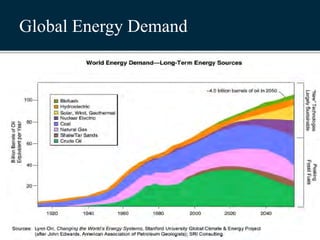
Global Energy Demand


                              2
© 2011 Winston & Strawn LLP
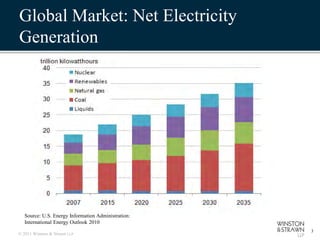
Global Market: Net Electricity
Generation


   Source: U.S. Energy Information Administration:
   International Energy Outlook 2010
                                                     3
© 2011 Winston & Strawn LLP
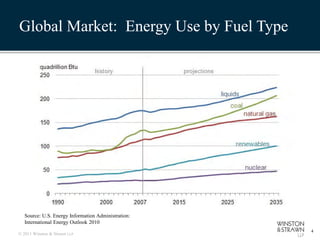
Global Market: Energy Use by Fuel Type


   Source: U.S. Energy Information Administration:
   International Energy Outlook 2010
                                                     4
© 2011 Winston & Strawn LLP
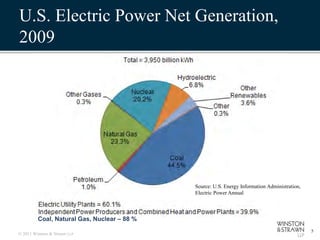
U.S. Electric Power Net Generation,
2009


                                             Source: U.S. Energy Information Administration,
                                             Electric Power Annual


         Coal, Natural Gas, Nuclear – 88 %
                                                                                               5
© 2011 Winston & Strawn LLP
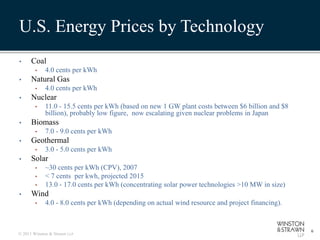
U.S. Energy Prices by Technology
•     Coal
        •    4.0 cents per kWh
•     Natural Gas
        •    4.0 cents per kWh
•     Nuclear
        •    11.0 - 15.5 cents per kWh (based on new 1 GW plant costs between $6 billion and $8
             billion), probably low figure, now escalating given nuclear problems in Japan
•     Biomass
        •    7.0 - 9.0 cents per kWh
•     Geothermal
        •    3.0 - 5.0 cents per kWh
•     Solar
        •    ~30 cents per kWh (CPV), 2007
        •    < 7 cents per kwh, projected 2015
        •    13.0 - 17.0 cents per kWh (concentrating solar power technologies >10 MW in size)
•     Wind
        •    4.0 - 8.0 cents per kWh (depending on actual wind resource and project financing).


                                                                                                  6
© 2011 Winston & Strawn LLP
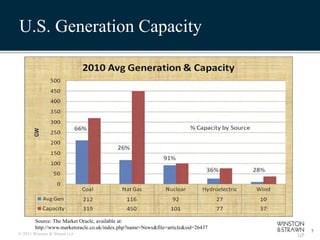
U.S. Generation Capacity


        Source: The Market Oracle, available at:
        http://www.marketoracle.co.uk/index.php?name=News&file=article&sid=26437
                                                                                   7
© 2011 Winston & Strawn LLP
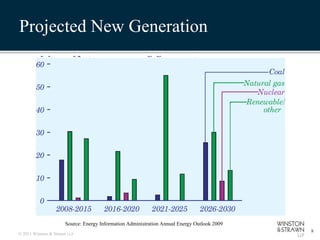
Projected New Generation


                      Source: Energy Information Administration Annual Energy Outlook 2009
                                                                                             8
© 2011 Winston & Strawn LLP
Projected New Generation

•     According to Energy Information Administration's
      Annual Energy Outlook 2009 for the period 2008 to
      2030, capacity additions will be:
        •    53% Natural gas-fired plants
        •    22% Renewable plants
        •    18% Coal-fired plants
        •    5% Nuclear plants


                                                          9
© 2011 Winston & Strawn LLP
Sustainability – What Is It?

•     The phrase “Sustainable Development” was coined in 1980 by
      the International Union for the Conservation of Nature with
      the publication of its World Conservation Strategy
•     There is no officially established or recognized singular
      definition of “sustainable development”
•     Most oft-quoted definition
        •    Development that “meets the needs of the present generation without
             compromising the ability of future generations to meet their own
             needs.” Report of the World Commission on Environment and
             Development, General Assembly Resolution 42/187, December 11, 198


                                                                                   10
© 2011 Winston & Strawn LLP
Sustainability – Components

•     In the corporate context, the concept of sustainable
      development is generally understood to embody three
      component parts
        •    corporate governance
        •    environment
        •    social governance


                                                             11
© 2011 Winston & Strawn LLP
Sustainability – Corporate Governance
Component
•     Corporate Governance aspects of sustainability include:
       • using open and transparent participatory processes that
         actively engage relevant stakeholders
       • a strong commitment to running one’s business ethically
         and in compliance with legal standards
       • corporate accountability and responsibility
       • actively working against corruption in the business
         community generally


                                                                   12
© 2011 Winston & Strawn LLP
Sustainability – Environmental
Component
•     Environmental aspects of sustainability include:
        •    conscientious and careful use of natural resources (resource
             management)
        •    reducing greenhouse gas emissions
        •    preserving biodiversity
        •    managing human consumption
        •    energy management/renewable energy
        •    reduce, reuse, recycle


                                                                            13
© 2011 Winston & Strawn LLP
Sustainability – Social Governance
Component
•     Social Governance aspects of sustainability include:
        •    respecting human rights and security
        •    clearly establishing the rights and obligations of
             employees/laborers
        •    ensuring fair and appropriate wages and safe and healthful
             working conditions
        •    supporting the local community
        •    recognizing and preserving cultural and spiritual values
             amongst the workforce and the surrounding community
        •    efficient allocation of resources

                                                                          14
© 2011 Winston & Strawn LLP
Sustainability – Corporate Drivers

•     Investors
        •    risk reduction
        •    cost reduction
        •    profitability improvement
•     Business customers
•     Consumer preference
•     Brand value/equity


                                         15
© 2011 Winston & Strawn LLP
Sustainability – Corporate Significance

•     93% of Accenture-surveyed CEOs see sustainability as
      important to their company’s future success (A New Era of
      Sustainability, UN Global Compact-Accenture CEO Study
      2010 (“Accenture Study”, at 10, 19)
•     96 % of Accenture-surveyed CEOs believe sustainability
      should be fully integrated into the strategy and operations of a
      company (Accenture Study, at 32)
•     88% of Accenture-surveyed CEOs believe that sustainability
      should be integrated through their supply chain (Accenture
      Study, at 35)


                                                                         16
© 2011 Winston & Strawn LLP
Sustainability: The Traditional
Paradigm
•     Defensive, Involuntary, Regulatory Compliance
•     Laws and regulations requiring compliance
•     Driver, avoidance of civil and sometimes criminal penalties
•     Energy
        •    Renewable Portfolio Standards (CA, 33%)
        •    Energy Independence
        •    Competition with fossil-fuel generation (Coal, Gas)
        •    Purchaser Monopsony Utilities
        •    Economic focus on comparative price of electron
        •    Fossil-fuels win, externalities and commercial value ignored.


                                                                             17
© 2011 Winston & Strawn LLP
Sustainability: The Traditional
Paradigm
•     Environmental
        •    Clean Air and Water Acts (Federal and state)
        •    Climate Change Initiatives (Federal, state, international (Kyoto))
        •    Greenhouse Gas Emission Reductions (AB 32, CA)
        •    Federal and state Environmental Protection Agencies
        •    State Regulators and lawmakers
        •    Issues of penalty to competitiveness of business and jobs
        •    Economic impact on states with high dependency on fossil-fuel
             generation and stakeholder interests (oil, coal, gas companies, utilities,
             and labor unions)
        •    Recent barrage of federal legislation to block EPA and federal
             governments from regulating emission reductions


                                                                                          18
© 2011 Winston & Strawn LLP
The Emerging Paradigm

•     Offensive, Voluntary, Commercial Strategic Plans
•     Economic Proposition, the “Green” Product
•     Voluntary spending by corporations for economic gain
        •    Responding to demands by customers (wholesale)
        •    Responding to demands by consumers (retail)
        •    Responding to demands by Board Members and Shareholders
        •    Sustainability evaluations in procurement
•     Value proposition no longer losing comparison with electron
      from traditional fossil-fuel generation
•     Value proposition is commercial value of “Green” products
      and services (Marketing “Green”)

                                                                       19
© 2011 Winston & Strawn LLP
The Emerging Paradigm

•     Economic, Commercial Value Proposition is significant game
      changer as compared to playbook of last three decades
        •    Externalities and commercial values weigh in decision making
        •    Cost of “Green” no longer solely electric ratepayer issue
        •    Higher cost of electron absorbed in market and sales
                •   Fritolay (SunChips)
                •   Dow Chemical
                •   The Proctor & Gamble Paper Products Co.
                •   Walmart
        •    Seen by leading companies as essential to their future
        •    Compelling data from CEOs and Executive Managers


                                                                            20
© 2011 Winston & Strawn LLP
Complex and Complicated Path
Forward
•     The Metrics – What Qualifies as “Green”?
        •    Standards for “Green”
        •    Off-sets for “Green”
•     Cap and Trade of “Green Attributes” (Carbon Taxes)
        •    Creation of markets and trading rules
        •    Local direct Greenhouse Gas reductions verses remote, purchased or
             traded reductions
•     Branding, Marketing and Advertising – What can be said
      about being “Green”? (False and Misleading Claims)
•     Competition: National and International (a US advantage over
      China and India?)

                                                                                  21
© 2011 Winston & Strawn LLP
Complex and Complicated Path
Forward
•     Uncertainties in Implementation Abound
        •    How to determine commercial value (economic models)?
        •    Will consumers pay the “Green” premiums, if premiums exist?
        •    Is the desire for “Green” temporary, or indicative of a permanent
             change in behavior (generational distinctions)
        •    Will competitors follow the leading companies?
        •    Will global markets and countries follow leading nations?
        •    If the US delays, will it find itself at advantage or disadvantage in
             global markets (Kyoto, “Green” markets)?
        •    How competitive and accessible are markets for the electrons
             associated with “Green” energy production (energy issue)?
        •    Will another Enron be averted (corporate responsibility)?


                                                                                     22
© 2011 Winston & Strawn LLP
The Politics of “Green”

•     Social, economic, political circus (global issues)
•     Healthcare, a walk in the park in comparison
•     Strange Bedfellows
        •    Leading companies become leading advocates
        •    Different labor unions align with different stakeholders
        •    Environmentalists align with Nuclear industry
•     Is “Green” a Democratic issue (environmental) or a
      Republican issue (business and jobs)?
•     Does “Green” create jobs and opportunity or hurt them?
•     Can we afford “Green”, do we have a choice?


                                                                        23
© 2011 Winston & Strawn LLP

Jerry Bloom | Winston & Strawn

  • 1.
    BEIJING CHARLOTTE CHICAGO GENEVA HONG KONG HOUSTON LONDON LOS ANGELES NEW YORK NEWARK MOSCOW PARIS SAN FRANCISCO SHANGHAI WASHINGTON, D.C. Taking Up the Clean Energy Challenge The George Washington University Solar Institute Solar Energy: A Critical Component of Meeting the Clean Energy Challenge Washington, D.C. April 26, 2011 Jerry R. Bloom Chair, Energy Practice Winston & Strawn, LLP jbloom@winston.com North America Europe Asia (213) 615-1756 www.winston.com © 2011 Winston & Strawn LLP
  • 2.
    Global Energy Demand 2 © 2011 Winston & Strawn LLP
  • 3.
    Global Market: NetElectricity Generation Source: U.S. Energy Information Administration: International Energy Outlook 2010 3 © 2011 Winston & Strawn LLP
  • 4.
    Global Market: EnergyUse by Fuel Type Source: U.S. Energy Information Administration: International Energy Outlook 2010 4 © 2011 Winston & Strawn LLP
  • 5.
    U.S. Electric PowerNet Generation, 2009 Source: U.S. Energy Information Administration, Electric Power Annual Coal, Natural Gas, Nuclear – 88 % 5 © 2011 Winston & Strawn LLP
  • 6.
    U.S. Energy Pricesby Technology • Coal • 4.0 cents per kWh • Natural Gas • 4.0 cents per kWh • Nuclear • 11.0 - 15.5 cents per kWh (based on new 1 GW plant costs between $6 billion and $8 billion), probably low figure, now escalating given nuclear problems in Japan • Biomass • 7.0 - 9.0 cents per kWh • Geothermal • 3.0 - 5.0 cents per kWh • Solar • ~30 cents per kWh (CPV), 2007 • < 7 cents per kwh, projected 2015 • 13.0 - 17.0 cents per kWh (concentrating solar power technologies >10 MW in size) • Wind • 4.0 - 8.0 cents per kWh (depending on actual wind resource and project financing). 6 © 2011 Winston & Strawn LLP
  • 7.
    U.S. Generation Capacity Source: The Market Oracle, available at: http://www.marketoracle.co.uk/index.php?name=News&file=article&sid=26437 7 © 2011 Winston & Strawn LLP
  • 8.
    Projected New Generation Source: Energy Information Administration Annual Energy Outlook 2009 8 © 2011 Winston & Strawn LLP
  • 9.
    Projected New Generation • According to Energy Information Administration's Annual Energy Outlook 2009 for the period 2008 to 2030, capacity additions will be: • 53% Natural gas-fired plants • 22% Renewable plants • 18% Coal-fired plants • 5% Nuclear plants 9 © 2011 Winston & Strawn LLP
  • 10.
    Sustainability – WhatIs It? • The phrase “Sustainable Development” was coined in 1980 by the International Union for the Conservation of Nature with the publication of its World Conservation Strategy • There is no officially established or recognized singular definition of “sustainable development” • Most oft-quoted definition • Development that “meets the needs of the present generation without compromising the ability of future generations to meet their own needs.” Report of the World Commission on Environment and Development, General Assembly Resolution 42/187, December 11, 198 10 © 2011 Winston & Strawn LLP
  • 11.
    Sustainability – Components • In the corporate context, the concept of sustainable development is generally understood to embody three component parts • corporate governance • environment • social governance 11 © 2011 Winston & Strawn LLP
  • 12.
    Sustainability – CorporateGovernance Component • Corporate Governance aspects of sustainability include: • using open and transparent participatory processes that actively engage relevant stakeholders • a strong commitment to running one’s business ethically and in compliance with legal standards • corporate accountability and responsibility • actively working against corruption in the business community generally 12 © 2011 Winston & Strawn LLP
  • 13.
    Sustainability – Environmental Component • Environmental aspects of sustainability include: • conscientious and careful use of natural resources (resource management) • reducing greenhouse gas emissions • preserving biodiversity • managing human consumption • energy management/renewable energy • reduce, reuse, recycle 13 © 2011 Winston & Strawn LLP
  • 14.
    Sustainability – SocialGovernance Component • Social Governance aspects of sustainability include: • respecting human rights and security • clearly establishing the rights and obligations of employees/laborers • ensuring fair and appropriate wages and safe and healthful working conditions • supporting the local community • recognizing and preserving cultural and spiritual values amongst the workforce and the surrounding community • efficient allocation of resources 14 © 2011 Winston & Strawn LLP
  • 15.
    Sustainability – CorporateDrivers • Investors • risk reduction • cost reduction • profitability improvement • Business customers • Consumer preference • Brand value/equity 15 © 2011 Winston & Strawn LLP
  • 16.
    Sustainability – CorporateSignificance • 93% of Accenture-surveyed CEOs see sustainability as important to their company’s future success (A New Era of Sustainability, UN Global Compact-Accenture CEO Study 2010 (“Accenture Study”, at 10, 19) • 96 % of Accenture-surveyed CEOs believe sustainability should be fully integrated into the strategy and operations of a company (Accenture Study, at 32) • 88% of Accenture-surveyed CEOs believe that sustainability should be integrated through their supply chain (Accenture Study, at 35) 16 © 2011 Winston & Strawn LLP
  • 17.
    Sustainability: The Traditional Paradigm • Defensive, Involuntary, Regulatory Compliance • Laws and regulations requiring compliance • Driver, avoidance of civil and sometimes criminal penalties • Energy • Renewable Portfolio Standards (CA, 33%) • Energy Independence • Competition with fossil-fuel generation (Coal, Gas) • Purchaser Monopsony Utilities • Economic focus on comparative price of electron • Fossil-fuels win, externalities and commercial value ignored. 17 © 2011 Winston & Strawn LLP
  • 18.
    Sustainability: The Traditional Paradigm • Environmental • Clean Air and Water Acts (Federal and state) • Climate Change Initiatives (Federal, state, international (Kyoto)) • Greenhouse Gas Emission Reductions (AB 32, CA) • Federal and state Environmental Protection Agencies • State Regulators and lawmakers • Issues of penalty to competitiveness of business and jobs • Economic impact on states with high dependency on fossil-fuel generation and stakeholder interests (oil, coal, gas companies, utilities, and labor unions) • Recent barrage of federal legislation to block EPA and federal governments from regulating emission reductions 18 © 2011 Winston & Strawn LLP
  • 19.
    The Emerging Paradigm • Offensive, Voluntary, Commercial Strategic Plans • Economic Proposition, the “Green” Product • Voluntary spending by corporations for economic gain • Responding to demands by customers (wholesale) • Responding to demands by consumers (retail) • Responding to demands by Board Members and Shareholders • Sustainability evaluations in procurement • Value proposition no longer losing comparison with electron from traditional fossil-fuel generation • Value proposition is commercial value of “Green” products and services (Marketing “Green”) 19 © 2011 Winston & Strawn LLP
  • 20.
    The Emerging Paradigm • Economic, Commercial Value Proposition is significant game changer as compared to playbook of last three decades • Externalities and commercial values weigh in decision making • Cost of “Green” no longer solely electric ratepayer issue • Higher cost of electron absorbed in market and sales • Fritolay (SunChips) • Dow Chemical • The Proctor & Gamble Paper Products Co. • Walmart • Seen by leading companies as essential to their future • Compelling data from CEOs and Executive Managers 20 © 2011 Winston & Strawn LLP
  • 21.
    Complex and ComplicatedPath Forward • The Metrics – What Qualifies as “Green”? • Standards for “Green” • Off-sets for “Green” • Cap and Trade of “Green Attributes” (Carbon Taxes) • Creation of markets and trading rules • Local direct Greenhouse Gas reductions verses remote, purchased or traded reductions • Branding, Marketing and Advertising – What can be said about being “Green”? (False and Misleading Claims) • Competition: National and International (a US advantage over China and India?) 21 © 2011 Winston & Strawn LLP
  • 22.
    Complex and ComplicatedPath Forward • Uncertainties in Implementation Abound • How to determine commercial value (economic models)? • Will consumers pay the “Green” premiums, if premiums exist? • Is the desire for “Green” temporary, or indicative of a permanent change in behavior (generational distinctions) • Will competitors follow the leading companies? • Will global markets and countries follow leading nations? • If the US delays, will it find itself at advantage or disadvantage in global markets (Kyoto, “Green” markets)? • How competitive and accessible are markets for the electrons associated with “Green” energy production (energy issue)? • Will another Enron be averted (corporate responsibility)? 22 © 2011 Winston & Strawn LLP
  • 23.
    The Politics of“Green” • Social, economic, political circus (global issues) • Healthcare, a walk in the park in comparison • Strange Bedfellows • Leading companies become leading advocates • Different labor unions align with different stakeholders • Environmentalists align with Nuclear industry • Is “Green” a Democratic issue (environmental) or a Republican issue (business and jobs)? • Does “Green” create jobs and opportunity or hurt them? • Can we afford “Green”, do we have a choice? 23 © 2011 Winston & Strawn LLP