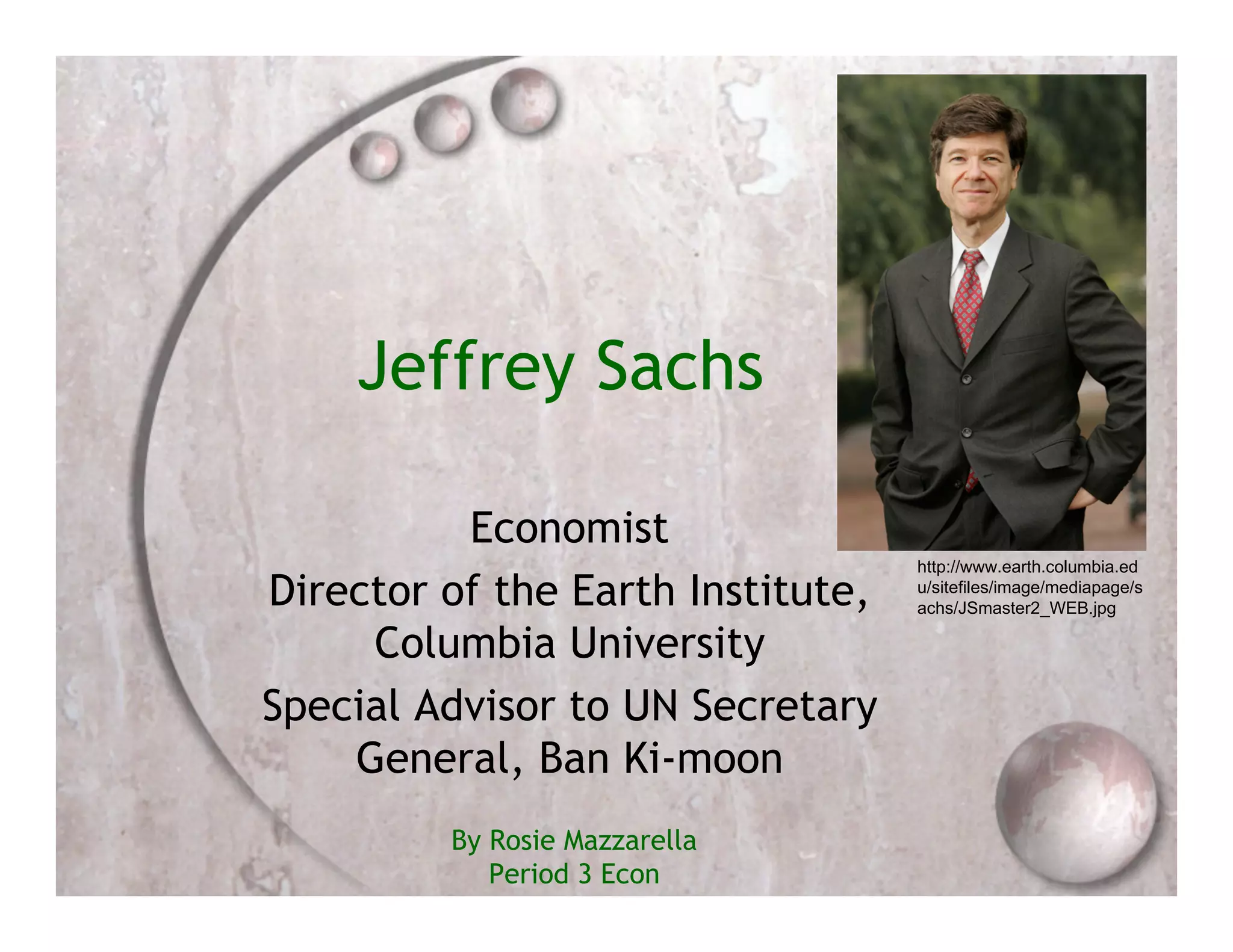
Jeffrey Sachs

          Economist
                                   http://www.earth.columbia.ed
Director of the Earth Institute,   u/sitefiles/image/mediapage/s
                                   achs/JSmaster2_WEB.jpg

     Columbia University
Special Advisor to UN Secretary
    General, Ban Ki-moon
         By Rosie Mazzarella
            Period 3 Econ
Poverty
“Currently, more than eight million people around the world die
each year because they are too poor to stay alive. Every morning
the newspapers could report, "More than 20'000 people perished
yesterday of extreme poverty." The stories would put the stark
numbers in context; up to 8000 children dead of malaria, 5000
mothers and fathers dead of tuberculosis, 7500 young adults dead
of AIDS, and thousands more dead of diarrhea, respiratory
infection, and other killer diseases that prey on bodies weakened
by chronic hunger. The poor die in hospital wards that lack drugs,
in villages that lack anti-malarial bed nets, in houses that lack safe
drinking water. They die namelessly, without public comment.
Sadly, such stories rarely get written. Most people are unaware of
the daily struggles for survival, and the vast number of
impoverished people around the world who lose that struggle.”

-Jeffrey Sachs, The End of Poverty
The End of Poverty
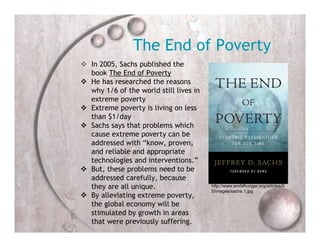
 In 2005, Sachs published the
  book The End of Poverty
 He has researched the reasons
  why 1/6 of the world still lives in
  extreme poverty
 Extreme poverty is living on less
  than $1/day
 Sachs says that problems which
  cause extreme poverty can be
  addressed with “know, proven,
  and reliable and appropriate
  technologies and interventions.”
 But, these problems need to be
  addressed carefully, because
  they are all unique.                  http://www.worldhunger.org/articles/0
                                        5/images/sachs.1.jpg
 By alleviating extreme poverty,
  the global economy will be
  stimulated by growth in areas
  that were previously suffering.
How much aid is needed
                                          to alleviate extreme
                                                 poverty?
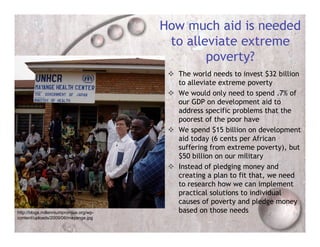
                                           The world needs to invest $32 billion
                                            to alleviate extreme poverty
                                           We would only need to spend .7% of
                                            our GDP on development aid to
                                            address specific problems that the
                                            poorest of the poor have
                                           We spend $15 billion on development
                                            aid today (6 cents per African
                                            suffering from extreme poverty), but
                                            $50 billion on our military
                                           Instead of pledging money and
                                            creating a plan to fit that, we need
                                            to research how we can implement
                                            practical solutions to individual
                                            causes of poverty and pledge money
http://blogs.millenniumpromise.org/wp-      based on those needs
content/uploads/2009/06/mayange.jpg
Addressing basic needs
 By boosting                          of the poor
  agriculture, improving
  basic health, investing                  In some areas, like those
  in education, bringing                  with high rates of diseases
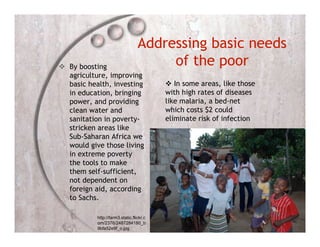
  power, and providing                    like malaria, a bed-net
  clean water and                         which costs $2 could
  sanitation in poverty-                  eliminate risk of infection
  stricken areas like
  Sub-Saharan Africa we
  would give those living
  in extreme poverty
  the tools to make
  them self-sufficient,
  not dependent on
  foreign aid, according
  to Sachs.

           http://farm3.static.flickr.c
           om/2376/2487284180_b
           9bfa52e9f_o.jpg
The
                                                                    Millennium
                                                                      Village
                                                                     Project
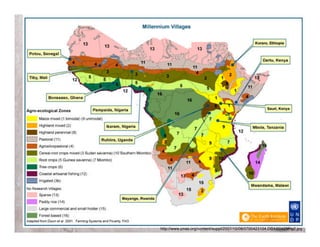
                                                                  To help reach the
                                                                  UN’s goal of eradicating
                                                                  extreme poverty by
                                                                  2015, this project was
                                                                  created by the Earth
                                                                  Institute at Columbia
http://www.btcycle.com/wp-
                                                                  University in 2006
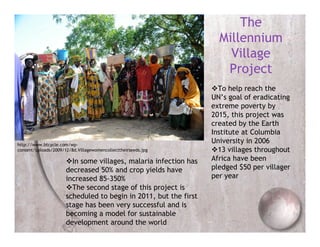
content/uploads/2009/12/8d.Villagewomencollecttheirseeds.jpg      13 villages throughout
                      In some villages, malaria infection has    Africa have been
                      decreased 50% and crop yields have          pledged $50 per villager
                      increased 85-350%                           per year
                      The second stage of this project is
                      scheduled to begin in 2011, but the first
                      stage has been very successful and is
                      becoming a model for sustainable
                      development around the world
http://www.pnas.org/content/suppl/2007/10/08/0700423104.DC1/00423Fig2.jpg
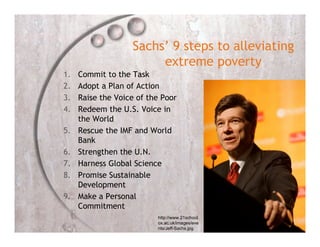
Sachs’ 9 steps to alleviating
                        extreme poverty
1.   Commit to the Task
2.   Adopt a Plan of Action
3.   Raise the Voice of the Poor
4.   Redeem the U.S. Voice in
     the World
5.   Rescue the IMF and World
     Bank
6.   Strengthen the U.N.
7.   Harness Global Science
8.   Promise Sustainable
     Development
9.   Make a Personal
     Commitment
                          http://www.21school.
                          ox.ac.uk/images/eve
                          nts/Jeff-Sachs.jpg
Sources
1.   Sachs, Jeffrey. “The End of Poverty.” TIME. 14 March, 2005. SIRS
     Researcher. SIRS Knowledge Source. 8 February, 2010.
     http://www.sirs.com
2.   “Prof Jeffrey Sachs, Director.” The Earth Institute. Columbia University. 8
     February, 2010. http://www.earth.columbia.edu/articles/view/1804
3.   Sachs, Jeffrey. “International Economics: Unlocking the mysteries of
     globalization.” Foreign Policy. 1 April, 1998: 97. eLibrary. Web. 8
     February, 2010.
4.   Sachs, Jeffrey D. “A Practical Plan to Achieve the MDGs.” UN Chronicle. 1
     June, 2005: 5. eLibrary. Web. 8 February, 2010.
5.   Hackett, Ken; Rivera, John. "Sachs' strategy to end poverty is a 'must-
     read'". National Catholic Reporter. 25 Nov 2005: 18. eLibrary. Web. 9 Feb
     2010.
6.   “Overview.” Millennium villages. 2009. 1 March 2010.
     http://www.millenniumvillages.org/news/index.htm
7.   “UN village project provides model for ending poverty.” The National. Abu
     Dhabi Media Company. 6 February 2010. 1 March 2010.
     http://www.thenational.ae/apps/pbcs.dll/article?AID=/20100207/FOREIG
     N/702069956/1135/pollarchive

Jeffrey Sachs

  • 1.
    Jeffrey Sachs Economist http://www.earth.columbia.ed Director of the Earth Institute, u/sitefiles/image/mediapage/s achs/JSmaster2_WEB.jpg Columbia University Special Advisor to UN Secretary General, Ban Ki-moon By Rosie Mazzarella Period 3 Econ
  • 2.
    Poverty “Currently, more thaneight million people around the world die each year because they are too poor to stay alive. Every morning the newspapers could report, "More than 20'000 people perished yesterday of extreme poverty." The stories would put the stark numbers in context; up to 8000 children dead of malaria, 5000 mothers and fathers dead of tuberculosis, 7500 young adults dead of AIDS, and thousands more dead of diarrhea, respiratory infection, and other killer diseases that prey on bodies weakened by chronic hunger. The poor die in hospital wards that lack drugs, in villages that lack anti-malarial bed nets, in houses that lack safe drinking water. They die namelessly, without public comment. Sadly, such stories rarely get written. Most people are unaware of the daily struggles for survival, and the vast number of impoverished people around the world who lose that struggle.” -Jeffrey Sachs, The End of Poverty
  • 3.
    The End ofPoverty  In 2005, Sachs published the book The End of Poverty  He has researched the reasons why 1/6 of the world still lives in extreme poverty  Extreme poverty is living on less than $1/day  Sachs says that problems which cause extreme poverty can be addressed with “know, proven, and reliable and appropriate technologies and interventions.”  But, these problems need to be addressed carefully, because they are all unique. http://www.worldhunger.org/articles/0 5/images/sachs.1.jpg  By alleviating extreme poverty, the global economy will be stimulated by growth in areas that were previously suffering.
  • 4.
    How much aidis needed to alleviate extreme poverty?  The world needs to invest $32 billion to alleviate extreme poverty  We would only need to spend .7% of our GDP on development aid to address specific problems that the poorest of the poor have  We spend $15 billion on development aid today (6 cents per African suffering from extreme poverty), but $50 billion on our military  Instead of pledging money and creating a plan to fit that, we need to research how we can implement practical solutions to individual causes of poverty and pledge money http://blogs.millenniumpromise.org/wp- based on those needs content/uploads/2009/06/mayange.jpg
  • 5.
    Addressing basic needs By boosting of the poor agriculture, improving basic health, investing  In some areas, like those in education, bringing with high rates of diseases power, and providing like malaria, a bed-net clean water and which costs $2 could sanitation in poverty- eliminate risk of infection stricken areas like Sub-Saharan Africa we would give those living in extreme poverty the tools to make them self-sufficient, not dependent on foreign aid, according to Sachs. http://farm3.static.flickr.c om/2376/2487284180_b 9bfa52e9f_o.jpg
  • 6.
    The Millennium Village Project To help reach the UN’s goal of eradicating extreme poverty by 2015, this project was created by the Earth Institute at Columbia http://www.btcycle.com/wp- University in 2006 content/uploads/2009/12/8d.Villagewomencollecttheirseeds.jpg 13 villages throughout In some villages, malaria infection has Africa have been decreased 50% and crop yields have pledged $50 per villager increased 85-350% per year The second stage of this project is scheduled to begin in 2011, but the first stage has been very successful and is becoming a model for sustainable development around the world
  • 7.
  • 8.
    Sachs’ 9 stepsto alleviating extreme poverty 1. Commit to the Task 2. Adopt a Plan of Action 3. Raise the Voice of the Poor 4. Redeem the U.S. Voice in the World 5. Rescue the IMF and World Bank 6. Strengthen the U.N. 7. Harness Global Science 8. Promise Sustainable Development 9. Make a Personal Commitment http://www.21school. ox.ac.uk/images/eve nts/Jeff-Sachs.jpg
  • 9.
    Sources 1. Sachs, Jeffrey. “The End of Poverty.” TIME. 14 March, 2005. SIRS Researcher. SIRS Knowledge Source. 8 February, 2010. http://www.sirs.com 2. “Prof Jeffrey Sachs, Director.” The Earth Institute. Columbia University. 8 February, 2010. http://www.earth.columbia.edu/articles/view/1804 3. Sachs, Jeffrey. “International Economics: Unlocking the mysteries of globalization.” Foreign Policy. 1 April, 1998: 97. eLibrary. Web. 8 February, 2010. 4. Sachs, Jeffrey D. “A Practical Plan to Achieve the MDGs.” UN Chronicle. 1 June, 2005: 5. eLibrary. Web. 8 February, 2010. 5. Hackett, Ken; Rivera, John. "Sachs' strategy to end poverty is a 'must- read'". National Catholic Reporter. 25 Nov 2005: 18. eLibrary. Web. 9 Feb 2010. 6. “Overview.” Millennium villages. 2009. 1 March 2010. http://www.millenniumvillages.org/news/index.htm 7. “UN village project provides model for ending poverty.” The National. Abu Dhabi Media Company. 6 February 2010. 1 March 2010. http://www.thenational.ae/apps/pbcs.dll/article?AID=/20100207/FOREIG N/702069956/1135/pollarchive