JavaScript The Web Warrior Series 6th Edition
Vodnik Solutions Manual install download
https://testbankfan.com/product/javascript-the-web-warrior-
series-6th-edition-vodnik-solutions-manual/
Download more testbank from https://testbankfan.com
We believe these products will be a great fit for you. Click
the link to download now, or visit testbankfan.com
to discover even more!
JavaScript The Web Warrior Series 6th Edition Vodnik
Test Bank
https://testbankfan.com/product/javascript-the-web-warrior-
series-6th-edition-vodnik-test-bank/
Principles of Web Design The Web Warrior Series 6th
Edition Sklar Solutions Manual
https://testbankfan.com/product/principles-of-web-design-the-web-
warrior-series-6th-edition-sklar-solutions-manual/
Principles of Web Design The Web Technologies Series
5th Edition Skalar Test Bank
https://testbankfan.com/product/principles-of-web-design-the-web-
technologies-series-5th-edition-skalar-test-bank/
Web Design Introductory 6th Edition Campbell Solutions
Manual
https://testbankfan.com/product/web-design-introductory-6th-
edition-campbell-solutions-manual/
New Perspectives on HTML5 CSS3 JavaScript 6th Edition
Carey Solutions Manual
https://testbankfan.com/product/new-perspectives-on-
html5-css3-javascript-6th-edition-carey-solutions-manual/
Programming the World Wide Web 7th Edition Sebesta
Solutions Manual
https://testbankfan.com/product/programming-the-world-wide-
web-7th-edition-sebesta-solutions-manual/
Web Development And Design Foundations With HTML5 6th
Edition Morris Solutions Manual
https://testbankfan.com/product/web-development-and-design-
foundations-with-html5-6th-edition-morris-solutions-manual/
New Perspectives on HTML5 CSS3 JavaScript 6th Edition
Carey Test Bank
https://testbankfan.com/product/new-perspectives-on-
html5-css3-javascript-6th-edition-carey-test-bank/
Web Design Introductory 6th Edition Campbell Test Bank
https://testbankfan.com/product/web-design-introductory-6th-
edition-campbell-test-bank/
JavaScript, Sixth Edition 6-1
© 2015 Cengage Learning. All Rights Reserved. May not be copied, scanned, or duplicated, in whole or in part, except for use as permitted in a
license distributed with a certain product or service or otherwise on a password-protected website for classroom use.
Chapter 6
Enhancing and Validating Forms
A Guide to this Instructor’s Manual:
We have designed this Instructor’s Manual to supplement and enhance your teaching
experience through classroom activities and a cohesive chapter summary.
This document is organized chronologically, using the same headings that you see in the
textbook. Under the headings you will find: lecture notes that summarize the section, Teacher
Tips, Class Discussion Topics, and Additional Projects and Resources. Pay special attention to
teaching tips and activities geared towards quizzing your students and enhancing their critical
thinking skills.
In addition to this Instructor’s Manual, our Instructor’s Resources also contain PowerPoint
Presentations, Test Banks, and other supplements to aid in your teaching experience.
At a Glance
Instructor’s Manual Table of Contents
• Overview
• Objectives
• Teaching Tips
• Quick Quizzes
• Class Discussion Topics
• Additional Projects
• Additional Resources
• Key Terms
JavaScript, Sixth Edition 6-2
© 2015 Cengage Learning. All Rights Reserved. May not be copied, scanned, or duplicated, in whole or in part, except for use as permitted in a
license distributed with a certain product or service or otherwise on a password-protected website for classroom use.
Lecture Notes
Overview
Forms are one of the most common web page elements used with JavaScript. Chapter 6
explains how to use JavaScript to make web forms easier for users to complete. Students
will learn about form elements and objects. Students will learn about basic form validation,
and implement custom form validation.
Objectives
After completing this chapter, students will be able to:
• Enhance form usability with JavaScript
• Customize browser-based HTML validation
• Implement custom validation to check for errors and display error messages
Teaching Tips
Using JavaScript with Forms
1. Explain that JavaScript is commonly used with forms for two reasons:
• To make forms easier for users to fill out
• To validate or process user-entered data before the data is submitted to a server-
side script
2. Introduce the concept of validation, the process of checking user-entered data to ensure
it conforms to the proper rules and format. Give examples of the types of validation
typically found on a customer form to order merchandise from a website.
3. Explain that a form object represents a form element in an HTML document. Use
Tables 6-1 through 6-3 to present the properties, events, and methods of form objects.
4. Mention that the elements used for collecting data in a form include input, select,
option, textarea, and button. Review Tables 6-4 through 6-6 with students,
which show properties, events, and methods common to most or all of these elements.
Referencing Forms and Form Elements
1. Explain that in addition to getElementById() and
getElementsByTagName(), there are other ways to address form objects.
2. Introduce the document. syntax shown on Pages 366-367 and the forms array.
JavaScript, Sixth Edition 6-3
© 2015 Cengage Learning. All Rights Reserved. May not be copied, scanned, or duplicated, in whole or in part, except for use as permitted in a
license distributed with a certain product or service or otherwise on a password-protected website for classroom use.
3. Note that using Document object methods makes your code more flexible when you
need the same code to be able to refer to both form and non-form elements.
4. Allow students time to complete the steps on Page 367 to open and view the order form.
Improving Form Usability
1. Mention that one of the most important form-related roles is validating user input. Note
that there are a few steps a programmer can take to reduce the amount of validation
necessary.
Designing Forms to Collect More Accurate Content
1. Explain that most form validation consists of checking data typed into input and
textarea boxes for accuracy. Give an example, using Figure 6-2.
2. Mention that a programmer can use other types of form fields to limit users’ choices.
Review some of the alternative form elements using Table 6-7.
3. Give an example of improving the design shown in Figure 6-2 with the alternative in
Figure 6-3.
Programming Forms to Increase Content Accuracy
1. Define assistive functions, which prevent users from entering erroneous data in the first
place.
2. Give the example of an order form for flowers, for which setting a default delivery data
may result in incorrect delivery. Note that a solution for this situation is to set the
selectedIndex property of a select object to -1, which corresponds to no
selection.
3. Review Table 6-8, which describes the select element properties.
4. Allow students time to complete the exercise on Pages 372-374 to change the
selectedIndex property for select elements.
Teaching
Tip
Another introduction to forms may be found at:
http://www.quirksmode.org/js/forms.html
Teaching
Tip
More information on JavaScript forms may be found at:
www.w3.org/TR/html401/interact/forms.html
JavaScript, Sixth Edition 6-4
© 2015 Cengage Learning. All Rights Reserved. May not be copied, scanned, or duplicated, in whole or in part, except for use as permitted in a
license distributed with a certain product or service or otherwise on a password-protected website for classroom use.
Quick Quiz 1
1. Many websites use ____ to collect information from users and transmit that information
to a server for processing.
Answer: forms
2. The ____ element designates a form within a web page and contains all the text and
elements that make up a form.
Answer: form
3. Any form element into which a user can enter data (such as a text box) is called a(n)
____.
Answer: field
4. To use JavaScript to access form controls and verify form information, you use the
____ object, which represents a form on a web page.
Answer: Form
5. Programming constructs that prevent users from entering erroneous data in the first
place are called ____.
Answer: assistive functions
Dynamically Updating Selection List Values
1. Explain that a programmer can add and remove option elements in a select
element.
2. Note that a programmer can also set properties of option elements. Review Table 6-9
for properties of option elements.
3. Mention that a common use of adding and removing options from a select element is
to change the options shown in a list based on another selection a user has made in the
same form. Give the example of changing the number of days available in a selection
list based on the selected month.
4. Allow students time to complete the exercise on Pages 376-381 to program the days list
to change dynamically based on the selected month and year.
Teaching
Tip
More information on using JavaScript with forms may be found at:
http://www.javaworld.com/article/2077176/scripting-jvm-languages/using-
javascript-and-forms.html
JavaScript, Sixth Edition 6-5
© 2015 Cengage Learning. All Rights Reserved. May not be copied, scanned, or duplicated, in whole or in part, except for use as permitted in a
license distributed with a certain product or service or otherwise on a password-protected website for classroom use.
Adding Placeholder Text for Older Browsers
1. Explain that many older browsers do not support the usability enhancements to HTML.
Note that JavaScript can simulate the behavior of these features in older browsers.
2. Mention that a popular recent feature in form creation is the placeholder attribute
of the input and textarea elements.
3. Note that a programmer can specify a word or phrase as the value of the
placeholder attribute, which is then displayed in the input or textarea box,
generally in gray rather than black characters.
4. Explain that the placeholder attribute provides guidance on what the user should
enter, as well as any formatting constraints.
5. Allow students time to complete the three exercises on Pages 382-388 to add
placeholder text to the Custom message box in older browsers.
Automatically Updating an Associated Field Based on a User Entry
1. Give the example of a form which has a “Custom message” checkbox a user can check
to send a message which is entered into a textarea element. Explain that if there is
an inconsistency between the two, it may not be treated properly by back-end code.
2. Explain that a solution is to add a function that checks a user’s entry in the textarea
field and checks the “Custom message” box for them if they have entered custom text.
3. Review Tables 6-10 and 6-11 for properties and methods of textarea elements.
4. Allow students time to complete the exercise on Pages 389-390 to create a function to
automatically check the Custom message check box when a custom message has been
entered.
Transferring Duplicate Field Values
1. Explain that JavaScript is commonly used to improve form usability by copying data
entered in one field to another field that a user indicates should contain the same data.
Give the example of billing and shipping addresses in a purchasing application.
2. Allow students time to complete the exercise on Pages 391-393 to enable users to use
billing address information for the shipping address.
JavaScript, Sixth Edition 6-6
© 2015 Cengage Learning. All Rights Reserved. May not be copied, scanned, or duplicated, in whole or in part, except for use as permitted in a
license distributed with a certain product or service or otherwise on a password-protected website for classroom use.
Customizing Browser-Based Validation
1. Explain that historically, JavaScript code was written to perform common and important
validation tasks. Note that in recent years, many browsers themselves often perform
validation without extra JavaScript code. This type of validation is called browser-based
validation, native validation, or HTML5 validation.
Specifying Browser-Based Validation Parameters
1. Review the attributes in Table 6-12, which are used to specify browser-based validation.
2. Describe additional browser-based validation linked to values for the type attribute,
presented in Table 6-13.
3. Allow students time to complete the exercise on Pages 395-397 to see how browser-
based validation deals with missing or invalid data in the order form.
Customizing Browser-Based Validation Feedback
1. Define constraint validation API, and explain that many aspects of the way browsers
present browser-based validation feedback are customizable through its properties and
methods.
2. Review Table 6-14, which describes properties of the validity object.
3. Discuss the methods of the constraint validation API, as presented in Table 6-15.
4. Describe that in conjunction with these properties and methods, you can use the CSS
:invalid and :valid pseudo-classes to change the properties of form elements based on
their validity status.
5. Work through the example code on Page 399, and show the result of the code, using
Figure 6-13.
6. Note that some features of browser-based validation are missing, which makes it
difficult to use in complex situations.
7. Allow students time to complete the exercise on Pages 401-402 to disable browser-
based validation for the order form.
Programming Custom Validation
1. Describe the common validation functions:
• Checking that required fields contain entries
• Checking values that are dependent on the values of other controls
• Checking for an appropriate content type in one or more fields
JavaScript, Sixth Edition 6-7
© 2015 Cengage Learning. All Rights Reserved. May not be copied, scanned, or duplicated, in whole or in part, except for use as permitted in a
license distributed with a certain product or service or otherwise on a password-protected website for classroom use.
2. Preview the Snoot Flowers order form, using Figure 6-14.
Validating Submitted Data
1. Describe the submit event, which fires when a form is submitted.
2. Allow students time to complete the exercise on Pages 404-408 to create the main
validation function.
Validating Required Fields with Custom Functions
1. Explain that creating a function to validate required fields generally involves retrieving
the values of the required fields and checking to see whether the value of any of them is
an empty string. Review the general form of the syntax, given on Page 408.
Checking for Empty Text Input Fields
1. Mention that a programmer uses different properties to validate each form element and
input type. Note that for text boxes, a programmer can use the value property to check
for a value.
2. Review both Table 6-16 and Table 6-17, which contain the properties and methods of
the input element.
3. Give an example, using the code on Page 410.
4. Allow students time to complete the exercise on Pages 410-413 to create a custom
validation function for input fields in the Billing Address fieldset.
Checking for Selection Lists with No Values
1. Introduce the State field and review its syntax, using the code on Page 414.
2. Allow students time to complete the exercises on Pages 414-417 to add validation for
the State selection lists to the validation function for the address and delivery date
fieldsets.
Checking for Option Button Sets with No Selection
1. Mention that to check whether an option button has been selected, you access the value
of its checked property.
2. Give an example, using the code at the top of Page 418.
3. Allow students time to complete the exercise on Pages 418-421 to create a validation
function for the Payment fieldset.
JavaScript, Sixth Edition 6-8
© 2015 Cengage Learning. All Rights Reserved. May not be copied, scanned, or duplicated, in whole or in part, except for use as permitted in a
license distributed with a certain product or service or otherwise on a password-protected website for classroom use.
Validating Dependent Fields with Custom Functions
1. Explain that a programmer may need to create functions to test logic specific to the
form. Give the example of a set of option buttons including “other”, followed by a text
box. Note that validation code could include the text box only when “other” is selected.
Validating Based on the State of a Check Box
1. Go through the example given at the bottom of Page 421, which addresses the Message
fieldset. Note that if the Custom message box is checked, a programmer’s code should
verify the text in the textarea control.
2. Allow students time to complete the exercise on Pages 422-424 to create a validation
function for the Custom message checkbox and its dependent textarea control.
Validating Based on Text Input Box Contents
1. Explain that in the Snoot Flowers order form, some fields need not be completed,
because buyers are not required to create an account. Note, however, that if a user
makes an entry in one of the fields, all three must be completed.
2. Show the required logic flow using Figure 6-21.
3. Allow students time to complete the exercise on Pages 425-428 to create a validation
function for the Create Account fieldset.
Validating Content Type with Custom Functions
1. Explain that a programmer can use JavaScript’s built-in isNaN() function for fields
that require numeric values to determine whether the user actually entered a number.
Show the syntax of the function, given on Page 429.
2. Allow students time to complete the exercise on Pages 429-432 to validate the Card
Number and CVV numeric fields.
Quick Quiz 2
1. The JavaScript ____ function can be used to determine if the value entered by a user is
numeric.
Teaching
Tip
More JavaScript forms examples may be found at:
http://javascript.internet.com/forms/
JavaScript, Sixth Edition 6-9
© 2015 Cengage Learning. All Rights Reserved. May not be copied, scanned, or duplicated, in whole or in part, except for use as permitted in a
license distributed with a certain product or service or otherwise on a password-protected website for classroom use.
Answer: isNaN()
2. You can use the ____ property to determine whether an individual check box has been
selected.
Answer: checked
3. The ____ property can be used to determine if a text box has a value.
Answer: value
4. True or False: Browser-based validation can replace the need to write custom JavaScript
code to validate user input.
Answer: True
5. The ____ attribute is used to provide guidance on what the user should enter, and any
formatting constraints that apply.
Answer: placeholder
Class Discussion Topics
1. Describe the attributes of the <form> object.
2. Why is the <input> element the most commonly used form element?
Additional Projects
1. Use JavaScript to create a web page that allows clients to order pizza. Clients should be
able to select toppings, type of crust, and method of payment. Validate that the form is
correct before submitting it.
2. Use JavaScript to create a web page for a shuttle company. The client should be able to
reserve a ticket using this page, selecting the date and time, pick-up and destination
locations, and the method of payment from a list of available options. Your code should
validate the form before it is submitted.
Teaching
Tip
More information on JavaScript form validation may be found at:
www.w3schools.com/jS/js_form_validation.asp
JavaScript, Sixth Edition 6-10
© 2015 Cengage Learning. All Rights Reserved. May not be copied, scanned, or duplicated, in whole or in part, except for use as permitted in a
license distributed with a certain product or service or otherwise on a password-protected website for classroom use.
Additional Resources
1. JavaScript Form Object:
www.comptechdoc.org/independent/web/cgi/javamanual/javaform.html
2. Form Object:
www.javascriptkit.com/jsref/form.shtml
3. JavaScript Form Object:
www.exforsys.com/tutorials/javascript/javascript-form-object.html
4. Form Validation:
www.yourhtmlsource.com/javascript/formvalidation.html
5. JavaScript form validation – doing it right:
www.xs4all.nl/~sbpoley/webmatters/formval.html
Key Terms
 assistive functions—JavaScript functions that reduce the likelihood of user errors when
completing a form by preventing users from entering erroneous data in the first place
 browser-based validation—Validation tasks performed by browsers themselves
without any extra JavaScript, enabled by recent enhancements to HTML and to modern
browsers; also known as native validation
 constraint validation API—The set of properties and methods that enables developers
to customize aspects of the way browsers present browser-based validation feedback
 createDocumentFragment() method—The method of the Document object that
creates an empty document fragment
 friction—A loose measure of the persistence required for a website user to accomplish
a goal, such as placing an order
 HTML5 validation—See browser-based validation
 native validation—See browser-based validation
 submit event—The event that fires when a form is submitted, which is generally when
a submit button is selected on a form
 validation—The process of checking that information provided by users conforms to
rules to ensure that it appropriately answers the form’s questions and is provided in a
format that the site’s back-end programs can work with
Exploring the Variety of Random
Documents with Different Content
Captain is counting on me to stand faithful to my articles. I’ve a
pretty good notion this dying business isn’t so troublesome as folks
think. I’ve picked up a good many poor lads along the shore, and
not one of them looked worried. Some were sort of smiling. It’s real
comforting, if you look at it sensibly.”
The girls remembered that sunset hour all their lives. There was
nothing exciting about the quiet station, nor the lighthouse out on
the Point, although they did find the keeper, Billy Clewen, very kind.
He was a little old man about seventy-four, but everybody along the
shore called him Billy Clewen. One thing that he told them the girls
thought very pathetic. He said in bad weather the sea birds would
see the light and would fly to it, and beat their lives out against the
heavy glass, seeking shelter from a storm.
“Were you ever in danger out here, Mr. Clewen?” asked Isabel,
whose mind always drifted towards romance.
“Just call me Billy, miss,” answered the old fellow, happily, as he
followed them out into the neat garden, with its paling fence half
buried in sand. “I can’t just say as I was, and I can’t just say as I
wasn’t, nuther. It’s about ten years ago, and my wife was alive. Her
father used to be lighthouse tender before I come here, and she was
born in this house. And that winter I come down sick with
pneumony. Pretty bad sick I was, too, pretty bad sick. Sally, she had
to turn in and trim the lamps and see they was lighted up on time,
and look after me besides, and she was sorter tangled up herself
with sciatic rheumatiz, and if the ile didn’t give out on top of it all.”
“The what, Billy?” asked Crullers, innocently.
“Ile, ile, what we put into the lamps. Anyhow, I remembered it the
last thing, and told her the boys at the station would help her. There
was a nor’wester a-blowing round this Point that would have picked
up an ocean liner, and played ball with it, and the snow a-banking up
around us like sand dunes. I didn’t think Sally would weather it, but
she started off. The fever had me tight, but I held my course and
when it grew dark and no Sally, up I gets out of bed, and crept
along on my hands and knees to the passageway that leads to the
tower, and that’s where the Captain found me when he came to fill
the lamps and light ’em up.”
“How did he know?” asked Polly, eagerly.
“He knew I was sick, and he was bringing me over some medicine
Mis’ Carey fixed up for me, and he found Sarah in a drift, half-way
between the Station and this here fence, half froze, but he had the
ile, Lord bless your hearts, he had the ile, and he set the light
burning.”
“Avast there, Billy,” shouted the Captain over his shoulder. “Are you
spinning that there oil yarn to those poor children?”
“I am, Cap, I am,” laughed Billy. “And I’ll spin it to Saint Peter too,
when I stop to rest a bit by the gates of pearl, if he’ll give me an ear,
just to let him know you’re coming.”
CHAPTER XVII
POLLY PREPARES
It was dark when the girls reached the cottage on the island that
night. They lingered at the Life Saving Station until the Captain
ordered them home, and then Tom led the way with a lantern along
the shore road. There was no moon, but the stars shone, and the
wind had gone down, leaving the sea quiet, except for the long, lazy
swells that brushed along the ocean beach to their left.
Once Tom paused at a rise in the ground and pointed away off to
the south side of the Sickle where a light twinkled.
“That’s the half-way house,” he told them. “They have one every
two miles along shore; the men meet there and exchange slips and
pass on. I’ll be glad when I’m old enough to join.”
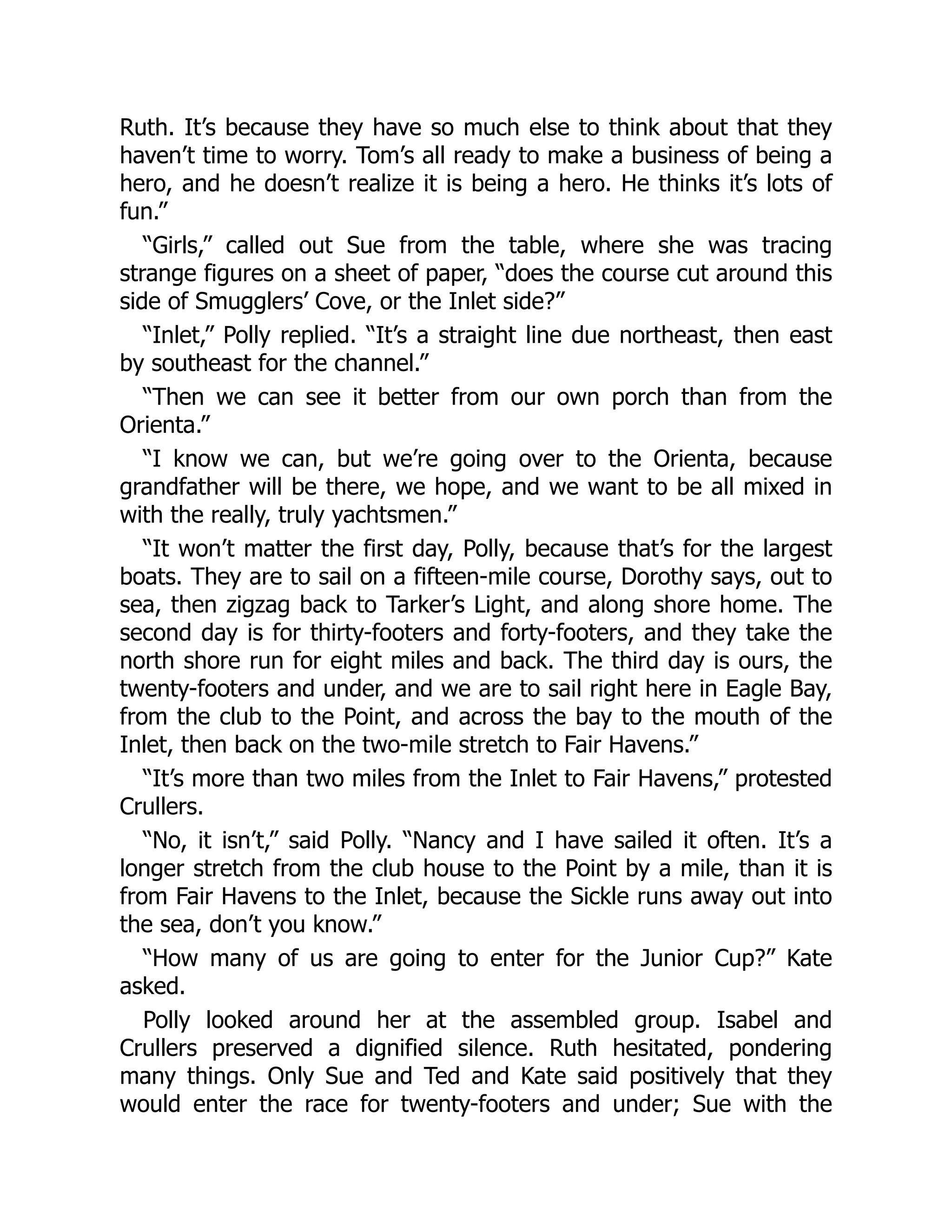
“Say, Polly,” exclaimed Ruth that night, as the girls sat around in
the living-room, after they were undressed, combing their hair, and
chatting girl fashion, “isn’t it queer that people who lead lives of
danger never seem to think anything of it at all?”
Combing Their Hair and Chatting, Girl Fashion
“You’re never afraid of anything you know all about,” Kate put in.
“It’s the unknown danger that scares you.”
“I mean firemen, and soldiers, and life-savers—”
“And mothers and fathers, and heroes generally,” put in Polly, as
she sat on a sofa cushion, her long, brown curls falling loosely
around her, and her pink kimono slipped on over her night gown, for
the nights were always cool on the bay. “I know what you mean,
Ruth. It’s because they have so much else to think about that they
haven’t time to worry. Tom’s all ready to make a business of being a
hero, and he doesn’t realize it is being a hero. He thinks it’s lots of
fun.”
“Girls,” called out Sue from the table, where she was tracing
strange figures on a sheet of paper, “does the course cut around this
side of Smugglers’ Cove, or the Inlet side?”
“Inlet,” Polly replied. “It’s a straight line due northeast, then east
by southeast for the channel.”
“Then we can see it better from our own porch than from the
Orienta.”
“I know we can, but we’re going over to the Orienta, because
grandfather will be there, we hope, and we want to be all mixed in
with the really, truly yachtsmen.”
“It won’t matter the first day, Polly, because that’s for the largest
boats. They are to sail on a fifteen-mile course, Dorothy says, out to
sea, then zigzag back to Tarker’s Light, and along shore home. The
second day is for thirty-footers and forty-footers, and they take the
north shore run for eight miles and back. The third day is ours, the
twenty-footers and under, and we are to sail right here in Eagle Bay,
from the club to the Point, and across the bay to the mouth of the
Inlet, then back on the two-mile stretch to Fair Havens.”
“It’s more than two miles from the Inlet to Fair Havens,” protested
Crullers.
“No, it isn’t,” said Polly. “Nancy and I have sailed it often. It’s a
longer stretch from the club house to the Point by a mile, than it is
from Fair Havens to the Inlet, because the Sickle runs away out into
the sea, don’t you know.”
“How many of us are going to enter for the Junior Cup?” Kate
asked.
Polly looked around her at the assembled group. Isabel and
Crullers preserved a dignified silence. Ruth hesitated, pondering
many things. Only Sue and Ted and Kate said positively that they
would enter the race for twenty-footers and under; Sue with the
Patsy D., Ted with the Hurricane, and Kate with her skip-jack, the
Witch Cat.
“Nancy’s going to enter the Pirate,” Polly said. “And I will sail the
Tidy Jane! How about you, Ruth?”
“Polly, I don’t honestly think I had better go into the race. I can’t
manage the Iris well enough to race her, and I’ll be sure to get into
somebody’s way if they don’t succeed in getting into mine first.”
“No, you won’t, Grandma. Stop your fussing,” laughed Polly. “You
can sail a boat as well as any of us, and it’s lots of fun. Dorothy says
we will be the only outsiders in that class, the rest are Juniors from
the Orienta.”
“Boys?” Ruth’s tone was ominous.
“I don’t know whether they will be boys or pollywogs,” said Polly,
her eyes full of mischief. “Who’s afraid, anyway? I’d just as soon race
against boys as girls.”
“No boys in the twenty-footer class,” called Kate.
“How do you know?”
“I asked Tom. The only boys’ yacht club around here is the
Pautipaug Beach Club, about five miles east, and they never race, he
says. All they do is fish, and camp out, and slosh around shore.”
“What’s that?” asked Polly.
“I don’t know. Tom called it that. He says they hoist a sail, and
lash the tiller, and then go to sleep.”
“Well, that’s only one of Tom’s yarns, but just the same I think
that is all most yacht clubs do, ‘slosh around shore.’” Polly’s tone was
full of fine, ringing scorn.
“But, Polly, there are five or six girls from the Orienta Juniors, and
we’ll have to race against them.”
“All the more fun,” responded the Commodore with true
sportsmanlike generosity. “I do hope that grandfather will come
north so he can see it.”
“And watch us win,” added Sue.
“Oh, you may laugh,” persisted Polly, happily, “but I can’t see why
one of us shouldn’t win. We can sail our boats every bit as well as
Dorothy and Bess, or any Orienta girl. Nancy is the only one who
can beat us, and I’d just as soon she did, if it had to be somebody.
It would be for the glory of our club anyway, if she did. Week after
next, children, nine days, to be accurate, as Fraulein used to say, is
the event, and we must clean up our old hulls, and get in line, and
practise along the course. It means work, every single day, with our
sleeves rolled up.”
“Well, I am not going to race,” Isabel said, decidedly. “I want to
finish my shell portìere before we go home, and fix up my collection,
and it’s too hard work.”
“I’d like to race, but I’m afraid to,” Crullers put in, dubiously. “Polly,
I just can’t.”
“Well, don’t then,” said Polly, cheerfully. “You two can be our
rocking-chair fleet. There’s always one in every club. You may sit up
here and enjoy the view with Aunty Welcome.”
The following days were the busiest that Lost Island had seen that
summer. Tom and Nancy came over every morning, after their own
work was done, advising and assisting. Dorothy and Bess were
enthusiastic over the Junior event. There were more entries for it
than ever before, Commodore Vaughan said, and they were all girls.
Every afternoon the graceful little “cats” and knockabouts, yawls and
skipjacks, sailed on the bay, and it looked as if Nancy and Dorothy
had the best showing, for theirs were the largest boats.
The course was neither difficult nor dangerous in any way, and
providing the weather and wind held fair, the race was bound to be a
spirited one, for it would be a straight away run.
One day they all went over to the Orienta Club to look at the
trophy the winner of the Junior event would bear away. It was an
exact reproduction of the large Championship Cup the Orienta Club
had held for several years. The cup stood about eight inches high,
lined with gold, and shaped like a chalice, the outer side was of
richly chased silver, and engraved.
“I like that very much,” Polly remarked, critically, as she scrutinized
the workmanship on it. “Don’t you remember, Ruth, the summer we
went down to Old Point Comfort with grandfather and saw the
regatta? I went on the committee boat that day, and followed the
race. But the cup didn’t look like a cup at all. It looked more like a
silver ice-water pitcher.”
“Maybe it was a flagon,” Kate said meditatively. “Did it have a
beak, and a handle?”
“Two handles,” Polly returned, “and a large curved beak, and a
cover to it like a syrup jug. And yet they called it a cup.”
“This one has two handles, look, Polly,” said Ted. “I like it that
way.”
“So do I,” said Sue. “I shall enjoy drinking the Patsy D.’s health in
it with Aunty Welcome’s fruit lemonade after the race is won.”
“Listen to her, Polly. As if her old Patsy had any chance at all
against my Hurricane.”
Sue smiled, and slipped her arm through Ted’s.
“Bide a wee, Edwina,” she laughed. “I’ll let you drink out of it first
of all.”
The day before the regatta was an exciting one on Eagle Bay.
Sometime the night before the Adventure dropped anchor, and the
first object the girls beheld the following morning was the slender,
low yacht, with her great uplift of spars and white-clad sailors
running about the deck.
“She’s won ever so many cups,” Dorothy said, as they watched her
through opera glasses, which Polly had thought to slip in with her
equipment. “They stand all in a long row on her cabin sideboard.
And she’s worth over fifty thousand dollars. When I told papa I
thought that was too much to pay for a yacht, he laughed at me and
said some steam yachts cost as much as that just to keep traveling
for a year.”
“There comes another one around the Point,” called Ted. “That’s a
yawl, isn’t it?”
“Auxiliary yawl,” corrected Dorothy. “How queer her sails look from
here, the big mainsail, and topsail, and the jib, and then that funny
spread down near the end. Makes me think of a cat and her kitten.
But wait till the sloops arrive. I like them the best. They are so
stately and slender, and when they sail under full canvas they dip to
the wind like gulls.”
Polly had hesitated over putting fresh coats of paint on the Tidy
Jane, and the Iris. The other boats were in fairly good order, for Tom
and his father had repainted them early in the spring for the Holmes
boys. But that final week before the event, Polly painted and caulked
seams, and overhauled with an energy and vim that made even Tom
remonstrate.
“Now you mind what I tell you, it won’t make them go a bit faster,
not a bit,” he grumbled, when Polly coaxed him to help them fix a
dry dock.
“Oh, but Tom, they’ll look so handsome,” pleaded Polly. “I’m going
to run a beautiful dark blue belt ribbon of paint around the Tidy
Jane, and then, under strained circumstances—”
“Now, see here,” Tom crawled laboriously out from under the
Jane, a paint pot in one hand and a brush in the other, “you can
strain all the circumstances you want, but she won’t go a bit faster.”
The girls broke into a peal of laughter at him, but Tom stolidly
refused to see anything funny in the whole proceeding and went on
painting reluctantly.
But it paid, even the Captain said so the last day, when he came
over on a tour of inspection, and approved of the Polly Page Club’s
racers, clean and trim as paint and polish could make them.
“Aren’t they handsome?” asked Polly, proudly, as she stood beside
him on the landing, and surveyed the fleet.
“Fine and dandy,” echoed the Captain, heartily. “If they act as
saucy as they look, there won’t be a running chance for any other
boat on the bay. You want to look out for the Jane, mind. Don’t give
her her head. She’s a smart one, now, I tell you. I never let her find
out she could get the best of me, but she was always a-trying. Make
her feel your hand steady on the tiller, every minute, or she’ll bolt
like a wild thing. And when she takes a notion to tilt on her beam
end in a good puff of wind, why, let her tilt. She can’t do a mite of
harm, not a mite. I’ve had her out when the seas would skip clean
over her, and half fill the cockpit, and she’d tilt till she’d lift her
centerboard out of the water. Yes, ma’am. And what did I do? Just
patted her down easy, and let her drift off a bit to leeward till the
wind spilled out of her sail, and when she came about again, she’d
right herself like a lady and walk on.”
Polly nodded comprehendingly.
“I know how she acts,” she said. “And that’s just the way I feel
about her, too, Captain Carey, as if she were alive, and could almost
understand what I say to her.”
“Well, it’s something plain humans can’t know about,” the Captain
answered, in his slow, restful, philosophic way. “Every boat on the
face of the waters has got just as much personality as you or I, and
they’ve got dispositions too. I’ve shipped before now on vessels that
you couldn’t make behave themselves any more’n you could harness
up a porpoise to a plough. Then I’ve shipped on bashful, nervous
creeturs of boats, that would dance and shiver their timbers from
one beam end to another, for all the world like some old woman.
There was a three-master out of Martha’s Vineyard when I was a
lad. She carried various articles of trade along the west coast of
Africa, and she was the skeeriest thing I ever sailed on. She had her
favorites among the crew too, mind you. I’ve seen her fairly tremble
and waver when the pilot for the day would take hold of her. He was
a big, slow chap from a place called Noank down on the Connecticut
shore. Name was Shad Hardy, and it suited him. He had the identical
expression of a shad. I was on night duty then at the wheel, and the
minute she’d feel my hand on the spokes, she was like a lamb. I’d
speak to her, and steady her up a bit, and she’d march along in the
wind, like a grenadier to band music. I always did say it wa’n’t no
use trying to make a ship like you, when it had made up its mind it
wouldn’t. They’re the notioniest things alive, ’cepting females, and I
sometimes think that’s why some discerning seaman called a boat
‘she’ and set public opinion that way.”
“Oh, Captain, when you know how nice we are, and how we mind
you,” rebuked Polly. “Just wait till to-morrow.”
“The Junior race won’t come off till the third day Tom tells me,”
the Captain answered. “And that makes me think.” He dipped into
his jacket pocket, and pulled forth neat rolls of twine and lines, a
pouch of tobacco, and some keys. “They just gave me a telegram for
you over at the hotel. Here ’tis. No, ’tain’t. Avast there, maybe it’s
down below. Nancy and mother told me not to give it to you sudden,
for fear it might be bad news.”
“Oh, I don’t think it is,” Polly said, hopefully. She never went out
and opened the gate for trouble, not Polly.
The Captain drew forth the yellow envelope gingerly.
“I wouldn’t open it in too big a hurry, anyway,” he warned. “Better
take such matters pretty easy. I’m suspicious of the pesky things
every time I see one. I never got one yet that told me any good
news. It always plumps you full of bad surprises, all to once.”
“Well, this is good news,” Polly cried, as she glanced over the
sheet of paper. “It’s from grandfather, and he’ll be here to-morrow,
and stay for regatta week, then take us home with him! Let’s see,
from the fifteenth to the twenty-second is the regatta, then allowing
four days down the coast we’ll get to Queen’s Ferry just in time to
rest up before school opens.”
The Captain’s eyes twinkled under their bushy brows.
“I shall have to hand in a true and faithful report if the Admiral
asks me for one,” he said.
“Oh, but we’ve been good, haven’t we, Captain Carey?”
“Fair to middlin’, fair to middlin’,” laughed the old sailor, as he
started down the beach, and Polly ran up to the house to break the
news to the other girls.
CHAPTER XVIII
THE REGATTA
There was an air of excitement and activity about Eagle Bay the
following morning. All summer long it had been a quiet inlet of the
great Atlantic. When the long breakers would come surging in on the
south shore of the Sickle, half a mile over on its north shore there
would hardly be a ripple on the bay. Up at the east end of course,
near the Point, the heavy seas would come racing through the
channel, but before they had gone far, the bay had caught them and
soothed them, and all their fury died away in her placid arms.
But when the sun rose on the fifteenth of August, all along the
bay there was a holiday look to things. The weather was splendid,
not too warm nor too windy, but just right, the girls declared, as
they all trouped out on the porch before breakfast, with various
“envelopes” around them, as Crullers expressed it, to take a look at
the scene. The hotel flaunted flags wherever a flag could be placed
to advantage, and all along the beach, the cottages had out bunting
and flags too. At the landing at Fair Havens, one huge flag was
unfurled with dignity to the morning breeze.
“Oh, dear, I wish we had thought to buy a lot of flags too,” cried
Isabel.
“There’s a whole week of it,” Polly answered. “We can buy them
to-day over in the village. Don’t worry over anything at all, girls.
Let’s be just as happy as we can while it lasts.”
Twelve large yachts they counted, besides several steam launches,
motor boats, and smaller sailing craft. From the rigging of every one
of them fluttered gay strings of small flags, and Polly finally ran
down to their own flag pole and raised the blue and gold pennant of
which the girls were so proud.
“Before the week is over, girls,” cried Kate, waving her towel at it
joyously, as she came out on the porch after her bath, clad in her
bathrobe, “every boat on the bay will know and respect that flag.”
The Commodore had sent over a cordial invitation for them to be
the guests of the Orienta whenever they felt like it during regatta
week. Polly hardly knew what to say about it. The best view of the
course could be had from Lost Island, but the girls wanted to go to
the big club house and “strut,” as Sue said.
“You’re a lot of vain bluejays,” Polly declared laughingly. “All you
want to do is dress up in your best yachting suits, and go over there
and be petted. I know you all.”
“Oh, Polly, come on. We haven’t been petted much this summer,
have we?” pleaded Ted. “We’ve stayed right here and worked like
able seamen, you know we have. Mayn’t we tie on our best hair
ribbons now and go and eat ice cream, please?”
“Please, Commodore,” echoed Kate and Ruth, laughingly, and the
Commodore finally agreed.
“I think we’d better start by half-past eight, girls,” she said, as she
sat in the hammock and deliberately brushed out her brown curls.
“Say, Polly, suppose somebody over on the yachts had field
glasses, and could see you?” questioned Isabel.
“See me? Look at Kate clad in a bath robe of bright blue Turkish
toweling. Look at Crullers with a red shawl draped artistically over
her nightgown. I move we all adjourn out of sight.”
Aunty Welcome’s turbaned head appeared at the kitchen door, as
they all trooped back into the living-room.
“Has you all been out on dat porch in your nightgowns?” she
asked, ominously. “Well, I did think I might make a Spanish omelet
for breakfast, but now you don’t get it.”
“Oh, please, darling, precious Aunty—” began Polly, who loved
Spanish omelet, but Welcome held firmly to her point.
“No, ma’am. It’s de only power I got over you all, and if you don’t
behave, I won’t cook nice things for you. Oatmeal and boiled eggs is
what you’ll get.”
“Let’s hurry and dress, girls, and maybe she will.” Polly curled her
hair over her finger quickly, and tied the cluster with a soft satin
ribbon. “Grandfather arrives at Eastport on the nine forty-five train
from Portland, and I want to be there to meet him. So I think you
girls can all go up on the Orienta veranda and watch the start, and
we can join you there.”
“There won’t be any start before noon,” Kate answered. “Why
can’t we all meet the Admiral at Eastport and let everybody else
know we are meeting him. It’s an event for a little place like Eastport
to catch a real Rear-Admiral even if he is on the retired list, and we
must let the town know its honor. Let’s all carry blue and gold flags,
and dress up in our best, and salute him in state when the train pulls
in.”
Polly enjoyed the plan, and they hurried with their dressing, then
walked out sedately into the little room that served as a dining-
room. Welcome’s face was immobile and unrelenting, but on the
table there were neither boiled eggs nor oatmeal. Crullers saw, and
gave one glad cry.
“Girls, waffles!”
Now waffles are usually merely an adjunct to a full meal, but not
Welcome’s waffles. There was no room for other food. The girls ate
waffles with butter and sugar on them, and then waffles with honey
on them, then Polly tried some maple syrup, and Sue hunted up the
strawberry jam jar, and Ruth appeared with some marmalade.
“’Deed, an’ I nevah see sech appetites,” Welcome declared, her
indignation forgotten, as she stood over the cookstove, and guarded
the waffle iron, her old face smiling broadly. “Dat’s jest sixty-nine I
done cooked dis yere morning for you all, and I don’t see whar you
puts ’em, chillern.”
“It’s your own fault, Aunty,” Polly declared. “You make them so
light and nice, that when we eat them, they just evaporate.”
“Listen to her get ’round her mammy,” Welcome’s fat sides shook
with laughter, as she ladled out more. “Hyar goes seventy-one.”
Tom had agreed to drive over after them in the carry-all. Polly’s
orders had gone forth, and not a single boat was to be taken out on
the bay until the Junior race. She wanted them spick and span for
the event of the regatta, and even Dorothy and Bess’s boat, the
Nixie, looked weather-beaten beside the newly painted challengers
of the Junior Cup.
“Who are the judges, Kate?” asked Ted, as they drove along the
shore road towards town. It had been a matter for calculation to get
seven girls into the carry-all besides the driver, but some way it had
happened. There was room for four people, and under pressure,
five, but when they picked up Nancy too, down at Fair Havens, there
were nine aboard, and the colts moderated their pace. Tom’s special
pride in life, next to his hope of being a life saver, was the colts.
Sorrels they were, and almost a perfect match to Ted’s red curls. The
Captain had owned them twelve years, and they had grown up with
the children, so they still called them the “colts.” And they had
traveled that shore road so often during those twelve years that the
Captain declared he shouldn’t be at all surprised to see them walk
out of their stalls, harness each other up, and start off alone at any
time. As the two trotted along the shore road together, they
scattered a cloud of dust behind, and their short manes caught the
breeze like a t’gallant peak flag, Tom said.
It was the first time the girls had all been to Eastport since their
arrival at Eagle Bay. It lay about two miles from the club house on
Orienta Point, and a quarter of a mile up the Inlet. A big lumber mill
off to one end of town hummed its song lazily. You could tell just
what the saw was doing from the tone, Sue said. First the sharp hiss
as it cut the bark, then a gradually rising buzz and hum, till there
came the crack as it fell apart. Off to the other side of the village lay
the railroad station. There were half a dozen buildings around the
central square of green, some low white houses, with their green
blinds tightly closed, and little garden patches out in front filled with
sweet-scented old-fashioned flowers.
“I was born over yonder,” Tom told them, pointing his whip at a
little house next the white church that occupied the north end of the
green. “So was Pa, and his Pa too, but now my Aunt Cynthy Bardwell
lives there. She’s got the finest rose garden in Eastport, and all the
summer folks come down here to buy her roses. She’s Pa’s only
sister, and her husband was a captain too, sailed a schooner up to
the Gulf every year for over forty years, and fell off the dock down
here one day loading ties.”
“Doing what, Tom?” asked Polly, anxiously, as they stopped.
“Loading railroad ties from the saw mill yonder, to carry south. He
was just visiting around the docks and saw a tie slip into the river,
and it knocked off a little chap with it, Dicky Button, it was, and
Uncle Bardwell went in after him, and just then a boat come along,
and her swell swashed the schooner up against the dock, and when
they got him out he was dead, but Dicky’s alive.”
The girls listened and made up their minds they wanted to see the
rose garden then and there. It was only nine, Polly said, and the
train couldn’t possibly get through the village without everybody
knowing it was there. So Tom tied the colts to the hitching post, and
they went in to call on Mrs. Cynthy Bardwell.
Ruth started to walk up the front path, but Tom told her they had
better go around to the back door, so they followed him obediently
along the graveled path, bordered neatly with clam shells turned
face downward in the mould. Then came “old hen and chickens,” as
Kate called them, mignonette, sweet alyssium, marigolds, and
pansies. And in the center of each bed there rose up stocks, pink
and white, and so fragrant and lovable, that the girls begged for
some at once.
“Well, I do declare!” exclaimed a sweet, friendly voice so near to
them they nearly jumped. “I’m right here at the buttery window,
girls, and I saw you and Tom coming. Wait a minute till I change my
apron.”
“It gave me quite a turn to see such a lot of youngsters in my
garden so early,” she told them, when she appeared, tying the
strings of her apron as she talked. “Come and see my roses.”
It seemed as if nothing but roses grew in that long back garden,
shaded with horse chestnut trees, excepting the tall lilac bushes
along the fence and the lilies of the valley that grew thickly on the
ground beneath them.
“They’ve gone by long ago,” Mrs. Bardwell said, “but they’re real
sweet in the spring.”
On the white and green trellis work above the kitchen portico, a
crimson rambler climbed sturdily to the “ell” roof. A sweetbrier hung
over the gate, with little white roses nearly gone. Then there were
bushes of old-fashioned blush roses, so delicately pink and sweet
that Polly declared all she could think of was her grandmother’s
wedding chest at home, with its flat silk bags of dried rose leaves,
still heavy with fragrance from roses that had bloomed half a century
ago.
“Yes, they’re sweet, but I have a leaning towards the white
brides,” said Mrs. Bardwell, moving from bush to bush like a white
bride herself, with her silver white curls, pink cheeks, and fresh
white apron. “And the bees love them best too. They’re all gone by,
now. I can generally count on them along in June. The crimson
rambler’s real hardy, but it’s beginning now to shake its petals. I
suppose you folks down south have roses so much you hardly
appreciate them, but we love them. Summer’s kind of late up here,
and I’ve had roses for my table clear to the end of August. These
here were American Beauties. I never tried them before this year,
but a man come along last fall and sorter talked me into taking
them, and they did bloom up real sightly, but terrible thorny. This
bush I raised from a slip my mother gave me the day I was married.
It’s a cabbage rose. ’Tain’t a pretty name, but I love the bush, and
the flower too. It looks more like a lot of little rosebuds all clustered
together than just one flower, don’t it? There’s moss roses down in
that corner by the fence, but they went by last month too. These
here, they call them Gloriana Wonders. I always feel like shaking
them same as you would a child that won’t behave. They bloom all
to once, and just open up their whole hearts in a day, and the wind
blows them to Halifax.” She laughed happily, touching the leaves
with tender, lingering fingers as you would the flushed cheek of a
baby. “I suppose I’m foolish over them, but they’re all I’ve got to
love and care for now. I used to have five babies of my own, and
they’re all lying over yonder around their father, the Captain, in the
little cemetery across from the lighthouse, on the east shore.”
“We haven’t been there yet,” Polly said, her dark eyes full of
sympathy, as she held the flowers that Aunt Cynthy clipped steadily
while she talked.
“Haven’t you? It’s real int’restin’,” answered the old lady cheerily.
“I like it better, somehow, than the new one down by the church.
That was built recently, thirty years ago, wasn’t it, Tom? The old one
goes back long before that, and I want to lie there, even if the
graves be half sunken, and some of the stones lopsided. I guess
they sleep the long sleep just as well. I had father and the children
buried sorter opposite from the way other folks do. I didn’t p’int
them to the east and the sunrise. I p’inted them due west, so they
can look straight out over the bay from the east shore of the
channel. I know that’s the way they would have liked it best. These
here tea roses are real sweet and friendly, don’t you think so? and
lasting, too.”
“I think the whole garden is lovely,” cried Polly. “I just wish I could
reach out and hug them all. Seems as if I never saw such a garden
before.”
“Well, flowers are like children and friends. Give ’em love and care,
and plenty of fresh water, and they’ll love you back a hundred-fold.
Stop in any time, girls. Tom and Nancy are over every day or so, and
they always come to see me. I was born to mother something, and
as long as the dear Lord saw fit to gather my babies in his arms, I
have to mother the roses, and all the other babies, little and big,
that come to my garden, don’t you see?”
“Isn’t she a darling?” exclaimed Ruth, when they finally left the
little white cottage, and started over to the depot. Polly had coaxed
and coaxed until she had prevailed, and Mrs. Bardwell had promised
to go back with them to watch the races. The carry-all and its
capacity had been argued over, until Polly said the Admiral could get
one of the village teams and take Kate and Ruth with him.
Polly buried her nose in her bouquet, and just smiled and sighed
all at once.
“I’m too full for utterance, as Crullers says after dinner,” she
laughed. “But there’s one thing certain. I am coming back to that
white cottage again. Wait till we see Aunty Welcome’s face when she
smells these late roses. She was saying only yesterday that the only
thing she was homesick for were the roses at Glenwood. Listen. Oh,
girls, there’s the train whistle!”
She forgot everything except the dear grandfather who was on
that train, and before the rest could catch up with her, she started
on a run towards the little red station. It was an excursion train from
Portland, one that connected with the southern expresses and came
up to Eastport in honor of the regatta. Polly stood up on a wooden
box near the express office, and watched the outpouring of the
crowds, men, women, and children, all bearing lunch boxes, and all
dressed in holiday and outing clothes. But she could not see the
Admiral anywhere. Finally, somebody put an arm around her very
quietly, and she turned to find the Admiral smiling down on her.
“Oh, you dear, you precious old dear,” cried Polly, as she nearly
strangled him with her strong, young embrace. “I never even saw
you leave the train and I watched everyone.”
“Didn’t you see me riding on the engine so I’d be the first one
off?” the Admiral asked, teasingly, as he pinched her cheek. “I was
up forward in the smoker, mate. Where did you collect those
freckles? Where are all the other girls?”
“Here we are, sir,” Sue exclaimed, as they came up, breathlessly.
“Polly wouldn’t wait for us. She wanted to meet you first of all, so
we let her.”
“Let me?” repeated Polly, but the girls wouldn’t allow her to finish.
“You don’t know how she orders us around,” Ruth added.
“Does she?” The Admiral leaned back his head, and laughed in his
deep, hearty fashion. “And I am afraid I cannot do a thing about it.
She’s the Commodore, you understand, and if I had my choice
between a kingship and a commodore’s berth, for real sovereignty,
I’d choose the berth. Where’s the Doctor?”
The girls caught their breath, and their eyes fairly shone with
interest and subdued excitement. Polly laid her hands on the
Admiral’s shoulders.
“Grandfather dear,” she exclaimed, solemnly, “do you know him?”
“Oh, but he’s a smuggler,” added Ted, mischievously. “He’s just
disguised as a doctor of something.”
“And he’s addicted to orange marmalade something terrible, Aunty
Welcome says,” Kate put in.
“But he’s got the finest Chili sauce over in the cave you ever
tasted, grandfather,” Polly concluded.
“Now, wait one moment, and let me catch my breath.” The
Admiral put out his hands to defend himself, as the girls all clustered
around him, each one eager to tell about the mystery of Smugglers’
Isle. “I mean Penrhyn Parmelee Smith of Washington, D. C.”
“So do we,” came a united and positive chorus, “Washington, D.
C., and Eagle Bay. He lives right next door to us in a cave on an
island.”
“God bless my heart and soul,” exclaimed the Admiral, and he took
off his glasses to wipe them, as he always did when he was startled.
“I am sure I have never been surprised but twice in twenty years.
Once when Welcome marched forcibly into my study and placed this
person with the freckles in my arms, and again to-day. And yet it
may be true. It is quite like Penrhyn to do such a thing. For a man in
his sixty-sixth year he is the most irresponsible, child-like creature I
ever knew. Polly, did you say orange marmalade?”
Polly nodded her head emphatically.
“He’s had six jars out of the ten we brought with us,” she replied,
solemnly. “Aunty declares it can’t hurt him one bit, but we don’t
believe he eats it himself. We think he uses it as bait to catch—what
is it, girls?”
“Polypi,” supplemented Ruth. “Polypi.”
More than one in the holiday crowd turned at the hearty laugh
that broke from the group around the stately old Admiral. And
suddenly the girls saw a figure approaching, whose white suit of
flannel and white yachting cap, they recognized at once.
“Admiral,” the Doctor fairly beamed as he put out his hand. “I
salute you.” He smiled his slow, dry smile that only drew down the
corners of his mouth, and stretched his dimples more, Polly
declared. The Admiral gripped his hand warmly.
“Polly, my dear, we went to college together,” he exclaimed.
“Didn’t we, Penny? Some day when you girls meet one another, and
have grandchildren beside you, perhaps you’ll look back and
understand how we two old fellows feel this minute; eh, Doctor? I
think if I took a deep breath I could give the grand old yell yet.”
“Don’t,” cautioned the Doctor. “It won’t do in Eastport. Polly would
hand us over to the authorities without a qualm. You don’t know
how she rules us.”
“Oh, yes, I do,” said the Admiral, merrily. “I’ve heard reports of it
already.”
The Doctor’s eyebrows lifted.
“Marmalade?” he queried, as he took Polly by one arm, and
guided her deftly through the crowd, the rest following. “I have to
eat it, to keep in their good graces.”
“You shall not have another jar after that,” Polly cried, severely.
“Wait till I tell Aunty Welcome. Where’s Tom with our carry-all? Oh, I
see him, over under the horse chestnuts at Aunt Cynthy’s.”
“Aunt Cynthy, Polly?” asked the Admiral. “Who is the lady?”
“She’s the mother of the roses,” Polly told him, mysteriously, as
she raised her bouquet for him to catch a whiff of its fragrance.
“Tom’s aunt. And she’s going back to the Orienta with us to watch
the races. Now, the carry-all won’t carry all, at all. It will just about
carry seven people.”
“I have a conveyance here some place,” spoke up the Doctor. “At
least I did have. I can take two with me. Wait just one minute.”
He disappeared around the corner, and came back driving a trim
top carriage.
“It’s the hotel keeper’s,” he told them. “I didn’t know these
children were coming to meet you in state, so I plotted to carry you
off myself. Now, I think I had best take Mrs. Bardwell with me, and
the thinnest one of the girls.”
“Thinnest!” exclaimed Sue. “Thinnest! You won’t find any thin
people in this club after six weeks on Lost Island. Crullers, won’t you
please ride with the Doctor, just as a matter of revenge?”
And Crullers, whose one strong point was her weight, agreed
willingly to share the seat with the doctor and Mrs. Bardwell.
It was a gay ride back along the bay shore road. The Doctor was
an old acquaintance of Aunt Cynthy’s, for he loved flowers and had
often stopped on his way to the post-office to look at her garden
and chat awhile over the white cross-bar fence.
When they arrived at the club house, the whole place seemed
filled with people. All of the summer colony had turned out in state
to do honor to the regatta, as well as the visitors. Up in the balcony
that overhung the bay, a band played, and the view out on the water
was one the girls never forgot all their lives.
After they had greeted the Commodore and Mrs. Vaughan, they
found chairs at a good angle of vision, and established themselves
around Aunt Cynthy as chaperon, while the Doctor and Admiral Page
went out on the committee boat.
The bay was brilliant in the sparkling morning sunshine. It was a
perfect day. Crullers said the sky looked higher than usual, and the
clouds drifted lazily up from the southwest. The great sails were
hoisted, and curved out in great white swells, as the wind filled
them. Orders rang out sharply, as the white-clad sailors ran here and
there, and finally the start was made at 11:02 sharp. One after
another, eight yachts dipped to the wind, crossed the imaginary line
of starting, and the fifteen-mile race was on.
“Oh, Polly, just think how we shall feel when we start like that,”
exclaimed Sue, excitedly. “Just look at the spread of canvas on that
last sloop. All I can think of is a sheet tacked to a shingle, by way of
comparison. Polly, Polly, watch her keel over as she catches the wash
from the others. Oh, isn’t it glorious!”
“Don’t gush so, child,” said Aunt Cynthy, placidly. “No sailor talks
that way at all. But ’tis a sightly lot of sail boats, and no mistake.
What’s the name of that last one?”
Dorothy leaned over her chair, happy and proud.
“That’s my father’s sloop, the Adventure,” she replied. “Mamma is
with him. They are waving to us, don’t you see?”
“And she’s the only lady in the race,” added Bess, her eyes full of
love and pleasure. “She loves it the same as we do.”
Polly leaned eagerly forward over the railing. She had handed the
glasses to Kate and Isabel. Her cap was off, and the breeze blew her
curls back from her forehead. Her lips were half parted, and her
eyes shining like stars as she watched the stately yachts cross the
bay, and make for the open channel to the sea.
“I don’t see how they can sail with a southerly wind,” Ted said.
“Aren’t they going to tack south as soon as they strike the ocean?”
“Well, we’re facing more southeast, than south, aren’t we, Polly?”
Ruth asked with one eye on the sun.
“Girls,” breathed Polly, tensely. “I don’t care a rap how we’re
facing. Watch the race, and stop your talking.”
“Spoken like a true sailor,” Aunt Cynthy echoed, warmly, and they
all turned to the railing to watch the yachts as one by one they
slipped through the channel, and the race was really on.
CHAPTER XIX
THE FIRST EVENT
It was late in the afternoon before the first sails of the returning
fleet appeared in the channel. All day long the girls had been
honored guests of the Orienta Club, and had enjoyed themselves
thoroughly. Although both Mrs. Vaughan and the Commodore were
away on board the Adventure, the other members and their wives
had all heard about the yacht club over on Lost Island, and were
happy to meet the girls, and see that they had a pleasant day of it.
“I think,” said Mrs. Allison, the chairman of the reception
committee for regatta week, “I think it would be nice for you to
meet your competitors in the race, the girls of the Junior Club. Let
me see how it can be best managed? There are six, no, eight, in
your club, and nine in the Juniors. Dorothy, will you just press that
button behind you, dear?” She smiled around at the circle of
interested faces. “We will call the club steward, and you may have a
luncheon all by yourselves and get acquainted.”
So it was arranged. Instead of the “girl element,” as the Doctor
laughingly dubbed the rival clubs, eating luncheon in the large
dining-hall with the other guests and members, they were given one
of the smaller side rooms all to themselves.
Dorothy and Bess acted as official hostesses, and there was a
great cluster of red and white carnations in a cut glass bowl for a
centerpiece, as red and white were the Orienta colors. Besides the
Vaughan girls, there were seven others, all daughters of club
members, and a delightful lot of girls, the rest decided.
“Only five of us are going to race, though,” said Connie Evans.
“This is my first year at the seashore. We always go up to the
Adirondacks. Father has a lodge up there, and it seems so strange
not to be closed in by the mountains. I never sailed a yacht until this
season, and mine is just a ‘cat’ with one sail.”
“Most of us have catboats,” replied Polly, reassuringly. “Mine is a
‘cat,’ too, and it is our first season with boats, so you need not be
afraid of racing against experts. I think it will be lots of fun. Can you
all swim?”
“No, we can’t, not one,” Bess declared. “We’ve been sand bathers
this summer, mamma says, and haven’t been in at all above our
shoulders. But I don’t think anything will happen, do you, Polly?”
“Polly believes that prevention is earth’s first law,” laughed Kate,
as she saw Polly shake her head doubtfully. “You had best put a lot
of buoys and life preservers in your boats.”
“What time would they have to put them on,” demanded Sue, “if
they just dropped into the water? I think it would be a good idea if
we wore belts like acrobats when they are training, with a ring in the
back, and a rope fastened to it. Then if we fell over all we would
have to do would be to hold on to the rope and be hauled in.”
“They say one of the men from the Station is to be on guard at
the pier all day, and they will watch from the Point too.”
“That’s all right,” Crullers broke in, wistfully, “but if you fall
overboard, you’ll swallow salt water enough to drown ten cats,
before they have time to get to you; I know from experience.”
“Let’s not even think it may happen,” said Polly, happily. “Dorothy,
couldn’t we have the Cup on the table just as a reminder?”
Dorothy thought perhaps they might, and after a consultation with
the steward the Junior Cup was borne in state into the room, and
set in the place of honor at the head of the table between Dorothy
and Polly, the two commodores.
“Day after to-morrow,” said Sue, thoughtfully regarding it, “I shall
go home with that under my arm.”
“Listen to her, girls,” Kate cried. “And remember what I prophesy.
The Patsy D. will finish fifth, while the Witch Cat glides over the line
first.”
Polly said nothing. From her seat beside Dorothy, she looked at
the beautiful silver cup and thought of the race. She had said she
was a good sportsman, as the Admiral wished her to be, and she
was sure she could see the Cup go to the best yacht without any
feeling of envy, but she almost wished there might have been nine
consolation prizes, for something seemed to tell her that the Pirate
would be the winner. There was something different about Tom’s big
knockabout, and the daring way that Nancy sailed her, that left the
other boats out in the cold. Nancy knew the bay well. She was used
to every ripple on it, every turn of the tide, every breath of wind,
every mood and whim that passed over it like cloud shadows. And
she knew, too, the trim, slender boat as she might some live, tamed
animal that loved her. The Cup would mean a great deal more to her
than to the other girls. Most of them came from well-to-do families,
and they themselves were happy, normal city-bred girls, who had
had plenty of amusement and novelty in their lives, while Nancy had
spent all of hers in the little gray cottage that listed to leeward on
Fair Havens’ beach. She had never even been inside the Orienta until
the girls took her with them, and now that she was there and had a
chance of winning the Cup, she seemed like another girl. While the
rest chatted and laughed, she sat quietly by, but Polly caught her
glance now and then, and the quick, wistful smile, and she knew
what she was thinking about. Once, when Dorothy rose to make a
little speech, Polly closed her eyes for a second, in a half-expressed
prayer that if it were right for Nancy to win the race, she herself
might be willing and glad to have her.
“But you’re not,” she told herself, after the luncheon, when they all
went down to the beach to walk and pass the time. Her chin was
raised, her brown eyes troubled, but she smiled in the old bright
way, and laughed with the rest, even while she thought: “You’re not
glad, Polly Page, that Nancy has even a little bit of a chance against
the Tidy Jane, and you want the Cup with all your heart, and you
know perfectly well that if Nancy were not in the race, you could win
it.”
“Polly, you look just like the Winged Victory with the wind blowing
back your hair and dress that way,” called Ruth.
“I wouldn’t allow such a comparison,” Kate declared. “Polly, it
doesn’t have any head, you know.”
But Polly smiled and waved her hand at them, and said nothing.
Nancy was walking beside her, and she wondered whether a true
sportsman ever allows sentimental reasons to outweigh his sense of
fairness, whether it was wrong for her to hope with all her heart that
she might win the race when Nancy had set all her hopes on it.
“Father says that if I should win the Cup,” Nancy whispered,
happily, as she slipped her arm through Polly’s, “he’ll build me a
knockabout for next year just like Tom’s. And just think, if you girls
hadn’t let me come into your club, I couldn’t have raced at all. Aren’t
things queer, Polly?”
“Curious and curiouser,” smiled back Polly, remembering the
expression of one of her favorite heroines. The Doctor and Mrs.
Bardwell were walking towards them, with several of the club
members, and they all strolled down to the pier to watch for the
incoming yachts. At just four-thirty-two by the Doctor’s watch, the
first boat hove in sight around the Point. She was too far away for
them to distinguish her identity, but hardly had she come about and
started on the new stretch than a larger yacht appeared, following
hard in her wake.
“That’s the Thistle,” cried Dorothy. “I know the cut of her sails. Oh,
dear, I wonder if the other is papa’s?”
“The Thistle’s crowding on more sail, and gaining,” Polly
exclaimed, watching them through glasses. “She will win!”
“Perhaps not,” Mrs. Bardwell rejoined cheerily. “A race is never
won till it’s done, you know, so hope to the finish.”
There were three in sight now, one following the other as closely
and evenly as flying geese, but still the Thistle strove to the fore.
That first mile up the bay, the girls hardly spoke, as they leaned over
the iron chain that was stretched along the pier for safety. Their eyes
were bright, their lips half-parted as they tried to watch every
swerve, every manœuvre on the part of the racers. All at once Bess
declared she knew the first vessel was the Adventure because there
was a lady on deck, and she had waved to her.
“Bess Vaughan,” laughed Polly, “you make me think of the soldier
in the fairy tale who was a sharpshooter and could aim at a fly on
the limb of a tree five miles off. That boat is a mile and a half from
us now.”
“Just you wait and see,” Bess retorted seriously. “Maybe it wasn’t
her handkerchief, but I know it’s the Adventure.”
“Oh, girls,” exclaimed Isabel, excitedly. “See the big one dip
sideways.”
“Sideways, child,” Aunt Cynthy repeated, merrily. “To leeward,
dear heart, to leeward.”
Even at that distance it appeared as if the larger yacht had the
best chance.
“I’m sure they could crowd on more sail,” Dorothy said, helplessly.
“Why don’t they do it? Tom says there’s always room for another
reef some place on a sloop.”
“That’s just what’s happening this minute,” Kate said. “The Thistle
has every inch on she can carry, and there’s still over a mile to go.”
“Polly, if that old New York boat should win, I shall lie down on the
sand, and simply, simply—” Isabel hesitated for lack of an apt
expression, but Ted filled it in for her calmly.
“Suspire. And be sure and do it very quietly, Isabel, so as not to
disturb the race.”
Isabel laughed good-humoredly with the rest. The six weeks’
vacation at Lost Island had helped her in many ways. She would
always be more precise than the other girls, more attentive to the
formalities of life, as Miss Calvert expressed it, but the hearty, daily
companionship and example set by the rest had filed down many
sharp little points in her character. At Calvert Hall both Ted and Sue
had loved to tease her, but someway she did not mind it any more.
She could laugh back at them like Kate or Polly now, and it was
rarely that one of “Isabel’s grumbles” was heard. “Lady Vanitas” she
would always be, for she dearly loved pretty clothes and dainty
things. Sue had expressed her ideas on dress aptly one day when
she had remarked that Isabel couldn’t even wear a sweater at
basket ball unless it had a fancy border to it and a stickpin in front.
Even to-day the brim of her white duck yachting cap was pinned
jauntily back with a class pin, while the other girls had turned theirs
down to keep the sun out of their eyes. It seemed as if Isabel’s
collar never wilted under the hottest sun, her belt never sagged out
of place, and her shoe strings never came untied. Polly’s eyes always
lingered over this member of her crew approvingly, for she, too,
loved neatness and good taste.
All of the club verandas were thronged with onlookers during that
final half hour. Both boats were hesitating under a vagrant puff of
adverse wind, when suddenly the Adventure seemed to get under
way and slipped steadily down the course, ahead of her New York
rival. Something white fluttered from her deck, and all of the girls
waved their handkerchiefs wildly in response. Somewhere back in
the crowd on shore a boy’s voice shouted:
“Come along, Adventure, come along there!”
The girls laughed, for they knew it must be Tom, losing his head
at the critical moment. The little sloop held gallantly to the point she
had gained, and glided finally over the imaginary line that ended the
course, while cheer on cheer rang out from the club house and the
shore away up to the hotel. The cup would remain with the Orienta
Club for another season.
After the shouts had at last died away, and the fussy little
committee launch had puffed back and forth among the returning
yachts, the girls took their leave, and started homeward, with the
Admiral and the Vaughan girls in tow. The Doctor had undertaken to
return Mrs. Bardwell safely to the house of the roses, and she
declared as she kissed each girl that it had been the first day she
had spent in society in twenty years.
“Bless her,” Polly said tenderly, as she watched the Doctor tuck the
tan lap robe about her. “She doesn’t know what a nice ‘society’ she
is all by herself.”
“Admiral Page,” interposed Ted, gravely, “isn’t Polly sentimental?”
“All sailors should be,” rejoined the Admiral, his eyes twinkling.
“Not exactly sentimental, but full of sentiment, eh, Polly, mate?”
“Aye, aye, sir,” said Polly, but she was thinking of something else,
thinking of Nancy and the Junior Cup.
Aunty Welcome lived up to her name in the dinner that she had
prepared for her “Marse Bob.” Polly had declared the dining-room in
the cottage was too small for such a festive occasion, so dinner was
served in state out on the porch. It was an evening they all
remembered out of a long, happy summer-time. Two small tables
set together made quite a commodious banquet board. Aunt
Cynthy’s bouquets, freshened up after a good drink of water, made a
pretty centerpiece, with the blue and gold yacht club pennant
waving above it. The Admiral insisted on Polly taking the head of the
table with Kate, as club chaperon, at the foot.
“I am merely a guest,” he said, “and will sit at the Commodore’s
right hand, if she will permit.”
Long after the sun went down, the little dinner party went on,
until the moon rose, and the bay lay like a sea of quicksilver and jet
below them. Then they heard the sound of wheels along the shore
road, and Tom’s long cheery hail, and the Admiral rose to take his
leave.
“To-morrow,” he told them, “you had better stay right here and
rest. The day’s event is for twenty-footers and over, and they have a
long course to cover. I’ll run over in the afternoon and see how you
are. Tom or the Captain will go over the yachts with me, for I want
to be sure everything is shipshape.”
Dorothy and Bess had returned with the girls, and as it was their
first night at Lost Island, there were whisperings and smothered
laughter long after the official “taps” had been sounded.
“What’s ‘taps’?” echoed Ted when Bess asked what they meant.
“Just listen.”
Out in the kitchen Aunty Welcome’s steady footfalls could be heard
as she moved around, locking the door, winding the clock, humming
a sweet old camp-meeting tune under her breath, and finally
stepping to the foot of the stairs, to blow out the bracket lamp that
hung there.
“You all keep still, now, and go to sleep, and say your prayers, like
good chilluns, you hyar me?” she asked forcibly. There was a dead
silence, supposed to come only from heavy sleepers. As soon as she
had gone to her own room, Ted’s head rose from the couch, and she
whispered:
“That’s ‘taps’.”
CHAPTER XX
THE WINNER OF THE JUNIOR CUP
They took the Admiral’s advice the next day, and rested. Dorothy
and Bess were anxious to look over the shells and specimens the
girls had found during the summer, and helped arrange them for the
home going the end of the week. The two shell curtains that Kate
and Isabel had made were completed, and ready to be shipped by
express, with some of the heavier shells.
Crullers had surprised everybody by finding out a new way to use
the small shells in decoration. She had had quite a taste for drawing
and applied design at school, and now had glued the shells to heavy
cardboard, after first tracing out a decorative design. The effect was
surprisingly unique and attractive. Ted had looked at the result with
a speculative eye, but she was generous with her praise, and frank
spoken.
“I never thought old Crullers had such a knack in her fingertips,”
she said.
“Didn’t you?” Polly asked, smiling. “I always knew that she loved
beautiful things, and when you do you’ll generally make something
beautiful yourself to add to it, don’t you know?”
“I know what you mean,” Ted agreed, pushing back her red curls
restlessly. “Fraulein called it the personal quality in art, the gift of
expression. What was that old painter’s name who used such a
wonderful red in his pictures, and when he died they found it was
his heart’s blood he had been painting with. I guess that’s personal
expression, isn’t it? I haven’t any, Miss Calvert says. I haven’t any
artistic sense.”
“We all have it,” Polly insisted. “You cannot help but have it,
because it’s the gift of yourself. What do you like to do more than
anything else in the world?”
Ted meditated, then her face brightened.
“Travel,” she said. “Walk, ride, swim, run, sail, do anything as long
as I’m going some place.”
Polly laughed heartily.
“That’s what the Captain says about you, that you won’t stay put,”
she said.
The Captain had come down to the island in the afternoon and
gone over the racing boats carefully with Tom and the Admiral.
Finally they had pronounced everything “fit,” as the Captain said,
and started to go when Polly asked for an opinion as to which one
stood the best chance of winning the race.
“With a fair wind and tide, anyone of them is liable to win,” the
Captain declared flatly. “They’re the knowingest lot of boats on the
bay, anyhow. Start them properly, and lash their tillers, and I’d be
surprised if they didn’t start and race by themselves.”
There were light appetites at breakfast the next morning.
“Mah sakes alive,” protested Aunty, “how you spec you going to
win any race and old silver cup an’ saucer, lessen you get good
inside linings so your ribs don’t stick together, honeys?”
But it was no use. Chocolate and toast was the repast, and then
they dressed for the race. The start was to be at ten from the
Orienta. Bess and Dorothy crossed the bay on the Tidy Jane with
Polly, then took their own yacht. The girls had precious little to say
to each other. Just before the moment of starting, Commodore
Vaughan made them a little speech from the deck of the committee
launch, commending them highly for their ardor in outdoor sport,
and the spirit of good fellowship that existed among them all.
“There is a double emulation in all this,” he remarked. “This is a
race between two clubs, and a race between individuals as well. You
may beat the Juniors, or the Juniors may beat the Polly Page Club,
but besides that you will win or lose from each other, even as
members of the same club. I wish you a fair wind and all success.”
He glanced at his watch, hesitated, and just on the touch of the
hands at ten, gave the signal for the start.
Sue was the first to gain. For some reason Polly and Nancy
blundered in the get-away. It looked as if each had tried to give the
other one the advantage in the start, but as they all slipped down
the bay they looked like a flock of white winged sea birds, flying low.
South they sailed towards Lost Island and Aunty Welcome came
out on the porch and waved a tablecloth at them excitedly, so they
would feel encouraged. The committee boat puffed behind, and
picked up two of the Juniors at the end of the first mile, when they
became confused over tacking around the small islands. Nancy was
ahead now with the Pirate, and Kate’s Witch Cat second, with the
Nixie pushing her way steadily towards them. When they passed
Smugglers’ Island, the Doctor was waiting for them in his motor
boat, and the Natica joined the committee yacht as a sort of marine
rear guard.
To Polly the first five miles seemed like a dream. She could feel
the Tidy Jane spring to the touch of the waves, and her heart
seemed to leap with it. When they neared the Point, she saw the
white-clad crew come down from the station, and caught the hearty
cheer they sent ringing over the water to the girl sailors.
Nancy hardly stopped long enough to wave back at them. The
turn in the course came at the end of the Point, and she hardly
thought about it, so intent was she on speed, until all at once Polly
came steadily up behind her, passed Ted and Sue, Kate, and the
others, and made the tack with hardly any pause.
“That’s Polly’s best trick in yachting,” Ted thought, with a big throb
of admiration. “She sees it coming, and is ready to let go her main

JavaScript The Web Warrior Series 6th Edition Vodnik Solutions Manual

  • 1.
    JavaScript The WebWarrior Series 6th Edition Vodnik Solutions Manual install download https://testbankfan.com/product/javascript-the-web-warrior- series-6th-edition-vodnik-solutions-manual/ Download more testbank from https://testbankfan.com
  • 2.
    We believe theseproducts will be a great fit for you. Click the link to download now, or visit testbankfan.com to discover even more! JavaScript The Web Warrior Series 6th Edition Vodnik Test Bank https://testbankfan.com/product/javascript-the-web-warrior- series-6th-edition-vodnik-test-bank/ Principles of Web Design The Web Warrior Series 6th Edition Sklar Solutions Manual https://testbankfan.com/product/principles-of-web-design-the-web- warrior-series-6th-edition-sklar-solutions-manual/ Principles of Web Design The Web Technologies Series 5th Edition Skalar Test Bank https://testbankfan.com/product/principles-of-web-design-the-web- technologies-series-5th-edition-skalar-test-bank/ Web Design Introductory 6th Edition Campbell Solutions Manual https://testbankfan.com/product/web-design-introductory-6th- edition-campbell-solutions-manual/
  • 3.
    New Perspectives onHTML5 CSS3 JavaScript 6th Edition Carey Solutions Manual https://testbankfan.com/product/new-perspectives-on- html5-css3-javascript-6th-edition-carey-solutions-manual/ Programming the World Wide Web 7th Edition Sebesta Solutions Manual https://testbankfan.com/product/programming-the-world-wide- web-7th-edition-sebesta-solutions-manual/ Web Development And Design Foundations With HTML5 6th Edition Morris Solutions Manual https://testbankfan.com/product/web-development-and-design- foundations-with-html5-6th-edition-morris-solutions-manual/ New Perspectives on HTML5 CSS3 JavaScript 6th Edition Carey Test Bank https://testbankfan.com/product/new-perspectives-on- html5-css3-javascript-6th-edition-carey-test-bank/ Web Design Introductory 6th Edition Campbell Test Bank https://testbankfan.com/product/web-design-introductory-6th- edition-campbell-test-bank/
  • 4.
    JavaScript, Sixth Edition6-1 © 2015 Cengage Learning. All Rights Reserved. May not be copied, scanned, or duplicated, in whole or in part, except for use as permitted in a license distributed with a certain product or service or otherwise on a password-protected website for classroom use. Chapter 6 Enhancing and Validating Forms A Guide to this Instructor’s Manual: We have designed this Instructor’s Manual to supplement and enhance your teaching experience through classroom activities and a cohesive chapter summary. This document is organized chronologically, using the same headings that you see in the textbook. Under the headings you will find: lecture notes that summarize the section, Teacher Tips, Class Discussion Topics, and Additional Projects and Resources. Pay special attention to teaching tips and activities geared towards quizzing your students and enhancing their critical thinking skills. In addition to this Instructor’s Manual, our Instructor’s Resources also contain PowerPoint Presentations, Test Banks, and other supplements to aid in your teaching experience. At a Glance Instructor’s Manual Table of Contents • Overview • Objectives • Teaching Tips • Quick Quizzes • Class Discussion Topics • Additional Projects • Additional Resources • Key Terms
  • 5.
    JavaScript, Sixth Edition6-2 © 2015 Cengage Learning. All Rights Reserved. May not be copied, scanned, or duplicated, in whole or in part, except for use as permitted in a license distributed with a certain product or service or otherwise on a password-protected website for classroom use. Lecture Notes Overview Forms are one of the most common web page elements used with JavaScript. Chapter 6 explains how to use JavaScript to make web forms easier for users to complete. Students will learn about form elements and objects. Students will learn about basic form validation, and implement custom form validation. Objectives After completing this chapter, students will be able to: • Enhance form usability with JavaScript • Customize browser-based HTML validation • Implement custom validation to check for errors and display error messages Teaching Tips Using JavaScript with Forms 1. Explain that JavaScript is commonly used with forms for two reasons: • To make forms easier for users to fill out • To validate or process user-entered data before the data is submitted to a server- side script 2. Introduce the concept of validation, the process of checking user-entered data to ensure it conforms to the proper rules and format. Give examples of the types of validation typically found on a customer form to order merchandise from a website. 3. Explain that a form object represents a form element in an HTML document. Use Tables 6-1 through 6-3 to present the properties, events, and methods of form objects. 4. Mention that the elements used for collecting data in a form include input, select, option, textarea, and button. Review Tables 6-4 through 6-6 with students, which show properties, events, and methods common to most or all of these elements. Referencing Forms and Form Elements 1. Explain that in addition to getElementById() and getElementsByTagName(), there are other ways to address form objects. 2. Introduce the document. syntax shown on Pages 366-367 and the forms array.
  • 6.
    JavaScript, Sixth Edition6-3 © 2015 Cengage Learning. All Rights Reserved. May not be copied, scanned, or duplicated, in whole or in part, except for use as permitted in a license distributed with a certain product or service or otherwise on a password-protected website for classroom use. 3. Note that using Document object methods makes your code more flexible when you need the same code to be able to refer to both form and non-form elements. 4. Allow students time to complete the steps on Page 367 to open and view the order form. Improving Form Usability 1. Mention that one of the most important form-related roles is validating user input. Note that there are a few steps a programmer can take to reduce the amount of validation necessary. Designing Forms to Collect More Accurate Content 1. Explain that most form validation consists of checking data typed into input and textarea boxes for accuracy. Give an example, using Figure 6-2. 2. Mention that a programmer can use other types of form fields to limit users’ choices. Review some of the alternative form elements using Table 6-7. 3. Give an example of improving the design shown in Figure 6-2 with the alternative in Figure 6-3. Programming Forms to Increase Content Accuracy 1. Define assistive functions, which prevent users from entering erroneous data in the first place. 2. Give the example of an order form for flowers, for which setting a default delivery data may result in incorrect delivery. Note that a solution for this situation is to set the selectedIndex property of a select object to -1, which corresponds to no selection. 3. Review Table 6-8, which describes the select element properties. 4. Allow students time to complete the exercise on Pages 372-374 to change the selectedIndex property for select elements. Teaching Tip Another introduction to forms may be found at: http://www.quirksmode.org/js/forms.html Teaching Tip More information on JavaScript forms may be found at: www.w3.org/TR/html401/interact/forms.html
  • 7.
    JavaScript, Sixth Edition6-4 © 2015 Cengage Learning. All Rights Reserved. May not be copied, scanned, or duplicated, in whole or in part, except for use as permitted in a license distributed with a certain product or service or otherwise on a password-protected website for classroom use. Quick Quiz 1 1. Many websites use ____ to collect information from users and transmit that information to a server for processing. Answer: forms 2. The ____ element designates a form within a web page and contains all the text and elements that make up a form. Answer: form 3. Any form element into which a user can enter data (such as a text box) is called a(n) ____. Answer: field 4. To use JavaScript to access form controls and verify form information, you use the ____ object, which represents a form on a web page. Answer: Form 5. Programming constructs that prevent users from entering erroneous data in the first place are called ____. Answer: assistive functions Dynamically Updating Selection List Values 1. Explain that a programmer can add and remove option elements in a select element. 2. Note that a programmer can also set properties of option elements. Review Table 6-9 for properties of option elements. 3. Mention that a common use of adding and removing options from a select element is to change the options shown in a list based on another selection a user has made in the same form. Give the example of changing the number of days available in a selection list based on the selected month. 4. Allow students time to complete the exercise on Pages 376-381 to program the days list to change dynamically based on the selected month and year. Teaching Tip More information on using JavaScript with forms may be found at: http://www.javaworld.com/article/2077176/scripting-jvm-languages/using- javascript-and-forms.html
  • 8.
    JavaScript, Sixth Edition6-5 © 2015 Cengage Learning. All Rights Reserved. May not be copied, scanned, or duplicated, in whole or in part, except for use as permitted in a license distributed with a certain product or service or otherwise on a password-protected website for classroom use. Adding Placeholder Text for Older Browsers 1. Explain that many older browsers do not support the usability enhancements to HTML. Note that JavaScript can simulate the behavior of these features in older browsers. 2. Mention that a popular recent feature in form creation is the placeholder attribute of the input and textarea elements. 3. Note that a programmer can specify a word or phrase as the value of the placeholder attribute, which is then displayed in the input or textarea box, generally in gray rather than black characters. 4. Explain that the placeholder attribute provides guidance on what the user should enter, as well as any formatting constraints. 5. Allow students time to complete the three exercises on Pages 382-388 to add placeholder text to the Custom message box in older browsers. Automatically Updating an Associated Field Based on a User Entry 1. Give the example of a form which has a “Custom message” checkbox a user can check to send a message which is entered into a textarea element. Explain that if there is an inconsistency between the two, it may not be treated properly by back-end code. 2. Explain that a solution is to add a function that checks a user’s entry in the textarea field and checks the “Custom message” box for them if they have entered custom text. 3. Review Tables 6-10 and 6-11 for properties and methods of textarea elements. 4. Allow students time to complete the exercise on Pages 389-390 to create a function to automatically check the Custom message check box when a custom message has been entered. Transferring Duplicate Field Values 1. Explain that JavaScript is commonly used to improve form usability by copying data entered in one field to another field that a user indicates should contain the same data. Give the example of billing and shipping addresses in a purchasing application. 2. Allow students time to complete the exercise on Pages 391-393 to enable users to use billing address information for the shipping address.
  • 9.
    JavaScript, Sixth Edition6-6 © 2015 Cengage Learning. All Rights Reserved. May not be copied, scanned, or duplicated, in whole or in part, except for use as permitted in a license distributed with a certain product or service or otherwise on a password-protected website for classroom use. Customizing Browser-Based Validation 1. Explain that historically, JavaScript code was written to perform common and important validation tasks. Note that in recent years, many browsers themselves often perform validation without extra JavaScript code. This type of validation is called browser-based validation, native validation, or HTML5 validation. Specifying Browser-Based Validation Parameters 1. Review the attributes in Table 6-12, which are used to specify browser-based validation. 2. Describe additional browser-based validation linked to values for the type attribute, presented in Table 6-13. 3. Allow students time to complete the exercise on Pages 395-397 to see how browser- based validation deals with missing or invalid data in the order form. Customizing Browser-Based Validation Feedback 1. Define constraint validation API, and explain that many aspects of the way browsers present browser-based validation feedback are customizable through its properties and methods. 2. Review Table 6-14, which describes properties of the validity object. 3. Discuss the methods of the constraint validation API, as presented in Table 6-15. 4. Describe that in conjunction with these properties and methods, you can use the CSS :invalid and :valid pseudo-classes to change the properties of form elements based on their validity status. 5. Work through the example code on Page 399, and show the result of the code, using Figure 6-13. 6. Note that some features of browser-based validation are missing, which makes it difficult to use in complex situations. 7. Allow students time to complete the exercise on Pages 401-402 to disable browser- based validation for the order form. Programming Custom Validation 1. Describe the common validation functions: • Checking that required fields contain entries • Checking values that are dependent on the values of other controls • Checking for an appropriate content type in one or more fields
  • 10.
    JavaScript, Sixth Edition6-7 © 2015 Cengage Learning. All Rights Reserved. May not be copied, scanned, or duplicated, in whole or in part, except for use as permitted in a license distributed with a certain product or service or otherwise on a password-protected website for classroom use. 2. Preview the Snoot Flowers order form, using Figure 6-14. Validating Submitted Data 1. Describe the submit event, which fires when a form is submitted. 2. Allow students time to complete the exercise on Pages 404-408 to create the main validation function. Validating Required Fields with Custom Functions 1. Explain that creating a function to validate required fields generally involves retrieving the values of the required fields and checking to see whether the value of any of them is an empty string. Review the general form of the syntax, given on Page 408. Checking for Empty Text Input Fields 1. Mention that a programmer uses different properties to validate each form element and input type. Note that for text boxes, a programmer can use the value property to check for a value. 2. Review both Table 6-16 and Table 6-17, which contain the properties and methods of the input element. 3. Give an example, using the code on Page 410. 4. Allow students time to complete the exercise on Pages 410-413 to create a custom validation function for input fields in the Billing Address fieldset. Checking for Selection Lists with No Values 1. Introduce the State field and review its syntax, using the code on Page 414. 2. Allow students time to complete the exercises on Pages 414-417 to add validation for the State selection lists to the validation function for the address and delivery date fieldsets. Checking for Option Button Sets with No Selection 1. Mention that to check whether an option button has been selected, you access the value of its checked property. 2. Give an example, using the code at the top of Page 418. 3. Allow students time to complete the exercise on Pages 418-421 to create a validation function for the Payment fieldset.
  • 11.
    JavaScript, Sixth Edition6-8 © 2015 Cengage Learning. All Rights Reserved. May not be copied, scanned, or duplicated, in whole or in part, except for use as permitted in a license distributed with a certain product or service or otherwise on a password-protected website for classroom use. Validating Dependent Fields with Custom Functions 1. Explain that a programmer may need to create functions to test logic specific to the form. Give the example of a set of option buttons including “other”, followed by a text box. Note that validation code could include the text box only when “other” is selected. Validating Based on the State of a Check Box 1. Go through the example given at the bottom of Page 421, which addresses the Message fieldset. Note that if the Custom message box is checked, a programmer’s code should verify the text in the textarea control. 2. Allow students time to complete the exercise on Pages 422-424 to create a validation function for the Custom message checkbox and its dependent textarea control. Validating Based on Text Input Box Contents 1. Explain that in the Snoot Flowers order form, some fields need not be completed, because buyers are not required to create an account. Note, however, that if a user makes an entry in one of the fields, all three must be completed. 2. Show the required logic flow using Figure 6-21. 3. Allow students time to complete the exercise on Pages 425-428 to create a validation function for the Create Account fieldset. Validating Content Type with Custom Functions 1. Explain that a programmer can use JavaScript’s built-in isNaN() function for fields that require numeric values to determine whether the user actually entered a number. Show the syntax of the function, given on Page 429. 2. Allow students time to complete the exercise on Pages 429-432 to validate the Card Number and CVV numeric fields. Quick Quiz 2 1. The JavaScript ____ function can be used to determine if the value entered by a user is numeric. Teaching Tip More JavaScript forms examples may be found at: http://javascript.internet.com/forms/
  • 12.
    JavaScript, Sixth Edition6-9 © 2015 Cengage Learning. All Rights Reserved. May not be copied, scanned, or duplicated, in whole or in part, except for use as permitted in a license distributed with a certain product or service or otherwise on a password-protected website for classroom use. Answer: isNaN() 2. You can use the ____ property to determine whether an individual check box has been selected. Answer: checked 3. The ____ property can be used to determine if a text box has a value. Answer: value 4. True or False: Browser-based validation can replace the need to write custom JavaScript code to validate user input. Answer: True 5. The ____ attribute is used to provide guidance on what the user should enter, and any formatting constraints that apply. Answer: placeholder Class Discussion Topics 1. Describe the attributes of the <form> object. 2. Why is the <input> element the most commonly used form element? Additional Projects 1. Use JavaScript to create a web page that allows clients to order pizza. Clients should be able to select toppings, type of crust, and method of payment. Validate that the form is correct before submitting it. 2. Use JavaScript to create a web page for a shuttle company. The client should be able to reserve a ticket using this page, selecting the date and time, pick-up and destination locations, and the method of payment from a list of available options. Your code should validate the form before it is submitted. Teaching Tip More information on JavaScript form validation may be found at: www.w3schools.com/jS/js_form_validation.asp
  • 13.
    JavaScript, Sixth Edition6-10 © 2015 Cengage Learning. All Rights Reserved. May not be copied, scanned, or duplicated, in whole or in part, except for use as permitted in a license distributed with a certain product or service or otherwise on a password-protected website for classroom use. Additional Resources 1. JavaScript Form Object: www.comptechdoc.org/independent/web/cgi/javamanual/javaform.html 2. Form Object: www.javascriptkit.com/jsref/form.shtml 3. JavaScript Form Object: www.exforsys.com/tutorials/javascript/javascript-form-object.html 4. Form Validation: www.yourhtmlsource.com/javascript/formvalidation.html 5. JavaScript form validation – doing it right: www.xs4all.nl/~sbpoley/webmatters/formval.html Key Terms  assistive functions—JavaScript functions that reduce the likelihood of user errors when completing a form by preventing users from entering erroneous data in the first place  browser-based validation—Validation tasks performed by browsers themselves without any extra JavaScript, enabled by recent enhancements to HTML and to modern browsers; also known as native validation  constraint validation API—The set of properties and methods that enables developers to customize aspects of the way browsers present browser-based validation feedback  createDocumentFragment() method—The method of the Document object that creates an empty document fragment  friction—A loose measure of the persistence required for a website user to accomplish a goal, such as placing an order  HTML5 validation—See browser-based validation  native validation—See browser-based validation  submit event—The event that fires when a form is submitted, which is generally when a submit button is selected on a form  validation—The process of checking that information provided by users conforms to rules to ensure that it appropriately answers the form’s questions and is provided in a format that the site’s back-end programs can work with
  • 14.
    Exploring the Varietyof Random Documents with Different Content
  • 15.
    Captain is countingon me to stand faithful to my articles. I’ve a pretty good notion this dying business isn’t so troublesome as folks think. I’ve picked up a good many poor lads along the shore, and not one of them looked worried. Some were sort of smiling. It’s real comforting, if you look at it sensibly.” The girls remembered that sunset hour all their lives. There was nothing exciting about the quiet station, nor the lighthouse out on the Point, although they did find the keeper, Billy Clewen, very kind. He was a little old man about seventy-four, but everybody along the shore called him Billy Clewen. One thing that he told them the girls thought very pathetic. He said in bad weather the sea birds would see the light and would fly to it, and beat their lives out against the heavy glass, seeking shelter from a storm. “Were you ever in danger out here, Mr. Clewen?” asked Isabel, whose mind always drifted towards romance. “Just call me Billy, miss,” answered the old fellow, happily, as he followed them out into the neat garden, with its paling fence half buried in sand. “I can’t just say as I was, and I can’t just say as I wasn’t, nuther. It’s about ten years ago, and my wife was alive. Her father used to be lighthouse tender before I come here, and she was born in this house. And that winter I come down sick with pneumony. Pretty bad sick I was, too, pretty bad sick. Sally, she had to turn in and trim the lamps and see they was lighted up on time, and look after me besides, and she was sorter tangled up herself with sciatic rheumatiz, and if the ile didn’t give out on top of it all.” “The what, Billy?” asked Crullers, innocently. “Ile, ile, what we put into the lamps. Anyhow, I remembered it the last thing, and told her the boys at the station would help her. There was a nor’wester a-blowing round this Point that would have picked up an ocean liner, and played ball with it, and the snow a-banking up around us like sand dunes. I didn’t think Sally would weather it, but she started off. The fever had me tight, but I held my course and when it grew dark and no Sally, up I gets out of bed, and crept along on my hands and knees to the passageway that leads to the
  • 16.
    tower, and that’swhere the Captain found me when he came to fill the lamps and light ’em up.” “How did he know?” asked Polly, eagerly. “He knew I was sick, and he was bringing me over some medicine Mis’ Carey fixed up for me, and he found Sarah in a drift, half-way between the Station and this here fence, half froze, but he had the ile, Lord bless your hearts, he had the ile, and he set the light burning.” “Avast there, Billy,” shouted the Captain over his shoulder. “Are you spinning that there oil yarn to those poor children?” “I am, Cap, I am,” laughed Billy. “And I’ll spin it to Saint Peter too, when I stop to rest a bit by the gates of pearl, if he’ll give me an ear, just to let him know you’re coming.”
  • 17.
    CHAPTER XVII POLLY PREPARES Itwas dark when the girls reached the cottage on the island that night. They lingered at the Life Saving Station until the Captain ordered them home, and then Tom led the way with a lantern along the shore road. There was no moon, but the stars shone, and the wind had gone down, leaving the sea quiet, except for the long, lazy swells that brushed along the ocean beach to their left. Once Tom paused at a rise in the ground and pointed away off to the south side of the Sickle where a light twinkled. “That’s the half-way house,” he told them. “They have one every two miles along shore; the men meet there and exchange slips and pass on. I’ll be glad when I’m old enough to join.” “Say, Polly,” exclaimed Ruth that night, as the girls sat around in the living-room, after they were undressed, combing their hair, and chatting girl fashion, “isn’t it queer that people who lead lives of danger never seem to think anything of it at all?”
  • 18.
    Combing Their Hairand Chatting, Girl Fashion “You’re never afraid of anything you know all about,” Kate put in. “It’s the unknown danger that scares you.” “I mean firemen, and soldiers, and life-savers—” “And mothers and fathers, and heroes generally,” put in Polly, as she sat on a sofa cushion, her long, brown curls falling loosely around her, and her pink kimono slipped on over her night gown, for the nights were always cool on the bay. “I know what you mean,
  • 19.
    Ruth. It’s becausethey have so much else to think about that they haven’t time to worry. Tom’s all ready to make a business of being a hero, and he doesn’t realize it is being a hero. He thinks it’s lots of fun.” “Girls,” called out Sue from the table, where she was tracing strange figures on a sheet of paper, “does the course cut around this side of Smugglers’ Cove, or the Inlet side?” “Inlet,” Polly replied. “It’s a straight line due northeast, then east by southeast for the channel.” “Then we can see it better from our own porch than from the Orienta.” “I know we can, but we’re going over to the Orienta, because grandfather will be there, we hope, and we want to be all mixed in with the really, truly yachtsmen.” “It won’t matter the first day, Polly, because that’s for the largest boats. They are to sail on a fifteen-mile course, Dorothy says, out to sea, then zigzag back to Tarker’s Light, and along shore home. The second day is for thirty-footers and forty-footers, and they take the north shore run for eight miles and back. The third day is ours, the twenty-footers and under, and we are to sail right here in Eagle Bay, from the club to the Point, and across the bay to the mouth of the Inlet, then back on the two-mile stretch to Fair Havens.” “It’s more than two miles from the Inlet to Fair Havens,” protested Crullers. “No, it isn’t,” said Polly. “Nancy and I have sailed it often. It’s a longer stretch from the club house to the Point by a mile, than it is from Fair Havens to the Inlet, because the Sickle runs away out into the sea, don’t you know.” “How many of us are going to enter for the Junior Cup?” Kate asked. Polly looked around her at the assembled group. Isabel and Crullers preserved a dignified silence. Ruth hesitated, pondering many things. Only Sue and Ted and Kate said positively that they would enter the race for twenty-footers and under; Sue with the
  • 20.
    Patsy D., Tedwith the Hurricane, and Kate with her skip-jack, the Witch Cat. “Nancy’s going to enter the Pirate,” Polly said. “And I will sail the Tidy Jane! How about you, Ruth?” “Polly, I don’t honestly think I had better go into the race. I can’t manage the Iris well enough to race her, and I’ll be sure to get into somebody’s way if they don’t succeed in getting into mine first.” “No, you won’t, Grandma. Stop your fussing,” laughed Polly. “You can sail a boat as well as any of us, and it’s lots of fun. Dorothy says we will be the only outsiders in that class, the rest are Juniors from the Orienta.” “Boys?” Ruth’s tone was ominous. “I don’t know whether they will be boys or pollywogs,” said Polly, her eyes full of mischief. “Who’s afraid, anyway? I’d just as soon race against boys as girls.” “No boys in the twenty-footer class,” called Kate. “How do you know?” “I asked Tom. The only boys’ yacht club around here is the Pautipaug Beach Club, about five miles east, and they never race, he says. All they do is fish, and camp out, and slosh around shore.” “What’s that?” asked Polly. “I don’t know. Tom called it that. He says they hoist a sail, and lash the tiller, and then go to sleep.” “Well, that’s only one of Tom’s yarns, but just the same I think that is all most yacht clubs do, ‘slosh around shore.’” Polly’s tone was full of fine, ringing scorn. “But, Polly, there are five or six girls from the Orienta Juniors, and we’ll have to race against them.” “All the more fun,” responded the Commodore with true sportsmanlike generosity. “I do hope that grandfather will come north so he can see it.” “And watch us win,” added Sue.
  • 21.
    “Oh, you maylaugh,” persisted Polly, happily, “but I can’t see why one of us shouldn’t win. We can sail our boats every bit as well as Dorothy and Bess, or any Orienta girl. Nancy is the only one who can beat us, and I’d just as soon she did, if it had to be somebody. It would be for the glory of our club anyway, if she did. Week after next, children, nine days, to be accurate, as Fraulein used to say, is the event, and we must clean up our old hulls, and get in line, and practise along the course. It means work, every single day, with our sleeves rolled up.” “Well, I am not going to race,” Isabel said, decidedly. “I want to finish my shell portìere before we go home, and fix up my collection, and it’s too hard work.” “I’d like to race, but I’m afraid to,” Crullers put in, dubiously. “Polly, I just can’t.” “Well, don’t then,” said Polly, cheerfully. “You two can be our rocking-chair fleet. There’s always one in every club. You may sit up here and enjoy the view with Aunty Welcome.” The following days were the busiest that Lost Island had seen that summer. Tom and Nancy came over every morning, after their own work was done, advising and assisting. Dorothy and Bess were enthusiastic over the Junior event. There were more entries for it than ever before, Commodore Vaughan said, and they were all girls. Every afternoon the graceful little “cats” and knockabouts, yawls and skipjacks, sailed on the bay, and it looked as if Nancy and Dorothy had the best showing, for theirs were the largest boats. The course was neither difficult nor dangerous in any way, and providing the weather and wind held fair, the race was bound to be a spirited one, for it would be a straight away run. One day they all went over to the Orienta Club to look at the trophy the winner of the Junior event would bear away. It was an exact reproduction of the large Championship Cup the Orienta Club had held for several years. The cup stood about eight inches high, lined with gold, and shaped like a chalice, the outer side was of richly chased silver, and engraved.
  • 22.
    “I like thatvery much,” Polly remarked, critically, as she scrutinized the workmanship on it. “Don’t you remember, Ruth, the summer we went down to Old Point Comfort with grandfather and saw the regatta? I went on the committee boat that day, and followed the race. But the cup didn’t look like a cup at all. It looked more like a silver ice-water pitcher.” “Maybe it was a flagon,” Kate said meditatively. “Did it have a beak, and a handle?” “Two handles,” Polly returned, “and a large curved beak, and a cover to it like a syrup jug. And yet they called it a cup.” “This one has two handles, look, Polly,” said Ted. “I like it that way.” “So do I,” said Sue. “I shall enjoy drinking the Patsy D.’s health in it with Aunty Welcome’s fruit lemonade after the race is won.” “Listen to her, Polly. As if her old Patsy had any chance at all against my Hurricane.” Sue smiled, and slipped her arm through Ted’s. “Bide a wee, Edwina,” she laughed. “I’ll let you drink out of it first of all.” The day before the regatta was an exciting one on Eagle Bay. Sometime the night before the Adventure dropped anchor, and the first object the girls beheld the following morning was the slender, low yacht, with her great uplift of spars and white-clad sailors running about the deck. “She’s won ever so many cups,” Dorothy said, as they watched her through opera glasses, which Polly had thought to slip in with her equipment. “They stand all in a long row on her cabin sideboard. And she’s worth over fifty thousand dollars. When I told papa I thought that was too much to pay for a yacht, he laughed at me and said some steam yachts cost as much as that just to keep traveling for a year.” “There comes another one around the Point,” called Ted. “That’s a yawl, isn’t it?”
  • 23.
    “Auxiliary yawl,” correctedDorothy. “How queer her sails look from here, the big mainsail, and topsail, and the jib, and then that funny spread down near the end. Makes me think of a cat and her kitten. But wait till the sloops arrive. I like them the best. They are so stately and slender, and when they sail under full canvas they dip to the wind like gulls.” Polly had hesitated over putting fresh coats of paint on the Tidy Jane, and the Iris. The other boats were in fairly good order, for Tom and his father had repainted them early in the spring for the Holmes boys. But that final week before the event, Polly painted and caulked seams, and overhauled with an energy and vim that made even Tom remonstrate. “Now you mind what I tell you, it won’t make them go a bit faster, not a bit,” he grumbled, when Polly coaxed him to help them fix a dry dock. “Oh, but Tom, they’ll look so handsome,” pleaded Polly. “I’m going to run a beautiful dark blue belt ribbon of paint around the Tidy Jane, and then, under strained circumstances—” “Now, see here,” Tom crawled laboriously out from under the Jane, a paint pot in one hand and a brush in the other, “you can strain all the circumstances you want, but she won’t go a bit faster.” The girls broke into a peal of laughter at him, but Tom stolidly refused to see anything funny in the whole proceeding and went on painting reluctantly. But it paid, even the Captain said so the last day, when he came over on a tour of inspection, and approved of the Polly Page Club’s racers, clean and trim as paint and polish could make them. “Aren’t they handsome?” asked Polly, proudly, as she stood beside him on the landing, and surveyed the fleet. “Fine and dandy,” echoed the Captain, heartily. “If they act as saucy as they look, there won’t be a running chance for any other boat on the bay. You want to look out for the Jane, mind. Don’t give her her head. She’s a smart one, now, I tell you. I never let her find out she could get the best of me, but she was always a-trying. Make
  • 24.
    her feel yourhand steady on the tiller, every minute, or she’ll bolt like a wild thing. And when she takes a notion to tilt on her beam end in a good puff of wind, why, let her tilt. She can’t do a mite of harm, not a mite. I’ve had her out when the seas would skip clean over her, and half fill the cockpit, and she’d tilt till she’d lift her centerboard out of the water. Yes, ma’am. And what did I do? Just patted her down easy, and let her drift off a bit to leeward till the wind spilled out of her sail, and when she came about again, she’d right herself like a lady and walk on.” Polly nodded comprehendingly. “I know how she acts,” she said. “And that’s just the way I feel about her, too, Captain Carey, as if she were alive, and could almost understand what I say to her.” “Well, it’s something plain humans can’t know about,” the Captain answered, in his slow, restful, philosophic way. “Every boat on the face of the waters has got just as much personality as you or I, and they’ve got dispositions too. I’ve shipped before now on vessels that you couldn’t make behave themselves any more’n you could harness up a porpoise to a plough. Then I’ve shipped on bashful, nervous creeturs of boats, that would dance and shiver their timbers from one beam end to another, for all the world like some old woman. There was a three-master out of Martha’s Vineyard when I was a lad. She carried various articles of trade along the west coast of Africa, and she was the skeeriest thing I ever sailed on. She had her favorites among the crew too, mind you. I’ve seen her fairly tremble and waver when the pilot for the day would take hold of her. He was a big, slow chap from a place called Noank down on the Connecticut shore. Name was Shad Hardy, and it suited him. He had the identical expression of a shad. I was on night duty then at the wheel, and the minute she’d feel my hand on the spokes, she was like a lamb. I’d speak to her, and steady her up a bit, and she’d march along in the wind, like a grenadier to band music. I always did say it wa’n’t no use trying to make a ship like you, when it had made up its mind it wouldn’t. They’re the notioniest things alive, ’cepting females, and I
  • 25.
    sometimes think that’swhy some discerning seaman called a boat ‘she’ and set public opinion that way.” “Oh, Captain, when you know how nice we are, and how we mind you,” rebuked Polly. “Just wait till to-morrow.” “The Junior race won’t come off till the third day Tom tells me,” the Captain answered. “And that makes me think.” He dipped into his jacket pocket, and pulled forth neat rolls of twine and lines, a pouch of tobacco, and some keys. “They just gave me a telegram for you over at the hotel. Here ’tis. No, ’tain’t. Avast there, maybe it’s down below. Nancy and mother told me not to give it to you sudden, for fear it might be bad news.” “Oh, I don’t think it is,” Polly said, hopefully. She never went out and opened the gate for trouble, not Polly. The Captain drew forth the yellow envelope gingerly. “I wouldn’t open it in too big a hurry, anyway,” he warned. “Better take such matters pretty easy. I’m suspicious of the pesky things every time I see one. I never got one yet that told me any good news. It always plumps you full of bad surprises, all to once.” “Well, this is good news,” Polly cried, as she glanced over the sheet of paper. “It’s from grandfather, and he’ll be here to-morrow, and stay for regatta week, then take us home with him! Let’s see, from the fifteenth to the twenty-second is the regatta, then allowing four days down the coast we’ll get to Queen’s Ferry just in time to rest up before school opens.” The Captain’s eyes twinkled under their bushy brows. “I shall have to hand in a true and faithful report if the Admiral asks me for one,” he said. “Oh, but we’ve been good, haven’t we, Captain Carey?” “Fair to middlin’, fair to middlin’,” laughed the old sailor, as he started down the beach, and Polly ran up to the house to break the news to the other girls.
  • 26.
    CHAPTER XVIII THE REGATTA Therewas an air of excitement and activity about Eagle Bay the following morning. All summer long it had been a quiet inlet of the great Atlantic. When the long breakers would come surging in on the south shore of the Sickle, half a mile over on its north shore there would hardly be a ripple on the bay. Up at the east end of course, near the Point, the heavy seas would come racing through the channel, but before they had gone far, the bay had caught them and soothed them, and all their fury died away in her placid arms. But when the sun rose on the fifteenth of August, all along the bay there was a holiday look to things. The weather was splendid, not too warm nor too windy, but just right, the girls declared, as they all trouped out on the porch before breakfast, with various “envelopes” around them, as Crullers expressed it, to take a look at the scene. The hotel flaunted flags wherever a flag could be placed to advantage, and all along the beach, the cottages had out bunting and flags too. At the landing at Fair Havens, one huge flag was unfurled with dignity to the morning breeze. “Oh, dear, I wish we had thought to buy a lot of flags too,” cried Isabel. “There’s a whole week of it,” Polly answered. “We can buy them to-day over in the village. Don’t worry over anything at all, girls. Let’s be just as happy as we can while it lasts.” Twelve large yachts they counted, besides several steam launches, motor boats, and smaller sailing craft. From the rigging of every one
  • 27.
    of them flutteredgay strings of small flags, and Polly finally ran down to their own flag pole and raised the blue and gold pennant of which the girls were so proud. “Before the week is over, girls,” cried Kate, waving her towel at it joyously, as she came out on the porch after her bath, clad in her bathrobe, “every boat on the bay will know and respect that flag.” The Commodore had sent over a cordial invitation for them to be the guests of the Orienta whenever they felt like it during regatta week. Polly hardly knew what to say about it. The best view of the course could be had from Lost Island, but the girls wanted to go to the big club house and “strut,” as Sue said. “You’re a lot of vain bluejays,” Polly declared laughingly. “All you want to do is dress up in your best yachting suits, and go over there and be petted. I know you all.” “Oh, Polly, come on. We haven’t been petted much this summer, have we?” pleaded Ted. “We’ve stayed right here and worked like able seamen, you know we have. Mayn’t we tie on our best hair ribbons now and go and eat ice cream, please?” “Please, Commodore,” echoed Kate and Ruth, laughingly, and the Commodore finally agreed. “I think we’d better start by half-past eight, girls,” she said, as she sat in the hammock and deliberately brushed out her brown curls. “Say, Polly, suppose somebody over on the yachts had field glasses, and could see you?” questioned Isabel. “See me? Look at Kate clad in a bath robe of bright blue Turkish toweling. Look at Crullers with a red shawl draped artistically over her nightgown. I move we all adjourn out of sight.” Aunty Welcome’s turbaned head appeared at the kitchen door, as they all trooped back into the living-room. “Has you all been out on dat porch in your nightgowns?” she asked, ominously. “Well, I did think I might make a Spanish omelet for breakfast, but now you don’t get it.”
  • 28.
    “Oh, please, darling,precious Aunty—” began Polly, who loved Spanish omelet, but Welcome held firmly to her point. “No, ma’am. It’s de only power I got over you all, and if you don’t behave, I won’t cook nice things for you. Oatmeal and boiled eggs is what you’ll get.” “Let’s hurry and dress, girls, and maybe she will.” Polly curled her hair over her finger quickly, and tied the cluster with a soft satin ribbon. “Grandfather arrives at Eastport on the nine forty-five train from Portland, and I want to be there to meet him. So I think you girls can all go up on the Orienta veranda and watch the start, and we can join you there.” “There won’t be any start before noon,” Kate answered. “Why can’t we all meet the Admiral at Eastport and let everybody else know we are meeting him. It’s an event for a little place like Eastport to catch a real Rear-Admiral even if he is on the retired list, and we must let the town know its honor. Let’s all carry blue and gold flags, and dress up in our best, and salute him in state when the train pulls in.” Polly enjoyed the plan, and they hurried with their dressing, then walked out sedately into the little room that served as a dining- room. Welcome’s face was immobile and unrelenting, but on the table there were neither boiled eggs nor oatmeal. Crullers saw, and gave one glad cry. “Girls, waffles!” Now waffles are usually merely an adjunct to a full meal, but not Welcome’s waffles. There was no room for other food. The girls ate waffles with butter and sugar on them, and then waffles with honey on them, then Polly tried some maple syrup, and Sue hunted up the strawberry jam jar, and Ruth appeared with some marmalade. “’Deed, an’ I nevah see sech appetites,” Welcome declared, her indignation forgotten, as she stood over the cookstove, and guarded the waffle iron, her old face smiling broadly. “Dat’s jest sixty-nine I done cooked dis yere morning for you all, and I don’t see whar you puts ’em, chillern.”
  • 29.
    “It’s your ownfault, Aunty,” Polly declared. “You make them so light and nice, that when we eat them, they just evaporate.” “Listen to her get ’round her mammy,” Welcome’s fat sides shook with laughter, as she ladled out more. “Hyar goes seventy-one.” Tom had agreed to drive over after them in the carry-all. Polly’s orders had gone forth, and not a single boat was to be taken out on the bay until the Junior race. She wanted them spick and span for the event of the regatta, and even Dorothy and Bess’s boat, the Nixie, looked weather-beaten beside the newly painted challengers of the Junior Cup. “Who are the judges, Kate?” asked Ted, as they drove along the shore road towards town. It had been a matter for calculation to get seven girls into the carry-all besides the driver, but some way it had happened. There was room for four people, and under pressure, five, but when they picked up Nancy too, down at Fair Havens, there were nine aboard, and the colts moderated their pace. Tom’s special pride in life, next to his hope of being a life saver, was the colts. Sorrels they were, and almost a perfect match to Ted’s red curls. The Captain had owned them twelve years, and they had grown up with the children, so they still called them the “colts.” And they had traveled that shore road so often during those twelve years that the Captain declared he shouldn’t be at all surprised to see them walk out of their stalls, harness each other up, and start off alone at any time. As the two trotted along the shore road together, they scattered a cloud of dust behind, and their short manes caught the breeze like a t’gallant peak flag, Tom said. It was the first time the girls had all been to Eastport since their arrival at Eagle Bay. It lay about two miles from the club house on Orienta Point, and a quarter of a mile up the Inlet. A big lumber mill off to one end of town hummed its song lazily. You could tell just what the saw was doing from the tone, Sue said. First the sharp hiss as it cut the bark, then a gradually rising buzz and hum, till there came the crack as it fell apart. Off to the other side of the village lay the railroad station. There were half a dozen buildings around the central square of green, some low white houses, with their green
  • 30.
    blinds tightly closed,and little garden patches out in front filled with sweet-scented old-fashioned flowers. “I was born over yonder,” Tom told them, pointing his whip at a little house next the white church that occupied the north end of the green. “So was Pa, and his Pa too, but now my Aunt Cynthy Bardwell lives there. She’s got the finest rose garden in Eastport, and all the summer folks come down here to buy her roses. She’s Pa’s only sister, and her husband was a captain too, sailed a schooner up to the Gulf every year for over forty years, and fell off the dock down here one day loading ties.” “Doing what, Tom?” asked Polly, anxiously, as they stopped. “Loading railroad ties from the saw mill yonder, to carry south. He was just visiting around the docks and saw a tie slip into the river, and it knocked off a little chap with it, Dicky Button, it was, and Uncle Bardwell went in after him, and just then a boat come along, and her swell swashed the schooner up against the dock, and when they got him out he was dead, but Dicky’s alive.” The girls listened and made up their minds they wanted to see the rose garden then and there. It was only nine, Polly said, and the train couldn’t possibly get through the village without everybody knowing it was there. So Tom tied the colts to the hitching post, and they went in to call on Mrs. Cynthy Bardwell. Ruth started to walk up the front path, but Tom told her they had better go around to the back door, so they followed him obediently along the graveled path, bordered neatly with clam shells turned face downward in the mould. Then came “old hen and chickens,” as Kate called them, mignonette, sweet alyssium, marigolds, and pansies. And in the center of each bed there rose up stocks, pink and white, and so fragrant and lovable, that the girls begged for some at once. “Well, I do declare!” exclaimed a sweet, friendly voice so near to them they nearly jumped. “I’m right here at the buttery window, girls, and I saw you and Tom coming. Wait a minute till I change my apron.”
  • 31.
    “It gave mequite a turn to see such a lot of youngsters in my garden so early,” she told them, when she appeared, tying the strings of her apron as she talked. “Come and see my roses.” It seemed as if nothing but roses grew in that long back garden, shaded with horse chestnut trees, excepting the tall lilac bushes along the fence and the lilies of the valley that grew thickly on the ground beneath them. “They’ve gone by long ago,” Mrs. Bardwell said, “but they’re real sweet in the spring.” On the white and green trellis work above the kitchen portico, a crimson rambler climbed sturdily to the “ell” roof. A sweetbrier hung over the gate, with little white roses nearly gone. Then there were bushes of old-fashioned blush roses, so delicately pink and sweet that Polly declared all she could think of was her grandmother’s wedding chest at home, with its flat silk bags of dried rose leaves, still heavy with fragrance from roses that had bloomed half a century ago. “Yes, they’re sweet, but I have a leaning towards the white brides,” said Mrs. Bardwell, moving from bush to bush like a white bride herself, with her silver white curls, pink cheeks, and fresh white apron. “And the bees love them best too. They’re all gone by, now. I can generally count on them along in June. The crimson rambler’s real hardy, but it’s beginning now to shake its petals. I suppose you folks down south have roses so much you hardly appreciate them, but we love them. Summer’s kind of late up here, and I’ve had roses for my table clear to the end of August. These here were American Beauties. I never tried them before this year, but a man come along last fall and sorter talked me into taking them, and they did bloom up real sightly, but terrible thorny. This bush I raised from a slip my mother gave me the day I was married. It’s a cabbage rose. ’Tain’t a pretty name, but I love the bush, and the flower too. It looks more like a lot of little rosebuds all clustered together than just one flower, don’t it? There’s moss roses down in that corner by the fence, but they went by last month too. These here, they call them Gloriana Wonders. I always feel like shaking
  • 32.
    them same asyou would a child that won’t behave. They bloom all to once, and just open up their whole hearts in a day, and the wind blows them to Halifax.” She laughed happily, touching the leaves with tender, lingering fingers as you would the flushed cheek of a baby. “I suppose I’m foolish over them, but they’re all I’ve got to love and care for now. I used to have five babies of my own, and they’re all lying over yonder around their father, the Captain, in the little cemetery across from the lighthouse, on the east shore.” “We haven’t been there yet,” Polly said, her dark eyes full of sympathy, as she held the flowers that Aunt Cynthy clipped steadily while she talked. “Haven’t you? It’s real int’restin’,” answered the old lady cheerily. “I like it better, somehow, than the new one down by the church. That was built recently, thirty years ago, wasn’t it, Tom? The old one goes back long before that, and I want to lie there, even if the graves be half sunken, and some of the stones lopsided. I guess they sleep the long sleep just as well. I had father and the children buried sorter opposite from the way other folks do. I didn’t p’int them to the east and the sunrise. I p’inted them due west, so they can look straight out over the bay from the east shore of the channel. I know that’s the way they would have liked it best. These here tea roses are real sweet and friendly, don’t you think so? and lasting, too.” “I think the whole garden is lovely,” cried Polly. “I just wish I could reach out and hug them all. Seems as if I never saw such a garden before.” “Well, flowers are like children and friends. Give ’em love and care, and plenty of fresh water, and they’ll love you back a hundred-fold. Stop in any time, girls. Tom and Nancy are over every day or so, and they always come to see me. I was born to mother something, and as long as the dear Lord saw fit to gather my babies in his arms, I have to mother the roses, and all the other babies, little and big, that come to my garden, don’t you see?”
  • 33.
    “Isn’t she adarling?” exclaimed Ruth, when they finally left the little white cottage, and started over to the depot. Polly had coaxed and coaxed until she had prevailed, and Mrs. Bardwell had promised to go back with them to watch the races. The carry-all and its capacity had been argued over, until Polly said the Admiral could get one of the village teams and take Kate and Ruth with him. Polly buried her nose in her bouquet, and just smiled and sighed all at once. “I’m too full for utterance, as Crullers says after dinner,” she laughed. “But there’s one thing certain. I am coming back to that white cottage again. Wait till we see Aunty Welcome’s face when she smells these late roses. She was saying only yesterday that the only thing she was homesick for were the roses at Glenwood. Listen. Oh, girls, there’s the train whistle!” She forgot everything except the dear grandfather who was on that train, and before the rest could catch up with her, she started on a run towards the little red station. It was an excursion train from Portland, one that connected with the southern expresses and came up to Eastport in honor of the regatta. Polly stood up on a wooden box near the express office, and watched the outpouring of the crowds, men, women, and children, all bearing lunch boxes, and all dressed in holiday and outing clothes. But she could not see the Admiral anywhere. Finally, somebody put an arm around her very quietly, and she turned to find the Admiral smiling down on her. “Oh, you dear, you precious old dear,” cried Polly, as she nearly strangled him with her strong, young embrace. “I never even saw you leave the train and I watched everyone.” “Didn’t you see me riding on the engine so I’d be the first one off?” the Admiral asked, teasingly, as he pinched her cheek. “I was up forward in the smoker, mate. Where did you collect those freckles? Where are all the other girls?” “Here we are, sir,” Sue exclaimed, as they came up, breathlessly. “Polly wouldn’t wait for us. She wanted to meet you first of all, so we let her.”
  • 34.
    “Let me?” repeatedPolly, but the girls wouldn’t allow her to finish. “You don’t know how she orders us around,” Ruth added. “Does she?” The Admiral leaned back his head, and laughed in his deep, hearty fashion. “And I am afraid I cannot do a thing about it. She’s the Commodore, you understand, and if I had my choice between a kingship and a commodore’s berth, for real sovereignty, I’d choose the berth. Where’s the Doctor?” The girls caught their breath, and their eyes fairly shone with interest and subdued excitement. Polly laid her hands on the Admiral’s shoulders. “Grandfather dear,” she exclaimed, solemnly, “do you know him?” “Oh, but he’s a smuggler,” added Ted, mischievously. “He’s just disguised as a doctor of something.” “And he’s addicted to orange marmalade something terrible, Aunty Welcome says,” Kate put in. “But he’s got the finest Chili sauce over in the cave you ever tasted, grandfather,” Polly concluded. “Now, wait one moment, and let me catch my breath.” The Admiral put out his hands to defend himself, as the girls all clustered around him, each one eager to tell about the mystery of Smugglers’ Isle. “I mean Penrhyn Parmelee Smith of Washington, D. C.” “So do we,” came a united and positive chorus, “Washington, D. C., and Eagle Bay. He lives right next door to us in a cave on an island.” “God bless my heart and soul,” exclaimed the Admiral, and he took off his glasses to wipe them, as he always did when he was startled. “I am sure I have never been surprised but twice in twenty years. Once when Welcome marched forcibly into my study and placed this person with the freckles in my arms, and again to-day. And yet it may be true. It is quite like Penrhyn to do such a thing. For a man in his sixty-sixth year he is the most irresponsible, child-like creature I ever knew. Polly, did you say orange marmalade?” Polly nodded her head emphatically.
  • 35.
    “He’s had sixjars out of the ten we brought with us,” she replied, solemnly. “Aunty declares it can’t hurt him one bit, but we don’t believe he eats it himself. We think he uses it as bait to catch—what is it, girls?” “Polypi,” supplemented Ruth. “Polypi.” More than one in the holiday crowd turned at the hearty laugh that broke from the group around the stately old Admiral. And suddenly the girls saw a figure approaching, whose white suit of flannel and white yachting cap, they recognized at once. “Admiral,” the Doctor fairly beamed as he put out his hand. “I salute you.” He smiled his slow, dry smile that only drew down the corners of his mouth, and stretched his dimples more, Polly declared. The Admiral gripped his hand warmly. “Polly, my dear, we went to college together,” he exclaimed. “Didn’t we, Penny? Some day when you girls meet one another, and have grandchildren beside you, perhaps you’ll look back and understand how we two old fellows feel this minute; eh, Doctor? I think if I took a deep breath I could give the grand old yell yet.” “Don’t,” cautioned the Doctor. “It won’t do in Eastport. Polly would hand us over to the authorities without a qualm. You don’t know how she rules us.” “Oh, yes, I do,” said the Admiral, merrily. “I’ve heard reports of it already.” The Doctor’s eyebrows lifted. “Marmalade?” he queried, as he took Polly by one arm, and guided her deftly through the crowd, the rest following. “I have to eat it, to keep in their good graces.” “You shall not have another jar after that,” Polly cried, severely. “Wait till I tell Aunty Welcome. Where’s Tom with our carry-all? Oh, I see him, over under the horse chestnuts at Aunt Cynthy’s.” “Aunt Cynthy, Polly?” asked the Admiral. “Who is the lady?” “She’s the mother of the roses,” Polly told him, mysteriously, as she raised her bouquet for him to catch a whiff of its fragrance.
  • 36.
    “Tom’s aunt. Andshe’s going back to the Orienta with us to watch the races. Now, the carry-all won’t carry all, at all. It will just about carry seven people.” “I have a conveyance here some place,” spoke up the Doctor. “At least I did have. I can take two with me. Wait just one minute.” He disappeared around the corner, and came back driving a trim top carriage. “It’s the hotel keeper’s,” he told them. “I didn’t know these children were coming to meet you in state, so I plotted to carry you off myself. Now, I think I had best take Mrs. Bardwell with me, and the thinnest one of the girls.” “Thinnest!” exclaimed Sue. “Thinnest! You won’t find any thin people in this club after six weeks on Lost Island. Crullers, won’t you please ride with the Doctor, just as a matter of revenge?” And Crullers, whose one strong point was her weight, agreed willingly to share the seat with the doctor and Mrs. Bardwell. It was a gay ride back along the bay shore road. The Doctor was an old acquaintance of Aunt Cynthy’s, for he loved flowers and had often stopped on his way to the post-office to look at her garden and chat awhile over the white cross-bar fence. When they arrived at the club house, the whole place seemed filled with people. All of the summer colony had turned out in state to do honor to the regatta, as well as the visitors. Up in the balcony that overhung the bay, a band played, and the view out on the water was one the girls never forgot all their lives. After they had greeted the Commodore and Mrs. Vaughan, they found chairs at a good angle of vision, and established themselves around Aunt Cynthy as chaperon, while the Doctor and Admiral Page went out on the committee boat. The bay was brilliant in the sparkling morning sunshine. It was a perfect day. Crullers said the sky looked higher than usual, and the clouds drifted lazily up from the southwest. The great sails were hoisted, and curved out in great white swells, as the wind filled them. Orders rang out sharply, as the white-clad sailors ran here and
  • 37.
    there, and finallythe start was made at 11:02 sharp. One after another, eight yachts dipped to the wind, crossed the imaginary line of starting, and the fifteen-mile race was on. “Oh, Polly, just think how we shall feel when we start like that,” exclaimed Sue, excitedly. “Just look at the spread of canvas on that last sloop. All I can think of is a sheet tacked to a shingle, by way of comparison. Polly, Polly, watch her keel over as she catches the wash from the others. Oh, isn’t it glorious!” “Don’t gush so, child,” said Aunt Cynthy, placidly. “No sailor talks that way at all. But ’tis a sightly lot of sail boats, and no mistake. What’s the name of that last one?” Dorothy leaned over her chair, happy and proud. “That’s my father’s sloop, the Adventure,” she replied. “Mamma is with him. They are waving to us, don’t you see?” “And she’s the only lady in the race,” added Bess, her eyes full of love and pleasure. “She loves it the same as we do.” Polly leaned eagerly forward over the railing. She had handed the glasses to Kate and Isabel. Her cap was off, and the breeze blew her curls back from her forehead. Her lips were half parted, and her eyes shining like stars as she watched the stately yachts cross the bay, and make for the open channel to the sea. “I don’t see how they can sail with a southerly wind,” Ted said. “Aren’t they going to tack south as soon as they strike the ocean?” “Well, we’re facing more southeast, than south, aren’t we, Polly?” Ruth asked with one eye on the sun. “Girls,” breathed Polly, tensely. “I don’t care a rap how we’re facing. Watch the race, and stop your talking.” “Spoken like a true sailor,” Aunt Cynthy echoed, warmly, and they all turned to the railing to watch the yachts as one by one they slipped through the channel, and the race was really on.
  • 38.
    CHAPTER XIX THE FIRSTEVENT It was late in the afternoon before the first sails of the returning fleet appeared in the channel. All day long the girls had been honored guests of the Orienta Club, and had enjoyed themselves thoroughly. Although both Mrs. Vaughan and the Commodore were away on board the Adventure, the other members and their wives had all heard about the yacht club over on Lost Island, and were happy to meet the girls, and see that they had a pleasant day of it. “I think,” said Mrs. Allison, the chairman of the reception committee for regatta week, “I think it would be nice for you to meet your competitors in the race, the girls of the Junior Club. Let me see how it can be best managed? There are six, no, eight, in your club, and nine in the Juniors. Dorothy, will you just press that button behind you, dear?” She smiled around at the circle of interested faces. “We will call the club steward, and you may have a luncheon all by yourselves and get acquainted.” So it was arranged. Instead of the “girl element,” as the Doctor laughingly dubbed the rival clubs, eating luncheon in the large dining-hall with the other guests and members, they were given one of the smaller side rooms all to themselves. Dorothy and Bess acted as official hostesses, and there was a great cluster of red and white carnations in a cut glass bowl for a centerpiece, as red and white were the Orienta colors. Besides the Vaughan girls, there were seven others, all daughters of club members, and a delightful lot of girls, the rest decided.
  • 39.
    “Only five ofus are going to race, though,” said Connie Evans. “This is my first year at the seashore. We always go up to the Adirondacks. Father has a lodge up there, and it seems so strange not to be closed in by the mountains. I never sailed a yacht until this season, and mine is just a ‘cat’ with one sail.” “Most of us have catboats,” replied Polly, reassuringly. “Mine is a ‘cat,’ too, and it is our first season with boats, so you need not be afraid of racing against experts. I think it will be lots of fun. Can you all swim?” “No, we can’t, not one,” Bess declared. “We’ve been sand bathers this summer, mamma says, and haven’t been in at all above our shoulders. But I don’t think anything will happen, do you, Polly?” “Polly believes that prevention is earth’s first law,” laughed Kate, as she saw Polly shake her head doubtfully. “You had best put a lot of buoys and life preservers in your boats.” “What time would they have to put them on,” demanded Sue, “if they just dropped into the water? I think it would be a good idea if we wore belts like acrobats when they are training, with a ring in the back, and a rope fastened to it. Then if we fell over all we would have to do would be to hold on to the rope and be hauled in.” “They say one of the men from the Station is to be on guard at the pier all day, and they will watch from the Point too.” “That’s all right,” Crullers broke in, wistfully, “but if you fall overboard, you’ll swallow salt water enough to drown ten cats, before they have time to get to you; I know from experience.” “Let’s not even think it may happen,” said Polly, happily. “Dorothy, couldn’t we have the Cup on the table just as a reminder?” Dorothy thought perhaps they might, and after a consultation with the steward the Junior Cup was borne in state into the room, and set in the place of honor at the head of the table between Dorothy and Polly, the two commodores. “Day after to-morrow,” said Sue, thoughtfully regarding it, “I shall go home with that under my arm.”
  • 40.
    “Listen to her,girls,” Kate cried. “And remember what I prophesy. The Patsy D. will finish fifth, while the Witch Cat glides over the line first.” Polly said nothing. From her seat beside Dorothy, she looked at the beautiful silver cup and thought of the race. She had said she was a good sportsman, as the Admiral wished her to be, and she was sure she could see the Cup go to the best yacht without any feeling of envy, but she almost wished there might have been nine consolation prizes, for something seemed to tell her that the Pirate would be the winner. There was something different about Tom’s big knockabout, and the daring way that Nancy sailed her, that left the other boats out in the cold. Nancy knew the bay well. She was used to every ripple on it, every turn of the tide, every breath of wind, every mood and whim that passed over it like cloud shadows. And she knew, too, the trim, slender boat as she might some live, tamed animal that loved her. The Cup would mean a great deal more to her than to the other girls. Most of them came from well-to-do families, and they themselves were happy, normal city-bred girls, who had had plenty of amusement and novelty in their lives, while Nancy had spent all of hers in the little gray cottage that listed to leeward on Fair Havens’ beach. She had never even been inside the Orienta until the girls took her with them, and now that she was there and had a chance of winning the Cup, she seemed like another girl. While the rest chatted and laughed, she sat quietly by, but Polly caught her glance now and then, and the quick, wistful smile, and she knew what she was thinking about. Once, when Dorothy rose to make a little speech, Polly closed her eyes for a second, in a half-expressed prayer that if it were right for Nancy to win the race, she herself might be willing and glad to have her. “But you’re not,” she told herself, after the luncheon, when they all went down to the beach to walk and pass the time. Her chin was raised, her brown eyes troubled, but she smiled in the old bright way, and laughed with the rest, even while she thought: “You’re not glad, Polly Page, that Nancy has even a little bit of a chance against the Tidy Jane, and you want the Cup with all your heart, and you
  • 41.
    know perfectly wellthat if Nancy were not in the race, you could win it.” “Polly, you look just like the Winged Victory with the wind blowing back your hair and dress that way,” called Ruth. “I wouldn’t allow such a comparison,” Kate declared. “Polly, it doesn’t have any head, you know.” But Polly smiled and waved her hand at them, and said nothing. Nancy was walking beside her, and she wondered whether a true sportsman ever allows sentimental reasons to outweigh his sense of fairness, whether it was wrong for her to hope with all her heart that she might win the race when Nancy had set all her hopes on it. “Father says that if I should win the Cup,” Nancy whispered, happily, as she slipped her arm through Polly’s, “he’ll build me a knockabout for next year just like Tom’s. And just think, if you girls hadn’t let me come into your club, I couldn’t have raced at all. Aren’t things queer, Polly?” “Curious and curiouser,” smiled back Polly, remembering the expression of one of her favorite heroines. The Doctor and Mrs. Bardwell were walking towards them, with several of the club members, and they all strolled down to the pier to watch for the incoming yachts. At just four-thirty-two by the Doctor’s watch, the first boat hove in sight around the Point. She was too far away for them to distinguish her identity, but hardly had she come about and started on the new stretch than a larger yacht appeared, following hard in her wake. “That’s the Thistle,” cried Dorothy. “I know the cut of her sails. Oh, dear, I wonder if the other is papa’s?” “The Thistle’s crowding on more sail, and gaining,” Polly exclaimed, watching them through glasses. “She will win!” “Perhaps not,” Mrs. Bardwell rejoined cheerily. “A race is never won till it’s done, you know, so hope to the finish.” There were three in sight now, one following the other as closely and evenly as flying geese, but still the Thistle strove to the fore. That first mile up the bay, the girls hardly spoke, as they leaned over
  • 42.
    the iron chainthat was stretched along the pier for safety. Their eyes were bright, their lips half-parted as they tried to watch every swerve, every manœuvre on the part of the racers. All at once Bess declared she knew the first vessel was the Adventure because there was a lady on deck, and she had waved to her. “Bess Vaughan,” laughed Polly, “you make me think of the soldier in the fairy tale who was a sharpshooter and could aim at a fly on the limb of a tree five miles off. That boat is a mile and a half from us now.” “Just you wait and see,” Bess retorted seriously. “Maybe it wasn’t her handkerchief, but I know it’s the Adventure.” “Oh, girls,” exclaimed Isabel, excitedly. “See the big one dip sideways.” “Sideways, child,” Aunt Cynthy repeated, merrily. “To leeward, dear heart, to leeward.” Even at that distance it appeared as if the larger yacht had the best chance. “I’m sure they could crowd on more sail,” Dorothy said, helplessly. “Why don’t they do it? Tom says there’s always room for another reef some place on a sloop.” “That’s just what’s happening this minute,” Kate said. “The Thistle has every inch on she can carry, and there’s still over a mile to go.” “Polly, if that old New York boat should win, I shall lie down on the sand, and simply, simply—” Isabel hesitated for lack of an apt expression, but Ted filled it in for her calmly. “Suspire. And be sure and do it very quietly, Isabel, so as not to disturb the race.” Isabel laughed good-humoredly with the rest. The six weeks’ vacation at Lost Island had helped her in many ways. She would always be more precise than the other girls, more attentive to the formalities of life, as Miss Calvert expressed it, but the hearty, daily companionship and example set by the rest had filed down many sharp little points in her character. At Calvert Hall both Ted and Sue
  • 43.
    had loved totease her, but someway she did not mind it any more. She could laugh back at them like Kate or Polly now, and it was rarely that one of “Isabel’s grumbles” was heard. “Lady Vanitas” she would always be, for she dearly loved pretty clothes and dainty things. Sue had expressed her ideas on dress aptly one day when she had remarked that Isabel couldn’t even wear a sweater at basket ball unless it had a fancy border to it and a stickpin in front. Even to-day the brim of her white duck yachting cap was pinned jauntily back with a class pin, while the other girls had turned theirs down to keep the sun out of their eyes. It seemed as if Isabel’s collar never wilted under the hottest sun, her belt never sagged out of place, and her shoe strings never came untied. Polly’s eyes always lingered over this member of her crew approvingly, for she, too, loved neatness and good taste. All of the club verandas were thronged with onlookers during that final half hour. Both boats were hesitating under a vagrant puff of adverse wind, when suddenly the Adventure seemed to get under way and slipped steadily down the course, ahead of her New York rival. Something white fluttered from her deck, and all of the girls waved their handkerchiefs wildly in response. Somewhere back in the crowd on shore a boy’s voice shouted: “Come along, Adventure, come along there!” The girls laughed, for they knew it must be Tom, losing his head at the critical moment. The little sloop held gallantly to the point she had gained, and glided finally over the imaginary line that ended the course, while cheer on cheer rang out from the club house and the shore away up to the hotel. The cup would remain with the Orienta Club for another season. After the shouts had at last died away, and the fussy little committee launch had puffed back and forth among the returning yachts, the girls took their leave, and started homeward, with the Admiral and the Vaughan girls in tow. The Doctor had undertaken to return Mrs. Bardwell safely to the house of the roses, and she declared as she kissed each girl that it had been the first day she had spent in society in twenty years.
  • 44.
    “Bless her,” Pollysaid tenderly, as she watched the Doctor tuck the tan lap robe about her. “She doesn’t know what a nice ‘society’ she is all by herself.” “Admiral Page,” interposed Ted, gravely, “isn’t Polly sentimental?” “All sailors should be,” rejoined the Admiral, his eyes twinkling. “Not exactly sentimental, but full of sentiment, eh, Polly, mate?” “Aye, aye, sir,” said Polly, but she was thinking of something else, thinking of Nancy and the Junior Cup. Aunty Welcome lived up to her name in the dinner that she had prepared for her “Marse Bob.” Polly had declared the dining-room in the cottage was too small for such a festive occasion, so dinner was served in state out on the porch. It was an evening they all remembered out of a long, happy summer-time. Two small tables set together made quite a commodious banquet board. Aunt Cynthy’s bouquets, freshened up after a good drink of water, made a pretty centerpiece, with the blue and gold yacht club pennant waving above it. The Admiral insisted on Polly taking the head of the table with Kate, as club chaperon, at the foot. “I am merely a guest,” he said, “and will sit at the Commodore’s right hand, if she will permit.” Long after the sun went down, the little dinner party went on, until the moon rose, and the bay lay like a sea of quicksilver and jet below them. Then they heard the sound of wheels along the shore road, and Tom’s long cheery hail, and the Admiral rose to take his leave. “To-morrow,” he told them, “you had better stay right here and rest. The day’s event is for twenty-footers and over, and they have a long course to cover. I’ll run over in the afternoon and see how you are. Tom or the Captain will go over the yachts with me, for I want to be sure everything is shipshape.” Dorothy and Bess had returned with the girls, and as it was their first night at Lost Island, there were whisperings and smothered laughter long after the official “taps” had been sounded.
  • 45.
    “What’s ‘taps’?” echoedTed when Bess asked what they meant. “Just listen.” Out in the kitchen Aunty Welcome’s steady footfalls could be heard as she moved around, locking the door, winding the clock, humming a sweet old camp-meeting tune under her breath, and finally stepping to the foot of the stairs, to blow out the bracket lamp that hung there. “You all keep still, now, and go to sleep, and say your prayers, like good chilluns, you hyar me?” she asked forcibly. There was a dead silence, supposed to come only from heavy sleepers. As soon as she had gone to her own room, Ted’s head rose from the couch, and she whispered: “That’s ‘taps’.”
  • 46.
    CHAPTER XX THE WINNEROF THE JUNIOR CUP They took the Admiral’s advice the next day, and rested. Dorothy and Bess were anxious to look over the shells and specimens the girls had found during the summer, and helped arrange them for the home going the end of the week. The two shell curtains that Kate and Isabel had made were completed, and ready to be shipped by express, with some of the heavier shells. Crullers had surprised everybody by finding out a new way to use the small shells in decoration. She had had quite a taste for drawing and applied design at school, and now had glued the shells to heavy cardboard, after first tracing out a decorative design. The effect was surprisingly unique and attractive. Ted had looked at the result with a speculative eye, but she was generous with her praise, and frank spoken. “I never thought old Crullers had such a knack in her fingertips,” she said. “Didn’t you?” Polly asked, smiling. “I always knew that she loved beautiful things, and when you do you’ll generally make something beautiful yourself to add to it, don’t you know?” “I know what you mean,” Ted agreed, pushing back her red curls restlessly. “Fraulein called it the personal quality in art, the gift of expression. What was that old painter’s name who used such a wonderful red in his pictures, and when he died they found it was his heart’s blood he had been painting with. I guess that’s personal
  • 47.
    expression, isn’t it?I haven’t any, Miss Calvert says. I haven’t any artistic sense.” “We all have it,” Polly insisted. “You cannot help but have it, because it’s the gift of yourself. What do you like to do more than anything else in the world?” Ted meditated, then her face brightened. “Travel,” she said. “Walk, ride, swim, run, sail, do anything as long as I’m going some place.” Polly laughed heartily. “That’s what the Captain says about you, that you won’t stay put,” she said. The Captain had come down to the island in the afternoon and gone over the racing boats carefully with Tom and the Admiral. Finally they had pronounced everything “fit,” as the Captain said, and started to go when Polly asked for an opinion as to which one stood the best chance of winning the race. “With a fair wind and tide, anyone of them is liable to win,” the Captain declared flatly. “They’re the knowingest lot of boats on the bay, anyhow. Start them properly, and lash their tillers, and I’d be surprised if they didn’t start and race by themselves.” There were light appetites at breakfast the next morning. “Mah sakes alive,” protested Aunty, “how you spec you going to win any race and old silver cup an’ saucer, lessen you get good inside linings so your ribs don’t stick together, honeys?” But it was no use. Chocolate and toast was the repast, and then they dressed for the race. The start was to be at ten from the Orienta. Bess and Dorothy crossed the bay on the Tidy Jane with Polly, then took their own yacht. The girls had precious little to say to each other. Just before the moment of starting, Commodore Vaughan made them a little speech from the deck of the committee launch, commending them highly for their ardor in outdoor sport, and the spirit of good fellowship that existed among them all.
  • 48.
    “There is adouble emulation in all this,” he remarked. “This is a race between two clubs, and a race between individuals as well. You may beat the Juniors, or the Juniors may beat the Polly Page Club, but besides that you will win or lose from each other, even as members of the same club. I wish you a fair wind and all success.” He glanced at his watch, hesitated, and just on the touch of the hands at ten, gave the signal for the start. Sue was the first to gain. For some reason Polly and Nancy blundered in the get-away. It looked as if each had tried to give the other one the advantage in the start, but as they all slipped down the bay they looked like a flock of white winged sea birds, flying low. South they sailed towards Lost Island and Aunty Welcome came out on the porch and waved a tablecloth at them excitedly, so they would feel encouraged. The committee boat puffed behind, and picked up two of the Juniors at the end of the first mile, when they became confused over tacking around the small islands. Nancy was ahead now with the Pirate, and Kate’s Witch Cat second, with the Nixie pushing her way steadily towards them. When they passed Smugglers’ Island, the Doctor was waiting for them in his motor boat, and the Natica joined the committee yacht as a sort of marine rear guard. To Polly the first five miles seemed like a dream. She could feel the Tidy Jane spring to the touch of the waves, and her heart seemed to leap with it. When they neared the Point, she saw the white-clad crew come down from the station, and caught the hearty cheer they sent ringing over the water to the girl sailors. Nancy hardly stopped long enough to wave back at them. The turn in the course came at the end of the Point, and she hardly thought about it, so intent was she on speed, until all at once Polly came steadily up behind her, passed Ted and Sue, Kate, and the others, and made the tack with hardly any pause. “That’s Polly’s best trick in yachting,” Ted thought, with a big throb of admiration. “She sees it coming, and is ready to let go her main