java write a program to evaluate the postfix expression
the program should ask users for input and show the postfix epression and then the result.
and to have a try and catch exception since we have an empty stack
Solution
Postfix.java
import java.util.Scanner;
public class Postfix
{
/**
* Reads and evaluates multiple postfix expressions.
*/
public static void main (String[] args)
{
String expression, again;
int result;
try
{
Scanner in = new Scanner(System.in);
do
{
PostfixEvaluator evaluator = new PostfixEvaluator();
System.out.println ("Enter a valid postfix expression: ");
expression = in.nextLine();
result = evaluator.evaluate (expression);
System.out.println();
System.out.println ("That expression equals " + result);
System.out.print ("Evaluate another expression [Y/N]? ");
again = in.nextLine();
System.out.println();
}
while (again.equalsIgnoreCase("y"));
}
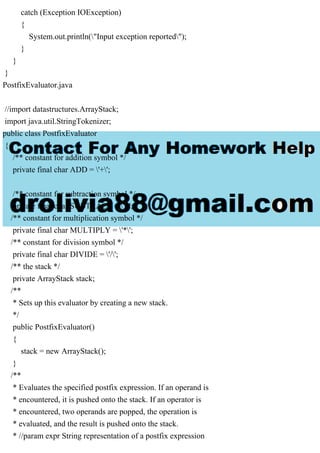
catch (Exception IOException)
{
System.out.println("Input exception reported");
}
}
}
PostfixEvaluator.java
//import datastructures.ArrayStack;
import java.util.StringTokenizer;
public class PostfixEvaluator
{
/** constant for addition symbol */
private final char ADD = '+';
/** constant for subtraction symbol */
private final char SUBTRACT = '-';
/** constant for multiplication symbol */
private final char MULTIPLY = '*';
/** constant for division symbol */
private final char DIVIDE = '/';
/** the stack */
private ArrayStack stack;
/**
* Sets up this evaluator by creating a new stack.
*/
public PostfixEvaluator()
{
stack = new ArrayStack();
}
/**
* Evaluates the specified postfix expression. If an operand is
* encountered, it is pushed onto the stack. If an operator is
* encountered, two operands are popped, the operation is
* evaluated, and the result is pushed onto the stack.
* //param expr String representation of a postfix expression
* //return int value of the given expression
*/
public int evaluate (String expr)
{
int op1, op2, result = 0;
String token;
StringTokenizer tokenizer = new StringTokenizer (expr);
while (tokenizer.hasMoreTokens())
{
token = tokenizer.nextToken();
if (isOperator(token))
{
op2 = (stack.pop()).intValue();
op1 = (stack.pop()).intValue();
result = evalSingleOp (token.charAt(0), op1, op2);
stack.push (new Integer(result));
}
else
stack.push (new Integer(Integer.parseInt(token)));
}
return result;
}
/**
* Determines if the specified token is an operator.
* //param token String representing a single token
* //return boolean true if token is operator
*/
private boolean isOperator (String token)
{
return ( token.equals("+") || token.equals("-") ||
token.equals("*") || token.equals("/") );
}
/**
* Performs integer evaluation on a single expression consisting of
* the specified operator and operands.
* //param operation operation to be performed
* //param op1 the first operand
* //param op2 the second operand
* //return int value of the expression
*/
private int evalSingleOp (char operation, int op1, int op2)
{
int result = 0;
switch (operation)
{
case ADD:
result = op1 + op2;
break;
case SUBTRACT:
result = op1 - op2;
break;
case MULTIPLY:
result = op1 * op2;
break;
case DIVIDE:
result = op1 / op2;
}
return result;
}
}
ArrayStack.java
import java.util.Arrays;
public class ArrayStack implements StackADT {
private final static int DEFAULT_CAPACITY = 100;
private int top;
private T[] stack;
/**
* Creates an empty stack using the default capacity.
*/
public ArrayStack() {
this(DEFAULT_CAPACITY);
}
/**
* Creates an empty stack using the specified capacity.
*
* //param initialCapacity the initial size of the array
*/
public ArrayStack(int initialCapacity) {
top = 0;
stack = (T[]) (new Object[initialCapacity]);
}
/**
* Adds the specified element to the top of this stack, expanding the
* capacity of the array if necessary.
*
* //param element generic element to be pushed onto stack
*/
public void push(T element) {
if (size() == stack.length) {
expandCapacity();
}
stack[top] = element;
top++;
}
/**
* Creates a new array to store the contents of this stack with twice the
* capacity of the old one.
*/
private void expandCapacity() {
stack = Arrays.copyOf(stack, stack.length * 2);
}
/**
* Removes the element at the top of this stack and returns a reference to
* it.
*
* //return element removed from top of stack
* //throws EmptyCollectionException if stack is empty
*/
public T pop() throws EmptyCollectionException {
if (isEmpty()) {
throw new EmptyCollectionException("stack");
}
top--;
T result = stack[top];
stack[top] = null;
return result;
}
/**
* Returns a reference to the element at the top of this stack. The element
* is not removed from the stack.
*
* //return element on top of stack
* //throws EmptyCollectionException if stack is empty
*/
public T peek() throws EmptyCollectionException {
if (isEmpty()) {
throw new EmptyCollectionException("stack");
}
return stack[top - 1];
}
/**
* Returns true if this stack is empty and false otherwise.
*
* //return true if this stack is empty
*/
public boolean isEmpty() {
return (top == 0);
}
/**
* Returns the number of elements in this stack.
*
* //return the number of elements in the stack
*/
public int size() {
return top;
}
/**
* Returns a string representation of this stack.
*
* //return a string representation of the stack
*/
public String toString() {
String result = "";
for (int scan = 0; scan < top; scan++) {
result = result + stack[scan] + " ";
}
return result;
}
}
StackADT.java
public interface StackADT
{
/**
* Adds the specified element to the top of this stack.
* //param element element to be pushed onto the stack
*/
public void push(T element);
/**
* Removes and returns the top element from this stack.
* //return the element removed from the stack
*/
public T pop();
/**
* Returns without removing the top element of this stack.
* //return the element on top of the stack
*/
public T peek();
/**
* Returns true if this stack contains no elements.
* //return true if the stack is empty
*/
public boolean isEmpty();
/**
* Returns the number of elements in this stack.
* //return the number of elements in the stack
*/
public int size();
/**
* Returns a string representation of this stack.
* //return a string representation of the stack
*/
public String toString();
}
EmptyCollectionException.java
public class EmptyCollectionException extends RuntimeException{
public EmptyCollectionException(String collection)
{
super("The " + collection + " is empty.");
}
}

java write a program to evaluate the postfix expressionthe program.pdf

  • 1.
    java write aprogram to evaluate the postfix expression the program should ask users for input and show the postfix epression and then the result. and to have a try and catch exception since we have an empty stack Solution Postfix.java import java.util.Scanner; public class Postfix { /** * Reads and evaluates multiple postfix expressions. */ public static void main (String[] args) { String expression, again; int result; try { Scanner in = new Scanner(System.in); do { PostfixEvaluator evaluator = new PostfixEvaluator(); System.out.println ("Enter a valid postfix expression: "); expression = in.nextLine(); result = evaluator.evaluate (expression); System.out.println(); System.out.println ("That expression equals " + result); System.out.print ("Evaluate another expression [Y/N]? "); again = in.nextLine(); System.out.println(); } while (again.equalsIgnoreCase("y")); }
  • 2.
    catch (Exception IOException) { System.out.println("Inputexception reported"); } } } PostfixEvaluator.java //import datastructures.ArrayStack; import java.util.StringTokenizer; public class PostfixEvaluator { /** constant for addition symbol */ private final char ADD = '+'; /** constant for subtraction symbol */ private final char SUBTRACT = '-'; /** constant for multiplication symbol */ private final char MULTIPLY = '*'; /** constant for division symbol */ private final char DIVIDE = '/'; /** the stack */ private ArrayStack stack; /** * Sets up this evaluator by creating a new stack. */ public PostfixEvaluator() { stack = new ArrayStack(); } /** * Evaluates the specified postfix expression. If an operand is * encountered, it is pushed onto the stack. If an operator is * encountered, two operands are popped, the operation is * evaluated, and the result is pushed onto the stack. * //param expr String representation of a postfix expression
  • 3.
    * //return intvalue of the given expression */ public int evaluate (String expr) { int op1, op2, result = 0; String token; StringTokenizer tokenizer = new StringTokenizer (expr); while (tokenizer.hasMoreTokens()) { token = tokenizer.nextToken(); if (isOperator(token)) { op2 = (stack.pop()).intValue(); op1 = (stack.pop()).intValue(); result = evalSingleOp (token.charAt(0), op1, op2); stack.push (new Integer(result)); } else stack.push (new Integer(Integer.parseInt(token))); } return result; } /** * Determines if the specified token is an operator. * //param token String representing a single token * //return boolean true if token is operator */ private boolean isOperator (String token) { return ( token.equals("+") || token.equals("-") || token.equals("*") || token.equals("/") ); } /**
  • 4.
    * Performs integerevaluation on a single expression consisting of * the specified operator and operands. * //param operation operation to be performed * //param op1 the first operand * //param op2 the second operand * //return int value of the expression */ private int evalSingleOp (char operation, int op1, int op2) { int result = 0; switch (operation) { case ADD: result = op1 + op2; break; case SUBTRACT: result = op1 - op2; break; case MULTIPLY: result = op1 * op2; break; case DIVIDE: result = op1 / op2; } return result; } } ArrayStack.java import java.util.Arrays; public class ArrayStack implements StackADT { private final static int DEFAULT_CAPACITY = 100; private int top; private T[] stack; /** * Creates an empty stack using the default capacity. */
  • 5.
    public ArrayStack() { this(DEFAULT_CAPACITY); } /** *Creates an empty stack using the specified capacity. * * //param initialCapacity the initial size of the array */ public ArrayStack(int initialCapacity) { top = 0; stack = (T[]) (new Object[initialCapacity]); } /** * Adds the specified element to the top of this stack, expanding the * capacity of the array if necessary. * * //param element generic element to be pushed onto stack */ public void push(T element) { if (size() == stack.length) { expandCapacity(); } stack[top] = element; top++; } /** * Creates a new array to store the contents of this stack with twice the * capacity of the old one. */ private void expandCapacity() { stack = Arrays.copyOf(stack, stack.length * 2); } /** * Removes the element at the top of this stack and returns a reference to * it. *
  • 6.
    * //return elementremoved from top of stack * //throws EmptyCollectionException if stack is empty */ public T pop() throws EmptyCollectionException { if (isEmpty()) { throw new EmptyCollectionException("stack"); } top--; T result = stack[top]; stack[top] = null; return result; } /** * Returns a reference to the element at the top of this stack. The element * is not removed from the stack. * * //return element on top of stack * //throws EmptyCollectionException if stack is empty */ public T peek() throws EmptyCollectionException { if (isEmpty()) { throw new EmptyCollectionException("stack"); } return stack[top - 1]; } /** * Returns true if this stack is empty and false otherwise. * * //return true if this stack is empty */ public boolean isEmpty() { return (top == 0); } /** * Returns the number of elements in this stack. *
  • 7.
    * //return thenumber of elements in the stack */ public int size() { return top; } /** * Returns a string representation of this stack. * * //return a string representation of the stack */ public String toString() { String result = ""; for (int scan = 0; scan < top; scan++) { result = result + stack[scan] + " "; } return result; } } StackADT.java public interface StackADT { /** * Adds the specified element to the top of this stack. * //param element element to be pushed onto the stack */ public void push(T element); /** * Removes and returns the top element from this stack. * //return the element removed from the stack */ public T pop(); /** * Returns without removing the top element of this stack. * //return the element on top of the stack
  • 8.
    */ public T peek(); /** *Returns true if this stack contains no elements. * //return true if the stack is empty */ public boolean isEmpty(); /** * Returns the number of elements in this stack. * //return the number of elements in the stack */ public int size(); /** * Returns a string representation of this stack. * //return a string representation of the stack */ public String toString(); } EmptyCollectionException.java public class EmptyCollectionException extends RuntimeException{ public EmptyCollectionException(String collection) { super("The " + collection + " is empty."); } }