2016 Winter
LAB #3
Prepared by: Berk Soysal
2016 Winter
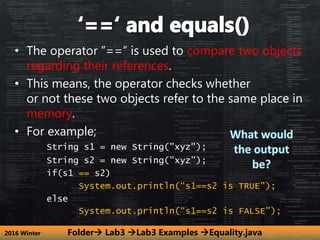
• The operator ”==” is used to compare two objects
regarding their references.
• This means, the operator checks whether
or not these two objects refer to the same place in
memory.
• For example;
String s1 = new String("xyz");
String s2 = new String("xyz");
if(s1 == s2)
System.out.println(“s1==s2 is TRUE");
else
System.out.println(“s1==s2 is FALSE");
Folder Lab3 Lab3 Examples Equality.java
• Note 1: Every time we create a new object, the
object gets its own unique address in the memory.
• Note 2: This type of comparison is called reference
comparison.
2016 Winter
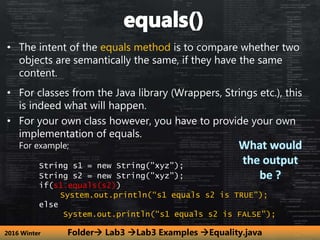
• The intent of the equals method is to compare whether two
objects are semantically the same, if they have the same
content.
• For classes from the Java library (Wrappers, Strings etc.), this
is indeed what will happen.
• For your own class however, you have to provide your own
implementation of equals.
For example;
String s1 = new String("xyz");
String s2 = new String("xyz");
if(s1.equals(s2))
System.out.println(“s1 equals s2 is TRUE");
else
System.out.println(“s1 equals s2 is FALSE");
2016 Winter Folder Lab3 Lab3 Examples Equality.java
• Another important aspect of software development
is the documentation.
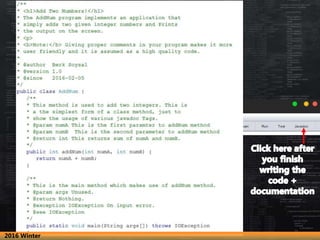
• JavaDoc is a format for your Java comments, and a
set of tools for producing Web pages automatically.
• In this lab, we are asking you to document your
code (variables, methods, etc.) using JavaDoc.
2016 Winter
2016 Winter
• Let’s complete the implementation of the (static)
class method String[] findAndReplace(String[] in,
String[] what, String[] with) of the class Utils.
• The method returns a copy of the array in where
each word occurring in the array what has been
replaced by the word occurring at the
corresponding position in the array with.
• The array designated by in must remain
unchanged.
2016 Winter
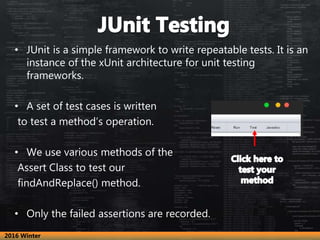
• JUnit is a simple framework to write repeatable tests. It is an
instance of the xUnit architecture for unit testing
frameworks.
• A set of test cases is written
to test a method’s operation.
• We use various methods of the
Assert Class to test our
findAndReplace() method.
• Only the failed assertions are recorded.
2016 Winter
• Let us implement a class to represent rational
numbers..
• Each rational number consists of a numerator
and a denominator, both of type int. Since each
rational number has its own numerator and
denominator, these must be instance variables.
Solutions-> Rational and TestRational
2016 Winter
• The public setXYZ () and getXYZ() methods are the
access points of the instance variables of a class.
• Normally, these methods are referred as getters
and setters.
• Therefore any class that wants to access the
variables should access them through these getters
and setters.
• An object that has no setter methods, and no other
methods for transforming the state of the object, is
said to be immutable.
2016 Winter
• An object is considered immutable if its state
cannot change after it is constructed. Maximum
reliance on immutable objects is widely accepted as
a sound strategy for creating simple, reliable code.
• Since they cannot change state, they cannot be
corrupted by thread interference or observed in an
inconsistent state.
2016 Winter
• Sometimes, you want to have variables that are
common to all objects. This is accomplished with
the static modifier. Fields that have the static
modifier in their declaration are called class
methods.
• When a number of objects are created from the
same class blueprint, they each have their own
distinct copies of instance methods.
2016 Winter
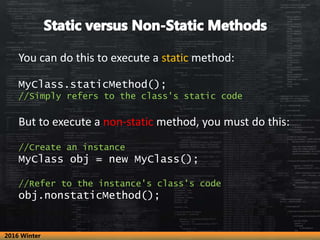
You can do this to execute a static method:
MyClass.staticMethod();
//Simply refers to the class's static code
But to execute a non-static method, you must do this:
//Create an instance
MyClass obj = new MyClass();
//Refer to the instance's class's code
obj.nonstaticMethod();
2016 Winter
Documentation Exercise !
Add JavaDoc comments for the class Rational.
1. Add JavaDoc comments for all the methods. Each
comment should include a brief description of what the
method does and descriptions of the parameters and the
return value using JavaDoc format.
2. Add a brief description of the class Rational, using the
JavaDoc syntax, make sure to include
the name of the author of the class (you).
2016 Winter
Java Tutorial Lab 3

Java Tutorial Lab 3

  • 1.
  • 2.
    2016 Winter • Theoperator ”==” is used to compare two objects regarding their references. • This means, the operator checks whether or not these two objects refer to the same place in memory. • For example; String s1 = new String("xyz"); String s2 = new String("xyz"); if(s1 == s2) System.out.println(“s1==s2 is TRUE"); else System.out.println(“s1==s2 is FALSE"); Folder Lab3 Lab3 Examples Equality.java
  • 3.
    • Note 1:Every time we create a new object, the object gets its own unique address in the memory. • Note 2: This type of comparison is called reference comparison. 2016 Winter
  • 4.
    • The intentof the equals method is to compare whether two objects are semantically the same, if they have the same content. • For classes from the Java library (Wrappers, Strings etc.), this is indeed what will happen. • For your own class however, you have to provide your own implementation of equals. For example; String s1 = new String("xyz"); String s2 = new String("xyz"); if(s1.equals(s2)) System.out.println(“s1 equals s2 is TRUE"); else System.out.println(“s1 equals s2 is FALSE"); 2016 Winter Folder Lab3 Lab3 Examples Equality.java
  • 5.
    • Another importantaspect of software development is the documentation. • JavaDoc is a format for your Java comments, and a set of tools for producing Web pages automatically. • In this lab, we are asking you to document your code (variables, methods, etc.) using JavaDoc. 2016 Winter
  • 6.
  • 7.
    • Let’s completethe implementation of the (static) class method String[] findAndReplace(String[] in, String[] what, String[] with) of the class Utils. • The method returns a copy of the array in where each word occurring in the array what has been replaced by the word occurring at the corresponding position in the array with. • The array designated by in must remain unchanged. 2016 Winter
  • 8.
    • JUnit isa simple framework to write repeatable tests. It is an instance of the xUnit architecture for unit testing frameworks. • A set of test cases is written to test a method’s operation. • We use various methods of the Assert Class to test our findAndReplace() method. • Only the failed assertions are recorded. 2016 Winter
  • 9.
    • Let usimplement a class to represent rational numbers.. • Each rational number consists of a numerator and a denominator, both of type int. Since each rational number has its own numerator and denominator, these must be instance variables. Solutions-> Rational and TestRational 2016 Winter
  • 10.
    • The publicsetXYZ () and getXYZ() methods are the access points of the instance variables of a class. • Normally, these methods are referred as getters and setters. • Therefore any class that wants to access the variables should access them through these getters and setters. • An object that has no setter methods, and no other methods for transforming the state of the object, is said to be immutable. 2016 Winter
  • 11.
    • An objectis considered immutable if its state cannot change after it is constructed. Maximum reliance on immutable objects is widely accepted as a sound strategy for creating simple, reliable code. • Since they cannot change state, they cannot be corrupted by thread interference or observed in an inconsistent state. 2016 Winter
  • 12.
    • Sometimes, youwant to have variables that are common to all objects. This is accomplished with the static modifier. Fields that have the static modifier in their declaration are called class methods. • When a number of objects are created from the same class blueprint, they each have their own distinct copies of instance methods. 2016 Winter
  • 13.
    You can dothis to execute a static method: MyClass.staticMethod(); //Simply refers to the class's static code But to execute a non-static method, you must do this: //Create an instance MyClass obj = new MyClass(); //Refer to the instance's class's code obj.nonstaticMethod(); 2016 Winter
  • 14.
    Documentation Exercise ! AddJavaDoc comments for the class Rational. 1. Add JavaDoc comments for all the methods. Each comment should include a brief description of what the method does and descriptions of the parameters and the return value using JavaDoc format. 2. Add a brief description of the class Rational, using the JavaDoc syntax, make sure to include the name of the author of the class (you). 2016 Winter