Gender In Communication
Chapter 9 Work
By Jason Brace
Introduction
Chapter 9 is about Work and its relationship with
Gender in Communication. The chapter is broken down
into different sections and they will be our jumping off
point. The Key Concepts of the chapter will be addressed
and we will sees examples of what they mean and how it
effects people. I hope that you enjoy this power point
presentation and get useful information you can apply in
your future.
Key Concepts
!   Capitalism
!   Critical Organizational communication
!   Emotions
!   Girl Watch
!   Hostile Work
!   Paid Care Work
The Key Concepts is a way for you to start thinking of what the chapter
will be about. Its also a great starting point to get your thoughts together and
get ready to understand Gender in Communication in Chapter 9 Work.
!   Quid Pro Quo
!   Sexual Harassment
!   Work-Family Tensions
Work Is a Gendered/Sexed
Institution
Work Is a Gendered/Sexed
Institution
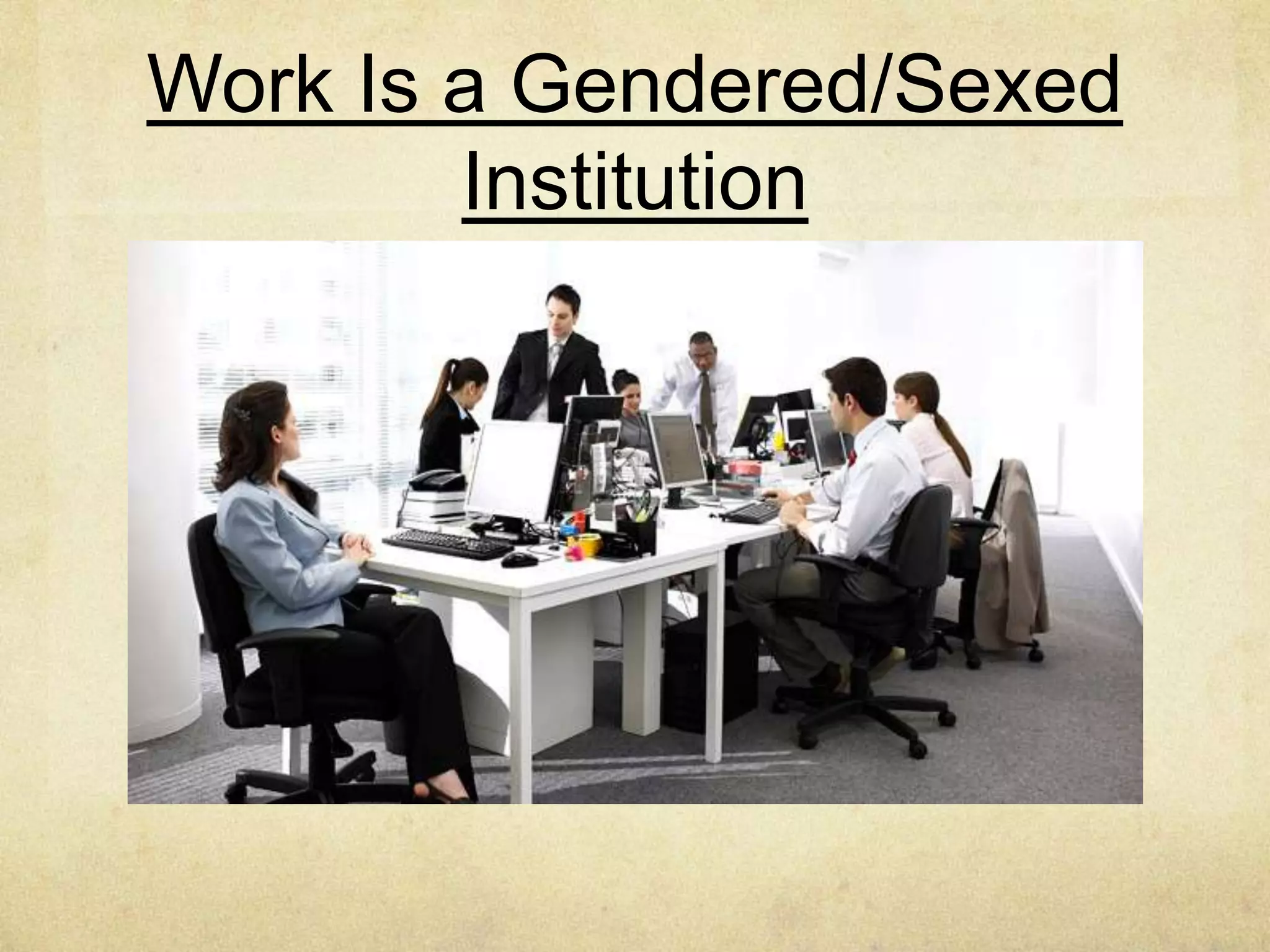
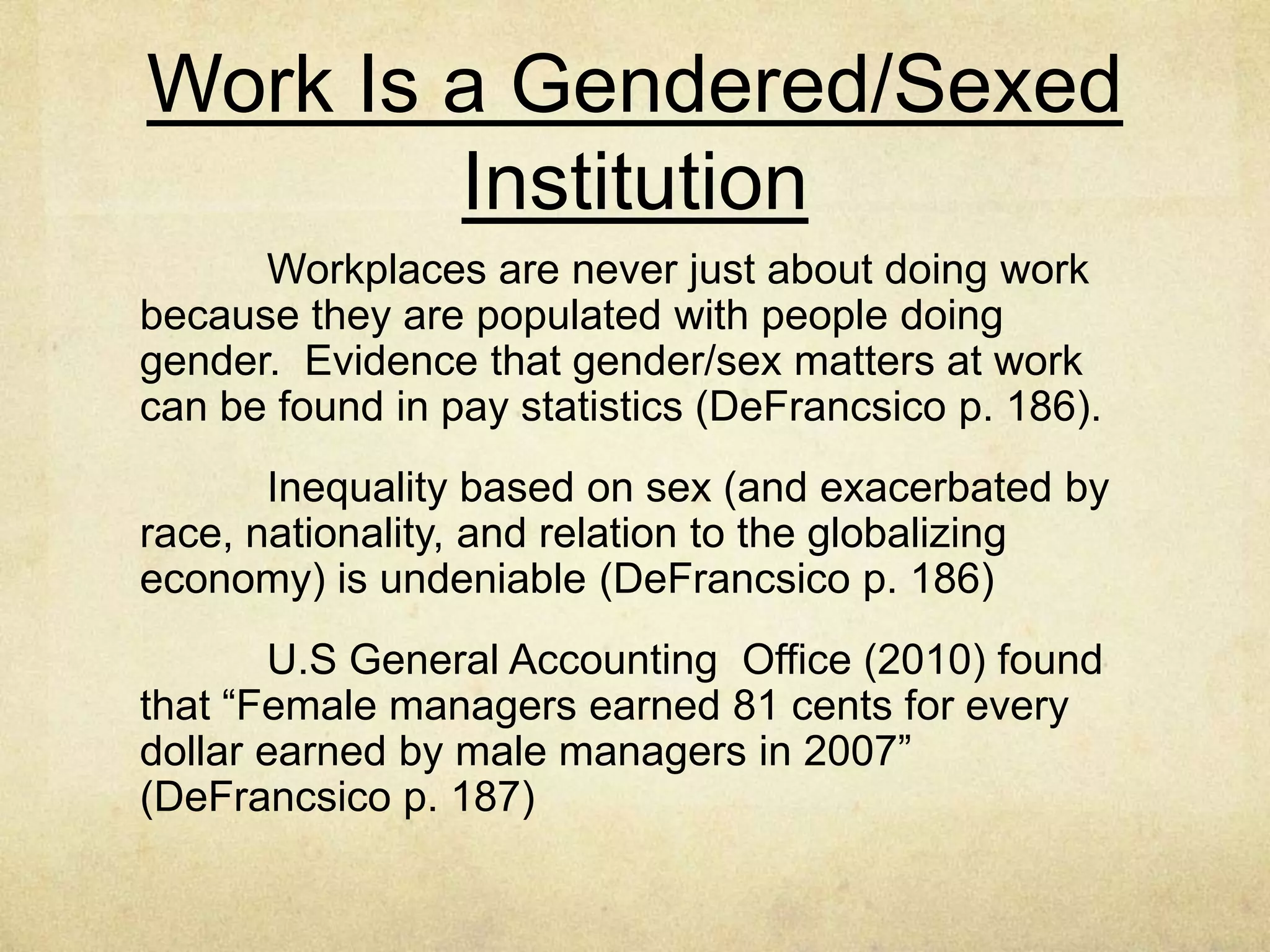
Workplaces are never just about doing work
because they are populated with people doing gender.
Evidence that gender/sex matters at work can be found in
pay statistics (DeFrancsico p. 186).
Inequality based on sex (and exacerbated by race,
nationality, and relation to the globalizing economy) is
undeniable (DeFrancsico p. 186)
U.S General Accounting Office (2010) found that
“Female managers earned 81 cents for every dollar earned
by male managers in 2007” (DeFrancsico p. 187)
Work Is a Gendered/Sexed
Institution
!   These three lines from the book are good examples
of what the authors are talking about when it comes to
the gap between women and men and not only that the
difference between races and nationality pay gaps. It is
true in that workplaces are never just doing work but it
depends on what work place you are at that will
determine a persons ability to make it stop. People
need to stand up for what they believe in no matter
what it takes.
Gendered/Sexed Wage Disparity
http://www.americanprogress.org/issues/2010/04/pdf/
equal_pay_day.pdf
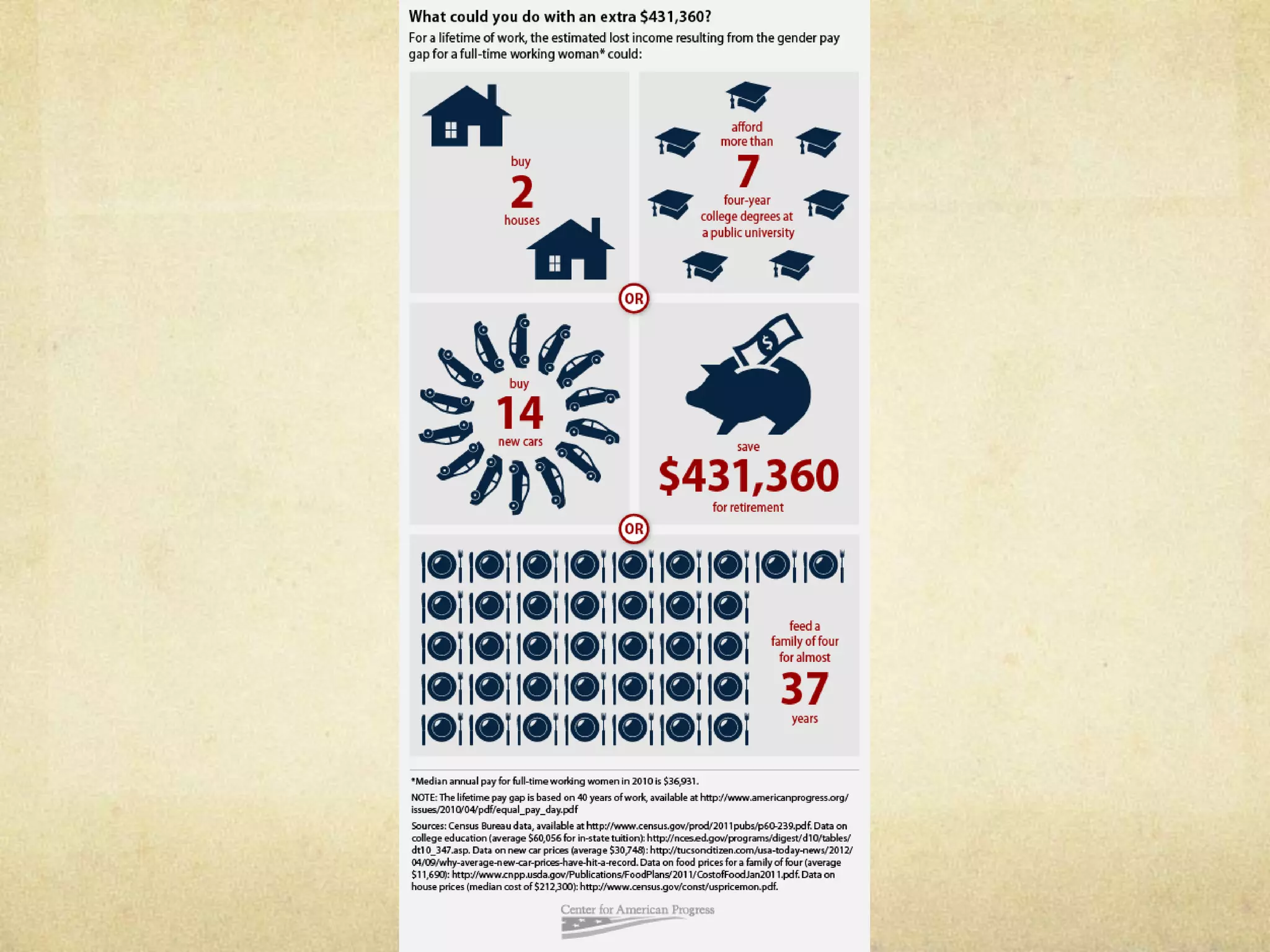
This is a chart full of information to support the claim that
women make less money then men do in the same positions of
responsibility.
I agree with this for the most part but in my profession I don’t
see it happen. The military is a place that I don’t think that this
happens as we are all paid the same based on your rank and
years in service. You can’t pay someone the money that they are
entitled to according to the pay chart.
This example is in the book for a reason and it shows
that men and women don’t get paid the same for the same
work in certain work places but I don’t think that it is like
this in every work place. I don’t see this difference in the
military where I work. I think that it shows a great deal of
a gap between men and women and something that needs
to be addressed and I understand that it is and I hope that
it is corrected sooner rather than later because people
should be paid for what they do.
Pay Difference
Gendered/Sexed Organizational
Structure and Microcommunication
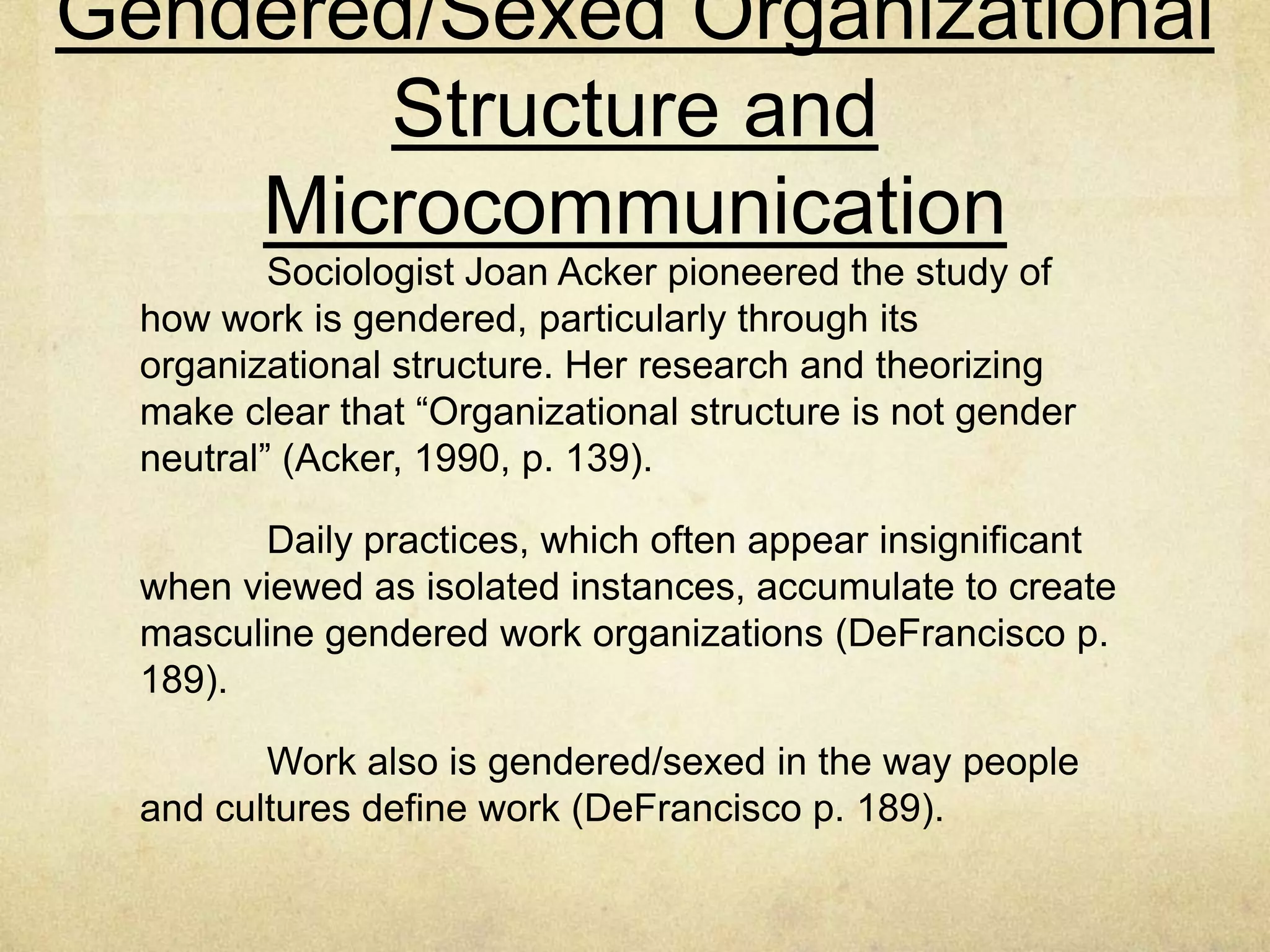
Sociologist Joan Acker pioneered the study of how work
is gendered, particularly through its organizational structure.
Her research and theorizing make clear that “Organizational
structure is not gender neutral” (Acker, 1990, p. 139).
Daily practices, which often appear insignificant when
viewed as isolated instances, accumulate to create masculine
gendered work organizations (DeFrancisco p. 189).
Work also is gendered/sexed in the way people and
cultures define work (DeFrancisco p. 189).
Gendered/Sexed Organizational
Structure and Microcommunication
I view this section like raising a child you let them
get away with a little each day and by the end of the week
you are letting them do things that you didn’t want them
to do but you are already accustom to them doing the little
things so it doesn’t seem bad. The only way to change
theses things is to start small and work together to make
the work structure better for all people involved.
The Definition of Work Is
Gendered/Sexed/Nationalized
Capitalism depends on creating and maintaining a
culture where people value materialism and purchasing
power.
In the United States, if people are asked to define
work, they will most likely define it as paid work outside
the home.
Child rearing is work, but because it is not paid,
people do not think of it as work. (DeFrancisco P. 190).
The Definition of Work Is
Gendered/Sexed/Nationalized
When looking at this section we see that people have
very different views of what work is and who is working. I don’t
think that people care that much about who is working where
and what they are doing unless it directly effects them. I can say
that I don’t care what people do for work unless I see some one
that I know not working and sitting around and collecting off
the government ( the money that you and I send it for taxes). I
do think that people sometimes need a little help to make it
through a ruff spot but not to live off of it there entire lives.
Who Should Work (Outside
the Home) Is Gendered/Sexed
Many women and men parents work and so place
their children in day care or seek the help of extended
family. While women who work outside the home are
criticized for placing their children in day care, poor
women who have had to rely on welfare f they remain
home to care for young children are considered bad
mothers because they do not work (DeFrancisco p. 190).
Who Should Work (Outside
the Home) Is Gendered/Sexed
I talked about this a lot during our online talks. I don’t
think that anyone should judge anyone for putting their kids in
day care. I think that if people need to do so to make ends meet
and to put food on the table and give their children a better
chance then I am all for it. I can see how some people that
don’t have children could look at it this way but if you have a
child I don’t think that you would think any less of a mother or
father for putting their children in day care.
Occupations Are Gendered/
Sexed Privileged
Many professions are sex segregated (e.g., men tend
to be firefighters, women tend to be nurses).
Predominantly male occupations possess more social value,
as indicated by more pay, prestige, authority, and
opportunities for advancement (DeFrancisco P. 191).
Numerous studies demonstrate that if an
occupation is female dominated, it tends to carry less
prestige, authority, and autonomy. Even in part-time work,
people (usually young men) who mow and care for lawns
tend to be paid more then people who babysit children
(usually young women) (DeFrancisco P.191).
Occupations Are Gendered/
Sexed Privileged
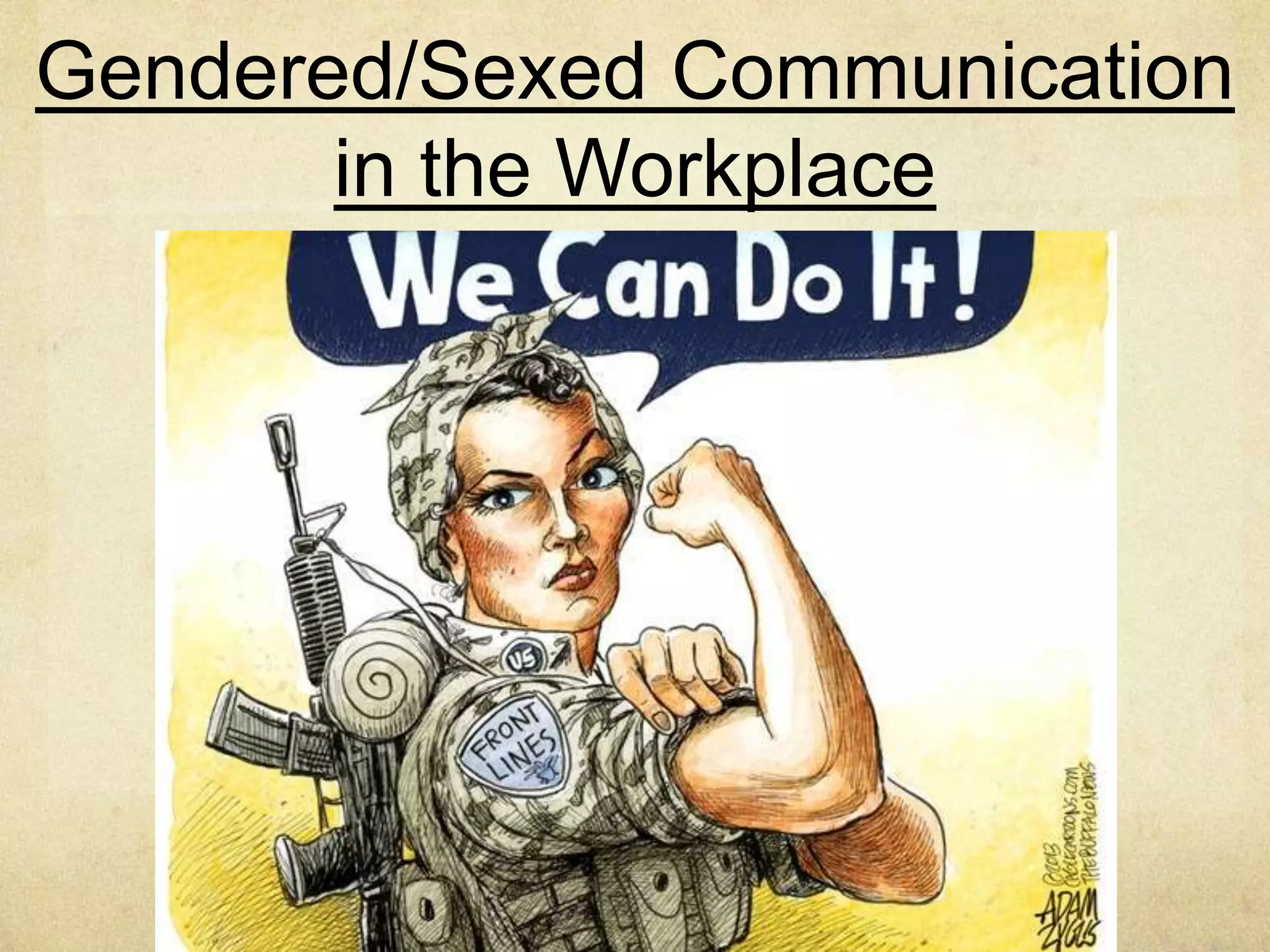
This is a fight that is going on in the military right
now over women being allowed into combat arms jobs. I
don’t see why people care so much. If someone wants to
be on the front lines then I am all for it. One less time for
me to be there and two if that’s what they want give it to
them. I can’t see someone being denied a job based on
what they are sex wise. I would think by now our culture
has move past some of this stuff and realize that men and
women can do the same jobs just as good as each other.
Occupations Are Gendered/
Sexed Privileged
Occupation Total Population
Employed in this
Occupation
Percentage Of Female
Employees
Median Salary,
Female
Median Salary,
Male
Registered nurse 2,843,000 91.1% 53,768 56,212
Maids and
housekeeping
cleaners
1,407,000 89.0% 20,384 24,596
Elementary and
middle school
teachers
2,813,000 81.8% 48,516 53,142
High School
Teachers
1,221,000 57.0% 51,428 54,548
Physicians and
surgeons
872,00 32.3% 79,404 100,620
Police and Sheriff’s
Patrol Officers
714,000 13.0% 48,776 49,296
Construction
Laborers
1,267,000 2.7% No data available 30,524
Workplace Organization is
Gendered/Sexed
How the structure of work-both paid labor and housework- is gendered
becomes most evident in work-family tensions. The institutions of work and
family generate tensions, causing many people to feel they must choose one over
the other. These choices are gendered, raced, and classed (DeFrancisco P. 192).
Nordic countries, work pay continues even during parental leave;
benefits provided at the birth of a child are reduced if both parents do not take
time off work; and parental leave is nontransferable, thus prompting both parents
to take time off (DeFrancisco P. 192).
Unfortunately, U.S. family leave is not structured this way, meaning the
tensions between work and family persist, leading to the very challenges the
Slaughter essay with which we opened the chapter outlines (DeFrancisco P.192).
Workplace Organization is
Gendered/Sexed
In the military (national guard) we call this the three legged stool
you have your work family, home family and your guard family. It is very
hard sometime to juggle all three of them at the same time but when you
get it right you have a great place to be at home, work and drill. It is hard
enough for people with just work and family but guardsman have it just a
little harder. I did like the Nordic countries approach to birth and would
love to see this in the United States as it would give the family a chance to
bond closer and to spend those first moments together with out the worry
of work in the back of your mind.
A Vivid Illustration: Transgender
Workers’ Experience
In a study of their work experiences, sociologist
Catherine Connell (2010) found that “transgender workers who
transitioned on the job described changes in their employers’
assumptions about their abilities” (DeFrancisco p. 193).
The person is the same person; the only thing that
changes is the sex designation. Yet, that alone is enough to
trigger different treatment from their employers (DeFrancisco p.
193)
Transwomen are more likely to face workplace barriers
than transmen DeFrancisco p. 193)
“The Workplace is not a gender-neutral location that
equitably rewards workers based on their individual merits… but
rather ‘a central site for the creation and reproduction of gender
differences and gender inequality’(DeFrancisco p. 193)
A Vivid Illustration: Transgender
Workers’ Experience
I can see how this would be hard for someone to go
through when they are at a job for a bit and then have a
major change in their life happen. I would think that
people would be understanding of it and just move on and
not make a big deal out of it but that’s not the case most of
the time. I don’t know how I would react to someone
going through this but would hope that I wouldn’t care
either way as long as they could do there job with no
problems.
Gendered/Sexed Communication in
the Workplace
Gendered/Sexed Communication in
the Workplace
Recent research makes clear that “gender differences in actual
communication and leadership behaviors are light, although
expectations of gender differences are strong. The situations that
remain most problematic for women are the ones in strongly male-
dominated or culturally masculine organizations”. Thus, the reality is
not that women and men communicate differently but that they are
assessed differently because people impose gendered expectations on
them, and these expectations benefit some and disadvantage other
(DeFrancsico p. 194)
Gendered/Sexed Communication in
the Workplace
This is another place where the women in combat arms jobs
comes to mind for me. I think that most people think of infantry as all
male because it is and would never think of a women belong to the
brother hood as they call it in the infantry world. The experience that I
have had with men in the infantry is that they don’t care what you are
or where you come from as long as you can cover their six and you can
handle the job then they are excepting of anything. I do hear peoples
argument of why women shouldn’t be allowed and it because (its always
been that way) that doesn’t cut it for me as a good reason. This is true
for any male or female dominated job and I think that it needs to stop
and let the best person have the job regardless of anything.
African American Women and
Work
Studies of African American women and work make clear that
their experiences of subordination at work begin in school, when
counselors and teacher tend to steer them away from particular
work aspirations (DeFrancisco p. 195)
The problems African American women face are intensified at
the time of job entry and then exacerbated with job advancement
(or the lack thereof) (DeFrancisco p.195)
Attention to how institutional structures of work affect African
American women differently than White American women should
make clear that a critical gendered lens applied to the institution of
work does not generate a simple list of different experiences for
women and men (DeFrancisco p. 195)
African American Women and
Work
I can see how this might have been an issue in the past but you
would think that we are past this in our culture. We have so many
other things to worry about then the color of someone’s skin don’t
we. I have said it through out this presentation that the best
person for the job should be the person that get its and if women
of color are not getting jobs or if they are and not being promoted
because of it needs to say something and fix the problem of the
boss that is holding them back. Its easy to say these things unless
you are faced with it but if you are seeing it happen to someone
and not saying something about yourself they you are also some
what responsible for the problem.
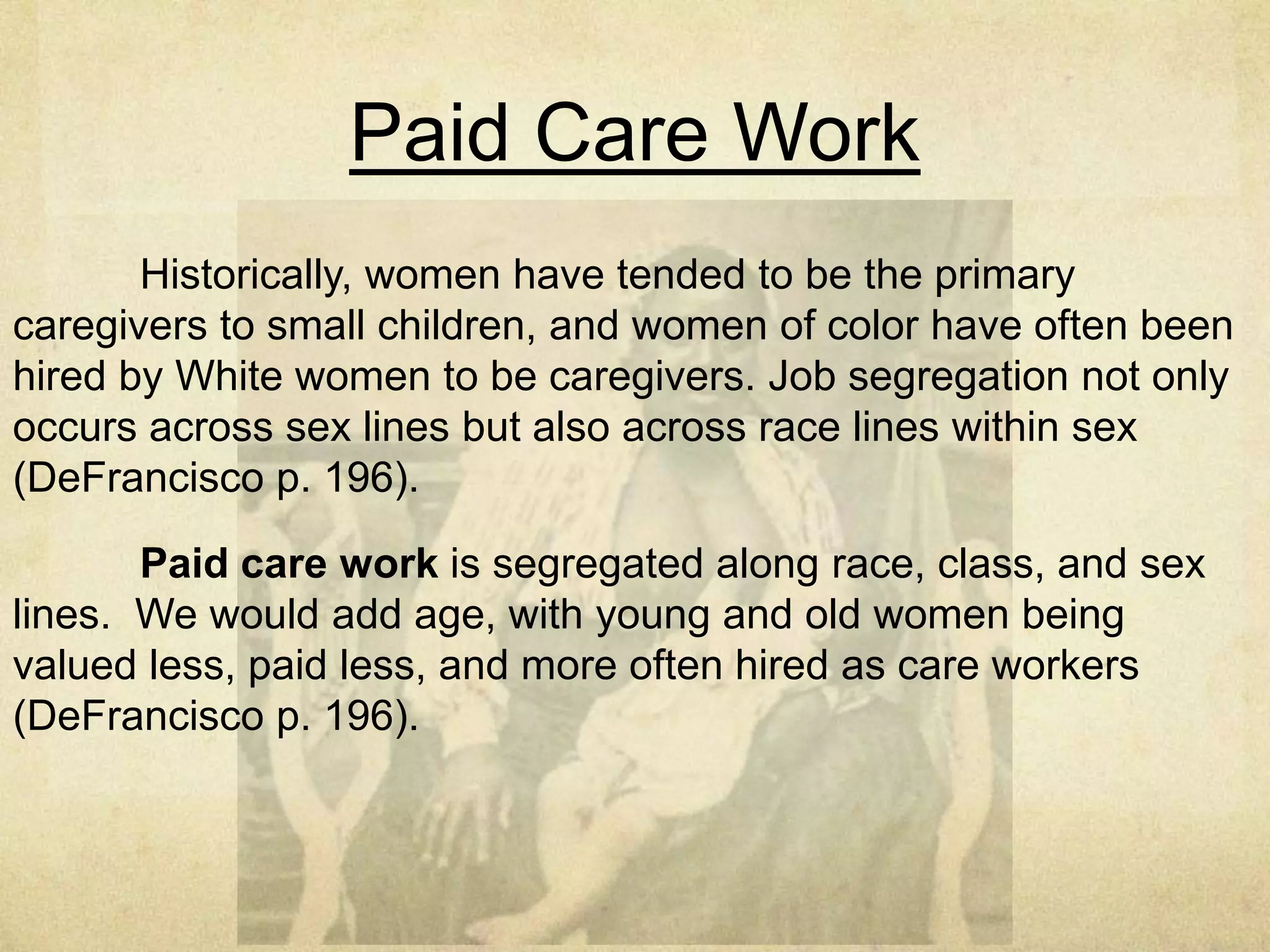
Paid Care Work
Historically, women have tended to be the primary caregivers to
small children, and women of color have often been hired by White
women to be caregivers. Job segregation not only occurs across sex lines
but also across race lines within sex (DeFrancisco p. 196).
Paid care work is segregated along race, class, and sex lines. We
would add age, with young and old women being valued less, paid less,
and more often hired as care workers (DeFrancisco p. 196).
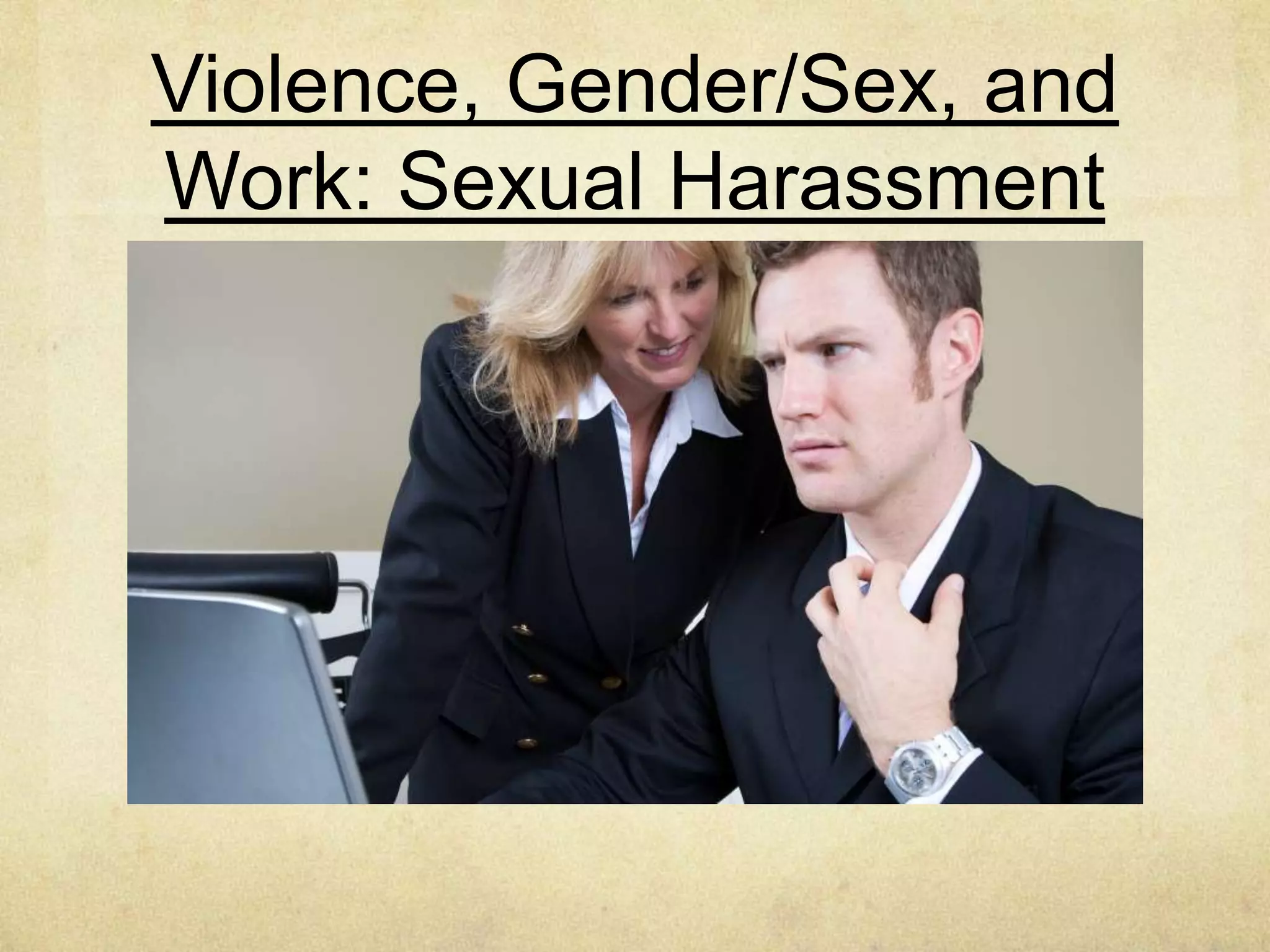
Violence, Gender/Sex, and
Work: Sexual Harassment
Violence, Gender/Sex, and
Work: Sexual Harassment
Perhaps the issue that makes most evident the power
relations present in work is workplace aggression. Research has
found that “workplace aggression and violence… does not affect
men and women equally”. In a meta-analysis of 57 empirical
studies, found men tended to be more aggressive at work than
women (DeFrancisco p.196).
The law recognizes two types of sexual harassment. Quid
pro quo, pressures to provide sexual favors in exchange for job
security, and hostile work environment, meaning behaviors
create a negative culture where work becomes impossible
(DeFrancisco p. 197).
Violence, Gender/Sex, and
Work: Sexual Harassment
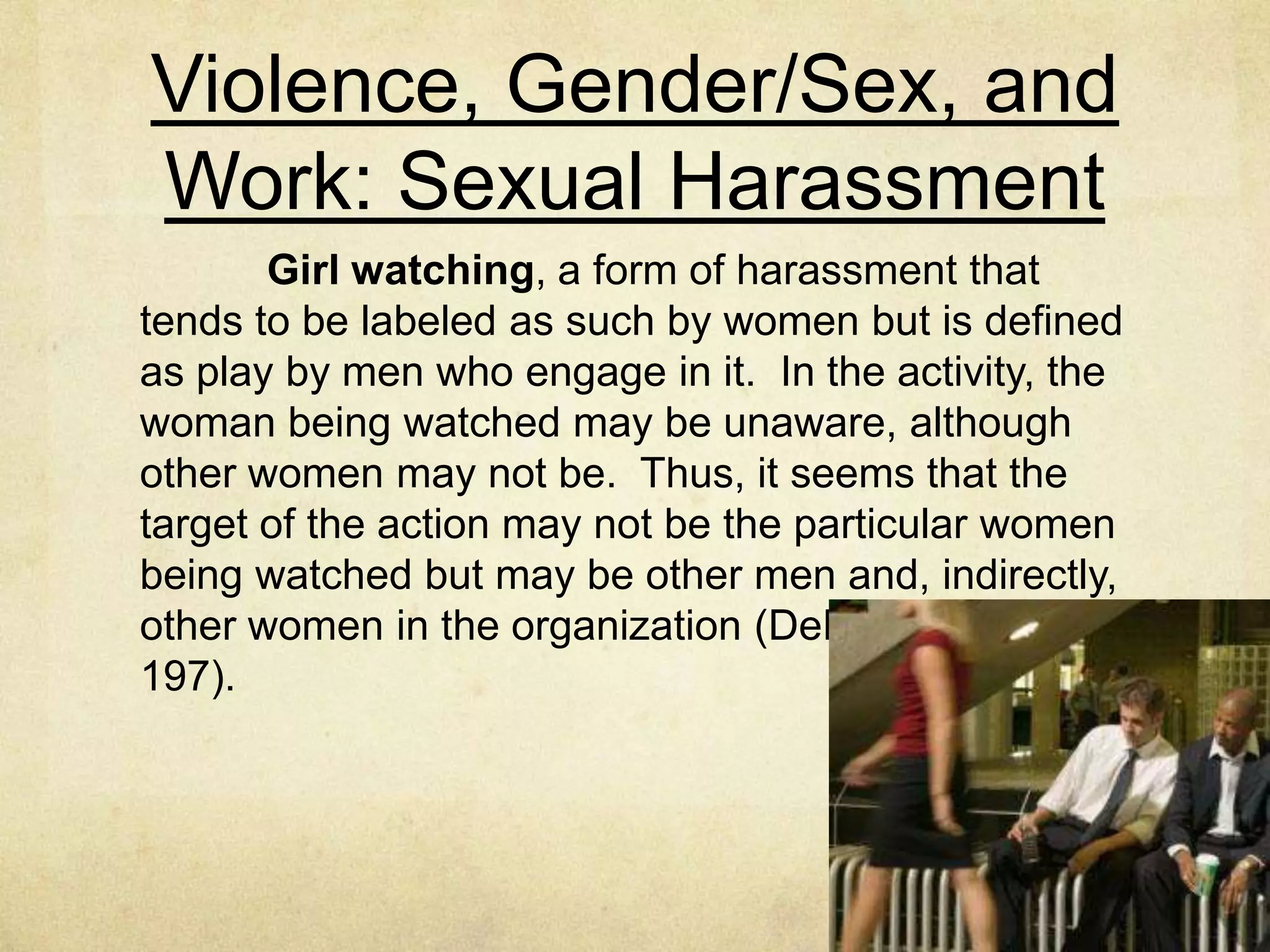
Girl watching, a form of harassment that tends to
be labeled as such by women but is defined as play by men
who engage in it. In the activity, the woman being watched
may be unaware, although other women may not be. Thus,
it seems that the target of the action may not be the
particular women being watched but may be other men
and, indirectly, other women in the organization
(DeFrancisco p. 197).
Violence, Gender/Sex, and
Work: Sexual Harassment
Most people think of sexual harassment as men on
to women because that is for the most part true but man
are subjected to sexual harassment as well. I don’t know
how it is in other work forces but in the military we have
training each ¼ of the year on this type of actions and it is
very clear that the command has a zero tolerance policy for
anyone that have committed these acts and they will be
charged with the correct punishment and handled swiftly.
Work as Liberation and
Locations of Empowerment
Work as Liberation and
Locations of Empowerment
To balance work-life demands, many African
American women have been found to develop
communities of “othermothers and fictive kin to help each
other with balancing work and Family. Five forms of
resistance and empowerment that individuals, in this case
African American women, use a. developing and using
voice, b. being self-defined, c. being self-determined, d.
connecting to and building community, and e. seeking
spirituality and regeneration through spiritual growth and
church support (DeFrancisco p. 199)
Work as Liberation and
Locations of Empowerment
Knowing one’s options can both protect one’s own
self-esteem and also create potential solutions. When one
confronts an instance where work has been gendered/
sexed, as when a man is discouraged from pursuing a
profession that traditionally has been populated by women,
understanding that such job segregation can be challenged
may enable him to pursue his career dreams. And , when
enough people follow this man’s lead, more pervasive
changes in the nature of work are possible (DeFrancisco p.
199-200).
Work as Liberation and
Locations of Empowerment
When you are held back in life by who you are and
you don’t think that you can every get out of that situation
it is a great feeling to have the opportunity to prove people
wrong. When you are able to hold a job and do what you
can in the work force it can be liberating and empowering.
I can say that it nice to see someone that enjoys their job
and does it well because they know how hard they worked
to get to that position. They were not handed anything on
a silver spoon and understand what it takes to make it and
you know they will keep taking steps to move forward and
succeed.
Conclusion
Work is something virtually every person does, whether it is paid
or unpaid (such as housework or yard work), and if one does not work that
in itself is a basis for judgment. Work can be extremely rewarding, and
people can consider their jobs a core part of their identities. However,
work also can be extremely dehumanizing, something done only as a way
of earning money to pay for the necessities of life (DeFrancisco p. 200).
Work as an institution both genders and is gendered. The jobs
people do, people’s interaction with other at work, and law and discourse
all influence the performance of gender/sex. In turn, gender/sex
influences how people understand work and its relation to family, identity,
and culture (DeFrancisco p. 200).
Conclusion
In showing this chapter in a power point I hope that you were able to get some
of the important things out of the presentation that I got out of the book. I chose this
chapter because it was something that all people do and that many people judge for what
type of jobs that people do. I am in the military and I see this from a different point of
view as the military is a place where you can move up the ranks on what you have done
and not who you know or what color skin, amount of money your family has and what
gender/sex you are.
Some people will say that women are just being let into combat jobs now and
they are not out in left field but women have been doing these jobs for a while now but
just in different ways. They will have the same opportunity as a male soldier to make it
up the ranks and achieve the positions that they want if they are good enough to do the
jobs just like everyone else. The pay will not be different as everyone is paid the same
depending on the pay chart. They don’t have one that is for males and one for females.
With this being said I think that if a place exists where people are place where
they are based on how good they are at the job no matter what or who they are will give
all of us hope that we can live in a place where this can happen in every work
environment.
Citation
DeFrancisco Palczewski 2007 Chapter 9 (work)
http://thegospelcoalition.org/blogs/trevinwax/files/2012/07/mom.jpg
http://thescrapheap.files.wordpress.com/2011/11/largemenhousework_12.jpg
http://i.huffpost.com/gen/1227553/thumbs/o-WORKING-MOTHER-facebook.jpg
http://images.sciencedaily.com/2013/12/131205091902-large.jpg
http://www.compliancetraininggroup.com/photos/woman-harasser.jpg
http://cdn.madamenoire.com/wp-content/uploads/2013/03/office-worker.jpg
http://acquandastanford.com/wp-content/uploads/
2014/03/580828_372264992840797_1336160827_n.jpg
http://www.slate.com/content/dam/slate/archive/
2010/07/1_123125_123112_2240728_2262207_090730_rec_girlwatchingarticle.jpg.CROP.original-
original.jpg

Jason brace presentation work

  • 1.
    Gender In Communication Chapter9 Work By Jason Brace
  • 2.
    Introduction Chapter 9 isabout Work and its relationship with Gender in Communication. The chapter is broken down into different sections and they will be our jumping off point. The Key Concepts of the chapter will be addressed and we will sees examples of what they mean and how it effects people. I hope that you enjoy this power point presentation and get useful information you can apply in your future.
  • 3.
    Key Concepts !  Capitalism !   Critical Organizational communication !   Emotions !   Girl Watch !   Hostile Work !   Paid Care Work The Key Concepts is a way for you to start thinking of what the chapter will be about. Its also a great starting point to get your thoughts together and get ready to understand Gender in Communication in Chapter 9 Work. !   Quid Pro Quo !   Sexual Harassment !   Work-Family Tensions
  • 4.
    Work Is aGendered/Sexed Institution
  • 5.
    Work Is aGendered/Sexed Institution Workplaces are never just about doing work because they are populated with people doing gender. Evidence that gender/sex matters at work can be found in pay statistics (DeFrancsico p. 186). Inequality based on sex (and exacerbated by race, nationality, and relation to the globalizing economy) is undeniable (DeFrancsico p. 186) U.S General Accounting Office (2010) found that “Female managers earned 81 cents for every dollar earned by male managers in 2007” (DeFrancsico p. 187)
  • 6.
    Work Is aGendered/Sexed Institution !   These three lines from the book are good examples of what the authors are talking about when it comes to the gap between women and men and not only that the difference between races and nationality pay gaps. It is true in that workplaces are never just doing work but it depends on what work place you are at that will determine a persons ability to make it stop. People need to stand up for what they believe in no matter what it takes.
  • 7.
    Gendered/Sexed Wage Disparity http://www.americanprogress.org/issues/2010/04/pdf/ equal_pay_day.pdf Thisis a chart full of information to support the claim that women make less money then men do in the same positions of responsibility. I agree with this for the most part but in my profession I don’t see it happen. The military is a place that I don’t think that this happens as we are all paid the same based on your rank and years in service. You can’t pay someone the money that they are entitled to according to the pay chart.
  • 8.
    This example isin the book for a reason and it shows that men and women don’t get paid the same for the same work in certain work places but I don’t think that it is like this in every work place. I don’t see this difference in the military where I work. I think that it shows a great deal of a gap between men and women and something that needs to be addressed and I understand that it is and I hope that it is corrected sooner rather than later because people should be paid for what they do. Pay Difference
  • 9.
    Gendered/Sexed Organizational Structure andMicrocommunication Sociologist Joan Acker pioneered the study of how work is gendered, particularly through its organizational structure. Her research and theorizing make clear that “Organizational structure is not gender neutral” (Acker, 1990, p. 139). Daily practices, which often appear insignificant when viewed as isolated instances, accumulate to create masculine gendered work organizations (DeFrancisco p. 189). Work also is gendered/sexed in the way people and cultures define work (DeFrancisco p. 189).
  • 10.
    Gendered/Sexed Organizational Structure andMicrocommunication I view this section like raising a child you let them get away with a little each day and by the end of the week you are letting them do things that you didn’t want them to do but you are already accustom to them doing the little things so it doesn’t seem bad. The only way to change theses things is to start small and work together to make the work structure better for all people involved.
  • 11.
    The Definition ofWork Is Gendered/Sexed/Nationalized Capitalism depends on creating and maintaining a culture where people value materialism and purchasing power. In the United States, if people are asked to define work, they will most likely define it as paid work outside the home. Child rearing is work, but because it is not paid, people do not think of it as work. (DeFrancisco P. 190).
  • 12.
    The Definition ofWork Is Gendered/Sexed/Nationalized When looking at this section we see that people have very different views of what work is and who is working. I don’t think that people care that much about who is working where and what they are doing unless it directly effects them. I can say that I don’t care what people do for work unless I see some one that I know not working and sitting around and collecting off the government ( the money that you and I send it for taxes). I do think that people sometimes need a little help to make it through a ruff spot but not to live off of it there entire lives.
  • 13.
    Who Should Work(Outside the Home) Is Gendered/Sexed Many women and men parents work and so place their children in day care or seek the help of extended family. While women who work outside the home are criticized for placing their children in day care, poor women who have had to rely on welfare f they remain home to care for young children are considered bad mothers because they do not work (DeFrancisco p. 190).
  • 14.
    Who Should Work(Outside the Home) Is Gendered/Sexed I talked about this a lot during our online talks. I don’t think that anyone should judge anyone for putting their kids in day care. I think that if people need to do so to make ends meet and to put food on the table and give their children a better chance then I am all for it. I can see how some people that don’t have children could look at it this way but if you have a child I don’t think that you would think any less of a mother or father for putting their children in day care.
  • 15.
    Occupations Are Gendered/ SexedPrivileged Many professions are sex segregated (e.g., men tend to be firefighters, women tend to be nurses). Predominantly male occupations possess more social value, as indicated by more pay, prestige, authority, and opportunities for advancement (DeFrancisco P. 191). Numerous studies demonstrate that if an occupation is female dominated, it tends to carry less prestige, authority, and autonomy. Even in part-time work, people (usually young men) who mow and care for lawns tend to be paid more then people who babysit children (usually young women) (DeFrancisco P.191).
  • 16.
    Occupations Are Gendered/ SexedPrivileged This is a fight that is going on in the military right now over women being allowed into combat arms jobs. I don’t see why people care so much. If someone wants to be on the front lines then I am all for it. One less time for me to be there and two if that’s what they want give it to them. I can’t see someone being denied a job based on what they are sex wise. I would think by now our culture has move past some of this stuff and realize that men and women can do the same jobs just as good as each other.
  • 17.
    Occupations Are Gendered/ SexedPrivileged Occupation Total Population Employed in this Occupation Percentage Of Female Employees Median Salary, Female Median Salary, Male Registered nurse 2,843,000 91.1% 53,768 56,212 Maids and housekeeping cleaners 1,407,000 89.0% 20,384 24,596 Elementary and middle school teachers 2,813,000 81.8% 48,516 53,142 High School Teachers 1,221,000 57.0% 51,428 54,548 Physicians and surgeons 872,00 32.3% 79,404 100,620 Police and Sheriff’s Patrol Officers 714,000 13.0% 48,776 49,296 Construction Laborers 1,267,000 2.7% No data available 30,524
  • 18.
    Workplace Organization is Gendered/Sexed Howthe structure of work-both paid labor and housework- is gendered becomes most evident in work-family tensions. The institutions of work and family generate tensions, causing many people to feel they must choose one over the other. These choices are gendered, raced, and classed (DeFrancisco P. 192). Nordic countries, work pay continues even during parental leave; benefits provided at the birth of a child are reduced if both parents do not take time off work; and parental leave is nontransferable, thus prompting both parents to take time off (DeFrancisco P. 192). Unfortunately, U.S. family leave is not structured this way, meaning the tensions between work and family persist, leading to the very challenges the Slaughter essay with which we opened the chapter outlines (DeFrancisco P.192).
  • 19.
    Workplace Organization is Gendered/Sexed Inthe military (national guard) we call this the three legged stool you have your work family, home family and your guard family. It is very hard sometime to juggle all three of them at the same time but when you get it right you have a great place to be at home, work and drill. It is hard enough for people with just work and family but guardsman have it just a little harder. I did like the Nordic countries approach to birth and would love to see this in the United States as it would give the family a chance to bond closer and to spend those first moments together with out the worry of work in the back of your mind.
  • 20.
    A Vivid Illustration:Transgender Workers’ Experience In a study of their work experiences, sociologist Catherine Connell (2010) found that “transgender workers who transitioned on the job described changes in their employers’ assumptions about their abilities” (DeFrancisco p. 193). The person is the same person; the only thing that changes is the sex designation. Yet, that alone is enough to trigger different treatment from their employers (DeFrancisco p. 193) Transwomen are more likely to face workplace barriers than transmen DeFrancisco p. 193) “The Workplace is not a gender-neutral location that equitably rewards workers based on their individual merits… but rather ‘a central site for the creation and reproduction of gender differences and gender inequality’(DeFrancisco p. 193)
  • 21.
    A Vivid Illustration:Transgender Workers’ Experience I can see how this would be hard for someone to go through when they are at a job for a bit and then have a major change in their life happen. I would think that people would be understanding of it and just move on and not make a big deal out of it but that’s not the case most of the time. I don’t know how I would react to someone going through this but would hope that I wouldn’t care either way as long as they could do there job with no problems.
  • 22.
  • 23.
    Gendered/Sexed Communication in theWorkplace Recent research makes clear that “gender differences in actual communication and leadership behaviors are light, although expectations of gender differences are strong. The situations that remain most problematic for women are the ones in strongly male- dominated or culturally masculine organizations”. Thus, the reality is not that women and men communicate differently but that they are assessed differently because people impose gendered expectations on them, and these expectations benefit some and disadvantage other (DeFrancsico p. 194)
  • 24.
    Gendered/Sexed Communication in theWorkplace This is another place where the women in combat arms jobs comes to mind for me. I think that most people think of infantry as all male because it is and would never think of a women belong to the brother hood as they call it in the infantry world. The experience that I have had with men in the infantry is that they don’t care what you are or where you come from as long as you can cover their six and you can handle the job then they are excepting of anything. I do hear peoples argument of why women shouldn’t be allowed and it because (its always been that way) that doesn’t cut it for me as a good reason. This is true for any male or female dominated job and I think that it needs to stop and let the best person have the job regardless of anything.
  • 25.
    African American Womenand Work Studies of African American women and work make clear that their experiences of subordination at work begin in school, when counselors and teacher tend to steer them away from particular work aspirations (DeFrancisco p. 195) The problems African American women face are intensified at the time of job entry and then exacerbated with job advancement (or the lack thereof) (DeFrancisco p.195) Attention to how institutional structures of work affect African American women differently than White American women should make clear that a critical gendered lens applied to the institution of work does not generate a simple list of different experiences for women and men (DeFrancisco p. 195)
  • 26.
    African American Womenand Work I can see how this might have been an issue in the past but you would think that we are past this in our culture. We have so many other things to worry about then the color of someone’s skin don’t we. I have said it through out this presentation that the best person for the job should be the person that get its and if women of color are not getting jobs or if they are and not being promoted because of it needs to say something and fix the problem of the boss that is holding them back. Its easy to say these things unless you are faced with it but if you are seeing it happen to someone and not saying something about yourself they you are also some what responsible for the problem.
  • 27.
    Paid Care Work Historically,women have tended to be the primary caregivers to small children, and women of color have often been hired by White women to be caregivers. Job segregation not only occurs across sex lines but also across race lines within sex (DeFrancisco p. 196). Paid care work is segregated along race, class, and sex lines. We would add age, with young and old women being valued less, paid less, and more often hired as care workers (DeFrancisco p. 196).
  • 28.
  • 29.
    Violence, Gender/Sex, and Work:Sexual Harassment Perhaps the issue that makes most evident the power relations present in work is workplace aggression. Research has found that “workplace aggression and violence… does not affect men and women equally”. In a meta-analysis of 57 empirical studies, found men tended to be more aggressive at work than women (DeFrancisco p.196). The law recognizes two types of sexual harassment. Quid pro quo, pressures to provide sexual favors in exchange for job security, and hostile work environment, meaning behaviors create a negative culture where work becomes impossible (DeFrancisco p. 197).
  • 30.
    Violence, Gender/Sex, and Work:Sexual Harassment Girl watching, a form of harassment that tends to be labeled as such by women but is defined as play by men who engage in it. In the activity, the woman being watched may be unaware, although other women may not be. Thus, it seems that the target of the action may not be the particular women being watched but may be other men and, indirectly, other women in the organization (DeFrancisco p. 197).
  • 31.
    Violence, Gender/Sex, and Work:Sexual Harassment Most people think of sexual harassment as men on to women because that is for the most part true but man are subjected to sexual harassment as well. I don’t know how it is in other work forces but in the military we have training each ¼ of the year on this type of actions and it is very clear that the command has a zero tolerance policy for anyone that have committed these acts and they will be charged with the correct punishment and handled swiftly.
  • 32.
    Work as Liberationand Locations of Empowerment
  • 33.
    Work as Liberationand Locations of Empowerment To balance work-life demands, many African American women have been found to develop communities of “othermothers and fictive kin to help each other with balancing work and Family. Five forms of resistance and empowerment that individuals, in this case African American women, use a. developing and using voice, b. being self-defined, c. being self-determined, d. connecting to and building community, and e. seeking spirituality and regeneration through spiritual growth and church support (DeFrancisco p. 199)
  • 34.
    Work as Liberationand Locations of Empowerment Knowing one’s options can both protect one’s own self-esteem and also create potential solutions. When one confronts an instance where work has been gendered/ sexed, as when a man is discouraged from pursuing a profession that traditionally has been populated by women, understanding that such job segregation can be challenged may enable him to pursue his career dreams. And , when enough people follow this man’s lead, more pervasive changes in the nature of work are possible (DeFrancisco p. 199-200).
  • 35.
    Work as Liberationand Locations of Empowerment When you are held back in life by who you are and you don’t think that you can every get out of that situation it is a great feeling to have the opportunity to prove people wrong. When you are able to hold a job and do what you can in the work force it can be liberating and empowering. I can say that it nice to see someone that enjoys their job and does it well because they know how hard they worked to get to that position. They were not handed anything on a silver spoon and understand what it takes to make it and you know they will keep taking steps to move forward and succeed.
  • 36.
    Conclusion Work is somethingvirtually every person does, whether it is paid or unpaid (such as housework or yard work), and if one does not work that in itself is a basis for judgment. Work can be extremely rewarding, and people can consider their jobs a core part of their identities. However, work also can be extremely dehumanizing, something done only as a way of earning money to pay for the necessities of life (DeFrancisco p. 200). Work as an institution both genders and is gendered. The jobs people do, people’s interaction with other at work, and law and discourse all influence the performance of gender/sex. In turn, gender/sex influences how people understand work and its relation to family, identity, and culture (DeFrancisco p. 200).
  • 37.
    Conclusion In showing thischapter in a power point I hope that you were able to get some of the important things out of the presentation that I got out of the book. I chose this chapter because it was something that all people do and that many people judge for what type of jobs that people do. I am in the military and I see this from a different point of view as the military is a place where you can move up the ranks on what you have done and not who you know or what color skin, amount of money your family has and what gender/sex you are. Some people will say that women are just being let into combat jobs now and they are not out in left field but women have been doing these jobs for a while now but just in different ways. They will have the same opportunity as a male soldier to make it up the ranks and achieve the positions that they want if they are good enough to do the jobs just like everyone else. The pay will not be different as everyone is paid the same depending on the pay chart. They don’t have one that is for males and one for females. With this being said I think that if a place exists where people are place where they are based on how good they are at the job no matter what or who they are will give all of us hope that we can live in a place where this can happen in every work environment.
  • 38.
    Citation DeFrancisco Palczewski 2007Chapter 9 (work) http://thegospelcoalition.org/blogs/trevinwax/files/2012/07/mom.jpg http://thescrapheap.files.wordpress.com/2011/11/largemenhousework_12.jpg http://i.huffpost.com/gen/1227553/thumbs/o-WORKING-MOTHER-facebook.jpg http://images.sciencedaily.com/2013/12/131205091902-large.jpg http://www.compliancetraininggroup.com/photos/woman-harasser.jpg http://cdn.madamenoire.com/wp-content/uploads/2013/03/office-worker.jpg http://acquandastanford.com/wp-content/uploads/ 2014/03/580828_372264992840797_1336160827_n.jpg http://www.slate.com/content/dam/slate/archive/ 2010/07/1_123125_123112_2240728_2262207_090730_rec_girlwatchingarticle.jpg.CROP.original- original.jpg