JACQUES DERRIDA
(A. D. 1930 - 2004)
His Life and Works
JACQUES DERRIDA
(A. D. 1930 - 2004)
by Gerald V. Delos Santos
•Jacques Derrida was born in Algeria in
1930 into a Jewish family.
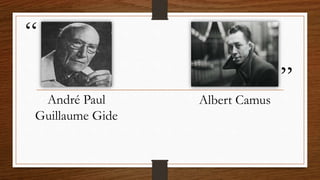
•During his adolescent period, he read works
by Rousseau, Nietzsche, and André Paul
Guillaume Gide (1869—1951, French author), which
was instrumental in his revolt against the
family and society.
•He also read Camus and Sartre.
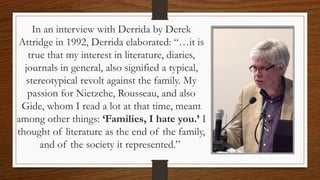
In an interview with Derrida by Derek
Attridge in 1992, Derrida elaborated: “…it is
true that my interest in literature, diaries,
journals in general, also signified a typical,
stereotypical revolt against the family. My
passion for Nietzche, Rousseau, and also
Gide, whom I read a lot at that time, meant
among other things: ‘Families, I hate you.’ I
thought of literature as the end of the family,
and of the society it represented.”
“
”
André Paul
Guillaume Gide
Albert Camus
•After Derrida visited the Husserl archives
in Leuven Belgium, he completed the civil
service examinations (the philosophy aggregation on
Edmund Husserl) for particular positions in the
public education system.
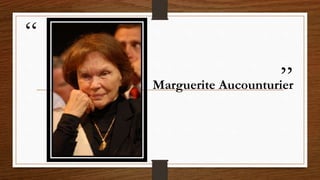
•In 1957, Derrida married the psychoanalyst
Marguerite Aucounturier. Rather than
participate in the military activity of Algerian
War of Independence, he received permission
to teach soldiers’ children from 1957 to 1959,
teaching them French and English.
“
”Marguerite Aucounturier
•After the war ended, Derrida taught
philosophy from 1960 to 1964 at the
University of Paris where he was the assistant
of Suzanne Bachelard, Georges Canguilhem,
Paul Ricoeur, and Jean Andre Wahl.
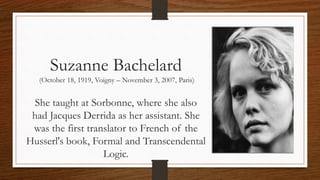
Suzanne Bachelard
(October 18, 1919, Voigny – November 3, 2007, Paris)
She taught at Sorbonne, where she also
had Jacques Derrida as her assistant. She
was the first translator to French of the
Husserl's book, Formal and Transcendental
Logic.
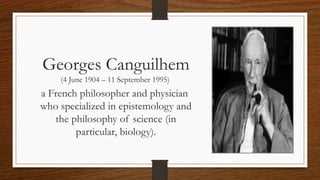
Georges Canguilhem
(4 June 1904 – 11 September 1995)
a French philosopher and physician
who specialized in epistemology and
the philosophy of science (in
particular, biology).
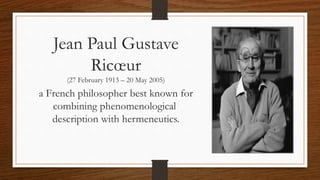
Jean Paul Gustave
Ricœur
(27 February 1913 – 20 May 2005)
a French philosopher best known for
combining phenomenological
description with hermeneutics.
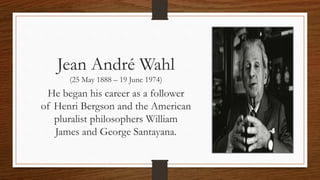
Jean André Wahl
(25 May 1888 – 19 June 1974)
He began his career as a follower
of Henri Bergson and the American
pluralist philosophers William
James and George Santayana.
•He was also associated with a group
called the Tel Quel, an innovative
magazine comprised of a group of
literary and philosophical theorists.
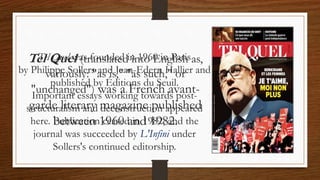
Tel Quel (translated into English as,
variously: "as is," "as such," or
"unchanged") was a French avant-
garde literary magazine published
between 1960 and 1982.
Tel Quel was founded in 1960 in Paris
by Philippe Sollers and Jean-Edern Hallier and
published by Éditions du Seuil.
Important essays working towards post-
structuralism and deconstruction appeared
here. Publication ceased in 1982, and the
journal was succeeded by L'Infini under
Sollers's continued editorship.
• Derrida’s work titled “Structure, Sign, and Play in the
Discourse of the Human Sciences” in a 1966 conference
at John Hopkins University began his international
prominence.
• In 1967, he published three books: Writing and
Difference, Speech and Phenomena, and Of Grammatology.
• Later in 1980, he later wrote Thèse d'État which,
when translated to English, was titled The Time
of a Thesis: Punctuations.
• In 1983 and in a joint effort with Ken McMullen
(b. 1948, film director and artist from London) they made a
film titled “Ghost Dance.”
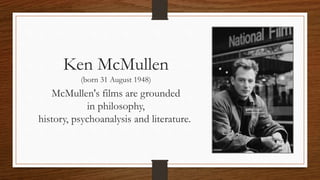
Ken McMullen
(born 31 August 1948)
McMullen's films are grounded
in philosophy,
history, psychoanalysis and literature.
• Derrida was also director of studies at the School
for Advanced Studies in the Social Sciences in
Paris and later in 1983 co-founded the Collège
International de Philosophie (a.k.a. the CIPH)
aimed at providing a location for philosophical
research.
•Jacques Derrida was diagnosed with
cancer in 2003 and subsequently died the
following year.
Post-Structuralism
An Overview
Post-Structuralism
Post-structuralism – which appeared in the
1970s – is both an expansion on and
refutation of structuralism.
Like structuralism, post-structuralism has
branched out into several disciplines,
perhaps most notably in the field of literary
criticism.
Post-Structuralism
Structuralists would argue that the
meaning of particular passages in the book
rests mainly on the structures within the
book itself, which is a closed system.
Post-Structuralism
The structures in the book involved paired
opposites of war/peace, wealth/poverty,
and love/strife.
Post structuralism pushes the matter
further.
Post-Structuralism
First,
If a book is truly a closed system, then I
must exclude any fact or consideration
outside of that book.
I must even set aside the author’s
intentions.
Post-Structuralism
First,
Since each reader will likely have different
interpretation of the book, the book will
have no definitive meaning.
Post-Structuralism
Second,
Post-structuralists will argue that if we
look carefully for so–called paired
opposites within the book, we will find this
to be an oversimplification.
Post-Structuralism
Second,
For example, although the book does
contain elements of love and strife, we also
see indifference.
We don’t see only wealth and poverty, but
middle-level income as well.
Post-Structuralism
Second,
Struturalists believed that paired opposites
provided logical coherence to closed
systems.
Each reader then will play with the book,
bringing his or her own meaning to it.
Jacques Derrida & Deconstructionism
Geisler, N. L. (2012). A History of Western Philosophy: Modern and
Postmodern: From Descartes to Derrida (Vol. II). USA: Bastion
Books
• He is atheistic regarding the existence of
God and agnostic concerning the possibility
of knowing absolute truth.
• He is anti-metaphysical.
• Humans are locked-up in their own
linguistic bubble.
• Has been given the label Father of
Deconstructionism
(a.k.a. Postmodernism).
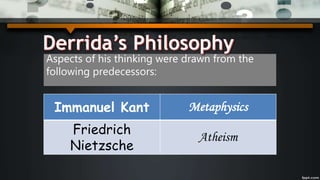
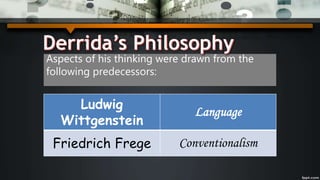
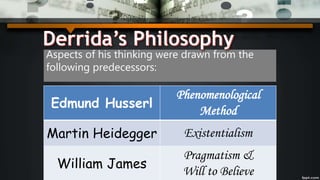
Aspects of his thinking were drawn from the
following predecessors:
Immanuel Kant Metaphysics
Friedrich
Nietzsche
Atheism
Aspects of his thinking were drawn from the
following predecessors:
Ludwig
Wittgenstein
Language
Friedrich Frege Conventionalism
Aspects of his thinking were drawn from the
following predecessors:
Edmund Husserl
Phenomenological
Method
Martin Heidegger Existentialism
William James
Pragmatism &
Will to Believe
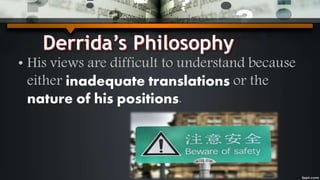
• His views are difficult to understand because
either inadequate translations or the
nature of his positions.
Deconstructionism
Deconstructionism
• It is a form of
hermeneutics – the
interpretation of text.
• He is not out to destroy meaning
but only to reconstruct it through
abandoning the established rules
of textual analysis.
Deconstructionism
• The deconstructionist reads,
rereads the text in search for
a new, deeper, forgotten
meaning.
Deconstructionism
• Deconstruction is not a negation
from dismantling the text but rather
it is a critique that remodels the
text, rather than a grammatical-
literal-historical foundation
associated with the text under
consideration.
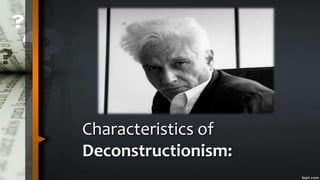
Characteristics of
Deconstructionism:
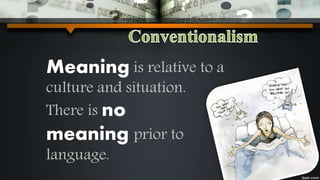
Meaning is relative to a
culture and situation.
There is no
meaning prior to
language.
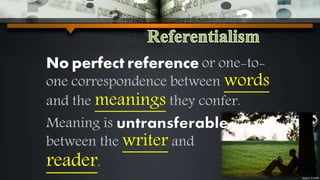
No perfect reference or one-to-
one correspondence between words
and the meanings they confer.
Meaning is
between the writer and
reader.
Rational structures leave something
out where the reader approaches the
text with suspicion looking for
some “differences” and in search
for “something” that
is “not there.”
Inability to escape the limits of
language.
Linguistic concepts can be broaden
but limits of it keep the reader
corralled.
All possible meanings are never
exhausted.
A text can always be further
deconstructed.
Understanding Derrida’s
Philosophy
✘ Three factors are key in
understanding Derrida’s
philosophy – grammar, logic,
and rhetoric.
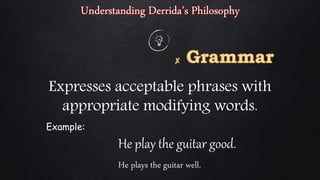
Expresses acceptable phrases with
appropriate modifying words.
Example:
He play the guitar good.
He plays the guitar well.
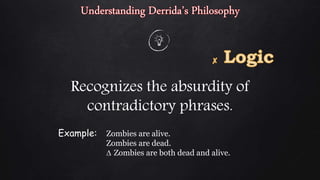
Recognizes the absurdity of
contradictory phrases.
Example: Zombies are alive.
Zombies are dead.
∆ Zombies are both dead and alive.
Show how and when to use the
phrases mastered through
grammar and logic.
Grammar is relatively superficial,
having to do with keeping the
signs of language in good order.
Logic and rhetoric are more
profound, dealing with the use
and interpretation of signs.
Derrida rejects the history of
western philosophy in which
language is based on logic.
Derrida also rejects Plato,
Aristotle, the rationalists and
empiricists, and even the linguistic
analysts such as Russell.
He also sets aside
phenomenologists like Husserl for
assuming that there is a logical
underpinning to reality.
Some precursors to Derrida’s
thought
Frege’s distinction between sense
and reference that played a part.
The operational definitions in
science and the recursive
definitions in mathematics provide
meaning or sense but rather only
effective criteria for use in
expression.
Charles Pierce’s pragmatic
meanings for clarifying ideas was
used in Derrida’s operational
definitions.
John Austin’s view of speech acts
that are a rhetorical basis for
meaning.
Wittgenstein’s language based in
“forms of life” involved a turn
from making demands to making
observations which resulted in
redirection away from logic-base
to use-based meaning.
It follows that experience ends up
being the basis of meaning –
“only in the stream of life does an
expression have meaning.”
Rhetoric and the actual context of
life is an essential feature of all
linguistic meaning.
Language is not based on logic but
is rather logic is based on rhetoric.
One must “deconstruct” language
based in logic in order to learn
how linguistic expressions are
used in human activity.
Language based on logic entails a
mistaken belief that there are
“private languages” with “inner
speech” and “private mental life.”
If logic is sovereign, then a private
language is possible. If logic is
formal, then ideas would not vary
with circumstances.
Rhetoric as Basis of Language
In order to understand what a text
means, one must first full
understand its actual life context.
- no pure and simple meanings
stand behind the signs (words) of
language. If all language is
complex, then no essential
meaning transcends time and
place.
- every object of language and
meaning is contingent upon
changing life reality. There is no
objective meaning.
- no pure experiences exist
without reference to transient
experience.
- Deconstructionists reject
realized idealized concepts
disconnected from the everyday
world.
- all written language is dependent
on spoken language. It is dependent
on the pattern of vocalization
(phonemics).
- Phonemes are parts of sound that
can be represented by a letter.
“Difference” is the key to meaning,
since all sounds must be
differentiated to be distinct and form
meaningful sounds.
Derrida also rejected the view that
meaning is rooted in timeless
ideas:
1. A radical disjunction results
between sign and what is
signified;
2. A residual Platonism occurs
that explains actual in terms of the
ideal;
3. A radical distinction between
sense and reference is created; and
4. A resolution of basic issues
ends up depending upon one’s
own concept of time and eternity.
““It remains, then, for us to speak, to
make our voices resonate
throughout the corridors in order to
make up for the breakup of
presence.”
- Jacques Derrida
the end of Western philosophy
and the closure of metaphysics!
Evaluating Derrida’s
Deconstructionism
Ω Derrida deconstructionism
illustrates how the linguistic
tradition leads to agnosticism.
Ω Unless one’s philosophy begins
in reality, it can never logically
end in reality.
Ω His critique that “private
language” and esoteric
thought cut off from reality.
Ω Derrida’s position is laced with
obscurity and ambiguity,
making it difficult to
understand and evaluate.
Ω His view contains many apparently
contradictory claims:
“The history of philosophy
is closed”
“Metaphysics has come to
an end.”
or
Ω For in order for such claims against
philosophy and metaphysics to be
made, one cannot avoid using
philosophy and metaphysics.
Ω His claim that we
cannot know
anything about
reality is
self-defeating.
Ω How does he know this unless he
knows something about reality?
Ω What sort of epistemological
status should be given to his
statements? If they were true,
they would be false.
Ω Even considering his rejection
of (or protest against)
metaphysics, Derrida uses
metaphysical
presuppositions. The very fact
that he inquires about the “the
real” indicates an underlying
of metaphysics.
Ω Derrida denial of logic is highly
problematic, if not self-
defeating. The very language that
denies logic is based in logic;
otherwise it would be
meaningless.
Ω His view is a form of nominalism
and radical empiricism.
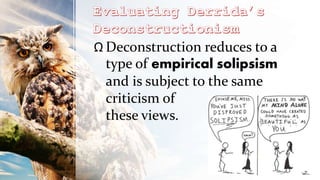
Ω Deconstruction reduces to a
type of empirical solipsism
and is subject to the same
criticism of
these views.
Ω The primacy difference over
identity departs from common
sense and makes all real
communication impossible.
Indeed, Derrida could not even
communicate his own position
to anyone if his view was right.
Ω Finally, Derrida’s “speech” is no
better than Kant’s unknowable
“noumena,” Wittgenstein’s
“silence,” or Hume’s “flames.”
For none of them tell us
anything about reality.

Jacques Derrida & post structuralism

  • 1.
    JACQUES DERRIDA (A. D.1930 - 2004) His Life and Works JACQUES DERRIDA (A. D. 1930 - 2004) by Gerald V. Delos Santos
  • 2.
    •Jacques Derrida wasborn in Algeria in 1930 into a Jewish family.
  • 4.
    •During his adolescentperiod, he read works by Rousseau, Nietzsche, and André Paul Guillaume Gide (1869—1951, French author), which was instrumental in his revolt against the family and society. •He also read Camus and Sartre.
  • 5.
    In an interviewwith Derrida by Derek Attridge in 1992, Derrida elaborated: “…it is true that my interest in literature, diaries, journals in general, also signified a typical, stereotypical revolt against the family. My passion for Nietzche, Rousseau, and also Gide, whom I read a lot at that time, meant among other things: ‘Families, I hate you.’ I thought of literature as the end of the family, and of the society it represented.”
  • 6.
  • 7.
    •After Derrida visitedthe Husserl archives in Leuven Belgium, he completed the civil service examinations (the philosophy aggregation on Edmund Husserl) for particular positions in the public education system.
  • 8.
    •In 1957, Derridamarried the psychoanalyst Marguerite Aucounturier. Rather than participate in the military activity of Algerian War of Independence, he received permission to teach soldiers’ children from 1957 to 1959, teaching them French and English.
  • 9.
  • 10.
    •After the warended, Derrida taught philosophy from 1960 to 1964 at the University of Paris where he was the assistant of Suzanne Bachelard, Georges Canguilhem, Paul Ricoeur, and Jean Andre Wahl.
  • 11.
    Suzanne Bachelard (October 18,1919, Voigny – November 3, 2007, Paris) She taught at Sorbonne, where she also had Jacques Derrida as her assistant. She was the first translator to French of the Husserl's book, Formal and Transcendental Logic.
  • 12.
    Georges Canguilhem (4 June1904 – 11 September 1995) a French philosopher and physician who specialized in epistemology and the philosophy of science (in particular, biology).
  • 13.
    Jean Paul Gustave Ricœur (27February 1913 – 20 May 2005) a French philosopher best known for combining phenomenological description with hermeneutics.
  • 14.
    Jean André Wahl (25May 1888 – 19 June 1974) He began his career as a follower of Henri Bergson and the American pluralist philosophers William James and George Santayana.
  • 15.
    •He was alsoassociated with a group called the Tel Quel, an innovative magazine comprised of a group of literary and philosophical theorists.
  • 16.
    Tel Quel (translatedinto English as, variously: "as is," "as such," or "unchanged") was a French avant- garde literary magazine published between 1960 and 1982. Tel Quel was founded in 1960 in Paris by Philippe Sollers and Jean-Edern Hallier and published by Éditions du Seuil. Important essays working towards post- structuralism and deconstruction appeared here. Publication ceased in 1982, and the journal was succeeded by L'Infini under Sollers's continued editorship.
  • 17.
    • Derrida’s worktitled “Structure, Sign, and Play in the Discourse of the Human Sciences” in a 1966 conference at John Hopkins University began his international prominence. • In 1967, he published three books: Writing and Difference, Speech and Phenomena, and Of Grammatology.
  • 18.
    • Later in1980, he later wrote Thèse d'État which, when translated to English, was titled The Time of a Thesis: Punctuations. • In 1983 and in a joint effort with Ken McMullen (b. 1948, film director and artist from London) they made a film titled “Ghost Dance.”
  • 19.
    Ken McMullen (born 31August 1948) McMullen's films are grounded in philosophy, history, psychoanalysis and literature.
  • 20.
    • Derrida wasalso director of studies at the School for Advanced Studies in the Social Sciences in Paris and later in 1983 co-founded the Collège International de Philosophie (a.k.a. the CIPH) aimed at providing a location for philosophical research.
  • 21.
    •Jacques Derrida wasdiagnosed with cancer in 2003 and subsequently died the following year.
  • 22.
  • 23.
    Post-Structuralism Post-structuralism – whichappeared in the 1970s – is both an expansion on and refutation of structuralism. Like structuralism, post-structuralism has branched out into several disciplines, perhaps most notably in the field of literary criticism.
  • 24.
    Post-Structuralism Structuralists would arguethat the meaning of particular passages in the book rests mainly on the structures within the book itself, which is a closed system.
  • 25.
    Post-Structuralism The structures inthe book involved paired opposites of war/peace, wealth/poverty, and love/strife. Post structuralism pushes the matter further.
  • 26.
    Post-Structuralism First, If a bookis truly a closed system, then I must exclude any fact or consideration outside of that book. I must even set aside the author’s intentions.
  • 27.
    Post-Structuralism First, Since each readerwill likely have different interpretation of the book, the book will have no definitive meaning.
  • 28.
    Post-Structuralism Second, Post-structuralists will arguethat if we look carefully for so–called paired opposites within the book, we will find this to be an oversimplification.
  • 29.
    Post-Structuralism Second, For example, althoughthe book does contain elements of love and strife, we also see indifference. We don’t see only wealth and poverty, but middle-level income as well.
  • 30.
    Post-Structuralism Second, Struturalists believed thatpaired opposites provided logical coherence to closed systems. Each reader then will play with the book, bringing his or her own meaning to it.
  • 33.
    Jacques Derrida &Deconstructionism Geisler, N. L. (2012). A History of Western Philosophy: Modern and Postmodern: From Descartes to Derrida (Vol. II). USA: Bastion Books
  • 34.
    • He isatheistic regarding the existence of God and agnostic concerning the possibility of knowing absolute truth. • He is anti-metaphysical.
  • 35.
    • Humans arelocked-up in their own linguistic bubble. • Has been given the label Father of Deconstructionism (a.k.a. Postmodernism).
  • 36.
    Aspects of histhinking were drawn from the following predecessors: Immanuel Kant Metaphysics Friedrich Nietzsche Atheism
  • 37.
    Aspects of histhinking were drawn from the following predecessors: Ludwig Wittgenstein Language Friedrich Frege Conventionalism
  • 38.
    Aspects of histhinking were drawn from the following predecessors: Edmund Husserl Phenomenological Method Martin Heidegger Existentialism William James Pragmatism & Will to Believe
  • 39.
    • His viewsare difficult to understand because either inadequate translations or the nature of his positions.
  • 40.
  • 41.
    Deconstructionism • It isa form of hermeneutics – the interpretation of text. • He is not out to destroy meaning but only to reconstruct it through abandoning the established rules of textual analysis.
  • 42.
    Deconstructionism • The deconstructionistreads, rereads the text in search for a new, deeper, forgotten meaning.
  • 43.
    Deconstructionism • Deconstruction isnot a negation from dismantling the text but rather it is a critique that remodels the text, rather than a grammatical- literal-historical foundation associated with the text under consideration.
  • 44.
  • 45.
    Meaning is relativeto a culture and situation. There is no meaning prior to language.
  • 46.
    No perfect referenceor one-to- one correspondence between words and the meanings they confer. Meaning is between the writer and reader.
  • 47.
    Rational structures leavesomething out where the reader approaches the text with suspicion looking for some “differences” and in search for “something” that is “not there.”
  • 48.
    Inability to escapethe limits of language. Linguistic concepts can be broaden but limits of it keep the reader corralled.
  • 49.
    All possible meaningsare never exhausted. A text can always be further deconstructed.
  • 50.
  • 51.
    ✘ Three factorsare key in understanding Derrida’s philosophy – grammar, logic, and rhetoric.
  • 52.
    Expresses acceptable phraseswith appropriate modifying words. Example: He play the guitar good. He plays the guitar well.
  • 53.
    Recognizes the absurdityof contradictory phrases. Example: Zombies are alive. Zombies are dead. ∆ Zombies are both dead and alive.
  • 54.
    Show how andwhen to use the phrases mastered through grammar and logic.
  • 55.
    Grammar is relativelysuperficial, having to do with keeping the signs of language in good order.
  • 56.
    Logic and rhetoricare more profound, dealing with the use and interpretation of signs.
  • 57.
    Derrida rejects thehistory of western philosophy in which language is based on logic.
  • 58.
    Derrida also rejectsPlato, Aristotle, the rationalists and empiricists, and even the linguistic analysts such as Russell.
  • 59.
    He also setsaside phenomenologists like Husserl for assuming that there is a logical underpinning to reality.
  • 60.
    Some precursors toDerrida’s thought
  • 61.
    Frege’s distinction betweensense and reference that played a part.
  • 62.
    The operational definitionsin science and the recursive definitions in mathematics provide meaning or sense but rather only effective criteria for use in expression.
  • 63.
    Charles Pierce’s pragmatic meaningsfor clarifying ideas was used in Derrida’s operational definitions.
  • 64.
    John Austin’s viewof speech acts that are a rhetorical basis for meaning.
  • 65.
    Wittgenstein’s language basedin “forms of life” involved a turn from making demands to making observations which resulted in redirection away from logic-base to use-based meaning.
  • 66.
    It follows thatexperience ends up being the basis of meaning – “only in the stream of life does an expression have meaning.”
  • 67.
    Rhetoric and theactual context of life is an essential feature of all linguistic meaning.
  • 68.
    Language is notbased on logic but is rather logic is based on rhetoric.
  • 69.
    One must “deconstruct”language based in logic in order to learn how linguistic expressions are used in human activity.
  • 70.
    Language based onlogic entails a mistaken belief that there are “private languages” with “inner speech” and “private mental life.”
  • 71.
    If logic issovereign, then a private language is possible. If logic is formal, then ideas would not vary with circumstances.
  • 72.
    Rhetoric as Basisof Language
  • 73.
    In order tounderstand what a text means, one must first full understand its actual life context.
  • 74.
    - no pureand simple meanings stand behind the signs (words) of language. If all language is complex, then no essential meaning transcends time and place.
  • 75.
    - every objectof language and meaning is contingent upon changing life reality. There is no objective meaning.
  • 76.
    - no pureexperiences exist without reference to transient experience.
  • 77.
    - Deconstructionists reject realizedidealized concepts disconnected from the everyday world.
  • 78.
    - all writtenlanguage is dependent on spoken language. It is dependent on the pattern of vocalization (phonemics).
  • 79.
    - Phonemes areparts of sound that can be represented by a letter. “Difference” is the key to meaning, since all sounds must be differentiated to be distinct and form meaningful sounds.
  • 80.
    Derrida also rejectedthe view that meaning is rooted in timeless ideas:
  • 81.
    1. A radicaldisjunction results between sign and what is signified; 2. A residual Platonism occurs that explains actual in terms of the ideal;
  • 82.
    3. A radicaldistinction between sense and reference is created; and 4. A resolution of basic issues ends up depending upon one’s own concept of time and eternity.
  • 83.
    ““It remains, then,for us to speak, to make our voices resonate throughout the corridors in order to make up for the breakup of presence.” - Jacques Derrida
  • 84.
    the end ofWestern philosophy and the closure of metaphysics!
  • 85.
  • 86.
    Ω Derrida deconstructionism illustrateshow the linguistic tradition leads to agnosticism. Ω Unless one’s philosophy begins in reality, it can never logically end in reality.
  • 87.
    Ω His critiquethat “private language” and esoteric thought cut off from reality. Ω Derrida’s position is laced with obscurity and ambiguity, making it difficult to understand and evaluate.
  • 88.
    Ω His viewcontains many apparently contradictory claims: “The history of philosophy is closed” “Metaphysics has come to an end.” or
  • 89.
    Ω For inorder for such claims against philosophy and metaphysics to be made, one cannot avoid using philosophy and metaphysics.
  • 90.
    Ω His claimthat we cannot know anything about reality is self-defeating.
  • 91.
    Ω How doeshe know this unless he knows something about reality?
  • 92.
    Ω What sortof epistemological status should be given to his statements? If they were true, they would be false.
  • 93.
    Ω Even consideringhis rejection of (or protest against) metaphysics, Derrida uses metaphysical presuppositions. The very fact that he inquires about the “the real” indicates an underlying of metaphysics.
  • 94.
    Ω Derrida denialof logic is highly problematic, if not self- defeating. The very language that denies logic is based in logic; otherwise it would be meaningless. Ω His view is a form of nominalism and radical empiricism.
  • 95.
    Ω Deconstruction reducesto a type of empirical solipsism and is subject to the same criticism of these views.
  • 96.
    Ω The primacydifference over identity departs from common sense and makes all real communication impossible. Indeed, Derrida could not even communicate his own position to anyone if his view was right.
  • 97.
    Ω Finally, Derrida’s“speech” is no better than Kant’s unknowable “noumena,” Wittgenstein’s “silence,” or Hume’s “flames.” For none of them tell us anything about reality.