1
Hicham BENFAIDA
Benjamin CHASSAGNETTE
Clémence DEGOUY
Aristide LENGLART
Sarah MATHIS
Emilie QUELVEN
SUMMARY
I. General Introduction
II. How IT influenced the taxi business
III. Key problems
IV. Projections In The Five Next Years
V. Changes And Emerging Players
VI. Recommandations
2
I. General Introduction
• Based in San Francisco
• Launched in 2009
• 2200 Employees
• Available in 62 cities in 45 countries
3
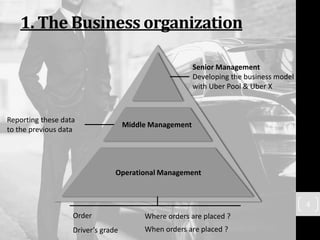
4
Operational Management
Order
Driver’s grade
Where orders are placed ?
When orders are placed ?
Middle Management
Reporting these data
to the previous data
Senior Management
Developing the business model
with Uber Pool & Uber X
1. The Business organization
2. Trends
a. Consumerization of IT
b. Mobile Digital Platform
c. Cloud Computing
5
a. Consumerization of IT
• Consumerization of IT is a phrase used to describe the cycle of
information technology emerging in the consumer market,
then spreading to business and government organizations.
6
Uber : All steps & operations are
done by mobile phones
in Applications or Website :
• Registration
• Ordering
• Payment
• Evaluation
Which gives the Company :
• Flexibility
• Accessible to the General
Public
• Easy to use
• Productivity
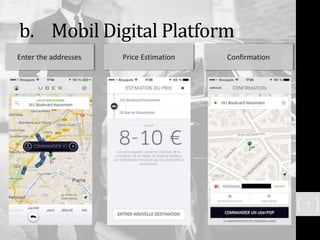
b. Mobil Digital Platform
7
Enter the addresses Price Estimation Confirmation
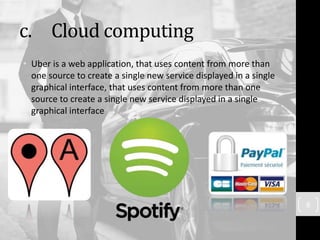
c. Cloud computing
• Uber is a web application, that uses content from more than
one source to create a single new service displayed in a single
graphical interface, that uses content from more than one
source to create a single new service displayed in a single
graphical interface
8
3. The 8 features of the e-commerce
• Ubiquity :
• Only mobile phone application, available at anytime
• Global reach :
• The technology is available in 62 cities in 45 countries
• Universal standards :
• It implies lower consumer’s search costs because customers can
locate a taxi very easily thanks to the driver GPS
• Richness :
• Lots of contents on internet : videos, articles, opinions about Uber
company
9
• Interactivity :
• The customer can see the profile of the driver and evaluate the
driver’s performance.
• The consumer co-participate in the process of delivering the service
• Information density :
• Huge information about the driver, the customer and the route that
must be taken. On the web, information about the taxi market
(competitors, problems of legacy…)
• Personalization/customization :
• The customer can choose the driver and the type of Uber service
• Social technology :
• Important use of social networks to talk about Uber.
• Ex : On the facebook page, share of experiences, news etc
10
II. How IT influenced the taxi
business
• Search by mobile phone
• We can see the profile of the driver before confirming
the ride.
• Optimizing availability: in big cities, the taxi drivers
adopted new technologies, which allows them to have
GPS, so the customer can locate a taxi at any time.
11
1. The Demand
1. The Demand
• Providing a confirmation interface for on-demand
services
• Dynamically providing position information of the
driver
• Mobile paiement
12
2. The Service
• Timeliness: reducing waiting and kilometers
unproductive hours.
• Efficiency : Define optimized routes calculated as Traffic
constraint.
• The application shows the estimated travel time.
13
3. After The Service
• Providing a summary or receipt for on-demand services
through us of portable computing devices.
• Rating system : The customer can rate the driver up to
five to guarantee the quality of the service.
14
III. Key problems
• Private scoring system : passengers are evaluated by the
drivers
• Problem of private data : no security for the customers (cf
below)
• Protests and problem of illegacy
• Problem of competition
• Inefficiency of Uber’s navigation system 15
Data security
• Information collected by Uber:
Personal information: Email, Password, Name…
Usage information: browser used by the customer…
Device Identifier : IP adress.
Tracking information: GPS coordinates.
Information third parties provide about the customer
Information collected by mobile applications: mobile operator
• Methods used to collect Usage Information:
Cookies and super cookies
Web Beacons
Embedded Scripts
16
Data security : key problems
• Stored and used of the customer’s credit card information
• Personal information collected for internal business purposes  not
clear.
• Analytics service providers may set and access their own cookies,
web beacons and embedded scripts to collect customer’s
information.
• Link with social network  spread of data.
• Storage of information even when the account is cancelled.
• Use of encryption as security practice  not impenetrable.
• Legislation of the USA  different than the European one, USA
allows businesses to gather transaction information and use this
for other marketing purposes
17
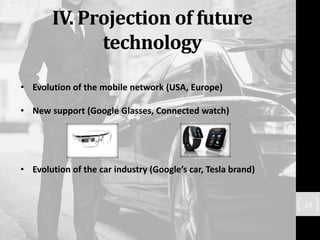
IV. Projection of future
technology
• Evolution of the mobile network (USA, Europe)
• New support (Google Glasses, Connected watch)
• Evolution of the car industry (Google’s car, Tesla brand)
18
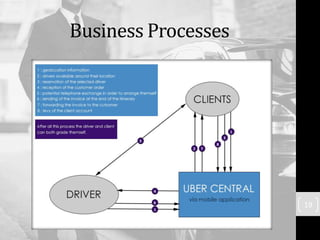
Business Processes
19
V. The Industry’s Preparations
Responding to These Changes
• Invest in new technologies
• Create agreements and partnership with IT firms
• Widden and differenciate the targets
• Secure the applications and the private information of
customer
20
1. Challenges for change
2. New players likely to emerge
• Applications could be developed to set up this new kind of
transport
• More and more concept as Uber
• Google car
• A mobile application for “taxi bike”
• segway concept
21
VI. Recommandations
 Instore a direct line on the internet and by telephone in
order to develop customer loyalty
Secure the datas of its customer by correcting some errors,
improve controls, pay attention to customer’s datas and
trade secrets
Developp application controls and forecast the potential
issues of the system
Should provide drivers with specified area such that the
waiting time of customer may be shorter and that every
space of the city may be provided with dirvers 22
VI. Recommandations (con’t)
 Use different security systems  if one is hacked, all the
data are not steal (do not put all your eggs in the same basket)
Inform clearly the customers how you will use his related
information and help him to secure his data  transparency
23
Thank you for your attention !
24
Have you any question ?

IT project : Uber

  • 1.
    1 Hicham BENFAIDA Benjamin CHASSAGNETTE ClémenceDEGOUY Aristide LENGLART Sarah MATHIS Emilie QUELVEN
  • 2.
    SUMMARY I. General Introduction II.How IT influenced the taxi business III. Key problems IV. Projections In The Five Next Years V. Changes And Emerging Players VI. Recommandations 2
  • 3.
    I. General Introduction •Based in San Francisco • Launched in 2009 • 2200 Employees • Available in 62 cities in 45 countries 3
  • 4.
    4 Operational Management Order Driver’s grade Whereorders are placed ? When orders are placed ? Middle Management Reporting these data to the previous data Senior Management Developing the business model with Uber Pool & Uber X 1. The Business organization
  • 5.
    2. Trends a. Consumerizationof IT b. Mobile Digital Platform c. Cloud Computing 5
  • 6.
    a. Consumerization ofIT • Consumerization of IT is a phrase used to describe the cycle of information technology emerging in the consumer market, then spreading to business and government organizations. 6 Uber : All steps & operations are done by mobile phones in Applications or Website : • Registration • Ordering • Payment • Evaluation Which gives the Company : • Flexibility • Accessible to the General Public • Easy to use • Productivity
  • 7.
    b. Mobil DigitalPlatform 7 Enter the addresses Price Estimation Confirmation
  • 8.
    c. Cloud computing •Uber is a web application, that uses content from more than one source to create a single new service displayed in a single graphical interface, that uses content from more than one source to create a single new service displayed in a single graphical interface 8
  • 9.
    3. The 8features of the e-commerce • Ubiquity : • Only mobile phone application, available at anytime • Global reach : • The technology is available in 62 cities in 45 countries • Universal standards : • It implies lower consumer’s search costs because customers can locate a taxi very easily thanks to the driver GPS • Richness : • Lots of contents on internet : videos, articles, opinions about Uber company 9
  • 10.
    • Interactivity : •The customer can see the profile of the driver and evaluate the driver’s performance. • The consumer co-participate in the process of delivering the service • Information density : • Huge information about the driver, the customer and the route that must be taken. On the web, information about the taxi market (competitors, problems of legacy…) • Personalization/customization : • The customer can choose the driver and the type of Uber service • Social technology : • Important use of social networks to talk about Uber. • Ex : On the facebook page, share of experiences, news etc 10
  • 11.
    II. How ITinfluenced the taxi business • Search by mobile phone • We can see the profile of the driver before confirming the ride. • Optimizing availability: in big cities, the taxi drivers adopted new technologies, which allows them to have GPS, so the customer can locate a taxi at any time. 11 1. The Demand
  • 12.
    1. The Demand •Providing a confirmation interface for on-demand services • Dynamically providing position information of the driver • Mobile paiement 12
  • 13.
    2. The Service •Timeliness: reducing waiting and kilometers unproductive hours. • Efficiency : Define optimized routes calculated as Traffic constraint. • The application shows the estimated travel time. 13
  • 14.
    3. After TheService • Providing a summary or receipt for on-demand services through us of portable computing devices. • Rating system : The customer can rate the driver up to five to guarantee the quality of the service. 14
  • 15.
    III. Key problems •Private scoring system : passengers are evaluated by the drivers • Problem of private data : no security for the customers (cf below) • Protests and problem of illegacy • Problem of competition • Inefficiency of Uber’s navigation system 15
  • 16.
    Data security • Informationcollected by Uber: Personal information: Email, Password, Name… Usage information: browser used by the customer… Device Identifier : IP adress. Tracking information: GPS coordinates. Information third parties provide about the customer Information collected by mobile applications: mobile operator • Methods used to collect Usage Information: Cookies and super cookies Web Beacons Embedded Scripts 16
  • 17.
    Data security :key problems • Stored and used of the customer’s credit card information • Personal information collected for internal business purposes  not clear. • Analytics service providers may set and access their own cookies, web beacons and embedded scripts to collect customer’s information. • Link with social network  spread of data. • Storage of information even when the account is cancelled. • Use of encryption as security practice  not impenetrable. • Legislation of the USA  different than the European one, USA allows businesses to gather transaction information and use this for other marketing purposes 17
  • 18.
    IV. Projection offuture technology • Evolution of the mobile network (USA, Europe) • New support (Google Glasses, Connected watch) • Evolution of the car industry (Google’s car, Tesla brand) 18
  • 19.
  • 20.
    V. The Industry’sPreparations Responding to These Changes • Invest in new technologies • Create agreements and partnership with IT firms • Widden and differenciate the targets • Secure the applications and the private information of customer 20 1. Challenges for change
  • 21.
    2. New playerslikely to emerge • Applications could be developed to set up this new kind of transport • More and more concept as Uber • Google car • A mobile application for “taxi bike” • segway concept 21
  • 22.
    VI. Recommandations  Instorea direct line on the internet and by telephone in order to develop customer loyalty Secure the datas of its customer by correcting some errors, improve controls, pay attention to customer’s datas and trade secrets Developp application controls and forecast the potential issues of the system Should provide drivers with specified area such that the waiting time of customer may be shorter and that every space of the city may be provided with dirvers 22
  • 23.
    VI. Recommandations (con’t) Use different security systems  if one is hacked, all the data are not steal (do not put all your eggs in the same basket) Inform clearly the customers how you will use his related information and help him to secure his data  transparency 23
  • 24.
    Thank you foryour attention ! 24 Have you any question ?

Editor's Notes

  • #6 This part concerns the trends of the company Uber First We will talk about the consumerization of IT, that we will first define then explain how uber is concerned about this trend Then We will see the mobile digital platform of this mobile application Finally we will understand how Cloud computing is employed in Uber
  • #7 Definition Why Uber is consumerized How consumerization of IT is helping Uber improving its business
  • #8 As we see the platform of the mobile application is simple and easy to use After a quick registration, that we can do with facebook profil, you just have to locate yourself by the geolocalisation tool or by entering your adress Then estimate the price by typing the destination adress And finally confirm your demand, and the payement will proceed thanks to the credit card information that you gave in the registration step
  • #9 Uber is a wleb application, that uses content from more than one source to create a single new service displayed in a single graphical interface, that’s what we call cloud computing. For ex : geolocalisation, the map, Spotify, payment system