Istio in Action 1st Edition Christian E. Posta
install download
https://ebookmeta.com/product/istio-in-action-1st-edition-
christian-e-posta/
Download more ebook from https://ebookmeta.com
We believe these products will be a great fit for you. Click
the link to download now, or visit ebookmeta.com
to discover even more!
Technology in action : complete 16th Edition Kendall E.
Martin
https://ebookmeta.com/product/technology-in-action-complete-16th-
edition-kendall-e-martin/
Business in Action, Tenth Global Edition Courtland L.
Bovée
https://ebookmeta.com/product/business-in-action-tenth-global-
edition-courtland-l-bovee/
Divine Agency and Divine Action Volume II Soundings in
the Christian Tradition 1st Edition William J. Abraham
https://ebookmeta.com/product/divine-agency-and-divine-action-
volume-ii-soundings-in-the-christian-tradition-1st-edition-
william-j-abraham/
Mint Chip Murder Cambria Clyne Cozy Mystery 4 Erin Huss
Et El
https://ebookmeta.com/product/mint-chip-murder-cambria-clyne-
cozy-mystery-4-erin-huss-et-el/
Process Engineering: Addressing the Gap between Study
and Chemical Industry 2nd Edition Michael Kleiber
https://ebookmeta.com/product/process-engineering-addressing-the-
gap-between-study-and-chemical-industry-2nd-edition-michael-
kleiber/
Successful Doctoral Training in Nursing and Health
Sciences: A Guide for Supervisors, Students and
Advisors 1st Edition Debra Jackson
https://ebookmeta.com/product/successful-doctoral-training-in-
nursing-and-health-sciences-a-guide-for-supervisors-students-and-
advisors-1st-edition-debra-jackson/
Selling the Business Location Place Marketing in the
context of the Rhine Main Region Place Marketing in the
context of the Rhine Main Region 1st Edition Christiane
Mohr
https://ebookmeta.com/product/selling-the-business-location-
place-marketing-in-the-context-of-the-rhine-main-region-place-
marketing-in-the-context-of-the-rhine-main-region-1st-edition-
christiane-mohr/
Essentials of Corporate Finance 11th Edition Stephen A
Ross Randolf W Westerfield Bradford D Jordan
https://ebookmeta.com/product/essentials-of-corporate-
finance-11th-edition-stephen-a-ross-randolf-w-westerfield-
bradford-d-jordan/
Solutions Manual to Fluid Mechanics 6th ed 666th
Edition Cohen Ira M Dowling David R Kundu Pijush K
https://ebookmeta.com/product/solutions-manual-to-fluid-
mechanics-6th-ed-666th-edition-cohen-ira-m-dowling-david-r-kundu-
pijush-k/
Egypt Moon Travel Guide 1st Edition Sarah Smierciak
https://ebookmeta.com/product/egypt-moon-travel-guide-1st-
edition-sarah-smierciak/
M A N N I N G
Christian E. Posta
Rinor Maloku
Foreword by Eric Brewer
Istio in Action
ii
Istio in Action
CHRISTIAN E. POSTA
RINOR MALOKU
FOREWORD BY ERIC BREWER
M A N N I N G
SHELTER ISLAND
For online information and ordering of this and other Manning books, please visit
www.manning.com. The publisher offers discounts on this book when ordered in quantity.
For more information, please contact
Special Sales Department
Manning Publications Co.
20 Baldwin Road
PO Box 761
Shelter Island, NY 11964
Email: orders@manning.com
©2022 by Manning Publications Co. All rights reserved.
No part of this publication may be reproduced, stored in a retrieval system, or transmitted, in
any form or by means electronic, mechanical, photocopying, or otherwise, without prior
written permission of the publisher.
Many of the designations used by manufacturers and sellers to distinguish their products are
claimed as trademarks. Where those designations appear in the book, and Manning
Publications was aware of a trademark claim, the designations have been printed in initial caps
or all caps.
Recognizing the importance of preserving what has been written, it is Manning’s policy to have
the books we publish printed on acid-free paper, and we exert our best efforts to that end.
Recognizing also our responsibility to conserve the resources of our planet, Manning books
are printed on paper that is at least 15 percent recycled and processed without the use of
elemental chlorine.
The author and publisher have made every effort to ensure that the information in this book
was correct at press time. The author and publisher do not assume and hereby disclaim any
liability to any party for any loss, damage, or disruption caused by errors or omissions, whether
such errors or omissions result from negligence, accident, or any other cause, or from any
usage of the information herein.
Manning Publications Co. Development editor: Elesha Hyde
20 Baldwin Road Technical development editor: Brent Stains
PO Box 761 Review editor: Aleksandar Dragosavljević
Shelter Island, NY 11964 Productioneditor: Andy Marinkovich
Copyeditor: Tiffany Taylor
Proofreader: Jason Everett
Technical proofreaders: Gregory Reshetniak
Typesetter and cover designer: Marija Tudor
ISBN 9781617295829
Printed in the United States of America
I dedicate this book to my wife and daughters.
—Christian Posta
I dedicate this book to everybody
who shares knowledge on the web.
—Rinor Maloku
vi
vii
brief contents
PART 1 UNDERSTANDING ISTIO .................................................. 1
1 ■ Introducing the Istio service mesh 3
2 ■ First steps with Istio 24
3 ■ Istio’s data plane: The Envoy proxy 54
PART 2 SECURING, OBSERVING, AND CONTROLLING
YOUR SERVICE’S NETWORK TRAFFIC ............................... 75
4 ■ Istio gateways: Getting traffic into a cluster 77
5 ■ Traffic control: Fine-grained traffic routing 110
6 ■ Resilience: Solving application networking
challenges 136
7 ■ Observability: Understanding the behavior of your
services 177
8 ■ Observability: Visualizing network behavior with
Grafana, Jaeger, and Kiali 205
9 ■ Securing microservice communication 230
PART 3 ISTIO DAY-2 OPERATIONS ............................................ 265
10 ■ Troubleshooting the data plane 267
11 ■ Performance-tuning the control plane 295
BRIEF CONTENTS
viii
PART 4 ISTIO IN YOUR ORGANIZATION .................................... 317
12 ■ Scaling Istio in your organization 319
13 ■ Incorporating virtual machine workloads into the mesh 347
14 ■ Extending Istio on the request path 378
ix
contents
foreword xvii
preface xix
acknowledgments xxi
about this book xxiii
about the authors xxvii
about the cover illustration xxviii
PART 1 UNDERSTANDING ISTIO ................................... 1
1 Introducing the Istio service mesh 3
1.1 Challenges of going faster 5
Our cloud infrastructure is not reliable 6 ■
Making service
interactions resilient 7 ■
Understanding what’s happening
in real time 8
1.2 Solving these challenges with application libraries 8
Drawbacks to application-specific libraries 9
1.3 Pushing these concerns to the infrastructure 11
The application-aware service proxy 11 ■
Meet the Envoy
proxy 12
1.4 What’s a service mesh? 13
1.5 Introducing the Istio service mesh 15
How a service mesh relates to an enterprise service bus 17
How a service mesh relates to an API gateway 18
CONTENTS
x
Can I use Istio for non-microservices deployments? 20 ■
Where
Istio fits in distributed architectures 21 ■
What are the
drawbacks to using a service mesh? 22
2 First steps with Istio 24
2.1 Deploying Istio on Kubernetes 25
Using Docker Desktop for the examples 25 ■
Getting the Istio
distribution 26 ■
Installing the Istio components into
Kubernetes 27
2.2 Getting to know the Istio control plane 29
Istiod 30 ■
Ingress and egress gateway 33
2.3 Deploying your first application in the service
mesh 34
2.4 Exploring the power of Istio with resilience, observability,
and traffic control 39
Istio observability 40 ■
Istio for resiliency 47 ■
Istio for
traffic routing 49
3 Istio’s data plane: The Envoy proxy 54
3.1 What is the Envoy proxy? 55
Envoy’s core features 57 ■
Comparing Envoy to other
proxies 61
3.2 Configuring Envoy 62
Static configuration 62 ■
Dynamic configuration 63
3.3 Envoy in action 65
Envoy’s Admin API 69 ■
Envoy request retries 69
3.4 How Envoy fits with Istio 71
PART 2 SECURING, OBSERVING, AND CONTROLLING
YOUR SERVICE’S NETWORK TRAFFIC ................ 75
4 Istio gateways: Getting traffic into a cluster 77
4.1 Traffic ingress concepts 78
Virtual IPs: Simplifying service access 78 ■
Virtual hosting:
Multiple services from a single access point 79
4.2 Istio ingress gateways 80
Specifying Gateway resources 82 ■
Gateway routing with virtual
services 83 ■
Overall view of traffic flow 86 ■
Istio ingress
CONTENTS xi
gateway vs. Kubernetes Ingress 87 ■
Istio ingress gateway
vs. API gateways 88
4.3 Securing gateway traffic 88
HTTP traffic with TLS 89 ■
HTTP redirect to HTTPS 93
HTTP traffic with mutual TLS 94 ■
Serving multiple virtual
hosts with TLS 97
4.4 TCP traffic 98
Exposing TCP ports on an Istio gateway 99 ■
Traffic routing with
SNI passthrough 101
4.5 Operational tips 104
Split gateway responsibilities 104 ■
Gateway injection 105
Ingress gateway access logs 106 ■
Reducing gateway
configuration 107
5 Traffic control: Fine-grained traffic routing 110
5.1 Reducing the risk of deploying new code 111
Deployment vs. release 111
5.2 Routing requests with Istio 114
Cleaning up our workspace 114 ■
Deploying v1 of the catalog
service 115 ■
Deploying v2 of the catalog service 116
Routing all traffic to v1 of the catalog service 117 ■
Routing
specific requests to v2 119 ■
Routing deep within a call
graph 120
5.3 Traffic shifting 122
Canary releasing with Flagger 124
5.4 Reducing risk even further: Traffic mirroring 129
5.5 Routing to services outside your cluster by using Istio’s
service discovery 131
6 Resilience: Solving application networking challenges 136
6.1 Building resilience into the application 137
Building resilience into application libraries 137 ■
Using Istio to
solve these problems 138 ■
Decentralized implementation of
resilience 138
6.2 Client-side load balancing 139
Getting started with client-side load balancing 140 ■
Setting up
our scenario 142 ■
Testing various client-side load-balancing
strategies 144 ■
Understanding the different load-balancing
algorithms 147
CONTENTS
xii
6.3 Locality-aware load balancing 149
Hands-on with locality load balancing 149 ■
More control
over locality load balancing with weighted distribution 153
6.4 Transparent timeouts and retries 156
Timeouts 156 ■
Retries 158 ■
Advanced retries 164
6.5 Circuit breaking with Istio 166
Guarding against slow services with connection-pool
control 168 ■
Guarding against unhealthy services with
outlier detection 173
7 Observability: Understanding the behavior of your
services 177
7.1 What is observability? 178
Observability vs. monitoring 179 ■
How Istio helps with
observability 179
7.2 Exploring Istio metrics 180
Metrics in the data plane 180 ■
Metrics in the
control plane 186
7.3 Scraping Istio metrics with Prometheus 187
Setting up Prometheus and Grafana 189 ■
Configuring the
Prometheus Operator to scrape the Istio control plane and
workloads 190
7.4 Customizing Istio’s standard metrics 193
Configuring existing metrics 196 ■
Creating new metrics 200
Grouping calls with new attributes 202
8 Observability: Visualizing network behavior with
Grafana, Jaeger, and Kiali 205
8.1 Using Grafana to visualize Istio service and control-plane
metrics 205
Setting up Istio’s Grafana dashboards 207 ■
Viewing control-
plane metrics 208 ■
Viewing data-plane metrics 209
8.2 Distributed tracing 209
How does distributed tracing work? 210 ■
Installing a distributed
tracing system 212 ■
Configuring Istio to perform distributed
tracing 213 ■
Viewing distributed tracing data 216
Trace sampling, force traces, and custom tags 217
8.3 Visualization with Kiali 223
Installing Kiali 223 ■
Conclusion 228
CONTENTS xiii
9 Securing microservice communication 230
9.1 The need for application-networking security 230
Service-to-service authentication 231 ■
End-user
authentication 231 ■
Authorization 231 ■
Comparison
of security in monoliths and microservices 231 ■
How
Istio implements SPIFFE 233 ■
Istio security in
a nutshell 233
9.2 Auto mTLS 234
Setting up the environment 235 ■
Understanding Istio’s
PeerAuthentication resource 236
9.3 Authorizing service-to-service traffic 242
Understanding authorization in Istio 243 ■
Setting up the
workspace 244 ■
Behavior changes when a policy is applied
to a workload 245 ■
Denying all requests by default with
a catch-all policy 246 ■
Allowing requests originating from
a single namespace 247 ■
Allowing requests from non-
authenticated legacy workloads 248 ■
Allowing requests
from a single service account 248 ■
Conditional matching
of policies 249 ■
Understanding value-match expressions 250
Understanding the order in which authorization policies are
evaluated 252
9.4 End-user authentication and authorization 252
What is a JSON web token? 252 ■
End-user authentication and
authorization at the ingress gateway 255 ■
Validating JWTs
with RequestAuthentication 255
9.5 Integrating with custom external authorization
services 260
Hands-on with external authorization 261 ■
Configuring
Istio for ExtAuthz 262 ■
Using a custom AuthorizationPolicy
resource 263
PART 3 ISTIO DAY-2 OPERATIONS ............................. 265
10 Troubleshooting the data plane 267
10.1 The most common mistake: A misconfigured data
plane 268
10.2 Identifying data-plane issues 270
How to verify that the data plane is up to date 270
Discovering misconfigurations with Kiali 272
Discovering misconfigurations with istioctl 274
CONTENTS
xiv
10.3 Discovering misconfigurations manually from the Envoy
config 275
Envoy administration interface 276 ■
Querying proxy
configurations using istioctl 276 ■
Troubleshooting application
issues 282 ■
Inspect network traffic with ksniff 288
10.4 Understanding your application using Envoy
telemetry 291
Finding the rate of failing requests in Grafana 291 ■
Querying
the affected Pods using Prometheus 292
11 Performance-tuning the control plane 295
11.1 The control plane’s primary goal 295
Understanding the steps of data-plane synchronization 297
Factors that determine performance 298
11.2 Monitoring the control plane 298
The four golden signals of the control plane 299
11.3 Tuning performance 303
Setting up the workspace 304 ■
Measuring performance before
optimizations 305 ■
Ignoring events: Reducing the scope of
discovery using discovery selectors 309 ■
Event-batching and
push-throttling properties 310
11.4 Performance tuning guidelines 314
PART 4 ISTIO IN YOUR ORGANIZATION ..................... 317
12 Scaling Istio in your organization 319
12.1 The benefits of a multi-cluster service mesh 320
12.2 Overview of multi-cluster service meshes 320
Istio multi-cluster deployment models 321 ■
How workloads are
discovered in multi-cluster deployments 323 ■
Cross-cluster
workload connectivity 324 ■
Common trust between clusters 324
12.3 Overview of a multi-cluster, multi-network, multi-control-
plane service mesh 326
Choosing the multi-cluster deployment model 327 ■
Setting up
the cloud infrastructure 327 ■
Configuring plug-in CA
certificates 328 ■
Installing the control planes in each
cluster 329 ■
Enabling cross-cluster workload discovery 333
Setting up cross-cluster connectivity 335 ■
Load-balancing
across clusters 341
CONTENTS xv
13 Incorporating virtual machine workloads into the mesh 347
13.1 Istio’s VM support 348
Simplifying sidecar proxy installation and configuration
in a VM 348 ■
Virtual machine high availability 351
DNS resolution of in-mesh services 354
13.2 Setting up the infrastructure 355
Setting up the service mesh 356 ■
Provisioning the VM 357
13.3 Mesh expansion to VMs 359
Exposing istiod and cluster services to the VM 360
Representing a group of workloads with a WorkloadGroup 361
Installing and configuring the istio-agent in the VM 363
Routing traffic to cluster services 366 ■
Routing traffic to the
WorkloadEntry 367 ■
VMs are configured by the control plane:
Enforcing mutual authentication 371
13.4 Demystifying the DNS proxy 372
How the DNS proxy resolves cluster hostnames 372 ■
Which
hostnames is the DNS proxy aware of? 374
13.5 Customizing the agent’s behavior 375
13.6 Removing a WorkloadEntry from the mesh 375
14 Extending Istio on the request path 378
14.1 Envoy’s extension capabilities 379
Understanding Envoy’s filter chaining 379 ■
Filters
intended for extension 382 ■
Customizing Istio’s data
plane 382
14.2 Configuring an Envoy filter with the EnvoyFilter
resource 383
14.3 Rate-limiting requests with external call-out 387
Understanding Envoy rate limiting 388
14.4 Extending Istio’s data plane with Lua 392
14.5 Extending Istio’s data plane with WebAssembly 395
Introducing WebAssembly 395 ■
Why WebAssembly
for Envoy? 396 ■
Building a new Envoy filter with
WebAssembly 396 ■
Building a new Envoy filter with the
meshctl tool 397 ■
Deploying a new WebAssembly Envoy
filter 399
appendix A Customizing the Istio installation 401
appendix B Istio’s sidecar and its injection options 408
CONTENTS
xvi
appendix C Istio security: SPIFFE 414
appendix D Troubleshooting Istio components 424
appendix E How the virtual machine is configured to join the mesh 433
index 435
xvii
foreword
A service mesh can maximize the development speed of your whole organization by
enabling thousands of independent microservices that are automatically compliant
with a wide range of evolving policies. This book discusses many other benefits of
Istio, but they largely follow from this premise.
This brings us to the central question, “What is a service mesh, and why do I need
one?” I’m asked this question frequently, and the answer is not trivial. It is not about
security or telemetry or most of the benefits some people claim. Nor is it automatically
the case that you need a service mesh for your application, especially if it is a monolith.
The real answer has to do with decoupling applications from infrastructure. Istio is
the third major step in that direction. First, Docker provided a way to package an
application (and its library choices) separately from the machine on which it runs.
Next, Kubernetes made it easy to create a service with automation to help with auto-
scaling and management. Together, Docker and Kubernetes enabled the practical
movement to fine-grain services, often called microservices. This book guides you
through implementing a service mesh with Istio to achieve this third step: application
decoupling.
Microservices allow greater overall velocity by enabling teams to be more autono-
mous. Ideally, your team can update its microservice(s) without deep interactions with
other teams. The top-level goal for Istio is to enable this at scale—to make it easy to
have thousands of microservices (Google has more than a million!).
But enabling velocity for a service is not just about decoupling it from the
machine; the service must also be decoupled from shared policies. Every enterprise
has policies that apply to all services, and we must be able to change those policies
quickly if needed. Traditionally, such policies are embedded inside services as part of
FOREWORD
xviii
the code or as libraries that services are expected to use. Either way, such policies are
hard to update and enforce.
Istio moves a wide range of such policies (primarily those involving an API) out of
the service and into the service mesh, which is essentially a proxy that sits in front of
the service and implements the policies. When this is done correctly, all services meet
the policies with no work—and, conversely, policy changes do not require updating
the services. This is the decoupling we are after.
In Istio in Action, Christian and Rinor present a clear-headed vision of how to
achieve the goal of decoupling applications from infrastructure. I hope you’ll enjoy
this book as much as I have.
— ERIC BREWER
VP INFRASTRUCTURE AND GOOGLE FELLOW
xix
preface
Building software is hard. Connecting different services across a network is harder.
Any time you put a packet, message, or request on the network, there are no guaran-
tees about its outcome. Will the request make it? How long will it take? Will anyone
know if the communication fails?
Docker and Kubernetes have done a lot to support distributed services architec-
tures like microservices, but they exacerbate the existing communication problems.
One misbehaving service might take down everything.
While working with organizations worldwide that are trying to adopt microservices,
I find that getting teams to consistently think about and solve these communication
problems is very difficult. There are many questions: How will they do service discovery?
Timeouts? Retries? Circuit breaking? Tracing? Authentication? Large cloud companies
like Netflix, Twitter, and Google pioneered some of the early, successful microservices
architectures. These companies had to build a lot of their own developer tooling and
infrastructure to solve these problems, and fortunately, they open sourced much of it.
Could other organizations use the NetflixOSS stack or Twitter Finagle? They could, and
some did, but doing so created a new operational nightmare.
For example, the NetflixOSS stack was primarily written for Java developers. What
about NodeJS, Golang, and Python teams? Teams had to either build libraries them-
selves or hack together the functionality with various bits they found on the internet.
They also had to intermingle this “networking” code into their business logic. This
approach added transitive dependencies, cluttered the code, and made revisions
more difficult. Operating a service architecture with these application networking
libraries, upgrading, patching, and doing this consistently across many different lan-
guages was extremely complex and error prone.
PREFACE
xx
A service mesh is a cleaner solution to this application-networking problem. With a
service mesh, we abstract away the application-networking logic into a dedicated piece
of infrastructure and apply it to all services regardless of what languages they are writ-
ten in.
Istio is a scalable, mature, powerful service-mesh implementation that originally
came out of a project from IBM and Google. I was introduced to the Istio team in Jan-
uary 2017 and began working on the project very early. At the end of 2018, I went to
work as global field CTO at a startup, Solo.io, to focus full-time on service mesh tech-
nology and advancing the state of application networking.
Building a startup from the ground up, pushing the boundaries on this technol-
ogy, and writing an in-depth book on this topic is not an easy combination. I needed
someone with dedication and passion to help me move the book forward; so, when I
was halfway through, the Manning team and I invited Rinor Maloku to join the effort.
Thanks to the time we both spend in the community and working with our customers
at Solo.io, some of which are the largest deployments of Istio in the world, Rinor and I
have been able to compile an excellent resource for Istio based on real-world experi-
ence. We hope this book will show you the value and power of Istio and make you
comfortable adopting this technology into production, as many others have.
xxi
acknowledgments
Writing this book has been possible only due to the support of many people.
Special thanks to our personal friends Gentrina Gashi, Dimal Zeqiri, and Taulant
Mehmeti, who provided such valuable feedback.
Thank you to the Manning Early Access Program (MEAP) readers who posted
comments in the online forum—Takahiko Suzuki, George Tseres, Amol Nayak, Mark
O’Crally—and the forum moderator, Ayush Singh.
Sincere gratitude to our editor, Elesha Hyde, who was always patient when
responding to our questions and concerns. Most important, thank you for being
understanding and supportive when we missed deadlines, and for keeping our focus
on writing a better book for our readers.
A big thank you also goes to our technical editors, Gregor Zurowski and Brent
Stains, as well as our technical proofreader, Gregory Reshetniak.
Thank you to all the reviewers: Alceu Rodrigues de Freitas Junior, Alessandro Cam-
peis, Allan Makura, Amitabh Cheekoth, Andrea Cosentino, Andrea Tarocchi, Andres
Sacco, Borko Djurkovic, Christoph Schubert, Dinkar Gupta, Eriks Zelenka, Ernesto
Cardenas, Fotis Stamatelopoulos, Giuseppe Catalano, James Liu, Javier Muñoz, Jeff
Hajewski, Karthikeyan Mohan, Kelum Prabath Senanayake, Kent R. Spillner, Leon-
ardo Jose Gomes da Silva, Maciej Droz
.
dz
.
owski, Michael Bright, Michael J Haller, Mor-
gan Nelson, Paolo Antinori, Salvatore Campagna, Satadru Roy, Stanley Anozie, Taylor
Dolezal, Vijay Thakorlal, and Yogesh Shetty. Your excellent suggestions made this a
better book.
Thank you to key people in the Istio community, including Louis Ryan (Google),
Shriram Rajagopalan (Google), and Sven Mawson (Google) who are the three found-
ers of the Istio project; along with Dan Berg (Digital.ai), Lin Sun (Solo.io), Dan Ciruli
(Zuora), Idit Levine (Solo.io), John Howard (Google), Kevin Connor (Red Hat),
ACKNOWLEDGMENTS
xxii
Jason McGee (IBM), Zack Butcher (Tetrate), Ram Vennam (Solo.io), and Neeraj Pod-
dar (Solo.io).
Finally, we thank the entire Istio community, who are working to build an amazing
technology that is a joy to work on and write about on a daily basis.
I am extremely fortunate to work on technology, which has been my passion since I
was young. I wouldn’t have been able to get here without the love and support of my
family. My father, Cask Posta, immigrated to the United States in the early 1970s; he
provided me and my sister with a strong foundation and taught me the value of hard
work. My beautiful wife Jackie has been by my side through all the unknowns and
uncertainties and has shown nothing but unwavering support and love. Thank you,
Jackie: without you, we wouldn’t have been able to accomplish all we’ve done.
Finally, I’m thankful for my two lovely daughters, Maddie and Claire, who can put
a smile on my face no matter how the day has been and for whom my wife and I work
so hard.
—CHRISTIAN E. POSTA
I’d like to thank my parents, Sahadi and Sheride, and my brothers, Aurel and Drilon,
for giving me a worry-less childhood that allowed me to explore my many hobbies.
One of those, programming, turned into a joyful career; and another, writing, contrib-
uted to this book. I’d also like to thank my girlfriend, Rinora, for her endless love and
support. To Christian Posta, I’d like to express my eternal gratitude for the trust you
put in me. It was crucial in enabling me to do my best work as a first-time writer.
—RINOR MALOKU
xxiii
about this book
Who should read this book
This book is meant for developers, architects, and or service operators who operate or
are planning to operate distributed services such as user-facing web applications, APIs,
and backend services and want to provide highly available services to their end users.
If you are a member of a platform engineering team and provide infrastructure and
other supporting components such as log management, monitoring, container
orchestration, and so on to many development teams within your organization, this
book will show you how to give your users the tools to make their apps resilient,
secure, and observable as well as reduce the risk of shipping new features.
If you are already using Istio in a testing or staging environment but many of its
workings are a mystery to you, this book will demystify Istio’s components. The latter
chapters, in particular, will show you how to scale the service mesh in your organiza-
tion, troubleshoot it when its behavior doesn’t match your expectations, and custom-
ize it to meet your enterprise’s needs.
If you are already an Istio expert, you may still find this book useful, as we took
great care to ingrain into this book what we’ve learned from working in the field over
the last three years.
If building a container is new to you, or you are unsure what a Kubernetes deploy-
ment, pod, or service is, this book may not be for you—yet. There are a lot of
resources to get you started. We highly recommend Kubernetes in Action by Marko
Lukša (Manning, 2017); in addition to being a thorough introduction to this topic,
the book is a real page-turner. Once you understand the foundation of Kubernetes
and its resources and how Kubernetes controllers work, you can return here and dive
into the Istio service mesh.
ABOUT THIS BOOK
xxiv
You should also have a basic understanding of networking, and we do mean basic.
If you are familiar with the network layer (layer 3), the transport layer (layer 4), and
how they differ from the application (layer 7) according to the Open Systems Inter-
connection model, you are ready for this book.
How this book is organized: A roadmap
This book has four parts and 14 chapters. Part 1 of the book introduces the concept of
a service mesh and explains how Istio implements it. These three chapters cover the
architecture of Istio, how Envoy fits into it, and how it can benefit your organization:
 Chapter 1 introduces the benefits of Istio and the value that adopting service
meshes can bring to an organization.
 Chapter 2 is a hands-on tutorial for installing Istio in a Kubernetes cluster. You
deploy and integrate your first application into the mesh and configure it with
Istio’s custom resources. Using the demo application, this chapter provides an
overview of what you get out of the box with Istio and covers traffic manage-
ment, observability, and security.
 Chapter 3 is all about Envoy: how it came to be, what problems it solves, and
how it fits within the service mesh architecture.
Part 2 is a deep dive into Istio. The focus switches to practical examples, and we
answer key operational questions: how to secure traffic coming into your cluster, make
services more resilient, and make your system observable using the telemetry gener-
ated by the service proxies. This part contains six chapters:
 Chapter 4 teaches you how to use and configure the Istio ingress gateway to route
traffic securely from the public network to your services (what we call north-
south traffic).
 Chapter 5 proceeds after traffic is admitted into the cluster. It shows how Vir-
tualServices and DestinationRules are used to route traffic in a fine-grained
manner, enabling complex deployment patterns to reduce risk when you
release new software.
 Chapter 6 explores how Istio benefits application teams. We discuss making ser-
vices robust by implementing retries, circuit-breaking, load balancing across
regions, and locality-aware load balancing right in the service mesh.
 Chapter 7 teaches you how Istio makes services observable by generating met-
rics, traces, and logs. Here we dive deeper into the metrics generated by service
proxies, what information the metrics record, and how the recorded informa-
tion can be customized.
 Chapter 8 shows you how to use telemetry visualization tools to make sense of
the collected data. You use Prometheus to collect metrics and Grafana to visual-
ize them. You use Jaeger to stitch together the traces of a request traveling
through your services. And we show how Kiali intertwines this information to
make troubleshooting services in the mesh a breeze.
ABOUT THIS BOOK xxv
 Chapter 9 elaborates on how Istio secures service-to-service traffic, how services
receive their identity, and how the identity is used to implement access control
and reduce the potential attack scope.
Part 3 is all about day-2 operations. It shows you how to troubleshoot issues in the data
plane and maintain the control plane’s stability and performance. By the end of this
part, you will have a firm understanding of Istio’s internals, and you will be able to dis-
cover and fix issues on your own:
 Chapter 10 shows you how to troubleshoot issues in the data plane using tools
such as Istioctl, Kiali, and telemetry that is collected and visualized.
 Chapter 11 discusses Istio’s performance factors. It shows how Istio can be con-
figured to make the control plane more performant—the foundation of a
robust service mesh.
The fourth and final part of the book shows you how to make Istio yours. Enterprises
have services running across boundaries, such as different clusters, different networks,
or a mixture of cloud-native and legacy workloads. By the end of part 4, you will know
how to join your workloads into a single mesh and customize the mesh’s behavior
using WebAssembly to meet your unique requirements:
 Chapter 12 shows you how to connect workloads in different Kubernetes clus-
ters wherever they are running, such as different cloud providers, on premises,
or in a hybrid cloud.
 Chapter 13 shows how to integrate legacy workloads running in virtual
machines into the mesh and extend to those workloads the mesh’s capabilities
of resiliency and high availability.
 Chapter 14 teaches you how to extend and customize Istio’s capabilities with
existing Envoy functionality or your code using Lua scripting and WebAssembly.
About the code
This book contains many examples of source code in numbered listings and in line
with normal text. In both cases, source code is formatted in a fixed-width font like
this to separate it from ordinary text. Sometimes code is also in bold to highlight
code that has changed from previous steps in the chapter, such as when a new feature
adds to an existing line of code.
In many cases, the original source code has been reformatted; we’ve added line
breaks and reworked indentation to accommodate the available page space in the
book. In rare cases, even this was not enough, and listings include line-continuation
markers (➥). Additionally, comments in the source code have often been removed
from the listings when the code is described in the text. Code annotations accompany
many of the listings, highlighting important concepts.
You can get executable snippets of code from the liveBook (online) version of this
book at https:/
/livebook.manning.com/book/istio-in-action. The complete code for
the examples in the book is available for download from the Manning website at
ABOUT THIS BOOK
xxvi
www.manning.com, and from GitHub at https://github.com/istioinaction/book
-source-code.
liveBook discussion forum
Purchase of Istio in Action includes free access to liveBook, Manning’s online reading
platform. Using liveBook’s exclusive discussion features, you can attach comments to
the book globally or to specific sections or paragraphs. It’s a snap to make notes for
yourself, ask and answer technical questions, and receive help from the authors and
other users. To access the forum, go to https:/
/livebook.manning.com/book/istio-in
-action/discussion. You can also learn more about Manning’s forums and the rules of
conduct at https://livebook.manning.com/discussion.
Manning’s commitment to our readers is to provide a venue where a meaningful
dialogue between individual readers and between readers and the authors can take
place. It is not a commitment to any specific amount of participation on the part of
the authors, whose contribution to the forum remains voluntary (and unpaid). We
suggest you try asking the authors some challenging questions lest their interests stray!
The forum and the archives of previous discussions will be accessible from the pub-
lisher’s website as long as the book is in print.
xxvii
about the authors
CHRISTIAN POSTA (@christianposta) is VP, Global Field CTO at
Solo.io. He is well known in the cloud-native community for being an
author, blogger (https:/
/blog.christianposta.com), speaker, and con-
tributor to various open-source projects in the service mesh and
cloud-native ecosystem. Christian has spent time at enterprises and
web-scale companies and now helps organizations create and deploy
large-scale, cloud-native, resilient, distributed architectures. He
enjoys mentoring, training, and leading teams to be successful with distributed sys-
tems concepts, microservices, DevOps, and cloud-native application design.
RINOR MALOKU (@rinormaloku) is an engineer at Solo.io, where he
consults clients adopting application networking solutions, such as
service meshes. Previously, he worked at Red Hat, where he built
middleware software that enabled teams to ensure the high availabil-
ity of their services. As a freelancer, he consulted multiple DAX 30
members in their endeavor to fully utilize the potential of cloud com-
puting technologies.
xxviii
about the cover illustration
The figure on the cover of Istio in Action is “Femme Islandoise,” or “Icelandic woman,”
taken from a collection by Jacques Grasset de Saint-Sauveur, published in 1797. Each
illustration is finely drawn and colored by hand.
In those days, it was easy to identify where people lived and what their trade or sta-
tion in life was just by their dress. Manning celebrates the inventiveness and initiative
of the computer business with book covers based on the rich diversity of regional cul-
ture centuries ago, brought back to life by pictures from collections such as this one.
Part 1
Understanding Istio
What programming language do you use to implement your microser-
vices or applications? Java? NodeJS? Golang? Whichever language or framework
you use will eventually have to communicate with services over the network. The
network is a perilous place for applications. What do you do for service discov-
ery? timeouts? retries? circuit-breaking? security?
Istio is an open source service mesh that helps solve service-to-service connec-
tivity challenges in your cloud and microservices environment regardless of what
language or framework you use. In chapters 1-3, we explain why a service mesh is
critical infrastructure for a microservices and cloud-native application architec-
ture, how Istio helps, and what you can expect from the rest of the book. Istio is
built on an open source proxy named Envoy, which we cover in detail to set the
foundations for the rest of the Istio functionality covered in future chapters.
2 CHAPTER
3
Introducing
the Istio service mesh
Software is the lifeblood of today’s companies. As we move to a more digital world,
consumers will expect convenience, service, and quality when interacting with busi-
nesses, and software will be used to deliver these experiences. Customers don’t con-
form nicely to structure, processes, or predefined boxes. Customers’ demands and
needs are fluid, dynamic, and unpredictable, and our companies and software sys-
tems will need to have these same characteristics. For some companies (such as
startups), building software systems that are agile and able to respond to unpredict-
ability will be the difference between surviving or failing. For others (such as exist-
ing companies), the inability to use software as a differentiator will mean slower
growth, decay, and eventual collapse.
This chapter covers
 Addressing the challenges of service-oriented
architectures with service meshes
 Introducing Istio and how it helps solve
microservice issues
 Comparing service meshes to earlier
technologies
4 CHAPTER 1 Introducing the Istio service mesh
As we explore how to go faster and take advantage of newer technology like cloud
platforms and containers, we’ll encounter an amplification of some past problems.
For example, the network is not reliable and when we start to build larger, more dis-
tributed systems, the network must become a central design consideration in our
applications. Should applications implement network resilience like retries, timeouts,
and circuit breakers? What about consistent network observability? Application-layer
security?
Resilience, security, and metrics collection are cross-cutting concerns and not
application-specific. Moreover, they are not processes that differentiate your business.
Developers are critical resources in large IT systems, and their time is best spent writ-
ing capabilities that deliver business value in a differentiating way. Application net-
working, security, and metrics collection are necessary practices, but they aren’t
differentiating. What we’d like is a way to implement these capabilities in a language-
and framework-agnostic way and apply them as policy.
Service mesh is a relatively recent term used to describe a decentralized application-
networking infrastructure that allows applications to be secure, resilient, observable,
and controllable. It describes an architecture made up of a data plane that uses appli-
cation-layer proxies to manage networking traffic on behalf of an application and a
control plane to manage proxies. This architecture lets us build important applica-
tion-networking capabilities outside of the application without relying on a particular
programming language or framework.
Istio is an open source implementation of a service mesh. It was created initially by
folks at Lyft, Google, and IBM, but now it has a vibrant, open, diverse community that
includes individuals from Lyft, Red Hat, VMWare, Solo.io, Aspen Mesh, Salesforce,
and many others. Istio allows us to build reliable, secure, cloud-native systems and
solve difficult problems like security, policy management, and observability in most
cases with no application code changes. Istio’s data plane is made up of service prox-
ies, based on the Envoy proxy, that live alongside the applications. Those act as inter-
mediaries between the applications and affect networking behavior according to the
configuration sent by the control plane.
Istio is intended for microservices or service-oriented architecture (SOA)-style
architectures, but it is not limited to those. The reality is, most organizations have a lot
of investment in existing applications and platforms. They’ll most likely build services
architectures around their existing applications, and this is where Istio really shines.
With Istio, we can implement these application-networking concerns without forcing
changes in existing systems. Since the service proxies live outside of the application,
any application for any architecture is a welcome first-class citizen in the service mesh.
We’ll explore more of this in a hybrid brownfield application landscape.
This book introduces you to Istio, helps you understand how all this is possible,
and teaches you how to use Istio to build more resilient applications that you can
monitor and operate in a cloud environment. Along the way, we explore Istio’s design
principles, explain why it’s different from past attempts to solve these problems, and
discuss when Istio is not the solution for your problem.
5
Challenges of going faster
But we certainly don’t want to start using new technology just because it’s “new,”
“hip,” or “cool.” As technologists, we find ourselves easily getting excited about tech-
nology; however, we’d be doing ourselves and our organizations a disservice by not
fully understanding when and when not to use a technology. Let’s spend a few
moments understanding why you would use Istio, what problems it solves, what prob-
lems to avoid, and why this technology is exciting going forward.
1.1 Challenges of going faster
The technology teams at ACME Inc. have bought into microservices, automated test-
ing, containers, and continuous integration and delivery (CI/CD). They decided to
split out module A and B from ACMEmono, their core revenue-generation system,
into their own standalone services. They also needed some new capabilities that they
decided to build as service C, resulting in the services shown in figure 1.1.
Figure 1.1 ACMEMono modernization with complementary services
They packaged their new services in containers and used a Kubernetes-based platform
into which to deploy. As they began to implement these approaches, they quickly
experienced some challenges.
The first thing ACME noticed was that sometimes services in the architecture were
very inconsistent in how long they took to process requests. During peak customer
usage, some services experienced intermittent issues and were unable to serve any
Service
A
Service
B
Service
C
ACMEmono
Database
Database
Database
HTTP PUT
/order/456
HTTP Post
/foo
HTTP GET
/customer/123
JSON
6 CHAPTER 1 Introducing the Istio service mesh
traffic. Furthermore, ACME identified that if service B experienced trouble process-
ing requests, service A also did, but only for certain requests.
The second thing ACME noticed was that when they practiced automated deploy-
ments, at times they introduced bugs into the system that weren’t caught by auto-
mated testing. They practiced a deployment approach called blue-green deployment,
which means they brought up the new deployment (the green deployment) in its own
cluster and then at some point cut over the traffic from the old cluster (the blue
deployment) to the new cluster. They had hoped the blue-green approach would
lower the risk of doing deployments, but instead they experienced more of a “big
bang” release, which is what they wanted to avoid.
Finally, ACME found that the teams implementing services A and B were handling
security completely differently. Team A favored secure connections with certificates and
private keys, while team B created their own custom framework built on passing tokens
and verifying signatures. The team operating service C decided they didn’t need any
additional security since these were “internal” services behind the company firewall.
These challenges are not unique to ACME, nor is the extent of the challenges lim-
ited to what they encountered. The following things must be addressed when moving
to a services-oriented architecture:
 Keeping faults from jumping isolation boundaries
 Building applications/services capable of responding to changes in their envi-
ronment
 Building systems capable of running in partially failed conditions
 Understanding what’s happening to the overall system as it constantly changes
and evolves
 Inability to control the runtime behaviors of the system
 Implementing strong security as the attack surface grows
 Lowering the risk of making changes to the system
 Enforcing policies about who or what can use system components, and when
As we dig into Istio, we’ll explore these in more detail and explain how to deal with
them. These are core challenges to building services-based architectures on any cloud
infrastructure. In the past, non-cloud architectures did have to contend with some of
these problems; but in today’s cloud environments, they are highly amplified and can
take down your entire system if not taken into account correctly. Let’s look a little bit
closer at the problems encountered with unreliable infrastructure.
1.1.1 Our cloud infrastructure is not reliable
Even though, as consumers of cloud infrastructure, we don’t see the actual hardware,
clouds are made up of millions of pieces of hardware and software. These components
form the compute, storage, and networking virtualized infrastructure that we can pro-
vision via self-service APIs. Any of these components can, and do, fail. In the past, we did
everything we could to make infrastructure highly available, and we built our applica-
tions on top of it with assumptions of availability and reliability. In the cloud, we have
7
Challenges of going faster
to build our apps assuming the infrastructure is ephemeral and will be unavailable at
times. This ephemerality must be considered upfront in our architectures.
Let’s take a very simple example. Let’s say a Preference service is in charge of
managing customer preferences and ends up making calls to a Customer service. In
figure 1.2, the Preference service calls the Customer service to update some customer
data and experiences severe slowdowns when it sends a message. What does it do? A
slow downstream dependency can wreak havoc on the Preference service, including
causing it to fail (thus initiating a cascading failure). This scenario can happen for any
number of reasons, such as these:
 The Customer service is overloaded and running slowly.
 The Customer service has a bug.
 The network has firewalls that are slowing the traffic.
 The network is congested and is slowing traffic.
 The network experienced some failed hardware and is rerouting traffic.
 The network card on the Customer service hardware is experiencing failures.
The problem is, the Preference service cannot distinguish whether this is a failure of
the Customer service. Again, in a cloud environment with millions of hardware and
software components, these types of scenarios happen all the time.
1.1.2 Making service interactions resilient
The Preference service can try a few things. It can retry the request, although in a sce-
nario where things are overloaded, that might just add to the downstream issues. If it
does retry the request, it cannot be sure that previous attempts didn’t succeed. It can
time out the request after some threshold and throw an error. It can also retry to a dif-
ferent instance of the Customer service, maybe in a different availability zone. If the
Customer service experiences these or similar issues for an extended period of time, the
Preference service may opt to stop calling the Customer service altogether for a cool-off
period (a form of circuit breaking, which we’ll cover in more depth in later chapters).
Some patterns have evolved to help mitigate these types of scenarios and help
make applications more resilient to unplanned, unexpected failures:
 Client-side load balancing—Give the client the list of possible endpoints, and let it
decide which one to call.
 Service discovery—A mechanism for finding the periodically updated list of
healthy endpoints for a particular logical service.
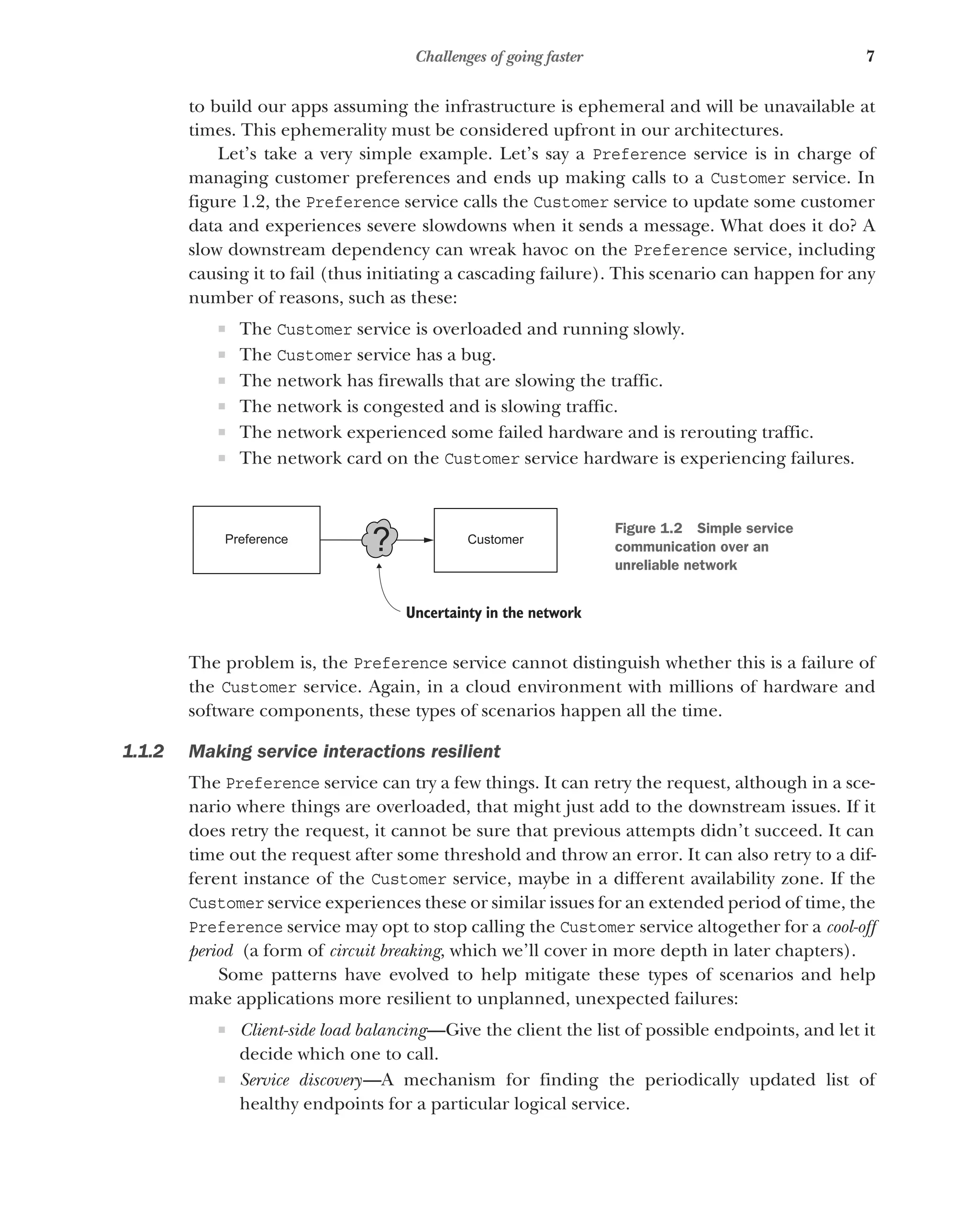
Preference Customer
?
Uncertainty in the network
Figure 1.2 Simple service
communication over an
unreliable network
8 CHAPTER 1 Introducing the Istio service mesh
 Circuit breaking—Shed load for a period of time to a service that appears to be
misbehaving.
 Bulkheading—Limit client resource usage with explicit thresholds (connections,
threads, sessions, and so on) when making calls to a service.
 Timeouts—Enforce time limitations on requests, sockets, liveness, and so on
when making calls to a service.
 Retries—Retry a failed request.
 Retry budgets—Apply constraints to retries: that is, limit the number of retries in
a given period (for example, only retry 50% of the calls in a 10-second window).
 Deadlines—Give requests context about how long a response may still be useful;
if outside the deadline, disregard processing the request.
Collectively, these types of patterns can be thought of as application networking. They
have a lot of overlap with similar constructs at lower layers of the networking stack,
except that they operate at the layer of messages instead of packets.
1.1.3 Understanding what’s happening in real time
A very important aspect of going faster is making sure we’re going in the right direc-
tion. We try to get deployments out quickly, so we can test how customers react to
them, but they will not have an opportunity to react (or will avoid our service) if it’s
slow or not available. As we make changes to our services, do we understand what
impact (positive or negative) they will have? Do we know how things are running
before we make changes?
It is critical to know things about our services architecture like which services are
talking to each other, what typical service load looks like, how many failures we expect
to see, what happens when services fail, service health, and so on. Each time we make
a change by deploying new code or configuration, we introduce the possibility of neg-
atively impacting our key metrics. When network and infrastructure unreliability rear
their ugly heads, or if we deploy new code with bugs in it, can we be confident we have
enough of a pulse on what’s really happening to trust that the system isn’t on verge of
collapse? Observing the system with metrics, logs, and traces is a crucial part of run-
ning a services architecture.
1.2 Solving these challenges with application libraries
The first organizations to figure out how to run their applications and services in a
cloud environment were the large internet companies, many of which pioneered
cloud infrastructure as we know it today. These companies invested massive amounts
of time and resources into building libraries and frameworks for a select set of lan-
guages that everyone had to use, which helped solve the challenges of running ser-
vices in a cloud-native architecture. Google built frameworks like Stubby, Twitter built
Finagle, and, in 2012, Netflix open sourced its microservices libraries to the open
source community. For example, with NetflixOSS, libraries targeted for Java develop-
ers handle cloud-native concerns:
9
Solving these challenges with application libraries
 Hystrix—Circuit breaking and bulkheading
 Ribbon—Client-side load balancing
 Eureka—Service registration and discovery
 Zuul—Dynamic edge proxy
Since these libraries were targeted for Java runtimes, they could only be used in Java
projects. To use them, we’d have to create an application dependency on them, pull
them into our classpath, and then use them in our application code. The following
example of using NetflixOSS Hystrix pulls a dependency on Hystrix into your depen-
dency control system:
<dependency>
<groupId>com.netflix.hystrix</groupId>
<artifactId>hystrix-core</artifactId>
<version>x.y.z</version>
</dependency>
To use Hystrix, we wrap our commands with a base Hystrix class, HystrixCommand.
public class CommandHelloWorld extends HystrixCommand<String> {
private final String name;
public CommandHelloWorld(String name) {
super(HystrixCommandGroupKey.Factory.asKey("ExampleGroup"));
this.name = name;
}
@Override
protected String run() {
// a real example would do work like a network call here
return "Hello " + name + "!";
}
}
If each application is responsible for building resilience into its code, we can distrib-
ute the handling of these concerns and eliminate central bottlenecks. In large-scale
deployments on unreliable cloud infrastructure, this is a desirable system trait.
1.2.1 Drawbacks to application-specific libraries
Although we’ve mitigated a concern about large-scale services architectures when we
decentralize and distribute the implementation of application resiliency into the
applications themselves, we’ve introduced some new challenges. The first challenge is
around the expected assumptions of any application. If we wish to introduce a new
service into our architecture, it will be constrained to implementation decisions made
by other people and other teams. For example, to use NetflixOSS Hystrix, you must
use Java or a JVM-based technology. Typically, circuit breaking and load balancing go
together, so you’d need to use both of those resilience libraries. To use Netflix Ribbon
for load balancing, you’d need some kind of registry to discover service endpoints,
10 CHAPTER 1 Introducing the Istio service mesh
which might mean using Eureka. Going down this path of using libraries introduces
implicit constraints around a very undefined protocol for interacting with the rest of
the system.
The second issue is around introducing a new language or framework to imple-
ment a service. You may find that NodeJS is a better fit for implementing user-facing
APIs but the rest of your architecture uses Java and NetflixOSS. You may opt to find a
different set of libraries to implement resilience patterns. Or you may try to find anal-
ogous packages like resilient (www.npmjs.com/package/resilient) or hystrixjs
(www.npmjs.com/package/hystrixjs). And you’ll need to search for each language
you wish to introduce (microservices enable a polyglot development environment,
although standardizing on a handful of languages is usually best), certify it, and intro-
duce it to your development stack. Each of these libraries will have a different imple-
mentation making different assumptions. In some cases you may not be able to find
analogous replacements for each framework/language combination. You end up with
a partial implementation for some languages and overall inconsistency in the imple-
mentation that is very difficult to reason about in failure scenarios and possibly con-
tributes to obscuring/propagating failures. Figure 1.3 shows how services end up
implementing the same set of libraries to manage application networking.
Figure 1.3 Application networking libraries commingled with an application
Finally, maintaining a handful of libraries across a bunch of programming languages
and frameworks requires a lot of discipline and is very hard to get right. The key is
ensuring that all of the implementations are consistent and correct. One deviation, and
you’ve introduced more unpredictability into your system. Pushing out updates and
changes across a fleet of services all at the same time can be a daunting task as well.
App
networking
code
Customer
service
App
networking
code
Loyalty
service
App
networking
code
Catalog
service
11
Pushing these concerns to the infrastructure
Although the decentralization of application networking is better for cloud archi-
tectures, the operational burden and constraints this approach puts on a system in
exchange will be difficult for most organizations to swallow. Even if they take on that
challenge, getting it right is even harder. What if there was a way to get the benefits of
decentralization without paying the price of massive overhead in maintaining and
operating these applications with embedded libraries?
1.3 Pushing these concerns to the infrastructure
These basic application-networking concerns are not specific to any particular appli-
cation, language, or framework. Retries, timeouts, client-side load balancing, circuit
breaking, and so on are also not differentiating application features. They are critical
concerns to have as part of your service, but investing massive time and resources into
language-specific implementations for each language you intend to use (including
the other drawbacks from the previous section) is a waste of time. What we really want
is a technology-agnostic way to implement these concerns and relieve applications
from having to do so themselves.
1.3.1 The application-aware service proxy
Using a proxy is a way to move these horizontal concerns into the infrastructure. A
proxy is an intermediate infrastructure component that can handle connections and
redirect them to appropriate backends. We use proxies all the time (whether we know
it or not) to handle network traffic, enforce security, and load balance work to back-
end servers. For example, HAProxy is a simple but powerful reverse proxy for distrib-
uting connections across many backend servers. mod_proxy is a module for the
Apache HTTP server that also acts as a reverse proxy. In our corporate IT systems, all
outgoing internet traffic is typically routed through forwarding proxies in a firewall.
These proxies monitor traffic and block certain types of activities.
What we want for this problem, however, is a proxy that’s application aware and able
to perform application networking on behalf of our services (see figure 1.4). To do so,
this service proxy will need to understand application constructs like messages and
requests, unlike more traditional infrastructure proxies, which understand connec-
tions and packets. In other words, we need a layer 7 proxy.
Figure 1.4 Using a proxy to push horizontal concerns such as resilience,
traffic control, and security out of the application implementation
Service
Outbound
network traffic
Implement
concerns here.
Proxy
12 CHAPTER 1 Introducing the Istio service mesh
1.3.2 Meet the Envoy proxy
Envoy (http:/
/envoyproxy.io) is a service proxy that has emerged in the open source
community as a versatile, performant, and capable application-layer proxy. Envoy was
developed at Lyft as part of the company’s SOA infrastructure and is capable of imple-
menting networking concerns like retries, timeouts, circuit breaking, client-side load
balancing, service discovery, security, and metrics collection without any explicit lan-
guage or framework dependencies. Envoy implements all of that out-of-process from
the application, as shown in figure 1.5.
The power of Envoy is not limited to these application-layer resilience aspects. Envoy
also captures many application-networking metrics like requests per second, number
of failures, circuit-breaking events, and more. By using Envoy, we can automatically
get visibility into what’s happening between our services, which is where we start to see
a lot of unanticipated complexity. The Envoy proxy forms the foundation for solving
cross-cutting, horizontal reliability and observability concerns for a services architec-
ture and allows us to push these concerns outside of the applications and into the
infrastructure. We’ll cover more of Envoy in ensuing sections and chapters.
We can deploy service proxies alongside our applications to get these features
(resilience and observability) out-of-process from the application, but at a fidelity that
is very application specific. Figure 1.6 shows how in this model, applications that wish
to communicate with the rest of the system do so by passing their requests to Envoy
first, which then handles the communication upstream.
Service proxies can also do things like collect distributed tracing spans so we can
stitch together all the steps taken by a particular request. We can see how long each
step took and look for potential bottlenecks or bugs in our system. If all applications
talk through their own proxy to the outside world, and all incoming traffic to an appli-
cation goes through our proxy, we gain some important capabilities for our applica-
tion without changing any application code. This proxy + application combination
forms the foundation of a communication bus known as a service mesh.
We can deploy a service proxy like Envoy along with every instance of our applica-
tion as a single atomic unit. For example, in Kubernetes, we can co-deploy a service
proxy with our application in a single Pod. Figure 1.7 visualizes the sidecar deployment
pattern in which the service proxy is deployed to complement the main application
instance.
Service
Outbound
network traffic
That’s Envoy!
Proxy
Figure 1.5 The Envoy proxy is
an out-of-process participant in
application networking.
13
What’s a service mesh?
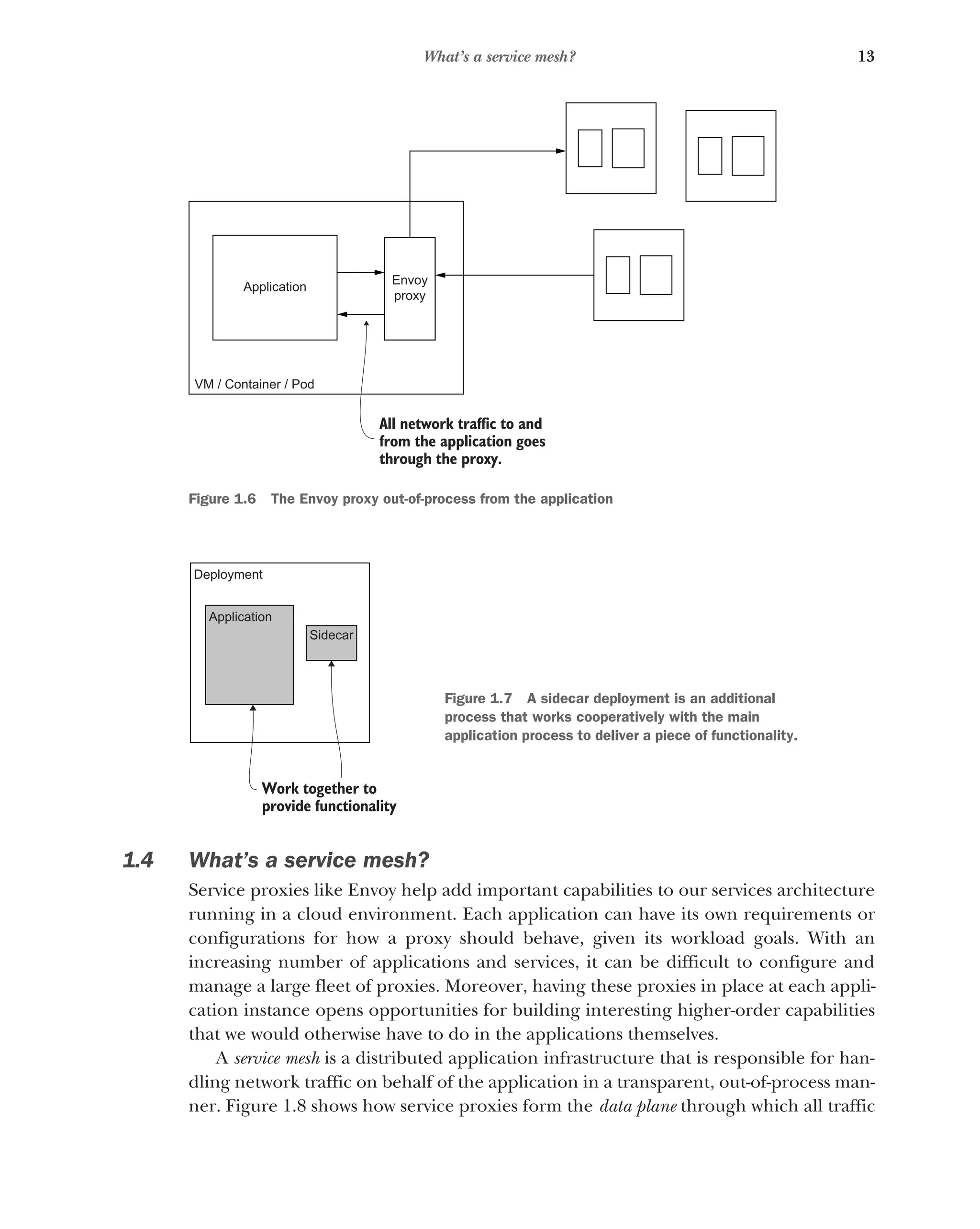
Figure 1.6 The Envoy proxy out-of-process from the application
1.4 What’s a service mesh?
Service proxies like Envoy help add important capabilities to our services architecture
running in a cloud environment. Each application can have its own requirements or
configurations for how a proxy should behave, given its workload goals. With an
increasing number of applications and services, it can be difficult to configure and
manage a large fleet of proxies. Moreover, having these proxies in place at each appli-
cation instance opens opportunities for building interesting higher-order capabilities
that we would otherwise have to do in the applications themselves.
A service mesh is a distributed application infrastructure that is responsible for han-
dling network traffic on behalf of the application in a transparent, out-of-process man-
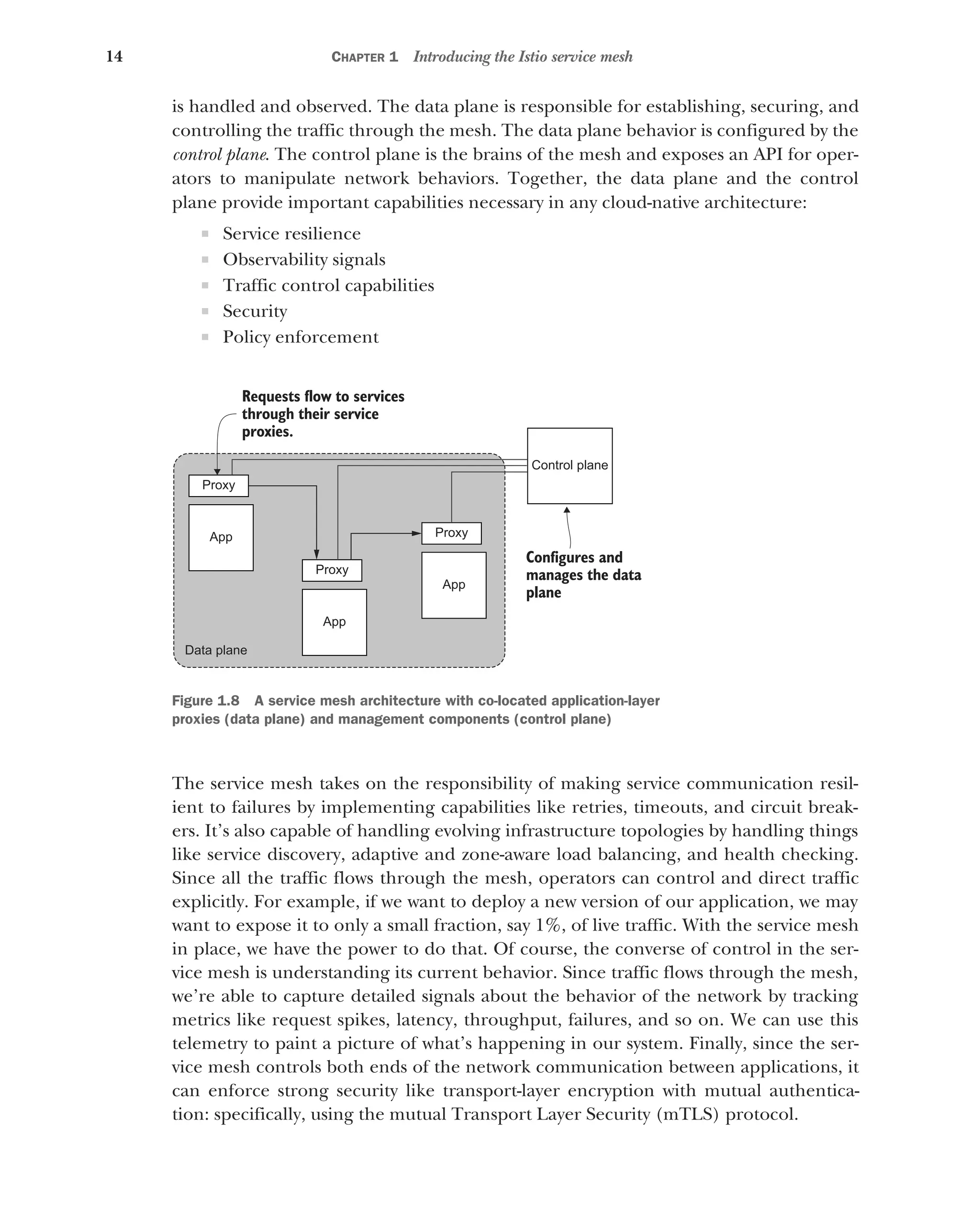
ner. Figure 1.8 shows how service proxies form the data plane through which all traffic
VM / Container / Pod
Application
Envoy
proxy
All network traffic to and
from the application goes
through the proxy.
Deployment
Application
Sidecar
Work together to
provide functionality
Figure 1.7 A sidecar deployment is an additional
process that works cooperatively with the main
application process to deliver a piece of functionality.
14 CHAPTER 1 Introducing the Istio service mesh
is handled and observed. The data plane is responsible for establishing, securing, and
controlling the traffic through the mesh. The data plane behavior is configured by the
control plane. The control plane is the brains of the mesh and exposes an API for oper-
ators to manipulate network behaviors. Together, the data plane and the control
plane provide important capabilities necessary in any cloud-native architecture:
 Service resilience
 Observability signals
 Traffic control capabilities
 Security
 Policy enforcement
Figure 1.8 A service mesh architecture with co-located application-layer
proxies (data plane) and management components (control plane)
The service mesh takes on the responsibility of making service communication resil-
ient to failures by implementing capabilities like retries, timeouts, and circuit break-
ers. It’s also capable of handling evolving infrastructure topologies by handling things
like service discovery, adaptive and zone-aware load balancing, and health checking.
Since all the traffic flows through the mesh, operators can control and direct traffic
explicitly. For example, if we want to deploy a new version of our application, we may
want to expose it to only a small fraction, say 1%, of live traffic. With the service mesh
in place, we have the power to do that. Of course, the converse of control in the ser-
vice mesh is understanding its current behavior. Since traffic flows through the mesh,
we’re able to capture detailed signals about the behavior of the network by tracking
metrics like request spikes, latency, throughput, failures, and so on. We can use this
telemetry to paint a picture of what’s happening in our system. Finally, since the ser-
vice mesh controls both ends of the network communication between applications, it
can enforce strong security like transport-layer encryption with mutual authentica-
tion: specifically, using the mutual Transport Layer Security (mTLS) protocol.
Data plane
Proxy
App
Proxy
App
Proxy
App
Control plane
Requests flow to services
through their service
proxies.
Configures and
manages the data
plane
15
Introducing the Istio service mesh
The service mesh provides all of these capabilities to service operators with very
few or no application code changes, dependencies, or intrusions. Some capabilities
require minor cooperation with the application code, but we can avoid large, compli-
cated library dependencies. With a service mesh, it doesn’t matter what application
framework or programming language you’ve used to build your application; these
capabilities are implemented consistently and correctly and allow service teams to
move quickly, safely, and confidently when implementing and delivering changes to
systems to test their hypotheses and deliver value.
1.5 Introducing the Istio service mesh
Istio is an open source implementation of a service mesh founded by Google, IBM,
and Lyft. It helps you add resilience and observability to your services architecture in a
transparent way. With Istio, applications don’t have to know that they’re part of the
service mesh: whenever they interact with the outside world, Istio handles the net-
working on their behalf. It doesn’t matter if you’re using microservices, monoliths, or
anything in between—Istio can bring many benefits. Istio’s data plane uses the Envoy
proxy and helps you configure your application to have an instance of the service
proxy (Envoy) deployed alongside it. Istio’s control plane is made up of a few compo-
nents that provide APIs for end users/operators, configuration APIs for the proxies,
security settings, policy declarations, and more. We’ll cover these control-plane com-
ponents in future sections of this book.
Istio was originally built to run on Kubernetes but was written from the perspective
of being deployment-platform agnostic. This means you can use an Istio-based service
mesh across deployment platforms like Kubernetes, OpenShift, and even traditional
deployment environments like virtual machines (VMs). In later chapters, we’ll take a
look at how powerful this can be for hybrid deployments across combinations of
clouds, including private data centers.
NOTE Istio is Greek for “sail,” which goes along nicely with the rest of the
Kubernetes nautical words.
With a service proxy next to each application instance, applications no longer need
language-specific resilience libraries for circuit breaking, timeouts, retries, service dis-
covery, load balancing, and so on. Moreover, the service proxy also handles metrics
collection, distributed tracing, and access control.
Since traffic in the service mesh flows through the Istio service proxy, Istio has con-
trol points at each application to influence and direct its networking behavior. This
allows a service operator to control traffic flow and implement fine-grained releases
with canary releases, dark launches, graduated roll outs, and A/B style testing. We’ll
explore these capabilities in later chapters.
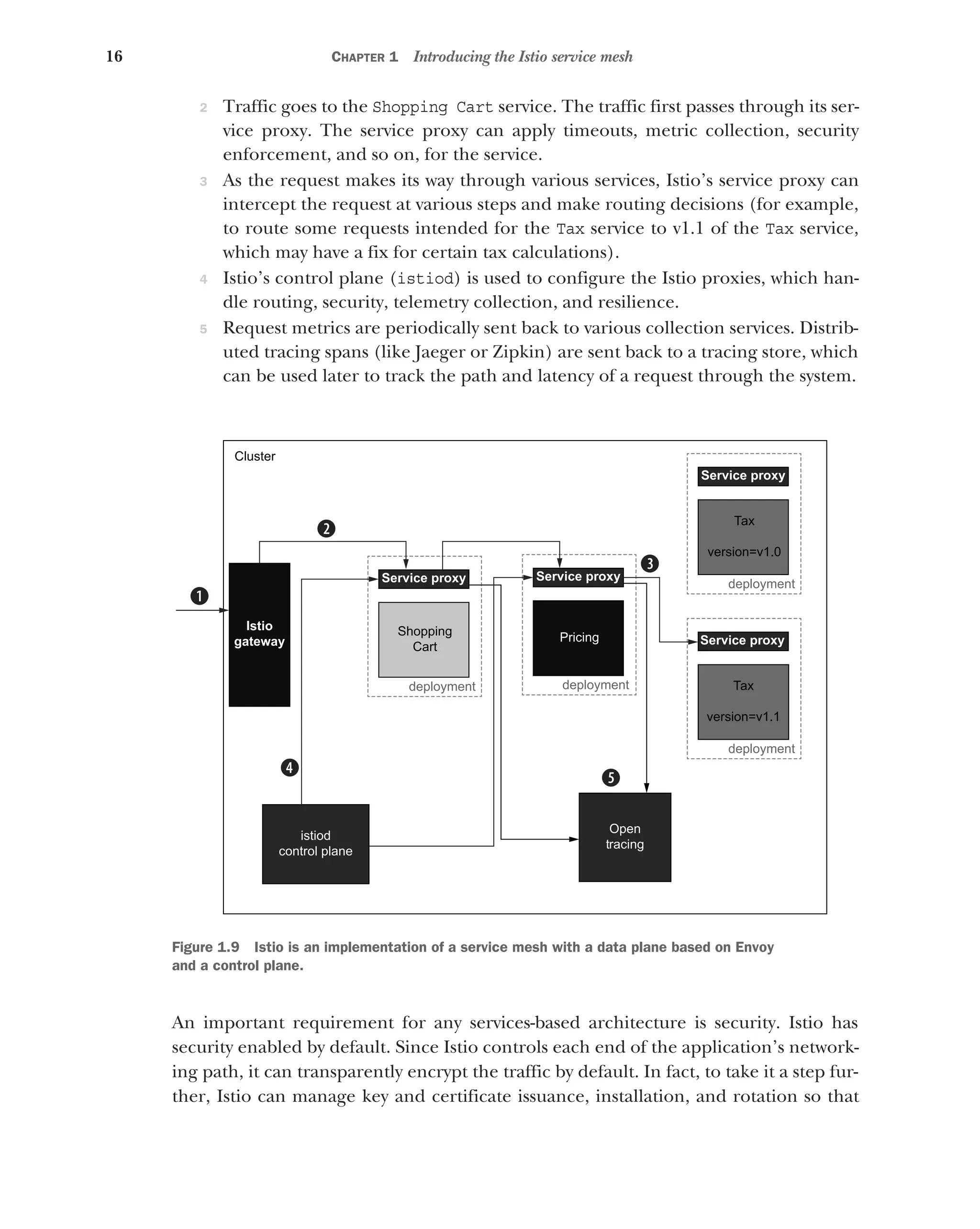
Figure 1.9 shows the following:
1 Traffic comes into the cluster from a client outside the mesh through the Istio
ingress gateway.
16 CHAPTER 1 Introducing the Istio service mesh
2 Traffic goes to the Shopping Cart service. The traffic first passes through its ser-
vice proxy. The service proxy can apply timeouts, metric collection, security
enforcement, and so on, for the service.
3 As the request makes its way through various services, Istio’s service proxy can
intercept the request at various steps and make routing decisions (for example,
to route some requests intended for the Tax service to v1.1 of the Tax service,
which may have a fix for certain tax calculations).
4 Istio’s control plane (istiod) is used to configure the Istio proxies, which han-
dle routing, security, telemetry collection, and resilience.
5 Request metrics are periodically sent back to various collection services. Distrib-
uted tracing spans (like Jaeger or Zipkin) are sent back to a tracing store, which
can be used later to track the path and latency of a request through the system.
Figure 1.9 Istio is an implementation of a service mesh with a data plane based on Envoy
and a control plane.
An important requirement for any services-based architecture is security. Istio has
security enabled by default. Since Istio controls each end of the application’s network-
ing path, it can transparently encrypt the traffic by default. In fact, to take it a step fur-
ther, Istio can manage key and certificate issuance, installation, and rotation so that
Istio
gateway
deployment
Shopping
Cart
Cluster
Service proxy
deployment
Pricing
Service proxy
deployment
Tax
version=v1.0
Service proxy
deployment
Tax
version=v1.1
Service proxy
istiod
control plane
Open
tracing
Other documents randomly have
different content
Los anónimos de Zapata se sucedieron durante largo tiempo y tenían
otro carácter. Fueron varios.
El primero decía así:
«En esa santa casa antigua de Capellanes hay una mujer
que adorna la frente de su marido. Es Juanita, la señora de
Gómez. El señor Gómez no puede ya con su cabeza. Cada
año un asta más.
¡Buena está la casa de la calle de la Misericordia, 2!
El duende.»
Al día siguiente llegó otro anónimo:
«El joven Miguel Rocaforte se jacta en todas partes de
haberle puesto los cuernos a su principal. Estaba escrito:
Manso has sido, manso eres y manso serás.
¡Buena está la casa de la calle de la Misericordia, 2!
El duende.»
Al cabo de poco tiempo vino otro papel:
«En esa santa casa, hoy de la Sal, hay un Cuervo que debía
graznar, ya hace tiempo, en el patio de un presidio. Ese
Cuervo, mal zapatero, es un bandido, miserable y estafador,
que engaña a todo el mundo, empezando por su amo.
¡Buena está la casa de la calle de la Misericordia, 2!
El duende.»
A los pocos días se recibió otro anónimo:
«En esa cristiana casa hay una Pepita que tiene dos
cortejos a la vez: uno para los días de fiesta, y otro para los
días de labor. Ahora la visita el cerdo del padre Cecilio.
¿Qué hace mientrastanto Burguillos? Burguillos calla y
otorga. ¡Buena está la casa de la calle de la Misericordia, 2!
El duende.»
Por último, se recibió esta letanía, que decía así:
«Letanía para recitar en la casa de la Sal.
De la mansedumbre de don Tomás Manso,
De la gracia del Cuervo,
De las visitas de los padres franciscanos,
De los chismes de las monjas Clarisas,
Líbranos, Señor;
Del ceño de don Bernardo,
Del vientre del padre Cecilio,
Del contravientre del hermano Félix,
De la charla de don Plácido,
Líbranos, Señor;
De los ardores de la Pepita,
De los malhumores de Juanita,
De los cuernos del buen Gómez,
De los flatos de Burguillos,
Líbranos, Señor;
Líbranos, Señor, de tanto bellaco, de tanto cornudo, de
tanta pécora como habita esa casa, Misericordia, 2.
¡Misericordia, Señor!
El duende.»
Don Tomás leyó con una terrible indignación estos anónimos. El
primero comprendió que partía de alguna de las mujeres de la casa,
de la Pepa, o de la Juanita; los otros, pensaba que debían ser de
algún amigo de Miguel; pero no podía suponer de quién.
VI.
PREPARATIVOS
Que no quedara contenta
ni lograda mi esperanza
si no vieras la venganza
en donde viste la afrenta.
Guillén de Castro: Las
mocedades del Cid.
El Cuervo había tenido siempre gran antipatía por Miguel. Sin duda,
la juventud y la fuerza del joven excitaban su envidia.
El Cuervo había asegurado en la casa que Miguel no saldría de la
cárcel; cuando le vió que volvía sintió por él un gran odio.
Don Tomás recibió a Miguel con marcada frialdad e hizo que el
Cuervo registrara el cuarto y las ropas del joven. Este había dejado
las cartas de Soledad y su Diario en manos de Aviraneta, en un
paquete atado.
El Cuervo no encontró nada. Don Tomás pareció contentarse; pero el
Cuervo insinuó a su amo y, al último, le dijo claramente que no por
eso era menos cierto que Soledad se entendía con Miguel.
—¿Lo sabes tú?
—Lo sé todo.
—¿Te lo han dicho?
—Lo he visto.
—¿Qué has visto?
—He visto que se escribían cartas y luego se hablaban y se daban
citas.
—¿Dónde se encontraban?
—Generalmente en el claustro de las Descalzas. Al principio, Miguel
escribía con lápiz, en una de las ventanas, el lugar de la cita; luego
iba ella y borraba lo escrito; después era un pobre que está a la
puerta de esta iglesia el que se encargaba de su correspondencia.
—¿Lo viste tú?
—Sí.
—¿Qué viste más?
—Vi también que uno de aquellos días, al salir de la iglesia de las
Descalzas, pasó por aquí doña Soledad como si fuera a hacer
compras, miró a derecha e izquierda y entró en la calle de
Peregrinos, donde la esperaba Miguel.
Don Tomás sintió que le sofocaba el ansia de vengarse; no le tenía
gran cariño a su mujer, pero consideraba que al querer a Miguel
ofendía en su dignidad al hombre que le había sacado de la miseria.
—Está bien—dijo don Tomás.
Para don Tomás la traición de Soledad y de Miguel era una prueba
más de la maldad humana, del espíritu envilecido y encanallado de
los hombres.
Ante el Cuervo, el amo consideraba que debía tener una actitud
indiferente, como si hasta él no pudieran llegar las miserias
humanas. Los siguientes días, a pesar de su impasibilidad, don
Tomás se estremecía ante la mirada brillante e irónica del jorobado.
Miguel había vuelto a su trabajo y se manifestaba tranquilo y
contento; su tío le hablaba poco; Gómez le miraba sonriente;
Burguillos le contemplaba con atención, y el Cuervo le dirigía una
mirada larga y rencorosa.
Una vez don Tomás y el Cuervo tuvieron una nocturna conferencia.
Al día siguiente, por la tarde, era domingo y no había nadie en casa.
Amo y criado entraron en el almacén de la fuente con la cabeza de
Medusa, y estuvieron allí largo rato.
El almacén era bajo de techo, tenía rejas al patio y en el suelo
grandes losas. Entre ellas había dos con hendiduras, como saeteras,
que se podían levantar. Las levantó el Cuervo con una palanca y
apareció un agujero grande y obscuro. Metió el Cuervo una linterna
encendida, colgada de una cuerda, y se vió una oquedad hecha en
tierra arenosa, en parte revestida por una bóveda de ladrillo, con
arcos medio derrumbados.
Don Tomás y el Cuervo bajaron al subterráneo por una escalera
larga, y lo reconocieron. Tenía una profundidad de ocho a diez
metros. Estaba completamente cerrado, y no había comunicación
alguna con el exterior; la única boca de galería que parecía haber
existido en otro tiempo estaba cerrada por una gran piedra de
molino. En el centro de esta piedra había un agujero. El Cuervo
metió un hierro por él, sospechando si tendría una salida, y sacó
trozos de carbón y de huesos.
Después de reconocer el subterráneo y ver que no tenía ninguna
comunicación, volvieron amo y criado al almacén e hicieron entre los
dos varias y extrañas maniobras. Sirviéndose de la palanca, llevó el
Cuervo las dos piedras grandes que cerraban el boquete del suelo a
un rincón, y sobre el agujero que quedaba, de un metro en cuadro,
puso una esterilla ligera, que lo ocultaba perfectamente, sujeta en
los bordes por unas bolas de sal. Delante del boquete colocó una
mesa.
El Cuervo tenía imaginación para el mal. Excitaba constantemente a
su amo. Don Tomás vacilaba; tan pronto consideraba la venganza
como lógica y justa, como la tenía por excesivamente severa.
El Cuervo, que era el espíritu maligno que se cernía sobre el alma de
don Tomás, le excitaba, le ponía a la vista la petulancia y la
fanfarronería de Miguel.
VII.
EL CRIMEN
Madruga y mata primero.
Calderón: El monstruo de
la fortuna.
Después de muchas conferencias con el Cuervo, don Tomás se
decidió. Un día le dijo a Miguel:
—Tengo que enviar una persona con una comisión importante para
Zaragoza, y de paso para Sigüenza. ¿Quieres ir tú?
—Con mucho gusto.
—Te advierto que es una comisión para los carlistas.
—No me importa.
—Bueno; pues pide un pasaporte y un billete para la diligencia.
Miguel se entusiasmó con la idea de ver pronto a Soledad, y no se le
ocurrió la menor sospecha.
Dos días después le avisó a su tío y le dijo:
—Ya tengo todo en regla.
—Tienes que hacer el viaje con el máximo de prudencia. Es
conveniente que digas a todo el mundo que te marchas hoy, y no te
vayas hasta mañana. Ven esta noche a casa, a las doce; no subas a
la habitación, para que no oigan los pasos. Te daré la llave, entras y
pasas al almacén de la fuente, donde yo te esperaré.
—Está bien.
—También quiero que te confieses para salir de Madrid y hacer este
viaje, que puede estar lleno de peligros.
—Bueno.
Miguel no hizo gran caso de este consejo. Por la noche estuvo en el
Café Nuevo, y, poco antes de dar las doce, se acercó a la casa de la
calle de la Misericordia. Miguel iba muy embozado en la capa; hacía
una noche negra de invierno. El joven empujó el postigo de la
puerta, que se abrió sin ruido, y lo volvió a cerrar, pasó el zaguán,
abrió la puerta de la mampara de cristales, que comunicaba con el
patio, y luego, la del almacén de la fuentecilla.
—¡Adelante!—dijo don Tomás, con voz temblona.
Miguel no había estado nunca en este almacén, en el cual se decía
que don Tomás guardaba sus secretos. Vió en un rincón una caja de
caudales y sobre una mesa un velón.
—¿Te ha visto alguno entrar en la casa?—preguntó don Tomás.
—Nadie. La noche está muy negra y muy fría.
—¿Estás preparado?
—Sí.
—¿Ya te confesaste?
—Sí.
—Bueno.
Don Tomás, dando una larga vuelta, se acercó a la mesa, de manera
que la luz no le diera en el rostro. Así no podía verse el aire siniestro
y alterado de su fisonomía.
—Dale esta carta a Soledad cuando llegues a Sigüenza—dijo—, y
lleva este paquete a Zaragoza. En el papel está la dirección.
Miguel avanzó despacio hacia la mesa.
Don Tomás le contempló con una mirada anhelante.
—¿Por qué me mira así?—se preguntó Miguel.
—Si se salva—pensó, a su vez, don Tomás—, Dios lo habrá querido.
Miguel dió varios pasos y se aproximó a la mesa. De pronto se oyó
que la esterilla se hundía, arrastrando las bolas de sal que la
sujetaban, y el joven desapareció.
En el momento mismo, el Cuervo saltó por entre dos filas de sacos,
y apareció en medio del almacén.
Don Tomás se asomó al agujero y oyó un gemido ahogado de dolor.
El Cuervo, armado de la palanca, arrastró con brío, una tras otra, las
dos grandes losas y cerró el boquete del suelo.
—Ya no se oye nada—dijo, temblando, don Tomás.
—Habrá muerto con el golpe—repuso el Cuervo.
Don Tomás se dejó caer sobre una silla con el aire de un hombre
extenuado. El Cuervo comenzó a hacer una gran pirámide de bolas
de sal sobre las losas que ocultaban el agujero por donde se había
cometido el crimen.
Acabada la obra, los cómplices se miraron uno a otro. En el Cuervo
había una expresión de crueldad y de satisfacción. En don Tomás,
una mezcla de horror y de espanto. Los dos salieron del almacén al
patio, y luego, al portal. El Cuervo entró en su covacha y don Tomás
subió las escaleras hasta su cuarto.
Quince días después volvió Soledad a Madrid, sin haber mejorado de
su mal. No se atrevía a hacer ninguna pregunta. Su marido,
indiferente e impasible, nada le dijo. Así vivieron marido y mujer
meses y meses. Nadie tuvo la menor sospecha en la casa. El Cuervo
siguió trabajando en su portal.
Dos años después, un día en que Soledad rezaba en la iglesia de las
Descalzas, le dió un desmayo y cayó al suelo. La llevaron a casa y
llamaron al médico, y después a don Bernardo, el capellán. Don
Bernardo pasó largo tiempo con la enferma, que a cada instante
decía en voz baja: «¡Miguel! ¡Miguel!» Unas horas después, Soledad
había muerto.
Don Tomás se retiró a Lerma y vendió la Casa de la Sal. Esta pasó a
diversas manos, hasta que el último dueño decidió tirarla y alinear la
calle de Capellanes.
VIII.
LA ESCUELA DE CRISTO
El sueño de la razón
produce monstruos.
Goya: Caprichos.
Don Tomás y el Cuervo se retiraron a Lerma y vivieron algunos años
juntos. El Cuervo no era capaz de permanecer tranquilo y sin
mezclarse en los asuntos públicos y privados, y durante la guerra
civil denunció a la partida del Cura Merino algunos ciudadanos
liberales, que fueron fusilados. Poco después, unos parientes de
éstos cogieron al Cuervo en el campo y lo apalearon de tal manera
que murió a consecuencia de la paliza.
Don Tomás, al verse sin su criado, sintió más bien tranquilidad que
pena; la mirada irónica y dura del Cuervo le recordaba la cueva del
almacén de la calle de la Misericordia.
Al verse solo fué para el una tregua, pero una tregua que duró poco
tiempo, porque sus terrores volvieron de nuevo.
Don Tomás se hallaba entregado a la religión; constantemente
estaba en la iglesia rezando y confesándose.
Había por entonces en el pueblo una casa pequeña y ruinosa que
casi siempre estaba cerrada. Sólo al anochecer solía abrirse para el
paso de algunas personas. Si se entraba en el estrecho zaguán y se
subía al único piso, se encontraba primero una sala pintada de
negro, con un ventanillo enrejado que daba a la calle. En medio de
la sala había un féretro, cubierto de paño negro, con cuatro cirios
apagados. Este cuarto se comunicaba por una puerta estrecha con
una capilla obscura y sin luz. La capilla tenía en medio un altar, con
un Nazareno coronado de espinas y lleno de sangre, y alrededor,
unos armarios de sacristía, y encima de los armarios, varias
calaveras y varias disciplinas. En la pared había un marco con un
papel, en donde se leía una lista de nombres.
Esta casa pequeña con su cuarto fúnebre y su capilla constituía la
Escuela de Cristo. Formaban parte de ella varias personas religiosas
cuyos nombres constaban en el cuadro de la pared. De noche
entraban allí diez o doce hombres a hacer penitencia, y después de
rezar delante del féretro, cubierto de paño negro, iban pasando uno
detrás de otro a la capilla, y allí se cubrían con una capucha.
Cuando estaban todos reunidos y en círculo delante del altar, se
apagaban las luces y se ponía en el suelo un gran farol de hoja de
lata, sin cristales, que tenía unos agujeros por los cuales pasaban
tenues raros de luz. Entonces uno se destacaba, se desnudaba y se
colocaba en medio del círculo de los encapuchados; luego tomaba
una calavera en la mano izquierda y las disciplinas en la derecha, y
comenzaba a azotarse, mientras el siniestro coro rezaba en voz alta.
Don Tomás pertenecía a la Escuela de Cristo, se disciplinaba, usaba
cilicios, y en su casa rezaba tirado en el suelo cuan largo era y
dando grandes alaridos. Aquel último gemido de Miguel al caer al
subterráneo lo oía en su cerebro a cada paso; el suspiro del viento,
el toque de una campana, el chirriar de una lechuza, el ruido de una
ventana movida por una ráfaga del cierzo, todo rumor de la tierra o
del aire le recordaba la queja postrera del joven muerto por él.
Muchas veces hubiera preferido perder la razón definitivamente, que
no vivir de una manera tan miserable y triste.
IX.
EL FANTASMA
Ya oigo la voz del terror
que se levanta en mi
corazón.
Esquilo: Las Coéforas.
Poco después de la guerra civil se habló en Lerma de que en la Plaza
aparecían fantasmas a media noche. Algunos los habían visto
claramente. Los serenos, por más que vigilaban, no podían dar con
ellos. No se sabía si eran duendes, espectros o almas en pena; pero
se aseguraba que uno de estos fantasmas tenía una mano de plomo
y otra de estopa, y que gozaba del poder de avisar la próxima
muerte al que había de morir.
Al parecer, algunos serenos no sentían gran interés en encontrarse
con aquellos seres misteriosos, porque cuando les decían que
andaban por un lado, iban por el opuesto; otros más decididos y
valientes llevaban una pistola y un garrote, y afirmaban que no se
les escaparían los fantasmas sin un estacazo o sin un tiro.
Don Tomás había oído hablar de estas apariciones, considerándolas
como chiquilladas, sin darles más importancia. Una noche en que el
viejo, después de rezar sus oraciones, se dirigía a la cama, oyó en la
calle pasos quedos. Desde hacía algún tiempo, don Tomás tenía un
oído de enfermo. Escuchó las pisadas de lejos y abrió un ventanillo
de su alcoba. Vió una cosa blanca que se acercaba por la acera de
enfrente. Era el fantasma.
Don Tomás, maravillado y confundido, quedó en el ventanillo, y,
trastornado, preguntó:
—¿Quién eres? ¿Qué deseas?
Entonces el fantasma, con voz sepulcral, dijo:
—¡Asesino! Yo soy el alma de Miguel Rocaforte, condenada por tu
culpa.
Don Tomás se retiró de la ventana temblando y se tiró en el suelo a
rezar. Al día siguiente lo encontraron desmayado, moribundo; lo
llevaron a la cama y ya no volvió a levantarse.
Unos días después, los serenos cogieron a uno de los fantasmas,
que resultó un sargento de milicianos nacionales que tenía amores
con la mujer de un tendero de la plaza.
El otro fantasma, a quien no lograron coger, se supo que era León
Zapata, el compañero de Miguel Rocaforte.
Madrid, diciembre, 1920.
ADÁN EN EL INFIERNO
I.
ADÁN
No se gana nada
violentando a la
sensibilidad en sus
inclinaciones; es preciso
engañarla y, como dice
Swift, divertir la ballena
con una barrica para
salvar el barco.
Kant: Antropología.
En la época de la matanza de frailes, cuando fueron ingresando en la
Cárcel de Corte una porción de gente cogida en las calles de Madrid,
llevaron a ella a un muchacho joven, guapo, recién venido de un
pueblo de la Alcarria, Andrés Lafuente.
Este alcarreño vino con Román, el hijo del librero de la calle de la
Paz, y con un zapatero joven llamado Gaspar, a quien todos
conocían por Gasparito y de quien te hablé antes.
A aquel muchacho alcarreño se le consideraba como un mozo
ingenuo e inocente, y se le compadecía por haber caído en el
infierno de la cárcel.
El poeta Espronceda, en los pocos días que estuvo en la cárcel, le
llamaba Adán, y probablemente pensando en él ideó el personaje de
su poema el Diablo mundo, que debía publicar unos años más tarde;
Andrés (alias Adán) era un muchacho fuerte, guapo, muy lúcido y
muy inocente. Gasparito el zapatero se constituyó en uno de sus
defensores.
Gasparito el remendón era liberal, pequeño, rubio, muy leído, amigo
del hijo del librero de viejo de la calle de la Paz, y se mostraba como
hombre de buena fe y de buenas intenciones.
Yo tomé bajo mi protección a Gasparito y quise proteger también a
Adán, aunque veía que a un muchacho, sin experiencia como aquél,
metido en el segundo patio, entre ladrones, la corrupción de la
cárcel le había de contagiar rápidamente. El padre Anselmo creyó
también que con sus sermones apartaría al mozo del mal camino;
pero Adán se reía de él.
II.
LA CUADRILLA DEL FORTUNA
¿Es posible—dijo Andrenio
—, que jamás nos hemos
de ver libres de
monstruos ni de fieras,
que toda la vida ha de ser
arma?
Gracián: El Criticón.
Los presos del segundo patio se dividían para comer en cuadrillas,
que llevaban el nombre del que las dirigía. Adán fué a parar a la
cuadrilla del Fortuna. El Fortuna era un matón de casa de juego que
tenía gran influencia.
El Fortuna era un hombre fuerte, atrevido, moreno, de bigote, con
un lunar en la mejilla, tipo desvergonzado y cínico. Cobraba el
barato en la cárcel; pero no era un valiente de verdad. Era de los
que allí, en el segundo patio, se decía que madrugaban. No
afrontaba con calma, sereno y tranquilo, las situaciones difíciles; sino
que las capeaba. Eso sí, tenía indudablemente el hábito de la
audacia.
Al Fortuna le habían preso por matar a traición a un hombre. Afiliado
en la cárcel al grupo de los absolutistas, era de nuestros enemigos
más acérrimos. Sin duda, el encontrar nuestra gente menos terne,
menos enérgica, que los absolutistas, le había dado una gran
hostilidad contra ella.
A mí me tenía mucho odio; una vez, en el segundo patio, se echó
encima de mí; pero yo le di con toda mi fuerza un puñetazo en un
costado que lo dejé sin aliento.
El Fortuna era hombre petulante y cínico, que dejaba una estela de
vicio allí por donde pasaba. Hacía alarde de sus instintos crapulosos;
vestía chaquetilla con caireles de colores, gran reloj de plata, con la
cadena llena de dijes, y calañés en la cabeza. El Fortuna buscaba la
amistad de los muchachos jóvenes, les brindaba su protección;
según algunos, les conseguía tener comunicaciones con la sección
de mujeres; según otros, había algo peor en sus maniobras. De la
misma cuadrilla era Cadedis, un gascón aventurero, que estaba
procesado por robo, y un caballero de industria. El gascón aseguraba
a todas horas que España era un país sin civilización y sin cultura. A
pesar de su cultura, el francés era muy supersticioso. Creía en la
quiromancia, en la magia y en que las brujas hacían ovillos con las
lanas de los colchones de una cama de tal modo, que si no se les
atajaba en su obra le ahogaban al que dormía en ella. Afirmaba
también que en el barrio de Saint-Esprit, de Bayona, se vendían
diablos metidos en una caña, que llamaban familiares, con los que
se hacían prodigios. El había tenido uno de éstos. Un gitano, ladrón
de caballos, le engañaba a Cadedis y le sacaba el dinero. El gitano
era saludador y, según decía, tenía la rueda de Santa Catalina en el
cielo de la boca, y una cruz debajo de la lengua.
El otro personaje era un caballero de industria de quien ya te he
hablado, el señor Pérez de Bustamante.
Este señor se hacía llamar conde de Otero, marqués de la Vega, etc.
Gastaba unas tarjetas llenas de títulos y condecoraciones.
Tenía, según decía, grandes amistades con los oficiales de las
secretarías, con aristócratas y ministros; todo lo facilitaba, y ofrecía
empleos con la condición precisa de que se le anticipara algunas
cantidades para recompensar los servicios de sus favorecedores.
Contaba que había viajado por toda Europa y América.
A mí me dijo que me había conocido en Méjico y en Madrid, en la
fonda del Caballo Blanco, de la calle del Caballero de Gracia, donde
yo no había estado nunca. La cuadrilla del Fortuna, formada por él,
el gascón y el caballero de industria, se había completado con Adán.
El Fortuna adulaba al señor Pérez de Bustamante, y éste protegía al
Fortuna; el matón y el caballero de industria se entendían
perfectamente.
El Pinturas joven y otros solían acercarse a esta cuadrilla, que
manejaba dinero y convidaba a café y a aguardiente.
Ninguno de los que formaban esta cuadrilla se había afiliado a los
liberales. No querían, sin duda, comprometerse mientras no llegaran
a ver claro las ventajas que aquello les podía reportar.
III.
EL ODIO
¡La unción! ¡Favor! ¡Me
han herido!
Espronceda: El Diablo
mundo.
Gasparito, el zapatero, había querido preservar de la corrupción del
ambiente a su amigo Andrés, a quien nosotros, y en toda la cárcel,
llamábamos Adán.
Quiso enseñarle a leer y escribir; pero el Fortuna, unido con Pérez
de Bustamante, Doña Paquita y Cadedis, estaban empeñados en
estorbar los proyectos de Gasparito.
Durante algún tiempo se entabló una lucha de influencias para
captar la simpatía de Adán.
Gasparito le dejaba libros y periódicos, le daba algún dinero, hacía
que Andrés viniera a verme; por su parte, el Fortuna le daba
cigarros, le enseñaba a jugar a las cartas, a hacer pillerías y a tirar la
navaja.
El matón le decía al muchacho:
«Fortuna te dé Dios, hijo, que el saber poco, te basta».
El Pinturas le explicaba procedimientos de falsificación, y Pérez de
Bustamante, las intrigas y enredos donde se había metido.
A pesar de las ilusiones de Gasparito, yo veía claramente que el
Fortuna y su grupo ganaban la partida. Adán tomaba un aire
hipócrita delante de mí; pero, por lo que me dijeron los del segundo
patio, el muchacho andaba con el Fortuna, con Doña Paquita y con
algunas mujeres del otro departamento, jugaba a las cartas,
fumaba, se había tatuado los brazos y comenzaba a matonear.
El día de Carnaval de 1835, el Fortuna y los de su cuadrilla tuvieron
una comida espléndida, con pollos, un cochinillo asado y vino de
Valdepeñas.
Habían metido mucho aguardiente de contrabando y convidaron a
todos los amigos.
La gente se emborrachó, y se pidió al alcaide permiso para
disfrazarse.
Entramos Gasparito, Román, el padre Anselmo y yo en el segundo
patio a presenciar la fiesta. Se reunió con nosotros el Pinturas joven
y dimos una vuelta por la Gallinería y llegamos hasta el último patio.
En esto, disfrazados de mujer, vimos a Doña Paquita, que venía en
medio de Adán y del Fortuna, agarrado a los dos del brazo. Habían
bebido de más y gritaban como locos.
El Fortuna abrazaba a Adán, y se puso a hacer ademanes obscenos.
Gasparito volvió la cabeza con un ademán de disgusto y nos
alejamos del grupo que formaban los tres borrachos; pero el Fortuna
quiso mostrar más su conquista y se presentó de nuevo frente a
nosotros con Adán y con Doña Paquita.
—¿Vienes, hermoso?—le dijo a Gasparito con una risa cínica y un
contoneo repugnante—. ¿Cuál de las tres te gusta más?
Gasparito, incomodado, viendo que el guapo se le echaba encima, le
dió un empujón y lo tiró rodando al suelo.
Yo vi que se nos venía la tormenta encima, y, agarrándole a Gaspar
por el brazo, le empujé hacia la salida del patio; pero había mucha
gente y Gaspar no quería salir rápidamente, quizá para que no se
creyera que tenía miedo.
El Fortuna había desaparecido. Ya estábamos a la salida del patio
cuando el matón se presentó con una navaja, oculta en la manga, y
se lanzó sobre Gasparito como un toro; Gasparito tuvo tiempo de
escapar a la acometida dando un salto rápido para atrás. Román, el
hijo del librero, agarró al matón del borde de la chaqueta, y
Gasparito, con gran valor, le arrancó la navaja de las manos.
El Fortuna, loco, enfurecido, le mordió en el brazo izquierdo.
Entonces, Gasparito, en un momento de terrible furia, empuñó la
navaja con toda su fuerza y dió tal navajada al matón en el vientre,
que el Fortuna dió un grito de becerro que matan, y cayó al suelo.
Yo vi brillar la hoja de la navaja como un relámpago y desaparecer
en el vientre del matón. Le salían las entrañas por la herida y se iba
desangrando rápidamente.
—¡Socorro! ¡Socorro!—gritó—. Me ha matado.
A los gritos vinieron el alcaide y los cabos de vara, prendieron a
Gasparito y llevaron al matón a la enfermería, el cual falleció poco
después, asistido por el padre Anselmo.
—¡A quién se le ocurre matar a la Fortuna!—dijo el Pinturas con
indiferencia.
Gaspar pasó unos días en el calabozo y tuvo un proceso. Yo declaré
a su favor; Pérez de Bustamente, en contra, y el tribunal le condenó
al zapatero a una pena ínfima.
Años después le vi en su tienda y le pregunté:
—¿Se acuerda usted de la Cárcel de Corte?
—No, don Eugenio; ¿y usted?
Me dijo que muy pocas veces había pensado en aquel bruto a quien
había matado, y, al parecer, recordaba el suceso sin remordimiento.
Adán, al salir de la cárcel, se hizo un criminal completo, y debió
acabar su vida en presidio.
Itzea, diciembre, 1920.
MI DESQUITE
Todo esto es salud, y otro
tanto ingenio.
Quevedo: El Buscón.
Durante mucho tiempo, no pudimos luchar con los presos carlistas.
En el cuarto del abogado Selva, el mejor de todos de la Cárcel de
Corte, se reunían cuatro o cinco frailes, dos o tres curas y otros
tantos guerrilleros, y en esta Junta apostólica se tomaban acuerdos
que don Paco, el alcaide, seguía al pie de la letra.
La Junta de Selva se erigió en soberana de la cárcel: ella decidía lo
que se había de hacer; quién debía estar castigado; quién, no; quién
debía ser tratado con benevolencia, y quién con severidad.
—Yo, por entonces, tenía asegurada la comunicación con los de
fuera, y mis amigos de la Isabelina me mandaban cartas y papeles y
me indicaban el giro que iban tomando los asuntos políticos.
A pesar de que yo me quejaba constantemente de la situación en
que nos encontrábamos los liberales en la cárcel, los amigos no
hacían nada por nosotros. Entonces, desesperado, se me ocurrió
enviar un escrito al Gobierno, afirmando a rajatabla que en la Cárcel
de Corte se fraguaba una conspiración carlista.
El Gobierno no desconfió de mi denuncia, y envió en concepto de
preso a un coronel, don Andrés Robledo, con la misión de observar
lo que pasaba y de ver si era cierta mi denuncia.
Yo mismo no creía gran cosa en que allí se conspirase; pero cuando
Robledo comenzó sus investigaciones, vi que mi hipótesis era una
realidad, y que en la Cárcel de Corte se estaba tramando una de las
muchas intrigas carlistas que por entonces tuvieron Madrid por
centro.
El coronel Robledo me contaba sus descubrimientos; yo le daba
datos acerca de los presos carlistas, y entre los dos redactábamos
los partes al Gobierno.
Tan graves hallaron el ministro y el jefe de policía el contenido de
estos partes, que enviaron a la cárcel a dos comisarios de policía,
uno de ellos Luna, auxiliados por sesenta miñones aragoneses y
varios celadores.
Luna conferenció conmigo y con Robledo, y dispusimos prender a
don Paco el alcaide y a sus dependientes, al abogado Selva, al
escribano de mi causa, García, y enviarlos a la cárcel de la Villa.
Se comenzó a instruír un voluminoso proceso acerca de esta causa,
y se le encargó de él a mi amigo el juez don Modesto Cortázar, a
quien conocía desde Aranda del año 20.
Los cargos de alcaide, de llavero y de carceleros se proveyeron en
personas de antecedentes liberales, y desde entonces pudimos estar
los constitucionales a nuestras anchas.
El fiscal que nombraron para esta causa fué don Laureano de Jado,
enemigo mío, que meses después decía a todo el que le quería oír:
—Estoy admirado del genio fecundo y de la travesura de Aviraneta.
El ha conseguido embrollar su proceso de tal manera, que ha sido
preciso a los Tribunales poner en libertad como inocentes a todos
sus cómplices, y, para complemento de su maquiavelismo, ha
fraguado este proceso de la conspiración de la Cárcel de Corte, que
es la concepción más revolucionaria que ha podido imaginar el
cerebro de un hombre para vengarse de los que él consideraba
enemigos, y hasta del juez Regio y del escribano de la causa. Este
proceso está vestido con tales declaraciones y pruebas, que me veo
obligado a pedir contra los presuntos reos, cuando menos, un
presidio. Pues bien: si como fiscal estoy en la obligación de obrar de
esta manera, como particular me hallo cada vez más convencido y
casi seguro de que todo el proceso no es mas que un solemnísimo
embrollo fraguado por la fecunda imaginación de Aviraneta.
Con razón o sin ella, conseguimos vernos libres de la dictadura de
los carlistas.
Yo quise influír en Cortázar para que dejara libre al padre Anselmo;
pero el cura estaba pendiente de la causa y no se le podía libertar.
Como la vida en la cárcel para nosotros se hizo más llevadera, yo
comencé a recibir visitas de los antiguos afiliados a la Isabelina, que
podían hablarme con completa libertad. La opinión de la gente
reaccionó a mi favor, y todo el mundo decía que era un absurdo que
permaneciera preso por una conspiración que no había existido
nunca. Yo me hacía la víctima y esperaba el desquite.
Unos días después supe que en un movimiento revolucionario que
estalló por entonces en Barcelona y que costó la vida al general
Bassa, habían destituído del cargo, que le dieron meses antes, a mi
denunciador Civat.
Poco después, Martínez de la Rosa salía del Gobierno. Yo me
consideraba vengado, pero me faltaba conseguir mi libertad.
I.
PLAN DEL PRONUNCIAMIENTO
Yo pienso, pues, que vale
más ser impetuoso que
circunspecto, porque la
fortuna es mujer, y para
subyugarla es mejor
batirla y atropellarla,
porque se deja más bien
vencer por los audaces
que por los que obran
fríamente.
Maquiavelo: El Príncipe.
Lo que tengo que contar ahora no es ninguna novedad para ti—me
dijo Aviraneta—, porque pertenece en parte a la historia del tiempo.
Una mañana de agosto se presentaron en la Cárcel de Corte el
capitán Ríos, ayo de los hijos del conde de Parcent, con otro oficial
de la Milicia Urbana, de paisano. El alcaide me dejaba gran libertad y
me permitió hablar con ellos largamente.
Los dos oficiales venían nada menos que a pedirme un Plan de
sublevación, hecho a base de la Milicia Urbana.
—Señores—les dije yo—, no creo, claro es, que ustedes hayan
venido aquí a tenderme un lazo, ni mucho menos; pero ustedes
pueden muy bien engañarse respecto al espíritu del pueblo y de la
Milicia, y yo, antes de idear un plan y de ser responsable de él,
quisiera cerciorarme de lo que ustedes dicen.
Ríos me contestó que traerían una carta de tres comandantes de la
Milicia Urbana corroborando lo que decían ellos, y que vendría al día
siguiente un agente de Bolsa amigo mío llamado Robles. Vino Ríos
con la carta y con Robles, y hablamos.
Robles me dijo que reinaba, efectivamente, gran descontento en el
pueblo liberal; que las noticias de la guerra eran malas; que se
acusaba al Gobierno de inactivo; que la Corte en la Granja se
dedicaba a divertirse, y que todo el mundo decía que tenía que venir
un cambio en la política. Era una época en la que había entusiasmo
y fe en las nuevas ideas, entusiasmo y fe que luego han ido
decayendo.
Ríos añadió que estaba todo preparado para un pronunciamiento de
la Milicia; que el pueblo secundaría el movimiento, y que Andrés
Borrego había visitado al general Quesada, y que éste daba su
palabra de que la Guardia Real no atacaría a los sublevados.
—¿Cómo puede asegurar esto Quesada?—pregunté yo—. El está de
reemplazo.
—Sí; pero tiene de su parte toda la oficialidad de la Guardia Real.
—¿Han pactado algo Borrego y Quesada?
—No.
—¿Está usted seguro?
—Sí.
Luego se supo que Borrego había conferenciado con Quesada y con
dos jefes de la Guardia Real, el general Soria y el conde de Cleonart.
En esta conferencia, que yo no conocía, se había pactado que la
Milicia Urbana haría una manifestación. Borrego y Olózaga
escribirían una petición a la Reina, firmada por los cuatro jefes de la
Milicia Urbana, y, presentada la petición, la Milicia dejaría las armas.
Si yo hubiera sabido que Quesada estaba en el ajo, no entro en la
combinación.
Quesada era un militar ordenancista, bárbaro e incomprensivo. Era
muy valiente y de costumbres rudas, arrebatado, ajeno a todo
miramiento; decía que no sabía mas que mandar y obedecer,
declaración que basta para juzgar cualquiera. Muy duro en el
mando, muy destemplado en el lenguaje, a pesar de creerse muy
fijo en sus ideas, era completamente voluble.
Muchas veces dijo, refiriéndose a los liberales: «He de ser peor que
Atila con esa canalla».
Un hombre como Quesada, que tenía por norma el no razonar, no
podía ser hombre de ideas; así se le vió figurar en una época con los
absolutistas, después hacerse masón, sentirse medio liberal y, al
mismo tiempo, enemigo de la Constitución. Para él todas estas
volubilidades e inconsecuencias se velaban con la disciplina.
Sólo a Borrego, a Espronceda y a González Brabo, gente que quería
medrar sin esfuerzo, se les pudo ocurrir apoyarse en un hombre
como Quesada.
Quesada en esta época, 1835, estaba de cuartel en Madrid. Le
habían separado de la Capitanía General en enero, lo que
consideraba como una ofensa a su persona.
Si, como digo, hubiese tenido conocimiento de la participación de
Quesada en el asunto, hubiese llevado éste de otra manera muy
diferente.
Hablamos Robles y Ríos, y quedamos de acuerdo en que el objeto
de la sublevación sería:
1.º Apoderarse de Madrid.
2.º Nombrar una Junta Revolucionaria.
3.º Ponerse en relación con los sublevados de Zaragoza.
De acuerdo en esto, les dije que al día siguiente les daría mi plan.
Fué el siguiente:
PLAN DEL PRONUNCIAMIENTO
(Orden general para la Milicia.)
Pasado mañana, 15 de agosto, hay función de toros, y da el
piquete de la Plaza la Milicia. Este piquete, en vez de
disolverse al llegar a la Puerta del Sol, hará que sus
tambores toquen generala, esparciéndose por la población.
Los individuos de la Milicia, avisados, se irán reuniendo en
la Plaza Mayor; se ocuparán las casas y se harán barricadas
en las avenidas de los arcos. También se ocupará el
telégrafo para impedir se avise al Gobierno. Una compañía
se posesionará de la Puerta de Hierro e impedirá el paso al
Sitio (La Granja), Hecho esto, se pondrá inmediatamente
en libertad a Aviraneta, que dirá lo demás que debe
ejecutarse.
AVISO A LOS ISABELINOS
Se avisará a las centurias de la Isabelina para que asistan el
día 15 de agosto, día de la Asunción, a la corrida de toros.
A la salida rodearán al piquete de la Guardia Urbana y
provocarán todo el escándalo posible. Se alarmará al
vecindario.
AVISO A LOS DIPUTADOS
Inmediatamente se avisará a los diputados liberales para
que vayan a la Plaza Mayor y formen una Junta de
Gobierno.
DISPOSICIONES INMEDIATAS
Si las tropas del Gobierno no se oponen, la Milicia se
apoderará lo más rápidamente posible de la casa de Oñate,
en la calle Mayor, de la Imprenta Real y del Principal.
Se fueron los militares y yo me quedé en la cárcel. Aquellos días
estuve leyendo el Diablo Cojuelo, de Vélez de Guevara, que me
prestó un preso, y pensando en la idea original del autor.
La tarde y la noche del 15 de agosto las pasé en una gran angustia.
Al anochecer me pareció oír desde mi cuarto gritos y ruido de
tambores; luego cesó todo rumor y volvió el silencio. Cuando a las
diez de la noche vi que no venía nadie a buscarme, creí que el
pronunciamiento habría fracasado. Yo pensaba—y en estas cosas se
equivoca uno siempre—que podía fracasar el movimiento; lo que no
se me ocurría es que, después de hecho con éxito, mis amigos no
vinieran en seguida a sacarme de la cárcel. Sin embargo, así fué. Un
pelotón de milicianos, pertenecientes a la Isabelina, quisieron venir;
pero los centinelas no les dejaron pasar. Otros me dijeron que no
habían ido a la cárcel por no molestarme. ¡Por no molestar a un
preso retardar su libertad! ¡y retardarla creyéndolo necesario! ¡Qué
absurdo!
Al día siguiente, domingo, a las nueve de la mañana, vinieron a
buscarme a la Cárcel de Corte.
II.
LO OCURRIDO
Una vez que no se
entendían en una disputa
de la Academia, dijo M. de
Mairan: «Caballeros: ¡si
no habláramos más de
cuatro a la vez!»
Chamfort: Caracteres y
anécdotas.
El pronunciamiento se había hecho y estaba ya vencido. Al terminar
la corrida del día de la Asunción, dos compañías de milicianos
volvían formados por la calle de Alcalá, con la música al frente,
tocando himnos patrióticos. El Himno de Riego producía entre la
muchedumbre tempestades de aplausos. La gente daba vivas y
mueras, a cada momento más estrepitosos. Al llegar a la Puerta del
Sol la algazara subió de pronto; comenzaron a oírse gritos de «¡Viva
la libertad!», «¡Mueran los carlistas!», «¡Viva la Soberanía
Nacional!». Al acercarse a la Plaza Mayor la Milicia había perdido las
filas y se había mezclado con los paisanos.
De pronto sonaron unos cuantos tiros, se oyeron toques estridentes
de corneta, y se inició el pánico en la ciudad. Se cerraron las puertas
y ventanas de las casas, y los tambores comenzaron a tocar
generala por las calles desiertas de Madrid, en distintos puntos de la
capital. Se les había avisado a los milicianos que estuviesen


Istio in Action 1st Edition Christian E. Posta

  • 1.
    Istio in Action1st Edition Christian E. Posta install download https://ebookmeta.com/product/istio-in-action-1st-edition- christian-e-posta/ Download more ebook from https://ebookmeta.com
  • 2.
    We believe theseproducts will be a great fit for you. Click the link to download now, or visit ebookmeta.com to discover even more! Technology in action : complete 16th Edition Kendall E. Martin https://ebookmeta.com/product/technology-in-action-complete-16th- edition-kendall-e-martin/ Business in Action, Tenth Global Edition Courtland L. Bovée https://ebookmeta.com/product/business-in-action-tenth-global- edition-courtland-l-bovee/ Divine Agency and Divine Action Volume II Soundings in the Christian Tradition 1st Edition William J. Abraham https://ebookmeta.com/product/divine-agency-and-divine-action- volume-ii-soundings-in-the-christian-tradition-1st-edition- william-j-abraham/ Mint Chip Murder Cambria Clyne Cozy Mystery 4 Erin Huss Et El https://ebookmeta.com/product/mint-chip-murder-cambria-clyne- cozy-mystery-4-erin-huss-et-el/
  • 3.
    Process Engineering: Addressingthe Gap between Study and Chemical Industry 2nd Edition Michael Kleiber https://ebookmeta.com/product/process-engineering-addressing-the- gap-between-study-and-chemical-industry-2nd-edition-michael- kleiber/ Successful Doctoral Training in Nursing and Health Sciences: A Guide for Supervisors, Students and Advisors 1st Edition Debra Jackson https://ebookmeta.com/product/successful-doctoral-training-in- nursing-and-health-sciences-a-guide-for-supervisors-students-and- advisors-1st-edition-debra-jackson/ Selling the Business Location Place Marketing in the context of the Rhine Main Region Place Marketing in the context of the Rhine Main Region 1st Edition Christiane Mohr https://ebookmeta.com/product/selling-the-business-location- place-marketing-in-the-context-of-the-rhine-main-region-place- marketing-in-the-context-of-the-rhine-main-region-1st-edition- christiane-mohr/ Essentials of Corporate Finance 11th Edition Stephen A Ross Randolf W Westerfield Bradford D Jordan https://ebookmeta.com/product/essentials-of-corporate- finance-11th-edition-stephen-a-ross-randolf-w-westerfield- bradford-d-jordan/ Solutions Manual to Fluid Mechanics 6th ed 666th Edition Cohen Ira M Dowling David R Kundu Pijush K https://ebookmeta.com/product/solutions-manual-to-fluid- mechanics-6th-ed-666th-edition-cohen-ira-m-dowling-david-r-kundu- pijush-k/
  • 4.
    Egypt Moon TravelGuide 1st Edition Sarah Smierciak https://ebookmeta.com/product/egypt-moon-travel-guide-1st- edition-sarah-smierciak/
  • 5.
    M A NN I N G Christian E. Posta Rinor Maloku Foreword by Eric Brewer
  • 6.
  • 7.
  • 8.
    Istio in Action CHRISTIANE. POSTA RINOR MALOKU FOREWORD BY ERIC BREWER M A N N I N G SHELTER ISLAND
  • 9.
    For online informationand ordering of this and other Manning books, please visit www.manning.com. The publisher offers discounts on this book when ordered in quantity. For more information, please contact Special Sales Department Manning Publications Co. 20 Baldwin Road PO Box 761 Shelter Island, NY 11964 Email: orders@manning.com ©2022 by Manning Publications Co. All rights reserved. No part of this publication may be reproduced, stored in a retrieval system, or transmitted, in any form or by means electronic, mechanical, photocopying, or otherwise, without prior written permission of the publisher. Many of the designations used by manufacturers and sellers to distinguish their products are claimed as trademarks. Where those designations appear in the book, and Manning Publications was aware of a trademark claim, the designations have been printed in initial caps or all caps. Recognizing the importance of preserving what has been written, it is Manning’s policy to have the books we publish printed on acid-free paper, and we exert our best efforts to that end. Recognizing also our responsibility to conserve the resources of our planet, Manning books are printed on paper that is at least 15 percent recycled and processed without the use of elemental chlorine. The author and publisher have made every effort to ensure that the information in this book was correct at press time. The author and publisher do not assume and hereby disclaim any liability to any party for any loss, damage, or disruption caused by errors or omissions, whether such errors or omissions result from negligence, accident, or any other cause, or from any usage of the information herein. Manning Publications Co. Development editor: Elesha Hyde 20 Baldwin Road Technical development editor: Brent Stains PO Box 761 Review editor: Aleksandar Dragosavljević Shelter Island, NY 11964 Productioneditor: Andy Marinkovich Copyeditor: Tiffany Taylor Proofreader: Jason Everett Technical proofreaders: Gregory Reshetniak Typesetter and cover designer: Marija Tudor ISBN 9781617295829 Printed in the United States of America
  • 10.
    I dedicate thisbook to my wife and daughters. —Christian Posta I dedicate this book to everybody who shares knowledge on the web. —Rinor Maloku
  • 11.
  • 12.
    vii brief contents PART 1UNDERSTANDING ISTIO .................................................. 1 1 ■ Introducing the Istio service mesh 3 2 ■ First steps with Istio 24 3 ■ Istio’s data plane: The Envoy proxy 54 PART 2 SECURING, OBSERVING, AND CONTROLLING YOUR SERVICE’S NETWORK TRAFFIC ............................... 75 4 ■ Istio gateways: Getting traffic into a cluster 77 5 ■ Traffic control: Fine-grained traffic routing 110 6 ■ Resilience: Solving application networking challenges 136 7 ■ Observability: Understanding the behavior of your services 177 8 ■ Observability: Visualizing network behavior with Grafana, Jaeger, and Kiali 205 9 ■ Securing microservice communication 230 PART 3 ISTIO DAY-2 OPERATIONS ............................................ 265 10 ■ Troubleshooting the data plane 267 11 ■ Performance-tuning the control plane 295
  • 13.
    BRIEF CONTENTS viii PART 4ISTIO IN YOUR ORGANIZATION .................................... 317 12 ■ Scaling Istio in your organization 319 13 ■ Incorporating virtual machine workloads into the mesh 347 14 ■ Extending Istio on the request path 378
  • 14.
    ix contents foreword xvii preface xix acknowledgmentsxxi about this book xxiii about the authors xxvii about the cover illustration xxviii PART 1 UNDERSTANDING ISTIO ................................... 1 1 Introducing the Istio service mesh 3 1.1 Challenges of going faster 5 Our cloud infrastructure is not reliable 6 ■ Making service interactions resilient 7 ■ Understanding what’s happening in real time 8 1.2 Solving these challenges with application libraries 8 Drawbacks to application-specific libraries 9 1.3 Pushing these concerns to the infrastructure 11 The application-aware service proxy 11 ■ Meet the Envoy proxy 12 1.4 What’s a service mesh? 13 1.5 Introducing the Istio service mesh 15 How a service mesh relates to an enterprise service bus 17 How a service mesh relates to an API gateway 18
  • 15.
    CONTENTS x Can I useIstio for non-microservices deployments? 20 ■ Where Istio fits in distributed architectures 21 ■ What are the drawbacks to using a service mesh? 22 2 First steps with Istio 24 2.1 Deploying Istio on Kubernetes 25 Using Docker Desktop for the examples 25 ■ Getting the Istio distribution 26 ■ Installing the Istio components into Kubernetes 27 2.2 Getting to know the Istio control plane 29 Istiod 30 ■ Ingress and egress gateway 33 2.3 Deploying your first application in the service mesh 34 2.4 Exploring the power of Istio with resilience, observability, and traffic control 39 Istio observability 40 ■ Istio for resiliency 47 ■ Istio for traffic routing 49 3 Istio’s data plane: The Envoy proxy 54 3.1 What is the Envoy proxy? 55 Envoy’s core features 57 ■ Comparing Envoy to other proxies 61 3.2 Configuring Envoy 62 Static configuration 62 ■ Dynamic configuration 63 3.3 Envoy in action 65 Envoy’s Admin API 69 ■ Envoy request retries 69 3.4 How Envoy fits with Istio 71 PART 2 SECURING, OBSERVING, AND CONTROLLING YOUR SERVICE’S NETWORK TRAFFIC ................ 75 4 Istio gateways: Getting traffic into a cluster 77 4.1 Traffic ingress concepts 78 Virtual IPs: Simplifying service access 78 ■ Virtual hosting: Multiple services from a single access point 79 4.2 Istio ingress gateways 80 Specifying Gateway resources 82 ■ Gateway routing with virtual services 83 ■ Overall view of traffic flow 86 ■ Istio ingress
  • 16.
    CONTENTS xi gateway vs.Kubernetes Ingress 87 ■ Istio ingress gateway vs. API gateways 88 4.3 Securing gateway traffic 88 HTTP traffic with TLS 89 ■ HTTP redirect to HTTPS 93 HTTP traffic with mutual TLS 94 ■ Serving multiple virtual hosts with TLS 97 4.4 TCP traffic 98 Exposing TCP ports on an Istio gateway 99 ■ Traffic routing with SNI passthrough 101 4.5 Operational tips 104 Split gateway responsibilities 104 ■ Gateway injection 105 Ingress gateway access logs 106 ■ Reducing gateway configuration 107 5 Traffic control: Fine-grained traffic routing 110 5.1 Reducing the risk of deploying new code 111 Deployment vs. release 111 5.2 Routing requests with Istio 114 Cleaning up our workspace 114 ■ Deploying v1 of the catalog service 115 ■ Deploying v2 of the catalog service 116 Routing all traffic to v1 of the catalog service 117 ■ Routing specific requests to v2 119 ■ Routing deep within a call graph 120 5.3 Traffic shifting 122 Canary releasing with Flagger 124 5.4 Reducing risk even further: Traffic mirroring 129 5.5 Routing to services outside your cluster by using Istio’s service discovery 131 6 Resilience: Solving application networking challenges 136 6.1 Building resilience into the application 137 Building resilience into application libraries 137 ■ Using Istio to solve these problems 138 ■ Decentralized implementation of resilience 138 6.2 Client-side load balancing 139 Getting started with client-side load balancing 140 ■ Setting up our scenario 142 ■ Testing various client-side load-balancing strategies 144 ■ Understanding the different load-balancing algorithms 147
  • 17.
    CONTENTS xii 6.3 Locality-aware loadbalancing 149 Hands-on with locality load balancing 149 ■ More control over locality load balancing with weighted distribution 153 6.4 Transparent timeouts and retries 156 Timeouts 156 ■ Retries 158 ■ Advanced retries 164 6.5 Circuit breaking with Istio 166 Guarding against slow services with connection-pool control 168 ■ Guarding against unhealthy services with outlier detection 173 7 Observability: Understanding the behavior of your services 177 7.1 What is observability? 178 Observability vs. monitoring 179 ■ How Istio helps with observability 179 7.2 Exploring Istio metrics 180 Metrics in the data plane 180 ■ Metrics in the control plane 186 7.3 Scraping Istio metrics with Prometheus 187 Setting up Prometheus and Grafana 189 ■ Configuring the Prometheus Operator to scrape the Istio control plane and workloads 190 7.4 Customizing Istio’s standard metrics 193 Configuring existing metrics 196 ■ Creating new metrics 200 Grouping calls with new attributes 202 8 Observability: Visualizing network behavior with Grafana, Jaeger, and Kiali 205 8.1 Using Grafana to visualize Istio service and control-plane metrics 205 Setting up Istio’s Grafana dashboards 207 ■ Viewing control- plane metrics 208 ■ Viewing data-plane metrics 209 8.2 Distributed tracing 209 How does distributed tracing work? 210 ■ Installing a distributed tracing system 212 ■ Configuring Istio to perform distributed tracing 213 ■ Viewing distributed tracing data 216 Trace sampling, force traces, and custom tags 217 8.3 Visualization with Kiali 223 Installing Kiali 223 ■ Conclusion 228
  • 18.
    CONTENTS xiii 9 Securingmicroservice communication 230 9.1 The need for application-networking security 230 Service-to-service authentication 231 ■ End-user authentication 231 ■ Authorization 231 ■ Comparison of security in monoliths and microservices 231 ■ How Istio implements SPIFFE 233 ■ Istio security in a nutshell 233 9.2 Auto mTLS 234 Setting up the environment 235 ■ Understanding Istio’s PeerAuthentication resource 236 9.3 Authorizing service-to-service traffic 242 Understanding authorization in Istio 243 ■ Setting up the workspace 244 ■ Behavior changes when a policy is applied to a workload 245 ■ Denying all requests by default with a catch-all policy 246 ■ Allowing requests originating from a single namespace 247 ■ Allowing requests from non- authenticated legacy workloads 248 ■ Allowing requests from a single service account 248 ■ Conditional matching of policies 249 ■ Understanding value-match expressions 250 Understanding the order in which authorization policies are evaluated 252 9.4 End-user authentication and authorization 252 What is a JSON web token? 252 ■ End-user authentication and authorization at the ingress gateway 255 ■ Validating JWTs with RequestAuthentication 255 9.5 Integrating with custom external authorization services 260 Hands-on with external authorization 261 ■ Configuring Istio for ExtAuthz 262 ■ Using a custom AuthorizationPolicy resource 263 PART 3 ISTIO DAY-2 OPERATIONS ............................. 265 10 Troubleshooting the data plane 267 10.1 The most common mistake: A misconfigured data plane 268 10.2 Identifying data-plane issues 270 How to verify that the data plane is up to date 270 Discovering misconfigurations with Kiali 272 Discovering misconfigurations with istioctl 274
  • 19.
    CONTENTS xiv 10.3 Discovering misconfigurationsmanually from the Envoy config 275 Envoy administration interface 276 ■ Querying proxy configurations using istioctl 276 ■ Troubleshooting application issues 282 ■ Inspect network traffic with ksniff 288 10.4 Understanding your application using Envoy telemetry 291 Finding the rate of failing requests in Grafana 291 ■ Querying the affected Pods using Prometheus 292 11 Performance-tuning the control plane 295 11.1 The control plane’s primary goal 295 Understanding the steps of data-plane synchronization 297 Factors that determine performance 298 11.2 Monitoring the control plane 298 The four golden signals of the control plane 299 11.3 Tuning performance 303 Setting up the workspace 304 ■ Measuring performance before optimizations 305 ■ Ignoring events: Reducing the scope of discovery using discovery selectors 309 ■ Event-batching and push-throttling properties 310 11.4 Performance tuning guidelines 314 PART 4 ISTIO IN YOUR ORGANIZATION ..................... 317 12 Scaling Istio in your organization 319 12.1 The benefits of a multi-cluster service mesh 320 12.2 Overview of multi-cluster service meshes 320 Istio multi-cluster deployment models 321 ■ How workloads are discovered in multi-cluster deployments 323 ■ Cross-cluster workload connectivity 324 ■ Common trust between clusters 324 12.3 Overview of a multi-cluster, multi-network, multi-control- plane service mesh 326 Choosing the multi-cluster deployment model 327 ■ Setting up the cloud infrastructure 327 ■ Configuring plug-in CA certificates 328 ■ Installing the control planes in each cluster 329 ■ Enabling cross-cluster workload discovery 333 Setting up cross-cluster connectivity 335 ■ Load-balancing across clusters 341
  • 20.
    CONTENTS xv 13 Incorporatingvirtual machine workloads into the mesh 347 13.1 Istio’s VM support 348 Simplifying sidecar proxy installation and configuration in a VM 348 ■ Virtual machine high availability 351 DNS resolution of in-mesh services 354 13.2 Setting up the infrastructure 355 Setting up the service mesh 356 ■ Provisioning the VM 357 13.3 Mesh expansion to VMs 359 Exposing istiod and cluster services to the VM 360 Representing a group of workloads with a WorkloadGroup 361 Installing and configuring the istio-agent in the VM 363 Routing traffic to cluster services 366 ■ Routing traffic to the WorkloadEntry 367 ■ VMs are configured by the control plane: Enforcing mutual authentication 371 13.4 Demystifying the DNS proxy 372 How the DNS proxy resolves cluster hostnames 372 ■ Which hostnames is the DNS proxy aware of? 374 13.5 Customizing the agent’s behavior 375 13.6 Removing a WorkloadEntry from the mesh 375 14 Extending Istio on the request path 378 14.1 Envoy’s extension capabilities 379 Understanding Envoy’s filter chaining 379 ■ Filters intended for extension 382 ■ Customizing Istio’s data plane 382 14.2 Configuring an Envoy filter with the EnvoyFilter resource 383 14.3 Rate-limiting requests with external call-out 387 Understanding Envoy rate limiting 388 14.4 Extending Istio’s data plane with Lua 392 14.5 Extending Istio’s data plane with WebAssembly 395 Introducing WebAssembly 395 ■ Why WebAssembly for Envoy? 396 ■ Building a new Envoy filter with WebAssembly 396 ■ Building a new Envoy filter with the meshctl tool 397 ■ Deploying a new WebAssembly Envoy filter 399 appendix A Customizing the Istio installation 401 appendix B Istio’s sidecar and its injection options 408
  • 21.
    CONTENTS xvi appendix C Istiosecurity: SPIFFE 414 appendix D Troubleshooting Istio components 424 appendix E How the virtual machine is configured to join the mesh 433 index 435
  • 22.
    xvii foreword A service meshcan maximize the development speed of your whole organization by enabling thousands of independent microservices that are automatically compliant with a wide range of evolving policies. This book discusses many other benefits of Istio, but they largely follow from this premise. This brings us to the central question, “What is a service mesh, and why do I need one?” I’m asked this question frequently, and the answer is not trivial. It is not about security or telemetry or most of the benefits some people claim. Nor is it automatically the case that you need a service mesh for your application, especially if it is a monolith. The real answer has to do with decoupling applications from infrastructure. Istio is the third major step in that direction. First, Docker provided a way to package an application (and its library choices) separately from the machine on which it runs. Next, Kubernetes made it easy to create a service with automation to help with auto- scaling and management. Together, Docker and Kubernetes enabled the practical movement to fine-grain services, often called microservices. This book guides you through implementing a service mesh with Istio to achieve this third step: application decoupling. Microservices allow greater overall velocity by enabling teams to be more autono- mous. Ideally, your team can update its microservice(s) without deep interactions with other teams. The top-level goal for Istio is to enable this at scale—to make it easy to have thousands of microservices (Google has more than a million!). But enabling velocity for a service is not just about decoupling it from the machine; the service must also be decoupled from shared policies. Every enterprise has policies that apply to all services, and we must be able to change those policies quickly if needed. Traditionally, such policies are embedded inside services as part of
  • 23.
    FOREWORD xviii the code oras libraries that services are expected to use. Either way, such policies are hard to update and enforce. Istio moves a wide range of such policies (primarily those involving an API) out of the service and into the service mesh, which is essentially a proxy that sits in front of the service and implements the policies. When this is done correctly, all services meet the policies with no work—and, conversely, policy changes do not require updating the services. This is the decoupling we are after. In Istio in Action, Christian and Rinor present a clear-headed vision of how to achieve the goal of decoupling applications from infrastructure. I hope you’ll enjoy this book as much as I have. — ERIC BREWER VP INFRASTRUCTURE AND GOOGLE FELLOW
  • 24.
    xix preface Building software ishard. Connecting different services across a network is harder. Any time you put a packet, message, or request on the network, there are no guaran- tees about its outcome. Will the request make it? How long will it take? Will anyone know if the communication fails? Docker and Kubernetes have done a lot to support distributed services architec- tures like microservices, but they exacerbate the existing communication problems. One misbehaving service might take down everything. While working with organizations worldwide that are trying to adopt microservices, I find that getting teams to consistently think about and solve these communication problems is very difficult. There are many questions: How will they do service discovery? Timeouts? Retries? Circuit breaking? Tracing? Authentication? Large cloud companies like Netflix, Twitter, and Google pioneered some of the early, successful microservices architectures. These companies had to build a lot of their own developer tooling and infrastructure to solve these problems, and fortunately, they open sourced much of it. Could other organizations use the NetflixOSS stack or Twitter Finagle? They could, and some did, but doing so created a new operational nightmare. For example, the NetflixOSS stack was primarily written for Java developers. What about NodeJS, Golang, and Python teams? Teams had to either build libraries them- selves or hack together the functionality with various bits they found on the internet. They also had to intermingle this “networking” code into their business logic. This approach added transitive dependencies, cluttered the code, and made revisions more difficult. Operating a service architecture with these application networking libraries, upgrading, patching, and doing this consistently across many different lan- guages was extremely complex and error prone.
  • 25.
    PREFACE xx A service meshis a cleaner solution to this application-networking problem. With a service mesh, we abstract away the application-networking logic into a dedicated piece of infrastructure and apply it to all services regardless of what languages they are writ- ten in. Istio is a scalable, mature, powerful service-mesh implementation that originally came out of a project from IBM and Google. I was introduced to the Istio team in Jan- uary 2017 and began working on the project very early. At the end of 2018, I went to work as global field CTO at a startup, Solo.io, to focus full-time on service mesh tech- nology and advancing the state of application networking. Building a startup from the ground up, pushing the boundaries on this technol- ogy, and writing an in-depth book on this topic is not an easy combination. I needed someone with dedication and passion to help me move the book forward; so, when I was halfway through, the Manning team and I invited Rinor Maloku to join the effort. Thanks to the time we both spend in the community and working with our customers at Solo.io, some of which are the largest deployments of Istio in the world, Rinor and I have been able to compile an excellent resource for Istio based on real-world experi- ence. We hope this book will show you the value and power of Istio and make you comfortable adopting this technology into production, as many others have.
  • 26.
    xxi acknowledgments Writing this bookhas been possible only due to the support of many people. Special thanks to our personal friends Gentrina Gashi, Dimal Zeqiri, and Taulant Mehmeti, who provided such valuable feedback. Thank you to the Manning Early Access Program (MEAP) readers who posted comments in the online forum—Takahiko Suzuki, George Tseres, Amol Nayak, Mark O’Crally—and the forum moderator, Ayush Singh. Sincere gratitude to our editor, Elesha Hyde, who was always patient when responding to our questions and concerns. Most important, thank you for being understanding and supportive when we missed deadlines, and for keeping our focus on writing a better book for our readers. A big thank you also goes to our technical editors, Gregor Zurowski and Brent Stains, as well as our technical proofreader, Gregory Reshetniak. Thank you to all the reviewers: Alceu Rodrigues de Freitas Junior, Alessandro Cam- peis, Allan Makura, Amitabh Cheekoth, Andrea Cosentino, Andrea Tarocchi, Andres Sacco, Borko Djurkovic, Christoph Schubert, Dinkar Gupta, Eriks Zelenka, Ernesto Cardenas, Fotis Stamatelopoulos, Giuseppe Catalano, James Liu, Javier Muñoz, Jeff Hajewski, Karthikeyan Mohan, Kelum Prabath Senanayake, Kent R. Spillner, Leon- ardo Jose Gomes da Silva, Maciej Droz . dz . owski, Michael Bright, Michael J Haller, Mor- gan Nelson, Paolo Antinori, Salvatore Campagna, Satadru Roy, Stanley Anozie, Taylor Dolezal, Vijay Thakorlal, and Yogesh Shetty. Your excellent suggestions made this a better book. Thank you to key people in the Istio community, including Louis Ryan (Google), Shriram Rajagopalan (Google), and Sven Mawson (Google) who are the three found- ers of the Istio project; along with Dan Berg (Digital.ai), Lin Sun (Solo.io), Dan Ciruli (Zuora), Idit Levine (Solo.io), John Howard (Google), Kevin Connor (Red Hat),
  • 27.
    ACKNOWLEDGMENTS xxii Jason McGee (IBM),Zack Butcher (Tetrate), Ram Vennam (Solo.io), and Neeraj Pod- dar (Solo.io). Finally, we thank the entire Istio community, who are working to build an amazing technology that is a joy to work on and write about on a daily basis. I am extremely fortunate to work on technology, which has been my passion since I was young. I wouldn’t have been able to get here without the love and support of my family. My father, Cask Posta, immigrated to the United States in the early 1970s; he provided me and my sister with a strong foundation and taught me the value of hard work. My beautiful wife Jackie has been by my side through all the unknowns and uncertainties and has shown nothing but unwavering support and love. Thank you, Jackie: without you, we wouldn’t have been able to accomplish all we’ve done. Finally, I’m thankful for my two lovely daughters, Maddie and Claire, who can put a smile on my face no matter how the day has been and for whom my wife and I work so hard. —CHRISTIAN E. POSTA I’d like to thank my parents, Sahadi and Sheride, and my brothers, Aurel and Drilon, for giving me a worry-less childhood that allowed me to explore my many hobbies. One of those, programming, turned into a joyful career; and another, writing, contrib- uted to this book. I’d also like to thank my girlfriend, Rinora, for her endless love and support. To Christian Posta, I’d like to express my eternal gratitude for the trust you put in me. It was crucial in enabling me to do my best work as a first-time writer. —RINOR MALOKU
  • 28.
    xxiii about this book Whoshould read this book This book is meant for developers, architects, and or service operators who operate or are planning to operate distributed services such as user-facing web applications, APIs, and backend services and want to provide highly available services to their end users. If you are a member of a platform engineering team and provide infrastructure and other supporting components such as log management, monitoring, container orchestration, and so on to many development teams within your organization, this book will show you how to give your users the tools to make their apps resilient, secure, and observable as well as reduce the risk of shipping new features. If you are already using Istio in a testing or staging environment but many of its workings are a mystery to you, this book will demystify Istio’s components. The latter chapters, in particular, will show you how to scale the service mesh in your organiza- tion, troubleshoot it when its behavior doesn’t match your expectations, and custom- ize it to meet your enterprise’s needs. If you are already an Istio expert, you may still find this book useful, as we took great care to ingrain into this book what we’ve learned from working in the field over the last three years. If building a container is new to you, or you are unsure what a Kubernetes deploy- ment, pod, or service is, this book may not be for you—yet. There are a lot of resources to get you started. We highly recommend Kubernetes in Action by Marko Lukša (Manning, 2017); in addition to being a thorough introduction to this topic, the book is a real page-turner. Once you understand the foundation of Kubernetes and its resources and how Kubernetes controllers work, you can return here and dive into the Istio service mesh.
  • 29.
    ABOUT THIS BOOK xxiv Youshould also have a basic understanding of networking, and we do mean basic. If you are familiar with the network layer (layer 3), the transport layer (layer 4), and how they differ from the application (layer 7) according to the Open Systems Inter- connection model, you are ready for this book. How this book is organized: A roadmap This book has four parts and 14 chapters. Part 1 of the book introduces the concept of a service mesh and explains how Istio implements it. These three chapters cover the architecture of Istio, how Envoy fits into it, and how it can benefit your organization:  Chapter 1 introduces the benefits of Istio and the value that adopting service meshes can bring to an organization.  Chapter 2 is a hands-on tutorial for installing Istio in a Kubernetes cluster. You deploy and integrate your first application into the mesh and configure it with Istio’s custom resources. Using the demo application, this chapter provides an overview of what you get out of the box with Istio and covers traffic manage- ment, observability, and security.  Chapter 3 is all about Envoy: how it came to be, what problems it solves, and how it fits within the service mesh architecture. Part 2 is a deep dive into Istio. The focus switches to practical examples, and we answer key operational questions: how to secure traffic coming into your cluster, make services more resilient, and make your system observable using the telemetry gener- ated by the service proxies. This part contains six chapters:  Chapter 4 teaches you how to use and configure the Istio ingress gateway to route traffic securely from the public network to your services (what we call north- south traffic).  Chapter 5 proceeds after traffic is admitted into the cluster. It shows how Vir- tualServices and DestinationRules are used to route traffic in a fine-grained manner, enabling complex deployment patterns to reduce risk when you release new software.  Chapter 6 explores how Istio benefits application teams. We discuss making ser- vices robust by implementing retries, circuit-breaking, load balancing across regions, and locality-aware load balancing right in the service mesh.  Chapter 7 teaches you how Istio makes services observable by generating met- rics, traces, and logs. Here we dive deeper into the metrics generated by service proxies, what information the metrics record, and how the recorded informa- tion can be customized.  Chapter 8 shows you how to use telemetry visualization tools to make sense of the collected data. You use Prometheus to collect metrics and Grafana to visual- ize them. You use Jaeger to stitch together the traces of a request traveling through your services. And we show how Kiali intertwines this information to make troubleshooting services in the mesh a breeze.
  • 30.
    ABOUT THIS BOOKxxv  Chapter 9 elaborates on how Istio secures service-to-service traffic, how services receive their identity, and how the identity is used to implement access control and reduce the potential attack scope. Part 3 is all about day-2 operations. It shows you how to troubleshoot issues in the data plane and maintain the control plane’s stability and performance. By the end of this part, you will have a firm understanding of Istio’s internals, and you will be able to dis- cover and fix issues on your own:  Chapter 10 shows you how to troubleshoot issues in the data plane using tools such as Istioctl, Kiali, and telemetry that is collected and visualized.  Chapter 11 discusses Istio’s performance factors. It shows how Istio can be con- figured to make the control plane more performant—the foundation of a robust service mesh. The fourth and final part of the book shows you how to make Istio yours. Enterprises have services running across boundaries, such as different clusters, different networks, or a mixture of cloud-native and legacy workloads. By the end of part 4, you will know how to join your workloads into a single mesh and customize the mesh’s behavior using WebAssembly to meet your unique requirements:  Chapter 12 shows you how to connect workloads in different Kubernetes clus- ters wherever they are running, such as different cloud providers, on premises, or in a hybrid cloud.  Chapter 13 shows how to integrate legacy workloads running in virtual machines into the mesh and extend to those workloads the mesh’s capabilities of resiliency and high availability.  Chapter 14 teaches you how to extend and customize Istio’s capabilities with existing Envoy functionality or your code using Lua scripting and WebAssembly. About the code This book contains many examples of source code in numbered listings and in line with normal text. In both cases, source code is formatted in a fixed-width font like this to separate it from ordinary text. Sometimes code is also in bold to highlight code that has changed from previous steps in the chapter, such as when a new feature adds to an existing line of code. In many cases, the original source code has been reformatted; we’ve added line breaks and reworked indentation to accommodate the available page space in the book. In rare cases, even this was not enough, and listings include line-continuation markers (➥). Additionally, comments in the source code have often been removed from the listings when the code is described in the text. Code annotations accompany many of the listings, highlighting important concepts. You can get executable snippets of code from the liveBook (online) version of this book at https:/ /livebook.manning.com/book/istio-in-action. The complete code for the examples in the book is available for download from the Manning website at
  • 31.
    ABOUT THIS BOOK xxvi www.manning.com,and from GitHub at https://github.com/istioinaction/book -source-code. liveBook discussion forum Purchase of Istio in Action includes free access to liveBook, Manning’s online reading platform. Using liveBook’s exclusive discussion features, you can attach comments to the book globally or to specific sections or paragraphs. It’s a snap to make notes for yourself, ask and answer technical questions, and receive help from the authors and other users. To access the forum, go to https:/ /livebook.manning.com/book/istio-in -action/discussion. You can also learn more about Manning’s forums and the rules of conduct at https://livebook.manning.com/discussion. Manning’s commitment to our readers is to provide a venue where a meaningful dialogue between individual readers and between readers and the authors can take place. It is not a commitment to any specific amount of participation on the part of the authors, whose contribution to the forum remains voluntary (and unpaid). We suggest you try asking the authors some challenging questions lest their interests stray! The forum and the archives of previous discussions will be accessible from the pub- lisher’s website as long as the book is in print.
  • 32.
    xxvii about the authors CHRISTIANPOSTA (@christianposta) is VP, Global Field CTO at Solo.io. He is well known in the cloud-native community for being an author, blogger (https:/ /blog.christianposta.com), speaker, and con- tributor to various open-source projects in the service mesh and cloud-native ecosystem. Christian has spent time at enterprises and web-scale companies and now helps organizations create and deploy large-scale, cloud-native, resilient, distributed architectures. He enjoys mentoring, training, and leading teams to be successful with distributed sys- tems concepts, microservices, DevOps, and cloud-native application design. RINOR MALOKU (@rinormaloku) is an engineer at Solo.io, where he consults clients adopting application networking solutions, such as service meshes. Previously, he worked at Red Hat, where he built middleware software that enabled teams to ensure the high availabil- ity of their services. As a freelancer, he consulted multiple DAX 30 members in their endeavor to fully utilize the potential of cloud com- puting technologies.
  • 33.
    xxviii about the coverillustration The figure on the cover of Istio in Action is “Femme Islandoise,” or “Icelandic woman,” taken from a collection by Jacques Grasset de Saint-Sauveur, published in 1797. Each illustration is finely drawn and colored by hand. In those days, it was easy to identify where people lived and what their trade or sta- tion in life was just by their dress. Manning celebrates the inventiveness and initiative of the computer business with book covers based on the rich diversity of regional cul- ture centuries ago, brought back to life by pictures from collections such as this one.
  • 34.
    Part 1 Understanding Istio Whatprogramming language do you use to implement your microser- vices or applications? Java? NodeJS? Golang? Whichever language or framework you use will eventually have to communicate with services over the network. The network is a perilous place for applications. What do you do for service discov- ery? timeouts? retries? circuit-breaking? security? Istio is an open source service mesh that helps solve service-to-service connec- tivity challenges in your cloud and microservices environment regardless of what language or framework you use. In chapters 1-3, we explain why a service mesh is critical infrastructure for a microservices and cloud-native application architec- ture, how Istio helps, and what you can expect from the rest of the book. Istio is built on an open source proxy named Envoy, which we cover in detail to set the foundations for the rest of the Istio functionality covered in future chapters.
  • 35.
  • 36.
    3 Introducing the Istio servicemesh Software is the lifeblood of today’s companies. As we move to a more digital world, consumers will expect convenience, service, and quality when interacting with busi- nesses, and software will be used to deliver these experiences. Customers don’t con- form nicely to structure, processes, or predefined boxes. Customers’ demands and needs are fluid, dynamic, and unpredictable, and our companies and software sys- tems will need to have these same characteristics. For some companies (such as startups), building software systems that are agile and able to respond to unpredict- ability will be the difference between surviving or failing. For others (such as exist- ing companies), the inability to use software as a differentiator will mean slower growth, decay, and eventual collapse. This chapter covers  Addressing the challenges of service-oriented architectures with service meshes  Introducing Istio and how it helps solve microservice issues  Comparing service meshes to earlier technologies
  • 37.
    4 CHAPTER 1Introducing the Istio service mesh As we explore how to go faster and take advantage of newer technology like cloud platforms and containers, we’ll encounter an amplification of some past problems. For example, the network is not reliable and when we start to build larger, more dis- tributed systems, the network must become a central design consideration in our applications. Should applications implement network resilience like retries, timeouts, and circuit breakers? What about consistent network observability? Application-layer security? Resilience, security, and metrics collection are cross-cutting concerns and not application-specific. Moreover, they are not processes that differentiate your business. Developers are critical resources in large IT systems, and their time is best spent writ- ing capabilities that deliver business value in a differentiating way. Application net- working, security, and metrics collection are necessary practices, but they aren’t differentiating. What we’d like is a way to implement these capabilities in a language- and framework-agnostic way and apply them as policy. Service mesh is a relatively recent term used to describe a decentralized application- networking infrastructure that allows applications to be secure, resilient, observable, and controllable. It describes an architecture made up of a data plane that uses appli- cation-layer proxies to manage networking traffic on behalf of an application and a control plane to manage proxies. This architecture lets us build important applica- tion-networking capabilities outside of the application without relying on a particular programming language or framework. Istio is an open source implementation of a service mesh. It was created initially by folks at Lyft, Google, and IBM, but now it has a vibrant, open, diverse community that includes individuals from Lyft, Red Hat, VMWare, Solo.io, Aspen Mesh, Salesforce, and many others. Istio allows us to build reliable, secure, cloud-native systems and solve difficult problems like security, policy management, and observability in most cases with no application code changes. Istio’s data plane is made up of service prox- ies, based on the Envoy proxy, that live alongside the applications. Those act as inter- mediaries between the applications and affect networking behavior according to the configuration sent by the control plane. Istio is intended for microservices or service-oriented architecture (SOA)-style architectures, but it is not limited to those. The reality is, most organizations have a lot of investment in existing applications and platforms. They’ll most likely build services architectures around their existing applications, and this is where Istio really shines. With Istio, we can implement these application-networking concerns without forcing changes in existing systems. Since the service proxies live outside of the application, any application for any architecture is a welcome first-class citizen in the service mesh. We’ll explore more of this in a hybrid brownfield application landscape. This book introduces you to Istio, helps you understand how all this is possible, and teaches you how to use Istio to build more resilient applications that you can monitor and operate in a cloud environment. Along the way, we explore Istio’s design principles, explain why it’s different from past attempts to solve these problems, and discuss when Istio is not the solution for your problem.
  • 38.
    5 Challenges of goingfaster But we certainly don’t want to start using new technology just because it’s “new,” “hip,” or “cool.” As technologists, we find ourselves easily getting excited about tech- nology; however, we’d be doing ourselves and our organizations a disservice by not fully understanding when and when not to use a technology. Let’s spend a few moments understanding why you would use Istio, what problems it solves, what prob- lems to avoid, and why this technology is exciting going forward. 1.1 Challenges of going faster The technology teams at ACME Inc. have bought into microservices, automated test- ing, containers, and continuous integration and delivery (CI/CD). They decided to split out module A and B from ACMEmono, their core revenue-generation system, into their own standalone services. They also needed some new capabilities that they decided to build as service C, resulting in the services shown in figure 1.1. Figure 1.1 ACMEMono modernization with complementary services They packaged their new services in containers and used a Kubernetes-based platform into which to deploy. As they began to implement these approaches, they quickly experienced some challenges. The first thing ACME noticed was that sometimes services in the architecture were very inconsistent in how long they took to process requests. During peak customer usage, some services experienced intermittent issues and were unable to serve any Service A Service B Service C ACMEmono Database Database Database HTTP PUT /order/456 HTTP Post /foo HTTP GET /customer/123 JSON
  • 39.
    6 CHAPTER 1Introducing the Istio service mesh traffic. Furthermore, ACME identified that if service B experienced trouble process- ing requests, service A also did, but only for certain requests. The second thing ACME noticed was that when they practiced automated deploy- ments, at times they introduced bugs into the system that weren’t caught by auto- mated testing. They practiced a deployment approach called blue-green deployment, which means they brought up the new deployment (the green deployment) in its own cluster and then at some point cut over the traffic from the old cluster (the blue deployment) to the new cluster. They had hoped the blue-green approach would lower the risk of doing deployments, but instead they experienced more of a “big bang” release, which is what they wanted to avoid. Finally, ACME found that the teams implementing services A and B were handling security completely differently. Team A favored secure connections with certificates and private keys, while team B created their own custom framework built on passing tokens and verifying signatures. The team operating service C decided they didn’t need any additional security since these were “internal” services behind the company firewall. These challenges are not unique to ACME, nor is the extent of the challenges lim- ited to what they encountered. The following things must be addressed when moving to a services-oriented architecture:  Keeping faults from jumping isolation boundaries  Building applications/services capable of responding to changes in their envi- ronment  Building systems capable of running in partially failed conditions  Understanding what’s happening to the overall system as it constantly changes and evolves  Inability to control the runtime behaviors of the system  Implementing strong security as the attack surface grows  Lowering the risk of making changes to the system  Enforcing policies about who or what can use system components, and when As we dig into Istio, we’ll explore these in more detail and explain how to deal with them. These are core challenges to building services-based architectures on any cloud infrastructure. In the past, non-cloud architectures did have to contend with some of these problems; but in today’s cloud environments, they are highly amplified and can take down your entire system if not taken into account correctly. Let’s look a little bit closer at the problems encountered with unreliable infrastructure. 1.1.1 Our cloud infrastructure is not reliable Even though, as consumers of cloud infrastructure, we don’t see the actual hardware, clouds are made up of millions of pieces of hardware and software. These components form the compute, storage, and networking virtualized infrastructure that we can pro- vision via self-service APIs. Any of these components can, and do, fail. In the past, we did everything we could to make infrastructure highly available, and we built our applica- tions on top of it with assumptions of availability and reliability. In the cloud, we have
  • 40.
    7 Challenges of goingfaster to build our apps assuming the infrastructure is ephemeral and will be unavailable at times. This ephemerality must be considered upfront in our architectures. Let’s take a very simple example. Let’s say a Preference service is in charge of managing customer preferences and ends up making calls to a Customer service. In figure 1.2, the Preference service calls the Customer service to update some customer data and experiences severe slowdowns when it sends a message. What does it do? A slow downstream dependency can wreak havoc on the Preference service, including causing it to fail (thus initiating a cascading failure). This scenario can happen for any number of reasons, such as these:  The Customer service is overloaded and running slowly.  The Customer service has a bug.  The network has firewalls that are slowing the traffic.  The network is congested and is slowing traffic.  The network experienced some failed hardware and is rerouting traffic.  The network card on the Customer service hardware is experiencing failures. The problem is, the Preference service cannot distinguish whether this is a failure of the Customer service. Again, in a cloud environment with millions of hardware and software components, these types of scenarios happen all the time. 1.1.2 Making service interactions resilient The Preference service can try a few things. It can retry the request, although in a sce- nario where things are overloaded, that might just add to the downstream issues. If it does retry the request, it cannot be sure that previous attempts didn’t succeed. It can time out the request after some threshold and throw an error. It can also retry to a dif- ferent instance of the Customer service, maybe in a different availability zone. If the Customer service experiences these or similar issues for an extended period of time, the Preference service may opt to stop calling the Customer service altogether for a cool-off period (a form of circuit breaking, which we’ll cover in more depth in later chapters). Some patterns have evolved to help mitigate these types of scenarios and help make applications more resilient to unplanned, unexpected failures:  Client-side load balancing—Give the client the list of possible endpoints, and let it decide which one to call.  Service discovery—A mechanism for finding the periodically updated list of healthy endpoints for a particular logical service. Preference Customer ? Uncertainty in the network Figure 1.2 Simple service communication over an unreliable network
  • 41.
    8 CHAPTER 1Introducing the Istio service mesh  Circuit breaking—Shed load for a period of time to a service that appears to be misbehaving.  Bulkheading—Limit client resource usage with explicit thresholds (connections, threads, sessions, and so on) when making calls to a service.  Timeouts—Enforce time limitations on requests, sockets, liveness, and so on when making calls to a service.  Retries—Retry a failed request.  Retry budgets—Apply constraints to retries: that is, limit the number of retries in a given period (for example, only retry 50% of the calls in a 10-second window).  Deadlines—Give requests context about how long a response may still be useful; if outside the deadline, disregard processing the request. Collectively, these types of patterns can be thought of as application networking. They have a lot of overlap with similar constructs at lower layers of the networking stack, except that they operate at the layer of messages instead of packets. 1.1.3 Understanding what’s happening in real time A very important aspect of going faster is making sure we’re going in the right direc- tion. We try to get deployments out quickly, so we can test how customers react to them, but they will not have an opportunity to react (or will avoid our service) if it’s slow or not available. As we make changes to our services, do we understand what impact (positive or negative) they will have? Do we know how things are running before we make changes? It is critical to know things about our services architecture like which services are talking to each other, what typical service load looks like, how many failures we expect to see, what happens when services fail, service health, and so on. Each time we make a change by deploying new code or configuration, we introduce the possibility of neg- atively impacting our key metrics. When network and infrastructure unreliability rear their ugly heads, or if we deploy new code with bugs in it, can we be confident we have enough of a pulse on what’s really happening to trust that the system isn’t on verge of collapse? Observing the system with metrics, logs, and traces is a crucial part of run- ning a services architecture. 1.2 Solving these challenges with application libraries The first organizations to figure out how to run their applications and services in a cloud environment were the large internet companies, many of which pioneered cloud infrastructure as we know it today. These companies invested massive amounts of time and resources into building libraries and frameworks for a select set of lan- guages that everyone had to use, which helped solve the challenges of running ser- vices in a cloud-native architecture. Google built frameworks like Stubby, Twitter built Finagle, and, in 2012, Netflix open sourced its microservices libraries to the open source community. For example, with NetflixOSS, libraries targeted for Java develop- ers handle cloud-native concerns:
  • 42.
    9 Solving these challengeswith application libraries  Hystrix—Circuit breaking and bulkheading  Ribbon—Client-side load balancing  Eureka—Service registration and discovery  Zuul—Dynamic edge proxy Since these libraries were targeted for Java runtimes, they could only be used in Java projects. To use them, we’d have to create an application dependency on them, pull them into our classpath, and then use them in our application code. The following example of using NetflixOSS Hystrix pulls a dependency on Hystrix into your depen- dency control system: <dependency> <groupId>com.netflix.hystrix</groupId> <artifactId>hystrix-core</artifactId> <version>x.y.z</version> </dependency> To use Hystrix, we wrap our commands with a base Hystrix class, HystrixCommand. public class CommandHelloWorld extends HystrixCommand<String> { private final String name; public CommandHelloWorld(String name) { super(HystrixCommandGroupKey.Factory.asKey("ExampleGroup")); this.name = name; } @Override protected String run() { // a real example would do work like a network call here return "Hello " + name + "!"; } } If each application is responsible for building resilience into its code, we can distrib- ute the handling of these concerns and eliminate central bottlenecks. In large-scale deployments on unreliable cloud infrastructure, this is a desirable system trait. 1.2.1 Drawbacks to application-specific libraries Although we’ve mitigated a concern about large-scale services architectures when we decentralize and distribute the implementation of application resiliency into the applications themselves, we’ve introduced some new challenges. The first challenge is around the expected assumptions of any application. If we wish to introduce a new service into our architecture, it will be constrained to implementation decisions made by other people and other teams. For example, to use NetflixOSS Hystrix, you must use Java or a JVM-based technology. Typically, circuit breaking and load balancing go together, so you’d need to use both of those resilience libraries. To use Netflix Ribbon for load balancing, you’d need some kind of registry to discover service endpoints,
  • 43.
    10 CHAPTER 1Introducing the Istio service mesh which might mean using Eureka. Going down this path of using libraries introduces implicit constraints around a very undefined protocol for interacting with the rest of the system. The second issue is around introducing a new language or framework to imple- ment a service. You may find that NodeJS is a better fit for implementing user-facing APIs but the rest of your architecture uses Java and NetflixOSS. You may opt to find a different set of libraries to implement resilience patterns. Or you may try to find anal- ogous packages like resilient (www.npmjs.com/package/resilient) or hystrixjs (www.npmjs.com/package/hystrixjs). And you’ll need to search for each language you wish to introduce (microservices enable a polyglot development environment, although standardizing on a handful of languages is usually best), certify it, and intro- duce it to your development stack. Each of these libraries will have a different imple- mentation making different assumptions. In some cases you may not be able to find analogous replacements for each framework/language combination. You end up with a partial implementation for some languages and overall inconsistency in the imple- mentation that is very difficult to reason about in failure scenarios and possibly con- tributes to obscuring/propagating failures. Figure 1.3 shows how services end up implementing the same set of libraries to manage application networking. Figure 1.3 Application networking libraries commingled with an application Finally, maintaining a handful of libraries across a bunch of programming languages and frameworks requires a lot of discipline and is very hard to get right. The key is ensuring that all of the implementations are consistent and correct. One deviation, and you’ve introduced more unpredictability into your system. Pushing out updates and changes across a fleet of services all at the same time can be a daunting task as well. App networking code Customer service App networking code Loyalty service App networking code Catalog service
  • 44.
    11 Pushing these concernsto the infrastructure Although the decentralization of application networking is better for cloud archi- tectures, the operational burden and constraints this approach puts on a system in exchange will be difficult for most organizations to swallow. Even if they take on that challenge, getting it right is even harder. What if there was a way to get the benefits of decentralization without paying the price of massive overhead in maintaining and operating these applications with embedded libraries? 1.3 Pushing these concerns to the infrastructure These basic application-networking concerns are not specific to any particular appli- cation, language, or framework. Retries, timeouts, client-side load balancing, circuit breaking, and so on are also not differentiating application features. They are critical concerns to have as part of your service, but investing massive time and resources into language-specific implementations for each language you intend to use (including the other drawbacks from the previous section) is a waste of time. What we really want is a technology-agnostic way to implement these concerns and relieve applications from having to do so themselves. 1.3.1 The application-aware service proxy Using a proxy is a way to move these horizontal concerns into the infrastructure. A proxy is an intermediate infrastructure component that can handle connections and redirect them to appropriate backends. We use proxies all the time (whether we know it or not) to handle network traffic, enforce security, and load balance work to back- end servers. For example, HAProxy is a simple but powerful reverse proxy for distrib- uting connections across many backend servers. mod_proxy is a module for the Apache HTTP server that also acts as a reverse proxy. In our corporate IT systems, all outgoing internet traffic is typically routed through forwarding proxies in a firewall. These proxies monitor traffic and block certain types of activities. What we want for this problem, however, is a proxy that’s application aware and able to perform application networking on behalf of our services (see figure 1.4). To do so, this service proxy will need to understand application constructs like messages and requests, unlike more traditional infrastructure proxies, which understand connec- tions and packets. In other words, we need a layer 7 proxy. Figure 1.4 Using a proxy to push horizontal concerns such as resilience, traffic control, and security out of the application implementation Service Outbound network traffic Implement concerns here. Proxy
  • 45.
    12 CHAPTER 1Introducing the Istio service mesh 1.3.2 Meet the Envoy proxy Envoy (http:/ /envoyproxy.io) is a service proxy that has emerged in the open source community as a versatile, performant, and capable application-layer proxy. Envoy was developed at Lyft as part of the company’s SOA infrastructure and is capable of imple- menting networking concerns like retries, timeouts, circuit breaking, client-side load balancing, service discovery, security, and metrics collection without any explicit lan- guage or framework dependencies. Envoy implements all of that out-of-process from the application, as shown in figure 1.5. The power of Envoy is not limited to these application-layer resilience aspects. Envoy also captures many application-networking metrics like requests per second, number of failures, circuit-breaking events, and more. By using Envoy, we can automatically get visibility into what’s happening between our services, which is where we start to see a lot of unanticipated complexity. The Envoy proxy forms the foundation for solving cross-cutting, horizontal reliability and observability concerns for a services architec- ture and allows us to push these concerns outside of the applications and into the infrastructure. We’ll cover more of Envoy in ensuing sections and chapters. We can deploy service proxies alongside our applications to get these features (resilience and observability) out-of-process from the application, but at a fidelity that is very application specific. Figure 1.6 shows how in this model, applications that wish to communicate with the rest of the system do so by passing their requests to Envoy first, which then handles the communication upstream. Service proxies can also do things like collect distributed tracing spans so we can stitch together all the steps taken by a particular request. We can see how long each step took and look for potential bottlenecks or bugs in our system. If all applications talk through their own proxy to the outside world, and all incoming traffic to an appli- cation goes through our proxy, we gain some important capabilities for our applica- tion without changing any application code. This proxy + application combination forms the foundation of a communication bus known as a service mesh. We can deploy a service proxy like Envoy along with every instance of our applica- tion as a single atomic unit. For example, in Kubernetes, we can co-deploy a service proxy with our application in a single Pod. Figure 1.7 visualizes the sidecar deployment pattern in which the service proxy is deployed to complement the main application instance. Service Outbound network traffic That’s Envoy! Proxy Figure 1.5 The Envoy proxy is an out-of-process participant in application networking.
  • 46.
    13 What’s a servicemesh? Figure 1.6 The Envoy proxy out-of-process from the application 1.4 What’s a service mesh? Service proxies like Envoy help add important capabilities to our services architecture running in a cloud environment. Each application can have its own requirements or configurations for how a proxy should behave, given its workload goals. With an increasing number of applications and services, it can be difficult to configure and manage a large fleet of proxies. Moreover, having these proxies in place at each appli- cation instance opens opportunities for building interesting higher-order capabilities that we would otherwise have to do in the applications themselves. A service mesh is a distributed application infrastructure that is responsible for han- dling network traffic on behalf of the application in a transparent, out-of-process man- ner. Figure 1.8 shows how service proxies form the data plane through which all traffic VM / Container / Pod Application Envoy proxy All network traffic to and from the application goes through the proxy. Deployment Application Sidecar Work together to provide functionality Figure 1.7 A sidecar deployment is an additional process that works cooperatively with the main application process to deliver a piece of functionality.
  • 47.
    14 CHAPTER 1Introducing the Istio service mesh is handled and observed. The data plane is responsible for establishing, securing, and controlling the traffic through the mesh. The data plane behavior is configured by the control plane. The control plane is the brains of the mesh and exposes an API for oper- ators to manipulate network behaviors. Together, the data plane and the control plane provide important capabilities necessary in any cloud-native architecture:  Service resilience  Observability signals  Traffic control capabilities  Security  Policy enforcement Figure 1.8 A service mesh architecture with co-located application-layer proxies (data plane) and management components (control plane) The service mesh takes on the responsibility of making service communication resil- ient to failures by implementing capabilities like retries, timeouts, and circuit break- ers. It’s also capable of handling evolving infrastructure topologies by handling things like service discovery, adaptive and zone-aware load balancing, and health checking. Since all the traffic flows through the mesh, operators can control and direct traffic explicitly. For example, if we want to deploy a new version of our application, we may want to expose it to only a small fraction, say 1%, of live traffic. With the service mesh in place, we have the power to do that. Of course, the converse of control in the ser- vice mesh is understanding its current behavior. Since traffic flows through the mesh, we’re able to capture detailed signals about the behavior of the network by tracking metrics like request spikes, latency, throughput, failures, and so on. We can use this telemetry to paint a picture of what’s happening in our system. Finally, since the ser- vice mesh controls both ends of the network communication between applications, it can enforce strong security like transport-layer encryption with mutual authentica- tion: specifically, using the mutual Transport Layer Security (mTLS) protocol. Data plane Proxy App Proxy App Proxy App Control plane Requests flow to services through their service proxies. Configures and manages the data plane
  • 48.
    15 Introducing the Istioservice mesh The service mesh provides all of these capabilities to service operators with very few or no application code changes, dependencies, or intrusions. Some capabilities require minor cooperation with the application code, but we can avoid large, compli- cated library dependencies. With a service mesh, it doesn’t matter what application framework or programming language you’ve used to build your application; these capabilities are implemented consistently and correctly and allow service teams to move quickly, safely, and confidently when implementing and delivering changes to systems to test their hypotheses and deliver value. 1.5 Introducing the Istio service mesh Istio is an open source implementation of a service mesh founded by Google, IBM, and Lyft. It helps you add resilience and observability to your services architecture in a transparent way. With Istio, applications don’t have to know that they’re part of the service mesh: whenever they interact with the outside world, Istio handles the net- working on their behalf. It doesn’t matter if you’re using microservices, monoliths, or anything in between—Istio can bring many benefits. Istio’s data plane uses the Envoy proxy and helps you configure your application to have an instance of the service proxy (Envoy) deployed alongside it. Istio’s control plane is made up of a few compo- nents that provide APIs for end users/operators, configuration APIs for the proxies, security settings, policy declarations, and more. We’ll cover these control-plane com- ponents in future sections of this book. Istio was originally built to run on Kubernetes but was written from the perspective of being deployment-platform agnostic. This means you can use an Istio-based service mesh across deployment platforms like Kubernetes, OpenShift, and even traditional deployment environments like virtual machines (VMs). In later chapters, we’ll take a look at how powerful this can be for hybrid deployments across combinations of clouds, including private data centers. NOTE Istio is Greek for “sail,” which goes along nicely with the rest of the Kubernetes nautical words. With a service proxy next to each application instance, applications no longer need language-specific resilience libraries for circuit breaking, timeouts, retries, service dis- covery, load balancing, and so on. Moreover, the service proxy also handles metrics collection, distributed tracing, and access control. Since traffic in the service mesh flows through the Istio service proxy, Istio has con- trol points at each application to influence and direct its networking behavior. This allows a service operator to control traffic flow and implement fine-grained releases with canary releases, dark launches, graduated roll outs, and A/B style testing. We’ll explore these capabilities in later chapters. Figure 1.9 shows the following: 1 Traffic comes into the cluster from a client outside the mesh through the Istio ingress gateway.
  • 49.
    16 CHAPTER 1Introducing the Istio service mesh 2 Traffic goes to the Shopping Cart service. The traffic first passes through its ser- vice proxy. The service proxy can apply timeouts, metric collection, security enforcement, and so on, for the service. 3 As the request makes its way through various services, Istio’s service proxy can intercept the request at various steps and make routing decisions (for example, to route some requests intended for the Tax service to v1.1 of the Tax service, which may have a fix for certain tax calculations). 4 Istio’s control plane (istiod) is used to configure the Istio proxies, which han- dle routing, security, telemetry collection, and resilience. 5 Request metrics are periodically sent back to various collection services. Distrib- uted tracing spans (like Jaeger or Zipkin) are sent back to a tracing store, which can be used later to track the path and latency of a request through the system. Figure 1.9 Istio is an implementation of a service mesh with a data plane based on Envoy and a control plane. An important requirement for any services-based architecture is security. Istio has security enabled by default. Since Istio controls each end of the application’s network- ing path, it can transparently encrypt the traffic by default. In fact, to take it a step fur- ther, Istio can manage key and certificate issuance, installation, and rotation so that Istio gateway deployment Shopping Cart Cluster Service proxy deployment Pricing Service proxy deployment Tax version=v1.0 Service proxy deployment Tax version=v1.1 Service proxy istiod control plane Open tracing
  • 50.
    Other documents randomlyhave different content
  • 51.
    Los anónimos deZapata se sucedieron durante largo tiempo y tenían otro carácter. Fueron varios. El primero decía así: «En esa santa casa antigua de Capellanes hay una mujer que adorna la frente de su marido. Es Juanita, la señora de Gómez. El señor Gómez no puede ya con su cabeza. Cada año un asta más. ¡Buena está la casa de la calle de la Misericordia, 2! El duende.» Al día siguiente llegó otro anónimo: «El joven Miguel Rocaforte se jacta en todas partes de haberle puesto los cuernos a su principal. Estaba escrito: Manso has sido, manso eres y manso serás. ¡Buena está la casa de la calle de la Misericordia, 2! El duende.» Al cabo de poco tiempo vino otro papel: «En esa santa casa, hoy de la Sal, hay un Cuervo que debía graznar, ya hace tiempo, en el patio de un presidio. Ese Cuervo, mal zapatero, es un bandido, miserable y estafador, que engaña a todo el mundo, empezando por su amo. ¡Buena está la casa de la calle de la Misericordia, 2! El duende.»
  • 52.
    A los pocosdías se recibió otro anónimo: «En esa cristiana casa hay una Pepita que tiene dos cortejos a la vez: uno para los días de fiesta, y otro para los días de labor. Ahora la visita el cerdo del padre Cecilio. ¿Qué hace mientrastanto Burguillos? Burguillos calla y otorga. ¡Buena está la casa de la calle de la Misericordia, 2! El duende.» Por último, se recibió esta letanía, que decía así: «Letanía para recitar en la casa de la Sal. De la mansedumbre de don Tomás Manso, De la gracia del Cuervo, De las visitas de los padres franciscanos, De los chismes de las monjas Clarisas, Líbranos, Señor; Del ceño de don Bernardo, Del vientre del padre Cecilio, Del contravientre del hermano Félix, De la charla de don Plácido, Líbranos, Señor; De los ardores de la Pepita, De los malhumores de Juanita, De los cuernos del buen Gómez, De los flatos de Burguillos, Líbranos, Señor; Líbranos, Señor, de tanto bellaco, de tanto cornudo, de tanta pécora como habita esa casa, Misericordia, 2. ¡Misericordia, Señor! El duende.»
  • 53.
    Don Tomás leyócon una terrible indignación estos anónimos. El primero comprendió que partía de alguna de las mujeres de la casa, de la Pepa, o de la Juanita; los otros, pensaba que debían ser de algún amigo de Miguel; pero no podía suponer de quién.
  • 54.
    VI. PREPARATIVOS Que no quedaracontenta ni lograda mi esperanza si no vieras la venganza en donde viste la afrenta. Guillén de Castro: Las mocedades del Cid. El Cuervo había tenido siempre gran antipatía por Miguel. Sin duda, la juventud y la fuerza del joven excitaban su envidia. El Cuervo había asegurado en la casa que Miguel no saldría de la cárcel; cuando le vió que volvía sintió por él un gran odio. Don Tomás recibió a Miguel con marcada frialdad e hizo que el Cuervo registrara el cuarto y las ropas del joven. Este había dejado las cartas de Soledad y su Diario en manos de Aviraneta, en un paquete atado. El Cuervo no encontró nada. Don Tomás pareció contentarse; pero el Cuervo insinuó a su amo y, al último, le dijo claramente que no por eso era menos cierto que Soledad se entendía con Miguel. —¿Lo sabes tú? —Lo sé todo. —¿Te lo han dicho?
  • 55.
    —Lo he visto. —¿Quéhas visto? —He visto que se escribían cartas y luego se hablaban y se daban citas. —¿Dónde se encontraban? —Generalmente en el claustro de las Descalzas. Al principio, Miguel escribía con lápiz, en una de las ventanas, el lugar de la cita; luego iba ella y borraba lo escrito; después era un pobre que está a la puerta de esta iglesia el que se encargaba de su correspondencia. —¿Lo viste tú? —Sí. —¿Qué viste más? —Vi también que uno de aquellos días, al salir de la iglesia de las Descalzas, pasó por aquí doña Soledad como si fuera a hacer compras, miró a derecha e izquierda y entró en la calle de Peregrinos, donde la esperaba Miguel. Don Tomás sintió que le sofocaba el ansia de vengarse; no le tenía gran cariño a su mujer, pero consideraba que al querer a Miguel ofendía en su dignidad al hombre que le había sacado de la miseria. —Está bien—dijo don Tomás. Para don Tomás la traición de Soledad y de Miguel era una prueba más de la maldad humana, del espíritu envilecido y encanallado de los hombres. Ante el Cuervo, el amo consideraba que debía tener una actitud indiferente, como si hasta él no pudieran llegar las miserias humanas. Los siguientes días, a pesar de su impasibilidad, don Tomás se estremecía ante la mirada brillante e irónica del jorobado.
  • 56.
    Miguel había vueltoa su trabajo y se manifestaba tranquilo y contento; su tío le hablaba poco; Gómez le miraba sonriente; Burguillos le contemplaba con atención, y el Cuervo le dirigía una mirada larga y rencorosa. Una vez don Tomás y el Cuervo tuvieron una nocturna conferencia. Al día siguiente, por la tarde, era domingo y no había nadie en casa. Amo y criado entraron en el almacén de la fuente con la cabeza de Medusa, y estuvieron allí largo rato. El almacén era bajo de techo, tenía rejas al patio y en el suelo grandes losas. Entre ellas había dos con hendiduras, como saeteras, que se podían levantar. Las levantó el Cuervo con una palanca y apareció un agujero grande y obscuro. Metió el Cuervo una linterna encendida, colgada de una cuerda, y se vió una oquedad hecha en tierra arenosa, en parte revestida por una bóveda de ladrillo, con arcos medio derrumbados. Don Tomás y el Cuervo bajaron al subterráneo por una escalera larga, y lo reconocieron. Tenía una profundidad de ocho a diez metros. Estaba completamente cerrado, y no había comunicación alguna con el exterior; la única boca de galería que parecía haber existido en otro tiempo estaba cerrada por una gran piedra de molino. En el centro de esta piedra había un agujero. El Cuervo metió un hierro por él, sospechando si tendría una salida, y sacó trozos de carbón y de huesos. Después de reconocer el subterráneo y ver que no tenía ninguna comunicación, volvieron amo y criado al almacén e hicieron entre los dos varias y extrañas maniobras. Sirviéndose de la palanca, llevó el Cuervo las dos piedras grandes que cerraban el boquete del suelo a un rincón, y sobre el agujero que quedaba, de un metro en cuadro, puso una esterilla ligera, que lo ocultaba perfectamente, sujeta en los bordes por unas bolas de sal. Delante del boquete colocó una mesa.
  • 57.
    El Cuervo teníaimaginación para el mal. Excitaba constantemente a su amo. Don Tomás vacilaba; tan pronto consideraba la venganza como lógica y justa, como la tenía por excesivamente severa. El Cuervo, que era el espíritu maligno que se cernía sobre el alma de don Tomás, le excitaba, le ponía a la vista la petulancia y la fanfarronería de Miguel.
  • 58.
    VII. EL CRIMEN Madruga ymata primero. Calderón: El monstruo de la fortuna. Después de muchas conferencias con el Cuervo, don Tomás se decidió. Un día le dijo a Miguel: —Tengo que enviar una persona con una comisión importante para Zaragoza, y de paso para Sigüenza. ¿Quieres ir tú? —Con mucho gusto. —Te advierto que es una comisión para los carlistas. —No me importa. —Bueno; pues pide un pasaporte y un billete para la diligencia. Miguel se entusiasmó con la idea de ver pronto a Soledad, y no se le ocurrió la menor sospecha. Dos días después le avisó a su tío y le dijo: —Ya tengo todo en regla. —Tienes que hacer el viaje con el máximo de prudencia. Es conveniente que digas a todo el mundo que te marchas hoy, y no te vayas hasta mañana. Ven esta noche a casa, a las doce; no subas a
  • 59.
    la habitación, paraque no oigan los pasos. Te daré la llave, entras y pasas al almacén de la fuente, donde yo te esperaré. —Está bien. —También quiero que te confieses para salir de Madrid y hacer este viaje, que puede estar lleno de peligros. —Bueno. Miguel no hizo gran caso de este consejo. Por la noche estuvo en el Café Nuevo, y, poco antes de dar las doce, se acercó a la casa de la calle de la Misericordia. Miguel iba muy embozado en la capa; hacía una noche negra de invierno. El joven empujó el postigo de la puerta, que se abrió sin ruido, y lo volvió a cerrar, pasó el zaguán, abrió la puerta de la mampara de cristales, que comunicaba con el patio, y luego, la del almacén de la fuentecilla. —¡Adelante!—dijo don Tomás, con voz temblona. Miguel no había estado nunca en este almacén, en el cual se decía que don Tomás guardaba sus secretos. Vió en un rincón una caja de caudales y sobre una mesa un velón. —¿Te ha visto alguno entrar en la casa?—preguntó don Tomás. —Nadie. La noche está muy negra y muy fría. —¿Estás preparado? —Sí. —¿Ya te confesaste? —Sí. —Bueno. Don Tomás, dando una larga vuelta, se acercó a la mesa, de manera que la luz no le diera en el rostro. Así no podía verse el aire siniestro y alterado de su fisonomía.
  • 60.
    —Dale esta cartaa Soledad cuando llegues a Sigüenza—dijo—, y lleva este paquete a Zaragoza. En el papel está la dirección. Miguel avanzó despacio hacia la mesa. Don Tomás le contempló con una mirada anhelante. —¿Por qué me mira así?—se preguntó Miguel. —Si se salva—pensó, a su vez, don Tomás—, Dios lo habrá querido. Miguel dió varios pasos y se aproximó a la mesa. De pronto se oyó que la esterilla se hundía, arrastrando las bolas de sal que la sujetaban, y el joven desapareció. En el momento mismo, el Cuervo saltó por entre dos filas de sacos, y apareció en medio del almacén. Don Tomás se asomó al agujero y oyó un gemido ahogado de dolor. El Cuervo, armado de la palanca, arrastró con brío, una tras otra, las dos grandes losas y cerró el boquete del suelo. —Ya no se oye nada—dijo, temblando, don Tomás. —Habrá muerto con el golpe—repuso el Cuervo. Don Tomás se dejó caer sobre una silla con el aire de un hombre extenuado. El Cuervo comenzó a hacer una gran pirámide de bolas de sal sobre las losas que ocultaban el agujero por donde se había cometido el crimen. Acabada la obra, los cómplices se miraron uno a otro. En el Cuervo había una expresión de crueldad y de satisfacción. En don Tomás, una mezcla de horror y de espanto. Los dos salieron del almacén al patio, y luego, al portal. El Cuervo entró en su covacha y don Tomás subió las escaleras hasta su cuarto. Quince días después volvió Soledad a Madrid, sin haber mejorado de su mal. No se atrevía a hacer ninguna pregunta. Su marido,
  • 61.
    indiferente e impasible,nada le dijo. Así vivieron marido y mujer meses y meses. Nadie tuvo la menor sospecha en la casa. El Cuervo siguió trabajando en su portal. Dos años después, un día en que Soledad rezaba en la iglesia de las Descalzas, le dió un desmayo y cayó al suelo. La llevaron a casa y llamaron al médico, y después a don Bernardo, el capellán. Don Bernardo pasó largo tiempo con la enferma, que a cada instante decía en voz baja: «¡Miguel! ¡Miguel!» Unas horas después, Soledad había muerto. Don Tomás se retiró a Lerma y vendió la Casa de la Sal. Esta pasó a diversas manos, hasta que el último dueño decidió tirarla y alinear la calle de Capellanes.
  • 62.
    VIII. LA ESCUELA DECRISTO El sueño de la razón produce monstruos. Goya: Caprichos. Don Tomás y el Cuervo se retiraron a Lerma y vivieron algunos años juntos. El Cuervo no era capaz de permanecer tranquilo y sin mezclarse en los asuntos públicos y privados, y durante la guerra civil denunció a la partida del Cura Merino algunos ciudadanos liberales, que fueron fusilados. Poco después, unos parientes de éstos cogieron al Cuervo en el campo y lo apalearon de tal manera que murió a consecuencia de la paliza. Don Tomás, al verse sin su criado, sintió más bien tranquilidad que pena; la mirada irónica y dura del Cuervo le recordaba la cueva del almacén de la calle de la Misericordia. Al verse solo fué para el una tregua, pero una tregua que duró poco tiempo, porque sus terrores volvieron de nuevo. Don Tomás se hallaba entregado a la religión; constantemente estaba en la iglesia rezando y confesándose. Había por entonces en el pueblo una casa pequeña y ruinosa que casi siempre estaba cerrada. Sólo al anochecer solía abrirse para el paso de algunas personas. Si se entraba en el estrecho zaguán y se subía al único piso, se encontraba primero una sala pintada de
  • 63.
    negro, con unventanillo enrejado que daba a la calle. En medio de la sala había un féretro, cubierto de paño negro, con cuatro cirios apagados. Este cuarto se comunicaba por una puerta estrecha con una capilla obscura y sin luz. La capilla tenía en medio un altar, con un Nazareno coronado de espinas y lleno de sangre, y alrededor, unos armarios de sacristía, y encima de los armarios, varias calaveras y varias disciplinas. En la pared había un marco con un papel, en donde se leía una lista de nombres. Esta casa pequeña con su cuarto fúnebre y su capilla constituía la Escuela de Cristo. Formaban parte de ella varias personas religiosas cuyos nombres constaban en el cuadro de la pared. De noche entraban allí diez o doce hombres a hacer penitencia, y después de rezar delante del féretro, cubierto de paño negro, iban pasando uno detrás de otro a la capilla, y allí se cubrían con una capucha. Cuando estaban todos reunidos y en círculo delante del altar, se apagaban las luces y se ponía en el suelo un gran farol de hoja de lata, sin cristales, que tenía unos agujeros por los cuales pasaban tenues raros de luz. Entonces uno se destacaba, se desnudaba y se colocaba en medio del círculo de los encapuchados; luego tomaba una calavera en la mano izquierda y las disciplinas en la derecha, y comenzaba a azotarse, mientras el siniestro coro rezaba en voz alta. Don Tomás pertenecía a la Escuela de Cristo, se disciplinaba, usaba cilicios, y en su casa rezaba tirado en el suelo cuan largo era y dando grandes alaridos. Aquel último gemido de Miguel al caer al subterráneo lo oía en su cerebro a cada paso; el suspiro del viento, el toque de una campana, el chirriar de una lechuza, el ruido de una ventana movida por una ráfaga del cierzo, todo rumor de la tierra o del aire le recordaba la queja postrera del joven muerto por él. Muchas veces hubiera preferido perder la razón definitivamente, que no vivir de una manera tan miserable y triste.
  • 64.
    IX. EL FANTASMA Ya oigola voz del terror que se levanta en mi corazón. Esquilo: Las Coéforas. Poco después de la guerra civil se habló en Lerma de que en la Plaza aparecían fantasmas a media noche. Algunos los habían visto claramente. Los serenos, por más que vigilaban, no podían dar con ellos. No se sabía si eran duendes, espectros o almas en pena; pero se aseguraba que uno de estos fantasmas tenía una mano de plomo y otra de estopa, y que gozaba del poder de avisar la próxima muerte al que había de morir. Al parecer, algunos serenos no sentían gran interés en encontrarse con aquellos seres misteriosos, porque cuando les decían que andaban por un lado, iban por el opuesto; otros más decididos y valientes llevaban una pistola y un garrote, y afirmaban que no se les escaparían los fantasmas sin un estacazo o sin un tiro. Don Tomás había oído hablar de estas apariciones, considerándolas como chiquilladas, sin darles más importancia. Una noche en que el viejo, después de rezar sus oraciones, se dirigía a la cama, oyó en la calle pasos quedos. Desde hacía algún tiempo, don Tomás tenía un oído de enfermo. Escuchó las pisadas de lejos y abrió un ventanillo
  • 65.
    de su alcoba.Vió una cosa blanca que se acercaba por la acera de enfrente. Era el fantasma. Don Tomás, maravillado y confundido, quedó en el ventanillo, y, trastornado, preguntó: —¿Quién eres? ¿Qué deseas? Entonces el fantasma, con voz sepulcral, dijo: —¡Asesino! Yo soy el alma de Miguel Rocaforte, condenada por tu culpa. Don Tomás se retiró de la ventana temblando y se tiró en el suelo a rezar. Al día siguiente lo encontraron desmayado, moribundo; lo llevaron a la cama y ya no volvió a levantarse. Unos días después, los serenos cogieron a uno de los fantasmas, que resultó un sargento de milicianos nacionales que tenía amores con la mujer de un tendero de la plaza. El otro fantasma, a quien no lograron coger, se supo que era León Zapata, el compañero de Miguel Rocaforte. Madrid, diciembre, 1920.
  • 66.
    ADÁN EN ELINFIERNO I. ADÁN No se gana nada violentando a la sensibilidad en sus inclinaciones; es preciso engañarla y, como dice Swift, divertir la ballena con una barrica para salvar el barco. Kant: Antropología. En la época de la matanza de frailes, cuando fueron ingresando en la Cárcel de Corte una porción de gente cogida en las calles de Madrid, llevaron a ella a un muchacho joven, guapo, recién venido de un pueblo de la Alcarria, Andrés Lafuente.
  • 67.
    Este alcarreño vinocon Román, el hijo del librero de la calle de la Paz, y con un zapatero joven llamado Gaspar, a quien todos conocían por Gasparito y de quien te hablé antes. A aquel muchacho alcarreño se le consideraba como un mozo ingenuo e inocente, y se le compadecía por haber caído en el infierno de la cárcel. El poeta Espronceda, en los pocos días que estuvo en la cárcel, le llamaba Adán, y probablemente pensando en él ideó el personaje de su poema el Diablo mundo, que debía publicar unos años más tarde; Andrés (alias Adán) era un muchacho fuerte, guapo, muy lúcido y muy inocente. Gasparito el zapatero se constituyó en uno de sus defensores. Gasparito el remendón era liberal, pequeño, rubio, muy leído, amigo del hijo del librero de viejo de la calle de la Paz, y se mostraba como hombre de buena fe y de buenas intenciones. Yo tomé bajo mi protección a Gasparito y quise proteger también a Adán, aunque veía que a un muchacho, sin experiencia como aquél, metido en el segundo patio, entre ladrones, la corrupción de la cárcel le había de contagiar rápidamente. El padre Anselmo creyó también que con sus sermones apartaría al mozo del mal camino; pero Adán se reía de él.
  • 68.
    II. LA CUADRILLA DELFORTUNA ¿Es posible—dijo Andrenio —, que jamás nos hemos de ver libres de monstruos ni de fieras, que toda la vida ha de ser arma? Gracián: El Criticón. Los presos del segundo patio se dividían para comer en cuadrillas, que llevaban el nombre del que las dirigía. Adán fué a parar a la cuadrilla del Fortuna. El Fortuna era un matón de casa de juego que tenía gran influencia. El Fortuna era un hombre fuerte, atrevido, moreno, de bigote, con un lunar en la mejilla, tipo desvergonzado y cínico. Cobraba el barato en la cárcel; pero no era un valiente de verdad. Era de los que allí, en el segundo patio, se decía que madrugaban. No afrontaba con calma, sereno y tranquilo, las situaciones difíciles; sino que las capeaba. Eso sí, tenía indudablemente el hábito de la audacia. Al Fortuna le habían preso por matar a traición a un hombre. Afiliado en la cárcel al grupo de los absolutistas, era de nuestros enemigos más acérrimos. Sin duda, el encontrar nuestra gente menos terne,
  • 69.
    menos enérgica, quelos absolutistas, le había dado una gran hostilidad contra ella. A mí me tenía mucho odio; una vez, en el segundo patio, se echó encima de mí; pero yo le di con toda mi fuerza un puñetazo en un costado que lo dejé sin aliento. El Fortuna era hombre petulante y cínico, que dejaba una estela de vicio allí por donde pasaba. Hacía alarde de sus instintos crapulosos; vestía chaquetilla con caireles de colores, gran reloj de plata, con la cadena llena de dijes, y calañés en la cabeza. El Fortuna buscaba la amistad de los muchachos jóvenes, les brindaba su protección; según algunos, les conseguía tener comunicaciones con la sección de mujeres; según otros, había algo peor en sus maniobras. De la misma cuadrilla era Cadedis, un gascón aventurero, que estaba procesado por robo, y un caballero de industria. El gascón aseguraba a todas horas que España era un país sin civilización y sin cultura. A pesar de su cultura, el francés era muy supersticioso. Creía en la quiromancia, en la magia y en que las brujas hacían ovillos con las lanas de los colchones de una cama de tal modo, que si no se les atajaba en su obra le ahogaban al que dormía en ella. Afirmaba también que en el barrio de Saint-Esprit, de Bayona, se vendían diablos metidos en una caña, que llamaban familiares, con los que se hacían prodigios. El había tenido uno de éstos. Un gitano, ladrón de caballos, le engañaba a Cadedis y le sacaba el dinero. El gitano era saludador y, según decía, tenía la rueda de Santa Catalina en el cielo de la boca, y una cruz debajo de la lengua. El otro personaje era un caballero de industria de quien ya te he hablado, el señor Pérez de Bustamante. Este señor se hacía llamar conde de Otero, marqués de la Vega, etc. Gastaba unas tarjetas llenas de títulos y condecoraciones. Tenía, según decía, grandes amistades con los oficiales de las secretarías, con aristócratas y ministros; todo lo facilitaba, y ofrecía
  • 70.
    empleos con lacondición precisa de que se le anticipara algunas cantidades para recompensar los servicios de sus favorecedores. Contaba que había viajado por toda Europa y América. A mí me dijo que me había conocido en Méjico y en Madrid, en la fonda del Caballo Blanco, de la calle del Caballero de Gracia, donde yo no había estado nunca. La cuadrilla del Fortuna, formada por él, el gascón y el caballero de industria, se había completado con Adán. El Fortuna adulaba al señor Pérez de Bustamante, y éste protegía al Fortuna; el matón y el caballero de industria se entendían perfectamente. El Pinturas joven y otros solían acercarse a esta cuadrilla, que manejaba dinero y convidaba a café y a aguardiente. Ninguno de los que formaban esta cuadrilla se había afiliado a los liberales. No querían, sin duda, comprometerse mientras no llegaran a ver claro las ventajas que aquello les podía reportar.
  • 71.
    III. EL ODIO ¡La unción!¡Favor! ¡Me han herido! Espronceda: El Diablo mundo. Gasparito, el zapatero, había querido preservar de la corrupción del ambiente a su amigo Andrés, a quien nosotros, y en toda la cárcel, llamábamos Adán. Quiso enseñarle a leer y escribir; pero el Fortuna, unido con Pérez de Bustamante, Doña Paquita y Cadedis, estaban empeñados en estorbar los proyectos de Gasparito. Durante algún tiempo se entabló una lucha de influencias para captar la simpatía de Adán. Gasparito le dejaba libros y periódicos, le daba algún dinero, hacía que Andrés viniera a verme; por su parte, el Fortuna le daba cigarros, le enseñaba a jugar a las cartas, a hacer pillerías y a tirar la navaja. El matón le decía al muchacho: «Fortuna te dé Dios, hijo, que el saber poco, te basta». El Pinturas le explicaba procedimientos de falsificación, y Pérez de Bustamante, las intrigas y enredos donde se había metido.
  • 72.
    A pesar delas ilusiones de Gasparito, yo veía claramente que el Fortuna y su grupo ganaban la partida. Adán tomaba un aire hipócrita delante de mí; pero, por lo que me dijeron los del segundo patio, el muchacho andaba con el Fortuna, con Doña Paquita y con algunas mujeres del otro departamento, jugaba a las cartas, fumaba, se había tatuado los brazos y comenzaba a matonear. El día de Carnaval de 1835, el Fortuna y los de su cuadrilla tuvieron una comida espléndida, con pollos, un cochinillo asado y vino de Valdepeñas. Habían metido mucho aguardiente de contrabando y convidaron a todos los amigos. La gente se emborrachó, y se pidió al alcaide permiso para disfrazarse. Entramos Gasparito, Román, el padre Anselmo y yo en el segundo patio a presenciar la fiesta. Se reunió con nosotros el Pinturas joven y dimos una vuelta por la Gallinería y llegamos hasta el último patio. En esto, disfrazados de mujer, vimos a Doña Paquita, que venía en medio de Adán y del Fortuna, agarrado a los dos del brazo. Habían bebido de más y gritaban como locos. El Fortuna abrazaba a Adán, y se puso a hacer ademanes obscenos. Gasparito volvió la cabeza con un ademán de disgusto y nos alejamos del grupo que formaban los tres borrachos; pero el Fortuna quiso mostrar más su conquista y se presentó de nuevo frente a nosotros con Adán y con Doña Paquita. —¿Vienes, hermoso?—le dijo a Gasparito con una risa cínica y un contoneo repugnante—. ¿Cuál de las tres te gusta más? Gasparito, incomodado, viendo que el guapo se le echaba encima, le dió un empujón y lo tiró rodando al suelo.
  • 73.
    Yo vi quese nos venía la tormenta encima, y, agarrándole a Gaspar por el brazo, le empujé hacia la salida del patio; pero había mucha gente y Gaspar no quería salir rápidamente, quizá para que no se creyera que tenía miedo. El Fortuna había desaparecido. Ya estábamos a la salida del patio cuando el matón se presentó con una navaja, oculta en la manga, y se lanzó sobre Gasparito como un toro; Gasparito tuvo tiempo de escapar a la acometida dando un salto rápido para atrás. Román, el hijo del librero, agarró al matón del borde de la chaqueta, y Gasparito, con gran valor, le arrancó la navaja de las manos. El Fortuna, loco, enfurecido, le mordió en el brazo izquierdo. Entonces, Gasparito, en un momento de terrible furia, empuñó la navaja con toda su fuerza y dió tal navajada al matón en el vientre, que el Fortuna dió un grito de becerro que matan, y cayó al suelo. Yo vi brillar la hoja de la navaja como un relámpago y desaparecer en el vientre del matón. Le salían las entrañas por la herida y se iba desangrando rápidamente. —¡Socorro! ¡Socorro!—gritó—. Me ha matado. A los gritos vinieron el alcaide y los cabos de vara, prendieron a Gasparito y llevaron al matón a la enfermería, el cual falleció poco después, asistido por el padre Anselmo. —¡A quién se le ocurre matar a la Fortuna!—dijo el Pinturas con indiferencia. Gaspar pasó unos días en el calabozo y tuvo un proceso. Yo declaré a su favor; Pérez de Bustamente, en contra, y el tribunal le condenó al zapatero a una pena ínfima. Años después le vi en su tienda y le pregunté: —¿Se acuerda usted de la Cárcel de Corte? —No, don Eugenio; ¿y usted?
  • 74.
    Me dijo quemuy pocas veces había pensado en aquel bruto a quien había matado, y, al parecer, recordaba el suceso sin remordimiento. Adán, al salir de la cárcel, se hizo un criminal completo, y debió acabar su vida en presidio. Itzea, diciembre, 1920.
  • 75.
    MI DESQUITE Todo estoes salud, y otro tanto ingenio. Quevedo: El Buscón. Durante mucho tiempo, no pudimos luchar con los presos carlistas. En el cuarto del abogado Selva, el mejor de todos de la Cárcel de Corte, se reunían cuatro o cinco frailes, dos o tres curas y otros tantos guerrilleros, y en esta Junta apostólica se tomaban acuerdos que don Paco, el alcaide, seguía al pie de la letra. La Junta de Selva se erigió en soberana de la cárcel: ella decidía lo que se había de hacer; quién debía estar castigado; quién, no; quién debía ser tratado con benevolencia, y quién con severidad. —Yo, por entonces, tenía asegurada la comunicación con los de fuera, y mis amigos de la Isabelina me mandaban cartas y papeles y me indicaban el giro que iban tomando los asuntos políticos. A pesar de que yo me quejaba constantemente de la situación en que nos encontrábamos los liberales en la cárcel, los amigos no hacían nada por nosotros. Entonces, desesperado, se me ocurrió
  • 76.
    enviar un escritoal Gobierno, afirmando a rajatabla que en la Cárcel de Corte se fraguaba una conspiración carlista. El Gobierno no desconfió de mi denuncia, y envió en concepto de preso a un coronel, don Andrés Robledo, con la misión de observar lo que pasaba y de ver si era cierta mi denuncia. Yo mismo no creía gran cosa en que allí se conspirase; pero cuando Robledo comenzó sus investigaciones, vi que mi hipótesis era una realidad, y que en la Cárcel de Corte se estaba tramando una de las muchas intrigas carlistas que por entonces tuvieron Madrid por centro. El coronel Robledo me contaba sus descubrimientos; yo le daba datos acerca de los presos carlistas, y entre los dos redactábamos los partes al Gobierno. Tan graves hallaron el ministro y el jefe de policía el contenido de estos partes, que enviaron a la cárcel a dos comisarios de policía, uno de ellos Luna, auxiliados por sesenta miñones aragoneses y varios celadores. Luna conferenció conmigo y con Robledo, y dispusimos prender a don Paco el alcaide y a sus dependientes, al abogado Selva, al escribano de mi causa, García, y enviarlos a la cárcel de la Villa. Se comenzó a instruír un voluminoso proceso acerca de esta causa, y se le encargó de él a mi amigo el juez don Modesto Cortázar, a quien conocía desde Aranda del año 20. Los cargos de alcaide, de llavero y de carceleros se proveyeron en personas de antecedentes liberales, y desde entonces pudimos estar los constitucionales a nuestras anchas. El fiscal que nombraron para esta causa fué don Laureano de Jado, enemigo mío, que meses después decía a todo el que le quería oír: —Estoy admirado del genio fecundo y de la travesura de Aviraneta. El ha conseguido embrollar su proceso de tal manera, que ha sido
  • 77.
    preciso a losTribunales poner en libertad como inocentes a todos sus cómplices, y, para complemento de su maquiavelismo, ha fraguado este proceso de la conspiración de la Cárcel de Corte, que es la concepción más revolucionaria que ha podido imaginar el cerebro de un hombre para vengarse de los que él consideraba enemigos, y hasta del juez Regio y del escribano de la causa. Este proceso está vestido con tales declaraciones y pruebas, que me veo obligado a pedir contra los presuntos reos, cuando menos, un presidio. Pues bien: si como fiscal estoy en la obligación de obrar de esta manera, como particular me hallo cada vez más convencido y casi seguro de que todo el proceso no es mas que un solemnísimo embrollo fraguado por la fecunda imaginación de Aviraneta. Con razón o sin ella, conseguimos vernos libres de la dictadura de los carlistas. Yo quise influír en Cortázar para que dejara libre al padre Anselmo; pero el cura estaba pendiente de la causa y no se le podía libertar. Como la vida en la cárcel para nosotros se hizo más llevadera, yo comencé a recibir visitas de los antiguos afiliados a la Isabelina, que podían hablarme con completa libertad. La opinión de la gente reaccionó a mi favor, y todo el mundo decía que era un absurdo que permaneciera preso por una conspiración que no había existido nunca. Yo me hacía la víctima y esperaba el desquite. Unos días después supe que en un movimiento revolucionario que estalló por entonces en Barcelona y que costó la vida al general Bassa, habían destituído del cargo, que le dieron meses antes, a mi denunciador Civat. Poco después, Martínez de la Rosa salía del Gobierno. Yo me consideraba vengado, pero me faltaba conseguir mi libertad.
  • 78.
    I. PLAN DEL PRONUNCIAMIENTO Yopienso, pues, que vale más ser impetuoso que circunspecto, porque la fortuna es mujer, y para subyugarla es mejor batirla y atropellarla, porque se deja más bien vencer por los audaces que por los que obran fríamente. Maquiavelo: El Príncipe. Lo que tengo que contar ahora no es ninguna novedad para ti—me dijo Aviraneta—, porque pertenece en parte a la historia del tiempo. Una mañana de agosto se presentaron en la Cárcel de Corte el capitán Ríos, ayo de los hijos del conde de Parcent, con otro oficial de la Milicia Urbana, de paisano. El alcaide me dejaba gran libertad y me permitió hablar con ellos largamente. Los dos oficiales venían nada menos que a pedirme un Plan de sublevación, hecho a base de la Milicia Urbana. —Señores—les dije yo—, no creo, claro es, que ustedes hayan venido aquí a tenderme un lazo, ni mucho menos; pero ustedes pueden muy bien engañarse respecto al espíritu del pueblo y de la
  • 79.
    Milicia, y yo,antes de idear un plan y de ser responsable de él, quisiera cerciorarme de lo que ustedes dicen. Ríos me contestó que traerían una carta de tres comandantes de la Milicia Urbana corroborando lo que decían ellos, y que vendría al día siguiente un agente de Bolsa amigo mío llamado Robles. Vino Ríos con la carta y con Robles, y hablamos. Robles me dijo que reinaba, efectivamente, gran descontento en el pueblo liberal; que las noticias de la guerra eran malas; que se acusaba al Gobierno de inactivo; que la Corte en la Granja se dedicaba a divertirse, y que todo el mundo decía que tenía que venir un cambio en la política. Era una época en la que había entusiasmo y fe en las nuevas ideas, entusiasmo y fe que luego han ido decayendo. Ríos añadió que estaba todo preparado para un pronunciamiento de la Milicia; que el pueblo secundaría el movimiento, y que Andrés Borrego había visitado al general Quesada, y que éste daba su palabra de que la Guardia Real no atacaría a los sublevados. —¿Cómo puede asegurar esto Quesada?—pregunté yo—. El está de reemplazo. —Sí; pero tiene de su parte toda la oficialidad de la Guardia Real. —¿Han pactado algo Borrego y Quesada? —No. —¿Está usted seguro? —Sí. Luego se supo que Borrego había conferenciado con Quesada y con dos jefes de la Guardia Real, el general Soria y el conde de Cleonart. En esta conferencia, que yo no conocía, se había pactado que la Milicia Urbana haría una manifestación. Borrego y Olózaga
  • 80.
    escribirían una peticióna la Reina, firmada por los cuatro jefes de la Milicia Urbana, y, presentada la petición, la Milicia dejaría las armas. Si yo hubiera sabido que Quesada estaba en el ajo, no entro en la combinación. Quesada era un militar ordenancista, bárbaro e incomprensivo. Era muy valiente y de costumbres rudas, arrebatado, ajeno a todo miramiento; decía que no sabía mas que mandar y obedecer, declaración que basta para juzgar cualquiera. Muy duro en el mando, muy destemplado en el lenguaje, a pesar de creerse muy fijo en sus ideas, era completamente voluble. Muchas veces dijo, refiriéndose a los liberales: «He de ser peor que Atila con esa canalla». Un hombre como Quesada, que tenía por norma el no razonar, no podía ser hombre de ideas; así se le vió figurar en una época con los absolutistas, después hacerse masón, sentirse medio liberal y, al mismo tiempo, enemigo de la Constitución. Para él todas estas volubilidades e inconsecuencias se velaban con la disciplina. Sólo a Borrego, a Espronceda y a González Brabo, gente que quería medrar sin esfuerzo, se les pudo ocurrir apoyarse en un hombre como Quesada. Quesada en esta época, 1835, estaba de cuartel en Madrid. Le habían separado de la Capitanía General en enero, lo que consideraba como una ofensa a su persona. Si, como digo, hubiese tenido conocimiento de la participación de Quesada en el asunto, hubiese llevado éste de otra manera muy diferente. Hablamos Robles y Ríos, y quedamos de acuerdo en que el objeto de la sublevación sería: 1.º Apoderarse de Madrid.
  • 81.
    2.º Nombrar unaJunta Revolucionaria. 3.º Ponerse en relación con los sublevados de Zaragoza. De acuerdo en esto, les dije que al día siguiente les daría mi plan. Fué el siguiente: PLAN DEL PRONUNCIAMIENTO (Orden general para la Milicia.) Pasado mañana, 15 de agosto, hay función de toros, y da el piquete de la Plaza la Milicia. Este piquete, en vez de disolverse al llegar a la Puerta del Sol, hará que sus tambores toquen generala, esparciéndose por la población. Los individuos de la Milicia, avisados, se irán reuniendo en la Plaza Mayor; se ocuparán las casas y se harán barricadas en las avenidas de los arcos. También se ocupará el telégrafo para impedir se avise al Gobierno. Una compañía se posesionará de la Puerta de Hierro e impedirá el paso al Sitio (La Granja), Hecho esto, se pondrá inmediatamente en libertad a Aviraneta, que dirá lo demás que debe ejecutarse. AVISO A LOS ISABELINOS Se avisará a las centurias de la Isabelina para que asistan el día 15 de agosto, día de la Asunción, a la corrida de toros. A la salida rodearán al piquete de la Guardia Urbana y provocarán todo el escándalo posible. Se alarmará al vecindario. AVISO A LOS DIPUTADOS
  • 82.
    Inmediatamente se avisaráa los diputados liberales para que vayan a la Plaza Mayor y formen una Junta de Gobierno. DISPOSICIONES INMEDIATAS Si las tropas del Gobierno no se oponen, la Milicia se apoderará lo más rápidamente posible de la casa de Oñate, en la calle Mayor, de la Imprenta Real y del Principal. Se fueron los militares y yo me quedé en la cárcel. Aquellos días estuve leyendo el Diablo Cojuelo, de Vélez de Guevara, que me prestó un preso, y pensando en la idea original del autor. La tarde y la noche del 15 de agosto las pasé en una gran angustia. Al anochecer me pareció oír desde mi cuarto gritos y ruido de tambores; luego cesó todo rumor y volvió el silencio. Cuando a las diez de la noche vi que no venía nadie a buscarme, creí que el pronunciamiento habría fracasado. Yo pensaba—y en estas cosas se equivoca uno siempre—que podía fracasar el movimiento; lo que no se me ocurría es que, después de hecho con éxito, mis amigos no vinieran en seguida a sacarme de la cárcel. Sin embargo, así fué. Un pelotón de milicianos, pertenecientes a la Isabelina, quisieron venir; pero los centinelas no les dejaron pasar. Otros me dijeron que no habían ido a la cárcel por no molestarme. ¡Por no molestar a un preso retardar su libertad! ¡y retardarla creyéndolo necesario! ¡Qué absurdo! Al día siguiente, domingo, a las nueve de la mañana, vinieron a buscarme a la Cárcel de Corte.
  • 83.
    II. LO OCURRIDO Una vezque no se entendían en una disputa de la Academia, dijo M. de Mairan: «Caballeros: ¡si no habláramos más de cuatro a la vez!» Chamfort: Caracteres y anécdotas. El pronunciamiento se había hecho y estaba ya vencido. Al terminar la corrida del día de la Asunción, dos compañías de milicianos volvían formados por la calle de Alcalá, con la música al frente, tocando himnos patrióticos. El Himno de Riego producía entre la muchedumbre tempestades de aplausos. La gente daba vivas y mueras, a cada momento más estrepitosos. Al llegar a la Puerta del Sol la algazara subió de pronto; comenzaron a oírse gritos de «¡Viva la libertad!», «¡Mueran los carlistas!», «¡Viva la Soberanía Nacional!». Al acercarse a la Plaza Mayor la Milicia había perdido las filas y se había mezclado con los paisanos. De pronto sonaron unos cuantos tiros, se oyeron toques estridentes de corneta, y se inició el pánico en la ciudad. Se cerraron las puertas y ventanas de las casas, y los tambores comenzaron a tocar generala por las calles desiertas de Madrid, en distintos puntos de la capital. Se les había avisado a los milicianos que estuviesen