1
LOS
ANGELES’
GRAND
EXPO
RUSTY
TWEED
RANDY
HUGHES
CHARLES
SELLS
CHRISTOPHER
MEZA
ALTON
JONES
SAM
SADAT
LLOYD
SEGAL
HECTOR
PADILLA
THE
SUMROKS
CHIMENE
VANGUNDY
BILL
TAN
TINA D.
LEWIS
DUTCH
MENDENHALL
DR MARIJO
WILSON
FREE COMMUNITY EXPO for REAL ESTATE Investors
Agents/Brokers & Entrepreneurs TONS OF EXHIBITS
Visit REALTY411EXPO.com or 805.693.1497
MARCO
SANTARELLI
NETWORK WITH
INDUSTRY VIPs
3
4
5
REIWealth
Monthly
PUBLISHER
Linda Pliagas
Pliagas Enterprises, Inc.
LEGAL COUNSEL
Boesch Law Group
CONSULTANT
Steven Kendis, GRI
ADVERTISING
Linda Pliagas
Walt Adams
Jenna Bennett
Lori Peebles
EDITORIAL STAFF
Tim Houghten
Lori Peebles
PUBLISHED BY
Pliagas Enterprises
VICE PRESIDENT
Nikolaos K. Pliagas
COPY EDITOR
Bruce Kellogg
Jenna Bennett
PHOTOGRAPHER
John DeCindis
CONTRIBUTORS
Kathy Kennebrook
Sharon Vornholt
Edward Brown
Gerry Guterman
Garry Massari
Bruce Kellogg
Anita Cooper
Karen A. Walker
Jay Butler
Randy Hughes
Tim Houghten
Kristine Gentry
WEB MASTER
Maria Landicho
MARKETING
Holly Lynn
Rosa Houghten
EVENTS & EXPOS
Lawrence Ruano
Michael Ringwald
805.693.1497 | Visit www.REIWEALTHMAG.com
LOS
ANGELES’
GRAND
EXPO
RUSTY
TWEED
RANDY
HUGHES
CHARLES
SELLS
CHRISTOPHER
MEZA
ALTON
JONES
SAM
SADAT
LLOYD
SEGAL
HECTOR
PADILLA
THE
SUMROKS
CHIMENE
VANGUNDY
BILL
TAN
TINA D.
LEWIS
DUTCH
MENDENHALL
DR MARIJO
WILSON
FREE COMMUNITY EXPO for REAL ESTATE Investors
Agents/Brokers & Entrepreneurs TONS OF EXHIBITS
Visit REALTY411EXPO.com or 805.693.1497
MARCO
SANTARELLI
NETWORK WITH
INDUSTRY VIPs
91
6
7
contents
11   Comfort Curtails Abundance
15   Allowing a Lender to Cross Collaterize
 Against Additional Property
21   Using the Right Mailing Lists to Locate
 Motivated Sellers (Part 2)
28   Why Choose Probate Investing?
34   Real Estate Investing: A Market
 Correction is Coming
39   Generational Opportunities For Creating
 Cash & Wealth in Real Estate
45   Uber of Self Storage
51    Just Do It: Be the Difference 
You Want  to Make
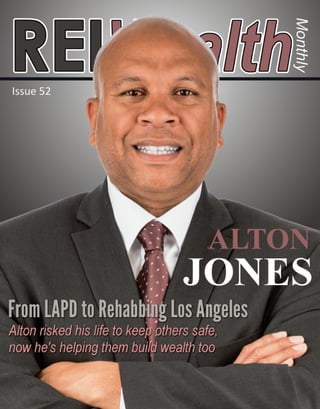
57   Alton Jones: From LAPD to Rehabbing
 Los Angeles
64   Think Differently to Uncover Huge 
 Hidden Profits
70   Inside and Outside Lawsuits
76   Besides the Purchase Price, 
 There are Other Costs You Must Consider
81   Virginia Land Trusts
85   In Memory of Geradline Barry
 REI Icon, Investor, Educator
92   Tips for Working with Probate Leads
96   How to Avoid the Pitfalls
 of Hiring a Bad Contractor 
p. 57
p. 85
p. 21
p. 28
p. 15
8
9
10
11
LINDA'S LETTER
Linda Pliagas, Publisher
Photo by John De Cindis
A
s a 25­year media 
veteran and 
nationally­published 
journalist, I've had 
the pleasure of interviewing 
numerous celebrities, self­made 
millionaires and other VIPs. Many 
of the people I have spoken with 
went from zero to multi­millions 
in a short amount of time. Yes, 
they worked hard, and were 
dedicated, but when the money 
came, it kinda just fell into place, 
quite magically and very quickly. 
In the financial industry, they call 
it a "windfall."
     It doesn't have to take a lifetime 
of toiling to build wealth. 
Abundance can literally happen 
overnight... it's almost eerie. 
     One single deal can put you 
over the top. One business idea 
can manifest millions for years to 
come, even for generations to 
come!!
     By my examination of wealth 
creation, I've noticed something 
very important: Those who don't 
take risks, don't make the big 
bucks. 
     If you were not lucky enough to 
be born into wealth, like many 
people I know, you have to go out 
into the real world and make your 
way in life. It's great to read about 
all the success stories out there. 
The reality is anyone can have 
abundance and prosperity, but 
often times, people don't because 
they are "comfortable". The reality 
is, in order to be wealthy, you 
MUST go outside your comfort 
zone.
     For example, a real estate 
investor must take risks to make 
money. They have to purchase 
property, spend money to fix it up, 
put in on the market, and trust that 
it will sell for the price they want.
     Here are a few tips to get out of 
your comfort zone and start 
ushering in more prosperity into 
your life...
1. Examine your goals.
Do you have a written plan? Do
you know what you want in life? If 
you don't know where you want to 
be five years from now, one year 
from now, or even one month from 
now? If not, how will you know if 
you've reached your ultimate 
destination? Know EXACTLY 
where you want to go. Have a 
written guide to what it is that you 
want to accomplish. Whether your 
goal is to be a top­producing real 
estate agent or a millionaire real 
estate investor, WRITE IT DOWN 
AND HAVE A TIMELINE.
2. Observe How You Spend
Your Time.
 The most precious thing in our 
lives is time. Once time is gone, it 
can never return. Time is so 
precious that one must be careful 
By Linda Pliagas, 
Publisher
Comfort Curtails
Abundance
"THOSE THAT ARE AFRAID TO VENTURE 
OUTSIDE OF THEIR COMFORT ZONE, DO 
NOT END UP WITH ABUNDANCE."
12
LINDA'S LETTER
with how we use it. We must be 
STINGY with our time and guard 
it carefully. We have all heard the 
line: Time is MONEY. So, I ask 
you: How do you spend your 
precious free time? Are you 
blopped in front of the television 
set, just veggin' out? Do you spend 
a lot of time going out to "party" 
with your pals? Do you spend all 
your free time gossiping with your 
girlfriends and putting others 
down? Those who succeed, 
discipline themselves to a strict 
regimen. Observe your schedule: 
is it one that will lead you on a 
path of success or failure?
3. Learn More, Earn More.
Those who carve time out to
study, ALWAYS come out ahead. 
I'm not saying to go back to school 
to earn your MBA, although that 
will certainly help put you at a 
whole new level. The cold fact is: 
The more you INVEST in your 
education, the more ABUNDANCE 
you will have. Don't be 
complacent: go to a seminar, take a 
class at your local community 
college, sign up for an online 
course. At least read a book, for 
God's sake! In order to earn more, 
you must first LEARN MORE.
4. Program Your Mind for
Success
 Our brain is a computer: what 
we input, will be displayed. If you 
go around with thoughts of fear, 
poverty and lack, that's what the 
world will dish out. From my 
studies of clinical hypnotherapy, I 
KNOW for a FACT that a person 
can be PROGRAMMED for 
success. Every single person in this 
planet has the ability and the 
capability to enjoy ultimate 
abundance, health and joy beyond 
their wildest dreams!! We have 
everything we need, right here, 
right now, at this very moment in 
time! But the majority of people 
stand in their own way and limit 
their own success with negative 
words, negative actions and 
NEGATIVE THOUGHTS.
5. Get Out of Your
Comfort Zone!
 Do you have a comfortable, 
easy­breezy life? Then guess, 
what? You are not growing! You 
are not expanding! You are not 
performing at your peak! You are 
not doing every thing you are 
capable of. You are not fulfilling 
your God­given destiny!! In order 
to manifest miracles and create 
abundance, one needs to get out of 
their own complacent, conservative 
lifestyle and take risks. There is no 
other way around it: 
Success will not come 
knocking at your door, one 
must go out there and seek 
it, and REQUEST IT!
     I hope these tips have motivated 
you and have given you a short 
road map to success. I have 
utilized these principles over and 
over again. Every time I faithfully 
follow these rules, I experience 
exponential growth and success in 
a short amount of time. Thank you 
for allowing me the opportunity to 
write this and remind myself of 
these important rules.
     May you seek and receive all 
the joy, love, health and prosperity 
you were meant to have.
Until next time,
Linda Pliagas
Realty411.com
info@realty411.com
13
14
15
AAlllloowwiinngg aa LLeennddeerr
ttoo CCrroossss CCoollllaatteerraalliizzee
AAggaaiinnsstt AAddddiittiioonnaall
PPrrooppeerrttyy
BByy EEddwwaarrdd BBrroowwnn
16
for $200,000. The borrower wants 
to buy another rental for $800,000 
and has $250,000 to put as a down 
payment. The borrower asks a 
lender to loan the remaining 
needed $550,000, but the lender is 
not comfortable with the LTV 
[68.75%], so the lender asks what 
other real estate the borrower 
owns, so it can cross collateralize 
its $550,000 loan. The borrower 
mentions the other rental, and the 
lender decides to ask for crossing 
on the first rental. Thus, the lender 
has lowered its risk because of the 
equity in the first rental.
     Now, let’s say that the borrower 
receives an unsolicited offer for 
the first rental of $525,000, and he 
wishes to accept it. If there was no 
cross collateral against this 
property, the borrower could 
accept the offer, pay off the 
existing first of $200,000, and 
pocket the $325,000 remainder. 
However, because the rental has 
been crossed, the lender has 
There are times when a 
lender is going to ask for 
additional [real estate] 
collateral in order to make a 
borrower a loan. The most likely 
scenario for this is when there is 
not enough equity in the target 
property. Other scenarios include 
a borrower with less than stellar 
credit, or the type or quality of 
the target property may not be 
enough to satisfy the lender to 
make the loan, as most lenders 
are more interested in making 
loans that will pay them back 
instead of facing foreclosures. 
For this reason, the lender may 
ask the borrower to put up 
additional collateral satisfactory 
to the lender so as to give the 
borrower an incentive to avoid 
defaulting on the loan.
     In many cases, this cross 
collateralization may not be 
something the borrower worries 
about, as the borrower intends to 
pay the lender in full. The 
general plan is for the borrower 
to refinance the target property at 
a point where a new lender does 
not require cross collateralization, 
pay off the existing lender, and 
the existing lender releases both 
properties; however, what 
happens when the borrower sells 
the crossed property, or has the 
opportunity to refinance the 
target property, and there is not 
enough to pay off the current 
lender who crossed?
     The danger here is that the 
lender may hold up the sale 
because it does not want to 
release their lien until they are 
paid in full. For example, let’s 
say the borrower owns a rental 
house that is worth $500,000 and 
there is a first mortgage in place 
$550,000 against the property in 
second position. That means that 
there is technically $750,000 of 
liens showing up against the 
property. The borrower cannot 
accept the $525,000 offer without 
having the second [the crossed 
loan] release its lien. 
     For this reason, it is imperative 
for there to be an agreed upon 
release price in which the lender 
agrees ahead of time to release its 
interest in either properties for a 
specific sum. It does not 
necessarily have to be just the 
remaining equity in the first sale 
[$325,000 in our example]. The 
release price could be a smaller 
amount. It could also be a larger 
amount [up to what the lender is 
owed]. If the lender desires more 
than the $325,000, the borrower 
would have to come up with 
additional cash in order to transact 
the sale. This may not be all bad, 
as the crossed lender’s loan has 
then been reduced.
17
     For example, if the crossed rental was sold at a 5 CAP 
rate, and the crossed lender’s interest rate was 7%, the 
borrower may choose to sell the rental and come up with 
money to satisfy the lender should the lender want more 
than the $325,000 net proceeds from the sale. In other 
words, there are times when it makes economic sense to 
come up with money in order to sell property. Another 
similar scenario like this occurs when there is a blanket 
loan covering multiple properties, as is the case when an 
apartment building has been converted to condos and the 
owner of the building desires to sell off one condo at a 
time. A typical lender on the building will usually have 
release prices [agreed ahead of time] under which the 
lender will allow each unit to be sold and the lender takes a 
specific amount [or percentage of each sale] as a pay­down 
of its loan.
     The release price can be negotiated between borrower 
and lender. Because the lender did not take the new 
property alone due to the high LTV, many times the lender 
will reduce its pay­down to where it feels comfortable with 
a specific amount of its loan on the remaining property. To 
make this point clear, let’s say that the lender usually 
makes loans for rental properties at an LTV of no more 
than 55%. Since the new rental was purchased for 
$800,000, the lender would be fine with a loan balance of 
$440,000. Thus, in order for the lender’s exposure to be 
reduced from its original loan of $550,000, it may be 
willing to accept $110,000 from the sale of the first rental 
in order for the lender to release its crossed lien. In this 
case, the borrower would sell the first rental for $525,000, 
pay off the first mortgage of $200,000, and pay the lender 
in second position $110,000 [to release its crossed lien of 
$550,000], and pocket the rest of the proceeds from the 
sale [$215,000]. The borrower would keep $215,000 from 
the sale, and the only debt on the second rental would be 
the lender [who crossed] of $440,000.
     Borrowers who overlook release prices [a specific 
clause in the loan documents] risk having to ask the 
crossed lender after the fact under what circumstances the 
lender would be willing to release the first property. If 
there is no agreement ahead of time, the borrower runs the 
risk of being at the mercy of the lender, as the lender does 
not have an obligation to release its lien for less than what 
it is owed.
     Many lenders may be willing to work out a reasonable 
amount for releasing either property, as it is in the lenders 
best interest to reduce the borrower’s default risk. Having 
more than one property as collateral sounds good in 
principle, but the added exposure of having a loan spread 
out amongst more than one property may not be worth the 
risk. Each situation will be different, but, as a general rule, 
it is more conservative from the lender’s viewpoint to have 
 
18
Meet Edward Brown
     Edward Brown currently 
hosts two radio shows, The 
Best of Investing and Sports 
Econ 101. He is also in the 
Investor Relations 
department for Pacific 
Private Money, a private real 
estate lending company. 
Edward has published many 
articles in various financial magazines as well as 
been an expert on CNN, in addition to appearing as 
an expert witness and consultant in cases involving 
investments and analysis of financial statements 
and tax returns. 
Edward Brown, Host 
The Best of Investing on KDOW AM1220 
on Saturdays at noon  
a low LTV on one property compared to having crossed 
on one or more additional properties that have a higher 
LTV. Additional costs of foreclosure, if needed on more 
than one property, as well as having to deal with an 
existing first mortgage [keeping them current, so that 
lender does not foreclose] may not be a desirable solution 
to protecting the lender’s interest.
     Many lenders may be willing to work out a reasonable 
amount for releasing either property, as it is in the lenders 
best interest to reduce the borrower’s default risk. Having 
more than one property as collateral sounds good in 
principle, but the added exposure of having a loan spread 
out amongst more than one property may not be worth the 
risk. Each situation will be different, but, as a general rule, 
it is more conservative from the lender’s viewpoint to 
have a low LTV on one property compared to having 
crossed on one or more additional properties that have a 
higher LTV. Additional costs of foreclosure, if needed on 
more than one property, as well as having to deal with an 
existing first mortgage [keeping them current, so that 
lender does not foreclose] may not be a desirable solution 
to protecting the lender’s interest.
     This is the primary reason why typical banks do not 
usually cross collateralize their loans. Most banks do not 
like a lot of moving parts. They want to focus on one 
property and the risk associated with it.
     Borrowers should make sure that the lender does not 
hold any of the borrower’s properties hostage and that 
release prices are set at a point where the borrower feel 
comfortable.
What’s
in
your
?PORTFOLIO
Integrate Real Estate through short-term first trust deeds for:
Ease of Investing
Control
Diversification
Transparency
Collateral Ownership
Beat the Market type Returns
Money invested through a mortgage broker is not guaranteed to earn any interest or return and is not insured. Ignite Funding | 2140 E Pebble Road, Suite 160 LasVegas NV, 89123| P 702.739.9053 |
877.739.9094 | Nevada Mortgage Broker License #311 | AZ CMB-0932150 | AZ CMBBR-0121055.
702.739.9053 | IgniteFunding.com
IGNITE FUNDING
20
21
By Kathy Kennebrook
“The Marketing Magic Lady”
Using The
Right Mailing Lists
to Locate
Motivated Sellers(Part 2)
22
S
o what other lists can we use to
locate highly motivated sellers? One
of my favorite lists is people who are
behind on taxes. You can get this list
by getting a list of tax certificates available for 
sale in your county. In most counties this list 
comes out right before the tax certificate sale 
takes place. You would then mail them a 
neutral type of letter saying you are interested 
in buying properties in their neighborhood or 
subdivision. 
     When mailing these letters initially, I 
suggest that you do not refer to the seller’s 
specific problem. All you will accomplish is to 
alienate them so that they will not want to 
work with you. I personally do a mailing every 
year to folks whose tax bills have not been 
paid and I have purchased many properties this 
way. A lot of these folks are people who have a 
problem they need to solve, they just don’t 
know how until they are contacted by you. A 
lot of these people have inherited properties 
they neither want nor need and appreciate your 
offer to purchase it, especially if they have just 
received another big tax bill to pay. This is an 
extremely good lead source for really great 
deals.
     Another great list to 
get from the 
courthouse is the 
eviction notices. This is 
a great list to use to 
find “burned out” 
landlords who are just 
tired of dealing with 
rental properties. They 
don’t want to put 
another tenant in their 
property right after 
they have just evicted 
one. If the tenant has 
done damage to their 
property, this makes them even more 
motivated to sell and gives you the opportunity 
to create an even better deal. You will usually 
find that you end up buying multiple properties 
from these sellers.
     I also like to create lists of people who are 
newly married. You can find this listing in your 
newspaper each week in most areas. In this 
scenario you will be looking for situations 
where the bride owns a home, or both the bride 
and groom own a home and perhaps they want 
to sell one or both and buy a home of their 
own. These can be very good leads for you that 
most of your competition simply won’t think 
about going after. Do that which your 
competition will not and you will have more 
motivated sellers contacting you than you can 
handle.
     You can get lists of divorce notices, death 
notices, liens and judgments and notices of 
bankruptcy. Most of these lists are available in 
the newspaper or at your courthouse. These are 
all people with problems to solve who may 
have a home for sale. If you are using my 
Marketing Magic System I have all the letters 
in place for you to use for these mailings.
23
    If you are working with the list of death notices, just 
make sure you send them a generic type of a “we buy 
houses” type of letter and don’t refer to the fact that you 
know someone has died. This is a good way to alienate 
a potential seller. I have done many deals from this 
particular mailing.
     Another great list to mail to would be people who are 
in the military. These are people who work in the 
military, own a home and end up getting transferred. 
They now have a home and a mortgage payment they 
neither want nor need. These are excellent leads for 
“subject to’s”, or properties that the 
sellers will simply deed to you since 
generally there isn’t a lot of equity in 
these properties and not a lot of time 
for the seller to sell them.    
  This is a very easy list for you to 
obtain. You would obtain a list of 
everyone who has a VA loan and has 
purchased their home within a specific 
timeframe in the area surrounding the 
military base. This is a very good lead 
source for you and you are also doing 
a “public service” when purchasing 
these homes since you are solving a 
big problem for military personnel. In addition, once you 
have purchased a couple of these properties, you will get 
other leads strictly by word of mouth. I have had 
excellent results with military mailings.   
  I also prefer mailing a letter to these folks as opposed 
to using post cards since they are more likely to open a 
personal looking letter and read it.   
  Check out my website at www.marketingmagiclady.com 
for all the information and tools you need to create highly 
successful direct mail campaigns to find highly qualified 
motivated sellers.
“Another great list to mail
would be people who are in
the military. They now have a
home and a mortgage payment
they neither want nor need.”
23
    
If  you  are  working  with  the  list  of  death  notices,  just 
make  sure  you  send  them  a  generic  type  of  a  “we  buy 
houses”  type  of  letter  and  don’t  refer  to  the  fact  that  you 
know  someone  has  died.  This  is  a  good  way  to  alienate 
a  potential  seller.  I  have  done  many  deals  from  this 
particular  mailing.     
Another  great  list  to  mail  to  would  be  people  who  are 
in  the  military.  These  are  people  who  work  in  the 
military,  own  a  home  and  end  up  getting  transferred. 
They  now  have  a  home  and  a  mortgage  payment  they 
neither  want  nor  need.  These  are  excellent  leads  for 
“subject  to’s”,  or  properties  that  the 
sellers  will  simply  deed  to  you  since 
generally  there  isn’t  a  lot  of  equity  in 
these  properties  and  not  a  lot  of  time 
for  the  seller  to  sell  them.      
This  is  a  very  easy  list  for  you  to 
obtain.  You  would  obtain  a  list  of 
everyone  who  has  a  VA  loan  and  has 
purchased  their  home  within  a  specific 
timeframe  in  the  area  surrounding  the 
military  base.  This  is  a  very  good  lead 
source  for  you  and  you  are  also  doing 
a  “public  service”  when  purchasing 
these  homes  since  you  are  solving  a 
big  problem  for  military  personnel.  In  addition,  once  you 
have  purchased  a  couple  of  these  properties,  you  will  get 
other  leads  strictly  by  word  of  mouth.  I  have  had 
excellent  results  with  military  mailings.     
I  also  prefer  mailing  a  letter  to  these  folks  as  opposed 
to  using  post  cards  since  they  are  more  likely  to  open  a 
personal  looking  letter  and  read  it.     
Check  out  my  website  at  www.marketingmagiclady.com 
for  all  the  information  and  tools  you  need  to  create  highly 
successful  direct  mail  campaigns  to  find  highly  qualified 
motivated  sellers.
24
Meet Kathy Kennebrook
     Kathy Kennebrook is the ultimate 
success story. She spent over 20 
years in the banking industry before 
discovering the world of real estate. 
After attending some real estate 
seminars this 4 foot 11 mother of two 
got really excited and before you 
know it she’d bought and sold hundreds of properties 
using none of her own money or credit.
     Kathy holds a degree in finance and has co­authored 
the books­ The Venus Approach to Real Estate Investing, 
Walking With the Wise Real Estate Investor, and Walking 
With the Wise Entrepreneur which also includes real 
estate experts Suze Orman, Robert Kiyosaki, and Dr. 
Wayne Dyer. 
     She is the nation’s leading expert at finding highly 
qualified, motivated sellers, buyers and lenders using 
many types of direct mail marketing. She is known 
throughout the United States and Canada as the 
Marketing Magic Lady. She has put together a simple 
step­by­step system that anyone can follow to duplicate 
her success.
     Kathy has been speaking throughout the country and 
across Canada for over 14 years and has shared the stage 
with Ron LeGrand, Dr. Phil, Dan Kennedy, Mark Victor 
Hansen, Ted Thomas and Suze Orman to name a few. 
     Kathy is going to share with you how she generates a 
seven figure income by mailing a handful of letters 
throughout the year to highly selected targets by knowing 
exactly what to send them, who to send them to and 
exactly how to deliver her message. She will teach you 
the secrets of pre­screening and automating your 
marketing and follow up systems to put your entire Real 
Estate business on auto­pilot. 
     I also provide information on my website for resources 
to locate list brokers who can provide you with the lists 
you need to find the motivated sellers you are looking for.
     Once you find the lists you need that are current and 
targeted to the types of motivated sellers you want to find, 
 you will have the beginnings of a machine that will 
provide you with all the motivated sellers you will ever 
need. 
"A lot of these folks 
are people who have 
a problem they need 
to solve, they just 
don’t know how until 
they are contacted by 
you. A lot of these 
people have inherited 
properties they 
neither want nor 
need and appreciate 
your offer to 
purchase it, 
especially if they 
have just received 
another big tax bill 
to pay. This is an 
extremely good lead 
source for really 
great deals."
25
26
27
28
CChhoooossee
PPrroobbaattee
IInnvveessttiinngg??
By Sharon Vornholt
29
W
hy Choose 
Probate 
Investing?
     Probates have been my #1 
source of leads for more than a 
decade.  I love working with 
probates, however that’s not true 
for all investors.  The reason this 
niche is so good is because you 
will never run out of leads, and 
the heirs almost always need to 
sell the property.  It’s usually 
just a question of whether it’s a 
“pretty house” that will be listed 
(listen up Realtors®), or it’s an 
ugly house needing repairs and 
updates that will be sold to an 
investor.  It’s a pretty straight 
forward choice in most cases.  
Whether it’s a pretty house or an 
ugly house, there is so much 
opportunity here. 
Why Do Investors 
Shy Away from 
Probates?
     I think there are two main 
reasons investors are reluctant to 
work in the niche of probates. 
1. First of all, they just
don’t understand how the 
probate process works.
     Investors think that they have 
to know a lot of legal stuff which 
just isn’t true. Since probate is a 
legal process, you do need to 
have a basic understanding of the 
probate process and the steps 
involved. Specifically, you need 
to know when the house can be 
sold.  One other thing >
that will help you tremendously 
is being familiar with the 
terminology used in probate. 
 Knowing these two things will 
allow you to show up as the 
“expert” to help them with their 
problem which is an unwanted 
house.
2. The second reason is
that their mindset holds
them back.
     Probate investing isn’t that 
much different than other niches 
in real estate, particularly when 
it comes to off­market deals. 
There will be things you need to 
learn that are unique to that 
particular niche. 
     Because the property is part 
of an estate, it makes a difference 
in the way people feel about it. 
 Investors often feel like it’s 
creepy working with probates. 
Or they feel like they are taking 
advantage of someone at what is 
undeniably one of the worst 
times of their life when they 
make a low­ball offer.  They 
feel guilty even when it’s a fixer­
upper that needs a lot of work.
     It’s important to understand 
that it couldn’t be further from 
the truth.  In almost every case, 
the property must be sold before 
the estate can be closed.  That 
means that the heirs have to take 
care of the business of settling 
the estate, before the they can 
collect what they have inherited.  
     Here is the main thing to 
remember about probate; this is a 
great niche for investors because 
the heirs almost never want the 
house.  They just want the cash 
sitting in that property. This is 
also a very profitable and 
untapped source of leads for 
Realtors. In a seller’s market like 
we’re in now, a large percentage 
of those properties will likely be 
listed on the MLS. I’ve been 
doing this a long time, but I don’t 
know of a single Realtor® in my 
area that specializes in probate 
property. As I said before, there 
is so much opportunity for both 
real estate investors and agents.
30
Meet Sharon Vornholt 
      Sharon Vornholt is the 
owner of Innovative Property 
Solutions, LLC in Louisville, 
KY.
      Sharon owned and 
operated a successful home inspection company for 17 
years. She began investing in real estate in 1998 and 
became a full time real estate investor in January of 2008. 
      Sharon specializes in wholesaling, and is also an 
experienced landlord and rehabber. 
     In addition, Sharon is an internet marketer and also 
writes articles for several national real estate sites. Sharon 
is the author of a popular real estate blog called the 
“Louisville Gals Real Estate Blog”. For your FREE 
REPORT “Probates and Absentee Owners: Your Fast 
Track to Real Estate Riches”, stop by her blog at: 
http://LouisvilleGalsRealEstateBlog.com.
FREE BRAND ASSESSMENT AT
https://louisvillegalsrealestateblog.com/brand­assessment
To find learn how you can become the probate expert in 
your area, check out my course, Probate Investing 
Simplified   https://probateinvestingsimplified.com
Showing Up as the Expert
     Remember that marketing is how you get leads, and 
branding is why they choose YOU.  
     When you are able to show up as the expert to talk 
to a motivated seller, they will choose you over the 
other investors every single time because of your 
knowledge about probate.  The seller will be able to 
identify with you. They will also be confident they’ve 
made the right decision because they view you a trusted 
expert. 
     Armed with your knowledge about probate, all your 
marketing will get better results because you will have 
built a rock­solid brand around your expert status.  You 
begin this whole process by changing your mindset. 
 That’s the first step. Then once you have learned the 
terminology, you know the steps in the probate process, 
and you understand how to market to these folks, I can 
promise that you will be light years ahead of your 
competition. 
"You begin this whole 
process by changing your 
mindset.  That’s the first 
step... I can promise that you 
will be light years ahead of 
your competition."
31
32
33
34
Real Estate Investing:
A Market Correction is Coming
By Tim Houghten
35
I
t’s inevitable. A market correction is coming. The 
market has been on a high for years now. In 2018 
alone, the Dow Jones Industrial Average broke a 
record high 15 times. If history has taught us 
anything, it’s that the market cannot sustain those highs for 
that long without a correction. Real estate markets across 
the country are still very hot. Even with the “cooling” that 
some markets are seeing, real estate prices are still well 
above records and competition is hot. “A cool­down has 
been predicted for over in a year in our local market. 
However, I’ve yet to see it. Sure there are some longer list 
times for sellers but properties are still selling in record 
time over asking price. It’s still a hot market,” says Eric 
Jones, Director of Sales and Marketing for Freedom Real 
Estate Group. 
     With all that being said, the question on every wise 
investor’s mind: how can I prepare myself for the next 
recession? The short answer, diversify. The long answer, 
diversify into buy and hold, long­term strategies. 
     “The short­game (fix and flip) is good. It’s instant 
return. But you get hit hard by the tax man. Buy and hold 
has some of the best tax advantages of any asset class,” 
Jones stated. “Depreciation, property taxes, mortgage 
insurance and more are all deductible expenses. Plus, with 
fix and flips, it’s simply not a long­term strategy. It’s not a 
way to build true wealth.” 
 To lessen the risk of any big swing in the market, the 
answer is to diversify your 
investment portfolio so all 
your eggs aren’t in one 
basket. The problem many 
individuals faced in 2008 
was that most of their 
401k or other retirement 
accounts were tied up in 
stocks and mutual funds. 
When the market tanked, 
so did their accounts. 
Now imagine if half of 
those funds were 
diversified into buy and 
hold real estate. For many, 
the outcome could have 
been vastly different. 
Here’s why.
 The key to cash 
flowing, rental properties 
is that even during a 
down economy, they’re still cash flowing at the same 
amount. In some cases, even higher. Let’s look at it this 
way. If you were getting an 8% return on your stock 
investments, and the market crashes, you’re likely going to 
be reduced to 2%­4% if you are lucky. With rental 
properties, the rent amount stays the same. Your mortgage 
stays the same. Your property management fees, if you have 
them, stay the same. Essentially, if you were getting 8% 
returns on your property before, you’re still getting that. In a 
down economy, rents rarely go down. You may not be able 
to get rent increases during that time, but you will at least 
have a steady, consistent amount of cash coming in each 
month. 
     Rental properties tend to weather a down market in a 
consistent or even appreciating way. Not necessarily 
appreciating in value of the asset but appreciating in terms 
of cash flow being received. In a bad economy, a few 
things are happening. People simply aren’t buying homes. 
Credit is tighter. People are scared. The pocketbook is 
squeezed. Instead of purchasing, individuals and small 
families tend to continue renting during a recession. In 
addition, those that may be losing their homes to a 
foreclosure turn to single­family or duplex style rentals 
since it’s more private and familiar than a large apartment 
complex. Therefore, demand may actually increase in a 
down market which is a huge win for rental property 
owners.
36
     With all that being said, a down market is definitely not 
the time to sell your rental properties. It’s a buy and hold 
strategy. During a down market, it is always best to hold 
these properties unless there is some absolute reason you 
must sell. When the market begins to climb again, then you 
may want to consider selling to upgrade to another 
investment property in a better neighborhood or better yet, 
purchase two and double your cash flow.
     The best part of investing in rental properties is 
investors are wealth building while cash flowing. Very few 
investments offer this kind of opportunity. With a buy and 
hold strategy, you are receiving the benefit of monthly cash 
flow while also building a portfolio of tangible assets that 
will always – no matter the market – have value. “If you 
have the right plan, with a decent amount to invest, you 
can quickly scale up to a very healthy portfolio. We 
worked with a dentist who had $400K to invest and 
wanted to receive $10,000 a month in cash flow so he 
could retire. We built a plan and got him to his goal in 
three and a half years. He was able to retire early. 
However, not only did he keep receiving the cash flow 
each month, now he has tangible assets that he can sell off 
if he ever needed to and can pass on to his children and 
grandchildren,” Dani Lynn Robison, Co­Founder of 
Freedom Real Estate Group stated.
     Something else to consider is how you are using the 
power of inflation to your advantage. Most 401k plans 
aren’t able to keep up with inflation. With the small 
returns and high managements fees, unless you are able to 
invest a lot in those funds, you may not even be able to 
keep up with the rate of inflation. However, with rental 
property, you are working with inflation to win in two 
ways. First, your mortgage payment doesn’t change. Let’s 
say when you purchased the property it was a $500 per 
month payment. If the market tanks, it’s still a $500 
payment on a fixed rate loan. If the market is great, same 
payment. 
When the market is doing well, your asset, if all goes as 
planned, is increasing in value. You’re actually earning 
value on the asset while effectively reducing the value of 
the money you’re paying due to inflation. Second, you 
will likely be able to increase the rental amount between 
1%­5% per year. That’s additional cash flow and value 
you will be receiving yearly. 
     Finally, it’s important to note that this is an investment 
and with any investment, there is inherent risk. No 
investment is guaranteed. However, real estate is one of 
the most proven, asset­based investment classes in history. 
Most millionaires were either made through investing in 
real estate or find large value in investing in real estate. As 
you explore this investment opportunity, look for markets 
that do not have super highs or super lows in market 
crashes (like 2008). States affected greatly were Florida, 
California and Arizona. One of the cities most notorious 
for being hit hard in the crash was Las Vegas. These may 
be markets to steer clear of. If a market crash occurs again, 
it may cause migration out of those areas resulting in rent 
losses. “Consider markets that may seem ‘boring’ like 
many in the Midwest including our market – Cincinnati 
and Dayton, Ohio. These have proven to weather a down 
economy and not have big drops in real estate values or 
population. These are the markets where you truly win.” 
Eric said.
     Diversification is the key to weathering a down turn in 
the market. More specifically, investing in buy and hold 
rental properties not only is a proven strategy to survive 
and even thrive in a down market, but one that holds 
many positive attributes such as consistent cash flow, 
numerous tax benefits, and true wealth building. 
19
38
39
Generational
Opportunities
For Creating Cash
& Wealth
In Real Estate
By Gerry Guterman
40
T
he real estate market cycle appears to have 
come full circle again. This is one of those 
moments in which many will go broke, while 
others achieve substantial leaps in their wealth 
and incomes. It’s all about knowing how to take 
advantage of the market and the negligent moves of 
others.
     While there are plenty of real estate investors still 
blindly and bullishly thrashing away in the market, and 
many uneasily eyeing where things are headed from the 
sidelines, the truly experienced are stepping in with 
predictable investment strategies. They see the same 
careless blunders being made by many of the same 
characters. They know where the market is going. They 
see the big opportunities to buy smart and convert assets 
into cash.
Where We Are in the Real Estate Cycle Now
     It’s not rocket science. It’s no longer a 
closely guarded secret that only a few have 
the data on. All real estate professionals 
really need to do is look back at what was 
happening in 2005 to 2010. Then compare 
that to what’s happening around them 
today. You’ll see the same glaring 
mistakes.
     Interest rates are going up, 
lending is tightening, oversupply is 
becoming an epidemic and too 
many people are paying too much 
for units that aren’t really a good 
fit for the market.
     There are really only one of three 
choices to make in this phase of the 
market:
1. Keep blindly investing and hold on as the
sinking ships go down
2. Do nothing and miss out on the best asset prices
3. Replicate the successes of the biggest winners in
similar historical cycles
Gerald (Gerry) Guterman and his firm sold out all of
their real estate assets in 2006. They did it again in 2016. 
Since 1978 they’ve delivered 58.3% returns to their 
investors. Now Guterman Partners is in acquisition mode 
again.
Experience is Everything
     Guterman Partners has managed almost 100M 
rentable square feet of real estate since 1969.
     Among the buildings and locations they’ve been 
involved in that you may recognize are:
● Galt Towers, Fort Lauderdale
● Gramercy House, New York
● Sutton Tower, New York
● Ibis Club Apartment, Naples
● Memorial Building, Houston
● The Stanhope, New York
Gerry who is Senior Principal Partner and Chief
Investment Officer at Guterman Partners has 
what is probably one of the strongest resumes 
in the business when it comes to being a 
sought out industry expert as well.
     This includes being a guest lecturer at 
Cornell University. Being the founding 
benefactor of several charitable 
organizations and medical research 
facilities. Plus trusteeships and 
directorships with the Metropolitan 
Museum of Art in New York, New 
York City Opera and Dallas Opera, 
as well as The Rent Stabilization 
Association of New York.
 On an international level Gerry 
has been Chairman of the 
Committee on Banking and Finance 
at the United States Center for 
Strategic and International Studies in 
Washington, DC. He has been an advisor to 
the governments of Romania and Austria.
     So, if anyone has the depth and breadth of experience 
to really understand what’s going on in the market, and 
the track record of knowing how to manage real estate 
assets during these times, Gerry is definitely up there at 
the top of the list. We were hugely blessed with the 
opportunity to catch up with him for an exclusive 
interview and his take on what’s happening now.
. 
41
Once Again, Generational 
Real Estate Opportunities
     Gerry recently published the 
latest of his white papers 
covering the state of the market, 
and where he sees the 
opportunities now.
     Among the current challenges 
he tackles in his report are:
● The increasing number of
rental to condo conversions
● Reducing value of
condominium units
● Cash flow problems due to
rising costs and rates
● Difficulty in refinance for
developers
● Over­leverage by builders
● Lack of product to market fit
● Reluctance of lenders to
provide more debt
● Oversupply of luxury condo
units
     What this all leads to is 
that many of these 
developers are sitting on a 
huge amount of inventory. 
Inventory on which they 
can’t really reduce retail 
prices on themselves. 
While they are facing 
more cash flow crunches 
and challenges in 
restructuring debt. In 
some cases individual 
developers in NYC are 
sitting on 1,000 or more 
unsold units. They need 
out.  It’s a repeat of 2004 
to 2008 all over again.
 Though when the same 
problems show up, the 
same opportunities for 
creating great cash and 
leaps in wealth arise too.
Strategies for Taking 
Advantage of the Current 
Market
     Gerry told us his firm 
currently sees opportunities in:
● Medical offices
● Retail strip plazas
● Family sized apartments
This is of course restricted to
certain states and markets. Most 
notably outside of some of those 
facing some of the most fierce 
political and regulatory 
uncertainty at the moment.
     Among Gerry’s favorite 
strategies in this phase of the 
market is bulk buying of condo 
units. For example, 80 or so units 
at a time. Those units are 
converted or resold. Typically 
within 19 months.
. 
Gerald (Gerry) Guterman
Senior Principal Partner and Chief Investment Officer at Guterman Partners 
42
3 Big Differentiators
     Three things that Gerry tells us have really helped the 
firm continue to excel include:
1. Making your money on the day you buy
2. Focus on demographics and market fit
3. Focus on the wife as the decision maker
Gerry says you don’t make a dollar on the day you
sell. It’s all about what you are buying at. Guterman 
Partners targets prices of 45 to 55 cents on the dollar. 
That gives them plenty of room to absorb market 
fluctuations and to move units fast at a discount from the 
original list price, while still enjoying hefty profit 
margins,
     However, not any product will do. It has to be 
desirable to the consumer. He says many speculators, 
converters and developers have had no interest in doing 
any homework on what consumers really want. They may 
put up stylish buildings. Yet, there aren’t many families 
who are really trying to move into micro­apartments in 
some of the better neighborhoods of Manhattan. He adds 
that you also have to consider who the real decision maker 
will be and what is most important for them. That often 
includes size of the unit and security features.
     Guterman Partners is now raising capital for its 47th 
year. The current fund is a 506c offering for accredited 
investors, which pays out a cumulative preferred return of 
7% to 12% and 50/50 split of profits.
     Find out more about the new fund, the firm’s track 
record and Gerry’s white papers on the outrageous pricing 
of real estate, the tricks funds are using to try to get 
investors to accept lower returns, and the rules to 
successfully investing in real estate at 
GutermanPartners.com.
43
44
45
Uber of
Self Storage
By Anita Cooper
46
I
f you want to build 
wealth through investing 
it’s important not to 
become myopic when 
thinking about what you’ll 
invest in. 
     As a seasoned real estate 
investor, developer, and 
property investment educator, 
Scott Mednick has a keen sense 
of the marketplace and the 
foresight to keep ahead of 
changes in the market.
     “I'm kind of new...I started 
about 30 years ago and I started 
in Commercial Real Estate with 
­ back then it was Coldwell 
Banker, today it's CBRE ­ 
selling apartment buildings. I 
did that for a few years and then 
sort of got the bug to work for 
myself, so I started building 
custom homes back in the 80s...
     “My timing was not good.  I 
got right in before the market 
crashed, so my home building 
career didn’t last long.  I started 
working for banks as a general 
contractor, fixing up the REO 
properties for them. I 
remodeled about 2500 houses, 
here in Southern California, and 
in 1997, the market changed 
pretty quickly; at that point, I 
started buying and selling 
houses myself and have been 
flipping properties for over 20 
years now. 
     “I’ve been investing here in 
Southern California as well as 
Florida, Texas and Las Vegas, 
but I primarily invest in 
 Southern California ­ as I like 
to stay close to home where I 
can keep an eye on my 
projects.
     “I'm  a licensed real estate 
broker, so I often broker my own 
deals. However, even though I 
am a general contractor, I do hire 
a GC to run my projects.  It’s 
been a long road, but it's been a 
lot of fun…”
     Using knowledge and 
experience gained from years of 
investing, Scott helps other 
investors do what he’s done.
     “I train investor's how to buy 
and sell houses. Having done 
hundreds of flips ­ there’s not 
much I haven’t seen.  I have over 
30 years of real estate experience 
and I manage a fund buying 
value­add self storage properties 
across the United States.
     Just as he helps investors learn 
how to buy and flip properties, 
he’s helping them build up their 
portfolios through investing in 
storage facilities.
     In case you were wondering, 
the self­storage industry is no 
small market...
“A house is just a place 
to keep your stuff while 
you go out and get 
more stuff.” 
­ George Carlin 
47
      According to Self Storage 
Association — a not­for­profit 
advocacy and support 
organization for the self­storage 
industry, there are 
approximately 49,000 primary 
self­storage facilities.
     The total amount of storage 
space among these facilities is 
estimated at 2.6 billion square 
feet, generating approximately 
$32 billion in revenue each 
year.
Other fast facts:
• Facilities across the nation
are about 90% occupied
• There are, on average,
about 540 units at each
facility across the country
• The percentage of
households in the U.S.
using these units is
estimated to be about 9.3%
(as of the first quarter of
2018)
     Through his company Square 
Storage, Scott buys self storage 
properties located in diverse 
markets, buying only those 
facilities where there’s an 
opportunity to add value and 
the demand for storage, retail 
and housing are strong.
     Some of the reasons why a 
self­storage facility may be 
doing poorly include:
• Mis­management
• Under­capitalization
• Not enough storage space
• Insufficient or ineffective
management tools
 Anyone who’s been investing
for a while understands the 
need to diversify their portfolio. 
Self­storage facilities are the 
perfect accompaniment, either 
through ownership, as part of a 
REIT, or other investment 
vehicle.
     Says Scott, “It's also the 
perfect business model, because 
in a down market when 
homeowners loses their house, 
they put their stuff in storage 
and they move in with mom and 
dad.
     “And then, the economy 
comes back, they get a new 
place, they get their stuff. But 
usually when the economy 
comes back they're so happy to 
have money again they buy too 
much stuff, so the extra stuff 
they put back in storage...so it's 
the perfect cycle.
     We are seeking accredited 
investors to partner with us in 
the self storage business. If you 
want to be a part of the next 
commercial real estate boom, 
give us a call and we can 
explain why self storage is the 
next big thing. This is your 
chance to get into the Uber of 
real estate. 
An Interview with
Scott Mednick
Founder
SquareStorage.com
48
49
50
51
Just DO It:
BE the difference
you want to make
By Karen A. Walker
52
Y
ou want to make a 
difference? Start 
by BEING the 
difference. And if 
you’re serious about being the 
difference, start with trust.
     Famed leadership consultant 
Stephen R. Covey said it best: 
“Trust is the glue of life. It’s the 
most essential ingredient in 
effective communication. It’s 
the foundational principle that 
holds all relationships.”
     John Aaron and Gene Simmons, 
co­founders of Florida­based 
Prestige Executive Funding, 
have each independently put 
mutual trust and the strength of 
honoring their word primary in 
their real estate and lending 
relationships long before they 
partnered together to better 
serve their sophisticated clients.
     In fact, trust is so fundamental 
to everything they do in 
business that it’s second nature 
to them, and to their team.  
     Trust is an integral part of 
every transaction in which they 
participate, regardless of client 
sophistication, background or 
anything else…. that is, 
regardless of anything else 
except the equal trustworthiness 
of their clients and their 
arrangements.
Noteworthy
     This year, at age 29, John 
Aaron was featured in Forbes 
magazine’s “30 under 30” 
highlight.   He achieved 
consistent success in the fix and 
flip marketplace with, according 
to Forbes, more than $100 
million in residential properties 
purchased and flipped at the 
time of the article.  
     Gene Simmons, co­founder 
and co­president of Prestige 
Executive Funding, says Aaron 
has about 80 properties in his 
portfolio at any given time. 
Parlaying his residential fix and 
flip success into the commercial 
arena, Aaron is also purchasing 
large commercial apartment 
buildings, developing modern 
waterfront properties, 
condominiums, hotels and retail 
properties.
     But Aaron would rather DO it 
than talk about it.  He’d rather 
lead by example than tell you 
what to do. 
     For Aaron, his early character 
traits and principles of good 
business remain the same as they 
did when he first started: Focus, 
Integrity, Quality, Consistency, a 
lot of Hard Work, and Giving 
Back.
     Just for the record, Giving 
Back is a core motivator for 
Aaron.  Years ago he launched a 
nonprofit foundation and, as 
Simmons describes his young, 
motivated and sharp partner, 
“Aaron is always doing stuff for 
the community.  He’s at soup 
kitchens a lot and helping 
homeless and those in need. He 
likes going into an area, 
purchasing retail and bringing 
much needed jobs and 
opportunities into areas where 
people are struggling. He does at 
least five major service­oriented 
events a year. That’s a big part of 
who he is.”
53
New York to Florida
     Gene Simmons comes from 
the other side of the real estate 
development and investment 
business; the lending side. 
 Originally from New York, he 
relocated to Florida years ago.  
     At this point in his career, 
with more than 20 years 
experience in mortgage and loan 
business, he’s seen his share of 
ups and downs in the industry. 
 He’s also seen—and chosen to 
live by—the timeless principles 
of good ethics and honoring 
one’s word, regardless of what 
this or that other lender is doing.
     Those principles have served 
him well, even through some 
wild years for some sectors of 
the lending industry.  But 
Simmons never veered from his 
core path of excellence in 
service, good ethical practices, 
and high­quaiity loans.
     For Simmons, it’s not solely 
about the money or the profit. 
 He takes a longer view.  For him, 
it’s always been about building 
solid, trustworthy and valuable, 
long­term relationships with his 
clients.  This makes his partnership 
with Aaron a solid one.
Early mentors
     Both Aaron and Simmons 
know their area of expertise so 
well that they practically could 
do it, excellently, in their sleep. 
 But when you talk with either of 
them about their beginnings, 
they are each quick to point out 
excellent mentors in the 
beginning of their careers.  
     For Simmons it was an early 
boss in the loan business.  The 
man was renown for not only 
his nimble and creative loan 
solutions, but also, and more 
importantly, for the ethical way 
he did business. Every. Time.  
     For Aaron, it was a real 
estate investor guru. Again, this 
mentor was bold, challenging 
his mentees and always 
available when a student needed 
help. Above all, he was ethical to 
the core, and Aaron valued that.
     But mentors without students 
who are willing to follow the 
advice of their mentor yields no 
fruit.  The students themselves 
have to be willing to DO what 
they are challenged to do, even if 
it is out of their “comfort zone” 
and doesn’t seem to make sense 
at first.  
     Both Aaron and Simmons 
were willing to take those newbie 
leaps of faith, to take advised 
action, to “just do it,” but only 
because of the high level of 
proven trust they each had for 
their early mentors.  
     Now they, in turn, are trusted 
guides for their team, for each 
other, and for their select 
clientele.
"Trust is the glue of life. It’s the 
most essential ingredient in 
effective communication. It’s the 
foundational principle that holds all 
relationships."
­ Stephen R. Covey
54
Customized Solutions
     “Each deal we do is customized,” says Simmons, 
whose first­hand, creative, ethical funding examples lie 
ready for sharing when the need arises.   
     “We are a full service commercial lending source,” 
continues Simmons, who often recognizes ethical, 
creative financial solutions that are unique for each 
client’s situation long before others even—if 
ever—figure them out.
     “Our staff has over 30 years experience and are 
able to structure financing requests in just about 
every aspect of commercial lending. We cater to 
Corporate Executives, Music Industry Executives, 
Entrepreneurs and Professional Athletes as well as 
Entertainers and Actors from Television and Film. 
We pride ourselves in being extremely competitive 
and honest . We work closely with our more than 
100 institutional relationships in order to meet our 
client’s customized needs, and to guide our clients 
every step of the way.”
     Prestige Executive Funding primarily serves 
sophisticated clients since they are capable of, and truly 
enjoy, providing customized, sophisticated solutions 
that create exciting win­win­wins for all parties, 
including the local community. 
Summary
     In sum, Prestige Executive Funding (FundMePrestige.com) 
finances and provides a wide scope of investment 
opportunities and solutions, including Office, 
Industrial/Warehouses, Multifamily, Mixed Use, SBA, 
Lines of Credit, International, Churches, Equipment 
Financing, Factory, Hotels/Motels, Hard Money Loans, 
Private Equity Mortgage, Bridge Loans, and 
Development Financing. 
     What do you call any partnership with two trail­blazing, 
ethical real estate investing and lending entrepreneurs? 
Unstoppable. Successful. A win for all parties.
     Put a more practical way, Prestige Executive Funding 
provides access to institutional capital, family office 
funds, and direct private money for funding all types of 
real estate investments. Lending in all 50 states. Up to 
90% LTV, Prestige Executive Funding represents a group 
of investors who have financed more than two billion 
dollars worth of loans nationwide. Loans from $1 Million 
to 100+ Million.  Learn more at www.FundMePrestige.com.
“Each deal we do is customized...We are a 
full service commercial lending source.”
­ Gene Simmons
55
56
57
ALTON JONES:
POLICE OFFICER AND HANDS-ON REAL
ESTATE INVESTMENT TRAINER PUTS
STUDENT SUCCESS FIRST
By Karen A. Walker
58
For Los Angeles Police Department (LAPD) 
Officer and master real estate investment teacher 
and trainer Alton Jones and his wife, Rocio, it’s 
all about relationships, helping others succeed and being 
your best self. Every day. Every minute.
     But while Jones has helped people succeed in real 
estate investing beyond their wildest imagination, he 
doesn’t promise, and never himself expected, overnight 
success. His experience as a police officer prepared him 
for that.   
     He knows first­hand that success takes learning, 
listening, focus, persistence, a good sense of humor, a 
healthy dose of humility (did I mention persistence?!) 
and, most importantly, taking action.  
     That last step—action—can be the most difficult, but 
simply doing the right things and repeating until it 
become second nature marks the difference between 
success and none. 
     “It’s one thing to talk about it,” says Jones, “but a 
totally other thing to actually DO it!”
Did you say police officer?
     Jones has been an LAPD policeman for more than 34 
years. For the first 16 of those years, he served as a full­
time, active duty officer. After that—to this day—he serves 
as reserve officer. 
     In the last 10 years, Officer Jones has been honored as a 
Reserve Officer of the Year. Twice!
     “Officer of the Year is a big deal,” explains Jones. “A 
few officers are selected each year and honored for 
exceptional service during the year. About 600 people 
attend the honoree dinner, and it’s really a big deal, with 
any funds raised going to help the families of fallen 
officers or others in our police family who need it.”
     At his more recent honoree event, the main cast and the 
creator of the TV series THE ROOKIE attended, which 
made it extra fun.
People skills
     Just as in police work, real estate investing involves good 
training and good people skills.  Relationships matter.
“It’s one thing to talk about it, 
but it’s a totally other thing to 
actually DO it!!” ~ Alton Jones
59
     Knowing how to talk with a myriad of different types 
of people can mean the difference between life and death 
in police work.  
     “As an officer, especially on patrol, you have to talk 
with so many different kinds of people—victims, drug 
dealers, the mentally unstable, drug users on a high, the 
traumatized, witnesses, violent or less violent criminals,” 
says Jones. “Good officer safety skills are critical. You 
also have to be able to get accurate, useful information 
from witnesses. Those statements have to be able to hold 
up in court or identify a perpetrator, so you have to know 
how to ask a question and which information to pursue. 
     “In addition, sometimes you have just seconds to 
assess a situation or persons involved. Knowing how to 
quickly assess and talk with different people can 
determine if you come home that day.”
     In real estate investing, regardless whether you are 
fixing and flipping houses, negotiating fair win­win 
deals, managing contractors, or teaching others your 
proven system for success, it’s critical to develop good 
people skills and to build strong relationships.  
     And to build any kind of relationship, you have to be a 
person of integrity in words and actions.
Knowledge alone isn’t enough
     “It’s one thing to talk about it, but it’s a totally other 
thing to actually DO it,” says Jones, who gets his 
students quickly to action.  
 Again, the comparison to police work is clear. 
     In the training process you learn how to talk to 
different people, what you need to ask and what to do in 
different situations, what information you need, and so 
forth.  But learning it in a classroom doesn’t make you 
successful.  
 It’s a different story when you get out on the streets 
and you’re talking with real people, or in the chaos of an 
incident and trying to sort it out.  
"You have to 
rise above. 
There’s 
EGO, but 
you gotta 
drop the “e” 
and just 
GO!"
“In developing a real estate 
business, you have to have 
the will to WIN. That keeps 
you focused on the end goal. 
It keeps you going forward.”
60
 Same for the investor. 
     Practice (i.e. taking action) sharpens people skills until 
the right thing to do in negotiating an opportunity or 
managing contractors becomes second nature.
Never stop learning: Mentors matter
     Alton always says, “It’s OK to copycat, as long as you 
copy the right cat.”
     Jones got into the rehab, fix and flip business in 2009. 
 But he didn’t do it alone. He chose his mentors well. He 
invested in himself and in his success, and he hasn’t 
stopped to this day. 
     Even with the success he and his wife have achieved 
and continue to achieve… even with his rapid rise to 
being asked and encouraged by his mentors to become a 
teacher for others, beginning in 2013… even with his 
popular books and with the success he and his wife 
continue to nurture and grow in themselves and others… 
even with all that, Jones continues to listen and learn from 
others.
     Two of his stand­out mentors are Ron LeGrand and 
Dan Kennedy. 
     From his mentors, Jones learned early on that to be 
successful you must be purposeful in all you do.  You must 
run your business as a business, not as a hobby.  
 He learned what to do and how to do it. 
     He also learned to expect uphill battles and set­backs, 
even after you’ve achieved remarkable success. 
 It is what it is.  
 Be prepared. Go forward.  Keep your eyes on the prize, 
on doing the right thing, and on serving others.
61
Drop the "e" in "ego" and just "go"
     “The majority of people will tell you ‘no,’” says 
Jones. “So what? You have to rise above. There’s EGO, 
but you gotta drop the “e” and just GO!
     “In the police department you have to have the will to 
live.  You learn and you have to face the reality every day 
that there are people who want you dead, but you have to 
— you MUST — have the will to LIVE.  That keeps you 
doing the right things, following the good skills and 
training you received.   
     “In developing a real estate business, you have to have 
the will to WIN. That keeps you focused on the end goal. 
It keeps you going forward.”
     Good mentors tell you the truth.  They also practice 
what they preach. 
     The best mentors don’t just deliver knowledge. They 
don’t teach swimming lessons while standing on the edge 
of the pool.  No.  The best mentors lead by example. 
They get in the pool with you and show you how it’s 
done.  They insist you get into the water and learn how to 
swim for yourself. And they’ll be with you every step of 
the way, IF you allow it. 
     When Jones holds training sessions and boot camps, 
he tells it like it is. With a smile, he calls himself a 
minister of truth. He doesn’t deliver what attendees might 
want to hear.  He delivers the reality, the truth.
Rehabs 2 Riches
     It was an unexpected honor when Ron LeGrand, in 
2016, not only praised the system for success Alton and 
his wife had developed, but when he also strongly 
encouraged Jones to launch his own training courses on 
that very system. 
     Alton’s Rehabs 2 Riches courses, bootcamps and 
more soon followed, to popular acclaim by attendees.
     “I believe what we do changes lives,” says Jones. 
 “People who come to one of our events, they’ll make a 
life­changing decision at that event.  Those relationships 
made at our events can take you from $0 to self­
sufficient.”
     Jones smiles when he talks in his bootcamps about the 
importance of building a Million Dollar Rolodex of 
exceptional resources for your business.  “These days 
there are a lot of people who don’t know what a rolodex 
is,” he says.  But it hasn’t held any of his students back. 
They still understand the point.
     Jones practices in three markets—Southern California, 
Dallas and Memphis.  Of all these, however, his preference 
is his beloved southern California.
 For more information, go to Rehabs2Riches.com.
     Alton Jones says that in this business there are five 
things you have to do to succeed:
1. Locate prospects
2. Pre­screen prospects
3. Construct and present offers
4. Follow­up
5. Close quickly
Books by Alton Jones include:
• Ask Me How I Know? Four biggest house­flipping
mistakes that made me millions, by Alton Jones
Karen A. Walker is the founder and executive producer of 
The Mentors Radio Show (TheMentorsRadio.com)
62
63
64
Think Differently to Uncover
Huge Hidden Profits
By Karen A. Walker
65
N
obel Prize­winner 
Albert von Szent­
Gyorgy once said 
that "discovery 
consists of seeing what 
everybody has seen and thinking 
what nobody has thought.” It’s a 
description that captures what 
sets LuxHomePro, its processes 
and its co­founders apart from 
others.  In a nutshell, they think 
differently about luxury vacation 
rental property.
     Founding partners Jerry Conti 
and Dave Bynum were introduced 
by a mutual friend. At the time, 
Jerry was looking for a fresh, 
innovative and lucrative 
opportunity to market. 
     Dave had just completed an 
eight­year, remarkably 
innovative and profitable lead 
generation program he had 
developed and managed for a 
number of major banks from 
2001­2008.  With that project 
finished, Dave was also looking 
for something new that he could 
really embrace and enjoy as 
much as he had enjoyed the 
lead­gen project. 
Keep an open mind: 
Unexpected connections
     In truth, nothing innovative 
happens in a vacuum, and rarely 
at a convenient time. 
     As it turns out, Dave was in 
the midst of planned chaos on 
the day Jerry called to follow 
up.  That chaos included a 
camera crew and live taping 
session with Dean Graziosi. 
 Just days earlier, someone else 
previously unknown to Dave had 
tracked him down in an effort to 
become a silent financial partner 
on any project Dave had in mind. 
 At the time, Dave didn’t have 
anything in mind.
     Dave kept an open mind to see 
where it all would lead.
     Something clicked in the 
conversations with Jerry.  Their 
synergy, diverse areas of 
expertise, shared ethics of 
openness and trust, serving 
others, and creating win­win­win 
opportunities that also allowed 
for big, ethical profits resulted in 
the launch of LuxHomePro at the 
end of 2017. 
     Culling from his years of 
experience fixing and flipping 
homes and short­term rentals, 
Dave applied his knowledge to 
what he saw as a new emerging 
trend: an increasing demand by 
travelers to rent luxury homes, 
rather than stay in hotels. 
AirBNB, VRBO and similar 
platforms were beginning to pay 
attention to the trend as well, 
which opened up even more 
opportunities for the untapped 
win­win­win Dave recognized.
“I see opportunities 
that people don’t 
see...I can align the 
dots enough to get it 
going and then work 
through any failures 
to fix things and 
make it work.”
~Dave Bynum
66
 And that’s what happened. 
     Further fine­tuning was needed and the business was 
in full operation by April 2018, now offering about six 
seminars a year, with turn­key systems and a variety of 
optional, more intense training levels to participants.
 “I have always led my life by being the quiet guy,” 
confesses Dave. “When I’m at a meeting or in a crowd, I 
tend to read the room, figure it out, plant a seed and then 
listen.  I spend more time listening than talking.  I find 
you learn more from others that way.”
     In contrast, Jerry is a front and center, get onboard 
and let’s have fun on the journey kind of person. The 
two co­founders compliment each other wonderfully, 
and they forged a bond of mutual respect and trust, 
which makes for engaging, in­depth and hands­on, 
achievement­oriented learning for their students.  
Keep it Real, Keep it Simple
     “For us, it always has to be a win­win­win,” 
underscores Dave. “It’s a whole lot better if everyone is 
upfront and transparent. When you have a problem, get 
it out in the open so we can solve it together and move 
forward. Otherwise it can fester, people sneak around 
behind others’ backs and it’s just a waste of time and 
energy.  Keep it real! In every negotiation, every 
relationship, keep it open and upfront.”
     “One of the most exciting things for me,” Dave adds, 
“is when I finally put together all the pieces of a problem 
or project and it works!  It’s exciting for me when people 
say yes, believe in us, take action on what they learn, 
and then achieve the same or better results.  It’s exciting 
because it helps change other people’s lives for the 
better. That matters a lot to Jerry and to me.”
Core Concept
     For those who’ve not yet experienced the LuxHomePro 
opportunity, the core concept is brilliant. 
 There are basically three components:
• Luxury vacation renters.  Offer dream housing
options to those seeking luxury vacation home
accommodations.
• Luxury home owners.  Offer owners of qualified
luxury homes an option to sell at a good price and
also to earn significant revenue prior to selling,
without any work on their part and without having to
wait many months and even years to sell their high­
end luxury home.
• LuxHomePro Student “Connectors.”  Earn high
profits, on a consistent basis, following a proven­
successful strategy and easy­to­follow templates and
systems, without the need to own anything or have
good credit.
     It’s essential, of course, that the person connecting all 
parties (“the connector”) follow the system correctly. 
Everything is laid out for seminar attendees, including 
how to properly market a property, how to develop 
attractive pricing, how to upgrade for vacation renters 
and how to manage the operation efficiently and 
profitably.  
67
     Leave out—or even worse, 
cut corners—on any one of these 
components and the promised, 
sure­fire success is in jeopardy.  
     For example, rent a luxury 
vacation rental home from Dave 
and you’re sure to find such 
amenities as a hot tub, in­home 
games, pool or foosball table, 
baby­sitting and personal chef 
upgrade options and super­
discounted access to local golf 
club or other luxury amenities. 
 You can count on your 
experience in one of his homes 
to be truly luxurious and of more 
value than that for which you 
paid. Not cheap, but over­the­
top value. That’s what 
LuxHomePro trains its students 
to provide.
     So, if the LuxHomePro plan 
is followed as laid out, and if it’s 
managed correctly, it’s a 
beautiful thing all around—
amazing profits for you within 
4­6 months or so, amazing 
experience for the renter, and 
amazing profits for the home­
owner.  A win­win­win.
     Not to mention, a no questions 
asked, money­back guarantee.
What others say
     A broker in Michigan who 
had done fix and flips for years 
and recently got into short term 
rentals said he found himself 
struggling with the short term 
rentals. “I tried do it the 
traditional way like you see on 
YouTube,” he explained “and 
really struggled with it. I met 
Dave and he helped me with it, 
looked at the resources I had to 
work with and took it from 
there. He’s thorough. He’s 
patient and he starts working 
with you at wherever you are 
starting out. He can take it to 
where you want to go.”
     Shelly Clayton from 
Scottsdale echoes the Michigan 
broker.  Shelly raves about how 
Dave’s system took her from 
4% booking rate, which 
translated into two bookings a 
year (one of them even 
cancelled) to a 96% booking 
rate.  
     That’s a small segment of 
real­world, first­hand feedback 
from those who implemented 
the LuxHomePro training and 
systems.  And all of it is music 
to the co­founders’ ears! 
     For Jerry and Dave, it’s all 
about helping to change other 
people’s lives for the better.
Looking forward
     Jerry and Dave recently 
introduced a super simplified 
option in which they’ll act as a 
partner for select students who 
have financial limitations, but a 
strong desire to participate in 
the vacation rental industry. 
     To learn more about all of 
LuxHomePro’s offerings, go to 
www.LuxHomePro.com
Top Five Take­Aways 
from LuxHomePro 
Seminars:
1. Keen eye.  Walk away
knowing exactly how to
identify profitable
luxury rental properties.
2. Love what you do.
Find your own niche or
niches in the industry
from which you’ll be
able to master and profit
year after year.
3. Only win­win­win.
Learn the secrets to
setting up deals and
negotiations on the basis
of a win­win­win where
no one gets a bad deal.
4. Positive negotiation.
Learn how to successfully
negotiate with homeowners
so they will jump onto
your side and will want
to work directly with you.
5. Systems and Automation.
Learn which systems to
put into place to automate
your business for maximum
profits and efficiency.
“It’s a whole lot better if everyone is upfront and 
transparent. When you have a problem, get it out in 
the open so we can solve it together and move 
forward. Otherwise it can fester, people sneak 
around behind others’ backs and it’s just a waste of 
time and energy.  Keep it real! In every negotiation, 
every relationship, keep it open and upfront.”
~Dave Bynum 
68
69
70
By Jay Butler
71
72
73
74
75
76
Besides the Purchase Price,
There Are Other Costs
You Must Consider
By Lloyd Segal,
Director of Los Angeles Real Estate Investors Club, LLC (LAREIC)
77
When flipping 
properties, you also 
need to consider 
repair costs, holding costs, real 
estate commissions, closing 
costs, estimated profit, and lost 
opportunity costs.   Let’s analyze 
each of these costs separately.
Repair costs.  The repair costs 
will likely be your largest cost, 
so you need to calculate them 
carefully.  If you’re able to 
inspect the interior, you’ll be 
able to estimate the repairs and 
renovations needed to make the 
house salable.  However, if you 
aren't able to inspect the interior, 
use 10% of the purchase price as 
your estimate of repair costs.  In 
the alternative, multiply the 
square footage of the house by 
$7.00.  For example, if the 
property has 1,500 square feet, 
the estimated repair cost would 
be $10,500.
Holding costs.  It’s going to take 
you approximately 2­4 months 
to repair, market, and sell the 
property.  During those months, 
you’ll incur holding costs (i.e. 
mortgage payments, taxes, 
insurance, and utilities). 
 Neophyte flippers frequently 
forget to include these costs in 
their budgets.  If you’re worried 
about these costs, you can 
significantly reduce them by 
living in the house during this 
period, which is exactly what 
many flippers do when they are 
just starting out.  Instead of 
chalking up your monthly 
expenses as holding costs, 
simply consider it rent.  Another 
way to trim your holding costs is 
to price the house correctly the 
first time.  By offering the best 
home in its class at the best 
price, you’ll sell the home faster 
and lower your holding costs to 
more than cover the cost of 
selling the home for a little less. 
Real estate commissions. You 
can assume you'll pay a 6% 
commission to your real estate 
agent for selling the house when 
you flip it.  For that money, the 
agent will market your property 
for sale, list it in the Multiple 
Listing Service and related 
websites, advertise in local 
newspapers, receive and submit 
offers, negotiate with the buyer, 
and assist you with the timely 
close of escrow.   
Closing costs.  You will incur 
closing costs when it comes time 
to sell the property.  These costs 
include escrow fees, title 
insurance, transfer tax, recording 
fees, and other miscellaneous 
charges.  For a rough estimate of 
closing costs, figure 2% of the 
anticipated selling price. 
“Every 
investment you 
make has an 
opportunity cost. 
 With respect to 
flipping, lost 
opportunity cost 
boils down to 
making choices 
between various 
deals.”
78
Estimated profit:  While we're 
at it, let's factor in profit.  You 
want to make at least a 20­25% 
profit on each of your flips.  In 
that way, if unexpected expenses 
do pop­up, you’ll have some 
margin before you lose money 
on the deal.  (And if you sell the 
house for more than you 
expected, or your expenses are 
lower, you’ll make an even 
better profit.) 
Lost opportunity costs: 
 Opportunity cost is the cost of 
pursuing one investment choice 
instead of another.  Every 
investment you make has an 
opportunity cost.  With respect 
to flipping, lost opportunity cost 
boils down to making choices 
between various deals.  For 
example, if you are considering 
two potential deals and can only 
make one, which one is likely to 
generate the greatest return? 
 Which fits best into your 
workload, your skill set, and the 
time you have available?  If you 
can spend the same amount of 
time and money on a property 
that will generate a 20% return 
instead of another property that 
will yield only a 10% return, 
which would you choose? 
Time:  Another cost that you may 
not have considered is your time. 
 Successful flipping takes time.  If 
you buy a property and plan to do 
some repairs yourself, you will 
save money on repair costs but 
you'll also spending your time. 
 How much is your time worth? 
 If you'll spend 300 hours 
repairing and renovating a 
property and will make $3,000 in 
profit, your time was worth $10 
per hour.  If that sounds good to 
you, great!  If it doesn't, you'll 
need to adjust your cost estimates 
accordingly.  For example, if 
your time is worth $50 per hour, 
you should factor $15,000 into 
your budget for those same 300 
hours. 
“It’s going to take 
you approximately 2­
4 months to repair, 
market, and sell the 
property.  During 
those months, you’ll 
incur holding costs 
(i.e. mortgage 
payments, taxes, 
insurance, and 
utilities).”
79
80
81
VIRGINIA
LAND TRUSTS
By Randy Hughes,
aka, Mr. Land Trust™
82
O
ur modern world is fraught with dangers 
and potential liabilities for the real estate 
investor who just wants to work hard and 
build an estate for his/her family. Learning 
how to conceal assets and appear poor should be the 
goal of all hard­working entrepreneurs. America’s legal 
system has run amok and if you do not concern yourself 
with asset protection you are doomed to fall prey to the 
21st century terrorist…the contingency fee lawyer (and 
his/her client). 
     An interesting and not well understood fact about 
Land Trusts is that they do not have to be formed in the 
same state where the property is located (or where the 
beneficiary resides). Like the founding fathers intended, 
Land Trusts have been left to each state to develop how 
to rule on the use of them. There is no Federal Land 
Trust law. Only a few states have a Land Trust Statute 
(most have only case law supporting the use of Land 
Trusts from other states), but all states recognize some 
form of title holding trust. In this article, I will discuss 
the Virginia Land Trust Statute and its unique benefits to 
the real estate investor.
     The English Statute of Uses was repealed by the 
Virginia General Assembly in 1792, thereby eliminating 
one of the hurdles to land trust validity. But in 1819 the 
legislature enacted a limited Statute of Uses, which 
applies to declarations of trust in which the trustee has 
no duties whatsoever. Since Land Trusts are usually 
drafted requiring the Trustee to do something, even if 
only accepting property and deeding it out, this is all it 
takes to get around the limited Statute of Uses. 
     Land Trusts in Virginia work exactly like those in 
Florida and Illinois. 55­17.1 of the Code of Virginia 
spells out the modern­day interpretations which 
incorporates all these attributes. 58­77 (2) of the 
Virginia Code confirms that a trust is not taxed as a 
corporation. And, 8.01­81 et seq. of the Virginia Partition 
Statute verifies that the remedy of partition cannot be 
used by one beneficiary against another. Furthermore, 
there is no transfer notification requirement nor a 
requirement to disclose the beneficiary (as some states 
have).
     Note: Virginia Land Trust Law (Virginia Code 55­58.1) 
requires an in­state Trustee. Therefore, if you are forming 
a Virginia Land Trust to hold title to property in any other 
state, you need to have a Virginia Trustee. I do not like 
this requirement because although I prefer my trustees 
located in the same state as where I am forming my trust, 
it is nice to have the option to use someone from another 
state.
     So, how do you form an out­of­state trust to hold title 
to the property in your state? And, where can you find a 
trustee from another state to serve as your trustee? These 
are good questions for the concerned real estate investor 
who wants to protect his/her hard­earned assets. You will 
find the answers to these and many more of your 
questions at: www.landtrustsmadesimple.com 
     I encourage you to learn more by going to my FREE 
online training at: www.landtrustwebinar.com/411  and 
text “reasons” to 206­203­2005 for my free booklet, 
“Reasons to Use a Land Trust.” You can also reach me 
the old fashion way by calling me at 866­696­7347 (I 
actually answer my own phone unlike most other 
businesses in America today). 
Randy Hughes, 
aka, Mr. Land Trust™
It  is  difficult  to  convey  all  of 
 the  benefits  of  using  a  Land 
 Trust  in  a  short  article  like  this. 
 I  have been  using  (and  writing 
 about)  Land  Trusts  for  the  last 
 40  years.  If  you  would  like  to  learn  more about  how  to 
 create  your  own  Land  Trusts,  for  FREE  training  go  to: 
www.landtrustwebinar .com/411  or  email  me  at: 
 randy@mrlandtrust.net  for  my  FREE  booklet, “50 
 Reasons  to  Use  a  Land  Trust”  or  contact  me  the  old 
 fashioned  way  by  calling  866­696­7347 (I actually answer 
my own phone!)  Randy Hughes, aka, Mr. Land  Trust™
"An interesting and not well understood fact about 
Land Trusts is that they do not have to be formed in 
the same state where the property is located (or 
where the beneficiary resides)." ­ Randy Hughes
83
84
85
In Memory of
Geraldine Barry
REI Icon, Investor, Educator
TributebyLoriGreymont
86
Geraldine M. Barry, who 
was an icon in the 
tech­based and fiercely 
competitive Bay Area real estate 
investment world, left a great 
hole behind when she passed 
away recently...but she also left 
all of us with a challenge. I will 
get to the challenge later, but 
first, let me illustrate the hole 
that has been created with her 
passing. 
     Real estate investment, when 
successfully done, is both an art 
and a science. Communication 
skills will get you far but you 
must also have business savvy, 
the ability to make sense of 
industry research and regional 
trends, and the confidence to act. 
Geraldine truly was the perfect 
mix of expert communicator, 
savvy businesswoman, and bold 
liontamer to stand out in the 
traditionally male­dominated 
world of real estate investment 
at a time when few women were 
making such big leaps. 
 Not happy to rest on her 
laurels as an accomplished 
investor in her own right, she 
also founded, and for many 
years served as president of, the 
Bay Area’s premier real estate 
investors association SJREI 
(which, in many ways, set the 
pace for investing associations 
throughout the nation). Even 
more importantly, Ger was a 
devoted mother of two, a friend 
throughout all kinds of weather, 
and I really think this says it all: 
a woman who emigrated from 
Ireland to the Bay Area with a 
dream and just $500 in her 
pocket. 
     Though Geraldine often 
credited her goal mindset and 
accomplishments with her love 
of green tea and how her father 
taught her to wake up at 5 AM 
every day, how she did all she 
did in a single day, let alone in 
her lifetime, will forever remain 
a mystery…
     Geraldine was a lion chaser, 
and a great one. 
      For Ger, it did not matter if 
the lion ran into a den, she 
followed it right in and would 
come out victorious. She went 
boldly after investments, she 
brought speakers of the highest 
caliber to SJREI and wouldn’t 
settle for anything less, she 
connected people, she offered 
no­nonsense advice on not just 
business but on living your best 
life, no matter what. She had a 
gift in finding out what people 
needed and connecting them with 
the person that could help. 
Everywhere we went she would 
always say “let me introduce you 
to…”.
     My own life has been profoundly 
impacted by meeting Geraldine. I 
first met her in the early 2000’s 
when I was interested in beginning 
real estate investing. I had been 
doing some development in 
Texas and really wanted to find a 
community in which I could 
network, learn, and advance. As I 
was new to her club, she took my 
hand and introduced me to fellow 
members and did one of the 
things she did best: made me feel 
like part of the SJREI family 
from the very beginning. 
     Over the years, I followed her 
to the different locations such as 
Monterey and Pleasanton. 
Eventually, I asked her if she 
would start a club in Morgan Hill 
for the South Bay.  As she knew 
her limits and bandwidth, she 
declined but eventually we 
decided I would start an investing 
club and it would be a mutually 
beneficial relationship. When I 
reflect back today, I can see that 
this was the beginning of how I 
eventually became the 
predecessor to take the helms of 
SJREI, which I now am proud to 
run today. 
"She was also the friend who always was 
available to anyone in pain or in need: 
she would open her house, bring them in, 
and give them a hug." 
87
     Ger’s transition away from 
SJREI was just as seamless and 
strategic as everything else she 
did. On New Year’s Eve, 2014, 
Ger called me up and declared, 
“I’ve decided to sell my club 
and magazine ­ do you know 
anyone who wants to buy it?”. I 
said I didn’t know of 
anyone...off the top of my head. 
As our call ended, however, I 
heard a voice inside my head 
say, “Yes...you know someone. 
You do.” I pondered for just a 
moment and called her back. I 
said, “Ger, I think I want to buy 
it. I don’t know how but I am 
interested.” She said “great, 
we’ll figure it out after the 
holidays!”...and figure it out we 
did!
     By March 2015, the deal was 
sealed and Geraldine was 
excited to have a respite to 
explore other passions in her 
life. She could see that she had 
created a strong community of 
investors with SJREI, and that 
this community would continue 
to shine bright in the Bay Area 
for many decades to come. I 
truly consider it the greatest 
honor and privilege that Ger 
tapped me to pick up where she 
left off. 
     All too often, those of us who 
roll up our sleeves and commit 
fully to our professional lives 
find our personal lives lacking: 
this was not the case for Ger.
     An inspirational mother, Ger 
loved her children with the 
same intensity she brought to 
her work. She filled her 
children’s lives with 
enrichment, opportunity, 
love...and was also not afraid to 
make the hard decisions to 
ensure the best outcomes for 
them. She took the greatest 
pride in their accomplishments 
over the years, and was always 
bubbling with joy about what 
they had done, were doing, and 
were planning to do.  
     She was also the friend who 
always was available to anyone 
in pain or in need: she would 
open her house, bring them in, 
and give them a hug. When you 
were lucky enough to be a friend 
of Ger’s, you got regular ‘friend 
therapy’ sessions out on her back 
deck served up alongside a glass 
of wine. 
     Maybe one of the secrets to 
her success in her professional 
and personal lives was that for 
Ger, the two weren’t mutually 
exclusive. A brilliant woman, she 
was always thinking and 
strategizing and this just couldn’t 
be turned off. Sharing wine with 
friends, for example, could lead 
to forging connections that would 
benefit someone she knew. SJREI 
meetings and events were also 
opportunities for her children: she 
put them to work and made them 
responsible for various tasks, I 
was inspired how she instilled in 
them, at a young age, the value of 
their time and brainpower. 
"With the passing of someone like Geraldine, 
I have lost a great light in my life, the Bay Area 
has lost a light, the world of real estate investment 
has lost a light...and the world has lost a light."
88
     When I first learned of 
Geraldine’s passing, it took at 
least a day to fully comprehend 
this enormous loss. Then, as her 
passing was shared with her 
community both here in the Bay 
Area, across the United States, 
and in Europe ­­ the outpouring 
of love has been nothing short of 
amazing. I personally have 
received too many stories to 
count from folks who just want 
to share how deeply Geraldine 
has impacted their lives. 
     My one life goal which I 
carry with me always is to help 
so many people through my 
life’s work that when I am gone, 
my children will never want for 
a need. In her time on this earth, 
Geraldine has given that very 
gift to her children as everywhere 
Ger went and worked, she 
created a community of people 
who could, in ways small and 
large, in some way credit Ger 
for some of their success. Ger’s 
work as a catalyst and connector 
for investors has also meant that 
so many other people’s children 
will never want for a need. 
     With the passing of someone 
like Geraldine, I have lost a 
great light in my life, the Bay 
Area has lost a light, the world 
of real estate investment has lost 
a light...and the world has lost a 
light. I have now spoken of the 
hole created by Ger’s 
passing...but now here is the 
challenge: 
 It is up to each of us to 
continue her work in paving the 
way for women in real estate 
investment and in traditionally 
male­dominated fields: to truly 
honor her legacy, we must be 
brave when we need to be, build 
community when we can build it, 
mentor when others need it, make 
the introductions and connections 
even when awkward, and go 
boldly chasing those lions when 
we think they’re worth chasing. 
     Personally, my challenge will 
be to honor her legacy in how I 
run SJREI with standards that 
demand nothing less than best 
and to always keep Geraldine as 
my role model in how to love the 
community of which I am apart.
“Geraldine was 
a lion chaser, 
and a 
great one. 
 For Ger, it did 
not matter if 
the lion ran 
into a den, she 
followed it right 
in and would 
come out 
victorious. ”
­ Lori Greymont
Geraldine Barry, founder of SJREI, and Lori Greymont, who followed her footsteps as 
the next President of the San Jose Real Estate Investors Association -- SJREI.
89
90
www.ISurvivedRealEstate.com or 951-780-5856
Hosted By
Join The Norris Group on September 27th for our 12th annual charty gala at the Nixon Presidential Library.
Elections are around the corner, technology disruptors abound, and economists are predicting 2020 will be a
recession year. Time to hear from the leaders shaping our industry! Dress up, enjoy a spectacular meal in the
Presidential East Room, network with successful real estate professionals from all over California, and help
raise funds for kids with life-threatening medical conditions.
A Powerhouse Lineup of Industry Experts
Converge for The Biggest Night in Real Estate
THE PANEL
THE SPONSORSTHE SPONSORS
CHARITIESCHARITIESCHARITIES
Thank you for
helping us raise
over $940,000
for charity since
2008.
REAL ESTATEI SURVIVED
2019
REAL ESTATEI SURVIVED
2019
REAL ESTATEI SURVIVED
2019
Coldwell Banker Town &
Country
In A Day Development
Inland Valley Association
of Realtors
Jason Thorman/Real Estate
Sales & Investments
Keystone CPA
LA South REIA
Las Brisas Escrow
Michael Ryan & Associates
NorcalREIA
NSDREI
Orange County Investment
Club (OCIC)
Pacific Premier Bank
Pasadena FIBI
Shenbaum Group
SJREI
Spinnaker Loans
South OC REIA
uDirect IRA Services
Wilson Investments
White House Catering
MVT PRODUCTIONS
Apartment Owners Association
of California, Inc.
Special Thank You to Coach Jack Fullerton
Sean O’Toole
President
PropertyRadar.com
John Burns
CEO
John Burns Real Estate Consulting
Mark Lesswing
Blockchain Technology Office
DomiDocs, Inc.
Bruce Norris
President
The Norris Group
Doug Duncan
Chief Economist
Fannie Mae
Jim Park
CEO
The Mortgage Collaborative
Ryan Gorman
CEO
NRT LLC
Realty411-8.indd 1 8/7/2019 11:39:39 AM
92
Tips for Working with
Probate Leads
By Kristine Gentry
93
P
robate leads are a great way to find motivated 
sellers, but you do have to work the leads. We 
know many Real Estate Investors who says 
probate leads are their favorites and have led 
to some great deals. But we know that probate leads can 
be confusing for those who are just starting to work in 
Real Estate or in probate, specifically. If you are just 
starting in probate leads, and need some help, we have 
gathered some of our best tips below.
1. Purchase probate leads from a reputable seller – This
will save you a lot of time and allow you to spend
your time working the leads as opposed to collecting
the leads.
2. Use historical leads to develop your list – Probate
properties are sometimes sold fast, but other times
heirs take a while to decide what to do with them.
Most properties are sold within 18 months, but many
of them are sold towards the end of that time frame.
We highly recommend purchasing probates for the
past 6 months and including them in your outreach
campaign for any area you are working.
3. Develop a mailing strategy – We recommend sending
a formal letter the first month, followed by a post
card every other month for a minimum of six
mailings. You will want to vary the post cards and
make sure to emphasize what you are offering that
will help the potential seller. Try different colors and
styles and see what works best for you. The main
goal with the mailer is to have your mailer in front of
the seller when s/he decides to sell.
4. Make sure your call to action is clear and easy to do
– We suggest including several options for the seller.
While it is best if you can get the seller on the phone,
they may want to do some research on you before
calling. Make sure they can find you online and on
social media. Make sure you provide an email
address to in case they prefer to send an email.
5. Follow­up with phone calls – The most successful
probate strategy includes making outbound calls to
potential clients. We see the most success from
investors who use a combination of mailers and
phone calls.
6. Be prepared to offer your help – Most people who are
probate executors are both grieving the loss of a loved
one and tasked with settling an estate. They have a lot
going on, and most of the time are appreciative of
someone who can help them through this time. When
you get a potential seller on the phone, try to understand
what issues are causing the most stress, and think of
creative ways that you could help minimize that
stress. The most successful probate investors spend
time developing relationships with potential sellers
and provide much needed assistance.
7. Be patient – Most leads will not amount to anything,
but when dealing with real estate, you do not need to
turn a deal on every lead. You may simply need to
find a single great deal to make the effort worthwhile.
The most successful real estate investors develop their
strategy, implement it, and then wait patiently to find
the right deal. Consistency and patience are key in real
estate investing.
If you follow these tips, you are bound to have great
success with probate investing. These are great leads to 
motivated sellers, but you do have to reach out repeatedly 
to make contact. Then you will need to be ready to help 
and respond to the needs of the seller when they respond 
to your campaigns.
US Probate Leads Can Help!
     Are you ready to take your business to the next level?  
If you are, let the experts at US Probate Leads assist you 
in making sure that you have the tools that you need in 
order to profit.  Call us today or visit our website at 
www.usprobateleads.com for more information on 
webinars, seminars, lead services, and personalized 
mentoring programs.  
94
95
96
How To Avoid
The Pitfalls
Of Hiring
A Bad
Contractor
By Gary Massari
97
O
ne of the biggest pitfalls you can make is 
to hire a contractor without a check­off list. 
 If you fail to interview, prescreen, and 
check the contractor’s references, or set up 
the proper working relationship through the six critical 
documents needed to protect you and your investors 
when rehabbing, you could be facing serious problems.
     I will share with you one of my most trying 
experiences when doing a rehab out of state in Atlanta, 
Georgia.  I hired a contractor on the recommendation of 
a new project manager without properly doing my 
research and homework. As a result, the job turned into 
a disaster with a nine-month time over­run.  This 
contractor under­bid all the other contractors we were 
interviewing, and we awarded them the job.  We put 
together a contract, scope of work, Insurance 
indemnification, and payment schedule.  Sounds good 
so far. Well, here is what happened.
     The contractor kept asking for more money than 
what was on the agreed payment schedule, and after 3 
months I had paid the contractor 80% of the entire 
budget with only 25% of the work done.  The contractor 
started falling behind with one excuse after another, 
claiming problem after problem. After each inspection, 
they would ask for more money to fix the new 
problems.  After I asked for all the paid receipts, the 
contractor ignored me.  They wouldn’t return my phone 
calls, or emails, I knew the contractor was going to skip 
out on the job with the money!    
     The contractor was gone with over $63,000 of rehab 
money with only 25% of the work done!  I was 
screwed!  So let’s go over the pitfalls so you don’t make 
these mistakes. All the signs were there. I should have 
known!
THERE ARE SIX CRITICAL DOCUMENTS YOU NEED 
TO HAVE THE CONTRACTOR SIGN IMMEDIATELY, 
BEFORE ANY PAYMENTS ARE MADE: 
1. Independent Contractor Agreement (Make sure
it is reviewed by an attorney.)
2. Final Scope of Work (Line­item by line­item,
with part numbers)
3. Payment Schedule with 25% hold­back for last
payment
4. W­9 IRS Form
5. Insurance Indemnification Form, with you as a
loss payee, and Workers’ Compensation Insurance
6. Final and Unconditional Lien Waiver
LET'S AVOID PITFALLS:
1. All changes must be in writing and signed by
both parties.
2. Before any payments are made require copies of
receipts.
3. Make sure you have a Release­of­Lien signed
before making the final payment.
4. DO NOT get involved running errands for the
contractor.
5. If the contractor runs into problems and asks for
more money, make them turn in change orders
listing materials and labor.
6. If the contractor takes on another job, and your
project starts slowing down, make sure you put in
a penalty on a per diem basis.
7. Make sure the contractor shows up daily to the job site.
    Unfortunately, no matter how experienced you are, and 
how many rehabs you have done,  even a contractor you 
have been using can turn on you and make you and your 
project miserable.   
     Use the 6 critical documents I have listed, and make sure 
you use written Change Orders. Sign off on everything.  
     Hope this article helps you to avoid the pitfalls that 
can be very costly.
Gary Massari CEO of REI Fortunes, 
https://reifortunes.com  
Bruce Kellogg, Real Estate Consultant
98
Meet Gary Massari 
Leading REI Coach & Trainer
     Gary Massari is best described as 
a man with a long and successful 
past!  He is a top real estate investor 
and trainer who ran a successful 
peak­performance school and trained 
over 3000 realtors, investors and 
loan officers to become top income 
earners. He was also the managing 
partner of the largest mortgage 
brokerage company in northern 
California. Then there were his years 
as a co­host on the very popular 
radio show in the San Francisco Bay 
area where he taught financial 
literacy to over 25,000 weekly 
listeners. 
     Gary helps to build his students, 
followers, and team members their 
own unique master plan to achieve 
their REI Wealth.
     He’s also a best­selling Amazon 
Author in four different categories, 
with more than 300 published works 
and the founder of Make Money 
Now Real Estate Investors. If there’s 
anybody in the know, it’s Gary. In 
fact, through Gary’s mentoring 
programs, he has had students 
become millionaires and build their 
own fortune 5000 companies.
     But what makes Gary tick?  Gary 
believes that a person’s success 
requires a few things:  Hands on 
mentorship, community, education & 
local support.  He has built an entire 
REI club and network around those 
concepts.  
     For Gary it’s about giving the full 
experience to the student so they can 
actually get out there and succeed. 
 One of his single­most sought after 
programs is the “Ultimate Master 
Plan for Real Estate Investors”, 
which contains many parts that help 
one become a master of their own 
life and their own investments.  His 
goal for you is to retire debt free, 
mortgage free and wealthy.
     Gary breaks your master plan 
down into these critical areas:
● A Personal Budget
● Debt Retirement Including
Mortgage Debt
● 5­Year Income Plan
● A Real Estate Purchasing
Schedule for properties and
notes
● A Net Worth Balance Sheet
to measure their wealth as
they grow it.
One key service that Gary offers
is his national REI Club where he 
provides to his membership all the 
key components of success that are 
so important to him: Hands on 
mentorship, community, education 
& local support.  And his education 
is always exciting, thorough and 
top notch!  Just look at some of 
these workshops:
● How to find hidden deals and
beat your competition to the
Bank,
● How to build their net worth and
a create a debt free mortgage
free retirement.
Meet Bruce Kellogg
     Bruce Kellogg has been a 
Realtor® and investor for 36 
years. He has transacted about 
500 properties for clients, and 
about 300 properties for 
himself in 12 California 
counties. These include 1­4 
units, 5+ apartments, offices, 
mixed­use buildings, land, lots, 
mobile homes, cabins, and 
churches. He is available for 
listing, selling, consulting, 
mentoring, and partnering. 
99
100

Issue #52 - Featuring Alton Jones