FOUNDERS OF
ISLAM
FOUNDERS
-Born in Mecca CA 570 C.E
-Died in Medina in 632
- Most information we know about him comes from Quran,
biographies written after his death (Sirah) and the Hadith.
MUHAMMAD
as “Rasul Allah”
(God’s messenger to Arabs)
•His father died before he was born,
•His mother died when he was
6 years old
•His paternal grandfather, who sent
him to live with his nomadic tribe
•Khadija-wealthy widow that
impressed by his honesty and
hired to manage caravan business
and Muhammad proposed after
while.
•The couple married for 24 years and
at least 7 children
-4 daughters who survived to
adulthood
-3 sons who died in infancy
•The night Muhammad was called to become a prophet of Allah, known as the
Night of Power, took place when Muhammad was around forty years old.
•In 613, Muhammad began preaching to the people of Mecca
•His earliest messages focused on the oneness (tawhid) of Allah, the
punishments that await the greedy and the proud on Judgment Day, and on
exhorting people to show goodwill toward one another.
•He put special emphasis on the care of the poor, especially orphans and
widows.
•The most powerful tribal leaders in Mecca attempted to bribe him into silence
by offering to share the wealth of the annual pilgrimage with him and even
allowed for the God that Muhammad believed in to be deemed the most
powerful of all the gods in Mecca.
•In a town called Yathrib, north of Mecca, a civil war was tearing the town apart.
•In 621, the city leaders sent a delegation to Muhammad to invite him to move to
Yathrib.
•In 622, Muhammad and his followers left Mecca for Yathrib, an event
remembered as the Hijra, or emigration.This event became year one of the
Islamic calendar.
•Muhammad built the first mosque in his new home, and Yathrib became known
as the city of the prophet, madinat al-nabi, or simply, Medina, one of Islam's
three holiest cities (Mecca and Jerusalem being the other two).
•Once in Medina, Muhammad drafted an agreement on behalf of the feuding
clans that guaranteed mutual respect and religious freedom, and required
common defense of the city.
•He was deeply disappointed, however, when leaders of the Jewish tribes of the
city, close allies of Muhammad's enemies in Mecca, did not accept his claims to
be a prophet.
•Until this time, Muhammad had taught that God's revelation to the Arabs was
in a common stream with Jewish and Christian revelations, not a separate
religion but the culmination of them.
● •Upon this rejection from the powerful Jewish tribal leaders of Medina,
Muhammad received revelation from God to break away and found Islam
as a separate religion.
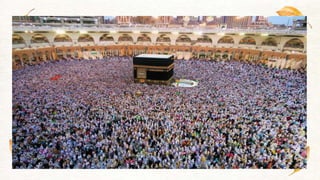
•Muhammad destroyed the idols in the Kaaba and the other shrines in the city,
and performed the rites of pilgrimage.
The following year, Muhammad and his troops suffered heavy losses in a second
battle with the Meccans.
Muhammad had married several women after Khadija’s death and he and his
wives and children settled in Medina.
•The following year, many of the tribes of the peninsula pledged loyalty to
Muhammad and Meccans converted to Islam. He had gained control of Arabia.
• The Meccans continued to harass Muslims, confiscating and selling their
property.
•In 630, Muhammad and the Muslims took control of Mecca.
•The following year, many of the tribes of the peninsula pledged loyalty to
Muhammad and Meccans converted to Islam.
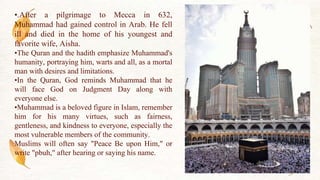
•.After a pilgrimage to Mecca in 632,
Muhammad had gained control in Arab. He fell
ill and died in the home of his youngest and
favorite wife, Aisha.
•The Quran and the hadith emphasize Muhammad's
humanity, portraying him, warts and all, as a mortal
man with desires and limitations.
•In the Quran, God reminds Muhammad that he
will face God on Judgment Day along with
everyone else.
•Muhammad is a beloved figure in Islam, remember
him for his many virtues, such as fairness,
gentleness, and kindness to everyone, especially the
most vulnerable members of the community.
Muslims will often say "Peace Be upon Him," or
write "pbuh," after hearing or saying his name.
Islam.pptx

Islam.pptx

  • 1.
  • 2.
  • 3.
    -Born in MeccaCA 570 C.E -Died in Medina in 632 - Most information we know about him comes from Quran, biographies written after his death (Sirah) and the Hadith. MUHAMMAD as “Rasul Allah” (God’s messenger to Arabs)
  • 4.
    •His father diedbefore he was born, •His mother died when he was 6 years old •His paternal grandfather, who sent him to live with his nomadic tribe •Khadija-wealthy widow that impressed by his honesty and hired to manage caravan business and Muhammad proposed after while. •The couple married for 24 years and at least 7 children -4 daughters who survived to adulthood -3 sons who died in infancy
  • 5.
    •The night Muhammadwas called to become a prophet of Allah, known as the Night of Power, took place when Muhammad was around forty years old. •In 613, Muhammad began preaching to the people of Mecca •His earliest messages focused on the oneness (tawhid) of Allah, the punishments that await the greedy and the proud on Judgment Day, and on exhorting people to show goodwill toward one another. •He put special emphasis on the care of the poor, especially orphans and widows.
  • 6.
    •The most powerfultribal leaders in Mecca attempted to bribe him into silence by offering to share the wealth of the annual pilgrimage with him and even allowed for the God that Muhammad believed in to be deemed the most powerful of all the gods in Mecca. •In a town called Yathrib, north of Mecca, a civil war was tearing the town apart. •In 621, the city leaders sent a delegation to Muhammad to invite him to move to Yathrib. •In 622, Muhammad and his followers left Mecca for Yathrib, an event remembered as the Hijra, or emigration.This event became year one of the Islamic calendar. •Muhammad built the first mosque in his new home, and Yathrib became known as the city of the prophet, madinat al-nabi, or simply, Medina, one of Islam's three holiest cities (Mecca and Jerusalem being the other two).
  • 7.
    •Once in Medina,Muhammad drafted an agreement on behalf of the feuding clans that guaranteed mutual respect and religious freedom, and required common defense of the city. •He was deeply disappointed, however, when leaders of the Jewish tribes of the city, close allies of Muhammad's enemies in Mecca, did not accept his claims to be a prophet. •Until this time, Muhammad had taught that God's revelation to the Arabs was in a common stream with Jewish and Christian revelations, not a separate religion but the culmination of them. ● •Upon this rejection from the powerful Jewish tribal leaders of Medina, Muhammad received revelation from God to break away and found Islam as a separate religion. •Muhammad destroyed the idols in the Kaaba and the other shrines in the city, and performed the rites of pilgrimage.
  • 8.
    The following year,Muhammad and his troops suffered heavy losses in a second battle with the Meccans. Muhammad had married several women after Khadija’s death and he and his wives and children settled in Medina. •The following year, many of the tribes of the peninsula pledged loyalty to Muhammad and Meccans converted to Islam. He had gained control of Arabia. • The Meccans continued to harass Muslims, confiscating and selling their property. •In 630, Muhammad and the Muslims took control of Mecca. •The following year, many of the tribes of the peninsula pledged loyalty to Muhammad and Meccans converted to Islam.
  • 9.
    •.After a pilgrimageto Mecca in 632, Muhammad had gained control in Arab. He fell ill and died in the home of his youngest and favorite wife, Aisha. •The Quran and the hadith emphasize Muhammad's humanity, portraying him, warts and all, as a mortal man with desires and limitations. •In the Quran, God reminds Muhammad that he will face God on Judgment Day along with everyone else. •Muhammad is a beloved figure in Islam, remember him for his many virtues, such as fairness, gentleness, and kindness to everyone, especially the most vulnerable members of the community. Muslims will often say "Peace Be upon Him," or write "pbuh," after hearing or saying his name.