lltlo nt ic Com m it t ee, on ll g ricu I tu ro I €n g inee,ri ng
ACAE Pub. No. 32 AGDEX No. 563
Irrigation System Types
& Typical Applications
By Trent Webster, P.Ag., P.Eng. N.S.D.A.M. Extension Engineer
The purpose of this fact sheet is to help new irrigators
become familiar with irrigation systems that are used in
the Maritimes today. It reviews the system components,
operation, advantages, disadvantages, crops used on, and
costs of each type of irrigation system. Pumps, irrigation
scheduling, and water supplies are also discussed.
Irrigation is often required in many regions of the
Maritimes in order to produce quality crops consistently.
Maritime farms usually experience one or more dry
spells, in excess of two weeks duration, each year.
During these dry spells, cash crops on sandy soil types
suffer irreversible yield losses, or even crop failures in
extremely dry years. This crop soil moisture stress can
be eliminated by irrigation.
Frost protection of temperature sensitive crops is another
benefit of certain types of irrigation systems. Frost
protection is discussed under the solid set small sprinkler
section of this fact sheet.
Farmers who are unfamiliar with irrigation must take into
consideration many factors prior to purchasing a system.
These may include: (1) field concerns such as soil type,
drainage, erosion potential, proximity to power,
topography including elevation lifts, and distances from
the water supply; (2) water concerns such as availability,
quantity, quality, costs to upgrade or to develop a water
supply, and annual crop water requirements; (3) crop
concerns such as yield potential, frost protection
requirements, row spacings, sprayer boom widths,
planting, cultivating, and harvesting practices; and (4)
system concerns such as the type of power supply, labor
requirements and availability, capital and operating costs,
and irrigation cost/benefit ratios.
Each irrigation system type has its own niche application.
Equipment purchase will be made easier by reviewing the
basics of each system type, and by knowing the main
advantages and disadvantages of each system. Once the
type of irrigation system is chosen, it will need to be
customized for the particular field and crop application.
This should be done by an Irrigation Equipment dealer,
or a qualified Agricultural Engineer.
The irrigation system types currently used in the
Maritimes include:
] Hand-Moved, Small Sprinklers
I Solid Set Small Sprinklers
I Hand-Moved, Volume Guns
I Hard Hose Reels
O Center Pivots
I Trickle or Drip
Hand-Moved. Small Sprinhlers
This is the most basic small sprinkler system, i.e. the
starter system, and was the first type of irrigation to be
used in the Maritimes on a large scale.
System Components
) Relatively small pumps, up to approximately 2,270
L/min (600 United States gallons per minute, U.S. gpm),
are used.
> A mainline pipe is laid from the water supply to the
field, and across the field headland, i.e. 100 or 150 mm
(4 or 6 in) aluminum mainline, or header pipe.
} One or two lateral pipes are run the length of the
field, from the header pipe. i.e. 50 to 100 mm (2 to 4 in)
diameter aluminum lateral pipes are usually spaced every
12 to 18 m (40 to 60 ft) along the header prpe.
> Relatively small sprinkiers, ranging frorn 11 to 113
Limin (3 to 30 U.S. gpm) each, are spaced every 12 to
18 m (40 to 60 ft) downthe entire length of the lateral
pipe, or pipes. Sprinkler pressures can range from 345
to 480 kPa (50 to 70 pounds per square inch, psi).
Operation
The pump, mainline, header, and one, two or more
laterals are installed in the field.
On a single lateral system, the pump is operated long
enough to provide the required amount of water, and the
system is shut down. The pipe is manually moved to the
next lateral position, and the system is started again.
With two or more lateral lines, irrigated lines can be
moved while the other laterals are being operated, by
using lateral valves on the field header. The pump does
not need to be shut down to move the laterals. This saves
repriming the pump to irrigate more ground.
Advantages
O The total system capital cost is relatively inexpensive.
O The area under the system can be frost protected.
Disadvantages
@ This is a very labor intensive irrigation system.
@ The area that is not covered by the system cannot be
frost protected.
Crops Commonly Used On
lg This system is used primarily on high value cash
crops such as vegetables of all types, strawberries,
raspberries, smail fruits, and tree fruits, etc.
Costs
The capital costs are relatively low when compared to
solid set small sprinklers. The first 0.4 ha (acre) with 12
sprinklers, pipe, and 7.5 kW (10 hp) gas pump, could
cost over $5,000. Approximately another $1,000 could
provide irrigation to the next 0.4 ha (acre), since only
additional mainline, or header pipe would be required.
The labor cost to operate the system is relatively high,
since the lateral pipes must be moved in order to get
water to all of the crop.
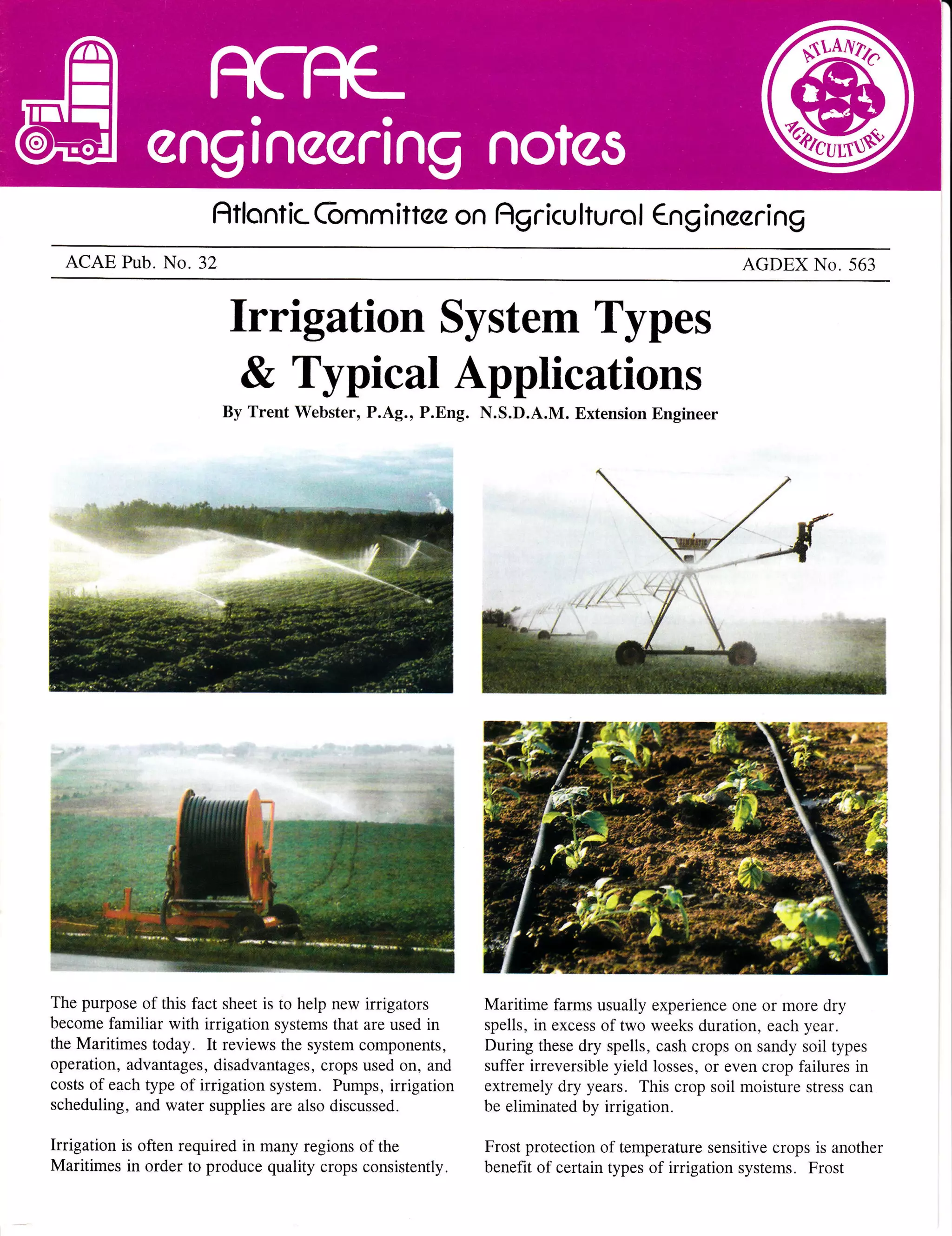
Solid Set Small Sprinklers
With this system, the entire field is covered with
sprinkler irrigation. The sprinklers are set in the field for
the full growing season.
Typical sprinkler spacings range from 72 x 12 m (40 x 40
ft) to 27 x27 m (90 x 90 ft), depending upon the exacr
sprinkler, nozzle size, and operation pressure
combination used. The most common spacing used by
the strawberry industry is 18 x 18 m (60 x 60 ft), with a
Rainbird 30H sprinkler, or equivalent, with 4 x2.4 mm
(5132 x 3132 in) nozzles. Only the 4 mm (5132 in) nozzle
is used for frost protection.
Solid set small sprinkler systems have been widely used
as a frost protection system for strawberries, and as an
excellent irrigation system.
System Components
} Relatively large pumps, up to 7 ,570 L/min (2,000
U.S" gpm) or larger are used, since the entire field is
covered at the same time for frost protection.
> 100 to 200 mm (4 to 8 in) mainline sizes are common
to get the water to the field and across the headland.
F Enough lateral pipes to cover the entire field are
used, spaced 12 to 27 m(40 to 90 ft) apart. Common
lateral pipe diameters are 50 to 100 mm (2 to 4 in).
F Relatively small sprinklers, ranging from 17 to 170
L/min, (4.5 to 45 U.S. gpm) each, are spaced every 12
to 27 m (40 to 90 ft) down the entire length of the lateral
pipes. Sprinkler pressures can range from 345 to 480
kPa (50 to 70 psi).
Operation
The irrigation system is set in the field, prior to the
spring frost for strawberries. The entire field must be
covered by water from the sprinklers, in order to provide
complete frost protection.
The frost protection system is started before freezing
begins atthe field level, around 1" C (34" F) or sooner.
As the air temperature drops to below freezing, the heat
stored in the applied water protects the crop.
As the applied water freezes, the latent heat of fusion
given off during the water phase change (from liquid to
solid) is sufficient to keep the fragile strawberry blossom
at 0' C (32' F). This method can protect crops down to
an air temperature of around - 6 to - 4' c (21to 25' F).
Typically, a night of frost protection can require 6 to 12
hours, or more, of irrigation. The system applies
between 2 and 4 mm (.08 and .15 in) of water per hour,
therefore a night of frost protection can put 25 mrn (1 in)
of water, or more, on the protected crop. Proper field
drainage is essential on these crops.
To irrigate, the system is run similarly, except that all
laterals do not need to be operated at the same time.
Advantages
@ This type of system can protect temperature sensitive,
high value cash crops from frost.
O It is easy to irrigate solid set fields. The pipes are not
moved once they are set in the field. Lateral lines are
controlled from header valves.
g This system can be tsed for fertigation.
Disadvantages
6 It is a very capital intensive system.
@ Sometimes the pipes are in the way of tractor
operations, such as spraying, and must be moved.
Crops Commonly Used On
lg This system is used on strawberries, cranberries,
highbush blueberries, lettuce, and all vegetable crops.
Costs
The capital costs are approx. $S,500 per 0.4 ha (acre).
The labor requirement is relatively low compared to
hand-moved small sprinklers, since the pipes are not
moved to irrigate. Labor is required to initially set up the
system at the start of the year, and then to remove it, at
the end of the year.
Hand-Moved. Volume Guns
Volume guns were introduced in the Maritimes after the
small sprinklers. The typical volume gun uses 950 L/min
(250 U.S. gpm) and covers an area of 61 x 61 m (200 x
200 ft); by comparison, the typical small sprinkler uses
38 L/min (10 U.S. gpm) and covers an area of 18 x 18 m
(60 x 60 ft).
Farmers previously using hand-moved small sprinklers
quickly adopted the hand-moved volume gun system,
since they could cover more ground with less labor.
System Components
F Pumps up to 7,570 L/min (2,000 U.S. gpm) or larger
are used to operate up to 4, or more, volume guns at
once.
> 150 mm (6 in) mainline sizes are common to get the
water to the field and across the headland. Lateral valves
are often used on the header line.
> Either a minimum of one to two lateral lines the
length of the field, or a maximum of enough lateral pipes
to cover the entire field, are used. They are spaced from
45 to 73 m (150 to 240 ft) apart. Common lateral pipe
sizes are 100 mm (4 in) in diameter.
P One or two volume guns per lateral, ranging from
380 to 1,890 Limin (100 to 500 U.S. gpm) each, are
spaced 45 to 73 m (150 to 240 ft) apart on the lateral
lines. The gun nozzle pressures can range from 480 to
690 kPa (70 to 100 psi).
Operation
The mainline and laterals are laid in the field. The
volume gun(s) is (are) set on the lateral and the system is
operated long enough to apply the desired amount of
water. The lateral line is shut down, and the volume
gun(s) is (are) moved by hand to the new position, and
the line is operated again.
Advantages
@ Large areas can be covered relatively quickly,
compared to hand-moved small sprinkler systems. e.g. 38
mm (1.5 in) of water on 40 ha (100 acres) per week is
quite common with these systems.
@ These systems are relatively inexpensive to purchase
when compared to hard hose reels.
Disadvantages
@ This system is labor intensive to set up and operate. It
must be continuously moved to irrigate a large crop.
@ Frost protection is not recommended with this system,
due to excessive quantities of water being applied.
@ The guns produce a relatively large water droplet size,
which may not be appropriate for some tender crops such
as lettuce.
@ Wind adversely affects the water distribution pattern
because the water stream trajectory is high above the
ground. These systems cannot be operated in high
winds.
Crops Commonly Used On
lg These systems are used on crops with large areas such
as potatoes, carrots, onions, tobacco and orchards.
Costs
The capital costs can range from $10,000 to $30,000 for
2 guns, some mainline, laterals and a Power Take Off
(P.T.O.) pump.
The operation labor costs are relatively high since it is a
hand-moved type of system.
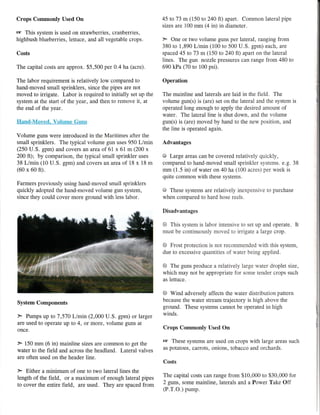
Hard Hose Reels
The hard hose reel system consists of a hose on a
mechanical reel and a volume gun mounted on a sled at
the end of the hose. These systems have been quickly
adopted by large commercial farmers as a means to
irrigate large areas with relatively little hand labor.
System Components
> High pressure, medium volume pumps, with up to
1,380 kPa (200 psi) and 3,030 L/min (800 U.S. gpm),
are being commonly used to operate 1,2, or more reels
at once.
> 150 mm (6 in) mainline sizes are common to get the
water to the field and across the headland.
) One or two hard hose reels are often used. Hose
diameters range from 50 to 125 mm (2 to 5 in) and hose
lengths are up to 380 m (1,250 ft). The volume gun on
the end of the hard hose can have a capacity ranging
from 380 to 1,890 L/min (100 to 500 U.S. gpm) or
more. Typical volume gun nozzle pressures can range
from 480 to 690 kPa (70 to 100 psi). Connection
pressures going to the reel are up to 1,035 kPa (i50 psi).
Operation
The pump, mainline and header are set in the field. The
reel is set up beside the header. The gun cart and hose
are pulled to the end of the field with a tractor. This
unreels the hose off of the reel. The system is started and
the reel is set to pull in the hose and volume gun slowly,
somewhat similar to a fishing reel. The volume gun
irrigates a strip as the hose is wound in. After the strip is
irrigated, the reel is moved 45 to 73 m (150 to 240 ft)
down the header and the process is begun again.
Advantages
g Reels have relatively low manual labor requirements
to set up and operate compared to hand-moved volume
guns.
@ Reels have improved water distribution uniformity
over hand-moved volume guns because the gun is
moving.
O A reel can irrigate up to 3.2 ha (8 acres) in a single
pull.
@ They are adaptable to almost any shape, size and
contour of field.
Disadvantages
6 Reels have a higher capital cost than hand-moved
volume guns.
@ There are high pressure losses through the reel hose.
O The pump pressure required is high, up to 1,380 kPa
(200 psi), therefore the systems are relatively expensive
to operate.
6 This system cannot be used for frost protection.
@ The wind severely affects the water distribution, and
high winds can stop usage altogether.
6 These systems can cause water runoff and soil erosion
if not operated properly.
Crops Commonly Used On
ls These systems are used on crops with large areas such
as potatoes, onions, tobacco, carrots and orchards.
Costs
Reels can cost up to $45,000 each. A typical 28ha (70
acre) system could cost $70,000 or more including the
reel, mainline and a pump.
The operation labor costs are relatively low, compared to
hand-moved volume gun systems.
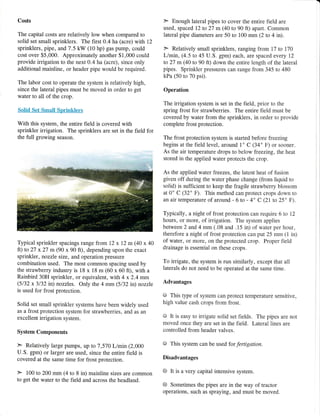
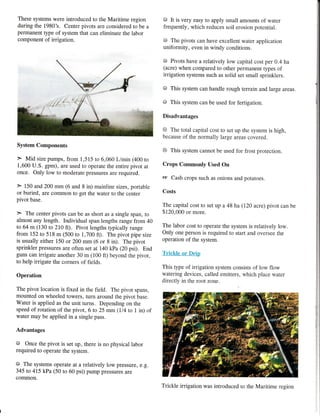
Center Pivots
Center pivots are simply a moving irrigation pipeline.
Water is distributed along the length of the pipe, which
pivots around a central, fixed water supply.
These systems were introduced to the Maritime region
during the 1980's. Center pivots are considered to be a
permanent type of system that can eliminate the labor
component of irrigation.
System Components
> Mid size pumps, from 1,515 to 6,060 L/min (400 to
1,600 U.S. gpm), are used to operate the entire pivot at
once. Only low to moderate pressures are required.
> 150 and 200 mm (6 and 8 in) mainline sizes, portable
or buried, are common to get the water to the center
pivot base.
> The center pivots can be as short as a single span, to
almost any length. Individual span lengths range from 40
to 64 m (130 to 210 tt). Pivor lengths rypically range
from 152 ro 518 m (500 to 1,700 ft). The pivot pipe size
is usually either 150 or 200 mm (6 or 8 in). The pivot
sprinkler pressures are often set at 140 kPa (20 psi). End
guns can irrigate another 30 m (100 ft) beyond the pivot,
to help irrigate the corners of fields.
0peration
The pivot location is fixed in the field. The pivot spans,
mounted on wheeled towers, turn around the pivot base.
Water is applied as the unit turns. Depending on the
speed of rotation of the pivot, 6 to 25 mm (ll4 to 1 in) of
water may be applied in a single pass.
Advantages
O Once the pivot is set up, there is no physical labor
required to operate the sys.tem.
@ The systems operate at a relatively low pressure, e.g.
345 to 415 kPa (50 to 60 psi) pump pressures are
common.
@ It is very easy to apply small amounts of water
frequently, which reduces soil erosion potential.
@ The pivots can have excellent water application
uniformity, even in windy conditions.
@ Pivots have a relatively low capital cost per 0.4 ha
(acre) when compared to other permanent types of
irrigation systems such as solid set small sprinklers.
@ This system can handle rough terrain and large areas.
@ This system can be used for fertigation.
Disadvantages
@ The total capital cost to set up the system is high,
because of the normally large areas covered.
6 This system cannot be used for frost protection.
Crops Commonly Used On
le Cash crops such as onions and potatoes.
Costs
The capital cost to set up a 48 ha (120 acre) pivot can be
$120,000 or more.
The labor cost to operate the system is relatively low.
Only one person is required to start and oversee the
operation of the system.
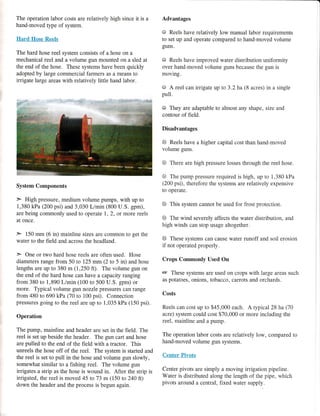
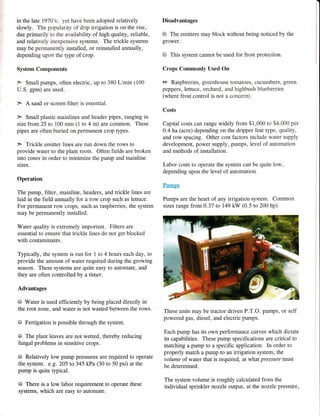
Trickle or Drip
This type of irrigation system consists of low flow
watering devices, called emitters, which place water
directly in the root zone.
I
i
Trickle irrigation was introduced to the Maritime region
in the late 1970's; yet have been adopted relatively
slowly. The popularity of drip irrigation is on the rise,
due primarily to the availability of high quality, reliable,
and relatively inexpensive systems. The trickle systems
may be permanently installed, or reinstalled annually,
depending upon the type of crop.
System Components
> Small pumps, often electric, up to 380 L/min (100
U.S. gpm) are used.
F A sand or screen filter is essential.
F Small plastic mainlines and header pipes, ranging in
size from 25 to 100 mm (1 to 4 in) are common. These
pipes are often buried on permanent crop types.
F Trickle emitter lines are run down the rows to
provide water to the plant roots. Often fields are broken
into zones in order to minimize the pump and mainline
sizes.
Operation
The pump, filter, mainline, headers, and trickle lines are
laid in the field annually for a row crop such as lettuce.
For permanent row crops, such as raspberries, the system
may be permanently installed.
Water quality is extremely important. Filters are
essential to ensure that trickle lines do not get blocked
with contaminants.
Typically, the system is run for 1 to 4 hours each day, to
provide the amount of water required during the growing
season. These systems are quite easy to automate, and
they are often controlled by a timer.
Advantages
o Water is used efficiently by being placed directly in
the root zone, and water is not wasted between the rows.
@ Fertigation is possible through the system.
@ The plant leaves are not wetted, thereby reducing
fungal problems in sensitive crops.
I Relatively low pump pressures are required to operate
the system. e.g.205 to 345 kPa (30 to 50 psi) at the
pump is quite typical.
@ There is a low labor requirement to operate these
systems, which are easy to automate.
Disadvantages
@ The emitters may block without being noticed by the
grower.
@ This system cannot be used for frost protection.
Crops Commonly Used On
us Raspberries, greenhouse tomatoes, cucumbers, green
peppers, lettuce, orchard, and highbush blueberries
(where frost control is not a concern).
Costs
Capital costs can range widely from $1,000 to $4,000 per
0.4 ha (acre) depending on the dripper line type, quality,
and row spacing. Other cost factors include water supply
development, power supply, pumps, level of automation
and methods of installation.
Labor costs to operate the system can be quite low,
depending upon the level of automation.
Pumps
Pumps are the heart of any irrigation system. Common
sizes range from 0.37 to 149 kw (0.5 to 200 hp).
These units may be tractor driven P.T.O. pumps, or self
powered gas, diesel, and electric pumps.
Each pump has its own performance curves which dictate
its capabilities. These pump specifications are critical to
matching a pump to a specific application. In order to
properly match a pump to an irrigation system, the
volume of water that is required, at what pressure must
be determined.
The system volume is roughly calculated from the
individual sprinkler nozzle output, at the nozzle pressure,
times the number of sprinklers.
Pump pressure includes the elevation lift from the water
supply to the highest sprinkler, the sprinkler operation
pressure, and the system pipe friction losses.
When volume and pressure requirements are known, a
proper pump can be selected. One should always keep in
mind potential future system expansion when buying a
pump. It is usually cheaper to buy a slightly larger pump
than required initially than to have to upgrade later.
Irrigation Scheduling
New irrigators often ask when and how much water to
apply.
Scheduling methods range from simple, such as the feel
of soil moisture by hand, to complex computer models,
which can predict crop water requirements when set up
properly.
For new and experienced irrigators, a tensiometer works
quite well as a starting point for timing irrigations.
Tensiometers cost less than $100 each and can indicate
reduced soil moisture levels in sandy soils before plant
moisture stress occurs.
Better methods are available for those who require or
desire more complete information regarding irrigation
scheduling. The best methods involve frequent readings
of soil moisture in the root zone in order to accurately
track soil moisture usage by the crop.
Water Supplies
Water supplies must be factored into the irrigation system
choice and the initial system planning.
Sometimes ample water is readily available; however,
often it is not. If it is not readily available, the cost to
drill a well, dig a pond, or build a dam must be
determined. The quantity of water that will be needed to
irrigate the crops adequately in a dry year must be
determined, and newly constructed water supplies must
be able to deliver these quantities of water.
A Water Rights Permit or Licence from the provincial
regulatory agencies such as the Dept. of Environment and
the Dept. of Fisheries is usually required to withdraw
water from a natural lake, river or stream.
This procedure varies from province to province, and
must be looked into on an individual site basis.
If water is not readily available, the development of the
water supply can represent a major cost to the irrigation
system.
Summarv
This fact sheet is intended to be a starting point for new
irrigators. It provides a basic description of the systems
currently in use in the Maritimes, as well as the
advantages, disadvantages and typical applications for
each system type. Water supplies are an essenrial
consideration before investing heavily in any type of
irrigation system.
The new irrigator should now be aware of the irrigation
system types which could be appropriate to his or her
particular application.
If you feel that one or two of the system types are more
appropriate to your application, then you can approach
equipment dealers for more specific information, such as
system pricing, to help you finalize your choice.
It also doesn't hurt to visit other producers who may now
use the irrigation system that you are interested in.
Finally, be sure to have a reputable Irrigation Equipment
dealer or a qualified Agricultural Engineer design a
system specifically for your application.
Printed March 1996

Irrigation System Types & Typical Applications 1996

  • 1.
    lltlo nt icCom m it t ee, on ll g ricu I tu ro I €n g inee,ri ng ACAE Pub. No. 32 AGDEX No. 563 Irrigation System Types & Typical Applications By Trent Webster, P.Ag., P.Eng. N.S.D.A.M. Extension Engineer The purpose of this fact sheet is to help new irrigators become familiar with irrigation systems that are used in the Maritimes today. It reviews the system components, operation, advantages, disadvantages, crops used on, and costs of each type of irrigation system. Pumps, irrigation scheduling, and water supplies are also discussed. Irrigation is often required in many regions of the Maritimes in order to produce quality crops consistently. Maritime farms usually experience one or more dry spells, in excess of two weeks duration, each year. During these dry spells, cash crops on sandy soil types suffer irreversible yield losses, or even crop failures in extremely dry years. This crop soil moisture stress can be eliminated by irrigation. Frost protection of temperature sensitive crops is another benefit of certain types of irrigation systems. Frost
  • 2.
    protection is discussedunder the solid set small sprinkler section of this fact sheet. Farmers who are unfamiliar with irrigation must take into consideration many factors prior to purchasing a system. These may include: (1) field concerns such as soil type, drainage, erosion potential, proximity to power, topography including elevation lifts, and distances from the water supply; (2) water concerns such as availability, quantity, quality, costs to upgrade or to develop a water supply, and annual crop water requirements; (3) crop concerns such as yield potential, frost protection requirements, row spacings, sprayer boom widths, planting, cultivating, and harvesting practices; and (4) system concerns such as the type of power supply, labor requirements and availability, capital and operating costs, and irrigation cost/benefit ratios. Each irrigation system type has its own niche application. Equipment purchase will be made easier by reviewing the basics of each system type, and by knowing the main advantages and disadvantages of each system. Once the type of irrigation system is chosen, it will need to be customized for the particular field and crop application. This should be done by an Irrigation Equipment dealer, or a qualified Agricultural Engineer. The irrigation system types currently used in the Maritimes include: ] Hand-Moved, Small Sprinklers I Solid Set Small Sprinklers I Hand-Moved, Volume Guns I Hard Hose Reels O Center Pivots I Trickle or Drip Hand-Moved. Small Sprinhlers This is the most basic small sprinkler system, i.e. the starter system, and was the first type of irrigation to be used in the Maritimes on a large scale. System Components ) Relatively small pumps, up to approximately 2,270 L/min (600 United States gallons per minute, U.S. gpm), are used. > A mainline pipe is laid from the water supply to the field, and across the field headland, i.e. 100 or 150 mm (4 or 6 in) aluminum mainline, or header pipe. } One or two lateral pipes are run the length of the field, from the header pipe. i.e. 50 to 100 mm (2 to 4 in) diameter aluminum lateral pipes are usually spaced every 12 to 18 m (40 to 60 ft) along the header prpe. > Relatively small sprinkiers, ranging frorn 11 to 113 Limin (3 to 30 U.S. gpm) each, are spaced every 12 to 18 m (40 to 60 ft) downthe entire length of the lateral pipe, or pipes. Sprinkler pressures can range from 345 to 480 kPa (50 to 70 pounds per square inch, psi). Operation The pump, mainline, header, and one, two or more laterals are installed in the field. On a single lateral system, the pump is operated long enough to provide the required amount of water, and the system is shut down. The pipe is manually moved to the next lateral position, and the system is started again. With two or more lateral lines, irrigated lines can be moved while the other laterals are being operated, by using lateral valves on the field header. The pump does not need to be shut down to move the laterals. This saves repriming the pump to irrigate more ground. Advantages O The total system capital cost is relatively inexpensive. O The area under the system can be frost protected. Disadvantages @ This is a very labor intensive irrigation system. @ The area that is not covered by the system cannot be frost protected. Crops Commonly Used On lg This system is used primarily on high value cash crops such as vegetables of all types, strawberries, raspberries, smail fruits, and tree fruits, etc.
  • 3.
    Costs The capital costsare relatively low when compared to solid set small sprinklers. The first 0.4 ha (acre) with 12 sprinklers, pipe, and 7.5 kW (10 hp) gas pump, could cost over $5,000. Approximately another $1,000 could provide irrigation to the next 0.4 ha (acre), since only additional mainline, or header pipe would be required. The labor cost to operate the system is relatively high, since the lateral pipes must be moved in order to get water to all of the crop. Solid Set Small Sprinklers With this system, the entire field is covered with sprinkler irrigation. The sprinklers are set in the field for the full growing season. Typical sprinkler spacings range from 72 x 12 m (40 x 40 ft) to 27 x27 m (90 x 90 ft), depending upon the exacr sprinkler, nozzle size, and operation pressure combination used. The most common spacing used by the strawberry industry is 18 x 18 m (60 x 60 ft), with a Rainbird 30H sprinkler, or equivalent, with 4 x2.4 mm (5132 x 3132 in) nozzles. Only the 4 mm (5132 in) nozzle is used for frost protection. Solid set small sprinkler systems have been widely used as a frost protection system for strawberries, and as an excellent irrigation system. System Components } Relatively large pumps, up to 7 ,570 L/min (2,000 U.S" gpm) or larger are used, since the entire field is covered at the same time for frost protection. > 100 to 200 mm (4 to 8 in) mainline sizes are common to get the water to the field and across the headland. F Enough lateral pipes to cover the entire field are used, spaced 12 to 27 m(40 to 90 ft) apart. Common lateral pipe diameters are 50 to 100 mm (2 to 4 in). F Relatively small sprinklers, ranging from 17 to 170 L/min, (4.5 to 45 U.S. gpm) each, are spaced every 12 to 27 m (40 to 90 ft) down the entire length of the lateral pipes. Sprinkler pressures can range from 345 to 480 kPa (50 to 70 psi). Operation The irrigation system is set in the field, prior to the spring frost for strawberries. The entire field must be covered by water from the sprinklers, in order to provide complete frost protection. The frost protection system is started before freezing begins atthe field level, around 1" C (34" F) or sooner. As the air temperature drops to below freezing, the heat stored in the applied water protects the crop. As the applied water freezes, the latent heat of fusion given off during the water phase change (from liquid to solid) is sufficient to keep the fragile strawberry blossom at 0' C (32' F). This method can protect crops down to an air temperature of around - 6 to - 4' c (21to 25' F). Typically, a night of frost protection can require 6 to 12 hours, or more, of irrigation. The system applies between 2 and 4 mm (.08 and .15 in) of water per hour, therefore a night of frost protection can put 25 mrn (1 in) of water, or more, on the protected crop. Proper field drainage is essential on these crops. To irrigate, the system is run similarly, except that all laterals do not need to be operated at the same time. Advantages @ This type of system can protect temperature sensitive, high value cash crops from frost. O It is easy to irrigate solid set fields. The pipes are not moved once they are set in the field. Lateral lines are controlled from header valves. g This system can be tsed for fertigation. Disadvantages 6 It is a very capital intensive system. @ Sometimes the pipes are in the way of tractor operations, such as spraying, and must be moved.
  • 4.
    Crops Commonly UsedOn lg This system is used on strawberries, cranberries, highbush blueberries, lettuce, and all vegetable crops. Costs The capital costs are approx. $S,500 per 0.4 ha (acre). The labor requirement is relatively low compared to hand-moved small sprinklers, since the pipes are not moved to irrigate. Labor is required to initially set up the system at the start of the year, and then to remove it, at the end of the year. Hand-Moved. Volume Guns Volume guns were introduced in the Maritimes after the small sprinklers. The typical volume gun uses 950 L/min (250 U.S. gpm) and covers an area of 61 x 61 m (200 x 200 ft); by comparison, the typical small sprinkler uses 38 L/min (10 U.S. gpm) and covers an area of 18 x 18 m (60 x 60 ft). Farmers previously using hand-moved small sprinklers quickly adopted the hand-moved volume gun system, since they could cover more ground with less labor. System Components F Pumps up to 7,570 L/min (2,000 U.S. gpm) or larger are used to operate up to 4, or more, volume guns at once. > 150 mm (6 in) mainline sizes are common to get the water to the field and across the headland. Lateral valves are often used on the header line. > Either a minimum of one to two lateral lines the length of the field, or a maximum of enough lateral pipes to cover the entire field, are used. They are spaced from 45 to 73 m (150 to 240 ft) apart. Common lateral pipe sizes are 100 mm (4 in) in diameter. P One or two volume guns per lateral, ranging from 380 to 1,890 Limin (100 to 500 U.S. gpm) each, are spaced 45 to 73 m (150 to 240 ft) apart on the lateral lines. The gun nozzle pressures can range from 480 to 690 kPa (70 to 100 psi). Operation The mainline and laterals are laid in the field. The volume gun(s) is (are) set on the lateral and the system is operated long enough to apply the desired amount of water. The lateral line is shut down, and the volume gun(s) is (are) moved by hand to the new position, and the line is operated again. Advantages @ Large areas can be covered relatively quickly, compared to hand-moved small sprinkler systems. e.g. 38 mm (1.5 in) of water on 40 ha (100 acres) per week is quite common with these systems. @ These systems are relatively inexpensive to purchase when compared to hard hose reels. Disadvantages @ This system is labor intensive to set up and operate. It must be continuously moved to irrigate a large crop. @ Frost protection is not recommended with this system, due to excessive quantities of water being applied. @ The guns produce a relatively large water droplet size, which may not be appropriate for some tender crops such as lettuce. @ Wind adversely affects the water distribution pattern because the water stream trajectory is high above the ground. These systems cannot be operated in high winds. Crops Commonly Used On lg These systems are used on crops with large areas such as potatoes, carrots, onions, tobacco and orchards. Costs The capital costs can range from $10,000 to $30,000 for 2 guns, some mainline, laterals and a Power Take Off (P.T.O.) pump.
  • 5.
    The operation laborcosts are relatively high since it is a hand-moved type of system. Hard Hose Reels The hard hose reel system consists of a hose on a mechanical reel and a volume gun mounted on a sled at the end of the hose. These systems have been quickly adopted by large commercial farmers as a means to irrigate large areas with relatively little hand labor. System Components > High pressure, medium volume pumps, with up to 1,380 kPa (200 psi) and 3,030 L/min (800 U.S. gpm), are being commonly used to operate 1,2, or more reels at once. > 150 mm (6 in) mainline sizes are common to get the water to the field and across the headland. ) One or two hard hose reels are often used. Hose diameters range from 50 to 125 mm (2 to 5 in) and hose lengths are up to 380 m (1,250 ft). The volume gun on the end of the hard hose can have a capacity ranging from 380 to 1,890 L/min (100 to 500 U.S. gpm) or more. Typical volume gun nozzle pressures can range from 480 to 690 kPa (70 to 100 psi). Connection pressures going to the reel are up to 1,035 kPa (i50 psi). Operation The pump, mainline and header are set in the field. The reel is set up beside the header. The gun cart and hose are pulled to the end of the field with a tractor. This unreels the hose off of the reel. The system is started and the reel is set to pull in the hose and volume gun slowly, somewhat similar to a fishing reel. The volume gun irrigates a strip as the hose is wound in. After the strip is irrigated, the reel is moved 45 to 73 m (150 to 240 ft) down the header and the process is begun again. Advantages g Reels have relatively low manual labor requirements to set up and operate compared to hand-moved volume guns. @ Reels have improved water distribution uniformity over hand-moved volume guns because the gun is moving. O A reel can irrigate up to 3.2 ha (8 acres) in a single pull. @ They are adaptable to almost any shape, size and contour of field. Disadvantages 6 Reels have a higher capital cost than hand-moved volume guns. @ There are high pressure losses through the reel hose. O The pump pressure required is high, up to 1,380 kPa (200 psi), therefore the systems are relatively expensive to operate. 6 This system cannot be used for frost protection. @ The wind severely affects the water distribution, and high winds can stop usage altogether. 6 These systems can cause water runoff and soil erosion if not operated properly. Crops Commonly Used On ls These systems are used on crops with large areas such as potatoes, onions, tobacco, carrots and orchards. Costs Reels can cost up to $45,000 each. A typical 28ha (70 acre) system could cost $70,000 or more including the reel, mainline and a pump. The operation labor costs are relatively low, compared to hand-moved volume gun systems. Center Pivots Center pivots are simply a moving irrigation pipeline. Water is distributed along the length of the pipe, which pivots around a central, fixed water supply.
  • 6.
    These systems wereintroduced to the Maritime region during the 1980's. Center pivots are considered to be a permanent type of system that can eliminate the labor component of irrigation. System Components > Mid size pumps, from 1,515 to 6,060 L/min (400 to 1,600 U.S. gpm), are used to operate the entire pivot at once. Only low to moderate pressures are required. > 150 and 200 mm (6 and 8 in) mainline sizes, portable or buried, are common to get the water to the center pivot base. > The center pivots can be as short as a single span, to almost any length. Individual span lengths range from 40 to 64 m (130 to 210 tt). Pivor lengths rypically range from 152 ro 518 m (500 to 1,700 ft). The pivot pipe size is usually either 150 or 200 mm (6 or 8 in). The pivot sprinkler pressures are often set at 140 kPa (20 psi). End guns can irrigate another 30 m (100 ft) beyond the pivot, to help irrigate the corners of fields. 0peration The pivot location is fixed in the field. The pivot spans, mounted on wheeled towers, turn around the pivot base. Water is applied as the unit turns. Depending on the speed of rotation of the pivot, 6 to 25 mm (ll4 to 1 in) of water may be applied in a single pass. Advantages O Once the pivot is set up, there is no physical labor required to operate the sys.tem. @ The systems operate at a relatively low pressure, e.g. 345 to 415 kPa (50 to 60 psi) pump pressures are common. @ It is very easy to apply small amounts of water frequently, which reduces soil erosion potential. @ The pivots can have excellent water application uniformity, even in windy conditions. @ Pivots have a relatively low capital cost per 0.4 ha (acre) when compared to other permanent types of irrigation systems such as solid set small sprinklers. @ This system can handle rough terrain and large areas. @ This system can be used for fertigation. Disadvantages @ The total capital cost to set up the system is high, because of the normally large areas covered. 6 This system cannot be used for frost protection. Crops Commonly Used On le Cash crops such as onions and potatoes. Costs The capital cost to set up a 48 ha (120 acre) pivot can be $120,000 or more. The labor cost to operate the system is relatively low. Only one person is required to start and oversee the operation of the system. Trickle or Drip This type of irrigation system consists of low flow watering devices, called emitters, which place water directly in the root zone. I i Trickle irrigation was introduced to the Maritime region
  • 7.
    in the late1970's; yet have been adopted relatively slowly. The popularity of drip irrigation is on the rise, due primarily to the availability of high quality, reliable, and relatively inexpensive systems. The trickle systems may be permanently installed, or reinstalled annually, depending upon the type of crop. System Components > Small pumps, often electric, up to 380 L/min (100 U.S. gpm) are used. F A sand or screen filter is essential. F Small plastic mainlines and header pipes, ranging in size from 25 to 100 mm (1 to 4 in) are common. These pipes are often buried on permanent crop types. F Trickle emitter lines are run down the rows to provide water to the plant roots. Often fields are broken into zones in order to minimize the pump and mainline sizes. Operation The pump, filter, mainline, headers, and trickle lines are laid in the field annually for a row crop such as lettuce. For permanent row crops, such as raspberries, the system may be permanently installed. Water quality is extremely important. Filters are essential to ensure that trickle lines do not get blocked with contaminants. Typically, the system is run for 1 to 4 hours each day, to provide the amount of water required during the growing season. These systems are quite easy to automate, and they are often controlled by a timer. Advantages o Water is used efficiently by being placed directly in the root zone, and water is not wasted between the rows. @ Fertigation is possible through the system. @ The plant leaves are not wetted, thereby reducing fungal problems in sensitive crops. I Relatively low pump pressures are required to operate the system. e.g.205 to 345 kPa (30 to 50 psi) at the pump is quite typical. @ There is a low labor requirement to operate these systems, which are easy to automate. Disadvantages @ The emitters may block without being noticed by the grower. @ This system cannot be used for frost protection. Crops Commonly Used On us Raspberries, greenhouse tomatoes, cucumbers, green peppers, lettuce, orchard, and highbush blueberries (where frost control is not a concern). Costs Capital costs can range widely from $1,000 to $4,000 per 0.4 ha (acre) depending on the dripper line type, quality, and row spacing. Other cost factors include water supply development, power supply, pumps, level of automation and methods of installation. Labor costs to operate the system can be quite low, depending upon the level of automation. Pumps Pumps are the heart of any irrigation system. Common sizes range from 0.37 to 149 kw (0.5 to 200 hp). These units may be tractor driven P.T.O. pumps, or self powered gas, diesel, and electric pumps. Each pump has its own performance curves which dictate its capabilities. These pump specifications are critical to matching a pump to a specific application. In order to properly match a pump to an irrigation system, the volume of water that is required, at what pressure must be determined. The system volume is roughly calculated from the individual sprinkler nozzle output, at the nozzle pressure,
  • 8.
    times the numberof sprinklers. Pump pressure includes the elevation lift from the water supply to the highest sprinkler, the sprinkler operation pressure, and the system pipe friction losses. When volume and pressure requirements are known, a proper pump can be selected. One should always keep in mind potential future system expansion when buying a pump. It is usually cheaper to buy a slightly larger pump than required initially than to have to upgrade later. Irrigation Scheduling New irrigators often ask when and how much water to apply. Scheduling methods range from simple, such as the feel of soil moisture by hand, to complex computer models, which can predict crop water requirements when set up properly. For new and experienced irrigators, a tensiometer works quite well as a starting point for timing irrigations. Tensiometers cost less than $100 each and can indicate reduced soil moisture levels in sandy soils before plant moisture stress occurs. Better methods are available for those who require or desire more complete information regarding irrigation scheduling. The best methods involve frequent readings of soil moisture in the root zone in order to accurately track soil moisture usage by the crop. Water Supplies Water supplies must be factored into the irrigation system choice and the initial system planning. Sometimes ample water is readily available; however, often it is not. If it is not readily available, the cost to drill a well, dig a pond, or build a dam must be determined. The quantity of water that will be needed to irrigate the crops adequately in a dry year must be determined, and newly constructed water supplies must be able to deliver these quantities of water. A Water Rights Permit or Licence from the provincial regulatory agencies such as the Dept. of Environment and the Dept. of Fisheries is usually required to withdraw water from a natural lake, river or stream. This procedure varies from province to province, and must be looked into on an individual site basis. If water is not readily available, the development of the water supply can represent a major cost to the irrigation system. Summarv This fact sheet is intended to be a starting point for new irrigators. It provides a basic description of the systems currently in use in the Maritimes, as well as the advantages, disadvantages and typical applications for each system type. Water supplies are an essenrial consideration before investing heavily in any type of irrigation system. The new irrigator should now be aware of the irrigation system types which could be appropriate to his or her particular application. If you feel that one or two of the system types are more appropriate to your application, then you can approach equipment dealers for more specific information, such as system pricing, to help you finalize your choice. It also doesn't hurt to visit other producers who may now use the irrigation system that you are interested in. Finally, be sure to have a reputable Irrigation Equipment dealer or a qualified Agricultural Engineer design a system specifically for your application. Printed March 1996