1
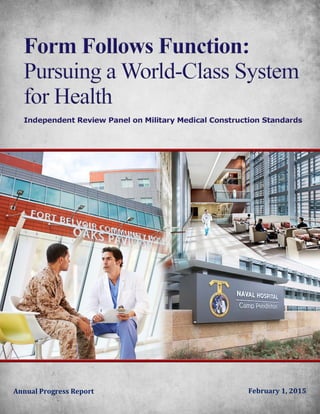
February 1, 2015Annual Progress Report
[This page is intentionally left blank]
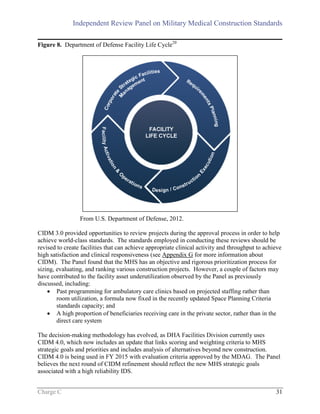
San Antonio Military Medical Center Lobby photo courtesy of RTKL Associates Inc.
OFFICE OF THE ASSISTANT SECRETARY OF DEFENSE
HEALTH AFFAIRS
7700 ARLINGTON BOULEVARD, SUITE 5101
FALLS CHURCH, VA 22042-5101
Independent Review Panel
on Military Medical
Construction Standards
MEMORANDUM FOR SECRETARY OF DEFENSE
SUBJECT: Annual Progress Report of the Independent Review Panel on Military Medical
Construction Standards
I, the Chairperson of the Independent Review Panel on Military Medical Construction
Standards, on behalf of the Panel and pursuant to our charter, hereby submit our annual progress
report’s findings and offer our best recommendations.
A. Ray Pentecost III, DrPH,
FAIA, FACHA, LEED AP
Chairperson
Independent Review Panel on Military Medical Construction Standards
[This page is intentionally left blank]
Independent Review Panel on Military Medical Construction Standards
Table of Contents i
TABLE OF CONTENTS
LIST OF FIGURES & TABLES .........................................................................................................IV
INDEPENDENT REVIEW PANEL ON MILITARY MEDICAL CONSTRUCTION STANDARDS
MEMBERS .......................................................................................................................................V
EXECUTIVE SUMMARY............................................................................................................. ES-1
CHARGE TO THE INDEPENDENT REVIEW PANEL ON MILITARY MEDICAL CONSTRUCTION
STANDARDS ................................................................................................................... ES-2
ABOUT THE REPORT....................................................................................................... ES-3
FINDINGS AND RECOMMENDATIONS .............................................................................. ES-3
CONCLUSION................................................................................................................ ES-10
EXECUTIVE SUMMARY REFERENCES ........................................................................... ES-10
1.0 INTRODUCTION................................................................................................................... 1
1.1 MILITARY MEDICAL CONSTRUCTION LEGISLATION, REPORTS, AND STUDIES
RELATED TO FACILITY STANDARDS..................................................................................... 2
1.2 CHARGE TO THE INDEPENDENT REVIEW PANEL ON MILITARY MEDICAL
CONSTRUCTION STANDARDS ............................................................................................... 3
1.3 DEPARTMENT OF DEFENSE MILITARY MEDICAL CONSTRUCTION POLICY,
STANDARDS CRITERIA, AND GUIDELINES ............................................................................ 4
SECTION REFERENCES ......................................................................................................... 7
2.0 OVERARCHING METHODOLOGY/APPROACH.................................................................... 9
GUIDING PRINCIPLES AND DEFINITION OF A WORLD-CLASS MEDICAL FACILITY.............. 10
SECTION REFERENCES ....................................................................................................... 11
3.0 CHARGE C. DEPARTMENT OF DEFENSE APPROACH TO PLANNING AND PROGRAMMING
FACILITY IMPROVEMENTS........................................................................................................... 12
INTRODUCTION .................................................................................................................. 12
METHODOLOGY ................................................................................................................. 13
3.1 ENTERPRISE STRATEGY ......................................................................................... 14
3.2 FACILITY FUNDING AND BUDGET STRUCTURE....................................................... 27
3.3 FACILITY SELECTION CRITERIA ............................................................................. 29
CHARGE C FINDINGS AND RECOMMENDATIONS ................................................................ 32
SECTION REFERENCES ....................................................................................................... 34
4.0 CHARGE A. CONSISTENCY OF UNIFIED CONSTRUCTION STANDARDS WITH INDUSTRY
PRACTICES AND BENCHMARKS.................................................................................................... 38
INTRODUCTION .................................................................................................................. 38
METHODOLOGY ................................................................................................................. 38
4.1 DEPARTMENT OF DEFENSE STANDARDS DEVELOPMENT RESPONSIBILITIES .......... 39
4.2 MEANINGFUL STANDARDS IN A RAPIDLY EVOLVING HEALTH CARE
ENVIRONMENT................................................................................................................... 42
4.3 STANDARDS DEVELOPMENT FRAMEWORK ............................................................ 43
4.4 RELATIONSHIP BETWEEN FACILITY AND INFORMATION TECHNOLOGY
STANDARDS ....................................................................................................................... 46
Independent Review Panel on Military Medical Construction Standards
Table of Contents ii
CHARGE A FINDINGS AND RECOMMENDATIONS ................................................................ 48
SECTION REFERENCES ....................................................................................................... 50
5.0 CHARGE B. UNIFORM APPLICATION OF MEDICAL CONSTRUCTION STANDARDS IN
ONGOING CONSTRUCTION PROGRAMS ....................................................................................... 52
INTRODUCTION .................................................................................................................. 52
METHODOLOGY ................................................................................................................. 52
5.1 ACQUISITION RESPONSIBILITIES AND APPROACHES............................................... 53
5.2 STANDARDIZED VERSUS HIGHLY ADAPTIVE APPLICATION OF STANDARDS .......... 57
5.3 THE WORLD-CLASS TOOLKIT AND UNIFORM STANDARDS APPLICATION.............. 58
5.4 EVALUATION OF EVIDENCE-BASED DESIGN IMPACTS ON HEALTH CARE
OUTCOMES ........................................................................................................................ 61
CHARGE B FINDINGS AND RECOMMENDATIONS ................................................................ 64
SECTION REFERENCES ....................................................................................................... 66
6.0 CHARGES D AND E. ADEQUACY OF AND ADJUSTMENTS TO THE COMPREHENSIVE
MASTER PLAN .............................................................................................................................. 68
INTRODUCTION .................................................................................................................. 68
METHODOLOGY ................................................................................................................. 68
6.1 ORGANIZATIONAL STRUCTURE AND FACILITY REQUIREMENTS............................. 69
6.2 REQUIREMENTS FOR THE WALTER REED NATIONAL MILITARY MEDICAL CENTER
ADDITION/ALTERATION PROJECT ...................................................................................... 71
6.3 GRADUATE MEDICAL EDUCATION......................................................................... 72
CHARGES D AND E FINDINGS AND RECOMMENDATIONS ................................................... 72
SECTION REFERENCES ....................................................................................................... 73
7.0 METHODOLOGY AND STRATEGY FOR THE FINAL REPORT ............................................ 74
APPENDIX A. PANEL MEMBER BIOGRAPHIES ............................................................................ 75
APPENDIX B. IKE SKELTON NATIONAL DEFENSE AUTHORIZATION ACT FOR FISCAL YEAR
2011, SECTION 2852 ..................................................................................................................... 82
APPENDIX C. WHAT IS A WORLD-CLASS MEDICAL FACILITY?................................................ 87
APPENDIX D. GUIDING PRINCIPLES............................................................................................ 98
APPENDIX E. BACKGROUND INFORMATION: LEGISLATION, REPORTS, AND STUDIES........... 102
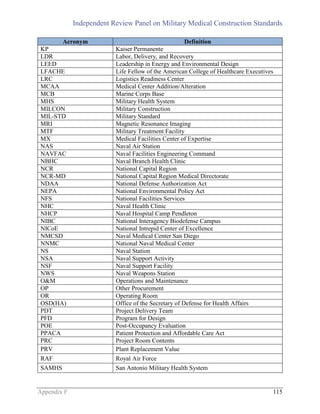
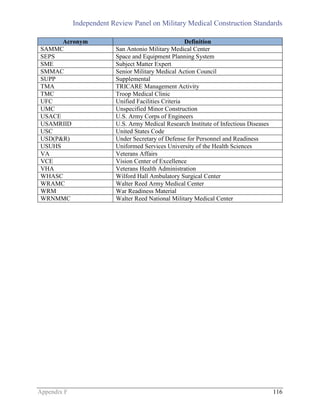
APPENDIX F. LIST OF ACRONYMS............................................................................................. 113
APPENDIX G. DEPARTMENT OF DEFENSE MEDICAL MILITARY CONSTRUCTION POLICY,
STANDARDS CRITERIA, AND GUIDELINES ................................................................................. 117
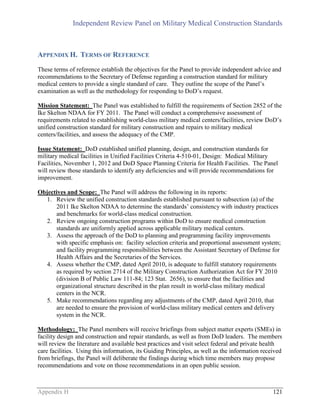
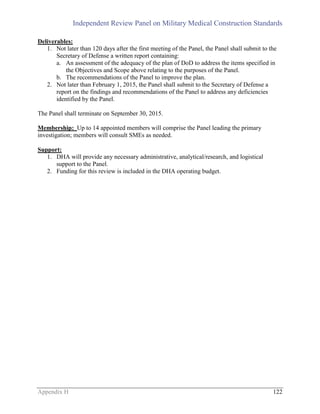
APPENDIX H. TERMS OF REFERENCE ....................................................................................... 121
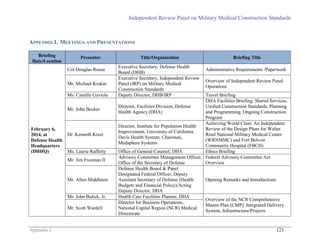
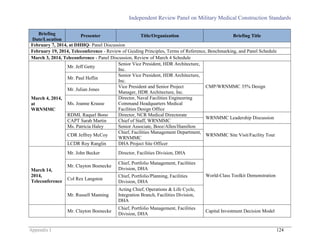
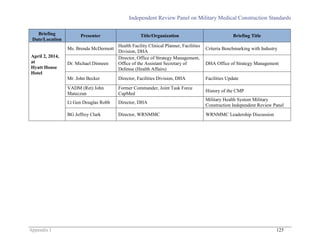
APPENDIX I. MEETINGS AND PRESENTATIONS ......................................................................... 123
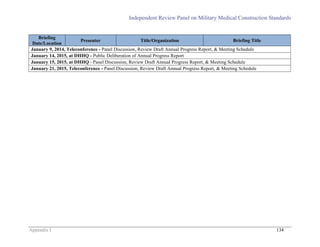
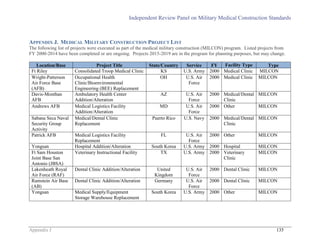
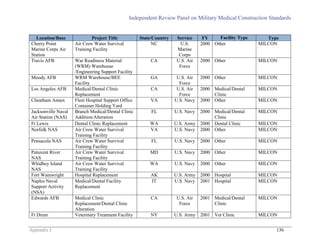
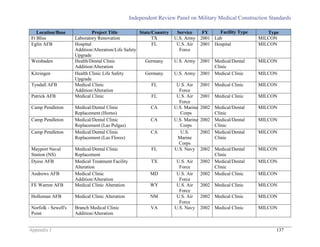
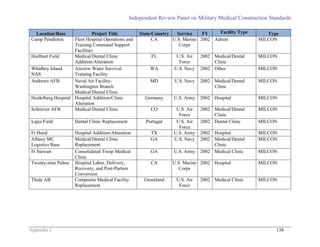
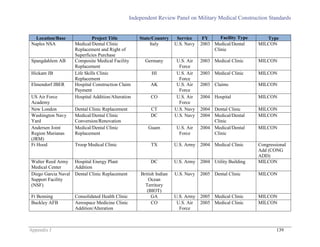
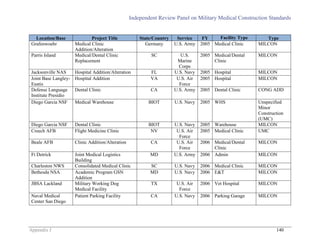
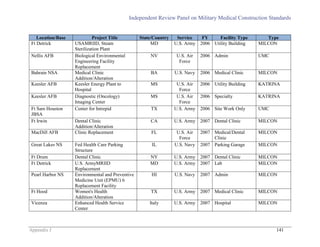
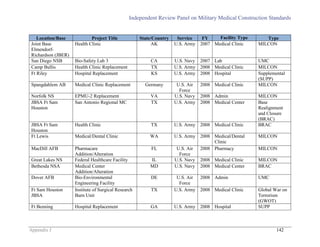
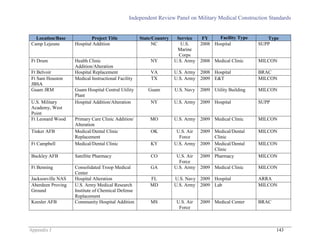
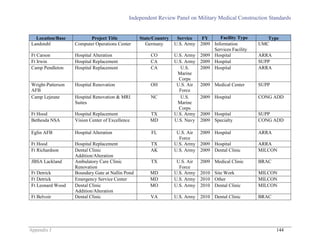
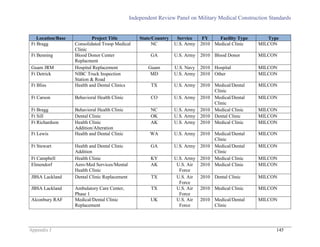
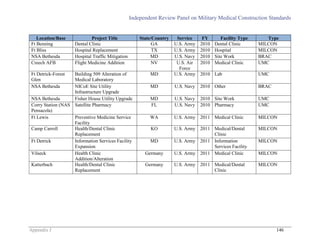
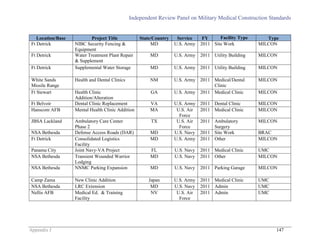
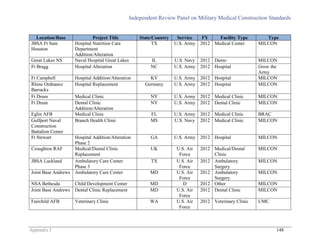
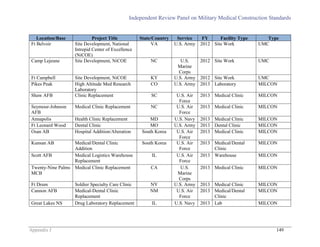
APPENDIX J. MEDICAL MILITARY CONSTRUCTION PROJECT LIST ........................................ 135
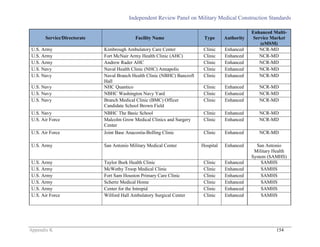
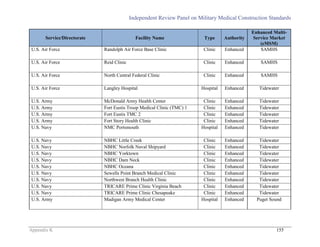
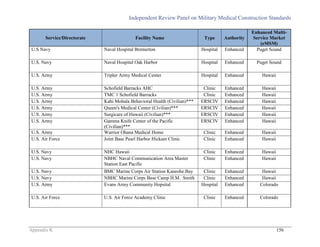
APPENDIX K. ENHANCED MULTI-SERVICE MARKET FACILITY LIST ..................................... 153
APPENDIX L. TRUE NORTH MEASURES AND LOGIC MODEL................................................... 158
APPENDIX M. SUPPORT STAFF.................................................................................................. 160
Independent Review Panel on Military Medical Construction Standards
Table of Contents iii
REPORT REFERENCES ................................................................................................................ 161
Independent Review Panel on Military Medical Construction Standards
List of Figures and Tables iv
LIST OF FIGURES & TABLES
FIGURE 1. LEGISLATIVE ACTIONS, REPORTS, AND STUDIES AFFECTING THE MILITARY
HEALTH SYSTEM (2005-2015) ........................................................................................................2
FIGURE 2. DEFENSE HEALTH AGENCY PLANNING AND PROGRAMMING PROCESS .....................5
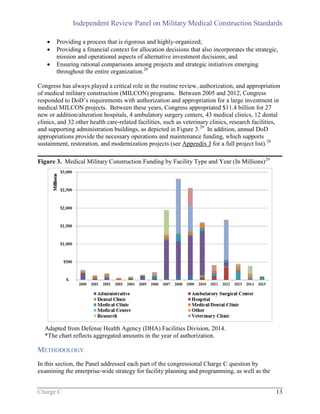
FIGURE 3. MEDICAL MILITARY CONSTRUCTION FUNDING BY FACILITY TYPE AND YEAR
(IN MILLIONS) ...............................................................................................................................13
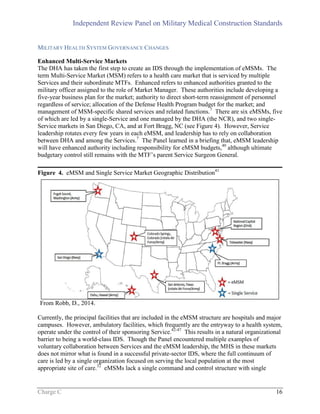
FIGURE 4. EMSM AND SINGLE SERVICE MARKET GEOGRAPHIC DISTRIBUTION .....................16
FIGURE 5. KEY QUESTIONS TO JUSTIFY CAPITAL INVESTMENT ................................................18
FIGURE 6. COMPARISON OF LEADING HEALTH SYSTEM AND MILITARY HEALTH SYSTEM
CAPITAL INVESTMENT PROCESS ..................................................................................................19
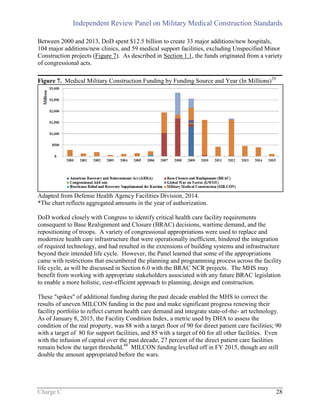
FIGURE 7. MEDICAL MILITARY CONSTRUCTION FUNDING BY FUNDING SOURCE AND YEAR
(IN MILLIONS) ...............................................................................................................................28
FIGURE 8. DEPARTMENT OF DEFENSE FACILITY LIFE CYCLE ...................................................31
FIGURE 9. IMPACT OF DESIGN STANDARDS.................................................................................44
FIGURE 10. INFORMATION TECHNOLOGY AND LOWER COST HEALTH CARE
ALTERNATIVES……......................................................................................................................47
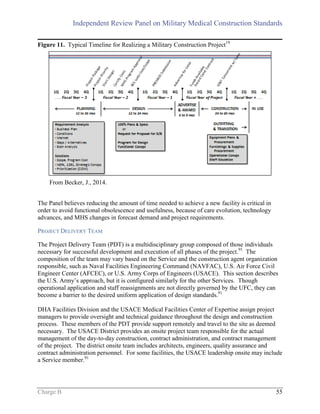
FIGURE 11. TYPICAL TIMELINE FOR REALIZING A MILITARY CONSTRUCTION PROJECT ........55
FIGURE 12. THE EVIDENCE-BASED DESIGN MODEL ..................................................................59
FIGURE 13. INSTITUTIONALIZING INFRASTRUCTURE INVESTMENTS .........................................64
FIGURE 14. PROGRAMMED AMOUNTS FOR CAPITAL INVESTMENTS (IN BILLIONS):
FYS 2000-2013 ............................................................................................................................103
FIGURE 15. THE QUADRUPLE AIM.............................................................................................108
FIGURE 16. CAPITAL INVESTMENT DECISION MODEL .............................................................120
FIGURE 17. TRUE NORTH MEASURES........................................................................................158
FIGURE 18. LOGIC MODEL FOR HEALTH AND MEDICAL READINESS ......................................159
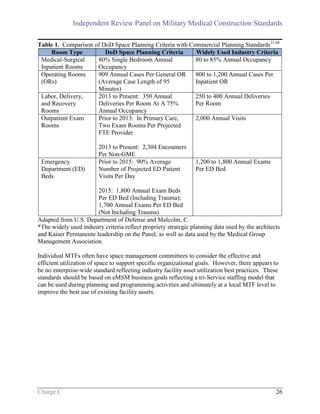
TABLE 1. COMPARISON OF DEPARTMENT OF DEFENSE SPACE PLANNING CRITERIA WITH
COMMERCIAL PLANNING STANDARDS .........................................................................................26
TABLE 2. DOD STANDARDS BY YEAR OF PUBLICATION..............................................................40
TABLE 3. MILITARY CONSTRUCTION ACQUISITION STRATEGIES, PROGRAMMED AMOUNT,
AND DURATION ..............................................................................................................................53
TABLE 4. MHS ACTION PLAN FOR ACCESS, QUALITY OF CARE, AND PATIENT SAFETY
TARGETED OUTCOMES FOR IMPROVEMENT AND EVIDENCE-BASED DESIGN FEATURES ..........62
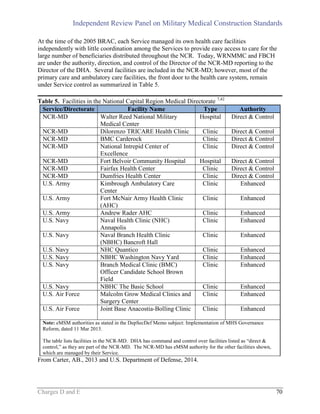
TABLE 5. FACILITIES IN THE NATIONAL CAPITAL REGION MEDICAL DIRECTORATE..............70
Independent Review Panel on Military Medical Construction Standards
Members v
INDEPENDENT REVIEW PANEL ON MILITARY MEDICAL CONSTRUCTION
STANDARDS MEMBERS
A. Ray Pentecost III, DrPH, FAIA, FACHA, LEED AP
Professor, Public Health and Architecture, Texas Tech University
Panel Chairperson
Mark Erath, CPA, CGMA, CTS-MC, FACHE, FHFMA
Healthcare Executive; Former Chief Financial Officer of Parkland Health and Hospital System
and Geisinger Medical Center; Retired Healthcare Partner, PricewaterhouseCoopers, LLP
Anjali Joseph, PhD, EDAC
Associate Professor and Endowed Chair of Architecture and Health Design and Research
Clemson University
Paul Kearns, MBA, CPA, CHE, LFACHE, FHFMA
Colonel (Retired), United States Air Force
Senior Executive Service (Retired), Veterans Health Administration
Christine Malcolm, MBA
West Coast Leader, Managing Director, Healthcare
Navigant Consulting, Inc.
Eileen Malone, RN, MSN, MS, EDAC
Colonel (Retired), United States Army
Senior Partner, Mercury Healthcare Consulting, LLC
Donald Orndoff, AIA, MS
Captain (Retired), United States Navy
Senior Vice President, National Facilities Services
Kaiser Permanente
William Rowley, MD
Rear Admiral (Retired), United States Navy
Independent Consultant
Joseph G. Sprague, FAIA, FACHA, FHFI
Principal and Senior Vice President/Director of Health Facilities
HKS, Inc.
Philip E. Tobey, FAIA, FACHA
Senior Vice President
SmithGroupJJR
Independent Review Panel on Military Medical Construction Standards
Executive Summary ES-1
EXECUTIVE SUMMARY
The Department of Defense’s (DoD’s) Military Health System (MHS) has undergone significant
transformation over the past decade as a result of myriad challenges and opportunities, which
included supporting and deploying a medically ready force fighting two wars, reorganizing
governance functions, implementing enterprise-wide common business processes, and creating
shared services in a more integrated fashion. During this dynamic period, the MHS continued
providing quality medical care to its Service members and beneficiary population. At the same
time, the health care industry was being reimagined and reconfigured in response to health care
reform legislation and advances in technology to achieve the national quality improvement goals
of better care, healthy people and communities, and affordable care;1
a journey that continues
today. The impacts of these significant changes have the potential to redefine world-class health
care facility requirements and supporting standards, since form should always follow function.
The general recommendations contained in this annual progress report are designed to provide
the Department with opportunities for enterprise-wide improvements that can be used to drive
systematic, positive change, and facility requirements, which should be based on strategic and
business goals that reflect the MHS’s recent transformation. The Independent Review Panel on
Military Medical Construction Standards (Panel) recommends that the MHS update the 2010
Comprehensive Master Plan (CMP) for the National Capital Region (NCR) as quickly as
possible to reflect current MHS strategy, business plans, and technological advances to help
achieve strategic goals and targeted outcomes. The Panel encourages the MHS to continue
shaping its future with an emphasis on health; employ a strategic vision that reaches beyond
world-class facilities; and focus on a world-class integrated delivery system (IDS).
The imperative for this new direction seems clear: change in health care is happening at an
unprecedented pace and on a scale that touches every aspect of the health care industry. Current
legislative mandates have prioritized the quality of care over the volume of care provided, with
renewed focus on affordable services that result in healthy individuals and communities. Health
care technology advances provide new virtual or non-facility based options for care delivery,
disrupting the strategic planning that represents the first step in determining health care facility
requirements and standards. As a result, facility and information management and technology
infrastructure investments and standards should be determined, executed, and evaluated together.
Changes in health care require leaders to think outside the traditional facilities-based platform to
establish a high reliability IDS.
As the MHS evolves in its efforts to become an IDS that rivals other high reliability, top
performing health care systems, it should continue to adapt to environmental, scientific, and
technological changes; align itself with industry and evidence-based design best practices; and
continue to focus on providing safe, high quality, accessible, and affordable patient care. The
Panel commends the MHS for the progress it has made so far during its transformational journey.
However, in its quest to become a top-tier health care system,2
where average is unacceptable,3
the DoD should also focus on the continuous improvement of its facility requirements and
supporting standards, using better analytics to understand and improve the role that facilities play
in the delivery of quality and affordable care.
Independent Review Panel on Military Medical Construction Standards
Executive Summary ES-2
CHARGE TO THE INDEPENDENT REVIEW PANEL ON MILITARY MEDICAL
CONSTRUCTION STANDARDS
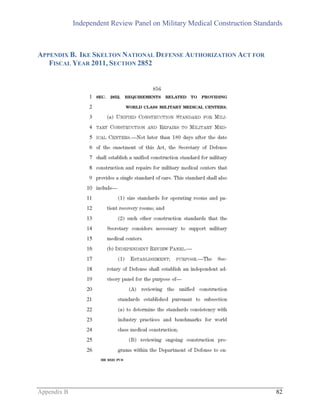
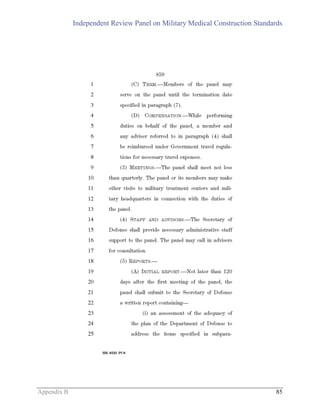
Section 2852 of the Ike Skelton National Defense Authorization Act (NDAA) for Fiscal Year
(FY) 2011 required the establishment of an Independent Review Panel on Military Medical
Construction Standards (Panel) whose objectives and scope of activities include the provision of
advice and recommendations regarding a construction standard for military medical centers to
provide a single standard of care. Specifically, the Panel’s charges include:
(A) Reviewing the unified construction standards established pursuant to subsection (a)
to determine the standards [sic] consistency with industry practices and benchmarks for
world class medical construction;
(B) Reviewing ongoing construction programs within the Department of Defense to
ensure medical construction standards are uniformly applied across applicable military
medical centers;
(C) Assessing the approach of the Department of Defense approach [sic] to planning and
programming facility improvements with specific emphasis on –
(i) Facility selection criteria and proportional assessment system; and
(ii) Facility programming responsibilities between the Assistant Secretary of
Defense for Health Affairs and the Secretaries of the military departments [sic];
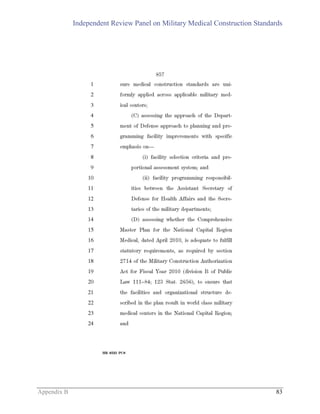
(D) Assessing whether the Comprehensive Master Plan for the National Capital Region
Medical, dated April 2010, is adequate to fulfill statutory requirements, as required by
section 2714 of the Military Construction Authorization Act for Fiscal Year 2010
(division B of Public Law 111-84; 123 Stat. 2656), to ensure that the facilities and
organizational structure described in the plan result in world class military medical
centers in the National Capital Region; and
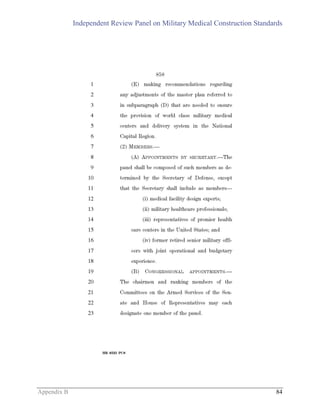
(E) Making recommendations regarding any adjustments of the master plan referred to in
subparagraph (D) that are needed to ensure the provision of world class military medical
centers and delivery system in the National Capital Region.4
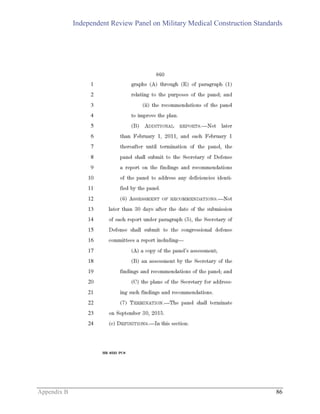
The Panel was charged with providing to the Secretary of Defense, not later than 120 days after
its first meeting, an initial report containing an assessment of the adequacy of DoD’s plan to
address the above items and the Panel’s recommendations to improve the CMP.4
The Initial
Report was delivered on June 5, 2014 and can be found at the following link:
https://database.faca.gov/committee/historyreportdocuments.aspx?flr=15308&cid=2450&fy=201
4.
The Panel also was charged to provide an annual report on the Panel’s findings and
recommendations to address any identified deficiencies each February 1 until the termination of
the Panel. This report is the first annual progress report of the Panel and provides an overview of
the Panel’s findings and recommendations based on its work to date (see Appendix A for
member biographies and Appendix B for the entire legislation).
Independent Review Panel on Military Medical Construction Standards
Executive Summary ES-3
ABOUT THE REPORT
The annual progress report is organized in the context of a typical facility project life cycle. The
facility life cycle begins with strategic planning and programming activities, followed by design,
construction, commissioning, and on-going operational activities. Following this approach, the
report addresses Charge C, Approach to Planning and Programming Facility Improvements, first,
followed by Charge A, Consistency of Unified Construction Standards with Industry Practices
and Benchmarks. Charges B, D, and E complete the report.
The Panel approached each of the five FY 2011 NDAA duties described above using the
following three key frameworks:
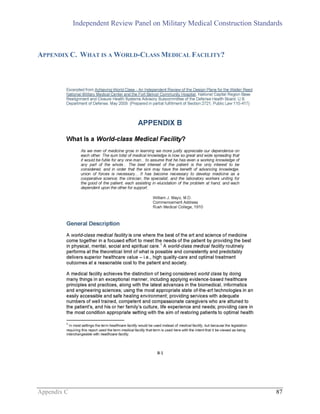
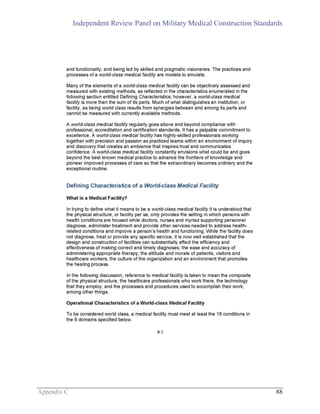
 The world-class medical facility definition, which was developed as part of the work
of the NCR Base Realignment and Closure Health Systems Advisory Subcommittee
of the Defense Health Board in May 2009, shaped the Panel’s analysis, advice, and
recommendations. The definition includes 18 conditions in 6 domains that must be
met for a medical facility to be considered world-class: (1) Basic Infrastructure; (2)
Leadership and Culture; (3) Processes of Care; (4) Performance; (5) Knowledge
Management; and (6) Community and Social Responsibility (see Appendix C).
 Seven Guiding Principles, created and adopted by the Panel, established the
foundation for its work, reflected the Panel’s core beliefs, and provided a lens through
which the Panel established goals and developed recommendations (see Appendix D).
 The components of the MHS Quadruple Aim, increased readiness, better care, better
health, and lower cost, guided the Panel’s inquiries.
FINDINGS AND RECOMMENDATIONS
The MHS has made significant progress toward improving the quality, access, and safety of the
health care it provides, while also maintaining military medical readiness, improving health, and
lowering costs. These advances include establishing the Defense Health Agency (DHA) and its
shared services, forming six enhanced Multi-Service Markets (eMSMs), pursuing an enterprise-
wide approach to modernizing and optimizing the MHS, developing plans to recapture workload
and increase productivity, and emphasizing the importance of creating world-class medical
facilities. This progress has occurred in the face of a rapidly evolving health care industry and is
the result of fundamental changes in thinking, dedicated leadership, and the continued integration
of the Services. The work of the DHA Facilities Division has been a positive force in the MHS
and includes integrating evidence-based design in the construction of medical facilities, creating
the World-Class Checklist and Toolkit, and continuing to develop and maintain standards and
criteria for the facility life cycle.
To address the five charges outlined in the NDAA, the Panel visited several military treatment
facilities (MTFs) to understand the differences in creating world-class facilities under a variety
of circumstances and during various phases of construction. Based on the information analyzed
for this annual progress report, the Panel found that DoD's facility standards are consistent with
the industry and in many ways lead the industry with their use of evidence-based design across
the facility life cycle as a tool to help improve health care outcomes. The Department is to be
commended for its extensive work in the pursuit of world-class facility criteria and goals and
Independent Review Panel on Military Medical Construction Standards
Executive Summary ES-4
other major initiatives to optimize facility investments in support of the MHS Quadruple Aim.
However, a number of MHS system enhancements remain to be realized, and then used, to
further drive facility standards refinement. As the MHS strives to become a high reliability
organization based on continuous performance improvement, it should analyze the impact of the
environment, which shapes patient experiences and the care provided. This analysis should be
used to refine facility standards and realize a maximum return on these investments. It appears
certain practices, structures, and processes are barriers to an enterprise-wide approach to facility
planning and programming and contribute to a lack of understanding about the effect of certain
design decisions on health outcomes. Future facility standards, requirements, and investments
should be integrated with information management and technology infrastructure standards,
requirements, and investments.
Although the MHS has made great strides, the Panel has observed the outcomes associated with
previous decisions, policies, guidelines, and business models that are no longer supportive of
current MHS goals and objectives. Since the creation of new facilities represents one of the
largest, longest-lasting capital investments the MHS makes, the MHS should continue to evolve
toward a world-class IDS to optimize its approach to planning and programming facility
improvements, reduce underutilization, and maximize the use of its facility resources.
Furthermore, due to the rapid evolution of health care models and technology during a time of
dynamic health care reform and transformation, developing and maintaining up-to-date facility
standards is particularly challenging, especially while also striving to achieve quality, safe, and
affordable care. Future facility standards, requirements, and investments should be refined based
on the routine evaluation of EBD features on targeted patient, staff, and resource outcomes, as an
integral component of the MHS’s and Services' performance improvement programs. Finally, as
mentioned above, when the Comprehensive Master Plan for the National Capital Region was
published in 2010, it met the requirements to ensure that the facilities and organizational
structure resulted in world-class medical centers, but now requires an update to reflect current
and future MHS strategy, business plans, technology, and health care outcome goals.
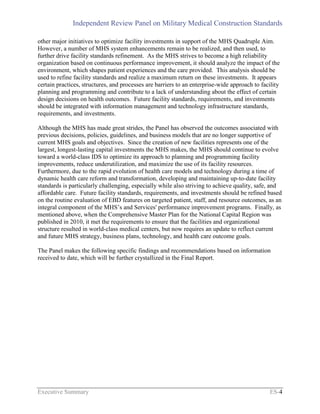
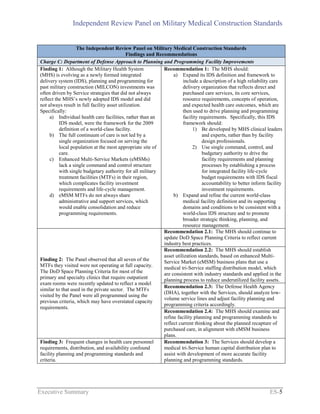
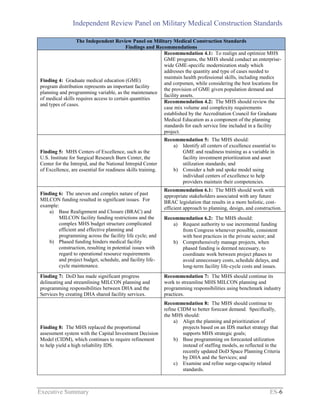
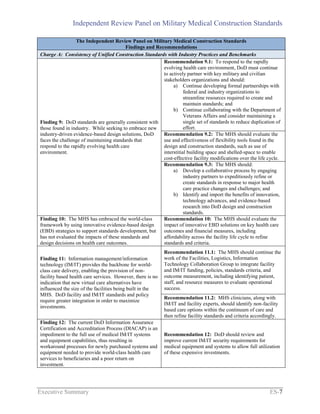
The Panel makes the following specific findings and recommendations based on information
received to date, which will be further crystallized in the Final Report.
Independent Review Panel on Military Medical Construction Standards
Executive Summary ES-5
The Independent Review Panel on Military Medical Construction Standards
Findings and Recommendations
Charge C: Department of Defense Approach to Planning and Programming Facility Improvements
Finding 1: Although the Military Health System
(MHS) is evolving as a newly formed integrated
delivery system (IDS), planning and programming for
past military construction (MILCON) investments was
often driven by Service strategies that did not always
reflect the MHS’s newly adopted IDS model and did
not always result in full facility asset utilization.
Specifically:
a) Individual health care facilities, rather than an
IDS model, were the framework for the 2009
definition of a world-class facility.
b) The full continuum of care is not led by a
single organization focused on serving the
local population at the most appropriate site of
care.
c) Enhanced Multi-Service Markets (eMSMs)
lack a single command and control structure
with single budgetary authority for all military
treatment facilities (MTFs) in their region,
which complicates facility investment
requirements and life-cycle management.
d) eMSM MTFs do not always share
administrative and support services, which
would enable consolidation and reduce
programming requirements.
Recommendation 1: The MHS should:
a) Expand its IDS definition and framework to
include a description of a high reliability care
delivery organization that reflects direct and
purchased care services, its core services,
resource requirements, concepts of operation,
and expected health care outcomes, which are
then used to drive planning and programming
facility requirements. Specifically, this IDS
framework should:
1) Be developed by MHS clinical leaders
and experts, rather than by facility
design professionals.
2) Use single command, control, and
budgetary authority to drive the
facility requirements and planning
processes by establishing a process
for integrated facility life-cycle
budget requirements with IDS fiscal
accountability to better inform facility
investment requirements.
b) Expand and refine the current world-class
medical facility definition and its supporting
domains and conditions to be consistent with a
world-class IDS structure and to promote
broader strategic thinking, planning, and
resource management.
Finding 2: The Panel observed that all seven of the
MTFs they visited were not operating at full capacity.
The DoD Space Planning Criteria for most of the
primary and specialty clinics that require outpatient
exam rooms were recently updated to reflect a model
similar to that used in the private sector. The MTFs
visited by the Panel were all programmed using the
previous criteria, which may have overstated capacity
requirements.
Recommendation 2.1: The MHS should continue to
update DoD Space Planning Criteria to reflect current
industry best practices.
Recommendation 2.2: The MHS should establish
asset utilization standards, based on enhanced Multi-
Service Market (eMSM) business plans that use a
medical tri-Service staffing distribution model, which
are consistent with industry standards and applied in the
planning process to reduce underutilized facility assets.
Recommendation 2.3: The Defense Health Agency
(DHA), together with the Services, should analyze low-
volume service lines and adjust facility planning and
programming criteria accordingly.
Recommendation 2.4: The MHS should examine and
refine facility planning and programming standards to
reflect current thinking about the planned recapture of
purchased care, in alignment with eMSM business
plans.
Finding 3: Frequent changes in health care personnel
requirements, distribution, and availability confound
facility planning and programming standards and
criteria.
Recommendation 3: The Services should develop a
medical tri-Service human capital distribution plan to
assist with development of more accurate facility
planning and programming standards.
Independent Review Panel on Military Medical Construction Standards
Executive Summary ES-6
The Independent Review Panel on Military Medical Construction Standards
Findings and Recommendations
Finding 4: Graduate medical education (GME)
program distribution represents an important facility
planning and programming variable, as the maintenance
of medical skills requires access to certain quantities
and types of cases.
Recommendation 4.1: To realign and optimize MHS
GME programs, the MHS should conduct an enterprise-
wide GME-specific modernization study which
addresses the quantity and type of cases needed to
maintain health professional skills, including medics
and corpsmen, while considering the best locations for
the provision of GME given population demand and
facility assets.
Recommendation 4.2: The MHS should review the
case mix volume and complexity requirements
established by the Accreditation Council for Graduate
Medical Education as a component of the planning
standards for each service line included in a facility
project.
Finding 5: MHS Centers of Excellence, such as the
U.S. Institute for Surgical Research Burn Center, the
Center for the Intrepid, and the National Intrepid Center
of Excellence, are essential for readiness skills training.
Recommendation 5: The MHS should:
a) Identify all centers of excellence essential to
GME and readiness training as a variable in
facility investment prioritization and asset
utilization standards; and
b) Consider a hub and spoke model using
individual centers of excellence to help
providers maintain their competencies.
Finding 6: The uneven and complex nature of past
MILCON funding resulted in significant issues. For
example:
a) Base Realignment and Closure (BRAC) and
MILCON facility funding restrictions and the
complex MHS budget structure complicated
efficient and effective planning and
programming across the facility life cycle; and
b) Phased funding hinders medical facility
construction, resulting in potential issues with
regard to operational resource requirements
and project budget, schedule, and facility life-
cycle maintenance.
Recommendation 6.1: The MHS should work with
appropriate stakeholders associated with any future
BRAC legislation that results in a more holistic, cost-
efficient approach to planning, design, and construction.
Recommendation 6.2: The MHS should:
a) Request authority to use incremental funding
from Congress whenever possible, consistent
with best practices in the private sector; and
b) Comprehensively manage projects, when
phased funding is deemed necessary, to
coordinate work between project phases to
avoid unnecessary costs, schedule delays, and
long-term facility life-cycle costs and issues.
Finding 7: DoD has made significant progress
delineating and streamlining MILCON planning and
programming responsibilities between DHA and the
Services by creating DHA shared facility services.
Recommendation 7: The MHS should continue its
work to streamline MHS MILCON planning and
programming responsibilities using benchmark industry
practices.
Finding 8: The MHS replaced the proportional
assessment system with the Capital Investment Decision
Model (CIDM), which continues to require refinement
to help yield a high reliability IDS.
Recommendation 8: The MHS should continue to
refine CIDM to better forecast demand. Specifically,
the MHS should:
a) Align the planning and prioritization of
projects based on an IDS market strategy that
supports MHS strategic goals;
b) Base programming on forecasted utilization
instead of staffing models, as reflected in the
recently updated DoD Space Planning Criteria
by DHA and the Services; and
c) Examine and refine surge-capacity related
standards.
Independent Review Panel on Military Medical Construction Standards
Executive Summary ES-7
The Independent Review Panel on Military Medical Construction Standards
Findings and Recommendations
Charge A: Consistency of Unified Construction Standards with Industry Practices and Benchmarks
Finding 9: DoD standards are generally consistent with
those found in industry. While seeking to embrace new
industry-driven evidence-based design solutions, DoD
faces the challenge of maintaining standards that
respond to the rapidly evolving health care
environment.
Recommendation 9.1: To respond to the rapidly
evolving health care environment, DoD must continue
to actively partner with key military and civilian
stakeholders organizations and should:
a) Continue developing formal partnerships with
federal and industry organizations to
streamline resources required to create and
maintain standards; and
b) Continue collaborating with the Department of
Veterans Affairs and consider maintaining a
single set of standards to reduce duplication of
effort.
Recommendation 9.2: The MHS should evaluate the
use and effectiveness of flexibility tools found in the
design and construction standards, such as use of
interstitial building space and shelled-space to enable
cost-effective facility modifications over the life cycle.
Recommendation 9.3: The MHS should:
a) Develop a collaborative process by engaging
industry partners to expeditiously refine or
create standards in response to major health
care practice changes and challenges; and
b) Identify and import the benefits of innovation,
technology advances, and evidence-based
research into DoD design and construction
standards.
Finding 10: The MHS has embraced the world-class
framework by using innovative evidence-based design
(EBD) strategies to support standards development, but
has not evaluated the impacts of these standards and
design decisions on health care outcomes.
Recommendation 10: The MHS should evaluate the
impact of innovative EBD solutions on key health care
outcomes and financial measures, including
affordability across the facility life cycle to refine
standards and criteria.
Finding 11: Information management/information
technology (IM/IT) provides the backbone for world-
class care delivery, enabling the provision of non-
facility based health care services. However, there is no
indication that new virtual care alternatives have
influenced the size of the facilities being built in the
MHS. DoD facility and IM/IT standards and policy
require greater integration in order to maximize
investments.
Recommendation 11.1: The MHS should continue the
work of the Facilities, Logistics, Information
Technology Collaboration Group to integrate facility
and IM/IT funding, policies, standards criteria, and
outcome measurement, including identifying patient,
staff, and resource measures to evaluate operational
success.
Recommendation 11.2: MHS clinicians, along with
IM/IT and facility experts, should identify non-facility
based care options within the continuum of care and
then refine facility standards and criteria accordingly.
Finding 12: The current DoD Information Assurance
Certification and Accreditation Process (DIACAP) is an
impediment to the full use of medical IM/IT systems
and equipment capabilities, thus resulting in
workaround processes for newly purchased systems and
equipment needed to provide world-class health care
services to beneficiaries and a poor return on
investment.
Recommendation 12: DoD should review and
improve current IM/IT security requirements for
medical equipment and systems to allow full utilization
of these expensive investments.
Independent Review Panel on Military Medical Construction Standards
Executive Summary ES-8
The Independent Review Panel on Military Medical Construction Standards
Findings and Recommendations
Charge B: Uniform Application of Medical Construction Standards in Ongoing Construction Programs
Finding 13: The Department of Defense (DoD)
employed a variety of new acquisition strategies during
the past decade of construction in order to improve
project outcomes.
Recommendation 13: With key stakeholders, the
DHA should evaluate this past decade’s project
acquisition strategies, including the evidence and
analysis underpinning acquisition and project decisions
as they impact budget, scope, and schedule outcomes, to
refine associated DoD construction standards and
criteria as appropriate.
Finding 14: The current MILCON project cycle length
is longer than that in the private sector.
Recommendation 14: The MHS should streamline and
shorten the MILCON project life-cycle processes with
key stakeholders.
Finding 15: Frequent reassignment of military
personnel over the course of a facility project often
results in a loss of understanding of original building
design intent, the evidence and thinking that
underpinned project decisions, and lessons learned
about the application and refinement of medical
construction standards.
Recommendation 15: DoD should consider the
balance, duration, and transition planning of the
civilian, military, and contractor personnel assigned to a
project to enable leadership continuity, complete
decision-supporting documentation, and identify lessons
learned and outcomes that can be used to refine
standards and criteria.
Finding 16: The Panel identified intended and
unintended variability in the application of standards.
Understanding the impacts of such variability on health
care and project management measures is key to the
future refinement of the standards and criteria.
Recommendation 16: DoD should analyze standards
application variability for planning, programming,
design, construction, and commissioning decisions to
refine standards and criteria.
Finding 17: The MHS is to be commended for the
development of the infrastructure domain of the world-
class medical facility definition; however, most MTFs
visited by the Panel were unaware of the definition of a
world-class medical facility, and the tools were not
consistently deployed.
Recommendation 17: For the infrastructure domain,
DHA should:
a) Refine the World-Class Checklist based on
validity and reliability testing as a performance
enhancement tool;
b) Streamline the tool for practical use during
project decision-making;
c) Develop a process and budget to keep the
World-Class Toolkit current;
d) Develop and implement a process for capturing
the rationale for all design decisions, new
research findings, and MHS post occupancy
evaluation (POE) findings to explain and
justify significant variation from the World-
Class Checklist strategies; and
e) Disseminate and institutionalize the use of the
definition of a world-class medical facility, as
well as the World-Class Checklist and Toolkit,
across the MHS.
Finding 18: DHA is underway with the creation of a
valid and reliable POE framework to assess the impact
of design decisions on building systems and health care
outcomes.
Recommendation 18.1: DHA should commit adequate
resources to conduct a standard POE within one to two
years after facility occupancy for major capital
investments.
Recommendation 18.2: DHA should use POE results
and lessons learned to inform project decision making
and refinement of standards and criteria.
Independent Review Panel on Military Medical Construction Standards
Executive Summary ES-9
The Independent Review Panel on Military Medical Construction Standards
Findings and Recommendations
Finding 19: The MHS lacks enterprise-wide policies
and procedures to maximize the use and systemic
evaluation of EBD features as a tool to improve health
care outcomes.
Recommendation 19: The MHS should:
a) Create a database that profiles variance in EBD
features across newly constructed MTFs;
b) Develop a routine process to collect key EBD-
related outcome metrics at the MHS and MTF
level as a component of routine quality
improvement initiatives; and
c) Evaluate the impact of EBD features on health
care outcomes and care delivery processes
using nationally defined outcome metrics.
Finding 20: The MHS’s Facility Innovation and
Research Model (FIRM) provides a research-based
approach for evaluating health care outcomes, which
may help inform DoD facility design standards, but
there is lack of awareness about FIRM beyond the DHA
Facilities Division, with no clear MHS-driven research
agenda identified to direct research efforts in the areas
of facility design.
Recommendation 20: The MHS should:
a) Develop a DHA FIRM research agenda that
supports continuous evaluation and
improvement of DHA design criteria;
b) Require FIRM to actively engage with the
MHS Innovation Center so clinical leaders,
policy makers, and facility leaders collaborate
in the development of a research agenda that is
driven by health care delivery requirements
and innovation and corresponding facility
innovations; and
c) Provide the necessary resources to support
MHS facility research.
Charges D and E: Adequacy of and Adjustments to the Comprehensive Master Plan
Finding 21: The 2010 CMP was a critical element in
assessing and coordinating the complex processes
associated with the completion of multiple major
construction projects, as well as merging of staff and
cultures to create Walter Reed National Military
Medical Center (WRNMMC) and Fort Belvoir
Community Hospital (FBCH). It has been very
successful in achieving these original goals. However,
with subsequent changes in care delivery and the MHS
governance structure, the CMP now is insufficient to
meet its mandate of creating world-class military
medical facilities and an integrated system of health
care delivery in the NCR. To realize the new MHS
enterprise strategic goals, an updated CMP is necessary.
Recommendation 21.1: The MHS should update the
2010 CMP to reflect:
a) Single authority and budgetary control for all
MTFs in the region;
b) Full distribution of graduate medical education
(GME) assets between WRNMMC and FBCH,
which served as an important planning variable
for the new FBCH, in order to provide
community-based specialty care in Northern
Virginia and further GME medical training
experiences; and
c) A plan to achieve full facility and staff asset
utilization within the NCR.
Recommendation 21.2: The CMP should be updated
to reflect the National Capital Region-Medical
Directorate(NCR-MD) eMSM strategic and business
plan goals, current facility asset utilization, and future
facility requirements, with the goal of developing a new
strategic plan to transform the entire NCR-MD into a
model IDS and high reliability organization.
Independent Review Panel on Military Medical Construction Standards
Executive Summary ES-10
The Independent Review Panel on Military Medical Construction Standards
Findings and Recommendations
Finding 22: Walter Reed National Military Medical
Center’s Addition/Alteration (MCAA) project requires
revalidation and funding to realize world-class facility
status.
Recommendation 22: DHA should:
a) Revalidate the appropriate care capacity,
infrastructure, and support functions included
in the MCAA project based on recently
updated DoD Space Planning Criteria,
changing venues of care delivery, plans to
recapture care, and GME training requirements
that maximize existing facility assets; and
b) Following revalidation, proceed in an
expeditious manner to complete the creation of
a world-class medical center at Walter Reed.
CONCLUSION
The MHS finds itself in promising but challenging times as a consequence of ongoing national
health care reform, the establishment of the DHA with its shared facility services, and the shift
toward an IDS model with a market-based approach that uses common business planning
processes, all of which profoundly affect facility requirements, standards, and criteria. The Panel
was impressed with the commitment and dedication of MHS leaders to realize Quadruple Aim
goals through collaboration between the DHA and the Services. Several recommendations in
this report focus on necessary MHS-wide system enhancements and provide a framework for
continuous performance improvement, the results of which should be institutionalized through
the refinement of DoD facility standards. Though the Panel has recommended areas for
improvement, it also has observed profound changes over the past few years, which will continue
to transform the culture and care delivery in the MHS to achieve increasingly world-class care.
This annual progress report represents a snapshot of the Panel’s current findings and
recommendations, which we realize is incomplete with respect to answering all five of the
congressional charges and may be refined based on receipt of additional information to address
some of the concerns we have noted. In the time that remains before the Panel concludes its
work and submits its Final Report on September 30, 2015, the Panel will continue to refine its
recommendations. The Panel also will examine the DHA and Service’s structure, processes, and
outcomes that shape MHS facility infrastructure programming requirements. Since facility
investments represent a costly, capital commitment and are an important tool in MHS’s quest to
become a high-reliability, world-class health care system, it is critical that form should always
follow function.
EXECUTIVE SUMMARY REFERENCES
1. U.S. Department of Health & Human Services. Report to Congress: National Strategy
for Quality Improvement in Health Care. 2011.
2. U.S. Department of Defense. Military Health System Review: Final Report to the
Secretary of Defense. August 29, 2014.
3. Kime P. 'We cannot accept average,' surgeons general say. Military Times. 2014.
Independent Review Panel on Military Medical Construction Standards
Executive Summary ES-11
4. 111th Congress 2nd Session. Ike Skelton National Defense Authorization Act for Fiscal
Year 2011. Pub. L. No. 111-383. 2011.
Independent Review Panel on Military Medical Construction Standards
Introduction 1
1.0INTRODUCTION
“...Every member of the Military Health System must be vigilant in
our efforts to properly assess our strengths, intelligently identify
our weaknesses, and propose steps forward that uphold the trust
and confidence of the people we serve, of our brothers and sisters
in service, and of the American people....”5
-Dr. Jonathan Woodson, Assistant Secretary of
Defense for Health Affairs
During the past 13 years, the Military Health System (MHS) has undergone significant
transformation in response to myriad challenges including:
 Operations involving 2.6 million deployed warriors in two theaters of war;2
 The restructuring, repositioning, growth, and downsizing of military operational units;
 The establishment of enterprise-wide MHS business processes;6
and
 The transformation of the MHS governance structure with the creation of the Defense
Health Agency (DHA) and its shared services in Fiscal Year (FY) 2014.7
Throughout this dynamic period, the MHS has worked diligently to provide quality health care at
a lower cost, all the while maintaining a high state of military medical readiness. The
Department of Defense (DoD) is to be commended for these conscientious efforts conducted in
the face of a rapidly evolving health care industry driven by health care reform and technological
advances. DoD and its leaders continue to emphasize the importance of providing high-quality,
affordable health care to its beneficiaries and, accordingly, have recommended ways to realign
care in the National Capital Region (NCR), improve overall MHS structure and governance, and
create world-class medical facilities.
The MHS provides the full continuum of health care services for 9.6 million beneficiaries, some
of whom are deployed to battlefields or austere operational environments around the world, as
well as care to all eligible beneficiaries in fixed military treatment facilities (MTFs), in private
sector facilities, and tertiary military medical centers in the United States and overseas.2
In FY
2013, 84.9 percent of eligible beneficiaries utilized the MHS, which includes services provided
in the direct care system, as well as contracted purchased care services made available in the
civilian marketplace.2
During an average week in the direct health care system, based on FY
2013 data, there are 834,000 outpatient visits, 61,000 behavioral health visits, 28,000 emergency
department visits, 5,000 admissions, and 943 births, and just under one million prescriptions
filled.2
The direct care system employs 86,051 military personnel and 60,389 civilians across 56
hospitals, 361 ambulatory care clinics, and 249 dental clinics.2
This facility infrastructure, and
the standards and policies that shape its life cycle, serves as one of the focus areas in this report.
This report consists of several sections, beginning with an overview of key legislation, reports,
and policy decisions that have shaped MHS facility investments and services; a description of the
charge of the Independent Review Panel on Military Medical Construction Standards (Panel);
and a description of policies, standards criteria, and guidelines regarding effective facility life-
Independent Review Panel on Military Medical Construction Standards
Introduction 2
cycle management. The Panel then describes its overarching methodology and approach, before
describing its findings and recommendations for each of its five charges. The report concludes
with the methodology and strategy used for developing the Final Report.
1.1 MILITARY MEDICAL CONSTRUCTION LEGISLATION, REPORTS, AND STUDIES
RELATED TO FACILITY STANDARDS
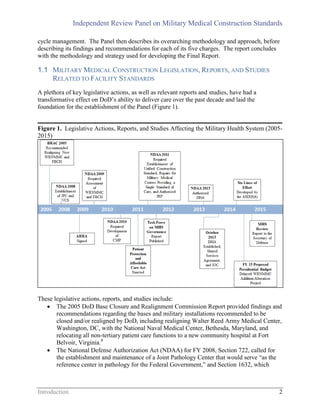
A plethora of key legislative actions, as well as relevant reports and studies, have had a
transformative effect on DoD’s ability to deliver care over the past decade and laid the
foundation for the establishment of the Panel (Figure 1).
Figure 1. Legislative Actions, Reports, and Studies Affecting the Military Health System (2005-
2015)
These legislative actions, reports, and studies include:
 The 2005 DoD Base Closure and Realignment Commission Report provided findings and
recommendations regarding the bases and military installations recommended to be
closed and/or realigned by DoD, including realigning Walter Reed Army Medical Center,
Washington, DC, with the National Naval Medical Center, Bethesda, Maryland, and
relocating all non-tertiary patient care functions to a new community hospital at Fort
Belvoir, Virginia.8
 The National Defense Authorization Act (NDAA) for FY 2008, Section 722, called for
the establishment and maintenance of a Joint Pathology Center that would serve “as the
reference center in pathology for the Federal Government,” and Section 1632, which
Independent Review Panel on Military Medical Construction Standards
Introduction 3
called for the establishment of a vision center of excellence in the prevention, diagnosis,
mitigation, treatment, and rehabilitation of military eye injuries.9
 The Duncan Hunter NDAA for FY 2009, Section 2721, recommended that beneficiaries
living in the NCR deserve to be treated in world-class facilities.10
 The American Recovery and Reinvestment Act of 2009 established three primary goals:
to create new jobs and save existing ones; to spur economic activity; and to invest in
long-term growth and foster levels of accountability and transparency in government
spending.11
 The NDAA for FY 2010, Section 2714, required a comprehensive master plan be
developed and implemented that provides sufficient world-class military medical
facilities and an integrated system of health care delivery for the NCR.12
 The Ike Skelton NDAA for FY 2011, Section 2852, required establishment of 1) a unified
construction standard for military construction and repairs for military medical centers
that provides a single standard of care and 2) the Independent Review Panel on Military
Medical Construction Standards.4
 The Patient Protection and Affordable Care Act of 2010 aims to increase access to health
care insurance using a variety of programs and incentives; increase prevention and
wellness provisions; and improve health care quality, system performance, and
efficiency.13
 The 2011 Task Force on Military Health System Governance evaluated the MHS and
multi-service health care markets’ long-term governance structure.14
 The NDAA for FY 2013, Section 731, authorized the Defense Health Agency (DHA),
established in October, 2013, to accomplish the MHS Quadruple Aim of increased
readiness, better health, better care, and lower costs.15
 The proposed FY 2015 Budget delayed the Walter Reed National Military Medical
Center Addition/Alteration project until FY 2017.16
 The Six Lines of Effort for the Military Health System developed six strategic lines of
effort to position the MHS to be stronger and more flexible in providing care.6
 The 2014 Military Health System Review: Final Report to the Secretary of Defense
provided a comprehensive review of patient access, patient safety, and quality of care
across the MHS.2
Additional information on these legislative actions, reports, and studies can be found in
Appendix E. A glossary of acronyms can be found in Appendix F.
1.2 CHARGE TO THE INDEPENDENT REVIEW PANEL ON MILITARY MEDICAL
CONSTRUCTION STANDARDS
Section 2852 of the FY 2011 Ike Skelton NDAA required the Secretary of Defense to establish a
unified construction standard for military construction (MILCON) and repairs for military
medical centers that provides a single standard of care and to establish an independent advisory
panel for the purposes of:
 Reviewing the unified construction standards’ consistency with industry practices and
benchmarks for world-class medical construction;
 Reviewing DoD’s ongoing construction programs to ensure standards are uniformly
applied;
Independent Review Panel on Military Medical Construction Standards
Introduction 4
 Assessing DoD’s approach to planning and programming facility improvements;
 Assessing whether the Comprehensive Master Plan (CMP) for the NCR , dated April
2010, is adequate to fulfill the requirements from Section 2714 of the NDAA for FY
2010 to ensure that the facilities and organizational structure described in the plan result
in world-class military medical centers in the NCR; and
 Making recommendations regarding adjustments to the CMP that are needed to ensure
the provision of world-class military medical centers and delivery system in the NCR.4
The Panel was constituted on February 6, 2014. As mandated by law requiring its establishment,
the Panel must submit an annual report to the Secretary of Defense no later than each February 1
until the Panel terminates.4
This report, “Form Follows Function: Pursuing a World-Class
System for Health,” is the Panel’s Annual Progress Report.
1.3 DEPARTMENT OF DEFENSE MILITARY MEDICAL CONSTRUCTION POLICY,
STANDARDS CRITERIA, AND GUIDELINES
“Design guidelines are intended to provide designers and design
decision makers with specific performance oriented tactical
guidelines on how to achieve world-class and evidence- based
design strategies, meet related objectives, and ultimately achieve
MHS Guiding Principles through the design of the built
environment.” 17
-MHS Facilities Design Guidelines, Criteria, and Policy
The MHS has defined policies, standards criteria, and guidelines for effective facility life-cycle
management in support of the MHS standard of care. These were established by the Office of
the Secretary of Defense for Health Affairs Portfolio Planning and Management Division with
the goal of “delivering world-class medical facilities that support a care experience that is
patient- and family-centered, compassionate, convenient, equitable, safe and always of the
highest quality.”18
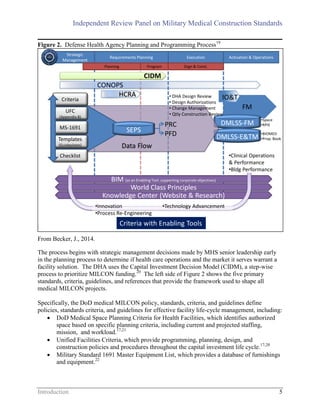
Figure 2 portrays the facility life-cycle process used for planning MHS facilities. This cycle
shows four major phases: Strategic Management, Requirements Planning, Execution, and
Activation and Operations. The process begins when the need for a capital investment is
identified and continues through construction, operation, and, ultimately, decommissioning. The
cycle repeats when another new requirement surfaces and lessons learned are incorporated.
Independent Review Panel on Military Medical Construction Standards
Introduction 5
Figure 2. Defense Health Agency Planning and Programming Process19
Independent Review Panel on
Military Medical Construction Standards
August 19, 2014 ■ San Diego, California
Page 9August 19, 2014
FM
DMLSS-FM
DMLSS-E&TM
Data Flow
Strategic
Management
Execution Activation & OperationsRequirements Planning
Planning Program
CIDM
Dsgn & Const.
CONOPS
HCRA
BIM (as an Enabling Tool ,supporting corporate objectives)
World Class Principles
Knowledge Center (Website & Research)
•Clinical Operations
& Performance
•Bldg Performance
IO&T
•Innovation
•Process Re-Engineering
•Technology Advancement
•Space
•RPIE
•BIOMED
•Prop. Book
Criteria
UFC
(Appendix B)
MS-1691
Templates
(Guideplates)
Checklist
PRC
PFD
SEPS
• DHA Design Review
• Design Authorizations
• Change Management
• Qtly Construction Review
Criteria with Enabling Tools
From Becker, J., 2014.
The process begins with strategic management decisions made by MHS senior leadership early
in the planning process to determine if health care operations and the market it serves warrant a
facility solution. The DHA uses the Capital Investment Decision Model (CIDM), a step-wise
process to prioritize MILCON funding.20
The left side of Figure 2 shows the five primary
standards, criteria, guidelines, and references that provide the framework used to shape all
medical MILCON projects.
Specifically, the DoD medical MILCON policy, standards, criteria, and guidelines define
policies, standards criteria, and guidelines for effective facility life-cycle management, including:
 DoD Medical Space Planning Criteria for Health Facilities, which identifies authorized
space based on specific planning criteria, including current and projected staffing,
mission, and workload.17,21
 Unified Facilities Criteria, which provide programming, planning, design, and
construction policies and procedures throughout the capital investment life cycle.17,20
 Military Standard 1691 Master Equipment List, which provides a database of furnishings
and equipment.22
Independent Review Panel on Military Medical Construction Standards
Introduction 6
 Military Health System Templates, which represent the recommended layout of
equipment to support the function and flow of a space/room and reflect the net square
feet of the space/room from the Space Planning Criteria chapter.17,23
 World-Class Toolkit and Checklist, which provide designers and design decision makers
with specific performance-oriented tactical guidance on how to achieve world-class and
evidence-based design strategies.24
 Health Care Requirements Analysis, which forecasts future requirements based on a
range of considerations, including the size and demographics of the market population
and demand/utilization of health care services by that population within and outside the
MHS direct care system.25,26
 Capital Investment Decision Model, which prioritizes MILCON projects.20,17
The Medical Space Planning Criteria for Health Facilities, Unified Facilities Criteria (UFC)
Appendix B, Military Standard-1691 (MILSTD 1691) Master Equipment List, MHS Templates,
and the World-Class Checklist provide the strategy and identify required medical functions,
room sizes, configurations, and contents.20
Project requirements are processed through the Space
and Equipment Planning System (SEPS) application to create the Project Room Contents (PRC)
list and Program for Design (PFD) that can be used to identify more refined project costs. The
HCRA process considers key input variables when determining what is required to plan and
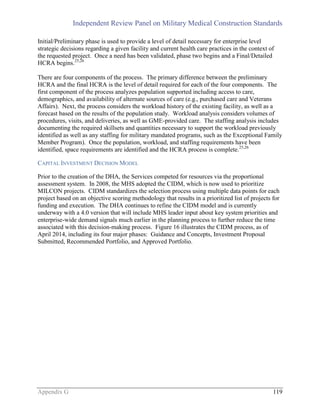
program a medical facility. The initial/preliminary phase is used to provide a level of detail
necessary for enterprise level strategic decisions regarding a given facility and current health
care practices in the context of the requested project. The primary difference between the
preliminary HCRA and the final HCRA is the level of detail required for each of the four
components.26,25,26
As depicted in Figure 2, project execution begins after the CIDM process concludes. Design and
construction activities occur as the gaining hospital staff begin to refine the Concept of
Operations (CONOPS) in preparing for operational changes to maintain safe quality care while
maximizing the capabilities of the new building. Initial outfitting and training (IO&T) planning,
procurement, and transition activities also begin during execution and continue into the
activation and operations stage.20
This includes turnover of a substantially completed facility;
activating building maintenance operations using DoD’s Facility Management tool (DMLSS-
FM); establishing a new property book and equipment maintenance schedule (DMLSS-E&TM);
training the staff based on the refined CONOPS; and moving the health care operations from the
existing areas to new facilities. Activation and operations also include establishing access,
quality, and safety metrics designed to achieve the intended outcomes identified during the
strategic planning process, along with any changes that have occurred in the health care industry.
This life-cycle process should result in improved facility capabilities to provide better health
care, as well as setting the stage for performance measurement, evaluation, and standards
improvement for the next project.
Additional information on DoD medical military construction policy, standards criteria, and
guidelines can be found in Appendix G.
Independent Review Panel on Military Medical Construction Standards
Introduction 7
SECTION REFERENCES
2. U.S. Department of Defense. Military Health System Review: Final Report to the
Secretary of Defense. August 29, 2014.
4. 111th Congress 2nd Session. Ike Skelton National Defense Authorization Act for Fiscal
Year 2011. Pub. L. No. 111-383. 2011.
5. Woodson J. Accountability and Leadership. 2014.
6. Woodson J, Robb D. Prepared Statement Of The Honorable Jonathan Woodson, M.D.,
Assistant Secretary of Defense (Health Affairs), and Lieutenant General (Dr) Douglas
Robb, Director, Defense Health Agency Before the House Armed Services Committee
Subcommittee on Military Personnel. 2014.
7. Carter AB. Implementation of Military Health System Governance Reform. 2013.
8. Defense Base Closure and Realignment Commission. 2005 Defense Base Closure and
Realignment Commission Report. 2005.
9. 110th Congress. National Defense Authorization Act for Fiscal Year 2008. Pub. L. No.
110-181. 2008.
10. 110th Congress. Duncan Hunter National Defense Authorization Act for Fiscal Year
2009. Pub. L. No. 110-417. 2008.
11. 111th Congress. American Recovery and Reinvestment Act of 2009. Pub. L. No. 111-5.
2009.
12. 111th Congress. National Defense Authorization Act for Fiscal Year 2010. Pub. L. No.
111-84. 2009.
13. U.S. Department of Health & Human Services. Read the Law. [Webpage].
http://www.hhs.gov/healthcare/rights/law/. Accessed April 15, 2015.
14. Task Force on Military Health System Governance. Department of Defense Task Force
on Military Health System Governance Final Report. September 29, 2011.
15. 112th Congress. National Defense Authorization Act for Fiscal Year 2013. Pub. L. No.
112-239. 2013.
16. U.S. Department of Defense. Presidential Budget 2015 Defense Health Agency Future
Years Defense Plan. 2014.
17. U.S. Department of Defense. MHS Facilities Design Guidelines, Criteria & Policy.
[Webpage]. https://facilities.health.mil/home/Criteria. Accessed April 17, 2014.
18. U.S. Department of Defense. World-Class Facilities. [Webpage].
https://facilities.health.mil/home/. Accessed April 17, 2014.
19. Becker J. Facilities Overview for Independent Review Panel. 2014.
20. U.S. Department of Defense. Unified Facilities Criteria (UFC) - Design: Medical Military
Facilities (UFC 4-510-01). 2012.
21. U.S. Department of Defense. Military Health System (MHS): DoD Space Planning
Criteria for Health Facilities. [Webpage].
http://www.wbdg.org/ccb/browse_cat.php?o=29&c=261.
22. U.S. Department of Defense. Military Standard (MILSTD) 1691 Equipment. [Webpage].
https://facilities.health.mil/home/MILSTD1691. Accessed January 6, 2014.
23. U.S. Department of Defense. Military Health System (MHS) Templates (formerly
'Guideplates'). [Webpage].
http://www.wbdg.org/ccb/browse_cat.php?o=64&c=260#8264.
Independent Review Panel on Military Medical Construction Standards
Introduction 8
24. U.S. Department of Defense. World-Class Toolkit. [Webpage].
https://facilities.health.mil/home/toolkit. Accessed April 17, 2014.
25. Boenecke C. Shared Service Annual Report Discussion. 2014.
26. McWhirt D. HCRA Process. 2014.
Independent Review Panel on Military Medical Construction Standards
Overarching Methodology/Approach 9
2.0OVERARCHING METHODOLOGY/APPROACH
The Independent Review Panel on Military Medical Construction Standards (Panel) was charged
with providing an annual report to the Secretary of Defense on its findings and recommendations
to address any identified deficiencies each February 1 until its termination in September 30,
2015.4
The Panel approached each of its five duties, as established in the Fiscal Year 2011 National
Defense Authorization Act (see Appendix B for more information on the Panel’s charge), using
three key frameworks:
 The world-class medical facility definition, which was developed as part of the work
of the National Capital Region Base Realignment and Closure Health Systems
Advisory Subcommittee of the Defense Health Board in May 2009, shaped the
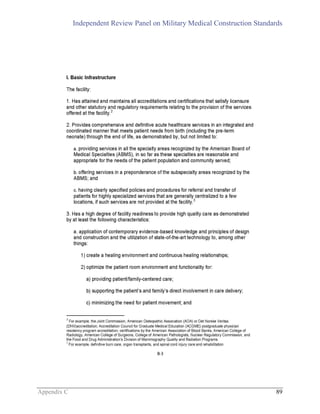
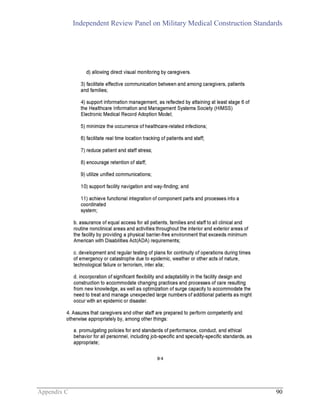
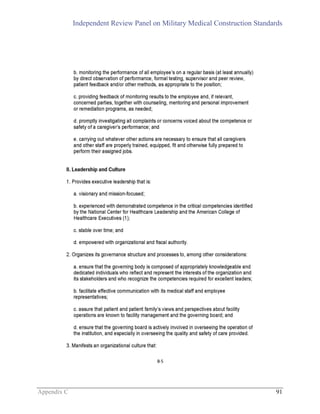
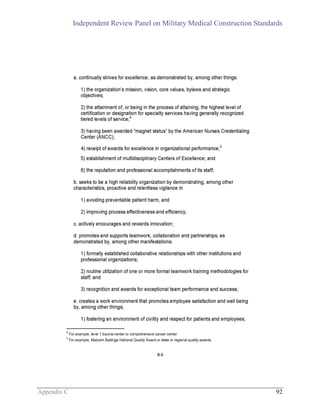
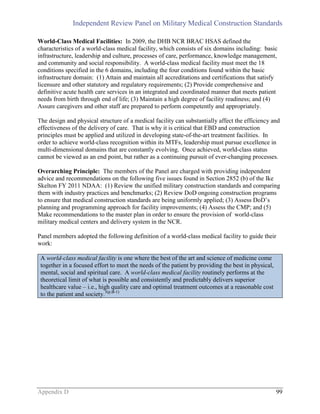
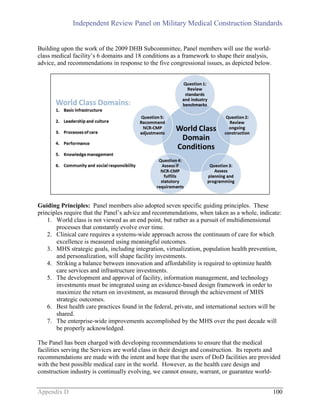
Panel’s analysis, advice, and recommendations. The definition includes 18
conditions in the following 6 domains that must be met for a medical facility to be
considered world-class:
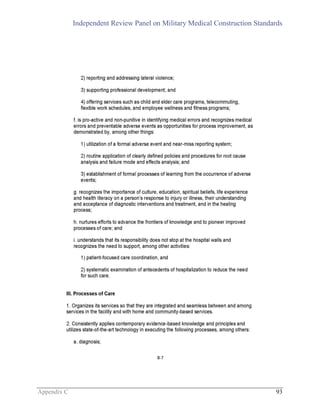
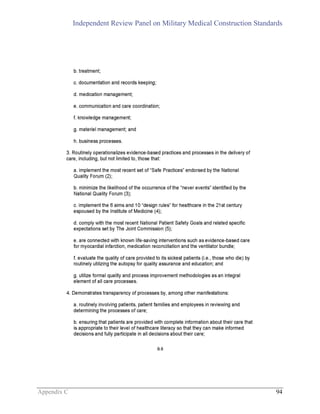
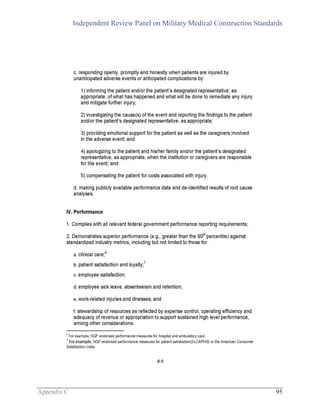
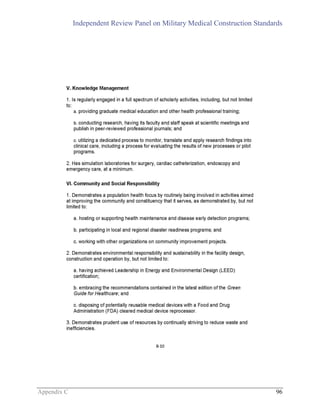
1. Basic Infrastructure;
2. Leadership and Culture;
3. Processes of Care;
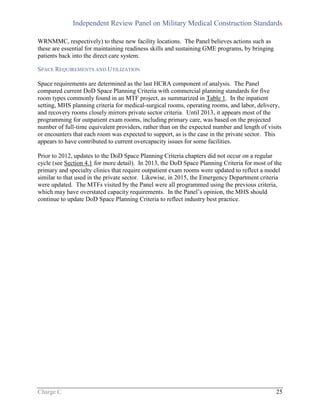
4. Performance;
5. Knowledge Management; and
6. Community and Social Responsibility (see Appendix C).
 Seven Guiding Principles, created and adopted by the Panel, established the
foundation for its work, reflected the Panel’s core beliefs, and provided a lens through
which the Panel established goals and developed recommendations (see Appendix D).
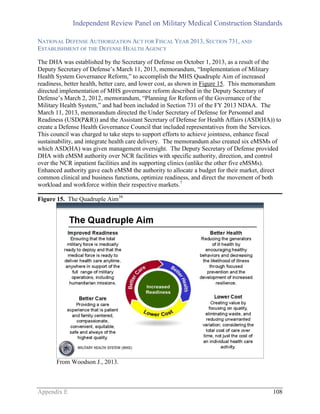
 The components of the MHS Quadruple Aim, increased readiness, better care, better
health, and lower cost, guided the Panel’s inquiry (see Figure 15).
The Panel also established Terms of Reference, which can be found in Appendix H, to guide its
work. The Panel has convened on multiple occasions in person and via teleconference and
webcast. It has received briefings from subject matter experts in facility design, construction,
and repair standards; engaged in discussions with Defense Health Agency and Department of
Defense leaders, national leaders of health care organizations and groups; toured multiple
military treatment facilities (MTFs); and reviewed relevant reports and presentation files. A
complete list of meetings, presentations, and MTFs visited is included in Appendix I.
The Annual Progress Report is organized in such a way as to address each of the five charges in
the context of a typical facility project life cycle, which starts with planning and programming
activities, followed by design, construction, and activation/operation-related activities. As such,
the report has been intentionally organized so that Charge C, Approach to Planning and
Programming Facility Improvements, will be introduced first in Section 3.0, followed by Charge
A, Consistency of Unified Construction Standards with Industry Practices and Benchmarks,
which is next in the life cycle, in Section 4.0. Charge B, Uniform Application of Medical
Construction Standards in Ongoing Construction Programs, and Charges D/E, Adequacy of and
Independent Review Panel on Military Medical Construction Standards
Overarching Methodology/Approach 10
Adjustments to the Comprehensive Master Plan, complete the report in Section 5.0 and Section
6.0, respectively.
The Panel submitted its Initial Report to the Secretary of Defense on June 5, 2014, and held a
meeting on January 14, 2015, to publically deliberate its Annual Progress Report. The Initial
Report can be found at the following link:
https://database.faca.gov/committee/historyreportdocuments.aspx?flr=15308&cid=2450&fy=201
4.
GUIDING PRINCIPLES AND DEFINITION OF A WORLD-CLASS MEDICAL FACILITY
The Panel believed that it was especially important to establish Guiding Principles that laid the
foundation for and shape its work. The Panel’s core beliefs and principles provide the lens
through which the Panel conducted its inquiry, document its findings, develop its
recommendations, and write its reports. A full version of the Guiding Principles document can
be found in Appendix D.
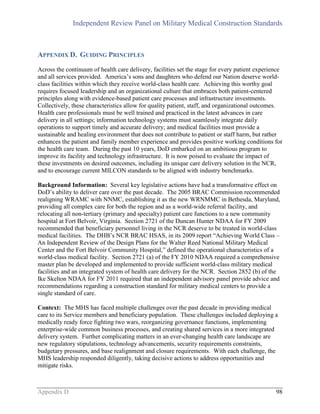
These principles require that the Panel’s advice and recommendations, when taken as a whole,
indicate:
1. World class is not viewed as an end point, but rather as a pursuit of multidimensional
processes that constantly evolve over time.
2. Clinical care requires a systems-wide approach across the continuum of care for which
excellence is measured using meaningful outcomes.
3. Military Health System (MHS) strategic goals, including integration, virtualization,
population health prevention, and personalization, will shape facility investments.
4. Striking a balance between innovation and affordability is required to optimize health
care services and infrastructure investments.
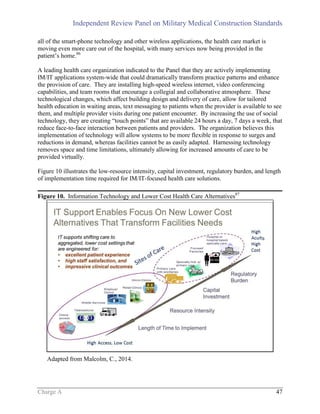
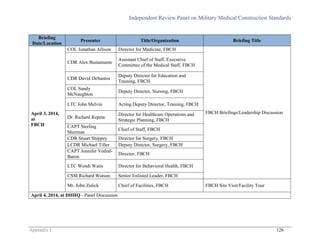
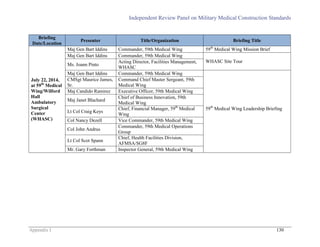
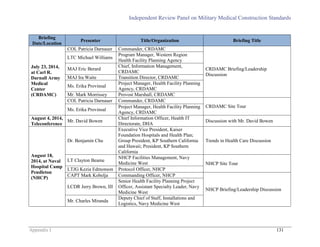
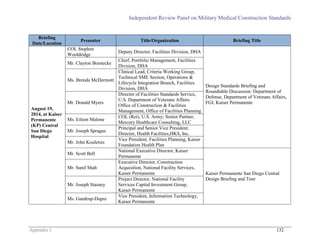
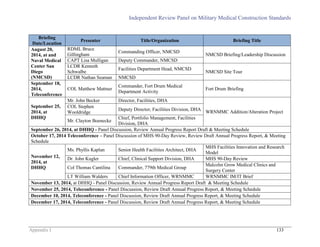
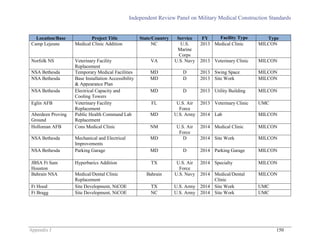
5. The development and approval of facility, information management, and technology
investments must be integrated using an evidence-based design framework in order to
maximize the return on investment, as measured through the achievement of MHS
strategic outcomes.
6. Best health care practices found in the federal, private, and international sectors will be
shared.
7. The enterprise-wide improvements accomplished by the MHS over the past decade will
be properly acknowledged.
Panel members also adopted the following definition for a world-class medical facility to guide
their work:
A world-class medical facility is one where the best of the art and science of medicine
come together in a focused effort to meet the needs of the patient by providing the best in
physical, mental, social, and spiritual care. A world-class medical facility routinely
performs at the theoretical limit of what is possible and consistently and predictably
delivers superior healthcare value – i.e., high quality care and optimal treatment
outcomes at a reasonable cost to the patient and society.27 (P.B-1)
See Appendix C for the full definition of a world-class medical facility.
Independent Review Panel on Military Medical Construction Standards
Overarching Methodology/Approach 11
SECTION REFERENCES
4. 111th Congress 2nd Session. Ike Skelton National Defense Authorization Act for Fiscal
Year 2011. Pub. L. No. 111-383. 2011.
27. National Capital Region Base Realignment and Closure Health Systems Advisory
Subcommittee of the Defense Health Board. Achieving World Class - An Independent
Review of the Design Plans for the Walter Reed National Military Medical Center and
the Fort Belvoir Community Hospital. May 2009.
Independent Review Panel on Military Medical Construction Standards
Charge C 12
3.0CHARGE C. DEPARTMENT OF DEFENSE APPROACH TO PLANNING AND
PROGRAMMING FACILITY IMPROVEMENTS
“(C) Assessing the approach of the Department of Defense … to
planning and programming facility improvements with specific
emphasis on – (i) Facility selection criteria and proportional
assessment system; and (ii) Facility programming responsibilities
between the Assistant Secretary of Defense for Health Affairs and
the Secretaries of the military departments [sic].”4
-Ike Skelton NDAA for FY 2011, Section 2852
INTRODUCTION
Many forces shape facility investment requirements related to the creation, expansion,
modification, or closure of military treatment facilities (MTFs) in the Department of Defense
(DoD). During the past decade-plus, significant changes in troop strength, the repositioning of
military units around the world, and combat casualty care and rehabilitation requirements shaped
the planning and programming for many new hospitals and clinics, which were designed to
enable changes in care delivery models. The nation also began an era of health care reform,13
adding more complexity to the challenge of forecasting demand for health care services and
capacity in both the commercial and military sectors.
The Independent Review Panel on Military Medical Construction Standards (Panel) observed
that the challenge of matching capacity to demand is exacerbated in military health care, in
which base-closings, troop surges and reductions, and strategies around purchased care combine
to create a level of volatility in the demand forecast that is unlike the commercial sector. In the
commercial sector, based on Panel experience, gradual shifts in population or physician
preference, merger and acquisition activity, and poor business performance are often linked to an
array of competitive forces, including investment and disinvestment. The Panel believes these
market signals are rarely experienced in the MHS, the risk of not having enough capacity is
perceived to be higher than the risk of having excess capacity in the MHS, and this phenomenon
is reversed in the private sector.
In the private sector, “capital allocation is a strategic, organizational process used to make capital
investment decisions.”28
Through the capital allocation process, an organization deploys its
available capital in a few ways: for investment in future growth, re-investment in the
organization, or, in a private organization, as cash reserves on its balance sheet. Sound corporate
finance-based capital allocation approaches used by private health care delivery systems are
instructive for the development and sustainment of world-class military health systems. That is
because the “purpose of true, corporate finance-based capital allocation is to ensure the
continued financial strength and mission effectiveness of the organization through a process that
enhances organization-wide decision making.”28
A capital allocation process based on best
practices supports the organization’s strategic goals by:
 Linking financial planning and capital planning to the organization’s strategic plan;
Independent Review Panel on Military Medical Construction Standards
Charge C 13
 Providing a process that is rigorous and highly-organized;
 Providing a financial context for allocation decisions that also incorporates the strategic,
mission and operational aspects of alternative investment decisions; and
 Ensuring rational comparisons among projects and strategic initiatives emerging
throughout the entire organization.28
Congress has always played a critical role in the routine review, authorization, and appropriation
of medical military construction (MILCON) programs. Between 2005 and 2012, Congress
responded to DoD’s requirements with authorization and appropriation for a large investment in
medical MILCON projects. Between these years, Congress appropriated $11.4 billion for 27
new or addition/alteration hospitals, 4 ambulatory surgery centers, 43 medical clinics, 12 dental
clinics, and 32 other health care-related facilities, such as veterinary clinics, research facilities,
and supporting administration buildings, as depicted in Figure 3.29
In addition, annual DoD
appropriations provide the necessary operations and maintenance funding, which supports
sustainment, restoration, and modernization projects (see Appendix J for a full project list).29
Figure 3. Medical Military Construction Funding by Facility Type and Year (In Millions)29
Adapted from Defense Health Agency (DHA) Facilities Division, 2014.
*The chart reflects aggregated amounts in the year of authorization.
METHODOLOGY
In this section, the Panel addressed each part of the congressional Charge C question by
examining the enterprise-wide strategy for facility planning and programming, as well as the
Independent Review Panel on Military Medical Construction Standards
Charge C 14
facility funding and budget structures, and facility selection criteria through briefings, site visits,
and review of DoD policies.
3.1 ENTERPRISE STRATEGY
CARE DESIGN IN AN INTEGRATED DELIVERY SYSTEM
“We must not only focus on creating world-class facilities, but also
on how the Military Health System’s choices and strategic
direction enable success and empower individuals to work toward
the shared vision of a world-class system of care.” 30
-Lt Gen Thomas Travis, Air Force Surgeon General
All successful facility planning and programming begins with an enterprise-wide, strategic vision
of a preferred future, supported by detailed goals and objectives that describe the functions that
facility investments enable so that “form ever follows function.”31
The MHS is evolving as a
newly formed integrated delivery system (IDS), an “organized, coordinated, and collaborative
network that links various health care providers to provide a coordinated, vertical continuum of
services to a particular patient population or community. It is also accountable, both clinically
and fiscally, for the clinical outcomes and health status of the population or community served,
and has systems in place to manage and improve them.”32
The approach to health care is
changing in the sense that function is and has been redefined, whereas the traditional approach
has been to focus on form/built environment. Accordingly, to be world class, the orientation of
thinking/planning needs to be reset to one of optimum IDS function for the MHS, one that
includes all types of facilities (inpatient, outpatient, physician offices, core functions, and support
services) that are utilized together, creating a system of care.
The Panel has been charged to compare the MHS to health systems that are world class. Based
on Panel experience, these world-class health systems normally employ forecasting, care design,
modeling, innovation, clinical and business planning, and cost analysis to arrive at their
solutions. Once a view of the market and strategy is developed and is determined to be
affordable for the health system, facility professionals are engaged to create physical options to
meet the need within established financial and planning constraints. Organizations that might be
considered world class, such as those in the top tier of U.S. News and World Reports ratings,
nearly always work to incorporate the latest evidence-based design (EBD),33-35
in addition to
reflecting the characteristics of an IDS.36
Similar to private sector organizations, the Defense Health Agency (DHA) planning and
programming process begins with strategic management (see Section 1.3 and Figure 2). It
appears that, in the past, exacting facility planning requirements often drove local and regional
strategic planning activities, such as clinical and administrative process reengineering and
organizational culture transformation, without consideration for the MHS' strategic
requirements.37
Fort Belvoir Community Hospital’s (FBCH’s) laudatory Culture of Excellence
program was created using successful culture models from Baptist Health Care System and
Disney, in response to the new hospital project and newly created National Capital Region
(NCR) integrated health care delivery system.38
However, it appears that this program exists
only at the FBCH and has not been adopted by all MTFs in the NCR or across the MHS as a
Independent Review Panel on Military Medical Construction Standards
Charge C 15
whole. Ideally, programs such as this should be developed, evaluated, and adopted in advance of
project planning and programming work in order to make the best use of facility design
opportunities and maximize facility project investments.
Based on what the Panel has seen to date, the MHS does not appear to have a standard business
model for health care delivery, a characteristic of an IDS that reduces variance. For example, not
all planned projects considered all of the military health care assets for the local market. The
Panel observed that, even when that approach was used in the planning of inpatient services for
the NCR, subsequent leaders may not have used the facilities as planned and programmed (see
Section 6.1 and 6.3). The establishment of the DHA “to assume responsibility for shared
services, functions and activities of the MHS and other common clinical and business
processes”2
represents an important first step in correcting this deficit.
DEMAND SIGNAL AND BUSINESS PROCESS ENGINEERING
The demand signal to justify any new or renovated MTF is shaped by the MHS Quadruple Aim’s
priorities and expressed as regional strategies to meet the MHS strategic objectives of increased
readiness, better care, better health, and lower cost.39
The Panel believes the four goals of the
Quadruple Aim are interconnected and interdependent. For example, it is unlikely that better
care and lower cost will be created in a low-volume environment. The success of each aim is
dependent on carefully planned and aligned resource investments of trained staff, operational
funding, and infrastructure investments, such as facilities, in order to support specific population
health requirements. Services that operate within this context appear to have a higher likelihood
of achieving the desired outcome.
The Panel viewed the recent consolidation of facilities programming responsibilities under the
DHA organizational structure as an important positive step towards ensuring prioritized
investments based on a clearly understood demand signal as a critical first step in the design and
construction of safe, efficient, flexible, adaptable, and world-class medical facilities. However,
implementing a planning and portfolio management process that is based on improved asset
utilization standards should be considered. The savings created through effective portfolio
management greatly outweighs other forms of capital intervention, which was furthered through
the establishment of a health market approach with the formation and implementation of the
enhanced Multi-Service Markets (eMSMs) in FY 2014.
Independent Review Panel on Military Medical Construction Standards
Charge C 16
MILITARY HEALTH SYSTEM GOVERNANCE CHANGES
Enhanced Multi-Service Markets
The DHA has taken the first step to create an IDS through the implementation of eMSMs. The
term Multi-Service Market (MSM) refers to a health care market that is serviced by multiple
Services and their subordinate MTFs. Enhanced refers to enhanced authorities granted to the
military officer assigned to the role of Market Manager. These authorities include developing a
five-year business plan for the market; authority to direct short-term reassignment of personnel
regardless of service; allocation of the Defense Health Program budget for the market; and
management of MSM-specific shared services and related functions.7
There are six eMSMs, five
of which are led by a single-Service and one managed by the DHA (the NCR), and two single-
Service markets in San Diego, CA, and at Fort Bragg, NC (see Figure 4). However, Service
leadership rotates every few years in each eMSM, and leadership has to rely on collaboration
between DHA and among the Services.7
The Panel learned in a briefing that, eMSM leadership
will have enhanced authority including responsibility for eMSM budgets,40
although ultimate
budgetary control still remains with the MTF’s parent Service Surgeon General.
Figure 4. eMSM and Single Service Market Geographic Distribution41
From Robb, D., 2014.
Currently, the principal facilities that are included in the eMSM structure are hospitals and major
campuses. However, ambulatory facilities, which frequently are the entryway to a health system,
operate under the control of their sponsoring Service.42-47
This results in a natural organizational
barrier to being a world-class IDS. Though the Panel encountered multiple examples of
voluntary collaboration between Services and the eMSM leadership, the MHS in these markets
does not mirror what is found in a successful private-sector IDS, where the full continuum of
care is led by a single organization focused on serving the local population at the most
appropriate site of care.32
eMSMs lack a single command and control structure with single
Independent Review Panel on Military Medical Construction Standards
Charge C 17
budgetary authority for all MTFs in their region, which complicates facility investment
requirements and life-cycle management. Given that the eMSM structure and the DHA are so
new, this may be an interim phase in its development. Another key difference between eMSMs
and private or commercial IDSs is that shared administrative service structures appear to be
somewhat underdeveloped, which could enable consolidation and reduce programming
requirements. There is normally a tiered local regional strategy designed to achieve the most
efficient support in facilities, laboratory, supply chain, dietary, finance, and other support
services. Currently, each Service MTF manages most of its own support services. However,
some of these support services, such as patient appointment and referral management could be
consolidated as an eMSM function, such as was the case at the San Antonio Military Health
System.
Therefore, there is a key structural limitation for eMSMs because the personnel structure,
responsibilities, scope of command and control, and budgetary authority all vary from one
location to another, and shared services are new and continuing to develop. A single command,
control, and budgetary authority could drive the facility requirements and planning processes by
establishing a program for integrated facility life-cycle budget requirements with IDS fiscal
accountability to inform facility investments. As affordability becomes a greater issue for the
MHS, it is likely that this structure will need to quickly evolve.
To help address these issues, DHA Facilities Division staff are conducting initial visits to eMSM
sites to introduce DHA facility capabilities and their role in facility planning and socialize the
shared service concept (see Appendix K for a list of MTFs in each eMSM). These introductory
visits revealed that eMSM staff do not include facility subject-matter-experts.48
The stage has
now been set for FY 2015 facility planning assessment visits, which will use approved FY 15-19
eMSM business plan requirements.
National Capital Region Medical Directorate
The newly formed DHA has authority, direction, and control for the National Capital Region-
Medical Directorate (NCR-MD).7
The NCR-MD includes the management of the two inpatient
medical facilities, Walter Reed National Military Medical Center (WRNMMC) and FBCH, and
only some of the primary care and ambulatory care facilities found in the 40-mile geographic
region that surrounds the Nation’s capital (see Appendix K for the list of the facilities in the
NCR-MD).42
However, unlike true IDS organizations, NCR-MD lacks the authority, control,
and single budgetary authority for all of the MTFs found in its region (see Section 6.1 for more
discussion about the impacts on facility comprehensive master planning activities for the NCR).
MILITARY TREATMENT FACILITY CAPACITY AND ASSET UTILIZATION
Based on information provided by the leadership at each of the MTFs visited by the Panel and
data provided in the eMSM’s business performance plans, none appeared to be operating at full
capacity.43,45,46
Recognizing the challenges associated with optimizing capacity, the creation of
appropriately sized buildings prevents high costs associated with an oversized facility’s life
cycle. Capacity for the new facility projects built over the past decade was determined using the
Health Care Requirements Analysis (HCRA) (see Section 1.3 and Appendix G). HCRA includes
four main components to determine capacity requirements: projected population demographics
demand and alternative sources of care, workload history, staffing analysis and finally, space
Independent Review Panel on Military Medical Construction Standards
Charge C 18
requirements.25,26
Once a new facility is open, many variables can impact its full utilization,
such as an increased surge in care demand, similar to the surges experienced during the recent
wars; a decrease in demand because troop units have been moved or reduced; staffing
assignment and availability; and the services available and the amount of care provided in the
purchased care network.
Figure 5. Key Questions to Justify Capital Investment49
From Malcolm, C.
In world-class IDSs, there are several key questions that are addressed to justify a capital
investment, as shown in Figure 5. Ideally, the MHS should address all five of these questions
and monitor the outcomes associated with each using capital-specific metrics. The Panel
compared the Capital Investment Decision Model (CIDM) phased-approval process, as displayed
in Figure 16, with a typical capital planning process in leading health systems, summarized in
Figure 6. It is evident that large projects, both in the MHS and leading private sector health
systems, follow a parallel process. The Panel considered why the MHS appears to have lower
asset utilization when compared with leading, private health systems, by first examining the four
HCRA components.
Independent Review Panel on Military Medical Construction Standards
Charge C 19
Figure 6. Comparison of Leading Health System and Military Health System Capital
Investment Decision Model 50,51
Adapted from Malcolm, C. 2014 and Boenecke, C., 2014.
A WORLD-CLASS HIGH-RELIABILITY INTEGRATED DELIVERY SYSTEM
“We are aggressively moving from a healthcare system – a system
that primarily focused on injuries and illness – to a System for
Health that now incorporates and balances health prevention and
wellness as part of the primary focus for readiness.” 52
-Lt. Gen. Patricia Horoho, U.S. Army Surgeon General
The MHS has recognized the need to migrate from Service-centric management of health care to
that of an IDS model. The Office of Strategy Management presentation to the Institutional
Review Board highlighted five “True North Measures” for the MHS related to Improved
Readiness, Better Health, Better Care, Lower Cost, and Engaged Workforce, and a logic model
for health and medical readiness that showed how the elements of the MHS would work together
to better achieve these goals (see Appendix L for the True North Measures and logic model).37
Independent Review Panel on Military Medical Construction Standards
Charge C 20
Entirely consistent with the best thinking in the commercial health sector and aligned with Panel
experience, the Office of the Secretary of Defense for Health Affairs Office of Strategy
Management believes the future of health facilities requirements will be based on:
 Disrupting the hospital model, through solution shops specializing in diagnoses and value
adding process clinics creating focus and precision in treatment;
 Moving from health care to health by shifting the point of intervention;
 Emphasizing patient and family involvement, including designing for an expanded care
team; and
 Using condition-based care and a patient-centric model.37
While this vision is highly consistent with the private sector, one key difference is the relative
lack of emphasis on the use of technology to transform care (see Section 4.4 for a discussion
about technology and facility infrastructure integration and the subsection below, Military
Treatment Facility Capacity and Asset Utilization, that further contrasts DoD with the private
sector).
In 2009, the Defense Health Board defined a world-class facility as “one where the best of the art
and science of medicine come together in a focused effort to meet the needs of the patient by
providing the best in physical, mental, social and spiritual care” which is characterized by six
domains and eighteen elements (see Appendix C for the complete list of domains and
conditions).27
Individual health care facilities, rather than an IDS, were the focus for this world-
class facility definition. However, because of financial incentives driven by health care reform13
,
IDS approaches to care delivery should reflect the current best practices found in the private
sector. As a result, the MHS’s decision to move to an IDS necessitates a review of the
foundational tenets of a world-class facility to expand the definition to include a description of a
high reliability IDS that reflects direct and purchased care services, its core services, resource
requirements, concepts of operation, and expected health care outcomes to drive facility planning
and programming requirements. This work would benefit from development by clinical leaders
with the involvement of facility design professionals.
Achieving a world-class IDS status will require the type of systems, culture, processes, and
infrastructure investments that have been successfully demonstrated by leading private sector
health care systems in the United States to achieve desirable cost, access, quality, and patient
safety outcomes, many of which were recently reviewed in the Military Health System Review:
Final Report to the Secretary of Defense.2
The report stated, “the MHS provides good quality
care that is safe and timely, and is comparable to that found in the civilian sector. However, the
MHS demonstrates wide performance variability with some areas better than civilian
counterparts and other areas below national benchmarks.”2
In addition, six external reviewers
recommended opportunities to improve health care delivery and an optimal health care
environment by using effective strategies proven by high-performing organizations.2
System
enhancements should foster a decrease in performance variance at the individual facility level by
creating a high reliability health system (see Section 4.3 for a discussion about high reliability in
health care and facility design). A number of the report’s recommended action plans to create a
high reliability MHS are tied to variables which affect facility planning and programming
decisions. Of note, a number of the EBD features that were included in recently built facilities
Independent Review Panel on Military Medical Construction Standards
Charge C 21
have been shown to improve some of the targeted outcomes identified for improvement in the
report (see Section 5.4, Table 4 for a list of the EBD features and outcomes).2
The Panel believes that a world-class facility is only one component of a true IDS, which should
include all health care facilities needed to support the continuum of care for a geographic region
in order to deliver world-class care. When the Panel evaluated the MHS against comparable
private health care systems, several opportunities for improvement emerged, including
reengineering care delivery processes, shifting care delivery to other locations, shifting care to
lower cost settings (see Section 4.4), balancing workload more appropriately across the region,
and combining clinical support functions, such as the pharmacy and other support services. For
example, a new facility’s square footage may be reduced if every Service’s MTF real estate in a
catchment area is considered based on population requirements. In these cases, staff should be
deployed to create health care facilities with the appropriate population-based services, near
where the population resides. In an IDS, administrative, non-patient functions are often merged
to gain efficiencies, and, as a result, alter the concept of operations that shape programming and
design standards.53
Non-facility, technology-enabled based care options play a role in determining the continuum of
care requirements (see Section 4.4). For example, use of two recent non-facility access
solutions, the Nurse Advice Line and Secure Messaging System, have the potential to reduce
patient demand for care at a facility because patient needs are managed in a virtual fashion.
There was no mention in the Military Health System Review: Final Report to the Secretary of
Defense about the use of telehealth applications as another tool that requires less facility space to
improve patient access to care; a tool that was developed by the military and has been used in a
variable fashion for the past fifteen years.2
It is the Panel’s opinion that a world-class, high-
reliability integrated delivery system requires a clearly envisioned and articulated continuum of
health care delivery options, as an important step in determining facility capacity and ultimately,
asset utilization.
POPULATION DEMAND AND WORKLOAD
Determining the services and the capacity for each project begins with an analysis of population
demand and historic workload to forecast requirements. However, as we noted in the
introduction of this section, population analysis estimates used in planning may be undone
because major force structure changes sometimes occur after a project is underway or completely
finished.
Projected workload based on a population demand analysis and historic workload represents the
second step in the HCRA analysis.25,26
For some of the MTFs that the Panel visited, it was clear
that surges associated with wartime casualty care displaced some of the direct care used to plan
and program the new facilities into the purchased care market. The Panel believes that this shift
in workload, from the direct care system to the purchased care market, has contributed to the
underutilization of new facility assets. Now that wartime care demand has waned, the MHS has
MTFs that have excess facility capacity, which should enable the recapture of workload from the
network. The December 2007 Final Report of the Task Force on the Future of Military Health
Care, Recommendation 1, stated that “DoD should develop a planning and management strategy
that integrates the direct health care system with the purchased care system and promotes such
Independent Review Panel on Military Medical Construction Standards
Charge C 22
integration at the level where care is provided.”54
Under the DHA concept of shared clinical and
business processes, some of which are expressed in eMSM five-year business plans, MHS
leaders have begun the work to recapture beneficiary care from the civilian market.
FY 2014 first quarter performance data for the six eMSMs, as well as the Fort Bragg and San
Diego markets, demonstrates the continued systemic underutilized capacity. Although,
recapturing care from the purchased care network is the top priority for all eMSMs, as reflected
in their FY15-19 eMSM Business Performance Plans,42-47
the Panel believes that barriers still
exist with the current structure of the private sector contracts. The Panel perceives an apparent
lack of aligned strategy, systems, financial incentives, communication, and processes between
the direct care system and the current TRICARE contractors, which appears to contribute to the
underutilization of direct care services, fragmentation in the delivery of services, and inefficiency
in paying for services. Facility planning and programming standards should be examined and
refined to reflect current thinking about the planned recapture of purchased care, in alignment
with eMSM business plans.
In addition, in discussion with eMSM MTF leaders, Panel members understood that the eMSM
realizes no specific financial benefit by recapturing purchased care. The realized recapture
savings (market cost-avoidance) are not accrued to the MTF that provides the services, which
further diminishes incentives to recapture care. This contrasts sharply with civilian integrated
delivery systems, which actively manage the entire care system, both contracted and directly
provided, in a harmonious way within an overall strategy for the market. Some eMSMs, such as
the NCR, are developing strategies to redistribute workload within the direct care system to
support patients closer to where they live for both primary and community-based specialty care,
as well as increase graduate medical education (GME) opportunities for the many residents,
fellows, and other health care professionals in training.42
In San Antonio, the Panel learned
about an integrated centralized referral system that has allowed the San Antonio Military Health
System to recapture workload by assigning the patient to one of several facilities based on
availability and location. The Panel believes that accountability measures and incentives require
development to help realize business plan goals.
Surge capacity planning and programming represents another important variable, which appears
to be described in the DoD Space Planning Criteria for medical mobilization requirements.
Panel members were unclear if these requirements reflect the lessons-learned about surge
demand consequent to the casualties treated over the past decade. In addition, the Panel was
impressed with the Department’s innovative mass casualty contingency design to meet surge
demand in the Rhine Ordnance Barracks Medical Center Replacement project.55
The MHS may
benefit from examining and refining surge-capacity related standards based on recent surge
demand experience.
Another variable in the workload analysis is the relationship between the volume of care
delivered and quality outcomes, a correlational relationship demonstrated in the field of health
care quality and safety. Robust and safe programs must have adequate clinical throughput to
justify staffing, clinical management, and desired clinical outcomes.56
Anecdotally, the Panel
spoke with a number of care providers who described the need to supplement their work outside
of the direct care system in order to maintain clinical proficiency. The DHA, together with the
Independent Review Panel on Military Medical Construction Standards
Charge C 23
Services, would benefit from analyzing low-volume service lines and adjusting facility planning
and programming criteria accordingly.
STAFFING
Projected staffing requirements and manpower distribution play an important role in the planning
and programming of facilities. During discussions with senior leaders, the Panel learned that
each of the Services has different staff requirements and distribution planning models, especially
for providers, whose presence drives product lines that are included in a facility project.57
Differences in staffing methodology between the Services and the overall availability of certain
providers and support personnel may lead to different programming decisions by the Services
and make standardization across the MHS more difficult to achieve.
The Panel learned that the Medical Deputy Action Group has asked the Services to comment on
creating a medical tri-Service human capital distribution plan. The Panel observed that, even
when a partial IDS approach was used in the planning and programming of clinical services for
the NCR, specialty provider staff were not assigned to FBCH from WRNMMC, resulting in
under-utilization of the new hospital, an issue presently being addressed by the NCR- MD (see
Sections 6.1 and 6.3 for more information).42
Appropriate allocation of staffing based on
workload is important so providers are able to maintain their skills, facility capacity is used, and
most importantly, the MTF team is able to maintain the health status and clinical outcomes of the
population it serves. A medical tri-Service human capital distribution plan would assist with the
development of more accurate facility planning and programming standards.
GRADUATE MEDICAL EDUCATION
"Let's have a health care culture that embraces safety practices
and removes for good any chance of preventable harm. . . Let's
abolish unsafe practices -- no more incorrect medications, no more
wrong-site surgeries, no more infections and communication issues
with our patients, just to name a few."58
-Lt. Gen. Patricia D. Horoho (Remarks
made at the annual Association of the
United States Army meeting)
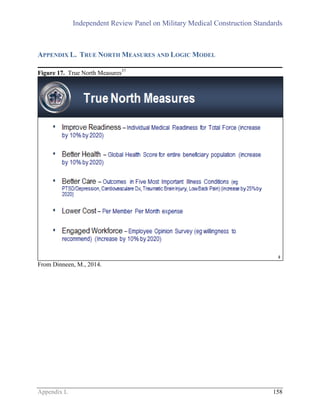
The staffing associated with MHS graduate medical education programs represents an important
sub-set of staffing requirements. During the past decade of wars, care moved from the direct
care system to the purchased care market. This was especially true in the largest eMSMs that
had medical centers, such as the NCR, where much of the wartime related specialty care was
provided and in which there was both an increased demand in the direct care system and a
corresponding loss of market share to network providers.59
Retirees and their family members
were particularly affected in these locations, which is now problematic for GME training
requirements dependent on the case-mix complexity found with older patients, especially given
that there are fewer war-related casualties, essential to support GME training. The Military
Compensation and Retirement Modernization Commission stated in their just published report,
“The military medical force requires access to the desired volume and mix of complex medical
cases and trauma to maintain medical force readiness.”60
Each GME training program has
Independent Review Panel on Military Medical Construction Standards
Charge C 24
requirements for a volume and variety of encounters that residents experience during their
training.61,62
Comments received during briefings that the Panel received during their visits to
MTFs suggested there may be an insufficient diversity of challenging clinical cases to adequately
support GME programs and maintain clinical wartime readiness skills for the health care team.
Another essential component of medical readiness is the continuous maintenance of wartime-
related clinical skills through the daily practice of comprehensive and challenging medical care
for all military medical professionals, including corpsmen and medics, in busy medical centers.
The Panel believes staffing, workload, and GME appear to be best supported by maximizing the
volume of care at the largest medical centers and community hospitals on bases with large active
duty populations. The MHS may find value in conducting an enterprise-wide GME specific
modernization study, which addresses the quantity and type of case needed to maintain health
professional skills, including medics and corpsmen, while considering the best locations for the
provision of GME given population demand and facility assets. The case mix volume and
complexity requirements established by the Accreditation Council for Graduate Medical
Education could be included as a component of the planning standards for each service line
included in a facility project.
There are some centers of excellence in the MHS, such as San Antonio Military Medical
Center’s (SAMMC’s) world-class U.S. Institute for Surgical Research Burn Center, which
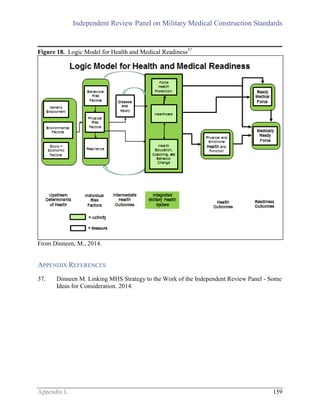
receives military patients from around the world along with civilian patients. SAMMC also has
DoD’s only Level 1 Trauma Center63
supported by the military’s busiest Emergency Department
seeing a large volume of high acuity diseases. The utilization of this critical readiness asset was
achieved because the U.S. Army committed to being one of two trauma centers supporting the
entire population (including the non-military civilian populations) of the greater San Antonio
metro area.63
Additional examples of excellence include the National Intrepid Center of
Excellence (NICoE) at WRNMMC for traumatic brain injuries and psychological health
conditions and the Center for the Intrepid for amputees. The Panel believes that these are true
national treasures that are essential for readiness skills training and caring for wartime casualties.
The MHS may benefit from identifying all centers of excellence essential to GME and readiness
training as a variable in facility investment prioritization and assets utilization standards.
Private sector systems are increasingly using some form of a hub-and-spoke model to establish
centers of excellence with enough patient volume and expert staff necessary to achieve the best
outcomes.64,65
Within the MHS, these centers need to maintain sufficient civilian and military
patient workload to maintain readiness clinical skills. Accordingly, DoD should consider
pursuing a hub and spoke model with individual centers of excellence to which patients are
transported for care, to help providers maintain their competencies, excel at their craft, and
maintain essential medical readiness skills. In the Panel’s opinion, there appears to be a few high
capacity MTFs in large catchment areas that can be properly resourced to support GME and
maintain staff skills, but this requires shifting assets where there are other alternatives for
beneficiary care in the market place. The Panel observed underused operating rooms, inpatient
beds, clinic exam rooms, and specialty care capacity at mid-sized MTFs, such as Naval Hospital
Camp Pendleton, Wilford Hall Ambulatory Surgical Center (WHASC), and FBCH, in the three
largest eMSMs. Their eMSM leaders told the Panel they are exploring ways to shift specialty
staff from nearby major academic centers (Naval Medical Center San Diego, SAMMC, and
Independent Review Panel on Military Medical Construction Standards
Charge C 25
WRNMMC, respectively) to these new facility locations. The Panel believes actions such as
these are essential for maintaining readiness skills and sustaining GME programs, by bringing
patients back into the direct care system.
SPACE REQUIREMENTS AND UTILIZATION
Space requirements are determined as the last HCRA component of analysis. The Panel
compared current DoD Space Planning Criteria with commercial planning standards for five
room types commonly found in an MTF project, as summarized in Table 1. In the inpatient
setting, MHS planning criteria for medical-surgical rooms, operating rooms, and labor, delivery,
and recovery rooms closely mirrors private sector criteria. Until 2013, it appears most of the
programming for outpatient exam rooms, including primary care, was based on the projected
number of full-time equivalent providers, rather than on the expected number and length of visits
or encounters that each room was expected to support, as is the case in the private sector. This
appears to have contributed to current overcapacity issues for some facilities.
Prior to 2012, updates to the DoD Space Planning Criteria chapters did not occur on a regular
cycle (see Section 4.1 for more detail). In 2013, the DoD Space Planning Criteria for most of the
primary and specialty clinics that require outpatient exam rooms were updated to reflect a model
similar to that used in the private sector. Likewise, in 2015, the Emergency Department criteria
were updated. The MTFs visited by the Panel were all programmed using the previous criteria,
which may have overstated capacity requirements. In the Panel’s opinion, the MHS should
continue to update DoD Space Planning Criteria to reflect industry best practice.
Independent Review Panel on Military Medical Construction Standards
Charge C 26
Table 1. Comparison of DoD Space Planning Criteria with Commercial Planning Standards21,66
Room Type DoD Space Planning Criteria Widely Used Industry Criteria
Medical-Surgical
Inpatient Rooms
80% Single Bedroom Annual
Occupancy
80 to 85% Annual Occupancy
Operating Rooms
(ORs)
909 Annual Cases Per General OR
(Average Case Length of 95
Minutes)
800 to 1,200 Annual Cases Per
Inpatient OR
Labor, Delivery,
and Recovery
Rooms
2013 to Present: 350 Annual
Deliveries Per Room At A 75%
Annual Occupancy
250 to 400 Annual Deliveries
Per Room
Outpatient Exam
Rooms
Prior to 2013: In Primary Care,
Two Exam Rooms Per Projected
FTE Provider
2013 to Present: 2,304 Encounters
Per Non-GME
2,000 Annual Visits
Emergency
Department (ED)
Beds
Prior to 2015: 90% Average
Number of Projected ED Patient
Visits Per Day
2015: 1,800 Annual Exam Beds
Per ED Bed (Including Trauma);
1,700 Annual Exams Per ED Bed
(Not Including Trauma)
1,200 to 1,800 Annual Exams
Per ED Bed
Adapted from U.S. Department of Defense and Malcolm, C.
*The widely used industry criteria reflect propriety strategic planning data used by the architects
and Kaiser Permanente leadership on the Panel, as well as data used by the Medical Group
Management Association.
Individual MTFs often have space management committees to consider the effective and
efficient utilization of space to support specific organizational goals. However, there appears to
be no enterprise-wide standard reflecting industry facility asset utilization best practices. These
standards should be based on eMSM business goals reflecting a tri-Service staffing model that
can be used during planning and programming activities and ultimately at a local MTF level to
improve the best use of existing facility assets.
Independent Review Panel on Military Medical Construction Standards
Charge C 27
3.2 FACILITY FUNDING AND BUDGET STRUCTURE
UFC are used regardless of the source of funding and should be
employed “in non-[Military Construction] MILCON sustainment,
restoration or modernization projects, in facility additions or
alteration projects or in operations maintenance (O&M) upgrade
projects” in addition to being employed for MILCON. 20
-Unified Facilities Criteria
In the Panel’s experience, in light of the complex demands of stakeholders and the changing
health care environment, few health care delivery systems, public or private, have sufficient
capital investment funds to meet all of their strategic needs. Decisions about how to prioritize
the spending of scarce capital resources are critical because of the lasting consequences with
regard to future risk and success in achieving balanced mission objectives. Unlike governmental
organizations, private sector health systems need to either earn a positive economic return, or
profit, to generate capital for future investment or repayment of borrowings or have the capacity
to fundraise, if a non-profit health system. All health systems aspiring to perform at a world-
class level must set priorities and allocate resources to the most important strategies. They must
balance all mission objectives in terms of quality care delivery, superior outcomes for
stakeholders, and economic stewardship at the time funds are initially invested and then used for
ongoing operations. Prudent spending within fiscal limits, cost efficiency, and optimizing
economic returns on investment, despite the absence of a profit motive, are equally important in
the military health system environment.28
AFFORDABILITY CONSIDERATIONS
As described, the Panel has learned that MHS facility planning and programming does not rely
on exactly the same drivers as those in the private sector, whose methods for medical
infrastructure construction are primarily driven by affordability objectives and best business
practices. Private sector decisions are driven by the evolution of construction industry standards
and practices, which continue to change as technology, construction methods, materials research,
quality, and safety standards evolve. Affordability considerations, which will be further
examined in the Panel’s Final Report, are a strong determinant of medical infrastructure
decisions and investments in the private sector.
CONGRESSIONAL APPROPRIATIONS
Four separate appropriations support the funding required for MHS facilities:
 Military construction appropriation provides funds to build new medical centers,
hospitals, and clinics;
 Research and development appropriation supports research protocols and projects;
 Other procurement appropriation provides funds to purchase major pieces of
equipment; and
 Operations and maintenance appropriation provides funds to support normal
operations of all MHS activities and functions.
Independent Review Panel on Military Medical Construction Standards
Charge C 28
Between 2000 and 2013, DoD spent $12.5 billion to create 33 major additions/new hospitals,
104 major additions/new clinics, and 59 medical support facilities, excluding Unspecified Minor
Construction projects (Figure 7). As described in Section 1.1, the funds originated from a variety
of congressional acts.
Figure 7. Medical Military Construction Funding by Funding Source and Year (In Millions)29
Adapted from Defense Health Agency Facilities Division, 2014.
*The chart reflects aggregated amounts in the year of authorization.
DoD worked closely with Congress to identify critical health care facility requirements
consequent to Base Realignment and Closure (BRAC) decisions, wartime demand, and the
repositioning of troops. A variety of congressional appropriations were used to replace and
modernize health care infrastructure that were operationally inefficient, hindered the integration
of required technology, and had resulted in the extensions of building systems and infrastructure
beyond their intended life cycle. However, the Panel learned that some of the appropriations
came with restrictions that encumbered the planning and programming process across the facility
life cycle, as will be discussed in Section 6.0 with the BRAC NCR projects. The MHS may
benefit from working with appropriate stakeholders associated with any future BRAC legislation
to enable a more holistic, cost-efficient approach to planning, design and construction.
These "spikes" of additional funding during the past decade enabled the MHS to correct the
results of uneven MILCON funding in the past and make significant progress renewing their
facility portfolio to reflect current health care demand and integrate state-of-the- art technology.
As of January 8, 2015, the Facility Condition Index, a metric used by DHA to assess the
condition of the real property, was 88 with a target floor of 90 for direct patient care facilities; 90
with a target of 80 for support facilities, and 85 with a target of 60 for all other facilities. Even
with the infusion of capital over the past decade, 27 percent of the direct patient care facilities
remain below the target threshold.48
MILCON funding levelled off in FY 2015, though are still
double the amount appropriated before the wars.
Independent Review Panel on Military Medical Construction Standards
Charge C 29
PHASED FUNDING
Projects typically are funded in one fiscal year using one authorization. However, in cases where
projects are funded over multiple years, they can be funded using a phased or an incremental
approach. An incrementally funded project is defined as one that does not result in a complete
and usable facility in a single year appropriation. An incrementally funded project is complete
and usable when all construction increments are completed.67
Each method of funding can work,
but each comes with its own unique challenges. In the case of phased funded projects, the
decision to use it should have considered the specifics of the project it supports. Phased funding
requires that each funded phase be complete and useable as a stand-alone project. Subsequent
phases are considered separate projects, which allow for competitive bidding and may result in
an award to an entirely different general construction contractor. This approach can have
unintended consequences on the quality of the construction because contractors for each phase
can use different materials and equipment that have different maintenance requirements,
software, repair parts, training and certification warrantees, and wear patterns. For example, the
Panel learned that the new WHASC is being constructed using a phased approach, and, as a
result has two different elevator systems, which may complicate life-cycle operations and
maintenance activities. With a phased approach, the potential for frequent changes in project and
MTF personnel can hinder effective project management, which results in negative impacts to
project schedule, budget, and scope. Using incremental funding whenever possible would be
consistent with the best practices in the private sector. However, when phased funding is
deemed necessary, projects need to be comprehensively managed to coordinate work between
project phases to avoid unnecessary costs, schedule delays, and long-term facility life-cycle costs
and issues.
3.3 FACILITY SELECTION CRITERIA
Prior to 2008, the MHS used a proportional distribution system to allocate MILCON funds
across the three Services. In the past, both the TRICARE Management Activity (TMA) and the
Services had overlapping responsibility for identifying and prioritizing medical MILCON
projects. The MHS leadership issued guidance to subordinate facility organizations consistent
with the latest DoD guidance/defense strategy, as well as any relevant trends in the health care
industry. The MHS also issued guidance to each Service regarding the amount of funds, the
Total Obligation Authority, to program when developing their individual multi-year capital
investment MILCON programs. Each Service received a proportion of the MILCON Total
Obligation Authority based on each Service's total square footage of Plant Replacement Value
(PRV). Since the U.S. Army had, and still does have, proportionally the largest PRV, it
generally received the largest proportion of the funding.68
As a next step, the Services would internally consolidate and prioritize projects for their
programs and submit them to the Portfolio Planning Management Division, now referred to as
DHA Facility Division, for MHS consolidation, review, and validation. Next, TMA and the
Services would have mutually agreed to make adjustments to the proportion depending on
additional factors. For example, a Service's proportion may have been adjusted to accommodate
funding the next phase or increment of project already under construction, or a small project
originally scheduled for the out-years might be moved forward because its cost more easily fit in
a given year based on availability of funds, after priority projects had been programmed. This
Independent Review Panel on Military Medical Construction Standards
Charge C 30
methodology considered the priorities of the individual services. The MHS's approach to project
selection and assessment needed to evolve to better focus on enterprise strategy with less
subjective criteria that is also more auditable.68
MILITARY CONSTRUCTION CAPITAL INVESTMENT DECISION MODEL EVOLUTION
In 2007, TMA’s Portfolio, Planning, and Management Division began the development of a
unified approach to the prioritization of medical MILCON projects through the creation of the
Capital Investment Decision Model (CIDM), which is described in further detail in Section 1.3
and Appendix G. The proportional assessment system was replaced by the CIDM in 2008.
CIDM is based on MHS strategic goals and uses established and standardized methods for
program formulation and review, while balancing facility infrastructure modernization, given the
historic reality of limited funds. The goal is to provide “a mechanism for neutral and
dispassionate decision-making, balancing the traditional aspects of Service preferences for
facility-specific solutions with Departmental concerns expressed in system-wide priorities and
published guidance.”69
This transparent, auditable, and strategically aligned process has been
used to prioritize and execute many hospital and clinic projects over the past six years.
The CIDM prioritization model plays a key role during the Requirements Planning phase of the
facility life cycle. The entire life cycle includes four major phases: Corporate Strategic
Facilities Management, Requirements Planning, Design/Construction Execution, and Facility
Activation and Operations (see Figure 8). The facility life cycle, which is described in detail in
Section 1.3, begins when the need for a capital investment is identified and continues through
construction, operation, and, ultimately, decommissioning.
Independent Review Panel on Military Medical Construction Standards
Charge C 31
Figure 8. Department of Defense Facility Life Cycle20
From U.S. Department of Defense, 2012.
CIDM 3.0 provided opportunities to review projects during the approval process in order to help
achieve world-class standards. The standards employed in conducting these reviews should be
revised to create facilities that can achieve appropriate clinical activity and throughput to achieve
high satisfaction and clinical responsiveness (see Appendix G for more information about
CIDM). The Panel found that the MHS has an objective and rigorous prioritization process for
sizing, evaluating, and ranking various construction projects. However, a couple of factors may
have contributed to the facility asset underutilization observed by the Panel as previously
discussed, including:
 Past programming for ambulatory care clinics based on projected staffing rather than
room utilization, a formula now fixed in the recently updated Space Planning Criteria
standards capacity; and
 A high proportion of beneficiaries receiving care in the private sector, rather than in the
direct care system
The decision-making methodology has evolved, as DHA Facilities Division currently uses
CIDM 4.0, which now includes an update that links scoring and weighting criteria to MHS
strategic goals and priorities and includes analysis of alternatives beyond new construction.
CIDM 4.0 is being used in FY 2015 with evaluation criteria approved by the MDAG. The Panel
believes the next round of CIDM refinement should reflect the new MHS strategic goals
associated with a high reliability IDS.
Independent Review Panel on Military Medical Construction Standards
Charge C 32
The MHS should continue to refine the demand signal used in the model to better forecast
demand using industry practices to align the planning and prioritization of projects based on an
IDS market strategy that supports MHS strategic goals.
CHARGE C FINDINGS AND RECOMMENDATIONS
Finding 1: Although the MHS is evolving as a newly formed IDS, planning and programming
for past MILCON investments was often driven by Service strategies that did not always reflect
the MHS’s newly adopted IDS model and did not always result in full facility asset utilization.
Specifically:
a) Individual health care facilities, rather than an IDS model, were the framework for the
2009 definition of a world-class facility.
b) The full continuum of care is not led by a single organization focused on serving the local
population at the most appropriate site of care.
c) eMSMs lack a single command and control structure with single budgetary authority for
all MTFs in their region, which complicates facility investment requirements and life-
cycle management.
d) eMSM MTFs do not always share administrative and support services, which would
enable consolidation and reduce programming requirements.
Recommendation 1: The MHS should:
a) Expand its IDS definition and framework to include a description of a high
reliability care delivery organization that reflects direct and purchased care
services, its core services, resource requirements, concepts of operation, and
expected health care outcomes, which are then used to drive planning and
programming facility requirements. Specifically, this IDS framework
should:
1) Be developed by MHS clinical leaders and experts, rather than by
facility design professionals.
2) Use single command, control, and budgetary authority to drive the
facility requirements and planning processes by establishing a process
for integrated facility life-cycle budget requirements with IDS fiscal
accountability to better inform facility investment requirements.
b) Expand and refine the current world-class medical facility definition and its
supporting domains and conditions to be consistent with a world-class IDS
structure and to promote broader strategic thinking, planning, and resource
management.
Finding 2: The Panel observed that all seven of the MTFs they visited were not operating at full
capacity. The DoD Space Planning Criteria for most of the primary and specialty clinics that
require outpatient exam rooms were recently updated to reflect a model similar to that used in the
private sector. The MTFs visited by the Panel were all programmed using the previous criteria,
which may have overstated capacity requirements.
Recommendation 2.1: The MHS should continue to update DoD Space Planning
Criteria to reflect current industry best practices.
Independent Review Panel on Military Medical Construction Standards
Charge C 33
Recommendation 2.2: The MHS should establish asset utilization standards, based
on eMSM business plans that use a medical tri-Service staffing distribution model,
which are consistent with industry standards and applied in the planning process to
reduce underutilized facility assets.
Recommendation 2.3: The DHA, together with the Services, should analyze low-
volume service lines and adjust facility planning and programming criteria
accordingly.
Recommendation 2.4: The MHS should examine and refine facility planning and
programming standards to reflect current thinking about the planned recapture of
purchased care, in alignment with eMSM business plans.
Finding 3: Frequent changes in health care personnel requirements, distribution, and availability
confound facility planning and programming standards and criteria.
Recommendation 3: The Services should develop a medical tri-Service human
capital distribution plan to assist with development of more accurate facility
planning and programming standards.
Finding 4: GME program distribution represents an important facility planning and
programming variable, as the maintenance of medical skills requires access to certain quantities
and types of cases.
Recommendation 4.1: To realign and optimize MHS GME programs, the MHS
should conduct an enterprise-wide GME-specific modernization study which
addresses the quantity and type of cases needed to maintain health professional
skills, including medics and corpsmen, while considering the best locations for the
provision of GME given population demand and facility assets.
Recommendation 4.2: The MHS should review the case mix volume and complexity
requirements established by the Accreditation Council for Graduate Medical
Education as a component of the planning standards for each service line included
in a facility project.
Finding 5: MHS Centers of Excellence, such as the U.S. Institute for Surgical Research Burn
Center, the Center for the Intrepid, and the National Intrepid Center of Excellence, are essential
for readiness skills training.
Recommendation 5: The MHS should:
a) Identify all centers of excellence essential to GME and readiness training as a
variable in facility investment prioritization and asset utilization standards;
and
b) Consider a hub and spoke model using individual centers of excellence to
help providers maintain their competencies.
Independent Review Panel on Military Medical Construction Standards
Charge C 34
Finding 6: The uneven and complex nature of past MILCON funding resulted in significant
issues. For example:
a) BRAC MILCON facility funding restrictions and the complex MHS budget structure
complicated efficient and effective planning and programming across the facility life
cycle; and
b) Phased funding hinders medical facility construction, resulting in potential issues with
regard to operational resource requirements and project budget, schedule, and facility
life-cycle maintenance.
Recommendation 6.1: The MHS should work with appropriate
stakeholders associated with any future BRAC legislation that results
in a more holistic, cost-efficient approach to planning, design, and
construction.
Recommendation 6.2: The MHS should:
a) Request authority to use incremental funding from Congress
whenever possible, consistent with best practices in the private
sector; and
b) Comprehensively manage projects, when phased funding is
deemed necessary, to coordinate work between project phases
to avoid unnecessary costs, schedule delays, and long-term
facility life-cycle costs and issues.
Finding 7: DoD has made significant progress delineating and streamlining
MILCON planning and programming responsibilities between DHA and the
Services by creating DHA shared facility services.
Recommendation 7: The MHS should continue its work to streamline
MHS MILCON planning and programming responsibilities using
benchmark industry practices.
Finding 8: The MHS replaced the proportional assessment system with CIDM, which continues
to require refinement to help yield a high reliability IDS.
Recommendation 8: The MHS should continue to refine CIDM to better forecast
demand. Specifically, the MHS should:
a) Align the planning and prioritization of projects based on an IDS market
strategy that supports MHS strategic goals;
b) Base programming on forecasted utilization instead of staffing models, as
reflected in the recently updated DoD Space Planning Criteria by DHA and
the Services; and
c) Examine and refine surge-capacity related standards.
SECTION REFERENCES
2. U.S. Department of Defense. Military Health System Review: Final Report to the
Secretary of Defense. August 29, 2014.
Independent Review Panel on Military Medical Construction Standards
Charge C 35
4. 111th Congress 2nd Session. Ike Skelton National Defense Authorization Act for Fiscal
Year 2011. Pub. L. No. 111-383. 2011.
7. Carter AB. Implementation of Military Health System Governance Reform. 2013.
13. U.S. Department of Health & Human Services. Read the Law. [Webpage].
http://www.hhs.gov/healthcare/rights/law/. Accessed April 15, 2015.
20. U.S. Department of Defense. Unified Facilities Criteria (UFC) - Design: Medical Military
Facilities (UFC 4-510-01). 2012.
21. U.S. Department of Defense. Military Health System (MHS): DoD Space Planning
Criteria for Health Facilities. [Webpage].
http://www.wbdg.org/ccb/browse_cat.php?o=29&c=261.
25. Boenecke C. Shared Service Annual Report Discussion. 2014.
26. McWhirt D. HCRA Process. 2014.
27. National Capital Region Base Realignment and Closure Health Systems Advisory
Subcommittee of the Defense Health Board. Achieving World Class - An Independent
Review of the Design Plans for the Walter Reed National Military Medical Center and
the Fort Belvoir Community Hospital. May 2009.
28. Sussman JH. Capital Allocation The Right Way: Consistent, Concurrent, Connected and
Communicated. Kaufman Hall.
29. DHA Facilities Division. Data Response. 2014.
30. Barr L. Quote for IRP Annual Report. 2014.
31. Sullivan LH. The tall office building artistically considered. Lippincott's Magazine. 1896.
32. Enthoven A. Integrated delivery systems: the cure for fragmentation. Am. J. Manag.
Care. Dec 2009;15(10 Suppl).
33. The Center for Health Design. Pebble Project Facilities. [Webpage].
https://www.healthdesign.org/pebble/facilities.
34. Kimmelman M. In Redesigned Room, Hospital Patients May Feel Better Already. The
New York Times. August 21, 2014.
35. Joseph A, Hamilton DK. The Pebble Projects: Coordinated Evidence-Based Case
Studies. Building Research & Information. 2008;36(2):129-145.
36. Silvis JK. First Look: Cleveland Clinic Cancer Center. Healthcare Design, 2014.
37. Dinneen M. Linking MHS Strategy to the Work of the Independent Review Panel - Some
Ideas for Consideration. 2014.
38. Fort Belvoir Community Hospital. Culture of Excellence. [Webpage].
http://www.fbch.capmed.mil/About/ace.aspx.
39. Woodson J. Institute of Medicine: Moving to a More Integrated Health System. 2013.
40. Keenan J. SAMHS eMSM Brief - IRP MilCon Delegation - Jul 14. 2014.
41. Robb DJ. Military Health System: HIT Transformation. 2014.
42. U.S. Department of Defense. National Capital Region: FY15-FY19 eMSM Business
Performance Plan. 2014.
43. U.S. Department of Defense. San Antonio: FY15-FY19 eMSM Business Performance
Plan. 2014.
44. U.S. Department of Defense. Tidewater Military Health System: FY15-FY19 eMSM
Business Performance Plan. 2014.
45. U.S. Department of Defense. Colorado Springs: FY15-FY19 eMSM Business
Performance Plan. 2014.
Independent Review Panel on Military Medical Construction Standards
Charge C 36
46. U.S. Department of Defense. Puget Sound: FY15-FY19 eMSM Business Performance
Plan. 2014.
47. U.S. Department of Defense. Hawaii: FY15-FY19 eMSM Business Performance Plan.
2014.
48. DHA Facilities Division. MILCON IRP Panel RFI for DHA. 2014.
49. Malcolm C, Kaiser Permanente. Capital Planning: Joint Exercise With Finance and
Operations Leadership Aimed at Metrics-Based Evaluation of Investments.
50. Malcolm C, Navigant Consulting. Typical Capital Process at Leading Health Systems.
2014.
51. Boenecke C. Capital Investment Decision Model. 2014.
52. Horoho PD. Statement by Lieutenant General Patricia D. Horoho, The Surgeon General,
United States Army, Before the Senate Committee on Appropriations Subcommittee on
Defense. 2014.
53. Hans EW, Houdenhove Mv, Hulsho PJH. A Framework for Healthcare Planning and
Control. Handbook of Healthcare System Scheduling. Vol 1682012:303-320.
54. U.S. Department of Defense. Task Force on the Future of Military Health Care Final
Report. December 2007.
55. Health Affairs - Portfolio Planning and Management Division. Rhine Ordnance Barracks
Medical Center Replacement: 20% Design Presentation. 2013.
56. Chassin MR, Loeb JM. The ongoing quality improvement journey: Next stop, high
reliability. Health Aff. (Millwood). 2011;30(4):559-568.
57. Potter C. FW: MHS Resource Monitoring and Validating System. 2014.
58. Army Vice Chief, Surgeon General Address Future of Army Medicine [press release].
September 10, 2014.
59. U.S. Department of Defense. Comprehensive Master Plan for the National Capital
Region Medical. 2010.
60. Military Compensation and Retirement Modernization Commission. Final Report of the
Military Compensation and Retirement Modernization Commission. January 29, 2015.
61. Accreditation Council for Graduate Medical Education. Common Program Requirements.
[Webpage].
http://www.acgme.org/acgmeweb/tabid/429/ProgramandInstitutionalAccreditation/Com
monProgramRequirements.aspx.
62. Accreditation Council for Graduate Medical Education. Case Log Statistical Reports.
[Webpage].
http://www.acgme.org/acgmeweb/tabid/274/DataCollectionSystems/ResidentCaseLogSy
stem/CaseLogsStatisticalReports.aspx
63. U.S. Army. Emergency Medicine Residency Program. [Webpage]. 2014;
http://www.bamc.amedd.army.mil/saushec/gme/residency/emergency-medicine/.
64. Cleveland Clinic. Heart & Vascular Alliances & Affiliations. [Webpage].
http://my.clevelandclinic.org/services/heart/departments-centers/heart-vascular-affiliates.
65. Pearl R. Rethinking Rural Hospitals With Lessons From The Battlefield. [Webpage].
2015; http://www.forbes.com/sites/robertpearl/2015/01/22/rethinking-rural-hospitals/.
66. Malcolm C, Navigant Consulting. Examples of Inpatient and Ancillary Benchmark
Metrics, . 2014.
Independent Review Panel on Military Medical Construction Standards
Charge C 37
67. U.S. Army. Army Military Construction and Nonappropriated-Funded Construction
Program Development and Execution. U.S. Army Pamphlet 420-1-2 ed: U.S. Army;
2009.
68. Rutkowski G. Meeting with DHA Facilities Program & Budget Office. 2014.
69. MHS CIDM 3.0 Process Guide - Draft. 2011.
Independent Review Panel on Military Medical Construction Standards
Charge A 38
4.0CHARGE A. CONSISTENCY OF UNIFIED CONSTRUCTION STANDARDS WITH
INDUSTRY PRACTICES AND BENCHMARKS
“(A) Reviewing the unified construction standards established …
to determine the standards [sic] consistency with industry
practices and benchmarks for world class medical construction.” 4
- Ike Skelton NDAA for FY 2011, Section 2852
INTRODUCTION
As described in Section 1.3, the Unified Facilities Criteria (UFC) 4-510-01 provides policies and
procedures for the programming, planning, design, and construction of military treatment
facilities (MTFs) such that the resultant facility is “safe, functional, and durable, with reasonable
and appropriate sustainment maintenance, and operations costs.”20
These standards are based on
federal law, executive orders, Department of Defense (DoD) directives and instructions, private
sector standards and publications, and technical data.20
The development and application of facility standards is particularly challenging in the present
health care environment. Currently, there is a rapid evolution of health care models and
technology, particularly information technology, during a time of dynamic health care reform
and transformation. The health care industry is debating the relative merits of minimum versus
innovative health care facility standards as the best approach to achieve quality, safe, and
affordable care. The Independent Review Panel on Military Medical Construction Standards
(Panel) addressed these and other issues related to achieving world-class medical construction,
and provides findings and recommendations.
METHODOLOGY
Using the three-dimensional perspective described in Section 2.0, the Panel examined the UFC
4-501-01 and then compared its standards, criteria, checklists, and guidelines against industry
standards, practices, and benchmarks. The Panel reviewed processes used by DoD, the
Department of Veterans Affairs (VA), the Facility Guidelines Institute (FGI), and Kaiser
Permanente to develop medical facility construction standards. The Panel reviewed various
factors that affect the development and implementation of construction standards, including:
their currency, the process for updating them, their relevance to changing health care technology
and standards of care, and the time required to implement them in completed construction
projects. Specifically, the Panel examined DoD standards development responsibilities, the
creation of meaningful standards in a rapidly evolving health care environment, DoD’s standards
development framework, and the relationship between facility and information technology
standards.
Independent Review Panel on Military Medical Construction Standards
Charge A 39
4.1 DEPARTMENT OF DEFENSE STANDARDS DEVELOPMENT RESPONSIBILITIES
CURRENT STANDARDS DEVELOPMENT PROCESS
The Oxford English Dictionary defines a standard as “a definite level of excellence, attainment,
wealth, or the like or a definite degree of any quality, viewed as a prescribed object of endeavor
or as the measure of what is adequate for some purpose.”70
DoD has developed the Unified Construction Standards, a comprehensive set of guidance
documents that enable design and construction professionals to create health care facilities that
meet the needs of the operational mission within a prescribed budget. DoD standards are
developed using and aligned with medical health care industry standards. Periodic review and
feedback facilitates the maintenance of standards that are correct and adequate to meet the
evolving DoD health care delivery model.
DoD is actively involved in key industry forums to review and improve design standards. For
example, DoD participates with the FGI as it refreshes its guidelines on a four-year cycle. DoD
then references and requires conformance to FGI guidance as part of the DoD standards, which,
the Panel learned in discussions with DoD facility leaders, have grown in size and complexity,
are expensive to maintain, and require frequent refinement or review to reflect the dynamic
health care environment.
DoD standards are broad and inclusive of all types of DoD health care facilities and recognize
that construction can take place in both domestic and international locations. The challenge with
any design and construction standard is how to rapidly adapt and improve as the health care
delivery model changes driven by innovation in methods of care and the supporting technology.
According to the Panel’s experience, most health care systems have developed a set of design
and construction standards, which set targets on key variables, such as quantity (size), quality,
functionality, and cost, to guide and inform the process of creating the built environment
platform for care delivery. DoD is now working with the Construction Industry Institute and
other large owner systems to develop medical facilities design and construction industry cost
benchmarking. However, this effort is in its preliminary stages with limited comparable cost
benchmark output.
DEPARTMENT OF DEFENSE STANDARDS BENCHMARKED AGAINST INDUSTRY STANDARDS
In those instances where there are comparable standards, the Panel observed that DoD standards
are generally consistent with industry practices and benchmarks. However, even within industry
practices and benchmarks, construction standards vary in scope, as organizations are challenged
to keep standards current given rapid changes to technology and care delivery paradigms,
reconcile minimum standards with best practices, and determine how prescriptive standards can
and should be while still encouraging innovation. Although DoD standards have been developed
and are largely consistent with those found in industry, the challenge is in developing life-cycle
facility standards that are appropriate for an enterprise-wide strategy. The FGI’s Guidelines for
the Design and Construction of Hospitals and Outpatient Facilities represent a consensus of
health care industry thought leaders on fundamental requirements for design and construction of
Independent Review Panel on Military Medical Construction Standards
Charge A 40
medical facilities,71
and more than 40 States and 60 countries have adopted or reference the
guidelines.72
The guidelines are reviewed and updated on a four-year cycle,73
which, until
recently, appeared to be more frequent than the update cycles used by DoD.
Updating standards requires significant time and other resources and creates challenges in
designing and building a medical facility that is both world-class and technologically current.
Prior to 2012, updates to Space Planning Criteria chapters did not occur on a regular cycle;
however, with the stand-up of Defense Health Agency (DHA), there are now dedicated resources
to sustain Space Planning Criteria chapters and space templates and to develop regular update
schedules. Updates to Space Planning Criteria chapters began in early 2012; this effort was
undertaken to align the chapters with current care models and technologies and to transition from
a staffing-based to a workload-based planning metric. To date, 34 out of 36 total chapters have
been updated; 13 chapters (10 clinical, 3 non-clinical) are used by DHA planners within the
Space Equipment Planning System application and are available for public use on the World-
Class Toolkit. The remaining 21 chapters will be available within Space Equipment Planning
System and posted for public use on the Toolkit by early 2015. The two remaining chapters,
Medical Mobilization and Chapel, will be updated in late 2015.74
The Space Template Board completed their review of 187 templates in 2014; 94 were deleted,
and 19 new templates were developed, which equals 112 templates at end-state. Forty-three
updated templates are currently posted on the Toolkit, and 39 additional templates will be posted
in early 2015. All templates will be evaluated for relevancy and applicability on a project-by-
project basis each time a project is completed and specific templates are referenced.74
Table 2
illustrates the most recent updates. Some criteria are updated and published as individual
sections or chapters, allowing frequent updates to sections as needed, while maintaining other
sections that have not changed. Other references, such as the UFC, are updated in total each
time. It is important to emphasize that the Space Planning Criteria chapters, the Templates, the
Military Standard 1691, and the UFC Appendix B are integral elements of the DoD construction
standards that do not stand alone, but are interrelated and synchronized. The Panel commends
DHA on its recent, intensive efforts to update the standards and encourages DHA to immediately
post these updates on the Military Health System: DoD Space Criteria for Medical Facilities
website.
Table 2. DoD Standards by Year of Publication21,22,20,23
Adapted from U.S. Department of Defense.
*The asterisks acknowledge update activities which occurred, but exact numbers for those years
were unavailable. Numbers in 2014 provide the current status as of the date of this report.
Independent Review Panel on Military Medical Construction Standards
Charge A 41
Based on Panel experience, design and construction strategies to enable future flexibilities are
frequently used during the creation of new health care facilities to accommodate new and
changing missions over the lifetime of a facility, which for most major investments can be
several decades. DoD has several standards in place to provide future flexibility, ranging from
standards for rooms and individual clinics to an entire facility and its supporting campus.
Examples of standards that enable future flexibility include:
 Select clinical and administrative rooms are sized the same to promote interchangeability
between clinical and administrative uses;21,23
 Private offices are built with examination room utilities that are capped behind walls to
simplify future conversions from office to examination space 21,23
 Where clinically appropriate, modular systems furniture is used throughout a space to
support configuration changes and relocations;21
 Radiology rooms are designed with a universal template that supports a wide variety of
equipment and future re-configurations;23
and
 Single patient rooms are designed with headwalls capable of supporting two patients in
the event of a mass casualty event.21,23
In a larger facility, to the degree possible, individual clinics share the same room, waiting, and
corridor layouts not only to simplify orientation for patients, but also to support clinic relocations
and expansions. When supported by a business case, inpatient facilities may include interstitial
building space (IBS) to facilitate facility maintenance and future modifications. Each design
includes a campus master plan to accommodate lateral building expansion, as well as roofs and
other building systems designed to allow for vertical growth.20
Some of the new projects at MTFs the Panel visited include IBS, such as Carl R. Darnall Army
Medical Center (CRDAMC); others, such as Naval Hospital Camp Pendleton (NHCP), do not.
The justification associated with the decision to use IBS or other strategies was not clear to Panel
members. While the private sector routinely uses shelled space as a means to provide space to
accommodate future missions, this strategy is prohibited in DoD because Title 10 of the United
States Code (U.S.C.) §2801, in part, defines a military construction project as work to produce a
complete and usable facility.75
Shelled space by its nature would be incomplete and unusable.
At the time of this Annual Progress Report, the Panel had not had the opportunity to evaluate any
Military Health System (MHS) studies on the efficacy and effectiveness associated with the use
of flexibility strategies to accommodate new missions, technology changes, and routine
maintenance and repair work as a means to explain the return on investment of these decisions.
CURRENT DEPARTMENT OF DEFENSE PARTNERS IN STANDARDS DEVELOPMENT
The Panel found that DoD maintains extensive volumes of medical facility construction
standards, some of which may not be always current (see Table 2). Developing, maintaining,
and updating these standards is a complex, labor-intensive, and time-consuming process, in
which the Services and DHA participate. The VA also maintains its own set of standards, and,
although the two Departments develop standards to meet unique medical mission requirements,
there are potential areas of duplication and redundancy.
Independent Review Panel on Military Medical Construction Standards
Charge A 42
The VA/DoD Capital Asset Planning Committee, formally the Construction Planning
Committee, was established in 2005 to provide a formalized structure to facilitate cooperation
and collaboration in achieving an integrated approach to planning, design, construction (major
and minor), leasing, and other real property related initiatives for medical facilities that are
mutually beneficial to both Departments. The Committee provides the oversight necessary for
collaborative opportunities for joint capital asset planning to explored, evaluated, and maximized
to enhance service delivery.76
DoD and the VA collaborate for some standards development, and
similarly, both participate with FGI in developing their standards.
DHA’s Facility Service, formerly the TRICARE Management Activity’s Portfolio, Planning and
Management Division, has worked diligently to create active partnerships with other leading
industry standards-creating organizations. However, the Panel wonders if these relationships
could be further expanded in an effort to reduce potential duplication of effort in standards
development and more fully synchronize standards development especially for those standards
that must respond to rapidly changing care delivery models and technology advances in care.
Additionally, continuing current partnerships could promote greater consistency, alignment, and
efficiency with industry practices. Because there is potential duplication of effort in standards
development between these entities, there could be opportunities to synchronize standards
development with federal and industry partners. The Panel believes this could provide DoD the
opportunity to reduce investment in standards development and maintenance while still ensuring
its standards are current.
4.2 MEANINGFUL STANDARDS IN A RAPIDLY EVOLVING HEALTH CARE
ENVIRONMENT
One of the main challenges to maintaining current standards is the rapid rate of change in health
care technology and care delivery models against a backdrop of multi-year timelines associated
with building a new facility. Emerging models of care, such as population-based planning,
community-based medical home, integrated health care markets, pharmacy home delivery,
virtual visits, focus on health and prevention rather than illness, and disease management all have
the potential to significantly alter facility requirements. Consequently, these evolving models of
care can reshape industry practices and benchmarks, which then affect the MHS as it embraces
these new models of care. For example, the patient-centered medical home concept is driving
design considerations in ambulatory care to accommodate patient- and family-centered care,
teamwork rooms, patient throughput, and enhanced use of the electronic health record.
Frequently health care delivery challenges emerge in which the physical environment may play a
role. For example, in 2013, The Joint Commission published a Sentinel Alert about Medical
Device Alarm Safety in Hospitals, describing the degree to which staff alarm fatigue contributes
to patient harm. Alarms significantly contribute to noise and are both a patient irritant and create
a known error-provoking environment.77
One of The Joint Commission recommendations was
for health care organizations to assess the degree to which acoustics in patient care areas allowed
alarm signals to be audible. Ensuring that alarms can be heard requires a bundle of solutions, to
include acoustic design standards, which includes how walls are designed to isolate sound and
the use of materials to increase sound absorption and decrease sound reverberation.71
FGI has
Independent Review Panel on Military Medical Construction Standards
Charge A 43
already intensively focused on alarm fatigue by engaging nationwide experts who have
researched and created white papers to inform its Guidelines standards.78,79
Thus, this is work
the MHS does not need to replicate.
Staff fatigue is another error-provoking condition that results in patient harm as outlined in
another The Joint Commission Sentinel Alert in 2011, in which it was recommended that
organizations provide an integrated bundle of solutions to include a cool, dark, quiet,
comfortable room to enable staff rest.80
The recent Ebola epidemic has forced all health care
organizations to reassess how they would identify, isolate, and care for such patients. This has
profound facility implications, such as the need for patient isolation support; the use and
maintenance of heating, ventilating and air conditioning systems; and the effective cleaning of
surfaces, equipment and furniture.
4.3 STANDARDS DEVELOPMENT FRAMEWORK
STANDARDS DEVELOPMENT PHILOSOPHY AND IMPACT
There is an ongoing debate in the national health care facility construction community about the
philosophic framework that standards should reflect. The fundamental question is the degree to
which standards should reflect proven methods over time versus altering standards to reflect
emerging best practices and opportunities for innovation. This quandary occurs during a health
care era that increasingly relies on evidence-based decision-making versus experiential practices,
that is, “this is the way we’ve always done it.”
Design standards should reflect the organization’s desire and tolerance for change and variation.
Figure 9 attempts to depict that there are potentially competing objectives.
Independent Review Panel on Military Medical Construction Standards
Charge A 44
Figure 9. Impact of Design Standards81
From Orndoff, D., 2014
The horizontal dimension of the figure illustrates that the owner organization’s design and
construction standards have a range of rigidity. On the extreme left is a highly prescriptive set of
rules, limiting designer and constructor options in the delivery of a facility. On the extreme right
is a broadly defined set of guidelines, allowing designers and builders maximum freedom to
meet the owner’s intent.
The vertical dimension of the chart illustrates that owner organizations have a range of demand
for innovation. On the extreme bottom of the scale is a need for highly predictable, repeatable
results. On the extreme top of the scale there is maximum design freedom to incorporate
innovative, even experimental solutions to meet the owner’s intent.
Organizations that operate in the lower left quadrant tend to value “standardization” to generate
predictable, repeatable results (e.g., functionality, quality, cost, and schedule). This philosophic
approach typically generates low-risk and high reliability solutions that result in minimum design
variation and that generally avoid design failures. Organizations embracing this approach tend to
lag behind the greater medical design and construction industry in terms of embracing innovative
but unproven facilities solutions.
Organizations that operate in the upper right quadrant tend to value “creative solutions” to
generate greater performance improvement (functionality, quality, cost, and schedule) over what
would be anticipated by a more conservative standards driven approach. The innovation
approach tolerates higher risk for potentially higher reward solutions. These organizations
accept variation and occasional failure as an acceptable cost of business. Organizations
Independent Review Panel on Military Medical Construction Standards
Charge A 45
embracing this approach tend to lead the greater medical design and construction industry in
terms of embracing innovative facilities solutions. However, it is too early to tell if either
approach is best associated with improved health care outcomes or more a cost-effective method
over time.
The Panel’s assessment is that DoD, as an “owner” design and construction organization,
currently would be plotted near the middle of the chart. The Panel believes DoD values
predictability, conformity, and reliability. However, over the past decade DoD has led the
industry in embracing industry-driven, evidence-based design (EBD) solutions as evident in the
World-Class Toolkit described in Appendix G to shape the most current generation of MTFs.
Just as is true in the private sector, as far as the Panel can ascertain, no evaluation of this
innovative approach has been completed to better understand the impact of these solutions on
targeted health care outcomes or a formal return-on-investment analysis.
Since the creation of the MHS World-Class Toolkit, the MHS has completed a 90-day review of
its health care system with regard to access, quality, and safety outcomes and has identified an
aspirational goal to become a high reliability organization (HRO). Five principles are shared by
HROs: preoccupation with failure, reluctance to simplify, sensitivity to operations, commitment
to resilience, and deference to expertise.82
Inherent in the HRO approach is the use of human
factors engineering as a tool to understand and analyze contributing safety-related variables,
including the built environment. “Human factors engineering is the study of human capabilities,
limitations, and behaviors and the integration of that knowledge into the systems we design for
them with the goals of enhancing safety, performance and the general well-being of the operators
of the system.”83
The HRO concept has been used widely in other high-risk industries, such as aviation, nuclear
aircraft carrier operations, and wild-land firefighting to improve safety outcomes. The aviation
community applied human factors engineering research in cockpit design to address human
operator limitations and capabilities in order to achieve improved safety outcomes.84
The Joint
Commission has developed a HRO-based framework, which encourages health care
organizations to commit to becoming HROs “to achieve and sustain the elusive goal of
consistent excellence in safety and quality.”56
Standardization of facility design represents an important tool for aspiring HRO systems such as
the MHS. It can lead to improved safety and other key outcomes and may be important in
facilitating the ability of military medical personnel to provide care at any MTF to which they
are assigned. However, the MHS has not yet fully considered the financial implications and
long-term affordability issues that may emerge across a facility’s cycle, especially issues related
to the creation and operation of world-class facilities.
The Panel commends the MHS for leading the way with its definition of a world-class medical
facility and development of the World-Class Toolkit, encouraging innovation during this last
decade of construction. However, it must now evaluate the impact of these design decisions on
key health care outcome measures and expected and realized returns on investment, in support of
changing missions.
Independent Review Panel on Military Medical Construction Standards
Charge A 46
4.4 RELATIONSHIP BETWEEN FACILITY AND INFORMATION TECHNOLOGY
STANDARDS
FACILITY AND TECHNOLOGY INTEGRATION
Information management and information technology (IM/IT) requirements increasingly serve as
the backbone for health care delivery, representing a key component in the design and
construction of any world-class health care facility. New diagnostic and treatment equipment,
virtual care options, the implementation and use of electronic health records, and other digital
systems (e.g., imaging) influence health care standards. For the most part, across the industry as
well as in DoD, major IM/IT infrastructure investments have been made in a parallel fashion
with little analysis or understanding about the impacts of one investment on the other.
Brick and mortar and IM/IT infrastructure significantly interact with regard to requirements,
design, construction, and operations and maintenance. No health care facility can be designed
and built today without a detailed understanding of the impacts of technology on cost and project
delivery. Improved outcomes for patients and staff require greater understanding about how a
facility and all the objects in it can be ideally used, based on human factors considerations. The
use of sophisticated technology and equipment, such as robotic surgery, Smart Beds, radio-
frequency identification, and other applications, should be fully integrated with care delivery
processes and included in a facility designed to maximize their safe and efficient use. Achieving
this goal requires integrated strategies and standards that enable successful execution of
technology and facility infrastructure investments across the facility life cycle.
DoD focuses primarily on architectural elements in the development of its construction standards
without fully incorporating the impacts of technology integration and use on concepts of
operation, space requirements, design, construction and operations, and maintenance activities.
Standards have not yet been adopted to reflect an integrated physical environment and
technology infrastructure. However, recently DHA Facility Division and IM/IT leaders
established the Facilities, Logistics, Health Information Technology Collaboration Group, whose
charge is to increase collaboration among the relevant communities supporting the MHS. The
goals of the group include increasing synergy among the communities; reducing duplication and
conflicting efforts; achieving standardization to the extent practicable or feasible; reducing the
training burden as people move across facilities; and increasing interoperability.85
VIRTUAL VERSUS FACILITY-BASED CARE
Technology advances that facilitate virtual care delivery are fundamentally altering the planning
and programming of health care facilities. Telemedicine was developed and has been used by
DoD for more than 15 years to provide care services to beneficiaries in remote locations,
including theaters of war. The Panel’s review of the current Space Planning Criteria found that
the MHS does provide one telehealth examination room for specialty medical, behavioral health,
general, and specialty surgical clinics. This space can be used to manage health care
remotely, including online communication with health care providers, remote monitoring of vital
signs, and video or online doctor visits. Depending on the clinic’s concept of operations, the
space can include video camera capability.21
However, it is not clear to the Panel how the use of
telemedicine has substituted for the planning and programming of space in MTFs. Today, given
Independent Review Panel on Military Medical Construction Standards
Charge A 47
all of the smart-phone technology and other wireless applications, the health care market is
moving even more care out of the hospital, with many services now being provided in the
patient’s home.86
A leading health care organization indicated to the Panel that they are actively implementing
IM/IT applications system-wide that could dramatically transform practice patterns and enhance
the provision of care. They are installing high-speed wireless internet, video conferencing
capabilities, and team rooms that encourage a collegial and collaborative atmosphere. These
technological changes, which affect building design and delivery of care, allow for tailored
health education in waiting areas, text messaging to patients when the provider is available to see
them, and multiple provider visits during one patient encounter. By increasing the use of social
technology, they are creating “touch points” that are available 24 hours a day, 7 days a week, that
reduce face-to-face interaction between patients and providers. The organization believes this
implementation of technology will allow systems to be more flexible in response to surges and
reductions in demand, whereas facilities cannot be as easily adapted. Harnessing technology
removes space and time limitations, ultimately allowing for increased amounts of care to be
provided virtually.
Figure 10 illustrates the low-resource intensity, capital investment, regulatory burden, and length
of implementation time required for IM/IT-focused health care solutions.
Figure 10. Information Technology and Lower Cost Health Care Alternatives87
Adapted from Malcolm, C., 2014.
Independent Review Panel on Military Medical Construction Standards
Charge A 48
With an increasing focus on health promotion and disease prevention, world-class health care
systems are responding to patient expectations for services that include a variety of virtual “touch
points” rather than requiring that all care be provided through a patient visit to a health care
facility. It was not clear to the Panel how the MHS is planning for and adapting to significant
shifts in health care delivery modalities, moving from a facility-based model to a seamless,
virtually based model using available communications and technology devices. The Military
Health System Review: Final Report to the Secretary of Defense discussed two non-facility
access solutions, Secure Messaging and the Nurse Advice Line, which already have shown
significant and growing use. The impact of systems such as these on facility-based primary care
services needs evaluation and should be reflected in facility standards and the capital investment
decision-making processes, an important next step for DoD to realize world-class processes of
care and services.
MILITARY INFORMATION MANAGEMENT/INFORMATION TECHNOLOGY SECURITY IMPACTS
Not only must the MHS stay abreast of rapidly changing health care technologies, but it also
must cope with unique military security requirements, which can negatively affect current health
care operations and use of technology investments. For example, the state-of-the-art magnetic
resonance imaging equipment purchased by Fort Belvoir Community Hospital (FBCH) for use in
the diagnosis and treatment of breast cancer cannot be used as designed because of security
restrictions imposed by the DoD Information Assurance Certification and Accreditation Process
(DIACAP). The requirements of the DIACAP program also limit the full use of purchased
hands-free communications equipment bought to enable provider communication while reducing
ambient noise, an error-provoking condition. As a result, health care personnel use multiple
work-around solutions to support care requirements and to comply with these restrictions. The
Panel found similar negative DIACAP impacts on current operations at Walter Reed National
Military Medical Center, FBCH, San Antonio Military Medical Center, CRDAMC, WHASC,
Naval Medical Center San Diego, and NHCP, which, in the Panel’s view, have the potential to
alter care delivery processes, limit the full use of technology capabilities, and as a result, not
realize the full value of these expensive investments. The Panel has been told, however, that the
DHA is transitioning away from DIACAP, a regulatory process, to a risk management
framework, which may mitigate some DIACAP-related concerns.
In summary, across the health care industry and within the MHS, IM/IT investments require
better integration with facility investments. IM/IT and communications investments continue to
be an MHS-wide concern for a variety of reasons, including: restrictions of the DIACAP
requirements; failure to achieve an effective electronic health record that supports the inpatient
and ambulatory care and virtual care environments; and communications redundancy and
interoperability challenges resulting from the Services using different networks. Although the
DHA is transitioning its medical operations to a single, non-Service-specific network that will
eliminate redundant accreditation processes, it will still be regulated by DoD security
requirements, such as DIACAP.
CHARGE A FINDINGS AND RECOMMENDATIONS
Finding 9: DoD standards are generally consistent with those found in industry. While seeking
to embrace new industry-driven evidence-based design solutions, DoD faces the challenge of
Independent Review Panel on Military Medical Construction Standards
Charge A 49
maintaining standards that respond to the rapidly evolving health care environment.
Recommendation 9.1: To respond to the rapidly evolving health care environment,
DoD must continue to actively partner with key military and civilian stakeholders
organizations and should:
a) Continue developing formal partnerships with federal and industry
organizations to streamline resources required to create and maintain
standards; and
b) Continue collaborating with the VA and consider maintaining a single set of
standards to reduce duplication of effort.
Recommendation 9.2: The MHS should evaluate the use and effectiveness of
flexibility tools found in the design and construction standards, such as use of
interstitial building space and shelled-space to enable cost-effective facility
modifications over the life cycle.
Recommendation 9.3: The MHS should:
a) Develop a collaborative process by engaging industry partners to
expeditiously refine or create standards in response to major health care
practice changes and challenges; and
b) Identify and import the benefits of innovation, technology advances, and
evidence-based research into DoD design and construction standards.
Finding 10: The MHS has embraced the world-class framework by using innovative EBD
strategies to support standards development, but has not evaluated the impacts of these standards
and design decisions on health care outcomes.
Recommendation 10: The MHS should evaluate the impact of innovative EBD
solutions on key health care outcomes and financial measures, including
affordability across the facility life cycle to refine standards and criteria.
Finding 11: IM/IT provides the backbone for world-class care delivery, enabling the provision
of non-facility based health care services. However, there is no indication that new virtual care
alternatives have influenced the size of the facilities being built in the MHS. DoD facility and
IM/IT standards and policy require greater integration in order to maximize investments.
Recommendation 11.1: The MHS should continue the work of the Facilities,
Logistics, Information Technology Collaboration Group to integrate facility and
IM/IT funding, policies, standards criteria, and outcome measurement, including
identifying patient, staff, and resource measures to evaluate operational success.
Recommendation 11.2: MHS clinicians, along with IM/IT and facility experts,
should identify non-facility based care options within the continuum of care and
then refine facility standards and criteria accordingly.
Finding 12: DIACAP is an impediment to the full use of medical IM/IT systems and equipment
Independent Review Panel on Military Medical Construction Standards
Charge A 50
capabilities, thus resulting in workaround processes for newly purchased systems and equipment
needed to provide world-class health care services to beneficiaries and a poor return on
investment.
Recommendation 12: DoD should review and improve current IM/IT security
requirements for medical equipment and systems to allow full utilization of these
expensive investments.
SECTION REFERENCES
4. 111th Congress 2nd Session. Ike Skelton National Defense Authorization Act for Fiscal
Year 2011. Pub. L. No. 111-383. 2011.
20. U.S. Department of Defense. Unified Facilities Criteria (UFC) - Design: Medical Military
Facilities (UFC 4-510-01). 2012.
21. U.S. Department of Defense. Military Health System (MHS): DoD Space Planning
Criteria for Health Facilities. [Webpage].
http://www.wbdg.org/ccb/browse_cat.php?o=29&c=261.
22. U.S. Department of Defense. Military Standard (MILSTD) 1691 Equipment. [Webpage].
https://facilities.health.mil/home/MILSTD1691. Accessed January 6, 2014.
23. U.S. Department of Defense. Military Health System (MHS) Templates (formerly
'Guideplates'). [Webpage].
http://www.wbdg.org/ccb/browse_cat.php?o=64&c=260#8264.
56. Chassin MR, Loeb JM. The ongoing quality improvement journey: Next stop, high
reliability. Health Aff. (Millwood). 2011;30(4):559-568.
70. The Oxford English Dictionary, Second Edition. The Oxford English Dictionary, Second
Edition. Vol XVI. Oxford, England: Oxford University Press; 1989.
71. Facility Guidelines Institute. Guidelines for Design and Construction of Hospitals and
Outpatient Facilities. Chicago, IL: American Society for Healthcare Engineering; 2014.
72. Boston Society of Architects/AIA. Healthcare Facilities Committee. [Webpage].
http://www.architects.org/programs-and-events/healthcare-facilities-committee-22.
73. New Health Care Facility Design Guidelines Address Patient Handling and Movement,
Bariatric Accommodations, Cancer Treatment Facilities, Acoustics, and More [press
release]. November 18, 2009.
74. DHA Facilities Division. IRP Response 26 Jan 2015 -finaljb. 2015.
75. 10 - Armed Forces. U.S.C. §2801. United States. 2010.
76. U.S. Department of Defense USDoVA. Department of Veterans Affairs and Department
of Defense Construction Planning Committee VA/DoD CPC. 2009.
77. The Joint Commission. Medical device alarm safety in hospitals. Vol 50: The Joint
Commission; 2013.
78. Sykes D, Barach P, Belojevic G, et al. Clinical alarms & fatalities resulting from ‘alarm
fatigue’ in hospitals: perspectives from clinical medicine, acoustical science, signal
processing, noise control engineering & human factors. 2011.
79. Facility Guidelines Institute, Sykes DM. FGI Guidelines Update #15: Updated Acoustic
Criteria Address Noise Issue. [Webpage]. 2014;
http://fgiguidelines.org/pdfs/FGI_Update_AcousticCriteria_140929.pdf.
80. The Joint Commission. Health care worker fatigue and patient safety. Vol 48: The Joint
Commission; 2011.
Independent Review Panel on Military Medical Construction Standards
Charge A 51
81. Orndoff D. Impact of Design Standards. 2014.
82. Weick KE, Sutcliffe KM. Managing the Unexpected: Resilient Performance in an Age of
Uncertainty. San Francisco, CA: Jossey-Bass; 2007.
83. Koonce JM. Predictive validity of flight simulation as a function of simulator motion.
Hum. Factors. 1979;21:215-223.
84. Aviation Knowledge. Cockpit Design and Human Factors. [Webpage].
http://aviationknowledge.wikidot.com/aviation:cockpit-design-and-human-factors.
Accessed January 5, 2015.
85. Berchtold. Draft Charter. 2014.
86. Tahir D. Kaiser virtual-visits growth shows the technology's potential. Modern
Healthcare. 2014.
87. Malcolm C, Navigant Consulting. IT Support Enables Focus on New Lower Cost
Alternatives That Transform Facilities Needs. 2014.
Independent Review Panel on Military Medical Construction Standards
Charge B 52
5.0CHARGE B. UNIFORM APPLICATION OF MEDICAL CONSTRUCTION
STANDARDS IN ONGOING CONSTRUCTION PROGRAMS
“(B) Reviewing ongoing construction programs within [DoD] to
ensure medical construction standards are uniformly applied
across applicable military medical centers”4
-Ike Skelton NDAA for FY 2011, Section 2852
INTRODUCTION
The Defense Health Agency (DHA) requires each Service’s construction agent to reference
Unified Facilities Criteria (UFC) 4-510-01 during the acquisition process. Regional construction
practices, site constraints, timing of new or revised codes, sustainability approaches, and project
design team decision making must all be considered when applying construction standards.
METHODOLOGY
The Independent Review Panel on Military Medical Construction Standards (Panel) addressed
the congressional question and developed findings and recommendations related to reviewing
ongoing construction programs within the Department of Defense (DoD) to determine whether
medical military construction (MILCON) standards are uniformly applied across military
treatment facilities (MTFs). The Panel interpreted the term “uniformly applied” to mean that the
UFC were applied the same way at each construction project and that the UFC standards were
included in the development of every project’s planning, design, and construction effort. The
Panel examined the effectiveness of processes that enable uniform application of standards in
ongoing MILCON projects, as well as how they function in practice. Specifically, the Panel
examined the uniform application of medical MILCON standards in ongoing construction
programs by reviewing DoD acquisition responsibilities and approaches; standardized versus
highly adaptive application of standards; the World-Class Toolkit and uniform standards
application; and the evaluation of evidence-based design (EBD).
While acknowledging the uniqueness of the DoD mission and the health care services it
provides, the Panel reviewed the processes used by DoD to evaluate key decisions during
planning, design, and construction in order to determine whether those decisions resulted in
desired outcomes. The Panel also visited ongoing military construction projects, such as Wilford
Hall Ambulatory Surgical Center and Carl R. Darnall Army Medical Center, and engaged with
MTF leadership and various stakeholders. The Panel viewed its visits to MTFs as an opportunity
to understand the differences in creating world-class facilities under a variety of circumstances
and during various phases of construction. To enable comparison between recent and ongoing
construction projects, the Panel requested that each MTF visited provide a briefing that explained
the measures taken to achieve the 6 domains and 18 conditions associated with a world-class
medical facility.
Independent Review Panel on Military Medical Construction Standards
Charge B 53
5.1 ACQUISITION RESPONSIBILITIES AND APPROACHES
MILITARY CONSTRUCTION ACQUISITION STRATEGIES
Private sector and DoD construction acquisition strategies have evolved over the past decade in
order to improve project management and delivery, as measured by budget, scope, and schedule
outcomes.88
Table 3 summarizes DoD hospital projects from 2005-2015, depicting the
programmed amount for the project, the acquisition strategy used, and the approximate schedule,
measured from contractor notice-to-proceed to the government’s building acceptance. It does
not include the time associated with planning or programming activities that precede design and
construction. The table includes various acquisition/delivery methods ranging from those that
are conducted sequentially to methods that overlap design and construction activities.
Table 3. Military Construction Project Acquisition Strategies, Programmed Amount, and
Duration29
Location/Base Project Title
Programmed
Amount
(Millions)
Acquisition
Strategy
Schedule
Duration
Years
(Rounded)
Ft Benning Hospital Replacement $506.9 DB 5
Ft Hood Hospital Replacement $621.0 DB 4
Bethesda NSA Medical Center Addition-
Alteration
$700.7 DB 4
Ft Carson Hospital Alteration $ 39.1 DB 2
Guam JRM Hospital Replacement Incr 1 $259.2 DBB 4
Camp Lejeune Hospital Renovation & MRI Suites $42.3 DBB 4
Vicenza Enhanced Health Service Center $52.0 DBB 3
Langley JBLE Hospital Addition $65.1 DBB 3
Keesler AFB Community Hospital (Addition) $48.5 DBB 3
Camp Lejeune Hospital Addition $64.3 DBB 3
Jacksonville NAS Hospital Alteration $14.6 DBB 2
Camp Pendleton Hospital Replacement $564.0 DBIO 3
Eglin AFB Hospital Alteration $64.9 DBIO 3
Ft Riley Hospital Replacement $404.0 ECI 5
Ft Sam Houston
JBSA
San Antonio Regional Med Center
$802.3 IDBB 5
Ft Belvoir Hospital Replacement $1,030.0 IDBB 5
Location Abbreviations
NAS - Naval Air Station
JBLE - Joint Base Langley-Eustis
JBSA - Joint Base San Antonio
AFB Air Force Base
Acquisition Methods:
Design Build (DB)
Design Bid Build (DBB)
Design Build Initial Outfit (DBIO)
Integrated Design Bid Build (IDBB)
Early Contractor Involvement (ECI)
Adapted from U.S. Department of Defense, 2014.
*This table shows projects that were greater than 87% complete as of September 2014.
Independent Review Panel on Military Medical Construction Standards
Charge B 54
In the private sector, these DBB project delivery methods accounted for 52 percent of the U.S.
commercial construction market in 2013, a decrease from 67 percent in 2005.89
Although the
Military Health System (MHS) has not officially identified a preferred delivery method, hospital
projects completed between 2005 and 2015 reflect only 44 percent of completed projects used a
DBB delivery method (see Table 3).29
The remaining MHS projects were executed using
methods, such as Design Build (DB) and Early Contractor Involvement.29
Representatives from
a major health care system indicated to the Panel that their capital investment program rarely
uses a DBB approach as they favor using delivery methods that incorporate construction
expertise earlier in the process, such as DB. Overall, methods that rely on construction expertise
earlier than DBB delivery methods seem to be gaining popularity.
The DHA does not prefer a particular acquisition strategy, but has initiated an assessment to
evaluate the advantages associated with each one. Industry professional organizations, such as
the American Institute of Architects and Construction Management Association of America, also
suggest there is no single project delivery method more appropriate for any given project type,
let alone a single method for an entire capital investment portfolio.90
Each project should be
evaluated based on a number of factors, one of which is how the acquisition strategy chosen
impacts the project schedule. This includes the evidence and analysis underpinning acquisition
and project decisions as they impact budget, scope, and schedule outcomes, to refine associated
DoD construction standards and criteria as appropriate.
MILITARY CONSTRUCTION PROJECT CYCLE TIMELINE
Prior to the last decade, some MILCON hospital projects required in excess of 10 years to
complete. This historic timeline was incompatible with the requirements of the 2005 Base
Closure and Realignment Commission (BRAC), which required that DoD meet specific time
constraints, which included the creation of new hospitals by September, 2011, or, in other words,
in less than 6.5 years (see Section 1.0 and Appendix E for more detailed BRAC information).
DoD is to be commended for its progress in reducing the time associated with BRAC medical
MILCON projects. However, since the BRAC projects, the project cycle timeline appears to be
lengthening for some hospital projects.
Although Table 3 begins to explain some of the variability associated with the amount of
construction time required for projects potentially consequent to the use of different acquisition
strategies, the Panel requires more information to understand the actual project cycle length for
non-BRAC hospitals over the past decade. The DoD project cycle length should reflect the same
or equivalent industry phases, to include concept development, land acquisition, programming,
design, construction, licensing and occupancy. Figure 11 suggests a maximum MILCON project
cycle timeline of 10-11 years. According to a briefing received from Kaiser Permanente,
hospital projects usually take about eight years to complete, including concept development, land
acquisition, programming, construction, licensing, and occupancy. Reducing the amount of time
needed to achieve a new facility is a critical goal to avoid functional obsolescence and
usefulness, because of care evolution, technological advances, and MHS changes in forecast
demand and project requirements.
Independent Review Panel on Military Medical Construction Standards
Charge B 55
Figure 11. Typical Timeline for Realizing a Military Construction Project19
From Becker, J., 2014.
The Panel believes reducing the amount of time needed to achieve a new facility is critical in
order to avoid functional obsolescence and usefulness, because of care evolution, technology
advances, and MHS changes in forecast demand and project requirements.
PROJECT DELIVERY TEAM
The Project Delivery Team (PDT) is a multidisciplinary group composed of those individuals
necessary for successful development and execution of all phases of the project.91
The
composition of the team may vary based on the Service and the construction agent organization
responsible, such as Naval Facilities Engineering Command (NAVFAC), U.S. Air Force Civil
Engineer Center (AFCEC), or U.S. Army Corps of Engineers (USACE). This section describes
the U.S. Army’s approach, but it is configured similarly for the other Services. Though
operational application and staff reassignments are not directly governed by the UFC, they can
become a barrier to the desired uniform application of design standards.91
DHA Facilities Division and the USACE Medical Facilities Center of Expertise assign project
managers to provide oversight and technical guidance throughout the design and construction
process. These members of the PDT provide support remotely and travel to the site as deemed
necessary. The USACE District provides an onsite project team responsible for the actual
management of the day-to-day construction, contract administration, and contract management
of the project. The district onsite team includes architects, engineers, quality assurance and
contract administration personnel. For some facilities, the USACE leadership onsite may include
a Service member.91
Independent Review Panel on Military Medical Construction Standards
Charge B 56
Depending on the Service, a health facility project office is typically established inside or
adjacent (or within close proximity) to the USACE project team office onsite. The health facility
project office represents the Service Surgeon General by acting as the “owner’s representative.”
Specifically, the owner's representative is responsible for ensuring the facility is designed and
constructed in accordance with the UFC, room templates, and space planning criteria. In
addition, the owner’s representative assists the medical staff with design reviews, change orders,
and other critical decisions requiring their input. The representative confirms the medical facility
staff's requirements are articulated and integrated into the project as much as possible within the
scope and authority of the project. The health facility project office includes a project manager
(often a Service member), clinical, technical, and medical equipment planning and transition
personnel.91
In addition to the two organizations on the project site, there are others who bring expertise and
resources to the project. The hospital facility manager is responsible to the hospital leadership
and is responsible for assisting with development of project requirements, reviewing designs for
functional requirements, and maintaining the project after construction is complete and turned
over. The installation’s director of public works, or similar, assigns a representative to facilitate
compliance with local design and environmental codes, policies, and regulations as well as assist
with various permitting activities.91
Several factors can complicate the application of the current UFC standards. Prime among these
is a lack of PDT continuity. Examples include the frequent reassignment of key military
personnel on the project team, especially during this past decade of war; frequently changing key
MTF leaders, including commanders who rotate every two years; and within some enhanced
Multi-Service Markets (eMSMs), market manager positions that are held by different Services
on a rotating basis. Onsite members of the PDT maintain files to document various aspects of
the project to aid in execution, monitoring, controlling, and archiving project activities. Files
include contract administration (e.g., contracts, schedules, change orders, quality control reports,
equipment procurement); progress reports (e.g., meeting minutes, photos, briefings, visitor logs);
and transition activities (e.g., concept of operations, training schedules, move planning).
Each artifact provides a history for decisions throughout the project, but may not always
document the factors that led up to the decision. In those instances, PDT continuity is key to
maintaining understanding, perspective, and overall team collaboration. The historic
understanding of the evidence and analysis that underpinned project decisions, and the specific
lessons learned related to the application of standards is easily lost, which can have implications
for the project schedule and, consequently, the budget.
When the Panel toured recently constructed MTFs, current personnel lacked knowledge about
the design features and their intended use to enable care delivery and improve outcomes. The
Panel’s visits provided MTF leaders with information about design intent and expected
outcomes. It appears there is inadequate documentation and communication of project
intentions. Where documentation exists, there is a lack of understanding about how a facility
was designed using staffing models, information management and information technology
(IM/IT) requirements, and reengineered care processes, all of which are key components
associated with a major capital investment.
Independent Review Panel on Military Medical Construction Standards
Charge B 57
5.2 STANDARDIZED VERSUS HIGHLY ADAPTIVE APPLICATION OF STANDARDS
“If you are a beneficiary . . . you may get your care in a Navy
hospital one day and the next week in an Air Force facility. We
have to be congruent.” 3
-VADM Matthew Nathan, U.S Navy Surgeon General
The Panel believes the UFC are uniformly applied in a number of ways. DoD has processes and
practices in place through its business relationships with NAVFAC, AFCEC, and USACE
designed to enforce the uniform application of standards. For example, each project delivery
team should brief the DHA Facilities Division at specific milestones to verify that designs
comply with the UFC before they can obtain approval to move to the next milestone.
Additionally, each Service should justify the validity of each project during the programming
process. Architect/Engineer (AE) firms are also required to use the MHS World-Class Checklist
during design (see Section 5.3), and each project delivery team is required to follow the UFC by
regulation and by contract.
Despite these measures, which are intended to ensure consistency, each project is unique in its
execution. For example, patient bedrooms frequently do not have the same design layout or
equipment manufacturer; and expedited delivery method projects are not awarded with the same
scope of services. Civilian health care facilities frequently evaluate initial and long-term costs
associated with the selection of different materials and finishes, establish a standard, and apply it
across their inventory, whereas materials and finishes used in MTFs vary considerably. For
example, one MTF included terrazzo flooring, which is seen less commonly in civilian facilities
today because of significant initial costs, although it is aesthetically pleasing and may be a better
investment over the life cycle.92
The DHA could benefit by evaluating which world-class
standards are affordable and add sufficient value in specific types of facilities. This could prove
beneficial in reducing initial and long-term life-cycle costs.
Flexibility is clearly intended by the UFC 4-510-01, as evidenced in section 1-4.6, which favors
flexible project planning to support future expansion, and separating building systems so that
future changes affecting one utility do not require wholesale system replacements to
accommodate change.20
Although not directly stated in the UFC, it appears that flexibility is
also part of DoD’s planning and programming process in which the majority of the key strategic
and tactical decisions are made (see Section 4.1 for a discussion about standards that enable
design flexibility).
After carefully evaluating and considering these inconsistencies, the Panel concluded that the
content in the UFC, particularly in the first two chapters, reflects principles rather than standards.
Even when principles are applied uniformly, they may not yield consistent outcomes because
they allow for variability, such as inboard versus outboard toilets in patient rooms, ceiling
mounted lifts that extend into bathrooms versus those that do not, and centralized versus
decentralized nursing stations. Since the UFC criteria are principles rather than prescriptive
standards, some degree of variability is acceptable. EBD, which has been used by the MHS in its
facilities projects, is defined as a process that involves the use of the best available research to
inform design decision making and, as a design framework, is not meant to be prescriptive.93
In
cases where definitive evidence is not available, design teams will weigh different types of
Independent Review Panel on Military Medical Construction Standards
Charge B 58
information, such as research, processes, best practice, principles, and standards, to make
decisions that are appropriate for a particular project. Some degree of variability is thus
expected. It is important, however, to document the basis for different design decisions and the
reasons for variations from principles and standards where they exist, and to evaluate the impact
of such decisions on meaningful health care outcomes.
The Panel observed intended and unintended variability at the MTFs it visited, some of which
seemed appropriate. In some cases, the variation appears appropriate to reflect current care
delivery practices and best practices, rather than using a previous standard. During site visits to
Fort Belvoir Community Hospital (FBCH) and Naval Hospital Camp Pendleton (NHCP), the
Panel observed that single patient medical-surgical bedrooms were designed differently. The
patient bathrooms at FBCH were on the outside wall, while NHCP’s bathrooms were on the
inside wall. Both approaches have advantages and disadvantages, but it was not clear to the
Panel which approach met the original intended design principle.
The Panel questions whether all possible design features reflect the original principles on which
they were based when the same planning principles result in different outcomes because of their
inherent flexibility. In another example, Walter Reed National Military Medical Center and
FBCH both had single patient bedrooms with ceiling mounted patient lifts. However, one design
included lifts and a track to carry patients into the bathroom, whereas the other design would
only bring the patient to the bathroom door. Again, it is not clear which design met the intended
principle or how these different results affect care delivery processes and healthcare outcomes.
The Panel believes that careful examination of the variance in design features for the same rooms
on key health care outcomes might yield important insights that should be used to refine
standards and criteria (see Sections 5.3 and 5.4).
5.3 THE WORLD-CLASS TOOLKIT AND UNIFORM STANDARDS APPLICATION
THE WORLD-CLASS TOOLKIT AND EVIDENCE-BASED DESIGN
As described above, EBD is the “process of making decisions about the built environment based
on research to achieve the best possible health care outcomes.”93
However, EBD is not meant to
be a set of prescriptive design strategies, the implementation of which should result in improved
outcomes for patients, staff, and the health care organization. Rather, it is clearly defined as a
process in which published and emerging research is continuously evaluated in the context of
project goals, technology, and clinical and administrative processes (see Figure 12 – Evidence
Based Design Model) to identify innovative solutions, which will facilitate the best possible
outcomes. Infrastructure, which includes building design and IM/IT, is one part of a three-
legged stool that includes transformative leadership and reengineered clinical and administrative
processes.94
When all these changes are implemented effectively together, the best outcomes are
achieved for patients, staff, and families and for the health care enterprise. Further, EBD is a
continuous looped cycle in which lessons learned from implemented projects inform future
projects. As such, an EBD process by its very definition would support variation among
projects. Lessons learned from a finished project, along with evolving new research findings,
would likely lead to changes and modifications in the design of future projects. This sort of
variation is healthy and can support innovation.
Independent Review Panel on Military Medical Construction Standards
Charge B 59
Figure 12. The Evidence-Based Design Model94
From Malone, E.
The MHS adopted EBD as the framework for its health care projects beginning with the 2007
report, Evidence-Based Design: Application in the MHS. 95
An EBD checklist was developed in
2008 to evaluate various design iterations for WRNMMC and FBCH and to provide feedback to
the project team.96
This checklist was further developed in the context of several projects and
formalized as the World-Class Toolkit and Checklist that is now required for the design and
planning of all new MILCON projects as reflected in Section 2-3.4.7 of the UFC. Although key
design strategies linked to health care outcomes are identified in the Checklist, they are not
prescriptive and allow for variation in interpretation.
The Panel also learned about the MHS’s World-Class Strategic Roadmap and World-Class
Toolkit, as described in Appendix G. The World-Class Toolkit uses EBD theory as its
theoretical framework and provides the project team with design insights based on the literature
and best practices to support the development of world-class facilities.24
The World-Class
Toolkit represents one of the most carefully constructed set of design and construction resources
in the field and should be a source of pride for the DHA. Even though it is an excellent tool, it
needs testing for validity and reliability to address several items that include multiple variables.
However, based on the Panel’s visits to MTFs, these tools did not appear to be widely known
outside of the DoD facilities community.
During Panel visits to MTFs, commanders and their teams were asked to use the definition of a
world-class medical facility (see Appendix C) as a framework to present the progress they had
made in meeting the definition of a world-class medical facility. The Panel found that most
Independent Review Panel on Military Medical Construction Standards
Charge B 60
MTFs were unaware of the definition of a world-class medical facility. After learning of the
definition, MTF team members stated that using the framework would have stimulated thinking,
planning, and action, which might have led to greater compliance with the world-class standard,
especially as it relates to the reengineering of clinical processes. Although many locations were
performing well when compared to requirements contained in the World-Class Toolkit, most
MTF leaders had not yet incorporated the world-class components as part of the organizational
management culture.
While the UFC requires the AE firms to use the World-Class Checklist and present their analysis
during their 35% design submission to the government, it is not clear whether DHA in
conjunction with the AE firms has used the EBD process consistently across its projects (see
Section 5.2 for more information). Thus, it is unclear whether the observed variability arises
from thoughtful review of previous projects’ post occupancy evaluations (POEs) and their
application to different project contexts or whether it is due to variation in the interpretation of
EBD strategies by different AE firms, without due consideration of research or lessons learned.
To enable consistent, replicable results across projects, DHA should conduct validity and
reliability testing on the Checklist to improve its value and usefulness. DoD may benefit from
implementing a process for capturing the rationale for all design decisions, new research
findings, and MS POE findings to explain and justify significant variation from the World-Class
Checklist strategies.
As stated in Section 5.2, in the absence of clearly documented information supporting design
decisions for MHS projects, it is not clear whether some of the observed variations are
intentional or unintentional. The briefings provided for completed MHS projects included a
discussion regarding design features that have been incorporated (e.g., gardens, decentralized
nursing stations). However, the Panel could not ascertain the degree to which project teams
based their design decision on research-based evidence or lessons learned as a result of
conducting a POE.
Since EBD and the definition of a world-class medical center were intended to shape the design
of world-class hospitals within DoD, the Panel believes it is time to begin evaluating the
contribution of EBD features on any observed variation in the application of medical MILCON
standards across MTFs.
POST-OCCUPANCY EVALUATION
A POE is a tool for evaluating the actual performance of a building’s design, its operational flow,
and maintainability. Evaluating these impacts is a critical part of the EBD process because POE
results, identified lessons learned, and focused research studies provide critical evidence that
should be used to refine standards. Although not all civilian facilities conduct POEs, the first
POE is often conducted between 12 and 18 months after a new facility has opened to capture
first impressions by the staff related to how the building helps or hinders care and the facility
manager’s assessment of the ease or difficulty of maintaining installed systems.97
The Panel investigated DoD’s efforts to institutionalize POE findings and EBD research as a way
to support improvement and updates to the medical construction standards. The Panel
commends its efforts to date to establish a valid and reliable POE framework that evaluates not
Independent Review Panel on Military Medical Construction Standards
Charge B 61
just the building systems but also the impact of the design on health care outcomes, as seen in the
their project report with Clemson University.98-100
However, conducting a POE, identifying its
lessons-learned and then using that information is a resource-intensive process. Four POEs have
been conducted on recently completed medical MILCON projects, which have been operational
for at least a year. There are 46 additional projects, a representative sample of which may also
provide additional important insights needed to shape future standards and criteria. The DHA
team explained that they are further developing the POE so the evaluation includes the impact of
design decisions on health care operations.
5.4 EVALUATION OF EVIDENCE-BASED DESIGN IMPACTS ON HEALTH CARE
OUTCOMES
“The Military Health System (MHS) is committed to improving
patient experience, outcomes, and readiness through a system of
cost-effective, world-class care. This system of care must serve a
wide range of needs, including emerging requirements and care
models such as patient-centered medical homes, decreased
recovery time, behavioral health, traumatic brain injuries, pain
management, and suicide prevention. The built environment plays
a critical role in supporting this system of care, as do other
infrastructure elements such as equipment and health information
technology.” 101
- MHS FIRM: Facilities Innovation and Research Model
A growing body of research shows that the health care built environment influences a range of
safety and quality outcomes that are a high priority for health care organizations, including the
MHS. This includes safety outcomes, such as reduced falls, health care-associated infections,
medication errors, and other hospital-acquired conditions; staff safety outcomes, such as reduced
musculoskeletal injuries related to patient handling; as well as patient satisfaction and experience
measures (see Table 4). The environment is one of the latent conditions that affect patient safety
in health care settings and, as a result, there is an opportunity during the facility design process to
identify and mitigate the potential impact environmental factors may have on safety. In the
Panel’s experience, failure to proactively address these issues leads to expensive renovations and
potentially adverse outcomes for patients and staff.
Links between design principles and health care outcomes are inherent in the World-Class
Toolkit and Checklist. However, the evaluation of the impact of the physical environment on
key health care outcomes has not been adequately considered, in spite of an intense decade of
newly-created, EBD-informed facility investments. The recent Military Health System Review:
Final Report to the Secretary of Defense focuses on access, quality of care, and patient safety,
but does not mention facility design as a tool to help resolve a number of targeted outcomes,
summarized in Table 4.2
Independent Review Panel on Military Medical Construction Standards
Charge B 62
Table 4. MHS Action Plan for Access, Quality of Care, and Patient Safety Targeted
Outcomes for Improvement and EBD Features2
Targeted Outcomes for Improvement EBD Feature
Health care-associated Infections  Single inpatient patient rooms
 Sink and alcohol gel placement and design
 Material finishes to enable cleaning of
high-touch surfaces
 Heating and air conditioning systems that
include high-efficiency particulate air
filters; ultra-violet gamma irradiation
Obstetrical Patient Satisfaction Patient- and family centered care designed
rooms
Waiting Time Positive distractions, such as art work and
views of nature; small, moveable seating areas
Readmission Rates Family zone space in the patient room to
enable family presence as part of the care team
to enable home transitions
Adapted from U.S. Department of Defense, 2014.
It is the Panel’s view that the MHS lacks the enterprise-wide policies and procedures needed to
fully maximize the use of EBD features included in facilities being designed and built.
Examples include a lack of a comprehensive MHS patient handling and movement program to
take advantage of the ceiling mounted lifts included in recently constructed facilities to help
reduce injury to patients and staff. Also, there is no mandatory reporting of contributing factors
that include many EBD features in the current MHS Patient Safety Reporting Tool, which serves
as an important data source in the evaluation of environmental variables related to patient harm
and near-miss episodes of care. Few recommended Global Trigger Tools include environmental
variables in the identification and assessment of patient harm events. The Panel believes this
quality improvement approach, coupled with the results of POEs and EBD research, is critical to
support innovation and continuous improvement in the MHS. It would also be beneficial to
develop a database of POE findings and EBD research that is integrated with other quality
improvement metrics that are already being collected within the MHS.
In the Panel’s opinion, DoD has the opportunity to more fully evaluate changes in care delivery
as well as in supporting analyses of innovative solutions. A robust, tri-Service staffed innovation
center could serve as a catalyst to stimulate innovation, experiment with new delivery processes,
and institutionalize successes across the MHS. The MHS Facility Innovation and Research
Model (FIRM) provides a promising structure and framework for conducting standardized
research across MTFs to examine the impact of design and related factors on health care
outcomes. The FIRM report outlines features such as a detailed structure, processes to include
forms and templates, and methodologies for individuals and teams at MTFs interested in
conducting EBD research.101
However, this effort is in its early stages and internal awareness
within the MHS about this resource seems limited. Some of the initial study templates that were
shared with the Panel were focused on facility-only outcomes, again reflecting the lack of
engagement and endorsement by clinical leaders who understand the critical role that human
factors play in the built environment, which can affect preferred health care outcomes. The
Independent Review Panel on Military Medical Construction Standards
Charge B 63
Panel suspects that only the facility community is aware of FIRM. The Panel believes FIRM
should actively engage with the MHS Innovation Center so clinical leaders, policy makers, and
facility leaders collaborate in the development of a research agenda that is driven by health care
delivery requirements and innovation and corresponding facility innovations.
The FIRM report indicates that a research agenda will be developed at a future date. However,
in the absence of a research agenda, it is difficult to identify and prioritize research resources. A
range of different research possibilities exist, but the Panel suggests that topics and types of
studies that would be most useful to the MHS should be identified and clearly outlined so that
limited resources, both human and financial, are effectively used for conducting research.
Potential research areas may include the relationship between staff proximity and patient
satisfaction; the sustainability of decentralized nursing stations given the availability of direct
care personnel; and the preference for double occupancy versus single occupancy rooms across
age and diagnosis groups. A DHA FIRM research agenda could be developed that supports
continuous evaluation and improvement of DHA design criteria.
A variety of health care associated infection rates, patient satisfaction scores, and fall rates are
being measured and should be included in the POE and used to refine UFC standards. If POEs
were conducted more frequently and in a more structured, comparative manner, there would be
opportunities to align outcomes with metrics available in the private sector and nationally. As
previously discussed in Section 5.2, it appears that EBD features have been implemented in a
variable fashion across recent medical MILCON projects. Efforts to evaluate the impact of
different design decisions on key health care outcomes would prove instructive for subsequent
refinement of DoD standards and criteria and clinician understanding about the role the
environment plays in shaping care delivery and the patient experience.
INSTITUTIONALIZING EVIDENCE-BASED DESIGN
The EBD process will yield optimum results in terms of improved health care outcomes when
considered in conjunction with re-engineered clinical processes and technology. For EBD to be
effective, the principles of EBD need to be institutionalized across the MHS as depicted in
Figure 13. As previously described, it appeared from the briefings by MTF leaders that even
though EBD might have been used in the design and construction of the facilities in which they
worked, they were not familiar with the formal constructs of EBD or “world class” until they
were asked to provide a World-Class Facility briefing to the Panel, as previously described.
Frequent transfers of staff within the MHS might explain poor retention of institutional
knowledge about EBD and the World-Class Toolkit. There is a need to develop a mechanism to
introduce EBD as part of the training or orientation of new clinical and administrative MTF staff,
so they understand how the facility design is intended to function together with technology and
processes to achieve safety and quality outcomes.
MTF briefings suggested to the Panel that DoD does not systematically evaluate the impact of
EBD features on health care outcomes in its medical MILCON projects. An important aspect of
institutionalizing EBD within the DHA is to incorporate POEs and research on EBD strategies as
part of regular operations within the MTFs. The MHS FIRM team should collaborate more
closely with research efforts within MTFs and actively reach out to researchers within the MHS
to promote EBD research. There is also a need to conduct standardized POEs on major MHS
Independent Review Panel on Military Medical Construction Standards
Charge B 64
facilities projects so that lessons learned can be developed. The Panel believes the data obtained
from these POEs should be stored in a database to facilitate ease of access for future projects.
Figure 13. Institutionalizing Infrastructure Investments94
From Malone, E., 2014.
CHARGE B FINDINGS AND RECOMMENDATIONS
Finding 13: DoD employed a variety of new acquisition strategies during the past decade of
construction in order to improve project outcomes.
Recommendation 13: With key stakeholders, the DHA should evaluate this past
decade’s project acquisition strategies, including the evidence and analysis
underpinning acquisition and project decisions as they impact budget, scope, and
schedule outcomes, to refine associated DoD construction standards and criteria as
appropriate.
Finding 14: The current MILCON project cycle length is longer than that in the private sector.
Recommendation 14: The MHS should streamline and shorten the MILCON
project life-cycle processes with key stakeholders.
Finding 15: Frequent reassignment of military personnel over the course of a facility project
often results in a loss of understanding of original building design intent, the evidence and
thinking that underpinned project decisions, and lessons learned about the application and
Independent Review Panel on Military Medical Construction Standards
Charge B 65
refinement of medical construction standards.
Recommendation 15: DoD should consider the balance, duration, and transition
planning of the civilian, military, and contractor personnel assigned to a project to
enable leadership continuity, complete decision-supporting documentation, and
identify lessons learned and outcomes that can be used to refine standards and
criteria.
Finding 16: The Panel identified intended and unintended variability in the application of
standards. Understanding the impacts of such variability on health care and project management
measures is key to the future refinement of the standards and criteria.
Recommendation 16: DoD should analyze standards application variability for
planning, programming, design, construction, and commissioning decisions to refine
standards and criteria.
Finding 17: The MHS is to be commended for the development of the infrastructure domain of
the world-class medical facility definition; however, most MTFs visited by the Panel were
unaware of the definition of a world-class medical facility, and the tools were not consistently
deployed.
Recommendation 17: For the infrastructure domain, DHA should:
a) Refine the World-Class Checklist based on validity and reliability testing as a
performance enhancement tool;
b) Streamline the tool for practical use during project decision-making;
c) Develop a process and budget to keep the World-Class Toolkit current;
d) Develop and implement a process for capturing the rationale for all design
decisions, new research findings, and MHS POE findings to explain and
justify significant variation from the World-Class Checklist strategies; and
e) Disseminate and institutionalize the use of the definition of a world-class
medical facility, as well as the World-Class Checklist and Toolkit, across the
MHS.
Finding 18: DHA is underway with the creation of a valid and reliable post occupancy
evaluation (POE) framework to assess the impact of design decisions on building systems and
health care outcomes.
Recommendation 18.1: DHA should commit adequate resources to conduct a
standard POE within one to two years after facility occupancy for major capital
investments.
Recommendation 18.2: DHA should use POE results and lessons learned to inform
project decision making and refinement of standards and criteria.
Finding 19: The MHS lacks enterprise-wide policies and procedures to maximize the use and
systemic evaluation of EBD features as a tool to improve health care outcomes.
Independent Review Panel on Military Medical Construction Standards
Charge B 66
Recommendation 19: The MHS should:
a) Create a database that profiles variance in EBD features across newly
constructed MTFs;
b) Develop a routine process to collect key EBD-related outcome metrics at the
MHS and MTF level as a component of routine quality improvement
initiatives; and
c) Evaluate the impact of EBD features on health care outcomes and care
delivery processes using nationally defined outcome metrics.
Finding 20: The MHS’s Facility Innovation and Research Model (FIRM) provides a research-
based approach for evaluating health care outcomes, which may help inform DoD facility design
standards, but there is lack of awareness about FIRM beyond the DHA Facilities Division, with
no clear MHS-driven research agenda identified to direct research efforts in the areas of facility
design.
Recommendation 20: The MHS should:
a) Develop a DHA FIRM research agenda that supports continuous evaluation
and improvement of DHA design criteria;
b) Require FIRM to actively engage with the MHS Innovation Center so clinical
leaders, policy makers, and facility leaders collaborate in the development of
a research agenda that is driven by health care delivery requirements and
innovation and corresponding facility innovations; and
c) Provide the necessary resources to support MHS facility research.
SECTION REFERENCES
2. U.S. Department of Defense. Military Health System Review: Final Report to the
Secretary of Defense. August 29, 2014.
3. Kime P. 'We cannot accept average,' surgeons general say. Military Times. 2014.
4. 111th Congress 2nd Session. Ike Skelton National Defense Authorization Act for Fiscal
Year 2011. Pub. L. No. 111-383. 2011.
19. Becker J. Facilities Overview for Independent Review Panel. 2014.
20. U.S. Department of Defense. Unified Facilities Criteria (UFC) - Design: Medical Military
Facilities (UFC 4-510-01). 2012.
24. U.S. Department of Defense. World-Class Toolkit. [Webpage].
https://facilities.health.mil/home/toolkit. Accessed April 17, 2014.
29. DHA Facilities Division. Data Response. 2014.
88. The Construction Management Association of America. Construction Delivery
Approaches. December 13, 2007.
89. Duggan T, Patel D. Design-Build Project Delivery Market Share and Market Size Report.
Norwell, MA; May 2014.
90. The Construction Management Association of America. An Owner's Guide to Project
Delivery Methods. 2012.
91. WBDG Project Management Committee. Project Delivery Teams. [Webpage]. 2014;
http://www.wbdg.org/project/deliveryteams.php
Independent Review Panel on Military Medical Construction Standards
Charge B 67
92. Malick P, McGrady F. Design and materials trends affect floor covering selection. Hfm
Magazine. 2007.
93. Sadler BL, DuBose JR, Malone EB, Zimring CM. Business Case for Building Better
Hospitals Through Evidence-Based Design. [Webpage]. 2008;
www.healthdesign.org/chd/research/business-case-building-better-hospitals-through-
evidence-based-design.
94. Malone E. Harnessing Transformative Changes to Maximize Technology and Facility
Investments. Paper presented at: The Center for Health Design, Pebble Colloquium,;
April 26, 2010; Philadelphia, PA.
95. Malone E, Mann-Dooks JR, Strauss J. Evidence-Based Design: Application in the MHS.
Falls Church, VA: Noblis, Inc.; August 1, 2007.
96. The Center for Health Design. An introductions to evidence-based design: exploring
healthcare design. Vol 2nd Edition, Volume 1. Concord, CA: The Center for Health
Design; 2010.
97. Shepley MM. Health Facility Evaluation for Design Practictioners. Myersville, MD:
Asclepion Publishing; 2011.
98. Clemson University, NXT. Pathway towards the Development of a Post Occupancy
Evaluation (POE) Program and Policy for the Military Health System: Final Report.
September 14, 2012.
99. Clemson University, NXT, Noblis. Post Occupancy Evaluation Methodology and Tools
Report for Military Health System: Final Report. September 27, 2011.
100. Clemson University, NXT, Noblis. Post Occupancy Evaluation Report for Military
Health System: Bassett Army Community Hospital. September 27, 2011.
101. HKS Inc., Wingler & Sharp. MHS FIRM: Facilities Innovation and Research Model.
December 31, 2013.
Independent Review Panel on Military Medical Construction Standards
Charges D and E 68
6.0CHARGES D AND E. ADEQUACY OF AND ADJUSTMENTS TO THE
COMPREHENSIVE MASTER PLAN
“(D) Assessing whether the Comprehensive Master Plan, dated
April 2010, is adequate to fulfill statutory requirements, as
required by section 2714 of the Military Construction
Authorization Act for Fiscal Year 2010 (division B of Public Law
111-84; 123 Stat. 2656), to ensure that the facilities and
organizational structure described in the plan result in world class
military medical centers in the National Capital Region; and
(E) Making recommendations regarding any adjustments of the
master plan referred to in subparagraph (D) that are needed to
ensure the provision of world class military medical centers and
delivery system in the National Capital Region.”4
-Ike Skelton NDAA for FY 2011, Section 2852
INTRODUCTION
The National Defense Authorization Act (NDAA) for Fiscal Year (FY) 2010, Section 2714,
required a comprehensive master plan be developed and implemented that provides “sufficient
world class military medical facilities and an integrated system of health care delivery for the
National Capital Region (NCR).”12
This plan, the “Comprehensive Master Plan (CMP) for the
National Capital Region Medical” and its supplement, “Supplement to the Comprehensive
Master Plan for the National Capital Region Medical: Schedule for Completion of Requirements
and Updated Cost Estimates,” were published in April 2010 and August 2010, respectively.
The CMP reflects the Department of Defense’s (DoD’s) vision for integrating the NCR health
care delivery system, resulting in world-class facilities in the NCR. Since the CMP report and its
supplement were published in 2010, the Military Health System (MHS) has been restructured,
resulting in the creation of the National Capital Region-Medical Directorate (NCR-MD) under
the command and control of the Defense Health Agency (DHA). The NCR-MD has been
identified as an enhanced Multi-Service Market (eMSM)7
(see Section 3.1 for more discussion
about eMSMs and the role of the DHA as a Combat Support Agency), and, as a result, the Panel
believes the CMP needs to reflect the refined goal of creating an integrated delivery system
(IDS) in the NCR.
METHODOLOGY
The Panel addressed each part of the congressional question and developed findings and
recommendations related to whether the CMP is adequate to fulfill statutory requirements to
ensure that the facilities and organizational structure described in the plan result in world-class
military treatment facilities (MTFs) in the NCR and making recommendations regarding
adjustments to the CMP needed to ensure the provision of world-class MTFs and a world-class
delivery system in the NCR. As the findings of Charge D informed the recommendations for
Independent Review Panel on Military Medical Construction Standards
Charges D and E 69
Charge E, the Panel intentionally addressed both charges together in Section 6.0. Specifically,
the Panel examined the NCR-MD’s organizational structure and facility requirements,
requirements for the Walter Reed National Military Medical Center Addition/Alteration
(MCAA) Project, and the NCR-MD’s graduate medical education requirements.
6.1 ORGANIZATIONAL STRUCTURE AND FACILITY REQUIREMENTS
The 2010 CMP “provides the framework and specific action plans for world-class military
medical hospitals and an integrated system of health care delivery for the NCR.”59
It is focused
on Walter Reed National Military Medical Center (WRNMMC) and Fort Belvoir Community
Hospital (FBCH), as well as their freestanding primary care clinics, and describes a single
command with budget and operational authority for the NCR. The CMP delineates the process
for developing budgets, prioritizing requirements, and allocating construction-related funds. It
also mandates world-class performance expectations for the future integrated health care delivery
system, including robust information management and information technology (IM/IT) support
and expanded support services. The CMP required a facilities needs assessment that
incorporated evidence-based design (EBD) features into WRNMMC, as well as specified
required personnel authorizations and personnel systems. Overall, the CMP plans include
constructing several facility buildings at Naval Support Activity Bethesda and transitioning
personnel and resources to create two fully functioning MTFs.
The CMP is driven by the 2005 Base Closure and Realignment Commission (BRAC);
recommendations from the NCR BRAC Health Systems Advisory Subcommittee of the Defense
Health Board; and information from the President’s Commission on Care for America’s
Returning Wounded Warriors. The BRAC law included a number of stipulations, including not
changing the total inpatient bed capacity in the NCR after closing the former Walter Reed Army
Medical Center, Washington, DC, and discontinuing the inpatient services at Malcolm Grow
Medical Center at Joint Base Andrews, MD. FY 2004 workload and population data
underpinned the BRAC planning and programming requirements. Project planning coincided
with the peak wartime casualty rates, and it became clear that additional project scope and
funding would be necessary to meet returning wounded warrior requirements.
All of the original BRAC construction as well as many additional construction projects at the
Naval Support Activity Bethesda campus have been completed. These new facilities were
designed using many of the EBD features described in Section 5.4. The complex transition of
merging two massive medical center staffs, systems, processes, and cultures was undertaken in
FY 2011, and now WRNMMC and FBCH are well-functioning health delivery institutions.
As described in the CMP report, one additional military construction (MILCON) project is
needed to achieve the world-class mandate: the MCAA. In 2009, DoD conducted an in-depth
analysis of the NCR to determine the reliant population, estimate workload demand, understand
market dynamics, and project future care demand. The planning and programming analysis
relied on available data, as well as on a comprehensive survey of hospital infrastructure
requirements that needed to be replaced or upgraded. The project is currently at 35-percent
design (see Section 6.2).
Independent Review Panel on Military Medical Construction Standards
Charges D and E 70
At the time of the 2005 BRAC, each Service managed its own health care facilities
independently with little coordination among the Services to provide easy access to care for the
large number of beneficiaries distributed throughout the NCR. Today, WRNMMC and FBCH
are under the authority, direction, and control of the Director of the NCR-MD reporting to the
Director of the DHA. Several facilities are included in the NCR-MD; however, most of the
primary care and ambulatory care facilities, the front door to the health care system, remain
under Service control as summarized in Table 5.
Table 5. Facilities in the National Capital Region Medical Directorate 7,42
Service/Directorate Facility Name Type Authority
NCR-MD Walter Reed National Military
Medical Center
Hospital Direct & Control
NCR-MD Dilorenzo TRICARE Health Clinic Clinic Direct & Control
NCR-MD BMC Carderock Clinic Direct & Control
NCR-MD National Intrepid Center of
Excellence
Clinic Direct & Control
NCR-MD Fort Belvoir Community Hospital Hospital Direct & Control
NCR-MD Fairfax Health Center Clinic Direct & Control
NCR-MD Dumfries Health Center Clinic Direct & Control
U.S. Army Kimbrough Ambulatory Care
Center
Clinic Enhanced
U.S. Army Fort McNair Army Health Clinic
(AHC)
Clinic Enhanced
U.S. Army Andrew Rader AHC Clinic Enhanced
U.S. Navy Naval Health Clinic (NHC)
Annapolis
Clinic Enhanced
U.S. Navy Naval Branch Health Clinic
(NBHC) Bancroft Hall
Clinic Enhanced
U.S. Navy NHC Quantico Clinic Enhanced
U.S. Navy NBHC Washington Navy Yard Clinic Enhanced
U.S. Navy Branch Medical Clinic (BMC)
Officer Candidate School Brown
Field
Clinic Enhanced
U.S. Navy NBHC The Basic School Clinic Enhanced
U.S. Air Force Malcolm Grow Medical Clinics and
Surgery Center
Clinic Enhanced
U.S. Air Force Joint Base Anacostia-Bolling Clinic Clinic Enhanced
Note: eMSM authorities as stated in the DepSecDef Memo subject: Implementation of MHS Governance
Reform, dated 11 Mar 2013.
The table lists facilities in the NCR-MD. DHA has command and control over facilities listed as “direct &
control,” as they are part of the NCR-MD. The NCR-MD has eMSM authority for the other facilities shown,
which are managed by their Service.
From Carter, AB., 2013 and U.S. Department of Defense, 2014.
Independent Review Panel on Military Medical Construction Standards
Charges D and E 71
Subsequently, there has been a dramatic shift in thinking about MHS care delivery. The decision
was made in FY 2014 to embrace an IDS model to manage the health and required health care of
the population of beneficiaries within an entire geographic area in a rational, coordinated,
convenient, high-quality, and cost-effective manner. The MHS created six eMSMs serving
metropolitan areas with multiple service medical facilities. The NCR-MD is the largest eMSM,
serving about 450,000 beneficiaries.42
The ultimate long-term goal is for all beneficiary care to
be managed within a capitated budget by a single authority using a coordinated system of
military and civilian health care providers and facilities. Although the CMP proposed
comprehensive requirements for integrated health care delivery, it did not envision an eMSM
operating as a true IDS.
The NCR-MD has completed its first five-year business plan for FY 2015-2019, which is
primarily focused on bringing beneficiaries back to MTF care by increasing Prime enrollment,
distributing specialty providers from WRNMMC to FBCH to improve patient access and staff
training and skills maintenance, and implementing cost control strategies. The DHA Facilities
Division is in the midst of conducting visits to each eMSM to introduce the concept of facilities
as a shared service, which should lead to a master eMSM-wide facilities master plan.
Optimizing existing infrastructure is a key component of creating a successful IDS, as discussed
in Section 3.1. In addition, the current CMP will not have achieved its mandate without
addressing additional planning requirements, such as comprehensive plans that address culture,
clinical, and administrative process reengineering to achieve targeted outcomes. For example,
there is no “Patient Experience and Population Health Master Plan” addressing how the NCR
beneficiary population can easily access a full range of world-class integrated health care
services. Furthermore, there is no “Integrated Delivery System Management Plan” in
determining a comprehensive, stable leadership and management structure and processes to
manage a complex interconnected system of military, TRICARE, and private sector health
resources to cost effectively deliver high-quality health care. In order to transition toward a true
IDS for the NCR, there should be a comprehensive strategic execution plan to address these
issues. The NCR provides an excellent location for developing an IDS-model eMSM, which
eventually could be implemented at the other eMSMs. The MHS should update the 2010 CMP
to reflect single command authority and budgetary control for all MTFs in the NCR-MD, eMSM
strategic and business plan goals, including a plan to achieve full facility and staff asset
utilization and future facility requirements to transform the NCR into a model IDS and high
reliability organization.
6.2 REQUIREMENTS FOR THE WALTER REED NATIONAL MILITARY MEDICAL
CENTER ADDITION/ALTERATION PROJECT
The MCAA project represents the remaining major new construction required to support
WRNMMC. This project is necessary to replace several 70-year-old legacy buildings that
comprise the medical center’s central clinical core. New and remodeled clinical spaces will
include many features intended to achieve world-class standards and accounts for 57 percent of
the size of the MILCON project.102
These spaces include the conversion of all remaining
hospital double occupancy rooms to single-patient rooms and construction of a new women’s
health center; a neonatal intensive care unit; an ambulatory surgery center; and units for vision
Independent Review Panel on Military Medical Construction Standards
Charges D and E 72
care, psychiatry and addiction services, and other clinical services. The other 43 percent of the
project includes 16 percent for medical education services and a simulation center and 27 percent
for public and patient amenities and supporting activities.
The MCAA project was originally scheduled to begin in FY 2015; however, it was deferred to
FY 2017 in the Presidential Budget 2015 Defense Health Agency Future Years Defense Plan.16
The clinical missions in the CMP are based on FY 2009 data, which do not reflect current and
future demand.59,102
FY 2013 eMSM workload data continue to reveal significant
underutilization of current inpatient beds, operating rooms, labor and delivery rooms, and other
clinical area capacity.42
In addition, the 2010 CMP was programmed using prior DoD Space
Planning Criteria, which may contribute to potential excess capacity in the current architectural
design.59,102
If the project is validated in some form, funding, redesign, and construction should
proceed in an expeditious manner to complete the creation of a world-class medical center at
WRNMMC.
6.3 GRADUATE MEDICAL EDUCATION
The planning and programming associated with the 2005 BRAC projects for WRNMMC and
FBCH were based on the distribution of graduate medical education (GME) trainees and their
teaching staff to provide a continuum of learning experiences in a variety of clinical settings,
ranging from a tertiary medical center at WRNMMC to community-based care at FBCH.
However, in the three years since both new facilities opened, the Panel has been told that most
specialty GME remains firmly entrenched at WRNMMC, which has resulted in underutilization
of the new hospital at FBCH and, potentially, increased purchased care costs. Likewise, once the
new Malcolm Grow MILCON project is completed, it will be important to fully utilize its
ambulatory surgery capability and other services by optimizing staffing and GME experiences
across all three MTFs. NCR-MD leaders are aware of the situation and are in the process of
implementing corrective action plans.
CHARGES D AND E FINDINGS AND RECOMMENDATIONS
Finding 21: The 2010 CMP was a critical element in assessing and coordinating the complex
processes associated with the completion of multiple major construction projects, as well as
merging of staff and cultures to create WRNMMC and FBCH. It has been very successful in
achieving these original goals. However, with subsequent changes in care delivery and the MHS
governance structure, the CMP now is insufficient to meet its mandate of creating world-class
military medical facilities and an integrated system of health care delivery in the NCR. To
realize the new MHS enterprise strategic goals, an updated CMP is necessary.
Recommendation 21.1: The MHS should update the 2010 CMP to reflect:
a) Single authority and budgetary control for all MTFs in the region;
b) Full distribution of graduate medical education (GME) assets between
WRNMMC and FBCH, which served as an important planning variable for
the new FBCH, in order to provide community-based specialty care in
Northern Virginia and further GME medical training experiences; and
c) A plan to achieve full facility and staff asset utilization within the NCR.
Independent Review Panel on Military Medical Construction Standards
Charges D and E 73
Recommendation 21.2: The CMP should be updated to reflect the NCR-MD eMSM
strategic and business plan goals, current facility asset utilization, and future facility
requirements, with the goal of developing a new strategic plan to transform the
entire NCR-MD into a model IDS and high reliability organization.
Finding 22: Walter Reed National Military Medical Center’s Addition/Alteration (MCAA)
project requires revalidation and funding to realize world-class facility status.
Recommendation 22: DHA should:
a) Revalidate the appropriate care capacity, infrastructure, and support
functions included in the MCAA project based on recently updated DoD
Space Planning Criteria, changing venues of care delivery, plans to recapture
care, and GME training requirements that maximize existing facility assets;
and
b) Following revalidation, proceed in an expeditious manner to complete the
creation of a world-class medical center at Walter Reed.
SECTION REFERENCES
4. 111th Congress 2nd Session. Ike Skelton National Defense Authorization Act for Fiscal
Year 2011. Pub. L. No. 111-383. 2011.
7. Carter AB. Implementation of Military Health System Governance Reform. 2013.
12. 111th Congress. National Defense Authorization Act for Fiscal Year 2010. Pub. L. No.
111-84. 2009.
16. U.S. Department of Defense. Presidential Budget 2015 Defense Health Agency Future
Years Defense Plan. 2014.
42. U.S. Department of Defense. National Capital Region: FY15-FY19 eMSM Business
Performance Plan. 2014.
59. U.S. Department of Defense. Comprehensive Master Plan for the National Capital
Region Medical. 2010.
102. U.S. Department of Defense. Supplement to the Comprehensive Master Plan for the
National Capital Region Medical: Schedule for Completion of Requirements and
Updated Cost Estimates. 2010.
Independent Review Panel on Military Medical Construction Standards
Methodology and Strategy for Final Report 74
7.0METHODOLOGY AND STRATEGY FOR THE FINAL REPORT
In the time that remains before the Panel concludes its work and submits its Final Report on
September 30, 2015, the Panel will continue to refine its recommendations, as well as examine
the DHA’s and Service’s structure, processes, and outcomes that shape MHS facility
infrastructure programming requirements. The Panel intends to convene regularly scheduled
teleconference calls and will meet in person at least quarterly until the submission of its Final
Report. To crystallize its findings and recommendations, the Panel will continue to receive
briefings from subject matter experts in facility design, construction, and repair standards and
engage in discussions with Defense Health Agency, Department of Defense, and industry
leaders.
Independent Review Panel on Military Medical Construction Standards
Appendix A 75
APPENDIX A. PANEL MEMBER BIOGRAPHIES
A. Ray Pentecost III, DrPH, FAIA, FACHA, LEED AP
Dr. Ray Pentecost III is the President of Design and Health, LLC in Norfolk, VA, as well as a
Professor with appointments in both Public Health and Architecture at Texas Tech University, in
Lubbock, TX. He is a licensed Architect, Board Certified in the healthcare architecture
specialty, and a Fellow in both the American Institute of Architects (FAIA) as well as in the
American College of Healthcare Architects (FACHA). He is a Leadership in Energy and
Environmental Design Accredited Professional (LEED AP) and was formerly a Licensed Long
Term Care Administrator.
Dr. Pentecost is the Immediate Past President of the International Academy for Design and
Health based in Stockholm and a Past President of the American Institute of Architects (AIA)
Academy of Architecture for Health. In 2012, Dr. Pentecost was named to Healthcare Design
Magazine’s list of The Most Influential People in Healthcare Design.
Dr. Pentecost currently serves as Chairman of the Board of Direction for the Building Research
Information Knowledgebase (BRIK), an AIA/ National Institute of Building Sciences joint
venture, building the world’s premier online portal for building research information. BRIK
went live on January 9, 2013. Dr. Pentecost also served as one of three co-chairs of the AIA’s
America’s Design and Health Initiative, and currently serves as a member of the Design and
Health Leadership Group for the AIA, which is focused on ways architecture can favorably
impact the nation’s health.
From 2008 to 2009, Dr. Pentecost served as a subject matter expert on the Achieving World
Class study as a member of the Defense Health Board’s National Capital Region Base
Realignment and Closure Health Systems Advisory Subcommittee and helped assess whether the
new WRNMMC and the new FBCH were being designed and constructed to be world-class
medical facilities and, if not, what remedy was recommended.
Mark E. Erath, CPA, CGMA, CTS-MC, FACHE, FHFMA
Mr. Mark Erath most recently completed service as the Executive Vice President and Interim
Chief Financial Officer of Parkland Health and Hospital System. The integrated, community-
supported health system’s hospital serves over 53,000 inpatients annually, includes over 860
beds, and will move into its new 2.5 million square foot, state-of-the-art facility in 2015.
Parkland delivers high quality care to Dallas County residents through its centers of excellence,
which include a large network of clinics (over one-million visits annually), the region’s first and
busiest Level I Trauma Center anchoring emergent and urgent care operations (over 240-
thousand visits annually), the second largest civilian burn unit in the nation, and the Level III
Neonatal Intensive Care Unit which provides the most acute care in North Texas.
Independent Review Panel on Military Medical Construction Standards
Appendix A 76
Mr. Erath also served Geisinger Health System as Chief Financial Officer of Geisinger Medical
Center, the flagship tertiary/quaternary care, teaching and research hospital platform, and led
system-wide financial oversight for 10 clinical service lines.
A retired Partner with PricewaterhouseCoopers, Mr. Erath served diverse industry clients,
concentrating on health care providers and payers, throughout his 30-year career as a consultant
and auditor.
His first job, beginning at age 13, was as a volunteer stationed in the Surgery Department at
Hotel Dieu Hospital in New Orleans.
A former Board Member and Board Treasurer for the Foundation for Critical Care and a former
faculty member for The Governance Institute, Mr. Erath earned his Bachelor of Science degree
in Accounting from Louisiana State University in Baton Rouge. He is a licensed Certified Public
Accountant (CPA), Chartered Global Management Accountant (CGMA), Certified Technical
Specialist-Managed Care (CTS-MC), board certified in healthcare management as a Fellow of
the American College of Healthcare Executives (FACHE), board certified in healthcare finance
as a Fellow of the Healthcare Financial Management Association (FHFMA), and trained as a
Lean Six Sigma Greenbelt. He also serves the nation as a member of the Board of Examiners of
the Malcolm Baldrige National Quality Award program.
Anjali Joseph, PhD, EDAC
Dr. Anjali Joseph currently is an associate professor and endowed chair of Architecture and
Health Design and Research at Clemson University, and formerly was the Vice President and
Director of Research at the Center for Health Design, leading and coordinating research
activities. Dr. Joseph’s work focused on understanding the relationship between the health care
built environment and health care outcomes, specifically focusing on tools and guidelines that
support the implementation of built environment research in health care practice to result in
improved outcomes for patients, staff, and families.
She leads a number of grant funded research projects at the center including “Developing and
Disseminating a Safety Risk Assessment Toolkit for Integrating Safety in the Healthcare Facility
Design Process,” “Designing for Patient Safety: Developing methods to integrate patient safety
concerns into the facility design process,” and “Patient Room Interior Design Checklist and
Evaluation Tool.” Dr. Joseph also works closely with the center’s member health care
organization, the Pebble Partners, throughout their evidence-based health care facility design
projects. Many of these studies incorporate aspects of patient safety, such as hospital acquired
infections and medication errors. Dr. Joseph also is a regular speaker at national and
international conferences, including the Architecture, Construction, and Capital Equipment
Summit and Exposition, Conference for Safe and Sustainable Hospitals, and Environments for
Aging in 2013.
Independent Review Panel on Military Medical Construction Standards
Appendix A 77
William Paul Kearns III, MBA, CPA, CHE, LFACHE, FHFMA
Mr. Paul Kearns, a member of the Senior Executive Service, served as Chief Financial Officer
(CFO) of the Veterans’ Health Administration (VHA) from November 17, 2006 until January 31,
2013. In this position, he served as the principal financial advisor to the Under Secretary for
Health and was responsible for the management of VHA’s $57 billion dollar budget system.
This included budget formulation, justification, allocation, and execution processes; the financial
management systems and assistance functions; and the managerial cost accounting decision
support system. This financial system supports VHA’s integrated health care delivery system for
over eight million enrolled veterans through 21 integrated networks of 153 medical centers and
over 828 outpatient clinics. Mr. Kearns joined the VA as VHA’s Associate CFO for Resource
Allocation and Analysis in February 2001. He was named Associate CFO for Resource
Management in October 2003 and Deputy CFO in June 2004.
Mr. Kearns also served in senior health care financial management positions within the Office of
the Secretary of Defense and the Department of the Air Force. While on the staff of the
Assistant Secretary of Defense for Health Affairs, he was responsible for management of the
MHS’s $15 billion dollar annual budget, including the allocation of resources to the medical
departments of the Services and for oversight of budget execution within the three Services. His
career experience includes over 25 years as an active duty U.S. Air Force Medical Service Corps
officer where he attained the rank of Colonel. During that period he served in senior financial
management positions ranging from the Air Force’s largest medical center, to the Office of the
Command Surgeon in Europe, the Office of the Surgeon General in Washington, D.C., and the
Office of the Assistant Secretary for Health Affairs, DoD, in Washington, D.C. He is a certified
public accountant (CPA) licensed in California, a life fellow of the American College of
Healthcare Executive (LFACHE), and a fellow of the Healthcare Financial Management
Association (FHFMA).
Christine Malcolm, MBA
Ms. Christine Malcolm is a Managing Director for Navigant Healthcare, based in San Francisco,
California. Ms. Malcolm is a nationally recognized strategic health care leader with experience
in leading transformational change in some of the leading health care systems, academic medical
centers and children’s hospitals in the United States. She has a distinguished track record in the
areas of health care leadership most important today, including network development, clinical
transformation, accountable care organization development, physician integration and alignment,
performance improvement, information technology, facilities, service line and clinical program
development, funds flow, mergers and acquisitions, and strategy and growth.
Ms. Malcolm has been involved with a number of professional organizations over her career,
including The Healthcare Executives Network (a network of 25 senior health care CEOs,
academics and entrepreneurs), a number of societies of the American Hospital Association, and
the Healthcare Strategy Institute. She also served on the Faculty of Rush University. While at
Kaiser Permanente, she was influential in the green movement in health care including the
formation of an alliance of 10 of the leading health systems in the United States, including
Independent Review Panel on Military Medical Construction Standards
Appendix A 78
Partners, Ascension, Catholic Healthcare West, University of California San Francisco, Kaiser
Permanente, and the Center for Health Design, Healthcare Without Harm and Practice Green
Health to encourage hospitals to achieve the triple objective of health care that is safe for
patients, health care workers, and the environment. Ms. Malcolm also served on the board of the
Hospital Energy Alliance of the Department of Energy and actively collaborated with the
Centers for Disease Control and Prevention and other federal agencies interested in safer, more
environmentally-sensitive hospitals. She was also honored to be named to be a leader in
healthcare design, by Healthcare Design Magazine.
Often quoted, and an active speaker, Ms. Malcolm has presented research and facilitated
planning retreats in over 60 academic health centers, children’s hospitals and health systems.
She has been published in numerous journals on a variety of topics, including market evolution,
capital formation for health systems, and specialty contracting.
Eileen B. Malone, RN, MSN, MS, EDAC
Ms. Eileen Malone is the Senior Partner of Mercury Healthcare Consulting, LLC, which supports
clients in their use of EBD solutions for health facility projects as a means to improve patient,
staff, and resource outcomes. Mercury Healthcare’s recent clients include the MHS in their
effort to implement and institutionalize EBD in the creation and life-cycle maintenance of their
health care facilities. Ms. Malone also is a volunteer consultant, having recently served as a
board member of the Facility Guidelines Institute, as well as a member of their 2014 Healthcare
Guideline Revision Committee, charged with reviewing and updating the Guidelines for Design
and Construction of Health Care Facilities. From 2008-2014, Ms. Malone served as a member
of The Center for Health Design’s Research Coalition and its Co-Chair from 2012-2014. She
also participates as an advisory board member for several of CHD’s grants projects focused on
patient safety and the built environment.
From 2005 to 2010, Ms. Malone served as the on-call Senior Principal in the Center for Science
and Technology for Noblis in Falls Church, Virginia and later with Mercury Health Consulting,
LLC, assisting with the MHS’s planning and transformation of an integrated-health care delivery
system serving 450,000 beneficiaries in the Washington, D.C., area.
Her career experience includes over 26 years as an active duty Army Nurse Corps officer during
which she served as the Army Medical Department Chief Information Officer, responsible for a
world-wide IM/IT portfolio in excess of $500 million. Ms. Malone also served as the Senior
Executive Medical Assistant to the Secretary of the Army’s Business Transformation team,
responsible for developing a prototype model of the Army Workload and Performance System
for the medical community, Commander of DeWitt Community Hospital and Health Care
Network at Fort Belvoir, Congressional Affairs Officer for Assistant Secretary of the Army for
Manpower and Reserve Affairs, and in many clinical leadership positions, including numerous
nurse practitioner assignments.
Independent Review Panel on Military Medical Construction Standards
Appendix A 79
Don Orndoff, AIA, MS
Mr. Don Orndoff is Senior Vice President of National Facilities Services at Kaiser Permanente,
one of America’s leading health care providers and not-for-profit health plans, with an annual
operating revenue of more than $50 billion. Mr. Orndoff is accountable for Kaiser Permanente’s
78-million-square-foot real estate portfolio, including more than 1,000 facilities with a
replacement value of $32 billion. He oversees an annual capital program of $3 billion and an
annual operating budget of $1.5 billion. Mr. Orndoff leads National Facilities Services (NFS), a
national organization of nearly 3,000 people who provide products and services to support the
complete facilities management life cycle. Organized into five collaborative business lines, NFS
supports Kaiser Permanente’s business strategies with facilities planning and design,
construction acquisition, real estate acquisition, facilities operations, and clinical technology.
Mr. Orndoff oversees Kaiser Permanente’s energy strategy, which focuses on reducing energy
intensity and pursuing green power opportunities to reduce greenhouse gas emissions. He has
committed to spending $331 million this year with construction suppliers that are owned by
minorities, women, and veterans to support Kaiser Permanente’s continued commitment to
diversity.
Prior to joining Kaiser Permanente in 2010, Mr. Orndoff served in the federal Senior Executive
Service as director of the VA Office of Construction and Facilities Management in Washington,
D.C. Prior to his work with the VA, he served as a commissioned officer for more than 29 years
in the Civil Engineer Corps of the U.S. Navy, retiring at the rank of Captain.
William R. Rowley, MD
Dr. William Rowley is currently the Senior Fellow at the Institute for Alternative Futures in
Alexandria, Virginia. His career experience includes over 28 years as an active duty Navy
Officer, culminating his career as the Fleet Surgeon for the U.S. Atlantic Fleet, Command
Surgeon for U.S. Joint Forces Command, and Medical Advisor for Allied Command Atlantic.
Dr. Rowley held several other leadership positions in military health, including Commander of
the Naval Medical Center Portsmouth and Lead Agent for the TRICARE Mid-Atlantic Region;
Assistant Chief for Plans, Analysis, and Evaluation at the Navy Bureau of Medicine and Surgery
(BUMED); and Deputy Assistant Chief for Health Care Operations of BUMED in Washington,
D.C. He also served as an Associate Clinical Professor of Surgery at the Uniformed Services
University of the Health Sciences for 25 years.
Dr. Rowley is Board Certified with the American Board of Surgery, with a Certification of
Special Qualifications in General Vascular Surgery. He has authored chapters in the book
Decision Making in Vascular Surgery and published articles on numerous health topics in peer-
reviewed journals including Military Medicine.
Independent Review Panel on Military Medical Construction Standards
Appendix A 80
Joseph G. Sprague, FAIA, FACHA, FHFI
For more than 40 years, Mr. Joseph Sprague has continued to promote design excellence within
the health care industry for a multitude of project types including academic medical centers,
cancer treatment facilities, specialty and community hospitals, and medical teaching facilities.
As a principal and director of health facilities at Harwood K. Smith, Inc. (HKS) Architects, an
internationally recognized leader in health facilities design, Mr. Sprague serves as health
facilities principal and technical advisor on numerous health care projects. He oversees project
execution, while providing substantive input in the areas of functional and space planning,
master planning, and facility design.
Prior to joining HKS, Mr. Sprague was director of design and construction at the American
Hospital Association. Responsible for representing hospitals nationwide including managing
state-of-the-art resources in both government and voluntary standard setting bodies, Mr. Sprague
developed a high degree of understanding of the principles utilized in health facilities standards
affecting design.
Widely published in national health care design magazines for his work contributions and a
frequent lecturer in health facility planning, design and construction, Mr. Sprague is a
Fellow in the American Institute of Architects (FAIA), a Fellow in the American College of
Healthcare Architects (FACHA), and a Fellow in the Health Facility Institute (FHFI). He is past
president of the AIA Academy of Architecture for Health and is chairman emeritus of the FGI
“Guidelines for Design and Construction of Health Care Facilities,” a nationally recognized
standard. In addition, he is president emeritus of FGI and former president of the American
College of Healthcare Architects.
Most recently, Mr. Sprague has received the Individual Distinction Award from the Symposium
on Healthcare Design organization. The award recognizes an individual in the field of
architecture who has displayed leadership and vision within their organizations or project teams,
and has gone above and beyond to enhance the healing environment. He also received the
Lifetime Achievement Award from the American College of Healthcare Architects (ACHA), the
highest honor that the ACHA can bestow on an architect.
Philip E. Tobey, FAIA, FACHA
Mr. Philip Tobey is Senior Vice President and a national health care leader of SmithGroupJJR,
one of the nation’s largest architectural/engineering firms. He has over 45 years of experience in
health care planning and design for the country’s leading academic medical centers and health
care systems.
Mr. Tobey is a Fellow of the American Institute of Architects (FAIA) and Fellow and Founding
Member of the American College of Healthcare Architects (FACHA). He is the recipient of the
national 2012 Urbahn Medal for “eminent and notable contributions in the field of architecture”
from the Society of American Military Engineers.
Independent Review Panel on Military Medical Construction Standards
Appendix A 81
Widely recognized and highly regarded as one of the profession’s leaders in health care
architecture, Mr. Tobey has addressed many national and regional organizations concerning
issues and trends that affect health care, including American Society of Hospital Executives,
American Society of Hospital Engineers, American Society of Military Engineers, and AIA
Academy of Architecture for Health.
Much of Mr. Tobey’s career has focused on health care for DoD and VA. His planning
experience includes master planning for all U.S. Army hospitals worldwide and planning for
numerous U.S. Navy facilities and more than 20 VA hospitals. Recent projects of note include
DoD Center for the Intrepid for Amputee Rehabilitation, DoD Intrepid Center for Traumatic
Brain Injury, and a program of nine additional DoD Traumatic Brain Injury centers across the
United States. In 2008, Mr. Tobey was appointed to the DHB’s NCR BRAC HSAS that
authored the study on Achieving World Class. The NDAA for FY 2010 subsequently codified
the term world-class medical facility as it was defined in the 2009 report.
Prior to entering private practice, Mr. Tobey served as an officer with the U.S. Air Force Office
of the Surgeon General with review responsibility for medical projects worldwide, and where for
almost a year, he was on special assignment to the White House.
Independent Review Panel on Military Medical Construction Standards
Appendix B 82
APPENDIX B. IKE SKELTON NATIONAL DEFENSE AUTHORIZATION ACT FOR
FISCAL YEAR 2011, SECTION 2852
Independent Review Panel on Military Medical Construction Standards
Appendix B 83
Independent Review Panel on Military Medical Construction Standards
Appendix B 84
Independent Review Panel on Military Medical Construction Standards
Appendix B 85
Independent Review Panel on Military Medical Construction Standards
Appendix B 86
Independent Review Panel on Military Medical Construction Standards
Appendix C 87
APPENDIX C. WHAT IS A WORLD-CLASS MEDICAL FACILITY?
Independent Review Panel on Military Medical Construction Standards
Appendix C 88
Independent Review Panel on Military Medical Construction Standards
Appendix C 89
Independent Review Panel on Military Medical Construction Standards
Appendix C 90
Independent Review Panel on Military Medical Construction Standards
Appendix C 91
Independent Review Panel on Military Medical Construction Standards
Appendix C 92
Independent Review Panel on Military Medical Construction Standards
Appendix C 93
Independent Review Panel on Military Medical Construction Standards
Appendix C 94
Independent Review Panel on Military Medical Construction Standards
Appendix C 95
Independent Review Panel on Military Medical Construction Standards
Appendix C 96
Independent Review Panel on Military Medical Construction Standards
Appendix C 97
Independent Review Panel on Military Medical Construction Standards
Appendix D 98
APPENDIX D. GUIDING PRINCIPLES
Across the continuum of health care delivery, facilities set the stage for every patient experience
and all services provided. America’s sons and daughters who defend our Nation deserve world-
class facilities within which they receive world-class health care. Achieving this worthy goal
requires focused leadership and an organizational culture that embraces both patient-centered
principles along with evidence-based patient care processes and infrastructure investments.
Collectively, these characteristics allow for quality patient, staff, and organizational outcomes.
Health care professionals must be well trained and practiced in the latest advances in care
delivery in all settings; information technology systems must seamlessly integrate daily
operations to support timely and accurate delivery; and medical facilities must provide a
sustainable and healing environment that does not contribute to patient or staff harm, but rather
enhances the patient and family member experience and provides positive working conditions for
the health care team. During the past 10 years, DoD embarked on an ambitious program to
improve its facility and technology infrastructure. It is now poised to evaluate the impact of
these investments on desired outcomes, including its unique care delivery solution in the NCR,
and to encourage current MILCON standards to be aligned with industry benchmarks.
Background Information: Several key legislative actions have had a transformative effect on
DoD’s ability to deliver care over the past decade. The 2005 BRAC Commission recommended
realigning WRAMC with NNMC, establishing it as the new WRNMMC in Bethesda, Maryland,
providing all complex care for both the region and as a world-wide referral facility, and
relocating all non-tertiary (primary and specialty) patient care functions to a new community
hospital at Fort Belvoir, Virginia. Section 2721 of the Duncan Hunter NDAA for FY 2009
recommended that beneficiary personnel living in the NCR deserve to be treated in world-class
medical facilities. The DHB’s NCR BRAC HSAS, in its 2009 report “Achieving World Class –
An Independent Review of the Design Plans for the Walter Reed National Military Medical
Center and the Fort Belvoir Community Hospital,” defined the operational characteristics of a
world-class medical facility. Section 2721 (a) of the FY 2010 NDAA required a comprehensive
master plan be developed and implemented to provide sufficient world-class military medical
facilities and an integrated system of health care delivery for the NCR. Section 2852 (b) of the
Ike Skelton NDAA for FY 2011 required that an independent advisory panel provide advice and
recommendations regarding a construction standard for military medical centers to provide a
single standard of care.
Context: The MHS has faced multiple challenges over the past decade in providing medical
care to its Service members and beneficiary population. These challenges included deploying a
medically ready force fighting two wars, reorganizing governance functions, implementing
enterprise-wide common business processes, and creating shared services in a more integrated
delivery system. Further complicating matters in an ever-changing health care landscape are
new regulatory stipulations, technology advancements, security requirements constraints,
budgetary pressures, and base realignment and closure requirements. With each challenge, the
MHS leadership responded diligently, taking decisive actions to address opportunities and
mitigate risks.
Independent Review Panel on Military Medical Construction Standards
Appendix D 99
World-Class Medical Facilities: In 2009, the DHB NCR BRAC HSAS defined the
characteristics of a world-class medical facility, which consists of six domains including: basic
infrastructure, leadership and culture, processes of care, performance, knowledge management,
and community and social responsibility. A world-class medical facility must meet the 18
conditions specified in the 6 domains, including the four conditions found within the basic
infrastructure domain: (1) Attain and maintain all accreditations and certifications that satisfy
licensure and other statutory and regulatory requirements; (2) Provide comprehensive and
definitive acute health care services in an integrated and coordinated manner that meets patient
needs from birth through end of life; (3) Maintain a high degree of facility readiness; and (4)
Assure caregivers and other staff are prepared to perform competently and appropriately.
The design and physical structure of a medical facility can substantially affect the efficiency and
effectiveness of the delivery of care. That is why it is critical that EBD and construction
principles must be applied and utilized in developing state-of-the-art treatment facilities. In
order to achieve world-class recognition within its MTFs, leadership must pursue excellence in
multi-dimensional domains that are constantly evolving. Once achieved, world-class status
cannot be viewed as an end point, but rather as a continuing pursuit of ever-changing processes.
Overarching Principle: The members of the Panel are charged with providing independent
advice and recommendations on the following five issues found in Section 2852 (b) of the Ike
Skelton FY 2011 NDAA: (1) Review the unified military construction standards and comparing
them with industry practices and benchmarks; (2) Review DoD ongoing construction programs
to ensure that medical construction standards are being uniformly applied; (3) Assess DoD’s
planning and programming approach for facility improvements; (4) Assess the CMP; and (5)
Make recommendations to the master plan in order to ensure the provision of world-class
military medical centers and delivery system in the NCR.
Panel members adopted the following definition of a world-class medical facility to guide their
work:
A world-class medical facility is one where the best of the art and science of medicine come
together in a focused effort to meet the needs of the patient by providing the best in physical,
mental, social and spiritual care. A world-class medical facility routinely performs at the
theoretical limit of what is possible and consistently and predictably delivers superior
healthcare value – i.e., high quality care and optimal treatment outcomes at a reasonable cost
to the patient and society.3(p.B-1)
Independent Review Panel on Military Medical Construction Standards
Appendix D 100
Building upon the work of the 2009 DHB Subcommittee, Panel members will use the world-
class medical facility’s 6 domains and 18 conditions as a framework to shape their analysis,
advice, and recommendations in response to the five congressional issues, as depicted below.
Guiding Principles: Panel members also adopted seven specific guiding principles. These
principles require that the Panel’s advice and recommendations, when taken as a whole, indicate:
1. World class is not viewed as an end point, but rather as a pursuit of multidimensional
processes that constantly evolve over time.
2. Clinical care requires a systems-wide approach across the continuum of care for which
excellence is measured using meaningful outcomes.
3. MHS strategic goals, including integration, virtualization, population health prevention,
and personalization, will shape facility investments.
4. Striking a balance between innovation and affordability is required to optimize health
care services and infrastructure investments.
5. The development and approval of facility, information management, and technology
investments must be integrated using an evidence-based design framework in order to
maximize the return on investment, as measured through the achievement of MHS
strategic outcomes.
6. Best health care practices found in the federal, private, and international sectors will be
shared.
7. The enterprise-wide improvements accomplished by the MHS over the past decade will
be properly acknowledged.
The Panel has been charged with developing recommendations to ensure that the medical
facilities serving the Services are world class in their design and construction. Its reports and
recommendations are made with the intent and hope that the users of DoD facilities are provided
with the best possible medical care in the world. However, as the health care design and
construction industry is continually evolving, we cannot ensure, warrant, or guarantee world-
Independent Review Panel on Military Medical Construction Standards
Appendix D 101
class outcomes or that the recommendations provided by the Panel are perfect, will be
implemented without error, or cannot be improved upon in the future.
Independent Review Panel on Military Medical Construction Standards
Appendix E 102
APPENDIX E. BACKGROUND INFORMATION: LEGISLATION, REPORTS, AND
STUDIES
Congress plays a critical role in the routine review, authorization, and appropriation of funds for
medical military construction (MILCON) programs. Between Fiscal Years (FYs) 2000 and
2013, Congress authorized $12.5 billion, depicted in Figure 14, to create 33 major additions/new
hospitals, 104 major additions/new clinics, and 59 medical support facilities, excluding
Unspecified Minor Construction projects.29
The funds originated from various congressional
acts, including the Base Closure and Realignment (BRAC) for FY 2005, the National Defense
Authorization Act (NDAA) for FY 2008, the NDAA for FY 2009, American Recovery and
Reinvestment Act (ARRA) of 2009, the NDAA for FY 2010, and the Ike Skelton NDAA for FY
2011.29
The details for each act are summarized in this section, beginning with the enactment of
the transformative 2005 BRAC legislation. Other funding sources include the FY 2006
Hurricane Relief and Recovery Supplemental for Katrina, the FY 2008 Global War on
Terrorism, the FY 2012 Grow the Army Initiatives, Overseas Contingency Operations, and other
supplemental sources, such as congressional add-ons.29
Additionally, medical MILCON specific legislative acts, general health care legislation, MHS
services legislation, reports to Congress, and MHS studies shaped the evolution of DoD medical
facility standards. These include: the enactment of the Patient Protection and Affordable Care
Act (PPACA) in 2010, the issuance of the Task Force on Military Health System (MHS)
Governance Report in 2011, and the establishment of the Defense Health Agency (DHA) in
2013, the proposed Presidential Budget for FY 2015, the Assistant Secretary of Defense for
Health Affairs Six Lines of Effort, and the Military Health System Review: Final Report to the
Secretary of Defense in August, 2014.
Independent Review Panel on Military Medical Construction Standards
Appendix E 103
Figure 14. Programmed Amounts for Capital Investments (In Billions), Fiscal Years 2000-
201329
Adapted from DHA Facilites Division, 2014.
2005 DEPARTMENT OF DEFENSE BASE CLOSURE AND REALIGNMENT REPORT
The 2005 BRAC Commission provided findings and recommendations regarding the bases and
military installations recommended to be closed and/or realigned by DoD,103
which were to be
implemented no later than September 15, 2011. In total, BRAC funded 11 medical MILCON
projects, including projects at Keesler Air Force Base, Fort Belvoir, Fort Sam Houston, Eglin Air
Force Base, Dover Air Force Base, and Bethesda Naval Support Activity.
Specifically, the 2005 BRAC Commission recommended:
 Realigning Walter Reed Army Medical Center (WRAMC) with the National Naval
Medical Center (NNMC), Bethesda, Maryland;
 Establishing the realigned facilities as the new Walter Reed National Military Medical
Center (WRNMMC) to provide tertiary care for the region and serve as a worldwide
referral facility; and
 Relocating “all non-tertiary … patient care functions”8
to a new community hospital at
Fort Belvoir, Virginia.
Independent Review Panel on Military Medical Construction Standards
Appendix E 104
The purpose of these recommendations were to “transform legacy medical infrastructure into a
premier, modernized joint operational medicine platform” and reduce “excess capacity within the
[NCR] Multi-Service Market … while maintaining the same level of care for the beneficiaries.”8
NATIONAL DEFENSE AUTHORIZATION ACT FOR FISCAL YEAR 2008, SECTION 722 TO ESTABLISH A
JOINT PATHOLOGY CENTER AND SECTION 1623 TO ESTABLISH THE VISION CENTER OF
EXCELLENCE
In the 2005 BRAC, the Secretary of Defense recommended the disestablishment of all elements
of the Armed Forces Institute of Pathology (AFIP), with the exception of the National Medical
Museum and the Tissue Repository.8
The BRAC Commission, however, altered the proposed
recommendations, requesting that the AFIP’s “capabilities not specified in this recommendation
will be absorbed into other DoD, federal, or civilian facilities,”8
allowing the Joint Pathology
Center to be maintained as a DoD or federal entity. In Section 722 of the FY 2008 National
Defense Authorization Act (NDAA), Congress highlighted the importance of the medical
capabilities of the AFIP and called for the establishment and maintenance of a Joint Pathology
Center by the President. The Joint Pathology Center would serve “as the reference center in
pathology for the Federal Government.”9
Section 1623 of the FY 2008 NDAA also called for the Secretary of Defense to establish, in
DoD, a center of excellence in the prevention, diagnosis, mitigation, treatment, and rehabilitation
of military eye injuries. The 2008 NDAA also mandated collaboration with the “Secretary of
Veterans Affairs, institutions of higher education, and other appropriate public and private
entities (including international entities).” The center of excellence was to include a registry,
named the Defense and Veterans Eye Injury and Vision Registry, requiring electronic exchanges
with the VA, as well as access to the registry by the VA.9
DUNCAN HUNTER NATIONAL DEFENSE AUTHORIZATION ACT FOR FISCAL YEAR 2009, SECTION
2721, DEFENSE HEALTH BOARD RECOMMENDATIONS, AND DEFINITION OF A WORLD-CLASS
MEDICAL FACILITY
The Duncan Hunter NDAA for FY 2009, Section 2721, recommended that beneficiaries living in
the NCR deserve to be treated in world-class medical facilities, which incorporate “the best
practices of the premier private health facilities in the country as well as the collaborative input
of military health care professionals into a design that supports the unique needs of military
personnel and their families.”10
Additionally, it identified the 2005 BRAC as an opportunity to
offer “the highest quality of joint service care for members of the Armed Forces and their
families.”10
Section 2721 of the FY 2009 NDAA also established a panel to recommend whether the design
plans for WRNMMC and Fort Belvoir Community Hospital (FBCH) would achieve the goal of
providing world-class medical facilities. In May 2009, this panel, the NCR Base Realignment
and Closure Health Systems Advisory Subcommittee (HSAS) of the Defense Health Board
(DHB), subsequently published Achieving World Class – An Independent Review of the Design
Plans for the Walter Reed National Military Medical Center and the Fort Belvoir Community
Hospital. The NCR BRAC HSAS was charged with reviewing “the design and construction
plans for the new WRNMMC and the new FBCH to determine if they were being designed and
Independent Review Panel on Military Medical Construction Standards
Appendix E 105
constructed to be world-class medical facilities and, if not, what should be done to remedy any
perceived deficiencies.”27
The group’s 2009 report issued five primary recommendations:
A. Further planning for the new WRNMMC and FBCH, as well as development of the
NCR [integrated delivery system], should be guided by the definition of world-class
medical facility [developed by the Subcommittee].
B. One official should be empowered with singular organizational and budgetary
authority and staffed appropriately to manage and lead the health care integration
efforts and operations in the NCR. This should be accomplished as quickly as
possible, and this official’s authority should extend over all DoD healthcare facilities
and resources that impact healthcare operations within the NCR …
C. Deficiencies in the current plans for the WRNMMC should be corrected, and the
funding needed to correct these [deficiencies] should be identified as soon as possible
...
D. A plan to assess the outcomes, benefits, and return on investment, among other
things, of the design processes used for the new WRNMMC and FBCH, as well as
the benefits of incorporating [evidence-based design] principles in these facilities,
should be developed, funded, and implemented.
E. New construction should proceed as currently planned, assuming that the needed
master plans are developed in a timely manner.27
Additionally NCR BRAC HSAS defined the term world-class medical facility. This definition
consists of 6 domains and 18 conditions that a facility must meet to be considered world class.
The full definition of a world-class medical facility can be found in Appendix D.
AMERICAN RECOVERY AND REINVESTMENT ACT OF 2009
ARRA, more commonly known as the Stimulus Package or the Recovery Act, had three primary
goals: to create new jobs and save existing ones, to spur economic activity, and to invest in long-
term growth and foster unprecedented levels of accountability and transparency in government
spending. ARRA strived to achieve those goals by funding federal contracts, grants, and loans.
The law was signed February 17, 2009, and included $1.3 billion for DoD hospitals. DoD
submitted a construction plan in May 2009 that included hospital replacements for Fort Hood
and Camp Pendleton and an alteration project for Naval Hospital Jacksonville. These projects
created and/or preserved jobs in the community, allowed DoD to improve health care
capabilities, and improved the quality of the total MHS inventory by addressing aged, poor
condition facilities at each location. Additionally, while not the intent of the legislation, it
provided DoD the flexibility to use project delivery methods and design standards that could
serve as benchmarks for potential future research.11
NATIONAL DEFENSE AUTHORIZATION ACT FOR FISCAL YEAR 2010, SECTION 2714, AND
COMPREHENSIVE MASTER PLAN
The NDAA for FY 2010, Section 2714, required a comprehensive master plan be developed and
implemented that provides “sufficient world class military medical facilities and an integrated
Independent Review Panel on Military Medical Construction Standards
Appendix E 106
system of health care delivery for the NCR.”12
This plan, the “Comprehensive Master Plan
(CMP) for the National Capital Region Medical” and its supplement, “Supplement to the
Comprehensive Master Plan for the National Capital Region Medical: Schedule for Completion
of Requirements and Updated Cost Estimates,” was published in April 2010 and August 2010,
respectively. The NDAA for FY 2010 also codified the term world-class military medical
facilities as it was defined in the HSAS’ May 2009 report.
As part of the CMP process, DoD initiated a medical facilities master plan. The CMP
“provide[d] the framework and specific action plans for world-class military medical hospitals
and an integrated system of healthcare delivery for the NCR” and estimated the NCR needed an
additional $781 million to achieve a world-class standard.59
In response to a NCR BRAC HSAS recommendation related to “singular organizational and
budgetary authority” and to allow for more efficient operations, the CMP assigned operational
control of WRAMC, NNMC, and DeWitt Army Community Hospital to the Commander of the
Joint Task Force National Capital Region Medical (JTF CapMed), who also would maintain
authority over the new WRNMMC and FBCH. DoD also instituted a tri-Service merger and
established WRNMMC and FBCH as joint hospitals with joint manning in order to effectively
staff the two MTFs.
The CMP also included information management/information technology improvements to
support the development of world-class medical facilities, such as Smart Suite Technology, Real
Time Location System Technology, and a Joint Medical Network that allows for sharing of
patient information between WRNMMC and FBCH.
IKE SKELTON NATIONAL DEFENSE AUTHORIZATION ACT FOR FISCAL YEAR 2011, SECTION 2852,
AND ESTABLISHMENT OF THE INDEPENDENT REVIEW PANEL ON MILITARY MEDICAL
CONSTRUCTION STANDARDS
This act, described in the Section 1.0 of this report, required the establishment of a unified
construction standard for MILCON and repairs for military medical centers that provides a single
standard of care and the establishment of the Independent Review Panel on Military Medical
Construction Standards, charged with addressing five key tasks.
PATIENT PROTECTION AND AFFORDABLE CARE ACT
The Patient Protection and Affordable Care Act (PPACA) represents the most significant and
comprehensive health care reform legislation in half a century. It was enacted March 23, 2010,
with the Triple Aim goals of better care, healthier people and communities, and affordable care.
Specifically, it aims to increase access to health care insurance using a variety of programs and
incentives; increase prevention and wellness provisions; and improve health care quality, system
performance, and efficiency of health care by incentivizing health care providers to improve
care, reduce errors, and decrease costs. It intends to prevent chronic disease and improve public
health; increase the supply of health care professionals; enhance transparency and program
integrity; and increase the availability of effective and low-cost medication. Additionally, it
aims to increase access to long-term care services; reduce personal health care costs and increase
the affordability of health care; and modernize the American Indian health care system.13
Independent Review Panel on Military Medical Construction Standards
Appendix E 107
The legislation intends to make care safer by reducing harm, such as healthcare-associated
infections, falls, and medication errors that occur in the delivery of care. This is to be
accomplished by creating several Pay-for-Performance programs, including the FY 2013
Hospital Value-Based Purchasing Program, the FY 2013 Hospital Readmissions Reduction
Program, and, in FY 2015, the Hospital Acquired Conditions Reduction Program. This
legislation also builds on the 2003 Medicare Prescription Drug Improvement and Modernization
Act provision that established the Hospital Inpatient Quality Reporting Program and the 2005
Deficit Reduction Act. These initiatives created the Hospital-Acquired Condition Program in
reaction to the Institute of Medicine (IOM) study, To Err is Human, which estimated between
44,000 and 98,000 Americans are killed each year by hospital-acquired conditions.104
More
recent studies have shown that rates of preventable patient harm are closer to four times higher
than indicated in the IOM report,105
representing the third leading cause of death in America as
estimated by patient safety experts.106
Another priority of the PPACA is to engage patients as
partners in their care and improve their health care experience. Evidence-based design (EBD)
research reveals that the design and operation of the physical environment plays an important
role in these patient-harm events.
The MHS shares these PPACA priorities in its goal of becoming a high reliability, high-
performing organization by creating “…an optimal health care environment...”2
that focuses on
continuous quality improvement. In addition, since two-thirds of the care provided to DoD
beneficiaries occurs in the private sector,107
using the same outcome measures could potentially
provide a more direct comparison about the quality of care received by DoD beneficiaries in both
the direct care system and purchased care system.
TASK FORCE ON MILITARY HEALTH SYSTEM GOVERNANCE
The Task Force on MHS Governance, established June 14, 2011, “consisted of representatives
from the Military Departments, the Joint Staff, and the Office of the Secretary of Defense.” It
was directed “to evaluate options for the long-term governance of the MHS as a whole and the
governance of multi-Service health care markets.”14
This report describes the governance
structure that was in place at the time and reviews the organizational changes from 2003, which
introduced the concept of a Multi-Service Markets, as well as changes in 2007 with the creation
of the Joint Task Force Capital Medical (JTF CapMed) and its responsibilities specific to the
NCR. The Task Force used these two changes as the basis for its analysis to develop and
evaluate a variety of models related to overall MHS governance, multi-Service market
governance, and NCR governance using a set of criteria outlined in the Task Force’s Terms of
Reference. The NCR was addressed in more detail due to required oversight of the consolidation
and realignment of military health care resources within the Joint Operating Area in accordance
with BRAC obligations.
The Task Force ultimately recommended in its September 29, 2011 report the establishment of
the DHA to provide shared health care support services and the creation of an enhanced-Multi
Service Market (eMSM) management model for the NCR and the 14 other multi-Service
Markets.14
Independent Review Panel on Military Medical Construction Standards
Appendix E 108
NATIONAL DEFENSE AUTHORIZATION ACT FOR FISCAL YEAR 2013, SECTION 731, AND
ESTABLISHMENT OF THE DEFENSE HEALTH AGENCY
The DHA was established by the Secretary of Defense on October 1, 2013, as a result of the
Deputy Secretary of Defense’s March 11, 2013, memorandum, “Implementation of Military
Health System Governance Reform,” to accomplish the MHS Quadruple Aim of increased
readiness, better health, better care, and lower cost, as shown in Figure 15. This memorandum
directed implementation of MHS governance reform described in the Deputy Secretary of
Defense’s March 2, 2012, memorandum, “Planning for Reform of the Governance of the
Military Health System,” and had been included in Section 731 of the FY 2013 NDAA. The
March 11, 2013, memorandum directed the Under Secretary of Defense for Personnel and
Readiness (USD(P&R)) and the Assistant Secretary of Defense for Health Affairs (ASD(HA)) to
create a Defense Health Governance Council that included representatives from the Services.
This council was charged to take steps to support efforts to achieve jointness, enhance fiscal
sustainability, and integrate health care delivery. The memorandum also created six eMSMs of
which ASD(HA) was given management oversight. The Deputy Secretary of Defense provided
DHA with eMSM authority over NCR facilities with specific authority, direction, and control
over the NCR inpatient facilities and its supporting clinics (unlike the other five eMSMs).
Enhanced authority gave each eMSM the authority to allocate a budget for their market, direct
common clinical and business functions, optimize readiness, and direct the movement of both
workload and workforce within their respective markets.7
Figure 15. The Quadruple Aim39
From Woodson J., 2013.
Independent Review Panel on Military Medical Construction Standards
Appendix E 109
The DHA is “responsible for driving greater integration of clinical and business processes across
the [MHS], implementing shared services with common measurement of outcomes, enabling
rapid adoption of proven practices, helping reduce unwanted variation, and improving the
coordination of care across time and treatment venues.”108
The DHA also is a Combat Support
Agency that meets the needs of the combatant commanders by ensuring that “Service members
are medically ready to perform their mission, and [DoD’s] military medical personnel are ready
to perform their mission.”108
The DHA is a Combat Support Agency supporting the Military Services. The DHA
supports the delivery of integrated, affordable, and high quality health services to
beneficiaries of the MHS, and executes responsibility for shared services, functions, and
activities of the MHS and other common clinical and business processes in support of the
Military Services. The DHA serves as the program manager for the TRICARE health
plan, medical resources, and the market manager for the [NCR] eMSM. The DHA
manages the execution of policy as issued by the Assistant Secretary of Defense for
Health Affairs and exercises authority, direction, and control over the inpatient facilities
and their subordinate clinics assigned to the DHA in the NCR Directorate.108
Prior to the establishment of the DHA, the TRICARE Management Activity (TMA) was
responsible for managing the TRICARE health plan, and JTF CapMed had authority over the
NCR Medical Directorate. TMA was established February 10, 1998, to: oversee TRICARE,
DoD’s managed health care program for uniformed Service members and their families; enhance
TRICARE performance worldwide; and provide “availability and affordability of high-quality,
accessible health care to DoD beneficiaries worldwide.”109,110
JTF CapMed was established September 12, 2007 in response to the Deputy Secretary of
Defense’s September 12, 2007, Memorandum, “Establishing Authority for Joint Task Force -
National Capital Region/Medical (JTF CapMed) and JTF CapMed Transition Team
(Unclassified).” JTF CapMed was created to “ensure the effective and efficient delivery of
world-class military healthcare within the NCR” and to “oversee the consolidation and
realignment of military healthcare within [the joint operating area] in accordance with
[BRAC].”111
The formation of DHA disestablished TMA and JTF CapMed.7
PROPOSED FISCAL YEAR 2015 BUDGET
The MCAA project was originally scheduled to begin in FY 2015; however, it was deferred to
FY 2017 in the Presidential Budget 2015 Defense Health Agency Future Years Defense Plan.16
As described in Section 6.0 of this report, the Panel assessed the adequacy of the 2010 CMP and
provided recommendations in light of a changing MHS.
Independent Review Panel on Military Medical Construction Standards
Appendix E 110
SIX LINES OF EFFORT FOR THE MILITARY HEALTH SYSTEM
Over the last 12 years of war, the MHS has made steady progress toward greater integration,
both among the Services and with external partners. Dr. Jonathan Woodson, Assistant Secretary
of Defense for Health Affairs, developed six strategic lines of effort to position the MHS to be
stronger and more flexible in providing care to beneficiaries.6
1. Modernize enterprise management: The establishment of DHA with its 10 shared
services represents one of the signature changes to modernizing MHS management with
an enterprise focus.
2. Continually improve medical capabilities: DoD has completed the MHS
Modernization Study and is focused on telehealth and teleradiation, which will enable
providers world-wide to provide care. Advanced simulation platforms also have been
developed.
3. Ensure ready medical force is balanced to meet Combatant Commanders’
requirements: DoD is reforming policies and procedures related to pulling medical
providers from the Reserves as it balances its Active and Reserve Component resources
in order to meet any future contingency.
4. Develop and support strategic partnerships to support readiness, clinical skills,
training, and research: DoD is developing relationships with key professional and
academic organizations to position itself to be well prepared in the 21st century and to
advance military medicine.
5. Transform the TRICARE Benefit Program to ensure the program’s long-term
viability: DoD is committed to modernizing TRICARE and is conducting analyses to
determine what needs modernization.
6. Define and develop the MHS core resources and competencies to support Global
Health Engagement: DoD is defining requirements and core competencies in global
health management.
MILITARY HEALTH SYSTEM REVIEW: FINAL REPORT TO THE SECRETARY OF DEFENSE, AUGUST
2014
On May 28, 2014, the Secretary of Defense ordered a comprehensive review of the MHS to
assess whether: 1) access to medical care in the MHS meets defined access standards; 2) the
quality of health care in the MHS meets or exceeds defined benchmarks; and 3) the MHS has
created a culture of safety with effective processes for ensuring safe and reliable care of
beneficiaries. This was the first enterprise review of such scope in these areas. Based on
information analyzed during the working group’s review, the group concluded that the “MHS
provides good quality care that is safe and timely, and is comparable to that found in the civilian
sector. However, the MHS demonstrates wide performance variability with some areas better
than civilian counterparts and other areas below national benchmarks.”2(p. 1)
Independent Review Panel on Military Medical Construction Standards
Appendix E 111
Among the major findings of relevance to this report are the following:
 The new MHS governance structure has resulted in significant gains in terms of
collaboration and alignment among the Services and the Defense Health Agency.
However, no single set of metrics is used across the enterprise to monitor performance in
the areas of access, quality, and safety, nor are there performance reviews of the system
as a whole in these areas. Moreover, the purchased care component is not aligned with
the direct care component in terms of data collected or metrics used, making it difficult to
draw comparisons between the two components.2(p.3)
 On average, access to care meets the identified standards; however, performance varies
across the system and purchased care data are incomplete.2(p.4)

Overall, the review of quality measures showed mixed results. Although there are areas
in which the MHS excels, there is considerable variation across the system, both for
specific clinical measures and for individual MTFs. Additionally, there is a general
deficiency of data concerning clinical quality and outcome measures for care provided in
the purchased care component.2(p.5)
Relevant recommendations include:
 Establishing clear enterprise performance goals with standardized metrics and holding the
system accountable for improvement;
 Making good decisions by relying on accurate data; and
 Leveraging common standards and processes to facilitate improvement.2
APPENDIX REFERENCES
2. U.S. Department of Defense. Military Health System Review: Final Report to the
Secretary of Defense. August 29, 2014.
6. Woodson J, Robb D. Prepared Statement Of The Honorable Jonathan Woodson, M.D.,
Assistant Secretary of Defense (Health Affairs), and Lieutenant General (Dr) Douglas
Robb, Director, Defense Health Agency Before the House Armed Services Committee
Subcommittee on Military Personnel. 2014.
7. Carter AB. Implementation of Military Health System Governance Reform. 2013.
8. Defense Base Closure and Realignment Commission. 2005 Defense Base Closure and
Realignment Commission Report. 2005.
9. 110th Congress. National Defense Authorization Act for Fiscal Year 2008. Pub. L. No.
110-181. 2008.
10. 110th Congress. Duncan Hunter National Defense Authorization Act for Fiscal Year
2009. Pub. L. No. 110-417. 2008.
11. 111th Congress. American Recovery and Reinvestment Act of 2009. Pub. L. No. 111-5.
2009.
12. 111th Congress. National Defense Authorization Act for Fiscal Year 2010. Pub. L. No.
111-84. 2009.
13. U.S. Department of Health & Human Services. Read the Law. [Webpage].
http://www.hhs.gov/healthcare/rights/law/. Accessed April 15, 2015.
14. Task Force on Military Health System Governance. Department of Defense Task Force
on Military Health System Governance Final Report. September 29, 2011.
Independent Review Panel on Military Medical Construction Standards
Appendix E 112
16. U.S. Department of Defense. Presidential Budget 2015 Defense Health Agency Future
Years Defense Plan. 2014.
27. National Capital Region Base Realignment and Closure Health Systems Advisory
Subcommittee of the Defense Health Board. Achieving World Class - An Independent
Review of the Design Plans for the Walter Reed National Military Medical Center and
the Fort Belvoir Community Hospital. May 2009.
29. DHA Facilities Division. Data Response. 2014.
39. Woodson J. Institute of Medicine: Moving to a More Integrated Health System. 2013.
59. U.S. Department of Defense. Comprehensive Master Plan for the National Capital
Region Medical. 2010.
103. Defense Base Closure and Realignment Commission. About the commission. [Webpage].
http://www.brac.gov/about.html. Accessed April 18, 2014.
104. Institute of Medicine Committee on Quality of Health Care in America. To Err is
Human: Building A Safer Health System. Washington, D.C.: Institute of Medicine;
2000.
105. James JT. A new, evidence-based estimate of patient harms associated with hospital care.
Journal of Patient Safety,. 2013;9(3):122-128.
106. Pronovost P. Comments for Senate HELP Committee Patient Safety Hearing July 17,
2014. [Webpage]. 2014; http://www.help.senate.gov/imo/media/doc/Pronovost1.pdf.
Accessed December 2, 2014.
107. U.S. Congressional Budget Office. Approaches to Reducing Federal Spending on
Military Health Care: Actual and Projected Costs for Military Health Care as a Share of
DoD's Base Budget, 2000 to 2028. January 2014.
108. Defense Health Agency. [Webpage]. http://www.health.mil/About-MHS/Defense-
Health-Agency. Accessed April 15, 2014.
109. U.S. Department of Defense. TRICARE Management Activity established. [Webpage].
http://www.defense.gov/Releases/Release.aspx?ReleaseID=1591. Accessed May 6, 2014.
110. U.S. Department of Defense. TRICARE Management Activity executive director named.
[Webpage]. http://www.defense.gov/Releases/Release.aspx?ReleaseID=1732. Accessed
May 6, 2014.
111. England G. Establishing Authority for Joint Task Force - National Capital
Region/Medical (JTF CapMed) and JTF CapMed Transition Team (Unclassified). 2007.
Independent Review Panel on Military Medical Construction Standards
Appendix F 113
APPENDIX F. LIST OF ACRONYMS
Acronym Definition
AB Air Base
ABMS American Board of Medical Specialties
ACHA American College of Healthcare Architects
ADA American with Disabilities Act
ADAL Additions and Alterations
AE Architect/Engineer
AFB Air Force Base
AFMSA Air Force Medical Support Agency
AHC Army Health Clinic
AIA American Institute of Architects
ANCC American Nurses Credentialing Center
ARRA American Recovery and Reinvestment Act
ASD(HA) Assistant Secretary of Defense for Health Affairs
BEE Bioenvironmental Engineering
BES Budget Estimate Submission
BIM Building Information Modeling
BIOT British Indian Ocean Territory
BMC Branch Medical Clinic
BRAC Base Realignment and Closure
BRIK Building Research Information Knowledge
BUMED Navy Bureau of Medicine and Surgery
CFO Chief Financial Officer
CFOIC Chief Financial Officer Integration Committee
CGMA Chartered Global Management Accountant
CIDM Capital Investment Decision Model
CIRB Capital Investment Review Board
CMP
Comprehensive Master Plan for the National Capital Region
Medical
CONG ADD Congressional Add
CONOPS Concept of Operations
CPA Certified Public Accountant
CRDAMC Carl R. Darnall Army Medical Center
CTS-MC Certified Technical Specialist-Managed Care
DAR Defense Access Roads
DB Design-Build
DBB Design-Bid-Build
DBIO Design Build Initial Outfit
DHA Defense Health Agency
DHB Defense Health Board
DHHQ Defense Health Headquarters
Independent Review Panel on Military Medical Construction Standards
Appendix F 114
Acronym Definition
DIACAP
Department of Defense Information Assurance Certification and
Accreditation Process
DMLSS-E&TM
Defense Medical Logistics Standard Support – Equipment and
Technology Management
DMLSS-FM
Defense Medical Logistics Standard Support – Facility
Management
DoD Department of Defense
EBD Evidence-Based Design
ECI Early Contractor Involvement
ED Emergency Department
EHR Electronic Health Record
eMSM Enhanced Multi-Service Market
EPMU Environmental and Preventive Medicine Unit
FACHA Fellow of the American College of Healthcare Architects
FACHE Fellow of the American College of Healthcare Executives
FAIA Fellow of the American Institute of Architects
FBCH Fort Belvoir Community Hospital
FDA Food and Drug Administration
FGI Facilities Guidelines Institute
FHFMA Fellow of the Healthcare Financial Management Association
FIRM Facility Innovation and Research Model
FM Facility Manager
FTE Full Time Equivalent
FY Fiscal Year
GME Graduate Medical Education
GWOT Global War on Terror
HCRA Health Care Requirements Analysis
HIMSS Health Information and Management Systems Society
HRO High Reliability Organization
HSAS Health Systems Advisory Subcommittee
IDBB Integrated Design Bid Build
IBS Interstitial Building Space
IDS Integrated Delivery System
IM Information Management
IT Information Technology
IO&T Initial outfitting and training
IRP
Independent Review Panel on Military Medical Construction
Standards
JBER Joint Base Elmendorf-Richardson
JBLE Joint Base Langley-Eustis
JBSA Joint Base San Antonio
JPC Joint Pathology Center
JTF CapMed Joint Task Force National Capital Regional Medical
JRM Joint Region Marianas
Independent Review Panel on Military Medical Construction Standards
Appendix F 115
Acronym Definition
KP Kaiser Permanente
LDR Labor, Delivery, and Recovery
LEED Leadership in Energy and Environmental Design
LFACHE Life Fellow of the American College of Healthcare Executives
LRC Logistics Readiness Center
MCAA Medical Center Addition/Alteration
MCB Marine Corps Base
MHS Military Health System
MILCON Military Construction
MIL-STD Military Standard
MRI Magnetic Resonance Imaging
MTF Military Treatment Facility
MX Medical Facilities Center of Expertise
NAS Naval Air Station
NAVFAC Naval Facilities Engineering Command
NBHC Naval Branch Health Clinic
NCR National Capital Region
NCR-MD National Capital Region Medical Directorate
NDAA National Defense Authorization Act
NEPA National Environmental Policy Act
NFS National Facilities Services
NHC Naval Health Clinic
NHCP Naval Hospital Camp Pendleton
NIBC National Interagency Biodefense Campus
NICoE National Intrepid Center of Excellence
NMCSD Naval Medical Center San Diego
NNMC National Naval Medical Center
NS Naval Station
NSA Naval Support Activity
NSF Naval Support Facility
NWS Naval Weapons Station
O&M Operations and Maintenance
OP Other Procurement
OR Operating Room
OSD(HA) Office of the Secretary of Defense for Health Affairs
PDT Project Delivery Team
PFD Program for Design
POE Post-Occupancy Evaluation
PPACA Patient Protection and Affordable Care Act
PRC Project Room Contents
PRV Plant Replacement Value
RAF Royal Air Force
SAMHS San Antonio Military Health System
Independent Review Panel on Military Medical Construction Standards
Appendix F 116
Acronym Definition
SAMMC San Antonio Military Medical Center
SEPS Space and Equipment Planning System
SME Subject Matter Expert
SMMAC Senior Military Medical Action Council
SUPP Supplemental
TMA TRICARE Management Activity
TMC Troop Medical Clinic
UFC Unified Facilities Criteria
UMC Unspecified Minor Construction
USACE U.S. Army Corps of Engineers
USAMRIID U.S. Army Medical Research Institute of Infectious Diseases
USC United States Code
USD(P&R) Under Secretary of Defense for Personnel and Readiness
USUHS Uniformed Services University of the Health Sciences
VA Veterans Affairs
VCE Vision Center of Excellence
VHA Veterans Health Administration
WHASC Wilford Hall Ambulatory Surgical Center
WRAMC Walter Reed Army Medical Center
WRM War Readiness Material
WRNMMC Walter Reed National Military Medical Center
Independent Review Panel on Military Medical Construction Standards
Appendix G 117
APPENDIX G. DEPARTMENT OF DEFENSE MEDICAL MILITARY CONSTRUCTION
POLICY, STANDARDS CRITERIA, AND GUIDELINES
The MHS has defined policies, standards criteria, and guidelines for effective facility life-cycle
management in support of the MHS standard of care, which are summarized in Section 1.3.
DEPARTMENT OF DEFENSE MEDICAL SPACE PLANNING CRITERIA FOR HEALTH FACILITIES
The Office of the Secretary of Defense for Health Affairs Portfolio Planning and Management
Division established the “DoD Medical Space Planning Criteria for Health Facilities,”
requirements that “define and provide specialized working environments within medical
facilities according to departments and function areas within the departments” and “provide
current guidance for the most efficient utilization of space to meet medical requirements.” The
primary purpose of this document is to identify how much space is authorized for a given
medical function based on specific planning criteria, including current and projected staffing,
mission, and workload. These criteria are regularly updated and recent care models, standards of
care, and technology are considered during their development.17,20
UNIFIED FACILITIES CRITERIA
Unified Facilities Criteria (UFC) 4-510-01 provide mandatory programming, planning, design,
and construction policies and procedures throughout the capital investment life cycle. UFC are
used regardless of the source of funding and should be employed “in non-[Military Construction]
MILCON sustainment, restoration or modernization projects, in facility additions or alteration
projects or in operations maintenance (O&M) upgrade projects” in addition to being employed
for MILCON.20
The Unified Facilities Criteria (UFC) system is prescribed by Military Standard (MIL-STD)
3007, which provides planning, design, construction, sustainment, restoration, and modernization
criteria, used by the Services, the Defense Agencies, and the DoD Field Activities in accordance
with the Under Secretary of Defense for Acquisition, Technology, and Logistics Memorandum
dated May 29, 2002. UFC 4-510-01 provides mandatory policies and procedures for
programming, planning, design, and construction throughout the life cycle of MTFs, including
medical and dental treatment facilities, medical training facilities, medical research facilities, and
veterinary facilities in the MHS. Where necessary, the UFC refers to civilian codes and
standards, such as the National Fire Protection Agency and the American Society of Heating,
Refrigeration, and Air Conditioning Engineering.20
UFC were written to allow for the building of safe, functional, durable, and economical facilities
that can be described as world-class. Additionally, construction is designed to be sustainable,
life-cycle cost effective, and flexible.20
The criteria are influenced by DoD and non-DoD
standards, subject matter experts, and evidence-based research.
Independent Review Panel on Military Medical Construction Standards
Appendix G 118
MILITARY STANDARD 1691 MASTER EQUIPMENT LIST
The Military Standard 1691 (MILSTD 1691) provides a database of furnishings and equipment
typically found in a medical facility. Each item is referenced using a unique number (Joint Stock
Number) that is linked to a furniture or equipment record. The database provides the planner,
architect, engineer, and cost estimator with a functional description and size, weight, and utility
requirements for each item. With the MILSTD 1691, the user is able to verify each item is
appropriately planned (i.e., the item fits in the intended room and has the correct utilities to
function appropriately). It also dictates which items are funded (built) into the construction
contract for programming purposes.112
MILITARY HEALTH SYSTEM TEMPLATES
The MHS Templates (formerly known as Design Guide Plates) describe how certain functional
spaces/rooms should be designed and are intended to supplement the UFC 4-510-01. Each room
template displays the geometry of a room and the positioning of furnishings and equipment. It
also provides a list of every item in the room and the subsequent utility requirements for each.
Armed with this information, the designer of record has a clear understanding of how each
templated room is expected to be configured in order to reduce ambiguity during design and
maximize standardization across the MHS during health care operations.113
WORLD-CLASS TOOLKIT AND CHECKLIST
The World-Class Checklist (Checklist) is intended to “provide designers and design decision
makers with specific performance oriented tactical guidance on how to achieve world-class and
evidence-based design strategies, meet related objectives, and ultimately achieve MHS Guiding
Principles through the design of the built environment.”17
It is designed for use throughout the
project’s life cycle, beginning with the programming phase. The Checklist includes mandatory
and recommended strategies, each with a supporting list of references. However, designers can
explain and justify why they chose not to utilize a certain strategy.20
The Checklist provides strategies for all six domains of a world-class medical facility, but most
of the effort to date has been on populating the Basic Infrastructure domain with strategies.
The Checklist is housed as part of the World-Class Toolkit which enables “planners, hospital
staff, architects, engineers, agents, and facility managers to understand the meaning of world
class and how it will affect their facilities and their operations” and helps “[them] to incorporate
world-class strategies into [their] projects throughout their life cycles.”24
Although many
features of the Toolkit are available to the public, including the World-Class Checklist, some
areas of the website, such as the CIDM Tool, are restricted from the general public.
HEALTH CARE REQUIREMENTS ANALYSIS
The HCRA process considers key input variables when determining what is required to plan and
program a medical facility. The process can be completed using DoD personnel or with
contractor support. The new MHS HCRA process is conducted in two phases to highlight the
most important potential projects quickly and focus efforts for further development. The
Independent Review Panel on Military Medical Construction Standards
Appendix G 119
Initial/Preliminary phase is used to provide a level of detail necessary for enterprise level
strategic decisions regarding a given facility and current health care practices in the context of
the requested project. Once a need has been validated, phase two begins and a Final/Detailed
HCRA begins.25,26
There are four components of the process. The primary difference between the preliminary
HCRA and the final HCRA is the level of detail required for each of the four components. The
first component of the process analyzes population supported including access to care,
demographics, and availability of alternate sources of care (e.g., purchased care and Veterans
Affairs). Next, the process considers the workload history of the existing facility, as well as a
forecast based on the results of the population study. Workload analysis considers volumes of
procedures, visits, and deliveries, as well as GME-provided care. The staffing analysis includes
documenting the required skillsets and quantities necessary to support the workload previously
identified as well as any staffing for military mandated programs, such as the Exceptional Family
Member Program). Once the population, workload, and staffing requirements have been
identified, space requirements are identified and the HCRA process is complete.25,26
CAPITAL INVESTMENT DECISION MODEL
Prior to the creation of the DHA, the Services competed for resources via the proportional
assessment system. In 2008, the MHS adopted the CIDM, which is now used to prioritize
MILCON projects. CIDM standardizes the selection process using multiple data points for each
project based on an objective scoring methodology that results in a prioritized list of projects for
funding and execution. The DHA continues to refine the CIDM model and is currently
underway with a 4.0 version that will include MHS leader input about key system priorities and
enterprise-wide demand signals much earlier in the planning process to further reduce the time
associated with this decision-making process. Figure 16 illustrates the CIDM process, as of
April 2014, including its four major phases: Guidance and Concepts, Investment Proposal
Submitted, Recommended Portfolio, and Approved Portfolio.
Independent Review Panel on Military Medical Construction Standards
Appendix G 120
Figure 16. Capital Investment Decision Model51
From Boenecke, C., 2014.
APPENDIX REFERENCES
17. U.S. Department of Defense. MHS Facilities Design Guidelines, Criteria & Policy.
[Webpage]. https://facilities.health.mil/home/Criteria. Accessed April 17, 2014.
20. U.S. Department of Defense. Unified Facilities Criteria (UFC) - Design: Medical Military
Facilities (UFC 4-510-01). 2012.
24. U.S. Department of Defense. World-Class Toolkit. [Webpage].
https://facilities.health.mil/home/toolkit. Accessed April 17, 2014.
25. Boenecke C. Shared Service Annual Report Discussion. 2014.
26. McWhirt D. HCRA Process. 2014.
51. Boenecke C. Capital Investment Decision Model. 2014.
112. U.S. Department of Defense. Military Standard 1691: Construction and Material
Schedule for Military Medical, Dental, Veterinary and Medical Research Laboratories.
2011.
113. U.S. Department of Defense. Medical Military Facilities: Medical Templates. 2011.
Independent Review Panel on Military Medical Construction Standards
Appendix H 121
APPENDIX H. TERMS OF REFERENCE
These terms of reference establish the objectives for the Panel to provide independent advice and
recommendations to the Secretary of Defense regarding a construction standard for military
medical centers to provide a single standard of care. They outline the scope of the Panel’s
examination as well as the methodology for responding to DoD’s request.
Mission Statement: The Panel was established to fulfill the requirements of Section 2852 of the
Ike Skelton NDAA for FY 2011. The Panel will conduct a comprehensive assessment of
requirements related to establishing world-class military medical centers/facilities, review DoD’s
unified construction standard for military construction and repairs to military medical
centers/facilities, and assess the adequacy of the CMP.
Issue Statement: DoD established unified planning, design, and construction standards for
military medical facilities in Unified Facilities Criteria 4-510-01, Design: Medical Military
Facilities, November 1, 2012 and DoD Space Planning Criteria for Health Facilities. The Panel
will review those standards to identify any deficiencies and will provide recommendations for
improvement.
Objectives and Scope: The Panel will address the following in its reports:
1. Review the unified construction standards established pursuant to subsection (a) of the
2011 Ike Skelton NDAA to determine the standards’ consistency with industry practices
and benchmarks for world-class medical construction.
2. Review ongoing construction programs within DoD to ensure medical construction
standards are uniformly applied across applicable military medical centers.
3. Assess the approach of the DoD to planning and programming facility improvements
with specific emphasis on: facility selection criteria and proportional assessment system;
and facility programming responsibilities between the Assistant Secretary of Defense for
Health Affairs and the Secretaries of the Services.
4. Assess whether the CMP, dated April 2010, is adequate to fulfill statutory requirements
as required by section 2714 of the Military Construction Authorization Act for FY 2010
(division B of Public Law 111-84; 123 Stat. 2656), to ensure that the facilities and
organizational structure described in the plan result in world-class military medical
centers in the NCR.
5. Make recommendations regarding any adjustments of the CMP, dated April 2010, that
are needed to ensure the provision of world-class military medical centers and delivery
system in the NCR.
Methodology: The Panel members will receive briefings from subject matter experts (SMEs) in
facility design and construction and repair standards, as well as from DoD leaders. The members
will review the literature and available best practices and visit select federal and private health
care facilities. Using this information, its Guiding Principles, as well as the information received
from briefings, the Panel will deliberate the findings during which time members may propose
recommendations and vote on those recommendations in an open public session.
Independent Review Panel on Military Medical Construction Standards
Appendix H 122
Deliverables:
1. Not later than 120 days after the first meeting of the Panel, the Panel shall submit to the
Secretary of Defense a written report containing:
a. An assessment of the adequacy of the plan of DoD to address the items specified in
the Objectives and Scope above relating to the purposes of the Panel.
b. The recommendations of the Panel to improve the plan.
2. Not later than February 1, 2015, the Panel shall submit to the Secretary of Defense a
report on the findings and recommendations of the Panel to address any deficiencies
identified by the Panel.
The Panel shall terminate on September 30, 2015.
Membership: Up to 14 appointed members will comprise the Panel leading the primary
investigation; members will consult SMEs as needed.
Support:
1. DHA will provide any necessary administrative, analytical/research, and logistical
support to the Panel.
2. Funding for this review is included in the DHA operating budget.
Independent Review Panel on Military Medical Construction Standards
Appendix I 123
APPENDIX I. MEETINGS AND PRESENTATIONS
Briefing
Date/Location
Presenter Title/Organization Briefing Title
February 6,
2014, at
Defense Health
Headquarters
(DHHQ)
Col Douglas Rouse
Executive Secretary, Defense Health
Board (DHB)
Administrative Requirements /Paperwork
Mr. Michael Krukar
Executive Secretary, Independent Review
Panel (IRP) on Military Medical
Construction Standards
Overview of Independent Review Panel
Operations
Ms. Camille Gaviola Deputy Director, DHB/IRP Travel Briefing
Mr. John Becker
Director, Facilities Division, Defense
Health Agency (DHA)
DHA Facilities Briefing: Shared Services,
Unified Construction Standards, Planning
and Programming, Ongoing Construction
Program
Dr. Kenneth Kizer
Director, Institute for Population Health
Improvement, University of California
Davis Health System; Chairman,
Medsphere Systems
Achieving World Class: An Independent
Review of the Design Plans for Walter
Reed National Military Medical Center
(WRNMMC) and Fort Belvoir
Community Hospital (FBCH)
Ms. Laurie Rafferty Office of General Counsel, DHA Ethics Briefing
Mr. Jim Freeman II
Advisory Committee Management Officer,
Office of the Secretary of Defense
Federal Advisory Committee Act
Overview
Mr. Allen Middleton
Defense Health Board & Panel
Designated Federal Officer, Deputy
Assistant Secretary of Defense (Health
Budgets and Financial Policy)/Acting
Deputy Director, DHA
Opening Remarks and Introductions
Mr. John Bulick, Jr. Health Care Facilities Planner, DHA
Overview of the NCR Comprehensive
Master Plan (CMP): Integrated Delivery
System, Infrastructure/Projects
Mr. Scott Wardell
Director for Business Operations,
National Capital Region (NCR) Medical
Directorate
Independent Review Panel on Military Medical Construction Standards
Appendix I 124
Briefing
Date/Location
Presenter Title/Organization Briefing Title
February 7, 2014, at DHHQ- Panel Discussion
February 19, 2014, Teleconference - Review of Guiding Principles, Terms of Reference, Benchmarking, and Panel Schedule
March 3, 2014, Teleconference - Panel Discussion, Review of March 4 Schedule
March 4, 2014,
at
WRNMMC
Mr. Jeff Getty
Senior Vice President, HDR Architecture,
Inc.
CMP/WRNMMC 35% Design
Mr. Paul Heflin
Senior Vice President, HDR Architecture,
Inc.
Mr. Julian Jones
Vice President and Senior Project
Manager, HDR Architecture, Inc.
Ms. Joanne Krause
Director, Naval Facilities Engineering
Command Headquarters Medical
Facilities Design Office
RDML Raquel Bono Director, NCR Medical Directorate
WRNMMC Leadership Discussion
CAPT Sarah Martin Chief of Staff, WRNMMC
Ms. Patricia Haley Senior Associate, Booz/Allen/Hamilton
WRNMMC Site Visit/Facility TourCDR Jeffrey McCoy
Chief, Facilities Management Department,
WRNMMC
LCDR Roy Ranglin DHA Project Site Officer
March 14,
2014,
Teleconference
Mr. John Becker Director, Facilities Division, DHA
World-Class Toolkit Demonstration
Mr. Clayton Boenecke
Chief, Portfolio Management, Facilities
Division, DHA
Col Rex Langston
Chief, Portfolio/Planning, Facilities
Division, DHA
Mr. Russell Manning
Acting Chief, Operations & Life Cycle,
Integration Branch, Facilities Division,
DHA
Mr. Clayton Boenecke
Chief, Portfolio Management, Facilities
Division, DHA
Capital Investment Decision Model
Independent Review Panel on Military Medical Construction Standards
Appendix I 125
Briefing
Date/Location
Presenter Title/Organization Briefing Title
April 2, 2014,
at
Hyatt House
Hotel
Ms. Brenda McDermott
Health Facility Clinical Planner, Facilities
Division, DHA
Criteria Benchmarking with Industry
Dr. Michael Dinneen
Director, Office of Strategy Management,
Office of the Assistant Secretary of
Defense (Health Affairs)
DHA Office of Strategy Management
Mr. John Becker Director, Facilities Division, DHA Facilities Update
VADM (Ret) John
Mateczun
Former Commander, Joint Task Force
CapMed
History of the CMP
Lt Gen Douglas Robb Director, DHA
Military Health System Military
Construction Independent Review Panel
BG Jeffrey Clark Director, WRNMMC WRNMMC Leadership Discussion
Independent Review Panel on Military Medical Construction Standards
Appendix I 126
Briefing
Date/Location
Presenter Title/Organization Briefing Title
April 3, 2014,
at
FBCH
COL Jonathan Allison Director for Medicine, FBCH
FBCH Briefings/Leadership Discussion
CDR Alex Bustamante
Assistant Chief of Staff, Executive
Committee of the Medical Staff, FBCH
CDR David DeSantos
Deputy Director for Education and
Training, FBCH
COL Sandy
McNaughton
Deputy Director, Nursing, FBCH
LTC John Melvin Acting Deputy Director, Training, FBCH
Dr. Richard Repeta
Director for Healthcare Operations and
Strategic Planning, FBCH
CAPT Sterling
Sherman
Chief of Staff, FBCH
CDR Stuart Shippey Director for Surgery, FBCH
LCDR Michael Tiller Deputy Director, Surgery, FBCH
CAPT Jennifer Vedral-
Baron
Director, FBCH
LTC Wendi Waits Director for Behavioral Health, FBCH
CSM Richard Watson Senior Enlisted Leader, FBCH
Mr. John Zulick Chief of Facilities, FBCH FBCH Site Visit/Facility Tour
April 4, 2014, at DHHQ - Panel Discussion
Independent Review Panel on Military Medical Construction Standards
Appendix I 127
Briefing
Date/Location
Presenter Title/Organization Briefing Title
April 16, 2014,
Teleconference
Mr. John Becker Director, Facilities Division, DHA
Landstuhl Regional Medical Center
Briefing
Mr. Clayton Boenecke
Chief, Portfolio Management, Facilities
Division, DHA
Mr. David Clark
Project Manager and Technical Expert,
Landstuhl
COL Stephen
Wooldridge
Deputy Director, Facilities Division, DHA
April 30, 2014,
Teleconference
Mr. Mark Hamilton
Budget and Program Analyst, Office of
the Deputy Assistant Secretary of Defense
(Health Budgets and Financial Policy)
MHS Modernization Study Process
May 14, 2014, Teleconference - Panel Discussion, Review Initial Report Draft & Meeting Schedule
May 22, 2014,
at
WRNMMC
IRP members Initial Report Deliberation
BG Jeffrey Clark Director, WRNMMC
WRNMMC Command and World Class
Domains
Ms. Patricia Haley Senior Associate, Booz/Allen/Hamilton
WRNMMC Site Visit/Facility Tour
LCDR Roy Ranglin Project Site Officer, DHA
Mr. Allen Middleton
DHB & Panel Designated Federal Officer,
Deputy Assistant Secretary of Defense
(Health Budgets and Financial
Policy)/Acting Deputy Director, DHA
DHA: Transforming Military Medicine
May 28, 2014, Teleconference - Panel Discussion, Review Initial Report Draft & Meeting Schedule
Independent Review Panel on Military Medical Construction Standards
Appendix I 128
Briefing
Date/Location
Presenter Title/Organization Briefing Title
June 11, 2014,
Teleconference
COL Patrick Grady
Chief of Analytics, DHA Enhanced Multi-Service Market Process
Briefing
Ms. Erin Lawler
Human Factors Engineer, DoD Patient
Safety Analysis Center Patient Safety Report Tool Demonstration
Mr. Michael Datena Patient Safety Analyst
June 23, 2014,
at DHHQ
Mr. Mark Goodge
Chief Technology Officer, Health
Information Technology (IT) Directorate,
DHA
IT Hospital of the Future
Mr. Dale Woodin
Senior Executive Director, American
Society for Healthcare Engineering
American Society for Healthcare
Engineering Briefing
Mr. Thomas Jung
Chief Executive Officer, Facilities
Guideline Institute (FGI)
Introduction and History of the FGI
Guidelines
Dr. Jonathan Woodson
Assistant Secretary of Defense for Health
Affairs
Assistant Secretary of Defense for Health
Affairs Vision and Strategy
Dr. Francis McVeigh
Lead, Innovative Information Technology
Scientific Domain, and Senior Clinical
Consultant/tele-Traumatic Brain Injury
Program Manager at Telemedicine and
Advanced Technology Research Center
Telehealth Implications on Future
Hospital Design
CAPT Stephen Bree
British Liaison Officer (Deployment
Health), U.S. Military Health System
Military Healthcare in the National Health
System - Partners in Military Readiness
July 16, 2014, Teleconference – Panel Discussion, Review Meeting Schedule
Independent Review Panel on Military Medical Construction Standards
Appendix I 129
Briefing
Date/Location
Presenter Title/Organization Briefing Title
July 21, 2014,
at San Antonio
Military
Medical
Center
(SAMMC)
MG Jimmie Keenan
Commanding General, Southern Region
Medical Command; Market Manager, San
Antonio Military Health System
(SAMHS); Chief, Army Nurse Corps
SAMHS Market Brief/Q&A
LTC Mark Swofford
Deputy Commander for Administration,
SAMMC
SAMMC Leadership Brief/Discussion
Mr. Dewey Mitchell Chief of Public Affairs, SAMMC
SAMMC and Center for the Intrepid Site
Tours
Mr. Robert Shields Public Affairs Specialist, SAMMC
COL Donald Gajewski Director, Center for the Intrepid, SAMMC
COL Kyle Campbell
Commander, Brooke Army Medical
Center
Independent Review Panel on Military Medical Construction Standards
Appendix I 130
Briefing
Date/Location
Presenter Title/Organization Briefing Title
July 22, 2014,
at 59th
Medical
Wing/Wilford
Hall
Ambulatory
Surgical
Center
(WHASC)
Maj Gen Bart Iddins Commander, 59th Medical Wing 59th
Medical Wing Mission Brief
Maj Gen Bart Iddins Commander, 59th Medical Wing
WHASC Site Tour
Ms. Joann Pinto
Acting Director, Facilities Management,
WHASC
Maj Gen Bart Iddins Commander, 59th Medical Wing
59th
Medical Wing Leadership Briefing
CMSgt Maurice James,
Sr.
Command Chief Master Sergeant, 59th
Medical Wing
Maj Candido Ramirez Executive Officer, 59th Medical Wing
Maj Janet Blachard
Chief of Business Innovation, 59th
Medical Wing
Lt Col Craig Keys
Chief, Financial Manager, 59th
Medical
Wing
Col Nancy Dezell Vice Commander, 59th Medical Wing
Col John Andrus
Commander, 59th Medical Operations
Group
Lt Col Scot Spann
Chief, Health Facilities Division,
AFMSA/SG8F
Mr. Gary Forthman Inspector General, 59th Medical Wing
Independent Review Panel on Military Medical Construction Standards
Appendix I 131
Briefing
Date/Location
Presenter Title/Organization Briefing Title
July 23, 2014,
at Carl R.
Darnall Army
Medical
Center
(CRDAMC)
COL Patricia Darnauer Commander, CRDAMC
CRDAMC Briefing/Leadership
Discussion
LTC Michael Williams
Program Manager, Western Region
Health Facility Planning Agency
MAJ Eric Berard
Chief, Information Management,
CRDAMC
MAJ Ira Waite Transition Director, CRDAMC
Ms. Erika Provinsal
Project Manager, Health Facility Planning
Agency, CRDAMC
Mr. Mark Morrissey Provost Marshall, CRDAMC
COL Patricia Darnauer Commander, CRDAMC
CRDAMC Site Tour
Ms. Erika Provinsal
Project Manager, Health Facility Planning
Agency, CRDAMC
August 4, 2014,
Teleconference
Mr. David Bowen
Chief Information Officer, Health IT
Directorate, DHA
Discussion with Mr. David Bowen
August 18,
2014, at Naval
Hospital Camp
Pendleton
(NHCP)
Dr. Benjamin Chu
Executive Vice President, Kaiser
Foundation Hospitals and Health Plan;
Group President, KP Southern California
and Hawaii; President, KP Southern
California
Trends in Health Care Discussion
LT Clayton Beame
NHCP Facilities Management, Navy
Medicine West NHCP Site Tour
LTJG Kezia Edmonson Protocol Officer, NHCP
CAPT Mark Kobelja Commanding Officer, NHCP
NHCP Briefing/Leadership Discussion
LCDR Jerry Brown, III
Senior Health Facility Planning Project
Officer, Assistant Specialty Leader, Navy
Medicine West
Mr. Charles Miranda
Deputy Chief of Staff, Installations and
Logistics, Navy Medicine West
Independent Review Panel on Military Medical Construction Standards
Appendix I 132
Briefing
Date/Location
Presenter Title/Organization Briefing Title
August 19,
2014, at Kaiser
Permanente
(KP) Central
San Diego
Hospital
COL Stephen
Wooldridge
Deputy Director, Facilities Division, DHA
Design Standards Briefing and
Roundtable Discussion: Department of
Defense, Department of Veterans Affairs,
FGI, Kaiser Permanente
Mr. Clayton Boenecke
Chief, Portfolio Management, Facilities
Division, DHA
Ms. Brenda McDermott
Clinical Lead, Criteria Working Group,
Technical SME Section, Operations &
Lifecycle Integration Branch, Facilities
Division, DHA
Mr. Donald Myers
Director of Facilities Standards Service,
U.S. Department of Veterans Affairs
Office of Construction & Facilities
Management, Office of Facilities Planning
Ms. Eileen Malone
COL (Ret), U.S. Army; Senior Partner,
Mercury Healthcare Consulting, LLC
Mr. Joseph Sprague
Principal and Senior Vice President;
Director, Health Facilities,HKS, Inc.
Mr. John Kouletsis
Vice President, Facilities Planning, Kaiser
Foundation Health Plan
Mr. Scott Bell
National Executive Director, Kaiser
Permanente
Kaiser Permanente San Diego Central
Design Briefing and Tour
Mr. Sunil Shah
Executive Director, Construction
Acquisition, National Facility Services,
Kaiser Permanente
Mr. Joseph Stasney
Project Director, National Facility
Services Capital Investment Group,
Kaiser Permanente
Ms. Gandrup-Dupre
Vice President, Information Technology,
Kaiser Permanente
Independent Review Panel on Military Medical Construction Standards
Appendix I 133
Briefing
Date/Location
Presenter Title/Organization Briefing Title
August 20,
2014, at and
Naval Medical
Center San
Diego
(NMCSD)
RDML Bruce
Gillingham
Commanding Officer, NMCSD
NMCSD Briefing/Leadership Discussion
CAPT Lisa Mulligan Deputy Commander, NMCSD
LCDR Kenneth
Schwalbe
Facilities Department Head, NMCSD
NMCSD Site Tour
LCDR Nathan Seaman NMCSD
September 18,
2014,
Teleconference
COL Matthew Mattner
Commander, Fort Drum Medical
Department Activity
Fort Drum Briefing
September 25,
2014, at
DHHQ
Mr. John Becker Director, Facilities, DHA
WRNMMC Addition/Alteration Project
COL Stephen
Wooldridge
Deputy Director, Facilities Division, DHA
Mr. Clayton Boenecke
Chief, Portfolio Management, Facilities
Division, DHA
September 26, 2014, at DHHQ - Panel Discussion, Review Annual Progress Report Draft & Meeting Schedule
October 17, 2014 Teleconference – Panel Discussion of MHS 90-Day Review, Review Draft Annual Progress Report, & Meeting
Schedule
November 12,
2014, at
DHHQ
Ms. Phyllis Kaplan Senior Health Facilities Architect, DHA
MHS Facilities Innovation and Research
Model
Dr. John Kugler Chief, Clinical Support Division, DHA MHS 90-Day Review
Col Thomas Cantilina Commander, 779th Medical Group
Malcolm Grow Medical Clinics and
Surgery Center
LT William Walders Chief Information Officer, WRNMMC WRNMMC IM/IT Brief
November 13, 2014, at DHHQ - Panel Discussion, Review Annual Progress Report Draft & Meeting Schedule
November 25, 2014, Teleconference - Panel Discussion, Review Draft Annual Progress Report, & Meeting Schedule
December 10, 2014, Teleconference - Panel Discussion, Review Draft Annual Progress Report, & Meeting Schedule
December 17, 2014, Teleconference - Panel Discussion, Review Draft Annual Progress Report, & Meeting Schedule
Independent Review Panel on Military Medical Construction Standards
Appendix I 134
Briefing
Date/Location
Presenter Title/Organization Briefing Title
January 9, 2014, Teleconference - Panel Discussion, Review Draft Annual Progress Report, & Meeting Schedule
January 14, 2015, at DHHQ - Public Deliberation of Annual Progress Report
January 15, 2015, at DHHQ - Panel Discussion, Review Draft Annual Progress Report, & Meeting Schedule
January 21, 2015, Teleconference - Panel Discussion, Review Draft Annual Progress Report, & Meeting Schedule
Independent Review Panel on Military Medical Construction Standards
Appendix J 135
APPENDIX J. MEDICAL MILITARY CONSTRUCTION PROJECT LIST
The following list of projects were executed as part of the medical military construction (MILCON) program. Listed projects from
FY 2000-2014 have been completed or are ongoing. Projects 2015-2019 are in the program for planning purposes, but may change.
Location/Base Project Title State/Country Service FY Facility Type Type
Ft Riley Consolidated Troop Medical Clinic KS U.S. Army 2000 Medical Clinic MILCON
Wright-Patterson
Air Force Base
(AFB)
Occupational Health
Clinic/Bioenvironmental
Engineering (BEE) Replacement
OH U.S. Air
Force
2000 Medical Clinic MILCON
Davis-Monthan
AFB
Ambulatory Health Center
Addition/Alteration
AZ U.S. Air
Force
2000 Medical/Dental
Clinic
MILCON
Andrews AFB Medical Logistics Facility
Addition/Alteration
MD U.S. Air
Force
2000 Other MILCON
Sabana Seca Naval
Security Group
Activity
Medical/Dental Clinic
Replacement
Puerto Rico U.S. Navy 2000 Medical/Dental
Clinic
MILCON
Patrick AFB Medical Logistics Facility
Replacement
FL U.S. Air
Force
2000 Other MILCON
Yongsan Hospital Addition/Alteration South Korea U.S. Army 2000 Hospital MILCON
Ft Sam Houston
Joint Base San
Antonio (JBSA)
Veterinary Instructional Facility TX U.S. Army 2000 Veterinary
Clinic
MILCON
Lakenheath Royal
Air Force (RAF)
Dental Clinic Addition/Alteration United
Kingdom
U.S. Air
Force
2000 Dental Clinic MILCON
Ramstein Air Base
(AB)
Dental Clinic Addition/Alteration Germany U.S. Air
Force
2000 Dental Clinic MILCON
Yongsan Medical Supply/Equipment
Storage Warehouse Replacement
South Korea U.S. Army 2000 Other MILCON
Independent Review Panel on Military Medical Construction Standards
Appendix J 136
Location/Base Project Title State/Country Service FY Facility Type Type
Cherry Point
Marine Corps Air
Station
Air Crew Water Survival
Training Facility
NC U.S.
Marine
Corps
2000 Other MILCON
Travis AFB War Readiness Material
(WRM) Warehouse
/Engineering Support Facility
CA U.S. Air
Force
2000 Other MILCON
Moody AFB WRM Warehouse/BEE
Facility
GA U.S. Air
Force
2000 Other MILCON
Los Angeles AFB Medical/Dental Clinic
Replacement
CA U.S. Air
Force
2000 Medical/Dental
Clinic
MILCON
Cheatham Annex Fleet Hospital Support Office
Container Holding Yard
VA U.S. Navy 2000 Other MILCON
Jacksonville Naval
Air Station (NAS)
Branch Medical/Dental Clinic
Addition/Alteration
FL U.S. Navy 2000 Medical/Dental
Clinic
MILCON
Ft Lewis Dental Clinic Replacement WA U.S. Army 2000 Dental Clinic MILCON
Norfolk NAS Air Crew Water Survival
Training Facility
VA U.S. Navy 2000 Other MILCON
Pensacola NAS Air Crew Water Survival
Training Facility
FL U.S. Navy 2000 Other MILCON
Patuxent River
NAS
Air Crew Water Survival
Training Facility
MD U.S. Navy 2000 Other MILCON
Whidbey Island
NAS
Air Crew Water Survival
Training Facility
WA U.S. Navy 2000 Other MILCON
Fort Wainwright Hospital Replacement AK U.S. Army 2000 Hospital MILCON
Naples Naval
Support Activity
(NSA)
Medical/Dental Facility
Replacement
IT U.S. Navy 2001 Hospital MILCON
Edwards AFB Medical Clinic
Replacement/Dental Clinic
Alteration
CA U.S. Air
Force
2001 Medical/Dental
Clinic
MILCON
Ft Drum Veterinary Treatment Facility NY U.S. Army 2001 Vet Clinic MILCON
Independent Review Panel on Military Medical Construction Standards
Appendix J 137
Location/Base Project Title State/Country Service FY Facility Type Type
Ft Bliss Laboratory Renovation TX U.S. Army 2001 Lab MILCON
Eglin AFB Hospital
Addition/Alteration/Life Safety
Upgrade
FL U.S. Air
Force
2001 Hospital MILCON
Weisbaden Health/Dental Clinic
Addition/Alteration
Germany U.S. Army 2001 Medical/Dental
Clinic
MILCON
Kitzingen Health Clinic Life Safety
Upgrade
Germany U.S. Army 2001 Medical Clinic MILCON
Tyndall AFB Medical Clinic
Addition/Alteration
FL U.S. Air
Force
2001 Medical Clinic MILCON
Patrick AFB Medical Clinic FL U.S. Air
Force
2001 Medical Clinic MILCON
Camp Pendleton Medical/Dental Clinic
Replacement (Horno)
CA U.S. Marine
Corps
2002 Medical/Dental
Clinic
MILCON
Camp Pendleton Medical/Dental Clinic
Replacement (Las Pulgas)
CA U.S. Marine
Corps
2002 Medical/Dental
Clinic
MILCON
Camp Pendleton Medical/Dental Clinic
Replacement (Las Flores)
CA U.S.
Marine
Corps
2002 Medical/Dental
Clinic
MILCON
Mayport Naval
Station (NS)
Medical/Dental Clinic
Replacement
FL U.S. Navy 2002 Medical/Dental
Clinic
MILCON
Dyess AFB Medical Treatment Facility
Alteration
TX U.S. Air
Force
2002 Medical/Dental
Clinic
MILCON
Andrews AFB Medical Clinic
Addition/Alteration
MD U.S. Air
Force
2002 Medical Clinic MILCON
FE Warren AFB Medical Clinic Alteration WY U.S. Air
Force
2002 Medical Clinic MILCON
Holloman AFB Medical Clinic Alteration NM U.S. Air
Force
2002 Medical Clinic MILCON
Norfolk - Sewell's
Point
Branch Medical Clinic
Addition/Alteration
VA U.S. Navy 2002 Medical Clinic MILCON
Independent Review Panel on Military Medical Construction Standards
Appendix J 138
Location/Base Project Title State/Country Service FY Facility Type Type
Camp Pendleton Fleet Hospital Operations and
Training Command Support
Facilities
CA U.S. Marine
Corps
2002 Admin MILCON
Hurlburt Field Medical/Dental Clinic
Addition/Alteration
FL U.S. Air
Force
2002 Medical/Dental
Clinic
MILCON
Whidbey Island
NAS
Aircrew Water Survival
Training Facility
WA U.S. Navy 2002 Other MILCON
Andrews AFB Naval Air Facility-
Washington Branch
Medical/Dental Clinic
MD U.S. Navy 2002 Medical/Dental
Clinic
MILCON
Heidelberg Hospital Hospital Addition/Clinic
Alteration
Germany U.S. Army 2002 Hospital MILCON
Schriever AFB Medical/Dental Clinic CO U.S. Air
Force
2002 Medical/Dental
Clinic
MILCON
Lajes Field Dental Clinic Replacement Portugal U.S. Air
Force
2002 Dental Clinic MILCON
Ft Hood Hospital Addition/Alteration TX U.S. Army 2002 Hospital MILCON
Albany MC
Logistics Base
Medical/Dental Clinic
Replacement
GA U.S. Navy 2002 Medical/Dental
Clinic
MILCON
Ft Stewart Consolidated Troop Medical
Clinic
GA U.S. Army 2002 Medical Clinic MILCON
Twenty-nine Palms Hospital Labor, Delivery,
Recovery, and Post-Partum
Conversion
CA U.S. Marine
Corps
2002 Hospital MILCON
Thule AB Composite Medical Facility
Replacement
Greenland U.S. Air
Force
2002 Medical Clinic MILCON
Independent Review Panel on Military Medical Construction Standards
Appendix J 139
Location/Base Project Title State/Country Service FY Facility Type Type
Naples NSA Medical/Dental Clinic
Replacement and Right of
Superficies Purchase
Italy U.S. Navy 2003 Medical/Dental
Clinic
MILCON
Spangdahlem AB Composite Medical Facility
Replacement
Germany U.S. Air
Force
2003 Medical Clinic MILCON
Hickam JB Life Skills Clinic
Replacement
HI U.S. Air
Force
2003 Medical Clinic MILCON
Elmendorf JBER Hospital Construction Claim
Payment
AK U.S. Air
Force
2003 Claims MILCON
US Air Force
Academy
Hospital Addition/Alteration CO U.S. Air
Force
2004 Hospital MILCON
New London Dental Clinic Replacement CT U.S. Navy 2004 Dental Clinic MILCON
Washington Navy
Yard
Medical/Dental Clinic
Conversion/Renovation
DC U.S. Navy 2004 Medical/Dental
Clinic
MILCON
Andersen Joint
Region Marianas
(JRM)
Medical/Dental Clinic
Replacement
Guam U.S. Air
Force
2004 Medical/Dental
Clinic
MILCON
Ft Hood Troop Medical Clinic TX U.S. Army 2004 Medical Clinic Congressional
Add (CONG
ADD)
Walter Reed Army
Medical Center
Hospital Energy Plant
Addition
DC U.S. Army 2004 Utility Building MILCON
Diego Garcia Naval
Support Facility
(NSF)
Dental Clinic Replacement British Indian
Ocean
Territory
(BIOT)
U.S. Navy 2005 Dental Clinic MILCON
Ft Benning Consolidated Health Clinic GA U.S. Army 2005 Medical Clinic MILCON
Buckley AFB Aerospace Medicine Clinic
Addition/Alteration
CO U.S. Air
Force
2005 Medical Clinic MILCON
Independent Review Panel on Military Medical Construction Standards
Appendix J 140
Location/Base Project Title State/Country Service FY Facility Type Type
Grafenwoehr Medical Clinic
Addition/Alteration
Germany U.S. Army 2005 Medical Clinic MILCON
Parris Island Medical/Dental Clinic
Replacement
SC U.S.
Marine
Corps
2005 Medical/Dental
Clinic
MILCON
Jacksonville NAS Hospital Addition/Alteration FL U.S. Navy 2005 Hospital MILCON
Joint Base Langley-
Eustis
Hospital Addition VA U.S. Air
Force
2005 Hospital MILCON
Defense Language
Institute Presidio
Dental Clinic CA U.S. Army 2005 Dental Clinic CONG ADD
Diego Garcia NSF Medical Warehouse BIOT U.S. Navy 2005 WHS Unspecified
Minor
Construction
(UMC)
Diego Garcia NSF Dental Clinic BIOT U.S. Navy 2005 Warehouse MILCON
Creech AFB Flight Medicine Clinic NV U.S. Air
Force
2005 Medical Clinic UMC
Beale AFB Clinic Addition/Alteration CA U.S. Air
Force
2006 Medical/Dental
Clinic
MILCON
Ft Detrick Joint Medical Logistics
Building
MD U.S. Army 2006 Admin MILCON
Charleston NWS Consolidated Medical Clinic SC U.S. Navy 2006 Medical Clinic MILCON
Bethesda NSA Academic Program GSN
Addition
MD U.S. Navy 2006 E&T MILCON
JBSA Lackland Military Working Dog
Medical Facility
TX U.S. Air
Force
2006 Vet Hospital MILCON
Naval Medical
Center San Diego
Patient Parking Facility CA U.S. Navy 2006 Parking Garage MILCON
Independent Review Panel on Military Medical Construction Standards
Appendix J 141
Location/Base Project Title State/Country Service FY Facility Type Type
Ft Detrick USAMRIID, Steam
Sterilization Plant
MD U.S. Army 2006 Utility Building MILCON
Nellis AFB Biological Environmental
Engineering Facility
Replacement
NV U.S. Air
Force
2006 Admin UMC
Bahrain NSA Medical Clinic
Addition/Alteration
BA U.S. Navy 2006 Medical Clinic MILCON
Keesler AFB Keesler Energy Plant to
Hospital
MS U.S. Air
Force
2006 Utility Building KATRINA
Keesler AFB Diagnostic (Oncology)
Imaging Center
MS U.S. Air
Force
2006 Specialty KATRINA
Ft Sam Houston
JBSA
Center for Intrepid TX U.S. Army 2006 Site Work Only UMC
Ft Irwin Dental Clinic
Addition/Alteration
CA U.S. Army 2007 Dental Clinic MILCON
MacDill AFB Clinic Replacement FL U.S. Air
Force
2007 Medical/Dental
Clinic
MILCON
Great Lakes NS Fed Health Care Parking
Structure
IL U.S. Navy 2007 Parking Garage MILCON
Ft Drum Dental Clinic NY U.S. Army 2007 Dental Clinic MILCON
Ft Detrick U.S. ArmyMRIID
Replacement
MD U.S. Army 2007 Lab MILCON
Pearl Harbor NS Environmental and Preventive
Medicine Unit (EPMU) 6
Replacement Facility
HI U.S. Navy 2007 Admin MILCON
Ft Hood Women's Health
Addition/Alteration
TX U.S. Army 2007 Medical Clinic MILCON
Vicenza Enhanced Health Service
Center
Italy U.S. Army 2007 Hospital MILCON
Independent Review Panel on Military Medical Construction Standards
Appendix J 142
Location/Base Project Title State/Country Service FY Facility Type Type
Joint Base
Elmendorf-
Richardson (JBER)
Health Clinic AK U.S. Army 2007 Medical Clinic MILCON
San Diego NSB Bio-Safety Lab 3 CA U.S. Navy 2007 Lab UMC
Camp Bullis Health Clinic Replacement TX U.S. Army 2008 Medical Clinic MILCON
Ft Riley Hospital Replacement KS U.S. Army 2008 Hospital Supplemental
(SUPP)
Spangdahlem AB Medical Clinic Replacement Germany U.S. Air
Force
2008 Medical Clinic MILCON
Norfolk NS EPMU-2 Replacement VA U.S. Navy 2008 Admin MILCON
JBSA Ft Sam
Houston
San Antonio Regional MC TX U.S. Army 2008 Medical Center Base
Realignment
and Closure
(BRAC)
JBSA Ft Sam
Houston
Health Clinic TX U.S. Army 2008 Medical Clinic BRAC
Ft Lewis Medical/Dental Clinic WA U.S. Army 2008 Medical/Dental
Clinic
MILCON
MacDill AFB Pharmacare
Addition/Alteration
FL U.S. Air
Force
2008 Pharmacy MILCON
Great Lakes NS Federal Healthcare Facility IL U.S. Navy 2008 Medical Clinic MILCON
Bethesda NSA Medical Center
Addition/Alteration
MD U.S. Navy 2008 Medical Center BRAC
Dover AFB Bio-Environmental
Engineering Facility
DE U.S. Air
Force
2008 Admin UMC
Ft Sam Houston
JBSA
Institute of Surgical Research
Burn Unit
TX U.S. Army 2008 Medical Clinic Global War on
Terrorism
(GWOT)
Ft Benning Hospital Replacement GA U.S. Army 2008 Hospital SUPP
Independent Review Panel on Military Medical Construction Standards
Appendix J 143
Location/Base Project Title State/Country Service FY Facility Type Type
Camp Lejeune Hospital Addition NC U.S.
Marine
Corps
2008 Hospital SUPP
Ft Drum Health Clinic
Addition/Alteration
NY U.S. Army 2008 Medical Clinic MILCON
Ft Belvoir Hospital Replacement VA U.S. Army 2008 Hospital BRAC
Ft Sam Houston
JBSA
Medical Instructional Facility TX U.S. Army 2009 E&T MILCON
Guam JRM Guam Hospital Central Utility
Plant
Guam U.S. Navy 2009 Utility Building MILCON
U.S. Military
Academy, West
Point
Hospital Addition/Alteration NY U.S. Army 2009 Hospital SUPP
Ft Leonard Wood Primary Care Clinic Addition/
Alteration
MO U.S. Army 2009 Medical Clinic MILCON
Tinker AFB Medical/Dental Clinic
Replacement
OK U.S. Air
Force
2009 Medical/Dental
Clinic
MILCON
Ft Campbell Medical/Dental Clinic KY U.S. Army 2009 Medical/Dental
Clinic
MILCON
Buckley AFB Satellite Pharmacy CO U.S. Air
Force
2009 Pharmacy MILCON
Ft Benning Consolidated Troop Medical
Center
GA U.S. Army 2009 Medical Clinic MILCON
Jacksonville NAS Hospital Alteration FL U.S. Navy 2009 Hospital ARRA
Aberdeen Proving
Ground
U.S. Army Medical Research
Institute of Chemical Defense
Replacement
MD U.S. Army 2009 Lab MILCON
Keesler AFB Community Hospital Addition MS U.S. Air
Force
2009 Medical Center BRAC
Independent Review Panel on Military Medical Construction Standards
Appendix J 144
Location/Base Project Title State/Country Service FY Facility Type Type
Landstuhl Computer Operations Center Germany U.S. Army 2009 Information
Services Facility
UMC
Ft Carson Hospital Alteration CO U.S. Army 2009 Hospital ARRA
Ft Irwin Hospital Replacement CA U.S. Army 2009 Hospital SUPP
Camp Pendleton Hospital Replacement CA U.S.
Marine
Corps
2009 Hospital ARRA
Wright-Patterson
AFB
Hospital Renovation OH U.S. Air
Force
2009 Medical Center SUPP
Camp Lejeune Hospital Renovation & MRI
Suites
NC U.S.
Marine
Corps
2009 Hospital CONG ADD
Ft Hood Hospital Replacement TX U.S. Army 2009 Hospital SUPP
Bethesda NSA Vision Center of Excellence MD U.S. Navy 2009 Specialty CONG ADD
Eglin AFB Hospital Alteration FL U.S. Air
Force
2009 Hospital ARRA
Ft Hood Hospital Replacement TX U.S. Army 2009 Hospital ARRA
Ft Richardson Dental Clinic
Addition/Alteration
AK U.S. Army 2009 Dental Clinic MILCON
JBSA Lackland Ambulatory Care Clinic
Renovation
TX U.S. Air
Force
2009 Medical Clinic BRAC
Ft Detrick Boundary Gate at Nallin Pond MD U.S. Army 2010 Site Work MILCON
Ft Detrick Emergency Service Center MD U.S. Army 2010 Other MILCON
Ft Leonard Wood Dental Clinic
Addition/Alteration
MO U.S. Army 2010 Dental Clinic MILCON
Ft Belvoir Dental Clinic VA U.S. Army 2010 Dental Clinic BRAC
Independent Review Panel on Military Medical Construction Standards
Appendix J 145
Location/Base Project Title State/Country Service FY Facility Type Type
Ft Bragg Consolidated Troop Medical
Clinic
NC U.S. Army 2010 Medical Clinic MILCON
Ft Benning Blood Donor Center
Replacment
GA U.S. Army 2010 Blood Donor MILCON
Guam JRM Hospital Replacement Guam U.S. Navy 2010 Hospital MILCON
Ft Detrick NIBC Truck Inspection
Station & Road
MD U.S. Army 2010 Other MILCON
Ft Bliss Health and Dental Clinics TX U.S. Army 2010 Medical/Dental
Clinic
MILCON
Ft Carson Behavioral Health Clinic CO U.S. Army 2010 Medical/Dental
Clinic
MILCON
Ft Bragg Behavioral Health Clinic NC U.S. Army 2010 Medical Clinic MILCON
Ft Sill Dental Clinic OK U.S. Army 2010 Dental Clinic MILCON
Ft Richardson Health Clinic
Addition/Alteration
AK U.S. Army 2010 Medical Clinic MILCON
Ft Lewis Health and Dental Clinic WA U.S. Army 2010 Medical/Dental
Clinic
MILCON
Ft Stewart Health and Dental Clinic
Addition
GA U.S. Army 2010 Medical/Dental
Clinic
MILCON
Ft Campbell Health Clinic KY U.S. Army 2010 Medical Clinic MILCON
Elmendorf Aero-Med Services/Mental
Health Clinic
AK U.S. Air
Force
2010 Medical Clinic MILCON
JBSA Lackland Dental Clinic Replacement TX U.S. Air
Force
2010 Dental Clinic MILCON
JBSA Lackland Ambulatory Care Center,
Phase 1
TX U.S. Air
Force
2010 Medical Clinic MILCON
Alconbury RAF Medical/Dental Clinic
Replacement
UK U.S. Air
Force
2010 Medical/Dental
Clinic
MILCON
Independent Review Panel on Military Medical Construction Standards
Appendix J 146
Location/Base Project Title State/Country Service FY Facility Type Type
Ft Benning Dental Clinic GA U.S. Army 2010 Dental Clinic MILCON
Ft Bliss Hospital Replacement TX U.S. Army 2010 Hospital MILCON
NSA Bethesda Hospital Traffic Mitigation MD U.S. Navy 2010 Site Work BRAC
Creech AFB Flight Medicine Addition NV U.S. Air
Force
2010 Medical Clinic UMC
Ft Detrick-Forest
Glen
Building 509 Alteration of
Medical Laboratory
MD U.S. Army 2010 Lab UMC
NSA Bethesda NICoE Site Utility
Infrastructure Upgrade
MD U.S. Navy 2010 Other BRAC
NSA Bethesda Fisher House Utility Upgrade MD U.S. Navy 2010 Site Work UMC
Corry Station (NAS
Pensacola)
Satellite Pharmacy FL U.S. Navy 2010 Pharmacy UMC
Ft Lewis Preventive Medicine Service
Facility
WA U.S. Army 2011 Medical Clinic MILCON
Camp Carroll Health/Dental Clinic
Replacement
KO U.S. Army 2011 Medical/Dental
Clinic
MILCON
Ft Detrick Information Services Facility
Expansion
MD U.S. Army 2011 Information
Services Facility
MILCON
Vilseck Health Clinic
Addition/Alteration
Germany U.S. Army 2011 Medical Clinic MILCON
Katterbach Health/Dental Clinic
Replacement
Germany U.S. Army 2011 Medical/Dental
Clinic
MILCON
Independent Review Panel on Military Medical Construction Standards
Appendix J 147
Location/Base Project Title State/Country Service FY Facility Type Type
Ft Detrick NIBC Security Fencing &
Equipment
MD U.S. Army 2011 Site Work MILCON
Ft Detrick Water Treatment Plant Repair
& Supplement
MD U.S. Army 2011 Utility Building MILCON
Ft Detrick Supplemental Water Storage MD U.S. Army 2011 Utility Building MILCON
White Sands
Missile Range
Health and Dental Clinics NM U.S. Army 2011 Medical/Dental
Clinic
MILCON
Ft Stewart Health Clinic
Addition/Alteration
GA U.S. Army 2011 Medical Clinic MILCON
Ft Belvoir Dental Clinic Replacement VA U.S. Army 2011 Dental Clinic MILCON
Hanscom AFB Mental Health Clinic Addition MA U.S. Air
Force
2011 Medical Clinic MILCON
JBSA Lackland Ambulatory Care Center
Phase 2
TX U.S. Air
Force
2011 Ambulatory
Surgery
MILCON
NSA Bethesda Defense Access Roads (DAR) MD U.S. Navy 2011 Site Work BRAC
Ft Detrick Consolidated Logistics
Facility
MD U.S. Army 2011 Other MILCON
Panama City Joint Navy-VA Project FL U.S. Navy 2011 Medical Clinic UMC
NSA Bethesda Transient Wounded Warrior
Lodging
MD U.S. Navy 2011 Other MILCON
NSA Bethesda NNMC Parking Expansion MD U.S. Navy 2011 Parking Garage MILCON
Camp Zama New Clinic Addition Japan U.S. Army 2011 Medical Clinic UMC
NSA Bethesda LRC Extension MD U.S. Navy 2011 Admin UMC
Nellis AFB Medical Ed. & Training
Facility
NV U.S. Air
Force
2011 Admin UMC
Independent Review Panel on Military Medical Construction Standards
Appendix J 148
Location/Base Project Title State/Country Service FY Facility Type Type
JBSA Ft Sam
Houston
Hospital Nutrition Care
Department
Addition/Alteration
TX U.S. Army 2012 Medical Center MILCON
Great Lakes NS Naval Hospital Great Lakes IL U.S. Navy 2012 Demo MILCON
Ft Bragg Hospital Alteration NC U.S. Army 2012 Hospital Grow the
Army
Ft Campbell Hospital Addition/Alteration KY U.S. Army 2012 Hospital MILCON
Rhine Ordnance
Barracks
Hospital Replacement Germany U.S. Army 2012 Hospital MILCON
Ft Drum Medical Clinic NY U.S. Army 2012 Medical Clinic MILCON
Ft Drum Dental Clinic
Addition/Alteration
NY U.S. Army 2012 Dental Clinic MILCON
Eglin AFB Medical Clinic FL U.S. Army 2012 Medical Clinic BRAC
Gulfport Naval
Construction
Battalion Center
Branch Health Clinic MS U.S. Navy 2012 Medical Clinic MILCON
Ft Stewart Hospital Addition/Alteration
Phase 2
GA U.S. Army 2012 Hospital MILCON
Croughton RAF Medical/Dental Clinic
Replacement
UK U.S. Air
Force
2012 Medical/Dental
Clinic
MILCON
JBSA Lackland Ambulatory Care Center
Phase 3
TX U.S. Air
Force
2012 Ambulatory
Surgery
MILCON
Joint Base Andrews Ambulatory Care Center MD U.S. Air
Force
2012 Ambulatory
Surgery
MILCON
NSA Bethesda Child Development Center MD D 2012 Other MILCON
Joint Base Andrews Dental Clinic Replacement MD U.S. Air
Force
2012 Dental Clinic MILCON
Fairchild AFB Veterinary Clinic WA U.S. Air
Force
2012 Veterinary Clinic UMC
Independent Review Panel on Military Medical Construction Standards
Appendix J 149
Location/Base Project Title State/Country Service FY Facility Type Type
Ft Belvoir Site Development, National
Intrepid Center of Excellence
(NiCOE)
VA U.S. Army 2012 Site Work UMC
Camp Lejeune Site Development, NiCOE NC U.S.
Marine
Corps
2012 Site Work UMC
Ft Campbell Site Development, NiCOE KY U.S. Army 2012 Site Work UMC
Pikes Peak High Altitude Med Research
Laboratory
CO U.S. Army 2013 Laboratory MILCON
Shaw AFB Clinic Replacement SC U.S. Air
Force
2013 Medical Clinic MILCON
Seymour-Johnson
AFB
Medical Clinic Replacement NC U.S. Air
Force
2013 Medical Clinic MILCON
Annapolis Health Clinic Replacement MD U.S. Navy 2013 Medical Clinic MILCON
Ft Leonard Wood Dental Clinic MO U.S. Army 2013 Dental Clinic MILCON
Osan AB Hospital Addition/Alteration South Korea U.S. Air
Force
2013 Medical Clinic MILCON
Kunsan AB Medical/Dental Clinic
Addition
South Korea U.S. Air
Force
2013 Medical/Dental
Clinic
MILCON
Scott AFB Medical Logistics Warehouse
Replacement
IL U.S. Air
Force
2013 Warehouse MILCON
Twenty-Nine Palms
MCB
Medical Clinic Replacement CA U.S.
Marine
Corps
2013 Medical Clinic MILCON
Ft Drum Soldier Specialty Care Clinic NY U.S. Army 2013 Medical Clinic MILCON
Cannon AFB Medical-Dental Clinic
Replacement
NM U.S. Air
Force
2013 Medical/Dental
Clinic
MILCON
Great Lakes NS Drug Laboratory Replacement IL U.S. Navy 2013 Lab MILCON
Independent Review Panel on Military Medical Construction Standards
Appendix J 150
Location/Base Project Title State/Country Service FY Facility Type Type
Camp Lejeune Medical Clinic Addition NC U.S.
Marine
Corps
2013 Medical Clinic MILCON
Norfolk NS Veterinary Facility
Replacement
VA U.S. Navy 2013 Veterinary Clinic MILCON
NSA Bethesda Temporary Medical Facilities MD D 2013 Swing Space MILCON
NSA Bethesda Base Installation Accessibility
& Appearance Plan
MD D 2013 Site Work MILCON
NSA Bethesda Electrical Capacity and
Cooling Towers
MD D 2013 Utility Building MILCON
Eglin AFB Veterinary Facility
Replacement
FL U.S. Air
Force
2013 Veterinary Clinic UMC
Aberdeen Proving
Ground
Public Health Command Lab
Replacement
MD U.S. Army 2014 Lab MILCON
Holloman AFB Cons Medical Clinic NM U.S. Air
Force
2014 Medical Clinic MILCON
NSA Bethesda Mechanical and Electrical
Improvements
MD D 2014 Site Work MILCON
NSA Bethesda Parking Garage MD D 2014 Parking Garage MILCON
JBSA Ft Sam
Houston
Hyperbarics Addition TX U.S. Air
Force
2014 Specialty MILCON
Bahrain NSA Medical/Dental Clinic
Replacement
Bahrain U.S. Navy 2014 Medical/Dental
Clinic
MILCON
Ft Hood Site Development, NiCOE TX U.S. Army 2014 Site Work UMC
Ft Bragg Site Development, NiCOE NC U.S. Army 2014 Site Work UMC
Independent Review Panel on Military Medical Construction Standards
Appendix J 151
Location/Base Project Title State/Country Service FY Facility Type Type
Kaneohe Bay Temporary Medical Facility
Site Preparation
HI U.S.
Marine
Corps
2014 Site Work UMC
Dover AFB Addition/Alteration Armed
Forces Medical Examiner
DE U.S. Army 2014 Specialty UMC
Peterson AFB Dental Clinic Replacement CO U.S. Air
Force
2015 Dental Clinic MILCON
JBSA Ft Sam
Houston
Medical Clinic Replacement TX U.S. Air
Force
2015 Medical Clinic MILCON
JBLE Langley Hospital Addition/Central
Utility Plant Replacement
VA U.S. Air
Force
2015 Medical Clinic MILCON
Wright-Patterson
AFB
Satellite Pharmacy
Replacement
OH U.S. Air
Force
2016 Pharmacy MILCON
JBSA Lackland Ambulatory Care Center
Phase 4
TX U.S. Air
Force
2016 Ambulatory
Surgery
MILCON
Spangdahlem AB Medical/Dental Clinic
Replacement
Germany U.S. Air
Force
2016 Medical/Dental
Clinic
MILCON
MCAS Kaneohe
Bay
Medical/Dental Clinic
Replacement Phase 1
HI U.S. Navy 2016 Medical/Dental
Clinic
MILCON
Schofield Barricks Med/Den/BH Clinic Addition
Phase 1
HI U.S. Army 2016 Medical/Dental
Clinic
MILCON
Ft Bliss Blood Donor Center
Replacement
TX U.S. Army 2017 Blood Donor MILCON
Geilenkirchen AB Medical Clinic Replacement Germany U.S. Air
Force
2019 Medical Clinic MILCON
Pax River Naval
Health Clinic
Medical/Dental Clinic
Replacement
MD U.S. Navy 2017 Medical/Dental
Clinic
MILCON
Independent Review Panel on Military Medical Construction Standards
Appendix J 152
Location/Base Project Title State/Country Service FY Facility Type Type
NSA Bethesda
(WRNMMC)
Medical Center
Addition/Alteration
MD D 2017 Medical Center MILCON
MCAS Kaneohe
Bay
Dental Clinic Replacement,
Phase 2
HI U.S. Marine
Corps
2017 Dental Clinic MILCON
Schofield Barricks Medical Clinic Alteration,
Phase 2,
HI U.S. Army 2017 Medical Clinic MILCON
NSA Bethesda Education and Research
Building ADAL (USUHS)
MD USD 2018 Admin MILCON
Schriever AFB Medical/Dental Clinic
Addition/Alteration
CO U.S. Air
Force
2018 Medical/Dental
Clinic
MILCON
Portsmouth Naval
Shipyard
Medical/Dental Clinic
Replacement
ME U.S. Navy 2019 Medical/Dental
Clinic
MILCON
Ft Gordon Medical/Behavioral Health
Clinic Replacement
GA U.S. Army 2019 Medical Clinic MILCON
Sheppard AFB Medical/Dental Clinic
Replacement
TX U.S. Air
Force
2019 Medical/Dental
Clinic
MILCON
Ft Hauchuca Troop Medical Clinic
Replacement
AZ U.S. Army 2019 Medical Clinic MILCON
Ft Gordon Blood Donor Center GA U.S. Army 2019 Blood Donor MILCON
Ft Jackson Behavioral Health Clinic
Addition/Alteration
SC U.S. Army 2019 Medical Clinic MILCON
Ft Sill Behavioral Health Clinic
Addition/Alteration
OK U.S. Army 2019 Medical Clinic MILCON
Ft Riley Veterinary Facility
Replacement
KS U.S. Army 2019 Veterinary Clinic MILCON
Wiesbaden Army
Airfield
Medical/Dental Clinic
Replacement
Germany U.S. Army 2019 Medical/Dental
Clinic
MILCON
Norfolk NS Medical Dental Clinic
Replacement
VA U.S. Navy 2019 Medical/Dental
Clinic
MILCON
Independent Review Panel on Military Medical Construction Standards
Appendix K 153
APPENDIX K. ENHANCED MULTI-SERVICE MARKET FACILITY LIST
The March 11, 2013, Deputy Secretary of Defense Memorandum directs several actions, including the identification of the six
enhanced Multi-Service Market (eMSMs) as well as identifying the types of authority each market manager will have over medical
military organizations operating in each market.7,42-47
The first level of authority was defined as enhanced management authority which includes the authority to manage the allocation of
the budget for the market, direct the adoption of common clinical and business functions for the market, optimize readiness to deploy
medically ready forces and ready medical forces, and direct the movement of workload and workforce between or among the medical
treatment facilities. The second level of authority defined by the memorandum provides the authority to exercise authority, direction,
and control over inpatient facilities and their subordinate clinics.7
Appendix K indicates which facilities are part of each eMSM and
clarifies the level of authority over market facilities.
Service/Directorate Facility Name Type Authority
Enhanced Multi-
Service Market
(eMSM)
National Capital Region Medical
Directorate (NCR-MD)
Walter Reed National Military Medical Center Hospital Direct &
Control
NCR-MD
NCR-MD Dilorenzo TRICARE Health Clinic Clinic Direct &
Control
NCR-MD
NCR-MD BMC Carderock Clinic Direct &
Control
NCR-MD
NCR-MD National Intrepid Center of Excellence Clinic Direct &
Control
NCR-MD
NCR-MD Fort Belvoir Community Hospital Hospital Direct &
Control
NCR-MD
NCR-MD Fairfax Health Center Clinic Direct &
Control
NCR-MD
NCR-MD Dumfries Health Center Clinic Direct &
Control
NCR-MD
Independent Review Panel on Military Medical Construction Standards
Appendix K 154
Service/Directorate Facility Name Type Authority
Enhanced Multi-
Service Market
(eMSM)
U.S. Army Kimbrough Ambulatory Care Center Clinic Enhanced NCR-MD
U.S. Army Fort McNair Army Health Clinic (AHC) Clinic Enhanced NCR-MD
U.S. Army Andrew Rader AHC Clinic Enhanced NCR-MD
U.S. Navy Naval Health Clinic (NHC) Annapolis Clinic Enhanced NCR-MD
U.S. Navy Naval Branch Health Clinic (NBHC) Bancroft
Hall
Clinic Enhanced NCR-MD
U.S. Navy NHC Quantico Clinic Enhanced NCR-MD
U.S. Navy NBHC Washington Navy Yard Clinic Enhanced NCR-MD
U.S. Navy Branch Medical Clinic (BMC) Officer
Candidate School Brown Field
Clinic Enhanced NCR-MD
U.S. Navy NBHC The Basic School Clinic Enhanced NCR-MD
U.S. Air Force Malcolm Grow Medical Clinics and Surgery
Center
Clinic Enhanced NCR-MD
U.S. Air Force Joint Base Anacostia-Bolling Clinic Clinic Enhanced NCR-MD
U.S. Army San Antonio Military Medical Center Hospital Enhanced San Antonio
Military Health
System (SAMHS)
U.S. Army Taylor Burk Health Clinic Clinic Enhanced SAMHS
U.S. Army McWethy Troop Medical Clinic Clinic Enhanced SAMHS
U.S. Army Fort Sam Houston Primary Care Clinic Clinic Enhanced SAMHS
U.S. Army Schertz Medical Home Clinic Enhanced SAMHS
U.S. Army Center for the Intrepid Clinic Enhanced SAMHS
U.S. Air Force Wilford Hall Ambulatory Surgical Center Clinic Enhanced SAMHS
Independent Review Panel on Military Medical Construction Standards
Appendix K 155
Service/Directorate Facility Name Type Authority
Enhanced Multi-
Service Market
(eMSM)
U.S. Air Force Randolph Air Force Base Clinic Clinic Enhanced SAMHS
U.S. Air Force Reid Clinic Clinic Enhanced SAMHS
U.S. Air Force North Central Federal Clinic Clinic Enhanced SAMHS
U.S. Air Force Langley Hospital Hospital Enhanced Tidewater
U.S. Army McDonald Army Health Center Clinic Enhanced Tidewater
U.S. Army Fort Eustis Troop Medical Clinic (TMC) 1 Clinic Enhanced Tidewater
U.S. Army Fort Eustis TMC 2 Clinic Enhanced Tidewater
U.S. Army Fort Story Health Clinic Clinic Enhanced Tidewater
U.S. Navy NMC Portsmouth Hospital Enhanced Tidewater
U.S. Navy NBHC Little Creek Clinic Enhanced Tidewater
U.S. Navy NBHC Norfolk Naval Shipyard Clinic Enhanced Tidewater
U.S. Navy NBHC Yorktown Clinic Enhanced Tidewater
U.S. Navy NBHC Dam Neck Clinic Enhanced Tidewater
U.S. Navy NBHC Oceana Clinic Enhanced Tidewater
U.S. Navy Sewells Point Branch Medical Clinic Clinic Enhanced Tidewater
U.S. Navy Northwest Branch Health Clinic Clinic Enhanced Tidewater
U.S. Navy TRICARE Prime Clinic Virginia Beach Clinic Enhanced Tidewater
U.S. Navy TRICARE Prime Clinic Chesapeake Clinic Enhanced Tidewater
U.S. Army Madigan Army Medical Center Hospital Enhanced Puget Sound
Independent Review Panel on Military Medical Construction Standards
Appendix K 156
Service/Directorate Facility Name Type Authority
Enhanced Multi-
Service Market
(eMSM)
U.S Navy Naval Hospital Bremerton Hospital Enhanced Puget Sound
U.S. Navy Naval Hospital Oak Harbor Hospital Enhanced Puget Sound
U.S. Army Tripler Army Medical Center Hospital Enhanced Hawaii
U.S. Army Schofield Barracks AHC Clinic Enhanced Hawaii
U.S. Army TMC 1 Schofield Barracks Clinic Enhanced Hawaii
U.S. Army Kahi Mohala Behavioral Health (Civilian)*** ERSCIV Enhanced Hawaii
U.S. Army Queen's Medical Center (Civilian)*** ERSCIV Enhanced Hawaii
U.S. Army Surgicare of Hawaii (Civilian)*** ERSCIV Enhanced Hawaii
U.S. Army Gamma Knife Center of the Pacific
(Civilian)***
ERSCIV Enhanced Hawaii
U.S. Army Warrior Ohana Medical Home Clinic Enhanced Hawaii
U.S. Air Force Joint Base Pearl Harbor Hickam Clinic Clinic Enhanced Hawaii
U.S. Navy NHC Hawaii Clinic Enhanced Hawaii
U.S. Navy NBHC Naval Communication Area Master
Station East Pacific
Clinic Enhanced Hawaii
U.S. Navy BMC Marine Corps Air Station Kaneohe Bay Clinic Enhanced Hawaii
U.S. Navy NBHC Marine Corps Base Camp H.M. Smith Clinic Enhanced Hawaii
U.S. Army Evans Army Community Hopsital Hospital Enhanced Colorado
U.S. Air Force U.S. Air Force Academy Clinic Clinic Enhanced Colorado
Independent Review Panel on Military Medical Construction Standards
Appendix K 157
APPENDIX REFERENCES
7. Carter AB. Implementation of Military Health System Governance Reform. 2013.
42. U.S. Department of Defense. National Capital Region: FY15-FY19 eMSM Business Performance Plan. 2014.
43. U.S. Department of Defense. San Antonio: FY15-FY19 eMSM Business Performance Plan. 2014.
44. U.S. Department of Defense. Tidewater Military Health System: FY15-FY19 eMSM Business Performance Plan. 2014.
45. U.S. Department of Defense. Colorado Springs: FY15-FY19 eMSM Business Performance Plan. 2014.
46. U.S. Department of Defense. Puget Sound: FY15-FY19 eMSM Business Performance Plan. 2014.
47. U.S. Department of Defense. Hawaii: FY15-FY19 eMSM Business Performance Plan. 2014.
Independent Review Panel on Military Medical Construction Standards
Appendix L 158
APPENDIX L. TRUE NORTH MEASURES AND LOGIC MODEL
Figure 17. True North Measures37
From Dinneen, M., 2014.
Independent Review Panel on Military Medical Construction Standards
Appendix L 159
Figure 18. Logic Model for Health and Medical Readiness37
From Dinneen, M., 2014.
APPENDIX REFERENCES
37. Dinneen M. Linking MHS Strategy to the Work of the Independent Review Panel - Some
Ideas for Consideration. 2014.
Independent Review Panel on Military Medical Construction Standards
Appendix M 160
APPENDIX M. SUPPORT STAFF
Allen Middleton, SES
Deputy Director, Defense Health Agency/
Designated Federal Officer
Christine Bader, MS, BSN, RN-BC
Executive Director, Defense Health Board
and Independent Review Panel on Military
Medical Construction Standards
Michael Krukar, MHA, FACHE
Executive Secretary, Independent Review
Panel
on Military Medical Construction Standards
Camille Gaviola, MBA
Deputy Director, Defense Health Board and
Independent Review Panel on Military
Medical Construction Standards
Troy Walker, MS
Health Facility Planner, VW International,
Inc.
Katrina Badger, MPH, GSW
Task Lead, Grant Thornton LLP
(Until October 2014)
Lisa Austin, MSHA, MBA
Task Lead, Grant Thornton LLP
Sara Higgins, MPH
Analyst, Grant Thornton LLP
Elizabeth Ribeiro, MSPH, CPH
Analyst, Creative Computing Solutions, Inc.
Ariel Markowitz-Shulman, MS
Analyst, Grant Thornton LLP
Kendal Brown, MBA
Management Analyst, Creative Computing
Solutions, Inc.
Margaret Welsh
Management Analyst, Grant Thornton LLP
Kathi E. Hanna, MS, PhD
Editor, Creative Computing Solutions, Inc.
Jean Ward
Defense Health Board Staff Assistant
Independent Review Panel on Military Medical Construction Standards
Report References 161
REPORT REFERENCES
1. U.S. Department of Health & Human Services. Report to Congress: National Strategy
for Quality Improvement in Health Care. 2011.
2. U.S. Department of Defense. Military Health System Review: Final Report to the
Secretary of Defense. August 29, 2014.
3. Kime P. 'We cannot accept average,' surgeons general say. Military Times. 2014.
4. 111th Congress 2nd Session. Ike Skelton National Defense Authorization Act for Fiscal
Year 2011. Pub. L. No. 111-383. 2011.
5. Woodson J. Accountability and Leadership. 2014.
6. Woodson J, Robb D. Prepared Statement Of The Honorable Jonathan Woodson, M.D.,
Assistant Secretary of Defense (Health Affairs), and Lieutenant General (Dr) Douglas
Robb, Director, Defense Health Agency Before the House Armed Services Committee
Subcommittee on Military Personnel. 2014.
7. Carter AB. Implementation of Military Health System Governance Reform. 2013.
8. Defense Base Closure and Realignment Commission. 2005 Defense Base Closure and
Realignment Commission Report. 2005.
9. 110th Congress. National Defense Authorization Act for Fiscal Year 2008. Pub. L. No.
110-181. 2008.
10. 110th Congress. Duncan Hunter National Defense Authorization Act for Fiscal Year
2009. Pub. L. No. 110-417. 2008.
11. 111th Congress. American Recovery and Reinvestment Act of 2009. Pub. L. No. 111-5.
2009.
12. 111th Congress. National Defense Authorization Act for Fiscal Year 2010. Pub. L. No.
111-84. 2009.
13. U.S. Department of Health & Human Services. Read the Law. [Webpage].
http://www.hhs.gov/healthcare/rights/law/. Accessed April 15, 2015.
14. Task Force on Military Health System Governance. Department of Defense Task Force
on Military Health System Governance Final Report. September 29, 2011.
15. 112th Congress. National Defense Authorization Act for Fiscal Year 2013. Pub. L. No.
112-239. 2013.
16. U.S. Department of Defense. Presidential Budget 2015 Defense Health Agency Future
Years Defense Plan. 2014.
17. U.S. Department of Defense. MHS Facilities Design Guidelines, Criteria & Policy.
[Webpage]. https://facilities.health.mil/home/Criteria. Accessed April 17, 2014.
18. U.S. Department of Defense. World-Class Facilities. [Webpage].
https://facilities.health.mil/home/. Accessed April 17, 2014.
19. Becker J. Facilities Overview for Independent Review Panel. 2014.
20. U.S. Department of Defense. Unified Facilities Criteria (UFC) - Design: Medical Military
Facilities (UFC 4-510-01). 2012.
21. U.S. Department of Defense. Military Health System (MHS): DoD Space Planning
Criteria for Health Facilities. [Webpage].
http://www.wbdg.org/ccb/browse_cat.php?o=29&c=261.
22. U.S. Department of Defense. Military Standard (MILSTD) 1691 Equipment. [Webpage].
https://facilities.health.mil/home/MILSTD1691. Accessed January 6, 2014.
Independent Review Panel on Military Medical Construction Standards
Report References 162
23. U.S. Department of Defense. Military Health System (MHS) Templates (formerly
'Guideplates'). [Webpage].
http://www.wbdg.org/ccb/browse_cat.php?o=64&c=260#8264.
24. U.S. Department of Defense. World-Class Toolkit. [Webpage].
https://facilities.health.mil/home/toolkit. Accessed April 17, 2014.
25. Boenecke C. Shared Service Annual Report Discussion. 2014.
26. McWhirt D. HCRA Process. 2014.
27. National Capital Region Base Realignment and Closure Health Systems Advisory
Subcommittee of the Defense Health Board. Achieving World Class - An Independent
Review of the Design Plans for the Walter Reed National Military Medical Center and
the Fort Belvoir Community Hospital. May 2009.
28. Sussman JH. Capital Allocation The Right Way: Consistent, Concurrent, Connected and
Communicated. Kaufman Hall.
29. DHA Facilities Division. Data Response. 2014.
30. Barr L. Quote for IRP Annual Report. 2014.
31. Sullivan LH. The tall office building artistically considered. Lippincott's Magazine. 1896.
32. Enthoven A. Integrated delivery systems: the cure for fragmentation. Am. J. Manag.
Care. Dec 2009;15(10 Suppl).
33. The Center for Health Design. Pebble Project Facilities. [Webpage].
https://www.healthdesign.org/pebble/facilities.
34. Kimmelman M. In Redesigned Room, Hospital Patients May Feel Better Already. The
New York Times. August 21, 2014.
35. Joseph A, Hamilton DK. The Pebble Projects: Coordinated Evidence-Based Case
Studies. Building Research & Information. 2008;36(2):129-145.
36. Silvis JK. First Look: Cleveland Clinic Cancer Center. Healthcare Design, 2014.
37. Dinneen M. Linking MHS Strategy to the Work of the Independent Review Panel - Some
Ideas for Consideration. 2014.
38. Fort Belvoir Community Hospital. Culture of Excellence. [Webpage].
http://www.fbch.capmed.mil/About/ace.aspx.
39. Woodson J. Institute of Medicine: Moving to a More Integrated Health System. 2013.
40. Keenan J. SAMHS eMSM Brief - IRP MilCon Delegation - Jul 14. 2014.
41. Robb DJ. Military Health System: HIT Transformation. 2014.
42. U.S. Department of Defense. National Capital Region: FY15-FY19 eMSM Business
Performance Plan. 2014.
43. U.S. Department of Defense. San Antonio: FY15-FY19 eMSM Business Performance
Plan. 2014.
44. U.S. Department of Defense. Tidewater Military Health System: FY15-FY19 eMSM
Business Performance Plan. 2014.
45. U.S. Department of Defense. Colorado Springs: FY15-FY19 eMSM Business
Performance Plan. 2014.
46. U.S. Department of Defense. Puget Sound: FY15-FY19 eMSM Business Performance
Plan. 2014.
47. U.S. Department of Defense. Hawaii: FY15-FY19 eMSM Business Performance Plan.
2014.
48. DHA Facilities Division. MILCON IRP Panel RFI for DHA. 2014.
Independent Review Panel on Military Medical Construction Standards
Report References 163
49. Malcolm C, Kaiser Permanente. Capital Planning: Joint Exercise With Finance and
Operations Leadership Aimed at Metrics-Based Evaluation of Investments.
50. Malcolm C, Navigant Consulting. Typical Capital Process at Leading Health Systems.
2014.
51. Boenecke C. Capital Investment Decision Model. 2014.
52. Horoho PD. Statement by Lieutenant General Patricia D. Horoho, The Surgeon General,
United States Army, Before the Senate Committee on Appropriations Subcommittee on
Defense. 2014.
53. Hans EW, Houdenhove Mv, Hulsho PJH. A Framework for Healthcare Planning and
Control. Handbook of Healthcare System Scheduling. Vol 1682012:303-320.
54. U.S. Department of Defense. Task Force on the Future of Military Health Care Final
Report. December 2007.
55. Health Affairs - Portfolio Planning and Management Division. Rhine Ordnance Barracks
Medical Center Replacement: 20% Design Presentation. 2013.
56. Chassin MR, Loeb JM. The ongoing quality improvement journey: Next stop, high
reliability. Health Aff. (Millwood). 2011;30(4):559-568.
57. Potter C. FW: MHS Resource Monitoring and Validating System. 2014.
58. Army Vice Chief, Surgeon General Address Future of Army Medicine [press release].
September 10, 2014.
59. U.S. Department of Defense. Comprehensive Master Plan for the National Capital
Region Medical. 2010.
60. Military Compensation and Retirement Modernization Commission. Final Report of the
Military Compensation and Retirement Modernization Commission. January 29, 2015.
61. Accreditation Council for Graduate Medical Education. Common Program Requirements.
[Webpage].
http://www.acgme.org/acgmeweb/tabid/429/ProgramandInstitutionalAccreditation/Com
monProgramRequirements.aspx.
62. Accreditation Council for Graduate Medical Education. Case Log Statistical Reports.
[Webpage].
http://www.acgme.org/acgmeweb/tabid/274/DataCollectionSystems/ResidentCaseLogSy
stem/CaseLogsStatisticalReports.aspx
63. U.S. Army. Emergency Medicine Residency Program. [Webpage]. 2014;
http://www.bamc.amedd.army.mil/saushec/gme/residency/emergency-medicine/.
64. Cleveland Clinic. Heart & Vascular Alliances & Affiliations. [Webpage].
http://my.clevelandclinic.org/services/heart/departments-centers/heart-vascular-affiliates.
65. Pearl R. Rethinking Rural Hospitals With Lessons From The Battlefield. [Webpage].
2015; http://www.forbes.com/sites/robertpearl/2015/01/22/rethinking-rural-hospitals/.
66. Malcolm C, Navigant Consulting. Examples of Inpatient and Ancillary Benchmark
Metrics, . 2014.
67. U.S. Army. Army Military Construction and Nonappropriated-Funded Construction
Program Development and Execution. U.S. Army Pamphlet 420-1-2 ed: U.S. Army;
2009.
68. Rutkowski G. Meeting with DHA Facilities Program & Budget Office. 2014.
69. MHS CIDM 3.0 Process Guide - Draft. 2011.
70. The Oxford English Dictionary, Second Edition. The Oxford English Dictionary, Second
Edition. Vol XVI. Oxford, England: Oxford University Press; 1989.
Independent Review Panel on Military Medical Construction Standards
Report References 164
71. Facility Guidelines Institute. Guidelines for Design and Construction of Hospitals and
Outpatient Facilities. Chicago, IL: American Society for Healthcare Engineering; 2014.
72. Boston Society of Architects/AIA. Healthcare Facilities Committee. [Webpage].
http://www.architects.org/programs-and-events/healthcare-facilities-committee-22.
73. New Health Care Facility Design Guidelines Address Patient Handling and Movement,
Bariatric Accommodations, Cancer Treatment Facilities, Acoustics, and More [press
release]. November 18, 2009.
74. DHA Facilities Division. IRP Response 26 Jan 2015 -finaljb. 2015.
75. 10 - Armed Forces. U.S.C. §2801. United States. 2010.
76. U.S. Department of Defense USDoVA. Department of Veterans Affairs and Department
of Defense Construction Planning Committee VA/DoD CPC. 2009.
77. The Joint Commission. Medical device alarm safety in hospitals. Vol 50: The Joint
Commission; 2013.
78. Sykes D, Barach P, Belojevic G, et al. Clinical alarms & fatalities resulting from ‘alarm
fatigue’ in hospitals: perspectives from clinical medicine, acoustical science, signal
processing, noise control engineering & human factors. 2011.
79. Facility Guidelines Institute, Sykes DM. FGI Guidelines Update #15: Updated Acoustic
Criteria Address Noise Issue. [Webpage]. 2014;
http://fgiguidelines.org/pdfs/FGI_Update_AcousticCriteria_140929.pdf.
80. The Joint Commission. Health care worker fatigue and patient safety. Vol 48: The Joint
Commission; 2011.
81. Orndoff D. Impact of Design Standards. 2014.
82. Weick KE, Sutcliffe KM. Managing the Unexpected: Resilient Performance in an Age of
Uncertainty. San Francisco, CA: Jossey-Bass; 2007.
83. Koonce JM. Predictive validity of flight simulation as a function of simulator motion.
Hum. Factors. 1979;21:215-223.
84. Aviation Knowledge. Cockpit Design and Human Factors. [Webpage].
http://aviationknowledge.wikidot.com/aviation:cockpit-design-and-human-factors.
Accessed January 5, 2015.
85. Berchtold. Draft Charter. 2014.
86. Tahir D. Kaiser virtual-visits growth shows the technology's potential. Modern
Healthcare. 2014.
87. Malcolm C, Navigant Consulting. IT Support Enables Focus on New Lower Cost
Alternatives That Transform Facilities Needs. 2014.
88. The Construction Management Association of America. Construction Delivery
Approaches. December 13, 2007.
89. Duggan T, Patel D. Design-Build Project Delivery Market Share and Market Size Report.
Norwell, MA; May 2014.
90. The Construction Management Association of America. An Owner's Guide to Project
Delivery Methods. 2012.
91. WBDG Project Management Committee. Project Delivery Teams. [Webpage]. 2014;
http://www.wbdg.org/project/deliveryteams.php
92. Malick P, McGrady F. Design and materials trends affect floor covering selection. Hfm
Magazine. 2007.
93. Sadler BL, DuBose JR, Malone EB, Zimring CM. Business Case for Building Better
Hospitals Through Evidence-Based Design. [Webpage]. 2008;
Independent Review Panel on Military Medical Construction Standards
Report References 165
www.healthdesign.org/chd/research/business-case-building-better-hospitals-through-
evidence-based-design.
94. Malone E. Harnessing Transformative Changes to Maximize Technology and Facility
Investments. Paper presented at: The Center for Health Design, Pebble Colloquium,;
April 26, 2010; Philadelphia, PA.
95. Malone E, Mann-Dooks JR, Strauss J. Evidence-Based Design: Application in the MHS.
Falls Church, VA: Noblis, Inc.; August 1, 2007.
96. The Center for Health Design. An introductions to evidence-based design: exploring
healthcare design. Vol 2nd Edition, Volume 1. Concord, CA: The Center for Health
Design; 2010.
97. Shepley MM. Health Facility Evaluation for Design Practictioners. Myersville, MD:
Asclepion Publishing; 2011.
98. Clemson University, NXT. Pathway towards the Development of a Post Occupancy
Evaluation (POE) Program and Policy for the Military Health System: Final Report.
September 14, 2012.
99. Clemson University, NXT, Noblis. Post Occupancy Evaluation Methodology and Tools
Report for Military Health System: Final Report. September 27, 2011.
100. Clemson University, NXT, Noblis. Post Occupancy Evaluation Report for Military
Health System: Bassett Army Community Hospital. September 27, 2011.
101. HKS Inc., Wingler & Sharp. MHS FIRM: Facilities Innovation and Research Model.
December 31, 2013.
102. U.S. Department of Defense. Supplement to the Comprehensive Master Plan for the
National Capital Region Medical: Schedule for Completion of Requirements and
Updated Cost Estimates. 2010.
103. Defense Base Closure and Realignment Commission. About the commission. [Webpage].
http://www.brac.gov/about.html. Accessed April 18, 2014.
104. Institute of Medicine Committee on Quality of Health Care in America. To Err is
Human: Building A Safer Health System. Washington, D.C.: Institute of Medicine;
2000.
105. James JT. A new, evidence-based estimate of patient harms associated with hospital care.
Journal of Patient Safety,. 2013;9(3):122-128.
106. Pronovost P. Comments for Senate HELP Committee Patient Safety Hearing July 17,
2014. [Webpage]. 2014; http://www.help.senate.gov/imo/media/doc/Pronovost1.pdf.
Accessed December 2, 2014.
107. U.S. Congressional Budget Office. Approaches to Reducing Federal Spending on
Military Health Care: Actual and Projected Costs for Military Health Care as a Share of
DoD's Base Budget, 2000 to 2028. January 2014.
108. Defense Health Agency. [Webpage]. http://www.health.mil/About-MHS/Defense-
Health-Agency. Accessed April 15, 2014.
109. U.S. Department of Defense. TRICARE Management Activity established. [Webpage].
http://www.defense.gov/Releases/Release.aspx?ReleaseID=1591. Accessed May 6, 2014.
110. U.S. Department of Defense. TRICARE Management Activity executive director named.
[Webpage]. http://www.defense.gov/Releases/Release.aspx?ReleaseID=1732. Accessed
May 6, 2014.
111. England G. Establishing Authority for Joint Task Force - National Capital
Region/Medical (JTF CapMed) and JTF CapMed Transition Team (Unclassified). 2007.
Independent Review Panel on Military Medical Construction Standards
Report References 166
112. U.S. Department of Defense. Military Standard 1691: Construction and Material
Schedule for Military Medical, Dental, Veterinary and Medical Research Laboratories.
2011.
113. U.S. Department of Defense. Medical Military Facilities: Medical Templates. 2011.

IRP Annual Report -Final

  • 1.
    1 February 1, 2015AnnualProgress Report
  • 2.
    [This page isintentionally left blank] San Antonio Military Medical Center Lobby photo courtesy of RTKL Associates Inc.
  • 3.
    OFFICE OF THEASSISTANT SECRETARY OF DEFENSE HEALTH AFFAIRS 7700 ARLINGTON BOULEVARD, SUITE 5101 FALLS CHURCH, VA 22042-5101 Independent Review Panel on Military Medical Construction Standards MEMORANDUM FOR SECRETARY OF DEFENSE SUBJECT: Annual Progress Report of the Independent Review Panel on Military Medical Construction Standards I, the Chairperson of the Independent Review Panel on Military Medical Construction Standards, on behalf of the Panel and pursuant to our charter, hereby submit our annual progress report’s findings and offer our best recommendations. A. Ray Pentecost III, DrPH, FAIA, FACHA, LEED AP Chairperson
  • 4.
    Independent Review Panelon Military Medical Construction Standards [This page is intentionally left blank]
  • 5.
    Independent Review Panelon Military Medical Construction Standards Table of Contents i TABLE OF CONTENTS LIST OF FIGURES & TABLES .........................................................................................................IV INDEPENDENT REVIEW PANEL ON MILITARY MEDICAL CONSTRUCTION STANDARDS MEMBERS .......................................................................................................................................V EXECUTIVE SUMMARY............................................................................................................. ES-1 CHARGE TO THE INDEPENDENT REVIEW PANEL ON MILITARY MEDICAL CONSTRUCTION STANDARDS ................................................................................................................... ES-2 ABOUT THE REPORT....................................................................................................... ES-3 FINDINGS AND RECOMMENDATIONS .............................................................................. ES-3 CONCLUSION................................................................................................................ ES-10 EXECUTIVE SUMMARY REFERENCES ........................................................................... ES-10 1.0 INTRODUCTION................................................................................................................... 1 1.1 MILITARY MEDICAL CONSTRUCTION LEGISLATION, REPORTS, AND STUDIES RELATED TO FACILITY STANDARDS..................................................................................... 2 1.2 CHARGE TO THE INDEPENDENT REVIEW PANEL ON MILITARY MEDICAL CONSTRUCTION STANDARDS ............................................................................................... 3 1.3 DEPARTMENT OF DEFENSE MILITARY MEDICAL CONSTRUCTION POLICY, STANDARDS CRITERIA, AND GUIDELINES ............................................................................ 4 SECTION REFERENCES ......................................................................................................... 7 2.0 OVERARCHING METHODOLOGY/APPROACH.................................................................... 9 GUIDING PRINCIPLES AND DEFINITION OF A WORLD-CLASS MEDICAL FACILITY.............. 10 SECTION REFERENCES ....................................................................................................... 11 3.0 CHARGE C. DEPARTMENT OF DEFENSE APPROACH TO PLANNING AND PROGRAMMING FACILITY IMPROVEMENTS........................................................................................................... 12 INTRODUCTION .................................................................................................................. 12 METHODOLOGY ................................................................................................................. 13 3.1 ENTERPRISE STRATEGY ......................................................................................... 14 3.2 FACILITY FUNDING AND BUDGET STRUCTURE....................................................... 27 3.3 FACILITY SELECTION CRITERIA ............................................................................. 29 CHARGE C FINDINGS AND RECOMMENDATIONS ................................................................ 32 SECTION REFERENCES ....................................................................................................... 34 4.0 CHARGE A. CONSISTENCY OF UNIFIED CONSTRUCTION STANDARDS WITH INDUSTRY PRACTICES AND BENCHMARKS.................................................................................................... 38 INTRODUCTION .................................................................................................................. 38 METHODOLOGY ................................................................................................................. 38 4.1 DEPARTMENT OF DEFENSE STANDARDS DEVELOPMENT RESPONSIBILITIES .......... 39 4.2 MEANINGFUL STANDARDS IN A RAPIDLY EVOLVING HEALTH CARE ENVIRONMENT................................................................................................................... 42 4.3 STANDARDS DEVELOPMENT FRAMEWORK ............................................................ 43 4.4 RELATIONSHIP BETWEEN FACILITY AND INFORMATION TECHNOLOGY STANDARDS ....................................................................................................................... 46
  • 6.
    Independent Review Panelon Military Medical Construction Standards Table of Contents ii CHARGE A FINDINGS AND RECOMMENDATIONS ................................................................ 48 SECTION REFERENCES ....................................................................................................... 50 5.0 CHARGE B. UNIFORM APPLICATION OF MEDICAL CONSTRUCTION STANDARDS IN ONGOING CONSTRUCTION PROGRAMS ....................................................................................... 52 INTRODUCTION .................................................................................................................. 52 METHODOLOGY ................................................................................................................. 52 5.1 ACQUISITION RESPONSIBILITIES AND APPROACHES............................................... 53 5.2 STANDARDIZED VERSUS HIGHLY ADAPTIVE APPLICATION OF STANDARDS .......... 57 5.3 THE WORLD-CLASS TOOLKIT AND UNIFORM STANDARDS APPLICATION.............. 58 5.4 EVALUATION OF EVIDENCE-BASED DESIGN IMPACTS ON HEALTH CARE OUTCOMES ........................................................................................................................ 61 CHARGE B FINDINGS AND RECOMMENDATIONS ................................................................ 64 SECTION REFERENCES ....................................................................................................... 66 6.0 CHARGES D AND E. ADEQUACY OF AND ADJUSTMENTS TO THE COMPREHENSIVE MASTER PLAN .............................................................................................................................. 68 INTRODUCTION .................................................................................................................. 68 METHODOLOGY ................................................................................................................. 68 6.1 ORGANIZATIONAL STRUCTURE AND FACILITY REQUIREMENTS............................. 69 6.2 REQUIREMENTS FOR THE WALTER REED NATIONAL MILITARY MEDICAL CENTER ADDITION/ALTERATION PROJECT ...................................................................................... 71 6.3 GRADUATE MEDICAL EDUCATION......................................................................... 72 CHARGES D AND E FINDINGS AND RECOMMENDATIONS ................................................... 72 SECTION REFERENCES ....................................................................................................... 73 7.0 METHODOLOGY AND STRATEGY FOR THE FINAL REPORT ............................................ 74 APPENDIX A. PANEL MEMBER BIOGRAPHIES ............................................................................ 75 APPENDIX B. IKE SKELTON NATIONAL DEFENSE AUTHORIZATION ACT FOR FISCAL YEAR 2011, SECTION 2852 ..................................................................................................................... 82 APPENDIX C. WHAT IS A WORLD-CLASS MEDICAL FACILITY?................................................ 87 APPENDIX D. GUIDING PRINCIPLES............................................................................................ 98 APPENDIX E. BACKGROUND INFORMATION: LEGISLATION, REPORTS, AND STUDIES........... 102 APPENDIX F. LIST OF ACRONYMS............................................................................................. 113 APPENDIX G. DEPARTMENT OF DEFENSE MEDICAL MILITARY CONSTRUCTION POLICY, STANDARDS CRITERIA, AND GUIDELINES ................................................................................. 117 APPENDIX H. TERMS OF REFERENCE ....................................................................................... 121 APPENDIX I. MEETINGS AND PRESENTATIONS ......................................................................... 123 APPENDIX J. MEDICAL MILITARY CONSTRUCTION PROJECT LIST ........................................ 135 APPENDIX K. ENHANCED MULTI-SERVICE MARKET FACILITY LIST ..................................... 153 APPENDIX L. TRUE NORTH MEASURES AND LOGIC MODEL................................................... 158 APPENDIX M. SUPPORT STAFF.................................................................................................. 160
  • 7.
    Independent Review Panelon Military Medical Construction Standards Table of Contents iii REPORT REFERENCES ................................................................................................................ 161
  • 8.
    Independent Review Panelon Military Medical Construction Standards List of Figures and Tables iv LIST OF FIGURES & TABLES FIGURE 1. LEGISLATIVE ACTIONS, REPORTS, AND STUDIES AFFECTING THE MILITARY HEALTH SYSTEM (2005-2015) ........................................................................................................2 FIGURE 2. DEFENSE HEALTH AGENCY PLANNING AND PROGRAMMING PROCESS .....................5 FIGURE 3. MEDICAL MILITARY CONSTRUCTION FUNDING BY FACILITY TYPE AND YEAR (IN MILLIONS) ...............................................................................................................................13 FIGURE 4. EMSM AND SINGLE SERVICE MARKET GEOGRAPHIC DISTRIBUTION .....................16 FIGURE 5. KEY QUESTIONS TO JUSTIFY CAPITAL INVESTMENT ................................................18 FIGURE 6. COMPARISON OF LEADING HEALTH SYSTEM AND MILITARY HEALTH SYSTEM CAPITAL INVESTMENT PROCESS ..................................................................................................19 FIGURE 7. MEDICAL MILITARY CONSTRUCTION FUNDING BY FUNDING SOURCE AND YEAR (IN MILLIONS) ...............................................................................................................................28 FIGURE 8. DEPARTMENT OF DEFENSE FACILITY LIFE CYCLE ...................................................31 FIGURE 9. IMPACT OF DESIGN STANDARDS.................................................................................44 FIGURE 10. INFORMATION TECHNOLOGY AND LOWER COST HEALTH CARE ALTERNATIVES……......................................................................................................................47 FIGURE 11. TYPICAL TIMELINE FOR REALIZING A MILITARY CONSTRUCTION PROJECT ........55 FIGURE 12. THE EVIDENCE-BASED DESIGN MODEL ..................................................................59 FIGURE 13. INSTITUTIONALIZING INFRASTRUCTURE INVESTMENTS .........................................64 FIGURE 14. PROGRAMMED AMOUNTS FOR CAPITAL INVESTMENTS (IN BILLIONS): FYS 2000-2013 ............................................................................................................................103 FIGURE 15. THE QUADRUPLE AIM.............................................................................................108 FIGURE 16. CAPITAL INVESTMENT DECISION MODEL .............................................................120 FIGURE 17. TRUE NORTH MEASURES........................................................................................158 FIGURE 18. LOGIC MODEL FOR HEALTH AND MEDICAL READINESS ......................................159 TABLE 1. COMPARISON OF DEPARTMENT OF DEFENSE SPACE PLANNING CRITERIA WITH COMMERCIAL PLANNING STANDARDS .........................................................................................26 TABLE 2. DOD STANDARDS BY YEAR OF PUBLICATION..............................................................40 TABLE 3. MILITARY CONSTRUCTION ACQUISITION STRATEGIES, PROGRAMMED AMOUNT, AND DURATION ..............................................................................................................................53 TABLE 4. MHS ACTION PLAN FOR ACCESS, QUALITY OF CARE, AND PATIENT SAFETY TARGETED OUTCOMES FOR IMPROVEMENT AND EVIDENCE-BASED DESIGN FEATURES ..........62 TABLE 5. FACILITIES IN THE NATIONAL CAPITAL REGION MEDICAL DIRECTORATE..............70
  • 9.
    Independent Review Panelon Military Medical Construction Standards Members v INDEPENDENT REVIEW PANEL ON MILITARY MEDICAL CONSTRUCTION STANDARDS MEMBERS A. Ray Pentecost III, DrPH, FAIA, FACHA, LEED AP Professor, Public Health and Architecture, Texas Tech University Panel Chairperson Mark Erath, CPA, CGMA, CTS-MC, FACHE, FHFMA Healthcare Executive; Former Chief Financial Officer of Parkland Health and Hospital System and Geisinger Medical Center; Retired Healthcare Partner, PricewaterhouseCoopers, LLP Anjali Joseph, PhD, EDAC Associate Professor and Endowed Chair of Architecture and Health Design and Research Clemson University Paul Kearns, MBA, CPA, CHE, LFACHE, FHFMA Colonel (Retired), United States Air Force Senior Executive Service (Retired), Veterans Health Administration Christine Malcolm, MBA West Coast Leader, Managing Director, Healthcare Navigant Consulting, Inc. Eileen Malone, RN, MSN, MS, EDAC Colonel (Retired), United States Army Senior Partner, Mercury Healthcare Consulting, LLC Donald Orndoff, AIA, MS Captain (Retired), United States Navy Senior Vice President, National Facilities Services Kaiser Permanente William Rowley, MD Rear Admiral (Retired), United States Navy Independent Consultant Joseph G. Sprague, FAIA, FACHA, FHFI Principal and Senior Vice President/Director of Health Facilities HKS, Inc. Philip E. Tobey, FAIA, FACHA Senior Vice President SmithGroupJJR
  • 10.
    Independent Review Panelon Military Medical Construction Standards Executive Summary ES-1 EXECUTIVE SUMMARY The Department of Defense’s (DoD’s) Military Health System (MHS) has undergone significant transformation over the past decade as a result of myriad challenges and opportunities, which included supporting and deploying a medically ready force fighting two wars, reorganizing governance functions, implementing enterprise-wide common business processes, and creating shared services in a more integrated fashion. During this dynamic period, the MHS continued providing quality medical care to its Service members and beneficiary population. At the same time, the health care industry was being reimagined and reconfigured in response to health care reform legislation and advances in technology to achieve the national quality improvement goals of better care, healthy people and communities, and affordable care;1 a journey that continues today. The impacts of these significant changes have the potential to redefine world-class health care facility requirements and supporting standards, since form should always follow function. The general recommendations contained in this annual progress report are designed to provide the Department with opportunities for enterprise-wide improvements that can be used to drive systematic, positive change, and facility requirements, which should be based on strategic and business goals that reflect the MHS’s recent transformation. The Independent Review Panel on Military Medical Construction Standards (Panel) recommends that the MHS update the 2010 Comprehensive Master Plan (CMP) for the National Capital Region (NCR) as quickly as possible to reflect current MHS strategy, business plans, and technological advances to help achieve strategic goals and targeted outcomes. The Panel encourages the MHS to continue shaping its future with an emphasis on health; employ a strategic vision that reaches beyond world-class facilities; and focus on a world-class integrated delivery system (IDS). The imperative for this new direction seems clear: change in health care is happening at an unprecedented pace and on a scale that touches every aspect of the health care industry. Current legislative mandates have prioritized the quality of care over the volume of care provided, with renewed focus on affordable services that result in healthy individuals and communities. Health care technology advances provide new virtual or non-facility based options for care delivery, disrupting the strategic planning that represents the first step in determining health care facility requirements and standards. As a result, facility and information management and technology infrastructure investments and standards should be determined, executed, and evaluated together. Changes in health care require leaders to think outside the traditional facilities-based platform to establish a high reliability IDS. As the MHS evolves in its efforts to become an IDS that rivals other high reliability, top performing health care systems, it should continue to adapt to environmental, scientific, and technological changes; align itself with industry and evidence-based design best practices; and continue to focus on providing safe, high quality, accessible, and affordable patient care. The Panel commends the MHS for the progress it has made so far during its transformational journey. However, in its quest to become a top-tier health care system,2 where average is unacceptable,3 the DoD should also focus on the continuous improvement of its facility requirements and supporting standards, using better analytics to understand and improve the role that facilities play in the delivery of quality and affordable care.
  • 11.
    Independent Review Panelon Military Medical Construction Standards Executive Summary ES-2 CHARGE TO THE INDEPENDENT REVIEW PANEL ON MILITARY MEDICAL CONSTRUCTION STANDARDS Section 2852 of the Ike Skelton National Defense Authorization Act (NDAA) for Fiscal Year (FY) 2011 required the establishment of an Independent Review Panel on Military Medical Construction Standards (Panel) whose objectives and scope of activities include the provision of advice and recommendations regarding a construction standard for military medical centers to provide a single standard of care. Specifically, the Panel’s charges include: (A) Reviewing the unified construction standards established pursuant to subsection (a) to determine the standards [sic] consistency with industry practices and benchmarks for world class medical construction; (B) Reviewing ongoing construction programs within the Department of Defense to ensure medical construction standards are uniformly applied across applicable military medical centers; (C) Assessing the approach of the Department of Defense approach [sic] to planning and programming facility improvements with specific emphasis on – (i) Facility selection criteria and proportional assessment system; and (ii) Facility programming responsibilities between the Assistant Secretary of Defense for Health Affairs and the Secretaries of the military departments [sic]; (D) Assessing whether the Comprehensive Master Plan for the National Capital Region Medical, dated April 2010, is adequate to fulfill statutory requirements, as required by section 2714 of the Military Construction Authorization Act for Fiscal Year 2010 (division B of Public Law 111-84; 123 Stat. 2656), to ensure that the facilities and organizational structure described in the plan result in world class military medical centers in the National Capital Region; and (E) Making recommendations regarding any adjustments of the master plan referred to in subparagraph (D) that are needed to ensure the provision of world class military medical centers and delivery system in the National Capital Region.4 The Panel was charged with providing to the Secretary of Defense, not later than 120 days after its first meeting, an initial report containing an assessment of the adequacy of DoD’s plan to address the above items and the Panel’s recommendations to improve the CMP.4 The Initial Report was delivered on June 5, 2014 and can be found at the following link: https://database.faca.gov/committee/historyreportdocuments.aspx?flr=15308&cid=2450&fy=201 4. The Panel also was charged to provide an annual report on the Panel’s findings and recommendations to address any identified deficiencies each February 1 until the termination of the Panel. This report is the first annual progress report of the Panel and provides an overview of the Panel’s findings and recommendations based on its work to date (see Appendix A for member biographies and Appendix B for the entire legislation).
  • 12.
    Independent Review Panelon Military Medical Construction Standards Executive Summary ES-3 ABOUT THE REPORT The annual progress report is organized in the context of a typical facility project life cycle. The facility life cycle begins with strategic planning and programming activities, followed by design, construction, commissioning, and on-going operational activities. Following this approach, the report addresses Charge C, Approach to Planning and Programming Facility Improvements, first, followed by Charge A, Consistency of Unified Construction Standards with Industry Practices and Benchmarks. Charges B, D, and E complete the report. The Panel approached each of the five FY 2011 NDAA duties described above using the following three key frameworks:  The world-class medical facility definition, which was developed as part of the work of the NCR Base Realignment and Closure Health Systems Advisory Subcommittee of the Defense Health Board in May 2009, shaped the Panel’s analysis, advice, and recommendations. The definition includes 18 conditions in 6 domains that must be met for a medical facility to be considered world-class: (1) Basic Infrastructure; (2) Leadership and Culture; (3) Processes of Care; (4) Performance; (5) Knowledge Management; and (6) Community and Social Responsibility (see Appendix C).  Seven Guiding Principles, created and adopted by the Panel, established the foundation for its work, reflected the Panel’s core beliefs, and provided a lens through which the Panel established goals and developed recommendations (see Appendix D).  The components of the MHS Quadruple Aim, increased readiness, better care, better health, and lower cost, guided the Panel’s inquiries. FINDINGS AND RECOMMENDATIONS The MHS has made significant progress toward improving the quality, access, and safety of the health care it provides, while also maintaining military medical readiness, improving health, and lowering costs. These advances include establishing the Defense Health Agency (DHA) and its shared services, forming six enhanced Multi-Service Markets (eMSMs), pursuing an enterprise- wide approach to modernizing and optimizing the MHS, developing plans to recapture workload and increase productivity, and emphasizing the importance of creating world-class medical facilities. This progress has occurred in the face of a rapidly evolving health care industry and is the result of fundamental changes in thinking, dedicated leadership, and the continued integration of the Services. The work of the DHA Facilities Division has been a positive force in the MHS and includes integrating evidence-based design in the construction of medical facilities, creating the World-Class Checklist and Toolkit, and continuing to develop and maintain standards and criteria for the facility life cycle. To address the five charges outlined in the NDAA, the Panel visited several military treatment facilities (MTFs) to understand the differences in creating world-class facilities under a variety of circumstances and during various phases of construction. Based on the information analyzed for this annual progress report, the Panel found that DoD's facility standards are consistent with the industry and in many ways lead the industry with their use of evidence-based design across the facility life cycle as a tool to help improve health care outcomes. The Department is to be commended for its extensive work in the pursuit of world-class facility criteria and goals and
  • 13.
    Independent Review Panelon Military Medical Construction Standards Executive Summary ES-4 other major initiatives to optimize facility investments in support of the MHS Quadruple Aim. However, a number of MHS system enhancements remain to be realized, and then used, to further drive facility standards refinement. As the MHS strives to become a high reliability organization based on continuous performance improvement, it should analyze the impact of the environment, which shapes patient experiences and the care provided. This analysis should be used to refine facility standards and realize a maximum return on these investments. It appears certain practices, structures, and processes are barriers to an enterprise-wide approach to facility planning and programming and contribute to a lack of understanding about the effect of certain design decisions on health outcomes. Future facility standards, requirements, and investments should be integrated with information management and technology infrastructure standards, requirements, and investments. Although the MHS has made great strides, the Panel has observed the outcomes associated with previous decisions, policies, guidelines, and business models that are no longer supportive of current MHS goals and objectives. Since the creation of new facilities represents one of the largest, longest-lasting capital investments the MHS makes, the MHS should continue to evolve toward a world-class IDS to optimize its approach to planning and programming facility improvements, reduce underutilization, and maximize the use of its facility resources. Furthermore, due to the rapid evolution of health care models and technology during a time of dynamic health care reform and transformation, developing and maintaining up-to-date facility standards is particularly challenging, especially while also striving to achieve quality, safe, and affordable care. Future facility standards, requirements, and investments should be refined based on the routine evaluation of EBD features on targeted patient, staff, and resource outcomes, as an integral component of the MHS’s and Services' performance improvement programs. Finally, as mentioned above, when the Comprehensive Master Plan for the National Capital Region was published in 2010, it met the requirements to ensure that the facilities and organizational structure resulted in world-class medical centers, but now requires an update to reflect current and future MHS strategy, business plans, technology, and health care outcome goals. The Panel makes the following specific findings and recommendations based on information received to date, which will be further crystallized in the Final Report.
  • 14.
    Independent Review Panelon Military Medical Construction Standards Executive Summary ES-5 The Independent Review Panel on Military Medical Construction Standards Findings and Recommendations Charge C: Department of Defense Approach to Planning and Programming Facility Improvements Finding 1: Although the Military Health System (MHS) is evolving as a newly formed integrated delivery system (IDS), planning and programming for past military construction (MILCON) investments was often driven by Service strategies that did not always reflect the MHS’s newly adopted IDS model and did not always result in full facility asset utilization. Specifically: a) Individual health care facilities, rather than an IDS model, were the framework for the 2009 definition of a world-class facility. b) The full continuum of care is not led by a single organization focused on serving the local population at the most appropriate site of care. c) Enhanced Multi-Service Markets (eMSMs) lack a single command and control structure with single budgetary authority for all military treatment facilities (MTFs) in their region, which complicates facility investment requirements and life-cycle management. d) eMSM MTFs do not always share administrative and support services, which would enable consolidation and reduce programming requirements. Recommendation 1: The MHS should: a) Expand its IDS definition and framework to include a description of a high reliability care delivery organization that reflects direct and purchased care services, its core services, resource requirements, concepts of operation, and expected health care outcomes, which are then used to drive planning and programming facility requirements. Specifically, this IDS framework should: 1) Be developed by MHS clinical leaders and experts, rather than by facility design professionals. 2) Use single command, control, and budgetary authority to drive the facility requirements and planning processes by establishing a process for integrated facility life-cycle budget requirements with IDS fiscal accountability to better inform facility investment requirements. b) Expand and refine the current world-class medical facility definition and its supporting domains and conditions to be consistent with a world-class IDS structure and to promote broader strategic thinking, planning, and resource management. Finding 2: The Panel observed that all seven of the MTFs they visited were not operating at full capacity. The DoD Space Planning Criteria for most of the primary and specialty clinics that require outpatient exam rooms were recently updated to reflect a model similar to that used in the private sector. The MTFs visited by the Panel were all programmed using the previous criteria, which may have overstated capacity requirements. Recommendation 2.1: The MHS should continue to update DoD Space Planning Criteria to reflect current industry best practices. Recommendation 2.2: The MHS should establish asset utilization standards, based on enhanced Multi- Service Market (eMSM) business plans that use a medical tri-Service staffing distribution model, which are consistent with industry standards and applied in the planning process to reduce underutilized facility assets. Recommendation 2.3: The Defense Health Agency (DHA), together with the Services, should analyze low- volume service lines and adjust facility planning and programming criteria accordingly. Recommendation 2.4: The MHS should examine and refine facility planning and programming standards to reflect current thinking about the planned recapture of purchased care, in alignment with eMSM business plans. Finding 3: Frequent changes in health care personnel requirements, distribution, and availability confound facility planning and programming standards and criteria. Recommendation 3: The Services should develop a medical tri-Service human capital distribution plan to assist with development of more accurate facility planning and programming standards.
  • 15.
    Independent Review Panelon Military Medical Construction Standards Executive Summary ES-6 The Independent Review Panel on Military Medical Construction Standards Findings and Recommendations Finding 4: Graduate medical education (GME) program distribution represents an important facility planning and programming variable, as the maintenance of medical skills requires access to certain quantities and types of cases. Recommendation 4.1: To realign and optimize MHS GME programs, the MHS should conduct an enterprise- wide GME-specific modernization study which addresses the quantity and type of cases needed to maintain health professional skills, including medics and corpsmen, while considering the best locations for the provision of GME given population demand and facility assets. Recommendation 4.2: The MHS should review the case mix volume and complexity requirements established by the Accreditation Council for Graduate Medical Education as a component of the planning standards for each service line included in a facility project. Finding 5: MHS Centers of Excellence, such as the U.S. Institute for Surgical Research Burn Center, the Center for the Intrepid, and the National Intrepid Center of Excellence, are essential for readiness skills training. Recommendation 5: The MHS should: a) Identify all centers of excellence essential to GME and readiness training as a variable in facility investment prioritization and asset utilization standards; and b) Consider a hub and spoke model using individual centers of excellence to help providers maintain their competencies. Finding 6: The uneven and complex nature of past MILCON funding resulted in significant issues. For example: a) Base Realignment and Closure (BRAC) and MILCON facility funding restrictions and the complex MHS budget structure complicated efficient and effective planning and programming across the facility life cycle; and b) Phased funding hinders medical facility construction, resulting in potential issues with regard to operational resource requirements and project budget, schedule, and facility life- cycle maintenance. Recommendation 6.1: The MHS should work with appropriate stakeholders associated with any future BRAC legislation that results in a more holistic, cost- efficient approach to planning, design, and construction. Recommendation 6.2: The MHS should: a) Request authority to use incremental funding from Congress whenever possible, consistent with best practices in the private sector; and b) Comprehensively manage projects, when phased funding is deemed necessary, to coordinate work between project phases to avoid unnecessary costs, schedule delays, and long-term facility life-cycle costs and issues. Finding 7: DoD has made significant progress delineating and streamlining MILCON planning and programming responsibilities between DHA and the Services by creating DHA shared facility services. Recommendation 7: The MHS should continue its work to streamline MHS MILCON planning and programming responsibilities using benchmark industry practices. Finding 8: The MHS replaced the proportional assessment system with the Capital Investment Decision Model (CIDM), which continues to require refinement to help yield a high reliability IDS. Recommendation 8: The MHS should continue to refine CIDM to better forecast demand. Specifically, the MHS should: a) Align the planning and prioritization of projects based on an IDS market strategy that supports MHS strategic goals; b) Base programming on forecasted utilization instead of staffing models, as reflected in the recently updated DoD Space Planning Criteria by DHA and the Services; and c) Examine and refine surge-capacity related standards.
  • 16.
    Independent Review Panelon Military Medical Construction Standards Executive Summary ES-7 The Independent Review Panel on Military Medical Construction Standards Findings and Recommendations Charge A: Consistency of Unified Construction Standards with Industry Practices and Benchmarks Finding 9: DoD standards are generally consistent with those found in industry. While seeking to embrace new industry-driven evidence-based design solutions, DoD faces the challenge of maintaining standards that respond to the rapidly evolving health care environment. Recommendation 9.1: To respond to the rapidly evolving health care environment, DoD must continue to actively partner with key military and civilian stakeholders organizations and should: a) Continue developing formal partnerships with federal and industry organizations to streamline resources required to create and maintain standards; and b) Continue collaborating with the Department of Veterans Affairs and consider maintaining a single set of standards to reduce duplication of effort. Recommendation 9.2: The MHS should evaluate the use and effectiveness of flexibility tools found in the design and construction standards, such as use of interstitial building space and shelled-space to enable cost-effective facility modifications over the life cycle. Recommendation 9.3: The MHS should: a) Develop a collaborative process by engaging industry partners to expeditiously refine or create standards in response to major health care practice changes and challenges; and b) Identify and import the benefits of innovation, technology advances, and evidence-based research into DoD design and construction standards. Finding 10: The MHS has embraced the world-class framework by using innovative evidence-based design (EBD) strategies to support standards development, but has not evaluated the impacts of these standards and design decisions on health care outcomes. Recommendation 10: The MHS should evaluate the impact of innovative EBD solutions on key health care outcomes and financial measures, including affordability across the facility life cycle to refine standards and criteria. Finding 11: Information management/information technology (IM/IT) provides the backbone for world- class care delivery, enabling the provision of non- facility based health care services. However, there is no indication that new virtual care alternatives have influenced the size of the facilities being built in the MHS. DoD facility and IM/IT standards and policy require greater integration in order to maximize investments. Recommendation 11.1: The MHS should continue the work of the Facilities, Logistics, Information Technology Collaboration Group to integrate facility and IM/IT funding, policies, standards criteria, and outcome measurement, including identifying patient, staff, and resource measures to evaluate operational success. Recommendation 11.2: MHS clinicians, along with IM/IT and facility experts, should identify non-facility based care options within the continuum of care and then refine facility standards and criteria accordingly. Finding 12: The current DoD Information Assurance Certification and Accreditation Process (DIACAP) is an impediment to the full use of medical IM/IT systems and equipment capabilities, thus resulting in workaround processes for newly purchased systems and equipment needed to provide world-class health care services to beneficiaries and a poor return on investment. Recommendation 12: DoD should review and improve current IM/IT security requirements for medical equipment and systems to allow full utilization of these expensive investments.
  • 17.
    Independent Review Panelon Military Medical Construction Standards Executive Summary ES-8 The Independent Review Panel on Military Medical Construction Standards Findings and Recommendations Charge B: Uniform Application of Medical Construction Standards in Ongoing Construction Programs Finding 13: The Department of Defense (DoD) employed a variety of new acquisition strategies during the past decade of construction in order to improve project outcomes. Recommendation 13: With key stakeholders, the DHA should evaluate this past decade’s project acquisition strategies, including the evidence and analysis underpinning acquisition and project decisions as they impact budget, scope, and schedule outcomes, to refine associated DoD construction standards and criteria as appropriate. Finding 14: The current MILCON project cycle length is longer than that in the private sector. Recommendation 14: The MHS should streamline and shorten the MILCON project life-cycle processes with key stakeholders. Finding 15: Frequent reassignment of military personnel over the course of a facility project often results in a loss of understanding of original building design intent, the evidence and thinking that underpinned project decisions, and lessons learned about the application and refinement of medical construction standards. Recommendation 15: DoD should consider the balance, duration, and transition planning of the civilian, military, and contractor personnel assigned to a project to enable leadership continuity, complete decision-supporting documentation, and identify lessons learned and outcomes that can be used to refine standards and criteria. Finding 16: The Panel identified intended and unintended variability in the application of standards. Understanding the impacts of such variability on health care and project management measures is key to the future refinement of the standards and criteria. Recommendation 16: DoD should analyze standards application variability for planning, programming, design, construction, and commissioning decisions to refine standards and criteria. Finding 17: The MHS is to be commended for the development of the infrastructure domain of the world- class medical facility definition; however, most MTFs visited by the Panel were unaware of the definition of a world-class medical facility, and the tools were not consistently deployed. Recommendation 17: For the infrastructure domain, DHA should: a) Refine the World-Class Checklist based on validity and reliability testing as a performance enhancement tool; b) Streamline the tool for practical use during project decision-making; c) Develop a process and budget to keep the World-Class Toolkit current; d) Develop and implement a process for capturing the rationale for all design decisions, new research findings, and MHS post occupancy evaluation (POE) findings to explain and justify significant variation from the World- Class Checklist strategies; and e) Disseminate and institutionalize the use of the definition of a world-class medical facility, as well as the World-Class Checklist and Toolkit, across the MHS. Finding 18: DHA is underway with the creation of a valid and reliable POE framework to assess the impact of design decisions on building systems and health care outcomes. Recommendation 18.1: DHA should commit adequate resources to conduct a standard POE within one to two years after facility occupancy for major capital investments. Recommendation 18.2: DHA should use POE results and lessons learned to inform project decision making and refinement of standards and criteria.
  • 18.
    Independent Review Panelon Military Medical Construction Standards Executive Summary ES-9 The Independent Review Panel on Military Medical Construction Standards Findings and Recommendations Finding 19: The MHS lacks enterprise-wide policies and procedures to maximize the use and systemic evaluation of EBD features as a tool to improve health care outcomes. Recommendation 19: The MHS should: a) Create a database that profiles variance in EBD features across newly constructed MTFs; b) Develop a routine process to collect key EBD- related outcome metrics at the MHS and MTF level as a component of routine quality improvement initiatives; and c) Evaluate the impact of EBD features on health care outcomes and care delivery processes using nationally defined outcome metrics. Finding 20: The MHS’s Facility Innovation and Research Model (FIRM) provides a research-based approach for evaluating health care outcomes, which may help inform DoD facility design standards, but there is lack of awareness about FIRM beyond the DHA Facilities Division, with no clear MHS-driven research agenda identified to direct research efforts in the areas of facility design. Recommendation 20: The MHS should: a) Develop a DHA FIRM research agenda that supports continuous evaluation and improvement of DHA design criteria; b) Require FIRM to actively engage with the MHS Innovation Center so clinical leaders, policy makers, and facility leaders collaborate in the development of a research agenda that is driven by health care delivery requirements and innovation and corresponding facility innovations; and c) Provide the necessary resources to support MHS facility research. Charges D and E: Adequacy of and Adjustments to the Comprehensive Master Plan Finding 21: The 2010 CMP was a critical element in assessing and coordinating the complex processes associated with the completion of multiple major construction projects, as well as merging of staff and cultures to create Walter Reed National Military Medical Center (WRNMMC) and Fort Belvoir Community Hospital (FBCH). It has been very successful in achieving these original goals. However, with subsequent changes in care delivery and the MHS governance structure, the CMP now is insufficient to meet its mandate of creating world-class military medical facilities and an integrated system of health care delivery in the NCR. To realize the new MHS enterprise strategic goals, an updated CMP is necessary. Recommendation 21.1: The MHS should update the 2010 CMP to reflect: a) Single authority and budgetary control for all MTFs in the region; b) Full distribution of graduate medical education (GME) assets between WRNMMC and FBCH, which served as an important planning variable for the new FBCH, in order to provide community-based specialty care in Northern Virginia and further GME medical training experiences; and c) A plan to achieve full facility and staff asset utilization within the NCR. Recommendation 21.2: The CMP should be updated to reflect the National Capital Region-Medical Directorate(NCR-MD) eMSM strategic and business plan goals, current facility asset utilization, and future facility requirements, with the goal of developing a new strategic plan to transform the entire NCR-MD into a model IDS and high reliability organization.
  • 19.
    Independent Review Panelon Military Medical Construction Standards Executive Summary ES-10 The Independent Review Panel on Military Medical Construction Standards Findings and Recommendations Finding 22: Walter Reed National Military Medical Center’s Addition/Alteration (MCAA) project requires revalidation and funding to realize world-class facility status. Recommendation 22: DHA should: a) Revalidate the appropriate care capacity, infrastructure, and support functions included in the MCAA project based on recently updated DoD Space Planning Criteria, changing venues of care delivery, plans to recapture care, and GME training requirements that maximize existing facility assets; and b) Following revalidation, proceed in an expeditious manner to complete the creation of a world-class medical center at Walter Reed. CONCLUSION The MHS finds itself in promising but challenging times as a consequence of ongoing national health care reform, the establishment of the DHA with its shared facility services, and the shift toward an IDS model with a market-based approach that uses common business planning processes, all of which profoundly affect facility requirements, standards, and criteria. The Panel was impressed with the commitment and dedication of MHS leaders to realize Quadruple Aim goals through collaboration between the DHA and the Services. Several recommendations in this report focus on necessary MHS-wide system enhancements and provide a framework for continuous performance improvement, the results of which should be institutionalized through the refinement of DoD facility standards. Though the Panel has recommended areas for improvement, it also has observed profound changes over the past few years, which will continue to transform the culture and care delivery in the MHS to achieve increasingly world-class care. This annual progress report represents a snapshot of the Panel’s current findings and recommendations, which we realize is incomplete with respect to answering all five of the congressional charges and may be refined based on receipt of additional information to address some of the concerns we have noted. In the time that remains before the Panel concludes its work and submits its Final Report on September 30, 2015, the Panel will continue to refine its recommendations. The Panel also will examine the DHA and Service’s structure, processes, and outcomes that shape MHS facility infrastructure programming requirements. Since facility investments represent a costly, capital commitment and are an important tool in MHS’s quest to become a high-reliability, world-class health care system, it is critical that form should always follow function. EXECUTIVE SUMMARY REFERENCES 1. U.S. Department of Health & Human Services. Report to Congress: National Strategy for Quality Improvement in Health Care. 2011. 2. U.S. Department of Defense. Military Health System Review: Final Report to the Secretary of Defense. August 29, 2014. 3. Kime P. 'We cannot accept average,' surgeons general say. Military Times. 2014.
  • 20.
    Independent Review Panelon Military Medical Construction Standards Executive Summary ES-11 4. 111th Congress 2nd Session. Ike Skelton National Defense Authorization Act for Fiscal Year 2011. Pub. L. No. 111-383. 2011.
  • 21.
    Independent Review Panelon Military Medical Construction Standards Introduction 1 1.0INTRODUCTION “...Every member of the Military Health System must be vigilant in our efforts to properly assess our strengths, intelligently identify our weaknesses, and propose steps forward that uphold the trust and confidence of the people we serve, of our brothers and sisters in service, and of the American people....”5 -Dr. Jonathan Woodson, Assistant Secretary of Defense for Health Affairs During the past 13 years, the Military Health System (MHS) has undergone significant transformation in response to myriad challenges including:  Operations involving 2.6 million deployed warriors in two theaters of war;2  The restructuring, repositioning, growth, and downsizing of military operational units;  The establishment of enterprise-wide MHS business processes;6 and  The transformation of the MHS governance structure with the creation of the Defense Health Agency (DHA) and its shared services in Fiscal Year (FY) 2014.7 Throughout this dynamic period, the MHS has worked diligently to provide quality health care at a lower cost, all the while maintaining a high state of military medical readiness. The Department of Defense (DoD) is to be commended for these conscientious efforts conducted in the face of a rapidly evolving health care industry driven by health care reform and technological advances. DoD and its leaders continue to emphasize the importance of providing high-quality, affordable health care to its beneficiaries and, accordingly, have recommended ways to realign care in the National Capital Region (NCR), improve overall MHS structure and governance, and create world-class medical facilities. The MHS provides the full continuum of health care services for 9.6 million beneficiaries, some of whom are deployed to battlefields or austere operational environments around the world, as well as care to all eligible beneficiaries in fixed military treatment facilities (MTFs), in private sector facilities, and tertiary military medical centers in the United States and overseas.2 In FY 2013, 84.9 percent of eligible beneficiaries utilized the MHS, which includes services provided in the direct care system, as well as contracted purchased care services made available in the civilian marketplace.2 During an average week in the direct health care system, based on FY 2013 data, there are 834,000 outpatient visits, 61,000 behavioral health visits, 28,000 emergency department visits, 5,000 admissions, and 943 births, and just under one million prescriptions filled.2 The direct care system employs 86,051 military personnel and 60,389 civilians across 56 hospitals, 361 ambulatory care clinics, and 249 dental clinics.2 This facility infrastructure, and the standards and policies that shape its life cycle, serves as one of the focus areas in this report. This report consists of several sections, beginning with an overview of key legislation, reports, and policy decisions that have shaped MHS facility investments and services; a description of the charge of the Independent Review Panel on Military Medical Construction Standards (Panel); and a description of policies, standards criteria, and guidelines regarding effective facility life-
  • 22.
    Independent Review Panelon Military Medical Construction Standards Introduction 2 cycle management. The Panel then describes its overarching methodology and approach, before describing its findings and recommendations for each of its five charges. The report concludes with the methodology and strategy used for developing the Final Report. 1.1 MILITARY MEDICAL CONSTRUCTION LEGISLATION, REPORTS, AND STUDIES RELATED TO FACILITY STANDARDS A plethora of key legislative actions, as well as relevant reports and studies, have had a transformative effect on DoD’s ability to deliver care over the past decade and laid the foundation for the establishment of the Panel (Figure 1). Figure 1. Legislative Actions, Reports, and Studies Affecting the Military Health System (2005- 2015) These legislative actions, reports, and studies include:  The 2005 DoD Base Closure and Realignment Commission Report provided findings and recommendations regarding the bases and military installations recommended to be closed and/or realigned by DoD, including realigning Walter Reed Army Medical Center, Washington, DC, with the National Naval Medical Center, Bethesda, Maryland, and relocating all non-tertiary patient care functions to a new community hospital at Fort Belvoir, Virginia.8  The National Defense Authorization Act (NDAA) for FY 2008, Section 722, called for the establishment and maintenance of a Joint Pathology Center that would serve “as the reference center in pathology for the Federal Government,” and Section 1632, which
  • 23.
    Independent Review Panelon Military Medical Construction Standards Introduction 3 called for the establishment of a vision center of excellence in the prevention, diagnosis, mitigation, treatment, and rehabilitation of military eye injuries.9  The Duncan Hunter NDAA for FY 2009, Section 2721, recommended that beneficiaries living in the NCR deserve to be treated in world-class facilities.10  The American Recovery and Reinvestment Act of 2009 established three primary goals: to create new jobs and save existing ones; to spur economic activity; and to invest in long-term growth and foster levels of accountability and transparency in government spending.11  The NDAA for FY 2010, Section 2714, required a comprehensive master plan be developed and implemented that provides sufficient world-class military medical facilities and an integrated system of health care delivery for the NCR.12  The Ike Skelton NDAA for FY 2011, Section 2852, required establishment of 1) a unified construction standard for military construction and repairs for military medical centers that provides a single standard of care and 2) the Independent Review Panel on Military Medical Construction Standards.4  The Patient Protection and Affordable Care Act of 2010 aims to increase access to health care insurance using a variety of programs and incentives; increase prevention and wellness provisions; and improve health care quality, system performance, and efficiency.13  The 2011 Task Force on Military Health System Governance evaluated the MHS and multi-service health care markets’ long-term governance structure.14  The NDAA for FY 2013, Section 731, authorized the Defense Health Agency (DHA), established in October, 2013, to accomplish the MHS Quadruple Aim of increased readiness, better health, better care, and lower costs.15  The proposed FY 2015 Budget delayed the Walter Reed National Military Medical Center Addition/Alteration project until FY 2017.16  The Six Lines of Effort for the Military Health System developed six strategic lines of effort to position the MHS to be stronger and more flexible in providing care.6  The 2014 Military Health System Review: Final Report to the Secretary of Defense provided a comprehensive review of patient access, patient safety, and quality of care across the MHS.2 Additional information on these legislative actions, reports, and studies can be found in Appendix E. A glossary of acronyms can be found in Appendix F. 1.2 CHARGE TO THE INDEPENDENT REVIEW PANEL ON MILITARY MEDICAL CONSTRUCTION STANDARDS Section 2852 of the FY 2011 Ike Skelton NDAA required the Secretary of Defense to establish a unified construction standard for military construction (MILCON) and repairs for military medical centers that provides a single standard of care and to establish an independent advisory panel for the purposes of:  Reviewing the unified construction standards’ consistency with industry practices and benchmarks for world-class medical construction;  Reviewing DoD’s ongoing construction programs to ensure standards are uniformly applied;
  • 24.
    Independent Review Panelon Military Medical Construction Standards Introduction 4  Assessing DoD’s approach to planning and programming facility improvements;  Assessing whether the Comprehensive Master Plan (CMP) for the NCR , dated April 2010, is adequate to fulfill the requirements from Section 2714 of the NDAA for FY 2010 to ensure that the facilities and organizational structure described in the plan result in world-class military medical centers in the NCR; and  Making recommendations regarding adjustments to the CMP that are needed to ensure the provision of world-class military medical centers and delivery system in the NCR.4 The Panel was constituted on February 6, 2014. As mandated by law requiring its establishment, the Panel must submit an annual report to the Secretary of Defense no later than each February 1 until the Panel terminates.4 This report, “Form Follows Function: Pursuing a World-Class System for Health,” is the Panel’s Annual Progress Report. 1.3 DEPARTMENT OF DEFENSE MILITARY MEDICAL CONSTRUCTION POLICY, STANDARDS CRITERIA, AND GUIDELINES “Design guidelines are intended to provide designers and design decision makers with specific performance oriented tactical guidelines on how to achieve world-class and evidence- based design strategies, meet related objectives, and ultimately achieve MHS Guiding Principles through the design of the built environment.” 17 -MHS Facilities Design Guidelines, Criteria, and Policy The MHS has defined policies, standards criteria, and guidelines for effective facility life-cycle management in support of the MHS standard of care. These were established by the Office of the Secretary of Defense for Health Affairs Portfolio Planning and Management Division with the goal of “delivering world-class medical facilities that support a care experience that is patient- and family-centered, compassionate, convenient, equitable, safe and always of the highest quality.”18 Figure 2 portrays the facility life-cycle process used for planning MHS facilities. This cycle shows four major phases: Strategic Management, Requirements Planning, Execution, and Activation and Operations. The process begins when the need for a capital investment is identified and continues through construction, operation, and, ultimately, decommissioning. The cycle repeats when another new requirement surfaces and lessons learned are incorporated.
  • 25.
    Independent Review Panelon Military Medical Construction Standards Introduction 5 Figure 2. Defense Health Agency Planning and Programming Process19 Independent Review Panel on Military Medical Construction Standards August 19, 2014 ■ San Diego, California Page 9August 19, 2014 FM DMLSS-FM DMLSS-E&TM Data Flow Strategic Management Execution Activation & OperationsRequirements Planning Planning Program CIDM Dsgn & Const. CONOPS HCRA BIM (as an Enabling Tool ,supporting corporate objectives) World Class Principles Knowledge Center (Website & Research) •Clinical Operations & Performance •Bldg Performance IO&T •Innovation •Process Re-Engineering •Technology Advancement •Space •RPIE •BIOMED •Prop. Book Criteria UFC (Appendix B) MS-1691 Templates (Guideplates) Checklist PRC PFD SEPS • DHA Design Review • Design Authorizations • Change Management • Qtly Construction Review Criteria with Enabling Tools From Becker, J., 2014. The process begins with strategic management decisions made by MHS senior leadership early in the planning process to determine if health care operations and the market it serves warrant a facility solution. The DHA uses the Capital Investment Decision Model (CIDM), a step-wise process to prioritize MILCON funding.20 The left side of Figure 2 shows the five primary standards, criteria, guidelines, and references that provide the framework used to shape all medical MILCON projects. Specifically, the DoD medical MILCON policy, standards, criteria, and guidelines define policies, standards criteria, and guidelines for effective facility life-cycle management, including:  DoD Medical Space Planning Criteria for Health Facilities, which identifies authorized space based on specific planning criteria, including current and projected staffing, mission, and workload.17,21  Unified Facilities Criteria, which provide programming, planning, design, and construction policies and procedures throughout the capital investment life cycle.17,20  Military Standard 1691 Master Equipment List, which provides a database of furnishings and equipment.22
  • 26.
    Independent Review Panelon Military Medical Construction Standards Introduction 6  Military Health System Templates, which represent the recommended layout of equipment to support the function and flow of a space/room and reflect the net square feet of the space/room from the Space Planning Criteria chapter.17,23  World-Class Toolkit and Checklist, which provide designers and design decision makers with specific performance-oriented tactical guidance on how to achieve world-class and evidence-based design strategies.24  Health Care Requirements Analysis, which forecasts future requirements based on a range of considerations, including the size and demographics of the market population and demand/utilization of health care services by that population within and outside the MHS direct care system.25,26  Capital Investment Decision Model, which prioritizes MILCON projects.20,17 The Medical Space Planning Criteria for Health Facilities, Unified Facilities Criteria (UFC) Appendix B, Military Standard-1691 (MILSTD 1691) Master Equipment List, MHS Templates, and the World-Class Checklist provide the strategy and identify required medical functions, room sizes, configurations, and contents.20 Project requirements are processed through the Space and Equipment Planning System (SEPS) application to create the Project Room Contents (PRC) list and Program for Design (PFD) that can be used to identify more refined project costs. The HCRA process considers key input variables when determining what is required to plan and program a medical facility. The initial/preliminary phase is used to provide a level of detail necessary for enterprise level strategic decisions regarding a given facility and current health care practices in the context of the requested project. The primary difference between the preliminary HCRA and the final HCRA is the level of detail required for each of the four components.26,25,26 As depicted in Figure 2, project execution begins after the CIDM process concludes. Design and construction activities occur as the gaining hospital staff begin to refine the Concept of Operations (CONOPS) in preparing for operational changes to maintain safe quality care while maximizing the capabilities of the new building. Initial outfitting and training (IO&T) planning, procurement, and transition activities also begin during execution and continue into the activation and operations stage.20 This includes turnover of a substantially completed facility; activating building maintenance operations using DoD’s Facility Management tool (DMLSS- FM); establishing a new property book and equipment maintenance schedule (DMLSS-E&TM); training the staff based on the refined CONOPS; and moving the health care operations from the existing areas to new facilities. Activation and operations also include establishing access, quality, and safety metrics designed to achieve the intended outcomes identified during the strategic planning process, along with any changes that have occurred in the health care industry. This life-cycle process should result in improved facility capabilities to provide better health care, as well as setting the stage for performance measurement, evaluation, and standards improvement for the next project. Additional information on DoD medical military construction policy, standards criteria, and guidelines can be found in Appendix G.
  • 27.
    Independent Review Panelon Military Medical Construction Standards Introduction 7 SECTION REFERENCES 2. U.S. Department of Defense. Military Health System Review: Final Report to the Secretary of Defense. August 29, 2014. 4. 111th Congress 2nd Session. Ike Skelton National Defense Authorization Act for Fiscal Year 2011. Pub. L. No. 111-383. 2011. 5. Woodson J. Accountability and Leadership. 2014. 6. Woodson J, Robb D. Prepared Statement Of The Honorable Jonathan Woodson, M.D., Assistant Secretary of Defense (Health Affairs), and Lieutenant General (Dr) Douglas Robb, Director, Defense Health Agency Before the House Armed Services Committee Subcommittee on Military Personnel. 2014. 7. Carter AB. Implementation of Military Health System Governance Reform. 2013. 8. Defense Base Closure and Realignment Commission. 2005 Defense Base Closure and Realignment Commission Report. 2005. 9. 110th Congress. National Defense Authorization Act for Fiscal Year 2008. Pub. L. No. 110-181. 2008. 10. 110th Congress. Duncan Hunter National Defense Authorization Act for Fiscal Year 2009. Pub. L. No. 110-417. 2008. 11. 111th Congress. American Recovery and Reinvestment Act of 2009. Pub. L. No. 111-5. 2009. 12. 111th Congress. National Defense Authorization Act for Fiscal Year 2010. Pub. L. No. 111-84. 2009. 13. U.S. Department of Health & Human Services. Read the Law. [Webpage]. http://www.hhs.gov/healthcare/rights/law/. Accessed April 15, 2015. 14. Task Force on Military Health System Governance. Department of Defense Task Force on Military Health System Governance Final Report. September 29, 2011. 15. 112th Congress. National Defense Authorization Act for Fiscal Year 2013. Pub. L. No. 112-239. 2013. 16. U.S. Department of Defense. Presidential Budget 2015 Defense Health Agency Future Years Defense Plan. 2014. 17. U.S. Department of Defense. MHS Facilities Design Guidelines, Criteria & Policy. [Webpage]. https://facilities.health.mil/home/Criteria. Accessed April 17, 2014. 18. U.S. Department of Defense. World-Class Facilities. [Webpage]. https://facilities.health.mil/home/. Accessed April 17, 2014. 19. Becker J. Facilities Overview for Independent Review Panel. 2014. 20. U.S. Department of Defense. Unified Facilities Criteria (UFC) - Design: Medical Military Facilities (UFC 4-510-01). 2012. 21. U.S. Department of Defense. Military Health System (MHS): DoD Space Planning Criteria for Health Facilities. [Webpage]. http://www.wbdg.org/ccb/browse_cat.php?o=29&c=261. 22. U.S. Department of Defense. Military Standard (MILSTD) 1691 Equipment. [Webpage]. https://facilities.health.mil/home/MILSTD1691. Accessed January 6, 2014. 23. U.S. Department of Defense. Military Health System (MHS) Templates (formerly 'Guideplates'). [Webpage]. http://www.wbdg.org/ccb/browse_cat.php?o=64&c=260#8264.
  • 28.
    Independent Review Panelon Military Medical Construction Standards Introduction 8 24. U.S. Department of Defense. World-Class Toolkit. [Webpage]. https://facilities.health.mil/home/toolkit. Accessed April 17, 2014. 25. Boenecke C. Shared Service Annual Report Discussion. 2014. 26. McWhirt D. HCRA Process. 2014.
  • 29.
    Independent Review Panelon Military Medical Construction Standards Overarching Methodology/Approach 9 2.0OVERARCHING METHODOLOGY/APPROACH The Independent Review Panel on Military Medical Construction Standards (Panel) was charged with providing an annual report to the Secretary of Defense on its findings and recommendations to address any identified deficiencies each February 1 until its termination in September 30, 2015.4 The Panel approached each of its five duties, as established in the Fiscal Year 2011 National Defense Authorization Act (see Appendix B for more information on the Panel’s charge), using three key frameworks:  The world-class medical facility definition, which was developed as part of the work of the National Capital Region Base Realignment and Closure Health Systems Advisory Subcommittee of the Defense Health Board in May 2009, shaped the Panel’s analysis, advice, and recommendations. The definition includes 18 conditions in the following 6 domains that must be met for a medical facility to be considered world-class: 1. Basic Infrastructure; 2. Leadership and Culture; 3. Processes of Care; 4. Performance; 5. Knowledge Management; and 6. Community and Social Responsibility (see Appendix C).  Seven Guiding Principles, created and adopted by the Panel, established the foundation for its work, reflected the Panel’s core beliefs, and provided a lens through which the Panel established goals and developed recommendations (see Appendix D).  The components of the MHS Quadruple Aim, increased readiness, better care, better health, and lower cost, guided the Panel’s inquiry (see Figure 15). The Panel also established Terms of Reference, which can be found in Appendix H, to guide its work. The Panel has convened on multiple occasions in person and via teleconference and webcast. It has received briefings from subject matter experts in facility design, construction, and repair standards; engaged in discussions with Defense Health Agency and Department of Defense leaders, national leaders of health care organizations and groups; toured multiple military treatment facilities (MTFs); and reviewed relevant reports and presentation files. A complete list of meetings, presentations, and MTFs visited is included in Appendix I. The Annual Progress Report is organized in such a way as to address each of the five charges in the context of a typical facility project life cycle, which starts with planning and programming activities, followed by design, construction, and activation/operation-related activities. As such, the report has been intentionally organized so that Charge C, Approach to Planning and Programming Facility Improvements, will be introduced first in Section 3.0, followed by Charge A, Consistency of Unified Construction Standards with Industry Practices and Benchmarks, which is next in the life cycle, in Section 4.0. Charge B, Uniform Application of Medical Construction Standards in Ongoing Construction Programs, and Charges D/E, Adequacy of and
  • 30.
    Independent Review Panelon Military Medical Construction Standards Overarching Methodology/Approach 10 Adjustments to the Comprehensive Master Plan, complete the report in Section 5.0 and Section 6.0, respectively. The Panel submitted its Initial Report to the Secretary of Defense on June 5, 2014, and held a meeting on January 14, 2015, to publically deliberate its Annual Progress Report. The Initial Report can be found at the following link: https://database.faca.gov/committee/historyreportdocuments.aspx?flr=15308&cid=2450&fy=201 4. GUIDING PRINCIPLES AND DEFINITION OF A WORLD-CLASS MEDICAL FACILITY The Panel believed that it was especially important to establish Guiding Principles that laid the foundation for and shape its work. The Panel’s core beliefs and principles provide the lens through which the Panel conducted its inquiry, document its findings, develop its recommendations, and write its reports. A full version of the Guiding Principles document can be found in Appendix D. These principles require that the Panel’s advice and recommendations, when taken as a whole, indicate: 1. World class is not viewed as an end point, but rather as a pursuit of multidimensional processes that constantly evolve over time. 2. Clinical care requires a systems-wide approach across the continuum of care for which excellence is measured using meaningful outcomes. 3. Military Health System (MHS) strategic goals, including integration, virtualization, population health prevention, and personalization, will shape facility investments. 4. Striking a balance between innovation and affordability is required to optimize health care services and infrastructure investments. 5. The development and approval of facility, information management, and technology investments must be integrated using an evidence-based design framework in order to maximize the return on investment, as measured through the achievement of MHS strategic outcomes. 6. Best health care practices found in the federal, private, and international sectors will be shared. 7. The enterprise-wide improvements accomplished by the MHS over the past decade will be properly acknowledged. Panel members also adopted the following definition for a world-class medical facility to guide their work: A world-class medical facility is one where the best of the art and science of medicine come together in a focused effort to meet the needs of the patient by providing the best in physical, mental, social, and spiritual care. A world-class medical facility routinely performs at the theoretical limit of what is possible and consistently and predictably delivers superior healthcare value – i.e., high quality care and optimal treatment outcomes at a reasonable cost to the patient and society.27 (P.B-1) See Appendix C for the full definition of a world-class medical facility.
  • 31.
    Independent Review Panelon Military Medical Construction Standards Overarching Methodology/Approach 11 SECTION REFERENCES 4. 111th Congress 2nd Session. Ike Skelton National Defense Authorization Act for Fiscal Year 2011. Pub. L. No. 111-383. 2011. 27. National Capital Region Base Realignment and Closure Health Systems Advisory Subcommittee of the Defense Health Board. Achieving World Class - An Independent Review of the Design Plans for the Walter Reed National Military Medical Center and the Fort Belvoir Community Hospital. May 2009.
  • 32.
    Independent Review Panelon Military Medical Construction Standards Charge C 12 3.0CHARGE C. DEPARTMENT OF DEFENSE APPROACH TO PLANNING AND PROGRAMMING FACILITY IMPROVEMENTS “(C) Assessing the approach of the Department of Defense … to planning and programming facility improvements with specific emphasis on – (i) Facility selection criteria and proportional assessment system; and (ii) Facility programming responsibilities between the Assistant Secretary of Defense for Health Affairs and the Secretaries of the military departments [sic].”4 -Ike Skelton NDAA for FY 2011, Section 2852 INTRODUCTION Many forces shape facility investment requirements related to the creation, expansion, modification, or closure of military treatment facilities (MTFs) in the Department of Defense (DoD). During the past decade-plus, significant changes in troop strength, the repositioning of military units around the world, and combat casualty care and rehabilitation requirements shaped the planning and programming for many new hospitals and clinics, which were designed to enable changes in care delivery models. The nation also began an era of health care reform,13 adding more complexity to the challenge of forecasting demand for health care services and capacity in both the commercial and military sectors. The Independent Review Panel on Military Medical Construction Standards (Panel) observed that the challenge of matching capacity to demand is exacerbated in military health care, in which base-closings, troop surges and reductions, and strategies around purchased care combine to create a level of volatility in the demand forecast that is unlike the commercial sector. In the commercial sector, based on Panel experience, gradual shifts in population or physician preference, merger and acquisition activity, and poor business performance are often linked to an array of competitive forces, including investment and disinvestment. The Panel believes these market signals are rarely experienced in the MHS, the risk of not having enough capacity is perceived to be higher than the risk of having excess capacity in the MHS, and this phenomenon is reversed in the private sector. In the private sector, “capital allocation is a strategic, organizational process used to make capital investment decisions.”28 Through the capital allocation process, an organization deploys its available capital in a few ways: for investment in future growth, re-investment in the organization, or, in a private organization, as cash reserves on its balance sheet. Sound corporate finance-based capital allocation approaches used by private health care delivery systems are instructive for the development and sustainment of world-class military health systems. That is because the “purpose of true, corporate finance-based capital allocation is to ensure the continued financial strength and mission effectiveness of the organization through a process that enhances organization-wide decision making.”28 A capital allocation process based on best practices supports the organization’s strategic goals by:  Linking financial planning and capital planning to the organization’s strategic plan;
  • 33.
    Independent Review Panelon Military Medical Construction Standards Charge C 13  Providing a process that is rigorous and highly-organized;  Providing a financial context for allocation decisions that also incorporates the strategic, mission and operational aspects of alternative investment decisions; and  Ensuring rational comparisons among projects and strategic initiatives emerging throughout the entire organization.28 Congress has always played a critical role in the routine review, authorization, and appropriation of medical military construction (MILCON) programs. Between 2005 and 2012, Congress responded to DoD’s requirements with authorization and appropriation for a large investment in medical MILCON projects. Between these years, Congress appropriated $11.4 billion for 27 new or addition/alteration hospitals, 4 ambulatory surgery centers, 43 medical clinics, 12 dental clinics, and 32 other health care-related facilities, such as veterinary clinics, research facilities, and supporting administration buildings, as depicted in Figure 3.29 In addition, annual DoD appropriations provide the necessary operations and maintenance funding, which supports sustainment, restoration, and modernization projects (see Appendix J for a full project list).29 Figure 3. Medical Military Construction Funding by Facility Type and Year (In Millions)29 Adapted from Defense Health Agency (DHA) Facilities Division, 2014. *The chart reflects aggregated amounts in the year of authorization. METHODOLOGY In this section, the Panel addressed each part of the congressional Charge C question by examining the enterprise-wide strategy for facility planning and programming, as well as the
  • 34.
    Independent Review Panelon Military Medical Construction Standards Charge C 14 facility funding and budget structures, and facility selection criteria through briefings, site visits, and review of DoD policies. 3.1 ENTERPRISE STRATEGY CARE DESIGN IN AN INTEGRATED DELIVERY SYSTEM “We must not only focus on creating world-class facilities, but also on how the Military Health System’s choices and strategic direction enable success and empower individuals to work toward the shared vision of a world-class system of care.” 30 -Lt Gen Thomas Travis, Air Force Surgeon General All successful facility planning and programming begins with an enterprise-wide, strategic vision of a preferred future, supported by detailed goals and objectives that describe the functions that facility investments enable so that “form ever follows function.”31 The MHS is evolving as a newly formed integrated delivery system (IDS), an “organized, coordinated, and collaborative network that links various health care providers to provide a coordinated, vertical continuum of services to a particular patient population or community. It is also accountable, both clinically and fiscally, for the clinical outcomes and health status of the population or community served, and has systems in place to manage and improve them.”32 The approach to health care is changing in the sense that function is and has been redefined, whereas the traditional approach has been to focus on form/built environment. Accordingly, to be world class, the orientation of thinking/planning needs to be reset to one of optimum IDS function for the MHS, one that includes all types of facilities (inpatient, outpatient, physician offices, core functions, and support services) that are utilized together, creating a system of care. The Panel has been charged to compare the MHS to health systems that are world class. Based on Panel experience, these world-class health systems normally employ forecasting, care design, modeling, innovation, clinical and business planning, and cost analysis to arrive at their solutions. Once a view of the market and strategy is developed and is determined to be affordable for the health system, facility professionals are engaged to create physical options to meet the need within established financial and planning constraints. Organizations that might be considered world class, such as those in the top tier of U.S. News and World Reports ratings, nearly always work to incorporate the latest evidence-based design (EBD),33-35 in addition to reflecting the characteristics of an IDS.36 Similar to private sector organizations, the Defense Health Agency (DHA) planning and programming process begins with strategic management (see Section 1.3 and Figure 2). It appears that, in the past, exacting facility planning requirements often drove local and regional strategic planning activities, such as clinical and administrative process reengineering and organizational culture transformation, without consideration for the MHS' strategic requirements.37 Fort Belvoir Community Hospital’s (FBCH’s) laudatory Culture of Excellence program was created using successful culture models from Baptist Health Care System and Disney, in response to the new hospital project and newly created National Capital Region (NCR) integrated health care delivery system.38 However, it appears that this program exists only at the FBCH and has not been adopted by all MTFs in the NCR or across the MHS as a
  • 35.
    Independent Review Panelon Military Medical Construction Standards Charge C 15 whole. Ideally, programs such as this should be developed, evaluated, and adopted in advance of project planning and programming work in order to make the best use of facility design opportunities and maximize facility project investments. Based on what the Panel has seen to date, the MHS does not appear to have a standard business model for health care delivery, a characteristic of an IDS that reduces variance. For example, not all planned projects considered all of the military health care assets for the local market. The Panel observed that, even when that approach was used in the planning of inpatient services for the NCR, subsequent leaders may not have used the facilities as planned and programmed (see Section 6.1 and 6.3). The establishment of the DHA “to assume responsibility for shared services, functions and activities of the MHS and other common clinical and business processes”2 represents an important first step in correcting this deficit. DEMAND SIGNAL AND BUSINESS PROCESS ENGINEERING The demand signal to justify any new or renovated MTF is shaped by the MHS Quadruple Aim’s priorities and expressed as regional strategies to meet the MHS strategic objectives of increased readiness, better care, better health, and lower cost.39 The Panel believes the four goals of the Quadruple Aim are interconnected and interdependent. For example, it is unlikely that better care and lower cost will be created in a low-volume environment. The success of each aim is dependent on carefully planned and aligned resource investments of trained staff, operational funding, and infrastructure investments, such as facilities, in order to support specific population health requirements. Services that operate within this context appear to have a higher likelihood of achieving the desired outcome. The Panel viewed the recent consolidation of facilities programming responsibilities under the DHA organizational structure as an important positive step towards ensuring prioritized investments based on a clearly understood demand signal as a critical first step in the design and construction of safe, efficient, flexible, adaptable, and world-class medical facilities. However, implementing a planning and portfolio management process that is based on improved asset utilization standards should be considered. The savings created through effective portfolio management greatly outweighs other forms of capital intervention, which was furthered through the establishment of a health market approach with the formation and implementation of the enhanced Multi-Service Markets (eMSMs) in FY 2014.
  • 36.
    Independent Review Panelon Military Medical Construction Standards Charge C 16 MILITARY HEALTH SYSTEM GOVERNANCE CHANGES Enhanced Multi-Service Markets The DHA has taken the first step to create an IDS through the implementation of eMSMs. The term Multi-Service Market (MSM) refers to a health care market that is serviced by multiple Services and their subordinate MTFs. Enhanced refers to enhanced authorities granted to the military officer assigned to the role of Market Manager. These authorities include developing a five-year business plan for the market; authority to direct short-term reassignment of personnel regardless of service; allocation of the Defense Health Program budget for the market; and management of MSM-specific shared services and related functions.7 There are six eMSMs, five of which are led by a single-Service and one managed by the DHA (the NCR), and two single- Service markets in San Diego, CA, and at Fort Bragg, NC (see Figure 4). However, Service leadership rotates every few years in each eMSM, and leadership has to rely on collaboration between DHA and among the Services.7 The Panel learned in a briefing that, eMSM leadership will have enhanced authority including responsibility for eMSM budgets,40 although ultimate budgetary control still remains with the MTF’s parent Service Surgeon General. Figure 4. eMSM and Single Service Market Geographic Distribution41 From Robb, D., 2014. Currently, the principal facilities that are included in the eMSM structure are hospitals and major campuses. However, ambulatory facilities, which frequently are the entryway to a health system, operate under the control of their sponsoring Service.42-47 This results in a natural organizational barrier to being a world-class IDS. Though the Panel encountered multiple examples of voluntary collaboration between Services and the eMSM leadership, the MHS in these markets does not mirror what is found in a successful private-sector IDS, where the full continuum of care is led by a single organization focused on serving the local population at the most appropriate site of care.32 eMSMs lack a single command and control structure with single
  • 37.
    Independent Review Panelon Military Medical Construction Standards Charge C 17 budgetary authority for all MTFs in their region, which complicates facility investment requirements and life-cycle management. Given that the eMSM structure and the DHA are so new, this may be an interim phase in its development. Another key difference between eMSMs and private or commercial IDSs is that shared administrative service structures appear to be somewhat underdeveloped, which could enable consolidation and reduce programming requirements. There is normally a tiered local regional strategy designed to achieve the most efficient support in facilities, laboratory, supply chain, dietary, finance, and other support services. Currently, each Service MTF manages most of its own support services. However, some of these support services, such as patient appointment and referral management could be consolidated as an eMSM function, such as was the case at the San Antonio Military Health System. Therefore, there is a key structural limitation for eMSMs because the personnel structure, responsibilities, scope of command and control, and budgetary authority all vary from one location to another, and shared services are new and continuing to develop. A single command, control, and budgetary authority could drive the facility requirements and planning processes by establishing a program for integrated facility life-cycle budget requirements with IDS fiscal accountability to inform facility investments. As affordability becomes a greater issue for the MHS, it is likely that this structure will need to quickly evolve. To help address these issues, DHA Facilities Division staff are conducting initial visits to eMSM sites to introduce DHA facility capabilities and their role in facility planning and socialize the shared service concept (see Appendix K for a list of MTFs in each eMSM). These introductory visits revealed that eMSM staff do not include facility subject-matter-experts.48 The stage has now been set for FY 2015 facility planning assessment visits, which will use approved FY 15-19 eMSM business plan requirements. National Capital Region Medical Directorate The newly formed DHA has authority, direction, and control for the National Capital Region- Medical Directorate (NCR-MD).7 The NCR-MD includes the management of the two inpatient medical facilities, Walter Reed National Military Medical Center (WRNMMC) and FBCH, and only some of the primary care and ambulatory care facilities found in the 40-mile geographic region that surrounds the Nation’s capital (see Appendix K for the list of the facilities in the NCR-MD).42 However, unlike true IDS organizations, NCR-MD lacks the authority, control, and single budgetary authority for all of the MTFs found in its region (see Section 6.1 for more discussion about the impacts on facility comprehensive master planning activities for the NCR). MILITARY TREATMENT FACILITY CAPACITY AND ASSET UTILIZATION Based on information provided by the leadership at each of the MTFs visited by the Panel and data provided in the eMSM’s business performance plans, none appeared to be operating at full capacity.43,45,46 Recognizing the challenges associated with optimizing capacity, the creation of appropriately sized buildings prevents high costs associated with an oversized facility’s life cycle. Capacity for the new facility projects built over the past decade was determined using the Health Care Requirements Analysis (HCRA) (see Section 1.3 and Appendix G). HCRA includes four main components to determine capacity requirements: projected population demographics demand and alternative sources of care, workload history, staffing analysis and finally, space
  • 38.
    Independent Review Panelon Military Medical Construction Standards Charge C 18 requirements.25,26 Once a new facility is open, many variables can impact its full utilization, such as an increased surge in care demand, similar to the surges experienced during the recent wars; a decrease in demand because troop units have been moved or reduced; staffing assignment and availability; and the services available and the amount of care provided in the purchased care network. Figure 5. Key Questions to Justify Capital Investment49 From Malcolm, C. In world-class IDSs, there are several key questions that are addressed to justify a capital investment, as shown in Figure 5. Ideally, the MHS should address all five of these questions and monitor the outcomes associated with each using capital-specific metrics. The Panel compared the Capital Investment Decision Model (CIDM) phased-approval process, as displayed in Figure 16, with a typical capital planning process in leading health systems, summarized in Figure 6. It is evident that large projects, both in the MHS and leading private sector health systems, follow a parallel process. The Panel considered why the MHS appears to have lower asset utilization when compared with leading, private health systems, by first examining the four HCRA components.
  • 39.
    Independent Review Panelon Military Medical Construction Standards Charge C 19 Figure 6. Comparison of Leading Health System and Military Health System Capital Investment Decision Model 50,51 Adapted from Malcolm, C. 2014 and Boenecke, C., 2014. A WORLD-CLASS HIGH-RELIABILITY INTEGRATED DELIVERY SYSTEM “We are aggressively moving from a healthcare system – a system that primarily focused on injuries and illness – to a System for Health that now incorporates and balances health prevention and wellness as part of the primary focus for readiness.” 52 -Lt. Gen. Patricia Horoho, U.S. Army Surgeon General The MHS has recognized the need to migrate from Service-centric management of health care to that of an IDS model. The Office of Strategy Management presentation to the Institutional Review Board highlighted five “True North Measures” for the MHS related to Improved Readiness, Better Health, Better Care, Lower Cost, and Engaged Workforce, and a logic model for health and medical readiness that showed how the elements of the MHS would work together to better achieve these goals (see Appendix L for the True North Measures and logic model).37
  • 40.
    Independent Review Panelon Military Medical Construction Standards Charge C 20 Entirely consistent with the best thinking in the commercial health sector and aligned with Panel experience, the Office of the Secretary of Defense for Health Affairs Office of Strategy Management believes the future of health facilities requirements will be based on:  Disrupting the hospital model, through solution shops specializing in diagnoses and value adding process clinics creating focus and precision in treatment;  Moving from health care to health by shifting the point of intervention;  Emphasizing patient and family involvement, including designing for an expanded care team; and  Using condition-based care and a patient-centric model.37 While this vision is highly consistent with the private sector, one key difference is the relative lack of emphasis on the use of technology to transform care (see Section 4.4 for a discussion about technology and facility infrastructure integration and the subsection below, Military Treatment Facility Capacity and Asset Utilization, that further contrasts DoD with the private sector). In 2009, the Defense Health Board defined a world-class facility as “one where the best of the art and science of medicine come together in a focused effort to meet the needs of the patient by providing the best in physical, mental, social and spiritual care” which is characterized by six domains and eighteen elements (see Appendix C for the complete list of domains and conditions).27 Individual health care facilities, rather than an IDS, were the focus for this world- class facility definition. However, because of financial incentives driven by health care reform13 , IDS approaches to care delivery should reflect the current best practices found in the private sector. As a result, the MHS’s decision to move to an IDS necessitates a review of the foundational tenets of a world-class facility to expand the definition to include a description of a high reliability IDS that reflects direct and purchased care services, its core services, resource requirements, concepts of operation, and expected health care outcomes to drive facility planning and programming requirements. This work would benefit from development by clinical leaders with the involvement of facility design professionals. Achieving a world-class IDS status will require the type of systems, culture, processes, and infrastructure investments that have been successfully demonstrated by leading private sector health care systems in the United States to achieve desirable cost, access, quality, and patient safety outcomes, many of which were recently reviewed in the Military Health System Review: Final Report to the Secretary of Defense.2 The report stated, “the MHS provides good quality care that is safe and timely, and is comparable to that found in the civilian sector. However, the MHS demonstrates wide performance variability with some areas better than civilian counterparts and other areas below national benchmarks.”2 In addition, six external reviewers recommended opportunities to improve health care delivery and an optimal health care environment by using effective strategies proven by high-performing organizations.2 System enhancements should foster a decrease in performance variance at the individual facility level by creating a high reliability health system (see Section 4.3 for a discussion about high reliability in health care and facility design). A number of the report’s recommended action plans to create a high reliability MHS are tied to variables which affect facility planning and programming decisions. Of note, a number of the EBD features that were included in recently built facilities
  • 41.
    Independent Review Panelon Military Medical Construction Standards Charge C 21 have been shown to improve some of the targeted outcomes identified for improvement in the report (see Section 5.4, Table 4 for a list of the EBD features and outcomes).2 The Panel believes that a world-class facility is only one component of a true IDS, which should include all health care facilities needed to support the continuum of care for a geographic region in order to deliver world-class care. When the Panel evaluated the MHS against comparable private health care systems, several opportunities for improvement emerged, including reengineering care delivery processes, shifting care delivery to other locations, shifting care to lower cost settings (see Section 4.4), balancing workload more appropriately across the region, and combining clinical support functions, such as the pharmacy and other support services. For example, a new facility’s square footage may be reduced if every Service’s MTF real estate in a catchment area is considered based on population requirements. In these cases, staff should be deployed to create health care facilities with the appropriate population-based services, near where the population resides. In an IDS, administrative, non-patient functions are often merged to gain efficiencies, and, as a result, alter the concept of operations that shape programming and design standards.53 Non-facility, technology-enabled based care options play a role in determining the continuum of care requirements (see Section 4.4). For example, use of two recent non-facility access solutions, the Nurse Advice Line and Secure Messaging System, have the potential to reduce patient demand for care at a facility because patient needs are managed in a virtual fashion. There was no mention in the Military Health System Review: Final Report to the Secretary of Defense about the use of telehealth applications as another tool that requires less facility space to improve patient access to care; a tool that was developed by the military and has been used in a variable fashion for the past fifteen years.2 It is the Panel’s opinion that a world-class, high- reliability integrated delivery system requires a clearly envisioned and articulated continuum of health care delivery options, as an important step in determining facility capacity and ultimately, asset utilization. POPULATION DEMAND AND WORKLOAD Determining the services and the capacity for each project begins with an analysis of population demand and historic workload to forecast requirements. However, as we noted in the introduction of this section, population analysis estimates used in planning may be undone because major force structure changes sometimes occur after a project is underway or completely finished. Projected workload based on a population demand analysis and historic workload represents the second step in the HCRA analysis.25,26 For some of the MTFs that the Panel visited, it was clear that surges associated with wartime casualty care displaced some of the direct care used to plan and program the new facilities into the purchased care market. The Panel believes that this shift in workload, from the direct care system to the purchased care market, has contributed to the underutilization of new facility assets. Now that wartime care demand has waned, the MHS has MTFs that have excess facility capacity, which should enable the recapture of workload from the network. The December 2007 Final Report of the Task Force on the Future of Military Health Care, Recommendation 1, stated that “DoD should develop a planning and management strategy that integrates the direct health care system with the purchased care system and promotes such
  • 42.
    Independent Review Panelon Military Medical Construction Standards Charge C 22 integration at the level where care is provided.”54 Under the DHA concept of shared clinical and business processes, some of which are expressed in eMSM five-year business plans, MHS leaders have begun the work to recapture beneficiary care from the civilian market. FY 2014 first quarter performance data for the six eMSMs, as well as the Fort Bragg and San Diego markets, demonstrates the continued systemic underutilized capacity. Although, recapturing care from the purchased care network is the top priority for all eMSMs, as reflected in their FY15-19 eMSM Business Performance Plans,42-47 the Panel believes that barriers still exist with the current structure of the private sector contracts. The Panel perceives an apparent lack of aligned strategy, systems, financial incentives, communication, and processes between the direct care system and the current TRICARE contractors, which appears to contribute to the underutilization of direct care services, fragmentation in the delivery of services, and inefficiency in paying for services. Facility planning and programming standards should be examined and refined to reflect current thinking about the planned recapture of purchased care, in alignment with eMSM business plans. In addition, in discussion with eMSM MTF leaders, Panel members understood that the eMSM realizes no specific financial benefit by recapturing purchased care. The realized recapture savings (market cost-avoidance) are not accrued to the MTF that provides the services, which further diminishes incentives to recapture care. This contrasts sharply with civilian integrated delivery systems, which actively manage the entire care system, both contracted and directly provided, in a harmonious way within an overall strategy for the market. Some eMSMs, such as the NCR, are developing strategies to redistribute workload within the direct care system to support patients closer to where they live for both primary and community-based specialty care, as well as increase graduate medical education (GME) opportunities for the many residents, fellows, and other health care professionals in training.42 In San Antonio, the Panel learned about an integrated centralized referral system that has allowed the San Antonio Military Health System to recapture workload by assigning the patient to one of several facilities based on availability and location. The Panel believes that accountability measures and incentives require development to help realize business plan goals. Surge capacity planning and programming represents another important variable, which appears to be described in the DoD Space Planning Criteria for medical mobilization requirements. Panel members were unclear if these requirements reflect the lessons-learned about surge demand consequent to the casualties treated over the past decade. In addition, the Panel was impressed with the Department’s innovative mass casualty contingency design to meet surge demand in the Rhine Ordnance Barracks Medical Center Replacement project.55 The MHS may benefit from examining and refining surge-capacity related standards based on recent surge demand experience. Another variable in the workload analysis is the relationship between the volume of care delivered and quality outcomes, a correlational relationship demonstrated in the field of health care quality and safety. Robust and safe programs must have adequate clinical throughput to justify staffing, clinical management, and desired clinical outcomes.56 Anecdotally, the Panel spoke with a number of care providers who described the need to supplement their work outside of the direct care system in order to maintain clinical proficiency. The DHA, together with the
  • 43.
    Independent Review Panelon Military Medical Construction Standards Charge C 23 Services, would benefit from analyzing low-volume service lines and adjusting facility planning and programming criteria accordingly. STAFFING Projected staffing requirements and manpower distribution play an important role in the planning and programming of facilities. During discussions with senior leaders, the Panel learned that each of the Services has different staff requirements and distribution planning models, especially for providers, whose presence drives product lines that are included in a facility project.57 Differences in staffing methodology between the Services and the overall availability of certain providers and support personnel may lead to different programming decisions by the Services and make standardization across the MHS more difficult to achieve. The Panel learned that the Medical Deputy Action Group has asked the Services to comment on creating a medical tri-Service human capital distribution plan. The Panel observed that, even when a partial IDS approach was used in the planning and programming of clinical services for the NCR, specialty provider staff were not assigned to FBCH from WRNMMC, resulting in under-utilization of the new hospital, an issue presently being addressed by the NCR- MD (see Sections 6.1 and 6.3 for more information).42 Appropriate allocation of staffing based on workload is important so providers are able to maintain their skills, facility capacity is used, and most importantly, the MTF team is able to maintain the health status and clinical outcomes of the population it serves. A medical tri-Service human capital distribution plan would assist with the development of more accurate facility planning and programming standards. GRADUATE MEDICAL EDUCATION "Let's have a health care culture that embraces safety practices and removes for good any chance of preventable harm. . . Let's abolish unsafe practices -- no more incorrect medications, no more wrong-site surgeries, no more infections and communication issues with our patients, just to name a few."58 -Lt. Gen. Patricia D. Horoho (Remarks made at the annual Association of the United States Army meeting) The staffing associated with MHS graduate medical education programs represents an important sub-set of staffing requirements. During the past decade of wars, care moved from the direct care system to the purchased care market. This was especially true in the largest eMSMs that had medical centers, such as the NCR, where much of the wartime related specialty care was provided and in which there was both an increased demand in the direct care system and a corresponding loss of market share to network providers.59 Retirees and their family members were particularly affected in these locations, which is now problematic for GME training requirements dependent on the case-mix complexity found with older patients, especially given that there are fewer war-related casualties, essential to support GME training. The Military Compensation and Retirement Modernization Commission stated in their just published report, “The military medical force requires access to the desired volume and mix of complex medical cases and trauma to maintain medical force readiness.”60 Each GME training program has
  • 44.
    Independent Review Panelon Military Medical Construction Standards Charge C 24 requirements for a volume and variety of encounters that residents experience during their training.61,62 Comments received during briefings that the Panel received during their visits to MTFs suggested there may be an insufficient diversity of challenging clinical cases to adequately support GME programs and maintain clinical wartime readiness skills for the health care team. Another essential component of medical readiness is the continuous maintenance of wartime- related clinical skills through the daily practice of comprehensive and challenging medical care for all military medical professionals, including corpsmen and medics, in busy medical centers. The Panel believes staffing, workload, and GME appear to be best supported by maximizing the volume of care at the largest medical centers and community hospitals on bases with large active duty populations. The MHS may find value in conducting an enterprise-wide GME specific modernization study, which addresses the quantity and type of case needed to maintain health professional skills, including medics and corpsmen, while considering the best locations for the provision of GME given population demand and facility assets. The case mix volume and complexity requirements established by the Accreditation Council for Graduate Medical Education could be included as a component of the planning standards for each service line included in a facility project. There are some centers of excellence in the MHS, such as San Antonio Military Medical Center’s (SAMMC’s) world-class U.S. Institute for Surgical Research Burn Center, which receives military patients from around the world along with civilian patients. SAMMC also has DoD’s only Level 1 Trauma Center63 supported by the military’s busiest Emergency Department seeing a large volume of high acuity diseases. The utilization of this critical readiness asset was achieved because the U.S. Army committed to being one of two trauma centers supporting the entire population (including the non-military civilian populations) of the greater San Antonio metro area.63 Additional examples of excellence include the National Intrepid Center of Excellence (NICoE) at WRNMMC for traumatic brain injuries and psychological health conditions and the Center for the Intrepid for amputees. The Panel believes that these are true national treasures that are essential for readiness skills training and caring for wartime casualties. The MHS may benefit from identifying all centers of excellence essential to GME and readiness training as a variable in facility investment prioritization and assets utilization standards. Private sector systems are increasingly using some form of a hub-and-spoke model to establish centers of excellence with enough patient volume and expert staff necessary to achieve the best outcomes.64,65 Within the MHS, these centers need to maintain sufficient civilian and military patient workload to maintain readiness clinical skills. Accordingly, DoD should consider pursuing a hub and spoke model with individual centers of excellence to which patients are transported for care, to help providers maintain their competencies, excel at their craft, and maintain essential medical readiness skills. In the Panel’s opinion, there appears to be a few high capacity MTFs in large catchment areas that can be properly resourced to support GME and maintain staff skills, but this requires shifting assets where there are other alternatives for beneficiary care in the market place. The Panel observed underused operating rooms, inpatient beds, clinic exam rooms, and specialty care capacity at mid-sized MTFs, such as Naval Hospital Camp Pendleton, Wilford Hall Ambulatory Surgical Center (WHASC), and FBCH, in the three largest eMSMs. Their eMSM leaders told the Panel they are exploring ways to shift specialty staff from nearby major academic centers (Naval Medical Center San Diego, SAMMC, and
  • 45.
    Independent Review Panelon Military Medical Construction Standards Charge C 25 WRNMMC, respectively) to these new facility locations. The Panel believes actions such as these are essential for maintaining readiness skills and sustaining GME programs, by bringing patients back into the direct care system. SPACE REQUIREMENTS AND UTILIZATION Space requirements are determined as the last HCRA component of analysis. The Panel compared current DoD Space Planning Criteria with commercial planning standards for five room types commonly found in an MTF project, as summarized in Table 1. In the inpatient setting, MHS planning criteria for medical-surgical rooms, operating rooms, and labor, delivery, and recovery rooms closely mirrors private sector criteria. Until 2013, it appears most of the programming for outpatient exam rooms, including primary care, was based on the projected number of full-time equivalent providers, rather than on the expected number and length of visits or encounters that each room was expected to support, as is the case in the private sector. This appears to have contributed to current overcapacity issues for some facilities. Prior to 2012, updates to the DoD Space Planning Criteria chapters did not occur on a regular cycle (see Section 4.1 for more detail). In 2013, the DoD Space Planning Criteria for most of the primary and specialty clinics that require outpatient exam rooms were updated to reflect a model similar to that used in the private sector. Likewise, in 2015, the Emergency Department criteria were updated. The MTFs visited by the Panel were all programmed using the previous criteria, which may have overstated capacity requirements. In the Panel’s opinion, the MHS should continue to update DoD Space Planning Criteria to reflect industry best practice.
  • 46.
    Independent Review Panelon Military Medical Construction Standards Charge C 26 Table 1. Comparison of DoD Space Planning Criteria with Commercial Planning Standards21,66 Room Type DoD Space Planning Criteria Widely Used Industry Criteria Medical-Surgical Inpatient Rooms 80% Single Bedroom Annual Occupancy 80 to 85% Annual Occupancy Operating Rooms (ORs) 909 Annual Cases Per General OR (Average Case Length of 95 Minutes) 800 to 1,200 Annual Cases Per Inpatient OR Labor, Delivery, and Recovery Rooms 2013 to Present: 350 Annual Deliveries Per Room At A 75% Annual Occupancy 250 to 400 Annual Deliveries Per Room Outpatient Exam Rooms Prior to 2013: In Primary Care, Two Exam Rooms Per Projected FTE Provider 2013 to Present: 2,304 Encounters Per Non-GME 2,000 Annual Visits Emergency Department (ED) Beds Prior to 2015: 90% Average Number of Projected ED Patient Visits Per Day 2015: 1,800 Annual Exam Beds Per ED Bed (Including Trauma); 1,700 Annual Exams Per ED Bed (Not Including Trauma) 1,200 to 1,800 Annual Exams Per ED Bed Adapted from U.S. Department of Defense and Malcolm, C. *The widely used industry criteria reflect propriety strategic planning data used by the architects and Kaiser Permanente leadership on the Panel, as well as data used by the Medical Group Management Association. Individual MTFs often have space management committees to consider the effective and efficient utilization of space to support specific organizational goals. However, there appears to be no enterprise-wide standard reflecting industry facility asset utilization best practices. These standards should be based on eMSM business goals reflecting a tri-Service staffing model that can be used during planning and programming activities and ultimately at a local MTF level to improve the best use of existing facility assets.
  • 47.
    Independent Review Panelon Military Medical Construction Standards Charge C 27 3.2 FACILITY FUNDING AND BUDGET STRUCTURE UFC are used regardless of the source of funding and should be employed “in non-[Military Construction] MILCON sustainment, restoration or modernization projects, in facility additions or alteration projects or in operations maintenance (O&M) upgrade projects” in addition to being employed for MILCON. 20 -Unified Facilities Criteria In the Panel’s experience, in light of the complex demands of stakeholders and the changing health care environment, few health care delivery systems, public or private, have sufficient capital investment funds to meet all of their strategic needs. Decisions about how to prioritize the spending of scarce capital resources are critical because of the lasting consequences with regard to future risk and success in achieving balanced mission objectives. Unlike governmental organizations, private sector health systems need to either earn a positive economic return, or profit, to generate capital for future investment or repayment of borrowings or have the capacity to fundraise, if a non-profit health system. All health systems aspiring to perform at a world- class level must set priorities and allocate resources to the most important strategies. They must balance all mission objectives in terms of quality care delivery, superior outcomes for stakeholders, and economic stewardship at the time funds are initially invested and then used for ongoing operations. Prudent spending within fiscal limits, cost efficiency, and optimizing economic returns on investment, despite the absence of a profit motive, are equally important in the military health system environment.28 AFFORDABILITY CONSIDERATIONS As described, the Panel has learned that MHS facility planning and programming does not rely on exactly the same drivers as those in the private sector, whose methods for medical infrastructure construction are primarily driven by affordability objectives and best business practices. Private sector decisions are driven by the evolution of construction industry standards and practices, which continue to change as technology, construction methods, materials research, quality, and safety standards evolve. Affordability considerations, which will be further examined in the Panel’s Final Report, are a strong determinant of medical infrastructure decisions and investments in the private sector. CONGRESSIONAL APPROPRIATIONS Four separate appropriations support the funding required for MHS facilities:  Military construction appropriation provides funds to build new medical centers, hospitals, and clinics;  Research and development appropriation supports research protocols and projects;  Other procurement appropriation provides funds to purchase major pieces of equipment; and  Operations and maintenance appropriation provides funds to support normal operations of all MHS activities and functions.
  • 48.
    Independent Review Panelon Military Medical Construction Standards Charge C 28 Between 2000 and 2013, DoD spent $12.5 billion to create 33 major additions/new hospitals, 104 major additions/new clinics, and 59 medical support facilities, excluding Unspecified Minor Construction projects (Figure 7). As described in Section 1.1, the funds originated from a variety of congressional acts. Figure 7. Medical Military Construction Funding by Funding Source and Year (In Millions)29 Adapted from Defense Health Agency Facilities Division, 2014. *The chart reflects aggregated amounts in the year of authorization. DoD worked closely with Congress to identify critical health care facility requirements consequent to Base Realignment and Closure (BRAC) decisions, wartime demand, and the repositioning of troops. A variety of congressional appropriations were used to replace and modernize health care infrastructure that were operationally inefficient, hindered the integration of required technology, and had resulted in the extensions of building systems and infrastructure beyond their intended life cycle. However, the Panel learned that some of the appropriations came with restrictions that encumbered the planning and programming process across the facility life cycle, as will be discussed in Section 6.0 with the BRAC NCR projects. The MHS may benefit from working with appropriate stakeholders associated with any future BRAC legislation to enable a more holistic, cost-efficient approach to planning, design and construction. These "spikes" of additional funding during the past decade enabled the MHS to correct the results of uneven MILCON funding in the past and make significant progress renewing their facility portfolio to reflect current health care demand and integrate state-of-the- art technology. As of January 8, 2015, the Facility Condition Index, a metric used by DHA to assess the condition of the real property, was 88 with a target floor of 90 for direct patient care facilities; 90 with a target of 80 for support facilities, and 85 with a target of 60 for all other facilities. Even with the infusion of capital over the past decade, 27 percent of the direct patient care facilities remain below the target threshold.48 MILCON funding levelled off in FY 2015, though are still double the amount appropriated before the wars.
  • 49.
    Independent Review Panelon Military Medical Construction Standards Charge C 29 PHASED FUNDING Projects typically are funded in one fiscal year using one authorization. However, in cases where projects are funded over multiple years, they can be funded using a phased or an incremental approach. An incrementally funded project is defined as one that does not result in a complete and usable facility in a single year appropriation. An incrementally funded project is complete and usable when all construction increments are completed.67 Each method of funding can work, but each comes with its own unique challenges. In the case of phased funded projects, the decision to use it should have considered the specifics of the project it supports. Phased funding requires that each funded phase be complete and useable as a stand-alone project. Subsequent phases are considered separate projects, which allow for competitive bidding and may result in an award to an entirely different general construction contractor. This approach can have unintended consequences on the quality of the construction because contractors for each phase can use different materials and equipment that have different maintenance requirements, software, repair parts, training and certification warrantees, and wear patterns. For example, the Panel learned that the new WHASC is being constructed using a phased approach, and, as a result has two different elevator systems, which may complicate life-cycle operations and maintenance activities. With a phased approach, the potential for frequent changes in project and MTF personnel can hinder effective project management, which results in negative impacts to project schedule, budget, and scope. Using incremental funding whenever possible would be consistent with the best practices in the private sector. However, when phased funding is deemed necessary, projects need to be comprehensively managed to coordinate work between project phases to avoid unnecessary costs, schedule delays, and long-term facility life-cycle costs and issues. 3.3 FACILITY SELECTION CRITERIA Prior to 2008, the MHS used a proportional distribution system to allocate MILCON funds across the three Services. In the past, both the TRICARE Management Activity (TMA) and the Services had overlapping responsibility for identifying and prioritizing medical MILCON projects. The MHS leadership issued guidance to subordinate facility organizations consistent with the latest DoD guidance/defense strategy, as well as any relevant trends in the health care industry. The MHS also issued guidance to each Service regarding the amount of funds, the Total Obligation Authority, to program when developing their individual multi-year capital investment MILCON programs. Each Service received a proportion of the MILCON Total Obligation Authority based on each Service's total square footage of Plant Replacement Value (PRV). Since the U.S. Army had, and still does have, proportionally the largest PRV, it generally received the largest proportion of the funding.68 As a next step, the Services would internally consolidate and prioritize projects for their programs and submit them to the Portfolio Planning Management Division, now referred to as DHA Facility Division, for MHS consolidation, review, and validation. Next, TMA and the Services would have mutually agreed to make adjustments to the proportion depending on additional factors. For example, a Service's proportion may have been adjusted to accommodate funding the next phase or increment of project already under construction, or a small project originally scheduled for the out-years might be moved forward because its cost more easily fit in a given year based on availability of funds, after priority projects had been programmed. This
  • 50.
    Independent Review Panelon Military Medical Construction Standards Charge C 30 methodology considered the priorities of the individual services. The MHS's approach to project selection and assessment needed to evolve to better focus on enterprise strategy with less subjective criteria that is also more auditable.68 MILITARY CONSTRUCTION CAPITAL INVESTMENT DECISION MODEL EVOLUTION In 2007, TMA’s Portfolio, Planning, and Management Division began the development of a unified approach to the prioritization of medical MILCON projects through the creation of the Capital Investment Decision Model (CIDM), which is described in further detail in Section 1.3 and Appendix G. The proportional assessment system was replaced by the CIDM in 2008. CIDM is based on MHS strategic goals and uses established and standardized methods for program formulation and review, while balancing facility infrastructure modernization, given the historic reality of limited funds. The goal is to provide “a mechanism for neutral and dispassionate decision-making, balancing the traditional aspects of Service preferences for facility-specific solutions with Departmental concerns expressed in system-wide priorities and published guidance.”69 This transparent, auditable, and strategically aligned process has been used to prioritize and execute many hospital and clinic projects over the past six years. The CIDM prioritization model plays a key role during the Requirements Planning phase of the facility life cycle. The entire life cycle includes four major phases: Corporate Strategic Facilities Management, Requirements Planning, Design/Construction Execution, and Facility Activation and Operations (see Figure 8). The facility life cycle, which is described in detail in Section 1.3, begins when the need for a capital investment is identified and continues through construction, operation, and, ultimately, decommissioning.
  • 51.
    Independent Review Panelon Military Medical Construction Standards Charge C 31 Figure 8. Department of Defense Facility Life Cycle20 From U.S. Department of Defense, 2012. CIDM 3.0 provided opportunities to review projects during the approval process in order to help achieve world-class standards. The standards employed in conducting these reviews should be revised to create facilities that can achieve appropriate clinical activity and throughput to achieve high satisfaction and clinical responsiveness (see Appendix G for more information about CIDM). The Panel found that the MHS has an objective and rigorous prioritization process for sizing, evaluating, and ranking various construction projects. However, a couple of factors may have contributed to the facility asset underutilization observed by the Panel as previously discussed, including:  Past programming for ambulatory care clinics based on projected staffing rather than room utilization, a formula now fixed in the recently updated Space Planning Criteria standards capacity; and  A high proportion of beneficiaries receiving care in the private sector, rather than in the direct care system The decision-making methodology has evolved, as DHA Facilities Division currently uses CIDM 4.0, which now includes an update that links scoring and weighting criteria to MHS strategic goals and priorities and includes analysis of alternatives beyond new construction. CIDM 4.0 is being used in FY 2015 with evaluation criteria approved by the MDAG. The Panel believes the next round of CIDM refinement should reflect the new MHS strategic goals associated with a high reliability IDS.
  • 52.
    Independent Review Panelon Military Medical Construction Standards Charge C 32 The MHS should continue to refine the demand signal used in the model to better forecast demand using industry practices to align the planning and prioritization of projects based on an IDS market strategy that supports MHS strategic goals. CHARGE C FINDINGS AND RECOMMENDATIONS Finding 1: Although the MHS is evolving as a newly formed IDS, planning and programming for past MILCON investments was often driven by Service strategies that did not always reflect the MHS’s newly adopted IDS model and did not always result in full facility asset utilization. Specifically: a) Individual health care facilities, rather than an IDS model, were the framework for the 2009 definition of a world-class facility. b) The full continuum of care is not led by a single organization focused on serving the local population at the most appropriate site of care. c) eMSMs lack a single command and control structure with single budgetary authority for all MTFs in their region, which complicates facility investment requirements and life- cycle management. d) eMSM MTFs do not always share administrative and support services, which would enable consolidation and reduce programming requirements. Recommendation 1: The MHS should: a) Expand its IDS definition and framework to include a description of a high reliability care delivery organization that reflects direct and purchased care services, its core services, resource requirements, concepts of operation, and expected health care outcomes, which are then used to drive planning and programming facility requirements. Specifically, this IDS framework should: 1) Be developed by MHS clinical leaders and experts, rather than by facility design professionals. 2) Use single command, control, and budgetary authority to drive the facility requirements and planning processes by establishing a process for integrated facility life-cycle budget requirements with IDS fiscal accountability to better inform facility investment requirements. b) Expand and refine the current world-class medical facility definition and its supporting domains and conditions to be consistent with a world-class IDS structure and to promote broader strategic thinking, planning, and resource management. Finding 2: The Panel observed that all seven of the MTFs they visited were not operating at full capacity. The DoD Space Planning Criteria for most of the primary and specialty clinics that require outpatient exam rooms were recently updated to reflect a model similar to that used in the private sector. The MTFs visited by the Panel were all programmed using the previous criteria, which may have overstated capacity requirements. Recommendation 2.1: The MHS should continue to update DoD Space Planning Criteria to reflect current industry best practices.
  • 53.
    Independent Review Panelon Military Medical Construction Standards Charge C 33 Recommendation 2.2: The MHS should establish asset utilization standards, based on eMSM business plans that use a medical tri-Service staffing distribution model, which are consistent with industry standards and applied in the planning process to reduce underutilized facility assets. Recommendation 2.3: The DHA, together with the Services, should analyze low- volume service lines and adjust facility planning and programming criteria accordingly. Recommendation 2.4: The MHS should examine and refine facility planning and programming standards to reflect current thinking about the planned recapture of purchased care, in alignment with eMSM business plans. Finding 3: Frequent changes in health care personnel requirements, distribution, and availability confound facility planning and programming standards and criteria. Recommendation 3: The Services should develop a medical tri-Service human capital distribution plan to assist with development of more accurate facility planning and programming standards. Finding 4: GME program distribution represents an important facility planning and programming variable, as the maintenance of medical skills requires access to certain quantities and types of cases. Recommendation 4.1: To realign and optimize MHS GME programs, the MHS should conduct an enterprise-wide GME-specific modernization study which addresses the quantity and type of cases needed to maintain health professional skills, including medics and corpsmen, while considering the best locations for the provision of GME given population demand and facility assets. Recommendation 4.2: The MHS should review the case mix volume and complexity requirements established by the Accreditation Council for Graduate Medical Education as a component of the planning standards for each service line included in a facility project. Finding 5: MHS Centers of Excellence, such as the U.S. Institute for Surgical Research Burn Center, the Center for the Intrepid, and the National Intrepid Center of Excellence, are essential for readiness skills training. Recommendation 5: The MHS should: a) Identify all centers of excellence essential to GME and readiness training as a variable in facility investment prioritization and asset utilization standards; and b) Consider a hub and spoke model using individual centers of excellence to help providers maintain their competencies.
  • 54.
    Independent Review Panelon Military Medical Construction Standards Charge C 34 Finding 6: The uneven and complex nature of past MILCON funding resulted in significant issues. For example: a) BRAC MILCON facility funding restrictions and the complex MHS budget structure complicated efficient and effective planning and programming across the facility life cycle; and b) Phased funding hinders medical facility construction, resulting in potential issues with regard to operational resource requirements and project budget, schedule, and facility life-cycle maintenance. Recommendation 6.1: The MHS should work with appropriate stakeholders associated with any future BRAC legislation that results in a more holistic, cost-efficient approach to planning, design, and construction. Recommendation 6.2: The MHS should: a) Request authority to use incremental funding from Congress whenever possible, consistent with best practices in the private sector; and b) Comprehensively manage projects, when phased funding is deemed necessary, to coordinate work between project phases to avoid unnecessary costs, schedule delays, and long-term facility life-cycle costs and issues. Finding 7: DoD has made significant progress delineating and streamlining MILCON planning and programming responsibilities between DHA and the Services by creating DHA shared facility services. Recommendation 7: The MHS should continue its work to streamline MHS MILCON planning and programming responsibilities using benchmark industry practices. Finding 8: The MHS replaced the proportional assessment system with CIDM, which continues to require refinement to help yield a high reliability IDS. Recommendation 8: The MHS should continue to refine CIDM to better forecast demand. Specifically, the MHS should: a) Align the planning and prioritization of projects based on an IDS market strategy that supports MHS strategic goals; b) Base programming on forecasted utilization instead of staffing models, as reflected in the recently updated DoD Space Planning Criteria by DHA and the Services; and c) Examine and refine surge-capacity related standards. SECTION REFERENCES 2. U.S. Department of Defense. Military Health System Review: Final Report to the Secretary of Defense. August 29, 2014.
  • 55.
    Independent Review Panelon Military Medical Construction Standards Charge C 35 4. 111th Congress 2nd Session. Ike Skelton National Defense Authorization Act for Fiscal Year 2011. Pub. L. No. 111-383. 2011. 7. Carter AB. Implementation of Military Health System Governance Reform. 2013. 13. U.S. Department of Health & Human Services. Read the Law. [Webpage]. http://www.hhs.gov/healthcare/rights/law/. Accessed April 15, 2015. 20. U.S. Department of Defense. Unified Facilities Criteria (UFC) - Design: Medical Military Facilities (UFC 4-510-01). 2012. 21. U.S. Department of Defense. Military Health System (MHS): DoD Space Planning Criteria for Health Facilities. [Webpage]. http://www.wbdg.org/ccb/browse_cat.php?o=29&c=261. 25. Boenecke C. Shared Service Annual Report Discussion. 2014. 26. McWhirt D. HCRA Process. 2014. 27. National Capital Region Base Realignment and Closure Health Systems Advisory Subcommittee of the Defense Health Board. Achieving World Class - An Independent Review of the Design Plans for the Walter Reed National Military Medical Center and the Fort Belvoir Community Hospital. May 2009. 28. Sussman JH. Capital Allocation The Right Way: Consistent, Concurrent, Connected and Communicated. Kaufman Hall. 29. DHA Facilities Division. Data Response. 2014. 30. Barr L. Quote for IRP Annual Report. 2014. 31. Sullivan LH. The tall office building artistically considered. Lippincott's Magazine. 1896. 32. Enthoven A. Integrated delivery systems: the cure for fragmentation. Am. J. Manag. Care. Dec 2009;15(10 Suppl). 33. The Center for Health Design. Pebble Project Facilities. [Webpage]. https://www.healthdesign.org/pebble/facilities. 34. Kimmelman M. In Redesigned Room, Hospital Patients May Feel Better Already. The New York Times. August 21, 2014. 35. Joseph A, Hamilton DK. The Pebble Projects: Coordinated Evidence-Based Case Studies. Building Research & Information. 2008;36(2):129-145. 36. Silvis JK. First Look: Cleveland Clinic Cancer Center. Healthcare Design, 2014. 37. Dinneen M. Linking MHS Strategy to the Work of the Independent Review Panel - Some Ideas for Consideration. 2014. 38. Fort Belvoir Community Hospital. Culture of Excellence. [Webpage]. http://www.fbch.capmed.mil/About/ace.aspx. 39. Woodson J. Institute of Medicine: Moving to a More Integrated Health System. 2013. 40. Keenan J. SAMHS eMSM Brief - IRP MilCon Delegation - Jul 14. 2014. 41. Robb DJ. Military Health System: HIT Transformation. 2014. 42. U.S. Department of Defense. National Capital Region: FY15-FY19 eMSM Business Performance Plan. 2014. 43. U.S. Department of Defense. San Antonio: FY15-FY19 eMSM Business Performance Plan. 2014. 44. U.S. Department of Defense. Tidewater Military Health System: FY15-FY19 eMSM Business Performance Plan. 2014. 45. U.S. Department of Defense. Colorado Springs: FY15-FY19 eMSM Business Performance Plan. 2014.
  • 56.
    Independent Review Panelon Military Medical Construction Standards Charge C 36 46. U.S. Department of Defense. Puget Sound: FY15-FY19 eMSM Business Performance Plan. 2014. 47. U.S. Department of Defense. Hawaii: FY15-FY19 eMSM Business Performance Plan. 2014. 48. DHA Facilities Division. MILCON IRP Panel RFI for DHA. 2014. 49. Malcolm C, Kaiser Permanente. Capital Planning: Joint Exercise With Finance and Operations Leadership Aimed at Metrics-Based Evaluation of Investments. 50. Malcolm C, Navigant Consulting. Typical Capital Process at Leading Health Systems. 2014. 51. Boenecke C. Capital Investment Decision Model. 2014. 52. Horoho PD. Statement by Lieutenant General Patricia D. Horoho, The Surgeon General, United States Army, Before the Senate Committee on Appropriations Subcommittee on Defense. 2014. 53. Hans EW, Houdenhove Mv, Hulsho PJH. A Framework for Healthcare Planning and Control. Handbook of Healthcare System Scheduling. Vol 1682012:303-320. 54. U.S. Department of Defense. Task Force on the Future of Military Health Care Final Report. December 2007. 55. Health Affairs - Portfolio Planning and Management Division. Rhine Ordnance Barracks Medical Center Replacement: 20% Design Presentation. 2013. 56. Chassin MR, Loeb JM. The ongoing quality improvement journey: Next stop, high reliability. Health Aff. (Millwood). 2011;30(4):559-568. 57. Potter C. FW: MHS Resource Monitoring and Validating System. 2014. 58. Army Vice Chief, Surgeon General Address Future of Army Medicine [press release]. September 10, 2014. 59. U.S. Department of Defense. Comprehensive Master Plan for the National Capital Region Medical. 2010. 60. Military Compensation and Retirement Modernization Commission. Final Report of the Military Compensation and Retirement Modernization Commission. January 29, 2015. 61. Accreditation Council for Graduate Medical Education. Common Program Requirements. [Webpage]. http://www.acgme.org/acgmeweb/tabid/429/ProgramandInstitutionalAccreditation/Com monProgramRequirements.aspx. 62. Accreditation Council for Graduate Medical Education. Case Log Statistical Reports. [Webpage]. http://www.acgme.org/acgmeweb/tabid/274/DataCollectionSystems/ResidentCaseLogSy stem/CaseLogsStatisticalReports.aspx 63. U.S. Army. Emergency Medicine Residency Program. [Webpage]. 2014; http://www.bamc.amedd.army.mil/saushec/gme/residency/emergency-medicine/. 64. Cleveland Clinic. Heart & Vascular Alliances & Affiliations. [Webpage]. http://my.clevelandclinic.org/services/heart/departments-centers/heart-vascular-affiliates. 65. Pearl R. Rethinking Rural Hospitals With Lessons From The Battlefield. [Webpage]. 2015; http://www.forbes.com/sites/robertpearl/2015/01/22/rethinking-rural-hospitals/. 66. Malcolm C, Navigant Consulting. Examples of Inpatient and Ancillary Benchmark Metrics, . 2014.
  • 57.
    Independent Review Panelon Military Medical Construction Standards Charge C 37 67. U.S. Army. Army Military Construction and Nonappropriated-Funded Construction Program Development and Execution. U.S. Army Pamphlet 420-1-2 ed: U.S. Army; 2009. 68. Rutkowski G. Meeting with DHA Facilities Program & Budget Office. 2014. 69. MHS CIDM 3.0 Process Guide - Draft. 2011.
  • 58.
    Independent Review Panelon Military Medical Construction Standards Charge A 38 4.0CHARGE A. CONSISTENCY OF UNIFIED CONSTRUCTION STANDARDS WITH INDUSTRY PRACTICES AND BENCHMARKS “(A) Reviewing the unified construction standards established … to determine the standards [sic] consistency with industry practices and benchmarks for world class medical construction.” 4 - Ike Skelton NDAA for FY 2011, Section 2852 INTRODUCTION As described in Section 1.3, the Unified Facilities Criteria (UFC) 4-510-01 provides policies and procedures for the programming, planning, design, and construction of military treatment facilities (MTFs) such that the resultant facility is “safe, functional, and durable, with reasonable and appropriate sustainment maintenance, and operations costs.”20 These standards are based on federal law, executive orders, Department of Defense (DoD) directives and instructions, private sector standards and publications, and technical data.20 The development and application of facility standards is particularly challenging in the present health care environment. Currently, there is a rapid evolution of health care models and technology, particularly information technology, during a time of dynamic health care reform and transformation. The health care industry is debating the relative merits of minimum versus innovative health care facility standards as the best approach to achieve quality, safe, and affordable care. The Independent Review Panel on Military Medical Construction Standards (Panel) addressed these and other issues related to achieving world-class medical construction, and provides findings and recommendations. METHODOLOGY Using the three-dimensional perspective described in Section 2.0, the Panel examined the UFC 4-501-01 and then compared its standards, criteria, checklists, and guidelines against industry standards, practices, and benchmarks. The Panel reviewed processes used by DoD, the Department of Veterans Affairs (VA), the Facility Guidelines Institute (FGI), and Kaiser Permanente to develop medical facility construction standards. The Panel reviewed various factors that affect the development and implementation of construction standards, including: their currency, the process for updating them, their relevance to changing health care technology and standards of care, and the time required to implement them in completed construction projects. Specifically, the Panel examined DoD standards development responsibilities, the creation of meaningful standards in a rapidly evolving health care environment, DoD’s standards development framework, and the relationship between facility and information technology standards.
  • 59.
    Independent Review Panelon Military Medical Construction Standards Charge A 39 4.1 DEPARTMENT OF DEFENSE STANDARDS DEVELOPMENT RESPONSIBILITIES CURRENT STANDARDS DEVELOPMENT PROCESS The Oxford English Dictionary defines a standard as “a definite level of excellence, attainment, wealth, or the like or a definite degree of any quality, viewed as a prescribed object of endeavor or as the measure of what is adequate for some purpose.”70 DoD has developed the Unified Construction Standards, a comprehensive set of guidance documents that enable design and construction professionals to create health care facilities that meet the needs of the operational mission within a prescribed budget. DoD standards are developed using and aligned with medical health care industry standards. Periodic review and feedback facilitates the maintenance of standards that are correct and adequate to meet the evolving DoD health care delivery model. DoD is actively involved in key industry forums to review and improve design standards. For example, DoD participates with the FGI as it refreshes its guidelines on a four-year cycle. DoD then references and requires conformance to FGI guidance as part of the DoD standards, which, the Panel learned in discussions with DoD facility leaders, have grown in size and complexity, are expensive to maintain, and require frequent refinement or review to reflect the dynamic health care environment. DoD standards are broad and inclusive of all types of DoD health care facilities and recognize that construction can take place in both domestic and international locations. The challenge with any design and construction standard is how to rapidly adapt and improve as the health care delivery model changes driven by innovation in methods of care and the supporting technology. According to the Panel’s experience, most health care systems have developed a set of design and construction standards, which set targets on key variables, such as quantity (size), quality, functionality, and cost, to guide and inform the process of creating the built environment platform for care delivery. DoD is now working with the Construction Industry Institute and other large owner systems to develop medical facilities design and construction industry cost benchmarking. However, this effort is in its preliminary stages with limited comparable cost benchmark output. DEPARTMENT OF DEFENSE STANDARDS BENCHMARKED AGAINST INDUSTRY STANDARDS In those instances where there are comparable standards, the Panel observed that DoD standards are generally consistent with industry practices and benchmarks. However, even within industry practices and benchmarks, construction standards vary in scope, as organizations are challenged to keep standards current given rapid changes to technology and care delivery paradigms, reconcile minimum standards with best practices, and determine how prescriptive standards can and should be while still encouraging innovation. Although DoD standards have been developed and are largely consistent with those found in industry, the challenge is in developing life-cycle facility standards that are appropriate for an enterprise-wide strategy. The FGI’s Guidelines for the Design and Construction of Hospitals and Outpatient Facilities represent a consensus of health care industry thought leaders on fundamental requirements for design and construction of
  • 60.
    Independent Review Panelon Military Medical Construction Standards Charge A 40 medical facilities,71 and more than 40 States and 60 countries have adopted or reference the guidelines.72 The guidelines are reviewed and updated on a four-year cycle,73 which, until recently, appeared to be more frequent than the update cycles used by DoD. Updating standards requires significant time and other resources and creates challenges in designing and building a medical facility that is both world-class and technologically current. Prior to 2012, updates to Space Planning Criteria chapters did not occur on a regular cycle; however, with the stand-up of Defense Health Agency (DHA), there are now dedicated resources to sustain Space Planning Criteria chapters and space templates and to develop regular update schedules. Updates to Space Planning Criteria chapters began in early 2012; this effort was undertaken to align the chapters with current care models and technologies and to transition from a staffing-based to a workload-based planning metric. To date, 34 out of 36 total chapters have been updated; 13 chapters (10 clinical, 3 non-clinical) are used by DHA planners within the Space Equipment Planning System application and are available for public use on the World- Class Toolkit. The remaining 21 chapters will be available within Space Equipment Planning System and posted for public use on the Toolkit by early 2015. The two remaining chapters, Medical Mobilization and Chapel, will be updated in late 2015.74 The Space Template Board completed their review of 187 templates in 2014; 94 were deleted, and 19 new templates were developed, which equals 112 templates at end-state. Forty-three updated templates are currently posted on the Toolkit, and 39 additional templates will be posted in early 2015. All templates will be evaluated for relevancy and applicability on a project-by- project basis each time a project is completed and specific templates are referenced.74 Table 2 illustrates the most recent updates. Some criteria are updated and published as individual sections or chapters, allowing frequent updates to sections as needed, while maintaining other sections that have not changed. Other references, such as the UFC, are updated in total each time. It is important to emphasize that the Space Planning Criteria chapters, the Templates, the Military Standard 1691, and the UFC Appendix B are integral elements of the DoD construction standards that do not stand alone, but are interrelated and synchronized. The Panel commends DHA on its recent, intensive efforts to update the standards and encourages DHA to immediately post these updates on the Military Health System: DoD Space Criteria for Medical Facilities website. Table 2. DoD Standards by Year of Publication21,22,20,23 Adapted from U.S. Department of Defense. *The asterisks acknowledge update activities which occurred, but exact numbers for those years were unavailable. Numbers in 2014 provide the current status as of the date of this report.
  • 61.
    Independent Review Panelon Military Medical Construction Standards Charge A 41 Based on Panel experience, design and construction strategies to enable future flexibilities are frequently used during the creation of new health care facilities to accommodate new and changing missions over the lifetime of a facility, which for most major investments can be several decades. DoD has several standards in place to provide future flexibility, ranging from standards for rooms and individual clinics to an entire facility and its supporting campus. Examples of standards that enable future flexibility include:  Select clinical and administrative rooms are sized the same to promote interchangeability between clinical and administrative uses;21,23  Private offices are built with examination room utilities that are capped behind walls to simplify future conversions from office to examination space 21,23  Where clinically appropriate, modular systems furniture is used throughout a space to support configuration changes and relocations;21  Radiology rooms are designed with a universal template that supports a wide variety of equipment and future re-configurations;23 and  Single patient rooms are designed with headwalls capable of supporting two patients in the event of a mass casualty event.21,23 In a larger facility, to the degree possible, individual clinics share the same room, waiting, and corridor layouts not only to simplify orientation for patients, but also to support clinic relocations and expansions. When supported by a business case, inpatient facilities may include interstitial building space (IBS) to facilitate facility maintenance and future modifications. Each design includes a campus master plan to accommodate lateral building expansion, as well as roofs and other building systems designed to allow for vertical growth.20 Some of the new projects at MTFs the Panel visited include IBS, such as Carl R. Darnall Army Medical Center (CRDAMC); others, such as Naval Hospital Camp Pendleton (NHCP), do not. The justification associated with the decision to use IBS or other strategies was not clear to Panel members. While the private sector routinely uses shelled space as a means to provide space to accommodate future missions, this strategy is prohibited in DoD because Title 10 of the United States Code (U.S.C.) §2801, in part, defines a military construction project as work to produce a complete and usable facility.75 Shelled space by its nature would be incomplete and unusable. At the time of this Annual Progress Report, the Panel had not had the opportunity to evaluate any Military Health System (MHS) studies on the efficacy and effectiveness associated with the use of flexibility strategies to accommodate new missions, technology changes, and routine maintenance and repair work as a means to explain the return on investment of these decisions. CURRENT DEPARTMENT OF DEFENSE PARTNERS IN STANDARDS DEVELOPMENT The Panel found that DoD maintains extensive volumes of medical facility construction standards, some of which may not be always current (see Table 2). Developing, maintaining, and updating these standards is a complex, labor-intensive, and time-consuming process, in which the Services and DHA participate. The VA also maintains its own set of standards, and, although the two Departments develop standards to meet unique medical mission requirements, there are potential areas of duplication and redundancy.
  • 62.
    Independent Review Panelon Military Medical Construction Standards Charge A 42 The VA/DoD Capital Asset Planning Committee, formally the Construction Planning Committee, was established in 2005 to provide a formalized structure to facilitate cooperation and collaboration in achieving an integrated approach to planning, design, construction (major and minor), leasing, and other real property related initiatives for medical facilities that are mutually beneficial to both Departments. The Committee provides the oversight necessary for collaborative opportunities for joint capital asset planning to explored, evaluated, and maximized to enhance service delivery.76 DoD and the VA collaborate for some standards development, and similarly, both participate with FGI in developing their standards. DHA’s Facility Service, formerly the TRICARE Management Activity’s Portfolio, Planning and Management Division, has worked diligently to create active partnerships with other leading industry standards-creating organizations. However, the Panel wonders if these relationships could be further expanded in an effort to reduce potential duplication of effort in standards development and more fully synchronize standards development especially for those standards that must respond to rapidly changing care delivery models and technology advances in care. Additionally, continuing current partnerships could promote greater consistency, alignment, and efficiency with industry practices. Because there is potential duplication of effort in standards development between these entities, there could be opportunities to synchronize standards development with federal and industry partners. The Panel believes this could provide DoD the opportunity to reduce investment in standards development and maintenance while still ensuring its standards are current. 4.2 MEANINGFUL STANDARDS IN A RAPIDLY EVOLVING HEALTH CARE ENVIRONMENT One of the main challenges to maintaining current standards is the rapid rate of change in health care technology and care delivery models against a backdrop of multi-year timelines associated with building a new facility. Emerging models of care, such as population-based planning, community-based medical home, integrated health care markets, pharmacy home delivery, virtual visits, focus on health and prevention rather than illness, and disease management all have the potential to significantly alter facility requirements. Consequently, these evolving models of care can reshape industry practices and benchmarks, which then affect the MHS as it embraces these new models of care. For example, the patient-centered medical home concept is driving design considerations in ambulatory care to accommodate patient- and family-centered care, teamwork rooms, patient throughput, and enhanced use of the electronic health record. Frequently health care delivery challenges emerge in which the physical environment may play a role. For example, in 2013, The Joint Commission published a Sentinel Alert about Medical Device Alarm Safety in Hospitals, describing the degree to which staff alarm fatigue contributes to patient harm. Alarms significantly contribute to noise and are both a patient irritant and create a known error-provoking environment.77 One of The Joint Commission recommendations was for health care organizations to assess the degree to which acoustics in patient care areas allowed alarm signals to be audible. Ensuring that alarms can be heard requires a bundle of solutions, to include acoustic design standards, which includes how walls are designed to isolate sound and the use of materials to increase sound absorption and decrease sound reverberation.71 FGI has
  • 63.
    Independent Review Panelon Military Medical Construction Standards Charge A 43 already intensively focused on alarm fatigue by engaging nationwide experts who have researched and created white papers to inform its Guidelines standards.78,79 Thus, this is work the MHS does not need to replicate. Staff fatigue is another error-provoking condition that results in patient harm as outlined in another The Joint Commission Sentinel Alert in 2011, in which it was recommended that organizations provide an integrated bundle of solutions to include a cool, dark, quiet, comfortable room to enable staff rest.80 The recent Ebola epidemic has forced all health care organizations to reassess how they would identify, isolate, and care for such patients. This has profound facility implications, such as the need for patient isolation support; the use and maintenance of heating, ventilating and air conditioning systems; and the effective cleaning of surfaces, equipment and furniture. 4.3 STANDARDS DEVELOPMENT FRAMEWORK STANDARDS DEVELOPMENT PHILOSOPHY AND IMPACT There is an ongoing debate in the national health care facility construction community about the philosophic framework that standards should reflect. The fundamental question is the degree to which standards should reflect proven methods over time versus altering standards to reflect emerging best practices and opportunities for innovation. This quandary occurs during a health care era that increasingly relies on evidence-based decision-making versus experiential practices, that is, “this is the way we’ve always done it.” Design standards should reflect the organization’s desire and tolerance for change and variation. Figure 9 attempts to depict that there are potentially competing objectives.
  • 64.
    Independent Review Panelon Military Medical Construction Standards Charge A 44 Figure 9. Impact of Design Standards81 From Orndoff, D., 2014 The horizontal dimension of the figure illustrates that the owner organization’s design and construction standards have a range of rigidity. On the extreme left is a highly prescriptive set of rules, limiting designer and constructor options in the delivery of a facility. On the extreme right is a broadly defined set of guidelines, allowing designers and builders maximum freedom to meet the owner’s intent. The vertical dimension of the chart illustrates that owner organizations have a range of demand for innovation. On the extreme bottom of the scale is a need for highly predictable, repeatable results. On the extreme top of the scale there is maximum design freedom to incorporate innovative, even experimental solutions to meet the owner’s intent. Organizations that operate in the lower left quadrant tend to value “standardization” to generate predictable, repeatable results (e.g., functionality, quality, cost, and schedule). This philosophic approach typically generates low-risk and high reliability solutions that result in minimum design variation and that generally avoid design failures. Organizations embracing this approach tend to lag behind the greater medical design and construction industry in terms of embracing innovative but unproven facilities solutions. Organizations that operate in the upper right quadrant tend to value “creative solutions” to generate greater performance improvement (functionality, quality, cost, and schedule) over what would be anticipated by a more conservative standards driven approach. The innovation approach tolerates higher risk for potentially higher reward solutions. These organizations accept variation and occasional failure as an acceptable cost of business. Organizations
  • 65.
    Independent Review Panelon Military Medical Construction Standards Charge A 45 embracing this approach tend to lead the greater medical design and construction industry in terms of embracing innovative facilities solutions. However, it is too early to tell if either approach is best associated with improved health care outcomes or more a cost-effective method over time. The Panel’s assessment is that DoD, as an “owner” design and construction organization, currently would be plotted near the middle of the chart. The Panel believes DoD values predictability, conformity, and reliability. However, over the past decade DoD has led the industry in embracing industry-driven, evidence-based design (EBD) solutions as evident in the World-Class Toolkit described in Appendix G to shape the most current generation of MTFs. Just as is true in the private sector, as far as the Panel can ascertain, no evaluation of this innovative approach has been completed to better understand the impact of these solutions on targeted health care outcomes or a formal return-on-investment analysis. Since the creation of the MHS World-Class Toolkit, the MHS has completed a 90-day review of its health care system with regard to access, quality, and safety outcomes and has identified an aspirational goal to become a high reliability organization (HRO). Five principles are shared by HROs: preoccupation with failure, reluctance to simplify, sensitivity to operations, commitment to resilience, and deference to expertise.82 Inherent in the HRO approach is the use of human factors engineering as a tool to understand and analyze contributing safety-related variables, including the built environment. “Human factors engineering is the study of human capabilities, limitations, and behaviors and the integration of that knowledge into the systems we design for them with the goals of enhancing safety, performance and the general well-being of the operators of the system.”83 The HRO concept has been used widely in other high-risk industries, such as aviation, nuclear aircraft carrier operations, and wild-land firefighting to improve safety outcomes. The aviation community applied human factors engineering research in cockpit design to address human operator limitations and capabilities in order to achieve improved safety outcomes.84 The Joint Commission has developed a HRO-based framework, which encourages health care organizations to commit to becoming HROs “to achieve and sustain the elusive goal of consistent excellence in safety and quality.”56 Standardization of facility design represents an important tool for aspiring HRO systems such as the MHS. It can lead to improved safety and other key outcomes and may be important in facilitating the ability of military medical personnel to provide care at any MTF to which they are assigned. However, the MHS has not yet fully considered the financial implications and long-term affordability issues that may emerge across a facility’s cycle, especially issues related to the creation and operation of world-class facilities. The Panel commends the MHS for leading the way with its definition of a world-class medical facility and development of the World-Class Toolkit, encouraging innovation during this last decade of construction. However, it must now evaluate the impact of these design decisions on key health care outcome measures and expected and realized returns on investment, in support of changing missions.
  • 66.
    Independent Review Panelon Military Medical Construction Standards Charge A 46 4.4 RELATIONSHIP BETWEEN FACILITY AND INFORMATION TECHNOLOGY STANDARDS FACILITY AND TECHNOLOGY INTEGRATION Information management and information technology (IM/IT) requirements increasingly serve as the backbone for health care delivery, representing a key component in the design and construction of any world-class health care facility. New diagnostic and treatment equipment, virtual care options, the implementation and use of electronic health records, and other digital systems (e.g., imaging) influence health care standards. For the most part, across the industry as well as in DoD, major IM/IT infrastructure investments have been made in a parallel fashion with little analysis or understanding about the impacts of one investment on the other. Brick and mortar and IM/IT infrastructure significantly interact with regard to requirements, design, construction, and operations and maintenance. No health care facility can be designed and built today without a detailed understanding of the impacts of technology on cost and project delivery. Improved outcomes for patients and staff require greater understanding about how a facility and all the objects in it can be ideally used, based on human factors considerations. The use of sophisticated technology and equipment, such as robotic surgery, Smart Beds, radio- frequency identification, and other applications, should be fully integrated with care delivery processes and included in a facility designed to maximize their safe and efficient use. Achieving this goal requires integrated strategies and standards that enable successful execution of technology and facility infrastructure investments across the facility life cycle. DoD focuses primarily on architectural elements in the development of its construction standards without fully incorporating the impacts of technology integration and use on concepts of operation, space requirements, design, construction and operations, and maintenance activities. Standards have not yet been adopted to reflect an integrated physical environment and technology infrastructure. However, recently DHA Facility Division and IM/IT leaders established the Facilities, Logistics, Health Information Technology Collaboration Group, whose charge is to increase collaboration among the relevant communities supporting the MHS. The goals of the group include increasing synergy among the communities; reducing duplication and conflicting efforts; achieving standardization to the extent practicable or feasible; reducing the training burden as people move across facilities; and increasing interoperability.85 VIRTUAL VERSUS FACILITY-BASED CARE Technology advances that facilitate virtual care delivery are fundamentally altering the planning and programming of health care facilities. Telemedicine was developed and has been used by DoD for more than 15 years to provide care services to beneficiaries in remote locations, including theaters of war. The Panel’s review of the current Space Planning Criteria found that the MHS does provide one telehealth examination room for specialty medical, behavioral health, general, and specialty surgical clinics. This space can be used to manage health care remotely, including online communication with health care providers, remote monitoring of vital signs, and video or online doctor visits. Depending on the clinic’s concept of operations, the space can include video camera capability.21 However, it is not clear to the Panel how the use of telemedicine has substituted for the planning and programming of space in MTFs. Today, given
  • 67.
    Independent Review Panelon Military Medical Construction Standards Charge A 47 all of the smart-phone technology and other wireless applications, the health care market is moving even more care out of the hospital, with many services now being provided in the patient’s home.86 A leading health care organization indicated to the Panel that they are actively implementing IM/IT applications system-wide that could dramatically transform practice patterns and enhance the provision of care. They are installing high-speed wireless internet, video conferencing capabilities, and team rooms that encourage a collegial and collaborative atmosphere. These technological changes, which affect building design and delivery of care, allow for tailored health education in waiting areas, text messaging to patients when the provider is available to see them, and multiple provider visits during one patient encounter. By increasing the use of social technology, they are creating “touch points” that are available 24 hours a day, 7 days a week, that reduce face-to-face interaction between patients and providers. The organization believes this implementation of technology will allow systems to be more flexible in response to surges and reductions in demand, whereas facilities cannot be as easily adapted. Harnessing technology removes space and time limitations, ultimately allowing for increased amounts of care to be provided virtually. Figure 10 illustrates the low-resource intensity, capital investment, regulatory burden, and length of implementation time required for IM/IT-focused health care solutions. Figure 10. Information Technology and Lower Cost Health Care Alternatives87 Adapted from Malcolm, C., 2014.
  • 68.
    Independent Review Panelon Military Medical Construction Standards Charge A 48 With an increasing focus on health promotion and disease prevention, world-class health care systems are responding to patient expectations for services that include a variety of virtual “touch points” rather than requiring that all care be provided through a patient visit to a health care facility. It was not clear to the Panel how the MHS is planning for and adapting to significant shifts in health care delivery modalities, moving from a facility-based model to a seamless, virtually based model using available communications and technology devices. The Military Health System Review: Final Report to the Secretary of Defense discussed two non-facility access solutions, Secure Messaging and the Nurse Advice Line, which already have shown significant and growing use. The impact of systems such as these on facility-based primary care services needs evaluation and should be reflected in facility standards and the capital investment decision-making processes, an important next step for DoD to realize world-class processes of care and services. MILITARY INFORMATION MANAGEMENT/INFORMATION TECHNOLOGY SECURITY IMPACTS Not only must the MHS stay abreast of rapidly changing health care technologies, but it also must cope with unique military security requirements, which can negatively affect current health care operations and use of technology investments. For example, the state-of-the-art magnetic resonance imaging equipment purchased by Fort Belvoir Community Hospital (FBCH) for use in the diagnosis and treatment of breast cancer cannot be used as designed because of security restrictions imposed by the DoD Information Assurance Certification and Accreditation Process (DIACAP). The requirements of the DIACAP program also limit the full use of purchased hands-free communications equipment bought to enable provider communication while reducing ambient noise, an error-provoking condition. As a result, health care personnel use multiple work-around solutions to support care requirements and to comply with these restrictions. The Panel found similar negative DIACAP impacts on current operations at Walter Reed National Military Medical Center, FBCH, San Antonio Military Medical Center, CRDAMC, WHASC, Naval Medical Center San Diego, and NHCP, which, in the Panel’s view, have the potential to alter care delivery processes, limit the full use of technology capabilities, and as a result, not realize the full value of these expensive investments. The Panel has been told, however, that the DHA is transitioning away from DIACAP, a regulatory process, to a risk management framework, which may mitigate some DIACAP-related concerns. In summary, across the health care industry and within the MHS, IM/IT investments require better integration with facility investments. IM/IT and communications investments continue to be an MHS-wide concern for a variety of reasons, including: restrictions of the DIACAP requirements; failure to achieve an effective electronic health record that supports the inpatient and ambulatory care and virtual care environments; and communications redundancy and interoperability challenges resulting from the Services using different networks. Although the DHA is transitioning its medical operations to a single, non-Service-specific network that will eliminate redundant accreditation processes, it will still be regulated by DoD security requirements, such as DIACAP. CHARGE A FINDINGS AND RECOMMENDATIONS Finding 9: DoD standards are generally consistent with those found in industry. While seeking to embrace new industry-driven evidence-based design solutions, DoD faces the challenge of
  • 69.
    Independent Review Panelon Military Medical Construction Standards Charge A 49 maintaining standards that respond to the rapidly evolving health care environment. Recommendation 9.1: To respond to the rapidly evolving health care environment, DoD must continue to actively partner with key military and civilian stakeholders organizations and should: a) Continue developing formal partnerships with federal and industry organizations to streamline resources required to create and maintain standards; and b) Continue collaborating with the VA and consider maintaining a single set of standards to reduce duplication of effort. Recommendation 9.2: The MHS should evaluate the use and effectiveness of flexibility tools found in the design and construction standards, such as use of interstitial building space and shelled-space to enable cost-effective facility modifications over the life cycle. Recommendation 9.3: The MHS should: a) Develop a collaborative process by engaging industry partners to expeditiously refine or create standards in response to major health care practice changes and challenges; and b) Identify and import the benefits of innovation, technology advances, and evidence-based research into DoD design and construction standards. Finding 10: The MHS has embraced the world-class framework by using innovative EBD strategies to support standards development, but has not evaluated the impacts of these standards and design decisions on health care outcomes. Recommendation 10: The MHS should evaluate the impact of innovative EBD solutions on key health care outcomes and financial measures, including affordability across the facility life cycle to refine standards and criteria. Finding 11: IM/IT provides the backbone for world-class care delivery, enabling the provision of non-facility based health care services. However, there is no indication that new virtual care alternatives have influenced the size of the facilities being built in the MHS. DoD facility and IM/IT standards and policy require greater integration in order to maximize investments. Recommendation 11.1: The MHS should continue the work of the Facilities, Logistics, Information Technology Collaboration Group to integrate facility and IM/IT funding, policies, standards criteria, and outcome measurement, including identifying patient, staff, and resource measures to evaluate operational success. Recommendation 11.2: MHS clinicians, along with IM/IT and facility experts, should identify non-facility based care options within the continuum of care and then refine facility standards and criteria accordingly. Finding 12: DIACAP is an impediment to the full use of medical IM/IT systems and equipment
  • 70.
    Independent Review Panelon Military Medical Construction Standards Charge A 50 capabilities, thus resulting in workaround processes for newly purchased systems and equipment needed to provide world-class health care services to beneficiaries and a poor return on investment. Recommendation 12: DoD should review and improve current IM/IT security requirements for medical equipment and systems to allow full utilization of these expensive investments. SECTION REFERENCES 4. 111th Congress 2nd Session. Ike Skelton National Defense Authorization Act for Fiscal Year 2011. Pub. L. No. 111-383. 2011. 20. U.S. Department of Defense. Unified Facilities Criteria (UFC) - Design: Medical Military Facilities (UFC 4-510-01). 2012. 21. U.S. Department of Defense. Military Health System (MHS): DoD Space Planning Criteria for Health Facilities. [Webpage]. http://www.wbdg.org/ccb/browse_cat.php?o=29&c=261. 22. U.S. Department of Defense. Military Standard (MILSTD) 1691 Equipment. [Webpage]. https://facilities.health.mil/home/MILSTD1691. Accessed January 6, 2014. 23. U.S. Department of Defense. Military Health System (MHS) Templates (formerly 'Guideplates'). [Webpage]. http://www.wbdg.org/ccb/browse_cat.php?o=64&c=260#8264. 56. Chassin MR, Loeb JM. The ongoing quality improvement journey: Next stop, high reliability. Health Aff. (Millwood). 2011;30(4):559-568. 70. The Oxford English Dictionary, Second Edition. The Oxford English Dictionary, Second Edition. Vol XVI. Oxford, England: Oxford University Press; 1989. 71. Facility Guidelines Institute. Guidelines for Design and Construction of Hospitals and Outpatient Facilities. Chicago, IL: American Society for Healthcare Engineering; 2014. 72. Boston Society of Architects/AIA. Healthcare Facilities Committee. [Webpage]. http://www.architects.org/programs-and-events/healthcare-facilities-committee-22. 73. New Health Care Facility Design Guidelines Address Patient Handling and Movement, Bariatric Accommodations, Cancer Treatment Facilities, Acoustics, and More [press release]. November 18, 2009. 74. DHA Facilities Division. IRP Response 26 Jan 2015 -finaljb. 2015. 75. 10 - Armed Forces. U.S.C. §2801. United States. 2010. 76. U.S. Department of Defense USDoVA. Department of Veterans Affairs and Department of Defense Construction Planning Committee VA/DoD CPC. 2009. 77. The Joint Commission. Medical device alarm safety in hospitals. Vol 50: The Joint Commission; 2013. 78. Sykes D, Barach P, Belojevic G, et al. Clinical alarms & fatalities resulting from ‘alarm fatigue’ in hospitals: perspectives from clinical medicine, acoustical science, signal processing, noise control engineering & human factors. 2011. 79. Facility Guidelines Institute, Sykes DM. FGI Guidelines Update #15: Updated Acoustic Criteria Address Noise Issue. [Webpage]. 2014; http://fgiguidelines.org/pdfs/FGI_Update_AcousticCriteria_140929.pdf. 80. The Joint Commission. Health care worker fatigue and patient safety. Vol 48: The Joint Commission; 2011.
  • 71.
    Independent Review Panelon Military Medical Construction Standards Charge A 51 81. Orndoff D. Impact of Design Standards. 2014. 82. Weick KE, Sutcliffe KM. Managing the Unexpected: Resilient Performance in an Age of Uncertainty. San Francisco, CA: Jossey-Bass; 2007. 83. Koonce JM. Predictive validity of flight simulation as a function of simulator motion. Hum. Factors. 1979;21:215-223. 84. Aviation Knowledge. Cockpit Design and Human Factors. [Webpage]. http://aviationknowledge.wikidot.com/aviation:cockpit-design-and-human-factors. Accessed January 5, 2015. 85. Berchtold. Draft Charter. 2014. 86. Tahir D. Kaiser virtual-visits growth shows the technology's potential. Modern Healthcare. 2014. 87. Malcolm C, Navigant Consulting. IT Support Enables Focus on New Lower Cost Alternatives That Transform Facilities Needs. 2014.
  • 72.
    Independent Review Panelon Military Medical Construction Standards Charge B 52 5.0CHARGE B. UNIFORM APPLICATION OF MEDICAL CONSTRUCTION STANDARDS IN ONGOING CONSTRUCTION PROGRAMS “(B) Reviewing ongoing construction programs within [DoD] to ensure medical construction standards are uniformly applied across applicable military medical centers”4 -Ike Skelton NDAA for FY 2011, Section 2852 INTRODUCTION The Defense Health Agency (DHA) requires each Service’s construction agent to reference Unified Facilities Criteria (UFC) 4-510-01 during the acquisition process. Regional construction practices, site constraints, timing of new or revised codes, sustainability approaches, and project design team decision making must all be considered when applying construction standards. METHODOLOGY The Independent Review Panel on Military Medical Construction Standards (Panel) addressed the congressional question and developed findings and recommendations related to reviewing ongoing construction programs within the Department of Defense (DoD) to determine whether medical military construction (MILCON) standards are uniformly applied across military treatment facilities (MTFs). The Panel interpreted the term “uniformly applied” to mean that the UFC were applied the same way at each construction project and that the UFC standards were included in the development of every project’s planning, design, and construction effort. The Panel examined the effectiveness of processes that enable uniform application of standards in ongoing MILCON projects, as well as how they function in practice. Specifically, the Panel examined the uniform application of medical MILCON standards in ongoing construction programs by reviewing DoD acquisition responsibilities and approaches; standardized versus highly adaptive application of standards; the World-Class Toolkit and uniform standards application; and the evaluation of evidence-based design (EBD). While acknowledging the uniqueness of the DoD mission and the health care services it provides, the Panel reviewed the processes used by DoD to evaluate key decisions during planning, design, and construction in order to determine whether those decisions resulted in desired outcomes. The Panel also visited ongoing military construction projects, such as Wilford Hall Ambulatory Surgical Center and Carl R. Darnall Army Medical Center, and engaged with MTF leadership and various stakeholders. The Panel viewed its visits to MTFs as an opportunity to understand the differences in creating world-class facilities under a variety of circumstances and during various phases of construction. To enable comparison between recent and ongoing construction projects, the Panel requested that each MTF visited provide a briefing that explained the measures taken to achieve the 6 domains and 18 conditions associated with a world-class medical facility.
  • 73.
    Independent Review Panelon Military Medical Construction Standards Charge B 53 5.1 ACQUISITION RESPONSIBILITIES AND APPROACHES MILITARY CONSTRUCTION ACQUISITION STRATEGIES Private sector and DoD construction acquisition strategies have evolved over the past decade in order to improve project management and delivery, as measured by budget, scope, and schedule outcomes.88 Table 3 summarizes DoD hospital projects from 2005-2015, depicting the programmed amount for the project, the acquisition strategy used, and the approximate schedule, measured from contractor notice-to-proceed to the government’s building acceptance. It does not include the time associated with planning or programming activities that precede design and construction. The table includes various acquisition/delivery methods ranging from those that are conducted sequentially to methods that overlap design and construction activities. Table 3. Military Construction Project Acquisition Strategies, Programmed Amount, and Duration29 Location/Base Project Title Programmed Amount (Millions) Acquisition Strategy Schedule Duration Years (Rounded) Ft Benning Hospital Replacement $506.9 DB 5 Ft Hood Hospital Replacement $621.0 DB 4 Bethesda NSA Medical Center Addition- Alteration $700.7 DB 4 Ft Carson Hospital Alteration $ 39.1 DB 2 Guam JRM Hospital Replacement Incr 1 $259.2 DBB 4 Camp Lejeune Hospital Renovation & MRI Suites $42.3 DBB 4 Vicenza Enhanced Health Service Center $52.0 DBB 3 Langley JBLE Hospital Addition $65.1 DBB 3 Keesler AFB Community Hospital (Addition) $48.5 DBB 3 Camp Lejeune Hospital Addition $64.3 DBB 3 Jacksonville NAS Hospital Alteration $14.6 DBB 2 Camp Pendleton Hospital Replacement $564.0 DBIO 3 Eglin AFB Hospital Alteration $64.9 DBIO 3 Ft Riley Hospital Replacement $404.0 ECI 5 Ft Sam Houston JBSA San Antonio Regional Med Center $802.3 IDBB 5 Ft Belvoir Hospital Replacement $1,030.0 IDBB 5 Location Abbreviations NAS - Naval Air Station JBLE - Joint Base Langley-Eustis JBSA - Joint Base San Antonio AFB Air Force Base Acquisition Methods: Design Build (DB) Design Bid Build (DBB) Design Build Initial Outfit (DBIO) Integrated Design Bid Build (IDBB) Early Contractor Involvement (ECI) Adapted from U.S. Department of Defense, 2014. *This table shows projects that were greater than 87% complete as of September 2014.
  • 74.
    Independent Review Panelon Military Medical Construction Standards Charge B 54 In the private sector, these DBB project delivery methods accounted for 52 percent of the U.S. commercial construction market in 2013, a decrease from 67 percent in 2005.89 Although the Military Health System (MHS) has not officially identified a preferred delivery method, hospital projects completed between 2005 and 2015 reflect only 44 percent of completed projects used a DBB delivery method (see Table 3).29 The remaining MHS projects were executed using methods, such as Design Build (DB) and Early Contractor Involvement.29 Representatives from a major health care system indicated to the Panel that their capital investment program rarely uses a DBB approach as they favor using delivery methods that incorporate construction expertise earlier in the process, such as DB. Overall, methods that rely on construction expertise earlier than DBB delivery methods seem to be gaining popularity. The DHA does not prefer a particular acquisition strategy, but has initiated an assessment to evaluate the advantages associated with each one. Industry professional organizations, such as the American Institute of Architects and Construction Management Association of America, also suggest there is no single project delivery method more appropriate for any given project type, let alone a single method for an entire capital investment portfolio.90 Each project should be evaluated based on a number of factors, one of which is how the acquisition strategy chosen impacts the project schedule. This includes the evidence and analysis underpinning acquisition and project decisions as they impact budget, scope, and schedule outcomes, to refine associated DoD construction standards and criteria as appropriate. MILITARY CONSTRUCTION PROJECT CYCLE TIMELINE Prior to the last decade, some MILCON hospital projects required in excess of 10 years to complete. This historic timeline was incompatible with the requirements of the 2005 Base Closure and Realignment Commission (BRAC), which required that DoD meet specific time constraints, which included the creation of new hospitals by September, 2011, or, in other words, in less than 6.5 years (see Section 1.0 and Appendix E for more detailed BRAC information). DoD is to be commended for its progress in reducing the time associated with BRAC medical MILCON projects. However, since the BRAC projects, the project cycle timeline appears to be lengthening for some hospital projects. Although Table 3 begins to explain some of the variability associated with the amount of construction time required for projects potentially consequent to the use of different acquisition strategies, the Panel requires more information to understand the actual project cycle length for non-BRAC hospitals over the past decade. The DoD project cycle length should reflect the same or equivalent industry phases, to include concept development, land acquisition, programming, design, construction, licensing and occupancy. Figure 11 suggests a maximum MILCON project cycle timeline of 10-11 years. According to a briefing received from Kaiser Permanente, hospital projects usually take about eight years to complete, including concept development, land acquisition, programming, construction, licensing, and occupancy. Reducing the amount of time needed to achieve a new facility is a critical goal to avoid functional obsolescence and usefulness, because of care evolution, technological advances, and MHS changes in forecast demand and project requirements.
  • 75.
    Independent Review Panelon Military Medical Construction Standards Charge B 55 Figure 11. Typical Timeline for Realizing a Military Construction Project19 From Becker, J., 2014. The Panel believes reducing the amount of time needed to achieve a new facility is critical in order to avoid functional obsolescence and usefulness, because of care evolution, technology advances, and MHS changes in forecast demand and project requirements. PROJECT DELIVERY TEAM The Project Delivery Team (PDT) is a multidisciplinary group composed of those individuals necessary for successful development and execution of all phases of the project.91 The composition of the team may vary based on the Service and the construction agent organization responsible, such as Naval Facilities Engineering Command (NAVFAC), U.S. Air Force Civil Engineer Center (AFCEC), or U.S. Army Corps of Engineers (USACE). This section describes the U.S. Army’s approach, but it is configured similarly for the other Services. Though operational application and staff reassignments are not directly governed by the UFC, they can become a barrier to the desired uniform application of design standards.91 DHA Facilities Division and the USACE Medical Facilities Center of Expertise assign project managers to provide oversight and technical guidance throughout the design and construction process. These members of the PDT provide support remotely and travel to the site as deemed necessary. The USACE District provides an onsite project team responsible for the actual management of the day-to-day construction, contract administration, and contract management of the project. The district onsite team includes architects, engineers, quality assurance and contract administration personnel. For some facilities, the USACE leadership onsite may include a Service member.91
  • 76.
    Independent Review Panelon Military Medical Construction Standards Charge B 56 Depending on the Service, a health facility project office is typically established inside or adjacent (or within close proximity) to the USACE project team office onsite. The health facility project office represents the Service Surgeon General by acting as the “owner’s representative.” Specifically, the owner's representative is responsible for ensuring the facility is designed and constructed in accordance with the UFC, room templates, and space planning criteria. In addition, the owner’s representative assists the medical staff with design reviews, change orders, and other critical decisions requiring their input. The representative confirms the medical facility staff's requirements are articulated and integrated into the project as much as possible within the scope and authority of the project. The health facility project office includes a project manager (often a Service member), clinical, technical, and medical equipment planning and transition personnel.91 In addition to the two organizations on the project site, there are others who bring expertise and resources to the project. The hospital facility manager is responsible to the hospital leadership and is responsible for assisting with development of project requirements, reviewing designs for functional requirements, and maintaining the project after construction is complete and turned over. The installation’s director of public works, or similar, assigns a representative to facilitate compliance with local design and environmental codes, policies, and regulations as well as assist with various permitting activities.91 Several factors can complicate the application of the current UFC standards. Prime among these is a lack of PDT continuity. Examples include the frequent reassignment of key military personnel on the project team, especially during this past decade of war; frequently changing key MTF leaders, including commanders who rotate every two years; and within some enhanced Multi-Service Markets (eMSMs), market manager positions that are held by different Services on a rotating basis. Onsite members of the PDT maintain files to document various aspects of the project to aid in execution, monitoring, controlling, and archiving project activities. Files include contract administration (e.g., contracts, schedules, change orders, quality control reports, equipment procurement); progress reports (e.g., meeting minutes, photos, briefings, visitor logs); and transition activities (e.g., concept of operations, training schedules, move planning). Each artifact provides a history for decisions throughout the project, but may not always document the factors that led up to the decision. In those instances, PDT continuity is key to maintaining understanding, perspective, and overall team collaboration. The historic understanding of the evidence and analysis that underpinned project decisions, and the specific lessons learned related to the application of standards is easily lost, which can have implications for the project schedule and, consequently, the budget. When the Panel toured recently constructed MTFs, current personnel lacked knowledge about the design features and their intended use to enable care delivery and improve outcomes. The Panel’s visits provided MTF leaders with information about design intent and expected outcomes. It appears there is inadequate documentation and communication of project intentions. Where documentation exists, there is a lack of understanding about how a facility was designed using staffing models, information management and information technology (IM/IT) requirements, and reengineered care processes, all of which are key components associated with a major capital investment.
  • 77.
    Independent Review Panelon Military Medical Construction Standards Charge B 57 5.2 STANDARDIZED VERSUS HIGHLY ADAPTIVE APPLICATION OF STANDARDS “If you are a beneficiary . . . you may get your care in a Navy hospital one day and the next week in an Air Force facility. We have to be congruent.” 3 -VADM Matthew Nathan, U.S Navy Surgeon General The Panel believes the UFC are uniformly applied in a number of ways. DoD has processes and practices in place through its business relationships with NAVFAC, AFCEC, and USACE designed to enforce the uniform application of standards. For example, each project delivery team should brief the DHA Facilities Division at specific milestones to verify that designs comply with the UFC before they can obtain approval to move to the next milestone. Additionally, each Service should justify the validity of each project during the programming process. Architect/Engineer (AE) firms are also required to use the MHS World-Class Checklist during design (see Section 5.3), and each project delivery team is required to follow the UFC by regulation and by contract. Despite these measures, which are intended to ensure consistency, each project is unique in its execution. For example, patient bedrooms frequently do not have the same design layout or equipment manufacturer; and expedited delivery method projects are not awarded with the same scope of services. Civilian health care facilities frequently evaluate initial and long-term costs associated with the selection of different materials and finishes, establish a standard, and apply it across their inventory, whereas materials and finishes used in MTFs vary considerably. For example, one MTF included terrazzo flooring, which is seen less commonly in civilian facilities today because of significant initial costs, although it is aesthetically pleasing and may be a better investment over the life cycle.92 The DHA could benefit by evaluating which world-class standards are affordable and add sufficient value in specific types of facilities. This could prove beneficial in reducing initial and long-term life-cycle costs. Flexibility is clearly intended by the UFC 4-510-01, as evidenced in section 1-4.6, which favors flexible project planning to support future expansion, and separating building systems so that future changes affecting one utility do not require wholesale system replacements to accommodate change.20 Although not directly stated in the UFC, it appears that flexibility is also part of DoD’s planning and programming process in which the majority of the key strategic and tactical decisions are made (see Section 4.1 for a discussion about standards that enable design flexibility). After carefully evaluating and considering these inconsistencies, the Panel concluded that the content in the UFC, particularly in the first two chapters, reflects principles rather than standards. Even when principles are applied uniformly, they may not yield consistent outcomes because they allow for variability, such as inboard versus outboard toilets in patient rooms, ceiling mounted lifts that extend into bathrooms versus those that do not, and centralized versus decentralized nursing stations. Since the UFC criteria are principles rather than prescriptive standards, some degree of variability is acceptable. EBD, which has been used by the MHS in its facilities projects, is defined as a process that involves the use of the best available research to inform design decision making and, as a design framework, is not meant to be prescriptive.93 In cases where definitive evidence is not available, design teams will weigh different types of
  • 78.
    Independent Review Panelon Military Medical Construction Standards Charge B 58 information, such as research, processes, best practice, principles, and standards, to make decisions that are appropriate for a particular project. Some degree of variability is thus expected. It is important, however, to document the basis for different design decisions and the reasons for variations from principles and standards where they exist, and to evaluate the impact of such decisions on meaningful health care outcomes. The Panel observed intended and unintended variability at the MTFs it visited, some of which seemed appropriate. In some cases, the variation appears appropriate to reflect current care delivery practices and best practices, rather than using a previous standard. During site visits to Fort Belvoir Community Hospital (FBCH) and Naval Hospital Camp Pendleton (NHCP), the Panel observed that single patient medical-surgical bedrooms were designed differently. The patient bathrooms at FBCH were on the outside wall, while NHCP’s bathrooms were on the inside wall. Both approaches have advantages and disadvantages, but it was not clear to the Panel which approach met the original intended design principle. The Panel questions whether all possible design features reflect the original principles on which they were based when the same planning principles result in different outcomes because of their inherent flexibility. In another example, Walter Reed National Military Medical Center and FBCH both had single patient bedrooms with ceiling mounted patient lifts. However, one design included lifts and a track to carry patients into the bathroom, whereas the other design would only bring the patient to the bathroom door. Again, it is not clear which design met the intended principle or how these different results affect care delivery processes and healthcare outcomes. The Panel believes that careful examination of the variance in design features for the same rooms on key health care outcomes might yield important insights that should be used to refine standards and criteria (see Sections 5.3 and 5.4). 5.3 THE WORLD-CLASS TOOLKIT AND UNIFORM STANDARDS APPLICATION THE WORLD-CLASS TOOLKIT AND EVIDENCE-BASED DESIGN As described above, EBD is the “process of making decisions about the built environment based on research to achieve the best possible health care outcomes.”93 However, EBD is not meant to be a set of prescriptive design strategies, the implementation of which should result in improved outcomes for patients, staff, and the health care organization. Rather, it is clearly defined as a process in which published and emerging research is continuously evaluated in the context of project goals, technology, and clinical and administrative processes (see Figure 12 – Evidence Based Design Model) to identify innovative solutions, which will facilitate the best possible outcomes. Infrastructure, which includes building design and IM/IT, is one part of a three- legged stool that includes transformative leadership and reengineered clinical and administrative processes.94 When all these changes are implemented effectively together, the best outcomes are achieved for patients, staff, and families and for the health care enterprise. Further, EBD is a continuous looped cycle in which lessons learned from implemented projects inform future projects. As such, an EBD process by its very definition would support variation among projects. Lessons learned from a finished project, along with evolving new research findings, would likely lead to changes and modifications in the design of future projects. This sort of variation is healthy and can support innovation.
  • 79.
    Independent Review Panelon Military Medical Construction Standards Charge B 59 Figure 12. The Evidence-Based Design Model94 From Malone, E. The MHS adopted EBD as the framework for its health care projects beginning with the 2007 report, Evidence-Based Design: Application in the MHS. 95 An EBD checklist was developed in 2008 to evaluate various design iterations for WRNMMC and FBCH and to provide feedback to the project team.96 This checklist was further developed in the context of several projects and formalized as the World-Class Toolkit and Checklist that is now required for the design and planning of all new MILCON projects as reflected in Section 2-3.4.7 of the UFC. Although key design strategies linked to health care outcomes are identified in the Checklist, they are not prescriptive and allow for variation in interpretation. The Panel also learned about the MHS’s World-Class Strategic Roadmap and World-Class Toolkit, as described in Appendix G. The World-Class Toolkit uses EBD theory as its theoretical framework and provides the project team with design insights based on the literature and best practices to support the development of world-class facilities.24 The World-Class Toolkit represents one of the most carefully constructed set of design and construction resources in the field and should be a source of pride for the DHA. Even though it is an excellent tool, it needs testing for validity and reliability to address several items that include multiple variables. However, based on the Panel’s visits to MTFs, these tools did not appear to be widely known outside of the DoD facilities community. During Panel visits to MTFs, commanders and their teams were asked to use the definition of a world-class medical facility (see Appendix C) as a framework to present the progress they had made in meeting the definition of a world-class medical facility. The Panel found that most
  • 80.
    Independent Review Panelon Military Medical Construction Standards Charge B 60 MTFs were unaware of the definition of a world-class medical facility. After learning of the definition, MTF team members stated that using the framework would have stimulated thinking, planning, and action, which might have led to greater compliance with the world-class standard, especially as it relates to the reengineering of clinical processes. Although many locations were performing well when compared to requirements contained in the World-Class Toolkit, most MTF leaders had not yet incorporated the world-class components as part of the organizational management culture. While the UFC requires the AE firms to use the World-Class Checklist and present their analysis during their 35% design submission to the government, it is not clear whether DHA in conjunction with the AE firms has used the EBD process consistently across its projects (see Section 5.2 for more information). Thus, it is unclear whether the observed variability arises from thoughtful review of previous projects’ post occupancy evaluations (POEs) and their application to different project contexts or whether it is due to variation in the interpretation of EBD strategies by different AE firms, without due consideration of research or lessons learned. To enable consistent, replicable results across projects, DHA should conduct validity and reliability testing on the Checklist to improve its value and usefulness. DoD may benefit from implementing a process for capturing the rationale for all design decisions, new research findings, and MS POE findings to explain and justify significant variation from the World-Class Checklist strategies. As stated in Section 5.2, in the absence of clearly documented information supporting design decisions for MHS projects, it is not clear whether some of the observed variations are intentional or unintentional. The briefings provided for completed MHS projects included a discussion regarding design features that have been incorporated (e.g., gardens, decentralized nursing stations). However, the Panel could not ascertain the degree to which project teams based their design decision on research-based evidence or lessons learned as a result of conducting a POE. Since EBD and the definition of a world-class medical center were intended to shape the design of world-class hospitals within DoD, the Panel believes it is time to begin evaluating the contribution of EBD features on any observed variation in the application of medical MILCON standards across MTFs. POST-OCCUPANCY EVALUATION A POE is a tool for evaluating the actual performance of a building’s design, its operational flow, and maintainability. Evaluating these impacts is a critical part of the EBD process because POE results, identified lessons learned, and focused research studies provide critical evidence that should be used to refine standards. Although not all civilian facilities conduct POEs, the first POE is often conducted between 12 and 18 months after a new facility has opened to capture first impressions by the staff related to how the building helps or hinders care and the facility manager’s assessment of the ease or difficulty of maintaining installed systems.97 The Panel investigated DoD’s efforts to institutionalize POE findings and EBD research as a way to support improvement and updates to the medical construction standards. The Panel commends its efforts to date to establish a valid and reliable POE framework that evaluates not
  • 81.
    Independent Review Panelon Military Medical Construction Standards Charge B 61 just the building systems but also the impact of the design on health care outcomes, as seen in the their project report with Clemson University.98-100 However, conducting a POE, identifying its lessons-learned and then using that information is a resource-intensive process. Four POEs have been conducted on recently completed medical MILCON projects, which have been operational for at least a year. There are 46 additional projects, a representative sample of which may also provide additional important insights needed to shape future standards and criteria. The DHA team explained that they are further developing the POE so the evaluation includes the impact of design decisions on health care operations. 5.4 EVALUATION OF EVIDENCE-BASED DESIGN IMPACTS ON HEALTH CARE OUTCOMES “The Military Health System (MHS) is committed to improving patient experience, outcomes, and readiness through a system of cost-effective, world-class care. This system of care must serve a wide range of needs, including emerging requirements and care models such as patient-centered medical homes, decreased recovery time, behavioral health, traumatic brain injuries, pain management, and suicide prevention. The built environment plays a critical role in supporting this system of care, as do other infrastructure elements such as equipment and health information technology.” 101 - MHS FIRM: Facilities Innovation and Research Model A growing body of research shows that the health care built environment influences a range of safety and quality outcomes that are a high priority for health care organizations, including the MHS. This includes safety outcomes, such as reduced falls, health care-associated infections, medication errors, and other hospital-acquired conditions; staff safety outcomes, such as reduced musculoskeletal injuries related to patient handling; as well as patient satisfaction and experience measures (see Table 4). The environment is one of the latent conditions that affect patient safety in health care settings and, as a result, there is an opportunity during the facility design process to identify and mitigate the potential impact environmental factors may have on safety. In the Panel’s experience, failure to proactively address these issues leads to expensive renovations and potentially adverse outcomes for patients and staff. Links between design principles and health care outcomes are inherent in the World-Class Toolkit and Checklist. However, the evaluation of the impact of the physical environment on key health care outcomes has not been adequately considered, in spite of an intense decade of newly-created, EBD-informed facility investments. The recent Military Health System Review: Final Report to the Secretary of Defense focuses on access, quality of care, and patient safety, but does not mention facility design as a tool to help resolve a number of targeted outcomes, summarized in Table 4.2
  • 82.
    Independent Review Panelon Military Medical Construction Standards Charge B 62 Table 4. MHS Action Plan for Access, Quality of Care, and Patient Safety Targeted Outcomes for Improvement and EBD Features2 Targeted Outcomes for Improvement EBD Feature Health care-associated Infections  Single inpatient patient rooms  Sink and alcohol gel placement and design  Material finishes to enable cleaning of high-touch surfaces  Heating and air conditioning systems that include high-efficiency particulate air filters; ultra-violet gamma irradiation Obstetrical Patient Satisfaction Patient- and family centered care designed rooms Waiting Time Positive distractions, such as art work and views of nature; small, moveable seating areas Readmission Rates Family zone space in the patient room to enable family presence as part of the care team to enable home transitions Adapted from U.S. Department of Defense, 2014. It is the Panel’s view that the MHS lacks the enterprise-wide policies and procedures needed to fully maximize the use of EBD features included in facilities being designed and built. Examples include a lack of a comprehensive MHS patient handling and movement program to take advantage of the ceiling mounted lifts included in recently constructed facilities to help reduce injury to patients and staff. Also, there is no mandatory reporting of contributing factors that include many EBD features in the current MHS Patient Safety Reporting Tool, which serves as an important data source in the evaluation of environmental variables related to patient harm and near-miss episodes of care. Few recommended Global Trigger Tools include environmental variables in the identification and assessment of patient harm events. The Panel believes this quality improvement approach, coupled with the results of POEs and EBD research, is critical to support innovation and continuous improvement in the MHS. It would also be beneficial to develop a database of POE findings and EBD research that is integrated with other quality improvement metrics that are already being collected within the MHS. In the Panel’s opinion, DoD has the opportunity to more fully evaluate changes in care delivery as well as in supporting analyses of innovative solutions. A robust, tri-Service staffed innovation center could serve as a catalyst to stimulate innovation, experiment with new delivery processes, and institutionalize successes across the MHS. The MHS Facility Innovation and Research Model (FIRM) provides a promising structure and framework for conducting standardized research across MTFs to examine the impact of design and related factors on health care outcomes. The FIRM report outlines features such as a detailed structure, processes to include forms and templates, and methodologies for individuals and teams at MTFs interested in conducting EBD research.101 However, this effort is in its early stages and internal awareness within the MHS about this resource seems limited. Some of the initial study templates that were shared with the Panel were focused on facility-only outcomes, again reflecting the lack of engagement and endorsement by clinical leaders who understand the critical role that human factors play in the built environment, which can affect preferred health care outcomes. The
  • 83.
    Independent Review Panelon Military Medical Construction Standards Charge B 63 Panel suspects that only the facility community is aware of FIRM. The Panel believes FIRM should actively engage with the MHS Innovation Center so clinical leaders, policy makers, and facility leaders collaborate in the development of a research agenda that is driven by health care delivery requirements and innovation and corresponding facility innovations. The FIRM report indicates that a research agenda will be developed at a future date. However, in the absence of a research agenda, it is difficult to identify and prioritize research resources. A range of different research possibilities exist, but the Panel suggests that topics and types of studies that would be most useful to the MHS should be identified and clearly outlined so that limited resources, both human and financial, are effectively used for conducting research. Potential research areas may include the relationship between staff proximity and patient satisfaction; the sustainability of decentralized nursing stations given the availability of direct care personnel; and the preference for double occupancy versus single occupancy rooms across age and diagnosis groups. A DHA FIRM research agenda could be developed that supports continuous evaluation and improvement of DHA design criteria. A variety of health care associated infection rates, patient satisfaction scores, and fall rates are being measured and should be included in the POE and used to refine UFC standards. If POEs were conducted more frequently and in a more structured, comparative manner, there would be opportunities to align outcomes with metrics available in the private sector and nationally. As previously discussed in Section 5.2, it appears that EBD features have been implemented in a variable fashion across recent medical MILCON projects. Efforts to evaluate the impact of different design decisions on key health care outcomes would prove instructive for subsequent refinement of DoD standards and criteria and clinician understanding about the role the environment plays in shaping care delivery and the patient experience. INSTITUTIONALIZING EVIDENCE-BASED DESIGN The EBD process will yield optimum results in terms of improved health care outcomes when considered in conjunction with re-engineered clinical processes and technology. For EBD to be effective, the principles of EBD need to be institutionalized across the MHS as depicted in Figure 13. As previously described, it appeared from the briefings by MTF leaders that even though EBD might have been used in the design and construction of the facilities in which they worked, they were not familiar with the formal constructs of EBD or “world class” until they were asked to provide a World-Class Facility briefing to the Panel, as previously described. Frequent transfers of staff within the MHS might explain poor retention of institutional knowledge about EBD and the World-Class Toolkit. There is a need to develop a mechanism to introduce EBD as part of the training or orientation of new clinical and administrative MTF staff, so they understand how the facility design is intended to function together with technology and processes to achieve safety and quality outcomes. MTF briefings suggested to the Panel that DoD does not systematically evaluate the impact of EBD features on health care outcomes in its medical MILCON projects. An important aspect of institutionalizing EBD within the DHA is to incorporate POEs and research on EBD strategies as part of regular operations within the MTFs. The MHS FIRM team should collaborate more closely with research efforts within MTFs and actively reach out to researchers within the MHS to promote EBD research. There is also a need to conduct standardized POEs on major MHS
  • 84.
    Independent Review Panelon Military Medical Construction Standards Charge B 64 facilities projects so that lessons learned can be developed. The Panel believes the data obtained from these POEs should be stored in a database to facilitate ease of access for future projects. Figure 13. Institutionalizing Infrastructure Investments94 From Malone, E., 2014. CHARGE B FINDINGS AND RECOMMENDATIONS Finding 13: DoD employed a variety of new acquisition strategies during the past decade of construction in order to improve project outcomes. Recommendation 13: With key stakeholders, the DHA should evaluate this past decade’s project acquisition strategies, including the evidence and analysis underpinning acquisition and project decisions as they impact budget, scope, and schedule outcomes, to refine associated DoD construction standards and criteria as appropriate. Finding 14: The current MILCON project cycle length is longer than that in the private sector. Recommendation 14: The MHS should streamline and shorten the MILCON project life-cycle processes with key stakeholders. Finding 15: Frequent reassignment of military personnel over the course of a facility project often results in a loss of understanding of original building design intent, the evidence and thinking that underpinned project decisions, and lessons learned about the application and
  • 85.
    Independent Review Panelon Military Medical Construction Standards Charge B 65 refinement of medical construction standards. Recommendation 15: DoD should consider the balance, duration, and transition planning of the civilian, military, and contractor personnel assigned to a project to enable leadership continuity, complete decision-supporting documentation, and identify lessons learned and outcomes that can be used to refine standards and criteria. Finding 16: The Panel identified intended and unintended variability in the application of standards. Understanding the impacts of such variability on health care and project management measures is key to the future refinement of the standards and criteria. Recommendation 16: DoD should analyze standards application variability for planning, programming, design, construction, and commissioning decisions to refine standards and criteria. Finding 17: The MHS is to be commended for the development of the infrastructure domain of the world-class medical facility definition; however, most MTFs visited by the Panel were unaware of the definition of a world-class medical facility, and the tools were not consistently deployed. Recommendation 17: For the infrastructure domain, DHA should: a) Refine the World-Class Checklist based on validity and reliability testing as a performance enhancement tool; b) Streamline the tool for practical use during project decision-making; c) Develop a process and budget to keep the World-Class Toolkit current; d) Develop and implement a process for capturing the rationale for all design decisions, new research findings, and MHS POE findings to explain and justify significant variation from the World-Class Checklist strategies; and e) Disseminate and institutionalize the use of the definition of a world-class medical facility, as well as the World-Class Checklist and Toolkit, across the MHS. Finding 18: DHA is underway with the creation of a valid and reliable post occupancy evaluation (POE) framework to assess the impact of design decisions on building systems and health care outcomes. Recommendation 18.1: DHA should commit adequate resources to conduct a standard POE within one to two years after facility occupancy for major capital investments. Recommendation 18.2: DHA should use POE results and lessons learned to inform project decision making and refinement of standards and criteria. Finding 19: The MHS lacks enterprise-wide policies and procedures to maximize the use and systemic evaluation of EBD features as a tool to improve health care outcomes.
  • 86.
    Independent Review Panelon Military Medical Construction Standards Charge B 66 Recommendation 19: The MHS should: a) Create a database that profiles variance in EBD features across newly constructed MTFs; b) Develop a routine process to collect key EBD-related outcome metrics at the MHS and MTF level as a component of routine quality improvement initiatives; and c) Evaluate the impact of EBD features on health care outcomes and care delivery processes using nationally defined outcome metrics. Finding 20: The MHS’s Facility Innovation and Research Model (FIRM) provides a research- based approach for evaluating health care outcomes, which may help inform DoD facility design standards, but there is lack of awareness about FIRM beyond the DHA Facilities Division, with no clear MHS-driven research agenda identified to direct research efforts in the areas of facility design. Recommendation 20: The MHS should: a) Develop a DHA FIRM research agenda that supports continuous evaluation and improvement of DHA design criteria; b) Require FIRM to actively engage with the MHS Innovation Center so clinical leaders, policy makers, and facility leaders collaborate in the development of a research agenda that is driven by health care delivery requirements and innovation and corresponding facility innovations; and c) Provide the necessary resources to support MHS facility research. SECTION REFERENCES 2. U.S. Department of Defense. Military Health System Review: Final Report to the Secretary of Defense. August 29, 2014. 3. Kime P. 'We cannot accept average,' surgeons general say. Military Times. 2014. 4. 111th Congress 2nd Session. Ike Skelton National Defense Authorization Act for Fiscal Year 2011. Pub. L. No. 111-383. 2011. 19. Becker J. Facilities Overview for Independent Review Panel. 2014. 20. U.S. Department of Defense. Unified Facilities Criteria (UFC) - Design: Medical Military Facilities (UFC 4-510-01). 2012. 24. U.S. Department of Defense. World-Class Toolkit. [Webpage]. https://facilities.health.mil/home/toolkit. Accessed April 17, 2014. 29. DHA Facilities Division. Data Response. 2014. 88. The Construction Management Association of America. Construction Delivery Approaches. December 13, 2007. 89. Duggan T, Patel D. Design-Build Project Delivery Market Share and Market Size Report. Norwell, MA; May 2014. 90. The Construction Management Association of America. An Owner's Guide to Project Delivery Methods. 2012. 91. WBDG Project Management Committee. Project Delivery Teams. [Webpage]. 2014; http://www.wbdg.org/project/deliveryteams.php
  • 87.
    Independent Review Panelon Military Medical Construction Standards Charge B 67 92. Malick P, McGrady F. Design and materials trends affect floor covering selection. Hfm Magazine. 2007. 93. Sadler BL, DuBose JR, Malone EB, Zimring CM. Business Case for Building Better Hospitals Through Evidence-Based Design. [Webpage]. 2008; www.healthdesign.org/chd/research/business-case-building-better-hospitals-through- evidence-based-design. 94. Malone E. Harnessing Transformative Changes to Maximize Technology and Facility Investments. Paper presented at: The Center for Health Design, Pebble Colloquium,; April 26, 2010; Philadelphia, PA. 95. Malone E, Mann-Dooks JR, Strauss J. Evidence-Based Design: Application in the MHS. Falls Church, VA: Noblis, Inc.; August 1, 2007. 96. The Center for Health Design. An introductions to evidence-based design: exploring healthcare design. Vol 2nd Edition, Volume 1. Concord, CA: The Center for Health Design; 2010. 97. Shepley MM. Health Facility Evaluation for Design Practictioners. Myersville, MD: Asclepion Publishing; 2011. 98. Clemson University, NXT. Pathway towards the Development of a Post Occupancy Evaluation (POE) Program and Policy for the Military Health System: Final Report. September 14, 2012. 99. Clemson University, NXT, Noblis. Post Occupancy Evaluation Methodology and Tools Report for Military Health System: Final Report. September 27, 2011. 100. Clemson University, NXT, Noblis. Post Occupancy Evaluation Report for Military Health System: Bassett Army Community Hospital. September 27, 2011. 101. HKS Inc., Wingler & Sharp. MHS FIRM: Facilities Innovation and Research Model. December 31, 2013.
  • 88.
    Independent Review Panelon Military Medical Construction Standards Charges D and E 68 6.0CHARGES D AND E. ADEQUACY OF AND ADJUSTMENTS TO THE COMPREHENSIVE MASTER PLAN “(D) Assessing whether the Comprehensive Master Plan, dated April 2010, is adequate to fulfill statutory requirements, as required by section 2714 of the Military Construction Authorization Act for Fiscal Year 2010 (division B of Public Law 111-84; 123 Stat. 2656), to ensure that the facilities and organizational structure described in the plan result in world class military medical centers in the National Capital Region; and (E) Making recommendations regarding any adjustments of the master plan referred to in subparagraph (D) that are needed to ensure the provision of world class military medical centers and delivery system in the National Capital Region.”4 -Ike Skelton NDAA for FY 2011, Section 2852 INTRODUCTION The National Defense Authorization Act (NDAA) for Fiscal Year (FY) 2010, Section 2714, required a comprehensive master plan be developed and implemented that provides “sufficient world class military medical facilities and an integrated system of health care delivery for the National Capital Region (NCR).”12 This plan, the “Comprehensive Master Plan (CMP) for the National Capital Region Medical” and its supplement, “Supplement to the Comprehensive Master Plan for the National Capital Region Medical: Schedule for Completion of Requirements and Updated Cost Estimates,” were published in April 2010 and August 2010, respectively. The CMP reflects the Department of Defense’s (DoD’s) vision for integrating the NCR health care delivery system, resulting in world-class facilities in the NCR. Since the CMP report and its supplement were published in 2010, the Military Health System (MHS) has been restructured, resulting in the creation of the National Capital Region-Medical Directorate (NCR-MD) under the command and control of the Defense Health Agency (DHA). The NCR-MD has been identified as an enhanced Multi-Service Market (eMSM)7 (see Section 3.1 for more discussion about eMSMs and the role of the DHA as a Combat Support Agency), and, as a result, the Panel believes the CMP needs to reflect the refined goal of creating an integrated delivery system (IDS) in the NCR. METHODOLOGY The Panel addressed each part of the congressional question and developed findings and recommendations related to whether the CMP is adequate to fulfill statutory requirements to ensure that the facilities and organizational structure described in the plan result in world-class military treatment facilities (MTFs) in the NCR and making recommendations regarding adjustments to the CMP needed to ensure the provision of world-class MTFs and a world-class delivery system in the NCR. As the findings of Charge D informed the recommendations for
  • 89.
    Independent Review Panelon Military Medical Construction Standards Charges D and E 69 Charge E, the Panel intentionally addressed both charges together in Section 6.0. Specifically, the Panel examined the NCR-MD’s organizational structure and facility requirements, requirements for the Walter Reed National Military Medical Center Addition/Alteration (MCAA) Project, and the NCR-MD’s graduate medical education requirements. 6.1 ORGANIZATIONAL STRUCTURE AND FACILITY REQUIREMENTS The 2010 CMP “provides the framework and specific action plans for world-class military medical hospitals and an integrated system of health care delivery for the NCR.”59 It is focused on Walter Reed National Military Medical Center (WRNMMC) and Fort Belvoir Community Hospital (FBCH), as well as their freestanding primary care clinics, and describes a single command with budget and operational authority for the NCR. The CMP delineates the process for developing budgets, prioritizing requirements, and allocating construction-related funds. It also mandates world-class performance expectations for the future integrated health care delivery system, including robust information management and information technology (IM/IT) support and expanded support services. The CMP required a facilities needs assessment that incorporated evidence-based design (EBD) features into WRNMMC, as well as specified required personnel authorizations and personnel systems. Overall, the CMP plans include constructing several facility buildings at Naval Support Activity Bethesda and transitioning personnel and resources to create two fully functioning MTFs. The CMP is driven by the 2005 Base Closure and Realignment Commission (BRAC); recommendations from the NCR BRAC Health Systems Advisory Subcommittee of the Defense Health Board; and information from the President’s Commission on Care for America’s Returning Wounded Warriors. The BRAC law included a number of stipulations, including not changing the total inpatient bed capacity in the NCR after closing the former Walter Reed Army Medical Center, Washington, DC, and discontinuing the inpatient services at Malcolm Grow Medical Center at Joint Base Andrews, MD. FY 2004 workload and population data underpinned the BRAC planning and programming requirements. Project planning coincided with the peak wartime casualty rates, and it became clear that additional project scope and funding would be necessary to meet returning wounded warrior requirements. All of the original BRAC construction as well as many additional construction projects at the Naval Support Activity Bethesda campus have been completed. These new facilities were designed using many of the EBD features described in Section 5.4. The complex transition of merging two massive medical center staffs, systems, processes, and cultures was undertaken in FY 2011, and now WRNMMC and FBCH are well-functioning health delivery institutions. As described in the CMP report, one additional military construction (MILCON) project is needed to achieve the world-class mandate: the MCAA. In 2009, DoD conducted an in-depth analysis of the NCR to determine the reliant population, estimate workload demand, understand market dynamics, and project future care demand. The planning and programming analysis relied on available data, as well as on a comprehensive survey of hospital infrastructure requirements that needed to be replaced or upgraded. The project is currently at 35-percent design (see Section 6.2).
  • 90.
    Independent Review Panelon Military Medical Construction Standards Charges D and E 70 At the time of the 2005 BRAC, each Service managed its own health care facilities independently with little coordination among the Services to provide easy access to care for the large number of beneficiaries distributed throughout the NCR. Today, WRNMMC and FBCH are under the authority, direction, and control of the Director of the NCR-MD reporting to the Director of the DHA. Several facilities are included in the NCR-MD; however, most of the primary care and ambulatory care facilities, the front door to the health care system, remain under Service control as summarized in Table 5. Table 5. Facilities in the National Capital Region Medical Directorate 7,42 Service/Directorate Facility Name Type Authority NCR-MD Walter Reed National Military Medical Center Hospital Direct & Control NCR-MD Dilorenzo TRICARE Health Clinic Clinic Direct & Control NCR-MD BMC Carderock Clinic Direct & Control NCR-MD National Intrepid Center of Excellence Clinic Direct & Control NCR-MD Fort Belvoir Community Hospital Hospital Direct & Control NCR-MD Fairfax Health Center Clinic Direct & Control NCR-MD Dumfries Health Center Clinic Direct & Control U.S. Army Kimbrough Ambulatory Care Center Clinic Enhanced U.S. Army Fort McNair Army Health Clinic (AHC) Clinic Enhanced U.S. Army Andrew Rader AHC Clinic Enhanced U.S. Navy Naval Health Clinic (NHC) Annapolis Clinic Enhanced U.S. Navy Naval Branch Health Clinic (NBHC) Bancroft Hall Clinic Enhanced U.S. Navy NHC Quantico Clinic Enhanced U.S. Navy NBHC Washington Navy Yard Clinic Enhanced U.S. Navy Branch Medical Clinic (BMC) Officer Candidate School Brown Field Clinic Enhanced U.S. Navy NBHC The Basic School Clinic Enhanced U.S. Air Force Malcolm Grow Medical Clinics and Surgery Center Clinic Enhanced U.S. Air Force Joint Base Anacostia-Bolling Clinic Clinic Enhanced Note: eMSM authorities as stated in the DepSecDef Memo subject: Implementation of MHS Governance Reform, dated 11 Mar 2013. The table lists facilities in the NCR-MD. DHA has command and control over facilities listed as “direct & control,” as they are part of the NCR-MD. The NCR-MD has eMSM authority for the other facilities shown, which are managed by their Service. From Carter, AB., 2013 and U.S. Department of Defense, 2014.
  • 91.
    Independent Review Panelon Military Medical Construction Standards Charges D and E 71 Subsequently, there has been a dramatic shift in thinking about MHS care delivery. The decision was made in FY 2014 to embrace an IDS model to manage the health and required health care of the population of beneficiaries within an entire geographic area in a rational, coordinated, convenient, high-quality, and cost-effective manner. The MHS created six eMSMs serving metropolitan areas with multiple service medical facilities. The NCR-MD is the largest eMSM, serving about 450,000 beneficiaries.42 The ultimate long-term goal is for all beneficiary care to be managed within a capitated budget by a single authority using a coordinated system of military and civilian health care providers and facilities. Although the CMP proposed comprehensive requirements for integrated health care delivery, it did not envision an eMSM operating as a true IDS. The NCR-MD has completed its first five-year business plan for FY 2015-2019, which is primarily focused on bringing beneficiaries back to MTF care by increasing Prime enrollment, distributing specialty providers from WRNMMC to FBCH to improve patient access and staff training and skills maintenance, and implementing cost control strategies. The DHA Facilities Division is in the midst of conducting visits to each eMSM to introduce the concept of facilities as a shared service, which should lead to a master eMSM-wide facilities master plan. Optimizing existing infrastructure is a key component of creating a successful IDS, as discussed in Section 3.1. In addition, the current CMP will not have achieved its mandate without addressing additional planning requirements, such as comprehensive plans that address culture, clinical, and administrative process reengineering to achieve targeted outcomes. For example, there is no “Patient Experience and Population Health Master Plan” addressing how the NCR beneficiary population can easily access a full range of world-class integrated health care services. Furthermore, there is no “Integrated Delivery System Management Plan” in determining a comprehensive, stable leadership and management structure and processes to manage a complex interconnected system of military, TRICARE, and private sector health resources to cost effectively deliver high-quality health care. In order to transition toward a true IDS for the NCR, there should be a comprehensive strategic execution plan to address these issues. The NCR provides an excellent location for developing an IDS-model eMSM, which eventually could be implemented at the other eMSMs. The MHS should update the 2010 CMP to reflect single command authority and budgetary control for all MTFs in the NCR-MD, eMSM strategic and business plan goals, including a plan to achieve full facility and staff asset utilization and future facility requirements to transform the NCR into a model IDS and high reliability organization. 6.2 REQUIREMENTS FOR THE WALTER REED NATIONAL MILITARY MEDICAL CENTER ADDITION/ALTERATION PROJECT The MCAA project represents the remaining major new construction required to support WRNMMC. This project is necessary to replace several 70-year-old legacy buildings that comprise the medical center’s central clinical core. New and remodeled clinical spaces will include many features intended to achieve world-class standards and accounts for 57 percent of the size of the MILCON project.102 These spaces include the conversion of all remaining hospital double occupancy rooms to single-patient rooms and construction of a new women’s health center; a neonatal intensive care unit; an ambulatory surgery center; and units for vision
  • 92.
    Independent Review Panelon Military Medical Construction Standards Charges D and E 72 care, psychiatry and addiction services, and other clinical services. The other 43 percent of the project includes 16 percent for medical education services and a simulation center and 27 percent for public and patient amenities and supporting activities. The MCAA project was originally scheduled to begin in FY 2015; however, it was deferred to FY 2017 in the Presidential Budget 2015 Defense Health Agency Future Years Defense Plan.16 The clinical missions in the CMP are based on FY 2009 data, which do not reflect current and future demand.59,102 FY 2013 eMSM workload data continue to reveal significant underutilization of current inpatient beds, operating rooms, labor and delivery rooms, and other clinical area capacity.42 In addition, the 2010 CMP was programmed using prior DoD Space Planning Criteria, which may contribute to potential excess capacity in the current architectural design.59,102 If the project is validated in some form, funding, redesign, and construction should proceed in an expeditious manner to complete the creation of a world-class medical center at WRNMMC. 6.3 GRADUATE MEDICAL EDUCATION The planning and programming associated with the 2005 BRAC projects for WRNMMC and FBCH were based on the distribution of graduate medical education (GME) trainees and their teaching staff to provide a continuum of learning experiences in a variety of clinical settings, ranging from a tertiary medical center at WRNMMC to community-based care at FBCH. However, in the three years since both new facilities opened, the Panel has been told that most specialty GME remains firmly entrenched at WRNMMC, which has resulted in underutilization of the new hospital at FBCH and, potentially, increased purchased care costs. Likewise, once the new Malcolm Grow MILCON project is completed, it will be important to fully utilize its ambulatory surgery capability and other services by optimizing staffing and GME experiences across all three MTFs. NCR-MD leaders are aware of the situation and are in the process of implementing corrective action plans. CHARGES D AND E FINDINGS AND RECOMMENDATIONS Finding 21: The 2010 CMP was a critical element in assessing and coordinating the complex processes associated with the completion of multiple major construction projects, as well as merging of staff and cultures to create WRNMMC and FBCH. It has been very successful in achieving these original goals. However, with subsequent changes in care delivery and the MHS governance structure, the CMP now is insufficient to meet its mandate of creating world-class military medical facilities and an integrated system of health care delivery in the NCR. To realize the new MHS enterprise strategic goals, an updated CMP is necessary. Recommendation 21.1: The MHS should update the 2010 CMP to reflect: a) Single authority and budgetary control for all MTFs in the region; b) Full distribution of graduate medical education (GME) assets between WRNMMC and FBCH, which served as an important planning variable for the new FBCH, in order to provide community-based specialty care in Northern Virginia and further GME medical training experiences; and c) A plan to achieve full facility and staff asset utilization within the NCR.
  • 93.
    Independent Review Panelon Military Medical Construction Standards Charges D and E 73 Recommendation 21.2: The CMP should be updated to reflect the NCR-MD eMSM strategic and business plan goals, current facility asset utilization, and future facility requirements, with the goal of developing a new strategic plan to transform the entire NCR-MD into a model IDS and high reliability organization. Finding 22: Walter Reed National Military Medical Center’s Addition/Alteration (MCAA) project requires revalidation and funding to realize world-class facility status. Recommendation 22: DHA should: a) Revalidate the appropriate care capacity, infrastructure, and support functions included in the MCAA project based on recently updated DoD Space Planning Criteria, changing venues of care delivery, plans to recapture care, and GME training requirements that maximize existing facility assets; and b) Following revalidation, proceed in an expeditious manner to complete the creation of a world-class medical center at Walter Reed. SECTION REFERENCES 4. 111th Congress 2nd Session. Ike Skelton National Defense Authorization Act for Fiscal Year 2011. Pub. L. No. 111-383. 2011. 7. Carter AB. Implementation of Military Health System Governance Reform. 2013. 12. 111th Congress. National Defense Authorization Act for Fiscal Year 2010. Pub. L. No. 111-84. 2009. 16. U.S. Department of Defense. Presidential Budget 2015 Defense Health Agency Future Years Defense Plan. 2014. 42. U.S. Department of Defense. National Capital Region: FY15-FY19 eMSM Business Performance Plan. 2014. 59. U.S. Department of Defense. Comprehensive Master Plan for the National Capital Region Medical. 2010. 102. U.S. Department of Defense. Supplement to the Comprehensive Master Plan for the National Capital Region Medical: Schedule for Completion of Requirements and Updated Cost Estimates. 2010.
  • 94.
    Independent Review Panelon Military Medical Construction Standards Methodology and Strategy for Final Report 74 7.0METHODOLOGY AND STRATEGY FOR THE FINAL REPORT In the time that remains before the Panel concludes its work and submits its Final Report on September 30, 2015, the Panel will continue to refine its recommendations, as well as examine the DHA’s and Service’s structure, processes, and outcomes that shape MHS facility infrastructure programming requirements. The Panel intends to convene regularly scheduled teleconference calls and will meet in person at least quarterly until the submission of its Final Report. To crystallize its findings and recommendations, the Panel will continue to receive briefings from subject matter experts in facility design, construction, and repair standards and engage in discussions with Defense Health Agency, Department of Defense, and industry leaders.
  • 95.
    Independent Review Panelon Military Medical Construction Standards Appendix A 75 APPENDIX A. PANEL MEMBER BIOGRAPHIES A. Ray Pentecost III, DrPH, FAIA, FACHA, LEED AP Dr. Ray Pentecost III is the President of Design and Health, LLC in Norfolk, VA, as well as a Professor with appointments in both Public Health and Architecture at Texas Tech University, in Lubbock, TX. He is a licensed Architect, Board Certified in the healthcare architecture specialty, and a Fellow in both the American Institute of Architects (FAIA) as well as in the American College of Healthcare Architects (FACHA). He is a Leadership in Energy and Environmental Design Accredited Professional (LEED AP) and was formerly a Licensed Long Term Care Administrator. Dr. Pentecost is the Immediate Past President of the International Academy for Design and Health based in Stockholm and a Past President of the American Institute of Architects (AIA) Academy of Architecture for Health. In 2012, Dr. Pentecost was named to Healthcare Design Magazine’s list of The Most Influential People in Healthcare Design. Dr. Pentecost currently serves as Chairman of the Board of Direction for the Building Research Information Knowledgebase (BRIK), an AIA/ National Institute of Building Sciences joint venture, building the world’s premier online portal for building research information. BRIK went live on January 9, 2013. Dr. Pentecost also served as one of three co-chairs of the AIA’s America’s Design and Health Initiative, and currently serves as a member of the Design and Health Leadership Group for the AIA, which is focused on ways architecture can favorably impact the nation’s health. From 2008 to 2009, Dr. Pentecost served as a subject matter expert on the Achieving World Class study as a member of the Defense Health Board’s National Capital Region Base Realignment and Closure Health Systems Advisory Subcommittee and helped assess whether the new WRNMMC and the new FBCH were being designed and constructed to be world-class medical facilities and, if not, what remedy was recommended. Mark E. Erath, CPA, CGMA, CTS-MC, FACHE, FHFMA Mr. Mark Erath most recently completed service as the Executive Vice President and Interim Chief Financial Officer of Parkland Health and Hospital System. The integrated, community- supported health system’s hospital serves over 53,000 inpatients annually, includes over 860 beds, and will move into its new 2.5 million square foot, state-of-the-art facility in 2015. Parkland delivers high quality care to Dallas County residents through its centers of excellence, which include a large network of clinics (over one-million visits annually), the region’s first and busiest Level I Trauma Center anchoring emergent and urgent care operations (over 240- thousand visits annually), the second largest civilian burn unit in the nation, and the Level III Neonatal Intensive Care Unit which provides the most acute care in North Texas.
  • 96.
    Independent Review Panelon Military Medical Construction Standards Appendix A 76 Mr. Erath also served Geisinger Health System as Chief Financial Officer of Geisinger Medical Center, the flagship tertiary/quaternary care, teaching and research hospital platform, and led system-wide financial oversight for 10 clinical service lines. A retired Partner with PricewaterhouseCoopers, Mr. Erath served diverse industry clients, concentrating on health care providers and payers, throughout his 30-year career as a consultant and auditor. His first job, beginning at age 13, was as a volunteer stationed in the Surgery Department at Hotel Dieu Hospital in New Orleans. A former Board Member and Board Treasurer for the Foundation for Critical Care and a former faculty member for The Governance Institute, Mr. Erath earned his Bachelor of Science degree in Accounting from Louisiana State University in Baton Rouge. He is a licensed Certified Public Accountant (CPA), Chartered Global Management Accountant (CGMA), Certified Technical Specialist-Managed Care (CTS-MC), board certified in healthcare management as a Fellow of the American College of Healthcare Executives (FACHE), board certified in healthcare finance as a Fellow of the Healthcare Financial Management Association (FHFMA), and trained as a Lean Six Sigma Greenbelt. He also serves the nation as a member of the Board of Examiners of the Malcolm Baldrige National Quality Award program. Anjali Joseph, PhD, EDAC Dr. Anjali Joseph currently is an associate professor and endowed chair of Architecture and Health Design and Research at Clemson University, and formerly was the Vice President and Director of Research at the Center for Health Design, leading and coordinating research activities. Dr. Joseph’s work focused on understanding the relationship between the health care built environment and health care outcomes, specifically focusing on tools and guidelines that support the implementation of built environment research in health care practice to result in improved outcomes for patients, staff, and families. She leads a number of grant funded research projects at the center including “Developing and Disseminating a Safety Risk Assessment Toolkit for Integrating Safety in the Healthcare Facility Design Process,” “Designing for Patient Safety: Developing methods to integrate patient safety concerns into the facility design process,” and “Patient Room Interior Design Checklist and Evaluation Tool.” Dr. Joseph also works closely with the center’s member health care organization, the Pebble Partners, throughout their evidence-based health care facility design projects. Many of these studies incorporate aspects of patient safety, such as hospital acquired infections and medication errors. Dr. Joseph also is a regular speaker at national and international conferences, including the Architecture, Construction, and Capital Equipment Summit and Exposition, Conference for Safe and Sustainable Hospitals, and Environments for Aging in 2013.
  • 97.
    Independent Review Panelon Military Medical Construction Standards Appendix A 77 William Paul Kearns III, MBA, CPA, CHE, LFACHE, FHFMA Mr. Paul Kearns, a member of the Senior Executive Service, served as Chief Financial Officer (CFO) of the Veterans’ Health Administration (VHA) from November 17, 2006 until January 31, 2013. In this position, he served as the principal financial advisor to the Under Secretary for Health and was responsible for the management of VHA’s $57 billion dollar budget system. This included budget formulation, justification, allocation, and execution processes; the financial management systems and assistance functions; and the managerial cost accounting decision support system. This financial system supports VHA’s integrated health care delivery system for over eight million enrolled veterans through 21 integrated networks of 153 medical centers and over 828 outpatient clinics. Mr. Kearns joined the VA as VHA’s Associate CFO for Resource Allocation and Analysis in February 2001. He was named Associate CFO for Resource Management in October 2003 and Deputy CFO in June 2004. Mr. Kearns also served in senior health care financial management positions within the Office of the Secretary of Defense and the Department of the Air Force. While on the staff of the Assistant Secretary of Defense for Health Affairs, he was responsible for management of the MHS’s $15 billion dollar annual budget, including the allocation of resources to the medical departments of the Services and for oversight of budget execution within the three Services. His career experience includes over 25 years as an active duty U.S. Air Force Medical Service Corps officer where he attained the rank of Colonel. During that period he served in senior financial management positions ranging from the Air Force’s largest medical center, to the Office of the Command Surgeon in Europe, the Office of the Surgeon General in Washington, D.C., and the Office of the Assistant Secretary for Health Affairs, DoD, in Washington, D.C. He is a certified public accountant (CPA) licensed in California, a life fellow of the American College of Healthcare Executive (LFACHE), and a fellow of the Healthcare Financial Management Association (FHFMA). Christine Malcolm, MBA Ms. Christine Malcolm is a Managing Director for Navigant Healthcare, based in San Francisco, California. Ms. Malcolm is a nationally recognized strategic health care leader with experience in leading transformational change in some of the leading health care systems, academic medical centers and children’s hospitals in the United States. She has a distinguished track record in the areas of health care leadership most important today, including network development, clinical transformation, accountable care organization development, physician integration and alignment, performance improvement, information technology, facilities, service line and clinical program development, funds flow, mergers and acquisitions, and strategy and growth. Ms. Malcolm has been involved with a number of professional organizations over her career, including The Healthcare Executives Network (a network of 25 senior health care CEOs, academics and entrepreneurs), a number of societies of the American Hospital Association, and the Healthcare Strategy Institute. She also served on the Faculty of Rush University. While at Kaiser Permanente, she was influential in the green movement in health care including the formation of an alliance of 10 of the leading health systems in the United States, including
  • 98.
    Independent Review Panelon Military Medical Construction Standards Appendix A 78 Partners, Ascension, Catholic Healthcare West, University of California San Francisco, Kaiser Permanente, and the Center for Health Design, Healthcare Without Harm and Practice Green Health to encourage hospitals to achieve the triple objective of health care that is safe for patients, health care workers, and the environment. Ms. Malcolm also served on the board of the Hospital Energy Alliance of the Department of Energy and actively collaborated with the Centers for Disease Control and Prevention and other federal agencies interested in safer, more environmentally-sensitive hospitals. She was also honored to be named to be a leader in healthcare design, by Healthcare Design Magazine. Often quoted, and an active speaker, Ms. Malcolm has presented research and facilitated planning retreats in over 60 academic health centers, children’s hospitals and health systems. She has been published in numerous journals on a variety of topics, including market evolution, capital formation for health systems, and specialty contracting. Eileen B. Malone, RN, MSN, MS, EDAC Ms. Eileen Malone is the Senior Partner of Mercury Healthcare Consulting, LLC, which supports clients in their use of EBD solutions for health facility projects as a means to improve patient, staff, and resource outcomes. Mercury Healthcare’s recent clients include the MHS in their effort to implement and institutionalize EBD in the creation and life-cycle maintenance of their health care facilities. Ms. Malone also is a volunteer consultant, having recently served as a board member of the Facility Guidelines Institute, as well as a member of their 2014 Healthcare Guideline Revision Committee, charged with reviewing and updating the Guidelines for Design and Construction of Health Care Facilities. From 2008-2014, Ms. Malone served as a member of The Center for Health Design’s Research Coalition and its Co-Chair from 2012-2014. She also participates as an advisory board member for several of CHD’s grants projects focused on patient safety and the built environment. From 2005 to 2010, Ms. Malone served as the on-call Senior Principal in the Center for Science and Technology for Noblis in Falls Church, Virginia and later with Mercury Health Consulting, LLC, assisting with the MHS’s planning and transformation of an integrated-health care delivery system serving 450,000 beneficiaries in the Washington, D.C., area. Her career experience includes over 26 years as an active duty Army Nurse Corps officer during which she served as the Army Medical Department Chief Information Officer, responsible for a world-wide IM/IT portfolio in excess of $500 million. Ms. Malone also served as the Senior Executive Medical Assistant to the Secretary of the Army’s Business Transformation team, responsible for developing a prototype model of the Army Workload and Performance System for the medical community, Commander of DeWitt Community Hospital and Health Care Network at Fort Belvoir, Congressional Affairs Officer for Assistant Secretary of the Army for Manpower and Reserve Affairs, and in many clinical leadership positions, including numerous nurse practitioner assignments.
  • 99.
    Independent Review Panelon Military Medical Construction Standards Appendix A 79 Don Orndoff, AIA, MS Mr. Don Orndoff is Senior Vice President of National Facilities Services at Kaiser Permanente, one of America’s leading health care providers and not-for-profit health plans, with an annual operating revenue of more than $50 billion. Mr. Orndoff is accountable for Kaiser Permanente’s 78-million-square-foot real estate portfolio, including more than 1,000 facilities with a replacement value of $32 billion. He oversees an annual capital program of $3 billion and an annual operating budget of $1.5 billion. Mr. Orndoff leads National Facilities Services (NFS), a national organization of nearly 3,000 people who provide products and services to support the complete facilities management life cycle. Organized into five collaborative business lines, NFS supports Kaiser Permanente’s business strategies with facilities planning and design, construction acquisition, real estate acquisition, facilities operations, and clinical technology. Mr. Orndoff oversees Kaiser Permanente’s energy strategy, which focuses on reducing energy intensity and pursuing green power opportunities to reduce greenhouse gas emissions. He has committed to spending $331 million this year with construction suppliers that are owned by minorities, women, and veterans to support Kaiser Permanente’s continued commitment to diversity. Prior to joining Kaiser Permanente in 2010, Mr. Orndoff served in the federal Senior Executive Service as director of the VA Office of Construction and Facilities Management in Washington, D.C. Prior to his work with the VA, he served as a commissioned officer for more than 29 years in the Civil Engineer Corps of the U.S. Navy, retiring at the rank of Captain. William R. Rowley, MD Dr. William Rowley is currently the Senior Fellow at the Institute for Alternative Futures in Alexandria, Virginia. His career experience includes over 28 years as an active duty Navy Officer, culminating his career as the Fleet Surgeon for the U.S. Atlantic Fleet, Command Surgeon for U.S. Joint Forces Command, and Medical Advisor for Allied Command Atlantic. Dr. Rowley held several other leadership positions in military health, including Commander of the Naval Medical Center Portsmouth and Lead Agent for the TRICARE Mid-Atlantic Region; Assistant Chief for Plans, Analysis, and Evaluation at the Navy Bureau of Medicine and Surgery (BUMED); and Deputy Assistant Chief for Health Care Operations of BUMED in Washington, D.C. He also served as an Associate Clinical Professor of Surgery at the Uniformed Services University of the Health Sciences for 25 years. Dr. Rowley is Board Certified with the American Board of Surgery, with a Certification of Special Qualifications in General Vascular Surgery. He has authored chapters in the book Decision Making in Vascular Surgery and published articles on numerous health topics in peer- reviewed journals including Military Medicine.
  • 100.
    Independent Review Panelon Military Medical Construction Standards Appendix A 80 Joseph G. Sprague, FAIA, FACHA, FHFI For more than 40 years, Mr. Joseph Sprague has continued to promote design excellence within the health care industry for a multitude of project types including academic medical centers, cancer treatment facilities, specialty and community hospitals, and medical teaching facilities. As a principal and director of health facilities at Harwood K. Smith, Inc. (HKS) Architects, an internationally recognized leader in health facilities design, Mr. Sprague serves as health facilities principal and technical advisor on numerous health care projects. He oversees project execution, while providing substantive input in the areas of functional and space planning, master planning, and facility design. Prior to joining HKS, Mr. Sprague was director of design and construction at the American Hospital Association. Responsible for representing hospitals nationwide including managing state-of-the-art resources in both government and voluntary standard setting bodies, Mr. Sprague developed a high degree of understanding of the principles utilized in health facilities standards affecting design. Widely published in national health care design magazines for his work contributions and a frequent lecturer in health facility planning, design and construction, Mr. Sprague is a Fellow in the American Institute of Architects (FAIA), a Fellow in the American College of Healthcare Architects (FACHA), and a Fellow in the Health Facility Institute (FHFI). He is past president of the AIA Academy of Architecture for Health and is chairman emeritus of the FGI “Guidelines for Design and Construction of Health Care Facilities,” a nationally recognized standard. In addition, he is president emeritus of FGI and former president of the American College of Healthcare Architects. Most recently, Mr. Sprague has received the Individual Distinction Award from the Symposium on Healthcare Design organization. The award recognizes an individual in the field of architecture who has displayed leadership and vision within their organizations or project teams, and has gone above and beyond to enhance the healing environment. He also received the Lifetime Achievement Award from the American College of Healthcare Architects (ACHA), the highest honor that the ACHA can bestow on an architect. Philip E. Tobey, FAIA, FACHA Mr. Philip Tobey is Senior Vice President and a national health care leader of SmithGroupJJR, one of the nation’s largest architectural/engineering firms. He has over 45 years of experience in health care planning and design for the country’s leading academic medical centers and health care systems. Mr. Tobey is a Fellow of the American Institute of Architects (FAIA) and Fellow and Founding Member of the American College of Healthcare Architects (FACHA). He is the recipient of the national 2012 Urbahn Medal for “eminent and notable contributions in the field of architecture” from the Society of American Military Engineers.
  • 101.
    Independent Review Panelon Military Medical Construction Standards Appendix A 81 Widely recognized and highly regarded as one of the profession’s leaders in health care architecture, Mr. Tobey has addressed many national and regional organizations concerning issues and trends that affect health care, including American Society of Hospital Executives, American Society of Hospital Engineers, American Society of Military Engineers, and AIA Academy of Architecture for Health. Much of Mr. Tobey’s career has focused on health care for DoD and VA. His planning experience includes master planning for all U.S. Army hospitals worldwide and planning for numerous U.S. Navy facilities and more than 20 VA hospitals. Recent projects of note include DoD Center for the Intrepid for Amputee Rehabilitation, DoD Intrepid Center for Traumatic Brain Injury, and a program of nine additional DoD Traumatic Brain Injury centers across the United States. In 2008, Mr. Tobey was appointed to the DHB’s NCR BRAC HSAS that authored the study on Achieving World Class. The NDAA for FY 2010 subsequently codified the term world-class medical facility as it was defined in the 2009 report. Prior to entering private practice, Mr. Tobey served as an officer with the U.S. Air Force Office of the Surgeon General with review responsibility for medical projects worldwide, and where for almost a year, he was on special assignment to the White House.
  • 102.
    Independent Review Panelon Military Medical Construction Standards Appendix B 82 APPENDIX B. IKE SKELTON NATIONAL DEFENSE AUTHORIZATION ACT FOR FISCAL YEAR 2011, SECTION 2852
  • 103.
    Independent Review Panelon Military Medical Construction Standards Appendix B 83
  • 104.
    Independent Review Panelon Military Medical Construction Standards Appendix B 84
  • 105.
    Independent Review Panelon Military Medical Construction Standards Appendix B 85
  • 106.
    Independent Review Panelon Military Medical Construction Standards Appendix B 86
  • 107.
    Independent Review Panelon Military Medical Construction Standards Appendix C 87 APPENDIX C. WHAT IS A WORLD-CLASS MEDICAL FACILITY?
  • 108.
    Independent Review Panelon Military Medical Construction Standards Appendix C 88
  • 109.
    Independent Review Panelon Military Medical Construction Standards Appendix C 89
  • 110.
    Independent Review Panelon Military Medical Construction Standards Appendix C 90
  • 111.
    Independent Review Panelon Military Medical Construction Standards Appendix C 91
  • 112.
    Independent Review Panelon Military Medical Construction Standards Appendix C 92
  • 113.
    Independent Review Panelon Military Medical Construction Standards Appendix C 93
  • 114.
    Independent Review Panelon Military Medical Construction Standards Appendix C 94
  • 115.
    Independent Review Panelon Military Medical Construction Standards Appendix C 95
  • 116.
    Independent Review Panelon Military Medical Construction Standards Appendix C 96
  • 117.
    Independent Review Panelon Military Medical Construction Standards Appendix C 97
  • 118.
    Independent Review Panelon Military Medical Construction Standards Appendix D 98 APPENDIX D. GUIDING PRINCIPLES Across the continuum of health care delivery, facilities set the stage for every patient experience and all services provided. America’s sons and daughters who defend our Nation deserve world- class facilities within which they receive world-class health care. Achieving this worthy goal requires focused leadership and an organizational culture that embraces both patient-centered principles along with evidence-based patient care processes and infrastructure investments. Collectively, these characteristics allow for quality patient, staff, and organizational outcomes. Health care professionals must be well trained and practiced in the latest advances in care delivery in all settings; information technology systems must seamlessly integrate daily operations to support timely and accurate delivery; and medical facilities must provide a sustainable and healing environment that does not contribute to patient or staff harm, but rather enhances the patient and family member experience and provides positive working conditions for the health care team. During the past 10 years, DoD embarked on an ambitious program to improve its facility and technology infrastructure. It is now poised to evaluate the impact of these investments on desired outcomes, including its unique care delivery solution in the NCR, and to encourage current MILCON standards to be aligned with industry benchmarks. Background Information: Several key legislative actions have had a transformative effect on DoD’s ability to deliver care over the past decade. The 2005 BRAC Commission recommended realigning WRAMC with NNMC, establishing it as the new WRNMMC in Bethesda, Maryland, providing all complex care for both the region and as a world-wide referral facility, and relocating all non-tertiary (primary and specialty) patient care functions to a new community hospital at Fort Belvoir, Virginia. Section 2721 of the Duncan Hunter NDAA for FY 2009 recommended that beneficiary personnel living in the NCR deserve to be treated in world-class medical facilities. The DHB’s NCR BRAC HSAS, in its 2009 report “Achieving World Class – An Independent Review of the Design Plans for the Walter Reed National Military Medical Center and the Fort Belvoir Community Hospital,” defined the operational characteristics of a world-class medical facility. Section 2721 (a) of the FY 2010 NDAA required a comprehensive master plan be developed and implemented to provide sufficient world-class military medical facilities and an integrated system of health care delivery for the NCR. Section 2852 (b) of the Ike Skelton NDAA for FY 2011 required that an independent advisory panel provide advice and recommendations regarding a construction standard for military medical centers to provide a single standard of care. Context: The MHS has faced multiple challenges over the past decade in providing medical care to its Service members and beneficiary population. These challenges included deploying a medically ready force fighting two wars, reorganizing governance functions, implementing enterprise-wide common business processes, and creating shared services in a more integrated delivery system. Further complicating matters in an ever-changing health care landscape are new regulatory stipulations, technology advancements, security requirements constraints, budgetary pressures, and base realignment and closure requirements. With each challenge, the MHS leadership responded diligently, taking decisive actions to address opportunities and mitigate risks.
  • 119.
    Independent Review Panelon Military Medical Construction Standards Appendix D 99 World-Class Medical Facilities: In 2009, the DHB NCR BRAC HSAS defined the characteristics of a world-class medical facility, which consists of six domains including: basic infrastructure, leadership and culture, processes of care, performance, knowledge management, and community and social responsibility. A world-class medical facility must meet the 18 conditions specified in the 6 domains, including the four conditions found within the basic infrastructure domain: (1) Attain and maintain all accreditations and certifications that satisfy licensure and other statutory and regulatory requirements; (2) Provide comprehensive and definitive acute health care services in an integrated and coordinated manner that meets patient needs from birth through end of life; (3) Maintain a high degree of facility readiness; and (4) Assure caregivers and other staff are prepared to perform competently and appropriately. The design and physical structure of a medical facility can substantially affect the efficiency and effectiveness of the delivery of care. That is why it is critical that EBD and construction principles must be applied and utilized in developing state-of-the-art treatment facilities. In order to achieve world-class recognition within its MTFs, leadership must pursue excellence in multi-dimensional domains that are constantly evolving. Once achieved, world-class status cannot be viewed as an end point, but rather as a continuing pursuit of ever-changing processes. Overarching Principle: The members of the Panel are charged with providing independent advice and recommendations on the following five issues found in Section 2852 (b) of the Ike Skelton FY 2011 NDAA: (1) Review the unified military construction standards and comparing them with industry practices and benchmarks; (2) Review DoD ongoing construction programs to ensure that medical construction standards are being uniformly applied; (3) Assess DoD’s planning and programming approach for facility improvements; (4) Assess the CMP; and (5) Make recommendations to the master plan in order to ensure the provision of world-class military medical centers and delivery system in the NCR. Panel members adopted the following definition of a world-class medical facility to guide their work: A world-class medical facility is one where the best of the art and science of medicine come together in a focused effort to meet the needs of the patient by providing the best in physical, mental, social and spiritual care. A world-class medical facility routinely performs at the theoretical limit of what is possible and consistently and predictably delivers superior healthcare value – i.e., high quality care and optimal treatment outcomes at a reasonable cost to the patient and society.3(p.B-1)
  • 120.
    Independent Review Panelon Military Medical Construction Standards Appendix D 100 Building upon the work of the 2009 DHB Subcommittee, Panel members will use the world- class medical facility’s 6 domains and 18 conditions as a framework to shape their analysis, advice, and recommendations in response to the five congressional issues, as depicted below. Guiding Principles: Panel members also adopted seven specific guiding principles. These principles require that the Panel’s advice and recommendations, when taken as a whole, indicate: 1. World class is not viewed as an end point, but rather as a pursuit of multidimensional processes that constantly evolve over time. 2. Clinical care requires a systems-wide approach across the continuum of care for which excellence is measured using meaningful outcomes. 3. MHS strategic goals, including integration, virtualization, population health prevention, and personalization, will shape facility investments. 4. Striking a balance between innovation and affordability is required to optimize health care services and infrastructure investments. 5. The development and approval of facility, information management, and technology investments must be integrated using an evidence-based design framework in order to maximize the return on investment, as measured through the achievement of MHS strategic outcomes. 6. Best health care practices found in the federal, private, and international sectors will be shared. 7. The enterprise-wide improvements accomplished by the MHS over the past decade will be properly acknowledged. The Panel has been charged with developing recommendations to ensure that the medical facilities serving the Services are world class in their design and construction. Its reports and recommendations are made with the intent and hope that the users of DoD facilities are provided with the best possible medical care in the world. However, as the health care design and construction industry is continually evolving, we cannot ensure, warrant, or guarantee world-
  • 121.
    Independent Review Panelon Military Medical Construction Standards Appendix D 101 class outcomes or that the recommendations provided by the Panel are perfect, will be implemented without error, or cannot be improved upon in the future.
  • 122.
    Independent Review Panelon Military Medical Construction Standards Appendix E 102 APPENDIX E. BACKGROUND INFORMATION: LEGISLATION, REPORTS, AND STUDIES Congress plays a critical role in the routine review, authorization, and appropriation of funds for medical military construction (MILCON) programs. Between Fiscal Years (FYs) 2000 and 2013, Congress authorized $12.5 billion, depicted in Figure 14, to create 33 major additions/new hospitals, 104 major additions/new clinics, and 59 medical support facilities, excluding Unspecified Minor Construction projects.29 The funds originated from various congressional acts, including the Base Closure and Realignment (BRAC) for FY 2005, the National Defense Authorization Act (NDAA) for FY 2008, the NDAA for FY 2009, American Recovery and Reinvestment Act (ARRA) of 2009, the NDAA for FY 2010, and the Ike Skelton NDAA for FY 2011.29 The details for each act are summarized in this section, beginning with the enactment of the transformative 2005 BRAC legislation. Other funding sources include the FY 2006 Hurricane Relief and Recovery Supplemental for Katrina, the FY 2008 Global War on Terrorism, the FY 2012 Grow the Army Initiatives, Overseas Contingency Operations, and other supplemental sources, such as congressional add-ons.29 Additionally, medical MILCON specific legislative acts, general health care legislation, MHS services legislation, reports to Congress, and MHS studies shaped the evolution of DoD medical facility standards. These include: the enactment of the Patient Protection and Affordable Care Act (PPACA) in 2010, the issuance of the Task Force on Military Health System (MHS) Governance Report in 2011, and the establishment of the Defense Health Agency (DHA) in 2013, the proposed Presidential Budget for FY 2015, the Assistant Secretary of Defense for Health Affairs Six Lines of Effort, and the Military Health System Review: Final Report to the Secretary of Defense in August, 2014.
  • 123.
    Independent Review Panelon Military Medical Construction Standards Appendix E 103 Figure 14. Programmed Amounts for Capital Investments (In Billions), Fiscal Years 2000- 201329 Adapted from DHA Facilites Division, 2014. 2005 DEPARTMENT OF DEFENSE BASE CLOSURE AND REALIGNMENT REPORT The 2005 BRAC Commission provided findings and recommendations regarding the bases and military installations recommended to be closed and/or realigned by DoD,103 which were to be implemented no later than September 15, 2011. In total, BRAC funded 11 medical MILCON projects, including projects at Keesler Air Force Base, Fort Belvoir, Fort Sam Houston, Eglin Air Force Base, Dover Air Force Base, and Bethesda Naval Support Activity. Specifically, the 2005 BRAC Commission recommended:  Realigning Walter Reed Army Medical Center (WRAMC) with the National Naval Medical Center (NNMC), Bethesda, Maryland;  Establishing the realigned facilities as the new Walter Reed National Military Medical Center (WRNMMC) to provide tertiary care for the region and serve as a worldwide referral facility; and  Relocating “all non-tertiary … patient care functions”8 to a new community hospital at Fort Belvoir, Virginia.
  • 124.
    Independent Review Panelon Military Medical Construction Standards Appendix E 104 The purpose of these recommendations were to “transform legacy medical infrastructure into a premier, modernized joint operational medicine platform” and reduce “excess capacity within the [NCR] Multi-Service Market … while maintaining the same level of care for the beneficiaries.”8 NATIONAL DEFENSE AUTHORIZATION ACT FOR FISCAL YEAR 2008, SECTION 722 TO ESTABLISH A JOINT PATHOLOGY CENTER AND SECTION 1623 TO ESTABLISH THE VISION CENTER OF EXCELLENCE In the 2005 BRAC, the Secretary of Defense recommended the disestablishment of all elements of the Armed Forces Institute of Pathology (AFIP), with the exception of the National Medical Museum and the Tissue Repository.8 The BRAC Commission, however, altered the proposed recommendations, requesting that the AFIP’s “capabilities not specified in this recommendation will be absorbed into other DoD, federal, or civilian facilities,”8 allowing the Joint Pathology Center to be maintained as a DoD or federal entity. In Section 722 of the FY 2008 National Defense Authorization Act (NDAA), Congress highlighted the importance of the medical capabilities of the AFIP and called for the establishment and maintenance of a Joint Pathology Center by the President. The Joint Pathology Center would serve “as the reference center in pathology for the Federal Government.”9 Section 1623 of the FY 2008 NDAA also called for the Secretary of Defense to establish, in DoD, a center of excellence in the prevention, diagnosis, mitigation, treatment, and rehabilitation of military eye injuries. The 2008 NDAA also mandated collaboration with the “Secretary of Veterans Affairs, institutions of higher education, and other appropriate public and private entities (including international entities).” The center of excellence was to include a registry, named the Defense and Veterans Eye Injury and Vision Registry, requiring electronic exchanges with the VA, as well as access to the registry by the VA.9 DUNCAN HUNTER NATIONAL DEFENSE AUTHORIZATION ACT FOR FISCAL YEAR 2009, SECTION 2721, DEFENSE HEALTH BOARD RECOMMENDATIONS, AND DEFINITION OF A WORLD-CLASS MEDICAL FACILITY The Duncan Hunter NDAA for FY 2009, Section 2721, recommended that beneficiaries living in the NCR deserve to be treated in world-class medical facilities, which incorporate “the best practices of the premier private health facilities in the country as well as the collaborative input of military health care professionals into a design that supports the unique needs of military personnel and their families.”10 Additionally, it identified the 2005 BRAC as an opportunity to offer “the highest quality of joint service care for members of the Armed Forces and their families.”10 Section 2721 of the FY 2009 NDAA also established a panel to recommend whether the design plans for WRNMMC and Fort Belvoir Community Hospital (FBCH) would achieve the goal of providing world-class medical facilities. In May 2009, this panel, the NCR Base Realignment and Closure Health Systems Advisory Subcommittee (HSAS) of the Defense Health Board (DHB), subsequently published Achieving World Class – An Independent Review of the Design Plans for the Walter Reed National Military Medical Center and the Fort Belvoir Community Hospital. The NCR BRAC HSAS was charged with reviewing “the design and construction plans for the new WRNMMC and the new FBCH to determine if they were being designed and
  • 125.
    Independent Review Panelon Military Medical Construction Standards Appendix E 105 constructed to be world-class medical facilities and, if not, what should be done to remedy any perceived deficiencies.”27 The group’s 2009 report issued five primary recommendations: A. Further planning for the new WRNMMC and FBCH, as well as development of the NCR [integrated delivery system], should be guided by the definition of world-class medical facility [developed by the Subcommittee]. B. One official should be empowered with singular organizational and budgetary authority and staffed appropriately to manage and lead the health care integration efforts and operations in the NCR. This should be accomplished as quickly as possible, and this official’s authority should extend over all DoD healthcare facilities and resources that impact healthcare operations within the NCR … C. Deficiencies in the current plans for the WRNMMC should be corrected, and the funding needed to correct these [deficiencies] should be identified as soon as possible ... D. A plan to assess the outcomes, benefits, and return on investment, among other things, of the design processes used for the new WRNMMC and FBCH, as well as the benefits of incorporating [evidence-based design] principles in these facilities, should be developed, funded, and implemented. E. New construction should proceed as currently planned, assuming that the needed master plans are developed in a timely manner.27 Additionally NCR BRAC HSAS defined the term world-class medical facility. This definition consists of 6 domains and 18 conditions that a facility must meet to be considered world class. The full definition of a world-class medical facility can be found in Appendix D. AMERICAN RECOVERY AND REINVESTMENT ACT OF 2009 ARRA, more commonly known as the Stimulus Package or the Recovery Act, had three primary goals: to create new jobs and save existing ones, to spur economic activity, and to invest in long- term growth and foster unprecedented levels of accountability and transparency in government spending. ARRA strived to achieve those goals by funding federal contracts, grants, and loans. The law was signed February 17, 2009, and included $1.3 billion for DoD hospitals. DoD submitted a construction plan in May 2009 that included hospital replacements for Fort Hood and Camp Pendleton and an alteration project for Naval Hospital Jacksonville. These projects created and/or preserved jobs in the community, allowed DoD to improve health care capabilities, and improved the quality of the total MHS inventory by addressing aged, poor condition facilities at each location. Additionally, while not the intent of the legislation, it provided DoD the flexibility to use project delivery methods and design standards that could serve as benchmarks for potential future research.11 NATIONAL DEFENSE AUTHORIZATION ACT FOR FISCAL YEAR 2010, SECTION 2714, AND COMPREHENSIVE MASTER PLAN The NDAA for FY 2010, Section 2714, required a comprehensive master plan be developed and implemented that provides “sufficient world class military medical facilities and an integrated
  • 126.
    Independent Review Panelon Military Medical Construction Standards Appendix E 106 system of health care delivery for the NCR.”12 This plan, the “Comprehensive Master Plan (CMP) for the National Capital Region Medical” and its supplement, “Supplement to the Comprehensive Master Plan for the National Capital Region Medical: Schedule for Completion of Requirements and Updated Cost Estimates,” was published in April 2010 and August 2010, respectively. The NDAA for FY 2010 also codified the term world-class military medical facilities as it was defined in the HSAS’ May 2009 report. As part of the CMP process, DoD initiated a medical facilities master plan. The CMP “provide[d] the framework and specific action plans for world-class military medical hospitals and an integrated system of healthcare delivery for the NCR” and estimated the NCR needed an additional $781 million to achieve a world-class standard.59 In response to a NCR BRAC HSAS recommendation related to “singular organizational and budgetary authority” and to allow for more efficient operations, the CMP assigned operational control of WRAMC, NNMC, and DeWitt Army Community Hospital to the Commander of the Joint Task Force National Capital Region Medical (JTF CapMed), who also would maintain authority over the new WRNMMC and FBCH. DoD also instituted a tri-Service merger and established WRNMMC and FBCH as joint hospitals with joint manning in order to effectively staff the two MTFs. The CMP also included information management/information technology improvements to support the development of world-class medical facilities, such as Smart Suite Technology, Real Time Location System Technology, and a Joint Medical Network that allows for sharing of patient information between WRNMMC and FBCH. IKE SKELTON NATIONAL DEFENSE AUTHORIZATION ACT FOR FISCAL YEAR 2011, SECTION 2852, AND ESTABLISHMENT OF THE INDEPENDENT REVIEW PANEL ON MILITARY MEDICAL CONSTRUCTION STANDARDS This act, described in the Section 1.0 of this report, required the establishment of a unified construction standard for MILCON and repairs for military medical centers that provides a single standard of care and the establishment of the Independent Review Panel on Military Medical Construction Standards, charged with addressing five key tasks. PATIENT PROTECTION AND AFFORDABLE CARE ACT The Patient Protection and Affordable Care Act (PPACA) represents the most significant and comprehensive health care reform legislation in half a century. It was enacted March 23, 2010, with the Triple Aim goals of better care, healthier people and communities, and affordable care. Specifically, it aims to increase access to health care insurance using a variety of programs and incentives; increase prevention and wellness provisions; and improve health care quality, system performance, and efficiency of health care by incentivizing health care providers to improve care, reduce errors, and decrease costs. It intends to prevent chronic disease and improve public health; increase the supply of health care professionals; enhance transparency and program integrity; and increase the availability of effective and low-cost medication. Additionally, it aims to increase access to long-term care services; reduce personal health care costs and increase the affordability of health care; and modernize the American Indian health care system.13
  • 127.
    Independent Review Panelon Military Medical Construction Standards Appendix E 107 The legislation intends to make care safer by reducing harm, such as healthcare-associated infections, falls, and medication errors that occur in the delivery of care. This is to be accomplished by creating several Pay-for-Performance programs, including the FY 2013 Hospital Value-Based Purchasing Program, the FY 2013 Hospital Readmissions Reduction Program, and, in FY 2015, the Hospital Acquired Conditions Reduction Program. This legislation also builds on the 2003 Medicare Prescription Drug Improvement and Modernization Act provision that established the Hospital Inpatient Quality Reporting Program and the 2005 Deficit Reduction Act. These initiatives created the Hospital-Acquired Condition Program in reaction to the Institute of Medicine (IOM) study, To Err is Human, which estimated between 44,000 and 98,000 Americans are killed each year by hospital-acquired conditions.104 More recent studies have shown that rates of preventable patient harm are closer to four times higher than indicated in the IOM report,105 representing the third leading cause of death in America as estimated by patient safety experts.106 Another priority of the PPACA is to engage patients as partners in their care and improve their health care experience. Evidence-based design (EBD) research reveals that the design and operation of the physical environment plays an important role in these patient-harm events. The MHS shares these PPACA priorities in its goal of becoming a high reliability, high- performing organization by creating “…an optimal health care environment...”2 that focuses on continuous quality improvement. In addition, since two-thirds of the care provided to DoD beneficiaries occurs in the private sector,107 using the same outcome measures could potentially provide a more direct comparison about the quality of care received by DoD beneficiaries in both the direct care system and purchased care system. TASK FORCE ON MILITARY HEALTH SYSTEM GOVERNANCE The Task Force on MHS Governance, established June 14, 2011, “consisted of representatives from the Military Departments, the Joint Staff, and the Office of the Secretary of Defense.” It was directed “to evaluate options for the long-term governance of the MHS as a whole and the governance of multi-Service health care markets.”14 This report describes the governance structure that was in place at the time and reviews the organizational changes from 2003, which introduced the concept of a Multi-Service Markets, as well as changes in 2007 with the creation of the Joint Task Force Capital Medical (JTF CapMed) and its responsibilities specific to the NCR. The Task Force used these two changes as the basis for its analysis to develop and evaluate a variety of models related to overall MHS governance, multi-Service market governance, and NCR governance using a set of criteria outlined in the Task Force’s Terms of Reference. The NCR was addressed in more detail due to required oversight of the consolidation and realignment of military health care resources within the Joint Operating Area in accordance with BRAC obligations. The Task Force ultimately recommended in its September 29, 2011 report the establishment of the DHA to provide shared health care support services and the creation of an enhanced-Multi Service Market (eMSM) management model for the NCR and the 14 other multi-Service Markets.14
  • 128.
    Independent Review Panelon Military Medical Construction Standards Appendix E 108 NATIONAL DEFENSE AUTHORIZATION ACT FOR FISCAL YEAR 2013, SECTION 731, AND ESTABLISHMENT OF THE DEFENSE HEALTH AGENCY The DHA was established by the Secretary of Defense on October 1, 2013, as a result of the Deputy Secretary of Defense’s March 11, 2013, memorandum, “Implementation of Military Health System Governance Reform,” to accomplish the MHS Quadruple Aim of increased readiness, better health, better care, and lower cost, as shown in Figure 15. This memorandum directed implementation of MHS governance reform described in the Deputy Secretary of Defense’s March 2, 2012, memorandum, “Planning for Reform of the Governance of the Military Health System,” and had been included in Section 731 of the FY 2013 NDAA. The March 11, 2013, memorandum directed the Under Secretary of Defense for Personnel and Readiness (USD(P&R)) and the Assistant Secretary of Defense for Health Affairs (ASD(HA)) to create a Defense Health Governance Council that included representatives from the Services. This council was charged to take steps to support efforts to achieve jointness, enhance fiscal sustainability, and integrate health care delivery. The memorandum also created six eMSMs of which ASD(HA) was given management oversight. The Deputy Secretary of Defense provided DHA with eMSM authority over NCR facilities with specific authority, direction, and control over the NCR inpatient facilities and its supporting clinics (unlike the other five eMSMs). Enhanced authority gave each eMSM the authority to allocate a budget for their market, direct common clinical and business functions, optimize readiness, and direct the movement of both workload and workforce within their respective markets.7 Figure 15. The Quadruple Aim39 From Woodson J., 2013.
  • 129.
    Independent Review Panelon Military Medical Construction Standards Appendix E 109 The DHA is “responsible for driving greater integration of clinical and business processes across the [MHS], implementing shared services with common measurement of outcomes, enabling rapid adoption of proven practices, helping reduce unwanted variation, and improving the coordination of care across time and treatment venues.”108 The DHA also is a Combat Support Agency that meets the needs of the combatant commanders by ensuring that “Service members are medically ready to perform their mission, and [DoD’s] military medical personnel are ready to perform their mission.”108 The DHA is a Combat Support Agency supporting the Military Services. The DHA supports the delivery of integrated, affordable, and high quality health services to beneficiaries of the MHS, and executes responsibility for shared services, functions, and activities of the MHS and other common clinical and business processes in support of the Military Services. The DHA serves as the program manager for the TRICARE health plan, medical resources, and the market manager for the [NCR] eMSM. The DHA manages the execution of policy as issued by the Assistant Secretary of Defense for Health Affairs and exercises authority, direction, and control over the inpatient facilities and their subordinate clinics assigned to the DHA in the NCR Directorate.108 Prior to the establishment of the DHA, the TRICARE Management Activity (TMA) was responsible for managing the TRICARE health plan, and JTF CapMed had authority over the NCR Medical Directorate. TMA was established February 10, 1998, to: oversee TRICARE, DoD’s managed health care program for uniformed Service members and their families; enhance TRICARE performance worldwide; and provide “availability and affordability of high-quality, accessible health care to DoD beneficiaries worldwide.”109,110 JTF CapMed was established September 12, 2007 in response to the Deputy Secretary of Defense’s September 12, 2007, Memorandum, “Establishing Authority for Joint Task Force - National Capital Region/Medical (JTF CapMed) and JTF CapMed Transition Team (Unclassified).” JTF CapMed was created to “ensure the effective and efficient delivery of world-class military healthcare within the NCR” and to “oversee the consolidation and realignment of military healthcare within [the joint operating area] in accordance with [BRAC].”111 The formation of DHA disestablished TMA and JTF CapMed.7 PROPOSED FISCAL YEAR 2015 BUDGET The MCAA project was originally scheduled to begin in FY 2015; however, it was deferred to FY 2017 in the Presidential Budget 2015 Defense Health Agency Future Years Defense Plan.16 As described in Section 6.0 of this report, the Panel assessed the adequacy of the 2010 CMP and provided recommendations in light of a changing MHS.
  • 130.
    Independent Review Panelon Military Medical Construction Standards Appendix E 110 SIX LINES OF EFFORT FOR THE MILITARY HEALTH SYSTEM Over the last 12 years of war, the MHS has made steady progress toward greater integration, both among the Services and with external partners. Dr. Jonathan Woodson, Assistant Secretary of Defense for Health Affairs, developed six strategic lines of effort to position the MHS to be stronger and more flexible in providing care to beneficiaries.6 1. Modernize enterprise management: The establishment of DHA with its 10 shared services represents one of the signature changes to modernizing MHS management with an enterprise focus. 2. Continually improve medical capabilities: DoD has completed the MHS Modernization Study and is focused on telehealth and teleradiation, which will enable providers world-wide to provide care. Advanced simulation platforms also have been developed. 3. Ensure ready medical force is balanced to meet Combatant Commanders’ requirements: DoD is reforming policies and procedures related to pulling medical providers from the Reserves as it balances its Active and Reserve Component resources in order to meet any future contingency. 4. Develop and support strategic partnerships to support readiness, clinical skills, training, and research: DoD is developing relationships with key professional and academic organizations to position itself to be well prepared in the 21st century and to advance military medicine. 5. Transform the TRICARE Benefit Program to ensure the program’s long-term viability: DoD is committed to modernizing TRICARE and is conducting analyses to determine what needs modernization. 6. Define and develop the MHS core resources and competencies to support Global Health Engagement: DoD is defining requirements and core competencies in global health management. MILITARY HEALTH SYSTEM REVIEW: FINAL REPORT TO THE SECRETARY OF DEFENSE, AUGUST 2014 On May 28, 2014, the Secretary of Defense ordered a comprehensive review of the MHS to assess whether: 1) access to medical care in the MHS meets defined access standards; 2) the quality of health care in the MHS meets or exceeds defined benchmarks; and 3) the MHS has created a culture of safety with effective processes for ensuring safe and reliable care of beneficiaries. This was the first enterprise review of such scope in these areas. Based on information analyzed during the working group’s review, the group concluded that the “MHS provides good quality care that is safe and timely, and is comparable to that found in the civilian sector. However, the MHS demonstrates wide performance variability with some areas better than civilian counterparts and other areas below national benchmarks.”2(p. 1)
  • 131.
    Independent Review Panelon Military Medical Construction Standards Appendix E 111 Among the major findings of relevance to this report are the following:  The new MHS governance structure has resulted in significant gains in terms of collaboration and alignment among the Services and the Defense Health Agency. However, no single set of metrics is used across the enterprise to monitor performance in the areas of access, quality, and safety, nor are there performance reviews of the system as a whole in these areas. Moreover, the purchased care component is not aligned with the direct care component in terms of data collected or metrics used, making it difficult to draw comparisons between the two components.2(p.3)  On average, access to care meets the identified standards; however, performance varies across the system and purchased care data are incomplete.2(p.4)  Overall, the review of quality measures showed mixed results. Although there are areas in which the MHS excels, there is considerable variation across the system, both for specific clinical measures and for individual MTFs. Additionally, there is a general deficiency of data concerning clinical quality and outcome measures for care provided in the purchased care component.2(p.5) Relevant recommendations include:  Establishing clear enterprise performance goals with standardized metrics and holding the system accountable for improvement;  Making good decisions by relying on accurate data; and  Leveraging common standards and processes to facilitate improvement.2 APPENDIX REFERENCES 2. U.S. Department of Defense. Military Health System Review: Final Report to the Secretary of Defense. August 29, 2014. 6. Woodson J, Robb D. Prepared Statement Of The Honorable Jonathan Woodson, M.D., Assistant Secretary of Defense (Health Affairs), and Lieutenant General (Dr) Douglas Robb, Director, Defense Health Agency Before the House Armed Services Committee Subcommittee on Military Personnel. 2014. 7. Carter AB. Implementation of Military Health System Governance Reform. 2013. 8. Defense Base Closure and Realignment Commission. 2005 Defense Base Closure and Realignment Commission Report. 2005. 9. 110th Congress. National Defense Authorization Act for Fiscal Year 2008. Pub. L. No. 110-181. 2008. 10. 110th Congress. Duncan Hunter National Defense Authorization Act for Fiscal Year 2009. Pub. L. No. 110-417. 2008. 11. 111th Congress. American Recovery and Reinvestment Act of 2009. Pub. L. No. 111-5. 2009. 12. 111th Congress. National Defense Authorization Act for Fiscal Year 2010. Pub. L. No. 111-84. 2009. 13. U.S. Department of Health & Human Services. Read the Law. [Webpage]. http://www.hhs.gov/healthcare/rights/law/. Accessed April 15, 2015. 14. Task Force on Military Health System Governance. Department of Defense Task Force on Military Health System Governance Final Report. September 29, 2011.
  • 132.
    Independent Review Panelon Military Medical Construction Standards Appendix E 112 16. U.S. Department of Defense. Presidential Budget 2015 Defense Health Agency Future Years Defense Plan. 2014. 27. National Capital Region Base Realignment and Closure Health Systems Advisory Subcommittee of the Defense Health Board. Achieving World Class - An Independent Review of the Design Plans for the Walter Reed National Military Medical Center and the Fort Belvoir Community Hospital. May 2009. 29. DHA Facilities Division. Data Response. 2014. 39. Woodson J. Institute of Medicine: Moving to a More Integrated Health System. 2013. 59. U.S. Department of Defense. Comprehensive Master Plan for the National Capital Region Medical. 2010. 103. Defense Base Closure and Realignment Commission. About the commission. [Webpage]. http://www.brac.gov/about.html. Accessed April 18, 2014. 104. Institute of Medicine Committee on Quality of Health Care in America. To Err is Human: Building A Safer Health System. Washington, D.C.: Institute of Medicine; 2000. 105. James JT. A new, evidence-based estimate of patient harms associated with hospital care. Journal of Patient Safety,. 2013;9(3):122-128. 106. Pronovost P. Comments for Senate HELP Committee Patient Safety Hearing July 17, 2014. [Webpage]. 2014; http://www.help.senate.gov/imo/media/doc/Pronovost1.pdf. Accessed December 2, 2014. 107. U.S. Congressional Budget Office. Approaches to Reducing Federal Spending on Military Health Care: Actual and Projected Costs for Military Health Care as a Share of DoD's Base Budget, 2000 to 2028. January 2014. 108. Defense Health Agency. [Webpage]. http://www.health.mil/About-MHS/Defense- Health-Agency. Accessed April 15, 2014. 109. U.S. Department of Defense. TRICARE Management Activity established. [Webpage]. http://www.defense.gov/Releases/Release.aspx?ReleaseID=1591. Accessed May 6, 2014. 110. U.S. Department of Defense. TRICARE Management Activity executive director named. [Webpage]. http://www.defense.gov/Releases/Release.aspx?ReleaseID=1732. Accessed May 6, 2014. 111. England G. Establishing Authority for Joint Task Force - National Capital Region/Medical (JTF CapMed) and JTF CapMed Transition Team (Unclassified). 2007.
  • 133.
    Independent Review Panelon Military Medical Construction Standards Appendix F 113 APPENDIX F. LIST OF ACRONYMS Acronym Definition AB Air Base ABMS American Board of Medical Specialties ACHA American College of Healthcare Architects ADA American with Disabilities Act ADAL Additions and Alterations AE Architect/Engineer AFB Air Force Base AFMSA Air Force Medical Support Agency AHC Army Health Clinic AIA American Institute of Architects ANCC American Nurses Credentialing Center ARRA American Recovery and Reinvestment Act ASD(HA) Assistant Secretary of Defense for Health Affairs BEE Bioenvironmental Engineering BES Budget Estimate Submission BIM Building Information Modeling BIOT British Indian Ocean Territory BMC Branch Medical Clinic BRAC Base Realignment and Closure BRIK Building Research Information Knowledge BUMED Navy Bureau of Medicine and Surgery CFO Chief Financial Officer CFOIC Chief Financial Officer Integration Committee CGMA Chartered Global Management Accountant CIDM Capital Investment Decision Model CIRB Capital Investment Review Board CMP Comprehensive Master Plan for the National Capital Region Medical CONG ADD Congressional Add CONOPS Concept of Operations CPA Certified Public Accountant CRDAMC Carl R. Darnall Army Medical Center CTS-MC Certified Technical Specialist-Managed Care DAR Defense Access Roads DB Design-Build DBB Design-Bid-Build DBIO Design Build Initial Outfit DHA Defense Health Agency DHB Defense Health Board DHHQ Defense Health Headquarters
  • 134.
    Independent Review Panelon Military Medical Construction Standards Appendix F 114 Acronym Definition DIACAP Department of Defense Information Assurance Certification and Accreditation Process DMLSS-E&TM Defense Medical Logistics Standard Support – Equipment and Technology Management DMLSS-FM Defense Medical Logistics Standard Support – Facility Management DoD Department of Defense EBD Evidence-Based Design ECI Early Contractor Involvement ED Emergency Department EHR Electronic Health Record eMSM Enhanced Multi-Service Market EPMU Environmental and Preventive Medicine Unit FACHA Fellow of the American College of Healthcare Architects FACHE Fellow of the American College of Healthcare Executives FAIA Fellow of the American Institute of Architects FBCH Fort Belvoir Community Hospital FDA Food and Drug Administration FGI Facilities Guidelines Institute FHFMA Fellow of the Healthcare Financial Management Association FIRM Facility Innovation and Research Model FM Facility Manager FTE Full Time Equivalent FY Fiscal Year GME Graduate Medical Education GWOT Global War on Terror HCRA Health Care Requirements Analysis HIMSS Health Information and Management Systems Society HRO High Reliability Organization HSAS Health Systems Advisory Subcommittee IDBB Integrated Design Bid Build IBS Interstitial Building Space IDS Integrated Delivery System IM Information Management IT Information Technology IO&T Initial outfitting and training IRP Independent Review Panel on Military Medical Construction Standards JBER Joint Base Elmendorf-Richardson JBLE Joint Base Langley-Eustis JBSA Joint Base San Antonio JPC Joint Pathology Center JTF CapMed Joint Task Force National Capital Regional Medical JRM Joint Region Marianas
  • 135.
    Independent Review Panelon Military Medical Construction Standards Appendix F 115 Acronym Definition KP Kaiser Permanente LDR Labor, Delivery, and Recovery LEED Leadership in Energy and Environmental Design LFACHE Life Fellow of the American College of Healthcare Executives LRC Logistics Readiness Center MCAA Medical Center Addition/Alteration MCB Marine Corps Base MHS Military Health System MILCON Military Construction MIL-STD Military Standard MRI Magnetic Resonance Imaging MTF Military Treatment Facility MX Medical Facilities Center of Expertise NAS Naval Air Station NAVFAC Naval Facilities Engineering Command NBHC Naval Branch Health Clinic NCR National Capital Region NCR-MD National Capital Region Medical Directorate NDAA National Defense Authorization Act NEPA National Environmental Policy Act NFS National Facilities Services NHC Naval Health Clinic NHCP Naval Hospital Camp Pendleton NIBC National Interagency Biodefense Campus NICoE National Intrepid Center of Excellence NMCSD Naval Medical Center San Diego NNMC National Naval Medical Center NS Naval Station NSA Naval Support Activity NSF Naval Support Facility NWS Naval Weapons Station O&M Operations and Maintenance OP Other Procurement OR Operating Room OSD(HA) Office of the Secretary of Defense for Health Affairs PDT Project Delivery Team PFD Program for Design POE Post-Occupancy Evaluation PPACA Patient Protection and Affordable Care Act PRC Project Room Contents PRV Plant Replacement Value RAF Royal Air Force SAMHS San Antonio Military Health System
  • 136.
    Independent Review Panelon Military Medical Construction Standards Appendix F 116 Acronym Definition SAMMC San Antonio Military Medical Center SEPS Space and Equipment Planning System SME Subject Matter Expert SMMAC Senior Military Medical Action Council SUPP Supplemental TMA TRICARE Management Activity TMC Troop Medical Clinic UFC Unified Facilities Criteria UMC Unspecified Minor Construction USACE U.S. Army Corps of Engineers USAMRIID U.S. Army Medical Research Institute of Infectious Diseases USC United States Code USD(P&R) Under Secretary of Defense for Personnel and Readiness USUHS Uniformed Services University of the Health Sciences VA Veterans Affairs VCE Vision Center of Excellence VHA Veterans Health Administration WHASC Wilford Hall Ambulatory Surgical Center WRAMC Walter Reed Army Medical Center WRM War Readiness Material WRNMMC Walter Reed National Military Medical Center
  • 137.
    Independent Review Panelon Military Medical Construction Standards Appendix G 117 APPENDIX G. DEPARTMENT OF DEFENSE MEDICAL MILITARY CONSTRUCTION POLICY, STANDARDS CRITERIA, AND GUIDELINES The MHS has defined policies, standards criteria, and guidelines for effective facility life-cycle management in support of the MHS standard of care, which are summarized in Section 1.3. DEPARTMENT OF DEFENSE MEDICAL SPACE PLANNING CRITERIA FOR HEALTH FACILITIES The Office of the Secretary of Defense for Health Affairs Portfolio Planning and Management Division established the “DoD Medical Space Planning Criteria for Health Facilities,” requirements that “define and provide specialized working environments within medical facilities according to departments and function areas within the departments” and “provide current guidance for the most efficient utilization of space to meet medical requirements.” The primary purpose of this document is to identify how much space is authorized for a given medical function based on specific planning criteria, including current and projected staffing, mission, and workload. These criteria are regularly updated and recent care models, standards of care, and technology are considered during their development.17,20 UNIFIED FACILITIES CRITERIA Unified Facilities Criteria (UFC) 4-510-01 provide mandatory programming, planning, design, and construction policies and procedures throughout the capital investment life cycle. UFC are used regardless of the source of funding and should be employed “in non-[Military Construction] MILCON sustainment, restoration or modernization projects, in facility additions or alteration projects or in operations maintenance (O&M) upgrade projects” in addition to being employed for MILCON.20 The Unified Facilities Criteria (UFC) system is prescribed by Military Standard (MIL-STD) 3007, which provides planning, design, construction, sustainment, restoration, and modernization criteria, used by the Services, the Defense Agencies, and the DoD Field Activities in accordance with the Under Secretary of Defense for Acquisition, Technology, and Logistics Memorandum dated May 29, 2002. UFC 4-510-01 provides mandatory policies and procedures for programming, planning, design, and construction throughout the life cycle of MTFs, including medical and dental treatment facilities, medical training facilities, medical research facilities, and veterinary facilities in the MHS. Where necessary, the UFC refers to civilian codes and standards, such as the National Fire Protection Agency and the American Society of Heating, Refrigeration, and Air Conditioning Engineering.20 UFC were written to allow for the building of safe, functional, durable, and economical facilities that can be described as world-class. Additionally, construction is designed to be sustainable, life-cycle cost effective, and flexible.20 The criteria are influenced by DoD and non-DoD standards, subject matter experts, and evidence-based research.
  • 138.
    Independent Review Panelon Military Medical Construction Standards Appendix G 118 MILITARY STANDARD 1691 MASTER EQUIPMENT LIST The Military Standard 1691 (MILSTD 1691) provides a database of furnishings and equipment typically found in a medical facility. Each item is referenced using a unique number (Joint Stock Number) that is linked to a furniture or equipment record. The database provides the planner, architect, engineer, and cost estimator with a functional description and size, weight, and utility requirements for each item. With the MILSTD 1691, the user is able to verify each item is appropriately planned (i.e., the item fits in the intended room and has the correct utilities to function appropriately). It also dictates which items are funded (built) into the construction contract for programming purposes.112 MILITARY HEALTH SYSTEM TEMPLATES The MHS Templates (formerly known as Design Guide Plates) describe how certain functional spaces/rooms should be designed and are intended to supplement the UFC 4-510-01. Each room template displays the geometry of a room and the positioning of furnishings and equipment. It also provides a list of every item in the room and the subsequent utility requirements for each. Armed with this information, the designer of record has a clear understanding of how each templated room is expected to be configured in order to reduce ambiguity during design and maximize standardization across the MHS during health care operations.113 WORLD-CLASS TOOLKIT AND CHECKLIST The World-Class Checklist (Checklist) is intended to “provide designers and design decision makers with specific performance oriented tactical guidance on how to achieve world-class and evidence-based design strategies, meet related objectives, and ultimately achieve MHS Guiding Principles through the design of the built environment.”17 It is designed for use throughout the project’s life cycle, beginning with the programming phase. The Checklist includes mandatory and recommended strategies, each with a supporting list of references. However, designers can explain and justify why they chose not to utilize a certain strategy.20 The Checklist provides strategies for all six domains of a world-class medical facility, but most of the effort to date has been on populating the Basic Infrastructure domain with strategies. The Checklist is housed as part of the World-Class Toolkit which enables “planners, hospital staff, architects, engineers, agents, and facility managers to understand the meaning of world class and how it will affect their facilities and their operations” and helps “[them] to incorporate world-class strategies into [their] projects throughout their life cycles.”24 Although many features of the Toolkit are available to the public, including the World-Class Checklist, some areas of the website, such as the CIDM Tool, are restricted from the general public. HEALTH CARE REQUIREMENTS ANALYSIS The HCRA process considers key input variables when determining what is required to plan and program a medical facility. The process can be completed using DoD personnel or with contractor support. The new MHS HCRA process is conducted in two phases to highlight the most important potential projects quickly and focus efforts for further development. The
  • 139.
    Independent Review Panelon Military Medical Construction Standards Appendix G 119 Initial/Preliminary phase is used to provide a level of detail necessary for enterprise level strategic decisions regarding a given facility and current health care practices in the context of the requested project. Once a need has been validated, phase two begins and a Final/Detailed HCRA begins.25,26 There are four components of the process. The primary difference between the preliminary HCRA and the final HCRA is the level of detail required for each of the four components. The first component of the process analyzes population supported including access to care, demographics, and availability of alternate sources of care (e.g., purchased care and Veterans Affairs). Next, the process considers the workload history of the existing facility, as well as a forecast based on the results of the population study. Workload analysis considers volumes of procedures, visits, and deliveries, as well as GME-provided care. The staffing analysis includes documenting the required skillsets and quantities necessary to support the workload previously identified as well as any staffing for military mandated programs, such as the Exceptional Family Member Program). Once the population, workload, and staffing requirements have been identified, space requirements are identified and the HCRA process is complete.25,26 CAPITAL INVESTMENT DECISION MODEL Prior to the creation of the DHA, the Services competed for resources via the proportional assessment system. In 2008, the MHS adopted the CIDM, which is now used to prioritize MILCON projects. CIDM standardizes the selection process using multiple data points for each project based on an objective scoring methodology that results in a prioritized list of projects for funding and execution. The DHA continues to refine the CIDM model and is currently underway with a 4.0 version that will include MHS leader input about key system priorities and enterprise-wide demand signals much earlier in the planning process to further reduce the time associated with this decision-making process. Figure 16 illustrates the CIDM process, as of April 2014, including its four major phases: Guidance and Concepts, Investment Proposal Submitted, Recommended Portfolio, and Approved Portfolio.
  • 140.
    Independent Review Panelon Military Medical Construction Standards Appendix G 120 Figure 16. Capital Investment Decision Model51 From Boenecke, C., 2014. APPENDIX REFERENCES 17. U.S. Department of Defense. MHS Facilities Design Guidelines, Criteria & Policy. [Webpage]. https://facilities.health.mil/home/Criteria. Accessed April 17, 2014. 20. U.S. Department of Defense. Unified Facilities Criteria (UFC) - Design: Medical Military Facilities (UFC 4-510-01). 2012. 24. U.S. Department of Defense. World-Class Toolkit. [Webpage]. https://facilities.health.mil/home/toolkit. Accessed April 17, 2014. 25. Boenecke C. Shared Service Annual Report Discussion. 2014. 26. McWhirt D. HCRA Process. 2014. 51. Boenecke C. Capital Investment Decision Model. 2014. 112. U.S. Department of Defense. Military Standard 1691: Construction and Material Schedule for Military Medical, Dental, Veterinary and Medical Research Laboratories. 2011. 113. U.S. Department of Defense. Medical Military Facilities: Medical Templates. 2011.
  • 141.
    Independent Review Panelon Military Medical Construction Standards Appendix H 121 APPENDIX H. TERMS OF REFERENCE These terms of reference establish the objectives for the Panel to provide independent advice and recommendations to the Secretary of Defense regarding a construction standard for military medical centers to provide a single standard of care. They outline the scope of the Panel’s examination as well as the methodology for responding to DoD’s request. Mission Statement: The Panel was established to fulfill the requirements of Section 2852 of the Ike Skelton NDAA for FY 2011. The Panel will conduct a comprehensive assessment of requirements related to establishing world-class military medical centers/facilities, review DoD’s unified construction standard for military construction and repairs to military medical centers/facilities, and assess the adequacy of the CMP. Issue Statement: DoD established unified planning, design, and construction standards for military medical facilities in Unified Facilities Criteria 4-510-01, Design: Medical Military Facilities, November 1, 2012 and DoD Space Planning Criteria for Health Facilities. The Panel will review those standards to identify any deficiencies and will provide recommendations for improvement. Objectives and Scope: The Panel will address the following in its reports: 1. Review the unified construction standards established pursuant to subsection (a) of the 2011 Ike Skelton NDAA to determine the standards’ consistency with industry practices and benchmarks for world-class medical construction. 2. Review ongoing construction programs within DoD to ensure medical construction standards are uniformly applied across applicable military medical centers. 3. Assess the approach of the DoD to planning and programming facility improvements with specific emphasis on: facility selection criteria and proportional assessment system; and facility programming responsibilities between the Assistant Secretary of Defense for Health Affairs and the Secretaries of the Services. 4. Assess whether the CMP, dated April 2010, is adequate to fulfill statutory requirements as required by section 2714 of the Military Construction Authorization Act for FY 2010 (division B of Public Law 111-84; 123 Stat. 2656), to ensure that the facilities and organizational structure described in the plan result in world-class military medical centers in the NCR. 5. Make recommendations regarding any adjustments of the CMP, dated April 2010, that are needed to ensure the provision of world-class military medical centers and delivery system in the NCR. Methodology: The Panel members will receive briefings from subject matter experts (SMEs) in facility design and construction and repair standards, as well as from DoD leaders. The members will review the literature and available best practices and visit select federal and private health care facilities. Using this information, its Guiding Principles, as well as the information received from briefings, the Panel will deliberate the findings during which time members may propose recommendations and vote on those recommendations in an open public session.
  • 142.
    Independent Review Panelon Military Medical Construction Standards Appendix H 122 Deliverables: 1. Not later than 120 days after the first meeting of the Panel, the Panel shall submit to the Secretary of Defense a written report containing: a. An assessment of the adequacy of the plan of DoD to address the items specified in the Objectives and Scope above relating to the purposes of the Panel. b. The recommendations of the Panel to improve the plan. 2. Not later than February 1, 2015, the Panel shall submit to the Secretary of Defense a report on the findings and recommendations of the Panel to address any deficiencies identified by the Panel. The Panel shall terminate on September 30, 2015. Membership: Up to 14 appointed members will comprise the Panel leading the primary investigation; members will consult SMEs as needed. Support: 1. DHA will provide any necessary administrative, analytical/research, and logistical support to the Panel. 2. Funding for this review is included in the DHA operating budget.
  • 143.
    Independent Review Panelon Military Medical Construction Standards Appendix I 123 APPENDIX I. MEETINGS AND PRESENTATIONS Briefing Date/Location Presenter Title/Organization Briefing Title February 6, 2014, at Defense Health Headquarters (DHHQ) Col Douglas Rouse Executive Secretary, Defense Health Board (DHB) Administrative Requirements /Paperwork Mr. Michael Krukar Executive Secretary, Independent Review Panel (IRP) on Military Medical Construction Standards Overview of Independent Review Panel Operations Ms. Camille Gaviola Deputy Director, DHB/IRP Travel Briefing Mr. John Becker Director, Facilities Division, Defense Health Agency (DHA) DHA Facilities Briefing: Shared Services, Unified Construction Standards, Planning and Programming, Ongoing Construction Program Dr. Kenneth Kizer Director, Institute for Population Health Improvement, University of California Davis Health System; Chairman, Medsphere Systems Achieving World Class: An Independent Review of the Design Plans for Walter Reed National Military Medical Center (WRNMMC) and Fort Belvoir Community Hospital (FBCH) Ms. Laurie Rafferty Office of General Counsel, DHA Ethics Briefing Mr. Jim Freeman II Advisory Committee Management Officer, Office of the Secretary of Defense Federal Advisory Committee Act Overview Mr. Allen Middleton Defense Health Board & Panel Designated Federal Officer, Deputy Assistant Secretary of Defense (Health Budgets and Financial Policy)/Acting Deputy Director, DHA Opening Remarks and Introductions Mr. John Bulick, Jr. Health Care Facilities Planner, DHA Overview of the NCR Comprehensive Master Plan (CMP): Integrated Delivery System, Infrastructure/Projects Mr. Scott Wardell Director for Business Operations, National Capital Region (NCR) Medical Directorate
  • 144.
    Independent Review Panelon Military Medical Construction Standards Appendix I 124 Briefing Date/Location Presenter Title/Organization Briefing Title February 7, 2014, at DHHQ- Panel Discussion February 19, 2014, Teleconference - Review of Guiding Principles, Terms of Reference, Benchmarking, and Panel Schedule March 3, 2014, Teleconference - Panel Discussion, Review of March 4 Schedule March 4, 2014, at WRNMMC Mr. Jeff Getty Senior Vice President, HDR Architecture, Inc. CMP/WRNMMC 35% Design Mr. Paul Heflin Senior Vice President, HDR Architecture, Inc. Mr. Julian Jones Vice President and Senior Project Manager, HDR Architecture, Inc. Ms. Joanne Krause Director, Naval Facilities Engineering Command Headquarters Medical Facilities Design Office RDML Raquel Bono Director, NCR Medical Directorate WRNMMC Leadership Discussion CAPT Sarah Martin Chief of Staff, WRNMMC Ms. Patricia Haley Senior Associate, Booz/Allen/Hamilton WRNMMC Site Visit/Facility TourCDR Jeffrey McCoy Chief, Facilities Management Department, WRNMMC LCDR Roy Ranglin DHA Project Site Officer March 14, 2014, Teleconference Mr. John Becker Director, Facilities Division, DHA World-Class Toolkit Demonstration Mr. Clayton Boenecke Chief, Portfolio Management, Facilities Division, DHA Col Rex Langston Chief, Portfolio/Planning, Facilities Division, DHA Mr. Russell Manning Acting Chief, Operations & Life Cycle, Integration Branch, Facilities Division, DHA Mr. Clayton Boenecke Chief, Portfolio Management, Facilities Division, DHA Capital Investment Decision Model
  • 145.
    Independent Review Panelon Military Medical Construction Standards Appendix I 125 Briefing Date/Location Presenter Title/Organization Briefing Title April 2, 2014, at Hyatt House Hotel Ms. Brenda McDermott Health Facility Clinical Planner, Facilities Division, DHA Criteria Benchmarking with Industry Dr. Michael Dinneen Director, Office of Strategy Management, Office of the Assistant Secretary of Defense (Health Affairs) DHA Office of Strategy Management Mr. John Becker Director, Facilities Division, DHA Facilities Update VADM (Ret) John Mateczun Former Commander, Joint Task Force CapMed History of the CMP Lt Gen Douglas Robb Director, DHA Military Health System Military Construction Independent Review Panel BG Jeffrey Clark Director, WRNMMC WRNMMC Leadership Discussion
  • 146.
    Independent Review Panelon Military Medical Construction Standards Appendix I 126 Briefing Date/Location Presenter Title/Organization Briefing Title April 3, 2014, at FBCH COL Jonathan Allison Director for Medicine, FBCH FBCH Briefings/Leadership Discussion CDR Alex Bustamante Assistant Chief of Staff, Executive Committee of the Medical Staff, FBCH CDR David DeSantos Deputy Director for Education and Training, FBCH COL Sandy McNaughton Deputy Director, Nursing, FBCH LTC John Melvin Acting Deputy Director, Training, FBCH Dr. Richard Repeta Director for Healthcare Operations and Strategic Planning, FBCH CAPT Sterling Sherman Chief of Staff, FBCH CDR Stuart Shippey Director for Surgery, FBCH LCDR Michael Tiller Deputy Director, Surgery, FBCH CAPT Jennifer Vedral- Baron Director, FBCH LTC Wendi Waits Director for Behavioral Health, FBCH CSM Richard Watson Senior Enlisted Leader, FBCH Mr. John Zulick Chief of Facilities, FBCH FBCH Site Visit/Facility Tour April 4, 2014, at DHHQ - Panel Discussion
  • 147.
    Independent Review Panelon Military Medical Construction Standards Appendix I 127 Briefing Date/Location Presenter Title/Organization Briefing Title April 16, 2014, Teleconference Mr. John Becker Director, Facilities Division, DHA Landstuhl Regional Medical Center Briefing Mr. Clayton Boenecke Chief, Portfolio Management, Facilities Division, DHA Mr. David Clark Project Manager and Technical Expert, Landstuhl COL Stephen Wooldridge Deputy Director, Facilities Division, DHA April 30, 2014, Teleconference Mr. Mark Hamilton Budget and Program Analyst, Office of the Deputy Assistant Secretary of Defense (Health Budgets and Financial Policy) MHS Modernization Study Process May 14, 2014, Teleconference - Panel Discussion, Review Initial Report Draft & Meeting Schedule May 22, 2014, at WRNMMC IRP members Initial Report Deliberation BG Jeffrey Clark Director, WRNMMC WRNMMC Command and World Class Domains Ms. Patricia Haley Senior Associate, Booz/Allen/Hamilton WRNMMC Site Visit/Facility Tour LCDR Roy Ranglin Project Site Officer, DHA Mr. Allen Middleton DHB & Panel Designated Federal Officer, Deputy Assistant Secretary of Defense (Health Budgets and Financial Policy)/Acting Deputy Director, DHA DHA: Transforming Military Medicine May 28, 2014, Teleconference - Panel Discussion, Review Initial Report Draft & Meeting Schedule
  • 148.
    Independent Review Panelon Military Medical Construction Standards Appendix I 128 Briefing Date/Location Presenter Title/Organization Briefing Title June 11, 2014, Teleconference COL Patrick Grady Chief of Analytics, DHA Enhanced Multi-Service Market Process Briefing Ms. Erin Lawler Human Factors Engineer, DoD Patient Safety Analysis Center Patient Safety Report Tool Demonstration Mr. Michael Datena Patient Safety Analyst June 23, 2014, at DHHQ Mr. Mark Goodge Chief Technology Officer, Health Information Technology (IT) Directorate, DHA IT Hospital of the Future Mr. Dale Woodin Senior Executive Director, American Society for Healthcare Engineering American Society for Healthcare Engineering Briefing Mr. Thomas Jung Chief Executive Officer, Facilities Guideline Institute (FGI) Introduction and History of the FGI Guidelines Dr. Jonathan Woodson Assistant Secretary of Defense for Health Affairs Assistant Secretary of Defense for Health Affairs Vision and Strategy Dr. Francis McVeigh Lead, Innovative Information Technology Scientific Domain, and Senior Clinical Consultant/tele-Traumatic Brain Injury Program Manager at Telemedicine and Advanced Technology Research Center Telehealth Implications on Future Hospital Design CAPT Stephen Bree British Liaison Officer (Deployment Health), U.S. Military Health System Military Healthcare in the National Health System - Partners in Military Readiness July 16, 2014, Teleconference – Panel Discussion, Review Meeting Schedule
  • 149.
    Independent Review Panelon Military Medical Construction Standards Appendix I 129 Briefing Date/Location Presenter Title/Organization Briefing Title July 21, 2014, at San Antonio Military Medical Center (SAMMC) MG Jimmie Keenan Commanding General, Southern Region Medical Command; Market Manager, San Antonio Military Health System (SAMHS); Chief, Army Nurse Corps SAMHS Market Brief/Q&A LTC Mark Swofford Deputy Commander for Administration, SAMMC SAMMC Leadership Brief/Discussion Mr. Dewey Mitchell Chief of Public Affairs, SAMMC SAMMC and Center for the Intrepid Site Tours Mr. Robert Shields Public Affairs Specialist, SAMMC COL Donald Gajewski Director, Center for the Intrepid, SAMMC COL Kyle Campbell Commander, Brooke Army Medical Center
  • 150.
    Independent Review Panelon Military Medical Construction Standards Appendix I 130 Briefing Date/Location Presenter Title/Organization Briefing Title July 22, 2014, at 59th Medical Wing/Wilford Hall Ambulatory Surgical Center (WHASC) Maj Gen Bart Iddins Commander, 59th Medical Wing 59th Medical Wing Mission Brief Maj Gen Bart Iddins Commander, 59th Medical Wing WHASC Site Tour Ms. Joann Pinto Acting Director, Facilities Management, WHASC Maj Gen Bart Iddins Commander, 59th Medical Wing 59th Medical Wing Leadership Briefing CMSgt Maurice James, Sr. Command Chief Master Sergeant, 59th Medical Wing Maj Candido Ramirez Executive Officer, 59th Medical Wing Maj Janet Blachard Chief of Business Innovation, 59th Medical Wing Lt Col Craig Keys Chief, Financial Manager, 59th Medical Wing Col Nancy Dezell Vice Commander, 59th Medical Wing Col John Andrus Commander, 59th Medical Operations Group Lt Col Scot Spann Chief, Health Facilities Division, AFMSA/SG8F Mr. Gary Forthman Inspector General, 59th Medical Wing
  • 151.
    Independent Review Panelon Military Medical Construction Standards Appendix I 131 Briefing Date/Location Presenter Title/Organization Briefing Title July 23, 2014, at Carl R. Darnall Army Medical Center (CRDAMC) COL Patricia Darnauer Commander, CRDAMC CRDAMC Briefing/Leadership Discussion LTC Michael Williams Program Manager, Western Region Health Facility Planning Agency MAJ Eric Berard Chief, Information Management, CRDAMC MAJ Ira Waite Transition Director, CRDAMC Ms. Erika Provinsal Project Manager, Health Facility Planning Agency, CRDAMC Mr. Mark Morrissey Provost Marshall, CRDAMC COL Patricia Darnauer Commander, CRDAMC CRDAMC Site Tour Ms. Erika Provinsal Project Manager, Health Facility Planning Agency, CRDAMC August 4, 2014, Teleconference Mr. David Bowen Chief Information Officer, Health IT Directorate, DHA Discussion with Mr. David Bowen August 18, 2014, at Naval Hospital Camp Pendleton (NHCP) Dr. Benjamin Chu Executive Vice President, Kaiser Foundation Hospitals and Health Plan; Group President, KP Southern California and Hawaii; President, KP Southern California Trends in Health Care Discussion LT Clayton Beame NHCP Facilities Management, Navy Medicine West NHCP Site Tour LTJG Kezia Edmonson Protocol Officer, NHCP CAPT Mark Kobelja Commanding Officer, NHCP NHCP Briefing/Leadership Discussion LCDR Jerry Brown, III Senior Health Facility Planning Project Officer, Assistant Specialty Leader, Navy Medicine West Mr. Charles Miranda Deputy Chief of Staff, Installations and Logistics, Navy Medicine West
  • 152.
    Independent Review Panelon Military Medical Construction Standards Appendix I 132 Briefing Date/Location Presenter Title/Organization Briefing Title August 19, 2014, at Kaiser Permanente (KP) Central San Diego Hospital COL Stephen Wooldridge Deputy Director, Facilities Division, DHA Design Standards Briefing and Roundtable Discussion: Department of Defense, Department of Veterans Affairs, FGI, Kaiser Permanente Mr. Clayton Boenecke Chief, Portfolio Management, Facilities Division, DHA Ms. Brenda McDermott Clinical Lead, Criteria Working Group, Technical SME Section, Operations & Lifecycle Integration Branch, Facilities Division, DHA Mr. Donald Myers Director of Facilities Standards Service, U.S. Department of Veterans Affairs Office of Construction & Facilities Management, Office of Facilities Planning Ms. Eileen Malone COL (Ret), U.S. Army; Senior Partner, Mercury Healthcare Consulting, LLC Mr. Joseph Sprague Principal and Senior Vice President; Director, Health Facilities,HKS, Inc. Mr. John Kouletsis Vice President, Facilities Planning, Kaiser Foundation Health Plan Mr. Scott Bell National Executive Director, Kaiser Permanente Kaiser Permanente San Diego Central Design Briefing and Tour Mr. Sunil Shah Executive Director, Construction Acquisition, National Facility Services, Kaiser Permanente Mr. Joseph Stasney Project Director, National Facility Services Capital Investment Group, Kaiser Permanente Ms. Gandrup-Dupre Vice President, Information Technology, Kaiser Permanente
  • 153.
    Independent Review Panelon Military Medical Construction Standards Appendix I 133 Briefing Date/Location Presenter Title/Organization Briefing Title August 20, 2014, at and Naval Medical Center San Diego (NMCSD) RDML Bruce Gillingham Commanding Officer, NMCSD NMCSD Briefing/Leadership Discussion CAPT Lisa Mulligan Deputy Commander, NMCSD LCDR Kenneth Schwalbe Facilities Department Head, NMCSD NMCSD Site Tour LCDR Nathan Seaman NMCSD September 18, 2014, Teleconference COL Matthew Mattner Commander, Fort Drum Medical Department Activity Fort Drum Briefing September 25, 2014, at DHHQ Mr. John Becker Director, Facilities, DHA WRNMMC Addition/Alteration Project COL Stephen Wooldridge Deputy Director, Facilities Division, DHA Mr. Clayton Boenecke Chief, Portfolio Management, Facilities Division, DHA September 26, 2014, at DHHQ - Panel Discussion, Review Annual Progress Report Draft & Meeting Schedule October 17, 2014 Teleconference – Panel Discussion of MHS 90-Day Review, Review Draft Annual Progress Report, & Meeting Schedule November 12, 2014, at DHHQ Ms. Phyllis Kaplan Senior Health Facilities Architect, DHA MHS Facilities Innovation and Research Model Dr. John Kugler Chief, Clinical Support Division, DHA MHS 90-Day Review Col Thomas Cantilina Commander, 779th Medical Group Malcolm Grow Medical Clinics and Surgery Center LT William Walders Chief Information Officer, WRNMMC WRNMMC IM/IT Brief November 13, 2014, at DHHQ - Panel Discussion, Review Annual Progress Report Draft & Meeting Schedule November 25, 2014, Teleconference - Panel Discussion, Review Draft Annual Progress Report, & Meeting Schedule December 10, 2014, Teleconference - Panel Discussion, Review Draft Annual Progress Report, & Meeting Schedule December 17, 2014, Teleconference - Panel Discussion, Review Draft Annual Progress Report, & Meeting Schedule
  • 154.
    Independent Review Panelon Military Medical Construction Standards Appendix I 134 Briefing Date/Location Presenter Title/Organization Briefing Title January 9, 2014, Teleconference - Panel Discussion, Review Draft Annual Progress Report, & Meeting Schedule January 14, 2015, at DHHQ - Public Deliberation of Annual Progress Report January 15, 2015, at DHHQ - Panel Discussion, Review Draft Annual Progress Report, & Meeting Schedule January 21, 2015, Teleconference - Panel Discussion, Review Draft Annual Progress Report, & Meeting Schedule
  • 155.
    Independent Review Panelon Military Medical Construction Standards Appendix J 135 APPENDIX J. MEDICAL MILITARY CONSTRUCTION PROJECT LIST The following list of projects were executed as part of the medical military construction (MILCON) program. Listed projects from FY 2000-2014 have been completed or are ongoing. Projects 2015-2019 are in the program for planning purposes, but may change. Location/Base Project Title State/Country Service FY Facility Type Type Ft Riley Consolidated Troop Medical Clinic KS U.S. Army 2000 Medical Clinic MILCON Wright-Patterson Air Force Base (AFB) Occupational Health Clinic/Bioenvironmental Engineering (BEE) Replacement OH U.S. Air Force 2000 Medical Clinic MILCON Davis-Monthan AFB Ambulatory Health Center Addition/Alteration AZ U.S. Air Force 2000 Medical/Dental Clinic MILCON Andrews AFB Medical Logistics Facility Addition/Alteration MD U.S. Air Force 2000 Other MILCON Sabana Seca Naval Security Group Activity Medical/Dental Clinic Replacement Puerto Rico U.S. Navy 2000 Medical/Dental Clinic MILCON Patrick AFB Medical Logistics Facility Replacement FL U.S. Air Force 2000 Other MILCON Yongsan Hospital Addition/Alteration South Korea U.S. Army 2000 Hospital MILCON Ft Sam Houston Joint Base San Antonio (JBSA) Veterinary Instructional Facility TX U.S. Army 2000 Veterinary Clinic MILCON Lakenheath Royal Air Force (RAF) Dental Clinic Addition/Alteration United Kingdom U.S. Air Force 2000 Dental Clinic MILCON Ramstein Air Base (AB) Dental Clinic Addition/Alteration Germany U.S. Air Force 2000 Dental Clinic MILCON Yongsan Medical Supply/Equipment Storage Warehouse Replacement South Korea U.S. Army 2000 Other MILCON
  • 156.
    Independent Review Panelon Military Medical Construction Standards Appendix J 136 Location/Base Project Title State/Country Service FY Facility Type Type Cherry Point Marine Corps Air Station Air Crew Water Survival Training Facility NC U.S. Marine Corps 2000 Other MILCON Travis AFB War Readiness Material (WRM) Warehouse /Engineering Support Facility CA U.S. Air Force 2000 Other MILCON Moody AFB WRM Warehouse/BEE Facility GA U.S. Air Force 2000 Other MILCON Los Angeles AFB Medical/Dental Clinic Replacement CA U.S. Air Force 2000 Medical/Dental Clinic MILCON Cheatham Annex Fleet Hospital Support Office Container Holding Yard VA U.S. Navy 2000 Other MILCON Jacksonville Naval Air Station (NAS) Branch Medical/Dental Clinic Addition/Alteration FL U.S. Navy 2000 Medical/Dental Clinic MILCON Ft Lewis Dental Clinic Replacement WA U.S. Army 2000 Dental Clinic MILCON Norfolk NAS Air Crew Water Survival Training Facility VA U.S. Navy 2000 Other MILCON Pensacola NAS Air Crew Water Survival Training Facility FL U.S. Navy 2000 Other MILCON Patuxent River NAS Air Crew Water Survival Training Facility MD U.S. Navy 2000 Other MILCON Whidbey Island NAS Air Crew Water Survival Training Facility WA U.S. Navy 2000 Other MILCON Fort Wainwright Hospital Replacement AK U.S. Army 2000 Hospital MILCON Naples Naval Support Activity (NSA) Medical/Dental Facility Replacement IT U.S. Navy 2001 Hospital MILCON Edwards AFB Medical Clinic Replacement/Dental Clinic Alteration CA U.S. Air Force 2001 Medical/Dental Clinic MILCON Ft Drum Veterinary Treatment Facility NY U.S. Army 2001 Vet Clinic MILCON
  • 157.
    Independent Review Panelon Military Medical Construction Standards Appendix J 137 Location/Base Project Title State/Country Service FY Facility Type Type Ft Bliss Laboratory Renovation TX U.S. Army 2001 Lab MILCON Eglin AFB Hospital Addition/Alteration/Life Safety Upgrade FL U.S. Air Force 2001 Hospital MILCON Weisbaden Health/Dental Clinic Addition/Alteration Germany U.S. Army 2001 Medical/Dental Clinic MILCON Kitzingen Health Clinic Life Safety Upgrade Germany U.S. Army 2001 Medical Clinic MILCON Tyndall AFB Medical Clinic Addition/Alteration FL U.S. Air Force 2001 Medical Clinic MILCON Patrick AFB Medical Clinic FL U.S. Air Force 2001 Medical Clinic MILCON Camp Pendleton Medical/Dental Clinic Replacement (Horno) CA U.S. Marine Corps 2002 Medical/Dental Clinic MILCON Camp Pendleton Medical/Dental Clinic Replacement (Las Pulgas) CA U.S. Marine Corps 2002 Medical/Dental Clinic MILCON Camp Pendleton Medical/Dental Clinic Replacement (Las Flores) CA U.S. Marine Corps 2002 Medical/Dental Clinic MILCON Mayport Naval Station (NS) Medical/Dental Clinic Replacement FL U.S. Navy 2002 Medical/Dental Clinic MILCON Dyess AFB Medical Treatment Facility Alteration TX U.S. Air Force 2002 Medical/Dental Clinic MILCON Andrews AFB Medical Clinic Addition/Alteration MD U.S. Air Force 2002 Medical Clinic MILCON FE Warren AFB Medical Clinic Alteration WY U.S. Air Force 2002 Medical Clinic MILCON Holloman AFB Medical Clinic Alteration NM U.S. Air Force 2002 Medical Clinic MILCON Norfolk - Sewell's Point Branch Medical Clinic Addition/Alteration VA U.S. Navy 2002 Medical Clinic MILCON
  • 158.
    Independent Review Panelon Military Medical Construction Standards Appendix J 138 Location/Base Project Title State/Country Service FY Facility Type Type Camp Pendleton Fleet Hospital Operations and Training Command Support Facilities CA U.S. Marine Corps 2002 Admin MILCON Hurlburt Field Medical/Dental Clinic Addition/Alteration FL U.S. Air Force 2002 Medical/Dental Clinic MILCON Whidbey Island NAS Aircrew Water Survival Training Facility WA U.S. Navy 2002 Other MILCON Andrews AFB Naval Air Facility- Washington Branch Medical/Dental Clinic MD U.S. Navy 2002 Medical/Dental Clinic MILCON Heidelberg Hospital Hospital Addition/Clinic Alteration Germany U.S. Army 2002 Hospital MILCON Schriever AFB Medical/Dental Clinic CO U.S. Air Force 2002 Medical/Dental Clinic MILCON Lajes Field Dental Clinic Replacement Portugal U.S. Air Force 2002 Dental Clinic MILCON Ft Hood Hospital Addition/Alteration TX U.S. Army 2002 Hospital MILCON Albany MC Logistics Base Medical/Dental Clinic Replacement GA U.S. Navy 2002 Medical/Dental Clinic MILCON Ft Stewart Consolidated Troop Medical Clinic GA U.S. Army 2002 Medical Clinic MILCON Twenty-nine Palms Hospital Labor, Delivery, Recovery, and Post-Partum Conversion CA U.S. Marine Corps 2002 Hospital MILCON Thule AB Composite Medical Facility Replacement Greenland U.S. Air Force 2002 Medical Clinic MILCON
  • 159.
    Independent Review Panelon Military Medical Construction Standards Appendix J 139 Location/Base Project Title State/Country Service FY Facility Type Type Naples NSA Medical/Dental Clinic Replacement and Right of Superficies Purchase Italy U.S. Navy 2003 Medical/Dental Clinic MILCON Spangdahlem AB Composite Medical Facility Replacement Germany U.S. Air Force 2003 Medical Clinic MILCON Hickam JB Life Skills Clinic Replacement HI U.S. Air Force 2003 Medical Clinic MILCON Elmendorf JBER Hospital Construction Claim Payment AK U.S. Air Force 2003 Claims MILCON US Air Force Academy Hospital Addition/Alteration CO U.S. Air Force 2004 Hospital MILCON New London Dental Clinic Replacement CT U.S. Navy 2004 Dental Clinic MILCON Washington Navy Yard Medical/Dental Clinic Conversion/Renovation DC U.S. Navy 2004 Medical/Dental Clinic MILCON Andersen Joint Region Marianas (JRM) Medical/Dental Clinic Replacement Guam U.S. Air Force 2004 Medical/Dental Clinic MILCON Ft Hood Troop Medical Clinic TX U.S. Army 2004 Medical Clinic Congressional Add (CONG ADD) Walter Reed Army Medical Center Hospital Energy Plant Addition DC U.S. Army 2004 Utility Building MILCON Diego Garcia Naval Support Facility (NSF) Dental Clinic Replacement British Indian Ocean Territory (BIOT) U.S. Navy 2005 Dental Clinic MILCON Ft Benning Consolidated Health Clinic GA U.S. Army 2005 Medical Clinic MILCON Buckley AFB Aerospace Medicine Clinic Addition/Alteration CO U.S. Air Force 2005 Medical Clinic MILCON
  • 160.
    Independent Review Panelon Military Medical Construction Standards Appendix J 140 Location/Base Project Title State/Country Service FY Facility Type Type Grafenwoehr Medical Clinic Addition/Alteration Germany U.S. Army 2005 Medical Clinic MILCON Parris Island Medical/Dental Clinic Replacement SC U.S. Marine Corps 2005 Medical/Dental Clinic MILCON Jacksonville NAS Hospital Addition/Alteration FL U.S. Navy 2005 Hospital MILCON Joint Base Langley- Eustis Hospital Addition VA U.S. Air Force 2005 Hospital MILCON Defense Language Institute Presidio Dental Clinic CA U.S. Army 2005 Dental Clinic CONG ADD Diego Garcia NSF Medical Warehouse BIOT U.S. Navy 2005 WHS Unspecified Minor Construction (UMC) Diego Garcia NSF Dental Clinic BIOT U.S. Navy 2005 Warehouse MILCON Creech AFB Flight Medicine Clinic NV U.S. Air Force 2005 Medical Clinic UMC Beale AFB Clinic Addition/Alteration CA U.S. Air Force 2006 Medical/Dental Clinic MILCON Ft Detrick Joint Medical Logistics Building MD U.S. Army 2006 Admin MILCON Charleston NWS Consolidated Medical Clinic SC U.S. Navy 2006 Medical Clinic MILCON Bethesda NSA Academic Program GSN Addition MD U.S. Navy 2006 E&T MILCON JBSA Lackland Military Working Dog Medical Facility TX U.S. Air Force 2006 Vet Hospital MILCON Naval Medical Center San Diego Patient Parking Facility CA U.S. Navy 2006 Parking Garage MILCON
  • 161.
    Independent Review Panelon Military Medical Construction Standards Appendix J 141 Location/Base Project Title State/Country Service FY Facility Type Type Ft Detrick USAMRIID, Steam Sterilization Plant MD U.S. Army 2006 Utility Building MILCON Nellis AFB Biological Environmental Engineering Facility Replacement NV U.S. Air Force 2006 Admin UMC Bahrain NSA Medical Clinic Addition/Alteration BA U.S. Navy 2006 Medical Clinic MILCON Keesler AFB Keesler Energy Plant to Hospital MS U.S. Air Force 2006 Utility Building KATRINA Keesler AFB Diagnostic (Oncology) Imaging Center MS U.S. Air Force 2006 Specialty KATRINA Ft Sam Houston JBSA Center for Intrepid TX U.S. Army 2006 Site Work Only UMC Ft Irwin Dental Clinic Addition/Alteration CA U.S. Army 2007 Dental Clinic MILCON MacDill AFB Clinic Replacement FL U.S. Air Force 2007 Medical/Dental Clinic MILCON Great Lakes NS Fed Health Care Parking Structure IL U.S. Navy 2007 Parking Garage MILCON Ft Drum Dental Clinic NY U.S. Army 2007 Dental Clinic MILCON Ft Detrick U.S. ArmyMRIID Replacement MD U.S. Army 2007 Lab MILCON Pearl Harbor NS Environmental and Preventive Medicine Unit (EPMU) 6 Replacement Facility HI U.S. Navy 2007 Admin MILCON Ft Hood Women's Health Addition/Alteration TX U.S. Army 2007 Medical Clinic MILCON Vicenza Enhanced Health Service Center Italy U.S. Army 2007 Hospital MILCON
  • 162.
    Independent Review Panelon Military Medical Construction Standards Appendix J 142 Location/Base Project Title State/Country Service FY Facility Type Type Joint Base Elmendorf- Richardson (JBER) Health Clinic AK U.S. Army 2007 Medical Clinic MILCON San Diego NSB Bio-Safety Lab 3 CA U.S. Navy 2007 Lab UMC Camp Bullis Health Clinic Replacement TX U.S. Army 2008 Medical Clinic MILCON Ft Riley Hospital Replacement KS U.S. Army 2008 Hospital Supplemental (SUPP) Spangdahlem AB Medical Clinic Replacement Germany U.S. Air Force 2008 Medical Clinic MILCON Norfolk NS EPMU-2 Replacement VA U.S. Navy 2008 Admin MILCON JBSA Ft Sam Houston San Antonio Regional MC TX U.S. Army 2008 Medical Center Base Realignment and Closure (BRAC) JBSA Ft Sam Houston Health Clinic TX U.S. Army 2008 Medical Clinic BRAC Ft Lewis Medical/Dental Clinic WA U.S. Army 2008 Medical/Dental Clinic MILCON MacDill AFB Pharmacare Addition/Alteration FL U.S. Air Force 2008 Pharmacy MILCON Great Lakes NS Federal Healthcare Facility IL U.S. Navy 2008 Medical Clinic MILCON Bethesda NSA Medical Center Addition/Alteration MD U.S. Navy 2008 Medical Center BRAC Dover AFB Bio-Environmental Engineering Facility DE U.S. Air Force 2008 Admin UMC Ft Sam Houston JBSA Institute of Surgical Research Burn Unit TX U.S. Army 2008 Medical Clinic Global War on Terrorism (GWOT) Ft Benning Hospital Replacement GA U.S. Army 2008 Hospital SUPP
  • 163.
    Independent Review Panelon Military Medical Construction Standards Appendix J 143 Location/Base Project Title State/Country Service FY Facility Type Type Camp Lejeune Hospital Addition NC U.S. Marine Corps 2008 Hospital SUPP Ft Drum Health Clinic Addition/Alteration NY U.S. Army 2008 Medical Clinic MILCON Ft Belvoir Hospital Replacement VA U.S. Army 2008 Hospital BRAC Ft Sam Houston JBSA Medical Instructional Facility TX U.S. Army 2009 E&T MILCON Guam JRM Guam Hospital Central Utility Plant Guam U.S. Navy 2009 Utility Building MILCON U.S. Military Academy, West Point Hospital Addition/Alteration NY U.S. Army 2009 Hospital SUPP Ft Leonard Wood Primary Care Clinic Addition/ Alteration MO U.S. Army 2009 Medical Clinic MILCON Tinker AFB Medical/Dental Clinic Replacement OK U.S. Air Force 2009 Medical/Dental Clinic MILCON Ft Campbell Medical/Dental Clinic KY U.S. Army 2009 Medical/Dental Clinic MILCON Buckley AFB Satellite Pharmacy CO U.S. Air Force 2009 Pharmacy MILCON Ft Benning Consolidated Troop Medical Center GA U.S. Army 2009 Medical Clinic MILCON Jacksonville NAS Hospital Alteration FL U.S. Navy 2009 Hospital ARRA Aberdeen Proving Ground U.S. Army Medical Research Institute of Chemical Defense Replacement MD U.S. Army 2009 Lab MILCON Keesler AFB Community Hospital Addition MS U.S. Air Force 2009 Medical Center BRAC
  • 164.
    Independent Review Panelon Military Medical Construction Standards Appendix J 144 Location/Base Project Title State/Country Service FY Facility Type Type Landstuhl Computer Operations Center Germany U.S. Army 2009 Information Services Facility UMC Ft Carson Hospital Alteration CO U.S. Army 2009 Hospital ARRA Ft Irwin Hospital Replacement CA U.S. Army 2009 Hospital SUPP Camp Pendleton Hospital Replacement CA U.S. Marine Corps 2009 Hospital ARRA Wright-Patterson AFB Hospital Renovation OH U.S. Air Force 2009 Medical Center SUPP Camp Lejeune Hospital Renovation & MRI Suites NC U.S. Marine Corps 2009 Hospital CONG ADD Ft Hood Hospital Replacement TX U.S. Army 2009 Hospital SUPP Bethesda NSA Vision Center of Excellence MD U.S. Navy 2009 Specialty CONG ADD Eglin AFB Hospital Alteration FL U.S. Air Force 2009 Hospital ARRA Ft Hood Hospital Replacement TX U.S. Army 2009 Hospital ARRA Ft Richardson Dental Clinic Addition/Alteration AK U.S. Army 2009 Dental Clinic MILCON JBSA Lackland Ambulatory Care Clinic Renovation TX U.S. Air Force 2009 Medical Clinic BRAC Ft Detrick Boundary Gate at Nallin Pond MD U.S. Army 2010 Site Work MILCON Ft Detrick Emergency Service Center MD U.S. Army 2010 Other MILCON Ft Leonard Wood Dental Clinic Addition/Alteration MO U.S. Army 2010 Dental Clinic MILCON Ft Belvoir Dental Clinic VA U.S. Army 2010 Dental Clinic BRAC
  • 165.
    Independent Review Panelon Military Medical Construction Standards Appendix J 145 Location/Base Project Title State/Country Service FY Facility Type Type Ft Bragg Consolidated Troop Medical Clinic NC U.S. Army 2010 Medical Clinic MILCON Ft Benning Blood Donor Center Replacment GA U.S. Army 2010 Blood Donor MILCON Guam JRM Hospital Replacement Guam U.S. Navy 2010 Hospital MILCON Ft Detrick NIBC Truck Inspection Station & Road MD U.S. Army 2010 Other MILCON Ft Bliss Health and Dental Clinics TX U.S. Army 2010 Medical/Dental Clinic MILCON Ft Carson Behavioral Health Clinic CO U.S. Army 2010 Medical/Dental Clinic MILCON Ft Bragg Behavioral Health Clinic NC U.S. Army 2010 Medical Clinic MILCON Ft Sill Dental Clinic OK U.S. Army 2010 Dental Clinic MILCON Ft Richardson Health Clinic Addition/Alteration AK U.S. Army 2010 Medical Clinic MILCON Ft Lewis Health and Dental Clinic WA U.S. Army 2010 Medical/Dental Clinic MILCON Ft Stewart Health and Dental Clinic Addition GA U.S. Army 2010 Medical/Dental Clinic MILCON Ft Campbell Health Clinic KY U.S. Army 2010 Medical Clinic MILCON Elmendorf Aero-Med Services/Mental Health Clinic AK U.S. Air Force 2010 Medical Clinic MILCON JBSA Lackland Dental Clinic Replacement TX U.S. Air Force 2010 Dental Clinic MILCON JBSA Lackland Ambulatory Care Center, Phase 1 TX U.S. Air Force 2010 Medical Clinic MILCON Alconbury RAF Medical/Dental Clinic Replacement UK U.S. Air Force 2010 Medical/Dental Clinic MILCON
  • 166.
    Independent Review Panelon Military Medical Construction Standards Appendix J 146 Location/Base Project Title State/Country Service FY Facility Type Type Ft Benning Dental Clinic GA U.S. Army 2010 Dental Clinic MILCON Ft Bliss Hospital Replacement TX U.S. Army 2010 Hospital MILCON NSA Bethesda Hospital Traffic Mitigation MD U.S. Navy 2010 Site Work BRAC Creech AFB Flight Medicine Addition NV U.S. Air Force 2010 Medical Clinic UMC Ft Detrick-Forest Glen Building 509 Alteration of Medical Laboratory MD U.S. Army 2010 Lab UMC NSA Bethesda NICoE Site Utility Infrastructure Upgrade MD U.S. Navy 2010 Other BRAC NSA Bethesda Fisher House Utility Upgrade MD U.S. Navy 2010 Site Work UMC Corry Station (NAS Pensacola) Satellite Pharmacy FL U.S. Navy 2010 Pharmacy UMC Ft Lewis Preventive Medicine Service Facility WA U.S. Army 2011 Medical Clinic MILCON Camp Carroll Health/Dental Clinic Replacement KO U.S. Army 2011 Medical/Dental Clinic MILCON Ft Detrick Information Services Facility Expansion MD U.S. Army 2011 Information Services Facility MILCON Vilseck Health Clinic Addition/Alteration Germany U.S. Army 2011 Medical Clinic MILCON Katterbach Health/Dental Clinic Replacement Germany U.S. Army 2011 Medical/Dental Clinic MILCON
  • 167.
    Independent Review Panelon Military Medical Construction Standards Appendix J 147 Location/Base Project Title State/Country Service FY Facility Type Type Ft Detrick NIBC Security Fencing & Equipment MD U.S. Army 2011 Site Work MILCON Ft Detrick Water Treatment Plant Repair & Supplement MD U.S. Army 2011 Utility Building MILCON Ft Detrick Supplemental Water Storage MD U.S. Army 2011 Utility Building MILCON White Sands Missile Range Health and Dental Clinics NM U.S. Army 2011 Medical/Dental Clinic MILCON Ft Stewart Health Clinic Addition/Alteration GA U.S. Army 2011 Medical Clinic MILCON Ft Belvoir Dental Clinic Replacement VA U.S. Army 2011 Dental Clinic MILCON Hanscom AFB Mental Health Clinic Addition MA U.S. Air Force 2011 Medical Clinic MILCON JBSA Lackland Ambulatory Care Center Phase 2 TX U.S. Air Force 2011 Ambulatory Surgery MILCON NSA Bethesda Defense Access Roads (DAR) MD U.S. Navy 2011 Site Work BRAC Ft Detrick Consolidated Logistics Facility MD U.S. Army 2011 Other MILCON Panama City Joint Navy-VA Project FL U.S. Navy 2011 Medical Clinic UMC NSA Bethesda Transient Wounded Warrior Lodging MD U.S. Navy 2011 Other MILCON NSA Bethesda NNMC Parking Expansion MD U.S. Navy 2011 Parking Garage MILCON Camp Zama New Clinic Addition Japan U.S. Army 2011 Medical Clinic UMC NSA Bethesda LRC Extension MD U.S. Navy 2011 Admin UMC Nellis AFB Medical Ed. & Training Facility NV U.S. Air Force 2011 Admin UMC
  • 168.
    Independent Review Panelon Military Medical Construction Standards Appendix J 148 Location/Base Project Title State/Country Service FY Facility Type Type JBSA Ft Sam Houston Hospital Nutrition Care Department Addition/Alteration TX U.S. Army 2012 Medical Center MILCON Great Lakes NS Naval Hospital Great Lakes IL U.S. Navy 2012 Demo MILCON Ft Bragg Hospital Alteration NC U.S. Army 2012 Hospital Grow the Army Ft Campbell Hospital Addition/Alteration KY U.S. Army 2012 Hospital MILCON Rhine Ordnance Barracks Hospital Replacement Germany U.S. Army 2012 Hospital MILCON Ft Drum Medical Clinic NY U.S. Army 2012 Medical Clinic MILCON Ft Drum Dental Clinic Addition/Alteration NY U.S. Army 2012 Dental Clinic MILCON Eglin AFB Medical Clinic FL U.S. Army 2012 Medical Clinic BRAC Gulfport Naval Construction Battalion Center Branch Health Clinic MS U.S. Navy 2012 Medical Clinic MILCON Ft Stewart Hospital Addition/Alteration Phase 2 GA U.S. Army 2012 Hospital MILCON Croughton RAF Medical/Dental Clinic Replacement UK U.S. Air Force 2012 Medical/Dental Clinic MILCON JBSA Lackland Ambulatory Care Center Phase 3 TX U.S. Air Force 2012 Ambulatory Surgery MILCON Joint Base Andrews Ambulatory Care Center MD U.S. Air Force 2012 Ambulatory Surgery MILCON NSA Bethesda Child Development Center MD D 2012 Other MILCON Joint Base Andrews Dental Clinic Replacement MD U.S. Air Force 2012 Dental Clinic MILCON Fairchild AFB Veterinary Clinic WA U.S. Air Force 2012 Veterinary Clinic UMC
  • 169.
    Independent Review Panelon Military Medical Construction Standards Appendix J 149 Location/Base Project Title State/Country Service FY Facility Type Type Ft Belvoir Site Development, National Intrepid Center of Excellence (NiCOE) VA U.S. Army 2012 Site Work UMC Camp Lejeune Site Development, NiCOE NC U.S. Marine Corps 2012 Site Work UMC Ft Campbell Site Development, NiCOE KY U.S. Army 2012 Site Work UMC Pikes Peak High Altitude Med Research Laboratory CO U.S. Army 2013 Laboratory MILCON Shaw AFB Clinic Replacement SC U.S. Air Force 2013 Medical Clinic MILCON Seymour-Johnson AFB Medical Clinic Replacement NC U.S. Air Force 2013 Medical Clinic MILCON Annapolis Health Clinic Replacement MD U.S. Navy 2013 Medical Clinic MILCON Ft Leonard Wood Dental Clinic MO U.S. Army 2013 Dental Clinic MILCON Osan AB Hospital Addition/Alteration South Korea U.S. Air Force 2013 Medical Clinic MILCON Kunsan AB Medical/Dental Clinic Addition South Korea U.S. Air Force 2013 Medical/Dental Clinic MILCON Scott AFB Medical Logistics Warehouse Replacement IL U.S. Air Force 2013 Warehouse MILCON Twenty-Nine Palms MCB Medical Clinic Replacement CA U.S. Marine Corps 2013 Medical Clinic MILCON Ft Drum Soldier Specialty Care Clinic NY U.S. Army 2013 Medical Clinic MILCON Cannon AFB Medical-Dental Clinic Replacement NM U.S. Air Force 2013 Medical/Dental Clinic MILCON Great Lakes NS Drug Laboratory Replacement IL U.S. Navy 2013 Lab MILCON
  • 170.
    Independent Review Panelon Military Medical Construction Standards Appendix J 150 Location/Base Project Title State/Country Service FY Facility Type Type Camp Lejeune Medical Clinic Addition NC U.S. Marine Corps 2013 Medical Clinic MILCON Norfolk NS Veterinary Facility Replacement VA U.S. Navy 2013 Veterinary Clinic MILCON NSA Bethesda Temporary Medical Facilities MD D 2013 Swing Space MILCON NSA Bethesda Base Installation Accessibility & Appearance Plan MD D 2013 Site Work MILCON NSA Bethesda Electrical Capacity and Cooling Towers MD D 2013 Utility Building MILCON Eglin AFB Veterinary Facility Replacement FL U.S. Air Force 2013 Veterinary Clinic UMC Aberdeen Proving Ground Public Health Command Lab Replacement MD U.S. Army 2014 Lab MILCON Holloman AFB Cons Medical Clinic NM U.S. Air Force 2014 Medical Clinic MILCON NSA Bethesda Mechanical and Electrical Improvements MD D 2014 Site Work MILCON NSA Bethesda Parking Garage MD D 2014 Parking Garage MILCON JBSA Ft Sam Houston Hyperbarics Addition TX U.S. Air Force 2014 Specialty MILCON Bahrain NSA Medical/Dental Clinic Replacement Bahrain U.S. Navy 2014 Medical/Dental Clinic MILCON Ft Hood Site Development, NiCOE TX U.S. Army 2014 Site Work UMC Ft Bragg Site Development, NiCOE NC U.S. Army 2014 Site Work UMC
  • 171.
    Independent Review Panelon Military Medical Construction Standards Appendix J 151 Location/Base Project Title State/Country Service FY Facility Type Type Kaneohe Bay Temporary Medical Facility Site Preparation HI U.S. Marine Corps 2014 Site Work UMC Dover AFB Addition/Alteration Armed Forces Medical Examiner DE U.S. Army 2014 Specialty UMC Peterson AFB Dental Clinic Replacement CO U.S. Air Force 2015 Dental Clinic MILCON JBSA Ft Sam Houston Medical Clinic Replacement TX U.S. Air Force 2015 Medical Clinic MILCON JBLE Langley Hospital Addition/Central Utility Plant Replacement VA U.S. Air Force 2015 Medical Clinic MILCON Wright-Patterson AFB Satellite Pharmacy Replacement OH U.S. Air Force 2016 Pharmacy MILCON JBSA Lackland Ambulatory Care Center Phase 4 TX U.S. Air Force 2016 Ambulatory Surgery MILCON Spangdahlem AB Medical/Dental Clinic Replacement Germany U.S. Air Force 2016 Medical/Dental Clinic MILCON MCAS Kaneohe Bay Medical/Dental Clinic Replacement Phase 1 HI U.S. Navy 2016 Medical/Dental Clinic MILCON Schofield Barricks Med/Den/BH Clinic Addition Phase 1 HI U.S. Army 2016 Medical/Dental Clinic MILCON Ft Bliss Blood Donor Center Replacement TX U.S. Army 2017 Blood Donor MILCON Geilenkirchen AB Medical Clinic Replacement Germany U.S. Air Force 2019 Medical Clinic MILCON Pax River Naval Health Clinic Medical/Dental Clinic Replacement MD U.S. Navy 2017 Medical/Dental Clinic MILCON
  • 172.
    Independent Review Panelon Military Medical Construction Standards Appendix J 152 Location/Base Project Title State/Country Service FY Facility Type Type NSA Bethesda (WRNMMC) Medical Center Addition/Alteration MD D 2017 Medical Center MILCON MCAS Kaneohe Bay Dental Clinic Replacement, Phase 2 HI U.S. Marine Corps 2017 Dental Clinic MILCON Schofield Barricks Medical Clinic Alteration, Phase 2, HI U.S. Army 2017 Medical Clinic MILCON NSA Bethesda Education and Research Building ADAL (USUHS) MD USD 2018 Admin MILCON Schriever AFB Medical/Dental Clinic Addition/Alteration CO U.S. Air Force 2018 Medical/Dental Clinic MILCON Portsmouth Naval Shipyard Medical/Dental Clinic Replacement ME U.S. Navy 2019 Medical/Dental Clinic MILCON Ft Gordon Medical/Behavioral Health Clinic Replacement GA U.S. Army 2019 Medical Clinic MILCON Sheppard AFB Medical/Dental Clinic Replacement TX U.S. Air Force 2019 Medical/Dental Clinic MILCON Ft Hauchuca Troop Medical Clinic Replacement AZ U.S. Army 2019 Medical Clinic MILCON Ft Gordon Blood Donor Center GA U.S. Army 2019 Blood Donor MILCON Ft Jackson Behavioral Health Clinic Addition/Alteration SC U.S. Army 2019 Medical Clinic MILCON Ft Sill Behavioral Health Clinic Addition/Alteration OK U.S. Army 2019 Medical Clinic MILCON Ft Riley Veterinary Facility Replacement KS U.S. Army 2019 Veterinary Clinic MILCON Wiesbaden Army Airfield Medical/Dental Clinic Replacement Germany U.S. Army 2019 Medical/Dental Clinic MILCON Norfolk NS Medical Dental Clinic Replacement VA U.S. Navy 2019 Medical/Dental Clinic MILCON
  • 173.
    Independent Review Panelon Military Medical Construction Standards Appendix K 153 APPENDIX K. ENHANCED MULTI-SERVICE MARKET FACILITY LIST The March 11, 2013, Deputy Secretary of Defense Memorandum directs several actions, including the identification of the six enhanced Multi-Service Market (eMSMs) as well as identifying the types of authority each market manager will have over medical military organizations operating in each market.7,42-47 The first level of authority was defined as enhanced management authority which includes the authority to manage the allocation of the budget for the market, direct the adoption of common clinical and business functions for the market, optimize readiness to deploy medically ready forces and ready medical forces, and direct the movement of workload and workforce between or among the medical treatment facilities. The second level of authority defined by the memorandum provides the authority to exercise authority, direction, and control over inpatient facilities and their subordinate clinics.7 Appendix K indicates which facilities are part of each eMSM and clarifies the level of authority over market facilities. Service/Directorate Facility Name Type Authority Enhanced Multi- Service Market (eMSM) National Capital Region Medical Directorate (NCR-MD) Walter Reed National Military Medical Center Hospital Direct & Control NCR-MD NCR-MD Dilorenzo TRICARE Health Clinic Clinic Direct & Control NCR-MD NCR-MD BMC Carderock Clinic Direct & Control NCR-MD NCR-MD National Intrepid Center of Excellence Clinic Direct & Control NCR-MD NCR-MD Fort Belvoir Community Hospital Hospital Direct & Control NCR-MD NCR-MD Fairfax Health Center Clinic Direct & Control NCR-MD NCR-MD Dumfries Health Center Clinic Direct & Control NCR-MD
  • 174.
    Independent Review Panelon Military Medical Construction Standards Appendix K 154 Service/Directorate Facility Name Type Authority Enhanced Multi- Service Market (eMSM) U.S. Army Kimbrough Ambulatory Care Center Clinic Enhanced NCR-MD U.S. Army Fort McNair Army Health Clinic (AHC) Clinic Enhanced NCR-MD U.S. Army Andrew Rader AHC Clinic Enhanced NCR-MD U.S. Navy Naval Health Clinic (NHC) Annapolis Clinic Enhanced NCR-MD U.S. Navy Naval Branch Health Clinic (NBHC) Bancroft Hall Clinic Enhanced NCR-MD U.S. Navy NHC Quantico Clinic Enhanced NCR-MD U.S. Navy NBHC Washington Navy Yard Clinic Enhanced NCR-MD U.S. Navy Branch Medical Clinic (BMC) Officer Candidate School Brown Field Clinic Enhanced NCR-MD U.S. Navy NBHC The Basic School Clinic Enhanced NCR-MD U.S. Air Force Malcolm Grow Medical Clinics and Surgery Center Clinic Enhanced NCR-MD U.S. Air Force Joint Base Anacostia-Bolling Clinic Clinic Enhanced NCR-MD U.S. Army San Antonio Military Medical Center Hospital Enhanced San Antonio Military Health System (SAMHS) U.S. Army Taylor Burk Health Clinic Clinic Enhanced SAMHS U.S. Army McWethy Troop Medical Clinic Clinic Enhanced SAMHS U.S. Army Fort Sam Houston Primary Care Clinic Clinic Enhanced SAMHS U.S. Army Schertz Medical Home Clinic Enhanced SAMHS U.S. Army Center for the Intrepid Clinic Enhanced SAMHS U.S. Air Force Wilford Hall Ambulatory Surgical Center Clinic Enhanced SAMHS
  • 175.
    Independent Review Panelon Military Medical Construction Standards Appendix K 155 Service/Directorate Facility Name Type Authority Enhanced Multi- Service Market (eMSM) U.S. Air Force Randolph Air Force Base Clinic Clinic Enhanced SAMHS U.S. Air Force Reid Clinic Clinic Enhanced SAMHS U.S. Air Force North Central Federal Clinic Clinic Enhanced SAMHS U.S. Air Force Langley Hospital Hospital Enhanced Tidewater U.S. Army McDonald Army Health Center Clinic Enhanced Tidewater U.S. Army Fort Eustis Troop Medical Clinic (TMC) 1 Clinic Enhanced Tidewater U.S. Army Fort Eustis TMC 2 Clinic Enhanced Tidewater U.S. Army Fort Story Health Clinic Clinic Enhanced Tidewater U.S. Navy NMC Portsmouth Hospital Enhanced Tidewater U.S. Navy NBHC Little Creek Clinic Enhanced Tidewater U.S. Navy NBHC Norfolk Naval Shipyard Clinic Enhanced Tidewater U.S. Navy NBHC Yorktown Clinic Enhanced Tidewater U.S. Navy NBHC Dam Neck Clinic Enhanced Tidewater U.S. Navy NBHC Oceana Clinic Enhanced Tidewater U.S. Navy Sewells Point Branch Medical Clinic Clinic Enhanced Tidewater U.S. Navy Northwest Branch Health Clinic Clinic Enhanced Tidewater U.S. Navy TRICARE Prime Clinic Virginia Beach Clinic Enhanced Tidewater U.S. Navy TRICARE Prime Clinic Chesapeake Clinic Enhanced Tidewater U.S. Army Madigan Army Medical Center Hospital Enhanced Puget Sound
  • 176.
    Independent Review Panelon Military Medical Construction Standards Appendix K 156 Service/Directorate Facility Name Type Authority Enhanced Multi- Service Market (eMSM) U.S Navy Naval Hospital Bremerton Hospital Enhanced Puget Sound U.S. Navy Naval Hospital Oak Harbor Hospital Enhanced Puget Sound U.S. Army Tripler Army Medical Center Hospital Enhanced Hawaii U.S. Army Schofield Barracks AHC Clinic Enhanced Hawaii U.S. Army TMC 1 Schofield Barracks Clinic Enhanced Hawaii U.S. Army Kahi Mohala Behavioral Health (Civilian)*** ERSCIV Enhanced Hawaii U.S. Army Queen's Medical Center (Civilian)*** ERSCIV Enhanced Hawaii U.S. Army Surgicare of Hawaii (Civilian)*** ERSCIV Enhanced Hawaii U.S. Army Gamma Knife Center of the Pacific (Civilian)*** ERSCIV Enhanced Hawaii U.S. Army Warrior Ohana Medical Home Clinic Enhanced Hawaii U.S. Air Force Joint Base Pearl Harbor Hickam Clinic Clinic Enhanced Hawaii U.S. Navy NHC Hawaii Clinic Enhanced Hawaii U.S. Navy NBHC Naval Communication Area Master Station East Pacific Clinic Enhanced Hawaii U.S. Navy BMC Marine Corps Air Station Kaneohe Bay Clinic Enhanced Hawaii U.S. Navy NBHC Marine Corps Base Camp H.M. Smith Clinic Enhanced Hawaii U.S. Army Evans Army Community Hopsital Hospital Enhanced Colorado U.S. Air Force U.S. Air Force Academy Clinic Clinic Enhanced Colorado
  • 177.
    Independent Review Panelon Military Medical Construction Standards Appendix K 157 APPENDIX REFERENCES 7. Carter AB. Implementation of Military Health System Governance Reform. 2013. 42. U.S. Department of Defense. National Capital Region: FY15-FY19 eMSM Business Performance Plan. 2014. 43. U.S. Department of Defense. San Antonio: FY15-FY19 eMSM Business Performance Plan. 2014. 44. U.S. Department of Defense. Tidewater Military Health System: FY15-FY19 eMSM Business Performance Plan. 2014. 45. U.S. Department of Defense. Colorado Springs: FY15-FY19 eMSM Business Performance Plan. 2014. 46. U.S. Department of Defense. Puget Sound: FY15-FY19 eMSM Business Performance Plan. 2014. 47. U.S. Department of Defense. Hawaii: FY15-FY19 eMSM Business Performance Plan. 2014.
  • 178.
    Independent Review Panelon Military Medical Construction Standards Appendix L 158 APPENDIX L. TRUE NORTH MEASURES AND LOGIC MODEL Figure 17. True North Measures37 From Dinneen, M., 2014.
  • 179.
    Independent Review Panelon Military Medical Construction Standards Appendix L 159 Figure 18. Logic Model for Health and Medical Readiness37 From Dinneen, M., 2014. APPENDIX REFERENCES 37. Dinneen M. Linking MHS Strategy to the Work of the Independent Review Panel - Some Ideas for Consideration. 2014.
  • 180.
    Independent Review Panelon Military Medical Construction Standards Appendix M 160 APPENDIX M. SUPPORT STAFF Allen Middleton, SES Deputy Director, Defense Health Agency/ Designated Federal Officer Christine Bader, MS, BSN, RN-BC Executive Director, Defense Health Board and Independent Review Panel on Military Medical Construction Standards Michael Krukar, MHA, FACHE Executive Secretary, Independent Review Panel on Military Medical Construction Standards Camille Gaviola, MBA Deputy Director, Defense Health Board and Independent Review Panel on Military Medical Construction Standards Troy Walker, MS Health Facility Planner, VW International, Inc. Katrina Badger, MPH, GSW Task Lead, Grant Thornton LLP (Until October 2014) Lisa Austin, MSHA, MBA Task Lead, Grant Thornton LLP Sara Higgins, MPH Analyst, Grant Thornton LLP Elizabeth Ribeiro, MSPH, CPH Analyst, Creative Computing Solutions, Inc. Ariel Markowitz-Shulman, MS Analyst, Grant Thornton LLP Kendal Brown, MBA Management Analyst, Creative Computing Solutions, Inc. Margaret Welsh Management Analyst, Grant Thornton LLP Kathi E. Hanna, MS, PhD Editor, Creative Computing Solutions, Inc. Jean Ward Defense Health Board Staff Assistant
  • 181.
    Independent Review Panelon Military Medical Construction Standards Report References 161 REPORT REFERENCES 1. U.S. Department of Health & Human Services. Report to Congress: National Strategy for Quality Improvement in Health Care. 2011. 2. U.S. Department of Defense. Military Health System Review: Final Report to the Secretary of Defense. August 29, 2014. 3. Kime P. 'We cannot accept average,' surgeons general say. Military Times. 2014. 4. 111th Congress 2nd Session. Ike Skelton National Defense Authorization Act for Fiscal Year 2011. Pub. L. No. 111-383. 2011. 5. Woodson J. Accountability and Leadership. 2014. 6. Woodson J, Robb D. Prepared Statement Of The Honorable Jonathan Woodson, M.D., Assistant Secretary of Defense (Health Affairs), and Lieutenant General (Dr) Douglas Robb, Director, Defense Health Agency Before the House Armed Services Committee Subcommittee on Military Personnel. 2014. 7. Carter AB. Implementation of Military Health System Governance Reform. 2013. 8. Defense Base Closure and Realignment Commission. 2005 Defense Base Closure and Realignment Commission Report. 2005. 9. 110th Congress. National Defense Authorization Act for Fiscal Year 2008. Pub. L. No. 110-181. 2008. 10. 110th Congress. Duncan Hunter National Defense Authorization Act for Fiscal Year 2009. Pub. L. No. 110-417. 2008. 11. 111th Congress. American Recovery and Reinvestment Act of 2009. Pub. L. No. 111-5. 2009. 12. 111th Congress. National Defense Authorization Act for Fiscal Year 2010. Pub. L. No. 111-84. 2009. 13. U.S. Department of Health & Human Services. Read the Law. [Webpage]. http://www.hhs.gov/healthcare/rights/law/. Accessed April 15, 2015. 14. Task Force on Military Health System Governance. Department of Defense Task Force on Military Health System Governance Final Report. September 29, 2011. 15. 112th Congress. National Defense Authorization Act for Fiscal Year 2013. Pub. L. No. 112-239. 2013. 16. U.S. Department of Defense. Presidential Budget 2015 Defense Health Agency Future Years Defense Plan. 2014. 17. U.S. Department of Defense. MHS Facilities Design Guidelines, Criteria & Policy. [Webpage]. https://facilities.health.mil/home/Criteria. Accessed April 17, 2014. 18. U.S. Department of Defense. World-Class Facilities. [Webpage]. https://facilities.health.mil/home/. Accessed April 17, 2014. 19. Becker J. Facilities Overview for Independent Review Panel. 2014. 20. U.S. Department of Defense. Unified Facilities Criteria (UFC) - Design: Medical Military Facilities (UFC 4-510-01). 2012. 21. U.S. Department of Defense. Military Health System (MHS): DoD Space Planning Criteria for Health Facilities. [Webpage]. http://www.wbdg.org/ccb/browse_cat.php?o=29&c=261. 22. U.S. Department of Defense. Military Standard (MILSTD) 1691 Equipment. [Webpage]. https://facilities.health.mil/home/MILSTD1691. Accessed January 6, 2014.
  • 182.
    Independent Review Panelon Military Medical Construction Standards Report References 162 23. U.S. Department of Defense. Military Health System (MHS) Templates (formerly 'Guideplates'). [Webpage]. http://www.wbdg.org/ccb/browse_cat.php?o=64&c=260#8264. 24. U.S. Department of Defense. World-Class Toolkit. [Webpage]. https://facilities.health.mil/home/toolkit. Accessed April 17, 2014. 25. Boenecke C. Shared Service Annual Report Discussion. 2014. 26. McWhirt D. HCRA Process. 2014. 27. National Capital Region Base Realignment and Closure Health Systems Advisory Subcommittee of the Defense Health Board. Achieving World Class - An Independent Review of the Design Plans for the Walter Reed National Military Medical Center and the Fort Belvoir Community Hospital. May 2009. 28. Sussman JH. Capital Allocation The Right Way: Consistent, Concurrent, Connected and Communicated. Kaufman Hall. 29. DHA Facilities Division. Data Response. 2014. 30. Barr L. Quote for IRP Annual Report. 2014. 31. Sullivan LH. The tall office building artistically considered. Lippincott's Magazine. 1896. 32. Enthoven A. Integrated delivery systems: the cure for fragmentation. Am. J. Manag. Care. Dec 2009;15(10 Suppl). 33. The Center for Health Design. Pebble Project Facilities. [Webpage]. https://www.healthdesign.org/pebble/facilities. 34. Kimmelman M. In Redesigned Room, Hospital Patients May Feel Better Already. The New York Times. August 21, 2014. 35. Joseph A, Hamilton DK. The Pebble Projects: Coordinated Evidence-Based Case Studies. Building Research & Information. 2008;36(2):129-145. 36. Silvis JK. First Look: Cleveland Clinic Cancer Center. Healthcare Design, 2014. 37. Dinneen M. Linking MHS Strategy to the Work of the Independent Review Panel - Some Ideas for Consideration. 2014. 38. Fort Belvoir Community Hospital. Culture of Excellence. [Webpage]. http://www.fbch.capmed.mil/About/ace.aspx. 39. Woodson J. Institute of Medicine: Moving to a More Integrated Health System. 2013. 40. Keenan J. SAMHS eMSM Brief - IRP MilCon Delegation - Jul 14. 2014. 41. Robb DJ. Military Health System: HIT Transformation. 2014. 42. U.S. Department of Defense. National Capital Region: FY15-FY19 eMSM Business Performance Plan. 2014. 43. U.S. Department of Defense. San Antonio: FY15-FY19 eMSM Business Performance Plan. 2014. 44. U.S. Department of Defense. Tidewater Military Health System: FY15-FY19 eMSM Business Performance Plan. 2014. 45. U.S. Department of Defense. Colorado Springs: FY15-FY19 eMSM Business Performance Plan. 2014. 46. U.S. Department of Defense. Puget Sound: FY15-FY19 eMSM Business Performance Plan. 2014. 47. U.S. Department of Defense. Hawaii: FY15-FY19 eMSM Business Performance Plan. 2014. 48. DHA Facilities Division. MILCON IRP Panel RFI for DHA. 2014.
  • 183.
    Independent Review Panelon Military Medical Construction Standards Report References 163 49. Malcolm C, Kaiser Permanente. Capital Planning: Joint Exercise With Finance and Operations Leadership Aimed at Metrics-Based Evaluation of Investments. 50. Malcolm C, Navigant Consulting. Typical Capital Process at Leading Health Systems. 2014. 51. Boenecke C. Capital Investment Decision Model. 2014. 52. Horoho PD. Statement by Lieutenant General Patricia D. Horoho, The Surgeon General, United States Army, Before the Senate Committee on Appropriations Subcommittee on Defense. 2014. 53. Hans EW, Houdenhove Mv, Hulsho PJH. A Framework for Healthcare Planning and Control. Handbook of Healthcare System Scheduling. Vol 1682012:303-320. 54. U.S. Department of Defense. Task Force on the Future of Military Health Care Final Report. December 2007. 55. Health Affairs - Portfolio Planning and Management Division. Rhine Ordnance Barracks Medical Center Replacement: 20% Design Presentation. 2013. 56. Chassin MR, Loeb JM. The ongoing quality improvement journey: Next stop, high reliability. Health Aff. (Millwood). 2011;30(4):559-568. 57. Potter C. FW: MHS Resource Monitoring and Validating System. 2014. 58. Army Vice Chief, Surgeon General Address Future of Army Medicine [press release]. September 10, 2014. 59. U.S. Department of Defense. Comprehensive Master Plan for the National Capital Region Medical. 2010. 60. Military Compensation and Retirement Modernization Commission. Final Report of the Military Compensation and Retirement Modernization Commission. January 29, 2015. 61. Accreditation Council for Graduate Medical Education. Common Program Requirements. [Webpage]. http://www.acgme.org/acgmeweb/tabid/429/ProgramandInstitutionalAccreditation/Com monProgramRequirements.aspx. 62. Accreditation Council for Graduate Medical Education. Case Log Statistical Reports. [Webpage]. http://www.acgme.org/acgmeweb/tabid/274/DataCollectionSystems/ResidentCaseLogSy stem/CaseLogsStatisticalReports.aspx 63. U.S. Army. Emergency Medicine Residency Program. [Webpage]. 2014; http://www.bamc.amedd.army.mil/saushec/gme/residency/emergency-medicine/. 64. Cleveland Clinic. Heart & Vascular Alliances & Affiliations. [Webpage]. http://my.clevelandclinic.org/services/heart/departments-centers/heart-vascular-affiliates. 65. Pearl R. Rethinking Rural Hospitals With Lessons From The Battlefield. [Webpage]. 2015; http://www.forbes.com/sites/robertpearl/2015/01/22/rethinking-rural-hospitals/. 66. Malcolm C, Navigant Consulting. Examples of Inpatient and Ancillary Benchmark Metrics, . 2014. 67. U.S. Army. Army Military Construction and Nonappropriated-Funded Construction Program Development and Execution. U.S. Army Pamphlet 420-1-2 ed: U.S. Army; 2009. 68. Rutkowski G. Meeting with DHA Facilities Program & Budget Office. 2014. 69. MHS CIDM 3.0 Process Guide - Draft. 2011. 70. The Oxford English Dictionary, Second Edition. The Oxford English Dictionary, Second Edition. Vol XVI. Oxford, England: Oxford University Press; 1989.
  • 184.
    Independent Review Panelon Military Medical Construction Standards Report References 164 71. Facility Guidelines Institute. Guidelines for Design and Construction of Hospitals and Outpatient Facilities. Chicago, IL: American Society for Healthcare Engineering; 2014. 72. Boston Society of Architects/AIA. Healthcare Facilities Committee. [Webpage]. http://www.architects.org/programs-and-events/healthcare-facilities-committee-22. 73. New Health Care Facility Design Guidelines Address Patient Handling and Movement, Bariatric Accommodations, Cancer Treatment Facilities, Acoustics, and More [press release]. November 18, 2009. 74. DHA Facilities Division. IRP Response 26 Jan 2015 -finaljb. 2015. 75. 10 - Armed Forces. U.S.C. §2801. United States. 2010. 76. U.S. Department of Defense USDoVA. Department of Veterans Affairs and Department of Defense Construction Planning Committee VA/DoD CPC. 2009. 77. The Joint Commission. Medical device alarm safety in hospitals. Vol 50: The Joint Commission; 2013. 78. Sykes D, Barach P, Belojevic G, et al. Clinical alarms & fatalities resulting from ‘alarm fatigue’ in hospitals: perspectives from clinical medicine, acoustical science, signal processing, noise control engineering & human factors. 2011. 79. Facility Guidelines Institute, Sykes DM. FGI Guidelines Update #15: Updated Acoustic Criteria Address Noise Issue. [Webpage]. 2014; http://fgiguidelines.org/pdfs/FGI_Update_AcousticCriteria_140929.pdf. 80. The Joint Commission. Health care worker fatigue and patient safety. Vol 48: The Joint Commission; 2011. 81. Orndoff D. Impact of Design Standards. 2014. 82. Weick KE, Sutcliffe KM. Managing the Unexpected: Resilient Performance in an Age of Uncertainty. San Francisco, CA: Jossey-Bass; 2007. 83. Koonce JM. Predictive validity of flight simulation as a function of simulator motion. Hum. Factors. 1979;21:215-223. 84. Aviation Knowledge. Cockpit Design and Human Factors. [Webpage]. http://aviationknowledge.wikidot.com/aviation:cockpit-design-and-human-factors. Accessed January 5, 2015. 85. Berchtold. Draft Charter. 2014. 86. Tahir D. Kaiser virtual-visits growth shows the technology's potential. Modern Healthcare. 2014. 87. Malcolm C, Navigant Consulting. IT Support Enables Focus on New Lower Cost Alternatives That Transform Facilities Needs. 2014. 88. The Construction Management Association of America. Construction Delivery Approaches. December 13, 2007. 89. Duggan T, Patel D. Design-Build Project Delivery Market Share and Market Size Report. Norwell, MA; May 2014. 90. The Construction Management Association of America. An Owner's Guide to Project Delivery Methods. 2012. 91. WBDG Project Management Committee. Project Delivery Teams. [Webpage]. 2014; http://www.wbdg.org/project/deliveryteams.php 92. Malick P, McGrady F. Design and materials trends affect floor covering selection. Hfm Magazine. 2007. 93. Sadler BL, DuBose JR, Malone EB, Zimring CM. Business Case for Building Better Hospitals Through Evidence-Based Design. [Webpage]. 2008;
  • 185.
    Independent Review Panelon Military Medical Construction Standards Report References 165 www.healthdesign.org/chd/research/business-case-building-better-hospitals-through- evidence-based-design. 94. Malone E. Harnessing Transformative Changes to Maximize Technology and Facility Investments. Paper presented at: The Center for Health Design, Pebble Colloquium,; April 26, 2010; Philadelphia, PA. 95. Malone E, Mann-Dooks JR, Strauss J. Evidence-Based Design: Application in the MHS. Falls Church, VA: Noblis, Inc.; August 1, 2007. 96. The Center for Health Design. An introductions to evidence-based design: exploring healthcare design. Vol 2nd Edition, Volume 1. Concord, CA: The Center for Health Design; 2010. 97. Shepley MM. Health Facility Evaluation for Design Practictioners. Myersville, MD: Asclepion Publishing; 2011. 98. Clemson University, NXT. Pathway towards the Development of a Post Occupancy Evaluation (POE) Program and Policy for the Military Health System: Final Report. September 14, 2012. 99. Clemson University, NXT, Noblis. Post Occupancy Evaluation Methodology and Tools Report for Military Health System: Final Report. September 27, 2011. 100. Clemson University, NXT, Noblis. Post Occupancy Evaluation Report for Military Health System: Bassett Army Community Hospital. September 27, 2011. 101. HKS Inc., Wingler & Sharp. MHS FIRM: Facilities Innovation and Research Model. December 31, 2013. 102. U.S. Department of Defense. Supplement to the Comprehensive Master Plan for the National Capital Region Medical: Schedule for Completion of Requirements and Updated Cost Estimates. 2010. 103. Defense Base Closure and Realignment Commission. About the commission. [Webpage]. http://www.brac.gov/about.html. Accessed April 18, 2014. 104. Institute of Medicine Committee on Quality of Health Care in America. To Err is Human: Building A Safer Health System. Washington, D.C.: Institute of Medicine; 2000. 105. James JT. A new, evidence-based estimate of patient harms associated with hospital care. Journal of Patient Safety,. 2013;9(3):122-128. 106. Pronovost P. Comments for Senate HELP Committee Patient Safety Hearing July 17, 2014. [Webpage]. 2014; http://www.help.senate.gov/imo/media/doc/Pronovost1.pdf. Accessed December 2, 2014. 107. U.S. Congressional Budget Office. Approaches to Reducing Federal Spending on Military Health Care: Actual and Projected Costs for Military Health Care as a Share of DoD's Base Budget, 2000 to 2028. January 2014. 108. Defense Health Agency. [Webpage]. http://www.health.mil/About-MHS/Defense- Health-Agency. Accessed April 15, 2014. 109. U.S. Department of Defense. TRICARE Management Activity established. [Webpage]. http://www.defense.gov/Releases/Release.aspx?ReleaseID=1591. Accessed May 6, 2014. 110. U.S. Department of Defense. TRICARE Management Activity executive director named. [Webpage]. http://www.defense.gov/Releases/Release.aspx?ReleaseID=1732. Accessed May 6, 2014. 111. England G. Establishing Authority for Joint Task Force - National Capital Region/Medical (JTF CapMed) and JTF CapMed Transition Team (Unclassified). 2007.
  • 186.
    Independent Review Panelon Military Medical Construction Standards Report References 166 112. U.S. Department of Defense. Military Standard 1691: Construction and Material Schedule for Military Medical, Dental, Veterinary and Medical Research Laboratories. 2011. 113. U.S. Department of Defense. Medical Military Facilities: Medical Templates. 2011.