Chemical Society Program 2022
Department of Chemistry
Gurukula Kangri (Deemed to be University)
Haridwar - 249 404 (India)
Contents:
• Iron history
• Physical properties
• Chemical properties
• Magnetic properties
• Applications
Iron History
 It is unknown who and where iron was discovered because it is very
old.
 Iron was one the earliest elements on earth.
 It is the most common chemical element on Earth (by mass).
 It makes up much of the Earth's core, and is the fourth most common
element in the Earth's crust.
 It is the most widely used metal.
Iron
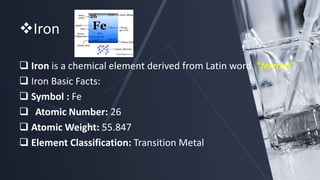
 Iron is a chemical element derived from Latin word ”ferrum”.
 Iron Basic Facts:
 Symbol : Fe
 Atomic Number: 26
 Atomic Weight: 55.847
 Element Classification: Transition Metal
Iron Location in Periodic table and its electronic
configuration
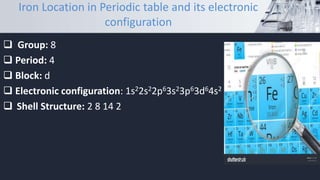
 Group: 8
 Period: 4
 Block: d
 Electronic configuration: 1s22s22p63s23p63d64s2
 Shell Structure: 2 8 14 2
State at room temperature (300 K): Solid
Appearance: malleable, ductile, silvery metal
Density: 7.870 g/cc (25 °C)
Density at Melting Point: 6.98 g/cc
Specific Gravity: 7.874 (20 °C)
Melting Point: 1811 K
Boiling Point: 3133.35 K
Critical Point: 9250 K at 8750 bar
Heat of Fusion:14.9 kJ/mol
Heat of Vaporization: 351 kJ/mol
Molar Heat Capacity: 25.1 J/mol·K
Specific Heat: 0.443 J/g·K (at 20 °C)
Iron Physical properties
Reactivity: very high and readily react with oxygen in moist air.
Oxidation state: +2 (Fe2O3)and +3(Fe3O4).
Iron is Non – Toxic element.
Solubility: dissolved in acid.
Ferrous compounds(Fe2O3) are weak reducing agents.
Ferric compounds(Fe3O4) are oxidizing agents.
Examples of Iron compound: Iron(II) sulfide ,Iron(II) sulfate, Iron(II)
chloride, Iron(II) hydroxide.
Iron Chemical properties
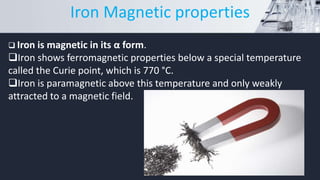
 Iron is magnetic in its α form.
Iron shows ferromagnetic properties below a special temperature
called the Curie point, which is 770 °C.
Iron is paramagnetic above this temperature and only weakly
attracted to a magnetic field.
Iron Magnetic properties
Applications
Iron, in general, was heavily used for tools and weapons in
the past time
Constructions
To make electricity pylons
Bridges
Aircraft
Railways
Industries
Alloys
Biological Applications
 Iron is an essential element for blood production.
It plays a big role in coordination compound.
About 70 percent of our body's iron is found in the red blood
cells of your blood called hemoglobin and in muscle cells called
myoglobin. Hemoglobin is essential for transferring oxygen in
your blood from the lungs to the tissues.
THANK YOU

Iron.pptx

  • 1.
    Chemical Society Program2022 Department of Chemistry Gurukula Kangri (Deemed to be University) Haridwar - 249 404 (India)
  • 2.
    Contents: • Iron history •Physical properties • Chemical properties • Magnetic properties • Applications
  • 3.
    Iron History  Itis unknown who and where iron was discovered because it is very old.  Iron was one the earliest elements on earth.  It is the most common chemical element on Earth (by mass).  It makes up much of the Earth's core, and is the fourth most common element in the Earth's crust.  It is the most widely used metal.
  • 4.
    Iron  Iron isa chemical element derived from Latin word ”ferrum”.  Iron Basic Facts:  Symbol : Fe  Atomic Number: 26  Atomic Weight: 55.847  Element Classification: Transition Metal
  • 5.
    Iron Location inPeriodic table and its electronic configuration  Group: 8  Period: 4  Block: d  Electronic configuration: 1s22s22p63s23p63d64s2  Shell Structure: 2 8 14 2
  • 6.
    State at roomtemperature (300 K): Solid Appearance: malleable, ductile, silvery metal Density: 7.870 g/cc (25 °C) Density at Melting Point: 6.98 g/cc Specific Gravity: 7.874 (20 °C) Melting Point: 1811 K Boiling Point: 3133.35 K Critical Point: 9250 K at 8750 bar Heat of Fusion:14.9 kJ/mol Heat of Vaporization: 351 kJ/mol Molar Heat Capacity: 25.1 J/mol·K Specific Heat: 0.443 J/g·K (at 20 °C) Iron Physical properties
  • 7.
    Reactivity: very highand readily react with oxygen in moist air. Oxidation state: +2 (Fe2O3)and +3(Fe3O4). Iron is Non – Toxic element. Solubility: dissolved in acid. Ferrous compounds(Fe2O3) are weak reducing agents. Ferric compounds(Fe3O4) are oxidizing agents. Examples of Iron compound: Iron(II) sulfide ,Iron(II) sulfate, Iron(II) chloride, Iron(II) hydroxide. Iron Chemical properties
  • 8.
     Iron ismagnetic in its α form. Iron shows ferromagnetic properties below a special temperature called the Curie point, which is 770 °C. Iron is paramagnetic above this temperature and only weakly attracted to a magnetic field. Iron Magnetic properties
  • 9.
    Applications Iron, in general,was heavily used for tools and weapons in the past time Constructions To make electricity pylons Bridges Aircraft Railways Industries Alloys
  • 10.
    Biological Applications  Ironis an essential element for blood production. It plays a big role in coordination compound. About 70 percent of our body's iron is found in the red blood cells of your blood called hemoglobin and in muscle cells called myoglobin. Hemoglobin is essential for transferring oxygen in your blood from the lungs to the tissues.
  • 11.