International Research Journal of Engineering and Technology (IRJET) e-ISSN: 2395-0056
Volume: 05 Issue: 03 | Mar-2018 www.irjet.net p-ISSN: 2395-0072
© 2018, IRJET | Impact Factor value: 6.171 | ISO 9001:2008 Certified Journal | Page 3808
Landslide Hazard Zonation (LHZ) Mapping of Attappady, Kerala using
GIS
Anju Kailas1, Greena Shajan2, Nikhila P3, Shijo Joy4, Geeja K George5, Dr. Vinu Prakash6
1,2,3,4 Undergraduate students, Dept. of Civil Engineering, MA College of engineering, Kothamangalam, Kerala, India
5Associate Professor, Dept. of Civil Engineering, MA College of engineering Kothamangalam, Kerala, India
6Assistant Professor, Dept. of Geology, MA College of engineering Kothamangalam, Kerala, India
---------------------------------------------------------------------***---------------------------------------------------------------------
Abstract -Landslides are common forms of disasters,which
include wide range of ground movements such as rock falls,
debris flows etc. Landslides are also known as landslips,
slumps, slope failure. They are the most common geo-hazards
occurring in highland regions, especiallymountainousregions.
Landslides can be caused by natural factors or by
anthropogenic activities, resulting in destruction of
environment, damage to buildings, road, railways, pipelines,
communication networks, agricultural land etc. The present
study area Attappadi block panchayat in Palakkad district,
Kerala is prone to landslides, and have been affected by
landslides during the past several years. In this study, an
attempt has been made to prepare the landslide hazard
zonation map based on applied remote sensing (ARS) and
geographic information system (GIS) techniques. In thisstudy,
seven influencing factors are selected viz. slope, elevation, soil
type, drainage density, geology, geomorphology and land use.
For the preparation of the landslide hazard zonation zone of
Attappadi block panchayat weighted overlay analysis is used.
The prepared map shows the areas prone to landslides as 5
zones of varying vulnerability. The Landslide HazardZonation
map is validated using the landslide incidence points of the
study area.
Key Words: landslide, GIS, geo-hazards, Kerala,
Attappadi, vulnerability
1. INTRODUCTION
Landslides are natural hazardsthat cancauseseveredamage
to life and property. It can be defined as the movement of a
mass of rock, debris, or down a slope, under the influence of
gravity. Landslides have become a major threat in therecent
times due to the intervention of human beings. Activities
such as deforestation, mining, landfilling, unscientific
developmental activities etc. has contributed to increasing
the magnitude and frequency of landslides. Also, the natural
structure and constitution of some areas make them prone
to landslides by default. Although landslides are not as
disastrous as major earthquakes, floods, forest fires,
hurricane etc, they can be equally devastating at times.
Landslides can be induced either by earthquake or rain fall.
Kerala receive high amount of rain fall during monsoon
which make the slopesof hilly areas vulnerabletolandslides.
Geological and geomorphological features, elevation, slope
stability, surface characteristics etc.playanimportantrolein
triggering landslides. Hilly terrains of India, Himalayan
Mountains, Western Ghats, and North-Eastern India etc. are
hit by landslides almost annually. These landslides cause
great misery to the dwellers of such areas and it is almost
unavoidable. Landslides cause damage to property, injury
and death to men and animals and adversely affect a variety
of resources. Damages caused to communication lines, road
networks, railway lines, bridges, water supplies, dams etc.
can take up years to restore. Landslides can also lead to
economical degradationof the affected area.Theavailability,
quantity, and quality of water can be affected by landslides.
The objective of this study is to identify the landslide
susceptible regions of Attappadi block panchayath. In this
study, seven factors viz., slope, elevation, geology,
geomorphology, soil type, landuse, and drainage density are
selected as controlling parameters.
1.1 Study Area
Thepresent study area, attappadiblockpanchayathislocated
between 11°14’23.694”N and 10°54’58.396”N latitudes and
76°23’19.33”E and 76°47’59.054”Elongitudes.Thetotalarea
is 828.9 square kilometers and perimeter is 206.15
kilometers. The region is a part of Mannarkad Taluk of
Palakkad district. Attappadi’s climate is classified as tropical
with an average annual temperature of 24.8°C and
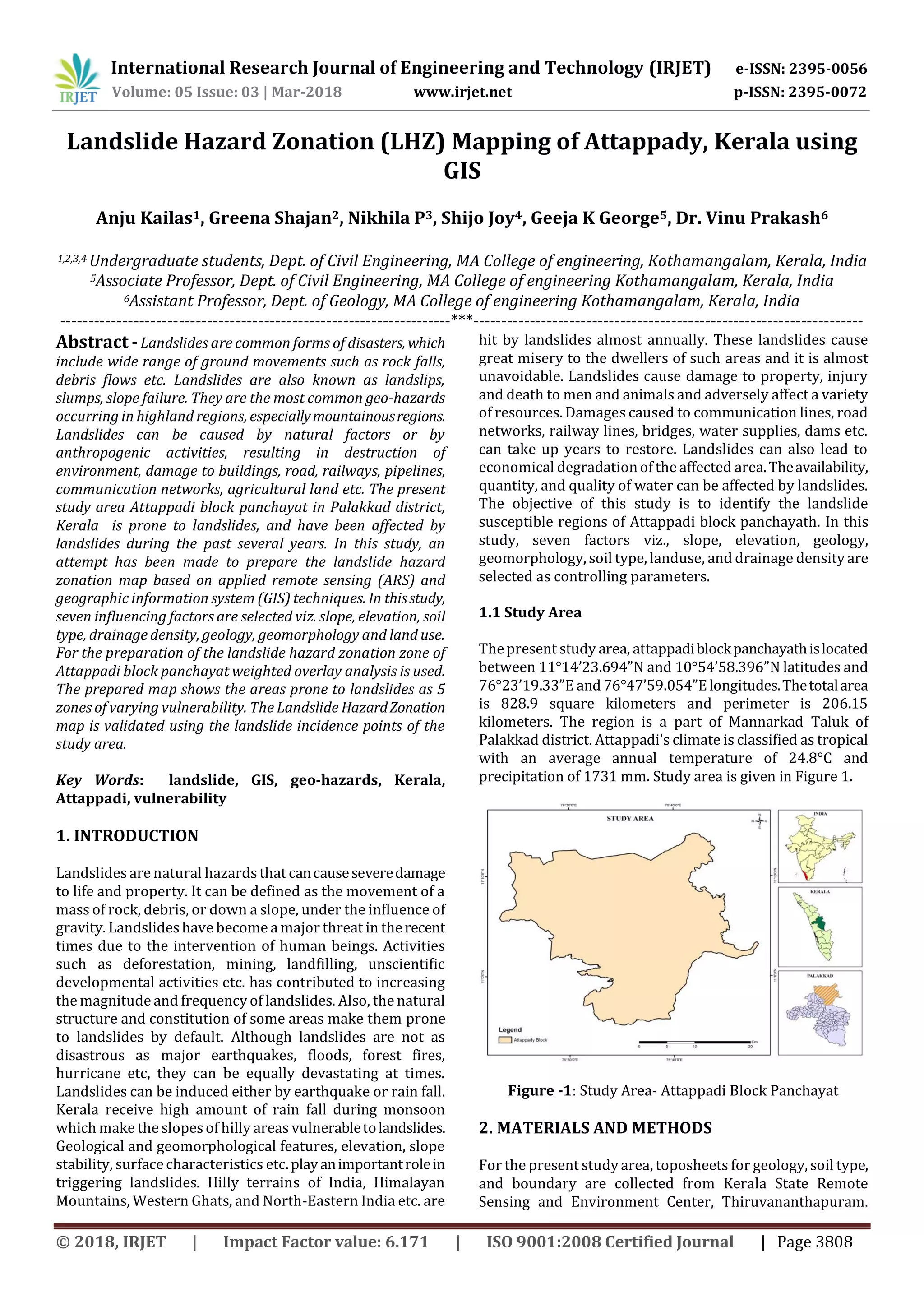
precipitation of 1731 mm. Study area is given in Figure 1.
Figure -1: Study Area- Attappadi Block Panchayat
2. MATERIALS AND METHODS
For the present study area, toposheets for geology, soil type,
and boundary are collected from Kerala State Remote
Sensing and Environment Center, Thiruvananthapuram.
International Research Journal of Engineering and Technology (IRJET) e-ISSN: 2395-0056
Volume: 05 Issue: 03 | Mar-2018 www.irjet.net p-ISSN: 2395-0072
© 2018, IRJET | Impact Factor value: 6.171 | ISO 9001:2008 Certified Journal | Page 3809
Thematic maps were prepared by digitization using ArcGIS
10.3.1. The landuse/landcover, and geomorphology of the
study area is extracted from the Bhuvan Web Map Services
(WSM) by Indian Space Research Organization. A WMS is a
standard protocol for serving georeferenced map images
over the internet that are generated by map server using
data from GIS database.
Slope and elevation were derived using Digital Elevation
Model (DEM). The data used in the preparation of elevation
and slope is of SRTM-1 Arc-Second Global (Shuttle Radar
Topography Mission-1 Arc-SecondGlobal). The DEM datais
obtained from Earth explorer. The drainagedensitymapwas
prepared using ArcGIS spatial analyst tools.
To each class of selected factors, different ranks and weights
were assigned on accordance to its influence on landslide
occurrence. The landslide hazard zonation map is prepared
using Weighted Overlay Analysis. The LHZ map is validated
using the landslide occurrence points based on field study
and the natural hazard zonation map of Kerala, prepared by
Kerala State Disaster Management Authority.
Sl
No
Factor Class Rank Weight
1 Slope
0-10.654˚ 5
25
10.654-18.717˚ 3
18.717-27.067˚ 3
27.067-36.858˚ 2
36.˚858-73.428˚ 1
2 Elevation
64-565 m 4
10
565-866 m 3
866-1206 m 3
1206-1631 m 2
1631-2366 m 1
3 Geology
Peninsular Gneissic
Complex
1
17
Metabasic and
Ultrabasic rock
5
Migmatite complex 2
Charnockite 1
High Grade
Metasedimentary
Rock
5
Khondalite 1
Pegmatite/Aplit
e/ Quartz vein
5
Basic Rocks 5
4 Soil Type
Gravelly Loam 2
15
Waterbody/Tank 3
Gravelly Clay 2
Clay 1
5 Geo-
Structural Origin-
Highly Dissected
Hills and Valleys
2
10
Structural Origin-
Moderately
Dissected Hills and
3
morphology Valleys
Denduational
Origin- Highly
Dissected Hills and
Valleys
1
Anthropogenic
Origin
1
6 Landuse
Agriculture 2
13
Forest 4
Built-up area 3
Grassland 1
Wasteland 1
Water bodies 5
Wetlands 2
Fallow land 2
7 Drainage
Density
0-0.00029
km/sq.km
5
10
0.00029-0.000612
km/sq.km
4
0.000612-.000927
km/sq.km
3
0.000927-0.001275
km/sq.km
2
0.001275-0.00211
km/sq.km
1
Table -1: Weightages and ranks
3. RESULTS AND DISCUSSION
3.1 Slope
Slope is one of the most important factorsaffectinglandslide.
It is expressed as percentage rise or degree. As the value of
slope increases the chances of landslide occurrence also
increases. But it does not mean that gentle slopes are not
susceptible to landslide. When gentler slopes are combined
with other factors, they also become vulnerable to landslide.
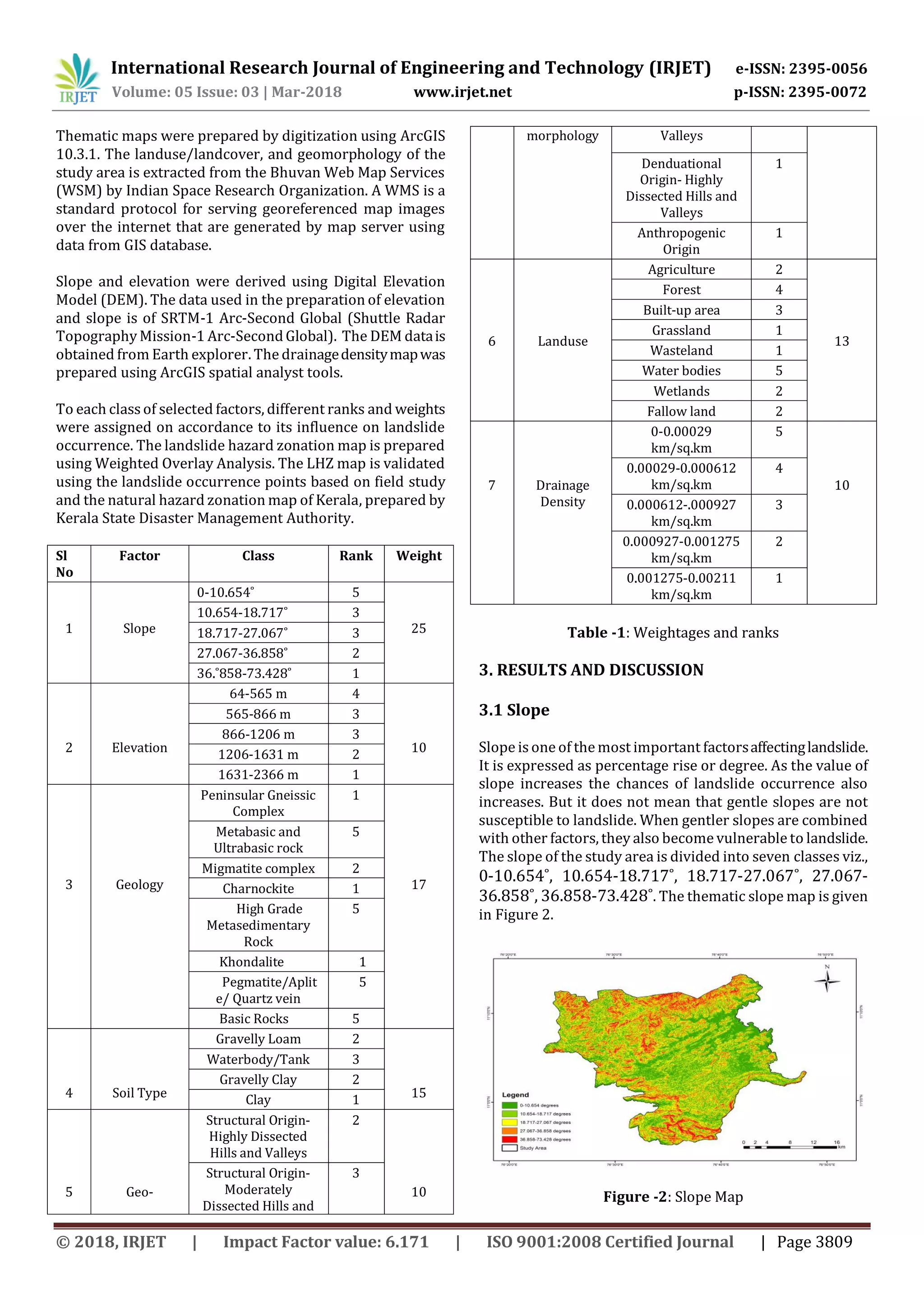
The slope of the study area is divided into seven classes viz.,
0-10.654˚, 10.654-18.717˚, 18.717-27.067˚, 27.067-
36.858˚, 36.858-73.428˚. The thematic slope map is given
in Figure 2.
Figure -2: Slope Map
International Research Journal of Engineering and Technology (IRJET) e-ISSN: 2395-0056
Volume: 05 Issue: 03 | Mar-2018 www.irjet.net p-ISSN: 2395-0072
© 2018, IRJET | Impact Factor value: 6.171 | ISO 9001:2008 Certified Journal | Page 3810
3.2 Elevation
Elevation is another natural factor that causes the downfall
and sliding of rocks and debris. In areas of higher elevation,
the probability of landslide occurrence is relatively higher
than that of lower elevation. In areas of lower elevation
terrain is generally gentle and a high water table will be
required to initiate slope failure. In this study area the
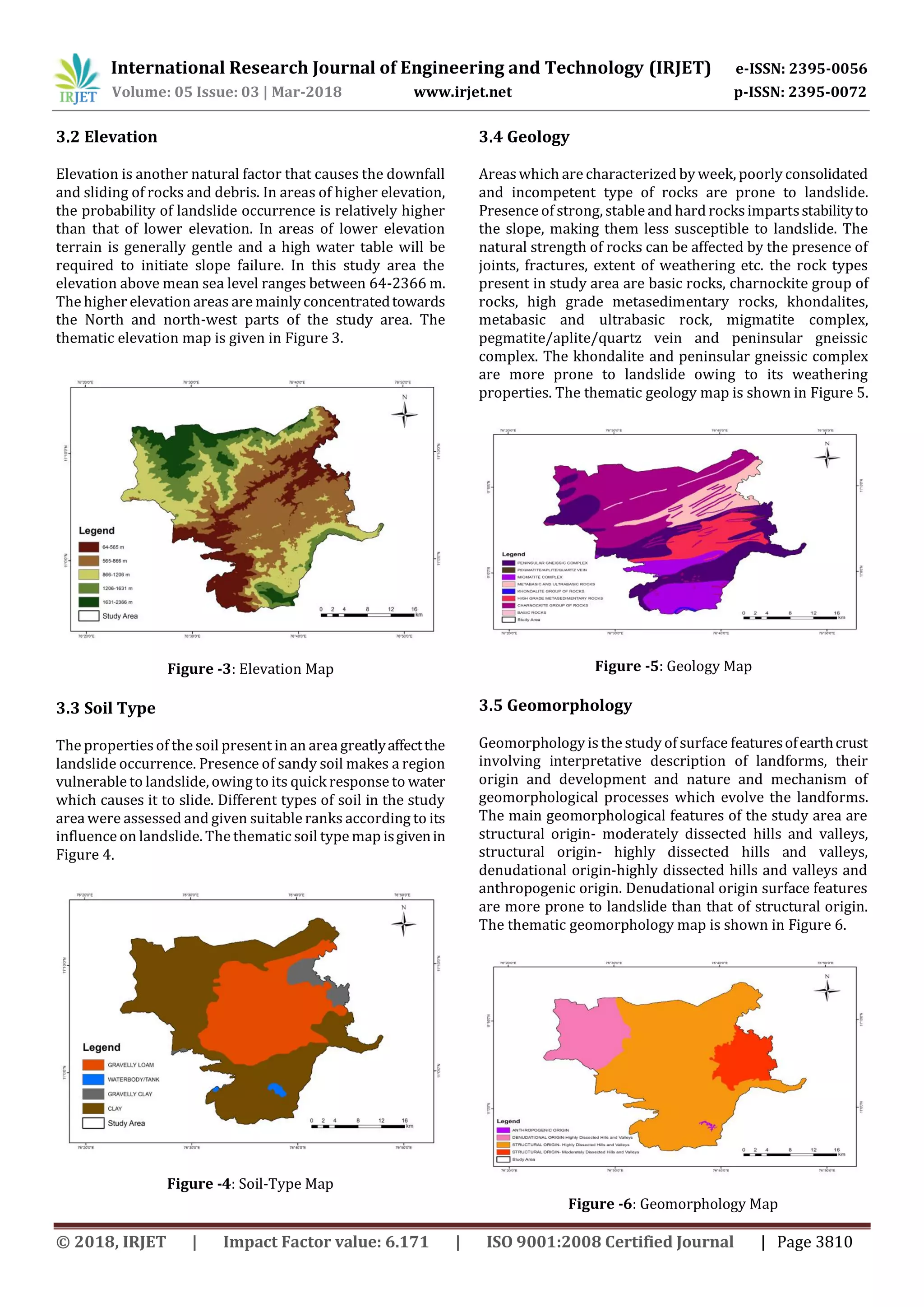
elevation above mean sea level ranges between 64-2366 m.
The higher elevation areas are mainly concentratedtowards
the North and north-west parts of the study area. The
thematic elevation map is given in Figure 3.
Figure -3: Elevation Map
3.3 Soil Type
The properties of the soil present in an area greatlyaffectthe
landslide occurrence. Presence of sandy soil makes a region
vulnerable to landslide, owing to its quick response to water
which causes it to slide. Different types of soil in the study
area were assessed and given suitable ranks according to its
influence on landslide. The thematic soil type map isgivenin
Figure 4.
Figure -4: Soil-Type Map
3.4 Geology
Areaswhich are characterized by week, poorly consolidated
and incompetent type of rocks are prone to landslide.
Presence of strong, stable and hard rocksimpartsstabilityto
the slope, making them less susceptible to landslide. The
natural strength of rocks can be affected by the presence of
joints, fractures, extent of weathering etc. the rock types
present in study area are basic rocks, charnockite group of
rocks, high grade metasedimentary rocks, khondalites,
metabasic and ultrabasic rock, migmatite complex,
pegmatite/aplite/quartz vein and peninsular gneissic
complex. The khondalite and peninsular gneissic complex
are more prone to landslide owing to its weathering
properties. The thematic geology map is shown in Figure 5.
Figure -5: Geology Map
3.5 Geomorphology
Geomorphology is the study of surface featuresofearthcrust
involving interpretative description of landforms, their
origin and development and nature and mechanism of
geomorphological processes which evolve the landforms.
The main geomorphological features of the study area are
structural origin- moderately dissected hills and valleys,
structural origin- highly dissected hills and valleys,
denudational origin-highly dissected hills and valleys and
anthropogenic origin. Denudational origin surface features
are more prone to landslide than that of structural origin.
The thematic geomorphology map is shown in Figure 6.
Figure -6: Geomorphology Map
International Research Journal of Engineering and Technology (IRJET) e-ISSN: 2395-0056
Volume: 05 Issue: 03 | Mar-2018 www.irjet.net p-ISSN: 2395-0072
© 2018, IRJET | Impact Factor value: 6.171 | ISO 9001:2008 Certified Journal | Page 3811
3.6 Drainage Density
Drainage density is a factor which is indicative of
perviousness of strata, rainfall, vegetation and stream
incision. All these factors are directly related to mass
movement. High drainage density is an indication of
impervious strata, high rainfall, less vegetation and active
stream incision. The thematic drainagedensitymapisshown
in Figure 7.
Figure -7: Drainage Density Map
3.7 Landuse
Landuse/Landcover is one of the key factors affecting
landslide. Often, the changes brought by anthropogenic
activities cause rapid changes in the stability of a landform.
Activities like deforestation, unscientific cultivation
practices, urbanization, land reclamation etc. influence the
incidence of landslides. Areas with sparse vegetation are
more prone to landslide in contrast to densely vegetated
areas due to more erosion. Chances of landslide depend
upon the amount of water infiltrated to geomorphologically
unstable slopes with loose soil and weak rocks.Thethematic
landuse/landcover map is shown in Figure 8.
Figure -8: Landuse Map
Based on the weighted overlay analysis done on the seven
selected parameters, the output map is generated.Thestudy
area isthus classified into 5 zoneswith varying vulnerability
viz., very high susceptible zone, highly susceptible zone,
moderately susceptible zone, low susceptible zone and very
low susceptible zone.
4. CONCLUSION
Regions like Attappadi where the population density is less,
the preventive measures taken for the recurring landslides
are relatively low. When landslides and such disasters hit
them, usually people get isolated. The communication and
transport systems often get hindered making their life
miserable during the time of such disasters. Using remote
sensing and GIS techniques, effective demarcation of
landslide hazard zones can be done. Thus the mitigation
measures can be precisely done and the management of
landslide hazard is made easy.
From this study it is found that the north, north-eastern and
the southern regions of Attappadi block panchayat aremore
prone to landslides. It is clear that slope and elevation are
the most important causative factors followed by drainage
density, geology, soil type, geomorphology and landuse.The
prepared landslide hazard zonation map is validated based
on the natural hazard zonation map of Kerala, prepared by
Kerala State Disaster Management Authority. Hence this
methodology can be used for further studies on other
regions.
The prepared LHZ map may be useful to planners and
developers for choosing suitable site for future
developments and landuse planning, and also to locate
constructions in the unstable zones. It could be of use for
authorities of the area for ensuring safety to the people of
affected regions.
Constant monitoring for geo-hazards is necessary in
strategically important places and location of major dams,
pipelines, important structures and monuments. Hazard
zonation mapping using GIS and remote sensing techniques
provide latest and reliable information regarding the same.
REFERENCES
[1] Ganapathy, G.P., Mahendran, “Need and Urgency of
Landslide Risk Planning for Nilgiri District, Tamil nadu
state India”, International journal of geomatics and
geosciences volume 1, pp.29-40, (2010).
[2] Raveendran, Dr. Mani, Aneesh, “Landslide Hazard
Zonation and Vulnerability Assessment of Western
Ghats- A case study in Devikulam Taluk of Idukki
District”, International journal of research and applied
sciences, volume 5, pp.185-189, (2015).
[3] Ahmed B, “Landslide susceptibility mapping using
multi-criteria evaluation techniques in Chittagong
International Research Journal of Engineering and Technology (IRJET) e-ISSN: 2395-0056
Volume: 05 Issue: 03 | Mar-2018 www.irjet.net p-ISSN: 2395-0072
© 2018, IRJET | Impact Factor value: 6.171 | ISO 9001:2008 Certified Journal | Page 3812
Metropolitan Area, Bangladesh”, Landslides.
doi: 10.1007/s10346-014-0521 (2014)
[4] Ayalew L, Yamagishi H, Ugawa N, “Landslide
susceptibility mapping using GIS-based weighted linear
combination, the case in Tsugawa area of Agano River,
Niigata Prefecture, Japan”, Springer 2004:34,( 2004)
[5] Cevik E., Topal T, “GIS-based landslide susceptibility
mapping for a problematic segment of the natural gas
pipeline, Hendek (Turkey)”, Environmental Geology 44,
pp. 949- 962, (2003)
[6] Ajin R.S., Vinod P.G., Menon A.R.R, “Landslide Hazard
Zonation using RS and GIS techniques: A case study of
Meenachil and Kanjirappally Taluk, Kottayam district,
Kerala, India”, Proceedings of the 26th Kerala Science
Congress, Pookode, Wayanad (India), pp. 1797- 1804,
(2014)
[7] Akgun A., Bulut F., “GIS-Based Landslide Susceptibility
For Arsin-Yomra (Trabzon, North Turkey) Region”,
Environmental Geology 51, pp. 1377-1387, (2007)
[8] Chingkhei R.K., Shiroyleima A., Singh L.R., Kumar A,
“Landslide hazard zonation in NH-1A in Kashmir
Himalaya, India”, International JournalofGeosciences 4,
pp. 1501-1508, (2013)
[9] Dai F.C., Lee C.F., Li J., Xu Z.W, “Assessment of landslide
susceptibility on the natural terrain of Lantau Island,
Hong Kong”, Environmental Geology 40, pp. 381-391,
(2001)
[10] Dutta P.J., Sarma S., “Landslide susceptibility zoning of
the Kalapahar hill, Guwahati, Assam state, India, using a
GIS-based heuristic technique”, International Journal of
Remote Sensing & Geoscience 2(2), pp. 49-55, (2013)

IRJET- Landslide Hazard Zonation (LHZ) Mapping of Attappady, Kerala using GIS

  • 1.
    International Research Journalof Engineering and Technology (IRJET) e-ISSN: 2395-0056 Volume: 05 Issue: 03 | Mar-2018 www.irjet.net p-ISSN: 2395-0072 © 2018, IRJET | Impact Factor value: 6.171 | ISO 9001:2008 Certified Journal | Page 3808 Landslide Hazard Zonation (LHZ) Mapping of Attappady, Kerala using GIS Anju Kailas1, Greena Shajan2, Nikhila P3, Shijo Joy4, Geeja K George5, Dr. Vinu Prakash6 1,2,3,4 Undergraduate students, Dept. of Civil Engineering, MA College of engineering, Kothamangalam, Kerala, India 5Associate Professor, Dept. of Civil Engineering, MA College of engineering Kothamangalam, Kerala, India 6Assistant Professor, Dept. of Geology, MA College of engineering Kothamangalam, Kerala, India ---------------------------------------------------------------------***--------------------------------------------------------------------- Abstract -Landslides are common forms of disasters,which include wide range of ground movements such as rock falls, debris flows etc. Landslides are also known as landslips, slumps, slope failure. They are the most common geo-hazards occurring in highland regions, especiallymountainousregions. Landslides can be caused by natural factors or by anthropogenic activities, resulting in destruction of environment, damage to buildings, road, railways, pipelines, communication networks, agricultural land etc. The present study area Attappadi block panchayat in Palakkad district, Kerala is prone to landslides, and have been affected by landslides during the past several years. In this study, an attempt has been made to prepare the landslide hazard zonation map based on applied remote sensing (ARS) and geographic information system (GIS) techniques. In thisstudy, seven influencing factors are selected viz. slope, elevation, soil type, drainage density, geology, geomorphology and land use. For the preparation of the landslide hazard zonation zone of Attappadi block panchayat weighted overlay analysis is used. The prepared map shows the areas prone to landslides as 5 zones of varying vulnerability. The Landslide HazardZonation map is validated using the landslide incidence points of the study area. Key Words: landslide, GIS, geo-hazards, Kerala, Attappadi, vulnerability 1. INTRODUCTION Landslides are natural hazardsthat cancauseseveredamage to life and property. It can be defined as the movement of a mass of rock, debris, or down a slope, under the influence of gravity. Landslides have become a major threat in therecent times due to the intervention of human beings. Activities such as deforestation, mining, landfilling, unscientific developmental activities etc. has contributed to increasing the magnitude and frequency of landslides. Also, the natural structure and constitution of some areas make them prone to landslides by default. Although landslides are not as disastrous as major earthquakes, floods, forest fires, hurricane etc, they can be equally devastating at times. Landslides can be induced either by earthquake or rain fall. Kerala receive high amount of rain fall during monsoon which make the slopesof hilly areas vulnerabletolandslides. Geological and geomorphological features, elevation, slope stability, surface characteristics etc.playanimportantrolein triggering landslides. Hilly terrains of India, Himalayan Mountains, Western Ghats, and North-Eastern India etc. are hit by landslides almost annually. These landslides cause great misery to the dwellers of such areas and it is almost unavoidable. Landslides cause damage to property, injury and death to men and animals and adversely affect a variety of resources. Damages caused to communication lines, road networks, railway lines, bridges, water supplies, dams etc. can take up years to restore. Landslides can also lead to economical degradationof the affected area.Theavailability, quantity, and quality of water can be affected by landslides. The objective of this study is to identify the landslide susceptible regions of Attappadi block panchayath. In this study, seven factors viz., slope, elevation, geology, geomorphology, soil type, landuse, and drainage density are selected as controlling parameters. 1.1 Study Area Thepresent study area, attappadiblockpanchayathislocated between 11°14’23.694”N and 10°54’58.396”N latitudes and 76°23’19.33”E and 76°47’59.054”Elongitudes.Thetotalarea is 828.9 square kilometers and perimeter is 206.15 kilometers. The region is a part of Mannarkad Taluk of Palakkad district. Attappadi’s climate is classified as tropical with an average annual temperature of 24.8°C and precipitation of 1731 mm. Study area is given in Figure 1. Figure -1: Study Area- Attappadi Block Panchayat 2. MATERIALS AND METHODS For the present study area, toposheets for geology, soil type, and boundary are collected from Kerala State Remote Sensing and Environment Center, Thiruvananthapuram.
  • 2.
    International Research Journalof Engineering and Technology (IRJET) e-ISSN: 2395-0056 Volume: 05 Issue: 03 | Mar-2018 www.irjet.net p-ISSN: 2395-0072 © 2018, IRJET | Impact Factor value: 6.171 | ISO 9001:2008 Certified Journal | Page 3809 Thematic maps were prepared by digitization using ArcGIS 10.3.1. The landuse/landcover, and geomorphology of the study area is extracted from the Bhuvan Web Map Services (WSM) by Indian Space Research Organization. A WMS is a standard protocol for serving georeferenced map images over the internet that are generated by map server using data from GIS database. Slope and elevation were derived using Digital Elevation Model (DEM). The data used in the preparation of elevation and slope is of SRTM-1 Arc-Second Global (Shuttle Radar Topography Mission-1 Arc-SecondGlobal). The DEM datais obtained from Earth explorer. The drainagedensitymapwas prepared using ArcGIS spatial analyst tools. To each class of selected factors, different ranks and weights were assigned on accordance to its influence on landslide occurrence. The landslide hazard zonation map is prepared using Weighted Overlay Analysis. The LHZ map is validated using the landslide occurrence points based on field study and the natural hazard zonation map of Kerala, prepared by Kerala State Disaster Management Authority. Sl No Factor Class Rank Weight 1 Slope 0-10.654˚ 5 25 10.654-18.717˚ 3 18.717-27.067˚ 3 27.067-36.858˚ 2 36.˚858-73.428˚ 1 2 Elevation 64-565 m 4 10 565-866 m 3 866-1206 m 3 1206-1631 m 2 1631-2366 m 1 3 Geology Peninsular Gneissic Complex 1 17 Metabasic and Ultrabasic rock 5 Migmatite complex 2 Charnockite 1 High Grade Metasedimentary Rock 5 Khondalite 1 Pegmatite/Aplit e/ Quartz vein 5 Basic Rocks 5 4 Soil Type Gravelly Loam 2 15 Waterbody/Tank 3 Gravelly Clay 2 Clay 1 5 Geo- Structural Origin- Highly Dissected Hills and Valleys 2 10 Structural Origin- Moderately Dissected Hills and 3 morphology Valleys Denduational Origin- Highly Dissected Hills and Valleys 1 Anthropogenic Origin 1 6 Landuse Agriculture 2 13 Forest 4 Built-up area 3 Grassland 1 Wasteland 1 Water bodies 5 Wetlands 2 Fallow land 2 7 Drainage Density 0-0.00029 km/sq.km 5 10 0.00029-0.000612 km/sq.km 4 0.000612-.000927 km/sq.km 3 0.000927-0.001275 km/sq.km 2 0.001275-0.00211 km/sq.km 1 Table -1: Weightages and ranks 3. RESULTS AND DISCUSSION 3.1 Slope Slope is one of the most important factorsaffectinglandslide. It is expressed as percentage rise or degree. As the value of slope increases the chances of landslide occurrence also increases. But it does not mean that gentle slopes are not susceptible to landslide. When gentler slopes are combined with other factors, they also become vulnerable to landslide. The slope of the study area is divided into seven classes viz., 0-10.654˚, 10.654-18.717˚, 18.717-27.067˚, 27.067- 36.858˚, 36.858-73.428˚. The thematic slope map is given in Figure 2. Figure -2: Slope Map
  • 3.
    International Research Journalof Engineering and Technology (IRJET) e-ISSN: 2395-0056 Volume: 05 Issue: 03 | Mar-2018 www.irjet.net p-ISSN: 2395-0072 © 2018, IRJET | Impact Factor value: 6.171 | ISO 9001:2008 Certified Journal | Page 3810 3.2 Elevation Elevation is another natural factor that causes the downfall and sliding of rocks and debris. In areas of higher elevation, the probability of landslide occurrence is relatively higher than that of lower elevation. In areas of lower elevation terrain is generally gentle and a high water table will be required to initiate slope failure. In this study area the elevation above mean sea level ranges between 64-2366 m. The higher elevation areas are mainly concentratedtowards the North and north-west parts of the study area. The thematic elevation map is given in Figure 3. Figure -3: Elevation Map 3.3 Soil Type The properties of the soil present in an area greatlyaffectthe landslide occurrence. Presence of sandy soil makes a region vulnerable to landslide, owing to its quick response to water which causes it to slide. Different types of soil in the study area were assessed and given suitable ranks according to its influence on landslide. The thematic soil type map isgivenin Figure 4. Figure -4: Soil-Type Map 3.4 Geology Areaswhich are characterized by week, poorly consolidated and incompetent type of rocks are prone to landslide. Presence of strong, stable and hard rocksimpartsstabilityto the slope, making them less susceptible to landslide. The natural strength of rocks can be affected by the presence of joints, fractures, extent of weathering etc. the rock types present in study area are basic rocks, charnockite group of rocks, high grade metasedimentary rocks, khondalites, metabasic and ultrabasic rock, migmatite complex, pegmatite/aplite/quartz vein and peninsular gneissic complex. The khondalite and peninsular gneissic complex are more prone to landslide owing to its weathering properties. The thematic geology map is shown in Figure 5. Figure -5: Geology Map 3.5 Geomorphology Geomorphology is the study of surface featuresofearthcrust involving interpretative description of landforms, their origin and development and nature and mechanism of geomorphological processes which evolve the landforms. The main geomorphological features of the study area are structural origin- moderately dissected hills and valleys, structural origin- highly dissected hills and valleys, denudational origin-highly dissected hills and valleys and anthropogenic origin. Denudational origin surface features are more prone to landslide than that of structural origin. The thematic geomorphology map is shown in Figure 6. Figure -6: Geomorphology Map
  • 4.
    International Research Journalof Engineering and Technology (IRJET) e-ISSN: 2395-0056 Volume: 05 Issue: 03 | Mar-2018 www.irjet.net p-ISSN: 2395-0072 © 2018, IRJET | Impact Factor value: 6.171 | ISO 9001:2008 Certified Journal | Page 3811 3.6 Drainage Density Drainage density is a factor which is indicative of perviousness of strata, rainfall, vegetation and stream incision. All these factors are directly related to mass movement. High drainage density is an indication of impervious strata, high rainfall, less vegetation and active stream incision. The thematic drainagedensitymapisshown in Figure 7. Figure -7: Drainage Density Map 3.7 Landuse Landuse/Landcover is one of the key factors affecting landslide. Often, the changes brought by anthropogenic activities cause rapid changes in the stability of a landform. Activities like deforestation, unscientific cultivation practices, urbanization, land reclamation etc. influence the incidence of landslides. Areas with sparse vegetation are more prone to landslide in contrast to densely vegetated areas due to more erosion. Chances of landslide depend upon the amount of water infiltrated to geomorphologically unstable slopes with loose soil and weak rocks.Thethematic landuse/landcover map is shown in Figure 8. Figure -8: Landuse Map Based on the weighted overlay analysis done on the seven selected parameters, the output map is generated.Thestudy area isthus classified into 5 zoneswith varying vulnerability viz., very high susceptible zone, highly susceptible zone, moderately susceptible zone, low susceptible zone and very low susceptible zone. 4. CONCLUSION Regions like Attappadi where the population density is less, the preventive measures taken for the recurring landslides are relatively low. When landslides and such disasters hit them, usually people get isolated. The communication and transport systems often get hindered making their life miserable during the time of such disasters. Using remote sensing and GIS techniques, effective demarcation of landslide hazard zones can be done. Thus the mitigation measures can be precisely done and the management of landslide hazard is made easy. From this study it is found that the north, north-eastern and the southern regions of Attappadi block panchayat aremore prone to landslides. It is clear that slope and elevation are the most important causative factors followed by drainage density, geology, soil type, geomorphology and landuse.The prepared landslide hazard zonation map is validated based on the natural hazard zonation map of Kerala, prepared by Kerala State Disaster Management Authority. Hence this methodology can be used for further studies on other regions. The prepared LHZ map may be useful to planners and developers for choosing suitable site for future developments and landuse planning, and also to locate constructions in the unstable zones. It could be of use for authorities of the area for ensuring safety to the people of affected regions. Constant monitoring for geo-hazards is necessary in strategically important places and location of major dams, pipelines, important structures and monuments. Hazard zonation mapping using GIS and remote sensing techniques provide latest and reliable information regarding the same. REFERENCES [1] Ganapathy, G.P., Mahendran, “Need and Urgency of Landslide Risk Planning for Nilgiri District, Tamil nadu state India”, International journal of geomatics and geosciences volume 1, pp.29-40, (2010). [2] Raveendran, Dr. Mani, Aneesh, “Landslide Hazard Zonation and Vulnerability Assessment of Western Ghats- A case study in Devikulam Taluk of Idukki District”, International journal of research and applied sciences, volume 5, pp.185-189, (2015). [3] Ahmed B, “Landslide susceptibility mapping using multi-criteria evaluation techniques in Chittagong
  • 5.
    International Research Journalof Engineering and Technology (IRJET) e-ISSN: 2395-0056 Volume: 05 Issue: 03 | Mar-2018 www.irjet.net p-ISSN: 2395-0072 © 2018, IRJET | Impact Factor value: 6.171 | ISO 9001:2008 Certified Journal | Page 3812 Metropolitan Area, Bangladesh”, Landslides. doi: 10.1007/s10346-014-0521 (2014) [4] Ayalew L, Yamagishi H, Ugawa N, “Landslide susceptibility mapping using GIS-based weighted linear combination, the case in Tsugawa area of Agano River, Niigata Prefecture, Japan”, Springer 2004:34,( 2004) [5] Cevik E., Topal T, “GIS-based landslide susceptibility mapping for a problematic segment of the natural gas pipeline, Hendek (Turkey)”, Environmental Geology 44, pp. 949- 962, (2003) [6] Ajin R.S., Vinod P.G., Menon A.R.R, “Landslide Hazard Zonation using RS and GIS techniques: A case study of Meenachil and Kanjirappally Taluk, Kottayam district, Kerala, India”, Proceedings of the 26th Kerala Science Congress, Pookode, Wayanad (India), pp. 1797- 1804, (2014) [7] Akgun A., Bulut F., “GIS-Based Landslide Susceptibility For Arsin-Yomra (Trabzon, North Turkey) Region”, Environmental Geology 51, pp. 1377-1387, (2007) [8] Chingkhei R.K., Shiroyleima A., Singh L.R., Kumar A, “Landslide hazard zonation in NH-1A in Kashmir Himalaya, India”, International JournalofGeosciences 4, pp. 1501-1508, (2013) [9] Dai F.C., Lee C.F., Li J., Xu Z.W, “Assessment of landslide susceptibility on the natural terrain of Lantau Island, Hong Kong”, Environmental Geology 40, pp. 381-391, (2001) [10] Dutta P.J., Sarma S., “Landslide susceptibility zoning of the Kalapahar hill, Guwahati, Assam state, India, using a GIS-based heuristic technique”, International Journal of Remote Sensing & Geoscience 2(2), pp. 49-55, (2013)