IPTV vs. OTT – Internet TV explained
Over the past decade, online video consumption has skyrocketed. In 2011,
video content constituted 53% of all internet traffic. By 2021, this figure had
surged to nearly 82% of global internet traffic. The ability to watch videos
anytime and anywhere has become more attainable than ever.
However, when discussing internet TV, there is often confusion between two
key concepts: IPTV and OTT. This guide aims to clarify these terms and help
you determine which option best suits your media company's needs.
Both IPTV and OTT distribute video content over the internet using the IP
protocol. The primary differences lie in the type of service offered,
infrastructure, and delivery method.
Jump to:
● What is IPTV?
● How does IPTV work?
● What is OTT?
● How does OTT work?
● IPTV vs. OTT – Pros and Cons
● IPTV or OTT? What’s suitable for your service?
What is IPTV?
IPTV stands for "Internet-based protocol television." It is a digital television
system that delivers live and on-demand video over the internet in a controlled
manner. IPTV operates on a privately managed network, which could be a
LAN, WAN, or an ISP network. By reserving bandwidth specifically for video
delivery, IPTV ensures superior image and sound quality without interruptions,
along with enhanced network security.
Examples of IPTV services include Verizon Fios TV, DIRECTV STREAM,
Movistar+, and Orange TV.
How does IPTV work?
IPTV functions similarly to web browsing. TV programming and videos are
stored on servers and distributed whenever a viewer selects a channel or on-
demand content. The multicast method is used to transmit data to a group of
recipients simultaneously, rather than sending individual copies to each user.
Multicast is a one-to-many or many-to-many distribution technique, delivering
videos to specific users. Network nodes, such as switches and routers,
replicate the content to reach multiple IP addresses via broadband, fiber
optics, or DSL. This method efficiently utilizes network infrastructure and
bandwidth.
IPTV services are often bundled with broadband and mobile lines by ISPs,
providing convenience but limiting viewers to the channels and VOD titles
offered by their ISP in a particular region.
Setting up IPTV requires an internet connection, a router, and a device
connected to the dedicated internet line (usually a set-top box) that acts as a
signal decoder to display content on the TV screen. This setup resembles
traditional cable TV, making IPTV akin to cutting the cord halfway.
What is OTT?
OTT stands for "over-the-top," referring to video and TV programming
streamed to any device (smart TV, laptop, tablet, smartphone, or video
console) over the public internet. OTT bypasses traditional broadcast, cable,
and satellite gatekeepers, embodying the "anytime, anywhere" video model.
Popular OTT services include YouTube, Netflix, Amazon Prime Video,
Disney+, and HBO Max.
How does OTT work?
OTT services are purely streaming content providers, delivering video upon
request in a unicast form, which serves one stream to a single connected
device or recipient. ISPs do not control video delivery, viewing, or content
copyrights; they simply provide the infrastructure through which OTTs stream
content to end-user devices.
Due to the reduced infrastructure and overall cost, OTT services are typically
more affordable than IPTV. However, OTT must adjust to a wide range of
networks and devices, relying on internet connection speed, available
bandwidth, and device connectivity speed. This dependency can affect image
and audio quality, as the OTT application adjusts to network performance to
avoid buffering.
IPTV vs. OTT – Pros and Cons
Content delivery and network
● OTT: Delivered via an open network without infrastructure investment or
carriage negotiations.
● IPTV: Distributed through a closed, proprietary, optimized high-
bandwidth network via a specific ISP. IPTV offers reliability, high quality
of service, and easy monitoring but is more expensive and complex to
deploy, manage, and update.
Components needed
● IPTV: Requires an internet connection, a router, and a set-top box or IP-
based connected TV.
● OTT: Only requires an internet-compatible device connected to data or
Wi-Fi.
Quality of video
● OTT: Quality depends on available bandwidth, internet connection
speed, and device used.
● IPTV: Offers higher image and audio quality using a private content
delivery network.
Price
● IPTV: Subscription packages are comparable to traditional cable or
satellite TV.
● OTT: Generally more affordable, with some services as low as $4.99
per month or free if ad-supported.
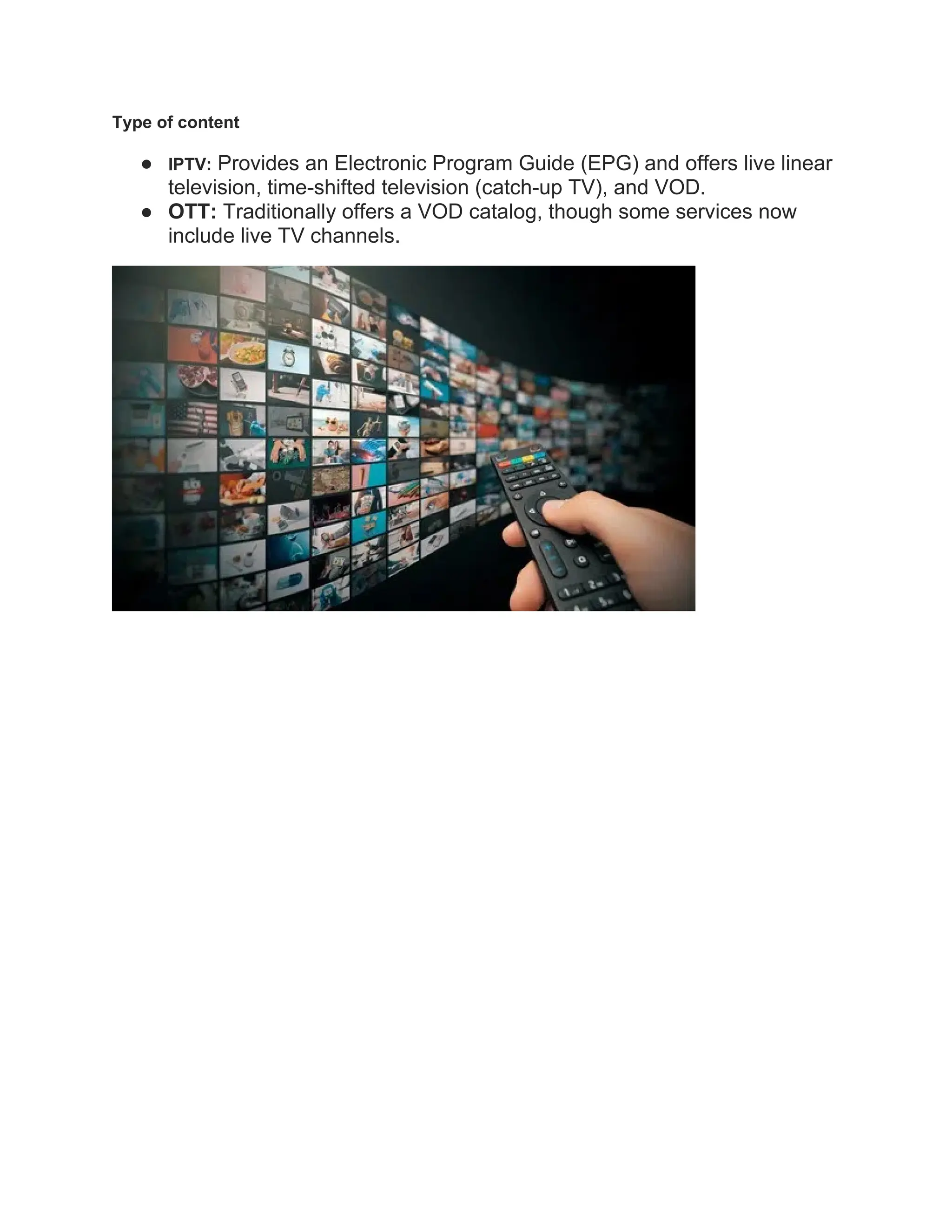
Type of content
● IPTV: Provides an Electronic Program Guide (EPG) and offers live linear
television, time-shifted television (catch-up TV), and VOD.
● OTT: Traditionally offers a VOD catalog, though some services now
include live TV channels.
IPTV or OTT? What’s Suitable for Your Service
Choosing between IPTV and OTT depends on your content delivery
infrastructure and operational resources.
● OTT: Cost-effective, flexible, allows service personalization, and
introduces new features at a lower price. However, it faces challenges
with network reliability and internet limitations, requiring a lower upfront
investment.
● IPTV: Provides higher quality of service, easier monitoring, and
scalability, but with higher operational costs. Suitable for legacy pay-TV
operators and telcos with existing network infrastructure.
Why Choose When You Can Fuse?
To deliver exceptional TV experiences, consider combining the best of both
IPTV and OTT. The Kaltura TV platform merges OTT's agility and flexibility
with pay TV’s robustness and scalability, offering broadcast-grade availability
for live and VOD TV viewing across all devices.
In today’s evolving TV landscape, flexibility and growth are crucial. With the
right platform, TV operators can easily set up new channels, aggregate OTT
services, and modify pricing plans, ensuring viewers always find something to
watch.
If you're considering establishing your own cloud TV offering, we can help you
embark on this journey and achieve a full-fledged service.
Source:
● https://www.the-best-iptv.com/
● https://www.iptveye.com/
● https://www.iptvmentor.com/
● https://www.iptv-new.com/
● https://www.iptvpicks.com/

IPTV vs. OTT – Internet TV explained.docx

  • 1.
    IPTV vs. OTT– Internet TV explained Over the past decade, online video consumption has skyrocketed. In 2011, video content constituted 53% of all internet traffic. By 2021, this figure had surged to nearly 82% of global internet traffic. The ability to watch videos anytime and anywhere has become more attainable than ever. However, when discussing internet TV, there is often confusion between two key concepts: IPTV and OTT. This guide aims to clarify these terms and help you determine which option best suits your media company's needs. Both IPTV and OTT distribute video content over the internet using the IP protocol. The primary differences lie in the type of service offered, infrastructure, and delivery method. Jump to: ● What is IPTV? ● How does IPTV work? ● What is OTT? ● How does OTT work? ● IPTV vs. OTT – Pros and Cons ● IPTV or OTT? What’s suitable for your service? What is IPTV? IPTV stands for "Internet-based protocol television." It is a digital television system that delivers live and on-demand video over the internet in a controlled manner. IPTV operates on a privately managed network, which could be a LAN, WAN, or an ISP network. By reserving bandwidth specifically for video delivery, IPTV ensures superior image and sound quality without interruptions, along with enhanced network security. Examples of IPTV services include Verizon Fios TV, DIRECTV STREAM, Movistar+, and Orange TV.
  • 3.
    How does IPTVwork? IPTV functions similarly to web browsing. TV programming and videos are stored on servers and distributed whenever a viewer selects a channel or on- demand content. The multicast method is used to transmit data to a group of recipients simultaneously, rather than sending individual copies to each user. Multicast is a one-to-many or many-to-many distribution technique, delivering videos to specific users. Network nodes, such as switches and routers, replicate the content to reach multiple IP addresses via broadband, fiber optics, or DSL. This method efficiently utilizes network infrastructure and bandwidth. IPTV services are often bundled with broadband and mobile lines by ISPs, providing convenience but limiting viewers to the channels and VOD titles offered by their ISP in a particular region. Setting up IPTV requires an internet connection, a router, and a device connected to the dedicated internet line (usually a set-top box) that acts as a signal decoder to display content on the TV screen. This setup resembles traditional cable TV, making IPTV akin to cutting the cord halfway. What is OTT? OTT stands for "over-the-top," referring to video and TV programming streamed to any device (smart TV, laptop, tablet, smartphone, or video console) over the public internet. OTT bypasses traditional broadcast, cable, and satellite gatekeepers, embodying the "anytime, anywhere" video model. Popular OTT services include YouTube, Netflix, Amazon Prime Video, Disney+, and HBO Max. How does OTT work?
  • 5.
    OTT services arepurely streaming content providers, delivering video upon request in a unicast form, which serves one stream to a single connected device or recipient. ISPs do not control video delivery, viewing, or content copyrights; they simply provide the infrastructure through which OTTs stream content to end-user devices. Due to the reduced infrastructure and overall cost, OTT services are typically more affordable than IPTV. However, OTT must adjust to a wide range of networks and devices, relying on internet connection speed, available bandwidth, and device connectivity speed. This dependency can affect image and audio quality, as the OTT application adjusts to network performance to avoid buffering. IPTV vs. OTT – Pros and Cons Content delivery and network ● OTT: Delivered via an open network without infrastructure investment or carriage negotiations. ● IPTV: Distributed through a closed, proprietary, optimized high- bandwidth network via a specific ISP. IPTV offers reliability, high quality of service, and easy monitoring but is more expensive and complex to deploy, manage, and update. Components needed ● IPTV: Requires an internet connection, a router, and a set-top box or IP- based connected TV. ● OTT: Only requires an internet-compatible device connected to data or Wi-Fi. Quality of video ● OTT: Quality depends on available bandwidth, internet connection speed, and device used. ● IPTV: Offers higher image and audio quality using a private content delivery network. Price ● IPTV: Subscription packages are comparable to traditional cable or satellite TV. ● OTT: Generally more affordable, with some services as low as $4.99 per month or free if ad-supported.
  • 6.
    Type of content ●IPTV: Provides an Electronic Program Guide (EPG) and offers live linear television, time-shifted television (catch-up TV), and VOD. ● OTT: Traditionally offers a VOD catalog, though some services now include live TV channels.
  • 7.
    IPTV or OTT?What’s Suitable for Your Service Choosing between IPTV and OTT depends on your content delivery infrastructure and operational resources. ● OTT: Cost-effective, flexible, allows service personalization, and introduces new features at a lower price. However, it faces challenges with network reliability and internet limitations, requiring a lower upfront investment. ● IPTV: Provides higher quality of service, easier monitoring, and scalability, but with higher operational costs. Suitable for legacy pay-TV operators and telcos with existing network infrastructure. Why Choose When You Can Fuse? To deliver exceptional TV experiences, consider combining the best of both IPTV and OTT. The Kaltura TV platform merges OTT's agility and flexibility with pay TV’s robustness and scalability, offering broadcast-grade availability for live and VOD TV viewing across all devices. In today’s evolving TV landscape, flexibility and growth are crucial. With the right platform, TV operators can easily set up new channels, aggregate OTT services, and modify pricing plans, ensuring viewers always find something to watch. If you're considering establishing your own cloud TV offering, we can help you embark on this journey and achieve a full-fledged service. Source: ● https://www.the-best-iptv.com/ ● https://www.iptveye.com/ ● https://www.iptvmentor.com/ ● https://www.iptv-new.com/ ● https://www.iptvpicks.com/