IoT Overview andImportance
01
Smart Homes
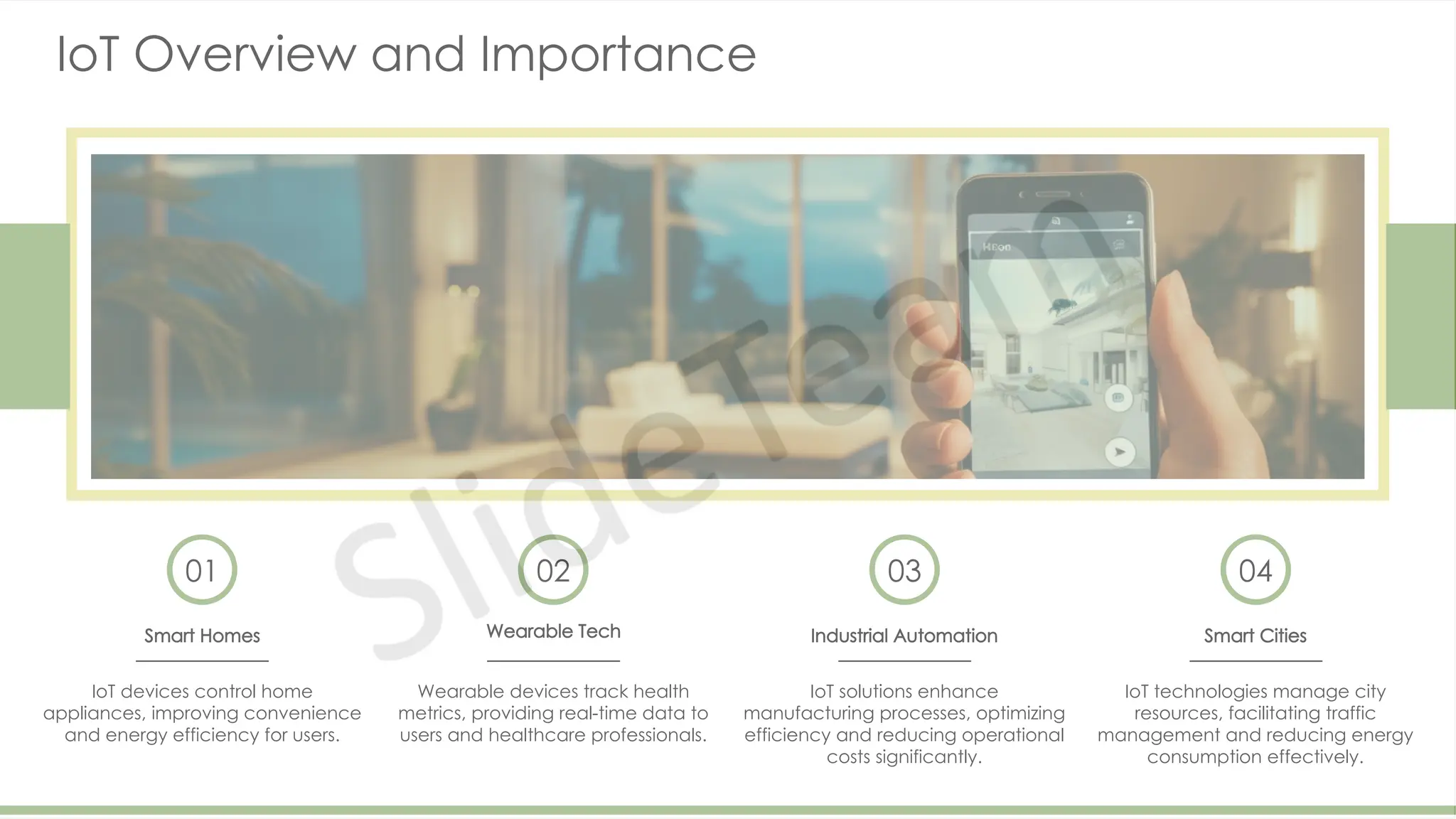
IoT devices control home
appliances, improving convenience
and energy efficiency for users.
02
Wearable Tech
Wearable devices track health
metrics, providing real-time data to
users and healthcare professionals.
03
Industrial Automation
IoT solutions enhance
manufacturing processes, optimizing
efficiency and reducing operational
costs significantly.
04
Smart Cities
IoT technologies manage city
resources, facilitating traffic
management and reducing energy
consumption effectively.
3.
Historical Development ofIoT
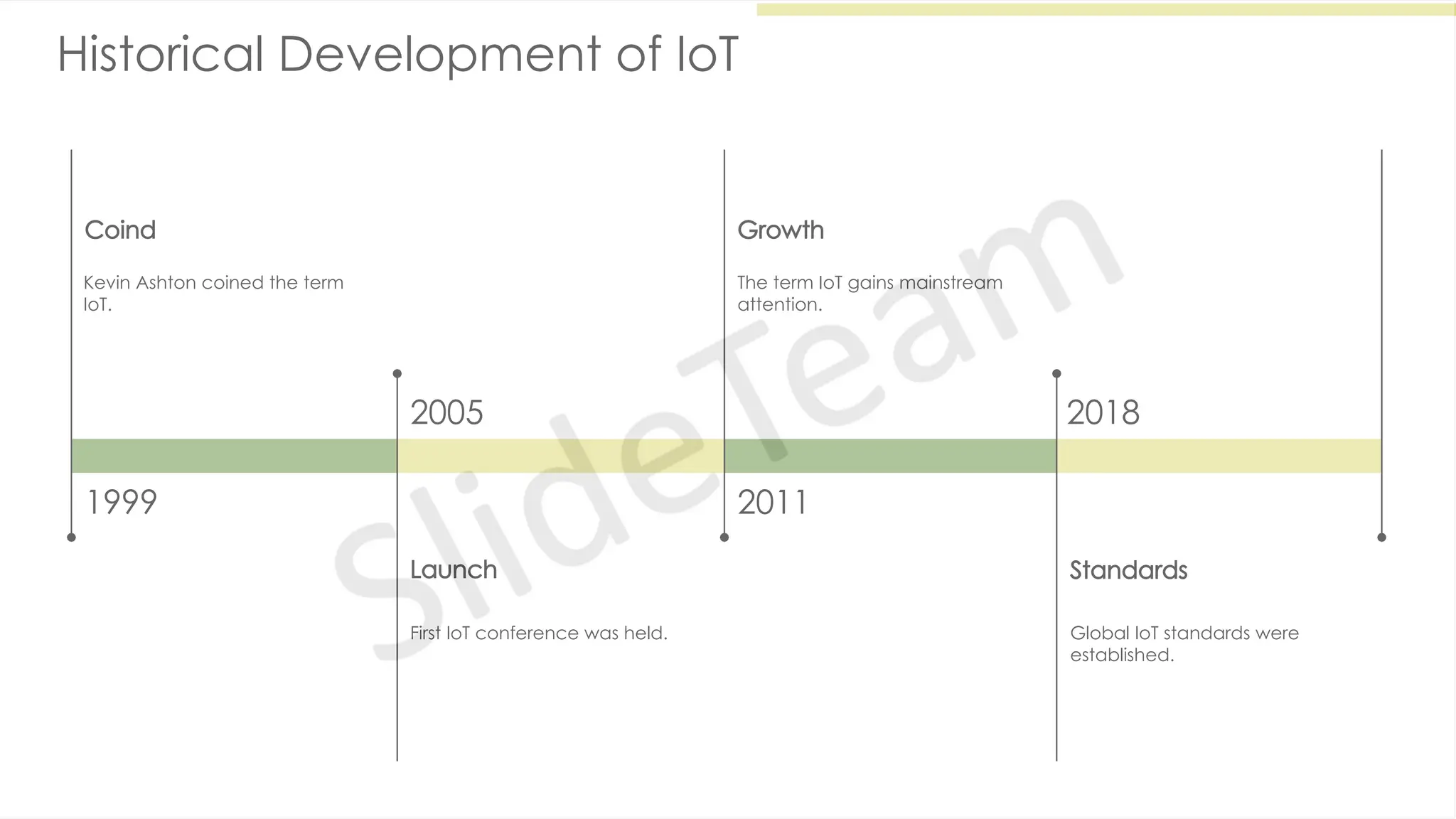
1999
Coind
Kevin Ashton coined the term
IoT.
2005
Launch
First IoT conference was held.
2011
Growth
The term IoT gains mainstream
attention.
2018
Standards
Global IoT standards were
established.
4.
Core Concepts ofIoT Architecture
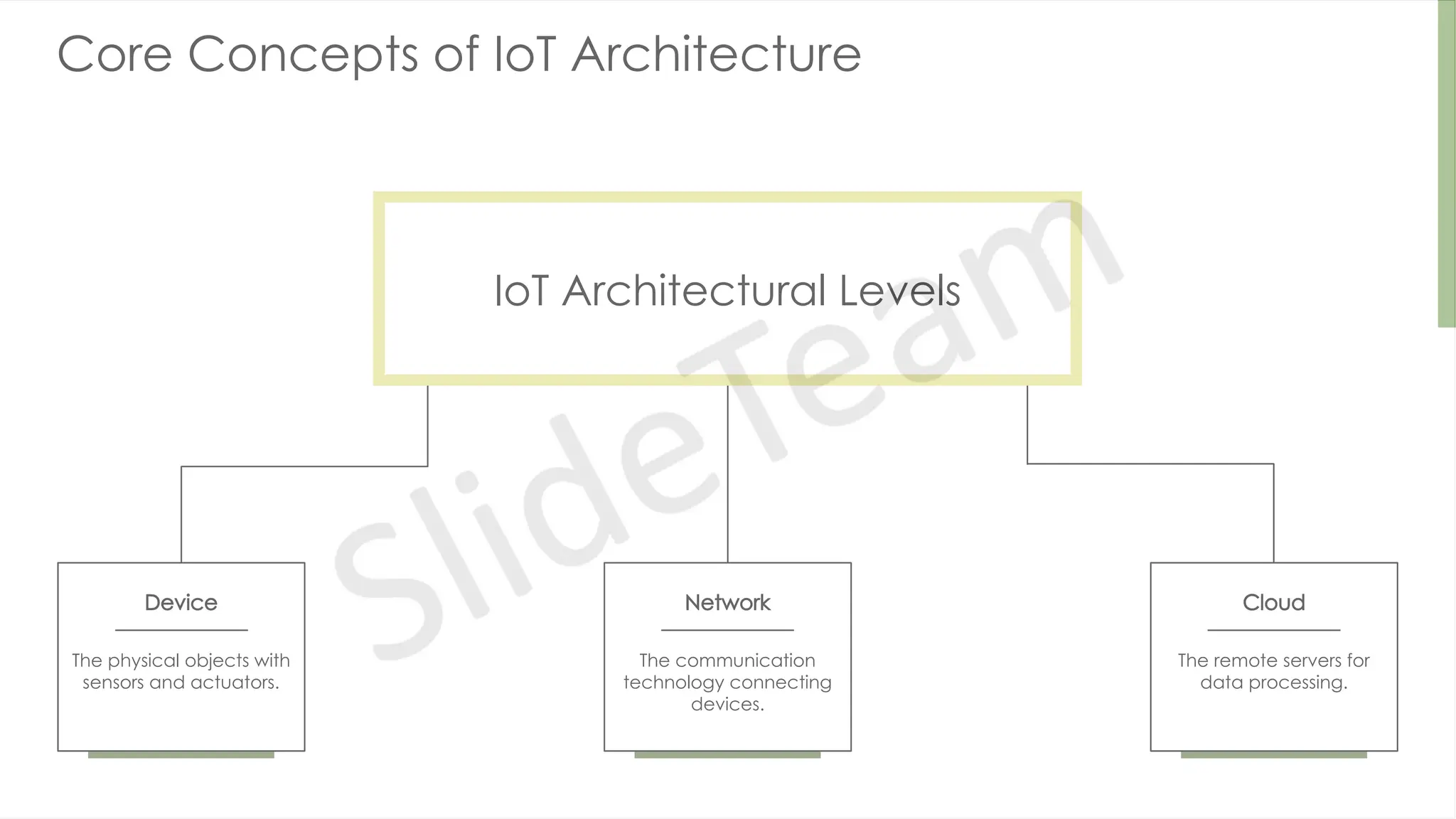
IoT Architectural Levels
Device
The physical objects with
sensors and actuators.
Network
The communication
technology connecting
devices.
Cloud
The remote servers for
data processing.
5.
Applications of IoTin Various Industries
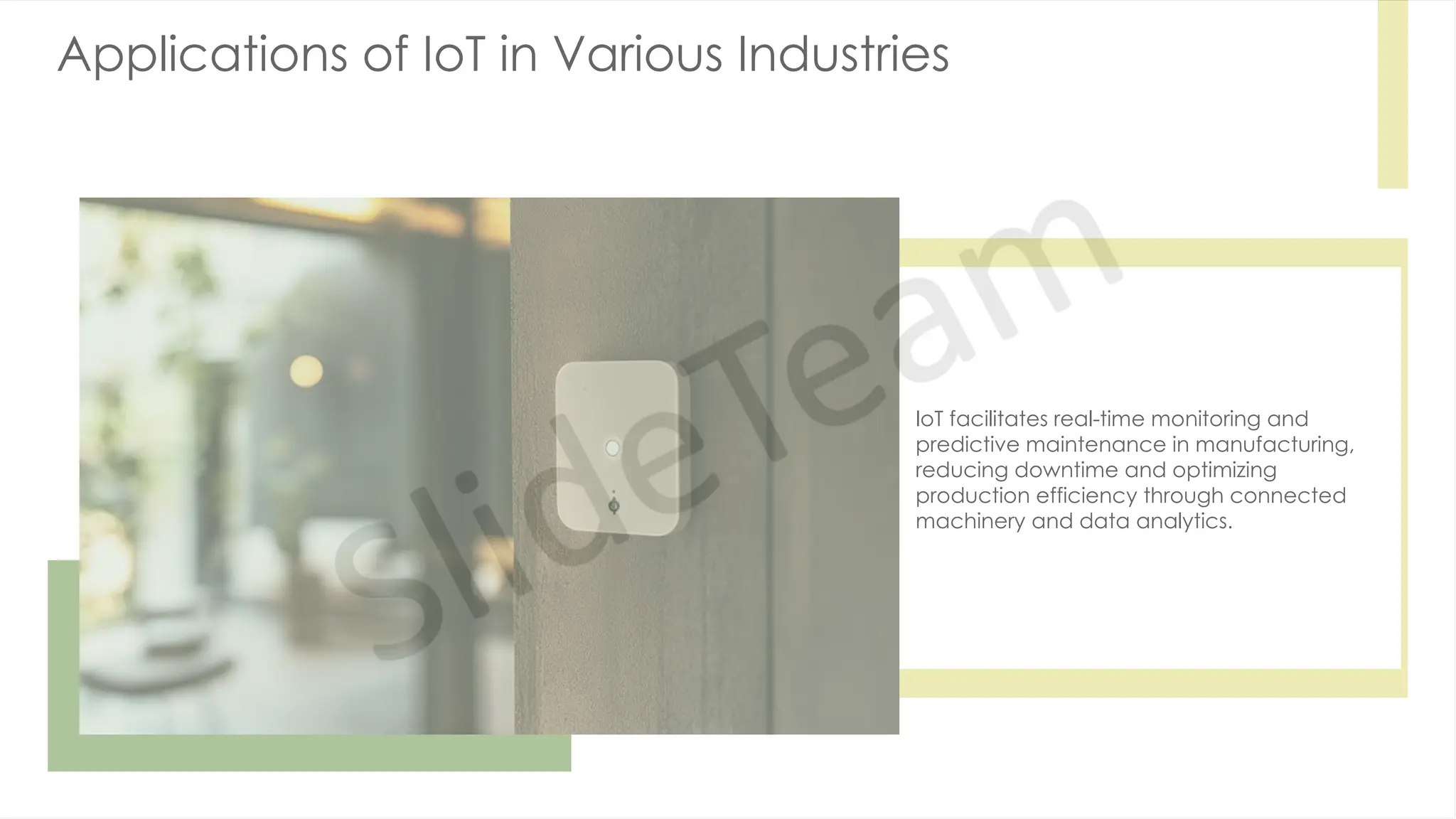
IoT facilitates real-time monitoring and
predictive maintenance in manufacturing,
reducing downtime and optimizing
production efficiency through connected
machinery and data analytics.
6.
IoT Technologies andProtocols
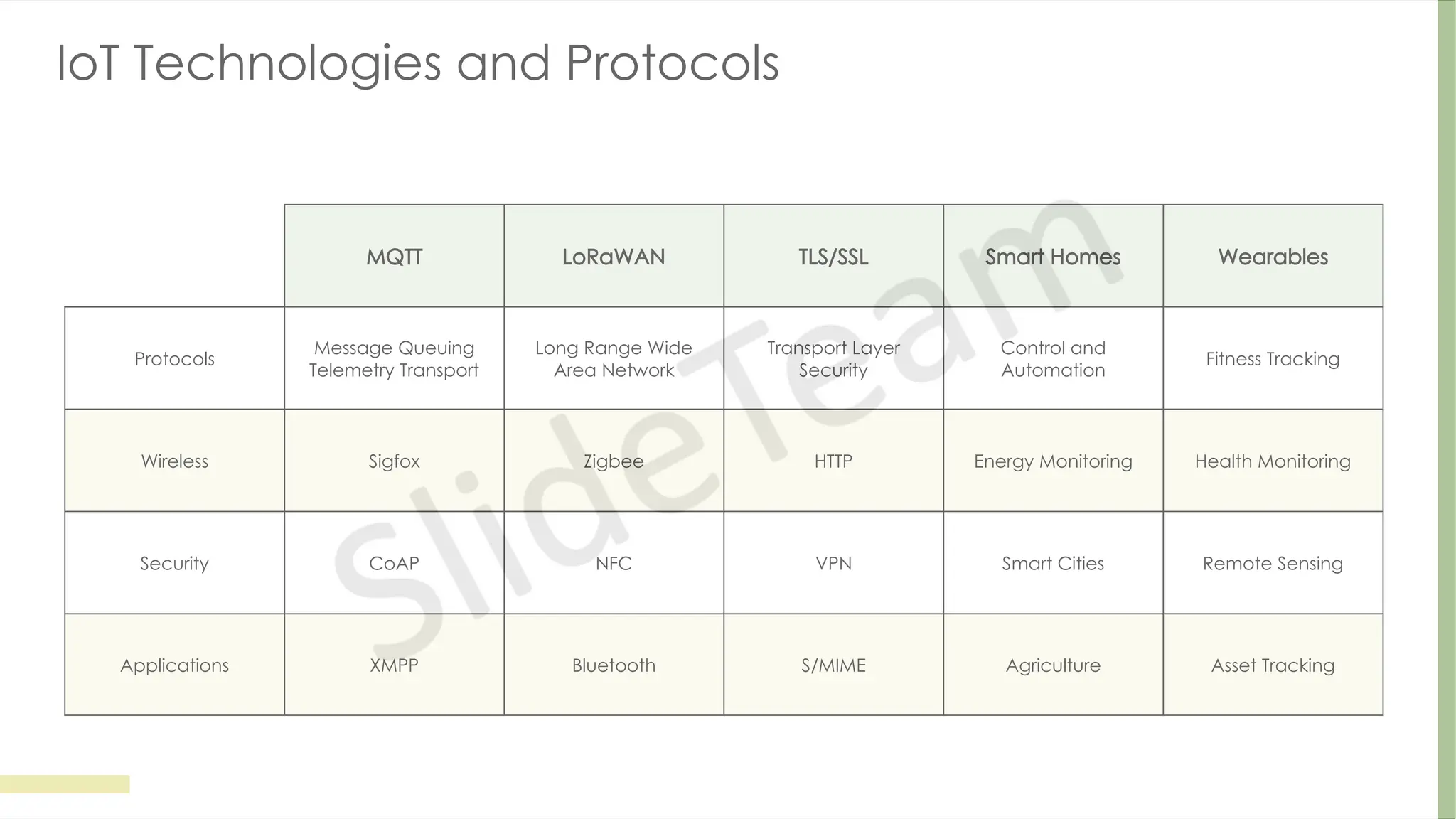
MQTT LoRaWAN TLS/SSL Smart Homes Wearables
Protocols
Message Queuing
Telemetry Transport
Long Range Wide
Area Network
Transport Layer
Security
Control and
Automation
Fitness Tracking
Wireless Sigfox Zigbee HTTP Energy Monitoring Health Monitoring
Security CoAP NFC VPN Smart Cities Remote Sensing
Applications XMPP Bluetooth S/MIME Agriculture Asset Tracking
7.
Smart Devices andConnectivity Solutions
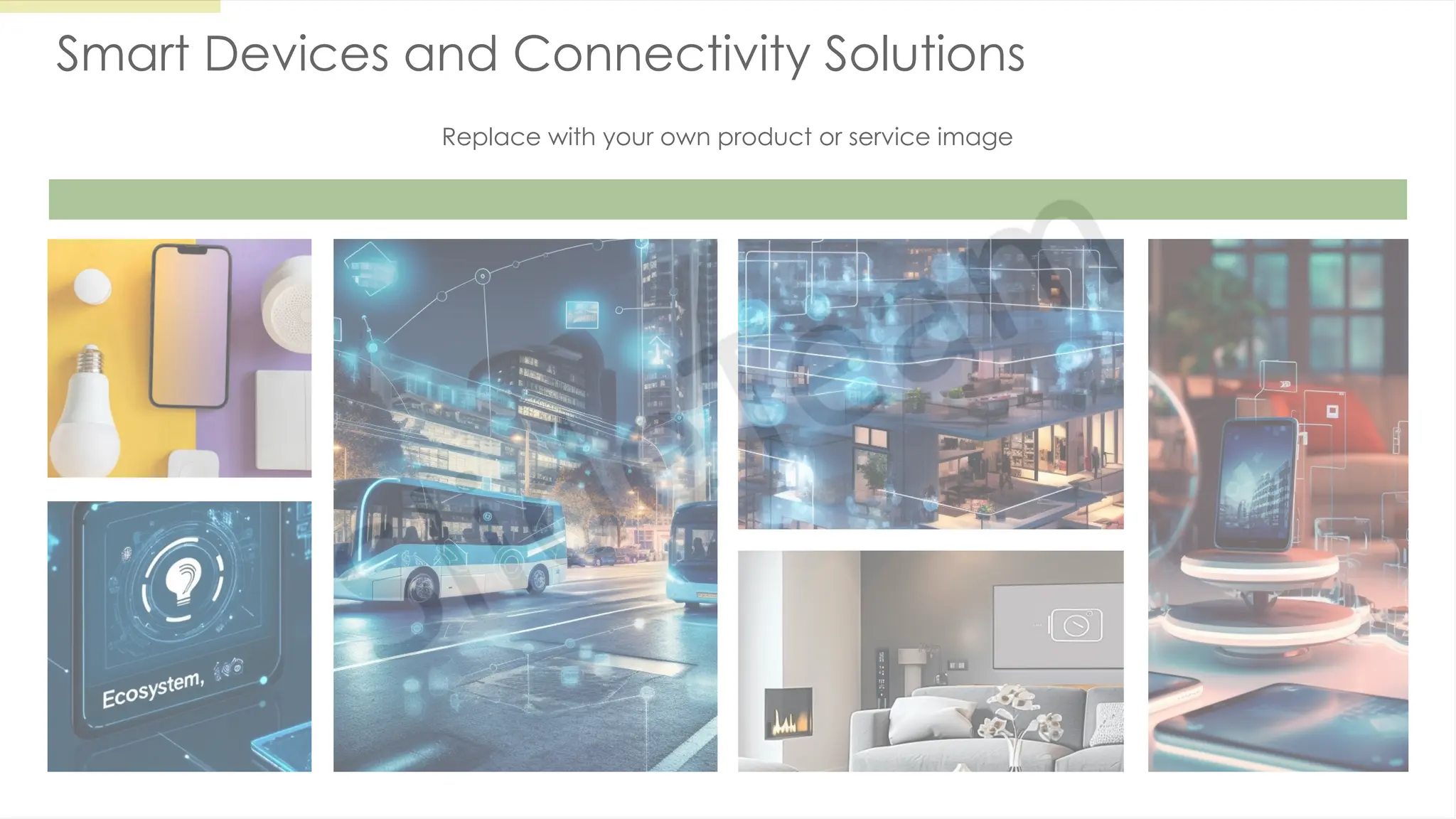
Replace with your own product or service image
8.
Data Management inIoT Systems
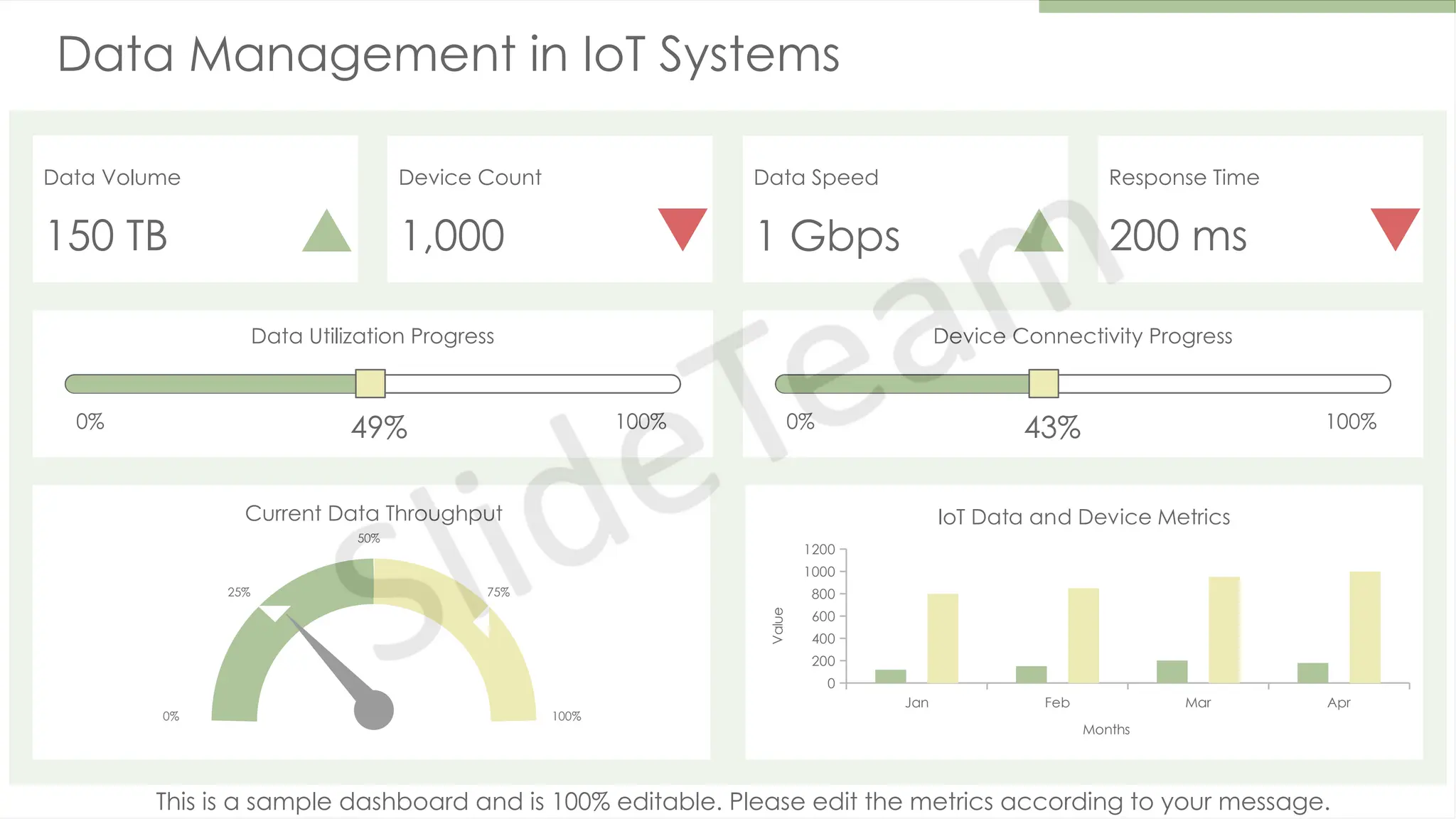
Data Volume
150 TB
Device Count
1,000
Data Speed
1 Gbps
Response Time
200 ms
Jan Feb Mar Apr
0
200
400
600
800
1000
1200
IoT Data and Device Metrics
Months
Value
Data Utilization Progress
0% 100%
49%
Device Connectivity Progress
0% 100%
43%
Current Data Throughput
0%
25%
50%
75%
100%
This is a sample dashboard and is 100% editable. Please edit the metrics according to your message.
9.
Security Challenges inIoT
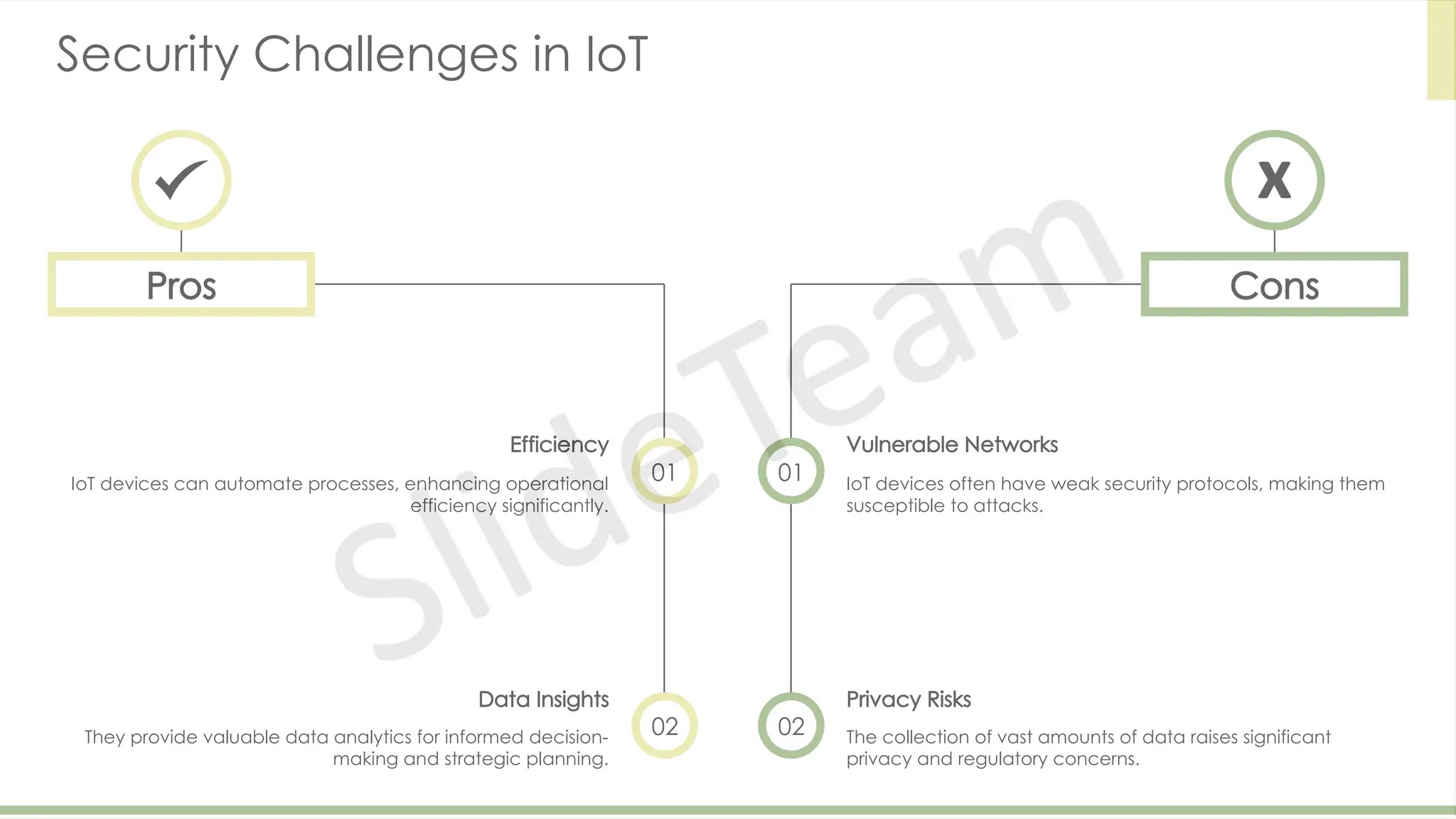
Pros
01
Efficiency
IoT devices can automate processes, enhancing operational
efficiency significantly.
02
Data Insights
They provide valuable data analytics for informed decision-
making and strategic planning.
Cons
01
Vulnerable Networks
IoT devices often have weak security protocols, making them
susceptible to attacks.
02
Privacy Risks
The collection of vast amounts of data raises significant
privacy and regulatory concerns.
10.
IoT Implementation Strategies
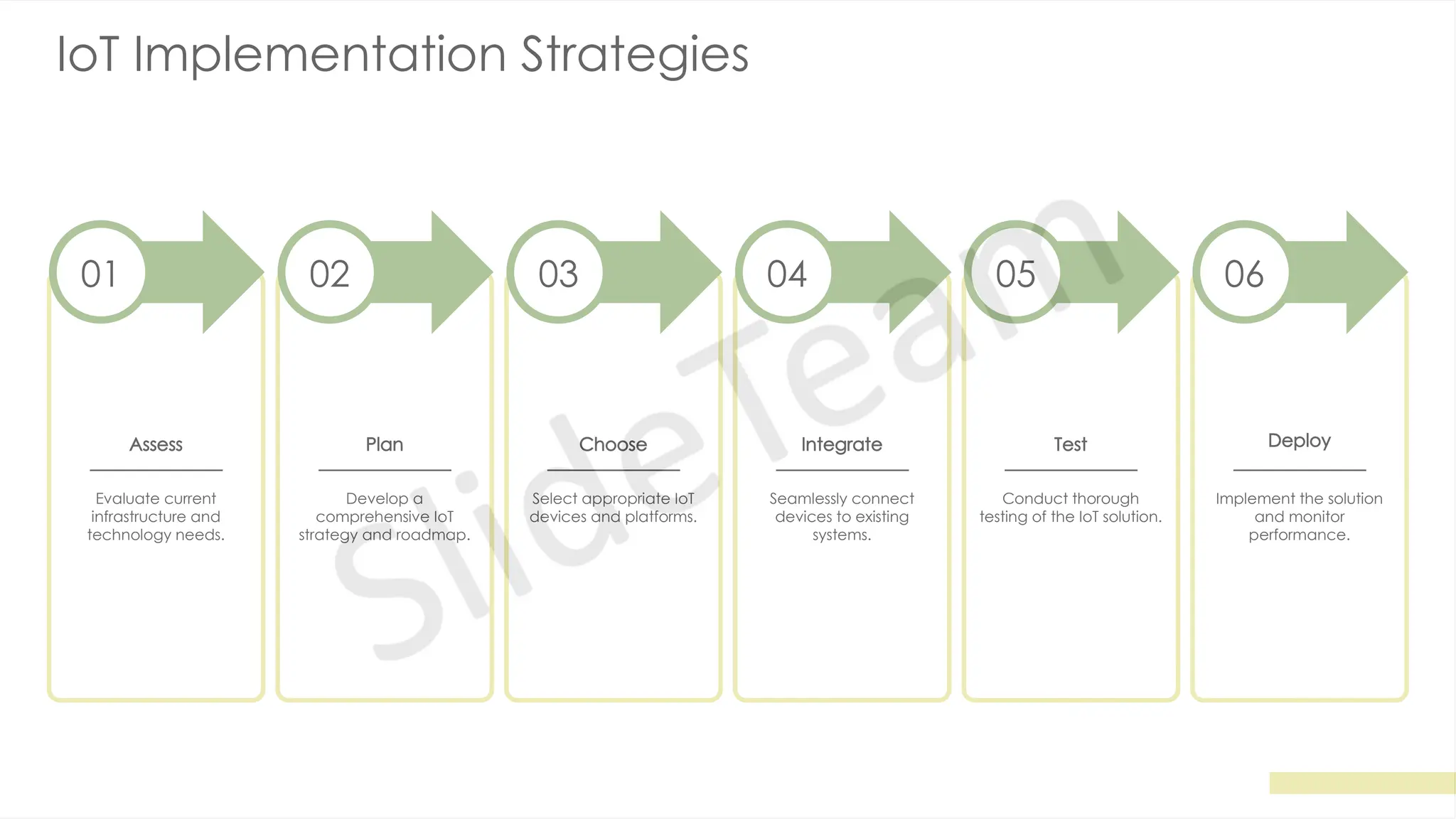
01
Assess
Evaluatecurrent
infrastructure and
technology needs.
02
Plan
Develop a
comprehensive IoT
strategy and roadmap.
03
Choose
Select appropriate IoT
devices and platforms.
04
Integrate
Seamlessly connect
devices to existing
systems.
05
Test
Conduct thorough
testing of the IoT solution.
06
Deploy
Implement the solution
and monitor
performance.
11.
Case Studies ofSuccessful IoT Deployments
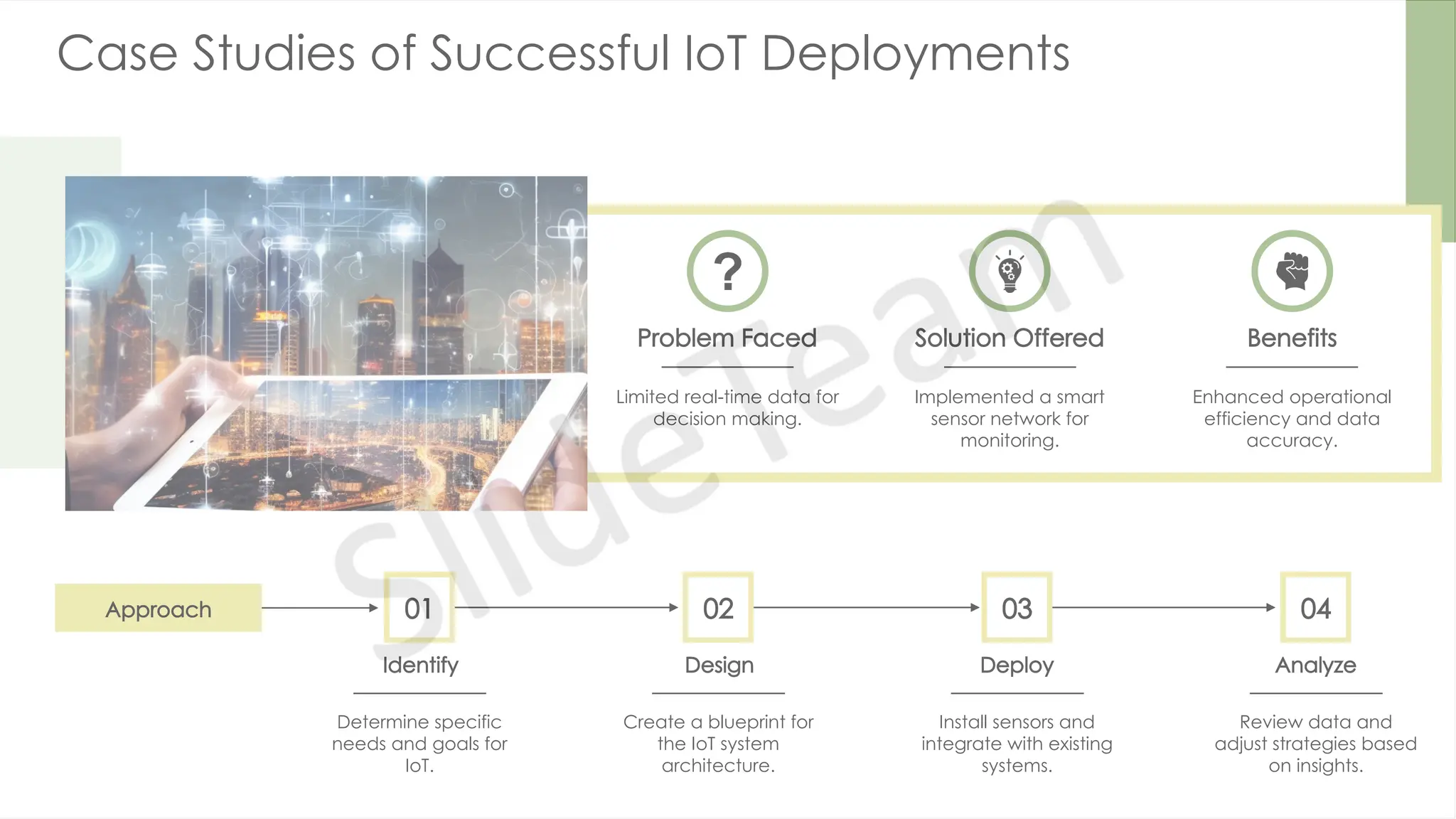
Problem Faced
Limited real-time data for
decision making.
Solution Offered
Implemented a smart
sensor network for
monitoring.
Benefits
Enhanced operational
efficiency and data
accuracy.
Approach 01
Identify
Determine specific
needs and goals for
IoT.
02
Design
Create a blueprint for
the IoT system
architecture.
03
Deploy
Install sensors and
integrate with existing
systems.
04
Analyze
Review data and
adjust strategies based
on insights.
12.
Emerging Trends inIoT Technology
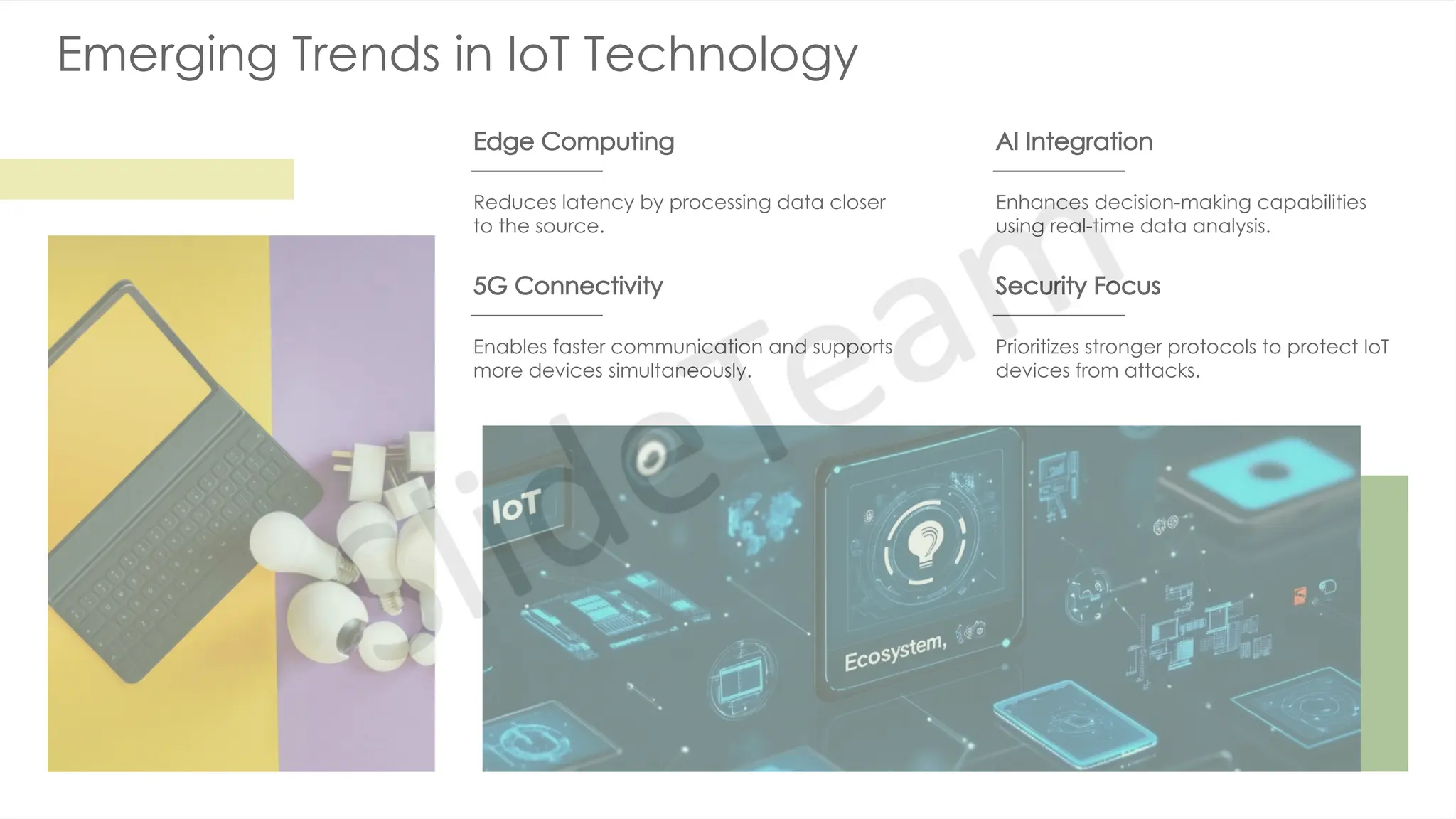
Edge Computing
Reduces latency by processing data closer
to the source.
AI Integration
Enhances decision-making capabilities
using real-time data analysis.
5G Connectivity
Enables faster communication and supports
more devices simultaneously.
Security Focus
Prioritizes stronger protocols to protect IoT
devices from attacks.
13.
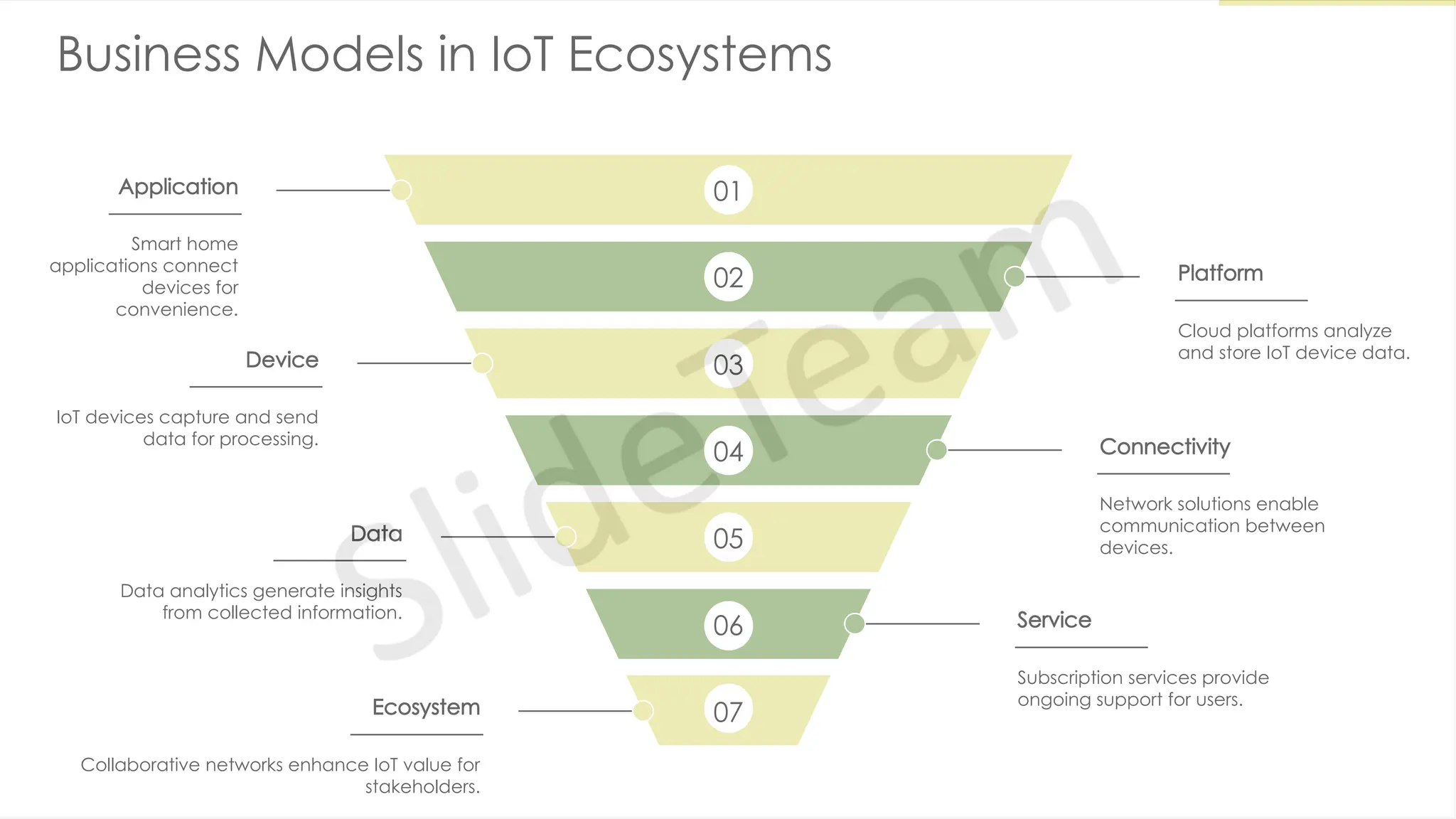
Business Models inIoT Ecosystems
01
Application
Smart home
applications connect
devices for
convenience.
02 Platform
Cloud platforms analyze
and store IoT device data.
03
IoT devices capture and send
data for processing.
Device
04 Connectivity
Network solutions enable
communication between
devices.
05
Data
Data analytics generate insights
from collected information.
06 Service
Subscription services provide
ongoing support for users.
Ecosystem 07
Collaborative networks enhance IoT value for
stakeholders.
14.
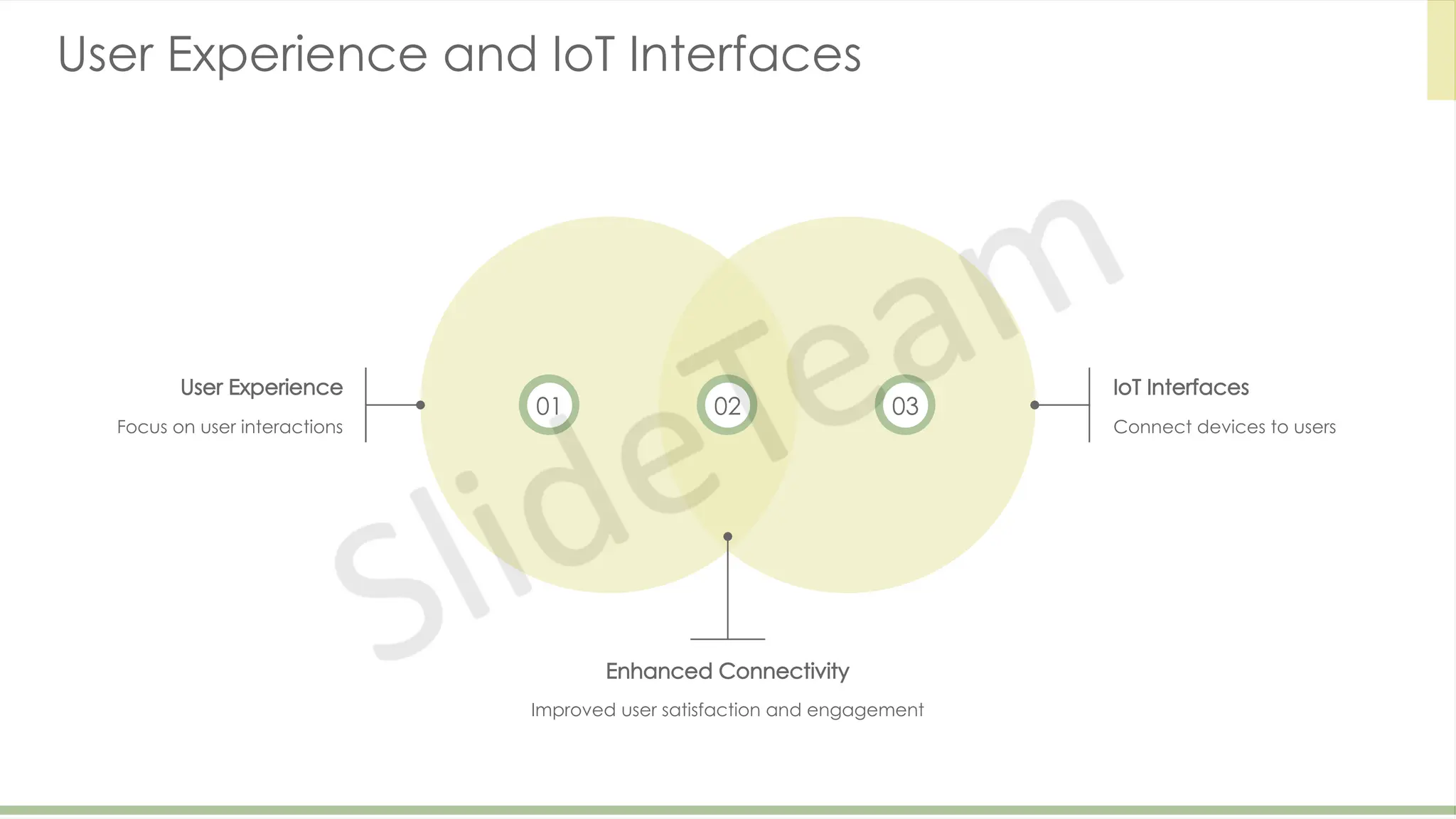
User Experience andIoT Interfaces
01
User Experience
Focus on user interactions
03
IoT Interfaces
Connect devices to users
02
Enhanced Connectivity
Improved user satisfaction and engagement
15.
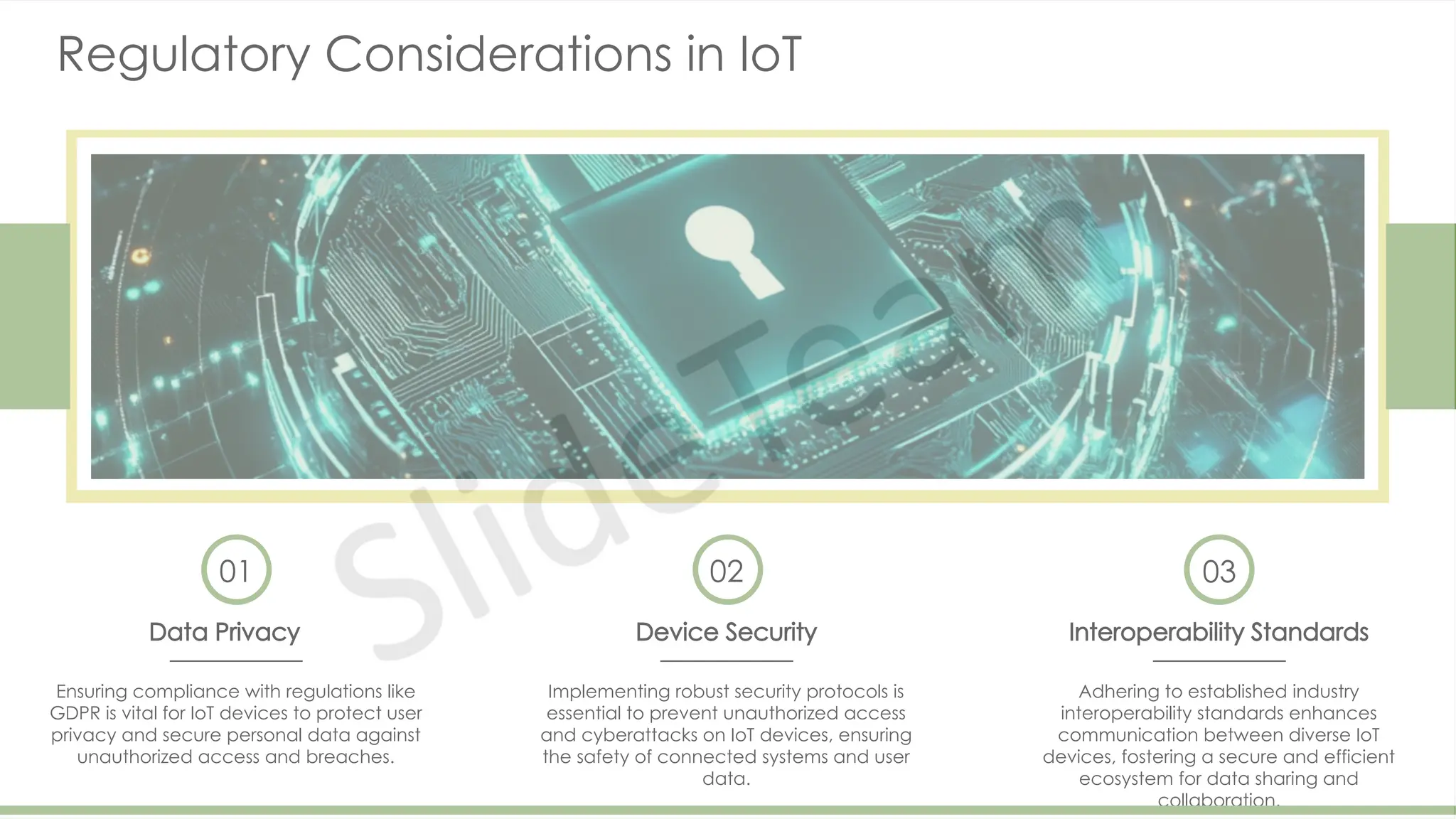
Regulatory Considerations inIoT
01
Data Privacy
Ensuring compliance with regulations like
GDPR is vital for IoT devices to protect user
privacy and secure personal data against
unauthorized access and breaches.
02
Device Security
Implementing robust security protocols is
essential to prevent unauthorized access
and cyberattacks on IoT devices, ensuring
the safety of connected systems and user
data.
03
Interoperability Standards
Adhering to established industry
interoperability standards enhances
communication between diverse IoT
devices, fostering a secure and efficient
ecosystem for data sharing and
collaboration.
16.
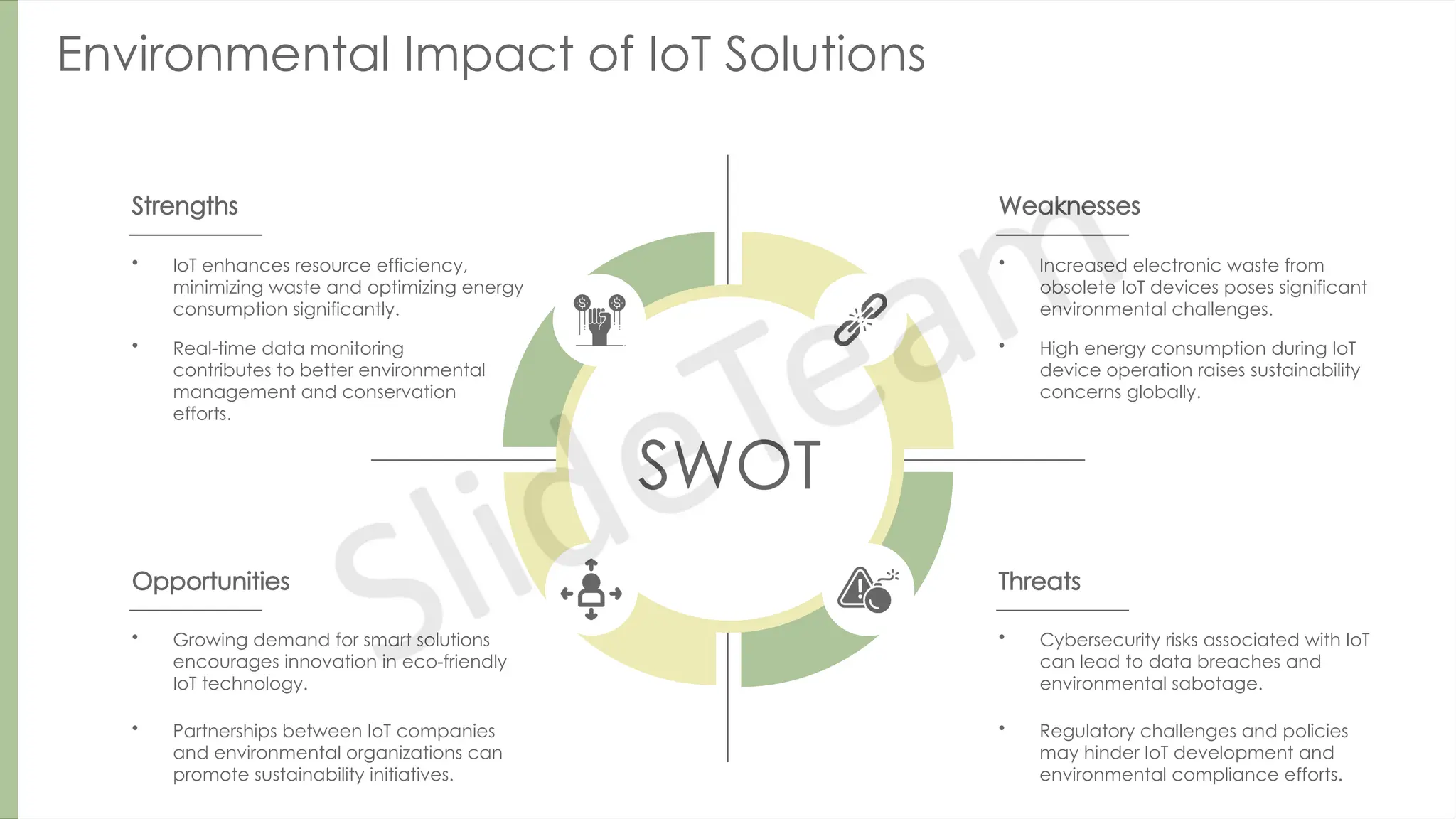
Environmental Impact ofIoT Solutions
SWOT
Weaknesses
• Increased electronic waste from
obsolete IoT devices poses significant
environmental challenges.
• High energy consumption during IoT
device operation raises sustainability
concerns globally.
Strengths
• IoT enhances resource efficiency,
minimizing waste and optimizing energy
consumption significantly.
• Real-time data monitoring
contributes to better environmental
management and conservation
efforts.
Opportunities
• Growing demand for smart solutions
encourages innovation in eco-friendly
IoT technology.
• Partnerships between IoT companies
and environmental organizations can
promote sustainability initiatives.
Threats
• Cybersecurity risks associated with IoT
can lead to data breaches and
environmental sabotage.
• Regulatory challenges and policies
may hinder IoT development and
environmental compliance efforts.
17.
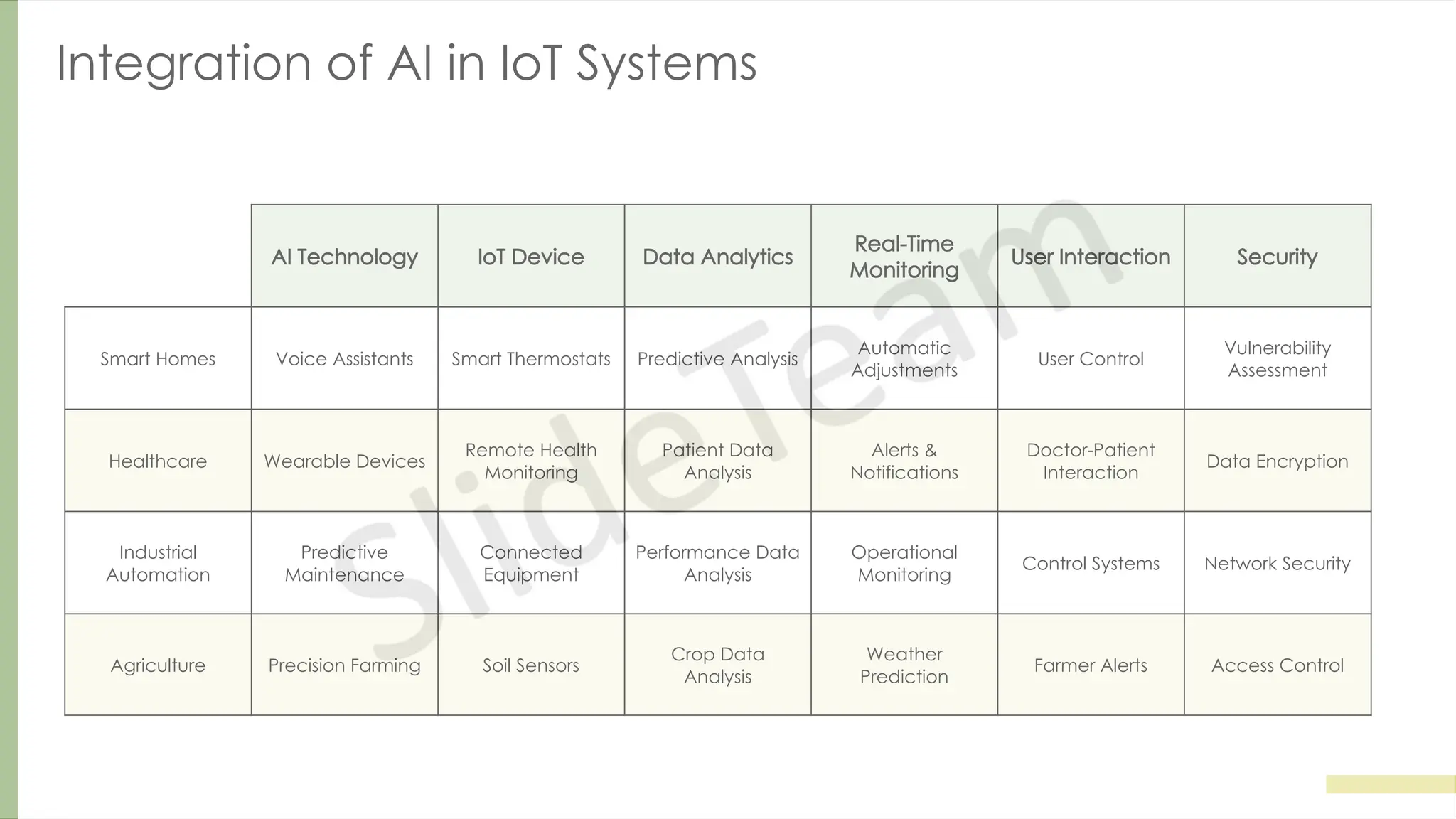
Integration of AIin IoT Systems
AI Technology IoT Device Data Analytics
Real-Time
Monitoring
User Interaction Security
Smart Homes Voice Assistants Smart Thermostats Predictive Analysis
Automatic
Adjustments
User Control
Vulnerability
Assessment
Healthcare Wearable Devices
Remote Health
Monitoring
Patient Data
Analysis
Alerts &
Notifications
Doctor-Patient
Interaction
Data Encryption
Industrial
Automation
Predictive
Maintenance
Connected
Equipment
Performance Data
Analysis
Operational
Monitoring
Control Systems Network Security
Agriculture Precision Farming Soil Sensors
Crop Data
Analysis
Weather
Prediction
Farmer Alerts Access Control
18.
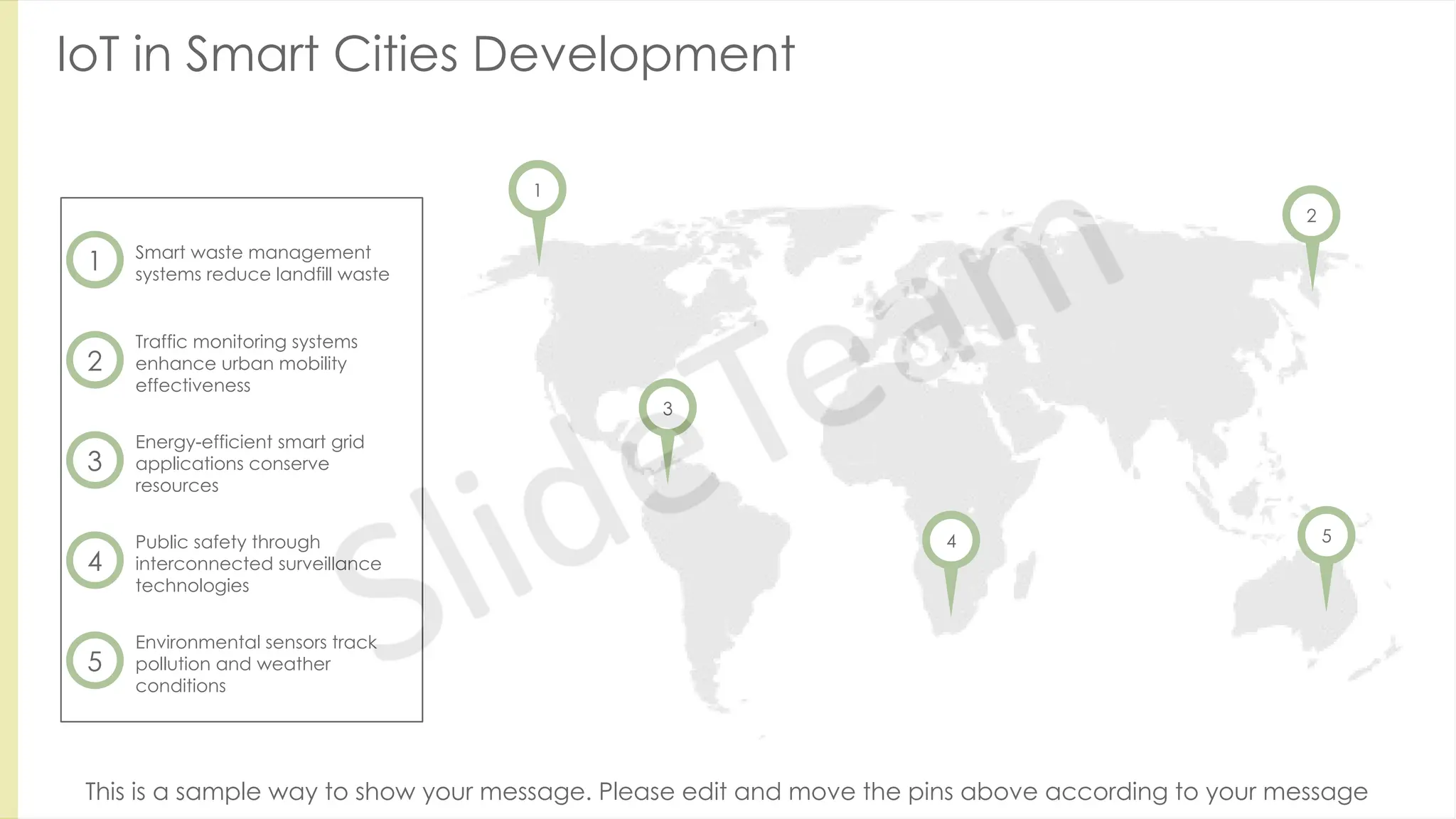
IoT in SmartCities Development
Smart waste management
systems reduce landfill waste
1
Traffic monitoring systems
enhance urban mobility
effectiveness
2
Energy-efficient smart grid
applications conserve
resources
3
Public safety through
interconnected surveillance
technologies
4
Environmental sensors track
pollution and weather
conditions
5
This is a sample way to show your message. Please edit and move the pins above according to your message
1
2
3
4 5
19.
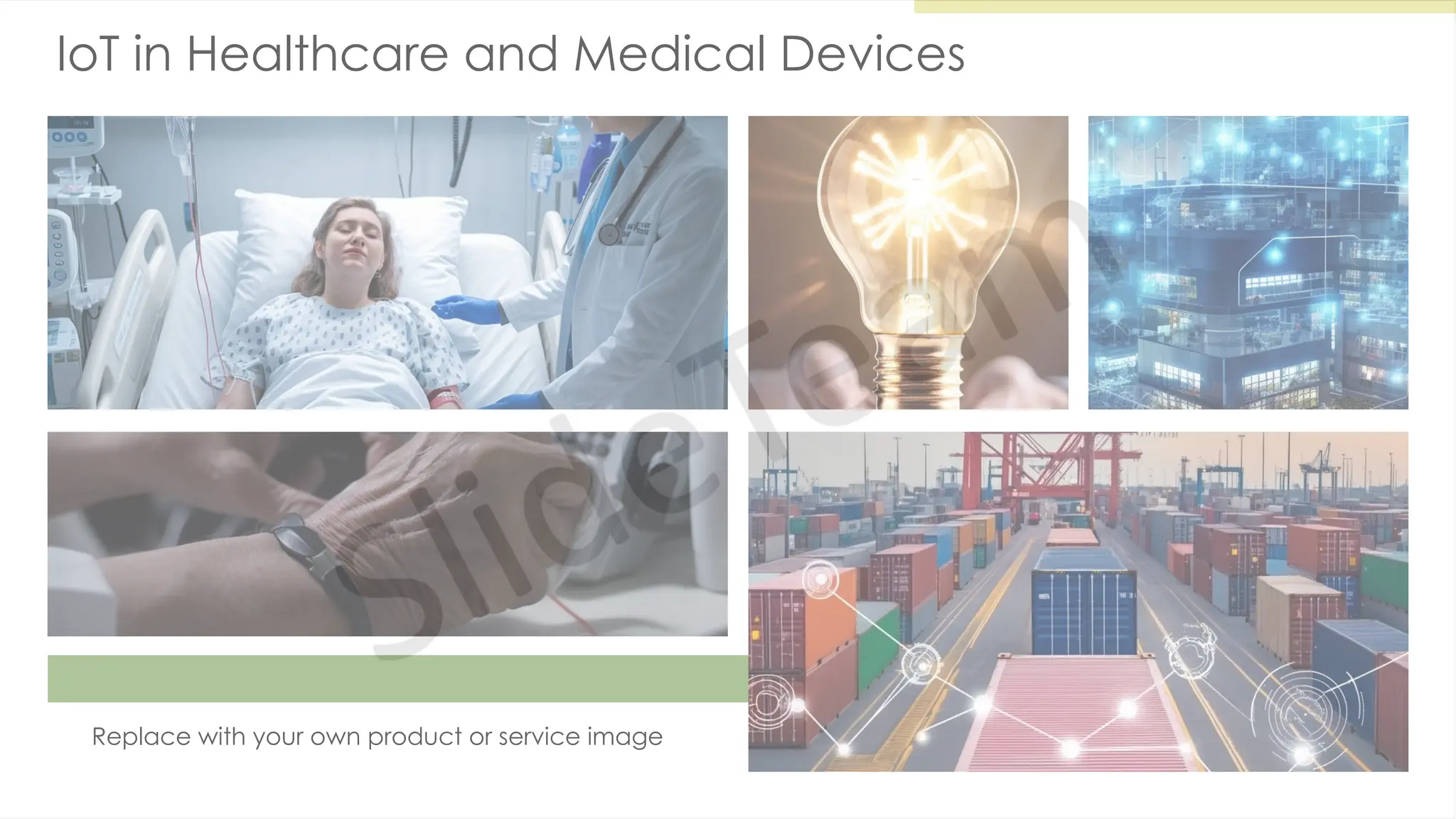
IoT in Healthcareand Medical Devices
Replace with your own product or service image
20.
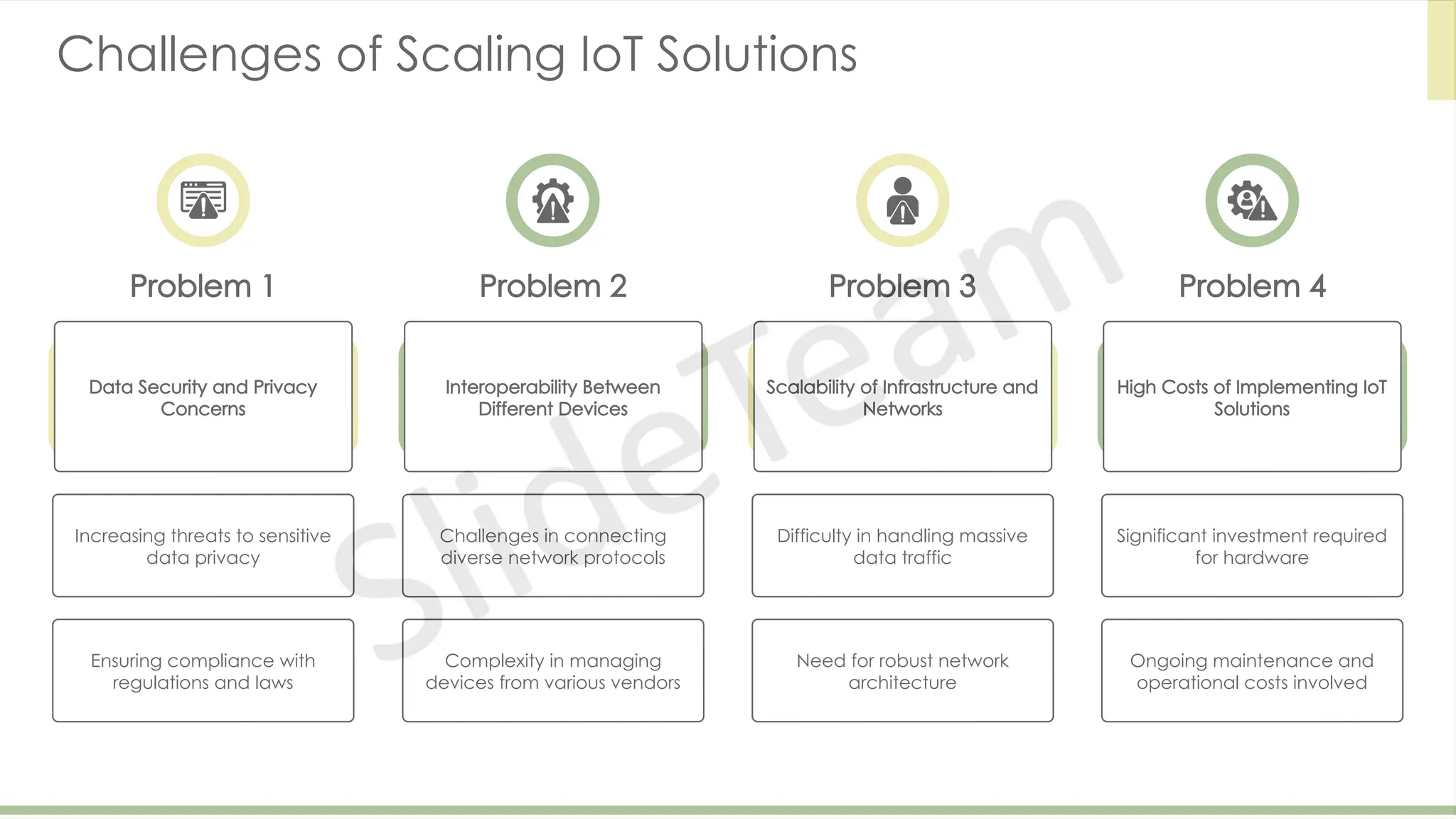
Problem 1 Problem2
Challenges of Scaling IoT Solutions
Problem 3 Problem 4
Data Security and Privacy
Concerns
Increasing threats to sensitive
data privacy
Ensuring compliance with
regulations and laws
Interoperability Between
Different Devices
Challenges in connecting
diverse network protocols
Complexity in managing
devices from various vendors
Scalability of Infrastructure and
Networks
Difficulty in handling massive
data traffic
Need for robust network
architecture
High Costs of Implementing IoT
Solutions
Significant investment required
for hardware
Ongoing maintenance and
operational costs involved
21.
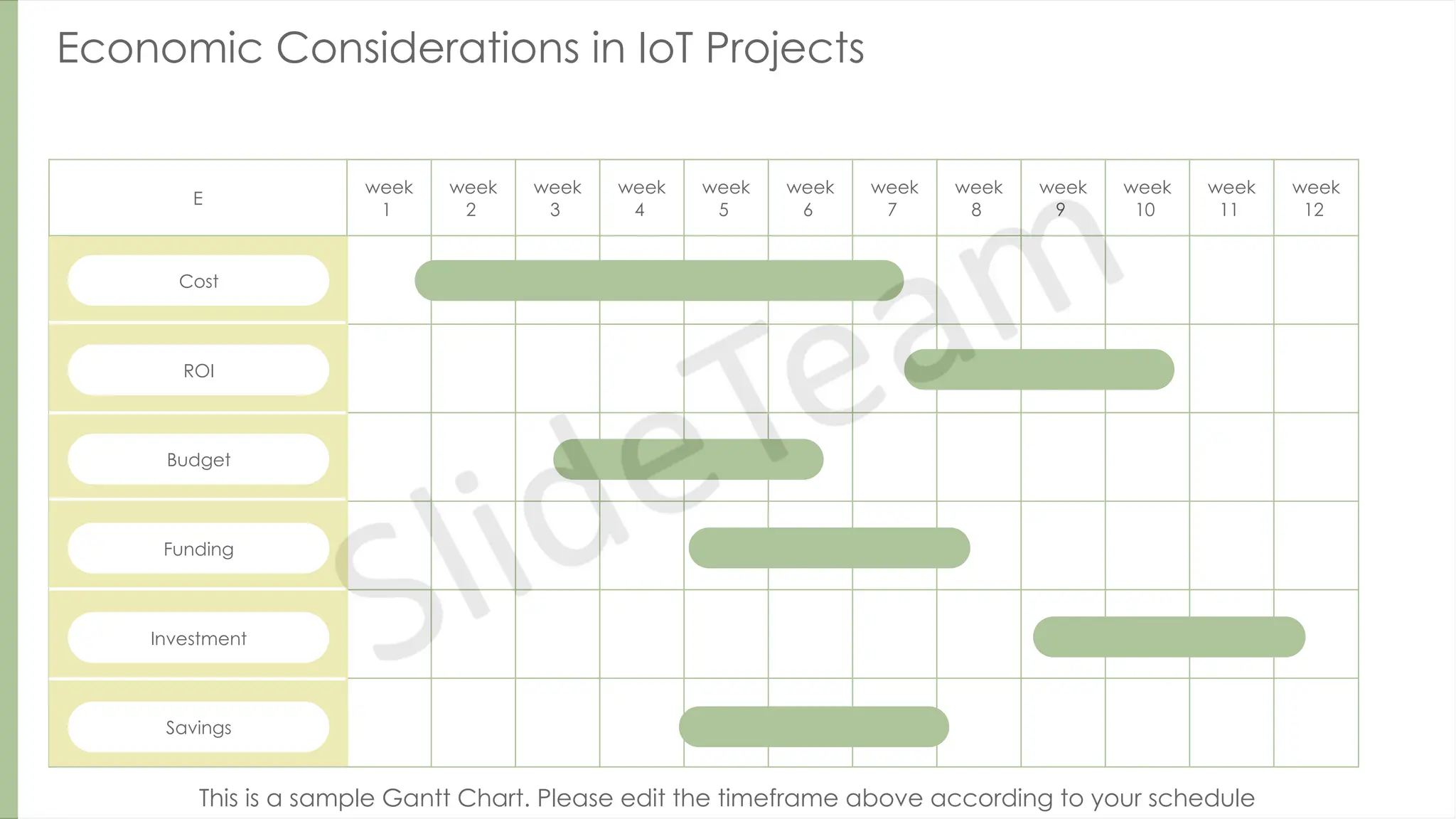
Economic Considerations inIoT Projects
This is a sample Gantt Chart. Please edit the timeframe above according to your schedule
E
week
1
week
2
week
3
week
4
week
5
week
6
week
7
week
8
week
9
week
10
week
11
week
12
Cost
ROI
Budget
Funding
Investment
Savings
22.
Future Innovations inIoT
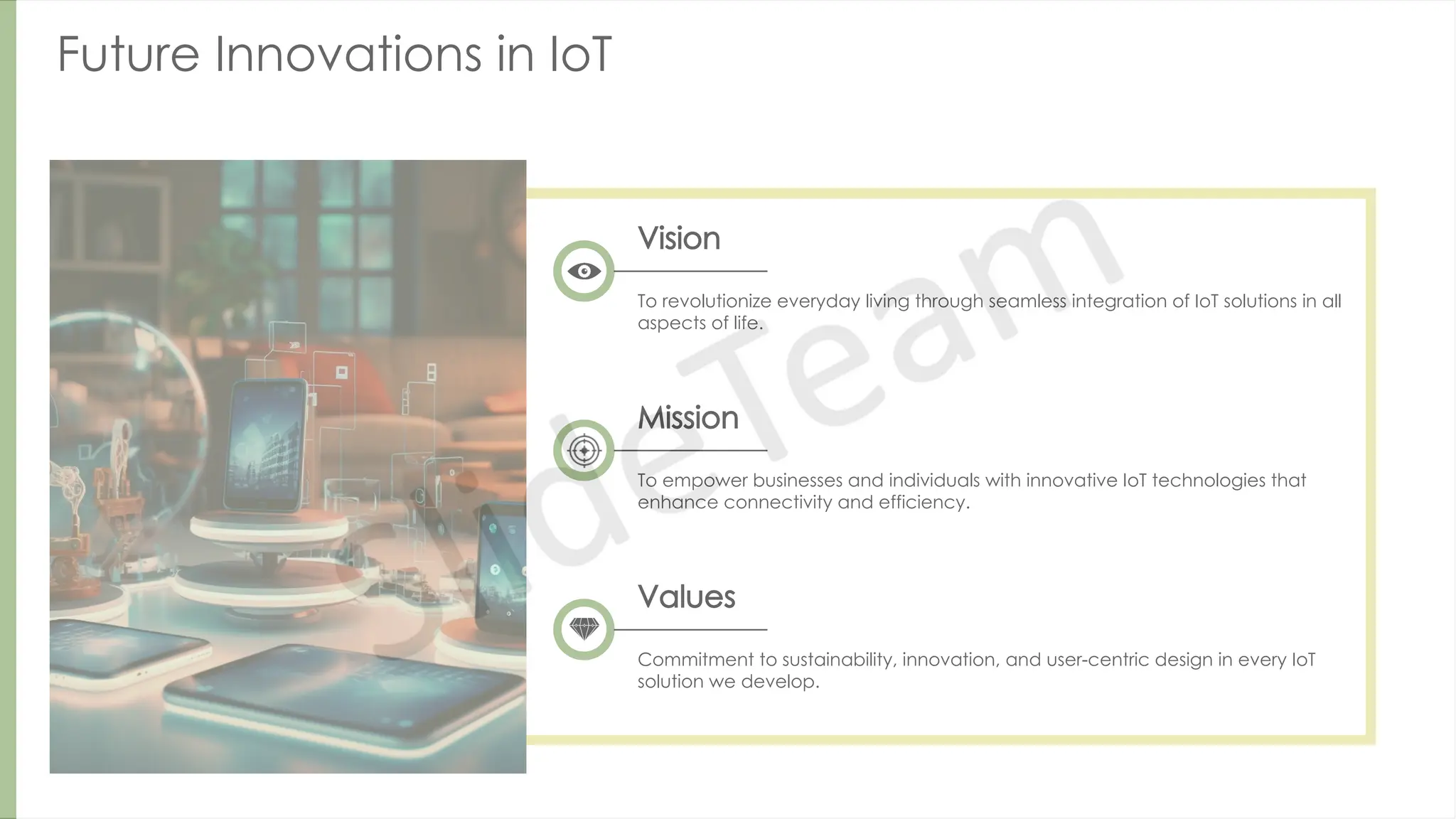
Vision
To revolutionize everyday living through seamless integration of IoT solutions in all
aspects of life.
Mission
To empower businesses and individuals with innovative IoT technologies that
enhance connectivity and efficiency.
Values
Commitment to sustainability, innovation, and user-centric design in every IoT
solution we develop.
23.
Interoperability and Standardsin IoT
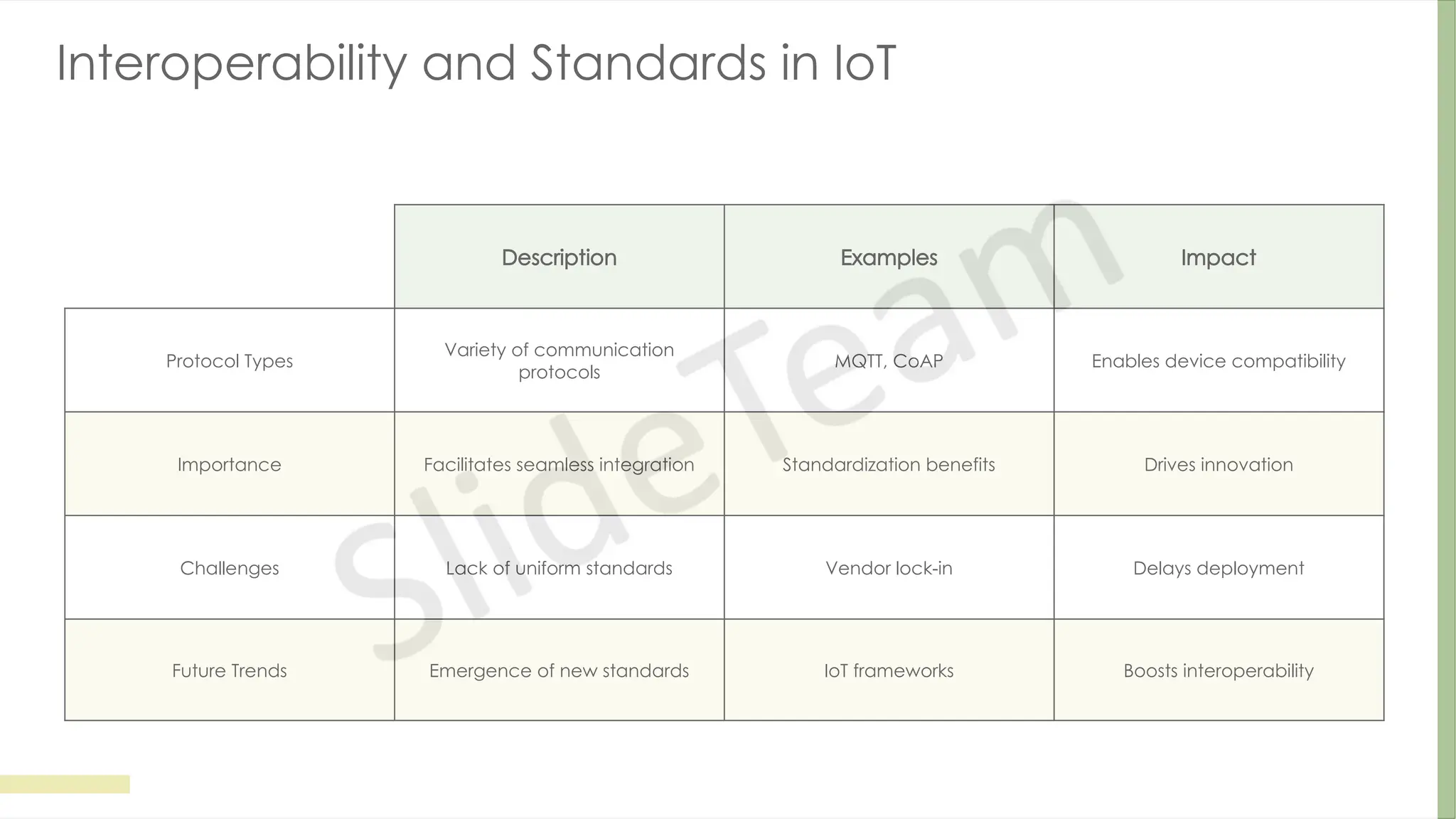
Description Examples Impact
Protocol Types
Variety of communication
protocols
MQTT, CoAP Enables device compatibility
Importance Facilitates seamless integration Standardization benefits Drives innovation
Challenges Lack of uniform standards Vendor lock-in Delays deployment
Future Trends Emergence of new standards IoT frameworks Boosts interoperability
24.
IoT Cloud Solutionsand Services
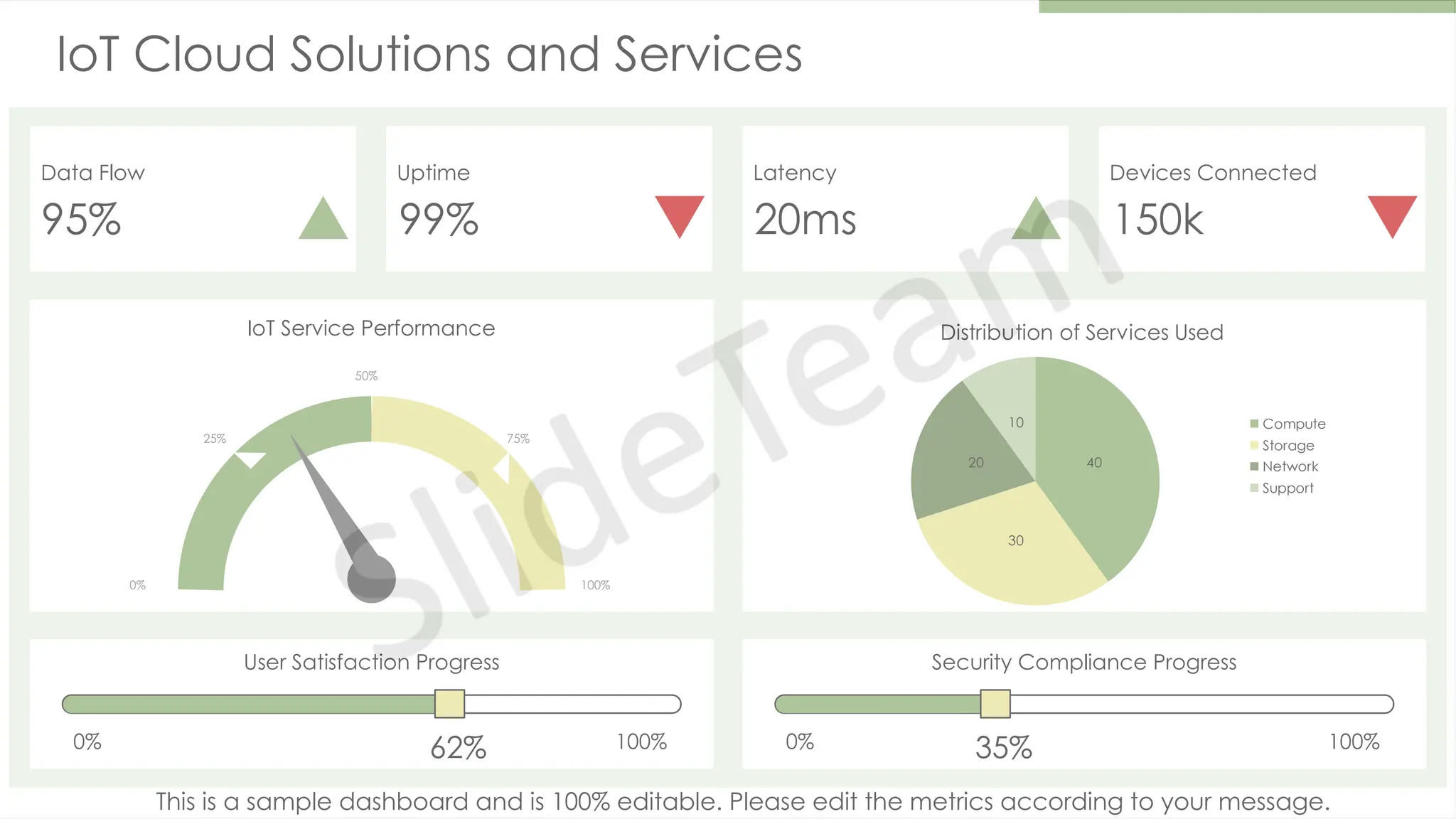
Data Flow
95%
Uptime
99%
Latency
20ms
Devices Connected
150k
IoT Service Performance
0%
25%
50%
75%
100%
40
30
20
10
Distribution of Services Used
Compute
Storage
Network
Support
This is a sample dashboard and is 100% editable. Please edit the metrics according to your message.
User Satisfaction Progress
0% 100%
62%
Security Compliance Progress
0% 100%
35%
25.
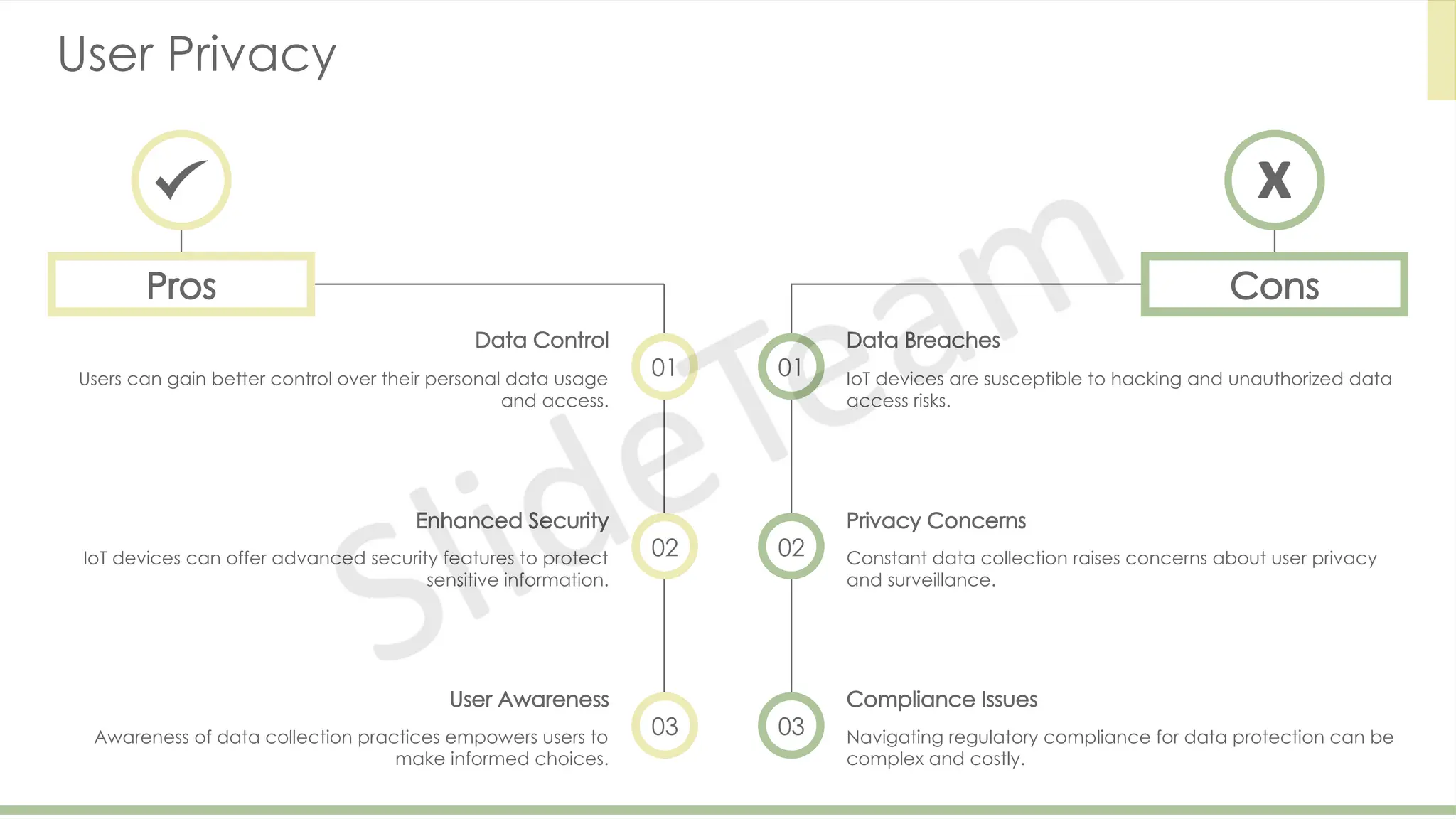
User Privacy
Pros
01
Data Control
Userscan gain better control over their personal data usage
and access.
02
Enhanced Security
IoT devices can offer advanced security features to protect
sensitive information.
03
User Awareness
Awareness of data collection practices empowers users to
make informed choices.
Cons
01
Data Breaches
IoT devices are susceptible to hacking and unauthorized data
access risks.
02
Privacy Concerns
Constant data collection raises concerns about user privacy
and surveillance.
03
Compliance Issues
Navigating regulatory compliance for data protection can be
complex and costly.
26.
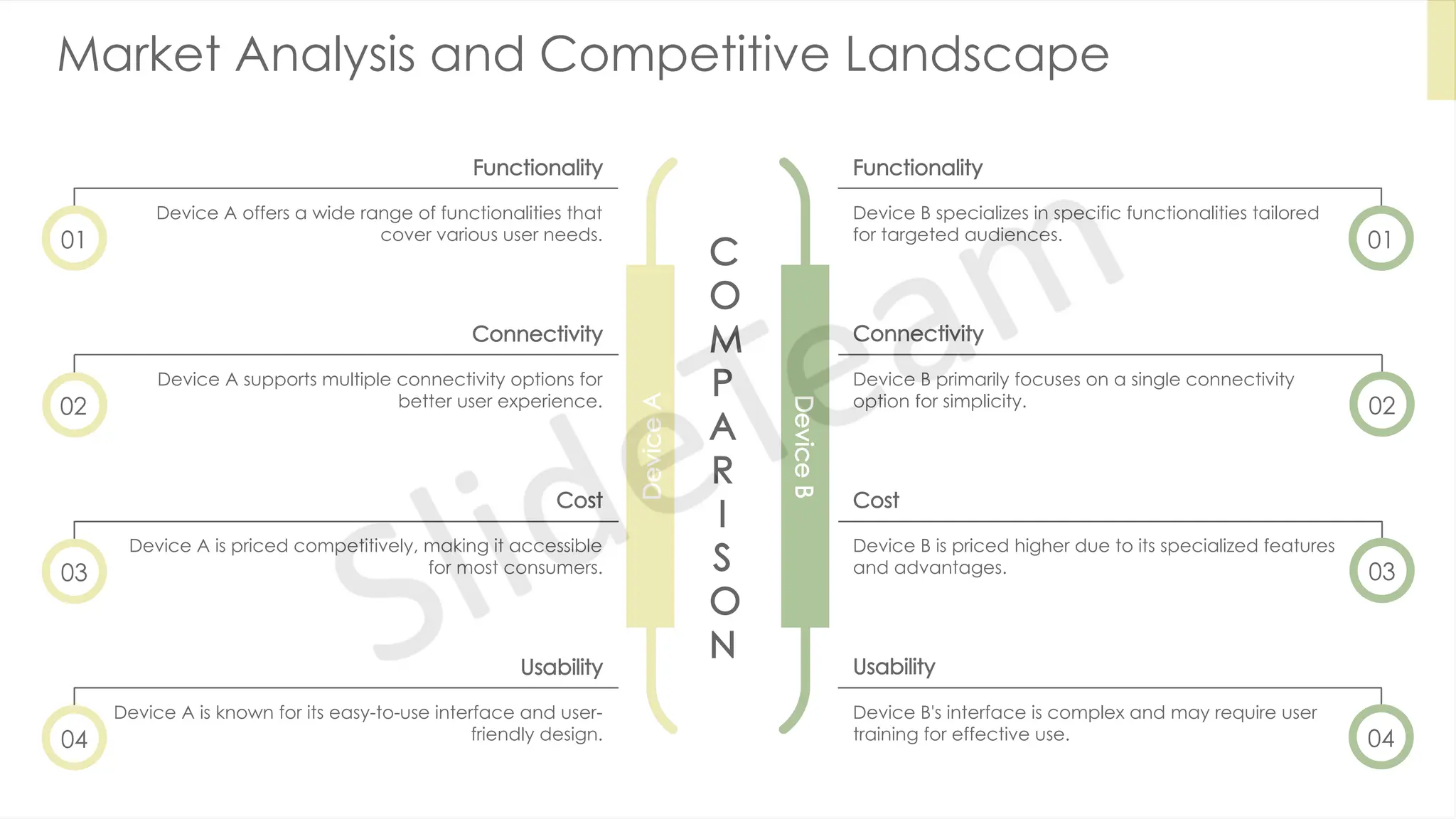
Market Analysis andCompetitive Landscape
C
O
M
P
A
R
I
S
O
N
Device
A
01
Functionality
Device A offers a wide range of functionalities that
cover various user needs.
02
Connectivity
Device A supports multiple connectivity options for
better user experience.
03
Cost
Device A is priced competitively, making it accessible
for most consumers.
04
Usability
Device A is known for its easy-to-use interface and user-
friendly design.
Device
B
01
Functionality
Device B specializes in specific functionalities tailored
for targeted audiences.
02
Device B primarily focuses on a single connectivity
option for simplicity.
Connectivity
03
Cost
Device B is priced higher due to its specialized features
and advantages.
04
Usability
Device B's interface is complex and may require user
training for effective use.
27.
Collaborative IoT Solutionsand Partnerships
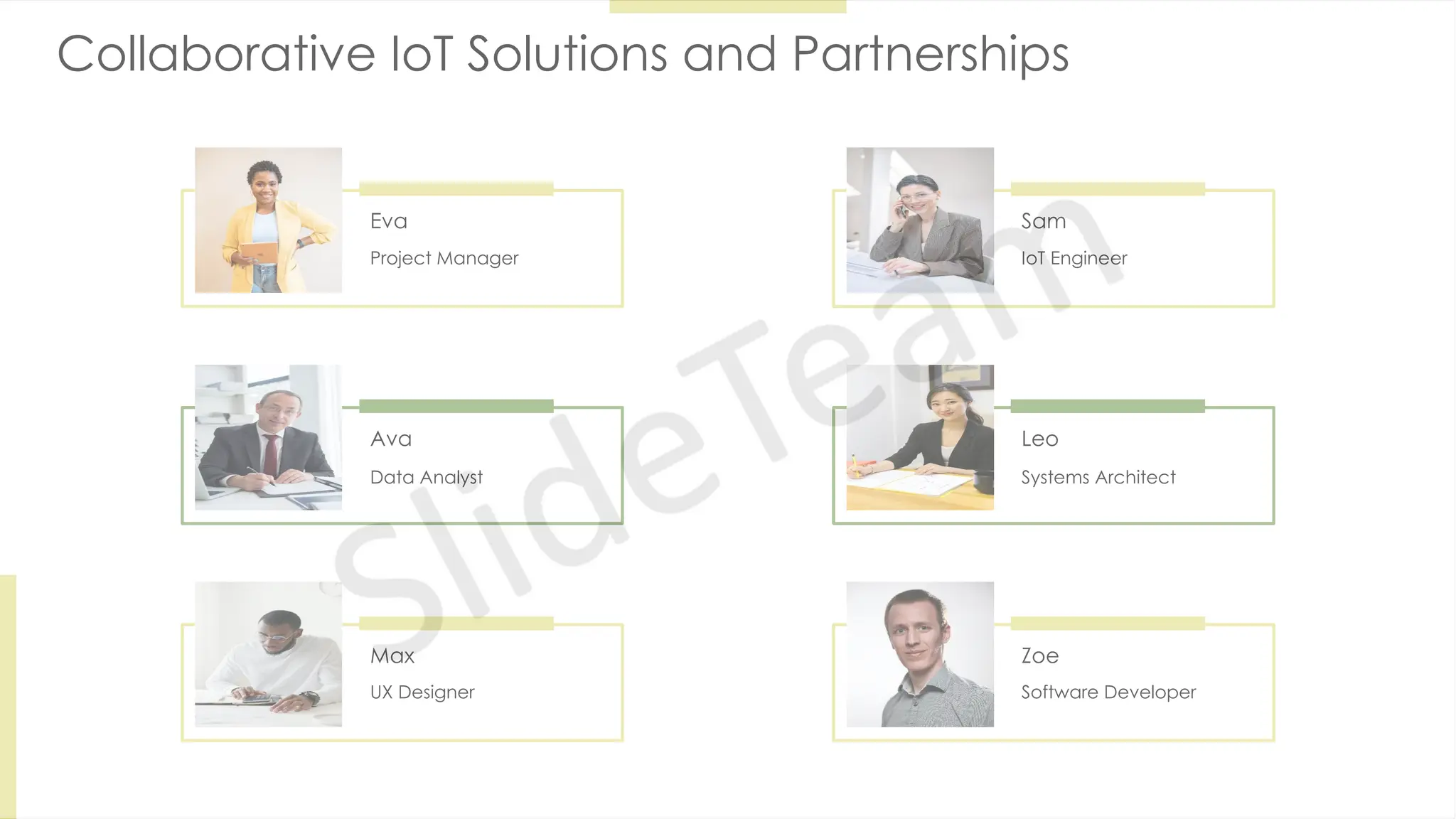
Eva
Project Manager
Sam
IoT Engineer
Ava
Data Analyst
Leo
Systems Architect
Max
UX Designer
Zoe
Software Developer
28.
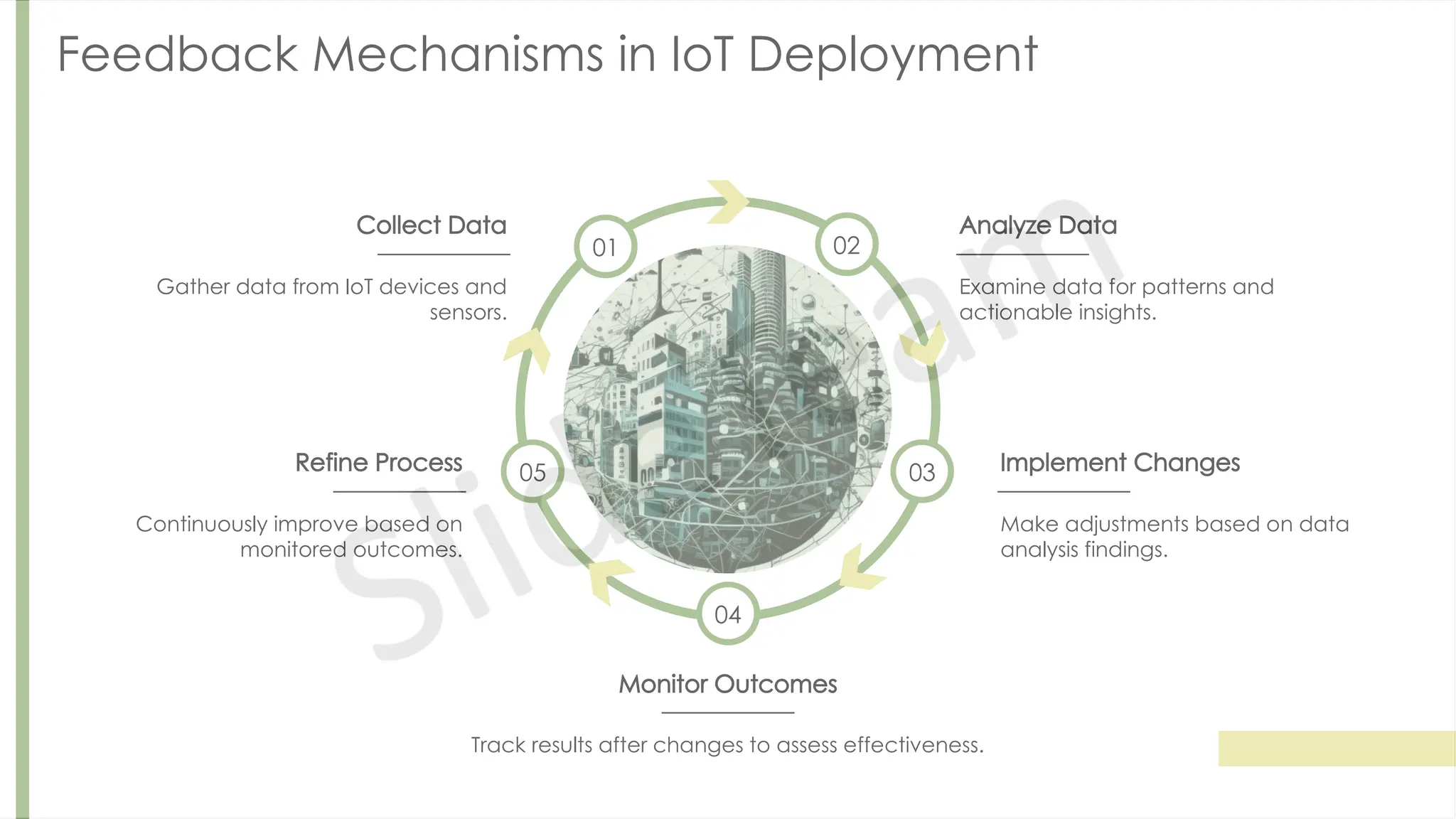
Feedback Mechanisms inIoT Deployment
Collect Data
Gather data from IoT devices and
sensors.
01
Analyze Data
Examine data for patterns and
actionable insights.
02
Implement Changes
Make adjustments based on data
analysis findings.
03
Monitor Outcomes
Track results after changes to assess effectiveness.
04
Refine Process
Continuously improve based on
monitored outcomes.
05
29.
Thank You
Address
123 IoTLane, Tech City, CA
Email Address
contact@iotexample.com
Contact Number
(555) 123-4567
30.
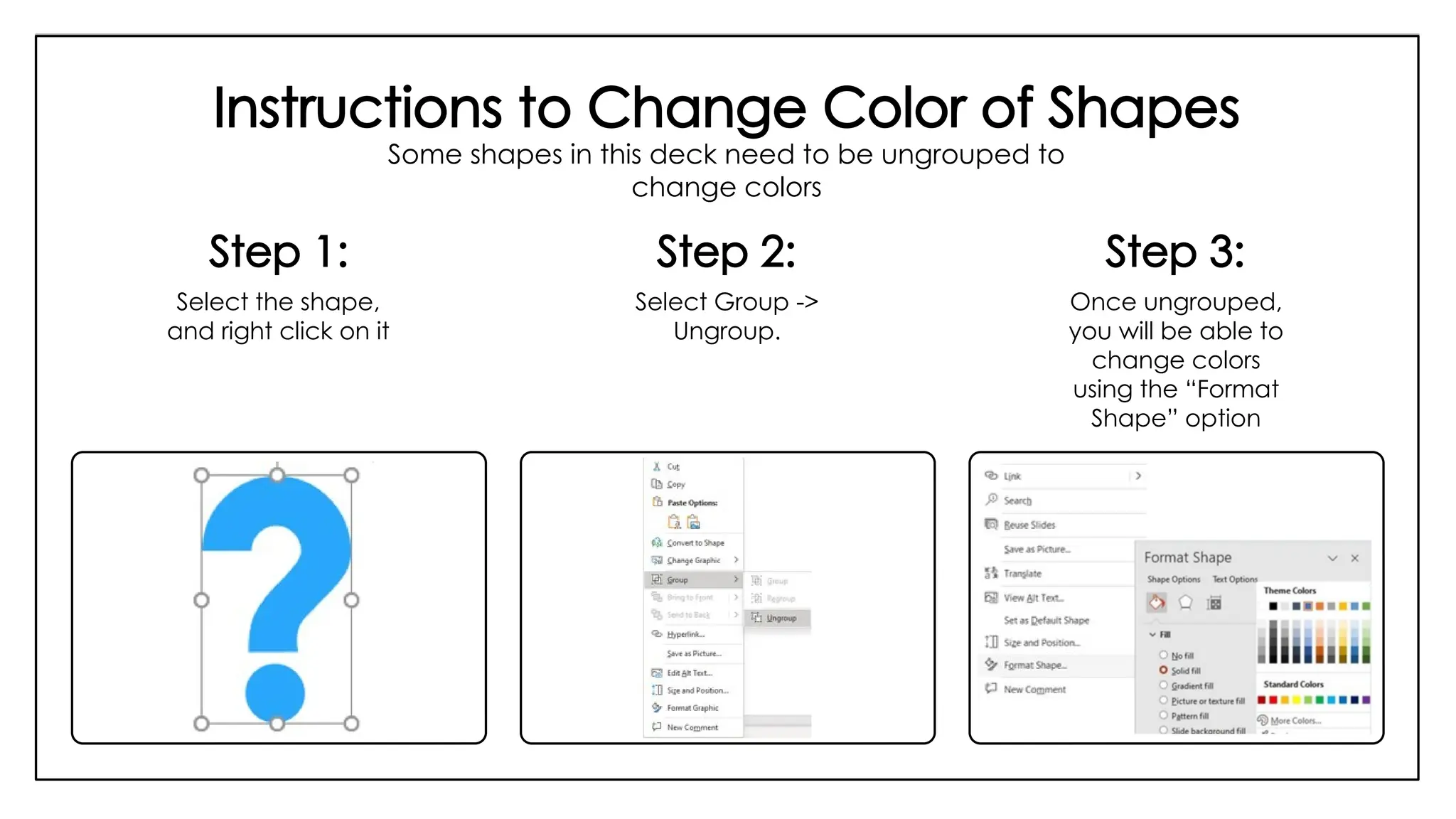
Instructions to ChangeColor of Shapes
Some shapes in this deck need to be ungrouped to
change colors
Step 1:
Select the shape,
and right click on it
Step 2:
Select Group ->
Ungroup.
Step 3:
Once ungrouped,
you will be able to
change colors
using the “Format
Shape” option