IoT Technical Challenges and Solutions 1st Edition Arpan Pal
IoT Technical Challenges and Solutions 1st Edition Arpan Pal
IoT Technical Challenges and Solutions 1st Edition Arpan Pal
IoT Technical Challenges and Solutions 1st Edition Arpan Pal
IoT Technical Challenges and Solutions 1st Edition Arpan Pal
1.
IoT Technical Challengesand Solutions 1st
Edition Arpan Pal pdf download
https://ebookmeta.com/product/iot-technical-challenges-and-
solutions-1st-edition-arpan-pal/
Download more ebook from https://ebookmeta.com
2.
We believe theseproducts will be a great fit for you. Click
the link to download now, or visit ebookmeta.com
to discover even more!
Energy Crises Challenges and Solutions 1st Edition
Pardeep Singh
https://ebookmeta.com/product/energy-crises-challenges-and-
solutions-1st-edition-pardeep-singh/
Architecting IoT Solutions on Azure 1st Edition Blaize
Stewart
https://ebookmeta.com/product/architecting-iot-solutions-on-
azure-1st-edition-blaize-stewart/
Internet of Things and Access Control Sensing
Monitoring and Controlling Access in IoT Enabled
Healthcare Systems 1st Edition Shantanu Pal
https://ebookmeta.com/product/internet-of-things-and-access-
control-sensing-monitoring-and-controlling-access-in-iot-enabled-
healthcare-systems-1st-edition-shantanu-pal/
Mosby's Drug Guide for Nursing Students, 14th Edition
Skidmore-Roth Rn Msn Np
https://ebookmeta.com/product/mosbys-drug-guide-for-nursing-
students-14th-edition-skidmore-roth-rn-msn-np/
3.
Respiratory Biology ofAnimals evolutionary and
functional morphology Steven F. Perry
https://ebookmeta.com/product/respiratory-biology-of-animals-
evolutionary-and-functional-morphology-steven-f-perry/
Dynamics Information and Complexity in Quantum Systems
2nd Edition Fabio Benatti
https://ebookmeta.com/product/dynamics-information-and-
complexity-in-quantum-systems-2nd-edition-fabio-benatti/
The Ballad of Never After Once Upon a Broken Heart 2
1st Edition Stephanie Garber
https://ebookmeta.com/product/the-ballad-of-never-after-once-
upon-a-broken-heart-2-1st-edition-stephanie-garber/
Beginning AWS Security 1st Edition Tasha Penwell
https://ebookmeta.com/product/beginning-aws-security-1st-edition-
tasha-penwell/
Frenzy (Shadow Bred #2) 1st Edition Grace Mcginty
https://ebookmeta.com/product/frenzy-shadow-bred-2-1st-edition-
grace-mcginty/
4.
Investing Strategies forAdults Effective Ways of
Making a Profit With Low Risk Investments Working Just
1 Hour A Day With Little or No Experience 1st Edition
Matthew
https://ebookmeta.com/product/investing-strategies-for-adults-
effective-ways-of-making-a-profit-with-low-risk-investments-
working-just-1-hour-a-day-with-little-or-no-experience-1st-
edition-matthew/
To the IoTResearch and Innovation community
at Tata Consultancy Services
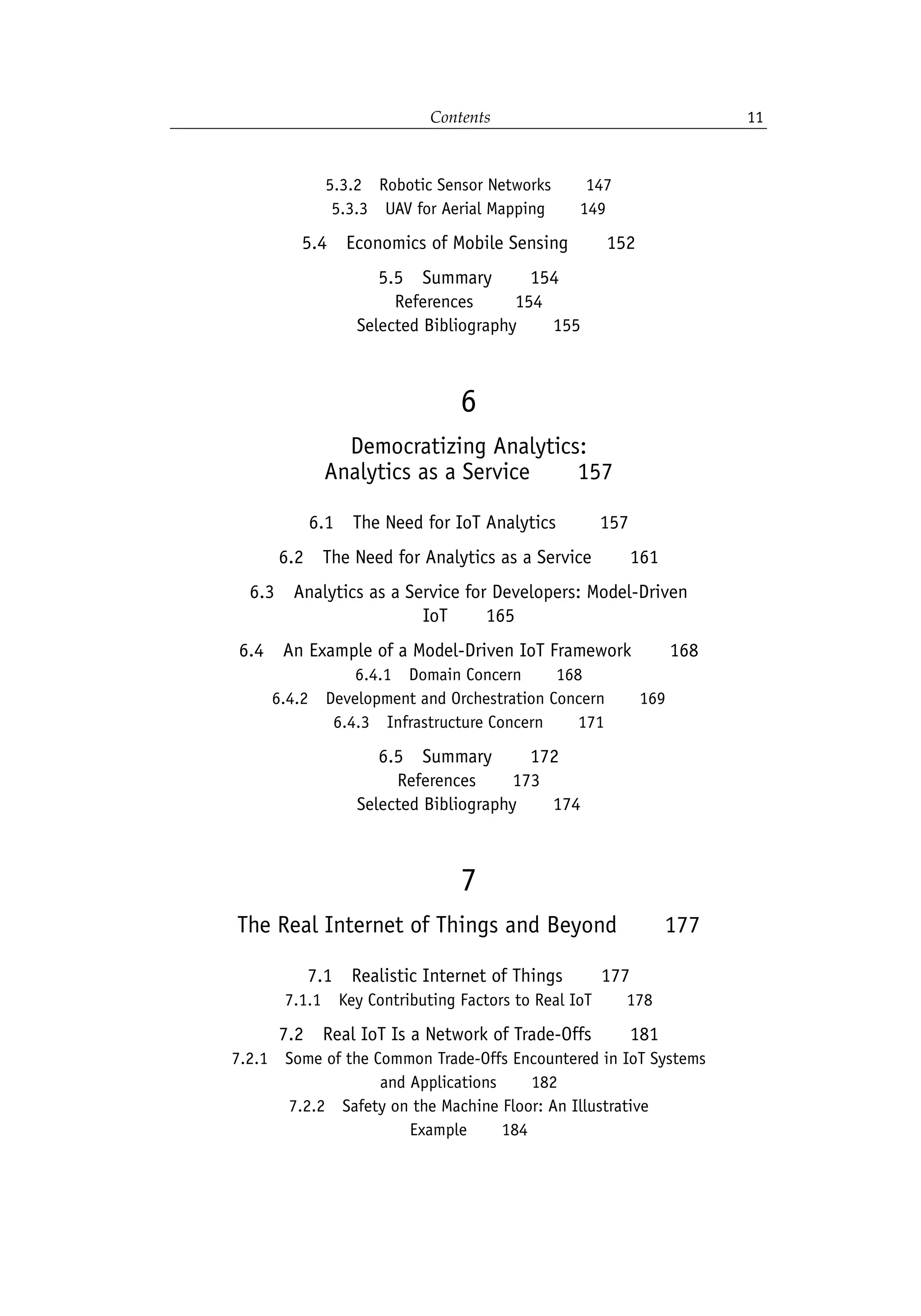
12.
7
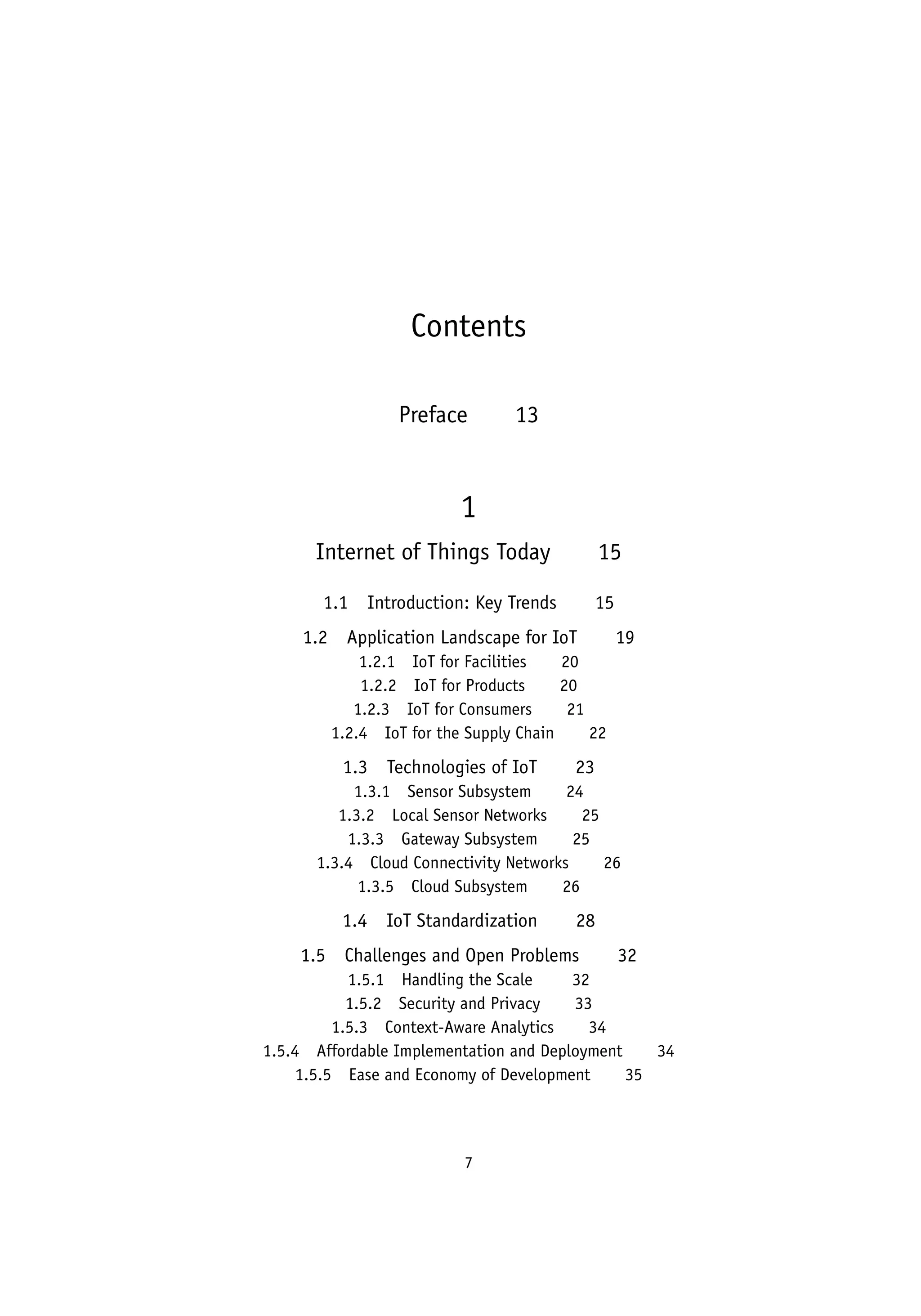
Contents
Preface 13
1
Internet ofThings Today 15
1.1 Introduction: Key Trends 15
1.2 Application Landscape for IoT 19
1.2.1 IoT for Facilities 20
1.2.2 IoT for Products 20
1.2.3 IoT for Consumers 21
1.2.4 IoT for the Supply Chain 22
1.3 Technologies of IoT 23
1.3.1 Sensor Subsystem 24
1.3.2 Local Sensor Networks 25
1.3.3 Gateway Subsystem 25
1.3.4 Cloud Connectivity Networks 26
1.3.5 Cloud Subsystem 26
1.4 IoT Standardization 28
1.5 Challenges and Open Problems 32
1.5.1 Handling the Scale 32
1.5.2 Security and Privacy 33
1.5.3 Context-Aware Analytics 34
1.5.4 Affordable Implementation and Deployment 34
1.5.5 Ease and Economy of Development 35
13.
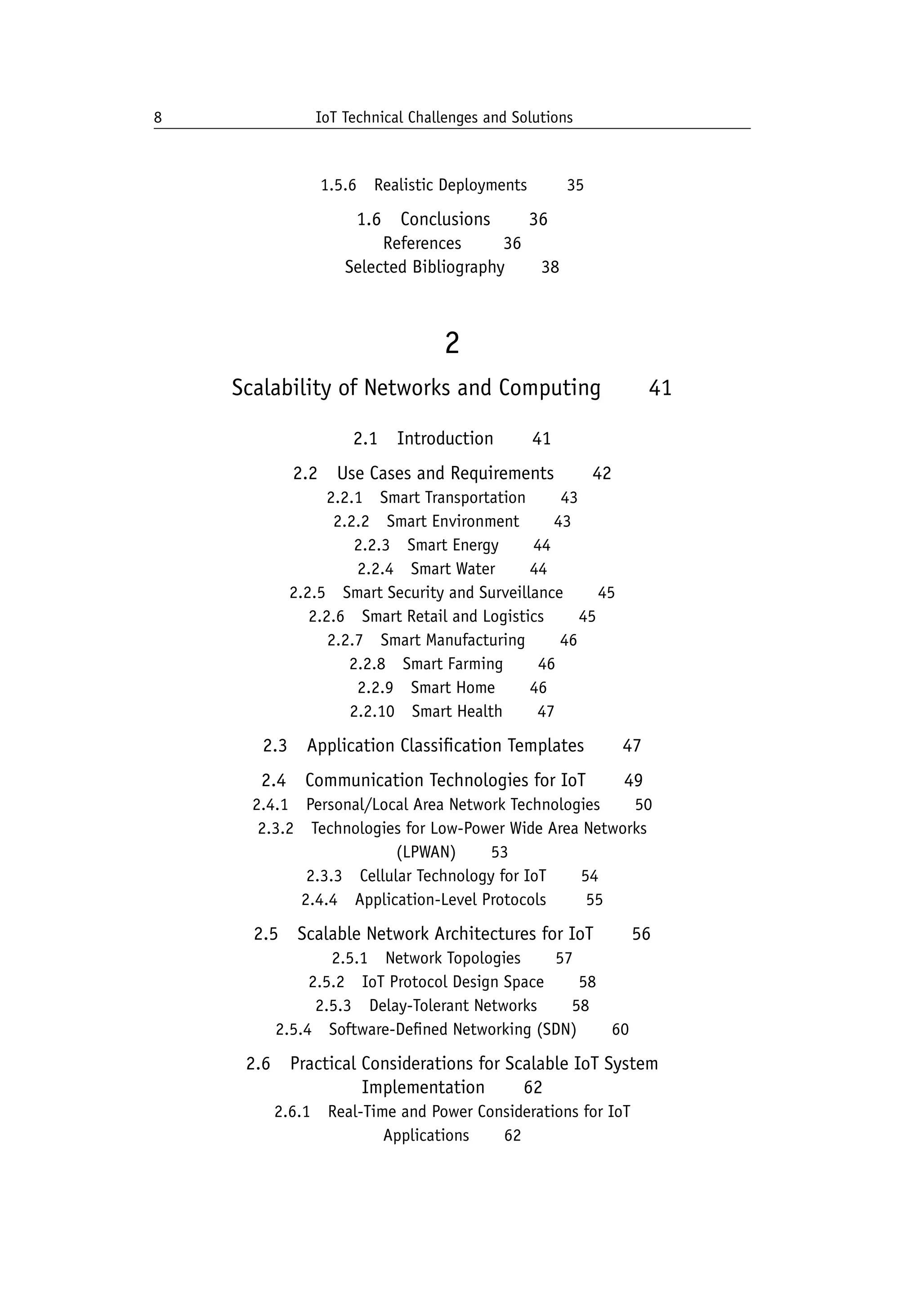
8 IoT TechnicalChallenges and Solutions
1.5.6 Realistic Deployments 35
1.6 Conclusions 36
References 36
Selected Bibliography 38
2
Scalability of Networks and Computing 41
2.1 Introduction 41
2.2 Use Cases and Requirements 42
2.2.1 Smart Transportation 43
2.2.2 Smart Environment 43
2.2.3 Smart Energy 44
2.2.4 Smart Water 44
2.2.5 Smart Security and Surveillance 45
2.2.6 Smart Retail and Logistics 45
2.2.7 Smart Manufacturing 46
2.2.8 Smart Farming 46
2.2.9 Smart Home 46
2.2.10 Smart Health 47
2.3 Application Classification Templates 47
2.4 Communication Technologies for IoT 49
2.4.1 Personal/Local Area Network Technologies 50
2.3.2 Technologies for Low-Power Wide Area Networks
(LPWAN) 53
2.3.3 Cellular Technology for IoT 54
2.4.4 Application-Level Protocols 55
2.5 Scalable Network Architectures for IoT 56
2.5.1 Network Topologies 57
2.5.2 IoT Protocol Design Space 58
2.5.3 Delay-Tolerant Networks 58
2.5.4 Software-Defined Networking (SDN) 60
2.6 Practical Considerations for Scalable IoT System
Implementation 62
2.6.1 Real-Time and Power Considerations for IoT
Applications 62
14.
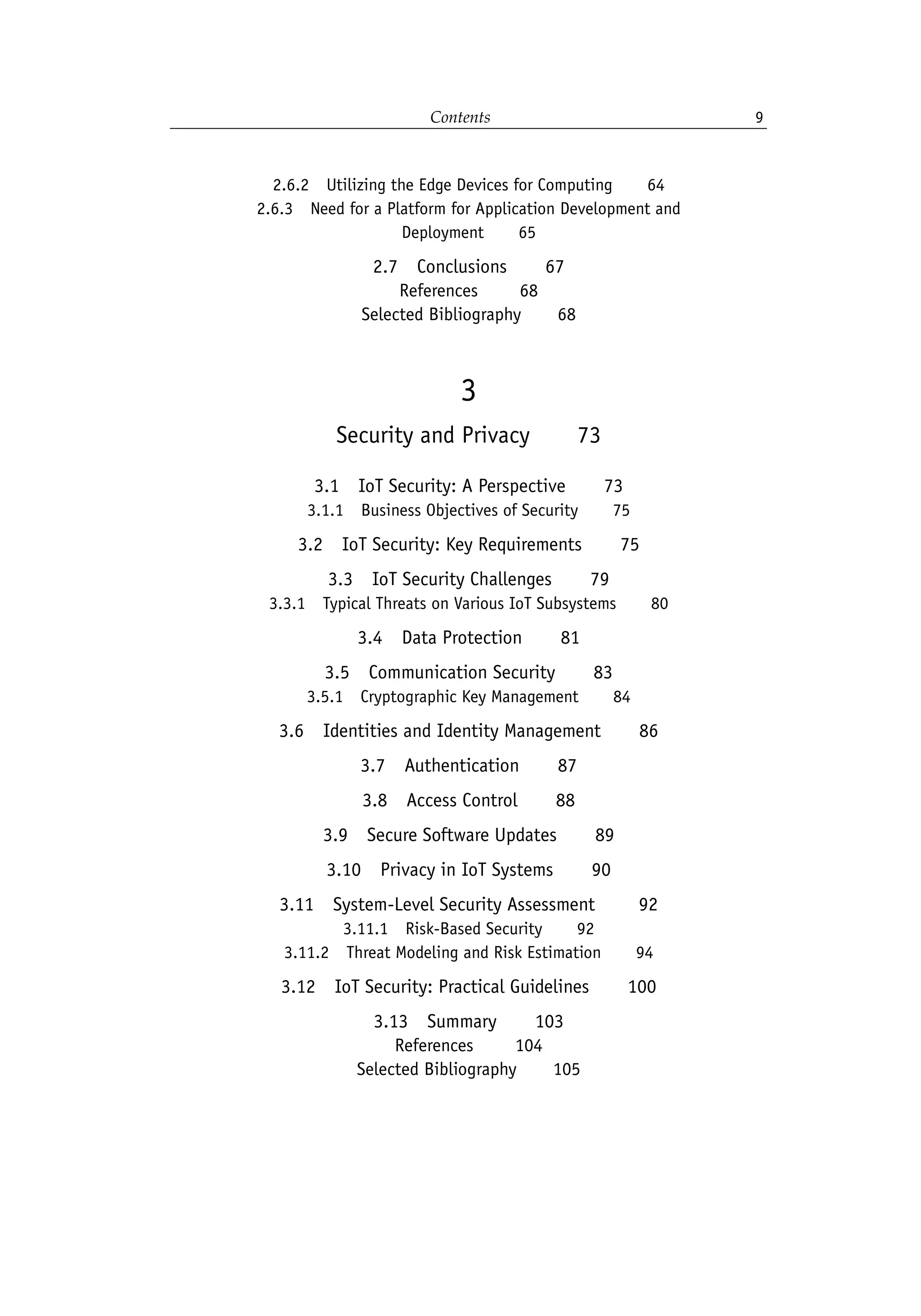
Contents 9
2.6.2 Utilizingthe Edge Devices for Computing 64
2.6.3 Need for a Platform for Application Development and
Deployment 65
2.7 Conclusions 67
References 68
Selected Bibliography 68
3
Security and Privacy 73
3.1 IoT Security: A Perspective 73
3.1.1 Business Objectives of Security 75
3.2 IoT Security: Key Requirements 75
3.3 IoT Security Challenges 79
3.3.1 Typical Threats on Various IoT Subsystems 80
3.4 Data Protection 81
3.5 Communication Security 83
3.5.1 Cryptographic Key Management 84
3.6 Identities and Identity Management 86
3.7 Authentication 87
3.8 Access Control 88
3.9 Secure Software Updates 89
3.10 Privacy in IoT Systems 90
3.11 System-Level Security Assessment 92
3.11.1 Risk-Based Security 92
3.11.2 Threat Modeling and Risk Estimation 94
3.12 IoT Security: Practical Guidelines 100
3.13 Summary 103
References 104
Selected Bibliography 105
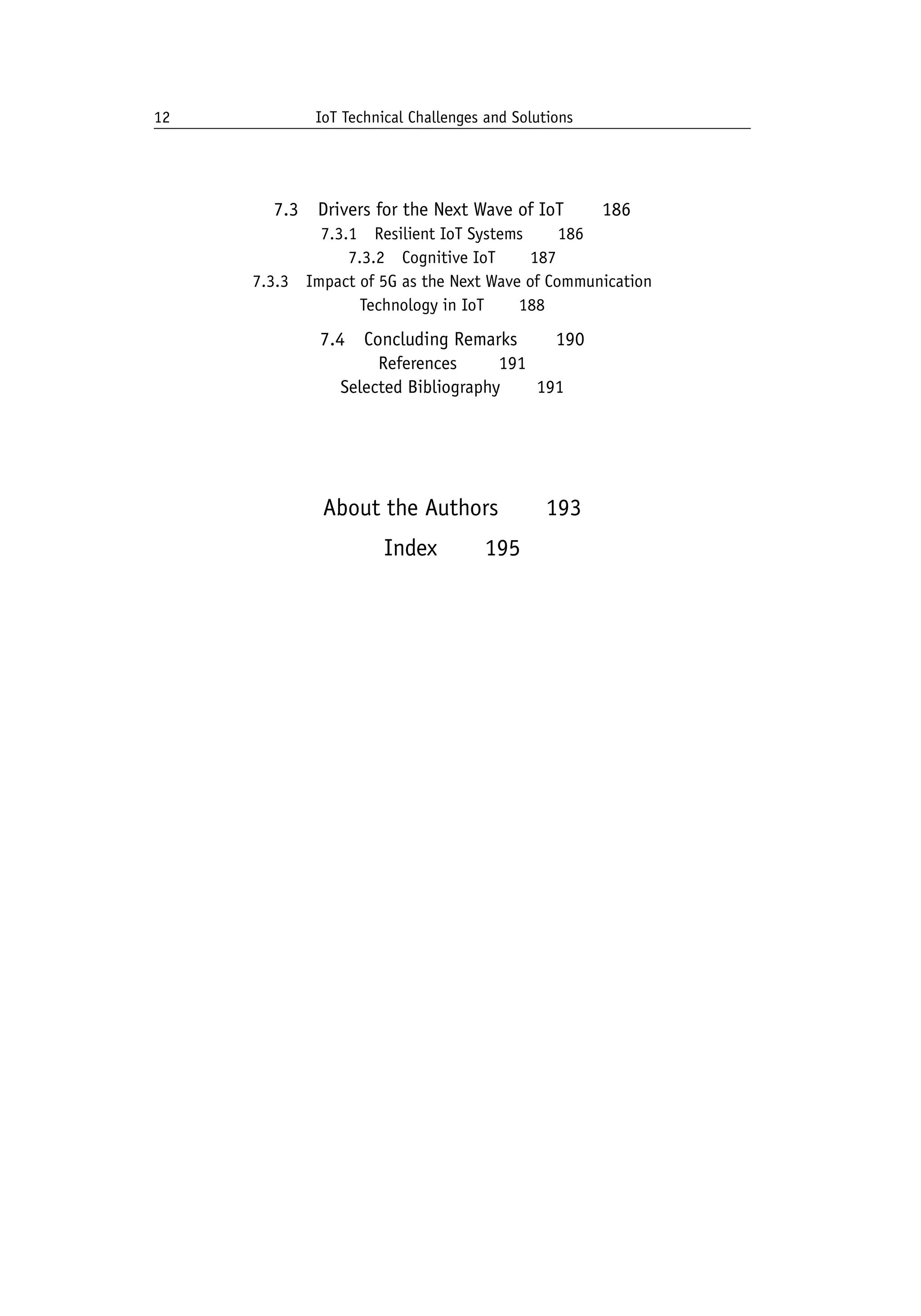
15.
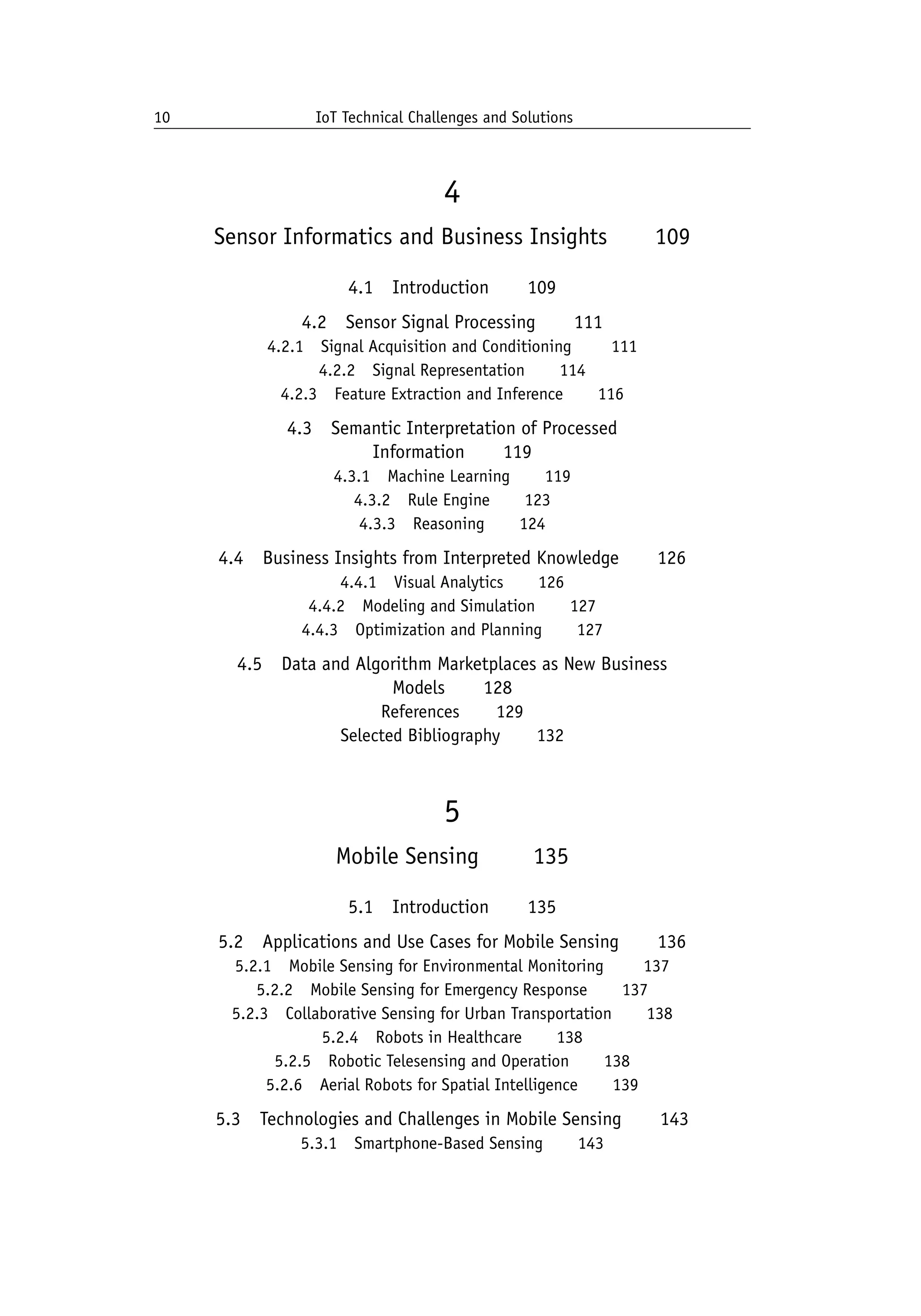
10 IoT TechnicalChallenges and Solutions
4
Sensor Informatics and Business Insights 109
4.1 Introduction 109
4.2 Sensor Signal Processing 111
4.2.1 Signal Acquisition and Conditioning 111
4.2.2 Signal Representation 114
4.2.3 Feature Extraction and Inference 116
4.3 Semantic Interpretation of Processed
Information 119
4.3.1 Machine Learning 119
4.3.2 Rule Engine 123
4.3.3 Reasoning 124
4.4 Business Insights from Interpreted Knowledge 126
4.4.1 Visual Analytics 126
4.4.2 Modeling and Simulation 127
4.4.3 Optimization and Planning 127
4.5 Data and Algorithm Marketplaces as New Business
Models 128
References 129
Selected Bibliography 132
5
Mobile Sensing 135
5.1 Introduction 135
5.2 Applications and Use Cases for Mobile Sensing 136
5.2.1 Mobile Sensing for Environmental Monitoring 137
5.2.2 Mobile Sensing for Emergency Response 137
5.2.3 Collaborative Sensing for Urban Transportation 138
5.2.4 Robots in Healthcare 138
5.2.5 Robotic Telesensing and Operation 138
5.2.6 Aerial Robots for Spatial Intelligence 139
5.3 Technologies and Challenges in Mobile Sensing 143
5.3.1 Smartphone-Based Sensing 143
16.
Contents 11
5.3.2 RoboticSensor Networks 147
5.3.3 UAV for Aerial Mapping 149
5.4 Economics of Mobile Sensing 152
5.5 Summary 154
References 154
Selected Bibliography 155
6
Democratizing Analytics:
Analytics as a Service 157
6.1 The Need for IoT Analytics 157
6.2 The Need for Analytics as a Service 161
6.3 Analytics as a Service for Developers: Model-Driven
IoT 165
6.4 An Example of a Model-Driven IoT Framework 168
6.4.1 Domain Concern 168
6.4.2 Development and Orchestration Concern 169
6.4.3 Infrastructure Concern 171
6.5 Summary 172
References 173
Selected Bibliography 174
7
The Real Internet of Things and Beyond 177
7.1 Realistic Internet of Things 177
7.1.1 Key Contributing Factors to Real IoT 178
7.2 Real IoT Is a Network of Trade-Offs 181
7.2.1 Some of the Common Trade-Offs Encountered in IoT Systems
and Applications 182
7.2.2 Safety on the Machine Floor: An Illustrative
Example 184
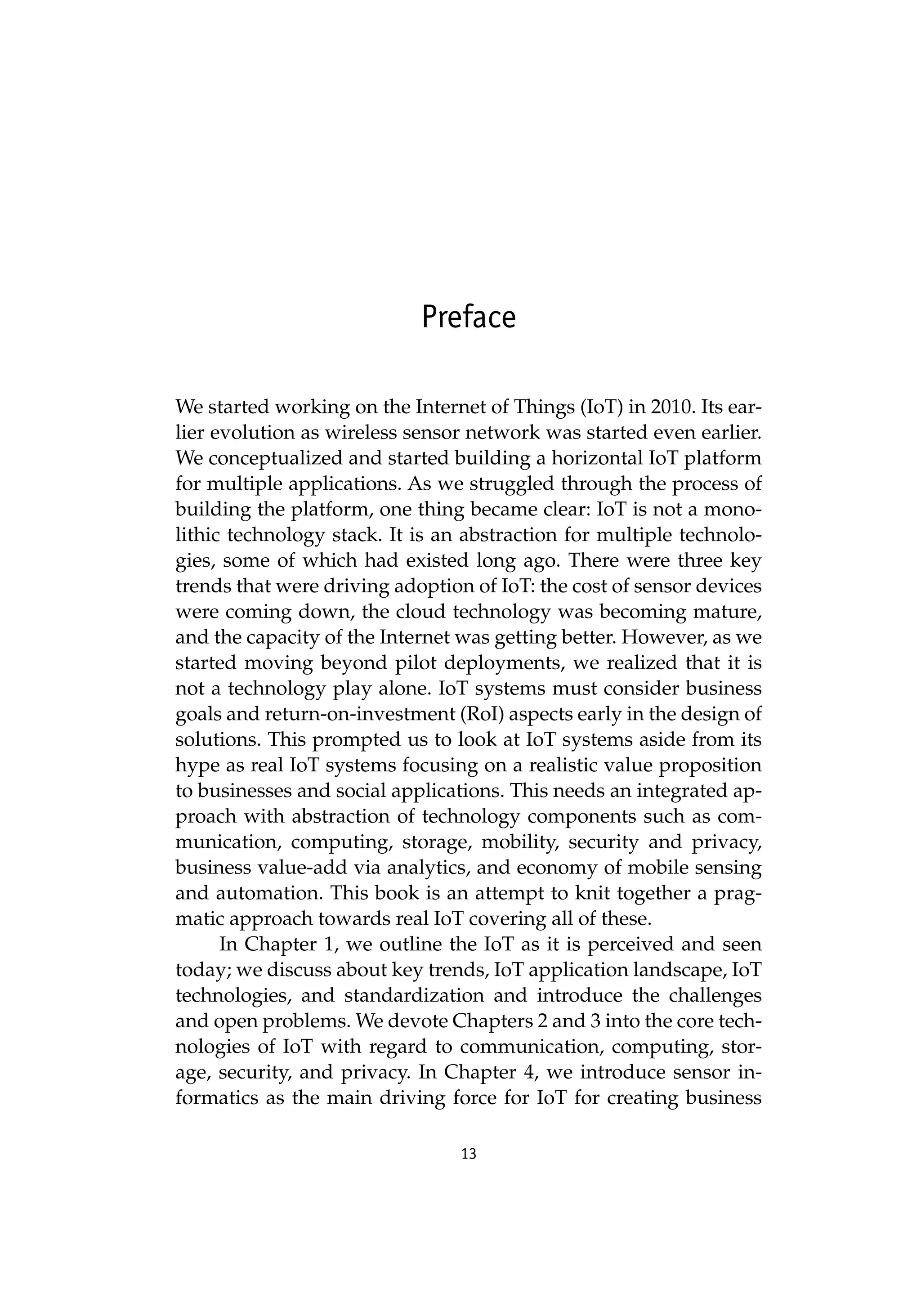
17.
12 IoT TechnicalChallenges and Solutions
7.3 Drivers for the Next Wave of IoT 186
7.3.1 Resilient IoT Systems 186
7.3.2 Cognitive IoT 187
7.3.3 Impact of 5G as the Next Wave of Communication
Technology in IoT 188
7.4 Concluding Remarks 190
References 191
Selected Bibliography 191
About the Authors 193
Index 195
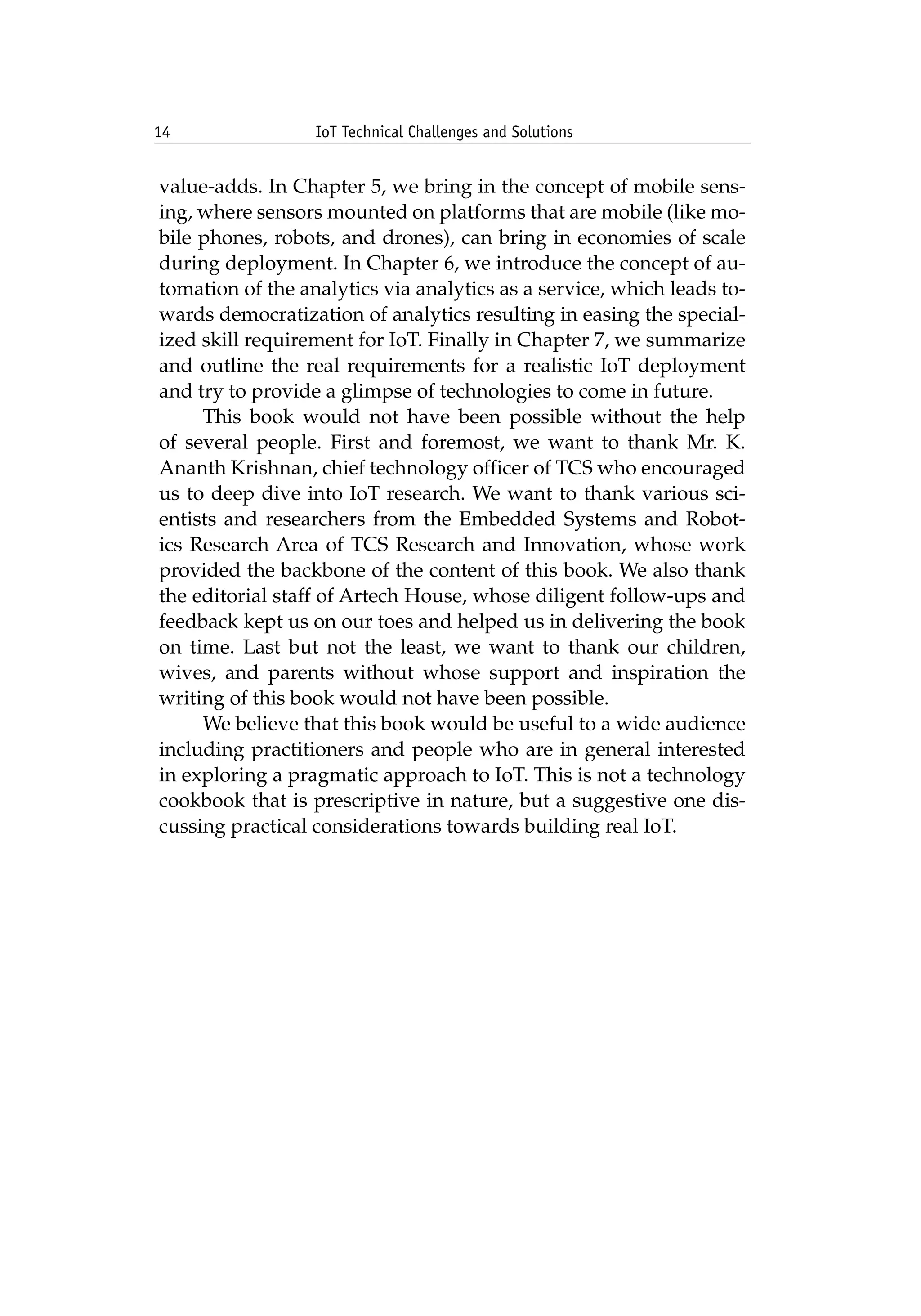
18.
13
Preface
We started workingon the Internet of Things (IoT) in 2010. Its ear-
lier evolution as wireless sensor network was started even earlier.
We conceptualized and started building a horizontal IoT platform
for multiple applications. As we struggled through the process of
building the platform, one thing became clear: IoT is not a mono-
lithic technology stack. It is an abstraction for multiple technolo-
gies, some of which had existed long ago. There were three key
trends that were driving adoption of IoT: the cost of sensor devices
were coming down, the cloud technology was becoming mature,
and the capacity of the Internet was getting better. However, as we
started moving beyond pilot deployments, we realized that it is
not a technology play alone. IoT systems must consider business
goals and return-on-investment (RoI) aspects early in the design of
solutions. This prompted us to look at IoT systems aside from its
hype as real IoT systems focusing on a realistic value proposition
to businesses and social applications. This needs an integrated ap-
proach with abstraction of technology components such as com-
munication, computing, storage, mobility, security and privacy,
business value-add via analytics, and economy of mobile sensing
and automation. This book is an attempt to knit together a prag-
matic approach towards real IoT covering all of these.
In Chapter 1, we outline the IoT as it is perceived and seen
today; we discuss about key trends, IoT application landscape, IoT
technologies, and standardization and introduce the challenges
and open problems. We devote Chapters 2 and 3 into the core tech-
nologies of IoT with regard to communication, computing, stor-
age, security, and privacy. In Chapter 4, we introduce sensor in-
formatics as the main driving force for IoT for creating business
19.
14 IoT TechnicalChallenges and Solutions
value-adds. In Chapter 5, we bring in the concept of mobile sens-
ing, where sensors mounted on platforms that are mobile (like mo-
bile phones, robots, and drones), can bring in economies of scale
during deployment. In Chapter 6, we introduce the concept of au-
tomation of the analytics via analytics as a service, which leads to-
wards democratization of analytics resulting in easing the special-
ized skill requirement for IoT. Finally in Chapter 7, we summarize
and outline the real requirements for a realistic IoT deployment
and try to provide a glimpse of technologies to come in future.
This book would not have been possible without the help
of several people. First and foremost, we want to thank Mr. K.
Ananth Krishnan, chief technology officer of TCS who encouraged
us to deep dive into IoT research. We want to thank various sci-
entists and researchers from the Embedded Systems and Robot-
ics Research Area of TCS Research and Innovation, whose work
provided the backbone of the content of this book. We also thank
the editorial staff of Artech House, whose diligent follow-ups and
feedback kept us on our toes and helped us in delivering the book
on time. Last but not the least, we want to thank our children,
wives, and parents without whose support and inspiration the
writing of this book would not have been possible.
We believe that this book would be useful to a wide audience
including practitioners and people who are in general interested
in exploring a pragmatic approach to IoT. This is not a technology
cookbook that is prescriptive in nature, but a suggestive one dis-
cussing practical considerations towards building real IoT.
“Shall I ever,do you think, be able to take back to England with me
a husband with such a name as Emidio? What a pity he was not
christened Paul, or Stephen, or even Anthony! But Emidio!” By this
time we were both laughing—Frank at me, I at myself.
“You need never call him Emidio in public. We call him so because,
when we have been travelling about Italy alone together, we found it
convenient to drop his title. But you know he is il Conte Gandolfi. His
mother was the only child of a noble Roman family, and
consequently a great heiress. She married a Neapolitan Conte
Gandolfi; and that is how it happens that [pg 637] with a Neapolitan
name his chief residence is in Rome, in the palazzo that belonged to
his mother. His father was not a man of very considerable fortune,
and his only property here is his villa at Capo di Monte, where he
spends the summer. A nobler heart and a finer nature I never saw.
There is the simplicity of a child, the honor of a true-born
gentleman, the delicacy of a woman, the courage of a hero, and the
piety of a saint.”
The tears stood in my eyes; and taking dear Frank's hand in mine, I
said, “Thank you, dear old fellow, for saying that. And, thank God,
you too have drawn a prize!”
22.
A Discussion WithAn Infidel.
IV. Immortality Of Matter.
Reader. And now, doctor, what other argument do you allege against
creation?
Büchner. The immortality of matter, and the immortality of force.
Reader. The immortality of matter?
Büchner. Yes, sir. “Matter is immortal, indestructible. There is not an
atom in the universe which can be lost. We cannot, even in thought,
remove or add an atom without admitting that the world would
thereby be disturbed, and the laws of gravitation and the equilibrium
of matter interfered with. It is the great merit of modern chemistry
to have proved in the most convincing manner that the
uninterrupted changes of matter which we daily witness, the origin
and decay of organic and inorganic forms and tissues, do not arise,
as was hitherto believed, from new materials, but that this change
consists in nothing else but the constant and continuous
metamorphosis of the same elementary principles, the quantity and
quality of which ever are, and ever remain, the same” (p. 9). “The
atoms are in themselves unchangeable and indestructible; to-day in
this, tomorrow in another form, they present by the variety of their
combinations the innumerable forms in which matter appears to our
senses. The number of atoms in any element remains, on the whole,
the same; not a single particle is formed anew; nor can it, when
formed, disappear from existence” (p. 11).
23.
Reader. Do yousay in the same breath that no particle of matter can
be formed anew, and that, when formed, it cannot disappear? When
is it formed, if it cannot be formed at all?
Büchner. The phrase may be incorrect, but the idea is sound, and
the argument conclusive.
Reader. Poor doctor! the idea is as inconsistent as the phrase is
incorrect; and the argument is not worthy of the name. Let us admit
that matter, elements, and atoms have been observed to remain
always and everywhere the same. Does it follow that matter,
elements, and atoms are indestructible? By no means; it only follows
that, be they destructible or [pg 638] not, they have not been
actually destroyed. You say that by the destruction or addition of an
atom “the world would be disturbed.” Let it be disturbed; what then?
Büchner. Then the laws of gravitation and the equilibrium of matter
would be interfered with; which cannot be admitted. The laws of
nature are unchangeable. What has been constantly true for the
past must be true for ever.
Reader. You are utterly mistaken, doctor. The world may be
disturbed by the creation or the annihilation of matter without the
laws of nature being interfered with. I admit that the laws of nature
are unchangeable; they have been true for the past, and they will be
true for ever. But what is the object of these laws? Nothing but the
mode of production of the phenomena of the material world. Hence
you have a law of gravitation, a law of propagation of sound, a law
of impact, a law of reflection and of refraction, and generally laws of
motion, but you have no law of existence and no law of substance.
Whence it is clear that all your laws of nature would remain exactly
the same whether any new portion of matter were brought into
being or any portion of existing matter annihilated. Suppose that
your own body were annihilated; would any law of nature be upset?
Would the sun cease to illuminate the earth? Would the earth cease
to revolve round its axis or to attract bodies? Would the ocean cease
24.
rolling its wavesto the shore? Would fire cease to burn? In one
word, would any law of statics or of dynamics cease to be true?
Nor can you decline this supposition by saying that annihilation itself
would be against the laws of nature. For all your laws of nature, as I
have just remarked, regard the movements, and not the substance,
of the material world. Your laws suppose the existence of matter in
the same manner as civil laws suppose the existence of civil society;
and as these latter are not modified by an increase or a decrease in
the number of the individuals subject to them, so neither would the
former be modified by any increase or decrease in the number of
material elements. There would be, of course, a change in the
phenomena themselves, because the execution of the laws would be
carried on suitably to the new condition of the case; but the laws
would remain the same. Consequently any amount of matter could
be annihilated without the least change in the laws of nature. Let
the moon be annihilated; the ebb and flow of the ocean will be
altered, but the laws of motion will remain the same; for the ebbing
and flowing of the waters will still be proportional to the action of
the disturbing causes. Let a stone be annihilated in the act of its
falling to the ground; the law of attraction will remain unaltered, as
it will still be true that every falling body must acquire, under
gravitation, a uniformly increasing velocity. Hence the
unchangeableness of natural laws cannot be alleged as a proof of
the indestructibility of matter; and your argument is worthless. The
utmost you can be allowed to assume is that matter, whether
destructible or not, has hitherto continued to exist, and no particle of
it has ever been annihilated.
This last assertion, however, is admitted by natural philosophers, not
because there is any scientific proof of it, but simply because [pg
639] science has no grounds for denying it. Science has no means of
ascertaining, for instance, whether any remote star has been
annihilated, or any new star created, in the last thousand years; and
if the common belief is that no new matter has been created, and no
portion of matter annihilated, we owe it, not to science, but to the
25.
teaching of theBible, which represents the work of creation as long
ago completed, and the conservation of all created substances as
the effect of design. But you, who laugh at revelation, and pretend
to substantiate all your assertions by facts, have no right to assume
that no matter has ever been annihilated. Hence not only are you
unable to show that matter is indestructible, but you cannot even
maintain that no particle of matter has ever been destroyed.
But I will no longer insist on this point. I admit that no atom of
matter can ever be lost to the world by natural processes. My reason
is that the natural actions of bodies, whether physical or chemical,
tend merely to the production, modification, or neutralization of
movement, and that no amount of change in the movement of an
atom can cause the atom to vanish. This is not, however, a discovery
of modern chemistry, as you seem to believe. The scholastic
philosophers had not the fortune to know modern chemistry; yet
they never believed that new compounds were made of new
materials, though you recklessly assert that “it was hitherto
believed”; but they always uniformly taught that matter was
ingenerable and incorruptible. There was therefore scarcely any
need of modern chemistry to teach us that no portion of matter can
be lost by natural processes. Yet this is not the real question. What
we want to know is whether an atom, or any number of atoms, has
a necessary existence and cannot be annihilated by God. This is your
assumption; and this is what you are unable to show. Your argument
is, in fact, nothing but a vicious circle. You say: “There is no God;
and therefore matter cannot be annihilated”; and at the same time
you say: “Matter cannot be annihilated; and therefore there is no
God.” This is, in reality, the covert drift of your argumentation, when
from the assumed indestructibility of matter you conclude, first, that
matter could not have been created, and, further, that the existence
of a Creator is a gratuitous hypothesis. On the other hand, you
cannot make good your assertion that matter is indestructible
without first denying the existence of a Creator. Such is your nice
logic in what you probably consider to be one of your best
arguments.
26.
And let mehere make a passing remark on the word “immortality,”
which you have chosen to designate the pretended indestructibility
of matter. Immortality is not simply “existence without end,” but “life
without end.” Hence living beings alone can be immortal. Do you
assume, then, that a grain of dust or an atom of matter is a living
being? If you say yes, where are the facts that will lend a support to
such an unscientific doctrine? If you say no, then the immortality of
your matter is nothing indeed but a new form of what you would
style “philosophical charlatanism.”
To conclude: the indestructibility of matter is a ridiculous invention of
ignorant empiricists, who know neither what matter is nor what is
philosophical reasoning. [pg 640] They make, indeed, a great deal of
noise with their scientific publications; but their ephemeral celebrity
is due to an organized system of mutual laudation and to Masonic
support, as you know. Let only twenty years pass, and you may be
sure that our children will laugh at your celebrities: and if your Force
and Matter is to reach them, they will laugh at you too. Common
sense cannot slumber for ever; and when it awakes, then will all
your infidel scribes be pronounced designing knaves.
Büchner. I thought you would never end, sir; but, long as your
answer has been, it has failed to convince me. The force of my
argument lies in this: that what can have an end must have had a
beginning. If, therefore, matter is not indestructible, it must have
had a beginning.
Reader. Certainly.
Büchner. But a beginning of matter is inconceivable. For how could
matter come into existence?
Reader. By creation out of nothing.
Büchner. This is what I deny. For out of nothing nothing can arise.
This is an axiom. Hence “never can an atom arise anew or
27.
disappear; it canonly change its combinations.... Matter must have
existed from eternity, and must last for ever” (p. 12).
Reader. I am not in the least surprised to hear that my long talk did
not convince you. It is always difficult to convince a man against his
will. My object, however, was not to give you a positive
demonstration of the fact of creation, but only to show that the
reasons which you were parading against creation amount to
nothing. Of this I hope I have not failed to convince you. But now
you come forward with a new argument, which indeed is very old,
consisting in a pretended axiom, that out of nothing nothing can
arise. Suppose, doctor, that I deny your axiom. How would you show
that I deny a truth?
Büchner. “How can any one deny the axiom that out of nothing
nothing can arise?” (p. 12).
Reader. You must know, doctor, that what you assume to be an old
axiom is only an old error. In fact, why do you say that out of
nothing nothing can arise? Simply because natural energies can do
nothing without pre-existing materials. Hence your argument
amounts to this. “Natural energies never make anything out of
nothing; therefore out of nothing nothing can be made.” That this
conclusion is a great blunder I need not prove, I presume, as logic
teaches that no conclusion can be more general than its premises.
Where is, then, the ground of your pretended axiom?
Nor can you reply that the natural energies are the only energies
known to us, and that, if these cannot make anything out of
nothing, the axiom is unexceptionably true. This would be to assume
what you are bound to prove, to wit, that there is no power above
the natural forces; and to assume this is what logicians call Petitio
principii. On the other hand, you cannot maintain that such natural
forces are the only ones we know; for you cannot limit the range of
human knowledge within the narrow sphere of mere empiricism
without denying human reason.
28.
Büchner. We haveno notion of supersensible forces.
Reader. You talk without reflection, doctor. If you have no such a
notion, what is it, then, that compels you to admit any demonstrated
[pg 641] truth? Is it attraction, heat, electricity, or any of your
physical or chemical forces? No; it is the force of demonstration, it is
the force of truth. This is no vain theory; I appeal to your own
experience. Your intellect is obliged to yield to the force of evidence
and demonstration just as inevitably as the pendulum is obliged to
yield to the force of gravitation. And since a real effect requires a
real cause, hence whatever thus really compels your intellect to yield
must have a real power, and that evidently supersensible.
But reverting to your pretended axiom, I have yet to remark that,
strictly speaking, it does not even hold in the case of natural causes;
in other terms, I say that nothing is ever produced by natural causes
except out of nothing. Of course no tailor ever made a coat without
cloth, and no carpenter ever built a ship without pre-existing
materials. This I admit; but if you closely examine the point, you will
see that to make a coat or a ship is not to produce it, and that the
action of the tailor and the carpenter wholly consists in modifying
and arranging the materials so as to give them a form. It is,
therefore, this form alone that is produced. Now, clearly, this form,
before its production, was nothing; for it had no existence. And
therefore the work of the tailor or the carpenter is a production of
something out of nothing.152
And thus either you must deny that
anything is ever produced, or you must give up your axiom that
nothing can be produced out of nothing.
Büchner. I cannot give up my axiom without inconsistency. I will
rather deny that anything is ever really produced. In fact, “Those are
children, or persons with a narrow sphere of vision, says
Empedocles, who imagine that anything arises that has not existed
before, or that anything can entirely die and perish” (p. 15).
Reader. These are empty words.
29.
Büchner. On theother hand, “the immortality of matter is now a fact
scientifically established, and can no longer be denied” (p. 13).
Reader. Indeed?
Büchner. Yes; “Its actual proof is given by our scales and retorts” (p.
13).
Reader. I thought I had already shown that your scales and retorts
are incapable of giving such a proof.
Büchner. “Sebastian Frank, a German who lived in 1528, says:
Matter was in the beginning in God, and is on that account eternal
and infinite. The earth and everything created may pass away, but
we cannot say that that will perish out of which matter is created.
The substance remains for ever” (p. 14).
Reader. Do you endorse these words?
Büchner. Certainly.
Reader. Then you catch yourself in your own trap. For if matter is
created, as your German writer says, surely there is a Creator.
Büchner. But if matter was in the beginning in God, and was eternal,
it is plain that matter could not be created.
Reader. Perfectly true. And therefore, since matter, according to your
German authority, has been created, surely matter was not in [pg
642] the beginning in God. But, after all, can you endorse Frank's
words without admitting a God? And can you admit a God and a
Creator while fighting against creation and the existence of God? Be
honest, doctor, and confess that bad indeed must a cause be which
cannot be maintained but by clumsy sophistry and shameful
contradiction.
30.
V. Immortality OfForce.
Reader. In your theory, doctor, force is immortal. This I cannot
understand. Would you tell me how you come to such a conclusion?
Büchner. “Indestructible, imperishable, and immortal as matter is
also its immanent force. Intimately united to matter, force revolves in
the same never-ending cycle, and emerges from any form in the
same quantity as it entered. If it be an undoubted fact that matter
can neither be produced nor destroyed, but merely transformed,
then it must also be assumed as an established principle that there
is not a single case in which force can be produced out of, or pass
into, nothing; or, in other words, can be born or annihilated. In all
cases where force is manifested it may be reduced to its sources;
that is to say, it can be ascertained from what other forces a definite
amount of force has been obtained, either directly or by conversion.
This convertibility is not arbitrary, but takes place according to
definite equivalents, so that not the smallest quantity of force can be
lost” (p. 16).
Reader. How do you account for this theory?
Büchner. “Logic and our daily experience teach us that no natural
motion or change, consequently no manifestation of force, can take
place without producing an endless chain of successive motions and
changes, as every effect becomes immediately the cause of
succeeding effects. There is no repose of any kind in nature; its
whole existence is a constant cycle, in which every motion, the
consequence of a preceding motion, becomes immediately the cause
of an equivalent succeeding one; so that there is nowhere a gap,
nowhere either loss or gain. No motion in nature proceeds from or
passes into nothing; and as in the material world every individual
form can only realize its existence by drawing its materials from the
immense storehouse of matter, so does every motion originate from
the equally immense storehouse of forces, to which sooner or later
31.
the borrowed quantityof force is again returned. The motion may
become latent—i.e., apparently concealed; but nevertheless it is not
lost, having merely been converted into equivalent states, from
which it will escape again in some shape. During this process force
has changed its mode; for force may, though essentially the same,
assume in the universe a variety of modes. The various forms may,
as already stated, be converted into others without loss, so that the
sum-total of existing forces can neither be increased nor diminished,
the forms only changing” (pp. 17, 18).
Reader. What do you mean by “forms of forces”?
Büchner. Physics, as I stated to you on another occasion, “makes us
acquainted with eight different forces—gravitation, mechanical force,
heat, light, electricity, magnetism, affinity, cohesion, which,
inseparably united to matter, form and give shape to the world.
These [pg 643] forces are, with few exceptions, mutually
convertible, so that nothing is lost in the process of conversion” (p.
18).
Reader. “With few exceptions”? I fear that any exception will prove
fatal to your theory. But go on, doctor; I wish to hear more about
your conversion of forces.
Büchner. “We may cite a few instances of transformation or
convertibility of forces. Heat and light are produced by combustion.
Heat again is converted into mechanical power in steam, and
mechanical force can again by friction be reconverted into heat, and,
as in the electro-magnetical machine, into heat, electricity,
magnetism, and light. One of the most frequent conversions of force
is that of heat into mechanical force, and vice versa” (pp. 18, 19).
Reader. What conclusion do you draw from these and similar facts?
Büchner. I draw the conclusion that in speaking of forces “the word
lost is an incorrect expression; for in all these and similar cases there
is not a minim of power lost as regards the universe, but merely as
32.
regards the immediateobject. The expended force has in reality only
assumed different forms, the sum-total of which is equivalent to the
original force. Innumerable examples may be adduced to establish
this law, which is expressed in the axiom that force can neither be
created nor destroyed—an axiom from which results the immortality
of force, and the impossibility of its having a beginning or an end.
The consequence of this recently-discovered natural truth is the
same as that deduced from the immortality of matter, and both form
and manifest from eternity the sum of phenomena which we term
world. The cycle of matter sides, as a necessary correlate, with the
cycle of force, and teaches that nothing is generated anew, that
nothing disappears, and that the secret of nature lies in an eternal
and immanent cycle, in which cause and effect are connected
without beginning or end. That only can be immortal which has
existed from eternity; and what is immortal cannot have been
created” (pp. 21, 22).
Reader. I have heard with great attention all you have said, doctor,
and I am sorry to see that you are as wrong as ever. Your argument
is altogether ludicrous.
Büchner. It is, however, a mere statement of known facts.
Reader. I question this very much. But even if the alleged facts were
unquestionable, and could not receive any other interpretation than
that which you give of them, your conclusion about the “immortality
of force” would still be groundless. In fact, the forces of which you
speak are all material, and have their existence in matter alone. It is
therefore vain and preposterous to argue about the immortality of
such forces when you have already failed to show the immortality of
matter itself. You boast that your argument is a mere statement of
facts; and so do all modern sciolists, more or less awkwardly, when
pushed to the wall. But what are the facts? Is heat a form of force?
Is it a form convertible into another form? I perceive from your style
that you never studied this subject; you only repeat like a parrot
what other parrots have learned to say, without the least notion of
33.
the true stateof things. Tell me, what is a form of force? What is
force itself?
Büchner. It is not my duty to define force. I accept the definition of
the physicists.
[pg 644]
Reader. This is exactly what I expected to hear. Yet when a man
undertakes to philosophize on anything, he ought to know very
distinctly what that thing is. Do you make any difference between
“forces” and “powers”?
Büchner. No, sir, as is evident from my terminology.
Reader. Do you discriminate between “force” and “quantity of
action”?
Büchner. No, sir.
Reader. Do you identify “force” with “quantity of movement”?
Büchner. Yes, sir.
Reader. Then it is evident that you confound force, power, quantity
of action, and quantity of movement.
Büchner. All these terms are substantially identical in science.
Reader. True, the lowest school of physicists considers them as
substantially identical, and in this manner they succeed in
persuading themselves and many others that the quantity of living
force existing in the world is always invariably the same. But, after
all, those physicists speak very incorrectly, and are not to be
followed in their blundering terminology. A quantity of movement is
not an action, but the result of action; and a quantity of action is not
a power, but the exertion of power. In fact, the same power acts
with different intensity in different conditions; and equal actions
34.
produce different movementsin bodies actually subject to different
dynamical determinations. Hence it is impossible to admit that
powers, actions, and movements are synonymous.
And now, which of these three notions do you choose to identify
with force? If you say that force is “a quantity of movement,” then it
will be false that no force is ever lost; for any quantity of movement
can be lost without compensation. Thus a stone thrown up vertically
loses its quantity of movement without compensation.153
If you say
that force is “a quantity of action,” it will again be false that no force
is ever lost; for all successive actions successively pass away, and
continually change their direction and their intensity, according as
the distances and positions of the bodies acted on are altered.
Lastly, if you say that force is “power,” then it is false that forces are
transformed or convertible; for the power of each element of matter
remains unalterably the same, as you yourself acknowledge,
throughout all the vicissitudes of time. “A particle of iron,” you say
with Dubois-Reymond, “is and remains the same, whether it crosses
the horizon in the meteoric stone, rushes along in the wheel of the
steam-engine, or circulates in the blood through the temples of the
poet.”
Büchner. Would you, then, repudiate science?
Reader. By no means. I love and respect true science. I only
repudiate that false and presumptuous dogmatism which prompts a
class of physicists to draw general conclusions from particular, and
often questionable, premises.
Büchner. Do you, then, condemn the method of induction?
Reader. Not at all. I condemn the abuse of that method. What right
have modern scientists of extending the principle of the
“conservation of force” beyond the boundaries marked by
observation and experiment? All they have a right to say is that in
the impact of bodies an equal quantity of movement [pg 645]is lost
35.
by one bodyand acquired by another. This is the fact. But does it
follow that therefore the movement lost by the one body passes
identically into the other? This is what they imagine; and this is what
cannot be proved, because it is absurd. Movement is an affection of
matter, and has no independent existence, as you well know. It
cannot, therefore, pass identically from body to body any more than
a movement of anger can pass identically from man to man. And yet
it is on this absurd notion of nomadic movement that the whole
theory of the conservation of force, as now held by your advanced
thinkers, has been raised. They say: “The quantity of movement
which is lost by one of the bodies, and that which is acquired by the
other, are perfectly equal; therefore a quantity of movement passes
identically from one body to another.” In other terms they say:
“There is equality; therefore there is identity.” Is this legitimate
induction? Good logic would lead us to argue in the following
manner: The actions of the two struggling bodies, being equal and
opposite, must produce equal and opposite quantities of movement;
hence the quantity of movement which is destroyed in the impinging
body must equal the quantity of movement produced in the body
impinged upon. Such is the only logical view of the subject; it agrees
both with reason and with fact, and it strikes your theory at the root.
For what is destroyed is no more; and what is produced had no
existence before its production.
We might allow you to talk of the “conservation” and “conversion” of
forces, were you reasonable enough to consider such expressions as
mere conventional technicalities suited to explain the relations of
effects to effects rather than of effects to causes. But you construe
the technical phrases into real and absolute principles, and try to
explain causation by substituting the effect for the cause; which is as
ridiculous an abuse of the word “force” as if a carpenter pretended
that his iron square is the square spoken of in the treatises of
geometry. But this is not all. What right have you to apply such a
theory, whether right or wrong, to gravitation?
36.
Büchner. “The pendulumof every clock shows the conversion of
gravitation into motion” (p. 21).
Reader. Indeed? What do you mean by gravitation? The attractive
power of the earth, or its action, or the weight of the pendulum?
Surely the attractive power of the earth is not converted into
movement; for it remains in the earth, and it continues its work.
Neither is the weight of the pendulum converted into movement; for
the pendulum does not cease, while moving, to have weight, nor
does it weigh more when, at rest; and at the end of its oscillation is
not found to have expended or consumed any portion of its weight.
You are therefore obliged to say that it is the action of the earth that
is converted into movement. But such an expression can have no
meaning; because the action is the production of an act, and it is the
act itself, not its production, that constitutes the formal principle of
the movement. On the other hand, a production which becomes the
thing produced is such an absurdity that not even a lunatic could
dream of it. Thus it is quite evident that in no imaginable sense can
gravitation be considered as converted into movement. It produces
movement, but is not [pg 646] converted into it. You see, doctor,
that your so boasted theory has no foundation either in reason or in
fact.
Büchner. But we cannot deny that mechanical movement is
convertible into heat, that heat may become light, and that all other
such forces can be transformed.
Reader. I repeat, and, on the strength of the reasons which I have
brought forward, I maintain that the term “conversion of forces” may
be admitted as a conventional phrase, but not as exhibiting a
philosophical notion. A real conversion of mechanical movement into
heat would require that a movement of translation should be
transformed into a movement of vibration by being distributed
among the molecules of the body which is heated. This I have
already shown to be impossible. Things follow a different course.
When the hammer falls upon the anvil, its action (and not its
37.
movement) shakes thefirst range of molecules which it encounters.
These molecules are thus constrained to approach the following set
of molecules lying immediately under them, and to trouble their
relative equilibrium. These latter, in their turn, trouble the
equilibrium of the following set, and so on till all the molecules of
the anvil partake in the movement, each molecule undergoing
alternate compression and dilatation, the first through the violent
action of its neighbors, and the second by the reaction due to its
immanent powers. The consequence of all this is that a rapid
succession of vibratory movements is originated in each molecule;
and thus, as soon as the movement of translation of the falling
hammer is extinguished, the movement of vibration is awakened in
the molecules of both the anvil and the hammer. Now, what is this
but a case of impact? For just as the hammer impinges on the
surface of the anvil does each molecule of the anvil impinge on its
neighbor; and therefore what you call a transformation of
mechanical into vibratory movement is not a real transformation of
the one into the other, but the extinction of the one and the
production of the other. Thus heat is generated by percussion; and
in a similar manner it would be generated by friction and by other
mechanical processes. Whenever heat is produced, molecules are
set into vibrations of a certain intensity, and their relative equilibrium
disturbed. Evidently, such a disturbance of the molecular equilibrium
is due to interaction of molecules—that is, to molecular impact. Now,
I have already shown, and you have understood it, I hope, that, in
the case of impact, the movement never passes identically from this
matter to that, but is produced in the one at the same rate as it is
extinguished in the other.
I might say a great deal more on this subject, but here I stop, as I
almost regret having said so much. Your theory of the conservation
of force does not bear out your “immortality of force,” and is so
destitute of proof that it does not deserve the honor of a longer
refutation.154
38.
[pg 647]
VI. InfinityOf Matter.
Reader. How do you account, doctor, for your assertion that “matter
is infinite”?
Büchner. In a very simple manner: “Whether we investigate the
extension of matter in its magnitude or minuteness, we never come
to an end or to an ultimate form of it. When the invention of the
microscope disclosed unknown worlds, and exhibited to the eye of
the investigator the infinite minuteness of organic elements, the
hope was raised that we might discover the ultimate organic atom,
perhaps the mode of its origin. This hope vanished with the
improvement of our instruments. The microscope showed that in the
hundredth part of a drop of water there existed a world of
animalcules, of the most delicate and definite forms, which move
and digest like other animals, and are endowed with organs, the
structure of which we have little conception of” (p. 23). “We term
the most minute particle of matter, which we imagine to be no
longer capable of division, an atom, and consider matter to be
composed of such atoms, acquiring from them its qualities, and
existing by their reciprocal attraction and repulsion. But the word
atom is merely an expression for a necessary conception, required
for certain purposes. We have no real notion of the thing we term
atom; we know nothing of its size, form, composition, etc. No one
has seen it. The speculative philosophers deny its existence, as they
do not admit that a thing can exist which is no longer divisible. Thus
neither observation nor thought leads us, in regard to the
minuteness of matter, to a point where we can stop; nor have we
any hope that we shall ever reach that point” (p. 24, 25).
39.
Reader. That pointhas been reached, doctor. The theory of primitive,
unextended elements is well known and advocated by good
scientists and thoughtful philosophers. But let this pass, as I long for
your demonstration of the infinity of matter.
Büchner. “Like the microscope in respect to the minuteness, so does
the telescope conduct us to the universe at large. Astronomers
boldly thought to penetrate into the inmost recesses of the world;
but the more their instruments were improved, the more worlds
expanded before their astonished eyes. The telescope resolved the
whitish nebulæ in the sky into myriads of stars, worlds, solar and
planetary systems; and the earth with its inhabitants, hitherto
imagined to be the crown and centre of existence, was degraded
from its imaginary height to be a mere atom moving in universal
space. The distances of the celestial bodies are so immense that our
intellect wonders at the contemplation of them, and becomes
confused. Light, moving with a velocity of millions of miles in a
minute, required no less than two thousand years to reach the earth
from the galaxy! And the large telescope of Lord Rosse has disclosed
stars so distant from us that their light must have travelled thirty
millions of years before it reached the earth. But a simple
observation must convince us that these stars are not at the limit of
space. All bodies obey the law of [pg 648] gravitation, and attract
each other. In assuming, now, a limitation, the attraction must tend
towards an imagined centre of gravity, and the consequence would
be the conglomeration of all matter in one celestial body. However
great the distances may be, such an union must happen; but as it
does not happen, although the world exists from eternity, there can
be no attraction towards a common centre. And this gravitation
towards a centre can only be prevented by there being, beyond the
bodies visible to us, others still further which attract from without—
and so forth ad infinitum. Every imagined limitation would render the
existence of the world impossible” (pp. 25, 26).
Reader. Is this the whole of your argument?
40.
Büchner. Yes, sir.
Reader.I should like to know how could the large telescope of Lord
Rosse disclose stars so distant from us that their light must have
travelled thirty millions of years before it reached the earth? Do you
not know that in thirty millions of years light travels two million
millions of times over the distance from the earth to the sun? And do
you hope the world will believe that, thanks to Lord Rosse's
telescope, it has been possible to determine the parallax of a star
two million millions of times more distant from us than we are from
the sun? The world indeed is ignorant and credulous; but when the
lie is too impudent, it is apt to cry you down as a charlatan. You are
most imprudent, doctor. You had no need of Lord Rosse's telescope
for your argumentation; and your mention of the distant stars
disclosed by it was therefore an inexcusable blunder. But the
argument itself has no foundation. You imagine that, if the world
were not infinitely expanded in all directions, all matter, by universal
gravitation, would have conglomerated into one celestial body. But
tell me, Does the moon gravitate towards the earth?
Büchner. Of course it does.
Reader. How do you account, then, for the fact that the moon has
not fallen, nor is likely to fall, on the earth? Is it because the moon is
attracted by some matter lying outside its orbit?
Büchner. It is on account of centrifugal force accompanying its
curvilinear motion.
Reader. I am delighted to see that you can explain the fact without
appealing to the infinity of matter. Let us go on. As the moon
gravitates towards the earth, so do all satellites towards their
planets, and all planets towards the sun. And yet none of the
satellites have fallen into their planets, and none of the planets into
the sun. Is this owing to the matter which lies outside of the
planetary and solar system? I presume, doctor, that the enormous
41.
distance of fixedstars from us will not encourage you to believe that
their attraction on any planet can cope with its gravitation towards
the sun. On the other hand, this gravitation is not neutralized by the
action of any exterior matter; for all planets actually obey the solar
attraction, as their orbital movement conclusively shows. This same
orbital movement implies also a centrifugal tendency; and this
tendency sufficiently prevents the falling of the planets on the sun.
This is unquestionable doctrine.
Büchner. I admit the doctrine.
Reader. Accordingly it is evident there is no need of infinite matter to
prevent the celestial [pg 649] bodies from clustering into one central
body. Centrifugal forces, in fact, are sufficient, even by your own
admission, to remove all danger of such a catastrophe; and
centrifugal forces are to be found wherever there is curvilinear
movement around a centre of attraction, that is, throughout all the
world, according to astronomical induction. Consequently your
argument in favor of the infinity of matter is a mere delusion.
Büchner. “If we can find no limit to minuteness, and are still less
able to reach it in respect to magnitude, we must declare matter to
be infinite in either direction, and incapable of limitation in time or
space. If the laws of thought demonstrate an infinite divisibility of
matter, and if it be further impossible to imagine a limited space or a
nothing, it must be admitted that there is here a remarkable
concordance of logical laws with the results of our scientific
investigations” (p. 27).
Reader. Your great scientific investigations give no result that favors
the infinity of matter. This we have just seen. Logical laws give no
better results. It is idle, doctor, to assume that there is any law of
thought which demonstrates the infinite divisibility of matter; and it
is as capricious to assert the impossibility of imagining that the
space occupied by matter is limited. You say that outside that space
there would be nothing, and therefore there would be no space
42.
except that occupiedby matter; whence you conclude that space
would be limited. Do not fear, doctor, for the fate of space. Outside
the space which is occupied by matter there is yet infinite space
unoccupied by matter. Space is not made up of matter. Move the
matter; you will not move space. Remove all matter; space will not
disappear. Of course you cannot understand this, because whoever
blots God out of the world extinguishes the source of his intellectual
light, and is therefore doomed to grope for ever in the dark. But we
Christian philosophers, who admit a God infinite and immense, have
no great difficulty to understand how there can be space not
occupied by matter. Wherever God is, there is space which can be
occupied by matter; for wherever God is, there he can create any
amount of matter; and wherever matter can be placed, there is
space; for space is nothing but the possibility of locating matter.
It is not my intention to dilate on this topic, nor is it necessary. To
answer your difficulty I need only say that space, though void of
matter, is always full of God's substance, to whose immensity alone
we must resort, if we desire to account at all for the existence of
infinite space.
VII. Dignity Of Matter.
Reader. I scarcely expected, doctor, that you would devote a chapter
of your book to such a trifling and unscientific subject as the dignity
of matter. Is not matter, as such, the lowest of all known
substances? What is the dignity of matter?
Büchner. You belong to the old school, sir. I will tell you what is the
modern view of matter: “To despise matter and our own body
because it is material, to consider nature and the world as dust
which we must endeavor to shake off, nay, to torment our own body,
43.
can only arise[pg 650] from a confusion of notions, the result of
ignorance and fanaticism” (p. 28).
Reader. You begin with a false assumption, doctor. We of the old
school do not despise the body “because it is material.” God created
matter; and whatever proceeds from God is very good. We, however,
consider the body as of a lower nature than our rational soul, and
try to put a check to its unruly appetites—a thing which you, being a
physician, will surely approve and commend as conducive to the
preservation of health, not to say of morality.
Büchner. “Matter is not inferior to, but the peer of, spirit; the one
cannot exist without the other; and matter is the vehicle of all
mental power, of all human and earthly greatness” (p. 28).
Reader. This is, doctor, the most abject and degrading materialism.
Büchner. I am not afraid of this word, sir. “We frequently hear those
persons contemptuously called materialists who do not share the
fashionable contempt for matter, but endeavor to fathom by its
means the powers and laws of existence; who have discerned that
spirit could not have built the world out of itself, and that it is
impossible to arrive at a just conception of the world without an
exact knowledge of matter and its laws. In this sense the name of
materialist can nowadays be only a title of honor. It is to materialists
that we owe the conquest over matter and a knowledge of its laws,
so that, almost released from the chains of gravitation, we fly with
the swiftness of the wind across the plain, and are enabled to
communicate, with the celerity of thought, with the most distant
parts of the globe. Malevolence is silenced by such facts; and the
times are past in which a world produced by a deceitful fancy was
considered of more value than the reality” (p. 29).
Reader. You commit blunders upon blunders, doctor. We do not call
materialists those who do not share “the fashionable contempt for
matter,” but those who deny the existence of a spiritual soul, or
44.
teach that matteris not inferior to, but the peer of, spirit, and that
the one cannot exist without the other, just as you teach. And
therefore your definition of materialism is your first blunder. Again,
contempt for matter is not, and never has been, “fashionable”;
second blunder. That materialists endeavor “to fathom the powers
and laws of existence” is a third blunder; for they are not even
capable of fathoming their own ignorance, as our present discussion
shows very clearly. A further blunder is to speak of “the powers and
laws of existence,” as if there were any law of existence. A fifth
blunder is to give credit to the materialists for having discerned “that
spirit could not have built the world out of itself.” This was discerned
long ago by Christian philosophers; whereas your materialists have
even failed to discern that spirit could create the world out of
nothing. A sixth blunder is contained in your assertion that “it is to
materialists that we owe the conquest over matter and a knowledge
of its laws.” Indeed, you might as well say that we owe light to
darkness, and wisdom to dolts. Go and study, O great doctor and
president of the medical association of Hessen-Darmstadt! and then
tell us whether Newton, Volta, Galileo, Galvani, Biot, Ampère, Cuvier,
[pg 651] Faraday, Liebig, and scores of other great scientists were
materialists. To such men we owe modern science; but what does
science owe to your materialists? What law did they discover? What
conquests have they achieved? It is absurd for them to complain of
“malevolence” when they are treated with the contempt they
deserve. They are, in fact, mere plunderers and traitors of science.
But I wonder, doctor, whether your love of materialism is much
calculated to show the dignity of matter. You have not adduced as
yet any reason why we should think of matter very highly. You have
said, indeed, that matter is “the peer of spirit”; but this is mere
twaddle, as you admit of no other spirit than what would be a result
of material combination. I want something better—something like a
good argument—before I can appreciate the dignity of matter.
Büchner. “Pretended worshippers of God have in the middle ages
carried their contempt for matter so far as to nail their own bodies,
45.
the noble worksof nature, to the pillory” (p. 29).
Reader. What do you mean?
Büchner. “Some have tormented, others crucified themselves ...”
(ibid.)
Reader. Who crucified himself? When? Where? Can any one nail
himself to a cross any more than he can raise himself by his belt?
Büchner. “Crowds of flagellants travelled through the country,
exhibiting their lacerated backs. Strength and health were
undermined in the most refined manner, in order to render to the
spirit—considered as independent of the body—its superiority over
the sinful flesh” (p. 29).
Reader. The flagellants were a set of fanatics; but their excesses do
not prove the dignity of matter. After all, had they been materialists,
they would surely have done something worse than to scourge
themselves. They may have undermined their strength and their
health, as you remark; but how much greater is the number of
materialists who shorten their lives by shameful disorders, since they
have lost all hope of a future and better life? Do you pretend that
what is done by your adepts for the sake of worldly or sensual
pleasure cannot be done by Christians for the sake of eternal
salvation? We believe in eternal salvation, and we know what we
believe. Strength and health are goods of a lower order than
morality, and no true man would hesitate to endanger them for a
superior good. But on what authority do you assume that in the
middle ages strength and health were undermined “in the most
refined manner”?
Büchner. “Feuerbach relates that S. Bernard had, by his exaggerated
asceticism, lost his sense of taste, so that he took grease for butter,
oil for water” (p. 30).
46.
Reader. You knowthat Feuerbach is no authority; and yet I should
like to know, how can a man lose his sense of taste by asceticism?
Does asceticism affect the tongue or the palate? S. Bernard lived
sixty-three years, in spite of continuous intellectual and corporal
work, so that you can scarcely say that his manner of undermining
his strength and health was “most refined.” As to grease and butter,
I have the honor to inform you that S. Bernard seldom tasted either,
as they were excluded from the Cistercian table. What do you say to
that?
Büchner. “Rostan reports that [pg 652] in many cloisters the
superiors were in the habit of frequently bleeding their monks, in
order to repress their passions” (p. 30).
Reader. Bosh.
Büchner. “He further states that injured nature avenged itself, and
that rebellion, the use of poison and the dagger against superiors,
were by no means rare in these living tombs” (p. 30).
Reader. And you believe such lies? Of course there is no reason why
they should not be circulated among the ignorant and superstitious.
They are fond of believing such things, and they are served
according to their taste. The supply always meets the demand. Oh!
how truly right was S. Paul when he said that those who turn a deaf
ear to truth are doomed to swallow fables! Those who do not believe
the Catholic Church, the highest authority on earth, by just
judgment stupidly believe the lies of a Rostan and of a hundred
other charlatans of modern times. But let us not forget the real point
at issue. Your object was to show the dignity of matter. Where are
your proofs? Do you think that the dignity of matter can be
established by defamation? Every intelligent reader will infer, on the
contrary, that it is from lack of reasons that you are obliged to
disgrace your work with libel and slander.
47.
Büchner. I amnot a forger, after all. I have cited my authorities. But
the dignity of matter appears from the fact that it is to matter that
we owe science. “Have those who start from God and not from
matter ever given us any clue as to the quality of matter and its
laws, after which they say the world is governed? Could they tell us
whether the sun moves or is at rest? whether the earth is a globe or
a plain? what was God's design? No! That would be an impossibility.
To start from God in the investigation of nature is a phrase without
meaning. The unfortunate tendency to proceed in the investigation
of nature from theoretical premises, and to construe the world and
natural truths by way of speculation, is long abandoned; and it is by
pursuing an opposite course of scientific investigation that the great
advance of our knowledge of nature in recent times must be
ascribed” (pp. 31, 32).
Reader. It is evident that all our knowledge begins in sensible
representations, and therefore depends on matter. But how can you
infer from this the dignity of matter? When you ascend a ladder, the
first step is always the lowest; which shows the contrary of what you
wish to prove. Matter is the lowest of all objects of knowledge, while
the highest is God. From matter we start, and in God we must end.
This every one admits; you, however, assume that some
philosophers “start from God, and not from matter.” Who are they?
Are they, forsooth, those who teach that matter has been created by
God? Then you are unjust to them, and falsify the history of science,
by giving us to understand that they could not tell us whether the
sun moves or is at rest, and whether the earth is a globe or a plain.
It was not the atheist or the materialist that taught us astronomy
and geography. The materialist can only tell us, as you do, that “all
natural and mental forces are inherent in matter” (p. 32), which is
no science at all; and that “in matter alone forces can manifest
themselves,” or that “matter is the origin of all that exists” [pg 653]
(ibid.), which is the reverse of science. This they can prate; but as
for the great laws of nature, they had to learn them from us—I
mean from men who did not preach the dignity of matter with the
foolish and ignoble purpose of dethroning God. You condemn those
48.
who “construe theworld and natural truths by way of speculation.”
This I have already answered; but I may remind you that by
condemning speculation you condemn yourself. Experimental
knowledge is very good; but it is by speculation alone that our
knowledge acquires its scientific character. Hence your view of
science without speculation is as absurd as your assumption of
matter without spirit and without God. This may suit materialists, for
they stop supinely at the lowest step of the ladder; but intellectual
men have a mind to ascend the ladder to the very top. What is the
use of knowing matter, if you know nothing else? Matter is the
alphabet of science; to study matter, and to ignore the methods of
rising from matter to spirit, and from the world to God, is to study
the alphabet alone during all your life, and to die an abecedarian.
This is what you crave; this is what you adorn with the venerable
name of science; whereas we believers not only study the alphabet,
but also read the great book of the universe, and know that the
book has an Author, whose thoughts it reveals. You have vainly
labored to establish the dignity of matter. Had you known how to
read the book of nature, you would have discovered that matter has
no natural dignity but that of being the lowest work of Him whose
works are all perfect.
To Be Continued.
50.
Who Will Remember?
Likeas a pebble on the salt sea-sands
That some wave washes to an unknown shore,
So shall we quietly be swept away
From out the millions to be seen no more.
Who will remember, who will say “dear friend”?
Who will walk sadly seeking yet a trace
Of well-known footsteps, of caressing hands,
Of some remembrance of a lost, dead face?
Ask not too much of human hearts that wait;
Fresh buds will blossom for their eyes at last,
And flowers dead, however sweet they were,
Are, like the whole of earth's dead treasures, past.
[pg 654]
51.
Church Music.155
I.
From theearliest times music has had a place in the public worship
of all peoples—among the pagans, among the Jews, among
Christians. Its use in this connection has been dictated by God
himself in the act of constituting the human mind; it has, moreover,
received his express sanction, as we learn from the ordinances of
the Jewish people. In the new law it has even been consecrated by
his own divine example, since we read that our Lord and his apostles
sang hymns together. His birth was heralded to the world by the
song of his angels, and heaven is represented to the Christian as a
place where we shall sing for ever the praises of God.
Church music, therefore, dates from the origin of Christianity, and
has constituted ever since an integral, though not an essential, part
of public worship among Christians.
The church has her simple offices and her solemn offices, and she
has made the use of music one of the chief marks by which they are
distinguished.
Church music grew with the growth of the church. As Christians
increased and prospered, music was more and more cultivated, and
was more largely introduced into their solemn exercises of worship.
The extent to which sacred music was cultivated in the early church
cannot be easily determined; we have no reason to think it was very
great.
52.
When Europe emergedfrom that sad state of confusion which came
over it with the invasion of the northern barbarians, and music was
revived as a science and an art, it was, like the other branches of
learning, at first confined mostly to the clergy, and its productions
were for a long time almost exclusively of a sacred character.
The church being an indestructible institution, her traditions are
handed down by one generation of her children to another. It was
thus that in a dark day of confusion and destruction she preserved
for us the treasures of ancient learning and the arts; and the world
to-day owes to her not only the modern developments of poetry,
painting, sculpture, and architecture, but also the beautiful and
varied combinations of modern music.
At first, as we have just said, there was no music but that which was
dedicated to holy purposes, except such rude melodies as nature in
all ages teaches the most uncultivated.
The musical drama did not exist; and music does not seem to have
made any essential part of the pageants or spectacles destined for
the public entertainment.
It was from the church that music was introduced into the chamber,
the hall, and the street, and [pg 655] in the beginning secular music
imitated and borrowed the forms of that which was sacred.
The music used in the sacred offices at first and during many
centuries was the plain chant. How much of this chant was taken
from pagan or Jewish sources cannot be determined, for authorities
differ widely; but in any case it was so modified and improved by the
fathers of the Eastern Church, and afterwards in the West by SS.
Ambrose and Gregory, when they adapted it to the purposes of
Christian worship, that it is now frequently called the ecclesiastical
chant, though it is oftener called Gregorian, from the pope just
mentioned.







![“Shall I ever, do you think, be able to take back to England with me
a husband with such a name as Emidio? What a pity he was not
christened Paul, or Stephen, or even Anthony! But Emidio!” By this
time we were both laughing—Frank at me, I at myself.
“You need never call him Emidio in public. We call him so because,
when we have been travelling about Italy alone together, we found it
convenient to drop his title. But you know he is il Conte Gandolfi. His
mother was the only child of a noble Roman family, and
consequently a great heiress. She married a Neapolitan Conte
Gandolfi; and that is how it happens that [pg 637] with a Neapolitan
name his chief residence is in Rome, in the palazzo that belonged to
his mother. His father was not a man of very considerable fortune,
and his only property here is his villa at Capo di Monte, where he
spends the summer. A nobler heart and a finer nature I never saw.
There is the simplicity of a child, the honor of a true-born
gentleman, the delicacy of a woman, the courage of a hero, and the
piety of a saint.”
The tears stood in my eyes; and taking dear Frank's hand in mine, I
said, “Thank you, dear old fellow, for saying that. And, thank God,
you too have drawn a prize!”](https://image.slidesharecdn.com/113053-250417225554-6fac621d/75/IoT-Technical-Challenges-and-Solutions-1st-Edition-Arpan-Pal-21-2048.jpg)
![Reader. Do you say in the same breath that no particle of matter can
be formed anew, and that, when formed, it cannot disappear? When
is it formed, if it cannot be formed at all?
Büchner. The phrase may be incorrect, but the idea is sound, and
the argument conclusive.
Reader. Poor doctor! the idea is as inconsistent as the phrase is
incorrect; and the argument is not worthy of the name. Let us admit
that matter, elements, and atoms have been observed to remain
always and everywhere the same. Does it follow that matter,
elements, and atoms are indestructible? By no means; it only follows
that, be they destructible or [pg 638] not, they have not been
actually destroyed. You say that by the destruction or addition of an
atom “the world would be disturbed.” Let it be disturbed; what then?
Büchner. Then the laws of gravitation and the equilibrium of matter
would be interfered with; which cannot be admitted. The laws of
nature are unchangeable. What has been constantly true for the
past must be true for ever.
Reader. You are utterly mistaken, doctor. The world may be
disturbed by the creation or the annihilation of matter without the
laws of nature being interfered with. I admit that the laws of nature
are unchangeable; they have been true for the past, and they will be
true for ever. But what is the object of these laws? Nothing but the
mode of production of the phenomena of the material world. Hence
you have a law of gravitation, a law of propagation of sound, a law
of impact, a law of reflection and of refraction, and generally laws of
motion, but you have no law of existence and no law of substance.
Whence it is clear that all your laws of nature would remain exactly
the same whether any new portion of matter were brought into
being or any portion of existing matter annihilated. Suppose that
your own body were annihilated; would any law of nature be upset?
Would the sun cease to illuminate the earth? Would the earth cease
to revolve round its axis or to attract bodies? Would the ocean cease](https://image.slidesharecdn.com/113053-250417225554-6fac621d/75/IoT-Technical-Challenges-and-Solutions-1st-Edition-Arpan-Pal-23-2048.jpg)
![rolling its waves to the shore? Would fire cease to burn? In one
word, would any law of statics or of dynamics cease to be true?
Nor can you decline this supposition by saying that annihilation itself
would be against the laws of nature. For all your laws of nature, as I
have just remarked, regard the movements, and not the substance,
of the material world. Your laws suppose the existence of matter in
the same manner as civil laws suppose the existence of civil society;
and as these latter are not modified by an increase or a decrease in
the number of the individuals subject to them, so neither would the
former be modified by any increase or decrease in the number of
material elements. There would be, of course, a change in the
phenomena themselves, because the execution of the laws would be
carried on suitably to the new condition of the case; but the laws
would remain the same. Consequently any amount of matter could
be annihilated without the least change in the laws of nature. Let
the moon be annihilated; the ebb and flow of the ocean will be
altered, but the laws of motion will remain the same; for the ebbing
and flowing of the waters will still be proportional to the action of
the disturbing causes. Let a stone be annihilated in the act of its
falling to the ground; the law of attraction will remain unaltered, as
it will still be true that every falling body must acquire, under
gravitation, a uniformly increasing velocity. Hence the
unchangeableness of natural laws cannot be alleged as a proof of
the indestructibility of matter; and your argument is worthless. The
utmost you can be allowed to assume is that matter, whether
destructible or not, has hitherto continued to exist, and no particle of
it has ever been annihilated.
This last assertion, however, is admitted by natural philosophers, not
because there is any scientific proof of it, but simply because [pg
639] science has no grounds for denying it. Science has no means of
ascertaining, for instance, whether any remote star has been
annihilated, or any new star created, in the last thousand years; and
if the common belief is that no new matter has been created, and no
portion of matter annihilated, we owe it, not to science, but to the](https://image.slidesharecdn.com/113053-250417225554-6fac621d/75/IoT-Technical-Challenges-and-Solutions-1st-Edition-Arpan-Pal-24-2048.jpg)
![And let me here make a passing remark on the word “immortality,”
which you have chosen to designate the pretended indestructibility
of matter. Immortality is not simply “existence without end,” but “life
without end.” Hence living beings alone can be immortal. Do you
assume, then, that a grain of dust or an atom of matter is a living
being? If you say yes, where are the facts that will lend a support to
such an unscientific doctrine? If you say no, then the immortality of
your matter is nothing indeed but a new form of what you would
style “philosophical charlatanism.”
To conclude: the indestructibility of matter is a ridiculous invention of
ignorant empiricists, who know neither what matter is nor what is
philosophical reasoning. [pg 640] They make, indeed, a great deal of
noise with their scientific publications; but their ephemeral celebrity
is due to an organized system of mutual laudation and to Masonic
support, as you know. Let only twenty years pass, and you may be
sure that our children will laugh at your celebrities: and if your Force
and Matter is to reach them, they will laugh at you too. Common
sense cannot slumber for ever; and when it awakes, then will all
your infidel scribes be pronounced designing knaves.
Büchner. I thought you would never end, sir; but, long as your
answer has been, it has failed to convince me. The force of my
argument lies in this: that what can have an end must have had a
beginning. If, therefore, matter is not indestructible, it must have
had a beginning.
Reader. Certainly.
Büchner. But a beginning of matter is inconceivable. For how could
matter come into existence?
Reader. By creation out of nothing.
Büchner. This is what I deny. For out of nothing nothing can arise.
This is an axiom. Hence “never can an atom arise anew or](https://image.slidesharecdn.com/113053-250417225554-6fac621d/75/IoT-Technical-Challenges-and-Solutions-1st-Edition-Arpan-Pal-26-2048.jpg)
![Büchner. We have no notion of supersensible forces.
Reader. You talk without reflection, doctor. If you have no such a
notion, what is it, then, that compels you to admit any demonstrated
[pg 641] truth? Is it attraction, heat, electricity, or any of your
physical or chemical forces? No; it is the force of demonstration, it is
the force of truth. This is no vain theory; I appeal to your own
experience. Your intellect is obliged to yield to the force of evidence
and demonstration just as inevitably as the pendulum is obliged to
yield to the force of gravitation. And since a real effect requires a
real cause, hence whatever thus really compels your intellect to yield
must have a real power, and that evidently supersensible.
But reverting to your pretended axiom, I have yet to remark that,
strictly speaking, it does not even hold in the case of natural causes;
in other terms, I say that nothing is ever produced by natural causes
except out of nothing. Of course no tailor ever made a coat without
cloth, and no carpenter ever built a ship without pre-existing
materials. This I admit; but if you closely examine the point, you will
see that to make a coat or a ship is not to produce it, and that the
action of the tailor and the carpenter wholly consists in modifying
and arranging the materials so as to give them a form. It is,
therefore, this form alone that is produced. Now, clearly, this form,
before its production, was nothing; for it had no existence. And
therefore the work of the tailor or the carpenter is a production of
something out of nothing.152
And thus either you must deny that
anything is ever produced, or you must give up your axiom that
nothing can be produced out of nothing.
Büchner. I cannot give up my axiom without inconsistency. I will
rather deny that anything is ever really produced. In fact, “Those are
children, or persons with a narrow sphere of vision, says
Empedocles, who imagine that anything arises that has not existed
before, or that anything can entirely die and perish” (p. 15).
Reader. These are empty words.](https://image.slidesharecdn.com/113053-250417225554-6fac621d/75/IoT-Technical-Challenges-and-Solutions-1st-Edition-Arpan-Pal-28-2048.jpg)
![Büchner. On the other hand, “the immortality of matter is now a fact
scientifically established, and can no longer be denied” (p. 13).
Reader. Indeed?
Büchner. Yes; “Its actual proof is given by our scales and retorts” (p.
13).
Reader. I thought I had already shown that your scales and retorts
are incapable of giving such a proof.
Büchner. “Sebastian Frank, a German who lived in 1528, says:
Matter was in the beginning in God, and is on that account eternal
and infinite. The earth and everything created may pass away, but
we cannot say that that will perish out of which matter is created.
The substance remains for ever” (p. 14).
Reader. Do you endorse these words?
Büchner. Certainly.
Reader. Then you catch yourself in your own trap. For if matter is
created, as your German writer says, surely there is a Creator.
Büchner. But if matter was in the beginning in God, and was eternal,
it is plain that matter could not be created.
Reader. Perfectly true. And therefore, since matter, according to your
German authority, has been created, surely matter was not in [pg
642] the beginning in God. But, after all, can you endorse Frank's
words without admitting a God? And can you admit a God and a
Creator while fighting against creation and the existence of God? Be
honest, doctor, and confess that bad indeed must a cause be which
cannot be maintained but by clumsy sophistry and shameful
contradiction.](https://image.slidesharecdn.com/113053-250417225554-6fac621d/75/IoT-Technical-Challenges-and-Solutions-1st-Edition-Arpan-Pal-29-2048.jpg)
![the borrowed quantity of force is again returned. The motion may
become latent—i.e., apparently concealed; but nevertheless it is not
lost, having merely been converted into equivalent states, from
which it will escape again in some shape. During this process force
has changed its mode; for force may, though essentially the same,
assume in the universe a variety of modes. The various forms may,
as already stated, be converted into others without loss, so that the
sum-total of existing forces can neither be increased nor diminished,
the forms only changing” (pp. 17, 18).
Reader. What do you mean by “forms of forces”?
Büchner. Physics, as I stated to you on another occasion, “makes us
acquainted with eight different forces—gravitation, mechanical force,
heat, light, electricity, magnetism, affinity, cohesion, which,
inseparably united to matter, form and give shape to the world.
These [pg 643] forces are, with few exceptions, mutually
convertible, so that nothing is lost in the process of conversion” (p.
18).
Reader. “With few exceptions”? I fear that any exception will prove
fatal to your theory. But go on, doctor; I wish to hear more about
your conversion of forces.
Büchner. “We may cite a few instances of transformation or
convertibility of forces. Heat and light are produced by combustion.
Heat again is converted into mechanical power in steam, and
mechanical force can again by friction be reconverted into heat, and,
as in the electro-magnetical machine, into heat, electricity,
magnetism, and light. One of the most frequent conversions of force
is that of heat into mechanical force, and vice versa” (pp. 18, 19).
Reader. What conclusion do you draw from these and similar facts?
Büchner. I draw the conclusion that in speaking of forces “the word
lost is an incorrect expression; for in all these and similar cases there
is not a minim of power lost as regards the universe, but merely as](https://image.slidesharecdn.com/113053-250417225554-6fac621d/75/IoT-Technical-Challenges-and-Solutions-1st-Edition-Arpan-Pal-31-2048.jpg)
![the true state of things. Tell me, what is a form of force? What is
force itself?
Büchner. It is not my duty to define force. I accept the definition of
the physicists.
[pg 644]
Reader. This is exactly what I expected to hear. Yet when a man
undertakes to philosophize on anything, he ought to know very
distinctly what that thing is. Do you make any difference between
“forces” and “powers”?
Büchner. No, sir, as is evident from my terminology.
Reader. Do you discriminate between “force” and “quantity of
action”?
Büchner. No, sir.
Reader. Do you identify “force” with “quantity of movement”?
Büchner. Yes, sir.
Reader. Then it is evident that you confound force, power, quantity
of action, and quantity of movement.
Büchner. All these terms are substantially identical in science.
Reader. True, the lowest school of physicists considers them as
substantially identical, and in this manner they succeed in
persuading themselves and many others that the quantity of living
force existing in the world is always invariably the same. But, after
all, those physicists speak very incorrectly, and are not to be
followed in their blundering terminology. A quantity of movement is
not an action, but the result of action; and a quantity of action is not
a power, but the exertion of power. In fact, the same power acts
with different intensity in different conditions; and equal actions](https://image.slidesharecdn.com/113053-250417225554-6fac621d/75/IoT-Technical-Challenges-and-Solutions-1st-Edition-Arpan-Pal-33-2048.jpg)
![produce different movements in bodies actually subject to different
dynamical determinations. Hence it is impossible to admit that
powers, actions, and movements are synonymous.
And now, which of these three notions do you choose to identify
with force? If you say that force is “a quantity of movement,” then it
will be false that no force is ever lost; for any quantity of movement
can be lost without compensation. Thus a stone thrown up vertically
loses its quantity of movement without compensation.153
If you say
that force is “a quantity of action,” it will again be false that no force
is ever lost; for all successive actions successively pass away, and
continually change their direction and their intensity, according as
the distances and positions of the bodies acted on are altered.
Lastly, if you say that force is “power,” then it is false that forces are
transformed or convertible; for the power of each element of matter
remains unalterably the same, as you yourself acknowledge,
throughout all the vicissitudes of time. “A particle of iron,” you say
with Dubois-Reymond, “is and remains the same, whether it crosses
the horizon in the meteoric stone, rushes along in the wheel of the
steam-engine, or circulates in the blood through the temples of the
poet.”
Büchner. Would you, then, repudiate science?
Reader. By no means. I love and respect true science. I only
repudiate that false and presumptuous dogmatism which prompts a
class of physicists to draw general conclusions from particular, and
often questionable, premises.
Büchner. Do you, then, condemn the method of induction?
Reader. Not at all. I condemn the abuse of that method. What right
have modern scientists of extending the principle of the
“conservation of force” beyond the boundaries marked by
observation and experiment? All they have a right to say is that in
the impact of bodies an equal quantity of movement [pg 645]is lost](https://image.slidesharecdn.com/113053-250417225554-6fac621d/75/IoT-Technical-Challenges-and-Solutions-1st-Edition-Arpan-Pal-34-2048.jpg)
![Büchner. “The pendulum of every clock shows the conversion of
gravitation into motion” (p. 21).
Reader. Indeed? What do you mean by gravitation? The attractive
power of the earth, or its action, or the weight of the pendulum?
Surely the attractive power of the earth is not converted into
movement; for it remains in the earth, and it continues its work.
Neither is the weight of the pendulum converted into movement; for
the pendulum does not cease, while moving, to have weight, nor
does it weigh more when, at rest; and at the end of its oscillation is
not found to have expended or consumed any portion of its weight.
You are therefore obliged to say that it is the action of the earth that
is converted into movement. But such an expression can have no
meaning; because the action is the production of an act, and it is the
act itself, not its production, that constitutes the formal principle of
the movement. On the other hand, a production which becomes the
thing produced is such an absurdity that not even a lunatic could
dream of it. Thus it is quite evident that in no imaginable sense can
gravitation be considered as converted into movement. It produces
movement, but is not [pg 646] converted into it. You see, doctor,
that your so boasted theory has no foundation either in reason or in
fact.
Büchner. But we cannot deny that mechanical movement is
convertible into heat, that heat may become light, and that all other
such forces can be transformed.
Reader. I repeat, and, on the strength of the reasons which I have
brought forward, I maintain that the term “conversion of forces” may
be admitted as a conventional phrase, but not as exhibiting a
philosophical notion. A real conversion of mechanical movement into
heat would require that a movement of translation should be
transformed into a movement of vibration by being distributed
among the molecules of the body which is heated. This I have
already shown to be impossible. Things follow a different course.
When the hammer falls upon the anvil, its action (and not its](https://image.slidesharecdn.com/113053-250417225554-6fac621d/75/IoT-Technical-Challenges-and-Solutions-1st-Edition-Arpan-Pal-36-2048.jpg)
![[pg 647]
VI. Infinity Of Matter.
Reader. How do you account, doctor, for your assertion that “matter
is infinite”?
Büchner. In a very simple manner: “Whether we investigate the
extension of matter in its magnitude or minuteness, we never come
to an end or to an ultimate form of it. When the invention of the
microscope disclosed unknown worlds, and exhibited to the eye of
the investigator the infinite minuteness of organic elements, the
hope was raised that we might discover the ultimate organic atom,
perhaps the mode of its origin. This hope vanished with the
improvement of our instruments. The microscope showed that in the
hundredth part of a drop of water there existed a world of
animalcules, of the most delicate and definite forms, which move
and digest like other animals, and are endowed with organs, the
structure of which we have little conception of” (p. 23). “We term
the most minute particle of matter, which we imagine to be no
longer capable of division, an atom, and consider matter to be
composed of such atoms, acquiring from them its qualities, and
existing by their reciprocal attraction and repulsion. But the word
atom is merely an expression for a necessary conception, required
for certain purposes. We have no real notion of the thing we term
atom; we know nothing of its size, form, composition, etc. No one
has seen it. The speculative philosophers deny its existence, as they
do not admit that a thing can exist which is no longer divisible. Thus
neither observation nor thought leads us, in regard to the
minuteness of matter, to a point where we can stop; nor have we
any hope that we shall ever reach that point” (p. 24, 25).](https://image.slidesharecdn.com/113053-250417225554-6fac621d/75/IoT-Technical-Challenges-and-Solutions-1st-Edition-Arpan-Pal-38-2048.jpg)
![Reader. That point has been reached, doctor. The theory of primitive,
unextended elements is well known and advocated by good
scientists and thoughtful philosophers. But let this pass, as I long for
your demonstration of the infinity of matter.
Büchner. “Like the microscope in respect to the minuteness, so does
the telescope conduct us to the universe at large. Astronomers
boldly thought to penetrate into the inmost recesses of the world;
but the more their instruments were improved, the more worlds
expanded before their astonished eyes. The telescope resolved the
whitish nebulæ in the sky into myriads of stars, worlds, solar and
planetary systems; and the earth with its inhabitants, hitherto
imagined to be the crown and centre of existence, was degraded
from its imaginary height to be a mere atom moving in universal
space. The distances of the celestial bodies are so immense that our
intellect wonders at the contemplation of them, and becomes
confused. Light, moving with a velocity of millions of miles in a
minute, required no less than two thousand years to reach the earth
from the galaxy! And the large telescope of Lord Rosse has disclosed
stars so distant from us that their light must have travelled thirty
millions of years before it reached the earth. But a simple
observation must convince us that these stars are not at the limit of
space. All bodies obey the law of [pg 648] gravitation, and attract
each other. In assuming, now, a limitation, the attraction must tend
towards an imagined centre of gravity, and the consequence would
be the conglomeration of all matter in one celestial body. However
great the distances may be, such an union must happen; but as it
does not happen, although the world exists from eternity, there can
be no attraction towards a common centre. And this gravitation
towards a centre can only be prevented by there being, beyond the
bodies visible to us, others still further which attract from without—
and so forth ad infinitum. Every imagined limitation would render the
existence of the world impossible” (pp. 25, 26).
Reader. Is this the whole of your argument?](https://image.slidesharecdn.com/113053-250417225554-6fac621d/75/IoT-Technical-Challenges-and-Solutions-1st-Edition-Arpan-Pal-39-2048.jpg)
![distance of fixed stars from us will not encourage you to believe that
their attraction on any planet can cope with its gravitation towards
the sun. On the other hand, this gravitation is not neutralized by the
action of any exterior matter; for all planets actually obey the solar
attraction, as their orbital movement conclusively shows. This same
orbital movement implies also a centrifugal tendency; and this
tendency sufficiently prevents the falling of the planets on the sun.
This is unquestionable doctrine.
Büchner. I admit the doctrine.
Reader. Accordingly it is evident there is no need of infinite matter to
prevent the celestial [pg 649] bodies from clustering into one central
body. Centrifugal forces, in fact, are sufficient, even by your own
admission, to remove all danger of such a catastrophe; and
centrifugal forces are to be found wherever there is curvilinear
movement around a centre of attraction, that is, throughout all the
world, according to astronomical induction. Consequently your
argument in favor of the infinity of matter is a mere delusion.
Büchner. “If we can find no limit to minuteness, and are still less
able to reach it in respect to magnitude, we must declare matter to
be infinite in either direction, and incapable of limitation in time or
space. If the laws of thought demonstrate an infinite divisibility of
matter, and if it be further impossible to imagine a limited space or a
nothing, it must be admitted that there is here a remarkable
concordance of logical laws with the results of our scientific
investigations” (p. 27).
Reader. Your great scientific investigations give no result that favors
the infinity of matter. This we have just seen. Logical laws give no
better results. It is idle, doctor, to assume that there is any law of
thought which demonstrates the infinite divisibility of matter; and it
is as capricious to assert the impossibility of imagining that the
space occupied by matter is limited. You say that outside that space
there would be nothing, and therefore there would be no space](https://image.slidesharecdn.com/113053-250417225554-6fac621d/75/IoT-Technical-Challenges-and-Solutions-1st-Edition-Arpan-Pal-41-2048.jpg)
![can only arise [pg 650] from a confusion of notions, the result of
ignorance and fanaticism” (p. 28).
Reader. You begin with a false assumption, doctor. We of the old
school do not despise the body “because it is material.” God created
matter; and whatever proceeds from God is very good. We, however,
consider the body as of a lower nature than our rational soul, and
try to put a check to its unruly appetites—a thing which you, being a
physician, will surely approve and commend as conducive to the
preservation of health, not to say of morality.
Büchner. “Matter is not inferior to, but the peer of, spirit; the one
cannot exist without the other; and matter is the vehicle of all
mental power, of all human and earthly greatness” (p. 28).
Reader. This is, doctor, the most abject and degrading materialism.
Büchner. I am not afraid of this word, sir. “We frequently hear those
persons contemptuously called materialists who do not share the
fashionable contempt for matter, but endeavor to fathom by its
means the powers and laws of existence; who have discerned that
spirit could not have built the world out of itself, and that it is
impossible to arrive at a just conception of the world without an
exact knowledge of matter and its laws. In this sense the name of
materialist can nowadays be only a title of honor. It is to materialists
that we owe the conquest over matter and a knowledge of its laws,
so that, almost released from the chains of gravitation, we fly with
the swiftness of the wind across the plain, and are enabled to
communicate, with the celerity of thought, with the most distant
parts of the globe. Malevolence is silenced by such facts; and the
times are past in which a world produced by a deceitful fancy was
considered of more value than the reality” (p. 29).
Reader. You commit blunders upon blunders, doctor. We do not call
materialists those who do not share “the fashionable contempt for
matter,” but those who deny the existence of a spiritual soul, or](https://image.slidesharecdn.com/113053-250417225554-6fac621d/75/IoT-Technical-Challenges-and-Solutions-1st-Edition-Arpan-Pal-43-2048.jpg)
![teach that matter is not inferior to, but the peer of, spirit, and that
the one cannot exist without the other, just as you teach. And
therefore your definition of materialism is your first blunder. Again,
contempt for matter is not, and never has been, “fashionable”;
second blunder. That materialists endeavor “to fathom the powers
and laws of existence” is a third blunder; for they are not even
capable of fathoming their own ignorance, as our present discussion
shows very clearly. A further blunder is to speak of “the powers and
laws of existence,” as if there were any law of existence. A fifth
blunder is to give credit to the materialists for having discerned “that
spirit could not have built the world out of itself.” This was discerned
long ago by Christian philosophers; whereas your materialists have
even failed to discern that spirit could create the world out of
nothing. A sixth blunder is contained in your assertion that “it is to
materialists that we owe the conquest over matter and a knowledge
of its laws.” Indeed, you might as well say that we owe light to
darkness, and wisdom to dolts. Go and study, O great doctor and
president of the medical association of Hessen-Darmstadt! and then
tell us whether Newton, Volta, Galileo, Galvani, Biot, Ampère, Cuvier,
[pg 651] Faraday, Liebig, and scores of other great scientists were
materialists. To such men we owe modern science; but what does
science owe to your materialists? What law did they discover? What
conquests have they achieved? It is absurd for them to complain of
“malevolence” when they are treated with the contempt they
deserve. They are, in fact, mere plunderers and traitors of science.
But I wonder, doctor, whether your love of materialism is much
calculated to show the dignity of matter. You have not adduced as
yet any reason why we should think of matter very highly. You have
said, indeed, that matter is “the peer of spirit”; but this is mere
twaddle, as you admit of no other spirit than what would be a result
of material combination. I want something better—something like a
good argument—before I can appreciate the dignity of matter.
Büchner. “Pretended worshippers of God have in the middle ages
carried their contempt for matter so far as to nail their own bodies,](https://image.slidesharecdn.com/113053-250417225554-6fac621d/75/IoT-Technical-Challenges-and-Solutions-1st-Edition-Arpan-Pal-44-2048.jpg)
![Reader. You know that Feuerbach is no authority; and yet I should
like to know, how can a man lose his sense of taste by asceticism?
Does asceticism affect the tongue or the palate? S. Bernard lived
sixty-three years, in spite of continuous intellectual and corporal
work, so that you can scarcely say that his manner of undermining
his strength and health was “most refined.” As to grease and butter,
I have the honor to inform you that S. Bernard seldom tasted either,
as they were excluded from the Cistercian table. What do you say to
that?
Büchner. “Rostan reports that [pg 652] in many cloisters the
superiors were in the habit of frequently bleeding their monks, in
order to repress their passions” (p. 30).
Reader. Bosh.
Büchner. “He further states that injured nature avenged itself, and
that rebellion, the use of poison and the dagger against superiors,
were by no means rare in these living tombs” (p. 30).
Reader. And you believe such lies? Of course there is no reason why
they should not be circulated among the ignorant and superstitious.
They are fond of believing such things, and they are served
according to their taste. The supply always meets the demand. Oh!
how truly right was S. Paul when he said that those who turn a deaf
ear to truth are doomed to swallow fables! Those who do not believe
the Catholic Church, the highest authority on earth, by just
judgment stupidly believe the lies of a Rostan and of a hundred
other charlatans of modern times. But let us not forget the real point
at issue. Your object was to show the dignity of matter. Where are
your proofs? Do you think that the dignity of matter can be
established by defamation? Every intelligent reader will infer, on the
contrary, that it is from lack of reasons that you are obliged to
disgrace your work with libel and slander.](https://image.slidesharecdn.com/113053-250417225554-6fac621d/75/IoT-Technical-Challenges-and-Solutions-1st-Edition-Arpan-Pal-46-2048.jpg)
![Büchner. I am not a forger, after all. I have cited my authorities. But
the dignity of matter appears from the fact that it is to matter that
we owe science. “Have those who start from God and not from
matter ever given us any clue as to the quality of matter and its
laws, after which they say the world is governed? Could they tell us
whether the sun moves or is at rest? whether the earth is a globe or
a plain? what was God's design? No! That would be an impossibility.
To start from God in the investigation of nature is a phrase without
meaning. The unfortunate tendency to proceed in the investigation
of nature from theoretical premises, and to construe the world and
natural truths by way of speculation, is long abandoned; and it is by
pursuing an opposite course of scientific investigation that the great
advance of our knowledge of nature in recent times must be
ascribed” (pp. 31, 32).
Reader. It is evident that all our knowledge begins in sensible
representations, and therefore depends on matter. But how can you
infer from this the dignity of matter? When you ascend a ladder, the
first step is always the lowest; which shows the contrary of what you
wish to prove. Matter is the lowest of all objects of knowledge, while
the highest is God. From matter we start, and in God we must end.
This every one admits; you, however, assume that some
philosophers “start from God, and not from matter.” Who are they?
Are they, forsooth, those who teach that matter has been created by
God? Then you are unjust to them, and falsify the history of science,
by giving us to understand that they could not tell us whether the
sun moves or is at rest, and whether the earth is a globe or a plain.
It was not the atheist or the materialist that taught us astronomy
and geography. The materialist can only tell us, as you do, that “all
natural and mental forces are inherent in matter” (p. 32), which is
no science at all; and that “in matter alone forces can manifest
themselves,” or that “matter is the origin of all that exists” [pg 653]
(ibid.), which is the reverse of science. This they can prate; but as
for the great laws of nature, they had to learn them from us—I
mean from men who did not preach the dignity of matter with the
foolish and ignoble purpose of dethroning God. You condemn those](https://image.slidesharecdn.com/113053-250417225554-6fac621d/75/IoT-Technical-Challenges-and-Solutions-1st-Edition-Arpan-Pal-47-2048.jpg)

![Who Will Remember?
Like as a pebble on the salt sea-sands
That some wave washes to an unknown shore,
So shall we quietly be swept away
From out the millions to be seen no more.
Who will remember, who will say “dear friend”?
Who will walk sadly seeking yet a trace
Of well-known footsteps, of caressing hands,
Of some remembrance of a lost, dead face?
Ask not too much of human hearts that wait;
Fresh buds will blossom for their eyes at last,
And flowers dead, however sweet they were,
Are, like the whole of earth's dead treasures, past.
[pg 654]](https://image.slidesharecdn.com/113053-250417225554-6fac621d/75/IoT-Technical-Challenges-and-Solutions-1st-Edition-Arpan-Pal-50-2048.jpg)
![When Europe emerged from that sad state of confusion which came
over it with the invasion of the northern barbarians, and music was
revived as a science and an art, it was, like the other branches of
learning, at first confined mostly to the clergy, and its productions
were for a long time almost exclusively of a sacred character.
The church being an indestructible institution, her traditions are
handed down by one generation of her children to another. It was
thus that in a dark day of confusion and destruction she preserved
for us the treasures of ancient learning and the arts; and the world
to-day owes to her not only the modern developments of poetry,
painting, sculpture, and architecture, but also the beautiful and
varied combinations of modern music.
At first, as we have just said, there was no music but that which was
dedicated to holy purposes, except such rude melodies as nature in
all ages teaches the most uncultivated.
The musical drama did not exist; and music does not seem to have
made any essential part of the pageants or spectacles destined for
the public entertainment.
It was from the church that music was introduced into the chamber,
the hall, and the street, and [pg 655] in the beginning secular music
imitated and borrowed the forms of that which was sacred.
The music used in the sacred offices at first and during many
centuries was the plain chant. How much of this chant was taken
from pagan or Jewish sources cannot be determined, for authorities
differ widely; but in any case it was so modified and improved by the
fathers of the Eastern Church, and afterwards in the West by SS.
Ambrose and Gregory, when they adapted it to the purposes of
Christian worship, that it is now frequently called the ecclesiastical
chant, though it is oftener called Gregorian, from the pope just
mentioned.](https://image.slidesharecdn.com/113053-250417225554-6fac621d/75/IoT-Technical-Challenges-and-Solutions-1st-Edition-Arpan-Pal-52-2048.jpg)


