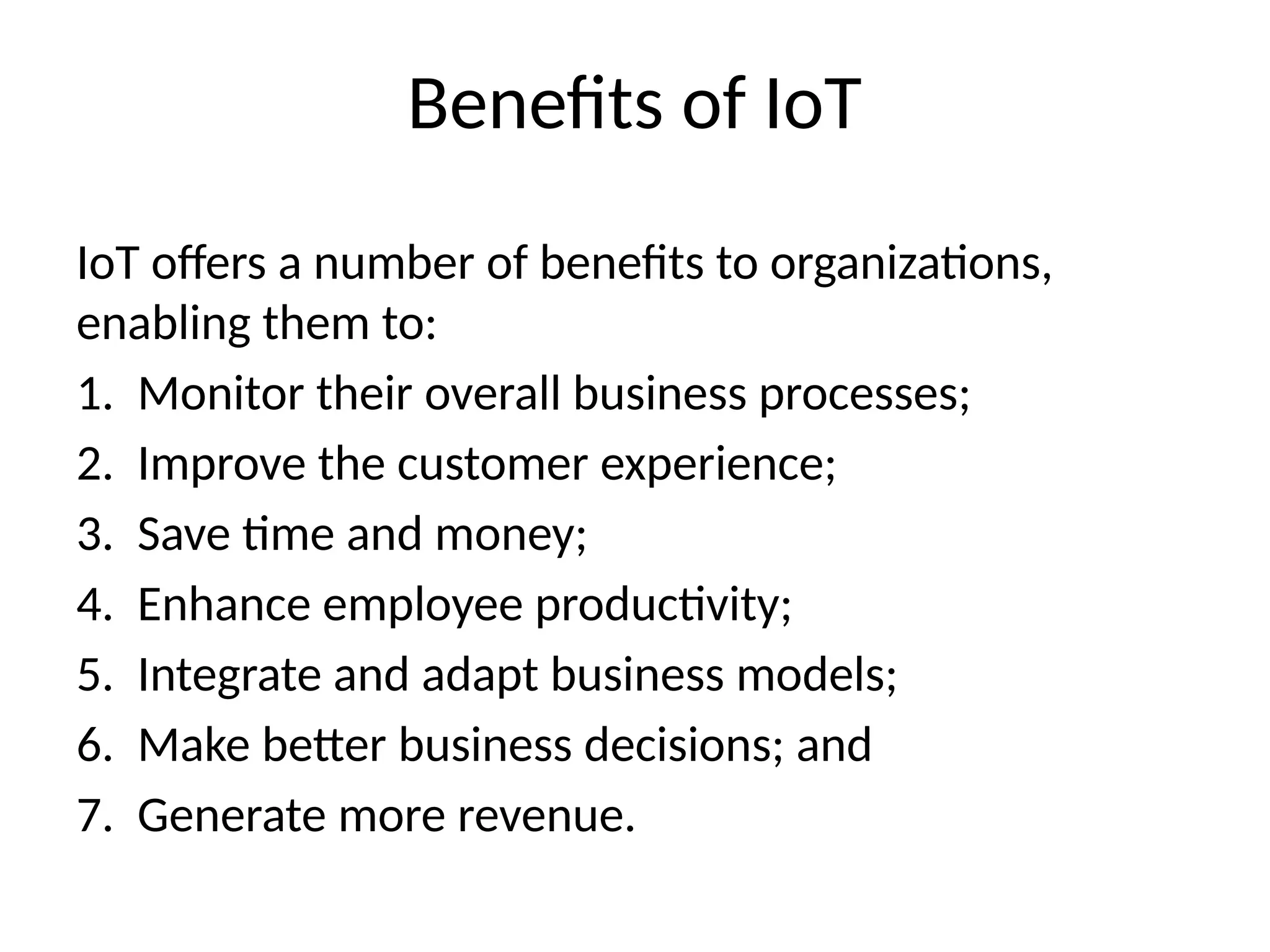
Benefits of IoT
IoToffers a number of benefits to organizations,
enabling them to:
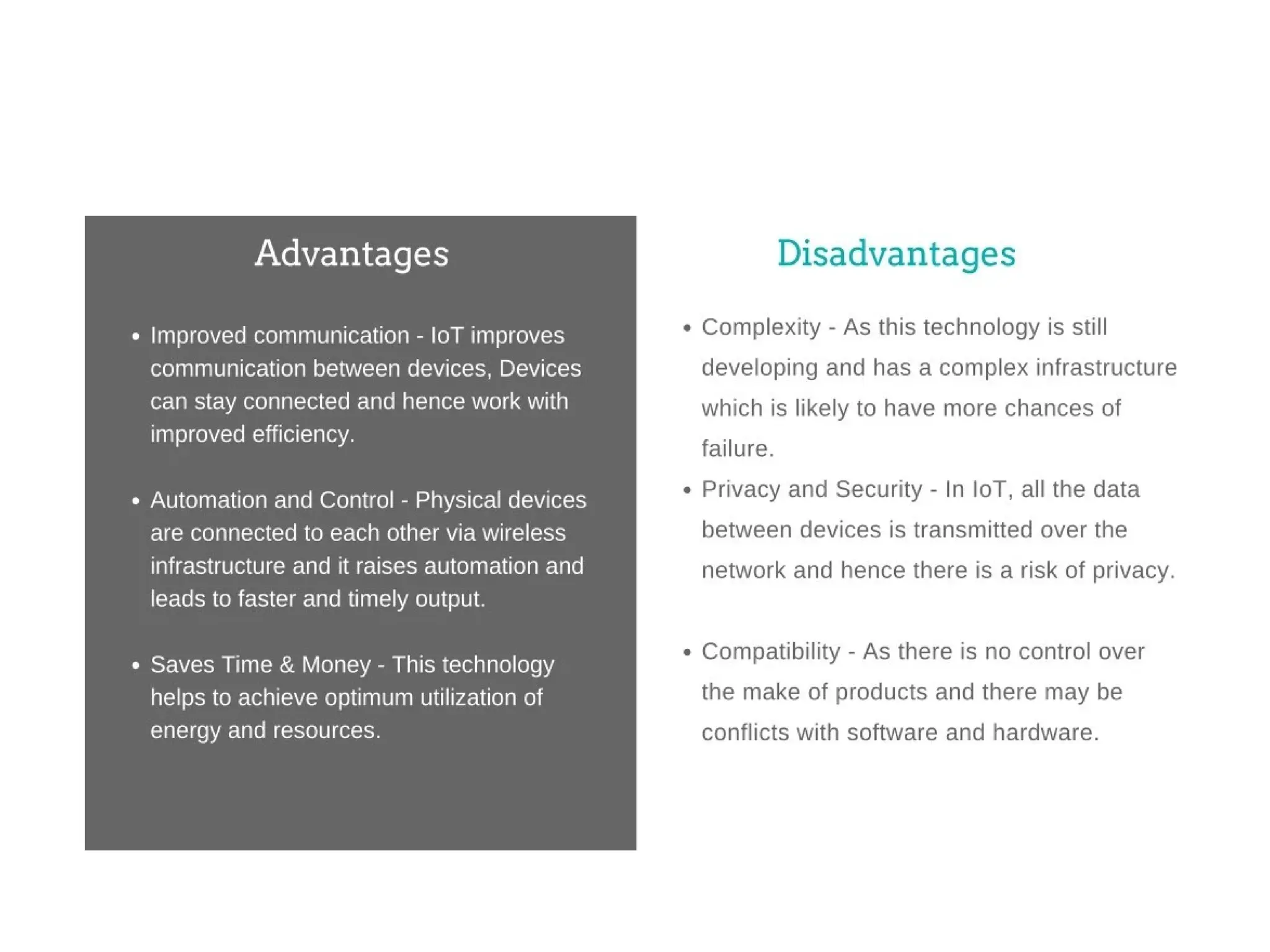
1. Monitor their overall business processes;
2. Improve the customer experience;
3. Save time and money;
4. Enhance employee productivity;
5. Integrate and adapt business models;
6. Make better business decisions; and
7. Generate more revenue.
13.
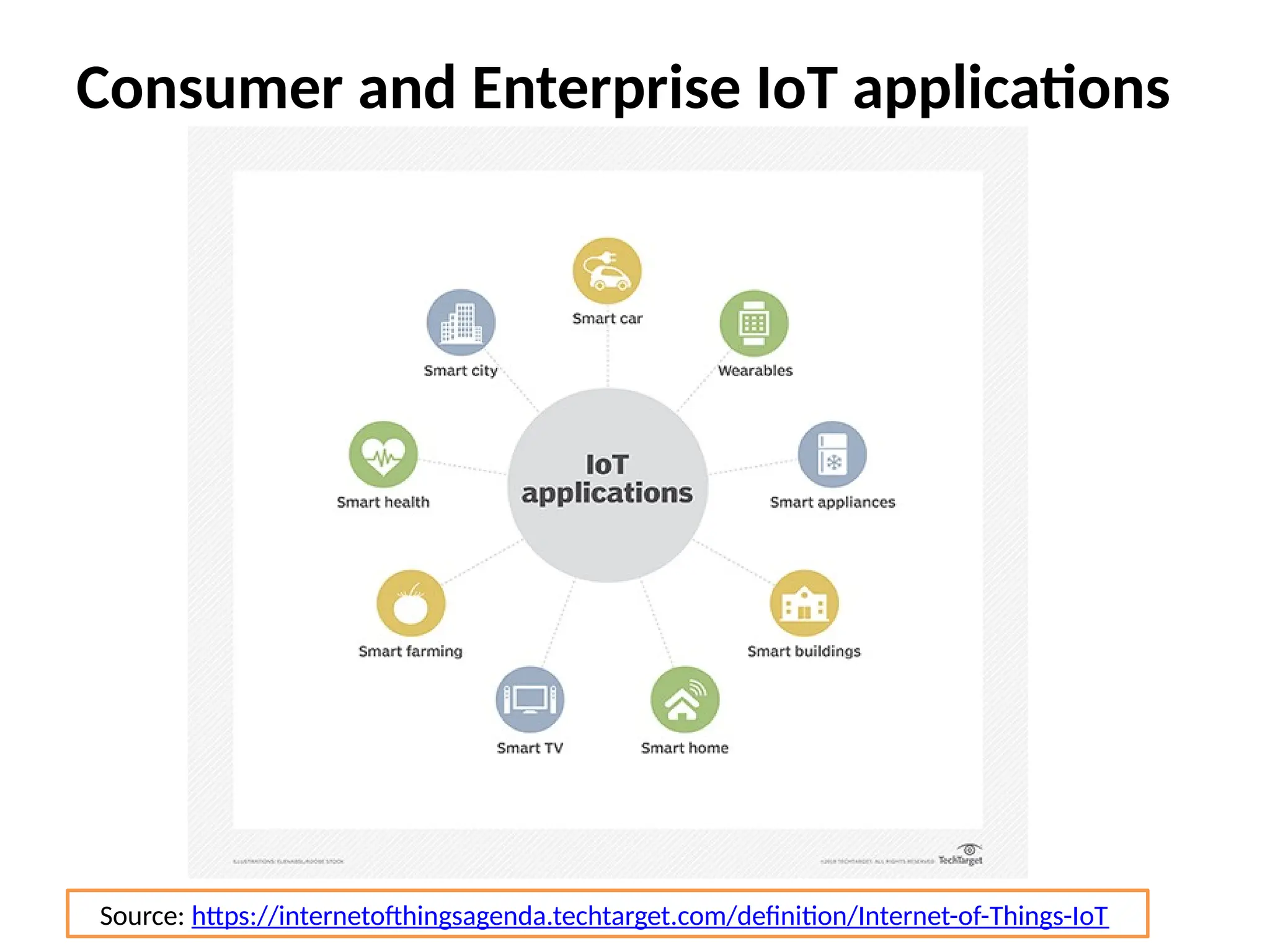
Consumer and EnterpriseIoT applications
Source: https://internetofthingsagenda.techtarget.com/definition/Internet-of-Things-IoT
14.
IoT things presentation- Davis M On
sakia
14
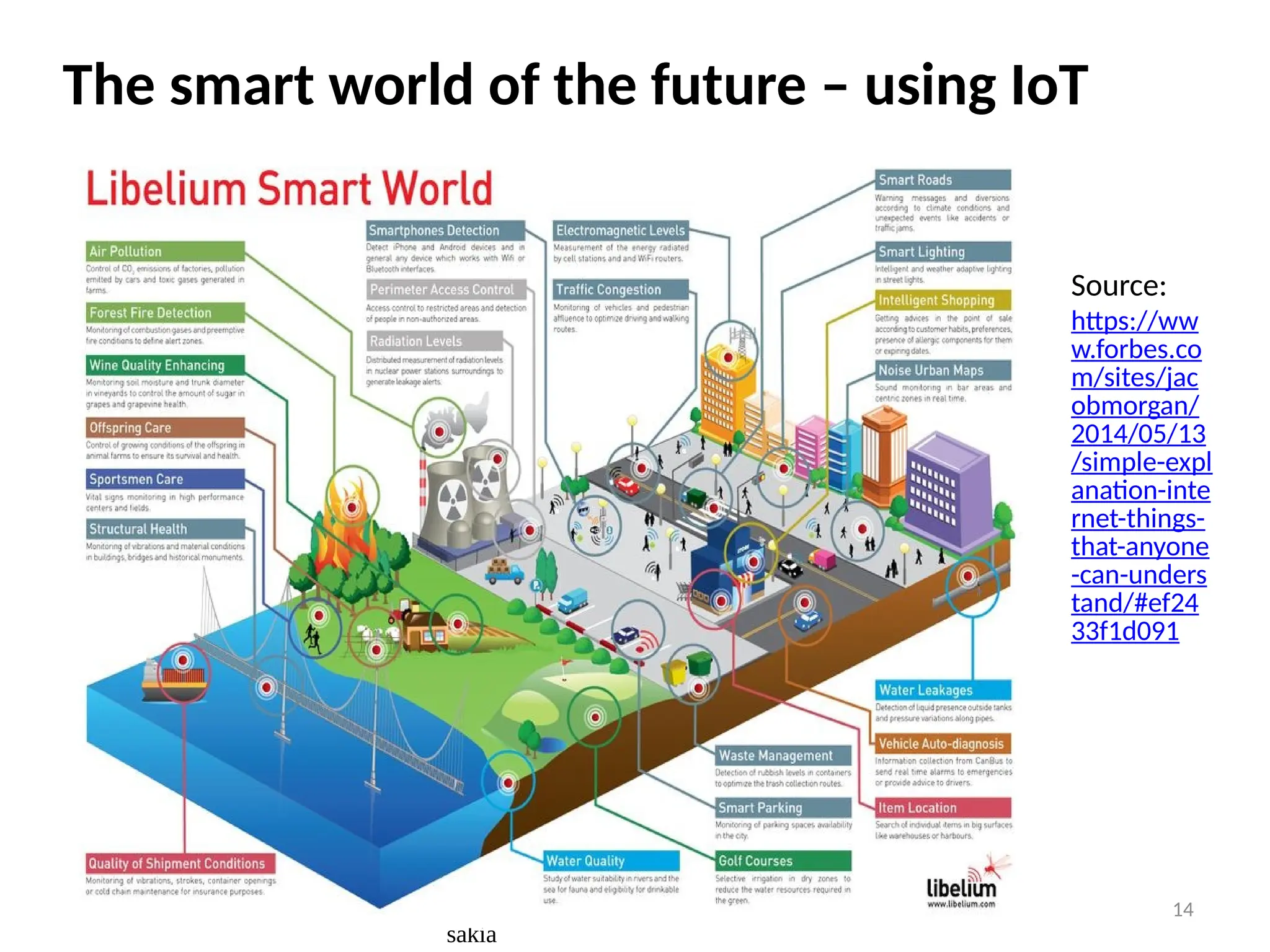
The smart world of the future – using IoT
Source:
https://ww
w.forbes.co
m/sites/jac
obmorgan/
2014/05/13
/simple-expl
anation-inte
rnet-things-
that-anyone
-can-unders
tand/#ef24
33f1d091
15.
15
Sample: consumer iotproducts & Services
1. Helmet Concussion Sensor
2. Medical Alert Watch
3. Smart Fitness Clothing and Smart Running Shoes
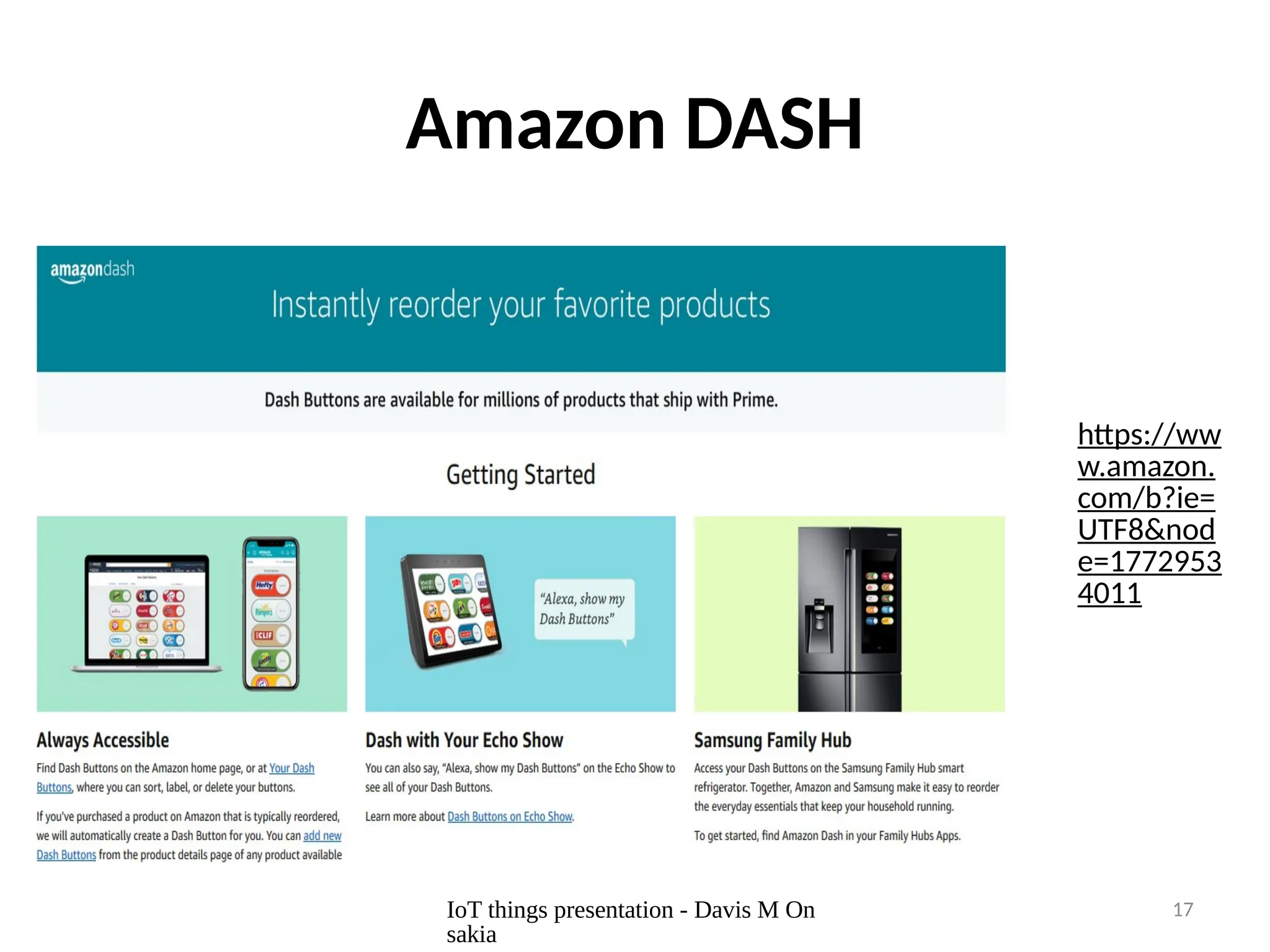
4. One-Button Product Purchases: “Order at the click of a
button!” Amazon has taken that phrase literally and produced
physical branded buttons called Amazon Dash that link to
products in your home. Say you run out of laundry powder. You
can press your Dash button for Tide and Amazon will reorder
your Tide Powder product for you. No need to sign onto the
Web, fumble with payment methods, or retype credit card
numbers.
5. Garden Sensors
6. Smart Televisions
IoT things presentation - Davis M Onsakia
16.
IoT things presentation- Davis M On
sakia
16
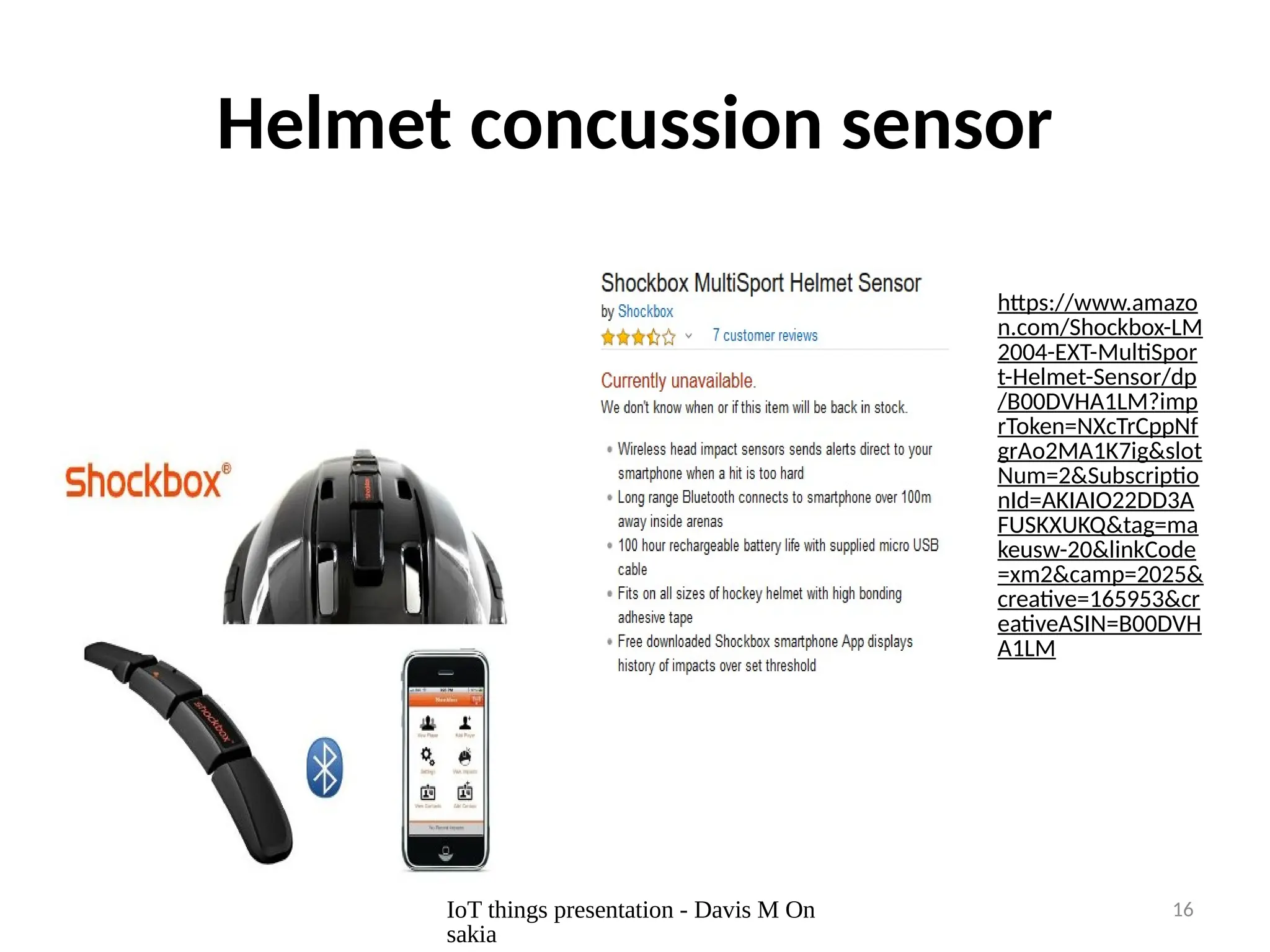
Helmet concussion sensor
https://www.amazo
n.com/Shockbox-LM
2004-EXT-MultiSpor
t-Helmet-Sensor/dp
/B00DVHA1LM?imp
rToken=NXcTrCppNf
grAo2MA1K7ig&slot
Num=2&Subscriptio
nId=AKIAIO22DD3A
FUSKXUKQ&tag=ma
keusw-20&linkCode
=xm2&camp=2025&
creative=165953&cr
eativeASIN=B00DVH
A1LM
17.
IoT things presentation- Davis M On
sakia
17
Amazon DASH
https://ww
w.amazon.
com/b?ie=
UTF8&nod
e=1772953
4011
19
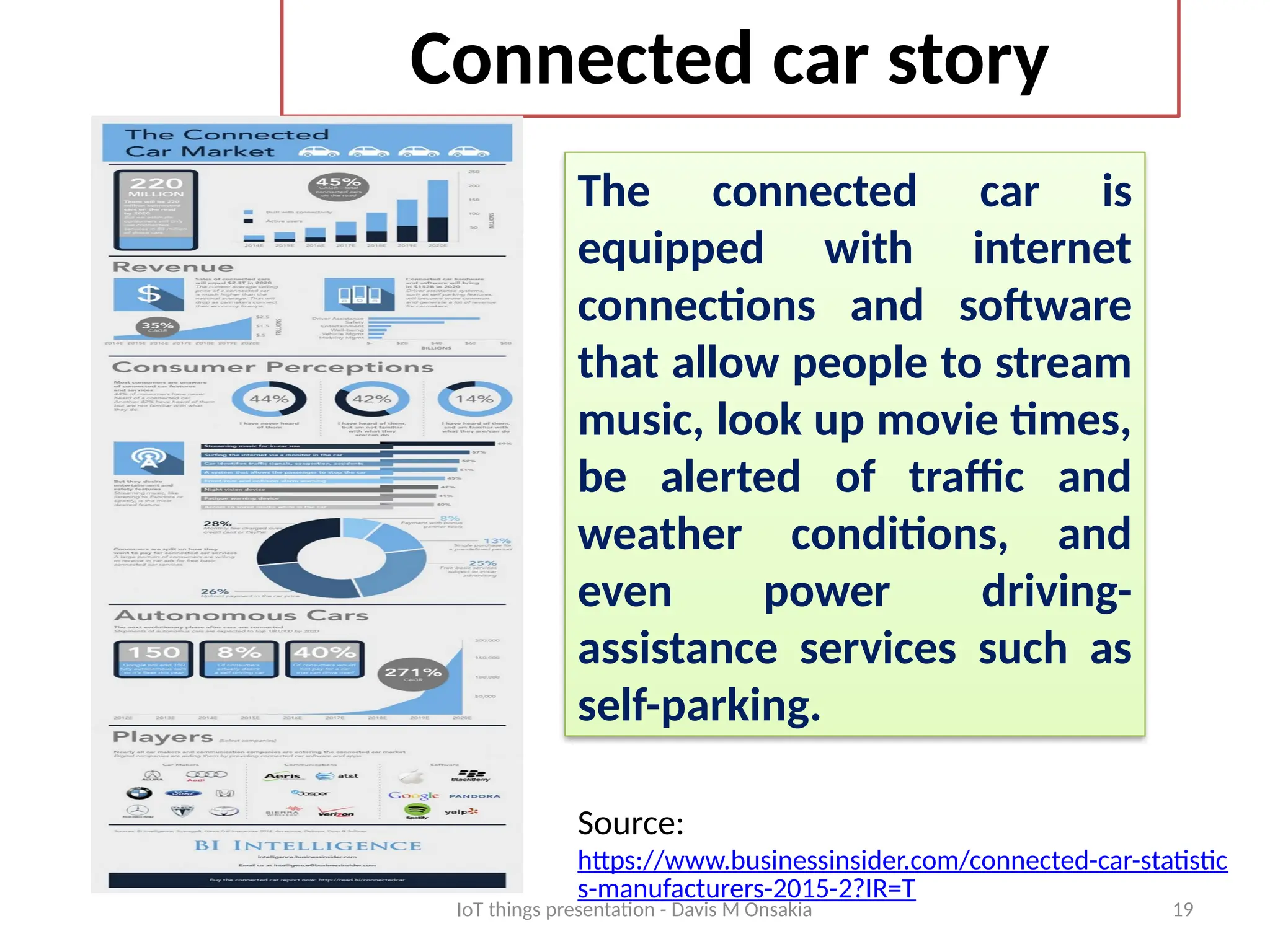
Connected car story
IoTthings presentation - Davis M Onsakia
Source:
https://www.businessinsider.com/connected-car-statistic
s-manufacturers-2015-2?IR=T
The connected car is
equipped with internet
connections and software
that allow people to stream
music, look up movie times,
be alerted of traffic and
weather conditions, and
even power driving-
assistance services such as
self-parking.
20.
20
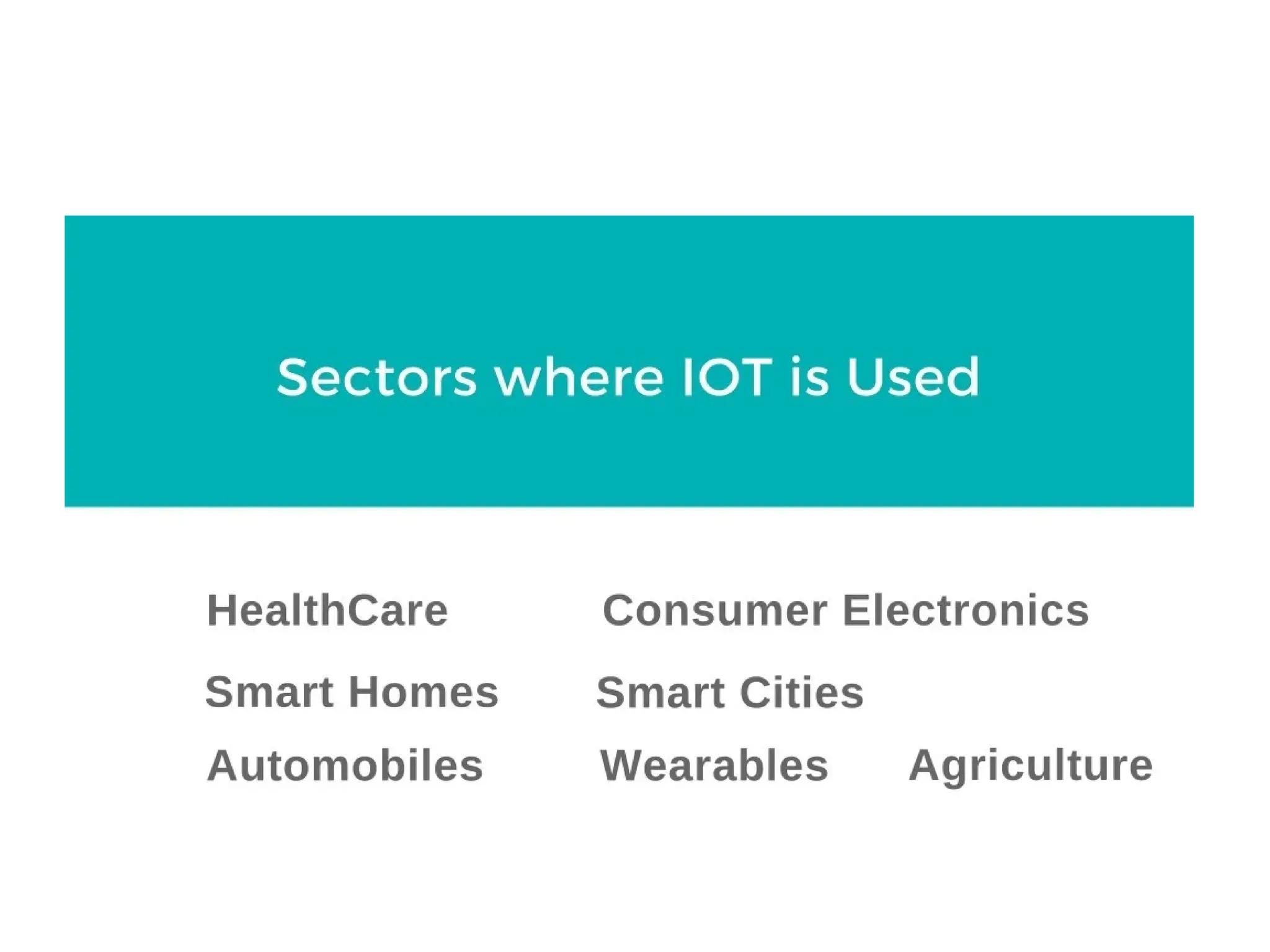
Smart farming: Useof IoT to improve agriculture
• In IoT-based smart farming, a system is built for monitoring the crop field with the
help of sensors (light, humidity, temperature, soil moisture, etc.) and automating the
irrigation system. The farmers can monitor the field conditions from anywhere. This is
highly efficient compared to the traditional/conventional approach.
• In terms of environmental issues, IoT-based smart farming provides great benefits
including: better and efficient water usage, and optimization of inputs and treatments.
• Therefore, smart farming based on IoT technologies enables growers and farmers to
reduce waste and enhance productivity.
• Some of the IoT applications in this area are:
i. Precision farming
ii. Agricultural drones
iii. Livestock monitoring
iv. Smart greenhouses
IoT things presentation - Davis M Onsakia
21.
21
Industrial IoT (IIoT)
•Industrial IoT (IIoT) focusses on the use of
cyber-physical systems to monitor the physical
factory processes and make data-based automated
decisions.
• While the physical systems are made the
intelligent using IoT, the real-time
communication, and cooperation both with each
other and with humans is established via the
wireless web
• IIoT brings in the concept of ‘a connected factory
leads to a smart factory’.
22.
22
IIoT in Manufacturing
1.Digital/connected factory: IoT enabled machinery can
transmit operational information to the partners like
original equipment manufacturers and to field engineers.
2. Facility management: The use of IoT sensors in
manufacturing equipment enables condition-based
maintenance alerts.
3. Production flow monitoring: IoT in manufacturing can
enable the monitoring of production lines starting from
the refining process down to the packaging of final
products.
4. Inventory management: IoT applications permit the
monitoring of events across a supply chain.
23.
IoT things presentation- Davis M On
sakia
23
IIoT in Manufacturing (cont’d)
5. Plant Safety and Security: IoT combined big data analysis can
improve the overall workers’ safety and security in the plant. .
6. Quality control: IoT sensors collect aggregate product data
and other third-party syndicated data from various stages of a
product cycle.
7. Packaging Optimization: By using IoT sensors in products
and/or packaging, manufacturers can gain insights into the
usage patterns and handling of product from multiple
customers.
8. Logistics and Supply Chain Optimization: The Industrial IoT
(IIoT) can provide access to real-time supply chain information
by tracking materials, equipment, and products as they move
through the supply chain.
24.
24
IOT CHALLENGES
Security, privacyand data sharing issues
• Because IoT devices are closely connected, all a hacker has to do is exploit
one vulnerability to manipulate all the data, rendering it unusable. And
manufacturers that don't update their devices regularly -- or at all -- leave
them vulnerable to cybercriminals.
• However, hackers aren't the only threat to the internet of things; privacy is
another major concern for IoT users. For instance, companies that make
and distribute consumer IoT devices could use those devices to obtain and
sell users' personal data.
• Challenges with IIoT:
i. Security of data – same as above
ii. Reliability and stability – of IIoT sensors
iii. Connectivity of all the systems in IIoT setup – no maintenance envisioned?
iv. Blending legacy systems – IIoT is new in the market
25.
25
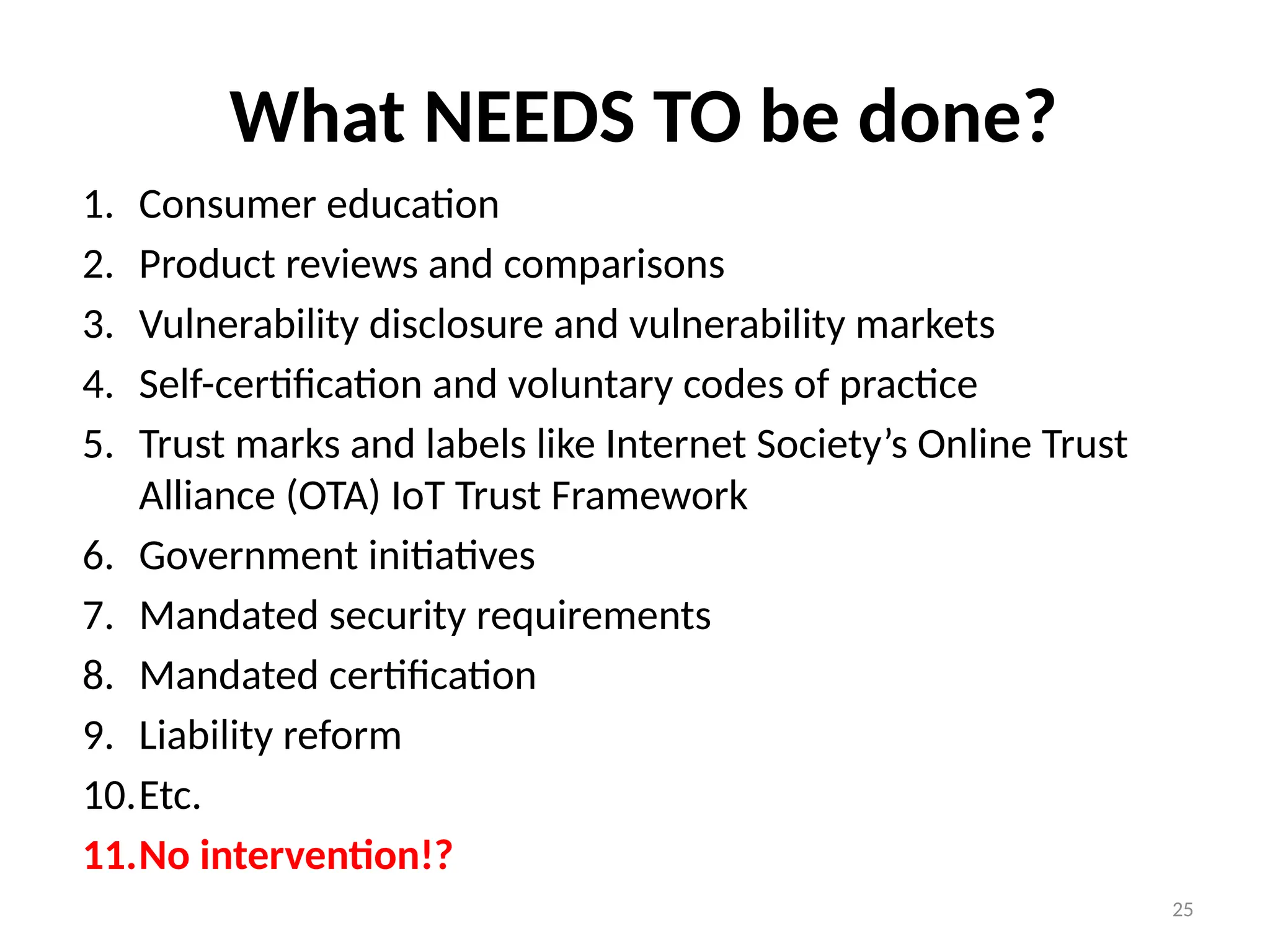
What NEEDS TObe done?
1. Consumer education
2. Product reviews and comparisons
3. Vulnerability disclosure and vulnerability markets
4. Self-certification and voluntary codes of practice
5. Trust marks and labels like Internet Society’s Online Trust
Alliance (OTA) IoT Trust Framework
6. Government initiatives
7. Mandated security requirements
8. Mandated certification
9. Liability reform
10.Etc.
11.No intervention!?
26.
26
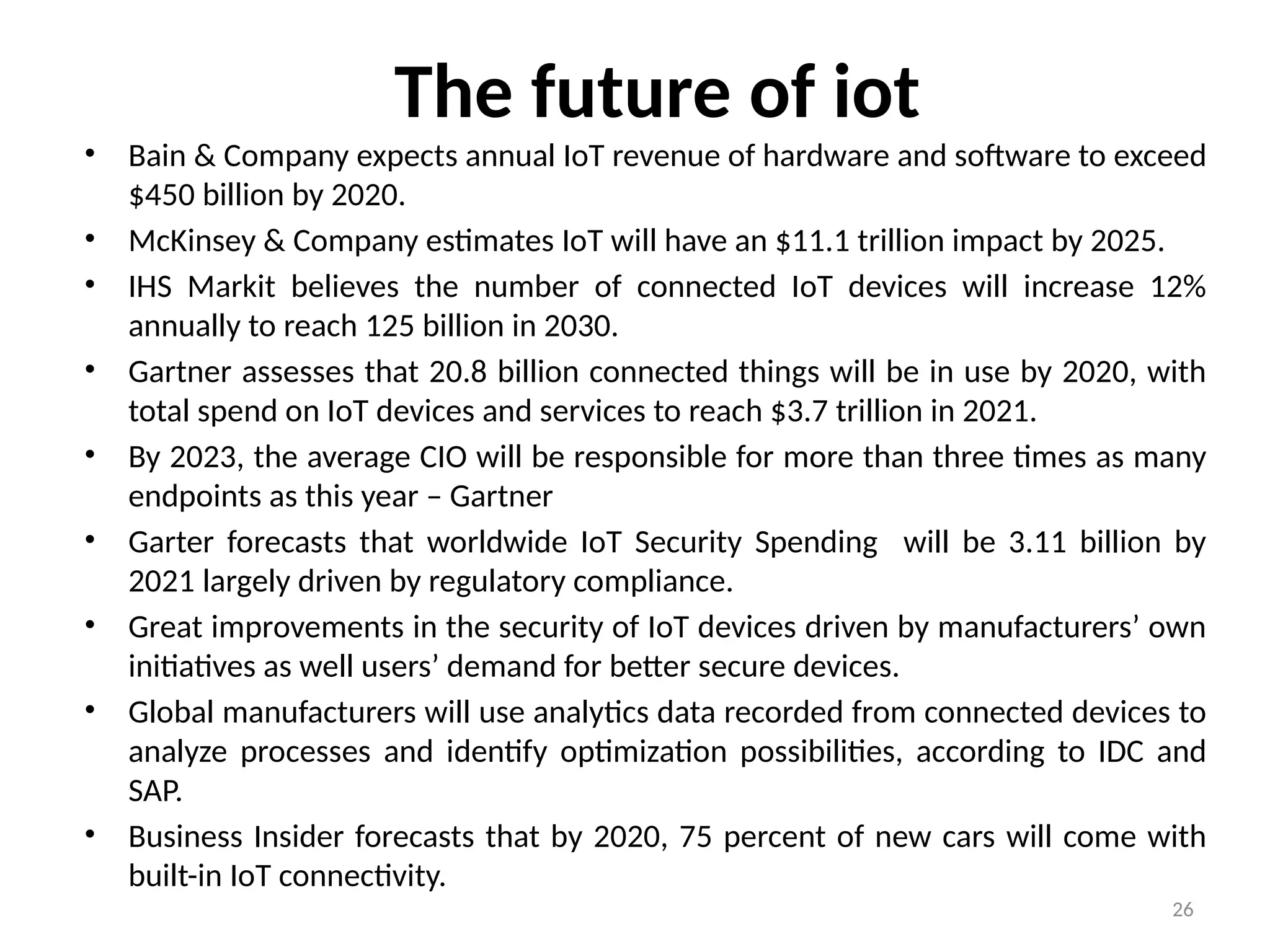
The future ofiot
• Bain & Company expects annual IoT revenue of hardware and software to exceed
$450 billion by 2020.
• McKinsey & Company estimates IoT will have an $11.1 trillion impact by 2025.
• IHS Markit believes the number of connected IoT devices will increase 12%
annually to reach 125 billion in 2030.
• Gartner assesses that 20.8 billion connected things will be in use by 2020, with
total spend on IoT devices and services to reach $3.7 trillion in 2021.
• By 2023, the average CIO will be responsible for more than three times as many
endpoints as this year – Gartner
• Garter forecasts that worldwide IoT Security Spending will be 3.11 billion by
2021 largely driven by regulatory compliance.
• Great improvements in the security of IoT devices driven by manufacturers’ own
initiatives as well users’ demand for better secure devices.
• Global manufacturers will use analytics data recorded from connected devices to
analyze processes and identify optimization possibilities, according to IDC and
SAP.
• Business Insider forecasts that by 2020, 75 percent of new cars will come with
built-in IoT connectivity.
![27
References
1. https://internetofthingsagenda.techtarget.com
2. https://www.forbes.com/sites/jacobmorgan/2014/05/13/simple-explanation-int
ernet-things-that-anyone-can-understand/#ef2433f1d091
3. https://www.gartner.com/en/newsroom/press-releases/2018-11-07-gartner-ide
ntifies-top-10-strategic-iot-technologies-and-trends
4. https://www.gartner.com/en/newsroom/press-releases/2018-03-21-gartner-say
s-worldwide-iot-security-spending-will-reach-1-point-5-billion-in-2018
5. https://www.makeuseof.com/tag/internet-things-10-useful-products-must-try-2
016/
6. “Internet of Things Research Study”,
http://www8.hp.com/us/en/hp-news/press-release.html?id=1909050 [Hewlett
Packard (2015)]
7. https://security.radware.com/ddos-threats-attacks/threat-advisories-attack-repo
rts/iot-devices-threat-spreading/
8. https://www2.deloitte.com/ng/en/pages/technology-media-and-telecommunica
tions/articles/global-mobile-consumer-survey.html
9. https://www.newgenapps.com/blog/8-uses-applications-and-benefits-of-industri
al-iot-in-manufacturing](https://image.slidesharecdn.com/iot-250410171619-0ea1a257/75/IoT-internet-of-things-internet-of-things-27-2048.jpg)


