IoT For Data Science and
Analytics
"Anything that can be connected, will be connected"
Sourav Tripathy
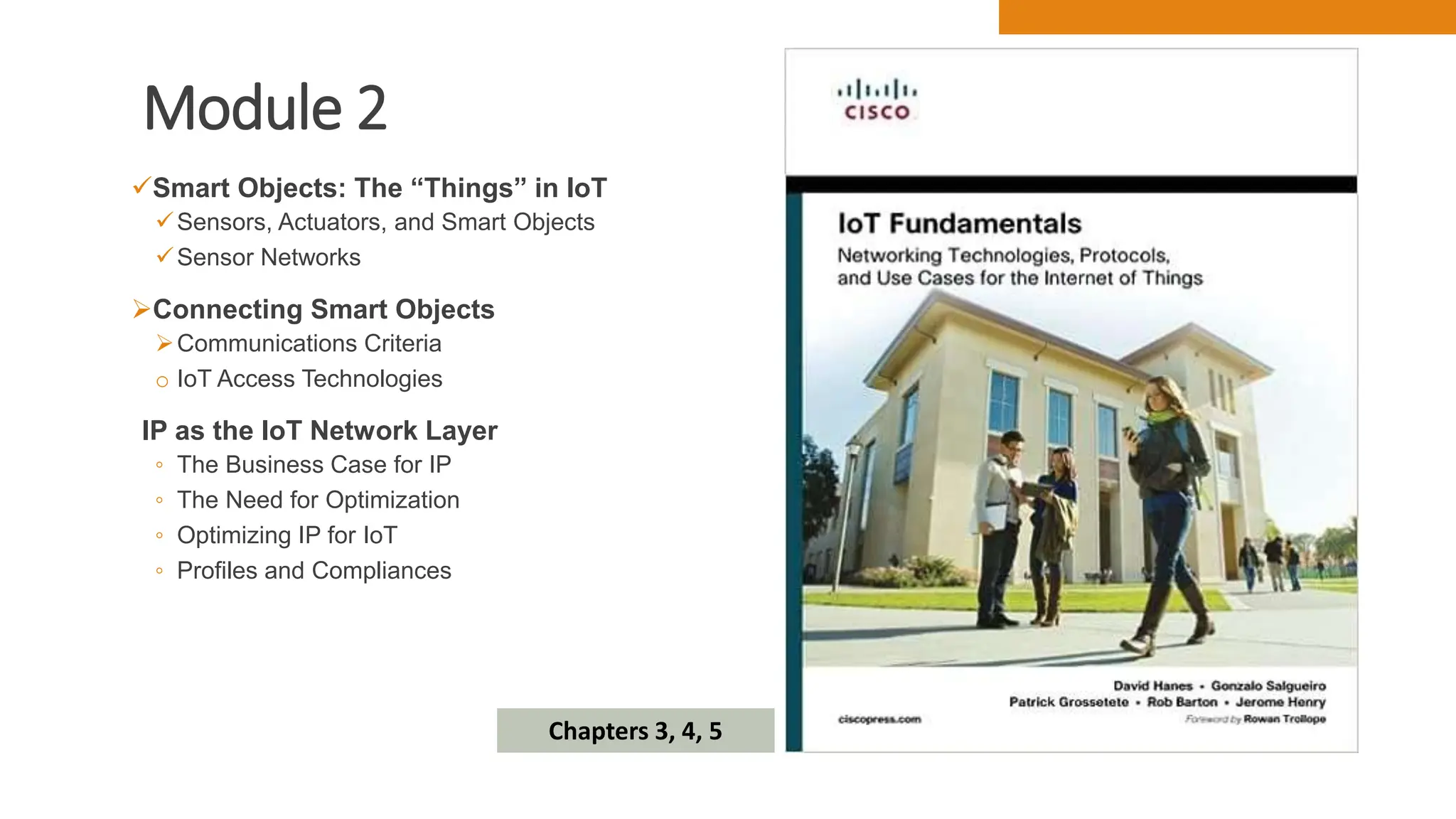
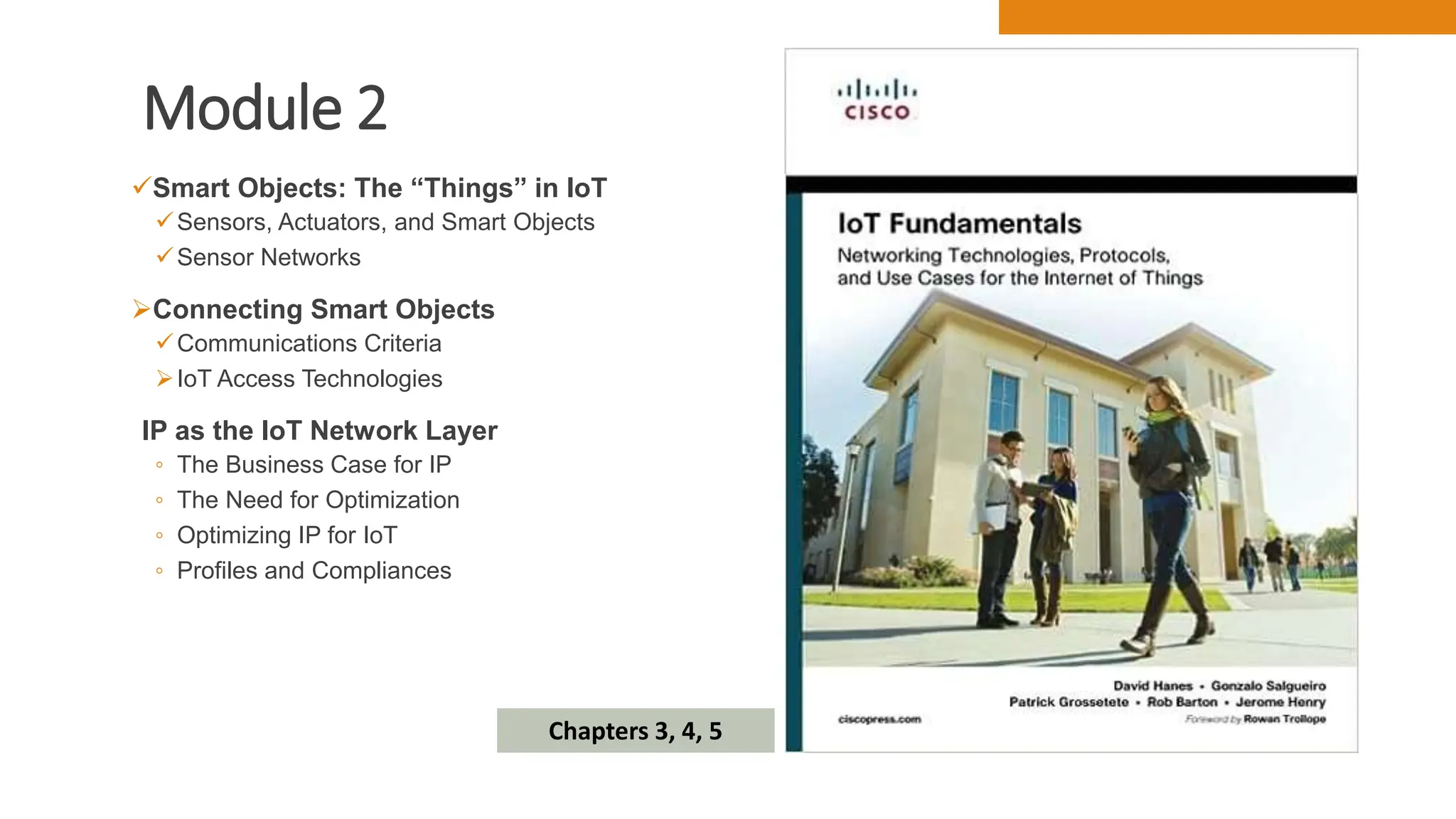
Module 2
2
Module 2
IOT FOR DATA SCIENCE AND ANALYTICS 3
Module 2
4
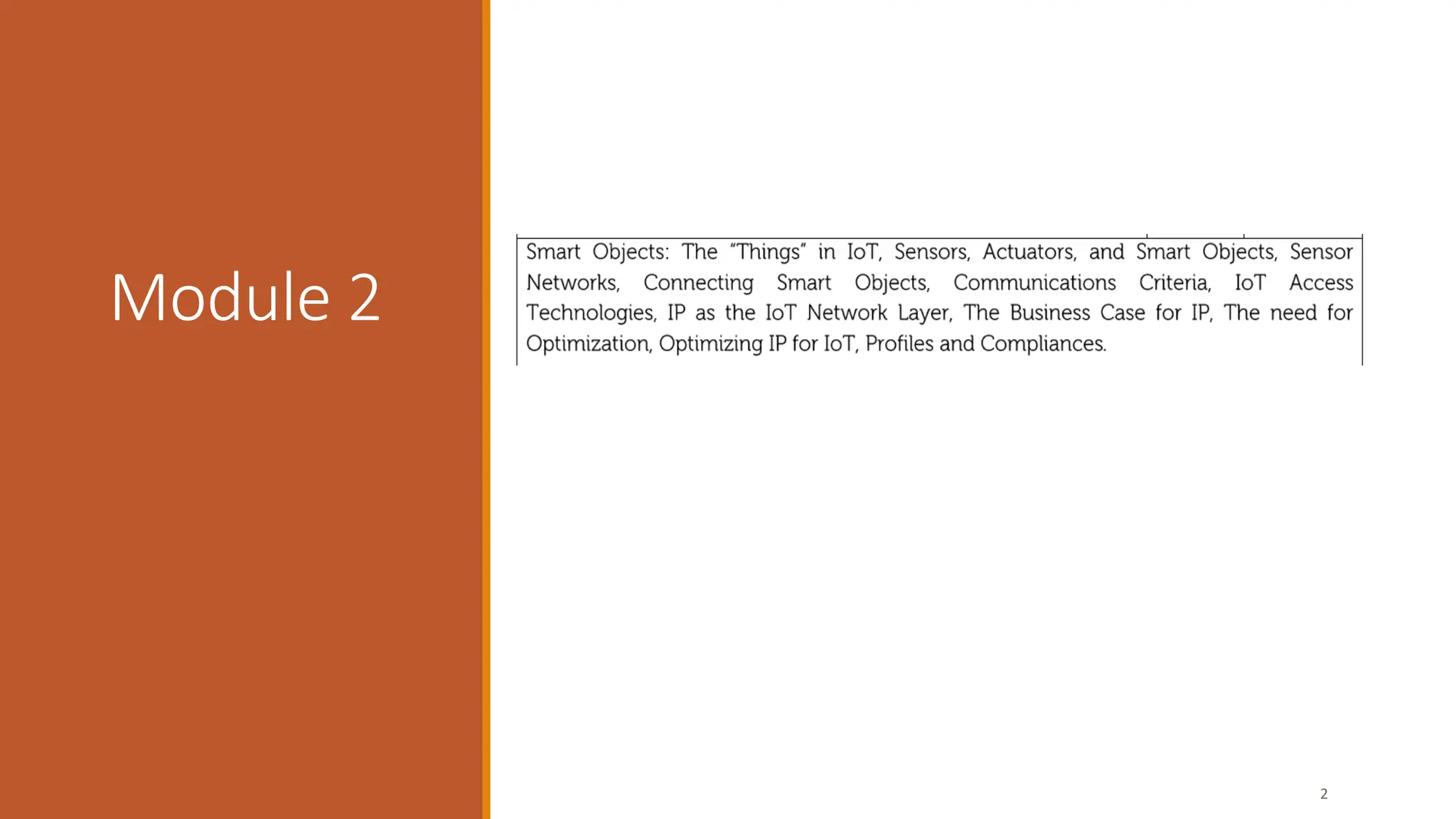
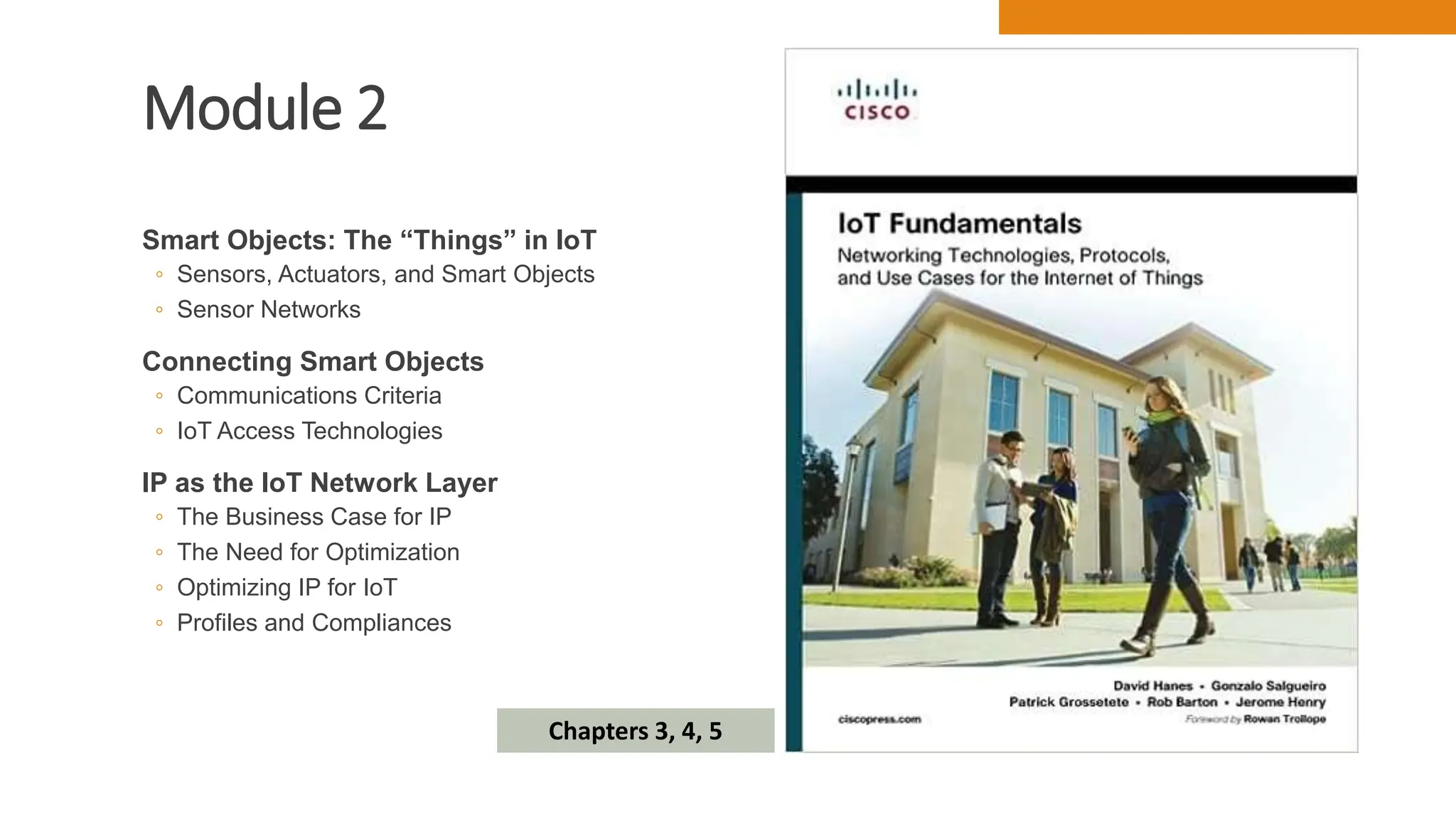
Smart Objects: The “Things” in IoT
◦ Sensors, Actuators, and Smart Objects
◦ Sensor Networks
Connecting Smart Objects
◦ Communications Criteria
◦ IoT Access Technologies
IP as the IoT Network Layer
◦ The Business Case for IP
◦ The Need for Optimization
◦ Optimizing IP for IoT
◦ Profiles and Compliances
Chapters 3, 4, 5
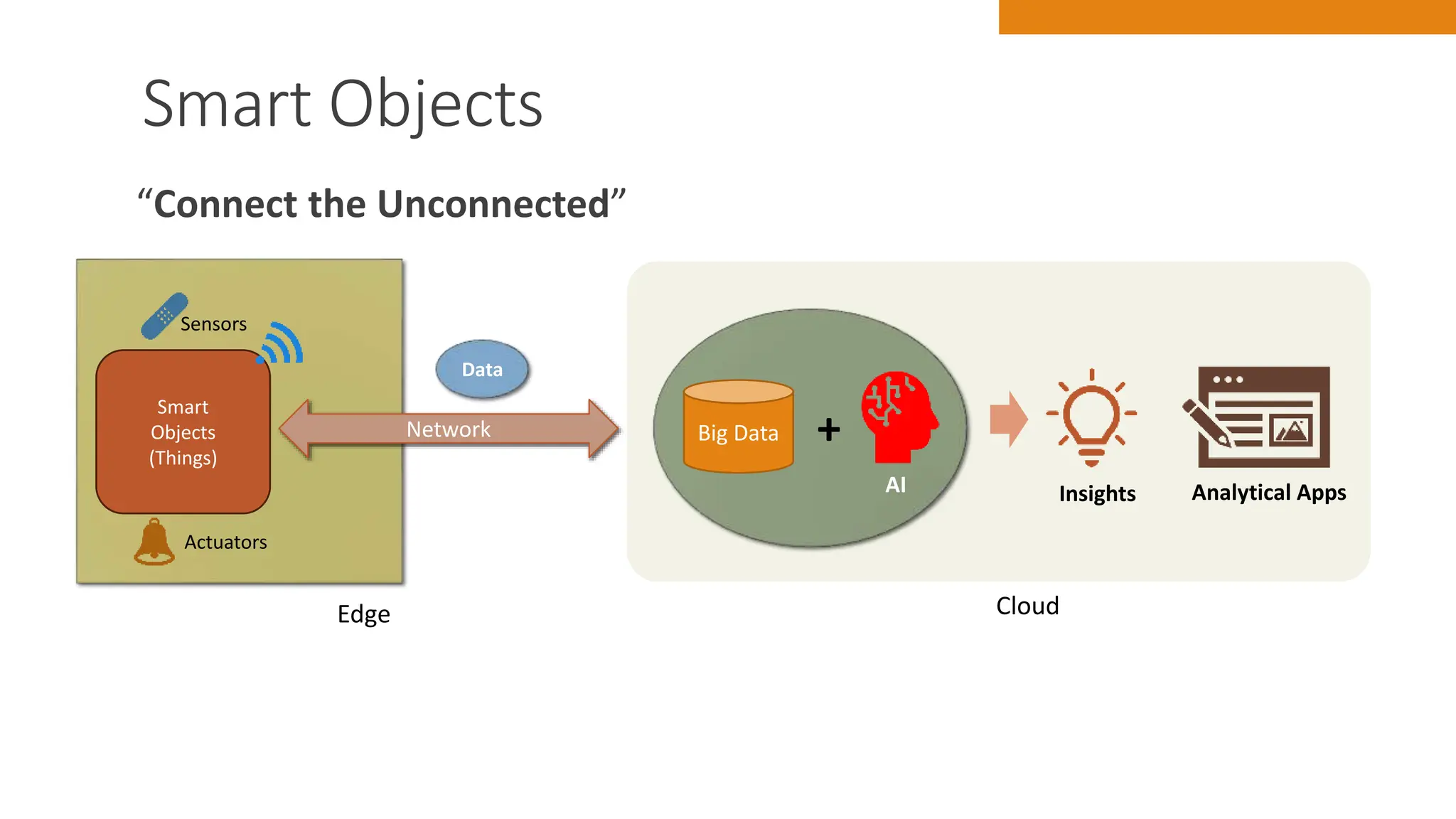
Smart
Objects
(Things)
Smart Objects
“Connect the Unconnected”
IOT FOR DATA SCIENCE AND ANALYTICS 5
Data
Big Data
AI
+
Insights Analytical Apps
Actuators
Network
Sensors
Cloud
Edge
Smart Objects: The “Things” in IoT
6
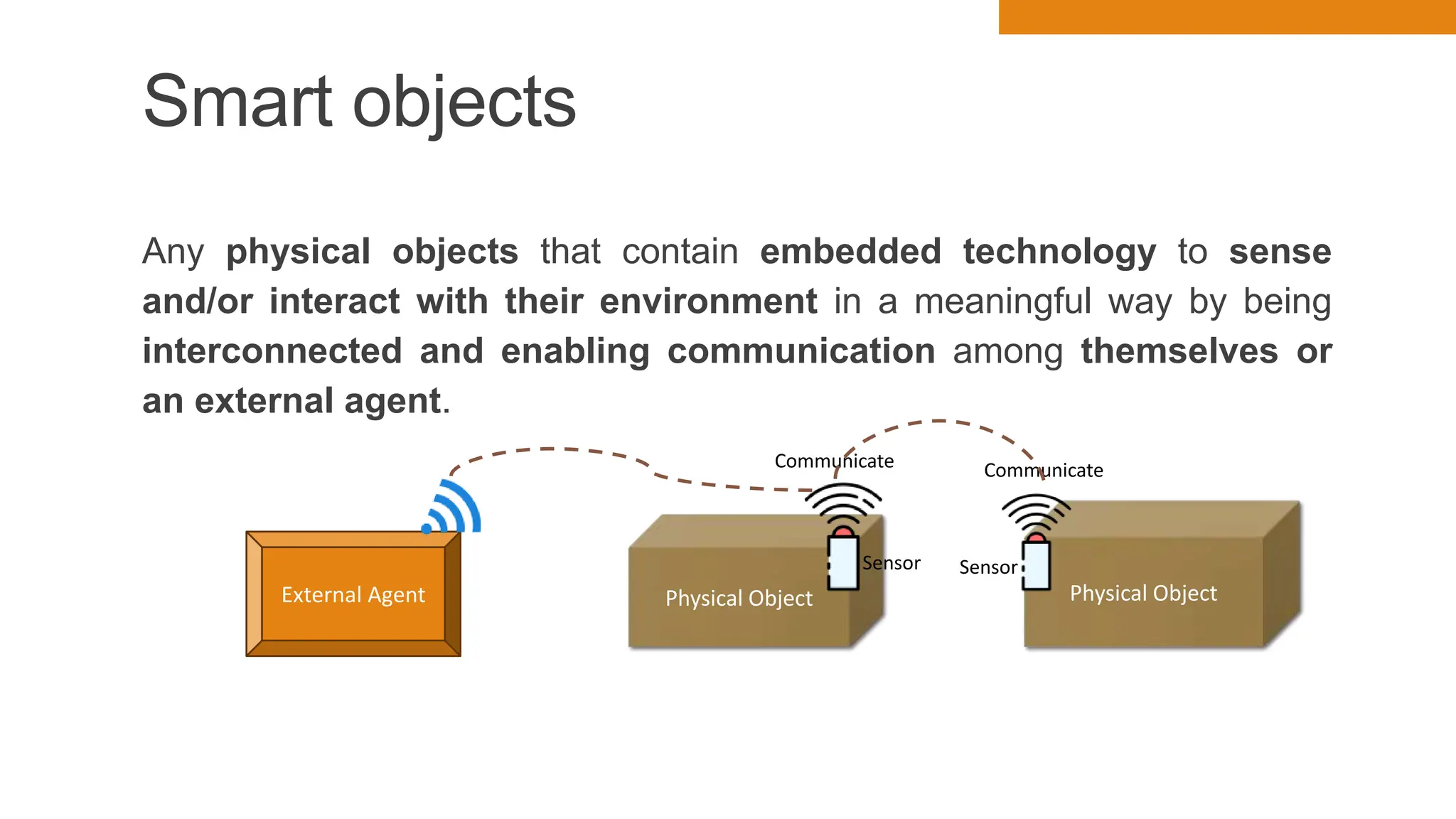
Smart objects
Any physical objects that contain embedded technology to sense
and/or interact with their environment in a meaningful way by being
interconnected and enabling communication among themselves or
an external agent.
IOT FOR DATA SCIENCE AND ANALYTICS 7
Physical Object
Sensor
Communicate
Physical Object
Sensor
Communicate
External Agent
Sensors, Actuators, and Smart
Objects
CAPABILITIES, CHARACTERISTICS, AND FUNCTIONALITY OF SENSORS
AND ACTUATORS
RIGHT ECONOMIC AND TECHNICAL CONDITIONS
8
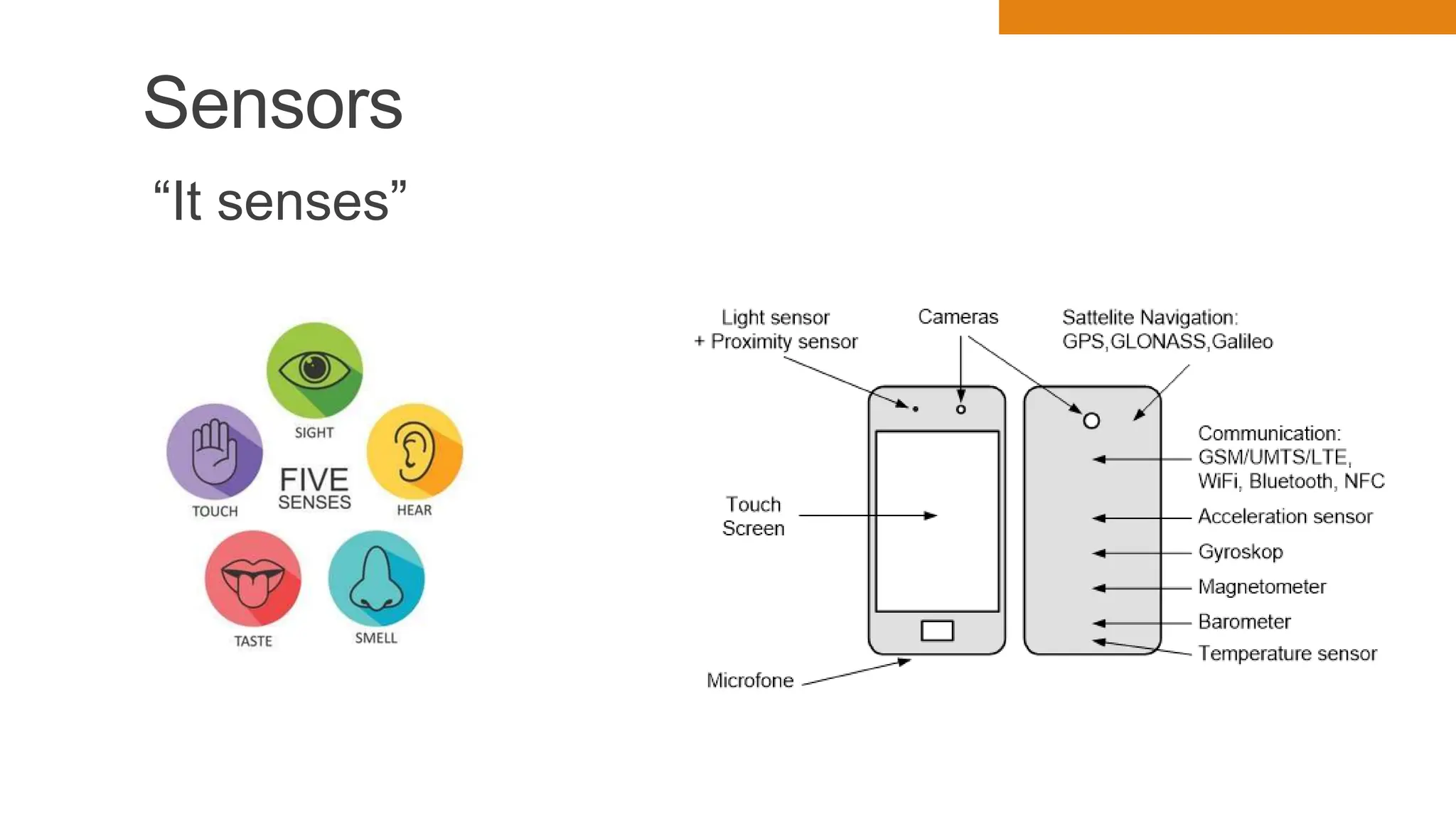
Sensors
“It senses”
IOT FOR DATA SCIENCE AND ANALYTICS 9
Sensors
IOT THINGS PRESENTATION - DAVIS M ONSAKIA 10
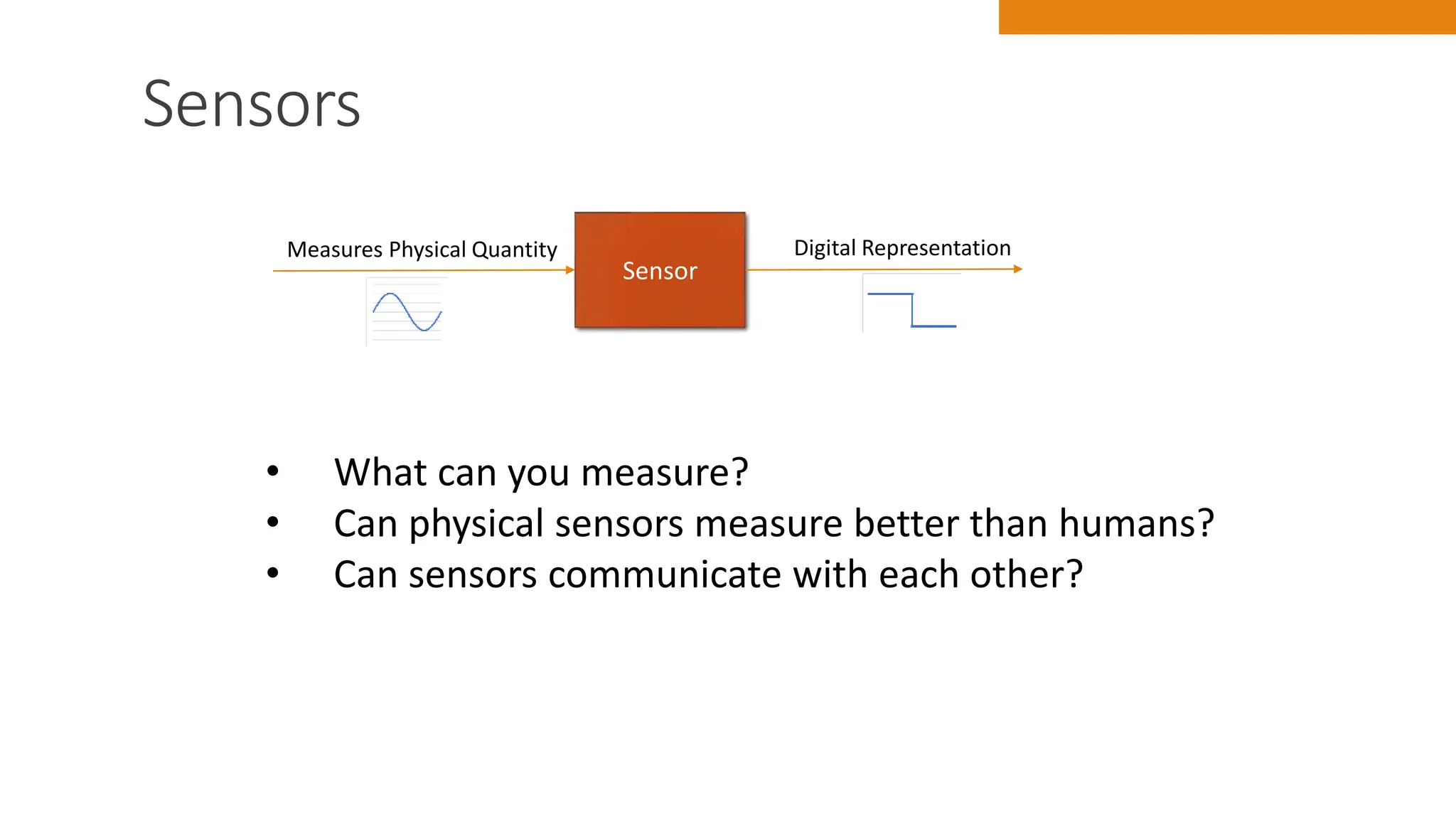
Sensor
Measures Physical Quantity Digital Representation
• What can you measure?
• Can physical sensors measure better than humans?
• Can sensors communicate with each other?
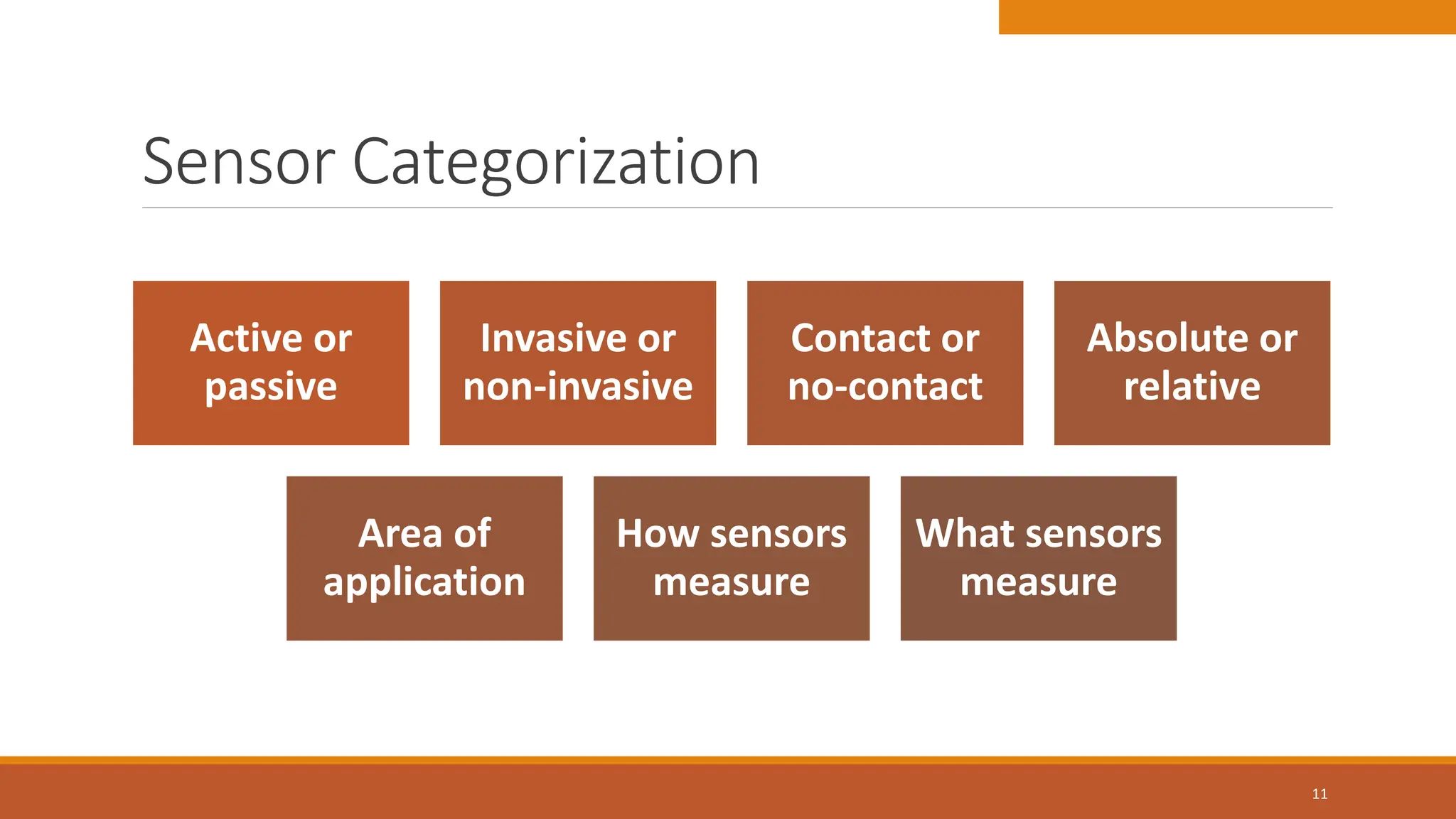
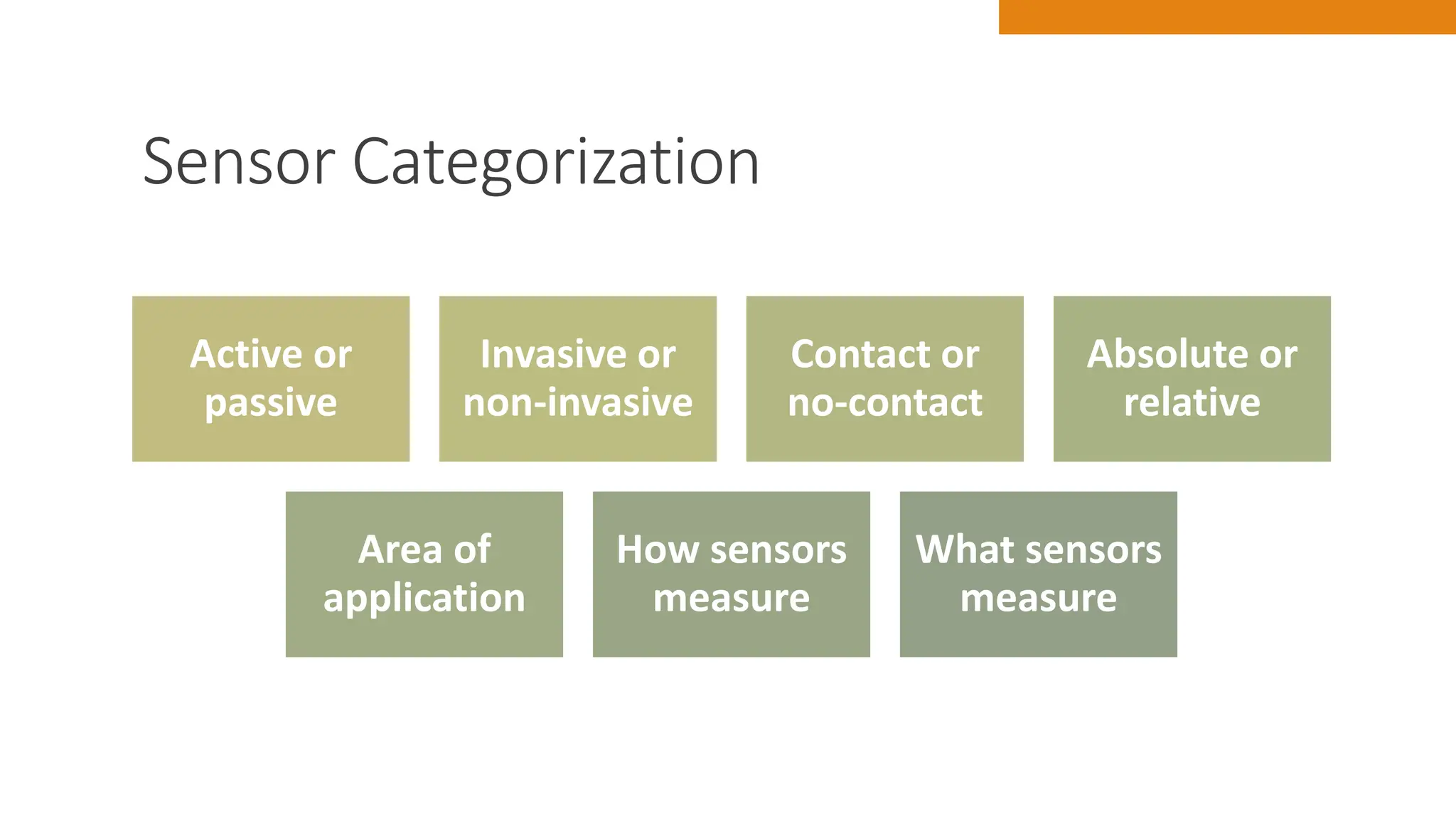
Sensor Categorization
11
Active or
passive
Invasive or
non-invasive
Contact or
no-contact
Absolute or
relative
Area of
application
How sensors
measure
What sensors
measure
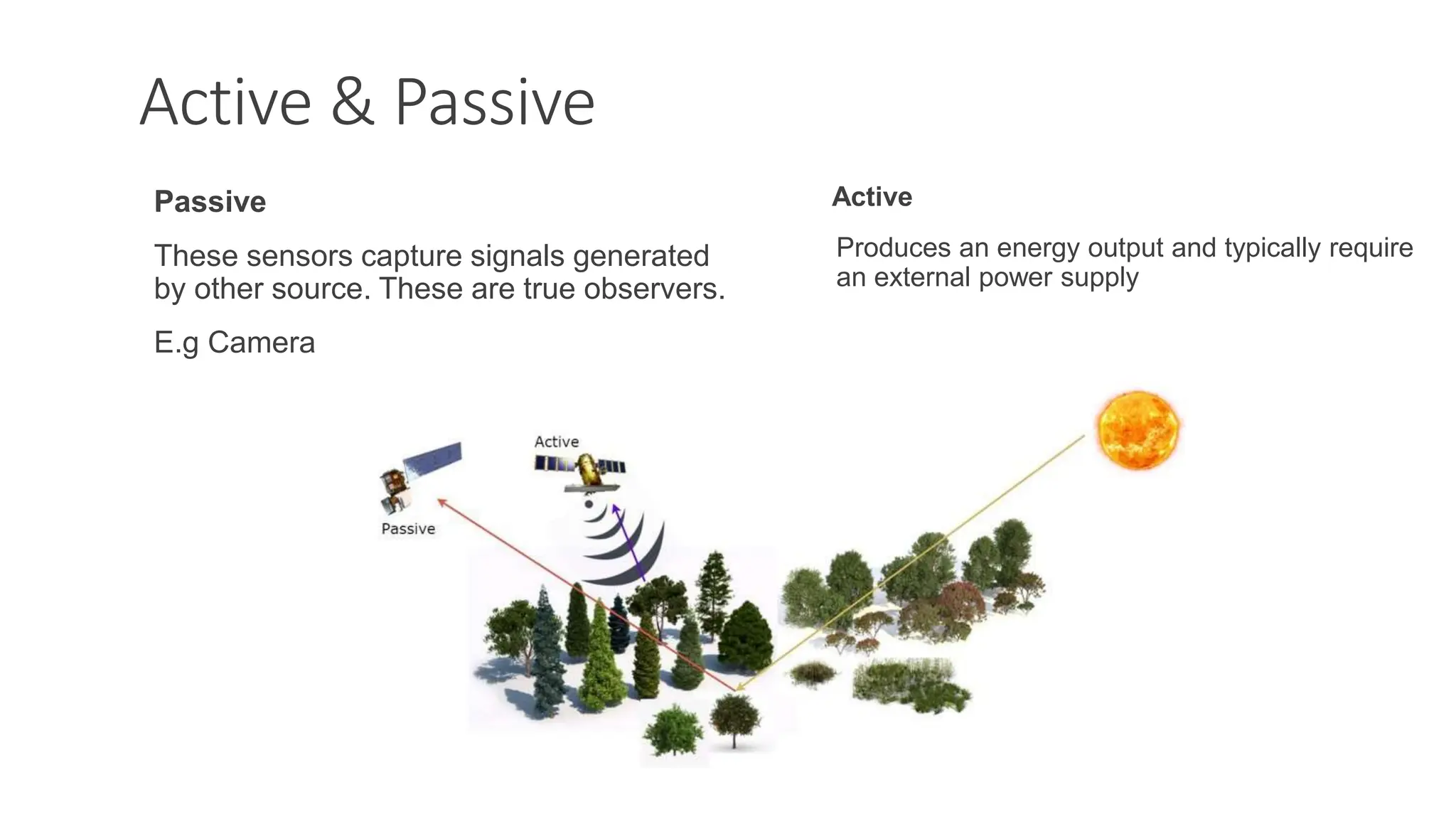
Active & Passive
Active
Produces an energy output and typically require
an external power supply
Passive
These sensors capture signals generated
by other source. These are true observers.
E.g Camera
IOT THINGS PRESENTATION - DAVIS M ONSAKIA 12
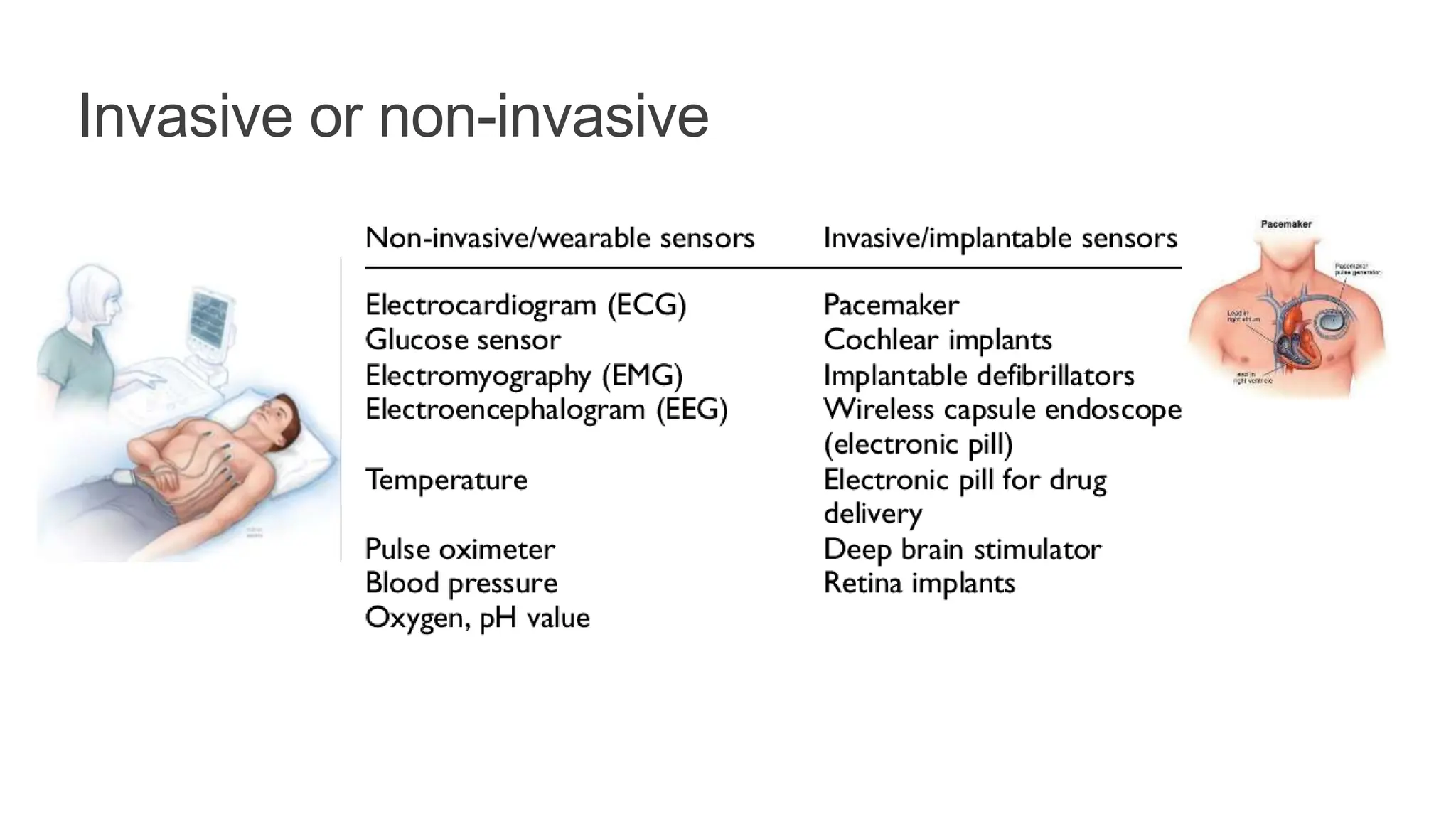
Invasive or non-invasive
IOT THINGS PRESENTATION - DAVIS M ONSAKIA 13
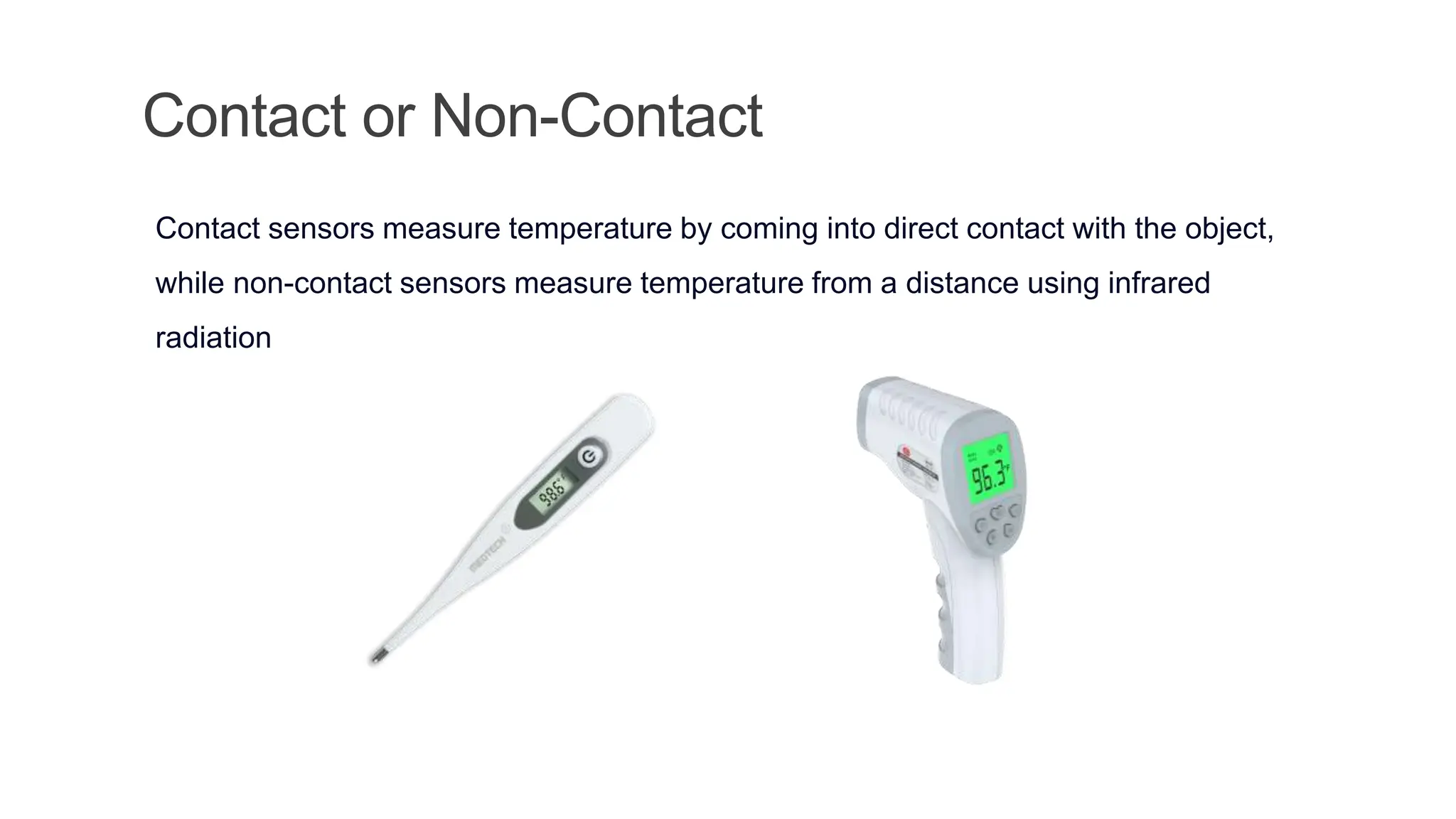
Contact or Non-Contact
IOT THINGS PRESENTATION - DAVIS M ONSAKIA 14
Contact sensors measure temperature by coming into direct contact with the object,
while non-contact sensors measure temperature from a distance using infrared
radiation
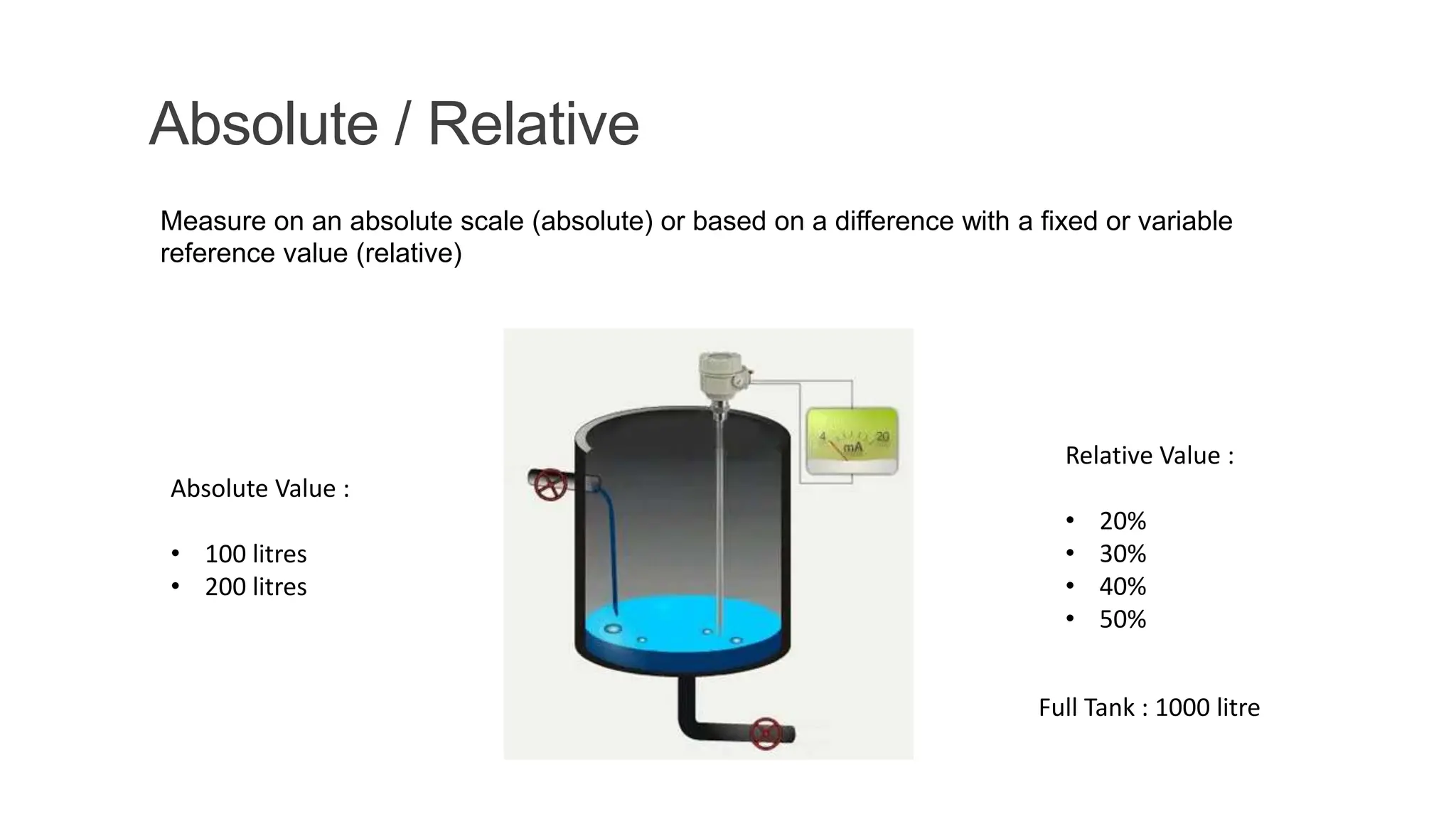
Absolute / Relative
IOT THINGS PRESENTATION - DAVIS M ONSAKIA 15
Measure on an absolute scale (absolute) or based on a difference with a fixed or variable
reference value (relative)
Absolute Value :
• 100 litres
• 200 litres
Relative Value :
• 20%
• 30%
• 40%
• 50%
Full Tank : 1000 litre
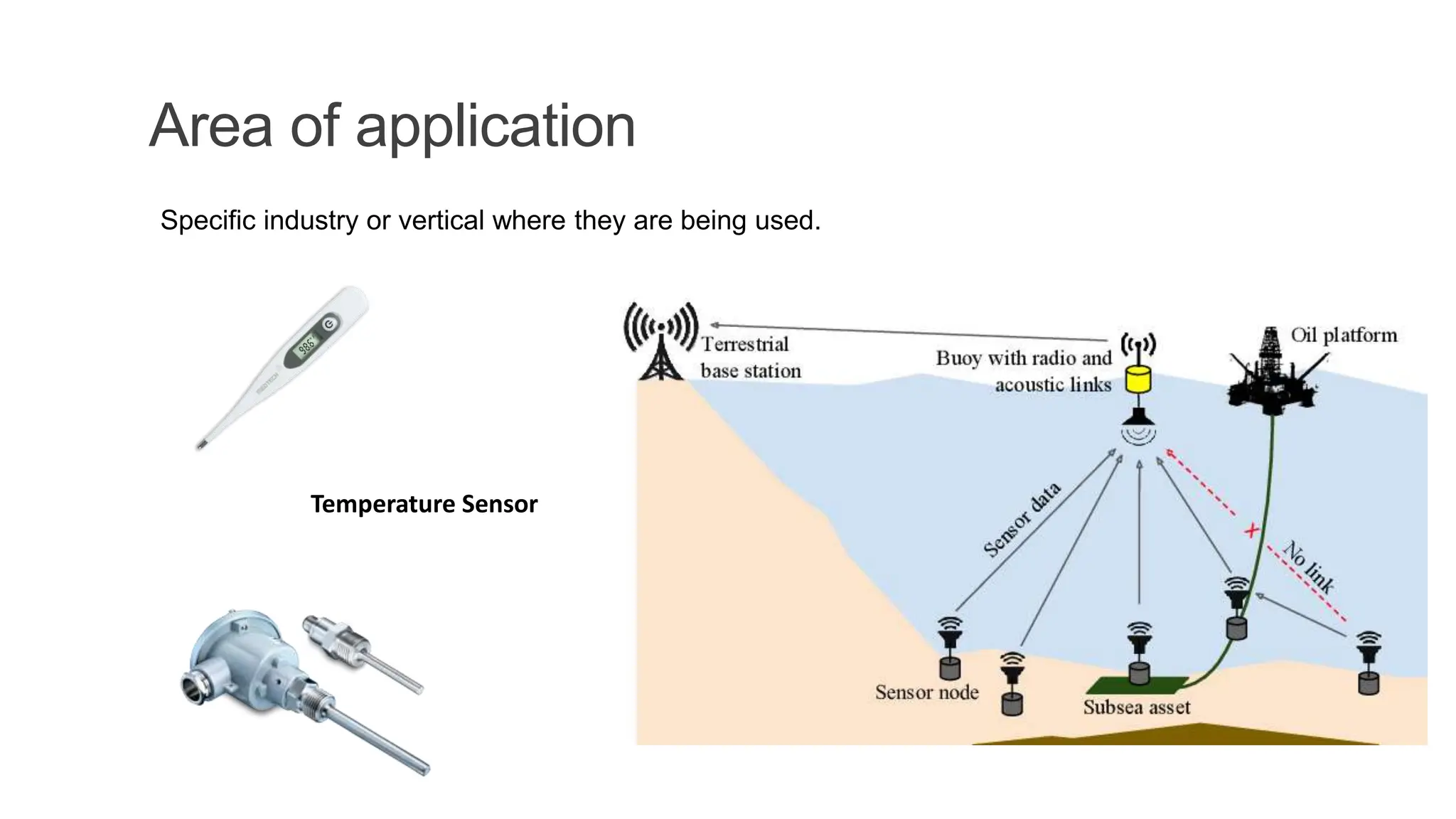
Area of application
IOT THINGS PRESENTATION - DAVIS M ONSAKIA 16
Specific industry or vertical where they are being used.
Temperature Sensor
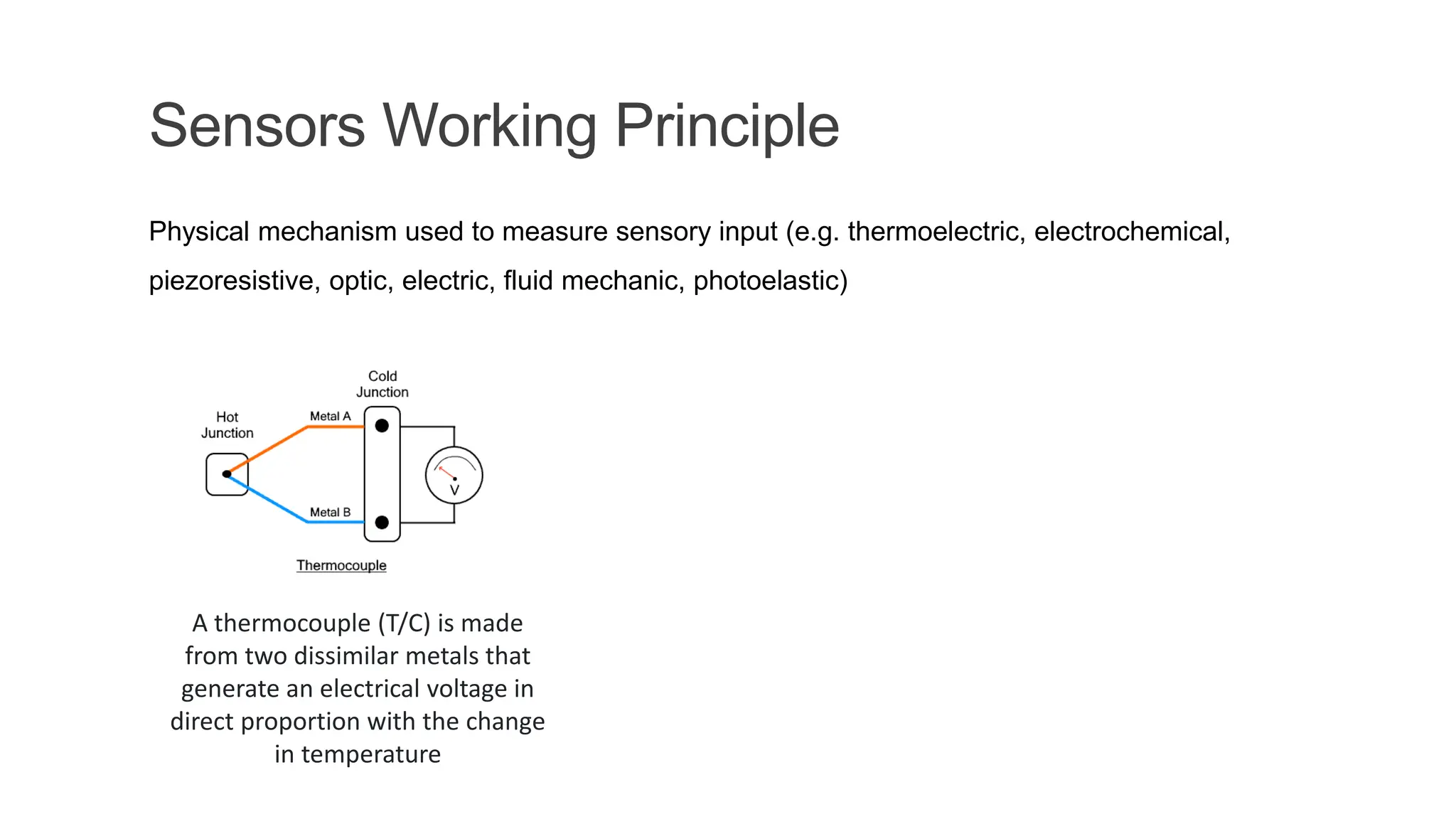
Sensors Working Principle
IOT THINGS PRESENTATION - DAVIS M ONSAKIA 17
Physical mechanism used to measure sensory input (e.g. thermoelectric, electrochemical,
piezoresistive, optic, electric, fluid mechanic, photoelastic)
A thermocouple (T/C) is made
from two dissimilar metals that
generate an electrical voltage in
direct proportion with the change
in temperature
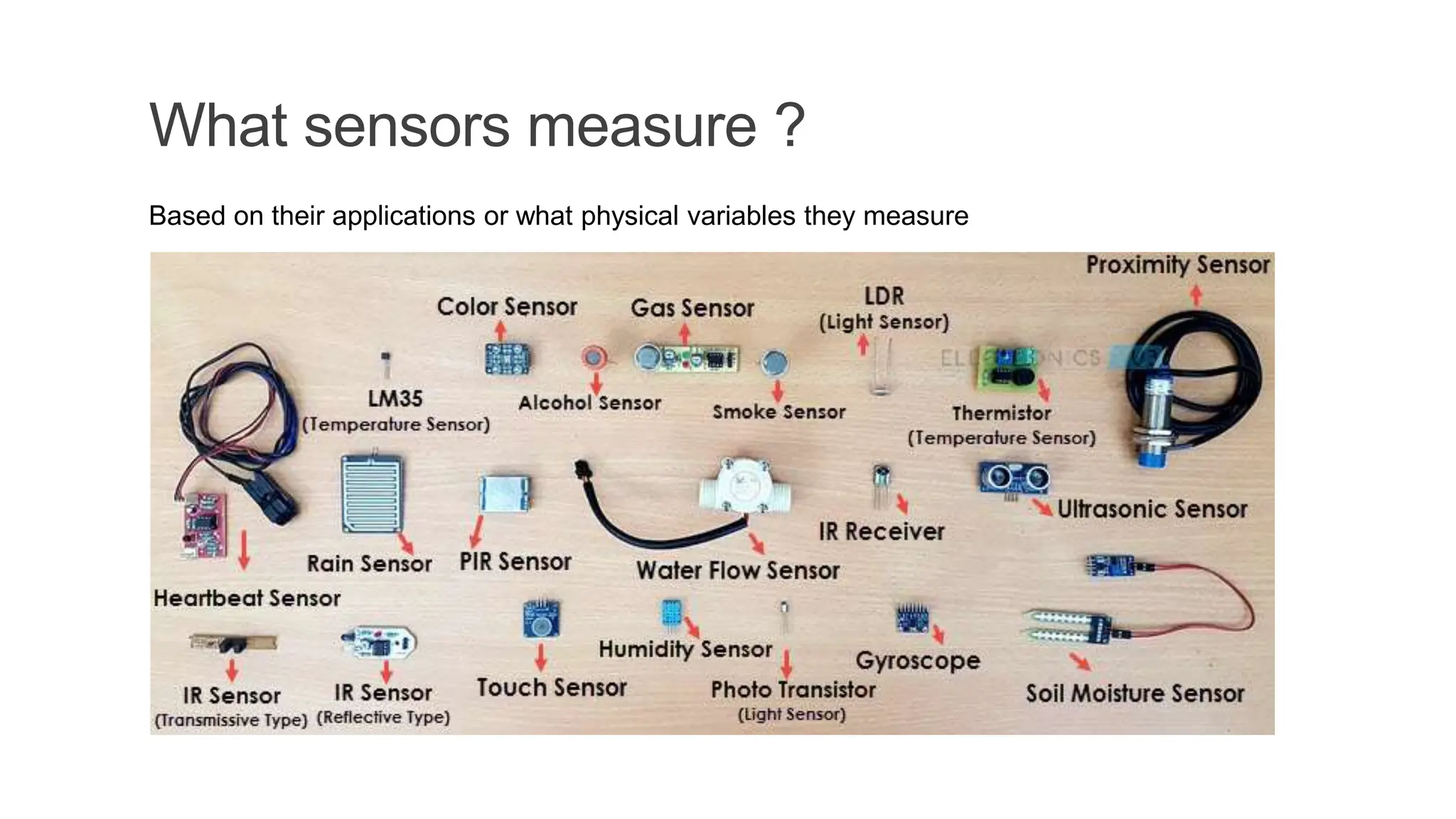
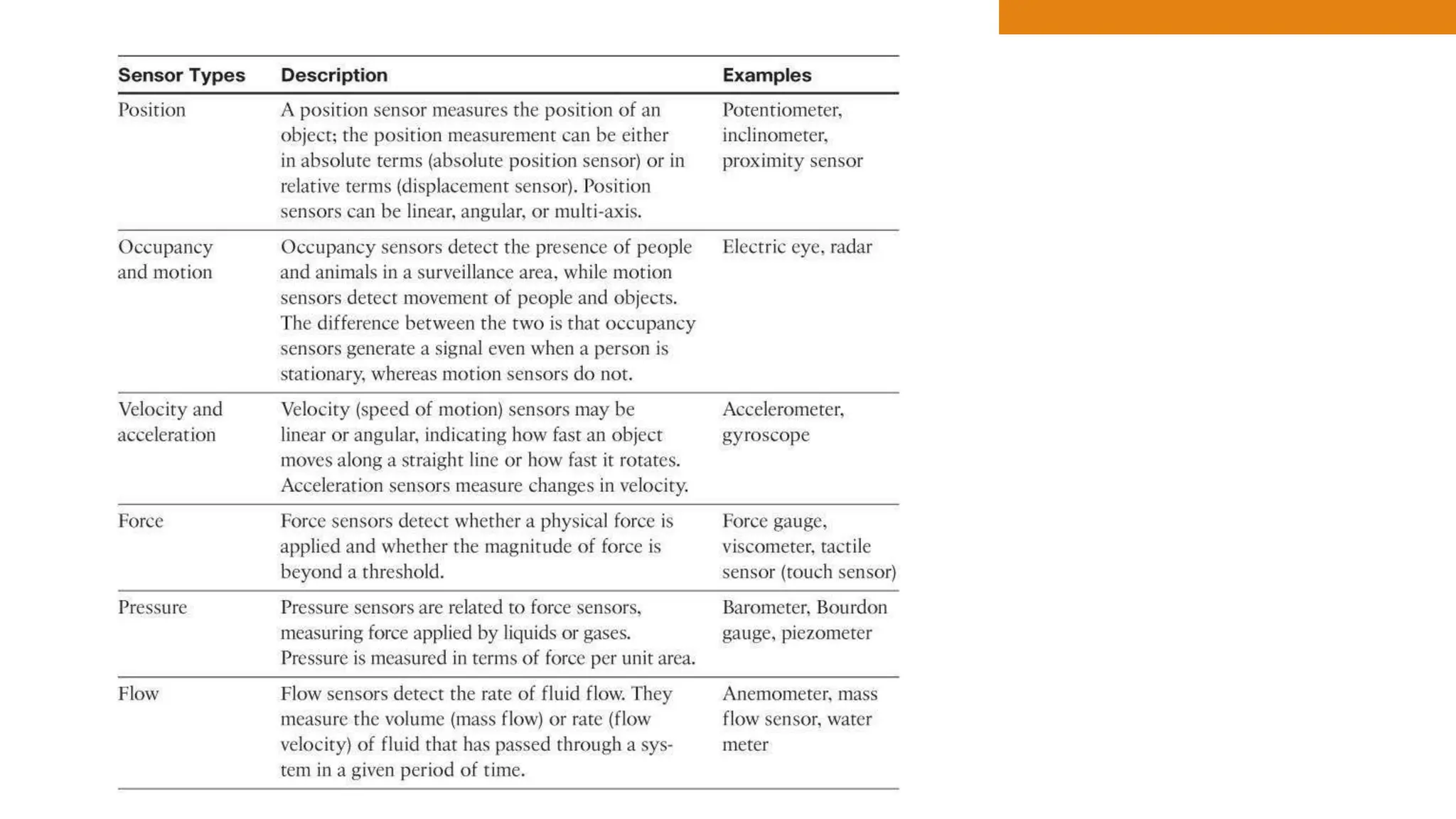
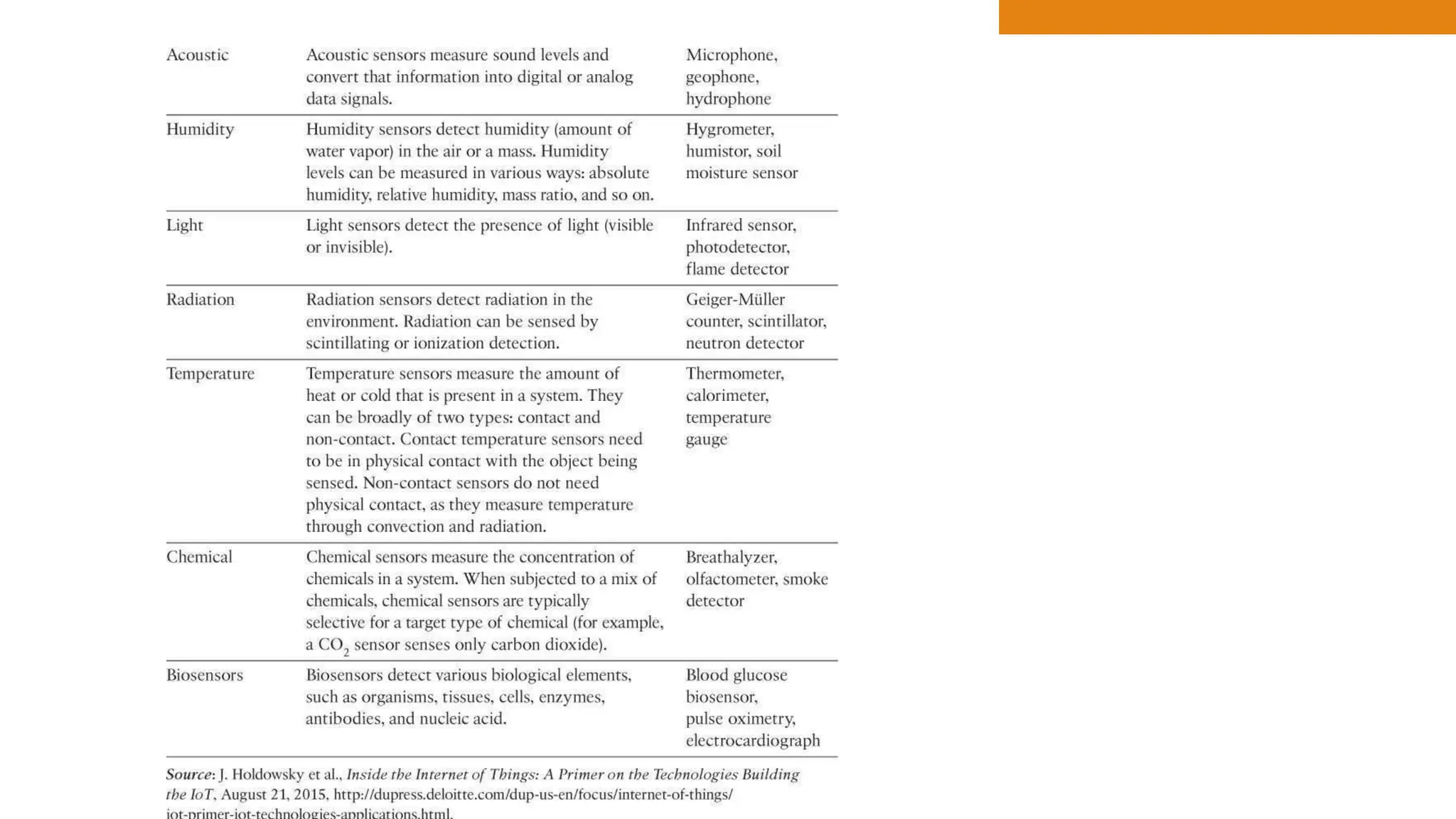
What sensors measure ?
IOT THINGS PRESENTATION - DAVIS M ONSAKIA 18
Based on their applications or what physical variables they measure
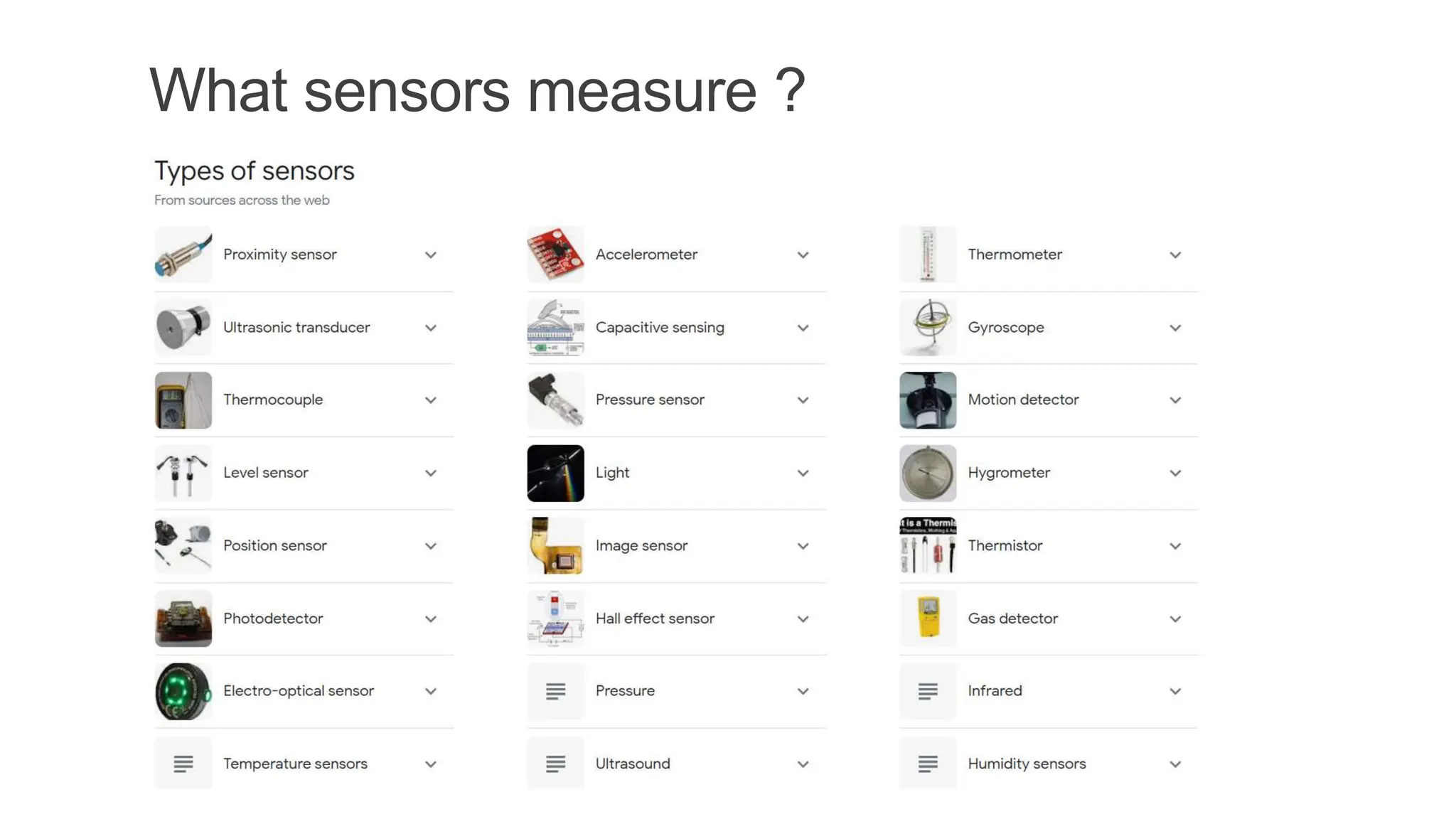
What sensors measure ?
IOT THINGS PRESENTATION - DAVIS M ONSAKIA 19
Sensor Categorization
IOT THINGS PRESENTATION - DAVIS M ONSAKIA 20
Active or
passive
Invasive or
non-invasive
Contact or
no-contact
Absolute or
relative
Area of
application
How sensors
measure
What sensors
measure
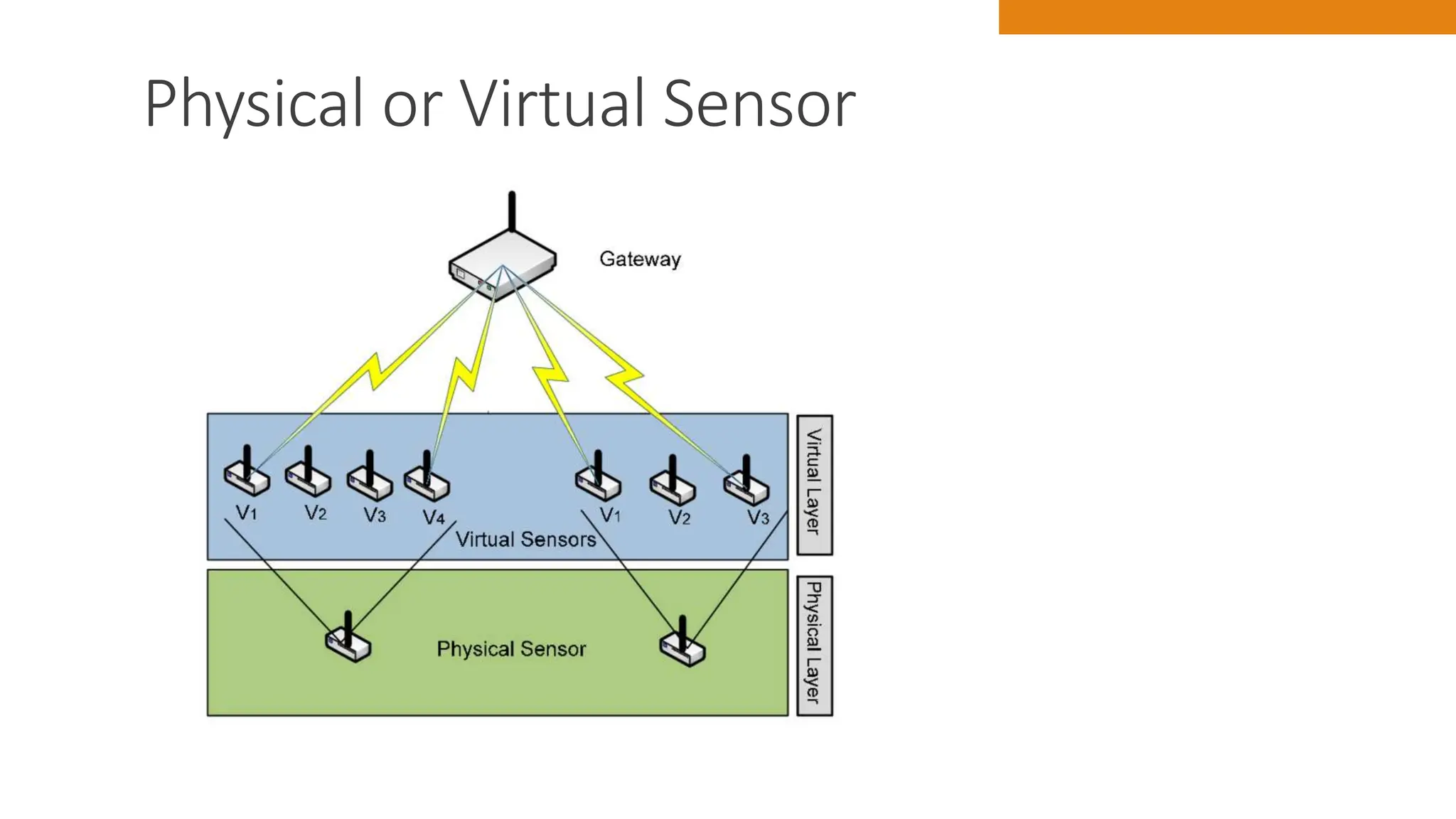
Physical or Virtual Sensor
IOT THINGS PRESENTATION - DAVIS M ONSAKIA 21
IOT THINGS PRESENTATION - DAVIS M ONSAKIA 22
IOT THINGS PRESENTATION - DAVIS M ONSAKIA 23
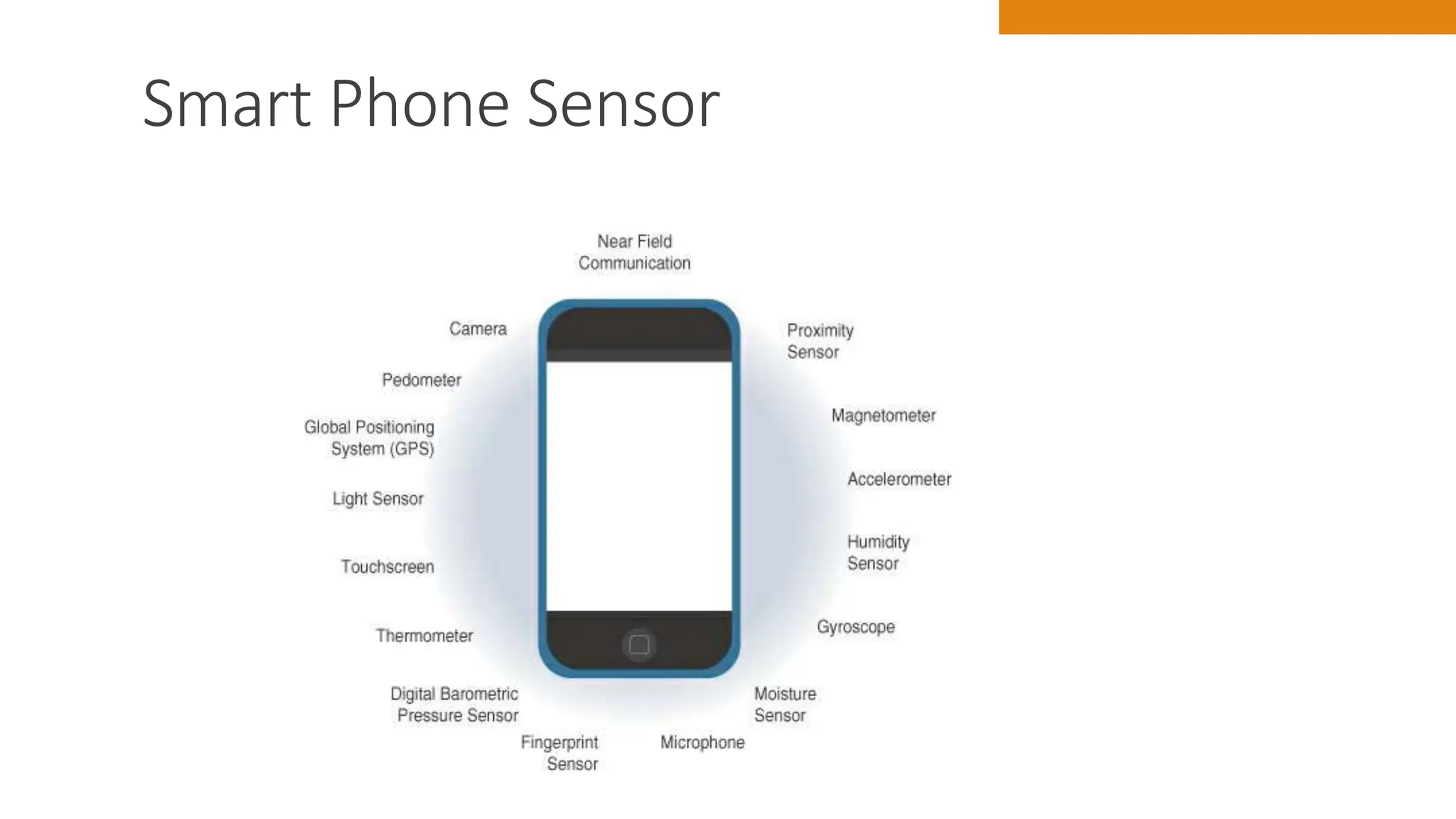
Smart Phone Sensor
IOT THINGS PRESENTATION - DAVIS M ONSAKIA 24
Actuators
25
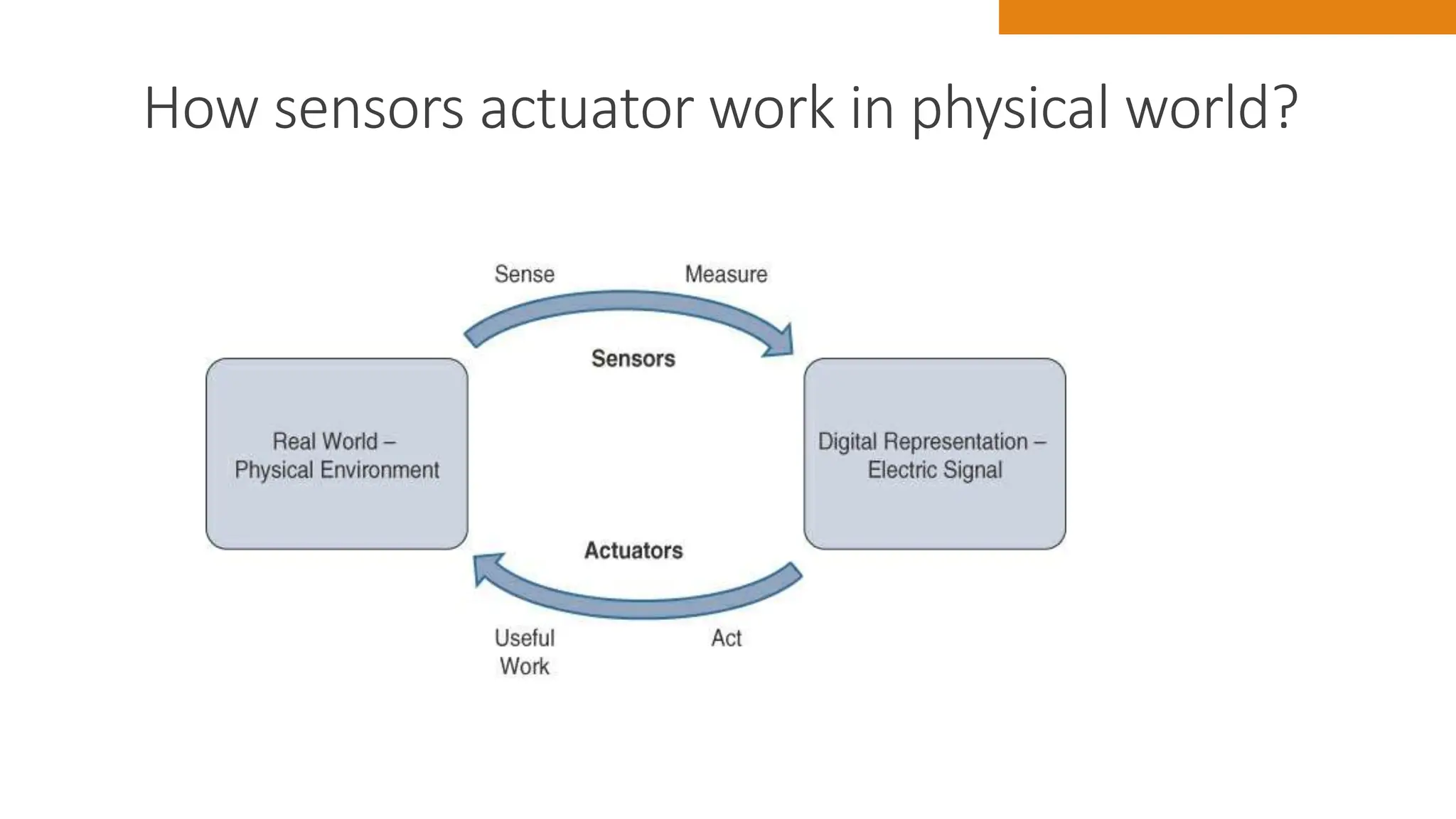
How sensors actuator work in physical world?
IOT FOR DATA SCIENCE AND ANALYTICS 26
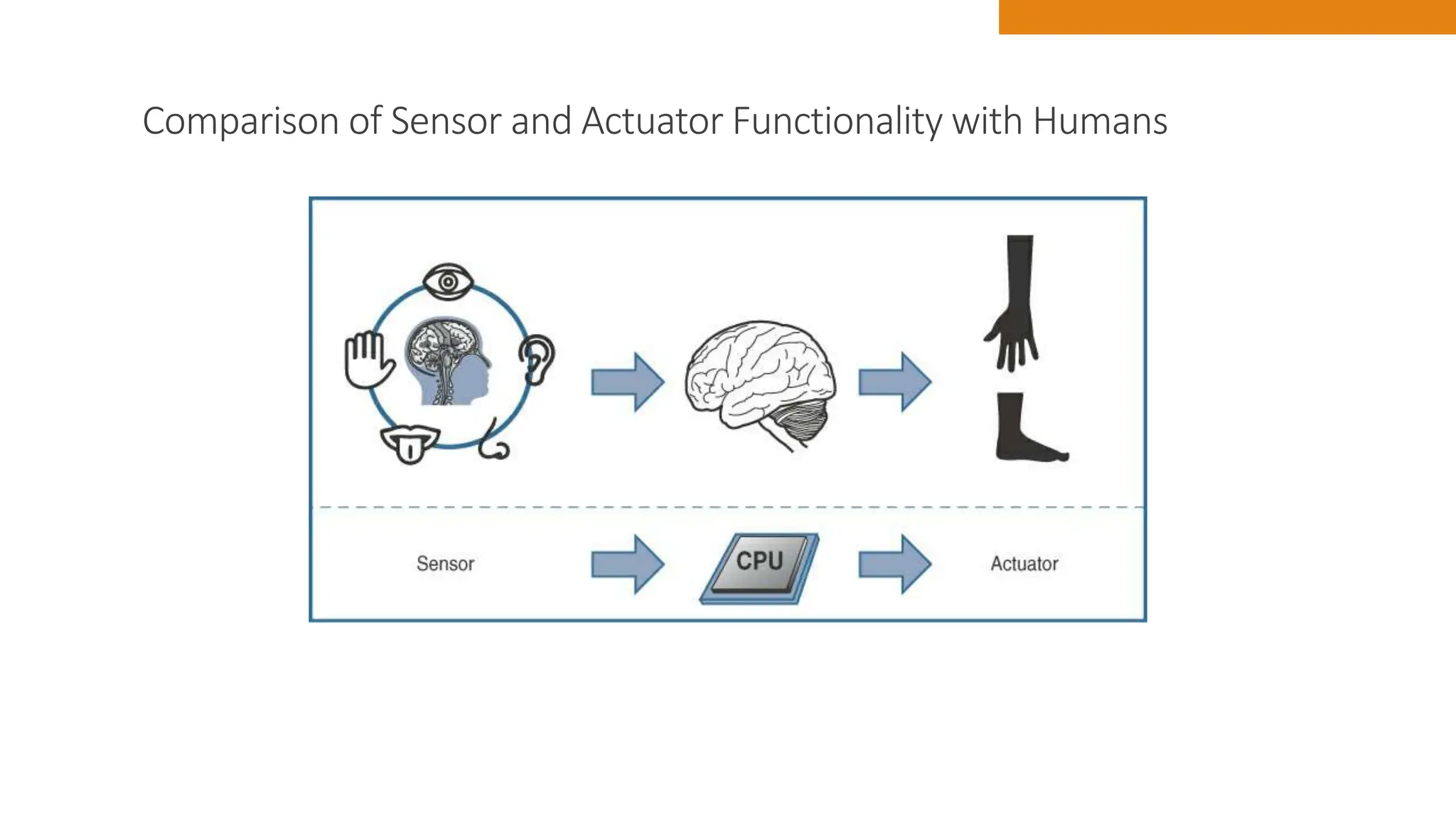
Comparison of Sensor and Actuator Functionality with Humans
IOT FOR DATA SCIENCE AND ANALYTICS 27
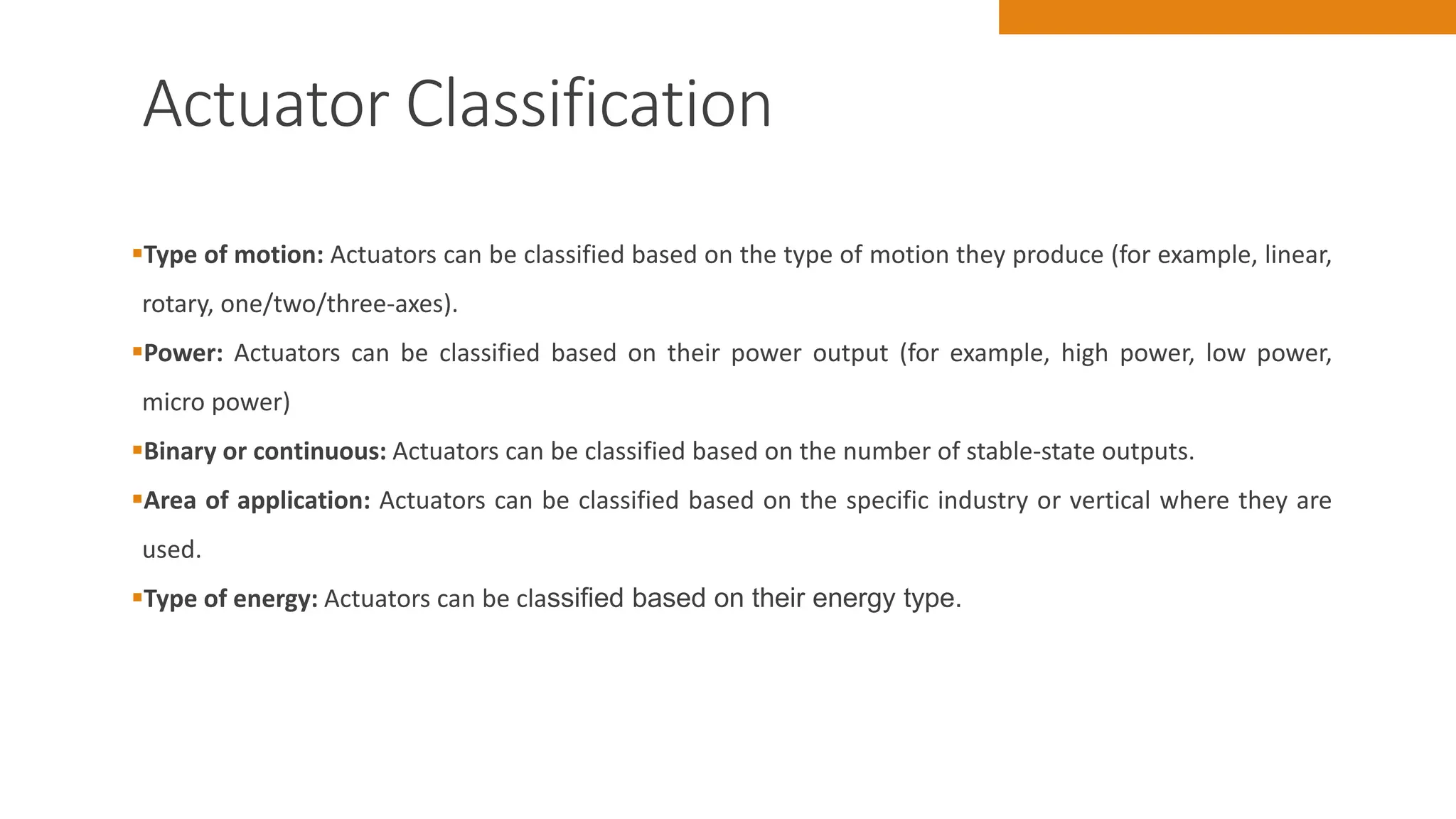
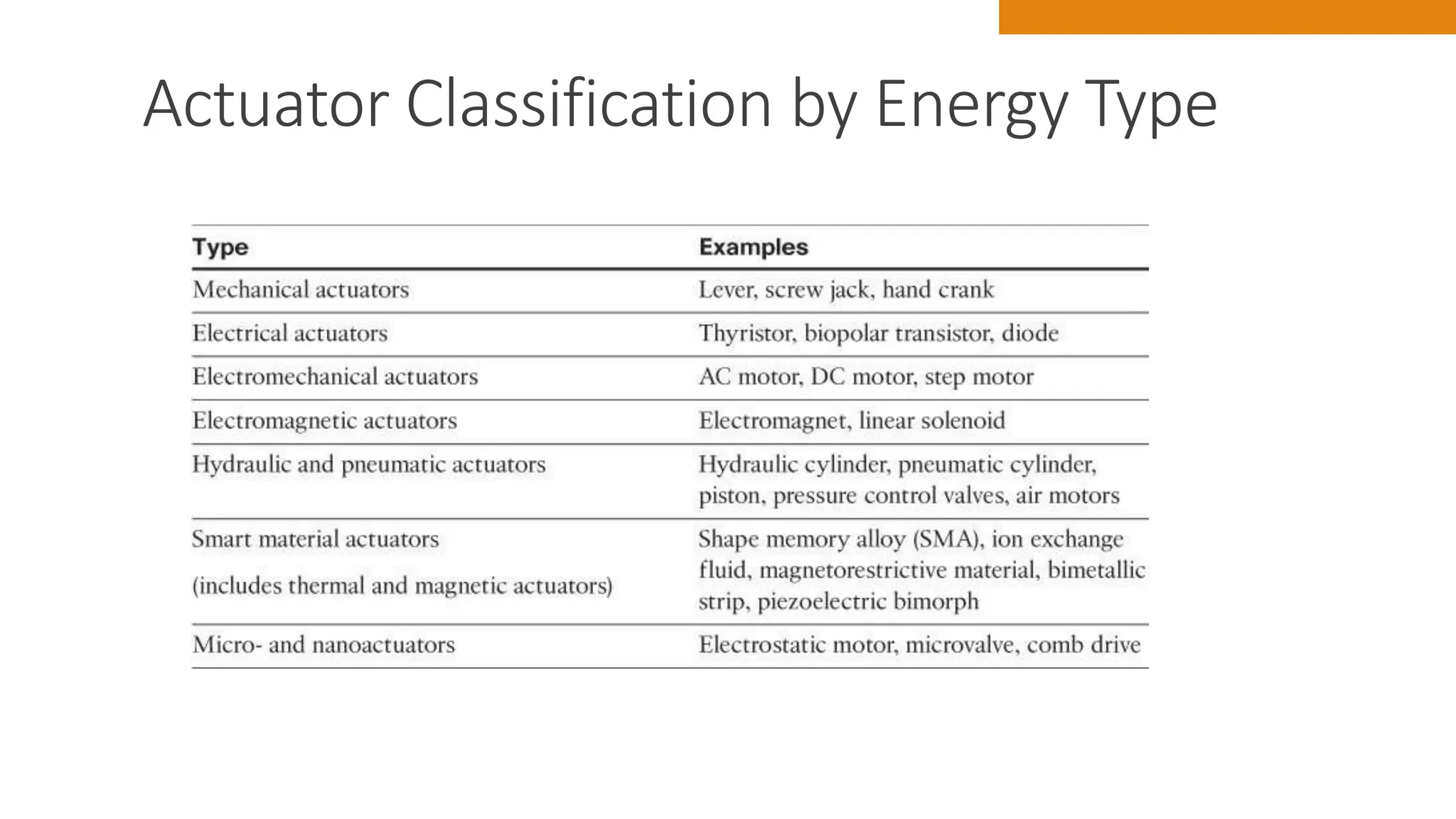
Actuator Classification
Type of motion: Actuators can be classified based on the type of motion they produce (for example, linear,
rotary, one/two/three-axes).
Power: Actuators can be classified based on their power output (for example, high power, low power,
micro power)
Binary or continuous: Actuators can be classified based on the number of stable-state outputs.
Area of application: Actuators can be classified based on the specific industry or vertical where they are
used.
Type of energy: Actuators can be classified based on their energy type.
IOT THINGS PRESENTATION - DAVIS M ONSAKIA 28
Actuator Classification by Energy Type
IOT THINGS PRESENTATION - DAVIS M ONSAKIA 29
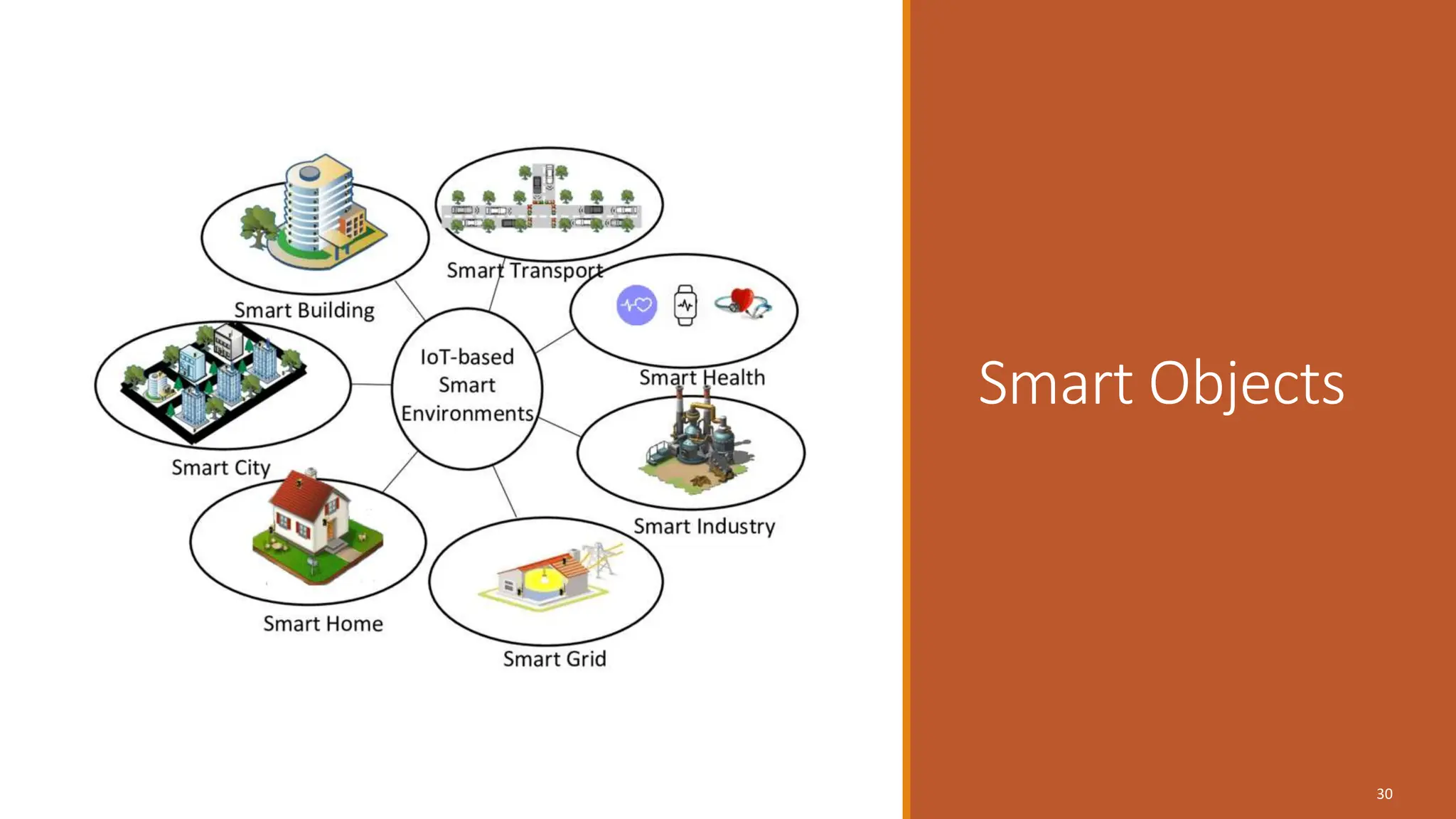
Smart Objects
30
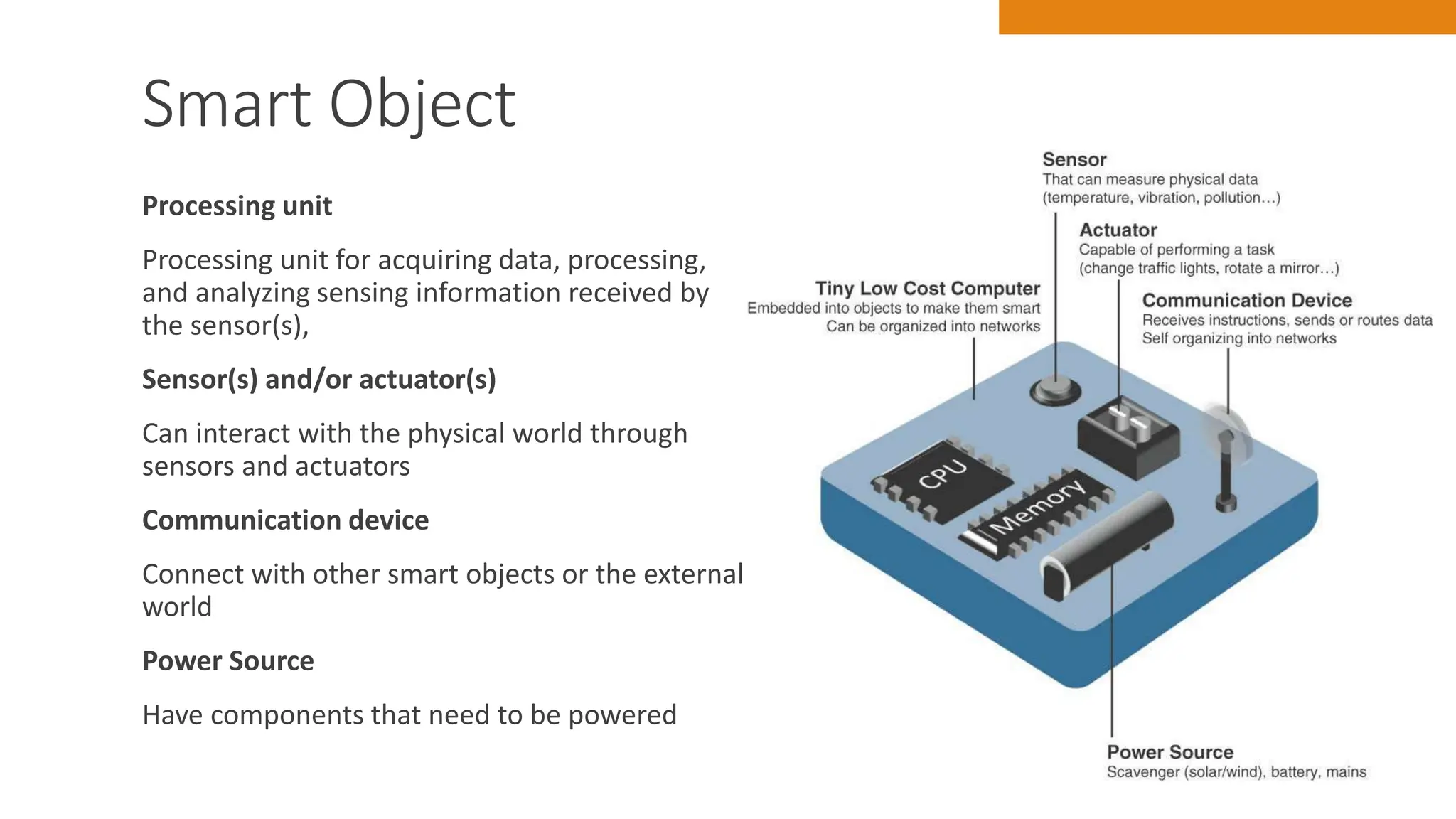
Smart Object
Processing unit
Processing unit for acquiring data, processing,
and analyzing sensing information received by
the sensor(s),
Sensor(s) and/or actuator(s)
Can interact with the physical world through
sensors and actuators
Communication device
Connect with other smart objects or the external
world
Power Source
Have components that need to be powered
IOT FOR DATA SCIENCE AND ANALYTICS 31
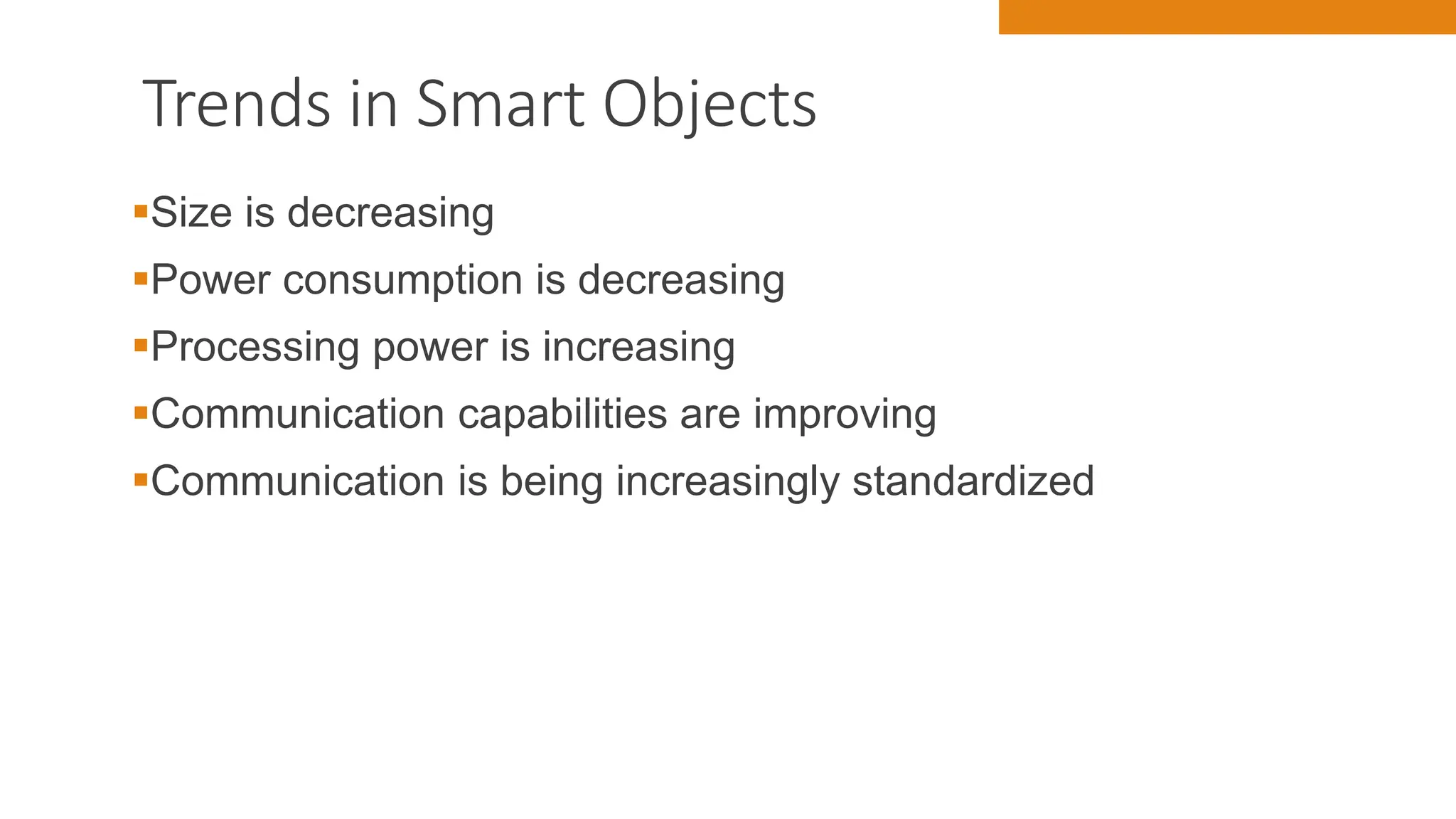
Trends in Smart Objects
Size is decreasing
Power consumption is decreasing
Processing power is increasing
Communication capabilities are improving
Communication is being increasingly standardized
IOT FOR DATA SCIENCE AND ANALYTICS 32
Sensor Networks
33
Sensor/actuator network (SANET)
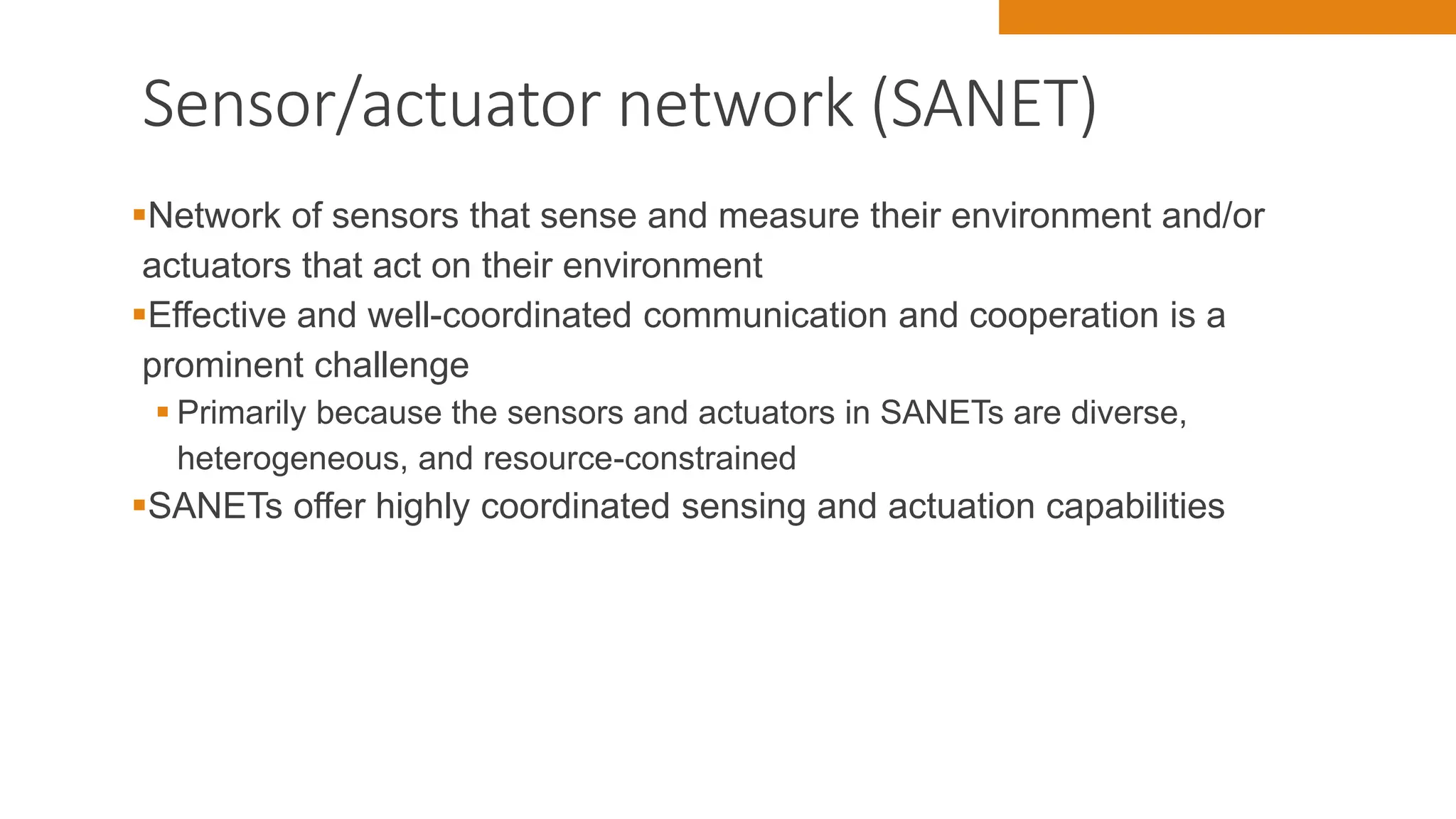
Network of sensors that sense and measure their environment and/or
actuators that act on their environment
Effective and well-coordinated communication and cooperation is a
prominent challenge
 Primarily because the sensors and actuators in SANETs are diverse,
heterogeneous, and resource-constrained
SANETs offer highly coordinated sensing and actuation capabilities
IOT FOR DATA SCIENCE AND ANALYTICS 34
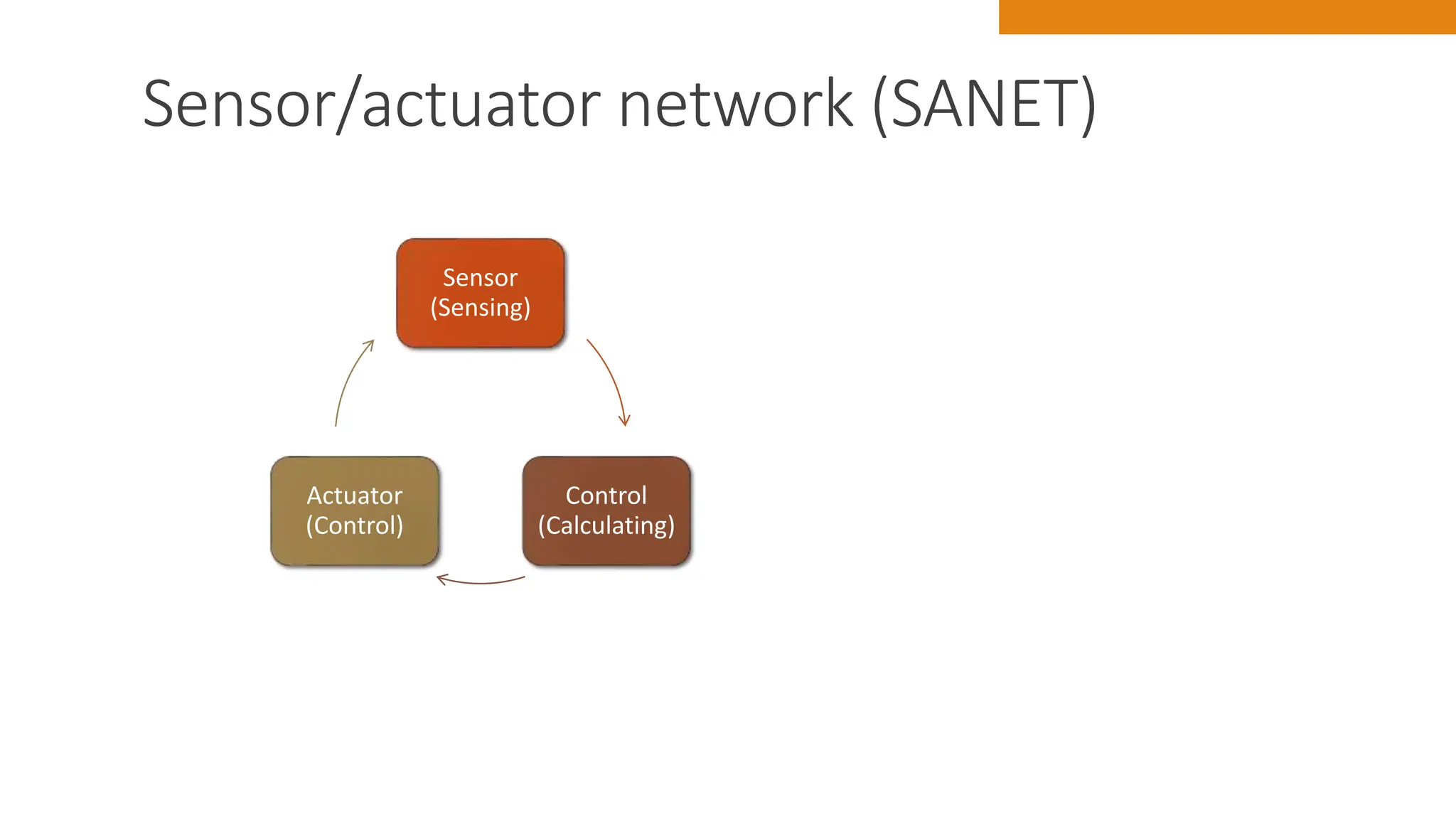
Sensor/actuator network (SANET)
IOT FOR DATA SCIENCE AND ANALYTICS 35
Sensor
(Sensing)
Control
(Calculating)
Actuator
(Control)
Wireless Sensor Networks (WSNs)
IOT FOR DATA SCIENCE AND ANALYTICS 36
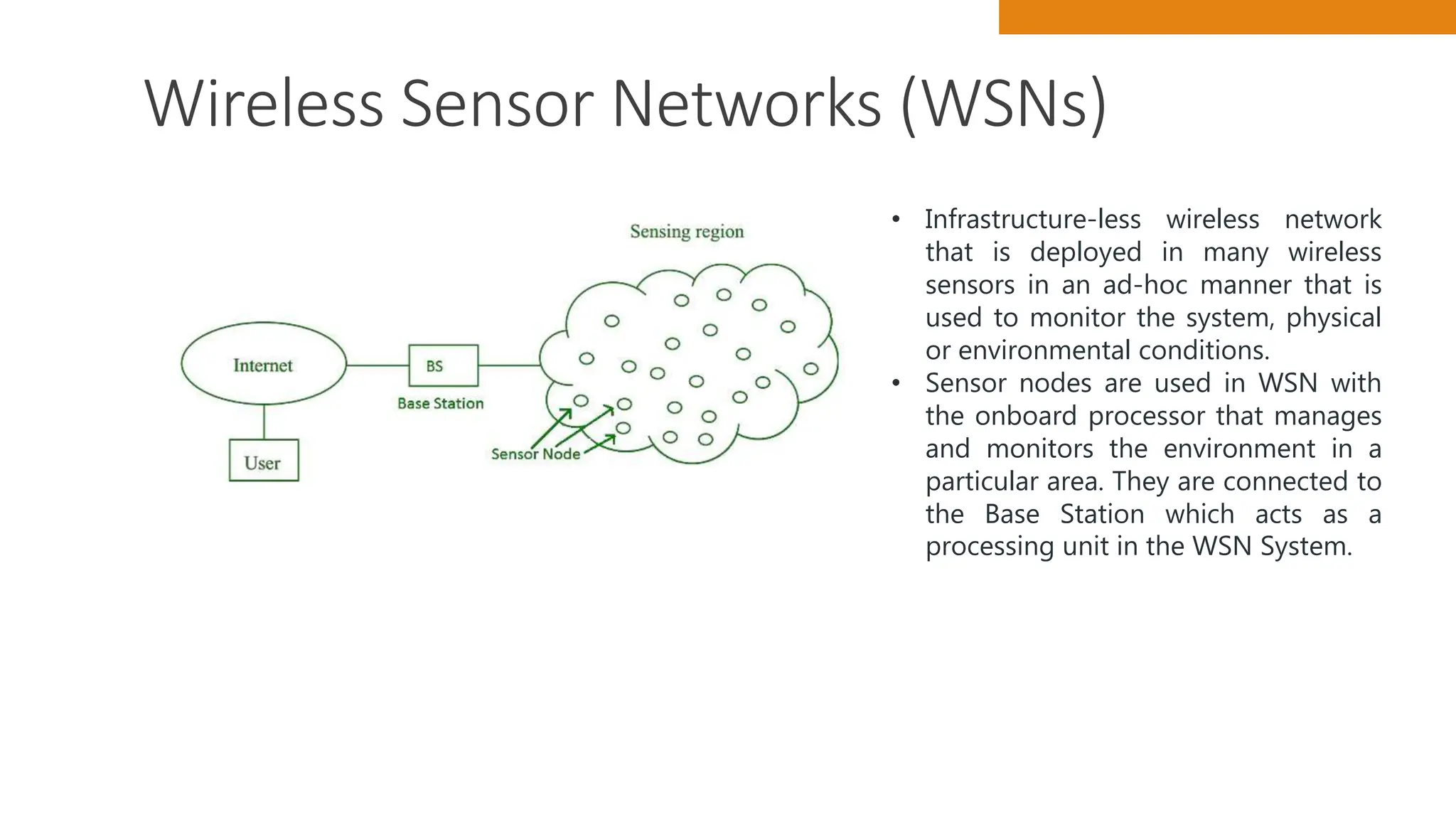
• Infrastructure-less wireless network
that is deployed in many wireless
sensors in an ad-hoc manner that is
used to monitor the system, physical
or environmental conditions.
• Sensor nodes are used in WSN with
the onboard processor that manages
and monitors the environment in a
particular area. They are connected to
the Base Station which acts as a
processing unit in the WSN System.
Wireless Sensor Networks (WSNs)
IOT FOR DATA SCIENCE AND ANALYTICS 37
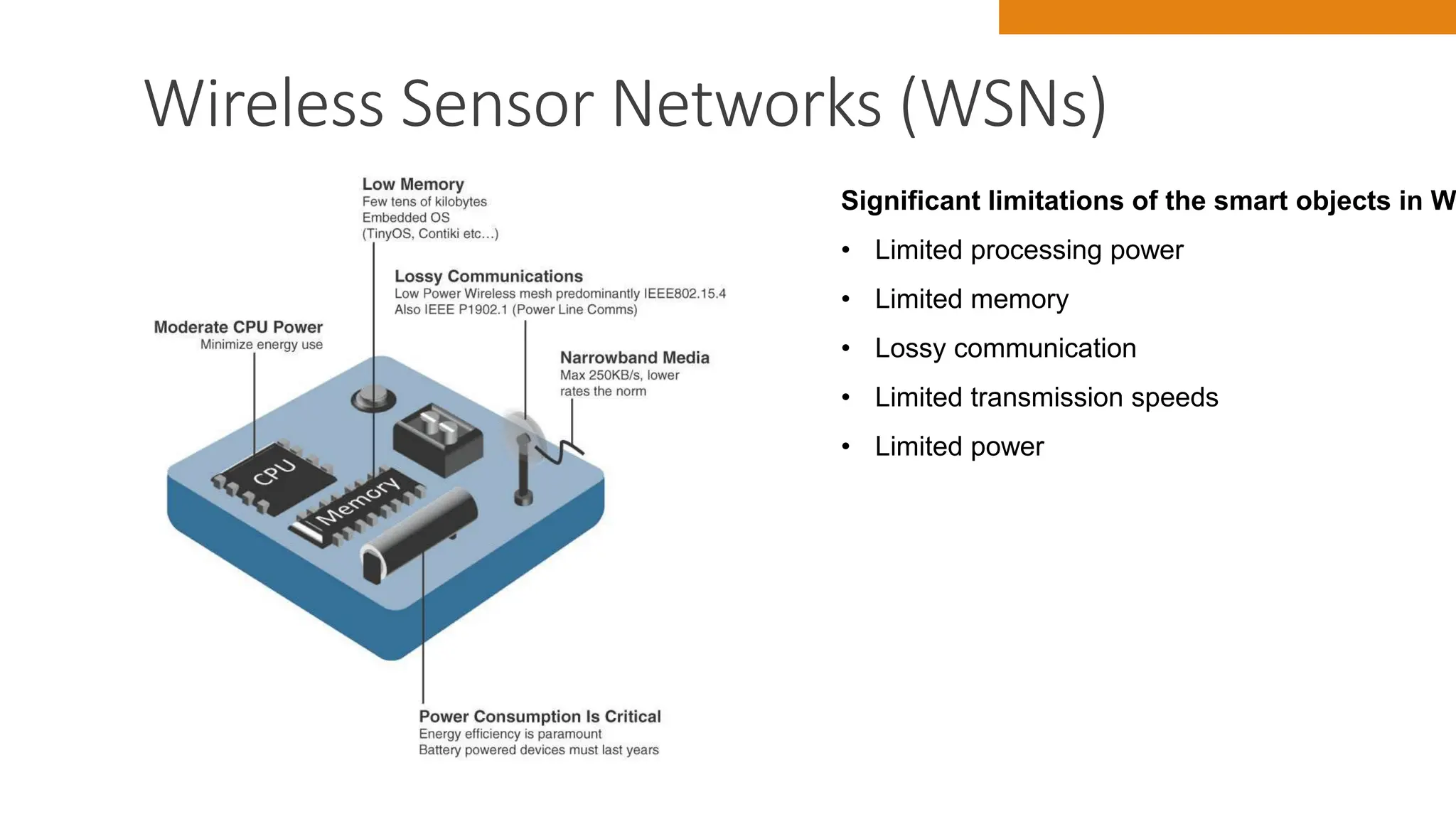
Significant limitations of the smart objects in W
• Limited processing power
• Limited memory
• Lossy communication
• Limited transmission speeds
• Limited power
Wireless Sensor Networks (WSNs)
IOT FOR DATA SCIENCE AND ANALYTICS 38
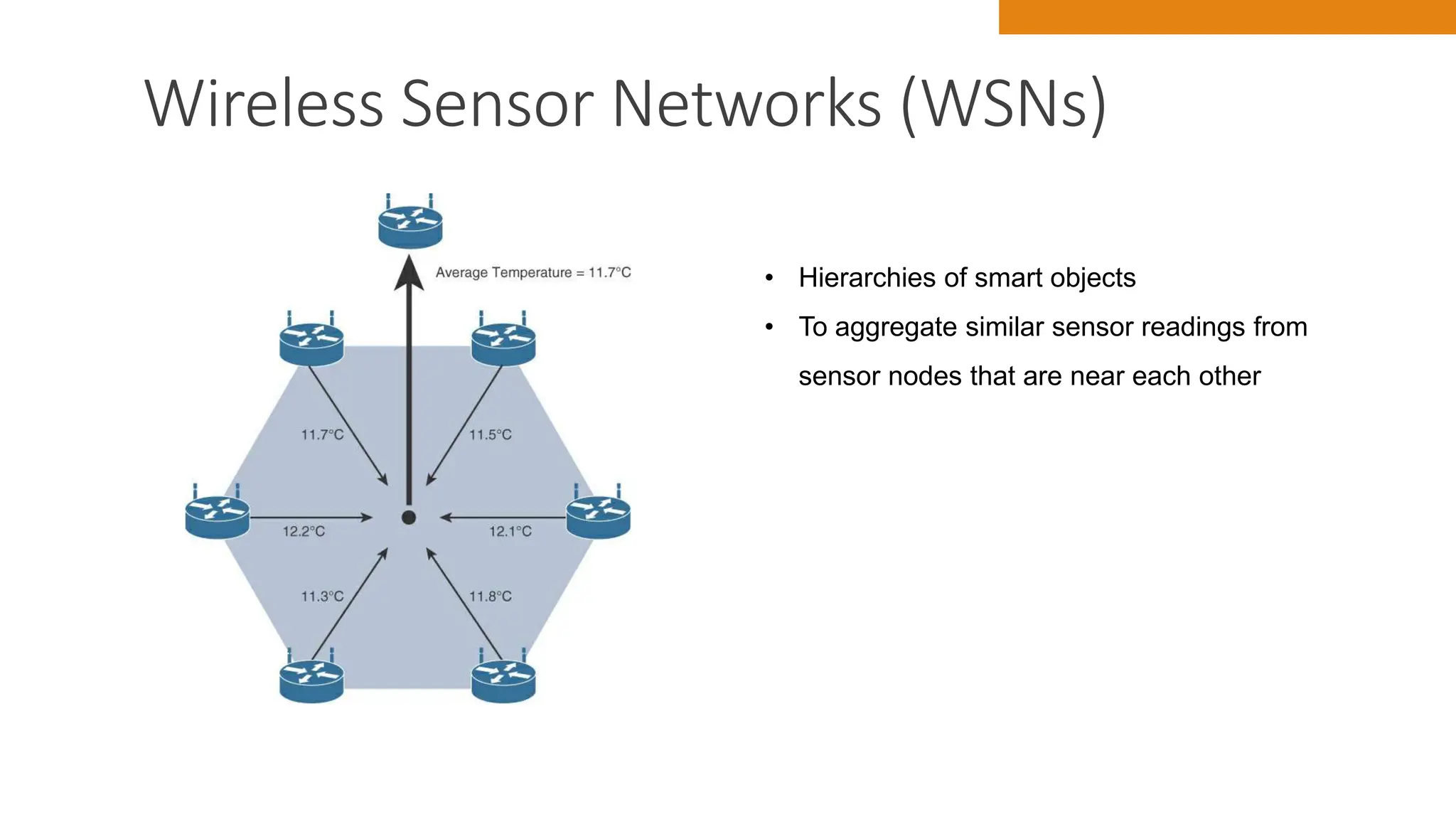
• Hierarchies of smart objects
• To aggregate similar sensor readings from
sensor nodes that are near each other
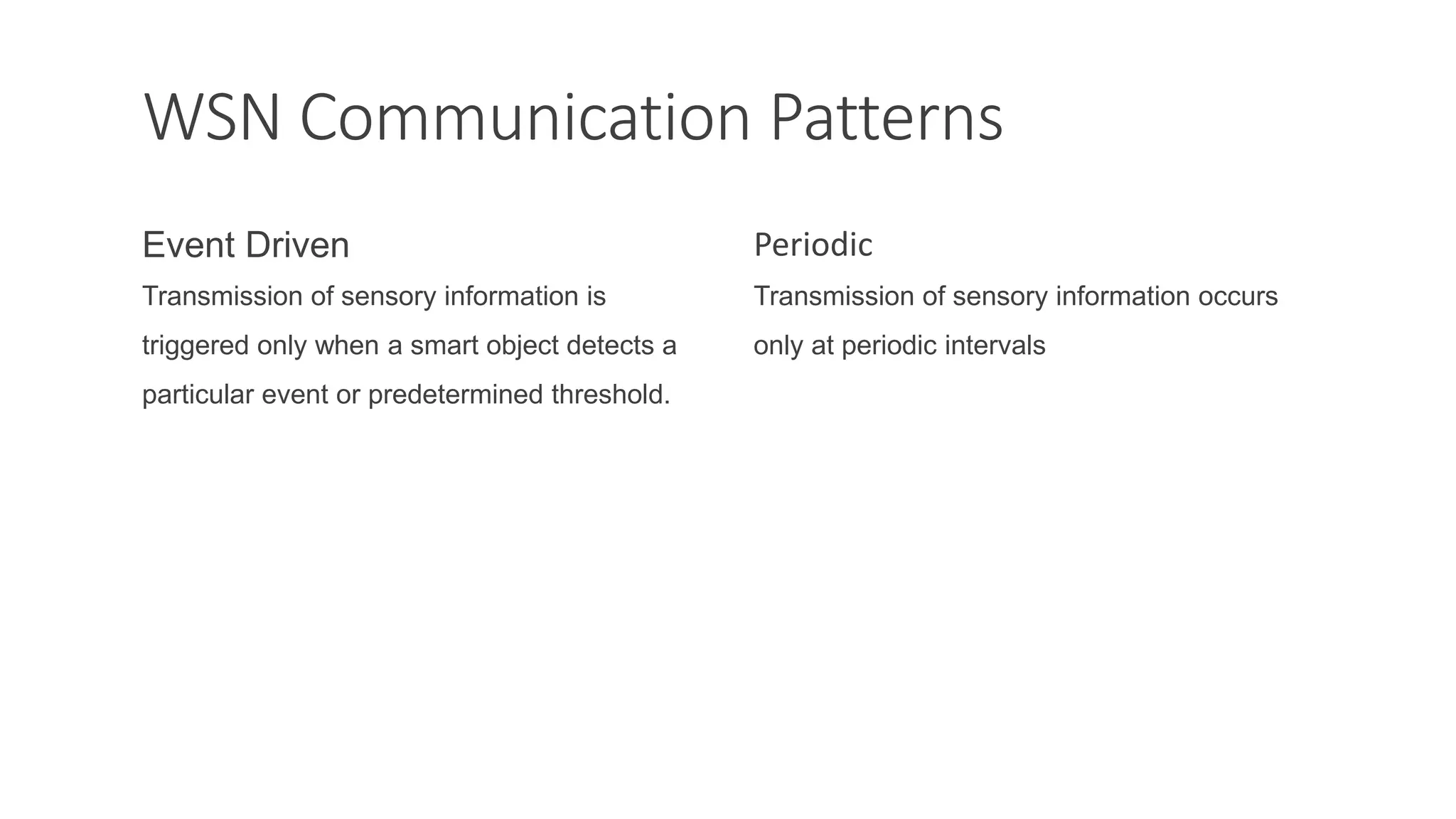
WSN Communication Patterns
Event Driven
Transmission of sensory information is
triggered only when a smart object detects a
particular event or predetermined threshold.
Periodic
Transmission of sensory information occurs
only at periodic intervals
IOT FOR DATA SCIENCE AND ANALYTICS 39
WSN Communication Protocols
 Thousands of different types of sensors and actuators
 WSNs are becoming increasingly heterogeneous, with more sophisticated interactions
Single-type sensor to multiple types of sensors
Single-purpose to Multiple Purpose
IOT FOR DATA SCIENCE AND ANALYTICS 40
Module 2
41
Smart Objects: The “Things” in IoT
Sensors, Actuators, and Smart Objects
Sensor Networks
Connecting Smart Objects
Communications Criteria
o IoT Access Technologies
IP as the IoT Network Layer
◦ The Business Case for IP
◦ The Need for Optimization
◦ Optimizing IP for IoT
◦ Profiles and Compliances
Chapters 3, 4, 5
Connecting Smart Objects
Communications Criteria
IoT Access Technologies
42
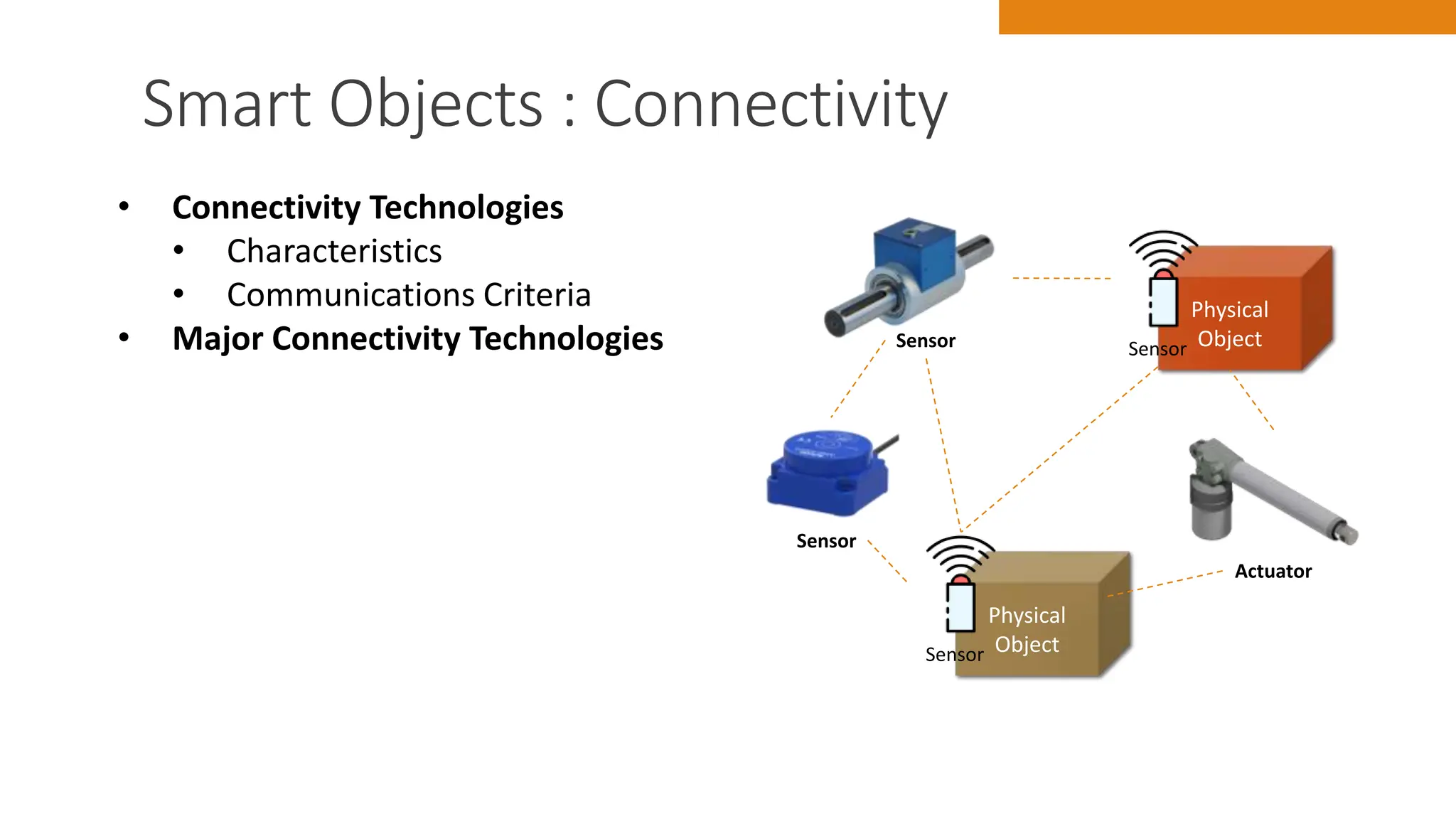
Smart Objects : Connectivity
IOT FOR DATA SCIENCE AND ANALYTICS 43
Physical
Object
Sensor
Physical
Object
Sensor
Sensor
Sensor
Actuator
• Connectivity Technologies
• Characteristics
• Communications Criteria
• Major Connectivity Technologies
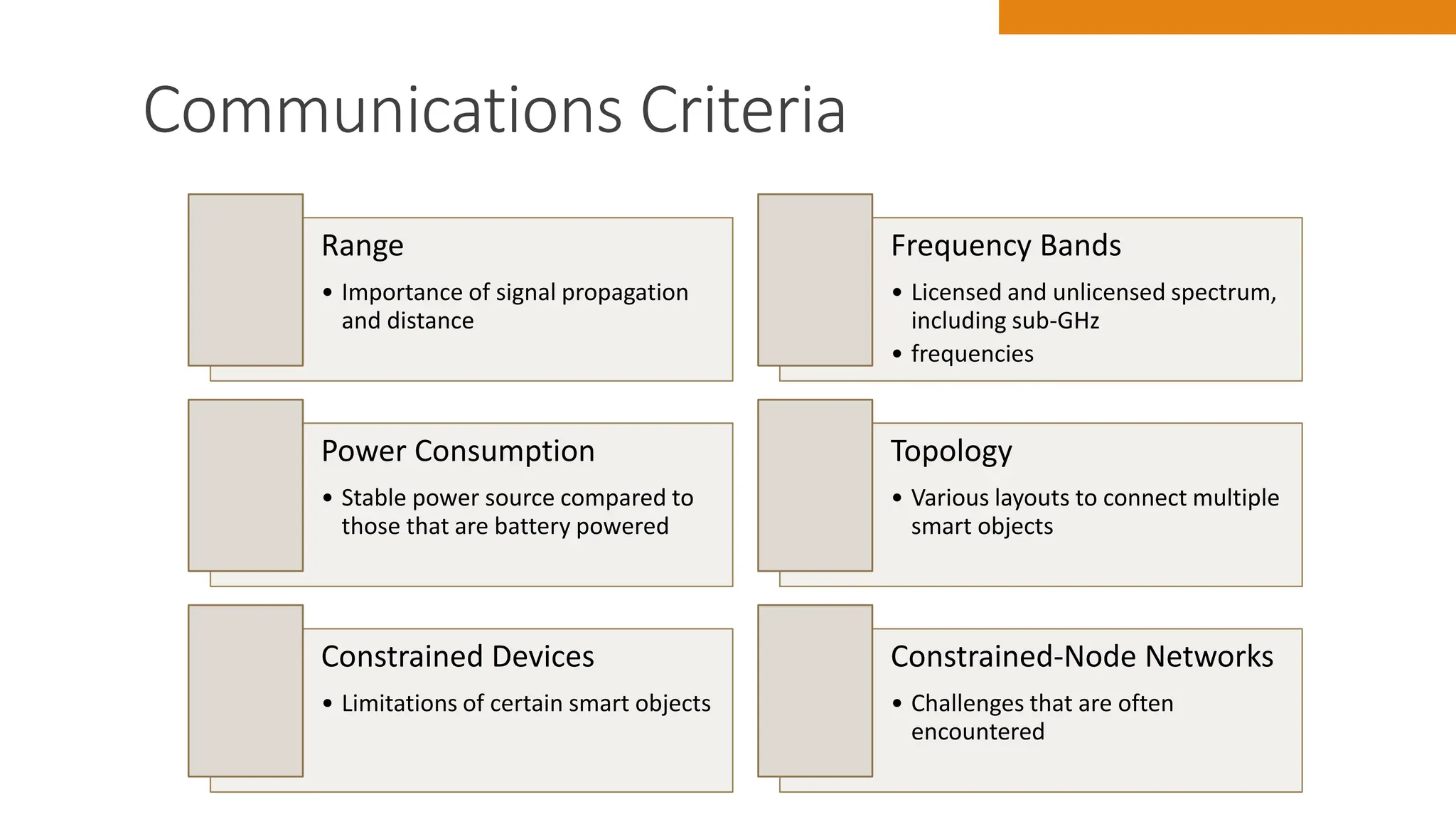
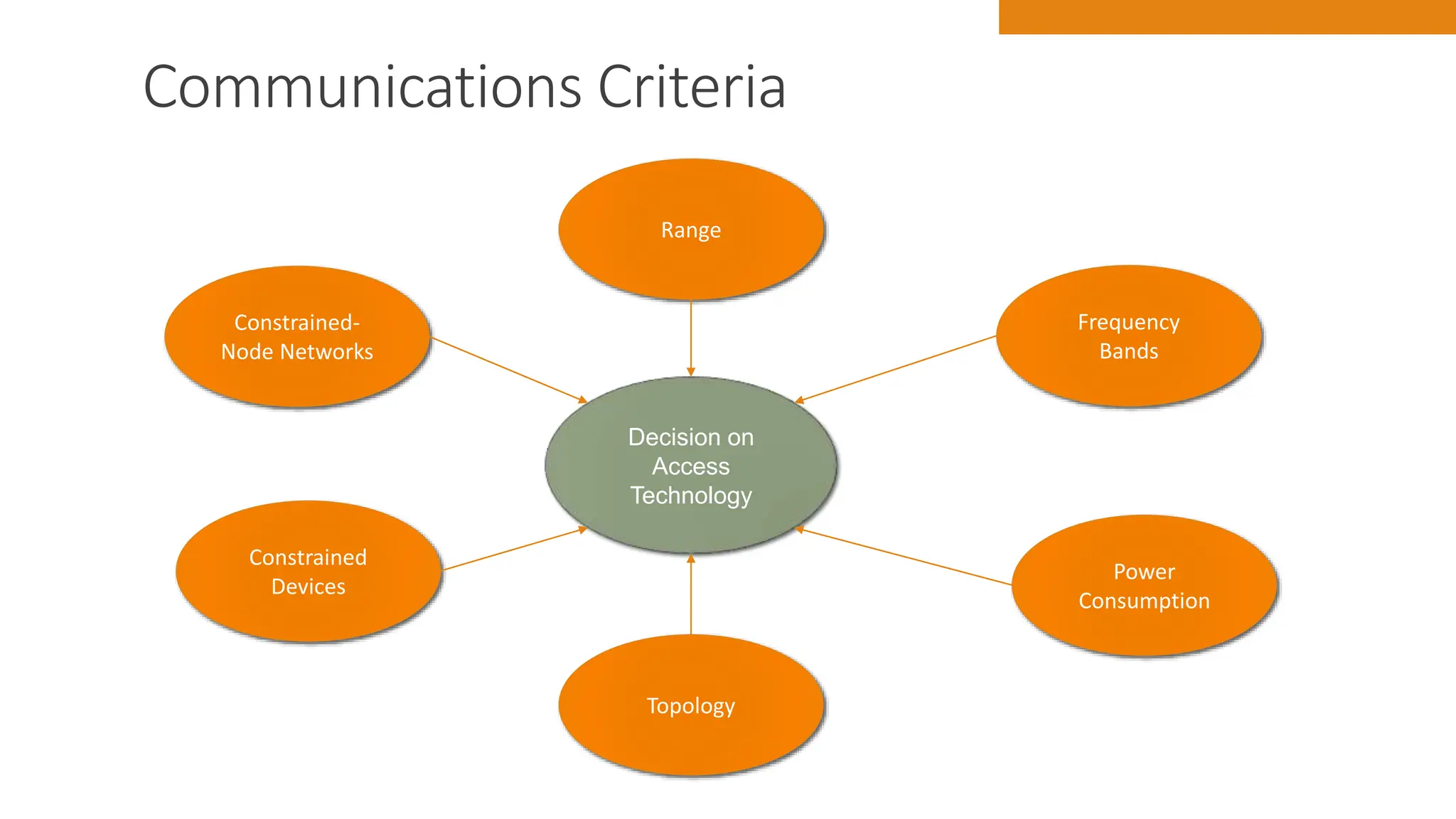
Communications Criteria
IOT FOR DATA SCIENCE AND ANALYTICS 44
Range
• Importance of signal propagation
and distance
Frequency Bands
• Licensed and unlicensed spectrum,
including sub-GHz
• frequencies
Power Consumption
• Stable power source compared to
those that are battery powered
Topology
• Various layouts to connect multiple
smart objects
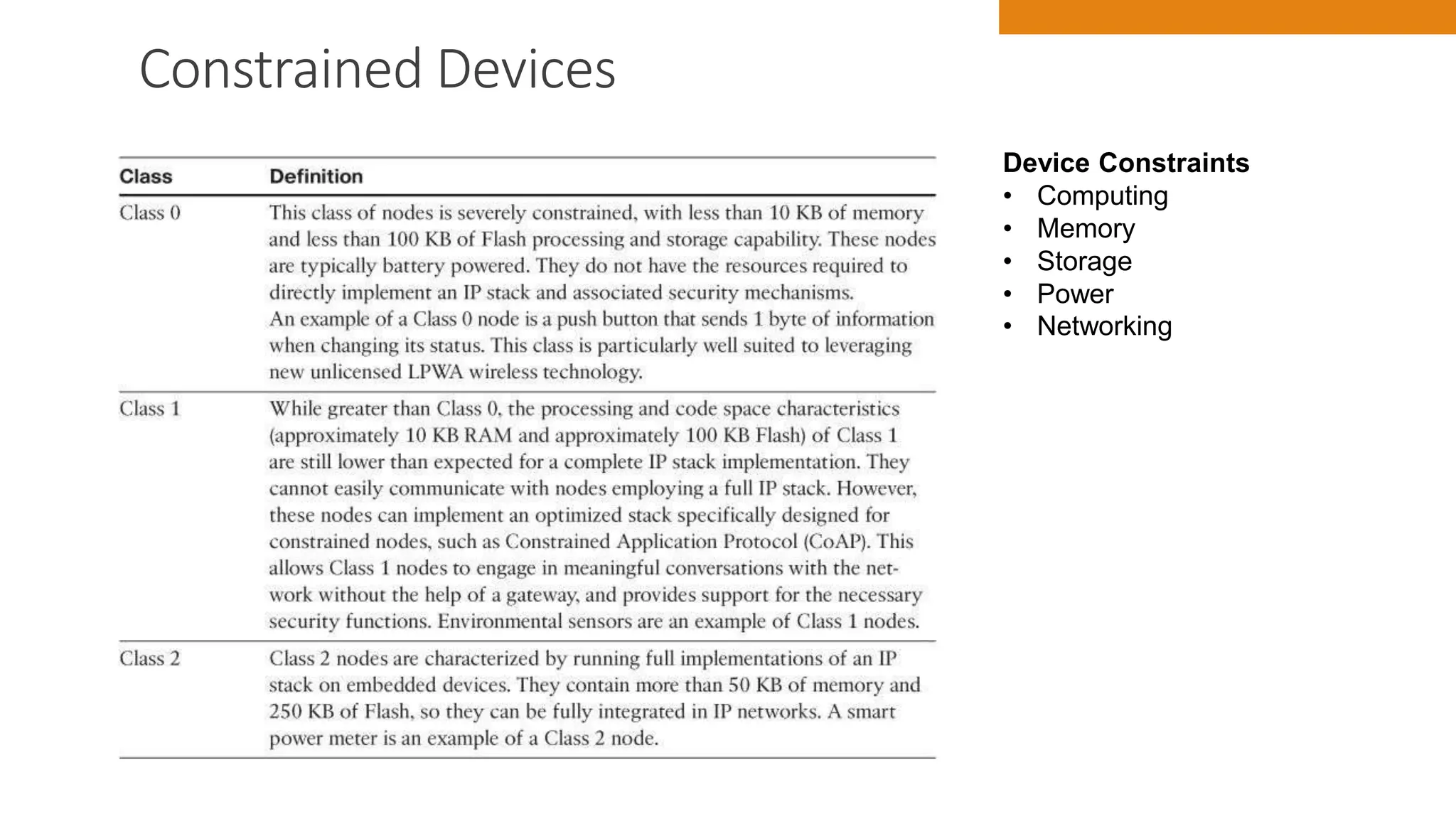
Constrained Devices
• Limitations of certain smart objects
Constrained-Node Networks
• Challenges that are often
encountered
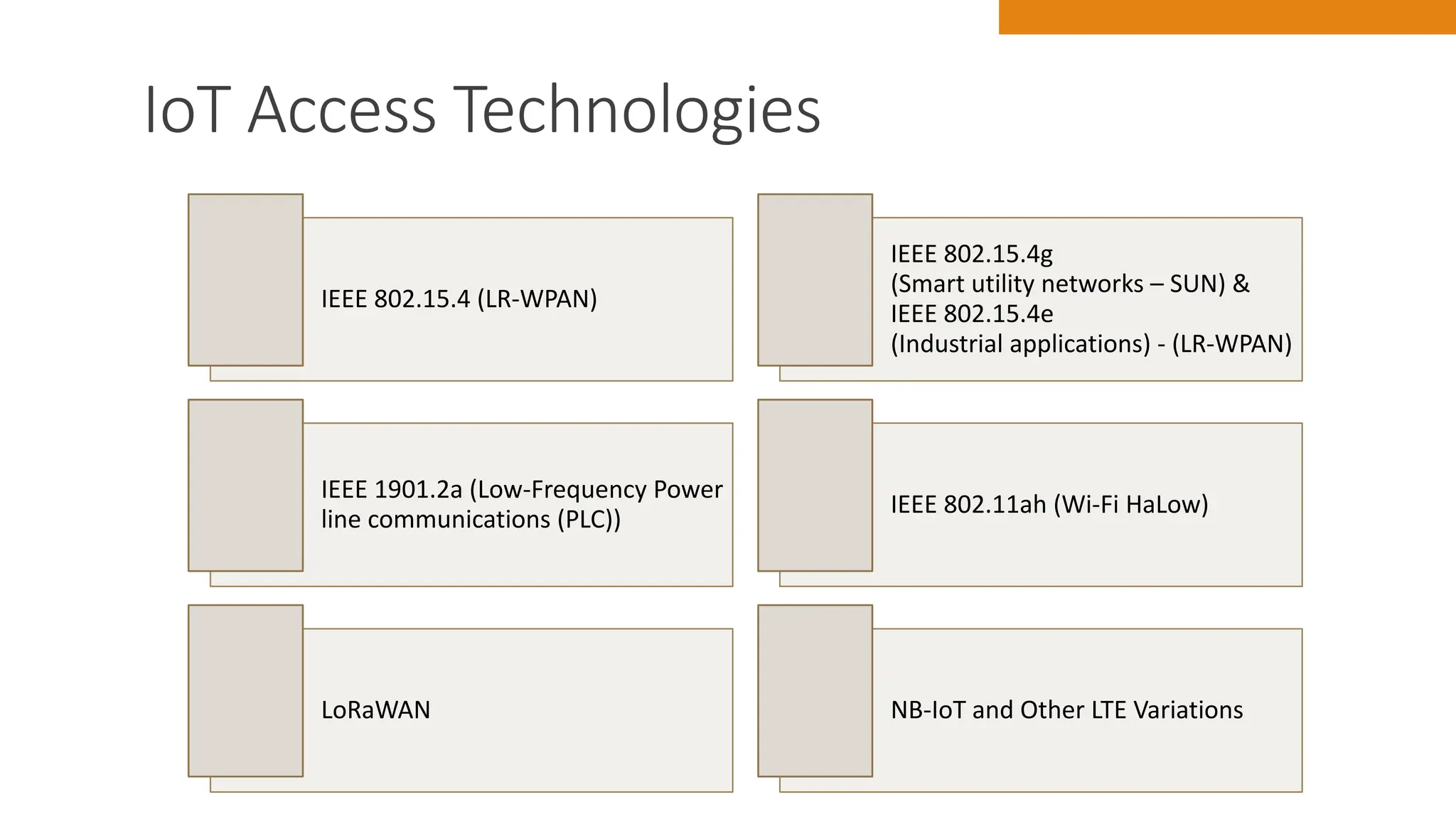
IoT Access Technologies
IOT FOR DATA SCIENCE AND ANALYTICS 45
IEEE 802.15.4 (LR-WPAN)
IEEE 802.15.4g
(Smart utility networks – SUN) &
IEEE 802.15.4e
(Industrial applications) - (LR-WPAN)
IEEE 1901.2a (Low-Frequency Power
line communications (PLC))
IEEE 802.11ah (Wi-Fi HaLow)
LoRaWAN NB-IoT and Other LTE Variations
Communications Criteria
46
Communications Criteria
IOT FOR DATA SCIENCE AND ANALYTICS 47
Range
Frequency
Bands
Power
Consumption
Topology
Constrained
Devices
Constrained-
Node Networks
Decision on
Access
Technology
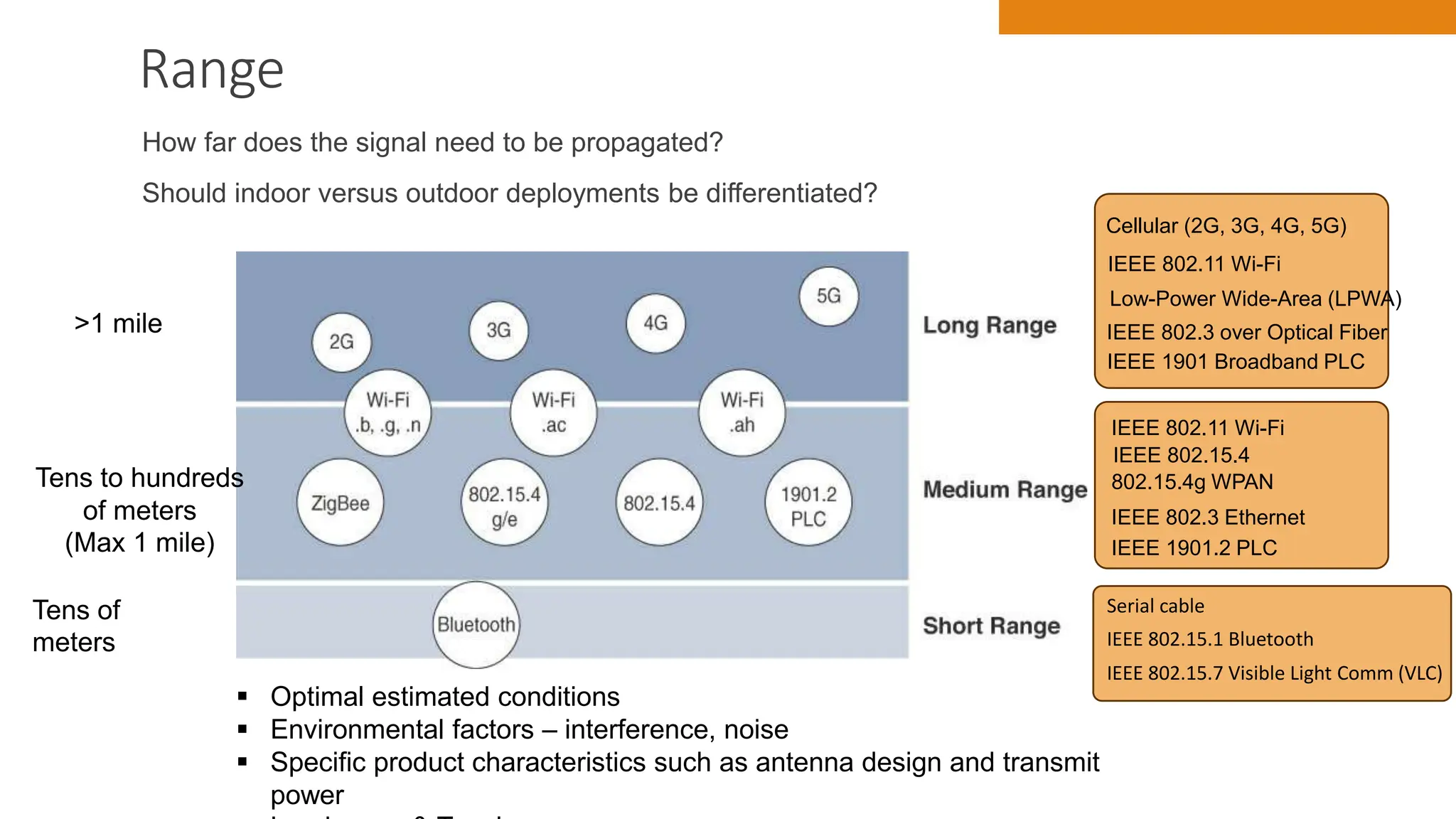
Range
How far does the signal need to be propagated?
Should indoor versus outdoor deployments be differentiated?
IOT FOR DATA SCIENCE AND ANALYTICS 48
Serial cable
IEEE 802.15.1 Bluetooth
IEEE 802.15.7 Visible Light Comm (VLC)
Tens of
meters
Tens to hundreds
of meters
(Max 1 mile)
IEEE 802.11 Wi-Fi
IEEE 802.15.4
802.15.4g WPAN
IEEE 802.3 Ethernet
IEEE 1901.2 PLC
>1 mile
Cellular (2G, 3G, 4G, 5G)
IEEE 802.11 Wi-Fi
Low-Power Wide-Area (LPWA)
IEEE 802.3 over Optical Fiber
IEEE 1901 Broadband PLC
 Optimal estimated conditions
 Environmental factors – interference, noise
 Specific product characteristics such as antenna design and transmit
power
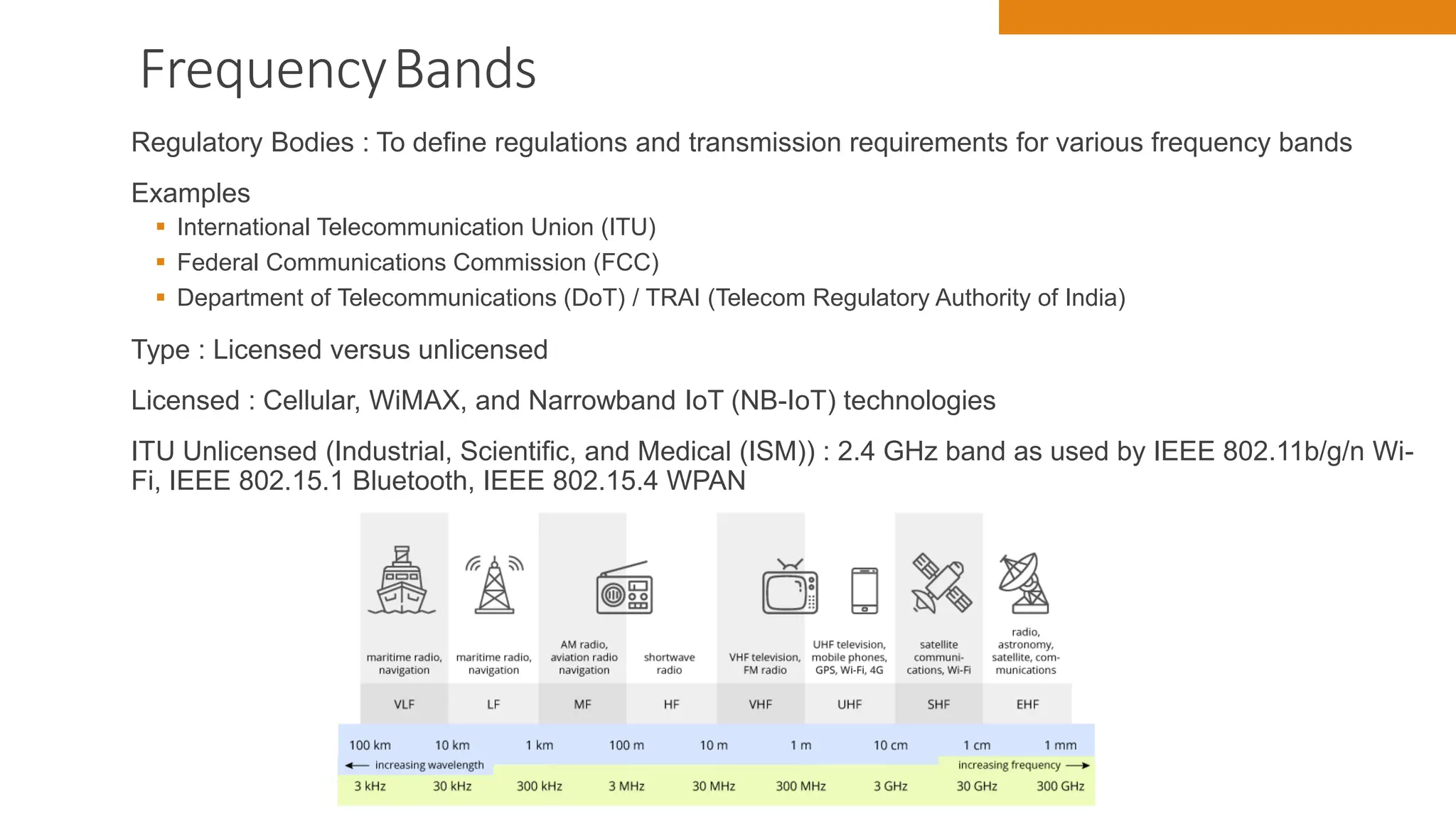
FrequencyBands
Regulatory Bodies : To define regulations and transmission requirements for various frequency bands
Examples
 International Telecommunication Union (ITU)
 Federal Communications Commission (FCC)
 Department of Telecommunications (DoT) / TRAI (Telecom Regulatory Authority of India)
Type : Licensed versus unlicensed
Licensed : Cellular, WiMAX, and Narrowband IoT (NB-IoT) technologies
ITU Unlicensed (Industrial, Scientific, and Medical (ISM)) : 2.4 GHz band as used by IEEE 802.11b/g/n Wi-
Fi, IEEE 802.15.1 Bluetooth, IEEE 802.15.4 WPAN
49
FrequencyBands
Mandate device compliance on parameters such as transmit power, duty cycle and dwell time, channel
bandwidth, and channel hopping
Unlicensed spectrum -> Simpler (involves No ISP), but noisy
Frequency of transmission : How a signal propagates and its practical maximum range
Sub-GHz frequency bands :
 (+) Allow greater distances between devices
 (+) Better ability than the 2.4 GHz ISM band to penetrate building infrastructures
 (-) lower rate of data delivery compared to higher frequencies
There are country-wise regulation and allocation of frequency band
Smart objects running over unlicensed bands can be easily optimized in terms of hardware supporting the
two main worldwide sub-GHz frequencies, 868 MHz and 915 MHz.
However, parameters such as transmit power, antennas, and EIRP must be properly designed to follow the
settings required by each country’s regulations.
50
Power Consumption
IoT Device
 Powered nodes
 Battery-powered nodes
Powered nodes
 Has a direct connection to a power source
 Limited by availability of a power source
Battery-powered nodes
 Remaining battery lifetime
 What is a good battery lifetime?
Low-Power Wide-Area (LPWA)
Need battery optimization on both cases
51
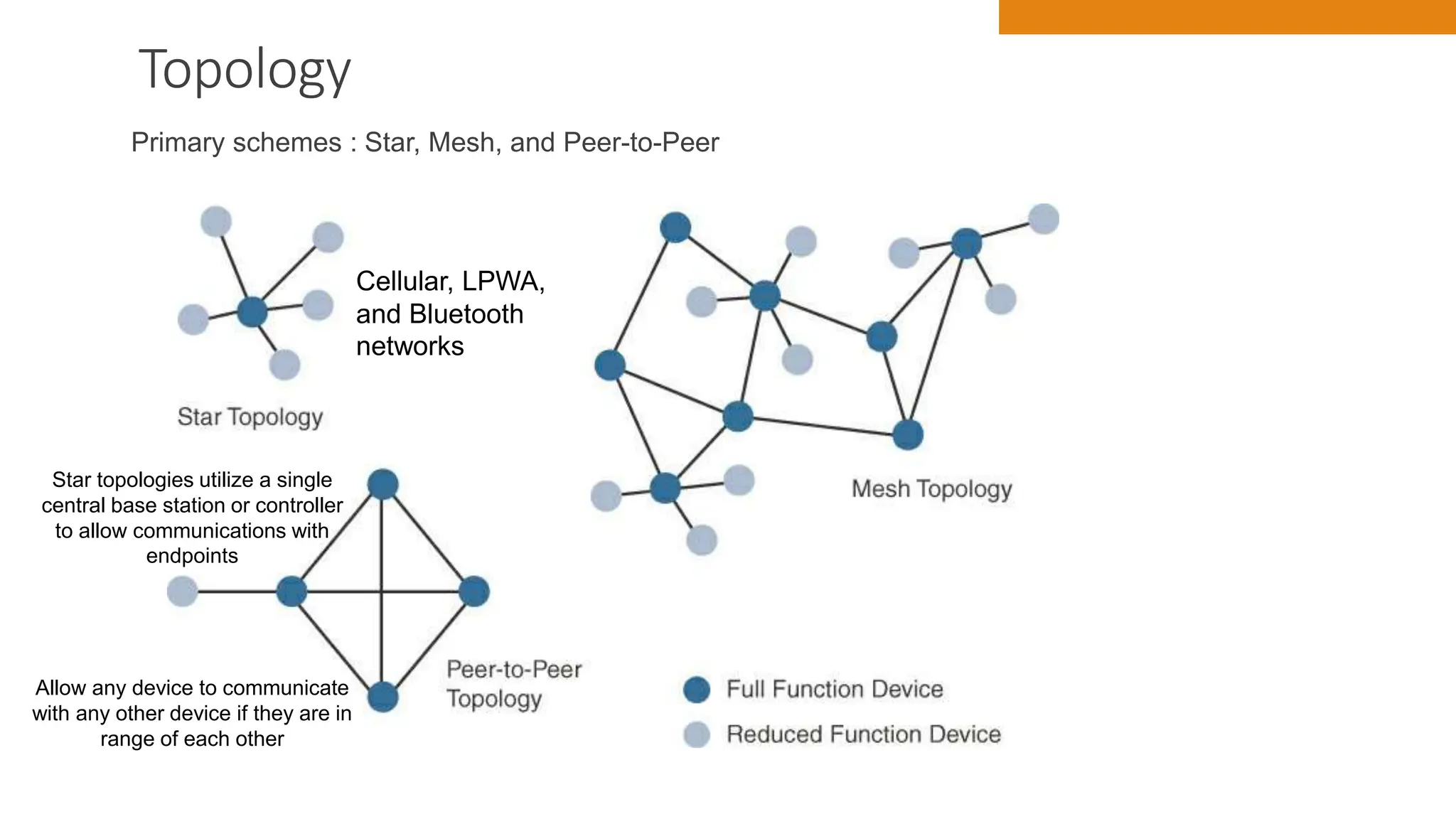
Topology
Primary schemes : Star, Mesh, and Peer-to-Peer
52
Cellular, LPWA,
and Bluetooth
networks
Star topologies utilize a single
central base station or controller
to allow communications with
endpoints
Allow any device to communicate
with any other device if they are in
range of each other
Constrained Devices
53
Device Constraints
• Computing
• Memory
• Storage
• Power
• Networking
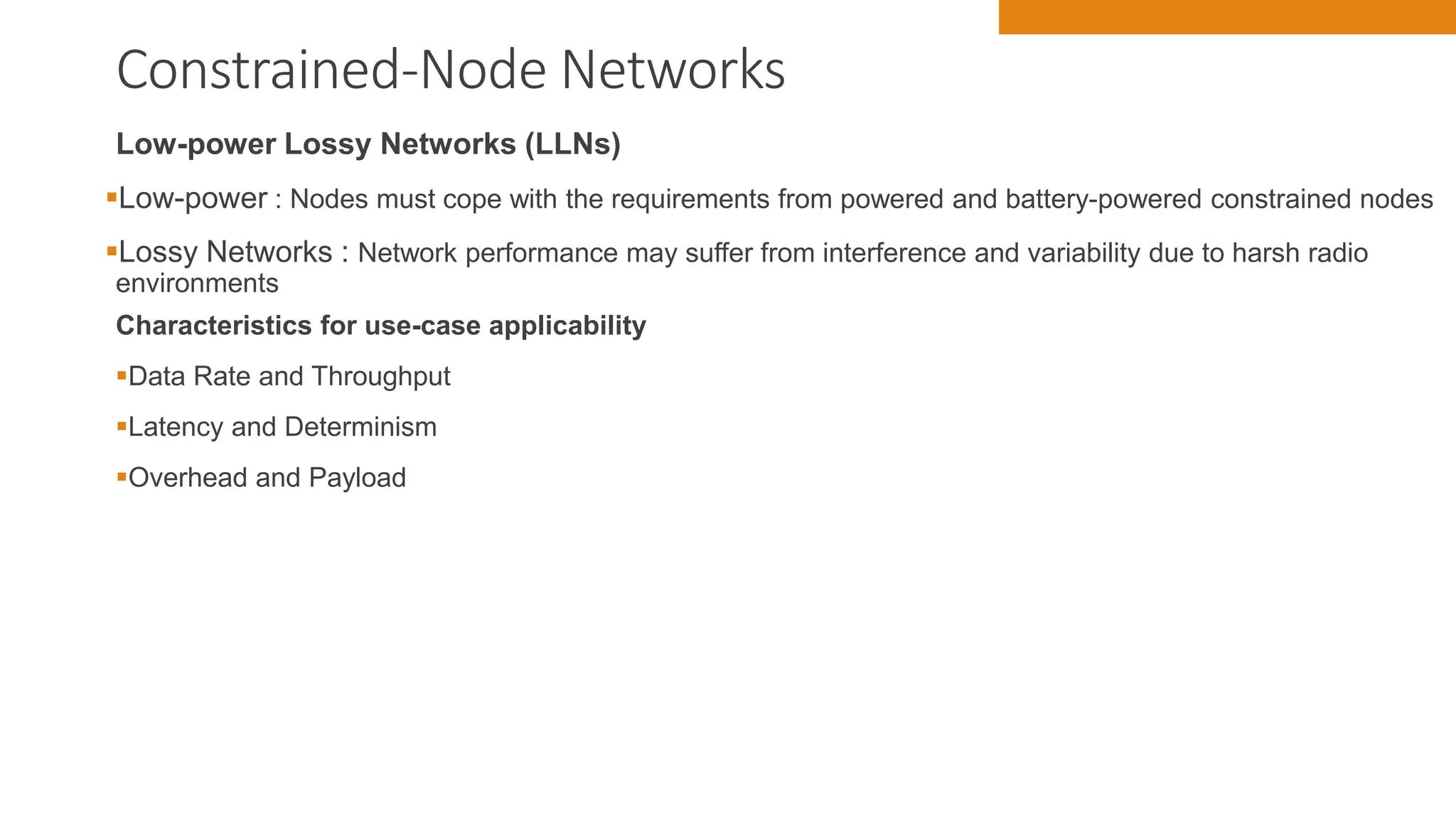
Constrained-Node Networks
Low-power Lossy Networks (LLNs)
Low-power : Nodes must cope with the requirements from powered and battery-powered constrained nodes
Lossy Networks : Network performance may suffer from interference and variability due to harsh radio
environments
54
Characteristics for use-case applicability
Data Rate and Throughput
Latency and Determinism
Overhead and Payload
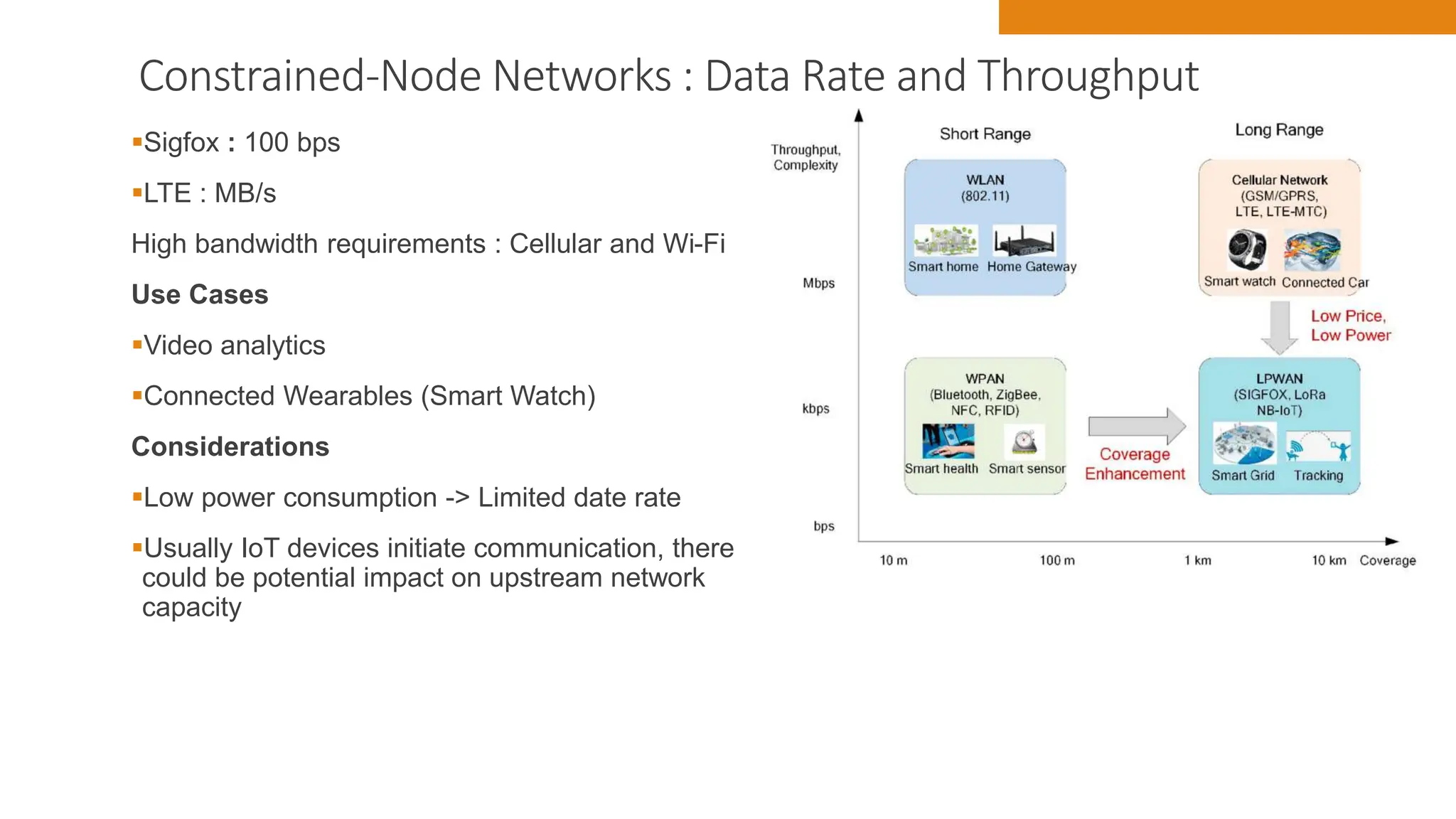
Constrained-Node Networks : Data Rate and Throughput
Sigfox : 100 bps
LTE : MB/s
High bandwidth requirements : Cellular and Wi-Fi
Use Cases
Video analytics
Connected Wearables (Smart Watch)
Considerations
Low power consumption -> Limited date rate
Usually IoT devices initiate communication, there
could be potential impact on upstream network
capacity
55
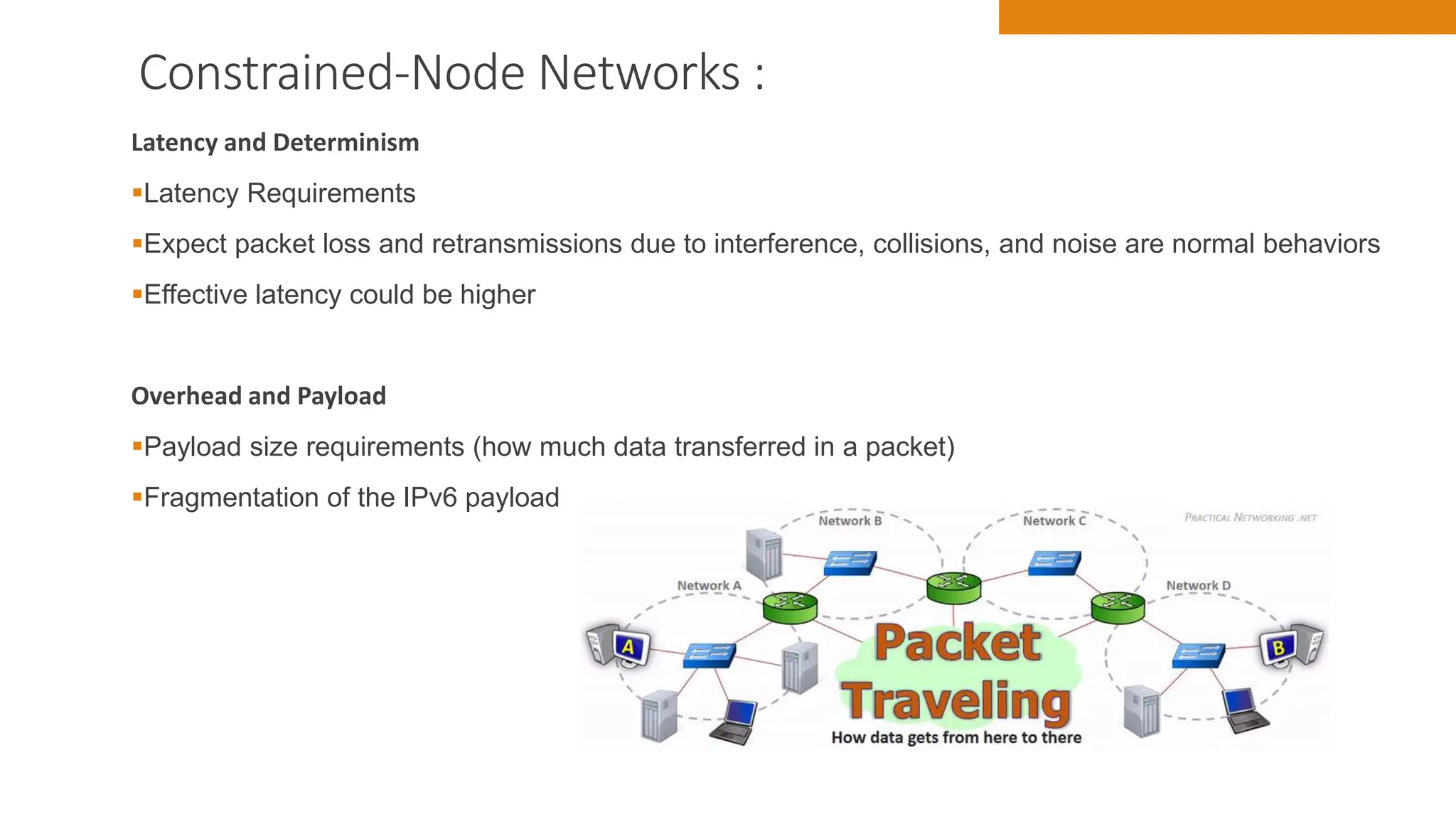
Constrained-Node Networks :
Latency and Determinism
Latency Requirements
Expect packet loss and retransmissions due to interference, collisions, and noise are normal behaviors
Effective latency could be higher
Overhead and Payload
Payload size requirements (how much data transferred in a packet)
Fragmentation of the IPv6 payload
56
Module 2
57
Smart Objects: The “Things” in IoT
Sensors, Actuators, and Smart Objects
Sensor Networks
Connecting Smart Objects
Communications Criteria
IoT Access Technologies
IP as the IoT Network Layer
◦ The Business Case for IP
◦ The Need for Optimization
◦ Optimizing IP for IoT
◦ Profiles and Compliances
Chapters 3, 4, 5
IoT Access Technologies
58
IoT Access Technologies
IOT FOR DATA SCIENCE AND ANALYTICS 59
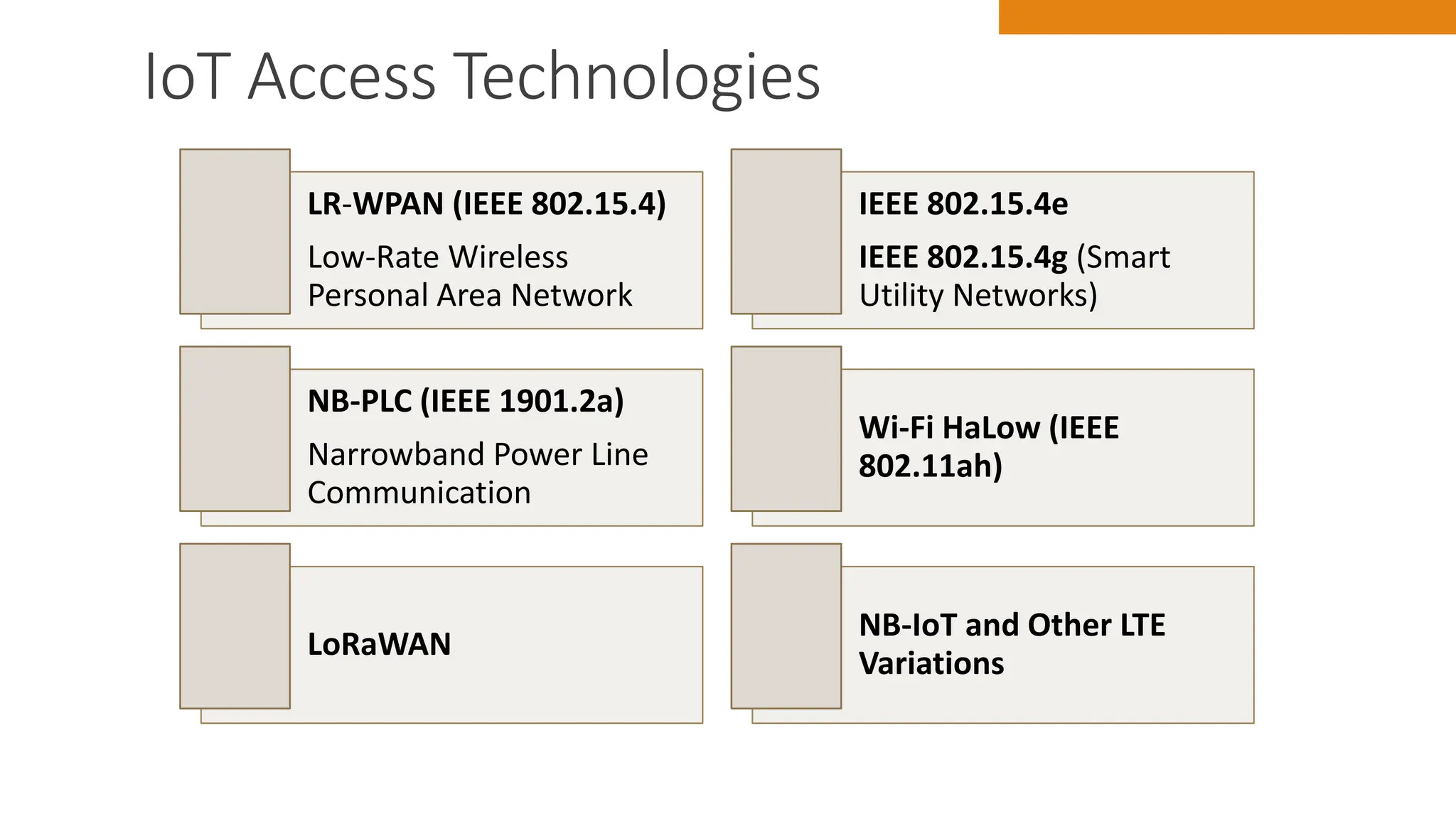
LR-WPAN (IEEE 802.15.4)
Low-Rate Wireless
Personal Area Network
IEEE 802.15.4e
IEEE 802.15.4g (Smart
Utility Networks)
NB-PLC (IEEE 1901.2a)
Narrowband Power Line
Communication
Wi-Fi HaLow (IEEE
802.11ah)
LoRaWAN
NB-IoT and Other LTE
Variations
IoT Access Technologies
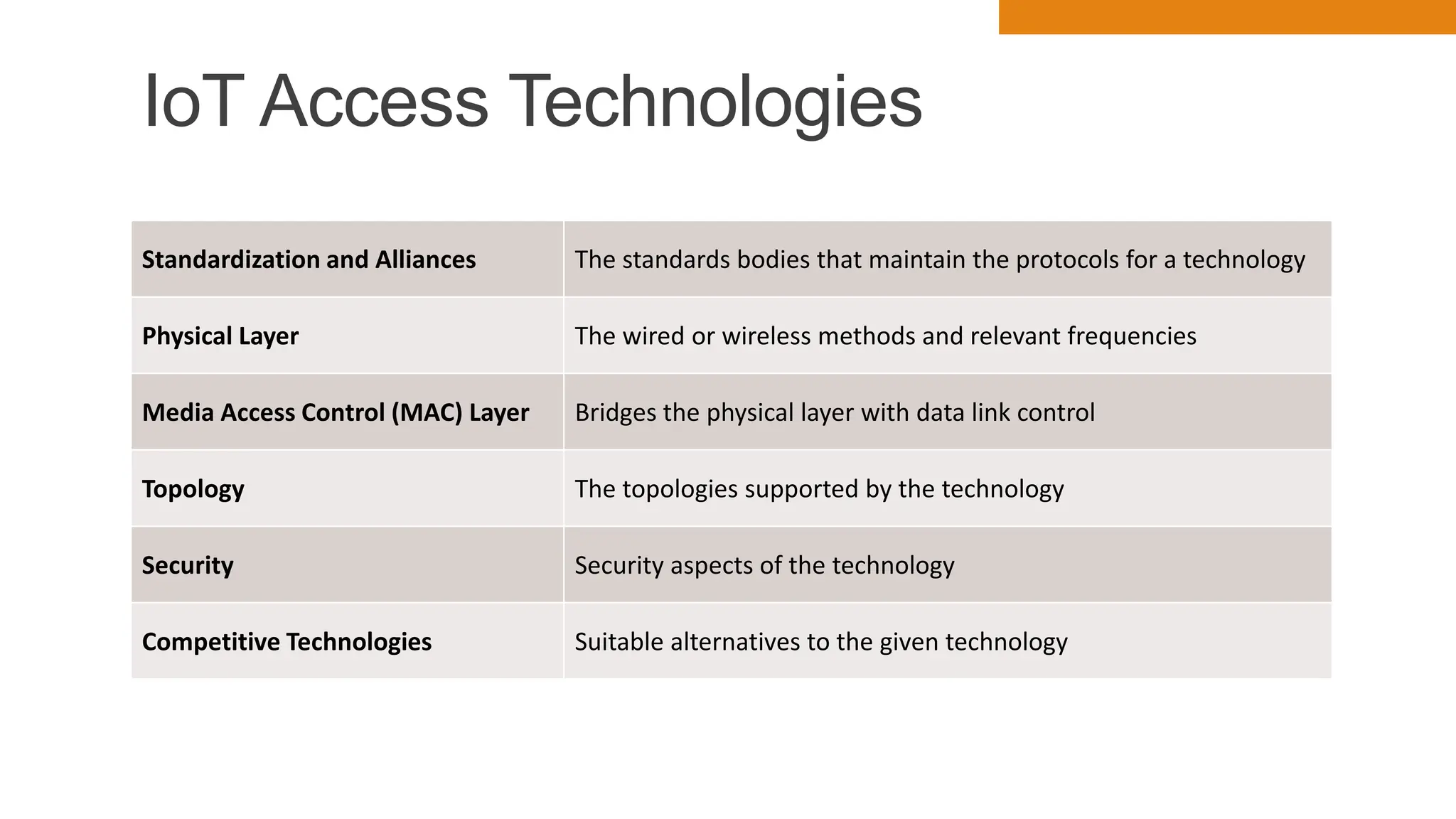
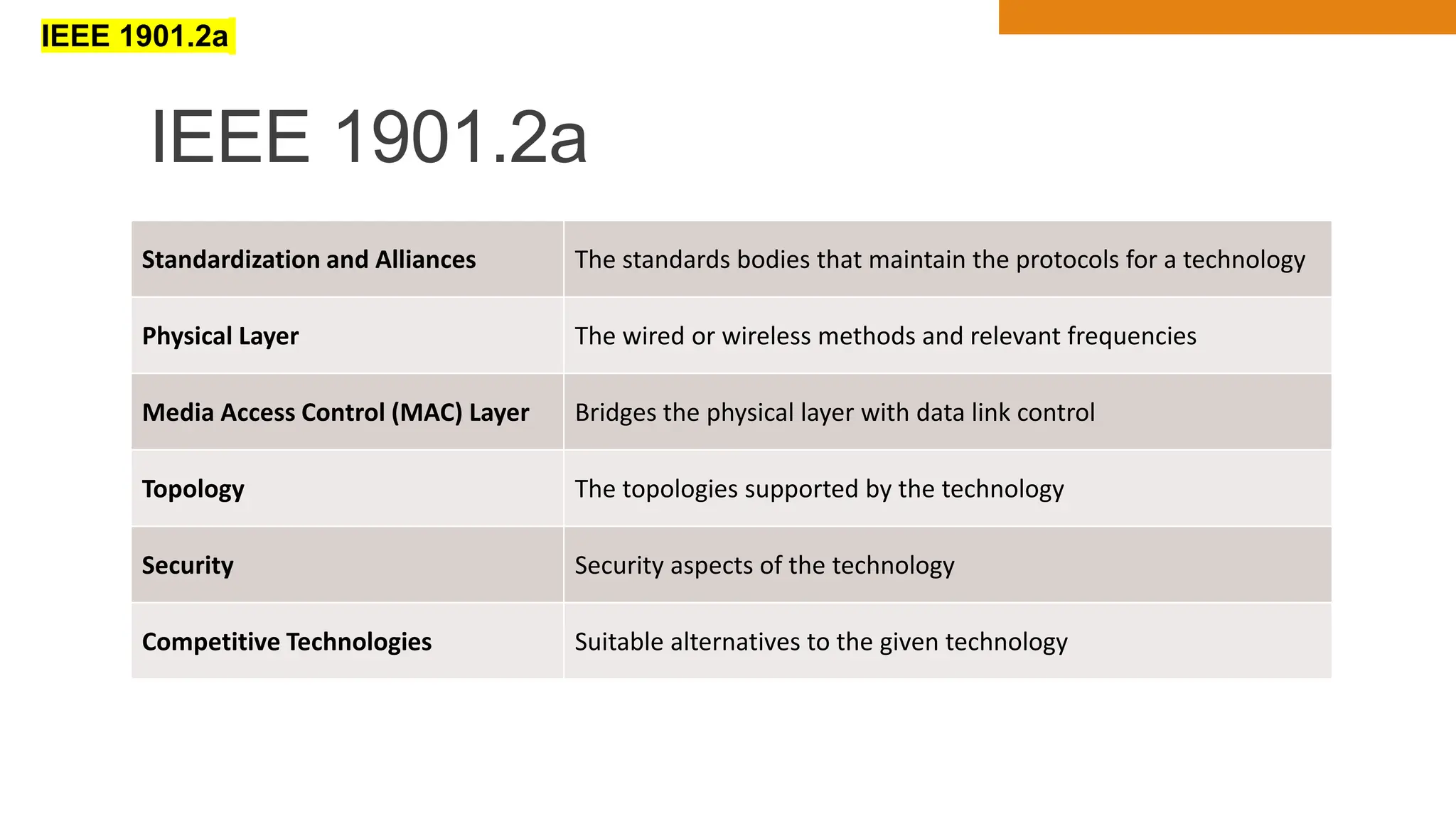
Standardization and Alliances The standards bodies that maintain the protocols for a technology
Physical Layer The wired or wireless methods and relevant frequencies
Media Access Control (MAC) Layer Bridges the physical layer with data link control
Topology The topologies supported by the technology
Security Security aspects of the technology
Competitive Technologies Suitable alternatives to the given technology
IOT THINGS PRESENTATION - DAVIS M ONSAKIA 60
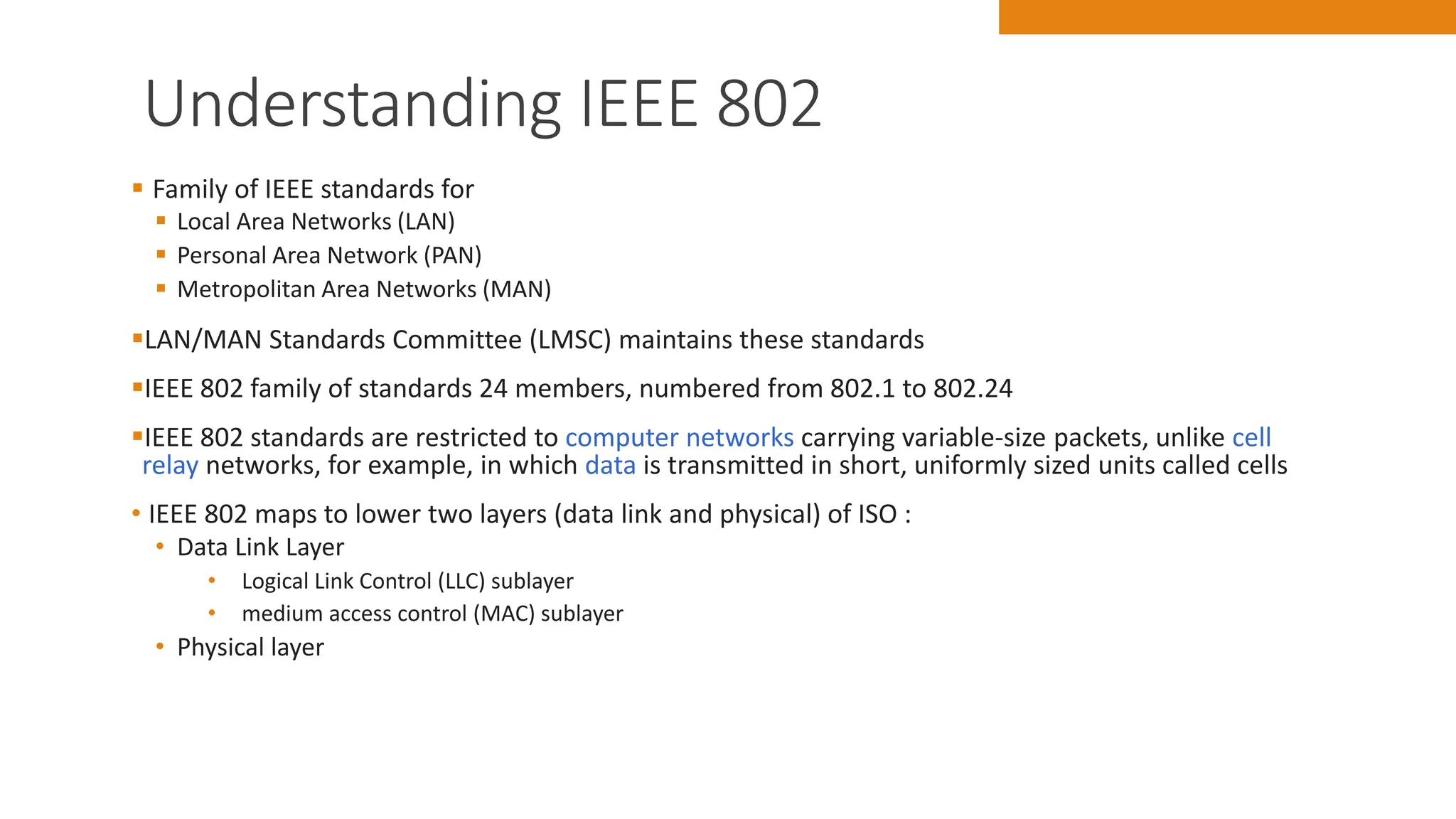
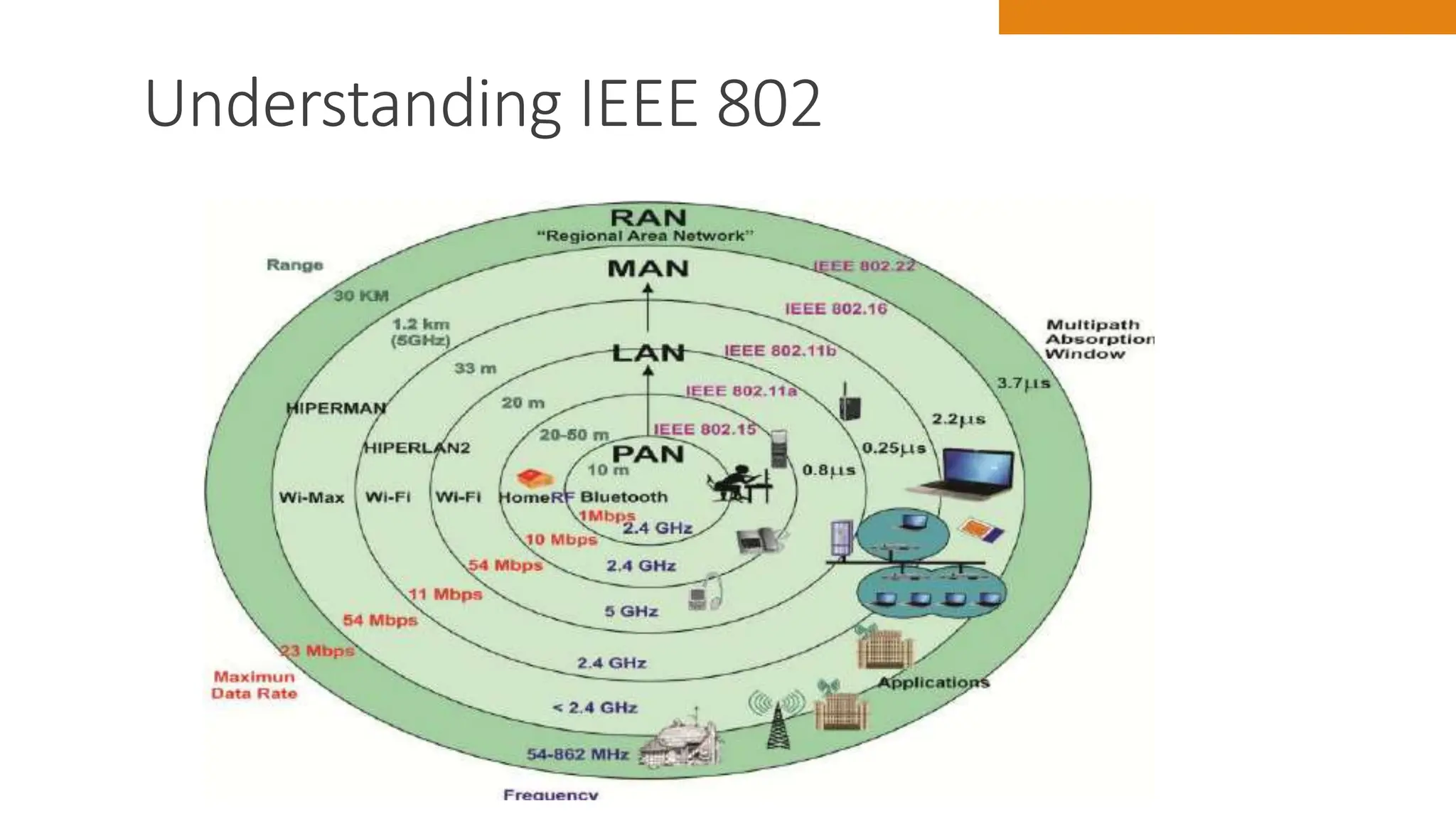
Understanding IEEE 802
 Family of IEEE standards for
 Local Area Networks (LAN)
 Personal Area Network (PAN)
 Metropolitan Area Networks (MAN)
LAN/MAN Standards Committee (LMSC) maintains these standards
IEEE 802 family of standards 24 members, numbered from 802.1 to 802.24
IEEE 802 standards are restricted to computer networks carrying variable-size packets, unlike cell
relay networks, for example, in which data is transmitted in short, uniformly sized units called cells
• IEEE 802 maps to lower two layers (data link and physical) of ISO :
• Data Link Layer
• Logical Link Control (LLC) sublayer
• medium access control (MAC) sublayer
• Physical layer
IOT THINGS PRESENTATION - DAVIS M ONSAKIA 61
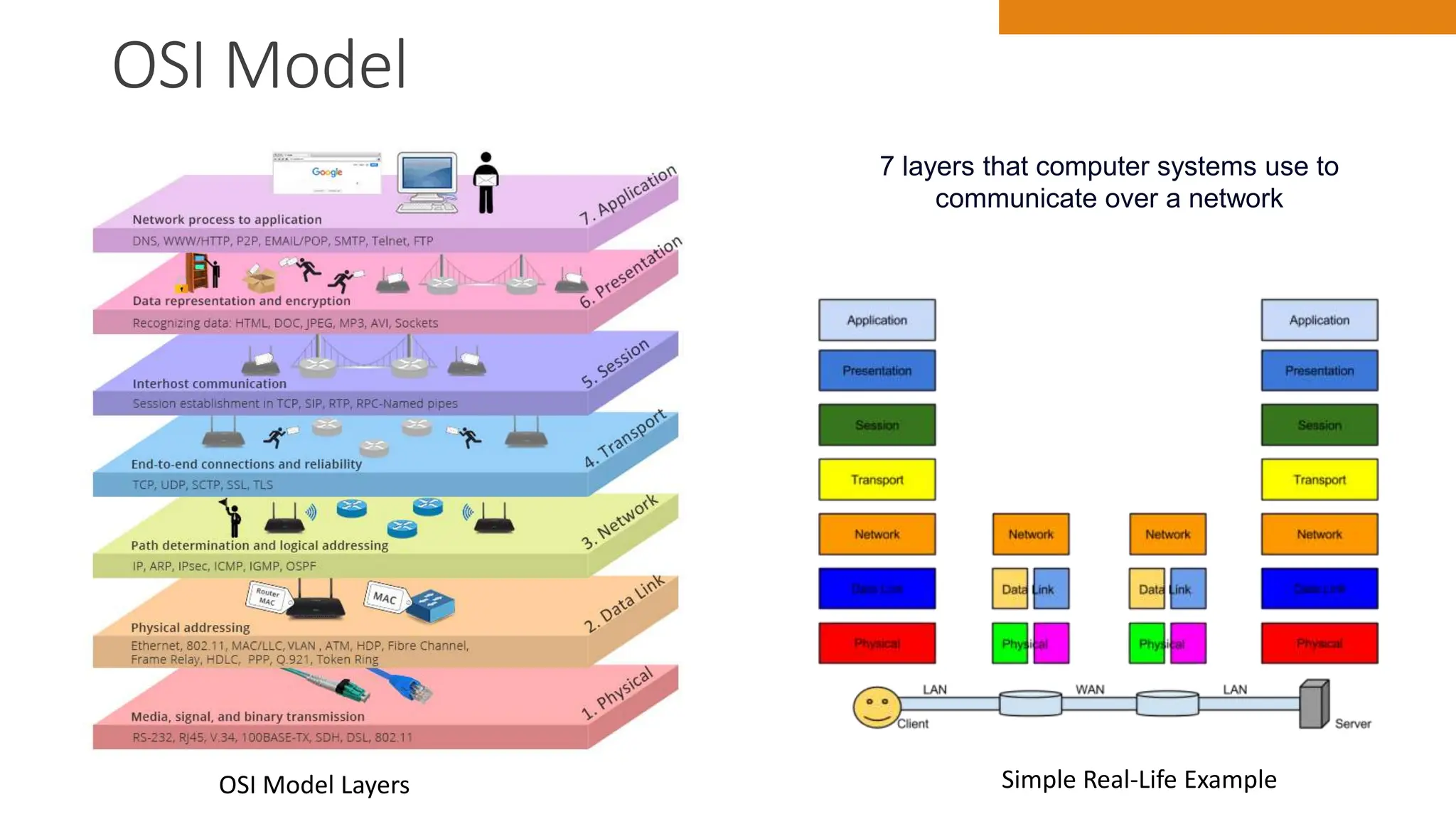
OSI Model
IOT THINGS PRESENTATION - DAVIS M ONSAKIA 62
Simple Real-Life Example
OSI Model Layers
7 layers that computer systems use to
communicate over a network
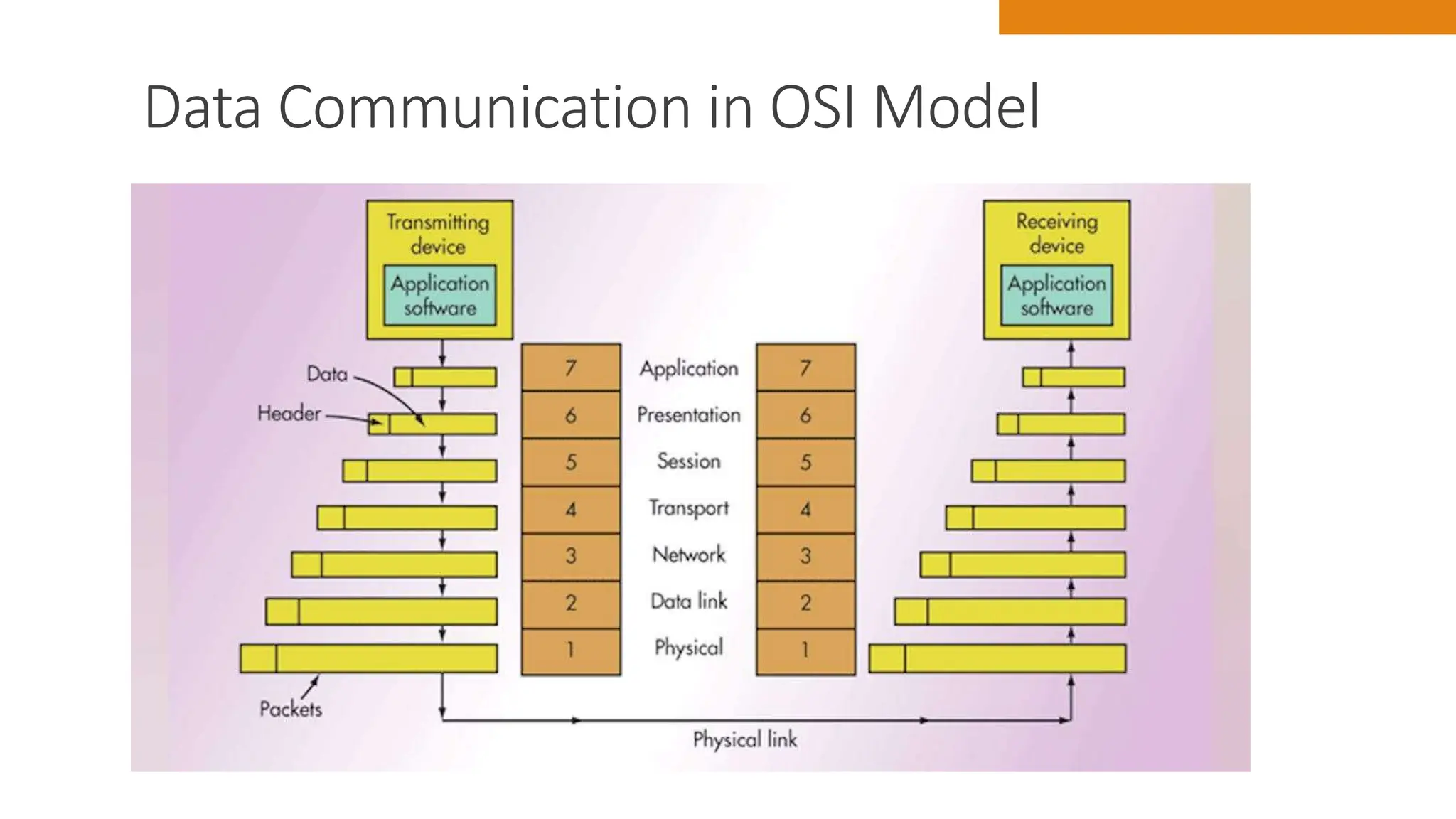
Data Communication in OSI Model
IOT THINGS PRESENTATION - DAVIS M ONSAKIA 63
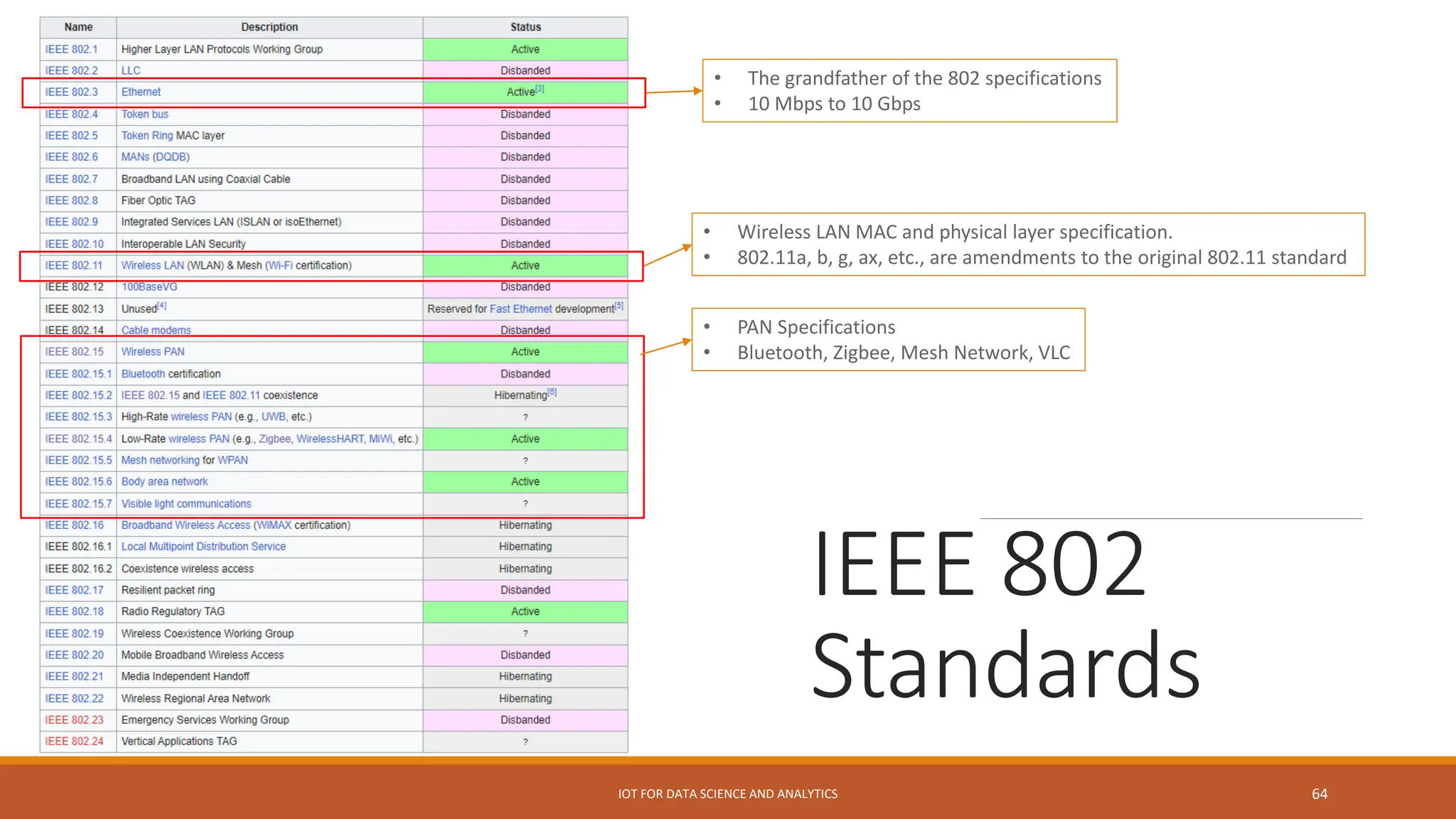
IEEE 802
Standards
IOT FOR DATA SCIENCE AND ANALYTICS 64
• The grandfather of the 802 specifications
• 10 Mbps to 10 Gbps
• Wireless LAN MAC and physical layer specification.
• 802.11a, b, g, ax, etc., are amendments to the original 802.11 standard
• PAN Specifications
• Bluetooth, Zigbee, Mesh Network, VLC
Understanding IEEE 802
IOT THINGS PRESENTATION - DAVIS M ONSAKIA 65
IEEE 802.15.4
66
 Standardization and Alliances
 Physical layer
 MAC layer
 Topology
 Security
 Competitive Technologies
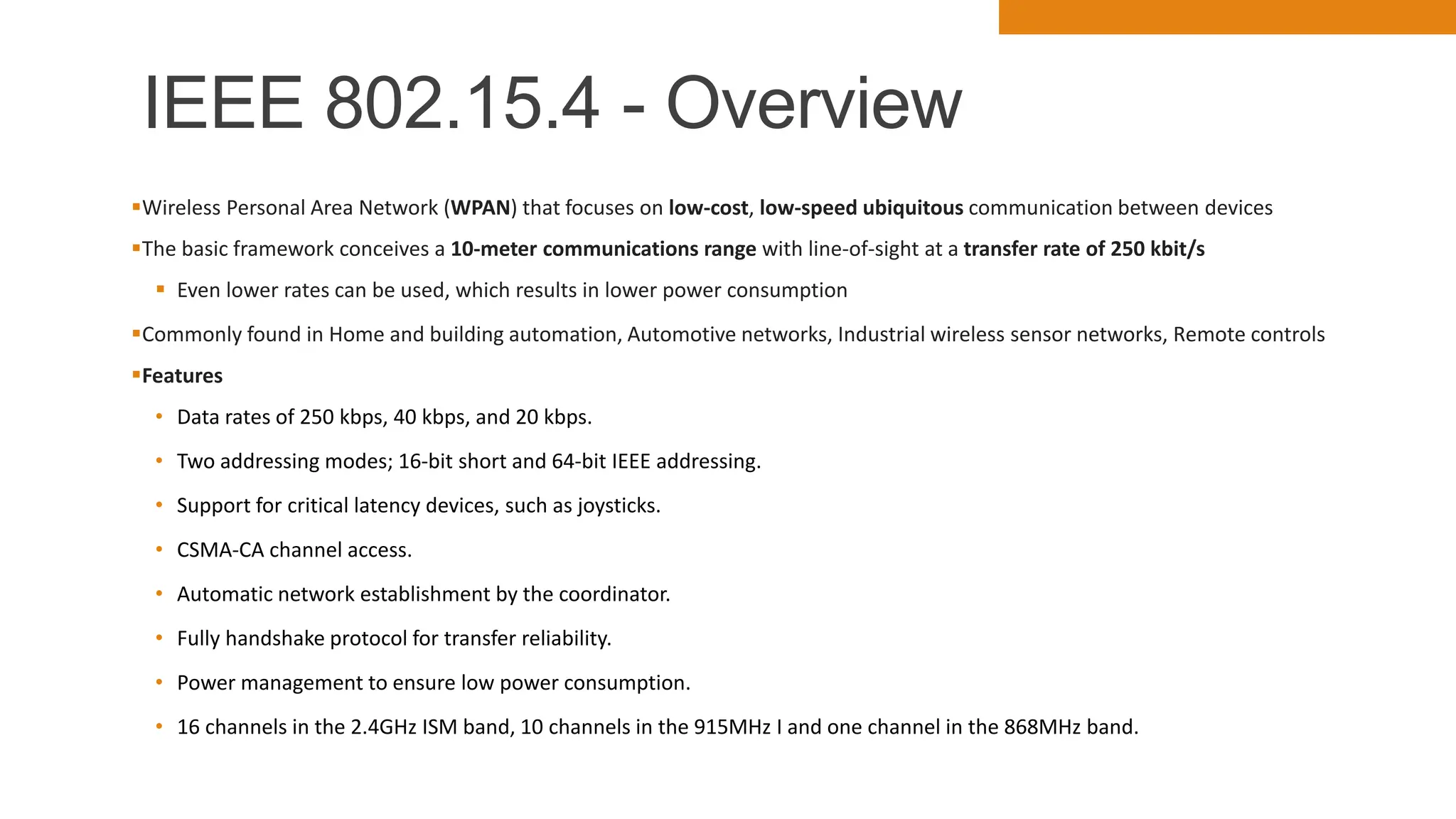
IEEE 802.15.4 - Overview
IOT THINGS PRESENTATION - DAVIS M ONSAKIA 67
Wireless Personal Area Network (WPAN) that focuses on low-cost, low-speed ubiquitous communication between devices
The basic framework conceives a 10-meter communications range with line-of-sight at a transfer rate of 250 kbit/s
 Even lower rates can be used, which results in lower power consumption
Commonly found in Home and building automation, Automotive networks, Industrial wireless sensor networks, Remote controls
Features
• Data rates of 250 kbps, 40 kbps, and 20 kbps.
• Two addressing modes; 16-bit short and 64-bit IEEE addressing.
• Support for critical latency devices, such as joysticks.
• CSMA-CA channel access.
• Automatic network establishment by the coordinator.
• Fully handshake protocol for transfer reliability.
• Power management to ensure low power consumption.
• 16 channels in the 2.4GHz ISM band, 10 channels in the 915MHz I and one channel in the 868MHz band.
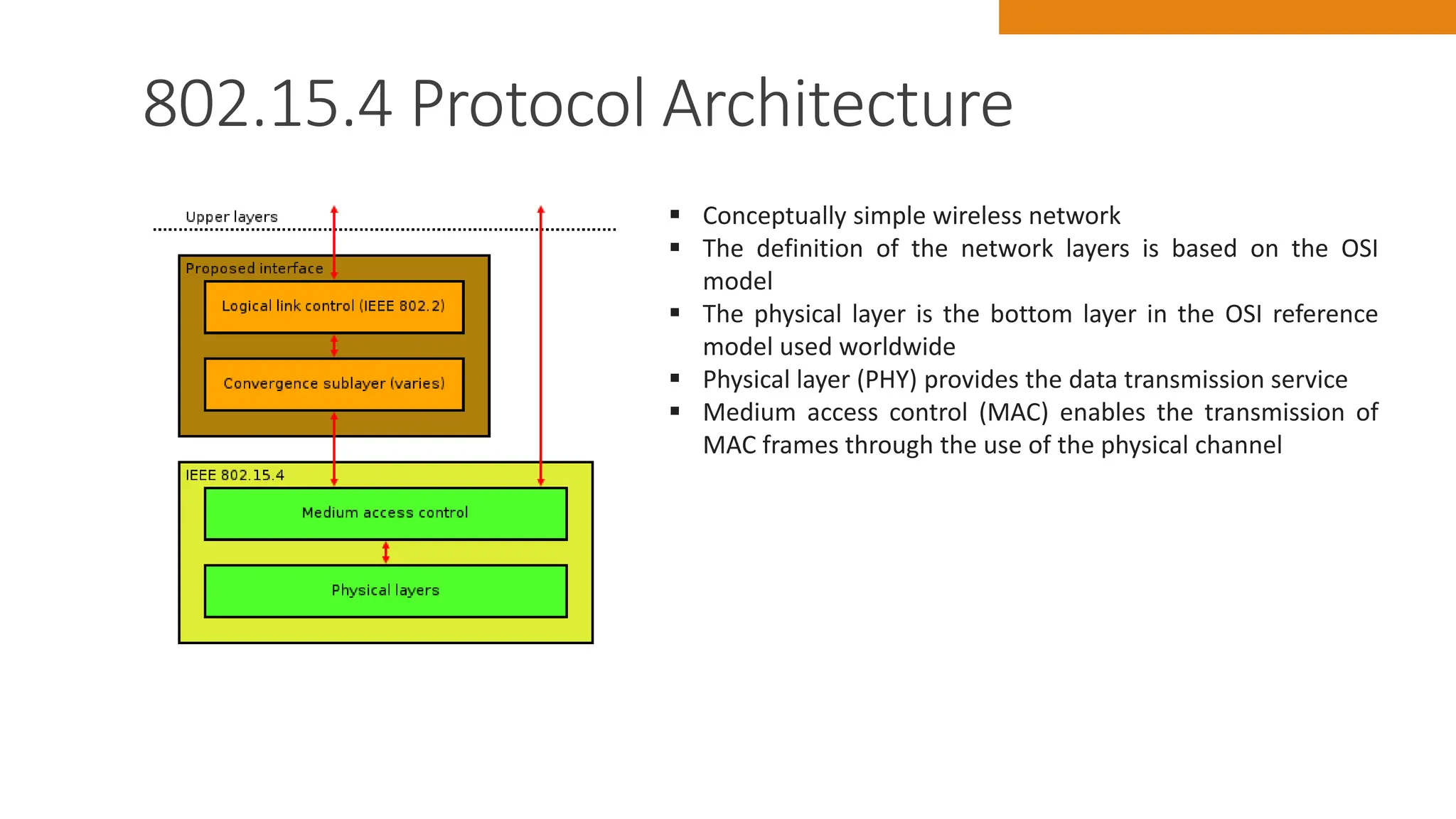
802.15.4 Protocol Architecture
IOT THINGS PRESENTATION - DAVIS M ONSAKIA 68
 Conceptually simple wireless network
 The definition of the network layers is based on the OSI
model
 The physical layer is the bottom layer in the OSI reference
model used worldwide
 Physical layer (PHY) provides the data transmission service
 Medium access control (MAC) enables the transmission of
MAC frames through the use of the physical channel
Standardization and Alliances
IOT THINGS PRESENTATION - DAVIS M ONSAKIA 69
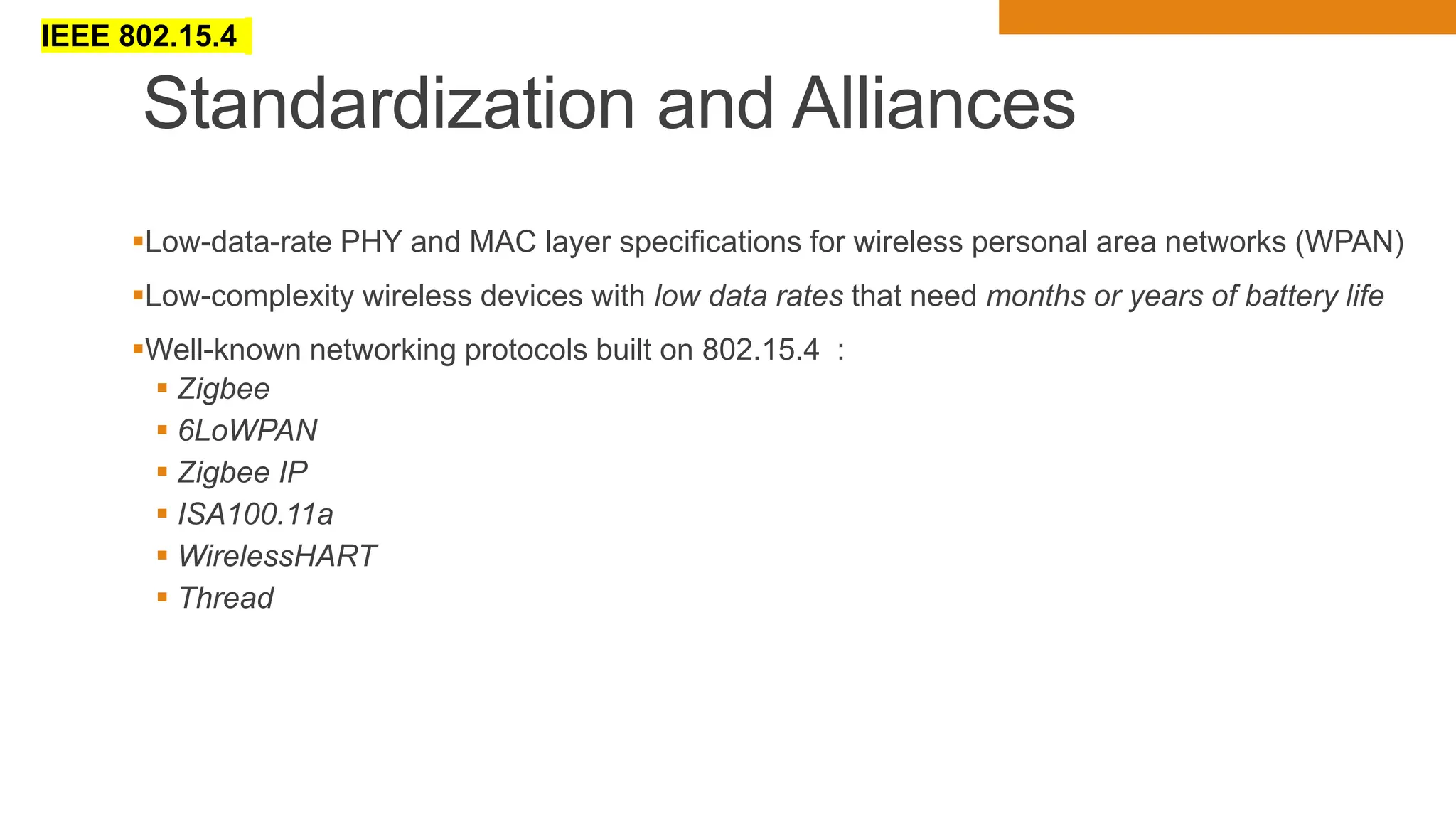
Low-data-rate PHY and MAC layer specifications for wireless personal area networks (WPAN)
Low-complexity wireless devices with low data rates that need months or years of battery life
Well-known networking protocols built on 802.15.4 :
 Zigbee
 6LoWPAN
 Zigbee IP
 ISA100.11a
 WirelessHART
 Thread
IEEE 802.15.4
Zigbee
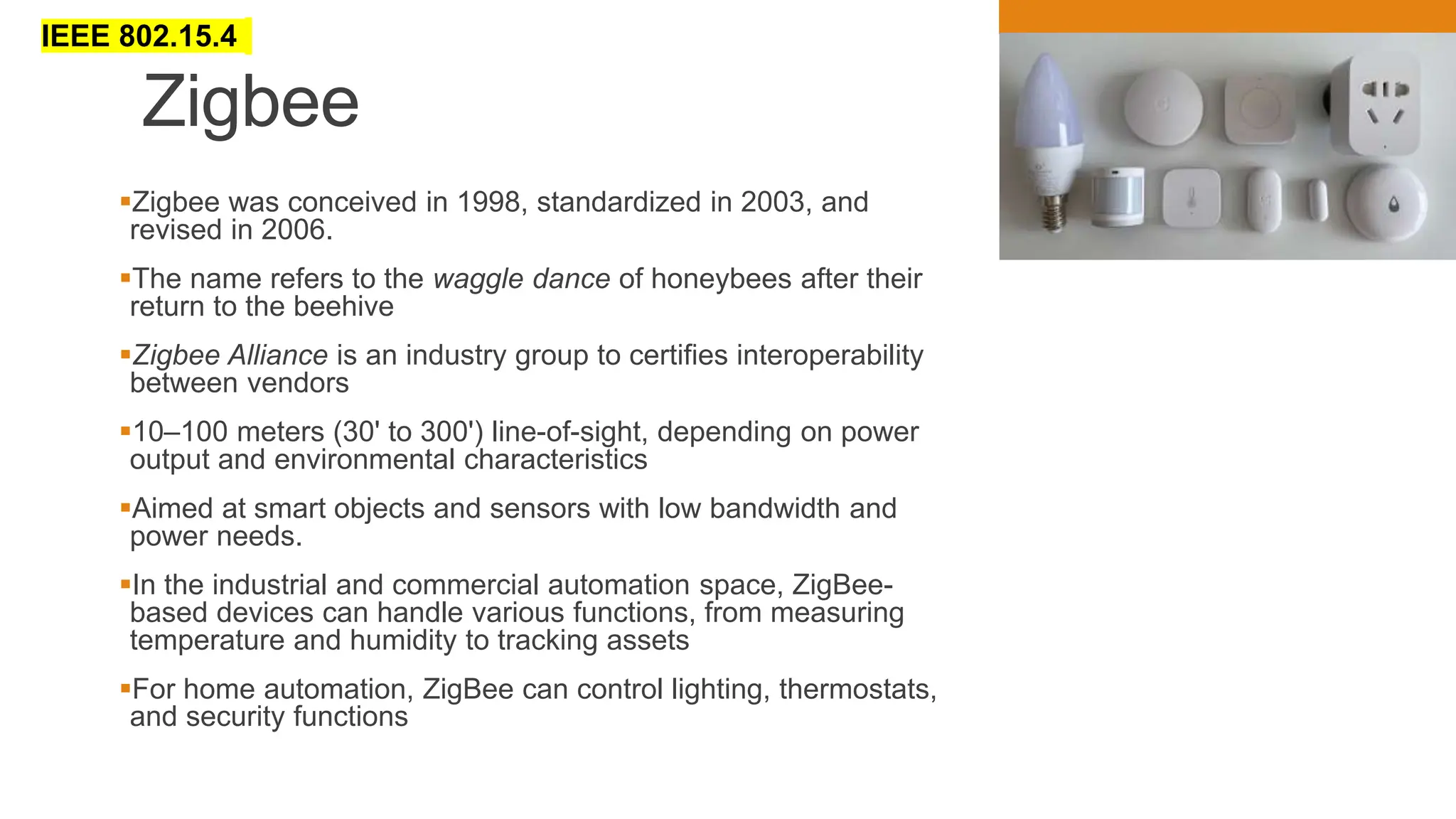
Zigbee was conceived in 1998, standardized in 2003, and
revised in 2006.
The name refers to the waggle dance of honeybees after their
return to the beehive
Zigbee Alliance is an industry group to certifies interoperability
between vendors
10–100 meters (30' to 300') line-of-sight, depending on power
output and environmental characteristics
Aimed at smart objects and sensors with low bandwidth and
power needs.
In the industrial and commercial automation space, ZigBee-
based devices can handle various functions, from measuring
temperature and humidity to tracking assets
For home automation, ZigBee can control lighting, thermostats,
and security functions
IOT THINGS PRESENTATION - DAVIS M ONSAKIA 70
IEEE 802.15.4
High Level Zigbee Protocol Stack
IOT THINGS PRESENTATION - DAVIS M ONSAKIA 71
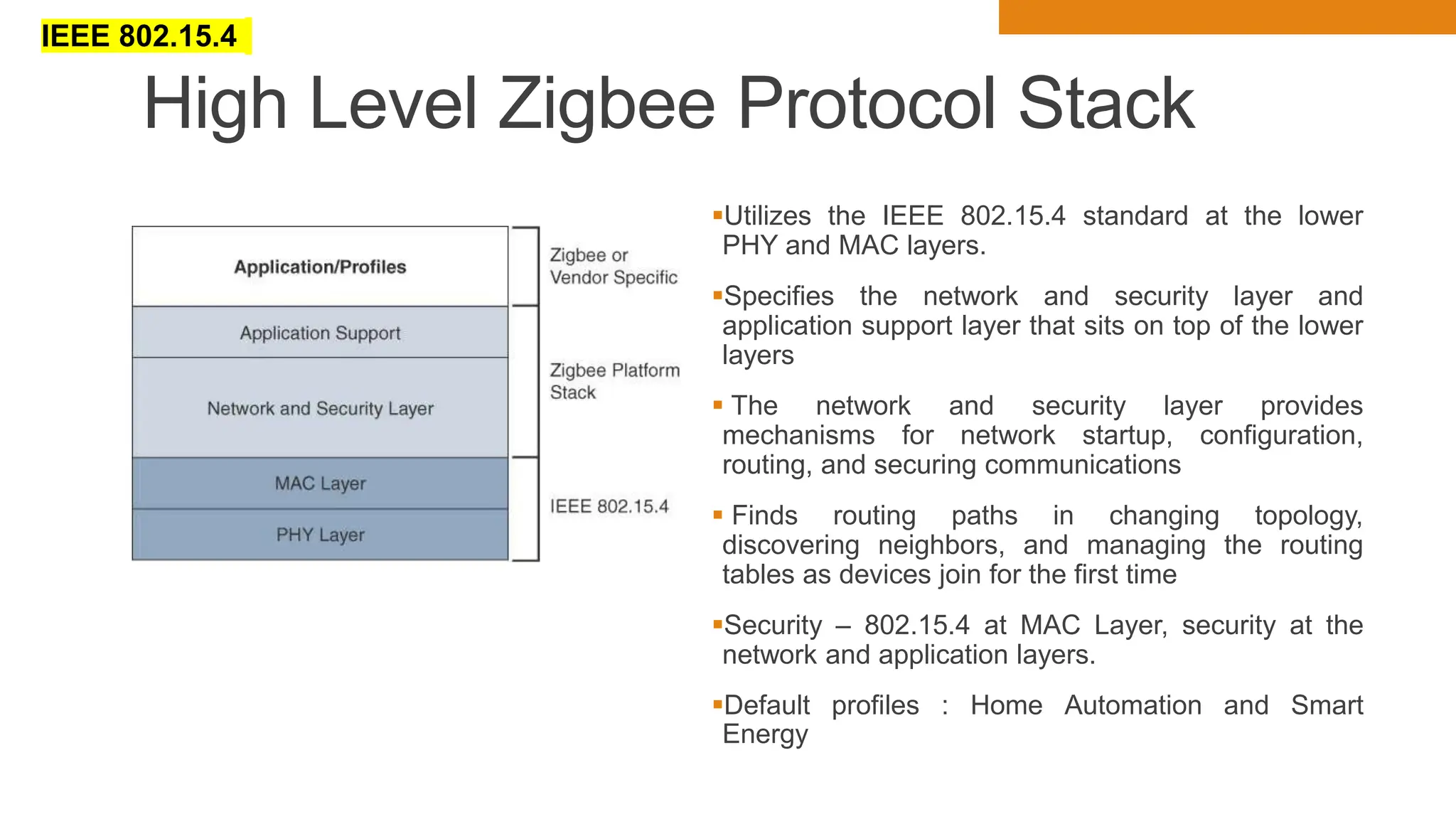
Utilizes the IEEE 802.15.4 standard at the lower
PHY and MAC layers.
Specifies the network and security layer and
application support layer that sits on top of the lower
layers
 The network and security layer provides
mechanisms for network startup, configuration,
routing, and securing communications
 Finds routing paths in changing topology,
discovering neighbors, and managing the routing
tables as devices join for the first time
Security – 802.15.4 at MAC Layer, security at the
network and application layers.
Default profiles : Home Automation and Smart
Energy
IEEE 802.15.4
6LoWPAN
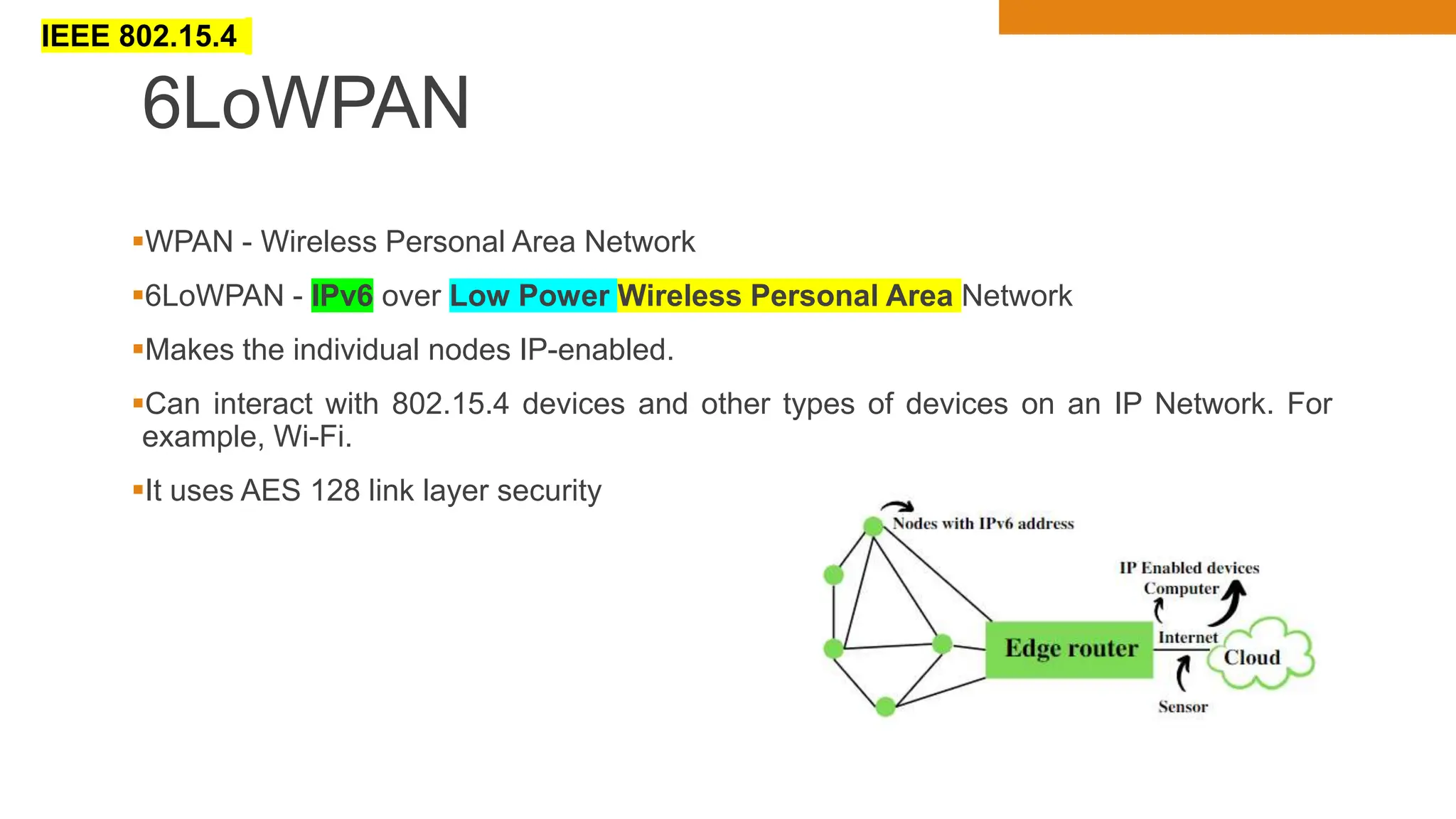
WPAN - Wireless Personal Area Network
6LoWPAN - IPv6 over Low Power Wireless Personal Area Network
Makes the individual nodes IP-enabled.
Can interact with 802.15.4 devices and other types of devices on an IP Network. For
example, Wi-Fi.
It uses AES 128 link layer security
IOT THINGS PRESENTATION - DAVIS M ONSAKIA 72
IEEE 802.15.4
Physical Layer
IOT THINGS PRESENTATION - DAVIS M ONSAKIA 73
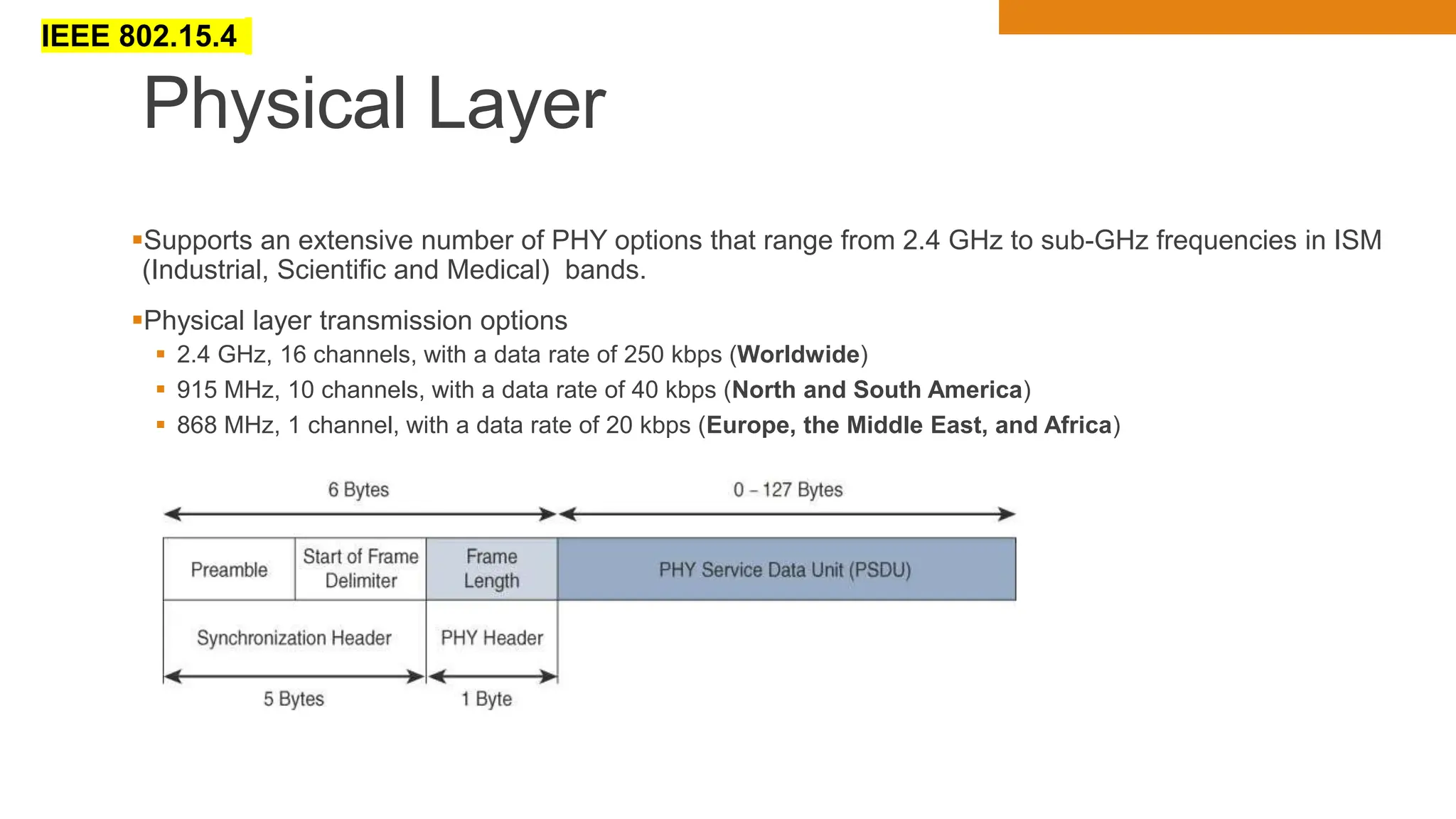
Supports an extensive number of PHY options that range from 2.4 GHz to sub-GHz frequencies in ISM
(Industrial, Scientific and Medical) bands.
Physical layer transmission options
 2.4 GHz, 16 channels, with a data rate of 250 kbps (Worldwide)
 915 MHz, 10 channels, with a data rate of 40 kbps (North and South America)
 868 MHz, 1 channel, with a data rate of 20 kbps (Europe, the Middle East, and Africa)
IEEE 802.15.4
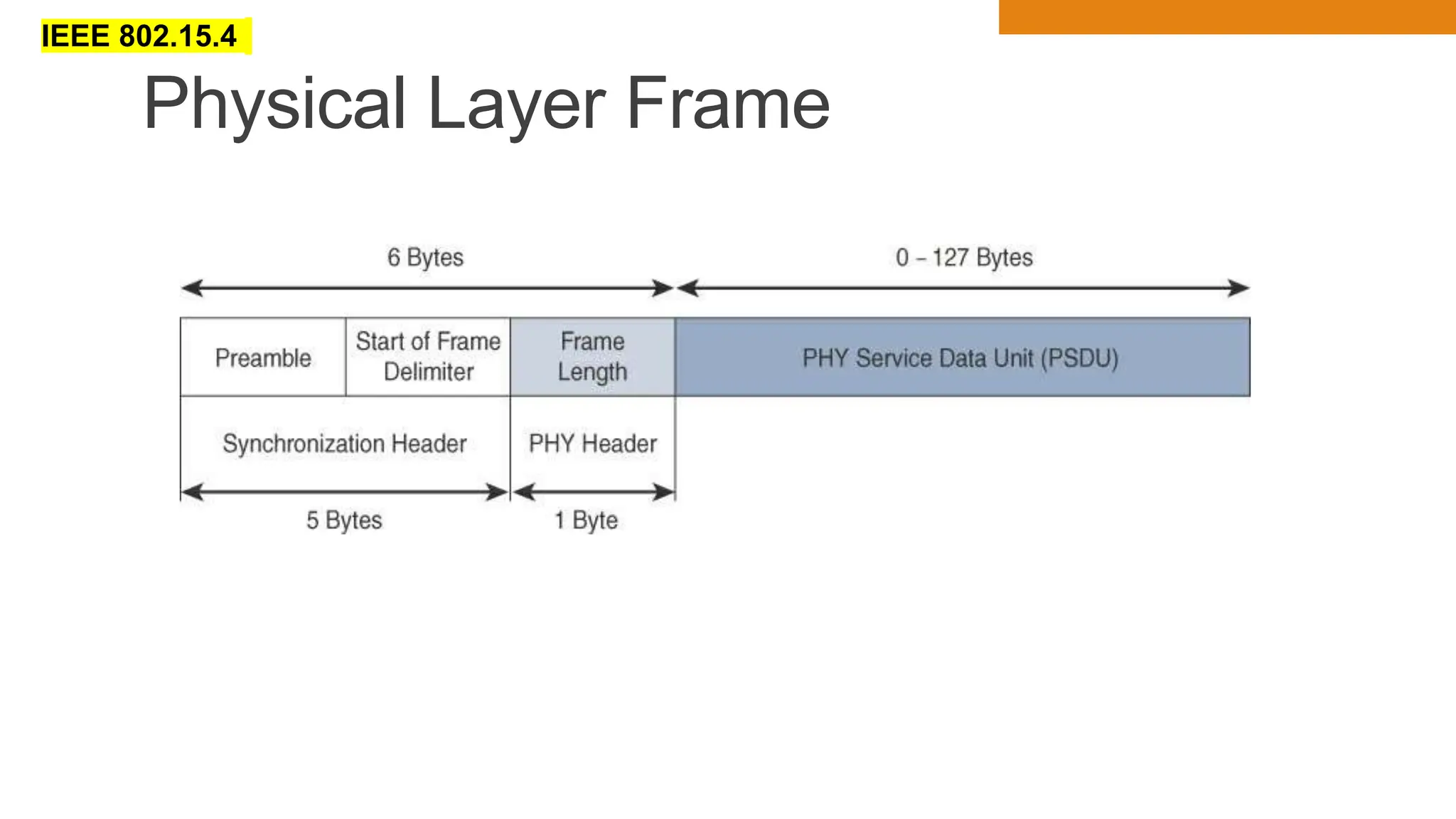
Physical Layer Frame
IOT THINGS PRESENTATION - DAVIS M ONSAKIA 74
IEEE 802.15.4
MAC Layer
IOT THINGS PRESENTATION - DAVIS M ONSAKIA 75
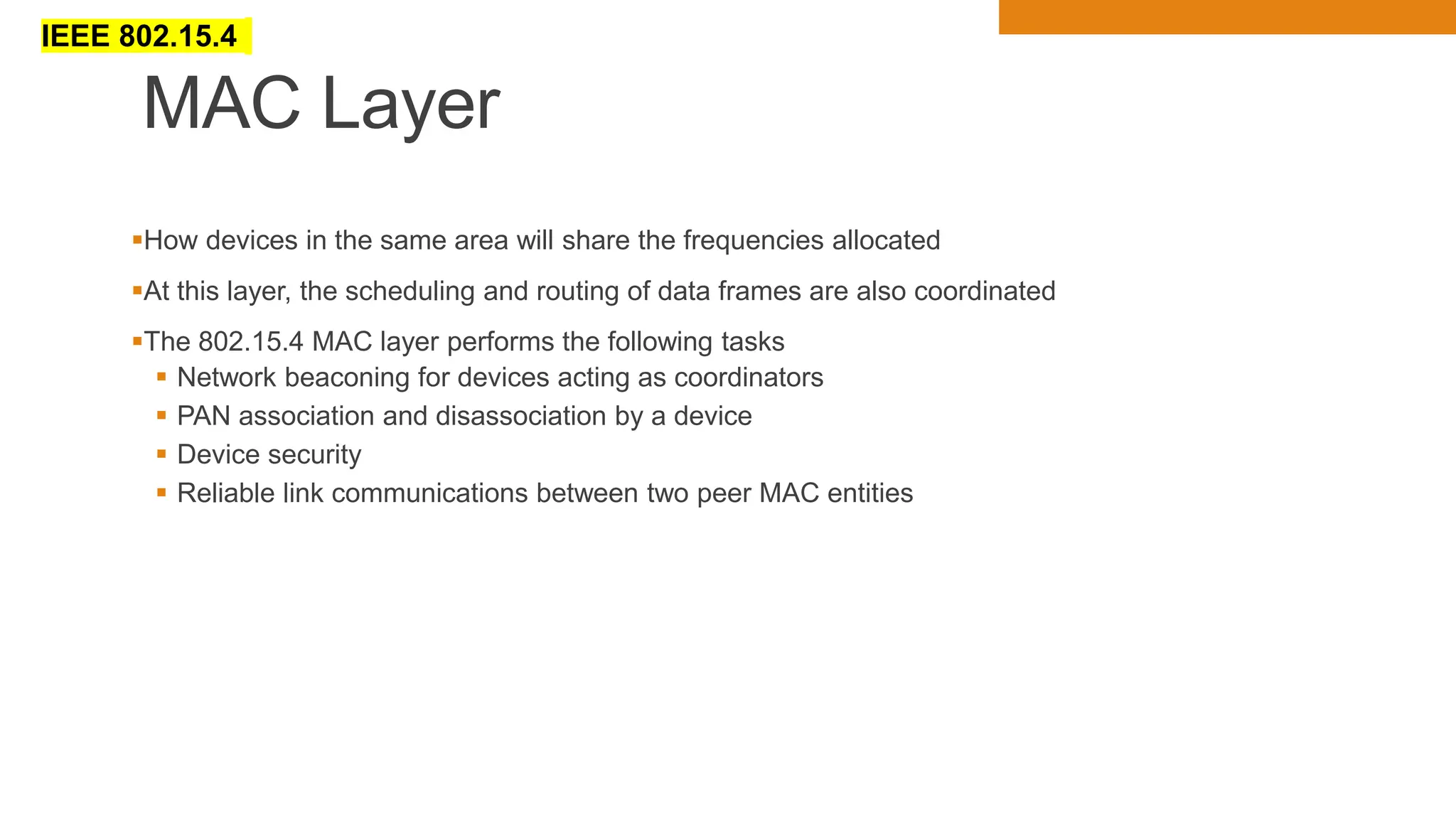
How devices in the same area will share the frequencies allocated
At this layer, the scheduling and routing of data frames are also coordinated
The 802.15.4 MAC layer performs the following tasks
 Network beaconing for devices acting as coordinators
 PAN association and disassociation by a device
 Device security
 Reliable link communications between two peer MAC entities
IEEE 802.15.4
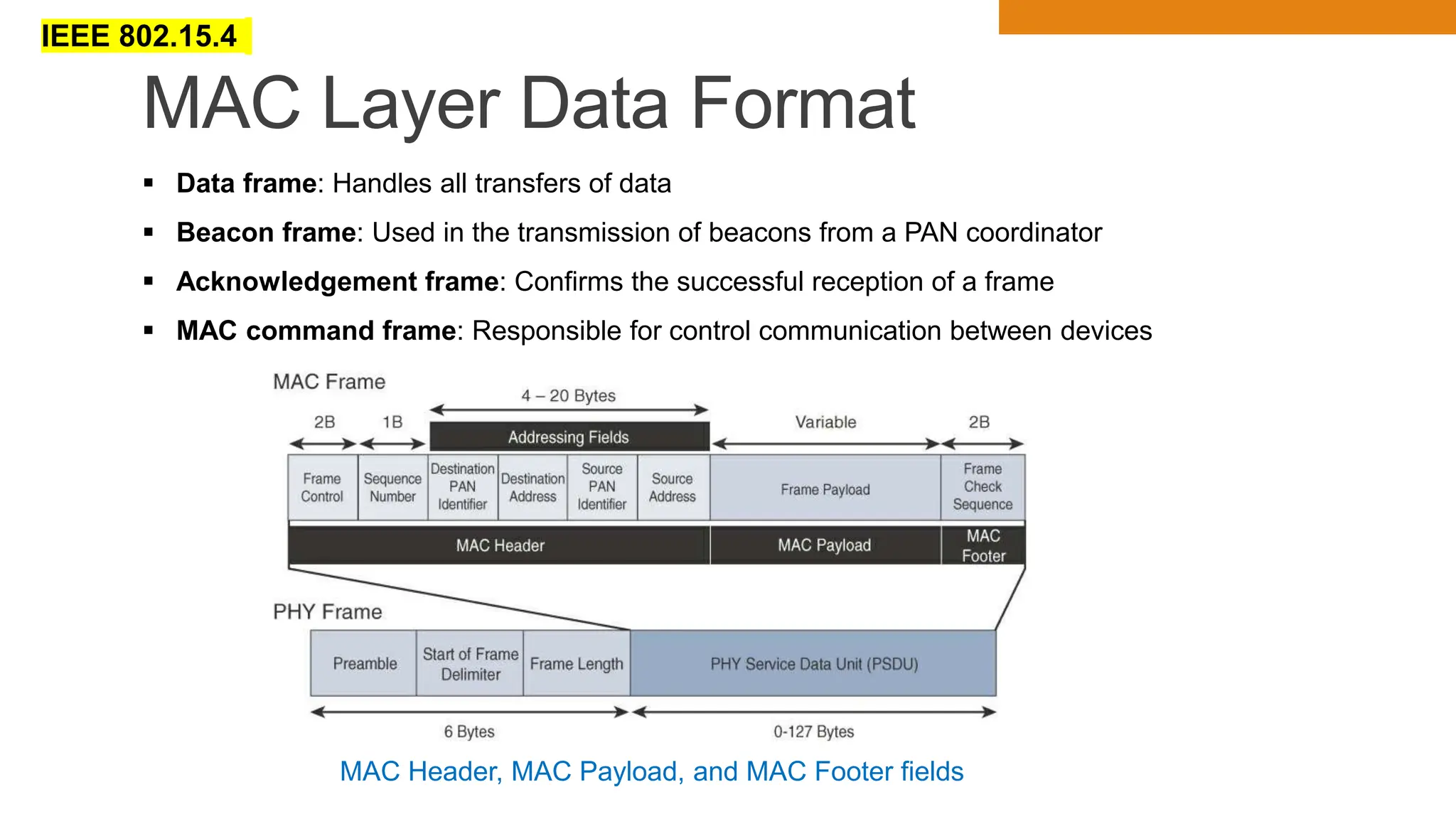
MAC Layer Data Format
IOT THINGS PRESENTATION - DAVIS M ONSAKIA 76
IEEE 802.15.4
 Data frame: Handles all transfers of data
 Beacon frame: Used in the transmission of beacons from a PAN coordinator
 Acknowledgement frame: Confirms the successful reception of a frame
 MAC command frame: Responsible for control communication between devices
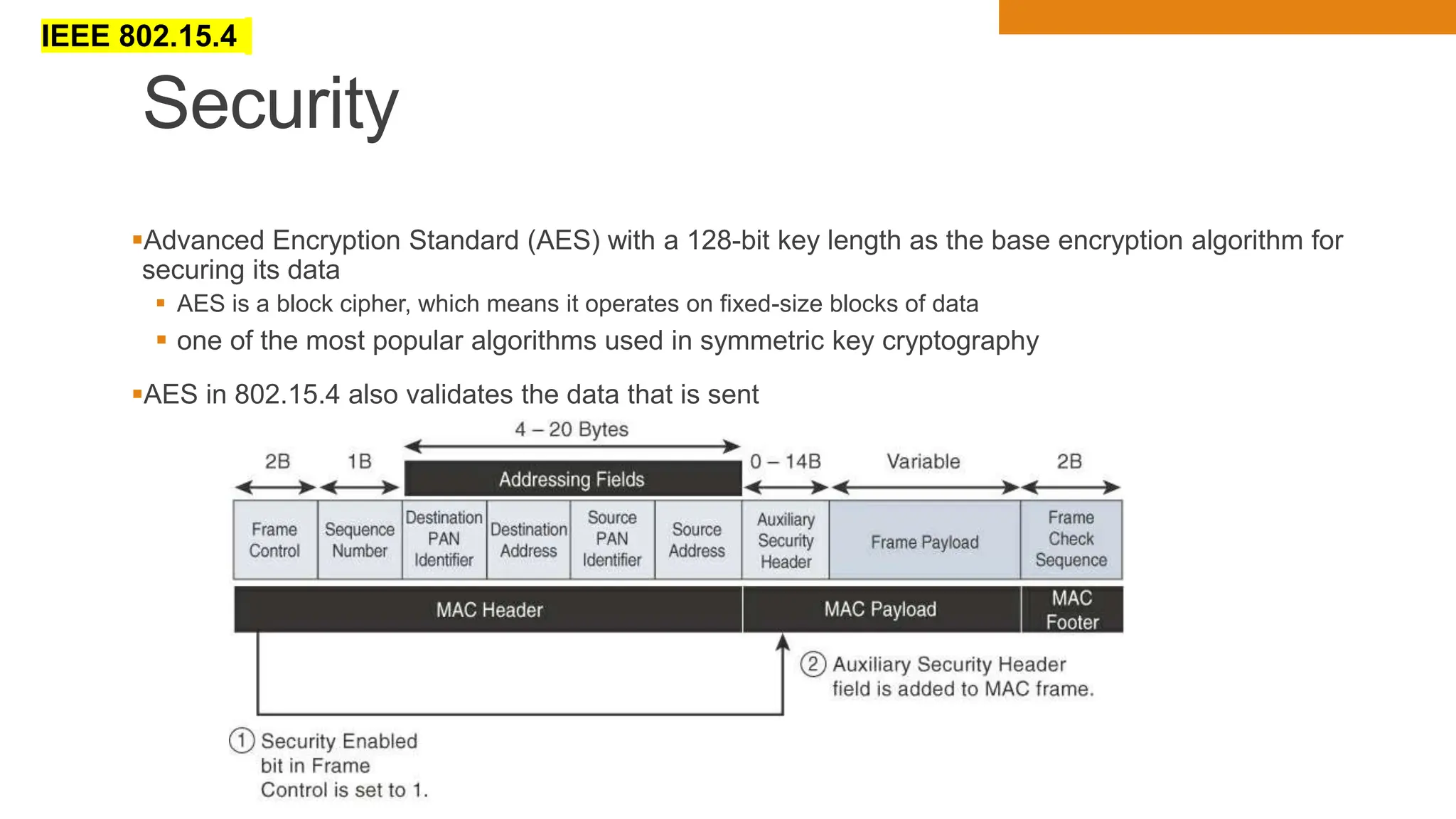
MAC Header, MAC Payload, and MAC Footer fields
Topology
IOT THINGS PRESENTATION - DAVIS M ONSAKIA 77
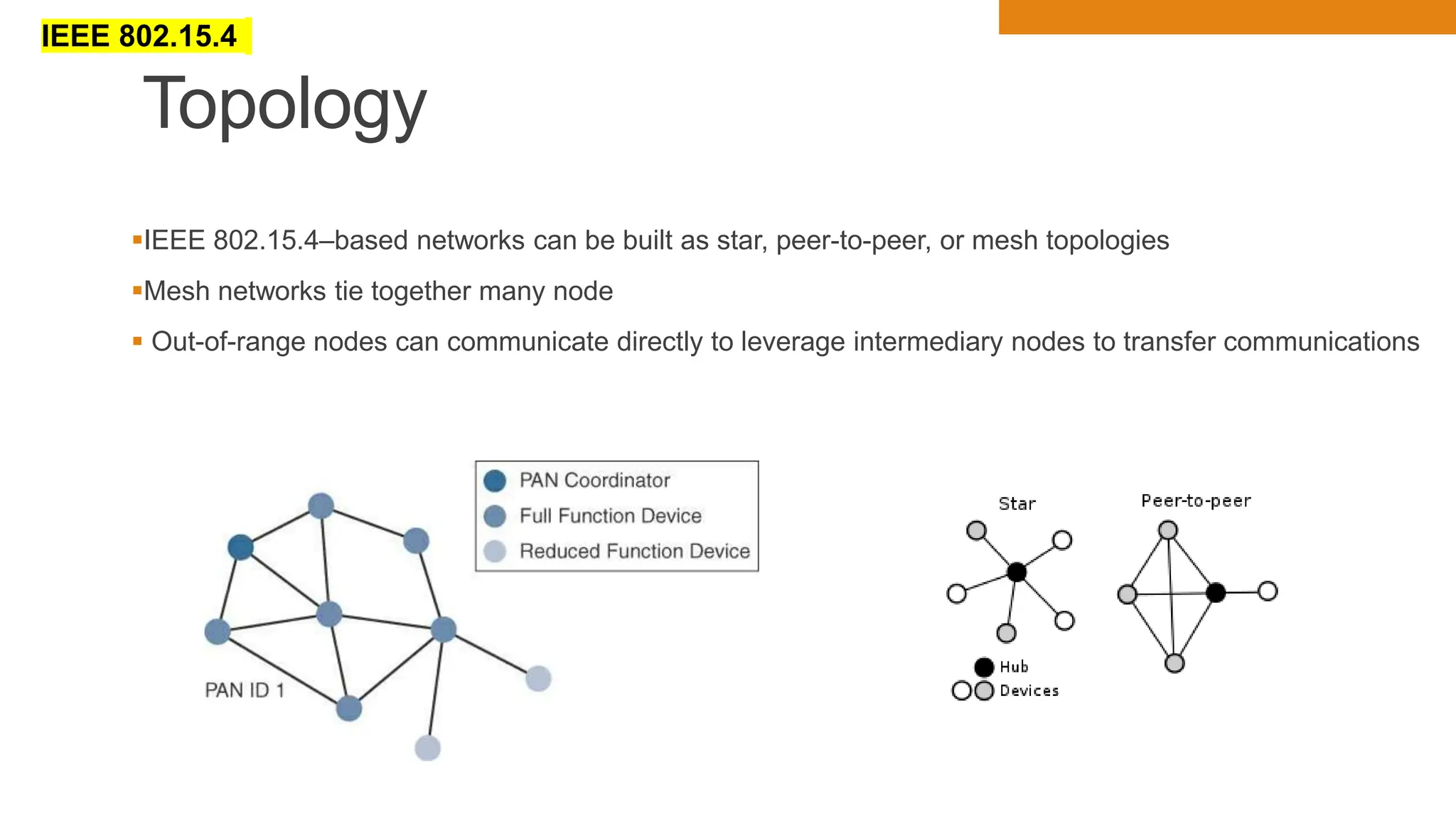
IEEE 802.15.4–based networks can be built as star, peer-to-peer, or mesh topologies
Mesh networks tie together many node
 Out-of-range nodes can communicate directly to leverage intermediary nodes to transfer communications
IEEE 802.15.4
Security
IOT THINGS PRESENTATION - DAVIS M ONSAKIA 78
Advanced Encryption Standard (AES) with a 128-bit key length as the base encryption algorithm for
securing its data
 AES is a block cipher, which means it operates on fixed-size blocks of data
 one of the most popular algorithms used in symmetric key cryptography
AES in 802.15.4 also validates the data that is sent
IEEE 802.15.4
Competitive Technologies
IOT THINGS PRESENTATION - DAVIS M ONSAKIA 79
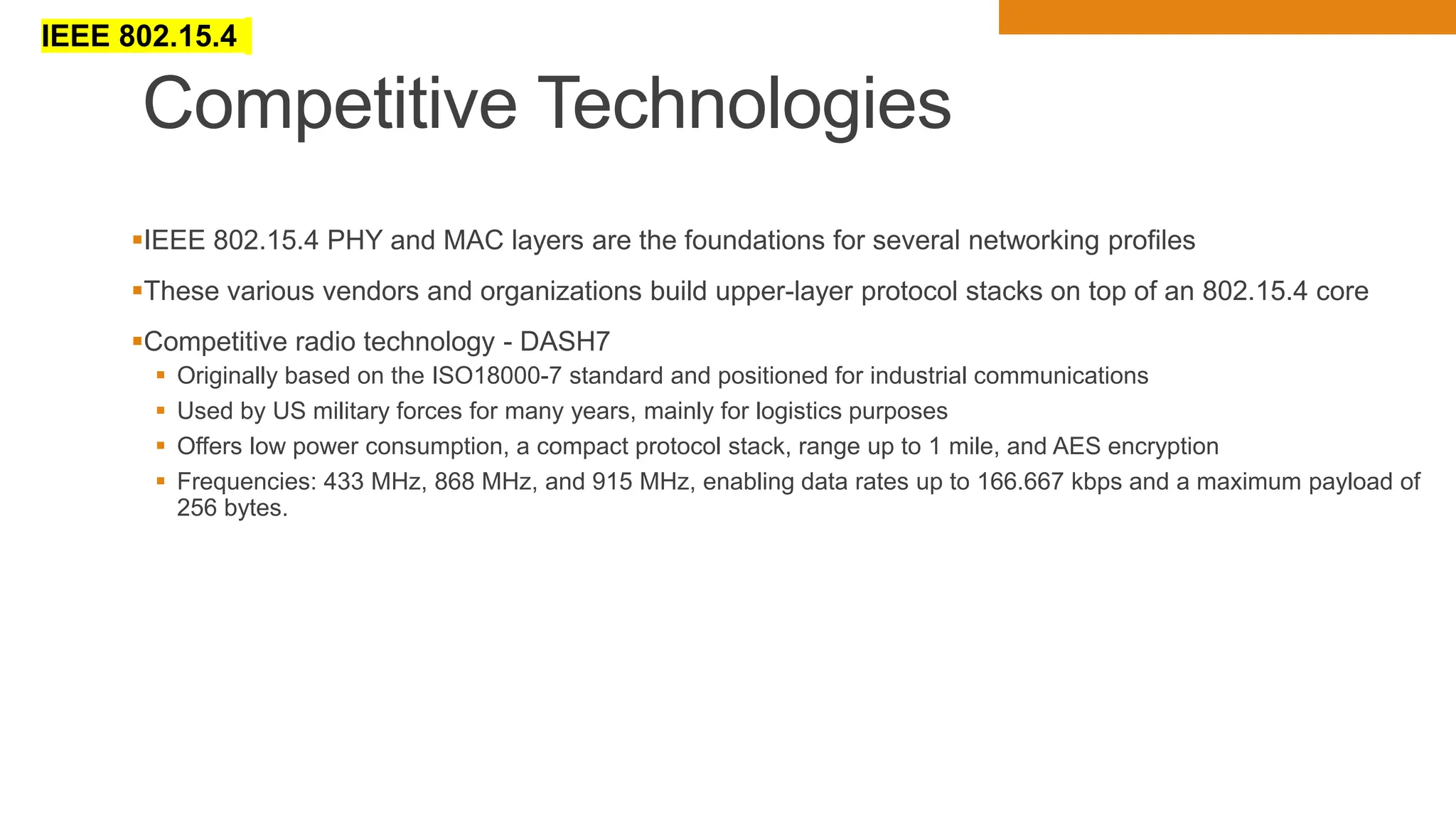
IEEE 802.15.4 PHY and MAC layers are the foundations for several networking profiles
These various vendors and organizations build upper-layer protocol stacks on top of an 802.15.4 core
Competitive radio technology - DASH7
 Originally based on the ISO18000-7 standard and positioned for industrial communications
 Used by US military forces for many years, mainly for logistics purposes
 Offers low power consumption, a compact protocol stack, range up to 1 mile, and AES encryption
 Frequencies: 433 MHz, 868 MHz, and 915 MHz, enabling data rates up to 166.667 kbps and a maximum payload of
256 bytes.
IEEE 802.15.4
IEEE 802.15.4 comparison with other Wireless
Technologies
IOT THINGS PRESENTATION - DAVIS M ONSAKIA 80
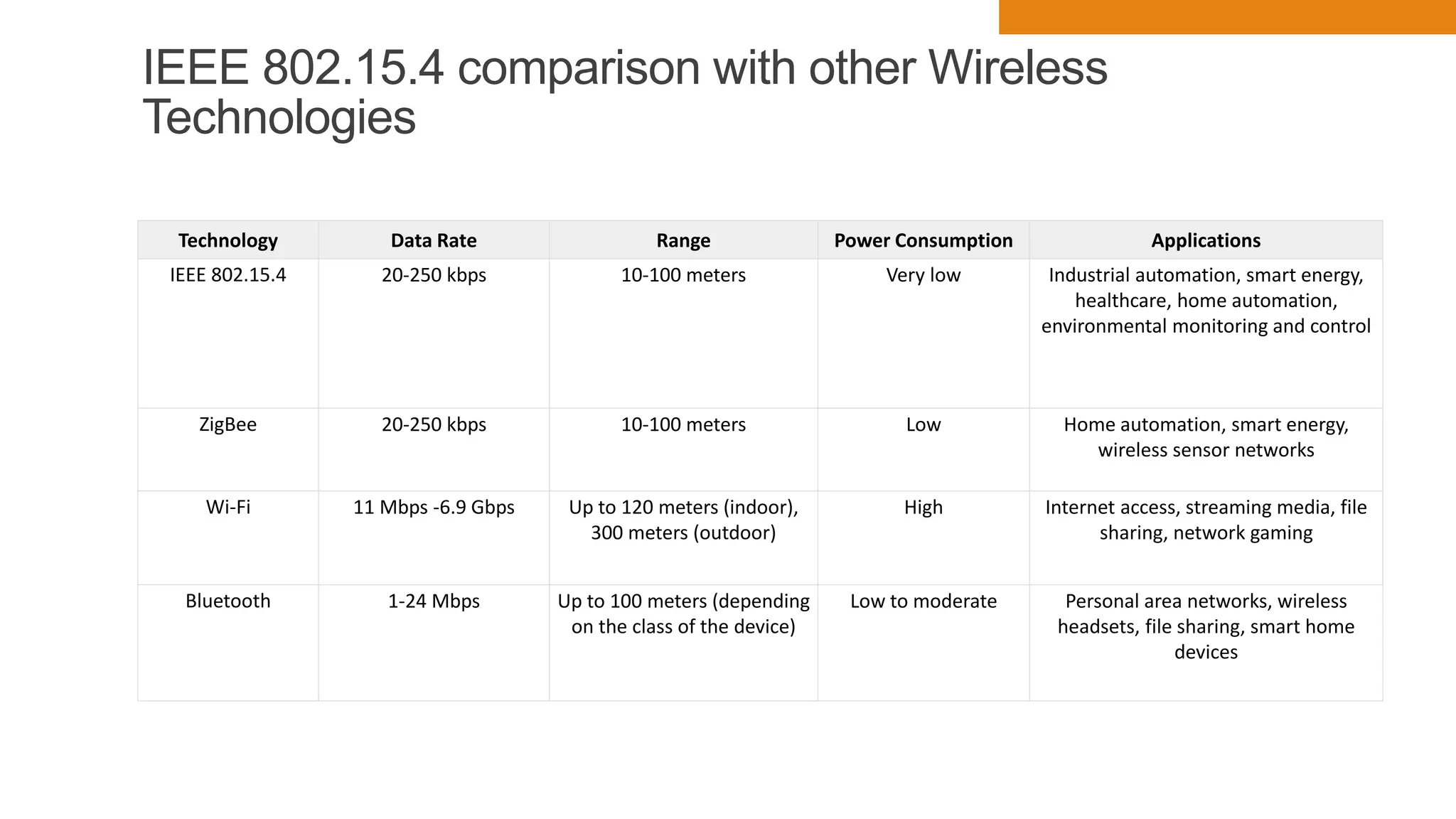
Technology Data Rate Range Power Consumption Applications
IEEE 802.15.4 20-250 kbps 10-100 meters Very low Industrial automation, smart energy,
healthcare, home automation,
environmental monitoring and control
ZigBee 20-250 kbps 10-100 meters Low Home automation, smart energy,
wireless sensor networks
Wi-Fi 11 Mbps -6.9 Gbps Up to 120 meters (indoor),
300 meters (outdoor)
High Internet access, streaming media, file
sharing, network gaming
Bluetooth 1-24 Mbps Up to 100 meters (depending
on the class of the device)
Low to moderate Personal area networks, wireless
headsets, file sharing, smart home
devices
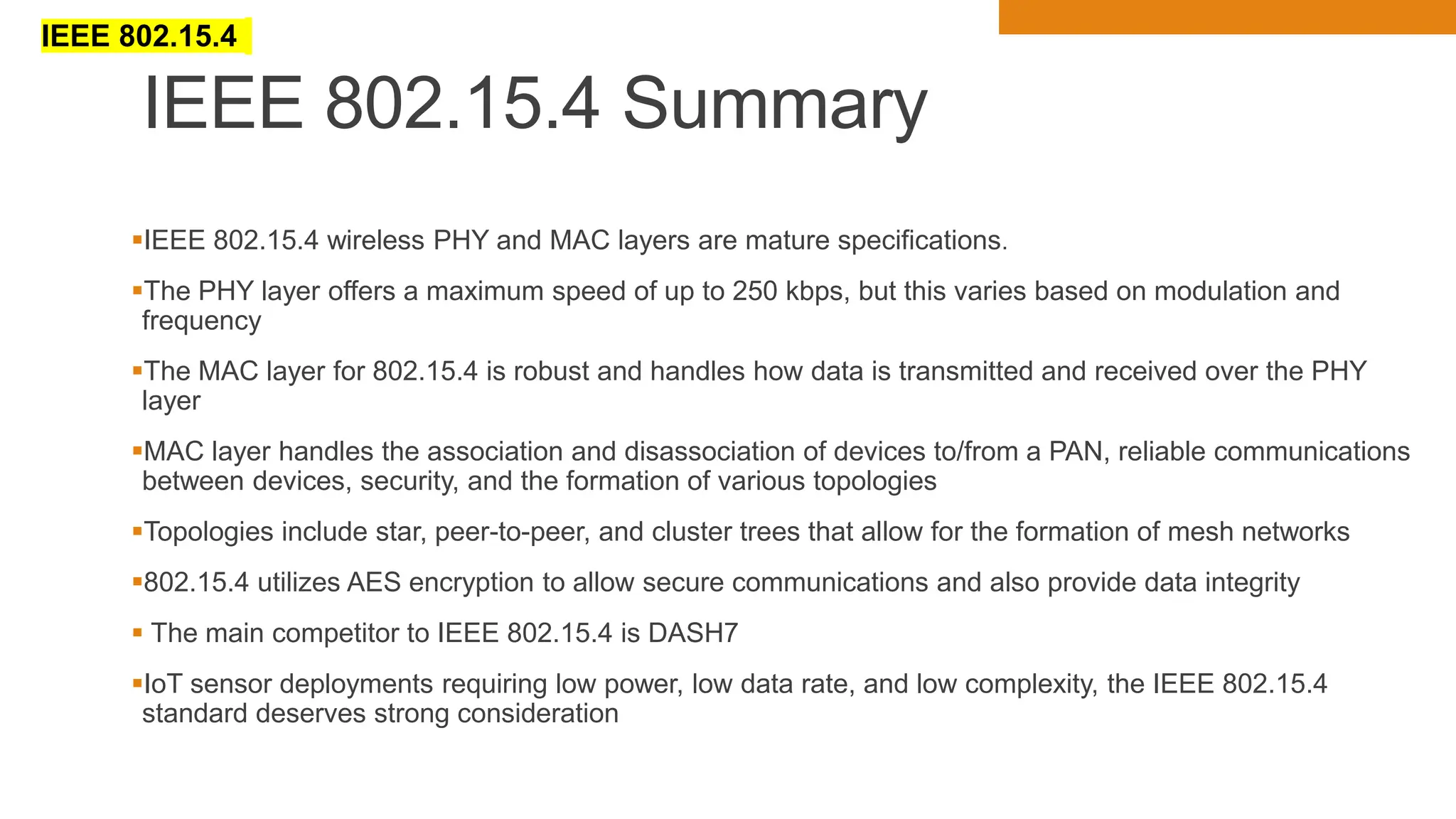
IEEE 802.15.4 Summary
IOT THINGS PRESENTATION - DAVIS M ONSAKIA 81
IEEE 802.15.4 wireless PHY and MAC layers are mature specifications.
The PHY layer offers a maximum speed of up to 250 kbps, but this varies based on modulation and
frequency
The MAC layer for 802.15.4 is robust and handles how data is transmitted and received over the PHY
layer
MAC layer handles the association and disassociation of devices to/from a PAN, reliable communications
between devices, security, and the formation of various topologies
Topologies include star, peer-to-peer, and cluster trees that allow for the formation of mesh networks
802.15.4 utilizes AES encryption to allow secure communications and also provide data integrity
 The main competitor to IEEE 802.15.4 is DASH7
IoT sensor deployments requiring low power, low data rate, and low complexity, the IEEE 802.15.4
standard deserves strong consideration
IEEE 802.15.4
IEEE 802.15.4g and 802.15.4e
82
IEEE 802.15.4g and
802.15.4e
IEEE 802.15.4e and IEEE 802.15.4g
IOT THINGS PRESENTATION - DAVIS M ONSAKIA 83
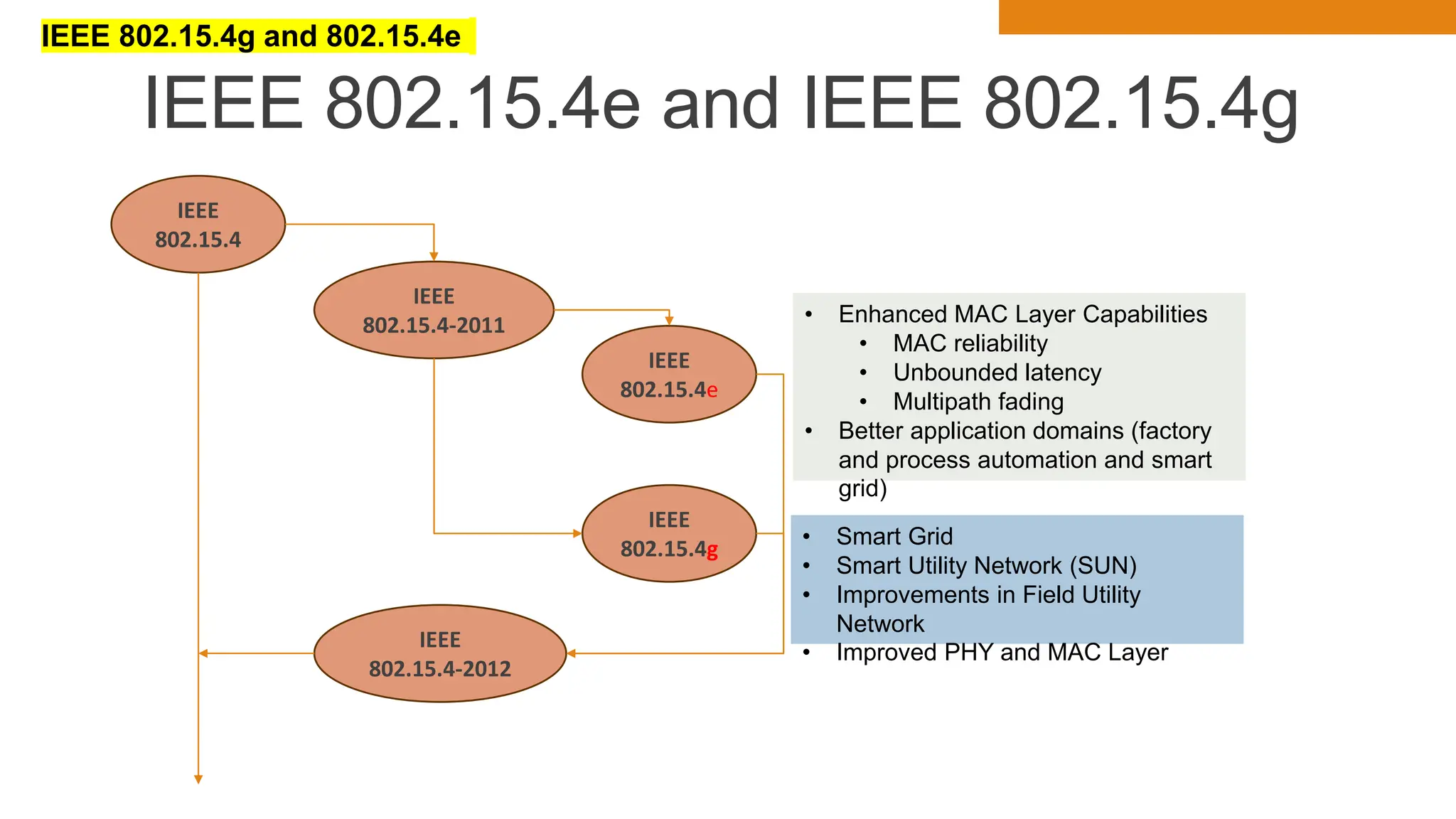
IEEE 802.15.4g and 802.15.4e
IEEE
802.15.4
IEEE
802.15.4-2011
IEEE
802.15.4e
IEEE
802.15.4g
IEEE
802.15.4-2012
• Enhanced MAC Layer Capabilities
• MAC reliability
• Unbounded latency
• Multipath fading
• Better application domains (factory
and process automation and smart
grid)
• Smart Grid
• Smart Utility Network (SUN)
• Improvements in Field Utility
Network
• Improved PHY and MAC Layer
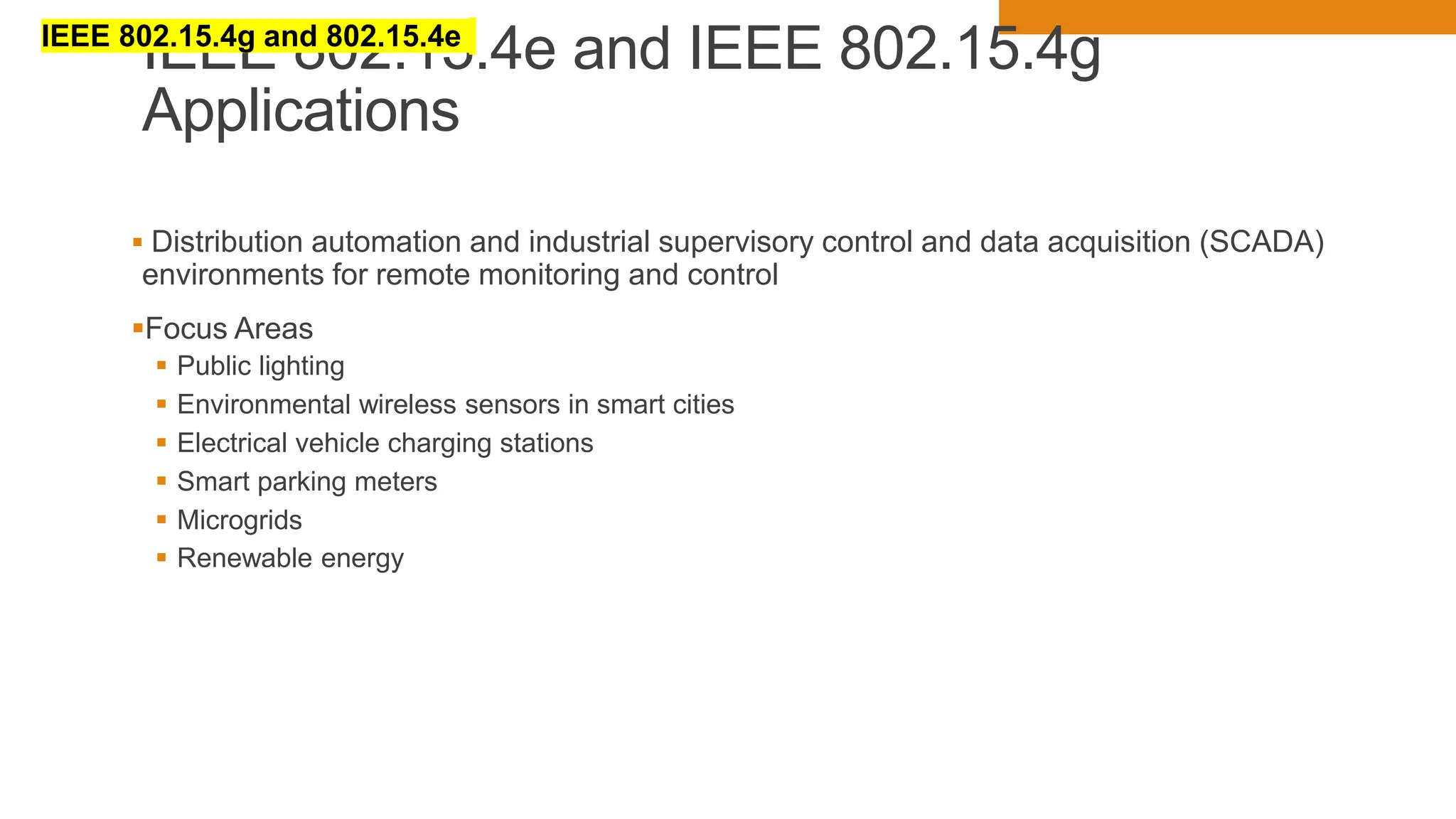
IEEE 802.15.4e and IEEE 802.15.4g
Applications
 Distribution automation and industrial supervisory control and data acquisition (SCADA)
environments for remote monitoring and control
Focus Areas
 Public lighting
 Environmental wireless sensors in smart cities
 Electrical vehicle charging stations
 Smart parking meters
 Microgrids
 Renewable energy
IOT THINGS PRESENTATION - DAVIS M ONSAKIA 84
IEEE 802.15.4g and 802.15.4e
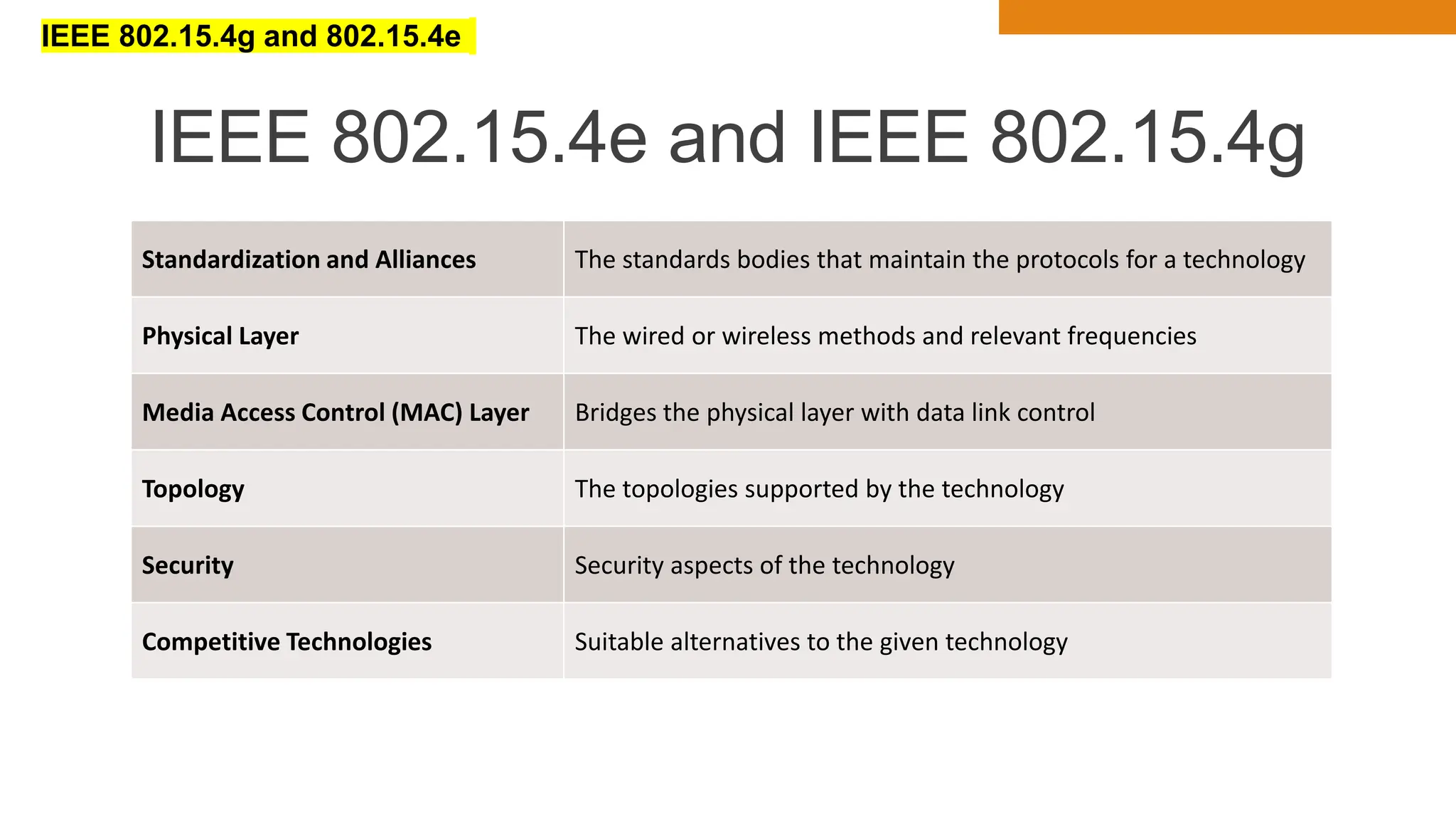
IEEE 802.15.4e and IEEE 802.15.4g
Standardization and Alliances The standards bodies that maintain the protocols for a technology
Physical Layer The wired or wireless methods and relevant frequencies
Media Access Control (MAC) Layer Bridges the physical layer with data link control
Topology The topologies supported by the technology
Security Security aspects of the technology
Competitive Technologies Suitable alternatives to the given technology
IOT THINGS PRESENTATION - DAVIS M ONSAKIA 85
IEEE 802.15.4g and 802.15.4e
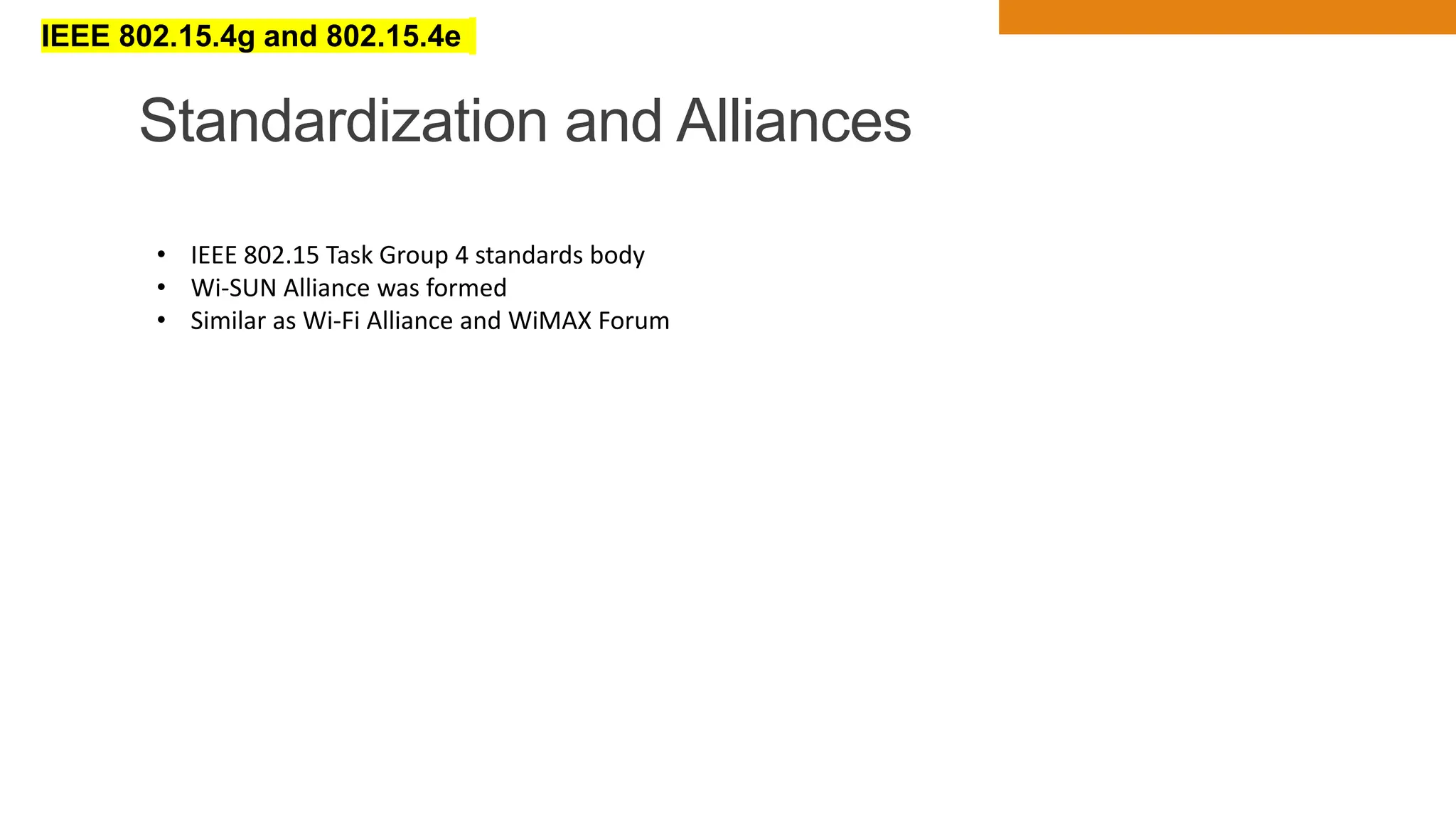
Standardization and Alliances
• IEEE 802.15 Task Group 4 standards body
• Wi-SUN Alliance was formed
• Similar as Wi-Fi Alliance and WiMAX Forum
IOT THINGS PRESENTATION - DAVIS M ONSAKIA 86
IEEE 802.15.4g and 802.15.4e
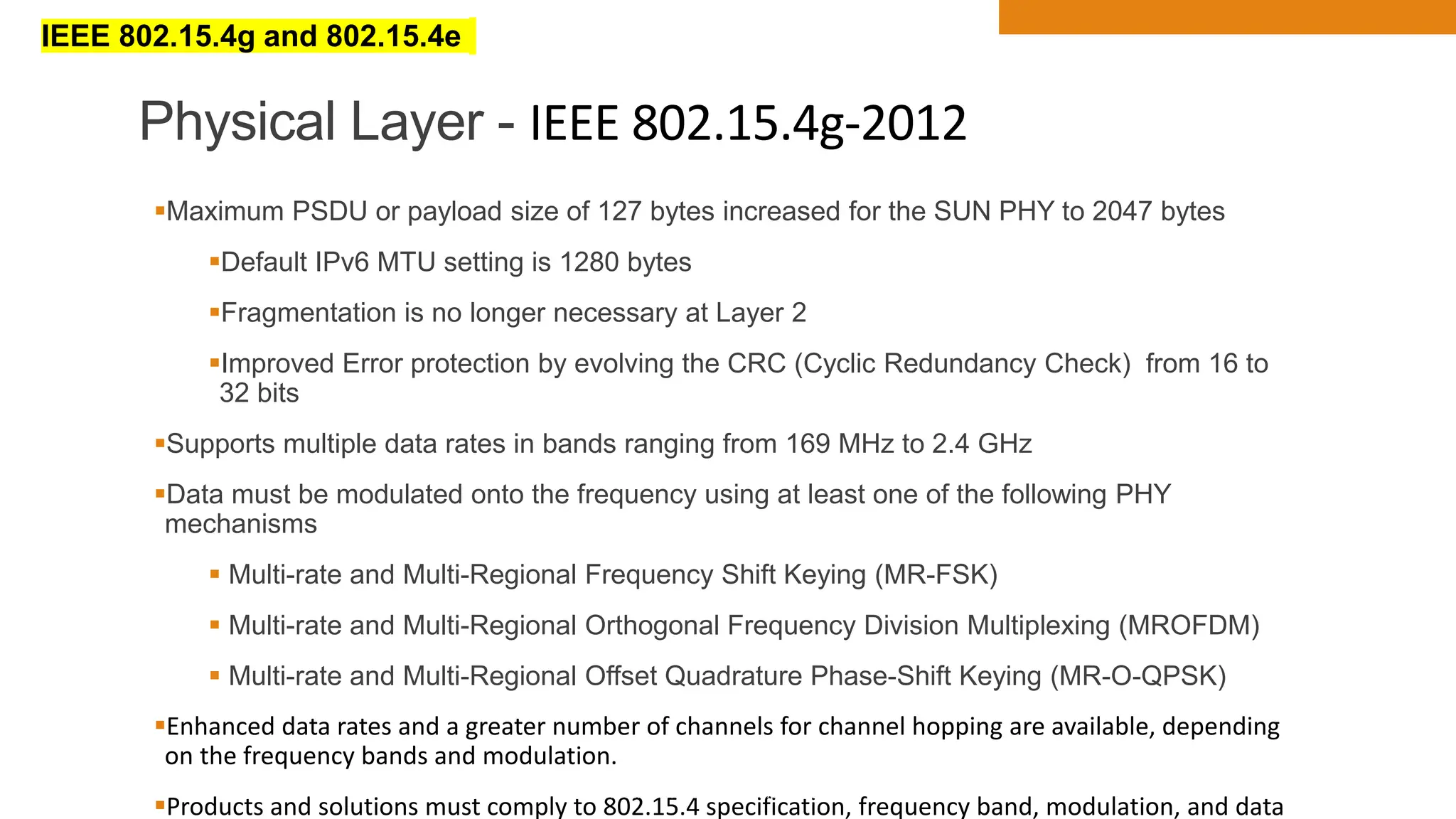
Physical Layer - IEEE 802.15.4g-2012
Maximum PSDU or payload size of 127 bytes increased for the SUN PHY to 2047 bytes
Default IPv6 MTU setting is 1280 bytes
Fragmentation is no longer necessary at Layer 2
Improved Error protection by evolving the CRC (Cyclic Redundancy Check) from 16 to
32 bits
Supports multiple data rates in bands ranging from 169 MHz to 2.4 GHz
Data must be modulated onto the frequency using at least one of the following PHY
mechanisms
 Multi-rate and Multi-Regional Frequency Shift Keying (MR-FSK)
 Multi-rate and Multi-Regional Orthogonal Frequency Division Multiplexing (MROFDM)
 Multi-rate and Multi-Regional Offset Quadrature Phase-Shift Keying (MR-O-QPSK)
Enhanced data rates and a greater number of channels for channel hopping are available, depending
on the frequency bands and modulation.
Products and solutions must comply to 802.15.4 specification, frequency band, modulation, and data
IOT THINGS PRESENTATION - DAVIS M ONSAKIA 87
IEEE 802.15.4g and 802.15.4e
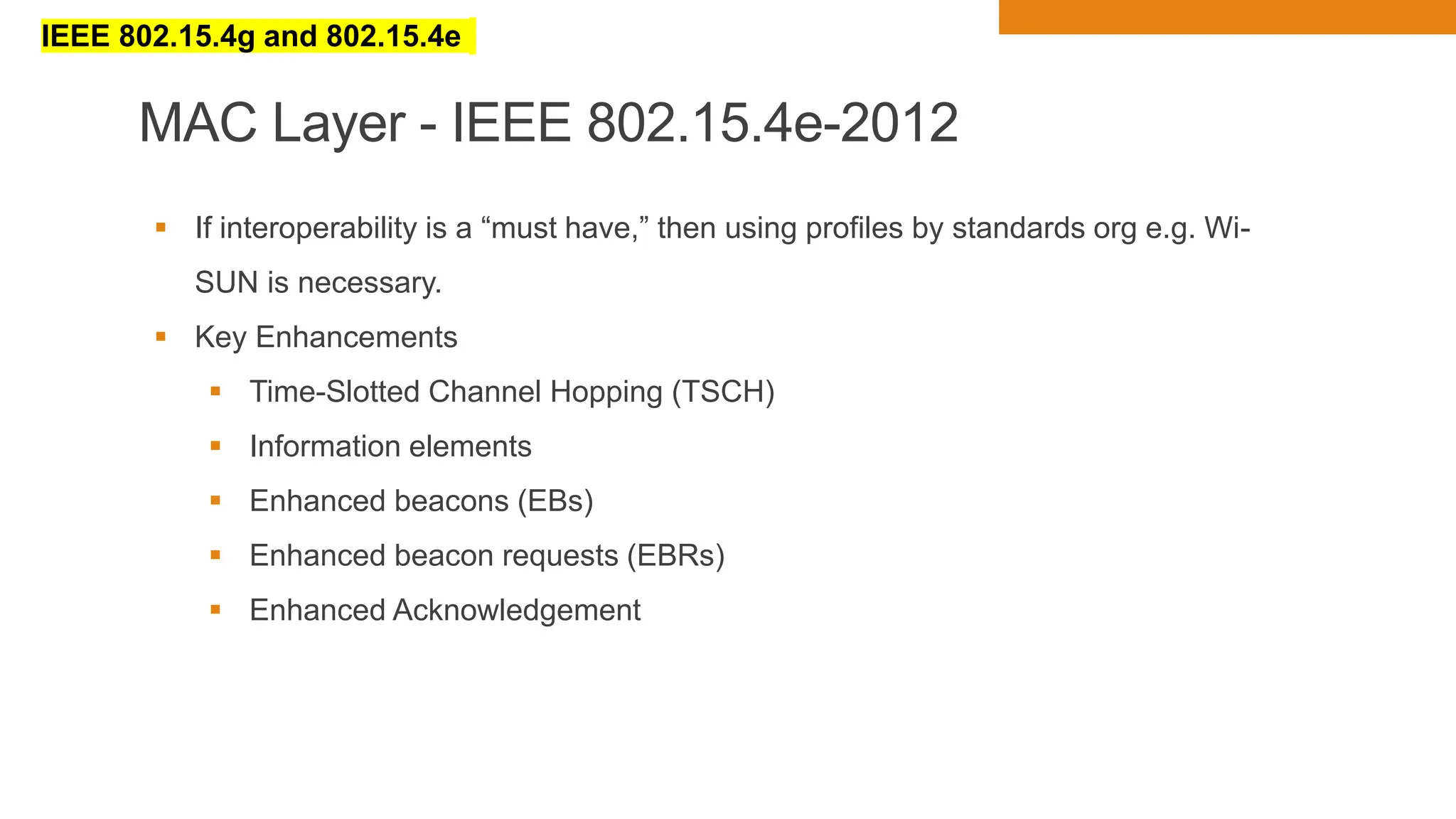
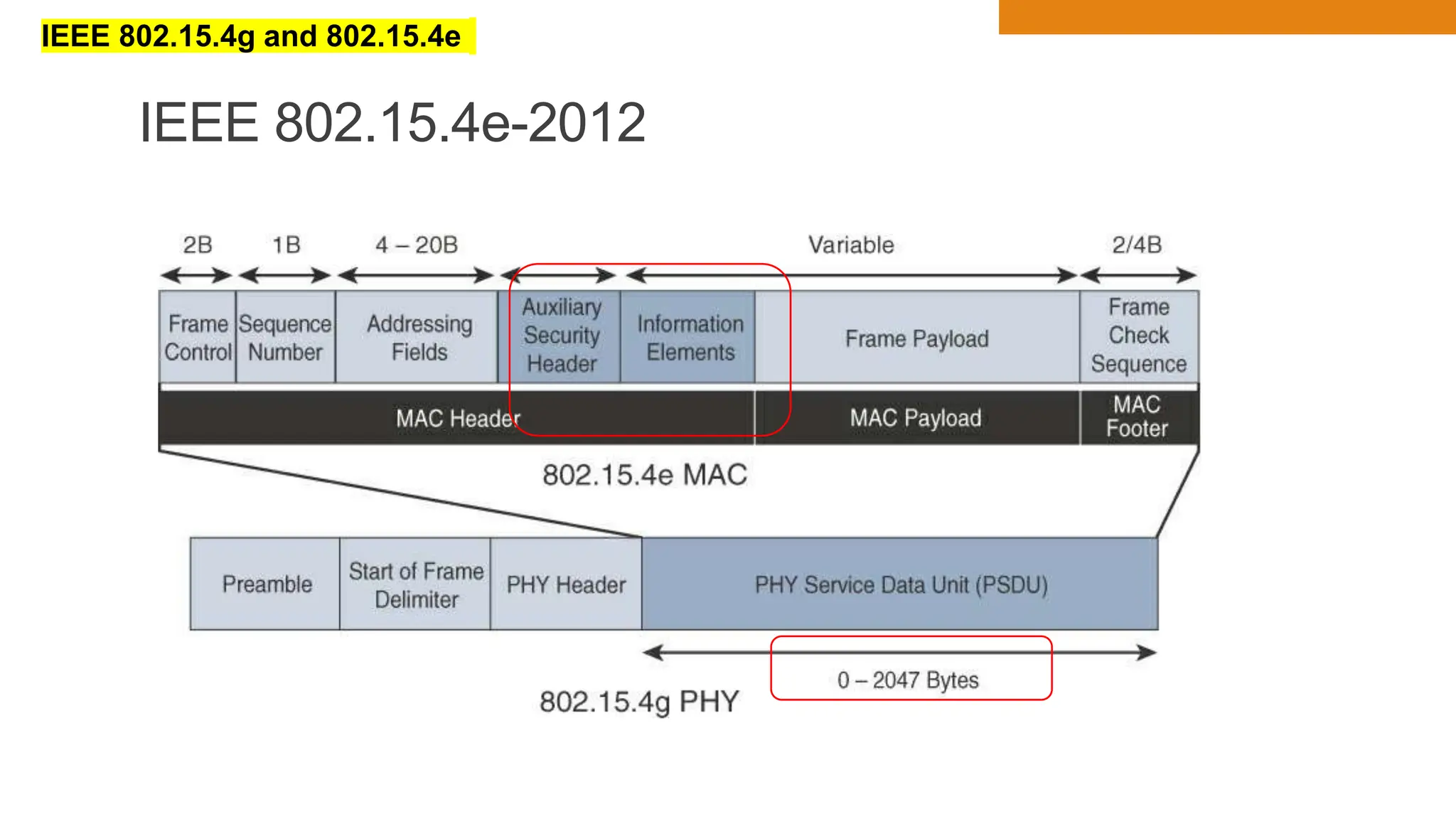
MAC Layer - IEEE 802.15.4e-2012
 If interoperability is a “must have,” then using profiles by standards org e.g. Wi-
SUN is necessary.
 Key Enhancements
 Time-Slotted Channel Hopping (TSCH)
 Information elements
 Enhanced beacons (EBs)
 Enhanced beacon requests (EBRs)
 Enhanced Acknowledgement
IOT THINGS PRESENTATION - DAVIS M ONSAKIA 88
IEEE 802.15.4g and 802.15.4e
MAC Layer - Time-Slotted Channel Hopping
(TSCH)
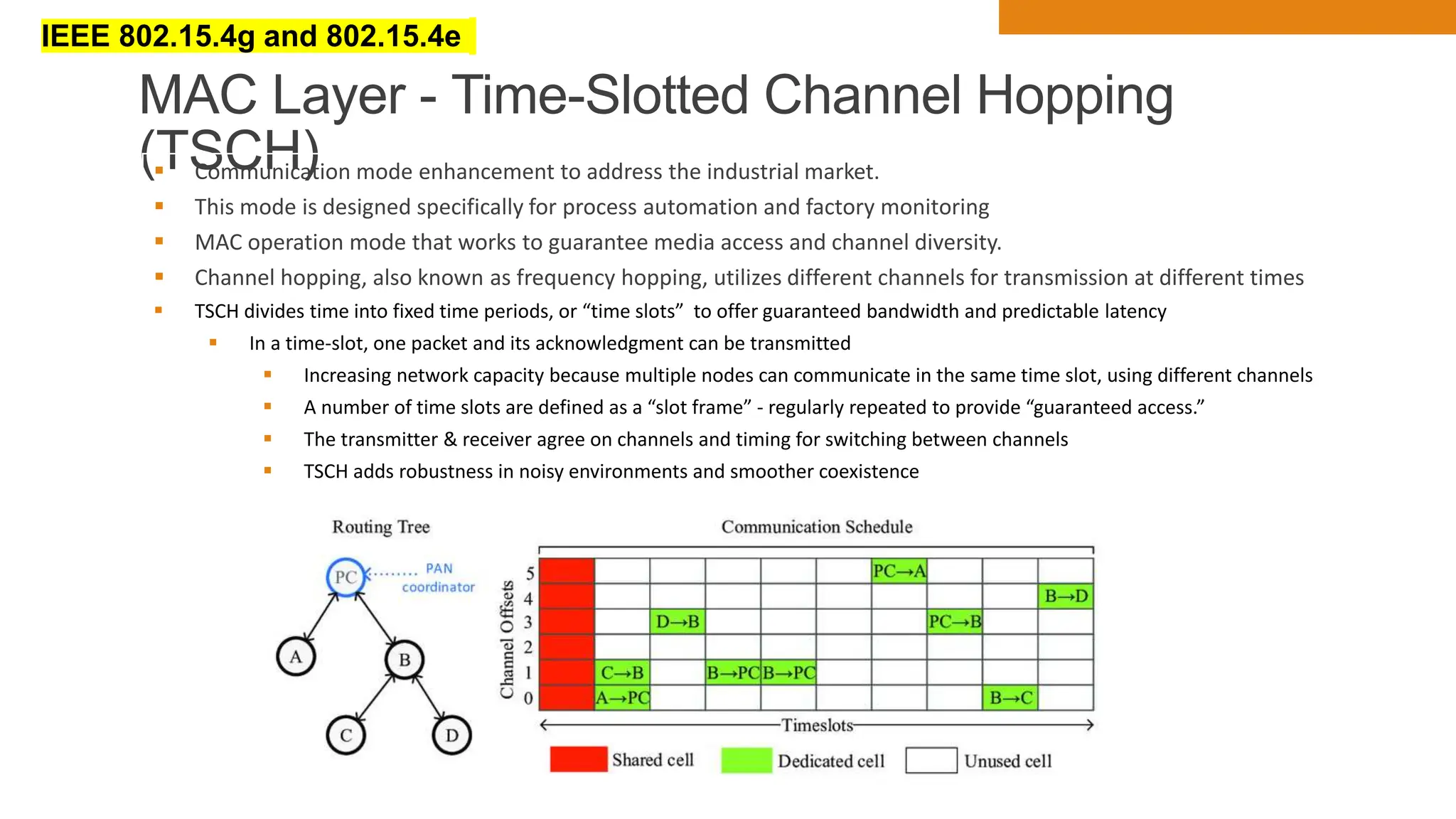
 Communication mode enhancement to address the industrial market.
 This mode is designed specifically for process automation and factory monitoring
 MAC operation mode that works to guarantee media access and channel diversity.
 Channel hopping, also known as frequency hopping, utilizes different channels for transmission at different times
 TSCH divides time into fixed time periods, or “time slots” to offer guaranteed bandwidth and predictable latency
 In a time-slot, one packet and its acknowledgment can be transmitted
 Increasing network capacity because multiple nodes can communicate in the same time slot, using different channels
 A number of time slots are defined as a “slot frame” - regularly repeated to provide “guaranteed access.”
 The transmitter & receiver agree on channels and timing for switching between channels
 TSCH adds robustness in noisy environments and smoother coexistence
IOT THINGS PRESENTATION - DAVIS M ONSAKIA 89
IEEE 802.15.4g and 802.15.4e
MAC Layer - Information elements
• Information elements (IEs) allow for the exchange of information at the MAC layer in an
extensible manner, either as header IEs (standardized) and/or payload IEs (private)
• Specified in a tag, length, value (TLV) format, the IE field allows frames to carry additional
metadata to support MAC layer services
IOT THINGS PRESENTATION - DAVIS M ONSAKIA 90
IEEE 802.15.4g and 802.15.4e
MAC Layer - Enhanced beacons (EBs)
• EBs extend the flexibility of IEEE 802.15.4 beacons to allow the construction of application-specific beacon
content
• Accomplished by including relevant IEs in EB frames
• Example IEs :
• Network metrics
• Frequency hopping
• Broadcast schedule
• PAN information version
IOT THINGS PRESENTATION - DAVIS M ONSAKIA 91
IEEE 802.15.4g and 802.15.4e
MAC Layer - Enhanced beacon requests (EBRs)
• Leverages IE
• Allow the sender to selectively specify the request of information
• Beacon responses are then limited to what was requested in the EBR.
• A device can query for a PAN that is allowing new devices to join or a PAN that supports a certain set of
MAC/PHY capabilities
IOT THINGS PRESENTATION - DAVIS M ONSAKIA 92
IEEE 802.15.4g and 802.15.4e
MAC Layer - Enhanced Acknowledgement
• Allows for the integration of a frame counter for the frame being acknowledged
• Protect against certain attacks that occur when Acknowledgement frames are spoofed
IOT THINGS PRESENTATION - DAVIS M ONSAKIA 93
IEEE 802.15.4g and 802.15.4e
IEEE 802.15.4e-2012
IOT THINGS PRESENTATION - DAVIS M ONSAKIA 94
IEEE 802.15.4g and 802.15.4e
Topology
• Deployments of IEEE 802.15.4g-2012 are mostly based on a mesh topology
• A mesh topology allows deployments to be done in urban or rural areas, expanding the distance between
nodes that can relay the traffic of other nodes.
• Powered nodes have been the primary targets of implementations
• Support for battery powered nodes with a long lifecycle requires optimized Layer 2 forwarding or Layer 3
routing protocol implementations
IOT THINGS PRESENTATION - DAVIS M ONSAKIA 95
IEEE 802.15.4g and 802.15.4e
Security
• Encryption is provided by AES, with a 128-bit key
• Fields
• Auxiliary Security Header
• Secure acknowledgement
• Secure Enhanced Beacon
IOT THINGS PRESENTATION - DAVIS M ONSAKIA 96
IEEE 802.15.4g and 802.15.4e
Competitive Technologies
• IEEE 802.15.4g and 802.15.4e parallel the technologies that also compete with IEEE 802.15.4, such as DASH7
IOT THINGS PRESENTATION - DAVIS M ONSAKIA 97
IEEE 802.15.4g and 802.15.4e
Summary
• IEEE 802.15.4g and 802.15.4e are simply amendments to the IEEE 802.15.4 standard
• Successfully deployed in real-world scenarios, and already support millions of endpoints
• IEEE 802.15.4g focuses mainly on improvements to the PHY layer
• IEEE 802.15.4e targets the MAC layer.
• Improvements for latency and vulnerability to multipath fading
• Better suited to handle the unique deployment models in the areas of smart grid/utilities and smart cities
• Wi-SUN Alliance is an important industry alliance that provides interoperability and certification for industry
implementations
IOT THINGS PRESENTATION - DAVIS M ONSAKIA 98
IEEE 802.15.4g and 802.15.4e
IEEE 1901.2a
99
IEEE 1901.2a
IEEE 1901.2a
IOT THINGS PRESENTATION - DAVIS M ONSAKIA 100
IEEE 1901.2a
 IEEE 1901.2a-2013 is a wired technology that is an update to the original IEEE 1901.2 specification
 Standard for Narrowband Power Line Communication (NB-PLC)
 Leverages a narrowband spectrum for low power, long-range, and resistance to interference over the
same wires that carry electric power
Transport IoT data across power grid connections that are already in place
Low-frequency PLC solution <500 kHz, both AC and DC current, indoor and outdoor, few Kms
Data rates can scale up to 500 kbps
IEEE 1901.2a PHY and MAC layers can be mixed with IEEE 802.15.4g/e on endpoints
Use Cases
 Smart metering: Meter Reading
 Distribution automation: Control and Monitor Power Grid
 Public lighting
 Electric vehicle charging stations
 Microgrids: Independent Grids
 Renewable energy
IEEE 1901.2a
Standardization and Alliances The standards bodies that maintain the protocols for a technology
Physical Layer The wired or wireless methods and relevant frequencies
Media Access Control (MAC) Layer Bridges the physical layer with data link control
Topology The topologies supported by the technology
Security Security aspects of the technology
Competitive Technologies Suitable alternatives to the given technology
IOT THINGS PRESENTATION - DAVIS M ONSAKIA 101
IEEE 1901.2a
IEEE 1901.2a - Standardization and
Alliances
IOT THINGS PRESENTATION - DAVIS M ONSAKIA 102
IEEE 1901.2a
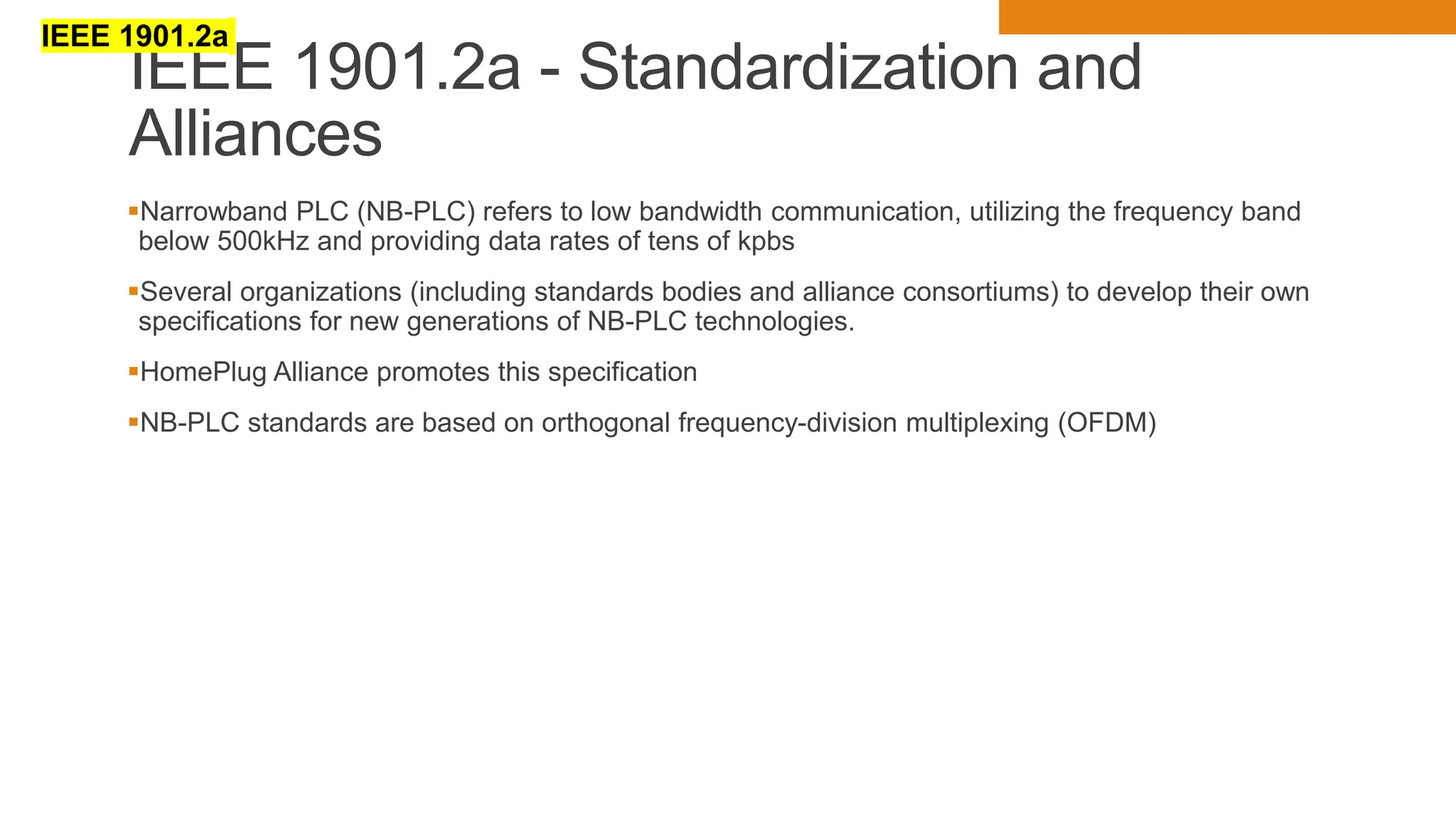
Narrowband PLC (NB-PLC) refers to low bandwidth communication, utilizing the frequency band
below 500kHz and providing data rates of tens of kpbs
Several organizations (including standards bodies and alliance consortiums) to develop their own
specifications for new generations of NB-PLC technologies.
HomePlug Alliance promotes this specification
NB-PLC standards are based on orthogonal frequency-division multiplexing (OFDM)
IEEE 1901.2a – Physical Layer
IOT THINGS PRESENTATION - DAVIS M ONSAKIA 103
IEEE 1901.2a
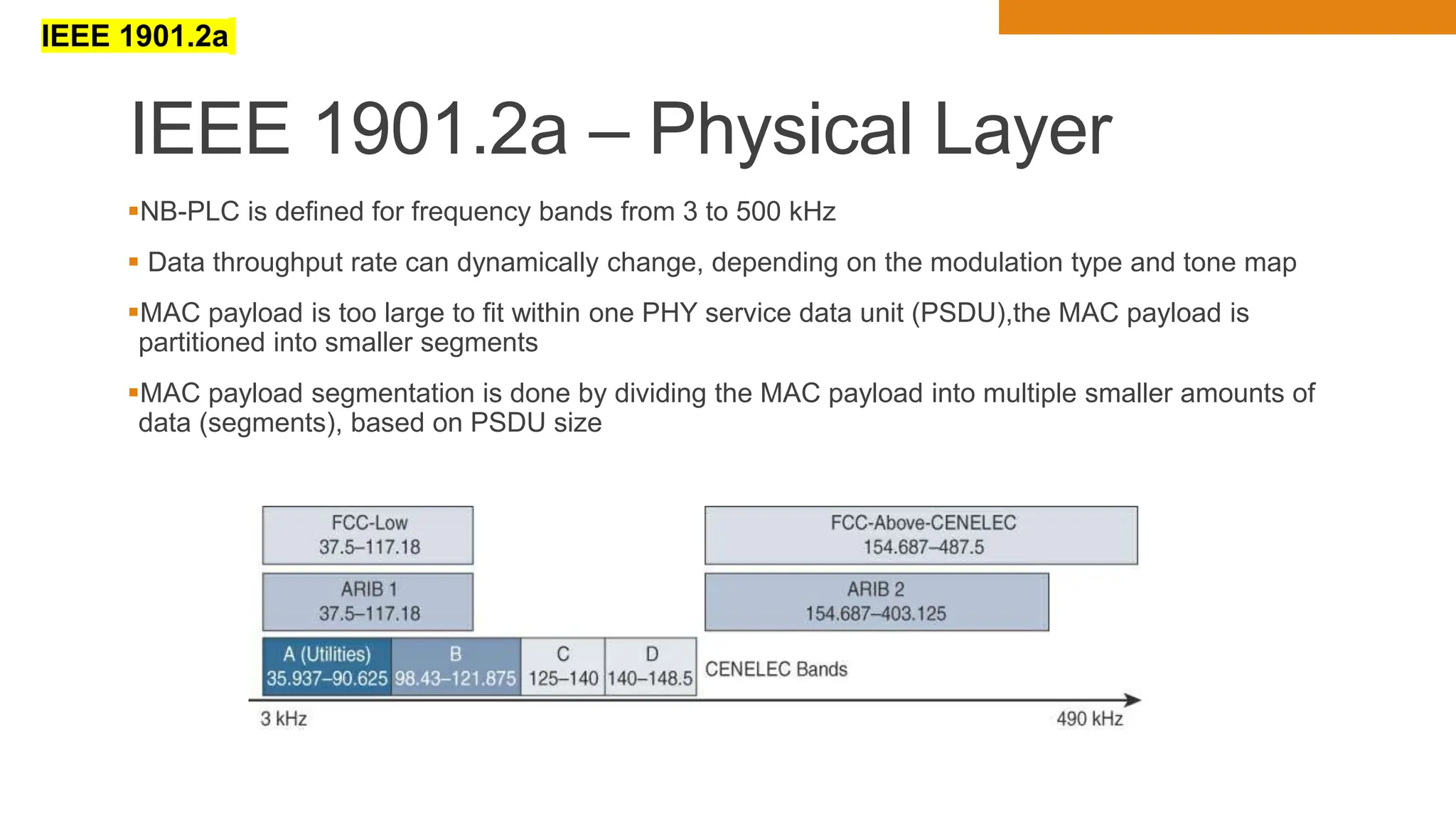
NB-PLC is defined for frequency bands from 3 to 500 kHz
 Data throughput rate can dynamically change, depending on the modulation type and tone map
MAC payload is too large to fit within one PHY service data unit (PSDU),the MAC payload is
partitioned into smaller segments
MAC payload segmentation is done by dividing the MAC payload into multiple smaller amounts of
data (segments), based on PSDU size
IEEE 1901.2a – MAC Layer
IOT THINGS PRESENTATION - DAVIS M ONSAKIA 104
IEEE 1901.2a
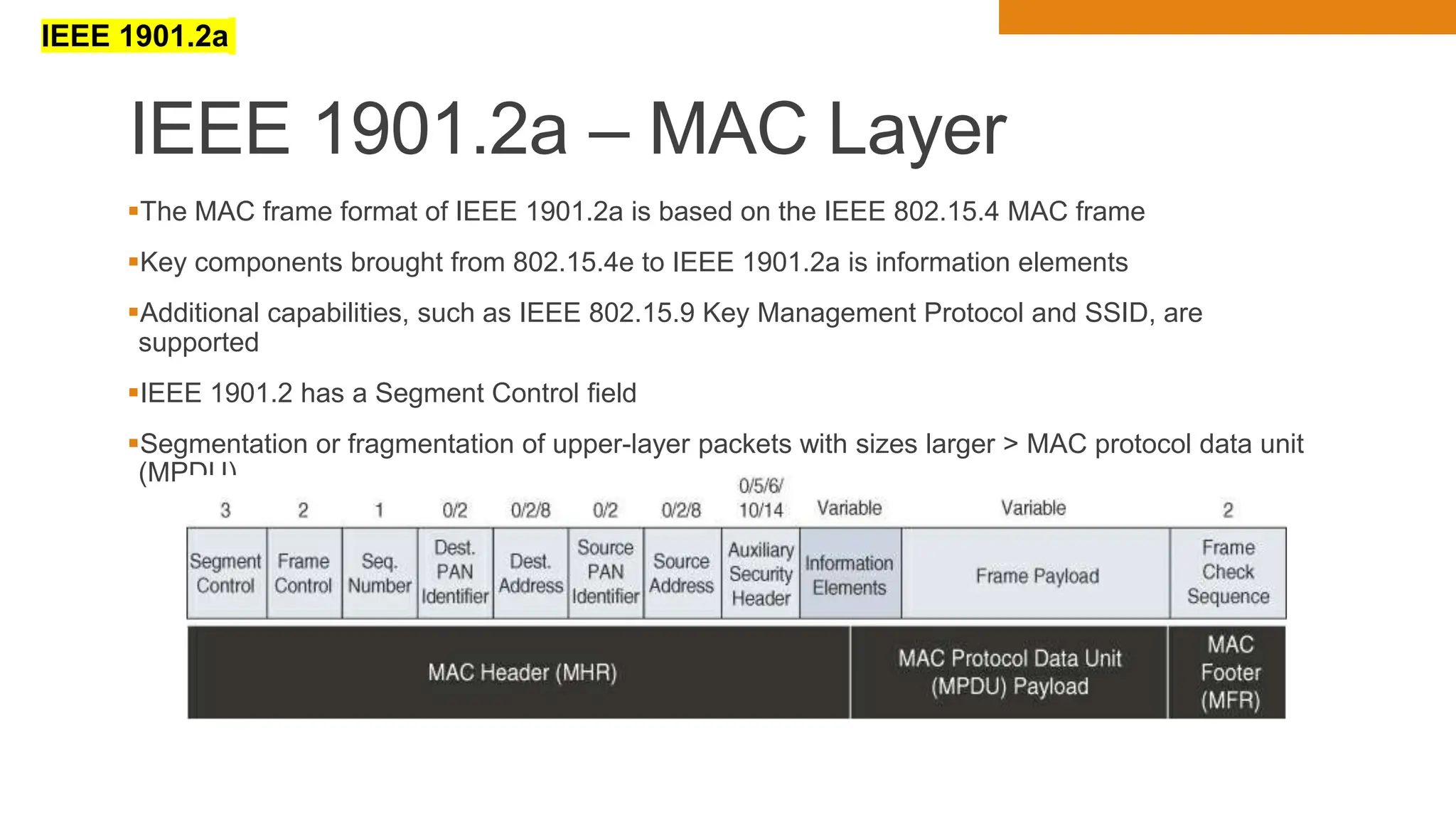
The MAC frame format of IEEE 1901.2a is based on the IEEE 802.15.4 MAC frame
Key components brought from 802.15.4e to IEEE 1901.2a is information elements
Additional capabilities, such as IEEE 802.15.9 Key Management Protocol and SSID, are
supported
IEEE 1901.2 has a Segment Control field
Segmentation or fragmentation of upper-layer packets with sizes larger > MAC protocol data unit
(MPDU)
IEEE 1901.2a – Topology
IOT THINGS PRESENTATION - DAVIS M ONSAKIA 105
IEEE 1901.2a
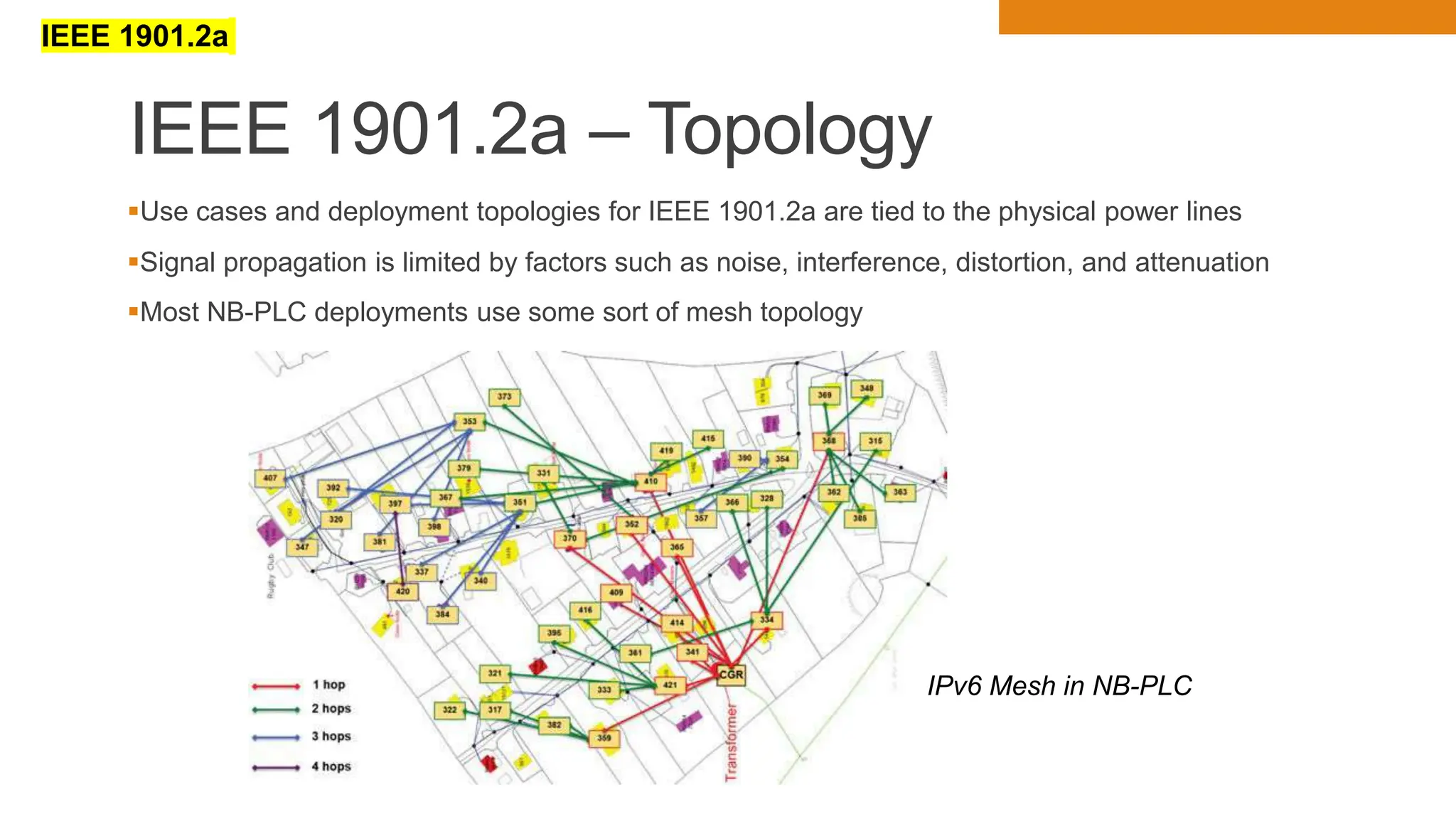
Use cases and deployment topologies for IEEE 1901.2a are tied to the physical power lines
Signal propagation is limited by factors such as noise, interference, distortion, and attenuation
Most NB-PLC deployments use some sort of mesh topology
IPv6 Mesh in NB-PLC
IEEE 1901.2a – Security
IOT THINGS PRESENTATION - DAVIS M ONSAKIA 106
IEEE 1901.2a
Offers similar security features to IEEE 802.15.4g
Encryption and authentication are performed using AES
Key difference in PHY layer fragmentation capabilities
Security Enabled bit in the Frame Control field set in all MAC frames carrying segments of an
encrypted frame
If data encryption is required, it should be done before packet segmentation
On the receiver side, the data decryption is done after packet reassembly
When security is enabled, the MAC payload is composed of the ciphered payload and the
message integrity code (MIC) authentication tag for non-segmented payloads.
IEEE 1901.2a – Competitive
Technologies
IOT THINGS PRESENTATION - DAVIS M ONSAKIA 107
IEEE 1901.2a
Two technologies compete against IEEE 1901.2a: G3-PLC (now ITU G.9903) and PRIME (now
ITU G.9904)
Both developed to address smart metering deployment in Europe over the CENELEC A band
IEEE 1901.2a leverages portions of G3-PLC and PRIME
Ge-PLC : no information element support and no global IPv6 address support.
IEEE 1901.2a – Summary
IOT THINGS PRESENTATION - DAVIS M ONSAKIA 108
IEEE 1901.2a
Open PHY and MAC standard approach to enable the use of Narrowband Power Line
Leverages the earlier standards G3-PLC (now ITU G.9903) and PRIME (now ITU G.9904)
IEEE 1901.2a also has a feature-rich MAC layer, based on 802.15.4
Flexibility in the MAC layer lends readily to the support of mesh topologies
IEEE 802.11ah
IOT THINGS PRESENTATION - DAVIS M ONSAKIA 109
IEEE 802.11ah
IEEE 802.11ah
IOT THINGS PRESENTATION - DAVIS M ONSAKIA 110
IEEE 802.11ah
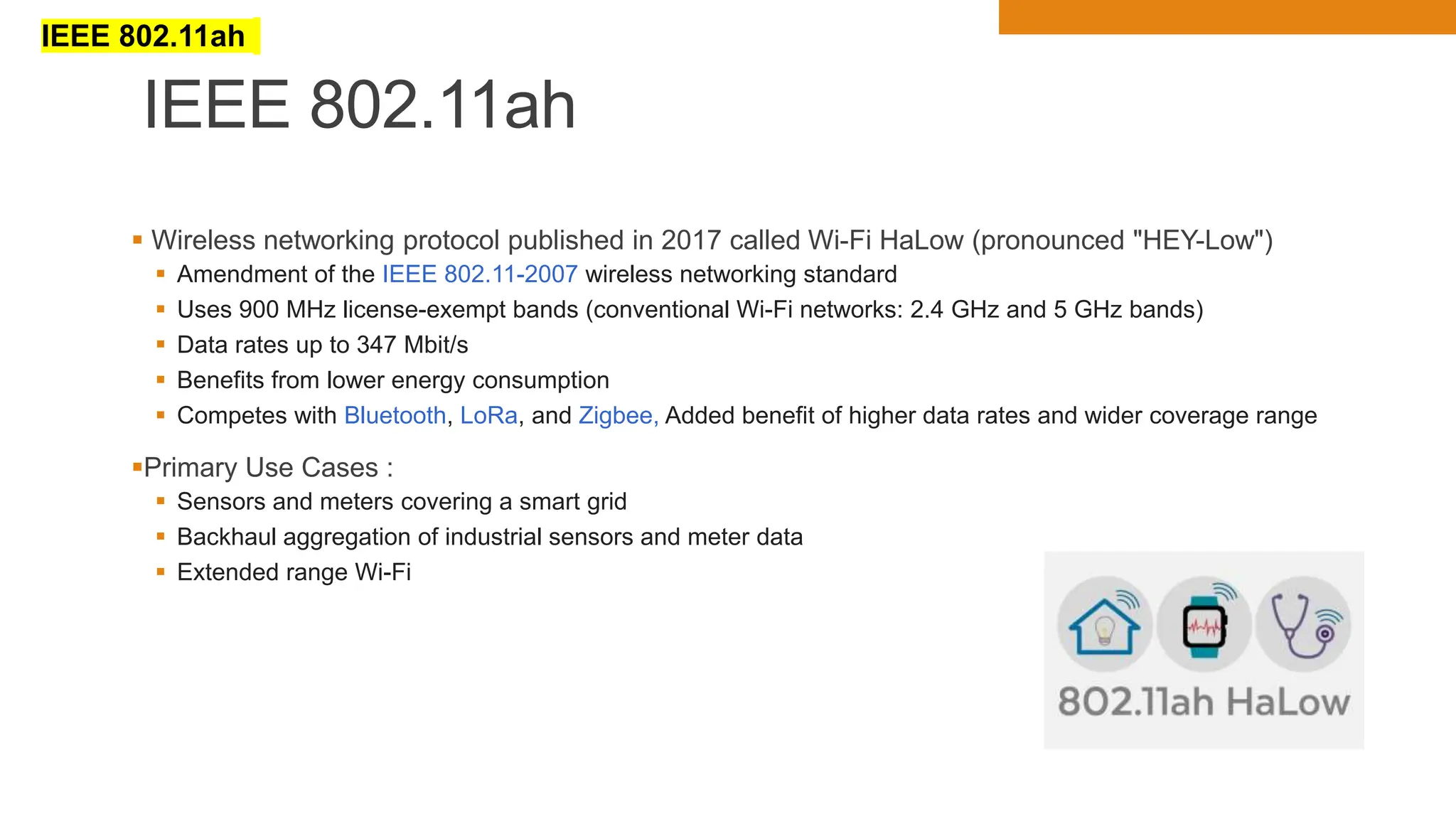
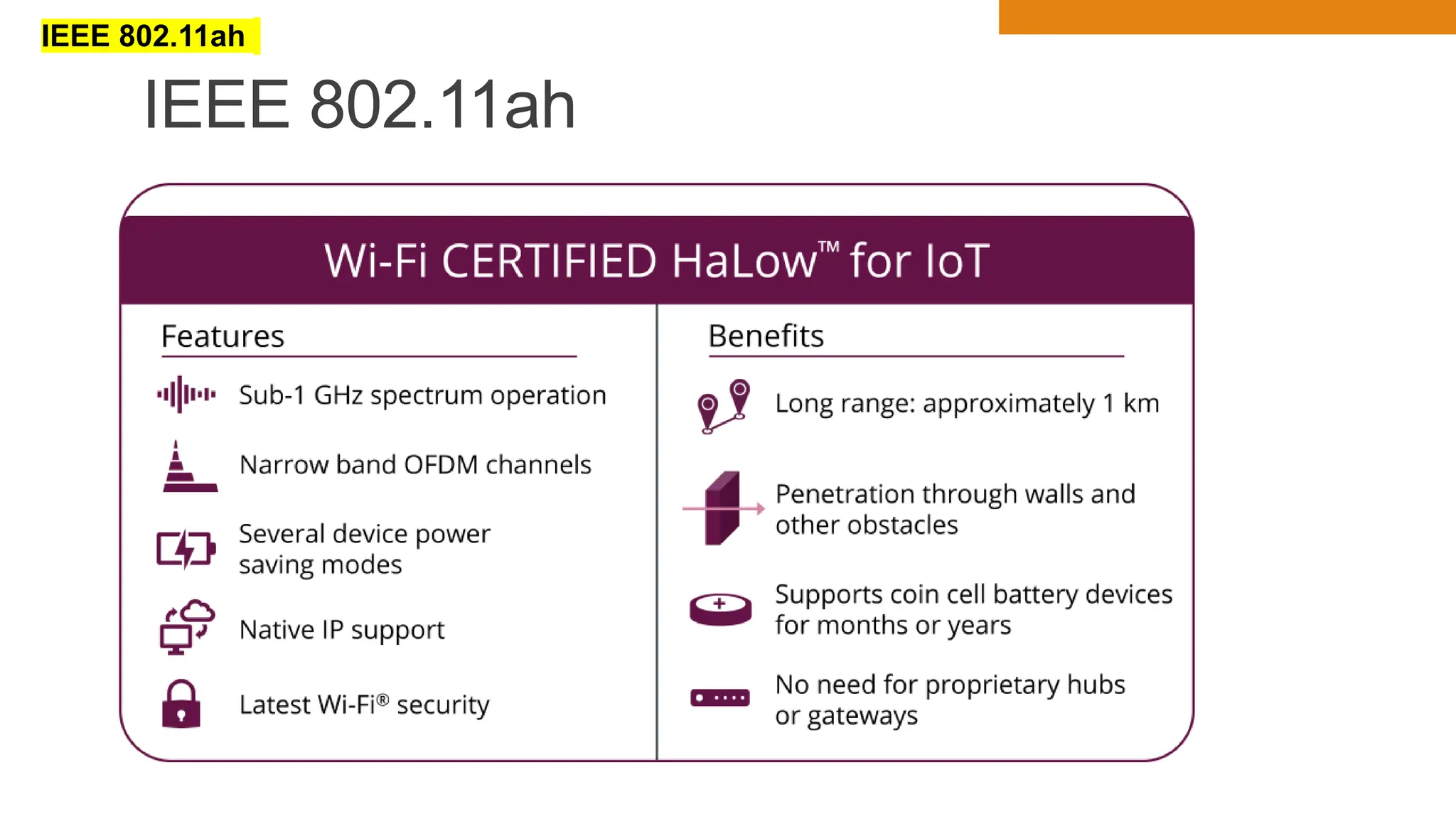
 Wireless networking protocol published in 2017 called Wi-Fi HaLow (pronounced "HEY-Low")
 Amendment of the IEEE 802.11-2007 wireless networking standard
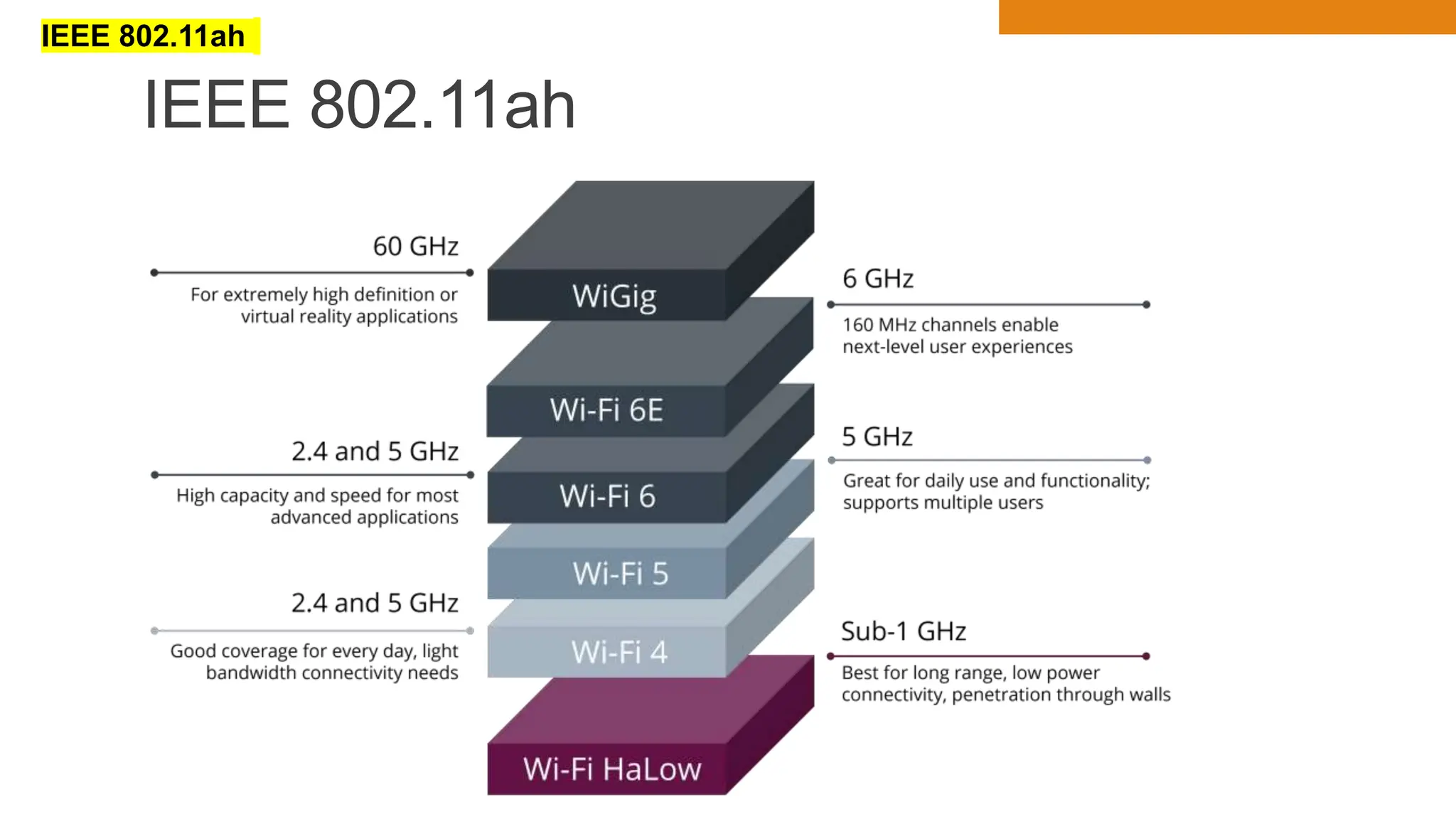
 Uses 900 MHz license-exempt bands (conventional Wi-Fi networks: 2.4 GHz and 5 GHz bands)
 Data rates up to 347 Mbit/s
 Benefits from lower energy consumption
 Competes with Bluetooth, LoRa, and Zigbee, Added benefit of higher data rates and wider coverage range
Primary Use Cases :
 Sensors and meters covering a smart grid
 Backhaul aggregation of industrial sensors and meter data
 Extended range Wi-Fi
Standardization and Alliances
IOT THINGS PRESENTATION - DAVIS M ONSAKIA 111
IEEE 802.11ah
2010 - “Industrial Wi-Fi”
Wi-Fi Alliance
Wi-Fi HaLow
Play on words between “11ah” in reverse and “low power.”
Physical Layer
IOT THINGS PRESENTATION - DAVIS M ONSAKIA 112
IEEE 802.11ah
Additional 802.11 physical layer operating in unlicensed sub-GHz band
IEEE 802.11ah uses channels of 2, 4, 8, or 16 MHz ( 1/10 data rate)
Provides an extended range for its lower-speed data
MAC Layer
IOT THINGS PRESENTATION - DAVIS M ONSAKIA 113
IEEE 802.11ah
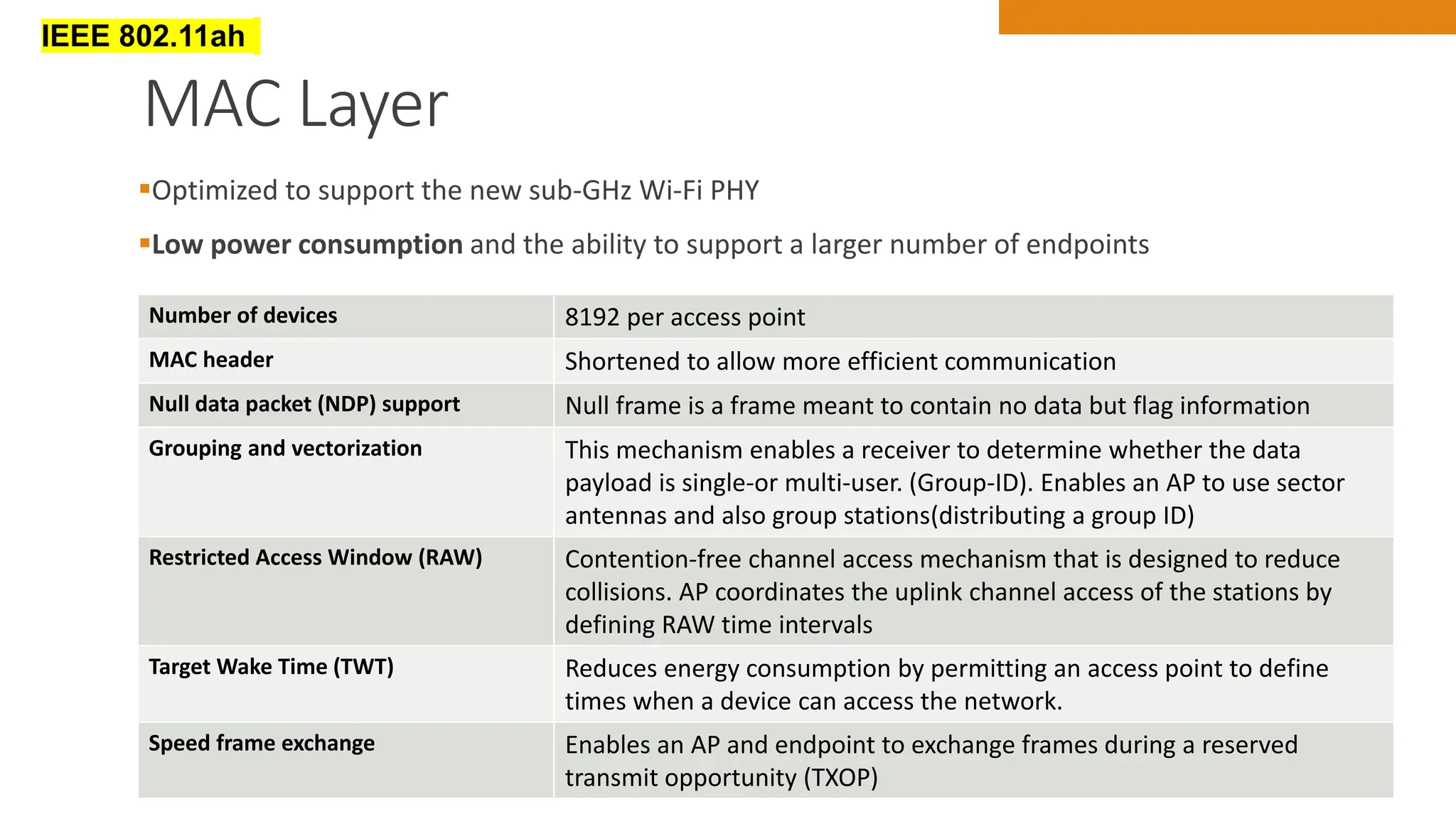
Optimized to support the new sub-GHz Wi-Fi PHY
Low power consumption and the ability to support a larger number of endpoints
Number of devices 8192 per access point
MAC header Shortened to allow more efficient communication
Null data packet (NDP) support Null frame is a frame meant to contain no data but flag information
Grouping and vectorization This mechanism enables a receiver to determine whether the data
payload is single-or multi-user. (Group-ID). Enables an AP to use sector
antennas and also group stations(distributing a group ID)
Restricted Access Window (RAW) Contention-free channel access mechanism that is designed to reduce
collisions. AP coordinates the uplink channel access of the stations by
defining RAW time intervals
Target Wake Time (TWT) Reduces energy consumption by permitting an access point to define
times when a device can access the network.
Speed frame exchange Enables an AP and endpoint to exchange frames during a reserved
transmit opportunity (TXOP)
Topology
IOT THINGS PRESENTATION - DAVIS M ONSAKIA 114
IEEE 802.11ah
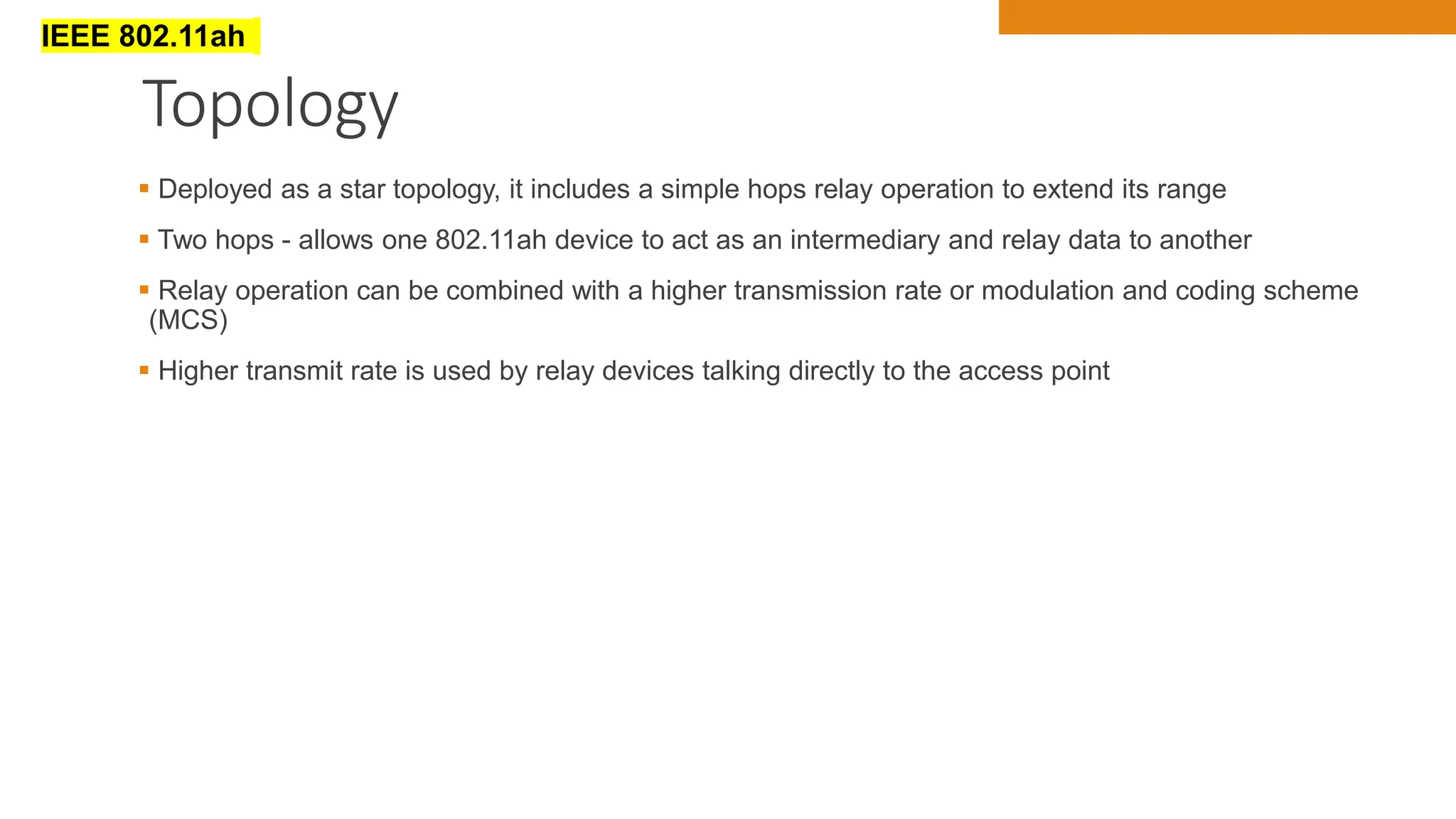
 Deployed as a star topology, it includes a simple hops relay operation to extend its range
 Two hops - allows one 802.11ah device to act as an intermediary and relay data to another
 Relay operation can be combined with a higher transmission rate or modulation and coding scheme
(MCS)
 Higher transmit rate is used by relay devices talking directly to the access point
Topology
IOT THINGS PRESENTATION - DAVIS M ONSAKIA 115
IEEE 802.11ah
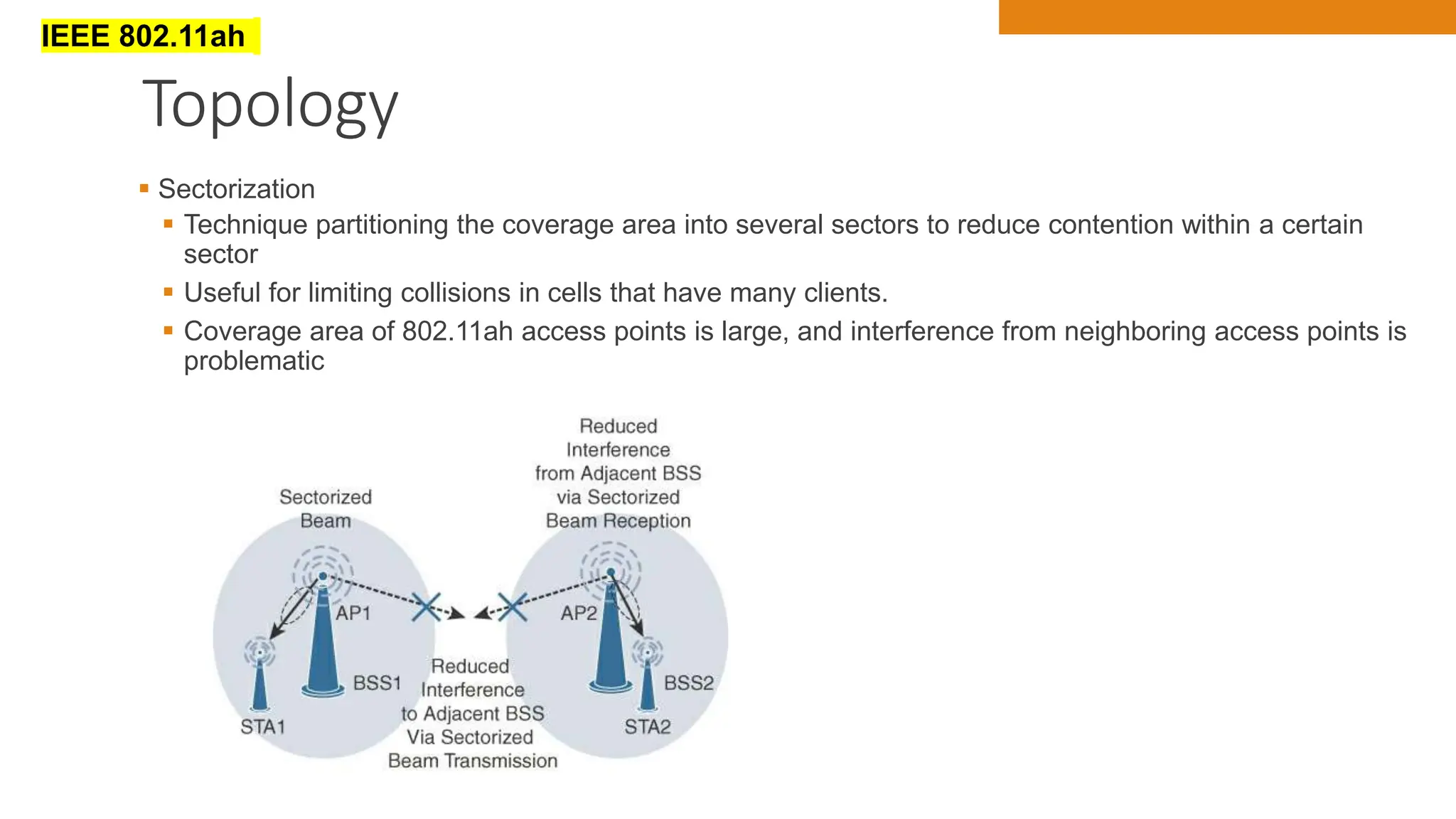
 Sectorization
 Technique partitioning the coverage area into several sectors to reduce contention within a certain
sector
 Useful for limiting collisions in cells that have many clients.
 Coverage area of 802.11ah access points is large, and interference from neighboring access points is
problematic
Security
IOT THINGS PRESENTATION - DAVIS M ONSAKIA 116
IEEE 802.11ah
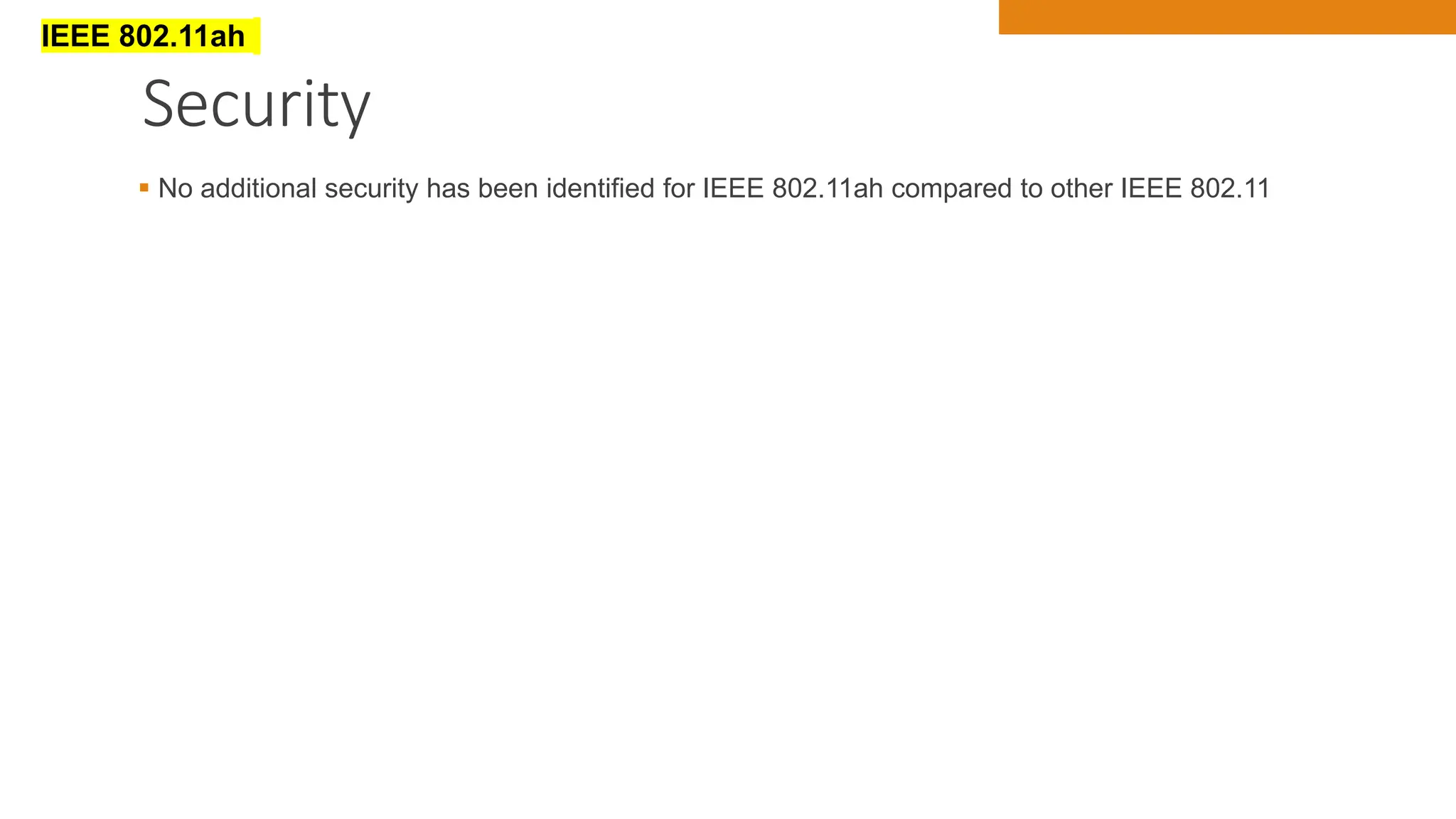
 No additional security has been identified for IEEE 802.11ah compared to other IEEE 802.11
Competitive Technologies
IOT THINGS PRESENTATION - DAVIS M ONSAKIA 117
IEEE 802.11ah
 Competitive technologies to IEEE 802.11ah are IEEE 802.15.4 and IEEE 802.15.4e
IEEE 802.11ah
IOT THINGS PRESENTATION - DAVIS M ONSAKIA 118
IEEE 802.11ah
IEEE 802.11ah
IOT THINGS PRESENTATION - DAVIS M ONSAKIA 119
IEEE 802.11ah
LoRaWAN
IOT THINGS PRESENTATION - DAVIS M ONSAKIA 120
LoRaWAN
Overview
IOT THINGS PRESENTATION - DAVIS M ONSAKIA 121
LoRaWAN
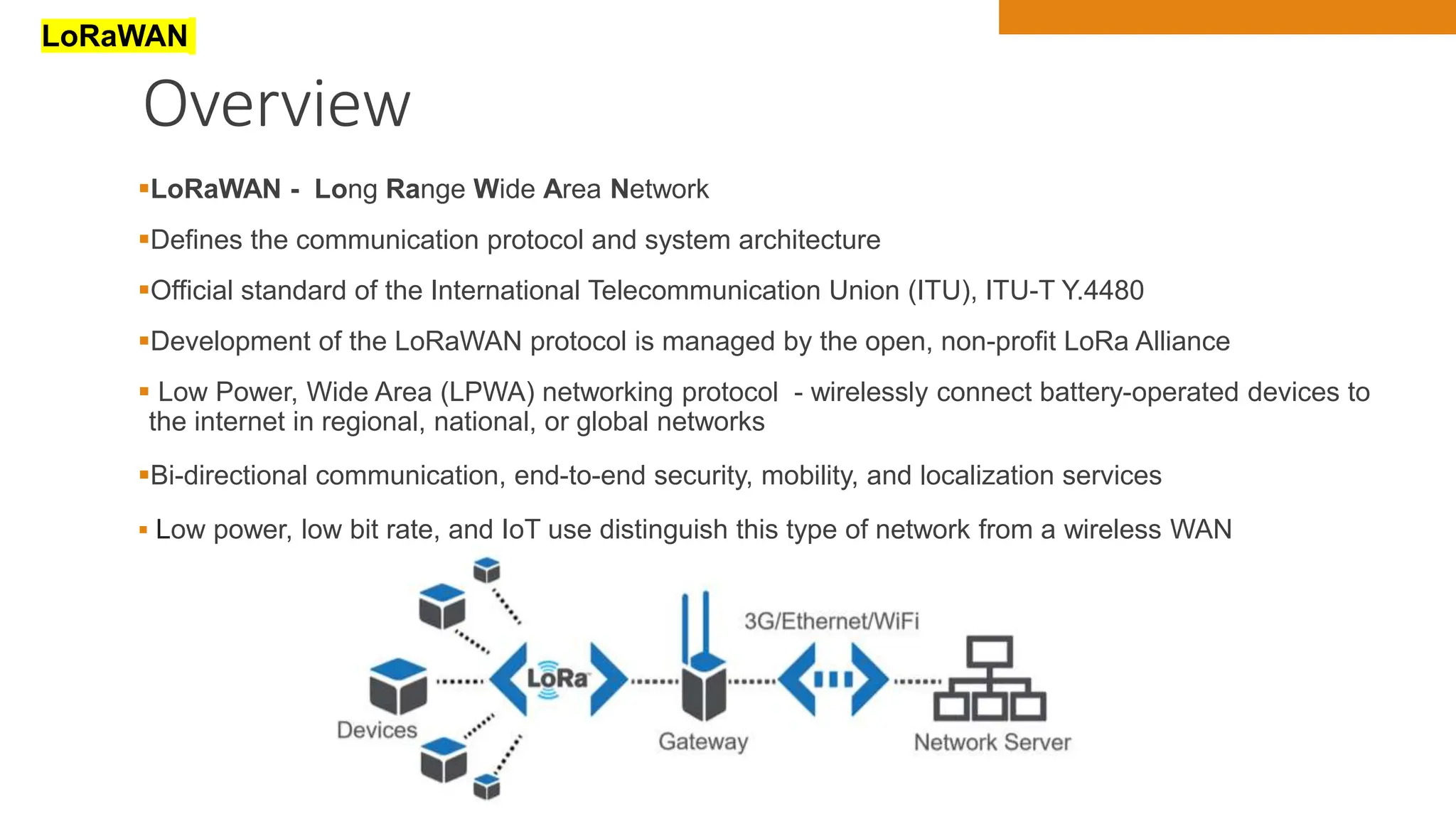
LoRaWAN - Long Range Wide Area Network
Defines the communication protocol and system architecture
Official standard of the International Telecommunication Union (ITU), ITU-T Y.4480
Development of the LoRaWAN protocol is managed by the open, non-profit LoRa Alliance
 Low Power, Wide Area (LPWA) networking protocol - wirelessly connect battery-operated devices to
the internet in regional, national, or global networks
Bi-directional communication, end-to-end security, mobility, and localization services
 Low power, low bit rate, and IoT use distinguish this type of network from a wireless WAN
Standardizationand Alliances
IOT THINGS PRESENTATION - DAVIS M ONSAKIA 122
LoRaWAN
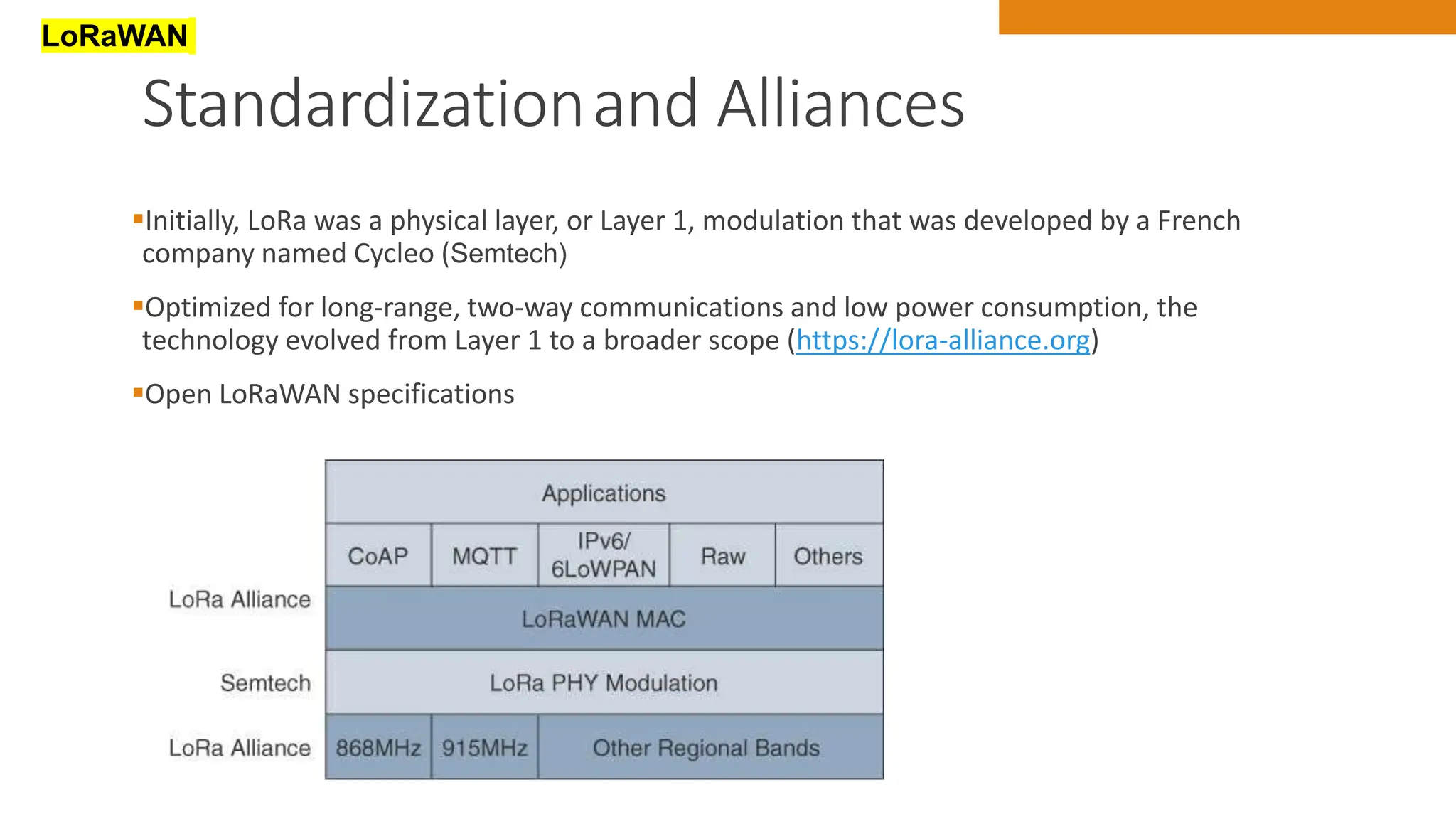
Initially, LoRa was a physical layer, or Layer 1, modulation that was developed by a French
company named Cycleo (Semtech)
Optimized for long-range, two-way communications and low power consumption, the
technology evolved from Layer 1 to a broader scope (https://lora-alliance.org)
Open LoRaWAN specifications
Physical Layer
IOT THINGS PRESENTATION - DAVIS M ONSAKIA 123
LoRaWAN
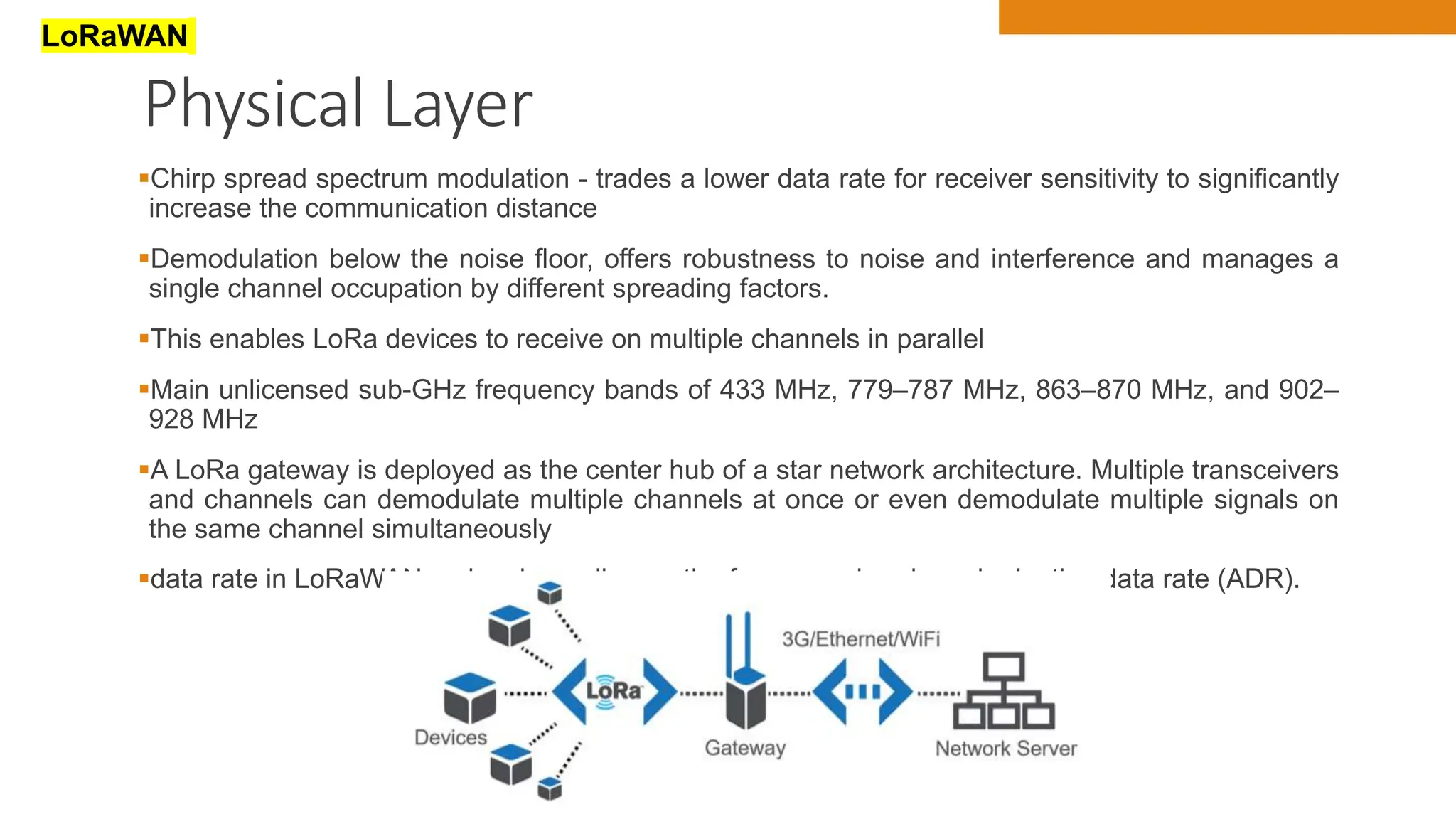
Chirp spread spectrum modulation - trades a lower data rate for receiver sensitivity to significantly
increase the communication distance
Demodulation below the noise floor, offers robustness to noise and interference and manages a
single channel occupation by different spreading factors.
This enables LoRa devices to receive on multiple channels in parallel
Main unlicensed sub-GHz frequency bands of 433 MHz, 779–787 MHz, 863–870 MHz, and 902–
928 MHz
A LoRa gateway is deployed as the center hub of a star network architecture. Multiple transceivers
and channels can demodulate multiple channels at once or even demodulate multiple signals on
the same channel simultaneously
data rate in LoRaWAN varies depending on the frequency bands and adaptive data rate (ADR).
MAC Layer
IOT THINGS PRESENTATION - DAVIS M ONSAKIA 124
LoRaWAN
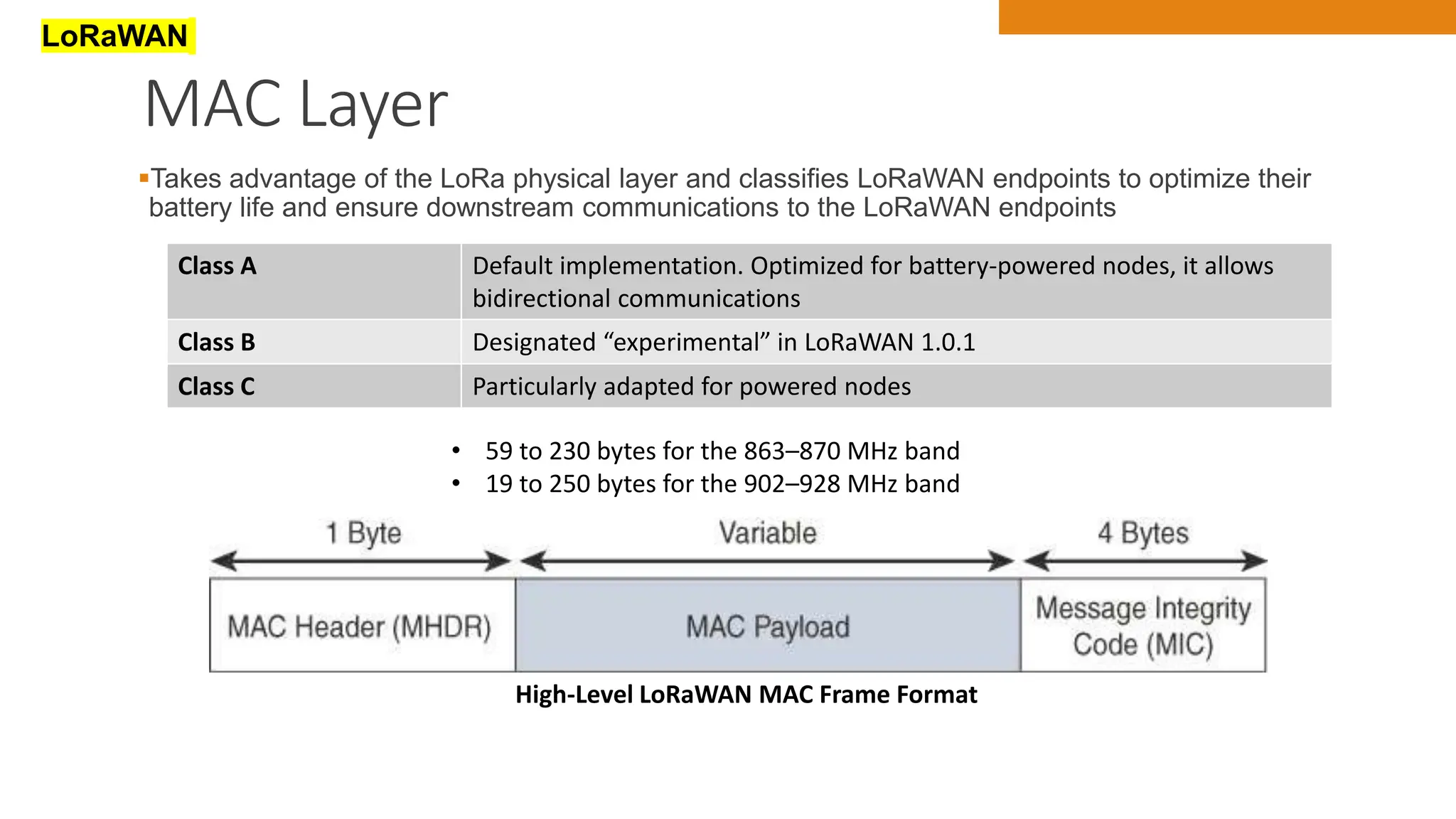
Takes advantage of the LoRa physical layer and classifies LoRaWAN endpoints to optimize their
battery life and ensure downstream communications to the LoRaWAN endpoints
Class A Default implementation. Optimized for battery-powered nodes, it allows
bidirectional communications
Class B Designated “experimental” in LoRaWAN 1.0.1
Class C Particularly adapted for powered nodes
High-Level LoRaWAN MAC Frame Format
• 59 to 230 bytes for the 863–870 MHz band
• 19 to 250 bytes for the 902–928 MHz band
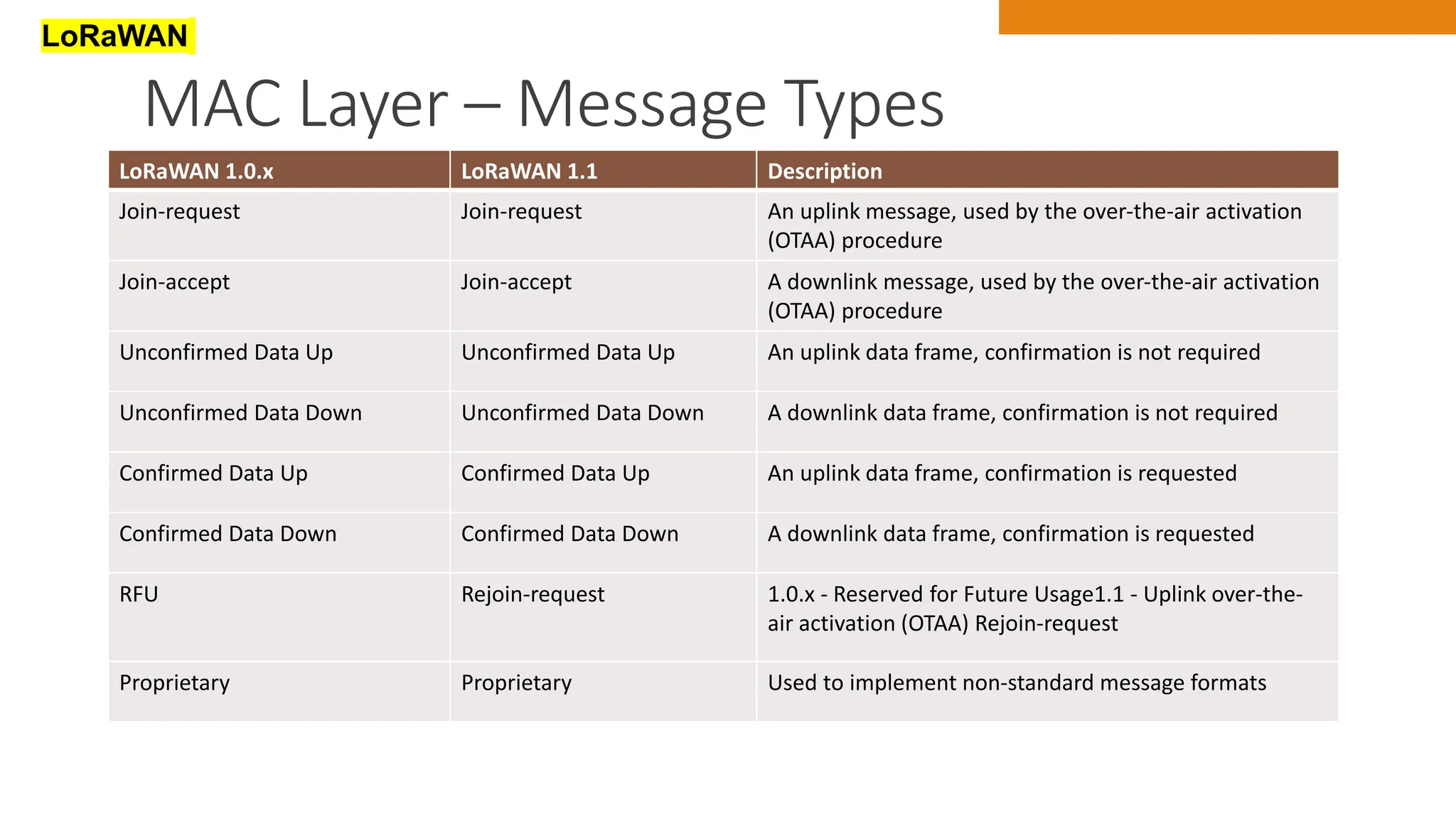
MAC Layer – Message Types
IOT THINGS PRESENTATION - DAVIS M ONSAKIA 125
LoRaWAN
LoRaWAN 1.0.x LoRaWAN 1.1 Description
Join-request Join-request An uplink message, used by the over-the-air activation
(OTAA) procedure
Join-accept Join-accept A downlink message, used by the over-the-air activation
(OTAA) procedure
Unconfirmed Data Up Unconfirmed Data Up An uplink data frame, confirmation is not required
Unconfirmed Data Down Unconfirmed Data Down A downlink data frame, confirmation is not required
Confirmed Data Up Confirmed Data Up An uplink data frame, confirmation is requested
Confirmed Data Down Confirmed Data Down A downlink data frame, confirmation is requested
RFU Rejoin-request 1.0.x - Reserved for Future Usage1.1 - Uplink over-the-
air activation (OTAA) Rejoin-request
Proprietary Proprietary Used to implement non-standard message formats
Topology
IOT THINGS PRESENTATION - DAVIS M ONSAKIA 126
LoRaWAN
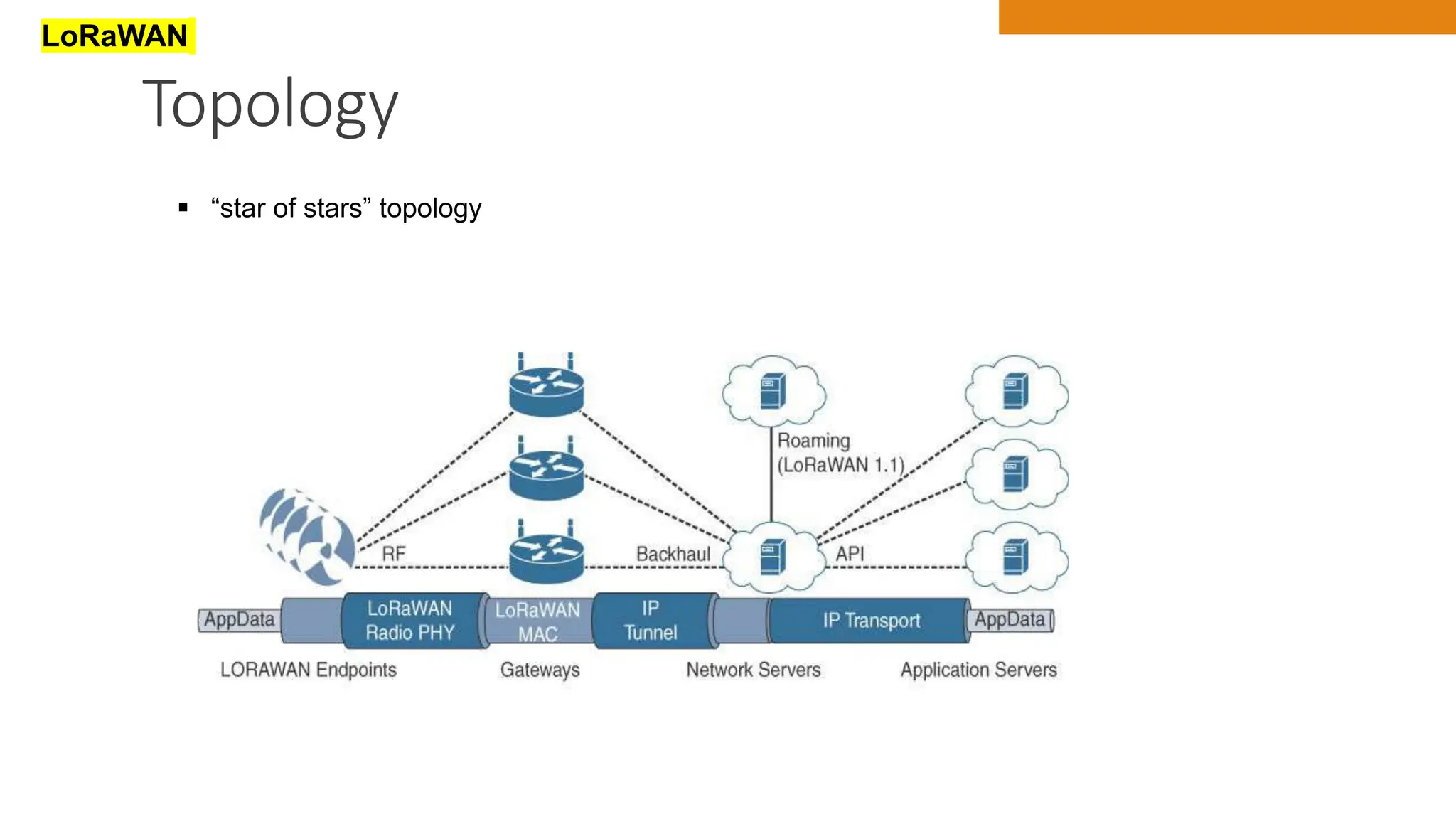
 “star of stars” topology
Security
IOT THINGS PRESENTATION - DAVIS M ONSAKIA 127
LoRaWAN
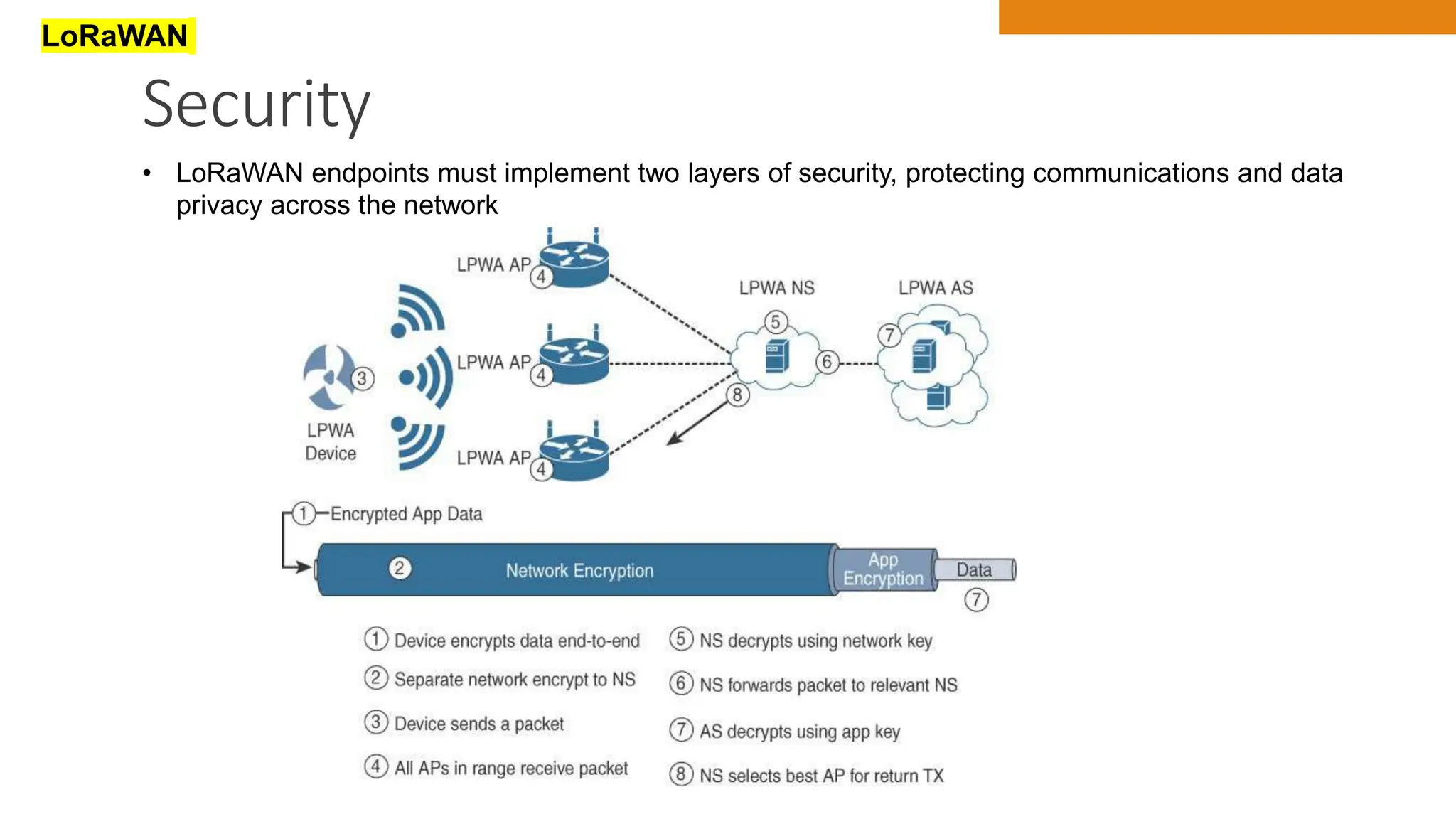
• LoRaWAN endpoints must implement two layers of security, protecting communications and data
privacy across the network
Security
IOT THINGS PRESENTATION - DAVIS M ONSAKIA 128
LoRaWAN
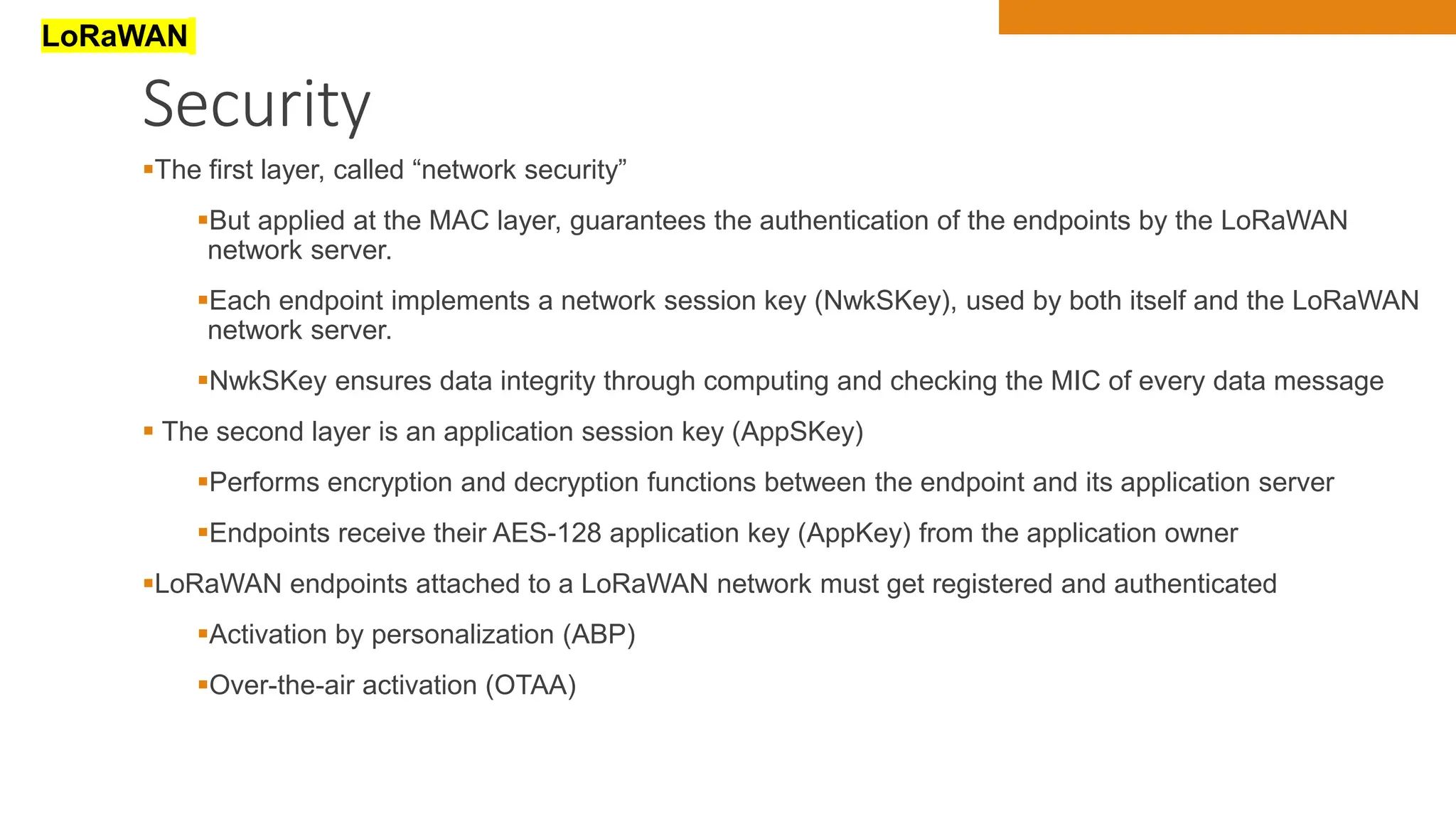
The first layer, called “network security”
But applied at the MAC layer, guarantees the authentication of the endpoints by the LoRaWAN
network server.
Each endpoint implements a network session key (NwkSKey), used by both itself and the LoRaWAN
network server.
NwkSKey ensures data integrity through computing and checking the MIC of every data message
 The second layer is an application session key (AppSKey)
Performs encryption and decryption functions between the endpoint and its application server
Endpoints receive their AES-128 application key (AppKey) from the application owner
LoRaWAN endpoints attached to a LoRaWAN network must get registered and authenticated
Activation by personalization (ABP)
Over-the-air activation (OTAA)
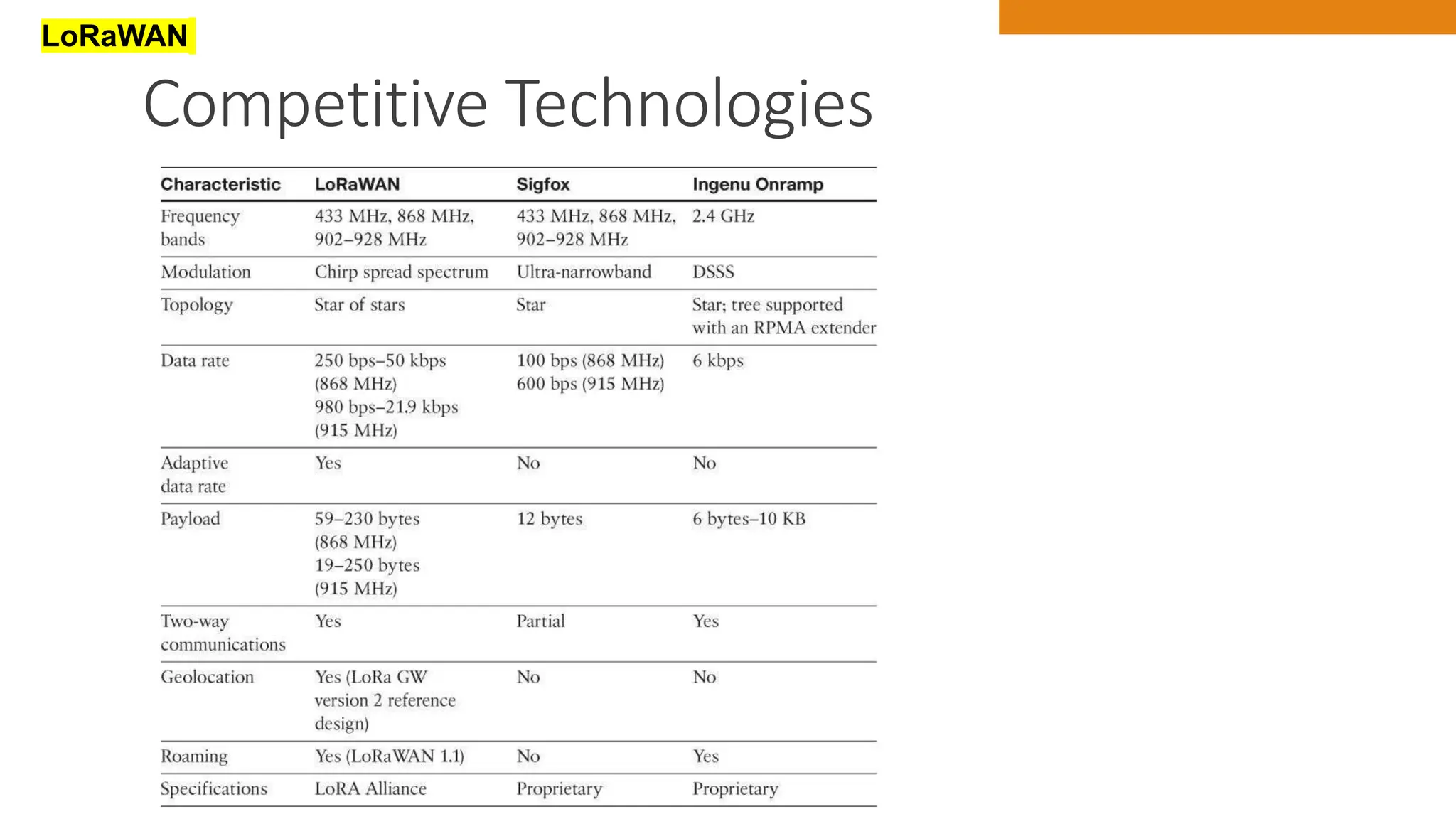
Competitive Technologies
IOT THINGS PRESENTATION - DAVIS M ONSAKIA 129
LoRaWAN
NB-IoT and Other LTE Variations
IOT THINGS PRESENTATION - DAVIS M ONSAKIA 130
NB-IoT
NB-IoT and Other LTE Variations
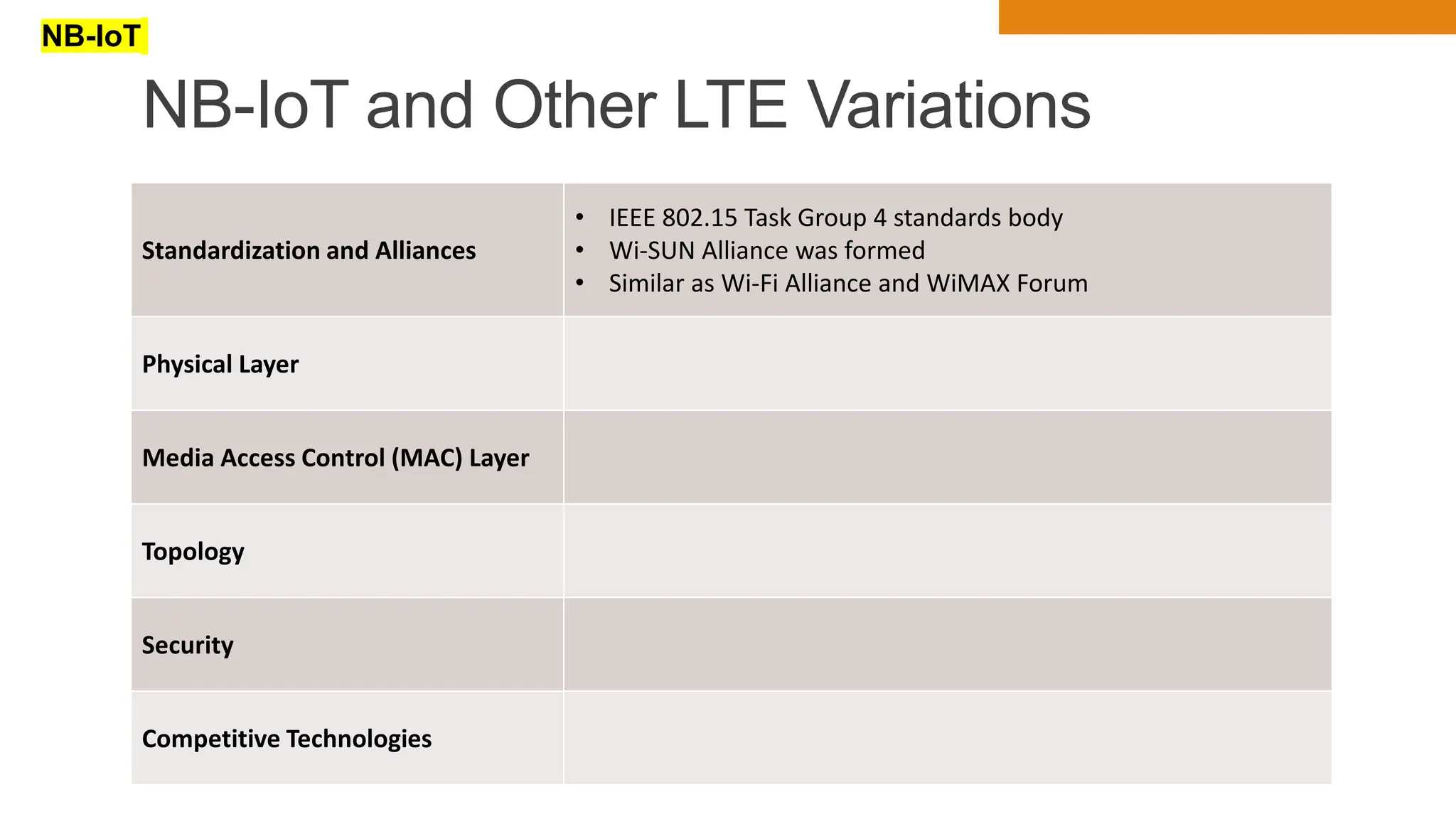
Standardization and Alliances
• IEEE 802.15 Task Group 4 standards body
• Wi-SUN Alliance was formed
• Similar as Wi-Fi Alliance and WiMAX Forum
Physical Layer
Media Access Control (MAC) Layer
Topology
Security
Competitive Technologies
IOT THINGS PRESENTATION - DAVIS M ONSAKIA 131
NB-IoT
Recap
132
NB-IoT and Other LTE Variations
IOT THINGS PRESENTATION - DAVIS M ONSAKIA 133
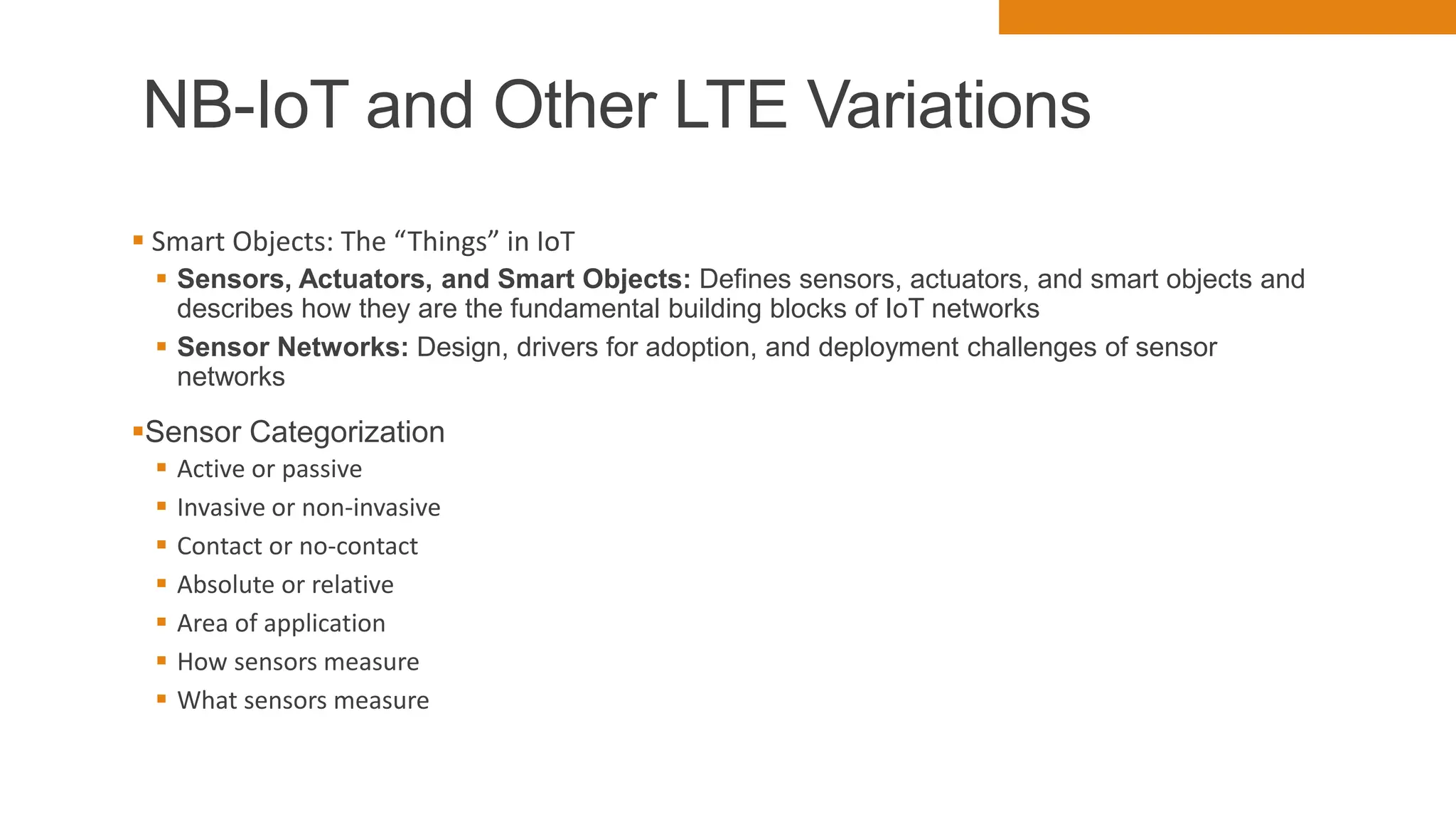
 Smart Objects: The “Things” in IoT
 Sensors, Actuators, and Smart Objects: Defines sensors, actuators, and smart objects and
describes how they are the fundamental building blocks of IoT networks
 Sensor Networks: Design, drivers for adoption, and deployment challenges of sensor
networks
Sensor Categorization
 Active or passive
 Invasive or non-invasive
 Contact or no-contact
 Absolute or relative
 Area of application
 How sensors measure
 What sensors measure
IP as the IoT Network Layer
134
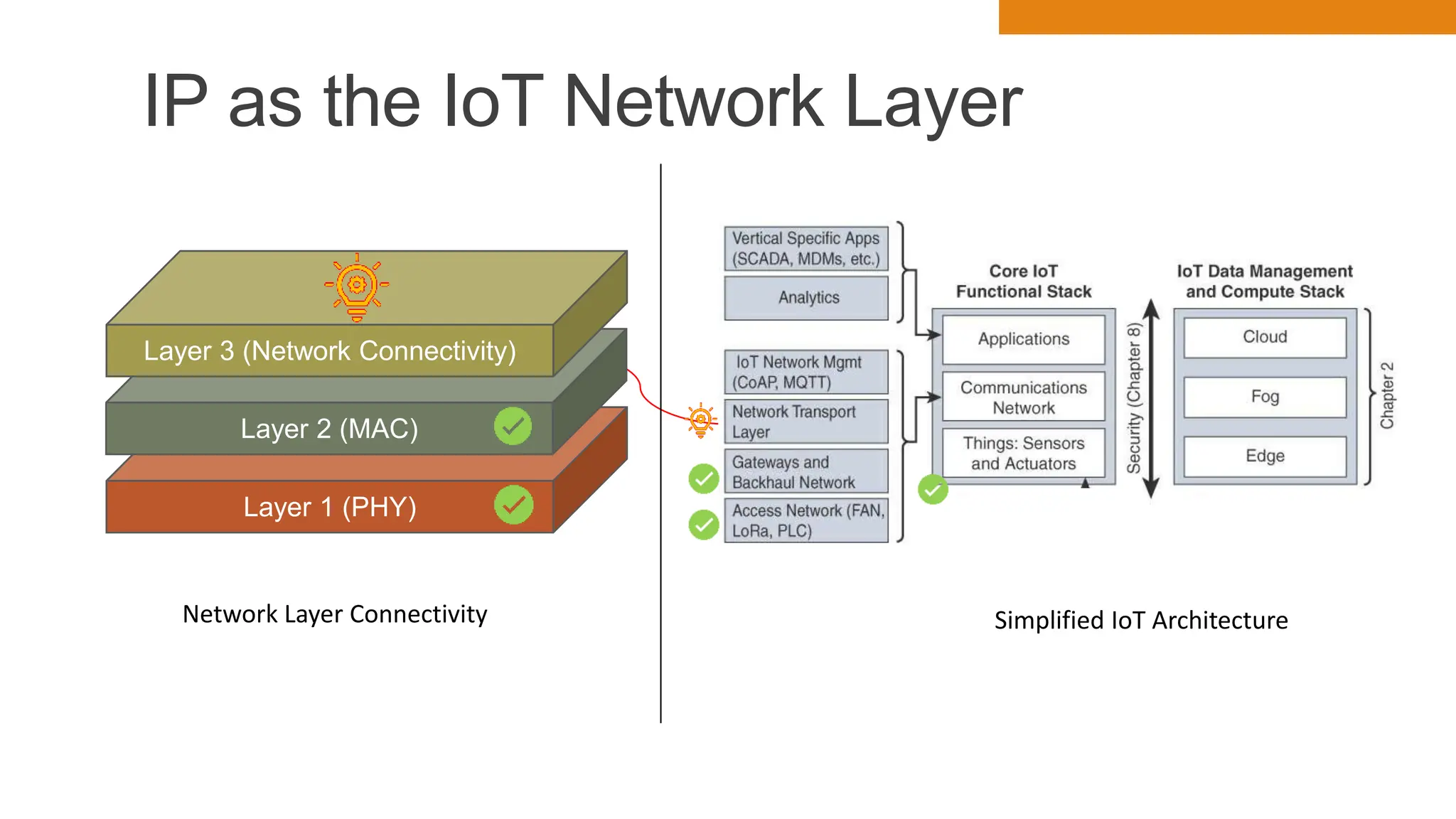
IP as the IoT Network Layer
IOT FOR DATA SCIENCE AND ANALYTICS 135
Layer 1 (PHY)
Layer 2 (MAC)
Layer 3 (Network Connectivity)
Simplified IoT Architecture
Network Layer Connectivity
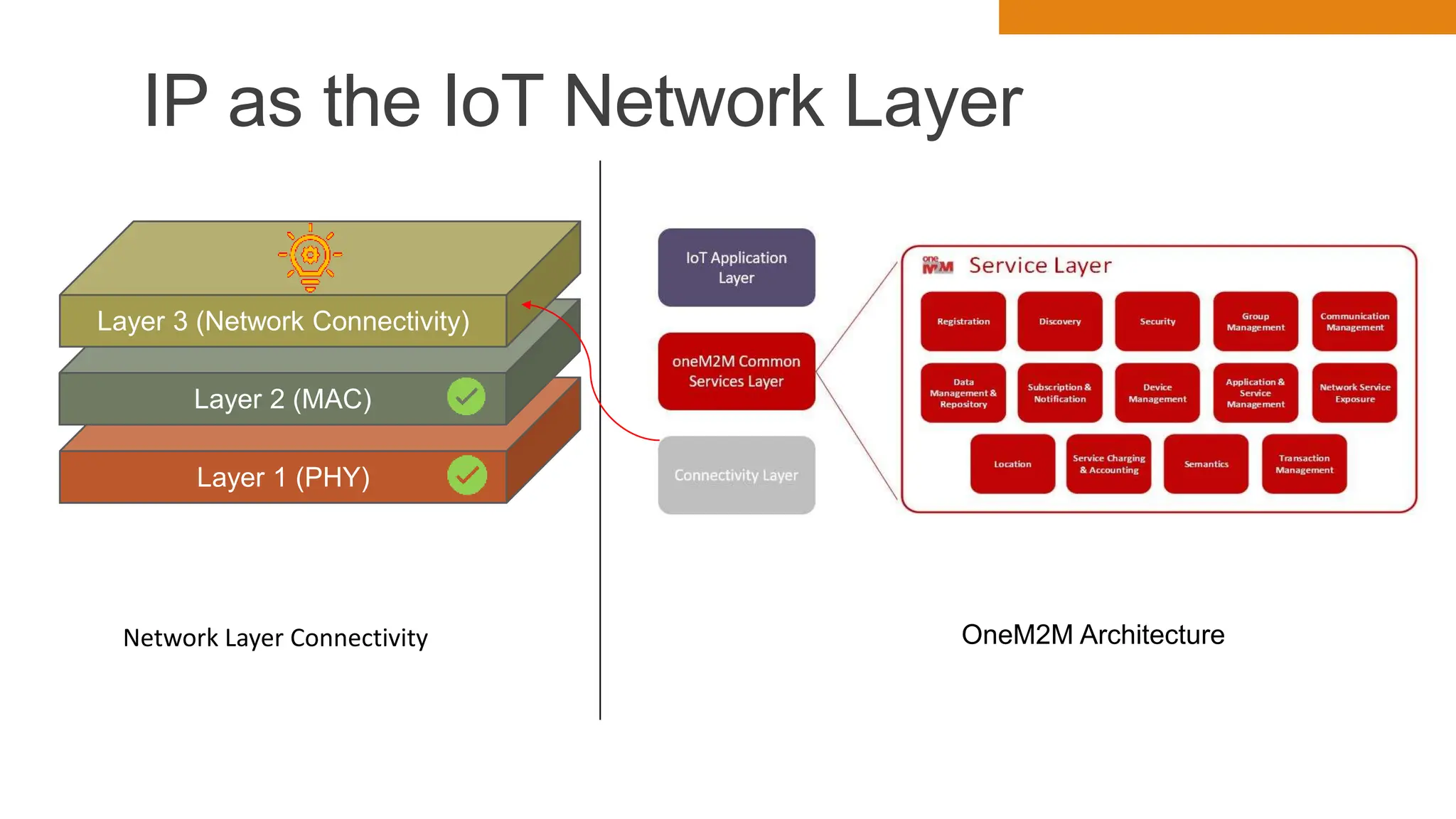
IP as the IoT Network Layer
IOT FOR DATA SCIENCE AND ANALYTICS 136
Layer 1 (PHY)
Layer 2 (MAC)
Layer 3 (Network Connectivity)
OneM2M Architecture
Network Layer Connectivity
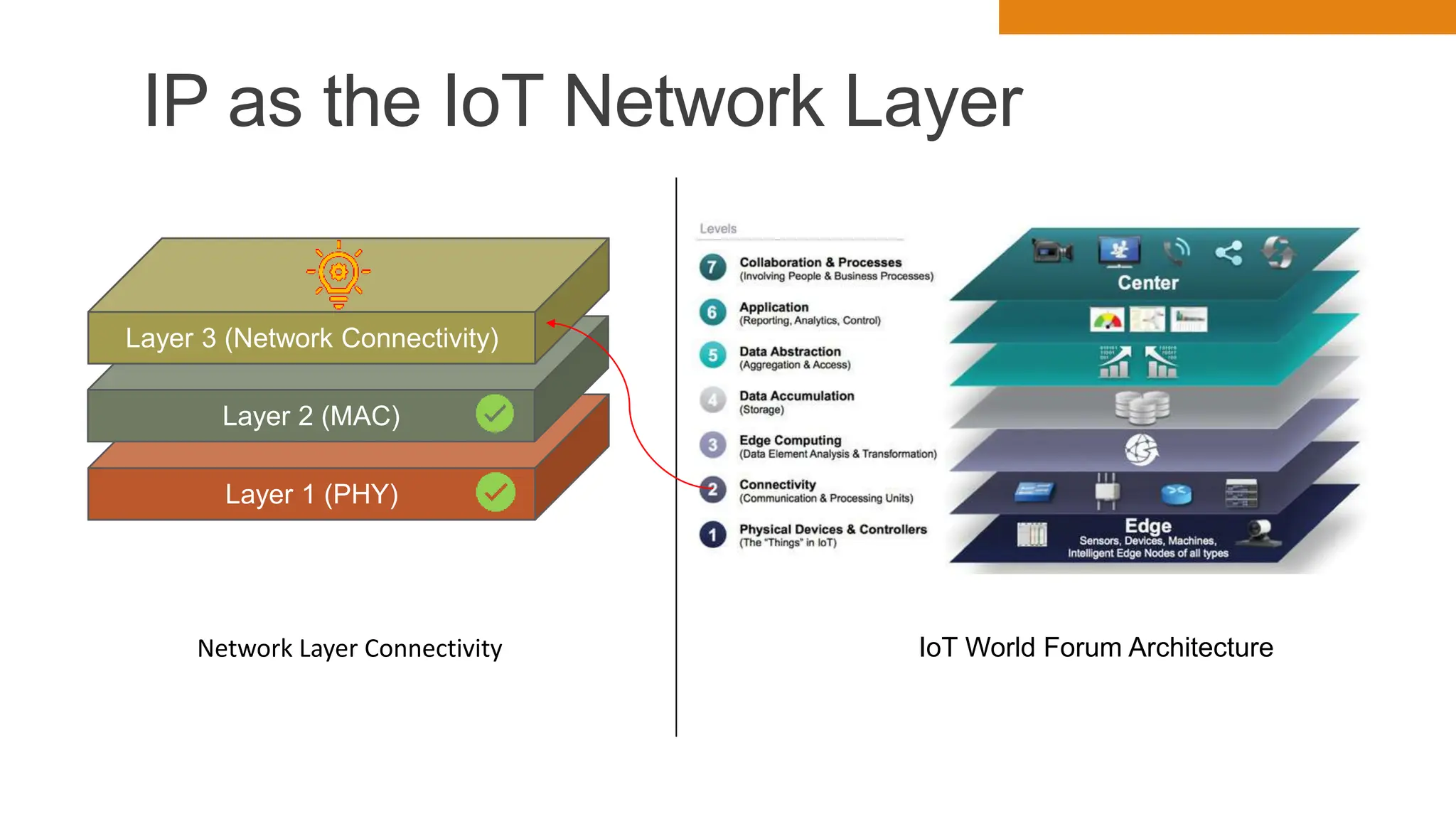
IP as the IoT Network Layer
IOT FOR DATA SCIENCE AND ANALYTICS 137
Layer 1 (PHY)
Layer 2 (MAC)
Layer 3 (Network Connectivity)
IoT World Forum Architecture
Network Layer Connectivity
IP as the IoT Network Layer
138
The Business Case for IP
• Advantages of IP from an IoT perspective
• Introduces the concepts of adoption and adaptation
The Need for Optimization
• Challenges of constrained nodes and devices when deploying IP
• Migration from IPv4 -> IPv6 and how it affects IoT networks
Optimizing IP for IoT
Common protocols and technologies in IoT networks utilizing IP including 6LoWPAN, 6TiSCH,
and RPL
Profiles and Compliances
Organizations and standards bodies involved with IP connectivity and IoT
Internet Protocol (IP)
139
IP – Internet Protocol
140
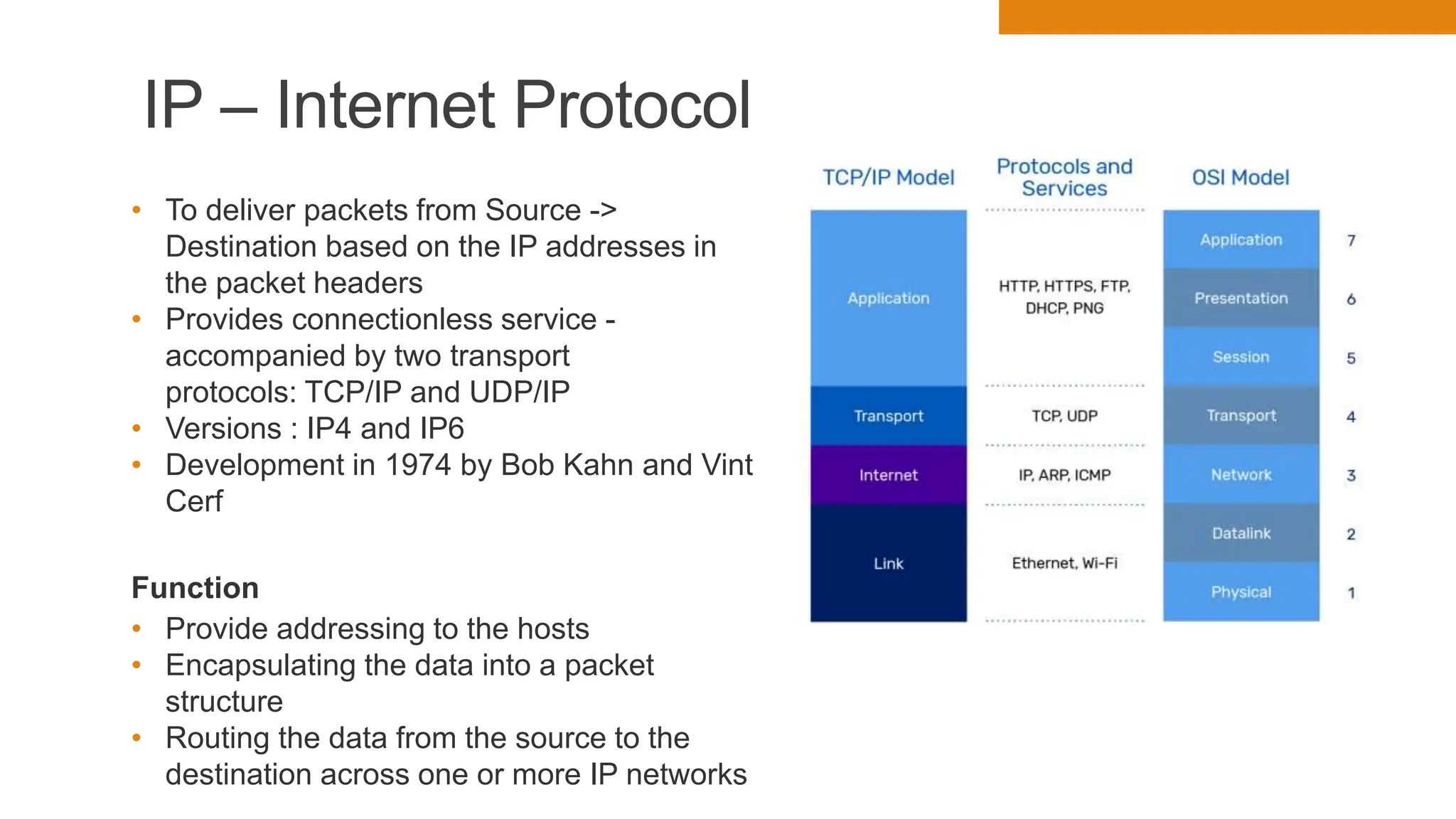
• To deliver packets from Source ->
Destination based on the IP addresses in
the packet headers
• Provides connectionless service -
accompanied by two transport
protocols: TCP/IP and UDP/IP
• Versions : IP4 and IP6
• Development in 1974 by Bob Kahn and Vint
Cerf
Function
• Provide addressing to the hosts
• Encapsulating the data into a packet
structure
• Routing the data from the source to the
destination across one or more IP networks
IP – Overview
141
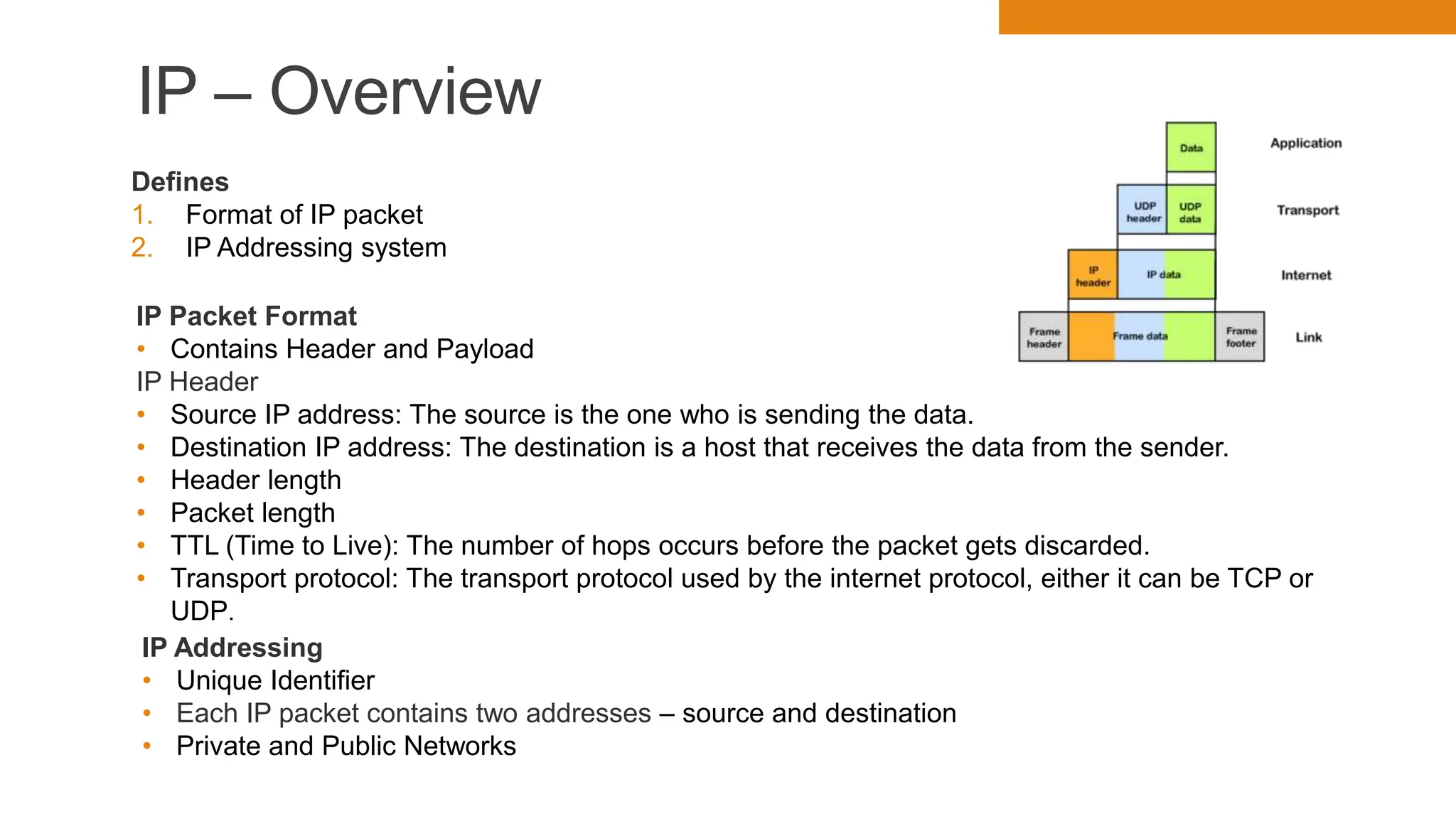
Defines
1. Format of IP packet
2. IP Addressing system
IP Addressing
• Unique Identifier
• Each IP packet contains two addresses – source and destination
• Private and Public Networks
IP Packet Format
• Contains Header and Payload
IP Header
• Source IP address: The source is the one who is sending the data.
• Destination IP address: The destination is a host that receives the data from the sender.
• Header length
• Packet length
• TTL (Time to Live): The number of hops occurs before the packet gets discarded.
• Transport protocol: The transport protocol used by the internet protocol, either it can be TCP or
UDP.
The Business Case for IP
142
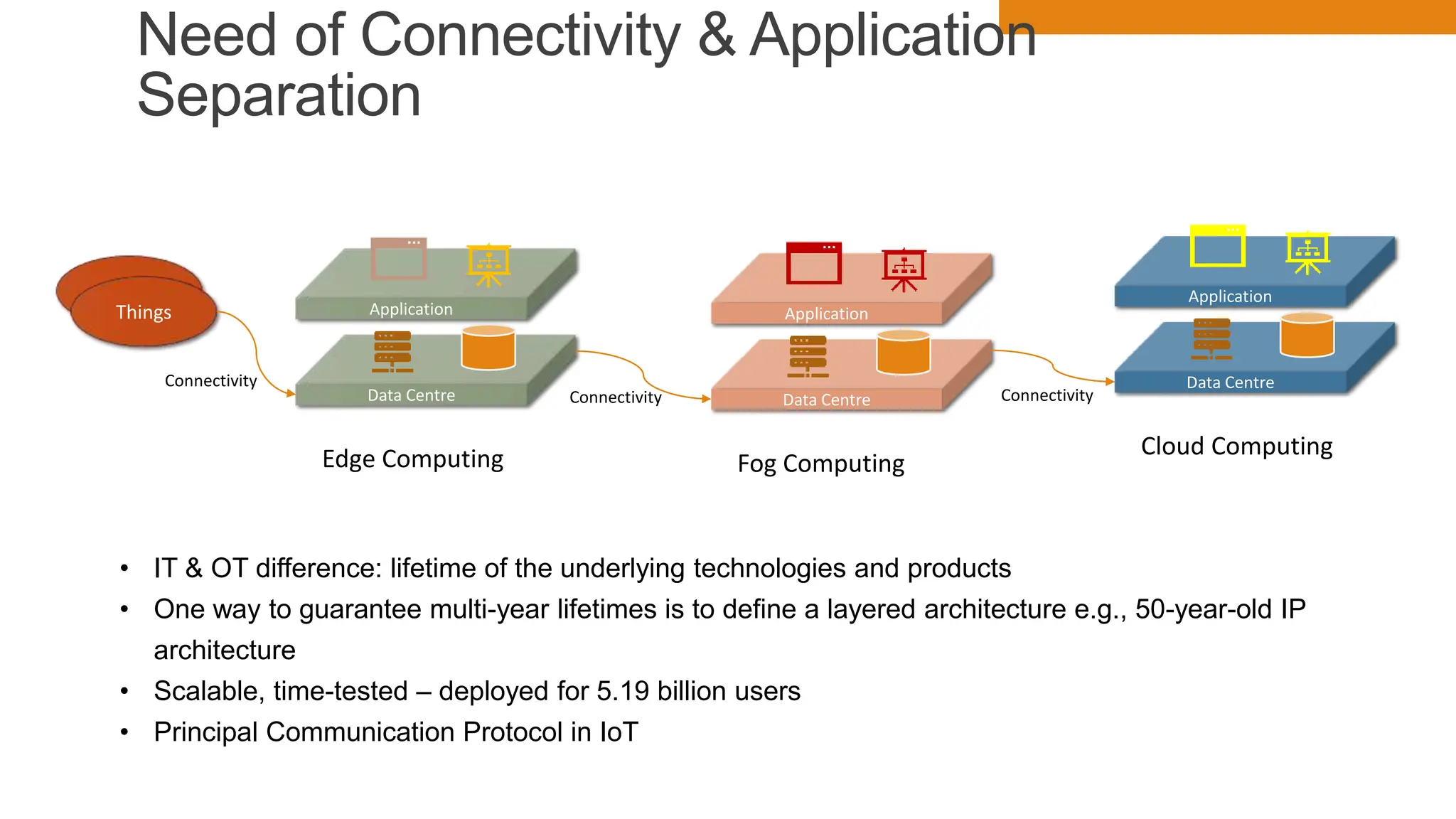
Need of Connectivity & Application
Separation
143
Data Centre
Application
Edge Computing
Data Centre
Application
Fog Computing
Data Centre
Application
Cloud Computing
Things
Connectivity
Connectivity Connectivity
• IT & OT difference: lifetime of the underlying technologies and products
• One way to guarantee multi-year lifetimes is to define a layered architecture e.g., 50-year-old IP
architecture
• Scalable, time-tested – deployed for 5.19 billion users
• Principal Communication Protocol in IoT
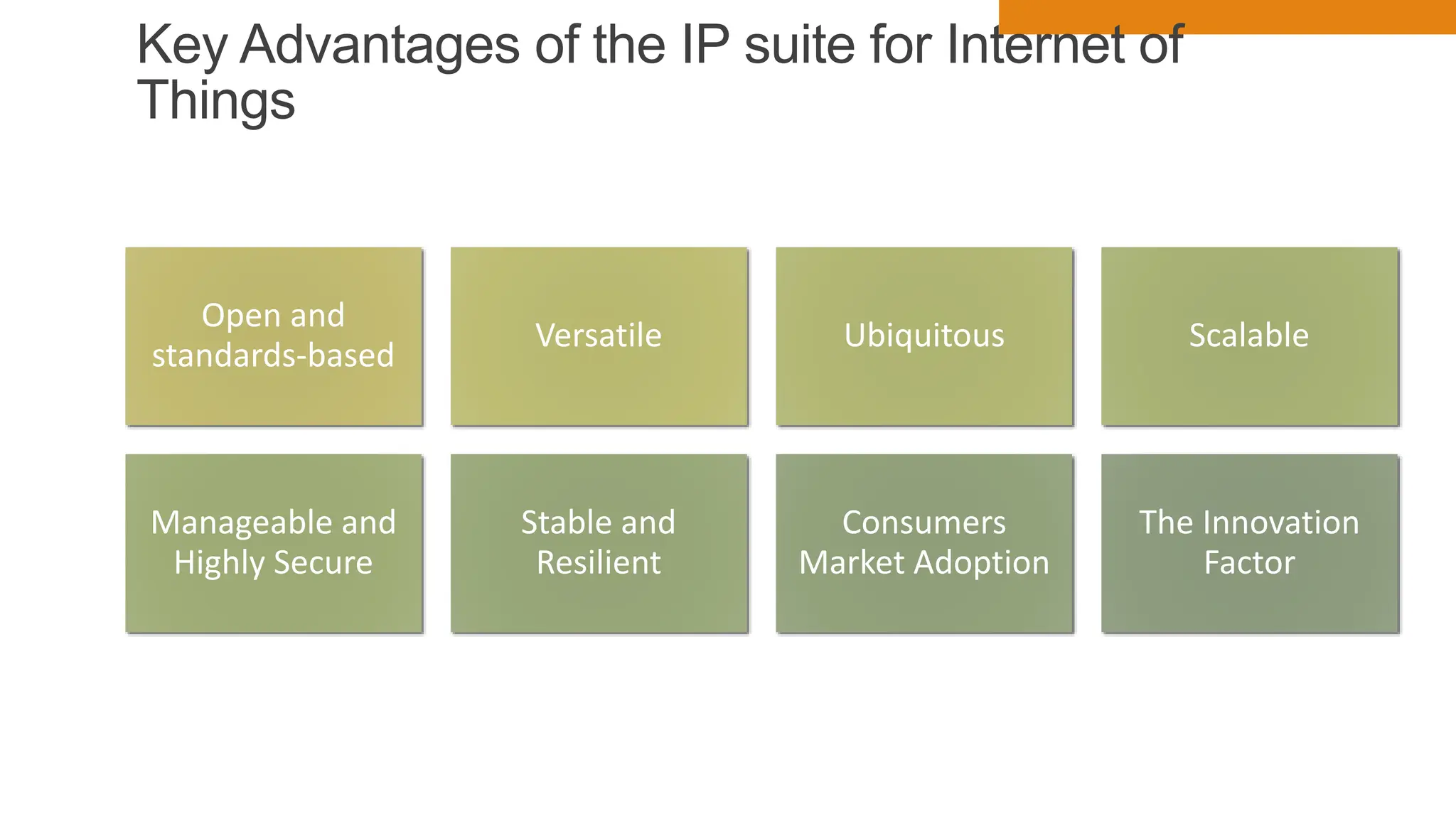
Key Advantages of the IP suite for Internet of
Things
144
Open and
standards-based
Versatile Ubiquitous Scalable
Manageable and
Highly Secure
Stable and
Resilient
Consumers
Market Adoption
The Innovation
Factor
Open and standards-based
145
OT Technologies have often been delivered as turnkey features
 Optimized communications through closed and proprietary networking solutions
IoT – a large set of devices and functionalities
 Guaranteeing interchangeability and interoperability, security, and management.
 Implementation, validation, and deployment of open, standards-based solutions
Internet Engineering Task Force (IETF) defines standard operating internet protocols such as
TCP/IP, the role of which remains unquestioned
SDO (Standards Development Organization) defines Internet of Things definitions, frameworks,
applications, and technologies
Versatile
146
 A large spectrum of access technologies is available to offer connectivity of “things” in the last
mile.
 Additional protocols and technologies for backhaul links and in the data center
 History of data communications demonstrates that no given wired or wireless technology fits all
deployment criteria
 Communication technologies evolve at a pace faster than the expected 10-20-year lifetime of OT
solutions
 Layered IP architecture is well equipped to cope with any type of physical and data link layers
Ubiquitous
147
 All recent operating system releases, from general-purpose computers and servers to
lightweight embedded systems (TinyOS, Contiki, and so on), have an integrated dual
(IPv4 and IPv6) IP stack that gets enhanced over time
IoT application protocols in many industrial OT solutions have been updated in recent
years to run over IP
Scalable
148
 IP has been massively deployed and tested for robust scalability
Millions of private and public IP infrastructure nodes have been operational for years, offering
strong foundations for those not familiar with IP network management
Think of the huge number of mobile devices connected to the internet!
Manageable and Highly Secure
149
 Communications infrastructure requires appropriate management and security
capabilities for proper operations
 Operational IP Network -> Well-understood network management and security protocols
 Well-known network and security management tools are easily leveraged with an IP network layer
But there are vulnerable areas !
Stable and Resilient
150
 Has been around for 30 years, and it is clear that IP is a workable solution
 Has a large and well-established knowledge base - used for years in critical
infrastructures
 Deployed for critical services, such as voice and video
Large ecosystem of IT professionals who can help design, deploy, and operate IP-based
solutions
Consumers Market Adoption
151
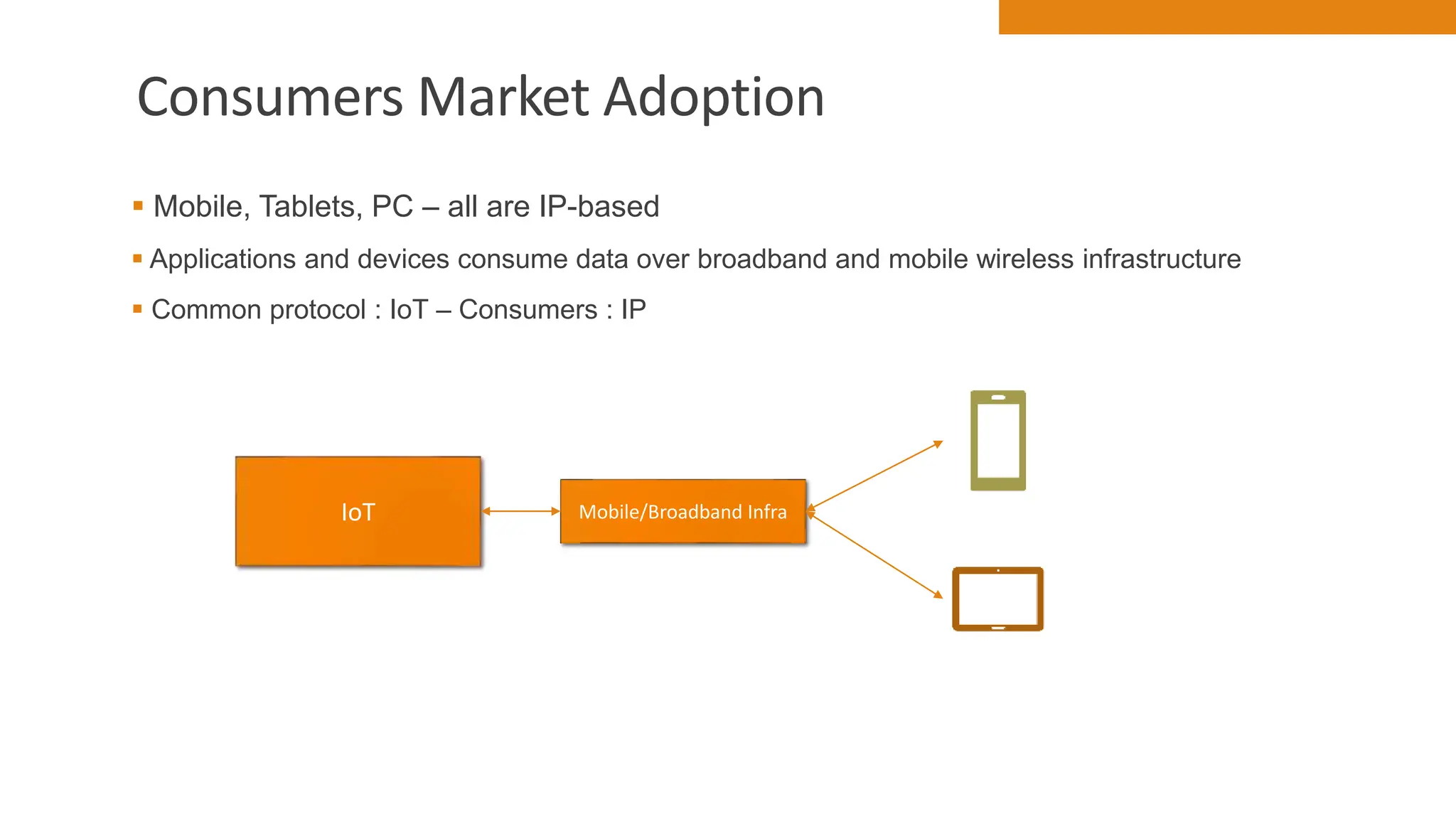
 Mobile, Tablets, PC – all are IP-based
 Applications and devices consume data over broadband and mobile wireless infrastructure
 Common protocol : IoT – Consumers : IP
IoT Mobile/Broadband Infra
The Innovation Factor
152
 IP sustained innovation
 IP is the underlying protocol for applications ranging from file transfer and e-mail to the World
Wide Web, e-commerce, social networking, mobility, and more.
 Recent computing evolution from PC to mobile and mainframes to cloud services are perfect
demonstrations of the innovative ground enabled by IP
Summary
153
 Solid foundation for the Internet of Things by allowing secured and manageable
bidirectional data communication capabilities between all devices in a network
IP is a standards-based protocol that is ubiquitous, scalable, versatile, and stable.
Network services such as naming, time distribution, traffic prioritization, isolation, and so on
are well-known and developed techniques that can be leveraged with IP
From cloud, centralized, or distributed architectures, IP data flow can be developed and
implemented according to business requirements
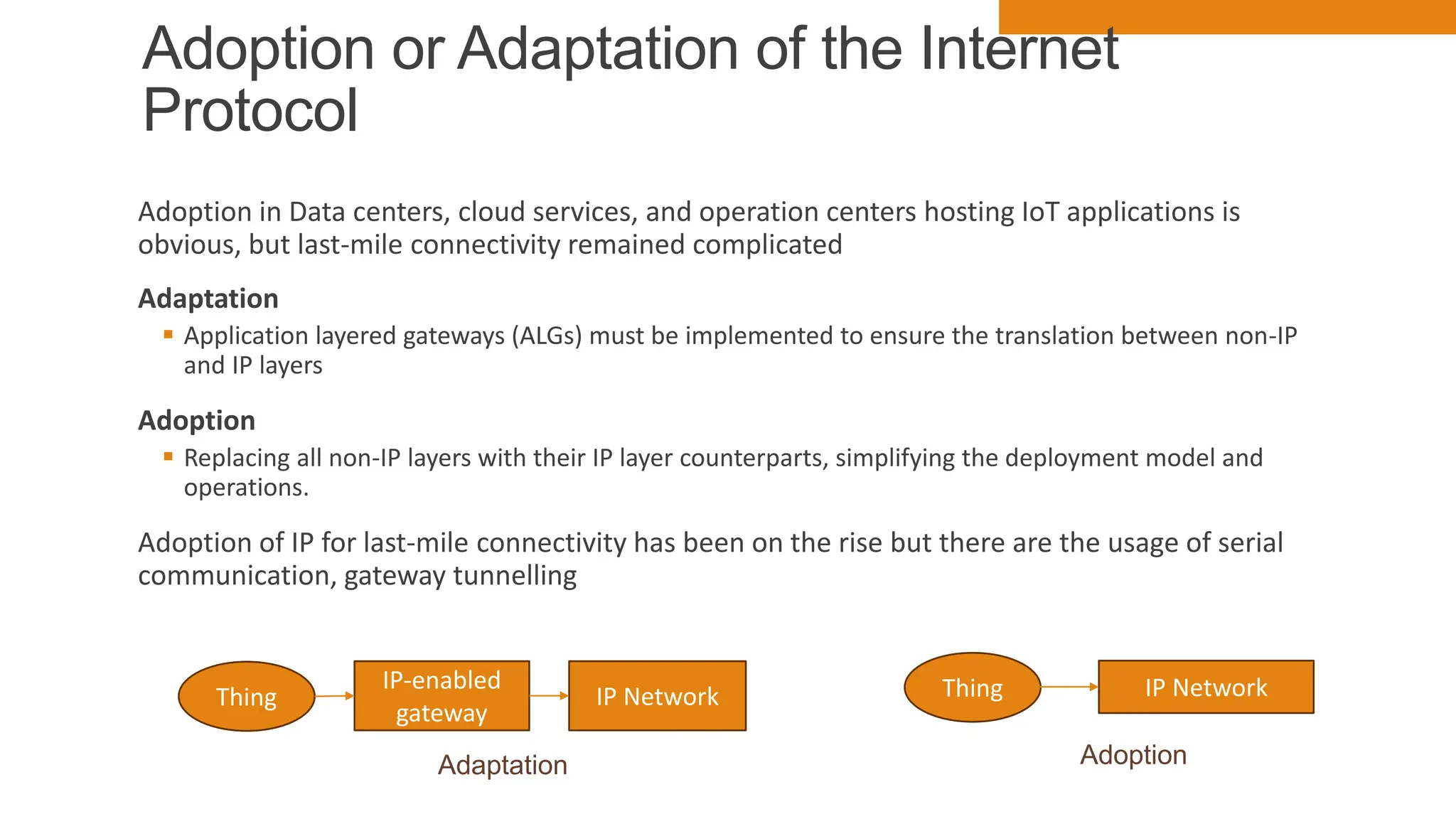
Adoption or Adaptation of the Internet
Protocol
Adoption in Data centers, cloud services, and operation centers hosting IoT applications is
obvious, but last-mile connectivity remained complicated
Adaptation
 Application layered gateways (ALGs) must be implemented to ensure the translation between non-IP
and IP layers
Adoption
 Replacing all non-IP layers with their IP layer counterparts, simplifying the deployment model and
operations.
Adoption of IP for last-mile connectivity has been on the rise but there are the usage of serial
communication, gateway tunnelling
154
Thing
IP-enabled
gateway
IP Network Thing IP Network
Adaptation Adoption
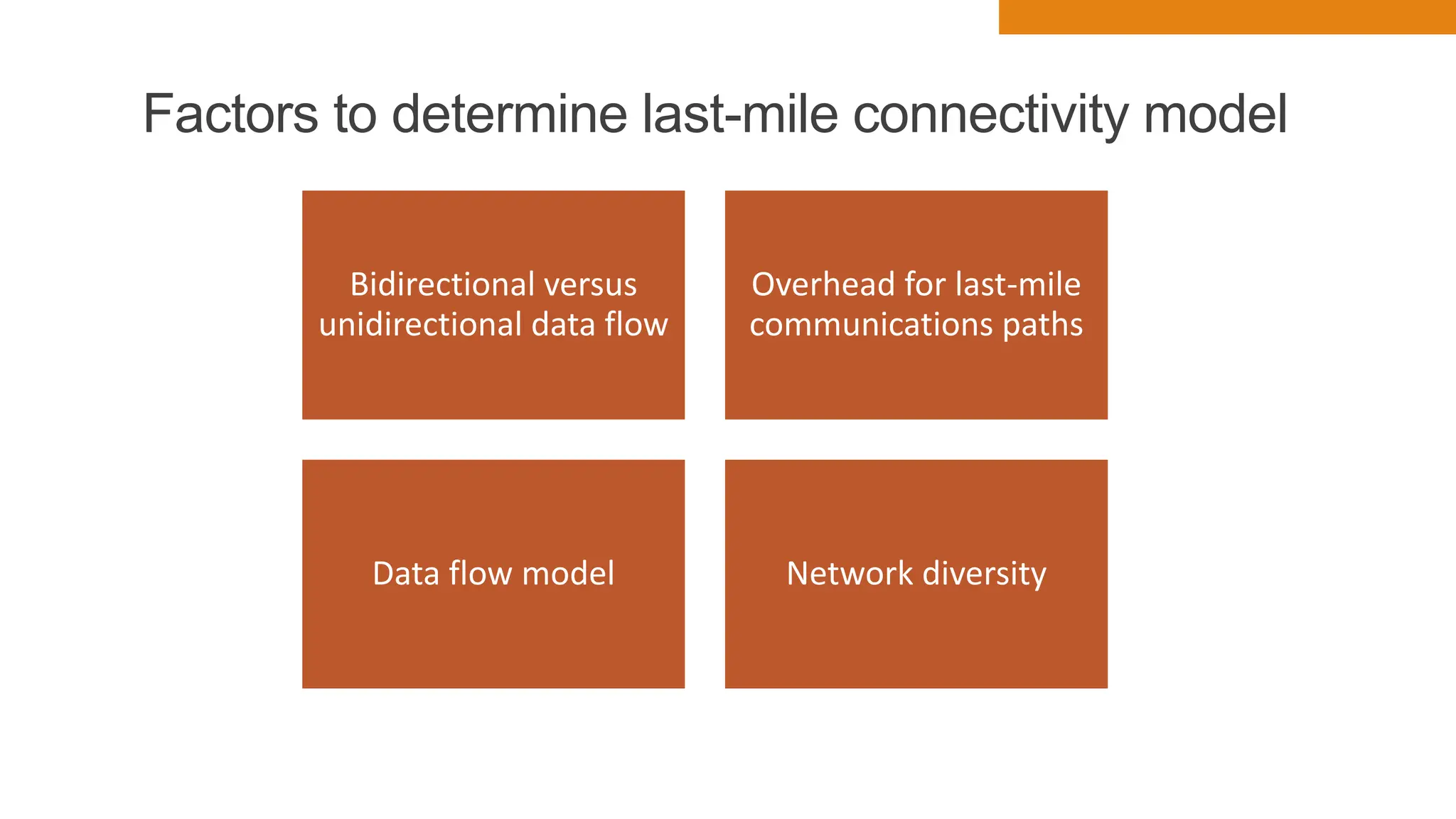
Factors to determine last-mile connectivity model
155
Bidirectional versus
unidirectional data flow
Overhead for last-mile
communications paths
Data flow model Network diversity
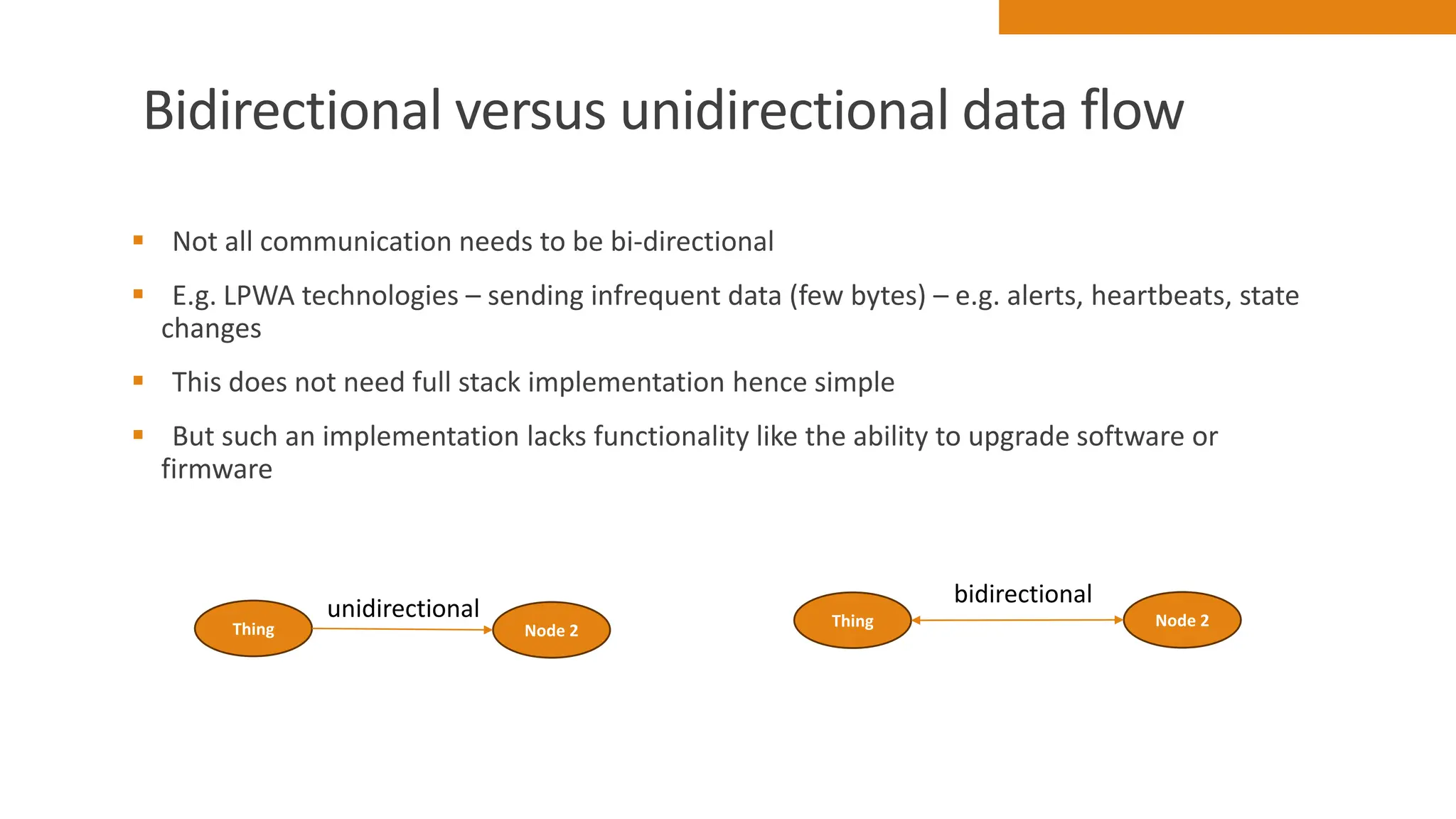
Bidirectional versus unidirectional data flow
 Not all communication needs to be bi-directional
 E.g. LPWA technologies – sending infrequent data (few bytes) – e.g. alerts, heartbeats, state
changes
 This does not need full stack implementation hence simple
 But such an implementation lacks functionality like the ability to upgrade software or
firmware
156
Thing Node 2
Thing Node 2
unidirectional
bidirectional
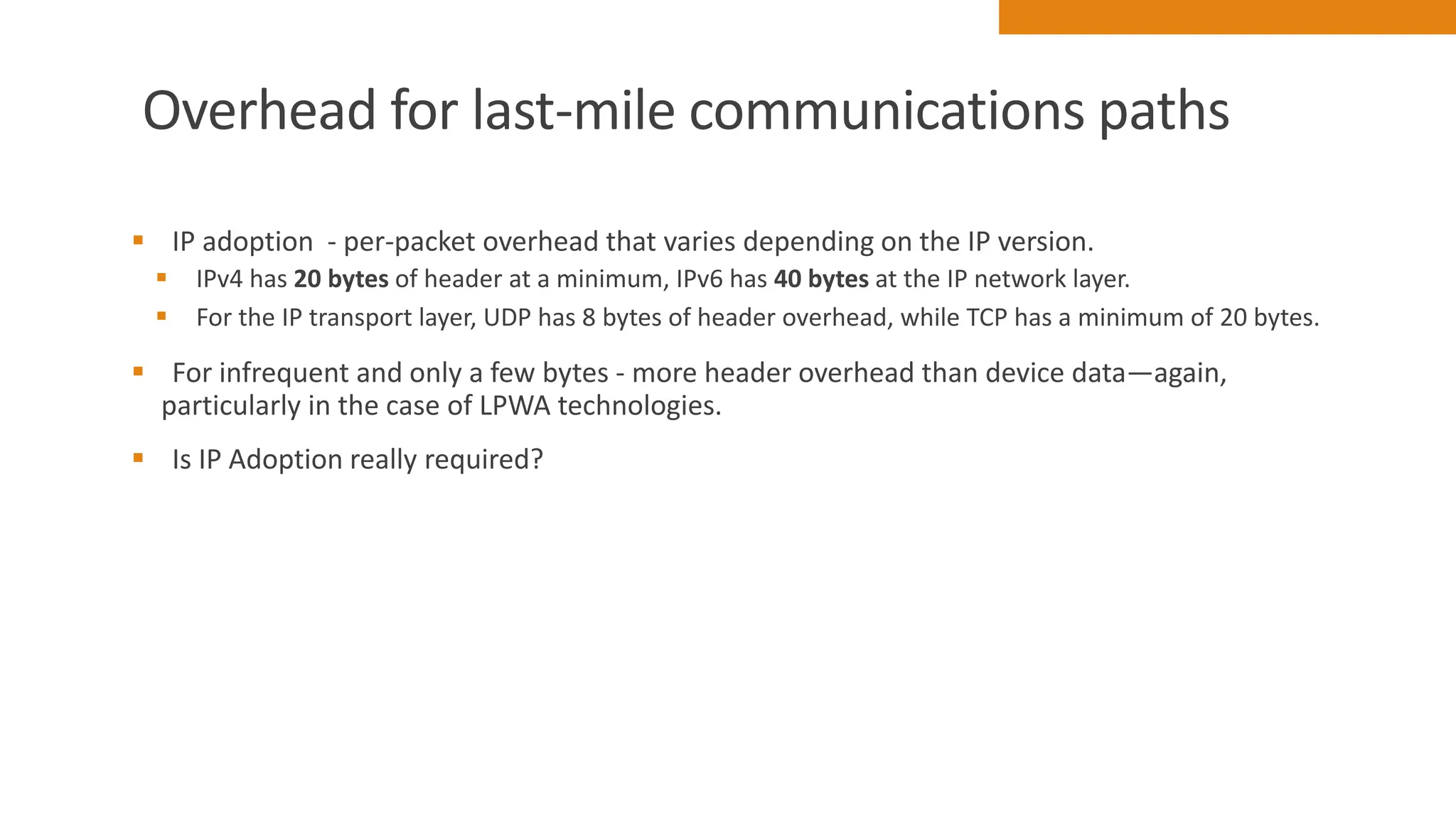
Overhead for last-mile communications paths
 IP adoption - per-packet overhead that varies depending on the IP version.
 IPv4 has 20 bytes of header at a minimum, IPv6 has 40 bytes at the IP network layer.
 For the IP transport layer, UDP has 8 bytes of header overhead, while TCP has a minimum of 20 bytes.
 For infrequent and only a few bytes - more header overhead than device data—again,
particularly in the case of LPWA technologies.
 Is IP Adoption really required?
157
Data flow model
 IP is the End-to-end nature of communications.
 Any node can easily exchange data with any other node in a network, although security,
privacy, and other factors may put controls and limits on the “end-to-end” concept.
 However, in many IoT solutions, a device’s data flow is limited to one or two applications.
 In this case, the adaptation model can work because the translation of traffic needs to occur
only between the end device and one or two application servers
158
Network diversity
 General dependency on single PHY and MAC layers.
 For example, ZigBee devices must only be deployed in ZigBee network islands. T
 his same restriction holds for ITU G.9903 G3-PLC nodes.
 Therefore, a deployment must consider which applications have to run on the gateway
connecting these islands and the rest of the world.
 Integration and coexistence of new physical and MAC layers or new applications impact how
deployment and operations have to be planned.
 This is not a relevant consideration for the adoption model.
159
The Need for Optimization
160
IOT FOR DATA SCIENCE AND ANALYTICS 161
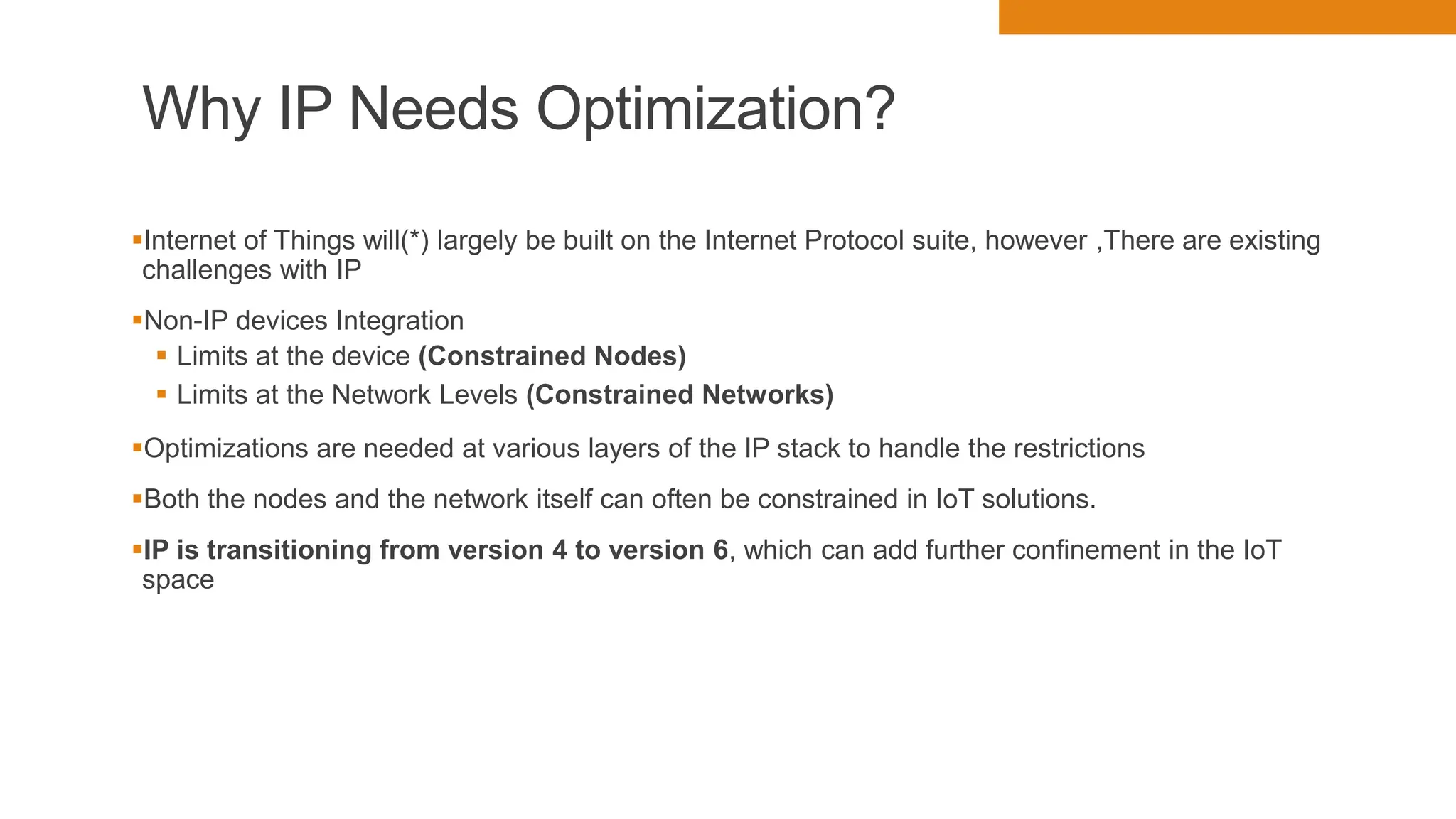
Why IP Needs Optimization?
Internet of Things will(*) largely be built on the Internet Protocol suite, however ,There are existing
challenges with IP
Non-IP devices Integration
 Limits at the device (Constrained Nodes)
 Limits at the Network Levels (Constrained Networks)
Optimizations are needed at various layers of the IP stack to handle the restrictions
Both the nodes and the network itself can often be constrained in IoT solutions.
IP is transitioning from version 4 to version 6, which can add further confinement in the IoT
space
162
Constrained Nodes
163
Constrained Nodes
164
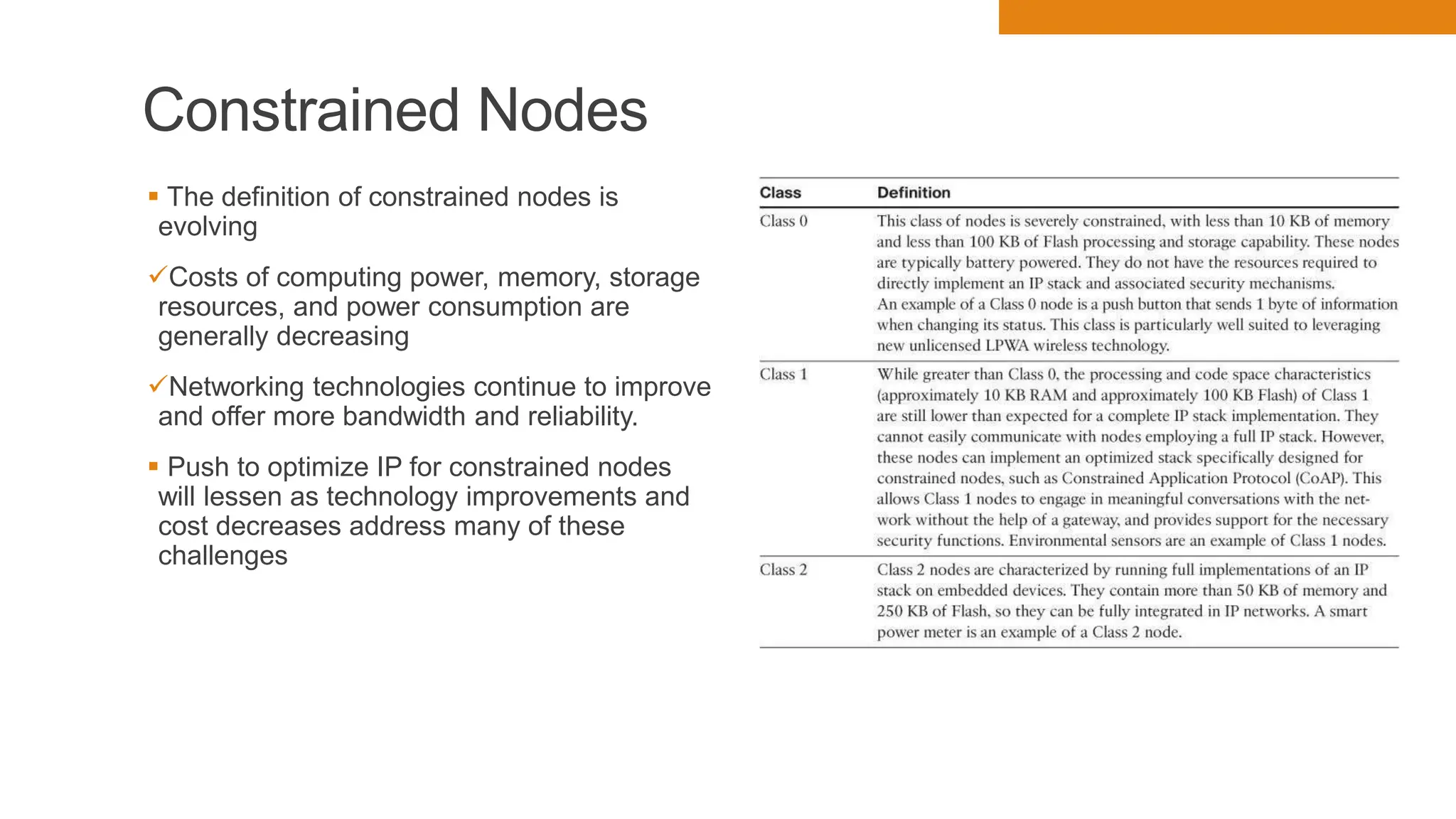
 The definition of constrained nodes is
evolving
Costs of computing power, memory, storage
resources, and power consumption are
generally decreasing
Networking technologies continue to improve
and offer more bandwidth and reliability.
 Push to optimize IP for constrained nodes
will lessen as technology improvements and
cost decreases address many of these
challenges
Constrained Nodes
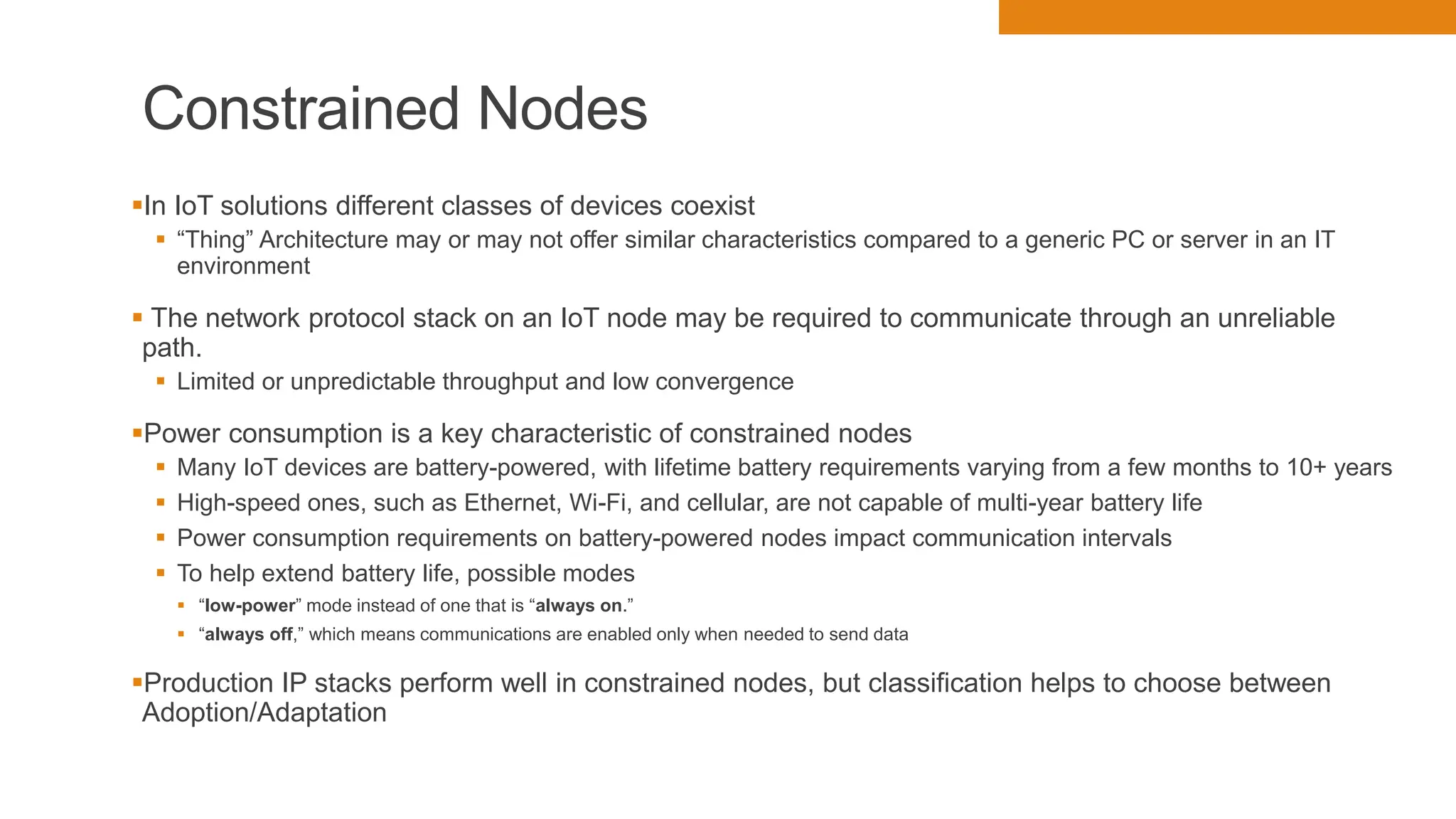
In IoT solutions different classes of devices coexist
 “Thing” Architecture may or may not offer similar characteristics compared to a generic PC or server in an IT
environment
 The network protocol stack on an IoT node may be required to communicate through an unreliable
path.
 Limited or unpredictable throughput and low convergence
Power consumption is a key characteristic of constrained nodes
 Many IoT devices are battery-powered, with lifetime battery requirements varying from a few months to 10+ years
 High-speed ones, such as Ethernet, Wi-Fi, and cellular, are not capable of multi-year battery life
 Power consumption requirements on battery-powered nodes impact communication intervals
 To help extend battery life, possible modes
 “low-power” mode instead of one that is “always on.”
 “always off,” which means communications are enabled only when needed to send data
Production IP stacks perform well in constrained nodes, but classification helps to choose between
Adoption/Adaptation
165
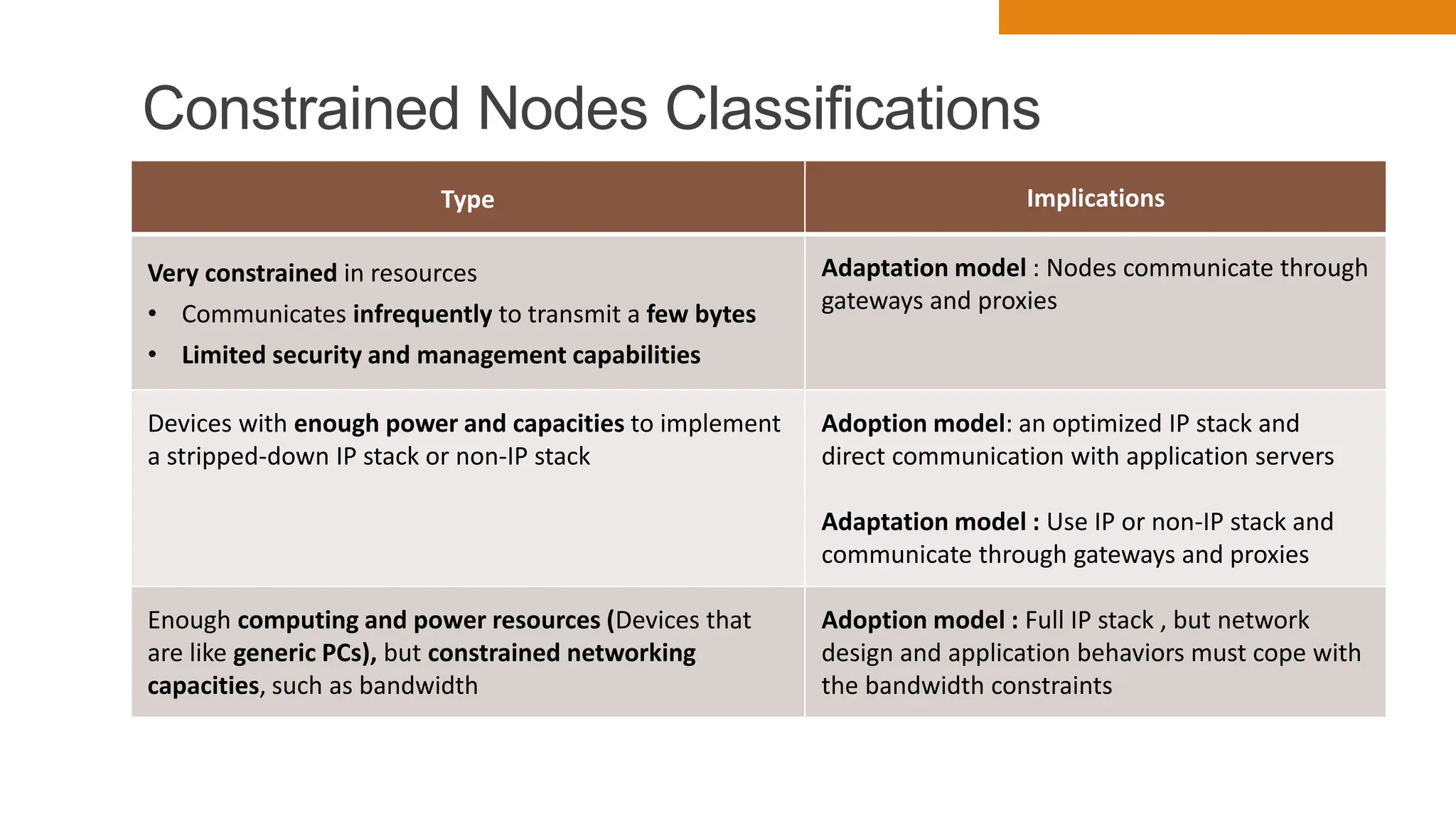
Constrained Nodes Classifications
166
Type Implications
Very constrained in resources
• Communicates infrequently to transmit a few bytes
• Limited security and management capabilities
Adaptation model : Nodes communicate through
gateways and proxies
Devices with enough power and capacities to implement
a stripped-down IP stack or non-IP stack
Adoption model: an optimized IP stack and
direct communication with application servers
Adaptation model : Use IP or non-IP stack and
communicate through gateways and proxies
Enough computing and power resources (Devices that
are like generic PCs), but constrained networking
capacities, such as bandwidth
Adoption model : Full IP stack , but network
design and application behaviors must cope with
the bandwidth constraints
Constrained Networks
167
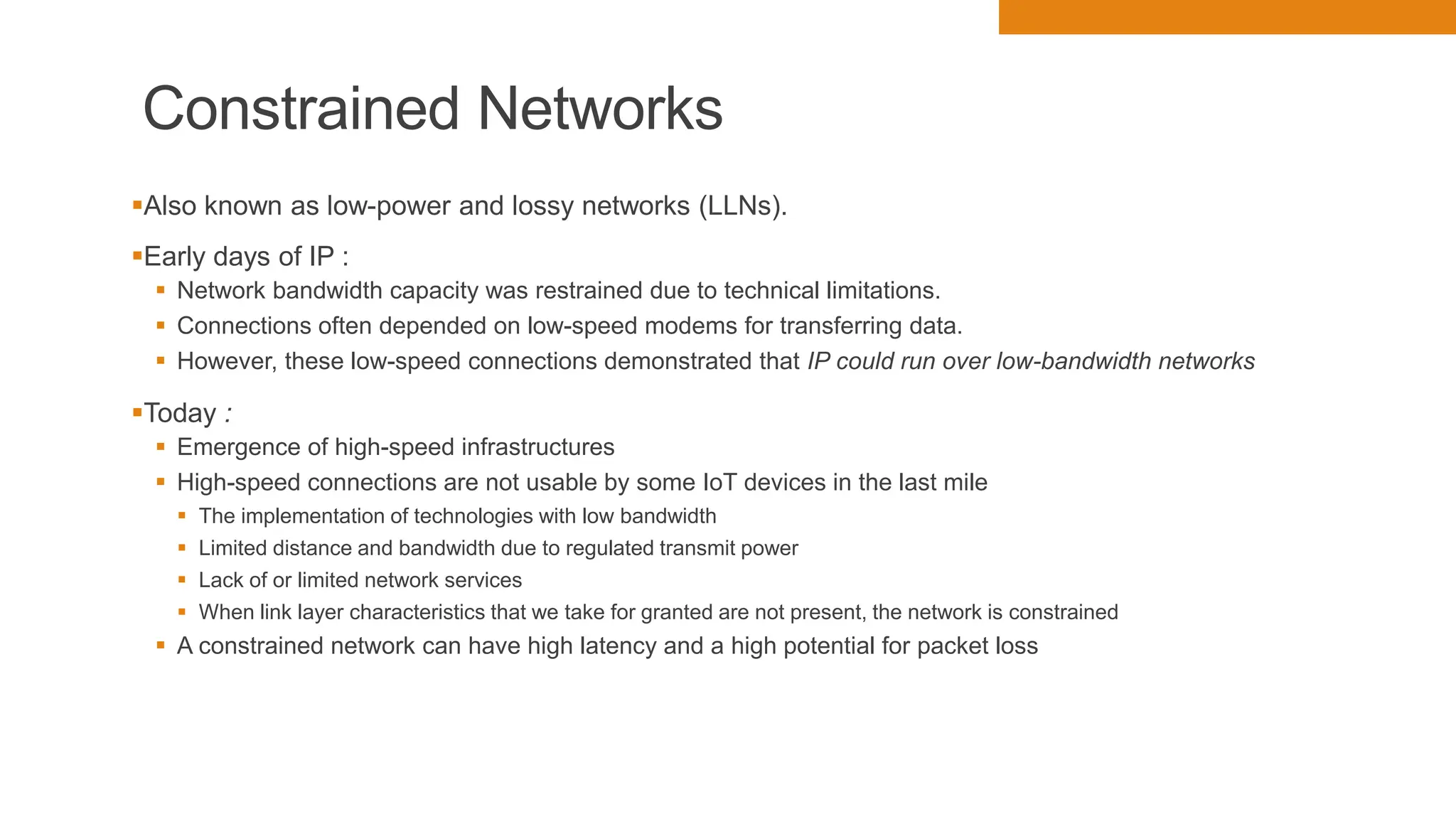
Constrained Networks
Also known as low-power and lossy networks (LLNs).
Early days of IP :
 Network bandwidth capacity was restrained due to technical limitations.
 Connections often depended on low-speed modems for transferring data.
 However, these low-speed connections demonstrated that IP could run over low-bandwidth networks
Today :
 Emergence of high-speed infrastructures
 High-speed connections are not usable by some IoT devices in the last mile
 The implementation of technologies with low bandwidth
 Limited distance and bandwidth due to regulated transmit power
 Lack of or limited network services
 When link layer characteristics that we take for granted are not present, the network is constrained
 A constrained network can have high latency and a high potential for packet loss
168
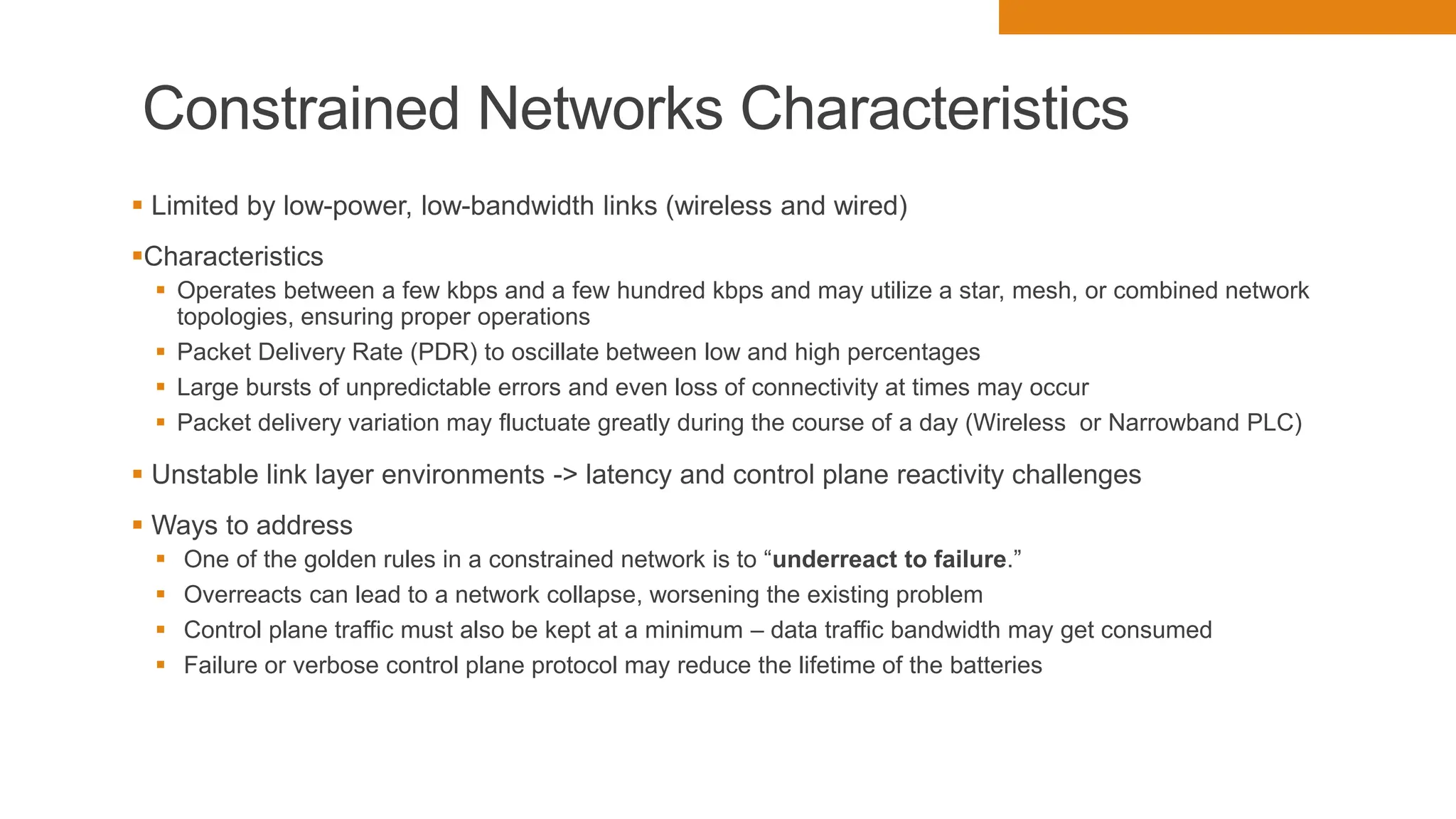
Constrained Networks Characteristics
 Limited by low-power, low-bandwidth links (wireless and wired)
Characteristics
 Operates between a few kbps and a few hundred kbps and may utilize a star, mesh, or combined network
topologies, ensuring proper operations
 Packet Delivery Rate (PDR) to oscillate between low and high percentages
 Large bursts of unpredictable errors and even loss of connectivity at times may occur
 Packet delivery variation may fluctuate greatly during the course of a day (Wireless or Narrowband PLC)
 Unstable link layer environments -> latency and control plane reactivity challenges
 Ways to address
 One of the golden rules in a constrained network is to “underreact to failure.”
 Overreacts can lead to a network collapse, worsening the existing problem
 Control plane traffic must also be kept at a minimum – data traffic bandwidth may get consumed
 Failure or verbose control plane protocol may reduce the lifetime of the batteries
169
IP Versions
170
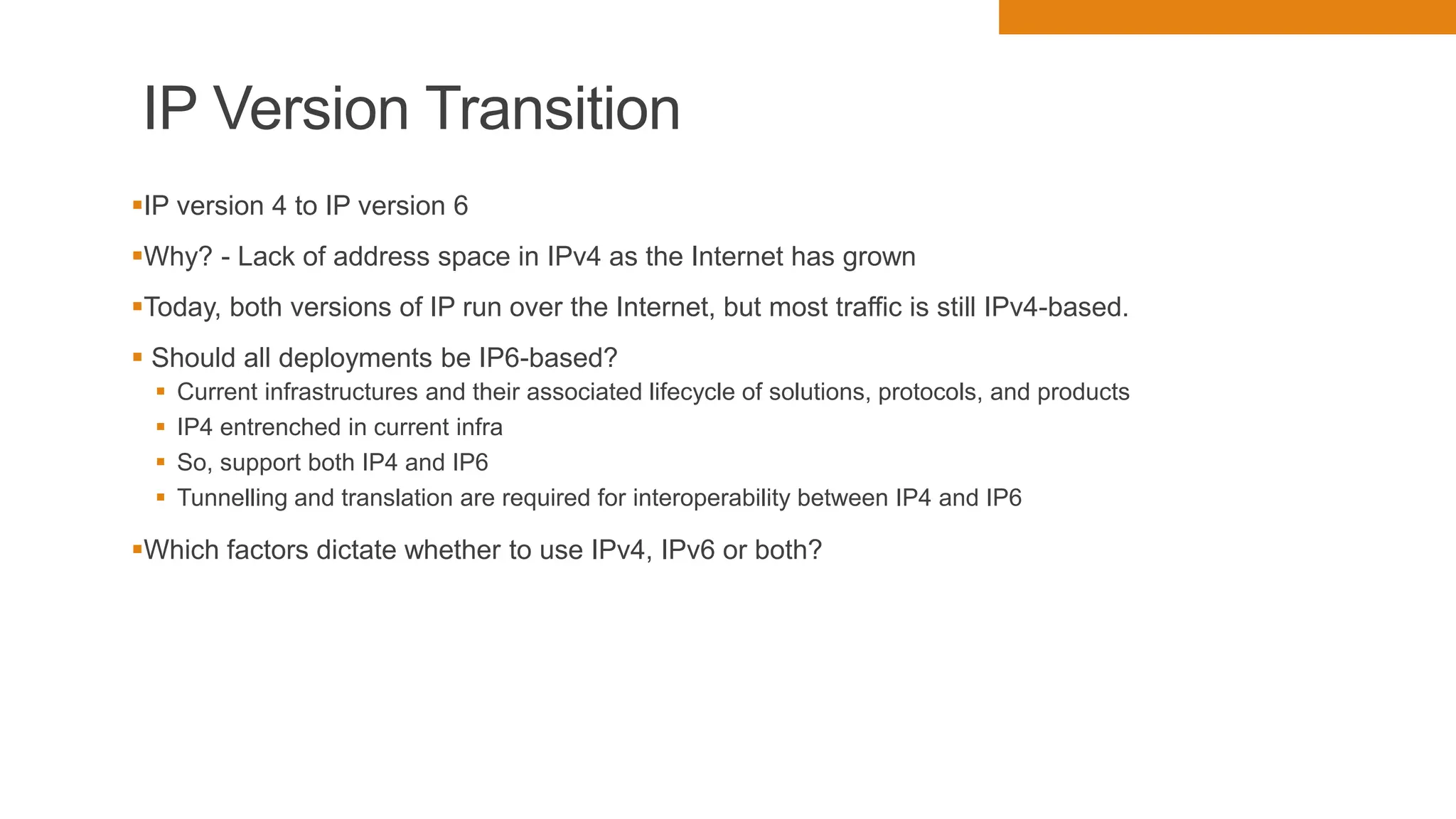
IP Version Transition
IP version 4 to IP version 6
Why? - Lack of address space in IPv4 as the Internet has grown
Today, both versions of IP run over the Internet, but most traffic is still IPv4-based.
 Should all deployments be IP6-based?
 Current infrastructures and their associated lifecycle of solutions, protocols, and products
 IP4 entrenched in current infra
 So, support both IP4 and IP6
 Tunnelling and translation are required for interoperability between IP4 and IP6
Which factors dictate whether to use IPv4, IPv6 or both?
171
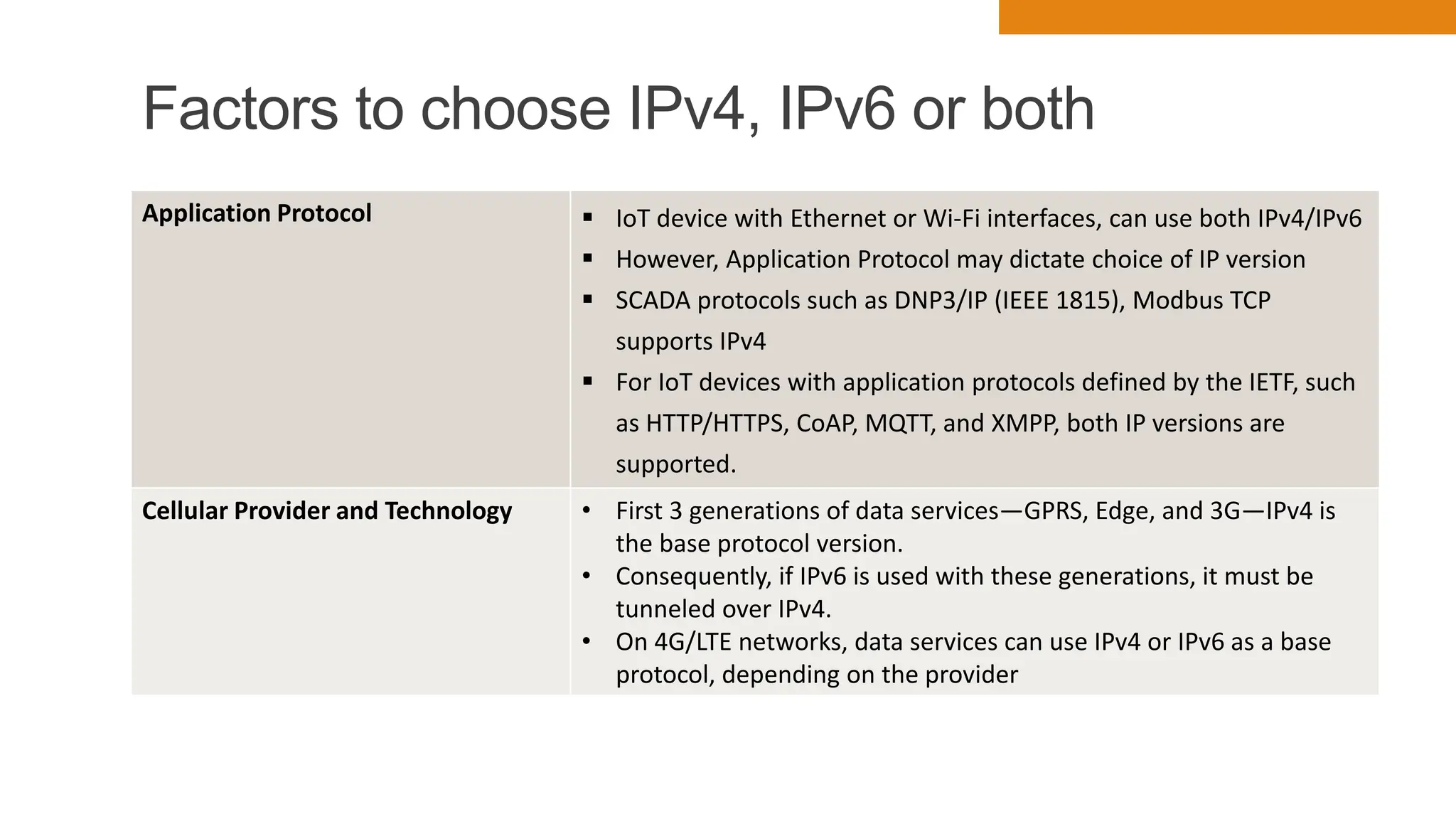
Factors to choose IPv4, IPv6 or both
Application Protocol  IoT device with Ethernet or Wi-Fi interfaces, can use both IPv4/IPv6
 However, Application Protocol may dictate choice of IP version
 SCADA protocols such as DNP3/IP (IEEE 1815), Modbus TCP
supports IPv4
 For IoT devices with application protocols defined by the IETF, such
as HTTP/HTTPS, CoAP, MQTT, and XMPP, both IP versions are
supported.
Cellular Provider and Technology • First 3 generations of data services—GPRS, Edge, and 3G—IPv4 is
the base protocol version.
• Consequently, if IPv6 is used with these generations, it must be
tunneled over IPv4.
• On 4G/LTE networks, data services can use IPv4 or IPv6 as a base
protocol, depending on the provider
172
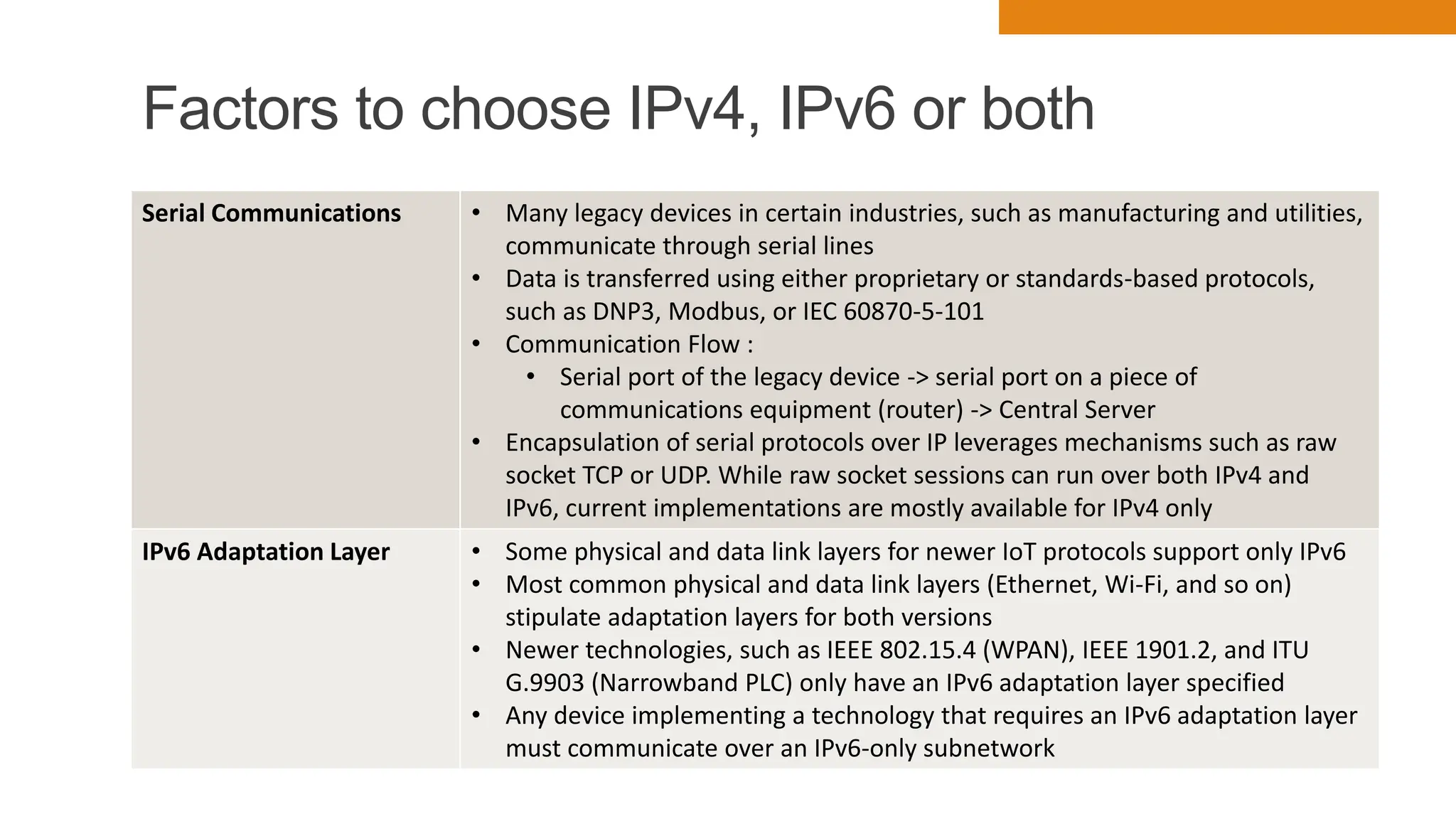
Factors to choose IPv4, IPv6 or both
Serial Communications • Many legacy devices in certain industries, such as manufacturing and utilities,
communicate through serial lines
• Data is transferred using either proprietary or standards-based protocols,
such as DNP3, Modbus, or IEC 60870-5-101
• Communication Flow :
• Serial port of the legacy device -> serial port on a piece of
communications equipment (router) -> Central Server
• Encapsulation of serial protocols over IP leverages mechanisms such as raw
socket TCP or UDP. While raw socket sessions can run over both IPv4 and
IPv6, current implementations are mostly available for IPv4 only
IPv6 Adaptation Layer • Some physical and data link layers for newer IoT protocols support only IPv6
• Most common physical and data link layers (Ethernet, Wi-Fi, and so on)
stipulate adaptation layers for both versions
• Newer technologies, such as IEEE 802.15.4 (WPAN), IEEE 1901.2, and ITU
G.9903 (Narrowband PLC) only have an IPv6 adaptation layer specified
• Any device implementing a technology that requires an IPv6 adaptation layer
must communicate over an IPv6-only subnetwork
173
Case Studies
IOT FOR DATA SCIENCE AND ANALYTICS 174
Assignment – Part 1
IOT FOR DATA SCIENCE AND ANALYTICS 175
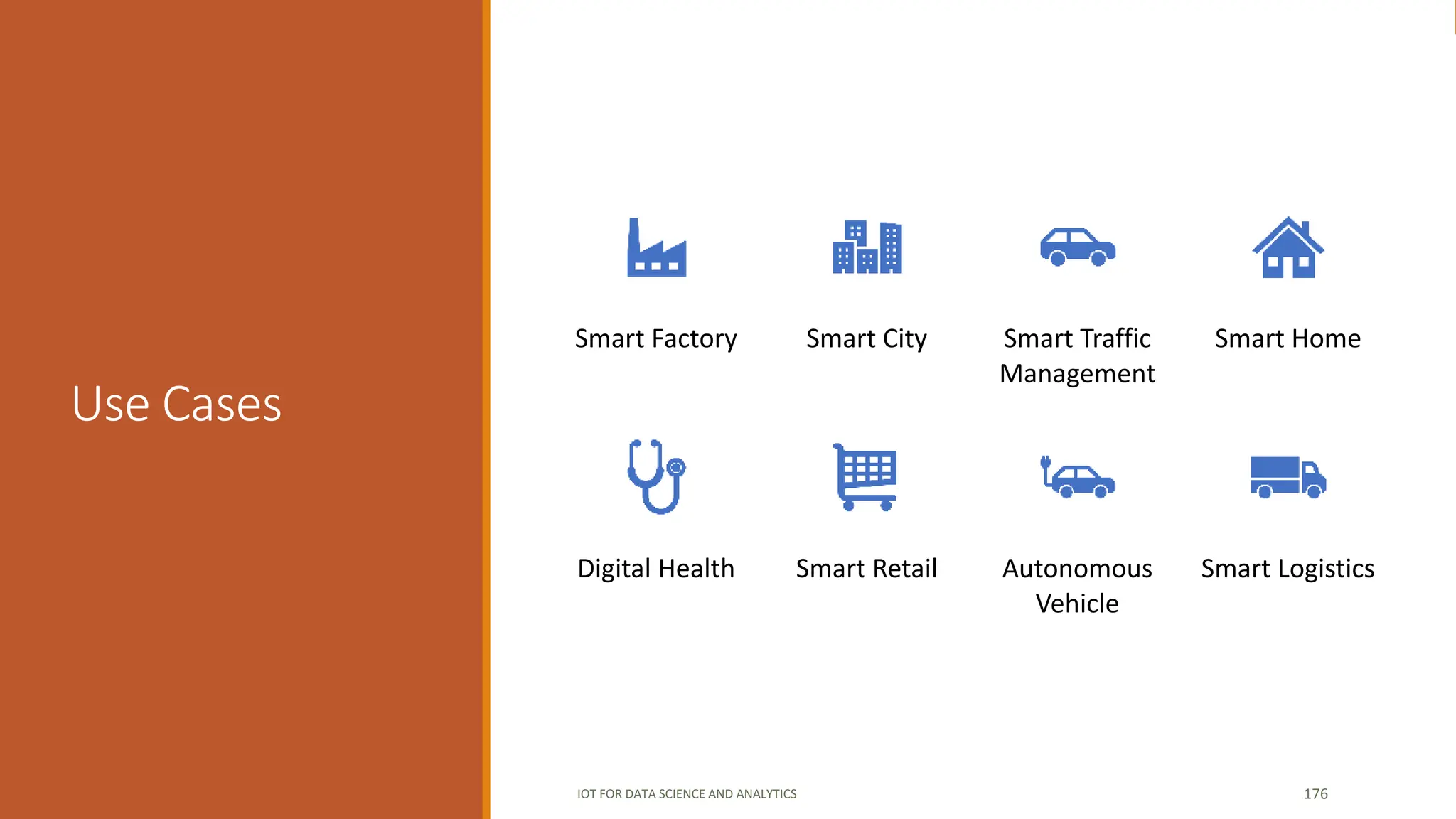
Use Cases
IOT FOR DATA SCIENCE AND ANALYTICS 176
Smart Factory Smart City Smart Traffic
Management
Smart Home
Digital Health Smart Retail Autonomous
Vehicle
Smart Logistics
Optimizing IP for IoT
177
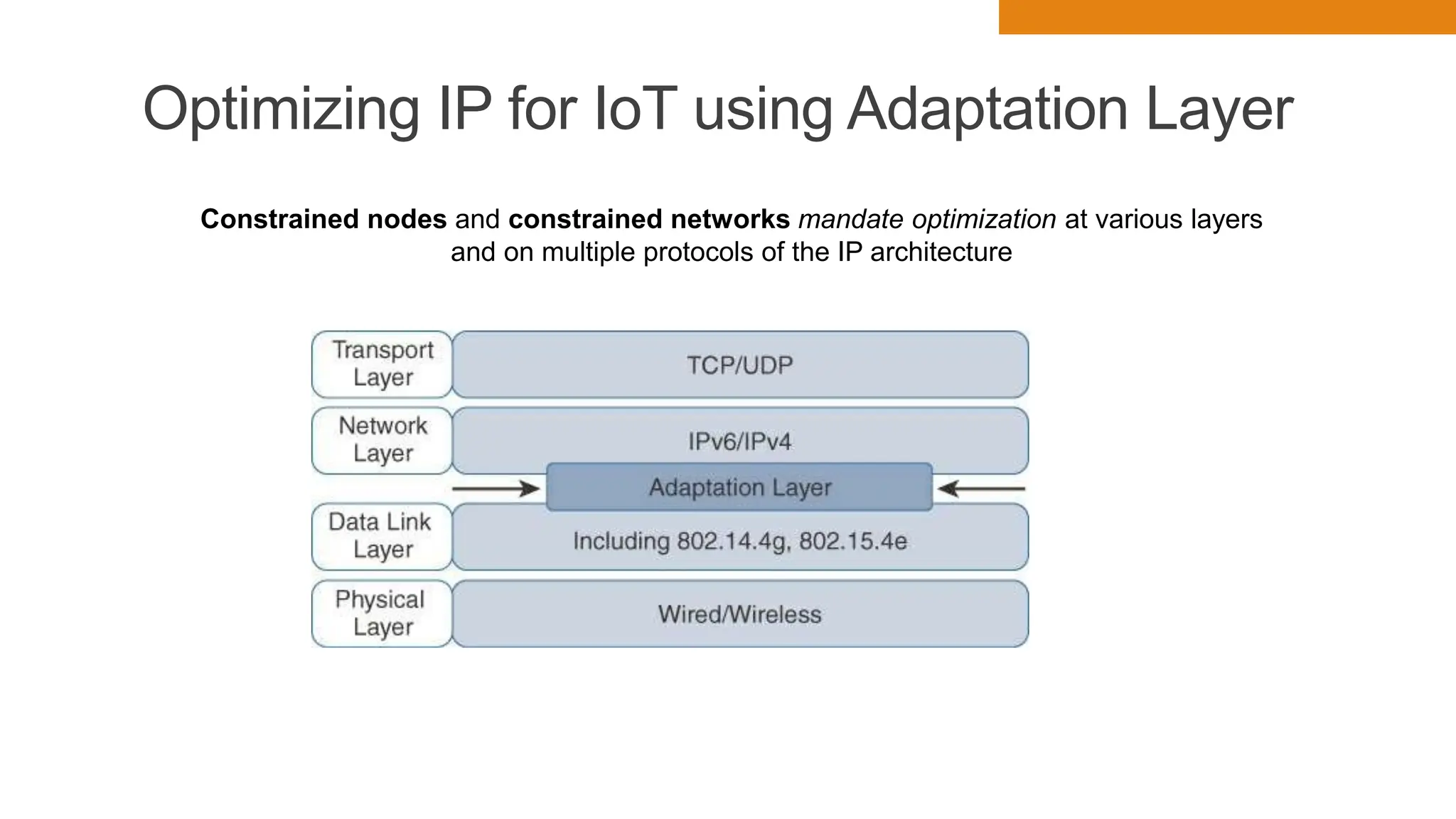
Optimizing IP for IoT using Adaptation Layer
178
Constrained nodes and constrained networks mandate optimization at various layers
and on multiple protocols of the IP architecture
From 6LoWPAN to 6Lo
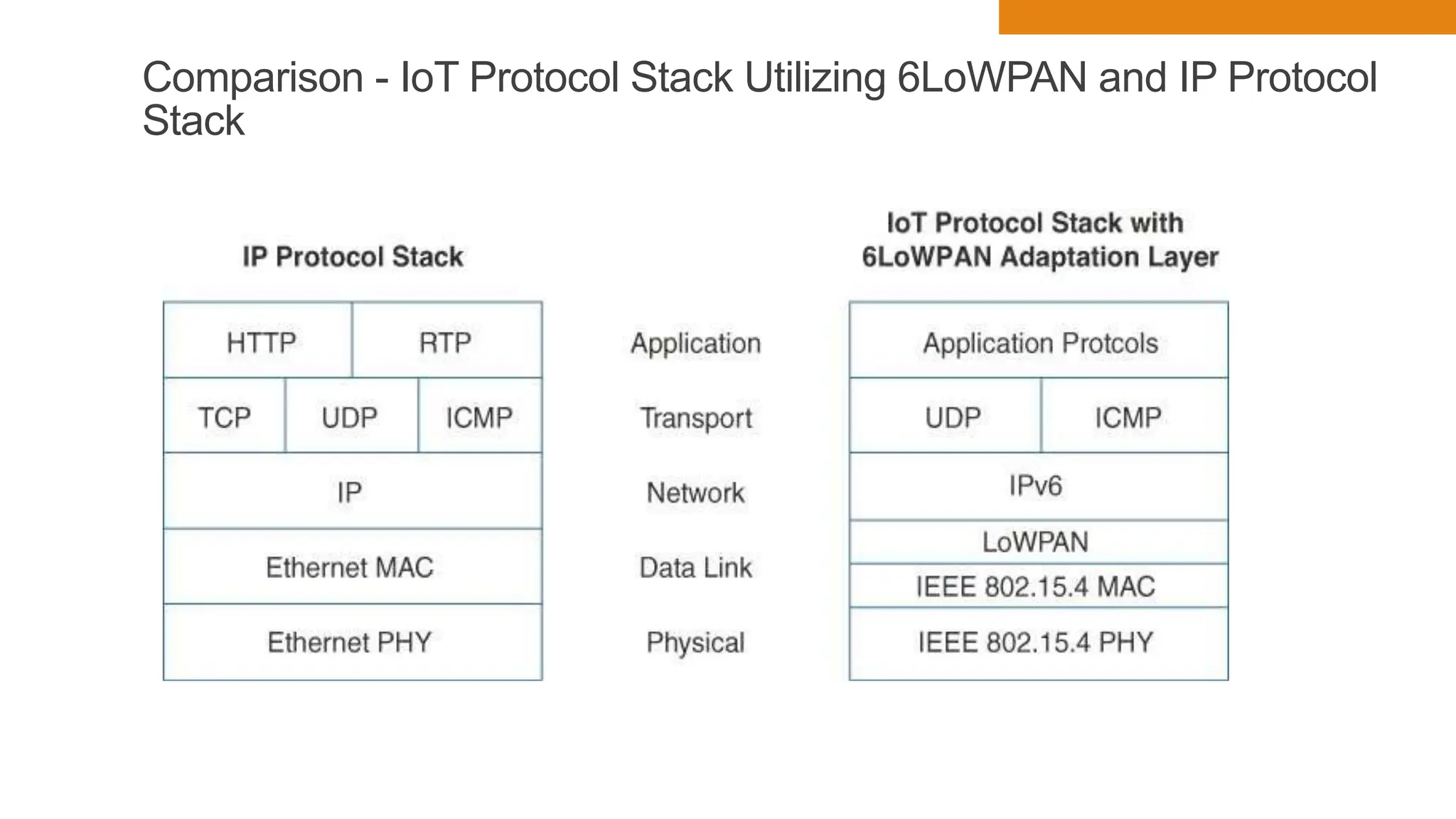
 6LoWPAN - IPv6 over Low-Power Wireless Personal Area Networks
 6lo focuses on the work that facilitates IPv6 connectivity over constrained node networks
Specifically, 6lo focus is on:
 IPv6-over-foo ("IPv6-over-Ethernet," "IPv6-over-PPP," "IPv6-over-UDP," or "IPv6-over-HTTP”) adaptation
layer specifications using 6LoWPAN technologies for link layer technologies of interest in constrained
node networks
 Information and data models (e.g., MIB modules) for these adaptation layers for basic monitoring and
troubleshooting.
 Specifications, such as low-complexity header compression, that are applicable to more than one
adaptation layer specification
 Maintenance and informational documents are required for the existing IETF specifications in this space.
179
Comparison - IoT Protocol Stack Utilizing 6LoWPAN and IP Protocol
Stack
180
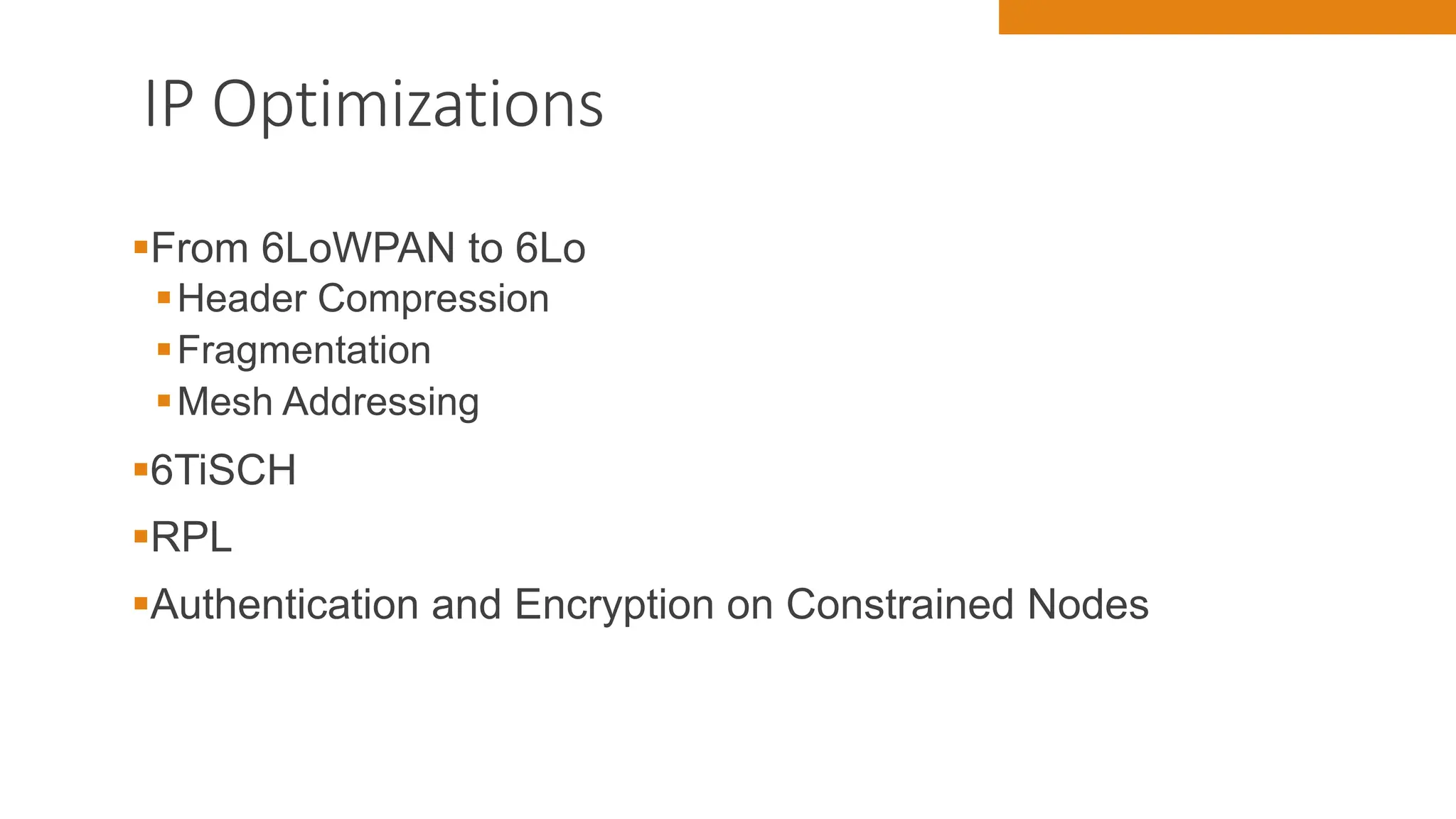
IP Optimizations
From 6LoWPAN to 6Lo
Header Compression
Fragmentation
Mesh Addressing
6TiSCH
RPL
Authentication and Encryption on Constrained Nodes
IOT FOR DATA SCIENCE AND ANALYTICS 181
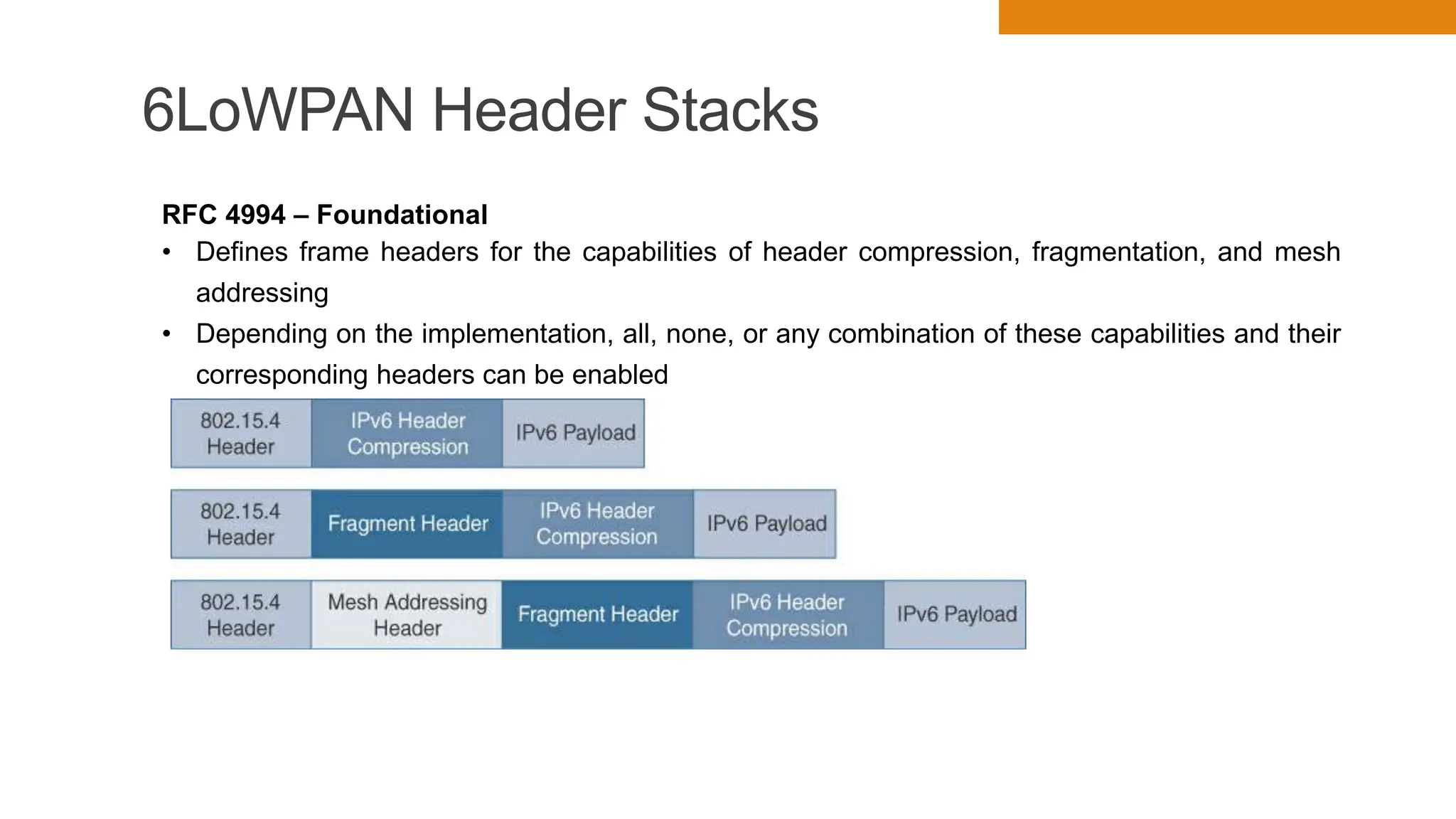
6LoWPAN Header Stacks
182
RFC 4994 – Foundational
• Defines frame headers for the capabilities of header compression, fragmentation, and mesh
addressing
• Depending on the implementation, all, none, or any combination of these capabilities and their
corresponding headers can be enabled
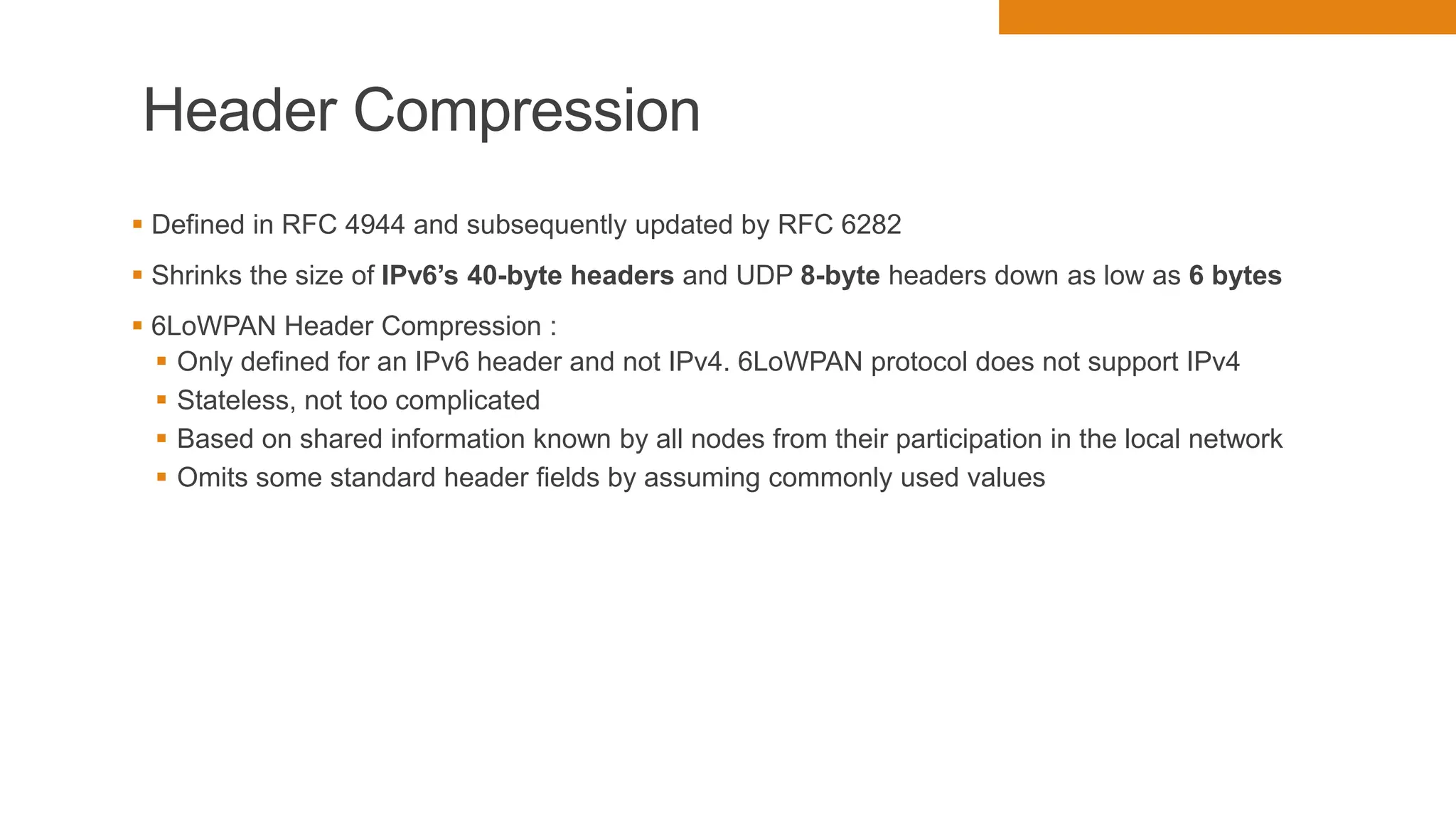
Header Compression
 Defined in RFC 4944 and subsequently updated by RFC 6282
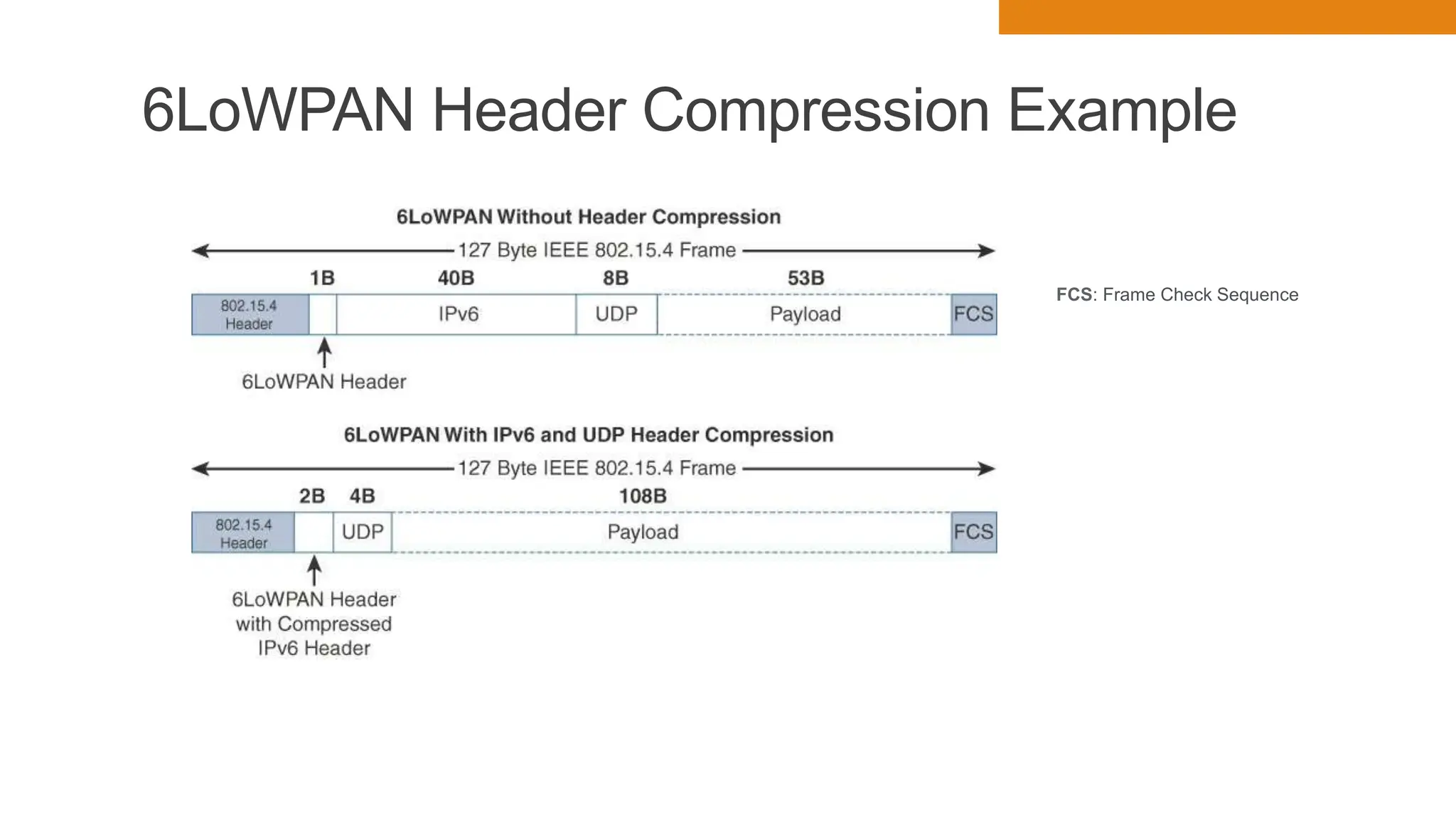
 Shrinks the size of IPv6’s 40-byte headers and UDP 8-byte headers down as low as 6 bytes
 6LoWPAN Header Compression :
 Only defined for an IPv6 header and not IPv4. 6LoWPAN protocol does not support IPv4
 Stateless, not too complicated
 Based on shared information known by all nodes from their participation in the local network
 Omits some standard header fields by assuming commonly used values
183
6LoWPAN Header Compression Example
184
FCS: Frame Check Sequence
Fragmentation
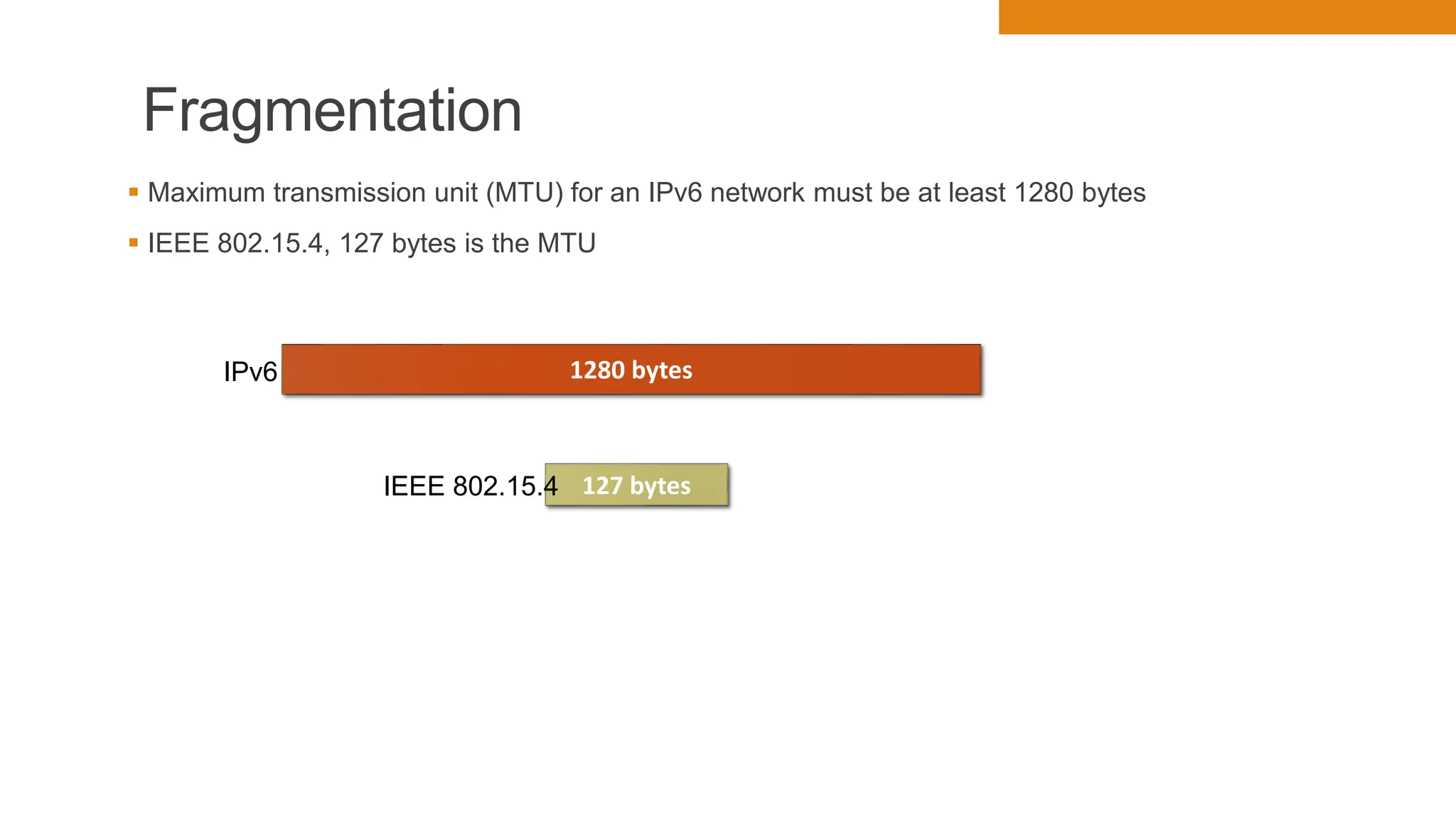
 Maximum transmission unit (MTU) for an IPv6 network must be at least 1280 bytes
 IEEE 802.15.4, 127 bytes is the MTU
185
1280 bytes
127 bytes
IPv6
IEEE 802.15.4
Fragmentation
186
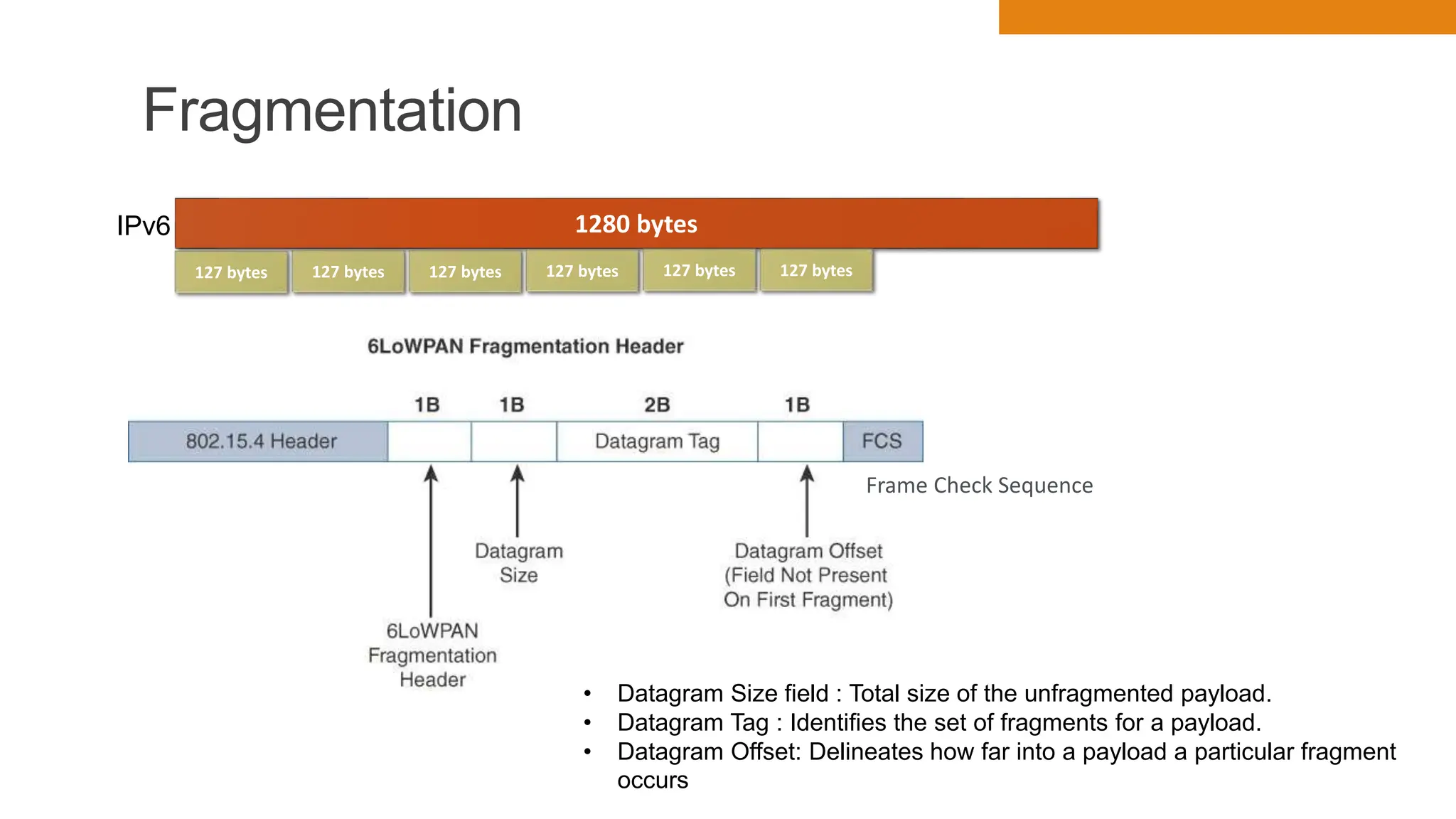
1280 bytes
IPv6
127 bytes 127 bytes 127 bytes 127 bytes 127 bytes 127 bytes
• Datagram Size field : Total size of the unfragmented payload.
• Datagram Tag : Identifies the set of fragments for a payload.
• Datagram Offset: Delineates how far into a payload a particular fragment
occurs
Frame Check Sequence
Mesh Addressing
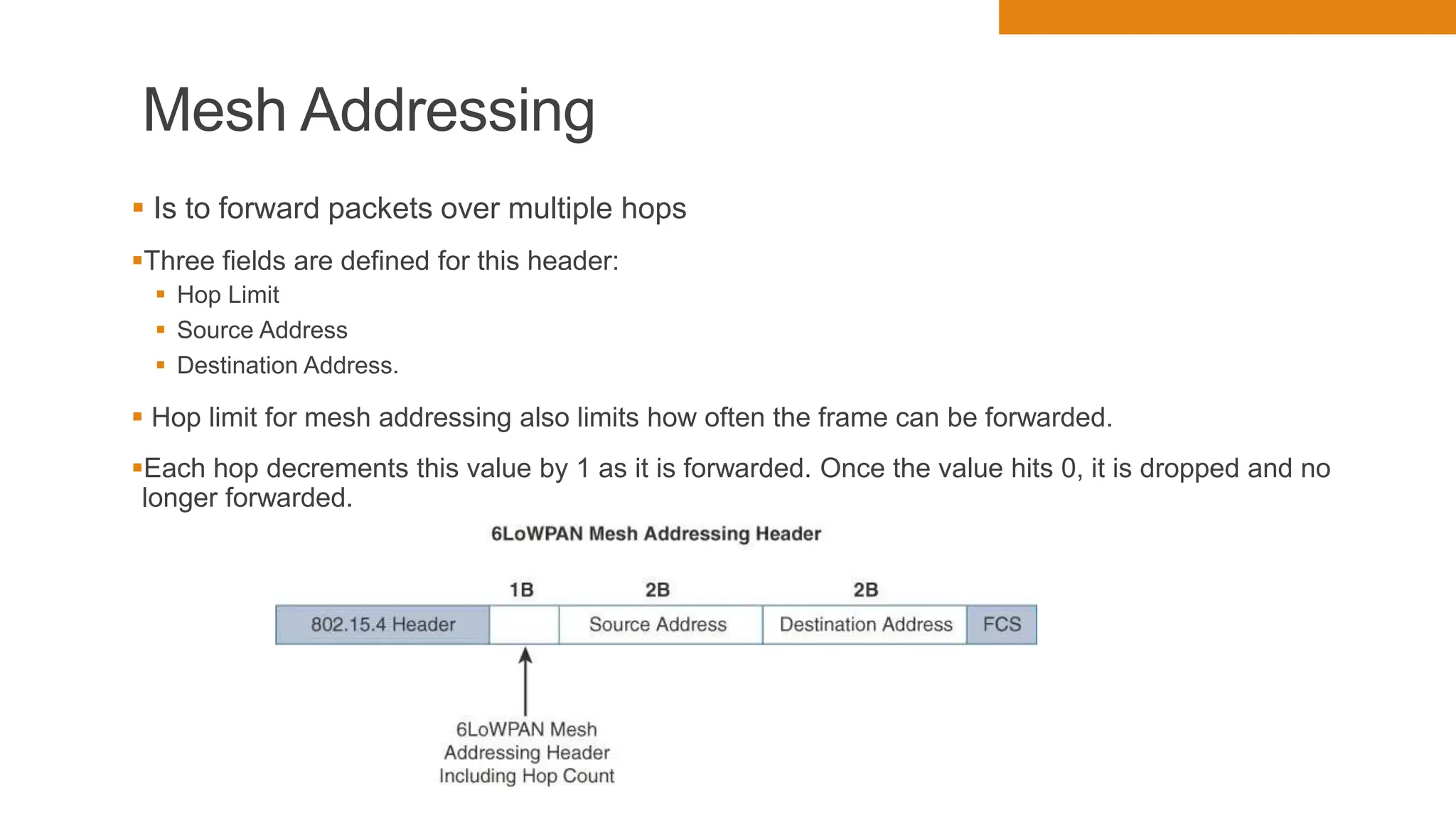
 Is to forward packets over multiple hops
Three fields are defined for this header:
 Hop Limit
 Source Address
 Destination Address.
 Hop limit for mesh addressing also limits how often the frame can be forwarded.
Each hop decrements this value by 1 as it is forwarded. Once the value hits 0, it is dropped and no
longer forwarded.
187
Mesh-Under Versus Mesh-Over Routing
For network topologies, support mesh topologies and operate at the physical and data link layers :
Two main options exist for establishing reachability and forwarding packets
“Mesh-under” : The routing of packets is handled at the 6LoWPAN adaptation layer
“Mesh-over” or “Route-over” : Utilizes IP routing to get packets to their destination
188
6TiSCH
 6TiSCH - IPv6 over the TSCH mode of IEEE 802.15.4e
 To enable efficient and reliable communication for low-power and lossy networks (LLNs)
 Allows the deployment of IPv6-based communication in industrial and home automation
applications, where devices may have limited power, memory, and processing
capabilities
 Employs time synchronization and channel hopping techniques
189
6TiSCH
190
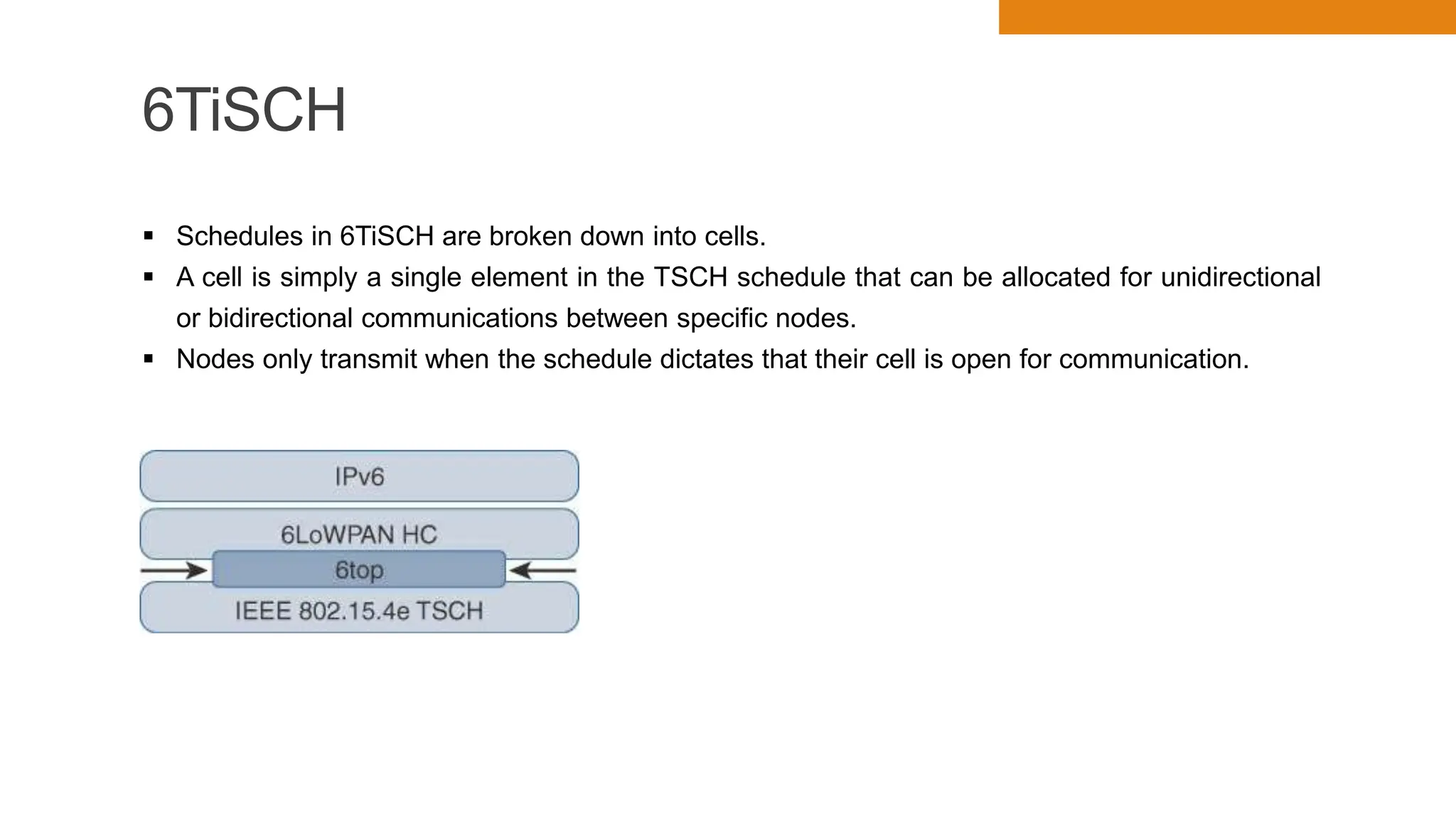
 Schedules in 6TiSCH are broken down into cells.
 A cell is simply a single element in the TSCH schedule that can be allocated for unidirectional
or bidirectional communications between specific nodes.
 Nodes only transmit when the schedule dictates that their cell is open for communication.
6TiSCH - Schedule management
mechanisms
191
 Static scheduling
 All nodes in the constrained network share a fixed schedule
 Cells are shared, and nodes contend for slot access in a slotted aloha manner
Neighbor-to-neighbor scheduling
 A schedule is established that correlates with the observed number of transmissions between nodes
 Cells in this schedule can be added or deleted as traffic requirements and bandwidth needs change.
Remote monitoring and scheduling management
 Time slots and other resource allocation are handled by a management entity that can be multiple hops
away
Hop-by-hop scheduling
 A node reserves a path to a destination node multiple hops away by requesting the allocation of cells in a
schedule at each intermediate node hop in the path.
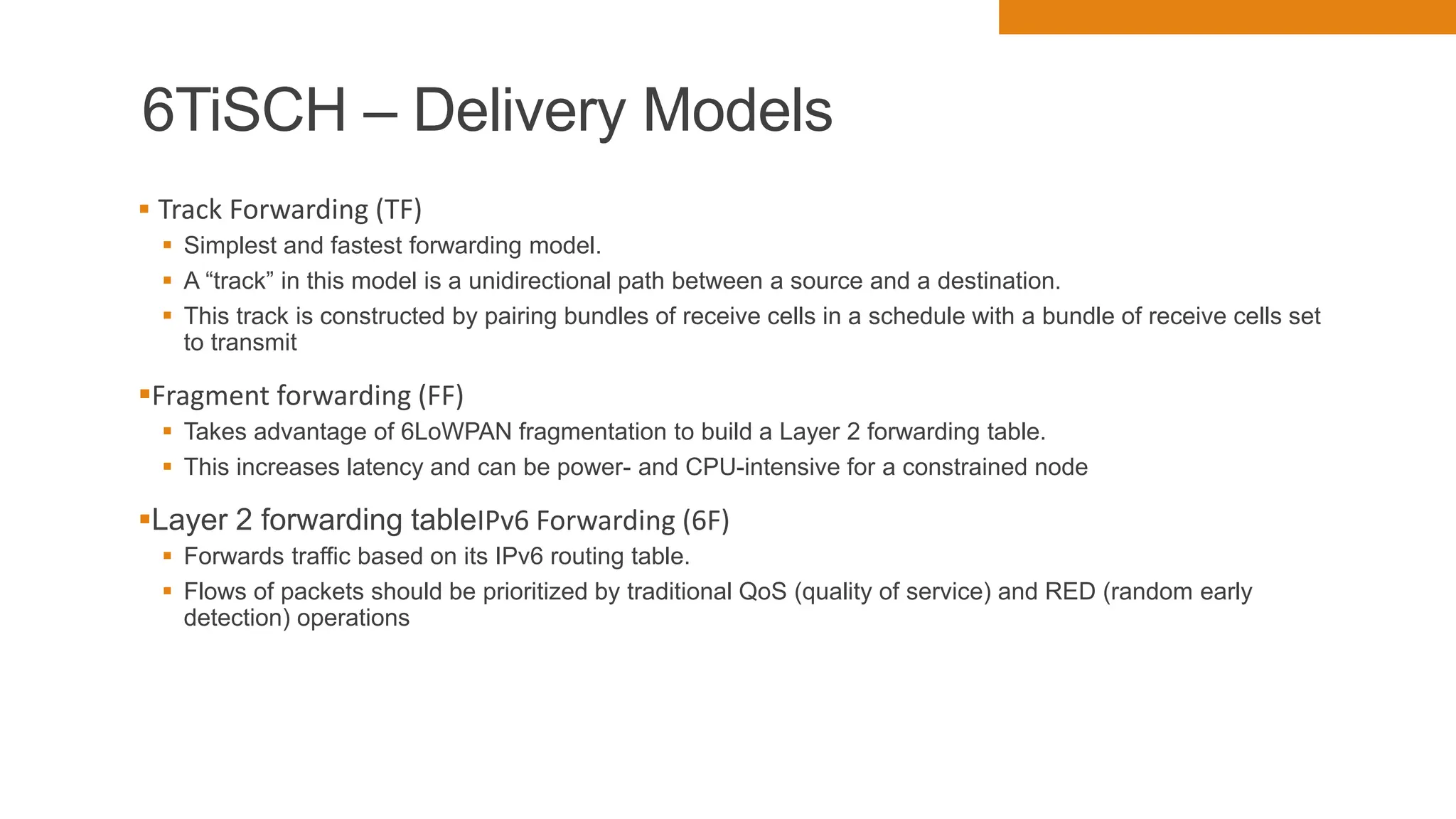
6TiSCH – Delivery Models
192
 Track Forwarding (TF)
 Simplest and fastest forwarding model.
 A “track” in this model is a unidirectional path between a source and a destination.
 This track is constructed by pairing bundles of receive cells in a schedule with a bundle of receive cells set
to transmit
Fragment forwarding (FF)
 Takes advantage of 6LoWPAN fragmentation to build a Layer 2 forwarding table.
 This increases latency and can be power- and CPU-intensive for a constrained node
Layer 2 forwarding tableIPv6 Forwarding (6F)
 Forwards traffic based on its IPv6 routing table.
 Flows of packets should be prioritized by traditional QoS (quality of service) and RED (random early
detection) operations
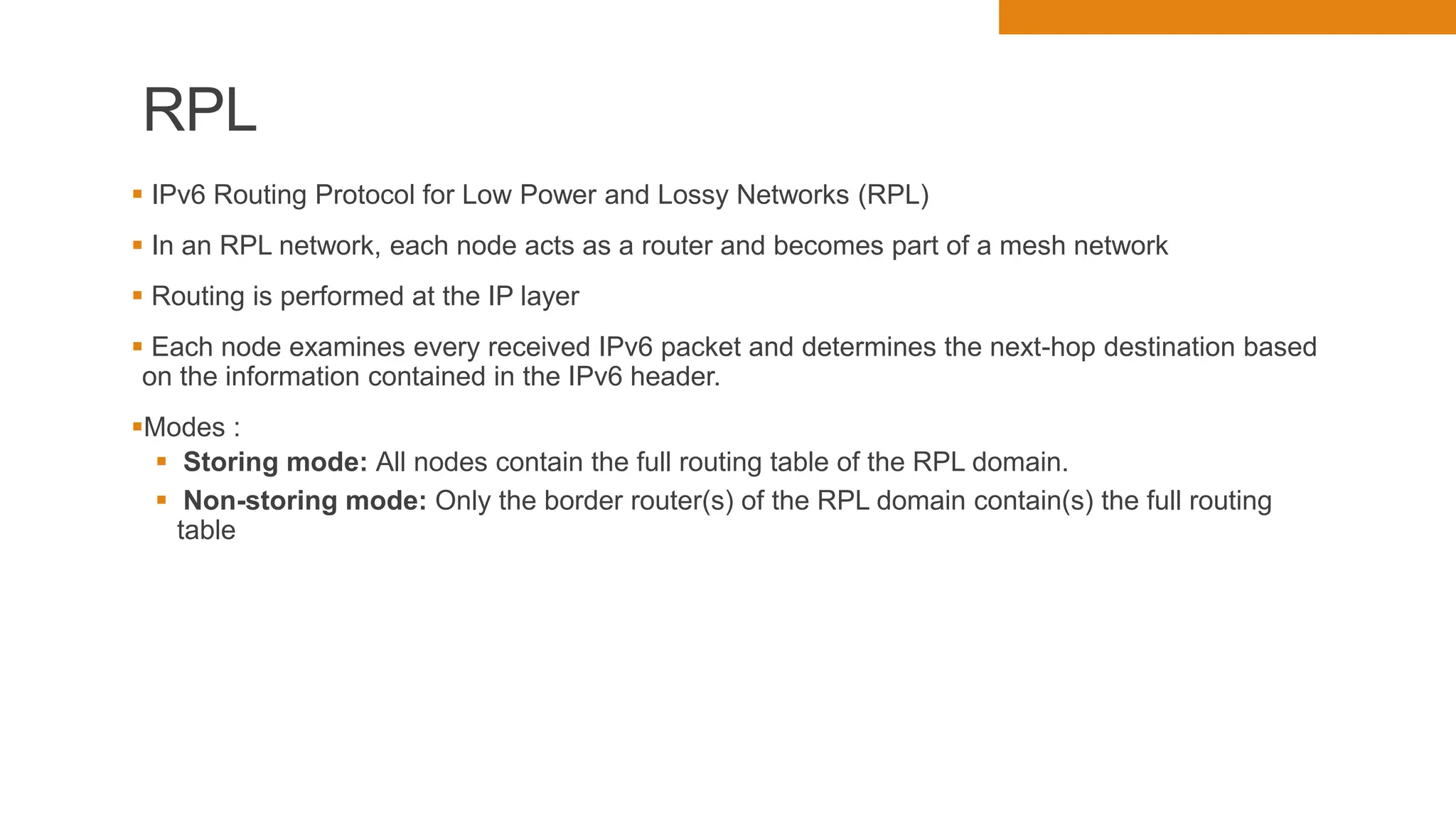
RPL
 IPv6 Routing Protocol for Low Power and Lossy Networks (RPL)
 In an RPL network, each node acts as a router and becomes part of a mesh network
 Routing is performed at the IP layer
 Each node examines every received IPv6 packet and determines the next-hop destination based
on the information contained in the IPv6 header.
Modes :
 Storing mode: All nodes contain the full routing table of the RPL domain.
 Non-storing mode: Only the border router(s) of the RPL domain contain(s) the full routing
table
193
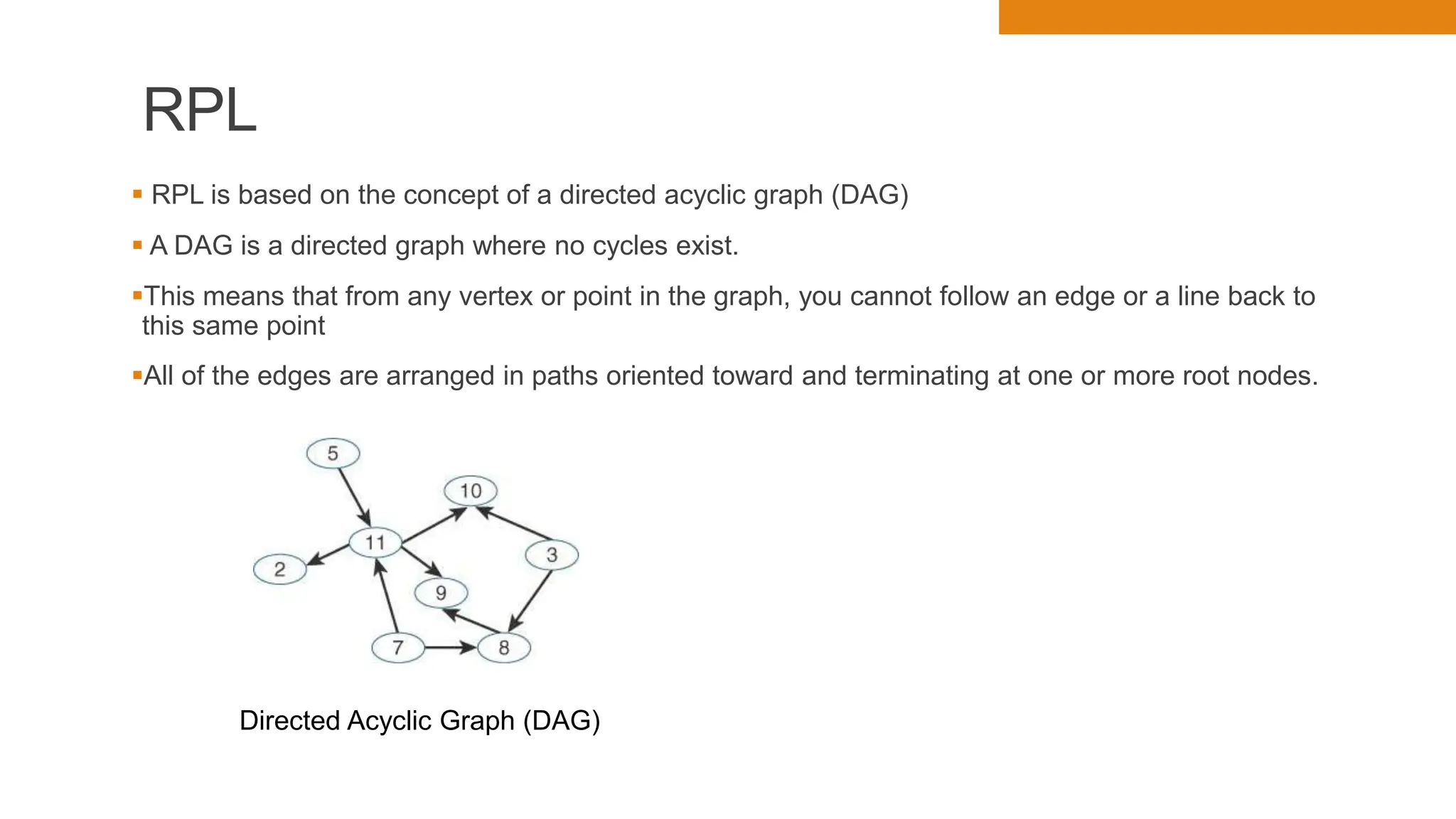
RPL
 RPL is based on the concept of a directed acyclic graph (DAG)
 A DAG is a directed graph where no cycles exist.
This means that from any vertex or point in the graph, you cannot follow an edge or a line back to
this same point
All of the edges are arranged in paths oriented toward and terminating at one or more root nodes.
194
Directed Acyclic Graph (DAG)
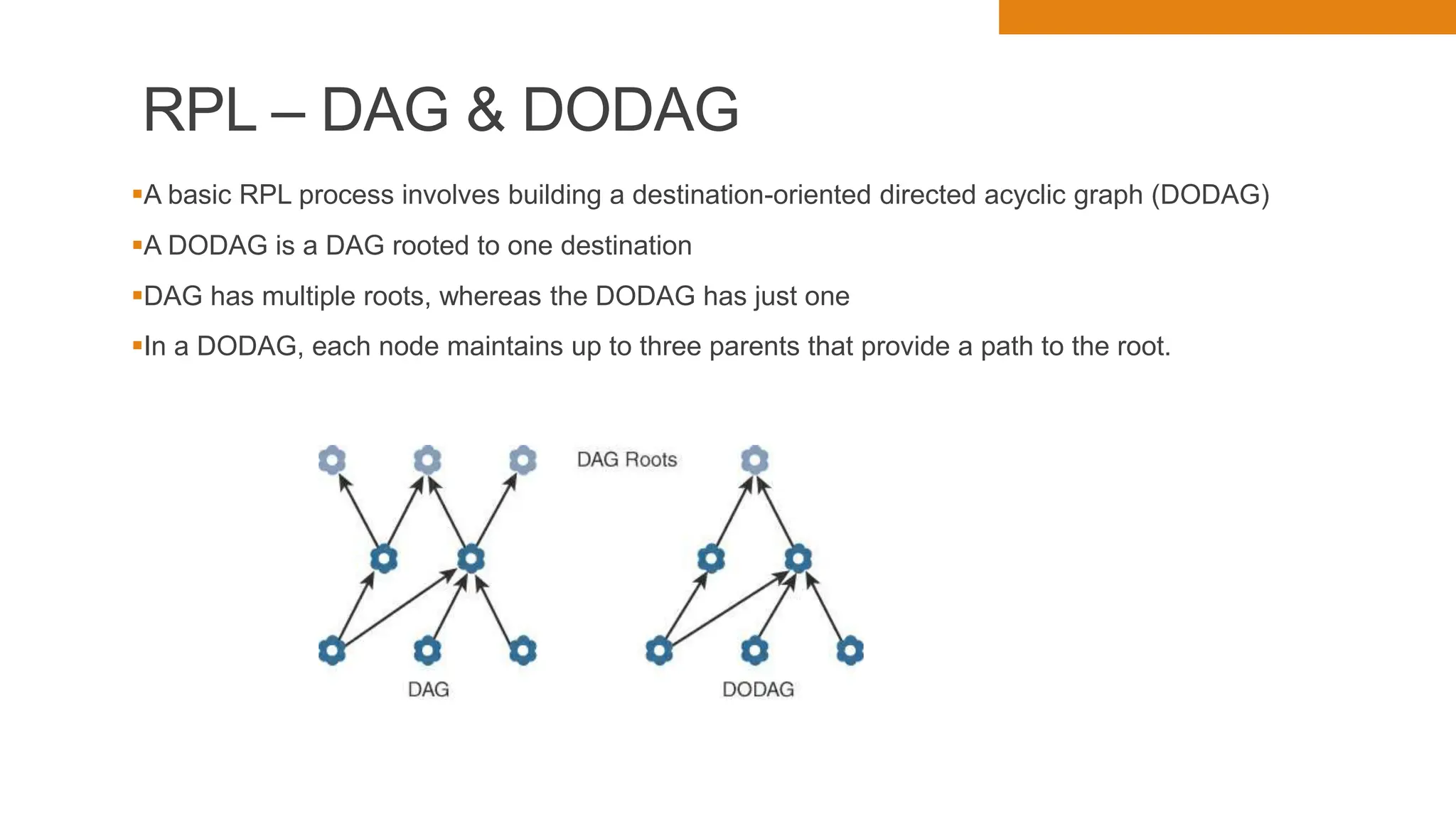
RPL – DAG & DODAG
A basic RPL process involves building a destination-oriented directed acyclic graph (DODAG)
A DODAG is a DAG rooted to one destination
DAG has multiple roots, whereas the DODAG has just one
In a DODAG, each node maintains up to three parents that provide a path to the root.
195
Profiles and Compliances
196
Need of Compliance
 Internet Protocol suite for smart objects involves a collection of protocols and options that must
work in coordination with lower and upper layers
 Profile definitions, certifications, and promotion by alliances can help implementers develop
solutions that guarantee interoperability and/or interchangeability of devices
Key Alliances
Internet Protocol for Smart Objects (IPSO) Alliance
Wi-SUN Alliance
Thread
IPv6 Ready Logo
IOT FOR DATA SCIENCE AND ANALYTICS 197
Quiz
IOT FOR DATA SCIENCE AND ANALYTICS 198

IOT FOR DATA SCIENCE AND ANALYTICSMODULE 2

  • 1.
    IoT For DataScience and Analytics "Anything that can be connected, will be connected" Sourav Tripathy
  • 2.
  • 3.
    Module 2 IOT FORDATA SCIENCE AND ANALYTICS 3
  • 4.
    Module 2 4 Smart Objects:The “Things” in IoT ◦ Sensors, Actuators, and Smart Objects ◦ Sensor Networks Connecting Smart Objects ◦ Communications Criteria ◦ IoT Access Technologies IP as the IoT Network Layer ◦ The Business Case for IP ◦ The Need for Optimization ◦ Optimizing IP for IoT ◦ Profiles and Compliances Chapters 3, 4, 5
  • 5.
    Smart Objects (Things) Smart Objects “Connect theUnconnected” IOT FOR DATA SCIENCE AND ANALYTICS 5 Data Big Data AI + Insights Analytical Apps Actuators Network Sensors Cloud Edge
  • 6.
    Smart Objects: The“Things” in IoT 6
  • 7.
    Smart objects Any physicalobjects that contain embedded technology to sense and/or interact with their environment in a meaningful way by being interconnected and enabling communication among themselves or an external agent. IOT FOR DATA SCIENCE AND ANALYTICS 7 Physical Object Sensor Communicate Physical Object Sensor Communicate External Agent
  • 8.
    Sensors, Actuators, andSmart Objects CAPABILITIES, CHARACTERISTICS, AND FUNCTIONALITY OF SENSORS AND ACTUATORS RIGHT ECONOMIC AND TECHNICAL CONDITIONS 8
  • 9.
    Sensors “It senses” IOT FORDATA SCIENCE AND ANALYTICS 9
  • 10.
    Sensors IOT THINGS PRESENTATION- DAVIS M ONSAKIA 10 Sensor Measures Physical Quantity Digital Representation • What can you measure? • Can physical sensors measure better than humans? • Can sensors communicate with each other?
  • 11.
    Sensor Categorization 11 Active or passive Invasiveor non-invasive Contact or no-contact Absolute or relative Area of application How sensors measure What sensors measure
  • 12.
    Active & Passive Active Producesan energy output and typically require an external power supply Passive These sensors capture signals generated by other source. These are true observers. E.g Camera IOT THINGS PRESENTATION - DAVIS M ONSAKIA 12
  • 13.
    Invasive or non-invasive IOTTHINGS PRESENTATION - DAVIS M ONSAKIA 13
  • 14.
    Contact or Non-Contact IOTTHINGS PRESENTATION - DAVIS M ONSAKIA 14 Contact sensors measure temperature by coming into direct contact with the object, while non-contact sensors measure temperature from a distance using infrared radiation
  • 15.
    Absolute / Relative IOTTHINGS PRESENTATION - DAVIS M ONSAKIA 15 Measure on an absolute scale (absolute) or based on a difference with a fixed or variable reference value (relative) Absolute Value : • 100 litres • 200 litres Relative Value : • 20% • 30% • 40% • 50% Full Tank : 1000 litre
  • 16.
    Area of application IOTTHINGS PRESENTATION - DAVIS M ONSAKIA 16 Specific industry or vertical where they are being used. Temperature Sensor
  • 17.
    Sensors Working Principle IOTTHINGS PRESENTATION - DAVIS M ONSAKIA 17 Physical mechanism used to measure sensory input (e.g. thermoelectric, electrochemical, piezoresistive, optic, electric, fluid mechanic, photoelastic) A thermocouple (T/C) is made from two dissimilar metals that generate an electrical voltage in direct proportion with the change in temperature
  • 18.
    What sensors measure? IOT THINGS PRESENTATION - DAVIS M ONSAKIA 18 Based on their applications or what physical variables they measure
  • 19.
    What sensors measure? IOT THINGS PRESENTATION - DAVIS M ONSAKIA 19
  • 20.
    Sensor Categorization IOT THINGSPRESENTATION - DAVIS M ONSAKIA 20 Active or passive Invasive or non-invasive Contact or no-contact Absolute or relative Area of application How sensors measure What sensors measure
  • 21.
    Physical or VirtualSensor IOT THINGS PRESENTATION - DAVIS M ONSAKIA 21
  • 22.
    IOT THINGS PRESENTATION- DAVIS M ONSAKIA 22
  • 23.
    IOT THINGS PRESENTATION- DAVIS M ONSAKIA 23
  • 24.
    Smart Phone Sensor IOTTHINGS PRESENTATION - DAVIS M ONSAKIA 24
  • 25.
  • 26.
    How sensors actuatorwork in physical world? IOT FOR DATA SCIENCE AND ANALYTICS 26
  • 27.
    Comparison of Sensorand Actuator Functionality with Humans IOT FOR DATA SCIENCE AND ANALYTICS 27
  • 28.
    Actuator Classification Type ofmotion: Actuators can be classified based on the type of motion they produce (for example, linear, rotary, one/two/three-axes). Power: Actuators can be classified based on their power output (for example, high power, low power, micro power) Binary or continuous: Actuators can be classified based on the number of stable-state outputs. Area of application: Actuators can be classified based on the specific industry or vertical where they are used. Type of energy: Actuators can be classified based on their energy type. IOT THINGS PRESENTATION - DAVIS M ONSAKIA 28
  • 29.
    Actuator Classification byEnergy Type IOT THINGS PRESENTATION - DAVIS M ONSAKIA 29
  • 30.
  • 31.
    Smart Object Processing unit Processingunit for acquiring data, processing, and analyzing sensing information received by the sensor(s), Sensor(s) and/or actuator(s) Can interact with the physical world through sensors and actuators Communication device Connect with other smart objects or the external world Power Source Have components that need to be powered IOT FOR DATA SCIENCE AND ANALYTICS 31
  • 32.
    Trends in SmartObjects Size is decreasing Power consumption is decreasing Processing power is increasing Communication capabilities are improving Communication is being increasingly standardized IOT FOR DATA SCIENCE AND ANALYTICS 32
  • 33.
  • 34.
    Sensor/actuator network (SANET) Networkof sensors that sense and measure their environment and/or actuators that act on their environment Effective and well-coordinated communication and cooperation is a prominent challenge  Primarily because the sensors and actuators in SANETs are diverse, heterogeneous, and resource-constrained SANETs offer highly coordinated sensing and actuation capabilities IOT FOR DATA SCIENCE AND ANALYTICS 34
  • 35.
    Sensor/actuator network (SANET) IOTFOR DATA SCIENCE AND ANALYTICS 35 Sensor (Sensing) Control (Calculating) Actuator (Control)
  • 36.
    Wireless Sensor Networks(WSNs) IOT FOR DATA SCIENCE AND ANALYTICS 36 • Infrastructure-less wireless network that is deployed in many wireless sensors in an ad-hoc manner that is used to monitor the system, physical or environmental conditions. • Sensor nodes are used in WSN with the onboard processor that manages and monitors the environment in a particular area. They are connected to the Base Station which acts as a processing unit in the WSN System.
  • 37.
    Wireless Sensor Networks(WSNs) IOT FOR DATA SCIENCE AND ANALYTICS 37 Significant limitations of the smart objects in W • Limited processing power • Limited memory • Lossy communication • Limited transmission speeds • Limited power
  • 38.
    Wireless Sensor Networks(WSNs) IOT FOR DATA SCIENCE AND ANALYTICS 38 • Hierarchies of smart objects • To aggregate similar sensor readings from sensor nodes that are near each other
  • 39.
    WSN Communication Patterns EventDriven Transmission of sensory information is triggered only when a smart object detects a particular event or predetermined threshold. Periodic Transmission of sensory information occurs only at periodic intervals IOT FOR DATA SCIENCE AND ANALYTICS 39
  • 40.
    WSN Communication Protocols Thousands of different types of sensors and actuators  WSNs are becoming increasingly heterogeneous, with more sophisticated interactions Single-type sensor to multiple types of sensors Single-purpose to Multiple Purpose IOT FOR DATA SCIENCE AND ANALYTICS 40
  • 41.
    Module 2 41 Smart Objects:The “Things” in IoT Sensors, Actuators, and Smart Objects Sensor Networks Connecting Smart Objects Communications Criteria o IoT Access Technologies IP as the IoT Network Layer ◦ The Business Case for IP ◦ The Need for Optimization ◦ Optimizing IP for IoT ◦ Profiles and Compliances Chapters 3, 4, 5
  • 42.
    Connecting Smart Objects CommunicationsCriteria IoT Access Technologies 42
  • 43.
    Smart Objects :Connectivity IOT FOR DATA SCIENCE AND ANALYTICS 43 Physical Object Sensor Physical Object Sensor Sensor Sensor Actuator • Connectivity Technologies • Characteristics • Communications Criteria • Major Connectivity Technologies
  • 44.
    Communications Criteria IOT FORDATA SCIENCE AND ANALYTICS 44 Range • Importance of signal propagation and distance Frequency Bands • Licensed and unlicensed spectrum, including sub-GHz • frequencies Power Consumption • Stable power source compared to those that are battery powered Topology • Various layouts to connect multiple smart objects Constrained Devices • Limitations of certain smart objects Constrained-Node Networks • Challenges that are often encountered
  • 45.
    IoT Access Technologies IOTFOR DATA SCIENCE AND ANALYTICS 45 IEEE 802.15.4 (LR-WPAN) IEEE 802.15.4g (Smart utility networks – SUN) & IEEE 802.15.4e (Industrial applications) - (LR-WPAN) IEEE 1901.2a (Low-Frequency Power line communications (PLC)) IEEE 802.11ah (Wi-Fi HaLow) LoRaWAN NB-IoT and Other LTE Variations
  • 46.
  • 47.
    Communications Criteria IOT FORDATA SCIENCE AND ANALYTICS 47 Range Frequency Bands Power Consumption Topology Constrained Devices Constrained- Node Networks Decision on Access Technology
  • 48.
    Range How far doesthe signal need to be propagated? Should indoor versus outdoor deployments be differentiated? IOT FOR DATA SCIENCE AND ANALYTICS 48 Serial cable IEEE 802.15.1 Bluetooth IEEE 802.15.7 Visible Light Comm (VLC) Tens of meters Tens to hundreds of meters (Max 1 mile) IEEE 802.11 Wi-Fi IEEE 802.15.4 802.15.4g WPAN IEEE 802.3 Ethernet IEEE 1901.2 PLC >1 mile Cellular (2G, 3G, 4G, 5G) IEEE 802.11 Wi-Fi Low-Power Wide-Area (LPWA) IEEE 802.3 over Optical Fiber IEEE 1901 Broadband PLC  Optimal estimated conditions  Environmental factors – interference, noise  Specific product characteristics such as antenna design and transmit power
  • 49.
    FrequencyBands Regulatory Bodies :To define regulations and transmission requirements for various frequency bands Examples  International Telecommunication Union (ITU)  Federal Communications Commission (FCC)  Department of Telecommunications (DoT) / TRAI (Telecom Regulatory Authority of India) Type : Licensed versus unlicensed Licensed : Cellular, WiMAX, and Narrowband IoT (NB-IoT) technologies ITU Unlicensed (Industrial, Scientific, and Medical (ISM)) : 2.4 GHz band as used by IEEE 802.11b/g/n Wi- Fi, IEEE 802.15.1 Bluetooth, IEEE 802.15.4 WPAN 49
  • 50.
    FrequencyBands Mandate device complianceon parameters such as transmit power, duty cycle and dwell time, channel bandwidth, and channel hopping Unlicensed spectrum -> Simpler (involves No ISP), but noisy Frequency of transmission : How a signal propagates and its practical maximum range Sub-GHz frequency bands :  (+) Allow greater distances between devices  (+) Better ability than the 2.4 GHz ISM band to penetrate building infrastructures  (-) lower rate of data delivery compared to higher frequencies There are country-wise regulation and allocation of frequency band Smart objects running over unlicensed bands can be easily optimized in terms of hardware supporting the two main worldwide sub-GHz frequencies, 868 MHz and 915 MHz. However, parameters such as transmit power, antennas, and EIRP must be properly designed to follow the settings required by each country’s regulations. 50
  • 51.
    Power Consumption IoT Device Powered nodes  Battery-powered nodes Powered nodes  Has a direct connection to a power source  Limited by availability of a power source Battery-powered nodes  Remaining battery lifetime  What is a good battery lifetime? Low-Power Wide-Area (LPWA) Need battery optimization on both cases 51
  • 52.
    Topology Primary schemes :Star, Mesh, and Peer-to-Peer 52 Cellular, LPWA, and Bluetooth networks Star topologies utilize a single central base station or controller to allow communications with endpoints Allow any device to communicate with any other device if they are in range of each other
  • 53.
    Constrained Devices 53 Device Constraints •Computing • Memory • Storage • Power • Networking
  • 54.
    Constrained-Node Networks Low-power LossyNetworks (LLNs) Low-power : Nodes must cope with the requirements from powered and battery-powered constrained nodes Lossy Networks : Network performance may suffer from interference and variability due to harsh radio environments 54 Characteristics for use-case applicability Data Rate and Throughput Latency and Determinism Overhead and Payload
  • 55.
    Constrained-Node Networks :Data Rate and Throughput Sigfox : 100 bps LTE : MB/s High bandwidth requirements : Cellular and Wi-Fi Use Cases Video analytics Connected Wearables (Smart Watch) Considerations Low power consumption -> Limited date rate Usually IoT devices initiate communication, there could be potential impact on upstream network capacity 55
  • 56.
    Constrained-Node Networks : Latencyand Determinism Latency Requirements Expect packet loss and retransmissions due to interference, collisions, and noise are normal behaviors Effective latency could be higher Overhead and Payload Payload size requirements (how much data transferred in a packet) Fragmentation of the IPv6 payload 56
  • 57.
    Module 2 57 Smart Objects:The “Things” in IoT Sensors, Actuators, and Smart Objects Sensor Networks Connecting Smart Objects Communications Criteria IoT Access Technologies IP as the IoT Network Layer ◦ The Business Case for IP ◦ The Need for Optimization ◦ Optimizing IP for IoT ◦ Profiles and Compliances Chapters 3, 4, 5
  • 58.
  • 59.
    IoT Access Technologies IOTFOR DATA SCIENCE AND ANALYTICS 59 LR-WPAN (IEEE 802.15.4) Low-Rate Wireless Personal Area Network IEEE 802.15.4e IEEE 802.15.4g (Smart Utility Networks) NB-PLC (IEEE 1901.2a) Narrowband Power Line Communication Wi-Fi HaLow (IEEE 802.11ah) LoRaWAN NB-IoT and Other LTE Variations
  • 60.
    IoT Access Technologies Standardizationand Alliances The standards bodies that maintain the protocols for a technology Physical Layer The wired or wireless methods and relevant frequencies Media Access Control (MAC) Layer Bridges the physical layer with data link control Topology The topologies supported by the technology Security Security aspects of the technology Competitive Technologies Suitable alternatives to the given technology IOT THINGS PRESENTATION - DAVIS M ONSAKIA 60
  • 61.
    Understanding IEEE 802 Family of IEEE standards for  Local Area Networks (LAN)  Personal Area Network (PAN)  Metropolitan Area Networks (MAN) LAN/MAN Standards Committee (LMSC) maintains these standards IEEE 802 family of standards 24 members, numbered from 802.1 to 802.24 IEEE 802 standards are restricted to computer networks carrying variable-size packets, unlike cell relay networks, for example, in which data is transmitted in short, uniformly sized units called cells • IEEE 802 maps to lower two layers (data link and physical) of ISO : • Data Link Layer • Logical Link Control (LLC) sublayer • medium access control (MAC) sublayer • Physical layer IOT THINGS PRESENTATION - DAVIS M ONSAKIA 61
  • 62.
    OSI Model IOT THINGSPRESENTATION - DAVIS M ONSAKIA 62 Simple Real-Life Example OSI Model Layers 7 layers that computer systems use to communicate over a network
  • 63.
    Data Communication inOSI Model IOT THINGS PRESENTATION - DAVIS M ONSAKIA 63
  • 64.
    IEEE 802 Standards IOT FORDATA SCIENCE AND ANALYTICS 64 • The grandfather of the 802 specifications • 10 Mbps to 10 Gbps • Wireless LAN MAC and physical layer specification. • 802.11a, b, g, ax, etc., are amendments to the original 802.11 standard • PAN Specifications • Bluetooth, Zigbee, Mesh Network, VLC
  • 65.
    Understanding IEEE 802 IOTTHINGS PRESENTATION - DAVIS M ONSAKIA 65
  • 66.
    IEEE 802.15.4 66  Standardizationand Alliances  Physical layer  MAC layer  Topology  Security  Competitive Technologies
  • 67.
    IEEE 802.15.4 -Overview IOT THINGS PRESENTATION - DAVIS M ONSAKIA 67 Wireless Personal Area Network (WPAN) that focuses on low-cost, low-speed ubiquitous communication between devices The basic framework conceives a 10-meter communications range with line-of-sight at a transfer rate of 250 kbit/s  Even lower rates can be used, which results in lower power consumption Commonly found in Home and building automation, Automotive networks, Industrial wireless sensor networks, Remote controls Features • Data rates of 250 kbps, 40 kbps, and 20 kbps. • Two addressing modes; 16-bit short and 64-bit IEEE addressing. • Support for critical latency devices, such as joysticks. • CSMA-CA channel access. • Automatic network establishment by the coordinator. • Fully handshake protocol for transfer reliability. • Power management to ensure low power consumption. • 16 channels in the 2.4GHz ISM band, 10 channels in the 915MHz I and one channel in the 868MHz band.
  • 68.
    802.15.4 Protocol Architecture IOTTHINGS PRESENTATION - DAVIS M ONSAKIA 68  Conceptually simple wireless network  The definition of the network layers is based on the OSI model  The physical layer is the bottom layer in the OSI reference model used worldwide  Physical layer (PHY) provides the data transmission service  Medium access control (MAC) enables the transmission of MAC frames through the use of the physical channel
  • 69.
    Standardization and Alliances IOTTHINGS PRESENTATION - DAVIS M ONSAKIA 69 Low-data-rate PHY and MAC layer specifications for wireless personal area networks (WPAN) Low-complexity wireless devices with low data rates that need months or years of battery life Well-known networking protocols built on 802.15.4 :  Zigbee  6LoWPAN  Zigbee IP  ISA100.11a  WirelessHART  Thread IEEE 802.15.4
  • 70.
    Zigbee Zigbee was conceivedin 1998, standardized in 2003, and revised in 2006. The name refers to the waggle dance of honeybees after their return to the beehive Zigbee Alliance is an industry group to certifies interoperability between vendors 10–100 meters (30' to 300') line-of-sight, depending on power output and environmental characteristics Aimed at smart objects and sensors with low bandwidth and power needs. In the industrial and commercial automation space, ZigBee- based devices can handle various functions, from measuring temperature and humidity to tracking assets For home automation, ZigBee can control lighting, thermostats, and security functions IOT THINGS PRESENTATION - DAVIS M ONSAKIA 70 IEEE 802.15.4
  • 71.
    High Level ZigbeeProtocol Stack IOT THINGS PRESENTATION - DAVIS M ONSAKIA 71 Utilizes the IEEE 802.15.4 standard at the lower PHY and MAC layers. Specifies the network and security layer and application support layer that sits on top of the lower layers  The network and security layer provides mechanisms for network startup, configuration, routing, and securing communications  Finds routing paths in changing topology, discovering neighbors, and managing the routing tables as devices join for the first time Security – 802.15.4 at MAC Layer, security at the network and application layers. Default profiles : Home Automation and Smart Energy IEEE 802.15.4
  • 72.
    6LoWPAN WPAN - WirelessPersonal Area Network 6LoWPAN - IPv6 over Low Power Wireless Personal Area Network Makes the individual nodes IP-enabled. Can interact with 802.15.4 devices and other types of devices on an IP Network. For example, Wi-Fi. It uses AES 128 link layer security IOT THINGS PRESENTATION - DAVIS M ONSAKIA 72 IEEE 802.15.4
  • 73.
    Physical Layer IOT THINGSPRESENTATION - DAVIS M ONSAKIA 73 Supports an extensive number of PHY options that range from 2.4 GHz to sub-GHz frequencies in ISM (Industrial, Scientific and Medical) bands. Physical layer transmission options  2.4 GHz, 16 channels, with a data rate of 250 kbps (Worldwide)  915 MHz, 10 channels, with a data rate of 40 kbps (North and South America)  868 MHz, 1 channel, with a data rate of 20 kbps (Europe, the Middle East, and Africa) IEEE 802.15.4
  • 74.
    Physical Layer Frame IOTTHINGS PRESENTATION - DAVIS M ONSAKIA 74 IEEE 802.15.4
  • 75.
    MAC Layer IOT THINGSPRESENTATION - DAVIS M ONSAKIA 75 How devices in the same area will share the frequencies allocated At this layer, the scheduling and routing of data frames are also coordinated The 802.15.4 MAC layer performs the following tasks  Network beaconing for devices acting as coordinators  PAN association and disassociation by a device  Device security  Reliable link communications between two peer MAC entities IEEE 802.15.4
  • 76.
    MAC Layer DataFormat IOT THINGS PRESENTATION - DAVIS M ONSAKIA 76 IEEE 802.15.4  Data frame: Handles all transfers of data  Beacon frame: Used in the transmission of beacons from a PAN coordinator  Acknowledgement frame: Confirms the successful reception of a frame  MAC command frame: Responsible for control communication between devices MAC Header, MAC Payload, and MAC Footer fields
  • 77.
    Topology IOT THINGS PRESENTATION- DAVIS M ONSAKIA 77 IEEE 802.15.4–based networks can be built as star, peer-to-peer, or mesh topologies Mesh networks tie together many node  Out-of-range nodes can communicate directly to leverage intermediary nodes to transfer communications IEEE 802.15.4
  • 78.
    Security IOT THINGS PRESENTATION- DAVIS M ONSAKIA 78 Advanced Encryption Standard (AES) with a 128-bit key length as the base encryption algorithm for securing its data  AES is a block cipher, which means it operates on fixed-size blocks of data  one of the most popular algorithms used in symmetric key cryptography AES in 802.15.4 also validates the data that is sent IEEE 802.15.4
  • 79.
    Competitive Technologies IOT THINGSPRESENTATION - DAVIS M ONSAKIA 79 IEEE 802.15.4 PHY and MAC layers are the foundations for several networking profiles These various vendors and organizations build upper-layer protocol stacks on top of an 802.15.4 core Competitive radio technology - DASH7  Originally based on the ISO18000-7 standard and positioned for industrial communications  Used by US military forces for many years, mainly for logistics purposes  Offers low power consumption, a compact protocol stack, range up to 1 mile, and AES encryption  Frequencies: 433 MHz, 868 MHz, and 915 MHz, enabling data rates up to 166.667 kbps and a maximum payload of 256 bytes. IEEE 802.15.4
  • 80.
    IEEE 802.15.4 comparisonwith other Wireless Technologies IOT THINGS PRESENTATION - DAVIS M ONSAKIA 80 Technology Data Rate Range Power Consumption Applications IEEE 802.15.4 20-250 kbps 10-100 meters Very low Industrial automation, smart energy, healthcare, home automation, environmental monitoring and control ZigBee 20-250 kbps 10-100 meters Low Home automation, smart energy, wireless sensor networks Wi-Fi 11 Mbps -6.9 Gbps Up to 120 meters (indoor), 300 meters (outdoor) High Internet access, streaming media, file sharing, network gaming Bluetooth 1-24 Mbps Up to 100 meters (depending on the class of the device) Low to moderate Personal area networks, wireless headsets, file sharing, smart home devices
  • 81.
    IEEE 802.15.4 Summary IOTTHINGS PRESENTATION - DAVIS M ONSAKIA 81 IEEE 802.15.4 wireless PHY and MAC layers are mature specifications. The PHY layer offers a maximum speed of up to 250 kbps, but this varies based on modulation and frequency The MAC layer for 802.15.4 is robust and handles how data is transmitted and received over the PHY layer MAC layer handles the association and disassociation of devices to/from a PAN, reliable communications between devices, security, and the formation of various topologies Topologies include star, peer-to-peer, and cluster trees that allow for the formation of mesh networks 802.15.4 utilizes AES encryption to allow secure communications and also provide data integrity  The main competitor to IEEE 802.15.4 is DASH7 IoT sensor deployments requiring low power, low data rate, and low complexity, the IEEE 802.15.4 standard deserves strong consideration IEEE 802.15.4
  • 82.
    IEEE 802.15.4g and802.15.4e 82 IEEE 802.15.4g and 802.15.4e
  • 83.
    IEEE 802.15.4e andIEEE 802.15.4g IOT THINGS PRESENTATION - DAVIS M ONSAKIA 83 IEEE 802.15.4g and 802.15.4e IEEE 802.15.4 IEEE 802.15.4-2011 IEEE 802.15.4e IEEE 802.15.4g IEEE 802.15.4-2012 • Enhanced MAC Layer Capabilities • MAC reliability • Unbounded latency • Multipath fading • Better application domains (factory and process automation and smart grid) • Smart Grid • Smart Utility Network (SUN) • Improvements in Field Utility Network • Improved PHY and MAC Layer
  • 84.
    IEEE 802.15.4e andIEEE 802.15.4g Applications  Distribution automation and industrial supervisory control and data acquisition (SCADA) environments for remote monitoring and control Focus Areas  Public lighting  Environmental wireless sensors in smart cities  Electrical vehicle charging stations  Smart parking meters  Microgrids  Renewable energy IOT THINGS PRESENTATION - DAVIS M ONSAKIA 84 IEEE 802.15.4g and 802.15.4e
  • 85.
    IEEE 802.15.4e andIEEE 802.15.4g Standardization and Alliances The standards bodies that maintain the protocols for a technology Physical Layer The wired or wireless methods and relevant frequencies Media Access Control (MAC) Layer Bridges the physical layer with data link control Topology The topologies supported by the technology Security Security aspects of the technology Competitive Technologies Suitable alternatives to the given technology IOT THINGS PRESENTATION - DAVIS M ONSAKIA 85 IEEE 802.15.4g and 802.15.4e
  • 86.
    Standardization and Alliances •IEEE 802.15 Task Group 4 standards body • Wi-SUN Alliance was formed • Similar as Wi-Fi Alliance and WiMAX Forum IOT THINGS PRESENTATION - DAVIS M ONSAKIA 86 IEEE 802.15.4g and 802.15.4e
  • 87.
    Physical Layer -IEEE 802.15.4g-2012 Maximum PSDU or payload size of 127 bytes increased for the SUN PHY to 2047 bytes Default IPv6 MTU setting is 1280 bytes Fragmentation is no longer necessary at Layer 2 Improved Error protection by evolving the CRC (Cyclic Redundancy Check) from 16 to 32 bits Supports multiple data rates in bands ranging from 169 MHz to 2.4 GHz Data must be modulated onto the frequency using at least one of the following PHY mechanisms  Multi-rate and Multi-Regional Frequency Shift Keying (MR-FSK)  Multi-rate and Multi-Regional Orthogonal Frequency Division Multiplexing (MROFDM)  Multi-rate and Multi-Regional Offset Quadrature Phase-Shift Keying (MR-O-QPSK) Enhanced data rates and a greater number of channels for channel hopping are available, depending on the frequency bands and modulation. Products and solutions must comply to 802.15.4 specification, frequency band, modulation, and data IOT THINGS PRESENTATION - DAVIS M ONSAKIA 87 IEEE 802.15.4g and 802.15.4e
  • 88.
    MAC Layer -IEEE 802.15.4e-2012  If interoperability is a “must have,” then using profiles by standards org e.g. Wi- SUN is necessary.  Key Enhancements  Time-Slotted Channel Hopping (TSCH)  Information elements  Enhanced beacons (EBs)  Enhanced beacon requests (EBRs)  Enhanced Acknowledgement IOT THINGS PRESENTATION - DAVIS M ONSAKIA 88 IEEE 802.15.4g and 802.15.4e
  • 89.
    MAC Layer -Time-Slotted Channel Hopping (TSCH)  Communication mode enhancement to address the industrial market.  This mode is designed specifically for process automation and factory monitoring  MAC operation mode that works to guarantee media access and channel diversity.  Channel hopping, also known as frequency hopping, utilizes different channels for transmission at different times  TSCH divides time into fixed time periods, or “time slots” to offer guaranteed bandwidth and predictable latency  In a time-slot, one packet and its acknowledgment can be transmitted  Increasing network capacity because multiple nodes can communicate in the same time slot, using different channels  A number of time slots are defined as a “slot frame” - regularly repeated to provide “guaranteed access.”  The transmitter & receiver agree on channels and timing for switching between channels  TSCH adds robustness in noisy environments and smoother coexistence IOT THINGS PRESENTATION - DAVIS M ONSAKIA 89 IEEE 802.15.4g and 802.15.4e
  • 90.
    MAC Layer -Information elements • Information elements (IEs) allow for the exchange of information at the MAC layer in an extensible manner, either as header IEs (standardized) and/or payload IEs (private) • Specified in a tag, length, value (TLV) format, the IE field allows frames to carry additional metadata to support MAC layer services IOT THINGS PRESENTATION - DAVIS M ONSAKIA 90 IEEE 802.15.4g and 802.15.4e
  • 91.
    MAC Layer -Enhanced beacons (EBs) • EBs extend the flexibility of IEEE 802.15.4 beacons to allow the construction of application-specific beacon content • Accomplished by including relevant IEs in EB frames • Example IEs : • Network metrics • Frequency hopping • Broadcast schedule • PAN information version IOT THINGS PRESENTATION - DAVIS M ONSAKIA 91 IEEE 802.15.4g and 802.15.4e
  • 92.
    MAC Layer -Enhanced beacon requests (EBRs) • Leverages IE • Allow the sender to selectively specify the request of information • Beacon responses are then limited to what was requested in the EBR. • A device can query for a PAN that is allowing new devices to join or a PAN that supports a certain set of MAC/PHY capabilities IOT THINGS PRESENTATION - DAVIS M ONSAKIA 92 IEEE 802.15.4g and 802.15.4e
  • 93.
    MAC Layer -Enhanced Acknowledgement • Allows for the integration of a frame counter for the frame being acknowledged • Protect against certain attacks that occur when Acknowledgement frames are spoofed IOT THINGS PRESENTATION - DAVIS M ONSAKIA 93 IEEE 802.15.4g and 802.15.4e
  • 94.
    IEEE 802.15.4e-2012 IOT THINGSPRESENTATION - DAVIS M ONSAKIA 94 IEEE 802.15.4g and 802.15.4e
  • 95.
    Topology • Deployments ofIEEE 802.15.4g-2012 are mostly based on a mesh topology • A mesh topology allows deployments to be done in urban or rural areas, expanding the distance between nodes that can relay the traffic of other nodes. • Powered nodes have been the primary targets of implementations • Support for battery powered nodes with a long lifecycle requires optimized Layer 2 forwarding or Layer 3 routing protocol implementations IOT THINGS PRESENTATION - DAVIS M ONSAKIA 95 IEEE 802.15.4g and 802.15.4e
  • 96.
    Security • Encryption isprovided by AES, with a 128-bit key • Fields • Auxiliary Security Header • Secure acknowledgement • Secure Enhanced Beacon IOT THINGS PRESENTATION - DAVIS M ONSAKIA 96 IEEE 802.15.4g and 802.15.4e
  • 97.
    Competitive Technologies • IEEE802.15.4g and 802.15.4e parallel the technologies that also compete with IEEE 802.15.4, such as DASH7 IOT THINGS PRESENTATION - DAVIS M ONSAKIA 97 IEEE 802.15.4g and 802.15.4e
  • 98.
    Summary • IEEE 802.15.4gand 802.15.4e are simply amendments to the IEEE 802.15.4 standard • Successfully deployed in real-world scenarios, and already support millions of endpoints • IEEE 802.15.4g focuses mainly on improvements to the PHY layer • IEEE 802.15.4e targets the MAC layer. • Improvements for latency and vulnerability to multipath fading • Better suited to handle the unique deployment models in the areas of smart grid/utilities and smart cities • Wi-SUN Alliance is an important industry alliance that provides interoperability and certification for industry implementations IOT THINGS PRESENTATION - DAVIS M ONSAKIA 98 IEEE 802.15.4g and 802.15.4e
  • 99.
  • 100.
    IEEE 1901.2a IOT THINGSPRESENTATION - DAVIS M ONSAKIA 100 IEEE 1901.2a  IEEE 1901.2a-2013 is a wired technology that is an update to the original IEEE 1901.2 specification  Standard for Narrowband Power Line Communication (NB-PLC)  Leverages a narrowband spectrum for low power, long-range, and resistance to interference over the same wires that carry electric power Transport IoT data across power grid connections that are already in place Low-frequency PLC solution <500 kHz, both AC and DC current, indoor and outdoor, few Kms Data rates can scale up to 500 kbps IEEE 1901.2a PHY and MAC layers can be mixed with IEEE 802.15.4g/e on endpoints Use Cases  Smart metering: Meter Reading  Distribution automation: Control and Monitor Power Grid  Public lighting  Electric vehicle charging stations  Microgrids: Independent Grids  Renewable energy
  • 101.
    IEEE 1901.2a Standardization andAlliances The standards bodies that maintain the protocols for a technology Physical Layer The wired or wireless methods and relevant frequencies Media Access Control (MAC) Layer Bridges the physical layer with data link control Topology The topologies supported by the technology Security Security aspects of the technology Competitive Technologies Suitable alternatives to the given technology IOT THINGS PRESENTATION - DAVIS M ONSAKIA 101 IEEE 1901.2a
  • 102.
    IEEE 1901.2a -Standardization and Alliances IOT THINGS PRESENTATION - DAVIS M ONSAKIA 102 IEEE 1901.2a Narrowband PLC (NB-PLC) refers to low bandwidth communication, utilizing the frequency band below 500kHz and providing data rates of tens of kpbs Several organizations (including standards bodies and alliance consortiums) to develop their own specifications for new generations of NB-PLC technologies. HomePlug Alliance promotes this specification NB-PLC standards are based on orthogonal frequency-division multiplexing (OFDM)
  • 103.
    IEEE 1901.2a –Physical Layer IOT THINGS PRESENTATION - DAVIS M ONSAKIA 103 IEEE 1901.2a NB-PLC is defined for frequency bands from 3 to 500 kHz  Data throughput rate can dynamically change, depending on the modulation type and tone map MAC payload is too large to fit within one PHY service data unit (PSDU),the MAC payload is partitioned into smaller segments MAC payload segmentation is done by dividing the MAC payload into multiple smaller amounts of data (segments), based on PSDU size
  • 104.
    IEEE 1901.2a –MAC Layer IOT THINGS PRESENTATION - DAVIS M ONSAKIA 104 IEEE 1901.2a The MAC frame format of IEEE 1901.2a is based on the IEEE 802.15.4 MAC frame Key components brought from 802.15.4e to IEEE 1901.2a is information elements Additional capabilities, such as IEEE 802.15.9 Key Management Protocol and SSID, are supported IEEE 1901.2 has a Segment Control field Segmentation or fragmentation of upper-layer packets with sizes larger > MAC protocol data unit (MPDU)
  • 105.
    IEEE 1901.2a –Topology IOT THINGS PRESENTATION - DAVIS M ONSAKIA 105 IEEE 1901.2a Use cases and deployment topologies for IEEE 1901.2a are tied to the physical power lines Signal propagation is limited by factors such as noise, interference, distortion, and attenuation Most NB-PLC deployments use some sort of mesh topology IPv6 Mesh in NB-PLC
  • 106.
    IEEE 1901.2a –Security IOT THINGS PRESENTATION - DAVIS M ONSAKIA 106 IEEE 1901.2a Offers similar security features to IEEE 802.15.4g Encryption and authentication are performed using AES Key difference in PHY layer fragmentation capabilities Security Enabled bit in the Frame Control field set in all MAC frames carrying segments of an encrypted frame If data encryption is required, it should be done before packet segmentation On the receiver side, the data decryption is done after packet reassembly When security is enabled, the MAC payload is composed of the ciphered payload and the message integrity code (MIC) authentication tag for non-segmented payloads.
  • 107.
    IEEE 1901.2a –Competitive Technologies IOT THINGS PRESENTATION - DAVIS M ONSAKIA 107 IEEE 1901.2a Two technologies compete against IEEE 1901.2a: G3-PLC (now ITU G.9903) and PRIME (now ITU G.9904) Both developed to address smart metering deployment in Europe over the CENELEC A band IEEE 1901.2a leverages portions of G3-PLC and PRIME Ge-PLC : no information element support and no global IPv6 address support.
  • 108.
    IEEE 1901.2a –Summary IOT THINGS PRESENTATION - DAVIS M ONSAKIA 108 IEEE 1901.2a Open PHY and MAC standard approach to enable the use of Narrowband Power Line Leverages the earlier standards G3-PLC (now ITU G.9903) and PRIME (now ITU G.9904) IEEE 1901.2a also has a feature-rich MAC layer, based on 802.15.4 Flexibility in the MAC layer lends readily to the support of mesh topologies
  • 109.
    IEEE 802.11ah IOT THINGSPRESENTATION - DAVIS M ONSAKIA 109 IEEE 802.11ah
  • 110.
    IEEE 802.11ah IOT THINGSPRESENTATION - DAVIS M ONSAKIA 110 IEEE 802.11ah  Wireless networking protocol published in 2017 called Wi-Fi HaLow (pronounced "HEY-Low")  Amendment of the IEEE 802.11-2007 wireless networking standard  Uses 900 MHz license-exempt bands (conventional Wi-Fi networks: 2.4 GHz and 5 GHz bands)  Data rates up to 347 Mbit/s  Benefits from lower energy consumption  Competes with Bluetooth, LoRa, and Zigbee, Added benefit of higher data rates and wider coverage range Primary Use Cases :  Sensors and meters covering a smart grid  Backhaul aggregation of industrial sensors and meter data  Extended range Wi-Fi
  • 111.
    Standardization and Alliances IOTTHINGS PRESENTATION - DAVIS M ONSAKIA 111 IEEE 802.11ah 2010 - “Industrial Wi-Fi” Wi-Fi Alliance Wi-Fi HaLow Play on words between “11ah” in reverse and “low power.”
  • 112.
    Physical Layer IOT THINGSPRESENTATION - DAVIS M ONSAKIA 112 IEEE 802.11ah Additional 802.11 physical layer operating in unlicensed sub-GHz band IEEE 802.11ah uses channels of 2, 4, 8, or 16 MHz ( 1/10 data rate) Provides an extended range for its lower-speed data
  • 113.
    MAC Layer IOT THINGSPRESENTATION - DAVIS M ONSAKIA 113 IEEE 802.11ah Optimized to support the new sub-GHz Wi-Fi PHY Low power consumption and the ability to support a larger number of endpoints Number of devices 8192 per access point MAC header Shortened to allow more efficient communication Null data packet (NDP) support Null frame is a frame meant to contain no data but flag information Grouping and vectorization This mechanism enables a receiver to determine whether the data payload is single-or multi-user. (Group-ID). Enables an AP to use sector antennas and also group stations(distributing a group ID) Restricted Access Window (RAW) Contention-free channel access mechanism that is designed to reduce collisions. AP coordinates the uplink channel access of the stations by defining RAW time intervals Target Wake Time (TWT) Reduces energy consumption by permitting an access point to define times when a device can access the network. Speed frame exchange Enables an AP and endpoint to exchange frames during a reserved transmit opportunity (TXOP)
  • 114.
    Topology IOT THINGS PRESENTATION- DAVIS M ONSAKIA 114 IEEE 802.11ah  Deployed as a star topology, it includes a simple hops relay operation to extend its range  Two hops - allows one 802.11ah device to act as an intermediary and relay data to another  Relay operation can be combined with a higher transmission rate or modulation and coding scheme (MCS)  Higher transmit rate is used by relay devices talking directly to the access point
  • 115.
    Topology IOT THINGS PRESENTATION- DAVIS M ONSAKIA 115 IEEE 802.11ah  Sectorization  Technique partitioning the coverage area into several sectors to reduce contention within a certain sector  Useful for limiting collisions in cells that have many clients.  Coverage area of 802.11ah access points is large, and interference from neighboring access points is problematic
  • 116.
    Security IOT THINGS PRESENTATION- DAVIS M ONSAKIA 116 IEEE 802.11ah  No additional security has been identified for IEEE 802.11ah compared to other IEEE 802.11
  • 117.
    Competitive Technologies IOT THINGSPRESENTATION - DAVIS M ONSAKIA 117 IEEE 802.11ah  Competitive technologies to IEEE 802.11ah are IEEE 802.15.4 and IEEE 802.15.4e
  • 118.
    IEEE 802.11ah IOT THINGSPRESENTATION - DAVIS M ONSAKIA 118 IEEE 802.11ah
  • 119.
    IEEE 802.11ah IOT THINGSPRESENTATION - DAVIS M ONSAKIA 119 IEEE 802.11ah
  • 120.
    LoRaWAN IOT THINGS PRESENTATION- DAVIS M ONSAKIA 120 LoRaWAN
  • 121.
    Overview IOT THINGS PRESENTATION- DAVIS M ONSAKIA 121 LoRaWAN LoRaWAN - Long Range Wide Area Network Defines the communication protocol and system architecture Official standard of the International Telecommunication Union (ITU), ITU-T Y.4480 Development of the LoRaWAN protocol is managed by the open, non-profit LoRa Alliance  Low Power, Wide Area (LPWA) networking protocol - wirelessly connect battery-operated devices to the internet in regional, national, or global networks Bi-directional communication, end-to-end security, mobility, and localization services  Low power, low bit rate, and IoT use distinguish this type of network from a wireless WAN
  • 122.
    Standardizationand Alliances IOT THINGSPRESENTATION - DAVIS M ONSAKIA 122 LoRaWAN Initially, LoRa was a physical layer, or Layer 1, modulation that was developed by a French company named Cycleo (Semtech) Optimized for long-range, two-way communications and low power consumption, the technology evolved from Layer 1 to a broader scope (https://lora-alliance.org) Open LoRaWAN specifications
  • 123.
    Physical Layer IOT THINGSPRESENTATION - DAVIS M ONSAKIA 123 LoRaWAN Chirp spread spectrum modulation - trades a lower data rate for receiver sensitivity to significantly increase the communication distance Demodulation below the noise floor, offers robustness to noise and interference and manages a single channel occupation by different spreading factors. This enables LoRa devices to receive on multiple channels in parallel Main unlicensed sub-GHz frequency bands of 433 MHz, 779–787 MHz, 863–870 MHz, and 902– 928 MHz A LoRa gateway is deployed as the center hub of a star network architecture. Multiple transceivers and channels can demodulate multiple channels at once or even demodulate multiple signals on the same channel simultaneously data rate in LoRaWAN varies depending on the frequency bands and adaptive data rate (ADR).
  • 124.
    MAC Layer IOT THINGSPRESENTATION - DAVIS M ONSAKIA 124 LoRaWAN Takes advantage of the LoRa physical layer and classifies LoRaWAN endpoints to optimize their battery life and ensure downstream communications to the LoRaWAN endpoints Class A Default implementation. Optimized for battery-powered nodes, it allows bidirectional communications Class B Designated “experimental” in LoRaWAN 1.0.1 Class C Particularly adapted for powered nodes High-Level LoRaWAN MAC Frame Format • 59 to 230 bytes for the 863–870 MHz band • 19 to 250 bytes for the 902–928 MHz band
  • 125.
    MAC Layer –Message Types IOT THINGS PRESENTATION - DAVIS M ONSAKIA 125 LoRaWAN LoRaWAN 1.0.x LoRaWAN 1.1 Description Join-request Join-request An uplink message, used by the over-the-air activation (OTAA) procedure Join-accept Join-accept A downlink message, used by the over-the-air activation (OTAA) procedure Unconfirmed Data Up Unconfirmed Data Up An uplink data frame, confirmation is not required Unconfirmed Data Down Unconfirmed Data Down A downlink data frame, confirmation is not required Confirmed Data Up Confirmed Data Up An uplink data frame, confirmation is requested Confirmed Data Down Confirmed Data Down A downlink data frame, confirmation is requested RFU Rejoin-request 1.0.x - Reserved for Future Usage1.1 - Uplink over-the- air activation (OTAA) Rejoin-request Proprietary Proprietary Used to implement non-standard message formats
  • 126.
    Topology IOT THINGS PRESENTATION- DAVIS M ONSAKIA 126 LoRaWAN  “star of stars” topology
  • 127.
    Security IOT THINGS PRESENTATION- DAVIS M ONSAKIA 127 LoRaWAN • LoRaWAN endpoints must implement two layers of security, protecting communications and data privacy across the network
  • 128.
    Security IOT THINGS PRESENTATION- DAVIS M ONSAKIA 128 LoRaWAN The first layer, called “network security” But applied at the MAC layer, guarantees the authentication of the endpoints by the LoRaWAN network server. Each endpoint implements a network session key (NwkSKey), used by both itself and the LoRaWAN network server. NwkSKey ensures data integrity through computing and checking the MIC of every data message  The second layer is an application session key (AppSKey) Performs encryption and decryption functions between the endpoint and its application server Endpoints receive their AES-128 application key (AppKey) from the application owner LoRaWAN endpoints attached to a LoRaWAN network must get registered and authenticated Activation by personalization (ABP) Over-the-air activation (OTAA)
  • 129.
    Competitive Technologies IOT THINGSPRESENTATION - DAVIS M ONSAKIA 129 LoRaWAN
  • 130.
    NB-IoT and OtherLTE Variations IOT THINGS PRESENTATION - DAVIS M ONSAKIA 130 NB-IoT
  • 131.
    NB-IoT and OtherLTE Variations Standardization and Alliances • IEEE 802.15 Task Group 4 standards body • Wi-SUN Alliance was formed • Similar as Wi-Fi Alliance and WiMAX Forum Physical Layer Media Access Control (MAC) Layer Topology Security Competitive Technologies IOT THINGS PRESENTATION - DAVIS M ONSAKIA 131 NB-IoT
  • 132.
  • 133.
    NB-IoT and OtherLTE Variations IOT THINGS PRESENTATION - DAVIS M ONSAKIA 133  Smart Objects: The “Things” in IoT  Sensors, Actuators, and Smart Objects: Defines sensors, actuators, and smart objects and describes how they are the fundamental building blocks of IoT networks  Sensor Networks: Design, drivers for adoption, and deployment challenges of sensor networks Sensor Categorization  Active or passive  Invasive or non-invasive  Contact or no-contact  Absolute or relative  Area of application  How sensors measure  What sensors measure
  • 134.
    IP as theIoT Network Layer 134
  • 135.
    IP as theIoT Network Layer IOT FOR DATA SCIENCE AND ANALYTICS 135 Layer 1 (PHY) Layer 2 (MAC) Layer 3 (Network Connectivity) Simplified IoT Architecture Network Layer Connectivity
  • 136.
    IP as theIoT Network Layer IOT FOR DATA SCIENCE AND ANALYTICS 136 Layer 1 (PHY) Layer 2 (MAC) Layer 3 (Network Connectivity) OneM2M Architecture Network Layer Connectivity
  • 137.
    IP as theIoT Network Layer IOT FOR DATA SCIENCE AND ANALYTICS 137 Layer 1 (PHY) Layer 2 (MAC) Layer 3 (Network Connectivity) IoT World Forum Architecture Network Layer Connectivity
  • 138.
    IP as theIoT Network Layer 138 The Business Case for IP • Advantages of IP from an IoT perspective • Introduces the concepts of adoption and adaptation The Need for Optimization • Challenges of constrained nodes and devices when deploying IP • Migration from IPv4 -> IPv6 and how it affects IoT networks Optimizing IP for IoT Common protocols and technologies in IoT networks utilizing IP including 6LoWPAN, 6TiSCH, and RPL Profiles and Compliances Organizations and standards bodies involved with IP connectivity and IoT
  • 139.
  • 140.
    IP – InternetProtocol 140 • To deliver packets from Source -> Destination based on the IP addresses in the packet headers • Provides connectionless service - accompanied by two transport protocols: TCP/IP and UDP/IP • Versions : IP4 and IP6 • Development in 1974 by Bob Kahn and Vint Cerf Function • Provide addressing to the hosts • Encapsulating the data into a packet structure • Routing the data from the source to the destination across one or more IP networks
  • 141.
    IP – Overview 141 Defines 1.Format of IP packet 2. IP Addressing system IP Addressing • Unique Identifier • Each IP packet contains two addresses – source and destination • Private and Public Networks IP Packet Format • Contains Header and Payload IP Header • Source IP address: The source is the one who is sending the data. • Destination IP address: The destination is a host that receives the data from the sender. • Header length • Packet length • TTL (Time to Live): The number of hops occurs before the packet gets discarded. • Transport protocol: The transport protocol used by the internet protocol, either it can be TCP or UDP.
  • 142.
  • 143.
    Need of Connectivity& Application Separation 143 Data Centre Application Edge Computing Data Centre Application Fog Computing Data Centre Application Cloud Computing Things Connectivity Connectivity Connectivity • IT & OT difference: lifetime of the underlying technologies and products • One way to guarantee multi-year lifetimes is to define a layered architecture e.g., 50-year-old IP architecture • Scalable, time-tested – deployed for 5.19 billion users • Principal Communication Protocol in IoT
  • 144.
    Key Advantages ofthe IP suite for Internet of Things 144 Open and standards-based Versatile Ubiquitous Scalable Manageable and Highly Secure Stable and Resilient Consumers Market Adoption The Innovation Factor
  • 145.
    Open and standards-based 145 OTTechnologies have often been delivered as turnkey features  Optimized communications through closed and proprietary networking solutions IoT – a large set of devices and functionalities  Guaranteeing interchangeability and interoperability, security, and management.  Implementation, validation, and deployment of open, standards-based solutions Internet Engineering Task Force (IETF) defines standard operating internet protocols such as TCP/IP, the role of which remains unquestioned SDO (Standards Development Organization) defines Internet of Things definitions, frameworks, applications, and technologies
  • 146.
    Versatile 146  A largespectrum of access technologies is available to offer connectivity of “things” in the last mile.  Additional protocols and technologies for backhaul links and in the data center  History of data communications demonstrates that no given wired or wireless technology fits all deployment criteria  Communication technologies evolve at a pace faster than the expected 10-20-year lifetime of OT solutions  Layered IP architecture is well equipped to cope with any type of physical and data link layers
  • 147.
    Ubiquitous 147  All recentoperating system releases, from general-purpose computers and servers to lightweight embedded systems (TinyOS, Contiki, and so on), have an integrated dual (IPv4 and IPv6) IP stack that gets enhanced over time IoT application protocols in many industrial OT solutions have been updated in recent years to run over IP
  • 148.
    Scalable 148  IP hasbeen massively deployed and tested for robust scalability Millions of private and public IP infrastructure nodes have been operational for years, offering strong foundations for those not familiar with IP network management Think of the huge number of mobile devices connected to the internet!
  • 149.
    Manageable and HighlySecure 149  Communications infrastructure requires appropriate management and security capabilities for proper operations  Operational IP Network -> Well-understood network management and security protocols  Well-known network and security management tools are easily leveraged with an IP network layer But there are vulnerable areas !
  • 150.
    Stable and Resilient 150 Has been around for 30 years, and it is clear that IP is a workable solution  Has a large and well-established knowledge base - used for years in critical infrastructures  Deployed for critical services, such as voice and video Large ecosystem of IT professionals who can help design, deploy, and operate IP-based solutions
  • 151.
    Consumers Market Adoption 151 Mobile, Tablets, PC – all are IP-based  Applications and devices consume data over broadband and mobile wireless infrastructure  Common protocol : IoT – Consumers : IP IoT Mobile/Broadband Infra
  • 152.
    The Innovation Factor 152 IP sustained innovation  IP is the underlying protocol for applications ranging from file transfer and e-mail to the World Wide Web, e-commerce, social networking, mobility, and more.  Recent computing evolution from PC to mobile and mainframes to cloud services are perfect demonstrations of the innovative ground enabled by IP
  • 153.
    Summary 153  Solid foundationfor the Internet of Things by allowing secured and manageable bidirectional data communication capabilities between all devices in a network IP is a standards-based protocol that is ubiquitous, scalable, versatile, and stable. Network services such as naming, time distribution, traffic prioritization, isolation, and so on are well-known and developed techniques that can be leveraged with IP From cloud, centralized, or distributed architectures, IP data flow can be developed and implemented according to business requirements
  • 154.
    Adoption or Adaptationof the Internet Protocol Adoption in Data centers, cloud services, and operation centers hosting IoT applications is obvious, but last-mile connectivity remained complicated Adaptation  Application layered gateways (ALGs) must be implemented to ensure the translation between non-IP and IP layers Adoption  Replacing all non-IP layers with their IP layer counterparts, simplifying the deployment model and operations. Adoption of IP for last-mile connectivity has been on the rise but there are the usage of serial communication, gateway tunnelling 154 Thing IP-enabled gateway IP Network Thing IP Network Adaptation Adoption
  • 155.
    Factors to determinelast-mile connectivity model 155 Bidirectional versus unidirectional data flow Overhead for last-mile communications paths Data flow model Network diversity
  • 156.
    Bidirectional versus unidirectionaldata flow  Not all communication needs to be bi-directional  E.g. LPWA technologies – sending infrequent data (few bytes) – e.g. alerts, heartbeats, state changes  This does not need full stack implementation hence simple  But such an implementation lacks functionality like the ability to upgrade software or firmware 156 Thing Node 2 Thing Node 2 unidirectional bidirectional
  • 157.
    Overhead for last-milecommunications paths  IP adoption - per-packet overhead that varies depending on the IP version.  IPv4 has 20 bytes of header at a minimum, IPv6 has 40 bytes at the IP network layer.  For the IP transport layer, UDP has 8 bytes of header overhead, while TCP has a minimum of 20 bytes.  For infrequent and only a few bytes - more header overhead than device data—again, particularly in the case of LPWA technologies.  Is IP Adoption really required? 157
  • 158.
    Data flow model IP is the End-to-end nature of communications.  Any node can easily exchange data with any other node in a network, although security, privacy, and other factors may put controls and limits on the “end-to-end” concept.  However, in many IoT solutions, a device’s data flow is limited to one or two applications.  In this case, the adaptation model can work because the translation of traffic needs to occur only between the end device and one or two application servers 158
  • 159.
    Network diversity  Generaldependency on single PHY and MAC layers.  For example, ZigBee devices must only be deployed in ZigBee network islands. T  his same restriction holds for ITU G.9903 G3-PLC nodes.  Therefore, a deployment must consider which applications have to run on the gateway connecting these islands and the rest of the world.  Integration and coexistence of new physical and MAC layers or new applications impact how deployment and operations have to be planned.  This is not a relevant consideration for the adoption model. 159
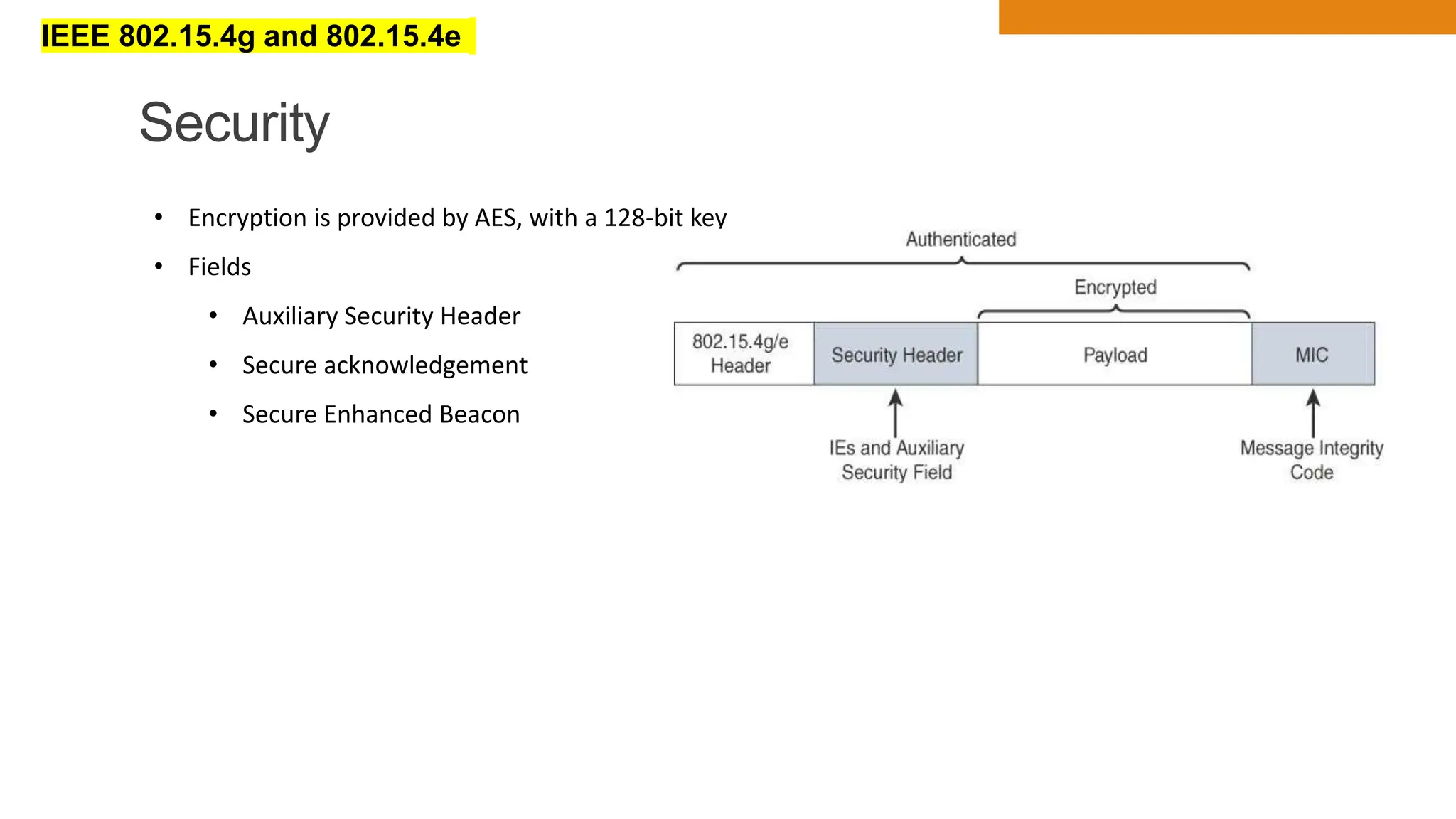
  • 160.
    The Need forOptimization 160
  • 161.
    IOT FOR DATASCIENCE AND ANALYTICS 161
  • 162.
    Why IP NeedsOptimization? Internet of Things will(*) largely be built on the Internet Protocol suite, however ,There are existing challenges with IP Non-IP devices Integration  Limits at the device (Constrained Nodes)  Limits at the Network Levels (Constrained Networks) Optimizations are needed at various layers of the IP stack to handle the restrictions Both the nodes and the network itself can often be constrained in IoT solutions. IP is transitioning from version 4 to version 6, which can add further confinement in the IoT space 162
  • 163.
  • 164.
    Constrained Nodes 164  Thedefinition of constrained nodes is evolving Costs of computing power, memory, storage resources, and power consumption are generally decreasing Networking technologies continue to improve and offer more bandwidth and reliability.  Push to optimize IP for constrained nodes will lessen as technology improvements and cost decreases address many of these challenges
  • 165.
    Constrained Nodes In IoTsolutions different classes of devices coexist  “Thing” Architecture may or may not offer similar characteristics compared to a generic PC or server in an IT environment  The network protocol stack on an IoT node may be required to communicate through an unreliable path.  Limited or unpredictable throughput and low convergence Power consumption is a key characteristic of constrained nodes  Many IoT devices are battery-powered, with lifetime battery requirements varying from a few months to 10+ years  High-speed ones, such as Ethernet, Wi-Fi, and cellular, are not capable of multi-year battery life  Power consumption requirements on battery-powered nodes impact communication intervals  To help extend battery life, possible modes  “low-power” mode instead of one that is “always on.”  “always off,” which means communications are enabled only when needed to send data Production IP stacks perform well in constrained nodes, but classification helps to choose between Adoption/Adaptation 165
  • 166.
    Constrained Nodes Classifications 166 TypeImplications Very constrained in resources • Communicates infrequently to transmit a few bytes • Limited security and management capabilities Adaptation model : Nodes communicate through gateways and proxies Devices with enough power and capacities to implement a stripped-down IP stack or non-IP stack Adoption model: an optimized IP stack and direct communication with application servers Adaptation model : Use IP or non-IP stack and communicate through gateways and proxies Enough computing and power resources (Devices that are like generic PCs), but constrained networking capacities, such as bandwidth Adoption model : Full IP stack , but network design and application behaviors must cope with the bandwidth constraints
  • 167.
  • 168.
    Constrained Networks Also knownas low-power and lossy networks (LLNs). Early days of IP :  Network bandwidth capacity was restrained due to technical limitations.  Connections often depended on low-speed modems for transferring data.  However, these low-speed connections demonstrated that IP could run over low-bandwidth networks Today :  Emergence of high-speed infrastructures  High-speed connections are not usable by some IoT devices in the last mile  The implementation of technologies with low bandwidth  Limited distance and bandwidth due to regulated transmit power  Lack of or limited network services  When link layer characteristics that we take for granted are not present, the network is constrained  A constrained network can have high latency and a high potential for packet loss 168
  • 169.
    Constrained Networks Characteristics Limited by low-power, low-bandwidth links (wireless and wired) Characteristics  Operates between a few kbps and a few hundred kbps and may utilize a star, mesh, or combined network topologies, ensuring proper operations  Packet Delivery Rate (PDR) to oscillate between low and high percentages  Large bursts of unpredictable errors and even loss of connectivity at times may occur  Packet delivery variation may fluctuate greatly during the course of a day (Wireless or Narrowband PLC)  Unstable link layer environments -> latency and control plane reactivity challenges  Ways to address  One of the golden rules in a constrained network is to “underreact to failure.”  Overreacts can lead to a network collapse, worsening the existing problem  Control plane traffic must also be kept at a minimum – data traffic bandwidth may get consumed  Failure or verbose control plane protocol may reduce the lifetime of the batteries 169
  • 170.
  • 171.
    IP Version Transition IPversion 4 to IP version 6 Why? - Lack of address space in IPv4 as the Internet has grown Today, both versions of IP run over the Internet, but most traffic is still IPv4-based.  Should all deployments be IP6-based?  Current infrastructures and their associated lifecycle of solutions, protocols, and products  IP4 entrenched in current infra  So, support both IP4 and IP6  Tunnelling and translation are required for interoperability between IP4 and IP6 Which factors dictate whether to use IPv4, IPv6 or both? 171
  • 172.
    Factors to chooseIPv4, IPv6 or both Application Protocol  IoT device with Ethernet or Wi-Fi interfaces, can use both IPv4/IPv6  However, Application Protocol may dictate choice of IP version  SCADA protocols such as DNP3/IP (IEEE 1815), Modbus TCP supports IPv4  For IoT devices with application protocols defined by the IETF, such as HTTP/HTTPS, CoAP, MQTT, and XMPP, both IP versions are supported. Cellular Provider and Technology • First 3 generations of data services—GPRS, Edge, and 3G—IPv4 is the base protocol version. • Consequently, if IPv6 is used with these generations, it must be tunneled over IPv4. • On 4G/LTE networks, data services can use IPv4 or IPv6 as a base protocol, depending on the provider 172

  • 173.
    Factors to chooseIPv4, IPv6 or both Serial Communications • Many legacy devices in certain industries, such as manufacturing and utilities, communicate through serial lines • Data is transferred using either proprietary or standards-based protocols, such as DNP3, Modbus, or IEC 60870-5-101 • Communication Flow : • Serial port of the legacy device -> serial port on a piece of communications equipment (router) -> Central Server • Encapsulation of serial protocols over IP leverages mechanisms such as raw socket TCP or UDP. While raw socket sessions can run over both IPv4 and IPv6, current implementations are mostly available for IPv4 only IPv6 Adaptation Layer • Some physical and data link layers for newer IoT protocols support only IPv6 • Most common physical and data link layers (Ethernet, Wi-Fi, and so on) stipulate adaptation layers for both versions • Newer technologies, such as IEEE 802.15.4 (WPAN), IEEE 1901.2, and ITU G.9903 (Narrowband PLC) only have an IPv6 adaptation layer specified • Any device implementing a technology that requires an IPv6 adaptation layer must communicate over an IPv6-only subnetwork 173
  • 174.
    Case Studies IOT FORDATA SCIENCE AND ANALYTICS 174
  • 175.
    Assignment – Part1 IOT FOR DATA SCIENCE AND ANALYTICS 175
  • 176.
    Use Cases IOT FORDATA SCIENCE AND ANALYTICS 176 Smart Factory Smart City Smart Traffic Management Smart Home Digital Health Smart Retail Autonomous Vehicle Smart Logistics
  • 177.
  • 178.
    Optimizing IP forIoT using Adaptation Layer 178 Constrained nodes and constrained networks mandate optimization at various layers and on multiple protocols of the IP architecture
  • 179.
    From 6LoWPAN to6Lo  6LoWPAN - IPv6 over Low-Power Wireless Personal Area Networks  6lo focuses on the work that facilitates IPv6 connectivity over constrained node networks Specifically, 6lo focus is on:  IPv6-over-foo ("IPv6-over-Ethernet," "IPv6-over-PPP," "IPv6-over-UDP," or "IPv6-over-HTTP”) adaptation layer specifications using 6LoWPAN technologies for link layer technologies of interest in constrained node networks  Information and data models (e.g., MIB modules) for these adaptation layers for basic monitoring and troubleshooting.  Specifications, such as low-complexity header compression, that are applicable to more than one adaptation layer specification  Maintenance and informational documents are required for the existing IETF specifications in this space. 179
  • 180.
    Comparison - IoTProtocol Stack Utilizing 6LoWPAN and IP Protocol Stack 180
  • 181.
    IP Optimizations From 6LoWPANto 6Lo Header Compression Fragmentation Mesh Addressing 6TiSCH RPL Authentication and Encryption on Constrained Nodes IOT FOR DATA SCIENCE AND ANALYTICS 181
  • 182.
    6LoWPAN Header Stacks 182 RFC4994 – Foundational • Defines frame headers for the capabilities of header compression, fragmentation, and mesh addressing • Depending on the implementation, all, none, or any combination of these capabilities and their corresponding headers can be enabled
  • 183.
    Header Compression  Definedin RFC 4944 and subsequently updated by RFC 6282  Shrinks the size of IPv6’s 40-byte headers and UDP 8-byte headers down as low as 6 bytes  6LoWPAN Header Compression :  Only defined for an IPv6 header and not IPv4. 6LoWPAN protocol does not support IPv4  Stateless, not too complicated  Based on shared information known by all nodes from their participation in the local network  Omits some standard header fields by assuming commonly used values 183
  • 184.
    6LoWPAN Header CompressionExample 184 FCS: Frame Check Sequence
  • 185.
    Fragmentation  Maximum transmissionunit (MTU) for an IPv6 network must be at least 1280 bytes  IEEE 802.15.4, 127 bytes is the MTU 185 1280 bytes 127 bytes IPv6 IEEE 802.15.4
  • 186.
    Fragmentation 186 1280 bytes IPv6 127 bytes127 bytes 127 bytes 127 bytes 127 bytes 127 bytes • Datagram Size field : Total size of the unfragmented payload. • Datagram Tag : Identifies the set of fragments for a payload. • Datagram Offset: Delineates how far into a payload a particular fragment occurs Frame Check Sequence
  • 187.
    Mesh Addressing  Isto forward packets over multiple hops Three fields are defined for this header:  Hop Limit  Source Address  Destination Address.  Hop limit for mesh addressing also limits how often the frame can be forwarded. Each hop decrements this value by 1 as it is forwarded. Once the value hits 0, it is dropped and no longer forwarded. 187
  • 188.
    Mesh-Under Versus Mesh-OverRouting For network topologies, support mesh topologies and operate at the physical and data link layers : Two main options exist for establishing reachability and forwarding packets “Mesh-under” : The routing of packets is handled at the 6LoWPAN adaptation layer “Mesh-over” or “Route-over” : Utilizes IP routing to get packets to their destination 188
  • 189.
    6TiSCH  6TiSCH -IPv6 over the TSCH mode of IEEE 802.15.4e  To enable efficient and reliable communication for low-power and lossy networks (LLNs)  Allows the deployment of IPv6-based communication in industrial and home automation applications, where devices may have limited power, memory, and processing capabilities  Employs time synchronization and channel hopping techniques 189
  • 190.
    6TiSCH 190  Schedules in6TiSCH are broken down into cells.  A cell is simply a single element in the TSCH schedule that can be allocated for unidirectional or bidirectional communications between specific nodes.  Nodes only transmit when the schedule dictates that their cell is open for communication.
  • 191.
    6TiSCH - Schedulemanagement mechanisms 191  Static scheduling  All nodes in the constrained network share a fixed schedule  Cells are shared, and nodes contend for slot access in a slotted aloha manner Neighbor-to-neighbor scheduling  A schedule is established that correlates with the observed number of transmissions between nodes  Cells in this schedule can be added or deleted as traffic requirements and bandwidth needs change. Remote monitoring and scheduling management  Time slots and other resource allocation are handled by a management entity that can be multiple hops away Hop-by-hop scheduling  A node reserves a path to a destination node multiple hops away by requesting the allocation of cells in a schedule at each intermediate node hop in the path.
  • 192.
    6TiSCH – DeliveryModels 192  Track Forwarding (TF)  Simplest and fastest forwarding model.  A “track” in this model is a unidirectional path between a source and a destination.  This track is constructed by pairing bundles of receive cells in a schedule with a bundle of receive cells set to transmit Fragment forwarding (FF)  Takes advantage of 6LoWPAN fragmentation to build a Layer 2 forwarding table.  This increases latency and can be power- and CPU-intensive for a constrained node Layer 2 forwarding tableIPv6 Forwarding (6F)  Forwards traffic based on its IPv6 routing table.  Flows of packets should be prioritized by traditional QoS (quality of service) and RED (random early detection) operations
  • 193.
    RPL  IPv6 RoutingProtocol for Low Power and Lossy Networks (RPL)  In an RPL network, each node acts as a router and becomes part of a mesh network  Routing is performed at the IP layer  Each node examines every received IPv6 packet and determines the next-hop destination based on the information contained in the IPv6 header. Modes :  Storing mode: All nodes contain the full routing table of the RPL domain.  Non-storing mode: Only the border router(s) of the RPL domain contain(s) the full routing table 193
  • 194.
    RPL  RPL isbased on the concept of a directed acyclic graph (DAG)  A DAG is a directed graph where no cycles exist. This means that from any vertex or point in the graph, you cannot follow an edge or a line back to this same point All of the edges are arranged in paths oriented toward and terminating at one or more root nodes. 194 Directed Acyclic Graph (DAG)
  • 195.
    RPL – DAG& DODAG A basic RPL process involves building a destination-oriented directed acyclic graph (DODAG) A DODAG is a DAG rooted to one destination DAG has multiple roots, whereas the DODAG has just one In a DODAG, each node maintains up to three parents that provide a path to the root. 195
  • 196.
  • 197.
    Need of Compliance Internet Protocol suite for smart objects involves a collection of protocols and options that must work in coordination with lower and upper layers  Profile definitions, certifications, and promotion by alliances can help implementers develop solutions that guarantee interoperability and/or interchangeability of devices Key Alliances Internet Protocol for Smart Objects (IPSO) Alliance Wi-SUN Alliance Thread IPv6 Ready Logo IOT FOR DATA SCIENCE AND ANALYTICS 197
  • 198.
    Quiz IOT FOR DATASCIENCE AND ANALYTICS 198