IoT Day 2014, Trento
Trento at the centre of the
Italian Internet of Things
Connect your Things!
Don’t be an alien!
organised by @iotitaly
hashtag for this event #trentoiot
iotitaly
iCore: smart things for smart applications
Raffaele Giaffreda, IoT Day Italy, TrentoRaffaele Giaffreda, IoT Day Italy, Trento
9th April 2014
outline
• the scale of Internet of Things
• the bottlenecks
• some research results
• some future trends• some future trends
• conclusions
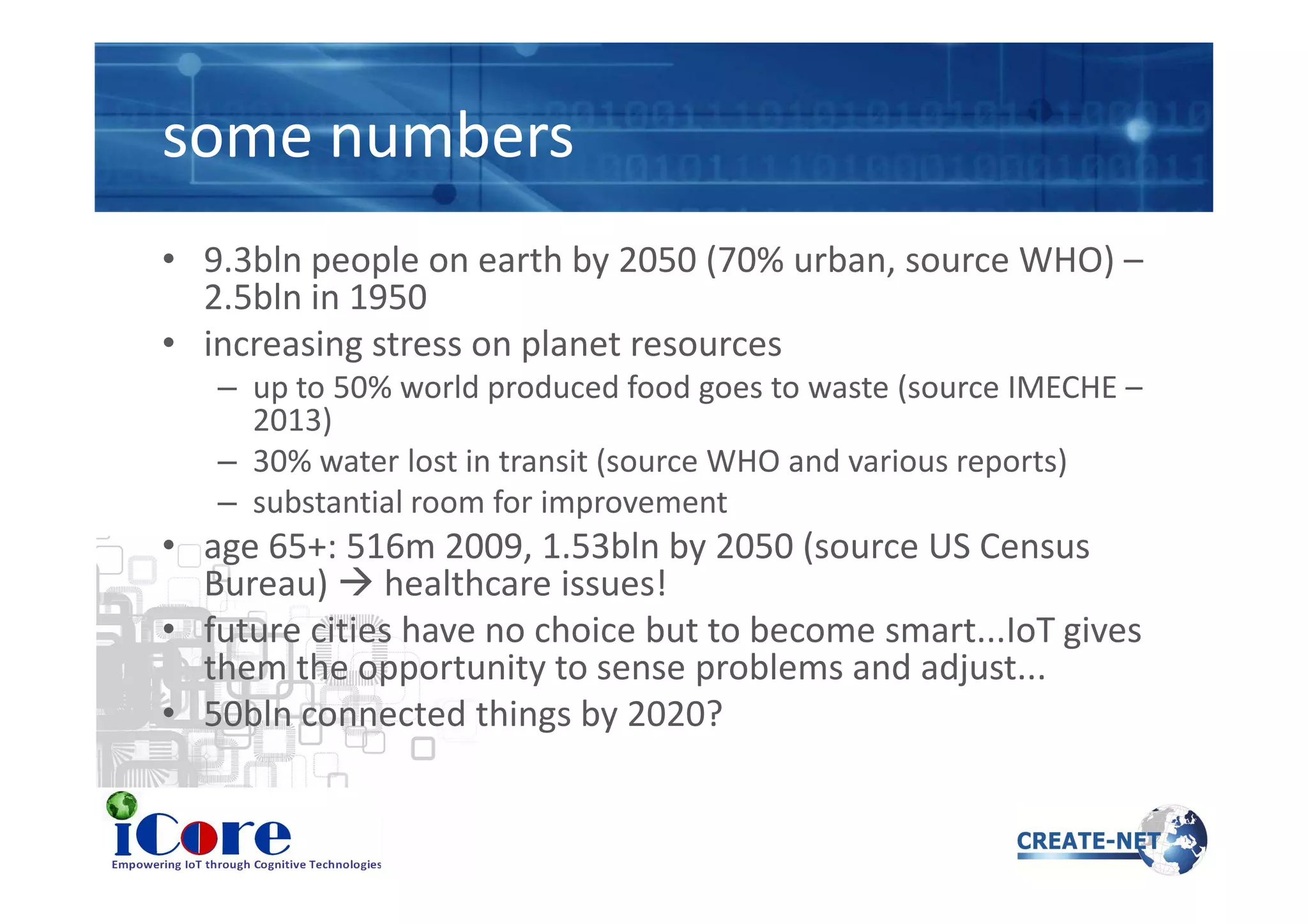
some numbers
• 9.3bln people on earth by 2050 (70% urban, source WHO) –
2.5bln in 1950
• increasing stress on planet resources
– up to 50% world produced food goes to waste (source IMECHE –
2013)
– 30% water lost in transit (source WHO and various reports)– 30% water lost in transit (source WHO and various reports)
– substantial room for improvement
• age 65+: 516m 2009, 1.53bln by 2050 (source US Census
Bureau) healthcare issues!
• future cities have no choice but to become smart...IoT gives
them the opportunity to sense problems and adjust...
• 50bln connected things by 2020?
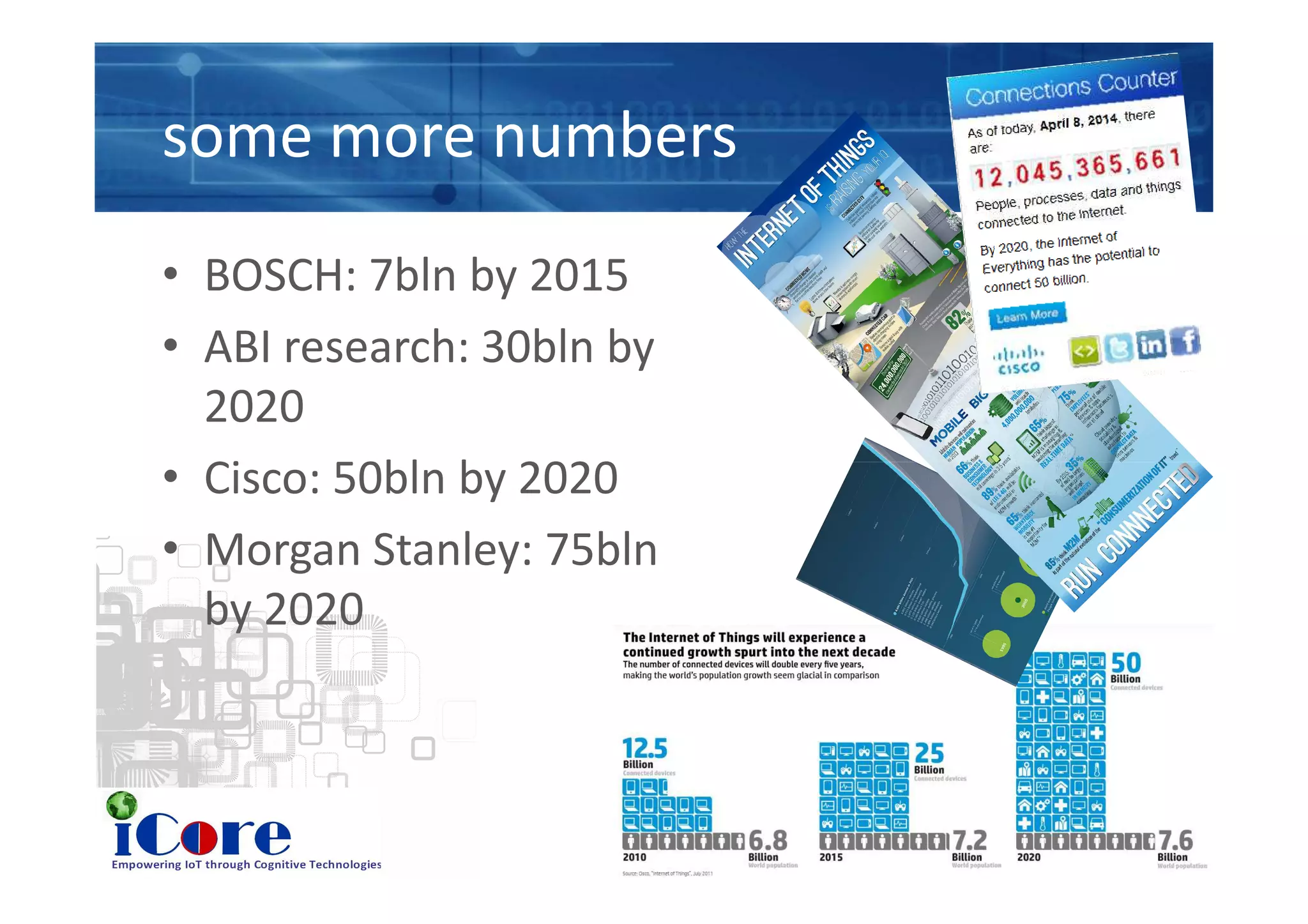
some more numbers
• BOSCH: 7bln by 2015
• ABI research: 30bln by
2020
• Cisco: 50bln by 2020• Cisco: 50bln by 2020
• Morgan Stanley: 75bln
by 2020
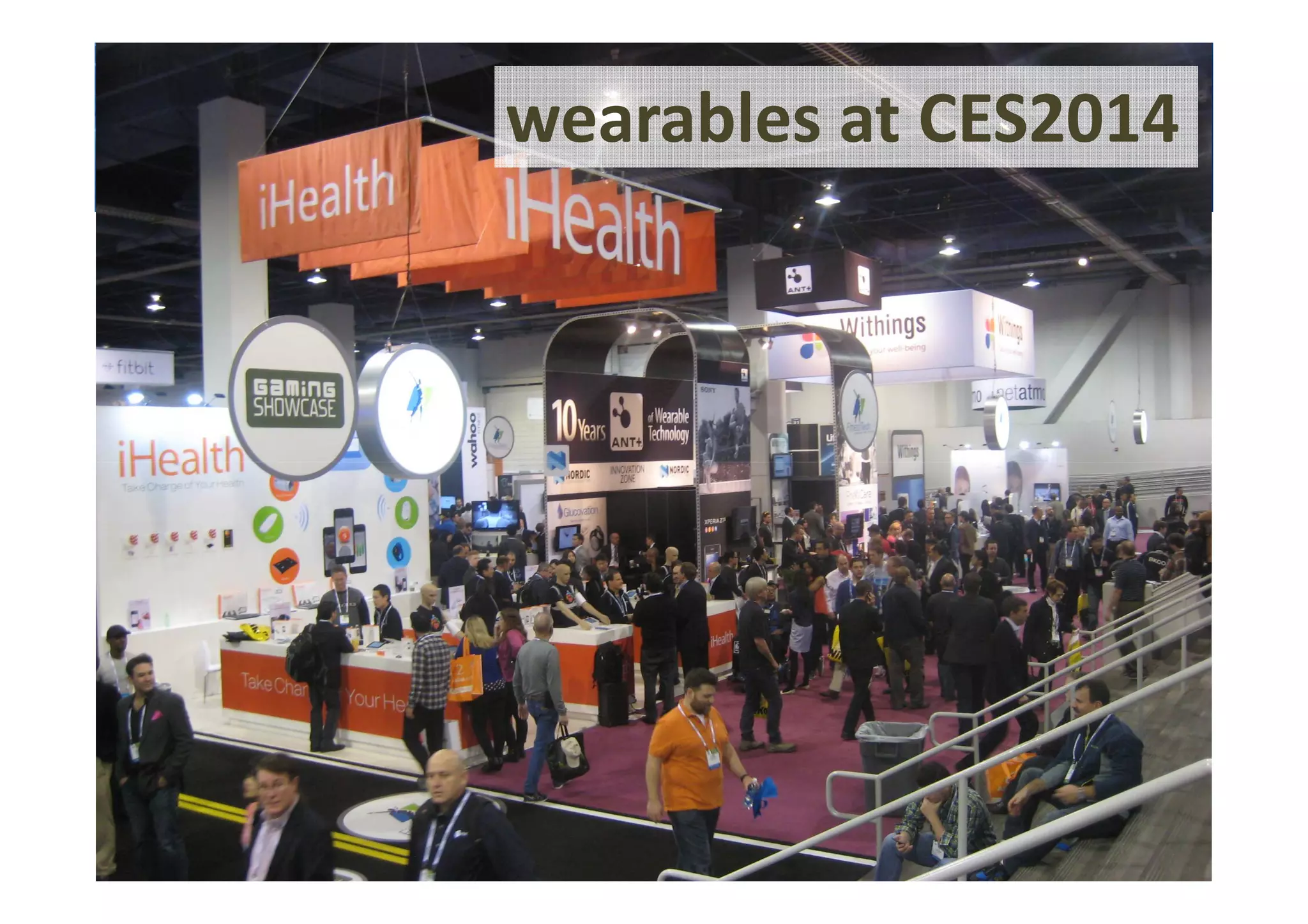
wearables at CES2014
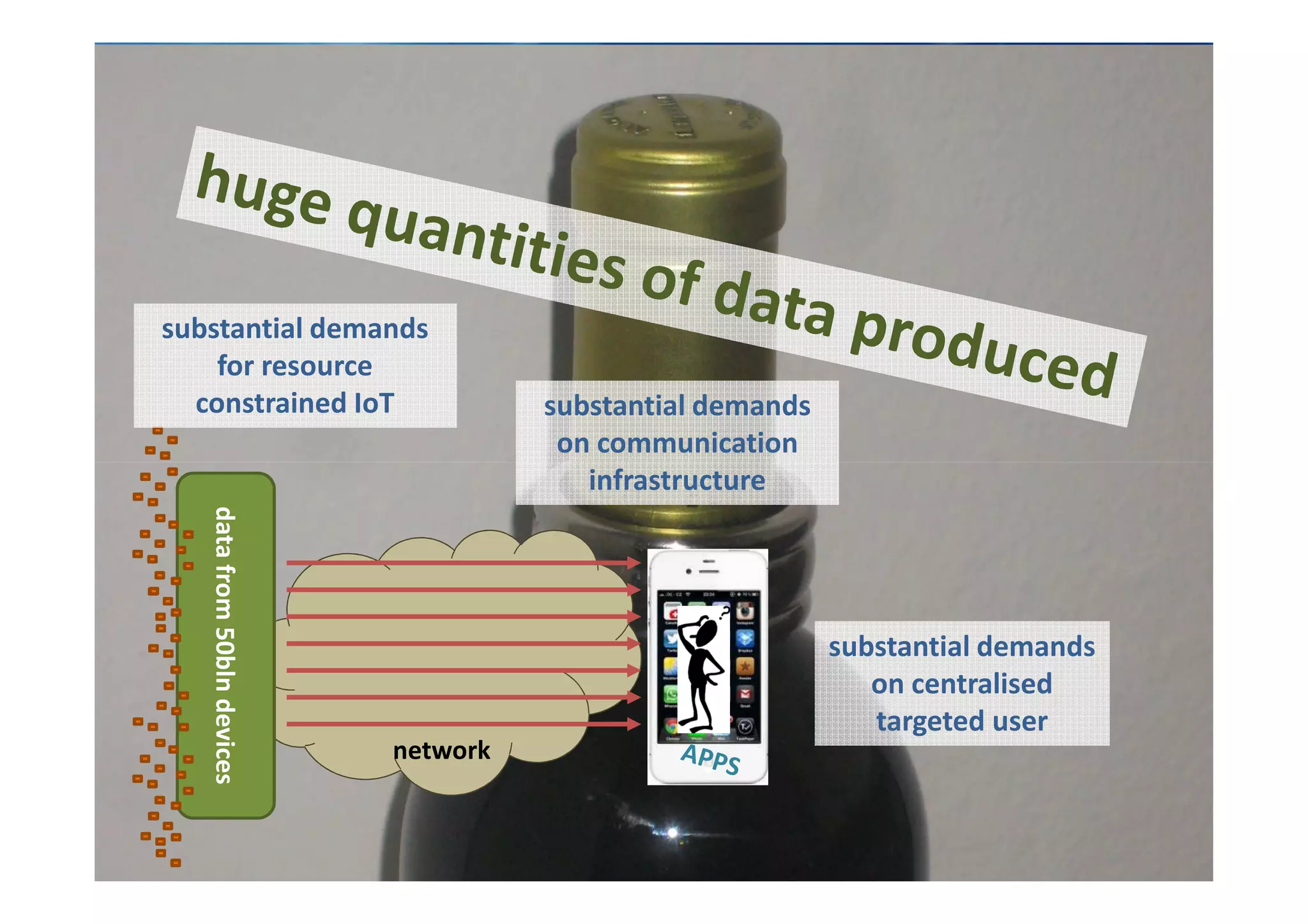
substantial demands
on communication
infrastructure
substantial demands
for resource
constrained IoT
datafrom50blndevices
infrastructure
substantial demands
on centralised
targeted user
network
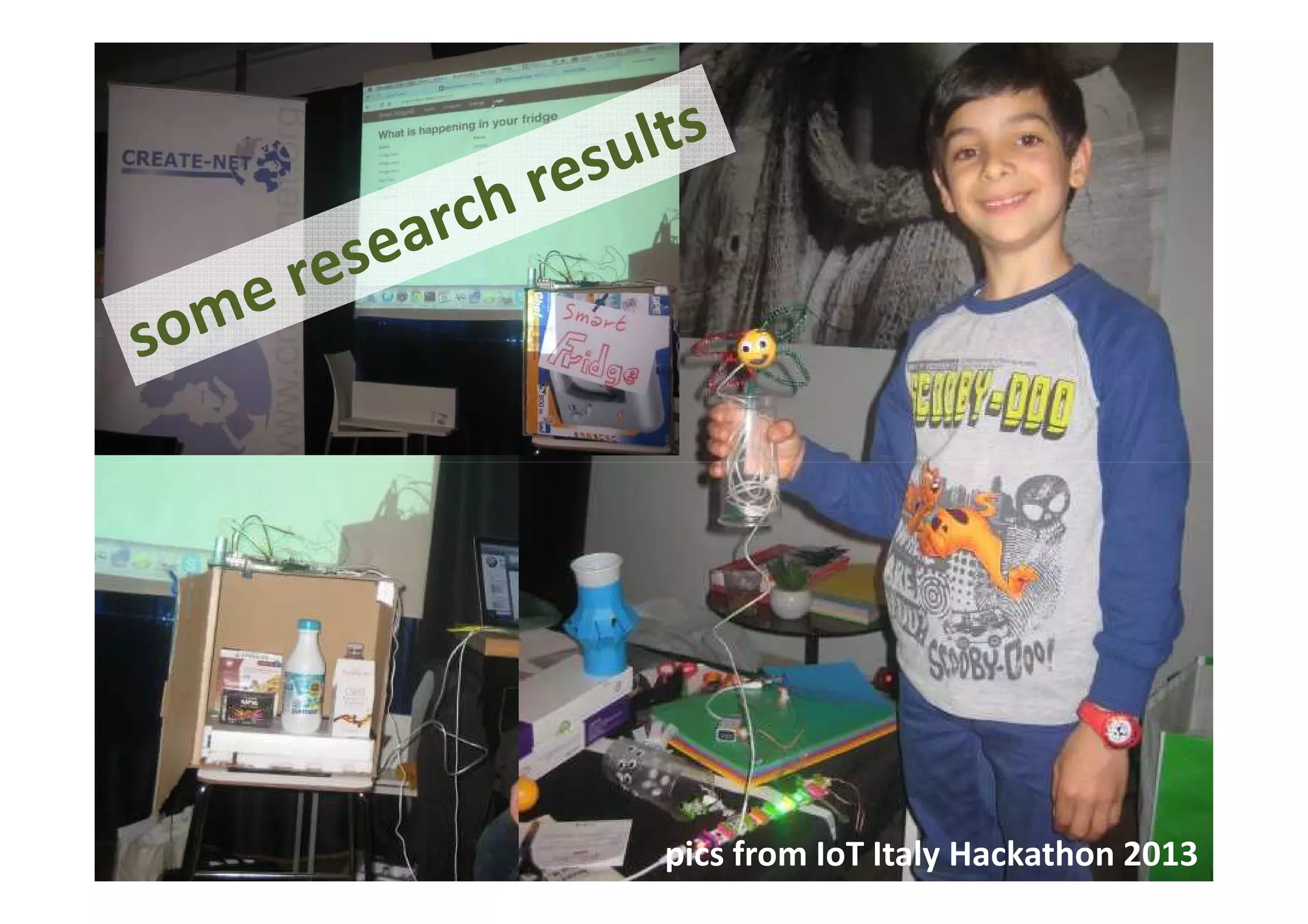
some research results
pics from IoT Italy Hackathon 2013
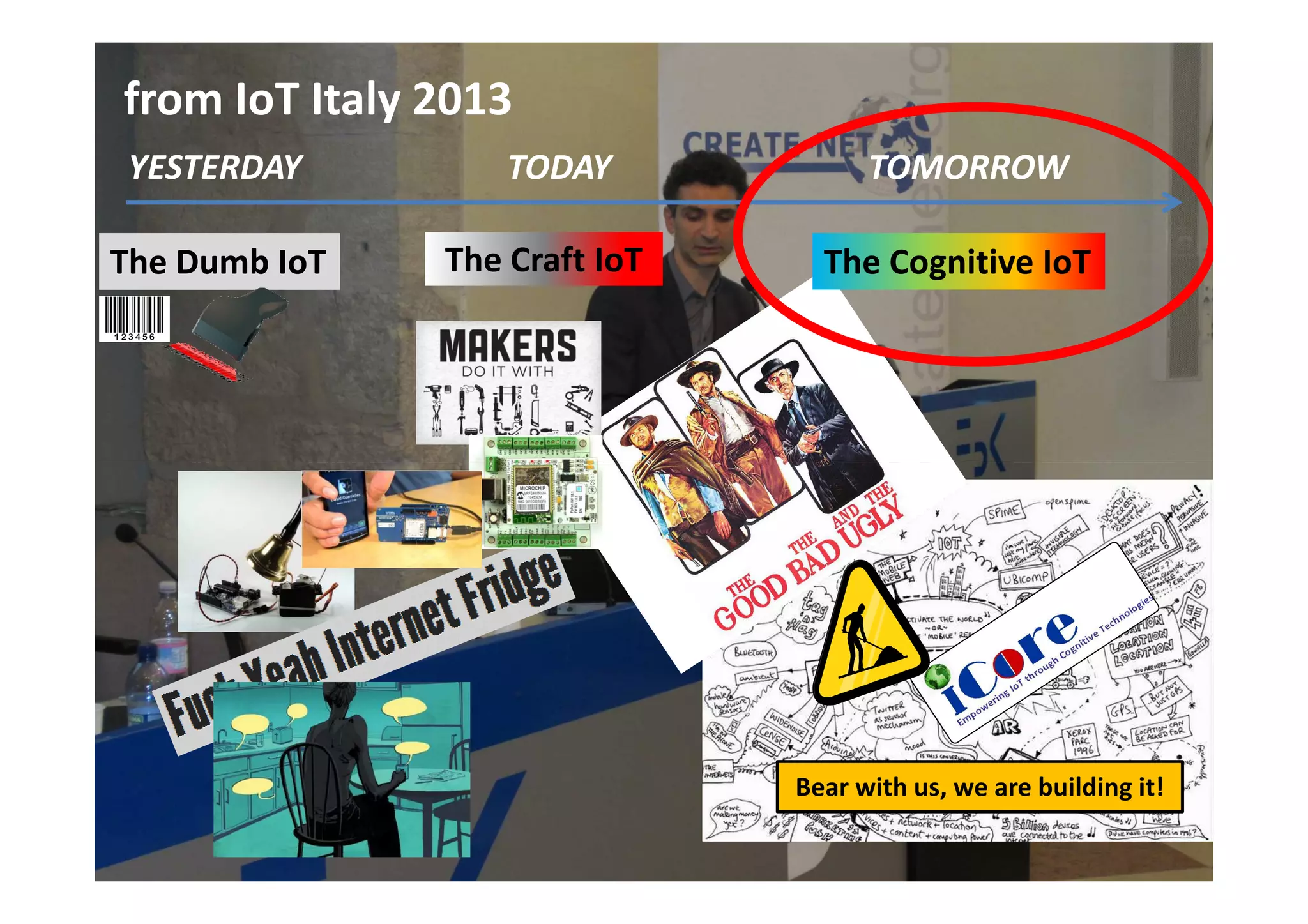
The Dumb IoT The Craft IoT The Cognitive IoT
YESTERDAY TODAY TOMORROW
from IoT Italy 2013
Bear with us, we are building it!
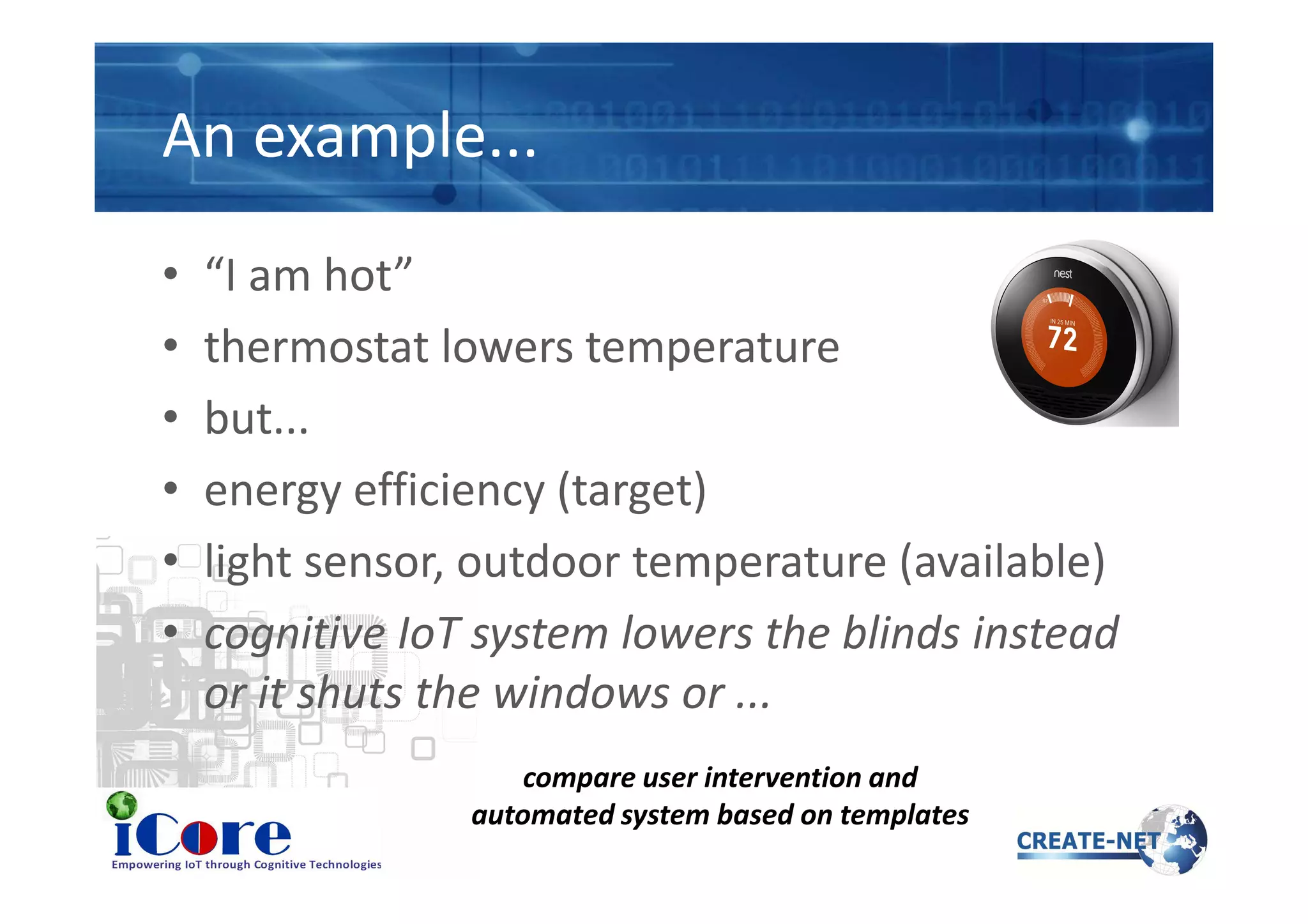
An example...
• “I am hot”
• thermostat lowers temperature
• but...
• energy efficiency (target)• energy efficiency (target)
• light sensor, outdoor temperature (available)
• cognitive IoT system lowers the blinds instead
or it shuts the windows or ...
compare user intervention and
automated system based on templates
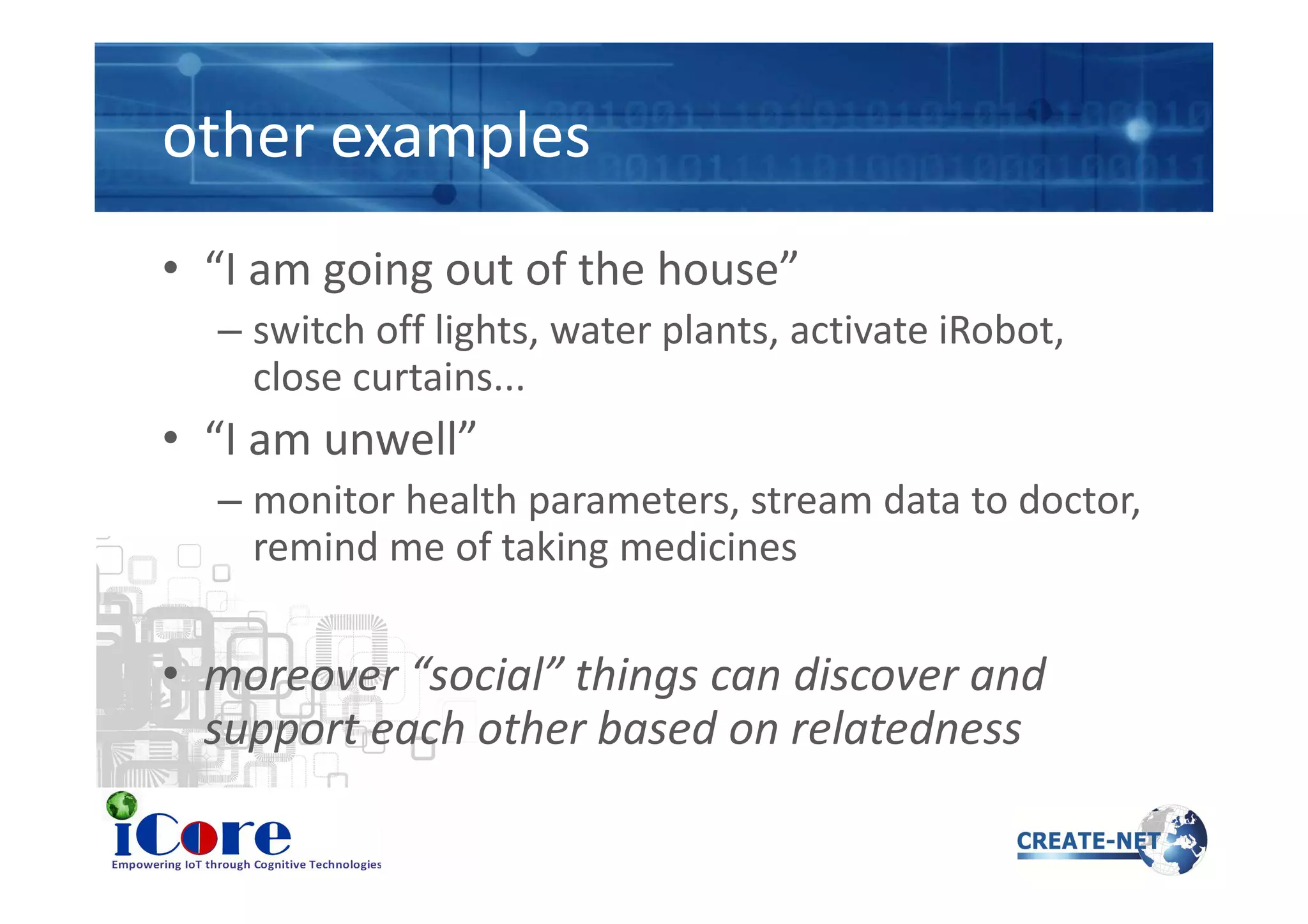
other examples
• “I am going out of the house”
– switch off lights, water plants, activate iRobot,
close curtains...
• “I am unwell”• “I am unwell”
– monitor health parameters, stream data to doctor,
remind me of taking medicines
• moreover “social” things can discover and
support each other based on relatedness
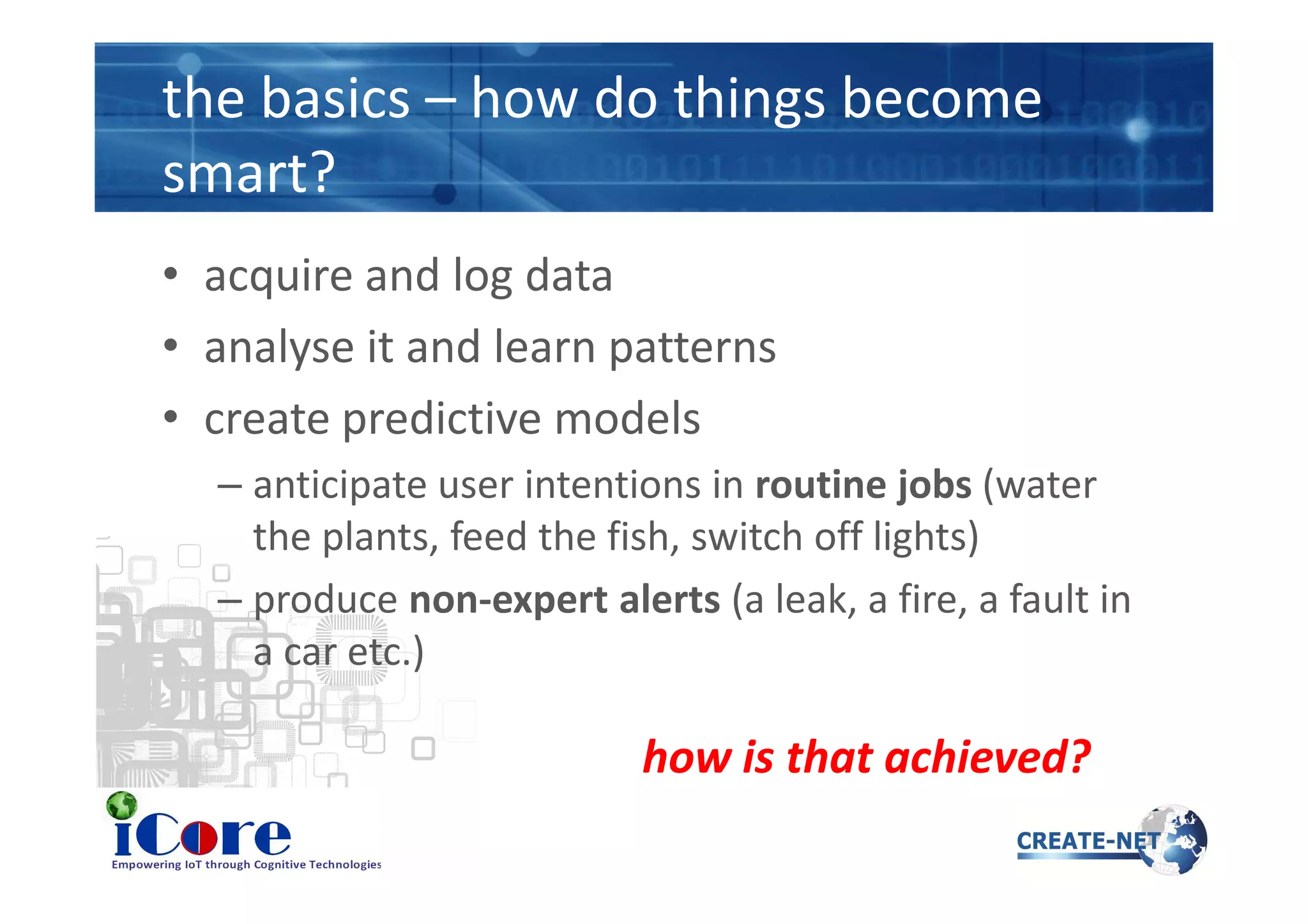
the basics – how do things become
smart?
• acquire and log data
• analyse it and learn patterns
• create predictive models
– anticipate user intentions in routine jobs (water– anticipate user intentions in routine jobs (water
the plants, feed the fish, switch off lights)
– produce non-expert alerts (a leak, a fire, a fault in
a car etc.)
how is that achieved?
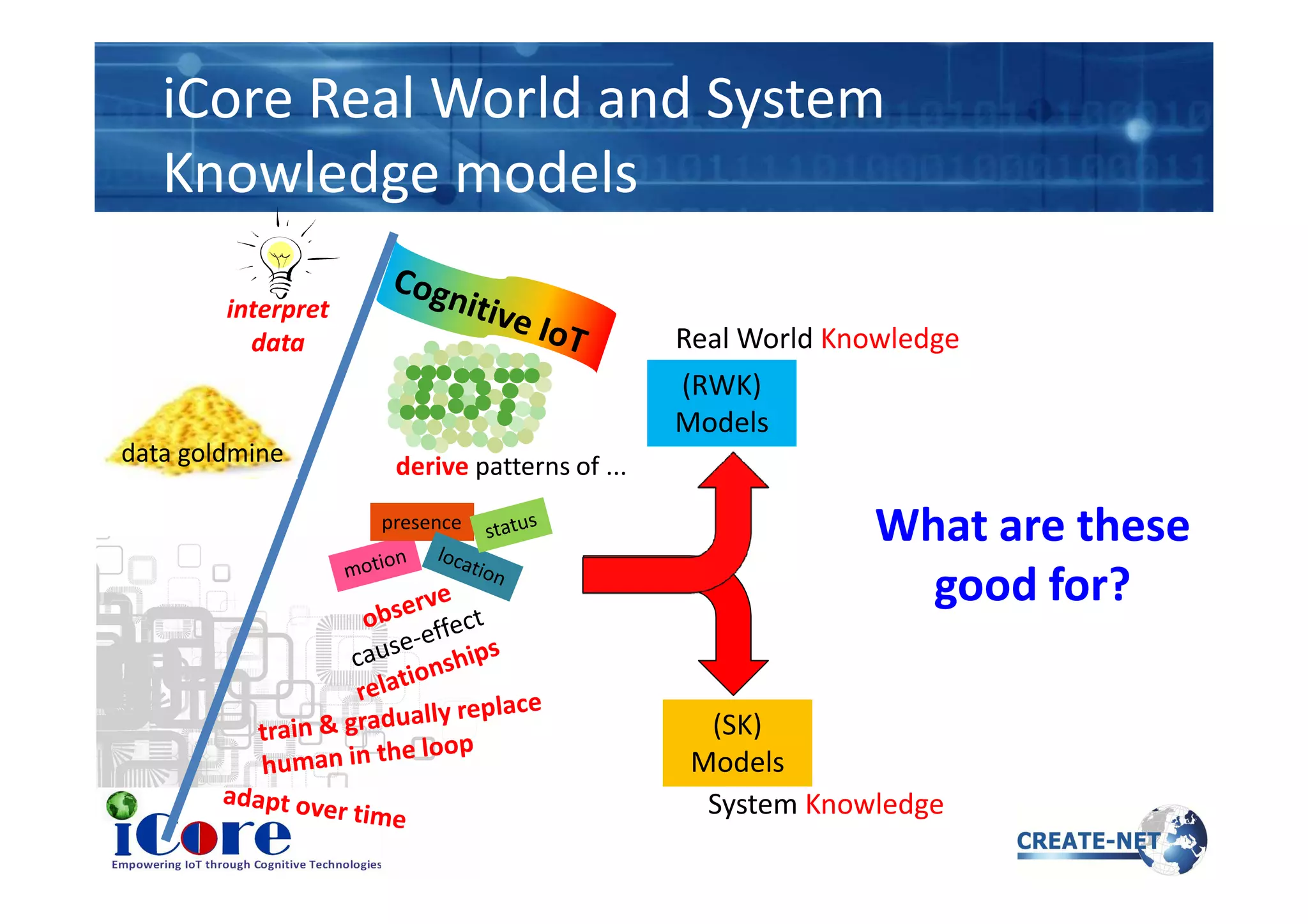
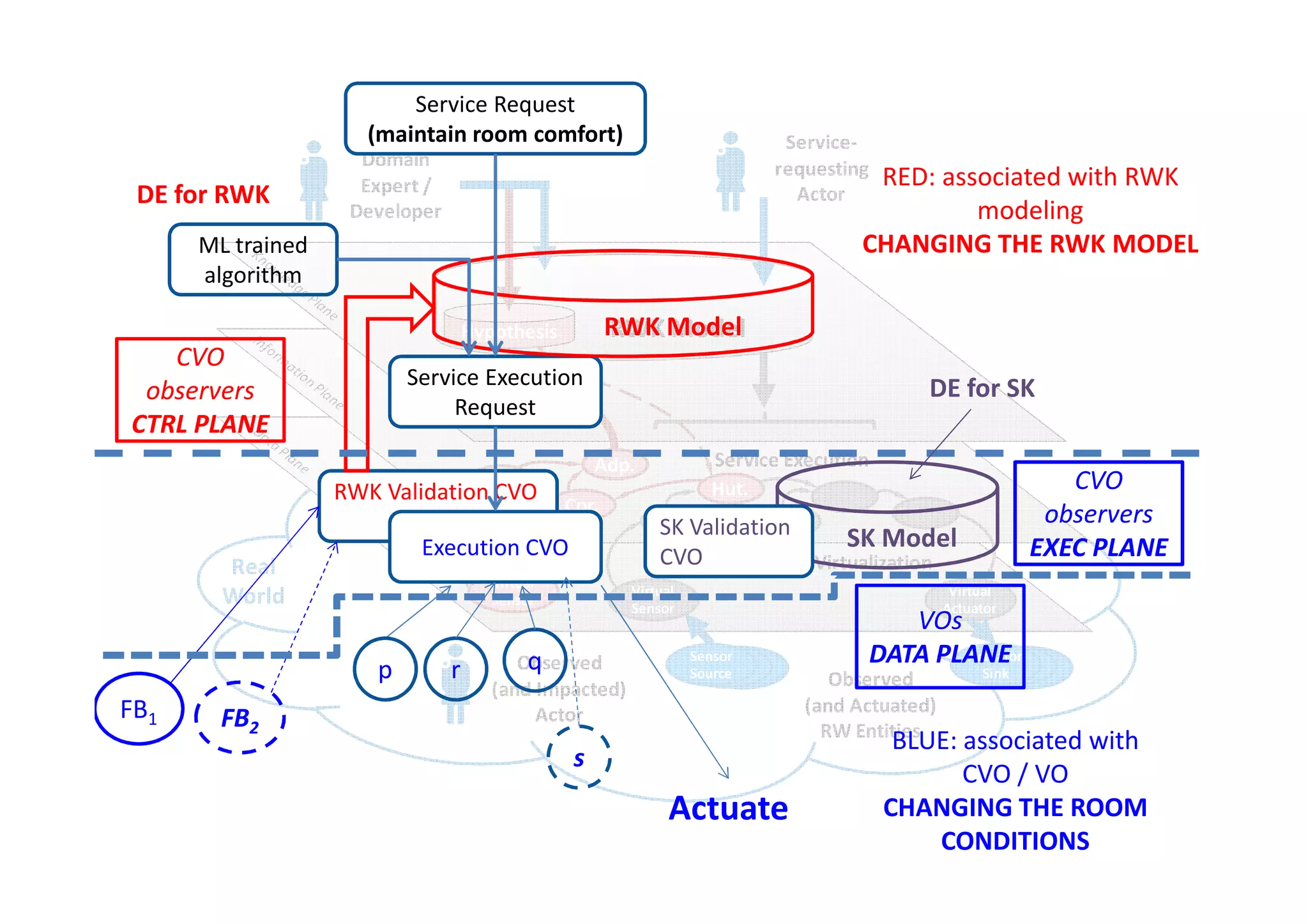
iCore Real World and System
Knowledge models
Real World Knowledge
(RWK)
Models
derive patterns of ...
interpret
data
data goldmine
System Knowledge
(SK)
Models
presence
derive patterns of ...
What are these
good for?
data goldmine
Service Execution
Domain
Expert /
Developer
Service-
requesting
Actor
RWK Model
Adp.
Hypothesis
ML trained
algorithm
Service Request
(maintain room comfort)
Service Execution
Request
CVO
observers
CTRL PLANE
RWK Model
RED: associated with RWK
modeling
CHANGING THE RWK MODEL
DE for SK
DE for RWK
Observed
(and Actuated)
RW Entities
Observed
(and Impacted)
Actor
Real
World
Sensor
Source
Data Source/Sink Virtualization
Sensor
Source
Sensor
Source
Actuator
Sink
Virtual
Sensor
Virtual
Actuator
Service Execution
Hut.
Virtual
Sensor
Cor.
Adp.
RWK Validation CVO
Execution CVO
Actuate
VOs
DATA PLANE
FB1 FB2
qr
s
p
CVO
observers
EXEC PLANE
BLUE: associated with
CVO / VO
CHANGING THE ROOM
CONDITIONS
SK ModelSK Validation
CVO
Some examples please?
• tracking cars in a smart city
• medical equipment tracking and asset
management
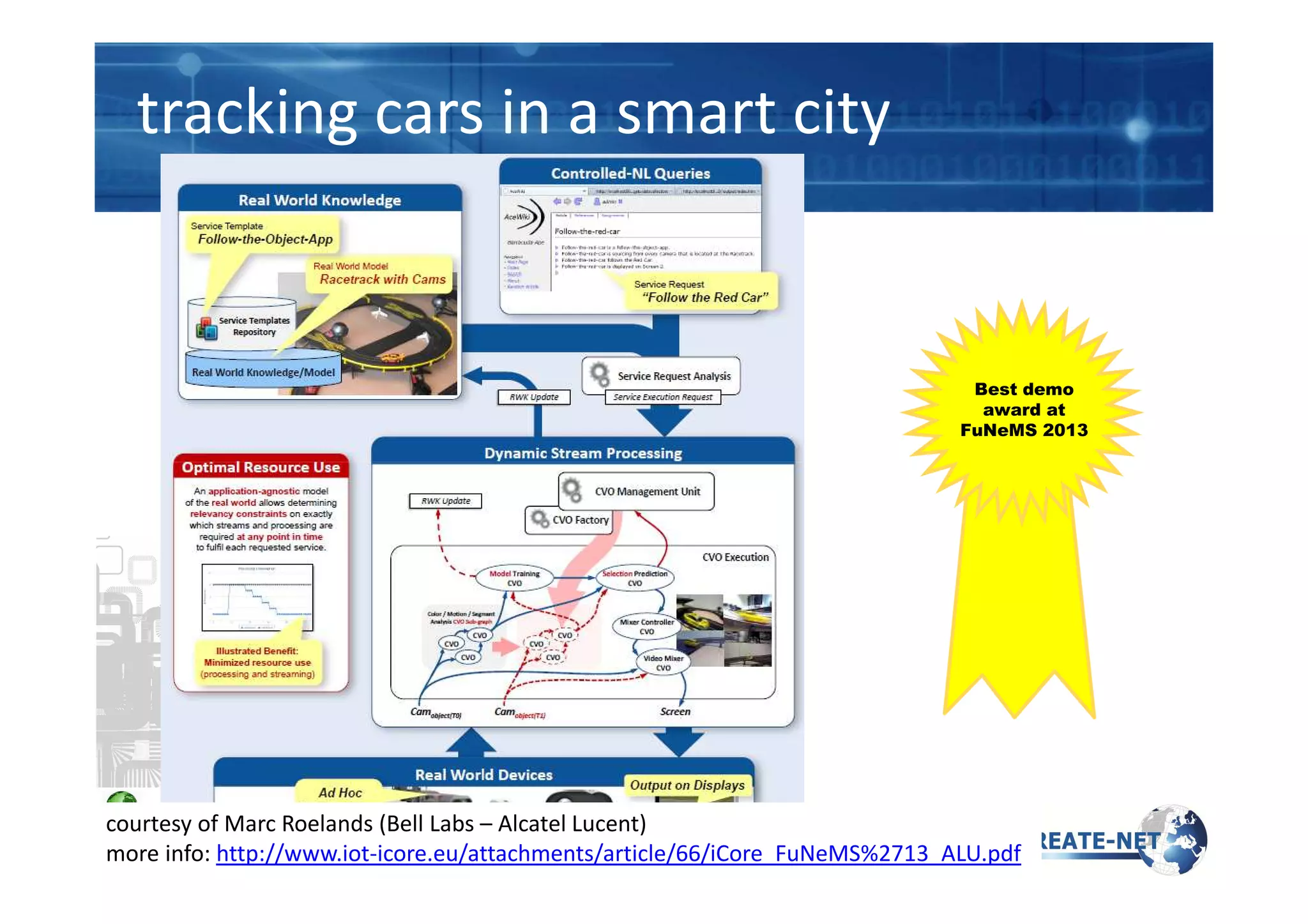
tracking cars in a smart city
Best demo
award at
FuNeMS 2013
courtesy of Marc Roelands (Bell Labs – Alcatel Lucent)
more info: http://www.iot-icore.eu/attachments/article/66/iCore_FuNeMS%2713_ALU.pdf
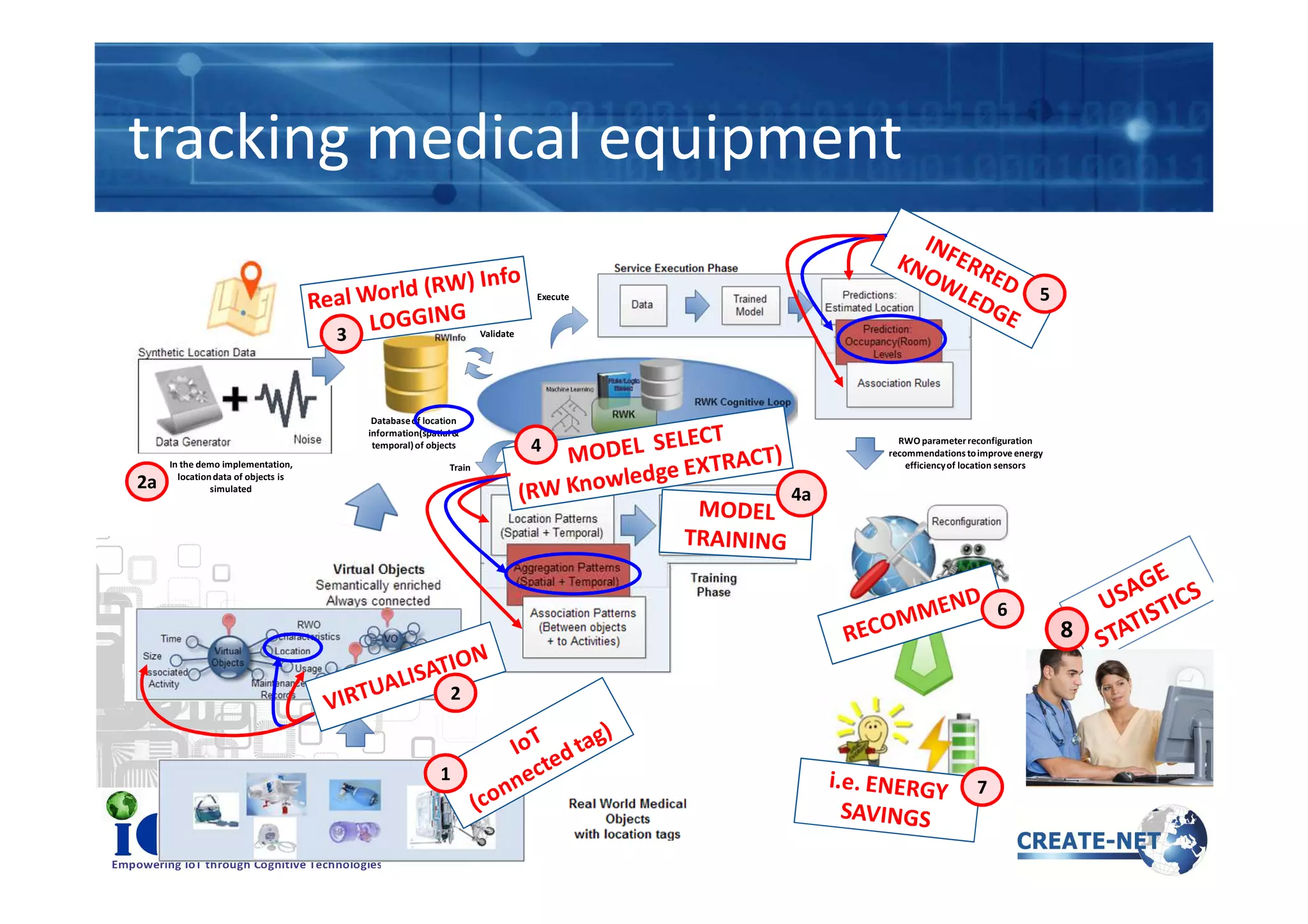
tracking medical equipment
Validate
Train
Execute
RWO parameterreconfiguration
recommendations toimprove energy
efficiencyof location sensorsIn the demo implementation,
Databaseof location
information(spatial &
temporal)of objects
3
4
5
Train efficiencyof location sensorsIn the demo implementation,
locationdata of objects is
simulated
1
2
2a
4a
6
7
8
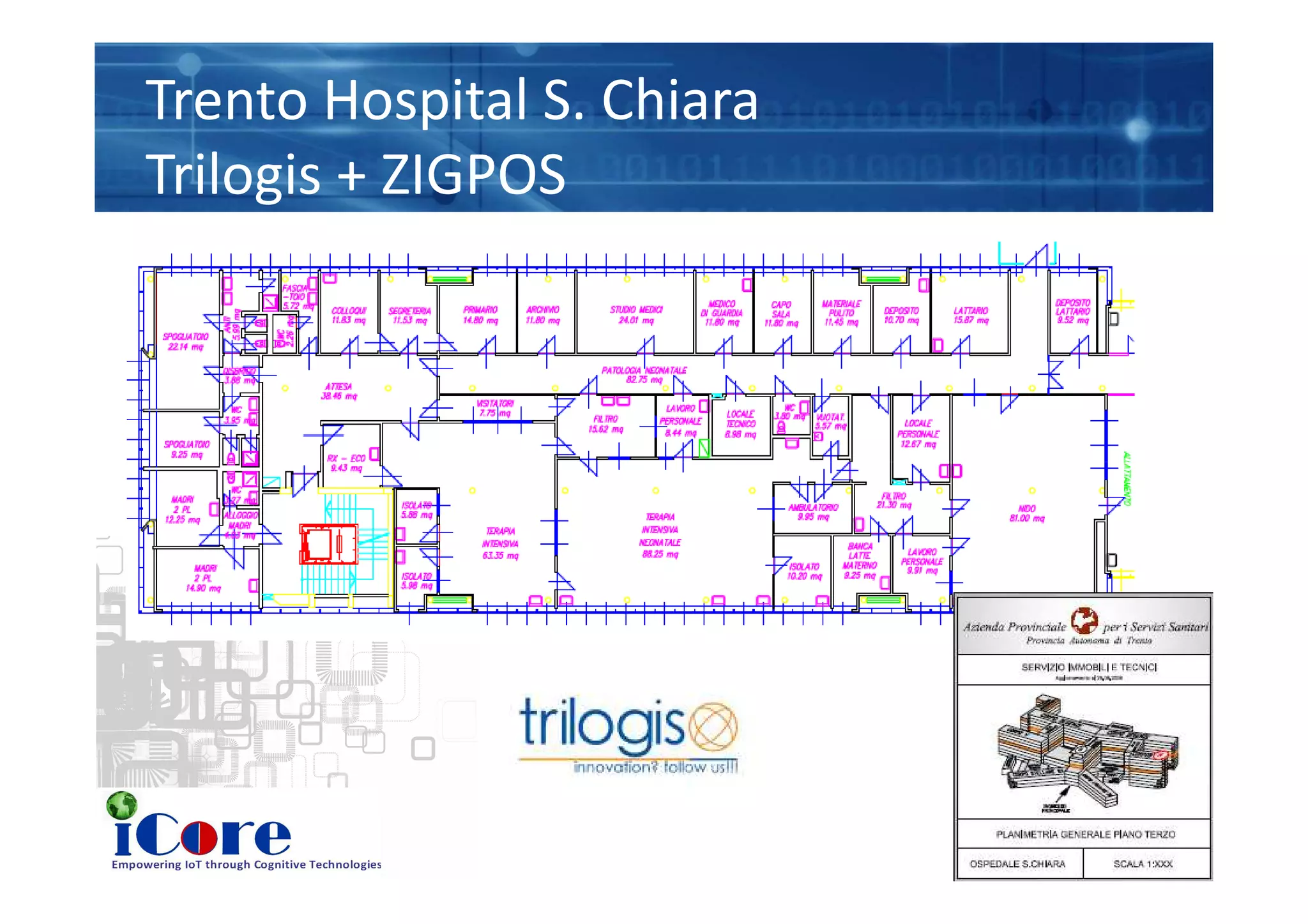
Trento Hospital S. Chiara
Trilogis + ZIGPOS
where are we heading?
• connected things will be able to “socialise”
their status (i.e. friends by ownership)
– relevance, proximity based discovery and
selectionselection
• integration with existing “human” social
networks
– spontaneous service provisioning
L. Atzori, A. Iera, G. Morabito From “Smart Objects” to “Social Objects”: The Next
Evolutionary Step of the Internet of Things IEEE Communications Magazine, Jan 2014
B. Kim, T. Kim, D. Lee, and S. J. Hyun, "SpinRadar: A Spontaneous Service Provision Middleware for
Place-aware Social Interactions," PERSONAL AND UBIQUITOUS COMPUTING, April 2013
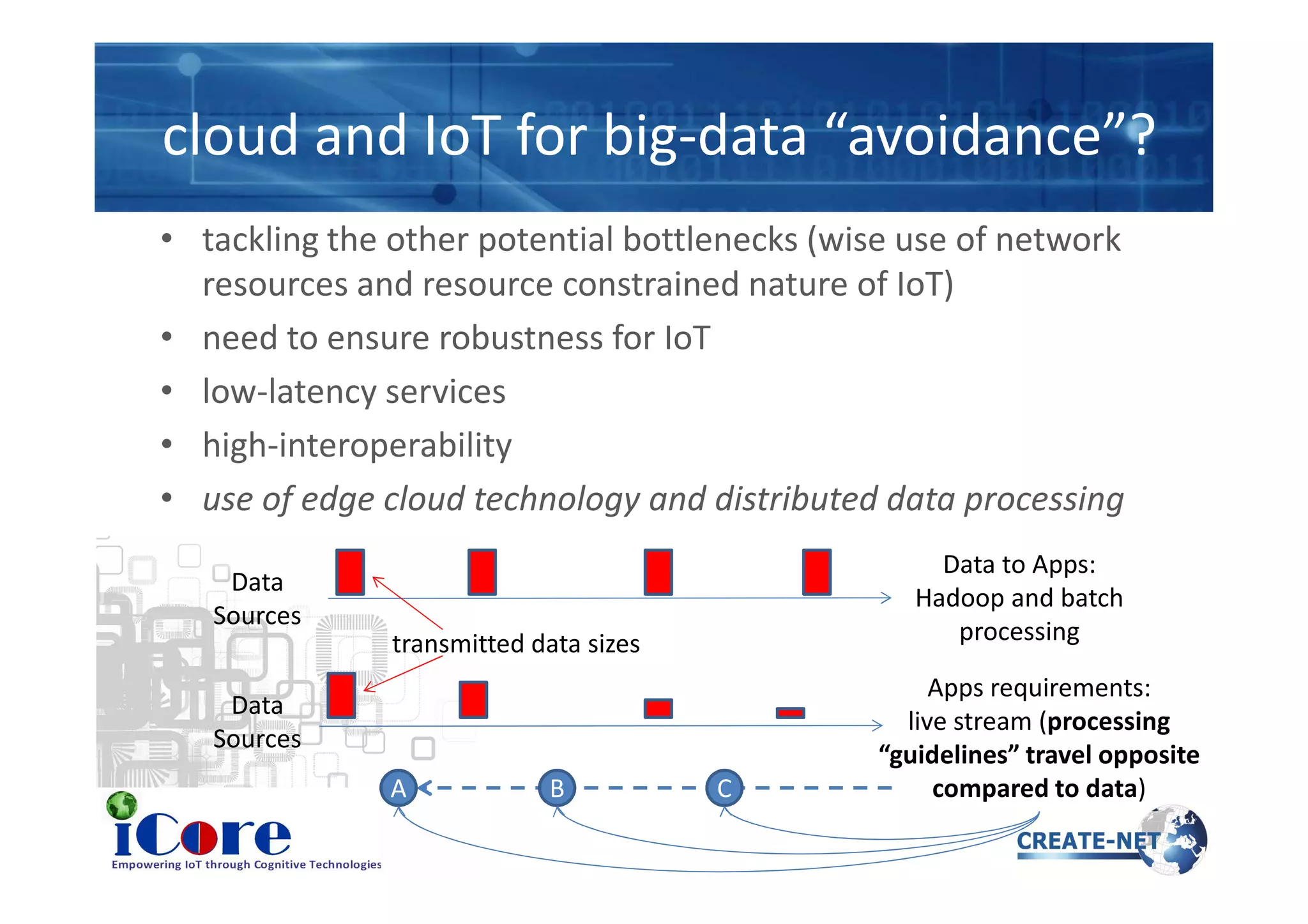
cloud and IoT for big-data “avoidance”?
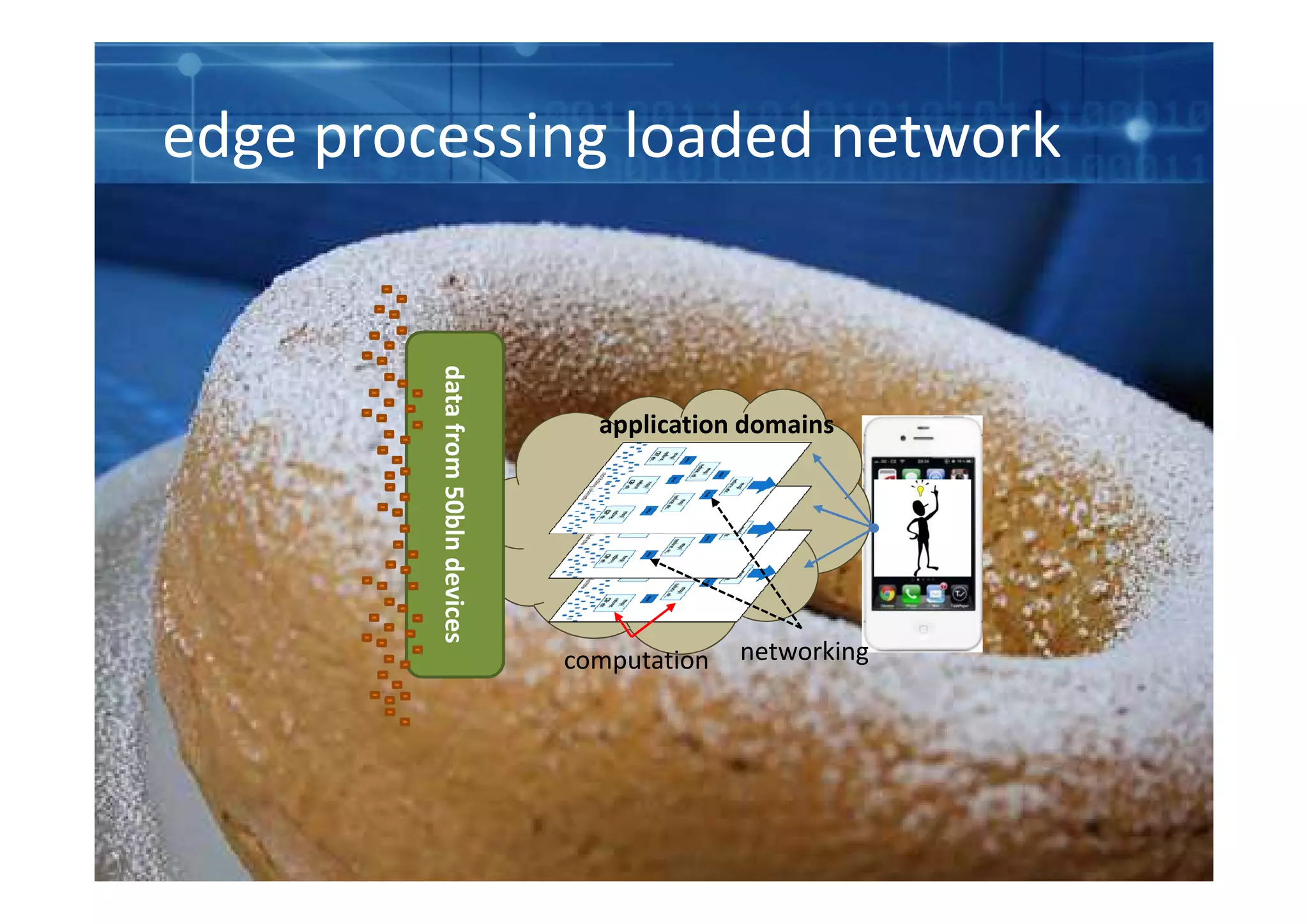
• tackling the other potential bottlenecks (wise use of network
resources and resource constrained nature of IoT)
• need to ensure robustness for IoT
• low-latency services
• high-interoperability• high-interoperability
• use of edge cloud technology and distributed data processing
Data
Sources
Data to Apps:
Hadoop and batch
processing
Data
Sources
Apps requirements:
live stream (processing
“guidelines” travel opposite
compared to data)CBA
transmitted data sizes
datafrom50blndevices
edge processing loaded network
application domainsdatafrom50blndevices
network
networkingcomputation
Conclusions
• Internet of Things is part of our present
• efficient usage of planet Earth resources is a
challenge with growing and aging population
• tremendous growth potential (50bln only 3%• tremendous growth potential (50bln only 3%
of all objects :-)
• there is work to do
Further info / links
[REF2] P. Vlacheas, R. Giaffreda et al. "Enabling Smart Cities Through
a Cognitive Management Framework for the Internet of Things“,
IEEE Communications Magazine - Special Issue on Smart Cities (June
2013)
[REF1] IERC April 2013 Newsletter – Foreword (see THIS LINK)
[REF3] iCore website (www.iot-icore.eu/latest-news)[REF3] iCore website (www.iot-icore.eu/latest-news)
Best Demo Award at FuNeMS 2013
Thank you!
Raffaele Giaffreda
Smart IoT (RIoT) Research Area Head
(CREATE-NET)
EU FP7 iCore Project CoordinatorEU FP7 iCore Project Coordinator
raffaele.giaffreda@create-net.org
Websites:
www.create-net.org/research/research-areas/riot
www.iot-icore.eu

IoT Day 2014 - Results and challenges ahead for IoT

  • 1.
    IoT Day 2014,Trento Trento at the centre of the Italian Internet of Things Connect your Things! Don’t be an alien! organised by @iotitaly hashtag for this event #trentoiot iotitaly
  • 2.
    iCore: smart thingsfor smart applications Raffaele Giaffreda, IoT Day Italy, TrentoRaffaele Giaffreda, IoT Day Italy, Trento 9th April 2014
  • 3.
    outline • the scaleof Internet of Things • the bottlenecks • some research results • some future trends• some future trends • conclusions
  • 5.
    some numbers • 9.3blnpeople on earth by 2050 (70% urban, source WHO) – 2.5bln in 1950 • increasing stress on planet resources – up to 50% world produced food goes to waste (source IMECHE – 2013) – 30% water lost in transit (source WHO and various reports)– 30% water lost in transit (source WHO and various reports) – substantial room for improvement • age 65+: 516m 2009, 1.53bln by 2050 (source US Census Bureau) healthcare issues! • future cities have no choice but to become smart...IoT gives them the opportunity to sense problems and adjust... • 50bln connected things by 2020?
  • 6.
    some more numbers •BOSCH: 7bln by 2015 • ABI research: 30bln by 2020 • Cisco: 50bln by 2020• Cisco: 50bln by 2020 • Morgan Stanley: 75bln by 2020
  • 7.
  • 10.
    substantial demands on communication infrastructure substantialdemands for resource constrained IoT datafrom50blndevices infrastructure substantial demands on centralised targeted user network
  • 11.
    some research results picsfrom IoT Italy Hackathon 2013
  • 12.
    The Dumb IoTThe Craft IoT The Cognitive IoT YESTERDAY TODAY TOMORROW from IoT Italy 2013 Bear with us, we are building it!
  • 13.
    An example... • “Iam hot” • thermostat lowers temperature • but... • energy efficiency (target)• energy efficiency (target) • light sensor, outdoor temperature (available) • cognitive IoT system lowers the blinds instead or it shuts the windows or ... compare user intervention and automated system based on templates
  • 14.
    other examples • “Iam going out of the house” – switch off lights, water plants, activate iRobot, close curtains... • “I am unwell”• “I am unwell” – monitor health parameters, stream data to doctor, remind me of taking medicines • moreover “social” things can discover and support each other based on relatedness
  • 15.
    the basics –how do things become smart? • acquire and log data • analyse it and learn patterns • create predictive models – anticipate user intentions in routine jobs (water– anticipate user intentions in routine jobs (water the plants, feed the fish, switch off lights) – produce non-expert alerts (a leak, a fire, a fault in a car etc.) how is that achieved?
  • 16.
    iCore Real Worldand System Knowledge models Real World Knowledge (RWK) Models derive patterns of ... interpret data data goldmine System Knowledge (SK) Models presence derive patterns of ... What are these good for? data goldmine
  • 17.
    Service Execution Domain Expert / Developer Service- requesting Actor RWKModel Adp. Hypothesis ML trained algorithm Service Request (maintain room comfort) Service Execution Request CVO observers CTRL PLANE RWK Model RED: associated with RWK modeling CHANGING THE RWK MODEL DE for SK DE for RWK Observed (and Actuated) RW Entities Observed (and Impacted) Actor Real World Sensor Source Data Source/Sink Virtualization Sensor Source Sensor Source Actuator Sink Virtual Sensor Virtual Actuator Service Execution Hut. Virtual Sensor Cor. Adp. RWK Validation CVO Execution CVO Actuate VOs DATA PLANE FB1 FB2 qr s p CVO observers EXEC PLANE BLUE: associated with CVO / VO CHANGING THE ROOM CONDITIONS SK ModelSK Validation CVO
  • 18.
    Some examples please? •tracking cars in a smart city • medical equipment tracking and asset management
  • 19.
    tracking cars ina smart city Best demo award at FuNeMS 2013 courtesy of Marc Roelands (Bell Labs – Alcatel Lucent) more info: http://www.iot-icore.eu/attachments/article/66/iCore_FuNeMS%2713_ALU.pdf
  • 20.
    tracking medical equipment Validate Train Execute RWOparameterreconfiguration recommendations toimprove energy efficiencyof location sensorsIn the demo implementation, Databaseof location information(spatial & temporal)of objects 3 4 5 Train efficiencyof location sensorsIn the demo implementation, locationdata of objects is simulated 1 2 2a 4a 6 7 8
  • 21.
    Trento Hospital S.Chiara Trilogis + ZIGPOS
  • 23.
    where are weheading? • connected things will be able to “socialise” their status (i.e. friends by ownership) – relevance, proximity based discovery and selectionselection • integration with existing “human” social networks – spontaneous service provisioning L. Atzori, A. Iera, G. Morabito From “Smart Objects” to “Social Objects”: The Next Evolutionary Step of the Internet of Things IEEE Communications Magazine, Jan 2014 B. Kim, T. Kim, D. Lee, and S. J. Hyun, "SpinRadar: A Spontaneous Service Provision Middleware for Place-aware Social Interactions," PERSONAL AND UBIQUITOUS COMPUTING, April 2013
  • 24.
    cloud and IoTfor big-data “avoidance”? • tackling the other potential bottlenecks (wise use of network resources and resource constrained nature of IoT) • need to ensure robustness for IoT • low-latency services • high-interoperability• high-interoperability • use of edge cloud technology and distributed data processing Data Sources Data to Apps: Hadoop and batch processing Data Sources Apps requirements: live stream (processing “guidelines” travel opposite compared to data)CBA transmitted data sizes
  • 25.
    datafrom50blndevices edge processing loadednetwork application domainsdatafrom50blndevices network networkingcomputation
  • 26.
    Conclusions • Internet ofThings is part of our present • efficient usage of planet Earth resources is a challenge with growing and aging population • tremendous growth potential (50bln only 3%• tremendous growth potential (50bln only 3% of all objects :-) • there is work to do
  • 27.
    Further info /links [REF2] P. Vlacheas, R. Giaffreda et al. "Enabling Smart Cities Through a Cognitive Management Framework for the Internet of Things“, IEEE Communications Magazine - Special Issue on Smart Cities (June 2013) [REF1] IERC April 2013 Newsletter – Foreword (see THIS LINK) [REF3] iCore website (www.iot-icore.eu/latest-news)[REF3] iCore website (www.iot-icore.eu/latest-news) Best Demo Award at FuNeMS 2013
  • 28.
    Thank you! Raffaele Giaffreda SmartIoT (RIoT) Research Area Head (CREATE-NET) EU FP7 iCore Project CoordinatorEU FP7 iCore Project Coordinator raffaele.giaffreda@create-net.org Websites: www.create-net.org/research/research-areas/riot www.iot-icore.eu