pH isthe negative logarithm of the hydrogen ion (H+) activity
in a given solution.
The range of the pH scale is from 0 to 14
pH = -log [H+ ]--------------------(1)
where H+ = activity of hydronium ion
pH
3.
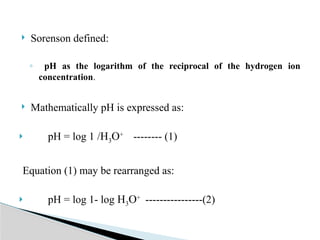
Sorenson defined:
◦pH as the logarithm of the reciprocal of the hydrogen ion
concentration.
Mathematically pH is expressed as:
pH = log 1 /H3O+
-------- (1)
Equation (1) may be rearranged as:
pH = log 1- log H3O+
----------------(2)
4.
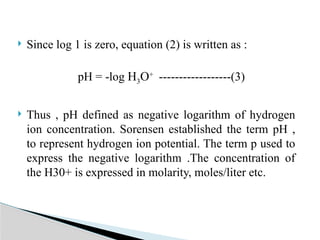
Since log1 is zero, equation (2) is written as :
pH = -log H3O+
------------------(3)
Thus , pH defined as negative logarithm of hydrogen
ion concentration. Sorensen established the term pH ,
to represent hydrogen ion potential. The term p used to
express the negative logarithm .The concentration of
the H30+ is expressed in molarity, moles/liter etc.
5.
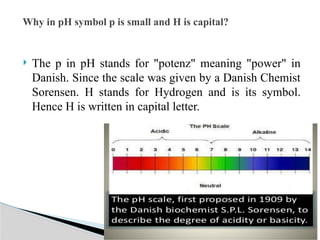
The pHvalues and different concentration of H30+ ions, a scale is
devised and named after Sorenson, who had developed it.
The scale starts with a zero pH, i.e., hydrogen ion concentration is
1(100
). It means the solution is strongly acidic.
At the other end of the scale , pH is 14 i.e., hydrogen ion concentration is
10-14
.It means the solution is strongly alkaline.
The central point pH in the scale is 7.0, because [H3O+] is equal to
[OH].
Sorensen’s pH Scale
6.
The pin pH stands for "potenz" meaning "power" in
Danish. Since the scale was given by a Danish Chemist
Sorensen. H stands for Hydrogen and is its symbol.
Hence H is written in capital letter.
Why in pH symbol p is small and H is capital?
7.
“It is asubstance which is used to indicate the end point or
completion of a reaction by it’s colour change.”
OR
“A pH indicator is a halochromic chemical compound added in
small amounts to a solution so the pH (acidity or basicity) of the
solution or end point of titration can be determined visually by
color change. “
pH indicator
8.
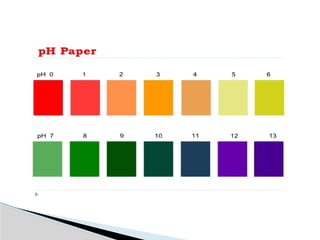
pH stripes(litmus paper)
pH meter
Types of pH indicator
9.
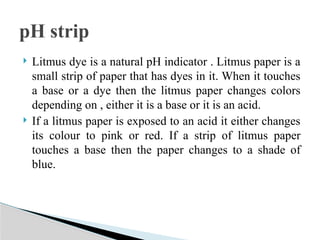
Litmus dyeis a natural pH indicator . Litmus paper is a
small strip of paper that has dyes in it. When it touches
a base or a dye then the litmus paper changes colors
depending on , either it is a base or it is an acid.
If a litmus paper is exposed to an acid it either changes
its colour to pink or red. If a strip of litmus paper
touches a base then the paper changes to a shade of
blue.
pH strip
11.
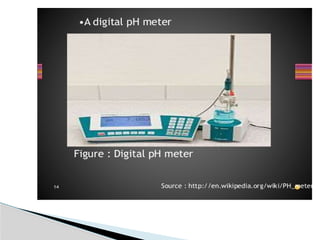
A pHmeter is an electronic instrument used for
measuring the pH (acidity or alkalinity) of a liquid
(though special probes are sometimes used to measure
the pH of semi-solid substances).
A typical pH meter consists of special measuring
probes (a glass electrode and a reference electrode)
connected to an electronic meter that measures and
displays the pH reading.
pH meter
13.
Calibration shouldbe performed with at least two
standard buffer solutions that span the range of pH values
to be measured.
For general purposes buffers at pH 4 and pH 10 are
acceptable.
The pH meter has one control (calibrate) to set the meter
reading equal to the value of the first standard buffer and
a second control (slope) which is used to adjust the meter
reading to the value of the second buffer.
A third control allows the temperature to be set.
Calibration

![ pH is the negative logarithm of the hydrogen ion (H+) activity
in a given solution.
The range of the pH scale is from 0 to 14
pH = -log [H+ ]--------------------(1)
where H+ = activity of hydronium ion
pH](https://image.slidesharecdn.com/ionizationppt1-250312150228-9a48a844/85/ionization-chapter-pharmacy-students-pptx-2-320.jpg)
![ The pH values and different concentration of H30+ ions, a scale is
devised and named after Sorenson, who had developed it.
The scale starts with a zero pH, i.e., hydrogen ion concentration is
1(100
). It means the solution is strongly acidic.
At the other end of the scale , pH is 14 i.e., hydrogen ion concentration is
10-14
.It means the solution is strongly alkaline.
The central point pH in the scale is 7.0, because [H3O+] is equal to
[OH].
Sorensen’s pH Scale](https://image.slidesharecdn.com/ionizationppt1-250312150228-9a48a844/85/ionization-chapter-pharmacy-students-pptx-5-320.jpg)