INVISIBILITY
OF WOMEN IN
ARCHITECTURE
ABSTRACT
The role of gender within a professional framework in the built environment has long been debated, and
the question still stands; what is the role of females in architecture, design and planning? Who gets what?
Where? And How? This report seeks to study and reflect the gendered nature of the beliefs, policies and
methods of implementation professionals have espoused in creating urban spaces.
Today, many would argue, and correctly so, that the situation for women within many professional
industries, as well as the women who utilise spaces generated is indeed improving. Education has indeed
expanded and diversified and become less sexist, less elitist to include feminist discourse as a legitimate
field of study. However, it is intended to examine this perception of women, as anything more than
abstract image, as although, in a quantitative sense, there are more women entering architecture, design
and planning, this is not indicative of marked improvement in qualitative measures.
The following research endeavors to investigate, through thorough review of literature on women in
architecture theory and urban development, as well as in-depth qualitative research methods whether or
not we do in fact live in a male dominated urban landscaped remnant from historical outlooks embedded
within a wider theoretical framework, which encompasses the themes of gender, design, and male
dominated views vs. feminist perspectives.
CONTENT
Chapter 1: Introduction
1.1. Problem Statement
1.2.Theoretical and conceptual context
Chapter 2: Indian History and Women
2.1. Women in Ancient India
2.1.a. Introduction
2.1. b. Vedic Period
2.1. c. Post Vedic Period
2.1. d. Mauryan period
2.1. e. Mughal Period
2.1. f. Buddhist Period
2.1. g. Medieval Period
2.1. h. British Period
2.1. i. After Independence
2.2. Women And Culture
2.2. a. Introduction
2.2. b. Women in the Vedas
2.2. c. Women in Upanishads
2.2. d. Women in the Mahabharata
2.2. e. Women in Ramayana
2.2. f. Women in Manu Samhita
2.3.History of Feminism
2.4. Women in Modern India
2.5. Changing Scenario
2.5. a. Performance of Women
2.5. b. Role of Women
Chapter 3: Role
Chapter 4: Education andEmployment
4.1 Women in Architectural Education
4.2 Studying Architecture
4.3 Women in architectural Practices
4.4 Gender biases in recognizing good work through awards
4.5 Women and Research
4.6 Women in policy making and planning
4.7 Women in architecture
Chapter 5: Women in Architecture and Planning
5.1. Women in Urban Design
5.1.a. Urban design theory
5.1.b. Women‘s Place in a city
5.1.c. Interview Findings
5.2. Writing about Feminism and Architecture
5.3. Designing and Planning Diversity
5.4. How Masculine and feminine design affectour city
5.5. Talking to people
Chapter 6: Feminism and Professionalism
6.1.Concept of Work
6.2. Feminist critiques and Professionalism
Chapter 7: Why do women leave Architecture?
7.1. Introduction
7.2. Reasons
7.3. Conclusion
Chapter 8: What could be done?
8.1. Understanding experiences of women
8.2. Balancing differences and equity
8.3. Reform of Feminist education
Chapter 9: Conclusion
Chapter 1:
INTRODUCTION
1.1. Problem Statement
The purpose of this research is to analyze and discuss the place of women in professional roles within,
architecture, design andurban planning. It is also hoped that the findings can be used to develop
awareness for policy makers and practitioners to ensure that professional women are not disadvantaged in
built environment careers. Further, the results can assist in ensuring that the policies and practices in
architecture, planning and design are fully inclusive of both genders.
Gender analysis is vital to the ability of the built environment to respond to the needs of all who utilise
planned spaces. Understanding the role of gender can be helpful in the process of developing gender
sensitive planning strategies. It is recognised that now, more than ever, in a time when cities are growing
and developing at a tremendous pace, that the identification of gender equality, along with subsequent
strategies, is imperative in accommodating change in the workplace and social demographics. The
increase in the number of women in the workplace reinforces the urgency of this task.
Women across the globe are raised to be very conscious of their femininity and gender, and how fragile
they are or should be in a very male dominated world. While the environment in which one is raised or
nurtured may be liberal and with no gender bias, one still finds certain limitations trickling in from
outside the immediate inner circle of neutrality. Equality and equal opportunity seem like an illusion, a
mirage in a desert that no longer exists! Many a time‘s women downplay their role even as they continue
to multitask efficiently and this humble perception gives their partners, staff, family, friends or colleagues
the false notion that they aren‘t contributing in a major way.
Further to this, if clients, staff and others too begin to perceive that the woman partner is no longer a part
of the main team, there is little she can do to restore their faith and confidence. The magic needs to be
apparent within the team and about the team!
In a much skewed hierarchy dominated by men and their unfortunate biases to their other-wise equal and
sometimes far better partners, there seems to be a lacuna where women lead or are given the opportunity
to lead!
The topic of gender inequality within the technological world is nothing new or ground breaking, but one
that runs so deep within social structures that it deserves far more attention than it receives. The majority
of women, not only in the field of architecture but in other professions too are being pushed into the
shadows. Why women are alone stuck with childcare and forced to give up their professions when they
could easily do both with the right support and encouragement? Why do women get relegated to the role
of secretaries when they have the potential to be equal partners? Why are students and fresh graduates
disappearing into the confines and isolation of architectural offices, with mere assistance-ship roles? Why
do young professionals disappear into the hollows of marital dogma and find their architectural forte
dying an early death? Who decides this?
Gender equality in Architecture, too, has become an increasing concern.
Women in architecture wish to be seen first and foremost as architects (not as women architects), but they
cannot control the gendering gaze of society. A good architect is not defined by gender or that being a
good architect and a woman isn‘t a singularly special occurrence– it‘s not just about sitting in an office
with co-workers who respect your abilities regardless of gender. It‘s about all the other aspects of being a
practicing architect where challenges present themselves. Have you ever met a female contractor – what
would it be like on a job site? Would a female architect have to endure (or enjoy) the same relentless
number of fishing and hunting stories that a male hear?Surely the tenor of the typical job site conversation
would be different – not more or less respectful, just different. It could be the little things like the type of
shoes someone chooses to wear. Does that really matter? Probably not but the construction worker who
has never noticed what shoes his wife is wearing would notice what is on the feet of a female architect
visiting the site. Acting or dressing ―like a man‖ — the advice women have received for decades as the
means to blend into the workplace — only entrenches a masculine norm. Yet difference in itself is not the
issue. Indeed, feminism encourages practices that accommodate differences among people and cultures.
But discrimination remains, if not a universal experience, then surprisingly commonplace. From lower
pay and fewer promotions to stereotypes about their design skills, women architects continue to struggle
to be accepted as equal players. Females believe they would be paid more if they were male, and also
experience sexual discrimination at work on a weekly or monthly basis.
The objective is to find out and analyze how this idea of gender in profession works silently all over the
world specific to Architecture. The research revolves around the aspects of gender biases, opportunities
and issues of being a woman architect. It also measures women to men gap in the domains of practice,
education and research.
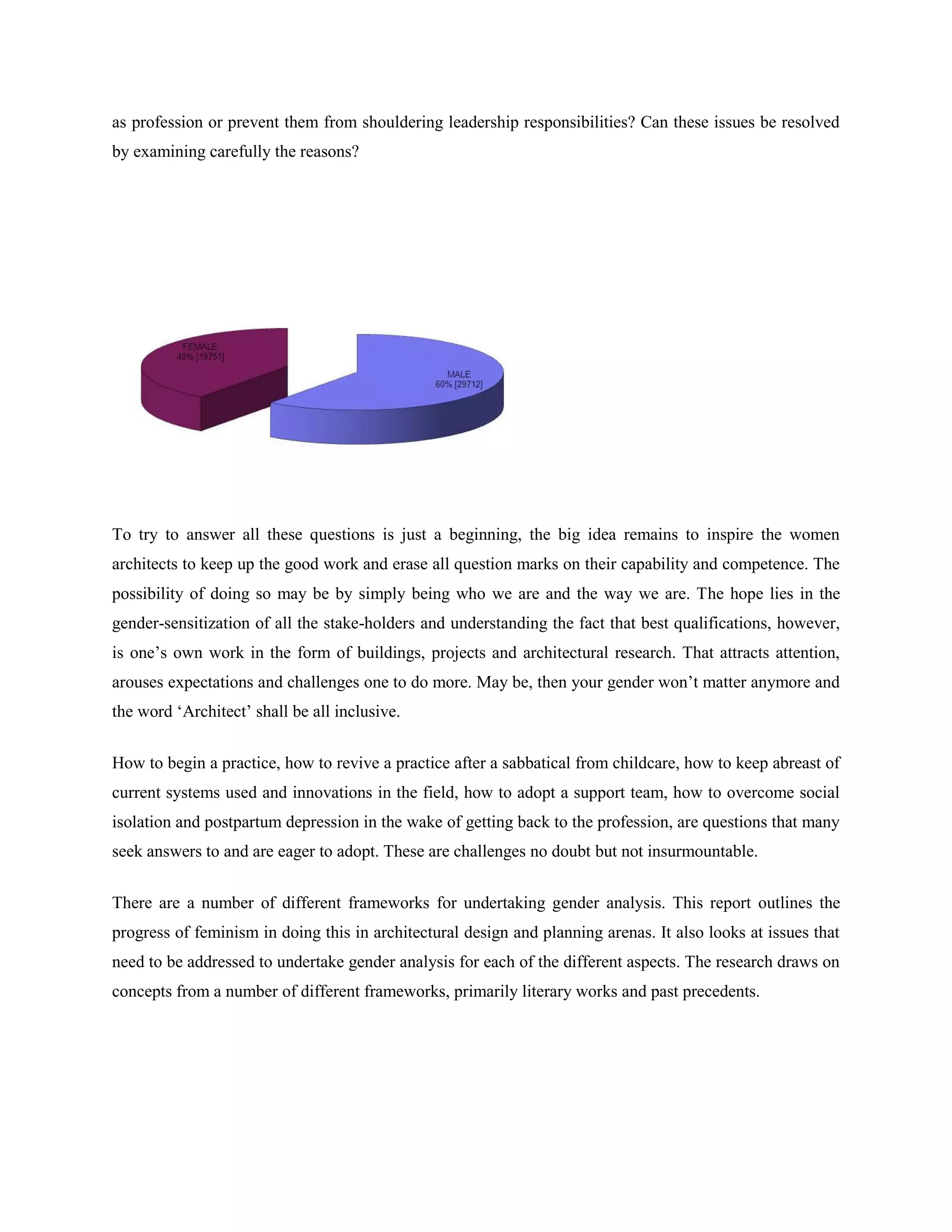
Is the profession really biased towards men? What causes imbalance between the numbers of girl-students
and women-professionals in Architecture? What are the issues which force women to leave architecture
as profession or prevent them from shouldering leadership responsibilities? Can these issues be resolved
by examining carefully the reasons?
To try to answer all these questions is just a beginning, the big idea remains to inspire the women
architects to keep up the good work and erase all question marks on their capability and competence. The
possibility of doing so may be by simply being who we are and the way we are. The hope lies in the
gender-sensitization of all the stake-holders and understanding the fact that best qualifications, however,
is one‘s own work in the form of buildings, projects and architectural research. That attracts attention,
arouses expectations and challenges one to do more. May be, then your gender won‘t matter anymore and
the word ‗Architect‘ shall be all inclusive.
How to begin a practice, how to revive a practice after a sabbatical from childcare, how to keep abreast of
current systems used and innovations in the field, how to adopt a support team, how to overcome social
isolation and postpartum depression in the wake of getting back to the profession, are questions that many
seek answers to and are eager to adopt. These are challenges no doubt but not insurmountable.
There are a number of different frameworks for undertaking gender analysis. This report outlines the
progress of feminism in doing this in architectural design and planning arenas. It also looks at issues that
need to be addressed to undertake gender analysis for each of the different aspects. The research draws on
concepts from a number of different frameworks, primarily literary works and past precedents.
1.2. Theoretical and conceptual context
In the recent years, much attention has been paid to the careers of women in the construction and
architecture in particular. Difficulties faced by women working in the architecture profession have been
identified as long working hours, poor pay, paternalistic culture, sexism and task restriction. These are all
measured against an assumed masculine norm, however, there is little or no work on what constitutes this
norm or how it came to be established, other than an idea that it is due to the critical mass of men
involved in the industry and related cultural assumptions. It has been argued that what it means to be an
architect has been determined and tightly controlled by male architects and women are thereby excluded
from these ‗masculine‘ norms. It is important that the norm of masculinity in the construction industry
must be critically examined. Through the exclusion of women from what is commonly seen as ‗manly
technologies‘, a vicious cycle has appeared where women are often intimidated to learn because they are
viewed as technologically ignorant, or not capable. This in turn breeds a further lack of confidence. This
common viewpoint where women are seen as less capable with technology than men, leads one to think
of the gender imbalance within the architectural profession. Although the numbers of women entering
into architectural education are equal or sometimes even more than their male counterparts, these
numbers do not carry through to the professional workplace. So why is still so difficult for women to
break through a traditionally male dominated field when they are equally as educated and capable? A
large part of the answer could lie with the vicious cycle mentioned above.
The findings reported widespread experience of sexual discrimination, sexual harassment and the
gendered nature of architectural salaries, as well as other data, drawing a dismal picture of women‘s
professional experiences in the industry. So the condition raises some questions about the different
locations and uses of this identity category, particularly in relation to its other, the ‗architect‘. The term
‗woman architect‘ implicitly genders the term ‗architect‘, as male. At the same time, the architect‘s
masculine sex disappears or is disguised behind the word, architect. It is the woman part of the phrase that
becomes identified with a gender when we apparently introduce gender into gender neutral architecture
by affixing woman to architect. We reinforce the visible and invisible patterns of gender production by
using the pair architect/woman architect.
The question is about the challenges of being a woman in this profession. It would make more sense on
one hand to ask these questions to a woman who is in the field of architecture – but maybe that‘s the
point. How do men feel about women in architecture?
For most part, development of the urban environment over time displayed little acknowledgment of
gender differences. Consequently, with the rise of the modern workspace and a transformation of work
ethics, professionals in the fields of planning, architecture and urban design did not distinguish gendered
needs in the city. These professionals are the women (and men) who sought to maintain the balance
between the identification of feminine perspectives as a unique and integral part of planning and
development. With the active involvement of women in bettering the urban fabric, their approach
distinguishes issues of gender from those more generally associated with unequal treatment. Nonetheless,
the early history of these professions embodies one striking similarity, that there is a sexual division of
labour, where the primary concerns of women lay in more socially oriented aspects of the profession. To
some extent, it can be argued that the theoretical context of this has not changed a great deal since the rise
of prominent female roles within these high profile professions. With the emergence of feminist studies
and the growing recognition that women play a pivotal role in the design and functionality of our cities,
social sciences and scholarship began to identify ways in which the interests of women could be better
addressed. To fully appreciate the context in which gender is applied to careers in the built
environment, the concept of gender, as well as the way in which gender fits in and affects the
urban environment, must be examined.
Chapter 2:
INDIAN HISTORY AND WOMEN
2.1. Women in ancient India
2.1. a. Introduction
There‘s nothing groundbreaking or new about the kind of life Indian women lived in ancient time. The
Rig Vedic Women in India enjoyed high status in society. Their condition was good. But from enjoying
free and esteemed positions in the Rig-Vedic society, women started being discriminated against since the
Later-Vedic period in education and other rights and facilities. Child marriage, widow burning, the
purdah and polygamy further worsened the women‘s position.
The epics and Puranas equated women with property; a few Puranas treated them no better than beasts.
Women were looked down upon as creatures worse than depraved men. Even Buddhism did little for
women.
Though the Maurya kings often employed female bodyguards, spies and `Stri-adhyaksha mahamatras‘,
their status was still quite bad.
Upper caste ladies had to accept the purdah. During this period men were polygamous and widow burning
was an accepted norm. Arthashastra imposed more stigmas on women as Kautilya dismissed women‘s
liberation and they were not free even to go elsewhere without husband‘s permission.
They became worse off in the Gupta period. The Smritishastras abused them; Manu dictated a woman
would be dependent on her father in childhood, on her husband in youth and on her son in old age. Apart
from child marriage and sati, prostitution and devadasi system became widespread. Kalidasa mentions the
presence of many devadasis in Ujjain temples. Hiuen Tsang spotted many of them at a sun temple in
eastern Sindh. Southern temples had devadasis in hordes.
ANCIENT WOMEN AND EDUCATION
There are some bright exceptions in this dismal picture. The role of women in Ancient Indian Literature is
immense. Ancient India had many learned ladies. There were two types of scholarly women — the
Brahmavadinis, or the women who never married and cultured the Vedas throughout their lives; and the
Sadyodvahas who studied the Vedas till they married. Panini mentioned of female students‘ studying
Vedas. Katyana called female teachers Upadhyaya or Upadhyayi. Ashokagot his daughter, Sanghamitra,
inducted into preaching Buddhism. From the Jain texts, we learn about the Kousambi princess, Jayanti,
who remained a spinster to study religion and philosophy. Often, Buddhist nuns composed hymns.
Women did write Sanskrit plays and verses, excelled in music, painting and other fine arts.
ANCIENT WOMEN AND POLITICS
Women often enjoyed prominent roles in politics. Megasthenes mentioned the Pandya women running
the administration. The Satavahana queen, ―Nayanika ruled the kingdom on behalf of her minor son. So
did Pravabati, daughter of Chandragupta II, on behalf of the minor Vakataka prince. A little after the
Gupta period, queens used to rule in Kashmir, Orissa and Andhra. Princess Vijaybhattarika acted as the
provincial ruler under the Chalukya King; Vikramaditya I. Women were provincial and village
administrators in the Kannada region.
2.1. b.Vedic Period
In the later Vedic period, the position of women gradually deteriorated. The period clearly sees the
growing tendency to stratify society along gender lines. Women lost their political rights of attending
assemblies. Child marriages also came into existence. According to the AitareyaBrahmana a daughter has
been described as a source of misery. The Atharva Veda also deplores the birth of daughters.
The system of Sati emerged in the shape of a formal custom during later Vedic period. The Artharva
Veda mentions that it was customary for the widow to lay symbolically by the side of her husband's
corpse on the funeral pyre.
During the period of smritis women were bracketed with the sudras and were denied the right to study the
Vedas to utter Vedic mantras and to perform Vedic rites. Marriage or domestic life became compulsory
for women and unquestioning devotion to husband was their only duty.
There are several references in the epics, Smritis and Puranas, where women and property are bracketed
together. Women came to be regarded as a sort of property and could be given away or loaned as any item
of property. It‘s because of this the Brahmanical law did not allow any property rights to women. The
provision for stridhanawas of a very limited character and does not extend beyond the wife's rights to
jewels, ornaments and presents made to her.
2.1. c. Post-Vedic Period (Upanishads, Puranic and Smriti
Periods)
The position enjoyed by women in Vedic period deteriorated in post-Vedic period. It was gradually
degraded in the Puranic and Smriti periods. The description of position before BC 300 shows that she
enjoyed a fairly high status, though not to the extent that she enjoyed in Vedic period.
It appears that several drastic changes that took place in the Indian society from about BC 300 to the
beginning of the Christian era led to the curtailment of freedom of women. Imposition of Brahminical
rules and code of conduct, rigid restrictions imposed by caste system and joint family system were the
main reasons for lowering of status in this period.
A daughter began to be regarded as curse. They were denied the right of inheritance and ownership of
property. Pre-puberty marriages came to be practised. She was forbidden to offer sacrifices and prayers
and undertake pilgrimages. Practice of polygyny came to be tolerated.
Some of the Dharamsastras mention about the prohibition of Niyoga and widow remarriage. The widow
was asked to devote herself to an ascetic life at home. Marriage became an irrevocable union as far as the
wife was concerned.
The Smriti writers preached that the wife should look upon her husband as God. Widows were required to
spend a life of penance and austerity. Sati had become popular by the 7th century AD. In this period,
women were regarded just as a means of satisfying the physical desires of men.
Just to refer one instance of Mahabharata, it is said that ‗there was no creature more sinful than man …
woman is the root of all ills‘. This simple quotation is sufficient to prove that how disrespect was shown
towards women. However, it is not out of place to mention here that Indian scriptures are full of
paradoxical statements.
At one place, women were regarded as goddess, held in high esteem, where at other place in the same
scripture, in some other context, they were regarded, no better than just slaves or chattels. Disregarding
what was practised at any particular time, the ancient Indian scriptures and documents (Mahabharata,
Ramayana, Vedic hymns, and various codes of the law of Manu) gave women a very high and protected
place in their basic moral codes.
Husband and wife stood as equals before God. Up to this period purdah (veil) was not commonly
observed by women. Divorce was, however, not permissible to them. But then, it was not permissible to
men either. Their position was not one of complete disability but one dictated by justice and fairness.
Women used to help their male members of their family in economic pursuits. They sometimes
accompanied their husband or other members of the family in hunting and agricultural pursuits.
2.1. d. Women in Mauryan Period
During Mauryan period Brahamanical literature was particularly severe in the treatment of women and
assigns them a very low status in the society. Greek traveller Megastheneswho visited Pataliputraduring
Chandragupta Mauryaruletestifies to the growing practice of polygamy; employment of women as palace
guards, bodyguards to the kings, spies etc.
The Buddhist texts on the other hand are much more considerate in treating women. The suppressed
condition of women in the society alarmed emperor Ashokawho felt the need to appoint a special group
of Mahamattasthat would be concerned only with the welfare of the women.
During Buddhist rule the position of women though inferior was not as badas it came to be in the later
periods. During Gupta and post Gupta period, equating women with property took strong roots. The
practice of using veils by women particularly in high caste families too came into vogue. In
Kadambari,Patralekha is described as wearing a veil of red cloth. However,this custom was not practiced
by common people.
In south Indiathe position of women deterioratedin post Buddhist period. Remarriage of widows was not
allowed and they had to cut off their hair, discard all their ornaments and eat only plain food. The tonsure
of widows was a custom taken over from the norththat was adopted in south Indiaduring later times.
2.1. e. Women in Mughal period
Unlike in the ancient Indian period, the position and status of women in the Mughal period (age) was not
quite high. Purdah and child marriage had become common. Except those of the lower classes, women in
Mughal period did not move out of their houses.
The Muslims women observed purdah much more strictly than the Hindus. The birth of a daughter was
considered inauspicious, while that of a son was an occasion for rejoicing. On account of early marriage,
there were many widows in our society. Generally, women in Mughal Period were not allowed to
remarry.
Polygamy was common among rich society. Divorce was not common among the Hindus, while it was
permitted both for Muslim men and women.
However, women exercised great influence at home and some of them helped their husbands in their
avocations. Generally, it was the responsibility of the men to look after the economic affairs, and the
women would take care of the needs at home.
Though, the overall position of women in Mughal period was low, there were many Hindu and Muslim
women of outstanding ability, whose fame is still relevant today.
There were many Hindu women of outstanding ability during this period, notably Rani Durgawati of
Gondwana, Rani Karmawati, Mira Bai, Tarabai, etc.
Among the Muslim women in Mughal Period, Salima Sultan Begum, Ruqaiya Sultan Begum, NurJahan,
MumtazMahal, Chand Bibi, Jahanara, Raushanara, Zeb-un-nisa, etc. played an important part in the
affairs of that time
2.1. f. Women in the Buddhist Period:
Many evil social practices, like the practice of prepuberty marriages, denial of right of women to
education and also to mate selection etc were imposed on women during the periods of Brahmans and
Puranas.
In the Buddhist period, the position of women improved to some extent. In the religious field, women
came to occupy a distinctly superior place. They had their own Sangha called Bhikshuni ‗Sangha‘, which
provided avenues of cultural activities and social services. They got ample opportunities in public life.
However, their economic status remained unchanged.
2.1. g. Women in Medieval Period
The period between 11th century to 18th century witnessed further deterioration in the position of women
due to the impact of Muslim culture. In this period, female infanticide, child marriage, purdah system, sati
and slavery were the main social evils affecting the position of women.
The birth of a female child began to be regarded as curse, a bad luck. They were almost confined to the
doors of their homes. There was further curtailment of freedom of women in matters of education, mate
selection, public appearances, etc.
Purdah system came to be rigorously followed. Women education was almost banned. More and more
feeling of conservatism increased about women. She not only continued to hold low status in and outside
home rather her position worsened in this period.
It is often said that in India the purdah (veil) system came into existence only after the arrival of Moghuls.
A.S. Altekar, in his book. The Position of Women in Hindu Civilization (1962) writes: ‗This for nearly
2000 years from BC 20 to 1800 AD, the position of women steadily deteriorated though she was fondled
by the parents, loved by the husband and revered by her children.
The revival of Sati, the prohibition of remarriage, the spread of Purdah and the greater prevalence of
polygamy made her position very bad.‘ Thus, there was a vast difference between the status of women in
the early Vedic period and the subsequent periods, stretching from post-Vedic to the medieval period. The
dual standards of morality set by Manu Smriti and other Smritis continue to prevail right up to now
though some changes are visible in urban educated women.
2.1. h. Women in British Period
During the period of British rule of about 200 years (early 18th century to the first half of 20th century)
some substantial progress was achieved in eliminating inequalities between men and women in matters of
education, employment, social and property rights and so forth.
Sati, purdah, female infanticide, child marriage, inheritance, slavery, prohibition of widow remarriage and
the lack of women‘s rights in different fields were some of the problems which attracted the attention of
British Raj.
Though the British rulers initially decided not to interfere with the traditional social fabric of Indian
people (Hindus) and as such they took no steps to bring any change in the status of women in India. It is
only in the latter half of the 19th century and the first quarter of the 20th century that they took some steps
to abolish or change some social customs through legislative measures.
For such measures incentive was provided to them by some social reformers, such as Raja Ram Mohan
Rai, Ishwar Chandra Vidyasagar, Dayanand Saraswati, Keshab Chandra Sen, Swami Vivekanand,
Maharashi Karve, Justice Ranade, Mahatma Gandhi and others.
Through the efforts and the various movements launched by these great social leaders of the 19th century
before independence, it had been possible to get many legislations passed and public opinion mobilized in
favour of some issues of social reforms.
These steps have paved the way in removing the obstacles in the progress of women. Not only this, it had
helped in eliminating inequalities between men and women and giving proper respect to the other-half of
the society.
The most significant legislations relating to the problems faced by the Indian (Hindu) women passed
during British period were as follows:
1. Abolition of Sati Act, 1813.
2. The Hindu Widow Remarriage Act, 1856.
3. Civil Marriage Act, 1872.
4. Married Women‘s Property Act, 1874.
5. The Child Marriage Restraint Act (Sharda Act), 1929.
6. Hindu Law of Inheritance Act, 1929.
7. Hindu Women‘s Rights to Property Act, 1939.
8. Hindu Marriage Disabilities Removal Act, 1946.
Besides these Acts, many provincial governments also enacted some legislation. In 1779, infanticide was
declared to be a murder by the Bengal Regulation XXI. In 1804, this was extended to other parts of the
country.
Another significant feature of the 19th century was the attempt made by social reformers to educate
Indian girls. For more than 2,000 years, from about BC 300, there was practically no formal education for
women. Only a few women of the upper castes and classes were given some education at home.
The ideas of imparting education in a formal manner first emerged during the British period. Christian
missionaries took great interest to impart education to the girls. It was in 1824 when the first girl‘s school
was started in Bombay (Mumbai). In 1882, girls were allowed to pursue higher education. Since then, to
pursue there has been a continuous progress in the field of education of girls in India.
In the last decades of 19th century, a marked change took place in the outlook of both men and women
about the education and employment of women as teachers, nurses, doctors, etc. This changed outlook
towards women‘s education also helped in rising the age of marriage and enacting legislation to ban sati.
Thus, the ground prepared by the 19th century social reformers and their untiring efforts led to the
emancipation of women. This also helped them to take their rightful place in society.
2.1. i. After Independence
In addition to the measures to uplift the status of women in India initiated by Britishers, many vigorous
steps (legal, social, economic and political) have been taken by Government of India after independence
by removing the hurdles put in their way by traditional past. The efforts of the social reformers and their
movements launched in the pre-independence period also bore fruits. The Indian National Movement also
led to the emancipation of Indian women.
The leaders of the national movement realized that the liberation of the country from the bondage of
imperialism was impossible without the active participation of women who constituted half of the
population of the country.
Most of the social reformers and thinkers of the 19th and 20th centuries were influenced by the tenets of
the liberal philosophy of the West, which emphasized the principle of contract rather than status, a
rational outlook of life and problems, freedom of speech, criticism of authority, questioning of accepted
dogmas and finally the recognition of the value of the individual and insistence on the rights of man as
opposed to his duties. They also got impetus from Upanishads and other Hindu scriptures.
The decades after independence have seen tremendous changes in the status and position of the women in
Indian society. The Constitution of India has laid down as a fundamental right the equality of sexes.
But, the change from a position of utter degradation of women to a position of equality is not a simple
case of the progress of women in the modern era. To uplift the status of women, many legislations
pertaining to women were enacted after independence. These were mainly related to marriage, divorce,
inheritance of property and employment.
Some of the important Acts are mentioned below:
1. The Hindu Marriage Validity Act, 1949.
2. The Special Marriage Act, 1954.
3. The Hindu Marriage Act, 1955 (amended in 1986 and 2010).
4. The Hindu Succession Act, 1956.
5. Immoral Traffic (Prevention) Act, 1956.
6. The Sati Prevention Act, 1987.
7. The Dowry Prohibition Act, 1961.
8. Indecent Representation of Women (Prohibition) Act, 1986.
9. Prohibition of Child Marriage Act, 2007.
10. Protection of Women from Domestic Violence Act, 2005.
11. Compulsory Registration of Marriage Act, 2006.
Besides, the Acts especially related to employment are:
1. The Factory Act, 1948.
2. Employees Insurance Act, 1948.
3. The Maternity Benefit Act, 1961.
4. The Equal Remuneration Act, 1976.
2.2. Women and Culture
2.2. a. Introduction
They call it bad Rape when someone is wrongly accused of something, and in recent Indian history both
women and Hinduism have suffered just such an injustice. To be sure, women are sometimes egregiously
mistreated in India, as elsewhere in the world. But this is not owing to Hinduism. Indeed, it is a violation
of the Sanatana Dharma. Although the position of women declined in modern times—especially during
the long period of foreign rule, which disrupted every aspect of society—most scholars agree that women
in ancient India held a most elevated position. They had similar education as men and participated with
men in philosophical debates. During Vedic times, women so inclined wore the sacred thread and were
taught the holy mantras of the Vedas. Some were brahmavadinis, women who devoted their lives to
scriptural study, expounded the Vedas and wrote some of the Vedic hymns. Women of the kshatriya
(warrior) caste received martial arts coaching and arms training. The Vedas, Upanishads and other
scriptures give numerous examples of women philosophers, politicians, teachers, administrators and
saints. The Rig Veda says, ―The wife and husband, being the equal halves of one substance, are equal in
every respect; therefore, both should join and take equal parts in all works, religious and secular.‖ The
Upanishads clearly declare that we individual souls are neither male nor female. Hinduism teaches that
each of us passes through many lives, both male and female. It further teaches the law of karma, which
informs us that what we do to others will in turn be done to us—and that ahimsa, non-hurtfulness, must be
the guiding precept of our lives. Thus, Hinduism gives no justification for the mistreatment of others,
whether on the basis of gender or for any other reason. (In the actual lives of adherents, of course—as in
any religion—―results may vary.‖)
Comparing the general position of women in our scriptures with those of any other faith, we will
immediately discover their elevated status in Hinduism. The Semitic faiths, by comparison, associated
women with evil and mortality. The Old Testament says, ―And a man will choose…any wickedness, but
the wickedness of a woman…Sin began with a woman, and thanks to her we all must die‖. The New
Testament, too, is partial to men: ―A man ought not to cover his head, since he is the image and glory of
God‖. ―And Adam was not the one deceived; it was the woman who was deceived and became a sinner‖.
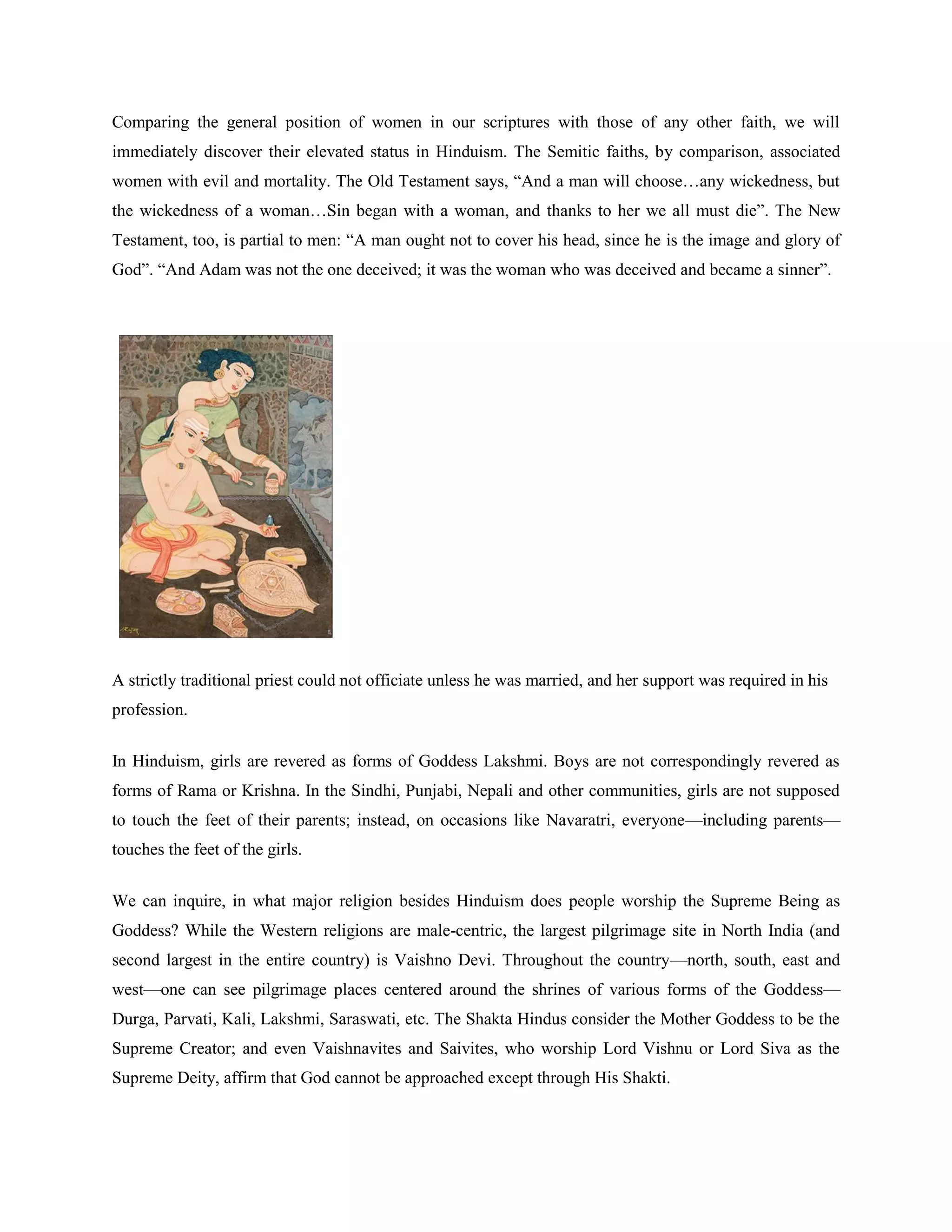
A strictly traditional priest could not officiate unless he was married, and her support was required in his
profession.
In Hinduism, girls are revered as forms of Goddess Lakshmi. Boys are not correspondingly revered as
forms of Rama or Krishna. In the Sindhi, Punjabi, Nepali and other communities, girls are not supposed
to touch the feet of their parents; instead, on occasions like Navaratri, everyone—including parents—
touches the feet of the girls.
We can inquire, in what major religion besides Hinduism does people worship the Supreme Being as
Goddess? While the Western religions are male-centric, the largest pilgrimage site in North India (and
second largest in the entire country) is Vaishno Devi. Throughout the country—north, south, east and
west—one can see pilgrimage places centered around the shrines of various forms of the Goddess—
Durga, Parvati, Kali, Lakshmi, Saraswati, etc. The Shakta Hindus consider the Mother Goddess to be the
Supreme Creator; and even Vaishnavites and Saivites, who worship Lord Vishnu or Lord Siva as the
Supreme Deity, affirm that God cannot be approached except through His Shakti.
Hindu scriptures are of two classes. Sruti is revealed scripture—the Vedas and the Upanishads. The smriti
comprise lesser scriptural texts, composed by human beings—the Itihasas, Puranas and Dharmashastras.
Within smriti, the Itihasas (the epics Ramayana and Mahabharata) are the most important and
authoritative. By the time those were written (the ―epic period‖ of India‘s history), the position of women
had deteriorated considerably, although there still existed women called brahmavadinis, who devoted
their lives to study and spiritual meditation and who participated in the philosophical discussions.
2.2. b. Women in the Vedas
Many of the Vedic rishis were women. Married and single women alike were acknowledged authorities
on the Vedic wisdom. The prophetess Gargi composed several Vedic hymns questioning the origin of all
existence. Other Vedic hymns are attributed to Vishwawara, Sikta and others. The Rig Veda identifies
many women rishis; indeed, it contains dozens of verses accredited to the woman philosopher Ghosha and
to the great Maitreyi, who rejected half her husband Yajnavalkya‘s wealth in favor of spiritual
knowledge. It also contains long philosophical conversations between the sage Agasthya and his highly
educated wife Lopamudra.
Rig Veda clearly proclaims that women should be given the lead in ruling the nation and in society, and
that they should have the same right as sons over the father‘s property. ―The entire world of noble people
bows to the glory of the glorious woman so that she enlightens us with knowledge and foresight. She is
the leader of society and provides knowledge to everyone. She is symbol of prosperity and daughter of
brilliance. May we respect her so that she destroys the tendencies of evil and hatred from the society?‖
Atharva Veda states that women should be valiant, scholarly, prosperous, intelligent and knowledgeable;
they should take part in the legislative chambers and be the protectors of family and society. When a bride
enters a family through marriage, she is to ―rule there along with her husband, as a queen, over the other
members of the family.‖
Yajur Veda tells us, ―The scholarly woman purifies our lives with her intellect. Through her actions, she
purifies our actions. Through her knowledge and action, she promotes virtue and efficient management of
society.‖
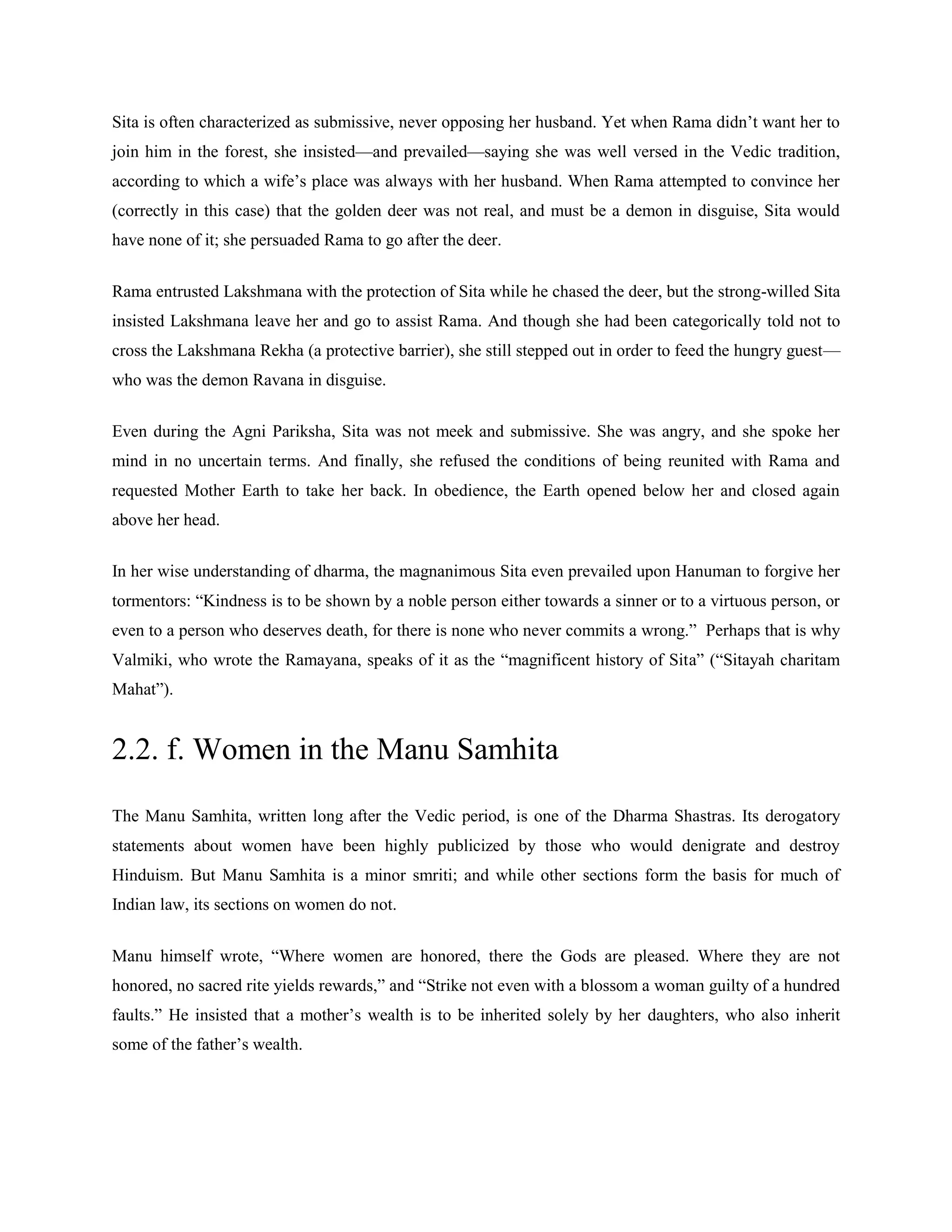
Woman as Goddess & Guardian:Goddess Saraswati, holding scripture, a vina, mala and yogi‘s water
pot, represents the ideal Indian woman.
2.2. c. Women in the Upanishads
Each of the four Vedas has four parts, the fourth of which comprises its Upanishads, which expound the
otherwise obscure philosophical meanings. The Brihadaranyaka Upanishad (part of the Yajur Veda)
contains an account of a philosophic congress organized by King Janak of Videha. The aforementioned
Gargi, one of the eminent participants, challenged the sage Yajnavalkya with questions about the soul
which confounded that learned man. Another incident in the same Upanishad relates the spiritual
teachings given by Yajnavalkya to Maitreyi.
2.2. d. Women in the Mahabharata
In the epic history Mahabharata, the noble prince Bhishma Pitamah declares, ―The teacher who teaches
true knowledge is more important than ten instructors. The father is more important than ten such teachers
of true knowledge and the mother is more important than ten such fathers. There is no greater guru than
mother.‖
Some people question Draupadi‘s having five husbands, considering that to be evidence of inferior status.
Does the opposite practice, polygamy, indicate the inferior status of its male practitioners?
By no means should Draupadi be considered subjugated. She did not hesitate to question Yudhisthira
Maharaj, something which even his brothers would not do. When the Pandavas captured Ashwattama,
who had mercilessly killed all five of Draupadi‘s sons in their sleep, Bhima and Krishna wanted to kill
him. Despite her unimaginable grief, the compassionate Draupadi did not want another woman to suffer
the loss of a child, and her moral strength and determination prevailed over the vengeful men.
Certainly Draupadi, like all humans, had her moments of weakness. The scriptures show the various trials
and tribulations in people‘s lives. Rather than judging people as right or wrong, good or bad, strong or
weak, based on isolated characteristics or events, we should always look at the total picture.
In the Mahabharata, Krishna accepted the curse of Gandhari, whose 100 sons were killed on the
Kurukshetra battlefield. The bereaved woman blamed Krishna for not stopping the war. Krishna did not
rebuke her—he listened respectfully and addressed her as Mother, accepted the curse and departed from
the Earth. How can anyone claim that the Mahabharata is demeaning to women?
2.2. e. Women in the Ramayana
Two incidents from the Ramayana are frequently cited to indicate the subjugation of women: Sita‘s Agni
Pariksha, trial by fire, and her banishment to the forest.
In those times, social standards were much stricter than the ―anything-goes‖ attitude common in today‘s
world. Royalty in particular, unlike politicians today, were held to a high standard. As Rama and Sita
were to become king and queen of Ayodhya, they were obligated to prove, through the Agni Pariksha,
that Sita had remained chaste while held in captivity by Ravana.
Sita‘s banishment to the forest is described in a section of the Ramayana called Uttara Ramayana. This
entire section may well be an interpolation, written and inserted much later than Valmiki‘s original
Ramayana, as the language is not consistent with the other parts of the Ramayana. Tulsidas and Kamban,
the translators into Hindi (Ramcharitmanas) and Tamil (Ramavataram), do not include the Uttara
Ramayana in their translations. But even if we do accept the banishment story, this is simply another
incident of royalty being held to a lofty standard, being accountable to their subjects.
Sita is often characterized as submissive, never opposing her husband. Yet when Rama didn‘t want her to
join him in the forest, she insisted—and prevailed—saying she was well versed in the Vedic tradition,
according to which a wife‘s place was always with her husband. When Rama attempted to convince her
(correctly in this case) that the golden deer was not real, and must be a demon in disguise, Sita would
have none of it; she persuaded Rama to go after the deer.
Rama entrusted Lakshmana with the protection of Sita while he chased the deer, but the strong-willed Sita
insisted Lakshmana leave her and go to assist Rama. And though she had been categorically told not to
cross the Lakshmana Rekha (a protective barrier), she still stepped out in order to feed the hungry guest—
who was the demon Ravana in disguise.
Even during the Agni Pariksha, Sita was not meek and submissive. She was angry, and she spoke her
mind in no uncertain terms. And finally, she refused the conditions of being reunited with Rama and
requested Mother Earth to take her back. In obedience, the Earth opened below her and closed again
above her head.
In her wise understanding of dharma, the magnanimous Sita even prevailed upon Hanuman to forgive her
tormentors: ―Kindness is to be shown by a noble person either towards a sinner or to a virtuous person, or
even to a person who deserves death, for there is none who never commits a wrong.‖ Perhaps that is why
Valmiki, who wrote the Ramayana, speaks of it as the ―magnificent history of Sita‖ (―Sitayah charitam
Mahat‖).
2.2. f. Women in the Manu Samhita
The Manu Samhita, written long after the Vedic period, is one of the Dharma Shastras. Its derogatory
statements about women have been highly publicized by those who would denigrate and destroy
Hinduism. But Manu Samhita is a minor smriti; and while other sections form the basis for much of
Indian law, its sections on women do not.
Manu himself wrote, ―Where women are honored, there the Gods are pleased. Where they are not
honored, no sacred rite yields rewards,‖ and ―Strike not even with a blossom a woman guilty of a hundred
faults.‖ He insisted that a mother‘s wealth is to be inherited solely by her daughters, who also inherit
some of the father‘s wealth.
2.2. g. Women in India Today
Social customs vary from age to age and from place to place. India‘s customs regarding women were
severely impacted by the centuries of invasions and foreign occupation, when the careful protection of
Hindu women became essential. All aspects of Indian society have suffered the British-imposed Christian
educational system, the tearing apart of families by proselytizing faiths determined to gain converts by
any possible means, and the further disruptions caused by a relatively swift change from a historically
stable, largely agrarian society to one intensely focused on manufacturing and technology.
Under the influence of the male-centric Western religions, the role that comes most naturally to most
women—wife and mother, the children‘s first guru, the Shakti of the home, the preserver and enhancer of
the spiritual force field of the home and family—has been effectively disparaged and has become so
despised in the mass mind that any reference to it is now perceived as an attempt at subjugation.
Every religion looks to its scriptures and its holy men and women for guidance. What other religion has
access to the sort of guidance regarding women that is contained in our revealed Hindu scriptures? What
other religion has scriptures that treat women with respect, not to mention reverence—and that speak of
God as both male and female (though ultimately neither)? What other religion has female leaders
comparable to our great women gurus?
Although the more recently written smriti scriptures show considerable divergence from shruti through
the millennia, our revealed holy texts depict the noble place of women in society. As the dawning Sat
Yuga returns in its fullness and the entire world comes to appreciate and honor the Sanatana Dharma, we
can look forward to the time when women will once again be accorded respect and their rightful place in
society—each one revered, whether she chooses to focus on the role of wife and mother or to become a
scholar, philosopher, temple priest, medical practitioner, scientist, author, astronaut, artist or
stateswoman.
2.3. History of feminism
The following section briefly outlines feminist movements from a historical perspective, from the
position of the built environment, as well as an independent field of literary discourse and study. The
analysis of gender is also discussed in light of the roles and positions of women in the professional world.
Feminism encompasses a range of discourses and practices committed to the political, economic and
social equality of women and to a doctrine of social transformation which aspires to establish a world for
women beyond rudimentary equality.
With the increased development of feminist approaches to disciplines and professions, discussions in
planning and design regarding the needs and experiences of women are becoming more common.
Alongside increasing dialogue regarding feminist issues, there are now also more collaborative
approaches to professional practice. Such concepts of feminist planning and design can be expressed
within a professional code, values in professional relationships, address power imbalances, equity,
emphasis on process and the natural environment. Further, its role within the realm of the built
environment and planning professions would useful to informing awareness in development.
Feminist studies have long been concerned with the environment. However, this study historically refers
to the natural environment. Primarily through eco-feminism, extensive focus has been placed on the
relationships between women and nature, its preservation, and the prevention of its destruction. The
designed environment -- the places and spaces that human beings design and create -- is largely absent
from the women's studies agenda. Designed environments are only in more recent years being taken into
account within academic teaching, conferences, and journals, despite the rich outpouring of feminist work
in design and related technology fields, and despite the critical importance of the environments where we
live, work, and play to women's well-being and women's empowerment.
2.4. Women in modern India
Our Indian sub-continent is gradually emerging as a powerful land since women began playing significant
role for the development of the nation. Role of woman in modern India can be called as phenomenal. The
transition of woman from the past to present is worth mentioning. Woman who once considered being the
masters in the art of home making are now considered to be the forces that shape a country.
―The hand that rocks the cradle rules the world.‖ -Albert Einstein
PRACTICAL STATUS OF INDIAN WOMEN
There was a time when women were just kitchen keepers and house keepers in the Indian society.
Gradually women began to get educated, even highly educated and a stage came when some of them
came out on the social and political field to rub shoulder with the men folk in these fields. The freedom
struggle of India was the opening up of the new horizon for womanhood in India. In modern India,
women have adorned high offices including that of the President, Prime minister, Speaker of the Lok
Sabha, etc.
“LET THE WOMEN REACH THE SKY WHICH IS THE LIMIT!”
2.5. The Changing Scenario
In those days women faced many Social Problems like Dowry, Child Marriages, Death during Childbirth,
Sati and many social problems but nowadays the status of women in India has been subject to many great
changes over the past few millennia. The year 1995, was declared as the International Year for Women
throughout the world. The women were made aware of their status and place in society. Women are now
no longer in slumber. They are awake and moving fast.
2.5. a. Performance of Women
There is no arena, which remained unconquered by Indian women. The most important name in the
category of women politicians of recent times is Mrs. Indira Gandhi. Kiran Majumdar Shaw is the richest
Indian woman. Some of the notable and outstanding women who set examples for others are Mother
Teresa, Kalpana Chawla, Kiran Bedi, Sarojini Naidu, etc. Indian women have mastered anything and
everything which a woman can dream of. But she still has to go a long way to achieve equal status in the
minds of Indian men.
2.5. b. Role of Women inModern India
The status of women in modern India is a sort of a paradox. The modern Indian women have honed their
skills and jumped into a battlefield of life fighting against social restrictions, emotional ties, religious
boundaries and cultural clutches. She can now be seen working on par with men in every field. As
compared with past women in modern times have achieved a lot but in reality they have to still travel a
long way. Their path is full of roadblocks. The women have left the secured domain of their home and are
now in the battlefield of life, fully armored with their talent. They must avail themselves of the
educational opportunities provided and learn to empower themselves.
"Educate a man and you educate an individual.
Educate a woman and you educate a family."
-- A.Cripps
Chapter 3:
ROLE OF WOMEN
―A woman is the full Circle. Within her is the power to create, nurture and transform‖. Diane Mariechild
Historically women in India were revered and the birth of a girl was widely believed to mark the arrival
of Lakshmi – the Goddess of wealth and riches. Women have been considered ‗janani‘, i.e., the
progenitor and ‗ardhanigini‘ i.e., half of the body. Women are also considered to be an embodiment of
Goddess Durga.
Women have shouldered equal responsibilities with men. Widespread discrimination against women is,
however, reflected in recurrent incidents of rape, acid throwing, dowry killings, wife beating, honour
killings, forced prostitution, etc. Some of these issues were highlighted by ‗Satyamev Jayate‘ (Truth alone
prevails) – an acclaimed television show hosted by Bollywood icon Aamir Khan.
A global poll conducted by Thomson Reuters in 2012 rated India as the ―fourth most dangerous country‖
globally for women, and the worst country for women among the G20 countries.
Gender discrimination is not only inequitable but also hampers the development of the nation. Evidently
no country can sustain its development if it underutilises its women, who constitute almost half the
population. Despite some basic changes in the status and role of women in the society, no society treats
its women as well as its men. Consequently, women continue to suffer from diverse deprivations from
kitchens to key-boards, from the cradle to the grave across nations. But, as Kofi Annan stressed, no
development strategy is more beneficial to society as a whole than ―treating men and women alike‖.
Besides, their entrepreneurial role in cities, Indian women contribute significantly to agricultural
activities, handicrafts, village art and crafts. Factors impeding the advancement of women include lack of
access to housing and basic services, inadequate support services and technologies for reducing drudgery
and occupational health hazards and for enhancing their productivity. This necessitates devising of a
broad-based strategic action plan for the realisation of equal partnership of men and women in all spheres
of life and economic activity. True, there are some striking cases of breaking the glass ceiling. The names
of Meera Kumar, Speaker of the Lok Sabha; Sushma Swaraj, Leader of the Opposition in the Parliament;
Chanda Kocchar, Chairperson, ICICI Bank; Shikha Sharma, Chairperson, Axis Bank; Kalpana Morarka,
India Head, JP Morgan and Sudha Sharma, Chairperson, CBDT easily come to mind. But as one swallow
does not make a summer, the fact of some women occupying top positions does not make the
development process broad-based, equitable and inclusive. Clearly, much more needs to be done. The
gross under-representation of women and the attitudinal bias against women is strikingly reflected in
several areas of employment like the police, the judiciary and the law, etc. The correction of this unhappy
situation requires focused intervention targeting education, training, child care, health, nutrition, credit,
employment, welfare services support and legal safeguards. In the struggle for independence, it was
stressed that political freedom must ultimately lead to emancipation of women by eliminating
shortcomings in terms of education, nutrition and health. But this aspiration is yet to be realized. Investing
in women‘s capabilities and empowering them is the best way to advance economic growth and overall
development. The Indian political system has also been characterised by concern with women‘s status and
rights. This is reflected in various constitutional provisions. But robust gender laws need to be effectively
enforced. Laws relating to marriage, divorce, maintenance and inheritance have not been fully effective
because of their inherent problems. Hence, attempts to provide de jure equality to women must be carried
to their logical conclusion. This requires tougher laws, stricter enforcement and exemplary punishment.
Let us do some number crunching: As per 2011 Census, there were 940 women for every 1000 men in
India. Female literacy in India is 65.46% as against male literacy of 82.14%. As at end-March 2011, 21%
of total bank deposit accounts constituting merely 12 % of total deposits were held by women. Similarly,
women availed only 18 % of the total small credit from banks in 2011.Women constitutes about 25% of
the formal employment in India whereas 84 % of rural women continue to be engaged in agricultural
production. Hence there has to be a shift from narrow welfare measures to broad-based development.
There has also been a greater awareness of the need for inculcating confidence among women, generating
awareness about their rights and privileges and training them for economic activity and employment. The
benefits of development must extend to women both qualitatively and quantitatively. Gender-specific
policies with emphasis on activities and resources beneficial to women may help in providing greater
opportunities because of the injustices against women. But what is required is affirmative action in areas,
such as, education, health and welfare to overcome entrenched discrimination caused by gender bias,
denial of opportunities, lack of employers‘ trust in their capabilities and apprehension about not getting a
fair deal. The national policy for empowerment of women stresses policies, programs and systems to
ensure mainstreaming of women‘s perspectives in all developmental processes, both as agents and
beneficiaries. It is time now for us to make a difference and effect a mindset change in the oppressively
male-centric scheme of things and bring about true socio-economic empowerment of women across
regions, regions and classes. We can-and we must- do this. But gender integration and promotion of a
cohesive social framework requires active participation of all stakeholders in the development process,
including the society at large, government, educational institutions, premier technological institutions,
voluntary agencies, policy makers and women themselves. The journey of emancipation of women has
crossed many milestones. But affirmative action is required for women to play their rightful role in the
society. The task ahead may be long and tortuous. But let us make a beginning immediately. As a woman
in Indian society, I find that the world is changing a lot in terms of acceptance of the many roles of
women as professionals, as bread-earners in families and as independent thinking individuals. The
traditional Indian woman has evolved to prove herself equal in many professions as well as proved better
suited than men in others. The situation for the changing role of women is improving fast. On the other
hand, female feticide, dowry deaths and domestic abuse provide a macabre background of primitive
barbarism. In the typical Indian Society, you find that there are still expectations and assumptions about
women that are not so much relevant to their current status, but a clear hangover from our suppressive
past. This may be more obvious with traditional women or women in rural societies, but it is extremely
prevalent in urban ones as well. We are speaking of ―running the home‖ kind of stuff. Regardless of how
hard the man and woman of the house work, when it comes to women and society, there are certain areas
of the home that are the woman‘s province in happy times and her nemesis in not so happy times. ―As the
woman of the house, you should….‖ is a familiar refrain for most women in India.‖ Indian Women‘s
clothing is another externally imposed recommendation backed by vicious judgments. A pregnant woman
is a public drop box for intrusive recommendations. I think it is high time that we as citizens of modern
India took a good hard look at our automatic assumptions and investigated which among these are still
applicable today, and which ones we simply need to let go. Typical situations we see include the woman
bringing a cup of hot tea for her man returning from work, or the woman returning home after her
husband and heading straight to the kitchen to cook dinner, and so on. On an average, in any home where
women are working, their income is also important to the well-being of the home and the living standards.
Where it is not a question of money, it is generally possible to employ someone for the work in the house.
So when we speak of a traditional role of a woman being responsible for the efficient running of her
home, it is something we need to be aware of as an additional expectation made from her. The traditional
role of a man has been the one of earning the money for the running of the home. This has changed to a
great extent. Working women contribute to the expenses of running their homes as well. However, there
has been little contribution from men in terms of shouldering some of the responsibilities of women. One
interesting insight I received into this was from a friend. He said, ―See, women find the outside world
challenging and attractive. They like the freedom it brings to them. So they enter the world. There is no
reason for a man to find the women‘s traditional role appealing, so he doesn‘t. No one has forced the
women to step into the man‘s role, and no one should force the men to step into a woman‘s role‖. On the
surface, this seems to strike sense. However, the flaw lies in an assumption of current roles that are the
same as traditional roles and that the women are entering ―a man‘s territory‖. This simply doesn‘t hold
true in most cases today. Women are educated and often have their careers well before they get married
and it is as much their right as the man‘s work is his. However, the other part, where the men don‘t find
the house work appealing enough to invest effort in still holds true. This is something that needs to be
taken an honest assessment of. If we abandon the traditional perspective of division of responsibilities
inside and outside the home (since it has already been broken in the outside the home area), we come to a
situation where the couple are both inhabiting a home and earning and contributingtoward its running.
What we need to find is a sharing of responsibilities inside the home as well, that allows both some
dignity. This would also help resolve many situations where a man feels threatened by a working woman.
Why wouldn‘t he. She earns, she spends, she invests, and on top of that, she is independent in terms of
being able to manage her own existence completely, including running of her own home. ‖It does not
empower men to be left incapable of managing the home they live in‖. There is no point pushing the
women down. What needs to happen is the removal of the ―un-machoness‖ associated with
responsibilities at home and recognise it as the actions of a responsible and independent individual,
whether male or female. This would actually add some power to the increasingly ―lazy‖ image of men
among women and empower them with some self-respect, while empowering the women with acceptance
and support from the one source that matters the most. Please note that we are not speaking of every man
out here. There are many couples who are already on this journey and find themselves comfortable both
inside and outside the home, and the mutual respect and closeness can be seen a mile off in such couples.
We sincerely think that this is an important adaption that is the need of today‘s times.
Chapter 4:
Education and Employment
There have been subsequent generations of women in architecture, whose practices belong to the post-
Independence period. The second generation women studied architecture during the heady days of
Nehru‘s vision for a modern and socialist form of state controlled industrializing India as the field of
architecture began to become more popular. They worked with the restrictions on imports of construction
materials, labour intensive and low cost methods as well as low energy construction technology. Apart
from that, it was also personally a hard struggle where they had to, by and large, deal with severe social
restrictions, absence of any networking and lack of professional understanding or gender awareness
among parents and the society. The situation has become easier as time has passed. Here it is important to
point out that many architectural practices are increasingly based on a creative collaboration between a
husband and a wife as partners. Or in rare cases an unrelated man or women also join hands for setting up
an office. This model has proved powerful and successful all over the world. Women professionals often
struggle in isolation; instead such partnerships become mutually supportive. This arrangement has its own
advantages and disadvantages, sometimes leading to misattribution of the work to the male partner, often
because he is better known, or, rarely, the other way around. Generally the partners‘ design jointly,
however, it is rather difficult to exactly separate the roles and contribution of each one.
During the education in the 1960s and the 1970s, women in architecture were exposed to modernist
theories and praxis which forms an underlying layer of their design approach. However, many have
moved beyond its narrow confines and have gone much further in myriad directions. Their practices have
succeeded greatly in the mainstream besides making a name for themselves in sustainable architecture, in
the field of conservation and preservation with some of them developing multiple identities. Thus, there
are highly accomplished women architects in India today whose work has a wide range and an excellent
quality. They now have a body of work and also national recognition.
A few successful women architects should not be taken as evidence that there are no barriers to women‘s
total acceptance in the profession. The gap between politically assumed/constitutionally guaranteed
gender equality and the ground reality, though decreasing day by day, is still vast and needs to be
recognised. As mentioned in the beginning the dropout rate of women graduates from the profession is
high due to several reasons.
It is primarily because it takes a long time to be recognised in the field of architecture for men and women
both, the social odds being particularly against women. The period of investing in a woman‘s career
generally overlaps with having a family and raising children among other things. If a break is taken to
raise a family, then it is difficult for her to catch up as the situation changes in a few years, in terms of
professional set-ups, building technology, materials and even software, including her self-confidence.
As a result, in the collective consciousness of the society and the discipline, the professional environment
is gender neutral although women have minimal visibility in the public domain, marginal leadership
positions and a non-iconic presence, indirectly resulting in a predominant patriarchal culture.
4.1. Women and Architectural Education
Education transmits knowledge and skills. The educational institution is where one's values are
interpreted and legitimized. . The discipline of architecture is deeply embedded in the cultural world and
the culture of an institute is closely connected to its teaching ideology and pedagogy. ―Architectural
education, although obviously intended as vocational training, is also intended as a form of socialization
aimed at producing a very specific type of person. All forms of education also socialize students into
some sort of ethos or culture. These two functions are inseparable."
―Architecture is inclusive of allied and applied aspects of humanities, aesthetics, built environment
techniques and skills, technology and engineering sciences and allied management systems. While
utilising relevant information and knowledge from these disciplines, it goes beyond them to be a unique
and holistic discipline of architecture.‖ Humanities, social and building sciences and structure courses are
kept as major papers to complement the designing process since architecture is also about understanding
people and dealing with complex interpersonal relationships at all stages in the practice. The assimilation
of the various related courses with the design curriculum should help to create more holistic studios
ideally; the reality needs a check though.
The architecture profession has long been dominated by men. This does not mean, however, that many
women have not become architects. Women make up between 25 and 50 per cent of the student
population in architectural schools or sometimes more than that. The majorities of these women complete
their degrees but why, after they have completed their education, many women apparently leave the
profession. Institutional practices such as organization of curriculum, the relationship between theory and
practice and administrative set-up enable or constrain particular forms of knowledge. The popular opinion
in India is that architectural education is bias-free, relatively liberal and gives equal opportunity to all for
success. In India, professional schools generally suffer from implicit gender bias because feminist
thinking has not entered the mainstream educational consciousness. As a result, without the integration of
feminist theory, the creation and transmission of knowledge on designed environments through curricula
and pedagogy are largely missing.
According to the data by Council of Architecture website, the number of girl students in Architecture has
been constantly rising from 70‘s till date. In 70‘s the average number of girl students getting registered
with the Council was around 550 and in 2014 it was the maximum of 4034.
4.2. Studying Architecture
As educators, we want our students to embrace the professional world as if there were no barriers, while
knowing that these persist. Do architecture schools have a responsibility to better prepare their graduates
— male and female — for the profession‘s gender politics? Do we increase the possibility of failure by
glossing over these issues with the rhetoric of progress and equality? Indeed, by acknowledging a less-
than-level playing field, architecture schools might help their female graduates to persevere by providing
theoretical and practical coping skills that could lessen the dramatic attrition rate of women in the
profession. At the same time, male graduates would develop greater understanding of the need for and
their role in fostering a better-integrated and equitable workforce. But these discussions are not happening
in most architecture schools is unsurprising. To an astonishing degree, the ―subject‖ in their curricula, as
communicated in studios and history/theory courses, remains male. Beyond syllabi and textbooks, there
are other ways in which schools communicate to students that the ―best‖ architects — the ones you want
to learn about and from — are and male. . Since architects tend to lecture about their own projects,
students, accordingly, hear less about the work of women. Lectures that address the histories of female
architects are rare and often set apart as special ―diversity‖ lectures, rather than incorporated into general
programming.
Other departments today — sociology, history, literature, et al. —have abundance of courses that broaden
students‘ knowledge beyond the legacy and experience of ―dead men.‖ Where are these courses in
architecture schools? And how has this gulf between architecture and other disciplines been sustained for
so long? In recent decades we‘ve seen an explosion of scholarship on the relationship of architecture to
gender. While one could in the past blame a lack of supporting materials for these curricular gaps, that
excuse is no longer tenable. More and more, the absence of women as subjects of architecture seems less
an oversight than a tacit exclusion. The crucial transition from school to practice is at the heart of the
profession‘s gender imbalances, for while women graduate from architecture schools at near parity with
men, less than 20 percent become licensed practitioners.
4.3. Women in Architectural Practice:
A GLOBAL PERSPECTIVE
It is worthwhile to take an overall perspective of Women in Architecture around the world for which the
comparative analysis of four regions: England, the United States, Australia and India is being presented.
England: - In England, after the First World War, opportunities opened up for women in architecture. It
was after the Second World War that critics began to question the male dominated nature of the
profession. RIBA also started holding exhibitions on women architecture in 1984. A survey with about
170 respondents was conducted in England, Wales, Scotland, Ireland, America, Australia, Germany,
Singapore, Canada, Hong Kong and New Zealand with women in various arenas of and around
architecture. 37 respondents were not working in architectural practice. Of these 1 was engaged in
architecture research, 6 were in education and remaining were not working in architecture practice as they
either chose alternate careers or were not working at all. When asked about the legal contract, most did
have a written contract, but some did not. This leads to concerns about lack of clarity around the agreed
basis of employment.
The idea that men and women should be treated alike in terms of salary and other rewards seems an
elementary notion of fairness and consistency of treatment but for most people lack of knowledge made it
difficult to demand this straightforward right. Lack of transparency in relation to pay was a crucial
consideration as most interviewees were completely unaware of the salaries obtained by colleagues so it
was difficult to argue any case about the consistency of treatment. Responses to the questionnaire
indicated that there were instances where males were favoured over women in obtaining promotion. Only
women that are prepared to be men (behaviourally) had a slight chance of promotion. A concern raised
from the questionnaire was that some women suffered from loss of confidence because of their treatment.
Replies to questions on working hours demonstrated many offices endorse a long-hours culture which
employees felt forced to go along with to show their ‗commitment‘. It was evident, particularly from the
interviews that many women would have appreciated the opportunity to work in a more flexible way.
Long hours and inflexibility were cited by some interviewees as reasons for their departure from the
profession. It was clear that many people felt that the work/life balance and the long hours culture had
contributed to their decision to leave. The RIBA commissions an annual survey providing statistical
information on schools of architecture. The 2000/2001 report indicates that the proportion of female
students has steadily risen over the past decade to 37% and that the dropout rates for male and female
students are similar. There were 14 respondents who are currently involved in teaching architecture and
one who had left. 3 of the 14 were also working in practice.
Answers to questions on equal opportunities were generally inconclusive but one respondent did state that
she had been advised that women are not in senior enough positions to sit on the University equal
opportunities committee. 28 students‘s currently studying and 18 women who have studied in the last 10
years responded to this section of the questionnaire. It is significant to note that on being asked whether
they wanted to leave architecture because they had chosen the wrong profession no respondents said
‗yes‘. They all gave other reasons for leaving and none said that they hated the activity of architecture.
The United States: - Women make up more than half of the professional and technical workforce in the
United States. While the status for women in the workforce has improved over the last several decades,
many women still struggle for equality in many occupations. However, many still face overt or subtle
employment discrimination, contributing to continued inequality. In December 2014, there were over 73
million working women in the U.S. While women were just under half of the general workforce (47%),
they represented a majority of those in professional and technical occupations (51%). The proportion of
women to men in the workforce changed dramatically from only a generation ago. In 1972, women
represented just 38% of the workforce. After years of steady growth, the number leveled off in the
mida1990s and has remained close to the current percentage for the last two decades.
While a larger proportion of women are entering the workforce, uneven representation across occupations
and industries persists. In 2013, 15% women were in architectural practice. Women have a lower
workforce participation rate than men at every level of education; however, the gap shrinks at higher
levels of educational attainment. Approximately 32% of women over the age of 25 with less than a high
school diploma were in the workforce in 2013, compared to close to 60% of men with less than a high
school diploma. Those not in the workforce either chose not to work or were no longer seeking work due
to labour market conditions. Among those with a bachelor‘s degree or higher, 71% of women and 80% of
men were in the workforce in 2013. Despite high levels of education, and strong representation in
professional and technical occupations, women still face a persistent wage and earnings gap. While there
are a number of factors that may influence the differences in earnings between men and women in the
aggregate, (such as higher proportions of women in lower paying occupations) the wage gap continues
even within individual occupations. Amongst professional and technical workers, the wage gap persists in
almost all occupational groups.
Australia: - There are 18 Architecture Schools in Australia. In 2011 there were 9222 students in total
across the two degrees. 42% of them were women. The proportion of women graduating from
Architecture Schools increased rapidly from the mid-eighties to the mid-nineties. It then leveled off. From
1990-1999, women averaged 40% of all graduates. From 2000-2010 this increased to 41% of all
graduates. At the end of 2010, 975 students graduated, 427 of whom (44%) were women. 4 If we take
registration as a measure of women‘s participation in the profession, there are 10,516 registered architects
in the Commonwealth and 2,286 of them are women (21.7%). In 2004, women were 14.3% of registered
architects. At work the membership of the Australian Institute of Architects can also be assessed. In 2012,
there were 11,738 members of the Institute 3,020 were women. This constitutes 26% of Institute
members. However, there are different categories of membership and the pattern of membership differs
quite markedly for each gender.
The Indian Perspective: - Women architects have been participating in the field in increasing numbers
as designers (and as teachers/researchers) in contemporary times. However, even today, there are very
few large practices where women are the sole principals. In the past 25 years, many women architects
have opted to establish successful partnerships with their architect husbands or male/female partners.
Some women work in governmental and municipal organisations. Many of them devise alternative
models to mainstream practice or diversify into nontraditional roles. However, they are much less visible
in terms of leadership, academic success and excellence in practice. This is universally applicable, in
varying degrees, including to the situation in India as women professionals continue to face hurdles at
various stages due to their gender in glaring contrast to other design fields such as media, fashion,
graphics and textiles. Many women graduates give up the idea of working for someone or independently
practice after a while. Many others branch out in related fields. As a result, women in architecture have
not yet developed a critical mass in practice. This is ironic because their intake has been steadily
increasing – from two/four women students in the 1940s – in the 280 odd colleges of architecture for the
past 25 years. The key question is: Can anything be done at the level of education? The popular opinion
of this situation is that processes in architectural education are biasfree and give equal opportunity to all
for success. The women students‘ percentage of admission ranges from 50 per cent to 80 per cent today.
In spite of this fact, the number of women in professional practice drops substantially to about 15 per cent
to 17 per cent.
What are the hidden barriers for women? First of all, there is the equality myth. Without gender
sensitivity, the built environment is commonly treated as a neutral background. In an attempt to be
‗mainstream‘, most of them stay away from ‗women‘s issues‘ for fear of being labeled as feminists or not
being accepted as a ‗true‘ professional. This makes us take the situation for granted, adding to the
marginalisation of the subject and its solutions. By contrast, in the USA for instance, by accepting the fact
that there is direct/indirect discrimination towards women professionals, much has been achieved. Most
famous and celebrated architects that students study and see in publications are male. There are relatively
few women in high positions such as heads of departments of architecture or principals in firms. It is not
often that women find representation in national architectural competition juries, in lecture series, as
inauguration guests, on interview panels or on college inspection visits except as tokens. Central bodies
like the Council of Architecture (CoA) or the Indian Institute of Architects (IIA) also have very few
women on their boards or in a position of leadership. All these factors combine to undermine the
confidence of the woman, ultimately affecting her performance in practice.
The architectural course is increasingly perceived as a ‗feminine‘ profession with the assumption that
girls will be able to work from the office and also handle the home front. Both men and women graduates
face difficulties in the real world. At the same time, women students have restrictions imposed on them
due to their social conditioning and strict family conventions. Although this attitude has been changing in
the last few decades, in most communities it has still not come to mean that women can become
predominantly career/business oriented. The absence of research is reflected in lack of theoretical
development on gender. Ignorance of these issues in practice gets reflected in design. This is compounded
by the fact that gender is not acknowledged in built environment history and in related contemporary
publications.
4.4. Gender Biases in Recognizing Good Work through
Reputed Awards
It is important to unravel why the gender identity of ‗‗star architects‘‘ tends to be male while recognizing
the works of professionals. It posits that this masculine dominance has to do with a dovetailing of
different factors. First, the traditional role model for architects has been gendered male, especially when
that role model is manifested through the concept of ‗‗genius‘‘. Second, the words used to describe the
performance of the avant-garde in architecture - cutting edge, innovative, daring, original - are more in
line with ‗‗masculine‘‘ than with ‗‗feminine‘‘ features. Third, the idea of authorship, crucial for the self-
conception of the profession, benefits men more than women.
This hypothesis is backed up by a discourse analysis of the jury citations that legitimise the selection of
the Pritzker Architecture Prize winners from 1979 onwards. There exist many contributing factors
reinforce one another, making for a system that produces many heroes and few heroines. The Pritzker
Architecture Prize is now more than 30 years old yet the list of 37 laureates to date features only two
women—Zaha Hadid in 2004 and Kazuyo Sejima in 2010 (as a partner in SANAA).
From a feminist point of view, the favouring of individual authorship as exemplified in the Pritzker Prize
poses multiple challenges. First of all, as is clear from the above analysis, the architect genius is
traditionally gendered male and it is thus inherently difficult for women to fill these shoes. Second, even
though the actual practice of the profession might evolve towards more collaboration, both with other
architects and with other professions, the cultural system of merit necessitates the continuous production
of role models—reinforcing rather than diminishing the importance of authorship. Third, the gender bias
is so intimately interwoven with the very conception of the profession that it seems an almost
insurmountable task to change it.6 To gauge career trajectories of women primarily through the prism of
gender invites us to produce more subtle theories of identity, lived subjectivity and mechanisms of gender
identification in feminist architectural research. The term, woman architect, invites us to think about the
hyphenated nature of identity.
4.5. Women and research
We are a design-focused discipline. The area of architectural research in India is by far the most
neglected. In educational institutions, unlike the West, there is no strong tradition nor is there any strict
research requirement for faculty promotion. The building industry, the architectural profession, the
colleges of architecture-none is structured in a way that facilitates or promotes systematic inquiry for
knowledge building. Designers generally rely on intuition, personal experience and precedents. The
research limitation is acutely felt in teaching where a heavy reliance on western publications still exists,
especially in courses on theory, history and technology. In addition we are faced with our society's poor
awareness of design fields, especially architecture as well as the invisibility of gender discrimination.
Within this context, the exclusion of gender considerations has specifically submerged the role of feminist
knowledge in the discipline. This lacuna has direct implications on policy making. We also need to find
mechanisms for real estate firms and construction industries to support some of the research. There are
vast avenues of inquiry that need to be addressed at individual, institutional and government levels.
4.6. Women in policy making and planning
At the moment, women play rather insignificant role in bodies that control political decisions.
Simultaneously design issues related to women are generally ignored in policy and planning processes.
The first step therefore is accepting the reality of the situation in order to address the gender angle. The
buzz words in planning today are, of course, "infrastructure development", "market forces" and "real
estate growth"! Often we forget that cities are about people after all! Our cities have increasingly become
less accessible to the marginalized population thatis the poor, physically challenged, children and women.
For example, if we take the Indian streets, in the guise of "development" they have become more and
more unfriendly towards the pedestrians (as footpaths are disappearing), the cyclists, the vendors and such
others. In addition, in the physical planning processes in India, the neutrality of the user is taken-for-
granted and the element of people‘s participation is minimal. We suffer from fragmented and contested
nature of policy implementation. Like cities, gender relations are porous, multifaceted, and a constant
work in progress. With increased violence inflicted on women in public spaces, the awareness about the
urban environment and gender is growing. But this is not recognized at policy level. The urban public
space is not just about women's safety but about their right as citizens to full access, including for
pleasure. For example, the public transport design has to take into consideration the lived experiences of
women not only in the growing numbers in the work force but also the home makers.
The profession of architecture is changing in a positive way in the 21st century; it is much more
collaborative, pluralistic and inclusive. New modes of practices are emerging and women can no longer
be peripheral to it. Simultaneously, women are also increasing as primary clients and patrons as their
money/social power rises in different fields. Let us challenge the status quo and create a climate to bring
feminist perspective and discourse to the profession. I would like to end with the line: "We cannot change
the world but we can certainly make a difference."
4.7. Women in Architecture
Over the past couple of decades, there has been a growing interest in the history and theory of South
Asian architecture, especially as the concept of ‗other‘ modernisms took root. The Modern Movement
often coin cided with the modernization of postcolonial societies, India being one of them. After
Independence in 1947, she ( women ) employed architecture as a means of expressing the vitality and
―modern-ness‖ of the young nation state; freely adopting the design principles of the Modern Movement
as a vision of the future, that was based on a functionalist language free of colonial associations and
references to traditions. During the past six decades, a range of modern architecture evolved in the
different regions of the subcontinent; affected by myriad of styles, forms and socio-political references.
However, in the perception of the world, the richness and complexity of Indian architecture is limited to
the celebrated edifices of the ‗star system‘ consisting of the male master architects who have dominated
professional and scholarly discourses since the 1960s and 1970s. Within the trajectory of twentieth
century modernism, women architects in India have been marginalized to a great extent. One of main
questions is in the historical trajectory of Indian architecture, where are the women?
In the 365 plus colleges of architecture, the intake of women students has been steadily increasing since
1990s. In fact, it ranges around 60% average just now. So the other crucial question is: what happens to
the hundreds of women graduates? The glaring gap between their presence in educational institutions and
in actual profession is highly visible. What is not visible is the indirect spatial discrimination that affects
women users as 50% of the population. We need to seriously review women as designers and as
consumers of space. There are many reasons for lack of such efforts in India but one of the main one is
that our disciplines have no connection to the knowledge developed in the field of women's study. But
before we go into it, it‘s important to go through a brief background about some of the pioneering women
in India.
An examination of the history of Indian architectural discourses reveals that, for the most part, issues of
race, gender, ethnicity and nationality do not figure in the scholarship, unlike a number of other
disciplines parallel to architecture. As the issue of gender has been widely ignored in theory and practice,
it affects the production of feminist knowledge and submerges its role in the narrative.
The narrative of women in the discipline, in a way, parallels the development of modern Indian
architecture. As a few women began to join architectural courses in the 1940s, they were influenced by
ideas and ideals of nationalism due to the freedom struggle led by Mahatma Gandhi being at its peak then.
At the same time, their design attitudes were also not above the dominant impact of the current trends of
western architecture then, such as the Art Deco, the International style, Brutalism, and the Garden City
movement. Mostly educated in the West, they were shaped by the aesthetics and utopian aspirations of
early modernism. Belonging to well-connected and liberal elite families, these women were exceptional
not only in their choice of the profession but also in their personal lives as they worked towards careers
that made them transgress established spatial and social boundaries of home. They led unconventional
personal lives in a society where women were traditionally defined by family, marriage and children.
They had sophisticated taste and were aware of the arts such as literature, painting, dance and music.
The second generation of women architects studied architecture during the heady days of Nehru‘s vision
for a modern and industrializing India as the field became popular. Women architects had many vistas
and varied challenges open to them in the twentieth century as designers, educators, researchers and
critics as they were the beneficiaries of political reform and the project of modernity. In the past two
decades, there has been a sharp increase in the number of women joining architectural courses in India. A
few successful women architects are taken as evidence that there are no barriers to women‘s acceptance in
the profession. So, the conference aims to ponder upon the issues and possibilities related to women in the
field of architecture
Development of our country depends on the empowerment of women. A man and a woman are like two
wheels of a cart. The cart can move fast and safely too, when both of them pull it in the same direction
and with equal strength. Hence no developing country or society can afford to ignore the role of women,
if they are to progress.
―You can tell the condition of a nation by looking at the status of women‖
-Jawaharlal Nehru.
Chapter 5:
WOMEN IN ARCHITECTURE AND PLANNING
Interest in the status of women throughout the world has resulted in, amongst other things, a steady
growth in studies addressed to analyzing and highlighting the ―gender‖ factor and bias within the nature
of housing and urban planning legislation. This chapter discusses the role and goals of women in
architecture and planning. How the very nature of being female can affect and inform one‘s planning
directions. These factors can be conscious decisions, or sub-conscious acts inherent to the comparatively
compassionate and environmentally aware character of a woman.
It is becoming more apparent that architectural authorities have a pivotal role in shaping the built
environment through the production and implementation of development plans. However, research
indicates that the needs of women have not been given as much attention as those of men in the
formulation of such policies and that a generic, rather than gendered, approach to mainstreaming prevails.
―Gender is given a relatively low priority relative to other over-arching policy considerations, such as
environmental sustainability or racial equality‖.
While architectural authorities exert considerable influence over the design and operation of the built
environment and the planning system, their decisions are based on Local, State, and Federal policies for
development. The formation of such policies requires planners to integrate a variety of knowledge and
experience in a broad range of social, economic and environmental considerations. It remains that,
however, the needs and requirements of women, as practitioners in design, as well as users of the built
environment have not been taken fully into account in planning policy and practice. As a result, the
introduction of gender considerations into the statutory planning system has now become an issue of high
priority in the development and implementation of planning policies and controls. Central to these
developments is the process of community consultation and engagement.
From this it can be seen that a transformation has to be prompted in the planning process, so that women
may take an active role in decision making processes and allow them to be incorporated in the process of
developing designs for residential areas that maximise the ease of (for example) travel to improve safety
and amenity.
Although there is increased integration of feminist dialogue in modern urban planning, the needs of
women are not reflected in the same proportions in planning processes and the profession itself.
Improvements to this phenomenon continue to be seen in additional community consultation, the steady
rise of women in the workforce and in planning, and progress in the provision of infrastructure to cater for
women‘s needs. Despite this, it can be said that women‘s contributions to planning may be under-
recognised. One explanation of this could be that women‘s ways of ways of knowing and working are
different from the ―rationalist, competitive and hierarchical models promoted by the traditional
architects‖, whether male or female.
While there has been, through many years of study and evolution, significant data collected and generated
on women and the problems they face, many aspects of feminism in architecture simply deal with
education, employment, leisure, and health. However, discussion on equal access to opportunities and
resources affect or reinforce the conditions of a female in an architectural and feminist perspective.
Although blatant attitudes of sexism and exclusion are no longer common in today‘s architecture,
planning and development, it is evident from studies of attitudes and outcomes of architectural policies
that such orientations arise from architects failing to take into account that a diversity of interests must be
considered. This is to say that architects have, for some time, made generalisations about the ―common
good‖, glossing over key differentiating factors in the needs of men and women. Conversely, gender
mainstreaming goes ―beyond a concept of ‗equality‘ based upon ‗treating everyone the same‘ (as men)
because it takes into account the differing lives of women and men, and consequently requires planners to
reassess, afresh, the land use and development requirements of each‖.
Drawing on a synthesis of secondary data sources, including an extensive body of research and published
material on ‗women and planning‘, and on ‗gender and space‘ we attempt to explain why it is important
to mainstream gender into spatial planning, both at a professional level, and from feminist perspective.
Over the last 20 years a wide range of international research has demonstrated that the needs of women
have not been adequately taken into account in the planning of town and cities. It has been shown that
gender differences have implications for all aspects of architecture and planning of the built environment,
from the interior design of housing to the planning of entire cities. Based on this, one would have
imagined their needs would be given higher priority in the planning process than has found to be the case.
Specific gender roles result in women using the built environment differently from men, with distinct
needs and expectations in respect of urban structure and planning policy. Today, most women combine
paid work with caring for the family. For example, over 47 per cent of women of working age are in
employment.
The concept of mainstreaming gender studies into the profession can be applied to the allocation of
resources and aid in the development of a more refined set of principles of social justice so as to redress
gender inequalities. This is to provide for women the necessary tools so as to enable them to participate
fully as political, social, and economic citizens. With this in mind, basic planning principles must be
reconstructed in such a way that they are applicable to the relationships between the genders. In the public
sphere, this means eliminating the barriers to women‘s participation in employment and community
participation, provision of a basic income guarantee, along with an equitable tax and healthcare system.
Mainstreaming the notion of gender, and its key differences, where relevant, is the vital component in
reforming the planning profession. One major aspect is the changes in access to education over the years
which have allowed women to gain high levels of tertiary education, and thus higher levels of educational
qualifications to partake in the shaping of the cities in which they live and plan for. To illustrate, recent
studies conducted in the United Kingdom found that almost nine out of 10 adults in Britain think more
women should be involved in designing our towns and buildings, and that placing women in charge of
designing our towns and cities would make them more practical and user-friendly.
Despite an increasing proportion of women in planning, women continue to face gender bias in a variety
of ways. Women in the architecture still face a significant wage gap. Women in planning programs
continue to experience subtle, as well as some quite blatant, forms of harassment and discrimination. And
women in general are disproportionately affected by the lack of affordable housing, the lack of child care,
transport options, and funding for care of the disabled. There is also the major concern of safety for
women in and outside the home. Despite this bias, architects have, by and large, been unable to
adequately cater for the problematic nature of gendered perspectives.
As such, architectural educators and professional architectural associations have a responsibility to
address issues of gender inequity within the profession. To overcome this historic and systemic bias
against women, it is necessary to integrate feminist perspectives in both the educational and the
professional practices of architects. What is important is whether a planner recognizes the existence and
causes of gender inequality, understands the specific needs of women which stem from this inequality,
and whether she or he has a professional commitment to advocating changes in the current system.
As part of the qualitative studies conducted in association with this project, a respondent has indicated
that while there has been an almost exponential increase in the number of women in the workplace, many
fail to reach the top of the corporate ladder. This corresponds with the results of surveys conducted
overseas. This response also represents many similar views apparent in the planning realm. The informant
also draws into the picture constituents such as age, experience, and the sense that some fields of planning
differ from others in terms of what the architects can actively contribute to feminism in architecture.
5.1. Women in Urban Design
5.1. a. Urban Design Theory
This chapter discusses theories in urban design, the relationship between feminist approaches to urban
design, actions and interventions, and design outcomes, all of which result in the creation of the urban
environment that reflect the quality, livability, and evolution process of a city. Rather than alienating any
of the theories and ideas mentioned above, which will ultimately result in ad hoc environments with little
chance of success, by encompassing feminist theory and physical relationships of spaces, better strategies
can be achieved and implemented.
―In the evolution of cities, human intervention has taken place at every level of organisation and design,
architecture and urban planning- in other words they have been designed‖ (Cuthbert, 2005, p.1). Urban
design and its related theories are expanding disciplines, continuously evolving and drawing on the
ideologies and practices of what can essentially be viewed as its sibling disciplines of architecture and
town planning. Traditionally, urban design theory was not given recognition as an independent discipline,
but rather as a somewhat insubstantial hybrid of its major theoretical proponents, including, but not
restricted to economics, social and political science, psychology, geography, or the humanities.
It can even be said, that urban design has not even embraced what today would be recognised as
―significant sub-disciplines, such as urban geography, urban economics, urban sociology, or cultural
studies, the latter only recently emerging as a major force in critical theory‖ (Cuthbert, 2005, pp. 2). Until
relatively recent years, urban design has been somewhat removed from its own distinct and substantial
theory as a discipline. It has been seen as a combination of other related professions, for example, a macro
scale form of architectural design, or more site specific version of city planning and legislation.
Notwithstanding this, the interrelated concepts and relationships suggest a theoretical dependency on
architecture and planning, focusing narrowly on the function of urban design as a social technology.
While it should be stressed that urban design in itself is a pluralistic body of knowledge, recognition of its
theoretical integrity lies in a deeper understanding of its social process, in which the key element is to
discard the notion of urban design as being an element of design derived from other environmental
disciplines.
Its power derives from the fact that, irrefutably, it is a deeply embedded social practice that societies have
valued from time immemorial, and therein lays its value. As such it does not have to justify its existence
through reference to a discrete set of home grown theory‘.
Architecture and planning have been seen as main contributors to bodies of feminist work in design, the
two at times grouped together, spatial design and urban layout of cities acts as a key constituent in
feminist discourse in these fields. Such feminist discourse is detailed and recorded in now well
established associations of registered and recognised professionals such as ―Constructive Women‖
Traditionally, as seen in other areas of feminist studies, much of this work began as historical, uncovering
women's roles and contributions. One of the most significant aspects of feminist literature found in urban
design and planning is that it demonstrates how feminist work repeatedly challenges and influences
changes in existing paradigms.
The role and purpose of feminist perspective critique of the process and nature or designing our urban
environments must serve to expose the gendered assumptions that inform the spaces and places we
experience in our daily lives-whether in the size and shapes of tools and appliances; the layout of rooms,
apartments, houses, city streets; or the design of computer programs and electronic media.
Another role taken on by feminist critique is to show and examine how the feminist perspective can be
dealt with in a creative manner whilst keeping within the confines of real issues in the needs for designed
urban environments raised by feminist analysis. Academics and professionals should direct attention
away from theoretically based critique analysis to action. Further, feminism should be brought to bear on
design, taking into account sensitivity to power imbalances of race, class and other inequities, as well as
those of gender.
There needs to be an integration of design and feminist principles within urban design theory. This
integration should bind theory and practice, taking into account practicality, emphasising designed
environments and women's studies. It is also vital that relevant materials on designed environments are
integrated into knowledge for other disciplines, such as urban planning and architectural design. The
exploration of home, work, school environments, for example, place focus on what is familiar. In
addition, the examination of public spaces, including the street, neighborhoods, transport, public
surveillance and building design move the study area into the wider designed environment. A key issue to
be explored here is the blurring of the public and private, which has important gender implications as the
old dichotomies break down with women more visibly in the public sphere. This point is central to the
theoretical underpinnings of the presence of feminism in urban design theory.
Focus on process is another important factor in feminist critiques of urban design. It examines how things
are designed and how the process should take place. Greater depth in the examination of theoretical issues
reveals deep seated relations to general feminist theory. Collaboration with planners and architects (as
mentioned in previous chapters can help to relate women‘s concerns, such as safety, access and
transportation. Still another area to look at more closely would be technological aspects, making
connections with existing work being covered, not only in women and technology, but also in computer
and media studies. The use of personal and collective experience as the benchmark to integrate theory and
practice will serve to keep urban design grounded in a social context. In turn, this can include the
promotion of collaborative and participatory processes whilst adhering to concerns for ethics and values.
5.1. b. A Women‘s Place in a City
The problem of work and family balance occupies a distinct spatial dimension in the minds of a city's
users. For those households in crisis where the woman may be experiencing domestic violence or social
isolation, vulnerability can be amplified by location and the constraints of design. For others, material
culture is an anathema; the home acting as an empty box in need of commodities and consumables. While
double income families can overcome the problems of established housing patterns, price and the
complex matrix of access to employment, schools, child-care, safety and other social services leaves few
options to the vulnerable woman. Far more efficient use of the city can be made by recognising the need
for a different environment. Housing design and the thoughtful location of services and facilities can aid
in bettering a woman's position in the city.
The role of an urban designer, as a profession which includes both men and women, is to use the powers
of influence bestowed upon the individual by their training and expertise to push for change and
development to make better places. Places which inspire the notions of community, promote user-positive
changes. Feminist paradigms must not be forgotten or rejected in order to effectively create quality urban
environments. While design professionals may not necessarily view themselves feminists, they do tend to
unconsciously classify themselves into certain categories within the overall field to incorporate feminist
rational that is more logical in layout and dispersion for all users, not simply women.
To date, the mainstream of urban design thought has not been shaken by debates about feminism and the
nature of masculinity and femininity. This is not to say that urban design writings have been completely
blind to the notion of gender. Women have entered the discussion on a number of levels, but have yet to
occupy center stage. As debate about the future of urban areas increases in intensity, the need to include
gender relations becomes more acute.
The most appealing topic for urban designers has been that of safety and security. Considerable effort has
been made in examining issues of safety and security with regard to a number of situations ranging from
city centers to housing estates and green spaces.
Thus far, the message is that women are particularly vulnerable to the fear of harassment and attack and
that this considerably limits their use and enjoyment of public spaces within the city. In addition, the
extent to which assumptions about a 'natural', ‗fundamental‘ or ‗biological‘ division between the sexes
has been inscribed in the built environment itself has received considerable documentation. Much of the
existing research elaborates the manner in which the built environment has been structured around
stereotypical notions of masculinity and femininity. It has been argued that these models have been based
on idealised notions of gender relations which were, and are, of dubious universal value. A number of
groups have been formed to provide support and assistance in the eradication of the delineation between
industries which are seen to be more suitable for women, or conversely, more male dominated.
The nature of the debate has now moved on, and adopted a more philosophical approach to a mode of
analysis which has pre-occupied feminists and designers, with one main aspect being the consensus that
women cannot simply be treated as a group of people, but rather as a line of study that pursues the
oppositions of male and female, along with their use of and contribution to the design of urban space.
Questions about the future shape of urban areas cannot simply be ignored. In this discussion, which
focuses on providing for the future economy and contemporary lifestyles, questions of gender relations
are central.
There is significant change in contemporary gender relations and in turn to lifestyles and culture. For
example, women from ethnic minority communities can no longer be portrayed as silent victims, as many
are finding a new voice and increasingly powerful positions in a still reluctant host society.
As the decline of traditional 'male' industries have become more apparent, the labour force has been
become more flexible in terms of working patterns, stereotypical relations of male breadwinner versus
female dependent have been transformed. This is not translated into women being better off, but rather
that there is a complex picture of an increase in independence and choice for women.
In summary to this chapter, the urban fabric is comprised of both masculine and feminine elements.
Whilst many hold negative views of contemporary urban living and place emphasis on the positives of
traditional town centers and communities, one must not forget that many of the changes which have
occurred are the results of genuine shifts of power in relations of gender, sex and race and that some of
these transformations in relationship have been entirely positive.
5.1. c. Interview Findings
To augment the interview data for the planning and architectural professionals, another in-depth interview
was conducted with an experienced practitioner. The informant has planning and urban design experience
and holds a managerial position in a prominent organisation for planning and design department. This
informant discusses a range of personal experiences and situations encountered over the past 20 years.
Since commencing her career as a cadet planner in Victoria in 1989, the respondent has been involved in
many aspects of urban planning. While she considers that there has been great progression in terms of
addressing systemic discrimination or disadvantage based on gender, there still exists a lack of
recognition for gender related issues. She believes this is more prominent in the public sector than it is in
private consultancies.
The respondent‘s decision to seek to progress her career in urban planning and design was largely
motivated by tertiary studies, where she studied urban geography. As a result, urban planning was seen to
be ―a great fit to apply my understanding of urban systems to future development‖ (Urban Designer
interview).
When questioned on personal objectives and visions translating into the professional workplace and the
design process, the respondent indicates that personal aspirations do not gain a great deal of recognition in
a field that is largely dominated by legislation and the need to objectively assess and respond to issues.
Similar to the responses of the other interviewees, she indicates that whilst skills and expertise are applied
when looking at a development proposal or negotiating a design proposal, it is critical that planners
working for public authorities actually look to the relevant statutory controls rather than applying their
own ‗wish list‘ of how they want a design to be resolved. ―I have seen many circumstances over my
career when inexperienced junior planners and designers doggedly demand design changes with little or
no skill or understanding of what these actually achieve – or how they may jeopardise another more
significant aspect of the development‖.
This aspect is especially important in providing practitioners with recommendations on how to achieve
the most optimum level of compromise. Designers should allow for the factor of gender to come into play
in terms of recognition of differences, but at the same time, not let this outlook to impact on development
in a way such that positive design is compromised through lack of knowledge. The issue, according to the
respondent is that design objectives must be defined by statutory authorities so that the staff can utilise
these guidelines when called upon to assess a preliminary development or design proposal. While she
does not believe that a practitioner‘s personal ‗vision‘ of design is completely irrelevant to project
outcomes, she stresses that when one is not within their field of expertise, for example trained in
architecture or design, then that does not warrant expressing any vision in the project outcomes. In this
instance, the respondent takes a seemingly objective stance in relation to be best possible design solution
or planning outcome.
In relation to her considerations when taking on a project, she points out that ―ideally all projects should
be challenges – but the reality is that we have little choice in the real world as to what projects we take on
or not whether we work in the public or private sector. For instance, as I am a consultant, I don‘t have to
agree with a planning project to take it on – that is the reality when working in the private sector‖.
As this research was prompted by motivations in seeking a balance and equality in the professions of
architecture, planning and design, it was important to make enquiries regarding perceptions of the
presence of feminist aspects of the respondents. It was also useful to discuss the balance between
retaining one‘s position as a woman whilst progressing in the professional arena in workplaces which
until relatively recent years, failed to give women the full recognition their work deserved. When
confronted with questions relating to feminist perspectives and whether or not she feels feminism is
relevant in today‘s workplace, the participants states: ―Yes – feminist issues range from the provision of
additional female toilets in retail and entertainment facilities – through to the design of subdivisions and
lack of public transport integration with new development resulting in the necessity for families to own
two cars to just access basic services in local areas. In this one response, the importance of gender can be
seen in several planning and design areas/situations.
The respondent does not, however, feel that policy makers and practitioners take female users into
account in their design decisions. When asked to what extent does gender come under consideration in the
policy making process, she responds, ―Not at all, the only provision is the building regulation
requirements in most circumstances for disabled access (which has the benefit of assisting parents with
prams). And similarly, they neglect older people and young people‘s needs‖. This response is contrary to
that of our other interviews. For someone who has been in the industry for a long time, her response is
indicative of the differing perspectives an individual has on how change takes place. As stated above,
younger female professionals interviewed tended to have a different view than that of this more
experienced practitioner. She does, however, go on to say that the private sector does take female users
into account in their developments, with the best example being the ―impressive new services provided in
retail centers where there are dedicated parking spaces for careers with prams, and family friendly
accessibility‖. In relation to feelings of difference in the workplace, the respondent firmly believes that
the disparity in perspectives that was so entrenched in the profession a decade or more ago still exists in
the workplace today. She follows on to recommend that it is necessary to incorporate feminist
perspectives into design and planning, and that proliferation of feminist perspectives will only succeed if
it is integrated with an overall approach that priortises all neglected groups. Such groups include, but are
not restricted to older people, parents, people with disabilities and young people as a recommendations do
you have for improving policy creation and implementation so as to incorporate an essentially feminist
perspective.
While she does not feel that there has been a significant step forward in the redefinition of female
architects/urban designers/planners, ―although many senior women are working in these areas, women in
construction group are trail blazing the building and construction professions‖. In order to succeed in
these professions, ―You need to have a thick skin and work twice as hard as the men‖.
These parallels lie in the perception that is driven by the desire for success, that women must work twice
as hard to exert their authority and establish themselves in an industry which has [been documented] long
been a man‘s domain. This trend has been, and continues to be bucked, by women, such as the third
interviewee. She maintains that today, hard work and dedication does pay off and one is recognised for
their abilities and achievements in a way that was previously receiving lack of documentation.
Contrary to the results of the previous findings, the third respondent indicated that her experience of
sexist attitudes in the workplace was confined to the public sector in local government. ―I have found the
private sector to be incredibly supportive of women in the workplace, where as in the public sector, I have
been sworn at by elected officials – and called derogatory names. Needless to say, I was very much
unimpressed and angry – given my hard work‖. She also stresses that in order to avoid and alleviate these
instances of discrimination, executive management must ensure they do their part in monitoring behavior
in the workplace. On the whole, as was found in the other interviews, although she is confronted with
day-to-day challenges, both professionally and personally, her level of job satisfaction is high, ―I have had
high levels of job satisfaction in my career as I have enjoyed the challenge of urban planning‖ (Urban
designer interview).
5.2. Writing about Feminism and Architecture
There has been a plethora of books and collections on the issue of gender or feminism and architecture.
These ranged from international perspectives on public versus private sector experiences, to more multi-
disciplinary studies venturing into professions such as engineering and surveying, all of which help to
provide an insight into the situation of women within the architectural profession today. The vast array of
material on the subject range from edited collections to essays and books largely fail to target a specific
topic or issue in architecture. Rather, they encompass an often disparate assortment of ideas. However,
the most prominent and striking characteristic is that most of these edited collections hold a common
desire to be pluralistic. The editors refrain from providing a framework for rendering and rigidly
interpreting the intellectual terrain in the book. Some even opt choose to subdivide the chapters into
sections, claiming that such formal structures are divisive and alien to the multidisciplinary nature of
feminist work.
Whilst this refusal to provide an explicit interpretation is considered to be relatively postmodern, the lack
of framework and basis for selection may unintentionally convey to readers a lack of intellectual
development, connectedness, or even synergy of these myriad projects and writings.
Furthermore, various academics have discussed and reprimanded that general lack of stance or conceptual
framing posed by the editors of these collections. With the growing number of these collections and
special journal issues in the past decade, feminist scholars have become more visible, vocal players on the
stage of architectural inquiry and practice. Yet ironically, the postmodern turn away from grand narratives
and has suggested that since all voices are partial, an attempt at overarching synthesis or even
categorisation is simply a wasted effort. However, within an appropriate context, these texts are
nonetheless insightful and through the vast amount of information provide further development of
conceptual frameworks upon which new studies can be based and elaborated upon. Accordingly, the
material serves to benefit researchers and practitioners alike.
In the process, the marginalisation of women in architecture must also be questioned and the categories
themselves must be challenged.
In-depth history, alongside analysis of the challenges that face women in architecture, and the place of
feminism itself in architecture, brings new knowledge and experience to areas such as domestic space
design, symbolism, critique, and professional roles.
Visibly, with the onslaught and insight of post structural criticism in the 1990s, there was a recognition
that not all frameworks were set in stone; they are dynamic and follow developments in the consciousness
of scholars. But if there exists several frameworks for study, feminist dialogue has a solid foundation on
which new findings can be made. ―What is not being said when refusing to frame this ecumenical blend
of feminist projects and epistemologies is that creating such a comprehensive, nuanced, yet elegant
framework that could embrace, not straight-jacket, the various feminist contributions in architecture over
the past twenty years is a Herculean task‖
In the introductory essay to the book ―Design and Feminism‖, Rothschild and Rosner (1999) organise
feminist work in architecture along three avenues of inquiry. In the book, there were three major sections
running along three themes. "Women in Architecture" discusses the work of neglected women architects
and the demographic accounting of women architects. "Spatial Arrangements," explores how women
experience the spaces they occupy and use, while "Theories of Architecture and Gender," examined
architecture in terms of female-male and feminine-masculine differences. The theories of many feminist
architects challenged the social context and social conditions that make a multiplicity of differences
matter.
In order to effectively fill in the silences in feminist architecture, the concept of inclusion, as well as
architecture as a diverse and multidisciplinary profession must be recognised. Within are elements of
design, history, psychoanalysis, literary studies, and philosophy, but also archeology, sociology, urban
planning, urban design, policy design and legislation, science, engineering, and politics.
5.3. Designing and Planning Diversity
The concern crosses professional divides, and many firms and organisations are pressing for a more
diverse profession where ethnic minority groups and the under-represented can also take part in the
profession and contribute to the shaping of their built environment.Collaboration with feminist architects
and planners would enable teachers to embark on new progressive projects. Should feminist architects
and planners' ideas and approaches be incorporated into education, students are more inclined to develop
non-sexist attitudes toward the built environment. Moreover, the academic setting could provide a venue
for female architects and planners whose views are under-represented in the professions.
Female architects and planners could also provide role models for aspiring students, serving as inspiration
for students to participate in future designs and positive project outcomes from a perspective which
deviates from the mainstream. Through encouragement in contributions to the design, planning and
management of their surroundings, feminist outlooks can be perpetuated from the initial stages of study,
planning, and eventuating in the design and construction. More experienced architects and planners can
help to clarify the profession for those wishing to pursue a career in the profession.
Within government agencies, this is also possible. Experience can be passed on regarding the political and
bureaucratic decision-making process and its strengths and weaknesses. This can encourage students to
―question proposed solutions and would assist them in formulating subsequent knowledgeable opinions
and actions, and judge built form and space and ultimately to develop more socially responsible
environments‖
Although some argue feminism in architecture is becoming more evident regardless of the gender of the
designer, there are some real and tangible constraints on female architects in terms of time management,
the need to place emphasis on family life, and lack of flexibility on the employer‘s part. The biggest
constraints on time and energy placed on women are linked to the widely accepted social convention that
women are responsible for domestic duties. While today‘s society is far more accepting of women in
professional roles, and encouraging the concept of equality, there has been no marked improvement on
how to balance these new professional responsibilities with domestic ones. Employers often fail to
recognise this as an acceptable excuse for compromised work hours and sticking to commitments. In
order to successfully manage personal and professional development, many women see chances for career
advancements as a tradeoff for family responsibilities.
The chief setback many female architects experience today is the time for one to become established. Due
to the intensive and involved nature of the profession, female architects experience something of a clash
between their career and the ―biological clock‖. Following qualification, practical experience, and the
prospect of establishing themselves professionally, a woman has most likely reached a stage in her life
where domestic duties have also peaked in terms of demand and relative importance. Professional
advancements overlap with the timeframe in which a woman is also seeking to ascertain her role in the
home, as a wife and a mother, placing extra strain on her ability to perform in the workplace at an
―optimum‖ level, a definition often used by employers in an economical context.
5.4. How Masculine and Feminine Design Affects Our
City
Louis Sullivan, described a towering building as: ―A man... a virile force, an entire male... it sings the
song of procreant power‖. Similarly, Leslie Kanes Weisman criticises the urban skyscraper of the
twentieth century as ―rooted in the masculine mystique of the big, the erect, the forceful - the full balloon
of the inflated masculine ego. Skyscrapers in our cities compete for individual recognition and
domination while impoverishing human identity and the quality of life.‖
The built environments world has, up until relatively recently in terms of the existence of architectural
design as a discipline, been largely defined by men. Of which the skyscraper is the most apparent
example. Much closer to contemporary architects however, the design of cities and homes can reflect a
rich set of ideas about professional architecture, women, and family life.
It has been said that female designers tend to have a greater empathy for diversity, whereas male
practitioners have a greater tendency to focus on technologies, structures and construction. This reflects
largely the assumptions of a woman‘s nature, being the role of the nurturer, and that of men being the
traditional ―bread-winner‖. The proliferation of women in the professional realm challenges these
traditional views and while the female agenda has become accepted, and at time even invisible, some of
the men dominating design and planning perpetuate old values through practices and unconscious actions
which can be misconstrued as a form paternalism or sexist behavior (Architect interview)
Conversely, some dispute the suggestion that women hold a softer design approach to men. The dilemma
lies in one key factor. In striving toward a more feminist approach and promotion of equality, men and
women tend to be categorised differently thus resulting in a self-promoting wheel of feminist discourse.
Often, the bias can be evident from the developer‘s point of view, and the architect and planner simply
follow instructions in being told what is acceptable to the public. The emerging shape of more feminine
based architectural design is the modernisation of retail development, access to natural surroundings, and
designing in a way that is convivial and focus on connectivity. By minimising walking/travel distance for
pedestrians as well as vehicle owners, networks which have been designed by female architects tend to be
smaller in scale and more intimate. Focus should not be placed on how women design differently to men,
but rather the fundamental differences and commonalities so that recognition is given to the varying
perspectives in the field of design. This provides for more holistic approaches and subsequent design
outcomes which take into account the socio-economic, biological, and physiological differentiation
between the sexes.
5.5. Talking to People
The respondent, as a woman in the architecture, expresses that there is little opportunity to put forth
personal points of view, but rather, decisions and subsequent outcomes are largely dictated by legislation
and highly political.
―A few instances where I guess you could say that I feel that I have actively planned as a woman, and for
women are simply the developments that may compromise someone‘s amenity and that someone happens
to be a single mother, or an elderly lady who‘s on her own, and has no one who will come forward and
represent them. When they object to something, the general attitude is that they don‘t have legitimate
concerns, that they can take a backseat when it‘s against someone who is louder and more obnoxious‖
(Architects interview). In this instance, the informant expresses understanding and places focus on
compassion and the need to realise and acknowledge the needs of different people, men and women alike.
She states, ―You really just have to sit down with them and offer them a little bit more of your time.
Sometimes all they require is a few minutes extra, for you to be compassionate and explain things.
Women with children will obviously have different concerns to a single man in his 20‘s‖ (Architects
interview).
Further, the respondent discusses experiences in attitudes where women, due to, for example, having to
take maternity leave and juggling family and professional responsibilities, fail to rise to the top of their
profession. While there are managers and directors who are women, and professional planning is moving
closer to equality, she still feels a sense that ―the glass ceiling is still there. Being younger may contribute
to a sense of inequality as well. I recall when I first entered the workforce, some people just don‘t take
you seriously‖ (Architects interview). Others in the firm make assumptions based on age and sex, and
often is the case, women must work harder in order to prove themselves. The respondent does agree that it
isn‘t all negative, and experiences an overwhelming sense of achievement once she has moved away from
that position/label. Many assumptions made in the workplace are to do with one‘s personal life as well,
and colleagues are quick to pass judgment.
―A woman who wants to have her feet firmly planted as a planner has to prove herself in more ways than
one. The way someone dresses, carries themselves at work, ability and professionalism are all things
which constantly come under scrutiny. Small, seemingly inconsequential things may affect your
credibility‖ (Architects interview). The respondent accepts these things as ―a way of life‖. While she
acknowledges that being under constant scrutiny is not a positive attribute to the job, it‘s not simple a case
of feminism and reform in the workplace, it‘s something of an outlook that society has to shift altogether.
While the respondent disagreed on whether her gender influenced her role in the profession, the notion
that women architects may approach their work in different ways suggests an epistemology worthy of
closer examination. It was indicated, however, that gender influenced their role in part. Most of the
description was made in reference to women‘s ways of working within the profession as different from
the typical activities of their male colleagues. For example, women were described as more likely to be
involved in consensus building, more willing to compromise, and putting greater emphasis on process and
participation. Women were also described as more interested in social issues.
To conclude this chapter, it is fundamental differences in the way men and women approach an issue, as
well as the variation in desired outcome that tells us that male and female planners not only bring varied
perspectives, but also project outcomes. Perhaps the most critical aspect in learning to see differently is
recognition that it is possible to do so. The role of personal experience in seeing differently (and in a
feminist perspective) is discovering an arena of choice typically seen as a signal for personal insight of
revolutionary dimensions.
Having been in the profession as a part-time undergraduate for approximately one and half years, the
subject informant expressed her motivations in seeking architecture as a career path as indirect. The
informant originally had intended to seek a career in interior architecture but became more interested and
drawn into the structure of a building as a whole. She considers that architecture provides for more
avenues of interests to explore. External influencing factors such as art, the economy, politics, cultural
influences and trends makes for complex architecture that aims to enrich the users and their community. It
was discovered that when planning project outcomes and during the design process, precedents and past
experiences are most valuable when dealing with new projects as they ―influence the method of design,
design process and outcomes‖ (architect interview, 2007). During this process, personal preferences will
generally be documented and displayed to the client, after which a process of discussion, consultation,
and analysis helps in the solidification of final design outcomes. As a relatively young and aspiring
architect, personal visions and directions are not always expressed in project outcomes. The informant,
currently employed by a property developer, places emphasis on the learning experience, and gaining
knowledge in the field to expand upon her relatively limited on-the-job experiences. Prior to this,
academic studies and related achievements resulted in only a limited field of knowledge that can be drawn
upon in the professional workplace. Architecturally, it is apparent that job satisfaction stems primarily
from personal achievements, that is, ―to see one‘s commission being built and realised. In a larger firm, I
may contribute to design discussions and solutions but clients, budget constraints and project architects
will have final say‖ (architect interview, 2007). According to the respondent, primary considerations
within the design and planning process relate to:
 Client: needs, wants, desired architectural outcome
 Architectural merit
 Aesthetic integrity
 Suitability of location, benefits and constraints, environmental impacts and subsequent outcomes
 Legislative requirements
 Heritage values and impact assessment
 Economic impacts
 Budget
With regard to feminist perspectives, it becomes apparent, as reflected/reported in the literature, that
while observable discrimination in the professional arena is decreasing, women must still ―work harder to
exert their influence and prove their abilities in an ‗all-male‘ environment‖ (architect interview) and
overcome stigmas attached to females on the buildings site. In certain situations, one clearly knows that
their opinions are being disregarded. This behavior is embodied in exclusion of the female architect in
design discussions and reports of sexual harassment on or around building sites. Attire can often
determinate how seriously one is taken on site and in design review panels (architect interview).
The informant acknowledges the effort of policy makers and practitioners in attempting to eliminate
discrimination against professional females; however, for her, discrimination is still apparent on
worksites. This reinforces literature detailing the differing approaches of male and female architectural
professionals. Women tend to be more artistically in tune with the element of design while men are
generally considered to be more technologically advanced, excelling in construction and management
aspects (architect interview). In relation to disparities in perspective that were so entrenched in the
profession a decade or more ago, the informant expresses concern that there is, despite advancements in
knowledge and reforms in the workplace, a degree of imbalance between the treatment and acceptance of
men and women in the professional arena. Compared to the state of feminism in architecture a decade
ago, the informant agrees there have been some shifts in paradigms. There has been a redefinition in
female architects, and they are far ―more widely accepted as professionals‖ (architect interview). There is
a gradual acceptance and accommodation of females in such roles and the notion of apparent gender
differences are slowly disappearing.
The informant places particular focus on encouraging aspiring female architects and planners to follow
their ambitions and aspirations. She stresses that one is what they make themselves in society and must
not allow restrictions in gender/wage to determine career options. Moreover, she says it would be ―foolish
to abandon the design profession as it is rewarding on so many levels, although perhaps not on a financial
level‖. (Architect interview)
In regards to sexist attitudes experienced in the workplace, experiences on-site tend to be more negative
than in the office. Although there are no direct remarks made in regard to sexuality, attitudes are
embodied, and thus can be felt, ―through actions‖. These incidents include directing comments solely at
more senior members of the firm and being dismissive of women‘s suggestions and opinions. The
informant does, however, point out that these experiences could also be a result of her age and lack of
experience and knowledge in the field. This gives her more incentive to work harder, produce better
designs and display her abilities so as to improve her position in the firm. She adds that these attitudes of
sexism cannot be avoided if people choose to behave in a sexist manner. It is more important to simply
―move on and deal with the problem in a professional manner that can reach a best solution and to draw
upon precedents in following projects‖ (architect interview).
Compromised designs are a common occurrence in architecture, but this is not always the result of the
practitioner(s) being male or female. These situations ―occur regularly to many projects in the office,
however, it happens to everybody even senior architects as issues may not be within the architect/clients‘
control. Personal commissions often allow more flexibility in terms of planning, design and execution‖
(architect interview).
As a female professional in architecture, the informant expresses that there is a great deal of job
satisfaction for her. Architecture is a very enjoyable career, being ―rewarding on a personal level and
seeing projects‘ being built provides a great sense of satisfaction and pride‖.
Chapter 6:
FEMINISM AND PROFESSIONALISM
―Feminism and Professionalism‖ focuses on the position of a woman in the workplace. This chapter
introduces notions of gender analysis, and the fundamental differences in men and women as professional
beings. Also discussed are the theoretical and historical facets in the nature of education and
achievements in tertiary education. This helps in shedding light on the sometimes-ambiguous definition
of ―profession‖ and ―professionalism‖.
Many institutions and individuals believe that a racially, ethnically, and socially diverse
student/professional organisation is the embodiment of excellence, an essential means by which each
participant in the educational process will maximise educational potential along with personal and social
development. The force behind these beliefs is grounded within notions such that the importance of
diversity has become of a common faith in higher education. Thus, it is unfortunate that many institutions
and degrees find it difficult at best to achieve the desired effect of increased diversity through common
admissions and employment processes. Issues of equity and group differences are always viewed with
importance, and as a result, a great number of scholars have turned their attention towards more academic
pursuits to examine issues of gender and equity. It has been found that whilst overt gender discrimination
is rapidly disappearing in many careers, it is being replaced by more subtle forms of bias; such as
increasingly specialised research. This in itself affects the professional bodies in that career options lend
themselves to more avenues of consideration, which can serve to differentiate men and women over time,
such as lack of ability to commit to research due to time and family constraints.
Bias has become more subtle in professionalism, and has been reflected in examination of job progress,
salaries and other quantifiable measures, along with qualitative research methods.
On the whole, it can be said that while overt discrimination is disappearing, this diminishing of sexism
does not necessarily translate into women rising to the top ranks in their professional fields. For example,
departments routinely had smaller shares of women than could be found among younger members of their
disciplines. Research also concluded that men were significantly more likely to earn out-of-cycle
increases in salaries (generally as a result of offers elsewhere). These and other changes translated into
women earning less, on average, than did men, with women ―articulated feelings of invisibility and
marginalisation that grew worse as they moved into the tenure ranks.‖
In order to more effectively discuss the role of feminism in a professional context, in education, and more
importantly, the progression from one to the other, it is important to broaden the scope to beyond
planning and architecture.
It can be said that within all professions, whether they be medicine, engineering, science, business and
economics, the story is fundamentally the same. There is an increase in the number of women who were
in graduated from these fields of study, yet when the top cohort in each field is examined, it is not
proportionately half of each sex, nor are the same number of women in the workplace present as that
which can be observed educational institutions. The women who achieve highest ranking in their
professions are nearing total commitment to their work, as they are placed under increasing workloads
and responsibilities. They are expected to commit a large number of hours in the office, allow flexibility
of schedules to respond to contingency, and are expected to continue with the same level of effort and
commitment through the life cycle. This is a commentary on society as a whole, that there should be a
high level of commitment that a much higher fraction of married men have been historically prepared to
make than of married women. This raises the question, is society correct in having expectations as to
having familial arrangements under which women are required to make choices which are not applicable
to men in many instances?
6.1. The concept of work
Work of various forms, but primarily wage labour, constitutes a large part of most people‘s sense of self.
Conventionally, work is regarded as an area that is clearly demarcated from domestic or social lives.
Often experienced as the opposite to home, it constitutes the ‗public‘ sphere of everyday life.
Outstandingly, work is represented as a masculine domain, both in terms of the arena, in which men are
dominant, numerically and in terms of power, and as the arena in which masculinity is created.
This does not, of course, indicate that men are absent from the household domain, or that women are
absent from the workplace, rather, it stipulates that work is primary to masculine identity and the home
and family are primary to the construction of femininity. This separation of men and women‘s work
between the labour market and the home, but also within wage labour has evolved historically. The notion
of ‗women‘s work‘ in the nineteenth and twentieth centuries is linked with the categorisation of women as
dependents, and the obscuring of their contribution to family enterprises.
The efficiency of household sexual division of labour varies by the economic system of production and as
levels of divisions within household increase, the bargaining power of the female figure decreases outside
of the home. The phenomenon of patriarchy, or as we view it in the professional arena (private and public
spheres) is the direct result of a comparatively weak female bargaining power.
Feminists interested in work have been concerned with what they refer to as the sexual division of labour,
and the allocation of tasks on the basis of sex. Feminist‘s stress that work cannot be narrowly based on
employment or productivity, and that woman‘s activities in the home constitutes as work.
6.2. Feminist Critiques of Professionalism
While the concept of professionalism is a problematic one, it can generally be organised and viewed as a
hierarchy, differentiated as ―major‖ and ―minor‖, or ―pure‖ professional and ―semi‖ professional. The
characteristics of professionalism have been identified to be membership in an occupational group, having
received theoretical and practical training, and the completion of a degree of license and adherence to a
code of ethics and practice.
When professionalism is critiqued from a feminist perspective, substantive differences emerge.
Historically, women‘s claim to professional status has been challenged continually by definitions of
professionalism as these definitions have been entrenched in male perceptions relating to values of status,
power, exclusivity and autonomy. The hierarchical model only serves to reinforce male domination in
many professions due to the functions of training and certification. The idea that feminists would find
much to critique in this characterisation of a profession and doing professional work then become
immediately apparent.
The influx of women in modern day professional fields leads to questions of underlying assumptions of
the process of professionalisation. In order to achieve reform in professionalism, knowledge and
credentials must be available to women in a way that is democratic and non-alienating. One must
challenge assumptions about professionalism, and more specifically, determine the relative impact of
feminist scholarship on professional bodies.
Consistent with this definition of feminism, women have found themselves excluded or under-represented
in many professions, including architecture. Even in those professions in which women do have a position
of strength in numbers, their male counterparts often overshadow their contributions to scholarship,
leadership and innovation. In addition, many women who ‗make it‘ to the professional ranks may well
lose their feminist sensibilities along the way (through professional education, mentorship,
apprenticeship, etc.) or may choose not to express such values in the context of their professional work.
Survival strategies women have adopted in dissonant professional/personal environments include
―superperformance, voluntary subordination, career innovation, and separate institutional career paths‖.
As indicated above, a profession is typically conceived as a particular kind of work. More specifically, it
is work that has a specific intent serve in the public interest. This aspect of ‗profession‘ has traditionally
served to separate professionals from non-professionals in a hierarchical fashion.
Feminists are wary of the traditional notion of profession, advocating the development of more equitable,
empowering relationships in which ‗expert‘ knowledge is made accessible to professionals and lay people
alike. Feminist professionals recognise the power laden aspect of their work and speak of working
towards a more empathetic or caring notion of professionalism in which there is a proactive emphasis on
equality, collaboration and a blending of matters of the ‗head and heart‘
To conclude this chapter, I reiterate the opinion that the notion of equality must extend beyond the
confines of the workplace and corporate sphere. It must expand existing philosophies to include domestic
and social arenas. Feminist critiques of professionalism cannot simply be restricted to definitions, but
rather encompass the wealth of knowledge that feminist philosophers and professionals have accumulated
through research and experience.
Chapter 7:
WHY DO WOMEN LEAVE ARCHITECTURE
7.1. Introduction
The architecture profession has long been dominated by men. This does not mean, however, that many
women have not become architects. Women make up between 25 and 50 per cent of the student
population in architectural schools. The majorities of these women complete their degrees, then why, after
they have completed their education, many women apparently leave the profession. The reasons why
women leave architecture tended to be a combination of a number of factors. Some of the key issues are
as follows:
 Low pay/Unequal pay
 Long working hours
 Inflexible/family-unfriendly working hours
 Side-lining/ Glass ceiling
 Limited areas of work
 Stressful working conditions
 Protective paternalism preventing development of experience
 Macho culture
 Redundancy and or dismissal
 More job satisfaction elsewhere
There is little evidence that women left because they were incompetent designers or that they no longer
wanted to be architects. One major concern is the extent to which some architectural practices are
operating outside current legislation in relation to employment practice. The low pay in the profession has
deterred women and men alike from practicing architecture, but they also cite women architects who
describe the profession as having a predominantly male identity reflected in what they describe as
arrogance, bullying and misogyny. These factors, they wrote, ‗‗contribute to gradual erosion of
confidence and de-skilling, leading to reduced self-esteem and poor job satisfaction‘‘.
7.2. Reasons
The immersion of gender issues in architecture, traditionally seen as a male dominated profession, raises
questions about the eligibility of women professionals especially because of their fragile presence in
different instances of architecture: history, theory and criticism.
Many factors affecting women‘s participation in the workforce are categorized as sociocultural.
Occupational segregation is mostly caused by gender based division of labour which marks radical
differences between women‘s and men‘s abilities and responsibilities. Gender essentialism based on
genetic data is indicating areas of gender competence according to socio-cultural expectations
The scientific discourse concerning women and architecture gathers, in socio-cultural terms, issues about
the gender-typing of the profession, tensions between views on femininity and social construction of the
architect as a masculine figure. The critique of the patriarchal value system of architecture is based on the
proliferation of gender stereotypes regarding innate abilities linked to suppositions about gender
professional performances. The social equity democratic desideratum becomes questionable when
highlighting the gender, pay gap, the uneven remuneration for a similar education background. The
reason for this specific economic aspect has long been speculated as the problematic reconciliation
between career and family life that ends with a diminution of working hours – the preference for part-
time jobs, non-working motherhood periods or the forced rejection of promotion opportunities and
leadership tasks. There are still too few institutions that provide motherhood policies, flexible working
schedule and childcare facilities.
A survey conducted among students of various architecture colleges, both males and females agree that
initially at institutional level there are more girls than boys enrolled in architecture but this ratio reverses
when they get their degrees. They even accept that they had opted their career as per their choice.
Then what prevent women to go with their career choices, what prevent them to become next starchitect?
Main Reasons that force women to leave architecture
Marriage:Marriage being a turning point in women‘s life, it may favour their careers or may ruin it all. In
India women have to adjust a lot with their in-laws hence priorities may change with time. Career choices
will become next priority after family and child. Also some husbands prevent their wives to continue their
profession and hence they were left with no choice but to leave architecture.
Motherhood: Too many contributors to this debate conflate women in architecture with parents in
architecture. It is absolutely true that until maternity leave and paternity leave are legally equivalent and
transferable and culturally acceptably so, the burden for early childcare will continue to rest
predominantly with the mother. Men are more willing to abandon the idea of family than women – and
perhaps this will persist for a while. Women,once get pregnant have to go through intensive care and in
last trimester of pregnancy site visits situation turns more complicated.
Sexism: Is the architecture industry simply sexist?While acknowledging that sexism is a real issue for
many. The battle of the 20th century sought to remove gender from the equation and this resulted in a
polarisation of women: super feminine (traditional) or super masculine (in order that their gender didn‘t
come into the office with them). So being a woman is now acceptable, but being feminine is not. Now
there‘s only one way that it‘s OK to be feminine, and that‘s to be ironically feminine. You can take your
Hello Kitty phone out on site, but it‘s not OK to just casually wear a skirt to a job interview because your
interviewer might think that you think that you‘re promoting your sexuality as part of your qualification
and it‘s a problem if you‘re not comfortable with them thinking that you think that. A survey showed that
of architects who claimed to dress like architects, women were much more likely than men to answer that
their gender obscured their identity. Do female architects dress how they feel an architect should in fear of
their gender getting in the way? The new battle then is less for women in architecture than for femininity
in architecture, whether it‘s brought by women or men.
Pay inequity: In architecture, a gender pay gap could be an outcome of a female architect being paid less
than a male colleague performing a similar role with the same degree of competence (equal pay for equal
work). Alternatively, it could be a result of different roles being rewarded differently due to perceptions
of the ‗value‘ of the work – rather than an actual difference in the required levels of skills, experience and
expertise (equal pay for work of equal value). Most architectural practices are clear about the concept of
equal pay for equal work, but the concept of equal pay for work of equal value is less understood. Pay
inequity is a problem for the profession as a whole. According to report full-time women architectural
workers earn 82% of the salary of full-time male workers in architecture, and part-time women
architectural workers earn 62% of the salary of part-time male workers in architecture in Indian
subcontinent. Low pay and the concomitant search for better economic security is one of the key reasons
women leave the profession. This loss of talent and experience is a significant issue, and a less diverse
profession leads to reduced opportunities for all.
Question on Talent: According to the survey, 83% of women feel that being a woman may be
disadvantage in the field of architecture as they feel discriminated at work not only with their boss and
male colleagues but from clients too. That make situation worsen thus preventing individually female
owned firms. They may have firms running in partnership with male counterparts or to work under the
male owned firms or may leave architecture. Many female interns admit that they were not/less taken for
field work compare to male ones, in addition they were paid less too for this.
“I went only 3 times for field work in my 6 months internship and that too with my male
colleague,as they think that it is not safe for women to go alone. And at first visit I was
paid only ¾ of his site commission. This clearly shows double standards of society over
gender in professional aspect.”(An architect who is now working as professor in an
architecture college.)
7.3. Conclusion
While a significant (and growing) portion of women are now pursuing career prospects in architecture,
this increase is reflected disproportionately. It seems that many are opting to leave the profession after
qualifying. ―No single reason can account for this trend but a multiplicity of factors, such as low pay,
poor promotion prospects, discriminatory attitudes and sexist behaviourwas found to influence
departure‖.
When questioned on personal experiences in relation to choices, workplace ethics and opportunities to
express one‘s own opinions in relation to designs, my architect informant gives thoughtful insight, in
support of the aforementioned theories as to the conditions of a young woman working in an architectural
firm as an undergraduate architect. The previous section reported on the findings of the interview. It also
reiterates some of the issues raised within this chapter.
Referring to survey conducted, when males were asked that Is being women can be disadvantage in field
of architecture? 79% of them denied this and said there is equal opportunity for both males and females in
architecture while remaining 21% said that being women limit up wider spectra of architecture. In other
hand women feel that there is no disadvantage as a person, the only issue is gender bias that is widening
gaps in career opportunities.
Mentality of the society is that women are incapable of doing field works, it has to be
changed. Family support is very important in letting women to fully dedicate themselves
for their work. And discrimination based on gender has come to end, people should be
paid for their talent and hard work not for what they are- Male or Female! (An
architect)
It has been commonly accepted that women tend to be more in tune with emotions and creativity, leading
many to believe that women are generally more intuitive and possess superior language skills. However,
this perception suggests that women are not well equipped to excel in such professions as architecture.
Scholars and professional practitioners have suggested that this is the reason behind the under
representation of women in the architectural profession. Others suggest that the balance needed between
the challenges of the domestic environment, motherhood, and the demanding nature of the profession
have led to the significant drop out rate for women in architecture. It is unreasonable to suggest a single
reason behind the number of women choosing to leave a career in architecture. The obligation demanded
by architecture can place strain on family commitments, relationships, and disparity between wages, as
well as levels of professional comfort experienced, all contribute to the decision to leave or remain in the
profession.
Generations of commentators have raised concerns about the lack of diversity in the profession and
expressed the belief that the built environment can be enriched by including amongst its members both
men and women and a diverse range of people of different races, cultures, abilities and backgrounds.
Women cited a form of unwitting discrimination where a well-intentioned desire to protect women from
awkward or unpleasant tasks, such as dealing with difficult clients or contractors was preventing personal
growth and the development of skills. In these situations of misguided paternalism, it was difficult for a
woman to gain confidence and skills. It was then harder to gain promotion and recognition. The result
was a sense of ―frustration, limited scope for creativity, and a lack of job satisfaction‖. This was reiterated
by our interview findings, where the architect interviewee expresses similar frustration at the lack of
opportunities for self-improvement; ―Sometimes I got increasingly impatient with the whole thing. My
parents even advised that it was a very stressful career I was taking on…at work, to prevent mistakes due
to inexperience, older, more experienced colleagues would sometimes help me with my tasks. While
that‘s a positive thing, I get no experience in certain aspects of my job‖ (Architect interview).
When asked where do you see female architects in 10 years?
Architecture students answers that they are expecting more Pritziker Prize winning female architects with
their unique concepts and ideas with feminine touch that can solve and relate issues in architecture.
“People are becoming open minded, a lot of awareness is being spread, but still a lot of
discrimination is being done mostly in field work. We are still far to go to totally
eliminate this discrimination.”(An architecture Student)
The extent to which the profession is sexist is inevitably a subject for discussion within feminist discourse
in architecture. Overall, female practitioners were accepting of behaviour that would not be tolerated
amongst other professional communities, but the sexist attitude towards working long hours, which
seemed to be an accepted part of the corporate culture, was a cause for great concern.
For women, the continuing struggle between the role of mother and wife in the family sphere, together
with other domestic responsibilities proved particularly problematic even when the woman concerned had
opted for a reduced working week. It is also common for women in the profession to feel they are not
taken seriously upon re-entering the workforce after having a family. This is not a phenomenon exclusive
to the architectural profession. Women can sometimes find themselves in situations where they have been
demoted, or not considered for a position or promotion when they are seen to be diverting too much
attention away from the demanding nature of their profession. Although few cite motherhood as the sole
reason behind their leaving the profession, they regret the fact that their motherhood, along with its
organisational and time constraint challenges had diminished their status as architects in the eyes of their
employers‖.
My work keeps me exceptionally busy and half the nights I don’t have time to spend with
my family. On top of all the study that’s required by the course, the practical works takes
up the majority of my day. This isn’t a huge issue in the sense that I am still young, and can
afford to work this hard to build a career, but I am concerned that later down the track,
when I decide that I want to dedicate more time to a family, I’m just not going to able to
put in such effort (Architect interview)
In summary, there is no single definitive answer to the central question of why women leave architecture
and why they become dissatisfied with their careers. Nonetheless, the underlying themes revolve around
the extremely time demanding nature of the profession. A pattern emerged that indicated that a woman's
decision to leave was likely to be a combination up of a number of factors rather than one particular
matter, although in some cases a relatively trivial issue may have triggered the final decision.
One more survey among students suggest that female were now working more positively to achieve
greater height in architecture since institutional level, it can be seen from design solving ability of women
and better results than their male counterparts.The extent to which the loss of female talent in the
architectural profession is an international issue. This reflects the ever growing need to promote diversity
in the architectural profession as part of a move towards creating an environment that responds to the
broad diversity of the human population. The final question is how can women architects are encouraged
to stay in the profession?
Attracting and retaining women in architecture should be seen as an opportunity to improve work culture.
Organisations such as SWIPE (Supporting Women in the Professional Environment – Set up by The
Royal Australian Institute of Architects) are task groups which aid in the development of progressive
equal opportunity workplace policies which can be adopted by individual offices. These policies strive to
retain women in architecture, as well as appealing to male and female family-oriented architects.
Employers can provide assistance in terms of child care, more flexible hours, and career break schemes as
a way to help women effectively combine work and family obligations. Thus, valuable professional staff
have added incentive pursue in a career which they are passionate about. Focus for future research and
policy change should target an increased understanding in career patterns and establish support/mentor
networks to include women in the practice.
Chapter 8:
WHAT COULD BE DONE?
This chapter aims to establish some methods by which women can be better supported in the workplace
and in education. These recommendations are based on the findings from our research. It is hoped that
they can assist practicing and aspiring female architects, planners and urban designers in overcoming their
career barriers and strengthen networks. Through recognition of the positive contributions women make
to these professions, improving working environments, and ultimately provide a more balanced lifestyle,
more women can be attracted and retained in these professions. Their expertise, passion, experience and
skills are valuable in creating an unbiased built environment which can truly reflect the diversity of
today‘s cities.
8.1. Understanding Experiences of Women
With more and more women entering the fields of architecture, planning and urban design related
professions; professional gender inequality and differences no longer remain an issue of merely numerical
dominance of men over women. Rather, it is an imbalance, or dominance of theories, ideologies and
standards that shape and guide the professional women in the built environment. Although, as this project
has established, there is an ever-growing awareness and acceptance of women as equals in the corporate
world, there nevertheless remains considerable structural inequalities between men and women. Some
architecture and planning fields still find women in human services, consultation and social planning
roles, or in divisions with relatively small and vulnerable budgets and little prestige and real power
beyond the role of consultants and advisors to those who ultimately make the decisions. In comparison to
men in positions with development control, transportation architecture, and metropolitan strategies,
women are still on the periphery, as opposed to being within the core of architectural policies and
practices. This is beginning to, and will undoubtedly continue to change over time as women move up the
ranks and exert more influence over their professions from positions of power. It is more important than
ever to facilitate further consultation in the form of in-depth interviews could be done about the
experience of women in the work place to assess whether and to what extent the gender inequalities and
biases of the wider society are being reinforced or challenged.
8.2. Balancing Differences and Equity
Feminism recognises difference in the experience of men and women. These differences can cause some
to become disadvantaged. The focus of feminist work has shifted towards recognition of differences
between different women, and how they use the city. Questions relating to the use of public spaces,
housing design, experiences of single women and families, women of various nationalities and socio-
economic backgrounds are critical in overcoming issues of inequity. Understanding and obtaining a
balance of gender (recognition) and equity will provide solutions to the inquiry of how men and women
can better appreciate how gender inequity is perpetuated and embedded in the culture of a profession. It is
hoped that with further understanding of gender inequities, the notion that these imbalances are natural
can be eradicated. Systematic differences in women and men in their own communities must be taken into
account so as to achieve gender conscious design and planning.
8.3. Reform of Feminist Education
It can be seen through the significant amount of theoretical literature on feminism in architecture and
planning professions that awareness is steadily increasing. However, given the dense nature of the
information, not everyone comes across, and is able to gain benefits from traditional feminist discourse in
the academic sense. The result is issues of gender in the architectural scene are very low in the
consciousness of many professional practitioners. Many are even actively anti-feminist. These women are
afraid to speak voice their concerns for fear of being labeled simply as a ―noisy feminist‖. But as it is well
said by Malinda Gates, philanthropist ―A women with a voice is by definition a strong women. But search
for this voice can be remarkably difficult.‖ The importance of gender and history should, and need to be
integrated into the consciousness of students, academics and professionals alike. There is a dramatic
polarisation of views on feminism, some embrace concepts raised within this thesis project, while others
(even some women) have very little interest in the field. This reveals a need for, and the resistance to
gender conscious approaches. The introduction of gender awareness, as opposed to strict enforcement will
lead us on an arduous path to true equality that will continue to be met with resistance and
incomprehension in male dominated faculties and professional bodies. The implications for our
architectural and planning framework lie in themes reflected in ―The Thereness‖ of Women: A Selective
Review of Urban Sociology,‖ She asserts that in empirical and theoretical urban sociology, women are
perceived as being part of the scene, but not the action.
Women are part of the locality or the neighborhood or the area. They are important contributors to
income, ecology, and demography, yet remain largely irrelevant to the analytic action. They reflect a
group‘s social organization and culture, but they don‘t seem to be much involved in the process of
creating it.
Our assertion is that feminist theory should also represent feminist politics. In this instance gender can
function as a key lens for analysis. Feminist education and theory development should aim at producing
emancipatory knowledge, and reduce the barriers for education from a feminist perspective. Furthermore,
within mainstream theory, women should be seen as subjects of theory, and the future of feminism in
planning and architectural professionalism lays in the recognition of a far more subtle and complex theory
than simply the tradition of exclusion. The paradigms on which the integrity of these professions based
upon, and informed by characteristics that are traditionally associated with the masculine in our society
must shift. There is a need to rethink the very foundations upon which these disciplines lay, its
epistemology, and its varying methodologies. Feminist critique and literature need to be incorporated and
deeply entrenched into debates on architectural, planning and design theory.
Lastly, the recommendations we make in this section are by no means sufficient in addressing the myriad
of trials and tribulations that professional women encounter on a day-to-day basis. They are merely
indicative of some directions which reform and education of feminist education can shift. It is important
to realise that fundamental shifts are not going to achieved over a few years, but rather, allow women in
architecture, planning and urban design to become conscious the possibilities that they can help to create.
The big idea of the research remains to inspire the women architects to keep up the good work and erase
all question marks on their capability and competence. The possibility of doing so may be by simply
being who we are and the way we are. The following ways could be tried to encourage women students to
take up the profession more seriously:
 The success stories of successful women architects need to be shared to inspire young girls in the
profession.
 Special grants in term of scholarships for girl students could help and encourage more girl
students to perform.
 Girls should be encouraged to be capable of sitting in decision-making chairs for which some job
posts could be secured specially for women, for some years to start with, in policy-making panels.
That shall also help the designs to be more gender-inclusive which the need of the hour.
 Architecture students should be given special training to enhance their business capabilities along
with design skills which would equip women to set up their own practice.
 The practices like ‗‘Flexible timings‘‘ and ‗‘Work from home‘‘ for women architects could bring
about considerable difference.
All said and done, but the real hope lies in the gender-sensitization of all the stake-holders and
understanding the fact that best qualifications, however, is one‘s own work in the form of buildings,
projects and architectural research. That attracts attention, arouses expectations and challenges one to do
more. May be, then your gender won‘t matter anymore and the word ‗Architect‘ shall be all inclusive.
Chapter 9:
CONCLUSION
From the data found in the process of research, it is obvious that there exists some sort of apparent
disadvantage being a woman architect, may be because of the reasons revealed like long working hours,
dealing with numerous sorts of people, family-unfriendly conditions and so on. Yet, an important positive
thing which needs attention is that the number of registered architects is increasing with passing years.
The profession of architecture is changing in a positive way; it is moving towards being much more
collaborative, pluralistic and inclusive. New modes of practices are emerging where an individual has a
much more networked role in the design process. Simultaneously, women are also increasing as primary
clients and patrons as their money/social power rises in different fields.
But if talking about women‘s position in field, it doesn‘t have everything to do with society but also
women herself. As stated by Eleanor Roosevelt, Politician, Diplomat& Activist ―No one can make you
feel inferior without your consent.‖Hence women need to keep up the good work and erase all question
marks on their capability and competence. As Eleanor Roosevelt also states that ―A women is like a tea
bag – you never know how strong she is until she gets in hot water.‖
With time the professional gender inequality and differences no longer remain an issue of merely
numerical dominance of men over women but it is an imbalance, or dominance of theories, ideologies and
standards that shape and guide the professional women in the built environment. And thus we need to
fill this difference.
It‘s a fact that women are considered physically week but they are the strongest not only emotionally but
also physically that is the reason women carries child. They play many roles in everyone‘s life sometimes
as mother and other times as sister and wife. Imagine a person who can not only understand the most
complicated species like human but can also handle them, how could anything stop her, women can do
anything she is not less in any means. She knows what others don‘t she can sense things others don‘t even
notice.

Invisibility of Women in Architecture

  • 1.
  • 2.
    ABSTRACT The role ofgender within a professional framework in the built environment has long been debated, and the question still stands; what is the role of females in architecture, design and planning? Who gets what? Where? And How? This report seeks to study and reflect the gendered nature of the beliefs, policies and methods of implementation professionals have espoused in creating urban spaces. Today, many would argue, and correctly so, that the situation for women within many professional industries, as well as the women who utilise spaces generated is indeed improving. Education has indeed expanded and diversified and become less sexist, less elitist to include feminist discourse as a legitimate field of study. However, it is intended to examine this perception of women, as anything more than abstract image, as although, in a quantitative sense, there are more women entering architecture, design and planning, this is not indicative of marked improvement in qualitative measures. The following research endeavors to investigate, through thorough review of literature on women in architecture theory and urban development, as well as in-depth qualitative research methods whether or not we do in fact live in a male dominated urban landscaped remnant from historical outlooks embedded within a wider theoretical framework, which encompasses the themes of gender, design, and male dominated views vs. feminist perspectives.
  • 3.
    CONTENT Chapter 1: Introduction 1.1.Problem Statement 1.2.Theoretical and conceptual context Chapter 2: Indian History and Women 2.1. Women in Ancient India 2.1.a. Introduction 2.1. b. Vedic Period 2.1. c. Post Vedic Period 2.1. d. Mauryan period 2.1. e. Mughal Period 2.1. f. Buddhist Period 2.1. g. Medieval Period 2.1. h. British Period 2.1. i. After Independence 2.2. Women And Culture 2.2. a. Introduction 2.2. b. Women in the Vedas 2.2. c. Women in Upanishads 2.2. d. Women in the Mahabharata 2.2. e. Women in Ramayana 2.2. f. Women in Manu Samhita 2.3.History of Feminism 2.4. Women in Modern India 2.5. Changing Scenario 2.5. a. Performance of Women 2.5. b. Role of Women Chapter 3: Role Chapter 4: Education andEmployment 4.1 Women in Architectural Education 4.2 Studying Architecture 4.3 Women in architectural Practices 4.4 Gender biases in recognizing good work through awards
  • 4.
    4.5 Women andResearch 4.6 Women in policy making and planning 4.7 Women in architecture Chapter 5: Women in Architecture and Planning 5.1. Women in Urban Design 5.1.a. Urban design theory 5.1.b. Women‘s Place in a city 5.1.c. Interview Findings 5.2. Writing about Feminism and Architecture 5.3. Designing and Planning Diversity 5.4. How Masculine and feminine design affectour city 5.5. Talking to people Chapter 6: Feminism and Professionalism 6.1.Concept of Work 6.2. Feminist critiques and Professionalism Chapter 7: Why do women leave Architecture? 7.1. Introduction 7.2. Reasons 7.3. Conclusion Chapter 8: What could be done? 8.1. Understanding experiences of women 8.2. Balancing differences and equity 8.3. Reform of Feminist education Chapter 9: Conclusion
  • 5.
    Chapter 1: INTRODUCTION 1.1. ProblemStatement The purpose of this research is to analyze and discuss the place of women in professional roles within, architecture, design andurban planning. It is also hoped that the findings can be used to develop awareness for policy makers and practitioners to ensure that professional women are not disadvantaged in built environment careers. Further, the results can assist in ensuring that the policies and practices in architecture, planning and design are fully inclusive of both genders. Gender analysis is vital to the ability of the built environment to respond to the needs of all who utilise planned spaces. Understanding the role of gender can be helpful in the process of developing gender sensitive planning strategies. It is recognised that now, more than ever, in a time when cities are growing and developing at a tremendous pace, that the identification of gender equality, along with subsequent strategies, is imperative in accommodating change in the workplace and social demographics. The increase in the number of women in the workplace reinforces the urgency of this task. Women across the globe are raised to be very conscious of their femininity and gender, and how fragile they are or should be in a very male dominated world. While the environment in which one is raised or nurtured may be liberal and with no gender bias, one still finds certain limitations trickling in from outside the immediate inner circle of neutrality. Equality and equal opportunity seem like an illusion, a mirage in a desert that no longer exists! Many a time‘s women downplay their role even as they continue to multitask efficiently and this humble perception gives their partners, staff, family, friends or colleagues the false notion that they aren‘t contributing in a major way. Further to this, if clients, staff and others too begin to perceive that the woman partner is no longer a part of the main team, there is little she can do to restore their faith and confidence. The magic needs to be apparent within the team and about the team! In a much skewed hierarchy dominated by men and their unfortunate biases to their other-wise equal and sometimes far better partners, there seems to be a lacuna where women lead or are given the opportunity to lead! The topic of gender inequality within the technological world is nothing new or ground breaking, but one that runs so deep within social structures that it deserves far more attention than it receives. The majority of women, not only in the field of architecture but in other professions too are being pushed into the
  • 6.
    shadows. Why womenare alone stuck with childcare and forced to give up their professions when they could easily do both with the right support and encouragement? Why do women get relegated to the role of secretaries when they have the potential to be equal partners? Why are students and fresh graduates disappearing into the confines and isolation of architectural offices, with mere assistance-ship roles? Why do young professionals disappear into the hollows of marital dogma and find their architectural forte dying an early death? Who decides this? Gender equality in Architecture, too, has become an increasing concern. Women in architecture wish to be seen first and foremost as architects (not as women architects), but they cannot control the gendering gaze of society. A good architect is not defined by gender or that being a good architect and a woman isn‘t a singularly special occurrence– it‘s not just about sitting in an office with co-workers who respect your abilities regardless of gender. It‘s about all the other aspects of being a practicing architect where challenges present themselves. Have you ever met a female contractor – what would it be like on a job site? Would a female architect have to endure (or enjoy) the same relentless number of fishing and hunting stories that a male hear?Surely the tenor of the typical job site conversation would be different – not more or less respectful, just different. It could be the little things like the type of shoes someone chooses to wear. Does that really matter? Probably not but the construction worker who has never noticed what shoes his wife is wearing would notice what is on the feet of a female architect visiting the site. Acting or dressing ―like a man‖ — the advice women have received for decades as the means to blend into the workplace — only entrenches a masculine norm. Yet difference in itself is not the issue. Indeed, feminism encourages practices that accommodate differences among people and cultures. But discrimination remains, if not a universal experience, then surprisingly commonplace. From lower pay and fewer promotions to stereotypes about their design skills, women architects continue to struggle to be accepted as equal players. Females believe they would be paid more if they were male, and also experience sexual discrimination at work on a weekly or monthly basis. The objective is to find out and analyze how this idea of gender in profession works silently all over the world specific to Architecture. The research revolves around the aspects of gender biases, opportunities and issues of being a woman architect. It also measures women to men gap in the domains of practice, education and research. Is the profession really biased towards men? What causes imbalance between the numbers of girl-students and women-professionals in Architecture? What are the issues which force women to leave architecture
  • 7.
    as profession orprevent them from shouldering leadership responsibilities? Can these issues be resolved by examining carefully the reasons? To try to answer all these questions is just a beginning, the big idea remains to inspire the women architects to keep up the good work and erase all question marks on their capability and competence. The possibility of doing so may be by simply being who we are and the way we are. The hope lies in the gender-sensitization of all the stake-holders and understanding the fact that best qualifications, however, is one‘s own work in the form of buildings, projects and architectural research. That attracts attention, arouses expectations and challenges one to do more. May be, then your gender won‘t matter anymore and the word ‗Architect‘ shall be all inclusive. How to begin a practice, how to revive a practice after a sabbatical from childcare, how to keep abreast of current systems used and innovations in the field, how to adopt a support team, how to overcome social isolation and postpartum depression in the wake of getting back to the profession, are questions that many seek answers to and are eager to adopt. These are challenges no doubt but not insurmountable. There are a number of different frameworks for undertaking gender analysis. This report outlines the progress of feminism in doing this in architectural design and planning arenas. It also looks at issues that need to be addressed to undertake gender analysis for each of the different aspects. The research draws on concepts from a number of different frameworks, primarily literary works and past precedents.
  • 8.
    1.2. Theoretical andconceptual context In the recent years, much attention has been paid to the careers of women in the construction and architecture in particular. Difficulties faced by women working in the architecture profession have been identified as long working hours, poor pay, paternalistic culture, sexism and task restriction. These are all measured against an assumed masculine norm, however, there is little or no work on what constitutes this norm or how it came to be established, other than an idea that it is due to the critical mass of men involved in the industry and related cultural assumptions. It has been argued that what it means to be an architect has been determined and tightly controlled by male architects and women are thereby excluded from these ‗masculine‘ norms. It is important that the norm of masculinity in the construction industry must be critically examined. Through the exclusion of women from what is commonly seen as ‗manly technologies‘, a vicious cycle has appeared where women are often intimidated to learn because they are viewed as technologically ignorant, or not capable. This in turn breeds a further lack of confidence. This common viewpoint where women are seen as less capable with technology than men, leads one to think of the gender imbalance within the architectural profession. Although the numbers of women entering into architectural education are equal or sometimes even more than their male counterparts, these numbers do not carry through to the professional workplace. So why is still so difficult for women to break through a traditionally male dominated field when they are equally as educated and capable? A large part of the answer could lie with the vicious cycle mentioned above. The findings reported widespread experience of sexual discrimination, sexual harassment and the gendered nature of architectural salaries, as well as other data, drawing a dismal picture of women‘s professional experiences in the industry. So the condition raises some questions about the different locations and uses of this identity category, particularly in relation to its other, the ‗architect‘. The term ‗woman architect‘ implicitly genders the term ‗architect‘, as male. At the same time, the architect‘s masculine sex disappears or is disguised behind the word, architect. It is the woman part of the phrase that becomes identified with a gender when we apparently introduce gender into gender neutral architecture by affixing woman to architect. We reinforce the visible and invisible patterns of gender production by using the pair architect/woman architect. The question is about the challenges of being a woman in this profession. It would make more sense on one hand to ask these questions to a woman who is in the field of architecture – but maybe that‘s the point. How do men feel about women in architecture?
  • 9.
    For most part,development of the urban environment over time displayed little acknowledgment of gender differences. Consequently, with the rise of the modern workspace and a transformation of work ethics, professionals in the fields of planning, architecture and urban design did not distinguish gendered needs in the city. These professionals are the women (and men) who sought to maintain the balance between the identification of feminine perspectives as a unique and integral part of planning and development. With the active involvement of women in bettering the urban fabric, their approach distinguishes issues of gender from those more generally associated with unequal treatment. Nonetheless, the early history of these professions embodies one striking similarity, that there is a sexual division of labour, where the primary concerns of women lay in more socially oriented aspects of the profession. To some extent, it can be argued that the theoretical context of this has not changed a great deal since the rise of prominent female roles within these high profile professions. With the emergence of feminist studies and the growing recognition that women play a pivotal role in the design and functionality of our cities, social sciences and scholarship began to identify ways in which the interests of women could be better addressed. To fully appreciate the context in which gender is applied to careers in the built environment, the concept of gender, as well as the way in which gender fits in and affects the urban environment, must be examined.
  • 10.
    Chapter 2: INDIAN HISTORYAND WOMEN 2.1. Women in ancient India 2.1. a. Introduction There‘s nothing groundbreaking or new about the kind of life Indian women lived in ancient time. The Rig Vedic Women in India enjoyed high status in society. Their condition was good. But from enjoying free and esteemed positions in the Rig-Vedic society, women started being discriminated against since the Later-Vedic period in education and other rights and facilities. Child marriage, widow burning, the purdah and polygamy further worsened the women‘s position. The epics and Puranas equated women with property; a few Puranas treated them no better than beasts. Women were looked down upon as creatures worse than depraved men. Even Buddhism did little for women. Though the Maurya kings often employed female bodyguards, spies and `Stri-adhyaksha mahamatras‘, their status was still quite bad. Upper caste ladies had to accept the purdah. During this period men were polygamous and widow burning was an accepted norm. Arthashastra imposed more stigmas on women as Kautilya dismissed women‘s liberation and they were not free even to go elsewhere without husband‘s permission. They became worse off in the Gupta period. The Smritishastras abused them; Manu dictated a woman would be dependent on her father in childhood, on her husband in youth and on her son in old age. Apart from child marriage and sati, prostitution and devadasi system became widespread. Kalidasa mentions the presence of many devadasis in Ujjain temples. Hiuen Tsang spotted many of them at a sun temple in eastern Sindh. Southern temples had devadasis in hordes.
  • 11.
    ANCIENT WOMEN ANDEDUCATION There are some bright exceptions in this dismal picture. The role of women in Ancient Indian Literature is immense. Ancient India had many learned ladies. There were two types of scholarly women — the Brahmavadinis, or the women who never married and cultured the Vedas throughout their lives; and the Sadyodvahas who studied the Vedas till they married. Panini mentioned of female students‘ studying Vedas. Katyana called female teachers Upadhyaya or Upadhyayi. Ashokagot his daughter, Sanghamitra, inducted into preaching Buddhism. From the Jain texts, we learn about the Kousambi princess, Jayanti, who remained a spinster to study religion and philosophy. Often, Buddhist nuns composed hymns. Women did write Sanskrit plays and verses, excelled in music, painting and other fine arts. ANCIENT WOMEN AND POLITICS Women often enjoyed prominent roles in politics. Megasthenes mentioned the Pandya women running the administration. The Satavahana queen, ―Nayanika ruled the kingdom on behalf of her minor son. So did Pravabati, daughter of Chandragupta II, on behalf of the minor Vakataka prince. A little after the Gupta period, queens used to rule in Kashmir, Orissa and Andhra. Princess Vijaybhattarika acted as the provincial ruler under the Chalukya King; Vikramaditya I. Women were provincial and village administrators in the Kannada region. 2.1. b.Vedic Period In the later Vedic period, the position of women gradually deteriorated. The period clearly sees the growing tendency to stratify society along gender lines. Women lost their political rights of attending assemblies. Child marriages also came into existence. According to the AitareyaBrahmana a daughter has been described as a source of misery. The Atharva Veda also deplores the birth of daughters. The system of Sati emerged in the shape of a formal custom during later Vedic period. The Artharva Veda mentions that it was customary for the widow to lay symbolically by the side of her husband's corpse on the funeral pyre. During the period of smritis women were bracketed with the sudras and were denied the right to study the Vedas to utter Vedic mantras and to perform Vedic rites. Marriage or domestic life became compulsory for women and unquestioning devotion to husband was their only duty.
  • 12.
    There are severalreferences in the epics, Smritis and Puranas, where women and property are bracketed together. Women came to be regarded as a sort of property and could be given away or loaned as any item of property. It‘s because of this the Brahmanical law did not allow any property rights to women. The provision for stridhanawas of a very limited character and does not extend beyond the wife's rights to jewels, ornaments and presents made to her. 2.1. c. Post-Vedic Period (Upanishads, Puranic and Smriti Periods) The position enjoyed by women in Vedic period deteriorated in post-Vedic period. It was gradually degraded in the Puranic and Smriti periods. The description of position before BC 300 shows that she enjoyed a fairly high status, though not to the extent that she enjoyed in Vedic period. It appears that several drastic changes that took place in the Indian society from about BC 300 to the beginning of the Christian era led to the curtailment of freedom of women. Imposition of Brahminical rules and code of conduct, rigid restrictions imposed by caste system and joint family system were the main reasons for lowering of status in this period. A daughter began to be regarded as curse. They were denied the right of inheritance and ownership of property. Pre-puberty marriages came to be practised. She was forbidden to offer sacrifices and prayers and undertake pilgrimages. Practice of polygyny came to be tolerated. Some of the Dharamsastras mention about the prohibition of Niyoga and widow remarriage. The widow was asked to devote herself to an ascetic life at home. Marriage became an irrevocable union as far as the wife was concerned. The Smriti writers preached that the wife should look upon her husband as God. Widows were required to spend a life of penance and austerity. Sati had become popular by the 7th century AD. In this period, women were regarded just as a means of satisfying the physical desires of men. Just to refer one instance of Mahabharata, it is said that ‗there was no creature more sinful than man … woman is the root of all ills‘. This simple quotation is sufficient to prove that how disrespect was shown towards women. However, it is not out of place to mention here that Indian scriptures are full of paradoxical statements.
  • 13.
    At one place,women were regarded as goddess, held in high esteem, where at other place in the same scripture, in some other context, they were regarded, no better than just slaves or chattels. Disregarding what was practised at any particular time, the ancient Indian scriptures and documents (Mahabharata, Ramayana, Vedic hymns, and various codes of the law of Manu) gave women a very high and protected place in their basic moral codes. Husband and wife stood as equals before God. Up to this period purdah (veil) was not commonly observed by women. Divorce was, however, not permissible to them. But then, it was not permissible to men either. Their position was not one of complete disability but one dictated by justice and fairness. Women used to help their male members of their family in economic pursuits. They sometimes accompanied their husband or other members of the family in hunting and agricultural pursuits. 2.1. d. Women in Mauryan Period During Mauryan period Brahamanical literature was particularly severe in the treatment of women and assigns them a very low status in the society. Greek traveller Megastheneswho visited Pataliputraduring Chandragupta Mauryaruletestifies to the growing practice of polygamy; employment of women as palace guards, bodyguards to the kings, spies etc. The Buddhist texts on the other hand are much more considerate in treating women. The suppressed condition of women in the society alarmed emperor Ashokawho felt the need to appoint a special group of Mahamattasthat would be concerned only with the welfare of the women. During Buddhist rule the position of women though inferior was not as badas it came to be in the later periods. During Gupta and post Gupta period, equating women with property took strong roots. The practice of using veils by women particularly in high caste families too came into vogue. In Kadambari,Patralekha is described as wearing a veil of red cloth. However,this custom was not practiced by common people. In south Indiathe position of women deterioratedin post Buddhist period. Remarriage of widows was not allowed and they had to cut off their hair, discard all their ornaments and eat only plain food. The tonsure of widows was a custom taken over from the norththat was adopted in south Indiaduring later times.
  • 14.
    2.1. e. Womenin Mughal period Unlike in the ancient Indian period, the position and status of women in the Mughal period (age) was not quite high. Purdah and child marriage had become common. Except those of the lower classes, women in Mughal period did not move out of their houses. The Muslims women observed purdah much more strictly than the Hindus. The birth of a daughter was considered inauspicious, while that of a son was an occasion for rejoicing. On account of early marriage, there were many widows in our society. Generally, women in Mughal Period were not allowed to remarry. Polygamy was common among rich society. Divorce was not common among the Hindus, while it was permitted both for Muslim men and women. However, women exercised great influence at home and some of them helped their husbands in their avocations. Generally, it was the responsibility of the men to look after the economic affairs, and the women would take care of the needs at home. Though, the overall position of women in Mughal period was low, there were many Hindu and Muslim women of outstanding ability, whose fame is still relevant today. There were many Hindu women of outstanding ability during this period, notably Rani Durgawati of Gondwana, Rani Karmawati, Mira Bai, Tarabai, etc. Among the Muslim women in Mughal Period, Salima Sultan Begum, Ruqaiya Sultan Begum, NurJahan, MumtazMahal, Chand Bibi, Jahanara, Raushanara, Zeb-un-nisa, etc. played an important part in the affairs of that time 2.1. f. Women in the Buddhist Period: Many evil social practices, like the practice of prepuberty marriages, denial of right of women to education and also to mate selection etc were imposed on women during the periods of Brahmans and Puranas. In the Buddhist period, the position of women improved to some extent. In the religious field, women came to occupy a distinctly superior place. They had their own Sangha called Bhikshuni ‗Sangha‘, which
  • 15.
    provided avenues ofcultural activities and social services. They got ample opportunities in public life. However, their economic status remained unchanged. 2.1. g. Women in Medieval Period The period between 11th century to 18th century witnessed further deterioration in the position of women due to the impact of Muslim culture. In this period, female infanticide, child marriage, purdah system, sati and slavery were the main social evils affecting the position of women. The birth of a female child began to be regarded as curse, a bad luck. They were almost confined to the doors of their homes. There was further curtailment of freedom of women in matters of education, mate selection, public appearances, etc. Purdah system came to be rigorously followed. Women education was almost banned. More and more feeling of conservatism increased about women. She not only continued to hold low status in and outside home rather her position worsened in this period. It is often said that in India the purdah (veil) system came into existence only after the arrival of Moghuls. A.S. Altekar, in his book. The Position of Women in Hindu Civilization (1962) writes: ‗This for nearly 2000 years from BC 20 to 1800 AD, the position of women steadily deteriorated though she was fondled by the parents, loved by the husband and revered by her children. The revival of Sati, the prohibition of remarriage, the spread of Purdah and the greater prevalence of polygamy made her position very bad.‘ Thus, there was a vast difference between the status of women in the early Vedic period and the subsequent periods, stretching from post-Vedic to the medieval period. The dual standards of morality set by Manu Smriti and other Smritis continue to prevail right up to now though some changes are visible in urban educated women. 2.1. h. Women in British Period During the period of British rule of about 200 years (early 18th century to the first half of 20th century) some substantial progress was achieved in eliminating inequalities between men and women in matters of education, employment, social and property rights and so forth.
  • 16.
    Sati, purdah, femaleinfanticide, child marriage, inheritance, slavery, prohibition of widow remarriage and the lack of women‘s rights in different fields were some of the problems which attracted the attention of British Raj. Though the British rulers initially decided not to interfere with the traditional social fabric of Indian people (Hindus) and as such they took no steps to bring any change in the status of women in India. It is only in the latter half of the 19th century and the first quarter of the 20th century that they took some steps to abolish or change some social customs through legislative measures. For such measures incentive was provided to them by some social reformers, such as Raja Ram Mohan Rai, Ishwar Chandra Vidyasagar, Dayanand Saraswati, Keshab Chandra Sen, Swami Vivekanand, Maharashi Karve, Justice Ranade, Mahatma Gandhi and others. Through the efforts and the various movements launched by these great social leaders of the 19th century before independence, it had been possible to get many legislations passed and public opinion mobilized in favour of some issues of social reforms. These steps have paved the way in removing the obstacles in the progress of women. Not only this, it had helped in eliminating inequalities between men and women and giving proper respect to the other-half of the society. The most significant legislations relating to the problems faced by the Indian (Hindu) women passed during British period were as follows: 1. Abolition of Sati Act, 1813. 2. The Hindu Widow Remarriage Act, 1856. 3. Civil Marriage Act, 1872. 4. Married Women‘s Property Act, 1874. 5. The Child Marriage Restraint Act (Sharda Act), 1929. 6. Hindu Law of Inheritance Act, 1929. 7. Hindu Women‘s Rights to Property Act, 1939.
  • 17.
    8. Hindu MarriageDisabilities Removal Act, 1946. Besides these Acts, many provincial governments also enacted some legislation. In 1779, infanticide was declared to be a murder by the Bengal Regulation XXI. In 1804, this was extended to other parts of the country. Another significant feature of the 19th century was the attempt made by social reformers to educate Indian girls. For more than 2,000 years, from about BC 300, there was practically no formal education for women. Only a few women of the upper castes and classes were given some education at home. The ideas of imparting education in a formal manner first emerged during the British period. Christian missionaries took great interest to impart education to the girls. It was in 1824 when the first girl‘s school was started in Bombay (Mumbai). In 1882, girls were allowed to pursue higher education. Since then, to pursue there has been a continuous progress in the field of education of girls in India. In the last decades of 19th century, a marked change took place in the outlook of both men and women about the education and employment of women as teachers, nurses, doctors, etc. This changed outlook towards women‘s education also helped in rising the age of marriage and enacting legislation to ban sati. Thus, the ground prepared by the 19th century social reformers and their untiring efforts led to the emancipation of women. This also helped them to take their rightful place in society. 2.1. i. After Independence In addition to the measures to uplift the status of women in India initiated by Britishers, many vigorous steps (legal, social, economic and political) have been taken by Government of India after independence by removing the hurdles put in their way by traditional past. The efforts of the social reformers and their movements launched in the pre-independence period also bore fruits. The Indian National Movement also led to the emancipation of Indian women. The leaders of the national movement realized that the liberation of the country from the bondage of imperialism was impossible without the active participation of women who constituted half of the population of the country. Most of the social reformers and thinkers of the 19th and 20th centuries were influenced by the tenets of the liberal philosophy of the West, which emphasized the principle of contract rather than status, a
  • 18.
    rational outlook oflife and problems, freedom of speech, criticism of authority, questioning of accepted dogmas and finally the recognition of the value of the individual and insistence on the rights of man as opposed to his duties. They also got impetus from Upanishads and other Hindu scriptures. The decades after independence have seen tremendous changes in the status and position of the women in Indian society. The Constitution of India has laid down as a fundamental right the equality of sexes. But, the change from a position of utter degradation of women to a position of equality is not a simple case of the progress of women in the modern era. To uplift the status of women, many legislations pertaining to women were enacted after independence. These were mainly related to marriage, divorce, inheritance of property and employment. Some of the important Acts are mentioned below: 1. The Hindu Marriage Validity Act, 1949. 2. The Special Marriage Act, 1954. 3. The Hindu Marriage Act, 1955 (amended in 1986 and 2010). 4. The Hindu Succession Act, 1956. 5. Immoral Traffic (Prevention) Act, 1956. 6. The Sati Prevention Act, 1987. 7. The Dowry Prohibition Act, 1961. 8. Indecent Representation of Women (Prohibition) Act, 1986. 9. Prohibition of Child Marriage Act, 2007. 10. Protection of Women from Domestic Violence Act, 2005. 11. Compulsory Registration of Marriage Act, 2006. Besides, the Acts especially related to employment are:
  • 19.
    1. The FactoryAct, 1948. 2. Employees Insurance Act, 1948. 3. The Maternity Benefit Act, 1961. 4. The Equal Remuneration Act, 1976. 2.2. Women and Culture 2.2. a. Introduction They call it bad Rape when someone is wrongly accused of something, and in recent Indian history both women and Hinduism have suffered just such an injustice. To be sure, women are sometimes egregiously mistreated in India, as elsewhere in the world. But this is not owing to Hinduism. Indeed, it is a violation of the Sanatana Dharma. Although the position of women declined in modern times—especially during the long period of foreign rule, which disrupted every aspect of society—most scholars agree that women in ancient India held a most elevated position. They had similar education as men and participated with men in philosophical debates. During Vedic times, women so inclined wore the sacred thread and were taught the holy mantras of the Vedas. Some were brahmavadinis, women who devoted their lives to scriptural study, expounded the Vedas and wrote some of the Vedic hymns. Women of the kshatriya (warrior) caste received martial arts coaching and arms training. The Vedas, Upanishads and other scriptures give numerous examples of women philosophers, politicians, teachers, administrators and saints. The Rig Veda says, ―The wife and husband, being the equal halves of one substance, are equal in every respect; therefore, both should join and take equal parts in all works, religious and secular.‖ The Upanishads clearly declare that we individual souls are neither male nor female. Hinduism teaches that each of us passes through many lives, both male and female. It further teaches the law of karma, which informs us that what we do to others will in turn be done to us—and that ahimsa, non-hurtfulness, must be the guiding precept of our lives. Thus, Hinduism gives no justification for the mistreatment of others, whether on the basis of gender or for any other reason. (In the actual lives of adherents, of course—as in any religion—―results may vary.‖)
  • 20.
    Comparing the generalposition of women in our scriptures with those of any other faith, we will immediately discover their elevated status in Hinduism. The Semitic faiths, by comparison, associated women with evil and mortality. The Old Testament says, ―And a man will choose…any wickedness, but the wickedness of a woman…Sin began with a woman, and thanks to her we all must die‖. The New Testament, too, is partial to men: ―A man ought not to cover his head, since he is the image and glory of God‖. ―And Adam was not the one deceived; it was the woman who was deceived and became a sinner‖. A strictly traditional priest could not officiate unless he was married, and her support was required in his profession. In Hinduism, girls are revered as forms of Goddess Lakshmi. Boys are not correspondingly revered as forms of Rama or Krishna. In the Sindhi, Punjabi, Nepali and other communities, girls are not supposed to touch the feet of their parents; instead, on occasions like Navaratri, everyone—including parents— touches the feet of the girls. We can inquire, in what major religion besides Hinduism does people worship the Supreme Being as Goddess? While the Western religions are male-centric, the largest pilgrimage site in North India (and second largest in the entire country) is Vaishno Devi. Throughout the country—north, south, east and west—one can see pilgrimage places centered around the shrines of various forms of the Goddess— Durga, Parvati, Kali, Lakshmi, Saraswati, etc. The Shakta Hindus consider the Mother Goddess to be the Supreme Creator; and even Vaishnavites and Saivites, who worship Lord Vishnu or Lord Siva as the Supreme Deity, affirm that God cannot be approached except through His Shakti.
  • 21.
    Hindu scriptures areof two classes. Sruti is revealed scripture—the Vedas and the Upanishads. The smriti comprise lesser scriptural texts, composed by human beings—the Itihasas, Puranas and Dharmashastras. Within smriti, the Itihasas (the epics Ramayana and Mahabharata) are the most important and authoritative. By the time those were written (the ―epic period‖ of India‘s history), the position of women had deteriorated considerably, although there still existed women called brahmavadinis, who devoted their lives to study and spiritual meditation and who participated in the philosophical discussions. 2.2. b. Women in the Vedas Many of the Vedic rishis were women. Married and single women alike were acknowledged authorities on the Vedic wisdom. The prophetess Gargi composed several Vedic hymns questioning the origin of all existence. Other Vedic hymns are attributed to Vishwawara, Sikta and others. The Rig Veda identifies many women rishis; indeed, it contains dozens of verses accredited to the woman philosopher Ghosha and to the great Maitreyi, who rejected half her husband Yajnavalkya‘s wealth in favor of spiritual knowledge. It also contains long philosophical conversations between the sage Agasthya and his highly educated wife Lopamudra. Rig Veda clearly proclaims that women should be given the lead in ruling the nation and in society, and that they should have the same right as sons over the father‘s property. ―The entire world of noble people bows to the glory of the glorious woman so that she enlightens us with knowledge and foresight. She is the leader of society and provides knowledge to everyone. She is symbol of prosperity and daughter of brilliance. May we respect her so that she destroys the tendencies of evil and hatred from the society?‖ Atharva Veda states that women should be valiant, scholarly, prosperous, intelligent and knowledgeable; they should take part in the legislative chambers and be the protectors of family and society. When a bride enters a family through marriage, she is to ―rule there along with her husband, as a queen, over the other members of the family.‖ Yajur Veda tells us, ―The scholarly woman purifies our lives with her intellect. Through her actions, she purifies our actions. Through her knowledge and action, she promotes virtue and efficient management of society.‖ Woman as Goddess & Guardian:Goddess Saraswati, holding scripture, a vina, mala and yogi‘s water pot, represents the ideal Indian woman.
  • 22.
    2.2. c. Womenin the Upanishads Each of the four Vedas has four parts, the fourth of which comprises its Upanishads, which expound the otherwise obscure philosophical meanings. The Brihadaranyaka Upanishad (part of the Yajur Veda) contains an account of a philosophic congress organized by King Janak of Videha. The aforementioned Gargi, one of the eminent participants, challenged the sage Yajnavalkya with questions about the soul which confounded that learned man. Another incident in the same Upanishad relates the spiritual teachings given by Yajnavalkya to Maitreyi. 2.2. d. Women in the Mahabharata In the epic history Mahabharata, the noble prince Bhishma Pitamah declares, ―The teacher who teaches true knowledge is more important than ten instructors. The father is more important than ten such teachers of true knowledge and the mother is more important than ten such fathers. There is no greater guru than mother.‖
  • 23.
    Some people questionDraupadi‘s having five husbands, considering that to be evidence of inferior status. Does the opposite practice, polygamy, indicate the inferior status of its male practitioners? By no means should Draupadi be considered subjugated. She did not hesitate to question Yudhisthira Maharaj, something which even his brothers would not do. When the Pandavas captured Ashwattama, who had mercilessly killed all five of Draupadi‘s sons in their sleep, Bhima and Krishna wanted to kill him. Despite her unimaginable grief, the compassionate Draupadi did not want another woman to suffer the loss of a child, and her moral strength and determination prevailed over the vengeful men. Certainly Draupadi, like all humans, had her moments of weakness. The scriptures show the various trials and tribulations in people‘s lives. Rather than judging people as right or wrong, good or bad, strong or weak, based on isolated characteristics or events, we should always look at the total picture. In the Mahabharata, Krishna accepted the curse of Gandhari, whose 100 sons were killed on the Kurukshetra battlefield. The bereaved woman blamed Krishna for not stopping the war. Krishna did not rebuke her—he listened respectfully and addressed her as Mother, accepted the curse and departed from the Earth. How can anyone claim that the Mahabharata is demeaning to women? 2.2. e. Women in the Ramayana Two incidents from the Ramayana are frequently cited to indicate the subjugation of women: Sita‘s Agni Pariksha, trial by fire, and her banishment to the forest. In those times, social standards were much stricter than the ―anything-goes‖ attitude common in today‘s world. Royalty in particular, unlike politicians today, were held to a high standard. As Rama and Sita were to become king and queen of Ayodhya, they were obligated to prove, through the Agni Pariksha, that Sita had remained chaste while held in captivity by Ravana. Sita‘s banishment to the forest is described in a section of the Ramayana called Uttara Ramayana. This entire section may well be an interpolation, written and inserted much later than Valmiki‘s original Ramayana, as the language is not consistent with the other parts of the Ramayana. Tulsidas and Kamban, the translators into Hindi (Ramcharitmanas) and Tamil (Ramavataram), do not include the Uttara Ramayana in their translations. But even if we do accept the banishment story, this is simply another incident of royalty being held to a lofty standard, being accountable to their subjects.
  • 24.
    Sita is oftencharacterized as submissive, never opposing her husband. Yet when Rama didn‘t want her to join him in the forest, she insisted—and prevailed—saying she was well versed in the Vedic tradition, according to which a wife‘s place was always with her husband. When Rama attempted to convince her (correctly in this case) that the golden deer was not real, and must be a demon in disguise, Sita would have none of it; she persuaded Rama to go after the deer. Rama entrusted Lakshmana with the protection of Sita while he chased the deer, but the strong-willed Sita insisted Lakshmana leave her and go to assist Rama. And though she had been categorically told not to cross the Lakshmana Rekha (a protective barrier), she still stepped out in order to feed the hungry guest— who was the demon Ravana in disguise. Even during the Agni Pariksha, Sita was not meek and submissive. She was angry, and she spoke her mind in no uncertain terms. And finally, she refused the conditions of being reunited with Rama and requested Mother Earth to take her back. In obedience, the Earth opened below her and closed again above her head. In her wise understanding of dharma, the magnanimous Sita even prevailed upon Hanuman to forgive her tormentors: ―Kindness is to be shown by a noble person either towards a sinner or to a virtuous person, or even to a person who deserves death, for there is none who never commits a wrong.‖ Perhaps that is why Valmiki, who wrote the Ramayana, speaks of it as the ―magnificent history of Sita‖ (―Sitayah charitam Mahat‖). 2.2. f. Women in the Manu Samhita The Manu Samhita, written long after the Vedic period, is one of the Dharma Shastras. Its derogatory statements about women have been highly publicized by those who would denigrate and destroy Hinduism. But Manu Samhita is a minor smriti; and while other sections form the basis for much of Indian law, its sections on women do not. Manu himself wrote, ―Where women are honored, there the Gods are pleased. Where they are not honored, no sacred rite yields rewards,‖ and ―Strike not even with a blossom a woman guilty of a hundred faults.‖ He insisted that a mother‘s wealth is to be inherited solely by her daughters, who also inherit some of the father‘s wealth.
  • 25.
    2.2. g. Womenin India Today Social customs vary from age to age and from place to place. India‘s customs regarding women were severely impacted by the centuries of invasions and foreign occupation, when the careful protection of Hindu women became essential. All aspects of Indian society have suffered the British-imposed Christian educational system, the tearing apart of families by proselytizing faiths determined to gain converts by any possible means, and the further disruptions caused by a relatively swift change from a historically stable, largely agrarian society to one intensely focused on manufacturing and technology. Under the influence of the male-centric Western religions, the role that comes most naturally to most women—wife and mother, the children‘s first guru, the Shakti of the home, the preserver and enhancer of the spiritual force field of the home and family—has been effectively disparaged and has become so despised in the mass mind that any reference to it is now perceived as an attempt at subjugation. Every religion looks to its scriptures and its holy men and women for guidance. What other religion has access to the sort of guidance regarding women that is contained in our revealed Hindu scriptures? What other religion has scriptures that treat women with respect, not to mention reverence—and that speak of God as both male and female (though ultimately neither)? What other religion has female leaders comparable to our great women gurus? Although the more recently written smriti scriptures show considerable divergence from shruti through the millennia, our revealed holy texts depict the noble place of women in society. As the dawning Sat Yuga returns in its fullness and the entire world comes to appreciate and honor the Sanatana Dharma, we can look forward to the time when women will once again be accorded respect and their rightful place in society—each one revered, whether she chooses to focus on the role of wife and mother or to become a scholar, philosopher, temple priest, medical practitioner, scientist, author, astronaut, artist or stateswoman. 2.3. History of feminism The following section briefly outlines feminist movements from a historical perspective, from the position of the built environment, as well as an independent field of literary discourse and study. The analysis of gender is also discussed in light of the roles and positions of women in the professional world.
  • 26.
    Feminism encompasses arange of discourses and practices committed to the political, economic and social equality of women and to a doctrine of social transformation which aspires to establish a world for women beyond rudimentary equality. With the increased development of feminist approaches to disciplines and professions, discussions in planning and design regarding the needs and experiences of women are becoming more common. Alongside increasing dialogue regarding feminist issues, there are now also more collaborative approaches to professional practice. Such concepts of feminist planning and design can be expressed within a professional code, values in professional relationships, address power imbalances, equity, emphasis on process and the natural environment. Further, its role within the realm of the built environment and planning professions would useful to informing awareness in development. Feminist studies have long been concerned with the environment. However, this study historically refers to the natural environment. Primarily through eco-feminism, extensive focus has been placed on the relationships between women and nature, its preservation, and the prevention of its destruction. The designed environment -- the places and spaces that human beings design and create -- is largely absent from the women's studies agenda. Designed environments are only in more recent years being taken into account within academic teaching, conferences, and journals, despite the rich outpouring of feminist work in design and related technology fields, and despite the critical importance of the environments where we live, work, and play to women's well-being and women's empowerment. 2.4. Women in modern India Our Indian sub-continent is gradually emerging as a powerful land since women began playing significant role for the development of the nation. Role of woman in modern India can be called as phenomenal. The transition of woman from the past to present is worth mentioning. Woman who once considered being the masters in the art of home making are now considered to be the forces that shape a country. ―The hand that rocks the cradle rules the world.‖ -Albert Einstein PRACTICAL STATUS OF INDIAN WOMEN There was a time when women were just kitchen keepers and house keepers in the Indian society. Gradually women began to get educated, even highly educated and a stage came when some of them came out on the social and political field to rub shoulder with the men folk in these fields. The freedom
  • 27.
    struggle of Indiawas the opening up of the new horizon for womanhood in India. In modern India, women have adorned high offices including that of the President, Prime minister, Speaker of the Lok Sabha, etc. “LET THE WOMEN REACH THE SKY WHICH IS THE LIMIT!” 2.5. The Changing Scenario In those days women faced many Social Problems like Dowry, Child Marriages, Death during Childbirth, Sati and many social problems but nowadays the status of women in India has been subject to many great changes over the past few millennia. The year 1995, was declared as the International Year for Women throughout the world. The women were made aware of their status and place in society. Women are now no longer in slumber. They are awake and moving fast. 2.5. a. Performance of Women There is no arena, which remained unconquered by Indian women. The most important name in the category of women politicians of recent times is Mrs. Indira Gandhi. Kiran Majumdar Shaw is the richest Indian woman. Some of the notable and outstanding women who set examples for others are Mother Teresa, Kalpana Chawla, Kiran Bedi, Sarojini Naidu, etc. Indian women have mastered anything and everything which a woman can dream of. But she still has to go a long way to achieve equal status in the minds of Indian men. 2.5. b. Role of Women inModern India The status of women in modern India is a sort of a paradox. The modern Indian women have honed their skills and jumped into a battlefield of life fighting against social restrictions, emotional ties, religious boundaries and cultural clutches. She can now be seen working on par with men in every field. As compared with past women in modern times have achieved a lot but in reality they have to still travel a long way. Their path is full of roadblocks. The women have left the secured domain of their home and are now in the battlefield of life, fully armored with their talent. They must avail themselves of the educational opportunities provided and learn to empower themselves.
  • 28.
    "Educate a manand you educate an individual. Educate a woman and you educate a family." -- A.Cripps
  • 29.
    Chapter 3: ROLE OFWOMEN ―A woman is the full Circle. Within her is the power to create, nurture and transform‖. Diane Mariechild Historically women in India were revered and the birth of a girl was widely believed to mark the arrival of Lakshmi – the Goddess of wealth and riches. Women have been considered ‗janani‘, i.e., the progenitor and ‗ardhanigini‘ i.e., half of the body. Women are also considered to be an embodiment of Goddess Durga. Women have shouldered equal responsibilities with men. Widespread discrimination against women is, however, reflected in recurrent incidents of rape, acid throwing, dowry killings, wife beating, honour killings, forced prostitution, etc. Some of these issues were highlighted by ‗Satyamev Jayate‘ (Truth alone prevails) – an acclaimed television show hosted by Bollywood icon Aamir Khan. A global poll conducted by Thomson Reuters in 2012 rated India as the ―fourth most dangerous country‖ globally for women, and the worst country for women among the G20 countries. Gender discrimination is not only inequitable but also hampers the development of the nation. Evidently no country can sustain its development if it underutilises its women, who constitute almost half the population. Despite some basic changes in the status and role of women in the society, no society treats its women as well as its men. Consequently, women continue to suffer from diverse deprivations from kitchens to key-boards, from the cradle to the grave across nations. But, as Kofi Annan stressed, no development strategy is more beneficial to society as a whole than ―treating men and women alike‖. Besides, their entrepreneurial role in cities, Indian women contribute significantly to agricultural activities, handicrafts, village art and crafts. Factors impeding the advancement of women include lack of access to housing and basic services, inadequate support services and technologies for reducing drudgery and occupational health hazards and for enhancing their productivity. This necessitates devising of a broad-based strategic action plan for the realisation of equal partnership of men and women in all spheres of life and economic activity. True, there are some striking cases of breaking the glass ceiling. The names of Meera Kumar, Speaker of the Lok Sabha; Sushma Swaraj, Leader of the Opposition in the Parliament; Chanda Kocchar, Chairperson, ICICI Bank; Shikha Sharma, Chairperson, Axis Bank; Kalpana Morarka, India Head, JP Morgan and Sudha Sharma, Chairperson, CBDT easily come to mind. But as one swallow
  • 30.
    does not makea summer, the fact of some women occupying top positions does not make the development process broad-based, equitable and inclusive. Clearly, much more needs to be done. The gross under-representation of women and the attitudinal bias against women is strikingly reflected in several areas of employment like the police, the judiciary and the law, etc. The correction of this unhappy situation requires focused intervention targeting education, training, child care, health, nutrition, credit, employment, welfare services support and legal safeguards. In the struggle for independence, it was stressed that political freedom must ultimately lead to emancipation of women by eliminating shortcomings in terms of education, nutrition and health. But this aspiration is yet to be realized. Investing in women‘s capabilities and empowering them is the best way to advance economic growth and overall development. The Indian political system has also been characterised by concern with women‘s status and rights. This is reflected in various constitutional provisions. But robust gender laws need to be effectively enforced. Laws relating to marriage, divorce, maintenance and inheritance have not been fully effective because of their inherent problems. Hence, attempts to provide de jure equality to women must be carried to their logical conclusion. This requires tougher laws, stricter enforcement and exemplary punishment. Let us do some number crunching: As per 2011 Census, there were 940 women for every 1000 men in India. Female literacy in India is 65.46% as against male literacy of 82.14%. As at end-March 2011, 21% of total bank deposit accounts constituting merely 12 % of total deposits were held by women. Similarly, women availed only 18 % of the total small credit from banks in 2011.Women constitutes about 25% of the formal employment in India whereas 84 % of rural women continue to be engaged in agricultural production. Hence there has to be a shift from narrow welfare measures to broad-based development. There has also been a greater awareness of the need for inculcating confidence among women, generating awareness about their rights and privileges and training them for economic activity and employment. The benefits of development must extend to women both qualitatively and quantitatively. Gender-specific policies with emphasis on activities and resources beneficial to women may help in providing greater opportunities because of the injustices against women. But what is required is affirmative action in areas, such as, education, health and welfare to overcome entrenched discrimination caused by gender bias, denial of opportunities, lack of employers‘ trust in their capabilities and apprehension about not getting a fair deal. The national policy for empowerment of women stresses policies, programs and systems to ensure mainstreaming of women‘s perspectives in all developmental processes, both as agents and beneficiaries. It is time now for us to make a difference and effect a mindset change in the oppressively male-centric scheme of things and bring about true socio-economic empowerment of women across regions, regions and classes. We can-and we must- do this. But gender integration and promotion of a cohesive social framework requires active participation of all stakeholders in the development process, including the society at large, government, educational institutions, premier technological institutions,
  • 31.
    voluntary agencies, policymakers and women themselves. The journey of emancipation of women has crossed many milestones. But affirmative action is required for women to play their rightful role in the society. The task ahead may be long and tortuous. But let us make a beginning immediately. As a woman in Indian society, I find that the world is changing a lot in terms of acceptance of the many roles of women as professionals, as bread-earners in families and as independent thinking individuals. The traditional Indian woman has evolved to prove herself equal in many professions as well as proved better suited than men in others. The situation for the changing role of women is improving fast. On the other hand, female feticide, dowry deaths and domestic abuse provide a macabre background of primitive barbarism. In the typical Indian Society, you find that there are still expectations and assumptions about women that are not so much relevant to their current status, but a clear hangover from our suppressive past. This may be more obvious with traditional women or women in rural societies, but it is extremely prevalent in urban ones as well. We are speaking of ―running the home‖ kind of stuff. Regardless of how hard the man and woman of the house work, when it comes to women and society, there are certain areas of the home that are the woman‘s province in happy times and her nemesis in not so happy times. ―As the woman of the house, you should….‖ is a familiar refrain for most women in India.‖ Indian Women‘s clothing is another externally imposed recommendation backed by vicious judgments. A pregnant woman is a public drop box for intrusive recommendations. I think it is high time that we as citizens of modern India took a good hard look at our automatic assumptions and investigated which among these are still applicable today, and which ones we simply need to let go. Typical situations we see include the woman bringing a cup of hot tea for her man returning from work, or the woman returning home after her husband and heading straight to the kitchen to cook dinner, and so on. On an average, in any home where women are working, their income is also important to the well-being of the home and the living standards. Where it is not a question of money, it is generally possible to employ someone for the work in the house. So when we speak of a traditional role of a woman being responsible for the efficient running of her home, it is something we need to be aware of as an additional expectation made from her. The traditional role of a man has been the one of earning the money for the running of the home. This has changed to a great extent. Working women contribute to the expenses of running their homes as well. However, there has been little contribution from men in terms of shouldering some of the responsibilities of women. One interesting insight I received into this was from a friend. He said, ―See, women find the outside world challenging and attractive. They like the freedom it brings to them. So they enter the world. There is no reason for a man to find the women‘s traditional role appealing, so he doesn‘t. No one has forced the women to step into the man‘s role, and no one should force the men to step into a woman‘s role‖. On the surface, this seems to strike sense. However, the flaw lies in an assumption of current roles that are the same as traditional roles and that the women are entering ―a man‘s territory‖. This simply doesn‘t hold
  • 32.
    true in mostcases today. Women are educated and often have their careers well before they get married and it is as much their right as the man‘s work is his. However, the other part, where the men don‘t find the house work appealing enough to invest effort in still holds true. This is something that needs to be taken an honest assessment of. If we abandon the traditional perspective of division of responsibilities inside and outside the home (since it has already been broken in the outside the home area), we come to a situation where the couple are both inhabiting a home and earning and contributingtoward its running. What we need to find is a sharing of responsibilities inside the home as well, that allows both some dignity. This would also help resolve many situations where a man feels threatened by a working woman. Why wouldn‘t he. She earns, she spends, she invests, and on top of that, she is independent in terms of being able to manage her own existence completely, including running of her own home. ‖It does not empower men to be left incapable of managing the home they live in‖. There is no point pushing the women down. What needs to happen is the removal of the ―un-machoness‖ associated with responsibilities at home and recognise it as the actions of a responsible and independent individual, whether male or female. This would actually add some power to the increasingly ―lazy‖ image of men among women and empower them with some self-respect, while empowering the women with acceptance and support from the one source that matters the most. Please note that we are not speaking of every man out here. There are many couples who are already on this journey and find themselves comfortable both inside and outside the home, and the mutual respect and closeness can be seen a mile off in such couples. We sincerely think that this is an important adaption that is the need of today‘s times.
  • 33.
    Chapter 4: Education andEmployment There have been subsequent generations of women in architecture, whose practices belong to the post- Independence period. The second generation women studied architecture during the heady days of Nehru‘s vision for a modern and socialist form of state controlled industrializing India as the field of architecture began to become more popular. They worked with the restrictions on imports of construction materials, labour intensive and low cost methods as well as low energy construction technology. Apart from that, it was also personally a hard struggle where they had to, by and large, deal with severe social restrictions, absence of any networking and lack of professional understanding or gender awareness among parents and the society. The situation has become easier as time has passed. Here it is important to point out that many architectural practices are increasingly based on a creative collaboration between a husband and a wife as partners. Or in rare cases an unrelated man or women also join hands for setting up an office. This model has proved powerful and successful all over the world. Women professionals often struggle in isolation; instead such partnerships become mutually supportive. This arrangement has its own advantages and disadvantages, sometimes leading to misattribution of the work to the male partner, often because he is better known, or, rarely, the other way around. Generally the partners‘ design jointly, however, it is rather difficult to exactly separate the roles and contribution of each one. During the education in the 1960s and the 1970s, women in architecture were exposed to modernist theories and praxis which forms an underlying layer of their design approach. However, many have moved beyond its narrow confines and have gone much further in myriad directions. Their practices have succeeded greatly in the mainstream besides making a name for themselves in sustainable architecture, in the field of conservation and preservation with some of them developing multiple identities. Thus, there are highly accomplished women architects in India today whose work has a wide range and an excellent quality. They now have a body of work and also national recognition. A few successful women architects should not be taken as evidence that there are no barriers to women‘s total acceptance in the profession. The gap between politically assumed/constitutionally guaranteed gender equality and the ground reality, though decreasing day by day, is still vast and needs to be recognised. As mentioned in the beginning the dropout rate of women graduates from the profession is high due to several reasons.
  • 34.
    It is primarilybecause it takes a long time to be recognised in the field of architecture for men and women both, the social odds being particularly against women. The period of investing in a woman‘s career generally overlaps with having a family and raising children among other things. If a break is taken to raise a family, then it is difficult for her to catch up as the situation changes in a few years, in terms of professional set-ups, building technology, materials and even software, including her self-confidence. As a result, in the collective consciousness of the society and the discipline, the professional environment is gender neutral although women have minimal visibility in the public domain, marginal leadership positions and a non-iconic presence, indirectly resulting in a predominant patriarchal culture. 4.1. Women and Architectural Education Education transmits knowledge and skills. The educational institution is where one's values are interpreted and legitimized. . The discipline of architecture is deeply embedded in the cultural world and the culture of an institute is closely connected to its teaching ideology and pedagogy. ―Architectural education, although obviously intended as vocational training, is also intended as a form of socialization aimed at producing a very specific type of person. All forms of education also socialize students into some sort of ethos or culture. These two functions are inseparable." ―Architecture is inclusive of allied and applied aspects of humanities, aesthetics, built environment techniques and skills, technology and engineering sciences and allied management systems. While utilising relevant information and knowledge from these disciplines, it goes beyond them to be a unique and holistic discipline of architecture.‖ Humanities, social and building sciences and structure courses are kept as major papers to complement the designing process since architecture is also about understanding people and dealing with complex interpersonal relationships at all stages in the practice. The assimilation of the various related courses with the design curriculum should help to create more holistic studios ideally; the reality needs a check though. The architecture profession has long been dominated by men. This does not mean, however, that many women have not become architects. Women make up between 25 and 50 per cent of the student population in architectural schools or sometimes more than that. The majorities of these women complete their degrees but why, after they have completed their education, many women apparently leave the profession. Institutional practices such as organization of curriculum, the relationship between theory and practice and administrative set-up enable or constrain particular forms of knowledge. The popular opinion
  • 35.
    in India isthat architectural education is bias-free, relatively liberal and gives equal opportunity to all for success. In India, professional schools generally suffer from implicit gender bias because feminist thinking has not entered the mainstream educational consciousness. As a result, without the integration of feminist theory, the creation and transmission of knowledge on designed environments through curricula and pedagogy are largely missing. According to the data by Council of Architecture website, the number of girl students in Architecture has been constantly rising from 70‘s till date. In 70‘s the average number of girl students getting registered with the Council was around 550 and in 2014 it was the maximum of 4034. 4.2. Studying Architecture As educators, we want our students to embrace the professional world as if there were no barriers, while knowing that these persist. Do architecture schools have a responsibility to better prepare their graduates — male and female — for the profession‘s gender politics? Do we increase the possibility of failure by glossing over these issues with the rhetoric of progress and equality? Indeed, by acknowledging a less- than-level playing field, architecture schools might help their female graduates to persevere by providing theoretical and practical coping skills that could lessen the dramatic attrition rate of women in the profession. At the same time, male graduates would develop greater understanding of the need for and their role in fostering a better-integrated and equitable workforce. But these discussions are not happening in most architecture schools is unsurprising. To an astonishing degree, the ―subject‖ in their curricula, as communicated in studios and history/theory courses, remains male. Beyond syllabi and textbooks, there are other ways in which schools communicate to students that the ―best‖ architects — the ones you want to learn about and from — are and male. . Since architects tend to lecture about their own projects, students, accordingly, hear less about the work of women. Lectures that address the histories of female architects are rare and often set apart as special ―diversity‖ lectures, rather than incorporated into general programming. Other departments today — sociology, history, literature, et al. —have abundance of courses that broaden students‘ knowledge beyond the legacy and experience of ―dead men.‖ Where are these courses in architecture schools? And how has this gulf between architecture and other disciplines been sustained for so long? In recent decades we‘ve seen an explosion of scholarship on the relationship of architecture to gender. While one could in the past blame a lack of supporting materials for these curricular gaps, that excuse is no longer tenable. More and more, the absence of women as subjects of architecture seems less
  • 36.
    an oversight thana tacit exclusion. The crucial transition from school to practice is at the heart of the profession‘s gender imbalances, for while women graduate from architecture schools at near parity with men, less than 20 percent become licensed practitioners. 4.3. Women in Architectural Practice: A GLOBAL PERSPECTIVE It is worthwhile to take an overall perspective of Women in Architecture around the world for which the comparative analysis of four regions: England, the United States, Australia and India is being presented. England: - In England, after the First World War, opportunities opened up for women in architecture. It was after the Second World War that critics began to question the male dominated nature of the profession. RIBA also started holding exhibitions on women architecture in 1984. A survey with about 170 respondents was conducted in England, Wales, Scotland, Ireland, America, Australia, Germany, Singapore, Canada, Hong Kong and New Zealand with women in various arenas of and around architecture. 37 respondents were not working in architectural practice. Of these 1 was engaged in architecture research, 6 were in education and remaining were not working in architecture practice as they either chose alternate careers or were not working at all. When asked about the legal contract, most did have a written contract, but some did not. This leads to concerns about lack of clarity around the agreed basis of employment. The idea that men and women should be treated alike in terms of salary and other rewards seems an elementary notion of fairness and consistency of treatment but for most people lack of knowledge made it difficult to demand this straightforward right. Lack of transparency in relation to pay was a crucial consideration as most interviewees were completely unaware of the salaries obtained by colleagues so it was difficult to argue any case about the consistency of treatment. Responses to the questionnaire indicated that there were instances where males were favoured over women in obtaining promotion. Only women that are prepared to be men (behaviourally) had a slight chance of promotion. A concern raised from the questionnaire was that some women suffered from loss of confidence because of their treatment. Replies to questions on working hours demonstrated many offices endorse a long-hours culture which employees felt forced to go along with to show their ‗commitment‘. It was evident, particularly from the interviews that many women would have appreciated the opportunity to work in a more flexible way. Long hours and inflexibility were cited by some interviewees as reasons for their departure from the
  • 37.
    profession. It wasclear that many people felt that the work/life balance and the long hours culture had contributed to their decision to leave. The RIBA commissions an annual survey providing statistical information on schools of architecture. The 2000/2001 report indicates that the proportion of female students has steadily risen over the past decade to 37% and that the dropout rates for male and female students are similar. There were 14 respondents who are currently involved in teaching architecture and one who had left. 3 of the 14 were also working in practice. Answers to questions on equal opportunities were generally inconclusive but one respondent did state that she had been advised that women are not in senior enough positions to sit on the University equal opportunities committee. 28 students‘s currently studying and 18 women who have studied in the last 10 years responded to this section of the questionnaire. It is significant to note that on being asked whether they wanted to leave architecture because they had chosen the wrong profession no respondents said ‗yes‘. They all gave other reasons for leaving and none said that they hated the activity of architecture. The United States: - Women make up more than half of the professional and technical workforce in the United States. While the status for women in the workforce has improved over the last several decades, many women still struggle for equality in many occupations. However, many still face overt or subtle employment discrimination, contributing to continued inequality. In December 2014, there were over 73 million working women in the U.S. While women were just under half of the general workforce (47%), they represented a majority of those in professional and technical occupations (51%). The proportion of women to men in the workforce changed dramatically from only a generation ago. In 1972, women represented just 38% of the workforce. After years of steady growth, the number leveled off in the mida1990s and has remained close to the current percentage for the last two decades. While a larger proportion of women are entering the workforce, uneven representation across occupations and industries persists. In 2013, 15% women were in architectural practice. Women have a lower workforce participation rate than men at every level of education; however, the gap shrinks at higher levels of educational attainment. Approximately 32% of women over the age of 25 with less than a high school diploma were in the workforce in 2013, compared to close to 60% of men with less than a high school diploma. Those not in the workforce either chose not to work or were no longer seeking work due to labour market conditions. Among those with a bachelor‘s degree or higher, 71% of women and 80% of men were in the workforce in 2013. Despite high levels of education, and strong representation in professional and technical occupations, women still face a persistent wage and earnings gap. While there are a number of factors that may influence the differences in earnings between men and women in the aggregate, (such as higher proportions of women in lower paying occupations) the wage gap continues
  • 38.
    even within individualoccupations. Amongst professional and technical workers, the wage gap persists in almost all occupational groups. Australia: - There are 18 Architecture Schools in Australia. In 2011 there were 9222 students in total across the two degrees. 42% of them were women. The proportion of women graduating from Architecture Schools increased rapidly from the mid-eighties to the mid-nineties. It then leveled off. From 1990-1999, women averaged 40% of all graduates. From 2000-2010 this increased to 41% of all graduates. At the end of 2010, 975 students graduated, 427 of whom (44%) were women. 4 If we take registration as a measure of women‘s participation in the profession, there are 10,516 registered architects in the Commonwealth and 2,286 of them are women (21.7%). In 2004, women were 14.3% of registered architects. At work the membership of the Australian Institute of Architects can also be assessed. In 2012, there were 11,738 members of the Institute 3,020 were women. This constitutes 26% of Institute members. However, there are different categories of membership and the pattern of membership differs quite markedly for each gender. The Indian Perspective: - Women architects have been participating in the field in increasing numbers as designers (and as teachers/researchers) in contemporary times. However, even today, there are very few large practices where women are the sole principals. In the past 25 years, many women architects have opted to establish successful partnerships with their architect husbands or male/female partners. Some women work in governmental and municipal organisations. Many of them devise alternative models to mainstream practice or diversify into nontraditional roles. However, they are much less visible in terms of leadership, academic success and excellence in practice. This is universally applicable, in varying degrees, including to the situation in India as women professionals continue to face hurdles at various stages due to their gender in glaring contrast to other design fields such as media, fashion, graphics and textiles. Many women graduates give up the idea of working for someone or independently practice after a while. Many others branch out in related fields. As a result, women in architecture have not yet developed a critical mass in practice. This is ironic because their intake has been steadily increasing – from two/four women students in the 1940s – in the 280 odd colleges of architecture for the past 25 years. The key question is: Can anything be done at the level of education? The popular opinion of this situation is that processes in architectural education are biasfree and give equal opportunity to all for success. The women students‘ percentage of admission ranges from 50 per cent to 80 per cent today. In spite of this fact, the number of women in professional practice drops substantially to about 15 per cent to 17 per cent.
  • 39.
    What are thehidden barriers for women? First of all, there is the equality myth. Without gender sensitivity, the built environment is commonly treated as a neutral background. In an attempt to be ‗mainstream‘, most of them stay away from ‗women‘s issues‘ for fear of being labeled as feminists or not being accepted as a ‗true‘ professional. This makes us take the situation for granted, adding to the marginalisation of the subject and its solutions. By contrast, in the USA for instance, by accepting the fact that there is direct/indirect discrimination towards women professionals, much has been achieved. Most famous and celebrated architects that students study and see in publications are male. There are relatively few women in high positions such as heads of departments of architecture or principals in firms. It is not often that women find representation in national architectural competition juries, in lecture series, as inauguration guests, on interview panels or on college inspection visits except as tokens. Central bodies like the Council of Architecture (CoA) or the Indian Institute of Architects (IIA) also have very few women on their boards or in a position of leadership. All these factors combine to undermine the confidence of the woman, ultimately affecting her performance in practice. The architectural course is increasingly perceived as a ‗feminine‘ profession with the assumption that girls will be able to work from the office and also handle the home front. Both men and women graduates face difficulties in the real world. At the same time, women students have restrictions imposed on them due to their social conditioning and strict family conventions. Although this attitude has been changing in the last few decades, in most communities it has still not come to mean that women can become predominantly career/business oriented. The absence of research is reflected in lack of theoretical development on gender. Ignorance of these issues in practice gets reflected in design. This is compounded by the fact that gender is not acknowledged in built environment history and in related contemporary publications. 4.4. Gender Biases in Recognizing Good Work through Reputed Awards It is important to unravel why the gender identity of ‗‗star architects‘‘ tends to be male while recognizing the works of professionals. It posits that this masculine dominance has to do with a dovetailing of different factors. First, the traditional role model for architects has been gendered male, especially when that role model is manifested through the concept of ‗‗genius‘‘. Second, the words used to describe the performance of the avant-garde in architecture - cutting edge, innovative, daring, original - are more in
  • 40.
    line with ‗‗masculine‘‘than with ‗‗feminine‘‘ features. Third, the idea of authorship, crucial for the self- conception of the profession, benefits men more than women. This hypothesis is backed up by a discourse analysis of the jury citations that legitimise the selection of the Pritzker Architecture Prize winners from 1979 onwards. There exist many contributing factors reinforce one another, making for a system that produces many heroes and few heroines. The Pritzker Architecture Prize is now more than 30 years old yet the list of 37 laureates to date features only two women—Zaha Hadid in 2004 and Kazuyo Sejima in 2010 (as a partner in SANAA). From a feminist point of view, the favouring of individual authorship as exemplified in the Pritzker Prize poses multiple challenges. First of all, as is clear from the above analysis, the architect genius is traditionally gendered male and it is thus inherently difficult for women to fill these shoes. Second, even though the actual practice of the profession might evolve towards more collaboration, both with other architects and with other professions, the cultural system of merit necessitates the continuous production of role models—reinforcing rather than diminishing the importance of authorship. Third, the gender bias is so intimately interwoven with the very conception of the profession that it seems an almost insurmountable task to change it.6 To gauge career trajectories of women primarily through the prism of gender invites us to produce more subtle theories of identity, lived subjectivity and mechanisms of gender identification in feminist architectural research. The term, woman architect, invites us to think about the hyphenated nature of identity. 4.5. Women and research We are a design-focused discipline. The area of architectural research in India is by far the most neglected. In educational institutions, unlike the West, there is no strong tradition nor is there any strict research requirement for faculty promotion. The building industry, the architectural profession, the colleges of architecture-none is structured in a way that facilitates or promotes systematic inquiry for knowledge building. Designers generally rely on intuition, personal experience and precedents. The research limitation is acutely felt in teaching where a heavy reliance on western publications still exists, especially in courses on theory, history and technology. In addition we are faced with our society's poor awareness of design fields, especially architecture as well as the invisibility of gender discrimination. Within this context, the exclusion of gender considerations has specifically submerged the role of feminist knowledge in the discipline. This lacuna has direct implications on policy making. We also need to find
  • 41.
    mechanisms for realestate firms and construction industries to support some of the research. There are vast avenues of inquiry that need to be addressed at individual, institutional and government levels. 4.6. Women in policy making and planning At the moment, women play rather insignificant role in bodies that control political decisions. Simultaneously design issues related to women are generally ignored in policy and planning processes. The first step therefore is accepting the reality of the situation in order to address the gender angle. The buzz words in planning today are, of course, "infrastructure development", "market forces" and "real estate growth"! Often we forget that cities are about people after all! Our cities have increasingly become less accessible to the marginalized population thatis the poor, physically challenged, children and women. For example, if we take the Indian streets, in the guise of "development" they have become more and more unfriendly towards the pedestrians (as footpaths are disappearing), the cyclists, the vendors and such others. In addition, in the physical planning processes in India, the neutrality of the user is taken-for- granted and the element of people‘s participation is minimal. We suffer from fragmented and contested nature of policy implementation. Like cities, gender relations are porous, multifaceted, and a constant work in progress. With increased violence inflicted on women in public spaces, the awareness about the urban environment and gender is growing. But this is not recognized at policy level. The urban public space is not just about women's safety but about their right as citizens to full access, including for pleasure. For example, the public transport design has to take into consideration the lived experiences of women not only in the growing numbers in the work force but also the home makers. The profession of architecture is changing in a positive way in the 21st century; it is much more collaborative, pluralistic and inclusive. New modes of practices are emerging and women can no longer be peripheral to it. Simultaneously, women are also increasing as primary clients and patrons as their money/social power rises in different fields. Let us challenge the status quo and create a climate to bring feminist perspective and discourse to the profession. I would like to end with the line: "We cannot change the world but we can certainly make a difference." 4.7. Women in Architecture Over the past couple of decades, there has been a growing interest in the history and theory of South Asian architecture, especially as the concept of ‗other‘ modernisms took root. The Modern Movement often coin cided with the modernization of postcolonial societies, India being one of them. After
  • 42.
    Independence in 1947,she ( women ) employed architecture as a means of expressing the vitality and ―modern-ness‖ of the young nation state; freely adopting the design principles of the Modern Movement as a vision of the future, that was based on a functionalist language free of colonial associations and references to traditions. During the past six decades, a range of modern architecture evolved in the different regions of the subcontinent; affected by myriad of styles, forms and socio-political references. However, in the perception of the world, the richness and complexity of Indian architecture is limited to the celebrated edifices of the ‗star system‘ consisting of the male master architects who have dominated professional and scholarly discourses since the 1960s and 1970s. Within the trajectory of twentieth century modernism, women architects in India have been marginalized to a great extent. One of main questions is in the historical trajectory of Indian architecture, where are the women? In the 365 plus colleges of architecture, the intake of women students has been steadily increasing since 1990s. In fact, it ranges around 60% average just now. So the other crucial question is: what happens to the hundreds of women graduates? The glaring gap between their presence in educational institutions and in actual profession is highly visible. What is not visible is the indirect spatial discrimination that affects women users as 50% of the population. We need to seriously review women as designers and as consumers of space. There are many reasons for lack of such efforts in India but one of the main one is that our disciplines have no connection to the knowledge developed in the field of women's study. But before we go into it, it‘s important to go through a brief background about some of the pioneering women in India. An examination of the history of Indian architectural discourses reveals that, for the most part, issues of race, gender, ethnicity and nationality do not figure in the scholarship, unlike a number of other disciplines parallel to architecture. As the issue of gender has been widely ignored in theory and practice, it affects the production of feminist knowledge and submerges its role in the narrative. The narrative of women in the discipline, in a way, parallels the development of modern Indian architecture. As a few women began to join architectural courses in the 1940s, they were influenced by ideas and ideals of nationalism due to the freedom struggle led by Mahatma Gandhi being at its peak then. At the same time, their design attitudes were also not above the dominant impact of the current trends of western architecture then, such as the Art Deco, the International style, Brutalism, and the Garden City movement. Mostly educated in the West, they were shaped by the aesthetics and utopian aspirations of early modernism. Belonging to well-connected and liberal elite families, these women were exceptional not only in their choice of the profession but also in their personal lives as they worked towards careers that made them transgress established spatial and social boundaries of home. They led unconventional
  • 43.
    personal lives ina society where women were traditionally defined by family, marriage and children. They had sophisticated taste and were aware of the arts such as literature, painting, dance and music. The second generation of women architects studied architecture during the heady days of Nehru‘s vision for a modern and industrializing India as the field became popular. Women architects had many vistas and varied challenges open to them in the twentieth century as designers, educators, researchers and critics as they were the beneficiaries of political reform and the project of modernity. In the past two decades, there has been a sharp increase in the number of women joining architectural courses in India. A few successful women architects are taken as evidence that there are no barriers to women‘s acceptance in the profession. So, the conference aims to ponder upon the issues and possibilities related to women in the field of architecture Development of our country depends on the empowerment of women. A man and a woman are like two wheels of a cart. The cart can move fast and safely too, when both of them pull it in the same direction and with equal strength. Hence no developing country or society can afford to ignore the role of women, if they are to progress. ―You can tell the condition of a nation by looking at the status of women‖ -Jawaharlal Nehru.
  • 44.
    Chapter 5: WOMEN INARCHITECTURE AND PLANNING Interest in the status of women throughout the world has resulted in, amongst other things, a steady growth in studies addressed to analyzing and highlighting the ―gender‖ factor and bias within the nature of housing and urban planning legislation. This chapter discusses the role and goals of women in architecture and planning. How the very nature of being female can affect and inform one‘s planning directions. These factors can be conscious decisions, or sub-conscious acts inherent to the comparatively compassionate and environmentally aware character of a woman. It is becoming more apparent that architectural authorities have a pivotal role in shaping the built environment through the production and implementation of development plans. However, research indicates that the needs of women have not been given as much attention as those of men in the formulation of such policies and that a generic, rather than gendered, approach to mainstreaming prevails. ―Gender is given a relatively low priority relative to other over-arching policy considerations, such as environmental sustainability or racial equality‖. While architectural authorities exert considerable influence over the design and operation of the built environment and the planning system, their decisions are based on Local, State, and Federal policies for development. The formation of such policies requires planners to integrate a variety of knowledge and experience in a broad range of social, economic and environmental considerations. It remains that, however, the needs and requirements of women, as practitioners in design, as well as users of the built environment have not been taken fully into account in planning policy and practice. As a result, the introduction of gender considerations into the statutory planning system has now become an issue of high priority in the development and implementation of planning policies and controls. Central to these developments is the process of community consultation and engagement. From this it can be seen that a transformation has to be prompted in the planning process, so that women may take an active role in decision making processes and allow them to be incorporated in the process of developing designs for residential areas that maximise the ease of (for example) travel to improve safety and amenity. Although there is increased integration of feminist dialogue in modern urban planning, the needs of women are not reflected in the same proportions in planning processes and the profession itself. Improvements to this phenomenon continue to be seen in additional community consultation, the steady rise of women in the workforce and in planning, and progress in the provision of infrastructure to cater for women‘s needs. Despite this, it can be said that women‘s contributions to planning may be under-
  • 45.
    recognised. One explanationof this could be that women‘s ways of ways of knowing and working are different from the ―rationalist, competitive and hierarchical models promoted by the traditional architects‖, whether male or female. While there has been, through many years of study and evolution, significant data collected and generated on women and the problems they face, many aspects of feminism in architecture simply deal with education, employment, leisure, and health. However, discussion on equal access to opportunities and resources affect or reinforce the conditions of a female in an architectural and feminist perspective. Although blatant attitudes of sexism and exclusion are no longer common in today‘s architecture, planning and development, it is evident from studies of attitudes and outcomes of architectural policies that such orientations arise from architects failing to take into account that a diversity of interests must be considered. This is to say that architects have, for some time, made generalisations about the ―common good‖, glossing over key differentiating factors in the needs of men and women. Conversely, gender mainstreaming goes ―beyond a concept of ‗equality‘ based upon ‗treating everyone the same‘ (as men) because it takes into account the differing lives of women and men, and consequently requires planners to reassess, afresh, the land use and development requirements of each‖. Drawing on a synthesis of secondary data sources, including an extensive body of research and published material on ‗women and planning‘, and on ‗gender and space‘ we attempt to explain why it is important to mainstream gender into spatial planning, both at a professional level, and from feminist perspective. Over the last 20 years a wide range of international research has demonstrated that the needs of women have not been adequately taken into account in the planning of town and cities. It has been shown that gender differences have implications for all aspects of architecture and planning of the built environment, from the interior design of housing to the planning of entire cities. Based on this, one would have imagined their needs would be given higher priority in the planning process than has found to be the case. Specific gender roles result in women using the built environment differently from men, with distinct needs and expectations in respect of urban structure and planning policy. Today, most women combine paid work with caring for the family. For example, over 47 per cent of women of working age are in employment. The concept of mainstreaming gender studies into the profession can be applied to the allocation of resources and aid in the development of a more refined set of principles of social justice so as to redress gender inequalities. This is to provide for women the necessary tools so as to enable them to participate fully as political, social, and economic citizens. With this in mind, basic planning principles must be reconstructed in such a way that they are applicable to the relationships between the genders. In the public sphere, this means eliminating the barriers to women‘s participation in employment and community
  • 46.
    participation, provision ofa basic income guarantee, along with an equitable tax and healthcare system. Mainstreaming the notion of gender, and its key differences, where relevant, is the vital component in reforming the planning profession. One major aspect is the changes in access to education over the years which have allowed women to gain high levels of tertiary education, and thus higher levels of educational qualifications to partake in the shaping of the cities in which they live and plan for. To illustrate, recent studies conducted in the United Kingdom found that almost nine out of 10 adults in Britain think more women should be involved in designing our towns and buildings, and that placing women in charge of designing our towns and cities would make them more practical and user-friendly. Despite an increasing proportion of women in planning, women continue to face gender bias in a variety of ways. Women in the architecture still face a significant wage gap. Women in planning programs continue to experience subtle, as well as some quite blatant, forms of harassment and discrimination. And women in general are disproportionately affected by the lack of affordable housing, the lack of child care, transport options, and funding for care of the disabled. There is also the major concern of safety for women in and outside the home. Despite this bias, architects have, by and large, been unable to adequately cater for the problematic nature of gendered perspectives. As such, architectural educators and professional architectural associations have a responsibility to address issues of gender inequity within the profession. To overcome this historic and systemic bias against women, it is necessary to integrate feminist perspectives in both the educational and the professional practices of architects. What is important is whether a planner recognizes the existence and causes of gender inequality, understands the specific needs of women which stem from this inequality, and whether she or he has a professional commitment to advocating changes in the current system. As part of the qualitative studies conducted in association with this project, a respondent has indicated that while there has been an almost exponential increase in the number of women in the workplace, many fail to reach the top of the corporate ladder. This corresponds with the results of surveys conducted overseas. This response also represents many similar views apparent in the planning realm. The informant also draws into the picture constituents such as age, experience, and the sense that some fields of planning differ from others in terms of what the architects can actively contribute to feminism in architecture. 5.1. Women in Urban Design 5.1. a. Urban Design Theory This chapter discusses theories in urban design, the relationship between feminist approaches to urban design, actions and interventions, and design outcomes, all of which result in the creation of the urban
  • 47.
    environment that reflectthe quality, livability, and evolution process of a city. Rather than alienating any of the theories and ideas mentioned above, which will ultimately result in ad hoc environments with little chance of success, by encompassing feminist theory and physical relationships of spaces, better strategies can be achieved and implemented. ―In the evolution of cities, human intervention has taken place at every level of organisation and design, architecture and urban planning- in other words they have been designed‖ (Cuthbert, 2005, p.1). Urban design and its related theories are expanding disciplines, continuously evolving and drawing on the ideologies and practices of what can essentially be viewed as its sibling disciplines of architecture and town planning. Traditionally, urban design theory was not given recognition as an independent discipline, but rather as a somewhat insubstantial hybrid of its major theoretical proponents, including, but not restricted to economics, social and political science, psychology, geography, or the humanities. It can even be said, that urban design has not even embraced what today would be recognised as ―significant sub-disciplines, such as urban geography, urban economics, urban sociology, or cultural studies, the latter only recently emerging as a major force in critical theory‖ (Cuthbert, 2005, pp. 2). Until relatively recent years, urban design has been somewhat removed from its own distinct and substantial theory as a discipline. It has been seen as a combination of other related professions, for example, a macro scale form of architectural design, or more site specific version of city planning and legislation. Notwithstanding this, the interrelated concepts and relationships suggest a theoretical dependency on architecture and planning, focusing narrowly on the function of urban design as a social technology. While it should be stressed that urban design in itself is a pluralistic body of knowledge, recognition of its theoretical integrity lies in a deeper understanding of its social process, in which the key element is to discard the notion of urban design as being an element of design derived from other environmental disciplines. Its power derives from the fact that, irrefutably, it is a deeply embedded social practice that societies have valued from time immemorial, and therein lays its value. As such it does not have to justify its existence through reference to a discrete set of home grown theory‘. Architecture and planning have been seen as main contributors to bodies of feminist work in design, the two at times grouped together, spatial design and urban layout of cities acts as a key constituent in feminist discourse in these fields. Such feminist discourse is detailed and recorded in now well established associations of registered and recognised professionals such as ―Constructive Women‖ Traditionally, as seen in other areas of feminist studies, much of this work began as historical, uncovering women's roles and contributions. One of the most significant aspects of feminist literature found in urban design and planning is that it demonstrates how feminist work repeatedly challenges and influences changes in existing paradigms.
  • 48.
    The role andpurpose of feminist perspective critique of the process and nature or designing our urban environments must serve to expose the gendered assumptions that inform the spaces and places we experience in our daily lives-whether in the size and shapes of tools and appliances; the layout of rooms, apartments, houses, city streets; or the design of computer programs and electronic media. Another role taken on by feminist critique is to show and examine how the feminist perspective can be dealt with in a creative manner whilst keeping within the confines of real issues in the needs for designed urban environments raised by feminist analysis. Academics and professionals should direct attention away from theoretically based critique analysis to action. Further, feminism should be brought to bear on design, taking into account sensitivity to power imbalances of race, class and other inequities, as well as those of gender. There needs to be an integration of design and feminist principles within urban design theory. This integration should bind theory and practice, taking into account practicality, emphasising designed environments and women's studies. It is also vital that relevant materials on designed environments are integrated into knowledge for other disciplines, such as urban planning and architectural design. The exploration of home, work, school environments, for example, place focus on what is familiar. In addition, the examination of public spaces, including the street, neighborhoods, transport, public surveillance and building design move the study area into the wider designed environment. A key issue to be explored here is the blurring of the public and private, which has important gender implications as the old dichotomies break down with women more visibly in the public sphere. This point is central to the theoretical underpinnings of the presence of feminism in urban design theory. Focus on process is another important factor in feminist critiques of urban design. It examines how things are designed and how the process should take place. Greater depth in the examination of theoretical issues reveals deep seated relations to general feminist theory. Collaboration with planners and architects (as mentioned in previous chapters can help to relate women‘s concerns, such as safety, access and transportation. Still another area to look at more closely would be technological aspects, making connections with existing work being covered, not only in women and technology, but also in computer and media studies. The use of personal and collective experience as the benchmark to integrate theory and practice will serve to keep urban design grounded in a social context. In turn, this can include the promotion of collaborative and participatory processes whilst adhering to concerns for ethics and values. 5.1. b. A Women‘s Place in a City The problem of work and family balance occupies a distinct spatial dimension in the minds of a city's users. For those households in crisis where the woman may be experiencing domestic violence or social
  • 49.
    isolation, vulnerability canbe amplified by location and the constraints of design. For others, material culture is an anathema; the home acting as an empty box in need of commodities and consumables. While double income families can overcome the problems of established housing patterns, price and the complex matrix of access to employment, schools, child-care, safety and other social services leaves few options to the vulnerable woman. Far more efficient use of the city can be made by recognising the need for a different environment. Housing design and the thoughtful location of services and facilities can aid in bettering a woman's position in the city. The role of an urban designer, as a profession which includes both men and women, is to use the powers of influence bestowed upon the individual by their training and expertise to push for change and development to make better places. Places which inspire the notions of community, promote user-positive changes. Feminist paradigms must not be forgotten or rejected in order to effectively create quality urban environments. While design professionals may not necessarily view themselves feminists, they do tend to unconsciously classify themselves into certain categories within the overall field to incorporate feminist rational that is more logical in layout and dispersion for all users, not simply women. To date, the mainstream of urban design thought has not been shaken by debates about feminism and the nature of masculinity and femininity. This is not to say that urban design writings have been completely blind to the notion of gender. Women have entered the discussion on a number of levels, but have yet to occupy center stage. As debate about the future of urban areas increases in intensity, the need to include gender relations becomes more acute. The most appealing topic for urban designers has been that of safety and security. Considerable effort has been made in examining issues of safety and security with regard to a number of situations ranging from city centers to housing estates and green spaces. Thus far, the message is that women are particularly vulnerable to the fear of harassment and attack and that this considerably limits their use and enjoyment of public spaces within the city. In addition, the extent to which assumptions about a 'natural', ‗fundamental‘ or ‗biological‘ division between the sexes has been inscribed in the built environment itself has received considerable documentation. Much of the existing research elaborates the manner in which the built environment has been structured around stereotypical notions of masculinity and femininity. It has been argued that these models have been based on idealised notions of gender relations which were, and are, of dubious universal value. A number of groups have been formed to provide support and assistance in the eradication of the delineation between industries which are seen to be more suitable for women, or conversely, more male dominated. The nature of the debate has now moved on, and adopted a more philosophical approach to a mode of analysis which has pre-occupied feminists and designers, with one main aspect being the consensus that
  • 50.
    women cannot simplybe treated as a group of people, but rather as a line of study that pursues the oppositions of male and female, along with their use of and contribution to the design of urban space. Questions about the future shape of urban areas cannot simply be ignored. In this discussion, which focuses on providing for the future economy and contemporary lifestyles, questions of gender relations are central. There is significant change in contemporary gender relations and in turn to lifestyles and culture. For example, women from ethnic minority communities can no longer be portrayed as silent victims, as many are finding a new voice and increasingly powerful positions in a still reluctant host society. As the decline of traditional 'male' industries have become more apparent, the labour force has been become more flexible in terms of working patterns, stereotypical relations of male breadwinner versus female dependent have been transformed. This is not translated into women being better off, but rather that there is a complex picture of an increase in independence and choice for women. In summary to this chapter, the urban fabric is comprised of both masculine and feminine elements. Whilst many hold negative views of contemporary urban living and place emphasis on the positives of traditional town centers and communities, one must not forget that many of the changes which have occurred are the results of genuine shifts of power in relations of gender, sex and race and that some of these transformations in relationship have been entirely positive. 5.1. c. Interview Findings To augment the interview data for the planning and architectural professionals, another in-depth interview was conducted with an experienced practitioner. The informant has planning and urban design experience and holds a managerial position in a prominent organisation for planning and design department. This informant discusses a range of personal experiences and situations encountered over the past 20 years. Since commencing her career as a cadet planner in Victoria in 1989, the respondent has been involved in many aspects of urban planning. While she considers that there has been great progression in terms of addressing systemic discrimination or disadvantage based on gender, there still exists a lack of recognition for gender related issues. She believes this is more prominent in the public sector than it is in private consultancies. The respondent‘s decision to seek to progress her career in urban planning and design was largely motivated by tertiary studies, where she studied urban geography. As a result, urban planning was seen to be ―a great fit to apply my understanding of urban systems to future development‖ (Urban Designer interview).
  • 51.
    When questioned onpersonal objectives and visions translating into the professional workplace and the design process, the respondent indicates that personal aspirations do not gain a great deal of recognition in a field that is largely dominated by legislation and the need to objectively assess and respond to issues. Similar to the responses of the other interviewees, she indicates that whilst skills and expertise are applied when looking at a development proposal or negotiating a design proposal, it is critical that planners working for public authorities actually look to the relevant statutory controls rather than applying their own ‗wish list‘ of how they want a design to be resolved. ―I have seen many circumstances over my career when inexperienced junior planners and designers doggedly demand design changes with little or no skill or understanding of what these actually achieve – or how they may jeopardise another more significant aspect of the development‖. This aspect is especially important in providing practitioners with recommendations on how to achieve the most optimum level of compromise. Designers should allow for the factor of gender to come into play in terms of recognition of differences, but at the same time, not let this outlook to impact on development in a way such that positive design is compromised through lack of knowledge. The issue, according to the respondent is that design objectives must be defined by statutory authorities so that the staff can utilise these guidelines when called upon to assess a preliminary development or design proposal. While she does not believe that a practitioner‘s personal ‗vision‘ of design is completely irrelevant to project outcomes, she stresses that when one is not within their field of expertise, for example trained in architecture or design, then that does not warrant expressing any vision in the project outcomes. In this instance, the respondent takes a seemingly objective stance in relation to be best possible design solution or planning outcome. In relation to her considerations when taking on a project, she points out that ―ideally all projects should be challenges – but the reality is that we have little choice in the real world as to what projects we take on or not whether we work in the public or private sector. For instance, as I am a consultant, I don‘t have to agree with a planning project to take it on – that is the reality when working in the private sector‖. As this research was prompted by motivations in seeking a balance and equality in the professions of architecture, planning and design, it was important to make enquiries regarding perceptions of the presence of feminist aspects of the respondents. It was also useful to discuss the balance between retaining one‘s position as a woman whilst progressing in the professional arena in workplaces which until relatively recent years, failed to give women the full recognition their work deserved. When confronted with questions relating to feminist perspectives and whether or not she feels feminism is relevant in today‘s workplace, the participants states: ―Yes – feminist issues range from the provision of additional female toilets in retail and entertainment facilities – through to the design of subdivisions and lack of public transport integration with new development resulting in the necessity for families to own
  • 52.
    two cars tojust access basic services in local areas. In this one response, the importance of gender can be seen in several planning and design areas/situations. The respondent does not, however, feel that policy makers and practitioners take female users into account in their design decisions. When asked to what extent does gender come under consideration in the policy making process, she responds, ―Not at all, the only provision is the building regulation requirements in most circumstances for disabled access (which has the benefit of assisting parents with prams). And similarly, they neglect older people and young people‘s needs‖. This response is contrary to that of our other interviews. For someone who has been in the industry for a long time, her response is indicative of the differing perspectives an individual has on how change takes place. As stated above, younger female professionals interviewed tended to have a different view than that of this more experienced practitioner. She does, however, go on to say that the private sector does take female users into account in their developments, with the best example being the ―impressive new services provided in retail centers where there are dedicated parking spaces for careers with prams, and family friendly accessibility‖. In relation to feelings of difference in the workplace, the respondent firmly believes that the disparity in perspectives that was so entrenched in the profession a decade or more ago still exists in the workplace today. She follows on to recommend that it is necessary to incorporate feminist perspectives into design and planning, and that proliferation of feminist perspectives will only succeed if it is integrated with an overall approach that priortises all neglected groups. Such groups include, but are not restricted to older people, parents, people with disabilities and young people as a recommendations do you have for improving policy creation and implementation so as to incorporate an essentially feminist perspective. While she does not feel that there has been a significant step forward in the redefinition of female architects/urban designers/planners, ―although many senior women are working in these areas, women in construction group are trail blazing the building and construction professions‖. In order to succeed in these professions, ―You need to have a thick skin and work twice as hard as the men‖. These parallels lie in the perception that is driven by the desire for success, that women must work twice as hard to exert their authority and establish themselves in an industry which has [been documented] long been a man‘s domain. This trend has been, and continues to be bucked, by women, such as the third interviewee. She maintains that today, hard work and dedication does pay off and one is recognised for their abilities and achievements in a way that was previously receiving lack of documentation. Contrary to the results of the previous findings, the third respondent indicated that her experience of sexist attitudes in the workplace was confined to the public sector in local government. ―I have found the private sector to be incredibly supportive of women in the workplace, where as in the public sector, I have been sworn at by elected officials – and called derogatory names. Needless to say, I was very much
  • 53.
    unimpressed and angry– given my hard work‖. She also stresses that in order to avoid and alleviate these instances of discrimination, executive management must ensure they do their part in monitoring behavior in the workplace. On the whole, as was found in the other interviews, although she is confronted with day-to-day challenges, both professionally and personally, her level of job satisfaction is high, ―I have had high levels of job satisfaction in my career as I have enjoyed the challenge of urban planning‖ (Urban designer interview). 5.2. Writing about Feminism and Architecture There has been a plethora of books and collections on the issue of gender or feminism and architecture. These ranged from international perspectives on public versus private sector experiences, to more multi- disciplinary studies venturing into professions such as engineering and surveying, all of which help to provide an insight into the situation of women within the architectural profession today. The vast array of material on the subject range from edited collections to essays and books largely fail to target a specific topic or issue in architecture. Rather, they encompass an often disparate assortment of ideas. However, the most prominent and striking characteristic is that most of these edited collections hold a common desire to be pluralistic. The editors refrain from providing a framework for rendering and rigidly interpreting the intellectual terrain in the book. Some even opt choose to subdivide the chapters into sections, claiming that such formal structures are divisive and alien to the multidisciplinary nature of feminist work. Whilst this refusal to provide an explicit interpretation is considered to be relatively postmodern, the lack of framework and basis for selection may unintentionally convey to readers a lack of intellectual development, connectedness, or even synergy of these myriad projects and writings. Furthermore, various academics have discussed and reprimanded that general lack of stance or conceptual framing posed by the editors of these collections. With the growing number of these collections and special journal issues in the past decade, feminist scholars have become more visible, vocal players on the stage of architectural inquiry and practice. Yet ironically, the postmodern turn away from grand narratives and has suggested that since all voices are partial, an attempt at overarching synthesis or even categorisation is simply a wasted effort. However, within an appropriate context, these texts are nonetheless insightful and through the vast amount of information provide further development of conceptual frameworks upon which new studies can be based and elaborated upon. Accordingly, the material serves to benefit researchers and practitioners alike.
  • 54.
    In the process,the marginalisation of women in architecture must also be questioned and the categories themselves must be challenged. In-depth history, alongside analysis of the challenges that face women in architecture, and the place of feminism itself in architecture, brings new knowledge and experience to areas such as domestic space design, symbolism, critique, and professional roles. Visibly, with the onslaught and insight of post structural criticism in the 1990s, there was a recognition that not all frameworks were set in stone; they are dynamic and follow developments in the consciousness of scholars. But if there exists several frameworks for study, feminist dialogue has a solid foundation on which new findings can be made. ―What is not being said when refusing to frame this ecumenical blend of feminist projects and epistemologies is that creating such a comprehensive, nuanced, yet elegant framework that could embrace, not straight-jacket, the various feminist contributions in architecture over the past twenty years is a Herculean task‖ In the introductory essay to the book ―Design and Feminism‖, Rothschild and Rosner (1999) organise feminist work in architecture along three avenues of inquiry. In the book, there were three major sections running along three themes. "Women in Architecture" discusses the work of neglected women architects and the demographic accounting of women architects. "Spatial Arrangements," explores how women experience the spaces they occupy and use, while "Theories of Architecture and Gender," examined architecture in terms of female-male and feminine-masculine differences. The theories of many feminist architects challenged the social context and social conditions that make a multiplicity of differences matter. In order to effectively fill in the silences in feminist architecture, the concept of inclusion, as well as architecture as a diverse and multidisciplinary profession must be recognised. Within are elements of design, history, psychoanalysis, literary studies, and philosophy, but also archeology, sociology, urban planning, urban design, policy design and legislation, science, engineering, and politics. 5.3. Designing and Planning Diversity The concern crosses professional divides, and many firms and organisations are pressing for a more diverse profession where ethnic minority groups and the under-represented can also take part in the profession and contribute to the shaping of their built environment.Collaboration with feminist architects and planners would enable teachers to embark on new progressive projects. Should feminist architects and planners' ideas and approaches be incorporated into education, students are more inclined to develop
  • 55.
    non-sexist attitudes towardthe built environment. Moreover, the academic setting could provide a venue for female architects and planners whose views are under-represented in the professions. Female architects and planners could also provide role models for aspiring students, serving as inspiration for students to participate in future designs and positive project outcomes from a perspective which deviates from the mainstream. Through encouragement in contributions to the design, planning and management of their surroundings, feminist outlooks can be perpetuated from the initial stages of study, planning, and eventuating in the design and construction. More experienced architects and planners can help to clarify the profession for those wishing to pursue a career in the profession. Within government agencies, this is also possible. Experience can be passed on regarding the political and bureaucratic decision-making process and its strengths and weaknesses. This can encourage students to ―question proposed solutions and would assist them in formulating subsequent knowledgeable opinions and actions, and judge built form and space and ultimately to develop more socially responsible environments‖ Although some argue feminism in architecture is becoming more evident regardless of the gender of the designer, there are some real and tangible constraints on female architects in terms of time management, the need to place emphasis on family life, and lack of flexibility on the employer‘s part. The biggest constraints on time and energy placed on women are linked to the widely accepted social convention that women are responsible for domestic duties. While today‘s society is far more accepting of women in professional roles, and encouraging the concept of equality, there has been no marked improvement on how to balance these new professional responsibilities with domestic ones. Employers often fail to recognise this as an acceptable excuse for compromised work hours and sticking to commitments. In order to successfully manage personal and professional development, many women see chances for career advancements as a tradeoff for family responsibilities. The chief setback many female architects experience today is the time for one to become established. Due to the intensive and involved nature of the profession, female architects experience something of a clash between their career and the ―biological clock‖. Following qualification, practical experience, and the prospect of establishing themselves professionally, a woman has most likely reached a stage in her life where domestic duties have also peaked in terms of demand and relative importance. Professional advancements overlap with the timeframe in which a woman is also seeking to ascertain her role in the home, as a wife and a mother, placing extra strain on her ability to perform in the workplace at an ―optimum‖ level, a definition often used by employers in an economical context.
  • 56.
    5.4. How Masculineand Feminine Design Affects Our City Louis Sullivan, described a towering building as: ―A man... a virile force, an entire male... it sings the song of procreant power‖. Similarly, Leslie Kanes Weisman criticises the urban skyscraper of the twentieth century as ―rooted in the masculine mystique of the big, the erect, the forceful - the full balloon of the inflated masculine ego. Skyscrapers in our cities compete for individual recognition and domination while impoverishing human identity and the quality of life.‖ The built environments world has, up until relatively recently in terms of the existence of architectural design as a discipline, been largely defined by men. Of which the skyscraper is the most apparent example. Much closer to contemporary architects however, the design of cities and homes can reflect a rich set of ideas about professional architecture, women, and family life. It has been said that female designers tend to have a greater empathy for diversity, whereas male practitioners have a greater tendency to focus on technologies, structures and construction. This reflects largely the assumptions of a woman‘s nature, being the role of the nurturer, and that of men being the traditional ―bread-winner‖. The proliferation of women in the professional realm challenges these traditional views and while the female agenda has become accepted, and at time even invisible, some of the men dominating design and planning perpetuate old values through practices and unconscious actions which can be misconstrued as a form paternalism or sexist behavior (Architect interview) Conversely, some dispute the suggestion that women hold a softer design approach to men. The dilemma lies in one key factor. In striving toward a more feminist approach and promotion of equality, men and women tend to be categorised differently thus resulting in a self-promoting wheel of feminist discourse. Often, the bias can be evident from the developer‘s point of view, and the architect and planner simply follow instructions in being told what is acceptable to the public. The emerging shape of more feminine based architectural design is the modernisation of retail development, access to natural surroundings, and designing in a way that is convivial and focus on connectivity. By minimising walking/travel distance for pedestrians as well as vehicle owners, networks which have been designed by female architects tend to be smaller in scale and more intimate. Focus should not be placed on how women design differently to men, but rather the fundamental differences and commonalities so that recognition is given to the varying perspectives in the field of design. This provides for more holistic approaches and subsequent design outcomes which take into account the socio-economic, biological, and physiological differentiation between the sexes.
  • 57.
    5.5. Talking toPeople The respondent, as a woman in the architecture, expresses that there is little opportunity to put forth personal points of view, but rather, decisions and subsequent outcomes are largely dictated by legislation and highly political. ―A few instances where I guess you could say that I feel that I have actively planned as a woman, and for women are simply the developments that may compromise someone‘s amenity and that someone happens to be a single mother, or an elderly lady who‘s on her own, and has no one who will come forward and represent them. When they object to something, the general attitude is that they don‘t have legitimate concerns, that they can take a backseat when it‘s against someone who is louder and more obnoxious‖ (Architects interview). In this instance, the informant expresses understanding and places focus on compassion and the need to realise and acknowledge the needs of different people, men and women alike. She states, ―You really just have to sit down with them and offer them a little bit more of your time. Sometimes all they require is a few minutes extra, for you to be compassionate and explain things. Women with children will obviously have different concerns to a single man in his 20‘s‖ (Architects interview). Further, the respondent discusses experiences in attitudes where women, due to, for example, having to take maternity leave and juggling family and professional responsibilities, fail to rise to the top of their profession. While there are managers and directors who are women, and professional planning is moving closer to equality, she still feels a sense that ―the glass ceiling is still there. Being younger may contribute to a sense of inequality as well. I recall when I first entered the workforce, some people just don‘t take you seriously‖ (Architects interview). Others in the firm make assumptions based on age and sex, and often is the case, women must work harder in order to prove themselves. The respondent does agree that it isn‘t all negative, and experiences an overwhelming sense of achievement once she has moved away from that position/label. Many assumptions made in the workplace are to do with one‘s personal life as well, and colleagues are quick to pass judgment. ―A woman who wants to have her feet firmly planted as a planner has to prove herself in more ways than one. The way someone dresses, carries themselves at work, ability and professionalism are all things which constantly come under scrutiny. Small, seemingly inconsequential things may affect your credibility‖ (Architects interview). The respondent accepts these things as ―a way of life‖. While she acknowledges that being under constant scrutiny is not a positive attribute to the job, it‘s not simple a case of feminism and reform in the workplace, it‘s something of an outlook that society has to shift altogether.
  • 58.
    While the respondentdisagreed on whether her gender influenced her role in the profession, the notion that women architects may approach their work in different ways suggests an epistemology worthy of closer examination. It was indicated, however, that gender influenced their role in part. Most of the description was made in reference to women‘s ways of working within the profession as different from the typical activities of their male colleagues. For example, women were described as more likely to be involved in consensus building, more willing to compromise, and putting greater emphasis on process and participation. Women were also described as more interested in social issues. To conclude this chapter, it is fundamental differences in the way men and women approach an issue, as well as the variation in desired outcome that tells us that male and female planners not only bring varied perspectives, but also project outcomes. Perhaps the most critical aspect in learning to see differently is recognition that it is possible to do so. The role of personal experience in seeing differently (and in a feminist perspective) is discovering an arena of choice typically seen as a signal for personal insight of revolutionary dimensions. Having been in the profession as a part-time undergraduate for approximately one and half years, the subject informant expressed her motivations in seeking architecture as a career path as indirect. The informant originally had intended to seek a career in interior architecture but became more interested and drawn into the structure of a building as a whole. She considers that architecture provides for more avenues of interests to explore. External influencing factors such as art, the economy, politics, cultural influences and trends makes for complex architecture that aims to enrich the users and their community. It was discovered that when planning project outcomes and during the design process, precedents and past experiences are most valuable when dealing with new projects as they ―influence the method of design, design process and outcomes‖ (architect interview, 2007). During this process, personal preferences will generally be documented and displayed to the client, after which a process of discussion, consultation, and analysis helps in the solidification of final design outcomes. As a relatively young and aspiring architect, personal visions and directions are not always expressed in project outcomes. The informant, currently employed by a property developer, places emphasis on the learning experience, and gaining knowledge in the field to expand upon her relatively limited on-the-job experiences. Prior to this, academic studies and related achievements resulted in only a limited field of knowledge that can be drawn upon in the professional workplace. Architecturally, it is apparent that job satisfaction stems primarily from personal achievements, that is, ―to see one‘s commission being built and realised. In a larger firm, I may contribute to design discussions and solutions but clients, budget constraints and project architects will have final say‖ (architect interview, 2007). According to the respondent, primary considerations within the design and planning process relate to:
  • 59.
     Client: needs,wants, desired architectural outcome  Architectural merit  Aesthetic integrity  Suitability of location, benefits and constraints, environmental impacts and subsequent outcomes  Legislative requirements  Heritage values and impact assessment  Economic impacts  Budget With regard to feminist perspectives, it becomes apparent, as reflected/reported in the literature, that while observable discrimination in the professional arena is decreasing, women must still ―work harder to exert their influence and prove their abilities in an ‗all-male‘ environment‖ (architect interview) and overcome stigmas attached to females on the buildings site. In certain situations, one clearly knows that their opinions are being disregarded. This behavior is embodied in exclusion of the female architect in design discussions and reports of sexual harassment on or around building sites. Attire can often determinate how seriously one is taken on site and in design review panels (architect interview). The informant acknowledges the effort of policy makers and practitioners in attempting to eliminate discrimination against professional females; however, for her, discrimination is still apparent on worksites. This reinforces literature detailing the differing approaches of male and female architectural professionals. Women tend to be more artistically in tune with the element of design while men are generally considered to be more technologically advanced, excelling in construction and management aspects (architect interview). In relation to disparities in perspective that were so entrenched in the profession a decade or more ago, the informant expresses concern that there is, despite advancements in knowledge and reforms in the workplace, a degree of imbalance between the treatment and acceptance of men and women in the professional arena. Compared to the state of feminism in architecture a decade ago, the informant agrees there have been some shifts in paradigms. There has been a redefinition in female architects, and they are far ―more widely accepted as professionals‖ (architect interview). There is a gradual acceptance and accommodation of females in such roles and the notion of apparent gender differences are slowly disappearing. The informant places particular focus on encouraging aspiring female architects and planners to follow their ambitions and aspirations. She stresses that one is what they make themselves in society and must
  • 60.
    not allow restrictionsin gender/wage to determine career options. Moreover, she says it would be ―foolish to abandon the design profession as it is rewarding on so many levels, although perhaps not on a financial level‖. (Architect interview) In regards to sexist attitudes experienced in the workplace, experiences on-site tend to be more negative than in the office. Although there are no direct remarks made in regard to sexuality, attitudes are embodied, and thus can be felt, ―through actions‖. These incidents include directing comments solely at more senior members of the firm and being dismissive of women‘s suggestions and opinions. The informant does, however, point out that these experiences could also be a result of her age and lack of experience and knowledge in the field. This gives her more incentive to work harder, produce better designs and display her abilities so as to improve her position in the firm. She adds that these attitudes of sexism cannot be avoided if people choose to behave in a sexist manner. It is more important to simply ―move on and deal with the problem in a professional manner that can reach a best solution and to draw upon precedents in following projects‖ (architect interview). Compromised designs are a common occurrence in architecture, but this is not always the result of the practitioner(s) being male or female. These situations ―occur regularly to many projects in the office, however, it happens to everybody even senior architects as issues may not be within the architect/clients‘ control. Personal commissions often allow more flexibility in terms of planning, design and execution‖ (architect interview). As a female professional in architecture, the informant expresses that there is a great deal of job satisfaction for her. Architecture is a very enjoyable career, being ―rewarding on a personal level and seeing projects‘ being built provides a great sense of satisfaction and pride‖.
  • 61.
    Chapter 6: FEMINISM ANDPROFESSIONALISM ―Feminism and Professionalism‖ focuses on the position of a woman in the workplace. This chapter introduces notions of gender analysis, and the fundamental differences in men and women as professional beings. Also discussed are the theoretical and historical facets in the nature of education and achievements in tertiary education. This helps in shedding light on the sometimes-ambiguous definition of ―profession‖ and ―professionalism‖. Many institutions and individuals believe that a racially, ethnically, and socially diverse student/professional organisation is the embodiment of excellence, an essential means by which each participant in the educational process will maximise educational potential along with personal and social development. The force behind these beliefs is grounded within notions such that the importance of diversity has become of a common faith in higher education. Thus, it is unfortunate that many institutions and degrees find it difficult at best to achieve the desired effect of increased diversity through common admissions and employment processes. Issues of equity and group differences are always viewed with importance, and as a result, a great number of scholars have turned their attention towards more academic pursuits to examine issues of gender and equity. It has been found that whilst overt gender discrimination is rapidly disappearing in many careers, it is being replaced by more subtle forms of bias; such as increasingly specialised research. This in itself affects the professional bodies in that career options lend themselves to more avenues of consideration, which can serve to differentiate men and women over time, such as lack of ability to commit to research due to time and family constraints. Bias has become more subtle in professionalism, and has been reflected in examination of job progress, salaries and other quantifiable measures, along with qualitative research methods. On the whole, it can be said that while overt discrimination is disappearing, this diminishing of sexism does not necessarily translate into women rising to the top ranks in their professional fields. For example, departments routinely had smaller shares of women than could be found among younger members of their disciplines. Research also concluded that men were significantly more likely to earn out-of-cycle increases in salaries (generally as a result of offers elsewhere). These and other changes translated into women earning less, on average, than did men, with women ―articulated feelings of invisibility and marginalisation that grew worse as they moved into the tenure ranks.‖
  • 62.
    In order tomore effectively discuss the role of feminism in a professional context, in education, and more importantly, the progression from one to the other, it is important to broaden the scope to beyond planning and architecture. It can be said that within all professions, whether they be medicine, engineering, science, business and economics, the story is fundamentally the same. There is an increase in the number of women who were in graduated from these fields of study, yet when the top cohort in each field is examined, it is not proportionately half of each sex, nor are the same number of women in the workplace present as that which can be observed educational institutions. The women who achieve highest ranking in their professions are nearing total commitment to their work, as they are placed under increasing workloads and responsibilities. They are expected to commit a large number of hours in the office, allow flexibility of schedules to respond to contingency, and are expected to continue with the same level of effort and commitment through the life cycle. This is a commentary on society as a whole, that there should be a high level of commitment that a much higher fraction of married men have been historically prepared to make than of married women. This raises the question, is society correct in having expectations as to having familial arrangements under which women are required to make choices which are not applicable to men in many instances? 6.1. The concept of work Work of various forms, but primarily wage labour, constitutes a large part of most people‘s sense of self. Conventionally, work is regarded as an area that is clearly demarcated from domestic or social lives. Often experienced as the opposite to home, it constitutes the ‗public‘ sphere of everyday life. Outstandingly, work is represented as a masculine domain, both in terms of the arena, in which men are dominant, numerically and in terms of power, and as the arena in which masculinity is created. This does not, of course, indicate that men are absent from the household domain, or that women are absent from the workplace, rather, it stipulates that work is primary to masculine identity and the home and family are primary to the construction of femininity. This separation of men and women‘s work between the labour market and the home, but also within wage labour has evolved historically. The notion of ‗women‘s work‘ in the nineteenth and twentieth centuries is linked with the categorisation of women as dependents, and the obscuring of their contribution to family enterprises. The efficiency of household sexual division of labour varies by the economic system of production and as levels of divisions within household increase, the bargaining power of the female figure decreases outside of the home. The phenomenon of patriarchy, or as we view it in the professional arena (private and public spheres) is the direct result of a comparatively weak female bargaining power.
  • 63.
    Feminists interested inwork have been concerned with what they refer to as the sexual division of labour, and the allocation of tasks on the basis of sex. Feminist‘s stress that work cannot be narrowly based on employment or productivity, and that woman‘s activities in the home constitutes as work. 6.2. Feminist Critiques of Professionalism While the concept of professionalism is a problematic one, it can generally be organised and viewed as a hierarchy, differentiated as ―major‖ and ―minor‖, or ―pure‖ professional and ―semi‖ professional. The characteristics of professionalism have been identified to be membership in an occupational group, having received theoretical and practical training, and the completion of a degree of license and adherence to a code of ethics and practice. When professionalism is critiqued from a feminist perspective, substantive differences emerge. Historically, women‘s claim to professional status has been challenged continually by definitions of professionalism as these definitions have been entrenched in male perceptions relating to values of status, power, exclusivity and autonomy. The hierarchical model only serves to reinforce male domination in many professions due to the functions of training and certification. The idea that feminists would find much to critique in this characterisation of a profession and doing professional work then become immediately apparent. The influx of women in modern day professional fields leads to questions of underlying assumptions of the process of professionalisation. In order to achieve reform in professionalism, knowledge and credentials must be available to women in a way that is democratic and non-alienating. One must challenge assumptions about professionalism, and more specifically, determine the relative impact of feminist scholarship on professional bodies. Consistent with this definition of feminism, women have found themselves excluded or under-represented in many professions, including architecture. Even in those professions in which women do have a position of strength in numbers, their male counterparts often overshadow their contributions to scholarship, leadership and innovation. In addition, many women who ‗make it‘ to the professional ranks may well lose their feminist sensibilities along the way (through professional education, mentorship, apprenticeship, etc.) or may choose not to express such values in the context of their professional work. Survival strategies women have adopted in dissonant professional/personal environments include ―superperformance, voluntary subordination, career innovation, and separate institutional career paths‖. As indicated above, a profession is typically conceived as a particular kind of work. More specifically, it
  • 64.
    is work thathas a specific intent serve in the public interest. This aspect of ‗profession‘ has traditionally served to separate professionals from non-professionals in a hierarchical fashion. Feminists are wary of the traditional notion of profession, advocating the development of more equitable, empowering relationships in which ‗expert‘ knowledge is made accessible to professionals and lay people alike. Feminist professionals recognise the power laden aspect of their work and speak of working towards a more empathetic or caring notion of professionalism in which there is a proactive emphasis on equality, collaboration and a blending of matters of the ‗head and heart‘ To conclude this chapter, I reiterate the opinion that the notion of equality must extend beyond the confines of the workplace and corporate sphere. It must expand existing philosophies to include domestic and social arenas. Feminist critiques of professionalism cannot simply be restricted to definitions, but rather encompass the wealth of knowledge that feminist philosophers and professionals have accumulated through research and experience.
  • 65.
    Chapter 7: WHY DOWOMEN LEAVE ARCHITECTURE 7.1. Introduction The architecture profession has long been dominated by men. This does not mean, however, that many women have not become architects. Women make up between 25 and 50 per cent of the student population in architectural schools. The majorities of these women complete their degrees, then why, after they have completed their education, many women apparently leave the profession. The reasons why women leave architecture tended to be a combination of a number of factors. Some of the key issues are as follows:  Low pay/Unequal pay  Long working hours  Inflexible/family-unfriendly working hours  Side-lining/ Glass ceiling  Limited areas of work  Stressful working conditions  Protective paternalism preventing development of experience  Macho culture  Redundancy and or dismissal  More job satisfaction elsewhere There is little evidence that women left because they were incompetent designers or that they no longer wanted to be architects. One major concern is the extent to which some architectural practices are operating outside current legislation in relation to employment practice. The low pay in the profession has deterred women and men alike from practicing architecture, but they also cite women architects who describe the profession as having a predominantly male identity reflected in what they describe as arrogance, bullying and misogyny. These factors, they wrote, ‗‗contribute to gradual erosion of confidence and de-skilling, leading to reduced self-esteem and poor job satisfaction‘‘.
  • 66.
    7.2. Reasons The immersionof gender issues in architecture, traditionally seen as a male dominated profession, raises questions about the eligibility of women professionals especially because of their fragile presence in different instances of architecture: history, theory and criticism. Many factors affecting women‘s participation in the workforce are categorized as sociocultural. Occupational segregation is mostly caused by gender based division of labour which marks radical differences between women‘s and men‘s abilities and responsibilities. Gender essentialism based on genetic data is indicating areas of gender competence according to socio-cultural expectations The scientific discourse concerning women and architecture gathers, in socio-cultural terms, issues about the gender-typing of the profession, tensions between views on femininity and social construction of the architect as a masculine figure. The critique of the patriarchal value system of architecture is based on the proliferation of gender stereotypes regarding innate abilities linked to suppositions about gender professional performances. The social equity democratic desideratum becomes questionable when highlighting the gender, pay gap, the uneven remuneration for a similar education background. The reason for this specific economic aspect has long been speculated as the problematic reconciliation between career and family life that ends with a diminution of working hours – the preference for part- time jobs, non-working motherhood periods or the forced rejection of promotion opportunities and leadership tasks. There are still too few institutions that provide motherhood policies, flexible working schedule and childcare facilities. A survey conducted among students of various architecture colleges, both males and females agree that initially at institutional level there are more girls than boys enrolled in architecture but this ratio reverses when they get their degrees. They even accept that they had opted their career as per their choice. Then what prevent women to go with their career choices, what prevent them to become next starchitect? Main Reasons that force women to leave architecture Marriage:Marriage being a turning point in women‘s life, it may favour their careers or may ruin it all. In India women have to adjust a lot with their in-laws hence priorities may change with time. Career choices will become next priority after family and child. Also some husbands prevent their wives to continue their profession and hence they were left with no choice but to leave architecture.
  • 67.
    Motherhood: Too manycontributors to this debate conflate women in architecture with parents in architecture. It is absolutely true that until maternity leave and paternity leave are legally equivalent and transferable and culturally acceptably so, the burden for early childcare will continue to rest predominantly with the mother. Men are more willing to abandon the idea of family than women – and perhaps this will persist for a while. Women,once get pregnant have to go through intensive care and in last trimester of pregnancy site visits situation turns more complicated. Sexism: Is the architecture industry simply sexist?While acknowledging that sexism is a real issue for many. The battle of the 20th century sought to remove gender from the equation and this resulted in a polarisation of women: super feminine (traditional) or super masculine (in order that their gender didn‘t come into the office with them). So being a woman is now acceptable, but being feminine is not. Now there‘s only one way that it‘s OK to be feminine, and that‘s to be ironically feminine. You can take your Hello Kitty phone out on site, but it‘s not OK to just casually wear a skirt to a job interview because your interviewer might think that you think that you‘re promoting your sexuality as part of your qualification and it‘s a problem if you‘re not comfortable with them thinking that you think that. A survey showed that of architects who claimed to dress like architects, women were much more likely than men to answer that their gender obscured their identity. Do female architects dress how they feel an architect should in fear of their gender getting in the way? The new battle then is less for women in architecture than for femininity in architecture, whether it‘s brought by women or men. Pay inequity: In architecture, a gender pay gap could be an outcome of a female architect being paid less than a male colleague performing a similar role with the same degree of competence (equal pay for equal work). Alternatively, it could be a result of different roles being rewarded differently due to perceptions of the ‗value‘ of the work – rather than an actual difference in the required levels of skills, experience and expertise (equal pay for work of equal value). Most architectural practices are clear about the concept of equal pay for equal work, but the concept of equal pay for work of equal value is less understood. Pay inequity is a problem for the profession as a whole. According to report full-time women architectural workers earn 82% of the salary of full-time male workers in architecture, and part-time women architectural workers earn 62% of the salary of part-time male workers in architecture in Indian subcontinent. Low pay and the concomitant search for better economic security is one of the key reasons women leave the profession. This loss of talent and experience is a significant issue, and a less diverse profession leads to reduced opportunities for all. Question on Talent: According to the survey, 83% of women feel that being a woman may be disadvantage in the field of architecture as they feel discriminated at work not only with their boss and
  • 68.
    male colleagues butfrom clients too. That make situation worsen thus preventing individually female owned firms. They may have firms running in partnership with male counterparts or to work under the male owned firms or may leave architecture. Many female interns admit that they were not/less taken for field work compare to male ones, in addition they were paid less too for this. “I went only 3 times for field work in my 6 months internship and that too with my male colleague,as they think that it is not safe for women to go alone. And at first visit I was paid only ¾ of his site commission. This clearly shows double standards of society over gender in professional aspect.”(An architect who is now working as professor in an architecture college.) 7.3. Conclusion While a significant (and growing) portion of women are now pursuing career prospects in architecture, this increase is reflected disproportionately. It seems that many are opting to leave the profession after qualifying. ―No single reason can account for this trend but a multiplicity of factors, such as low pay, poor promotion prospects, discriminatory attitudes and sexist behaviourwas found to influence departure‖. When questioned on personal experiences in relation to choices, workplace ethics and opportunities to express one‘s own opinions in relation to designs, my architect informant gives thoughtful insight, in support of the aforementioned theories as to the conditions of a young woman working in an architectural firm as an undergraduate architect. The previous section reported on the findings of the interview. It also reiterates some of the issues raised within this chapter. Referring to survey conducted, when males were asked that Is being women can be disadvantage in field of architecture? 79% of them denied this and said there is equal opportunity for both males and females in architecture while remaining 21% said that being women limit up wider spectra of architecture. In other hand women feel that there is no disadvantage as a person, the only issue is gender bias that is widening gaps in career opportunities. Mentality of the society is that women are incapable of doing field works, it has to be changed. Family support is very important in letting women to fully dedicate themselves for their work. And discrimination based on gender has come to end, people should be paid for their talent and hard work not for what they are- Male or Female! (An architect)
  • 69.
    It has beencommonly accepted that women tend to be more in tune with emotions and creativity, leading many to believe that women are generally more intuitive and possess superior language skills. However, this perception suggests that women are not well equipped to excel in such professions as architecture. Scholars and professional practitioners have suggested that this is the reason behind the under representation of women in the architectural profession. Others suggest that the balance needed between the challenges of the domestic environment, motherhood, and the demanding nature of the profession have led to the significant drop out rate for women in architecture. It is unreasonable to suggest a single reason behind the number of women choosing to leave a career in architecture. The obligation demanded by architecture can place strain on family commitments, relationships, and disparity between wages, as well as levels of professional comfort experienced, all contribute to the decision to leave or remain in the profession. Generations of commentators have raised concerns about the lack of diversity in the profession and expressed the belief that the built environment can be enriched by including amongst its members both men and women and a diverse range of people of different races, cultures, abilities and backgrounds. Women cited a form of unwitting discrimination where a well-intentioned desire to protect women from awkward or unpleasant tasks, such as dealing with difficult clients or contractors was preventing personal growth and the development of skills. In these situations of misguided paternalism, it was difficult for a woman to gain confidence and skills. It was then harder to gain promotion and recognition. The result was a sense of ―frustration, limited scope for creativity, and a lack of job satisfaction‖. This was reiterated by our interview findings, where the architect interviewee expresses similar frustration at the lack of opportunities for self-improvement; ―Sometimes I got increasingly impatient with the whole thing. My parents even advised that it was a very stressful career I was taking on…at work, to prevent mistakes due to inexperience, older, more experienced colleagues would sometimes help me with my tasks. While that‘s a positive thing, I get no experience in certain aspects of my job‖ (Architect interview). When asked where do you see female architects in 10 years? Architecture students answers that they are expecting more Pritziker Prize winning female architects with their unique concepts and ideas with feminine touch that can solve and relate issues in architecture. “People are becoming open minded, a lot of awareness is being spread, but still a lot of discrimination is being done mostly in field work. We are still far to go to totally eliminate this discrimination.”(An architecture Student)
  • 70.
    The extent towhich the profession is sexist is inevitably a subject for discussion within feminist discourse in architecture. Overall, female practitioners were accepting of behaviour that would not be tolerated amongst other professional communities, but the sexist attitude towards working long hours, which seemed to be an accepted part of the corporate culture, was a cause for great concern. For women, the continuing struggle between the role of mother and wife in the family sphere, together with other domestic responsibilities proved particularly problematic even when the woman concerned had opted for a reduced working week. It is also common for women in the profession to feel they are not taken seriously upon re-entering the workforce after having a family. This is not a phenomenon exclusive to the architectural profession. Women can sometimes find themselves in situations where they have been demoted, or not considered for a position or promotion when they are seen to be diverting too much attention away from the demanding nature of their profession. Although few cite motherhood as the sole reason behind their leaving the profession, they regret the fact that their motherhood, along with its organisational and time constraint challenges had diminished their status as architects in the eyes of their employers‖. My work keeps me exceptionally busy and half the nights I don’t have time to spend with my family. On top of all the study that’s required by the course, the practical works takes up the majority of my day. This isn’t a huge issue in the sense that I am still young, and can afford to work this hard to build a career, but I am concerned that later down the track, when I decide that I want to dedicate more time to a family, I’m just not going to able to put in such effort (Architect interview) In summary, there is no single definitive answer to the central question of why women leave architecture and why they become dissatisfied with their careers. Nonetheless, the underlying themes revolve around the extremely time demanding nature of the profession. A pattern emerged that indicated that a woman's decision to leave was likely to be a combination up of a number of factors rather than one particular matter, although in some cases a relatively trivial issue may have triggered the final decision. One more survey among students suggest that female were now working more positively to achieve greater height in architecture since institutional level, it can be seen from design solving ability of women and better results than their male counterparts.The extent to which the loss of female talent in the architectural profession is an international issue. This reflects the ever growing need to promote diversity in the architectural profession as part of a move towards creating an environment that responds to the broad diversity of the human population. The final question is how can women architects are encouraged to stay in the profession?
  • 71.
    Attracting and retainingwomen in architecture should be seen as an opportunity to improve work culture. Organisations such as SWIPE (Supporting Women in the Professional Environment – Set up by The Royal Australian Institute of Architects) are task groups which aid in the development of progressive equal opportunity workplace policies which can be adopted by individual offices. These policies strive to retain women in architecture, as well as appealing to male and female family-oriented architects. Employers can provide assistance in terms of child care, more flexible hours, and career break schemes as a way to help women effectively combine work and family obligations. Thus, valuable professional staff have added incentive pursue in a career which they are passionate about. Focus for future research and policy change should target an increased understanding in career patterns and establish support/mentor networks to include women in the practice.
  • 72.
    Chapter 8: WHAT COULDBE DONE? This chapter aims to establish some methods by which women can be better supported in the workplace and in education. These recommendations are based on the findings from our research. It is hoped that they can assist practicing and aspiring female architects, planners and urban designers in overcoming their career barriers and strengthen networks. Through recognition of the positive contributions women make to these professions, improving working environments, and ultimately provide a more balanced lifestyle, more women can be attracted and retained in these professions. Their expertise, passion, experience and skills are valuable in creating an unbiased built environment which can truly reflect the diversity of today‘s cities. 8.1. Understanding Experiences of Women With more and more women entering the fields of architecture, planning and urban design related professions; professional gender inequality and differences no longer remain an issue of merely numerical dominance of men over women. Rather, it is an imbalance, or dominance of theories, ideologies and standards that shape and guide the professional women in the built environment. Although, as this project has established, there is an ever-growing awareness and acceptance of women as equals in the corporate world, there nevertheless remains considerable structural inequalities between men and women. Some architecture and planning fields still find women in human services, consultation and social planning roles, or in divisions with relatively small and vulnerable budgets and little prestige and real power beyond the role of consultants and advisors to those who ultimately make the decisions. In comparison to men in positions with development control, transportation architecture, and metropolitan strategies, women are still on the periphery, as opposed to being within the core of architectural policies and practices. This is beginning to, and will undoubtedly continue to change over time as women move up the ranks and exert more influence over their professions from positions of power. It is more important than ever to facilitate further consultation in the form of in-depth interviews could be done about the experience of women in the work place to assess whether and to what extent the gender inequalities and biases of the wider society are being reinforced or challenged.
  • 73.
    8.2. Balancing Differencesand Equity Feminism recognises difference in the experience of men and women. These differences can cause some to become disadvantaged. The focus of feminist work has shifted towards recognition of differences between different women, and how they use the city. Questions relating to the use of public spaces, housing design, experiences of single women and families, women of various nationalities and socio- economic backgrounds are critical in overcoming issues of inequity. Understanding and obtaining a balance of gender (recognition) and equity will provide solutions to the inquiry of how men and women can better appreciate how gender inequity is perpetuated and embedded in the culture of a profession. It is hoped that with further understanding of gender inequities, the notion that these imbalances are natural can be eradicated. Systematic differences in women and men in their own communities must be taken into account so as to achieve gender conscious design and planning. 8.3. Reform of Feminist Education It can be seen through the significant amount of theoretical literature on feminism in architecture and planning professions that awareness is steadily increasing. However, given the dense nature of the information, not everyone comes across, and is able to gain benefits from traditional feminist discourse in the academic sense. The result is issues of gender in the architectural scene are very low in the consciousness of many professional practitioners. Many are even actively anti-feminist. These women are afraid to speak voice their concerns for fear of being labeled simply as a ―noisy feminist‖. But as it is well said by Malinda Gates, philanthropist ―A women with a voice is by definition a strong women. But search for this voice can be remarkably difficult.‖ The importance of gender and history should, and need to be integrated into the consciousness of students, academics and professionals alike. There is a dramatic polarisation of views on feminism, some embrace concepts raised within this thesis project, while others (even some women) have very little interest in the field. This reveals a need for, and the resistance to gender conscious approaches. The introduction of gender awareness, as opposed to strict enforcement will lead us on an arduous path to true equality that will continue to be met with resistance and incomprehension in male dominated faculties and professional bodies. The implications for our architectural and planning framework lie in themes reflected in ―The Thereness‖ of Women: A Selective Review of Urban Sociology,‖ She asserts that in empirical and theoretical urban sociology, women are perceived as being part of the scene, but not the action.
  • 74.
    Women are partof the locality or the neighborhood or the area. They are important contributors to income, ecology, and demography, yet remain largely irrelevant to the analytic action. They reflect a group‘s social organization and culture, but they don‘t seem to be much involved in the process of creating it. Our assertion is that feminist theory should also represent feminist politics. In this instance gender can function as a key lens for analysis. Feminist education and theory development should aim at producing emancipatory knowledge, and reduce the barriers for education from a feminist perspective. Furthermore, within mainstream theory, women should be seen as subjects of theory, and the future of feminism in planning and architectural professionalism lays in the recognition of a far more subtle and complex theory than simply the tradition of exclusion. The paradigms on which the integrity of these professions based upon, and informed by characteristics that are traditionally associated with the masculine in our society must shift. There is a need to rethink the very foundations upon which these disciplines lay, its epistemology, and its varying methodologies. Feminist critique and literature need to be incorporated and deeply entrenched into debates on architectural, planning and design theory. Lastly, the recommendations we make in this section are by no means sufficient in addressing the myriad of trials and tribulations that professional women encounter on a day-to-day basis. They are merely indicative of some directions which reform and education of feminist education can shift. It is important to realise that fundamental shifts are not going to achieved over a few years, but rather, allow women in architecture, planning and urban design to become conscious the possibilities that they can help to create. The big idea of the research remains to inspire the women architects to keep up the good work and erase all question marks on their capability and competence. The possibility of doing so may be by simply being who we are and the way we are. The following ways could be tried to encourage women students to take up the profession more seriously:  The success stories of successful women architects need to be shared to inspire young girls in the profession.  Special grants in term of scholarships for girl students could help and encourage more girl students to perform.  Girls should be encouraged to be capable of sitting in decision-making chairs for which some job posts could be secured specially for women, for some years to start with, in policy-making panels. That shall also help the designs to be more gender-inclusive which the need of the hour.  Architecture students should be given special training to enhance their business capabilities along with design skills which would equip women to set up their own practice.
  • 75.
     The practiceslike ‗‘Flexible timings‘‘ and ‗‘Work from home‘‘ for women architects could bring about considerable difference. All said and done, but the real hope lies in the gender-sensitization of all the stake-holders and understanding the fact that best qualifications, however, is one‘s own work in the form of buildings, projects and architectural research. That attracts attention, arouses expectations and challenges one to do more. May be, then your gender won‘t matter anymore and the word ‗Architect‘ shall be all inclusive.
  • 76.
    Chapter 9: CONCLUSION From thedata found in the process of research, it is obvious that there exists some sort of apparent disadvantage being a woman architect, may be because of the reasons revealed like long working hours, dealing with numerous sorts of people, family-unfriendly conditions and so on. Yet, an important positive thing which needs attention is that the number of registered architects is increasing with passing years. The profession of architecture is changing in a positive way; it is moving towards being much more collaborative, pluralistic and inclusive. New modes of practices are emerging where an individual has a much more networked role in the design process. Simultaneously, women are also increasing as primary clients and patrons as their money/social power rises in different fields. But if talking about women‘s position in field, it doesn‘t have everything to do with society but also women herself. As stated by Eleanor Roosevelt, Politician, Diplomat& Activist ―No one can make you feel inferior without your consent.‖Hence women need to keep up the good work and erase all question marks on their capability and competence. As Eleanor Roosevelt also states that ―A women is like a tea bag – you never know how strong she is until she gets in hot water.‖ With time the professional gender inequality and differences no longer remain an issue of merely numerical dominance of men over women but it is an imbalance, or dominance of theories, ideologies and standards that shape and guide the professional women in the built environment. And thus we need to fill this difference. It‘s a fact that women are considered physically week but they are the strongest not only emotionally but also physically that is the reason women carries child. They play many roles in everyone‘s life sometimes as mother and other times as sister and wife. Imagine a person who can not only understand the most complicated species like human but can also handle them, how could anything stop her, women can do anything she is not less in any means. She knows what others don‘t she can sense things others don‘t even notice.