Invariant Differential Operators Volume 3
Supersymmetry 1st Edition Vladimir K Dobrev
download
https://ebookbell.com/product/invariant-differential-operators-
volume-3-supersymmetry-1st-edition-vladimir-k-dobrev-50922996
Explore and download more ebooks at ebookbell.com
Here are some recommended products that we believe you will be
interested in. You can click the link to download.
Invariant Differential Operators Volume 4 Adscft Supervirasoro Affine
Superalgebras 1st Edition Vladimir K Dobrevvladimir K Dobrev
https://ebookbell.com/product/invariant-differential-operators-
volume-4-adscft-supervirasoro-affine-superalgebras-1st-edition-
vladimir-k-dobrevvladimir-k-dobrev-50922990
Invariant Differential Operators Volume 2 Quantum Groups 1st Edition
Vladimir K Dobrev
https://ebookbell.com/product/invariant-differential-operators-
volume-2-quantum-groups-1st-edition-vladimir-k-dobrev-50922998
Invariant Differential Operators Volume 1 Noncompact Semisimple Lie
Algebras And Groups 1st Edition Vladimir K Dobrev
https://ebookbell.com/product/invariant-differential-operators-
volume-1-noncompact-semisimple-lie-algebras-and-groups-1st-edition-
vladimir-k-dobrev-50923002
Invariant Differential Operators Volume 1 Noncompact Semisimple Lie
Algebras And Groups Vladimir K Dobrev
https://ebookbell.com/product/invariant-differential-operators-
volume-1-noncompact-semisimple-lie-algebras-and-groups-vladimir-k-
dobrev-56240022
Exact Solutions And Invariant Subspaces Of Nonlinear Partial
Differential Equations In Mechanics And Physics Victor A Galaktionov
Sergey R Svirshchevskii
https://ebookbell.com/product/exact-solutions-and-invariant-subspaces-
of-nonlinear-partial-differential-equations-in-mechanics-and-physics-
victor-a-galaktionov-sergey-r-svirshchevskii-4181966
Invariants Of Quadratic Differential Forms Oswald Veblen
https://ebookbell.com/product/invariants-of-quadratic-differential-
forms-oswald-veblen-889226
Basic Global Relative Invariants For Nonlinear Differential Equations
Roger Chalkley
https://ebookbell.com/product/basic-global-relative-invariants-for-
nonlinear-differential-equations-roger-chalkley-6697638
Basic Global Relative Invariants For Homogeneous Linear Differential
Equations Roger Chalkley
https://ebookbell.com/product/basic-global-relative-invariants-for-
homogeneous-linear-differential-equations-roger-chalkley-6697636
Quasiinvariant And Pseudodifferentiable Measures In Banach Spaces
Sergey Ludkovsky
https://ebookbell.com/product/quasiinvariant-and-pseudodifferentiable-
measures-in-banach-spaces-sergey-ludkovsky-2361274
Vladimir K. Dobrev
Invariant Differential Operators
De Gruyter Studies in
Mathematical Physics
|
Edited by
Michael Efroimsky, Bethesda, Maryland, USA
Leonard Gamberg, Reading, Pennsylvania, USA
Dmitry Gitman, São Paulo, Brazil
Alexander Lazarian, Madison, Wisconsin, USA
Boris Smirnov, Moscow, Russia
Volume 49
Vladimir K. Dobrev
Invariant
Differential
Operators
|
Volume 3: Supersymmetry
Mathematics Subject Classification 2010
17A70, 17BXX, 17B20, 17B35, 17B62, 17B60, 17B81, 20CXX, 20G42, 33D80, 58B32, 81R50, 81Q60,
81T30, 81T60, 83EXX, 16S30, 22E47, 81R20, 47A15, 47A46, 53A55, 70H33, 32C11, 46S60, 58A50,
59C50
Author
Prof. Vladimir K. Dobrev
Bulgarian Academy of Sciences
Institute for Nuclear Research and Nuclear Energy
Tsarigradsko Chaussee 72
1784 Sofia
Bulgaria
dobrev@inrne.bas.bg;
http://theo.inrne.bas.bg/˜dobrev/
ISBN 978-3-11-052663-9
e-ISBN (PDF) 978-3-11-052749-0
e-ISBN (EPUB) 978-3-11-052669-1
ISSN 2194-3532
Library of Congress Control Number: 2018952171
Bibliographic information published by the Deutsche Nationalbibliothek
The Deutsche Nationalbibliothek lists this publication in the Deutsche Nationalbibliografie;
detailed bibliographic data are available on the Internet at http://dnb.dnb.de.
© 2018 Walter de Gruyter GmbH, Berlin/Boston
Typesetting: VTeX UAB, Lithuania
Printing and binding: CPI books GmbH, Leck
www.degruyter.com
Preface
This is Volume 3 of our monograph series on invariant differential operators. In Vol-
ume 1 we presented our canonical procedure for the construction of invariant dif-
ferential operators and showed its application to the objects of the initial domain—
noncompact semisimple Lie algebras and groups. In Volume 2 we gave detailed expo-
sition with many concrete examples of the application of our procedure to quantum
groups.
Chapter 1 of Volume 3 has an introductory character. It contains standard material
on Lie superalgebras. After exposing the generalities of Lie superalgebras we present
the classification of finite-dimensional Lie superalgebras, mostly by using the root sys-
tems. Most attention is given to the basic classical Lie superalgebras as they are mostly
used. The affine case is also briefly introduced. Then we give the fundamentals of the
representations of simple Lie superalgebras. The classification of the real forms of the
basic classical Lie superalgebras is also presented.
Chapter 2 treats in detail the conformal supersymmetry in the 4D case (the super-
algebra su(2, 2/N)). This case has wide applications in string theory and conformal
field theory. We stress the algebraic treatment using Verma modules and their singu-
lar vectors. We recall from Volumes 1 and 2 that the duality between singular vectors
and invariant differential operators is the corner stone of our approach. Here most em-
phasis is put on the singular vectors and invariant submodules in the case of positive
energy UIRs at the unitary reduction points since these are very important in the appli-
cations. We also study in detail the character formulas of the positive energy UIRs with
many explicit special examples, e. g., the BPS states. Chapter 3 takes up two examples
of conformal supersymmetry for D > 4, which are treated in great detail. One exam-
ple is the positive energy UIRs for D = 6 using the superalgebra so(8∗
/2N). The other
example is the superalgebras osp(1/2n, ℝ), which are suitable for conformal super-
symmetry for D = 9, 10, 11 for n = 16, 16, 32, respectively. For both examples we present
the classification of the positive energy UIRs. Character formulas are also discussed.
Chapter 4 is in a field which is the intersection of two major developments in
physics starting in the seventies and in the eighties: supersymmetry and quantum
groups, respectively. We present the general definition of quantum superalgebras and
some examples. The case of multiparameter deformation of the supergroup GL(m/N)
and its dual quantum superalgebra Uuq(gl(m/n)) is treated in great detail. We present
also the induced representations of the quantum superalgebras Uuq(gl(m/n)) and
Uuq(sl(m/n)).
Each chapter has a summary, which explains briefly the contents and the most
relevant literature. Besides this, we present a Bibliography, an author index, and a
subject index.
Note that this volume is only half of what was announced, since later it turned
out that the intended material would need many more pages than customary. Thus,
https://doi.org/10.1515/9783110527490-201
VI | Preface
the material was split into Volume 3 (the present one) and Volume 4. The fourth
volume will cover applications of our approach to the AdS/CFT correspondence, to
infinite-dimensional (super-) algebras, including (super-) Virasoro algebras, and to
(q-) Schrödinger algebras.
Sofia, April 2018 Vladimir Dobrev
Contents
Preface | V
1 Lie superalgebras | 1
1.1 Generalities on Lie superalgebras | 1
1.2 Classification of finite-dimensional Lie superalgebras | 3
1.3 Root systems | 7
1.3.1 Classical Lie superalgebras | 7
1.3.2 Basic classical Lie superalgebras | 8
1.3.3 Affine basic classical superalgebras | 17
1.4 Representations of simple Lie superalgebras | 17
1.5 Real forms of the basic classical Lie superalgebras | 20
2 Conformal supersymmetry in 4D | 23
2.1 Representations of D = 4 conformal supersymmetry | 24
2.1.1 The setting | 24
2.1.2 Verma modules | 24
2.1.3 Singular vectors and invariant submodules at the unitary reduction
points | 30
2.1.4 Structure of single-reducibility-condition Verma modules and
UIRs | 34
2.1.5 Structure of double-reducibility-condition Verma modules and
UIRs | 37
2.2 Character formulas of positive energy UIRs | 41
2.2.1 Character formulas: generalities | 41
2.2.2 Character formulas for the long UIRs | 44
2.2.3 Character formulas of SRC UIRs | 48
2.2.4 Character formulas of DRC UIRs | 52
2.2.5 Summary and discussion | 58
2.3 Explicit character formulas for N = 1, 2, 4 | 59
2.3.1 Characters of the even subalgebra | 59
2.3.2 N = 1 | 64
2.3.3 N = 2 | 72
2.3.4 N = 4 | 80
2.4 BPS states for D = 4 | 87
2.4.1 R-symmetry scalars | 87
2.4.2 R-symmetry non-scalars | 89
2.4.3 PSU(2,2/4) | 90
2.4.4 SU(2, 2/N), N ≤ 3 | 94
2.4.5 SU(2, 2/N), N ≥ 5 | 97
VIII | Contents
2.4.6 1
N
-BPS states | 102
3 Examples of conformal supersymmetry for D > 4 | 105
3.1 Positive energy UIRs of D = 6 conformal supersymmetry | 105
3.1.1 Representations of D = 6 conformal supersymmetry | 106
3.1.2 Unitarity | 112
3.1.3 Unitarity at the reduction points | 123
3.2 Positive energy UIRS of osp(1|2n, ℝ) | 129
3.2.1 Representations of osp(1|2n) and osp(1|2n, ℝ) | 129
3.2.2 Unitarity | 137
3.2.3 Character formulas | 142
3.2.4 The case n = 3 | 145
3.2.5 Conformal superalgebras for D = 9, 10, 11 | 150
4 Quantum superalgebras | 155
4.1 Defining relations for q-deformed superalgebras | 155
4.1.1 Example of Uq(sl(M/N; ℂ)) | 156
4.1.2 The cases of sl(2/2; ℂ) and D(2, 1; ̄
σ) | 157
4.1.3 q-deformed conformal superalgebras Uq(su(2, 2/N)) | 159
4.2 Duality for multiparameter quantum deformation of the supergroup
GL(m/n) | 160
4.2.1 Multiparameter quantum deformation of GL(m/n) | 160
4.2.2 Hopf structure of the superalgebra 𝒰uq | 166
4.2.3 Drinfeld–Jimbo form of the superalgebra 𝒰uq | 167
4.2.4 Multiparameter superalgebra deformation of U(sl(m/n)) | 171
4.3 Induced representations of the multiparameter Hopf superalgebras
Uuq(gl(m/n)) and Uuq(sl(m/n)) | 173
4.3.1 Left and right actions of 𝒰 and 𝒰󸀠
| 174
4.3.2 Basis via Gauss decomposition | 178
4.3.3 Representations of 𝒰 and 𝒰󸀠
| 184
Bibliography | 193
Author Index | 215
Subject Index | 217
1 Lie superalgebras
Summary
Supersymmetry was discovered independently by three groups of researchers: Goldman and Licht-
man [205], Volkov and Akulov [380], Wess and Zumino [382]. Other important early contributions were
made in [178, 340, 218, 100, 192, 66, 163, 383, 315, 384, 306, 333, 109, 170, 248, 343, 237, 359, 77,
164, 93, 284, 396, 45, 47].
This introductory chapter contains standard material on Lie superalgebras based mainly on the
papers of Kac [241, 243] (see also Cornwell [86]).
1.1 Generalities on Lie superalgebras
Let F be a field of characteristic 0. A superspace is a ℤ2-graded linear space M over F,
that is, M is decomposedin the direct sum of twolinear spaces over F: M = M ̄
0⊕M ̄
1. The
elements of Mi, i ∈ ℤ2, i = 0, 1 mod 2 are called a homogeneous elements; m ∈ M ̄
0 are
called even elements and those from M ̄
1 are called a odd elements. For a homogeneous
element m ∈ M we define the parity of m, denoted p(m); p(m) is 0 if m is even and 1 if
m is odd. If we write p(m) for m ∈ M without explanation this means that we assume
that m is homogeneous.
M is called finite dimensional if M ̄
0, M ̄
1 are finite dimensional, and in that case
the superdimension of M is the pair n ̄
0 | n ̄
1, where n ̄
k = dim M ̄
k.
A subsuperspace is a ℤ2-graded subspace N ⊂ M so that N ̄
k ⊂ M ̄
k.
Let M, N be two superspaces. The direct sum M ⊕ N is a superspace with
(M ⊕ N) ̄
0 = M ̄
0 ⊕ N ̄
0, (M ⊕ N) ̄
1 = M ̄
1 ⊕ N ̄
1. The tensor product M ⊗ N is a super-
space with (M ⊗N) ̄
0 = M ̄
0 ⊗N ̄
0 +M ̄
1 ⊗N ̄
1, (M ⊗N) ̄
1 = M ̄
0 ⊗N ̄
1 +M ̄
1 ⊗N ̄
0. Analogously the
homomorphisms from M to N, i. e., Hom(M, N), form a superspace with Hom(M, N) ̄
0 =
Hom(M ̄
0, N ̄
0) ⊕ Hom(M ̄
1, N ̄
1); Hom(M, N) ̄
1 = Hom(M ̄
0, N ̄
1) ⊕ Hom(M ̄
1, N ̄
0).
A superalgebra is a superspace 𝒜 which is also an algebra. If X ∈ 𝒜i, Y ∈ 𝒜j, then
X ⋅ Y ∈ 𝒜i+j. An ideal ℐ in a superalgebra 𝒜 is an ideal of the algebra 𝒜, which is also
a subsuperspace of 𝒜. A subsuperalgebra of 𝒜 is a subalgebra ℬ of 𝒜 which is also a
subsuperspace of 𝒜. Clearly 𝒜 ̄
0 is a subsuperalgebra of 𝒜.
An endomorphism D of a superalgebra 𝒜 is called a derivation of degree s, s ∈ ℤ2,
if
D(X ⋅ Y) = (DX) ⋅ Y + (−1)sp
X ⋅ (DY),
where X, Y ∈ 𝒜, p = p(X). Note that if D, D󸀠
are derivations of degrees s, s󸀠
, respectively,
then D ∘ D󸀠
− (−1)ss󸀠
D󸀠
∘ D is also a derivation.
An agreement. All definitions which carry over verbatim from the nonsupersymmet-
ric case will be used without further notice. All formulas given for homogeneous ele-
ments are extended by linearity for arbitrary elements. In generalizing formulas from
https://doi.org/10.1515/9783110527490-001
2 | 1 Lie superalgebras
the nonsupersymmetric case we use the signs rule: if something of parity p ∈ ℤ2
passes through something of parity q ∈ ℤ2, then the sign (−1)pq
appears.
The tensor product of two superalgebras 𝒜, ℬ is a superalgebra with product
(X ⊗Y)⋅(X󸀠
⊗Y󸀠
) = (−1)pp󸀠
X ⋅X󸀠
⊗Y ⋅Y󸀠
, where X, X󸀠
∈ 𝒜, Y, Y󸀠
∈ ℬ, p = p(Y), p󸀠
= p(X󸀠
).
Let 𝒜 be superalgebra with unity, M be a superspace. The left action of 𝒜 on M is
a morphism of superspaces 𝒜 ⊗ M → M so that X ⊗ (Y ⊗ m) = (X ⋅ Y) ⊗ m, 1𝒜 ⊗ m = m,
where X, Y, 1𝒜 ∈ 𝒜, m ∈ M; then M is called a left 𝒜-module.
Schur’s lemma. Let M be a superspace, let 𝒪 be an irreducible family of linear op-
erators on M, 𝒪 ⊂ gl(M). The centralizer C(𝒪) of 𝒪 in gl(M), i. e., C(𝒪) = {B ∈
gl(M) : [B, D] = 0, ∀D ∈ 𝒪}, is given by either C(𝒪) = {idM} or dim M ̄
0 = dim M ̄
1
and C(𝒪) = {idM, B}, where B is a nondegenerate operator permuting M ̄
0 and M ̄
1, and
B2
= idM.
A Lie superalgebra is a superalgebra 𝒢 in which the product of X, Y ∈ 𝒢, which we
denote by [X, Y], satisfies
[X, Y] = −(−1)pp󸀠
[Y, X], (1.1a)
[X, [Y, Z]] − (−1)pp󸀠
[Y, [X, Z]] − [[X, Y], Z] = 0, (1.1b)
where X, Y, Z ∈ 𝒢, p = p(X) , p󸀠
= p(Y). Note that (1.1) represents an application
of the signs rule. (Indeed, in the nonsupersymmetric case p=p’=0 and we obtain the
defining relations of a Lie algebra; note only that the Jacobi identity is usually written
as [X, [Y, Z]]+[Y, [Z, X]]+[Z, [X, Y]] = 0.) Analogously it is clear that 𝒢 ̄
0 is a Lie algebra.
Let 𝒢 be a Lie superalgebra. The elements X, Y ∈ 𝒢 are called commuting if
[X, Y] = 0. Obviously every even element of 𝒢 commutes with itself (it follows either
from (1.1a) or recalling that 𝒢 ̄
0 is a Lie algebra). In an abelian Lie superalgebra all odd
elements are nilpotent. (Indeed, if X ∈ 𝒢 ̄
1 then [X, X] = 2X2
and if 𝒢 is abelian then
X2
= 0 (char F ̸
= 2).)
Every associative superalgebra 𝒜 is also a Lie superalgebra with respect to the
bracket [X, Y] ≡ X ⋅ Y − (−1)pp󸀠
Y ⋅ X, where X ⋅ Y is the product in 𝒜. Thus [X, Y] is the
anticommutator if X, Y are both odd and it is the commutator otherwise.
Let 𝒢 be a finite-dimensional Lie superalgebra. Then 𝒢 contains a unique maximal
solvable ideal ℛ (the solvable radical). The Lie superalgebra 𝒢/ℛ is semisimple (i. e.,
it has no solvable ideals). Note that Levi’s theorem on 𝒢 being a semidirect sum of ℛ
and 𝒢/ℛ is not true, in general, for Lie superalgebras.
The universal enveloping superalgebra of 𝒢 is constructed as follows. Let T(𝒢) be
the tensor superalgebra over 𝒢 with the induced ℤ2 grading, and ℛ be the ideal of
T(𝒢) generated by elements of the form
[X, Y] − X ⊗ Y + (−1)p(X)p(Y)
Y ⊗ X.
We set U(𝒢) = T(𝒢)/ℛ. The following holds:
1.2 Classification of finite-dimensional Lie superalgebras | 3
Poincaré–Birkhoff–Witt Theorem. Let 𝒢 = 𝒢 ̄
0 ⊕ 𝒢 ̄
1 be a Lie superalgebra, let a1, . . . , am
be a basis of 𝒢 ̄
0, and b ̄
1, . . . , bn be a basis of 𝒢 ̄
1. Then the elements of the form
a
k1
1 . . . akm
m b
ϵ1
1 . . . bϵn
n , ki ≥ 0, ϵi = 0, 1,
form a basis of U(𝒢). ⬦
A supermatrix is a matrix where every row (and column) is either even or odd.
An even element of a supermatrix is at the intersection of an even (respectively odd)
row with an even (respectively odd) column; an odd element of a supermatrix is at the
intersection of an even (respectively odd) row with an odd (respectively even) column.
A standard supermatrix
(
R S
T U
) (1.2)
is such that the elements of R, U are even and the elements of S, T are odd.
We shall denote by Mat(m/n; 𝒜) the superspace of supermatrices with m even rows
and n odd rows with elements from the superalgebra 𝒜. Obviously Mat(m/n; 𝒜) is an
associative superalgebra with the ordinary product of matrices.
If 𝒜 is an abelian superalgebra then we can introduce in Mat(p/q; 𝒜) the super-
trace of a standard supermatrix X = ( R S
T U ); it is denoted str X and is defined by str X ≐
tr R − tr U; str X ∈ 𝒜.
1.2 Classification of finite-dimensional Lie superalgebras
Examples. The Lie superalgebra
gl(m/n; F) = Mat(m/n; F) (1.3)
is called the general linear superalgebra. Note that gl(m/n; F) ̄
0 ≅ gl(m, F)⊕gl(n, F). It is
reductive (for m ̸
= n) with one-dimensional center spanned by the unit (m+n)×(m+n)
matrix Im+n ∈ gl(m/n; F) ̄
0. Note that gl(1/1) is four dimensional and solvable.
An important subsuperalgebra of gl(m/n; F) is
sl(m/n; F) ≐ {X ∈ gl(m/n; F) : str X = 0}, (1.4)
called the special linear superalgebra. Note that sl(m/n; F) ̄
0 ≅ sl(m, F)⊕sl(n, F)⊕F and
dimF sl(m/n; F) ̄
0 = m2
+ n2
− 1
dimF sl(m/n; F) ̄
1 = 2mn. (1.5)
If m ̸
= n it is semisimple and is an ideal of gl(m/n; F) = FIm+n ⊕ sl(m/n; F). If m = n
the superalgebra sl(n/n; F) contains itself the central generator: I2n ∈ sl(n/n; F).
However, dimF gl(m/n; F) = dimF sl(m/n; F) + 1 in all cases. For m = n the ex-
4 | 1 Lie superalgebras
tra generator of gl(n/n; F) which does not belong to sl(n/n; F) may be taken to be
𝒦 ≡ diag(1, . . . , 1, −1, . . . , −1), with equal number of +1 and −1; thus: str 𝒦 = 2n.
Note that sl(1/1) is three dimensional and nilpotent. Indeed, take 𝒢 = gl(1/1). Then
𝒢(1)
= [𝒢, 𝒢] = sl(1/1), 𝒢(2)
= [𝒢(1)
, 𝒢(1)
] = l.s. {I2}, 𝒢(3)
= [𝒢(2)
, 𝒢(2)
] = 0, showing that
gl(1/1) is solvable. Take 𝒢 = sl(1/1) = 𝒢1
. Then 𝒢2
= [𝒢1
, 𝒢] = l.s. {I2}, 𝒢3
= [𝒢2
, 𝒢] = 0,
showing that sl(1/1) is nilpotent.
For the rest of the superalgebras sl(m/n) sometimes we shall use the notation of
Kac:
A(m, n) ≡ {
sl(m + 1/n + 1; ℂ), if m ̸
= n, m, n ≥ 0, m + n > 0,
sl(n + 1/n + 1; ℂ)/𝒞, if m = n > 0,
𝒞 ≐ c.l.s.{I2n+2}
(c.l.s. means complex linear span).
Let ̃
b be a nondegenerate bilinear form on the superspace V, dim V ̄
0 = m, dim V ̄
1 =
2n, such that V ̄
0 and V ̄
1 are orthogonal, ̃
b|V ̄
0
is symmetric, and ̃
b|V ̄
1
is skew-symmetric.
Explicitly ̃
b may be given by the matrix B of order m + 2n:
B = (
iIm 0 0
0 0 In
0 −In 0
) .
We define in gl(m/2n; ℂ) a subalgebra osp(m/2n) = osp(m/2n) ̄
0 +osp(m/2n) ̄
1 by setting
osp(m/2n)s = {X ∈ gl(m/2n; ℂ)s : X B + is
B t
X = 0} (1.6)
Explicitly, for X ∈ 𝒢 ̄
0, s = 0, we have
X = (
α 0 0
0 β γ
0 δ −t
β
) (1.7)
α = −t
α, γ = t
γ, δ = t
δ.
Thus osp(m/2n) ̄
0 ≅ so(m, ℂ) ⊕ sp(n, ℂ) and one has dim osp(m/2n) ̄
0 = m(m − 1)/2 +
n(2n + 1). Because of the above we call osp(m/2n) the orthosymplectic superalgebra.
For m = 0, n = 0, respectively, it turns, respectively, into the symplectic, orthogonal,
Lie algebra: osp(0/2n) ≅ sp(n, ℂ), osp(m/0) ≅ so(m, ℂ). We note that
osp(2m + 1/2n) ̄
0 ≅ so(2m + 1, ℂ) ⊕ sp(n, ℂ) ≅ Bm ⊕ Cn, m, n ≥ 0, m + n > 0,
osp(2m/2n) ̄
0 ≅ so(2m, ℂ) ⊕ sp(n, ℂ) ≅ Dm ⊕ Cn, m, n ≥ 0, m + n > 0.
For X ∈ 𝒢 ̄
1, s = 1, we have
X = (
0 ξ η
−t
η 0 0
t
ξ 0 0
) . (1.8)
Thus dim osp(m/2n) ̄
1 = 2mn.
1.2 Classification of finite-dimensional Lie superalgebras | 5
Following Kac we introduce the notation
B(m, n) ≡ osp(2m + 1/2n), for m ≥ 0, n ≥ 1,
D(m, n) ≡ osp(2m/2n), for m ≥ 2, n ≥ 1,
C(n) ≡ osp(2/2n − 2), for n ≥ 2
Obviously we have
B(m, n) ̄
0 ≅ Bm ⊕ Cn,
D(m, n) ̄
0 ≅ Dm ⊕ Cn,
C(n) ̄
0 ≅ ℂ ⊕ Cn−1
Note that C(2) ≅ A(1, 0) ≅ A(0, 1) but in the considerations below, in particular, for the
q-deformations, it makes sense to consider also C(2).
Analogously to the nonsupersymmetric case a bilinear form on a Lie superalgebra
𝒢 is called invariant if
B(X, Y) = (−1)pp󸀠
B(Y, X), (1.9a)
(supersymmetry),
B(X, Y) = 0, if X ∈ 𝒢 ̄
0, Y ∈ 𝒢 ̄
1, (1.9b)
(consistency),
B([X, Y], Z) = B(X, [Y, Z]), (1.9c)
(invariance). In the nonsupersymmetric case (1.9a) is called the symmetry property,
(1.9b) is trivial (there is no 𝒢 ̄
1), and (1.9c) is the same. The Killing form
K(X, Y) ≡ str(ad X ad Y) (1.10)
is invariant as before; however, in some cases, e. g., A(n, n), D(n + 1, n), it is zero; cf.
below.
The list of complex finite-dimensional simple Lie superalgebras consists of two
essentially different parts—classical superalgebras and Cartan superalgebras. For the
latter we refer to [241] (cf. also the recent paper [73]).
Classical Lie superalgebras. A Lie superalgebra 𝒢 = 𝒢 ̄
0 ⊕ 𝒢 ̄
1 is called a classical su-
peralgebra if it is simple and the representation of 𝒢 ̄
0 on 𝒢 ̄
1 is completely reducible.
These algebras are divided into two classes, called ‘basic’ and ‘strange’.
Basic classical Lie superalgebras. A classical superalgebra 𝒢 is called a basic clas-
sical superalgebra if there exists a non-degenerate invariant bilinear B(⋅, ⋅) form on 𝒢.
Kac has proved [241] that the complete list of basic classical (or contragredient)
Lie superalgebras is as follows:
1. the simple Lie algebras;
6 | 1 Lie superalgebras
2. A(m, n), B(m, n), C(n), D(m, n), D(2,1;σ), ( ̄
σ = {σ1, σ2, σ3}, ∑3
i=1 σi = 0), F(4), G(3),
where D(2, 1; ̄
σ), F(4), G(3) are the unique 17-, 40-, 31-dimensional superalgebras,
respectively, such that D(2, 1; ̄
σ) ̄
0 ≅ A1 ⊕ A1 ⊕ A1, F(4) ̄
0 ≅ B3 ⊕ A1, G(3) ̄
0 = G2 ⊕ A1.
The non-degenerate form referred to above is unique (up to a constant factor),
and it may be taken to be the Killing form, except in the cases A(n, n), D(n + 1, n),
D(2, 1; ̄
σ), for which the Killing form is zero. Actually, in [241] the one-parameter
algebra D(2, 1; λ) (λ ∈ ℂ{0, −1}) is discussed, such that σ1 = −(1 + λ)/2, σ2 = 1/2,
σ3 = λ/2.
Strange classical Lie superalgebras. A classical superalgebra is called a strange clas-
sical superalgebra if there does not exist a non-degenerate invariant bilinear form
on 𝒢. There are two series of such algebras, P(n) and Q(n) for n ≥ 2:
P(n) ≐ {X = (
α β
γ −t
α
) : tr α = 0, β = t
β, γ = −t
γ} ⊂ sl(n + 1, n + 1; ℂ),
Q(n) ≐ ̃
Q(n)/𝒞, (1.11)
̃
Q(n) ≐ {X = (
α β
β α
) : tr β = 0} ⊂ sl(n + 1, n + 1; ℂ),
𝒞 = c.l.s.{I2n+2},
dim P(n) = 2(n + 1)2
− 1,
dim Q(n) = 2(n + 1)2
− 2.
Further information as regards this class the reader may find in, e. g., [188, 320, 98,
69, 289] and the references therein.
The classical Lie superalgebras are divided into two types. A classical simple Lie
superalgebra 𝒢 is said to be of type I if the representation of 𝒢 ̄
0 on 𝒢 ̄
1 is equivalent to
the sum of two irreducible representations of 𝒢 ̄
0, and it is said to be of type II if the
representation of 𝒢 ̄
0 on 𝒢 ̄
1 is irreducible.
The superalgebras of type I are A(m, n), C(n), P(n). They admit a ℤ-grading of
the form 𝒢 = 𝒢−1 ⊕ 𝒢 ̄
0 ⊕ 𝒢1. The 𝒢 ̄
0-modules 𝒢± are irreducible, and in the cases of
A(m, n), C(n) they are contragredient, i. e., conjugate to each other. In more detail: the
𝒢 ̄
0-module 𝒢−1 is isomorphic to slm+1 ⊗ sln+1 ⊗ℂ, csp2n−2, Λ2
sl∗
n+1, for sl(m+1/n+1), C(n),
P(n), respectively, while the 𝒢 ̄
0-module 𝒢1 is isomorphic to sl∗
m+1 ⊗ sl∗
n+1 ⊗ℂ, csp∗
2n−2,
S2
sl∗
n+1, for sl(m + 1/n + 1), C(n), P(n), where sln and spn, respectively, stand for the
standard (i. e., matrix) representations of sl(n) and sp(n), respectively, cspn is spn plus
one-dimensional center, and ∗ denotes the conjugate module.
The superalgebras of type II are B(m, n), D(m, n), D(2, 1; ̄
σ), F(4), G(3), Q(n). The
𝒢 ̄
0-module 𝒢 ̄
1 is isomorphic to so2n+1 ⊗ spn, so2m ⊗ spn, sl2 ⊗ sl2 ⊗ sl2, spin7 ⊗ sl2, G2⊗sl2,
ad sln+1, respectively; here spin7 denotes the spin representation of B3; son and G2,
respectively, stand for the standard representation of so(n), G2. Finally, ad sln stands
for the adjoint representation of sln.
1.3 Root systems | 7
1.3 Root systems
1.3.1 Classical Lie superalgebras
Let 𝒢 = 𝒢 ̄
0 ⊕ 𝒢 ̄
1 be a classical Lie superalgebra. We define a Cartan subalgebra ℋ of 𝒢
to be a Cartan subalgebra of 𝒢 ̄
0. We have the root decomposition as in the even case
𝒢 = ⊕α∈ℋ∗ 𝒢α, where 𝒢α = {X ∈ 𝒢 | [H, X] = α(H)X, ∀H ∈ ℋ}, and again the set Δ = {α ∈
ℋ∗
| α ̸
= 0, 𝒢α ̸
= 0} is the root system. Clearly, one has the decomposition Δ = Δ ̄
0 ∪ Δ ̄
1,
where Δ ̄
0 is the root system of 𝒢 ̄
0, while Δ ̄
1 is the weight system of the representation of
𝒢 ̄
0 in 𝒢 ̄
1. The system Δ ̄
0, Δ ̄
1, respectively, is called the even root system, odd root system,
respectively. A root system Π = {α1, . . . , αr} is called a simple root system if there exist
vectors X+
i ∈ 𝒢αi
, X−
i ∈ 𝒢−αi
, such that [X+
i , X−
j ] = δijHi ∈ ℋ, the vectors X+
i and X−
i
generate 𝒢, and Π is minimal with these properties. Unlike the even case, isomorphic
superalgebras may have different root systems as we shall see below. The simple root
system with the minimal number of odd roots is called a distinguished root system. As
in the even case for each choice of simple roots there exists a Cartan matrix A = (aij),
such that
[Hi, X±
j ] = ±aijX±
j . (1.12)
For the basic classical Lie superalgebras let (⋅, ⋅) be the scalar product in ℋ∗
in-
duced from the form B(⋅, ⋅) restricted to ℋ × ℋ as in the even case.
Considerations similar to the even case lead to the following.
Proposition ([241]). Let 𝒢 be a classical Lie superalgebra with the root decomposition
𝒢 = ⊕α∈ℋ∗ 𝒢α w.r.t. the Cartan subalgebra ℋ. Then:
a) 𝒢0 = ℋ except for Q(n);
b) dim 𝒢α = 1 when α ̸
= 0 except for A(1, 1), P(2), P(3), Q(n);
c) if 𝒢 is not one of A(1, 1), P(n), Q(n), then:
1) [𝒢α, 𝒢β] ̸
= 0 iff α, β, α + β ∈ Δ;
2) B(𝒢α, 𝒢β) = 0 for α ̸
= −β;
3) [𝒢α, 𝒢−α] = B(𝒢α, 𝒢−α)Hα, where Hα is the nonzero vector defined by B(Hα, H) =
α(H), ∀H ∈ ℋ;
4) B(⋅, ⋅) defines a nondegenerate pairing of 𝒢a and 𝒢−α;
5) Δ ̄
0 and Δ ̄
1 are invariant under the action of the Weyl group W of 𝒢 ̄
0;
6) if α ∈ Δ (respectively Δ ̄
0, Δ ̄
1) then −α ∈ Δ (respectively Δ ̄
0, Δ ̄
1);
7) if α ∈ Δ then kα ∈ Δ iff k = ±1 except for α ∈ Δ ̄
1 with (α, α) ̸
= 0 when k = ±1, 2. ⬦
The Weyl group W of the even subalgebra 𝒢 ̄
0 may be extended to a larger group
by the following odd reflections [139, 349]. For α ∈ Δ ̄
1 we define
sαβ = β − 2
(α, β)
(α, α)
α, (α, α) ̸
= 0
8 | 1 Lie superalgebras
sαβ = β + α, (α, α) = 0, (α, β) ̸
= 0
sαβ = β, (α, α) = 0, (α, β) = 0, α ̸
= β
sαα = −α (1.13)
The difference from the usual reflections is when isotropic odd roots, i. e., those with
(α, α) = 0, are involved.
1.3.2 Basic classical Lie superalgebras
Next we list the root systems of the basic classical Lie superalgebras. For the super-
algebras sl(m/n) and osp(m/n) the roots will be expressed in terms of the mutually
orthogonal linear functionals ϵi, δj, such that (ϵi, ϵj) = δij, (δi, δj) = −δij, (ϵi, δj) = 0.
A(m, n). The roots are expressed in terms of ϵ1, . . . , ϵm+1, δ1, . . . , δn+1. One has
Δ ̄
0 = {ϵi − ϵj, δi − δj, i ̸
= j}, Δ ̄
1 = {±(ϵi − δj)}. (1.14)
Up to W equivalence, all systems of simple roots are determined by two increasing
sequences S = {s1 < s2 < ⋅ ⋅ ⋅}, T = {t1 < t2 < ⋅ ⋅ ⋅}, and a sign:
ΠS,T = ±{ϵ1 − ϵ2, ϵ2 − ϵ3, . . . , ϵs1
− δ1, δ1 − δ2, . . . , δt1
− ϵs1+1, . . . }. (1.15)
The distinguished simple root system is obtained for S = {m + 1}, T = 0:
Π = {ϵ1 − ϵ2, ϵ2 − ϵ3, . . . , ϵm+1 − δ1, δ1 − δ2, . . . , δn − δn+1}, (1.16)
the corresponding distinguished positive root system is
Δ+
̄
0
= {ϵi − ϵj, δi − δj, i < j}, Δ+
̄
1
= {ϵi − δj}, (1.17)
and the highest distinguished root is the sum of all simple roots:
̃
α = ϵ1 − δn+1.
The case sl(1, 1) may be treated similarly (though formally) if we set in the above m =
n = 0.
B(m, n). The roots are expressed in terms of ϵ1 . . . , ϵm, δ1 . . . , δn. One has
Δ ̄
0 = {±ϵi ± ϵj, ±δi ± δj, i ̸
= j, ±ϵi, ±2δi}, Δ ̄
1 = {±δi, ±ϵi ± δj}. (1.18)
Up to W equivalence, all systems of simple roots are determined by the two increasing
sequences S and T:
ΠS,T = {ϵ1 − ϵ2, ϵ2 − ϵ3, . . . , ϵs1
− δ1, δ1 − δ2, . . . , δt1
− ϵs1+1, . . . , ±δn (or ± ϵm)}. (1.19)
1.3 Root systems | 9
The distinguished simple root system is
Π = {δ1 − δ2, δ2 − δ3, . . . , δn − ϵ1, ϵ1 − ϵ2, . . . , ϵm−1 − ϵm, ϵm}, m > 0; (1.20a)
Π = {δ1 − δ2, δ2 − δ3, . . . , δn−1 − δn, δn}, m = 0, (1.20b)
the corresponding positive root system is
Δ+
̄
0
= {ϵi ± ϵj, δi ± δj, i < j, ϵi, 2δi}, Δ+
̄
1
= {δi, δi ± ϵj} m > 0;
Δ+
̄
0
= {δi ± δj, i < j, 2δi}, Δ+
̄
1
= {δi}, m = 0, (1.21)
the highest distinguished root is twice the sum of all simple roots:
̃
α = 2δ1.
C(n). The roots are expressed in terms of ϵ, δ1 . . . , δn−1. One has
Δ ̄
0 = {±2δi, ±δi ± δj, i ̸
= j}, Δ ̄
1 = {±ϵ ± δj}. (1.22)
Up to W equivalence, we have the following systems of simple roots:
Π±
1 = ±{ϵ − δ1, δ1 − δ2, . . . , δn−2 − δn−1, 2δn−1}, (1.23a)
Πi±
2 = ±{δ1 − δ2, δ2 − δ3, . . . , δi − ϵ, ϵ − δi+1, . . . , δn−2 − δn−1, 2δn−1}, (1.23b)
Π±
3 = ±{δ1 − δ2, δ2 − δ3, . . . , δn−2 − δn−1, δn−1 − ϵ, δn−1 + ϵ}. (1.23c)
The distinguished simple root system is Π+
1 , the corresponding distinguished positive
root system is
Δ+
̄
0
= {2δi, δi ± δj, i < j}, Δ+
̄
1
= {ϵ ± δj}, (1.24)
and the highest distinguished root is
̃
α = ϵ + δ1.
D(m, n). The roots are expressed in terms of ϵ1 . . . , ϵm, δ1 . . . , δn. One has
Δ ̄
0 = {±ϵi ± ϵj, ±δi ± δj, i ̸
= j, ±2δi}, Δ ̄
1 = {±ϵi ± δj}. (1.25)
Up to W equivalence, all systems of simple roots are determined by the two increasing
sequences S andT, and by a number:
Π1
S,T = {ϵ1 − ϵ2, . . . , ϵs1
− δ1, δ1 − δ2, . . . , δt1
− ϵs1+1, . . . ,
ϵm−1 − ϵm, ϵm−1 + ϵm, (or δn − ϵm, δn + ϵm)},
Π2
S,T = {ϵ1 − ϵ2, . . . , ϵs1
− δ1, δ1 − δ2, . . . , δt1
− ϵs1+1, . . . ,
δn−1 − δn, 2δn}. (1.26)
10 | 1 Lie superalgebras
There are two distinguished simple root systems:
Π1
= {δ1 − δ2, δ2 − δ3, . . . ,
δn − ϵ1, ϵ1 − ϵ2, . . . , ϵm−1 − ϵm, ϵm−1 + ϵm}, (1.27a)
Π2
= {ϵ1 − ϵ2, . . . , ϵm − δ1, δ1 − δ2, . . . , δn−1 − δn, 2δn}, (1.27b)
the distinguished positive root system corresponding to Π1
is
Δ+
̄
0
= {ϵi ± ϵj, δi ± δj, i < j, 2δi}, Δ+
̄
1
= {δi ± ϵj}, (1.28)
and the highest distinguished root is
̃
α = 2δ1.
D(2, 1; ̄
σ), ̄
σ = {σ1, σ2, σ3}, ∑3
i=1 σi = 0. The roots are expressed in terms of mutually
orthogonal functionals ϵ1, ϵ2, ϵ3, such that (ϵi, ϵj) = δijσi. One has
Δ ̄
0 = {±2ϵi}, Δ ̄
1 = {±ϵ1 ± ϵ2 ± ϵ3}. (1.29)
Up to W equivalence, there are four systems of simple roots:
Πij = {−2ϵi, ϵ1 + ϵ2 + ϵ3, −2ϵj}, 1 ≤ i < j ≤ 3, (1.30a)
Π4 = {ϵ1 + ϵ2 + ϵ3, ϵ1 − ϵ2 − ϵ3, −ϵ1 − ϵ2 + ϵ3}, (1.30b)
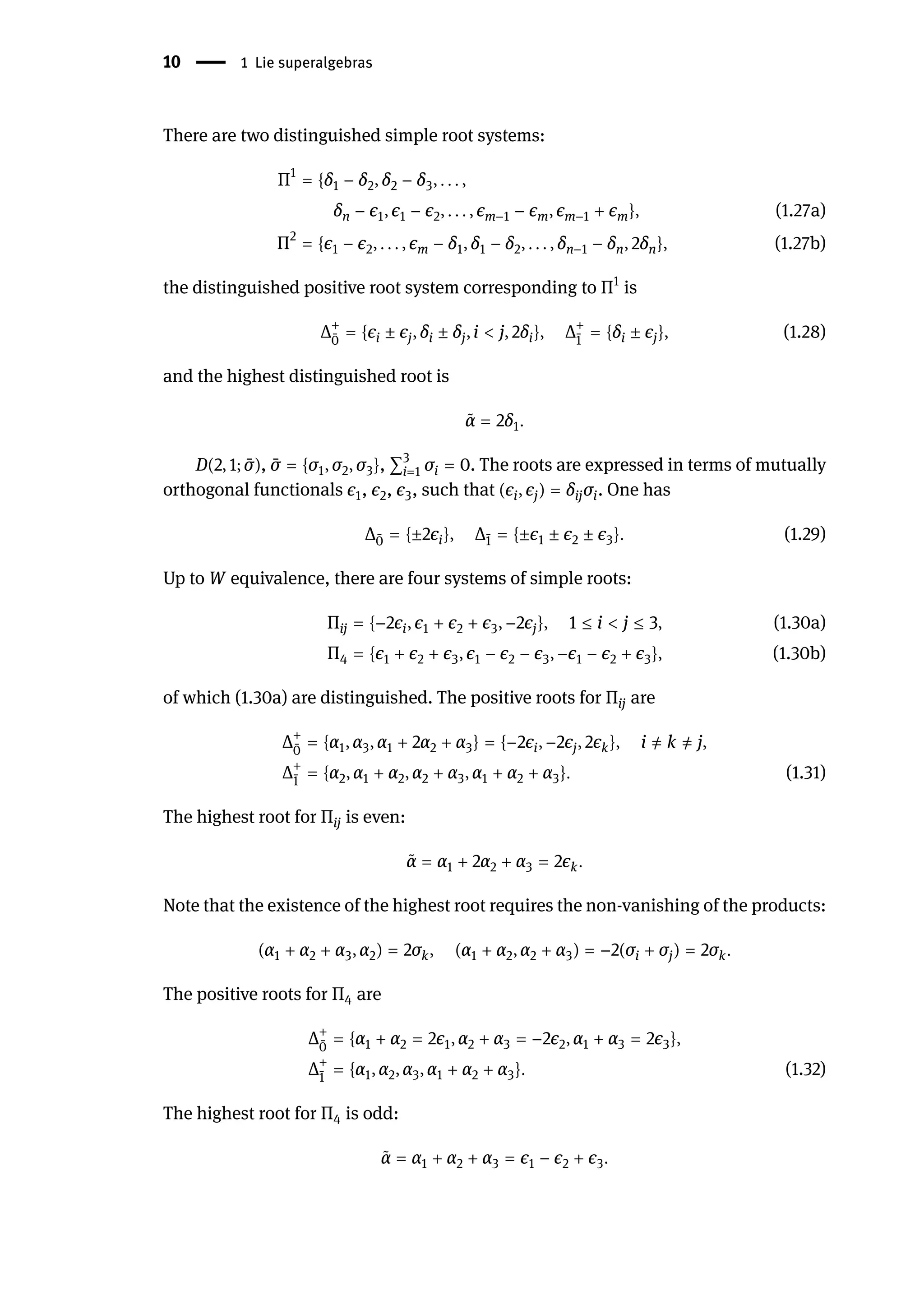
of which (1.30a) are distinguished. The positive roots for Πij are
Δ+
̄
0
= {α1, α3, α1 + 2α2 + α3} = {−2ϵi, −2ϵj, 2ϵk}, i ̸
= k ̸
= j,
Δ+
̄
1
= {α2, α1 + α2, α2 + α3, α1 + α2 + α3}. (1.31)
The highest root for Πij is even:
̃
α = α1 + 2α2 + α3 = 2ϵk.
Note that the existence of the highest root requires the non-vanishing of the products:
(α1 + α2 + α3, α2) = 2σk, (α1 + α2, α2 + α3) = −2(σi + σj) = 2σk.
The positive roots for Π4 are
Δ+
̄
0
= {α1 + α2 = 2ϵ1, α2 + α3 = −2ϵ2, α1 + α3 = 2ϵ3},
Δ+
̄
1
= {α1, α2, α3, α1 + α2 + α3}. (1.32)
The highest root for Π4 is odd:
̃
α = α1 + α2 + α3 = ϵ1 − ϵ2 + ϵ3.
1.3 Root systems | 11
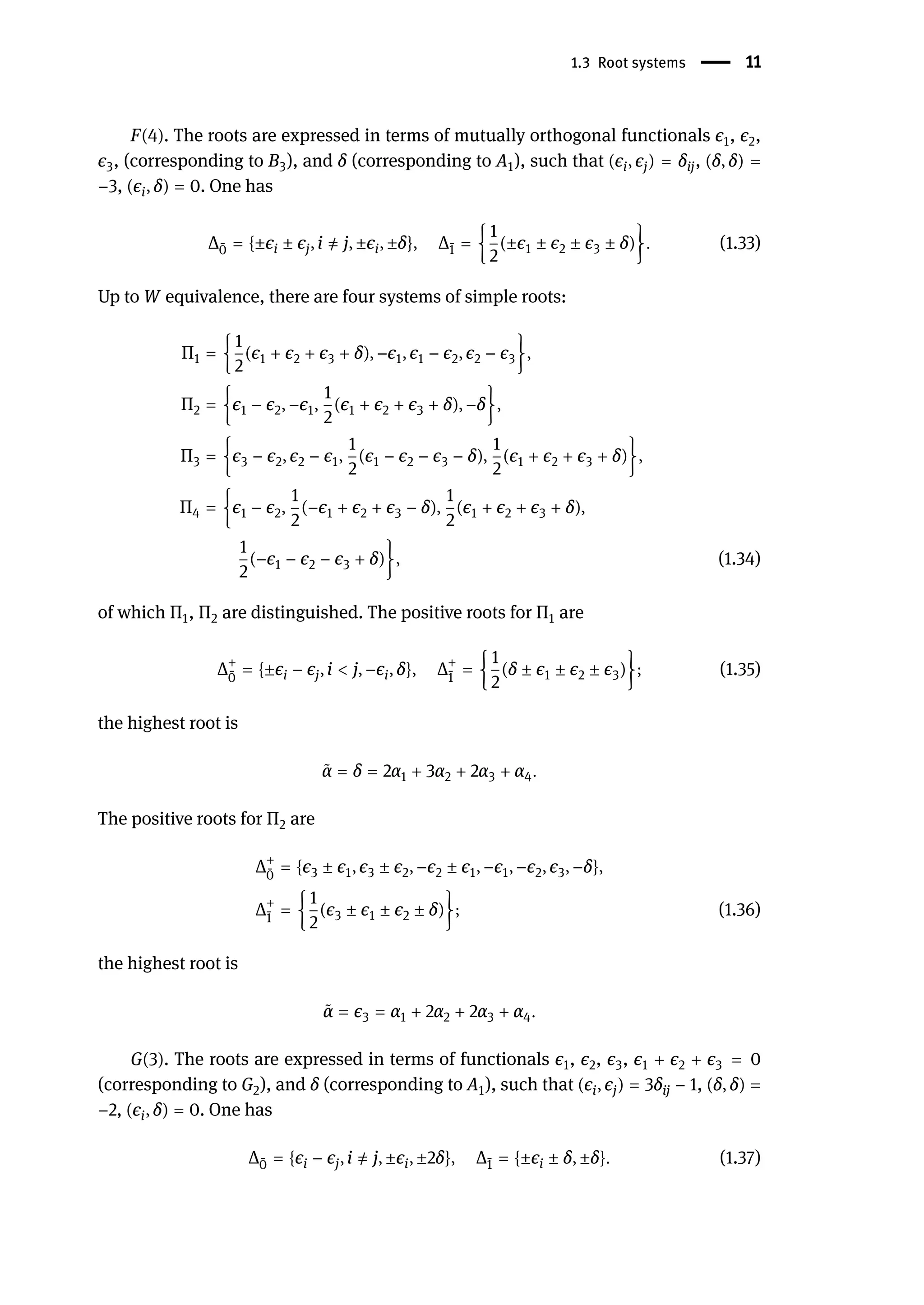
F(4). The roots are expressed in terms of mutually orthogonal functionals ϵ1, ϵ2,
ϵ3, (corresponding to B3), and δ (corresponding to A1), such that (ϵi, ϵj) = δij, (δ, δ) =
−3, (ϵi, δ) = 0. One has
Δ ̄
0 = {±ϵi ± ϵj, i ̸
= j, ±ϵi, ±δ}, Δ ̄
1 = {
1
2
(±ϵ1 ± ϵ2 ± ϵ3 ± δ)}. (1.33)
Up to W equivalence, there are four systems of simple roots:
Π1 = {
1
2
(ϵ1 + ϵ2 + ϵ3 + δ), −ϵ1, ϵ1 − ϵ2, ϵ2 − ϵ3},
Π2 = {ϵ1 − ϵ2, −ϵ1,
1
2
(ϵ1 + ϵ2 + ϵ3 + δ), −δ},
Π3 = {ϵ3 − ϵ2, ϵ2 − ϵ1,
1
2
(ϵ1 − ϵ2 − ϵ3 − δ),
1
2
(ϵ1 + ϵ2 + ϵ3 + δ)},
Π4 = {ϵ1 − ϵ2,
1
2
(−ϵ1 + ϵ2 + ϵ3 − δ),
1
2
(ϵ1 + ϵ2 + ϵ3 + δ),
1
2
(−ϵ1 − ϵ2 − ϵ3 + δ)}, (1.34)
of which Π1, Π2 are distinguished. The positive roots for Π1 are
Δ+
̄
0
= {±ϵi − ϵj, i < j, −ϵi, δ}, Δ+
̄
1
= {
1
2
(δ ± ϵ1 ± ϵ2 ± ϵ3)}; (1.35)
the highest root is
̃
α = δ = 2α1 + 3α2 + 2α3 + α4.
The positive roots for Π2 are
Δ+
̄
0
= {ϵ3 ± ϵ1, ϵ3 ± ϵ2, −ϵ2 ± ϵ1, −ϵ1, −ϵ2, ϵ3, −δ},
Δ+
̄
1
= {
1
2
(ϵ3 ± ϵ1 ± ϵ2 ± δ)}; (1.36)
the highest root is
̃
α = ϵ3 = α1 + 2α2 + 2α3 + α4.
G(3). The roots are expressed in terms of functionals ϵ1, ϵ2, ϵ3, ϵ1 + ϵ2 + ϵ3 = 0
(corresponding to G2), and δ (corresponding to A1), such that (ϵi, ϵj) = 3δij − 1, (δ, δ) =
−2, (ϵi, δ) = 0. One has
Δ ̄
0 = {ϵi − ϵj, i ̸
= j, ±ϵi, ±2δ}, Δ ̄
1 = {±ϵi ± δ, ±δ}. (1.37)
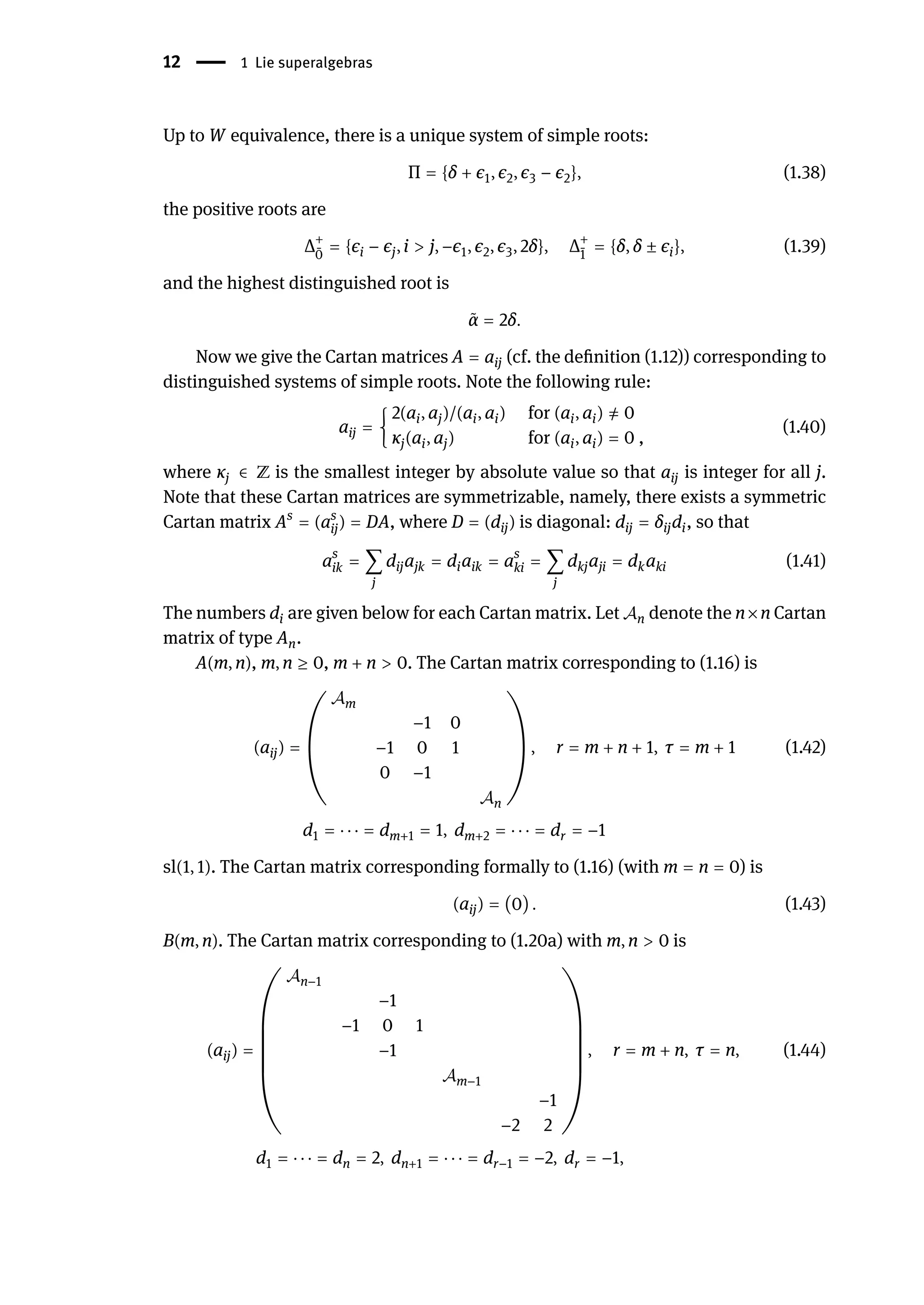
12 | 1 Lie superalgebras
Up to W equivalence, there is a unique system of simple roots:
Π = {δ + ϵ1, ϵ2, ϵ3 − ϵ2}, (1.38)
the positive roots are
Δ+
̄
0
= {ϵi − ϵj, i > j, −ϵ1, ϵ2, ϵ3, 2δ}, Δ+
̄
1
= {δ, δ ± ϵi}, (1.39)
and the highest distinguished root is
̃
α = 2δ.
Now we give the Cartan matrices A = aij (cf. the definition (1.12)) corresponding to
distinguished systems of simple roots. Note the following rule:
aij = {
2(ai, aj)/(ai, ai) for (ai, ai) ̸
= 0
κj(ai, aj) for (ai, ai) = 0 ,
(1.40)
where κj ∈ ℤ is the smallest integer by absolute value so that aij is integer for all j.
Note that these Cartan matrices are symmetrizable, namely, there exists a symmetric
Cartan matrix As
= (as
ij) = DA, where D = (dij) is diagonal: dij = δijdi, so that
as
ik = ∑
j
dijajk = diaik = as
ki = ∑
j
dkjaji = dkaki (1.41)
The numbers di are given below for each Cartan matrix. Let 𝒜n denote the n×n Cartan
matrix of type An.
A(m, n), m, n ≥ 0, m + n > 0. The Cartan matrix corresponding to (1.16) is
(aij) = (
𝒜m
−1 0
−1 0 1
0 −1
𝒜n
) , r = m + n + 1, τ = m + 1 (1.42)
d1 = ⋅ ⋅ ⋅ = dm+1 = 1, dm+2 = ⋅ ⋅ ⋅ = dr = −1
sl(1, 1). The Cartan matrix corresponding formally to (1.16) (with m = n = 0) is
(aij) = (0) . (1.43)
B(m, n). The Cartan matrix corresponding to (1.20a) with m, n > 0 is
(aij) =
(
(
(
(
(
(
𝒜n−1
−1
−1 0 1
−1
𝒜m−1
−1
−2 2
)
)
)
)
)
)
, r = m + n, τ = n, (1.44)
d1 = ⋅ ⋅ ⋅ = dn = 2, dn+1 = ⋅ ⋅ ⋅ = dr−1 = −2, dr = −1,
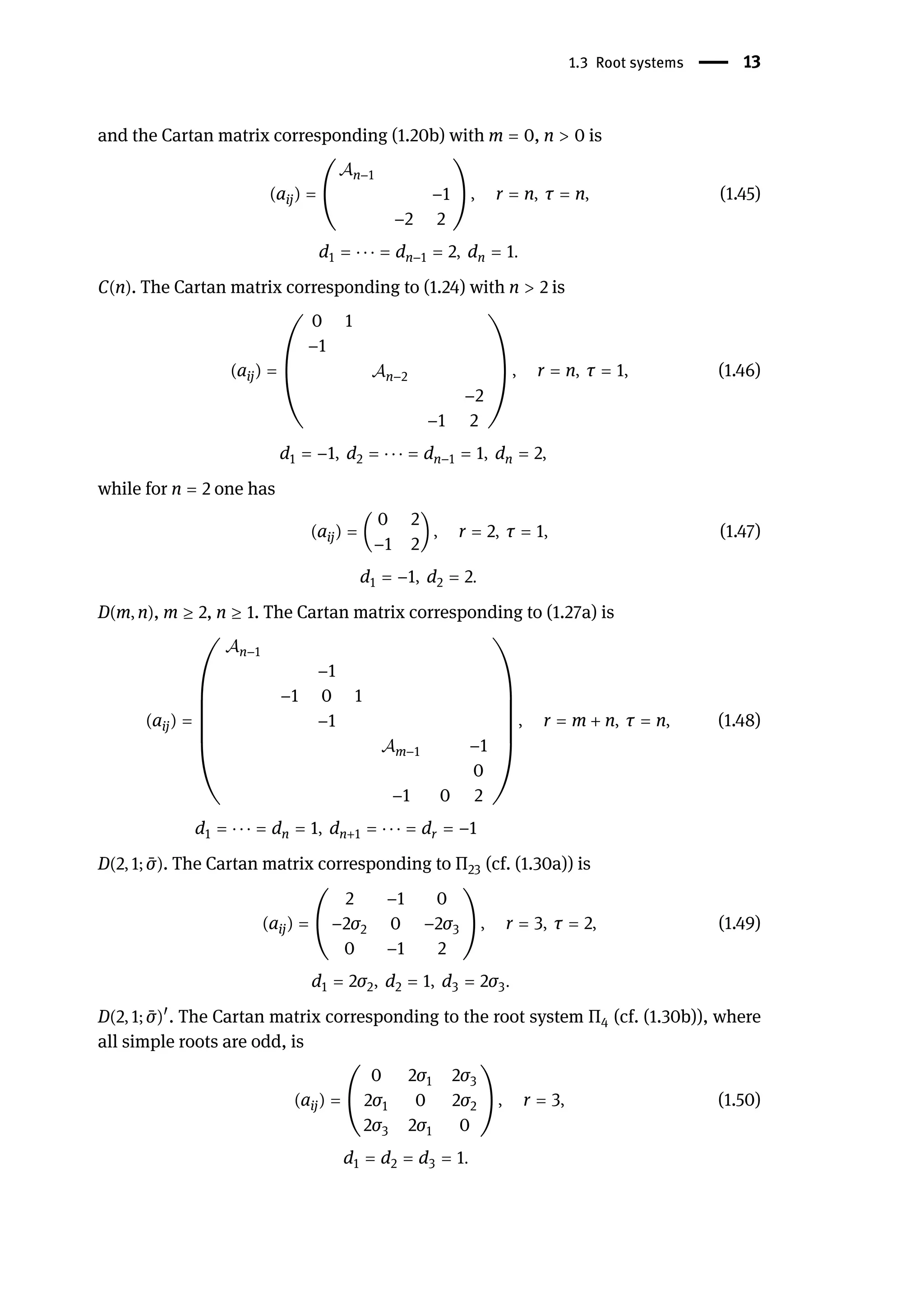
1.3 Root systems | 13
and the Cartan matrix corresponding (1.20b) with m = 0, n > 0 is
(aij) = (
𝒜n−1
−1
−2 2
) , r = n, τ = n, (1.45)
d1 = ⋅ ⋅ ⋅ = dn−1 = 2, dn = 1.
C(n). The Cartan matrix corresponding to (1.24) with n > 2 is
(aij) = (
0 1
−1
𝒜n−2
−2
−1 2
) , r = n, τ = 1, (1.46)
d1 = −1, d2 = ⋅ ⋅ ⋅ = dn−1 = 1, dn = 2,
while for n = 2 one has
(aij) = (
0 2
−1 2
) , r = 2, τ = 1, (1.47)
d1 = −1, d2 = 2.
D(m, n), m ≥ 2, n ≥ 1. The Cartan matrix corresponding to (1.27a) is
(aij) =
(
(
(
(
(
(
𝒜n−1
−1
−1 0 1
−1
𝒜m−1 −1
0
−1 0 2
)
)
)
)
)
)
, r = m + n, τ = n, (1.48)
d1 = ⋅ ⋅ ⋅ = dn = 1, dn+1 = ⋅ ⋅ ⋅ = dr = −1
D(2, 1; ̄
σ). The Cartan matrix corresponding to Π23 (cf. (1.30a)) is
(aij) = (
2 −1 0
−2σ2 0 −2σ3
0 −1 2
) , r = 3, τ = 2, (1.49)
d1 = 2σ2, d2 = 1, d3 = 2σ3.
D(2, 1; ̄
σ)󸀠
. The Cartan matrix corresponding to the root system Π4 (cf. (1.30b)), where
all simple roots are odd, is
(aij) = (
0 2σ1 2σ3
2σ1 0 2σ2
2σ3 2σ1 0
) , r = 3, (1.50)
d1 = d2 = d3 = 1.
14 | 1 Lie superalgebras
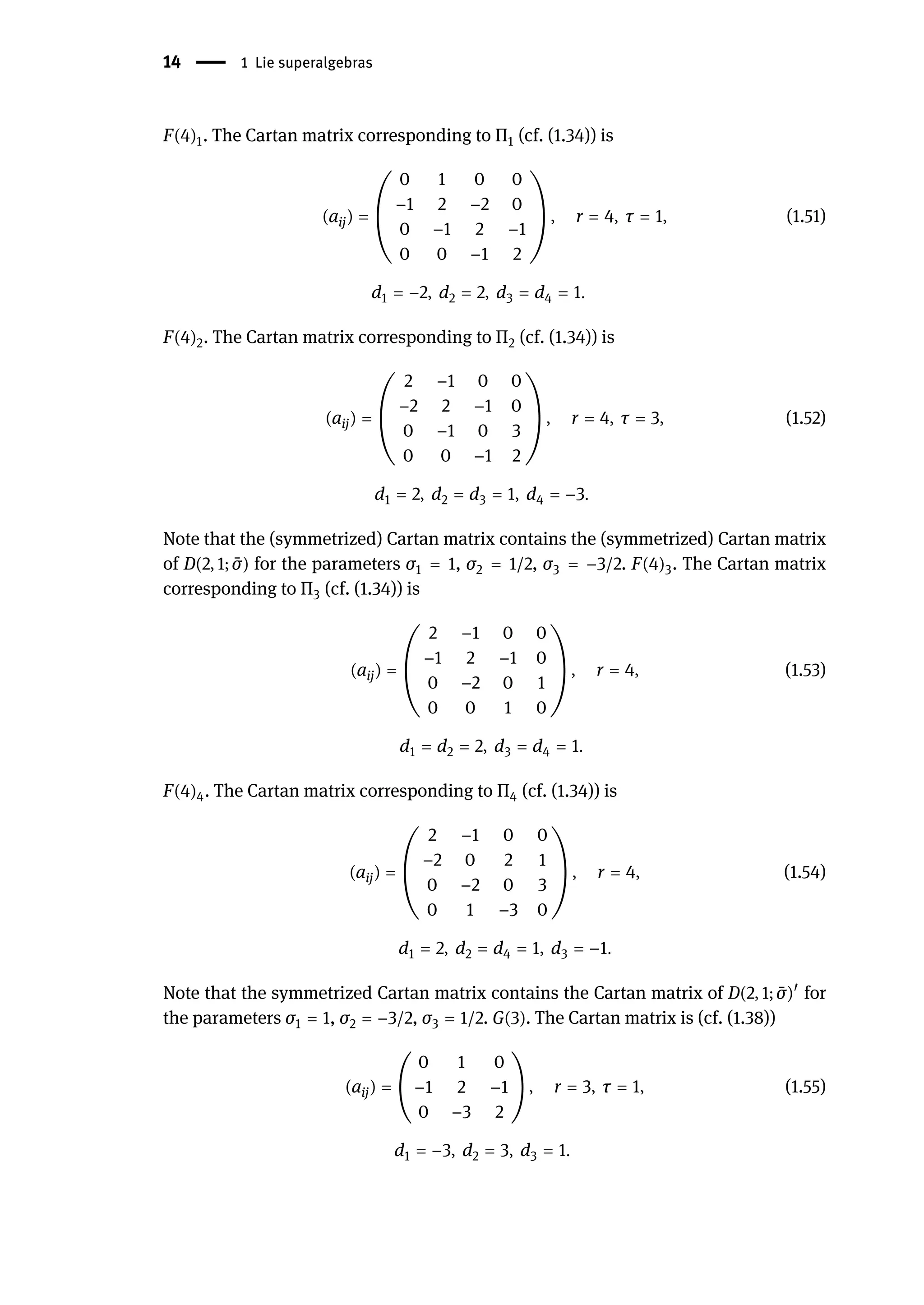
F(4)1. The Cartan matrix corresponding to Π1 (cf. (1.34)) is
(aij) = (
0 1 0 0
−1 2 −2 0
0 −1 2 −1
0 0 −1 2
) , r = 4, τ = 1, (1.51)
d1 = −2, d2 = 2, d3 = d4 = 1.
F(4)2. The Cartan matrix corresponding to Π2 (cf. (1.34)) is
(aij) = (
2 −1 0 0
−2 2 −1 0
0 −1 0 3
0 0 −1 2
) , r = 4, τ = 3, (1.52)
d1 = 2, d2 = d3 = 1, d4 = −3.
Note that the (symmetrized) Cartan matrix contains the (symmetrized) Cartan matrix
of D(2, 1; ̄
σ) for the parameters σ1 = 1, σ2 = 1/2, σ3 = −3/2. F(4)3. The Cartan matrix
corresponding to Π3 (cf. (1.34)) is
(aij) = (
2 −1 0 0
−1 2 −1 0
0 −2 0 1
0 0 1 0
) , r = 4, (1.53)
d1 = d2 = 2, d3 = d4 = 1.
F(4)4. The Cartan matrix corresponding to Π4 (cf. (1.34)) is
(aij) = (
2 −1 0 0
−2 0 2 1
0 −2 0 3
0 1 −3 0
) , r = 4, (1.54)
d1 = 2, d2 = d4 = 1, d3 = −1.
Note that the symmetrized Cartan matrix contains the Cartan matrix of D(2, 1; ̄
σ)󸀠
for
the parameters σ1 = 1, σ2 = −3/2, σ3 = 1/2. G(3). The Cartan matrix is (cf. (1.38))
(aij) = (
0 1 0
−1 2 −1
0 −3 2
) , r = 3, τ = 1, (1.55)
d1 = −3, d2 = 3, d3 = 1.
1.3 Root systems | 15
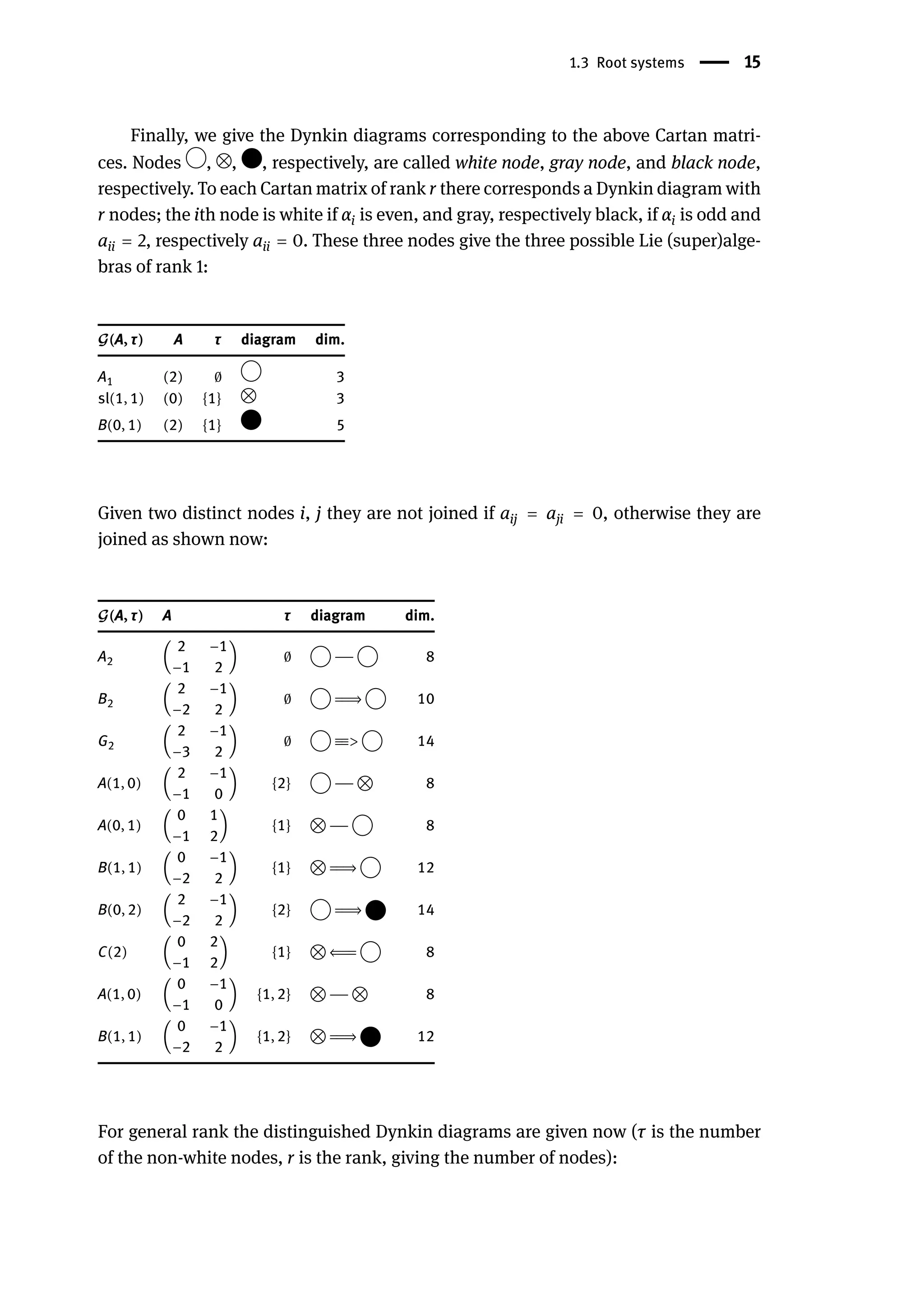
Finally, we give the Dynkin diagrams corresponding to the above Cartan matri-
ces. Nodes , , , respectively, are called white node, gray node, and black node,
respectively. To each Cartan matrix of rank r there corresponds a Dynkin diagram with
r nodes; the ith node is white if αi is even, and gray, respectively black, if αi is odd and
aii = 2, respectively aii = 0. These three nodes give the three possible Lie (super)alge-
bras of rank 1:
𝒢(A, τ) A τ diagram dim.
A1 (2) 0 3
sl(1, 1) (0) {1} 3
B(0, 1) (2) {1} 5
Given two distinct nodes i, j they are not joined if aij = aji = 0, otherwise they are
joined as shown now:
𝒢(A, τ) A τ diagram dim.
A2 (
2 −1
−1 2
) 0 −
−
− 8
B2 (
2 −1
−2 2
) 0 =
󳨐⇒ 10
G2 (
2 −1
−3 2
) 0 ≡
≡> 14
A(1, 0) (
2 −1
−1 0
) {2} −
−
− 8
A(0, 1) (
0 1
−1 2
) {1} −
−
− 8
B(1, 1) (
0 −1
−2 2
) {1} =
󳨐⇒ 12
B(0, 2) (
2 −1
−2 2
) {2} =
󳨐⇒ 14
C(2) (
0 2
−1 2
) {1} ⇐󳨐
= 8
A(1, 0) (
0 −1
−1 0
) {1, 2} −
−
− 8
B(1, 1) (
0 −1
−2 2
) {1, 2} =
󳨐⇒ 12
For general rank the distinguished Dynkin diagrams are given now (τ is the number
of the non-white nodes, r is the rank, giving the number of nodes):
16 | 1 Lie superalgebras
𝒢 diagram τ r
A(m, n)
1
−
−
− ⋅ ⋅ ⋅ −
−
−
1
−
−
−
1
−
−
−
1
−
−
− ⋅ ⋅ ⋅ −
−
−
1
m + 1 m + n + 1
B(m, n), m, n > 0
2
−
−
− ⋅ ⋅ ⋅ −
−
−
2
−
−
−
2
−
−
−
2
−
−
− ⋅ ⋅ ⋅ −
−
−
2
=
󳨐⇒
2
n m + n
B(0, n), n > 0
2
−
−
− ⋅ ⋅ ⋅ −
−
−
2
=
󳨐⇒
2
n n
C(n), n > 2 1
−
−
−
2
−
−
− ⋅ ⋅ ⋅ −
−
−
2
⇐󳨐
=
1
1 n
D(m, n)
2
−
−
− ⋅ ⋅ ⋅ −
−
−
2
−
−
−
2
−
−
−
2
−
−
− ⋅ ⋅ ⋅ −
−
−
2
|
1
−
−
−
1
n m + n
D(2, 1; ̄
σ)23
2
←󳨀
1
󳨀→
1
2 3
F(4)1 2
−
−
−
3
⇐󳨐
=
2
−
−
−
1
1 4
F(4)2
1
=
󳨐⇒
2
←󳨀
2
󳨀→
1
3 4
G(3) 2
−
−
−
4
<≡
≡
2
1 3
The number at a node gives the coefficient with which the corresponding simple root
enters the decomposition of the highest root.
Some of the different root systems may be written in a unified way [241] as given
now via the nondistinguished Dynkin diagrams, where the symbol × stands for white
or gray node (yet in every diagram there is at least one odd node):
𝒢 diagram r
A(m, n) × −
−
− ⋅ ⋅ ⋅ −
−
− × m + n + 1
B(m, n) × −
−
− ⋅ ⋅ ⋅ −
−
− × =
󳨐⇒ m + n, m, n > 0
B(0, n) × −
−
− ⋅ ⋅ ⋅ −
−
− × =
󳨐⇒ n > 0
C(n) × −
−
− ⋅ ⋅ ⋅ −
−
− × ⇐󳨐
= n > 2
D(m, n) × −
−
− ⋅ ⋅ ⋅ −
−
− × −
−
− ⋅ ⋅ ⋅ −
−
− ×
|
−
−
− m + n
D(m, n)󸀠
× −
−
− ⋅ ⋅ ⋅ −
−
− × −
−
− ⋅ ⋅ ⋅ −
−
− ×
| ⟍
−
− m + n
D(2, 1; ̄
σ)󸀠
| ⟍
−
− 3
F(4)3 −
−
− ←󳨀 󳨀→ 4
F(4)4 −
−
−
| ⟍
−
− 4
1.4 Representations of simple Lie superalgebras | 17
According to the results of Yamane [389] the above nondistinguished root systems are
equivalent if we extend W with the odd reflections (1.13). This is due to the fact that
each such odd reflection transforms the root system Δ into a root system Δ󸀠
so that the
corresponding Lie superalgebras 𝒢(Δ) and 𝒢(Δ󸀠
) are isomorphic.
1.3.3 Affine basic classical superalgebras
Finally, we give the (extended) distinguished Dynkin diagrams of the affinization 𝒢(1)
of the basic classical Lie superalgebras 𝒢 (cf. [390]):
𝒢(1)
diagram
A(m, n)(1)
1
−
−
− ⋅ ⋅ ⋅ −
−
−
1
−
−
−
1
| |
1
−
−
−
1
−
−
− ⋅ ⋅ ⋅ −
−
−
1
B(m, n)(1)
1
=
󳨐⇒
2
−
−
− ⋅ ⋅ ⋅ −
−
−
2
−
−
−
2
−
−
−
2
−
−
− ⋅ ⋅ ⋅ −
−
−
2
=
󳨐⇒
2
B(0, n)(1)
1
=
󳨐⇒
2
−
−
− ⋅ ⋅ ⋅ −
−
−
2
=
󳨐⇒
2
C(n)(1)
1
⟍
⇕
2
−
−
− ⋅ ⋅ ⋅ −
−
−
2
⇐󳨐
=
1
⟋
1
D(m, n)(1)
1
=
󳨐⇒
2
−
−
− ⋅ ⋅ ⋅ −
−
−
2
−
−
−
2
−
−
−
2
−
−
− ⋅ ⋅ ⋅ −
−
−
2
|
1
−
−
−
1
D(2, 1; ̄
σ)(1)
1
−
−
−
2
|
1
−
−
−
1
F(4)(1)
1
≡
≡
>
2
−
−
−
3
⇐󳨐
=
2
−
−
−
1
G(3)(1)
1
=
=
=
=
=
=>
2
−
−
−
4
<≡
≡
2
1.4 Representations of simple Lie superalgebras
Highest weight modules, in particular, Verma modules are defined analogously to the
even case. Also the following holds.
18 | 1 Lie superalgebras
Ado’s theorem. Every finite-dimensional Lie superalgebra has a finite-dimensional
faithful representation. ⬦
Let 𝒢 be a basic classical Lie superalgebra. Let
̄
Δ ̄
0 ≡ {α ∈ Δ ̄
0
󵄨
󵄨
󵄨
󵄨
󵄨
󵄨
1
2
α ∉ Δ ̄
1}, ̄
Δ ̄
1 ≡ {α ∈ Δ ̄
1 | 2α ∉ Δ ̄
0}. (1.56)
Let ρ ̄
0 ≡ 1
2
∑α∈Δ+
̄
0
α, ̄
ρ ̄
0 ≡ 1
2
∑α∈ ̄
Δ+
̄
0
α, ρ ̄
1 = 1
2
∑α∈Δ+
̄
1
α, ρ = ρ ̄
0 − ρ ̄
1. Note that ρ(Hi) =
(αi, αi)/2.
Then we have the following.
Proposition ([243]). The Verma module VΛ
over 𝒢 is irreducible iff
2(Λ + ρ, α) ̸
= m(α, α) (1.57)
for any α ∈ Δ+
and any m ∈ ℕ. ⬦
We shall say that the Verma module VΛ
is reducible w.r.t. the root α with (α, α) ̸
= 0
if there exists m ∈ ℕ such that
2(Λ + ρ, α) = m(α, α), (α, α) ̸
= 0, m ∈ ℕ (1.58)
and that VΛ
is reducible w.r.t. the root α with (α, α) = 0 if:
(Λ + ρ, α) = 0, (α, α) = 0. (1.59)
If (1.58) holds then there exists a singular vector of weight Λ − mα as in the even case,
while if (1.59) holds then there exists a singular vector of weight Λ − α. In particular, if
(Λ + ρ, αi) = 0 for an odd simple root αi, then the singular vector is
vodd
s = X−
i v0. (1.60)
As in the even case there exists a maximal invariant submodule IΛ
, so that the
factor module LΛ = VΛ
/IΛ
is irreducible. The difference with the even case is that it is
not true in general, except for 𝒢 = B(0, n), that a finite-dimensional representation is
completely reducible. Furthermore, 𝒢 ̸
= B(0, n). The irreducible finite-dimensional
representations are divided by Kac in two types: typical representations and atypi-
cal representations. The typical finite-dimensional representations are obtained as LΛ
when the Verma module VΛ
is reducible w.r.t. all even simple roots, but not w.r.t. any
odd root α ∈ ̄
Δ+
̄
1
. (Note here another difference from the even case, where LΛ is finite-
dimensional iff VΛ
is reducible w.r.t. all roots.) The atypical finite-dimensional repre-
sentations are obtained as LΛ when the Verma module VΛ
is reducible also w.r.t. some
odd root α ∈ ̄
Δ+
̄
1
. The interesting feature here is that the factor module VΛ
/ ̃
IΛ
, where
̃
IΛ
is the submodule generated by the even singular vectors, is finite dimensional, re-
ducible and indecomposable. It has to be factorized further to obtain LΛ. Further, we
1.4 Representations of simple Lie superalgebras | 19
say that an atypical representation is singly atypical if (Λ + ρ, α) = 0 only for one odd
root α ∈ ̄
Δ+
̄
1
.
The finite-dimensional representations were classified by Kac.
Theorem ([241, 243]). Let 𝒢 be a basic classical superalgebra, and let V be a finite-
dimensional irreducible 𝒢-module. Then there exists a vector vΛ ∈ V, Λ ∈ ℋ∗
(unique
up to a multiplication by nonzero scalar) such that X+
i vΛ = 0, HvΛ = Λ(H)vΛ. Two
𝒢-modules V1 and V2 are isomorphic iff Λ1 = Λ2. Thus, in our notation V = LΛ. The set
of numbers ai = Λ(Hi), i = 1, . . . , r, Λ as above, are described by the following conditions
(we consider as,s+1 = 1 if ass = 0):
1) ai ∈ ℤ+ if i ̸
= s;
2) k ∈ ℤ+ where k is given now:
𝒢 k b
B(0, n) 1
2
an 0
B(m, n), m > 0 an − an+1 − ⋅ ⋅ ⋅ − am+n−1 − 1
2
am+n m
D(m, n) an − an+1 − ⋅ ⋅ ⋅ − 1
2
(am+n−1 + am+n) m
D(2, 1; λ) (2a1 − a2 − λa3)/(1 + λ) 2
F(4) (2a1 − 3a2 − 4a3 − 2a4)/3 4
G(3) (a1 − 2a2 − 3a3)/2 3
3) k < b (from the table) then there are additional conditions:
B(m, n), an+k+1 = ⋅ ⋅ ⋅ = am+n = 0;
D(m, n), an+k+1 = ⋅ ⋅ ⋅ = am+n = 0 if k ≤ m − 2; am+n−1 = am+n if k = m − 1;
D(2, 1; λ), ai = 0 if k = 0; λ(a3 + 1) = ±(a2 + 1) if k = 1;
F(4), ai = 0 if k = 0; k ̸
= 1; a2 = a4 = 0 if k = 2; a2 = 2a4 + 1 if k = 3;
G(3), ai = 0 if k = 0; k ̸
= 1; a2 = 0 if k = 2. ⬦
Note that all finite-dimensional irreducible representations (irreps) of B(0, n) are
typical. All finite-dimensional irreps of C(n) are either typical or singly atypical.
Let LΛ be a typical finite-dimensional irrep of 𝒢. Then one has
dim LΛ = 2dim Δ+
̄
1 ∏
α∈Δ+
̄
0
(Λ + ρ, α)
(ρ0, α)
, (1.61)
dim(LΛ) ̄
0 − dim(LΛ) ̄
1 = 0, 𝒢 ̸
= B(0, n),
dim(LΛ) ̄
0 − dim(LΛ) ̄
1 = ∏
α∈ ̄
Δ+
̄
0
(Λ + ρ, α)
( ̄
ρ0, α)
= ∏
α∈ ̄
Δ+
̄
0
(Λ + ρ, α)
(ρ, α)
,
𝒢 = B(0, n). (1.62)
20 | 1 Lie superalgebras
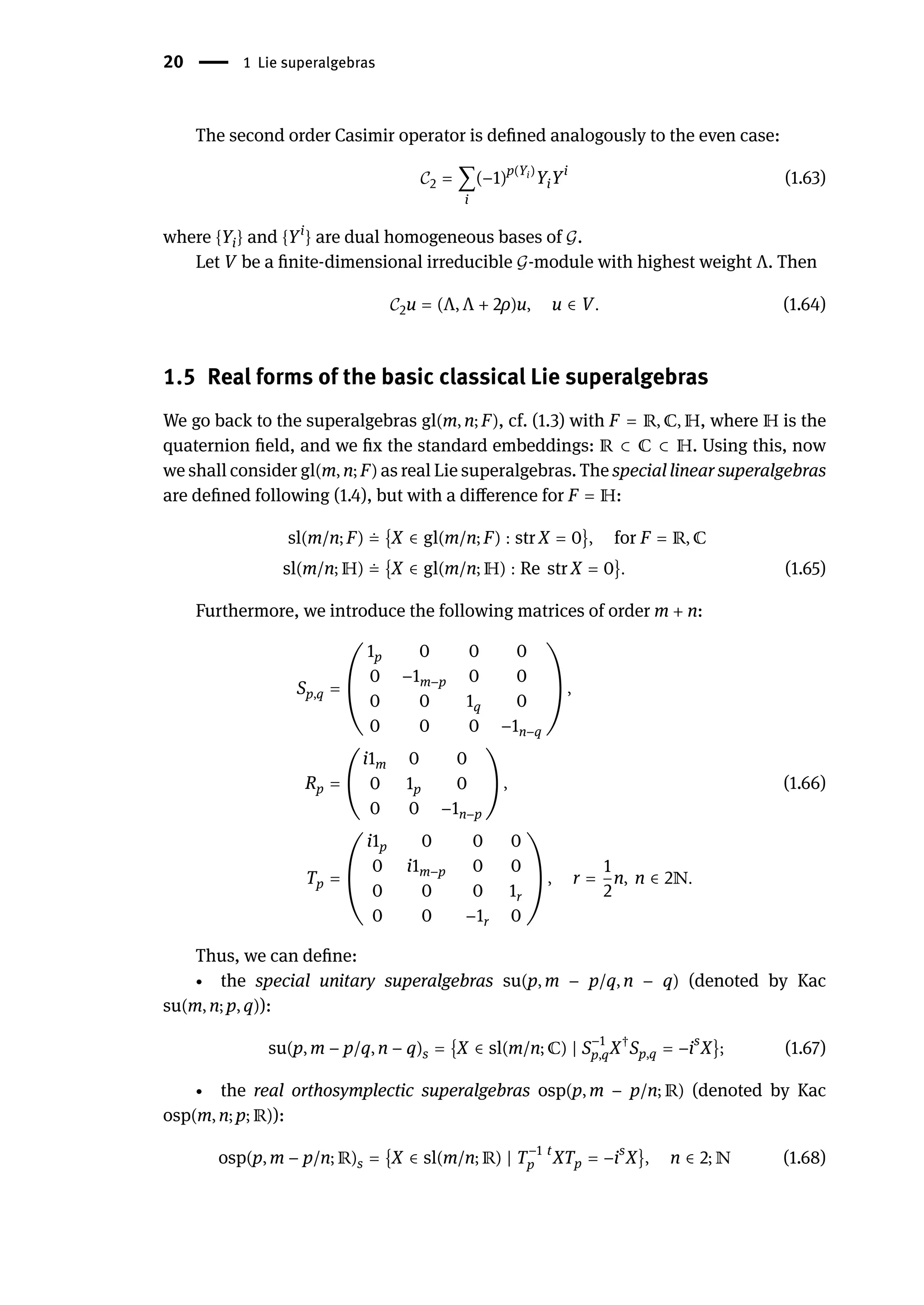
The second order Casimir operator is defined analogously to the even case:
𝒞2 = ∑
i
(−1)p(Yi)
YiYi
(1.63)
where {Yi} and {Yi
} are dual homogeneous bases of 𝒢.
Let V be a finite-dimensional irreducible 𝒢-module with highest weight Λ. Then
𝒞2u = (Λ, Λ + 2ρ)u, u ∈ V. (1.64)
1.5 Real forms of the basic classical Lie superalgebras
We go back to the superalgebras gl(m, n; F), cf. (1.3) with F = ℝ, ℂ, ℍ, where ℍ is the
quaternion field, and we fix the standard embeddings: ℝ ⊂ ℂ ⊂ ℍ. Using this, now
we shall consider gl(m, n; F) as real Lie superalgebras. The special linear superalgebras
are defined following (1.4), but with a difference for F = ℍ:
sl(m/n; F) ≐ {X ∈ gl(m/n; F) : str X = 0}, for F = ℝ, ℂ
sl(m/n; ℍ) ≐ {X ∈ gl(m/n; ℍ) : Re str X = 0}. (1.65)
Furthermore, we introduce the following matrices of order m + n:
Sp,q = (
1p 0 0 0
0 −1m−p 0 0
0 0 1q 0
0 0 0 −1n−q
) ,
Rp = (
i1m 0 0
0 1p 0
0 0 −1n−p
) , (1.66)
Tp = (
i1p 0 0 0
0 i1m−p 0 0
0 0 0 1r
0 0 −1r 0
) , r =
1
2
n, n ∈ 2ℕ.
Thus, we can define:
∙ the special unitary superalgebras su(p, m − p/q, n − q) (denoted by Kac
su(m, n; p, q)):
su(p, m − p/q, n − q)s = {X ∈ sl(m/n; ℂ) | S−1
p,qX†
Sp,q = −is
X}; (1.67)
∙ the real orthosymplectic superalgebras osp(p, m − p/n; ℝ) (denoted by Kac
osp(m, n; p; ℝ)):
osp(p, m − p/n; ℝ)s = {X ∈ sl(m/n; ℝ) | T−1
p
t
XTp = −is
X}, n ∈ 2; ℕ (1.68)
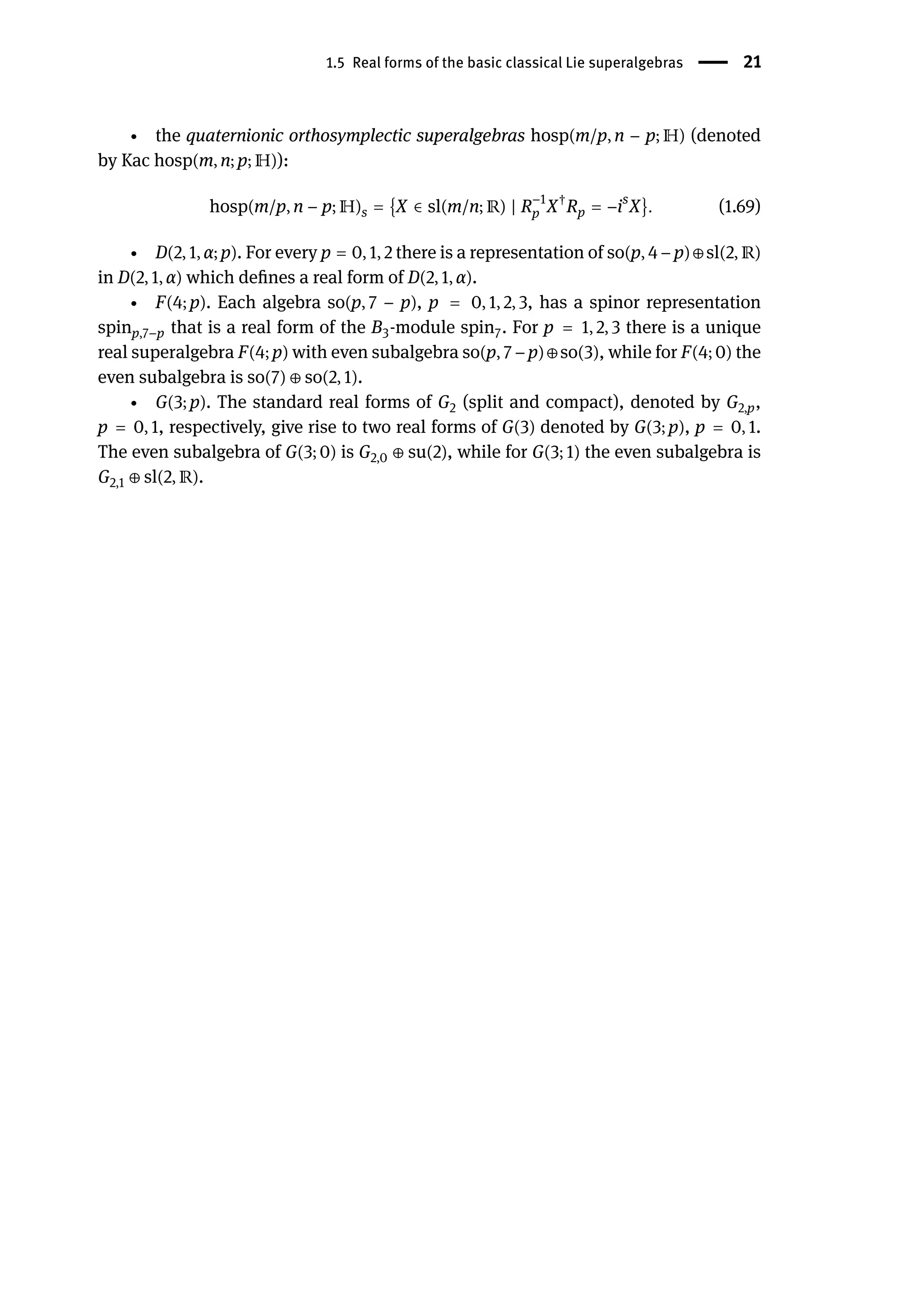
1.5 Real forms of the basic classical Lie superalgebras | 21
∙ the quaternionic orthosymplectic superalgebras hosp(m/p, n − p; ℍ) (denoted
by Kac hosp(m, n; p; ℍ)):
hosp(m/p, n − p; ℍ)s = {X ∈ sl(m/n; ℝ) | R−1
p X†
Rp = −is
X}. (1.69)
∙ D(2, 1, α; p). For every p = 0, 1, 2 there is a representation of so(p, 4−p)⊕sl(2, ℝ)
in D(2, 1, α) which defines a real form of D(2, 1, α).
∙ F(4; p). Each algebra so(p, 7 − p), p = 0, 1, 2, 3, has a spinor representation
spinp,7−p that is a real form of the B3-module spin7. For p = 1, 2, 3 there is a unique
real superalgebra F(4; p) with even subalgebra so(p, 7−p)⊕so(3), while for F(4; 0) the
even subalgebra is so(7) ⊕ so(2, 1).
∙ G(3; p). The standard real forms of G2 (split and compact), denoted by G2,p,
p = 0, 1, respectively, give rise to two real forms of G(3) denoted by G(3; p), p = 0, 1.
The even subalgebra of G(3; 0) is G2,0 ⊕ su(2), while for G(3; 1) the even subalgebra is
G2,1 ⊕ sl(2, ℝ).
2 Conformal supersymmetry in 4D
Summary
Recently, superconformal field theories in various dimensions have been attracting ever more interest,
cf. (for references up to year 2000): [306, 170, 248, 313, 89, 186, 233, 355, 215, 138–140, 49, 193, 141,
142, 347, 72, 160, 168, 258, 273, 309, 9, 58, 102, 189, 171, 177, 311, 317, 4, 76, 101, 103, 164, 167, 172,
174, 173, 175, 105] and the references therein. Particularly important are those for D ≤ 6, since in these
cases the relevant superconformal algebras satisfy Nahm’s classification [306] based on the Haag–
Lopuszanski–Sohnius theorem [218]. This makes the classification of the UIRs of these superalgebras
very important. First such classification was given for the D = 4 superconformal algebras su(2, 2/1)
[182] and su(2, 2/N) [138–142] (for arbitrary N). Then the classification for D = 3 (osp(N/4) for even
N), D = 5, and D = 6 (osp(8∗
/2N) for N = 1, 2) was given in [302] (some results being conjectural), and
then the D = 6 case (for arbitrary N) was finalized in [122] (see Section 3.1).
Once we know the UIRs of a (super-) algebra the next question is to find their characters, since
these give the spectrum which is important for the applications. Some results on the spectrum were
given in the early papers [233, 355, 215, 140] but it is necessary to have systematic results for which
the character formulas are needed. This is the question we address in this chapter for the UIRs of
D = 4 conformal superalgebras su(2, 2/N). From the mathematical point of view this question is clear
only for representations with conformal dimension above the unitarity threshold viewed as irreps of
the corresponding complex superalgebra sl(4/N). But for su(2, 2/N) even the UIRs above the unitarity
threshold are truncated for small values of spin and isospin. Moreover, in the applications the most
importantrole isplayedbythe representationswith “quantized” conformaldimensionsatthe unitarity
threshold and at discrete points below. In the quantum field or string theory framework some of these
correspond to fields with “protected” scaling dimension and therefore imply “non-renormalization
theorems” at the quantum level, cf., e. g., [228, 174]. This is intimately related to the super-invariant
differential operators and equations satisfied by the superfields at these special representations.
Thus, we need detailed knowledge about the structure of the UIRs from the representation-
theoretical point of view. Fortunately, such information is contained in [138–142]. Following these
papers we first recall the basic ingredients of the representation theory of the D = 4 superconformal
algebras. In particular we recall the structure of Verma modules and UIRs. First the general theory for
the characters of su(2, 2/N) is developed in great detail. For the general theory we use the (general-
ized) odd reflections introduced in [139] (see also [349]).1
We also pin-point the difference between
character formulas for sl(4, N) and su(2, 2/N); for the latter we need to introduce and use the notion of
counterterms in the character formulas. The general formulas are valid for arbitrary N and are given for
the so-called bare characters (or superfield decompositions). We also summarize our results on the
decompositions of long superfields as they descend to the unitarity threshold. To give the character
formulas explicitly we need to recall also the character formulas of su(2, 2) and su(N), for which we
give explicitly all formulas that we need. Finally, we give the explicit complete character formulas for
N = 1 and for a number of important examples for N = 2, 4.
In this chapter we mostly follow the papers [123, 129, 127, 128] and also using essentially the
results of [138–142].
1 For an alternative approach to character formulas, see [149, 57].
https://doi.org/10.1515/9783110527490-002
24 | 2 Conformal supersymmetry in 4D
2.1 Representations of D = 4 conformal supersymmetry
2.1.1 The setting
The superconformal algebras in D = 4 are 𝒢 = su(2, 2/N). The even subalgebra of 𝒢 is
the algebra 𝒢0 = su(2, 2) ⊕ u(1) ⊕ su(N). We label their physically relevant representa-
tions of 𝒢 by the signature:
χ = [d; j1, j2; z; r1, . . . , rN−1] (2.1)
where d is the conformal weight, j1, j2 are non-negative (half-)integers which are
Dynkin labels of the finite-dimensional irreps of the D = 4 Lorentz subalgebra so(3, 1)
of dimension (2j1 + 1)(2j2 + 1), z represents the u(1) subalgebra which is central for 𝒢0
(and for N = 4 is central for 𝒢 itself), and r1, . . . , rN−1 are non-negative integers which
are Dynkin labels of the finite-dimensional irreps of the internal (or R) symmetry
algebra su(N).
We recall that the algebraic approach to D = 4 conformal supersymmetry de-
veloped in [138–142] involves two related constructions—on function spaces and as
Verma modules. The first realization employs the explicit construction of induced rep-
resentations of 𝒢 (and of the corresponding supergroup G = su(2, 2/N)) in spaces of
functions (superfields) over superspace which are called elementary representations
(ER). The UIRs of 𝒢 are realized as irreducible components of ERs, and then they co-
incide with the usually used superfields in indexless notation. The Verma module re-
alization is also very useful as it provides simpler and more intuitive picture for the
relation between reducible ERs, for the construction of the irreps, in particular, of the
UIRs. For the latter the main tool is an adaptation of the Shapovalov form [353] to the
Verma modules [140, 142].
Here we shall use mostly the Verma module construction, however, keeping in
mind the construction on function spaces and the corresponding invariant differential
operators.
2.1.2 Verma modules
To introduce Verma modules one needs the standard triangular decomposition:
𝒢
ℂ
= 𝒢
+
⊕ ℋ ⊕ 𝒢
−
(2.2)
where 𝒢ℂ
= sl(4/N) is the complexification of 𝒢, 𝒢+
, 𝒢−
, respectively, are the subalge-
bras corresponding to the positive, negative, roots of 𝒢ℂ
, respectively, and ℋ denotes
the Cartan subalgebra of 𝒢ℂ
.
We consider the lowest weight Verma modules, so that VΛ
≅ U(𝒢+
) ⊗ v0, where
U(𝒢+
) is the universal enveloping algebra of 𝒢+
, Λ ∈ ℋ∗
is the lowest weight, and v0
is the lowest weight vector v0 such that
2.1 Representations of D = 4 conformal supersymmetry | 25
Xv0 = 0, X ∈ 𝒢
−
,
Hv0 = Λ(H)v0, H ∈ ℋ.
Furthermore, for simplicity we omit the sign ⊗, i. e., we write Pv0 ∈ VΛ
with P ∈ U(𝒢+
).
The lowest weight Λ is characterized by its values on the Cartan subalgebra ℋ,
or, equivalently, by its products with the simple roots (given explicitly below). In gen-
eral, these would be 3 + N complex numbers, however, in order to be useful for the
representations of the real form 𝒢 these values would be restricted to be real and fur-
thermore to correspond to the signatures χ, and we shall write Λ = Λ(χ), or χ = χ(Λ).
Note, however, that there are Verma modules to which correspond no ERs, cf. [139]
and below.
If a Verma module VΛ
is irreducible then it gives the lowest weight irrep LΛ with
the same weight. If a Verma module VΛ
is reducible then it contains a maximal in-
variant submodule IΛ
and the lowest weight irrep LΛ with the same weight is given by
factorization: LΛ = VΛ
/IΛ
[110, 244, 243].
Thus, we need first to know which Verma modules are reducible. The reducibility
conditions for highest weight Verma modules over basic classical Lie superalgebra
were given by Kac [243]. Translating his conditions to lowest weight Verma modules
we have [139]: A lowest weight Verma module VΛ
is reducible only if at least one of the
following conditions is true:2
(ρ − Λ, β) = m(β, β)/2, β ∈ Δ+
, (β, β) ̸
= 0, m ∈ ℕ (2.3a)
(ρ − Λ, β) = 0, β ∈ Δ+
, (β, β) = 0, (2.3b)
where Δ+
is the positive root system of 𝒢ℂ
, ρ ∈ ℋ∗
is the very important in represen-
tation theory element given by ρ = ρ ̄
0 − ρ ̄
1, where ρ ̄
0, ρ ̄
1 are the half-sums of the even,
odd, respectively, positive roots, (⋅, ⋅) is the standard bilinear product in ℋ∗
.
If a condition from (2.3a) is fulfilled then VΛ
contains a submodule which is a
Verma module VΛ󸀠
with shifted weight given by the pair m, β: Λ󸀠
= Λ + mβ. The em-
bedding of VΛ󸀠
in VΛ
is provided by mapping the lowest weight vector v󸀠
0 of VΛ󸀠
to the
singular vector v
m,β
s in VΛ
which is completely determined by the conditions
Xvm,β
s = 0, X ∈ 𝒢
−
,
Hvm,β
s = Λ󸀠
(H)v0, H ∈ ℋ, Λ󸀠
= Λ + mβ. (2.4)
Explicitly, v
m,β
s is given by an even polynomial in the positive root generators:
vm,β
s = Pm,β
v0, Pm,β
∈ U(𝒢
+
). (2.5)
Thus, the submodule of VΛ
which is isomorphic to VΛ󸀠
is given by U(𝒢+
)Pm,β
v0. [More
on the even case following the same approach may be found in, e. g., [113, 114].]
2 Many statements below are true for any basic classical Lie superalgebra and would require changes
only for the superalgebras osp(1/2N).
26 | 2 Conformal supersymmetry in 4D
If a condition from (2.3b) is fulfilled then VΛ
contains a submodule Iβ
obtained
from the Verma module VΛ󸀠
with shifted weight Λ󸀠
= Λ + β as follows. In this situation
VΛ
contains a singular vector
Xvβ
s = 0, X ∈ 𝒢
−
,
Hvβ
s = Λ󸀠
(H)v0, H ∈ ℋ, Λ󸀠
= Λ + β. (2.6)
Explicitly, v
β
s is given by an odd polynomial in the positive root generators:
vβ
s = Pβ
v0, Pβ
∈ U(𝒢
+
). (2.7)
Then we have
Iβ
= U(𝒢
+
)Pβ
v0, (2.8)
which is smaller than VΛ󸀠
= U(𝒢+
)v󸀠
0, since this polynomial is Grassmannian:
(Pβ
)
2
= 0. (2.9)
To describe this situation we say that VΛ󸀠
is oddly embedded in VΛ
.
Note, however, that the above formulas describe also more general situations
when the difference Λ󸀠
− Λ = β is not a root, as used in [139], and below.
The weight shifts Λ󸀠
= Λ + β, when β is an odd root are called generalized odd re-
flections; see [139]. For future reference we denote them by
̂
𝒮β ⋅ Λ ≡ Λ + β, (β, β) = 0, (Λ − ρ, β) = 0. (2.10)
Note the difference of this definition with (1.13). Note also that if Λ is as in (2.10) than
Λ󸀠
= Λ + nβ has the same properties. Thus, such generalized odd reflection generates
an infinite discrete abelian group:
̃
Wβ ≡ {( ̂
𝒮β)n
| n ∈ ℤ}, ℓ(( ̂
𝒮β)n
) = n, (2.11)
where the unit element is obviously obtained for n = 0, and ( ̂
𝒮β)−n
is the inverse of
( ̂
𝒮β)n
, and for future use we have also defined the length function ℓ(⋅) on the elements
of ̃
Wβ. This group acts on the weights Λ extending (2.10):
( ̂
𝒮β)n
⋅ Λ = Λ + nβ, n ∈ ℤ, (β, β) = 0, (Λ − ρ, β) = 0. (2.12)
This is related to the fact that there is a doubly infinite chain of oddly embedded Verma
modules whenever a Verma module is reducible w.r.t. an odd root as in (2.3b). This is
explained in detail and used for the classification of the Verma modules in [138], and
shall be used below.
Furthermore, to be more explicit we need to recall the root system of 𝒢ℂ
—
for definiteness—as used in [139]. The positive root system Δ+
is comprised of αij,
1 ≤ i < j ≤ 4 + N. The even positive root system Δ+
̄
0
is comprised of αij, with i, j ≤ 4
and αij, with i, j ≥ 5, cf. (1.17); the odd positive root system Δ+
̄
1
is comprised of αij, with
i ≤ 4, j ≥ 5, cf. (1.17).
2.1 Representations of D = 4 conformal supersymmetry | 27
The simple roots are chosen as in (2.4) of [139]:
γ1 = α12, γ2 = α34, γ3 = α25, γ4 = α4,4+N , γk = αk,k+1, 5 ≤ k ≤ 3 + N. (2.13)
Thus, the Dynkin diagram is
1
−−−
3
−−−
5
−−− ⋅ ⋅ ⋅ −−−
3+N
−−−
4
−−−
2
(2.14)
This is a non-distinguished simple root system with two odd simple roots (for the vari-
ous root systems of the basic classical superalgebras we refer to Kac [241] and to Chap-
ter 1 here).
We choose this diagram since it has a mirror symmetry (conjugation):
γ1 ←→ γ2, γ3 ←→ γ4, γj ←→ γN+8−j, j ≥ 5, (2.15)
and furthermore it is consistent with the mirror symmetry of the sl(4) and sl(N) root
systems by identifying: γ1 󳨃→ α1, γ2 󳨃→ α3, and γj 󳨃→ αj, j ≥ 5, respectively
Remark. Sometimes we shall use another way of writing the signature related to the
above enumeration of simple roots, cf. [139] and (1.16) of [123]:
χ = (2j1; (Λ, γ3); r1, . . . , rN−1; (Λ, γ4); 2j2), (2.16)
(where (Λ, γ3), (Λ, γ4) are definite linear combinations of all quantum numbers), or
even giving only the Lorentz and su(N) signatures:
χN = {2j1; r1, . . . , rN−1; 2j2}. (2.17)
⬦
Let Λ = Λ(χ). The products of Λ with the simple roots are [139]:
(Λ, γa) = −2ja, a = 1, 2, (2.18a)
(Λ, γ3) =
1
2
(d + z󸀠
) + j1 − m/N + 1, (2.18b)
(Λ, γ4) =
1
2
(d − z󸀠
) + j2 − m1 + m/N + 1, (2.18c)
z󸀠
≡ z(1 − δN4)
(Λ, γj) = rN+4−j, 5 ≤ j ≤ 3 + N. (2.18d)
These formulas give the correspondence between signatures χ and lowest weights
Λ(χ).
Remark. For N = 4 the factor u(1) in 𝒢0 becomes central in 𝒢 and 𝒢ℂ
. Consequently,
the representation parameter z cannot come from the products of Λ with the simple
roots, as indicated in (2.18). In that case the lowest weight is actually given by the sum
Λ + ̃
Λ, where ̃
Λ carries the representation parameter z. This is explained in detail in
[139] and further we shall comment on it no more; the peculiarities for N = 4 will be
evident in the formulas. ⬦
28 | 2 Conformal supersymmetry in 4D
In the case of even roots β ∈ Δ+
̄
0
there are six roots αij, j ≤ 4, coming from the sl(4)
factor (which is complexification of su(2, 2)) and N(N − 1)/2 roots αij, 5 ≤ i, coming
form the sl(N) factor (complexification of su(N)).
The reducibility conditions w.r.t. to the positive roots coming from sl(4)(su(2, 2))
coming from (2.3) (denoting m → nij for β → αij) are
n12 = 1 + 2j1 ≡ n1 (2.19a)
n23 = 1 − d − j1 − j2 ≡ n2 (2.19b)
n34 = 1 + 2j2 ≡ n3 (2.19c)
n13 = 2 − d + j1 − j2 = n1 + n2 (2.19d)
n24 = 2 − d − j1 + j2 = n2 + n3 (2.19e)
n14 = 3 − d + j1 + j2 = n1 + n2 + n3. (2.19f)
Thus, the reducibility conditions (2.19a,c) are fulfilled automatically for Λ(χ) with
χ from (2.1) since we always have n1, n3 ∈ ℕ. There are no such conditions for the ERs
since they are induced from the finite-dimensional irreps of the Lorentz subalgebra
(parametrized by j1, j2). However, to these two conditions correspond differential op-
erators of order 1 + 2j1 and 1 + 2j2 (as we mentioned above) and these annihilate all
functions of the ERs with signature χ.
The reducibility conditions w.r.t. to the positive roots coming from sl(N)(su(N))
are all fulfilled for Λ(χ) with χ from (2.1). In particular, for the simple roots from those
condition (2.3) is fulfilled with β → γj, m = 1 + rN+4−j, for every j = 5, 6, . . . , N + 3. There
are no such conditions for the ERs since they are induced from the finite-dimensional
UIRs of su(N). However, to these N−1 conditions correspond N−1 differential operators
of orders 1 + rk (as we mentioned) and the functions of our ERs are annihilated by all
these operators [139].3
For future use we note also the following decompositions:
Λ =
N+3
∑
j=1
λjαj,j+1 = Λs
+ Λz
+ Λu
(2.20a)
Λs
≡
3
∑
j=1
λjαj,j+1, Λz
≡ λ4α45, Λu
≡
N+3
∑
j=5
λjαj,j+1, (2.20b)
which actually employ the distinguished root system with one odd root α45.
The reducibility conditions for the 4N odd positive roots of 𝒢 are [138, 139]:
d = d1
Nk − zδN4 (2.21a)
3 Note that there are actually as many operators as positive roots of sl(N) but all are expressed in terms
of the N − 1 above corresponding to the simple roots [139].
2.1 Representations of D = 4 conformal supersymmetry | 29
d1
Nk ≡ 4 − 2k + 2j2 + z + 2mk − 2m/N
d = d2
Nk − zδN4 (2.21b)
d2
Nk ≡ 2 − 2k − 2j2 + z + 2mk − 2m/N
d = d3
Nk + zδN4 (2.21c)
d3
Nk ≡ 2 + 2k − 2N + 2j1 − z − 2mk + 2m/N
d = d4
Nk + zδN4 (2.21d)
d4
Nk ≡ 2k − 2N − 2j1 − z − 2mk + 2m/N
where in all four cases of (2.21) k = 1, . . . , N, mN ≡ 0, and
mk ≡
N−1
∑
i=k
ri, m ≡
N−1
∑
k=1
mk =
N−1
∑
k=1
krk; (2.22)
mk is the number of cells of the kth row of the standard Young tableau, m is the to-
tal number of cells. Condition (2.21a.k) corresponds to the root α3,N+5−k, (2.21b.k) cor-
responds to the root α4,N+5−k, (2.21c.k) corresponds to the root α1,N+5−k, and (2.21d.k)
corresponds to the root α2,N+5−k.
Note that for a fixed module and fixed i = 1, 2, 3, 4, only one of the odd N conditions
involving di
Nk may be satisfied. Thus, no more than four of the conditions (2.21) (two,
for N = 1) may hold for a given Verma module.
Remark. Note that for n2 ∈ ℕ (cf. (2.19)) the corresponding irreps of su(2,2) are finite
dimensional (the necessary and sufficient condition for this is n1, n2, n3 ∈ ℕ). Then
the irreducible LWM LΛ of su(2,2/N) are also finite dimensional (and non-unitary) in-
dependently on whether the corresponding Verma module VΛ
is reducible w.r.t. any
odd root. If VΛ
is not reducible w.r.t. any odd root, then these finite-dimensional irreps
are called ‘typical’ [243], otherwise, the irreps are called ‘atypical’ [243]. In our consid-
erations n2 ∉ ℕ in all cases, except the trivial 1-dimensional UIR (for which n2 = 1, cf.
below). ⬦
We shall consider quotients of Verma modules factoring out the even submodules
for which the reducibility conditions are always fulfilled. Before this we recall the root
vectors following [139]. The positive (negative) root vectors corresponding to αij, (−αij),
are denoted by X+
ij (X−
ij ). In the su(2, 2/N) matrix notation the convention of [139], (2.7),
is
X+
ij = {
eji for (i, j) = (3, 4), (3, j), (4, j), 5 ≤ j ≤ N + 4
eij otherwise
X−
ij = t
(X+
ij ) (2.23)
where eij are (N +4)×(N +4) matrices with all elements zero except the element equal
to 1 on the intersection of the ith row and jth column. The simple root vectors X+
i follow
the notation of the simple roots γi (2.13):
30 | 2 Conformal supersymmetry in 4D
X+
1 ≡ X+
12, X+
2 ≡ X+
34, X+
3 ≡ X+
25, X+
4 ≡ X+
4,4+N ,
X+
k ≡ X+
k,k+1, 5 ≤ k ≤ 3 + N. (2.24)
The mentioned submodules are generated by the singular vectors related to the
even simple roots γ1, γ2, γ5, . . . , γN+3 [139]:
v1
s = (X+
1 )
1+2j1
v0, (2.25a)
v2
s = (X+
2 )
1+2j2
v0, (2.25b)
vj
s = (X+
j )
1+rN+4−j
v0, j = 5, . . . , N + 3 (2.25c)
(for N = 1 (2.25c) being empty). The corresponding submodules are IΛ
k = U(𝒢+
)vk
s , and
the invariant submodule to be factored out is
IΛ
c = ⋃
k
IΛ
k . (2.26)
Thus, instead of VΛ
we shall consider the factor modules:
̃
VΛ
= VΛ
/IΛ
c , (2.27)
which are closer to the structure of the ERs. In the factorized modules the singular
vectors (2.25) become null conditions, i. e., denoting by ̃
|Λ⟩ the lowest weight vector
of ̃
VΛ
, we have
(X+
1 )
1+2j1 ̃
|Λ⟩ = 0, (2.28a)
(X+
2 )
1+2j2 ̃
|Λ⟩ = 0, (2.28b)
(X+
j )
1+rN+4−j ̃
|Λ⟩ = 0, j = 5, . . . , N + 3. (2.28c)
2.1.3 Singular vectors and invariant submodules at the unitary reduction points
We first recall the result of [140] (cf. part (i) of the theorem there) that the following is
the complete list of lowest weight (positive energy) UIRs of su(2, 2/N):
d ≥ dmax = max(d1
N1, d3
NN ), (2.29a)
d = d4
NN ≥ d1
N1, j1 = 0, (2.29b)
d = d2
N1 ≥ d3
NN , j2 = 0, (2.29c)
d = d2
N1 = d4
NN , j1 = j2 = 0, (2.29d)
where dmax is the threshold of the continuous unitary spectrum.
Remark. Note that from (2.29a) follows
dmax ≥ 2 + j1 + j2 + m1,
2.1 Representations of D = 4 conformal supersymmetry | 31
the equality being achieved only when d1
N1 = d3
NN , while from (2.29b,c) follows
d ≥ 1 + j1 + j2 + m1, j1j2 = 0,
the equality being achieved only when d4
NN = d1
N1, or d2
N1 = d3
NN , for (2.29b) and (2.29c),
respectively. We recall the unitarity conditions [291] for the conformal algebra su(2,2):
d ≥ 2 + j1 + j2, j1j2 > 0,
d ≥ 1 + j1 + j2, j1j2 = 0, (2.30)
i. e., the superconformal unitarity conditions are more stringent that the conformal
ones. ⬦
Note that in case (d) we have d = m1, z = 2m/N − m1, and that it is trivial for N = 1
since then the internal symmetry algebra su(N) is trivial and by definition m1 = m = 0
(the resulting irrep is 1 dimensional with d = z = j1 = j2 = 0). The UIRs for N = 1 (where
case (2.29d) is missing) were first given in [182].
Next we note that if d > dmax the factorized Verma modules are irreducible and
coincide with the UIRs LΛ. These UIRs are called longUIRs in the modern literature,
cf., e. g., [189, 171, 175, 174, 20, 58, 159, 228]. Analogously, we shall use for the cases
when d = dmax, i. e., (2.29a), the terminology of semi-short UIRs, introduced in [189,
174], while the cases (2.29b,c,d) are also called short UIRs, cf. [171, 175, 174, 20, 58,
159, 228].
Next we consider in more detail the UIRs the four distinguished reduction points
determining the list above:
d1
N1 = 2 + 2j2 + z + 2m1 − 2m/N, (2.31a)
d2
N1 = z + 2m1 − 2m/N, (j2 = 0), (2.31b)
d3
NN = 2 + 2j1 − z + 2m/N, (2.31c)
d4
NN = −z + 2m/N, (j1 = 0). (2.31d)
First we recall the singular vectors corresponding to these points. The above re-
ducibilities occur for the following odd roots, respectively:
α3,4+N = γ2 + γ4, α4,4+N = γ4, α15 = γ1 + γ3, α25 = γ3. (2.32)
The second and the fourth are the two odd simple roots:
γ3 = α25, γ4 = α4,4+N (2.33)
and the other two are simply related to these:
α15 = α12 + α25 = γ1 + γ3, α3,4+N = α34 + α4,4+N = γ2 + γ4. (2.34)
32 | 2 Conformal supersymmetry in 4D
Thus, the corresponding singular vectors are
v1
odd = P3,4+N v0 = (X+
4 X+
2 (h2 − 1) − X+
2 X+
4 h2)v0 (2.35a)
= (2j2X+
2 X+
4 − (2j2 + 1)X+
4 X+
2 )v0
= (2j2X+
3,4+N − X+
4 X+
2 )v0, d = d1
N1 (2.35a󸀠
)
v2
odd = X+
4 v0, d = d2
N1 (2.35b)
v3
odd = P15v0 = (X+
3 X+
1 (h1 − 1) − X+
1 X+
3 h1)v0 (2.35c)
= (2j1X+
1 X+
3 − (2j1 + 1)X+
3 X+
1 )v0
= (2j1X+
15 − X+
3 X+
1 )v0, d = d3
NN (2.35c󸀠
)
v4
odd = X+
3 v0, d = d4
NN , (2.35d)
where X+
3,4+N = [X+
2 , X+
4 ] is the odd root vector corresponding to the root α3,4+N , X+
15 =
[X+
1 , X+
3 ] is the odd root vector corresponding to the root α15, h1, h2 ∈ ℋ are Cartan gen-
erators corresponding to the roots γ1, γ2, (cf. [139]), and passing from the (2.35a) and
(2.35c), to the next line we have used the fact that h2v0 = −2j2v0 (h1v0 = −2j1v0), con-
sistently with (2.18b) and (2.18a). These vectors are given in (8.9a),(8.7b),(8.8a),(8.7a),
respectively, of [139].
These singular vectors carry over for the factorized Verma modules ̃
VΛ
:
̃
φ1
odd = P3,4+N
̃
|Λ⟩ = (X+
4 X+
2 (h2 − 1) − X+
2 X+
4 h2)̃
|Λ⟩
= (2j2X+
3,4+N − X+
4 X+
2 )̃
|Λ⟩, d = d1
N1, (2.36a)
̃
φ2
odd = X+
4
̃
|Λ⟩, d = d2
N1, (2.36b)
̃
φ3
odd = P15
̃
|Λ⟩ = (X+
3 X+
1 (h1 − 1) − X+
1 X+
3 h1)̃
|Λ⟩
= (2j1X+
15 − X+
3 X+
1 )̃
|Λ⟩, d = d3
NN , (2.36c)
̃
φ4
odd = X+
3
̃
|Λ⟩, d = d4
NN , (2.36d)
where X+
3,4+N = [X+
2 , X+
4 ], X+
15 = [X+
1 , X+
3 ], h1, h2 ∈ ℋ are Cartan generators correspond-
ing to the roots γ1, γ2 (cf. [139]), and passing from the (2.36a) and (2.36c), respectively,
to the next line we have used the fact that h2v0 = −2j2v0, h1v0 = −2j1v0, respectively,
consistently with (2.18b), (2.18a), respectively
For j1 = 0, j2 = 0, respectively, the vector v3
odd, v1
odd, respectively, is a descendant
of the singular vector v1
s, v2
s, respectively; cf. (2.25a) and (2.25b), respectively. In the
same situations the tilde counterparts ̃
φ1
s, ̃
φ2
s are just zero—cf. (2.28a) and (2.28b), re-
spectively. However, then there is another independent singular vector of ̃
VΛ
in both
cases. For j1 = 0 it corresponds to the sum of two roots: α15 + α25 (which sum is not a
root!) and is given by equation (D.1) of [139]:
̃
φ34
= X+
3 X+
1 X+
3
̃
|Λ⟩ = X+
3 X+
15
̃
|Λ⟩, d = d3
NN , j1 = 0 (2.37)
Checking singularity we see at once that X−
k
̃
φ34
= 0 for k ̸
= 3. It remains to calculate
the action of X−
3 :
2.1 Representations of D = 4 conformal supersymmetry | 33
X−
3 ̃
φ34
= h3X+
1 X+
3
̃
|Λ⟩ − X+
3 X+
1 h3
̃
|Λ⟩
= X+
1 X+
3 (h3 − 1)̃
|Λ⟩ − X+
3 X+
1 h3
̃
|Λ⟩ = 0, (2.38)
h3, h4 ∈ ℋ are Cartan generators corresponding to the roots γ3, γ4 (cf. [139]), the first
term is zero since Λ(h3) − 1 = 1
2
(d − d3
NN ) = 0, while the second term is zero due to
(2.28a) for j1 = 0.
For j2 = 0 there is a singular vector corresponding to the sum of two roots: α3,4+N +
α4,4+N (which sum is not a root) and is given in [139] (cf. the formula before (D.4) there):
̃
φ12
= X+
4 X+
2 X+
4
̃
|Λ⟩ = X+
4 X+
3,4+N
̃
|Λ⟩, d = d1
N1, j2 = 0 (2.39)
As above, one checks that X−
k v12
= 0 for k ̸
= 4, and then calculates
X−
4 ̃
φ12
= h4X+
2 X+
4
̃
|Λ⟩ − X+
4 X+
2 h4
̃
|Λ⟩
= X+
2 X+
4 (h4 − 1)̃
|Λ⟩ − X+
4 X+
2 h4
̃
|Λ⟩ = 0 (2.40)
using Λ(h4) − 1 = 1
2
(d − d1
N1) = 0, and (2.28b) for j2 = 0.
To the above two singular vectors in the ER picture correspond second-order
super-differential operators given explicitly in formulas (11a,b) of [140], and in formu-
las (D3) and (D5) of [139].
Remark. Note that w.r.t. VΛ
the analogs of the vectors ̃
φ34
and ̃
φ12
are not singular,
but subsingular vectors [120, 121]. Indeed, consider the vector in VΛ
given by the same
U(𝒢+
) monomial as ̃
φ34
: v34
= X+
3 X+
1 X+
3 . Clearly, X−
k v34
= 0 for k ̸
= 3. It remains to
calculate the action of X−
3 :
X−
3 v34
= h3X+
1 X+
3 v0 − X+
3 X+
1 h3v0 (2.41)
= X+
1 X+
3 (h3 − 1)v0 − X+
3 X+
1 h3v0 = −X+
3 X+
1 v0
where the first term is zero as above, while the second term is a descendant of the sin-
gular vector v1
s = X+
1 v0 (cf. (2.25a) for j1 = 0), which fulfills the definition of subsingular
vector. Analogously, for the vector v12
= X+
4 X+
2 X+
4 we have X−
k v12
= 0 for k ̸
= 4, and
X−
4 v12
= X−
4 X+
4 X+
2 X+
4 = −X+
4 X+
2 v0,
(using Λ(h4)−1), which is a descendant of the singular vector v2
s = X+
2 v0, cf. (2.25b) for
j2 = 0. ⬦
From the expressions of the singular vectors follow, using (2.8), the explicit for-
mulas for the corresponding invariant submodules Iβ
of the modules ̃
VΛ
as follows:
I1
= U(𝒢
+
)P3,4+N
̃
|Λ⟩ = U(𝒢
+
)(X+
4 X+
2 (h2 − 1) − X+
2 X+
4 h2)̃
|Λ⟩
= U(𝒢
+
)(2j2X+
3,4+N − X+
4 X+
2 )̃
|Λ⟩, d = d1
N1, j2 > 0, (2.42a)
I2
= U(𝒢
+
)X+
4
̃
|Λ⟩, d = d2
N1, (2.42b)
34 | 2 Conformal supersymmetry in 4D
I3
= U(𝒢
+
)P15
̃
|Λ⟩ = U(𝒢
+
)(X+
3 X+
1 (h1 − 1) − X+
1 X+
3 h1)̃
|Λ⟩
= U(𝒢
+
)(2j1X+
15 − X+
3 X+
1 )̃
|Λ⟩, d = d3
NN , j1 > 0, (2.42c)
I4
= U(𝒢
+
)X+
3
̃
|Λ⟩, d = d4
NN , (2.42d)
I12
= U(𝒢
+
) ̃
φ12
= X+
4 X+
2 X+
4
̃
|Λ⟩, d = d1
N1, j2 = 0, (2.42e)
I34
= U(𝒢
+
) ̃
φ34
= X+
3 X+
1 X+
3
̃
|Λ⟩, d = d3
NN , j1 = 0. (2.42f)
Sometimes we shall indicate the signature χ(Λ), writing, e. g., I1
(χ); sometimes we
shall indicate also the resulting signature, writing, e. g., I1
(χ, χ󸀠
) – this is a redundancy
since it is determined by what is displayed already: χ󸀠
= χ(Λ + β), but will be useful to
see immediately in the concrete situations without calculation.
The invariant submodules were used in [140] in the construction of the UIRs, as
we shall recall below.
2.1.4 Structure of single-reducibility-condition Verma modules and UIRs
We discuss now the reducibility of Verma modules at the four distinguished points
(2.31). We note a partial ordering of these four points:
d1
N1 > d2
N1, d3
NN > d4
NN , (2.43)
or more precisely:
d1
N1 = d2
N1 + 2, (j2 = 0); d3
NN = d4
NN + 2, (j1 = 0). (2.44)
Due to this ordering at most two of these four points may coincide. Thus, we have two
possible situations: of Verma modules (or ERs) reducible at one and at two reduction
points from (2.31).
In this section we deal with the situations in which no two of the points in (2.31)
coincide. According to [140] (Theorem) there are four such situations involving UIRs:
d = dmax = d1
N1 > d3
NN , (2.45a)
d = d2
N1 > d3
NN , j2 = 0, (2.45b)
d = dmax = d3
NN > d1
N1, (2.45c)
d = d4
NN > d1
N1, j1 = 0. (2.45d)
We shall call these cases single-reducibility-condition (SRC) Verma modules or
UIRs, depending on the context. In addition, as already stated, we use for the cases
when d = dmax, i. e., (2.45a,c), the terminology of semi-short UIRs, [189, 174], while
the cases (2.45b,d) are also called short UIRs, [171, 175, 174, 20, 58, 159, 228].
2.1 Representations of D = 4 conformal supersymmetry | 35
As we see the SRC cases have supplementary conditions as specified. And due to
the inequalities there are the following additional restrictions:
z > j1 − j2 − m1 + 2m/N, (2.46a)
z > j1 + 1 − m1 + 2m/N, (2.46b)
z < j1 − j2 − m1 + 2m/N, (2.46c)
z < −1 − j2 − m1 + 2m/N. (2.46d)
Using these inequalities the unitarity conditions (2.45) may be rewritten more explic-
itly:
d = dmax = d1
N1 = da
≡ 2 + 2j2 + z + 2m1 − 2m/N > d3
NN (2.47a)
d = d2
N1 > d3
NN , j2 = 0, (2.47b)
d = dmax = d3
NN = dc
≡ 2 + 2j1 − z + 2m/N > d1
N1, (2.47c)
d = d4
NN > d1
N1, j1 = 0, (2.47d)
where for future use we have introduced notation da
, dc
.
To finalize the structure we should check the even reducibility conditions
(2.19b,d,e,f). It is enough to note that the conditions on d in (2.47a,c):
d > 2 + j1 + j2 + m1
and in (2.47b,d):
d > 1 + j1 + j2 + m1, (j1j2 = 0)
are incompatible with (2.19b,d,e,f), except in two cases. The exceptions are in cases
(2.47b,d) when d = 2 + j1 + j2 = z and j1j2 = 0. In these cases we have n14 = 1 in (2.19f)
and there exists a Verma submodule VΛ+α14
. However, the su(2, 2) signature χ0(Λ+α14)
is unphysical: [j1 − 1
2
, −1
2
; 3 + j1] for j2 = 0, and [−1
2
, j2 − 1
2
; 3 + j1] for j1 = 0. Thus, there
is no such submodule of ̃
VΛ
.
Thus, the factorized Verma modules ̃
VΛ
with the unitary signatures from (2.45)
have only one invariant (odd) submodule which has to be factorized in order to obtain
the UIRs. These odd embeddings are given explicitly by
̃
VΛ
→ ̃
VΛ+β
(2.48)
where we use the convention [138] that arrows point to the oddly embedded module,
and we have the following cases for β:
β = α3,4+N , for (2.45a), j2 > 0, (2.49a)
= α4,4+N , for (2.45b), (2.49b)
= α15, for (2.45c), j1 > 0, (2.49c)
36 | 2 Conformal supersymmetry in 4D
= α25, for (2.45d), (2.49d)
= α3,4+N + α4,4+N , for (2.45a), j2 = 0, (2.49e)
= α15 + α25, for (2.45c), j1 = 0 (2.49f)
This diagram gives the UIR LΛ contained in ̃
VΛ
as follows:
LΛ = ̃
VΛ
/Iβ
, (2.50)
where Iβ
is given by I1
, I2
, I3
, I4
, I12
, I34
, respectively, (cf. (2.42)), in the cases
(2.49a,b,c,d,e,f), respectively.
It is useful to record the signatures of the shifted lowest weights, i. e., χ󸀠
= χ(Λ+β).
In fact, for future use we give the signature changes for arbitrary roots. The explicit
formulas are [138, 139]:
β = α3,N+5−k, j2 > 0, rk−1 > 0, (2.51a)
χ󸀠
= [d +
1
2
; j1, j2 −
1
2
; z + ϵN ; r1, . . . , rk−1 − 1, rk + 1, . . . , rN−1]
β = α4,N+5−k, rk−1 > 0, (2.51b)
χ󸀠
= [d +
1
2
; j1, j2 +
1
2
; z + ϵN ; r1, . . . , rk−1 − 1, rk + 1, . . . , rN−1]
β = α1,N+5−k, j1 > 0, rk > 0, (2.51c)
χ󸀠
= [d +
1
2
; j1 −
1
2
, j2; z − ϵN ; r1, . . . , rk−1 + 1, rk − 1, . . . , rN−1]
β = α2,N+5−k, rk > 0, (2.51d)
χ󸀠
= [d +
1
2
; j1 +
1
2
, j2; z − ϵN ; r1, . . . , rk−1 + 1, rk − 1, . . . , rN−1]
β12 = α3,4+N + α4,4+N , (2.51e)
χ󸀠
12 = [d + 1; j1, 0; z + 2ϵN ; r1 + 2, r2, . . . , rN−1],
β34 = α15 + α25, (2.51f)
χ󸀠
34 = [d + 1; 0, j2; z − 2ϵN ; r1, . . . , rN−2, rN−1 + 2],
ϵN ≡
2
N
−
1
2
(2.52)
For each fixed χ the lowest weight Λ(χ󸀠
) fulfills the same odd reducibility condition
as Λ(χ). The lowest weight Λ(χ󸀠
12) fulfils (2.45b), while the lowest weight Λ(χ󸀠
34) fulfils
(2.45d).
The embedding diagram (2.48) is a piece of a much richer picture [138]. Indeed,
notice that if (2.3b) is fulfilled for some odd root β, then it is fulfilled also for an infinite
number of Verma modules Vℓ = VΛ+ℓβ
for all ℓ ∈ ℤ. These modules form an infinite
chain complex of oddly embedded modules:
⋅ ⋅ ⋅ → V−1 → V0 → V1 → ⋅ ⋅ ⋅ (2.53)
2.1 Representations of D = 4 conformal supersymmetry | 37
Because of (2.9) this is an exact sequence with one nilpotent operator involved in the
whole chain. Of course, once we restrict to the factorized modules ̃
VΛ
the diagram will
be shortened – this is evident from the signature changes (2.51a,b,c,d). In fact, there
are only a finite number of factorized nodules for N > 1, while for N = 1 the diagram
continues to be infinite to the left. Furthermore, when β = β12, β34 from the end of
the restricted chain one transmutes—via the embeddings (2.42e,f), respectively—to the
chain with β = α4,N+4, α25, respectively. More explicitly, when β = β12, β34, then the
module V1 plays the role of V0 with β = α4,N+4, α25. All this is explained in detail in
[138]. Furthermore, when a factorized Verma module ̃
VΛ
= ̃
VΛ
0 contains an UIR then
not all modules ̃
VΛ
ℓ would contain an UIR, [139, 140]. From all this what is important
from the view of modern applications can be summarized as follows:
∙ The semi-short SRC UIRs (cf. (2.45a,c)) are obtained by factorizing a Verma
submodule ̃
VΛ+β
containing either another semi-short SRC UIR of the same type (cf.
(2.49a,c)) or containing a short SRC UIR of a different type (cf. (2.49e,f)). In contrast,
short SRC UIRs (cf. (2.45b,d)) are obtained by factorizing a Verma submodule ̃
VΛ+β
whose irreducible factor module is not unitary (cf. (2.49b,d)).
2.1.5 Structure of double-reducibility-condition Verma modules and UIRs
We consider now the situations in which two of the points in (2.31) coincide. According
to [140] (Theorem) there are four such situations involving UIRs:
d = dmax = dac
≡ 2 + j1 + j2 + m1 = d1
N1 = d3
NN , (2.54a)
d = d1
N1 = d4
NN = 1 + j2 + m1, j1 = 0, (2.54b)
d = d2
N1 = d3
NN = 1 + j1 + m1, j2 = 0, (2.54c)
d = d2
N1 = d4
NN = m1, j1 = j2 = 0. (2.54d)
We shall call these double-reducibility-condition (DRC) Verma modules or UIRs. As
in the previous subsection we shall use for the cases when d = dmax, i. e., (2.54a), also
the terminology of semi-short UIRs, [189, 174], while the cases (2.54b,c,d) shall also be
called short UIRs, [171, 175, 174, 20, 58, 159, 228].
For later use we list more explicitly the values of d and z
d = dac
= d1
N1 = d3
NN = 2 + j1 + j2 + m1,
z = j1 − j2 + 2m/N − m1; (2.55a)
d = d1
N1 = d4
NN = 1 + j2 + m1, j1 = 0,
z = −1 − j2 + 2m/N − m1; (2.55b)
d = d2
N1 = d3
NN = 1 + j1 + m1, j2 = 0,
z = 1 + j1 + 2m/N − m1; (2.55c)
38 | 2 Conformal supersymmetry in 4D
d = d2
N1 = d4
NN = m1, j1 = j2 = 0,
z = 2m/N − m1. (2.55d)
We noted already that for N = 1 the last case, d, is trivial. Note also that for N = 2 we
have 2m/N − m1 = m − m1 = 0.
To finalize the structure we should check the even reducibility conditions
(2.19b,d,e,f). It is enough to note that the values of d in (2.54), (2.55) are incompat-
ible with (2.19b,d,e,f), except in a few cases. The exceptions are
d = d1
N1 = d3
NN = 2 + j1 + j2, m1 = 0 (2.56a)
d = d1
N1 = d4
NN = 1 + j2 + m1, j1 = 0, m1 = 0, 1 (2.56b)
d = d2
N1 = d3
NN = 1 + j1 + m1, j2 = 0, m1 = 0, 1 (2.56c)
d = d2
N1 = d4
NN = m1, j1 = j2 = 0, m1 = 0, 1, 2 (2.56d)
∙ In case (2.56a) we have n14 = 1 in (2.19f) and there exists a Verma submodule
VΛ+α14
with su(2, 2) signature χ0(Λ + α14) = [j1 − 1
2
, j2 − 1
2
; 3 + j1 + j2]. As we can see this
signature is unphysical for j1j2 = 0. Thus, there is the even submodule ̃
VΛ+α14
of ̃
VΛ
only if j1j2 ̸
= 0.
∙ In case (2.56b) there are three subcases:
m1 = 0, j2 = 1
2
; then d = 3
2
, n24 = 1, n14 = 2. The signatures of the embedded
submodules of VΛ
are χ0(Λ + α24) = [1
2
, 0; 5
2
], χ0(Λ + 2α14) = [−1, −1
2
; 7
2
]. Thus, there is
only the even submodule ̃
VΛ+α24
of ̃
V.
m1 = 0, j2 = 0; then d = 1, n13 = 1, n24 = 1, n14 = 2. The signatures of the
embedded submodules of VΛ
are χ0(Λ + α13) = [−1
2
, 1
2
; 2], χ0(Λ + α24) = [1
2
, −1
2
; 2],
χ0(Λ+2α14) = [−1, −1; 3], and are all unphysical. However, the Verma module VΛ
has a
subsingular vector of weight α23 +α14, cf. [120], and thus, the factorized Verma module
̃
VΛ
has the submodule ̃
VΛ+α23+α14
.
m1 = 1; then n14 = 1, but as above there is no non-trivial even submodule of ̃
VΛ
.
∙ The case (2.56c) is dual to (2.56b) so we list briefly the three subcases:
m1 = 0, j1 = 1
2
; then d = 3
2
, n13 = 1, n14 = 2. There is only the even submodule
̃
VΛ+α13
of ̃
V.
m1 = 0, j1 = 0; then d = 1, n13 = 1, n24 = 1, n14 = 2. This subcase coincides with the
second subcase of (2.56b).
m1 = 1; then n14 = 1 and as above there is no non-trivial submodule of ̃
VΛ
.
∙ In case (2.56d) there are again three subcases:
m1 = 0; then all quantum numbers in the signature are zero and the UIR is the
1-dimensional trivial irrep.
m1 = 1; then d = 1, n13 = 1, n24 = 1, n14 = 2. Though this subcase has non-trivial
isospin from su(2, 2) point of view it has the same structure as the second subcase of
(2.56b) and the factorized Verma module ̃
VΛ
has the submodule ̃
VΛ+α23+α14
.
m1 = 2; then d = 2 and n14 = 1; as above there is no non-trivial even submodule
of ̃
VΛ
.
2.1 Representations of D = 4 conformal supersymmetry | 39
The embedding diagrams for the corresponding modules ̃
VΛ
when there are no
even embeddings are
̃
VΛ+β󸀠
↑
̃
VΛ
→ ̃
VΛ+β
(2.57)
(β, β󸀠
) = (α15, α3,4+N ), for (2.54a), j1j2 > 0 (2.58a)
= (α15, α3,4+N + α3,4+N ), for (2.54a), j1 > 0, j2 = 0 (2.58b)
= (α15 + α25, α3,4+N ), for (2.54a), j1 = 0, j2 > 0 (2.58c)
= (α15 + α25, α3,4+N + α3,4+N ), for (2.54a), j1 = j2 = 0 (2.58d)
= (α25, α3,4+N ), for (2.54b), j2 > 0, (2.58e)
= (α25, α3,4+N + α4,4+N ), for (2.54b), j2 = 0, (2.58f)
= (α15, α4,4+N ), for (2.54c), j1 > 0, (2.58g)
= (α15 + α25, α4,4+N ), for (2.54c), j1 = 0, (2.58h)
= (α25, α4,4+N ), for (2.54d) (2.58i)
This diagram gives the UIR LΛ contained in ̃
VΛ
as follows:
LΛ = ̃
VΛ
/Iβ,β󸀠
, Iβ,β󸀠
= Iβ
∪ Iβ󸀠
(2.59)
where Iβ
, Iβ󸀠
are given in (2.42), according to the cases in (2.58).
The embedding diagrams for the corresponding modules ̃
VΛ
when there are even
embeddings are
̃
VΛ+β󸀠
↑
̃
VΛ+βe
← ̃
VΛ
→ ̃
VΛ+β
(2.60)
where
(β, β󸀠
, βe) = (α15, α3,4+N , α14), for (2.54a), j1j2 > 0, m1 = 0 (2.61a)
= (α25, α3,4+N , α24), for (2.54b), j2 =
1
2
, m1 = 0 (2.61b)
= (α25, α3,4+N + α4,4+N , α23 + α14), for (2.54b), j2 = m1 = 0 (2.61c)
= (α15, α4,4+N , α13), for (2.54c), j1 =
1
2
, m1 = 0 (2.61d)
= (α15 + α25, α4,4+N , α23 + α14), for (2.54c), j1 = m1 = 0 (2.61e)
= (α25, α4,4+N , α23 + α14), for (2.54d), m1 = 1 (2.61f)
40 | 2 Conformal supersymmetry in 4D
This diagram gives the UIR LΛ contained in ̃
VΛ
as follows:
LΛ = ̃
VΛ
/Iβ,β󸀠
,βe
, Iβ,β󸀠
= Iβ
∪ Iβ󸀠
∪ ̃
VΛ+βe
(2.62)
Naturally, the two odd embeddings in (2.57) or (2.60) are the combination of the
different cases of (2.48). Similarly, like (2.48) is a piece of the richer picture (2.53), here
we have the following analogs of (2.53) [138]4
.
.
.
↑
V01
↑
⋅ ⋅ ⋅ → V00 → V10 → ⋅ ⋅ ⋅
↑
.
.
.
N = 1 (2.63)
where Vkℓ ≡ VΛ+kβ+ℓβ󸀠
,and β, β󸀠
arethe rootsappearingin (2.58a,e,g,i)(or(2.61a,b,d,f))
.
.
.
.
.
.
↑ ↑
⋅ ⋅ ⋅ → V10 → V11 → ⋅ ⋅ ⋅
↑ ↑
⋅ ⋅ ⋅ → V00 → V01 → ⋅ ⋅ ⋅
↑ ↑
.
.
.
.
.
.
N > 1 (2.64)
The difference between the cases N = 1 and N > 1 is due to the fact that if (2.3b) is
fulfilled for V00 w.r.t. two odd roots β, β󸀠
then for N > 1 it is fulfilled also for all Verma
modules Vkℓ again w.r.t. these odd roots β, β󸀠
, while for N = 1 it is fulfilled only for Vk0
w.r.t. the odd root β and only for V0ℓ w.r.t. the odd root β󸀠
.
In the cases (2.58b,c,d,f,h) (or (2.61c,e)) we have the same diagrams though their
parametrization is more involved [138] (cf. also what we said about transmutation for
4 These diagrams are essential parts of much richer diagrams (which we do not need since we con-
sider only UIRs-related modules) which are explicitly described for any N in [138], and shown there in
Figure 1 (for N = 1) and Figure 2 (for N = 2).
2.2 Character formulas of positive energy UIRs | 41
the single chains after (2.53)). However, for the modules with 0 ≤ k, ℓ ≤ 1 (which we
use) we have simply as before Vkℓ = VΛ+kβ+ℓβ󸀠
for the appropriate β, β󸀠
.
The richer structure for N > 1 has practical consequences for the calculation of
the character formulas, as we shall now see.
2.2 Character formulas of positive energy UIRs
2.2.1 Character formulas: generalities
In the beginning of this subsection we follow Dixmier [110]. Let ̂
𝒢 be a simple Lie al-
gebra of rank ℓ with Cartan subalgebra ̂
ℋ, root system ̂
𝒟, simple root system ̂
π. Let Γ,
(respectively, Γ+), be the set of all integral (respectively, integral dominant), elements
of ̂
ℋ∗
, i. e., λ ∈ ̂
ℋ∗
such that (λ, α∨
i ) ∈ ℤ (respectively, ℤ+), for all simple roots αi
(α∨
i ≡ 2αi/(αi, αi)). Let V be a lowest weight module with lowest weight Λ and lowest
weight vector v0. It has the following decomposition:
V = ⨁
μ∈Γ+
Vμ, Vμ = {u ∈ V | Hu = (λ + μ)(H)u, ∀ H ∈ ℋ} (2.65)
(Note that V0 = ℂv0.) Let E(ℋ∗
) be the associative abelian algebra consisting of the
series ∑μ∈ℋ∗ cμe(μ), where cμ ∈ ℂ, cμ = 0 for μ outside the union of a finite number
of sets of the form D(λ) = {μ ∈ ℋ∗
| μ ≥ λ}, using some ordering of ℋ∗
, e. g., the
lexicographic one; the formal exponents e(μ) have the properties: e(0) = 1, e(μ)e(ν) =
e(μ + ν).
Then the (formal) character of V is defined by
ch0 V = ∑
μ∈Γ+
(dim Vμ)e(Λ + μ) = e(Λ) ∑
μ∈Γ+
(dim Vμ)e(μ) (2.66)
(We shall use subscript ‘0’ for the even case.)
For a Verma module, i. e., V = VΛ
one has dim Vμ = P(μ), where P(μ) is a general-
ized partition function, P(μ) = # of ways μ can be presented as a sum of positive roots
β, each root taken with its multiplicity dim 𝒢β (= 1 here), P(0) ≡ 1. Thus, the character
formula for Verma modules is
ch0 VΛ
= e(Λ) ∑
μ∈Γ+
P(μ)e(μ) = e(Λ) ∏
α∈Δ+
(1 − e(α))
−1
(2.67)
Further we recall the standard reflections in ̂
ℋ∗
:
sα(λ) = λ − (λ, α∨
)α, λ ∈ ̂
ℋ
∗
, α ∈ ̂
𝒟 (2.68)
The Weyl group W is generated by the simple reflections si ≡ sαi
, αi ∈ ̂
π. Thus every
element w ∈ W can be written as the product of simple reflections. It is said that w is
written in a reduced form if it is written with the minimal possible number of simple
42 | 2 Conformal supersymmetry in 4D
reflections; the number of reflections of a reduced form of w is called the length of w,
denoted by ℓ(w).
The Weyl character formula for the finite-dimensional irreducible LWM LΛ over ̂
𝒢,
i. e., when Λ ∈ −Γ+, has the form5
ch0 LΛ = ∑
w∈W
(−1)ℓ(w)
ch0 Vw⋅Λ
, Λ ∈ −Γ+ (2.69)
where the dot ⋅ action is defined by w ⋅ λ = w(λ − ρ) + ρ. For future reference we note:
sα ⋅ Λ = Λ + nαα (2.70)
where
nα = nα(Λ) ≐ (ρ − Λ, α∨
) = (ρ − Λ)(Hα), α ∈ Δ+
(2.71)
In the case of basic classical Lie superalgebras the first character formulas were
given by Kac [243, 242].6
For all such superalgebras (except osp(1/2N)) the character
formula for Verma modules is [243, 242]:
ch VΛ
= e(Λ)( ∏
α∈Δ+
̄
0
(1 − e(α))
−1
)( ∏
α∈Δ+
̄
1
(1 + e(α))) (2.72)
Note that the factor ∏α∈Δ+
̄
0
(1 − e(α))−1
represents the states of the even sector: VΛ
0 ≡
U((𝒢ℂ
+ )(0))v0 (as above in the even case), while ∏α∈Δ+
̄
1
(1 + e(α)) represents the states
of the odd sector: ̂
VΛ
≡ (U(𝒢ℂ
+ )/U((𝒢ℂ
+ )(0)))v0. Thus, we may introduce a character for
̂
VΛ
as follows:
ch ̂
VΛ
≡ ∏
α∈Δ+
̄
1
(1 + e(α)). (2.73)
In our case, ̂
VΛ
may be viewed as the result of all possible applications of the 4N
odd generators X+
a,4+k on v0, i. e., ̂
VΛ
has 24N
states (including the vacuum). Explicitly,
the basis of ̂
VΛ
may be chosen as in [141, 142]:
Ψ ̄
ε = (
1
∏
k=N
(X+
1,4+k)
ε1,4+k
)(
1
∏
k=N
(X+
2,4+k)
ε2,4+k
)
× (
N
∏
k=1
(X+
3,4+k)
ε3,4+k
)(
N
∏
k=1
(X+
4,4+k)
ε4,4+k
)v0,
εaj = 0, 1 (2.74)
5 A more general character formula involves the Kazhdan–Lusztig polynomials Py,w(u), y, w ∈ W
[253].
6 Kac considers highest weight modules but his results are immediately transferable to lowest weight
modules.
Random documents with unrelated
content Scribd suggests to you:
slowly and painfully for ages before man could throw off the bonds
of ancestral prejudice. One of the most powerful of these causes
was the gradual rise of the Tiers-État to consideration and
importance. The sturdy bourgeois, though ready enough with
morion and pike to defend their privileges, were usually addicted to
a more peaceful mode of settling private quarrels. Devoted to the
arts of peace, seeing their interest in the pursuits of industry and
commerce, enjoying the advantage of settled and permanent
tribunals, and exposed to all the humanizing and civilizing influences
of close association in communities, they speedily acquired ideas of
progress very different from those of the savage feudal nobles living
isolated in their fastnesses, or of the wretched serfs who crouched
for protection around the castles of their masters. Accordingly, the
desire to escape from the necessity of purgation by battle is almost
coeval with the founding of the first communes. The earliest
instance of this tendency that I have met with is contained in the
charter granted to Pisa by the Emperor Henry IV. in 1081, by which
he agrees that any accusations which he may bring against citizens
can be tried without battle by the oaths of twelve compurgators,
except when the penalties of death or mutilation are involved; and in
questions concerning land, the duel is forbidden when competent
testimony can be procured.667 Limited as these concessions may
seem, they were an immense innovation on the prejudices of the
age, and are important as affording the earliest indication of the
direction which the new civilization was assuming. More
comprehensive was the privilege granted soon afterwards by Henry
I. to the citizens of London, by which he released them wholly from
the duel, and this was followed by similar exemptions during the
twelfth century bestowed on one town after another; but it was not
till near the end of the century that in Scotland William the Lion
granted the first charter of this kind to Inverness.668 About the year
1105, the citizens of Amiens received a charter from their bishop, St.
Godfrey, in which the duel is subjected to some restriction—not
enough in itself, perhaps, to effect much reform, yet clearly showing
the tendency which existed. According to the terms of this charter
no duel could be decreed concerning any agreement entered into
before two or three magistrates if they could bear witness to its
terms.669 One of the earliest instances of absolute freedom from the
judicial combat occurs in a charter granted to the town of Ypres, in
1116 by Baldwin VII. of Flanders, when he substituted the oath with
four conjurators in all cases where the duel or the ordeal was
previously in use.670 This was followed by a similar grant to the
inhabitants of Bari by Roger, King of Naples, in 1132.671 Curiously
enough, almost contemporary with this is a similar exemption
bestowed on the rude mountaineers of the Pyrenees. Centulla I. of
Bigorre, who died in 1138, in the Privileges of Lourdes, authorizes
the inhabitants to prosecute their claims without the duel;672 and his
desire to discourage the custom is further shown by a clause
permitting the pleader who has gaged his battle to withdraw on
payment of a fine of only five sous to the seigneur, in addition to
what the authorities of the town may levy.673 Still more decided was
a provision of the laws of Soest in Westphalia, somewhat earlier than
this, by which the citizens were absolutely prohibited from appealing
each other in battle;674 and this is also to be found in a charter
granted to the town of Tournay by Philip Augustus in 1187, though in
the latter the cold water ordeal is prescribed for cases of murder and
of wounding by night.675 In the laws of Ghent, granted by Philip of
Alsace in 1178, there is no allusion to any species of ordeal, and all
proceedings seem to be based on the ordinary processes of law,
while in the charter of Nieuport, bestowed by the same prince in
1163, although the ordeal of red-hot iron and compurgatorial oaths
are freely alluded to as means of rebutting accusations, there is no
reference whatever to the battle trial, showing that it must then
have been no longer in use.676 The charters granted to Medina de
Pomar in 1219 by Fernando III. of Castile, and to Treviño by Alfonso
X. in 1254, provide that there shall be no trial by single combat.677
Louis VIII. in the charter of Crespy, granted in 1223, promised that
neither himself nor his officials should in future have the right to
demand the wager of battle from its inhabitants;678 and shortly
after, the laws of Arques, conceded by the abbey of St. Bertin in
1231, provided that the duel could only be decreed between two
citizens of that commune when both parties should assent to it.679
In the same spirit the laws of Riom, granted by Alphonse de Poitiers,
the son of St. Louis, in 1270, declared that no inhabitant of the town
should be forced to submit to the wager of battle.680 In the customs
of Maubourguet, granted in 1309, by Bernard VI. of Armagnac,
privileges similar to those of Lourdes, alluded to above, were
included, rendering the duel a purely voluntary matter.681 Even in
Scotland, partial exemptions of the same kind in favor of towns are
found as early as the twelfth century. A stranger could not force a
burgher to fight, except on an accusation of treachery or theft,
while, if a burgher desired to compel a stranger to the duel, he was
obliged to go beyond the confines of the town. A special privilege
was granted to the royal burghs, for their citizens could not be
challenged by the burghers of nobles or prelates, while they had the
right to offer battle to the latter.682 Much more efficient was the
clause of the third Keure of Bruges, granted in 1304 by Philip son of
Count Guy of Flanders, which strictly prohibited the duel. Any one
who gave or received a wager of battle was fined sixty sols, one-half
for the benefit of the town, and the other for the count.683
The special influence exercised by the practical spirit of trade in
rendering the duel obsolete is well illustrated by the privilege
granted, in 1127, by William Clito, to the merchants of St. Omer,
declaring that they should be free from all appeals to single combat
in all the markets of Flanders.684 In a similar spirit, when Frederic
Barbarossa, in 1173, was desirous of attracting to the markets of
Aix-la-Chapelle and Duisbourg the traders of Flanders, in the code
which he established for the protection of such as might come, he
specially enacted that they should enjoy immunity from the duel.685
Even Russia found it advantageous to extend the same exemption to
foreign merchants, and in the treaty which Mstislas Davidovich made
in 1228 with the Hanse-town of Riga, he granted to the Germans
who might seek his dominions immunity from liability to the red-hot
iron ordeal and wager of battle.686
Germany seems to have been somewhat later than France or Italy
in the movement, yet her burghers evidently regarded it with favor.
Frederic II., who recorded his disapproval of the duel in his Sicilian
Constitutions, was ready to encourage them in this tendency, and in
his charters to Ratisbon and Vienna he authorized their citizens to
decline the duel and clear themselves by compurgation,687 while as
early as 1219 he exempted the Nürnbergers from the appeal of
battle throughout the empire.688 The burgher law of Northern
Germany alludes to the judicial combat only in criminal charges,
such as violence, homicide, housebreaking, and theft;689 and this is
limited in the statutes of Eisenach, of 1283, which provide that no
duel shall be adjudged in the town, except in cases of homicide, and
then only when the hand of the murdered man shall be produced in
court at the trial.690 In 1291, Rodolph of Hapsburg issued a
constitution declaring that the burghers of the free imperial cities
should not be liable to the duel outside of the limits of their
individual towns,691 and in the Kayser-Recht this privilege is
extended by declaring the burghers exempt from all challenge to
combat, except in a suit brought by a fellow-citizen.692
Notwithstanding this, special immunities continued to be granted,
showing that these general laws were of little effect unless
supported by the temper of the people. Thus Louis IV. in 1332 gave
such a privilege to Dortmund, and so late as 1355 Charles IV.
bestowed it on the citizens of Worms.693
A somewhat noteworthy exception to this tendency on the part of
the municipalities is to be found in Moravia. There, under the laws of
Ottokar Premizlas, in 1229 the duel was forbidden between natives
and only allowed when one of the parties was a foreigner. Yet his
son Wenceslas, some years later, confirmed the customs of the town
of Iglau, in which the duel was a recognized feature enforced by an
ascending scale of fines. If the accused compounded with the
prosecutor before the duel was ordered he paid the judge one mark;
after it was adjudged, two marks; after the lists were entered, three
marks; after weapons were taken, four marks; and if he waited till
the weapons were drawn he had to pay five marks.694
All these were local regulations which had no direct bearing on
general legislation, except in so far as they might assist in softening
the manners of their generation and aiding in the general spread of
civilization. A more efficient cause was to be found in the opposition
of the Church. From Liutprand the Lombard to Frederic II., a period
of five centuries, no secular lawgiver, south of Denmark, seems to
have thought of abolishing the judicial combat as a measure of
general policy, and those whose influence was largest were the most
conspicuous in fostering it. During the whole of this period the
Church was consistently engaged in discrediting it, notwithstanding
that the local interests or pride of individual prelates might lead
them to defend the vested privileges connected with it in their
jurisdictions.
When King Gundobald gave form and shape to the battle ordeal in
digesting the Burgundian laws, Avitus, Bishop of Vienne,
remonstrated loudly against the practice as unjust and unchristian. A
new controversy arose on the occasion of the duel between the
Counts Bera and Sanila, to which allusion has already been made as
one of the important events in the reign of Louis le Débonnaire. St.
Agobard, Archbishop of Lyons, took advantage of the opportunity to
address to the Emperor a treatise in which he strongly deprecated
the settlement of judicial questions by the sword; and he
subsequently wrote another tract against ordeals in general,
consisting principally of scriptural texts with a running commentary,
proving the incompatibility of Christian doctrines with these
unchristian practices.695 Some thirty-five years later the Council of
Valence, in 855, denounced the wager of battle in the most decided
terms, praying the Emperor Lothair to abolish it throughout his
dominions, and adopting a canon which not only excommunicated
the victor in such contests, but refused the rights of Christian
sepulture to the victim.696 By this time the forces of the church were
becoming consolidated in the papacy, and the Vicegerent of God was
beginning to make his voice heard authoritatively throughout
Europe. The popes accordingly were not long in protesting
energetically against the custom. Nicholas I. denounced it vigorously
as a tempting of God, unauthorized by divine law,697 and his
successors consistently endeavored, as we have already seen, to
discredit it. In the latter half of the twelfth century, Peter Cantor
argues that a champion undertaking the combat relies either on his
superior strength and skill, which is manifest injustice; or on the
justice of his cause, which is presumption; or on a special miracle,
which is a devilish tempting of God.698 Alexander III. decided that a
cleric engaging in a duel, whether willingly or unwillingly, whether
victor or vanquished, was subject to deposition, but that his bishop
could grant him a dispensation provided there had been loss of
neither life nor limb.699 Towards the close of the century Celestine
III. went further, and in the case of a priest who had put forward a
champion who had slain his antagonist he decided that both
principal and champion were guilty of homicide and the priest could
no longer perform his functions, though he might have a
dispensation to hold his benefice.700 These cases suggest one of the
reasons why the repeated papal prohibitions were so ineffective. The
all-pervading venality of the Church of the period found in the
dispensing power an exhaustless source of profit, and dispensations
for “irregularities” of all kinds were so habitually issued that the
threatened punishments lost their terrors, and as Rome gradually
absorbed the episcopal jurisdiction, offenders of all kinds knew that
relief from the operation of the canons could always be had there.
Some reason for setting them aside was never hard to find. In 1208
a canon of Bourges was elected prior; his disappointed competitor
claimed that he was ineligible because he had once served as judge
in a duel in which there was effusion of blood. Innocent III. was
appealed to, who decided that the canon was capable of promotion
to any dignity, and the chief reason alleged was that the evil custom
of the duel was so universal in some regions that ecclesiastics of all
classes from the lowest to the highest were habitually concerned in
them.701
Innocent III., however, took care that the great council of Lateran
in 1215 should confirm all the previous prohibitions of the
practice.702 It was probably this papal influence that led Simon de
Montfort, the special champion of the church, to limit the use of the
duel in the territories which he won in his crusade against the Count
of Toulouse. In a charter given December 1, 1212, he forbids its use
in all the seignorial courts in his dominions, except in cases of
treason, theft, robbery, and murder.703 De Montfort’s dependence on
Rome, however, was exceptional, and Christendom at large was not
as yet prepared to appreciate the reformatory efforts of the popes.
The most that the Council of Paris, held in 1212 for the reformation
of the church by the cardinal-legate Robert de Curzon, could do was
to order the bishops not to permit the duel in cemeteries or other
sacred places.704
The opposition of the church as represented by its worthiest and
most authoritative spokesmen continued. St. Ramon de Peñafort, the
leading canonist of his time, about 1240, asserts uncompromisingly
that all concerned in judicial combats are guilty of mortal sin; the sin
is somewhat lightened indeed when the pleader is obliged to accept
the combat by order of the judge, but the judge himself, the
assessors who counsel it, and the priest who gives the benediction
all sin most gravely; if death occurs they are all homicides and are
rendered “irregular.”705 About the same time Alexander Hales
ingeniously argued away the precedent of David and Goliath by
showing that it was simply a prefiguration of the Passion, in which
Christ triumphed over Satan as in a duel.706 With the development,
moreover, of the subtilties of scholastic theology the doctors found
that the duel was less objectionable than the other forms of ordeal,
because, as Thomas Aquinas remarks, the hot iron or boiling water
is a direct tempting of God, while the duel is only a matter of
chance, for no one expects miraculous interposition unless the
champions are very unequal in age or strength.707 This struck at the
very root of the faith on which confidence in the battle ordeal was
based, yet in spite of it the persistence of ecclesiastical belief in the
divine interposition is fairly illustrated by a case, related with great
triumph by monkish chroniclers, as late as the fourteenth century,
when a duel was undertaken by direction of the Virgin Mary herself.
In 1325, according to the story, a French Jew feigned conversion to
Christianity in order to gratify his spleen by mutilating the images in
the churches, and at length he committed the sacrilege of carrying
off the holy wafer to aid in the hideous rites of his fellows. The
patience of the Virgin being at last exhausted, she appeared in a
vision to a certain smith, commanding him to summon the impious
Israelite to the field. A second and a third time was the vision
repeated without effect, till at last the smith, on entering a church,
was confronted by the Virgin in person, scolded for his remissness,
promised an easy victory, and forbidden to pass the church door
until his duty should be accomplished. He obeyed and sought the
authorities. The duel was decreed, and the unhappy Hebrew, on
being brought into the lists, yielded without a blow, falling on his
knees, confessing his unpardonable sins, and crying that he could
not resist the thousands of armed men who appeared around his
adversary with threatening weapons. He was accordingly promptly
burned, to the great satisfaction of all believers.708
Evidently the clergy at large did not second the reformatory efforts
of their pontiffs. There was not only the ancestral belief implanted in
the minds of those from among whom they were drawn, but the
seignorial rights enjoyed by prelates and abbeys were not to be
willingly abandoned. The progress of enlightenment was slow and
the teachings of the papacy can only be enumerated as one of the
factors at work to discredit the judicial duel.709 We can estimate
how deeply rooted were the prejudices to be overcome when we
find Dante seriously arguing that property acquired by the duel is
justly acquired; that God may be relied upon to render the just
cause triumphant; that it is wicked to doubt it, while it is folly to
believe that a champion can be the weaker when God strengthens
him.710
In its endeavors to suppress the judicial duel the Church had to
weigh opposing difficulties. It could, as we have seen (p. 156),
enjoin its members from taking part in such combats and from
adjudging them in their jurisdictions; it could decree that priests
became “irregular” if death ensued in duels where they gave the
benediction, or perhaps even where they had only brought relics on
which the combatants took the oaths. But over the secular courts it
had only the power of persuasion, or at most of moral coercion, and
among the canon doctors there was considerable discussion as to
the extent to which it could pronounce participation in the duel a
mortal sin, entailing excommunication and denial of the rites of
sepulture. When a man sought the duel, when he demanded it of
the judge and provoked his adversary to it, he could be pronounced
guilty of homicide if death ensued. It was otherwise where an
innocent man was accused of a mortal crime and would be hanged if
he refused the duel adjudged to him by court. It was argued that
the Church was a harsh mother if she forced her children thus to
submit to death and infamy for a scruple of recent origin, raised
merely by papal command, though the more rigid casuists insisted
even on this. All agreed, however, that in civil cases a man ought
rather to undergo the loss of his property than to imperil his soul
and disobey the Church.711
Perhaps the most powerful cause at work was the revival of the
Roman jurisprudence, which in the thirteenth century commenced to
undermine all the institutions of feudalism. Its theory of royal
supremacy was most agreeable to sovereigns whose authority over
powerful vassals was scarcely more than nominal; its perfection of
equity between man and man could not fail to render it enticing to
clear-minded jurists, wearied with the complicated and fantastic
privileges of ecclesiastical, feudal, and customary law. Thus
recommended, its progress was rapid. Monarchs lost no opportunity
of inculcating respect for that which served their purpose so well,
and the civil lawyers, who were their most useful instruments,
speedily rose to be a power in the state. Of course the struggle was
long, for feudalism had arisen from the necessities of the age, and a
system on which were based all the existing institutions of Europe
could only be attacked in detail, and could only be destroyed when
the advance of civilization and the general diffusion of enlightenment
had finally rendered it obsolete. The French Revolution was the final
battle-field, and that terrible upheaval was requisite to obliterate a
form of society whose existence had numbered nine hundred years.
The wager of battle was not long in experiencing the first assaults
of the new power. The earliest efficient steps towards its abolition
were taken in 1231 by the Emperor Frederic II. in his Neapolitan
code. He pronounces it to be in no sense a legal proof, but only a
species of divination, incompatible with every notion of equity and
justice; and he prohibits it for the future, except in cases of
poisoning or secret murder and treason where other proof is
unattainable; and even in these it is placed at the option of the
accuser alone; moreover, if the accuser commences by offering proof
and fails he cannot then have recourse to combat; the accused must
be acquitted.712 The German Imperial code, known as the Kayser-
Recht, which was probably compiled about the same time, contains
a similar denunciation of the uncertainty of the duel, but does not
venture on a prohibition, merely renouncing all responsibility for it,
while recognizing it as a settled custom.713 In the portion, however,
devoted to municipal law, which is probably somewhat later in date,
the prohibition is much more stringently expressed, manifesting the
influences at work;714 but even this is contradicted by a passage
almost immediately preceding it. How little influence these wise
counsels had, in a state so intensely feudal and aristocratic, is
exemplified in the Suabian and Saxon codes, where the duel plays so
important a part. Yet the desire to escape it was not altogether
confined to the honest burghers of the cities, for in 1277 Rodolph of
Hapsburg, even before he granted immunity to the imperial towns,
gave a charter to the duchy of Styria, securing to the Styrians their
privileges and rights, and in this he forbade the duel in all cases
where sufficient testimony could be otherwise obtained; while the
general tenor of the document shows that this was regarded as a
favor.715 The Emperor Albert I. was no less desirous of restricting
the duel, and in ordinary criminal cases endeavored to substitute
compurgation.716
Still, as late as 1487, the Inquisitor Sprenger, in discountenancing
the red-hot iron ordeal in witch-trials, feels himself obliged to meet
the arguments of those who urged the lawfulness of the duel as a
reason for permitting the cognate appeal to the ordeal. To this he
naïvely replies, as Thomas Aquinas had done, that they are
essentially different, as the champions in a duel are about equally
matched, and the killing of one of them is a simple affair, while the
iron ordeal, or that of drinking boiling water, is a tempting of God by
requiring a miracle.717 This shows at the same time how thoroughly
the judicial combat had degenerated from its original theory, and
that the appeal to the God of battles had become a mere question of
chance, or of the comparative strength and skill of a couple of
professional bravos.
In Spain the influence of Roman institutions, transmitted through
the Wisigothic laws, had allowed to the judicial duel less foothold
than in other mediæval lands, and the process of suppressing it
began early. In Aragon the chivalrous Jayme I., el Conquistador, in
the franchises granted to Majorca, on its conquest in 1230,
prohibited the judicial combat in both civil and criminal cases.718
Within forty years from this, Alfonso the Wise of Castile issued the
code generally known as Las Siete Partidas. In this he evidently
desired to curb the practice as far as possible, stigmatizing it as a
custom peculiar to the military class (por lid de caballeros ò de
peones), and as reprehensible both as a tempting of God and as a
source of perpetual injustice.719 Accordingly, he subjected it to very
important limitations. The wager of battle could only be granted by
the king himself; it could only take place between gentlemen, and in
personal actions alone which savored of treachery, such as murder,
blows, or other dishonor, inflicted without warning or by surprise.
Offences committed against property, burning, forcible seizure, and
other wrongs, even without defiance, were specifically declared not
subject to its decision, the body of the plaintiff being its only
recognized justification.720 Even in this limited sphere, the consent
of both parties was requisite, for the appellant could prosecute in
the ordinary legal manner, and the defendant, if challenged to battle,
could elect to have the case tried by witnesses or inquest, nor could
the king himself refuse him the right to do so.721 When to this is
added that a preliminary trial was requisite to decide whether the
alleged offence was treacherous in its character or not, it will be
seen that the combat was hedged around with such difficulties as
rendered its presence on the statute book scarcely more than an
unmeaning concession to popular prejudice; and if anything were
wanting to prove the utter contempt of the legislator for the
decisions of the battle-trial, it is to be found in the regulation that if
the accused was killed on the field, without confessing the imputed
crime, he was to be pronounced innocent, as one who had fallen in
vindicating the truth.722 The same desire to restrict the duel within
the narrowest possible limits is shown in the rules concerning the
employment of champions, which have been already alluded to.
Although the Partidas as a scheme of legislation was not confirmed
until the cortes of 1348 these provisions were lasting and produced
the effect designed. It is true that in 1342 we hear of a combat
ordered by Alfonso XI. between Pay Rodriguez de Ambia and Ruy
Paez de Biedma, who mutually accused each other of treason. It was
fought before the king and lasted for three days without either party
obtaining the victory, till, on the evening of the third day, the king
entered the lists and pacified the quarrel, saying that both
antagonists could serve him better by fighting the Moors, with whom
he was at war, than by killing each other.723 Not long afterwards
Alfonso in the Ordenamiento de Alcalá, issued in 1348, repeated the
restrictions of the Partidas, but in a very cursory manner, and rather
incidently than directly, showing that the judicial combat was then a
matter of little importance.724 In fact, the jurisprudence of Spain
was derived so directly from the Roman law through the Wisigothic
code and its Romance recension, the Fuero Juzgo, that the wager of
battle could never have become so deeply rooted in the national
faith as among the more purely barbarian races. It was therefore
more readily eradicated, and yet, as late as the sixteenth century, a
case occurred in which the judicial duel was prescribed by Charles V.,
in whose presence the combat took place.725
The varying phases of the struggle between progress and
centralization on the one side, and chivalry and feudalism on the
other, were exceedingly well marked in France, and as the materials
for tracing them are abundant, a more detailed account of the
gradual reform may perhaps have interest, as illustrating the long
and painful strife which has been necessary to evoke order and
civilization out of the incongruous elements from which modern
European society has sprung. The sagacity of St. Louis, so rarely at
fault in the details of civil administration, saw in the duel not only an
unchristian and unrighteous practice, but a symbol of the
disorganizing feudalism which he so energetically labored to
suppress. His temper led him rather to adopt pacific measures, in
sapping by the forms of law the foundations of the feudal power,
than to break it down by force of arms as his predecessors had
attempted. The centralization of the Roman polity might well appear
to him and his advisers the ideal of a well-ordered state, and the
royal supremacy had by this time advanced to a point where the
gradual extension of the judicial prerogatives of the crown might
prove the surest mode of humbling eventually the haughty vassals
who had so often bearded the sovereign. No legal procedure was
more closely connected with feudalism, or embodied its spirit more
thoroughly, than the wager of battle, and Louis accordingly did all
that lay in his power to abrogate the custom. The royal authority
was strictly circumscribed, however, and though, in his celebrated
Ordonnance of 1260, he formally prohibited the battle trial in the
territory subject to his jurisdiction,726 he was obliged to admit that
he had no power to control the courts of his barons beyond the
domains of the crown.727 Even within this comparatively limited
sphere, we may fairly assume from some passages in the
Établissements, compiled about the year 1270, that he was unable
to do away entirely with the practice. It is to be found permitted in
some cases both civil and criminal, of peculiarly knotty character,
admitting of no other apparent solution.728 It seems, indeed,
remarkable that he should even have authorized personal combat
between brothers, in criminal accusations, only restricting them in
civil suits to fighting by champions,729 when the German law of
nearly the same period forbids the duel, like marriage, between
relations in the fifth degree, and states that previously it had been
prohibited to those connected in the seventh degree.730
Even this qualified reform provoked determined opposition. Every
motive of pride and interest prompted resistance. The prejudices of
birth, the strength of the feudal principle, the force of chivalric
superstition, the pride of self-reliance gave keener edge to the
apprehension of losing an assured source of revenue. The right of
granting the wager of battle was one of those appertaining to the
hauts-justiciers, and so highly was it esteemed that paintings of
champions fighting frequently adorned their halls as emblems of
their prerogatives; Loysel, indeed, deduces from it a maxim, “The
pillory, the gibbet, the iron collar, and paintings of champions
engaged, are marks of high jurisdiction.”731 This right had a
considerable money value, for the seigneur at whose court an appeal
of battle was tried received from the defeated party a fine of sixty
livres if he was a gentleman, and sixty sous if a roturier, besides a
perquisite of the horses and arms employed, and heavy mulcts for
any delays which might be asked,732 besides fines from those who
withdrew after the combat was decreed.733 Nor was this all, for
during the centuries of its existence there had grown and clustered
around the custom an immeasurable mass of rights and privileges
which struggled lustily against destruction. Thus, hardly had the
ordonnance of prohibition been issued when, in 1260, a knight
named Mathieu le Voyer actually brought suit against the king for
the loss it inflicted upon him. He dolefully set forth that he enjoyed
the privilege of guarding the lists in all duels adjudged in the royal
court at Corbon, for which he was entitled to receive a fee of five
sous in each case; and, as his occupation thus was gone, he claimed
compensation, modestly suggesting that he be allowed the same tax
on all inquests held under the new law.734 How closely all such
sources of revenue were watched is illustrated by a case occurring in
1286, when Philippe le Bel remitted the fines accruing to him from a
duel between two squires adjudged in the royal court of Tours. The
seneschal of Anjou and Touraine brought suit before the Parlement
of Paris to recover one-third of the amount, as he was entitled to
that proportion of all dues arising from combats held within his
jurisdiction, and he argued that the liberality of the king was not to
be exercised to his disadvantage. His claim was pronounced just,
and a verdict was rendered in his favor.735
But the loss of money was less important than the curtailment of
privilege and the threatened absorption of power of which this
reform was the precursor. Every step in advancing the influence of
peaceful justice, as expounded by the jurists of the royal courts, was
a heavy blow to the independence of the feudatories. They felt their
ancestral rights assailed at the weakest point, and they instinctively
recognized that, as the jurisdiction of the royal bailiffs became
extended, and as appeals to the court of the Parlement of Paris
became more frequent, their importance was diminished, and their
means of exercising a petty tyranny over those around them were
abridged. Entangled in the mazes of a code in which the unwonted
maxims of Roman law were daily quoted with increasing veneration,
the impetuous seigneur found himself the prey of those whom he
despised, and he saw that subtle lawyers were busily undoing the
work at which his ancestors had labored for centuries. These
feelings are well portrayed in a song of the period, exhumed not
long since by Le Roux de Lincy. Written apparently by one of the
sufferers, it gives so truthful a view of the conservative ideas of the
thirteenth century that a translation of the first stanza may not be
amiss:—
Gent de France, mult estes esbahis!
Je di à touz ceus qui sont nez des fiez, etc.736
Ye men of France, dismayed and sore
Ye well may be. In sooth, I swear,
Gentles, so help me God, no more
Are ye the freemen that ye were!
Where is your freedom? Ye are brought
To trust your rights to inquest law,
Where tricks and quibbles set at naught
The sword your fathers wont to draw.
Land of the Franks!—no more that name
Is thine—a land of slaves art thou,
Of bondsmen, wittols, who to shame
And wrong must bend submissive now!
Even legists—de Fontaines, whose admiration of the Digest led
him on all occasions to seek an incongruous alliance between the
customary and imperial law, and Beaumanoir, who in most things
was far in advance of his age, and who assisted so energetically in
the work of centralization—even these enlightened lawyers hesitate
to object to the principles involved in the battle trial, and while
disapproving of the custom, express their views in language which
contrasts strongly with the vigorous denunciations of Frederic II. half
a century earlier.737
How powerful were the influences thus brought to bear against
the innovation is shown by the fact that when the mild but firm hand
of St. Louis no longer grasped the sceptre, his son and successor
could not maintain his father’s laws. In 1280 there is a record of a
duel adjudged in the king’s court between Jeanne de la Valete and
the Sire of Montricher on an accusation of arson;738 and about 1283
Philippe even allowed himself to preside at a judicial duel, scarcely
more than twenty years after the promulgation of the ordonnance of
prohibition.739 The next monarch, Philippe le Bel, was at first guilty
of the same weakness, for when in 1293 the Count of Armagnac
accused Raymond Bernard of Foix of treason, a duel between them
was decreed, and they were compelled to fight before the king at
Gisors; though Robert d’Artois interfered after the combat had
commenced, and induced Philippe to separate the antagonists.740
Philippe, however, was too astute not to see that his interests lay in
humbling feudalism in all its forms; while the rapid extension of the
jurisdiction of the crown, and the limitations on the seignorial courts,
so successfully invented and asserted by the lawyers, acting by
means of the Parlement through the royal bailiffs, gave him power to
carry his views into effect such as had been enjoyed by none of his
predecessors. Able and unscrupulous, he took full advantage of his
opportunities in every way, and the wager of battle was not long in
experiencing the effect of his encroachments. Still, he proceeded
step by step, and the vacillation of his legislation shows how
obstinate was the spirit with which he had to deal. In 1296 he
prohibited the judicial duel in time of war, and in 1303 he was
obliged to repeat the prohibition.741 It was probably not long after
this that he interdicted the duel wholly742—possibly impelled thereto
by a case occurring in 1303, in which he is described as forced to
grant the combat between two nobles, on an accusation of murder,
very greatly against his wishes, and in spite of all his efforts to
dissuade the appellant.743
In thus abrogating the wager of battle, Philippe le Bel was in
advance of his age. Before three years were over he was forced to
abandon the position he had assumed; and though he gave as a
reason for the restoration of the duel that its absence had proved a
fruitful source of encouragement for crime and villany,744 yet at the
same time he took care to place on record the assertion of his own
conviction that it was worthless as a means of seeking justice.745 In
thus legalizing it by the Ordonnance of 1306, however, he by no
means replaced it on its former footing. It was restricted to criminal
cases involving the death penalty, excepting theft, and it was only
permitted when the crime was notorious, the guilt of the accused
probable, and no other evidence attainable.746 The ceremonies
prescribed, moreover, were fearfully expensive, and put it out of the
reach of all except the wealthiest pleaders. As the ordonnance,
which is very carefully drawn, only refers to appeals made by the
prosecutor, it may fairly be assumed that the defendant could merely
accept the challenge and had no right to offer it.
Even with these limitations, Philippe was not disposed to sanction
the practice within the domains of the crown, for, the next year
(1307), we find him commanding the seneschal of Toulouse to allow
no duel to be adjudged in his court, but to send all cases in which
the combat might arise to the Parlement of Paris for decision.747
This was equivalent to a formal prohibition. During the whole of the
period under consideration, numerous causes came before the
Parlement concerning challenges to battle, on appeals from various
jurisdictions throughout the country, and it is interesting to observe
how uniformly some valid reason was found for its refusal. In the
public register of decisions, extending from 1254 to 1318, scarcely a
single example of its permission is to be found.748 One doubtful
instance which I have observed is a curious case occurring in 1292,
wherein a man accused a woman of homicide in the court of the
Chapter of Soissons, and the royal officers interfered on the ground
that the plaintiff was a bastard. As by the local custom he thus was
in some sort a serf of the crown, they assumed that he could not
risk his body without the express permission of the king. The
Chapter contended for the appellant’s legitimacy, and the case
became so much obscured by the loss of the record of examination
made, that the Parlement finally shuffled it out of court without any
definite decision.749
Two decisions, in 1309, show that the Ordonnance of 1306 was in
force, for while they admit that the duel was legally possible, the
cases are settled by inquest as capable of proof by investigation.
One of these was an incident in the old quarrel between the Counts
of Foix and Armagnac, and its decision shows how great a stride had
been made since their duel of 1293. Raymond de Cardone, a
kinsman of Foix, gaged his battle in the king’s court against
Armagnac; Armagnac did the same against Foix and claimed that his
challenge had priority over that of Raymond, while Bernard de
Comminges also demanded battle of Foix. All these challenges arose
out of predatory border incursions between these nobles, and in its
verdict the Parlement refuses to grant the combat in any of them,
orders all the parties to swear peace and give bail to keep it, and
moreover condemns Foix in heavy damages to his adversaries and to
the king, whose territories he had invaded in one of his forays. The
Count of Foix made some objection to submitting to the sentence,
but a short imprisonment brought him to his senses.750 A more
thorough vindication of the royal jurisdiction over powerful
feudatories could scarcely be imagined, and the work of the civil
lawyers seemed to be perfectly accomplished. It was the same with
all the variety of cases involving the duel which were brought to the
cognizance of the Parlement. Some ingenious excuse was always
found for refusing it, whether by denying the jurisdiction of the court
which had granted it, or by alleging other reasons more or less
frivolous, the evident intention of all the arrêts being to restrict the
custom, as allowed under the ordonnance, within limits so narrow as
to render it practically a nullity. The astute lawyers who composed
the royal court knew too well the work committed to them to
hesitate as to their conclusions, while Philippe’s distaste for the duel
probably received a stimulus when, at the Council of Vienne in 1312
he endeavored to obtain the condemnation of the memory of
Boniface VIII., and two Catalan knights offered to prove by the
single combat that the late pope had been legitimately elected and
had not been a heretic.751
In spite of these efforts, the progress of reform was slow. On the
breaking out afresh of the perennial contest with Flanders, Philippe
found himself, in 1314, obliged to repeat his order of 1296,
forbidding all judicial combats during the war, and holding
suspended such as were in progress.752 As these duels could have
little real importance in crippling his military resources, it is evident
that he seized such occasions to accomplish under the war power
what his peaceful prerogative was unable to effect, and it is a
striking manifestation of his zeal in the cause, that he could turn
aside to give attention to it amid the preoccupations of the
exhausting struggle with the Flemings. Yet how little impression he
made, and how instinctively the popular mind still turned to the
battle ordeal, as the surest resource in all cases of doubt, is well
illustrated by a passage in a rhyming chronicle of the day. When the
close of Philippe’s long and prosperous reign was darkened by the
terrible scandal of his three daughters-in-law, and two of them were
convicted of adultery, Godefroy de Paris makes the third, Jeanne,
wife of Philippe le Long, offer at once to prove her innocence by the
combat:—
Gentil roy, je vous requier, sire,
Que vous m’oiez en defendant.
Se nul ou nule demandant
Me vait chose de mauvestie,
Mon cuer sens si pur, si haitie,
Que bonement me deffendrai,
Ou tel champion baillerai,
Qui bien saura mon droit deffendre,
S’il vous plest à mon gage prendre.753
The iron hand of Philippe was no sooner withdrawn than the
nobles made desperate efforts to throw off the yoke which he had so
skilfully and relentlessly imposed on them. His son, Louis Hutin, not
yet firmly seated on the throne, was constrained to yield a portion of
the newly-acquired prerogative. The nobles of Burgundy, for
instance, in their formal list of grievances, demanded the restoration
of the wager of battle as a right of the accused in criminal cases,
and Louis was obliged to promise that they should enjoy it according
to ancient custom.754 Those of Amiens and Vermandois were equally
clamorous, and for their benefit he re-enacted the Ordonnance of
1306, permitting the duel in criminal prosecutions where other
evidence was deficient, with an important extension authorizing its
application to cases of theft, in opposition to previous usage.755 A
legal record, compiled about 1325 to illustrate the customs of
Picardy, shows by a group of cases that it was still quite common,
and that indeed it was the ordinary defence in accusations of
homicide.756 The nobles of Champagne demanded similar privileges,
but Louis, by the right of his mother, Jeanne de Champagne, was
Count of Champagne, and his authority was less open to dispute. He
did not venture on a decided refusal, but an evasive answer, which
was tantamount to a denial of the request,757 showed that his
previous concessions were extorted, and not willingly granted. Not
content with this, the Champenois repeated their demand, and
received the dry response, that the existing edicts on the subject
must be observed.758
The threatened disturbances were avoided, and during the
succeeding years the centralization of jurisdiction in the royal courts
made rapid progress. It is a striking evidence of the successful
working of the plans of St. Louis and Philippe le Bel that several
ordonnances and charters granted by Philippe le Long in 1318 and
1319, while promising reforms in the procedures of the bailiffs and
seneschals, and in the manner of holding inquests, are wholly silent
on the subject of the duel, affording a fair inference that complaints
on that score were no longer made.759 Philip of Valois was especially
energetic in maintaining the royal jurisdiction, and when in 1330 he
was obliged to restrict the abusive use of appeals from the local
courts to the Parlement,760 it is evident that the question of granting
or withholding the wager of battle had become practically a
prerogative of the crown. That the challenging of witnesses must ere
long have fallen into desuetude is shown by an edict of Charles VI.,
issued in 1396, by which he ordered that the testimony of women
should be received in evidence in all the courts throughout his
kingdom.761
Though the duel was thus deprived, in France, of its importance
as an ordinary legal procedure, yet it was by no means extinguished,
nor had it lost its hold upon the confidence of the people. An
instructive illustration of this is afforded by the well-known story of
the Dog of Montargis. Though the learned Bullet762 has
demonstrated the fabulous nature of this legend, and has traced its
paternity up to the Carlovingian romances, still, the fact is
indubitable that it was long believed to have occurred in 1371, under
the reign of Charles le Sage, and that authors nearly contemporary
with that period recount the combat of the dog and the knight as an
unquestionable fact, admiring greatly the sagacity of the animal, and
regarding as a matter of course both the extraordinary judicial
proceedings and the righteous judgment of God which gave the
victory to the greyhound.
In 1371 there was battle gaged between Sir Thomas Felton,
Seneschal of Aquitaine, and Raymond de Caussade, Seigneur de
Puycornet. Apparently they felt that a fair field could not be had in
either French or English territory, and they applied to Pedro el
Ceremonioso of Aragon to provide the lists for them. Pedro acceded
to the request and promised to preside, provided there was due
cause for a judicial duel and that the arms were agreed upon in
advance, and he sent the combatants safe-conducts to come to
Aragon. He assigned the city of Valencia as the place of combat, and
when there was an endeavor to break off the affair on the ground
that it concerned the kings of France and England, he replied that it
was now too late and that the battle must take place.763
In 1386, the Parlement of Paris was occupied with a subtle
discussion as to whether the accused was obliged, in cases where
battle was gaged, to give the lie to the appellant, under pain of
being considered to confess the crime charged, and it was decided
that the lie was not essential.764 The same year occurred the
celebrated duel between the Chevalier de Carrouges and Jacques le
Gris, to witness which the king shortened a campaign, and in which
the appellant was seconded by Waleran, Count of St. Pol, son-in-law
of the Black Prince. Nothing can well be more impressive than the
scene so picturesquely described by Froissart. The cruelly wronged
Dame de Carrouges, clothed in black, is mounted on a sable
scaffold, watching the varying chances of the unequal combat
between her husband, weakened by disease, and his vigorous
antagonist, with the fearful certainty that, if strength alone prevail,
he must die a shameful death and she be consigned to the stake.
Hope grows faint and fainter; a grievous wound seems to place
Carrouges at the mercy of his adversary, until at the last moment,
when all appeared lost, she sees the avenger drive his sword
through the body of his prostrate enemy, vindicating at once his
wife’s honor and his own good cause.765 Froissart, however, was
rather an artist than an historian; he would not risk the effect of his
picture by too rigid an adherence to facts, and he omits to mention,
what is told by the cooler Juvenal des Ursins, that Le Gris was
subsequently proved innocent by the death-bed confession of the
real offender.766 To make the tragedy complete, the Anonyme de S.
Denis adds that the miserable Dame de Carrouges, overwhelmed
with remorse at having unwittingly caused the disgrace and death of
an innocent man, ended her days in a convent.767 So striking a
proof of the injustice of the battle ordeal is said by some writers to
have caused the abandonment of the practice; but this, as will be
seen, is an error, though no further trace of the combat as a judicial
procedure is to be found on the registers of the Parlement of
Paris.768
Still, it was popularly regarded as an unfailing resource. Thus, in
1390, two women were accused at the Châtelet of Paris of sorcery.
After repeated torture, a confession implicating both was extracted
from one of them, but the other persisted in her denial, and
challenged her companion to the duel by way of disproving her
evidence. In the record of the proceedings the challenge is duly
entered, but no notice whatever seems to have been taken of it by
the court, showing that it was no longer a legal mode of trial in such
cases.769
In 1409, the battle trial was materially limited by an ordonnance
of Charles VI. prohibiting its employment except when specially
granted by the king or the Parlement;770 and though the latter body
may never have exercised the privilege thus conferred upon it, the
king occasionally did, as we find him during the same year presiding
at a judicial duel between Guillaume Bariller, a Breton knight, and
John Carrington, an Englishman.771 The English occupation of
France, under Henry V. and the Regent Bedford, revived the practice,
and removed for a time the obstacles to its employment. Nicholas
Upton, writing in the middle of the fifteenth century, repeatedly
alludes to the numerous cases in which he assisted as officer of the
Earl of Salisbury, Lieutenant of the King of England; and in his
chapters devoted to defining the different species of duel he betrays
a singular confusion between the modern ideas of reparation of
honor and the original object of judicial investigation, thus fairly
illustrating the transitional character of the period.772
It was about this time that Philippe le Bon, Duke of Burgundy,
formally abolished the wager of battle, as far as lay in his power,
throughout the extensive dominions of which he was sovereign, and
in the Coutumier of Burgundy, as revised by him in 1459, there is no
trace of it to be found. The code in force in Britanny until 1539
permitted it in cases of contested estates, and of treason, theft, and
perjury—the latter, as usual, extending it over a considerable range
of civil actions, while the careful particularization of details by the
code shows that it was not merely a judicial antiquity.773 In
Normandy, the legal existence of the judicial duel was even more
prolonged, for it was not until the revision of the coutumier in 1583,
under Henry III., that the privilege of deciding in this way numerous
cases, both civil and criminal, was formally abolished.774 Still, it may
be assumed that, practically, the custom had long been obsolete,
though the tardy process of revising the local customs allowed it to
remain upon the statute book to so late a date. The fierce
mountaineers of remote Béarn clung to it more obstinately, and in
the last revision of their code, in 1552, which remained unaltered
until 1789, it retains its place as a legitimate means of proof, in
default of other testimony, with a heavy penalty on the party who
did not appear upon the field at the appointed time.775
During this long period, examples are to be found which show that
although the combat was falling into disuse, it was still a legal
procedure, which in certain cases could be claimed as a right, or
which could be decreed and enforced by competent judicial
authority. Among the privileges of the town of Valenciennes was one
to the effect that any homicide taking refuge there could swear that
the act had been committed in self-defence, when he could be
appealed only in battle. This gave occasion to a combat in 1455
between a certain Mahuot and Jacotin Plouvier, the former of whom
had killed a kinsman of the latter. Neither party desired the battle,
but the municipal government insisted upon it, and furnished them
with instructors to teach the use of the club and buckler allowed as
arms. The Comte de Charolois, Charles le Téméraire, endeavored to
prevent the useless cruelty, but the city held any interference as an
infringement of its chartered rights; and, after long negotiations,
Philippe le Bon, the suzerain, authorized the combat and was
present at it. The combatants, according to custom, had the head
shaved and the nails pared on both hands and feet; they were
dressed from head to foot in a tight-fitting suit of hardened leather,
and each was anointed with grease to prevent his antagonist from
clutching him. The combat was long and desperate, but at length
the appellant literally tore out the heart of his antagonist.776 Such
incidents among roturiers, however, were rare. More frequently
some fiery gentleman claimed the right of vindicating his quarrel at
the risk of his life. Thus, in 1482, shortly after the battle of Nancy
had reinstated René, Duke of Lorraine, on the ruins of the second
house of Burgundy, two gentlemen of the victor’s court, quarrelling
over the spoils of the battle-field, demanded the champ-clos; it was
duly granted, and on the appointed day the appellant was missing,
to the great discomfiture and no little loss of his bail.777 When
Charles d’Armagnac, in 1484, complained to the States General of
the inhuman destruction of his family, committed by order of Louis
XI., the Sieur de Castlenau, whom he accused of having poisoned his
mother, the Comtesse d’Armagnac, appeared before the assembly,
and, his advocate denying the charge, presented his offer to prove
his innocence by single combat.778 In 1518, Henry II. of Navarre
ordered a judicial duel at Pau between two contestants, of whom the
appellant made default; the defendant was accordingly pronounced
innocent, and was empowered to drag through all cities, villages,
and other places through which he might pass, the escutcheon and
effigy of his adversary, who was further punished by the prohibition
thenceforth to wear arms or knightly bearings.779 In 1538, Francis I.
granted the combat between Jean du Plessis and Gautier de
Dinteville, which would appear to have been essentially a judicial
proceeding, since the defendant, not appearing at the appointed
time, was condemned to death by sentence of the high council, Feb.
20, 1538.780 The duel thus was evidently still a matter of law, which
vindicated its majesty by punishing the unlucky contestant who
shrank from the arbitrament of the sword.
Allusion has already been made to the celebrated combat between
Chastaigneraye and Jarnac, in 1547, wherein the death of the
former, a favorite of Henry II., led the monarch to take a solemn
oath never to authorize another judicial duel. Two years later, two
young nobles of his court, Jacques de Fontaine, Sieur de Fendilles,
and Claude des Guerres, Baron de Vienne-le-Chatel, desired to settle
in this manner a disgusting accusation brought against the latter by
the former. The king, having debarred himself from granting the
appeal, arranged the matter by allowing Robert de la Marck, Marshal
of France, and sovereign Prince of Sedan, to permit it in the territory
of which he was suzerain. Fendilles was so sure of success that he
refused to enter the lists until a gallows was erected and a stake
lighted, where his adversary after defeat was to be gibbeted and
burned. Their only weapons were broad-swords, and at the first pass
Fendilles inflicted on his opponent a fearful gash in the thigh. Des
Guerres, seeing that loss of blood would soon reduce him to
extremity, closed with his antagonist, and being a skilful wrestler
speedily threw him. Reduced to his natural weapons, he could only
inflict blows with the fist, which failing strength rendered less and
less effective, when a scaffold crowded with ladies and gentlemen
gave way, throwing down the spectators in a shrieking mass. Taking
advantage of the confusion, the friends of Des Guerres violated the
law which imposed absolute silence and neutrality on all, and called
to him to blind and suffocate his adversary with sand. Des Guerres
promptly took the hint, and Fendilles succumbed to this unknightly
weapon. Whether he formally yielded or not was disputed. Des
Guerres claimed that he should undergo the punishment of the
gallows and stake prepared for himself, but de la Marck interfered,
and the combatants were both suffered to retire in peace.781 This is
the last recorded instance of the wager of battle in France. The
custom appears never to have been formally abolished, and so little
did it represent the thoughts and feelings of the age which
witnessed the Reformation, that when, in 1566, Charles IX. issued
an edict prohibiting duels, no allusion was made to the judicial
combat. The encounters which he sought to prevent were solely
those which arose from points of honor between gentlemen, and the
offended party was ordered not to appeal to the courts, but to lay
his case before the Marshals of France, or the governor of his
province.782 The custom had died a natural death. No ordonnance
was necessary to abrogate it; and, seemingly, from forgetfulness,
the crown and the Parlement appear never to have been divested of
the right to adjudge the wager of battle.
In Italy many causes conspired to lead to the abrogation of the
judicial duel. On the one hand there were the prescriptions of the
popes, and on the other the spirit of scepticism fostered by the
example of Frederic II. The influence of the resuscitated Roman law
was early felt and its principles were diffused by the illustrious jurists
who rendered the Italian schools famous. Burgher life, moreover,
was precociously developed in the social and political organization,
and as the imperial influence diminished with the fall of the House of
Hohenstaufen, the cities assumed self-government and fashioned
their local legislation after their own ideals. The judgments of God
were not indigenous in Italy; they were not ancestral customs rooted
in the prehistoric past, but were foreign devices introduced by
conquerors—first by the Lombards and then by the Othos. There
were thus many reasons why the trial by combat should disappear
early from the Italian statute books. There is no trace of it in the
elaborate criminal code of Milan compiled in 1338, nor in that of
Piacenza somewhat later; in fact, it was no longer needed, for the
inquisitional process was in full operation and in doubtful cases the
judge had all the resources of torture at his disposal.783
Although by the middle of the fourteenth century it had thus
disappeared from the written law, the rulers retained the right to
grant it in special cases, and it thus continued in existence as a
lawful though extra-legal mode of settling disputed cases. Where
suzerains were so numerous there was thus ample opportunity for
belligerent pleaders to gratify their desires. Even as late as 1507
Giovanni Paolo Baglioni, lord of Spello (a village in the Duchy of
Spoleto, near Foligno), granted a licence for a month to Giovanni
Batta Gaddi and Raffaello Altoviti to settle their suits by fighting
within his domain with three comrades.784 Two years after this,
Julius II., in issuing a constitution directed against duels of honor,
took occasion also to include in his prohibition all such purgationes
vulgares, even though permitted by the laws; the combatants were
ordered, in all the States of the Church, to be arrested and punished
for homicide or maiming according to the common law.785 In 1519
Leo X. reissued this bull with vastly sharper penalties on all
concerned, but in his additions to it he seems merely to have in
mind the duel of honor, which was habitually conducted in public, in
lists prepared for the purpose, and in presence of the prince or noble
who had granted licence for it.786 The legal combat may be
considered to have virtually disappeared, but the duel of honor
which succeeded it inherited some of its sanctions, and in the
learned treatises on the subject which appeared during the first half
of the sixteenth century there are still faint traces to be found of the
survival of the idea of the judgment of God.787
In Hungary, it was not until 1486 that any attempt was made to
restrict the judicial duel. In that year Matthias Corvinus prohibited it
in cases where direct testimony was procurable: where such
evidence was unattainable, he still permitted it, both in civil and
criminal matters.788 In 1492 Vladislas II. repeated this prohibition,
alleging as his reason for the restriction the almost universal
employment of champions who sometimes sold out their principals.
The terms of the decree show that previously its use was general,
though it is declared to be a custom unknown elsewhere.789
In Flanders, it is somewhat remarkable that the duel should have
lingered until late in the sixteenth century, although, as we have
seen above, the commercial spirit of that region had sought its
abrogation at a very early period, and had been seconded by the
efforts of Philippe le Bon in the fifteenth century. Damhouder, writing
about the middle of the sixteenth century, states that it was still
legal in matters of public concern, and even his severe training as a
civil lawyer cannot prevent his declaring it to be laudable in such
affairs.790 Indeed, when the Council of Trent, in 1563, stigmatized
the duel as the work of the devil and prohibited all potentates from
granting it under pain of excommunication and forfeiture of all
feudal possessions,791 the state Council of Flanders, in their report
to the Duchess of Parma on the reception of the Council, took
exception to this canon, and decided that the ruler ought not to be
deprived of the power of ordering the combat.792 In this view, the
Council of Namur agreed.793
In Germany, in spite of the imperial legislation referred to above
(p. 212), feudal influences were too strong to permit an early
abrogation of the custom. Throughout the fifteenth century the
wager of battle continued to flourish, and MSS. of the period give full
directions as to the details of the various procedures for patricians
and plebeians. The sixteenth century saw its wane, though it kept its
place in the statute books, and Fechtbücher of 1543 and 1556
describe fully the use of the club and the knife. Yet when in 1535
Friedrich von Schwartzenberg demanded a judicial duel to settle a
suit with Ludwig von Hutten, the latter contemptuously replied that
such things might be permitted in the times of Goliath and Dietrich
of Bern, but that now they were not in accordance with law, right, or
custom, and von Schwartzenberg was obliged to settle the case in
more peaceful fashion. Still, occasional instances of its use are said
to have occurred until the close of the century,794 and as late as
1607, Henry, Duke of Lorraine, procured from the Emperor Rodolph
II. the confirmation of a privilege which he claimed as ancestral that
all combats occurring between the Rhine and the Meuse should be
fought out in his presence.795
In Russia, under the code known as the Ulogenié Zakonof,
promulgated in 1498, any culprit, after his accuser’s testimony was
in, could claim the duel; and as both parties went to the field
accompanied by all the friends they could muster, the result was not
infrequently a bloody skirmish. These abuses were put an end to by
the Sudebtnick, issued in 1550, and the duel was regulated after a
more decent fashion, but it continued to flourish legally until it was
finally abrogated in 1649 by the Czar Alexis Mikhailovich, in the code
known as the Sobornoié Ulogenié. The more enlightened branch of
the Slavonic race, however, the Poles, abolished it in the fourteenth
century; but Macieiowski states that in Servia and Bulgaria the
custom has been preserved to the present day.796
In other countries, the custom likewise lingered to a comparatively
late period. Scotland, indeed, was somewhat more forward than her
neighbors; for in the year 1400, her Parliament showed the influence
of advancing civilization by limiting the practice in several important
particulars, which, if strictly observed, must have rendered it almost
obsolete. Four conditions were pronounced essential prerequisites:
the accusation must be for a capital crime; the offence must have
been committed secretly and by treachery; reasonable cause of
suspicion must be shown against the accused, and direct testimony
both of witnesses and documents must be wanting.797
Still the “perfervidum ingenium Scotorum” clung to the
arbitrament of the sword with great tenacity. In 1532 Sir James
Douglass accused his son-in-law Robert Charteris of treason, and the
charge was settled by a judicial duel in the presence of James V.,
who put an end to it when Charteris’s sword broke.798 Knox relates
that in 1562, when the Earl of Arran was consulting with him and
others respecting a proposed accusation against Bothwell for high
treason, arising out of a plan for seizing Queen Mary which Bothwell
had suggested, the earl remarked, “I know that he will offer the
combate unto me, but that would not be suffered in France, but I
will do that which I have proposed.” In 1567, also, when Bothwell
underwent a mock trial for the murder of Darnley, he offered to
justify himself by the duel; and when the Lords of the Congregation
took up arms against him, alleging as a reason the murder and his
presumed designs against the infant James VI., Queen Mary’s
proclamation against the rebels recites his challenge as a full
disproval of the charges. When the armies were drawn up at
Carberry Hill, Bothwell again came forward and renewed his
challenge. James Murray, who had already offered to accept it, took
it up at once, but Bothwell refused to meet him on account of the
inequality in their rank. Murray’s brother, William of Tullibardin, then
offered himself, and Bothwell again declined, as the Laird of
Tullibardin was not a peer of the realm. Many nobles then eagerly
proposed to take his place, and Lord Lindsay especially insisted on
being allowed the privilege of proving the charge on Bothwell’s body,
but the latter delayed on various pretexts, until Queen Mary was
able to prohibit the combat.799 The last judicial duels fought in
Scotland were two which occurred as the sixteenth century was
closing. In 1595, under a warrant from James VI. John Brown met
George Hepburn and was vanquished, though his life was spared at
the request of the judges. In 1597 Adam Bruntfield charged James
Carmichael with causing the death of his brother, and under royal
licence fought and slew him before a crowd of five thousand
spectators. Yet even this was not the end of the legal custom, for in
1603 an accusation of treason against Francis Mowbray was
adjudged to be settled by the duel, though the combat was
prevented by Mowbray meeting his death in an attempt to escape
from prison, after which he was duly hanged and quartered.800
In England, the resolute conservatism, which resists innovation to
the last, prolonged the existence of the wager of battle until a period
unknown in other enlightened nations. No doubt a reason for this
may be found in the rise of the jury trial towards the end of the
twelfth century, which, as we have seen above (p. 144), furnished
an effective substitute for the combat in doubtful cases. As the jury
system developed itself in both civil and criminal matters the sphere
of the duel became more limited, in practice if not in theory, and its
evils being thus less felt the necessity for its formal abrogation was
less pressing.801 It was thus enabled to hold its place as a
recognized form of procedure to a later period than in any other
civilized land. Already in the first quarter of the thirteenth century
Mr. Maitland tells us that in criminal cases it had become uncommon,
but the number of examples of it which he gives shows that this can
Welcome to our website – the perfect destination for book lovers and
knowledge seekers. We believe that every book holds a new world,
offering opportunities for learning, discovery, and personal growth.
That’s why we are dedicated to bringing you a diverse collection of
books, ranging from classic literature and specialized publications to
self-development guides and children's books.
More than just a book-buying platform, we strive to be a bridge
connecting you with timeless cultural and intellectual values. With an
elegant, user-friendly interface and a smart search system, you can
quickly find the books that best suit your interests. Additionally,
our special promotions and home delivery services help you save time
and fully enjoy the joy of reading.
Join us on a journey of knowledge exploration, passion nurturing, and
personal growth every day!
ebookbell.com

Invariant Differential Operators Volume 3 Supersymmetry 1st Edition Vladimir K Dobrev

  • 1.
    Invariant Differential OperatorsVolume 3 Supersymmetry 1st Edition Vladimir K Dobrev download https://ebookbell.com/product/invariant-differential-operators- volume-3-supersymmetry-1st-edition-vladimir-k-dobrev-50922996 Explore and download more ebooks at ebookbell.com

  • 2.
    Here are somerecommended products that we believe you will be interested in. You can click the link to download. Invariant Differential Operators Volume 4 Adscft Supervirasoro Affine Superalgebras 1st Edition Vladimir K Dobrevvladimir K Dobrev https://ebookbell.com/product/invariant-differential-operators- volume-4-adscft-supervirasoro-affine-superalgebras-1st-edition- vladimir-k-dobrevvladimir-k-dobrev-50922990 Invariant Differential Operators Volume 2 Quantum Groups 1st Edition Vladimir K Dobrev https://ebookbell.com/product/invariant-differential-operators- volume-2-quantum-groups-1st-edition-vladimir-k-dobrev-50922998 Invariant Differential Operators Volume 1 Noncompact Semisimple Lie Algebras And Groups 1st Edition Vladimir K Dobrev https://ebookbell.com/product/invariant-differential-operators- volume-1-noncompact-semisimple-lie-algebras-and-groups-1st-edition- vladimir-k-dobrev-50923002 Invariant Differential Operators Volume 1 Noncompact Semisimple Lie Algebras And Groups Vladimir K Dobrev https://ebookbell.com/product/invariant-differential-operators- volume-1-noncompact-semisimple-lie-algebras-and-groups-vladimir-k- dobrev-56240022

  • 3.
    Exact Solutions AndInvariant Subspaces Of Nonlinear Partial Differential Equations In Mechanics And Physics Victor A Galaktionov Sergey R Svirshchevskii https://ebookbell.com/product/exact-solutions-and-invariant-subspaces- of-nonlinear-partial-differential-equations-in-mechanics-and-physics- victor-a-galaktionov-sergey-r-svirshchevskii-4181966 Invariants Of Quadratic Differential Forms Oswald Veblen https://ebookbell.com/product/invariants-of-quadratic-differential- forms-oswald-veblen-889226 Basic Global Relative Invariants For Nonlinear Differential Equations Roger Chalkley https://ebookbell.com/product/basic-global-relative-invariants-for- nonlinear-differential-equations-roger-chalkley-6697638 Basic Global Relative Invariants For Homogeneous Linear Differential Equations Roger Chalkley https://ebookbell.com/product/basic-global-relative-invariants-for- homogeneous-linear-differential-equations-roger-chalkley-6697636 Quasiinvariant And Pseudodifferentiable Measures In Banach Spaces Sergey Ludkovsky https://ebookbell.com/product/quasiinvariant-and-pseudodifferentiable- measures-in-banach-spaces-sergey-ludkovsky-2361274
  • 5.
    Vladimir K. Dobrev InvariantDifferential Operators
  • 6.
    De Gruyter Studiesin Mathematical Physics | Edited by Michael Efroimsky, Bethesda, Maryland, USA Leonard Gamberg, Reading, Pennsylvania, USA Dmitry Gitman, São Paulo, Brazil Alexander Lazarian, Madison, Wisconsin, USA Boris Smirnov, Moscow, Russia Volume 49
  • 7.
  • 8.
    Mathematics Subject Classification2010 17A70, 17BXX, 17B20, 17B35, 17B62, 17B60, 17B81, 20CXX, 20G42, 33D80, 58B32, 81R50, 81Q60, 81T30, 81T60, 83EXX, 16S30, 22E47, 81R20, 47A15, 47A46, 53A55, 70H33, 32C11, 46S60, 58A50, 59C50 Author Prof. Vladimir K. Dobrev Bulgarian Academy of Sciences Institute for Nuclear Research and Nuclear Energy Tsarigradsko Chaussee 72 1784 Sofia Bulgaria dobrev@inrne.bas.bg; http://theo.inrne.bas.bg/˜dobrev/ ISBN 978-3-11-052663-9 e-ISBN (PDF) 978-3-11-052749-0 e-ISBN (EPUB) 978-3-11-052669-1 ISSN 2194-3532 Library of Congress Control Number: 2018952171 Bibliographic information published by the Deutsche Nationalbibliothek The Deutsche Nationalbibliothek lists this publication in the Deutsche Nationalbibliografie; detailed bibliographic data are available on the Internet at http://dnb.dnb.de. © 2018 Walter de Gruyter GmbH, Berlin/Boston Typesetting: VTeX UAB, Lithuania Printing and binding: CPI books GmbH, Leck www.degruyter.com
  • 9.
    Preface This is Volume3 of our monograph series on invariant differential operators. In Vol- ume 1 we presented our canonical procedure for the construction of invariant dif- ferential operators and showed its application to the objects of the initial domain— noncompact semisimple Lie algebras and groups. In Volume 2 we gave detailed expo- sition with many concrete examples of the application of our procedure to quantum groups. Chapter 1 of Volume 3 has an introductory character. It contains standard material on Lie superalgebras. After exposing the generalities of Lie superalgebras we present the classification of finite-dimensional Lie superalgebras, mostly by using the root sys- tems. Most attention is given to the basic classical Lie superalgebras as they are mostly used. The affine case is also briefly introduced. Then we give the fundamentals of the representations of simple Lie superalgebras. The classification of the real forms of the basic classical Lie superalgebras is also presented. Chapter 2 treats in detail the conformal supersymmetry in the 4D case (the super- algebra su(2, 2/N)). This case has wide applications in string theory and conformal field theory. We stress the algebraic treatment using Verma modules and their singu- lar vectors. We recall from Volumes 1 and 2 that the duality between singular vectors and invariant differential operators is the corner stone of our approach. Here most em- phasis is put on the singular vectors and invariant submodules in the case of positive energy UIRs at the unitary reduction points since these are very important in the appli- cations. We also study in detail the character formulas of the positive energy UIRs with many explicit special examples, e. g., the BPS states. Chapter 3 takes up two examples of conformal supersymmetry for D > 4, which are treated in great detail. One exam- ple is the positive energy UIRs for D = 6 using the superalgebra so(8∗ /2N). The other example is the superalgebras osp(1/2n, ℝ), which are suitable for conformal super- symmetry for D = 9, 10, 11 for n = 16, 16, 32, respectively. For both examples we present the classification of the positive energy UIRs. Character formulas are also discussed. Chapter 4 is in a field which is the intersection of two major developments in physics starting in the seventies and in the eighties: supersymmetry and quantum groups, respectively. We present the general definition of quantum superalgebras and some examples. The case of multiparameter deformation of the supergroup GL(m/N) and its dual quantum superalgebra Uuq(gl(m/n)) is treated in great detail. We present also the induced representations of the quantum superalgebras Uuq(gl(m/n)) and Uuq(sl(m/n)). Each chapter has a summary, which explains briefly the contents and the most relevant literature. Besides this, we present a Bibliography, an author index, and a subject index. Note that this volume is only half of what was announced, since later it turned out that the intended material would need many more pages than customary. Thus, https://doi.org/10.1515/9783110527490-201
  • 10.
    VI | Preface thematerial was split into Volume 3 (the present one) and Volume 4. The fourth volume will cover applications of our approach to the AdS/CFT correspondence, to infinite-dimensional (super-) algebras, including (super-) Virasoro algebras, and to (q-) Schrödinger algebras. Sofia, April 2018 Vladimir Dobrev
  • 11.
    Contents Preface | V 1Lie superalgebras | 1 1.1 Generalities on Lie superalgebras | 1 1.2 Classification of finite-dimensional Lie superalgebras | 3 1.3 Root systems | 7 1.3.1 Classical Lie superalgebras | 7 1.3.2 Basic classical Lie superalgebras | 8 1.3.3 Affine basic classical superalgebras | 17 1.4 Representations of simple Lie superalgebras | 17 1.5 Real forms of the basic classical Lie superalgebras | 20 2 Conformal supersymmetry in 4D | 23 2.1 Representations of D = 4 conformal supersymmetry | 24 2.1.1 The setting | 24 2.1.2 Verma modules | 24 2.1.3 Singular vectors and invariant submodules at the unitary reduction points | 30 2.1.4 Structure of single-reducibility-condition Verma modules and UIRs | 34 2.1.5 Structure of double-reducibility-condition Verma modules and UIRs | 37 2.2 Character formulas of positive energy UIRs | 41 2.2.1 Character formulas: generalities | 41 2.2.2 Character formulas for the long UIRs | 44 2.2.3 Character formulas of SRC UIRs | 48 2.2.4 Character formulas of DRC UIRs | 52 2.2.5 Summary and discussion | 58 2.3 Explicit character formulas for N = 1, 2, 4 | 59 2.3.1 Characters of the even subalgebra | 59 2.3.2 N = 1 | 64 2.3.3 N = 2 | 72 2.3.4 N = 4 | 80 2.4 BPS states for D = 4 | 87 2.4.1 R-symmetry scalars | 87 2.4.2 R-symmetry non-scalars | 89 2.4.3 PSU(2,2/4) | 90 2.4.4 SU(2, 2/N), N ≤ 3 | 94 2.4.5 SU(2, 2/N), N ≥ 5 | 97
  • 12.
    VIII | Contents 2.4.61 N -BPS states | 102 3 Examples of conformal supersymmetry for D > 4 | 105 3.1 Positive energy UIRs of D = 6 conformal supersymmetry | 105 3.1.1 Representations of D = 6 conformal supersymmetry | 106 3.1.2 Unitarity | 112 3.1.3 Unitarity at the reduction points | 123 3.2 Positive energy UIRS of osp(1|2n, ℝ) | 129 3.2.1 Representations of osp(1|2n) and osp(1|2n, ℝ) | 129 3.2.2 Unitarity | 137 3.2.3 Character formulas | 142 3.2.4 The case n = 3 | 145 3.2.5 Conformal superalgebras for D = 9, 10, 11 | 150 4 Quantum superalgebras | 155 4.1 Defining relations for q-deformed superalgebras | 155 4.1.1 Example of Uq(sl(M/N; ℂ)) | 156 4.1.2 The cases of sl(2/2; ℂ) and D(2, 1; ̄ σ) | 157 4.1.3 q-deformed conformal superalgebras Uq(su(2, 2/N)) | 159 4.2 Duality for multiparameter quantum deformation of the supergroup GL(m/n) | 160 4.2.1 Multiparameter quantum deformation of GL(m/n) | 160 4.2.2 Hopf structure of the superalgebra 𝒰uq | 166 4.2.3 Drinfeld–Jimbo form of the superalgebra 𝒰uq | 167 4.2.4 Multiparameter superalgebra deformation of U(sl(m/n)) | 171 4.3 Induced representations of the multiparameter Hopf superalgebras Uuq(gl(m/n)) and Uuq(sl(m/n)) | 173 4.3.1 Left and right actions of 𝒰 and 𝒰󸀠 | 174 4.3.2 Basis via Gauss decomposition | 178 4.3.3 Representations of 𝒰 and 𝒰󸀠 | 184 Bibliography | 193 Author Index | 215 Subject Index | 217
  • 13.
    1 Lie superalgebras Summary Supersymmetrywas discovered independently by three groups of researchers: Goldman and Licht- man [205], Volkov and Akulov [380], Wess and Zumino [382]. Other important early contributions were made in [178, 340, 218, 100, 192, 66, 163, 383, 315, 384, 306, 333, 109, 170, 248, 343, 237, 359, 77, 164, 93, 284, 396, 45, 47]. This introductory chapter contains standard material on Lie superalgebras based mainly on the papers of Kac [241, 243] (see also Cornwell [86]). 1.1 Generalities on Lie superalgebras Let F be a field of characteristic 0. A superspace is a ℤ2-graded linear space M over F, that is, M is decomposedin the direct sum of twolinear spaces over F: M = M ̄ 0⊕M ̄ 1. The elements of Mi, i ∈ ℤ2, i = 0, 1 mod 2 are called a homogeneous elements; m ∈ M ̄ 0 are called even elements and those from M ̄ 1 are called a odd elements. For a homogeneous element m ∈ M we define the parity of m, denoted p(m); p(m) is 0 if m is even and 1 if m is odd. If we write p(m) for m ∈ M without explanation this means that we assume that m is homogeneous. M is called finite dimensional if M ̄ 0, M ̄ 1 are finite dimensional, and in that case the superdimension of M is the pair n ̄ 0 | n ̄ 1, where n ̄ k = dim M ̄ k. A subsuperspace is a ℤ2-graded subspace N ⊂ M so that N ̄ k ⊂ M ̄ k. Let M, N be two superspaces. The direct sum M ⊕ N is a superspace with (M ⊕ N) ̄ 0 = M ̄ 0 ⊕ N ̄ 0, (M ⊕ N) ̄ 1 = M ̄ 1 ⊕ N ̄ 1. The tensor product M ⊗ N is a super- space with (M ⊗N) ̄ 0 = M ̄ 0 ⊗N ̄ 0 +M ̄ 1 ⊗N ̄ 1, (M ⊗N) ̄ 1 = M ̄ 0 ⊗N ̄ 1 +M ̄ 1 ⊗N ̄ 0. Analogously the homomorphisms from M to N, i. e., Hom(M, N), form a superspace with Hom(M, N) ̄ 0 = Hom(M ̄ 0, N ̄ 0) ⊕ Hom(M ̄ 1, N ̄ 1); Hom(M, N) ̄ 1 = Hom(M ̄ 0, N ̄ 1) ⊕ Hom(M ̄ 1, N ̄ 0). A superalgebra is a superspace 𝒜 which is also an algebra. If X ∈ 𝒜i, Y ∈ 𝒜j, then X ⋅ Y ∈ 𝒜i+j. An ideal ℐ in a superalgebra 𝒜 is an ideal of the algebra 𝒜, which is also a subsuperspace of 𝒜. A subsuperalgebra of 𝒜 is a subalgebra ℬ of 𝒜 which is also a subsuperspace of 𝒜. Clearly 𝒜 ̄ 0 is a subsuperalgebra of 𝒜. An endomorphism D of a superalgebra 𝒜 is called a derivation of degree s, s ∈ ℤ2, if D(X ⋅ Y) = (DX) ⋅ Y + (−1)sp X ⋅ (DY), where X, Y ∈ 𝒜, p = p(X). Note that if D, D󸀠 are derivations of degrees s, s󸀠 , respectively, then D ∘ D󸀠 − (−1)ss󸀠 D󸀠 ∘ D is also a derivation. An agreement. All definitions which carry over verbatim from the nonsupersymmet- ric case will be used without further notice. All formulas given for homogeneous ele- ments are extended by linearity for arbitrary elements. In generalizing formulas from https://doi.org/10.1515/9783110527490-001
  • 14.
    2 | 1Lie superalgebras the nonsupersymmetric case we use the signs rule: if something of parity p ∈ ℤ2 passes through something of parity q ∈ ℤ2, then the sign (−1)pq appears. The tensor product of two superalgebras 𝒜, ℬ is a superalgebra with product (X ⊗Y)⋅(X󸀠 ⊗Y󸀠 ) = (−1)pp󸀠 X ⋅X󸀠 ⊗Y ⋅Y󸀠 , where X, X󸀠 ∈ 𝒜, Y, Y󸀠 ∈ ℬ, p = p(Y), p󸀠 = p(X󸀠 ). Let 𝒜 be superalgebra with unity, M be a superspace. The left action of 𝒜 on M is a morphism of superspaces 𝒜 ⊗ M → M so that X ⊗ (Y ⊗ m) = (X ⋅ Y) ⊗ m, 1𝒜 ⊗ m = m, where X, Y, 1𝒜 ∈ 𝒜, m ∈ M; then M is called a left 𝒜-module. Schur’s lemma. Let M be a superspace, let 𝒪 be an irreducible family of linear op- erators on M, 𝒪 ⊂ gl(M). The centralizer C(𝒪) of 𝒪 in gl(M), i. e., C(𝒪) = {B ∈ gl(M) : [B, D] = 0, ∀D ∈ 𝒪}, is given by either C(𝒪) = {idM} or dim M ̄ 0 = dim M ̄ 1 and C(𝒪) = {idM, B}, where B is a nondegenerate operator permuting M ̄ 0 and M ̄ 1, and B2 = idM. A Lie superalgebra is a superalgebra 𝒢 in which the product of X, Y ∈ 𝒢, which we denote by [X, Y], satisfies [X, Y] = −(−1)pp󸀠 [Y, X], (1.1a) [X, [Y, Z]] − (−1)pp󸀠 [Y, [X, Z]] − [[X, Y], Z] = 0, (1.1b) where X, Y, Z ∈ 𝒢, p = p(X) , p󸀠 = p(Y). Note that (1.1) represents an application of the signs rule. (Indeed, in the nonsupersymmetric case p=p’=0 and we obtain the defining relations of a Lie algebra; note only that the Jacobi identity is usually written as [X, [Y, Z]]+[Y, [Z, X]]+[Z, [X, Y]] = 0.) Analogously it is clear that 𝒢 ̄ 0 is a Lie algebra. Let 𝒢 be a Lie superalgebra. The elements X, Y ∈ 𝒢 are called commuting if [X, Y] = 0. Obviously every even element of 𝒢 commutes with itself (it follows either from (1.1a) or recalling that 𝒢 ̄ 0 is a Lie algebra). In an abelian Lie superalgebra all odd elements are nilpotent. (Indeed, if X ∈ 𝒢 ̄ 1 then [X, X] = 2X2 and if 𝒢 is abelian then X2 = 0 (char F ̸ = 2).) Every associative superalgebra 𝒜 is also a Lie superalgebra with respect to the bracket [X, Y] ≡ X ⋅ Y − (−1)pp󸀠 Y ⋅ X, where X ⋅ Y is the product in 𝒜. Thus [X, Y] is the anticommutator if X, Y are both odd and it is the commutator otherwise. Let 𝒢 be a finite-dimensional Lie superalgebra. Then 𝒢 contains a unique maximal solvable ideal ℛ (the solvable radical). The Lie superalgebra 𝒢/ℛ is semisimple (i. e., it has no solvable ideals). Note that Levi’s theorem on 𝒢 being a semidirect sum of ℛ and 𝒢/ℛ is not true, in general, for Lie superalgebras. The universal enveloping superalgebra of 𝒢 is constructed as follows. Let T(𝒢) be the tensor superalgebra over 𝒢 with the induced ℤ2 grading, and ℛ be the ideal of T(𝒢) generated by elements of the form [X, Y] − X ⊗ Y + (−1)p(X)p(Y) Y ⊗ X. We set U(𝒢) = T(𝒢)/ℛ. The following holds:
  • 15.
    1.2 Classification offinite-dimensional Lie superalgebras | 3 Poincaré–Birkhoff–Witt Theorem. Let 𝒢 = 𝒢 ̄ 0 ⊕ 𝒢 ̄ 1 be a Lie superalgebra, let a1, . . . , am be a basis of 𝒢 ̄ 0, and b ̄ 1, . . . , bn be a basis of 𝒢 ̄ 1. Then the elements of the form a k1 1 . . . akm m b ϵ1 1 . . . bϵn n , ki ≥ 0, ϵi = 0, 1, form a basis of U(𝒢). ⬦ A supermatrix is a matrix where every row (and column) is either even or odd. An even element of a supermatrix is at the intersection of an even (respectively odd) row with an even (respectively odd) column; an odd element of a supermatrix is at the intersection of an even (respectively odd) row with an odd (respectively even) column. A standard supermatrix ( R S T U ) (1.2) is such that the elements of R, U are even and the elements of S, T are odd. We shall denote by Mat(m/n; 𝒜) the superspace of supermatrices with m even rows and n odd rows with elements from the superalgebra 𝒜. Obviously Mat(m/n; 𝒜) is an associative superalgebra with the ordinary product of matrices. If 𝒜 is an abelian superalgebra then we can introduce in Mat(p/q; 𝒜) the super- trace of a standard supermatrix X = ( R S T U ); it is denoted str X and is defined by str X ≐ tr R − tr U; str X ∈ 𝒜. 1.2 Classification of finite-dimensional Lie superalgebras Examples. The Lie superalgebra gl(m/n; F) = Mat(m/n; F) (1.3) is called the general linear superalgebra. Note that gl(m/n; F) ̄ 0 ≅ gl(m, F)⊕gl(n, F). It is reductive (for m ̸ = n) with one-dimensional center spanned by the unit (m+n)×(m+n) matrix Im+n ∈ gl(m/n; F) ̄ 0. Note that gl(1/1) is four dimensional and solvable. An important subsuperalgebra of gl(m/n; F) is sl(m/n; F) ≐ {X ∈ gl(m/n; F) : str X = 0}, (1.4) called the special linear superalgebra. Note that sl(m/n; F) ̄ 0 ≅ sl(m, F)⊕sl(n, F)⊕F and dimF sl(m/n; F) ̄ 0 = m2 + n2 − 1 dimF sl(m/n; F) ̄ 1 = 2mn. (1.5) If m ̸ = n it is semisimple and is an ideal of gl(m/n; F) = FIm+n ⊕ sl(m/n; F). If m = n the superalgebra sl(n/n; F) contains itself the central generator: I2n ∈ sl(n/n; F). However, dimF gl(m/n; F) = dimF sl(m/n; F) + 1 in all cases. For m = n the ex-
  • 16.
    4 | 1Lie superalgebras tra generator of gl(n/n; F) which does not belong to sl(n/n; F) may be taken to be 𝒦 ≡ diag(1, . . . , 1, −1, . . . , −1), with equal number of +1 and −1; thus: str 𝒦 = 2n. Note that sl(1/1) is three dimensional and nilpotent. Indeed, take 𝒢 = gl(1/1). Then 𝒢(1) = [𝒢, 𝒢] = sl(1/1), 𝒢(2) = [𝒢(1) , 𝒢(1) ] = l.s. {I2}, 𝒢(3) = [𝒢(2) , 𝒢(2) ] = 0, showing that gl(1/1) is solvable. Take 𝒢 = sl(1/1) = 𝒢1 . Then 𝒢2 = [𝒢1 , 𝒢] = l.s. {I2}, 𝒢3 = [𝒢2 , 𝒢] = 0, showing that sl(1/1) is nilpotent. For the rest of the superalgebras sl(m/n) sometimes we shall use the notation of Kac: A(m, n) ≡ { sl(m + 1/n + 1; ℂ), if m ̸ = n, m, n ≥ 0, m + n > 0, sl(n + 1/n + 1; ℂ)/𝒞, if m = n > 0, 𝒞 ≐ c.l.s.{I2n+2} (c.l.s. means complex linear span). Let ̃ b be a nondegenerate bilinear form on the superspace V, dim V ̄ 0 = m, dim V ̄ 1 = 2n, such that V ̄ 0 and V ̄ 1 are orthogonal, ̃ b|V ̄ 0 is symmetric, and ̃ b|V ̄ 1 is skew-symmetric. Explicitly ̃ b may be given by the matrix B of order m + 2n: B = ( iIm 0 0 0 0 In 0 −In 0 ) . We define in gl(m/2n; ℂ) a subalgebra osp(m/2n) = osp(m/2n) ̄ 0 +osp(m/2n) ̄ 1 by setting osp(m/2n)s = {X ∈ gl(m/2n; ℂ)s : X B + is B t X = 0} (1.6) Explicitly, for X ∈ 𝒢 ̄ 0, s = 0, we have X = ( α 0 0 0 β γ 0 δ −t β ) (1.7) α = −t α, γ = t γ, δ = t δ. Thus osp(m/2n) ̄ 0 ≅ so(m, ℂ) ⊕ sp(n, ℂ) and one has dim osp(m/2n) ̄ 0 = m(m − 1)/2 + n(2n + 1). Because of the above we call osp(m/2n) the orthosymplectic superalgebra. For m = 0, n = 0, respectively, it turns, respectively, into the symplectic, orthogonal, Lie algebra: osp(0/2n) ≅ sp(n, ℂ), osp(m/0) ≅ so(m, ℂ). We note that osp(2m + 1/2n) ̄ 0 ≅ so(2m + 1, ℂ) ⊕ sp(n, ℂ) ≅ Bm ⊕ Cn, m, n ≥ 0, m + n > 0, osp(2m/2n) ̄ 0 ≅ so(2m, ℂ) ⊕ sp(n, ℂ) ≅ Dm ⊕ Cn, m, n ≥ 0, m + n > 0. For X ∈ 𝒢 ̄ 1, s = 1, we have X = ( 0 ξ η −t η 0 0 t ξ 0 0 ) . (1.8) Thus dim osp(m/2n) ̄ 1 = 2mn.
  • 17.
    1.2 Classification offinite-dimensional Lie superalgebras | 5 Following Kac we introduce the notation B(m, n) ≡ osp(2m + 1/2n), for m ≥ 0, n ≥ 1, D(m, n) ≡ osp(2m/2n), for m ≥ 2, n ≥ 1, C(n) ≡ osp(2/2n − 2), for n ≥ 2 Obviously we have B(m, n) ̄ 0 ≅ Bm ⊕ Cn, D(m, n) ̄ 0 ≅ Dm ⊕ Cn, C(n) ̄ 0 ≅ ℂ ⊕ Cn−1 Note that C(2) ≅ A(1, 0) ≅ A(0, 1) but in the considerations below, in particular, for the q-deformations, it makes sense to consider also C(2). Analogously to the nonsupersymmetric case a bilinear form on a Lie superalgebra 𝒢 is called invariant if B(X, Y) = (−1)pp󸀠 B(Y, X), (1.9a) (supersymmetry), B(X, Y) = 0, if X ∈ 𝒢 ̄ 0, Y ∈ 𝒢 ̄ 1, (1.9b) (consistency), B([X, Y], Z) = B(X, [Y, Z]), (1.9c) (invariance). In the nonsupersymmetric case (1.9a) is called the symmetry property, (1.9b) is trivial (there is no 𝒢 ̄ 1), and (1.9c) is the same. The Killing form K(X, Y) ≡ str(ad X ad Y) (1.10) is invariant as before; however, in some cases, e. g., A(n, n), D(n + 1, n), it is zero; cf. below. The list of complex finite-dimensional simple Lie superalgebras consists of two essentially different parts—classical superalgebras and Cartan superalgebras. For the latter we refer to [241] (cf. also the recent paper [73]). Classical Lie superalgebras. A Lie superalgebra 𝒢 = 𝒢 ̄ 0 ⊕ 𝒢 ̄ 1 is called a classical su- peralgebra if it is simple and the representation of 𝒢 ̄ 0 on 𝒢 ̄ 1 is completely reducible. These algebras are divided into two classes, called ‘basic’ and ‘strange’. Basic classical Lie superalgebras. A classical superalgebra 𝒢 is called a basic clas- sical superalgebra if there exists a non-degenerate invariant bilinear B(⋅, ⋅) form on 𝒢. Kac has proved [241] that the complete list of basic classical (or contragredient) Lie superalgebras is as follows: 1. the simple Lie algebras;
  • 18.
    6 | 1Lie superalgebras 2. A(m, n), B(m, n), C(n), D(m, n), D(2,1;σ), ( ̄ σ = {σ1, σ2, σ3}, ∑3 i=1 σi = 0), F(4), G(3), where D(2, 1; ̄ σ), F(4), G(3) are the unique 17-, 40-, 31-dimensional superalgebras, respectively, such that D(2, 1; ̄ σ) ̄ 0 ≅ A1 ⊕ A1 ⊕ A1, F(4) ̄ 0 ≅ B3 ⊕ A1, G(3) ̄ 0 = G2 ⊕ A1. The non-degenerate form referred to above is unique (up to a constant factor), and it may be taken to be the Killing form, except in the cases A(n, n), D(n + 1, n), D(2, 1; ̄ σ), for which the Killing form is zero. Actually, in [241] the one-parameter algebra D(2, 1; λ) (λ ∈ ℂ{0, −1}) is discussed, such that σ1 = −(1 + λ)/2, σ2 = 1/2, σ3 = λ/2. Strange classical Lie superalgebras. A classical superalgebra is called a strange clas- sical superalgebra if there does not exist a non-degenerate invariant bilinear form on 𝒢. There are two series of such algebras, P(n) and Q(n) for n ≥ 2: P(n) ≐ {X = ( α β γ −t α ) : tr α = 0, β = t β, γ = −t γ} ⊂ sl(n + 1, n + 1; ℂ), Q(n) ≐ ̃ Q(n)/𝒞, (1.11) ̃ Q(n) ≐ {X = ( α β β α ) : tr β = 0} ⊂ sl(n + 1, n + 1; ℂ), 𝒞 = c.l.s.{I2n+2}, dim P(n) = 2(n + 1)2 − 1, dim Q(n) = 2(n + 1)2 − 2. Further information as regards this class the reader may find in, e. g., [188, 320, 98, 69, 289] and the references therein. The classical Lie superalgebras are divided into two types. A classical simple Lie superalgebra 𝒢 is said to be of type I if the representation of 𝒢 ̄ 0 on 𝒢 ̄ 1 is equivalent to the sum of two irreducible representations of 𝒢 ̄ 0, and it is said to be of type II if the representation of 𝒢 ̄ 0 on 𝒢 ̄ 1 is irreducible. The superalgebras of type I are A(m, n), C(n), P(n). They admit a ℤ-grading of the form 𝒢 = 𝒢−1 ⊕ 𝒢 ̄ 0 ⊕ 𝒢1. The 𝒢 ̄ 0-modules 𝒢± are irreducible, and in the cases of A(m, n), C(n) they are contragredient, i. e., conjugate to each other. In more detail: the 𝒢 ̄ 0-module 𝒢−1 is isomorphic to slm+1 ⊗ sln+1 ⊗ℂ, csp2n−2, Λ2 sl∗ n+1, for sl(m+1/n+1), C(n), P(n), respectively, while the 𝒢 ̄ 0-module 𝒢1 is isomorphic to sl∗ m+1 ⊗ sl∗ n+1 ⊗ℂ, csp∗ 2n−2, S2 sl∗ n+1, for sl(m + 1/n + 1), C(n), P(n), where sln and spn, respectively, stand for the standard (i. e., matrix) representations of sl(n) and sp(n), respectively, cspn is spn plus one-dimensional center, and ∗ denotes the conjugate module. The superalgebras of type II are B(m, n), D(m, n), D(2, 1; ̄ σ), F(4), G(3), Q(n). The 𝒢 ̄ 0-module 𝒢 ̄ 1 is isomorphic to so2n+1 ⊗ spn, so2m ⊗ spn, sl2 ⊗ sl2 ⊗ sl2, spin7 ⊗ sl2, G2⊗sl2, ad sln+1, respectively; here spin7 denotes the spin representation of B3; son and G2, respectively, stand for the standard representation of so(n), G2. Finally, ad sln stands for the adjoint representation of sln.
  • 19.
    1.3 Root systems| 7 1.3 Root systems 1.3.1 Classical Lie superalgebras Let 𝒢 = 𝒢 ̄ 0 ⊕ 𝒢 ̄ 1 be a classical Lie superalgebra. We define a Cartan subalgebra ℋ of 𝒢 to be a Cartan subalgebra of 𝒢 ̄ 0. We have the root decomposition as in the even case 𝒢 = ⊕α∈ℋ∗ 𝒢α, where 𝒢α = {X ∈ 𝒢 | [H, X] = α(H)X, ∀H ∈ ℋ}, and again the set Δ = {α ∈ ℋ∗ | α ̸ = 0, 𝒢α ̸ = 0} is the root system. Clearly, one has the decomposition Δ = Δ ̄ 0 ∪ Δ ̄ 1, where Δ ̄ 0 is the root system of 𝒢 ̄ 0, while Δ ̄ 1 is the weight system of the representation of 𝒢 ̄ 0 in 𝒢 ̄ 1. The system Δ ̄ 0, Δ ̄ 1, respectively, is called the even root system, odd root system, respectively. A root system Π = {α1, . . . , αr} is called a simple root system if there exist vectors X+ i ∈ 𝒢αi , X− i ∈ 𝒢−αi , such that [X+ i , X− j ] = δijHi ∈ ℋ, the vectors X+ i and X− i generate 𝒢, and Π is minimal with these properties. Unlike the even case, isomorphic superalgebras may have different root systems as we shall see below. The simple root system with the minimal number of odd roots is called a distinguished root system. As in the even case for each choice of simple roots there exists a Cartan matrix A = (aij), such that [Hi, X± j ] = ±aijX± j . (1.12) For the basic classical Lie superalgebras let (⋅, ⋅) be the scalar product in ℋ∗ in- duced from the form B(⋅, ⋅) restricted to ℋ × ℋ as in the even case. Considerations similar to the even case lead to the following. Proposition ([241]). Let 𝒢 be a classical Lie superalgebra with the root decomposition 𝒢 = ⊕α∈ℋ∗ 𝒢α w.r.t. the Cartan subalgebra ℋ. Then: a) 𝒢0 = ℋ except for Q(n); b) dim 𝒢α = 1 when α ̸ = 0 except for A(1, 1), P(2), P(3), Q(n); c) if 𝒢 is not one of A(1, 1), P(n), Q(n), then: 1) [𝒢α, 𝒢β] ̸ = 0 iff α, β, α + β ∈ Δ; 2) B(𝒢α, 𝒢β) = 0 for α ̸ = −β; 3) [𝒢α, 𝒢−α] = B(𝒢α, 𝒢−α)Hα, where Hα is the nonzero vector defined by B(Hα, H) = α(H), ∀H ∈ ℋ; 4) B(⋅, ⋅) defines a nondegenerate pairing of 𝒢a and 𝒢−α; 5) Δ ̄ 0 and Δ ̄ 1 are invariant under the action of the Weyl group W of 𝒢 ̄ 0; 6) if α ∈ Δ (respectively Δ ̄ 0, Δ ̄ 1) then −α ∈ Δ (respectively Δ ̄ 0, Δ ̄ 1); 7) if α ∈ Δ then kα ∈ Δ iff k = ±1 except for α ∈ Δ ̄ 1 with (α, α) ̸ = 0 when k = ±1, 2. ⬦ The Weyl group W of the even subalgebra 𝒢 ̄ 0 may be extended to a larger group by the following odd reflections [139, 349]. For α ∈ Δ ̄ 1 we define sαβ = β − 2 (α, β) (α, α) α, (α, α) ̸ = 0
  • 20.
    8 | 1Lie superalgebras sαβ = β + α, (α, α) = 0, (α, β) ̸ = 0 sαβ = β, (α, α) = 0, (α, β) = 0, α ̸ = β sαα = −α (1.13) The difference from the usual reflections is when isotropic odd roots, i. e., those with (α, α) = 0, are involved. 1.3.2 Basic classical Lie superalgebras Next we list the root systems of the basic classical Lie superalgebras. For the super- algebras sl(m/n) and osp(m/n) the roots will be expressed in terms of the mutually orthogonal linear functionals ϵi, δj, such that (ϵi, ϵj) = δij, (δi, δj) = −δij, (ϵi, δj) = 0. A(m, n). The roots are expressed in terms of ϵ1, . . . , ϵm+1, δ1, . . . , δn+1. One has Δ ̄ 0 = {ϵi − ϵj, δi − δj, i ̸ = j}, Δ ̄ 1 = {±(ϵi − δj)}. (1.14) Up to W equivalence, all systems of simple roots are determined by two increasing sequences S = {s1 < s2 < ⋅ ⋅ ⋅}, T = {t1 < t2 < ⋅ ⋅ ⋅}, and a sign: ΠS,T = ±{ϵ1 − ϵ2, ϵ2 − ϵ3, . . . , ϵs1 − δ1, δ1 − δ2, . . . , δt1 − ϵs1+1, . . . }. (1.15) The distinguished simple root system is obtained for S = {m + 1}, T = 0: Π = {ϵ1 − ϵ2, ϵ2 − ϵ3, . . . , ϵm+1 − δ1, δ1 − δ2, . . . , δn − δn+1}, (1.16) the corresponding distinguished positive root system is Δ+ ̄ 0 = {ϵi − ϵj, δi − δj, i < j}, Δ+ ̄ 1 = {ϵi − δj}, (1.17) and the highest distinguished root is the sum of all simple roots: ̃ α = ϵ1 − δn+1. The case sl(1, 1) may be treated similarly (though formally) if we set in the above m = n = 0. B(m, n). The roots are expressed in terms of ϵ1 . . . , ϵm, δ1 . . . , δn. One has Δ ̄ 0 = {±ϵi ± ϵj, ±δi ± δj, i ̸ = j, ±ϵi, ±2δi}, Δ ̄ 1 = {±δi, ±ϵi ± δj}. (1.18) Up to W equivalence, all systems of simple roots are determined by the two increasing sequences S and T: ΠS,T = {ϵ1 − ϵ2, ϵ2 − ϵ3, . . . , ϵs1 − δ1, δ1 − δ2, . . . , δt1 − ϵs1+1, . . . , ±δn (or ± ϵm)}. (1.19)
  • 21.
    1.3 Root systems| 9 The distinguished simple root system is Π = {δ1 − δ2, δ2 − δ3, . . . , δn − ϵ1, ϵ1 − ϵ2, . . . , ϵm−1 − ϵm, ϵm}, m > 0; (1.20a) Π = {δ1 − δ2, δ2 − δ3, . . . , δn−1 − δn, δn}, m = 0, (1.20b) the corresponding positive root system is Δ+ ̄ 0 = {ϵi ± ϵj, δi ± δj, i < j, ϵi, 2δi}, Δ+ ̄ 1 = {δi, δi ± ϵj} m > 0; Δ+ ̄ 0 = {δi ± δj, i < j, 2δi}, Δ+ ̄ 1 = {δi}, m = 0, (1.21) the highest distinguished root is twice the sum of all simple roots: ̃ α = 2δ1. C(n). The roots are expressed in terms of ϵ, δ1 . . . , δn−1. One has Δ ̄ 0 = {±2δi, ±δi ± δj, i ̸ = j}, Δ ̄ 1 = {±ϵ ± δj}. (1.22) Up to W equivalence, we have the following systems of simple roots: Π± 1 = ±{ϵ − δ1, δ1 − δ2, . . . , δn−2 − δn−1, 2δn−1}, (1.23a) Πi± 2 = ±{δ1 − δ2, δ2 − δ3, . . . , δi − ϵ, ϵ − δi+1, . . . , δn−2 − δn−1, 2δn−1}, (1.23b) Π± 3 = ±{δ1 − δ2, δ2 − δ3, . . . , δn−2 − δn−1, δn−1 − ϵ, δn−1 + ϵ}. (1.23c) The distinguished simple root system is Π+ 1 , the corresponding distinguished positive root system is Δ+ ̄ 0 = {2δi, δi ± δj, i < j}, Δ+ ̄ 1 = {ϵ ± δj}, (1.24) and the highest distinguished root is ̃ α = ϵ + δ1. D(m, n). The roots are expressed in terms of ϵ1 . . . , ϵm, δ1 . . . , δn. One has Δ ̄ 0 = {±ϵi ± ϵj, ±δi ± δj, i ̸ = j, ±2δi}, Δ ̄ 1 = {±ϵi ± δj}. (1.25) Up to W equivalence, all systems of simple roots are determined by the two increasing sequences S andT, and by a number: Π1 S,T = {ϵ1 − ϵ2, . . . , ϵs1 − δ1, δ1 − δ2, . . . , δt1 − ϵs1+1, . . . , ϵm−1 − ϵm, ϵm−1 + ϵm, (or δn − ϵm, δn + ϵm)}, Π2 S,T = {ϵ1 − ϵ2, . . . , ϵs1 − δ1, δ1 − δ2, . . . , δt1 − ϵs1+1, . . . , δn−1 − δn, 2δn}. (1.26)
  • 22.
    10 | 1Lie superalgebras There are two distinguished simple root systems: Π1 = {δ1 − δ2, δ2 − δ3, . . . , δn − ϵ1, ϵ1 − ϵ2, . . . , ϵm−1 − ϵm, ϵm−1 + ϵm}, (1.27a) Π2 = {ϵ1 − ϵ2, . . . , ϵm − δ1, δ1 − δ2, . . . , δn−1 − δn, 2δn}, (1.27b) the distinguished positive root system corresponding to Π1 is Δ+ ̄ 0 = {ϵi ± ϵj, δi ± δj, i < j, 2δi}, Δ+ ̄ 1 = {δi ± ϵj}, (1.28) and the highest distinguished root is ̃ α = 2δ1. D(2, 1; ̄ σ), ̄ σ = {σ1, σ2, σ3}, ∑3 i=1 σi = 0. The roots are expressed in terms of mutually orthogonal functionals ϵ1, ϵ2, ϵ3, such that (ϵi, ϵj) = δijσi. One has Δ ̄ 0 = {±2ϵi}, Δ ̄ 1 = {±ϵ1 ± ϵ2 ± ϵ3}. (1.29) Up to W equivalence, there are four systems of simple roots: Πij = {−2ϵi, ϵ1 + ϵ2 + ϵ3, −2ϵj}, 1 ≤ i < j ≤ 3, (1.30a) Π4 = {ϵ1 + ϵ2 + ϵ3, ϵ1 − ϵ2 − ϵ3, −ϵ1 − ϵ2 + ϵ3}, (1.30b) of which (1.30a) are distinguished. The positive roots for Πij are Δ+ ̄ 0 = {α1, α3, α1 + 2α2 + α3} = {−2ϵi, −2ϵj, 2ϵk}, i ̸ = k ̸ = j, Δ+ ̄ 1 = {α2, α1 + α2, α2 + α3, α1 + α2 + α3}. (1.31) The highest root for Πij is even: ̃ α = α1 + 2α2 + α3 = 2ϵk. Note that the existence of the highest root requires the non-vanishing of the products: (α1 + α2 + α3, α2) = 2σk, (α1 + α2, α2 + α3) = −2(σi + σj) = 2σk. The positive roots for Π4 are Δ+ ̄ 0 = {α1 + α2 = 2ϵ1, α2 + α3 = −2ϵ2, α1 + α3 = 2ϵ3}, Δ+ ̄ 1 = {α1, α2, α3, α1 + α2 + α3}. (1.32) The highest root for Π4 is odd: ̃ α = α1 + α2 + α3 = ϵ1 − ϵ2 + ϵ3.
  • 23.
    1.3 Root systems| 11 F(4). The roots are expressed in terms of mutually orthogonal functionals ϵ1, ϵ2, ϵ3, (corresponding to B3), and δ (corresponding to A1), such that (ϵi, ϵj) = δij, (δ, δ) = −3, (ϵi, δ) = 0. One has Δ ̄ 0 = {±ϵi ± ϵj, i ̸ = j, ±ϵi, ±δ}, Δ ̄ 1 = { 1 2 (±ϵ1 ± ϵ2 ± ϵ3 ± δ)}. (1.33) Up to W equivalence, there are four systems of simple roots: Π1 = { 1 2 (ϵ1 + ϵ2 + ϵ3 + δ), −ϵ1, ϵ1 − ϵ2, ϵ2 − ϵ3}, Π2 = {ϵ1 − ϵ2, −ϵ1, 1 2 (ϵ1 + ϵ2 + ϵ3 + δ), −δ}, Π3 = {ϵ3 − ϵ2, ϵ2 − ϵ1, 1 2 (ϵ1 − ϵ2 − ϵ3 − δ), 1 2 (ϵ1 + ϵ2 + ϵ3 + δ)}, Π4 = {ϵ1 − ϵ2, 1 2 (−ϵ1 + ϵ2 + ϵ3 − δ), 1 2 (ϵ1 + ϵ2 + ϵ3 + δ), 1 2 (−ϵ1 − ϵ2 − ϵ3 + δ)}, (1.34) of which Π1, Π2 are distinguished. The positive roots for Π1 are Δ+ ̄ 0 = {±ϵi − ϵj, i < j, −ϵi, δ}, Δ+ ̄ 1 = { 1 2 (δ ± ϵ1 ± ϵ2 ± ϵ3)}; (1.35) the highest root is ̃ α = δ = 2α1 + 3α2 + 2α3 + α4. The positive roots for Π2 are Δ+ ̄ 0 = {ϵ3 ± ϵ1, ϵ3 ± ϵ2, −ϵ2 ± ϵ1, −ϵ1, −ϵ2, ϵ3, −δ}, Δ+ ̄ 1 = { 1 2 (ϵ3 ± ϵ1 ± ϵ2 ± δ)}; (1.36) the highest root is ̃ α = ϵ3 = α1 + 2α2 + 2α3 + α4. G(3). The roots are expressed in terms of functionals ϵ1, ϵ2, ϵ3, ϵ1 + ϵ2 + ϵ3 = 0 (corresponding to G2), and δ (corresponding to A1), such that (ϵi, ϵj) = 3δij − 1, (δ, δ) = −2, (ϵi, δ) = 0. One has Δ ̄ 0 = {ϵi − ϵj, i ̸ = j, ±ϵi, ±2δ}, Δ ̄ 1 = {±ϵi ± δ, ±δ}. (1.37)
  • 24.
    12 | 1Lie superalgebras Up to W equivalence, there is a unique system of simple roots: Π = {δ + ϵ1, ϵ2, ϵ3 − ϵ2}, (1.38) the positive roots are Δ+ ̄ 0 = {ϵi − ϵj, i > j, −ϵ1, ϵ2, ϵ3, 2δ}, Δ+ ̄ 1 = {δ, δ ± ϵi}, (1.39) and the highest distinguished root is ̃ α = 2δ. Now we give the Cartan matrices A = aij (cf. the definition (1.12)) corresponding to distinguished systems of simple roots. Note the following rule: aij = { 2(ai, aj)/(ai, ai) for (ai, ai) ̸ = 0 κj(ai, aj) for (ai, ai) = 0 , (1.40) where κj ∈ ℤ is the smallest integer by absolute value so that aij is integer for all j. Note that these Cartan matrices are symmetrizable, namely, there exists a symmetric Cartan matrix As = (as ij) = DA, where D = (dij) is diagonal: dij = δijdi, so that as ik = ∑ j dijajk = diaik = as ki = ∑ j dkjaji = dkaki (1.41) The numbers di are given below for each Cartan matrix. Let 𝒜n denote the n×n Cartan matrix of type An. A(m, n), m, n ≥ 0, m + n > 0. The Cartan matrix corresponding to (1.16) is (aij) = ( 𝒜m −1 0 −1 0 1 0 −1 𝒜n ) , r = m + n + 1, τ = m + 1 (1.42) d1 = ⋅ ⋅ ⋅ = dm+1 = 1, dm+2 = ⋅ ⋅ ⋅ = dr = −1 sl(1, 1). The Cartan matrix corresponding formally to (1.16) (with m = n = 0) is (aij) = (0) . (1.43) B(m, n). The Cartan matrix corresponding to (1.20a) with m, n > 0 is (aij) = ( ( ( ( ( ( 𝒜n−1 −1 −1 0 1 −1 𝒜m−1 −1 −2 2 ) ) ) ) ) ) , r = m + n, τ = n, (1.44) d1 = ⋅ ⋅ ⋅ = dn = 2, dn+1 = ⋅ ⋅ ⋅ = dr−1 = −2, dr = −1,
  • 25.
    1.3 Root systems| 13 and the Cartan matrix corresponding (1.20b) with m = 0, n > 0 is (aij) = ( 𝒜n−1 −1 −2 2 ) , r = n, τ = n, (1.45) d1 = ⋅ ⋅ ⋅ = dn−1 = 2, dn = 1. C(n). The Cartan matrix corresponding to (1.24) with n > 2 is (aij) = ( 0 1 −1 𝒜n−2 −2 −1 2 ) , r = n, τ = 1, (1.46) d1 = −1, d2 = ⋅ ⋅ ⋅ = dn−1 = 1, dn = 2, while for n = 2 one has (aij) = ( 0 2 −1 2 ) , r = 2, τ = 1, (1.47) d1 = −1, d2 = 2. D(m, n), m ≥ 2, n ≥ 1. The Cartan matrix corresponding to (1.27a) is (aij) = ( ( ( ( ( ( 𝒜n−1 −1 −1 0 1 −1 𝒜m−1 −1 0 −1 0 2 ) ) ) ) ) ) , r = m + n, τ = n, (1.48) d1 = ⋅ ⋅ ⋅ = dn = 1, dn+1 = ⋅ ⋅ ⋅ = dr = −1 D(2, 1; ̄ σ). The Cartan matrix corresponding to Π23 (cf. (1.30a)) is (aij) = ( 2 −1 0 −2σ2 0 −2σ3 0 −1 2 ) , r = 3, τ = 2, (1.49) d1 = 2σ2, d2 = 1, d3 = 2σ3. D(2, 1; ̄ σ)󸀠 . The Cartan matrix corresponding to the root system Π4 (cf. (1.30b)), where all simple roots are odd, is (aij) = ( 0 2σ1 2σ3 2σ1 0 2σ2 2σ3 2σ1 0 ) , r = 3, (1.50) d1 = d2 = d3 = 1.
  • 26.
    14 | 1Lie superalgebras F(4)1. The Cartan matrix corresponding to Π1 (cf. (1.34)) is (aij) = ( 0 1 0 0 −1 2 −2 0 0 −1 2 −1 0 0 −1 2 ) , r = 4, τ = 1, (1.51) d1 = −2, d2 = 2, d3 = d4 = 1. F(4)2. The Cartan matrix corresponding to Π2 (cf. (1.34)) is (aij) = ( 2 −1 0 0 −2 2 −1 0 0 −1 0 3 0 0 −1 2 ) , r = 4, τ = 3, (1.52) d1 = 2, d2 = d3 = 1, d4 = −3. Note that the (symmetrized) Cartan matrix contains the (symmetrized) Cartan matrix of D(2, 1; ̄ σ) for the parameters σ1 = 1, σ2 = 1/2, σ3 = −3/2. F(4)3. The Cartan matrix corresponding to Π3 (cf. (1.34)) is (aij) = ( 2 −1 0 0 −1 2 −1 0 0 −2 0 1 0 0 1 0 ) , r = 4, (1.53) d1 = d2 = 2, d3 = d4 = 1. F(4)4. The Cartan matrix corresponding to Π4 (cf. (1.34)) is (aij) = ( 2 −1 0 0 −2 0 2 1 0 −2 0 3 0 1 −3 0 ) , r = 4, (1.54) d1 = 2, d2 = d4 = 1, d3 = −1. Note that the symmetrized Cartan matrix contains the Cartan matrix of D(2, 1; ̄ σ)󸀠 for the parameters σ1 = 1, σ2 = −3/2, σ3 = 1/2. G(3). The Cartan matrix is (cf. (1.38)) (aij) = ( 0 1 0 −1 2 −1 0 −3 2 ) , r = 3, τ = 1, (1.55) d1 = −3, d2 = 3, d3 = 1.
  • 27.
    1.3 Root systems| 15 Finally, we give the Dynkin diagrams corresponding to the above Cartan matri- ces. Nodes , , , respectively, are called white node, gray node, and black node, respectively. To each Cartan matrix of rank r there corresponds a Dynkin diagram with r nodes; the ith node is white if αi is even, and gray, respectively black, if αi is odd and aii = 2, respectively aii = 0. These three nodes give the three possible Lie (super)alge- bras of rank 1: 𝒢(A, τ) A τ diagram dim. A1 (2) 0 3 sl(1, 1) (0) {1} 3 B(0, 1) (2) {1} 5 Given two distinct nodes i, j they are not joined if aij = aji = 0, otherwise they are joined as shown now: 𝒢(A, τ) A τ diagram dim. A2 ( 2 −1 −1 2 ) 0 − − − 8 B2 ( 2 −1 −2 2 ) 0 = 󳨐⇒ 10 G2 ( 2 −1 −3 2 ) 0 ≡ ≡> 14 A(1, 0) ( 2 −1 −1 0 ) {2} − − − 8 A(0, 1) ( 0 1 −1 2 ) {1} − − − 8 B(1, 1) ( 0 −1 −2 2 ) {1} = 󳨐⇒ 12 B(0, 2) ( 2 −1 −2 2 ) {2} = 󳨐⇒ 14 C(2) ( 0 2 −1 2 ) {1} ⇐󳨐 = 8 A(1, 0) ( 0 −1 −1 0 ) {1, 2} − − − 8 B(1, 1) ( 0 −1 −2 2 ) {1, 2} = 󳨐⇒ 12 For general rank the distinguished Dynkin diagrams are given now (τ is the number of the non-white nodes, r is the rank, giving the number of nodes):
  • 28.
    16 | 1Lie superalgebras 𝒢 diagram τ r A(m, n) 1 − − − ⋅ ⋅ ⋅ − − − 1 − − − 1 − − − 1 − − − ⋅ ⋅ ⋅ − − − 1 m + 1 m + n + 1 B(m, n), m, n > 0 2 − − − ⋅ ⋅ ⋅ − − − 2 − − − 2 − − − 2 − − − ⋅ ⋅ ⋅ − − − 2 = 󳨐⇒ 2 n m + n B(0, n), n > 0 2 − − − ⋅ ⋅ ⋅ − − − 2 = 󳨐⇒ 2 n n C(n), n > 2 1 − − − 2 − − − ⋅ ⋅ ⋅ − − − 2 ⇐󳨐 = 1 1 n D(m, n) 2 − − − ⋅ ⋅ ⋅ − − − 2 − − − 2 − − − 2 − − − ⋅ ⋅ ⋅ − − − 2 | 1 − − − 1 n m + n D(2, 1; ̄ σ)23 2 ←󳨀 1 󳨀→ 1 2 3 F(4)1 2 − − − 3 ⇐󳨐 = 2 − − − 1 1 4 F(4)2 1 = 󳨐⇒ 2 ←󳨀 2 󳨀→ 1 3 4 G(3) 2 − − − 4 <≡ ≡ 2 1 3 The number at a node gives the coefficient with which the corresponding simple root enters the decomposition of the highest root. Some of the different root systems may be written in a unified way [241] as given now via the nondistinguished Dynkin diagrams, where the symbol × stands for white or gray node (yet in every diagram there is at least one odd node): 𝒢 diagram r A(m, n) × − − − ⋅ ⋅ ⋅ − − − × m + n + 1 B(m, n) × − − − ⋅ ⋅ ⋅ − − − × = 󳨐⇒ m + n, m, n > 0 B(0, n) × − − − ⋅ ⋅ ⋅ − − − × = 󳨐⇒ n > 0 C(n) × − − − ⋅ ⋅ ⋅ − − − × ⇐󳨐 = n > 2 D(m, n) × − − − ⋅ ⋅ ⋅ − − − × − − − ⋅ ⋅ ⋅ − − − × | − − − m + n D(m, n)󸀠 × − − − ⋅ ⋅ ⋅ − − − × − − − ⋅ ⋅ ⋅ − − − × | ⟍ − − m + n D(2, 1; ̄ σ)󸀠 | ⟍ − − 3 F(4)3 − − − ←󳨀 󳨀→ 4 F(4)4 − − − | ⟍ − − 4
  • 29.
    1.4 Representations ofsimple Lie superalgebras | 17 According to the results of Yamane [389] the above nondistinguished root systems are equivalent if we extend W with the odd reflections (1.13). This is due to the fact that each such odd reflection transforms the root system Δ into a root system Δ󸀠 so that the corresponding Lie superalgebras 𝒢(Δ) and 𝒢(Δ󸀠 ) are isomorphic. 1.3.3 Affine basic classical superalgebras Finally, we give the (extended) distinguished Dynkin diagrams of the affinization 𝒢(1) of the basic classical Lie superalgebras 𝒢 (cf. [390]): 𝒢(1) diagram A(m, n)(1) 1 − − − ⋅ ⋅ ⋅ − − − 1 − − − 1 | | 1 − − − 1 − − − ⋅ ⋅ ⋅ − − − 1 B(m, n)(1) 1 = 󳨐⇒ 2 − − − ⋅ ⋅ ⋅ − − − 2 − − − 2 − − − 2 − − − ⋅ ⋅ ⋅ − − − 2 = 󳨐⇒ 2 B(0, n)(1) 1 = 󳨐⇒ 2 − − − ⋅ ⋅ ⋅ − − − 2 = 󳨐⇒ 2 C(n)(1) 1 ⟍ ⇕ 2 − − − ⋅ ⋅ ⋅ − − − 2 ⇐󳨐 = 1 ⟋ 1 D(m, n)(1) 1 = 󳨐⇒ 2 − − − ⋅ ⋅ ⋅ − − − 2 − − − 2 − − − 2 − − − ⋅ ⋅ ⋅ − − − 2 | 1 − − − 1 D(2, 1; ̄ σ)(1) 1 − − − 2 | 1 − − − 1 F(4)(1) 1 ≡ ≡ > 2 − − − 3 ⇐󳨐 = 2 − − − 1 G(3)(1) 1 = = = = = => 2 − − − 4 <≡ ≡ 2 1.4 Representations of simple Lie superalgebras Highest weight modules, in particular, Verma modules are defined analogously to the even case. Also the following holds.
  • 30.
    18 | 1Lie superalgebras Ado’s theorem. Every finite-dimensional Lie superalgebra has a finite-dimensional faithful representation. ⬦ Let 𝒢 be a basic classical Lie superalgebra. Let ̄ Δ ̄ 0 ≡ {α ∈ Δ ̄ 0 󵄨 󵄨 󵄨 󵄨 󵄨 󵄨 1 2 α ∉ Δ ̄ 1}, ̄ Δ ̄ 1 ≡ {α ∈ Δ ̄ 1 | 2α ∉ Δ ̄ 0}. (1.56) Let ρ ̄ 0 ≡ 1 2 ∑α∈Δ+ ̄ 0 α, ̄ ρ ̄ 0 ≡ 1 2 ∑α∈ ̄ Δ+ ̄ 0 α, ρ ̄ 1 = 1 2 ∑α∈Δ+ ̄ 1 α, ρ = ρ ̄ 0 − ρ ̄ 1. Note that ρ(Hi) = (αi, αi)/2. Then we have the following. Proposition ([243]). The Verma module VΛ over 𝒢 is irreducible iff 2(Λ + ρ, α) ̸ = m(α, α) (1.57) for any α ∈ Δ+ and any m ∈ ℕ. ⬦ We shall say that the Verma module VΛ is reducible w.r.t. the root α with (α, α) ̸ = 0 if there exists m ∈ ℕ such that 2(Λ + ρ, α) = m(α, α), (α, α) ̸ = 0, m ∈ ℕ (1.58) and that VΛ is reducible w.r.t. the root α with (α, α) = 0 if: (Λ + ρ, α) = 0, (α, α) = 0. (1.59) If (1.58) holds then there exists a singular vector of weight Λ − mα as in the even case, while if (1.59) holds then there exists a singular vector of weight Λ − α. In particular, if (Λ + ρ, αi) = 0 for an odd simple root αi, then the singular vector is vodd s = X− i v0. (1.60) As in the even case there exists a maximal invariant submodule IΛ , so that the factor module LΛ = VΛ /IΛ is irreducible. The difference with the even case is that it is not true in general, except for 𝒢 = B(0, n), that a finite-dimensional representation is completely reducible. Furthermore, 𝒢 ̸ = B(0, n). The irreducible finite-dimensional representations are divided by Kac in two types: typical representations and atypi- cal representations. The typical finite-dimensional representations are obtained as LΛ when the Verma module VΛ is reducible w.r.t. all even simple roots, but not w.r.t. any odd root α ∈ ̄ Δ+ ̄ 1 . (Note here another difference from the even case, where LΛ is finite- dimensional iff VΛ is reducible w.r.t. all roots.) The atypical finite-dimensional repre- sentations are obtained as LΛ when the Verma module VΛ is reducible also w.r.t. some odd root α ∈ ̄ Δ+ ̄ 1 . The interesting feature here is that the factor module VΛ / ̃ IΛ , where ̃ IΛ is the submodule generated by the even singular vectors, is finite dimensional, re- ducible and indecomposable. It has to be factorized further to obtain LΛ. Further, we
  • 31.
    1.4 Representations ofsimple Lie superalgebras | 19 say that an atypical representation is singly atypical if (Λ + ρ, α) = 0 only for one odd root α ∈ ̄ Δ+ ̄ 1 . The finite-dimensional representations were classified by Kac. Theorem ([241, 243]). Let 𝒢 be a basic classical superalgebra, and let V be a finite- dimensional irreducible 𝒢-module. Then there exists a vector vΛ ∈ V, Λ ∈ ℋ∗ (unique up to a multiplication by nonzero scalar) such that X+ i vΛ = 0, HvΛ = Λ(H)vΛ. Two 𝒢-modules V1 and V2 are isomorphic iff Λ1 = Λ2. Thus, in our notation V = LΛ. The set of numbers ai = Λ(Hi), i = 1, . . . , r, Λ as above, are described by the following conditions (we consider as,s+1 = 1 if ass = 0): 1) ai ∈ ℤ+ if i ̸ = s; 2) k ∈ ℤ+ where k is given now: 𝒢 k b B(0, n) 1 2 an 0 B(m, n), m > 0 an − an+1 − ⋅ ⋅ ⋅ − am+n−1 − 1 2 am+n m D(m, n) an − an+1 − ⋅ ⋅ ⋅ − 1 2 (am+n−1 + am+n) m D(2, 1; λ) (2a1 − a2 − λa3)/(1 + λ) 2 F(4) (2a1 − 3a2 − 4a3 − 2a4)/3 4 G(3) (a1 − 2a2 − 3a3)/2 3 3) k < b (from the table) then there are additional conditions: B(m, n), an+k+1 = ⋅ ⋅ ⋅ = am+n = 0; D(m, n), an+k+1 = ⋅ ⋅ ⋅ = am+n = 0 if k ≤ m − 2; am+n−1 = am+n if k = m − 1; D(2, 1; λ), ai = 0 if k = 0; λ(a3 + 1) = ±(a2 + 1) if k = 1; F(4), ai = 0 if k = 0; k ̸ = 1; a2 = a4 = 0 if k = 2; a2 = 2a4 + 1 if k = 3; G(3), ai = 0 if k = 0; k ̸ = 1; a2 = 0 if k = 2. ⬦ Note that all finite-dimensional irreducible representations (irreps) of B(0, n) are typical. All finite-dimensional irreps of C(n) are either typical or singly atypical. Let LΛ be a typical finite-dimensional irrep of 𝒢. Then one has dim LΛ = 2dim Δ+ ̄ 1 ∏ α∈Δ+ ̄ 0 (Λ + ρ, α) (ρ0, α) , (1.61) dim(LΛ) ̄ 0 − dim(LΛ) ̄ 1 = 0, 𝒢 ̸ = B(0, n), dim(LΛ) ̄ 0 − dim(LΛ) ̄ 1 = ∏ α∈ ̄ Δ+ ̄ 0 (Λ + ρ, α) ( ̄ ρ0, α) = ∏ α∈ ̄ Δ+ ̄ 0 (Λ + ρ, α) (ρ, α) , 𝒢 = B(0, n). (1.62)
  • 32.
    20 | 1Lie superalgebras The second order Casimir operator is defined analogously to the even case: 𝒞2 = ∑ i (−1)p(Yi) YiYi (1.63) where {Yi} and {Yi } are dual homogeneous bases of 𝒢. Let V be a finite-dimensional irreducible 𝒢-module with highest weight Λ. Then 𝒞2u = (Λ, Λ + 2ρ)u, u ∈ V. (1.64) 1.5 Real forms of the basic classical Lie superalgebras We go back to the superalgebras gl(m, n; F), cf. (1.3) with F = ℝ, ℂ, ℍ, where ℍ is the quaternion field, and we fix the standard embeddings: ℝ ⊂ ℂ ⊂ ℍ. Using this, now we shall consider gl(m, n; F) as real Lie superalgebras. The special linear superalgebras are defined following (1.4), but with a difference for F = ℍ: sl(m/n; F) ≐ {X ∈ gl(m/n; F) : str X = 0}, for F = ℝ, ℂ sl(m/n; ℍ) ≐ {X ∈ gl(m/n; ℍ) : Re str X = 0}. (1.65) Furthermore, we introduce the following matrices of order m + n: Sp,q = ( 1p 0 0 0 0 −1m−p 0 0 0 0 1q 0 0 0 0 −1n−q ) , Rp = ( i1m 0 0 0 1p 0 0 0 −1n−p ) , (1.66) Tp = ( i1p 0 0 0 0 i1m−p 0 0 0 0 0 1r 0 0 −1r 0 ) , r = 1 2 n, n ∈ 2ℕ. Thus, we can define: ∙ the special unitary superalgebras su(p, m − p/q, n − q) (denoted by Kac su(m, n; p, q)): su(p, m − p/q, n − q)s = {X ∈ sl(m/n; ℂ) | S−1 p,qX† Sp,q = −is X}; (1.67) ∙ the real orthosymplectic superalgebras osp(p, m − p/n; ℝ) (denoted by Kac osp(m, n; p; ℝ)): osp(p, m − p/n; ℝ)s = {X ∈ sl(m/n; ℝ) | T−1 p t XTp = −is X}, n ∈ 2; ℕ (1.68)
  • 33.
    1.5 Real formsof the basic classical Lie superalgebras | 21 ∙ the quaternionic orthosymplectic superalgebras hosp(m/p, n − p; ℍ) (denoted by Kac hosp(m, n; p; ℍ)): hosp(m/p, n − p; ℍ)s = {X ∈ sl(m/n; ℝ) | R−1 p X† Rp = −is X}. (1.69) ∙ D(2, 1, α; p). For every p = 0, 1, 2 there is a representation of so(p, 4−p)⊕sl(2, ℝ) in D(2, 1, α) which defines a real form of D(2, 1, α). ∙ F(4; p). Each algebra so(p, 7 − p), p = 0, 1, 2, 3, has a spinor representation spinp,7−p that is a real form of the B3-module spin7. For p = 1, 2, 3 there is a unique real superalgebra F(4; p) with even subalgebra so(p, 7−p)⊕so(3), while for F(4; 0) the even subalgebra is so(7) ⊕ so(2, 1). ∙ G(3; p). The standard real forms of G2 (split and compact), denoted by G2,p, p = 0, 1, respectively, give rise to two real forms of G(3) denoted by G(3; p), p = 0, 1. The even subalgebra of G(3; 0) is G2,0 ⊕ su(2), while for G(3; 1) the even subalgebra is G2,1 ⊕ sl(2, ℝ).
  • 35.
    2 Conformal supersymmetryin 4D Summary Recently, superconformal field theories in various dimensions have been attracting ever more interest, cf. (for references up to year 2000): [306, 170, 248, 313, 89, 186, 233, 355, 215, 138–140, 49, 193, 141, 142, 347, 72, 160, 168, 258, 273, 309, 9, 58, 102, 189, 171, 177, 311, 317, 4, 76, 101, 103, 164, 167, 172, 174, 173, 175, 105] and the references therein. Particularly important are those for D ≤ 6, since in these cases the relevant superconformal algebras satisfy Nahm’s classification [306] based on the Haag– Lopuszanski–Sohnius theorem [218]. This makes the classification of the UIRs of these superalgebras very important. First such classification was given for the D = 4 superconformal algebras su(2, 2/1) [182] and su(2, 2/N) [138–142] (for arbitrary N). Then the classification for D = 3 (osp(N/4) for even N), D = 5, and D = 6 (osp(8∗ /2N) for N = 1, 2) was given in [302] (some results being conjectural), and then the D = 6 case (for arbitrary N) was finalized in [122] (see Section 3.1). Once we know the UIRs of a (super-) algebra the next question is to find their characters, since these give the spectrum which is important for the applications. Some results on the spectrum were given in the early papers [233, 355, 215, 140] but it is necessary to have systematic results for which the character formulas are needed. This is the question we address in this chapter for the UIRs of D = 4 conformal superalgebras su(2, 2/N). From the mathematical point of view this question is clear only for representations with conformal dimension above the unitarity threshold viewed as irreps of the corresponding complex superalgebra sl(4/N). But for su(2, 2/N) even the UIRs above the unitarity threshold are truncated for small values of spin and isospin. Moreover, in the applications the most importantrole isplayedbythe representationswith “quantized” conformaldimensionsatthe unitarity threshold and at discrete points below. In the quantum field or string theory framework some of these correspond to fields with “protected” scaling dimension and therefore imply “non-renormalization theorems” at the quantum level, cf., e. g., [228, 174]. This is intimately related to the super-invariant differential operators and equations satisfied by the superfields at these special representations. Thus, we need detailed knowledge about the structure of the UIRs from the representation- theoretical point of view. Fortunately, such information is contained in [138–142]. Following these papers we first recall the basic ingredients of the representation theory of the D = 4 superconformal algebras. In particular we recall the structure of Verma modules and UIRs. First the general theory for the characters of su(2, 2/N) is developed in great detail. For the general theory we use the (general- ized) odd reflections introduced in [139] (see also [349]).1 We also pin-point the difference between character formulas for sl(4, N) and su(2, 2/N); for the latter we need to introduce and use the notion of counterterms in the character formulas. The general formulas are valid for arbitrary N and are given for the so-called bare characters (or superfield decompositions). We also summarize our results on the decompositions of long superfields as they descend to the unitarity threshold. To give the character formulas explicitly we need to recall also the character formulas of su(2, 2) and su(N), for which we give explicitly all formulas that we need. Finally, we give the explicit complete character formulas for N = 1 and for a number of important examples for N = 2, 4. In this chapter we mostly follow the papers [123, 129, 127, 128] and also using essentially the results of [138–142]. 1 For an alternative approach to character formulas, see [149, 57]. https://doi.org/10.1515/9783110527490-002
  • 36.
    24 | 2Conformal supersymmetry in 4D 2.1 Representations of D = 4 conformal supersymmetry 2.1.1 The setting The superconformal algebras in D = 4 are 𝒢 = su(2, 2/N). The even subalgebra of 𝒢 is the algebra 𝒢0 = su(2, 2) ⊕ u(1) ⊕ su(N). We label their physically relevant representa- tions of 𝒢 by the signature: χ = [d; j1, j2; z; r1, . . . , rN−1] (2.1) where d is the conformal weight, j1, j2 are non-negative (half-)integers which are Dynkin labels of the finite-dimensional irreps of the D = 4 Lorentz subalgebra so(3, 1) of dimension (2j1 + 1)(2j2 + 1), z represents the u(1) subalgebra which is central for 𝒢0 (and for N = 4 is central for 𝒢 itself), and r1, . . . , rN−1 are non-negative integers which are Dynkin labels of the finite-dimensional irreps of the internal (or R) symmetry algebra su(N). We recall that the algebraic approach to D = 4 conformal supersymmetry de- veloped in [138–142] involves two related constructions—on function spaces and as Verma modules. The first realization employs the explicit construction of induced rep- resentations of 𝒢 (and of the corresponding supergroup G = su(2, 2/N)) in spaces of functions (superfields) over superspace which are called elementary representations (ER). The UIRs of 𝒢 are realized as irreducible components of ERs, and then they co- incide with the usually used superfields in indexless notation. The Verma module re- alization is also very useful as it provides simpler and more intuitive picture for the relation between reducible ERs, for the construction of the irreps, in particular, of the UIRs. For the latter the main tool is an adaptation of the Shapovalov form [353] to the Verma modules [140, 142]. Here we shall use mostly the Verma module construction, however, keeping in mind the construction on function spaces and the corresponding invariant differential operators. 2.1.2 Verma modules To introduce Verma modules one needs the standard triangular decomposition: 𝒢 ℂ = 𝒢 + ⊕ ℋ ⊕ 𝒢 − (2.2) where 𝒢ℂ = sl(4/N) is the complexification of 𝒢, 𝒢+ , 𝒢− , respectively, are the subalge- bras corresponding to the positive, negative, roots of 𝒢ℂ , respectively, and ℋ denotes the Cartan subalgebra of 𝒢ℂ . We consider the lowest weight Verma modules, so that VΛ ≅ U(𝒢+ ) ⊗ v0, where U(𝒢+ ) is the universal enveloping algebra of 𝒢+ , Λ ∈ ℋ∗ is the lowest weight, and v0 is the lowest weight vector v0 such that
  • 37.
    2.1 Representations ofD = 4 conformal supersymmetry | 25 Xv0 = 0, X ∈ 𝒢 − , Hv0 = Λ(H)v0, H ∈ ℋ. Furthermore, for simplicity we omit the sign ⊗, i. e., we write Pv0 ∈ VΛ with P ∈ U(𝒢+ ). The lowest weight Λ is characterized by its values on the Cartan subalgebra ℋ, or, equivalently, by its products with the simple roots (given explicitly below). In gen- eral, these would be 3 + N complex numbers, however, in order to be useful for the representations of the real form 𝒢 these values would be restricted to be real and fur- thermore to correspond to the signatures χ, and we shall write Λ = Λ(χ), or χ = χ(Λ). Note, however, that there are Verma modules to which correspond no ERs, cf. [139] and below. If a Verma module VΛ is irreducible then it gives the lowest weight irrep LΛ with the same weight. If a Verma module VΛ is reducible then it contains a maximal in- variant submodule IΛ and the lowest weight irrep LΛ with the same weight is given by factorization: LΛ = VΛ /IΛ [110, 244, 243]. Thus, we need first to know which Verma modules are reducible. The reducibility conditions for highest weight Verma modules over basic classical Lie superalgebra were given by Kac [243]. Translating his conditions to lowest weight Verma modules we have [139]: A lowest weight Verma module VΛ is reducible only if at least one of the following conditions is true:2 (ρ − Λ, β) = m(β, β)/2, β ∈ Δ+ , (β, β) ̸ = 0, m ∈ ℕ (2.3a) (ρ − Λ, β) = 0, β ∈ Δ+ , (β, β) = 0, (2.3b) where Δ+ is the positive root system of 𝒢ℂ , ρ ∈ ℋ∗ is the very important in represen- tation theory element given by ρ = ρ ̄ 0 − ρ ̄ 1, where ρ ̄ 0, ρ ̄ 1 are the half-sums of the even, odd, respectively, positive roots, (⋅, ⋅) is the standard bilinear product in ℋ∗ . If a condition from (2.3a) is fulfilled then VΛ contains a submodule which is a Verma module VΛ󸀠 with shifted weight given by the pair m, β: Λ󸀠 = Λ + mβ. The em- bedding of VΛ󸀠 in VΛ is provided by mapping the lowest weight vector v󸀠 0 of VΛ󸀠 to the singular vector v m,β s in VΛ which is completely determined by the conditions Xvm,β s = 0, X ∈ 𝒢 − , Hvm,β s = Λ󸀠 (H)v0, H ∈ ℋ, Λ󸀠 = Λ + mβ. (2.4) Explicitly, v m,β s is given by an even polynomial in the positive root generators: vm,β s = Pm,β v0, Pm,β ∈ U(𝒢 + ). (2.5) Thus, the submodule of VΛ which is isomorphic to VΛ󸀠 is given by U(𝒢+ )Pm,β v0. [More on the even case following the same approach may be found in, e. g., [113, 114].] 2 Many statements below are true for any basic classical Lie superalgebra and would require changes only for the superalgebras osp(1/2N).
  • 38.
    26 | 2Conformal supersymmetry in 4D If a condition from (2.3b) is fulfilled then VΛ contains a submodule Iβ obtained from the Verma module VΛ󸀠 with shifted weight Λ󸀠 = Λ + β as follows. In this situation VΛ contains a singular vector Xvβ s = 0, X ∈ 𝒢 − , Hvβ s = Λ󸀠 (H)v0, H ∈ ℋ, Λ󸀠 = Λ + β. (2.6) Explicitly, v β s is given by an odd polynomial in the positive root generators: vβ s = Pβ v0, Pβ ∈ U(𝒢 + ). (2.7) Then we have Iβ = U(𝒢 + )Pβ v0, (2.8) which is smaller than VΛ󸀠 = U(𝒢+ )v󸀠 0, since this polynomial is Grassmannian: (Pβ ) 2 = 0. (2.9) To describe this situation we say that VΛ󸀠 is oddly embedded in VΛ . Note, however, that the above formulas describe also more general situations when the difference Λ󸀠 − Λ = β is not a root, as used in [139], and below. The weight shifts Λ󸀠 = Λ + β, when β is an odd root are called generalized odd re- flections; see [139]. For future reference we denote them by ̂ 𝒮β ⋅ Λ ≡ Λ + β, (β, β) = 0, (Λ − ρ, β) = 0. (2.10) Note the difference of this definition with (1.13). Note also that if Λ is as in (2.10) than Λ󸀠 = Λ + nβ has the same properties. Thus, such generalized odd reflection generates an infinite discrete abelian group: ̃ Wβ ≡ {( ̂ 𝒮β)n | n ∈ ℤ}, ℓ(( ̂ 𝒮β)n ) = n, (2.11) where the unit element is obviously obtained for n = 0, and ( ̂ 𝒮β)−n is the inverse of ( ̂ 𝒮β)n , and for future use we have also defined the length function ℓ(⋅) on the elements of ̃ Wβ. This group acts on the weights Λ extending (2.10): ( ̂ 𝒮β)n ⋅ Λ = Λ + nβ, n ∈ ℤ, (β, β) = 0, (Λ − ρ, β) = 0. (2.12) This is related to the fact that there is a doubly infinite chain of oddly embedded Verma modules whenever a Verma module is reducible w.r.t. an odd root as in (2.3b). This is explained in detail and used for the classification of the Verma modules in [138], and shall be used below. Furthermore, to be more explicit we need to recall the root system of 𝒢ℂ — for definiteness—as used in [139]. The positive root system Δ+ is comprised of αij, 1 ≤ i < j ≤ 4 + N. The even positive root system Δ+ ̄ 0 is comprised of αij, with i, j ≤ 4 and αij, with i, j ≥ 5, cf. (1.17); the odd positive root system Δ+ ̄ 1 is comprised of αij, with i ≤ 4, j ≥ 5, cf. (1.17).
  • 39.
    2.1 Representations ofD = 4 conformal supersymmetry | 27 The simple roots are chosen as in (2.4) of [139]: γ1 = α12, γ2 = α34, γ3 = α25, γ4 = α4,4+N , γk = αk,k+1, 5 ≤ k ≤ 3 + N. (2.13) Thus, the Dynkin diagram is 1 −−− 3 −−− 5 −−− ⋅ ⋅ ⋅ −−− 3+N −−− 4 −−− 2 (2.14) This is a non-distinguished simple root system with two odd simple roots (for the vari- ous root systems of the basic classical superalgebras we refer to Kac [241] and to Chap- ter 1 here). We choose this diagram since it has a mirror symmetry (conjugation): γ1 ←→ γ2, γ3 ←→ γ4, γj ←→ γN+8−j, j ≥ 5, (2.15) and furthermore it is consistent with the mirror symmetry of the sl(4) and sl(N) root systems by identifying: γ1 󳨃→ α1, γ2 󳨃→ α3, and γj 󳨃→ αj, j ≥ 5, respectively Remark. Sometimes we shall use another way of writing the signature related to the above enumeration of simple roots, cf. [139] and (1.16) of [123]: χ = (2j1; (Λ, γ3); r1, . . . , rN−1; (Λ, γ4); 2j2), (2.16) (where (Λ, γ3), (Λ, γ4) are definite linear combinations of all quantum numbers), or even giving only the Lorentz and su(N) signatures: χN = {2j1; r1, . . . , rN−1; 2j2}. (2.17) ⬦ Let Λ = Λ(χ). The products of Λ with the simple roots are [139]: (Λ, γa) = −2ja, a = 1, 2, (2.18a) (Λ, γ3) = 1 2 (d + z󸀠 ) + j1 − m/N + 1, (2.18b) (Λ, γ4) = 1 2 (d − z󸀠 ) + j2 − m1 + m/N + 1, (2.18c) z󸀠 ≡ z(1 − δN4) (Λ, γj) = rN+4−j, 5 ≤ j ≤ 3 + N. (2.18d) These formulas give the correspondence between signatures χ and lowest weights Λ(χ). Remark. For N = 4 the factor u(1) in 𝒢0 becomes central in 𝒢 and 𝒢ℂ . Consequently, the representation parameter z cannot come from the products of Λ with the simple roots, as indicated in (2.18). In that case the lowest weight is actually given by the sum Λ + ̃ Λ, where ̃ Λ carries the representation parameter z. This is explained in detail in [139] and further we shall comment on it no more; the peculiarities for N = 4 will be evident in the formulas. ⬦
  • 40.
    28 | 2Conformal supersymmetry in 4D In the case of even roots β ∈ Δ+ ̄ 0 there are six roots αij, j ≤ 4, coming from the sl(4) factor (which is complexification of su(2, 2)) and N(N − 1)/2 roots αij, 5 ≤ i, coming form the sl(N) factor (complexification of su(N)). The reducibility conditions w.r.t. to the positive roots coming from sl(4)(su(2, 2)) coming from (2.3) (denoting m → nij for β → αij) are n12 = 1 + 2j1 ≡ n1 (2.19a) n23 = 1 − d − j1 − j2 ≡ n2 (2.19b) n34 = 1 + 2j2 ≡ n3 (2.19c) n13 = 2 − d + j1 − j2 = n1 + n2 (2.19d) n24 = 2 − d − j1 + j2 = n2 + n3 (2.19e) n14 = 3 − d + j1 + j2 = n1 + n2 + n3. (2.19f) Thus, the reducibility conditions (2.19a,c) are fulfilled automatically for Λ(χ) with χ from (2.1) since we always have n1, n3 ∈ ℕ. There are no such conditions for the ERs since they are induced from the finite-dimensional irreps of the Lorentz subalgebra (parametrized by j1, j2). However, to these two conditions correspond differential op- erators of order 1 + 2j1 and 1 + 2j2 (as we mentioned above) and these annihilate all functions of the ERs with signature χ. The reducibility conditions w.r.t. to the positive roots coming from sl(N)(su(N)) are all fulfilled for Λ(χ) with χ from (2.1). In particular, for the simple roots from those condition (2.3) is fulfilled with β → γj, m = 1 + rN+4−j, for every j = 5, 6, . . . , N + 3. There are no such conditions for the ERs since they are induced from the finite-dimensional UIRs of su(N). However, to these N−1 conditions correspond N−1 differential operators of orders 1 + rk (as we mentioned) and the functions of our ERs are annihilated by all these operators [139].3 For future use we note also the following decompositions: Λ = N+3 ∑ j=1 λjαj,j+1 = Λs + Λz + Λu (2.20a) Λs ≡ 3 ∑ j=1 λjαj,j+1, Λz ≡ λ4α45, Λu ≡ N+3 ∑ j=5 λjαj,j+1, (2.20b) which actually employ the distinguished root system with one odd root α45. The reducibility conditions for the 4N odd positive roots of 𝒢 are [138, 139]: d = d1 Nk − zδN4 (2.21a) 3 Note that there are actually as many operators as positive roots of sl(N) but all are expressed in terms of the N − 1 above corresponding to the simple roots [139].
  • 41.
    2.1 Representations ofD = 4 conformal supersymmetry | 29 d1 Nk ≡ 4 − 2k + 2j2 + z + 2mk − 2m/N d = d2 Nk − zδN4 (2.21b) d2 Nk ≡ 2 − 2k − 2j2 + z + 2mk − 2m/N d = d3 Nk + zδN4 (2.21c) d3 Nk ≡ 2 + 2k − 2N + 2j1 − z − 2mk + 2m/N d = d4 Nk + zδN4 (2.21d) d4 Nk ≡ 2k − 2N − 2j1 − z − 2mk + 2m/N where in all four cases of (2.21) k = 1, . . . , N, mN ≡ 0, and mk ≡ N−1 ∑ i=k ri, m ≡ N−1 ∑ k=1 mk = N−1 ∑ k=1 krk; (2.22) mk is the number of cells of the kth row of the standard Young tableau, m is the to- tal number of cells. Condition (2.21a.k) corresponds to the root α3,N+5−k, (2.21b.k) cor- responds to the root α4,N+5−k, (2.21c.k) corresponds to the root α1,N+5−k, and (2.21d.k) corresponds to the root α2,N+5−k. Note that for a fixed module and fixed i = 1, 2, 3, 4, only one of the odd N conditions involving di Nk may be satisfied. Thus, no more than four of the conditions (2.21) (two, for N = 1) may hold for a given Verma module. Remark. Note that for n2 ∈ ℕ (cf. (2.19)) the corresponding irreps of su(2,2) are finite dimensional (the necessary and sufficient condition for this is n1, n2, n3 ∈ ℕ). Then the irreducible LWM LΛ of su(2,2/N) are also finite dimensional (and non-unitary) in- dependently on whether the corresponding Verma module VΛ is reducible w.r.t. any odd root. If VΛ is not reducible w.r.t. any odd root, then these finite-dimensional irreps are called ‘typical’ [243], otherwise, the irreps are called ‘atypical’ [243]. In our consid- erations n2 ∉ ℕ in all cases, except the trivial 1-dimensional UIR (for which n2 = 1, cf. below). ⬦ We shall consider quotients of Verma modules factoring out the even submodules for which the reducibility conditions are always fulfilled. Before this we recall the root vectors following [139]. The positive (negative) root vectors corresponding to αij, (−αij), are denoted by X+ ij (X− ij ). In the su(2, 2/N) matrix notation the convention of [139], (2.7), is X+ ij = { eji for (i, j) = (3, 4), (3, j), (4, j), 5 ≤ j ≤ N + 4 eij otherwise X− ij = t (X+ ij ) (2.23) where eij are (N +4)×(N +4) matrices with all elements zero except the element equal to 1 on the intersection of the ith row and jth column. The simple root vectors X+ i follow the notation of the simple roots γi (2.13):
  • 42.
    30 | 2Conformal supersymmetry in 4D X+ 1 ≡ X+ 12, X+ 2 ≡ X+ 34, X+ 3 ≡ X+ 25, X+ 4 ≡ X+ 4,4+N , X+ k ≡ X+ k,k+1, 5 ≤ k ≤ 3 + N. (2.24) The mentioned submodules are generated by the singular vectors related to the even simple roots γ1, γ2, γ5, . . . , γN+3 [139]: v1 s = (X+ 1 ) 1+2j1 v0, (2.25a) v2 s = (X+ 2 ) 1+2j2 v0, (2.25b) vj s = (X+ j ) 1+rN+4−j v0, j = 5, . . . , N + 3 (2.25c) (for N = 1 (2.25c) being empty). The corresponding submodules are IΛ k = U(𝒢+ )vk s , and the invariant submodule to be factored out is IΛ c = ⋃ k IΛ k . (2.26) Thus, instead of VΛ we shall consider the factor modules: ̃ VΛ = VΛ /IΛ c , (2.27) which are closer to the structure of the ERs. In the factorized modules the singular vectors (2.25) become null conditions, i. e., denoting by ̃ |Λ⟩ the lowest weight vector of ̃ VΛ , we have (X+ 1 ) 1+2j1 ̃ |Λ⟩ = 0, (2.28a) (X+ 2 ) 1+2j2 ̃ |Λ⟩ = 0, (2.28b) (X+ j ) 1+rN+4−j ̃ |Λ⟩ = 0, j = 5, . . . , N + 3. (2.28c) 2.1.3 Singular vectors and invariant submodules at the unitary reduction points We first recall the result of [140] (cf. part (i) of the theorem there) that the following is the complete list of lowest weight (positive energy) UIRs of su(2, 2/N): d ≥ dmax = max(d1 N1, d3 NN ), (2.29a) d = d4 NN ≥ d1 N1, j1 = 0, (2.29b) d = d2 N1 ≥ d3 NN , j2 = 0, (2.29c) d = d2 N1 = d4 NN , j1 = j2 = 0, (2.29d) where dmax is the threshold of the continuous unitary spectrum. Remark. Note that from (2.29a) follows dmax ≥ 2 + j1 + j2 + m1,
  • 43.
    2.1 Representations ofD = 4 conformal supersymmetry | 31 the equality being achieved only when d1 N1 = d3 NN , while from (2.29b,c) follows d ≥ 1 + j1 + j2 + m1, j1j2 = 0, the equality being achieved only when d4 NN = d1 N1, or d2 N1 = d3 NN , for (2.29b) and (2.29c), respectively. We recall the unitarity conditions [291] for the conformal algebra su(2,2): d ≥ 2 + j1 + j2, j1j2 > 0, d ≥ 1 + j1 + j2, j1j2 = 0, (2.30) i. e., the superconformal unitarity conditions are more stringent that the conformal ones. ⬦ Note that in case (d) we have d = m1, z = 2m/N − m1, and that it is trivial for N = 1 since then the internal symmetry algebra su(N) is trivial and by definition m1 = m = 0 (the resulting irrep is 1 dimensional with d = z = j1 = j2 = 0). The UIRs for N = 1 (where case (2.29d) is missing) were first given in [182]. Next we note that if d > dmax the factorized Verma modules are irreducible and coincide with the UIRs LΛ. These UIRs are called longUIRs in the modern literature, cf., e. g., [189, 171, 175, 174, 20, 58, 159, 228]. Analogously, we shall use for the cases when d = dmax, i. e., (2.29a), the terminology of semi-short UIRs, introduced in [189, 174], while the cases (2.29b,c,d) are also called short UIRs, cf. [171, 175, 174, 20, 58, 159, 228]. Next we consider in more detail the UIRs the four distinguished reduction points determining the list above: d1 N1 = 2 + 2j2 + z + 2m1 − 2m/N, (2.31a) d2 N1 = z + 2m1 − 2m/N, (j2 = 0), (2.31b) d3 NN = 2 + 2j1 − z + 2m/N, (2.31c) d4 NN = −z + 2m/N, (j1 = 0). (2.31d) First we recall the singular vectors corresponding to these points. The above re- ducibilities occur for the following odd roots, respectively: α3,4+N = γ2 + γ4, α4,4+N = γ4, α15 = γ1 + γ3, α25 = γ3. (2.32) The second and the fourth are the two odd simple roots: γ3 = α25, γ4 = α4,4+N (2.33) and the other two are simply related to these: α15 = α12 + α25 = γ1 + γ3, α3,4+N = α34 + α4,4+N = γ2 + γ4. (2.34)
  • 44.
    32 | 2Conformal supersymmetry in 4D Thus, the corresponding singular vectors are v1 odd = P3,4+N v0 = (X+ 4 X+ 2 (h2 − 1) − X+ 2 X+ 4 h2)v0 (2.35a) = (2j2X+ 2 X+ 4 − (2j2 + 1)X+ 4 X+ 2 )v0 = (2j2X+ 3,4+N − X+ 4 X+ 2 )v0, d = d1 N1 (2.35a󸀠 ) v2 odd = X+ 4 v0, d = d2 N1 (2.35b) v3 odd = P15v0 = (X+ 3 X+ 1 (h1 − 1) − X+ 1 X+ 3 h1)v0 (2.35c) = (2j1X+ 1 X+ 3 − (2j1 + 1)X+ 3 X+ 1 )v0 = (2j1X+ 15 − X+ 3 X+ 1 )v0, d = d3 NN (2.35c󸀠 ) v4 odd = X+ 3 v0, d = d4 NN , (2.35d) where X+ 3,4+N = [X+ 2 , X+ 4 ] is the odd root vector corresponding to the root α3,4+N , X+ 15 = [X+ 1 , X+ 3 ] is the odd root vector corresponding to the root α15, h1, h2 ∈ ℋ are Cartan gen- erators corresponding to the roots γ1, γ2, (cf. [139]), and passing from the (2.35a) and (2.35c), to the next line we have used the fact that h2v0 = −2j2v0 (h1v0 = −2j1v0), con- sistently with (2.18b) and (2.18a). These vectors are given in (8.9a),(8.7b),(8.8a),(8.7a), respectively, of [139]. These singular vectors carry over for the factorized Verma modules ̃ VΛ : ̃ φ1 odd = P3,4+N ̃ |Λ⟩ = (X+ 4 X+ 2 (h2 − 1) − X+ 2 X+ 4 h2)̃ |Λ⟩ = (2j2X+ 3,4+N − X+ 4 X+ 2 )̃ |Λ⟩, d = d1 N1, (2.36a) ̃ φ2 odd = X+ 4 ̃ |Λ⟩, d = d2 N1, (2.36b) ̃ φ3 odd = P15 ̃ |Λ⟩ = (X+ 3 X+ 1 (h1 − 1) − X+ 1 X+ 3 h1)̃ |Λ⟩ = (2j1X+ 15 − X+ 3 X+ 1 )̃ |Λ⟩, d = d3 NN , (2.36c) ̃ φ4 odd = X+ 3 ̃ |Λ⟩, d = d4 NN , (2.36d) where X+ 3,4+N = [X+ 2 , X+ 4 ], X+ 15 = [X+ 1 , X+ 3 ], h1, h2 ∈ ℋ are Cartan generators correspond- ing to the roots γ1, γ2 (cf. [139]), and passing from the (2.36a) and (2.36c), respectively, to the next line we have used the fact that h2v0 = −2j2v0, h1v0 = −2j1v0, respectively, consistently with (2.18b), (2.18a), respectively For j1 = 0, j2 = 0, respectively, the vector v3 odd, v1 odd, respectively, is a descendant of the singular vector v1 s, v2 s, respectively; cf. (2.25a) and (2.25b), respectively. In the same situations the tilde counterparts ̃ φ1 s, ̃ φ2 s are just zero—cf. (2.28a) and (2.28b), re- spectively. However, then there is another independent singular vector of ̃ VΛ in both cases. For j1 = 0 it corresponds to the sum of two roots: α15 + α25 (which sum is not a root!) and is given by equation (D.1) of [139]: ̃ φ34 = X+ 3 X+ 1 X+ 3 ̃ |Λ⟩ = X+ 3 X+ 15 ̃ |Λ⟩, d = d3 NN , j1 = 0 (2.37) Checking singularity we see at once that X− k ̃ φ34 = 0 for k ̸ = 3. It remains to calculate the action of X− 3 :
  • 45.
    2.1 Representations ofD = 4 conformal supersymmetry | 33 X− 3 ̃ φ34 = h3X+ 1 X+ 3 ̃ |Λ⟩ − X+ 3 X+ 1 h3 ̃ |Λ⟩ = X+ 1 X+ 3 (h3 − 1)̃ |Λ⟩ − X+ 3 X+ 1 h3 ̃ |Λ⟩ = 0, (2.38) h3, h4 ∈ ℋ are Cartan generators corresponding to the roots γ3, γ4 (cf. [139]), the first term is zero since Λ(h3) − 1 = 1 2 (d − d3 NN ) = 0, while the second term is zero due to (2.28a) for j1 = 0. For j2 = 0 there is a singular vector corresponding to the sum of two roots: α3,4+N + α4,4+N (which sum is not a root) and is given in [139] (cf. the formula before (D.4) there): ̃ φ12 = X+ 4 X+ 2 X+ 4 ̃ |Λ⟩ = X+ 4 X+ 3,4+N ̃ |Λ⟩, d = d1 N1, j2 = 0 (2.39) As above, one checks that X− k v12 = 0 for k ̸ = 4, and then calculates X− 4 ̃ φ12 = h4X+ 2 X+ 4 ̃ |Λ⟩ − X+ 4 X+ 2 h4 ̃ |Λ⟩ = X+ 2 X+ 4 (h4 − 1)̃ |Λ⟩ − X+ 4 X+ 2 h4 ̃ |Λ⟩ = 0 (2.40) using Λ(h4) − 1 = 1 2 (d − d1 N1) = 0, and (2.28b) for j2 = 0. To the above two singular vectors in the ER picture correspond second-order super-differential operators given explicitly in formulas (11a,b) of [140], and in formu- las (D3) and (D5) of [139]. Remark. Note that w.r.t. VΛ the analogs of the vectors ̃ φ34 and ̃ φ12 are not singular, but subsingular vectors [120, 121]. Indeed, consider the vector in VΛ given by the same U(𝒢+ ) monomial as ̃ φ34 : v34 = X+ 3 X+ 1 X+ 3 . Clearly, X− k v34 = 0 for k ̸ = 3. It remains to calculate the action of X− 3 : X− 3 v34 = h3X+ 1 X+ 3 v0 − X+ 3 X+ 1 h3v0 (2.41) = X+ 1 X+ 3 (h3 − 1)v0 − X+ 3 X+ 1 h3v0 = −X+ 3 X+ 1 v0 where the first term is zero as above, while the second term is a descendant of the sin- gular vector v1 s = X+ 1 v0 (cf. (2.25a) for j1 = 0), which fulfills the definition of subsingular vector. Analogously, for the vector v12 = X+ 4 X+ 2 X+ 4 we have X− k v12 = 0 for k ̸ = 4, and X− 4 v12 = X− 4 X+ 4 X+ 2 X+ 4 = −X+ 4 X+ 2 v0, (using Λ(h4)−1), which is a descendant of the singular vector v2 s = X+ 2 v0, cf. (2.25b) for j2 = 0. ⬦ From the expressions of the singular vectors follow, using (2.8), the explicit for- mulas for the corresponding invariant submodules Iβ of the modules ̃ VΛ as follows: I1 = U(𝒢 + )P3,4+N ̃ |Λ⟩ = U(𝒢 + )(X+ 4 X+ 2 (h2 − 1) − X+ 2 X+ 4 h2)̃ |Λ⟩ = U(𝒢 + )(2j2X+ 3,4+N − X+ 4 X+ 2 )̃ |Λ⟩, d = d1 N1, j2 > 0, (2.42a) I2 = U(𝒢 + )X+ 4 ̃ |Λ⟩, d = d2 N1, (2.42b)
  • 46.
    34 | 2Conformal supersymmetry in 4D I3 = U(𝒢 + )P15 ̃ |Λ⟩ = U(𝒢 + )(X+ 3 X+ 1 (h1 − 1) − X+ 1 X+ 3 h1)̃ |Λ⟩ = U(𝒢 + )(2j1X+ 15 − X+ 3 X+ 1 )̃ |Λ⟩, d = d3 NN , j1 > 0, (2.42c) I4 = U(𝒢 + )X+ 3 ̃ |Λ⟩, d = d4 NN , (2.42d) I12 = U(𝒢 + ) ̃ φ12 = X+ 4 X+ 2 X+ 4 ̃ |Λ⟩, d = d1 N1, j2 = 0, (2.42e) I34 = U(𝒢 + ) ̃ φ34 = X+ 3 X+ 1 X+ 3 ̃ |Λ⟩, d = d3 NN , j1 = 0. (2.42f) Sometimes we shall indicate the signature χ(Λ), writing, e. g., I1 (χ); sometimes we shall indicate also the resulting signature, writing, e. g., I1 (χ, χ󸀠 ) – this is a redundancy since it is determined by what is displayed already: χ󸀠 = χ(Λ + β), but will be useful to see immediately in the concrete situations without calculation. The invariant submodules were used in [140] in the construction of the UIRs, as we shall recall below. 2.1.4 Structure of single-reducibility-condition Verma modules and UIRs We discuss now the reducibility of Verma modules at the four distinguished points (2.31). We note a partial ordering of these four points: d1 N1 > d2 N1, d3 NN > d4 NN , (2.43) or more precisely: d1 N1 = d2 N1 + 2, (j2 = 0); d3 NN = d4 NN + 2, (j1 = 0). (2.44) Due to this ordering at most two of these four points may coincide. Thus, we have two possible situations: of Verma modules (or ERs) reducible at one and at two reduction points from (2.31). In this section we deal with the situations in which no two of the points in (2.31) coincide. According to [140] (Theorem) there are four such situations involving UIRs: d = dmax = d1 N1 > d3 NN , (2.45a) d = d2 N1 > d3 NN , j2 = 0, (2.45b) d = dmax = d3 NN > d1 N1, (2.45c) d = d4 NN > d1 N1, j1 = 0. (2.45d) We shall call these cases single-reducibility-condition (SRC) Verma modules or UIRs, depending on the context. In addition, as already stated, we use for the cases when d = dmax, i. e., (2.45a,c), the terminology of semi-short UIRs, [189, 174], while the cases (2.45b,d) are also called short UIRs, [171, 175, 174, 20, 58, 159, 228].
  • 47.
    2.1 Representations ofD = 4 conformal supersymmetry | 35 As we see the SRC cases have supplementary conditions as specified. And due to the inequalities there are the following additional restrictions: z > j1 − j2 − m1 + 2m/N, (2.46a) z > j1 + 1 − m1 + 2m/N, (2.46b) z < j1 − j2 − m1 + 2m/N, (2.46c) z < −1 − j2 − m1 + 2m/N. (2.46d) Using these inequalities the unitarity conditions (2.45) may be rewritten more explic- itly: d = dmax = d1 N1 = da ≡ 2 + 2j2 + z + 2m1 − 2m/N > d3 NN (2.47a) d = d2 N1 > d3 NN , j2 = 0, (2.47b) d = dmax = d3 NN = dc ≡ 2 + 2j1 − z + 2m/N > d1 N1, (2.47c) d = d4 NN > d1 N1, j1 = 0, (2.47d) where for future use we have introduced notation da , dc . To finalize the structure we should check the even reducibility conditions (2.19b,d,e,f). It is enough to note that the conditions on d in (2.47a,c): d > 2 + j1 + j2 + m1 and in (2.47b,d): d > 1 + j1 + j2 + m1, (j1j2 = 0) are incompatible with (2.19b,d,e,f), except in two cases. The exceptions are in cases (2.47b,d) when d = 2 + j1 + j2 = z and j1j2 = 0. In these cases we have n14 = 1 in (2.19f) and there exists a Verma submodule VΛ+α14 . However, the su(2, 2) signature χ0(Λ+α14) is unphysical: [j1 − 1 2 , −1 2 ; 3 + j1] for j2 = 0, and [−1 2 , j2 − 1 2 ; 3 + j1] for j1 = 0. Thus, there is no such submodule of ̃ VΛ . Thus, the factorized Verma modules ̃ VΛ with the unitary signatures from (2.45) have only one invariant (odd) submodule which has to be factorized in order to obtain the UIRs. These odd embeddings are given explicitly by ̃ VΛ → ̃ VΛ+β (2.48) where we use the convention [138] that arrows point to the oddly embedded module, and we have the following cases for β: β = α3,4+N , for (2.45a), j2 > 0, (2.49a) = α4,4+N , for (2.45b), (2.49b) = α15, for (2.45c), j1 > 0, (2.49c)
  • 48.
    36 | 2Conformal supersymmetry in 4D = α25, for (2.45d), (2.49d) = α3,4+N + α4,4+N , for (2.45a), j2 = 0, (2.49e) = α15 + α25, for (2.45c), j1 = 0 (2.49f) This diagram gives the UIR LΛ contained in ̃ VΛ as follows: LΛ = ̃ VΛ /Iβ , (2.50) where Iβ is given by I1 , I2 , I3 , I4 , I12 , I34 , respectively, (cf. (2.42)), in the cases (2.49a,b,c,d,e,f), respectively. It is useful to record the signatures of the shifted lowest weights, i. e., χ󸀠 = χ(Λ+β). In fact, for future use we give the signature changes for arbitrary roots. The explicit formulas are [138, 139]: β = α3,N+5−k, j2 > 0, rk−1 > 0, (2.51a) χ󸀠 = [d + 1 2 ; j1, j2 − 1 2 ; z + ϵN ; r1, . . . , rk−1 − 1, rk + 1, . . . , rN−1] β = α4,N+5−k, rk−1 > 0, (2.51b) χ󸀠 = [d + 1 2 ; j1, j2 + 1 2 ; z + ϵN ; r1, . . . , rk−1 − 1, rk + 1, . . . , rN−1] β = α1,N+5−k, j1 > 0, rk > 0, (2.51c) χ󸀠 = [d + 1 2 ; j1 − 1 2 , j2; z − ϵN ; r1, . . . , rk−1 + 1, rk − 1, . . . , rN−1] β = α2,N+5−k, rk > 0, (2.51d) χ󸀠 = [d + 1 2 ; j1 + 1 2 , j2; z − ϵN ; r1, . . . , rk−1 + 1, rk − 1, . . . , rN−1] β12 = α3,4+N + α4,4+N , (2.51e) χ󸀠 12 = [d + 1; j1, 0; z + 2ϵN ; r1 + 2, r2, . . . , rN−1], β34 = α15 + α25, (2.51f) χ󸀠 34 = [d + 1; 0, j2; z − 2ϵN ; r1, . . . , rN−2, rN−1 + 2], ϵN ≡ 2 N − 1 2 (2.52) For each fixed χ the lowest weight Λ(χ󸀠 ) fulfills the same odd reducibility condition as Λ(χ). The lowest weight Λ(χ󸀠 12) fulfils (2.45b), while the lowest weight Λ(χ󸀠 34) fulfils (2.45d). The embedding diagram (2.48) is a piece of a much richer picture [138]. Indeed, notice that if (2.3b) is fulfilled for some odd root β, then it is fulfilled also for an infinite number of Verma modules Vℓ = VΛ+ℓβ for all ℓ ∈ ℤ. These modules form an infinite chain complex of oddly embedded modules: ⋅ ⋅ ⋅ → V−1 → V0 → V1 → ⋅ ⋅ ⋅ (2.53)
  • 49.
    2.1 Representations ofD = 4 conformal supersymmetry | 37 Because of (2.9) this is an exact sequence with one nilpotent operator involved in the whole chain. Of course, once we restrict to the factorized modules ̃ VΛ the diagram will be shortened – this is evident from the signature changes (2.51a,b,c,d). In fact, there are only a finite number of factorized nodules for N > 1, while for N = 1 the diagram continues to be infinite to the left. Furthermore, when β = β12, β34 from the end of the restricted chain one transmutes—via the embeddings (2.42e,f), respectively—to the chain with β = α4,N+4, α25, respectively. More explicitly, when β = β12, β34, then the module V1 plays the role of V0 with β = α4,N+4, α25. All this is explained in detail in [138]. Furthermore, when a factorized Verma module ̃ VΛ = ̃ VΛ 0 contains an UIR then not all modules ̃ VΛ ℓ would contain an UIR, [139, 140]. From all this what is important from the view of modern applications can be summarized as follows: ∙ The semi-short SRC UIRs (cf. (2.45a,c)) are obtained by factorizing a Verma submodule ̃ VΛ+β containing either another semi-short SRC UIR of the same type (cf. (2.49a,c)) or containing a short SRC UIR of a different type (cf. (2.49e,f)). In contrast, short SRC UIRs (cf. (2.45b,d)) are obtained by factorizing a Verma submodule ̃ VΛ+β whose irreducible factor module is not unitary (cf. (2.49b,d)). 2.1.5 Structure of double-reducibility-condition Verma modules and UIRs We consider now the situations in which two of the points in (2.31) coincide. According to [140] (Theorem) there are four such situations involving UIRs: d = dmax = dac ≡ 2 + j1 + j2 + m1 = d1 N1 = d3 NN , (2.54a) d = d1 N1 = d4 NN = 1 + j2 + m1, j1 = 0, (2.54b) d = d2 N1 = d3 NN = 1 + j1 + m1, j2 = 0, (2.54c) d = d2 N1 = d4 NN = m1, j1 = j2 = 0. (2.54d) We shall call these double-reducibility-condition (DRC) Verma modules or UIRs. As in the previous subsection we shall use for the cases when d = dmax, i. e., (2.54a), also the terminology of semi-short UIRs, [189, 174], while the cases (2.54b,c,d) shall also be called short UIRs, [171, 175, 174, 20, 58, 159, 228]. For later use we list more explicitly the values of d and z d = dac = d1 N1 = d3 NN = 2 + j1 + j2 + m1, z = j1 − j2 + 2m/N − m1; (2.55a) d = d1 N1 = d4 NN = 1 + j2 + m1, j1 = 0, z = −1 − j2 + 2m/N − m1; (2.55b) d = d2 N1 = d3 NN = 1 + j1 + m1, j2 = 0, z = 1 + j1 + 2m/N − m1; (2.55c)
  • 50.
    38 | 2Conformal supersymmetry in 4D d = d2 N1 = d4 NN = m1, j1 = j2 = 0, z = 2m/N − m1. (2.55d) We noted already that for N = 1 the last case, d, is trivial. Note also that for N = 2 we have 2m/N − m1 = m − m1 = 0. To finalize the structure we should check the even reducibility conditions (2.19b,d,e,f). It is enough to note that the values of d in (2.54), (2.55) are incompat- ible with (2.19b,d,e,f), except in a few cases. The exceptions are d = d1 N1 = d3 NN = 2 + j1 + j2, m1 = 0 (2.56a) d = d1 N1 = d4 NN = 1 + j2 + m1, j1 = 0, m1 = 0, 1 (2.56b) d = d2 N1 = d3 NN = 1 + j1 + m1, j2 = 0, m1 = 0, 1 (2.56c) d = d2 N1 = d4 NN = m1, j1 = j2 = 0, m1 = 0, 1, 2 (2.56d) ∙ In case (2.56a) we have n14 = 1 in (2.19f) and there exists a Verma submodule VΛ+α14 with su(2, 2) signature χ0(Λ + α14) = [j1 − 1 2 , j2 − 1 2 ; 3 + j1 + j2]. As we can see this signature is unphysical for j1j2 = 0. Thus, there is the even submodule ̃ VΛ+α14 of ̃ VΛ only if j1j2 ̸ = 0. ∙ In case (2.56b) there are three subcases: m1 = 0, j2 = 1 2 ; then d = 3 2 , n24 = 1, n14 = 2. The signatures of the embedded submodules of VΛ are χ0(Λ + α24) = [1 2 , 0; 5 2 ], χ0(Λ + 2α14) = [−1, −1 2 ; 7 2 ]. Thus, there is only the even submodule ̃ VΛ+α24 of ̃ V. m1 = 0, j2 = 0; then d = 1, n13 = 1, n24 = 1, n14 = 2. The signatures of the embedded submodules of VΛ are χ0(Λ + α13) = [−1 2 , 1 2 ; 2], χ0(Λ + α24) = [1 2 , −1 2 ; 2], χ0(Λ+2α14) = [−1, −1; 3], and are all unphysical. However, the Verma module VΛ has a subsingular vector of weight α23 +α14, cf. [120], and thus, the factorized Verma module ̃ VΛ has the submodule ̃ VΛ+α23+α14 . m1 = 1; then n14 = 1, but as above there is no non-trivial even submodule of ̃ VΛ . ∙ The case (2.56c) is dual to (2.56b) so we list briefly the three subcases: m1 = 0, j1 = 1 2 ; then d = 3 2 , n13 = 1, n14 = 2. There is only the even submodule ̃ VΛ+α13 of ̃ V. m1 = 0, j1 = 0; then d = 1, n13 = 1, n24 = 1, n14 = 2. This subcase coincides with the second subcase of (2.56b). m1 = 1; then n14 = 1 and as above there is no non-trivial submodule of ̃ VΛ . ∙ In case (2.56d) there are again three subcases: m1 = 0; then all quantum numbers in the signature are zero and the UIR is the 1-dimensional trivial irrep. m1 = 1; then d = 1, n13 = 1, n24 = 1, n14 = 2. Though this subcase has non-trivial isospin from su(2, 2) point of view it has the same structure as the second subcase of (2.56b) and the factorized Verma module ̃ VΛ has the submodule ̃ VΛ+α23+α14 . m1 = 2; then d = 2 and n14 = 1; as above there is no non-trivial even submodule of ̃ VΛ .
  • 51.
    2.1 Representations ofD = 4 conformal supersymmetry | 39 The embedding diagrams for the corresponding modules ̃ VΛ when there are no even embeddings are ̃ VΛ+β󸀠 ↑ ̃ VΛ → ̃ VΛ+β (2.57) (β, β󸀠 ) = (α15, α3,4+N ), for (2.54a), j1j2 > 0 (2.58a) = (α15, α3,4+N + α3,4+N ), for (2.54a), j1 > 0, j2 = 0 (2.58b) = (α15 + α25, α3,4+N ), for (2.54a), j1 = 0, j2 > 0 (2.58c) = (α15 + α25, α3,4+N + α3,4+N ), for (2.54a), j1 = j2 = 0 (2.58d) = (α25, α3,4+N ), for (2.54b), j2 > 0, (2.58e) = (α25, α3,4+N + α4,4+N ), for (2.54b), j2 = 0, (2.58f) = (α15, α4,4+N ), for (2.54c), j1 > 0, (2.58g) = (α15 + α25, α4,4+N ), for (2.54c), j1 = 0, (2.58h) = (α25, α4,4+N ), for (2.54d) (2.58i) This diagram gives the UIR LΛ contained in ̃ VΛ as follows: LΛ = ̃ VΛ /Iβ,β󸀠 , Iβ,β󸀠 = Iβ ∪ Iβ󸀠 (2.59) where Iβ , Iβ󸀠 are given in (2.42), according to the cases in (2.58). The embedding diagrams for the corresponding modules ̃ VΛ when there are even embeddings are ̃ VΛ+β󸀠 ↑ ̃ VΛ+βe ← ̃ VΛ → ̃ VΛ+β (2.60) where (β, β󸀠 , βe) = (α15, α3,4+N , α14), for (2.54a), j1j2 > 0, m1 = 0 (2.61a) = (α25, α3,4+N , α24), for (2.54b), j2 = 1 2 , m1 = 0 (2.61b) = (α25, α3,4+N + α4,4+N , α23 + α14), for (2.54b), j2 = m1 = 0 (2.61c) = (α15, α4,4+N , α13), for (2.54c), j1 = 1 2 , m1 = 0 (2.61d) = (α15 + α25, α4,4+N , α23 + α14), for (2.54c), j1 = m1 = 0 (2.61e) = (α25, α4,4+N , α23 + α14), for (2.54d), m1 = 1 (2.61f)
  • 52.
    40 | 2Conformal supersymmetry in 4D This diagram gives the UIR LΛ contained in ̃ VΛ as follows: LΛ = ̃ VΛ /Iβ,β󸀠 ,βe , Iβ,β󸀠 = Iβ ∪ Iβ󸀠 ∪ ̃ VΛ+βe (2.62) Naturally, the two odd embeddings in (2.57) or (2.60) are the combination of the different cases of (2.48). Similarly, like (2.48) is a piece of the richer picture (2.53), here we have the following analogs of (2.53) [138]4 . . . ↑ V01 ↑ ⋅ ⋅ ⋅ → V00 → V10 → ⋅ ⋅ ⋅ ↑ . . . N = 1 (2.63) where Vkℓ ≡ VΛ+kβ+ℓβ󸀠 ,and β, β󸀠 arethe rootsappearingin (2.58a,e,g,i)(or(2.61a,b,d,f)) . . . . . . ↑ ↑ ⋅ ⋅ ⋅ → V10 → V11 → ⋅ ⋅ ⋅ ↑ ↑ ⋅ ⋅ ⋅ → V00 → V01 → ⋅ ⋅ ⋅ ↑ ↑ . . . . . . N > 1 (2.64) The difference between the cases N = 1 and N > 1 is due to the fact that if (2.3b) is fulfilled for V00 w.r.t. two odd roots β, β󸀠 then for N > 1 it is fulfilled also for all Verma modules Vkℓ again w.r.t. these odd roots β, β󸀠 , while for N = 1 it is fulfilled only for Vk0 w.r.t. the odd root β and only for V0ℓ w.r.t. the odd root β󸀠 . In the cases (2.58b,c,d,f,h) (or (2.61c,e)) we have the same diagrams though their parametrization is more involved [138] (cf. also what we said about transmutation for 4 These diagrams are essential parts of much richer diagrams (which we do not need since we con- sider only UIRs-related modules) which are explicitly described for any N in [138], and shown there in Figure 1 (for N = 1) and Figure 2 (for N = 2).
  • 53.
    2.2 Character formulasof positive energy UIRs | 41 the single chains after (2.53)). However, for the modules with 0 ≤ k, ℓ ≤ 1 (which we use) we have simply as before Vkℓ = VΛ+kβ+ℓβ󸀠 for the appropriate β, β󸀠 . The richer structure for N > 1 has practical consequences for the calculation of the character formulas, as we shall now see. 2.2 Character formulas of positive energy UIRs 2.2.1 Character formulas: generalities In the beginning of this subsection we follow Dixmier [110]. Let ̂ 𝒢 be a simple Lie al- gebra of rank ℓ with Cartan subalgebra ̂ ℋ, root system ̂ 𝒟, simple root system ̂ π. Let Γ, (respectively, Γ+), be the set of all integral (respectively, integral dominant), elements of ̂ ℋ∗ , i. e., λ ∈ ̂ ℋ∗ such that (λ, α∨ i ) ∈ ℤ (respectively, ℤ+), for all simple roots αi (α∨ i ≡ 2αi/(αi, αi)). Let V be a lowest weight module with lowest weight Λ and lowest weight vector v0. It has the following decomposition: V = ⨁ μ∈Γ+ Vμ, Vμ = {u ∈ V | Hu = (λ + μ)(H)u, ∀ H ∈ ℋ} (2.65) (Note that V0 = ℂv0.) Let E(ℋ∗ ) be the associative abelian algebra consisting of the series ∑μ∈ℋ∗ cμe(μ), where cμ ∈ ℂ, cμ = 0 for μ outside the union of a finite number of sets of the form D(λ) = {μ ∈ ℋ∗ | μ ≥ λ}, using some ordering of ℋ∗ , e. g., the lexicographic one; the formal exponents e(μ) have the properties: e(0) = 1, e(μ)e(ν) = e(μ + ν). Then the (formal) character of V is defined by ch0 V = ∑ μ∈Γ+ (dim Vμ)e(Λ + μ) = e(Λ) ∑ μ∈Γ+ (dim Vμ)e(μ) (2.66) (We shall use subscript ‘0’ for the even case.) For a Verma module, i. e., V = VΛ one has dim Vμ = P(μ), where P(μ) is a general- ized partition function, P(μ) = # of ways μ can be presented as a sum of positive roots β, each root taken with its multiplicity dim 𝒢β (= 1 here), P(0) ≡ 1. Thus, the character formula for Verma modules is ch0 VΛ = e(Λ) ∑ μ∈Γ+ P(μ)e(μ) = e(Λ) ∏ α∈Δ+ (1 − e(α)) −1 (2.67) Further we recall the standard reflections in ̂ ℋ∗ : sα(λ) = λ − (λ, α∨ )α, λ ∈ ̂ ℋ ∗ , α ∈ ̂ 𝒟 (2.68) The Weyl group W is generated by the simple reflections si ≡ sαi , αi ∈ ̂ π. Thus every element w ∈ W can be written as the product of simple reflections. It is said that w is written in a reduced form if it is written with the minimal possible number of simple
  • 54.
    42 | 2Conformal supersymmetry in 4D reflections; the number of reflections of a reduced form of w is called the length of w, denoted by ℓ(w). The Weyl character formula for the finite-dimensional irreducible LWM LΛ over ̂ 𝒢, i. e., when Λ ∈ −Γ+, has the form5 ch0 LΛ = ∑ w∈W (−1)ℓ(w) ch0 Vw⋅Λ , Λ ∈ −Γ+ (2.69) where the dot ⋅ action is defined by w ⋅ λ = w(λ − ρ) + ρ. For future reference we note: sα ⋅ Λ = Λ + nαα (2.70) where nα = nα(Λ) ≐ (ρ − Λ, α∨ ) = (ρ − Λ)(Hα), α ∈ Δ+ (2.71) In the case of basic classical Lie superalgebras the first character formulas were given by Kac [243, 242].6 For all such superalgebras (except osp(1/2N)) the character formula for Verma modules is [243, 242]: ch VΛ = e(Λ)( ∏ α∈Δ+ ̄ 0 (1 − e(α)) −1 )( ∏ α∈Δ+ ̄ 1 (1 + e(α))) (2.72) Note that the factor ∏α∈Δ+ ̄ 0 (1 − e(α))−1 represents the states of the even sector: VΛ 0 ≡ U((𝒢ℂ + )(0))v0 (as above in the even case), while ∏α∈Δ+ ̄ 1 (1 + e(α)) represents the states of the odd sector: ̂ VΛ ≡ (U(𝒢ℂ + )/U((𝒢ℂ + )(0)))v0. Thus, we may introduce a character for ̂ VΛ as follows: ch ̂ VΛ ≡ ∏ α∈Δ+ ̄ 1 (1 + e(α)). (2.73) In our case, ̂ VΛ may be viewed as the result of all possible applications of the 4N odd generators X+ a,4+k on v0, i. e., ̂ VΛ has 24N states (including the vacuum). Explicitly, the basis of ̂ VΛ may be chosen as in [141, 142]: Ψ ̄ ε = ( 1 ∏ k=N (X+ 1,4+k) ε1,4+k )( 1 ∏ k=N (X+ 2,4+k) ε2,4+k ) × ( N ∏ k=1 (X+ 3,4+k) ε3,4+k )( N ∏ k=1 (X+ 4,4+k) ε4,4+k )v0, εaj = 0, 1 (2.74) 5 A more general character formula involves the Kazhdan–Lusztig polynomials Py,w(u), y, w ∈ W [253]. 6 Kac considers highest weight modules but his results are immediately transferable to lowest weight modules.
  • 55.
    Random documents withunrelated content Scribd suggests to you:
  • 56.
    slowly and painfullyfor ages before man could throw off the bonds of ancestral prejudice. One of the most powerful of these causes was the gradual rise of the Tiers-État to consideration and importance. The sturdy bourgeois, though ready enough with morion and pike to defend their privileges, were usually addicted to a more peaceful mode of settling private quarrels. Devoted to the arts of peace, seeing their interest in the pursuits of industry and commerce, enjoying the advantage of settled and permanent tribunals, and exposed to all the humanizing and civilizing influences of close association in communities, they speedily acquired ideas of progress very different from those of the savage feudal nobles living isolated in their fastnesses, or of the wretched serfs who crouched for protection around the castles of their masters. Accordingly, the desire to escape from the necessity of purgation by battle is almost coeval with the founding of the first communes. The earliest instance of this tendency that I have met with is contained in the charter granted to Pisa by the Emperor Henry IV. in 1081, by which he agrees that any accusations which he may bring against citizens can be tried without battle by the oaths of twelve compurgators, except when the penalties of death or mutilation are involved; and in questions concerning land, the duel is forbidden when competent testimony can be procured.667 Limited as these concessions may seem, they were an immense innovation on the prejudices of the age, and are important as affording the earliest indication of the direction which the new civilization was assuming. More comprehensive was the privilege granted soon afterwards by Henry I. to the citizens of London, by which he released them wholly from the duel, and this was followed by similar exemptions during the twelfth century bestowed on one town after another; but it was not till near the end of the century that in Scotland William the Lion granted the first charter of this kind to Inverness.668 About the year 1105, the citizens of Amiens received a charter from their bishop, St. Godfrey, in which the duel is subjected to some restriction—not enough in itself, perhaps, to effect much reform, yet clearly showing the tendency which existed. According to the terms of this charter
  • 57.
    no duel couldbe decreed concerning any agreement entered into before two or three magistrates if they could bear witness to its terms.669 One of the earliest instances of absolute freedom from the judicial combat occurs in a charter granted to the town of Ypres, in 1116 by Baldwin VII. of Flanders, when he substituted the oath with four conjurators in all cases where the duel or the ordeal was previously in use.670 This was followed by a similar grant to the inhabitants of Bari by Roger, King of Naples, in 1132.671 Curiously enough, almost contemporary with this is a similar exemption bestowed on the rude mountaineers of the Pyrenees. Centulla I. of Bigorre, who died in 1138, in the Privileges of Lourdes, authorizes the inhabitants to prosecute their claims without the duel;672 and his desire to discourage the custom is further shown by a clause permitting the pleader who has gaged his battle to withdraw on payment of a fine of only five sous to the seigneur, in addition to what the authorities of the town may levy.673 Still more decided was a provision of the laws of Soest in Westphalia, somewhat earlier than this, by which the citizens were absolutely prohibited from appealing each other in battle;674 and this is also to be found in a charter granted to the town of Tournay by Philip Augustus in 1187, though in the latter the cold water ordeal is prescribed for cases of murder and of wounding by night.675 In the laws of Ghent, granted by Philip of Alsace in 1178, there is no allusion to any species of ordeal, and all proceedings seem to be based on the ordinary processes of law, while in the charter of Nieuport, bestowed by the same prince in 1163, although the ordeal of red-hot iron and compurgatorial oaths are freely alluded to as means of rebutting accusations, there is no reference whatever to the battle trial, showing that it must then have been no longer in use.676 The charters granted to Medina de Pomar in 1219 by Fernando III. of Castile, and to Treviño by Alfonso X. in 1254, provide that there shall be no trial by single combat.677 Louis VIII. in the charter of Crespy, granted in 1223, promised that neither himself nor his officials should in future have the right to demand the wager of battle from its inhabitants;678 and shortly
  • 58.
    after, the lawsof Arques, conceded by the abbey of St. Bertin in 1231, provided that the duel could only be decreed between two citizens of that commune when both parties should assent to it.679 In the same spirit the laws of Riom, granted by Alphonse de Poitiers, the son of St. Louis, in 1270, declared that no inhabitant of the town should be forced to submit to the wager of battle.680 In the customs of Maubourguet, granted in 1309, by Bernard VI. of Armagnac, privileges similar to those of Lourdes, alluded to above, were included, rendering the duel a purely voluntary matter.681 Even in Scotland, partial exemptions of the same kind in favor of towns are found as early as the twelfth century. A stranger could not force a burgher to fight, except on an accusation of treachery or theft, while, if a burgher desired to compel a stranger to the duel, he was obliged to go beyond the confines of the town. A special privilege was granted to the royal burghs, for their citizens could not be challenged by the burghers of nobles or prelates, while they had the right to offer battle to the latter.682 Much more efficient was the clause of the third Keure of Bruges, granted in 1304 by Philip son of Count Guy of Flanders, which strictly prohibited the duel. Any one who gave or received a wager of battle was fined sixty sols, one-half for the benefit of the town, and the other for the count.683 The special influence exercised by the practical spirit of trade in rendering the duel obsolete is well illustrated by the privilege granted, in 1127, by William Clito, to the merchants of St. Omer, declaring that they should be free from all appeals to single combat in all the markets of Flanders.684 In a similar spirit, when Frederic Barbarossa, in 1173, was desirous of attracting to the markets of Aix-la-Chapelle and Duisbourg the traders of Flanders, in the code which he established for the protection of such as might come, he specially enacted that they should enjoy immunity from the duel.685 Even Russia found it advantageous to extend the same exemption to foreign merchants, and in the treaty which Mstislas Davidovich made in 1228 with the Hanse-town of Riga, he granted to the Germans
  • 59.
    who might seekhis dominions immunity from liability to the red-hot iron ordeal and wager of battle.686 Germany seems to have been somewhat later than France or Italy in the movement, yet her burghers evidently regarded it with favor. Frederic II., who recorded his disapproval of the duel in his Sicilian Constitutions, was ready to encourage them in this tendency, and in his charters to Ratisbon and Vienna he authorized their citizens to decline the duel and clear themselves by compurgation,687 while as early as 1219 he exempted the Nürnbergers from the appeal of battle throughout the empire.688 The burgher law of Northern Germany alludes to the judicial combat only in criminal charges, such as violence, homicide, housebreaking, and theft;689 and this is limited in the statutes of Eisenach, of 1283, which provide that no duel shall be adjudged in the town, except in cases of homicide, and then only when the hand of the murdered man shall be produced in court at the trial.690 In 1291, Rodolph of Hapsburg issued a constitution declaring that the burghers of the free imperial cities should not be liable to the duel outside of the limits of their individual towns,691 and in the Kayser-Recht this privilege is extended by declaring the burghers exempt from all challenge to combat, except in a suit brought by a fellow-citizen.692 Notwithstanding this, special immunities continued to be granted, showing that these general laws were of little effect unless supported by the temper of the people. Thus Louis IV. in 1332 gave such a privilege to Dortmund, and so late as 1355 Charles IV. bestowed it on the citizens of Worms.693 A somewhat noteworthy exception to this tendency on the part of the municipalities is to be found in Moravia. There, under the laws of Ottokar Premizlas, in 1229 the duel was forbidden between natives and only allowed when one of the parties was a foreigner. Yet his son Wenceslas, some years later, confirmed the customs of the town of Iglau, in which the duel was a recognized feature enforced by an ascending scale of fines. If the accused compounded with the
  • 60.
    prosecutor before theduel was ordered he paid the judge one mark; after it was adjudged, two marks; after the lists were entered, three marks; after weapons were taken, four marks; and if he waited till the weapons were drawn he had to pay five marks.694 All these were local regulations which had no direct bearing on general legislation, except in so far as they might assist in softening the manners of their generation and aiding in the general spread of civilization. A more efficient cause was to be found in the opposition of the Church. From Liutprand the Lombard to Frederic II., a period of five centuries, no secular lawgiver, south of Denmark, seems to have thought of abolishing the judicial combat as a measure of general policy, and those whose influence was largest were the most conspicuous in fostering it. During the whole of this period the Church was consistently engaged in discrediting it, notwithstanding that the local interests or pride of individual prelates might lead them to defend the vested privileges connected with it in their jurisdictions. When King Gundobald gave form and shape to the battle ordeal in digesting the Burgundian laws, Avitus, Bishop of Vienne, remonstrated loudly against the practice as unjust and unchristian. A new controversy arose on the occasion of the duel between the Counts Bera and Sanila, to which allusion has already been made as one of the important events in the reign of Louis le Débonnaire. St. Agobard, Archbishop of Lyons, took advantage of the opportunity to address to the Emperor a treatise in which he strongly deprecated the settlement of judicial questions by the sword; and he subsequently wrote another tract against ordeals in general, consisting principally of scriptural texts with a running commentary, proving the incompatibility of Christian doctrines with these unchristian practices.695 Some thirty-five years later the Council of Valence, in 855, denounced the wager of battle in the most decided
  • 61.
    terms, praying theEmperor Lothair to abolish it throughout his dominions, and adopting a canon which not only excommunicated the victor in such contests, but refused the rights of Christian sepulture to the victim.696 By this time the forces of the church were becoming consolidated in the papacy, and the Vicegerent of God was beginning to make his voice heard authoritatively throughout Europe. The popes accordingly were not long in protesting energetically against the custom. Nicholas I. denounced it vigorously as a tempting of God, unauthorized by divine law,697 and his successors consistently endeavored, as we have already seen, to discredit it. In the latter half of the twelfth century, Peter Cantor argues that a champion undertaking the combat relies either on his superior strength and skill, which is manifest injustice; or on the justice of his cause, which is presumption; or on a special miracle, which is a devilish tempting of God.698 Alexander III. decided that a cleric engaging in a duel, whether willingly or unwillingly, whether victor or vanquished, was subject to deposition, but that his bishop could grant him a dispensation provided there had been loss of neither life nor limb.699 Towards the close of the century Celestine III. went further, and in the case of a priest who had put forward a champion who had slain his antagonist he decided that both principal and champion were guilty of homicide and the priest could no longer perform his functions, though he might have a dispensation to hold his benefice.700 These cases suggest one of the reasons why the repeated papal prohibitions were so ineffective. The all-pervading venality of the Church of the period found in the dispensing power an exhaustless source of profit, and dispensations for “irregularities” of all kinds were so habitually issued that the threatened punishments lost their terrors, and as Rome gradually absorbed the episcopal jurisdiction, offenders of all kinds knew that relief from the operation of the canons could always be had there. Some reason for setting them aside was never hard to find. In 1208 a canon of Bourges was elected prior; his disappointed competitor claimed that he was ineligible because he had once served as judge in a duel in which there was effusion of blood. Innocent III. was
  • 62.
    appealed to, whodecided that the canon was capable of promotion to any dignity, and the chief reason alleged was that the evil custom of the duel was so universal in some regions that ecclesiastics of all classes from the lowest to the highest were habitually concerned in them.701 Innocent III., however, took care that the great council of Lateran in 1215 should confirm all the previous prohibitions of the practice.702 It was probably this papal influence that led Simon de Montfort, the special champion of the church, to limit the use of the duel in the territories which he won in his crusade against the Count of Toulouse. In a charter given December 1, 1212, he forbids its use in all the seignorial courts in his dominions, except in cases of treason, theft, robbery, and murder.703 De Montfort’s dependence on Rome, however, was exceptional, and Christendom at large was not as yet prepared to appreciate the reformatory efforts of the popes. The most that the Council of Paris, held in 1212 for the reformation of the church by the cardinal-legate Robert de Curzon, could do was to order the bishops not to permit the duel in cemeteries or other sacred places.704 The opposition of the church as represented by its worthiest and most authoritative spokesmen continued. St. Ramon de Peñafort, the leading canonist of his time, about 1240, asserts uncompromisingly that all concerned in judicial combats are guilty of mortal sin; the sin is somewhat lightened indeed when the pleader is obliged to accept the combat by order of the judge, but the judge himself, the assessors who counsel it, and the priest who gives the benediction all sin most gravely; if death occurs they are all homicides and are rendered “irregular.”705 About the same time Alexander Hales ingeniously argued away the precedent of David and Goliath by showing that it was simply a prefiguration of the Passion, in which Christ triumphed over Satan as in a duel.706 With the development, moreover, of the subtilties of scholastic theology the doctors found that the duel was less objectionable than the other forms of ordeal,
  • 63.
    because, as ThomasAquinas remarks, the hot iron or boiling water is a direct tempting of God, while the duel is only a matter of chance, for no one expects miraculous interposition unless the champions are very unequal in age or strength.707 This struck at the very root of the faith on which confidence in the battle ordeal was based, yet in spite of it the persistence of ecclesiastical belief in the divine interposition is fairly illustrated by a case, related with great triumph by monkish chroniclers, as late as the fourteenth century, when a duel was undertaken by direction of the Virgin Mary herself. In 1325, according to the story, a French Jew feigned conversion to Christianity in order to gratify his spleen by mutilating the images in the churches, and at length he committed the sacrilege of carrying off the holy wafer to aid in the hideous rites of his fellows. The patience of the Virgin being at last exhausted, she appeared in a vision to a certain smith, commanding him to summon the impious Israelite to the field. A second and a third time was the vision repeated without effect, till at last the smith, on entering a church, was confronted by the Virgin in person, scolded for his remissness, promised an easy victory, and forbidden to pass the church door until his duty should be accomplished. He obeyed and sought the authorities. The duel was decreed, and the unhappy Hebrew, on being brought into the lists, yielded without a blow, falling on his knees, confessing his unpardonable sins, and crying that he could not resist the thousands of armed men who appeared around his adversary with threatening weapons. He was accordingly promptly burned, to the great satisfaction of all believers.708 Evidently the clergy at large did not second the reformatory efforts of their pontiffs. There was not only the ancestral belief implanted in the minds of those from among whom they were drawn, but the seignorial rights enjoyed by prelates and abbeys were not to be willingly abandoned. The progress of enlightenment was slow and the teachings of the papacy can only be enumerated as one of the factors at work to discredit the judicial duel.709 We can estimate how deeply rooted were the prejudices to be overcome when we
  • 64.
    find Dante seriouslyarguing that property acquired by the duel is justly acquired; that God may be relied upon to render the just cause triumphant; that it is wicked to doubt it, while it is folly to believe that a champion can be the weaker when God strengthens him.710 In its endeavors to suppress the judicial duel the Church had to weigh opposing difficulties. It could, as we have seen (p. 156), enjoin its members from taking part in such combats and from adjudging them in their jurisdictions; it could decree that priests became “irregular” if death ensued in duels where they gave the benediction, or perhaps even where they had only brought relics on which the combatants took the oaths. But over the secular courts it had only the power of persuasion, or at most of moral coercion, and among the canon doctors there was considerable discussion as to the extent to which it could pronounce participation in the duel a mortal sin, entailing excommunication and denial of the rites of sepulture. When a man sought the duel, when he demanded it of the judge and provoked his adversary to it, he could be pronounced guilty of homicide if death ensued. It was otherwise where an innocent man was accused of a mortal crime and would be hanged if he refused the duel adjudged to him by court. It was argued that the Church was a harsh mother if she forced her children thus to submit to death and infamy for a scruple of recent origin, raised merely by papal command, though the more rigid casuists insisted even on this. All agreed, however, that in civil cases a man ought rather to undergo the loss of his property than to imperil his soul and disobey the Church.711 Perhaps the most powerful cause at work was the revival of the Roman jurisprudence, which in the thirteenth century commenced to undermine all the institutions of feudalism. Its theory of royal supremacy was most agreeable to sovereigns whose authority over
  • 65.
    powerful vassals wasscarcely more than nominal; its perfection of equity between man and man could not fail to render it enticing to clear-minded jurists, wearied with the complicated and fantastic privileges of ecclesiastical, feudal, and customary law. Thus recommended, its progress was rapid. Monarchs lost no opportunity of inculcating respect for that which served their purpose so well, and the civil lawyers, who were their most useful instruments, speedily rose to be a power in the state. Of course the struggle was long, for feudalism had arisen from the necessities of the age, and a system on which were based all the existing institutions of Europe could only be attacked in detail, and could only be destroyed when the advance of civilization and the general diffusion of enlightenment had finally rendered it obsolete. The French Revolution was the final battle-field, and that terrible upheaval was requisite to obliterate a form of society whose existence had numbered nine hundred years. The wager of battle was not long in experiencing the first assaults of the new power. The earliest efficient steps towards its abolition were taken in 1231 by the Emperor Frederic II. in his Neapolitan code. He pronounces it to be in no sense a legal proof, but only a species of divination, incompatible with every notion of equity and justice; and he prohibits it for the future, except in cases of poisoning or secret murder and treason where other proof is unattainable; and even in these it is placed at the option of the accuser alone; moreover, if the accuser commences by offering proof and fails he cannot then have recourse to combat; the accused must be acquitted.712 The German Imperial code, known as the Kayser- Recht, which was probably compiled about the same time, contains a similar denunciation of the uncertainty of the duel, but does not venture on a prohibition, merely renouncing all responsibility for it, while recognizing it as a settled custom.713 In the portion, however, devoted to municipal law, which is probably somewhat later in date, the prohibition is much more stringently expressed, manifesting the influences at work;714 but even this is contradicted by a passage almost immediately preceding it. How little influence these wise
  • 66.
    counsels had, ina state so intensely feudal and aristocratic, is exemplified in the Suabian and Saxon codes, where the duel plays so important a part. Yet the desire to escape it was not altogether confined to the honest burghers of the cities, for in 1277 Rodolph of Hapsburg, even before he granted immunity to the imperial towns, gave a charter to the duchy of Styria, securing to the Styrians their privileges and rights, and in this he forbade the duel in all cases where sufficient testimony could be otherwise obtained; while the general tenor of the document shows that this was regarded as a favor.715 The Emperor Albert I. was no less desirous of restricting the duel, and in ordinary criminal cases endeavored to substitute compurgation.716 Still, as late as 1487, the Inquisitor Sprenger, in discountenancing the red-hot iron ordeal in witch-trials, feels himself obliged to meet the arguments of those who urged the lawfulness of the duel as a reason for permitting the cognate appeal to the ordeal. To this he naïvely replies, as Thomas Aquinas had done, that they are essentially different, as the champions in a duel are about equally matched, and the killing of one of them is a simple affair, while the iron ordeal, or that of drinking boiling water, is a tempting of God by requiring a miracle.717 This shows at the same time how thoroughly the judicial combat had degenerated from its original theory, and that the appeal to the God of battles had become a mere question of chance, or of the comparative strength and skill of a couple of professional bravos. In Spain the influence of Roman institutions, transmitted through the Wisigothic laws, had allowed to the judicial duel less foothold than in other mediæval lands, and the process of suppressing it began early. In Aragon the chivalrous Jayme I., el Conquistador, in the franchises granted to Majorca, on its conquest in 1230, prohibited the judicial combat in both civil and criminal cases.718 Within forty years from this, Alfonso the Wise of Castile issued the code generally known as Las Siete Partidas. In this he evidently
  • 67.
    desired to curbthe practice as far as possible, stigmatizing it as a custom peculiar to the military class (por lid de caballeros ò de peones), and as reprehensible both as a tempting of God and as a source of perpetual injustice.719 Accordingly, he subjected it to very important limitations. The wager of battle could only be granted by the king himself; it could only take place between gentlemen, and in personal actions alone which savored of treachery, such as murder, blows, or other dishonor, inflicted without warning or by surprise. Offences committed against property, burning, forcible seizure, and other wrongs, even without defiance, were specifically declared not subject to its decision, the body of the plaintiff being its only recognized justification.720 Even in this limited sphere, the consent of both parties was requisite, for the appellant could prosecute in the ordinary legal manner, and the defendant, if challenged to battle, could elect to have the case tried by witnesses or inquest, nor could the king himself refuse him the right to do so.721 When to this is added that a preliminary trial was requisite to decide whether the alleged offence was treacherous in its character or not, it will be seen that the combat was hedged around with such difficulties as rendered its presence on the statute book scarcely more than an unmeaning concession to popular prejudice; and if anything were wanting to prove the utter contempt of the legislator for the decisions of the battle-trial, it is to be found in the regulation that if the accused was killed on the field, without confessing the imputed crime, he was to be pronounced innocent, as one who had fallen in vindicating the truth.722 The same desire to restrict the duel within the narrowest possible limits is shown in the rules concerning the employment of champions, which have been already alluded to. Although the Partidas as a scheme of legislation was not confirmed until the cortes of 1348 these provisions were lasting and produced the effect designed. It is true that in 1342 we hear of a combat ordered by Alfonso XI. between Pay Rodriguez de Ambia and Ruy Paez de Biedma, who mutually accused each other of treason. It was fought before the king and lasted for three days without either party obtaining the victory, till, on the evening of the third day, the king
  • 68.
    entered the listsand pacified the quarrel, saying that both antagonists could serve him better by fighting the Moors, with whom he was at war, than by killing each other.723 Not long afterwards Alfonso in the Ordenamiento de Alcalá, issued in 1348, repeated the restrictions of the Partidas, but in a very cursory manner, and rather incidently than directly, showing that the judicial combat was then a matter of little importance.724 In fact, the jurisprudence of Spain was derived so directly from the Roman law through the Wisigothic code and its Romance recension, the Fuero Juzgo, that the wager of battle could never have become so deeply rooted in the national faith as among the more purely barbarian races. It was therefore more readily eradicated, and yet, as late as the sixteenth century, a case occurred in which the judicial duel was prescribed by Charles V., in whose presence the combat took place.725 The varying phases of the struggle between progress and centralization on the one side, and chivalry and feudalism on the other, were exceedingly well marked in France, and as the materials for tracing them are abundant, a more detailed account of the gradual reform may perhaps have interest, as illustrating the long and painful strife which has been necessary to evoke order and civilization out of the incongruous elements from which modern European society has sprung. The sagacity of St. Louis, so rarely at fault in the details of civil administration, saw in the duel not only an unchristian and unrighteous practice, but a symbol of the disorganizing feudalism which he so energetically labored to suppress. His temper led him rather to adopt pacific measures, in sapping by the forms of law the foundations of the feudal power, than to break it down by force of arms as his predecessors had attempted. The centralization of the Roman polity might well appear to him and his advisers the ideal of a well-ordered state, and the royal supremacy had by this time advanced to a point where the gradual extension of the judicial prerogatives of the crown might prove the surest mode of humbling eventually the haughty vassals who had so often bearded the sovereign. No legal procedure was
  • 69.
    more closely connectedwith feudalism, or embodied its spirit more thoroughly, than the wager of battle, and Louis accordingly did all that lay in his power to abrogate the custom. The royal authority was strictly circumscribed, however, and though, in his celebrated Ordonnance of 1260, he formally prohibited the battle trial in the territory subject to his jurisdiction,726 he was obliged to admit that he had no power to control the courts of his barons beyond the domains of the crown.727 Even within this comparatively limited sphere, we may fairly assume from some passages in the Établissements, compiled about the year 1270, that he was unable to do away entirely with the practice. It is to be found permitted in some cases both civil and criminal, of peculiarly knotty character, admitting of no other apparent solution.728 It seems, indeed, remarkable that he should even have authorized personal combat between brothers, in criminal accusations, only restricting them in civil suits to fighting by champions,729 when the German law of nearly the same period forbids the duel, like marriage, between relations in the fifth degree, and states that previously it had been prohibited to those connected in the seventh degree.730 Even this qualified reform provoked determined opposition. Every motive of pride and interest prompted resistance. The prejudices of birth, the strength of the feudal principle, the force of chivalric superstition, the pride of self-reliance gave keener edge to the apprehension of losing an assured source of revenue. The right of granting the wager of battle was one of those appertaining to the hauts-justiciers, and so highly was it esteemed that paintings of champions fighting frequently adorned their halls as emblems of their prerogatives; Loysel, indeed, deduces from it a maxim, “The pillory, the gibbet, the iron collar, and paintings of champions engaged, are marks of high jurisdiction.”731 This right had a considerable money value, for the seigneur at whose court an appeal of battle was tried received from the defeated party a fine of sixty livres if he was a gentleman, and sixty sous if a roturier, besides a perquisite of the horses and arms employed, and heavy mulcts for
  • 70.
    any delays whichmight be asked,732 besides fines from those who withdrew after the combat was decreed.733 Nor was this all, for during the centuries of its existence there had grown and clustered around the custom an immeasurable mass of rights and privileges which struggled lustily against destruction. Thus, hardly had the ordonnance of prohibition been issued when, in 1260, a knight named Mathieu le Voyer actually brought suit against the king for the loss it inflicted upon him. He dolefully set forth that he enjoyed the privilege of guarding the lists in all duels adjudged in the royal court at Corbon, for which he was entitled to receive a fee of five sous in each case; and, as his occupation thus was gone, he claimed compensation, modestly suggesting that he be allowed the same tax on all inquests held under the new law.734 How closely all such sources of revenue were watched is illustrated by a case occurring in 1286, when Philippe le Bel remitted the fines accruing to him from a duel between two squires adjudged in the royal court of Tours. The seneschal of Anjou and Touraine brought suit before the Parlement of Paris to recover one-third of the amount, as he was entitled to that proportion of all dues arising from combats held within his jurisdiction, and he argued that the liberality of the king was not to be exercised to his disadvantage. His claim was pronounced just, and a verdict was rendered in his favor.735 But the loss of money was less important than the curtailment of privilege and the threatened absorption of power of which this reform was the precursor. Every step in advancing the influence of peaceful justice, as expounded by the jurists of the royal courts, was a heavy blow to the independence of the feudatories. They felt their ancestral rights assailed at the weakest point, and they instinctively recognized that, as the jurisdiction of the royal bailiffs became extended, and as appeals to the court of the Parlement of Paris became more frequent, their importance was diminished, and their means of exercising a petty tyranny over those around them were abridged. Entangled in the mazes of a code in which the unwonted maxims of Roman law were daily quoted with increasing veneration,
  • 71.
    the impetuous seigneurfound himself the prey of those whom he despised, and he saw that subtle lawyers were busily undoing the work at which his ancestors had labored for centuries. These feelings are well portrayed in a song of the period, exhumed not long since by Le Roux de Lincy. Written apparently by one of the sufferers, it gives so truthful a view of the conservative ideas of the thirteenth century that a translation of the first stanza may not be amiss:— Gent de France, mult estes esbahis! Je di à touz ceus qui sont nez des fiez, etc.736 Ye men of France, dismayed and sore Ye well may be. In sooth, I swear, Gentles, so help me God, no more Are ye the freemen that ye were! Where is your freedom? Ye are brought To trust your rights to inquest law, Where tricks and quibbles set at naught The sword your fathers wont to draw. Land of the Franks!—no more that name Is thine—a land of slaves art thou, Of bondsmen, wittols, who to shame And wrong must bend submissive now! Even legists—de Fontaines, whose admiration of the Digest led him on all occasions to seek an incongruous alliance between the customary and imperial law, and Beaumanoir, who in most things was far in advance of his age, and who assisted so energetically in the work of centralization—even these enlightened lawyers hesitate to object to the principles involved in the battle trial, and while disapproving of the custom, express their views in language which contrasts strongly with the vigorous denunciations of Frederic II. half a century earlier.737
  • 72.
    How powerful werethe influences thus brought to bear against the innovation is shown by the fact that when the mild but firm hand of St. Louis no longer grasped the sceptre, his son and successor could not maintain his father’s laws. In 1280 there is a record of a duel adjudged in the king’s court between Jeanne de la Valete and the Sire of Montricher on an accusation of arson;738 and about 1283 Philippe even allowed himself to preside at a judicial duel, scarcely more than twenty years after the promulgation of the ordonnance of prohibition.739 The next monarch, Philippe le Bel, was at first guilty of the same weakness, for when in 1293 the Count of Armagnac accused Raymond Bernard of Foix of treason, a duel between them was decreed, and they were compelled to fight before the king at Gisors; though Robert d’Artois interfered after the combat had commenced, and induced Philippe to separate the antagonists.740 Philippe, however, was too astute not to see that his interests lay in humbling feudalism in all its forms; while the rapid extension of the jurisdiction of the crown, and the limitations on the seignorial courts, so successfully invented and asserted by the lawyers, acting by means of the Parlement through the royal bailiffs, gave him power to carry his views into effect such as had been enjoyed by none of his predecessors. Able and unscrupulous, he took full advantage of his opportunities in every way, and the wager of battle was not long in experiencing the effect of his encroachments. Still, he proceeded step by step, and the vacillation of his legislation shows how obstinate was the spirit with which he had to deal. In 1296 he prohibited the judicial duel in time of war, and in 1303 he was obliged to repeat the prohibition.741 It was probably not long after this that he interdicted the duel wholly742—possibly impelled thereto by a case occurring in 1303, in which he is described as forced to grant the combat between two nobles, on an accusation of murder, very greatly against his wishes, and in spite of all his efforts to dissuade the appellant.743 In thus abrogating the wager of battle, Philippe le Bel was in advance of his age. Before three years were over he was forced to
  • 73.
    abandon the positionhe had assumed; and though he gave as a reason for the restoration of the duel that its absence had proved a fruitful source of encouragement for crime and villany,744 yet at the same time he took care to place on record the assertion of his own conviction that it was worthless as a means of seeking justice.745 In thus legalizing it by the Ordonnance of 1306, however, he by no means replaced it on its former footing. It was restricted to criminal cases involving the death penalty, excepting theft, and it was only permitted when the crime was notorious, the guilt of the accused probable, and no other evidence attainable.746 The ceremonies prescribed, moreover, were fearfully expensive, and put it out of the reach of all except the wealthiest pleaders. As the ordonnance, which is very carefully drawn, only refers to appeals made by the prosecutor, it may fairly be assumed that the defendant could merely accept the challenge and had no right to offer it. Even with these limitations, Philippe was not disposed to sanction the practice within the domains of the crown, for, the next year (1307), we find him commanding the seneschal of Toulouse to allow no duel to be adjudged in his court, but to send all cases in which the combat might arise to the Parlement of Paris for decision.747 This was equivalent to a formal prohibition. During the whole of the period under consideration, numerous causes came before the Parlement concerning challenges to battle, on appeals from various jurisdictions throughout the country, and it is interesting to observe how uniformly some valid reason was found for its refusal. In the public register of decisions, extending from 1254 to 1318, scarcely a single example of its permission is to be found.748 One doubtful instance which I have observed is a curious case occurring in 1292, wherein a man accused a woman of homicide in the court of the Chapter of Soissons, and the royal officers interfered on the ground that the plaintiff was a bastard. As by the local custom he thus was in some sort a serf of the crown, they assumed that he could not risk his body without the express permission of the king. The Chapter contended for the appellant’s legitimacy, and the case
  • 74.
    became so muchobscured by the loss of the record of examination made, that the Parlement finally shuffled it out of court without any definite decision.749 Two decisions, in 1309, show that the Ordonnance of 1306 was in force, for while they admit that the duel was legally possible, the cases are settled by inquest as capable of proof by investigation. One of these was an incident in the old quarrel between the Counts of Foix and Armagnac, and its decision shows how great a stride had been made since their duel of 1293. Raymond de Cardone, a kinsman of Foix, gaged his battle in the king’s court against Armagnac; Armagnac did the same against Foix and claimed that his challenge had priority over that of Raymond, while Bernard de Comminges also demanded battle of Foix. All these challenges arose out of predatory border incursions between these nobles, and in its verdict the Parlement refuses to grant the combat in any of them, orders all the parties to swear peace and give bail to keep it, and moreover condemns Foix in heavy damages to his adversaries and to the king, whose territories he had invaded in one of his forays. The Count of Foix made some objection to submitting to the sentence, but a short imprisonment brought him to his senses.750 A more thorough vindication of the royal jurisdiction over powerful feudatories could scarcely be imagined, and the work of the civil lawyers seemed to be perfectly accomplished. It was the same with all the variety of cases involving the duel which were brought to the cognizance of the Parlement. Some ingenious excuse was always found for refusing it, whether by denying the jurisdiction of the court which had granted it, or by alleging other reasons more or less frivolous, the evident intention of all the arrêts being to restrict the custom, as allowed under the ordonnance, within limits so narrow as to render it practically a nullity. The astute lawyers who composed the royal court knew too well the work committed to them to hesitate as to their conclusions, while Philippe’s distaste for the duel probably received a stimulus when, at the Council of Vienne in 1312 he endeavored to obtain the condemnation of the memory of
  • 75.
    Boniface VIII., andtwo Catalan knights offered to prove by the single combat that the late pope had been legitimately elected and had not been a heretic.751 In spite of these efforts, the progress of reform was slow. On the breaking out afresh of the perennial contest with Flanders, Philippe found himself, in 1314, obliged to repeat his order of 1296, forbidding all judicial combats during the war, and holding suspended such as were in progress.752 As these duels could have little real importance in crippling his military resources, it is evident that he seized such occasions to accomplish under the war power what his peaceful prerogative was unable to effect, and it is a striking manifestation of his zeal in the cause, that he could turn aside to give attention to it amid the preoccupations of the exhausting struggle with the Flemings. Yet how little impression he made, and how instinctively the popular mind still turned to the battle ordeal, as the surest resource in all cases of doubt, is well illustrated by a passage in a rhyming chronicle of the day. When the close of Philippe’s long and prosperous reign was darkened by the terrible scandal of his three daughters-in-law, and two of them were convicted of adultery, Godefroy de Paris makes the third, Jeanne, wife of Philippe le Long, offer at once to prove her innocence by the combat:— Gentil roy, je vous requier, sire, Que vous m’oiez en defendant. Se nul ou nule demandant Me vait chose de mauvestie, Mon cuer sens si pur, si haitie, Que bonement me deffendrai, Ou tel champion baillerai, Qui bien saura mon droit deffendre, S’il vous plest à mon gage prendre.753
  • 76.
    The iron handof Philippe was no sooner withdrawn than the nobles made desperate efforts to throw off the yoke which he had so skilfully and relentlessly imposed on them. His son, Louis Hutin, not yet firmly seated on the throne, was constrained to yield a portion of the newly-acquired prerogative. The nobles of Burgundy, for instance, in their formal list of grievances, demanded the restoration of the wager of battle as a right of the accused in criminal cases, and Louis was obliged to promise that they should enjoy it according to ancient custom.754 Those of Amiens and Vermandois were equally clamorous, and for their benefit he re-enacted the Ordonnance of 1306, permitting the duel in criminal prosecutions where other evidence was deficient, with an important extension authorizing its application to cases of theft, in opposition to previous usage.755 A legal record, compiled about 1325 to illustrate the customs of Picardy, shows by a group of cases that it was still quite common, and that indeed it was the ordinary defence in accusations of homicide.756 The nobles of Champagne demanded similar privileges, but Louis, by the right of his mother, Jeanne de Champagne, was Count of Champagne, and his authority was less open to dispute. He did not venture on a decided refusal, but an evasive answer, which was tantamount to a denial of the request,757 showed that his previous concessions were extorted, and not willingly granted. Not content with this, the Champenois repeated their demand, and received the dry response, that the existing edicts on the subject must be observed.758 The threatened disturbances were avoided, and during the succeeding years the centralization of jurisdiction in the royal courts made rapid progress. It is a striking evidence of the successful working of the plans of St. Louis and Philippe le Bel that several ordonnances and charters granted by Philippe le Long in 1318 and 1319, while promising reforms in the procedures of the bailiffs and seneschals, and in the manner of holding inquests, are wholly silent on the subject of the duel, affording a fair inference that complaints on that score were no longer made.759 Philip of Valois was especially
  • 77.
    energetic in maintainingthe royal jurisdiction, and when in 1330 he was obliged to restrict the abusive use of appeals from the local courts to the Parlement,760 it is evident that the question of granting or withholding the wager of battle had become practically a prerogative of the crown. That the challenging of witnesses must ere long have fallen into desuetude is shown by an edict of Charles VI., issued in 1396, by which he ordered that the testimony of women should be received in evidence in all the courts throughout his kingdom.761 Though the duel was thus deprived, in France, of its importance as an ordinary legal procedure, yet it was by no means extinguished, nor had it lost its hold upon the confidence of the people. An instructive illustration of this is afforded by the well-known story of the Dog of Montargis. Though the learned Bullet762 has demonstrated the fabulous nature of this legend, and has traced its paternity up to the Carlovingian romances, still, the fact is indubitable that it was long believed to have occurred in 1371, under the reign of Charles le Sage, and that authors nearly contemporary with that period recount the combat of the dog and the knight as an unquestionable fact, admiring greatly the sagacity of the animal, and regarding as a matter of course both the extraordinary judicial proceedings and the righteous judgment of God which gave the victory to the greyhound. In 1371 there was battle gaged between Sir Thomas Felton, Seneschal of Aquitaine, and Raymond de Caussade, Seigneur de Puycornet. Apparently they felt that a fair field could not be had in either French or English territory, and they applied to Pedro el Ceremonioso of Aragon to provide the lists for them. Pedro acceded to the request and promised to preside, provided there was due cause for a judicial duel and that the arms were agreed upon in advance, and he sent the combatants safe-conducts to come to Aragon. He assigned the city of Valencia as the place of combat, and when there was an endeavor to break off the affair on the ground
  • 78.
    that it concernedthe kings of France and England, he replied that it was now too late and that the battle must take place.763 In 1386, the Parlement of Paris was occupied with a subtle discussion as to whether the accused was obliged, in cases where battle was gaged, to give the lie to the appellant, under pain of being considered to confess the crime charged, and it was decided that the lie was not essential.764 The same year occurred the celebrated duel between the Chevalier de Carrouges and Jacques le Gris, to witness which the king shortened a campaign, and in which the appellant was seconded by Waleran, Count of St. Pol, son-in-law of the Black Prince. Nothing can well be more impressive than the scene so picturesquely described by Froissart. The cruelly wronged Dame de Carrouges, clothed in black, is mounted on a sable scaffold, watching the varying chances of the unequal combat between her husband, weakened by disease, and his vigorous antagonist, with the fearful certainty that, if strength alone prevail, he must die a shameful death and she be consigned to the stake. Hope grows faint and fainter; a grievous wound seems to place Carrouges at the mercy of his adversary, until at the last moment, when all appeared lost, she sees the avenger drive his sword through the body of his prostrate enemy, vindicating at once his wife’s honor and his own good cause.765 Froissart, however, was rather an artist than an historian; he would not risk the effect of his picture by too rigid an adherence to facts, and he omits to mention, what is told by the cooler Juvenal des Ursins, that Le Gris was subsequently proved innocent by the death-bed confession of the real offender.766 To make the tragedy complete, the Anonyme de S. Denis adds that the miserable Dame de Carrouges, overwhelmed with remorse at having unwittingly caused the disgrace and death of an innocent man, ended her days in a convent.767 So striking a proof of the injustice of the battle ordeal is said by some writers to have caused the abandonment of the practice; but this, as will be seen, is an error, though no further trace of the combat as a judicial
  • 79.
    procedure is tobe found on the registers of the Parlement of Paris.768 Still, it was popularly regarded as an unfailing resource. Thus, in 1390, two women were accused at the Châtelet of Paris of sorcery. After repeated torture, a confession implicating both was extracted from one of them, but the other persisted in her denial, and challenged her companion to the duel by way of disproving her evidence. In the record of the proceedings the challenge is duly entered, but no notice whatever seems to have been taken of it by the court, showing that it was no longer a legal mode of trial in such cases.769 In 1409, the battle trial was materially limited by an ordonnance of Charles VI. prohibiting its employment except when specially granted by the king or the Parlement;770 and though the latter body may never have exercised the privilege thus conferred upon it, the king occasionally did, as we find him during the same year presiding at a judicial duel between Guillaume Bariller, a Breton knight, and John Carrington, an Englishman.771 The English occupation of France, under Henry V. and the Regent Bedford, revived the practice, and removed for a time the obstacles to its employment. Nicholas Upton, writing in the middle of the fifteenth century, repeatedly alludes to the numerous cases in which he assisted as officer of the Earl of Salisbury, Lieutenant of the King of England; and in his chapters devoted to defining the different species of duel he betrays a singular confusion between the modern ideas of reparation of honor and the original object of judicial investigation, thus fairly illustrating the transitional character of the period.772 It was about this time that Philippe le Bon, Duke of Burgundy, formally abolished the wager of battle, as far as lay in his power, throughout the extensive dominions of which he was sovereign, and in the Coutumier of Burgundy, as revised by him in 1459, there is no trace of it to be found. The code in force in Britanny until 1539 permitted it in cases of contested estates, and of treason, theft, and
  • 80.
    perjury—the latter, asusual, extending it over a considerable range of civil actions, while the careful particularization of details by the code shows that it was not merely a judicial antiquity.773 In Normandy, the legal existence of the judicial duel was even more prolonged, for it was not until the revision of the coutumier in 1583, under Henry III., that the privilege of deciding in this way numerous cases, both civil and criminal, was formally abolished.774 Still, it may be assumed that, practically, the custom had long been obsolete, though the tardy process of revising the local customs allowed it to remain upon the statute book to so late a date. The fierce mountaineers of remote Béarn clung to it more obstinately, and in the last revision of their code, in 1552, which remained unaltered until 1789, it retains its place as a legitimate means of proof, in default of other testimony, with a heavy penalty on the party who did not appear upon the field at the appointed time.775 During this long period, examples are to be found which show that although the combat was falling into disuse, it was still a legal procedure, which in certain cases could be claimed as a right, or which could be decreed and enforced by competent judicial authority. Among the privileges of the town of Valenciennes was one to the effect that any homicide taking refuge there could swear that the act had been committed in self-defence, when he could be appealed only in battle. This gave occasion to a combat in 1455 between a certain Mahuot and Jacotin Plouvier, the former of whom had killed a kinsman of the latter. Neither party desired the battle, but the municipal government insisted upon it, and furnished them with instructors to teach the use of the club and buckler allowed as arms. The Comte de Charolois, Charles le Téméraire, endeavored to prevent the useless cruelty, but the city held any interference as an infringement of its chartered rights; and, after long negotiations, Philippe le Bon, the suzerain, authorized the combat and was present at it. The combatants, according to custom, had the head shaved and the nails pared on both hands and feet; they were dressed from head to foot in a tight-fitting suit of hardened leather,
  • 81.
    and each wasanointed with grease to prevent his antagonist from clutching him. The combat was long and desperate, but at length the appellant literally tore out the heart of his antagonist.776 Such incidents among roturiers, however, were rare. More frequently some fiery gentleman claimed the right of vindicating his quarrel at the risk of his life. Thus, in 1482, shortly after the battle of Nancy had reinstated René, Duke of Lorraine, on the ruins of the second house of Burgundy, two gentlemen of the victor’s court, quarrelling over the spoils of the battle-field, demanded the champ-clos; it was duly granted, and on the appointed day the appellant was missing, to the great discomfiture and no little loss of his bail.777 When Charles d’Armagnac, in 1484, complained to the States General of the inhuman destruction of his family, committed by order of Louis XI., the Sieur de Castlenau, whom he accused of having poisoned his mother, the Comtesse d’Armagnac, appeared before the assembly, and, his advocate denying the charge, presented his offer to prove his innocence by single combat.778 In 1518, Henry II. of Navarre ordered a judicial duel at Pau between two contestants, of whom the appellant made default; the defendant was accordingly pronounced innocent, and was empowered to drag through all cities, villages, and other places through which he might pass, the escutcheon and effigy of his adversary, who was further punished by the prohibition thenceforth to wear arms or knightly bearings.779 In 1538, Francis I. granted the combat between Jean du Plessis and Gautier de Dinteville, which would appear to have been essentially a judicial proceeding, since the defendant, not appearing at the appointed time, was condemned to death by sentence of the high council, Feb. 20, 1538.780 The duel thus was evidently still a matter of law, which vindicated its majesty by punishing the unlucky contestant who shrank from the arbitrament of the sword. Allusion has already been made to the celebrated combat between Chastaigneraye and Jarnac, in 1547, wherein the death of the former, a favorite of Henry II., led the monarch to take a solemn oath never to authorize another judicial duel. Two years later, two
  • 82.
    young nobles ofhis court, Jacques de Fontaine, Sieur de Fendilles, and Claude des Guerres, Baron de Vienne-le-Chatel, desired to settle in this manner a disgusting accusation brought against the latter by the former. The king, having debarred himself from granting the appeal, arranged the matter by allowing Robert de la Marck, Marshal of France, and sovereign Prince of Sedan, to permit it in the territory of which he was suzerain. Fendilles was so sure of success that he refused to enter the lists until a gallows was erected and a stake lighted, where his adversary after defeat was to be gibbeted and burned. Their only weapons were broad-swords, and at the first pass Fendilles inflicted on his opponent a fearful gash in the thigh. Des Guerres, seeing that loss of blood would soon reduce him to extremity, closed with his antagonist, and being a skilful wrestler speedily threw him. Reduced to his natural weapons, he could only inflict blows with the fist, which failing strength rendered less and less effective, when a scaffold crowded with ladies and gentlemen gave way, throwing down the spectators in a shrieking mass. Taking advantage of the confusion, the friends of Des Guerres violated the law which imposed absolute silence and neutrality on all, and called to him to blind and suffocate his adversary with sand. Des Guerres promptly took the hint, and Fendilles succumbed to this unknightly weapon. Whether he formally yielded or not was disputed. Des Guerres claimed that he should undergo the punishment of the gallows and stake prepared for himself, but de la Marck interfered, and the combatants were both suffered to retire in peace.781 This is the last recorded instance of the wager of battle in France. The custom appears never to have been formally abolished, and so little did it represent the thoughts and feelings of the age which witnessed the Reformation, that when, in 1566, Charles IX. issued an edict prohibiting duels, no allusion was made to the judicial combat. The encounters which he sought to prevent were solely those which arose from points of honor between gentlemen, and the offended party was ordered not to appeal to the courts, but to lay his case before the Marshals of France, or the governor of his province.782 The custom had died a natural death. No ordonnance
  • 83.
    was necessary toabrogate it; and, seemingly, from forgetfulness, the crown and the Parlement appear never to have been divested of the right to adjudge the wager of battle. In Italy many causes conspired to lead to the abrogation of the judicial duel. On the one hand there were the prescriptions of the popes, and on the other the spirit of scepticism fostered by the example of Frederic II. The influence of the resuscitated Roman law was early felt and its principles were diffused by the illustrious jurists who rendered the Italian schools famous. Burgher life, moreover, was precociously developed in the social and political organization, and as the imperial influence diminished with the fall of the House of Hohenstaufen, the cities assumed self-government and fashioned their local legislation after their own ideals. The judgments of God were not indigenous in Italy; they were not ancestral customs rooted in the prehistoric past, but were foreign devices introduced by conquerors—first by the Lombards and then by the Othos. There were thus many reasons why the trial by combat should disappear early from the Italian statute books. There is no trace of it in the elaborate criminal code of Milan compiled in 1338, nor in that of Piacenza somewhat later; in fact, it was no longer needed, for the inquisitional process was in full operation and in doubtful cases the judge had all the resources of torture at his disposal.783 Although by the middle of the fourteenth century it had thus disappeared from the written law, the rulers retained the right to grant it in special cases, and it thus continued in existence as a lawful though extra-legal mode of settling disputed cases. Where suzerains were so numerous there was thus ample opportunity for belligerent pleaders to gratify their desires. Even as late as 1507 Giovanni Paolo Baglioni, lord of Spello (a village in the Duchy of Spoleto, near Foligno), granted a licence for a month to Giovanni Batta Gaddi and Raffaello Altoviti to settle their suits by fighting
  • 84.
    within his domainwith three comrades.784 Two years after this, Julius II., in issuing a constitution directed against duels of honor, took occasion also to include in his prohibition all such purgationes vulgares, even though permitted by the laws; the combatants were ordered, in all the States of the Church, to be arrested and punished for homicide or maiming according to the common law.785 In 1519 Leo X. reissued this bull with vastly sharper penalties on all concerned, but in his additions to it he seems merely to have in mind the duel of honor, which was habitually conducted in public, in lists prepared for the purpose, and in presence of the prince or noble who had granted licence for it.786 The legal combat may be considered to have virtually disappeared, but the duel of honor which succeeded it inherited some of its sanctions, and in the learned treatises on the subject which appeared during the first half of the sixteenth century there are still faint traces to be found of the survival of the idea of the judgment of God.787 In Hungary, it was not until 1486 that any attempt was made to restrict the judicial duel. In that year Matthias Corvinus prohibited it in cases where direct testimony was procurable: where such evidence was unattainable, he still permitted it, both in civil and criminal matters.788 In 1492 Vladislas II. repeated this prohibition, alleging as his reason for the restriction the almost universal employment of champions who sometimes sold out their principals. The terms of the decree show that previously its use was general, though it is declared to be a custom unknown elsewhere.789 In Flanders, it is somewhat remarkable that the duel should have lingered until late in the sixteenth century, although, as we have seen above, the commercial spirit of that region had sought its abrogation at a very early period, and had been seconded by the efforts of Philippe le Bon in the fifteenth century. Damhouder, writing about the middle of the sixteenth century, states that it was still legal in matters of public concern, and even his severe training as a civil lawyer cannot prevent his declaring it to be laudable in such
  • 85.
    affairs.790 Indeed, whenthe Council of Trent, in 1563, stigmatized the duel as the work of the devil and prohibited all potentates from granting it under pain of excommunication and forfeiture of all feudal possessions,791 the state Council of Flanders, in their report to the Duchess of Parma on the reception of the Council, took exception to this canon, and decided that the ruler ought not to be deprived of the power of ordering the combat.792 In this view, the Council of Namur agreed.793 In Germany, in spite of the imperial legislation referred to above (p. 212), feudal influences were too strong to permit an early abrogation of the custom. Throughout the fifteenth century the wager of battle continued to flourish, and MSS. of the period give full directions as to the details of the various procedures for patricians and plebeians. The sixteenth century saw its wane, though it kept its place in the statute books, and Fechtbücher of 1543 and 1556 describe fully the use of the club and the knife. Yet when in 1535 Friedrich von Schwartzenberg demanded a judicial duel to settle a suit with Ludwig von Hutten, the latter contemptuously replied that such things might be permitted in the times of Goliath and Dietrich of Bern, but that now they were not in accordance with law, right, or custom, and von Schwartzenberg was obliged to settle the case in more peaceful fashion. Still, occasional instances of its use are said to have occurred until the close of the century,794 and as late as 1607, Henry, Duke of Lorraine, procured from the Emperor Rodolph II. the confirmation of a privilege which he claimed as ancestral that all combats occurring between the Rhine and the Meuse should be fought out in his presence.795 In Russia, under the code known as the Ulogenié Zakonof, promulgated in 1498, any culprit, after his accuser’s testimony was in, could claim the duel; and as both parties went to the field accompanied by all the friends they could muster, the result was not infrequently a bloody skirmish. These abuses were put an end to by the Sudebtnick, issued in 1550, and the duel was regulated after a
  • 86.
    more decent fashion,but it continued to flourish legally until it was finally abrogated in 1649 by the Czar Alexis Mikhailovich, in the code known as the Sobornoié Ulogenié. The more enlightened branch of the Slavonic race, however, the Poles, abolished it in the fourteenth century; but Macieiowski states that in Servia and Bulgaria the custom has been preserved to the present day.796 In other countries, the custom likewise lingered to a comparatively late period. Scotland, indeed, was somewhat more forward than her neighbors; for in the year 1400, her Parliament showed the influence of advancing civilization by limiting the practice in several important particulars, which, if strictly observed, must have rendered it almost obsolete. Four conditions were pronounced essential prerequisites: the accusation must be for a capital crime; the offence must have been committed secretly and by treachery; reasonable cause of suspicion must be shown against the accused, and direct testimony both of witnesses and documents must be wanting.797 Still the “perfervidum ingenium Scotorum” clung to the arbitrament of the sword with great tenacity. In 1532 Sir James Douglass accused his son-in-law Robert Charteris of treason, and the charge was settled by a judicial duel in the presence of James V., who put an end to it when Charteris’s sword broke.798 Knox relates that in 1562, when the Earl of Arran was consulting with him and others respecting a proposed accusation against Bothwell for high treason, arising out of a plan for seizing Queen Mary which Bothwell had suggested, the earl remarked, “I know that he will offer the combate unto me, but that would not be suffered in France, but I will do that which I have proposed.” In 1567, also, when Bothwell underwent a mock trial for the murder of Darnley, he offered to justify himself by the duel; and when the Lords of the Congregation took up arms against him, alleging as a reason the murder and his presumed designs against the infant James VI., Queen Mary’s proclamation against the rebels recites his challenge as a full disproval of the charges. When the armies were drawn up at Carberry Hill, Bothwell again came forward and renewed his
  • 87.
    challenge. James Murray,who had already offered to accept it, took it up at once, but Bothwell refused to meet him on account of the inequality in their rank. Murray’s brother, William of Tullibardin, then offered himself, and Bothwell again declined, as the Laird of Tullibardin was not a peer of the realm. Many nobles then eagerly proposed to take his place, and Lord Lindsay especially insisted on being allowed the privilege of proving the charge on Bothwell’s body, but the latter delayed on various pretexts, until Queen Mary was able to prohibit the combat.799 The last judicial duels fought in Scotland were two which occurred as the sixteenth century was closing. In 1595, under a warrant from James VI. John Brown met George Hepburn and was vanquished, though his life was spared at the request of the judges. In 1597 Adam Bruntfield charged James Carmichael with causing the death of his brother, and under royal licence fought and slew him before a crowd of five thousand spectators. Yet even this was not the end of the legal custom, for in 1603 an accusation of treason against Francis Mowbray was adjudged to be settled by the duel, though the combat was prevented by Mowbray meeting his death in an attempt to escape from prison, after which he was duly hanged and quartered.800 In England, the resolute conservatism, which resists innovation to the last, prolonged the existence of the wager of battle until a period unknown in other enlightened nations. No doubt a reason for this may be found in the rise of the jury trial towards the end of the twelfth century, which, as we have seen above (p. 144), furnished an effective substitute for the combat in doubtful cases. As the jury system developed itself in both civil and criminal matters the sphere of the duel became more limited, in practice if not in theory, and its evils being thus less felt the necessity for its formal abrogation was less pressing.801 It was thus enabled to hold its place as a recognized form of procedure to a later period than in any other civilized land. Already in the first quarter of the thirteenth century Mr. Maitland tells us that in criminal cases it had become uncommon, but the number of examples of it which he gives shows that this can
  • 88.
    Welcome to ourwebsite – the perfect destination for book lovers and knowledge seekers. We believe that every book holds a new world, offering opportunities for learning, discovery, and personal growth. That’s why we are dedicated to bringing you a diverse collection of books, ranging from classic literature and specialized publications to self-development guides and children's books. More than just a book-buying platform, we strive to be a bridge connecting you with timeless cultural and intellectual values. With an elegant, user-friendly interface and a smart search system, you can quickly find the books that best suit your interests. Additionally, our special promotions and home delivery services help you save time and fully enjoy the joy of reading. Join us on a journey of knowledge exploration, passion nurturing, and personal growth every day! ebookbell.com